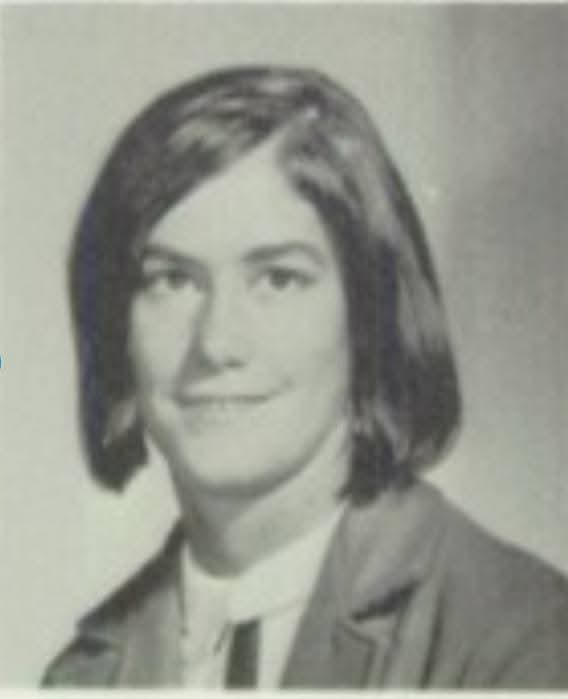
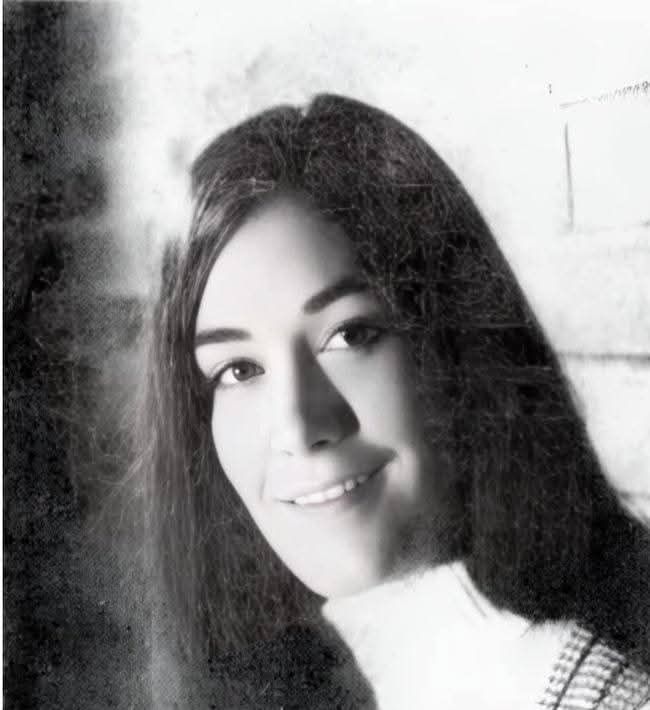
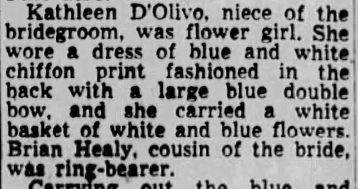
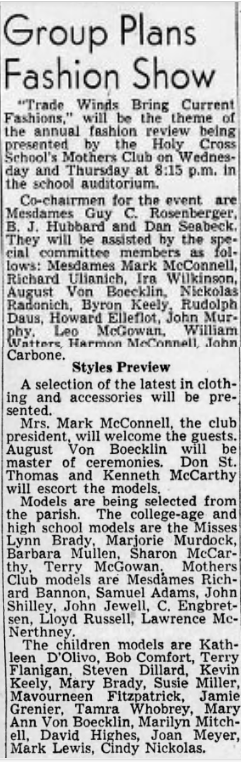
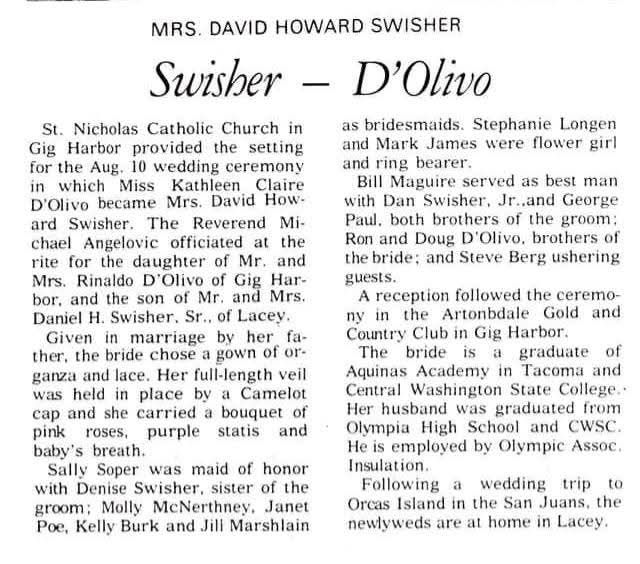
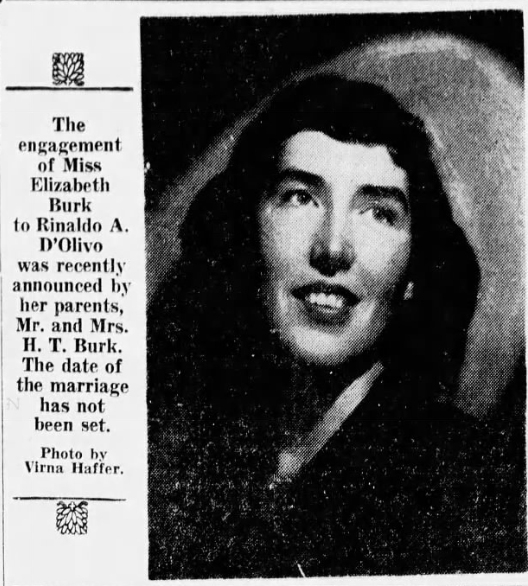
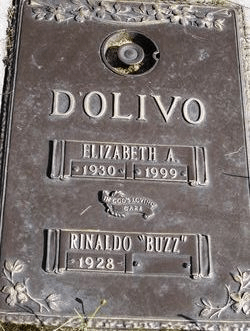
This is the second in a series about young women that were encountered by Ted Bundy on the Central Washington University campus in April 1974: Kathleen Clara D’Olivo was born on October 8, 1952 to Rinaldo and Elizabeth (nee Burk) D’Olivo in Tacoma WA. Rinaldo Anthony ‘Buzz’ D’Olivo was born on January 13, 1928 in Tacoma, and after graduating from Bellarmine Prep he served in the military during WWII; upon returning home he enrolled at Gonzaga University as a marketing major, and in 1974 he founded the company ‘Humdinger Fireworks.’ Kathy’s mother Elizabeth ‘Betty‘ Ann Burk was born on May 9, 1930 in Clare, Iowa. The couple were married on August 26, 1950 and went on to have three children together: Kathy, Douglas (b. 1954), and Rinaldo (b. 1956).
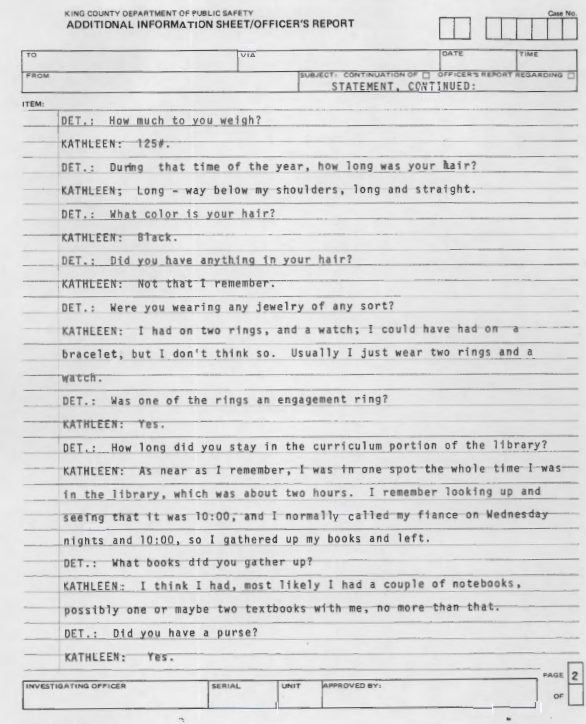
A traditional Italian beauty, Kathy was tall and slim, and stood at 5′ 9.5″ and weighed 125 pounds; she had hazel eyes and dark brown hair she wore long and parted down the middle. At the time of her encounter, she was living with a roommate in unit #21 at the Knissen Village Apartments located on 14th and ‘B’ Street.
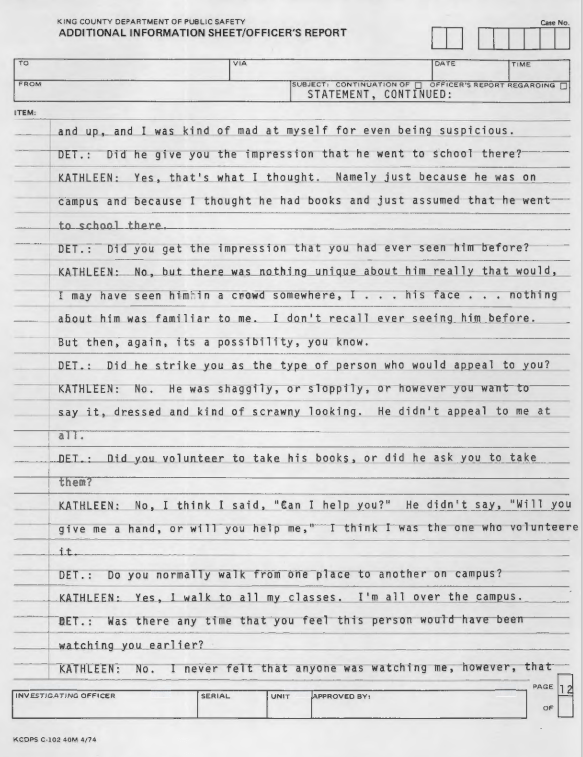
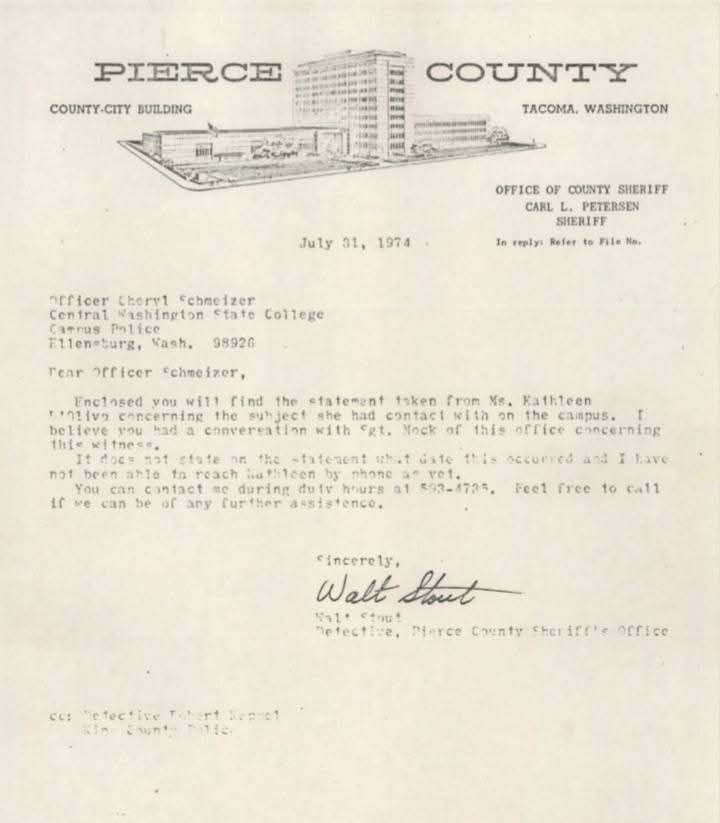
On the evening of Wednesday, April 17, 1974, twenty-one-year-old D’Olivo dropped her roommate off near downtown Ellensburg and drove to CWU’s campus, arriving just after 8:00 PM; she parked her car in the lot next to the Hertz Music Hall (located kitty corner to the library) and went into the main entrance of the Bouillon Library. In an interview with Detective Robert Keppel of the King County Sheriff’s Department on March 1, 1975, Kathleen said that ‘it was a clear night. I don’t remember it being extremely cold or extremely warm.’ She also stated that she was certain she was wearing blue jeans but wasn’t 100% sure of the top she had on, however she thinks it was most likely a blazer. Kathy was wearing two rings (one of them being her engagement ring) and said that she may have also been wearing a bracelet; at the time she was using a navy-blue cross-body purse.
Kathy stayed on the second floor of the library until around 10 PM, studying in an area known as the curriculum laboratory (don’t forget this location, I’m going to bring it up again later). But when she saw the clock nearing 10, she began gathering up her things, as it was time to head home and call her fiancé (a ritual she did every Wednesday at the same time). D’Olivo left the library same way she came in: through the front entrance. She then made a quick right and stepped off the concrete path and began making her way across the grass.
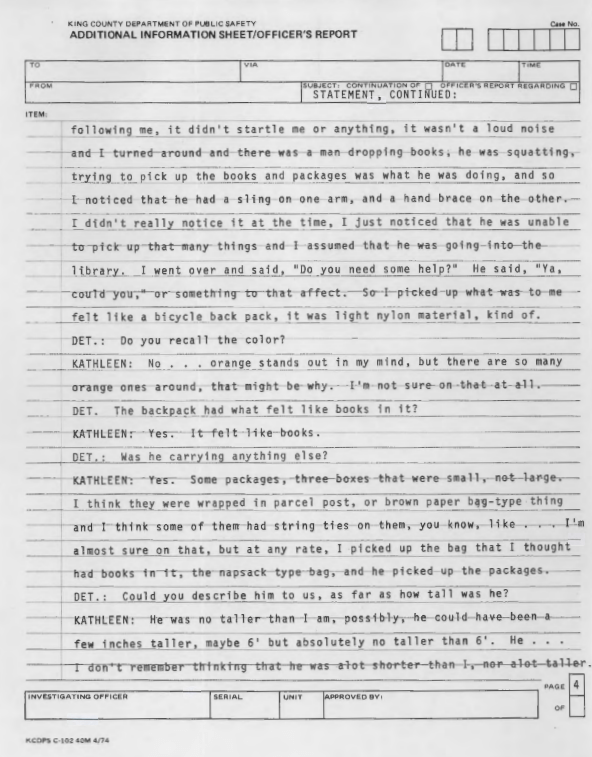
D’Olivo said that she ‘hadn’t quite gotten off the lawn, or sidewalk (wherever I was, I hadn’t reached the main mall stretch) when I heard something behind me. It sounded like something following me, it didn’t startle me or anything, it wasn’t a loud noise and I turned around and there was a man dropping books, he was squatting, trying to pick up the books and packages was what he was doing and so I noticed that he had a sling on one arm, and a hand brace on the other. I didn’t really notice it at the time, I just noticed that he was unable to pick up that many things and I assumed that he was going into the library. I went over and said, ‘do you need help?’ He said, ‘Ya, could you?,’ or something to that affect. So I picked up what to me felt like a bicycle backpack, it was nylon material, kind of.’ Kathy later clarified that he had his right arm in a sling but had metal braces on fingers of both hands, specifically the type that were used on broken fingers.
Kathleen told Detective Keppel that she wasn’t sure what was in the backpack, but it felt like books, and he also had with him ‘some packages, three boxes that were small, not large. I think they were wrapped in parcel post, or brown paper bag-type thing and I think some of them had string ties on them, you know, like… I’m almost sure on that, but at any rate, I picked up the bag that I thought had books in it, the knapsack type bag, and he picked up the packages.’
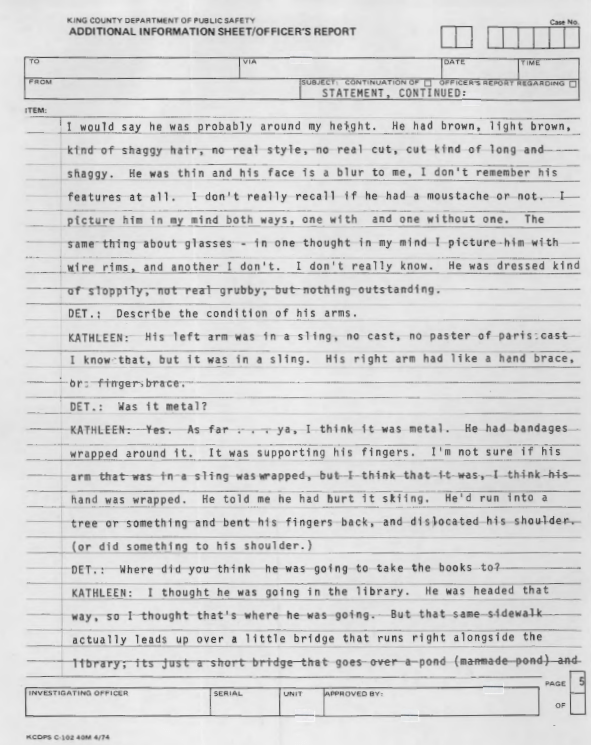
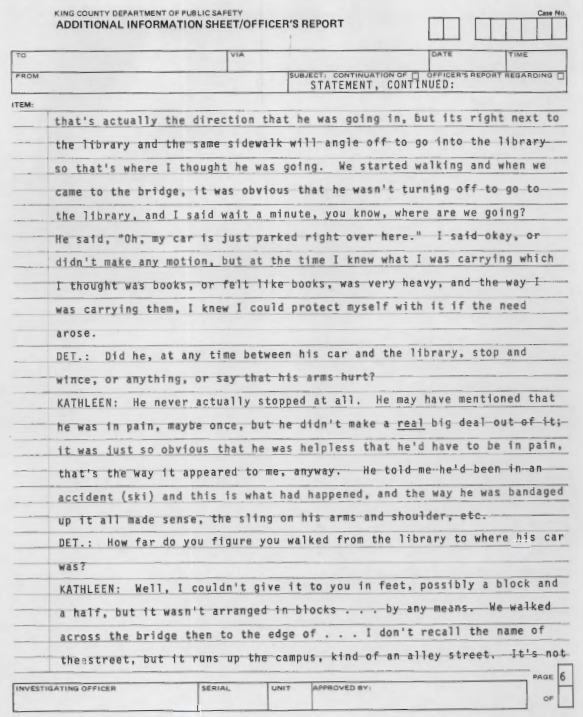
When Detective Keppel asked Kathy where she thought he was taking her as they began their walk, she replied ‘I thought he was going in the library. He was headed that way, so I thought that’s where he was going. But that same sidewalk actually leads up over a little bridge that runs alongside the library, it’s just short bridge that goes over a pond (man-made pond) and that’s actually the direction that he was going in, but its right next to the library and the same sidewalk will angle off to go into the library so that’s where I thought he was going. We started walking and when we came to the bridge, it was obvious that he wasn’t turning off to go to the library, and I said wait a minute, you know, where are we going? He said, ‘oh my car is just parked right over here.‘ I said okay, or didn’t make any motion, but at the same time I know what I was carrying which I thought was books, or felt like books, was very heavy, and the way I was carrying them, I knew I could protect myself with it if the need arose.’
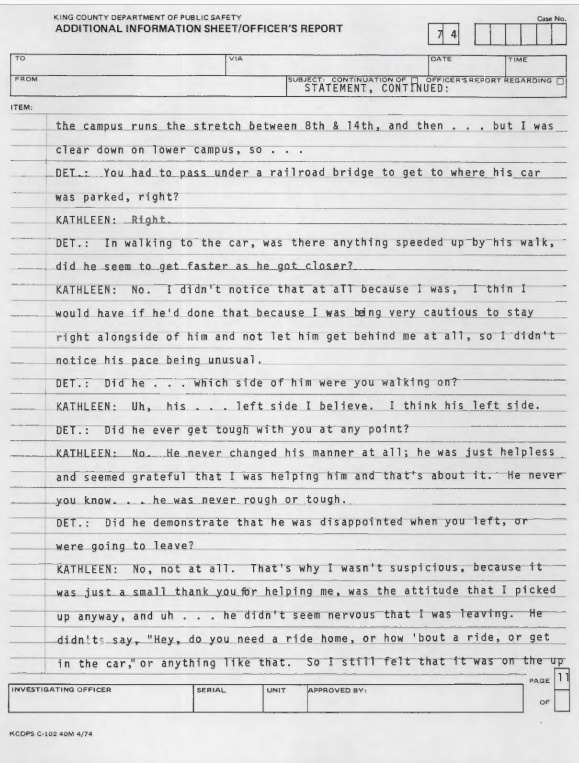
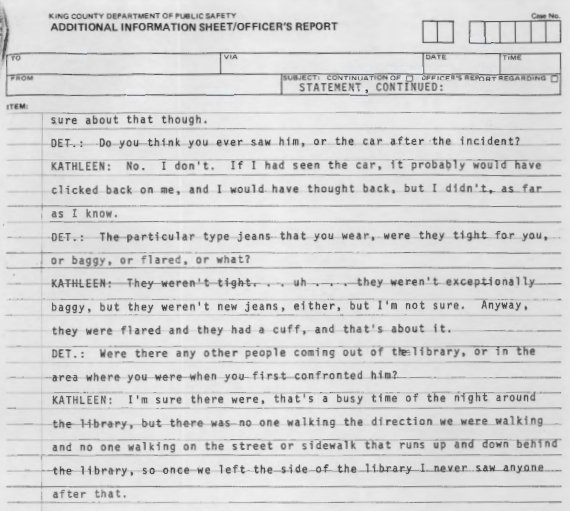
But instead of continuing on the pathway to the Library, the man started walking across the bridge, which immediately threw up a red flag for D’Olivo, and she said to him, ‘well, wait a minute, were are you going?’ He said, ‘well my cars just over here.’ I said, ‘okay,’ so we started walking across the bridge and we were maybe a quarter the way across the bridge and he began telling me about his ski injuries and that conversation took us up to by the other side of the bridge and a little ways beyond that, and then I asked him again, ‘well, where’s your car?’ I expected it to be parked on the street that’s right behind the library. He said, ‘oh, its just right here.’ Then we walked under the trestle to the right there, and it was just barely down that dark stretch.’ She said at that time she ‘assessed the situation,’ and said she ‘was extremely cautious while with him. I never gave him the opportunity of walking behind me.’
When Detective Keppel asked Kathleen what the man looked like, she said he ‘was no taller than I am, possibly, he could have been a few inches taller, maybe 6’ but absolutely not taller than 6’… I don’t remember thinking that he was a lot shorter than I, nor a lot taller. I would say he was probably around my height. He had brown, light brown kind of shaggy hair, no real style, no real cut, cut kind of long and shaggy. He was thin and his face is a blur to me. I don’t remember his features at all. I don’t really recall if he had a mustache or not. I picture him in my mind both ways, one with and without one. The same thing about glasses: in one thought in my mind, I picture him with wire rims, and another I don’t. I don’t really know. He was dressed kind of sloppily, not real grubby, but nothing outstanding.’
When asked about the condition of his arms, D’Olivo said ‘his left arm was in a sling, no cast, no plaster of Paris cast I know that, but it was in a sling. His right arm had like a hard brace, or finger brace.’ … ‘I think it was metal. He had bandages wrapped around it. It was supporting his fingers. I’m not sure if his arm that was in a sling was wrapped, but I think that it was. He told me that he had hurt it skiing. He’d run into a tree or something and bent his fingers back, and dislocated his shoulder (or did something to his shoulder).’ She clarified that he did not tell her where the accident happened.
When Keppel asked her if the man ever showed signs of being in any sort of pain from his injury, D’Olivo said that ‘he may have mentioned that he was in pain, maybe once, but he didn’t make a real big deal out of it; it was just so obvious that he was helpless that he’d have to be in pain, that’s the way it appeared to me, anyway. He told me that he’d been in an accident (ski) and this is what happened, and the way he was bandaged up it all made sense, the sling on his arms and shoulder, etc.’
Additionally, she recalled that he was soft spoken, and was dressed ‘sloppily, not real grubby, but nothing outstanding,’ and may have worn jeans with a wrinkled shirt, with ‘the tail hanging out.’ When asked if she recalled what the man was wearing, and if he had on for instance a short or jacket she said, ‘it seems to me that he had a shirt on, like a sport shirt, it was very sloppy or wrinkly looking. It seems to me he had a shirt-tail hanging out. I mean, intentionally hanging out, wearing it on the other side of his pants. I don’t remember what type of pants he had on, just all-around kind of grubby, like jeans or something like that.’
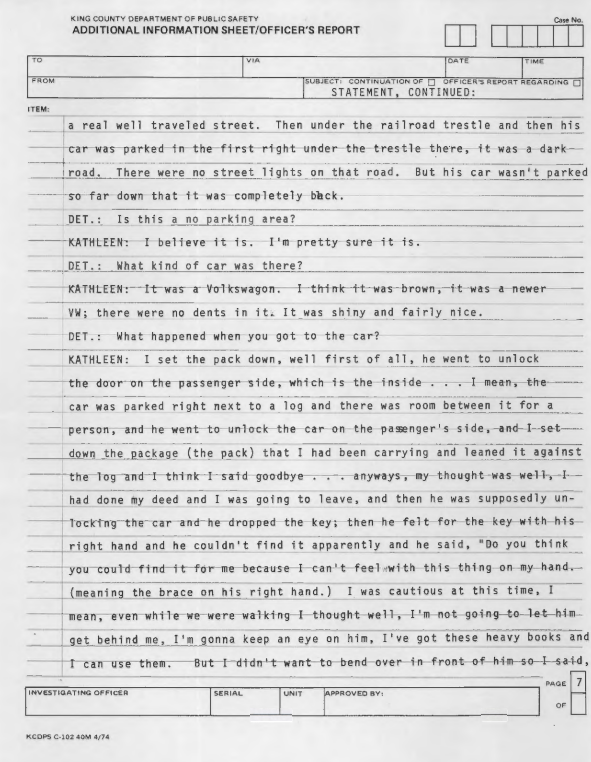
Kathy said that the strangers car was parked on 10th Street, and as they got closer to it she noticed that it was a ‘no parking’ area on the outskirts of campus and was in a secluded, dimly lit area that was ‘not well travelled.’ During their walk, D’Olivo said he talked about how much pain he w as in, and as they went under the railroad trestle, she said that she could vaguely make out the shape of a VW Bug in the distance that was parked to the right of the large trestle: ‘it was a dark road. There were no streetlights on that road … but it wasn’t completely black.’ This would make sense, as the only light available to them was from the library and an adjacent building, both of which were a fair distance away.’
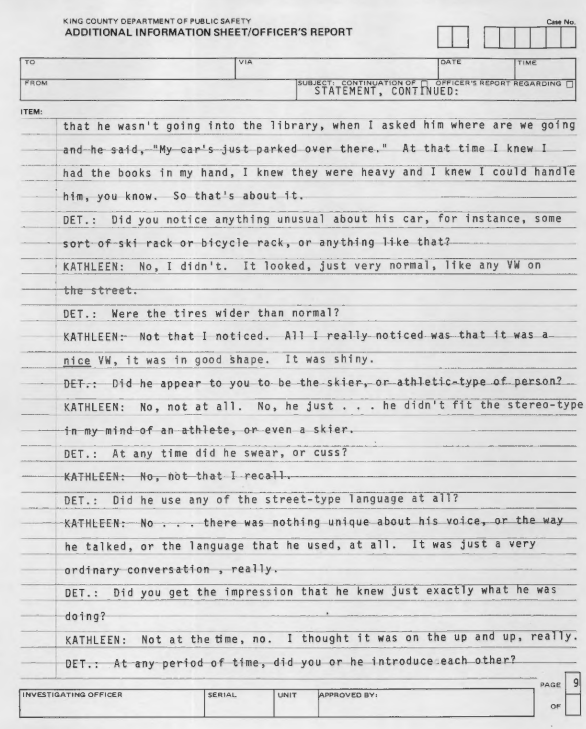
When they got to the car, Kathy said that she ‘set the pack down, well first of all, he went to unlock the door on the passenger side, which is the inside… I mean, the car was parked right next to a log and there was room between it for a person, and he went to unlock the car on the passengers side, and I set down the package (the pack) that I had been carrying and leaned it against the log and I think I said goodbye… anyways, my thought was well, I had done my deed and I was going to leave, and then he was supposedly unlocking the car and he dropped the key; then he felt for the key with his right hand and he couldn’t find it apparently and he said, ‘do you think you could find it for me because I can’t feel with this thing on my hand (meaning the brace on his right hand. I was cautious this time, I mean, even while we were walking I thought well, I’m not going to let him get behind me, I’m going to keep an eye on him, I’ve got these heavy books and I can use them. But I didn’t want to bend over in front of him so I said, lets step back and see if we can see the reflection in the light, so we stepped behind the car, kind of behind the car to the side, and I squatted down and luckily I did see the reflection of the key in the light so I picked up the key and dropped them in his hand and I said goodbye and good luck, or something with your arms, or something to that effect, and that was the end of the conversation.’ She also said that the lack of light made the VW appear shiny and brown in color and that it appeared to be in good shape (which we know isn’t exactly true), and as far as Kathy could remember it did not have a ski rack on top of it.
When Detective Keppel asked D’Olivo if she thought the man’s intentions were sincere, she told him, ‘yes, I did… Ya, and I thought he was just going into the library, it was just a short distance and her really did need help and I thought I could help him.’ She also said that nothing seemed unusual about his car when she was asked, and about it said: ‘it looked, just very normal, like any VW on the street.’ … ‘All I really noticed was that it was a nice VW, it was in good shape. And it was shiny.’
When Detective Keppel asked Kathy if she happened to notice if the VW’s front seat was missing on the passengers side, she replied that she ‘left before he opened the car. I didn’t notice it and I was right alongside the car on the passengers side. I think I would have if there had been a seat missing, but I can’t be certain on that, but it seemed all intact to me and in good shape.’ Like Jane Curtis, she said that the car had no particular odor associated with it, like cigarettes or marijuana smoke.
When asked if the man seemed disappointed when she left him, Kathleen said, ‘no, not at all. That’s why I wasn’t suspicious, because it was just a small thank you for helping me, was the attitude that I picked up anyway, and uh… he didn’t seem nervous that I was leaving. He didn’t say, ‘hey, do you need a ride home’ or ‘how ’bout a ride? or get in the car,’ or anything like that. So I still felt that it was on the up and up, and I was kind of mad at myself for even being suspicious.’ When asked if she remembered seeing him around campus (before and after the incident), she said: ‘there was nothing unique about him really that would. I may have seen him in a crows somewhere… I… his face… nothing about him was familiar to me. I don’t recall ever seeing him before.’ Kathleen also said that he was not ‘very appealing’ to her, and ‘he was shaggily, or sloppily, or however you want to say it, dressed and kind of scrawny looking. He didn’t appeal to me at all.’ Ms. D’Olivo further clarified that the stranger was not clean cut nor a hippy, but was ‘kind of weird looking, and when asked if he appeared to be athletic, she replied, ‘no, not at all. No, he just… he didn’t fit the stereotype in my mind of an athlete, or even a skier.’
Another young woman that may have had an encounter with Ted Bundy on Central Washington University’s campus is Jane Marie Curtis: at first I believed Jane’s encounter took place earlier in the same evening that Sue Rancourt was abducted (because that’s the date that was given in everything I’ve read about her), but after reading her interview with Detective Keppel I learned it actually took place on a Sunday evening, most likely on April 14, 1974 or April 21, 1974. Like Kathleen, Curtis had been spending time at the Curriculum Lab at CWU and ‘ran into’ Bundy as she was walking out of the main entrance at the Bouillon Library. She said he used the same ruse that he did with D’Olivo: he had been in a skiing accident and needed help carrying some heavy books to his car, as his arm was in a (poorly made) sling. Like Kathy, Curtis was lucky and managed to leave Bundy alive.
Kathy D’Olivo and Jane Curtis were both able to escape with their lives, but unfortunately Susan Rancourt was not so fortunate: later in the evening on April 17, 1974 around 10/10:30 PM Bundy stumbled upon the pretty young Biology major as she left a meeting about becoming an RA the following school year. After the meeting she had plans to see a German film with a friend but she never made it, and it didn’t take long for her friends and family to become worried, and by 3:00 AM her roommate Diana Pitt called the dorm manager, saying: ‘I got worried she wasn’t back.’ Parts of Rancourt’s skeleton were discovered in Taylor Mountain in March 1975 after two forestry students uncovered multiple sets of human remains; after combing the area, the King County Sheriff’s Department discovered four skulls in total as well as an assortment of other human bones.
In addition to Sue Rancourt, forensic experts were able to determine that the remains belonged to University of Washington coed Lynda Ann Healy, University of Oregon student Roberta Parks, and twenty-two-year-old loner Brenda Carol Ball. Later in the same day that Sue’s skull was identified, the King County ME took X-rays of her skull and mailed them special delivery to her dentist in Alaska, who confirmed it was her. According to CWU’s Police Chief Al Pickles: ‘there were several points of identification that made us almost sure the skull was Rancourt’s. This switches the case from a missing person to a homicide.’
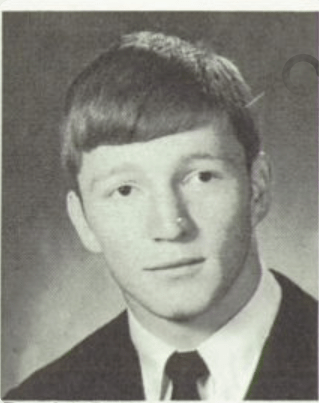
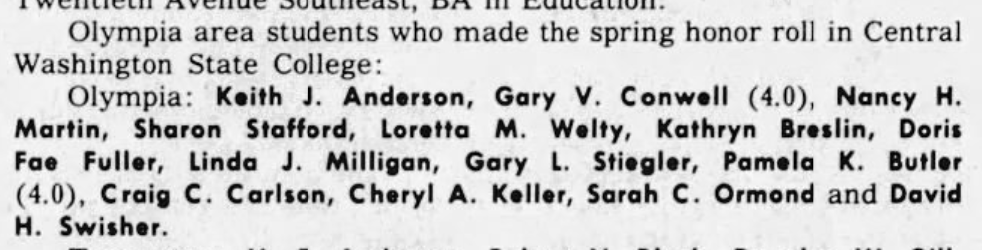
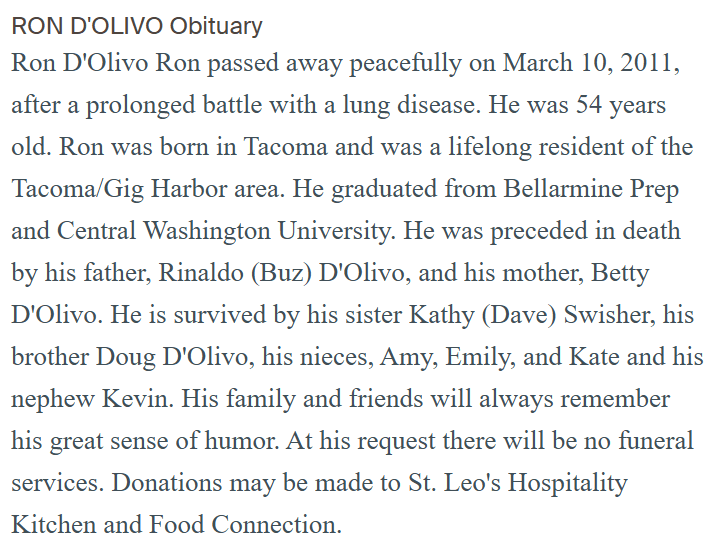
Elizabeth D’Olivo passed away at the age of sixty-eight on March 15, 1999 in Mexico. According to her obituary, Betty was a member of St. Charles Borromeo Church and her life revolved around her friends and family, and she especially loved her four grandchildren. Kathy’s father Rinaldo passed away at the age of eighty on November 22, 2008 in their winter home in San Carlos, Mexico. According to his obit, he continued working in his family’s fireworks company until his time of his death. Kathy’s brother Ron died at the age of fifty-four on March 10, 2011 after a prolonged battle with lung disease. Douglas D’Olivo is currently a seventy-one-year-old resident of University Place, WA. Kathleen and David are still married and reside in University Place, WA; they have two grown daughters together: Amy and Emily.

















 Another Bundy Blog.