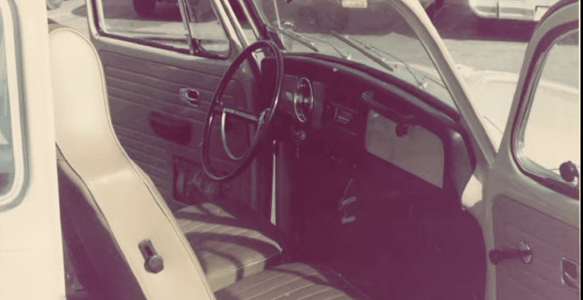
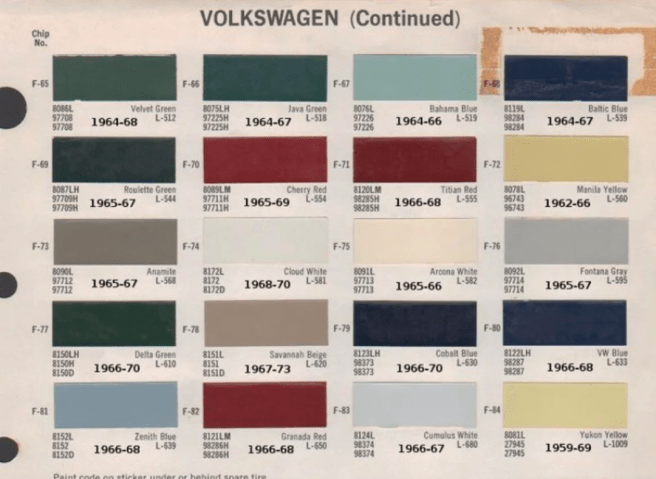
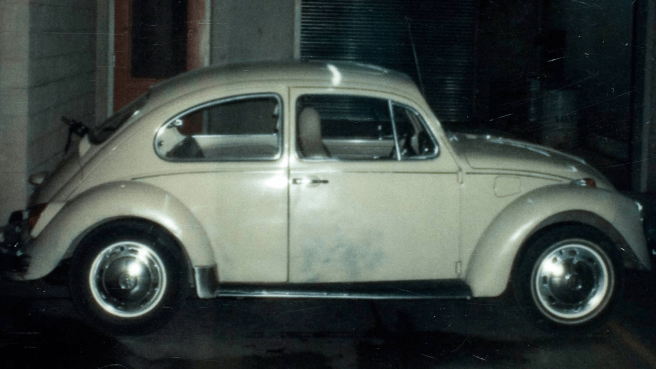
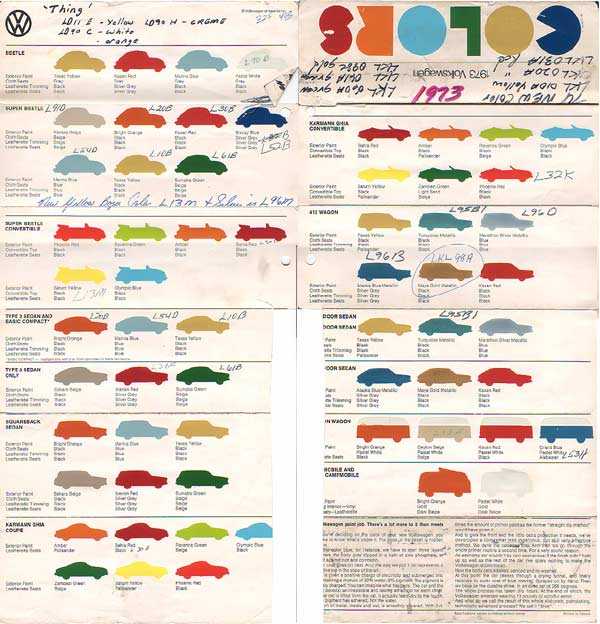
Technically, the color of Ted Bundy’s infamous 1968 Volkswagen Beetle is ‘Savannah Beige (also at times known as ‘Savanna Beige’), and in Volkswagen’s official 1968 paint catalog, this color is designated as L-620. Because of the extreme amount of weathering and fading (and rust), the car often appears to be a variety of different colors: over the years, I have heard it described as dusty, tan, ‘brownish,’ beige, off-white, cream, and of course yellow. As of July 2026, the vehicle is on display at the Alcatraz East Crime Museum in Pigeon Forge, Tennessee.
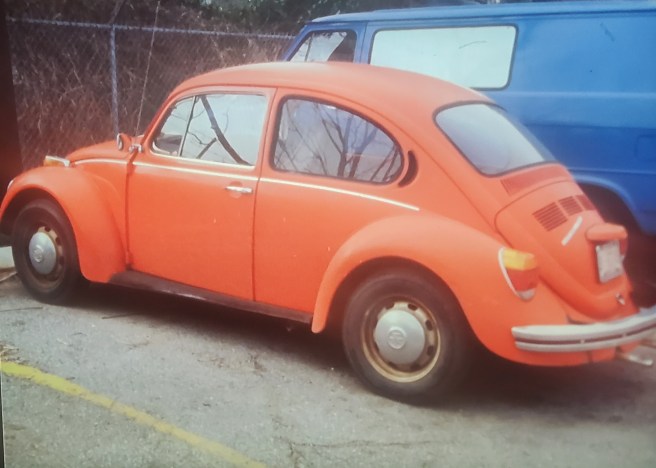
Although his 1968 Savanna Beige VW is Bundy’s most notorious car, he was caught for the last time in Pensacola on February 15, 1978 driving a completely different, stolen Volkswagen Bug: the orange 1972 orange ‘Super Beetle’ belonged to Rick Garzaniti, a massage therapist from Tallahassee, Florida. He had left his keys inside the car while he ran inside of a residence (I believe he was picking his kid up from the babysitter) as it was parked in an alleyway and as we know, the rest is history. After Ted’s arrest, law enforcement held the Super Beetle for about eight weeks to process it for evidence, and when it was finally returned to its rightful owner, it had been covered in fingerprint dust and forensic markings; because of this he no longer felt comfortable driving it, Garzaniti sold it four months later to a local family for $1,310.
It is worth noting, Elizabeth Kendall owned a 1973 light blue Volkswagen Beetle (I couldn’t find any pictures of it) while she was dating Ted, I believe she referred to it was ‘robin’s egg blue’ in her memoir. According to Google, there could be two possible factory paint matches for the color: Neptune Blue (Color Code: L50K) or the slightly brighter Marina Blue (Color Code: L54D); it was never specified anywhere which color she drove. According to Kendall, he crashed it in 1974 and almost totaled it, but she got it fixed and ‘drove it another 50,000 miles.’
According to the possible factory paint matches, Bundy’s 1968 VW Bug was ‘Savannah Beige.’ The front of Ted’s 1968 VW Bug.Ted’s 1968 VW Beetle.1972 Volkswagen Colors. Printed in the USA. Distributed by Volkswagen dealers.1972 Volkswagen Super Beetle Colors. Rick Garzaniti standing next to his orange 1972 orange Volkswagen Super Beetle.A picture of Rick Garzaniti’s orange 1972 orange Volkswagen Super Beetle shortly after Bundy was apprehended. A ‘Super Beetle’ is a larger, upgraded version of the classic Bug that was introduced by Volkswagen in 1971 and sold until 1979; where it looks very similar to a standard Beetle at first glance, Volkswagen designed the car to be more comfortable, hold more luggage, and handle better on modern roads.1973 Volkswagen Colors. A 1973 Neptune Blue VW Bug.A 1973 Marina Blue VW Bug.
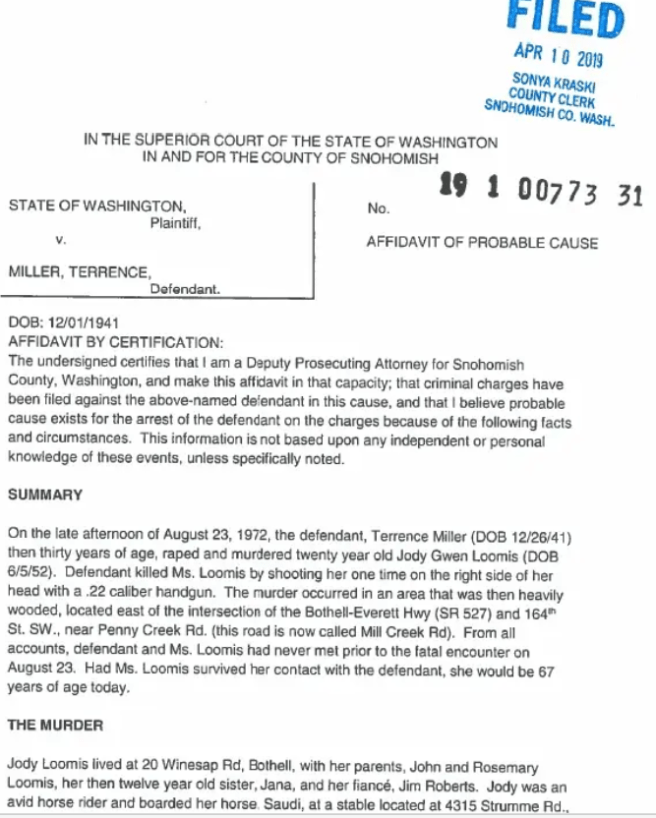
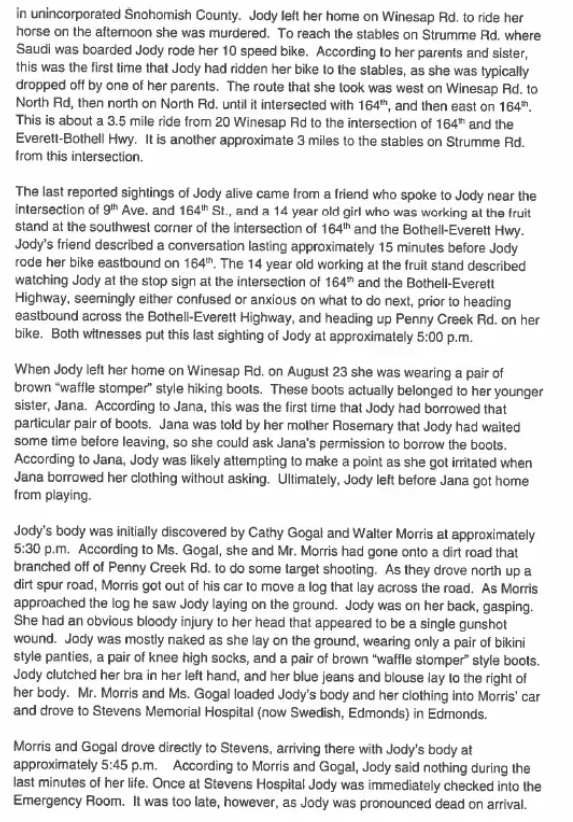
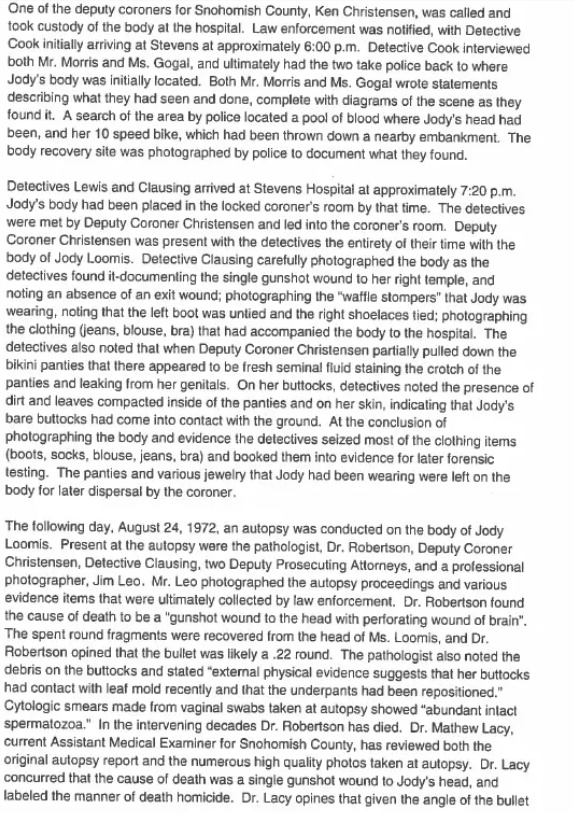
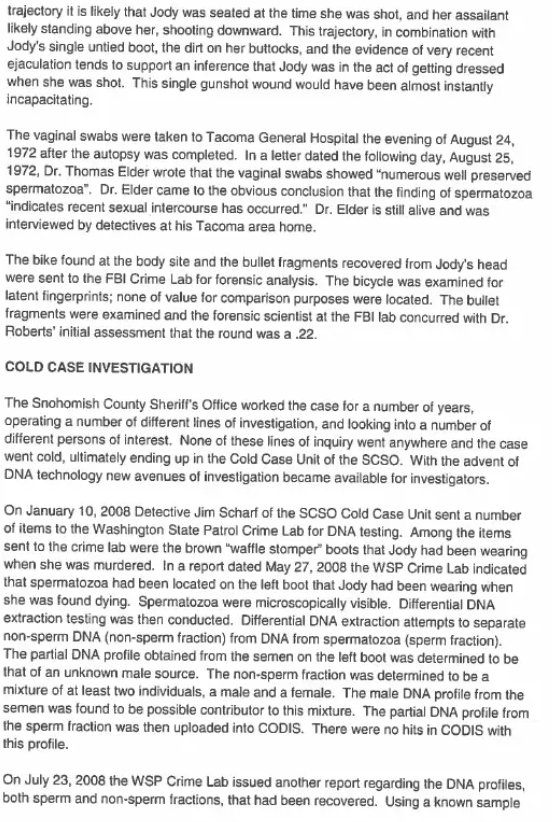
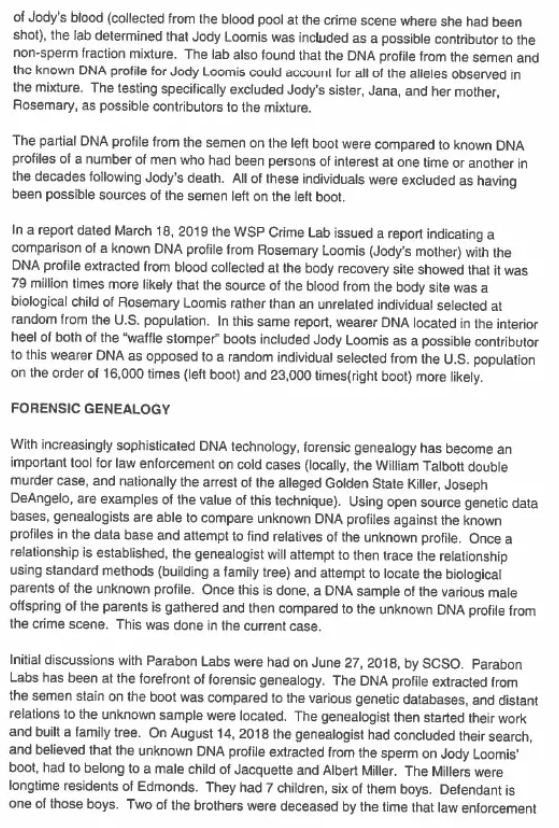
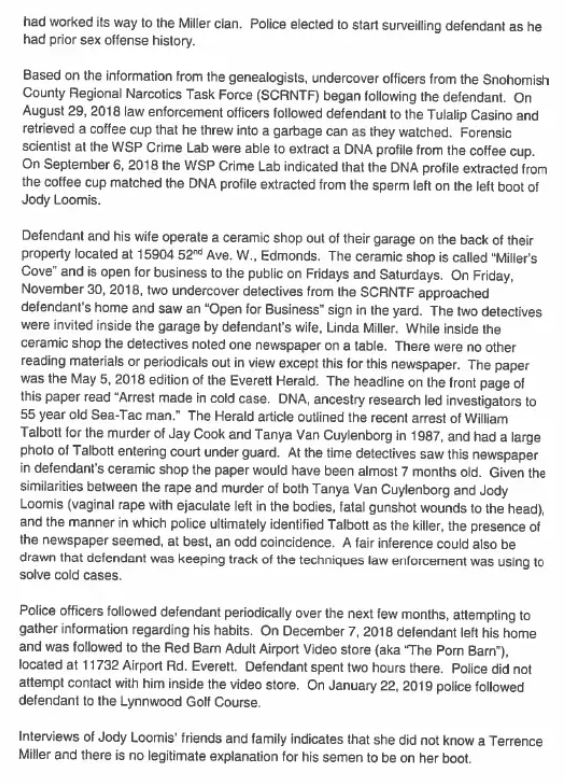
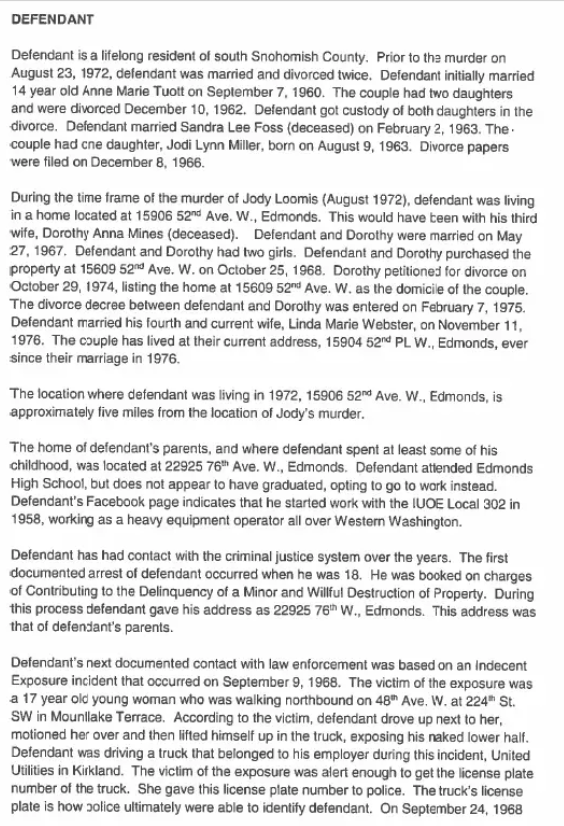
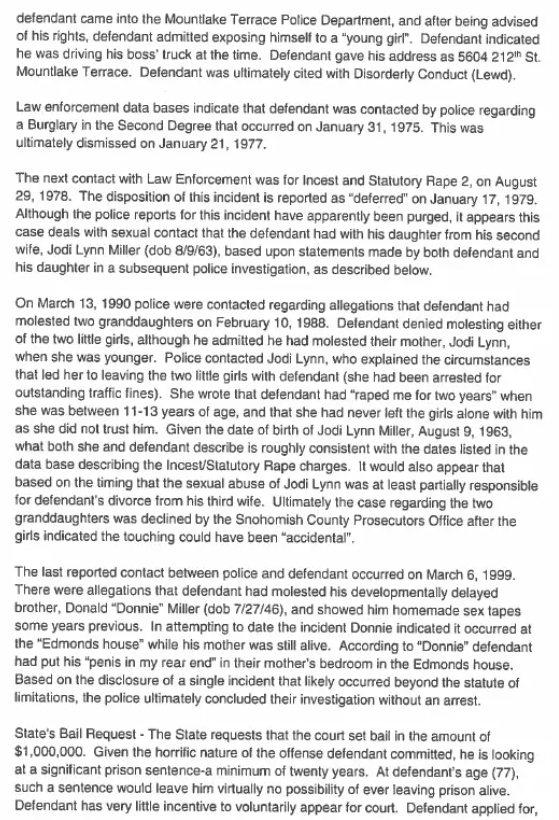
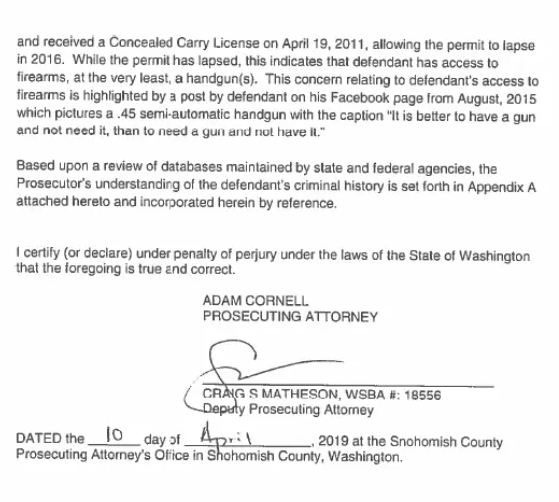
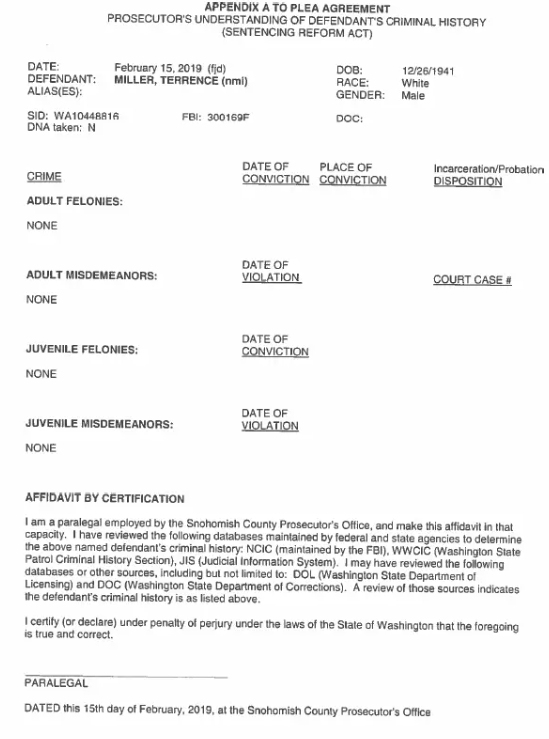
Page one of the affidavit associated with the arrest of Terrence Miller.Page two of the affidavit associated with the arrest of Terrence Miller.Page three of the affidavit associated with the arrest of Terrence Miller.Page four of the affidavit associated with the arrest of Terrence Miller.Page five of the affidavit associated with the arrest of Terrence Miller.Page six of the affidavit associated with the arrest of Terrence Miller.Page seven of the affidavit associated with the arrest of Terrence Miller.Page eight of the affidavit associated with the arrest of Terrence Miller.Page nine of the affidavit associated with the arrest of Terrence Miller.Page ten of the affidavit associated with the arrest of Terrence Miller.Page eleven of the affidavit associated with the arrest of Terrence Miller.Page twelve of the affidavit associated with the arrest of Terrence Miller.
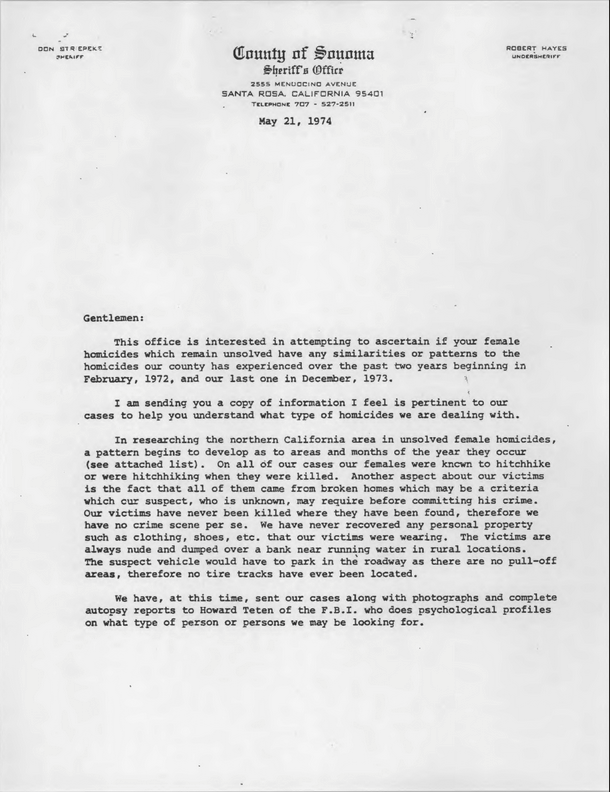
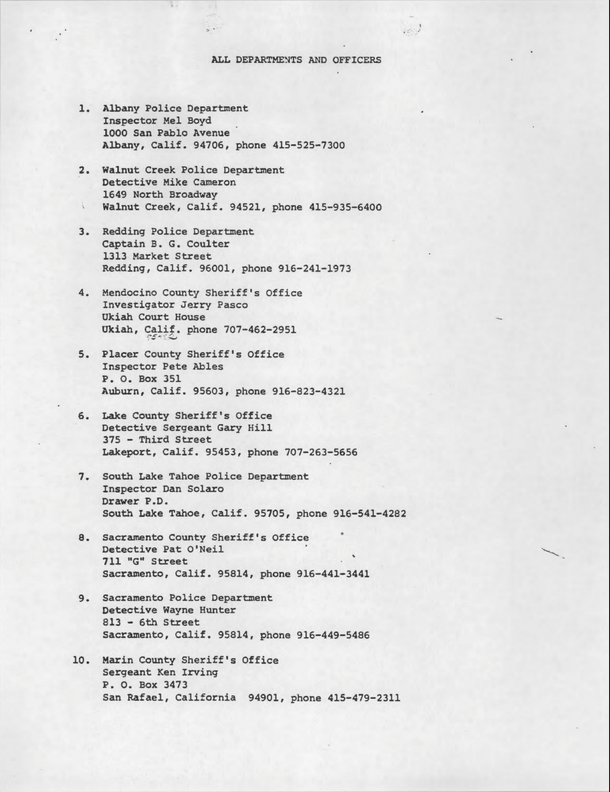
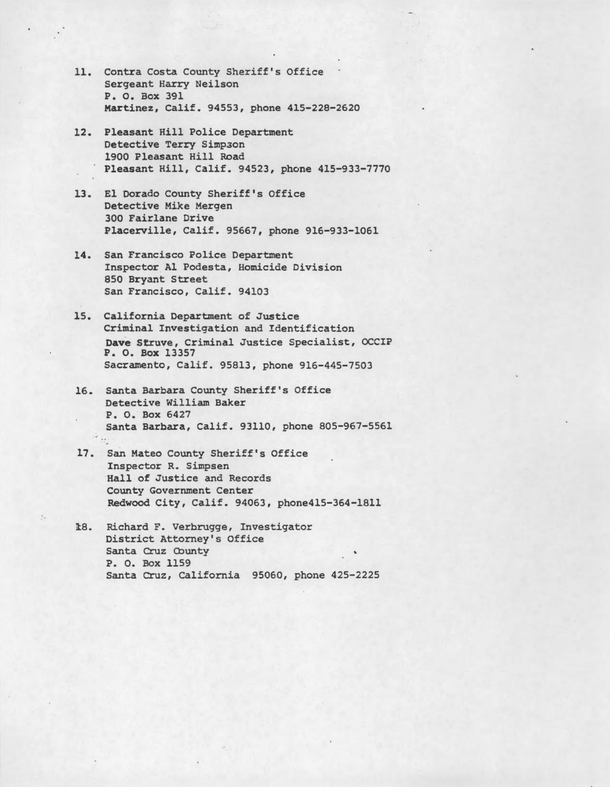
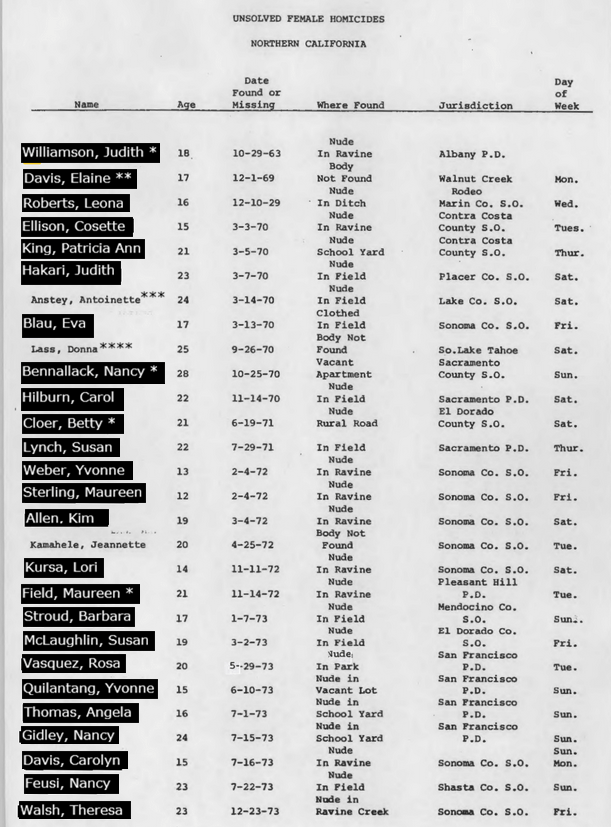
The record below specifically consists of pages 55, 63-64, and 69-70 from Box 25, Folder 11, “924-25-11 California Criminal Intelligence” of the King County Archives’ Dropbox. All information courtesy of cacoldcases.blogspot.com.
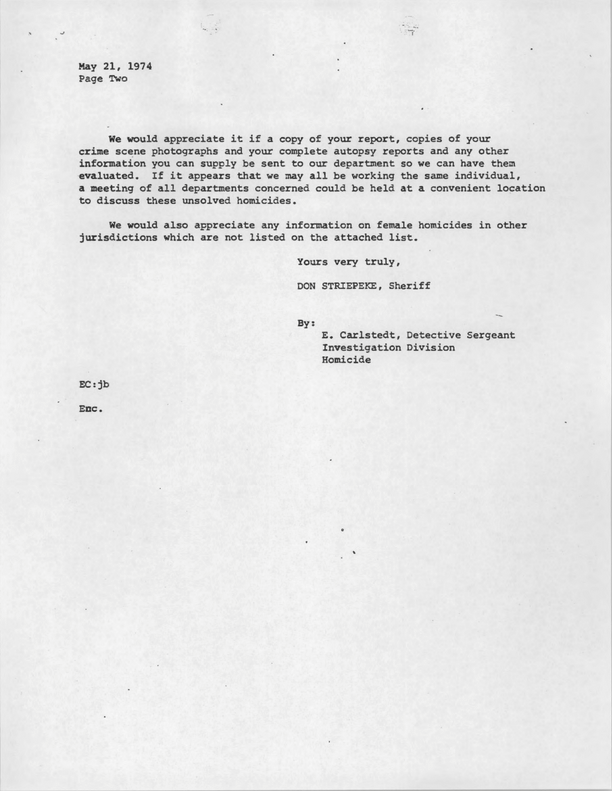
Page one of a letter from Sonoma County Sheriff on Don Striepeke written on May 21, 1974 to various LE agencies regarding the recent string of homicides in the Santa Rosa area.Page two of a letter from Sonoma County Sheriff on Don Striepeke written on May 21, 1974 to various LE agencies regarding the recent string of homicides in the Santa Rosa area.Page one of the policing agencies that Sonoma County Sheriff on Don Striepeke sent the above letter to.Page two of the policing agencies that Sonoma County Sheriff on Don Striepeke sent the above letter to.An unredacted version of the list of victims, courtesy of cacoldcases.blogspot.com
Preface: I don’t normally have to do this, as I don’t normally write about people that are still alive, but every member of Warren Leslie Forrest’s nuclear family is not only still with us, but (most of them) are going by their original surname. Because of this, I do feel the need to say that finding the information I did was just a quick Google search away, and it took me all of about three minutes to find most of it… I didn’t hire anyone to track them down or figure out their identities: it was all right there.
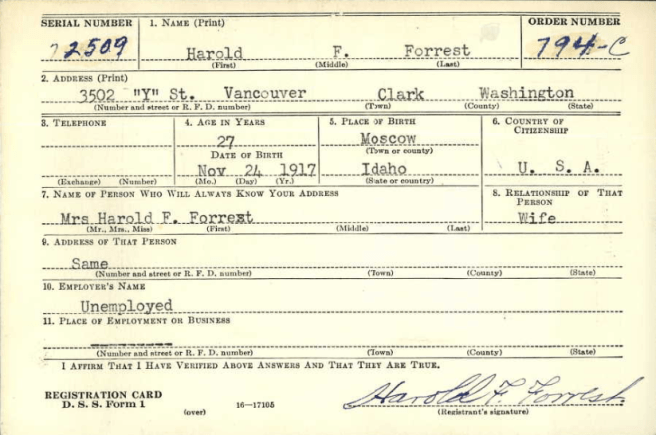
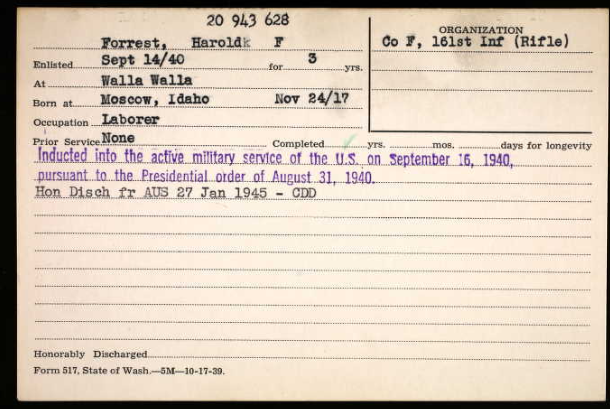
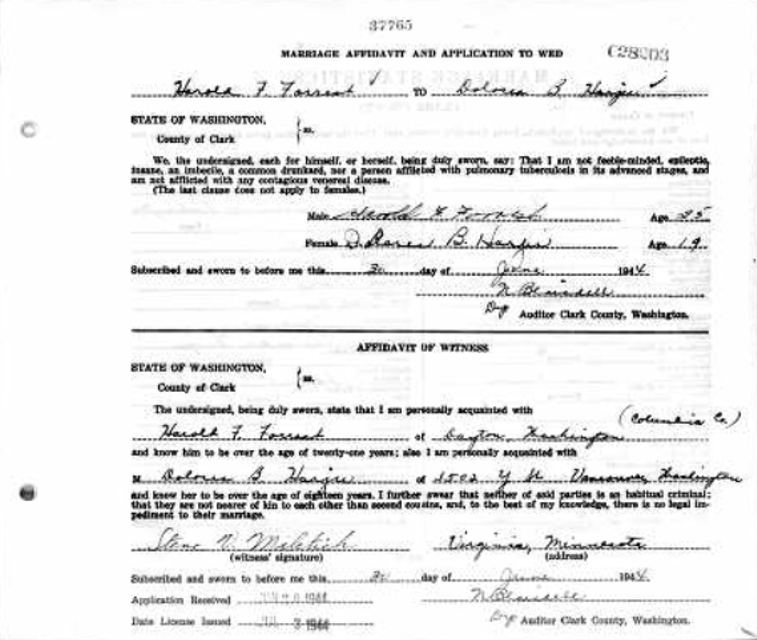
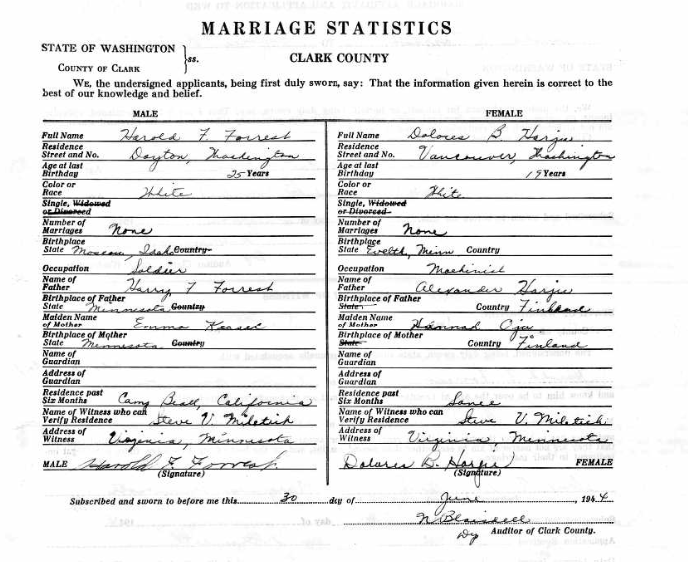
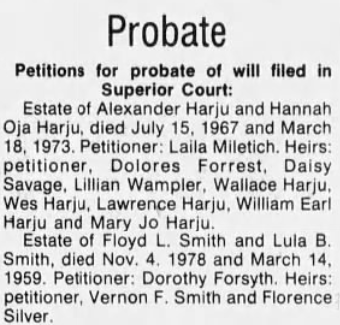
Introduction:Warren Leslie Forrest was born on June 29, 1949 to Harold and Dolores Forrest in Vancouver, WA. Harold Fred Forrest was born on November 24, 1917 in Moscow, Idaho and Dolores Beatrice Harju was born on June 20, 1925 in Eveleth, Minnesota. At the age of twenty-seven on September 16, 1940, Harold was inducted into active military service with the US Army in pursuant to the Presidential order of August 31, 1940 (also known as the Burke-Wadsworth Act), which required all men between twenty-one and thirty-six years of age to register with their local draft boards (when the US entered World War II, all men from eighteen to forty-five were subject to military service, and all males from eighteen to sixty-five were required to register with their local draft boards).
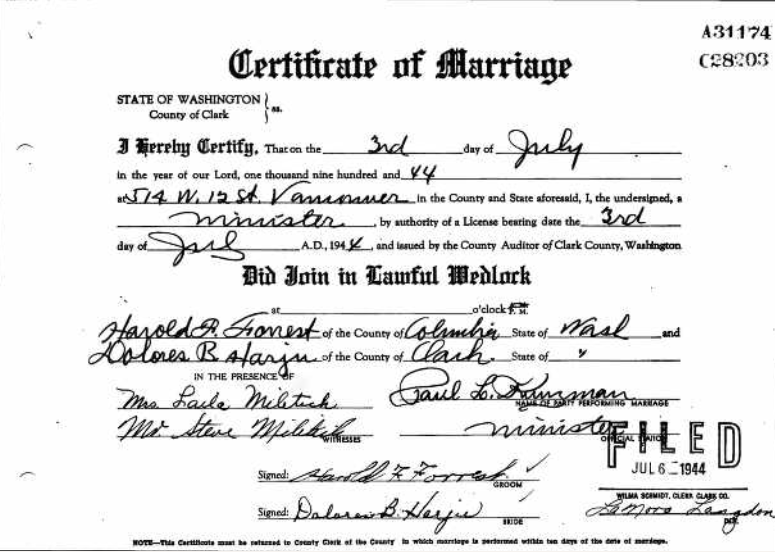
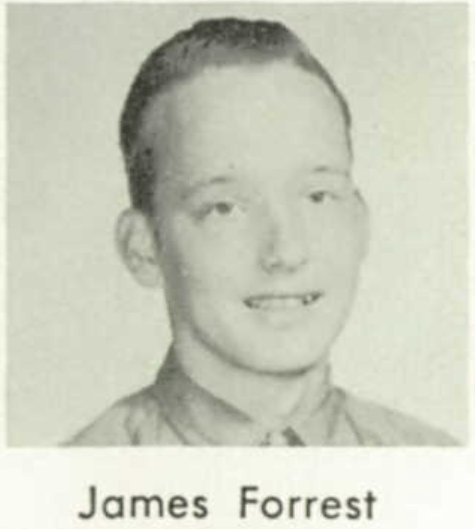
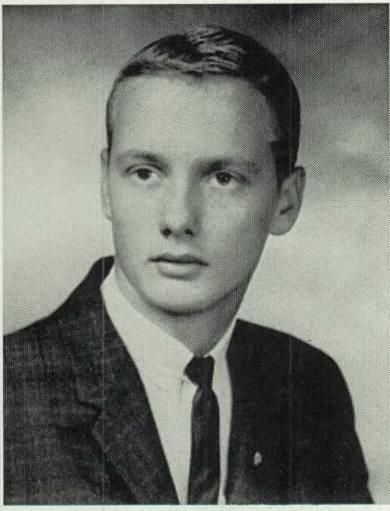
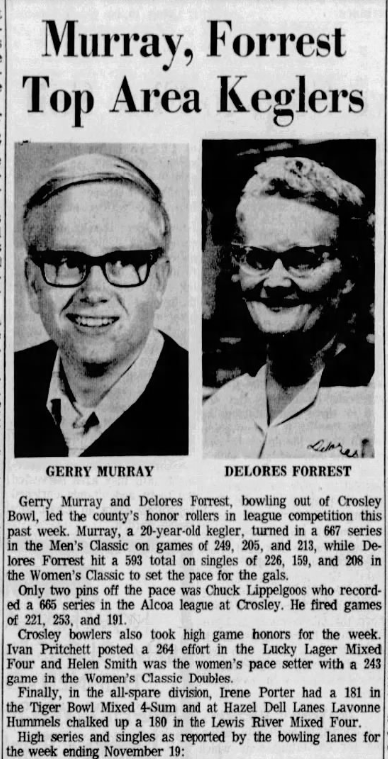
Mr. Forrest and Dolores were wed on July 3, 1944 in Vancouver, and he was honorably discharged from the military on January 27, 1945; they went on to have three boys together: James (b. 1946), Marvin (b. 1948), and their youngest, Warren. Growing up, his father worked at the Veterans Administration during the day and at night he was employed at a cold storage plant; his mother was employed at a cannery then later in retail. During an interview with a psychiatrist (after his arrest), Warren described his father as ‘stern’ and his mother as ‘overbearing and controlling,’ and claimed that she used to tease him about a piece of wood she used referred to as ‘one of his good friends’ (it was a 4×4 post that he talked to when he was a small child).
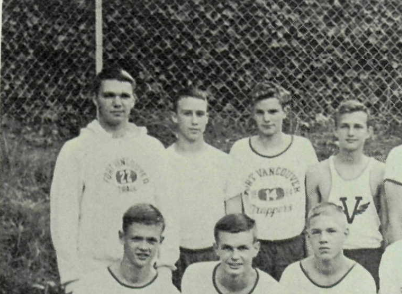
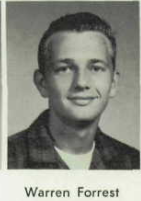
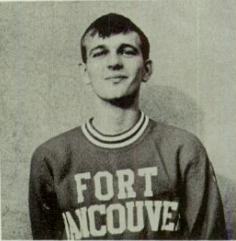
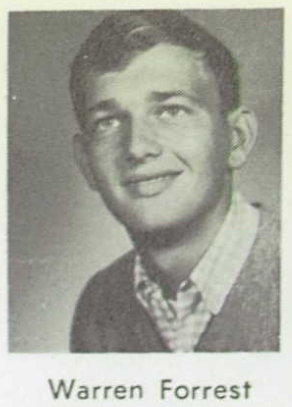
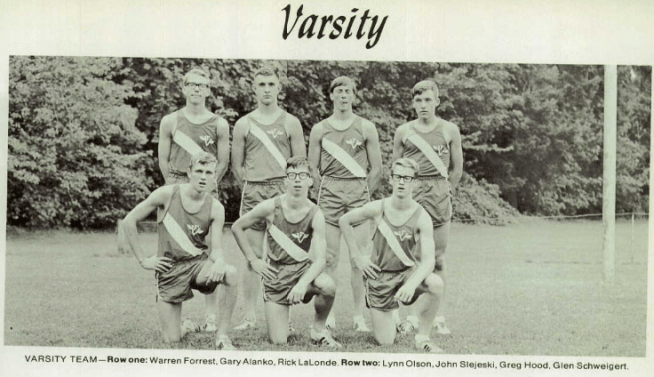
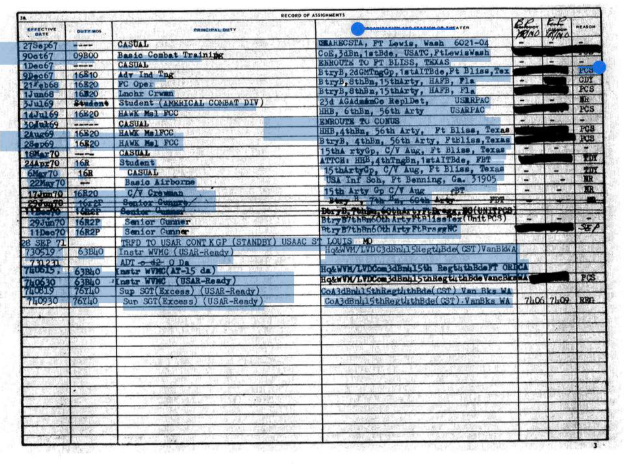
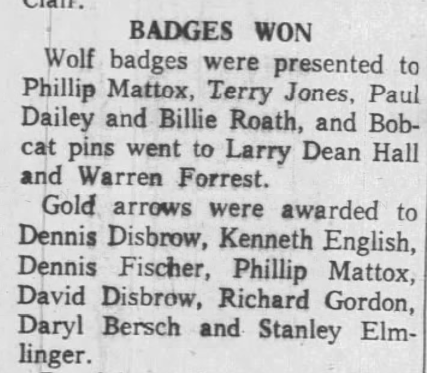
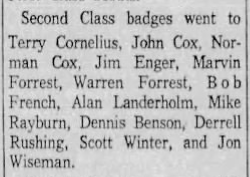
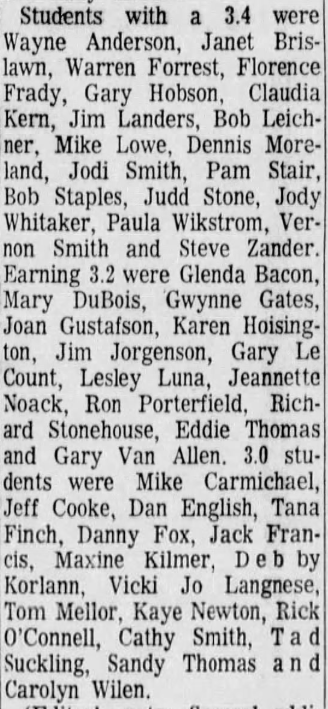
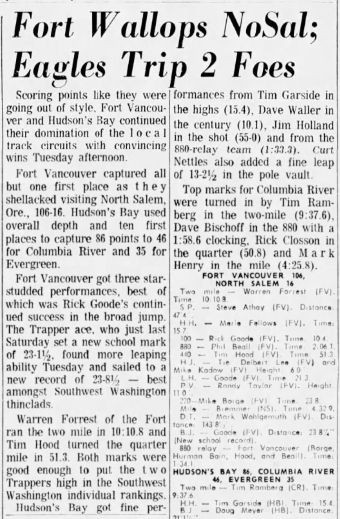
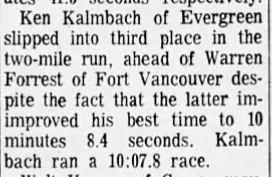
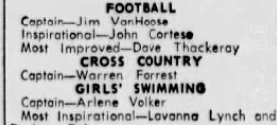
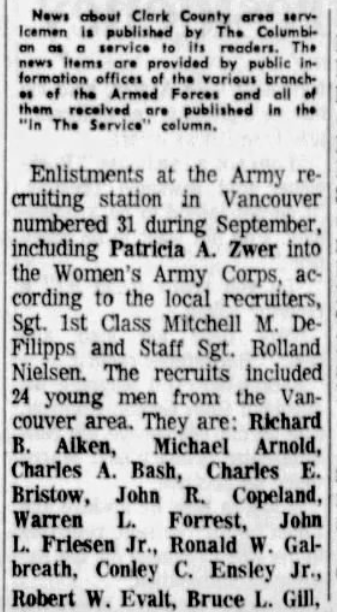
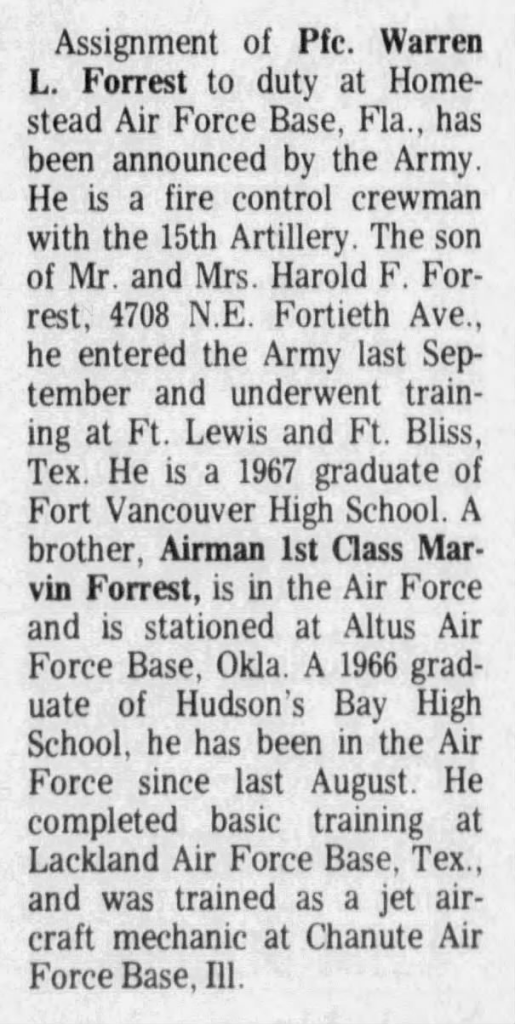
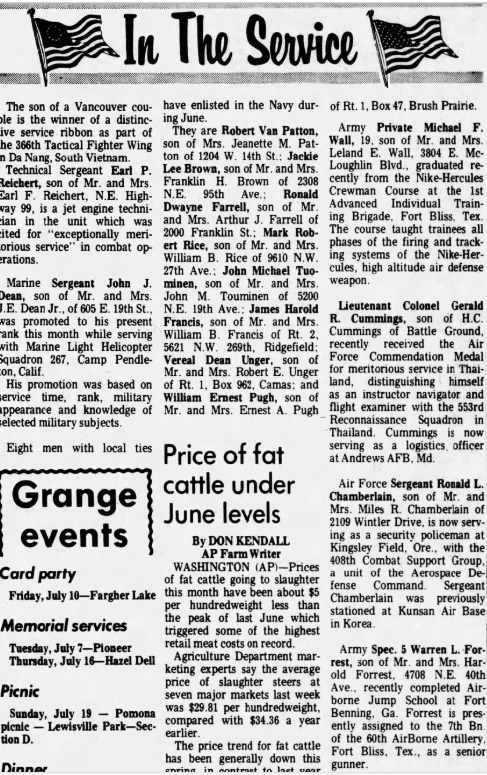
Background: As a child, Warren Forrest was a dedicated boy scout and worked his way all the way up to Eagle Scout. When he attended Fort Vancouver High School in the mid-1960’s he excelled at academics and was an exceptional athlete (even though he claimed he was a slow learner and had difficulty with spelling, reading, and writing): he played baseball, ran cross-country, and earned his role as the captain of the track and field team and was offered a track scholarship at Washington State University (he turned it down). Forrest later told one of his psychiatrists that he joined the military after high school because he didn’t think he was smart enough to do well in college, and in October 1967 he enlisted in the US Army (along with his brother, Marvin), and served as a missile crew service gunner and fire control crewman for the 15th Field Artillery Regiment in Homestead, Florida, reaching the rank of Specialist 5; later on when he relocated to Fort Bliss, TX he served in the 7th Battalion of the 60th Airborne Artillery, where he was a ‘senior gunner.’
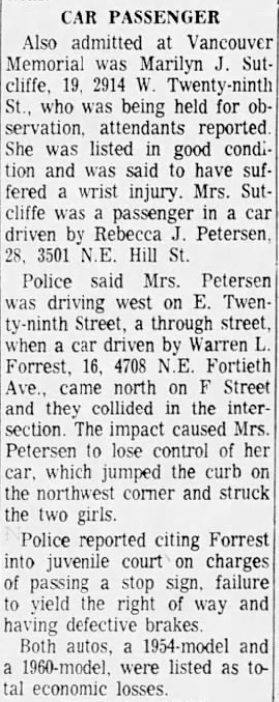
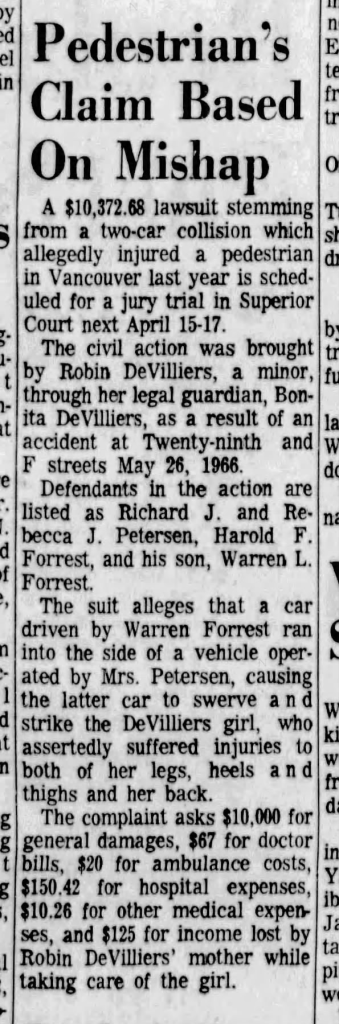
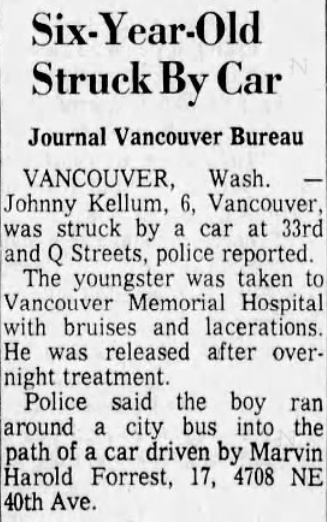
It appears for the most part that the Forrest brothers all had completely normal childhoods, aside from one glaring thing: two of the three boys hit people with their cars when they were teenagers. On January 16, 1966 a six-year-old ran around a city bus and directly into the path of Marvin Forrest. The child was taken to Vancouver Memorial Hospital and thankfully only suffered some minor bruising and lacerations. Later that same year on May 26th Rebecca Peterson was driving a car with her friend Marilyn Sutcliffe when they were hit by a vehicle driven by a then sixteen-year-old Warren L. Forrest. The impact of the collision caused Peterson (who had been pregnant at the time) to lose control of her vehicle, which subsequently jumped the curb and struck two young female pedestrians. The accident resulted in both vehicles being deemed ‘total economic losses,’ and afterwards Forrest was brought up on charges in juvenile court for passing a stop sign, failure to yield the right of way, and for having defective breaks.In September of the following year, he was taken to court by one of the two girls he hit, named Robin DeVilliers, who had suffered injuries to both of her legs, heels, thighs and back as a result of the accident. I was unable to find the ‘official’ resolution of the court case, but Forrest’s parents hired an attorney for their son, who advised him to enlist in the Army, and that it would ‘be in his best interest’ if he left town, and ‘the sooner the better.’
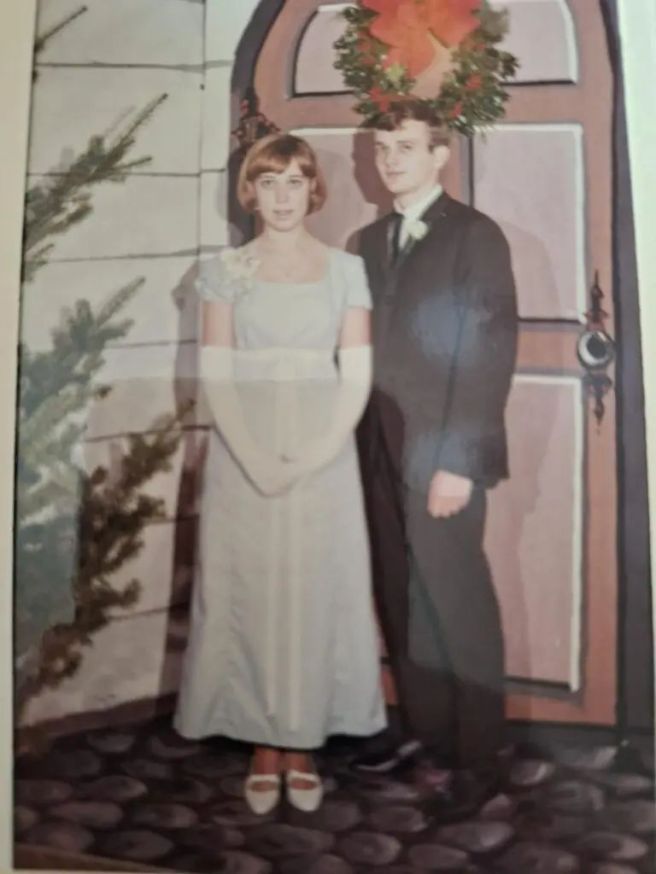
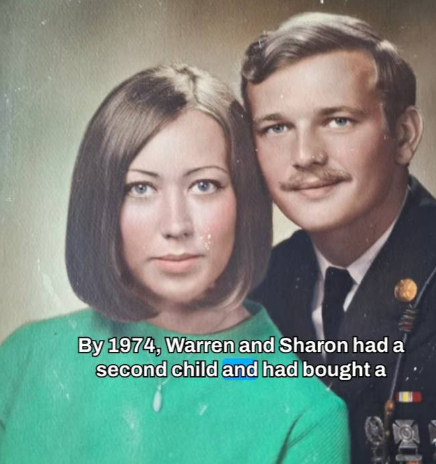
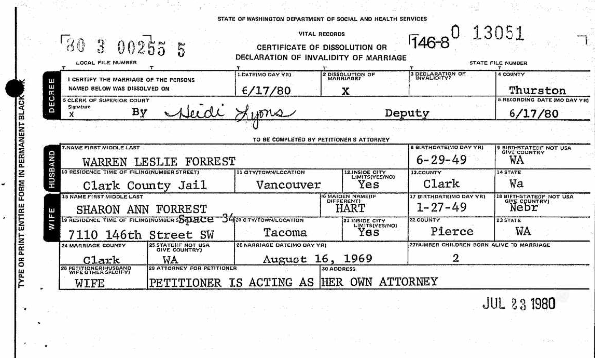
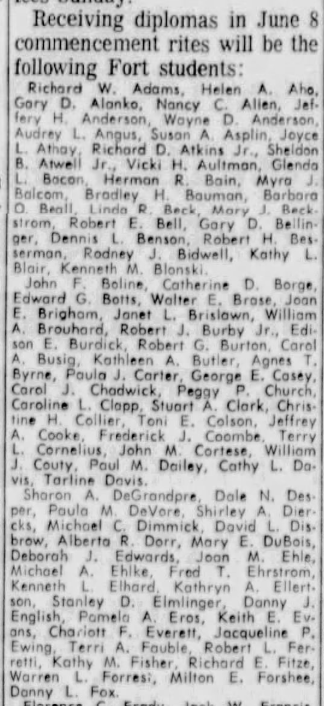
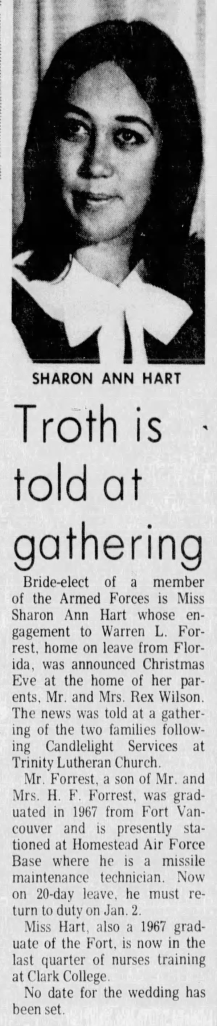
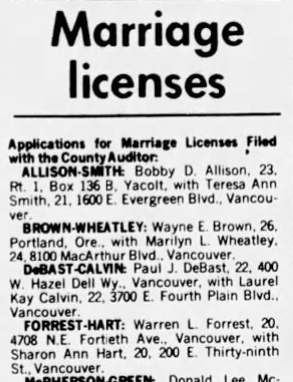
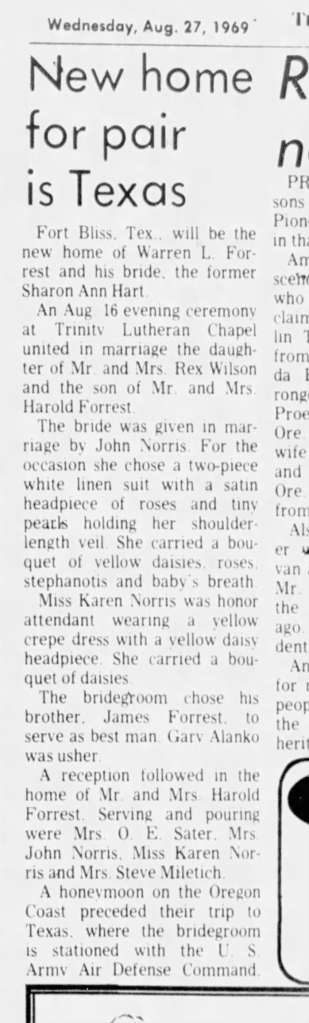
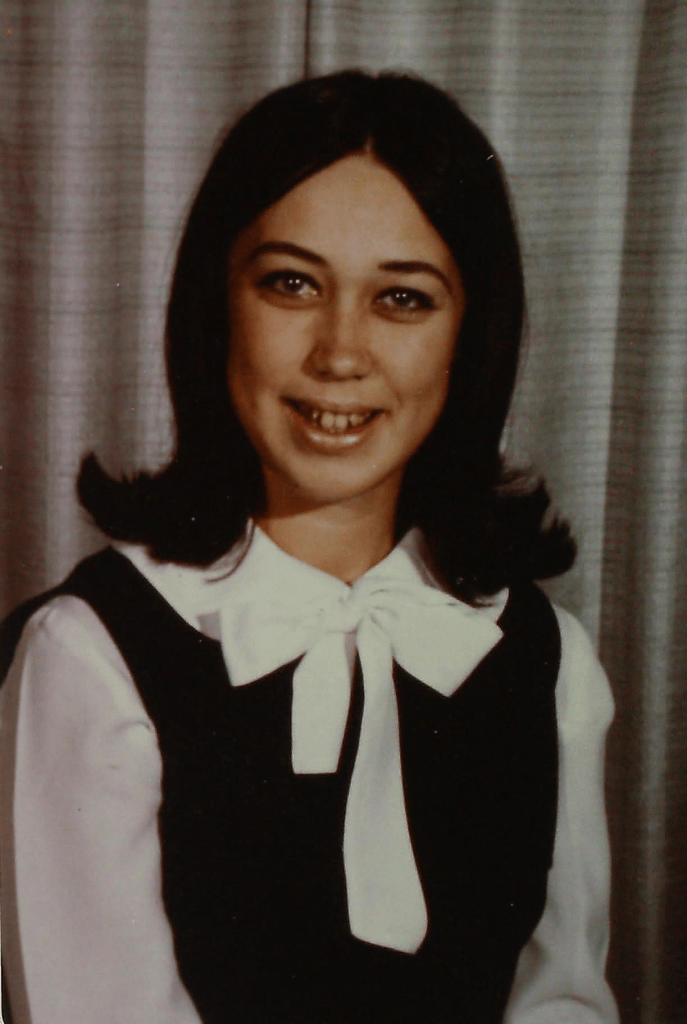
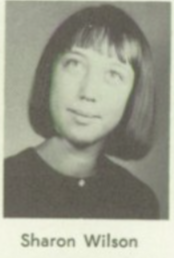
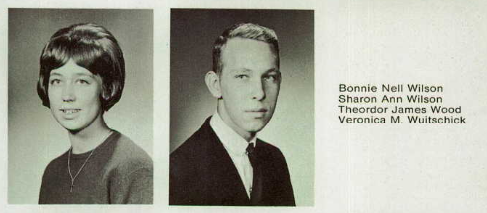
Forrest served a total of two years in the Army (including two and a half months overseas in Vietnam), and upon returning home to Vancouver he married his high school sweetheart, Sharon Ann Hart on August 16, 1969, and the couple had two children together: Leslie (b. 1971) and Lane (b. 1974). After they were married, the couple relocated to Fort Bliss, and according to her: ‘he got back, I met him. He said, I want to get married now because I’m going to Fort Bliss. And I said, but that’s like three weeks from now. So we got married in the small chapel and we packed up the car and drove to Fort Bliss, Texas.’ Sharon was born on January 27, 1949 in Omaha, Nebraska, however as her daughter Leslie pointed out in a semi-recent Facebook post, in every newspaper article about her and Warren’s engagement/marriage, her last name is Hart, but according to her high school yearbook, her full maiden name was ‘Sharon Ann Wilson.’ According to the 1967 Ft. Vancouver High School yearbook (she graduated in the same class as Warren), she performed in the yearly Christmas play and was a member of the marching band, Big Sister/Little Sister, the Future Homemakers of America Club, Pep Band, and the Health Careers Club.
In a December 2017 interview Sharon that did with Detective Lindsey Arnold and retired prosecutor Denny Hunter (both with the Clark County Sheriff’s Office Cold case task force): ‘Warren and I met when we were sophomores in high school, so we were fourteen. And, you know, I was a part of that family and I came from a very dysfunctional family. So, their family seemed like ‘Leave it to Beaver,’ you know, I didn’t know. But now looking back, she was very controlling. She ran the show. Now I think, I wonder how much did that play in Warren’s perception of Women.’
Forrest was honorably discharged from the US Army in September of 1971 right after his first child was born. After they left Fort Bliss they relocated to Newport Beach, CA, where Warren enrolled in classes at the North American School of Conservation and Ecology; he quickly lost interest in academics and dropped out at the end of his first semester. In late 1970, Warren and Sharon moved once again, this time back to Washington state, where they lived in the basement of his childhood home with their near infant child, who was a month old at the time. He quickly found employment with the Clark County Parks Department as a general maintenance worker (he officially began his employment on January 12, 1971), and for a while, everything appeared to be picture perfect for the seemingly happy young family… until suddenly it wasn’t.
According to Sharon, her mother-in-law was domineering and wanted to have a say in how to raise her grandchild: ‘and I go, please talk to your mom. He goes, it won’t do any good. I said, this is not working. We gotta get out of here.’ She said she later found out that her in-laws lived roughly a mile from the farmhouse in Minnehaha where Jamie Grissom and her sister Star lived, and that Warren was in town just two months prior to Jamie’s disappearance. By 1974, the couple had a second child and had managed to buy a house of their own. In her 2017 interview with Sherriff’s, Sharon said that at various points during their marriage, her husband was ‘often gone,’ but when she asked him where he went, he always had a good excuse to be missing.
According to Sharon, she said, ‘where were you? He said, I hit a female dog. I gotta go bury it. I gotta get a shovel. And I went, oh, I mean, that’s just the kind of guy that he was. He wouldn’t even go hunting because he didn’t want to kill animals. Sweet as gentlest man.’ She also said that he was a ‘loving and attentive father: He always changed diapers and took care of the kids. And he was a good father, a really good father, A good husband. Made meals. He cleaned the kitchen.’
Due to HIPAA laws, most of Warren Forest’s medical records are unavailable to the public, but some of them were recently released and in March of 1974, he allegedly suffered what would be described as some kind of nervous breakdown. After he was discharged from the Army, he signed up for the reserves on the weekends, and according to a court document, the supposed breakdown happened after drinking at the NCO club at the Vancouver barracks. After Warren’s incarceration, he told a psychiatrist that he left the club and began walking back to his in-laws house (who lived nearby), and during this walk, he began thinking about a painful war memory where he allegedly ‘killed a little girl with his M79 grenade launcher,’ and it was something that followed him throughout his entire life. Forrest told the psychiatrist that when he arrived at his in-laws he had a nervous breakdown.
Sharon’s family later told investigators that when he arrived he looked ‘wild,’ and he had been ‘combative:’ they called the police and he was taken to the VA Hospital, where he was admitted for a couple of days; he later claimed to have no memory of that night. After Forrest’s honorable discharge from the military he told friends and family about an event that he said took place when he was in Vietnam, where he was carrying a grenade launcher in a convoy and ‘somebody told him to shoot,’ so he spun around and did exactly that, and as a result killed a small Vietnamese child.
On October 1, 1974Warren Forrest kidnapped twenty-year-old victim* after he saw her standing on a street corner in downtown Portland and pulled over to talk to her: he told her that he was employed at Seattle University and had been working on a thesis project for class and offered her money to pose for pictures for him. She accepted his offer and climbed into his van and accompanied him to the Washington Park area of Portland, and it was at that point that he pulled out a knife and threatened her, and bound her with tape. He then drove roughly 25 miles to Lacamas Park, a heavily wooded and sparsely populated area of Clark County, where he sexually assaulted her; when he was finished, he shot her in the chest with a hand honed dart (which refers to the process of sharpening or refining an edge manually using either a whetstone or steel) from a .177 caliber dart pistol then led her 100 feet down a path by a rope around her neck. * I would like to add that it was requested the victims name be redacted from this so from now on I am referring to her as ‘The Lacamas Lake victim.’
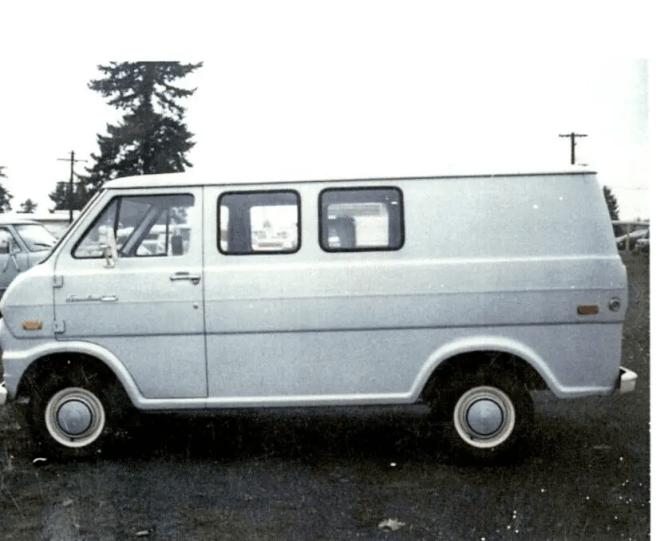
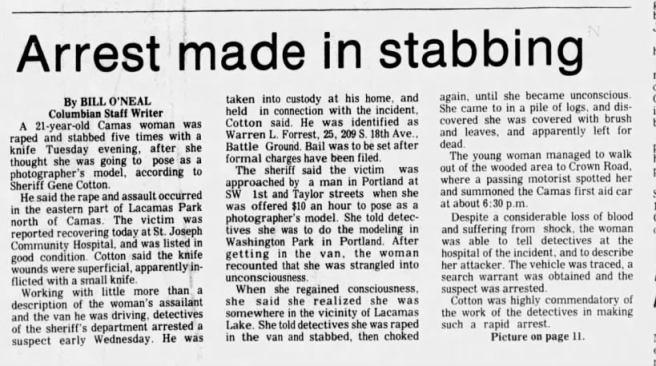
Once they reached his intended destination, he sat the young woman on a log and choked her to the point of unconscientious. From there, he stabbed her five times in the chest then laid her naked body next to a log and covered it with brush and leaves (at some point during the encounter her attacker had removed all of her clothes and taken them with him)… But by some miracle, she was not dead, and after struggling for about two hours finally made her way to a roadway, where she was able to get the attention of a passing motorist, who took her to a nearby hospital. Once she was stabilized, the woman was able to give detectives a description of her assailant along with the details of the very distinctive vehicle that he drove (a blue 1973 Ford van). She also told them that as he was driving through the park he slowed down on several occasions and exchanged greetings with several people, and investigators quickly deduced that their guy was an employee of the department.
After Forrest was finished attacking the Lacamas Lake victim, he drove home, cleaned out his van, stashed her belongings in his garage, then tossed a football around with his next door neighbor; when they were done, he went inside his residence, ate a TV dinner on the couch with his wife and young children (who at the time were one and three), then went to bed.
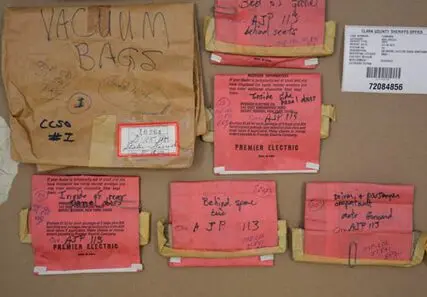
A look at employee records showed that Forrest owned a 1973 blue Ford van that closely matched the one the perpetrator drove, and that he had taken off from work on the day of the attack to ‘go to a doctor’s appointment in Portland.’ Detectives quickly got a search warrant for his home and vehicle, and while searching his residence found jewelry and clothing that belonged to the victim. In a footlocker discovered in his van, detectives found a gun, tape, and baling twine that was similar to what was used on one of his other victims. Also inside Forrest’s van, forensic experts found feather darts and the same Marksman repeater air pistol that the Lacamas Lake victim said her attacker used to shoot darts into her chest; forensic experts also vacuumed his van for evidence and collected pieces of twine as well as a Clark County Parks and Rec master key. When the young woman was shown a picture of the young Park’s Department employee, she was able to make a positive ID, andwas also able to identify the suspect in a lineup.
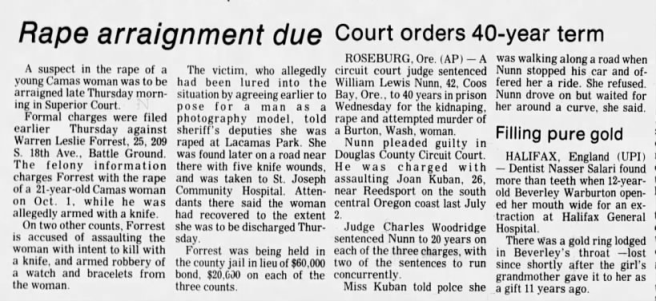
On the morning of October 2, 1974, Forrest was arrested on charges of kidnapping, rape, and attempted murder, and was held in lieu of $60,000 bond. When the moment finally came to arrest him, investigators came in, ‘guns a-blazing’ and ‘woke the babies,’ and went ‘through everything;’ as he was handcuffed and placed in the back of a squad car, he didn’t say a word to anyone, including his wife.
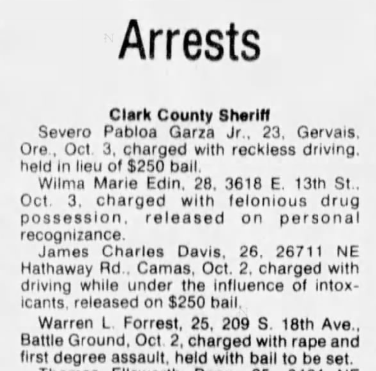
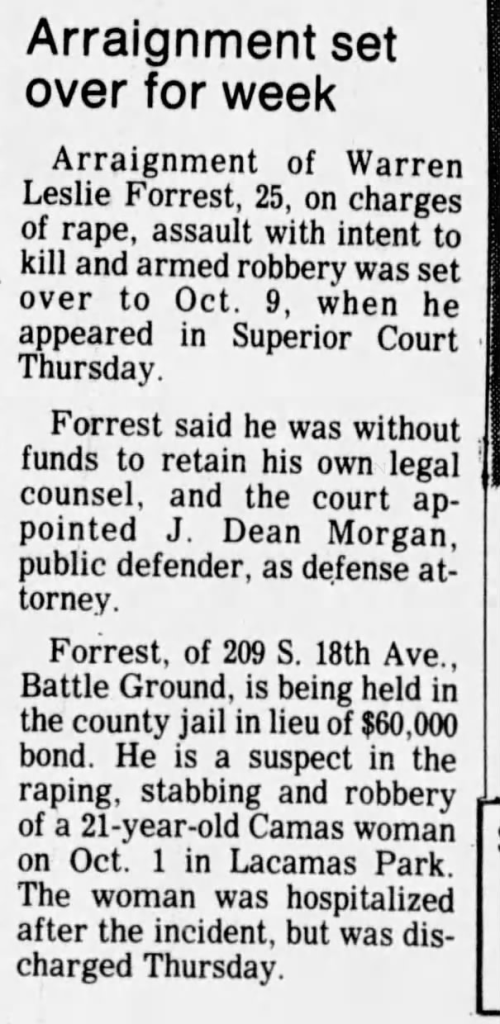
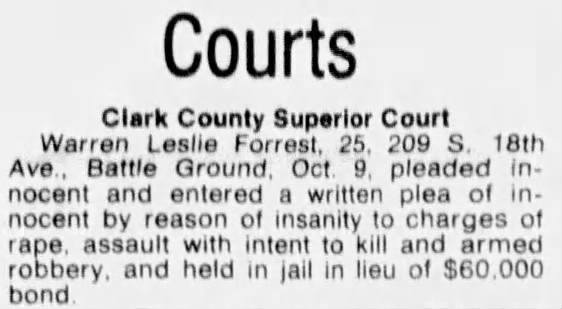
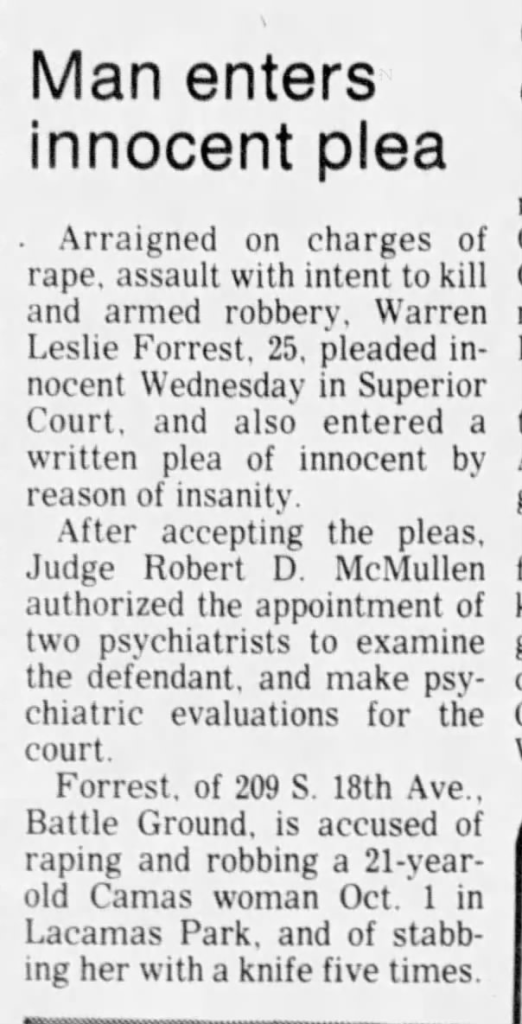
After he was brough to the police station, detectives returned to the Forrest family residence, where they performed a second search. A short time after Warren’s arrest, Sharon visited her husband in jail, which was the first time the couple had spoken after he was arrested: according to her, ‘I remember asking him. It was at the old jail, the courthouse, in Vanda’s cage, where the inmates could go. This was like when he was first arrested. And I said, things, you do it. He looked at me and he goes, ‘I don’t know.’’ When they found the girls possessions in the garage, Sharon said she heard a detective say, ‘we found the girl’s possession. Yeah. It was one of those moments. And did. And, you know, I just. I don’t remember anything after that.’ On October 5, 1974 he was arraigned on charges of rape, assault with the intent to kill, and armed robbery (after he assaulted Wightman, he also took her watch and bracelets), and he entered a plea of not guilty by reason of insanity.
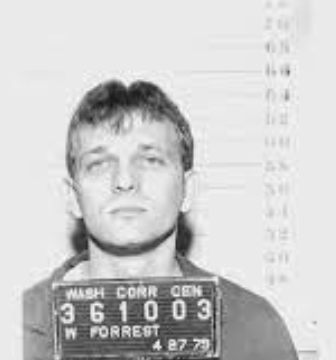
At the time of his arrest, Warren Leslie Forrest was twenty-five-years old and weighed 155 pounds; he stood at 5’9” tall, wore his light brown hair at his shoulders, and had what was described as a ‘bushy mustache.’ Shortly after his arrest was made public, detectives were also able to link him to the kidnapping, rape, and assault of fifteen-year-old Norma Countryman, who had been attempting to hitchhike out of Ridgefield on July 17, 1974 when she got in Warren’s van after he pulled over and offered her a lift. From there, he raped and beat her, and when they reached the slopes of Tukes Mountain, he gagged her with her own bra then hogtied her to a tree and told her he would ‘return’ to her later… but, the petite young woman had a fierce will to live, and chewed her way through her restraints and hide in some nearby bushes until the sun came up, when she was able to flag down a Parks employee for some help. The suspect returned to the scene of the crime the following night and picked up what he had used to bind her to the tree as well as the bra he used to gag her. Despite Countryman’s powerful testimony in court, Forrest was solely charged with the kidnapping and attempted murder of the the Lacamas Lake victim.
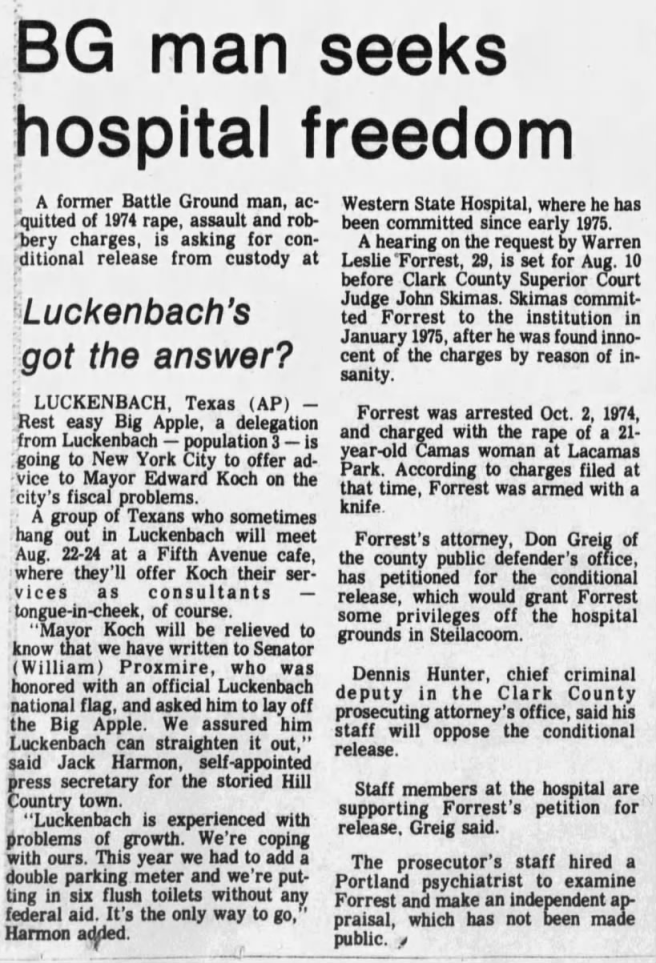
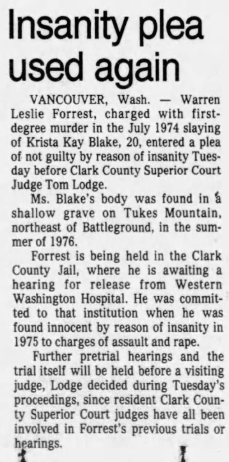
Warren Forrest pled not guilty due to reason of insanity, and his legal team filed a motion for him to undergo a psychiatric evaluation; thanks to examinations by three local psychiatrists (that the state paid for), it was determined that he was criminally insane at the time of his atrocities against. It’s also worth mentioning that the prosecution didn’t attempt to bring in their own experts to contest that these evaluations of mental insanity had any truth to them, and there were no state experts brought in at all: Forrest had an uncontested insanity acquittal. On January 23, 1975, a hearing was held and he was found not guilty of all charges against Wightman by reason of insanity, and a week later on January 31st he was committed to the Western State Mental Hospital in Steilacoom, WA. According to investigators who visited the facility in the 1970’s, they described a place where the inmates seemed to be running the asylum, not the administrators, and it was hard to tell the staff from the patients.
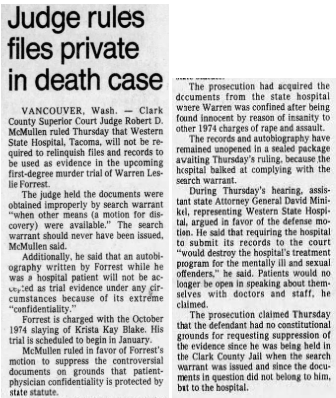
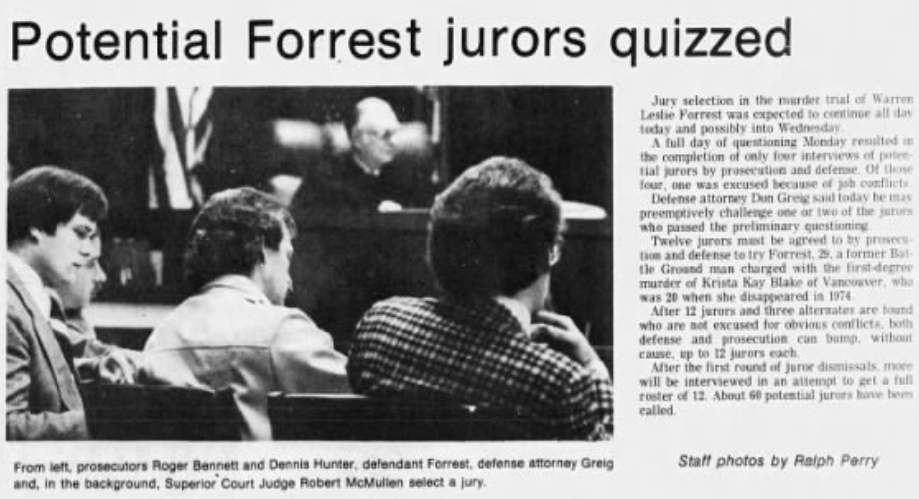
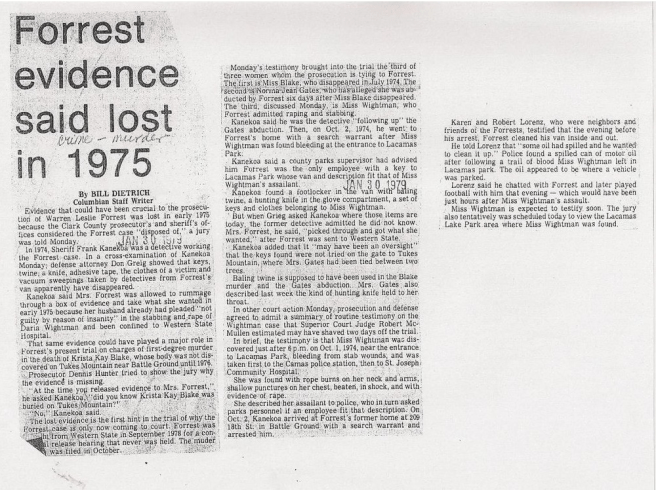
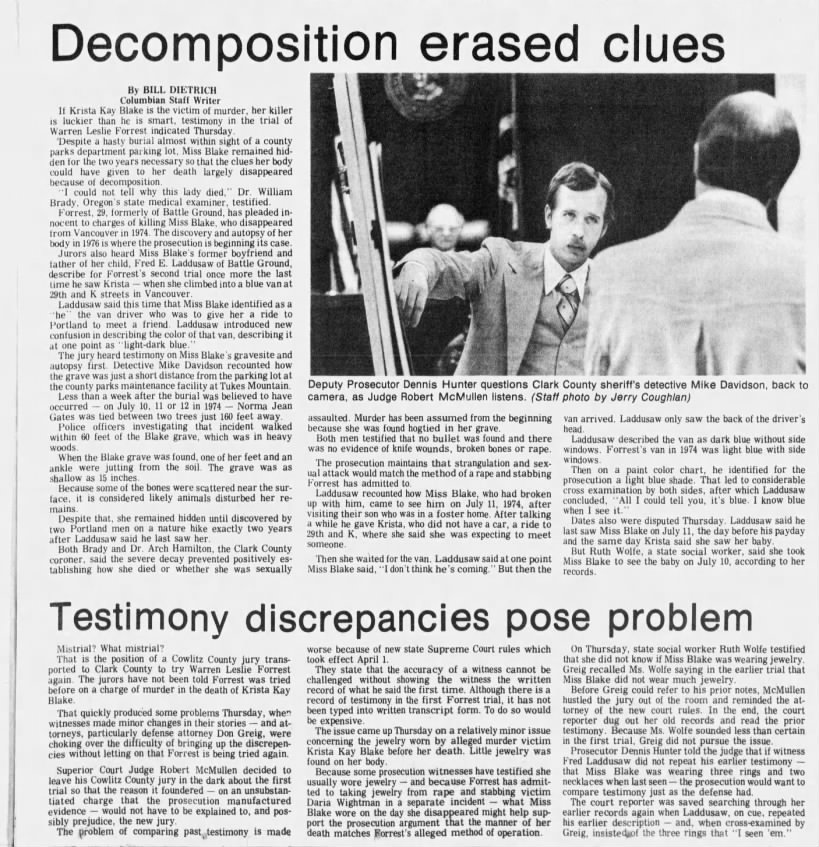
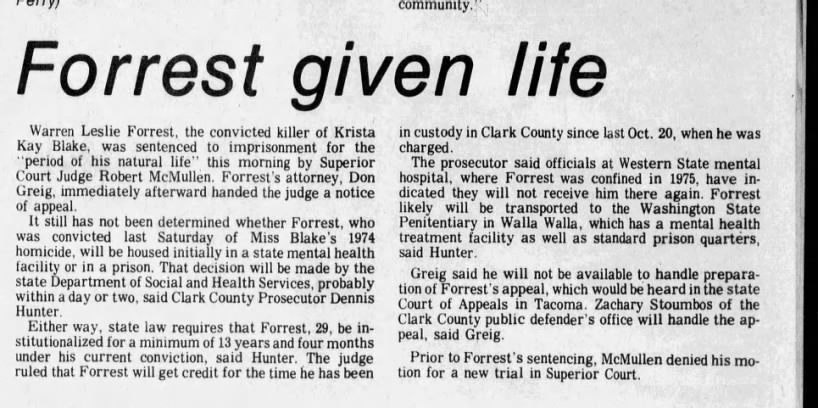
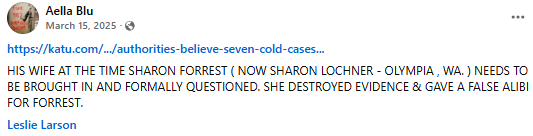
According to a court document, the term of Forrest’s commitment could be for ‘any period up to and including natural life,’ but he would be eligible to petition the court for a conditional discharge if staff at Western signed off that he was no longer a danger to society. It’s important to note that, according to an article published in ‘The Columbian’ on January 30, 1979, evidence was lost in early 1975 when Sharon was allowed to go through a box of her husband’s things after the Clark County prosecutor and sheriff’s department deemed the entire case to be ‘disposed of.’ Amongst the items that were taken were a master key to the Clark County Parks Department, twine, a knife, adhesive tape, a victims clothing, and the ‘forensic vacuum sweepings’ that were taken from Forrest’s 1973 Ford van shortly after his arrest. About the incident, Clark County Detective Frank Kanekoa said that ‘Sharon Forrest was allowed to rummage through a box of evidence and take what she wanted sometime in early 1975 because Warren had already pleaded not guilty by reason of insanity.’ In addition to what Sharon took, after Warren’s acquittal all evidence related to the case was either released or thrown away, aside for some pictures and the marksman repeater air pistol… all of which may have played a major role in Forrest’s later trial in January 1979 for the murder of Krista Kay Blake.
Upon arrival at Western State Hospital, Forrest was assigned to the ‘Omega’ group, which consisted of similar patients that had been committed to the facility for criminal insanity; it contained a variety of individuals that had been charged with a wide range of charges, ranging from minor offenses all the way up to serious ones. Clinical psychologist Dr. Brent Trowbridge was the director of the program, and described the group as follows: ‘a therapist who generally had a master’s degree in the field of social sciences, would lead the omega group. Omega was designed as a confrontational group therapy, which meant that the patients in the group were supposed to help each other with their treatment.’
While at Western State Hospital, WLF was able to keep a car in the parking lot that he was also allowed to ‘work on.’ Shortly after her husband was committed to the facility, Sharon sold their home and moved her and their children closer to the prison: ‘we used to go on Wednesdays to visit him, and then we used to go on weekends and spend, like, the whole day with him and, you know, pack the kids up. And I used to bake meals and take to him and get things that he wanted from the store and stuff. We had birthday parties, you know, for the kids there at the hospital and for him. I remember we celebrated one of our anniversaries there.’ Sharon planned on standing by her man and was going to wait for her husband to be released… until December of 1977, when she found out he was having an affair, and: ‘and I noticed that there was just a change in him. Something was different. One night I was there, and the phone rang, and it was for him, it was a payphone. And he was back whispering on the phone and just acted different. So when he got off the phone, I said, who is that? He goes, none of your business. I said, what’s going on? Nothing. It’s time for you to leave now. So me and the kids left. I was like, wow. Well, come to find out, he was seeing somebody at Western State.’
According to her, it was most likely a hospital employee, and that one time his therapist called her for a meeting between the three of them, who in the beginning prompted her husband: ’Warren, is something going on that you need to tell Sharon? You seeing someone?’ He goes, ‘yeah.’ The therapist said to him, he goes, you’re an asshole. And Warren goes, ‘yep, I am.’ And so I stood up and I said, I’m done. I’m not coming back. I moved here to be close to you, to try to keep our family, and you’re being able to see your kids, and this is how I get remained. And I walked out, and I didn’t go back.’ When police later interviewed a friend of his, he confirmed that Forrest had told him he was seeing an employee at the hospital named ‘Nancy.’
In an interview with forensic psychiatrist Dr. Sidney Pollack in 1978, Forrest described how he worked eight hours a day ‘all over the hospital:’ in the ceramic and sewing rooms, kitchen, greenhouse, and at one point he even worked as a janitor inside the facility and around the hospital grounds. Dr. Pollock questioned Forrest about the loose security protocols which would have ‘made it easy for him to escape:’ he replied with, ‘yeah, I had the opportunity. That’s what I was saying. I had the opportunity and the thoughts.’ At one point during his time there he also got hired to paint a staff member’s house.
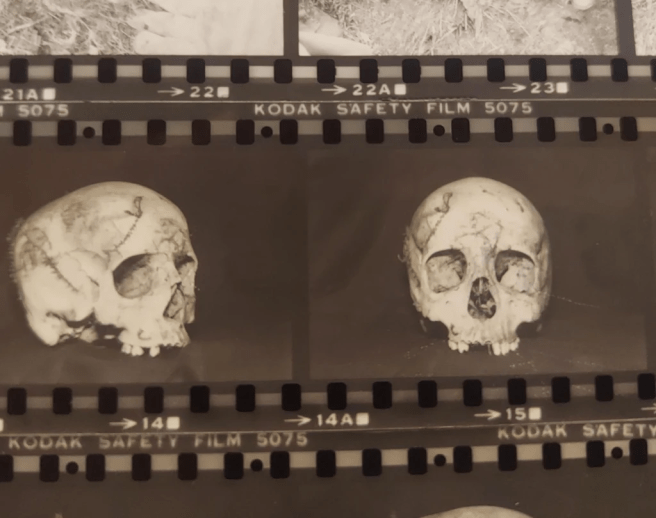
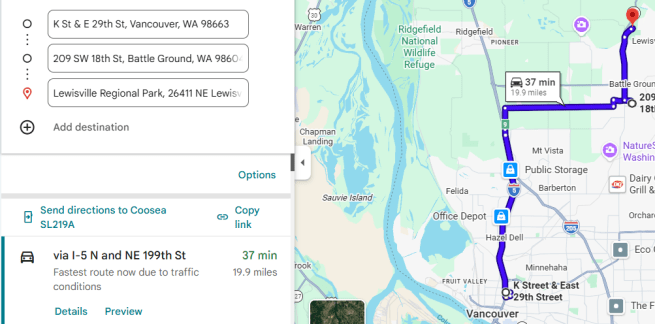
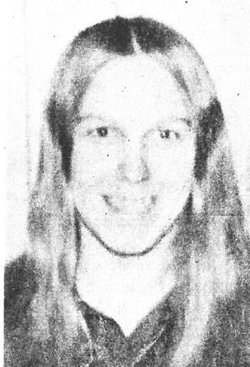
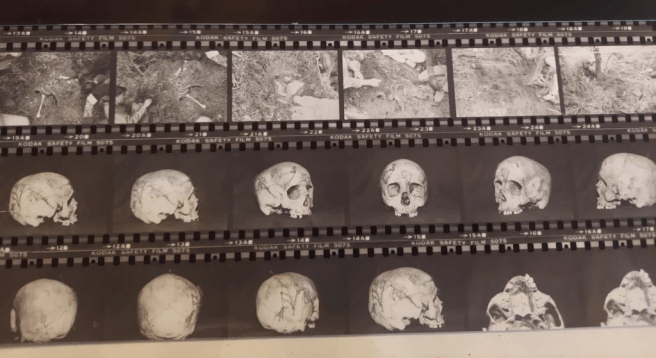
A year and a half went by after Warren Forrest was sent to Western State Hospital. On July 16, 1976 two foragers were out picking mushrooms and wildflowers on some Clark County Parks Department property in Tukes Mountain near Battle Ground when they noticed a small brown shoe sticking out of some bushes: when they gently tugged on it, they realized it was attached to a human foot and immediately notified LE, who discovered the half-skeletonized body of a young woman that had been (poorly) buried in a shallow grave. Forensic examination of the victims mandible led the ME to determine that the remains belonged to Krista Kay Blake, a hitchhiker that vanished without a trace from the area of 29th and ‘K’ Street of Vancouver on July 11, 1974.
Krista had been partially unclothed and had been missing her bra; her hands and feet were ‘hogtied’ behind her back with baling twine (which was discovered around 100 feet from her gravesite), and because her clothes and skeleton showed no signs of stab wounds or bullet holes, the ME concluded that she had most likely been strangled. Nineteen-year-old Blake was known to hitchhike, and at the time she was killed was living on NE 119th Street in Vancouver. After she disappeared two eyewitnesses came forward and told detectives that they observed her and the suspect that had been ‘driving the blue van’ together around the Lewisville Park area sometime prior to the day that she disappeared; other people came forward and reported they had seen the same van driving around Tukes Mountain on or around the date that Blake was last seen alive. It’s worth noting that Norma Countryman’s assault took place one week after the disappearance of Krista Kay Blake.
Because Warren Leslie Forrest owned the same van as the suspect and worked at the park where the victim had been found, he immediately became a person of interest in her death. Because of advanced age of the body a great deal of physical evidence had been lost, however a closer look at the clothing that the young woman had been wearing led to the discovery of incredibly small puncture marks in her T-shirt that forensic experts determined were made by a dart gun that was similar to the one that Forrest had used on his Lacamas Lake victim.
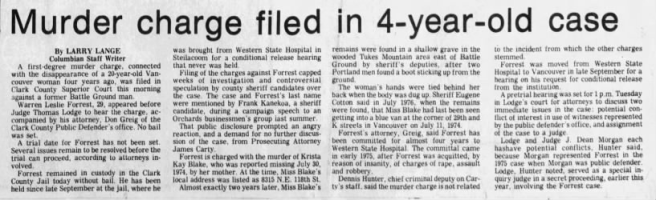
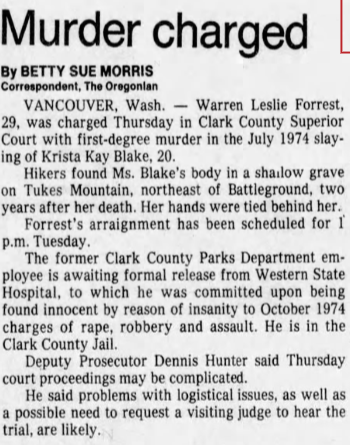
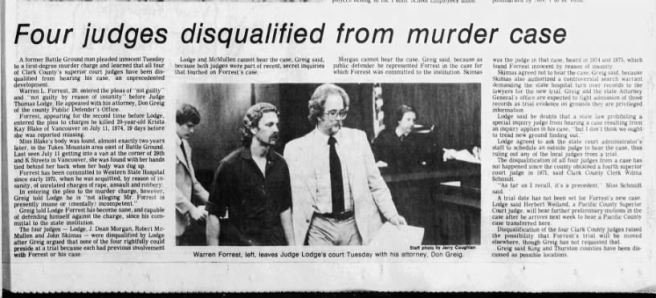
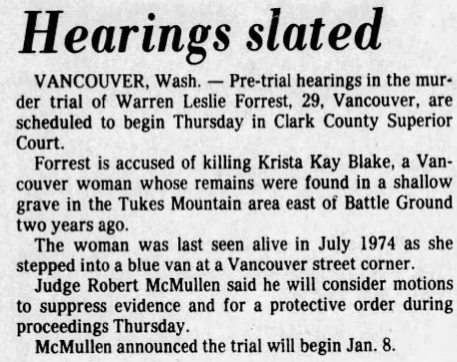
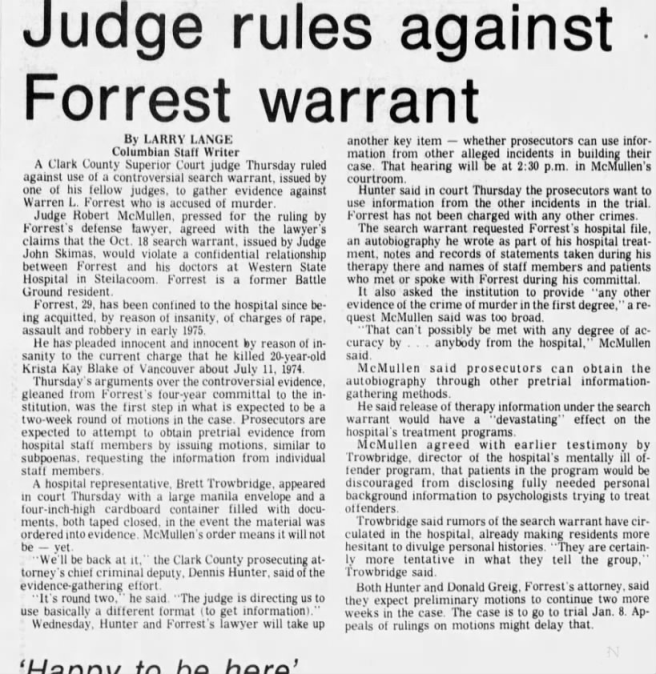
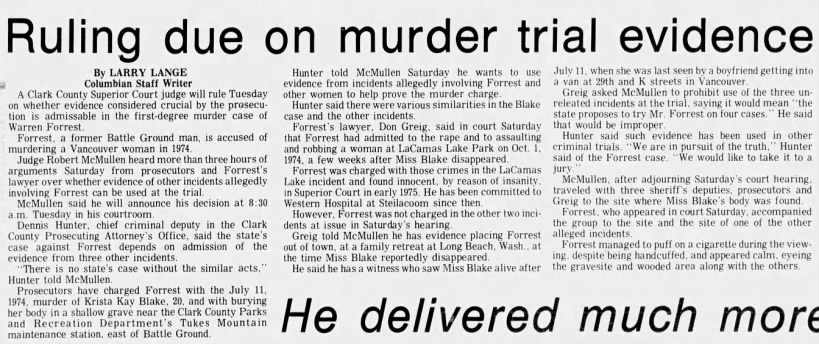
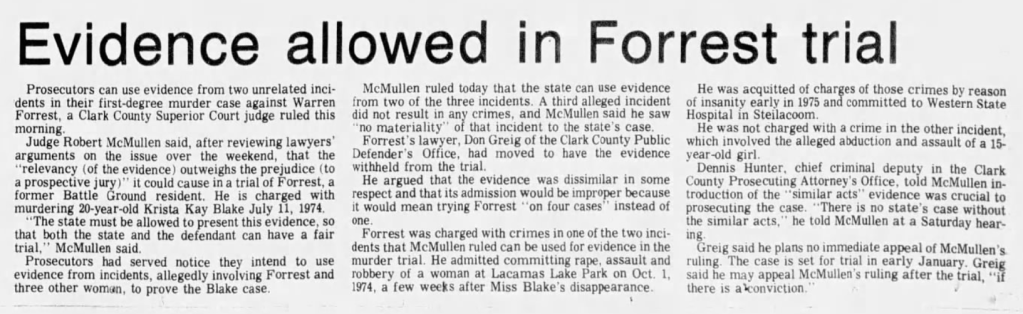
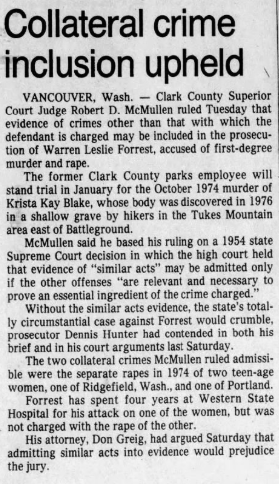
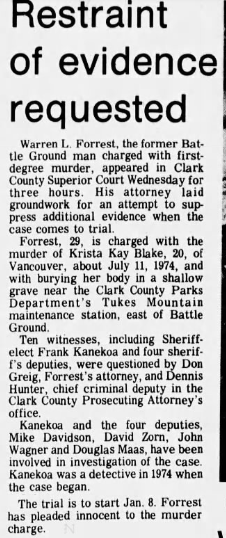
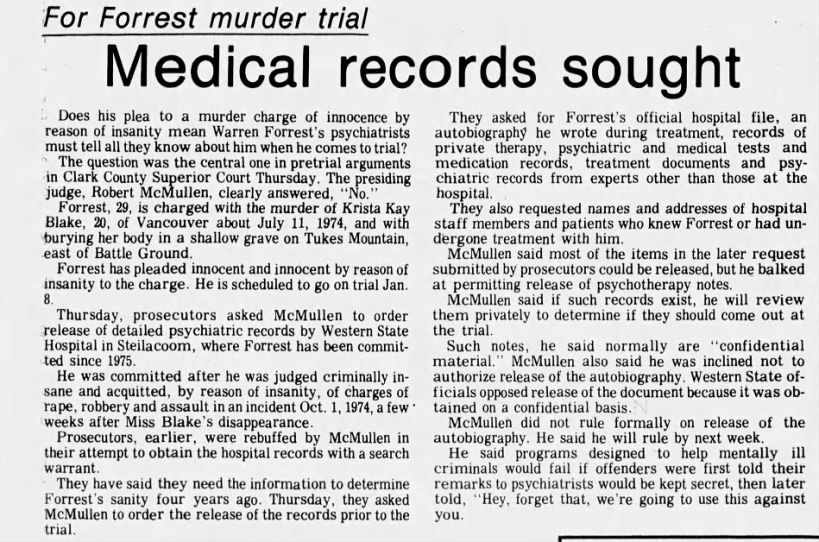
Not long into the murder investigation, detectives realized that on the day Blake had disappeared, Forrest wasn’t at work because reportedly ‘had a doctor’s appointment,’ this was on top of the fact that he had no alibi: his mother said that he had spent part of the day at her house, but had ‘left early in the evening’ and did not return until the following morning. He was charged on this basis with Krista’s murder in October 1978, and despite already being detained inside of an institution, his attorney Don Greig filed a petition for a new psychiatric evaluation, claiming his mental state had greatly improved in recent years… he even wanted to represent himself at trial (a request that had been granted). In the initial stages, the four judges that had participated in WLF’s earlier trials were removed from consideration due to concerns about possible bias, however this decision was later overturned, and Justice Robert McMullen was ultimately chosen to preside over the case.
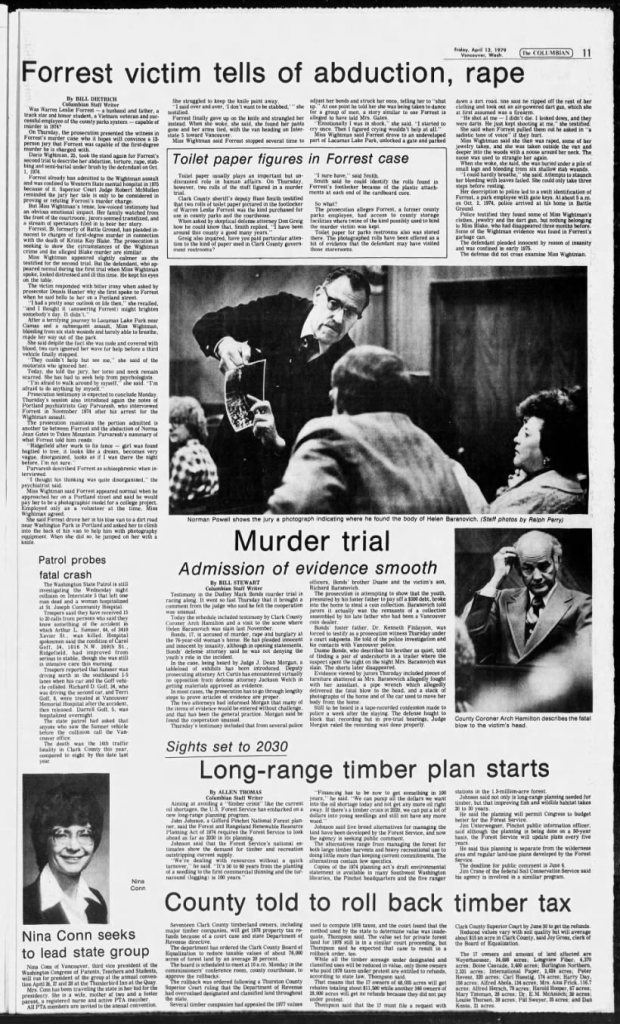
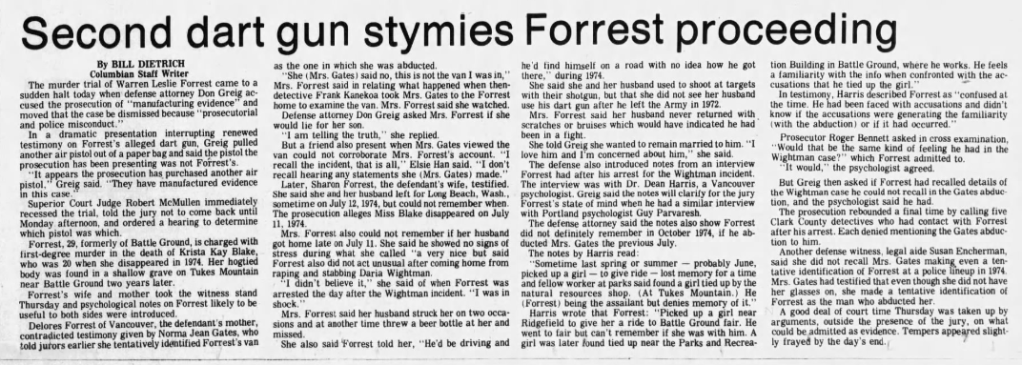
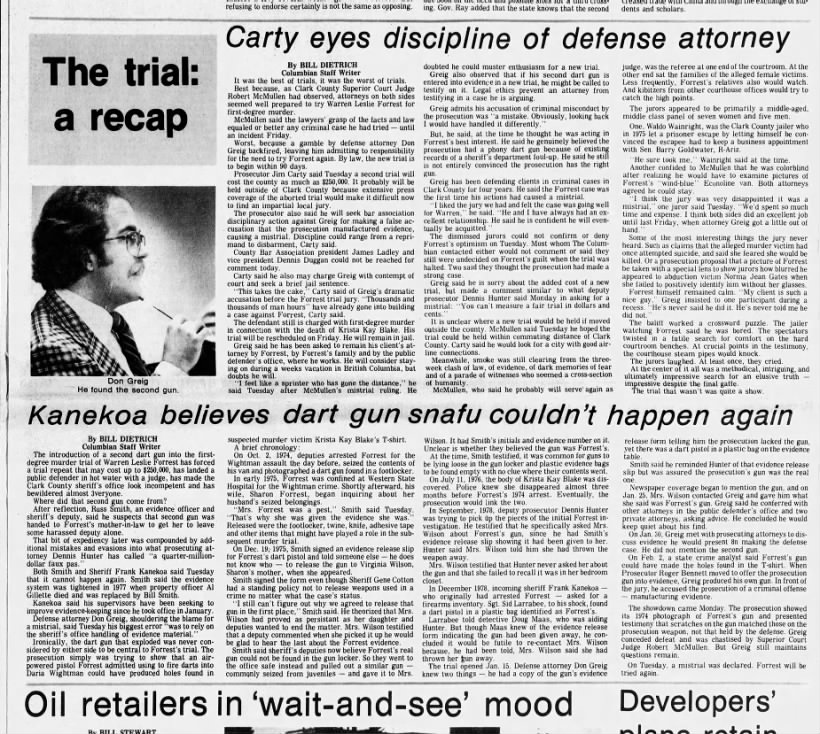
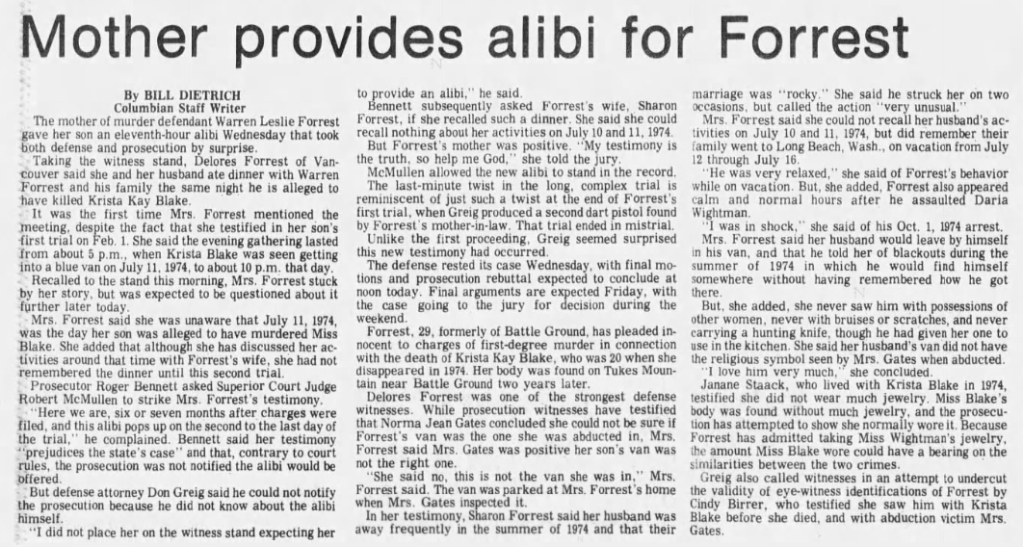
Warren Forrest’s trial for the murder of Krista Blake began in early 1979, however it wasn’t long before the judge declared a mistrial after his attorney erroneously allowed a second dart gun that had been unrelated to the case to be submitted into evidence. After that incident, his defense team filed a motion for a change of venue from Clark County to Cowlitz County, arguing that the media attention surrounding the case would prejudice the jurors against their client; the motion was granted andthe trial resumed in April 1979 in Cowlitz County. In the beginning of the proceedings, Forrest pled not guilty and claimed he had been on vacation with his family in Long Beach at the time of Blake’s murder; this had been backed up by his mother, who said in open court (while under oath) that her son had been at her residence (with her) at the time investigators supposed Krista had gotten into the blue van. However, prosecutors said her testimony was unreliable, pointing out that she had originally told detectives that her son had left her residence in the early evening and didn’t come back until the following morning. In addition to Dolores, Sharon Forrest also testified on Warren’s behalf, although she told the court their relationship had been ‘rocky’ and her husband had at times ‘suffered from blackouts;’ she also insisted that he had been with her the entire time Blake was being abducted and killed, and that he never showed any signs of being violent towards women.
Multiple eyewitnesses testified against Forrest, and claimed he was a known acquaintance of Krista Blake’s and that the two had been seen together at multiple times before her murder; however, some of their claims were scrutinized by his defense team, as two of them had given a description of the suspects van that did not perfectly match the one that he owned. One day during the trial, he admitted guilt to the kidnapping and attempted murder of the Lacamas Lake victim, claiming he attacked her due to ‘untreated PTSD’ from serving in the military. However, when confronted, he absolutely refused to admit guilt for the murder of Krista Ann Blake and the kidnapping and assault of Norma Countryman, and because of this the prosecutor’s office insisted that he was guilty of all charges (as each crime matched his MO). Warren Forrest was ultimately found guilty and was sentenced to life imprisonment with a chance of parole, and was sent to Washington State Penitentiaryin Walla Walla; because he was convicted before mandatory sentencing laws he was eligible for parole for the first time in 2014. Sharon Forrest filed for divorce from Warren in June of 1980.
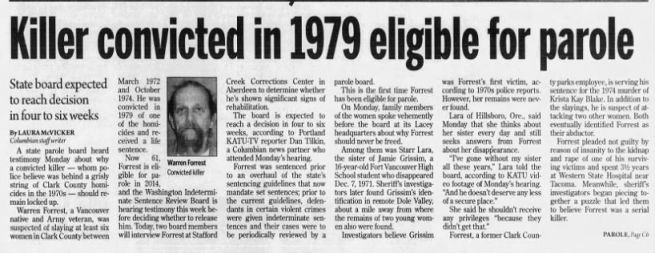
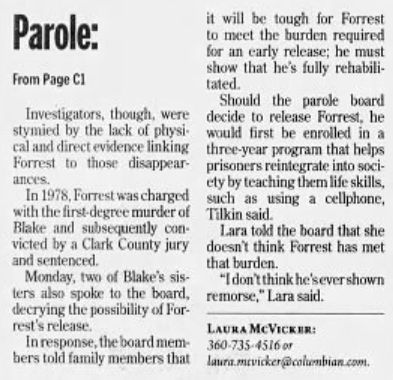
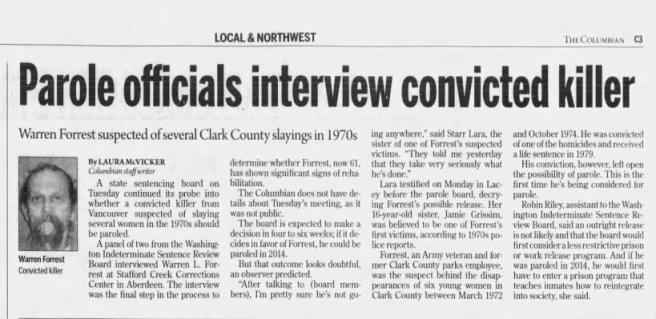
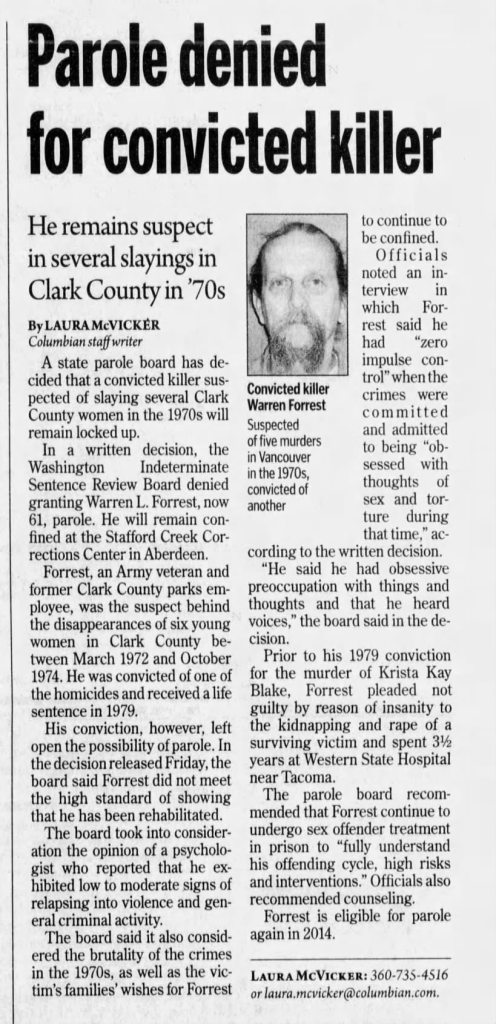
Forrest filed an appeal in early 1982, which was denied later that October; since then, he has filed numerous parole applications over the years (confirmed ones in April 2011, April 2014, July 2017, and May 2022), all of which have been denied due to the fact he is a suspect in many other heinous and violent crimes against women. It’s worth mentioning that during one of his parole hearings, both of his surviving victims took the stand and identified him as their assailant.
The Confession of Krista Blake/2017: Since his initial convictions, Warren Leslie Forrest has remained a suspect in multiple kidnappings, disappearances, and murders around Clark County that took place in the early to middle 1970’s… however, he has largely refused to help multiple policing agencies with their investigations. At a parole hearing in 2017, he finally confessed to killing Krista Blake, stating she had been severely depressed and stressed out at the time of her murder, and he ‘did not intend’ to kill her at first but was forced to after she attempted to get away from him. During that same hearing he also casually confessed to sixteen additional crimes against women that took place between 1971 and 1974, ranging from voyeurism to murder, and claimed he was ‘remorseful for his actions.’ Despite these ‘confessions,’ Forrest’s application for parole was denied and he was prohibited from filing another appeal until March 2022, as the board stated he ‘continued to pose a danger to society and made minimal progress in ameliorating his behavior.’ In an audio recording from one of his parole hearings, he recalled details of the horrific crimes he committed, and reiterated that he was ‘a different person’ now than he was forty years prior, and admitted he: ‘abducted a 19-year-old female stranger under the ruse of giving her a ride…forcing the victim to undress and during a struggle I choked the victim to death.’
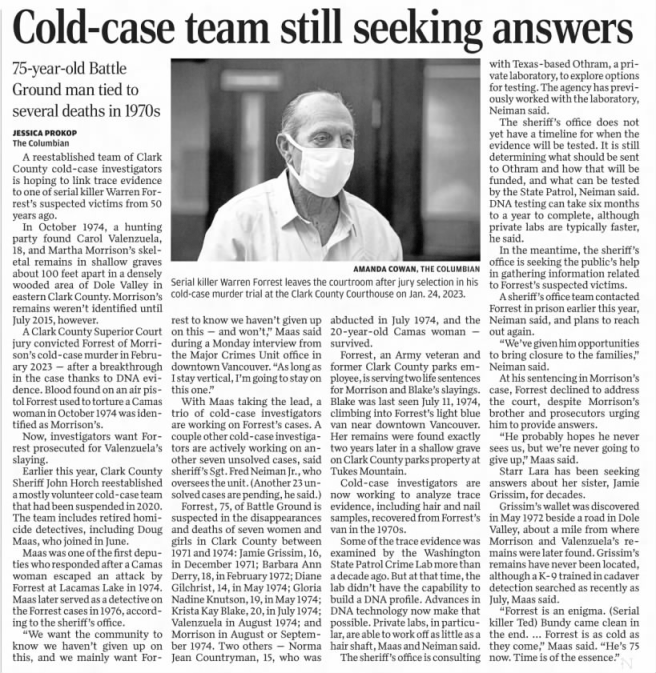
In June 2017, Clark County investigators met with Warren Forrest and told him they were working to prove he killed five additional young women across Washington and Oregon:Jamie Rochelle Grisim (1971), Barbara Ann Derry (1972), Carol Louise Platt-Valenzuela (1974), Martha Morrison (1974), and Gloria Nadine Knutson (1974). During one of his hearings, when the parole board asked him about the other possible victims, the only thing he would say was that he ‘felt sorrow for those families,’ and that talk of other crimes was ‘not factually’ accurate; he also said that he only committed the crimes that he did because he was ‘stressed out’ from working two jobs, going to school, and being a husband and father, and: ‘the only option I had was to distract myself, and I chose to live out those violent fantasies.’
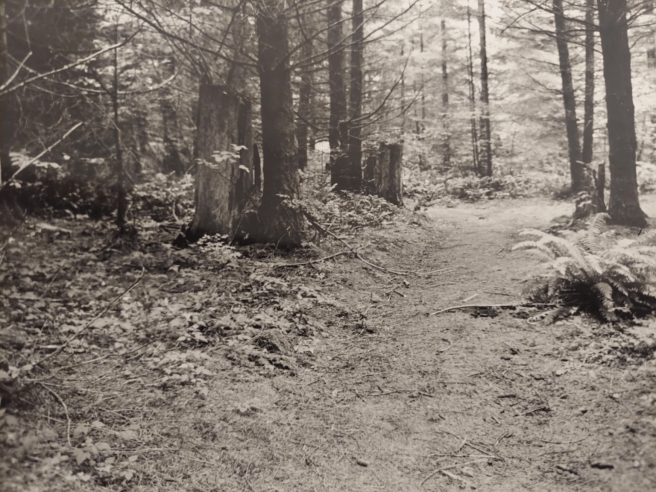
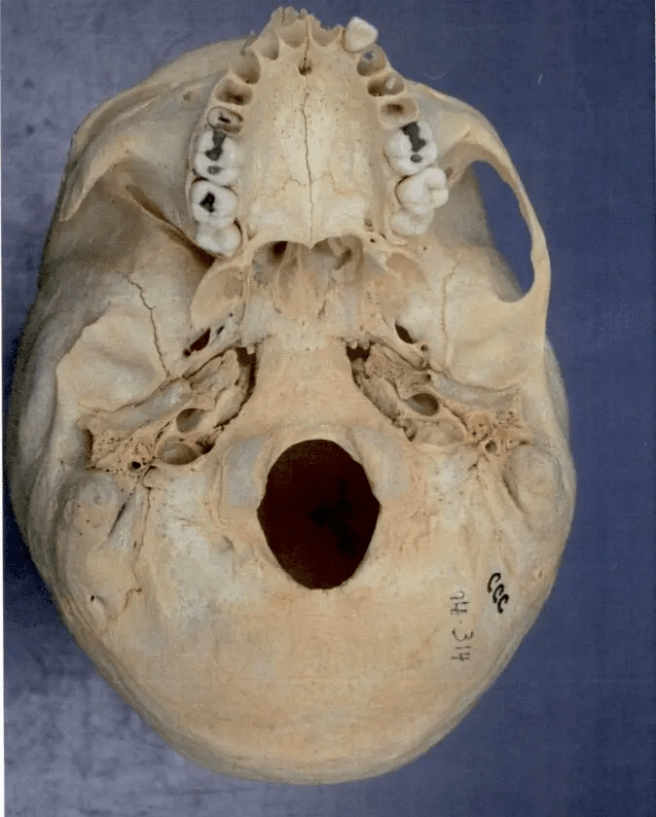
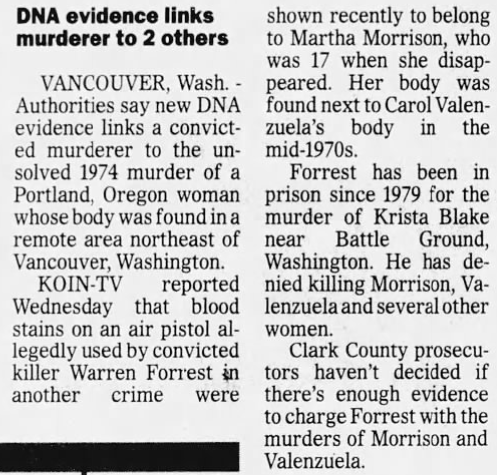
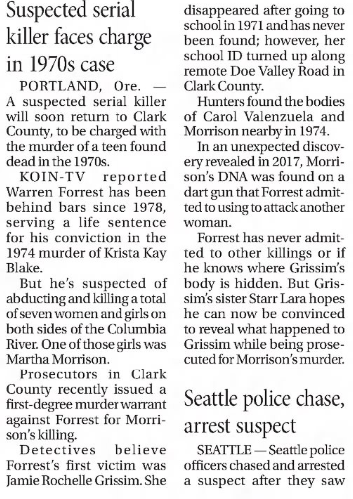
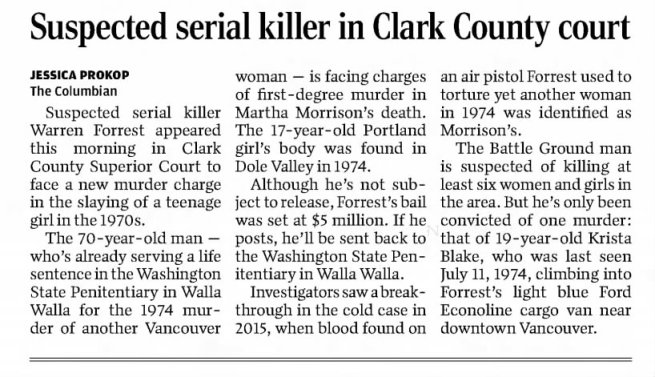
Martha Morrison: In December 2019, Warren Forrest was charged with the murder of seventeen-year-old Martha Morrison, who went missing from Portland, OR in September 1974; her skeletal remains were discovered on October 12, 1974 in Clark County close to those of Carol Valenzuela, only eight miles from Tukes Mountain (where Krista Blake’s body was recovered). Both victims were uncovered either behind or between logs and were fully skeletonized; additionally, neither one was wearing clothes and had any identification on them. At the time of the discoveries in 1974, Forest wasn’t considered a suspect in either murder even though the victims were discovered in a heavily wooded area that was ‘slightly upslope’ from a secluded side road that was close to Rock Creek Bridge. Unfortunately, authorities were unable to positively identify Morrison’s remains at the time she was recovered, and she was known simply as a ‘Jane Doe’ for many years. In 2010, Martha’s half-brother Michael submitted a DNA sample to police in Eugene, OR, and in 2014 investigators began re-examining physical evidence from Forrest’s criminal cases to determine if anything from them could be used to solve any unsolved crimes.
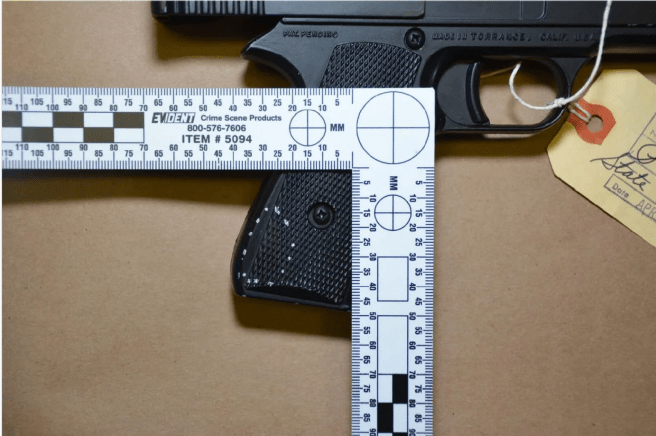
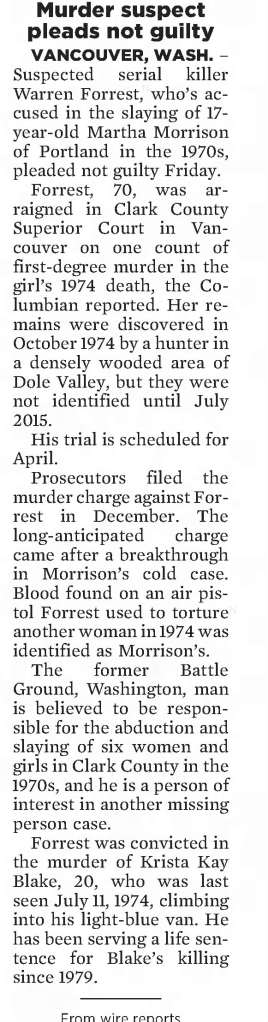
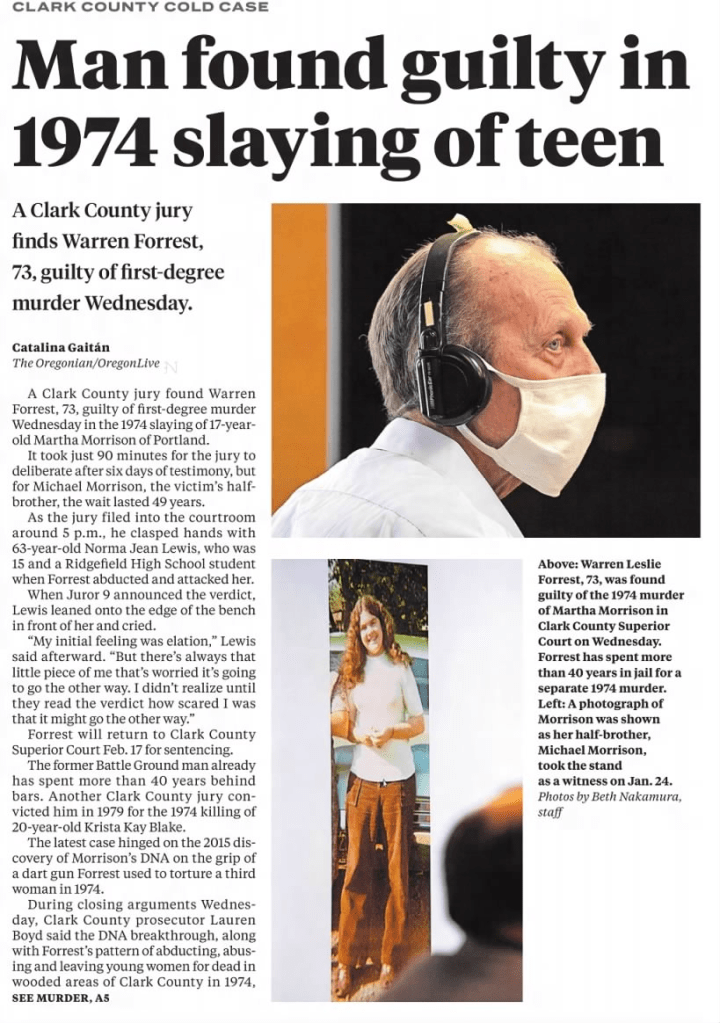
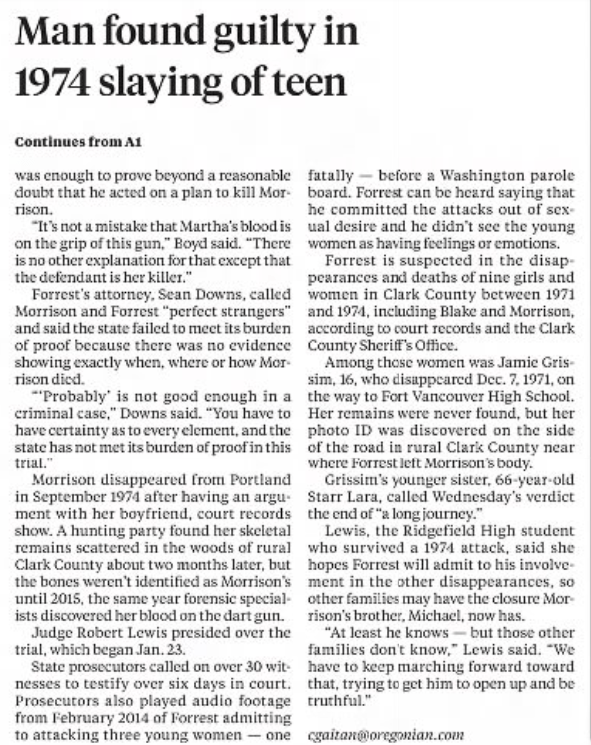
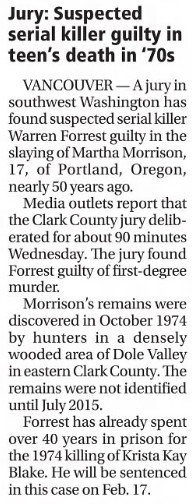
Forensic experts from the Washington State Police Crime Lab were able to isolate a partial DNA profile from some dried blood that had been left behind on Forrest’s dart gun, and cross-referenced it with Michael Morrison’s DNA, which lead to the positive identification of Morrison’s remains.In January 2020, WLF was extradited back to Clark County to await charges in Morrison’s murder, and on February 7, 2020 he pleaded not guilty. His trial was scheduled to begin later that year on April 6, 2020 but was delayed on several occasions thanks to the Covid pandemic; it eventually resumed in early 2023, and on February 1, 2023 a jury of his peers found Warren Leslie Forrest guilty of the murder of Martha Morrison. Only sixteen days later, he received another life sentence.He remains the prime suspect in the disappearances and murders of at least five more teenagers and young women, and in each case, the perpetrator exhibited a similar modus operandi to Forrest:
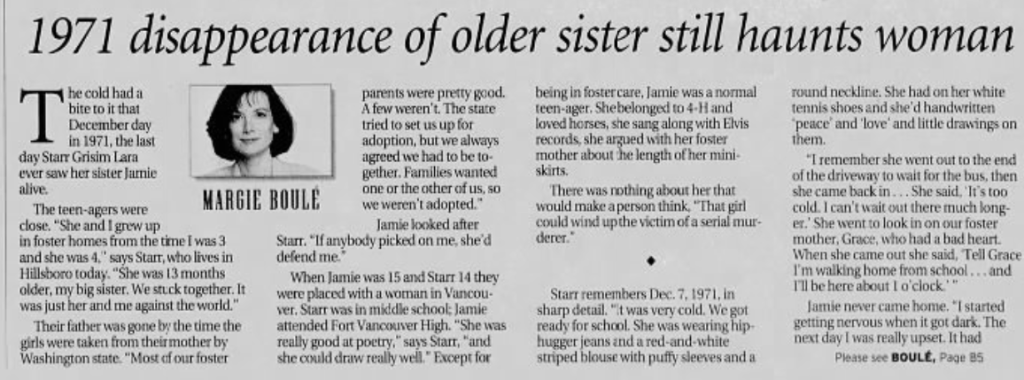
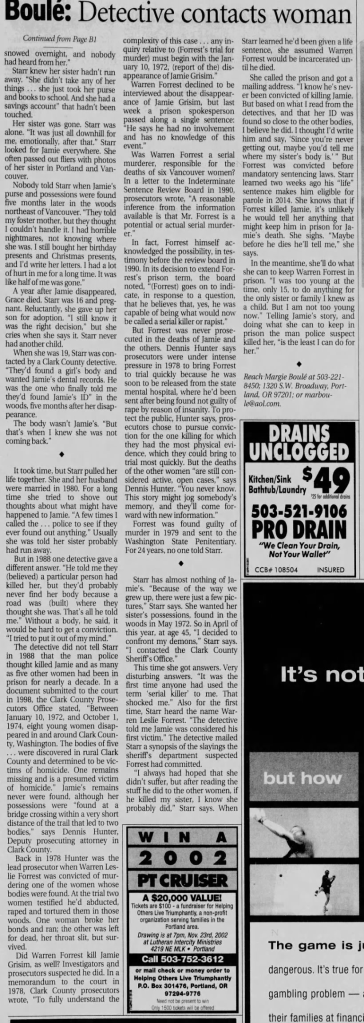
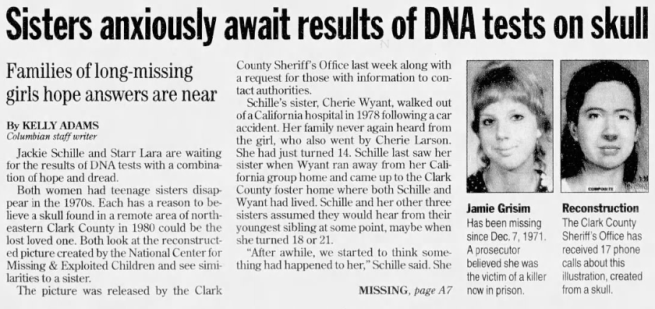
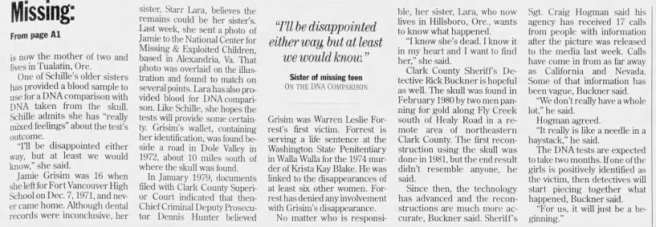
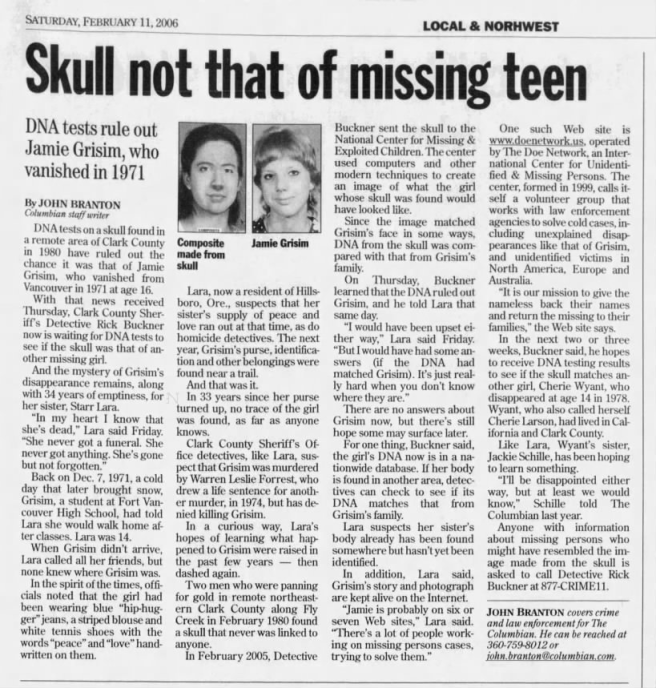
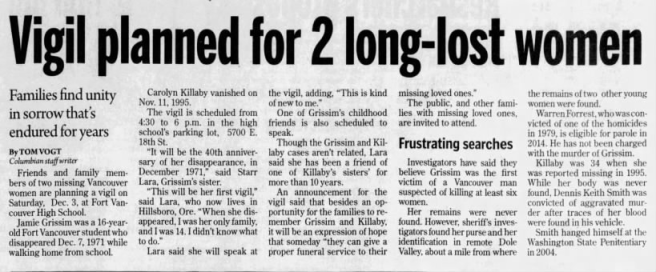
Possible Victims: On December 7, 1971 sixteen-year-old Jamie Rochelle Grisim was last seen walking home from Fort Vancouver High School; she was reported as missing by her foster mother the following day. During one of the searches for her shortly after she disappeared, detectives came across some of her personal belongings in nearby Dole Valley, including her purse and an ID card. It was initially believed that she ran away from her foster home and had left the state, but that theory was quickly disregarded. Since Martha Morrison and Carol Valenzuela were later recovered not far from where her belongings were found, local LE have reassessed their conclusions and now feel that Jamie was abducted and killed by Warren Forrest.
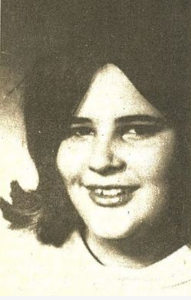
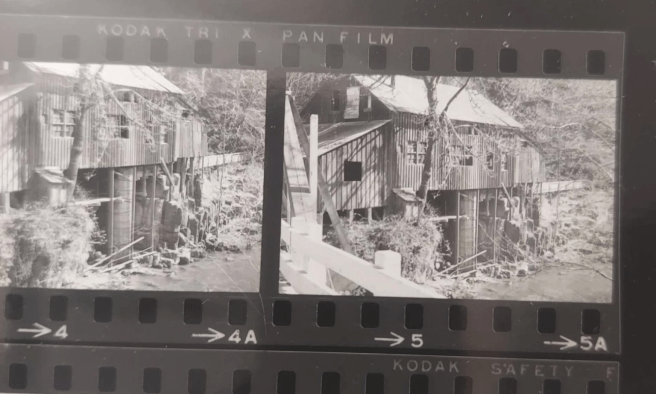
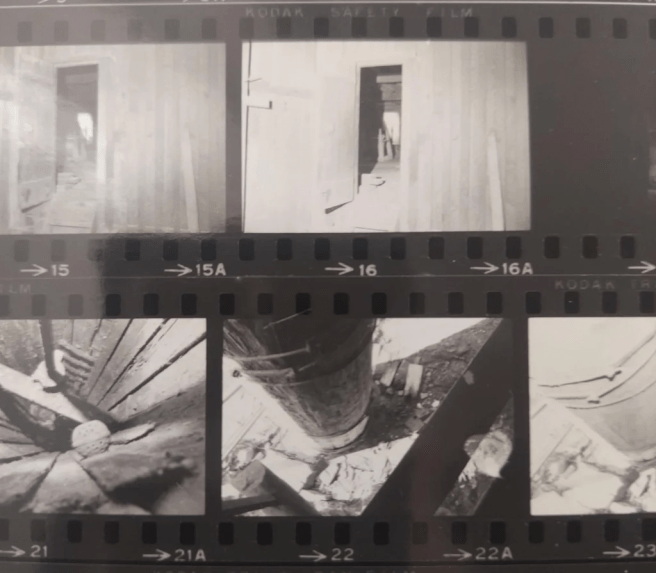
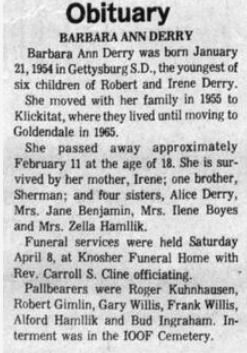
Eighteen-year-old Clark College freshman Barbara Ann Derry went missing on February 11, 1972, and was last seen on a Vancouver highway trying to hitchhike along State Highway 14 East and had been trying to make her way home to Goldendale. Tiny in stature, Derry was only 5’1” tall and weighed a mere 115 pounds, and at the time of her murder had been living on ‘W’ Street in Vancouver. Her remains were discovered by a woman searching for antique bottles the following month on March 29, 1972: she was at the bottom of a silo inside the Cedar Creek Grist Mill and she had been covered with boards and debris in a poor attempt to cover her up. The ME determined that she died from a single stab wound to the chest that had been inflicted by a ‘narrow-bladed instrument;’ she had been partially undressed and had been missing her bra. A positive identification was made thanks to dental records, and it was said (by LE) that she had ‘many male friends,’ and was known to hitchhike frequently. Oddly enough, Barbara’s body was found near the area where a large manhunt had been underway for ‘DB Cooper,’ an unidentified skyjacker that jumped out of a plane asking for a $200,000 ransom (his fate remains unknown to this day despite extensive investigations).
Either Forrest has some incredible self-restraint, or he has some victims that are unaccounted for (I suspect the latter): well over two years went by between the murder of Barbara Derry and the disappearance of his next unconfirmed victim, fourteen-year-old Diane Gilchrist. A ninth grader at Shumway Junior High School in Vancouver, Gilcrist went missing on May 29, 1974 and prior to her disappearance had never shown any problematic behavior: her parents said she had left their home in downtown Vancouver through her second-story bedroom window and vanished into the night, never to be seen or heard from again. As of February 2026, she has never been found, and her fate remains unclear.
Just days away from graduating from high school, nineteen-year-old Gloria Nadine Knutson was last seen by several acquaintances at a Vancouver nightclub called ‘The Red Caboose’ on May 31, 1974, after she turned down an invitation to attend a housewarming party. One eyewitness told investigators that the Hudson Bay High School senior had come to his residence and sought out his help that in those early morning hours, and that she had been claiming somebody had been tried to rape her, and that person was now stalking her; the acquaintance also reported that Knudson had asked him to drive her home, but he couldn’t because his car had been out of gas. Distraught and out of options, Gloria was forced to walk home; her skeletal remains were found by a fisherman in a forested area near Lacamas Lake on May 9, 1978.
On August 4, 1974 married mother of infant twins Carol Louise Platt-Valenzuela went missing while attempting to hitchhike from Camas to Vancouver; the twenty-year-old was not known to be involved in prostitution and had no criminal record. On October 12, 1974, her skeletal remains were discovered by a hunter in Dole Valley just outside of Vancouver, very close to those of Martha Morrison; because of this, detectives strongly suspect Forrest is responsible for the murders of both young women.
Lesser Discussed Possible Victims of WLF: In the first few weeks while he was at Western State Hospital in February 1975 Forrest resided at the same facility where a young woman had been murdered: twenty-five-year-old Karen Louise Wiles suffered from some form of diminished mental capacity and had voluntarily committed herself to the hospital three weeks prior to her death; because she wasn’t court mandated to be there she could come and go as she pleased. Wiles remains were found on February 21. 1975 in the flatlands in Tacoma, roughly eight miles away from the facility; she had been sexually assaulted and had been strangled, and had twine wrapped around her neck. The hospital staff greatly hindered the original investigation and refused to answer questions and help LE in any way.
There are a few additional possible victims of Warren Leslie Forrest that aren’t frequently discussed that do fall in his 1973 gap of inactivity: Rita Lorraine Jolly disappeared out of her West Linn, OR neighborhood while out on a routine nightly walk on June 29, 1973; her remains have never been recovered. It’s worth noting that West Linn is only a fifty-minute drive from Battle Ground, WA (where Forrest had been living at the time with his family).
On August 20, 1973 twenty-three-year-old seamstress Vicki Lynn Hollar was walking out of The Bon Marche in Eugene, which was her new POE (she has only been there for about two weeks, and was a transplant from Flossmoor, IL); she was last seen alive by her supervisor, when the two walked out to their respective vehicles together (Vicki drove a black 1965 VW Bug with the running boards removed). Hollar was supposed to show up at her residence to meet up with a friend, and the two were going to go to a party together, but she never arrived. Neither Vicki nor her vehicle have ever been recovered. It is slightly over a two-hour drive from Battle Ground to the Macy’s that Hollar worked at in Eugene, Oregon.
On November 5, 1973 Suzanne Seay-Justis was last heard from when she called her mother from a pay phone outside of The Memorial Coliseum in Portland; she told her she would be home the following day so she could pick up her young son from school, and despite having her own car Justis hitchhiked to Portland. It’s worth mentioning that the Memorial Coliseum is only a half hour drive from the Forrest family home on SW 18th Street in Battle Ground.
Washington state detectives have never stopped looking into Forrest in regard to the murders that he stands accused of committing, and in December 2025 they were able to locate a long-lost witness in relation to the murder of Jamie Grisim. Additionally, they’re working with the ‘Washington State Search Team and Rescue’ as well as ‘Clark County Search and Rescue,’ and have plans for another coordinated search in the Dole Valley area, this time using dogs that are highly trained in locating human remains that could be decades old and buried deep underground.
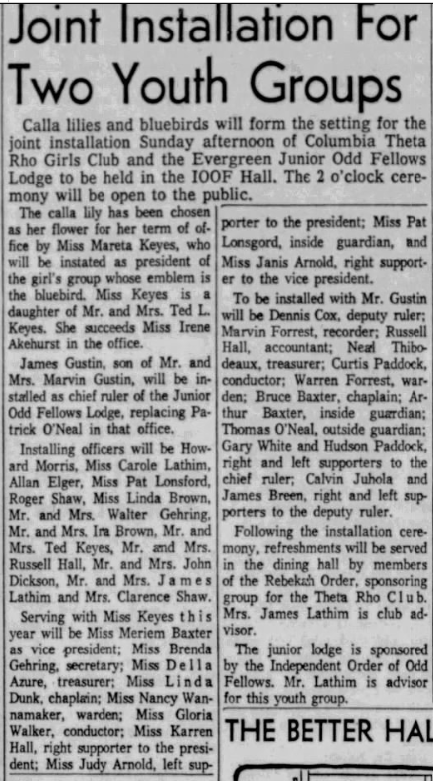
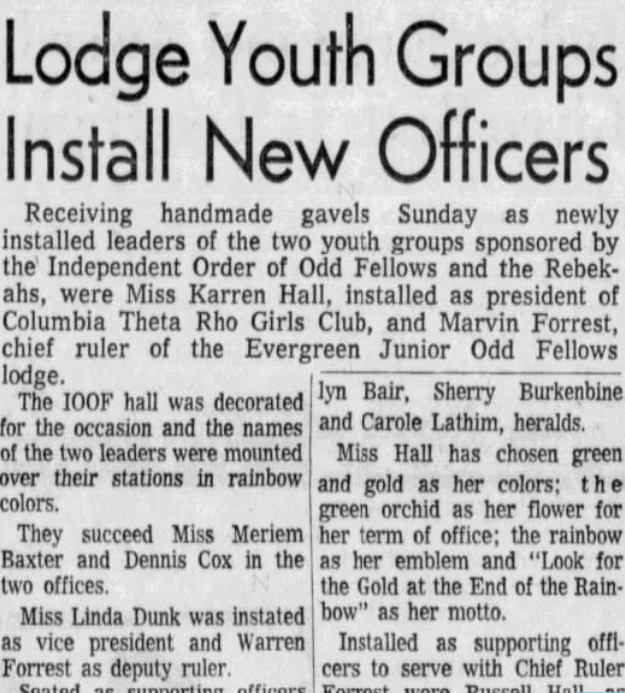
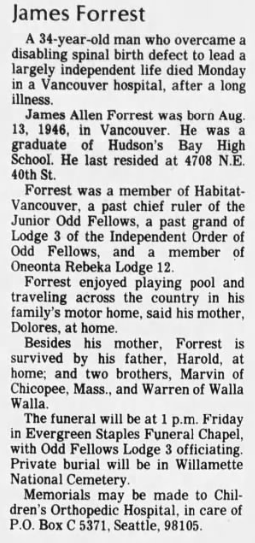
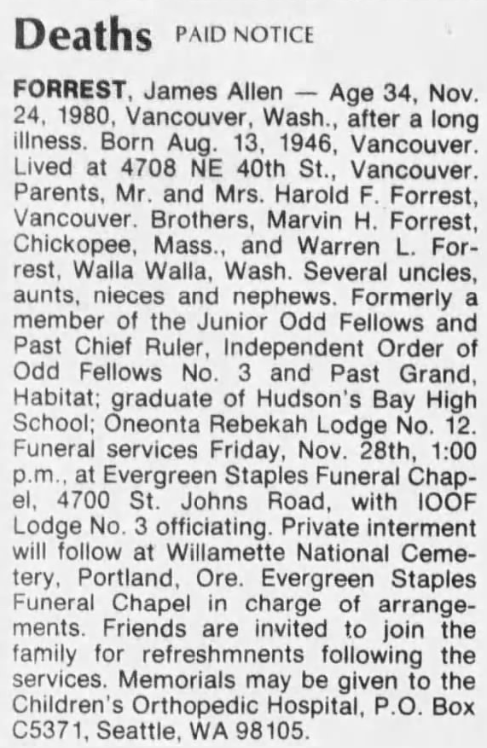
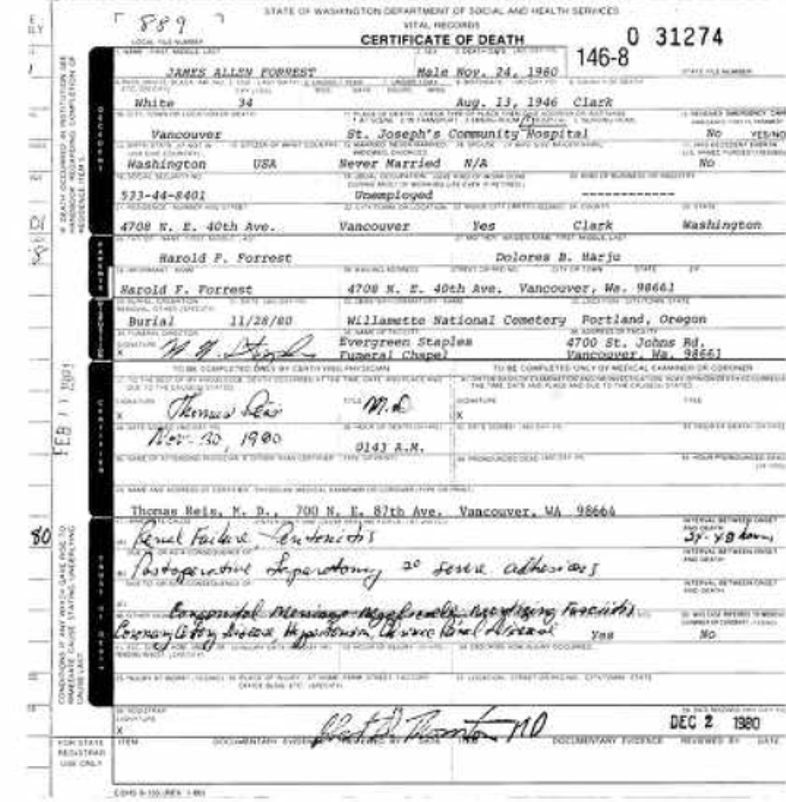
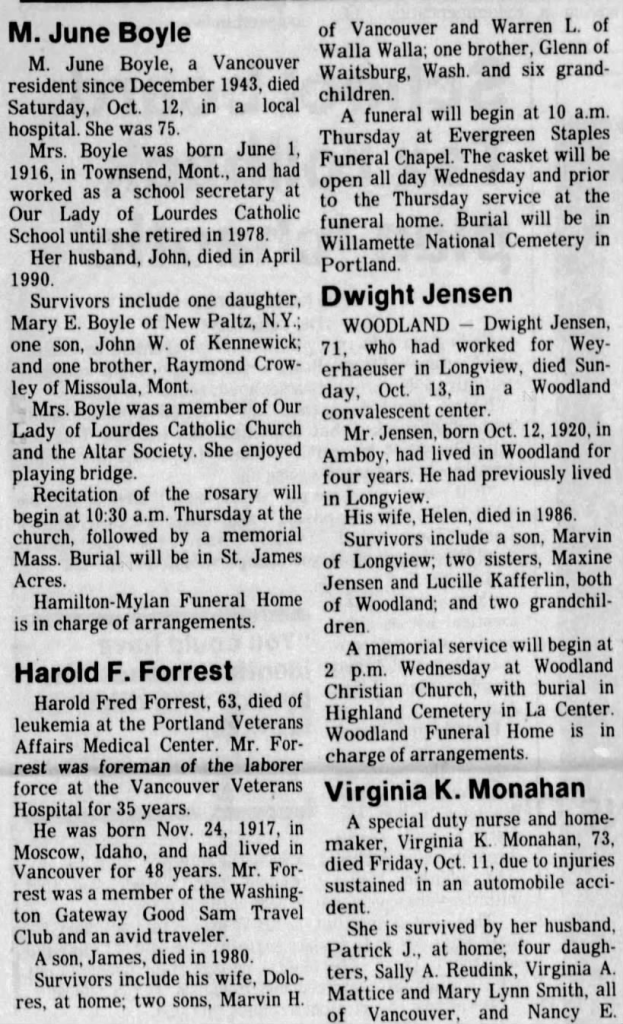
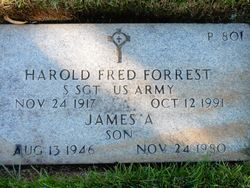
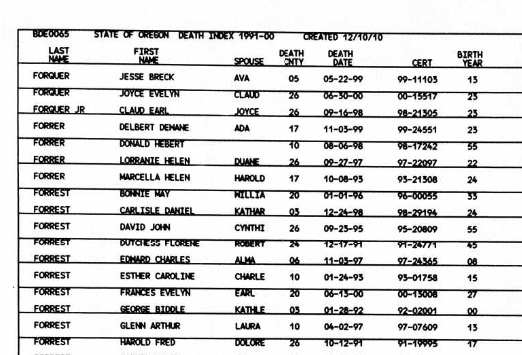
Conclusion: Warren’s brother James Allen Forrest died at the age of thirty-four on November 24, 1980 after succumbing to ‘a lengthy illness.’ According to his obituary, he was unmarried at the time of his death and was ‘formerly a member of the Junior Odd Fellows;’ he was also the Past Chief Ruler of the Independent Order of Odd Fellows No. 3 at St. John’s Road. Warren’s father died of leukemia at the age of seventy-three on October 13, 1991 in Portland, and per his obituary, before he retired Harold was the foreman of the labor force at the Vancouver Veterans Hospital for thirty-five years and was a member of the Washington Gateway Good Sam Travel Club (as he was an avid traveler). Dolores Beatrice Forrest died at the age of seventy-seven on Christmas day in 2002 in Walla Walla.
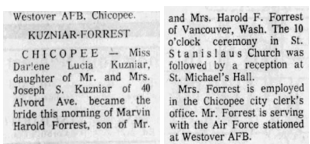
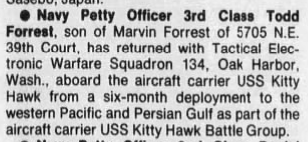
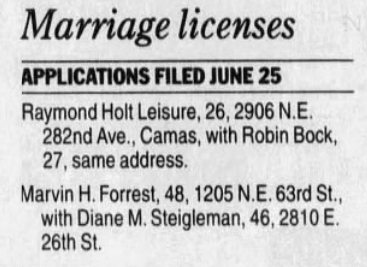
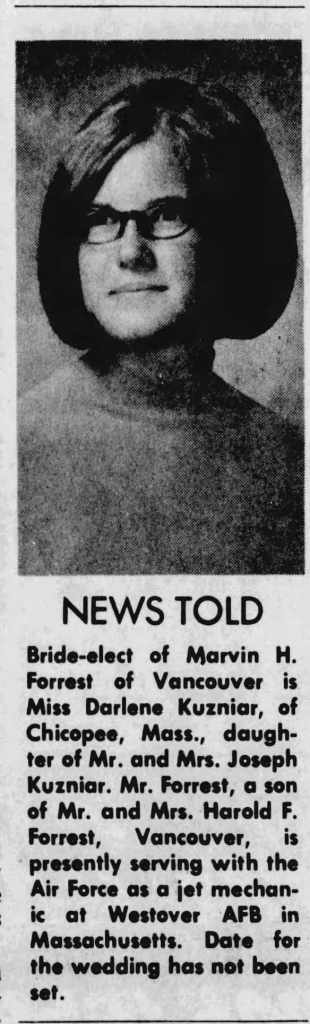
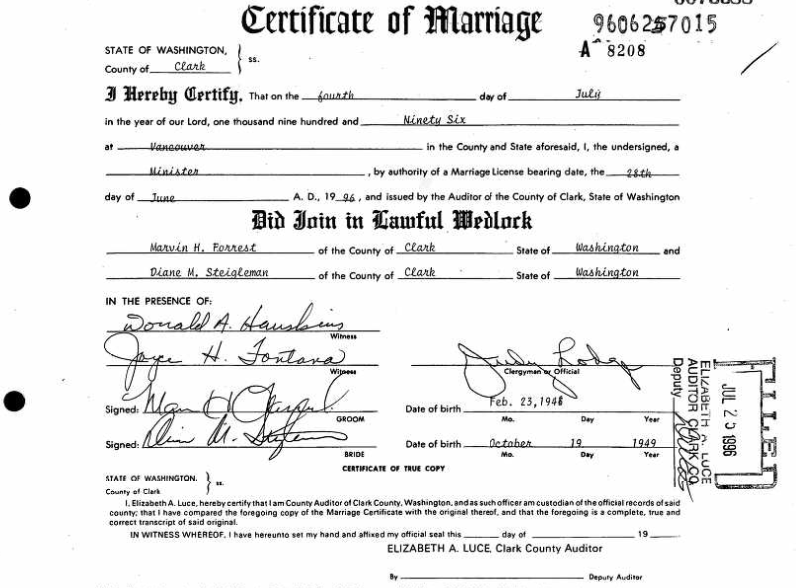
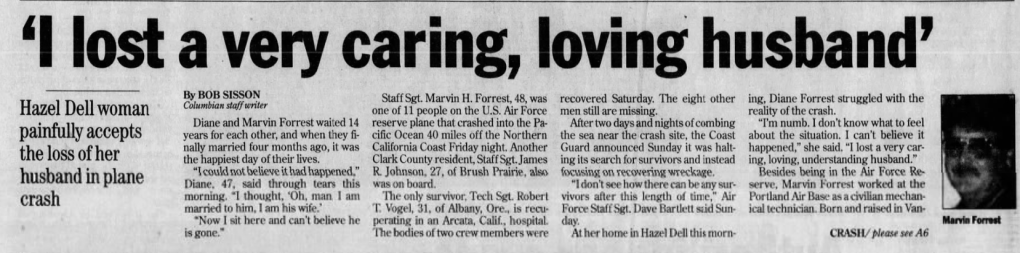
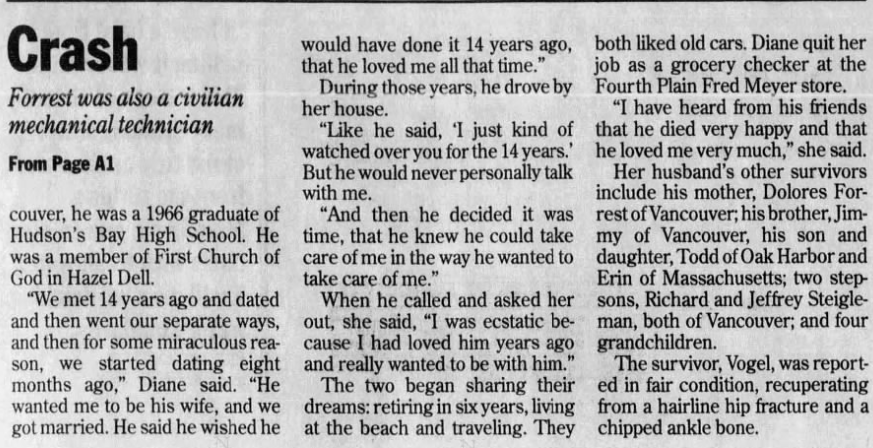
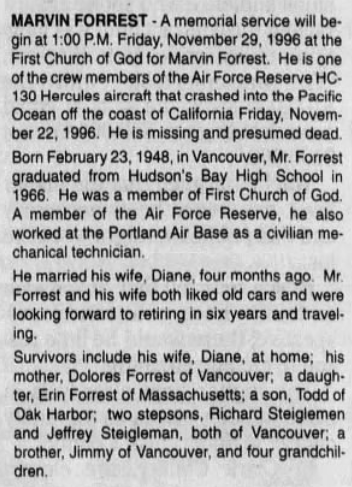
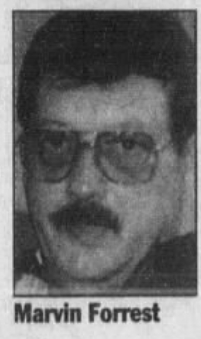
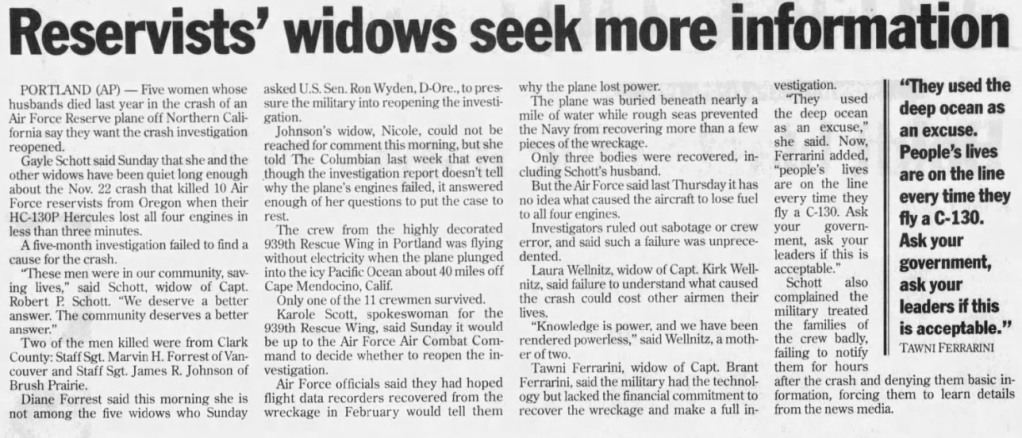
Marvin Forrest married Diane Steigleman at the age of forty-eight on July 23, 1996, and sadly not even four months later on November 23, 1996 he was killed in a plane crash above the Pacific Ocean roughly forty miles outside of the Northern California coast; his body has never been recovered. According to his obituary, he worked at the Portland Air Base as a civilian mechanic, and was a proud member of the Air Force Reserve; he was also a member of the First Church of God. Marvin and Diane both liked old cars and were looking forward to retiring in 2002 and traveling together. He had a son and a daughter, and his widow is now happily retired and living in Lake Havasu City, AZ.
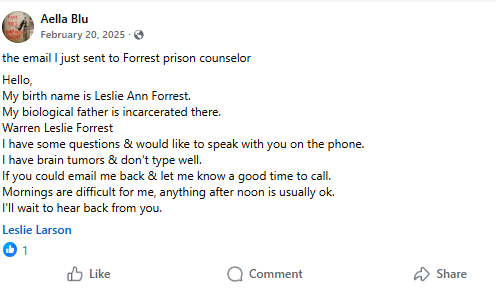
Warren’s younger child Lane has been married to his wife, Monica for almost twenty years and the couple have three children together; he works at Boeing Commercial Airplanes in Seattle as a mill operator. Forrest’s daughter Leslie is fifty-four and currently resides in Bullhead, AZ; sadly she is suffering from a plethora of health concerns, including three inoperable brain tumors.
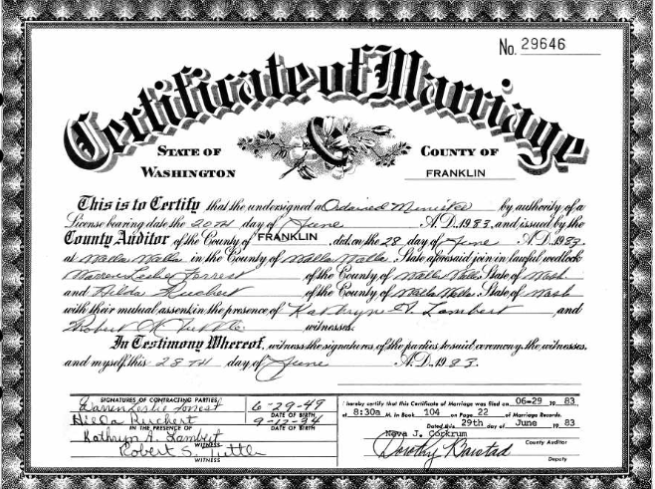
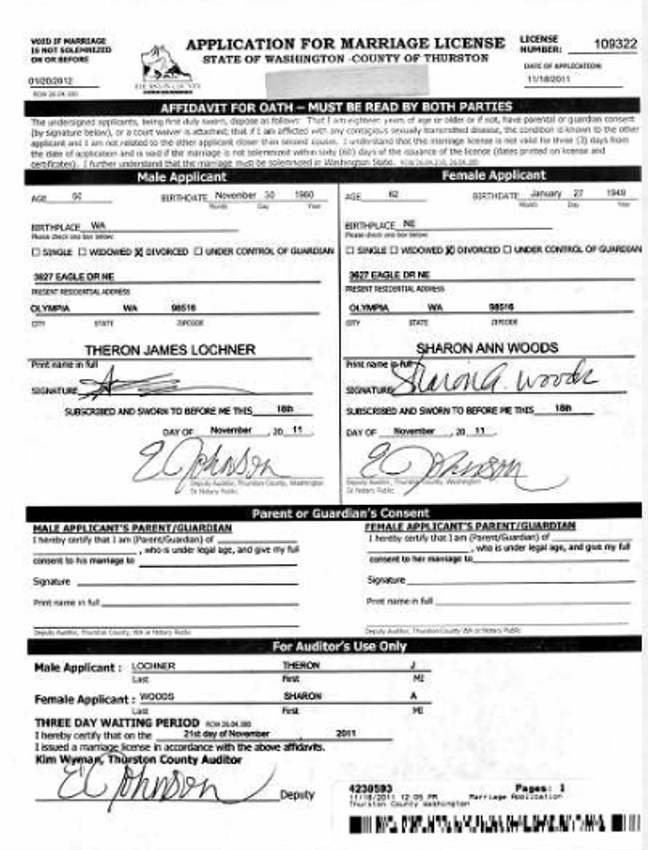
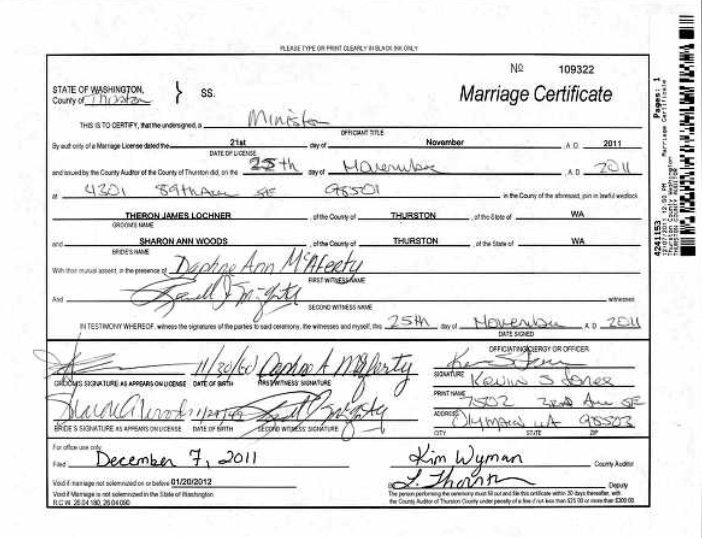
As of February 2026, Warren Leslie Forrest is seventy-six years old and is housed at Airway Heights Corrections Center in Spokane County, WA. He is still married to his second wife Hilda Ruchert, a nurse that he met while incarcerated and wed on June 20, 1983 that is fifteen years his senior. One of the only facts I was able to find out about the second Mrs. Warren Leslie Forrest is that she was born on September 12, 1934 and (according to an article published in 2017 on ‘koin.com’), she is in her 80’s and still residing in Walla Walla; I could find no record of her death. Sharon Ann Wilson/Hart-Forrest got remarried to a man named Jim Lochner on November 11, 2011, and the couple currently reside in Vancouver, WA; she is retired after a long career of working in the administrative part of a doctor’s office.
Works Cited: ‘Cold Case Team Analyzing Evidence that May Link More Women to Serial Killer Warren Forrest.’ (December 11, 2024). Taken January 6, 2026 from forensicmag.com Fox 12 Staff. ‘Clark County renews search for missing Teen Tied to 1970’s Serial Killer.’ (December 5, 2025). Iacobazzi, Ariel & Plante, Aimee. ‘Cold Case Team Revisits Death Linked to Warren Forrest Plante.’ (December 9, 2024). Taken January 6, 2026 from koin.com Morgan, Branden. Pie in the Sky Media: ‘The Forgotten Serial Killer.’ Taken February 17, 2026 from kslpodcasts.com Nakamura, Beth. Warren Leslie Forrest Clark County murder trial begins. Taken January 6, 2026 from oregonlive.com Osorio, Carolyn. (September 9, 2025). Stolen Voices of Dole Valley, Episode 5: The Good-Looking Stranger. Taken February 12, 2026 from https://pod.wave.co/ Varma, Tanvi. ‘Authorities believe multiple cold cases are linked to suspected Clark County serial killer.’ (December 10, 2024). Taken January 6, 2026 from katu.com ‘Warren Forrest.’ Taken January 6, 2026 from grokipedia.com/page/Warren_Forrest
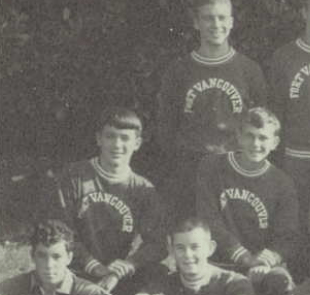
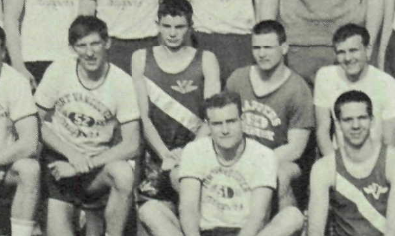
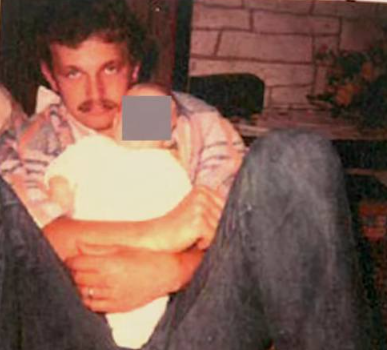
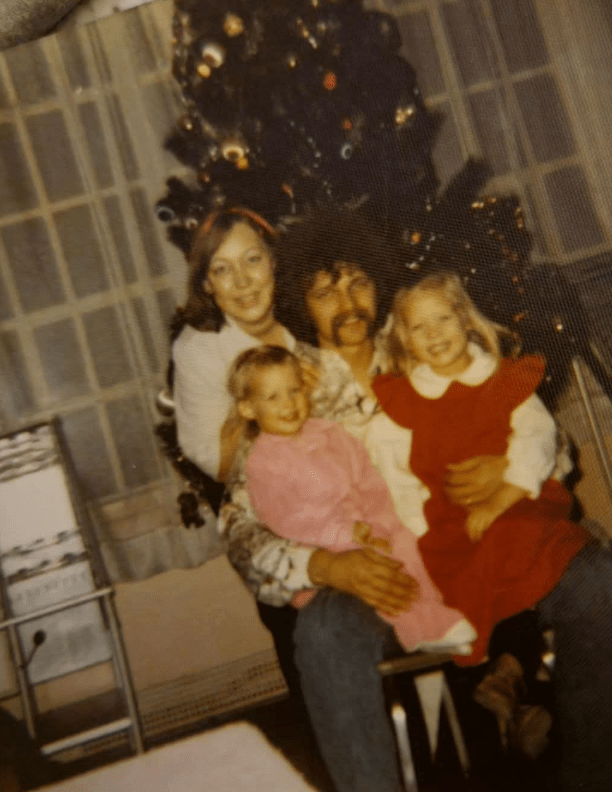
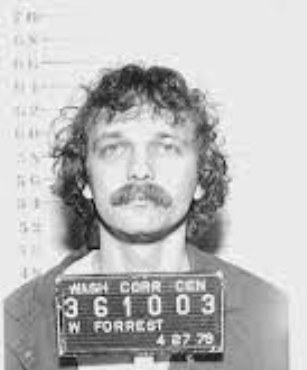
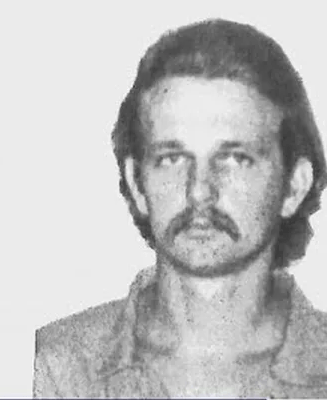
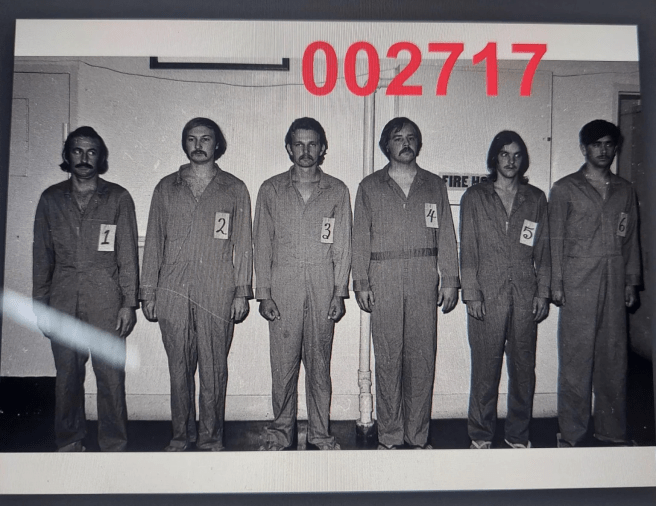
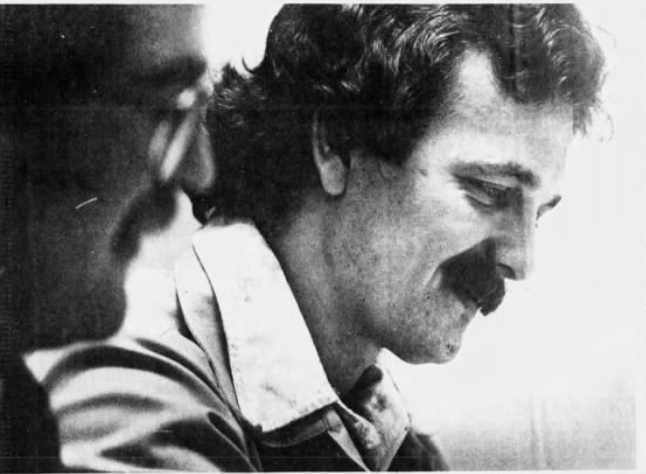
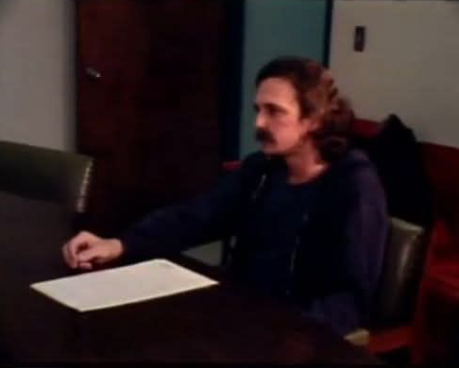
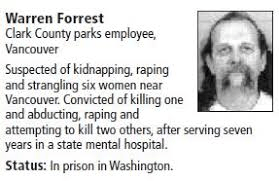
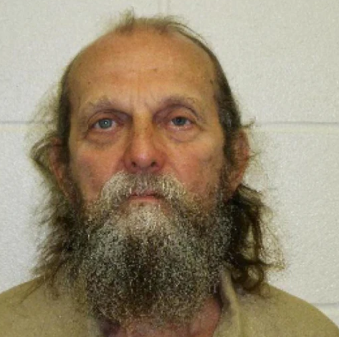
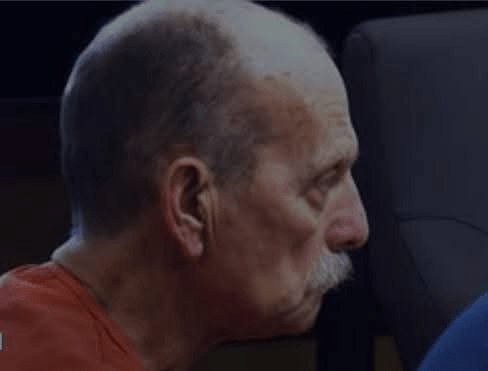
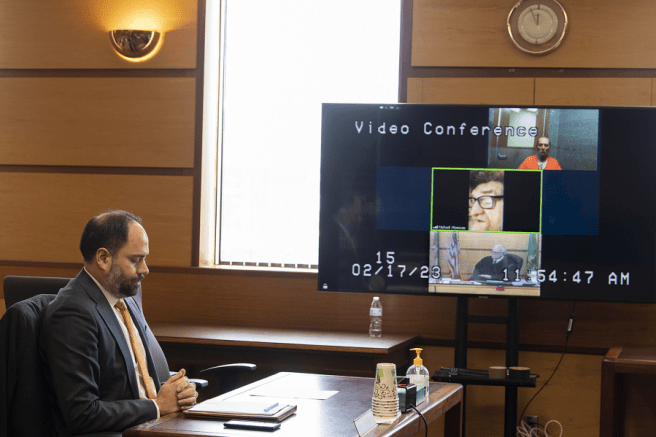
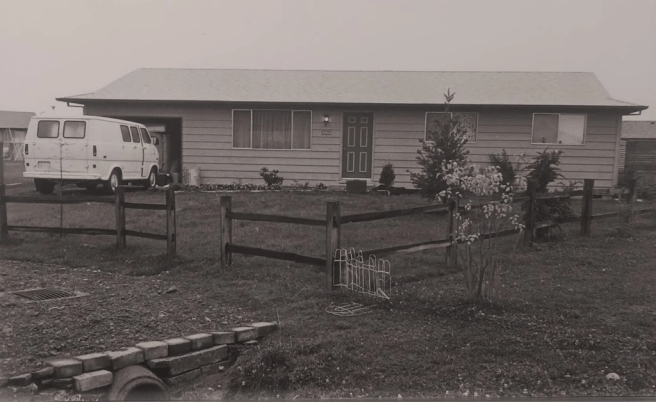
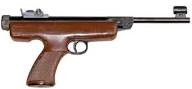
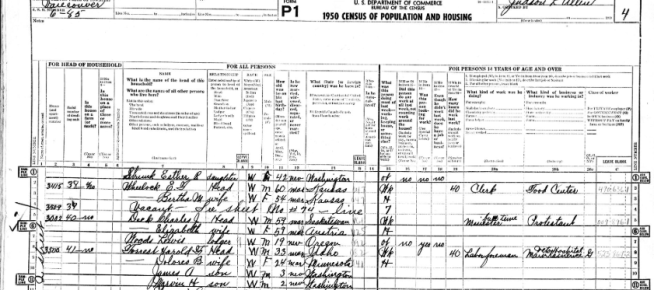
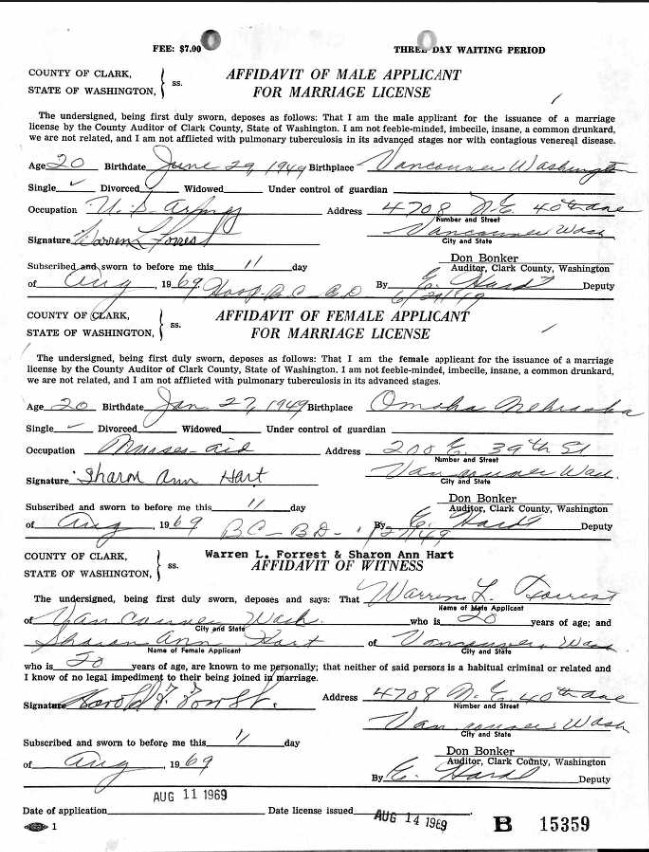
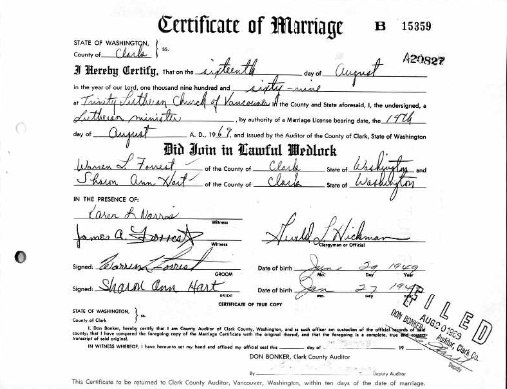
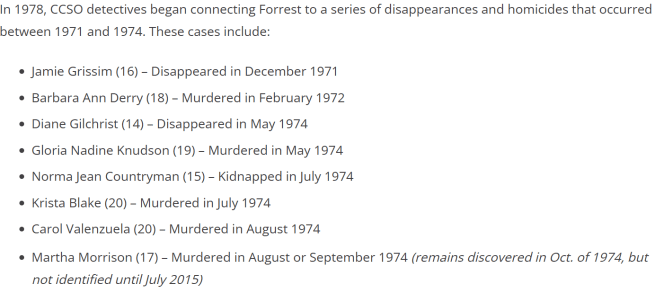
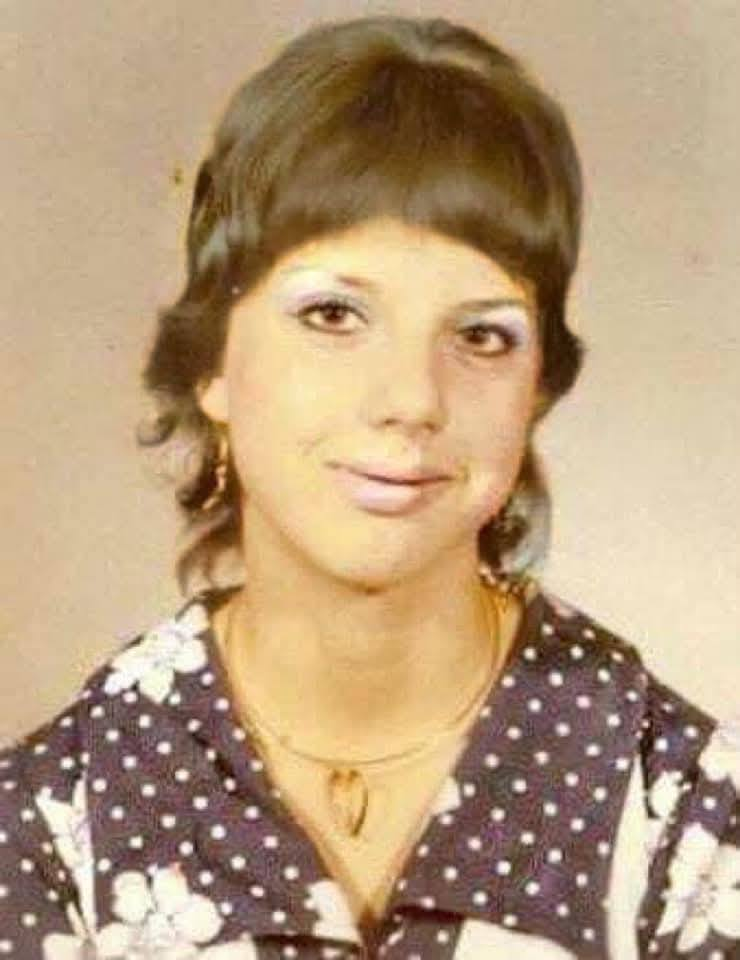
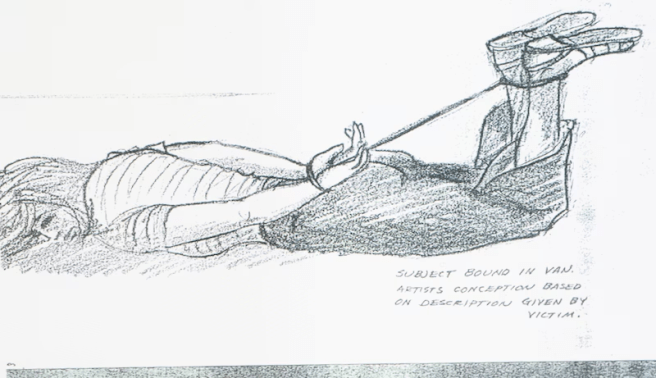
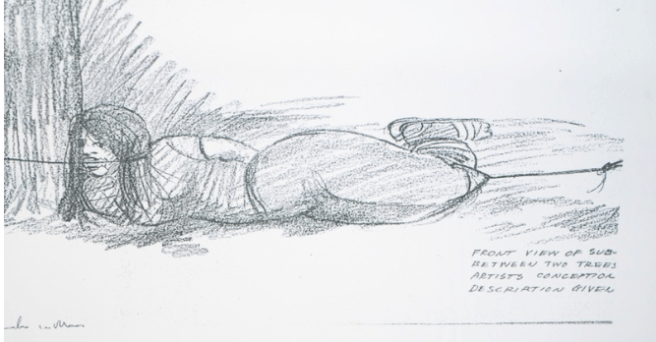
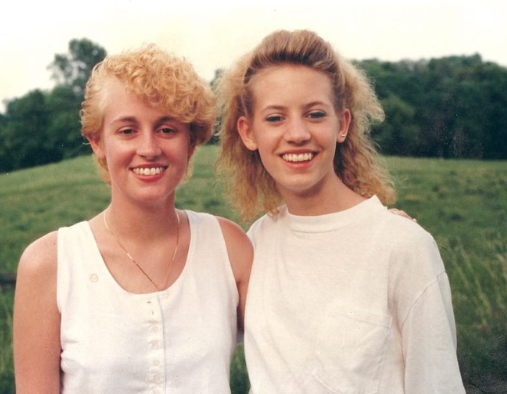
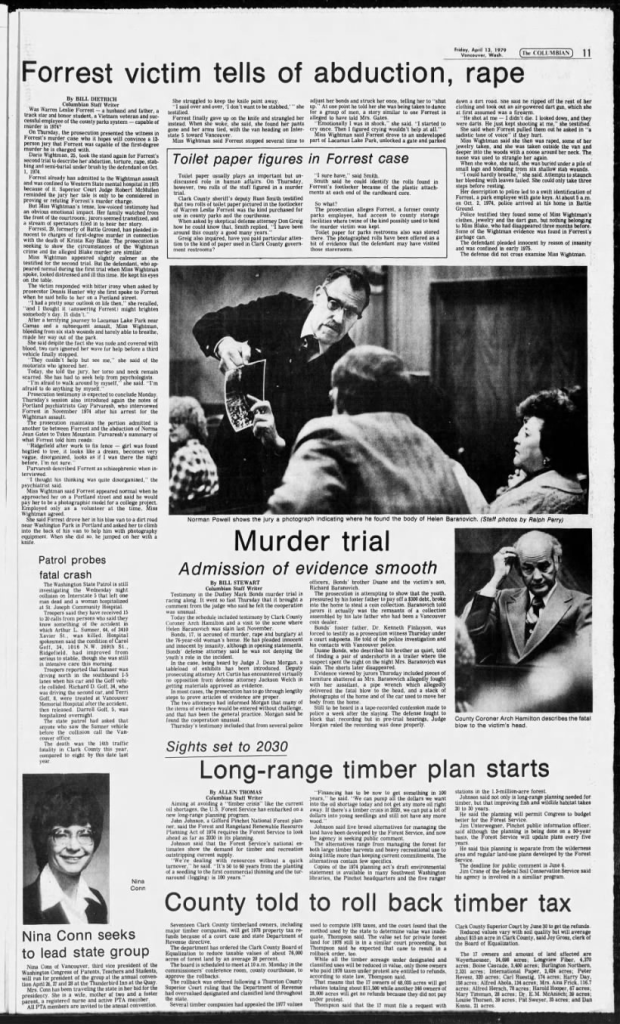
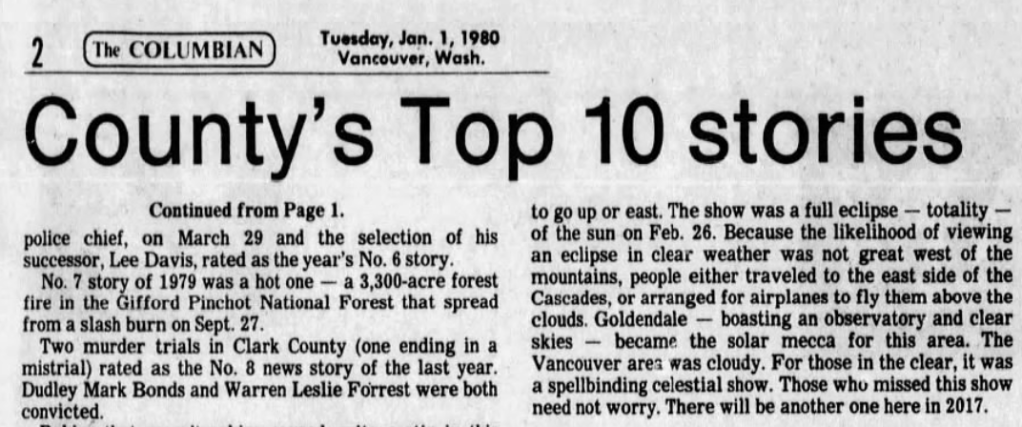
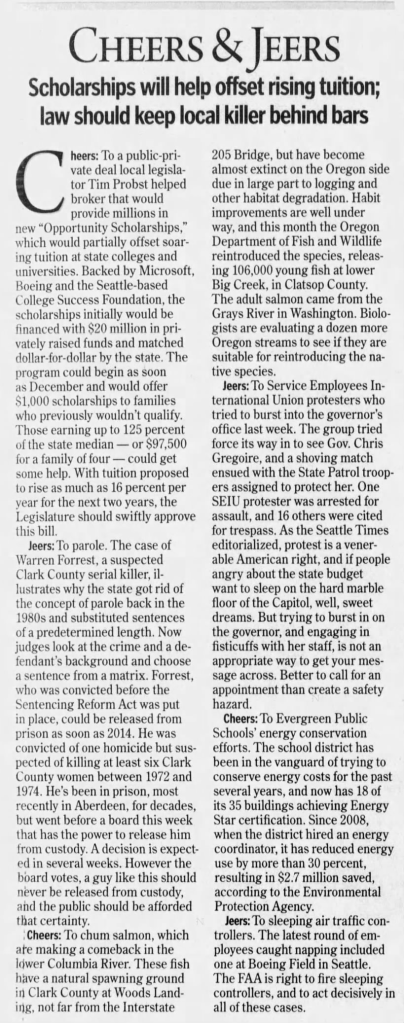
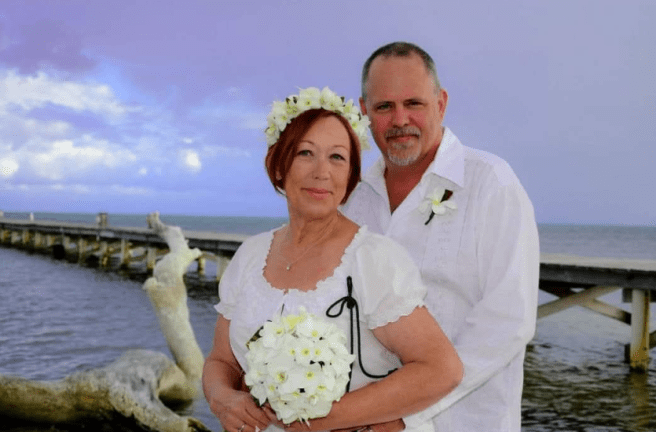
Warren Leslie Forrest in a group photo for track taken from the 1965 Fort Vancouver High School yearbook.Warren Leslie Forrest from the 1965 Fort Vancouver High School yearbook.Warren Leslie Forrest posing as captain of the track team from the 1967 Fort Vancouver High School yearbook.Warren Leslie Forrest from the 1966 Fort Vancouver High School yearbook.Warren Leslie Forrest in a group photo for cross country from the 1966 Fort Vancouver High School yearbook.Warren Leslie Forrest (middle row, right) in a group photo for cross country from the 1966 Fort Vancouver High School yearbook.Warren Leslie Forrest’s senior year picture from the 1967 Ft. Vancouver High School yearbook.Warren Leslie Forrest’s senior year activities listed in the 1967 Ft. Vancouver High School yearbook.Warren Leslie Forrest (bottom row, far left) in a group picture for track from the 1967 Fort Vancouver High School yearbook.Warren Leslie Forrest (top row, far right) in a group picture for track from the 1967 Fort Vancouver High School yearbook.Warren and Sharon on their wedding day.The best screenshot I was able to get of this particular picture of Warren and Sharon.A picture of Warren with one of his children, photo courtesy of Leslie Forrest.Warren Forrest with his wife and kids taken at the Western State Penitentiary at Christmas 1975, photo courtesy of Leslie Forrest.One of Forrest’s mug shots.Another one of Forrest’s mug shots.Another one of Forrest’s mug shots.A line up with Warren Forrest (he is the third from the left). Photo courtesy of the Clark County Sheriff’s Department/KSL Podcasts.Forrest sitting in court with one of his attorneys.Warren Leslie Forrest.Some details about Forrest along with another picture of him.An older WLF.Warren Leslie Forrest.Warren Forrest.Warren Leslie Forrest on a Zoom call during his trial for Martha Morrison.Warren Leslie Forrest’s military record, courtesy of Starr Grisim.The residence of WLF. Photo courtesy of the Clark County Sheriff’s Department/KSL Podcasts.Forrest’s blue 1973 Ford van. Photo courtesy of the Clark County Sheriff’s Department/KSL Podcasts.Some evidence from Warren Leslie Forrest’s van in vacuum sealed bags. Photo courtesy of the Clark County Sheriff’s Department/KSL Podcasts.Investigators identify a blood stain on the handle of Warren Forrest’s dart gun. Photo courtesy of the Clark County Sheriff’s Department/KSL Podcasts.An older model .177 caliber dart pistol.The Forrest family from the 1950 census.Warren Leslie Forrest and Sharon Ann Hart’s affidavit of applicant for a marriage license that was filed on August 11, 1969.Warren Leslie Forrest and Sharon Hart’s marriage certificate that was filed on August 20, 1969.Warren Leslie Forrest’s confirmed and suspected victims.Jamie Grisim.Barbara Ann Derry.The Grist Mill where the body of a young woman was found. Photo courtesy of the Clark County Sheriff’s Department/KSL Podcasts.The inside of the Grist Mill, where Barbara Derry was found. Photo courtesy of the Clark County Sheriff’s Department/KSL Podcasts.Barbara Derry’s obituary.Diane Sue Gilcrist.Gloria Nadine Knutson.Norma Jean Countryman, one of Forrest’s surviving victims.Norma, after her assault.Norma in the weeks after her attack. Photo courtesy of the Clark County Sheriff’s Department/KSL Podcasts.An artists depiction of Norma Countryman hogtied by Warren Forrest, drawing courtesy of the Clark County Sheriff’s Office.An artists depiction of Norma Countryman hogtied by Warren Forrest, drawing courtesy of the Clark County Sheriff’s Office.Krista Kay Blake (left) and her sister.Police evidence negative of Krista Blake skeletal remains. Photo courtesy of the Clark County Sheriff’s Department/KSL Podcasts.Where Krista Kay Blake was last seen compared to where Warren Leslie Forrest lived at the time he killed her; I also included where Lewisville Regional Park was as well, which is where some eyewitnesses said they saw Blake and Forrest together before she was murdered.Carol Valenzuela.Martha Morrison.A section of forest in Dole Valley where the bodies of Carol Valenzuela and Martha Morrison were discovered. Photo courtesy of the Clark County Sheriff’s Department/KSL Podcasts.The skull of Martha Morrison. Photo courtesy of the Clark County Sheriff’s Department/KSL Podcasts.An article about the trial of Warren Forrest that mentions his other surviving victim that was published in The Columbian on April 13, 1979.Some human remains discovered in the vicinity of Western State Mental Hospital. Photo courtesy of the Clark County Sheriff’s Department/KSL Podcasts.Karen Wiles.Rita Jolly, who vanished out of her West Linn neighborhood on June 29, 1973.Vicki Lynn Hollar, who disappeared on August 20, 1973 after leaving work at The Bon Marche in Eugene, OR.Sue Seay-Justis, who disappeared in Portland on November 5, 1973.Warren Forrest and Sharon Hart’s ‘Certificate of Dissolution or Declaration of Invalidity of Marriage’ dated July 23, 1980.A newspaper clipping announcing that Warren Leslie Forrest won a ‘wolf badge’ that was published in The Columbian on January 30, 1958.Warren Leslie Forrest is mentioned in an article about advancing in the boy scouts that was published in The Columbian on December 16, 1960.An article about two new youth groups being formed in Vancouver, WA that mentions Warren Leslie Forrest that was published in The Columbian on January 4, 1963.An article about two new youth groups being formed in Vancouver that mentions Warren Leslie Forrest that was published in The Columbian on January 14, 1964.A list of students with high GPA’s that includes Warren Leslie Forrest that was published in The Columbian on April 22, 1965.An article about athletes at Fort Vancouver High School that mentions Warren Leslie Forrest that was published in The Columbian on April 20, 1966.Warren Leslie Forrest’s name mentioned in an article about cross country at Fort Vancouver High School that was published in The Columbian on May 5, 1966.A newspaper clipping about a car accident Warren Leslie Forrest got into during his adolescence that was published in The Columbian on May 27, 1966.Forrest is mentioned as the captain of the baseball team from Fort Vancouver High School published in The Columbian on June 3, 1966.Warren Forrest in a list of top athletes at Fort Vancouver High School that was published in The Columbian on March 24, 1967.Forrest is mentioned in a list of graduates from Fort Vancouver High School published in The Columbian on June 2, 1967.A newspaper article about the car accident Warren Leslie Forrest got into in May 1966 that was published in The Columbian on September 21, 1967.Warren Leslie Forrest’s name is listed amongst those that enlisted in the US Army in October 1967 that was published in The Columbian on October 18, 1967.A newspaper article about Warren Leslie Forrest being assigned to the Homestead Air Force Base in Florida during his time in the US Army that was published in The Columbian on March 20, 1968.A newspaper article about the upcoming nuptials of Warren Leslie Forrest and Sharon Ann Hart that was published in The Columbian on December 26, 1968.Warren Leslie Forrest and Sharon Ann Hart are included in a list of people that applied for marriage licenses that was published in The Columbian on August 13, 1969.A newspaper clipping about Warren Leslie Forrest and his new bride Sharon relocating to Texas published in The Columbian on August 27, 1969.Warren Leslie Forrest is included in a list of military related accomplishments (he successfully completed Airborne Jump School at Fort Benning, GA) published in The Columbian on July 7, 1970. The birth announcement of Warren and Sharon’s first child that was published in The Columbian on September 8, 1971.The birth announcement of Warren and Sharon’s second child that was published in The Columbian on April 26, 1974.An article about Warren Leslie Forrest being arrested for a stabbing that was published in The Columbian on October 2, 1974.A quick blurb mentioning Warren Leslie Forrest being arrested by the Clark County Sheriff’s Department that was published in The Columbian on October 3, 1974.An article about a rape arraignment of Warren Leslie Forrest in Clark County, WA that was published in The Columbian on October 3, 1974.An article about a rape arraignment of Warren Leslie Forrest in Clark County, WA that was published in The Columbian on October 4, 1974.WLF listed in court cases being held in Clark County Superior Court that was published in The Columbian on October 10, 1974.A newspaper article about Warren Forrest entering a not-guilty plea that was published in The Columbian on October 10, 1974.An article about Warren Leslie Forrest asking for a conditional release from custody at Western State Hospital that was published in The Columbian on July 25, 1978.An article about Warren Leslie Forrest being charged in a four year old murder case that was published in The Columbian on October 20, 1978.An article about Warren Leslie Forrest being charged for the murder of Krista Kay Blake that was published in The Oregonian on October 21, 1978.The initial blurb in a newspaper about an article about Warren L. Forrest published in The Columbian on October 25, 1978.An article about four judges being disqualified from presiding over the trial of Warren Leslie Forrest that was published in The Columbian on October 25, 1978.An article about Warren Leslie Forrest using an insanity plea during his second trial that was published in The Oregonian on October 25, 1978.An article about pre-trial hearings for Warren Leslie Forrest in relation to the murder of Krista Blake that was published in The Oregon Journal on November 15, 1978.An article about a ruling in documents related to the trial of Warren Leslie Forrest for the murder of Krista Blake that was published in The Oregonian on November 17, 1978.An article about the trial of Warren Leslie Forrest that was published in The Columbian on November 17, 1978.A newspaper article about a ruling in the Warren Forrest trial that was published in The Columbian on December 3, 1978.A newspaper article about a ruling in the Warren Forrest trial that was published in The Columbian on December 5, 1978.A newspaper article the trial of Warren Forrest trial that was published in he Oregonian on December 6, 1978.A newspaper article about the trial of Warren Leslie Forrest that was published in The Columbian on December 21, 1978. A newspaper article about the trial of Warren Leslie Forrest that was published in The Columbian on December 22, 1978.A newspaper article about potential jurors for the trial of Warren Leslie Forrest that was published in The Columbian on January 16, 1979.An article about evidence being lost in the Warren Leslie Forrest trial published in The Columbian on January 30, 1979.An article about evidence being lost in the Warren Leslie Forrest trial published in The Columbian on February 2, 1979.An article about the trial of Warren Leslie Forrest published in The Columbian on February 7, 1979.An article about the trial of Warren Leslie Forrest for the murder of Krista Kay Blake that was published in The Columbian on April 6, 1979.An article about the trial of Warren Leslie Forrest published in The Columbian on April 13, 1979.Forrest is mentioned in the front page of The Columbian on April 19, 1979.An article about Warren Leslie Forrest’s mother giving him an alibi that was published in The Columbian on April 19, 1979.An article announcing Warren Leslie Forrest got life in prison for the murder of Krista Kay Blake that was published in The Columbian on April 26, 1979.Warren Forrest mentioned in ‘year in review (of 1979)’ that was published in The Columbian on January 1, 1980.Part one of a newspaper article about the disappearance of Jamie Grisim that mentions Warren Leslie Forest that was published in The Sunday Oregonian on June 16, 2002.Part two of a newspaper article about the disappearance of Jamie Grisim that mentions Warren Leslie Forest that was published in The Sunday Oregonian on June 16, 2002.Part one of a newspaper article about the disappearance of Jamie Grisim that mentions Warren Leslie Forest that was published in The Columbian on February 11, 2006.Part two of a newspaper article about the disappearance of Jamie Grisim that mentions Warren Leslie Forest that was published in The Columbian on February 11, 2006.A newspaper article about the possible skull of Jamie Grisim that mentions Warren Leslie Forest that was published in The Columbian on February 11, 2006. What was on the front of the newspaper that mentioned Warren Leslie Forrest that was published in The Columbian on April 12, 2011.Part one of a newspaper article about Warren Leslie Forrest being up for parole that was published in The Columbian on April 12, 2011.Part two of a newspaper article about Warren Leslie Forrest being up for parole that was published in The Columbian on April 12, 2011.A newspaper article about Warren Leslie Forrest being up for parole that was published in The Columbian on April 13, 2011.Warren Leslie Forrest is mentioned in a ‘Cheers and Jeers’ part of The Columbian that was published on April 16, 2011.A newspaper article about parole being denied for Warren Leslie Forest that was published in The Columbian on April 27, 2011.A newspaper article about a vigil for one of Warren Leslie Forests victims (Jamie Grisim) that was published in The Columbian on November 26, 2011.An article about DNA evidence linking Warren Leslie Forrest to two additional murders that was published in The Kitsap Sun on August 25, 2017.An article about Warren Leslie Forrest and the murder of Martha Morrison that was published in The Daily Herald on January 2, 2020.An article about Warren Leslie Forrest and the murder of Martha Morrison that was published in The Spokesman-Review on January 2, 2020.An article about Warren Forrest appearing in court for the murder of Martha Morrison that was published in The Longview Daily News on January 7, 2020.An article about Warren Forrest pleading not guilty for the murder of Martha Morrison that was published in The Spokesman-Review on February 8, 2020.Part one of an article about Warren Forrest being found guilty for the murder of Martha Morrison that was published in The Oregonian on February 2, 2023.Part two of an article about Warren Forrest being found guilty for the murder of Martha Morrison that was published in The Oregonian on February 2, 2023.An article about Warren Forrest being found guilty for the murder of Martha Morrison that was published in The Daily Herald on February 3, 2023.An article about some of the murders that Warren Leslie Forrest’s was never charged for that was published in The Longview Daily News on December 10, 2024.
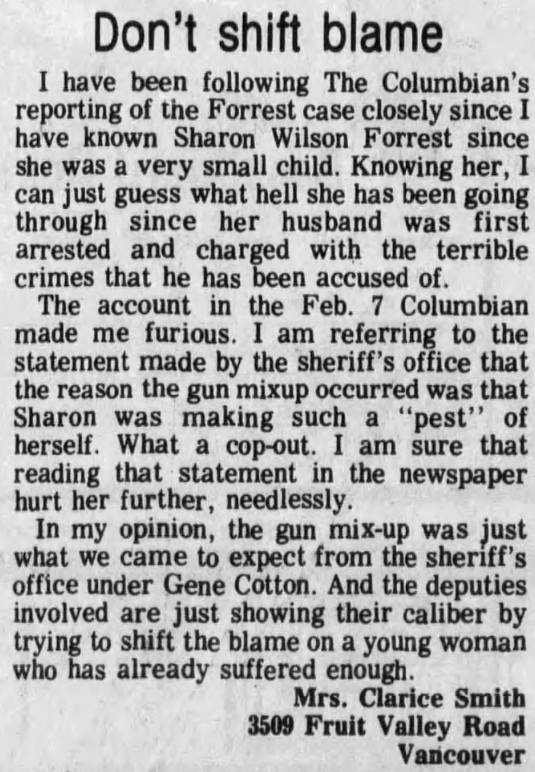
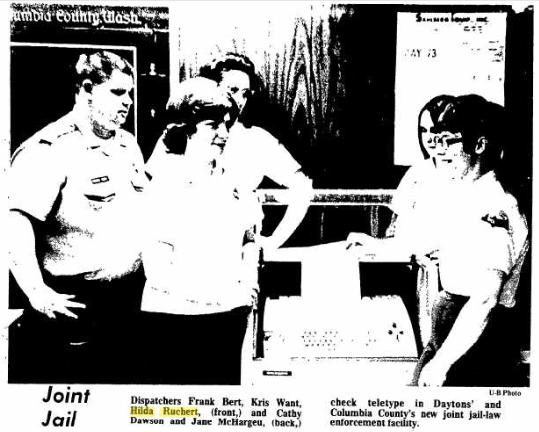
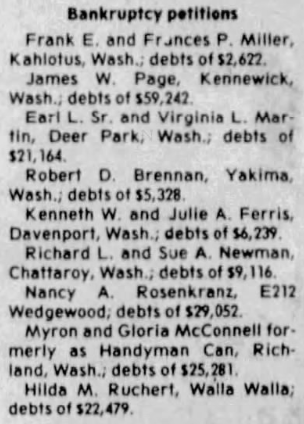
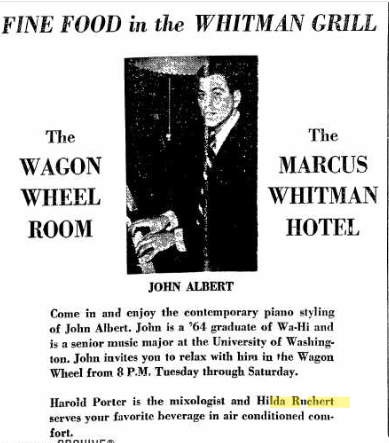
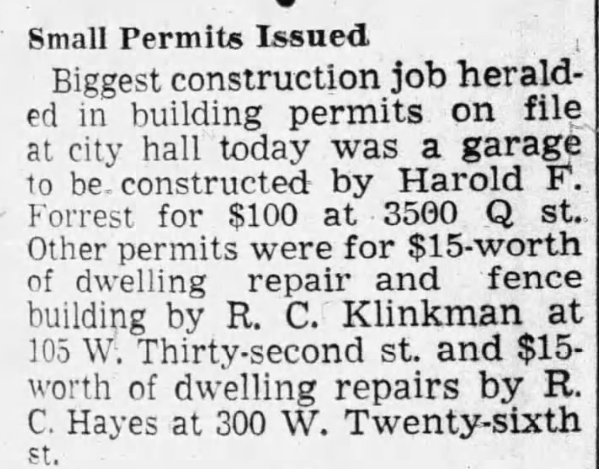
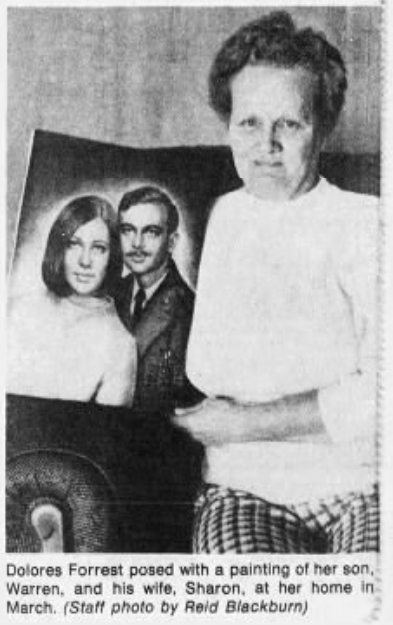
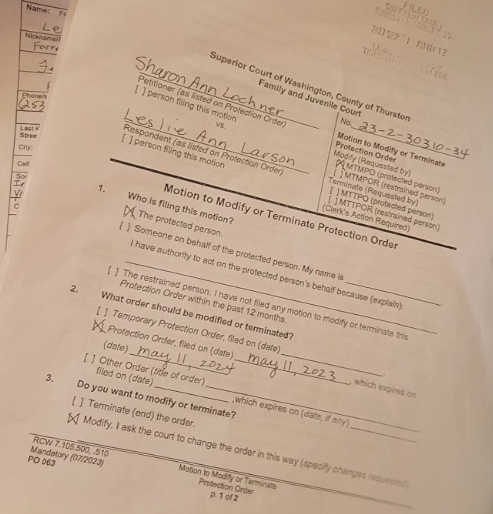
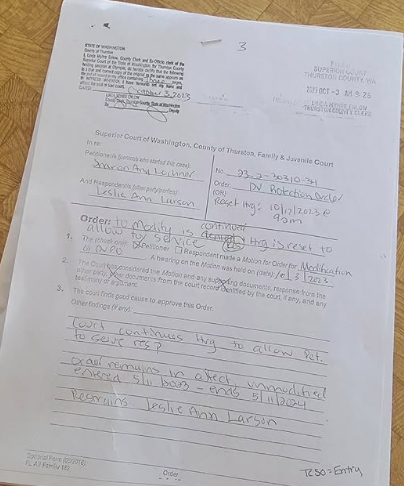
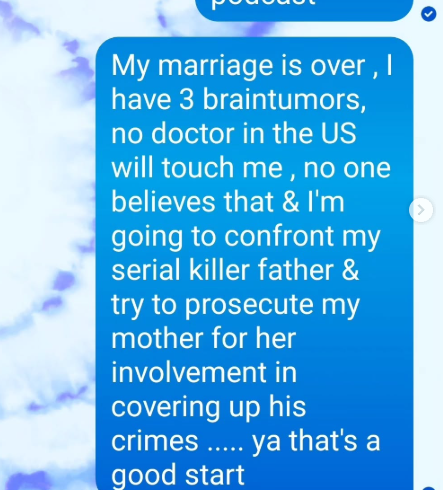
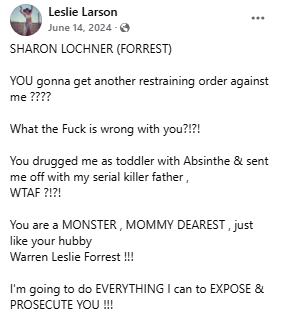
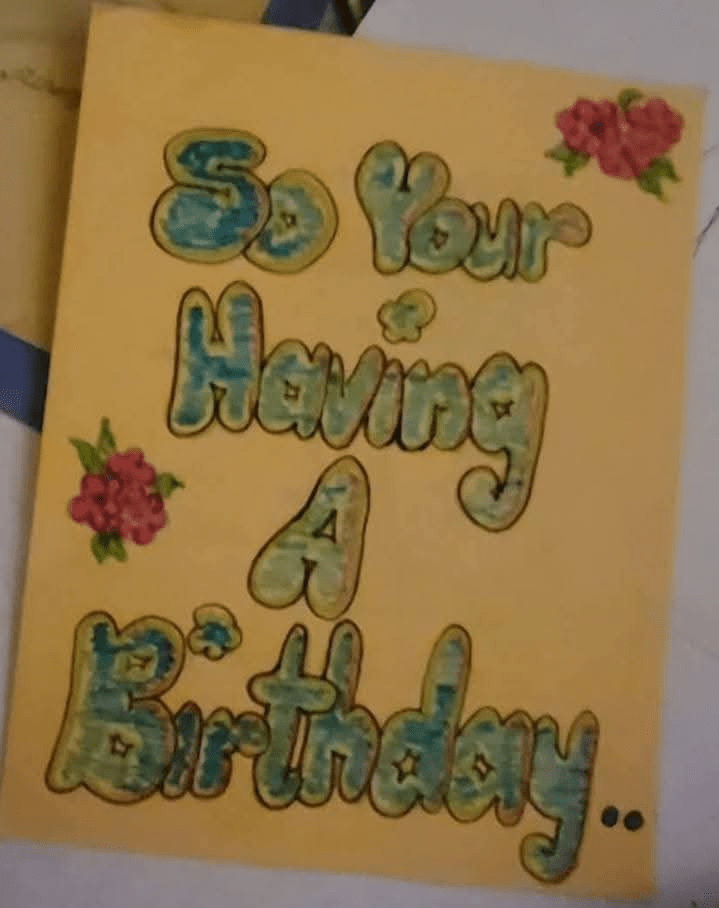
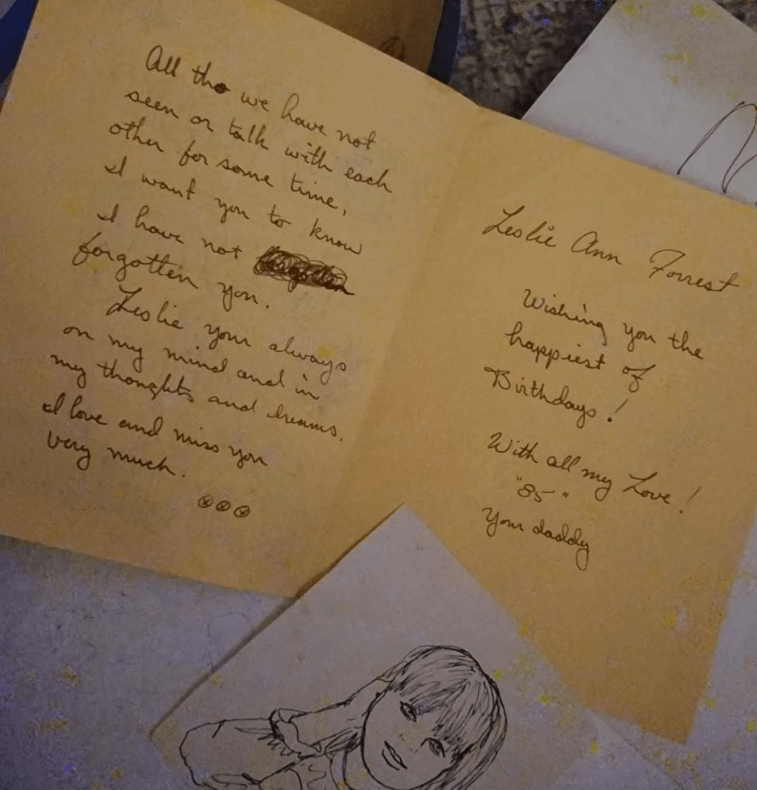
A Reddit comment made on a post about Warren Leslie Forrest.Sharon as a baby.A young Sharon Ann Hart.Sharon sitting with her younger sister.Sharon (far left) with some friends.Sharon Hart.Sharon Ann Wilson’s junior year picture from the 1966 Ft. Vancouver High School yearbook.Even though it was listed in multiple places that Sharon ‘Hart’ went to Ft Vancouver High School and graduated along with Warren in 1967, I could find no evidence of it… until I saw on Leslie’s FB page she went by a different maiden name than the one typically given (Hart). I went person by person until I found her: Sharon Ann Wilson.Sharon Ann Wilson’s senior year activities listed in the 1967 Ft. Vancouver High School yearbook. Sharon Ann Wilson in a group picture for the Future Homemakers of America from the 1967 Ft. Vancouver High School yearbook.Sharon Hart.Sharon in what is (I’m guessing) is her former husband’s Army hat; photo courtesy of her very PUBLIC Facebook page (I don’t want anyone thinking I somehow have connections to inappropriate pictures of WLF’s ex-wife).Sharon.Sharon.Sharon holding her and Warrens first child, Lane.Sharon with her two children and their family dog.Sharon and Leslie.Sharon Lochner.Sharon standing outside a trailer.Sharon and her second husband, Jim.An opinion piece on Sharon Forrest in relation to her husbands atrocities published in The Columbia on February 14, 1979. A picture of Warren Forrest’s second wife Hilda Ruchert published in The Walla Walla Union Bulletin on May 27, 1977.Warren Forrest’s second wife Hilda in a list of people who filed for bankruptcy published in The Spokesman-Review on May 8, 1981.An advertisement for the ‘Whitman Grill’ that mentions Warren Forrest’s second wife working as a bartender that was published in The Walla Walla Union Bulletin on July 19, 1968.The only Facebook picture of Hilda Forrest that was posted on her Facebook page, on April 5, 2020.Harold Forrest’s WWII draft card.Harold Forrest’s military card.A newspaper clipping that mentions Harold Forrest published in The Columbian on September 17, 1946.Warren Leslie Forrest and his second wife Hilda Ruchert’s marriage certificate dated June 28, 1983.Warren Leslie Forrest and Hilda Ruchert listed in the marriage index from June 1983.Harold Forrest and Dolores Harju’s marriage affidavit and application to wed dated June 30, 1944.Harold and Dolores Forrest’s Marriage Statistics dated June 30, 1944.Harold Forrest and Dolores Harju’s marriage certificate dated July 3, 1944.An article about Marvin Forrest hitting a little boy with his car published in The Oregon Daily Journal on January 17, 1966.James Allen Forrest.Marvin Harold Forrest.An article about Dolores Forrest wining a bowling contest published in The Columbian on November 21, 1967.The announcement of the wedding of Marvin Forrest and Darlene Kuzniar published in The Republic on January 31, 1970.A newspaper clipping about the estate of WLF’s grandfather that mentions his mother that was published in The Columbian on February 2, 1979.A picture of Dolores Forrest posing with a painting of her son and daughter-in-law that was published in The Columbian on April 19, 1979.James Forrest’s obituary published in The Columbian on November 26, 1980.James Forrest’s obituary published in The Columbian on November 26, 1980.James Forrest’s death certificate from November 24, 1980 (dated December 2, 1980).The announcement of the upcoming marriage of Marvin Forrest and Viki-Jo Westling published in The Columbian on August 31, 1984.A newspaper article announcing the death of Warren Forrest’s dad, Harold published in The Columbian on October 15, 1991.Harold Forrest’s grave site.Harold Forrest listed in the state of Oregon Death Index.A newspaper clipping that mentions Marvin Forrest’s son Todd returning from a six-month deployment to the western Pacific and Persian Gulf that was published in The Columbian on June 10, 1993.The announcement of the upcoming marriage of Marvin Forrest and Diane M. Steigleman published in The Columbian on June 27, 1996 .The announcement of the upcoming marriage of Marvin Forrest and Diane M. Steigleman published in The Columbian on June 27, 1996.Marvin Forrest and Diane Steigleman’s certificate of marriage dated July 23, 1996.Part one of an article about the death of Marvin Forrest published in The Columbian on November 25, 1996.Part two of an article about the death of Marvin Forrest published in The Columbian on November 25, 1996.Marvin Forrest’s obituary published in The Columbian on November 28, 1996.A picture of Marvin Forrest that was published in The Columbian December 8, 1996.A newspaper article about an accident that caused the death of Marvin Forrest published by The Columbian on April 28, 1997.Sharon Hart’s application for marriage from her second marriage to Jim Lochner from November 2011.Sharon Hart’s marriage certificate from her second marriage to Jim Lochner dated November 25, 2011.Leslie Forrest, who was a runner like her father.A picture of Leslie Forrest (right) running in a race.Lane and Monica Forrest.Leslie Forrest.Another (public) Facebook post made by Leslie Forrest about her mother, Sharon Ann Forrest-Lochner.A restraining order I found that on Leslie Forrests (very public) Instagram page taken out against her by her mother.The second page of a restraining order I found that on Leslie Forrests (very public) Instagram page taken out against her by her mother.An Instagram post made by Leslie Forrest saying she was trying to have her mother prosecuted because she was somehow involved in her husbands atrocities.A (public) Facebook post made by Leslie Forrest about her mother, Sharon Ann Forrest-Lochner.Aella Blu is a pseudonym that Leslie Forrest uses on FacebookA Facebook post made by Leslie Forrest. To be fair, in an article published in The Columbian on January 30, 1979, it was reported that evidence that could have been ‘crucial’ to the prosecution of Warren Leslie Forrest was lost in early 1975 due to the Clark County prosecutor and sheriff’s offices deeming the entire case ‘disposed of.’ Amongst the items that disappeared were keys, twine, a knife, adhesive tape, a victims clothing, and ‘vacuum sweepings’ that has been taken from Forrest’s 1973 Ford van. A birthday card from Warren to his daughter, Leslie.The inside of the birthday card Warren sent his daughter, Leslie.
Grand Junction Police Department records related to the July 25, 1975 murder of Linda Benson and her five-year-old daughter, Kelly Ketchum. Their murders were only a small part of a much larger and ongoing crime spree in Grand Junction, CO that seemed to target individuals that knew too much about the region’s narcotics activities linked to corrupt law enforcement such as former police chief Ben Meyers. It was said that one of Linda’s neighbors reported to seeing a man that matched Ted Bundy’s description around the complex right before the murder took place.
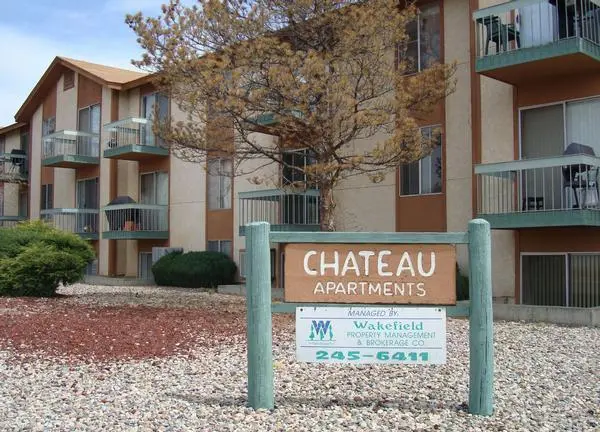
Linda Benson.The apartment complex where Linda and her daughter lived when they were murdered.
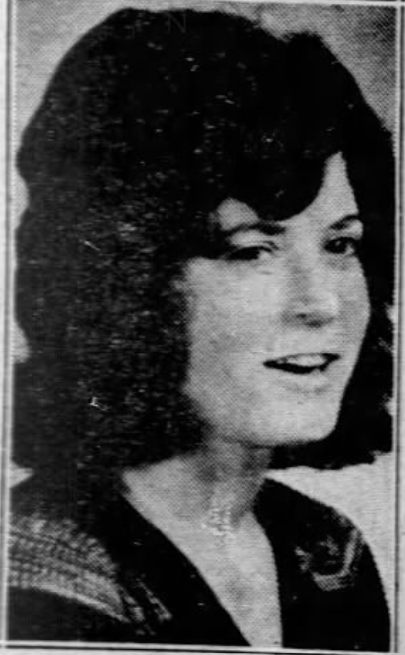
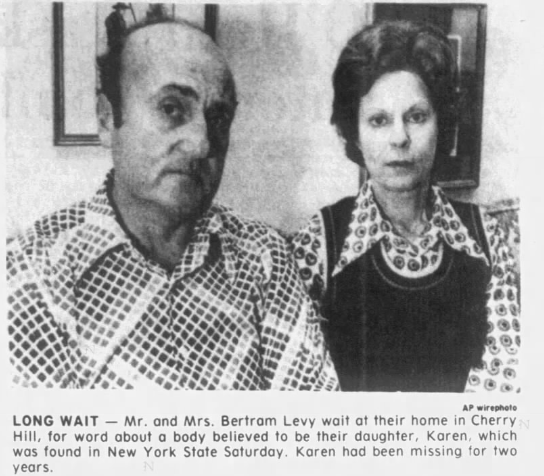
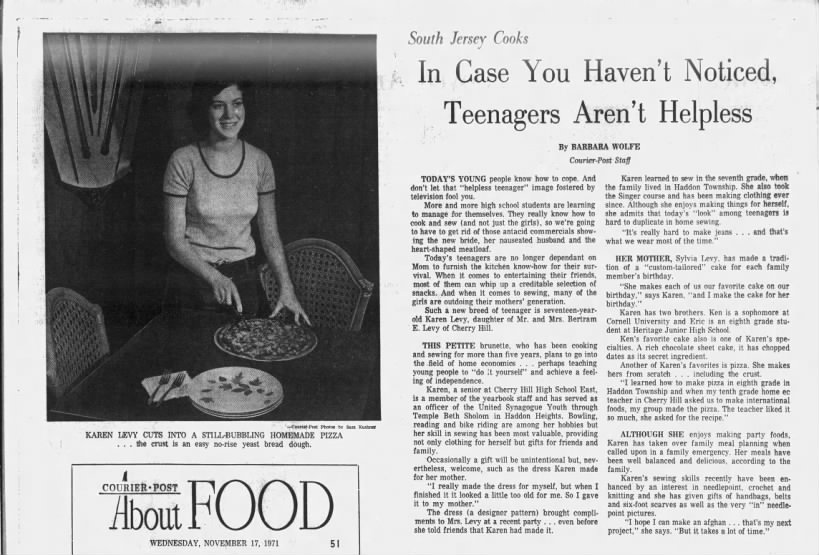
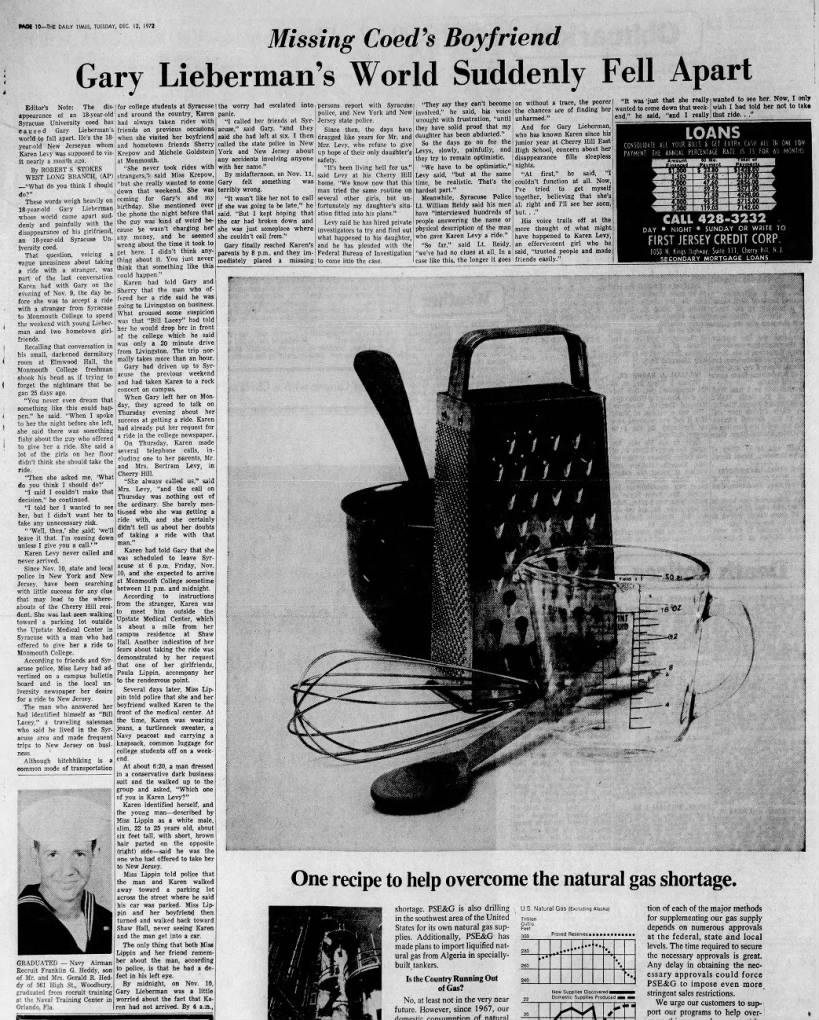
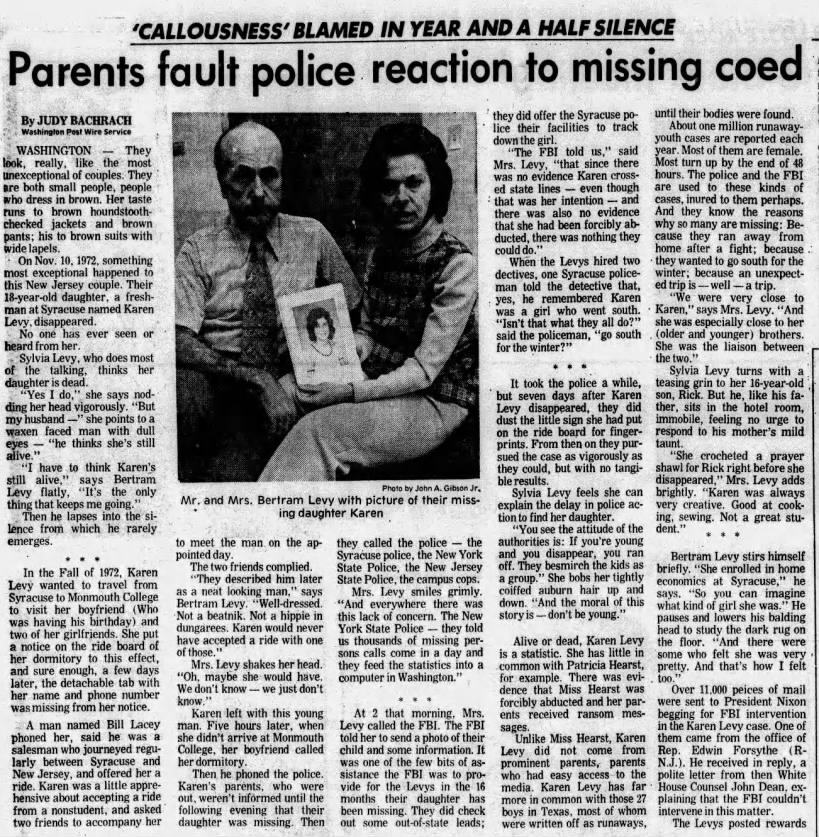
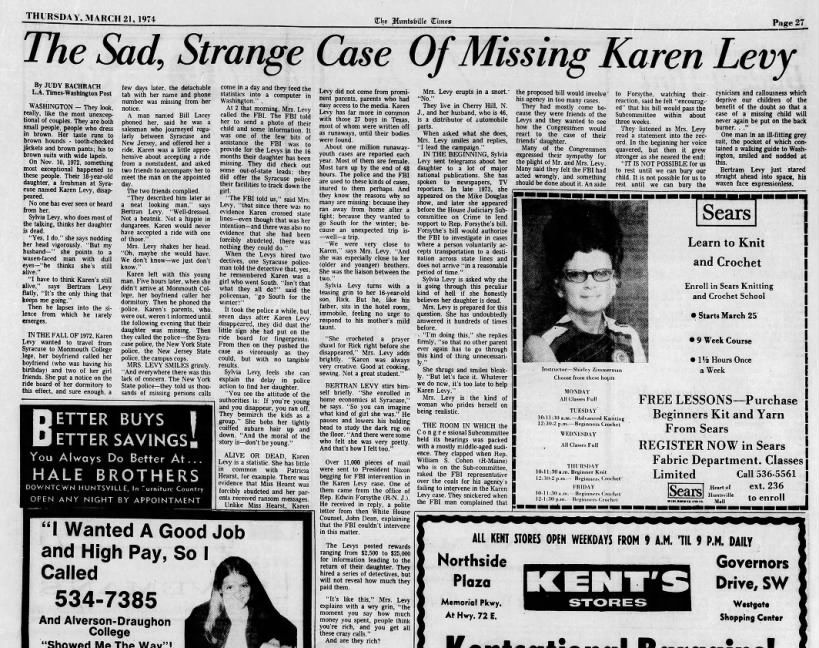
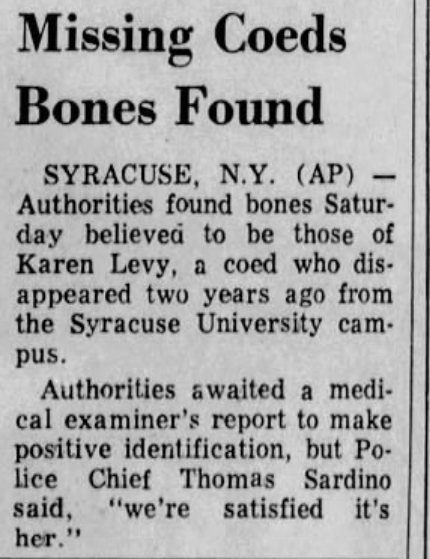
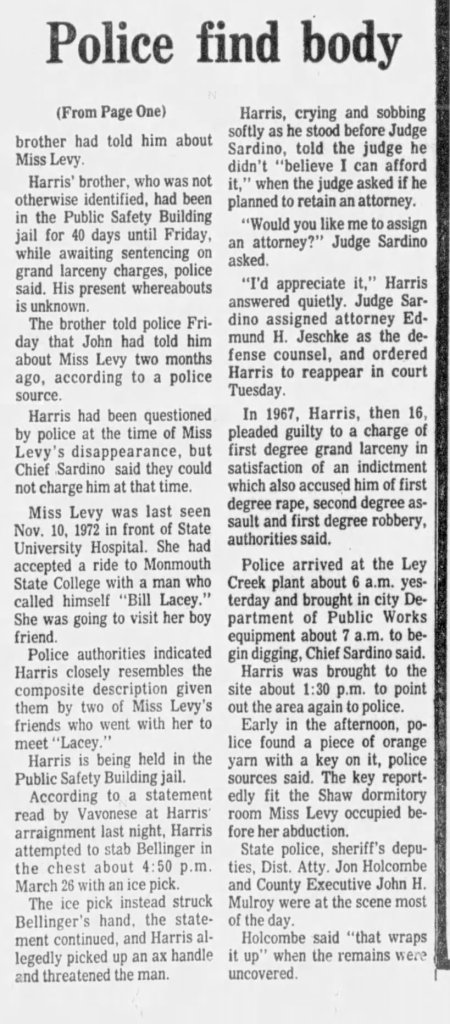
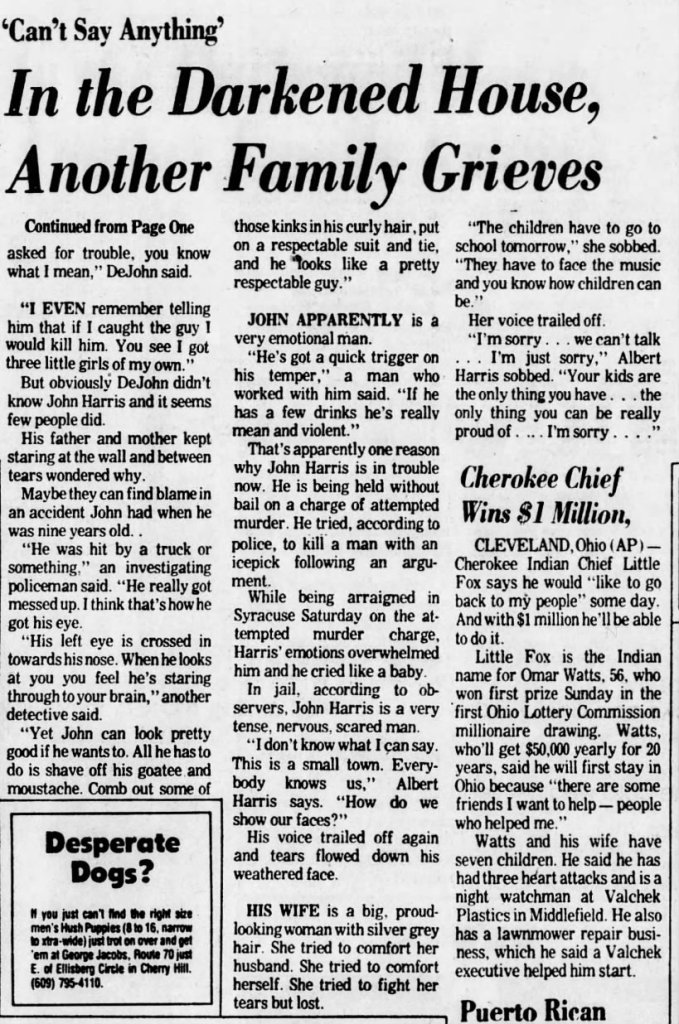
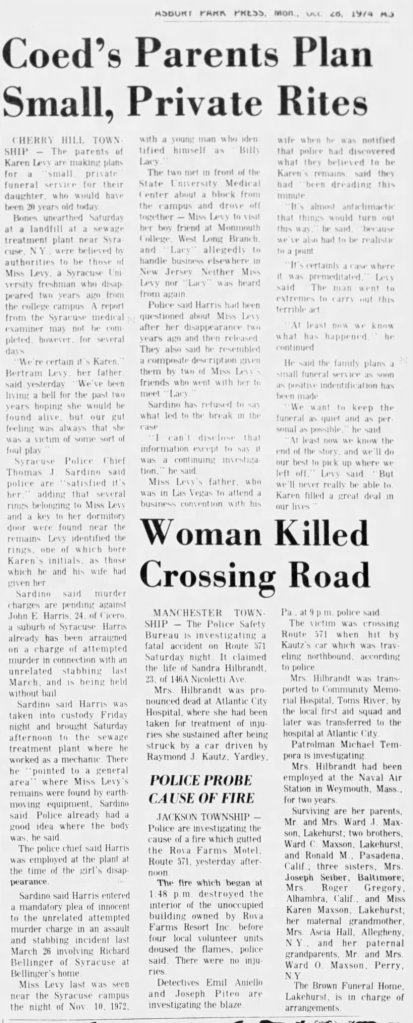
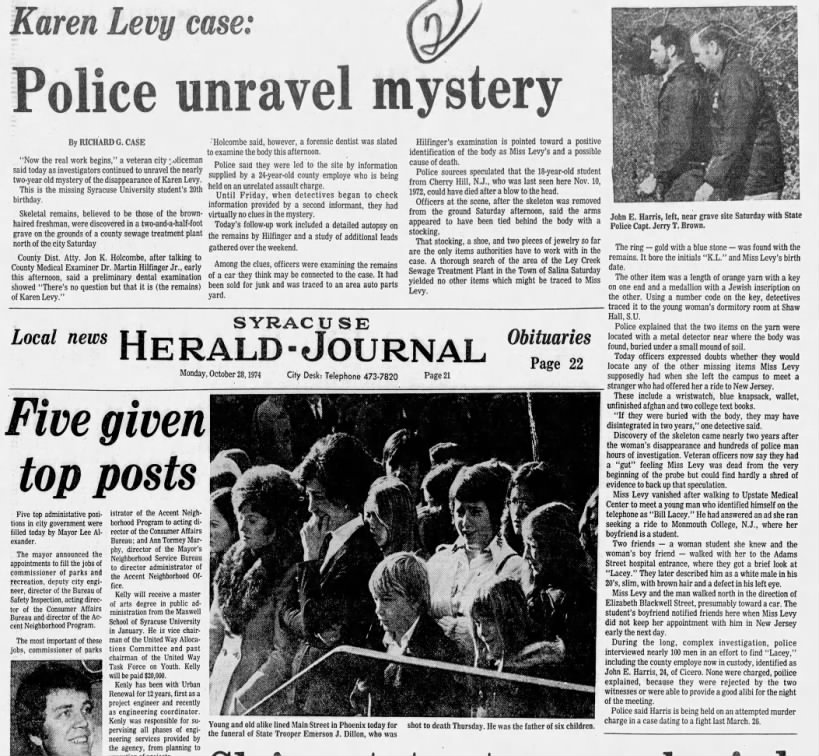
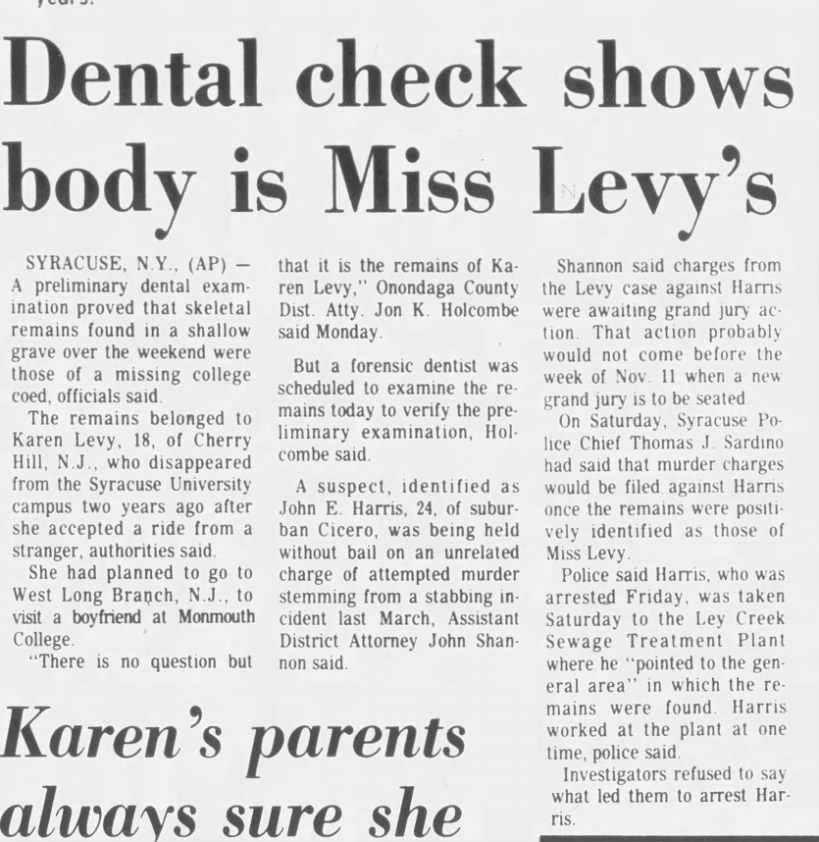
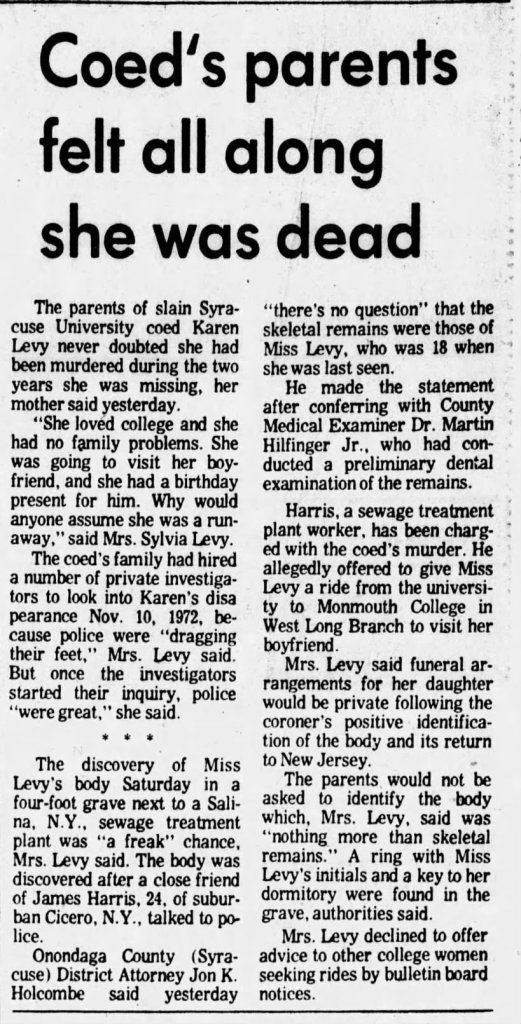
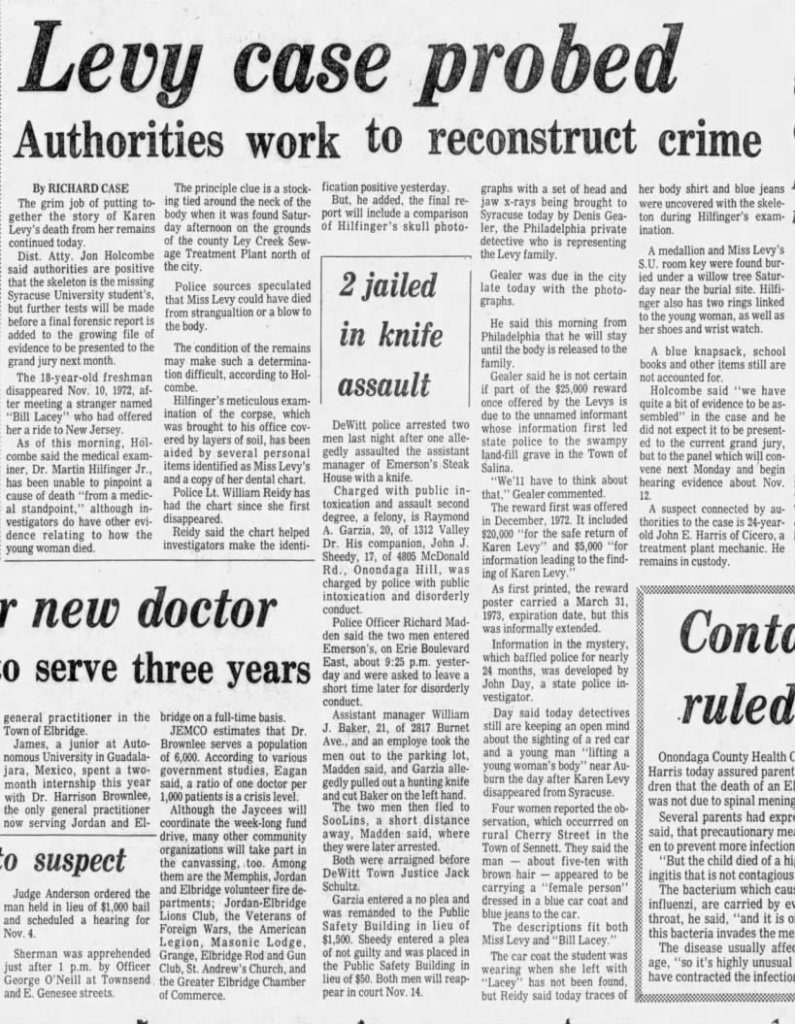
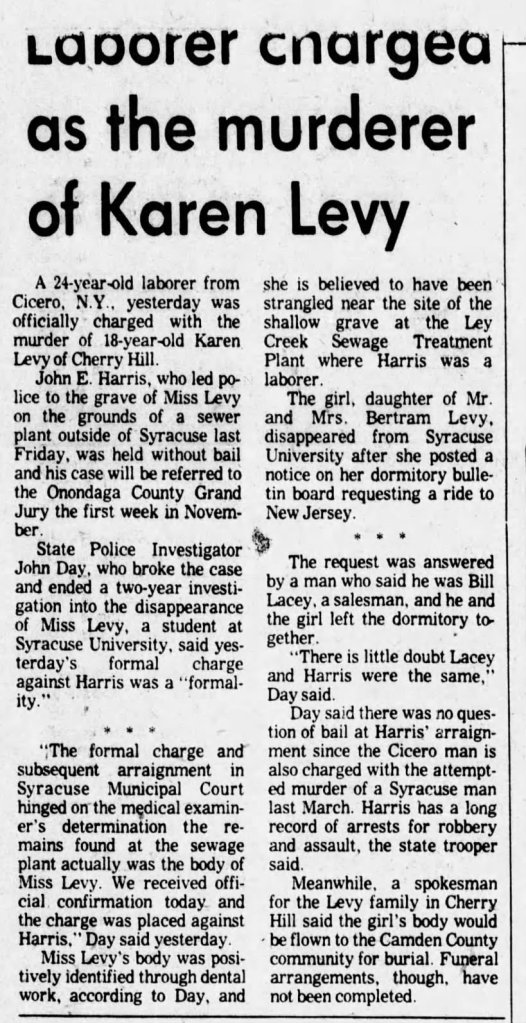
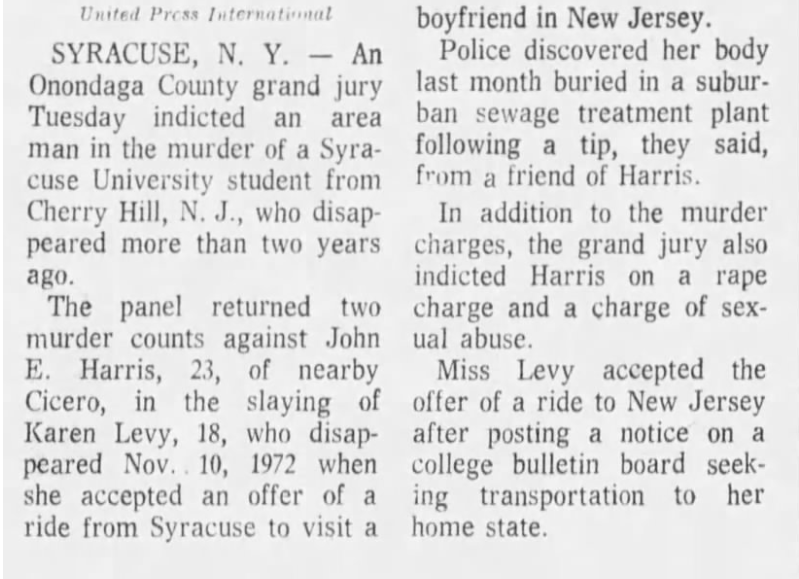
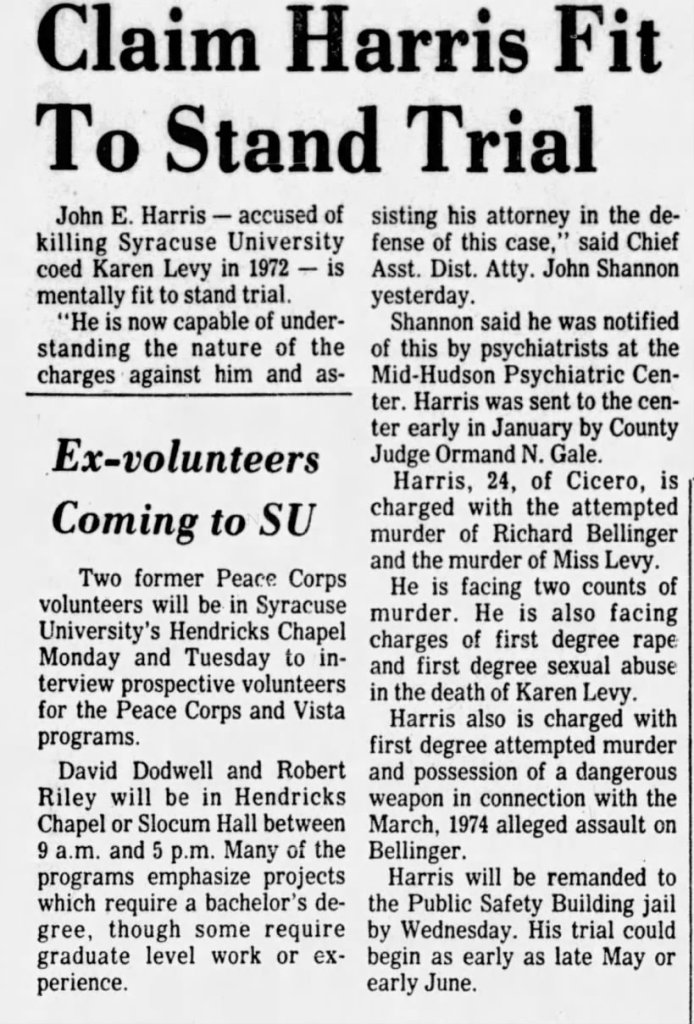
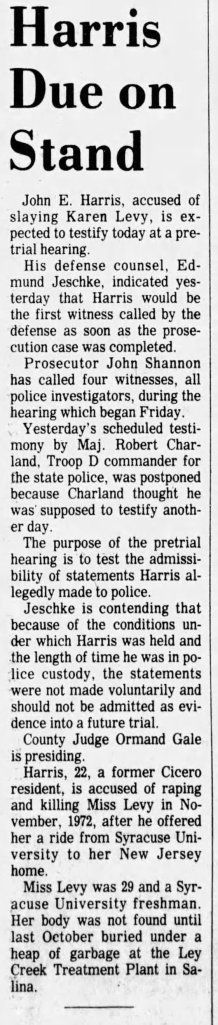
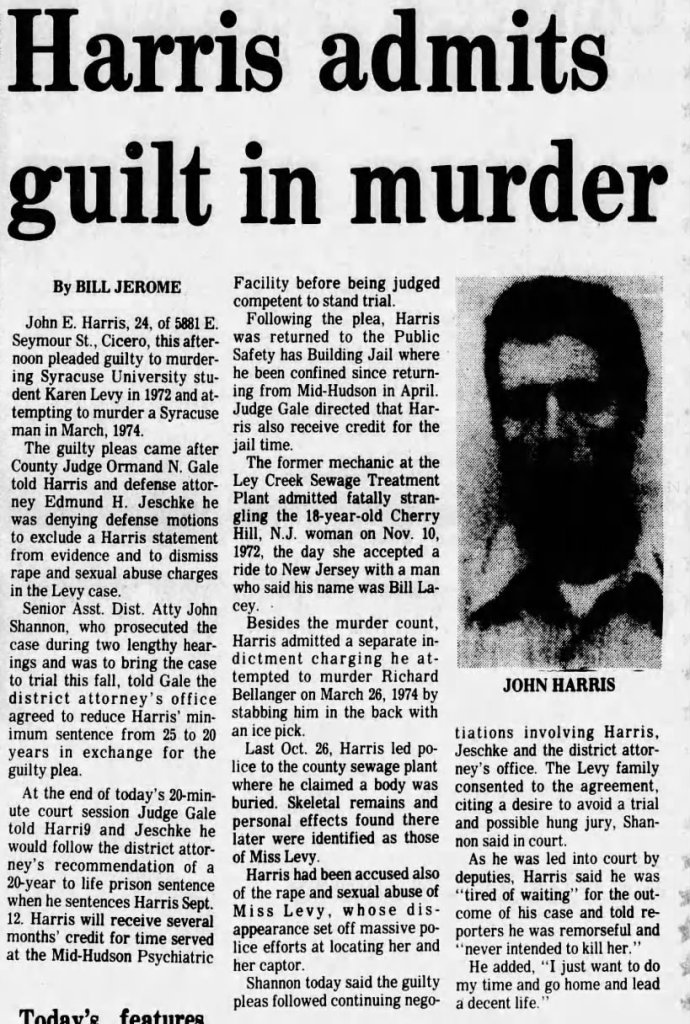
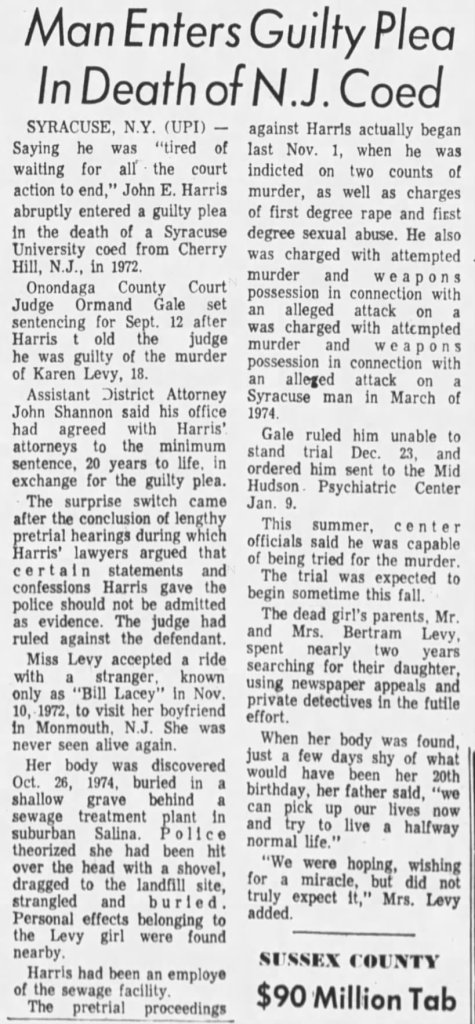
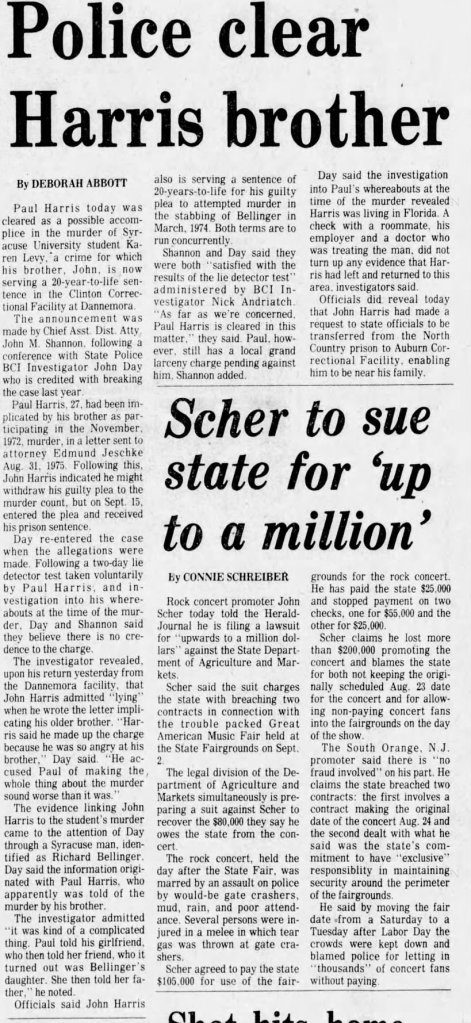
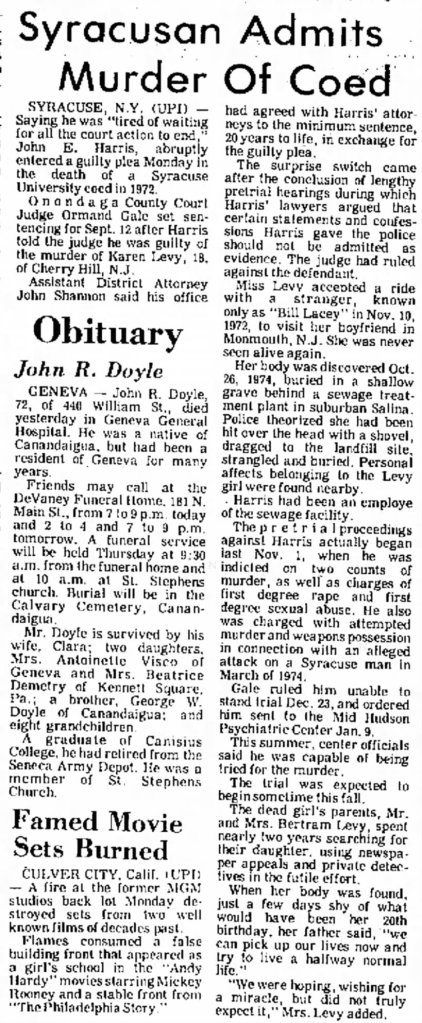
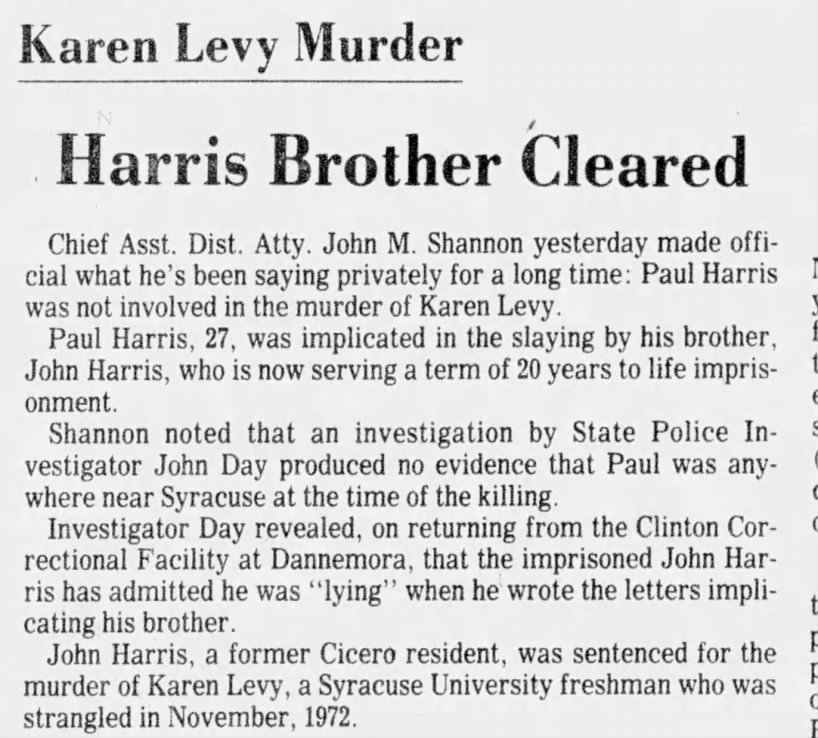
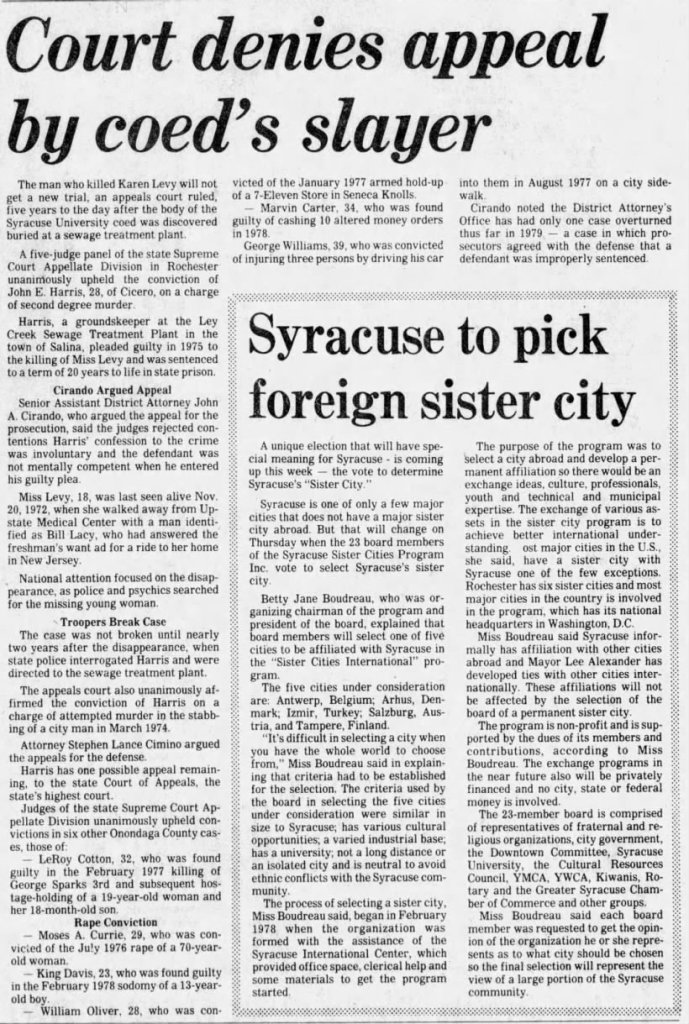
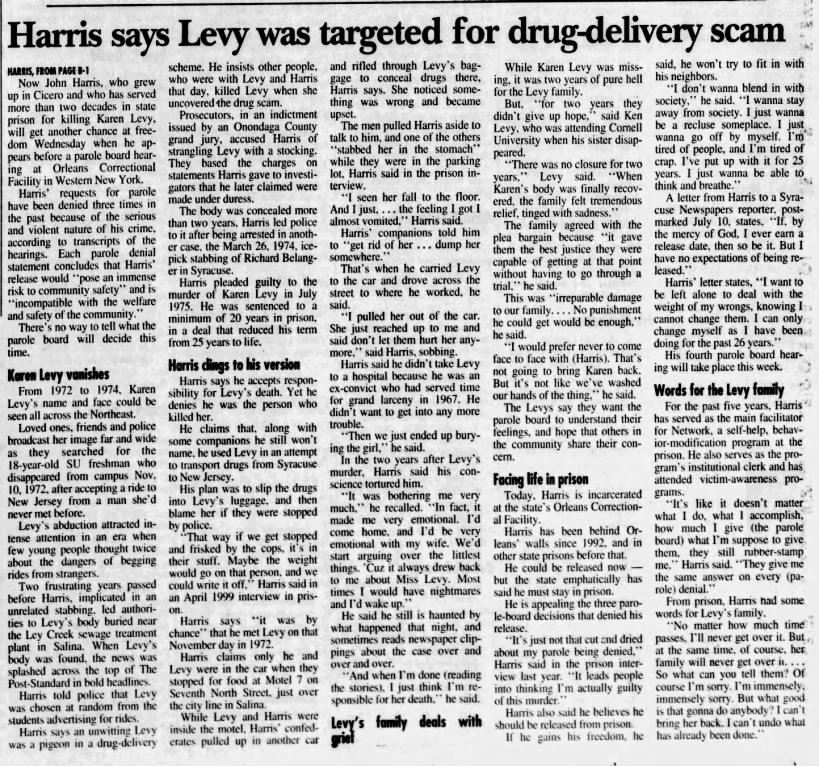
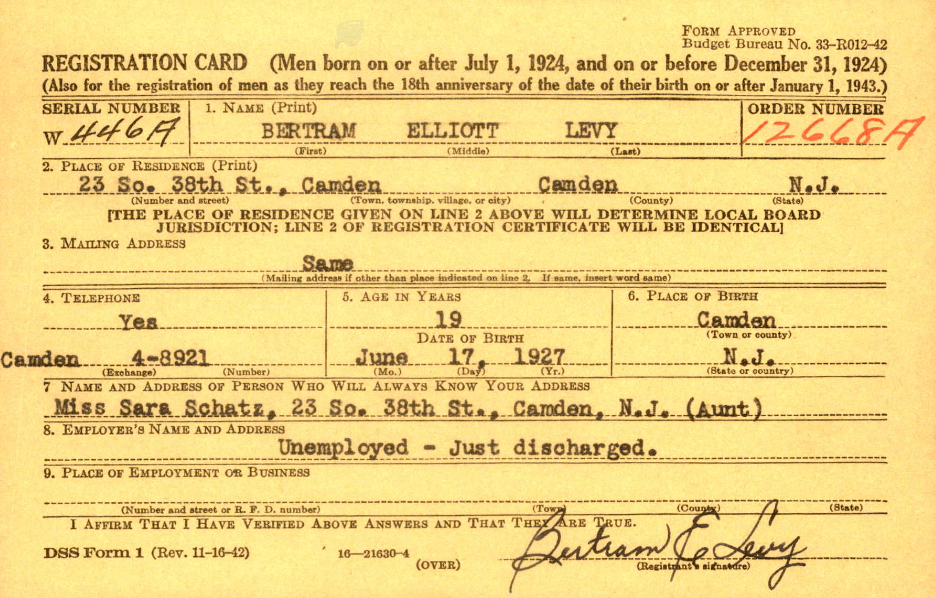
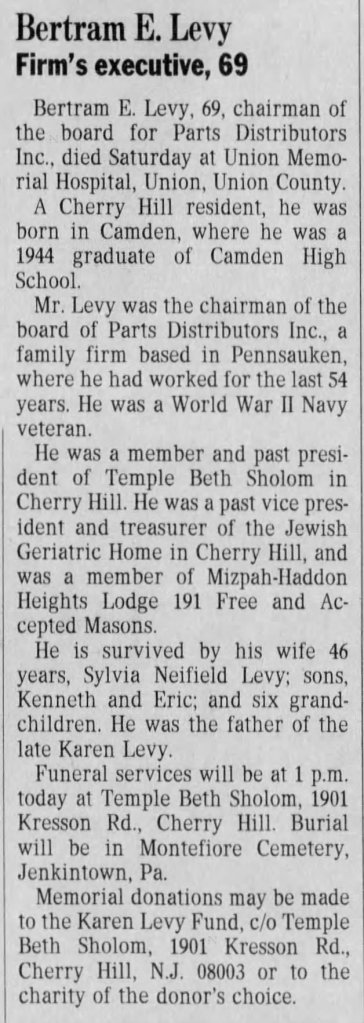
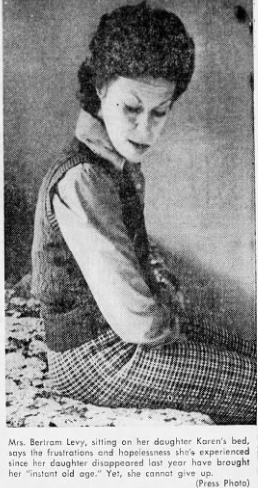
Background:Karen Merle Levy was born on October 28, 1954 to Bertram and Sylvia (nee Neifield) Levy in Cherry Hill, New Jersey. Bertram Elliott Levy was born on June 17, 1927 in Camden NJ and Sylvia was born on May 29, 1929 in Pennsylvania. After graduating from Camdem High School in 1944, Mr. Levy went on to serve in WWII, and upon returning home married Sylvia in the summer of 1950; the couple went on to have three children together: Karen, Eric, and Richard. Bertram was the chairman of the board for Parts Distributors Incorporated in Cherry Hill, and according to the 1950 census, Mrs. Levy’s profession was listed as ‘a secretary at a sweater manufacturer.’ According to her father, before she was killed Karen had recently made a ‘prayer shall’ for her brother, Rick, and she ‘was very creative, good at cooking and sewing. Not a great student.’ He went on to say that ‘she enrolled in home economics at Syracuse University, so you can imagine what kind of girl she was. And there were some who felt she was very pretty, and that’s how I felt too.’
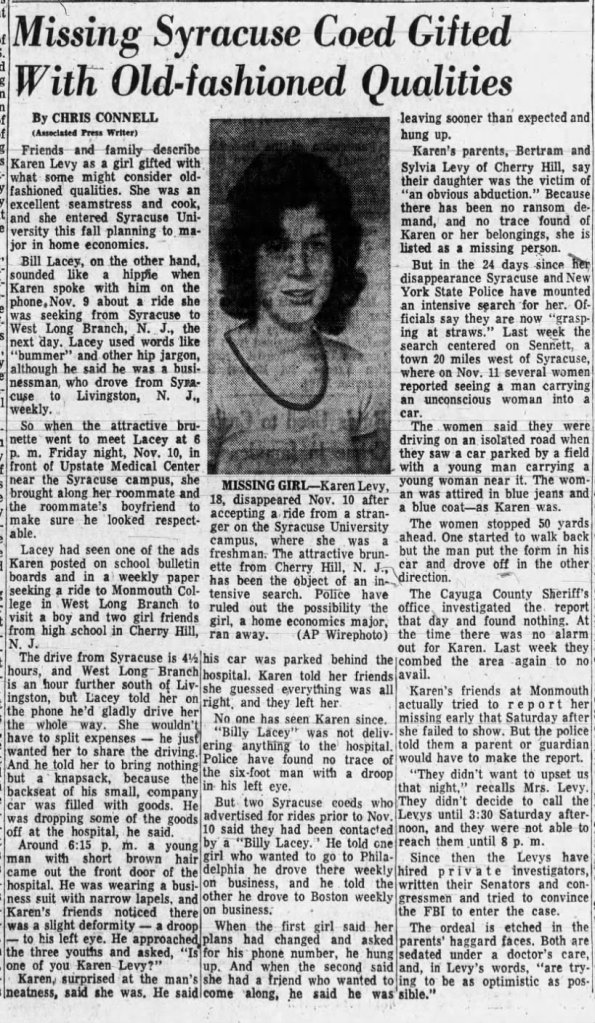
Syracuse University: After graduating from Cherry Hill East High School in 1972, Karen went on to attend Syracuse University, majoring in Home Economics. According to Karen’s family, her hobbies included bowling, reading, and riding her bike, and those that knew her well said that she possessed a lot of ‘old-fashioned qualities’ and really excelled at cooking and sewing. At the time of her death she was working on making an afghan and had it with her when she left for New Jersey. Ms. Levy stood at 5 feet tall even, weighed between 100 to 105 pounds, and wore her dark brown hair at her shoulders; she also had brown eyes and wore gold-rimmed, ‘granny-type’ glasses.
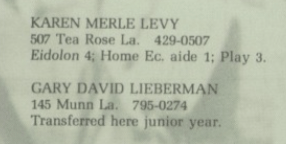
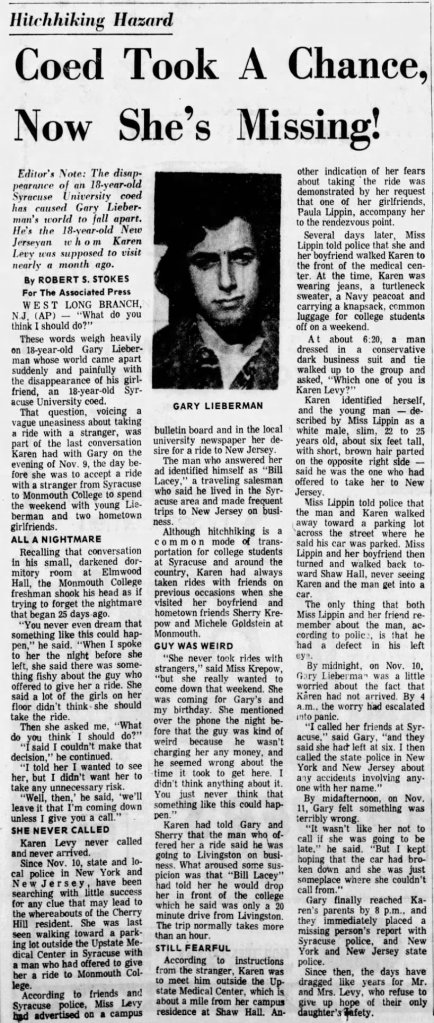
At the time of her murder Karen was in a long-distance relationship with a young man named Gary Lieberman, who transferred to Cherry Hill East High School in the beginning of their junior year in 1970. Lieberman’s name came immediately after hers in their school’s yearbook, and because of that a part of me wonders if they were brought together for semi-logistical reasons. After graduating high school he went on to attend Monmouth College, located in West Long Branch, New Jersey.
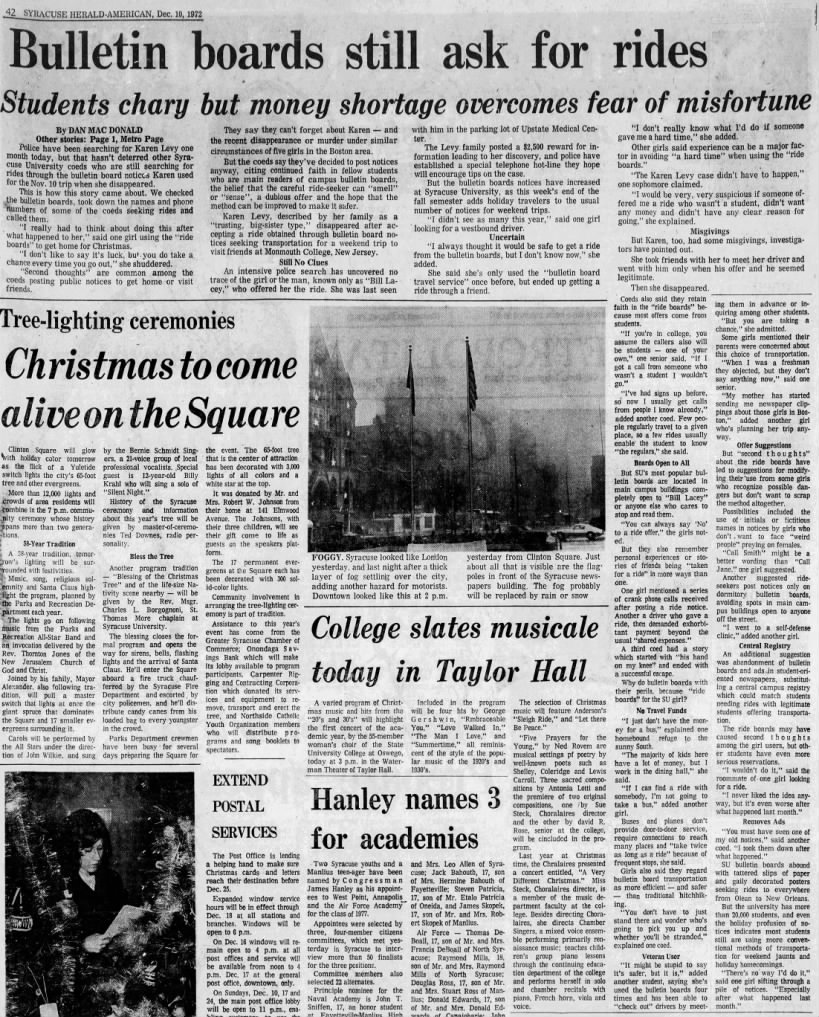
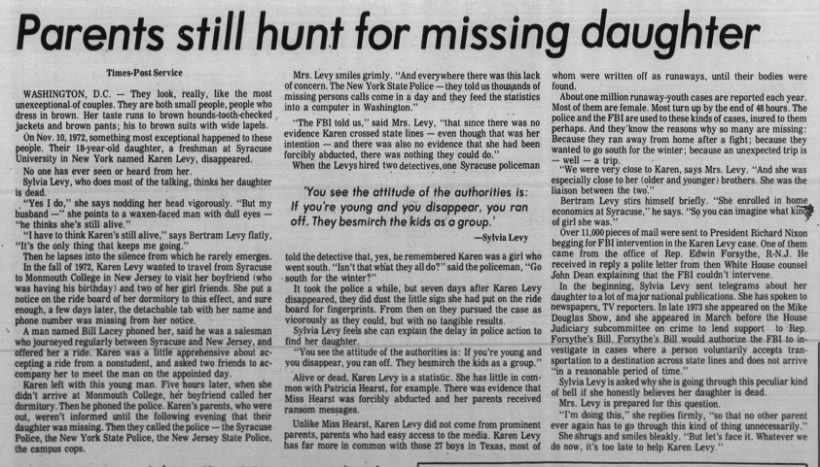
In her daughters first few months away from home, Mrs. Levy said that she ‘couldn’t keep her in writing paper, she wrote to us and her grandmother and her friends all the time. She called home more than once a week.‘ The Levy’s saw Karen for the last time roughly three weeks before she disappeared, during parents weekend on October 28, 1972, which also happened to be her 18th birthday. At that time Karen shared with them her plans of borrowing one of her brothers cars to go and visit Gary the weekend of November 10, 1972, but he wound up needing it. So, she did what many other young students at SU did at the time: she posted a three-by-five index card on a bulletin board on campus that said ‘ride wanted’ that contained her name, contact information, and final destination. Mrs. Levy said that ‘she told her friends he sounded strange over the phone and asked them to come along with her to meet him. The man looked alright and she took the ride.’
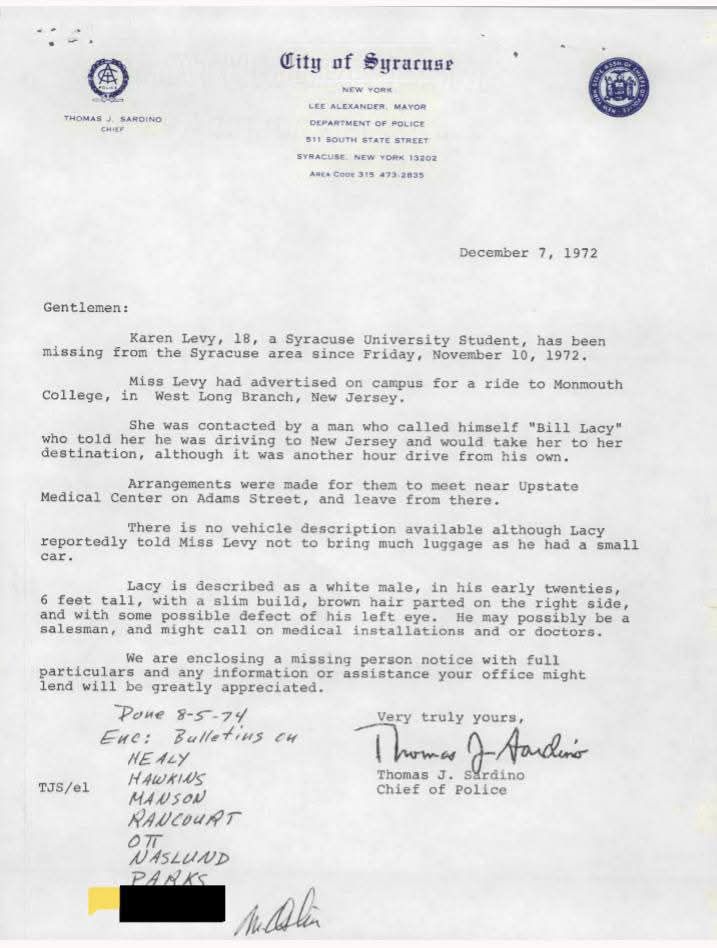
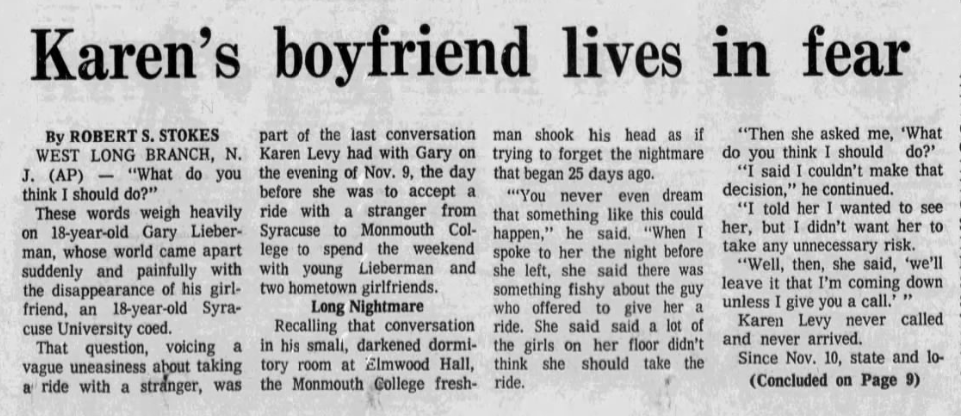
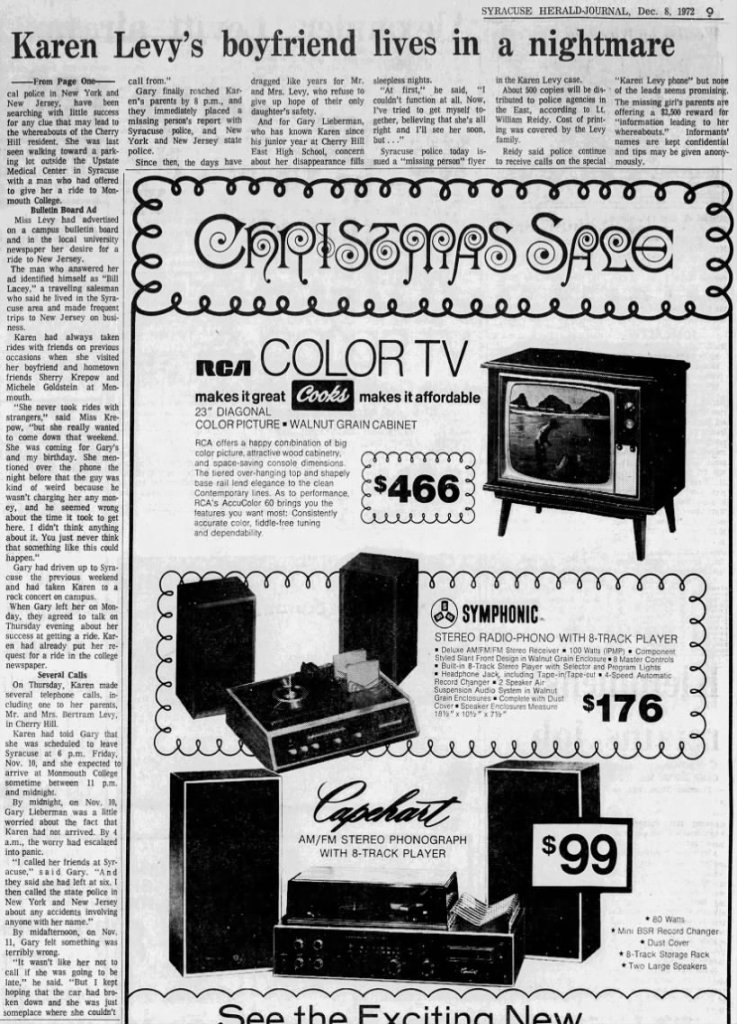
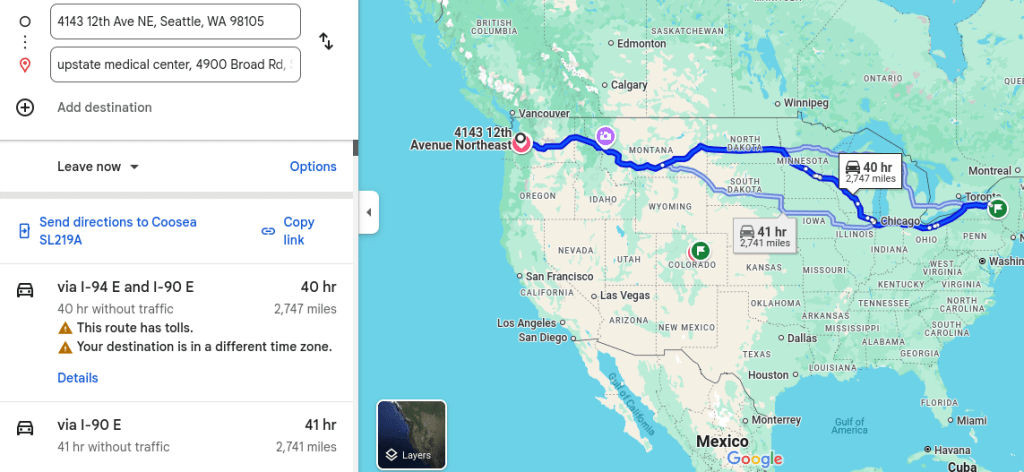
Monmouth College: On November 9, 1972 a ‘non-student’ and self-proclaimed ‘businessman*’ from Livingston, NJ calling himself ‘Bill Lacey’ reached out to Levy by phone and agreed to take her to Monmouth College, and the two made plans to meet at the Upstate Medical Center near campus at 6 PM the following day (*one report said he claimed to be a ‘traveling salesman’). Levy was accompanied by her friend Paula Lippin and her boyfriend Mitchell Sakofs, and they were able to confirm that she did meet up with an individual that introduced himself as Bill Lacey and was last seen walking away from them in his company. She was last seen wearing a navy blue peacoat, blue bell bottom ‘dungarees,’ a multi-colored V-neck vest, and brown shoes; she was carrying with her a blue knapsack and told Gary she was due to arrive at around 11 PM.
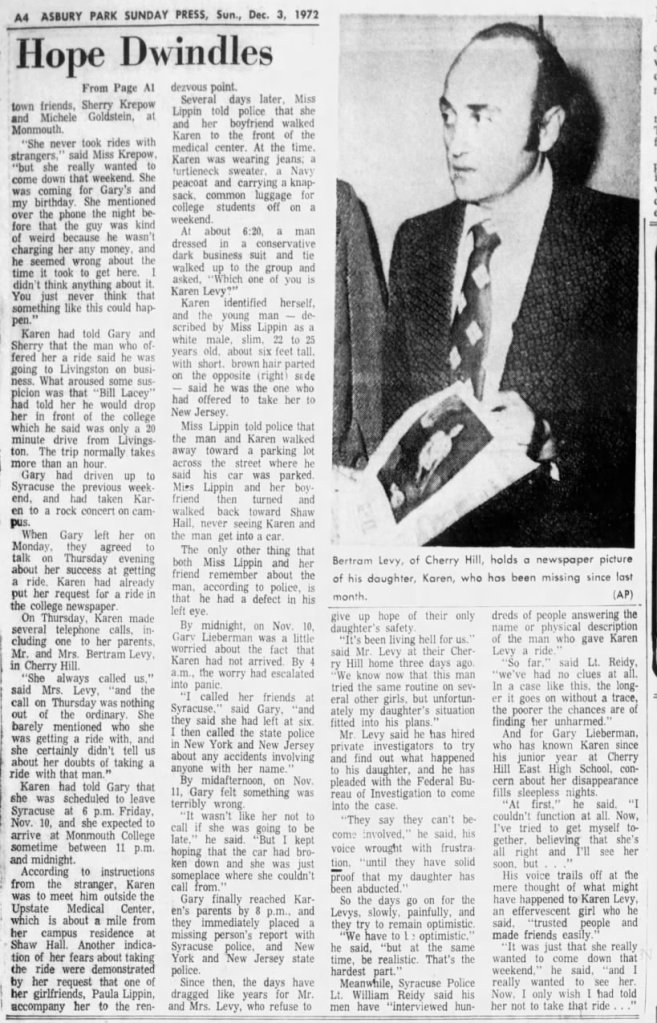
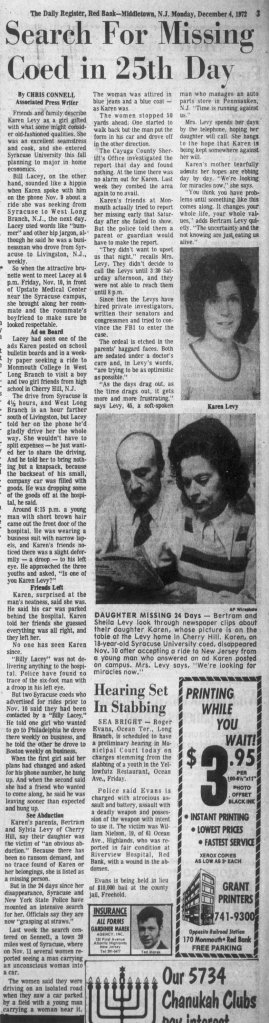
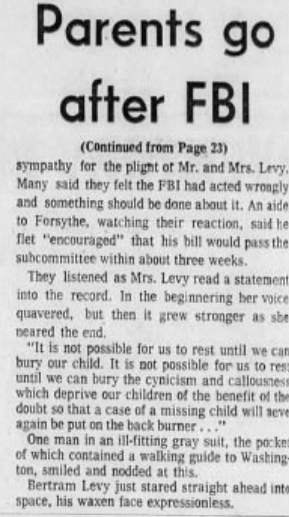
Disappearance: When Karen never arrived at Monmouth police were immediately notified and she was officially listed as a ‘missing person’ due to the fact they had no solid evidence that she had been abducted or was forced into ‘Bill Lacey’s’ car. After they felt that her case wasn’t being taken seriously enough, the Levy’s hired two New Jersey private investigators to assist, including one named John Begley, who brought her disappearance to the attention of the Albany Branch of the Federal Bureau of Investigation on November 13, 1972. Also on the same date, Sylvia Levy reached out to the Newark Division of the FBI, and on November 14th the Identification Division was asked to release a missing persons notice. About her daughter, Mrs. Levy said ‘she loved college and she had no family problems. She was going to visit her boyfriend and she had a birthday present for him. Why would anyone assume she was a runaway?’ She also said that in the initial stages of her daughter’s disappearance things were mishandled by the Syracuse police department, who she said didn’t have the resources to make a thorough investigation. She also charged the department with ‘cynicism and callousness in not conducting a prompt probe of Karen’s disappearance, and that no one lifted a finger for days, and those days were crucial, because they would not believe in the honesty and the sincerity and goodness of our child.’ About the delay in the initial stages of the case, Sylvia said ‘you see the attitude of the authorities is: if you’re young and you disappear, you ran off. They besmith the kids as a group. And the moral of the story is: don’t be young.’
Three policing jurisdictions were investigating Levy’s case: University Police, local Syracuse law enforcement, and the NYS Troopers, and in the early parts of the investigation at least twelve detectives were assigned to work full time on the case. In the first few days after she disappeared investigators focused their search efforts on Sennett, NY after they received multiple reports on November 11th that a man was seen carrying what seemed to be an unconscious woman to his car. One of the women that reported the incident said she was driving on an isolated road when she saw a car parked next to a field and a man walking towards it while carrying a woman that appeared to be unconscious that was dressed in a blue coat and jeans. Unfortunately, nothing came of this.
Investigators combed the general Central New York area and expanded their search into New Jersey, but came up with nothing. Syracuse police conducted over 500 interviews over the course of the investigation and tracked down anyone and everyone that was confirmed to be in the area when Levy was last seen. They also investigated all locals that were named Bill Lacey (or had variations of the name) and spoke with other young women that requested rides in the same method as Levy and whether or not they had any strange encounters with a man that matched his description. Additionally, detectives checked out local newspapers looking for advertisements that were posted by men offering rides in the same time frame that Levy vanished.
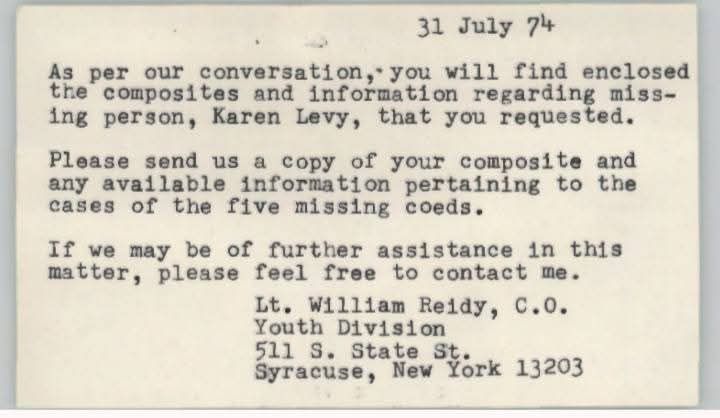
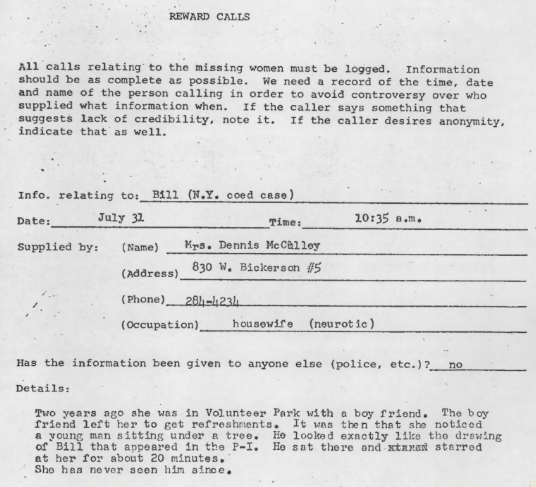
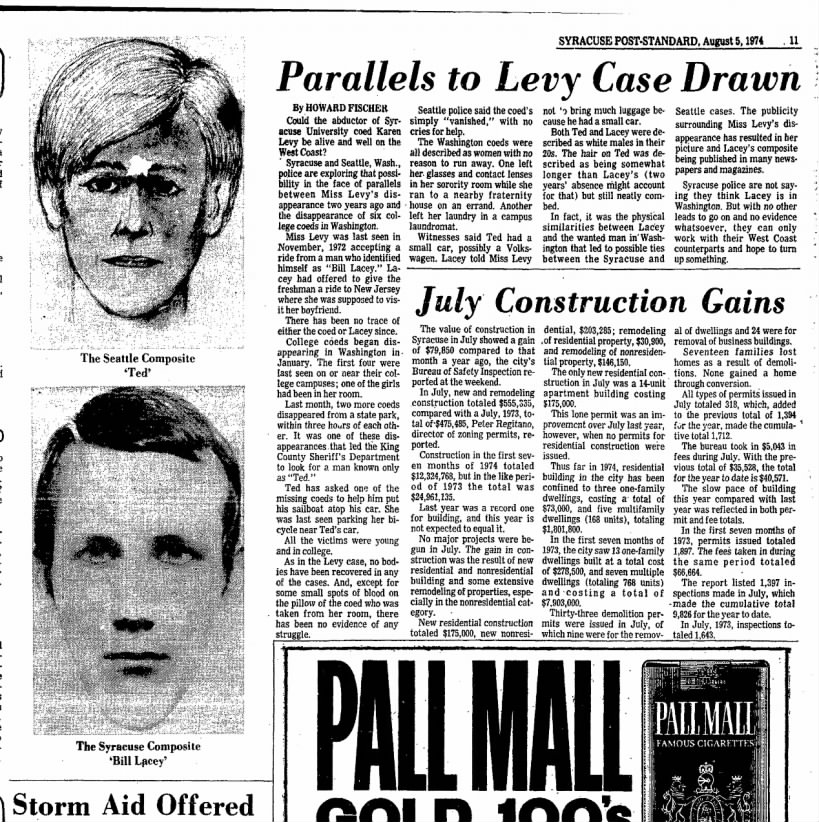
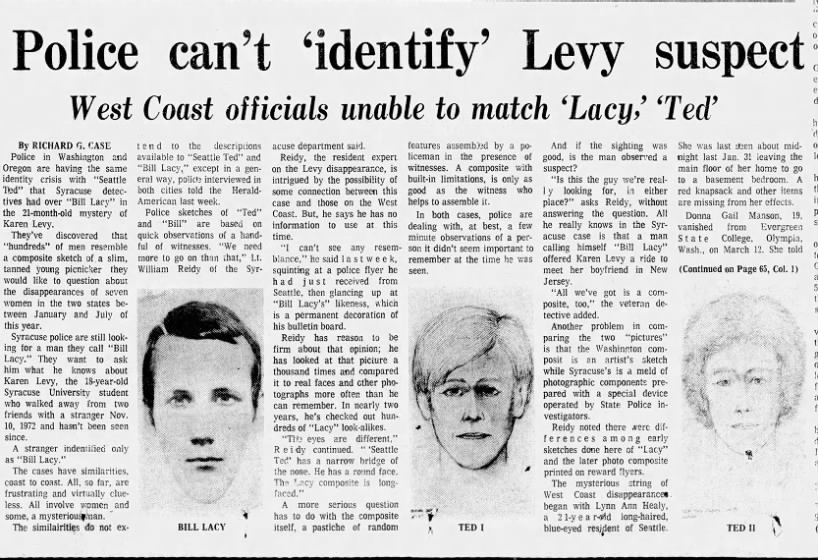
Every single tip that investigators received regarding the disappearance of Karen Levy was looked into, and many of the leads were related to the bulletin boards on Syracuse University’s campus. Additionally, NYS Police used helicopters, airplanes, and dogs in their search efforts, and conducted foot searches all over the two most likely routes of travel from SU to Monmouth College, combing through long stretches of highways and secluded ‘lovers’ lanes’… but to no avail. Because Levy’s friend and her boyfriend were able to get a good look at ‘Bill Lacey,’ a sketch artist was able to come up with a composite drawing of him, which was shared all over New York state. According to them, the man looked like ‘half the guys in the country’ aside from his left eye, which was either crossed or unable to completely focus.
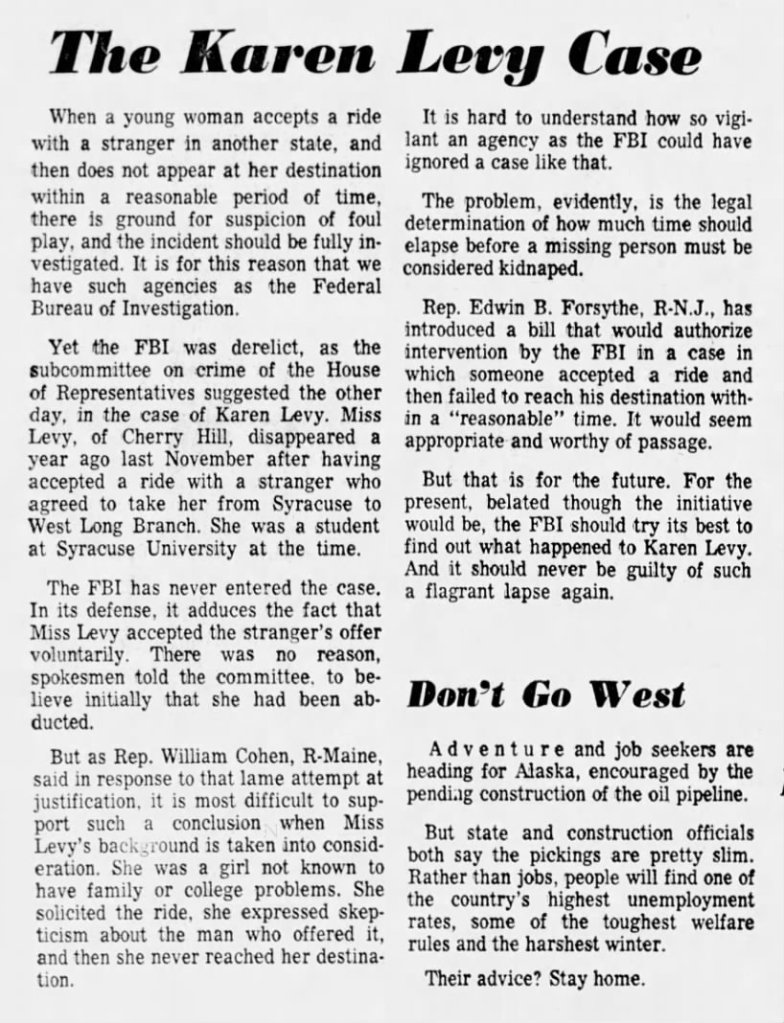
At the request of the Syracuse PD, the Albany Branch of the FBI (most likely as a cooperative measure, as they weren’t officially involved) conducted investigations regarding Levy’s disappearance in Oklahoma City, New York City, Chicago, Memphis, Charlotte, Newark, Dallas, Honolulu, and Detroit, which helped eliminate suspects.Because Ms. Levy left with Lacey voluntarily and of her own free will there was no violation of the Federal Kidnaping Statute., therefore the FBI didn’t ‘officially’ join in on the investigation. Despite this, Mr. and Mrs. Levy felt their daughter would never leave on her own with a stranger, and her father commented that: ‘it’s just not consistent with her or her nature to disappear purposefully,’ and about the possibility that someone may have taken his Karen he said that he had ‘no feeling toward that man who has abducted her, I can’t feel vindictive. We just want her home safe and sound. We don’t have any Thanksgiving plan, hopefully we will celebrate Karen’s safe return.’
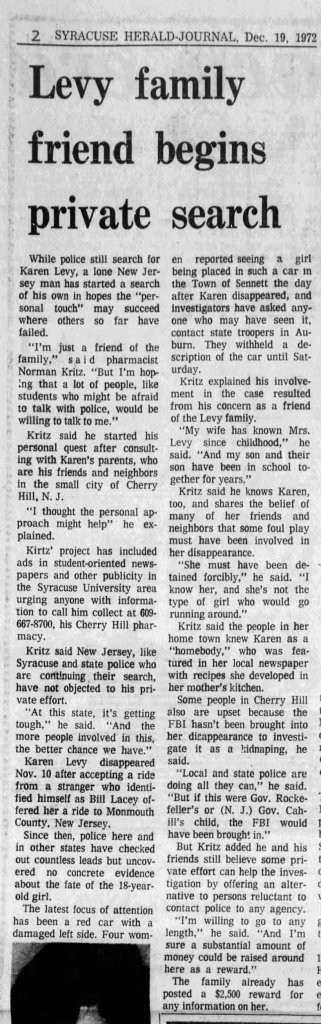
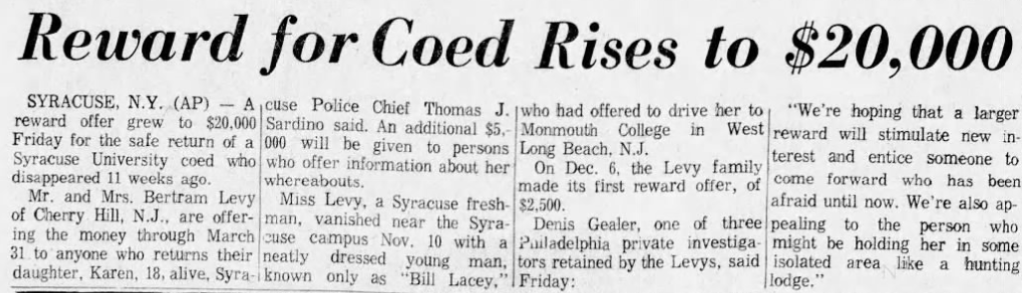
The Levy’s knew that their daughter would never voluntarily go anywhere with a strange man that she didn’t know. and immediately knew that something sinister had happened to her. In December 1972 they posted a $2,500 reward for any information that lead to the return of their daughter (it was never redeemed), and paid for thousands of missing persons fliersthat contained a picture of Karen on it along with the police composite sketch of ‘Bill Lacey’ as well as both of their complete physical descriptions.
Police tracked down a few young men that matched Bill Lacey’s description, and all of them were brought in for questioning and were released. One of the suspects was identified by both of Levy’s friends from a photograph, however when it came to a line-up they said they were only ‘uncertain’ it was him. After a long, in-depth interrogation the man passed a lie‐detector test, and was able to come up with an alibi for his whereabouts on November 10, 1972.
‘Bill Lacey:’ According to Karen’s friends, she had shared that she was slightly suspicious of the man that would be driving her to New Jersey after a weird conversations they had over the telephone the day before she vanished, as they were dotted with ‘hippie-type’ phrases such as ‘bummer’ and he seemed vague in his knowledge about the distance to Gary’s college. They were all surprised when ’Bill Lacey’ showed up dressed as a clean-cut businessman, wearing a grey suit with a vest, his brown hair cut short and parted neatly on the right; they also said that he was between 20 to 25 years old, roughly six feet tall, and told them that he was from Cleveland.
Detectives went to Upstate Medical Center where Lacey said he delivered medical supplies to, and spoke with members of their staff, and they said they had never heard of him. They also learned that two other coeds that were looking for rides were also contacted by a man named ‘Bill Lacey:’ one girl needed to get to Philadelphia and the other one to Boston, and in each case Lacey told them that he made weekly deliveries to their city. The girl in Philadelphia got spooked after she asked for a phone number and he simply hung up on her, and the one from Boston said when she told him that she wanted a friend to come with her he suddenly said that he needed to leave earlier than he originally anticipated and hung up on her.
One of the last people to talk to Karen during the final hours of her life was Gary, who had driven to Syracuse University the weekend prior to attend a rock concert on campus, and when he left Monday morning they had agreed to talk on the phone the following Thursday about her possibly coming to visit him the following weekend. He said that: ‘she said there was something fishy about the guy who offered her a ride. She said a lot of girls on her floor didn’t think she should take the ride.’ When she asked him what she should do, Lieberman thought about it briefly then said he ‘couldn’t make that decision. I told her I wanted to see her, but didn’t want her to take any unnecessary risk.’ He said that in response to this, she said they would ‘leave it that I’m coming down unless I give you a call.’ But he never heard from her again after that.
According to her high school friends Sherry Frepow and Michele Goldstein, who both went to attend Monmouth College with Gary, Karen had always bummed rides with friends on previous visits, and according to Frepow, ‘she never took rides with strangers, but she really wanted to come down that weekend. She was coming for Gary’s and my birthday. She mentioned over the phone the night before that the guy was kind of weird because he wasn’t charging her any money, and he seemed wrong about the time it took to get here. I didn’t want to think anything about it. You just never think that something like this could happen.’
After Karen talked to her boyfriend she spoke with her parents, and Mr. Levy said that: ‘she called all excited about getting a ride. She gave no details.’ Mr. Levy described Karen as ‘steady and reliable,’ and if anything, she was ‘too trustworthy,’ and that attending school at Syracuse University was the first time that she was ever away from home. According to them, she always called us and the call on Thursday was ‘nothing out of the ordinary and barely mentioned who she was getting a ride with, and she certainly didn’t tell us about her doubts of taking a ride with that man.’ About the individual, Bertram Levy said that ‘they described him later as a neat looking man, well dressed. Not a beatnik. Not a hippie in dungarees. Karen would never have accepted a ride with one of those.’ To this, Mrs. Levy shook her head and said ‘Oh, maybe she would have. We don’t know, we just don’t know.’
In a document I found that included a great deal of information related to the Levy case titled, ‘Hearings before the Subcommittee on Crime of the Committee on the Judiciary House of Representatives, Record Session, HR 4191 and HR 8722, Amendments to the Federal Kidnapping Statute, dated February 27, 1974 and April 10, 1974’ (which was obviously compiled before the apprehension of John E. Harris): ‘The Syracuse University Police Department’s initial report listed the only person who accompanied Karen to meet ‘Bill Lacey’ on November 10, as Amy Krackovitz, Karen’s roommate. However, two people, not one, accompanied Karen, and Amy Krackovitz was not one of them. Similarly, the report listed the suspected abductor as one ‘Charles Lacey,’ and the University Police has devoted some time and effort in preparing a preliminary background report on a ‘Charles Lacey’ for their initial report. However, Karen Levy’s abductor had identified himself as ‘Bill Lacey’ not ‘Charles,’ and again precious time was lost. In fact, it was not until two days after Karen’s disappearance that the Syracuse University Police Department mapped a coordinated plan of investigation. Yet, even after mapping the plan, it was not until the afternoon of November 13, when at the suggestion of the Levys’ private detective that the Syracuse University Police Department went to the ride boards to check for fingerprints on Karen’s ride notices, which were the tab type requiring anyone removing a tab with Karen’s phone number on it to touch the notice.’
Ted of the West Coast?’: Months ticked by, then eventually years, and Levy’s homicide remained unsolved. By the summer of 1974 the murders in Seattle had started, and the infamous ‘Ted of the West Coast’ had begun his reign of terror throughout the Pacific Northwest. Briefly, in the summer of 1974 it was speculated that the crazed killer had made his way to New York state and had something to do with the disappearance of Karen Levy, however that theory quickly was tossed out when her real killer was apprehended that fall. At the time of Levy’s disappearance in November 1972 Bundy was employed at Seattle’s Department of Law & Justice Planning (he was there from September 1972 to January 1973) and was in his first semester of law school at The University of Puget Sound in Tacoma. He was in a committed relationship with Elizabeth Kloepfer and was living at the Rogers Rooming House on 12th Avenue in Seattle’s University District.
Murder: According to an anonymous member of the Syracuse Police Department’s criminal investigation division, in late October 1974 ‘it was a confession to a friend by the suspect that finally helped to break the case.** Syracuse Deputy Police Chief John Dillon said that he got a tip from a friend of twenty-four-year-old John E. Harris of Cicero, NY who shared with him that he tried to stab thirty-four-year old Richard Bellinger with an ice pick on March 26, 1974, and that he killed Karen Levy. Bellinger was the business agent for John’s wife of a year-and-a-half Donna Lee Harris, who according to detectives was ‘a 21‐year‐old go‐go dancer.’ Unfortunately he told police that he didn’t get a good look at his attacker and wouldn’t be able to recognize him. Harris, who by that time had grown a big bushy beard, told investigators that Levy had gotten ‘hysterical’ when he attacked her and he killed her to ‘shut her up.’ During the interrogation his wife sat beside him, softly coaxing her husband to ‘tell them everything. If you did anything wrong, tell them.’ At that time he also volunteered that at the age of sixteen he had been arrested for rape and spent five years inside a reformatory. ** I have seen varying reports as to how police learned about the identity of John Harris: a different source says that while in jail in 1973 John’s brother Paul shared with another inmate what his brother had done to Levy, and that was eventually passed on to NYS investigators who arrested Harris as a result. Another article said that Paul told his girlfriend who told a friend who told another friend who eventually came forward and told law enforcement.
On Saturday, October 26, 1974 John E. Harris led investigators to the body of Karen Merle Levy in a shallow grave at his POE of five years: Ley Creek Sewage Treatment Plant in Salina, NY: she had been found underneath four feet of landfill and had been stabbed and strangled with a nylon stocking, which was still cinched around her neck. Detectives working the case theorized that Harris had hit Levy over the head with a shovel then dragged her to the landfill, where he strangled and buried her. Also at the scene investigators found a ring with Karen’s initials engraved on it, a medallion that had ‘keep holy the Commandments’ inscribed on it, and a set of keys, one of which fit the lock to her one-time dorm room. A 100% positive identification was made after a forensic dentist was brought in to examine Levy’s skeletal remains and according to Deputy Chief Dillon, the preliminary investigation had shown that Levy was killed less than an hour after she was last seen.After Karen’s body was discovered, Mr. Levy said that they could now ‘pick up our lives now and try to live a halfway normal life. We were hoping, wishing for a miracle, but did not truly expect it.’ According to Ken Levy, ‘for two years they didn’t give up hope, there was no closure for two years, when Karen’s body was finally recovered the family felt enormous relief, followed with sadness.’
According to an article published in The Syracuse Herald-Journal on September 17, 1975, John Harris implicated his brother Paul for the murder of Karen Levy in a series of letters,and claimed that he was with him that night in November 1972 when he picked her up and said that he was the killer, not him. Paul denied having anything to do with killing the young coed and after multiple interrogations and lie detector tests he was eventually cleared of any wrong-doing. In an article published in The Post-Standard on September 13, 1975, Paul said that he didn’t think his brother acted alone and that he thought ‘there was someone with him or someone forcing him to do it.’ When asked why he thought this, he said that John was ‘into some pretty heavy stuff’ and was ‘involved with gambling and the sale of drugs, as well as taking pictures of nude models: ‘John would pick the models up, sometimes from Syracuse University, and take them to a photo shoot where he would wait until the photographer was finished. Sometimes he would actually pose with her.’
Paul went on to say that John was involved with a group he dubbed ‘The Utica Bunch,’ and was ‘in this for the money, and maybe a little for the girls.’ When asked why he would want to blame him for the murder, Paul said he was asking himself the same thing and that ‘something happened in his mind. His memory is gone. Either he is trying to grasp onto the only escape left or it has just become a game for him. He probably doesn’t know I didn’t do that. I didn’t tell police. I just told my girlfriend who told somebody who told somebody. The police finally got wind of it.’ Paul Harris was a bartender by trade but after charges were dismissed he volunteered in an interview that he was thinking about leaving the area, saying the murder had ‘ruined his reputation’ and that he was at ‘the point where I might have to leave Syracuse. At least twice, enemies of John’s have actually tried to kill me.’ He also said that in November 1974 he was shot at while walking down Clinton Street, and in the beginning of September 1975 someone had tried to run him off the road on Route 81 by approaching him at an angle that ‘could only have been an attempt to get me.’ He also said that on one occasion a woman threw a drink in his face.
After Harris was held without bail, police records showed that in 1966 he was arrested on a rape charge and served five years in Coxsackie Reformatory. Pretrial proceedings began on November 1, 1974, and he was indicted on two counts of murder, along with additional charges of first‐degree rape and first‐degree sexual abuse. Additionally, John Harris was charged with attempted murder and possession of a dangerous weapon in relation to his crimes against Richard Bellinger.
Judge Gale ruled that Harris was unable to stand trial on December 23, 1974 and ordered him be sent to the Mid-Hudson Psychiatric Center on January 9, 1975, where he spent three months being evaluated. Although center professionals determined that he was capable of standing trial for Karen’s murder, two psychiatrists (one of them being the Head of the County’s Mental Health Department) said that he has ‘deteriorated steadily’ since his arrest. According to Chief Assistant District Attorney John Shannon, Harris was ‘capable of understanding the nature of the charges against him and assisting his attorneys in the defense of this case.’
At the sanity hearing, a psychiatrist from Mid-Hudson Psychiatric Center testified that the defendant told him that he was able to trick two separate doctors into believing that he was insane: ‘he (Harris) told me that when he was in his cell, he was told by the other inmates to keep looking at the floor. They told him to blink and mumble.’ At the hearing Harris took the stand and said that he didn’t know what his rights were when he gave the NYS Troopers a written confession, which was reportedly ‘peculiar and false.’ In it, he said that he drove her to the treatment plant and ‘asked her for a kiss,’ and when she refused he strangled her, and then ‘hit her and she hit me with her purse. So I knocked her out. She tried to claw my face so I hit her several times in the head. I thought she was unconscious. I took her out of the car and carried her on the lawn. I removed her jacket. The grass was wet so I rubbed her arm on the grass and splashed a mud puddle. She wouldn’t wake up. I started to cry. I walked around her, hoping she was all right.’ He said when he realized she was dead he stuffed her remains in an incinerator, and turned her all except her skull and bones. With a crowbar he crushed the bones to dust, and put them in a truck and buried ‘some place in Skaneateles.’
During his trial, Harris testified that he was ‘tired and sick’ when he spoke with police after his initial arrest, and that ‘when police asked him to sign the statement, he said, ‘shouldn’t I have a lawyer?” In response, they said, ‘if you don’t sign it, you’re going to be here all night until you do.’ He went on to say that during the interrogation he ‘had an upset stomach, and I was nervous and tired’ and that at one point a screaming match broke out between him and an investigator. He also claimed that the signature on the confession was forged and not his, which went nowhere. After Levy’s murder between November 1972 and October 1974 police had two separate (unrelated) interactions with Harris: one time he was pulled over for ‘failure to use his direction signal,’ and after he told the NYS Trooper he was ‘tired of being harassed by the fuzz’ they brought him into a nearby police station, questioned him for an hour, and was eventually issued a citation.
To the surprise of everyone, on July 25, 1975 Harris plead guilty to the rape and murder of Karen Levy because he was ‘tired of waiting for all the court actions to end.’ Under the terms of a plea bargain that was approved by the Levy family, he accepted a twenty year to life prison term for the murder, and began the sentence September 12, 1975. In an emotional interview with reporters, Harris said that he just wanted ‘to do my time and go home and lead a decent life.’ Mr. Levy said that he agreed with the plea bargain because ‘it gave them the best justice they were capable of getting at that point without having to go through a trial’ and that he ‘would prefer never to come face to face with Harris. That’s not going to bring Karen back. But it’s not like we’ve washed our hands of the thing.’ Harris was initially housed at Auburn Correctional Facility and after bouncing over a few prisons he was briefly moved to Clinton Correctional before going to Orleans Correctional Facility in 1992.
In September 1979 Harris attempted to appeal his conviction based on ‘arguments that he didn’t knowingly waive his right to remain silent or have his attorney present when he was questioned by police,’ and that he didn’t knowingly waive his right to a jury trial when he pleaded guilty. It was ultimately denied. In August of 2000 Harris was up for parole for the fourth time, but was denied due to the fact that he still ‘posed an imminent threat to community safety’ and was ‘incompatible with the welfare and safety of the community.’ According to an article published in The Post-Standard on August 6, 2000, he was cited (meaning he received a formal warning for violating rules/regulations) six times for breaking prison rules, including harassment, assaulting a prison guard, and property damage.
By 1999 Harris had completely changed his story again: in an article published in The Post-Standard on August 7, 2000, in an April 1999 interview with LE he said that he accepted responsibility for Karen’s death, however claimed he wasn’t the one that killed her. He went on to elaborate that he (along with some companions that he refused to name) planned on using Levy to transport drugs from Syracuse to New Jersey and their plan was to slip them into her luggage then blame her if they were stopped by law enforcement: ‘that way if we got stopped and frisked by the cops, it’s in their stuff, and we could write it off.’ He claimed it was ‘by chance’ that he met Karen and it was only the two of them in the car when they stopped for food at a Motel 7 on Seventh North Street just over the city line in Salina.
While Karen was inside the motel a second vehicle pulled up and they said they put the drugs in her bags, which were still in the car, but she noticed that ‘something was wrong’ and got upset. The men pulled Harris aside and as they were talking one of them ‘stabbed her in the stomach’ and he ‘just saw her fall to the floor. And I just… the feeling I got I almost vomited.’ The friends told him that he had to ‘get rid of her,’ and he had to ‘dump her body somewhere.’ He said that he ‘pulled her out of the car. She just reached up to me and said don’t let them hurt me anymore.’ When asked by investigators why he didn’t drop her off at a hospital, he said he was afraid because he was an ex-con that had ‘served time for grand larceny in 1967,’ and he ‘didn’t want to get in anymore trouble,’ and he ‘just ended up burying the girl. It was bothering me very much, in fact, it made me very emotional. I’d come home and I’d be very emotional with my wife. We’d start arguing over the littlest things. ‘Cuz it always drew back to me about Miss Levy. Most times I would have nightmares and I’d wake up.’ During that 1999 interview Harris also claimed that the incident ‘still haunted him,’ and that sometimes he would read newspaper clippings about the case over and over again: ‘and when I’m done reading the stories I just think I’m responsible for her death.’
About his release being denied Harris said that ‘it’s not that cut and dry.’ … ‘It leads people into thinking I’m actually guilty of this murder.’ If released Harris said that he wasn’t trying to fit into society and wasn’t interested in making friends with his neighbors: ‘I don’t wanna blend in with society, I wanna stay away from society. I just wanna be a recluse someplace. I just wanna go off by myself. I’m tired of people, and I’m tired of crap. I’ve put up with it for twenty-five-years, I just wanna be able to think and breathe.’
According to an article published in The Post Standard on August 7, 2000, while in prison Harris served as a ‘facilitator’ in ‘Network,’ a self-help, behavioral modification program at the prison and served as the program’s ‘institutional clerk’ and went to ‘victim awareness programs.’ About being up for parole so many times, he said that ‘it’s like it doesn’t matter what I do, what I accomplish, how much I give (the parole board) what I’m suppose to give them. they still rubber stamp me. They give me the same answer on every parole denial.’ From prison, Harris had some words for the Levy family: ‘no matter how much time passes, I’ll never get over it. But at the same time, of course her family will never get over it… So what can you tell them? Of course I’m sorry. I’m immensely, immensely sorry. But what good is that gonna do anybody? I can’t bring her back, I can’t undo what has already been done.’ Sadly I learned in a Facebook post made by Rick Levy in July 2022 that Harris’s parole had been approved and he was released from prison shortly after.
After Levy’s disappearance students at Syracuse University continued to use ‘the bulletin board method’ as a way of old-fashioned ‘ride-sharing,’ and there was no noticeable decline in the amount of students that stood around, bumming rides. One 17-year-old Syracuse University student said that she was ‘just a little more choosy,’ and that her ‘new attitude’ was based not so much on the disappearance of Karen Levy but more because the last time she had accepted a ride from a stranger, the person had raped her.
Strangely enough, Karen Levy is not the only young woman from New York state that Bundy was (briefly) suspected of killing: on November 2, 1974 Katherine Kolodziej disappeared after a night out at The Vault Tavern in Cobleskill, NY. The 17-year-old from Ronkonkoma was a freshman majoring in Equestrienne Studies at SUNY Cobleskill, and less than four weeks later on November 28, 1974 her remains were found on a rock wall on nearby McDonald Road in Richmondville, NY. It was reported that a yellow VW Beetle was seen driving away from the tavern on the evening Kathy was last seen alive, however at the time she was killed Bundy was placed on the phone in Salt Lake City (per the ‘1992 TB Multiagency Investigative Report’).
Mr. and Mrs. Levy were married for forty-six years when Bertram passed away at the age of 69 on October 12, 1996 in Union Township, NJ. According to his obituary, Mr. Levy worked at his job for fifty-four years, was a member and former president of the board of Temple Beth Shalom in Cherry Hill, a past VP and treasurer of the Jewish Geriatric Home, and a member of the Mizpah-Haddon Heights Lodge 191 Free and Accepted Masons. Sylvia Levy passed away on July 16, 2020 at the age of 91. I reached out to Rich Levy after I saw a post he made on Facebook asking that people reach out to the parole board on his family’s behalf regarding Harris being up for release, but I completely misread his tone and he seemed incredibly reluctant to speak to me due to the fact that it was too painful to talk about, so I dropped it. Because of that I didn’t include any details or pictures about his, Eric’s, or Gary Leiberman’s lives, past or present.
Karen Levy’s senior picture from the 1972 Cherry Hill East High School yearbook.Karen Levy.Another picture of Karen Levy taken from The Daily News on April 14, 1973.Karen Levy’s senior year accomplishments that were published in the 1972 Cherry Hill East High School yearbook; as you can see, her one time love Gary Lieberman is immediately after her. The missing persons flier for Karen Levy that was published in The Syracuse Herald-Journal on December 10, 1972.A note from Syracuse police to Seattle detectives A picture of Karen’s ring after her remains were discovered. A picture of the key found with Karen’s remains.A search crew looking for the remains of Karen Levy.A picture of Mr. and Mrs. Levy published in The Daily Register on October 29, 1974.Bertram and Sylvia Levy holding a framed portrait of Karen, picture taken from The Star-Ledger on March 10, 1974.A letter regarding the Levy case from the Syracuse Chief of Police, possibly in relation to the Bundy case, courtesy of the King County Sheriffs Department.A log from a reward calls book from the Ted investigation that mentions Bill Lacy, courtesy of the King County Sheriffs Department.A second log from a reward calls book from the Ted investigation that mentions Bill Lacy, courtesy of the King County Sheriffs Department.Karen’s parents house, where she lived between semesters at Syracuse University, located at 507 Tearose Lane in Cherry Hill, NJ.An article about Karen before her brutal murder published by The Courier-Post on November 17, 1971.An article about the disappearance of Karen Levy published in The Asbury Park Press on November 22, 1972.An article about the disappearance of Karen Levy published in TheThe Democrat and Chronicle on November 24, 1972.An article about the disappearance of Karen Levy published in The Syracuse Herald-Journal on November 29, 1972.An article about the disappearance of Karen Levy published in The Courier-Post on November 29, 1972.An article about the disappearance of Karen Levy published in The Syracuse Herald-Journal on November 30, 1972.An article about the disappearance of Karen Levy published in The Asbury Park Press on December 3, 1972.Part one of an article about the disappearance of Karen Levy published in The Syracuse Herald-Journal on December 3, 1972.Part two of an article about the disappearance of Karen Levy published in The Syracuse Herald-Journal on December 3, 1972.Part one of an article about the disappearance of Karen Levy published in The Philadelphia Inquirer on December 3, 1972.Part two of an article about the disappearance of Karen Levy published in The Philadelphia Inquirer on December 3, 1972.An article about the disappearance of Karen Levy published by The Daily Register on December 4, 1972.An article about the disappearance of Karen Levy published by The Times Leader on December 4, 1972.An article about the disappearance of Karen Levy published in The Daily Register on December 4, 1972.Part one of an article about the disappearance of Karen Levy published in The Syracuse Herald-Journal on December 6, 1972.Part two of an article about the disappearance of Karen Levy published in The Syracuse Herald-Journal on December 6, 1972.An article about the disappearance of Karen Levy published in The Asbury Park Press on December 7, 1972.An article about the disappearance of Karen Levy published in The Mercury on December 8, 1972.Part one of an article about the disappearance of Karen Levy published in The Syracuse Herald-Journal on December 8, 1972.Part two of an article about the disappearance of Karen Levy published in The Syracuse Herald-Journal on December 8, 1972.An article about the disappearance of Karen Levy published in The Intelligencer Journal on December 8, 1972.An article about the disappearance of Karen Levy published in The Syracuse Herald-Journal on December 10, 1972.An article about the murder of Karen Levy published in The Gloucester County Times on Dec 12, 1972.An article about the disappearance of Karen Levy published in The Syracuse Herald-Journal on Dec 19, 1972An article mentioning Karen Levy published in The Syracuse Herald-Journal on December 31, 1972.An article about the disappearance of Karen Levy published in The Finger Lakes Times on January 10, 1973.An article about the disappearance of Karen Levy published in The Syracuse Herald-Journal on January 18, 1973.An article about a reward in relation to the disappearance of Karen Levy published in The Gloucester County Times on January 27, 1973.An article a reward in relation to the disappearance of Karen Levy published in The Daily Register on January 29, 1973.An article about the disappearance of Karen Levy published in The Daily Register on April 11, 1973.An article about the disappearance of Karen Levy published in The Daily News on April 14, 1973.An article about the murder of Joan D’Allessandro that mentions Karen Levy published in The News on April 24, 1973.Part one of an article about the disappearance of Karen Levy published in The Star-Ledger on May 13, 1973.Part two of an article about the disappearance of Karen Levy published in The Star-Ledger on May 13, 1973.An article about the disappearance of Karen Levy published in The Star-Ledger on July 21, 1973.An article about the disappearance of Karen Levy published in The Asbury Park Press on November 11, 1973.An article about the disappearance of Karen Levy published in The Press of Atlantic City in December 12, 1973.An article about the disappearance of Karen Levy published in The Press of Atlantic City on December 12, 1973.An article about the disappearance of Karen Levy published in The Finger Lakes Times on August 11, 1973. An article about the disappearance of Karen Levy published in The Star-Ledger on February 28, 1974.An article about the disappearance of Karen Levy published in The Syracuse Herald-Journal on March 3, 1974.An article about the disappearance of Karen Levy published in The Star-Ledger on March 10, 1974.An article about the disappearance of Karen Levy published in The Courier-Post on March 11, 1974.An article about the disappearance of Karen Levy published in The Lansing State Journal on March 14, 1974.An article about the disappearance of Karen Levy published in The Finger Lakes Times on March 18, 1974.Part one of an article about the disappearance of Karen Levy published in The Journal Herald on March 19, 1974.Part two of an article about the disappearance of Karen Levy published in The Journal Herald on March 19, 1974.An article about the disappearance of Karen Levy published in The Huntsville Times on March 21, 1974.An article about the disappearance of Karen Levy published in The Albany Democrat-Herald on April 2, 1974.An article about the disappearance of Karen Levy published in The Star-Ledger on June 6, 1974.An article about the disappearance of Karen Levy published in The News Tribune on July 31, 1974.An article about ‘Ted of the West’ possibly having ties to the disappearance of Karen Levy published in The Post-Standard on August 5, 1974.An article about ‘Ted of the West’ possibly being related to the disappearance of Karen Levy published in The Syracuse Herald-Journal on August 18, 1974.An article about ‘Ted of the West’ possibly being related to the disappearance of Karen Levy published in The Syracuse Herald-American on August 18, 1974.An article about the discovery of the remains of Karen Levy published in The Spokesman-Review on October 27, 1974.An article about the murder of Karen Levy published in The Syracuse Herald-Journal on October 27, 1974.An article about the discovery of the remains of Karen Levy published in The Syracuse Herald-Journal on October 27, 1974.An article about the discovery of the remains of Karen Levy published in The Asbury Park Press on October 28, 1974.An article about the discovery of the remains of Karen Levy published in The Philadelphia Inquirer on October 28, 1974.An article about the murder of Karen Levy published in The Courier-Post on October 28, 1974.An article about the murder of Karen Levy published in The Ashbury Park Press on October 28, 1974.An article about the murder of Karen Levy published in The Syracuse Herald-Journal on October 28, 1974.An article about the murder of Karen Levy published in The Daily Register on October 29, 1974.An article about the murder of Karen Levy published in The Star-Ledger on October 29, 1974.An article about the murder of Karen Levy published in The Syracuse Herald-Journal on October 29, 1974.An article about the murder of Karen Levy published in The Daily Sentinel on October 29, 1974.An article about the murder of Karen Levy published in The Daily Sentinel on October 29, 1974.An article about the murder of Karen Levy published in The Syracuse Herald-Journal on October 31, 1974.An article about the murder of Karen Levy published in The Star-Ledger on October 31, 1974.An article about the discovery of the remains of Karen Levy published in The Buffalo News on October 31, 1974.An article about the murder of Karen Levy published in The Philadelphia Inquirer on November 20, 1974.An article about John Harris being found competent to stand trial published in The Daily Record on December 12, 1974.An article about John Harris being sent to a psychiatric center for evaluation published in The Democrat and Chronicle on January 9, 1975.An article about the murder of Karen Levy published in The Daily News on February 2, 1975.An article about the murder of Karen Levy published in The Post-Standard on March 28, 1975.An article about the murder of Karen Levy published in The Syracuse Herald-Journal on April 14, 1975.An article about the murder of Karen Levy published in The Post-Standard on July 17, 1975.An article about the murder of Karen Levy published in The Post-Standard on July 18, 1975.A newspaper article about the murder of Karen Levy published in The Syracuse Herald-Journal on July 28, 1975.A newspaper blurb about the murder of Karen Levy published in The Gloucester County Times on July 29, 1975.An article about the murder of Karen Levy published in The Post-Standard on July 29, 1975.An article about the murder of Karen Levy published in The Daily Messenger on July 29, 1975.An article about John Harris and the murder of Karen Levy published in The News on July 30, 1975.An article about the murder of Karen Levy published in The Syracuse Herald-Journal on September 12, 1975.An article about John Harris in relation to th4e murder of Karen Levy published in The Post-Standard on September 13, 1975.A newspaper article about John Harris published in The Syracuse Herald-Journal on September 13, 1975.The first part of an article about the murder of Karen Levy published in The Syracuse Herald-Journal on September 15, 1975.Part two of an article about the murder of Karen Levy published in The Syracuse Herald-Journal on September 15, 1975.An article about John Harris being sentenced for the murder of Karen Levy published in The Daily Messenger on September 16, 1975An article about the murder of Karen Levy published in The Post-Standard on September 16, 1975.An article about the murder of Karen Levy published in The Post-Standard on September 16, 1975.An article about the murder of Karen Levy published in The Syracuse Herald-Journal on September 17, 1975.An article about the murder of Karen Levy published in The Syracuse Herald-Journal on September 24, 1975.An article about the murder of Karen Levy published in The Syracuse Herald-Journal on October 2, 1975.An article about the murder of Karen Levy published in The Syracuse Herald-Journal on October 2, 1975.An article about the murder of Karen Levy published in The Post-Standard on October 3, 1975.An article about John Harris appealing his conviction for the murder of Karen Levy published in The Post-Standard on December 12, 1977.An article about the possible appeal of John Harris published in The Syracuse Herald-Journal on September 9, 1979.An article about the murder of Karen Levy published in The Syracuse Herald-Journal on October 28, 1979.An article mentioning Karen Levy published in The Syracuse Herald-Journal on July 22, 1996.An article mentioning the murder of Karen Levy published in The Post-Standard on November 6, 1999.An article about the murder of Karen Levy published in The Daily News on August 30, 1987.An article about the Ley Creek Sewage Plant that mentions Karen Levy published in The Post-Standard on October 26, 1999.An article about John Harris being up for parole published in The Post-Standard on August 6, 2000.Part one of a newspaper article about John Harris being up for parole published in The Post-Standard on August 7, 2000.Part two of a newspaper article about John Harris being up for parole published in The Post-Standard on August 7, 2000.A general route from Syracuse University to Monmouth College in New Jersey.John E. Harris A picture of Johns parents home, in Cicero, NY; at the time of Karen’s murder he lived in a house across the street with his wife, Donna.Part one of a newspaper article about John Harris and his family published in The Courier-Post on October 28, 1974.Part two of a newspaper article about John Harris and his family published in The Courier-Post on October 28, 1974.A newspaper blurb about Donna Lee Harris being granted a divorce that was published in The Syracuse Herald-Journal on July 3, 1975.A blurb in the paper mentioning John and Donna Harris’ divorce published in The Post-Standard on July 3, 1975Mr. Levy’s WWII draft card. The announcement of Mr. and Mrs. Levy’s engagement that was published in The Courier-Post on May 18, 1950.Mr. Levy’s obituary published in The Philadelphia Inquirer on October 13, 1996.Mr. Levy’s obituary published in The Philadelphia Inquirer on October 14, 1996.A post on a Facebook page for the ‘Cherry Hill East Class of 1974 Reunion Page’ regarding John E. Harris being up for parole. A Facebook post made by Karen’s brother Rick Levy about John Harris being up or parole.A comment on the above Facebook post about the outcome of John E. Harris’ parole hearing made by Karen’s brother Rick Levy about John Harris being up or parole.A picture of John E. Harris after his arrest published in The Syracuse Herald-Journal on September 12, 1975.A picture of Mr. Levy along with members of Syracuse law enforcement that was published in The Asbury Park Press on November 22, 1972.A picture of Mr. and Mrs. Levy that was published in The Star-Ledger on October 29, 1974.A picture of Mrs. Levy sitting on Karen’s bed.Gary Lieberman’s senior year picture in the 1972 Cherry Hill East High School yearbook.Kathy Kolodziej.Where Bundy was in November of 1972; I know it’s moot at this point as we all know Bundy had nothing to do with the disappearance of Karen Levy, but as this is a blog about him I feel that this needs to be here.A possible route that Bundy could have taken from the Rogers Rooming House in Seattle to Syracuse University.
Introduction: ‘The Santa Rosa Hitchhiker Murders’ is a moniker for a group of unsolved homicides that took place in 1972 and 1973 in the general Santa Rosa area, located specifically in Sonoma County in the North Bay region of California. The perpetrator is responsible for at the murders least seven young female hitchhikers, who were all found completely naked in rural areas. Californian detectives strongly suspect that the killer spoke with and was familiar with some of his victims before he killed them.
Confirmed Victims: At roughly 9 PM on February 4, 1972 twelve-year-old MaureenLouise Sterling and thirteen-year-old Yvonne Lisa Weber disappeared after being dropped off at the Redwood Empire Ice Arena at around 7:30 PM. Weber was born in Carson City, Nevada on January 29, 1959 and Sterling was native to Santa Rose and was born on February 18, 1959. Maureen’s father Larry tragically died in a skiing accident in August of 1958 just months before her birth at the age of 23, leaving Arleen to raise both her and her older sister, Theresa alone during a time where that was easier said than done).The girls, who were both studentsat Herbert Slater Middle School, had no intention of staying at the skating rink that evening, and had plans to go somewhere else, most likely a nearby park with four older boys (who later took lie detector tests, which ruled them out as suspects). They were last seen getting into a car on Guerneville Road, northwest of Santa Rosa.
Sterling was last seen wearing blue jeans, a purple shirt, a red zip up hoodie and brown suede shoes, and Weber was also wearing jeans, a lavender and white tweed shirt, a black velvet coat, and brown suede shoes. Law enforcement only released that two pieces of evidence in relation to the case that were found with the victims: a single filigree type drop earring with orange beads and a basket weave mixed metal cross attached to a gold chain necklace. Neither item belonged to either one of the girls.
When one of the girls parents came to pick them up from the skating rink at 11pm, they were nowhere to be found, and in the early stages of the investigation LE had felt that they were runaways. Their heavily decomposed bodies were found on December 28, 1972 by 17-year-old Glen Frost and 18-year-old David Brooner, who were hiking through the area known as ‘The Devil’s Kitchen’ and down a steep embankment roughly 66 feet off the east side of the roadway. A single earring, orange beads and a 14-carat gold necklace with a cross were found at the scene, and the victims cause of death could not be determined, due to the advanced state of the remains. By that time Santa Rosa was in a panic, and a county wide program dubbed ‘The Secret Witness Program’ offered a $20,000 reward for any tip that would lead to the apprehension of the girls killer(s).
In 2019 an acquaintance of Weber and Sterling came forward and told detectives that she had spoken with them earlier on the evening they were last seen alive, and that the girls told her that a tall, slim man had asked them to smoke marijuana in the lobby of the ice arena (she declined to go with them), and that he strongly resembled Ted Bundy. However, that same friend was interviewed for the 2024 HBO Max documentary, ‘The Truth About Jim,’ and THAT time she said that Jim Mordecai (the subject of the documentary) was the man that was talking to her friends that evening.
There were also rumors that the girls had been looking for a ride to a nearby bowling alley so they could meet up with some friends, where other sources claim they were in contact with a gentleman who lived along the Russian River; detectives could confirm neither report. Schoolmates were questioned about the missing young women the week after they vanished, but nothing useful came of it.
Kim Wendy Allen was born on July 22, 1952 to Kimball and Roberta Allen, and had a sister named Annilee and a brother named Robert. Of her daughter, Mrs. Allen told The Press Democrat that: ‘she was never a speck of trouble to anyone from the day she came on this earth. She trusted everyone, believed that people were good.’ Kim graduated from the private, all-girls Ursuline High School in Santa Rosa, and despite being her senior class’s spirit leader she was an incredibly private person and usually kept her thoughts and opinions to herself, even with the people that knew her best. Allen lived in the 2200 block of Guerneville Road with two roommates and worked part-time at a natural health food store in Larkspur, located roughly forty miles south of Santa Rosa.
Kim was last seen on Saturday, March 4th, 1972, and in the morning she had been visiting with friends in San Francisco and hitchhiked her way to work in Larkspur shortly before her shift at Larkspur Natural Foods was due to start at noon. She worked for approximately five hours then began making her way back to Santa Rosa, and the second-year art student at Santa Rosa Junior College was picked up by two men outside of her POE. They dropped her off on San Rafael’s Belle Avenue, leaving her with nearly forty miles left to her destination. The men told investigators that they last saw her at roughly 5:20 PM trying to hitchhike near the Bell Avenue entrance to Highway 101, and was carrying an orange, aluminum-frame backpack and a large wooden sauce barrel with red Chinese characters on it. Like Sterling and Webster, she also frequently used hitchhiking as a means to get around despite multiple warnings from her mother and a professor about how dangerous it was.
Allen’s remains were found the following day at the bottom of an embankment in a creek bed roughly twenty feet off Enterprise Road in Santa Rosa. She had been bound at her wrists and ankles and had been strangled with a cord. She had been brutally sexually assaulted, and semen was found on her remains; a single gold hoop earring was found near the body. Detectives found skid marks at the top of the embankment and wondered if her assailant may have slipped or lost their footing while throwing or transporting the body. The two men that gave Allen the first ride (one which had passed a polygraph test) were both ruled out as suspects. Her checkbook was found in a drive-up mailbox across from the Kentfield (CA) Post Office sometime in the morning on March 24, 1972.
On November 11, 1972 thirteen year old Lori Lee Kursa was reported missing by her mother after disappearing while they shopped at a U-Save, and she was last seen on either November 20/21 in Santa Rosa while visiting friends. Someone reported possibly seeing her hitchhiking on November 30, however that was never positively confirmed by investigators. Kursa had a troubled home life, and she was a known hitchhiker and frequent runaway, and on December 14, 1972 her frozen remains were found in a ravine roughly fifty-feet off Calistoga Road, northeast of Rincon Valley in Santa Rosa. Lori’s murderer had thrown her body at least 30 feet over an embankment, and she was found wearing a single wire loop earring in each earlobe.
On her death certificate, Allens cause of death is listed as a broken neck with compression andhemorrhage of the spinal cord, and she most likely died one to two weeks before her remains were found; she not been raped. Two people later called in tips to LE about possible sightings of Kursa: one shared that they saw two men with a girl fitting her description on Calistoga Road. A second said they saw a young woman with a white male with ‘bushy hair’ driving a pickup truck that had been parked near where her remains were later found. Nothing ever came of either report.
A possible witness to Kursa’s abduction eventually came forward and told investigators that on an evening sometime in between December 3 and 9, 1972 he saw two men with a young woman fitting her description run across Parkhurst Drive then push her into the back of a van that had been parked on the side of the road. They said that the woman seemed to be physically impaired in some way and that the men were holding her up in between them. The driver was a Caucasian man with an afro-type hairstyle and after the three got in the van it quickly drove north on Calistoga Road.
At around 7 AM on February 6, 1973 fifteen year old Carolyn Nadine left her family residence in Shasta County and spent the next five months traveling. She was last seen wearing a brown leather jacket with a fur collar and faded jeans, and before leaving the Anderson Union High School student left a note for her mom and stepdad that read: ‘Dear Mom. Don’t worry too much about me, the only thing I’m gonna be doing is keeping myself alive. Love, Carolyn.’ In 2022 her older sister Judy Wilson told an interviewer that after she ran away Carolyn had stayed with her for a period in her apartment in Garberville, and that she had been an eyewitness to a double murder and was ‘afraid for her life.’
Wilson said that Carolyn was getting increasingly paranoid that she might be discovered by someone that that knew about the murders, and she left her duplex and hitchhiked to Illinois. Davis returned to Garberville in the summer of 1973 because her sister was going to have a baby, and she stayed with her grandmother for two weeks that July before returning to her boyfriend in Illinois. According to multiple reports, her grandma drove her to downtown Garberville on July 15,1973 and shared with her plans to hitchhike to Modesto, California, with plans of staying with friends. She parked in front of the post office located two city blocks away from Highway 101, andCarolyn was last seen hitchhiking in Garberville that afternoon near the Highway 101 ramp going southbound. Her remains were discovered in Santa Rosa on July 31, 1973, just three feet away from where the bodies of Maureen Sterling and Yvonne Weber had been found seven months before.
Carolyn’s naked body had been discovered face-down roughly twenty feet down the embankment, and the fact that the vegetation growing around the body was not disturbed told investigators that her remains had been thrown from the road and she rolled for a few feet after landing. The way detectives discovered her body told them that ‘either a very large, strong man had heaved the dead girl’s body off the roadside, or he had help.’
Davis’s cause of death is listed as strychnine poisoning, administered ten to fourteen days before her remains were found, however the ME could not determine whether the drug had been administered by needle or by pill. Strychnine is sometimes mixed with other poisons, however an autopsy showed no trace of either heroin or amphetamines in her system. Having heard of the unidentified young woman, Carolyn’s sister sent detectives her dental records, and two weeks after her body was discovered, Jane Doe finally had a name: Carolyn Nadine Davis.
The ME determined that Carolyn’s probable date of death was July 20, 1973, five days after her grandmother had last seen her. It could not be determined if she had been raped, and her autopsy reported that she had an injury to her right earlobe that seemed to be an attempted ear piercing; her left earlobe had not been pierced. Detectives strongly felt that her killer had thrown her body from the road, as the brush on the hillside seemed to be undisturbed, and one investigator said that a witchcraft symbol that meant ‘carrier of spirits’ was found close to her body. In 1975 LE shared that it was ‘a rectangle connected to a square, with bars running alongside’ made up of twigs and sticks, and was identified as an occult symbol going back to medieval England, and possibly hinted at a connection to the Zodiac Killer.
In the winter of 1973 twenty-three-year-old Theresa Diane Smith Walsh left home and hitchhiked across California, making her way to Los Angeles and often traveled using Highway 101. Back home in Miranda, her two-year-old son was in the care of her mother, and she was separated from her husband. In late 1973 Walsh was in Malibu but made plans to go to Garberville for Christmas. She tried to arrange a ride home and even reached out to a group known as ‘Hitchhiker’s Anonymous’ for help but had no luck. At around 9 AM on December 22, 1973 Walsh said goodbye to her friends, who dropped her off near Zuma Beach; she was last seen wearing bell bottoms, a lavender blouse, a faux-fur brown coat, brown hiking boots, and an olive-green Boy Scout knapsack. Her remains were discovered partially submerged underwater six days later by kayakers in Mark West Creek; she had been hogtied with rope, raped, and strangled to death. It was later determined that she had been dead for roughly one week before she had been found, and a combination of high water and heavy rains suggest that she may have floated several miles down the river from where her attacker initially left her.
On July 2, 1979 the skeletal remains of a young woman were found in a ravine off Calistoga Road, roughly 100 yards away from where the remains of Lori Kursa were found seven years prior. Due to the advanced level of decomp, at first forensic experts believed that the victim may have been Jeannette Kamahele until dental records later proved this to be false. The young woman had been hogtied, and her arm had been fractured during the struggle at the time of her death; her body had been stuffed into a bag of some sort (maybe a duffel bag) before it was dumped in the ravine. Sonoma County Sheriff’s deputy Rick Oliver said that several pieces of evidence were found near the scene, but didn’t elaborate further.
It was determined that the young woman was between sixteen and twenty-one-years-old, wore hard contact lenses (that she kept in a metal container with cherries on it), had red/auburn/brown hair, was about 5’3”, and had broken a rib at one point in her life. Her weight and eye color could not be determined and no clothes were found at the crime scene. One medical expert hired by the sheriff’s department determined that at the time of her death the victim was roughly nineteen years old and was most likely killed sometime between 1972 and 1973. It’s also worth noting that hard contacts weren’t typically sold in the US and Canada after the mid-1970’s as soft contact lenses had become available.
* I have seen the next young woman listed as both a confirmed and unconfirmed Santa Rosa Hitchhiker victim: Twenty-year-old Santa Rosa Junior College student Jeannette Kamahelewas last seen by her roommate on April 25, 1972 at around 9:30 PM, and had plans to hitchhike near the Cotati on-ramp of Highway 101. A friend may have (possibly) seen her abduction, and told investigators that she had seen Kamahele get into a faded brown Chevy pickup that had been fitted with a homemade wooden camper in the back and was being driven by a twenty to thirty-year-old white man with an afro-styles hairdo. Jeannette stood at 5’5” tall and weighed 120 pounds; she was of Pacific Island descent and had black hair, brown eyes, and had a large birthmark directly underneath her right breast. She was last seen wearing a dark brown short, Levi’s jeans, and gold-post style earrings.
Born on February 10th, 1952 Jeannette Kamahele spent her formative years in Japan thanks to her dads naval career, and attended Yokohama American High School, which was designated for American children of military service members stationed overseas. After she graduated from high school, Jeannette decided to move stateside, and decided to enroll at Santa Rosa Junior College and moved to Cotati, where she lived along the 900 block of Sierra Avenue with her roommate, Nora Morales. Because she didn’t have a car of her own Jeannette often hitchhiked to get around, and would often catch a ride to class by walking along the nearby Highway 101 on-ramp. No trace of Kamahele has ever been recovered.
Unconfirmed Victims: Seventeen year old Lisa Michele Smith was last seen hitchhiking just a short distance away from her foster home, located along Hearn Avenue in Santa Rosa. Her foster parents reported her as missing from Petaluma, California on March 16, 1971 and shortly after a young woman with the name of ‘Lisa Smith’ went into Novato General Hospital after an incident she had while hitchhiking on March 26, 1971. Smith told investigators that she was picked up by a man that pulled a gun on her and threatened to rape her but she was able to escape by jumping out of the pickup, which was going 55 miles per hour at the time. The young victim was treated for a skull fracture as well as multiple cuts and bruises by physicians, and a nurse at the facility said that she looked to be about twenty-one-years-old. At the time, she was wearing a white blouse with ruffles, a dark pea coat, green bell-bottom jeans, and cowboy boots.
In an article published in The Santa Rosa Press Democrat on April 1, 1971, the ‘Lisa Smith’ that was treated at Novato General Hospital was the same person as the missing 17-year-old Lisa Smith. The young woman that is believed to have been Smith left the hospital before detectives could speak with her, and she reportedly hitchhiked her way back to San Francisco. Her biological parents eventually caught up with her and took her back to their residence in Livermore, California.
In 2011 The Press Democrat reported that the two Lisa Smiths were not the same, and she was not actually found. As ofMarch2025 it’s still not certain if the two Lisa Smiths were the same person or two separate individuals, and all of the police reports and medical records pertaining to the case were deemed to be missing by 2011.
Fifteen-year-old Kerry Ann Graham and fourteen-year-old Francine Marie Trimbleof Forestville, California both disappeared on December 16, 1978 after leaving their respective homes to visit a shopping mall in Santa Rosa. Their remains were found wrapped in duct-taped garbage bags that were buried in an embankment of a heavily overgrown wooded area beside a remote part of Highway 20 the following July, roughly 80 miles north of their hometown. Because of the advanced level of decomp, their exact cause of death has never been determined. At first Graham’s remains were mistakenly ID’d as a male, until genetic testing proved otherwise. Both victims remained unknown until November 2015, when their identities were confirmed thanks to DNA profiling.
In 1975, the FBI issued a report stating that fourteen unsolved homicides that took place between 1972 and 1974 were committed by the same perpetrator, which consisted of six of the known SRHM victims as well as the following young women:
Twenty-year-old Rosa Vasquez was last seen May 26, 1973, and her body was found three days later on May 29 near the Arguello Boulevard entrance at Golden Gate Park in San Francisco; she had been strangled and her remains had been thrown seven feet off the road into some shrubbery. On June 10, 1973 fifteen-year-old Yvonne Quilantang was found strangled in a vacant Bayview district lot; she had been seven months pregnant and was out and about in the community buying groceries.
Angela Thomas was found July 2, 1973, smothered to death on the playground of Benjamin Franklin Junior High School in Daly City. The sixteen-year-old was a resident of Belton, Texas and was last seen at 9:00 PM the previous evening walking away from the Presidio in San Francisco; a locket was discovered near the crime scene. Nancy Patricia Gidleywas last seen at a Rodeway Inn motel on July 12, 1973, and her remains were found three days later behind the George Washington High School gymnasium. The 24-year-old radiographer had been strangled and was completely nude, except for a single fish-shaped gold earring. It was eventually determined that she died within the previous 24 hours. Gidley had served in the US Air Force for four years prior to her murder, and told friends and family members that she had plans of becoming a freelance writer for the San Francisco Chronicle and was going to San Francisco to be the maid of honour at the wedding of a friend from Hamilton Air Force Base. After some investigating, this was all proved to be false.
Twenty-three-year-old* separated mother of five Nancy Feusi disappeared after going dancing at a club called The PlumbersHallin the eastern part of Sacramento, and her nearly naked remains were recovered fifteen miles away by a fisherman at 6:30 AM on July 22, 1973, alongside Pleasant Grove Road and Steelhead Creekin Redding; her clothes were recovered nearby, and she had beenstabbed twenty-nine times, mostly in the stomach, chest, and arm. She was last seen alive roughly two miles away from the night club, only three and a half hours before her remains were discovered. Detectives found shoe prints and tire tracks close to where Nancy’s remains were found, which opened up the possibility she was possibly killed in another location and was brought to the scene where she was found.
In 2011, one of her daughters, Angela Darlene Feusi-McAnulty was accused of torturing, beating, and starving to death her 15-year-old daughter Jeanette Marie Maples. After she was convicted, McAnulty officially became the second woman in history to be sentenced to death in the state of Oregon, the first since the 1984 reinstatement of the death penalty. *Some sources say that Nancy was twenty-two.
Twenty-one-year old Laura Albright O’Dell was reported missing on November 4, 1973; her remains were discovered three days later in some shrubbery behind the Stow Lake boathouse in Golden Gate Park. Her hands had been tied behind her back, and her cause of death appeared to be from head injuries and/or strangulation.On February 1, 1974 nineteen year old Brenda Kaye Merchant was found dead at her apartment in Marysville; she had been stabbed over 30 times with a long bladed knife and had asphyxiated on her own blood. Her assailant left a bloody handprint behind on the screen door of the residence, and it is believed that she was attacked between 6 PM (when she was last seen) and midnight, when neighbors happened to overhear a loud argument. Donna Maria Braun was only fourteen when her strangled remains were discovered by a crop dusting pilot at 7 PM on September 29, 1974 in the Salinas River near Monterey.
Over the years, California investigators have strongly considered the possibility that the perpetrator of the Santa Rosa hitchhiker murders was also active in Oregon, Washington, Utah, and Colorado, and additionally have looked into the possibility that there was a link to the Flat Tire Murders, which took place in Miami-Dade County in the southern part of Florida between February 1975 and January 1976. Also, in 1986 author Robert Graysmith published a list of forty-nine confirmed and possible Zodiac Killer victims, which included the Santa Rosa victims as well as some additional murders with some striking similarities, including:
Seventeen-year-old Elaine Louise Davis disappeared from family’s home in Walnut Creek, California on December 1, 1969, when she was left to watch her younger sister while her mother went to nearby Concord to pick her husband up from work. When Mr. and Mrs. David arrived home shortly after 11 PM, they found their three year old daughter alone in the residence with no trace of Elaine. At the scene there was no sign of a struggle, however investigators were immediately suspicious of foul play due to the fact that her purse and glasses were left behind. After they arrived home, her little sister told her parents, ‘they took her away, she didn’t want to go,’ and ‘there was a Volkswagen,’ the latter part was corroborated by neighbors. The young woman’s coat was found two days later on the side of the road along Highway 17 near Santa Cruz.
On December 19, 1969the remains of Elaine Davis were discovered floating near Lighthouse Point near Santa Cruz, however a positive ID was not made until 2001. An initial examination determined that the victim was in her early twenties, which led investigators to dismiss her as a potential match. Her cause of death is undetermined, however medical experts leaned towards strangulation because of some damaged cartilage found in her neck. In 2000, the investigation was reopened as part of a routine review of cold cases and the following year a new examination of the remains were conducted, and the victims dental records proved that the body did belong to Elaine Davis.
Sixteen-year-old Leona LaRell Roberts had been kidnapped from her boyfriend’s home on December 10, 1969; eighteen days later her nude body was found on the beach at Bolinas Lagoon in Marin County, and although the official cause of death was listed as ‘exposure,’ her case was treated as a homicide. Twenty-three-year-old Marie Antoinette Anste was kidnapped in Vallejo after experiencing a blow to the head, and her body was recovered in rural Lake County on March 21; an autopsy revealed that she had drowned and had traces of mescaline in her bloodstream.
Seventeen-year-old Eva Lucienne Blau was found dumped in a roadside gully near Santa Rosa during the equinox on March 20, 1970, and the medical examiner determined that she had been hit in the head and discovered drugs in her system. Blau was last seen leaving Jack London Hall on March 12 after telling friends that she was going to go home. On the evening of December 3, 1969, twenty-one-year-old Sonoma State College student Kathy Sosic accepted a ride from a stranger outside her school’s library, and at some point during the drive the man pulled out a handgun and tried to assault her. Sosic managed to escape by jumping out of the moving vehicle, and thankfully she was not seriously injured.
Suspects: Over the years there have been quite a few men that have been investigated for the Santa Rosa Hitchhiker Murders, and the first I’m going to talk about isTed Bundy. When these murders took place in 1972 and 1973 Ted was in an active relationship with Elizabeth Kendall (and was seeing multiple other women as well) and he graduated from the University of Washington in the spring of 1972, and began law school at the University of Puget Sound in the fall of 1973. He had quite a few jobs during this time period, and from September 1971 to May 1972 he worked one night a week at the Seattle Crisis Clinic (with Ann Rule), and between June and September 1972 he had an internship as a counselor at Harborview Mental Health Center in Seattle. From September to November 1972 he worked for Governor Dan Evans’ re-election campaign, and between November of ‘72 and April 1973 he worked at the Seattle Crime Prevention Advisory Commission, and helped draft Washington’s new hitchhiking law, and even wrote a rape‐prevention pamphlet for women. From September 1972 to January 1973 he worked with the Law & Justice Planning in Seattle, and between February to the end of April 1973 he worked for the King County Program Planning, Additionally, in September 1973 he held the title of the Assistant to the Washington State Republican chairman.
s we all know, Ted didn’t ‘officially’ become active until January 1974, when he brutally attacked and left for dead University of Washington student Karen Sparks, but it’s widely speculated that he began killing much earlier than that. Some people even believe he may have begun killing as early as fourteen with the murder of Ann Marie Burr, who was stolen out of her Tacoma residence in late August of 1961. Additionally, it’s thought Bundy killed two young stewardesses in the Queen Anne district of Seattle in 1966, as well as two young friends vacationing in the Jersey Shore in May of 1969. More realistically, he may have started killing in 1973, with the murder of a young hitchhiker in Tumwater, WA.
After Ted was captured for similar crimes in Washington/Colorado/Utah/Idaho he was suspected in the Santa Rosa hitchhiker murders as well, however according to Sonoma County law enforcement he was ruled out as a suspect in the late-1970s then again in 1989 (as his credit card receipts reveal that he was in Washington on the dates of some of the disappearances). I mean, let’s be real: he was known to drive hundreds of miles to commit a murder, and he confessed to having killed in the Golden State before (the ‘1992 TB FBI Multi agency Report’ credits him with one kill in the state). Another reason investigators feel that Ted isn’t responsible for the SRHM is that they believe that the perpetrator most likely lived in the Santa Rosa area, and may have even worked a local job, like as a mail carrier or a public utility worker that would have been familiar with the remote, rural areas where the young women were left.
In an interview with The San Francisco Gate in 2011, retired Seattle Detective Dr. Robert Keppel said of Ted: ‘one of the last times I talked to Bundy, I mentioned California, and he looked at me like, ‘I can’t talk about that right now.’ I think he believed his execution would be stayed so he could talk for years about his crimes, but the governor had other ideas… Bundy is definitely a good suspect. The killings in Santa Rosa would fit his methods, he spent time in the area, and I’m sure he started killing well before 1974… it was an open market for Bundy.’
Some similarities between the cases and Ted’s victims sticks out to members of law enforcement, as the SRHM victim profile is nearly identical to his and were all young women between fifteen and twenty-five-years-old that wore their hair long and parted down the middle. Additionally, he also made sure to dispose of remains in out-of-the-way, rural locations completely nude, and the way the assailant subdued his victims was incredibly similar to Bundy’s, as they were strangled to death, either by hand or with a household item.
Bundy also matched the description of a young, ‘bushy haired’ man that was seen near the scene of at least two of the SRHM. The first is in relation to the disappearance of Jeannette Kamahele, who was last seen getting into the truck of a man with an afro which is a type of style that Bundy wore in 1972. Additionally, it’s worth noting that Ted did own a truck in the mid 70’s, as he bought an inexpensive one to help with his move from Seattle to SLC (I believe he gave it to his brother Glenn, or he at the very least drove it). Then there’s the abduction of Lori Kursa in November of 1972, where a similarly-described man with an ‘afro-styled hairstyle’ was seen waiting in the getaway van that Kursa was shoved into (although in this situation the driver would have been only one part of a three-man operation; whereas Bundy acted alone).
After his first arrest while investigators were looking into his background, they learned that Ted had been in California on several occasions in the late 1960’s/early 1970s, proving that he did have some ties to the area: in 1968 he attended Stanford University and in 1973 he visited Sonoma County while working on a political campaign for the Republican party. He had also driven through the region on numerous occasions between 1968 and 1974 while visiting with his one-time love Diane Edwards, who had lived in Palo Alto and San Francisco.
However, despite his (weak) ties to California, Bundy was not linked to any of the victims from the Santa Rosa Hitchhiker Murders, and investigators would later find evidence that placed him in Washington either right before or after several of the murders. In a January 1976 issue of ‘The Vallejo Times Herald,’ Sonoma County Sergeant Butch Carlstedt said: ‘I tried to tie Bundy to our cases but we found credit card receipts that put him in Seattle at the time of the murders here… He’s definitely cleared as far as we’re concerned.’ However, years later detectives in Sonoma County learned that this was anything but true, as on a few occasions there were two-day periods in between many of his gas receipts that supposedly placed him in Washington, which allowed Bundy upwards of two days to make the drive to California then back home to Seattle.
In 2011, authorities uploaded a sample of Bundy’s DNA into the FBI’s Combined DNA Index System (CODIS) in the hopes of matching to any victims that haven’t been tied to him yet. When speaking to ‘The San Francisco Gate’ in 2011, Sonoma County Lieutenant Steve Brown commented that: ‘the feeling was that one person committed the killings, and Bundy was looked at. But I always thought it must have been a utility worker or a postal worker, someone familiar with the area.’
Another suspect of the SRHM is The Zodiac, thanks to the timing of the murders as well as the general location of where they took place. Additionally, the killer was known to correspond in code using symbols and ciphers, and located on Kim Allen’s missing soy sauce barrel was some chinese characters. Also, there was a crudely constructed symbol made out of twigs close to Carolyn Davis’ remains that looked like it could have been constructed by the Zodiac. Investigators reportedly ruled out the killer as a suspect because the SRHM seem to have a sexual component to them, where the Zodiac murders did not and the killer progressing from homicides involving a knife/gun to brutal slayings involving rape would be a huge shift.
Zodiac suspect Arthur Leigh Allen of Vallejo owned a mobile home at Sunset Trailer Park in Santa Rosa at the time of the murders. In 1968 he had been let go from his job at The Valley Springs Elementary School for suspected child molestation, and in 1972-73 he was a full-time student at Sonoma State University. Allen was arrested by the Sonoma County Sheriff’s Office on September 27, 1974, and was charged with child molestation in an unrelated case involving a young boy. He pleaded guilty on March 14, 1975 and was imprisoned at Atascadero State Hospital until late 1977. In his book ‘Zodiac Unmasked’ true crime writer Robert Graysmith said that a Sonoma County sheriff said that chipmunk hairs were found on all of the Santa Rosa Hitchhiker victims, and that Allen had been collecting and studying the same species of the animal.
Forty-one year old US Army veteran Fredric Manalli was a writing instructor at Santa Rosa Junior College and San Quentin Prison, and after he was killed in a head-on collision after his van veered into oncoming traffic on Highway 12 on August 24, 1976 he was a suspect in the SAHM; at the time of the accident he had no illicit drugs or alcohol in his system, but was taking medication for epileptic seizures. After his death police found sadomasochistic drawings in his van, and amongst his artwork were pieces showcasing Kim Allen, who was one of his former students as well as additional works involving two other young women and himself in a sexual manner. It’s also heavily speculated that he had one of Allen’s backpacks in his possession.
According to Robert Graysmith, ‘when the teacher’s widow was cataloging his property, she came across drawings of people being whipped. The sketches suggested the husband had been involved in S&M. The instructor had drawn himself as a woman and labeled it with the female version of his own name. Chief Wayne Dunham felt the deceased man might have something to do with Kim Wendy Allen’s death.’ In Graysmith’s book ‘Zodiac UnMasked,’ Sergeant Steve Brown said ‘I’ve actually got a photocopy of two of the drawings that they found. He drew Kim and he drew himself as ‘Freda.’ He drew the other girl and those two girls had classes with him. They tested it, but it wasn’t Kim. He probably taught Kim, and when she shows up dead, he became really obsessed with her. A weird dude.’
In 2024 HBO Max created a documentary titled, ‘The Truth About Jim,’ which explored the idea that a high school vocational agriculture teacher and part-time landscape designer named JimMordecai might have been responsible for the SRHM. Mordecai was born August 27, 1941 in Santa Rosa, and as early as 1953 his name started appearing in local papers thanks to his skill in basketball and football. He died of cancer in 2008 and his family had an isolated ranch in Sonoma County near Santa Rosa, where he spent a lot of time in the early-1970’s.He had no known criminal record and after his death family members found a box of mismatched jewelry among his belongings, which belonged to no one in the family.One item, a hoop earring with orange beads attached, matched the description of a piece of jewelry that was worn by one of the SRHM victims…but his family threw out the evidence and didn’t hold onto anything. A DNA profile of Mordecai was turned over to the Sonoma County Sheriff’s Department in August 2022.
Philip Joseph Hughes Jr. resided in Pleasanton, CA and was convicted of three murders in Contra Costa County in the early-to-mid 1970’s: in November 1972 he stabbed nineteen-year-old Maureen Field to death after she disappeared after her shift at KMart was over. Two days after she was last seen, her family got a phone call from an unidentified male caller, who said: ‘I’m calling about your daughter. She is dead. I killed her,’ then hung up. Her badly decomposed remains were discovered on February 15, 1973 on Morgan Territory Road. Just over a year after her death on January 26, 1974 fifteen-year old Skyline High School sophomore Lisa Berry disappeared while hitchhiking. It was later determined that Hughes (along with his wife and accomplice Suzanne Perrin) kidnapped Berry at knife point after picking her up near her home then took her to a basement in Oakland, where they sexually assaulted her then stabbed her to death. They then wrapped her remains in a bed sheet then dumped her in a shallow grave in a desolate area in Contra Costa County; she was found five years later in Moraga.
On March 19, 1975, Hughes and Perrin abducted then strangled, raped, and beat (with a hammer) twenty-five-year-old Letitia Fagot. Her nude remains were discovered in her Walnut Creek home after coworkers called on a welfare check when she never showed up for her shift; she had experienced blunt force trauma to the head.Hughes managed to fly under the radar until July 1979 when a friend of his then wifewent to police and confessed on her behalf (this supposedly was due to Perrin’s intense fear of her husband). The day after the call to law enforcement was made, Suzanne met up with a Contra County Sergeant at a local restaurant and gave him information about her husband and the murder of Lisa Beery, and on July 13, 1979, detectives got a search warrant for their home. Because Hughes victims were stabbed it’s a deterrent to him being responsible for the SRHM and he is currently serving life imprisonment at California Correctional Institution.
Another serial killer JosephNaso was investigated for the SRHM: known as ‘The Double Initial Killer,’ Naso was born on January 7, 1934 in Rochester, NY and after serving in the US Air Force in the 1950’s he met his first wife, who he lived with in San Francisco. Together for eighteen years when they separated, Naso continued visiting her and the two had a child together that eventually developed schizophrenia, and he spent a good part of his life caring for him. Nicknamed ‘Crazy Joe’ for his unusual behavior, Naso took classes in a few different colleges in the general San Francisco area in the 1970’s, and in the 80’s resided in the Mission District of San Francisco, then in Piedmont and Sacramento; in 2004 he relocated to Reno, Nevada and worked as a freelance photographer. He also had a long history of lower-level crimes, like shoplifting, which he committed up to his arrest in his mid-seventies.
Nevada law enforcement arrested Naso in April 2010, and while searching his residence discovered a diary where he listed ten unnamed women along with some correlating geographical locations. The journal proved that he stalked and sexually assaulted his victims then photographed them in suggestive poses next to mannequin parts. He was charged with the murders of four sex workers on April 11, 2011 and was later charged with the murders of two additional victims. On August 20, 2013, Naso was given a guilty verdict by a Marin County jury and on November 22, 2013, a judge sentenced him to death.
Another name that came up in my research a few times in relation to the SRHM was Robert Kibbe, or the I-5 Strangler, who was known to target young, vulnerable hitchhikers in the later part of the 1970’s. Kibbe was first arrested for assault and battery in 1987, after he tried to handcuff a sex worker named Debra Ann Guffie, who managed to fight him off and flag down a nearby police officer for help. With her testimony, Kibbe was arrested and sentenced to eight months in country lock-up, and it was at this time that LE began to piece together their case against him. He was arrested in 1988 for the murder of Darcie Frackenpohl that took place the year prior, and was convicted of first degree murder and was sentenced to 25 years to life in prison. The SRHM’s fall a bit outside of when Kibbe was active, as he didn’t begin killing until September 10, 1977 when he met twenty-one-year-old Lou Ellen Burleigh for an interview; the two met again the following morning and she was never seen again. He was also known to cut off the hair of most of his victims in order to remove the duct tape before he would abandon them, and this was never seen in the SRHM murders.
Kenneth Bianchi and his cousin Angelo Anthony Buono Jr. were also briefly investigated for the SRHM but they were both ruled out as suspects, as they weren’t active until October 1977. Known as the Hillside Stranglers, they were convicted of killing ten young women in Los Angeles between October 1977 and February 1978 (Bianchi killed two women in Washington by himself). Buono died on September 21, 2002 and Kenneth Bianchi is currently serving a life sentence in Washington State Penitentiary.
Joaquin Cordova is another possible perpetrator in the SRHM: at the time of the murders in 1972/73, Cordova was a twenty-two-year old bartender that was arrested for the rape and assault of a twenty-nine year old woman in his home. During the assault he told his victim that she was ‘different from the other girls,’ hinting at him doing this multiple times prior. He was ruled out by investigators (as he was in jail during the murders).
I would like to give credit to the ‘unresolved’ true crime website, who said the following about a man named ‘Campo de Santos: ‘outside of these big name, serial offenders, there are a couple of other small-time criminals that I discovered during my research into this case. One is a man named Campo de Santos, who operated under the alias, ‘Deyo.’ By 1975 ‘Deyo’ was spending time on New Mexico’s death row, having been convicted for a crime that was almost identical to the hitchhiking crimes. He was believed to have been in Sonoma County when at least some of the crimes were carried out, but it’s unknown what kind of connection there may be if any. Speaking to The Press Democrat, Sonoma County Sheriff’s captain Jim Caufield would state the following about the suspect: ‘he could be out man in some of these, but he won’t talk to us. It’s essentially possible they’ll send him to the gas chamber and we’ll never know if he’s the man, in fact, it’s possible out killer is dead or locked up somewhere else on other charges.’
True crime writer Gray George strongly suspected that serial killer Jackie Ray Hovarter was responsible for the Santa Rosa Hitchhiker Murders. Hovarter was a long-haul trucker that routinely drove throughout the northern part of California, and he was convicted of kidnapping, raping, and killing 16-year-old Diana Walsh from Willits, CA in August of 1984. He raped a second girl from Fortuna a few months later in December and tried to kill her by shooting her in the head, but she survived; she testified at his trial and helped put him behind bars. George feels that he could be a strong suspect in the murders of Francine Trimble and Kerry Graham.
Another name I came across in my research was an individual named Byron Avion, who was described as ‘an odd, portly man that was admittedly obsessed with the Zodiac Killer.’ He had other eccentricities as well, not the least of which was his ‘large collection of cardboard boxes, carefully stacked and tied shut with white nylon rope.’ However, the only place I came across a possible link was one source: a book titled ‘Suspect Zero,’ published on May 15, 2003 and written by Michael D Kelleher. I didn’t read the book so I didn’t learn much about this individual.
Works Cited: Best, Joseph. ‘Jim Mordecai and the Santa Rosa Hitchhiker Murders.’ (Fenruary 29, 2024). Taken on March 8, 2025 from Medium.com Fagan, Kevin. ‘Ted Bundy a suspect in Sonoma County cold cases.’ (July 7, 2011). Taken March 8, 2025 from sfgate.com Hamilton, Francis. ‘Sonoma County Missing and Murdered.’ (September 11, 2019). Taken March 8, 2025 from sonomacountymissingandmurdered.wordpress.com March, Lisa. ‘Adventurous Shasta County Teen Last Seen in Garberville: An Unsolved Cold Case.’ (May 16, 2022). Taken March 8, 2025 from kymkemp.com Romano, Tricia. ‘The Case of the Double Initial Murders: An Odd History.’ Taken March 13, 2025 from crimelibrary.com ‘Serial Killer Database: HUGHES, Philip Joseph Jr.’ Taken March 13, 2025 from skdb.fandom.com The Santa Rosa Hitchhiker Murders. (March 21, 2020). Taken March 8, 2025 from killerqueenspodcast.com/the-santa-rosa-hitchhiker-murders/ Unresolved. ‘The Santa Rosa Hitchhiker Murders.’ Taken March 8, 2025 from https://unresolved.me
A police bulletin published by the San Francisco Police Department on August 8, 1973 regarding the recent murders of Rosa Vasquez, Yvonne Quilantang, Angela Thomas, and Nancy Gidley.Yvonne Weber, who went missing on February 4th, 1972 with her friend Maureen Sterling and was last seen getting into a car in front of the Redwood Empire Ice Arena. Her body was found on December 26th, 1973 at the bottom of an embankment on the west side of Franz Valley Road roughly 2.7 miles from the intersection with Porter Creek Road.
Sterling’s obituary published in The Press Democrat on January 5, 1973.The only two pieces of evidence that LE released in relation to the murders of Sterling and Weber: a single filigree type drop earring w beads and a basket weave mixed metal cross attached to a gold chain necklace. Photo courtesy of ‘Sonoma County: Missing and Murdered WordPress’ page.Part one of an article about the murder of Sterling and Weber published in The Press Democrat on January 3, 1973.Part two of an article about the murder of Sterling and Weber published in The Press Democrat on January 3, 1973.Part one of an article about the funerals of Maureen Sterling and Yvonne Weber published in The Press Democrat on January 3, 1973.Part two of an article about the funerals of Maureen Sterling and Yvonne Weber published in The Press Democrat on January 3, 1973.Kim Allen, who went missing on March 4th, 1972 hitchhiking from her job in Larkspur in Marin County to her home in Santa Rosa. Her remains were found on March 5th, 1972 at the bottom of an embankment on the north side of Enterprise Road. She had been strangled.
An obituary for Lori Lee Kursa published in The Press Democrat on December 19, 1972.An article about the murder of Kori Kursa published in The Press Democrat on December 27, 1972.An article about Lori Kursa clipped from The Press Democrat on February 6, 1973. Kursa was last seen on November 20th, 1972 with her mother at U-Save Market ; her remains were found on December 14th, 1972 roughly 20′-30′ down an embankment on the western side of Calistoga Road. She died due to extreme trauma, and her first and second cervical vertebra were dislocated and her spinal cord had been compressed.Carolyn Davis, who went missing on July 15th, 1973 and was last seen hitchhiking on the on ramp of Highway 101 in Garberville, California. Her remains were recovered on July 31st, 1973 less than ten feet away from where Maureen Sterling and Yvonne Weber were found; she died from strychnine poisoning.
An article about the murder of Carolyn Davis published by The Press Democrat on August 16, 1973.The Sonoma West Times and News on August 23, 1973.The following symbol was left in sticks next to Santa Rosa Serial Killer victim, Carolyn Davis. Some think it was left by the Zodiac Killer.Theresa Walsh, who has been missing since December 22nd, 1973 when she was last seen hitchhiking north on Highway 101 to Maranda, California. Her body was recovered a few days later on December 28 found submerged under a log in Mark West Creek .I have seen her name also spelled ‘Terese,’ however ‘Theresa’ is what is on her death certificate.
An article about the Santa Rosa Jane Doe, who as of March 2025 still remains unidentified. An article about the thwarted abduction of Lisa Smith published in The Novato Advance on March 31, 1971.Jeannette Kamahele, who was last seen on April 25th, 1972 hitchhiking north on Highway 101 and was going from her residence to Santa Rosa Junior College. Her remains have never been recovered.Jeannette Kamahele.Jeannette Kamahele.An article about the disappearance of Jeanette Kamahele published in The Rohnert Park Cotati Clarion on May 2, 1972.An article about the disappearance of Jeanette published in The Press Democrat on April 28, 1972.
Kerry Ann Graham.Francine Trimble.An article about Francine Trimble and Kerry Ann Graham published in The Sacramento Bee on February 4, 2016.An article about Francine Trimble and Kerry Ann Graham published in The Fresno Bee on February 4, 2016.Rosa Vasquez.An article about the murder of Rosa Vasquez published by The Oakland Tribune on June 1, 1973.An article about the murder of Yvonne Quilantang published by The Oakland Tribune on June 15, 1973.An article about the murder of Yvonne Quilantang published by The San Francisco Examiner on June 24, 1973.An article about the murder of Angela Thomas published by The Oakland Tribune on July 5, 1973.An article about the murder of Angela Thomas published by The San Francisco Examiner on July 6, 1973.Angela Thomas’s obituary published in The Austin American on July 7, 1973.A picture of Nancy Gidley taken from The Idaho Statesman published on July 18, 1973.An article about the murder of Nancy Patricia Gidley published by The Idaho Statesman on July 18, 1973.An article about the murder of Nancy Gidley published by The Martinez News-Gazette on July 19, 1973.An article about the murder of Nancy Feusi published by The Sacramento Bee on August 9, 1973.An article about Nancy Feusi’s daughter being charged with the torture of her daughter published by The Corvallis Gazette-Times on February 11, 2011.An article about the murder of Laura O’Dell published by The San Francisco Examiner on November 7, 1973.An article about the murder of Brenda Merchant published by The Sacramento Bee on February 2, 1974.An article about the murder of Brenda Kaye Merchant published by The Colusa Sun-Herald on February 4, 1974.An article about the murder of Donna Marie Braun published by The Californian on October 1, 1974.An article about the murder of Kathy Sosic The Press Democrat on December 4, 1969.An article about the murder of Elaine Davis published by The Martinez News-Gazette on December 5, 1969.An article about the murder of Leona LaRell Roberts published by The Sacramento Bee on December 12, 1969.An article about the murder of Marie Antoinette Anstey published by The Berkeley Gazette on April 1, 1970.An article about the murder of Cosette Ellison published by The Concord Transcript on March 25, 1970.A general article about the Santa Rosa Hitchhiker Murders published in The Press Democrat on January 10, 1973.An article mentioning a man from Camarillo being arrested for the rape of a seventeen year old that is possibly related to the Santa Rosa Hitchhiker Murders published in The Press Democrat on May 11, 1973.A general article about the Santa Rosa Hitchhiker Murders published by The Ventura County Star on July 17, 1973.A general article about the Santa Rosa Hitchhiker Murders published by The Morning Union on July 17, 1973.A general article about the Santa Rosa Hitchhiker Murders published in The Press Democrat on September 13, 1973.A general article about the Santa Rosa Hitchhiker Murders published by The San Francisco Examiner on April 25, 1975.
Bundy’s whereabouts in the early part of 1972 according to the ‘Ted Bundy Multiagency Investigative Team Report 1992.’Bundy’s whereabouts in 1972 according to the ‘Ted Bundy Multiagency Investigative Team Report 1992.’Bundy’s whereabouts in the early part of 1973 according to the ‘Ted Bundy Multiagency Investigative Team Report 1992.’Bundy’s whereabouts in 1973 according to the ‘Ted Bundy Multiagency Investigative Team Report 1992.’Arthur Leigh Allen.Fred Manalli.Jim Mordecai.Philip Joseph Hughes Jr.NasoRobert Kibbe.Kenneth Bianchi.Angelo Buono.Joaquin Cordova.Jackie Rae Hovarter.A book about Byron Avion titled ‘Suspect Zero,’ written by Michael D. Kelleher
Alma Jean ‘Jeannie’ was born on October 12, 1943 to Oren and Orphey ‘Pearl’ Reynolds in Peoria, IL. Mr. Reynolds was born in 1920 and her mother Pearl was born on December 30, 1926 in St. Louis, MO. She was divorced from Thomas Barra and the couple had two children together: at the time of her death their daughter was four and their son was nine. Mr. Barra was born on February 12, 1930 in Johnson, IL and was quite a bit younger than his wife. It appears that Alma spent most of her life in Illinois but after splitting with her husband she took her children and relocated to Portland, Oregon. She was a petite woman, and stood at 5’1” tall and at the time of her murder weighed a mere ninety pounds; she dyed her strawberry blonde hair black and wore it at her shoulders.
Alma was seen earlier in the day around her apartment building before eventually leaving her kids with a babysitter, telling her that she would return at 11:30 later that evening, but when she failed to return home her sitter reported her as missing to local law enforcement. The twenty-eight year old was last seen leaving the Copper Penny Tavern in the company of an unknown gentleman driving southbound on 92nd Avenue between 11 and 11:30 PM on March 23, 1972. There’s some discrepancy as to what she was last wearing: according to the Clackamas County Sheriff’s website, she was dressed in a white sweater, turtleneck, maroon vest and pants, but according to an article published in The Oregon Daily Journal, she had been wearing a green pantsuit with a vest that was adorned with gold buttons on the side. Barra’s remains were discovered by two sixteen year olds out hiking, Joseph Venini and Lawrence Staub (one report said they were actually out riding their bikes) in an area that contained a heavy amount of brush near Lincoln Memorial Park Cemetery, roughly forty feet off of Mount Scott Boulevard.
One-time Multnomah County Medical Examiner Dr. Larry V. Lewman said that Barra died of strangulation and had what appeared to be nylon stockings cinched around her neck; she was nude from the waist down but showed no sign of sexual assault. Lieutenant Vern White with the Clackamas County Sheriff’s Department said there were signs of a struggle at the scene, and the victim put up quite a fight before she was finally subdued. There was a fifteen foot diameter around the remains that were ‘torn up,’ and investigators noted that moss, fern, hazel, and blackberry vines were all damaged during the attack. Some of her clothes were removed and were found scattered around the crime scene, and one of her shoes was found nearby on the side of the road; the other was found discarded in some nearby brush; missing from the area entirely was Barra’s black patent leather purse. After a positive identification was made her apartment was searched for clues, but investigators came up with nothing.
Alma Barra is one of over a dozen women that were either murdered or went missing in the state of Oregon in the early to mid 1970’s, and at the risk of being redundant (because I have written about them in all of my other pieces) I’m only going to gloss over all but one. I’ll only really dig into the new young woman that I recently learned about.
Thirty-four year old Barbara Katherine Pushman-Cunningham was discovered strangled to death in her Eugene apartment by her mother on May 25, 1971. On March 22, 1972 Fay Ellen Robinson was found dead in her bed in her downtown apartment in Portland, and later that same year on June 16 the badly decomposed remains of Geneva Joy Martin were found face down in a ‘woody, roadside ditch’ by a local farmer. Also in June 1972 the remains of sixteen year old Beverly May Jenkins were discovered just off the I-5 roughly ten miles outside of Cottage Grove; she had been strangled to death. On July 11th, 1973 Susan Ann Wickersham was abducted out of Bend, Oregon, and her remains were discovered on January 20th, 1976. On August 23, 1973 Gayle Elizabeth LeClair failed to come in for her scheduled shift at the Eugene Municipal Library, and when her supervisor went to her house to check on her she was found to be deceased as a result of multiple stab wounds.
In my opinion, there’s three cases that took place in mid to late 1973 that all fit very neatly into TB’s MO: Rita Lorraine Jolly, Vicki Lynn Hollar, and Suzanne Rae Seay-Justis. I know Ted only confessed to two additional Oregon murders aside from Roberta Kathleen Parks, but we all know he didn’t tell the truth very often… Seventeen year old Rita Lorraine Jolly left her family home in West Linn at around 7:15 PM on June 29, 1973 to go for a routine walk, and was seen for the last time a few hours later between 8:30 and 9:00 PM. Not even two months later on August 20, 1973 twenty-four-year-old seamstress Vicki Lynn Hollar was last seen getting into her black 1965 Volkswagen Beetle after leaving The Bon Marche in Eugene at 5:00 PM; neither her nor her vehicle have ever been recovered. Suzanne Rae Seay-Justis was last heard from on November 5, 1973 after she called her mother from outside the Memorial Coliseum in Portland.
Personally, I feel Bundy is most likely responsible for the murder of Rita Jolly and Sue Justis, and where Hollar looks exactly like most of his other victims I’ve never heard of him disposing of a vehicle before. We know he had a history of car theft, but did he really have the means to dispose of an entire vehicle? I do want to note that most of the major bodies of water surrounding Eugene were dredged in the years following Vicki’s disappearance, and her VW remains unaccounted for to this day.
While writing this piece I learned the identity of another young woman that was killed in the state of Oregon in the mid 1970’s: Camille Karen Covet-Foss. On October 17th, 1975, Ms. Covet-Foss was last seen alive leaving her job at Sears-Roebuck in Washington Square at 5 PM to drop off a check at the bank. The twenty-five year old was married but had no kids yet, and had been employed with Sears for seven years, and had only come to the store from the main branch in Portland about three months prior to her murder (she was the stores head cashier). Later that same day at roughly 9:30 PM a security guard for the Southwest Portland-area shopping center named Claudia Shaw found Camille‘s body inside her light olive 1969 Chevrolet Impala, which was parked outside of the building where she worked.
Oregon state ME Dr. William Brady said Camille was shot twice: a bullet grazed one of her thumbs before penetrating her neck, and the other hit her chest. The wounds were inflicted by a large-caliber handgun that was fired at close range (either a .38 or 357-magnum revolver); Dr. Brady also said she also had been beaten in the face. Detectives said nothing appeared to be missing from the car, including the bank deposit.
As I mentioned earlier, most of the women I write about from Oregon were most likely not victims of Ted Bundy, and that includes Ms. Covet-Foss… but, because this is a blog about him I do feel the need to mention that we know he wasn’t responsible for her death, as he was just beginning his legal troubles in Utah and was tied up at the time.
Alma’s ex-husband Thomas died at the age of 67 on January 11, 1998 in Johnson City, IL; according to his obituary, he was a Korean war veteran and served in the US Army as a Specialist 3rd Class. Alma’s mother Pearl Richardson passed away at the age of 96 in Branson, MO on August 17, 2023. She loved being a mom and a grandmother, and loved to shop, bowl, and fish, but her greatest love was her Lord and Savior Jesus Christ. Despite my best efforts I was unable to find any information about Ms. Barra’s children, but I quickly realized there is most likely a reason for that and stopped. If I made any mistakes in my research or if anyone from her family that comes across this would like to reach out to me directly, my contact information is on my home page.
Alma.Alma, photo courtesy of Amber Geye.Alma, photo courtesy of Amber Geye.A newspaper article about the murder of Alma Barra published in The Oregon Daily Journal on March 27, 1972.A newspaper article about the murder of Alma Barra published in The Oregon Daily Journal on March 27, 1972.A newspaper article about the murder of Alma Barra published in The Capital Journal on March 28, 1972.A newspaper article about the murder of Alma Barra published in The Corvallis Gazette-Times on March 28, 1972.A newspaper article about Alma Barra published in The Capital Journal on March 28, 1972.A newspaper article about the murder of Alma Barra published in The Oregon Daily Journal on March 29, 1972.A newspaper article about the murder of Alma Barra published in The Oregon Daily Journal on March 29, 1972.A newspaper article that mentions the murder of Alma Barra published in The The Oregonian on January 25, 1983.Barra’s name in the list of deaths in Oregon state.An want-ad for a bar maid at the Copper Penny Tavern published in The Oregonian on August 13, 1971.Tom Barra’s grave stone.Alma’s ex-husbands obituary.Ted’s whereabouts in the middle of October 1975 according to the 1992 TB FBI Multiagency Investigative Report.Alma’s mother, Pearl.