Missing/Murdered Women in Washington state, 1965 to 1975.

Here is a complete list of missing/murdered women from Washington state from 1965 to 1975.

Lisa Wick and Lonnie Trumbull (June 23, 1966, Seattle): Wick and Trumbull were twenty-year-old United Airlines flight attendants who were brutally attacked in their Seattle apartment in 1966: Lonnie Ree Trumbull suffered a fractured skull and severe brain hemorrhaging and tragically succumbing to her injuries, but Lisa E. Wick survived, but was left critically injured and suffered permanent memory loss regarding the incident. A third roommate, Joyce Bowe, was not home at the time of the attacks. It is a case famously suspected of being linked to Ted Bundy (who had been nineteen at the time), however he denied any involvement and there is no official evidence tying him to the case.

Ruby Agnes Schwanbeck-Lampson (reported as missing on June 6, 1967, Spokane): Lampson lived in an apartment above the Falls View Tavern (a popular local establishment with a rowdy reputation) and was known to frequent and even work at the establishment; she was last seen alive at the nearby Hi-Neighbor Tavern with an unidentified, much younger man. Four years after she vanished, on November 16, 1971, her skeletal remains were discovered in a shallow grave in the remote woods of the Seven-Mile ORV Park (a 600-acre off-road vehicle area located inside Riverside State Park near Spokane); due to the advanced decomposition of her body, medical examiners were unable to determine an exact cause of death. The suspected killer of Dorothy Fielding was Duke J. Pierson, a former detective for the Spokane County Sheriff’s Department.

Dorothy Fielding (reported as missing on August 19, 1967, Spokane): frequented the same local tavern as Ruby Lampson; found in April 1968. disappeared in August 1967 and was found in a shallow grave eight months later in April 1968 at the Seven-Mile ORV Park. She was an avid member of the tavern’s bowling team. The suspected killer of Dorothy Fielding was Duke J. Pierson, a former detective for the Spokane County Sheriff’s Department.

Susan Galvin (discovered on July 13, 1967, Seattle): the twenty-year-old records clerk for the Seattle Police Department had recently moved to the area from her childhood home in Spokane; after failing to show up for work, her body was discovered inside a parking garage elevator at the Seattle Center complex. Autopsy results revealed that she had been sexually assaulted and strangled.

Verla Helen Winter (October 21, 1968, Kent): Last seen at home after she had an argument with her estranged husband, who stayed at the residence and supposedly went to bed. When he awoke, his wife and all of her belongings had disappeared, as well as $400 in cash; she left behind two children who were raised by her parents. Prior to this, Verla was in frequent contact with her family by phone and mail.

Linda Mary Louise Garrison (November 19, 1968, Sumner): about a month before her disappearance the nineteen-year-old had been thrown from a horse and had been treated for back injuries; it’s unknown if the injuries she sustained resulted in scarring or indications of trauma to the bones. She left home after a horse ride.

Murders Linked to John Dwight Canaday (1968–1969, Renton): I am going to touch on the murders committed by John Canaday as a whole, who is a lesser-discussed serial killer from Washington state that killed three women between late 1968 and early 1969. On the evening of December 17, 1968, pregnant newlywed Sandra Darlene Bowman was stabbed to death in her home after she opened the door to her Ballard apartment and apparently let her killer in; she was later found in her bedroom, tied up, raped and stabbed repeatedly, court documents say. On the evening of January 4, 1969, twenty-one-year-old Mary Annabelle Bjornson was at her apartment preparing dinner for a friend when a man knocked on her door claiming he was experiencing car trouble to gain entry. Once inside, he threatened her with a knife, tied her wrists, and drove her to Seattle’s Seward Park, where he strangled her. Canaday’s final victim was twenty-year-old University of Washington junior (some records mention her attending Washington State University) Lynne Carol Tuski, who vanished while walking to her car in northern outside a north Seattle department store; according to her autopsy, he strangled her to death. John Dwight Canaday was apprehended by police on February 22, 1969; he confessed to the murders,saying he strangled his victims and left their remains in Snohomish County; he died on December 26, 2012, while serving his time at the Clallam Bay Corrections Center.

Laura Lee Asynithe Flink (February 21, 1969, Aberdeen): Flink was last seen driving her live-in boyfriend’s 1967 Red Ford Ranchero toward Moclips at about 4 PM on Friday, February 21, 1969 (where she was supposed to pick up some furniture and children’s clothing); she never arrived at her intended destination. Flink’s brown leather wallet was found on a Hoquiam, Washington sidewalk on February 23, 1969, and the vehicle was subsequently recovered on February 24, 1969 (also in Hoquiam). Flink’s wallet was mailed by the Hoquiam Police to her Aberdeen post office box, where it was never picked up. She never returned to her waitress job, and there has been no contact with any family or friends since; she had no alternate source of income, and she left behind a sixteen-month-old son, who she had just won full custody of through the courts.

Dorothy May Thompson (August 25, 1969, Walla Walla): Thompson was fifty-three-year-old at the time she was last seen alive and had been in the custody of Walla Walla penal authorities; upon her release, official records state she was provided with a bus ticket to travel to Vancouver along with explicit instructions to report to a designated officer immediately upon arrival. While penal authorities confirmed providing the ticket, investigators note there is no official verification or proof that she ever boarded the bus; she never checked in with the officer in Vancouver and has not been seen or heard from since.

Murders Linked to Gary Gene Grant (1969–1971, Renton): I am going to touch on the murders committed by Gary Grant as a whole, who is a lesser-known serial killer who raped and murdered four young women in the Renton area between 1969 and 1971. Often referred to as ‘Seattle’s Forgotten Serial Killer, Grant was only eighteen when he began his killing spree, targeting victims who were primarily children or young teenagers: he killed nineteen-year-old Carol Adele Erickson on December 15, 1969, while she was walking home from the Renton Municipal Library; she was stabbed and raped. Grant killed seventeen-year-old Joanne Zulauf on September 20, 1970 after she left her home to take a brief walk before dinner. When she failed to return, her family reported her missing, and her body was discovered two days later in a heavily wooded area; she had been attacked and strangled. On April 20, 1971, Grant committed his final two murders when he abducted two six-year-old boys that were in their front yard playing: he threatened Scott Andrews and Bradley Lyons with a knife and took them into the woods less than two miles away from the Bradleys’ residence; he beat them both and then stabbed Andrews then strangled Lyons. Their bodies were found two days later, and when examining the crime scene, investigators found footprints of the offender’s tennis shoes, of which plaster casts were taken. Following his arrest, Grant confessed to the four murders on April 30, 1971, however, during his trial, he denied legal guilt by claiming he was legally insane. On August 25, 1971, a jury rejected his insanity plea and convicted him of four counts of first-degree murder; he was sentenced to four consecutive life terms in prison.

Grace Foster (1970, Olympia): one-year-old Foster vanished during a family picnic in Olympia sometime in the summer of 1970. Despite the case going cold, Grace’s older brother, Daniel Foster, never gave up hope. He spent decades holding onto the belief that his little sister was still alive somewhere.

Patricia Garrison (January 5, 1970, Olympia): seventeen-year-old Patricia Garrison was found stabbed in a hospital parking lot on January 5, 1970 in Olympia; two days later she died from the over twenty stab wounds and injuries that she sustained in the attack.

Bertha Louise Burke (February 20, 1970, Port Angeles): Burke was a twenty-nine-year-old mother of three when she disappeared on a Friday night in early 1970: she had tucked her young children into bed at their East 13th Street home, and she was gone when they woke up in the morning. She left behind her purse, clothes, and all of her other personal effects.

Gladys Thelma Williams (February 20, 1970, Seattle): Williams was last seen on February 20, 1970 when she dropped her children off at her sister’s residence. Very little information is available about her disappearance.

Jeannette Rose Miller (September 16, 1970, Arlington): seventeen-year-old Miller was last seen walking on the Lincoln Bridge in Arlington, Washington.

Nancy Mae Richards-Winslow (July 26, 1970, Bellingham): twenty-three-year-old whose disappearance and murder became a noted unsolved cold case. Due to the timing, location, and nature of her disappearance, her case has frequently been studied by true-crime researchers investigating unconfirmed victims of the serial killer Ted Bundy.

Janice Marie Hannigan (March 1, 1971, Wapao): the sixteen-year-old was was discharged from a hospital on December 24, 1971. Janice was suffering from numerous bruises on her chest and head when she was admitted to a hospital three days prior. According to her hospital discharge summary, Janice was admitted to the hospital with multiple contusions around the head. It’s not known which hospital Janice was admitted to or the cause of her injuries. She was discharged in satisfactory condition. She never arrived home after her discharge and she hasn’t been seen since. At the time of her disappearance, Janice was living with her father on family land west of Harrah. Their parents were separated and the six younger children were with their mother in Buena.

Joyce Margaret LePage (July 22, 1971, Pullman): on the evening of Thursday, July 22, 1971, Joyce took a skydiving lesson with a friend, went out for a beer afterward, and was dropped off outside her off-campus apartment around 10:00 PM. This was the last time she was seen alive. She failed to show up for classes the next day and missed a planned weekend trip to visit her family in Pasco.

Marilyn Kay Pratt (October 8, 1971, Spokane): Marilyn was last seen on the evening of October 8, 1971 by her husband and friends at a local restaurant. Marilyn’s husband was working as a bartender at the race track. Marilyn was supposed to meet her husband at the track that evening, to bet on a race with him. She didn’t make it, so he placed the bet anyway and lost, which made him angry.

Jamie Grisim (December 7, 1971, Vancouver): climbing into Forrest’s light-blue van near downtown Vancouver. Her remains were found exactly two years later in a shallow grave on Clark County parks property at Tukes Mountain. Jamie Grissim has been missing since December 7, 1971, after she vanished while walking home from Fort Vancouver High School in Vancouver, Washington. Although she was initially categorized by police as a runaway, her high school identification card and purse were found months later along a rural road in the Dole Valley area, prompting authorities to treat her disappearance as a homicide. Her remains have never been found, and her disappearance stands as the oldest active missing person case in Clark County.

Ivah McDonnell (December 2, 1971, Pasco): the sixty-year-old was found dead inside her home at 5008 W. Sylvester Street; she had been brutally beaten with a blunt object, knocked unconscious, and strangled to death with her own pajama bottoms. Her wallet, a change jar, and items of lingerie were missing from the scene. DNA profiling matched Samuel Evans to the crime scene, though he died in prison for a separate murder.

Alisa ‘Lisa’ Francine Watson (January 1, 1972, Tacoma): Alisa had left the family home and may have been living at an apartment in the Seattle area. No contact with family since 1972.

Pamela Burrows (January 1, 1972, Seattle): Pamela and her boyfriend were going to visit her sister in Minnesota, but they never arrived and she was never heard from again; he later told her sister that she had been killed, but it was never confirmed and her body has not been found.

Barbara Ann Derry (disappeared on February 11, 1972, Vancouver): was an 18-year-old homicide victim from Washington State who is believed to be one of the earliest victims of Southwest Washington serial killer Warren Leslie Forrest. Derry was last seen on February 11, 1972, hitchhiking along State Highway 14. She was traveling from Vancouver toward her hometown of Goldendale, Washington. On March 29, 1972, her body was discovered by a woman hunting.

Althea Dayle Blankinship (March 27, 1973, Port Townsend): Althea Blankinship and her son Jeffrey, were last seen in the City of Port Townsend, WA, where they were residing at the time. They were last reported to have been dropped off at SeaTac International Airport. Althea had made plans to travel to Greece with Jeffrey to meet her parents who were already there on vacation. Family members became concerned when it was evident that Althea and Jeffrey never arrived in Greece. They have not been heard from or seen since. Foul play is suspected.

Salie Belle Maxi Signani (June 1, 1973, Renton): she was recently divorced and left home to live with another man. She failed to show up for work on a Monday in early June 1973. Investigation done at that time was apparently lost. A new case originated in 2003.

Jody Loomis (August 23, 1972, Bothell): was a 20-year-old woman from Bothell, Washington, who was sexually assaulted and murdered on August 23, 1972. Her case went unsolved for nearly five decades until it was cracked using groundbreaking forensic genetic genealogy. On the afternoon of August 23, 1972, Jody left her home on her bicycle to visit her horse, Saudi, at a local stable. She never arrived. Roughly 30 minutes after she was last seen, two people discovered her disrobed and suffering from a gunshot wound to the head in a heavily wooded area of Snohomish County (in what is now Mill Creek Road). She was still barely breathing when found but was pronounced dead on the way to the hospital.

Teresa Kay Davis (November 1, 1973, Tacoma): Teresa was staying with her sister in Tacoma, Washington. On November 1, 1973, Teresa’s sister came home and found that Teresa was not there. The front door was left open and all of Teresa’s belongings remained in the home. Later, her sister reportedly received a letter from Teresa sent from Anchorage, Alaska, but there was no further contact.

Katherine Merry Devine (November 25, 1973, Olympia): fourteen-year-old Kathy was murdered after running away from her Seattle home and hitchhiking on November 25, 1973. Her remains were discovered on December 6, 1973, by caretakers at Camp Margaret McKenny in the Capitol State Forest near Olympia, Washington. An autopsy revealed she had been sexually assaulted and killed by a knife wound to the neck. The mystery was finally solved in 2001 when the Washington State Patrol Crime Lab utilized modern DNA technology to test physical evidence preserved from the crime scene. The DNA perfectly matched William Earl Cosden Jr., a convicted rapist who had already been serving a prison sentence since 1976.

Kerry Hardy-May (June 13, 1972, Seattle): in June 1972, Kerry was in a period of transition, having recently separated from her husband. After she failed to show up at her family home to help them pack for a trip, her mother reported her missing to the Seattle Police Department. Her whereabouts remained a complete mystery for nearly 40 years. On September 6, 2010, a backhoe operator digging a waterline trench near a golf course at the Suncadia Resort in Roslyn, Washington, uncovered human remains in a shallow grave. Along with the bones, investigators found a gold wedding band and remnants of blue material. In June 2011, the Kittitas County Sheriff’s Office officially identified the remains as Kerry May-Hardy. The breakthrough came after her family noticed a striking resemblance between a forensic composite sketch circulated by authorities and Kerry. The identity was conclusively confirmed via DNA testing by the University of North Texas Center for Human Remains, using a profile her mother had proactively submitted in 2004.

Lynda Ann Healy (January 31, 1974, Seattle): a 21-year-old American college student who became the first widely confirmed murder victim of the notorious serial killer Ted Bundy. She was known by her peers and family as a talented musician who was full of life, self-assurance, and compassion. She attended Newport High School before enrolling at the University of Washington (UW).At the time of her disappearance, she was a senior majoring in psychology and was scheduled to graduate that year. Deeply invested in helping others, she regularly worked with mentally handicapped children. Alongside her studies, she worked part-time for Western Ski Promotions, broadcasting morning weather and ski condition reports to 20 local radio stations across Washington and Oregon.Disappearance and MurderIn early 1974, Healy lived in a pale green off-campus house on 12th Avenue Northeast in Seattle’s University District with four female roommates.On the evening of January 31, 1974, Healy went out to a local establishment with friends, returned home, spoke to her boyfriend on the phone, and went to sleep. During the early morning hours of February 1, 1974, Ted Bundy broke into her basement bedroom. He knocked her unconscious, dressed her in blue jeans and a blouse, and carried her out to his vehicle while her roommates slept undisturbed upstairs.The next morning, her roommates noticed she was missing after her radio alarm clock kept buzzing continuously and she failed to show up for her scheduled morning broadcast. When police examined her room, they found her bed neatly made, but discovered her nightgown hanging in the closet with blood stains on the collar, along with blood on her mattress and pillowcase.

Heidi Birgit Peterson (February 21, 1974, Seattle): a four-year-old girl who was tragically abducted from the front yard of her Capitol Hill home in Seattle on February 21, 1974. Heidi was playing outside with her 2.5-year-old brother when she vanished. Her disappearance sparked one of the largest and most extensive law enforcement searches in the history of the Pacific Northwest at the time. Nearly a year later, on January 24, 1975, her remains were discovered in a park just a block away from her home. Investigators believed her remains had been moved there later, as the park had been thoroughly searched initially; o this day, her killer has never been identified.

Donna Gail Manson (March 12, 1974, Olympia): Manson was last seen at 7:00 PM on campus at Evergreen State College in Olympia by a college roommate whom she told she was going to attend a jazz concert being held on the campus; she was reportedly last seen between the dorms and library on the way to the concert. Ted Bundy confessed on death row to abducting Manson from the Olympia campus but never specifically said where he left her remains. As of July 2026 they have never been recovered.

Susan Elaine ‘Sue’ Rancourt (April 17, 1974, Ellensburg): an eighteen-year-old college student who became the third known murder victim of Ted Bundy. On the evening of April 17, 1974, Sue attended a meeting for future residence hall leaders at Munson Hall. After the meeting concluded around 10:00 PM, she began walking back to her dormitory. Witnesses on campus later recalled seeing a man with his arm in a sling wandering near the parking lots (which is a common ruse Bundy liked to use).

Brenda Joy Baker (May 25, 1974, Maple Valley): the fourteen-year-old was brutally murdered in Washington state in May 1974. She has long been suspected of being an unconfirmed victim of the notorious serial killer Ted Bundy. The details surrounding her disappearance and the subsequent investigation include: Brenda lived with her family in Maple Valley, Washington, and had a history of running away from home. On May 25, 1974, she spent two days staying with friends in Sumner, Washington, who tried to convince her to go home. She refused, stating she was trying to hitchhike south toward Portland, Oregon. She was last seen alive getting into a pickup truck with two men at an on-ramp near Puyallup, Washington. Because her family immediately noticed her absence, they filed a missing person’s report the same day she vanished. On June 17, 1974, approximately three weeks after she went missing, her highly decomposed remains were discovered by chance in an isolated section of Millersylvania State Park in Thurston Count

Diane Sue Gilchrist (May 29, 1974, Vancouver): a teenager from Vancouver, Washington, who went missing on May 29, 1974, at the age of 14. Decades after her disappearance, she is heavily suspected by law enforcement to be a victim of convicted Washington serial killer Warren Leslie Forrest. She was last seen on May 27 or May 29, 1974, leaving her family’s home in the 1800 block of Franklin Street in downtown Vancouver, Washington.

Gloria Nadine Knudson (May 31, 1974, Vancouver): Gloria Nadine Knudson (which I’ve also seen spelled Knutson) was a nineteen-year-old woman that went missing on May 31, 1974 and is a suspected victim of serial killer Warren Leslie Forrest. At the time of her murder she was almost finished with her senior year at Hudson Bay High School and was last seen after visiting a friend’s house on Grant Street, where she reported that an unknown man had chased and stalked her. She left to walk home and never arrived. Her remains were later discovered in 1978 near Lacamas Lake.

Brenda Carol Ball (June 1, 1974, Burien): twenty-two-year-old Ball is the fifth official murder victim of the American serial killer Ted Bundy.( grew up in Washington and graduated from Mount Rainier High School in Des Moines, Washington. Described by friends and family as a petite, “free and fun-loving spirit,” she stood 5 feet 3 inches tall, weighed 112 pounds, and had long brown hair and brown eyes. She had taken classes at Highline Community College but decided to drop out a couple of weeks before her disappearance. At the time, she was living with roommates in an apartment in Burien, Washington. On the evening of May 31, 1974, during Memorial Day weekend, Brenda went out alone to the Flame Tavern, a neighborhood bar in Burien. She had mentioned to her roommates and friends earlier that day that she hoped to find a ride out to Sun Lakes in eastern Washington to join them at a campground later that weekend

Krista Kay Blake (disappeared on July 11, 1974, Vancouver): twenty-year-old Blake was kidnapped and murdered in Washington in July 1974 by Warren Forrest; she was last seen climbing into his light blue Ford Econoline cargo van near downtown Vancouver.

Georgann ‘George’ Hawkins (June 11, 1974, University of Washington, Seattle): Hawkins disappeared from the University of Washington campus after 1am on June 11, 1974. She was last seen in the alley outside of Beta Theta Pi fraternity. She had been to a fraternity party earlier in the evening, and visited her boyfriend, Marvin Gellatly, on the way back to her sorority house. As she left Beta Theta Pi, Georgeann spoke with another friend, Duane Covey, who spoke with her from his second-story window that faced the alley. After saying goodbye to her friend, she headed down the alley toward her sorority house, Kappa Alpha Theta. She never arrived. Ms. Hawkins is the victim of serial killer, Ted Bundy, who confessed to kidnapping and murdering her before his execution in 1989. He confessed to killing her in a remote area “across Mercer Island, east past Issaquah, up the hill, down the road, and up to the grassy area.” Bundy claimed that Georgeann’s remains were found with two of his other victims, Janice Ott and Denise Naslund, in Lake Sammamish State Park; investigators had found an extra leg bone and extra vertebrae at the site, but had been unidentified at the time and – so far – were never positively identified as Georgeann’s.

Janice Ott & Denise Naslund (July 14, 1974, Issaquah): Bundy abducted twenty-three-year-old Janice Ott and nineteen-three-year-old Denise Marie Naslund were abducted four hours apart from Lake Sammamish State Park in Issaquah; it quickly became one of the most notorious moments during the hunt for ‘Ted,’ marking the first time investigators realized the killer went by the name and approached multiple women in broad daylight on the same day That Sunday Lake Sammamish State Park was incredibly crowded, and had around 40,000 visitors, many attending an annual picnic held by Rainier Beer.

Joyce Tyer Jones (November 17, 1974, Bellingham): little is known about the final days of Joyce; she went for a walk and never returned home.

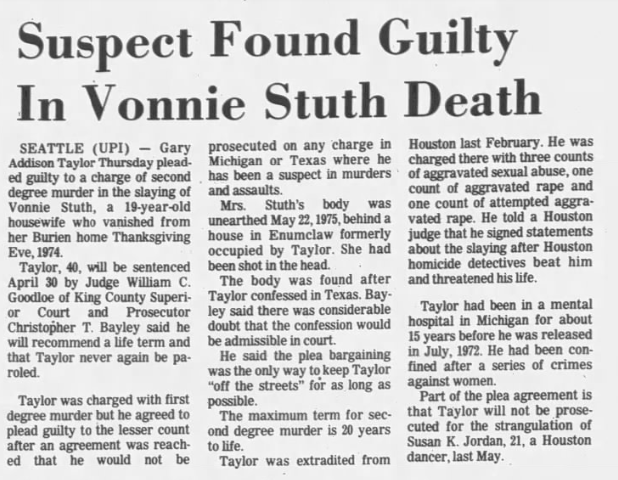
Vonnie Joyce VanDriel-Stuth (disappeared on November 27, 1974. Burien): was initially suspected to be another victim of Bundy, Vonnie was abducted and murdered by serial killer Gary Addison Taylor; the nineteen-year-old newlywed disappeared from her apartment in Burien, Washington. When her husband, Todd Stuth, returned home from work after midnight, he found the lights and television on, an unfinished Thanksgiving meal on the table, and his wife gone. Her only previous hint to family had been a mention of a neighborhood man coming to the door to offer her a dog.

Laurie Lynn Partridge (December 4, 1974, Spokane): on the day she disappeared Partridge left Ferris High School early, complaining about not feeling well walking at 37th & Havana Streets on Spokane’s South Hill. Unable to get a ride, she decided to walk the two-plus miles to the home where she lived with her parents and five younger siblings, saying the air might help her feel better. The family reported her missing after she failed to show up for work that evening at Lincoln Heights Theater. Initially, sheriff’s deputies thought she might have run away from home, given her displeasure when the family moved to Spokane from California, but by the time she vanished she had started to establish roots (she was also engaged to a twenty-year-old man). The couple planned to pick out engagement rings the day Partridge disappeared, and her fiancé was questioned extensively several times but never ruled a suspect.

Lorelee Sue Lhotka (January 1, 1975, Seattle): Lhotka was last seen on some unspecified date in 1975, when she left home to go to a doctor’s appointment; she was supposed to take the bus, but she may have hitchhiked instead, and she never arrived at the doctor’s office. She has never been seen or heard from again. In 1978, Lhotka’s wallet was found at Blewitt Pass in the Wenatchee National Forest.

Diana ‘Dinah’ Peterson (February 14, 1975, Shoreline): sixteen-year-old Dinah snuck out of her family’s home in the Innis Arden/Richmond Beach neighborhood to visit her older boyfriend (whom her parents disapproved of). Later that night, her dad discovered her body in their backyard; she had been stabbed. For decades, investigators primarily focused their attention on Peterson’s then-19-year-old boyfriend, Timothy Diener, who had been arrested shortly after the murder but was never formally convicted (investigators struggled with a lack of concrete evidence). In December 2007, King County Sheriff’s cold-case detectives arrested and charged James Eric Groth, who was also sixteen at the time of the crime and lived two houses away from the Petersons; authorities determined that Groth had been infatuated with Peterson and grew violently jealous of her dating an older guy.

Hallie Ann Seaman (April 29, 1975, Seattle): Seaman was an honor student just two terms away from finishing her master’s degree in architecture and was last seen working late at her drafting table inside the University of Washington’s architecture building. The following afternoon, a passerby discovered her body hidden in the bushes near a parking lot on Eastlake Avenue East; she had been sexually assaulted and repeatedly stabbed. Her case remained an unsolved mystery until advanced DNA testing identified her killer as Charles Rodman Campbell.

Jo Carrol Sanders (July 6, 1975, Camas): the fourteen-year-old was last seen alive near her residence, which was described as being ‘a tight-knit neighborhood where she lived with her father’ and investigators confirmed she was abducted in broad daylight by someone driving either a yellow or green van. Her body was discovered three days later in a gravel pit roughly ten miles east of Camas in Skamania County.
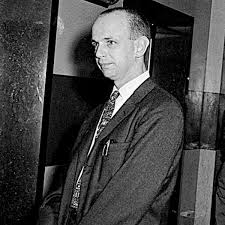
‘Guilty but Mentally Ill,’ by Ames Robey.
After speaking to a documentary filmmaker yesterday afternoon about Gary Addison Taylor I decided to shift gears and focus on him a bit. Dr. Ames Robey was one of his psychiatrists while he was incarcerated in MI, and he was also involved in ‘The Boston Strangler’ case as well. He wrote this article called ‘Guilty but Mentally Ill,’ which appeared in the ‘Bulletin of the American Academy of Psychiatry and the Law’ in 1978. 

Vonnie Joyce Van Driel-Stuth.

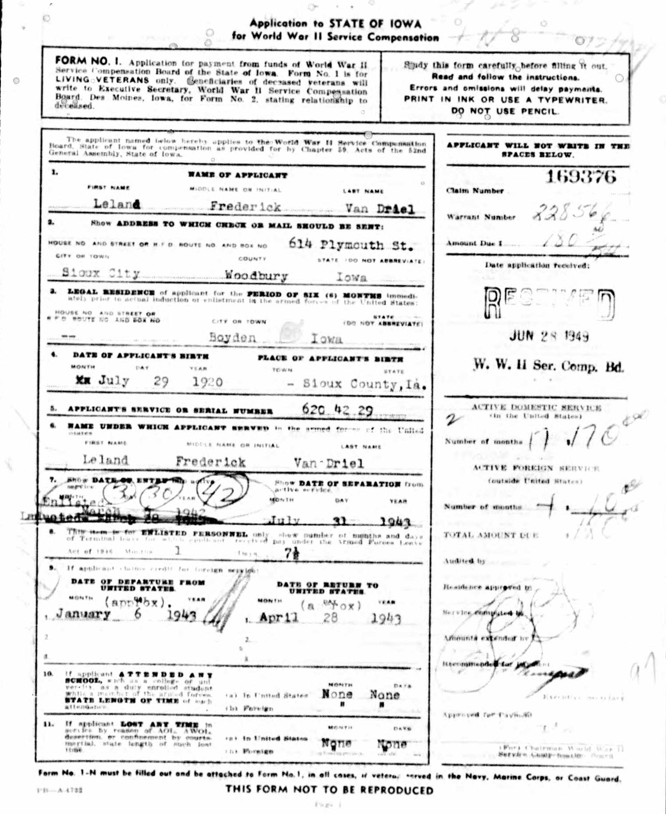
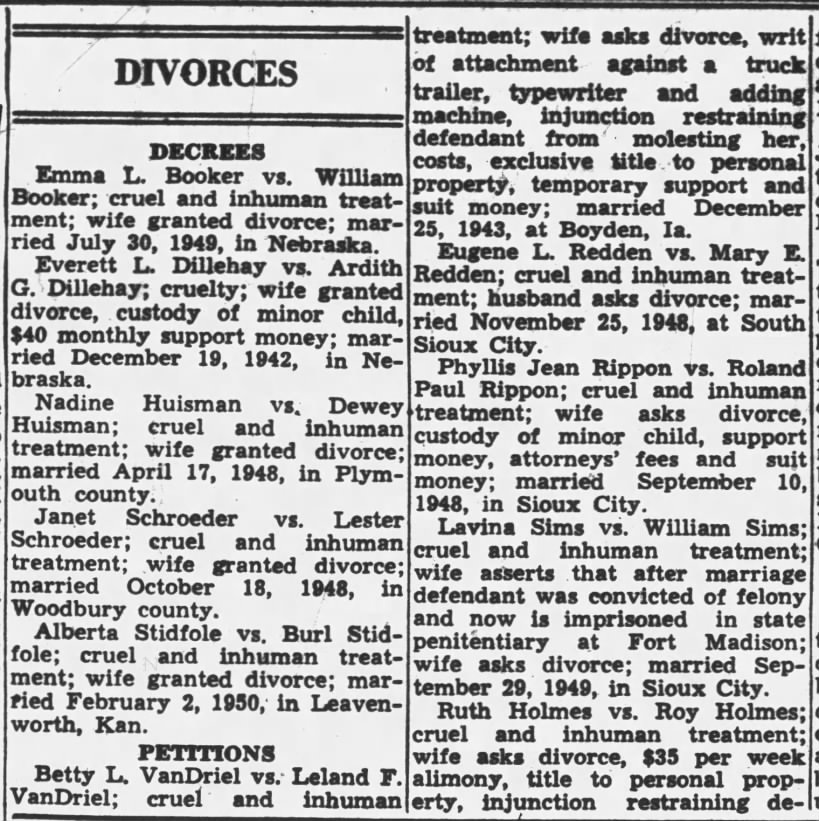
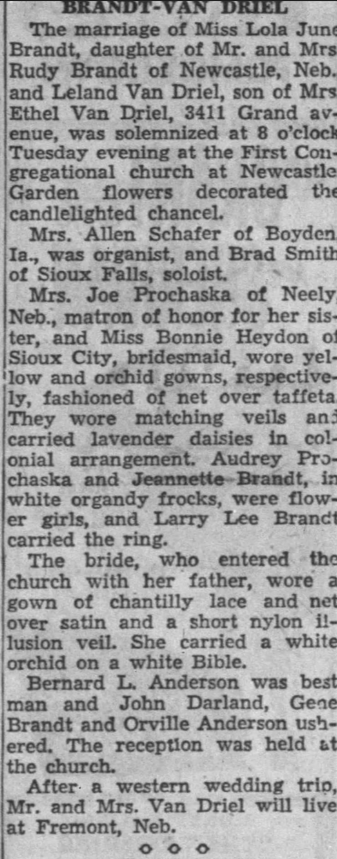
Vonnie Joyce Van Driel* was born on April 4, 1955 in Sioux City, Iowa to Leland and Lola (nee Brandt) Van Driel. Leland Fredrick Van Driel was born on July 29, 1920 in Sioux, Iowa, and Lola June Brandt was born on a farm in Nebraska on June 17, 1932. Leland was married once before Lola to a woman named Betty, and they divorced in May 1950 due to ‘cruel and inhumane treatment.’ The couple were married on June 17, 1952 and had four daughters together: Phyllis, Vonnie, Alicia, and Shirley. They relocated to Seattle when Leland got a job at Boeing, and Mrs. Van Driel was a stay at home wife and mother, and loved caring for her family. She filed for divorce in 1970, which was granted on June 6 and got married for a second time to Kenneth J. Linstad on June 19, 1972. * I have seen the family’s last name as VanDriel as well as Van Driel.
Vonnie graduated from Sealth High School in 1973, and married Todd Stuth on May 4, 1974; according to her marriage certificate, she was a housewife and volunteered at the Youth Service Center in Seattle. The newlyweds moved into a basement apartment located at 14215 24th Street South in Burien, which was roughly twenty miles away from the University of Washington. Todd Elliott Stuth was born on August 10, 1953 in Kent, WA, and graduated from Lincoln High School in 1971. At the time of his wife’s death he was a criminal law major at Highland Community College in Des Moines (which is the same school Brenda Ball attended before she dropped out), and worked the swing shift at Pacific Car & Foundry.

Late in the day on November 27, 1974 Vonnie kissed her husband goodbye in their Burien apartment and sent him off to work: twenty-one year old Todd began his day in the late afternoon and got home after midnight, and she had gotten used to spending her evenings alone. It was the evening before Thanksgiving, and the beautiful young newlywed told her family that her contribution that year was going to be a Jell-O salad, and she had just placed the ingredients on the kitchen counter and dissolved the package of gelatin when her thirteen year old sister Alicia called her at around 10:20/10:25 PM, and the two chatted for roughly a half hour.

Alicia said at one point during their chat, her sister put the phone down to answer a knock at the front door, and when she came back she said that ‘a man from across the street wanted to give us a dog (as they were moving), but I told him he’d have to come back tomorrow when Todd was home.’ Around 11 PM Vonnie’s half-brother stopped over to get something out of one of the family cars parked in the driveway: after looking in the window he saw she was on the phone, and since he knew what he needed and where it was he didn’t bother her.

When Todd arrived home around 1:15 AM on November 28, 1974 he came home to an empty house: the front door was unlocked (which was unusual for his wife), the TV was on, and all of the ingredients for the Jello-O salad were left out on the kitchen counter. All of his wife’s belongings were present and accounted for, and her keys, drivers license, cigarettes, and $150 were found in her purse, which was left behind on the counter. Vonnie left no note, and missing from her wardrobe was a blue shirt, a pair of bell-bottoms, and her grey-hooded coat. Todd immediately started calling around to her family and friends, but they hadn’t heard from her; after an hour of waiting he called the King County Sheriff’s Department and tried to report her as missing, but was told by the dispatcher that he needed to wait the standard 48 hours until a missing person’s report could be filed.

The Van Driels/Stuth’s had a grim Thanksgiving with no news about Vonnie, and after the standard forty-eight hours passed Todd was finally able to file a report with the sheriff’s department. King County Detective Sergeant Len Randall and Detective Mike Baily almost immediately designated it as a ‘missing person’ case, and the only real lead they had to work with was ‘the man from across the street that had offered her a dog’ (and even that was vague).

Ted Bundy: In the early part of the investigation Vonnie was thought to be a victim of the mysterious ‘Ted of the Northwest,’ and she was often included in his list of Washington state victims: in the first seven months of 1974, eight young women had vanished in and around the Seattle area, and the news had been filled with their stories. At the time Stuth went missing in November 1974 Ted was living in his first SLC apartment and was a full-time law student at the University of Utah; he was still in a relationship with Elizabeth Kloepfer and the two were trying the long distance thing (despite the fact that he was unfaithful to her on multiple occasions). He was in between jobs at the time, as he left the Department of Emergency Services in Olympia on August 28, 1974 and remained unemployed until June of the following year when he got a position as the night manager of Bailiff Hall at the University of Utah (he was fired the next month for showing up drunk).

Over time, detectives were unable to establish any connection between Stuth and Bundy, and her case helped to highlight systemic flaws in the missing-persons reporting system at the time. Strangely enough, Vonnie had ties to both of Ted’s victims that were taken from Lake Sammamish State Park on July 14, 1974: Denise Naslund was in the same graduating class as her at Sealth High School, and she worked as a volunteer case aide in the Youth Service Center at the King County Juvenile Hall, where Janice Ott had been a caseworker.

After canvassing the neighborhood, the detectives quickly learned that the man with the dog had already moved Enumclaw, which makes the situation even more unusual since he no longer lived in the area. None of the Stuth’s neighbors recalled talking to Vonnie on the evening of November 27th, but one of them told investigators that he had seen a former resident’s 1972 Dodge van parked in the driveway of the home they had once rented, but ‘it was only there for 10 or 15 minutes.’

The detectives searched the abandoned home, and went through a ‘small mountain’ of trash that had been left behind by the former tenants and found a large number of torn up pictures; when reassembled one of them was of a beautiful, dark haired woman dressed in a bikini that one of the neighbors identified as Helen, who was half of the couple that had just moved out. The investigating officers also found mail addressed to a man named ‘Gary A. Taylor,’ and they were able to trace him through a former landlord and utility bills to a quiet farm on the edge of the Muckleshoot Indian Reservation, close to Enumclaw.

The Taylors’ new neighbors said the couple had moved into the white frame house with a van and U-Haul trailer shortly before Thanksgiving; the property was located next to the Newaukun Creek and one neighbor commented that Gary seemed to do a lot of target shooting aimed at the water, but other than that they could tell detectives nothing. Officers Randall and Baily put in a few ‘information wanted’ requests on Gary A. Taylor through the National Crime Information Center (whose computer programs all data on requests, warrants and escapees), but he came back clean and with no warrants.

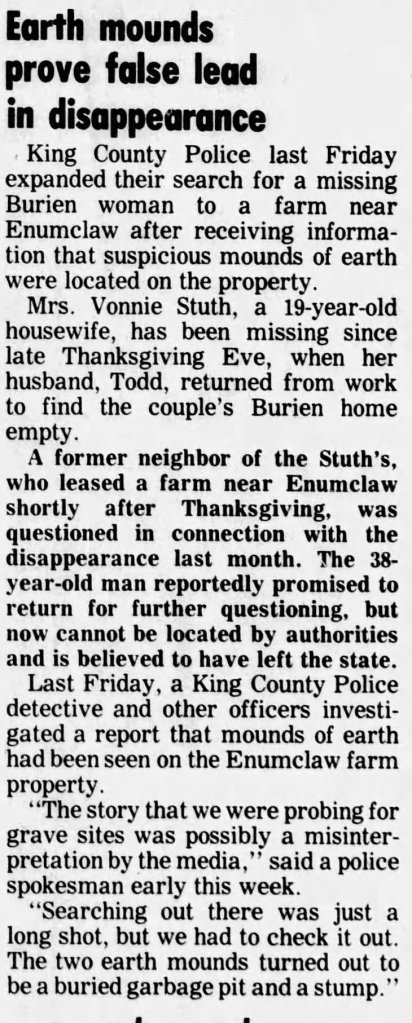
Investigators were brought to a farm in Burien that had been rented by the Taylor’s after receiving reports of ‘unusual mounds of dirt’ found on the property, and according to a King County detective, ‘the story that we were probing for grave sites was possibly a misinterpretation by the media. Searching out there was just a long shot, but we had to check it out. The two earth mounds turned out to be a buried garbage pit and a stump.’

After Detectives Baily and Randall tracked them down, the Taylor’s were brought in for questioning, but they refused to answer any questions, and Gary denied ever knowing Vonnie. The officers got him a public defender and he was booked on December 6, 1974 but was released after a few hours, as their ‘gut feeling’ to a suspect’s guilt had no legal clout, and they had no body, no proof of a crime, and no lawful reason to hold Taylor. He promised King County Sheriff’s that he would come in on Monday, December 9, 1974 for another conversation (and a polygraph), but he never showed up.

After the Taylor’s skipped town detectives searched their residence and the surrounding property: there were many outbuildings, sheds, and lean-to’s where they could have left a body that were all hidden by trees and underbrush. Directly behind the house, the land fell away to the Newaukum Creek, which was immediately dragged for a body but with no luck, and because it was the middle of winter the ground was frozen solid, and short of digging up the entire three acres of property, there was no way to establish that any remains had been buried there; additionally, they found shell casings in one of the buildings next to the main house.

Detectives Randall and Baily tracked the Taylors to Portland and learned that Helen had rented an apartment in her name from December 6 to the 16th, but by the time they learned this, the couple had already left and their van was found abandoned. When the vehicle was processed for evidence, forensic experts found a long blonde hair much like Vonnie Stuth’s, which meant it was ‘probable’ she had been in the vehicle at one point in time… but when? It was rumored that Gary Taylor was to have left Portland driving a Ford Pinto, and he was also sighted in several small Oregon towns (alone).

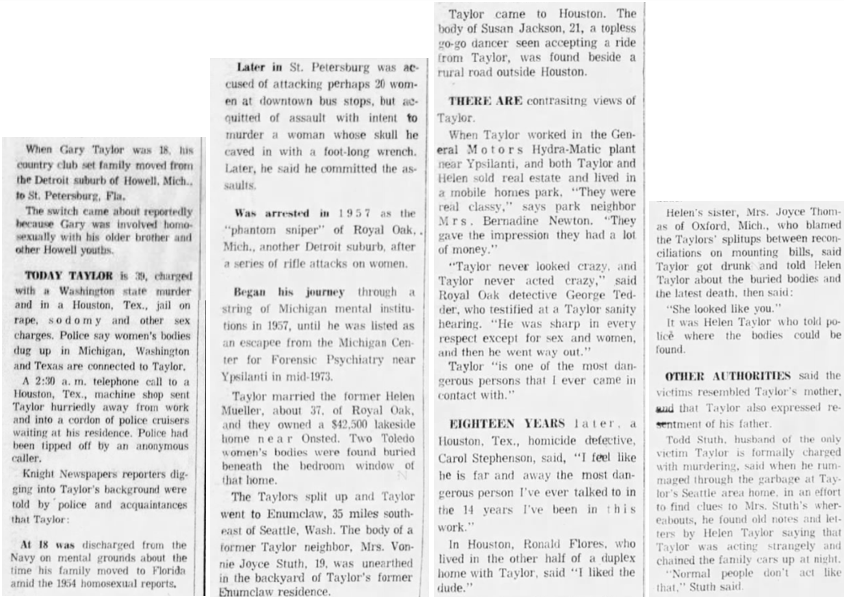
Gary Addison Taylor was born in Howell, Michigan in March 1936, and childhood friends recall that he was a physical fitness enthusiast that had a hair-trigger temper, but was also an accomplished trumpet player. Despite his outbursts, he had no real juvenile criminal record aside from one incident in Howell when he shot out of the windows of stores along Main Street with a pellet gun. In 1951 when Gary was fifteen the family moved to St. Petersburg, where his parents managed a motel.

While in Florida, he was responsible for ‘the bus stop phantom attacks,’ where he bludgeoned about a dozen women at bus stops during the late 1940’s and early 1950’s; his standard MO involved loitering around bus terminals at night and waiting for someone that was alone to walk by, which was when he pounced and would attack them with a hammer. His first arrest took place at the age of eighteen on Christmas Eve in 1954 after he nearly beat a 39-year-old woman to death with a wrench as she got off of a bus.

Despite investigators in the Sunshine State speculating that he was responsible for seventeen additional attacks on women where the same MO had been used, he was tried on a single assault charge with intent to kill but was acquitted by a jury; he later told three Michigan psychiatrists that he ‘felt lucky’ that he didn’t kill the woman, because he ‘might have.’ After their son’s acquittal the Taylors moved to Royal Oak, Michigan in 1951, where they opened a dry goods store and Gary joined the Navy… but it wasn’t long before he fell back into his old habits and began shooting women on the streets after dark. He was dubbed the ‘Royal Oak Sniper’ and shot sixteen women, but thankfully none of his victims were fatally wounded.

Two days before Christmas in 1956, Taylor shot and wounded a teenage girl in a drive-by attack in Royal Oak, and over the next few months he shot at several more females in a similar manner but thankfully missed every target. Several witnesses came forward and told police that the sniper was driving a two-toned black-and-white ’55 Chevrolet, and after they located the vehicle the suspect led them on a high-speed chase that ended in his arrest. Upon searching the car detectives discovered a .22 rifle, and Taylor couldn’t give them any particular explanation for his actions other than he wanted to shoot women and had these urges since he was a child, saying ‘it’s a sex drive compulsion.’

During Taylor’s trial, a psychiatrist testified that he was ‘unreasonably hostile toward women, and this makes it very possible that he might very well kill a person,’ and he was declared insane and was committed to Michigan’s Ionia State Hospital; three years later was transferred to the Lafayette Clinic in Detroit. While out on a work pass to attend a welding class, he talked his way into a woman’s home then raped and robbed her; the following year while out on another furlough he threatened a rooming-house manager and her daughter with an 18-inch butcher knife. He was not held responsible for either incident and was simply sent back to Ionia.

Even though he never stopped his violence against the opposite sex and had a self-proclaimed ‘compulsion to hurt women,’ Taylor was rated by prison staff as a ‘safe bet’ for out-patient treatment ‘as long as he reports in to receive medication.’ In 1970 he was transferred to an outpatient care facility after the director of the clinic determined that Taylor ‘was no longer mentally ill and would be dangerous only if he failed to take his medication,’ and drank alcohol.

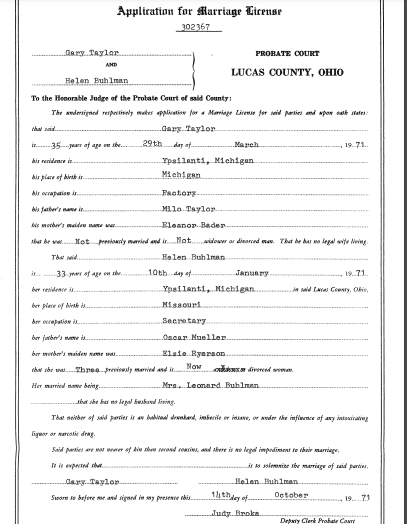
In 1972**, Taylor was released from the Michigan Center for Forensic Psychiatry in Ypsilanti thanks to a highly controversial state law: a person that had been acquitted of a crime by reason of insanity cannot be kept indefinitely in a mental institution and must be periodically declared mentally ill and deemed to be dangerous to himself or the community by a competent medical professional. Before his release, the center’s director Dr. Ames Robey diagnosed him with a character disorder (which is not a treatable mental illness), and felt that he was no longer dangerous as long as he was properly medicated and didn’t drink. Almost immediately after his release, Taylor married a secretary named Helen Buhlman, and the two moved first to Onsted, MI and later to the Seattle suburbs. **There may be some discrepancy as to exactly when he was released, as he was married on March 29, 1971 and another source said it was on November 3, 1973.

The state reported that in the two years after his release Taylor violated the conditions of his parole five times but was never recommitted by the Doctor, and after growing weary of reporting to treatment in late 1973 he completely stopped showing up altogether. When he failed to come in for scheduled check-in’s he wasn’t reported as an escaped mental patient for three months, and it wasn’t submitted into the national law enforcement communication system in Washington DC until January 13,1975. Plus, to make matters worse, when Michigan LE realized their mistake, the urgent bulletin they intended to release on November 6, 1974 never was and it slipped through the cracks.

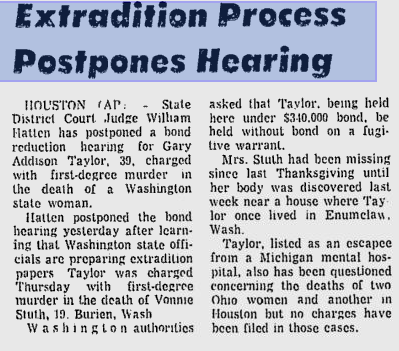
In December 1974 after separating from his wife, Taylor settled down in Houston, and Helen Taylor was last seen in January 1975 driving the couple’s Chrysler when she showed up at her FIL’s home in Tucson by herself. On May 20, 1975 Gary Addison Taylor was arrested in Houston for three counts of aggravated sexual abuse, one count of attempted aggravated rape, the rape of a 16-year-old pregnant girl, and the murder of a 21-year-old go-go dancer.

Discovery: According to an article published in The Times-Union on May 23, 1975, when news of her ex-husband’s arrest reached Helen (by that time she was in San Diego), she called Texas LE and told them that Gary had buried four bodies (three women and one man) underneath their bedroom window in a home they rented for three months in Michigan.

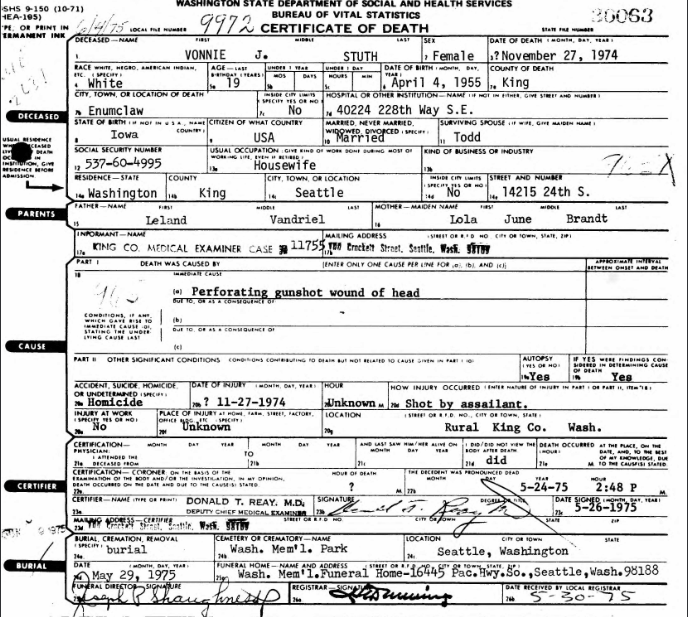
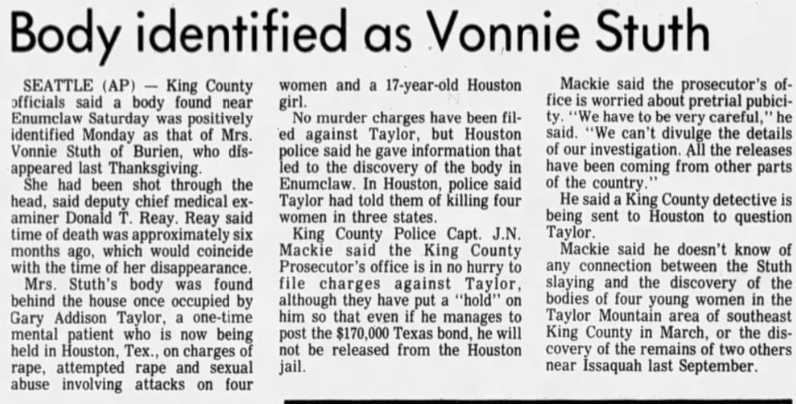
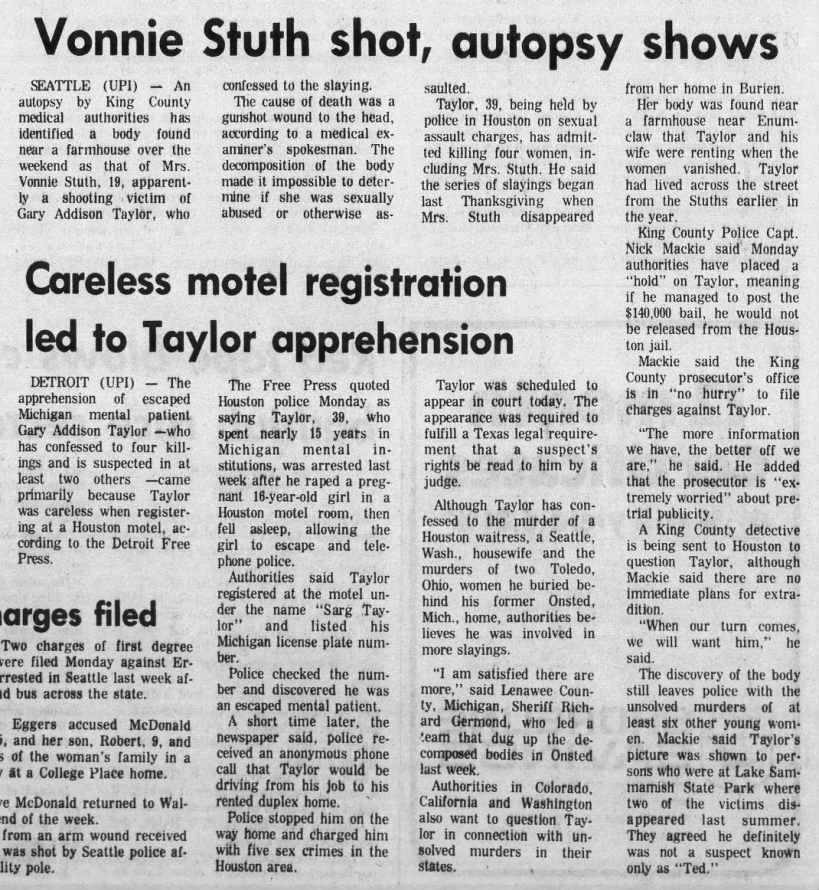
On May 18, 1975 the bodies of Vonnie Stuth and twenty-one year old Houston native Susan Jackson were found by detectives in a shallow grave along Neuwaukum Creek, roughly four to five miles northwest of Enumclaw; Stuth was ID’ed through dental records, and was still wearing the jeans, boots, and gray coat that were missing from her home the evening she disappeared. According to the King County ME, her exact cause of death is listed as a ‘perforating gunshot wound of the head,’ and detectives said she had been shot twice with a 9 mm pistol most likely during a desperate attempt to flee. They also said that due to the advanced level of decomposition it was impossible to tell if she had been sexually assaulted. Detectives said Jackson was last seen alive four days prior to the discovery leaving a Houston bar with Taylor, and her body had been bound with a dog leash and stuffed into a plastic garbage bag.

Tipped off by the Texas detectives, four days after the discovery of Stuth and Jackson investigators in Onsted discovered the remains of twenty-five year old Lee Fletcher and twenty-three year old Deborah Heneman from Toledo, wrapped in plastic bags, buried exactly where Helen said they were. After their discovery the remains were sent to the state police laboratory for analysis and autopsies were performed. Retired Sheriff Richard L. Germond said one of the victims was tied up with a piece of rope and the other had been bound with an electrical cord.

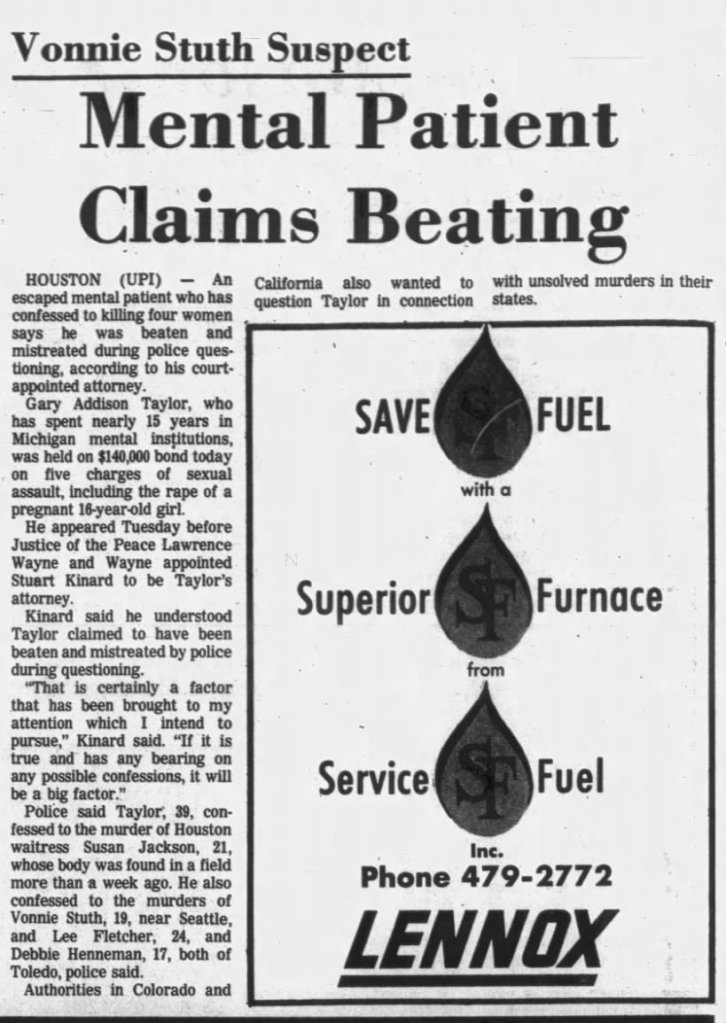
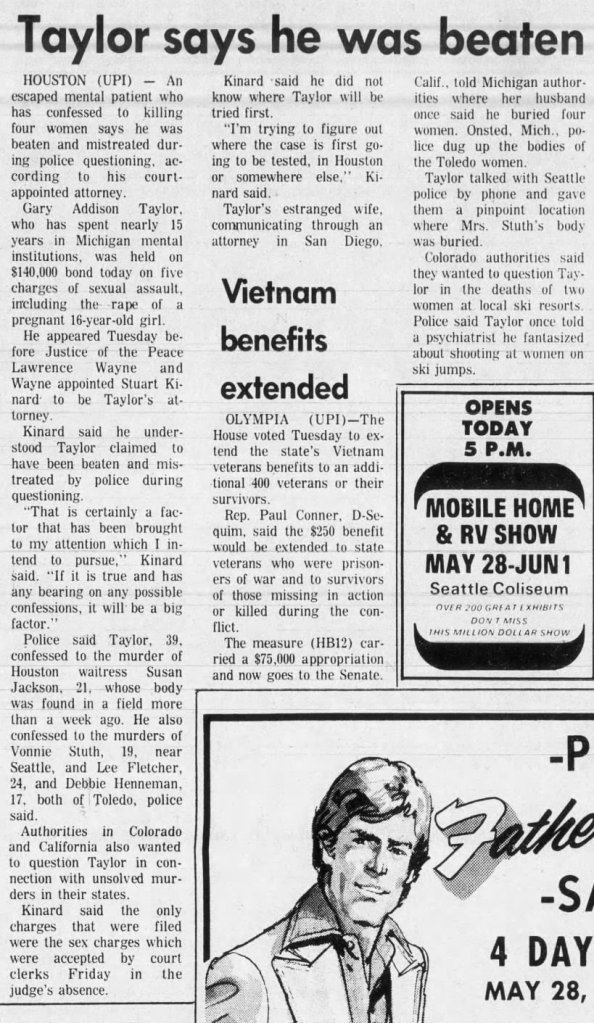
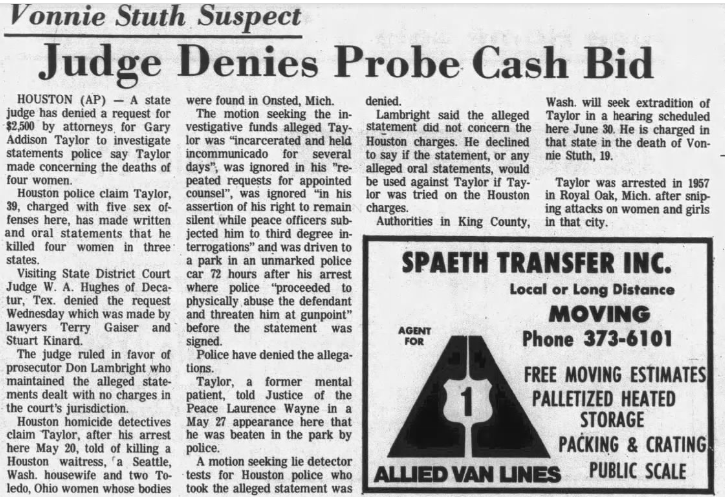
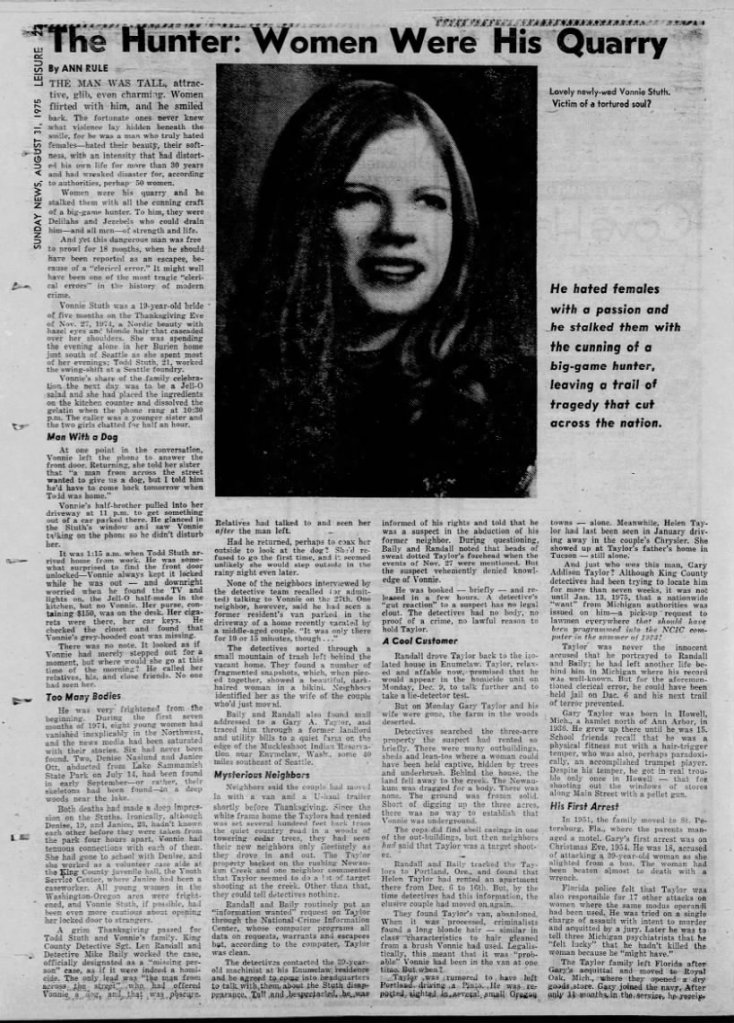
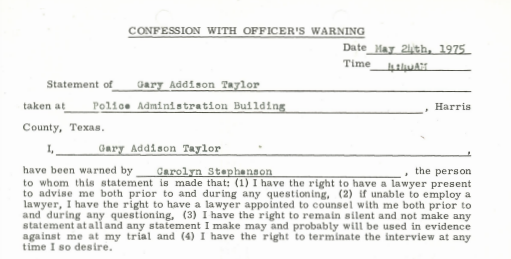
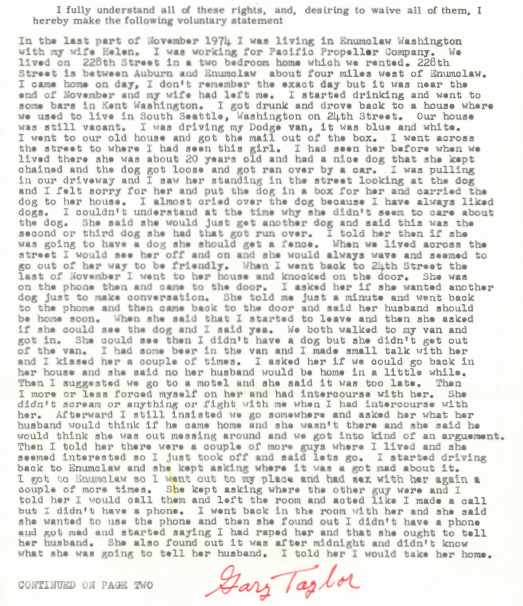
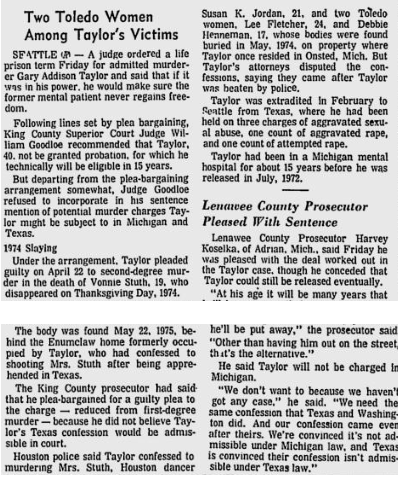
After his apprehension Taylor confessed to four murders (including Vonnie Stuth), however detectives were certain he wouldn’t have told them about any new women that they hadn’t already connected him to, meaning the actual number of his victims is unknown. After he admitted to killing Stuth, Taylor claimed that the detectives in Houston had beaten him into confessing and that there was no attorney present, which made the Texas and Michigan cases problematic. In an article published by The Daily News on August 31, 1975, Taylor was briefly a suspect in the death of Caryn Campbell (who wasn’t physically in Michigan when she disappeared but was from the state) and Julie Cunningham, who were both eventually tied to Ted Bundy. Further investigation cleared him of six additional murders in Washington state.

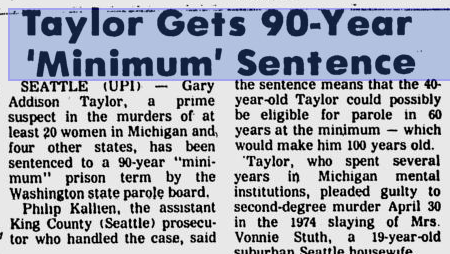
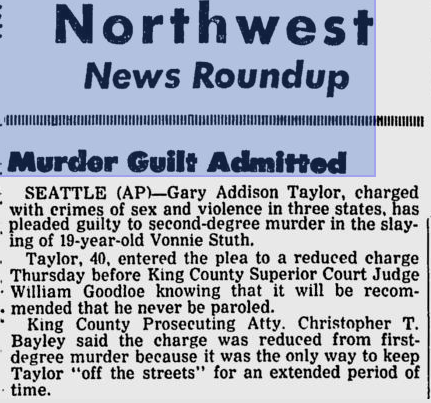
After his confession in Texas Taylor was extradited to Washington, where he was charged with first degree murder for the murder of Vonnie Stuth. On April 30, 1978 he pled guilty to second degree murder after an agreement was reached that both Texas and Michigan would not prosecute him for his crimes and he was sentenced to a ninety-year ‘minimum’ prison term by the Washington state parole board. Years after the conviction one of Vonnie’s sisters provided a victim impact statement to the Indeterminate Sentence Review Board, and Taylor’s parole was denied; his next parole date was set in 2035 when he will be 100 years old.

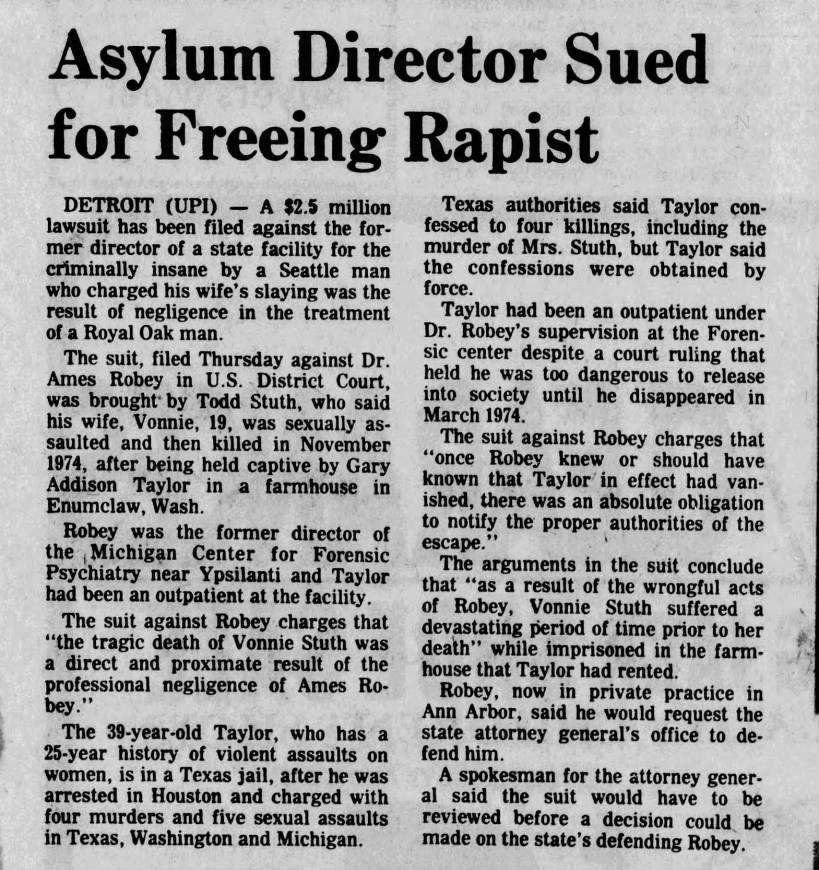
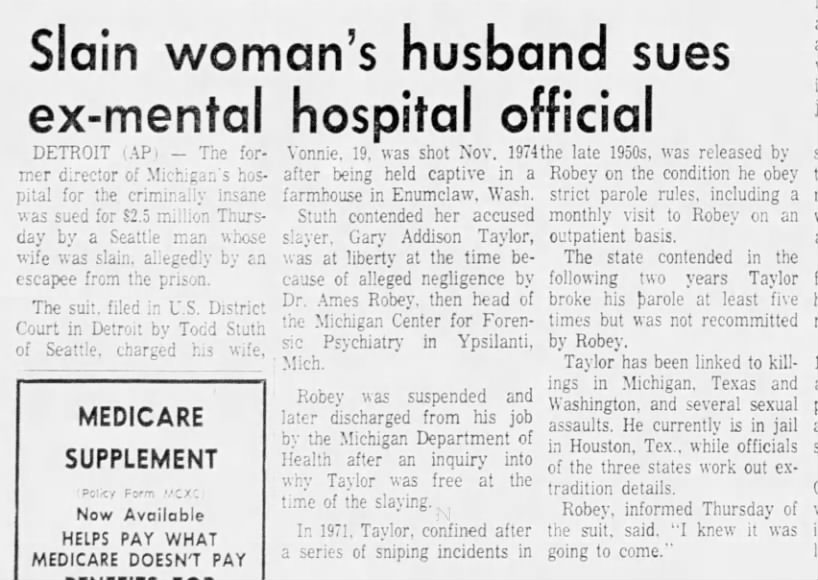
Todd Stuth: According to an article published in The Tri-City Herald on January 23, 1976, Vonnie’s widower Todd sued Gary Taylor’s former Psychiatrist Dr. Ames Robey for $2.5 million, as he was technically the one responsible for Taylor and he escaped under his watch. The former director of Michigan’s Center for Forensic Psychiatry, after the murders came to light Dr. Robey was suspended from his position and was eventually fired by the Michigan Department of Health after an inquiry into why his patient was free at the time of Stuth’s murder. In regard to the court case, Dr. Robey said in an interview: ‘I knew it was going to come.’

VSS/Victim Support Services: Lola ran a day care center out of her home and lived two blocks away from a woman named Linda Barker-Lowrance, and the two met when Linda needed someone to watch her kids when she went to PTA meetings. While waiting for answers as to what had happened to Vonnie, one evening when Linda arrived to pick up her children she said, ‘I am sorry my house is a mess but my daughter is missing.’ … ‘I wonder what the other mothers are doing?’

Despite over a fifteen year age gap between the two (and the fact that they hadn’t known each other for very long), Barker-Lowrance immediately responded, ‘let’s find out.’ The two women reached out to a Seattle-based newspaper reporter, who was able to give them phone numbers and addresses of several other families that had missing or murdered daughters and on February 25, 1975 thirteen families gathered in the social hall of a Catholic church in White Center. The group, officially dubbed ‘the Families and Friends of Violent Crime Victims***’ became one of the first victim advocacy groups in the US. *** It is now simply VSS.

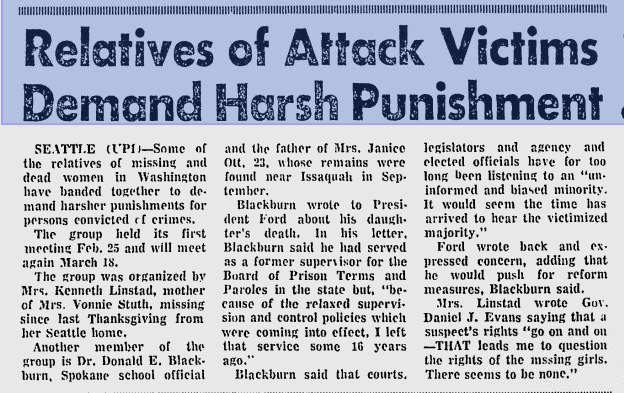
Also a member of the group was Dr. Donald Blackburn, father of Bundy’s Lake Sammamish victim, Janice Ott. In a letter he wrote to President Ford about his daughter, Dr. Blackburn said that he had previously worked as a supervisor for the Board of Prison Terms and Paroles in Washington state, but ‘because of the relaxed supervision and control policies which were coming into effect, I left that service some sixteen years ago.’ President Ford wrote back saying he expressed concern about his daughter’s death and that he would try his hardest to push for reform.

Mrs. Linstad wrote to Bundy buddy Governor Daniel J. Evans in regards to the rights of a murder suspect, saying they ‘go on and on, that leads me to question the rights of the missing girls. There seems to be none.’ Lola’s baby now operates out of a two-story house on Colby Avenue and is staffed by eight full-time employees (including mental health professionals), and volunteers help to operate the crisis line after hours.

Mr. Van Driel died at the age of sixty-five on July 29, 1985 in Seattle, and Vonnie’s mother Lola died on October 1, 2024 in Sweet Home, Oregon. According to her obituary, at the age of eighteen she enrolled in secretarial college and after she got married and started her family they packed up and relocated to Seattle. She did a lot of fund raising for an organization called ‘The Healing Garden’ at Samaritan Hospital in Lebanon, Oregon and volunteered with a local soup kitchen and FISH food distribution pantry. She also taught Sunday school for many years and was a PTA mother and a Girl Scout Leader.

Over the course of her life Lola had two careers: she worked as a licensed daycare provider for fifteen years and after her daughters grew up she took classes to update her skills and became a family court clerk at the King County courthouse in downtown Seattle. After retiring at the age of sixty-five, she moved to Oregon to be closer to her two daughters. Sadly while in her 80’s Lola lost her ability to walk and was diagnosed with Parkinson’s disease, Meniere’s disease (hearing loss), and glaucoma (vision loss), but despite these challenges, she was always good natured and lived to be ninety-two.

Phyllis Van Driel-Clem is married and currently resides in Friday Harbor, WA; she retired from Compass Health (which is a community-based, non-profit organization in Washington that provides a wide range of behavioral health related services) in 2017. Vonnie’s sister Shirley Byrd relocated to Oregon and earned her RN from Linn-Benton Community College in June 2002; she is a passionate advocate for those struggling with substance abuse. Vonnie’s youngest sister Alicia lives in Federal Way, WA with her husband, who she has been married to since 1986. Todd Stuth remarried and lives in Kent, WA; he is currently employed as a flight instructor at Crest Airpark.

Gary Taylor is currently 89 years old and is still incarcerated in the Washington State Penitentiary in Walla Walla. Michigan investigators strongly suspect that he is also responsible for the disappearance of thirty-three year old Ann Arbor mother of three Sandra Horwath, who vanished without a trace on October 1, 1973. In 2002 detectives went to the prison Taylor was housed at and tried to speak to him about Horwath, but he refused to answer any questions.

Works Cited:
Barber, Mike, ‘Serial killers prey on ‘the less dead.’ (February 19, 2003). The Seattle Post-Intelligencer Reporter.
Gore, Donna. (March 14, 2014). ‘Two Desperate Housewives, First Support Group.’ Taken August 27, 2025 from ‘herewomentalk.com’
Hefley, Diana. (April 18, 2015). ‘For 40 years, group has been there in darkest times for crime victims.’ Taken August 9, 2025 from heraldnet.com

Mr. and Mrs. Van Driel and their first three daughters.
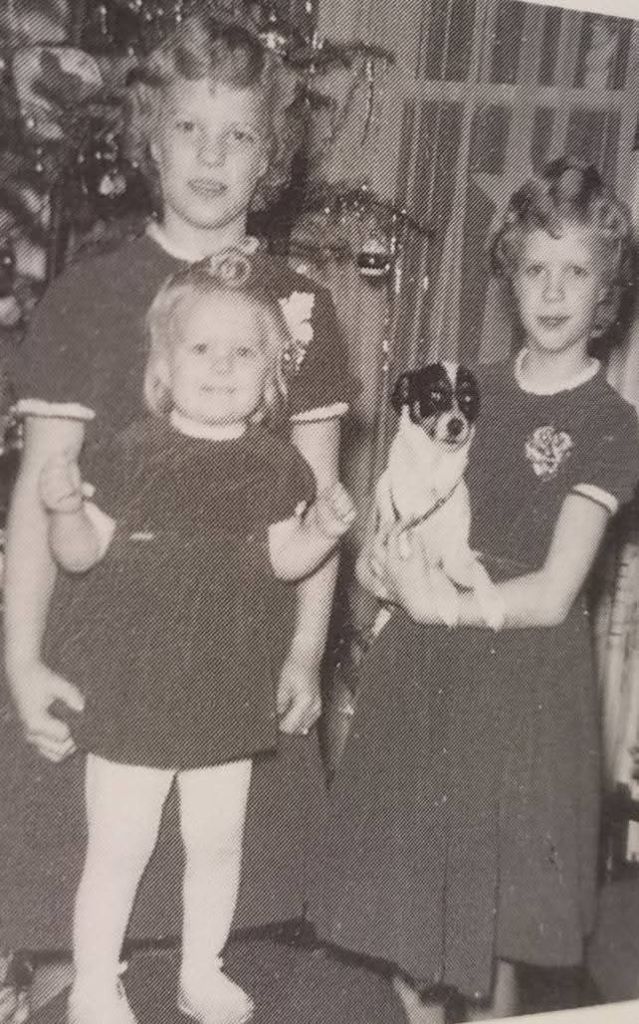
Vonnie with her sisters and the family dog.
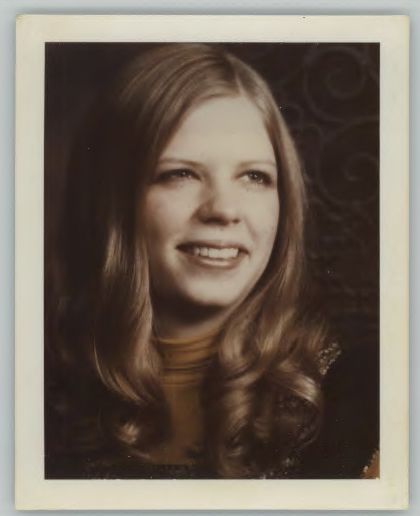
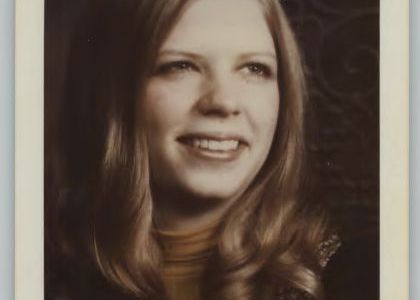
Vonnie Stuth.
Vonnie.
The back of one of Vonnie’s pictures, courtesy of the King County Sheriff’s Department.
Vonnie Stuth.
Vonnie and her mother on her wedding day.
Vonnie.
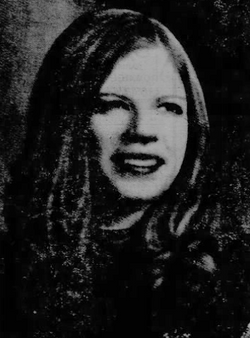
Vonnie Stuth.
Vonnie Stuth.
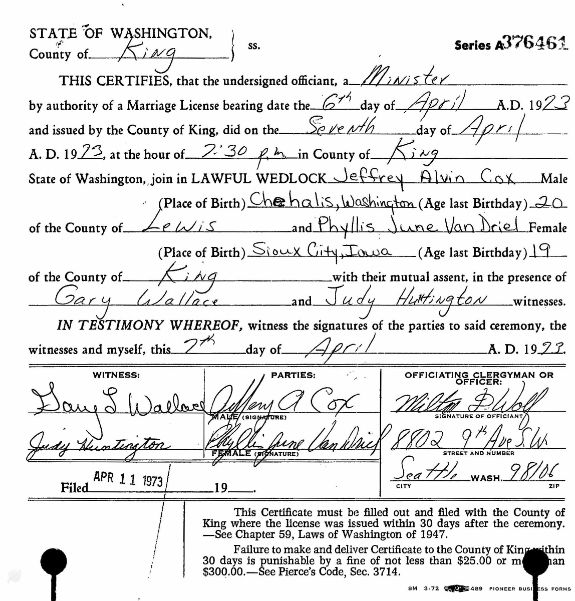
Todd and Vonnie Stuth’s marriage certificate.
Vonnie Stuth’s death certificate.
A map of Bundy’s eight Seattle victims that also includes Vonnie Stuth, photo courtesy of the King County Sheriff’s Department.
Some notes about Bundy’s Seattle victims that includes some information about Vonnie Stuth, photo courtesy of the King County Sheriff’s Department.
Some notes about Bundy’s Seattle victims that also includes some information about Vonnie Stuth, photo courtesy of the King County Sheriff’s Department.
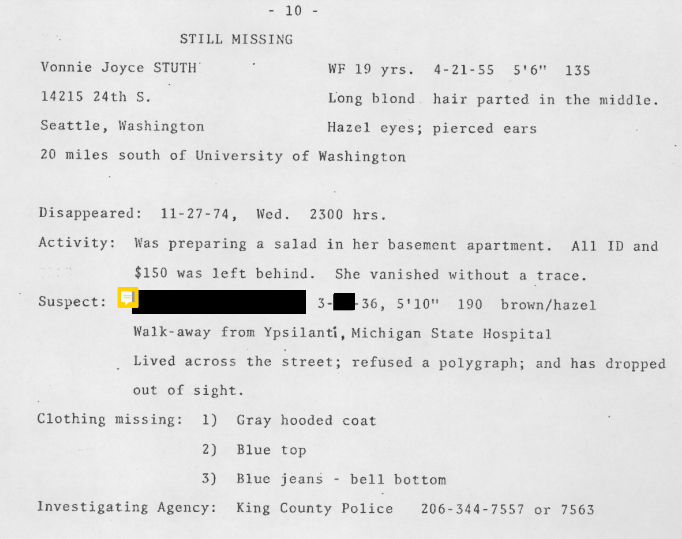
Some notes about Vonnie Stuth, photo courtesy of the King County Sheriff’s Department.
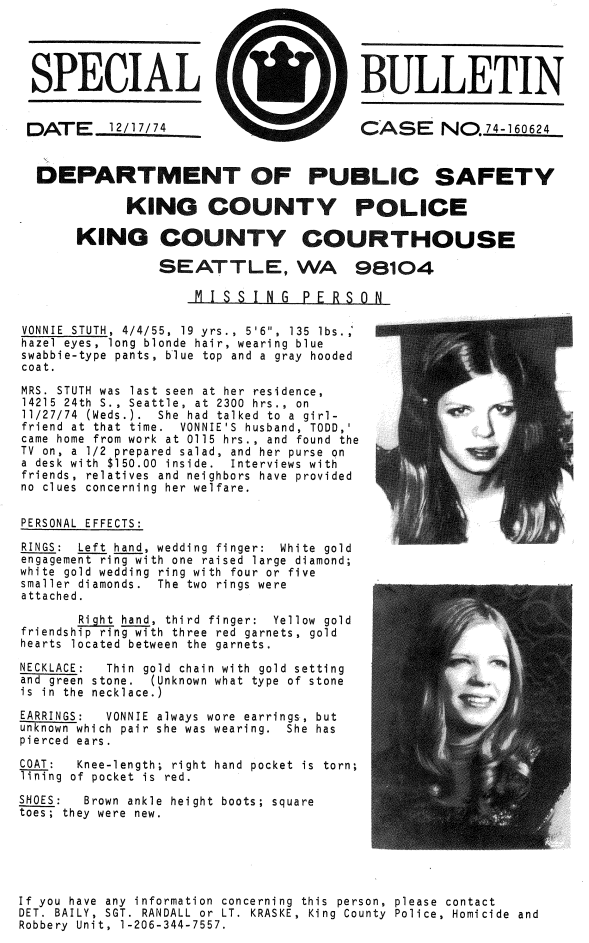
Vonnie Stuth’s missing persons flyer.
The grave stone for Vonnie Stuth.
Vonnie Stuth’s missing persons report.
Another page of Vonnie Stuth’s missing persons report.
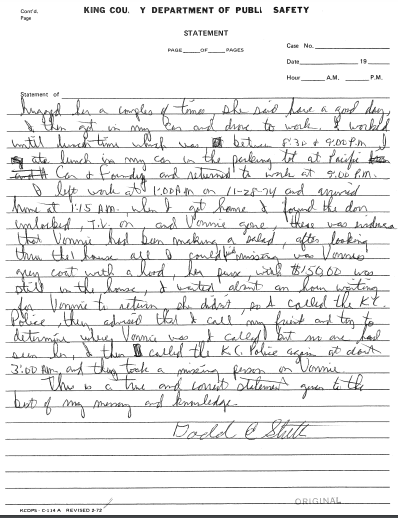
The first page of Todd Stuth’s statement in relation to his wife’s disappearance.
The second page of Todd Stuth’s statement in relation to his wife’s disappearance.
The first page of Alicia Van Driel’s statement in relation to his wife’s disappearance.
The second page of Alicia Van Driel’s statement in relation to his wife’s disappearance.
The first page of Vonnie’s half-brother’s statement in relation to his wife’s disappearance.
The second page of Vonnie’s half-brother’s statement in relation to his wife’s disappearance.
A note about Vonnie Stuth being in the same graduating class as Denise Naslund.
Gary Taylor after his 1957 arrest.
The Manchester Evening Hearld on February 8, 1957.
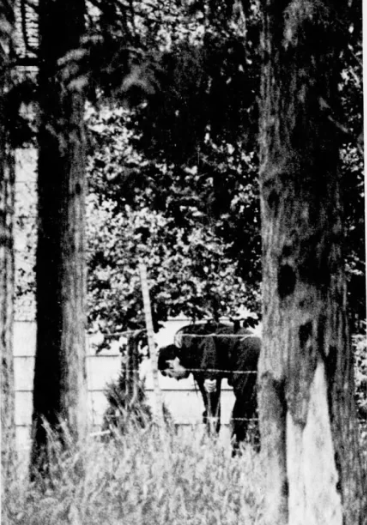
Vonnie Stuth’s body was found in a shallow grave close to this residence the Taylor’s lived in.
Another shot of the Taylor’s house.
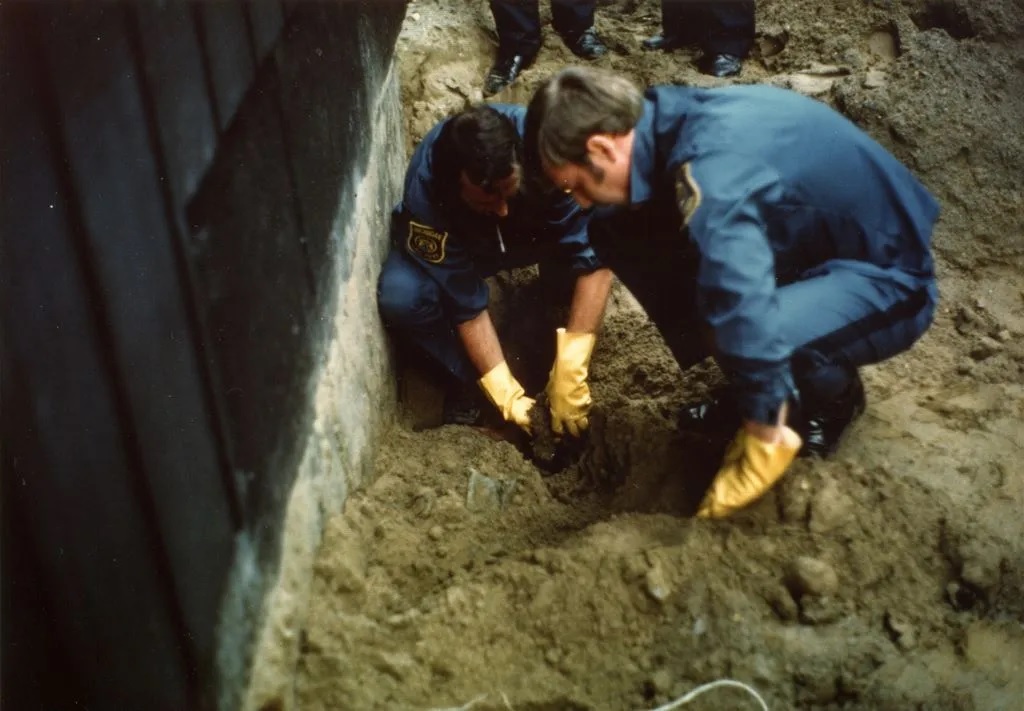
A police office searching for signs of a gave at the Taylor’s former residence.
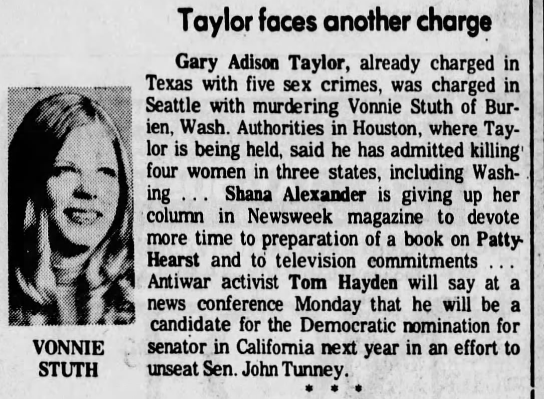
A picture from an article related to the investigation of Gary Taylor that mentions Vonnie Stuth published in The Tri-City Herald on May 25, 1975.
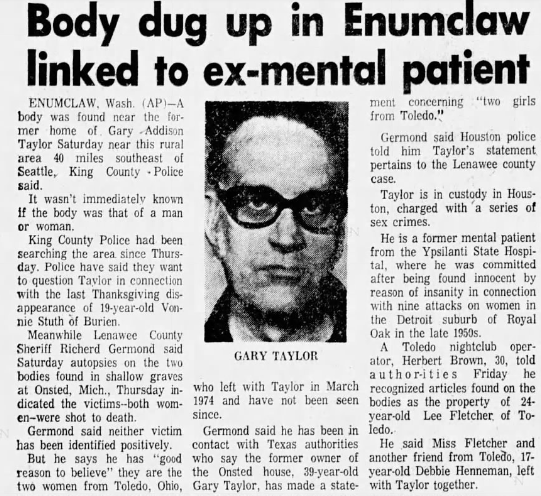
Investigators digging up Loch Ness looking for victims of Gary Taylor published, photo courtesy of The Daily Telegram.
In
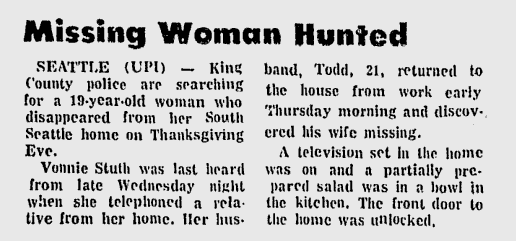
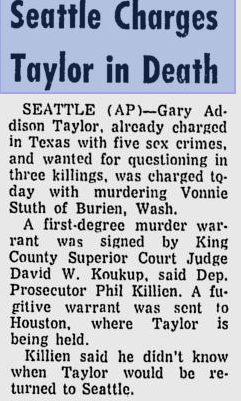
An article bout the disappearance of Vonnie Stuth published in The Spokane Chronicle on December 2, 1974.
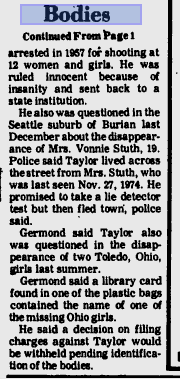
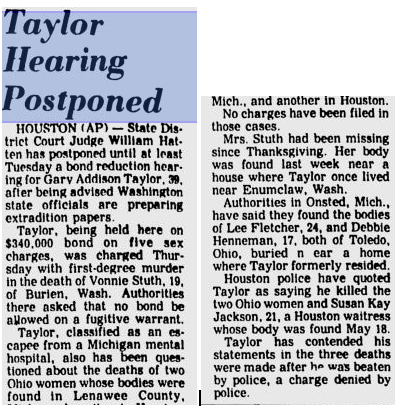
An article about the discovery of the remains of Vonnie Stuth published in The News Tribune on December 4, 1974.
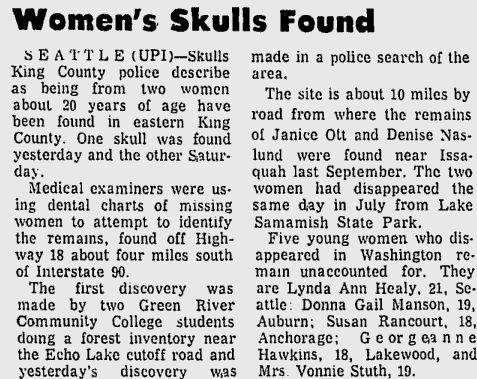
In the initial stages of Vonnie's murder investigation detectives strongly suspected she was a victim of Ted Bundy, and she was often included in his list of Washington state victims.
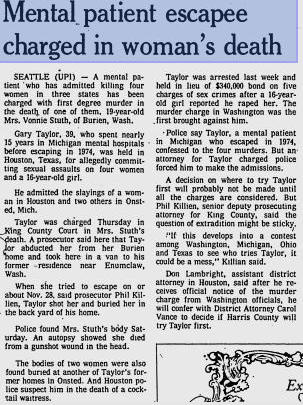
An article about Gary Taylor that mentions Vonnie Stuth published in The Daily Herald on January 4, 1975.
An article about Gary Addison Taylor that mentions Vonnie Stuth published in The Enumclaw Courier-Herald on January 9, 1975.
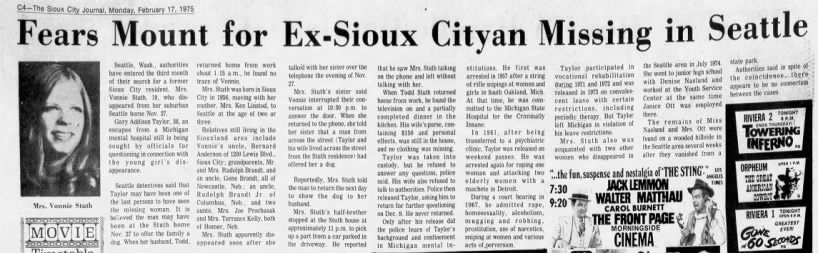
An article about the murder of Vonnie Stuth published in The Sioux City Journal on February 17, 1975.
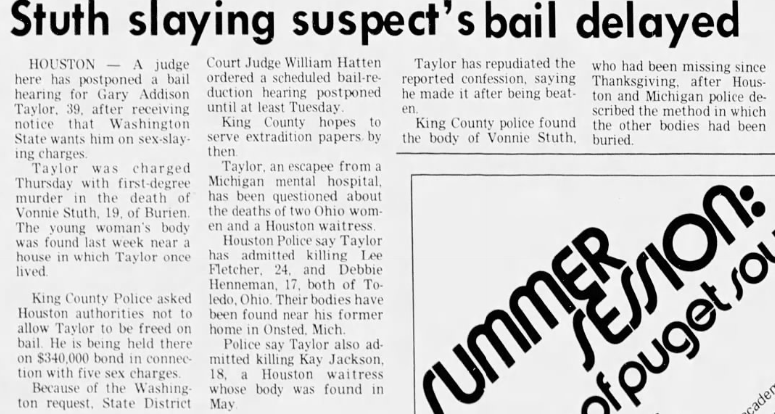
An article about Gary Taylor that mentions Stuth published in The Spokane Daily Chronicle on March 4, 1975.
An article about Gary Addison Taylor that mentions Vonnie Stuth published in The Daily Herald on March 5, 1975.
An article about the murder of Susan Rancourt that mentions Vonnie Stuth published in The Ellensburg Daily Record on March 7, 1975.
An article about Gary Addison Taylor that mentions Vonnie Stuth published in The Spokane Daily Chronicle on March 7, 1975.
An article about Gary Addison Taylor that mentions Vonnie Stuth published in The Lewiston Morning Tribune on March 8, 1975.
An article about Gary Addison Taylor that mentions Vonnie Stuth published in The Spokane Daily Chronicle on May 16, 1975.
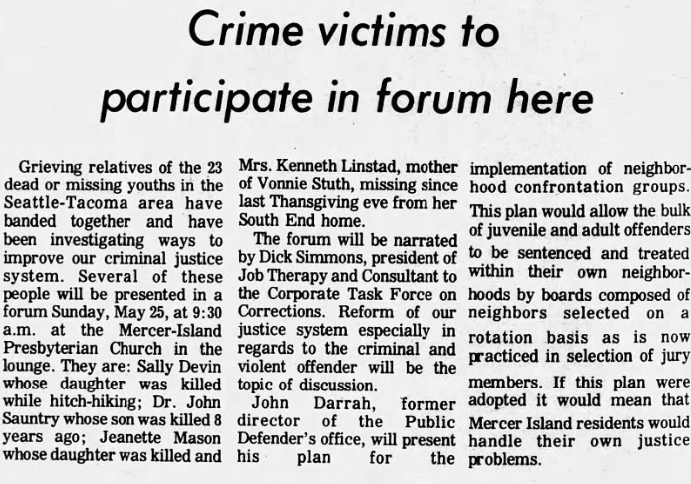
An article about grieving relatives in Washington mentions Vonnie Stuth published in The Mercer Island Reporter on May 22, 1975.
An article about Gary Taylor that mentions Stuth published in The Middlesboror Daily News on May 23, 1975.
An article about Gary Addison Taylor that mentions Vonnie Stuth published in The Times-Union on May 23, 1975.
An article about Gary Addison Taylor that mentions Vonnie Stuth published in The Middlesboro Daily News on May 23, 1975.
An article about Gary Taylor that mentions Vonnie Stuth published in The Daily Herald on May 24, 1975.
An article about Gary Taylor that mentions Vonnie Stuth published in The News Tribune on May 24, 1975.
An article about the murder of Vonnie Stuth published in The Daily Nonpareil on May 25, 1975.
An article about Gary Taylor that mentions Vonnie Stuth published in The Tri-City Herald on May 25, 1975.
An article about Gary Addison Taylor that mentions Vonnie Stuth published in The Gazette on May 27, 1975.
An article about Gary Addison Taylor that mentions Vonnie Stuth published in The Ellensburg Daily Record on May 27, 1975.
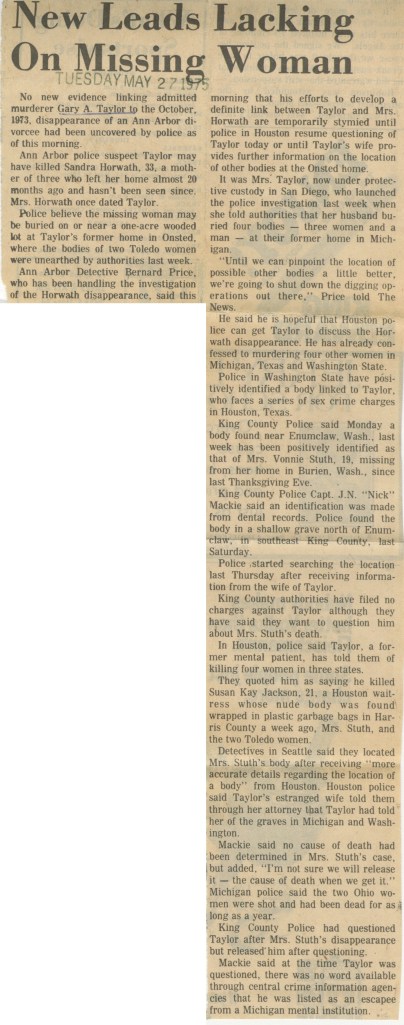
An article about Gary Addison Taylor that mentions Vonnie Stuth published in The Ann Arbor News on May 27, 1975.
An article about Gary Addison Taylor that mentions Vonnie Stuth published in The Toledo Blade on May 27, 1975.
An article about Gary Taylor that mentions Vonnie Stuth published in The Longview Daily News on May 27, 1975.
An article about Gary Taylor that mentions Vonnie Stuth published in The Olympian on May 27, 1975.
An article about the discovery of the remains of Vonnie Stuth published in The Longview Daily News on May 27, 1975.
An article about the autopsy of Vonnie Stuth published in The Daily Herald on May 27, 1975.
An article about Gary Taylor that mentions Vonnie Stuth published in The Kitsap Sun on May 28, 1975.
An article about Gary Taylor that mentions Vonnie Stuth published in The Daily Herald on May 28, 1975.
An article about Gary Addison Taylor that mentions Vonnie Stuth published in The Spokane Daily Chronicle May 29, 1975.
An article about Gary Taylor that mentions Stuth published in The Oregonian on May 30, 1975.
An article about the murder of Vonnie Stuth published in The Fort Worth Star-Telegram on May 30, 1975.
An article about Gary Taylor that mentions Stuth published in The Eugene Register-Guard on May 30, 1975.
An article about Gary Taylor that mentions Stuth published in The Portsmouth Times on May 31, 1975.
An article about Gary Addison Taylor that mentions Vonnie Stuth published in The Spokane Daily Chronicle on May 31, 1975.
An article about Gary Addison Taylor that mentions Vonnie Stuth published in The Spokane Daily Chronicle on May 31, 1975.
An article about Gary Taylor that mentions Vonnie Stuth published The News Tribune on May 31, 1975.
An article about Gary Taylor that mentions Stuth published in The Sioux City Journal on June 1, 1975.
An article about the murder of Vonnie Stuth published in The Mercer Island Reporter on June 5, 1975.
An article about Gary Taylor that mentions Vonnie Stuth published in The Kitsap Sun on June 19, 1975.
An article about Gary Taylor that mentions Stuth published in The Spokesman-Review on July 1, 1975.
An article about Gary Addison Taylor that mentions Vonnie Stuth published in The Kitsap Sun on July 1, 1975.
An article about Gary Taylor that mentions Vonnie Stuth published in The Daily Herald on July 2, 1975.
An article about the murder of Vonnie Stuth published in The Akron Beacon Journal on July 20, 1975.
An article about Gary Taylor that mentions Vonnie Stuth published in The Kitsap Sun on July 29, 1975.
Part one of an article about the murder of Vonnie Stuth published in The Daily News on August 31, 1975.
Part two of an article about the murder of Vonnie Stuth published in The Daily News on August 31, 1975.
An article about the murder of Vonnie Stuth published in The Times-Tribune on August 31, 1975.
An article published in
An article about Gary Addison Taylor that mentions Vonnie Stuth published in The Kitsap Sun on September 11, 1975.
An article about Dr. Ames obey being sued for freeing Gary Taylor published in The Bay City Times
on January 23, 1976.
An article about Gary Addison Taylor that mentions Vonnie Stuth published in The Tri-City Herald on January 23, 1976.
An article about Gary Taylor that mentions Vonnie Stuth published inThe Enumclaw Courier-Herald on March 4, 1976
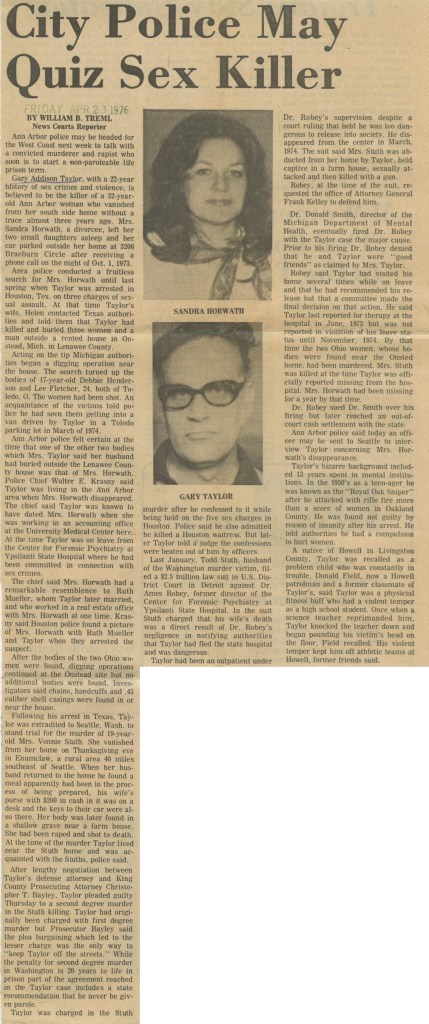
An article about Gary Addison Taylor that mentions Vonnie Stuth published in The Spokane Daily Chronicle on April 23, 1976.
An article about Gary Addison Taylor that mentions Vonnie Stuth published in The Ann Arbor News on April 23, 1976.
An article about Gary Taylor that mentions Vonnie Stuth published in The Kitsap Sun on April 23, 1976.
Part one of an article about Gary Taylor that mentions Vonnie Stuth published in The Enumclaw Courier-Herald on April 29, 1976.
Part two of an article about Gary Taylor that mentions Vonnie Stuth published in The Enumclaw Courier-Herald on April 29, 1976.
An article about Gary Addison Taylor that mentions Vonnie Stuth published in The Toledo Blade on May 1, 1976.
Part one of an article about Gary Taylor that mentions Vonnie Stuth published in The Enumclaw Courier-Herald on May 6, 1976.
Part two of an article about Gary Taylor that mentions Vonnie Stuth published in The Enumclaw Courier-Herald on May 6, 1976.
An article about Gary Addison Taylor that mentions Vonnie Stuth published in The Ann Arbor News on August 5, 1976.
An article about the committee founded by Vonnie’s mother Lola published in The Sioux City Journal on April 7, 1977.
An article about Gary Taylor that mentions Vonnie Stuth published in The Ann Arbor News on May 15, 1979.
An article about the lawsuit Todd Stuth filed in relation to his wife’s death published in The News Tribune on May 18, 1979.
A map of the US with some of Taylor’s victims pointed out (its missing the two from Toledo, and includes two from Vail, Colorado).
Gary Addison Taylor.
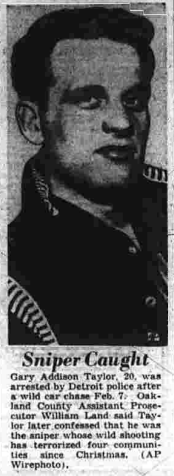
One of the more commonly used pictures of Gary Addison Taylor.
A BOLO for Gary Taylor, courtesy of the King County Sheriff’s Department.
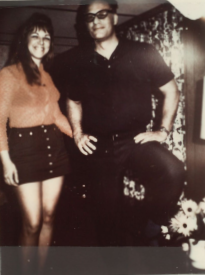
Gary Taylor and his wife, Helen Marie (nee Mueller), who was born on January 10, 1938 in Japan, Missouri and died on Christmas day in 2001. She was married five times over the course of her life.
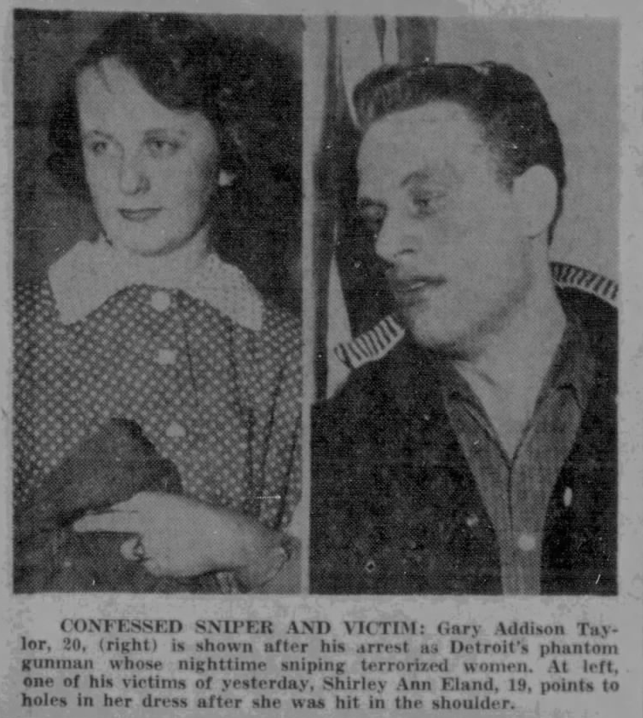
Side-by-side pictures of Gary Taylor and one of his victims related to his Royal Oak Sniper attacks published in The Ann Arbor News on February 8, 1957.
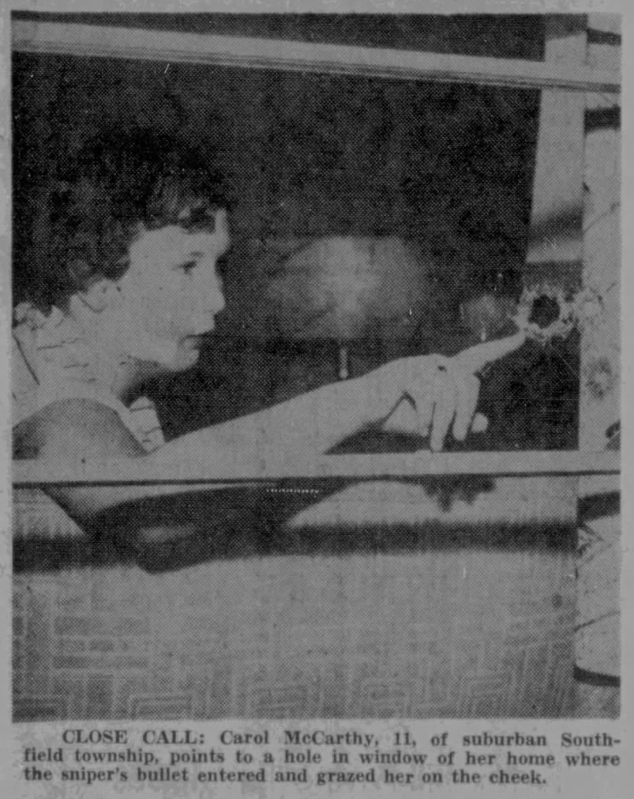
A picture of a victim related Gary Taylor’s Royal Oak Sniper attacks published in The Ann Arbor News on February 8, 1957.
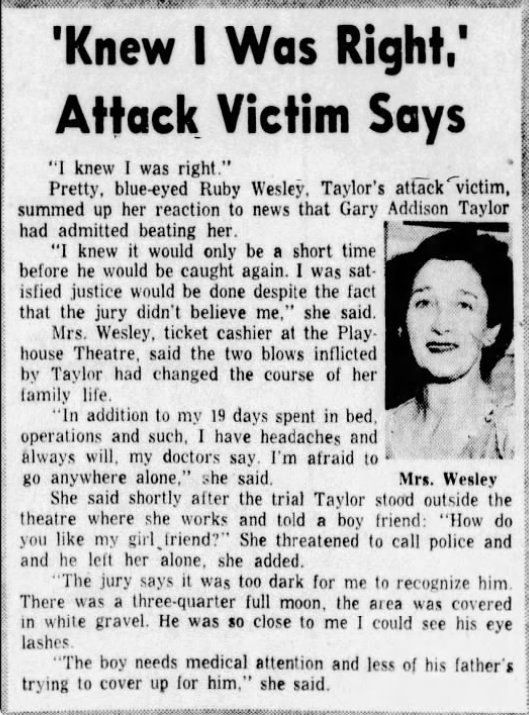
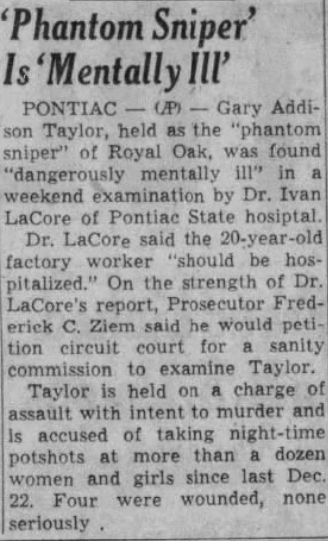
An article about Gary Taylors Royal Oak Sniper attacks published in The Times Herald on February 9, 1957.
An article about Gary Taylors Royal Oak Sniper attacks published in The Tampa Bay Times on February 10, 1957. 
An article about Gary Taylors Royal Oak Sniper attacks published in The Bay City Times on February 18, 1957.
Gary and Helen’s marriage license application.
The house Gary Taylor rented across the street from the Stuth’s located st 14216 24th Avenue South in Seatac, WA.
The first part of Gary Taylor’s confession.
The second part of the first page of Gary Taylor’s confession.
The second page of Gary Taylor’s confession.
Vonnie’s fathers WWII card.
The first page of Leland Van Driel’s WWII service compensation paperwork.
The second page of Leland Van Driel’s WWII service compensation paperwork.
Information related to Leland Van Driel’s first marriage.
A notice that a divorce decree was granted between Vonnie’s parents published in The Sioux City Journal on May 5, 1950.
The Van Driel’s wedding announcement published in The Sioux City Journal on June 19, 1952.
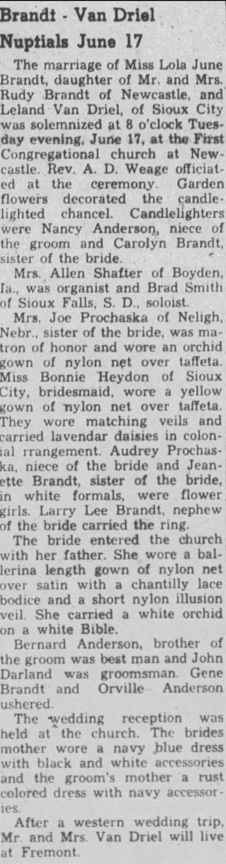
Lola Brandt’s wedding announcement to Leland Van Driel published in The Sioux City Journal on June 22, 1952.
The Van Driel’s wedding announcement published in The Nebraska Journal-Leader on June 26, 1952.
A newspaper clipping about Vonnie’s parents wedding published in The Plainview News on August 14, 1952.
Leland and Lola listed in the state of Nebraska marriage index.
A picture of Vonnie’s mother, Lola.
Leland and Lola Van Driel’s divorce certificate.
Lola and her second husbands marriage certificate.
An article about Vonnie’s grandparents celebrating their fiftieth wedding anniversary that mentions her published in The Sioux City Journal on August 13, 1975.
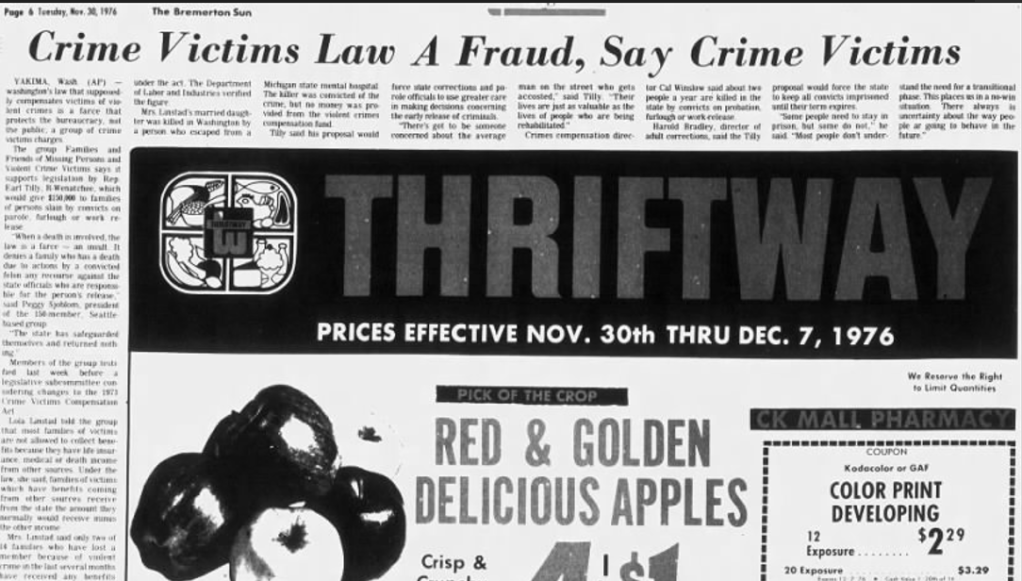
An article about a victim compensation law that mentions Vonnie Stuth published in The Kitsap Sun on November 30, 1976.
An article about a victim compensation law that mentions Vonnie Stuth published in The Daily News on December 1, 1976.
An article about a victim compensation law that mentions Vonnie Stuth published in The Daily Herald on December 1, 1976.
An article about VSS published in The Daily Herald on April 19, 2015.The Lebanon Express on October 4, 2006.
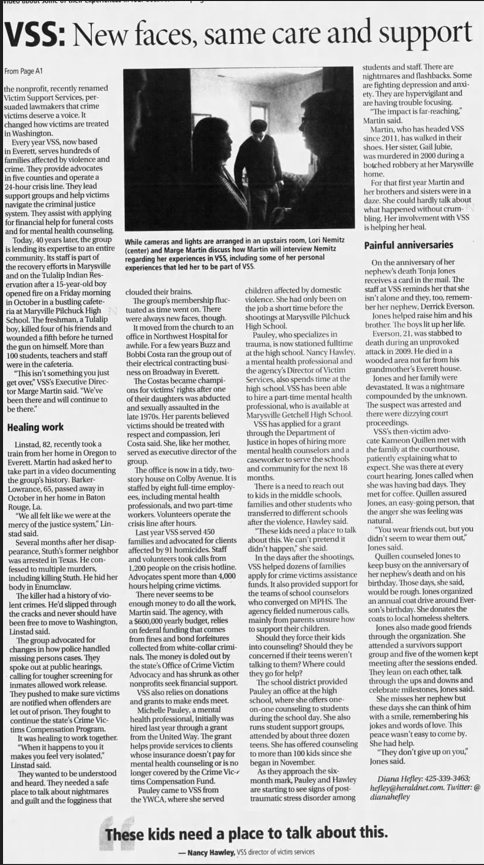
The first part of an article about VSS published in The Daily Herald on April 19, 2015.
The second part of an article about VSS published in The Daily Herald on April 19, 2015.
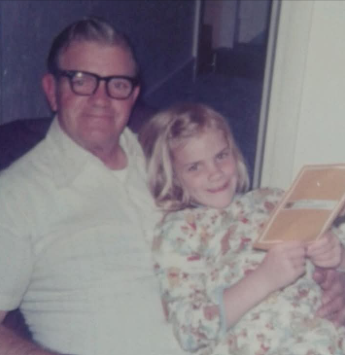
Shirley and Leland.
Phyllis Van Driel’s junior year picture from the 1971 Chief Sealth High School yearbook.
A picture of Phyllis Van Driel taken from the Chief Sealth High School yearbook.
Phyllis Van Driel’s marriage certificate.
Alicia Van Driel from the 1977 Chief Sealth High School yearbook.
A picture of VSS founded by Vonnie Stuth’s mother published in The Daily Herald on April 19, 2015.
A second picture of VSS published in The Daily Herald on April 19, 2015.
A quote made by Linda Barker about VSS.
Phyllis Van Driel and her pugs, photo courtesy of Facebook.
Vonnie’s sister, Shirley.
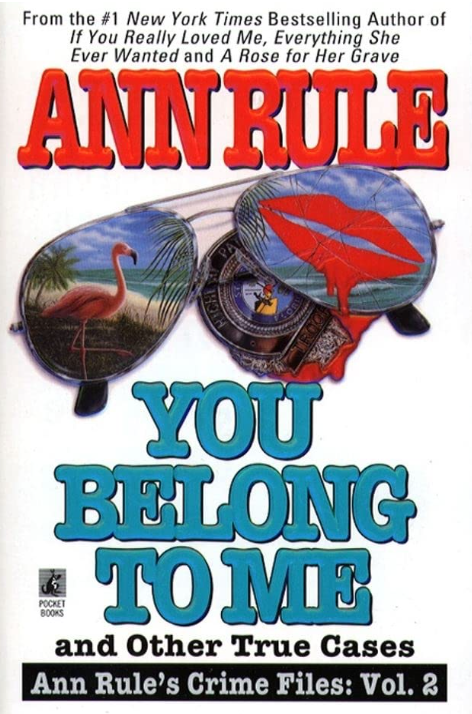
The cover of Ann Rule’s book ‘You Belong to Me, and Other True Crime Cases’ that was published in September 1994 and features a story about Vonnie Stuth.
Bundy’s whereabouts in late November 1974 according to the 1992 FBI TB Multiagency Team Report.
A possible route from Bundy’s residence on 12th Avenue NE in Seattle to the Stuth’s apartment on 24th Avenue South (which doesn’t exist anymore).
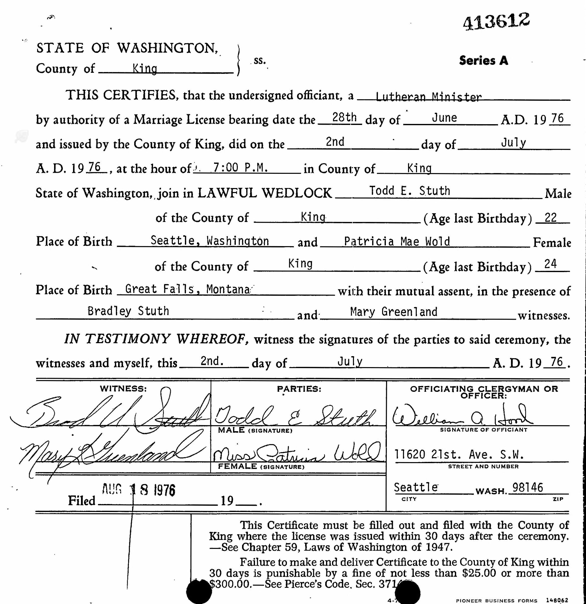
Todd Stuth’s second marriage certificate.
Todd Stuth.