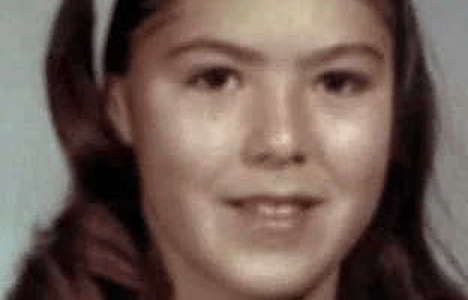
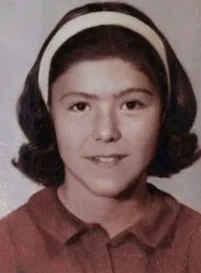
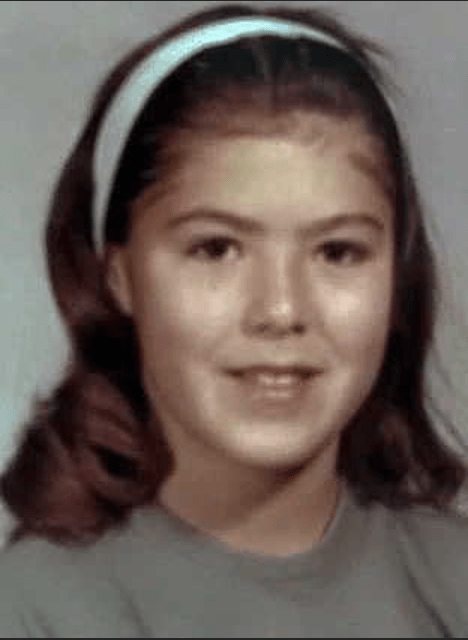
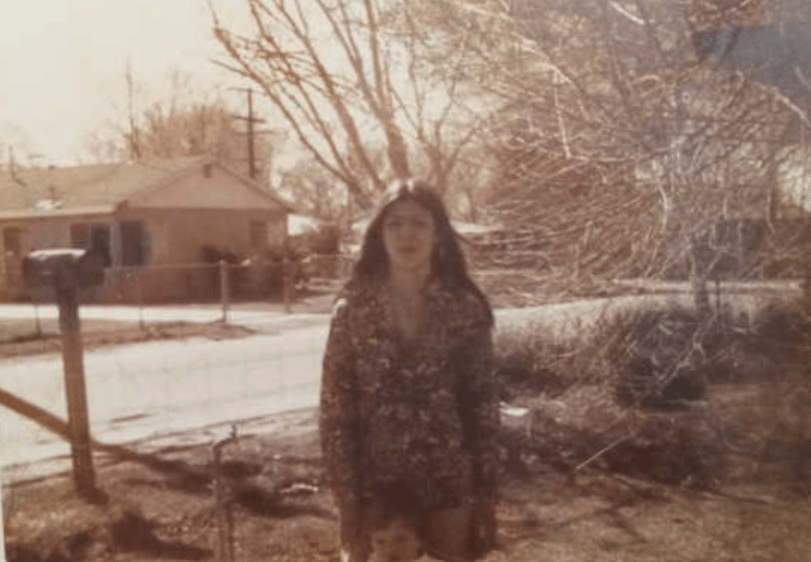
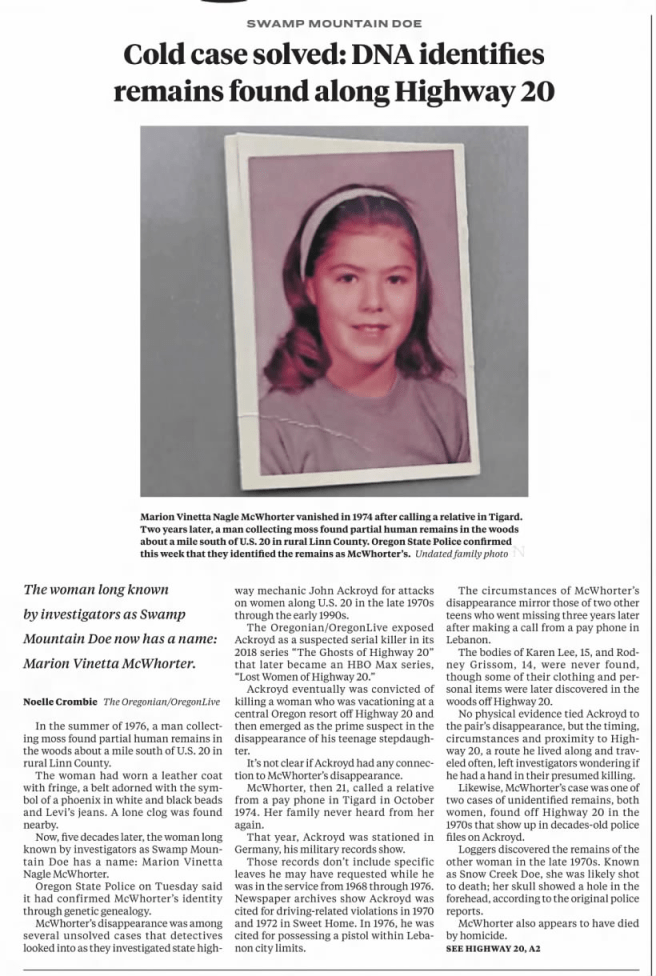
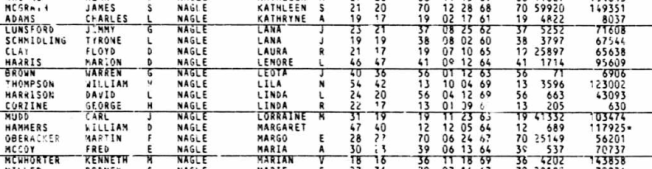
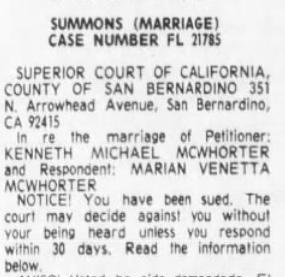
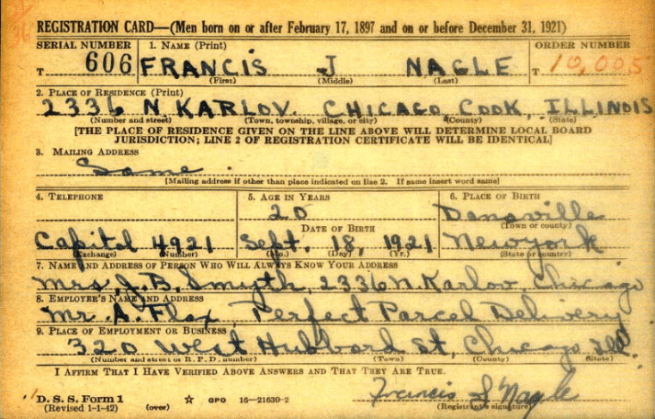
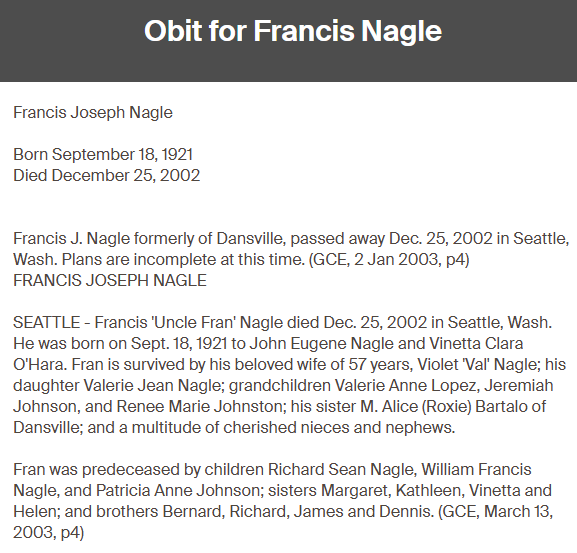
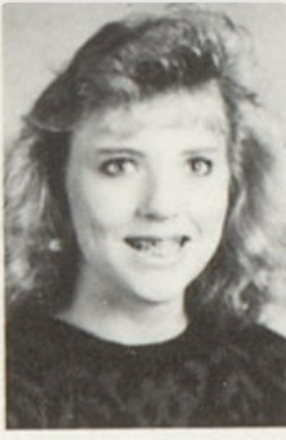
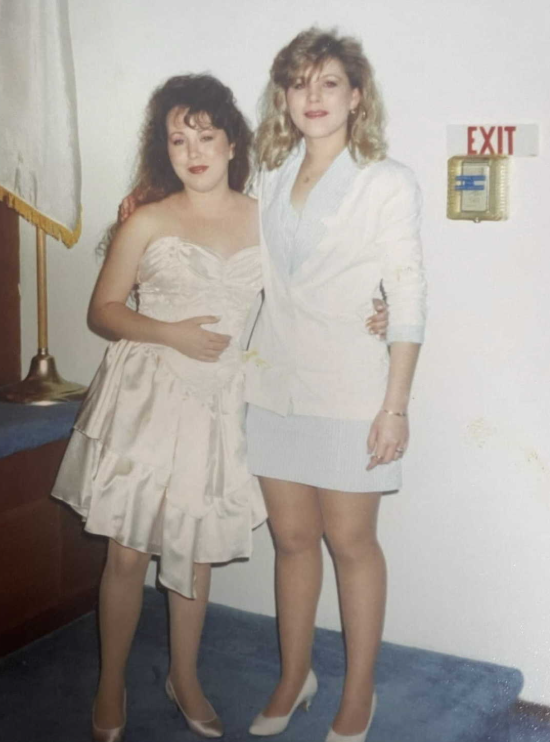
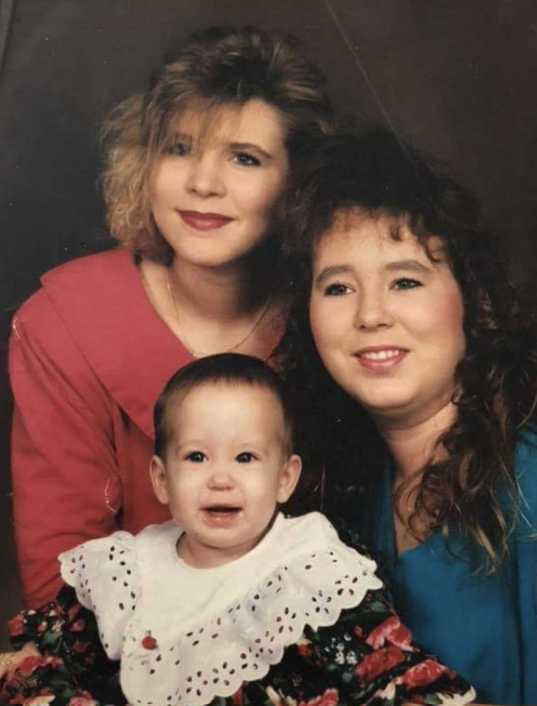
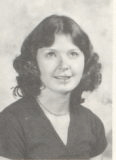
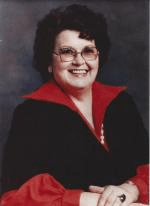
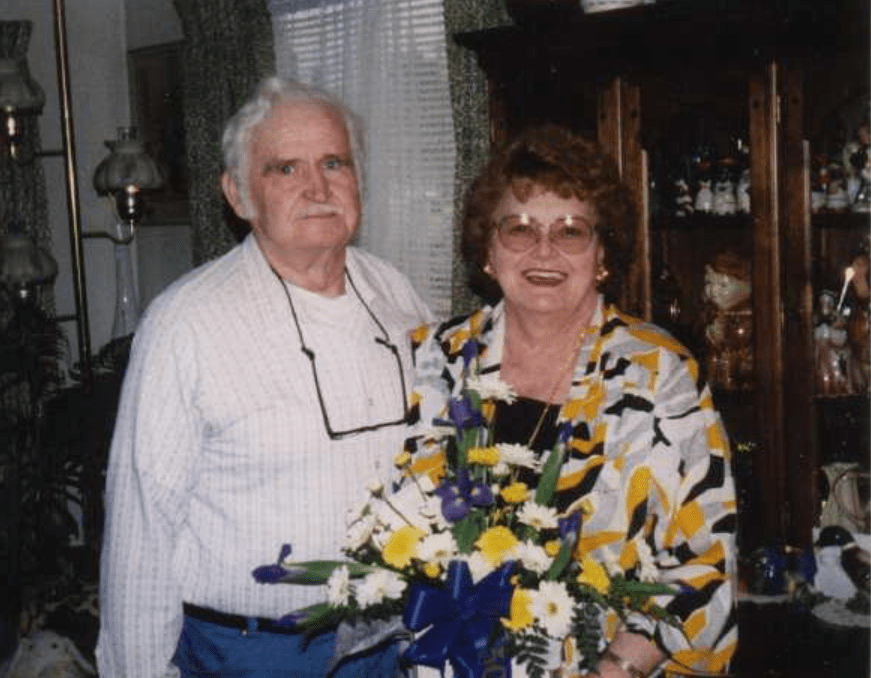
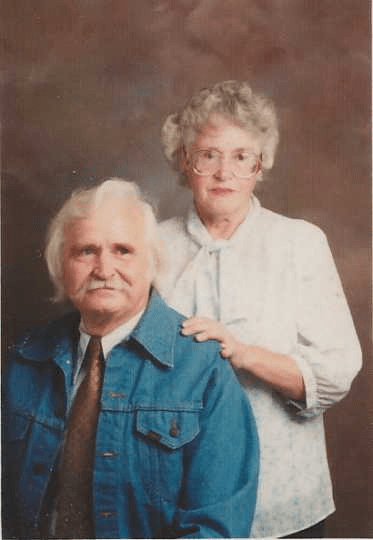
Introduction: Marion Vinetta Nagle was born on January 7, 1953 to Francis and Violet Nagle in Seattle, Washington. Francis Joseph Nagle was born on September 21, 1921 in Dansville, New York andViolet ‘Val’ Jackson was born on July 8, 1927 in Valdez, Alaska (she was of The Ahtna Athabascan culture, an indigenous group of people from Alaska’s Copper River region). After serving in WWII, Francis and Val tied the knot sometime in 1945 and went on to have five children together: Marion, Richard (b. 1959), William (b. 1955), Patricia (b. 1954), and Valerie (b. 1953). Marion got married at the tender age of sixteen on November 18, 1969 in San Bernardino, California to Kenneth Michael McWhorter, who was born on November 1, 1951 in Brownwood, Texas; the couple had a daughter together named Monica Kay McWhorter (born on February 16, 1971 in San Bernardino, CA).
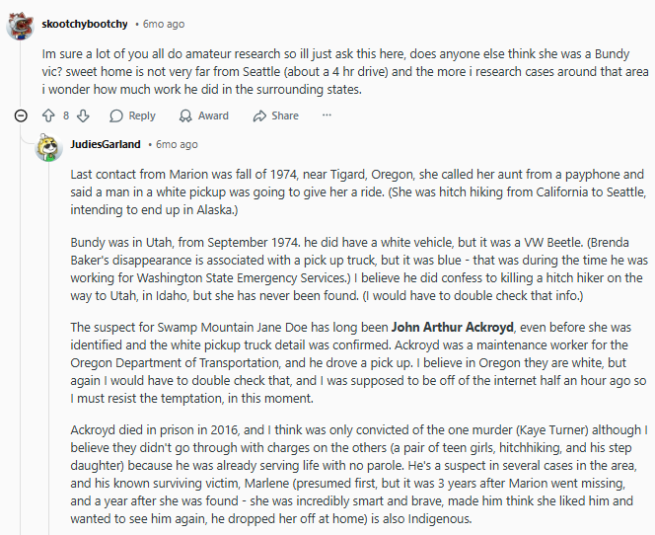
The Murder: the oldest of her siblings, twenty-one-year-old Marion was living an itinerant life at the time at the time she was last heard from: in late 1974, after separating from her abusive husband, she decided to hitchhike across the northern part of the US, with plans of making her way from California to Seattle then eventually ending up in Alaska. According to her sister Valerie, Marion may have been on her way to ‘The Last Frontier’ in an attempt to find work, as their grandfather lived there at the time she disappeared. In 2024 she told Oregon Live: ‘I always hoped to find her.’ According to reports, in late October 1974 McWhorter stopped in Tigard, Oregon (which is near Mountain), and on the 26th she called her aunt from a pay phone near Washington Square Mall. Valerie said her sister had hoped to stay overnight at her house that was nearby, but she said no, and claimed she had been ‘too busy’ at the time to go pick her up.
According to Valerie, Marion had actually given birth to two daughters but had given the second one up for adoption when she was sixteen and left her older one behind with her estranged husband. Nagle also made it clear that her sister didn’t just up and abandon her child, and that she was simply trying to escape from an abusive relationship: according to police reports, her husband had at one time broken her nose. After Marion disappeared Kenneth filed for divorce in July 1975; shortly after he married Deborah Kay James, who was born on August 19, 1951; the couple had three children together, two sons and Monica’s half-sister Melissa (b. 1979).
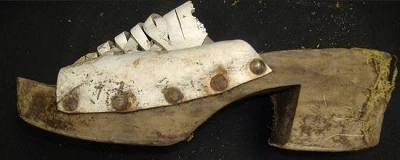
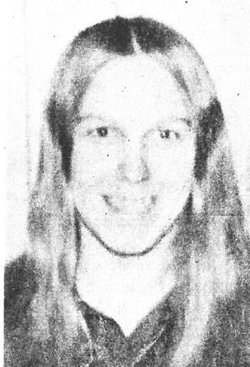
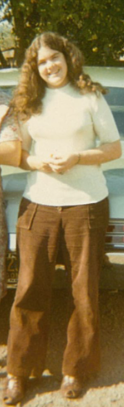
Marion’s weight was unknown at the time of her murder, but she had brown eyes and wore her brunette hair long, and she had a healed fracture on the right part of her nasal bone; she was last seen wearing a leather coat with fringe, Levi ‘s jeans (with a 29-inch inseam), and platform-style sandals with an approximately two-inch heel (one source called them a ‘clog-style shoe’) that had a single white strap with a basket weave section that was attached to the base by 5 round tacks on each side. Valerie shared with detectives that ‘their mother was an Alaskan Native from the Ahtna Athabascan people in the Copper River area in southeastern part of the state, and her oldest sister was named after their aunt who died in 1940 in an American Indian boarding school in Alaska.’
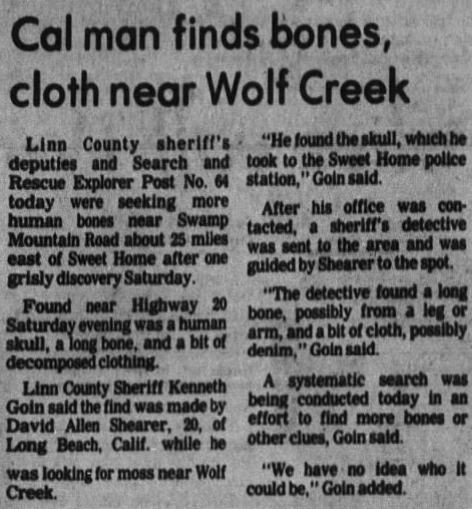
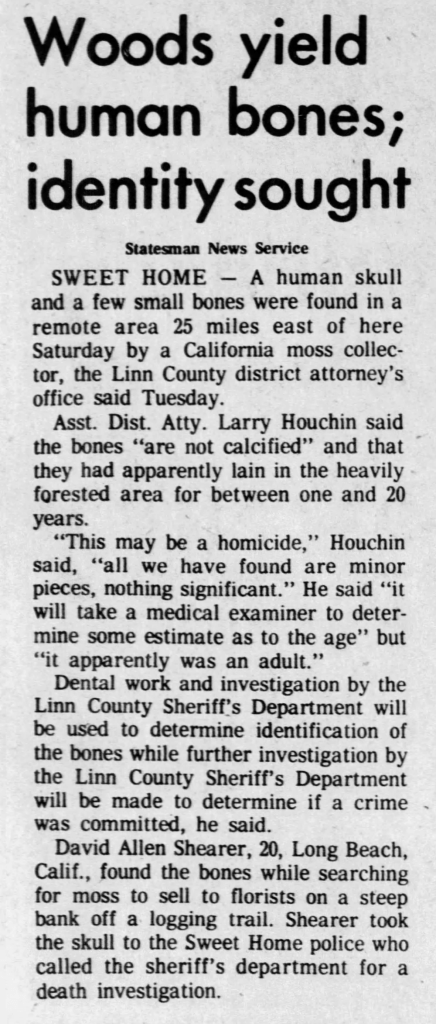
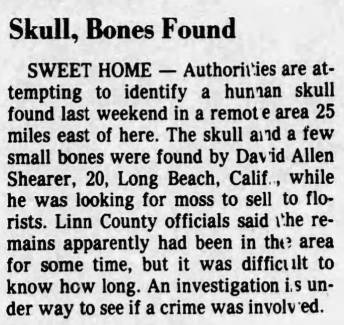
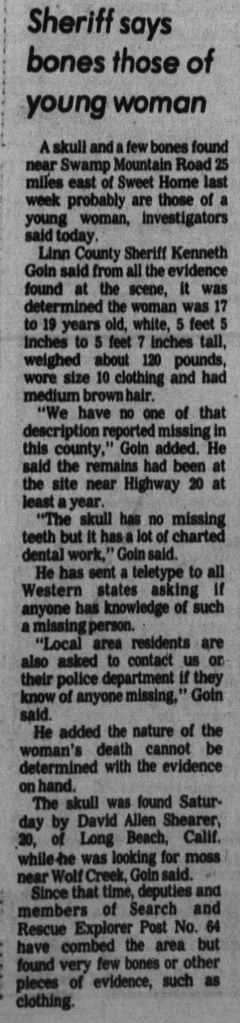
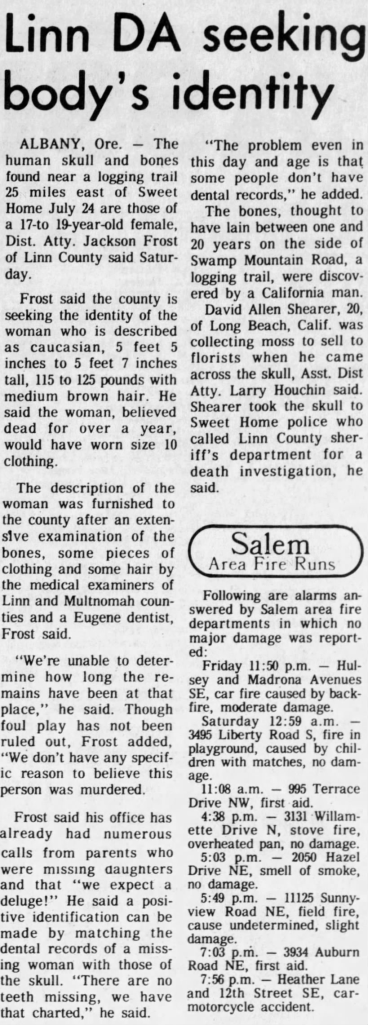
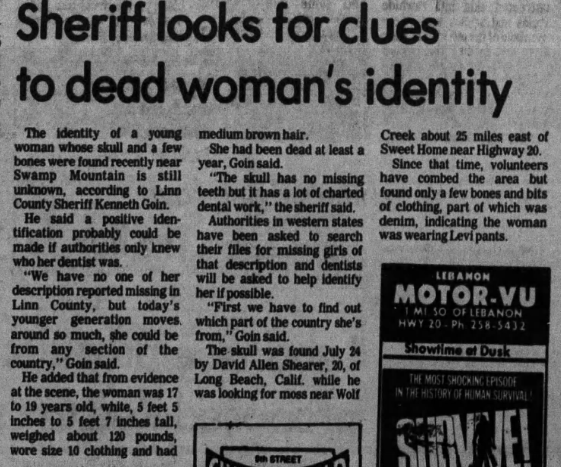
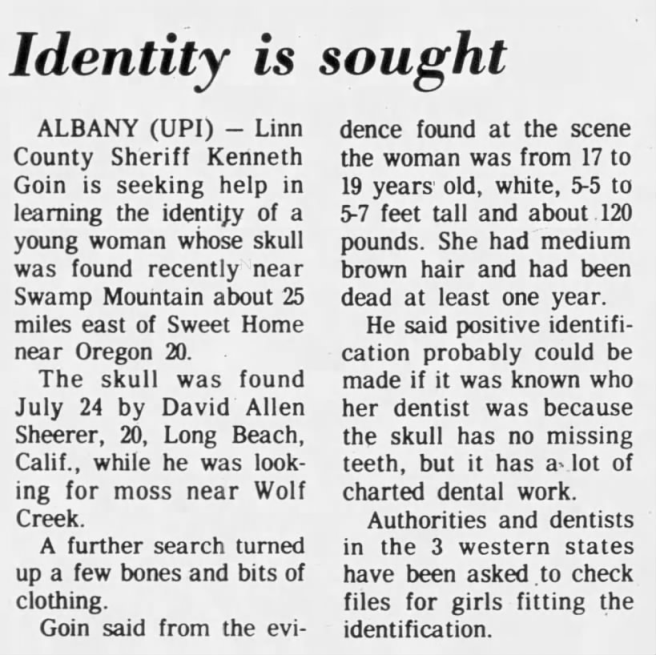
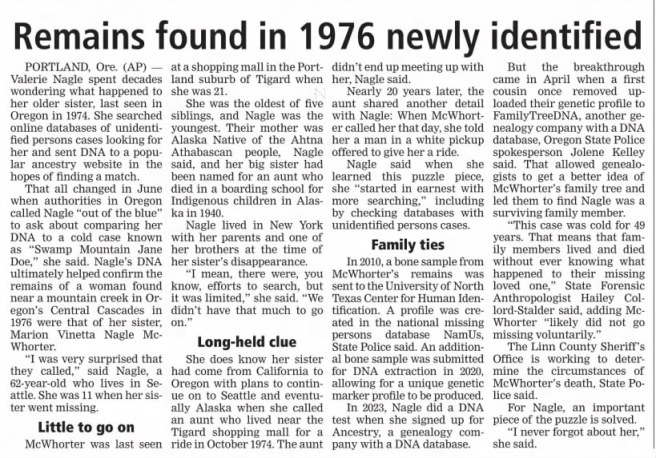
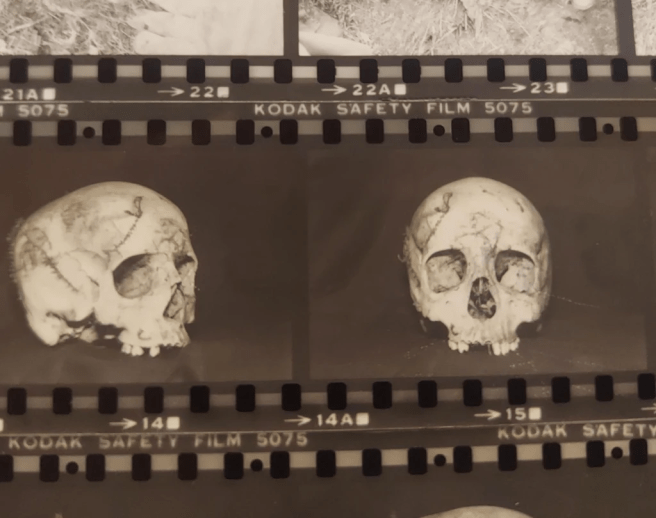
The Discovery: on the afternoon of July 24, 1976, twenty-year-old California native David Allen Shearer that had been out on the side of ‘Swamp Mountain Road’ collecting moss to sell to florist shops when he stumbled upon a skullin the woods about a mile south of US 20 in rural Sweet Home, Oregon. She had been wearing a leather coat with fringe, a leather belt adorned with a decorative phoenix made out of black and white Native American styled beadwork, two metal rings, and Levi’s jeans; a lone clog was found nearby. After their discovery the bones were transferred to the Oregon State Medical Examiner’s Office, where a pathologist and odontologist examined them.
According to Linn County District Attorney Jackson Frost, the county was ‘seeking the identity of the woman who had been described as Caucasian, between 5’5” to 5’7” tall, anywhere from 115 to 125 pounds and had medium brown hair. He further speculated that she had been dead for ‘over a year,’ had worn ‘size ten clothes,’ and was between seventeen and nineteen-years-old: ‘we’re unable to determine how long the remains have been at that place. Though foul play had not been ruled out we don’t have any specific reason to believe this person was murdered.‘ Frost went on to say his office had already received ‘numerous’ phone calls from parents of missing girls asking about their missing daughters, and about the skull said: ‘there are no teeth missing, we have that charted. The problem even in this day is that some people don’t have dental records.’
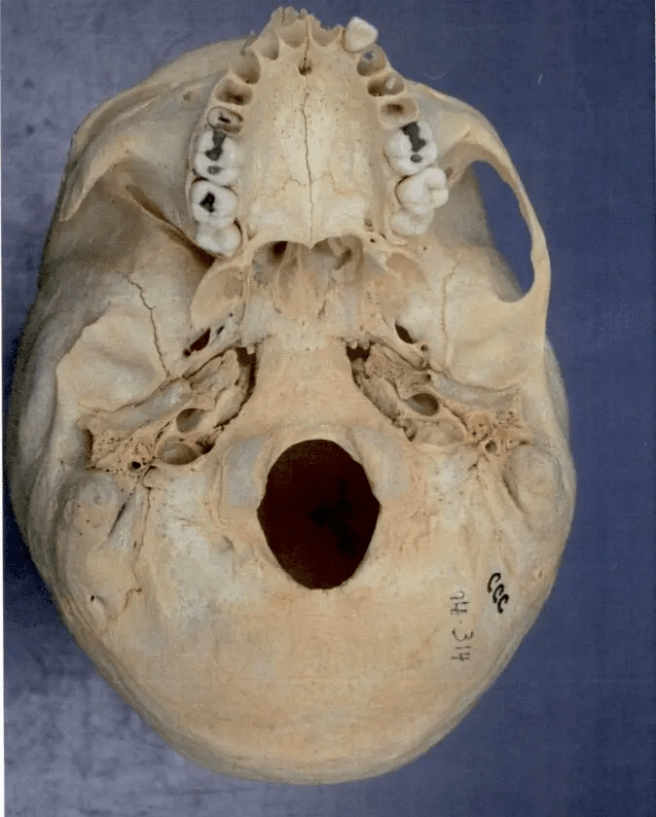
Because a limited amount of remains that were found (the skull, some teeth, and a few ‘small bones) the examinations came back undetermined: by that point a good amount of time had passed, and on top of the natural decomposition little woodland critters would have done a good job of dispersing their bones all over the area. The odontologist in charge of the dental examination noted several restorations, and per a 2010 Linn County Sheriff’s Office report, a medical examiner identified a ’wound track on her skull, which could have been caused by something similar in size to an ice pick or small caliber firearm.’ For almost fifty years the remains laid unidentified; she was referred to as the ‘Swamp Mountain Jane Doe.’
The Secret: for many years after her sister disappeared, Valerie said her aunt’s story about their last phone conversation remained consistent, until one day when she shared that Marion had told her that a strange man in a white pickup had offered to give her a ride. Nagle said that when she learned about this piece of the puzzle she: ‘started in earnest with more searching,’ including by checking databases with unidentified persons cases: ‘I remember spending a lot of time on those pages, just scrolling through and trying to look.’ … ‘I never forgot about her.
Valerie also said that her sister’s disappearance was something her parents didn’t often talk about, and she isn’t even positive that they filed a missing person’s report as the Nagle family wouldn’t have ‘known where to even begin looking’ for their daughter and didn’t attempt to organize any search effort. In 2024 The Oregonian newspaper reached out to Tigard law enforcement and requested copies of any missing persons reports filed for Marion; after looking into it, an agency spokesperson said they hadn’t come up with anything. At the time her big sister disappeared Valerie was only eleven and was living in New York state with her parents and one of her brothers, and according to her: ‘I mean, there were, you know, efforts to search, but it was limited. We didn’t have that much to go on.’
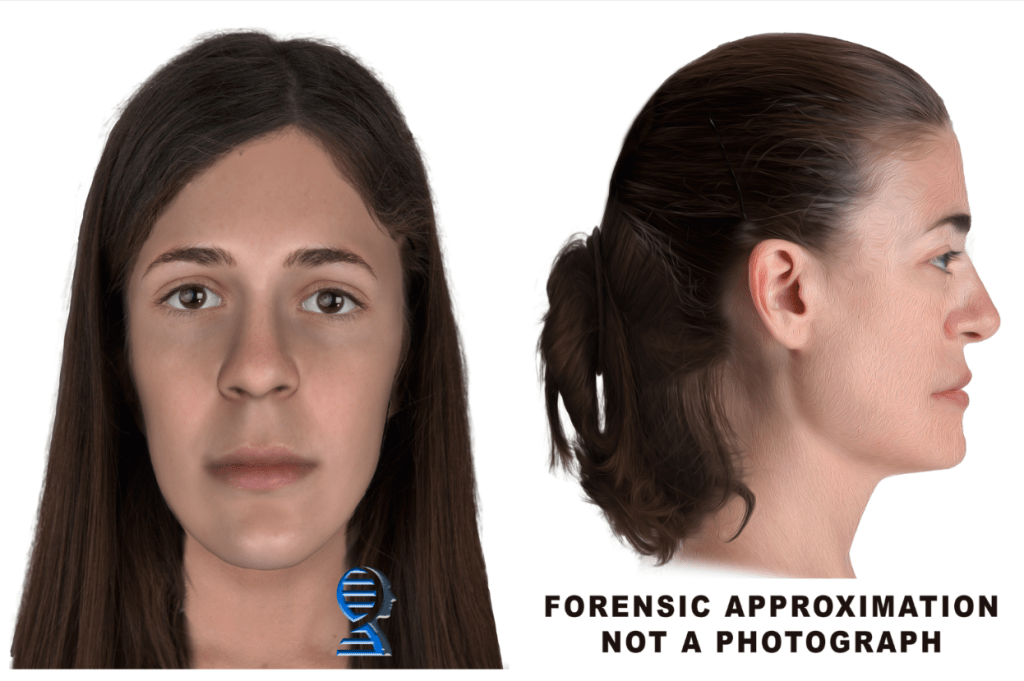
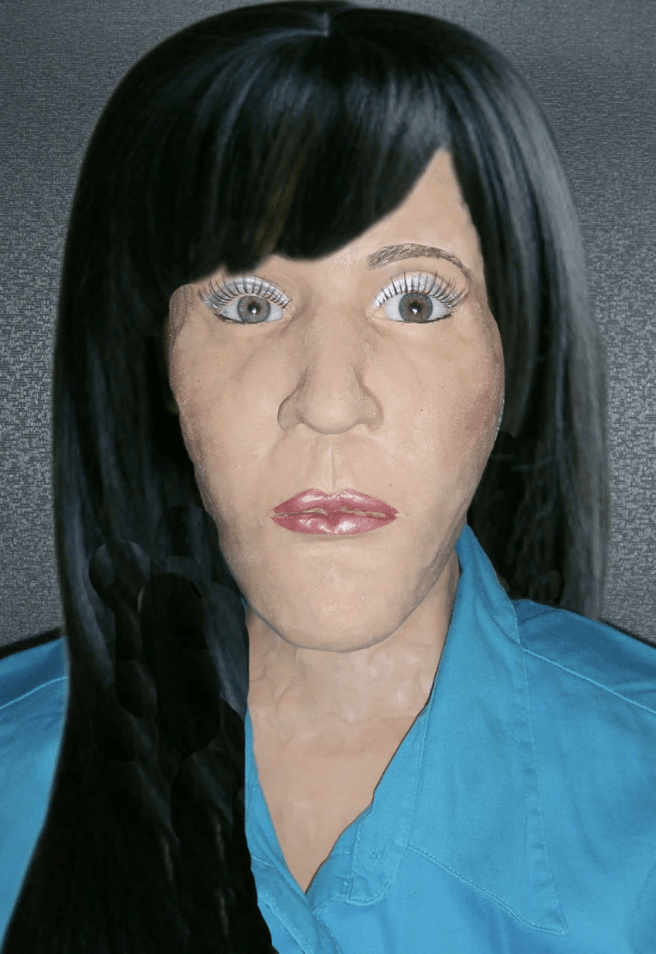
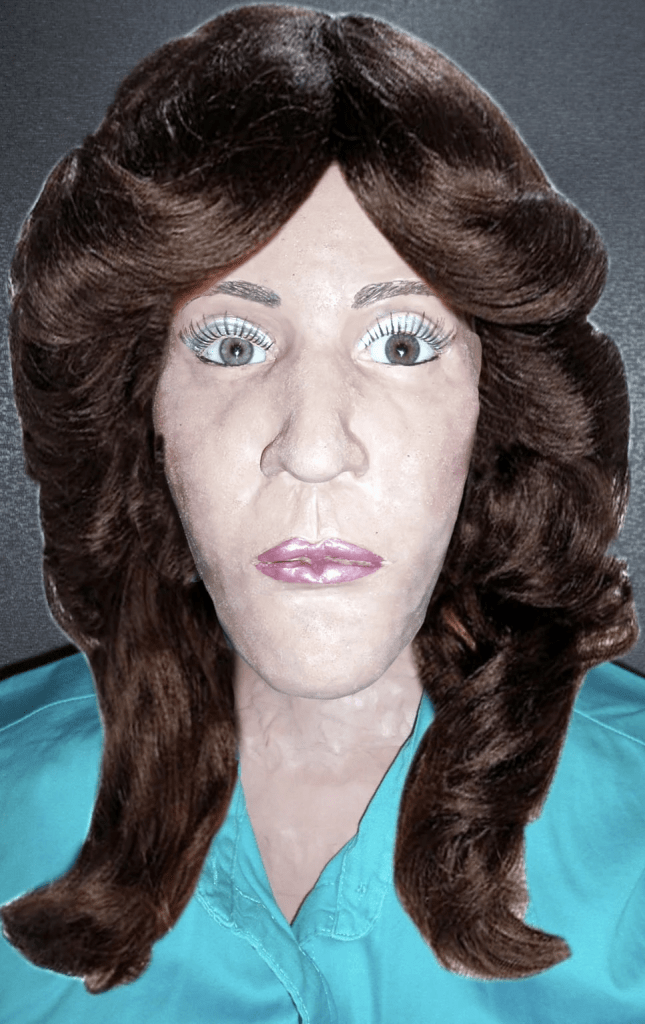
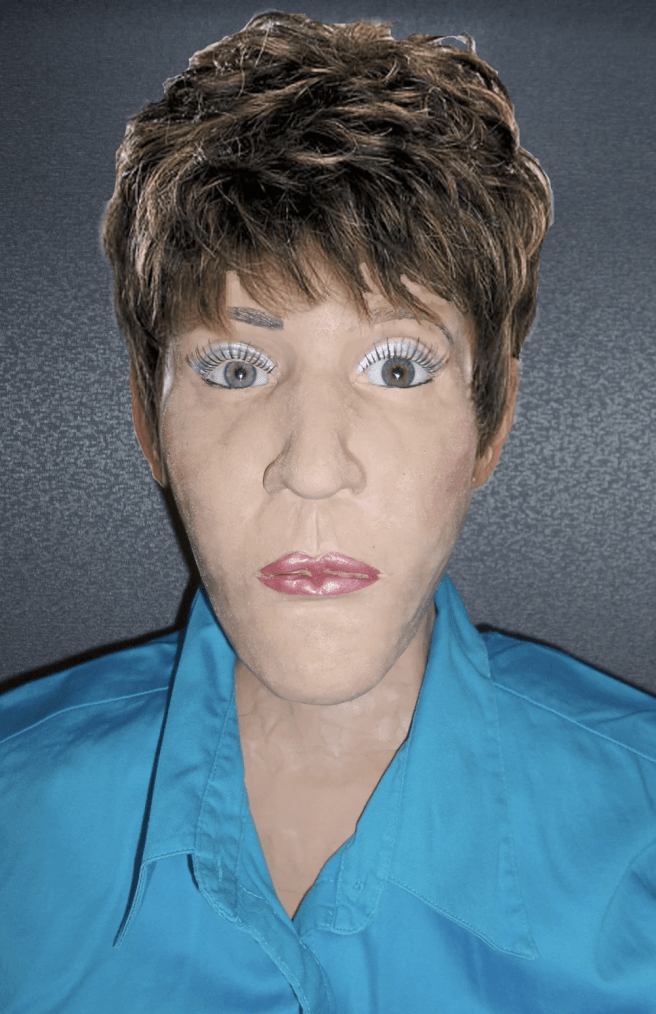
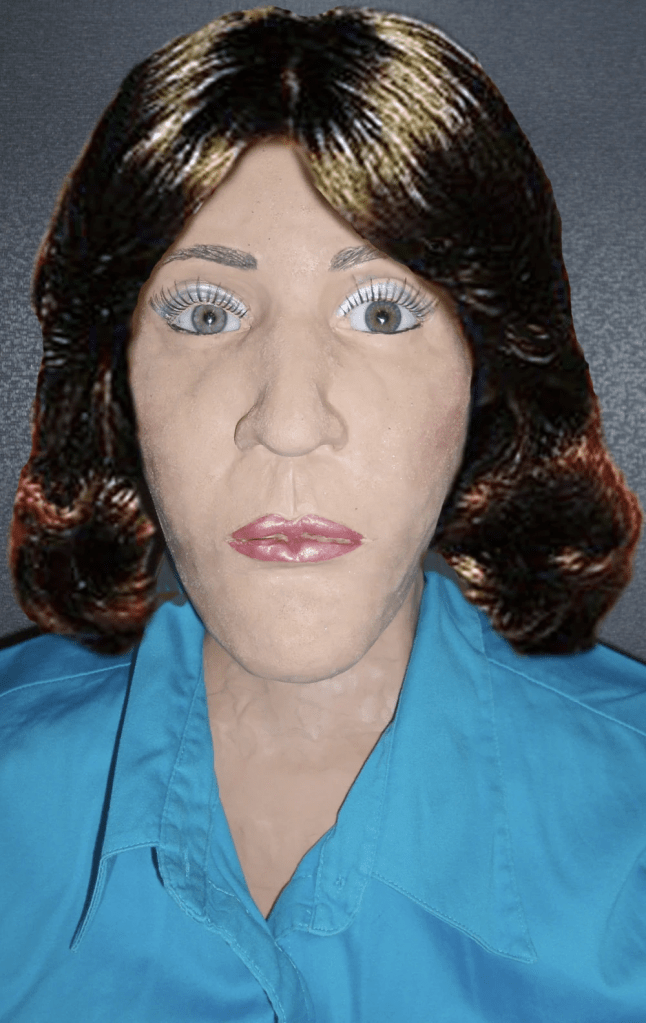
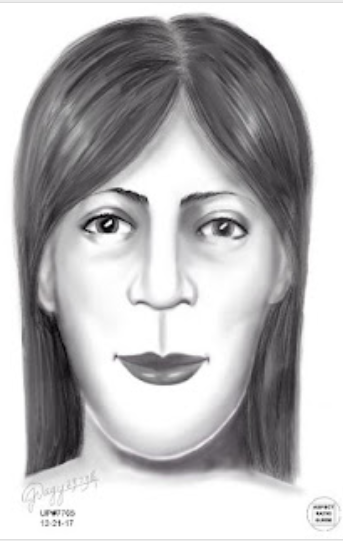
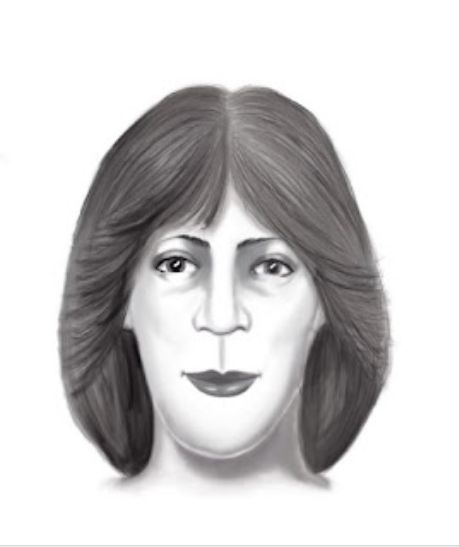
Efforts: over the years a NamUs profile (National Missing and Unidentified Persons System) was created for the ‘Swamp Mountain Jane Doe,’ and forensic techs put her information into CODIS (or the ‘Combined DNA Index System’), which allows federal, state, and local law enforcement laboratories to digitally compare genetic samples. Forensic artists also created multiple recreations of a possible physical renderings of the victims face based on the cranial features of her skeleton as well as a clay model that even featured different hairdos and color/shade ranges that maybe she may have worn in an attempt to create an image that people who knew her may have recognized.
Updates: in 2010, the Oregon Museum of Natural and Cultural History completed an anthropology report of the still unidentified remains of the ‘Swamp Mountain Jane Doe,’ and a biological profile gave investigators demographic information on the individual, noting she was most likely a white female under 35 years old when she died. But still, she remained unidentified; also in 2010, a bone sample from the remains were sent to the University of North Texas Center for Human Identification. An additional piece of bone was submitted for DNA extraction in 2020, which allowed for a unique genetic marker profile to be produced and in 2023, Valerie Nagle submitted a DNA sample to a genealogy website when she signed up for Ancestry.com with the hope that it would result in a clue as to what happened to her sister.
It wasn’t until April 2025 that Oregon investigators got a break in the case after Marion’s first cousin uploaded their genetic profile to the Ancestry-type website ‘Family Tree DNA,’ which allowed genealogists to delve deeper into the ‘Swamp Mountain Jane Doe’s’ family tree and eventually led them to one of Marion’s surviving family members: Valerie. InJune 2025detectives reached out to Nagle ‘out of the blue’ and asked what her thoughts were when it came to Marion possibly being the ‘Swamp Mountain Jane Doe;’ she said when they contacted her she was ‘very surprised that they called. I was really glad that they found me through DNA.’ Nagle gave detectives an oral DNA swab for comparison in June 2025 which quickly confirmed that the remains belonged to Marion.
In an interview with KOIN, Oregon State Forensic Anthropologist Hailey Collord-Stalder commented that: ‘this case was cold for 49 years. That means that family members lived and died without ever knowing what happened to their missing loved one.’ She went on to add that McWhorter most ‘likely did not go missing voluntarily. This was one of our oldest unidentified cases. And I think it just goes to show you that no matter how long somebody persists in being unidentified, we won’t give up trying to identify them.’
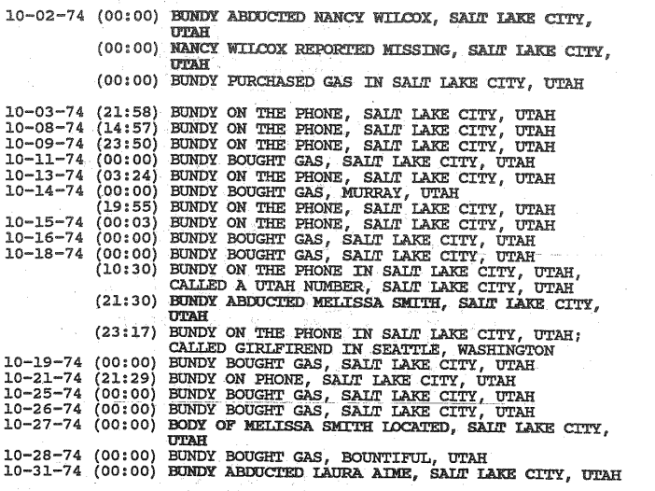
Suspects, Ted Bundy: in October 1974, Ted Bundy was living in a rooming house in Salt Lake City and was attempting his second round of law school at the University of Utah. This period marked a notable change in his criminal activity as he was in the process of moving his ‘playground’ from the Pacific Northwest to the Intermountain West: on October 2 he abducted and killed sixteen-year-old Nancy Wilcox from Holladay, Utah, and on October 18th seventeen-year-old Melissa Smith disappeared out of nearby Midvale; the daughter of the local police chief, Smiths remains were found nine days later. At the end of the month on Halloween night Ted abducted and killed seventeen-year-old Laura Ann Aime, who vanished after leaving a party in Lehi to buy cigarettes.
In the fall of 1974 Ted was also maintaining his long-distance relationship with Elizabeth Kloepfer in Seattle (despite also dating multiple other women) and it’s also worth mentioning that for his move from Washington to SLC he bought an old white pick-up truck at one point in time (I couldn’t find much information about that particular vehicle). I could have sworn I read somewhere that it was his brothers truck, but when I looked into it I couldn’t find much on it other than the fact that he owned it until late 1975 (this is according to the 1992 TB FBI Multiagency Report ).
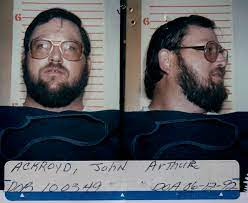
John Arthur Ackroyd: a lesser discussed serial killer from the Pacific Northwest, John Arthur Ackroyd was born on October 3, 1949 in the small logging town of Sweet Home, Oregon. He was one of three kids (he had an older and younger sister), and his dad was a maintenance worker and his mother worked in the office for the Sweet Home Police Department. During his adolescence, he was considered a loner and was frequently bullied, and his high school diploma indicated that he had been in the special education program.
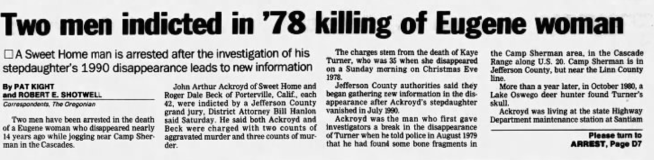
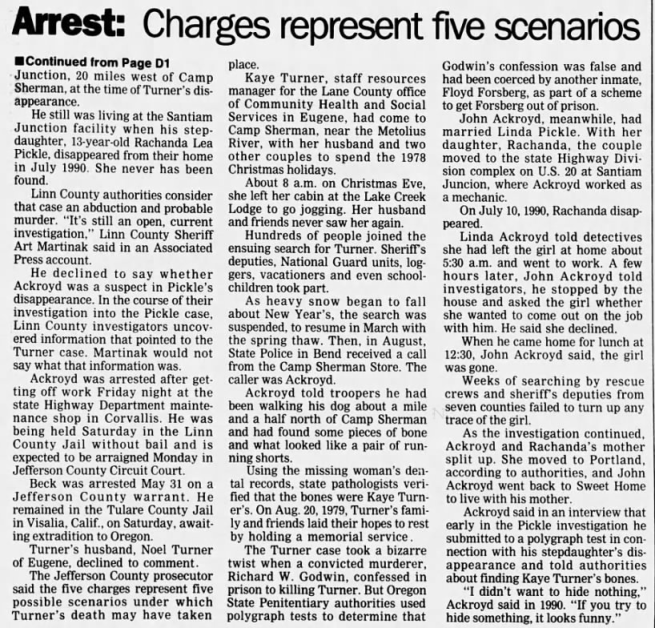
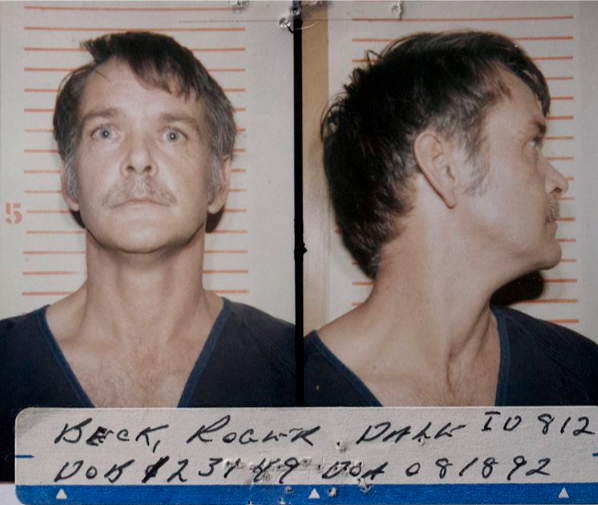
After Ackroyd was accused of felony theft he enlisted in the Army, where he worked overseas as a mechanic. Upon returning home in 1977, he got a job with the Oregon highway department which was located along US Route 20 and ran east to west across The Beaver State; some of his responsibilities included clearing vehicle wrecks, helping those whose cars broke down, and overall basic maintenance. Later that same year he raped twenty-nine-year-old Marlene Gabrielsen, a young mother that he allowed to live (she was the only one). In 1978, Ackroyd and an accomplice, Roger Dale Beck, he abducted and murdered thirty-five-year-old Kaye Turner, who had been out running at the time she was abducted.
At some time in the mid-1980’s he married a divorcee named Linda Pickle, who had two children from a previous relationship (Rachanda and Byron); the family moved into a house in Santiam Junction, a state highway division compound at the junction of Oregon-126, Oregon-22, and US Highway 20 (other members of the highway department lived there as well, but few of them had children). After only a year of marriage, the couple divorced but continued to live together; he was abusive to both of his former stepchildren, and Rachanda disappeared under mysterious circumstances on July 10, 1990.
By early 1992 Ackroyd had moved in with his mother in Sweet Home: because of his connection to his thirteen-year-old stepdaughter’s disappearance, most of the women and children in Santiam Junction were uncomfortable with him being there, and as a result he began to work out of Corvallis. In May 1992 nineteen-year-old Sheila Swanson and seventeen-year-old Melissa Sanders vanished while on a camping trip with Sanders’ family at Beverly Beach State Park on the central Oregon coast. They were last seen at a payphone near a grocery store on US 101, reportedly planning to hitchhike back home to Sweet Home and Lebanon. Their remains were discovered in October 1992 by hunters in a remote area off a logging road near Eddyville, and due to the advanced level of decomposition, an exact cause of death could not be determined. Ackroyd was arrested for the murder of Kaye Turner on June 12, 1992, and he was charged with Rachanda’s murder in 2013; he pleaded no contest. Lincoln County Investigators with the DA’s Office Ron Benson and Linda Snow were preparing to present evidence against Ackroyd in relation to the murders of the two young women to a grand jury when he died on December 30, 2016 at the age of sixty-seven.
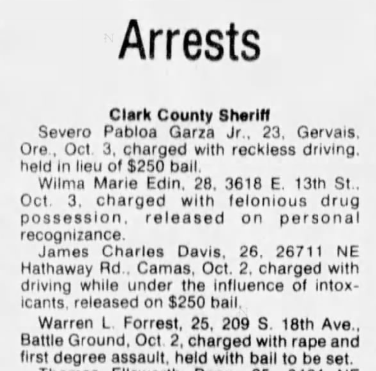
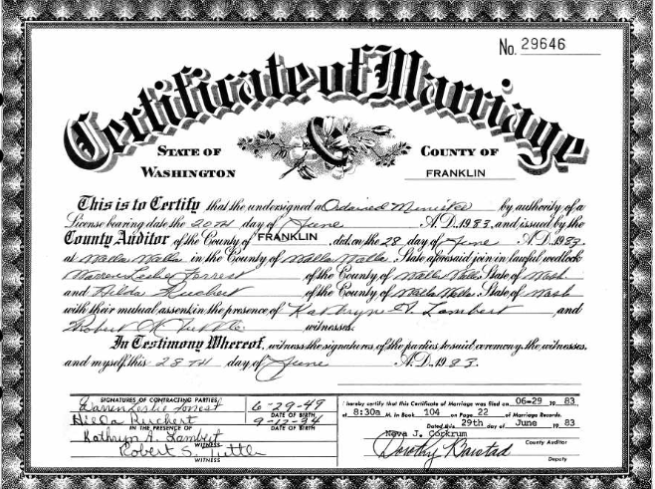
Warren Leslie Forrest: logically, when I was thinking about the timing of Marion’s murder, serial rapist and murder Warren Leslie Forrest immediately popped into my head… but by late October 1974 he had already been arrested (he was taken into custody on October 2, 1974).
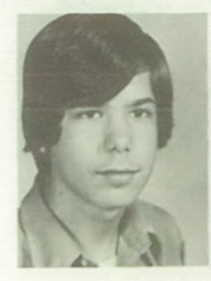
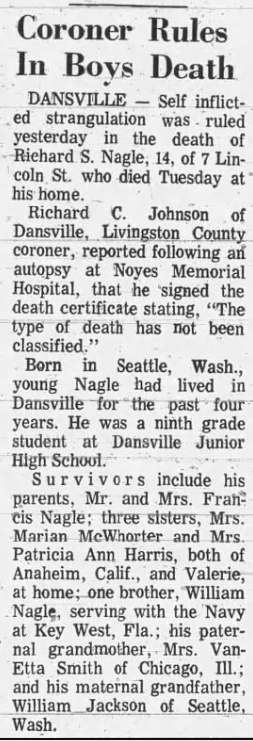
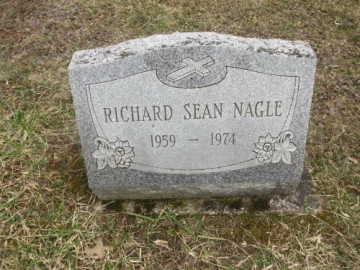
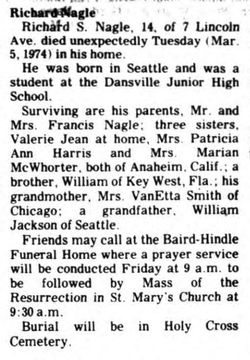
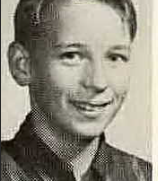
Richard Sean Nagle: sadly, Marion’s younger brother Richard Nagle died from suicide at the age of fourteen on March 6, 1974. He died in his home and according to his autopsy he died of ‘self-inflicted strangulation;’ per his obituary, Nagle was born in Seattle and had moved to Dansville four years prior; he was also in ninth grade at the local junior high school.
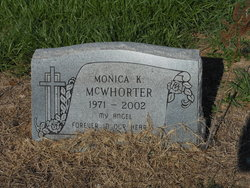
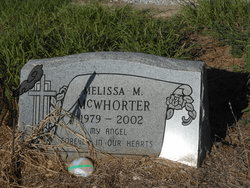
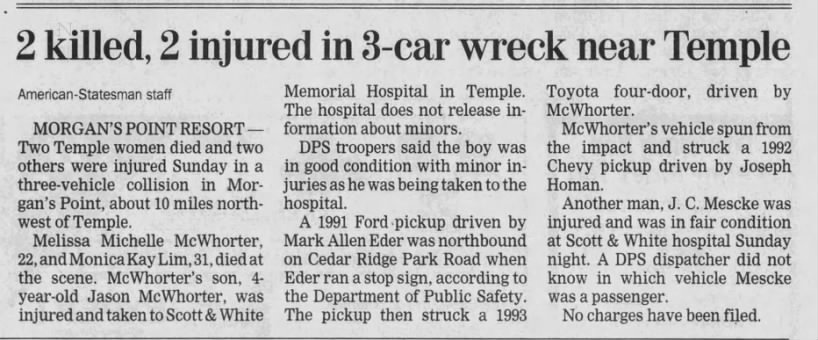
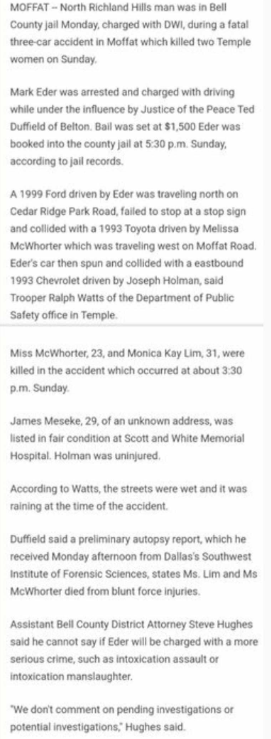
Monica & Melissa: tragically, on April 7, 2002 Marion’s daughter Monica died at the age of thirty-one along with her half-sister, twenty-two-year-old Melissa McWhorter after the vehicle they were driving was hit by a drunk driver in Moffat, Texas. Monica Kay McWhorter married Yeow B. Lim in 1996, and the couple had a son together named Jason Bravo (who fortunately survived the accident with only minor injuries). She is buried in Bell, TX.
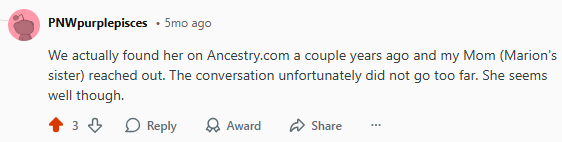
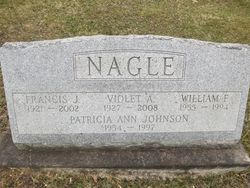
Conclusion: the entire Nagle-McWhorter clan is steeped in absolute tragedy: Kenneth Michael McWhorter died at the age of forty-two on July 17, 1994; his widow Deborah died at the age of fifty-six on December 31, 2007. Marion’s brother William Frances Nagle died of a heroin overdose at the age of thirty-eight in Seattle on June 17, 1994. Patricia Ann Nagle-Johnson died from lung cancer at the age of forty-two on January 13, 1997 in Seattle.Marion’s father died on Christmas day in 2002 in Seattle and at the time of his death, he had been married to Violet for fifty-seven years. Violet Nagle died at the age of eighty on May 3, 2008 in Seattle from lung cancer. According to a Reddit post, in recent years Valerie was able to find the daughter that Marion gave up for adoption, but they didn’t get as close to her as they had hoped to. She currently lives in Seattle, Washington and is sixty-three years old. As of April 2026, Marion’s case remains unsolved.
Works Cited: AP. (September 19, 2025). ‘A woman’s remains were found in Oregon in 1976. They’ve been identified 49 years later thanks to DNA.’ Taken March 4, 2026 from nbcnews.com Martin, Saleen. (September 22, 2025). ‘She was Last Heard from 51 Years Ago. Her Remains have Finally been Identified.’ Taken March 4, 2026 USA TODAY Wasson, Lindsey. (September 19, 2025). ‘A Woman Vanished in Oregon in 1974. Now, Remains Two Years Later have been Identified as her, through DNA.’ Taken March 5, 2026 from cbsnews.com
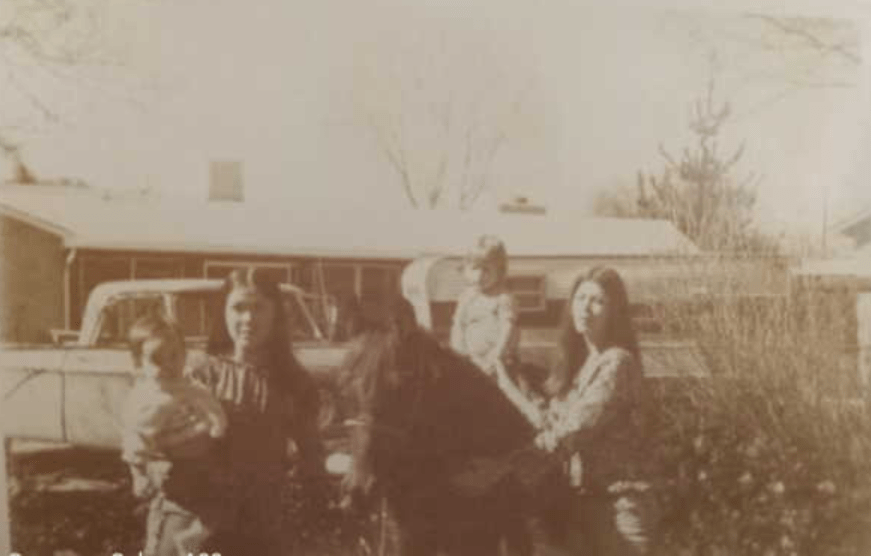
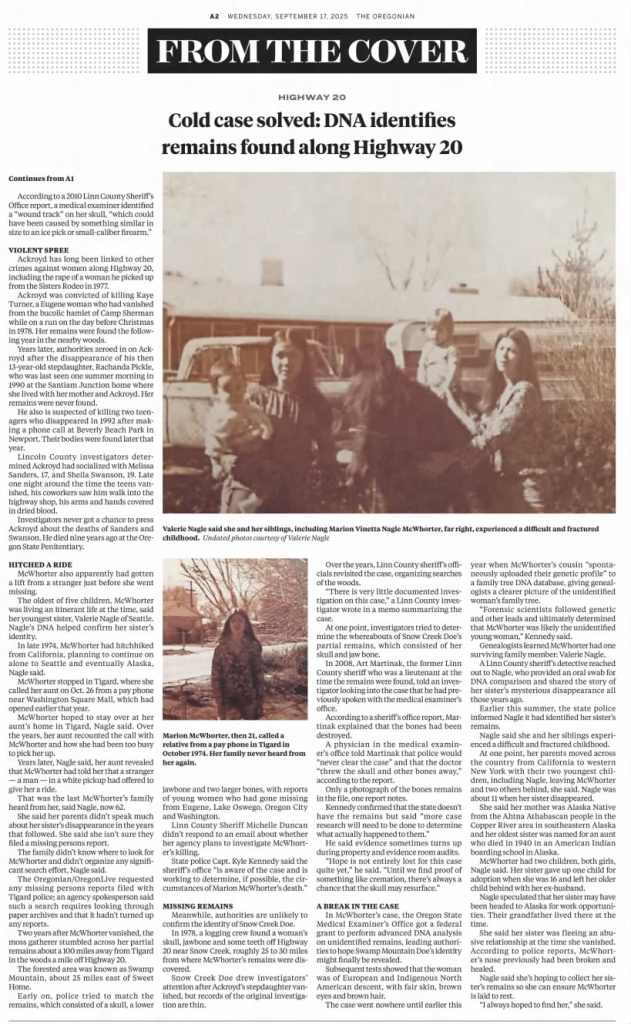
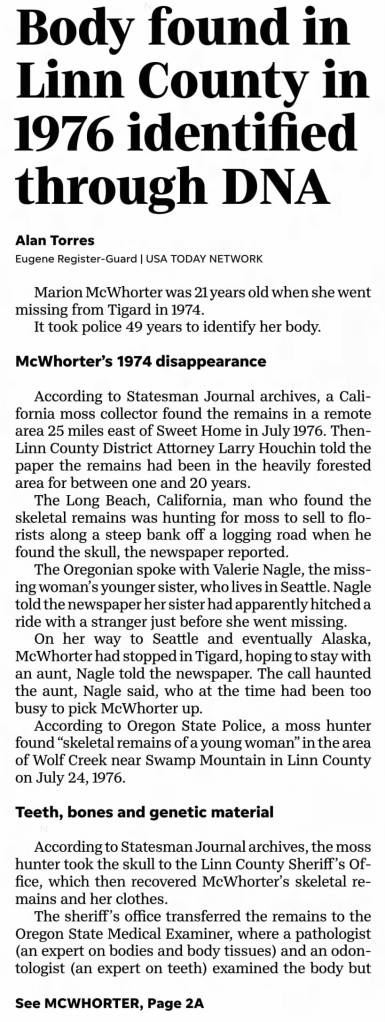
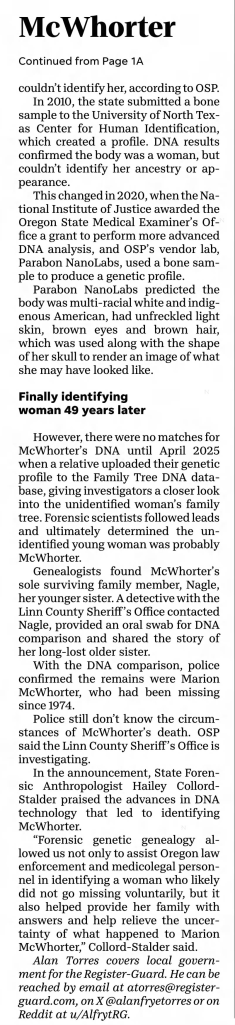
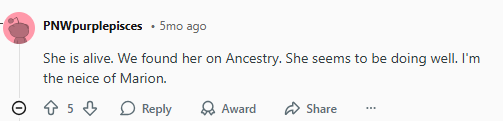
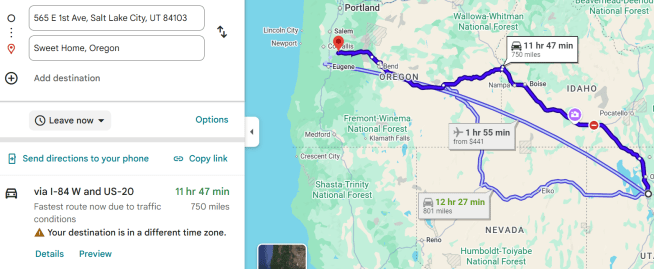
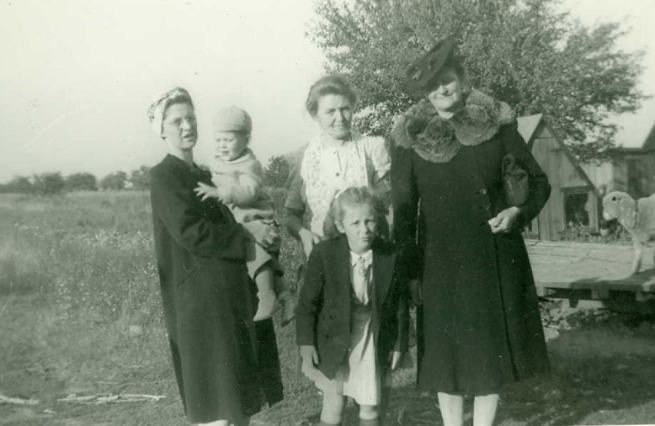
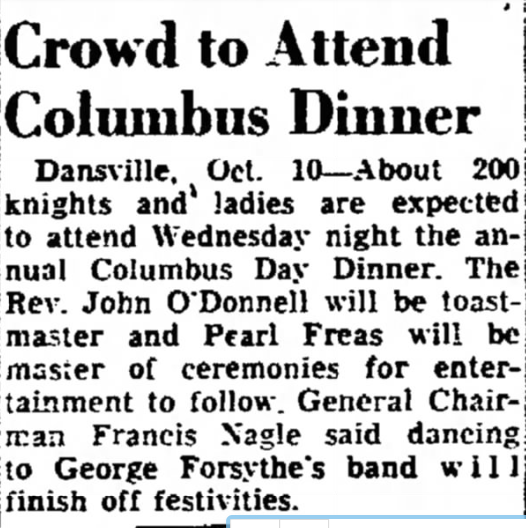
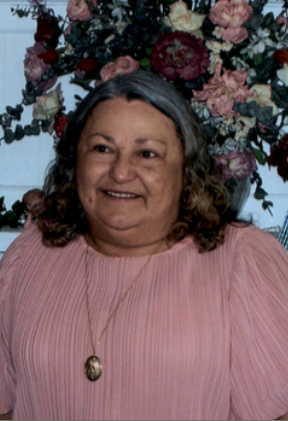
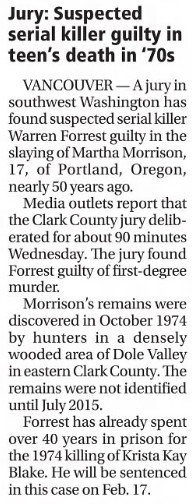
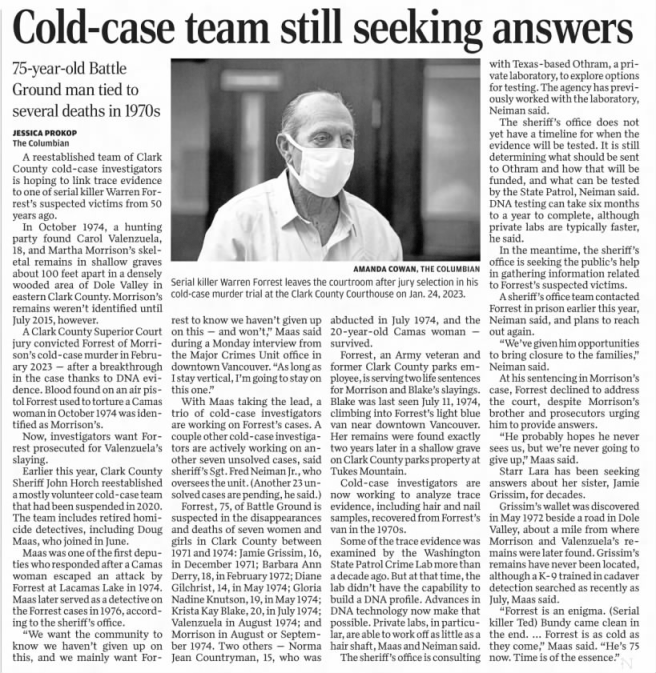
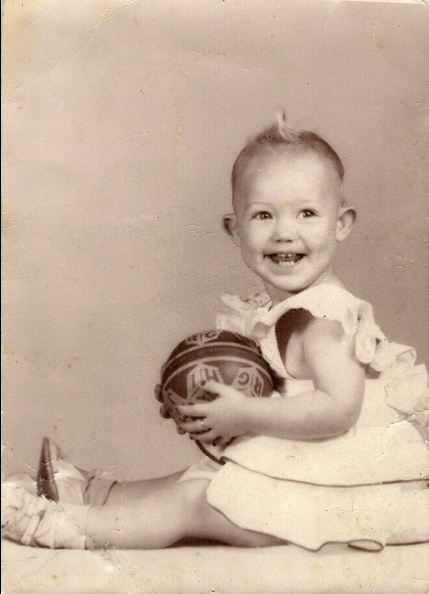
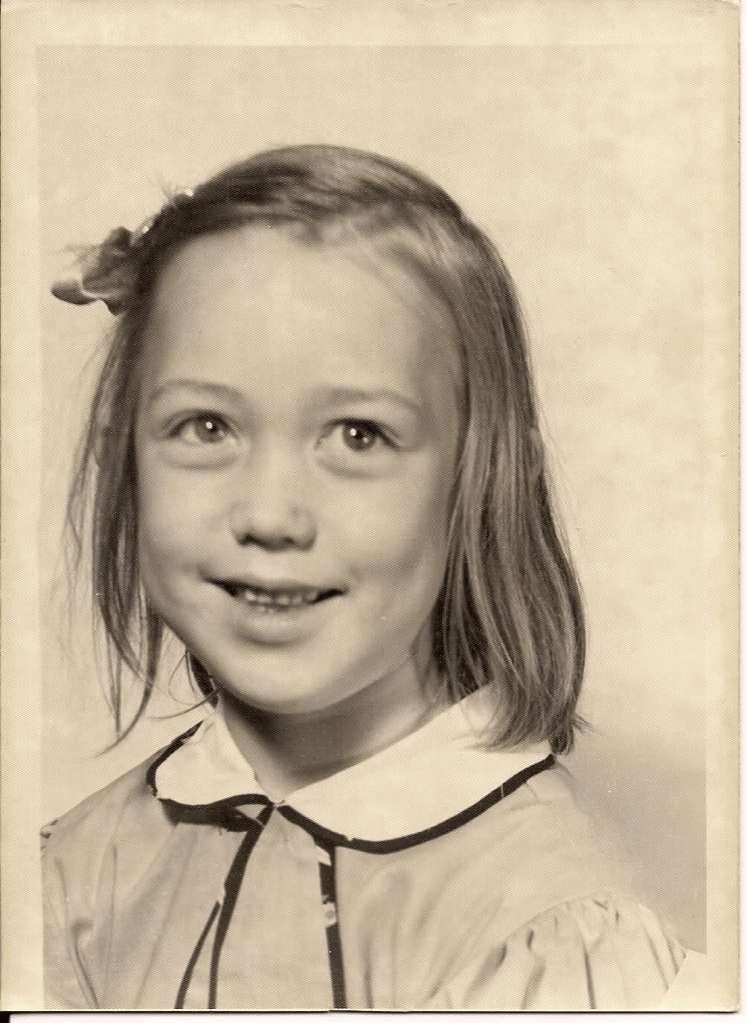
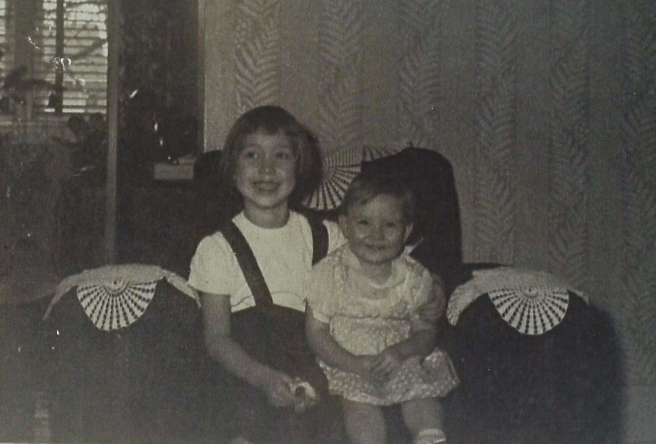
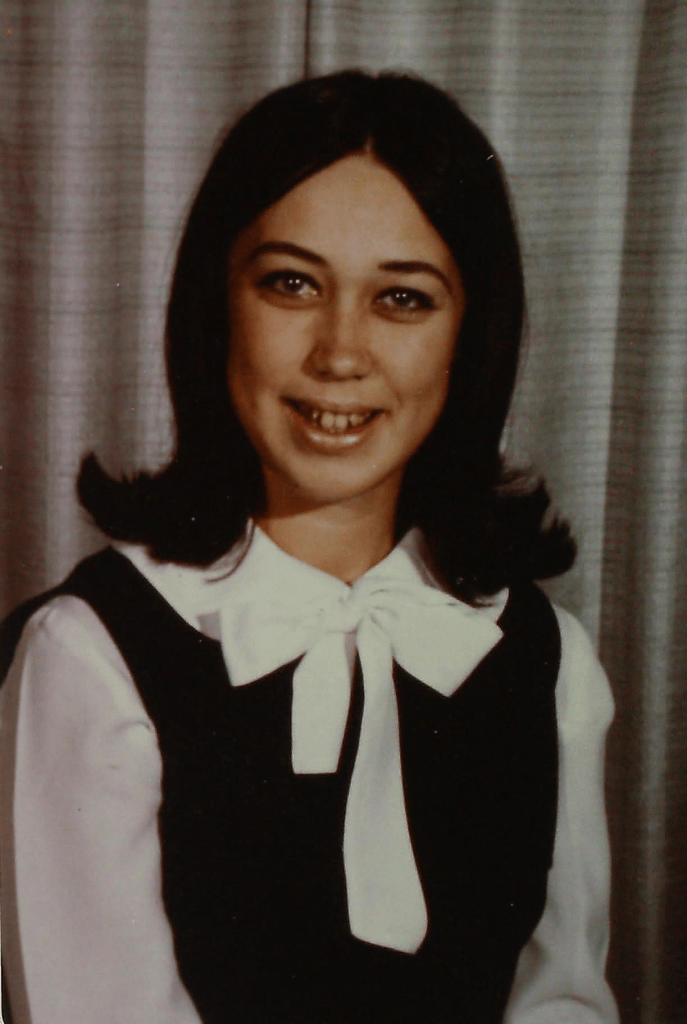
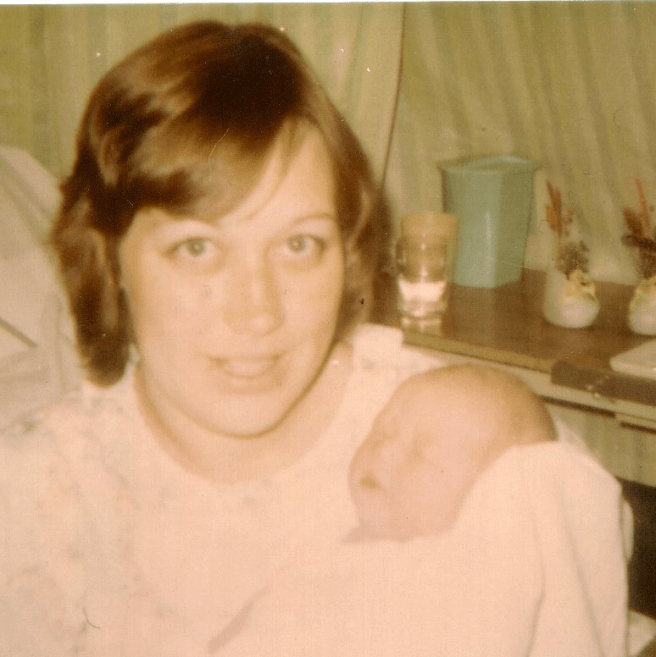
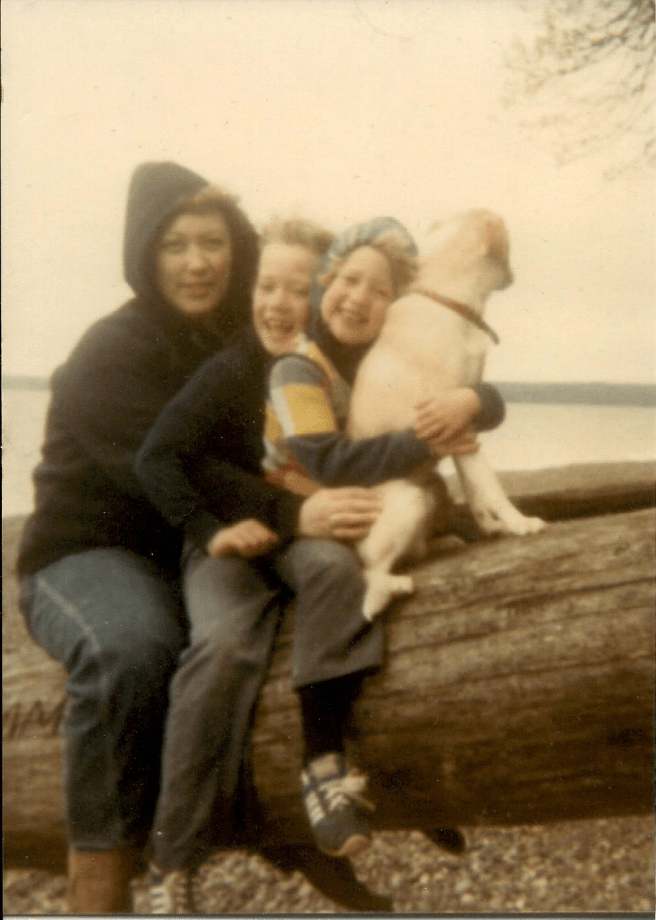
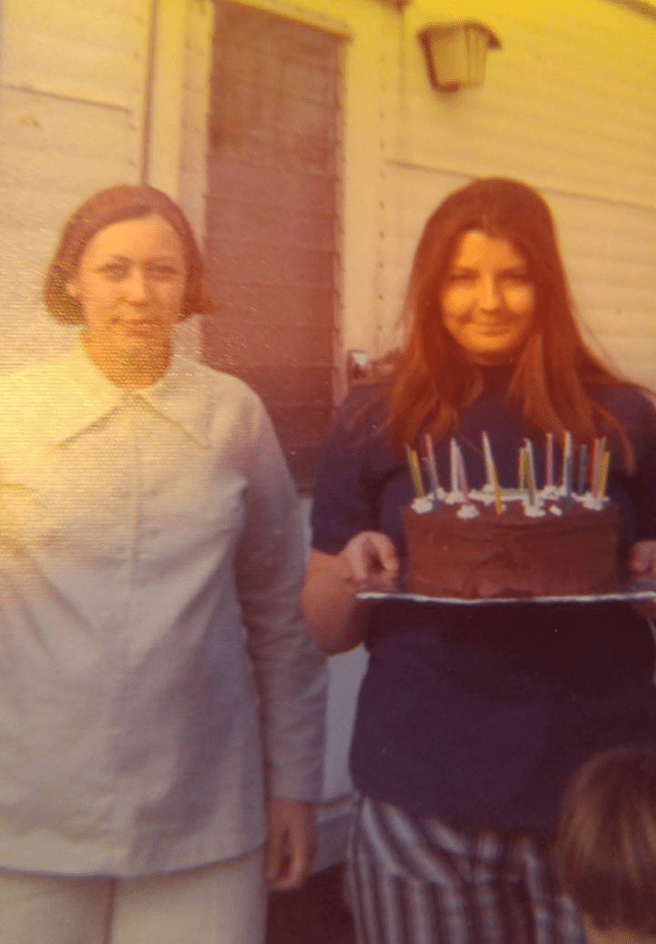
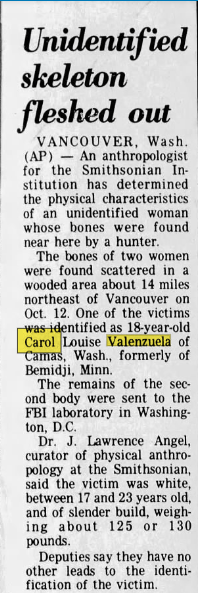
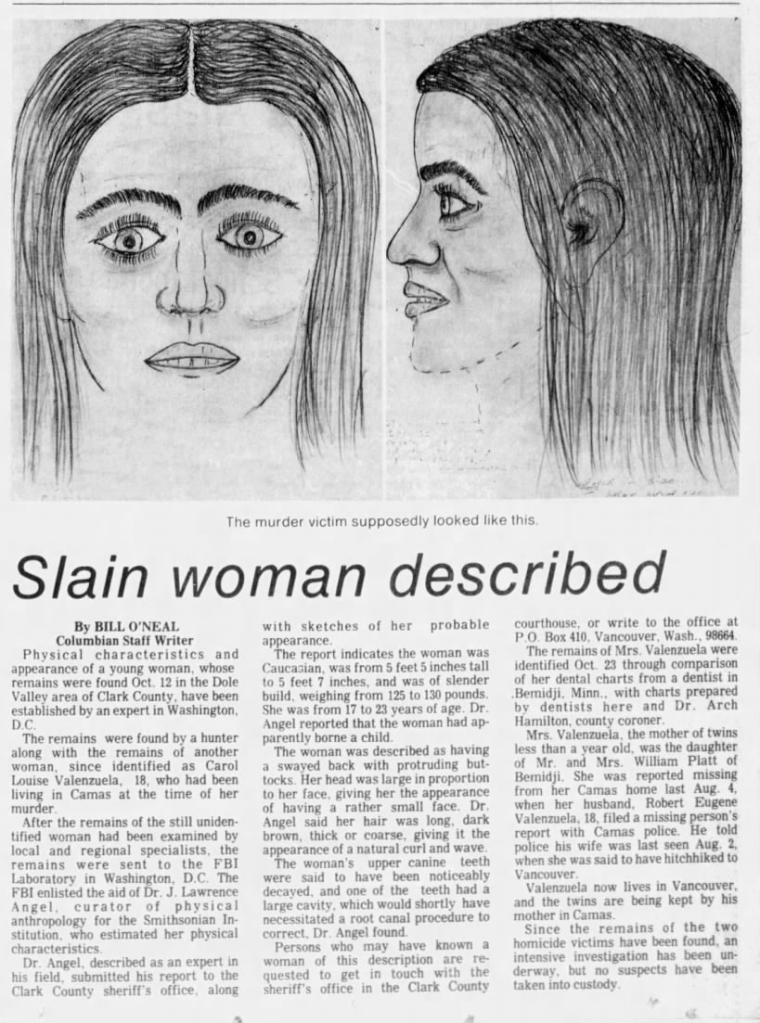
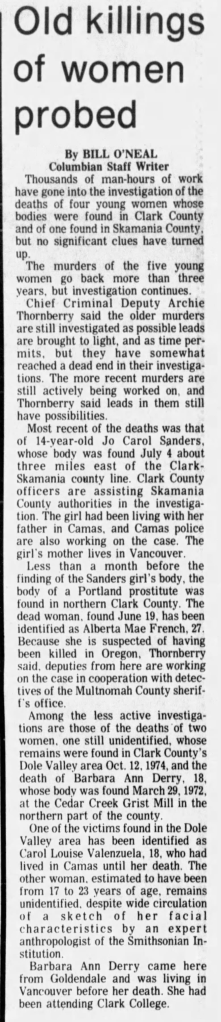
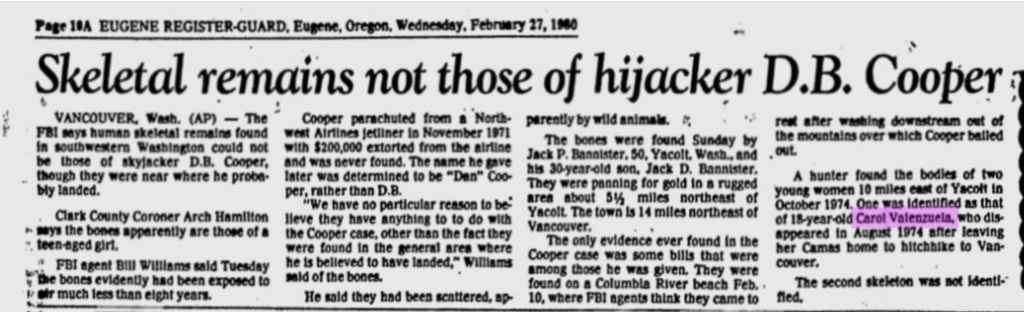
Marion in elementary school.Marion.Marion.Monica (seated on horse) with her mother Marion and aunt before 1975.The black and white beaded phoenix that was on Marion’s belt when her remains were discovered.The clog-like shoe that was found near Marion’s remains.A forensic approximation of what an older version of Marion Nagle-McWhorter might look like in more recent days. One of the multiple recreations of the ‘Swamp Mountain Jane Doe’s’ face that was based on the cranial features of her skeleton.One of the multiple recreations of the ‘Swamp Mountain Jane Doe’s’ face that was based on the cranial features of her skeleton.One of the multiple recreations of the ‘Swamp Mountain Jane Doe’s’ face that was based on the cranial features of her skeleton.One of the multiple recreations of the ‘Swamp Mountain Jane Doe’s’ face that was based on the cranial features of her skeleton.A forensic drawing of the former ‘Swamp Mountain Jane Doe.’A second forensic drawing of the former ‘Swamp Mountain Jane Doe.’An article about the discovery of the ‘Swamp Mountain Jane Doe’ that was published in The Albany Democrat-Herald on July 26, 1976.An article about the discovery of the ‘Swamp Mountain Jane Doe’ that was published in The Statesman Journal on July 28, 1976.An article about the discovery of the ‘Swamp Mountain Jane Doe’ that was published in The Oregon Journal on July 28, 1976.An article about the discovery of the ‘Swamp Mountain Jane Doe’ that was published in The Albany Democrat-Herald on July 30, 1976.An article about the ‘Swamp Mountain Jane Doe’ that was published in The Statesman Journal on August 1, 1976.An article about the ‘Swamp Mountain Jane Doe’ that was published in The Albany Democrat-Herald on August 2, 1976.An article about the ‘Swamp Mountain Jane Doe’ that was published in The Capital Journal on August 6, 1976.Part one of an article about the discovery that the ‘Swamp Mountain Jane Doe’ was really Marion McWhorter that was published in The Oregonian on September 17, 2025.Part two of an article about the discovery that the ‘Swamp Mountain Jane Doe’ was really Marion McWhorter that was published in The Oregonian on September 17, 2025.Part one of an article about the discovery that the ‘Swamp Mountain Jane Doe’ was really Marion McWhorter that was published in The Oregonian on September 20, 2025.Part two of an article about the discovery that the ‘Swamp Mountain Jane Doe’ was really Marion McWhorter that was published in The Oregonian on September 20, 2025.An article about the death of Monica’s daughter Michelle published in The Press Enterprise on October 18, 2025.Kenneth and Marion in the California state marriage records.Kenneth and Marion in the California state divorce records from 1975.I love how her name isn’t spelled even remotely correctly. Published in The San Bernardino County Sun on July 30, 1975.A comment on a Reddit post about Marion Nagle-McWhorter made by user ‘Sailboat_fuel.’A comment on a Reddit post about Marion Nagle-McWhorter made by her sister Valerie Nagle, who went by the username ‘PNWpurplepisces.’A second comment on a Reddit post about Marion made by her sister talking about how her niece is still alive and seems to be ‘doing well.’Ted’s whereabouts in October 1974 according to the ‘1992 TB Multiagency Team Report.’A possible route from Bundy’s residence on Est 1st Avenue in SLC to Sweet Home, Oregon where Marion was last seen alive.A Reddit comment made by user ‘JudiesGarland’ about Ted Bundy possibly being responsible for Marion’s death.John Arthur Ackroyd.Part one of an article about the atrocities of John Arthur Ackroyd published in The Sunday Oregonian on June 14, 1992.Part two of an article about the atrocities of John Arthur Ackroyd published in The Sunday Oregonian on June 14, 1992.Roger Dale Beck, accomplice of John Arthur Ackroyd.Vinetta Nagle, Jack Nagle, an unknown women and their aunt Vinetta Clara O’Hara (who Marion was named after).Francis J. Nagle’s WWII draft card.A newspaper article mentioning Francis Nagle published in The Evening Tribune on October 10, 1949.The obituary for Francis J. Nagle.Monica McWhorter from the 1987 Turlock High School yearbook.Monica Kay McWhorter from her high school days.Monica McWhorter, on the right.Monica Kay McWhorter-Lim.Monica (left) and her son, Jason Bravo; I’m not sure who the brunette is.The final resting place of Monic R. McWhorter.The final resting place of Melissa McWhorter.An article about the death of Monica’s daughter Michelle published in The Austin American-Statesman on April 8, 2002. A newspaper clipping a bout the deaths of Monica and Melissa McWhorter.Richard Sean Nagle.A newspaper article bout he death of Richard Nagle that was published in The Times-Union on March 7, 1974.The final resting place of Monica’s brother, Richard Sean Nagle.Richard Nagle’s obituary.The final resting place of Monica’s parents and brother.Kenneth Michael McWhorter listed in the Texas, U.S., Birth Index, 1903-1997.Kenneth Michael McWhorter.
According to this newspaper clipping, Kenneth and Deborah McWhorter suffered from some marriage difficulties at one point in their relationship, published in The San Bernardino County Sun on October 30, 1981.Kenneth McWhorter’s second wife, Deborah James. Valerie Nagle in Seattle. Photo taken by Lindsey Wasson of the AP.Valerie Nagle, photo courtesy of Facebook.
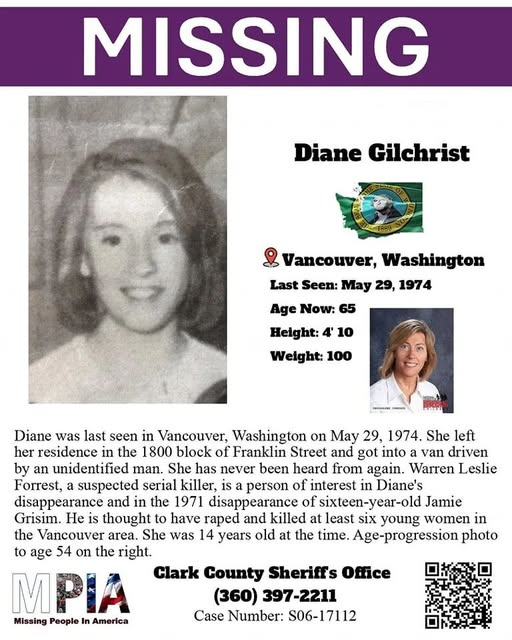
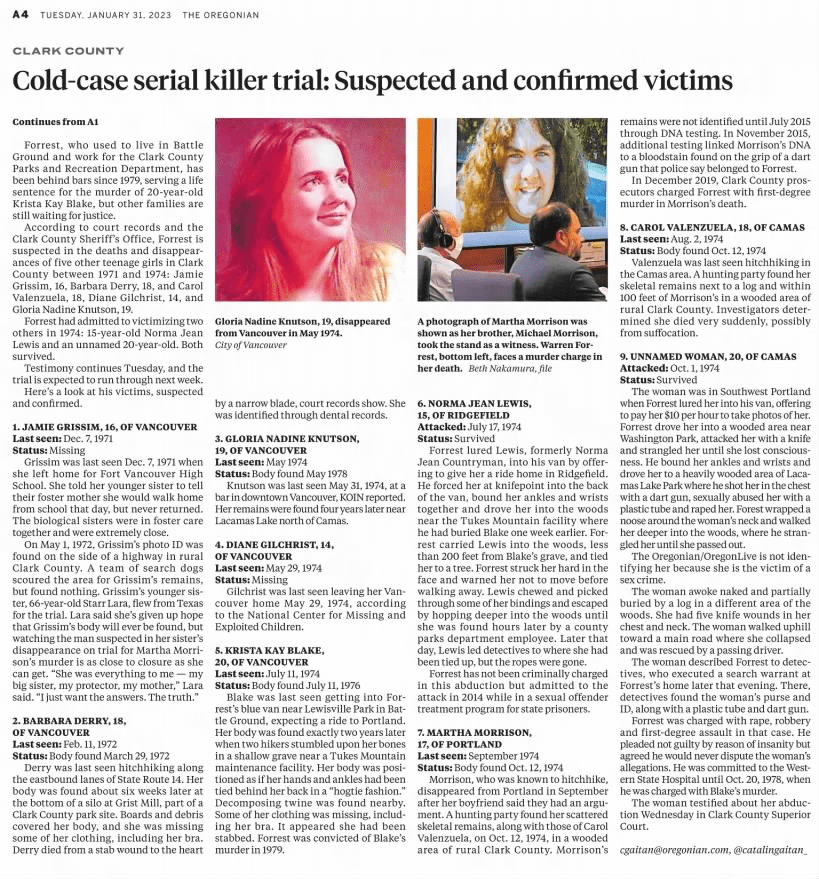
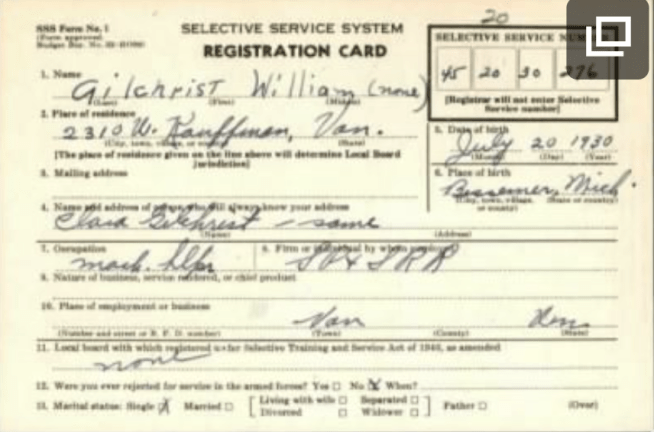
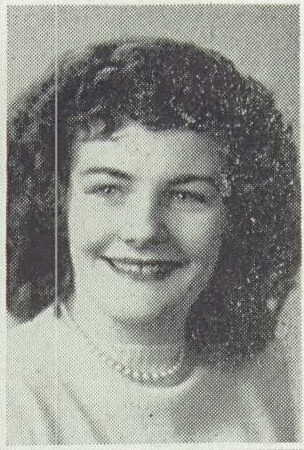
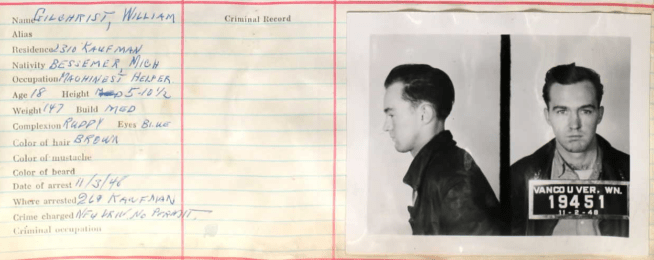
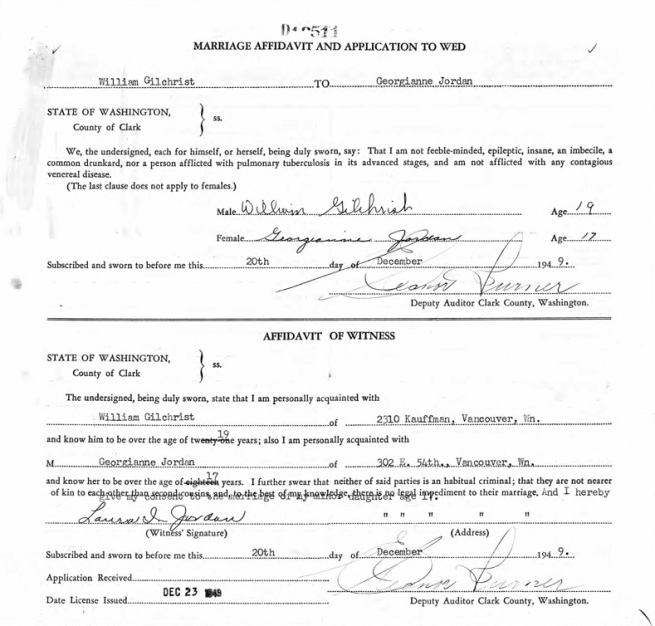
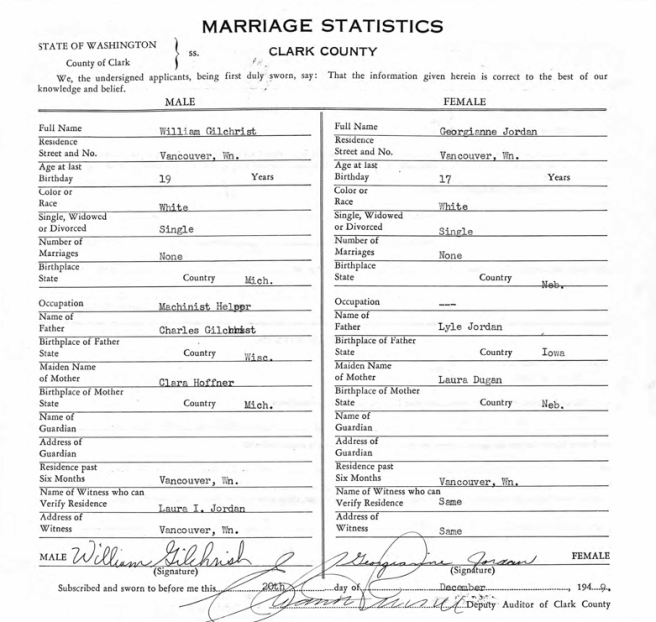
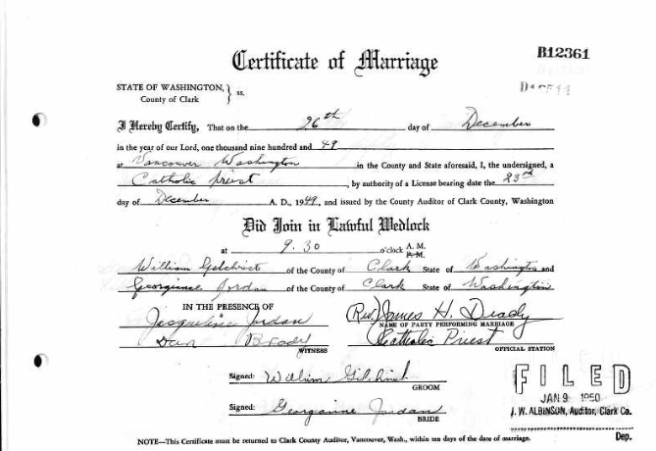
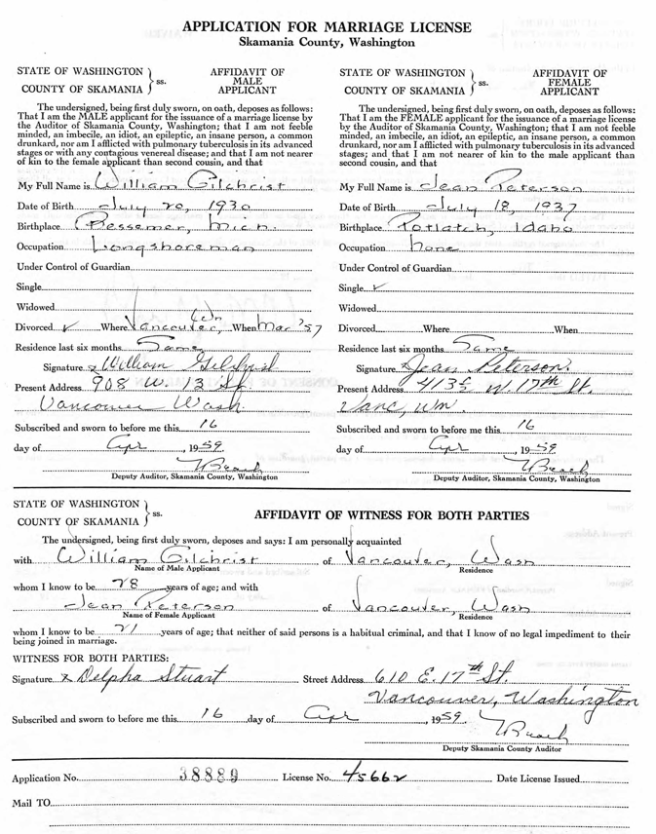
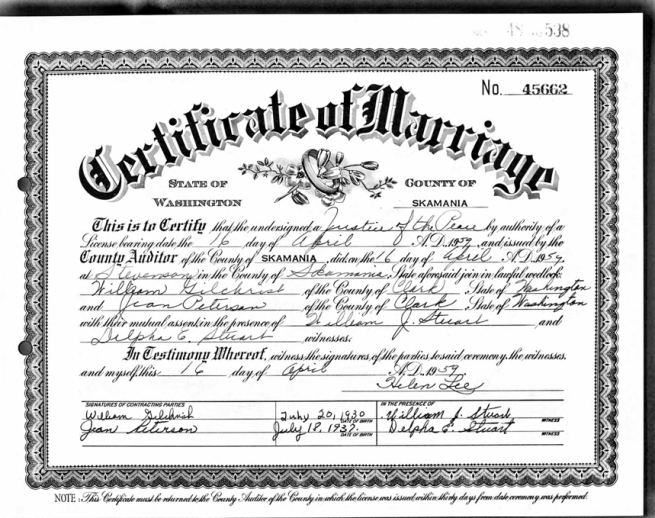
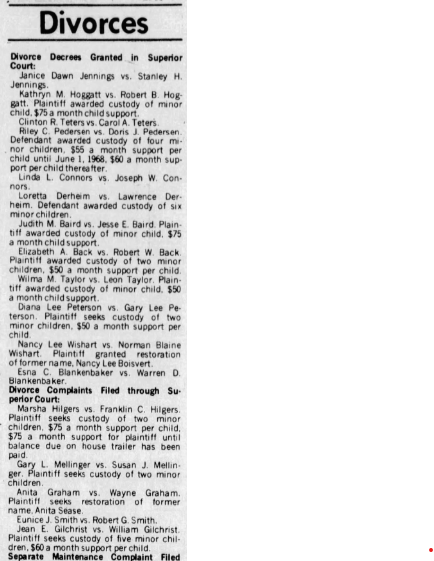
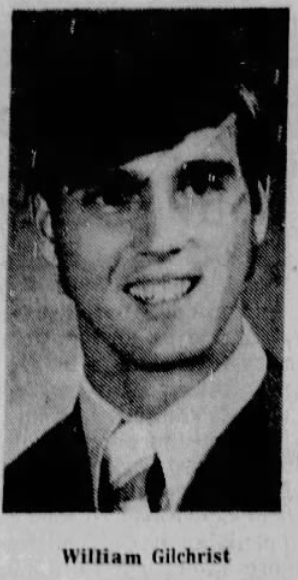
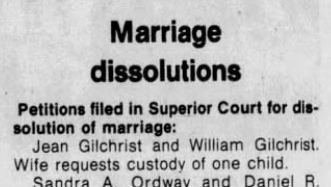
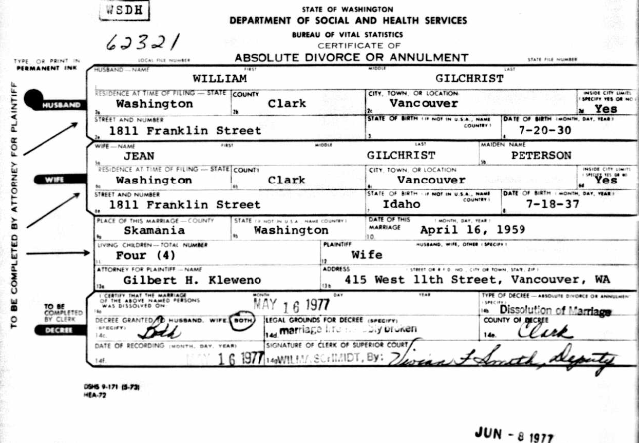
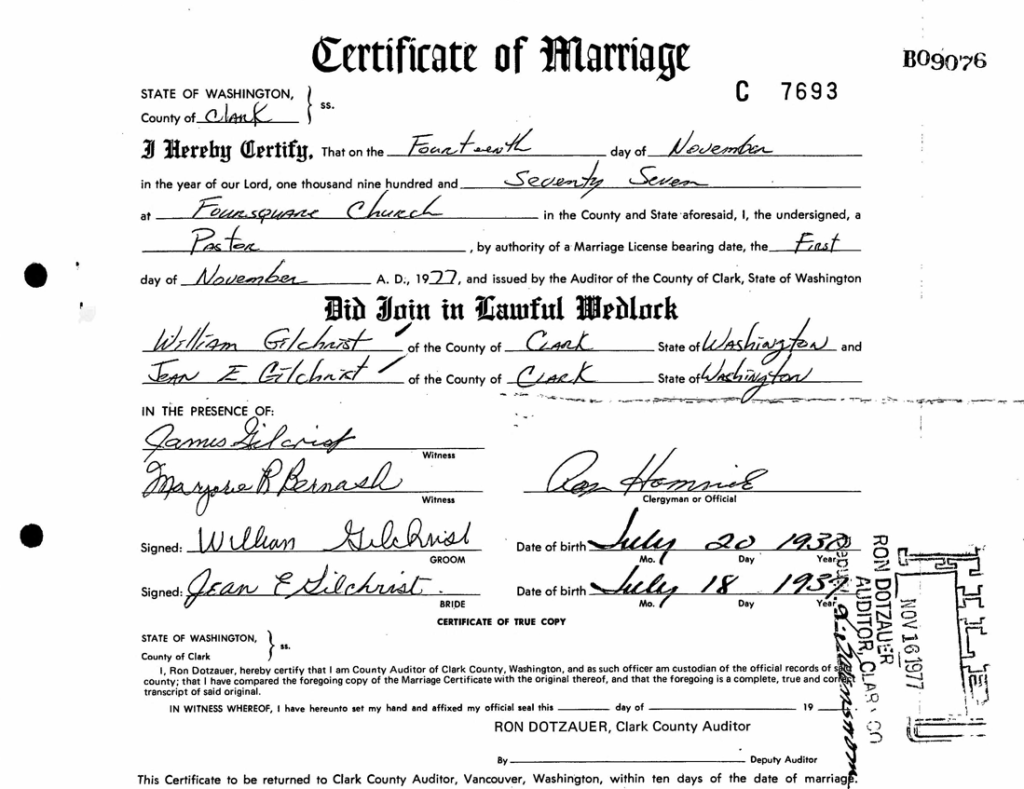
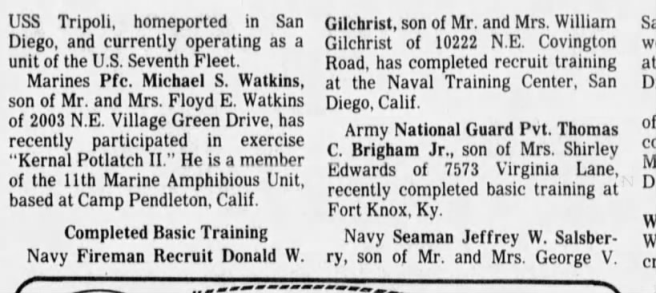
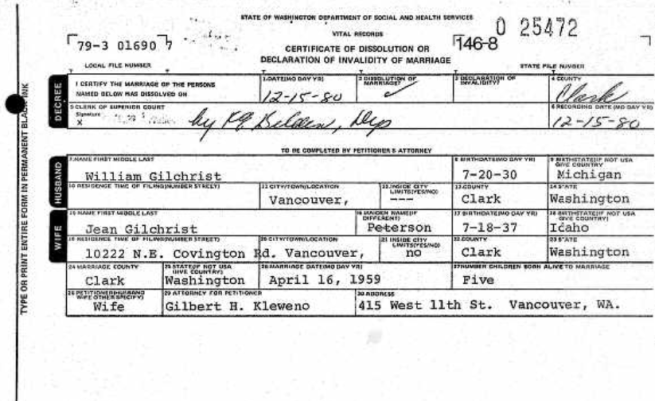
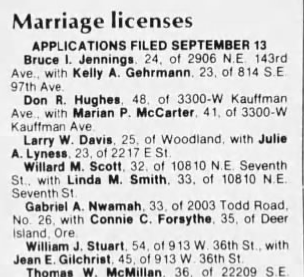
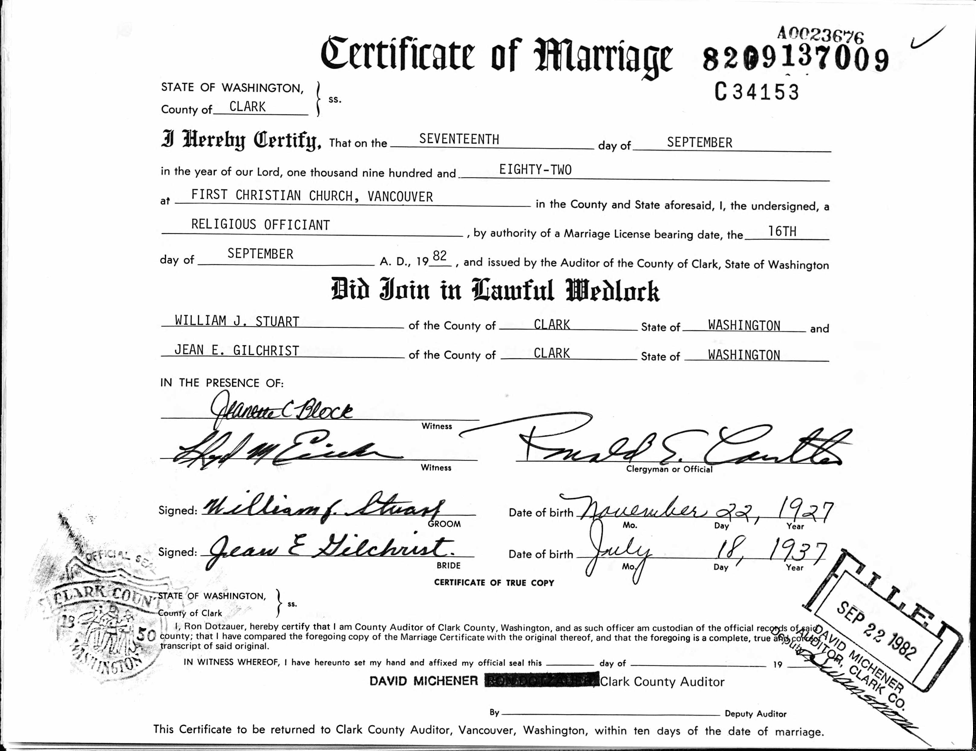
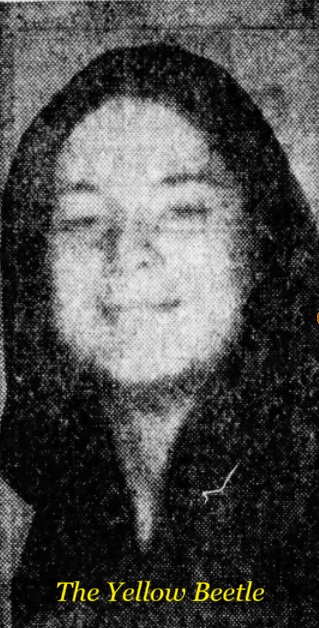
Diane Sue Gilchrist was born on August 8, 1959 to William and Jean Gilchrist in Vancouver, WA.William Gilchrist was born on July 30, 1930 in Bessemer, Michigan and Jean was born on July 18, 1937 in Potlatch, Idaho. After he relocated to Washington state at the age of ten, Gilchrist served in the Army during WWII and the Korean War and upon returning home got a job as a longshoreman (which is a marine terminal laborer that is responsible for loading and unloading cargo from ships at ports). Before he was married to Diane’s mother he was wed to Georgianne Jordan: the couple tied the knot in Vancouver, WA on December 20, 1949 but had gotten divorced at some point prior to 1959, as he married Jean Peterson on April 16, 1959; the couple had six children together: Carol, Kay (b. 1962), Karen (b. 1959), Diane, William, and Donald (b. 1961). William and Jean seemed to have a rocky relationship, and according to records divorced then reconciled at least once before they eventually parted ways for the final time on December 15, 1980 (she married William Stuart on September 16, 1982).
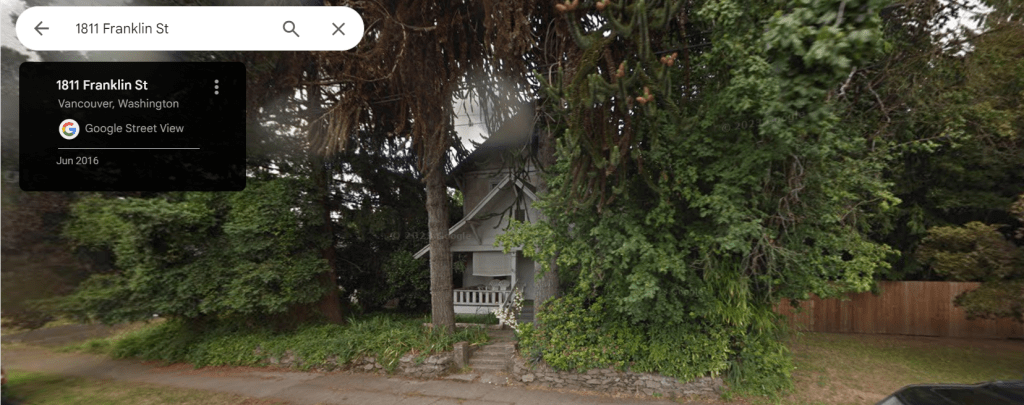
Few details are available in relation to Diane’s disappearance: at the time she was a freshman at Shumway Junior High School and wore her blonde hair at her shoulders; she had blue eyes, stood at a mere 4’10” tall, and only weighed 100 pounds. According to her sister Karen, after Diane got home that Monday it was just like every other night in the Gilchrist household: their father began to target her, which led to a verbal altercation and her head being slammed into a door jam. She then bolted upstairs to the bedroom she shared with her sister Kay and slammed the door, and talked about her plans of running away, exclaiming that she couldn’t: ‘handle it anymore;’ shortly after this exchange, she climbed out their second story bedroom window and vanished.
From there, she walked to her boyfriend David’s house, who lived nearby; he would later tell detectives that she got to his residence at around 7 PM but hadn’t been there for long before she announced she was ‘going to walk to the store for cigarettes.’ David wanted to go with her, and Gilchrist responded that she wanted to go by herself and would be back shortly… but when she walked out of the door and into the night, she was never seen or heard from again. Two days later, Diane’s mother reported her missing to the Vancouver City Police, and according to Karen, their mother was so grief stricken by her sister’s disappearance that she had a breakdown and checked herself into Western State Mental Hospital (which was coincidentally the same facility where WLF was later committed). And after that, the Gilchrist siblings went into foster care.
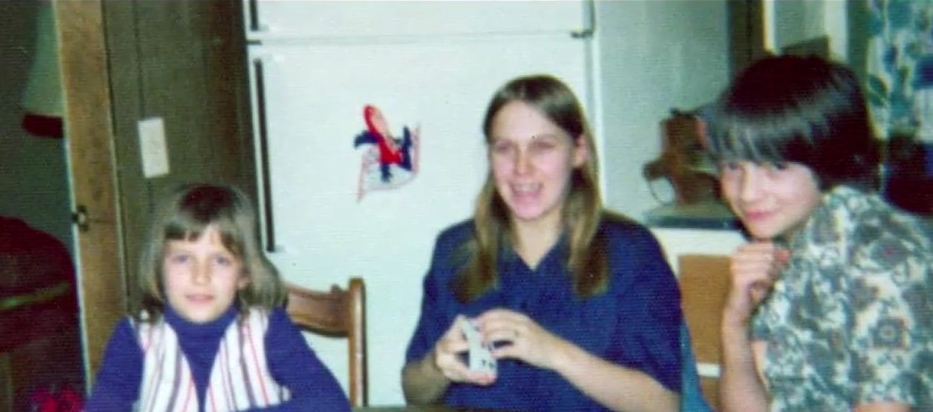
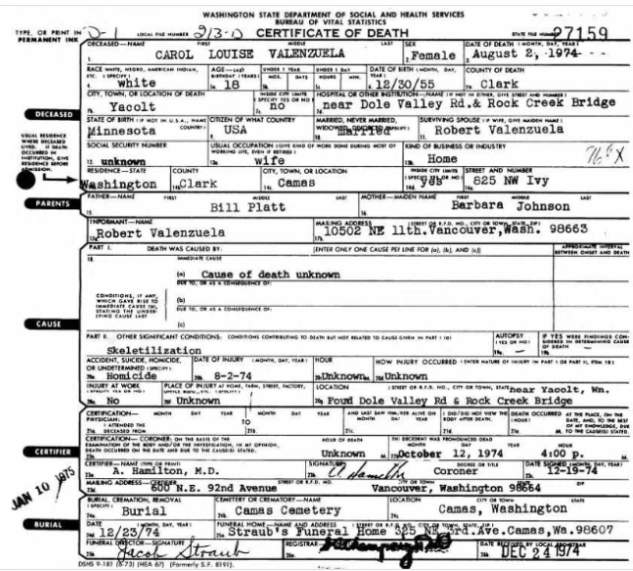
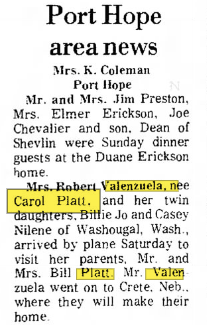
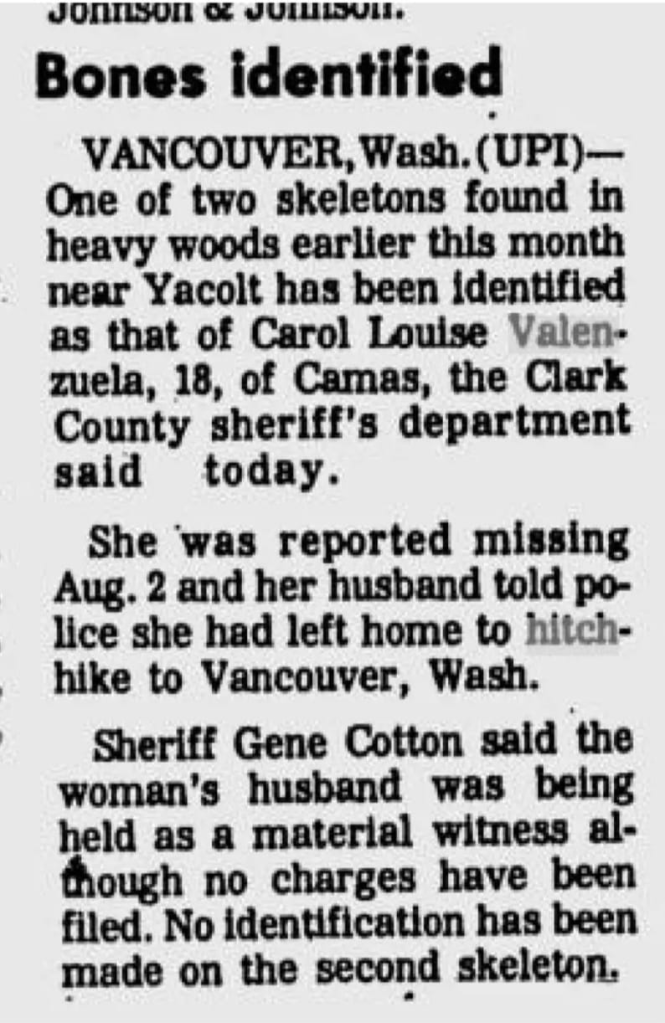
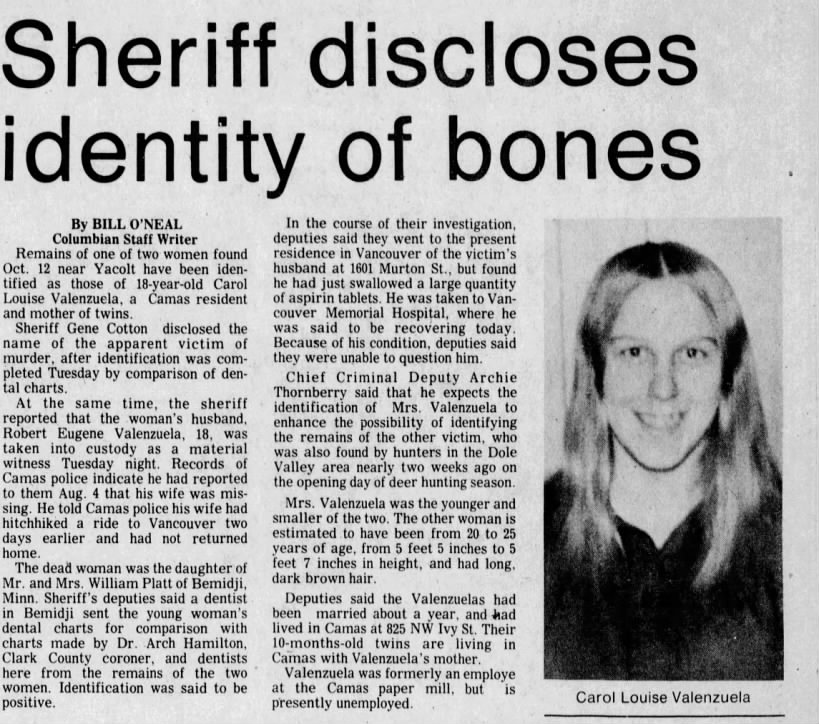
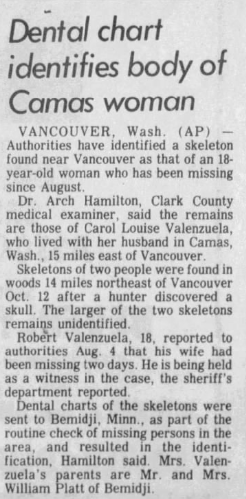
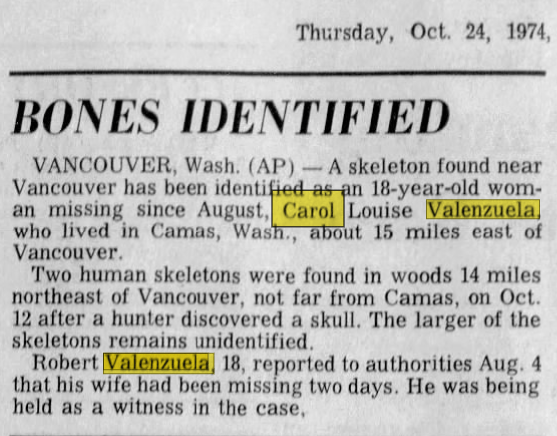
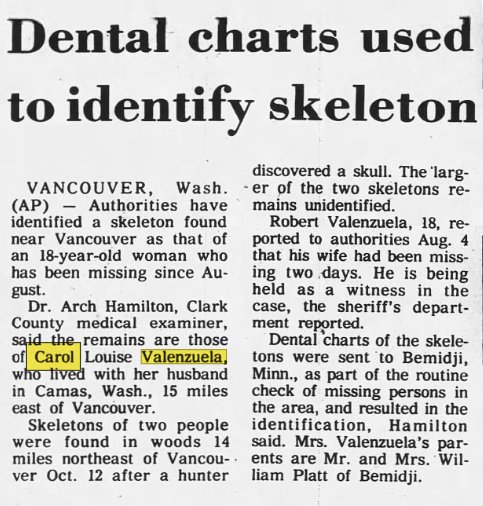
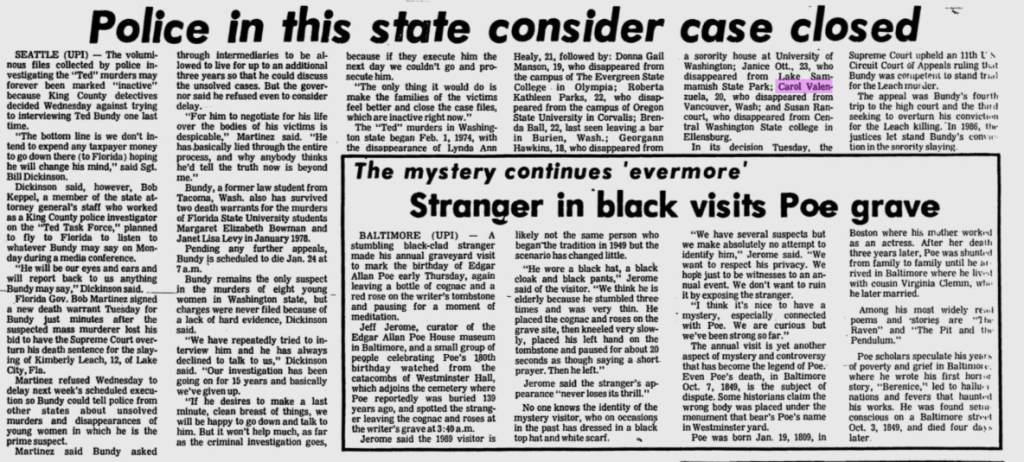
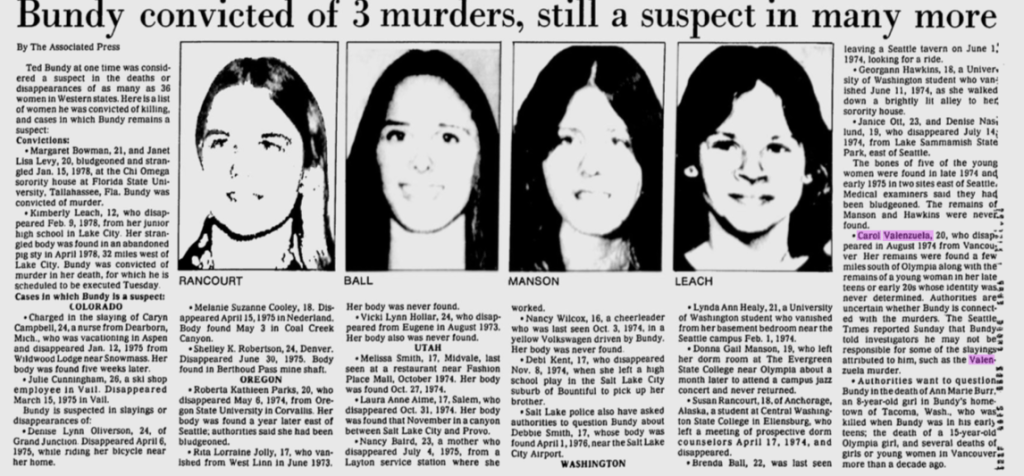
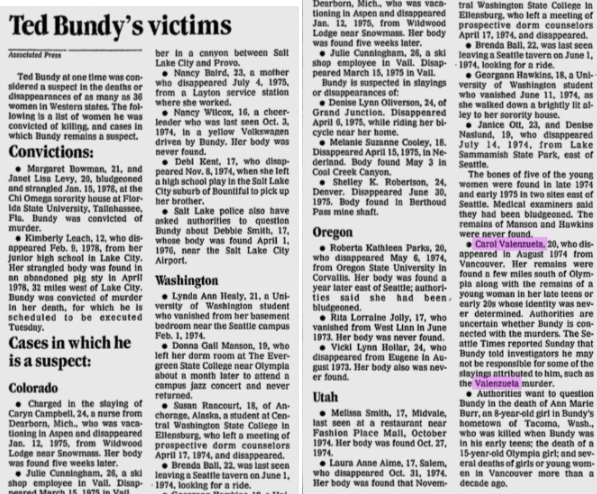
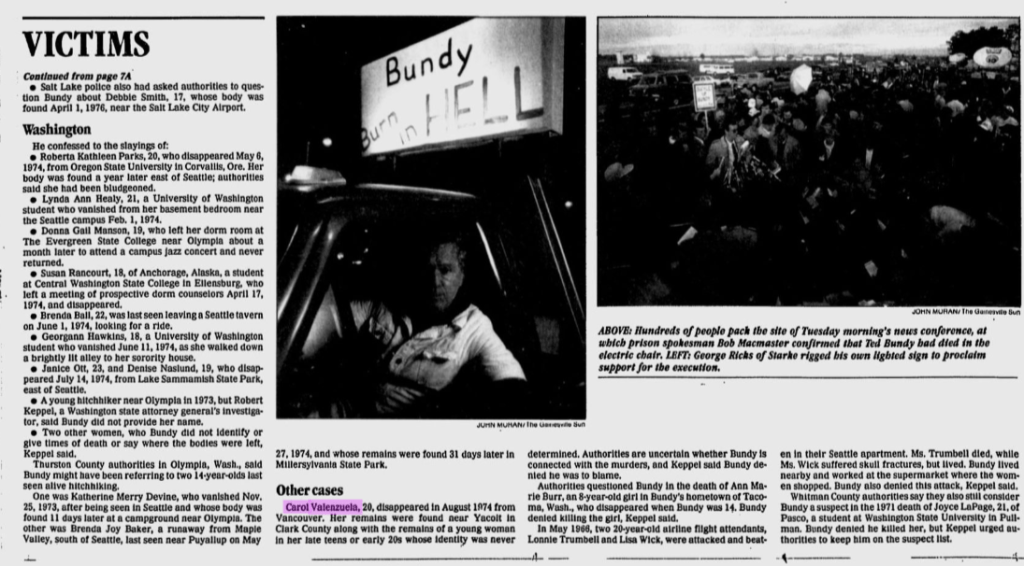
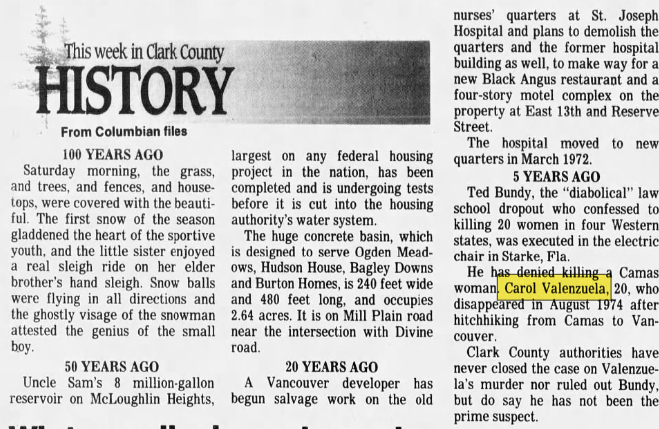
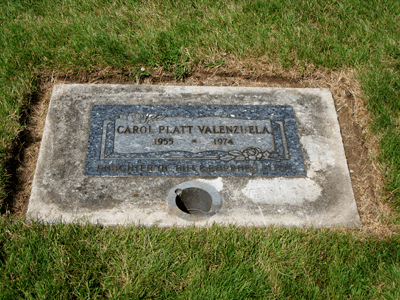
In the beginning part of the investigation, it was suspected that Diane may have been a runaway… and as a result her disappearance wasn’t taken seriously by police. However, this theory was eventually discarded, and investigators now strongly believe she is a victim of serial predator Warren Leslie Forrest. After his 1974 arrest investigators went over Forrest’s employment history, and he apparently took off from work the morning after Gilchrist was last seen alive, and just two days after Diane disappeared, Gloria Knutson was last seen alive (the day after she goes missing, Forrest left work early); two weeks after that, Carol Valenzuela was last seen in downtown Vancouver.
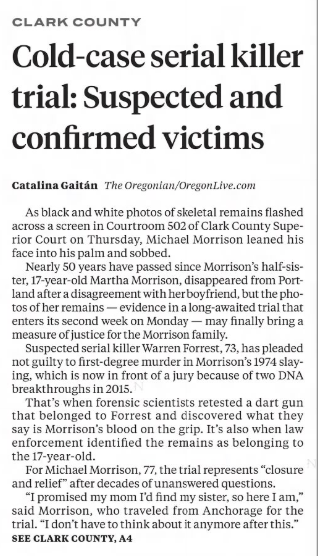
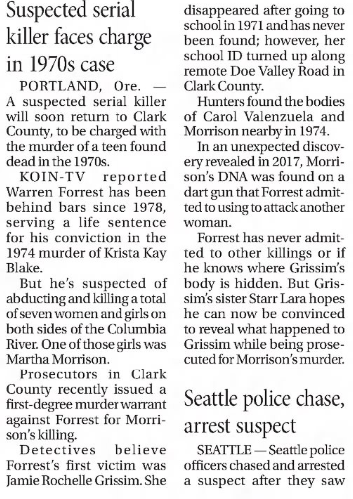
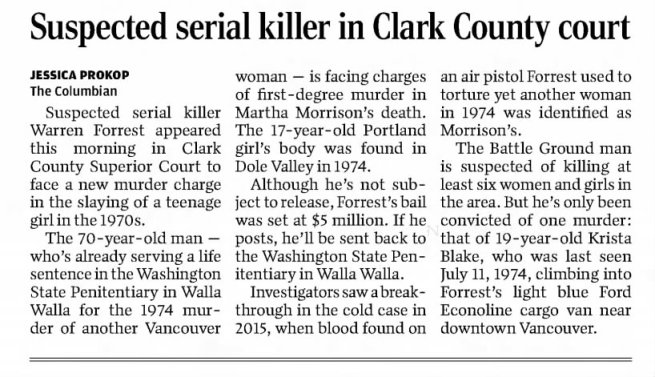
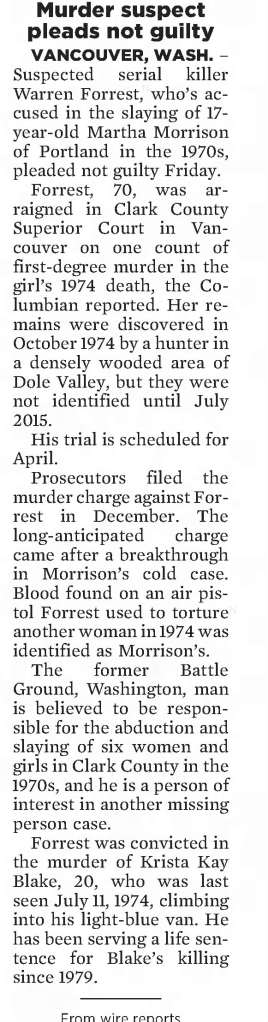
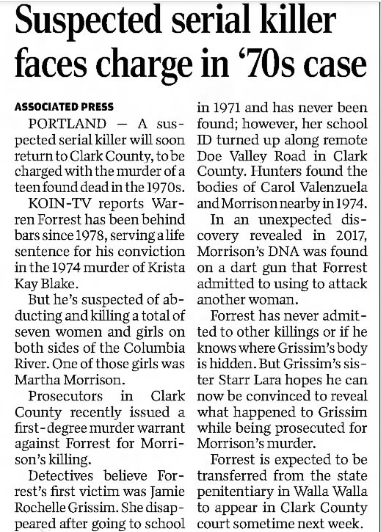
Forrest has been incarcerated since 1978 serving a life sentence for the 1974 murder of Krista Kay Blake (and before that he was committed to Western State Penitentiary in Steilacoom since January 1975). Nineteen-year-old Blake had been seen last on July 11, 1974, climbing into Forrest’s light blue Ford Econoline cargo van outside of downtown Vancouver; only six days later Norma Countryman was abducted while hitchhiking in Ridgefield (she survived the encounter). In 2018 new charges were brought up against Forrest in relation to the murder of Martha Morrison.
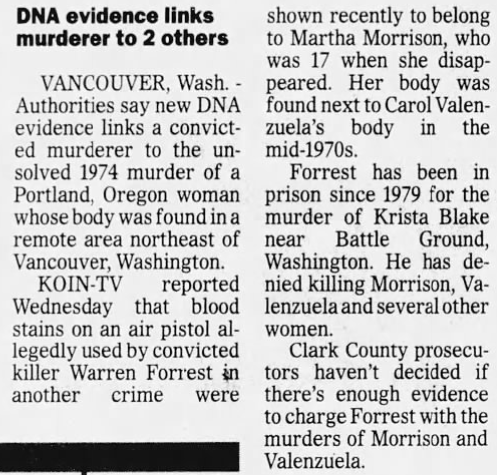
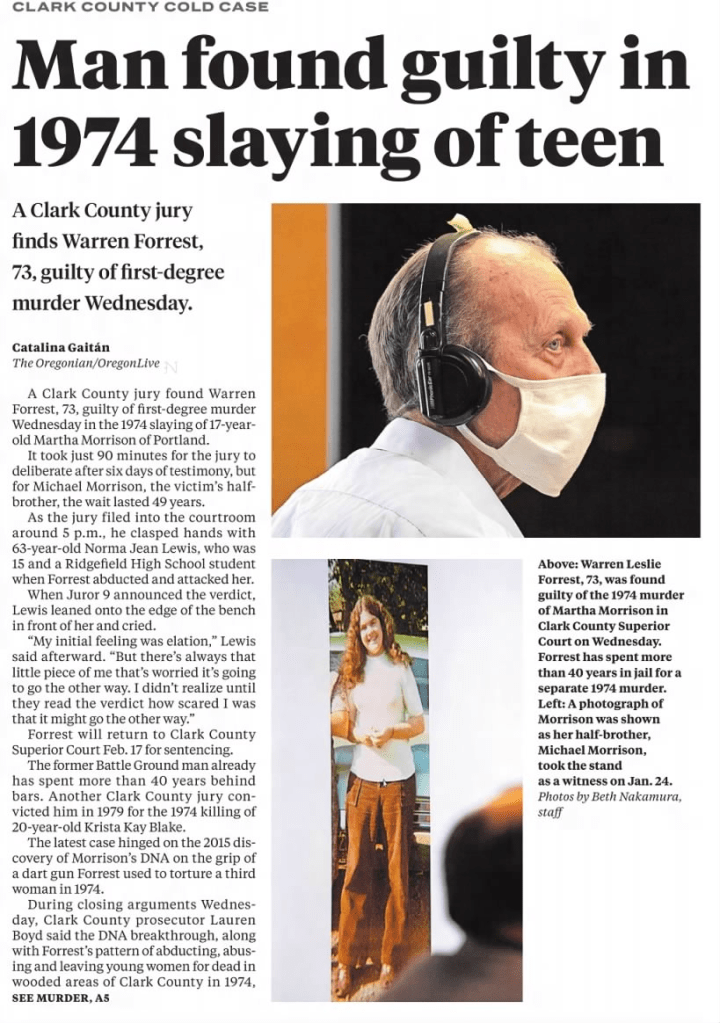
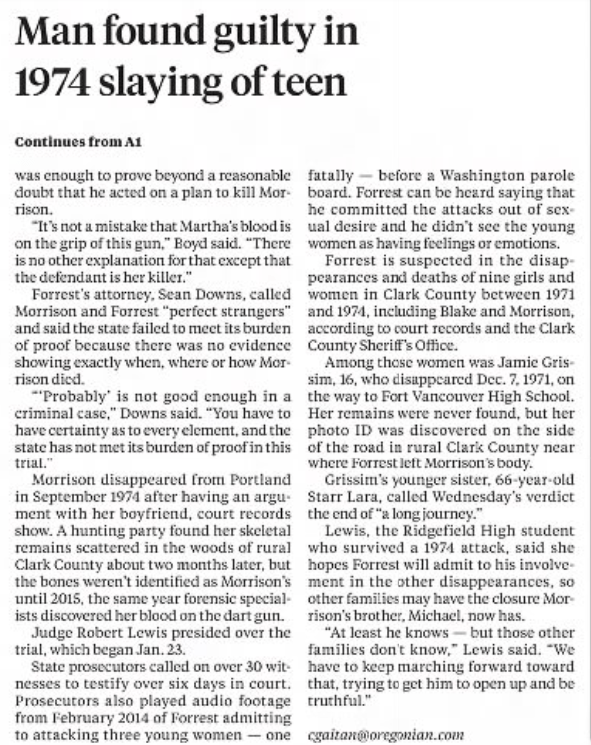
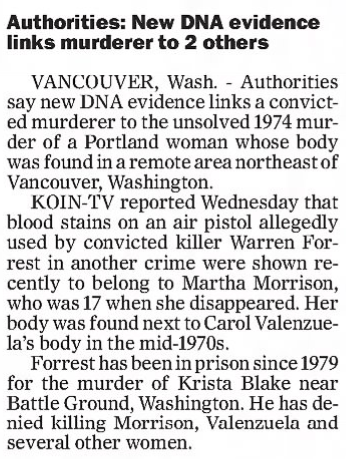
Seventeen-year-old Martha’s body was recovered on October 12, 1974, by a member of a hunting party in a densely wooded area in Dole Valley; sadly her remains went identified until July 7, 2015 when some familial DNA from Morrison’s half-brother, sister, and the exhumed body of her father matched some blood that had been found left behind on one of WLF’s dart guns.
About WLF finally being held accountable for his sisters murder, Michael said, ‘boy, am I happy about that one. It’s been 45 years. Am I expecting some kind of closure? I don’t know. I’m kind of really settled in my own mind at this point. I’d like to look him in the eye and say: … ‘Why did you do this?’’ He also said their father reported Martha as missing years prior, but the police report was lost so her disappearance wasn’t officially reported until January 2010, when he contacted police in Eugene, OR. According to Michael, his sister was a ‘free spirit’ that was known to hitchhike and played the guitar, and: ‘was an artist. She was real friendly. She was just a great kid. I don’t know what I’m really expecting. There isn’t really any closure. I got all of the information. OK, this happened. What more can you do? That’s probably all I can really expect at this point. I’m kind of at peace with it somewhat, somewhat.’
In August 2018 Diane’s sister Karen went to the murder trial of Martha Morrison to face her sister’s accused killer for the first time, and about the event said that it was mostly curiosity that brought her there, and ‘it was frightening. We made eye contact. It felt like he knew me’ (as she said this, she was reportedly trembling).
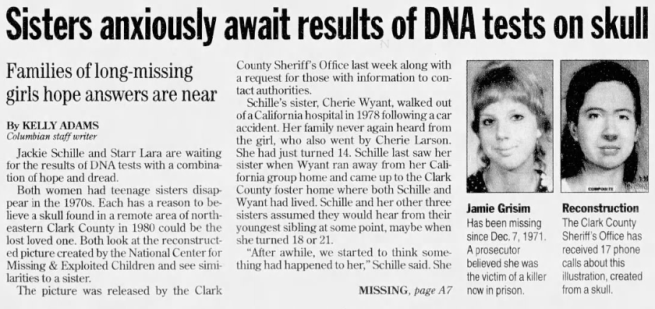
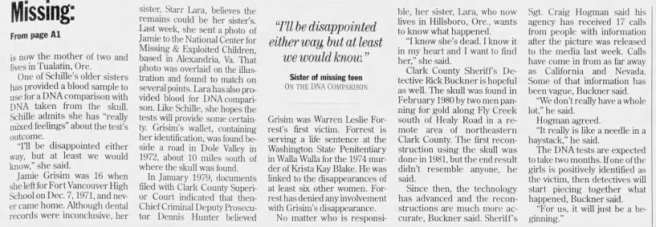
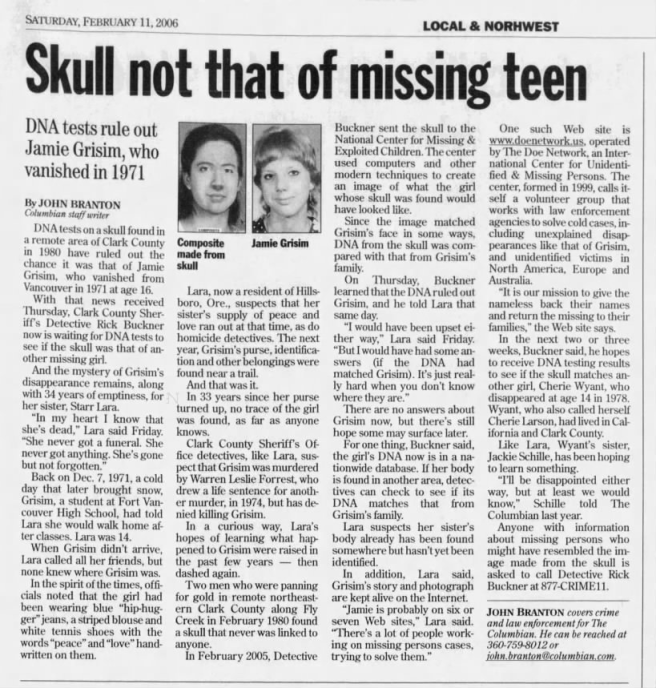
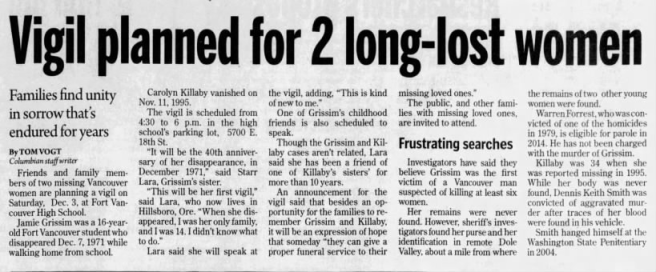
A friend of Jamie Grisim’s (who is another suspected victim of WLF) sister Dena Rush also attended Forrest’s 2018 hearing (on Starr’s behalf), and about him said: ’there are a lot of girls from our county who are missing that he had a hand in. It’s hard because so many years, and he’s still alive and their loved ones are still missing, these girls. And they deserve better.’ Rush also said she was struck by Forrest’s small stature: ‘you always think when you are going to be next to evil, you’re going to feel it or sense it. He looks so innocuous. He just looked like he couldn’t hurt a fly.’
One of Diane’s friends from early childhood, Jerri Mitchell thinks about her a lot, especially on August 8 of every year (which was their shared birthdays): ‘I miss her, I’ve missed her all these years. She was my first real friend.’ Since 1974, Jerri has held onto hope that her best friend ran away to live another life, and that she isn’t lying dead somewhere.’ At the time Diane disappeared the two friends had been ninth graders at Shumway Junior High School in downtown Vancouver, and they both experienced rough childhoods: ‘when Diane came along, she just came out of nowhere. I don’t remember her being in school before, we just ended up being friends and we hit it off and then she disappeared.’
About her friend, Jerri said: ‘I’ve always thought of kids like her and I, we get lost in the world. We are the ones that if we disappear, no one cares. And that’s what I saw with Diane. Nobody cared when she disappeared. I never had anyone come ask me. I was her best friend when she disappeared.’ She also said that if Diane was one of Forrest’s victims, ‘at least there’s knowing what happened to her,’ and knowing she wasn’t forgotten.’
Karen Gilchrist currently lives in Vancouver, WA and Diane’s sister Carol lives in Washougal, WA. She has been employed as a laundry room attendant at a Holiday Inn since March 2022
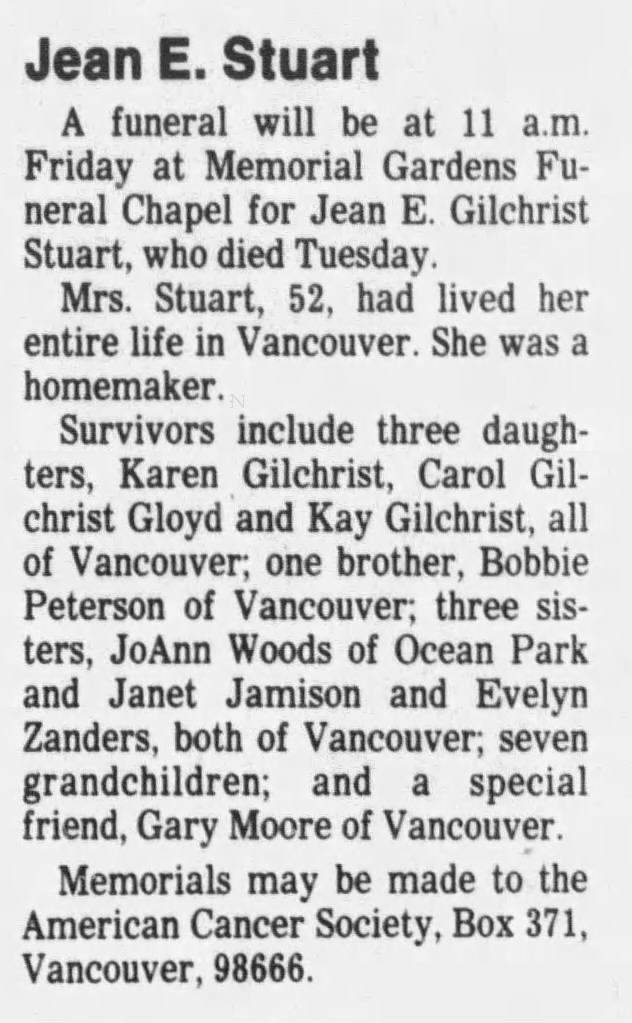
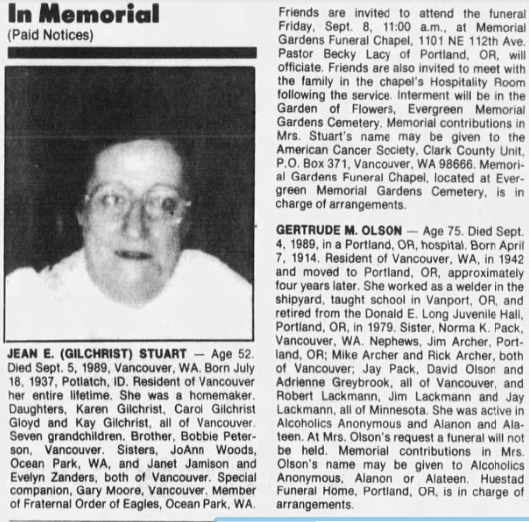
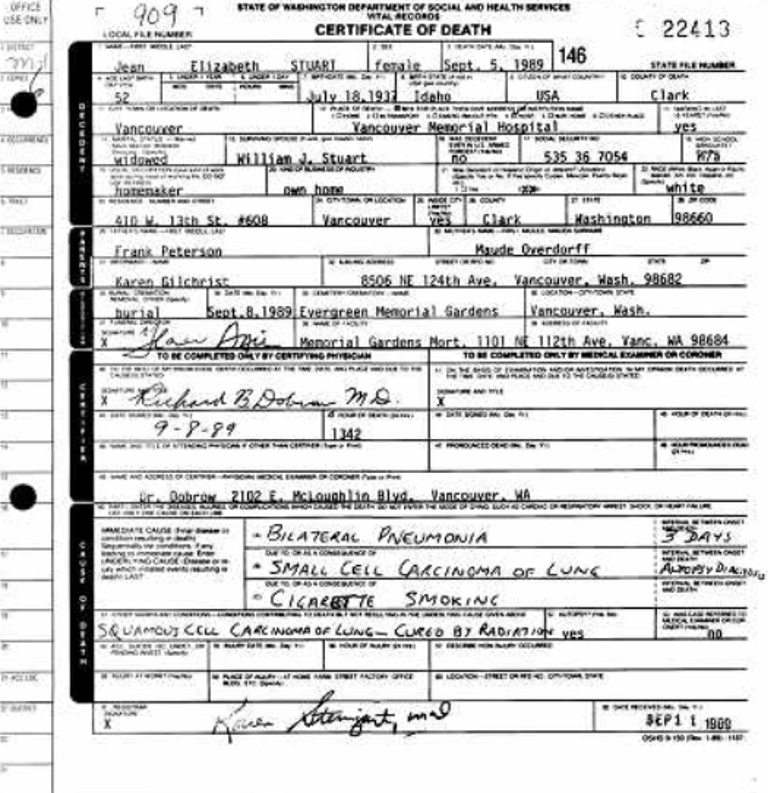
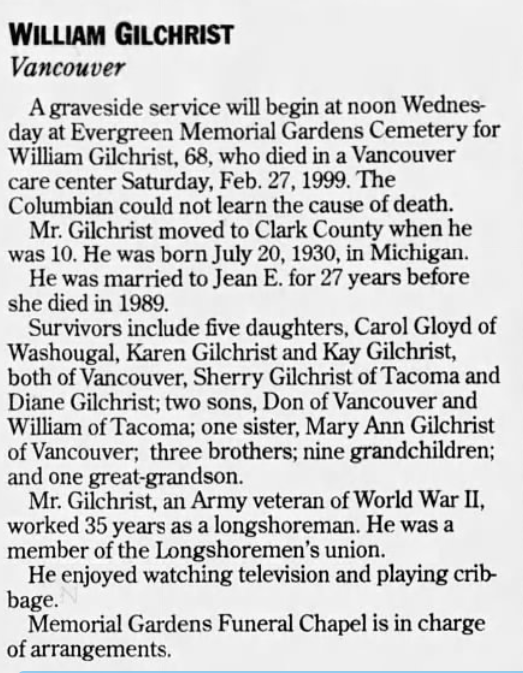
Jean Gilchrist-Stuart died at the age of fifty-eight on September 5, 1982 in Vancouver, WA; her obituary said that she was a homemaker.William Gilchrist died at the age of sixty-eight in a Vancouver care center on February 27, 1999. According to his obituary, he was a longshoreman for thirty-five years before his death and he was a member of the Longshoremen’s union. He also enjoyed watching TV and playing cribbage. Diane’s brother Donald William Gilchrist passed away on July 1, 2021.
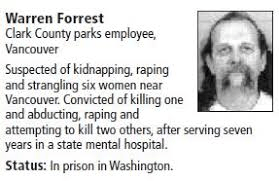
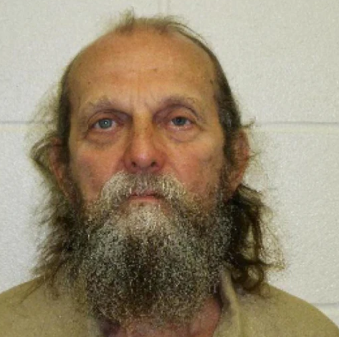
Warren Leslie Forrest is serving life sentences for the murders of Krista Blake and Martha Morrison in the Washington State Penitentiary in Walla Walla (despite being suspected in six disappearances and murders). As of February 2026 he has never been charged in connection to Diane’s disappearance, and her disappearance remains unsolved. After Diane disappeared the Gilchrist family purchased a burial plot that they keep to this day, waiting for a resolution to her disappearance. According to Karen Gilchrist, her sister: ‘was cheated out of life and Warren Forrest took that away.’
Works Cited: Carolyn Osorio. (September 9, 2025). Stolen Voices of Dole Valley, Episode 5: The Good-Looking Stranger. Taken February 12, 2026 from https://pod.wave.co/ Prokop, Jessica. (January 6, 2020). ‘Suspected Serial Killer, 70, in Clark County Court in 1974 Murder Case.’ Taken February 18, 2026 from http://www.columbian.com Tilkin, Dan. (August 8, 2018). ‘Could Diane Gilchrist be Warren Forrest’s 9th Victim?’ Taken February 18, 2026 from http://www.koin.com
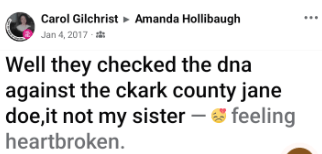
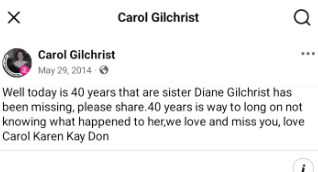
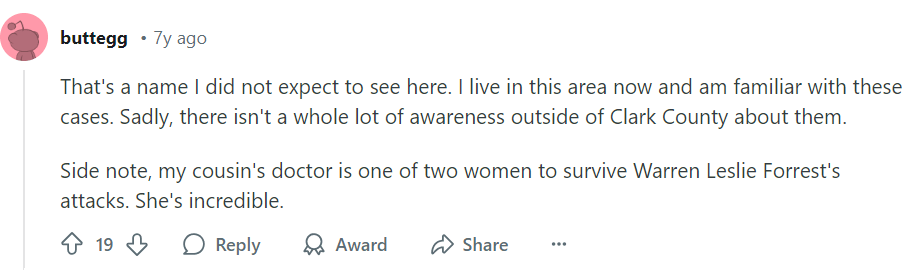
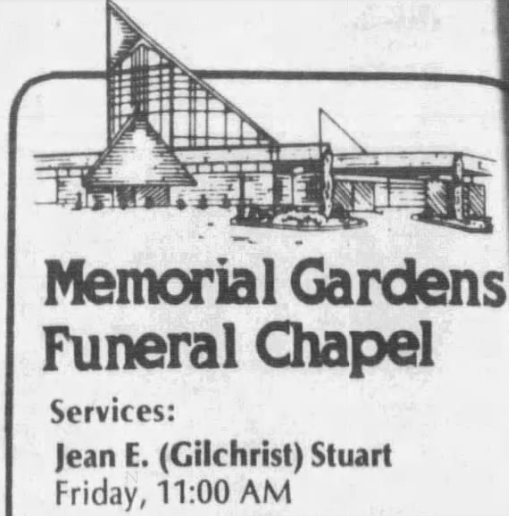
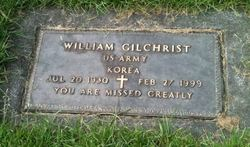
Five of the Gilchrist children (Diane is in the top far left).Diane Sue Gilchrist.A picture (from 2013) of what Diane Gilchrist could look like using age-progression to age 54.A missing-persons flier for Diane Gilchrist.One of Carol Gilchrist’s Facebook posts about her sister.Another one of Carol Gilchrist’s Facebook posts about her sister.Part one of an article about Warren Leslie Forrest that mentions Diane Gilchrist published in The Oregonian on January 31, 2023.Part two of an article about Warren Leslie Forrest that mentions Diane Gilchrist published in The Oregonian on January 31, 2023.A comment made on a Reddit post about Diane.The house that Diane was living at the time of her disappearance, located at 1811 Franklin Street in Vancouver, WA.William Gilchrist’s draft card from Korea.A picture of Georgeanne Jordan taken from the 1949 Vancouver High School yearbook. She was born on January 17, 1932 and died at the age if eighty-one on February 7, 2013.Some information related to William Gilchrist’s criminal record.William Gilchrist and his first wife’s marriage affidavit and application to wed dated December 20, 1949.William Gilchrist and his first wife’s marriage statistics dated December 20, 1949.William Gilchrist and his first wife’s certificate of marriage dated January 9, 1949.William Gilchrist and Jean Peterson’s application for a marriage license dated April 16, 1954.William Gilchrist and Jean Peterson’s certificate of marriage dated April 16, 1954.William and Jean are listed in those seeking a divorce published in The Columbian on March 12, 1968.A picture of Diane’s brother William Gilchrist, taken from The Spokane Chronicle on May 24, 1971.William and Jeans names in a list of people that applied for a marriage license published in The Columbian on November 3, 1977.William and Jean are listed in those seeking a divorce published in The Columbian on September 30, 1979.William and Jean’s certificate of divorce dated June 8, 1977.William Gilchrist and Jean Peterson’s certificate of marriage dated November 16, 1977.A newspaper clipping that mentions Diane’s brother Donald published in The Columbian on November 23, 1979. William and Jean Gilchrist’s certificate of the invalidity of marriage dated December 15, 1980. Jean E. Gilchrist and William J. Stuart applied for a marriage license published on The Columbian on September 15, 1982.Jean Gilchrist and William Stuart’s certificate of marriage dated September 16, 1982.Jeans name in a list of funeral services that was published in The Columbian on September 7, 1989.Obituary for Jean E. Stuart published in The Columbian on September 7, 1989.Obituary for Jean E. Stuart published in The Columbian on September 7, 1989.Jean Stuart’s death certificate.William Gilchrist’s service date and time listed in The Columbian on March 1, 1999.William Gilchrist’s obituary published in The Columbian on March 1, 1999.William Gilchrist’s grave site.Donald Gilchrist.
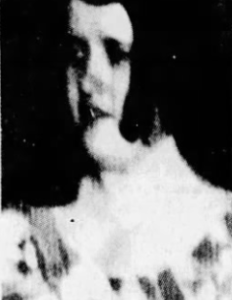
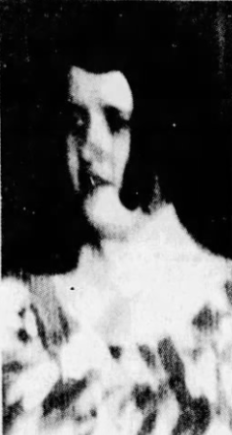
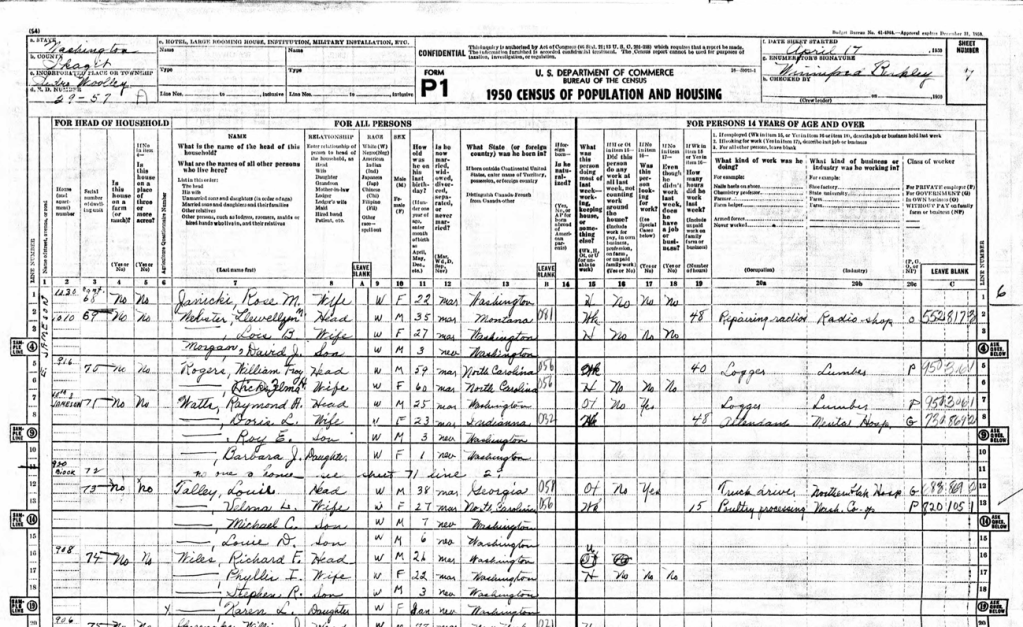
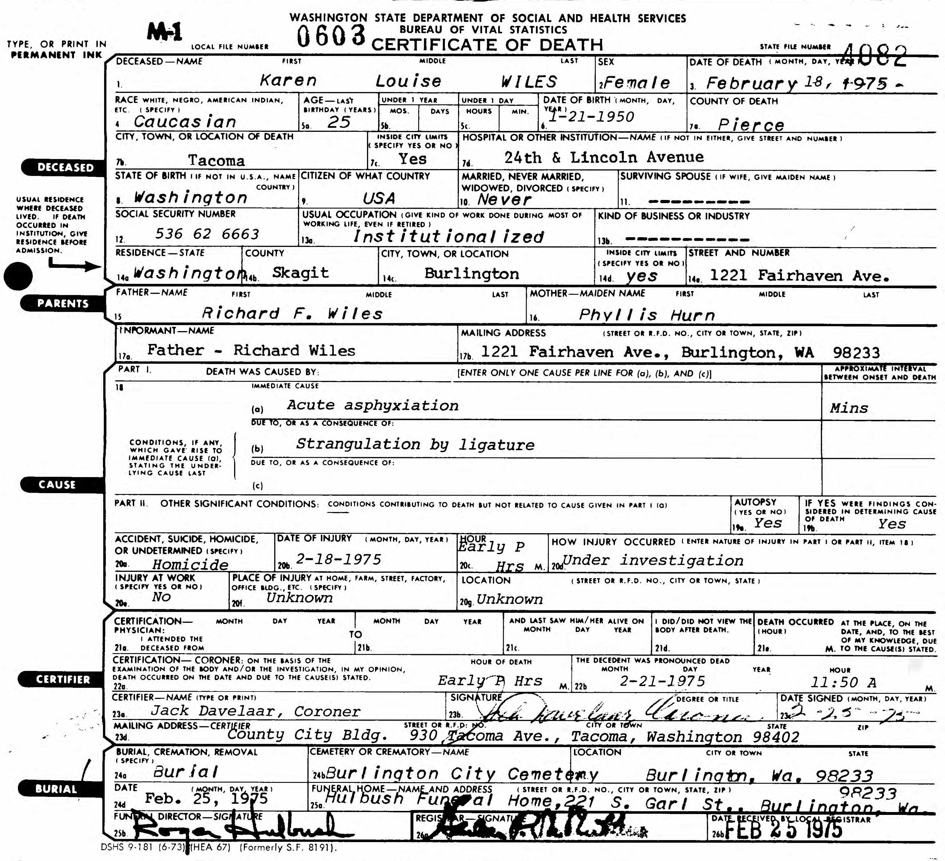
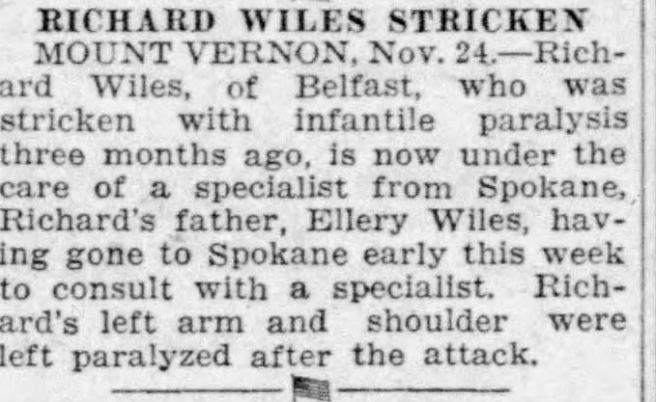
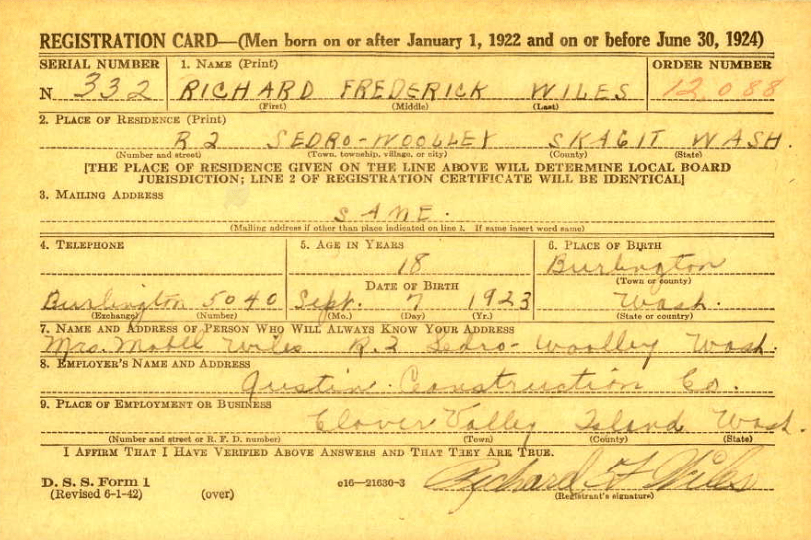
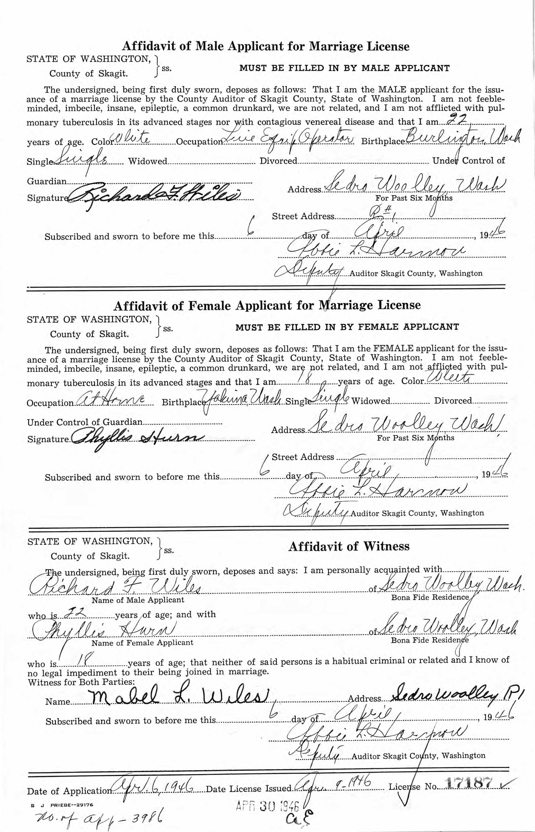
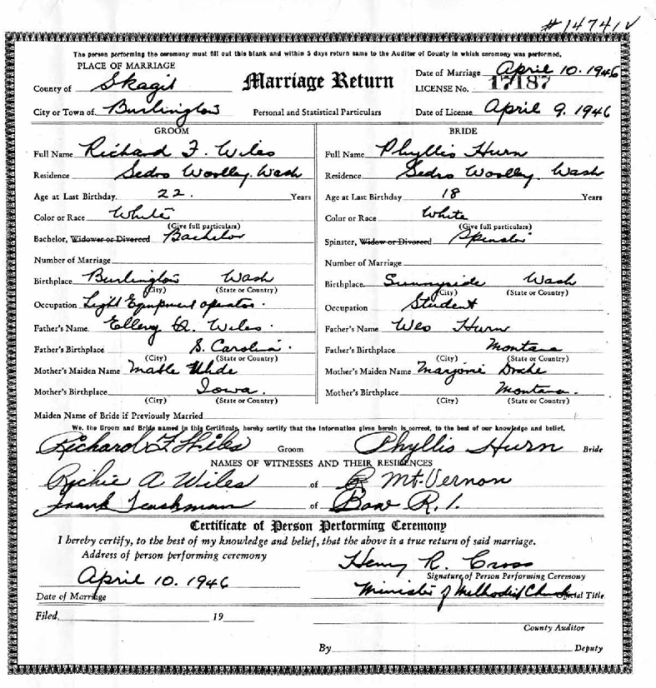
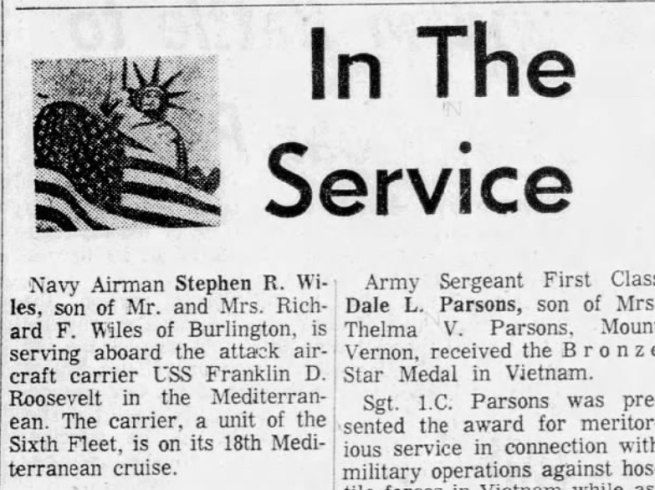
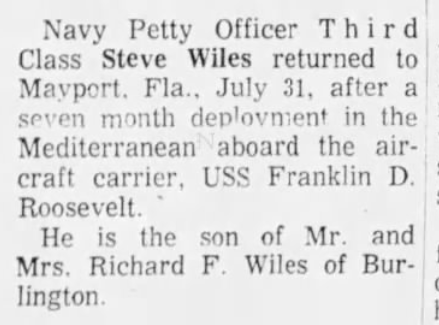
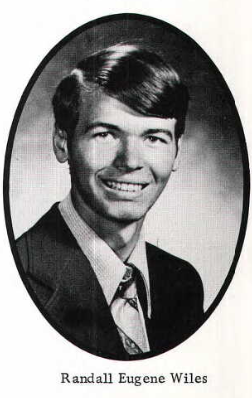
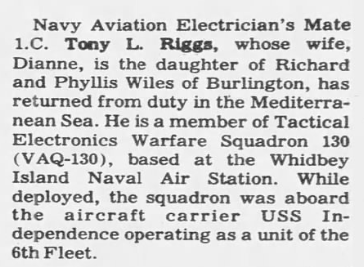
Karen Louise Wiles was born on January 21, 1950 to Richard and Phyllis Wiles in Tacoma, WA. Richard Frederick Wiles was born on September 7, 1923 in Burlington, WA and Phyllis Irene Hurn was born on November 10, 1927 in Sunnyside, Washington. After ‘Dick’ served in both WWII and the Korean War, he returned home and the couple were married on April 10, 1946; at first the family resided in Sedro-Woolley before they relocated to Burlington in 1958, where they laid down roots. They had five children together: Dianne (b. 1952), Karen, Brenda (b. 1963), Stephen, and Randall (b. 1956).
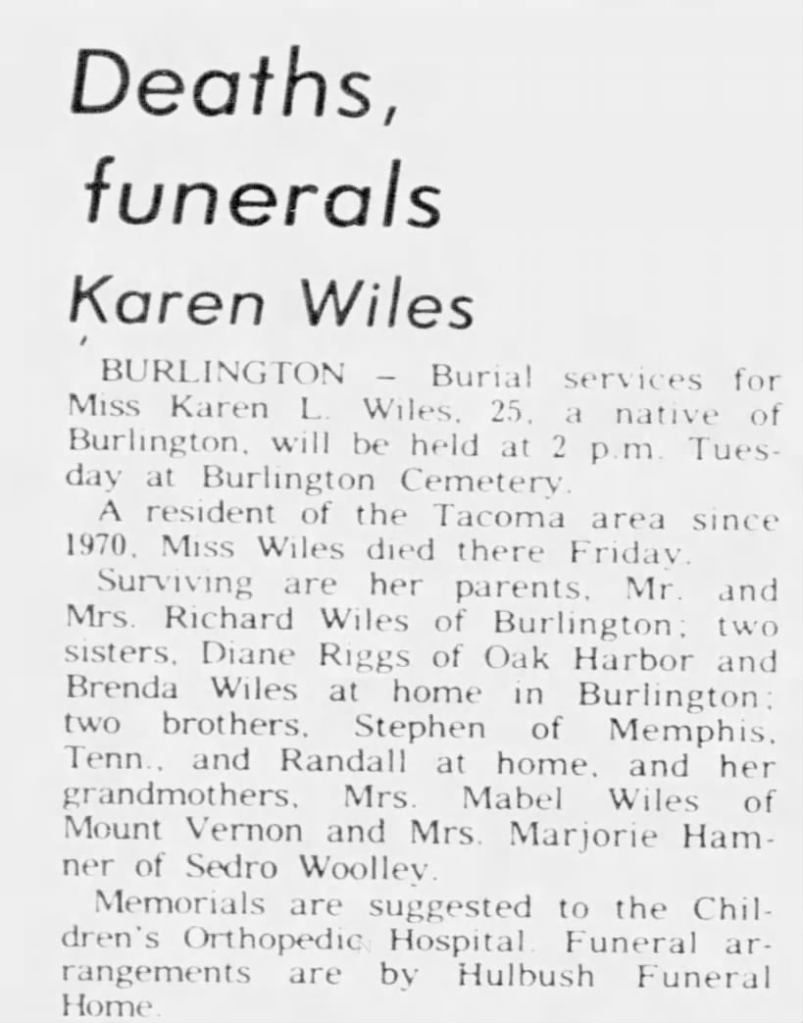
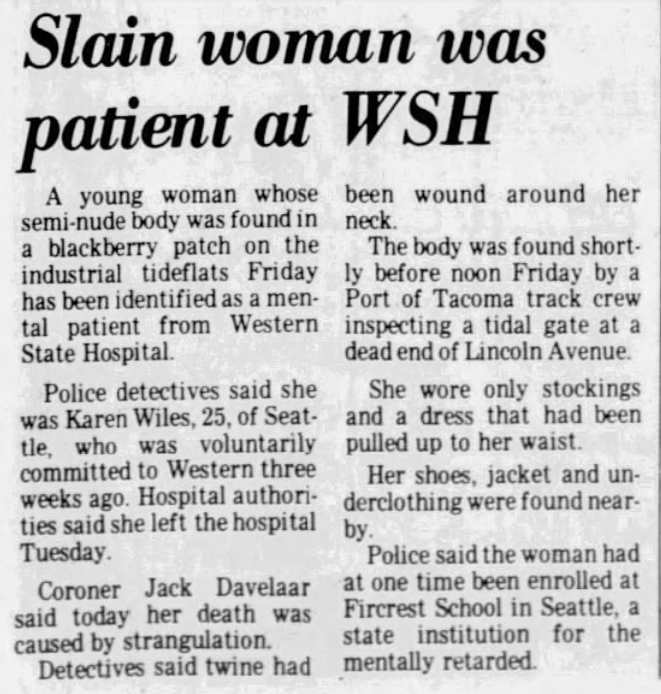
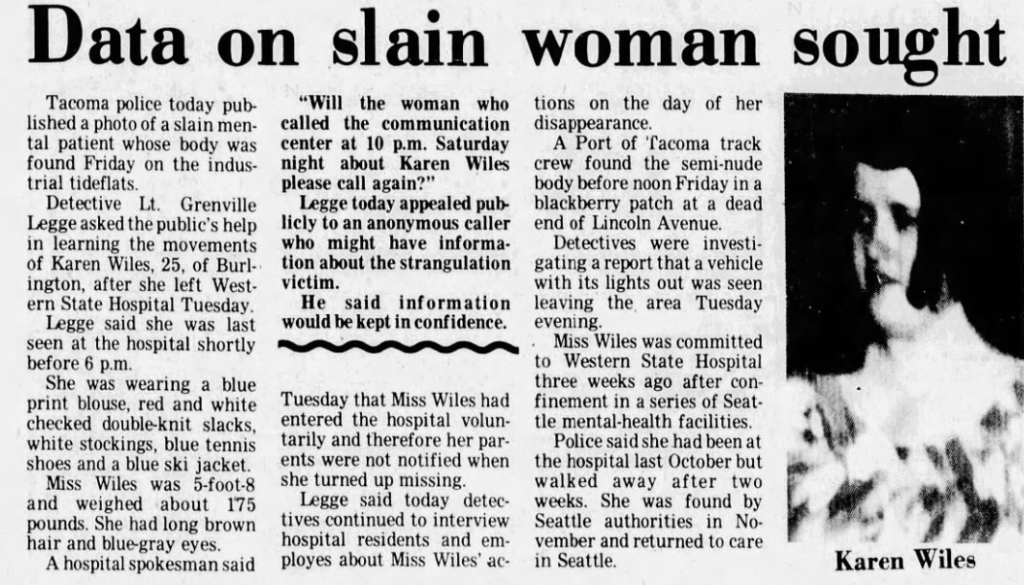
Details about Karen’s life are basically non-existent: the only real ‘fact’ I was able to find about her is that she had some sort of diminished mental capacity and during her adolescence attended/lived at the Fircrest School in Shoreline, WA. Fircrest was a major Residential Habilitation Center for those that suffered from intellectual disabilities and was designed to provide residential care, nursing, and habilitative services for those with ‘unique medical needs;’ it operated under the Washington State Department of Social and Health Services. Sadly, I was only able to find one black and white picture of Karen in an article that was published after her murder, most likely due to the fact that she never attended any sort of formal schooling (for example, Fircrest isn’t on classmates.com). Around three weeks prior to her death, Karen was voluntarily committed to Western State Hospital on February 4, 1975 after she was confined ‘in a series of Seattle mental-health facilities.’ Detectives said she had briefly resided there in October of 1974 but left after only two weeks; she was found by police the following month and was ‘returned to care in Seattle.’
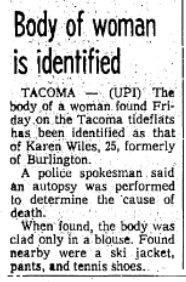
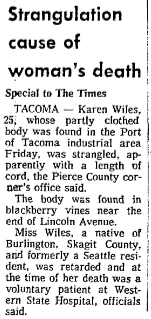
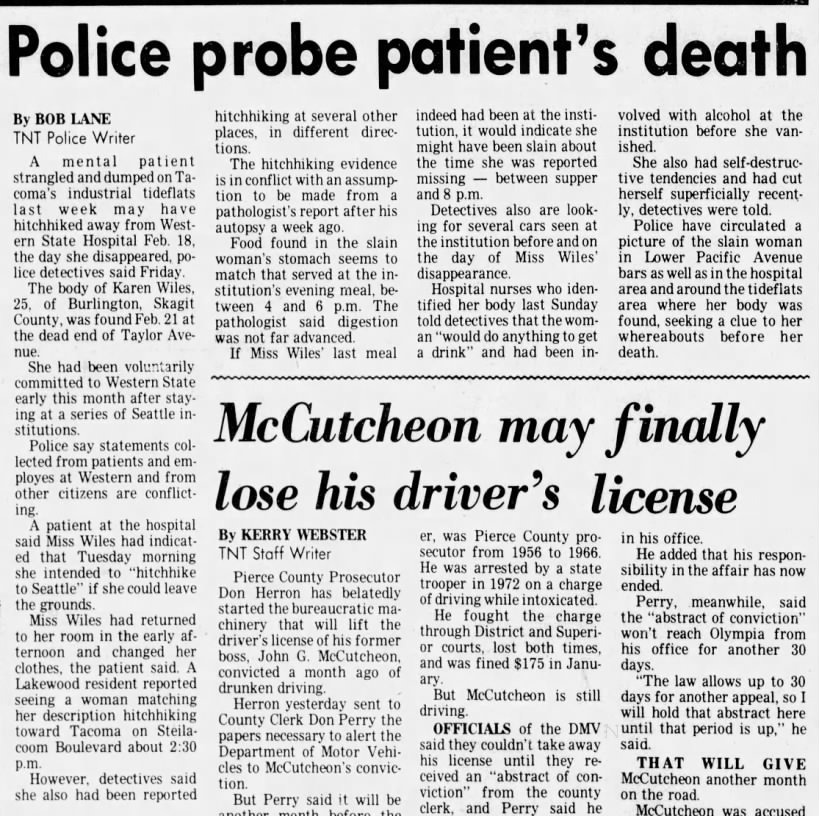
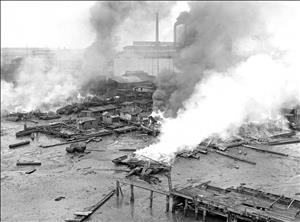
Around noon on February 21, 1975 the semi-nude remains of Karen Wiles were found around eight miles from Western State Hospital in a blackberry patch by a Port of Tacoma employee that had been inspecting a tidal gate at a dead end of Lincoln Avenue (one source said it was Taylor Avenue). It was an area known as the ‘tideflats,’ and during the daytime it was a semi-busy area close to Seattle… but at night, it transformed into a dark, deserted place that was known for attracting unsavory individuals that were typically partaking in some sort of illegal activity (aka: it was the perfect place to dump a body). It was strongly believed by investigators that she’d been murdered somewhere else and dumped at the tideflats.
At the time she had been found, Wiles was only wearing stockings and a dress that had been pulled up to her hips, and she was naked from the waist down; her shoes, jacket, and underclothing were found nearby. According to the Pierce County Coroner Jack Davelaae, her cause of death was strangulation, and detectives said twine had been found wrapped around her neck; she also had noticeable impressions on her wrists, which were an indication that she’d been bound when she was alive. Close to where her remains were found, investigators found a three-foot-long black plastic hose, which is interesting because Warren Leslie Forrest’s first victim said that at one point during her attack her assailant had penetrated with a hose which had been seized as evidence from Warren’s van: it was described as being approximately two inches in diameter and a couple of feet long and was very similar to the one found near Karen’s body (which unfortunately had gotten lost at some point after being brought into evidence).
Just a few weeks prior to her admission to the facility, suspected serial killer Warren Leslie Forrest had been committed after it was determined he had been ‘not guilty by reason of insanity’ after he got caught attacking his Lacamas Lake victim, and on January 31, 1975he was committed to the Western State Mental Hospital in Steilacoom, WA.
Authorities had no other choice than to turn to the public for help in identifying the young victim and turned to the local news: after the story aired some nurses at WSH came through forward and made the positive identification. According to Detective Lieutenant Grenville Legge, the twenty-five-year-old Wiles was last seen at the Western State Penitentiary around 6 PM on Tuesday, February 21. 1975: she had been wearing a blueprint blouse, red and white checkered double-knit slacks, white stockings, blue tennis shoes, and a blue ski jacket. She was 5’8,” weighed around 175 pounds and had long brown hair and blue-grey eyes.
A spokesman for Western State Hospital said that because Wiles had voluntarily entered the facility and was not a minor, they were under no obligation to notify her parents when she left their care. Detective Legge said that in the days that immediately followed her disappearance investigators interviewed hospital employees along with their residents about the activities of Karen on the morning she was last seen; he also said they had ‘briefly’ chased a lead regarding a report of a vehicle with its headlights out that had been seen leaving the area on the evening she was last seen alive (nothing ever came of it).
According to investigators, statements made by Wiles family and other patients at Western State Hospital were ‘conflicting:’one fellow patient said that in the morning on the day she vanished Karen had told her about her intentions of hitchhiking to Seattle, but this was only if she was able to leave the hospitals grounds; also, according to the same patient, she had returned to her room in the ‘early afternoon’ and changed her clothes. Additionally, a resident of Lakewood, WA came forward and told Pierce County Sheriff’s that they saw a woman that matched Wiles description hitchhiking ‘towards Tacoma’ on Steilacoom Boulevard around 2:30 PM on February 21. 1975… however, they also said that they received several additional reports that she was at a few other locations across Washington at the time as well.
These reports that Karen was seen hitchhiking in the middle of the afternoon are in direct conflict with a finding from the pathologist’s report from her autopsy: the food that had been found in her stomach matched the meal that had been served at Western State Hospital that evening, which took place between 4 PM and 6 PM; they also said that the ‘digestion was not far advanced.’ Which means is her last meal had been at the hospital, then she may have been killed sometime between dinner and 8 PM. Investigators were also looking into several vehicles that were seen near the facility on the day of and after she was last seen alive. The RN’s at the hospital that identified Karen’s remains told detectives that she ‘would do anything to get a drink,’ and had gotten caught with alcohol at the facility before she disappeared. They also said she had ‘self-destruction’ tendencies and had recently ‘superficially’ cut herself. Police passed her picture around in the lower Pacific Avenue bars as well as at the hospital and around the tideflats area where her remains were recovered, but they came up empty handed.
These reports that Karen was seen hitchhiking in the middle of the afternoon are in direct conflict with a finding from the pathologist’s report from her autopsy: the food that had been found in her stomach matched the meal that had been served at Western State Hospital that evening, which took place between 4 PM and 6 PM; they also said that the ‘digestion was not far advanced.’ Which means is her last meal had been at the hospital, then she may have been killed sometime between dinner and 8 PM. Investigators were also looking into several vehicles that were seen near the facility on the day of and after she was last seen alive. The RN’s at the hospital that identified Karen’s remains told detectives that she ‘would do anything to get a drink,’ and had gotten caught with alcohol at the facility before she disappeared. They also said she had ‘self-destruction’ tendencies and had recently ‘superficially’ cut herself. Police passed her picture around in the lower Pacific Avenue bars as well as at the hospital and around the tideflats area where her remains were recovered, but they came up empty handed.
According to ‘Stolen Voices of Dole Valley,’ the murder of Karen Wiles has recently been reopened, and for the first time since her death detectives in Tacoma questioned Warren Leslie Forrest about her death (however all their attempts were unsuccessful, as he refused to answer their questions). The use of a ligature to strangle the victim along with the sexual assault was consistent with Forrest’s MO, and it’s been reported that he worked with Karen in the hospitals kitchen; despite some restrictions (he wasn’t supposed to leave the facilities grounds the first few weeks he was there), he was still somehow able to leave the hospital and he did have access to his vehicle (I also saw he had access to the facilities van).Also, interestingly enough, Warren Forrest’s then wife Sharon claimed he was having an extramarital affair with one of the members of the staff at Western State Hospital, a fact that one of his ‘good friends’ verified when they were interviewed by detectives (he said that her name was Nancy). This is interesting to me, because in 1984 he married one of the nurses at the prison he was incarcerated in (Walla Walla State Penitentiary).
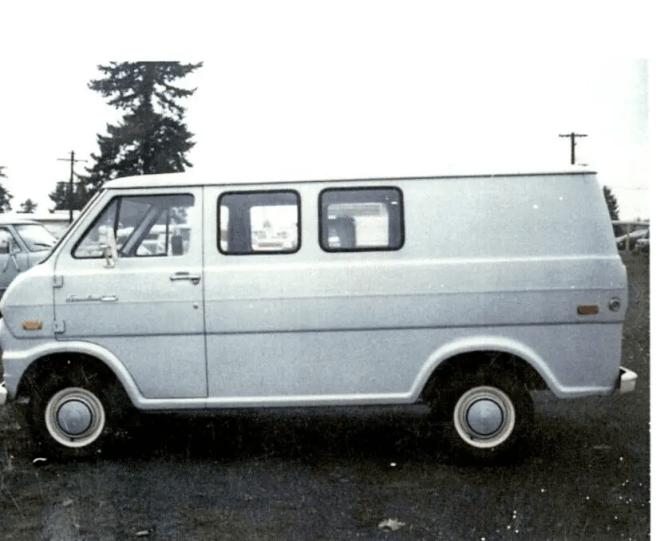
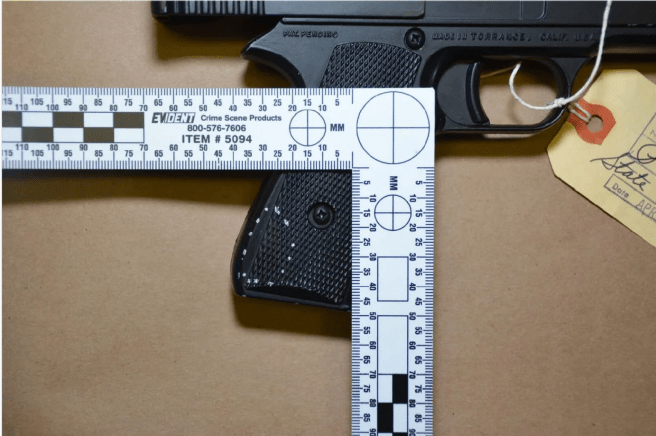
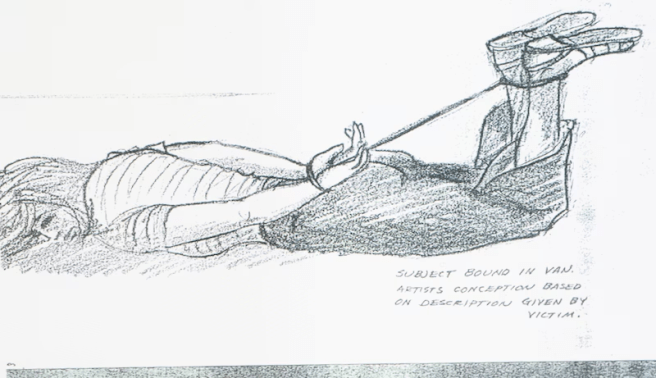
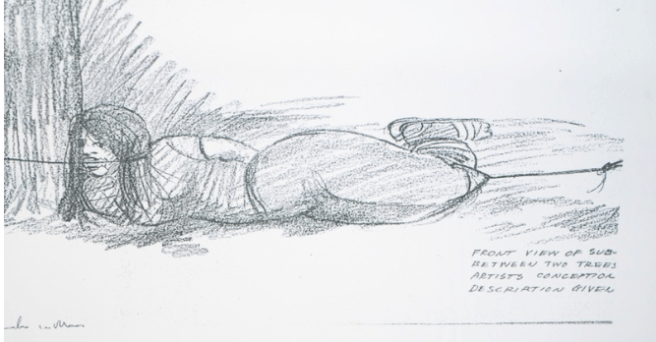
Because of not wanting to write about the same things repeatedly, I’m not going to go over the more commonly discussed victims of Warren Leslie Forrest, only because I have written about them all in the last two articles about him. The use of a ligature to strangle the victim along with the sexual assault was consistent with Forrest’s MO, which targeted young girls and women in the Clark County area of Washington state in the early to middle 1970’s (often those who were hitchhiking or walking alone). He frequently used a blue 1973 Ford Econoline van in his attacks, and in one of his cases where the victim survived, she said that he used a knife to threaten her then he forced her into the back of his vehicle. During abductions, he questioned victims about their age, relationships, and sexual history to assess them according to his own notions of morality. WLF’s preferred torture tool (which was a unique signature in relation to his MO) was an air-powered dart pistol, and he shot his victims with darts as a form of torture before eventually abandoning and/or killing them. He often left the women in remote, heavily wooded areas such as Dole Valley, Lacamas Lake, or Tukes Mountain in a state park (which makes sense, as he worked for the parks department) and they were typically bound with rope or baling twine, and were frequently tied between trees. Forrest’s primary methods of murder were strangulation and stabbing, with wounds that were typically consistent with the use of an ice pick or darts.
Investigators involved in Karen’s case said that in relation to Warren Leslie Forrest, although circumstantial evidence aligns in the case, it lacks physical proof: Tacoma Detective Sergeant Julie Deer said: ‘there are similarities that one can’t ignore… but we have to have evidence.’ According to current members of the Pierce County Sheriff’s Department, the staff at the Western State Hospital didn’t cooperate with the original detectives from the Tacoma Police Department back in 1975, which was detrimental when it came to the investigation. During his interview with Carolyn Osorio, retired Pierce County Police Chief WW Parrott made it clear that investigators were extremely suspicious about the goings on at Western State Hospital in the 1970’s, and the murder investigation hit a wall in 1978 partially due to ‘uncooperative staff, and: ‘investigators were extremely suspicious’ and had been ‘stymied by the staff at Western at every turn.’ Because Wiles was ‘a marginalized woman’ without close family advocates, investigators said her murder sadly became an afterthought, and her case quickly fell to the wayside.
According to the Pierce County Sheriff’s Department, some of the evidence related to Wiles case was either ‘mishandled or lost,’ and crucial biological evidence that could have belonged to the suspect (such as swabs and pantyhose) was lost. Before Tacoma PD Detective Lindsey Wade retired in 2018, she submitted some of Weil’s clothing to a lab in Washington state for DNA testing, along with the twine that had been recovered from around her neck; the results came back as ‘inconclusive,’ meaning no DNA from the suspect had been identified.
According to Chief Parrott, ‘the majority of my investigation into this homicide was conducted in and about the grounds of Western State Hospital. And I don’t feel I have to capitalize on you the difficulty that one is confronted with when attempting to conduct major investigations at this institution. It’s been my feeling from the mere outset of my investigation into this homicide that the suspects responsible for the demise of Karen Wiles were somehow connected to the hospital in one capacity or another. However, I have yet to be successful in attaching suspicions to any one person.’
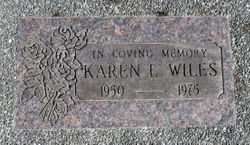
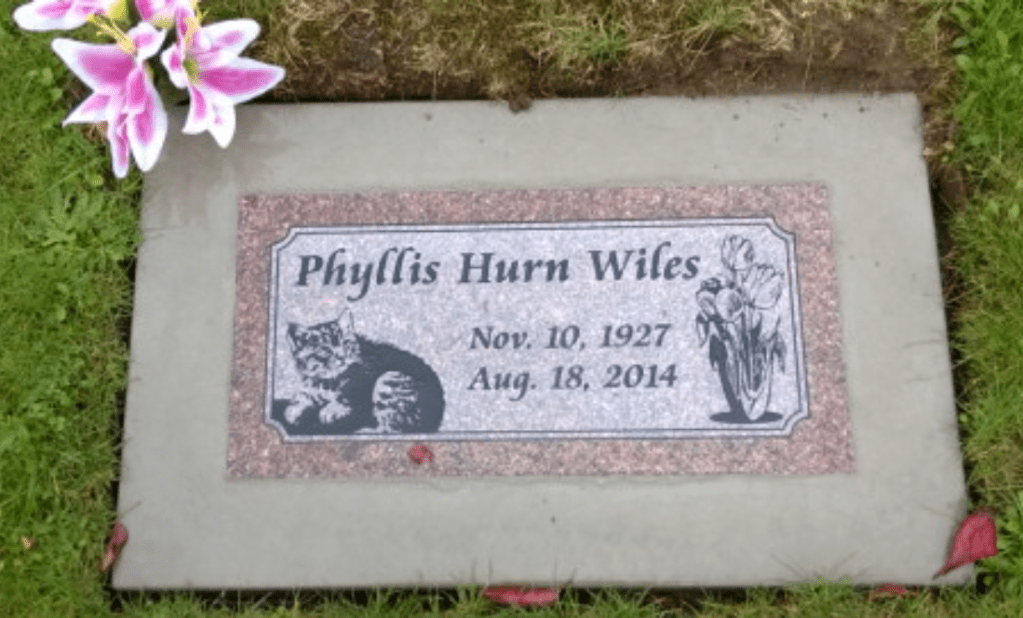
Richard Frederick Wiles died at the age of eighty on December 5, 2003 in Burlington, Washington. Karen’s mother Phyllis Irene Wiles passed away at the age of eighty-six on August 18, 2014 at home with her family by her bedside; the mother of five enjoyed crocheting ‘beautiful doilies,’ and loved to bake apple pie (her family’s favorite dessert) for every occasion; cinnamon rolls and pineapple upside down cake were also a specialty of hers. According to her obituary, Phyllis loved animals, country music, movies, and the beautiful flowers that her son was always bringing to her, and she never left home without her earrings on and always wore a heartfelt smile.
Karen’s sister Dianne died at the age of seventy-three on November 29, 2025 at Riverside Village, and according to her obituary, after high school she relocated to Oregon and was a co-owner of ‘His and Her’s Locksmith’ in South Bend for twenty years. Upon retiring Dianne returned to Washington to take care of her mother, and she adored being a mom and grandmother; she also loved to cook and was an avid reader, and had an extensive library of books (she especially was fond of cookbooks).
Both of Karen’s brothers are still alive: after college Stephen relocated to Collierville, Tennessee, and Randy Wiles stayed in Burlington, WA. Her sister Brenda Wiles-Harley is currently residing in Mount Vernon, WA.
Works Cited: Carolyn Osorio. (September 9, 2025). Stolen Voices of Dole Valley, Episode 5: The Good-Looking Stranger. Taken February 12, 2026 from https://pod.wave.co/
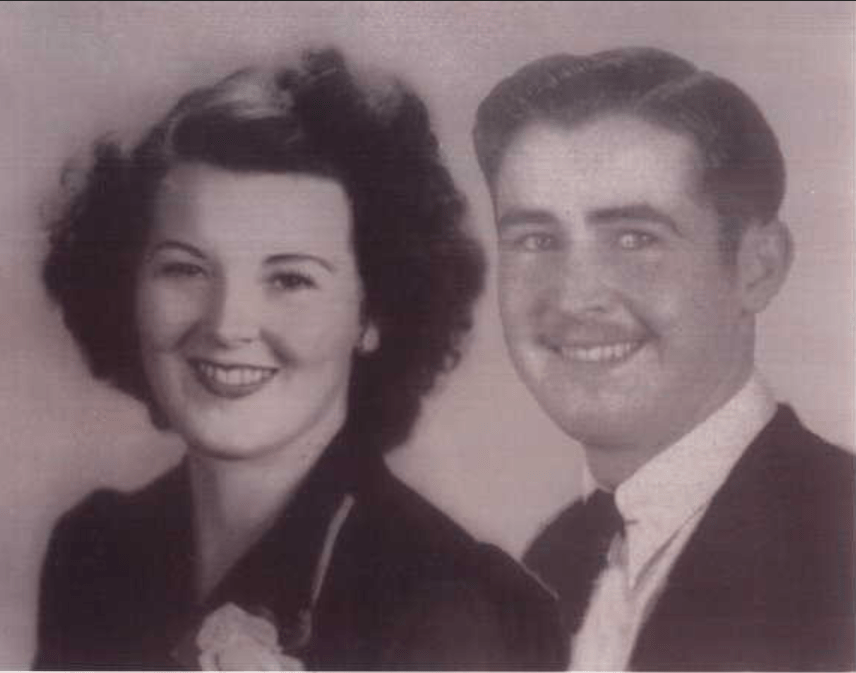
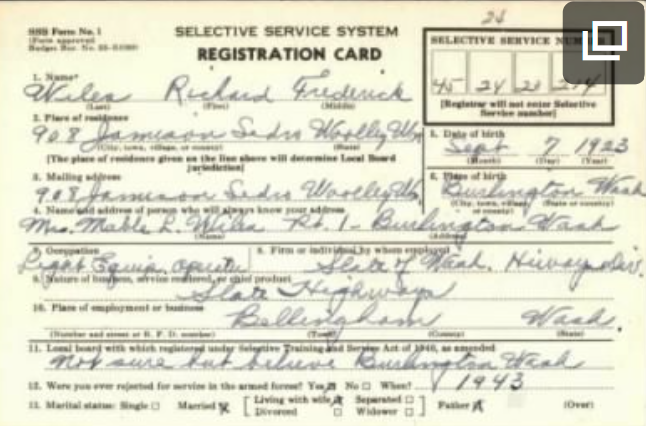
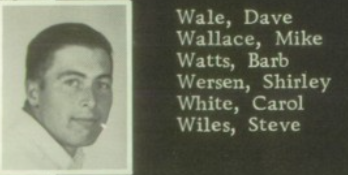
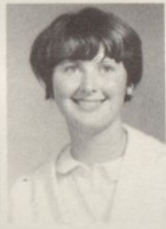
Karen Wiles.The Wile’s family from the 1950 US census.A newspaper clipping about the identification of Karen Wiles that was published on The Seattle Times Page on February 24, 1975.The Obituary for Karen Wiles published in The Bellingham Herald on February 24, 1975.An article about the murder of Karen Wiles published in The News Tribune on February 24, 1975.An article about the murder of Karen Wiles published in The News Tribune on February 25, 1975.An article about the murder of Karen Wiles published in The Seattle Times on February 27, 1975.An article about the murder of Karen Wiles published in The News Tribune on March 1, 1975.The death certificate of Karen Louise Wiles.Karen Wile’s grave site.Some residential buildings in the Hollywood on the tideflats community from 1938. Photo by Richards Studio, courtesy of the Tacoma Public Library.In the spring of 1942, under the direction of the Coast Guard the Tacoma Fire Department burned most of the houses in the tideflats. Photo taken by Richards Studio on May 20, 1942, courtesy of the Tacoma Public Library.An article about an illness Richard Wiles suffered from as a young child that was published in The Bellingham Herald on November 24, 1928.Richard and Phyllis’s High School graduation pictures photoshopped together: Phyllis Hurn graduated from Sedro Woolley High School and Richard graduated from Burlington High School.Mr. Wile’s WWII draft card.Richard Wile’s draft card from the Korean War.The affidavit for a marriage license for Richard Wiles and Phyllis Hurn dated April 6, 1946.Richard and Phyllis Wile’s marriage certificate dated April 10, 1946.Richard Wiles and Phyllis Hurn listed in the Marriage Register from Skagit county in 1946.Steve Wiles from the Burlington-Edison High School yearbook.Dianne Wiles from the 1967 Burlington-Edison High School yearbook.Another article mentioning Karen’s brother Stephen serving in the US Navy that was published in The Bellingham Herald on February 4, 1970.An article mentioning Karen’s brother Steve serving in the US Navy that was published in The Bellingham Herald on August 10, 1970.Randall Wiles senior picture from the 1974 Burlington-Edison High School yearbook.An article mentioning Karen’s sister Dianne’s in relation to her husband serving in the US Navy that was published in The Bellingham Herald on February 19, 1980.Brenda Wiles from the 1981 Burlington-Edison High School yearbook.Phyllis Wiles.Karen’s parents.Richard and Phyllis Wiles.Phyllis Wiles Grave site.Karen’s sister, Dianne.A word of condolence I found on Karen’s mother’s obituary page.
Preface: I don’t normally have to do this, as I don’t normally write about people that are still alive, but every member of Warren Leslie Forrest’s nuclear family is not only still with us, but (most of them) are going by their original surname. Because of this, I do feel the need to say that finding the information I did was just a quick Google search away, and it took me all of about three minutes to find most of it… I didn’t hire anyone to track them down or figure out their identities: it was all right there.
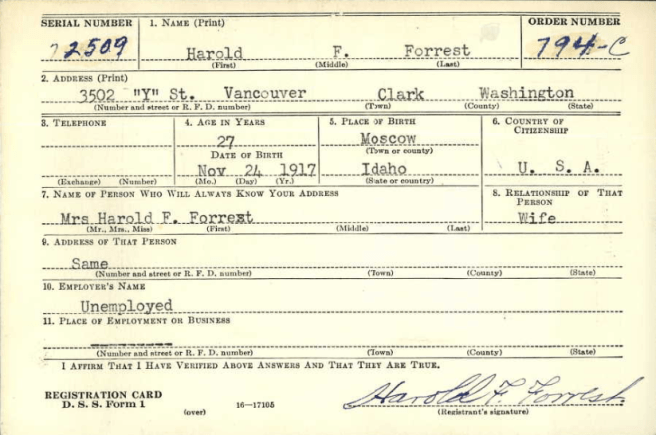
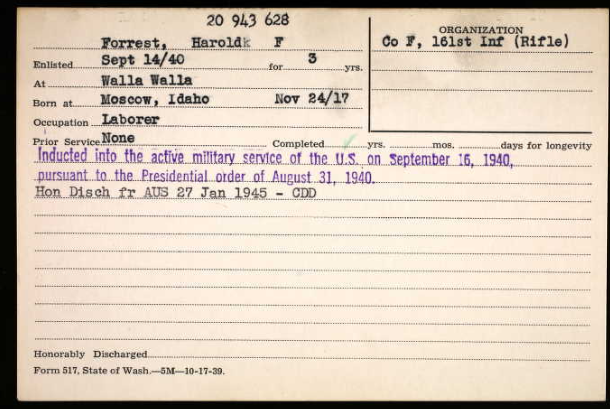
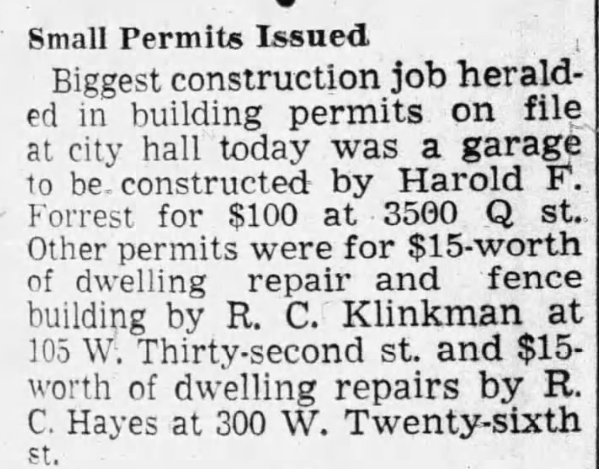
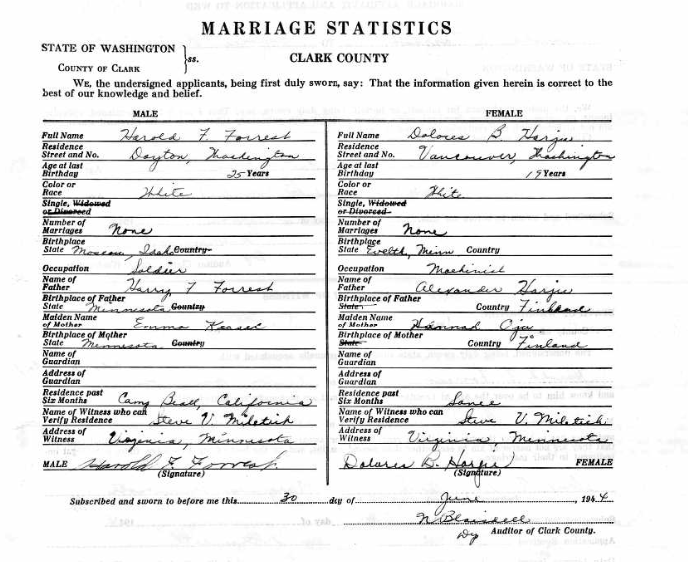
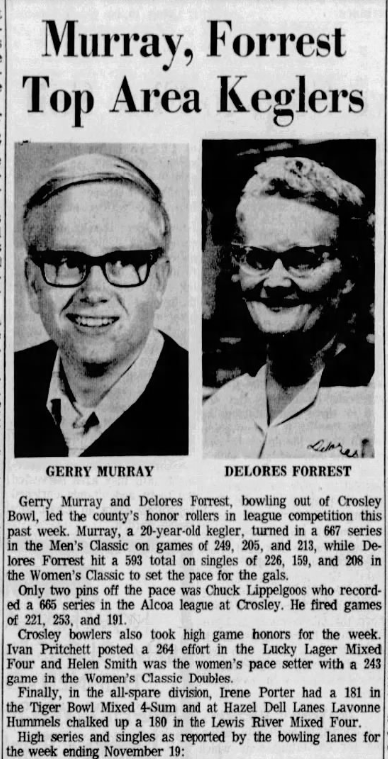
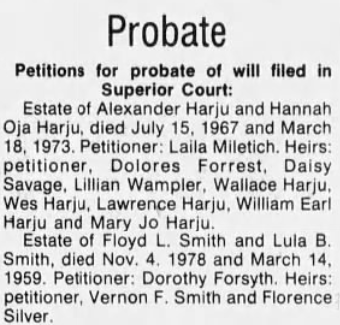
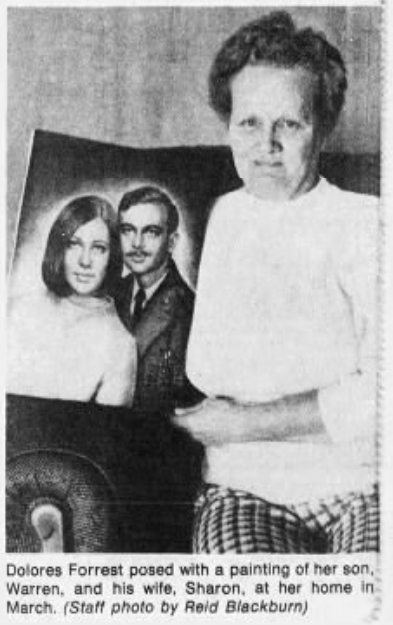
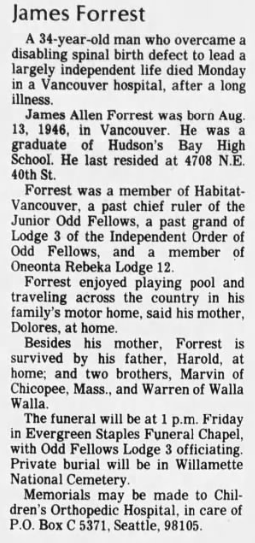
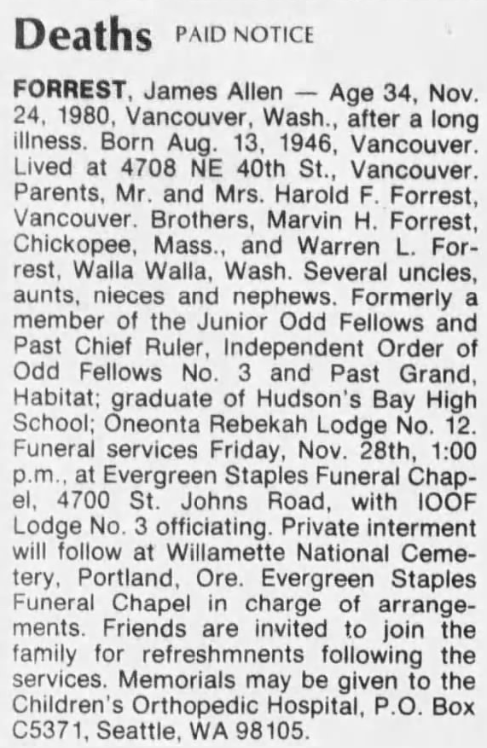
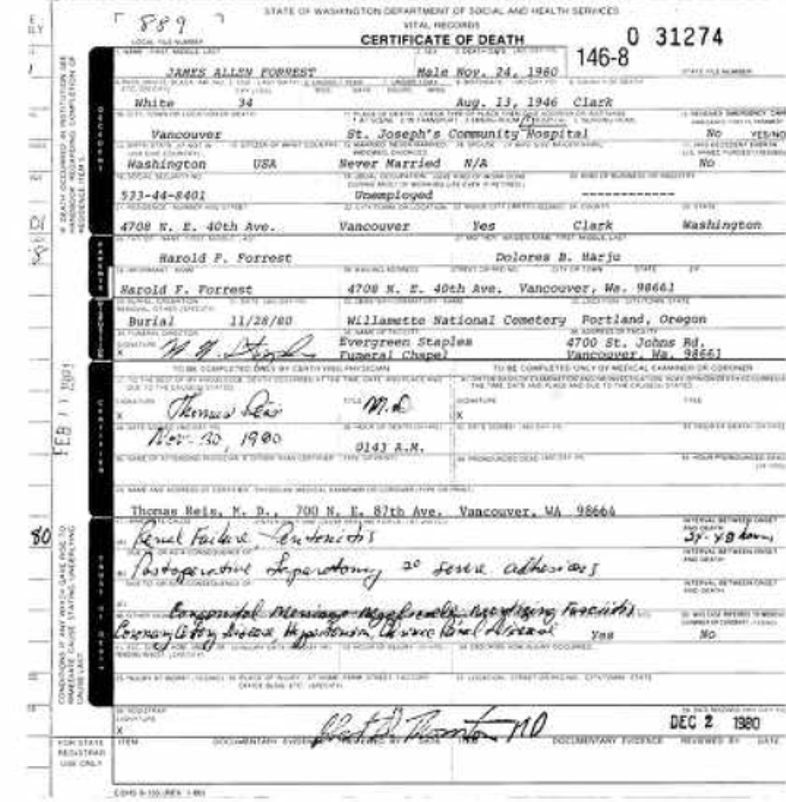
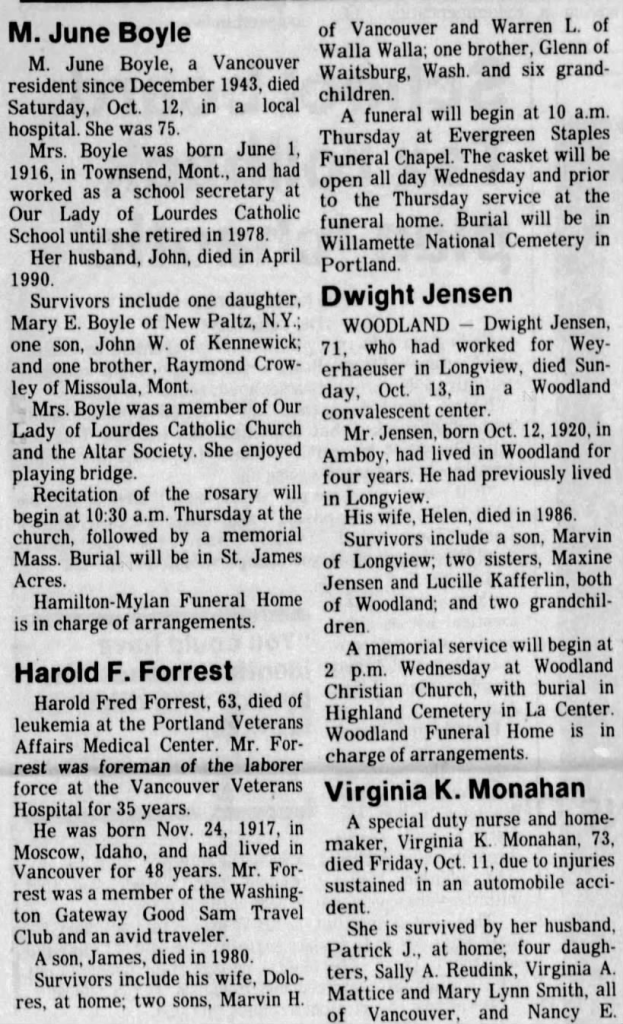
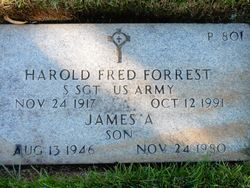
Introduction:Warren Leslie Forrest was born on June 29, 1949 to Harold and Dolores Forrest in Vancouver, WA. Harold Fred Forrest was born on November 24, 1917 in Moscow, Idaho and Dolores Beatrice Harju was born on June 20, 1925 in Eveleth, Minnesota. At the age of twenty-seven on September 16, 1940, Harold was inducted into active military service with the US Army in pursuant to the Presidential order of August 31, 1940 (also known as the Burke-Wadsworth Act), which required all men between twenty-one and thirty-six years of age to register with their local draft boards (when the US entered World War II, all men from eighteen to forty-five were subject to military service, and all males from eighteen to sixty-five were required to register with their local draft boards).
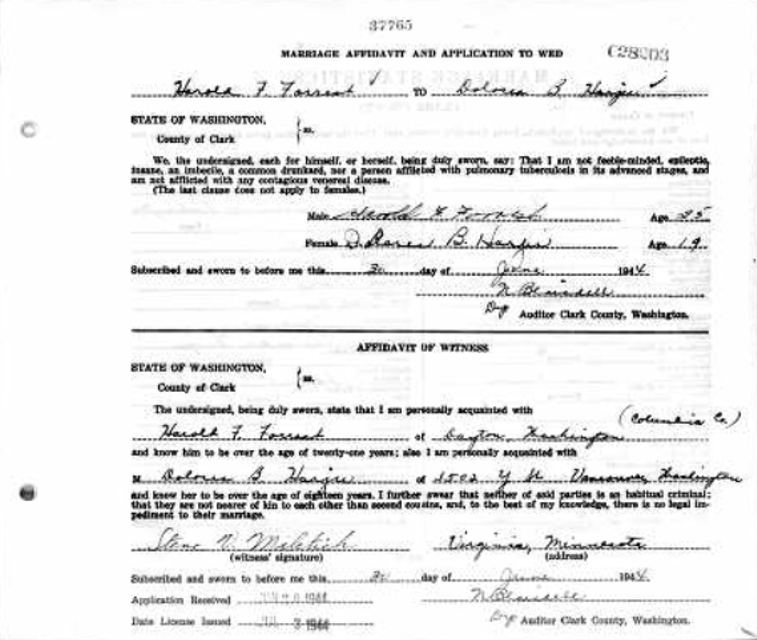
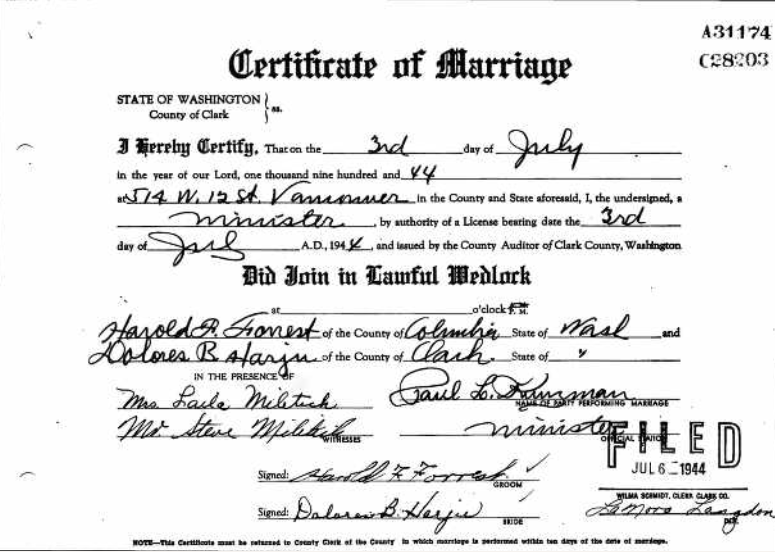
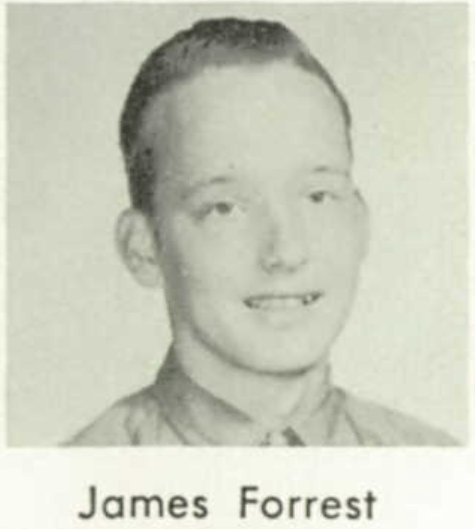
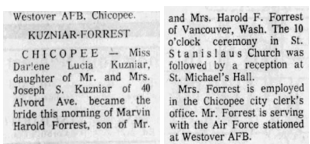
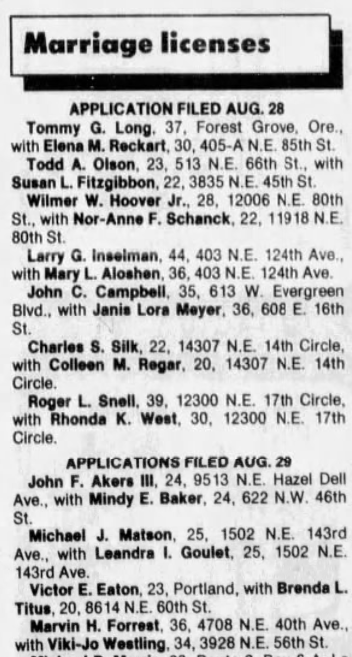
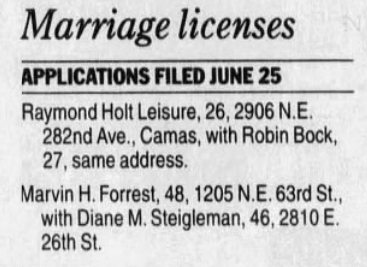
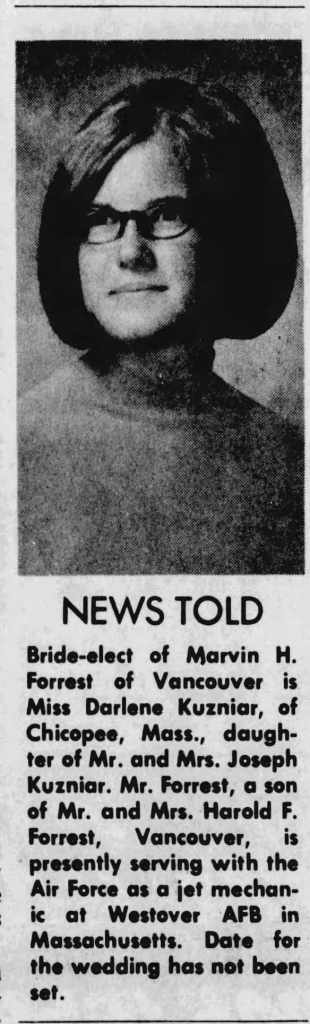
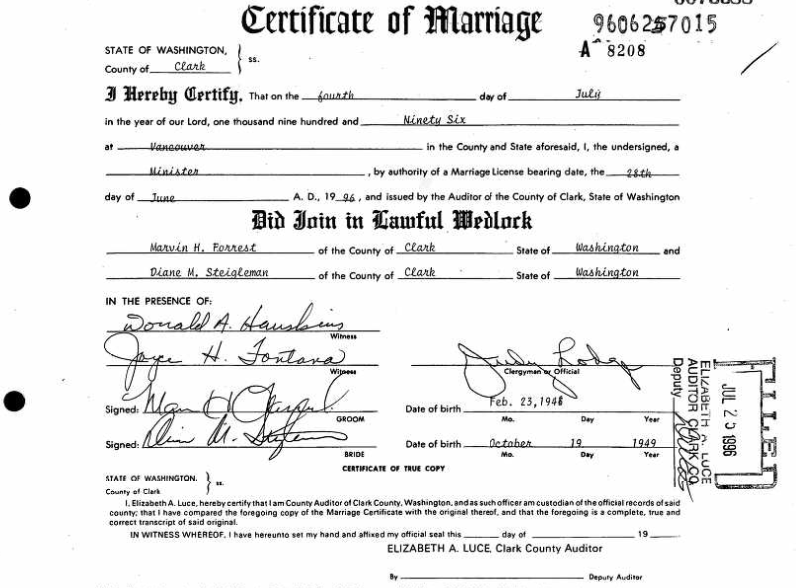
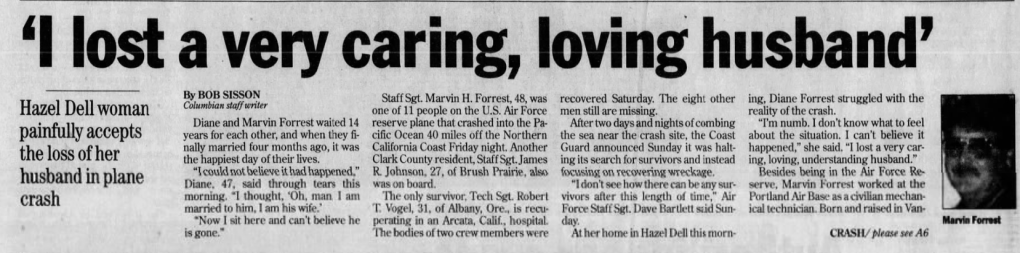
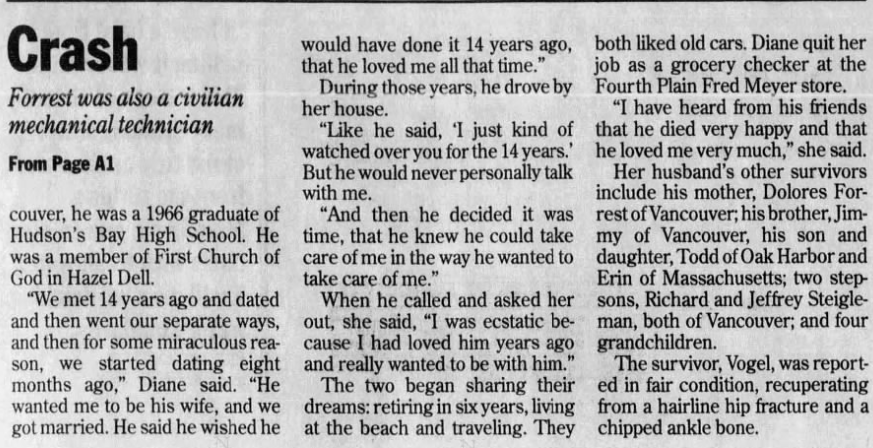
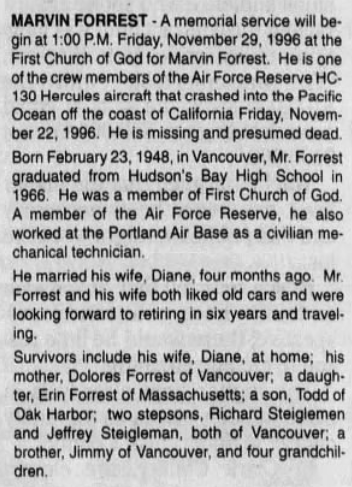
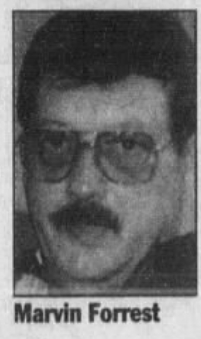
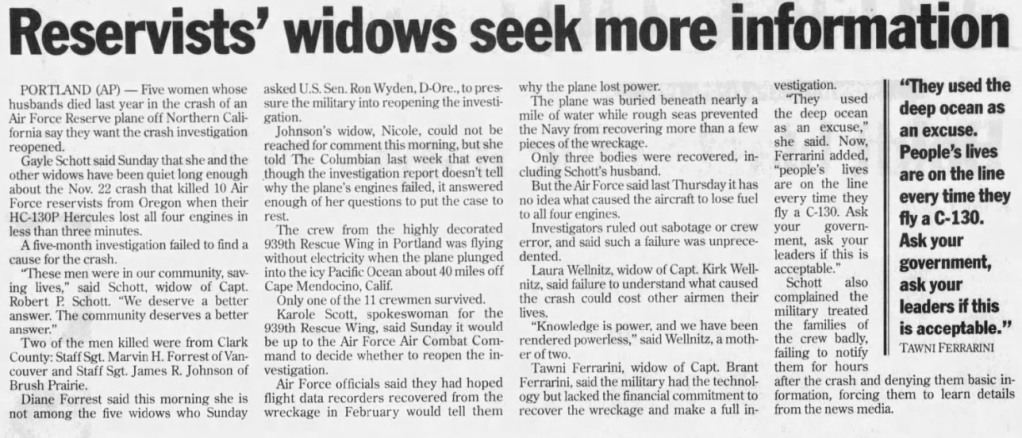
Mr. Forrest and Dolores were wed on July 3, 1944 in Vancouver, and he was honorably discharged from the military on January 27, 1945; they went on to have three boys together: James (b. 1946), Marvin (b. 1948), and their youngest, Warren. Growing up, his father worked at the Veterans Administration during the day and at night he was employed at a cold storage plant; his mother was employed at a cannery then later in retail. During an interview with a psychiatrist (after his arrest), Warren described his father as ‘stern’ and his mother as ‘overbearing and controlling,’ and claimed that she used to tease him about a piece of wood she used referred to as ‘one of his good friends’ (it was a 4×4 post that he talked to when he was a small child).
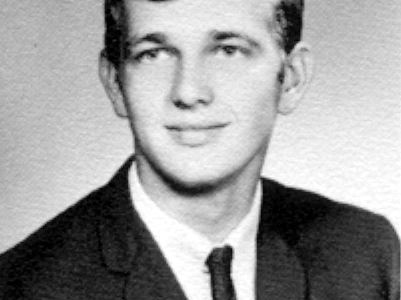
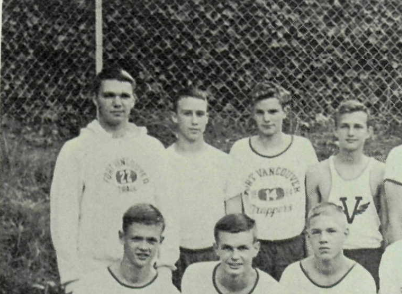
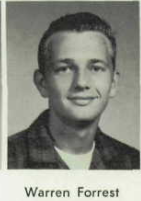
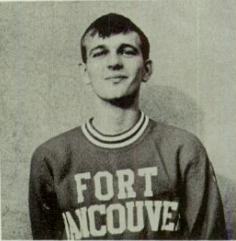
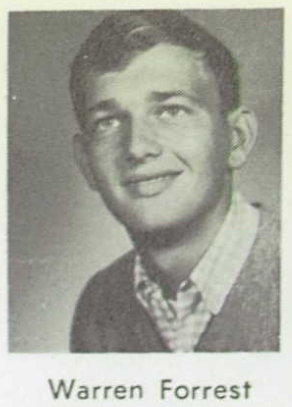
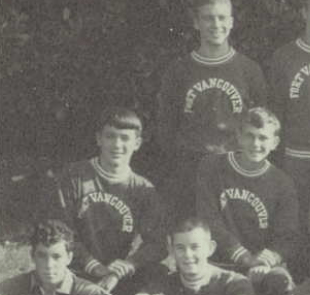
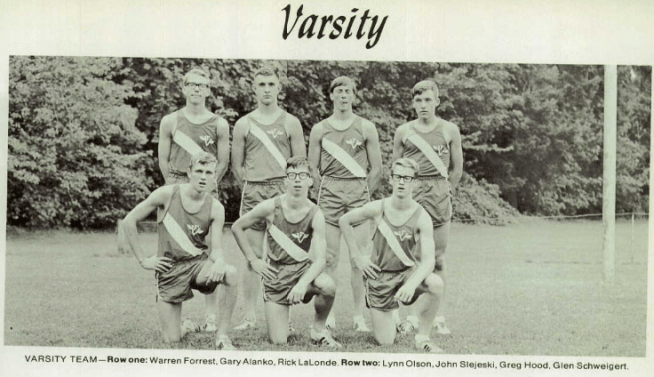
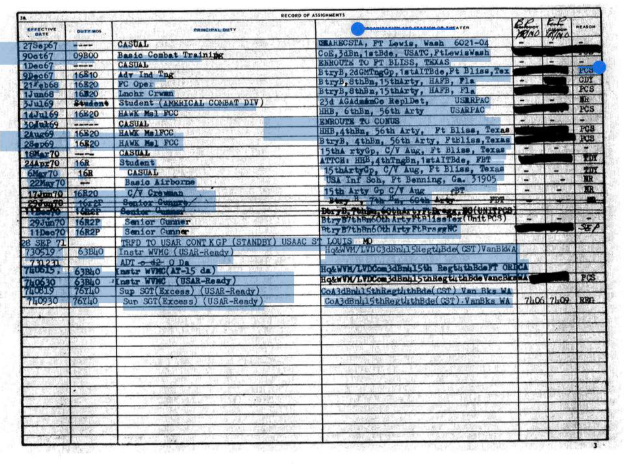
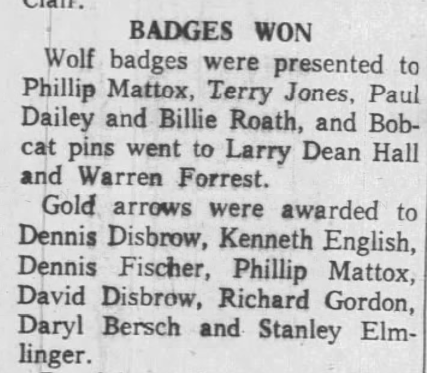
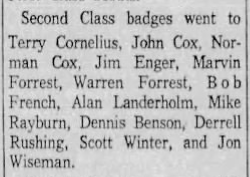
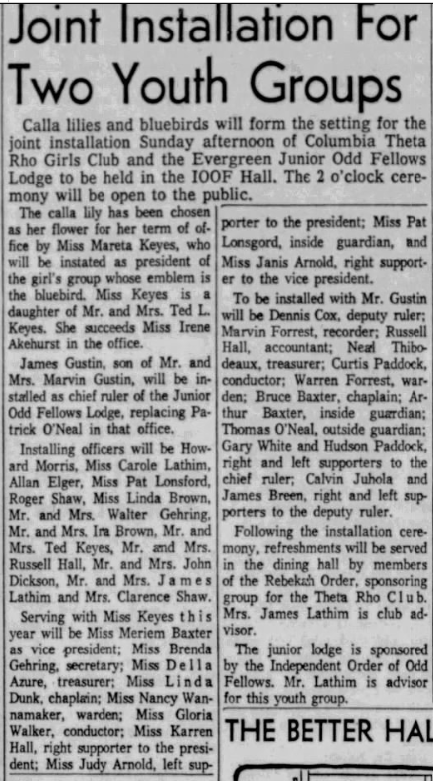
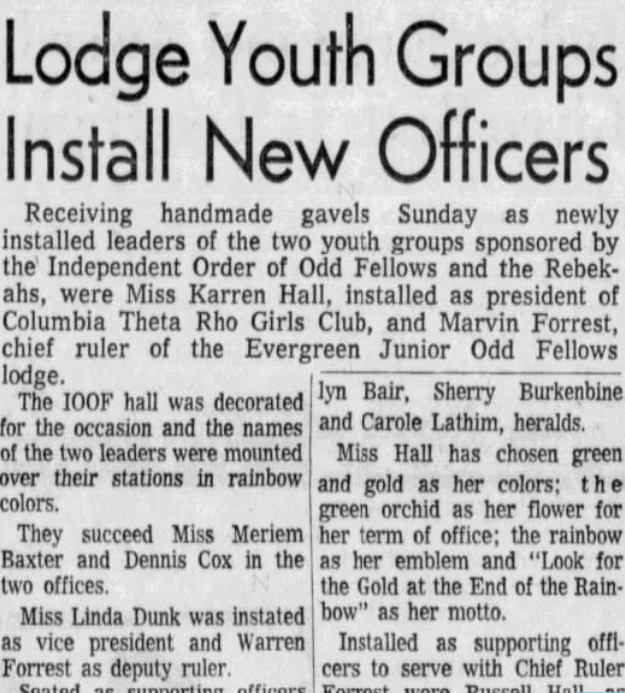
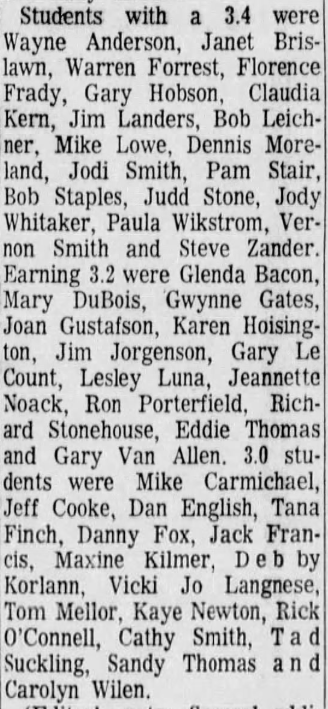
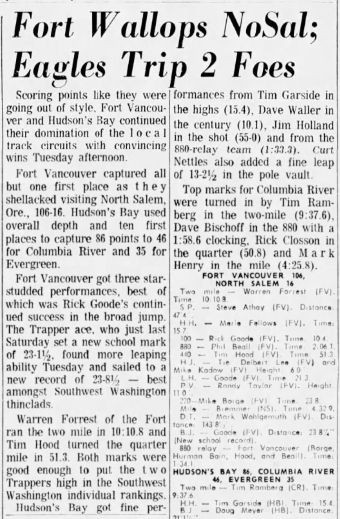
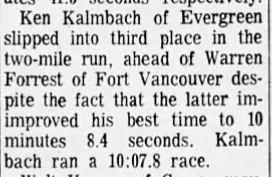
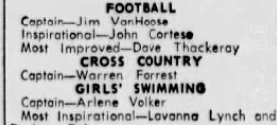
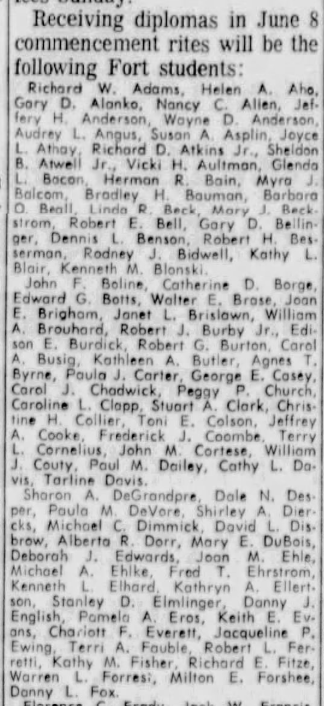
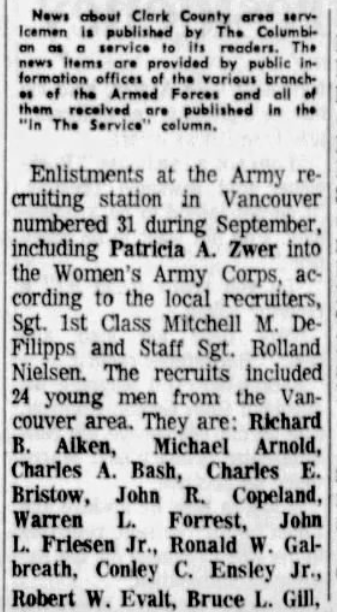
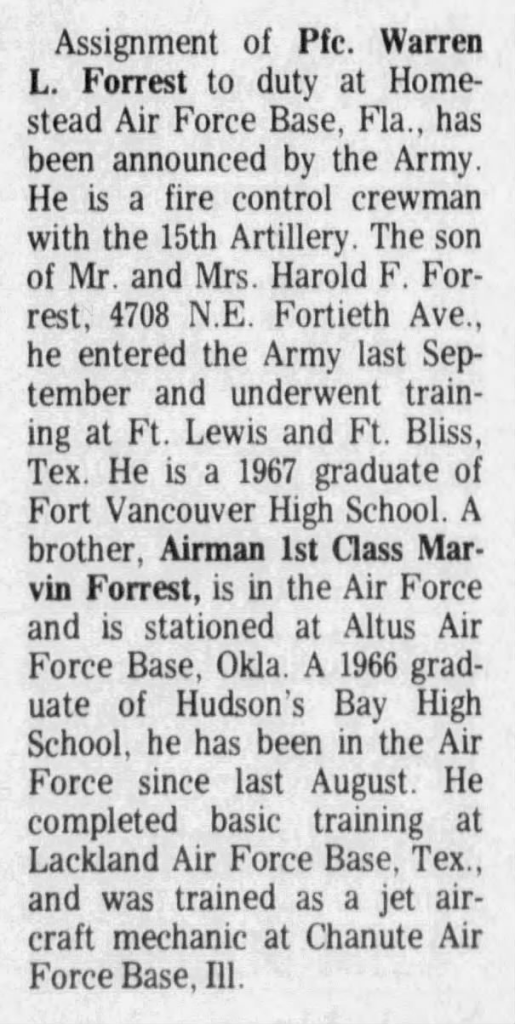
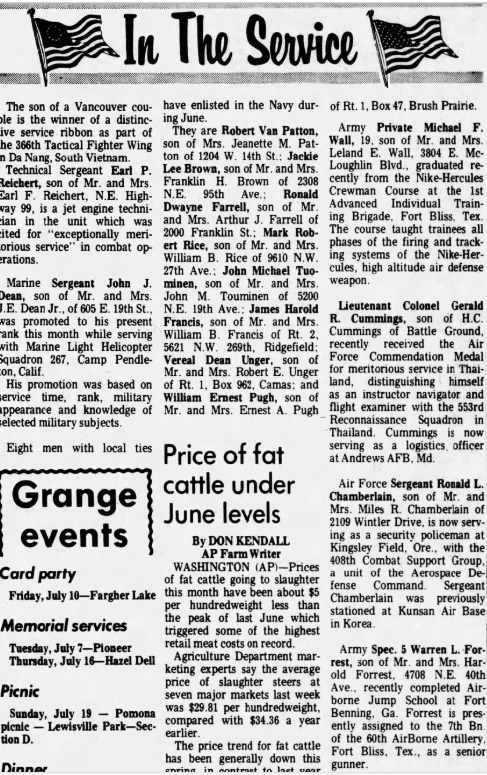
Background: As a child, Warren Forrest was a dedicated boy scout and worked his way all the way up to Eagle Scout. When he attended Fort Vancouver High School in the mid-1960’s he excelled at academics and was an exceptional athlete (even though he claimed he was a slow learner and had difficulty with spelling, reading, and writing): he played baseball, ran cross-country, and earned his role as the captain of the track and field team and was offered a track scholarship at Washington State University (he turned it down). Forrest later told one of his psychiatrists that he joined the military after high school because he didn’t think he was smart enough to do well in college, and in October 1967 he enlisted in the US Army (along with his brother, Marvin), and served as a missile crew service gunner and fire control crewman for the 15th Field Artillery Regiment in Homestead, Florida, reaching the rank of Specialist 5; later on when he relocated to Fort Bliss, TX he served in the 7th Battalion of the 60th Airborne Artillery, where he was a ‘senior gunner.’
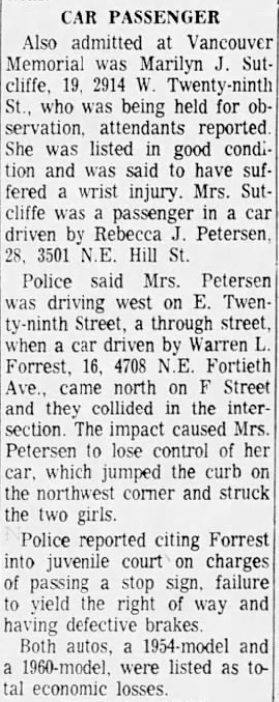
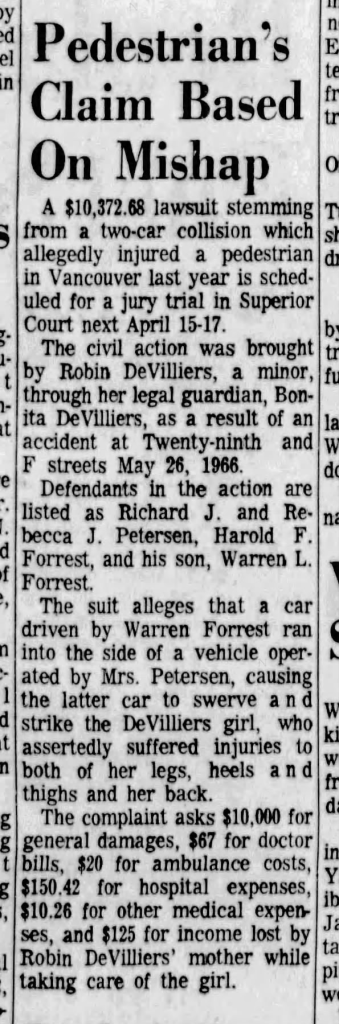
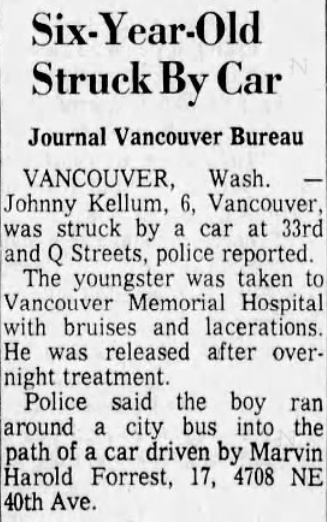
It appears for the most part that the Forrest brothers all had completely normal childhoods, aside from one glaring thing: two of the three boys hit people with their cars when they were teenagers. On January 16, 1966 a six-year-old ran around a city bus and directly into the path of Marvin Forrest. The child was taken to Vancouver Memorial Hospital and thankfully only suffered some minor bruising and lacerations. Later that same year on May 26th Rebecca Peterson was driving a car with her friend Marilyn Sutcliffe when they were hit by a vehicle driven by a then sixteen-year-old Warren L. Forrest. The impact of the collision caused Peterson (who had been pregnant at the time) to lose control of her vehicle, which subsequently jumped the curb and struck two young female pedestrians. The accident resulted in both vehicles being deemed ‘total economic losses,’ and afterwards Forrest was brought up on charges in juvenile court for passing a stop sign, failure to yield the right of way, and for having defective breaks.In September of the following year, he was taken to court by one of the two girls he hit, named Robin DeVilliers, who had suffered injuries to both of her legs, heels, thighs and back as a result of the accident. I was unable to find the ‘official’ resolution of the court case, but Forrest’s parents hired an attorney for their son, who advised him to enlist in the Army, and that it would ‘be in his best interest’ if he left town, and ‘the sooner the better.’
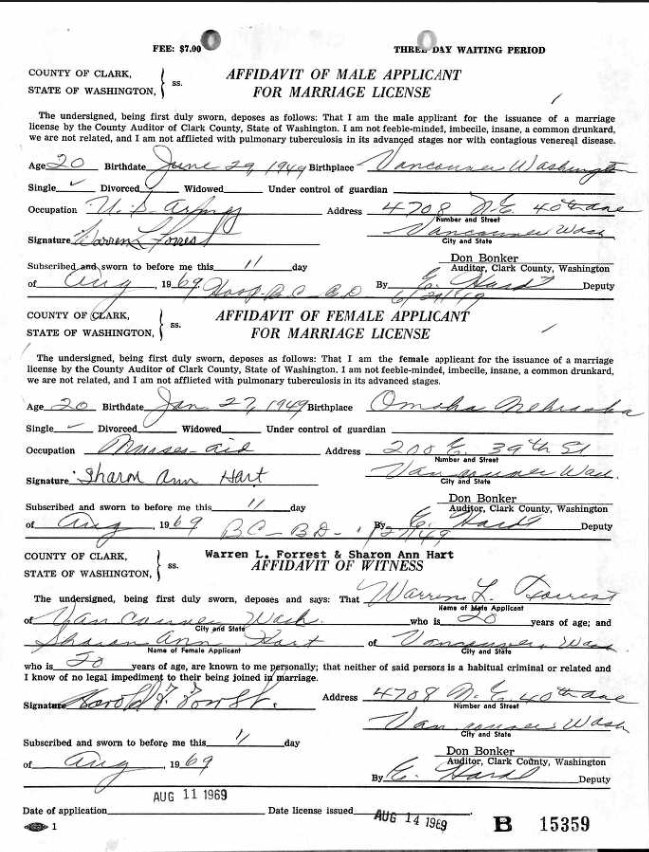
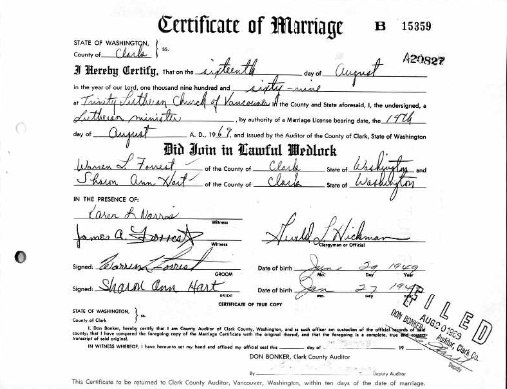
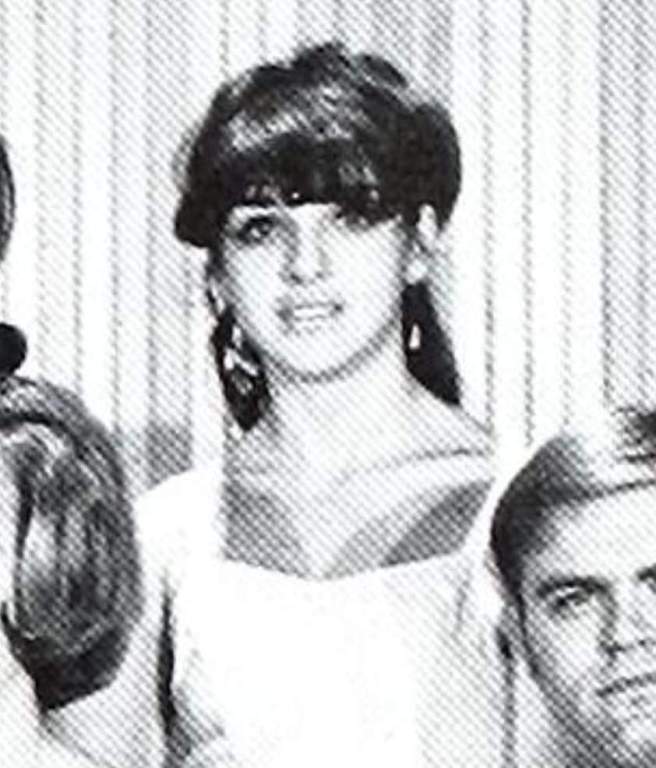
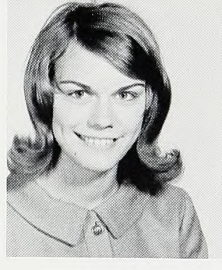
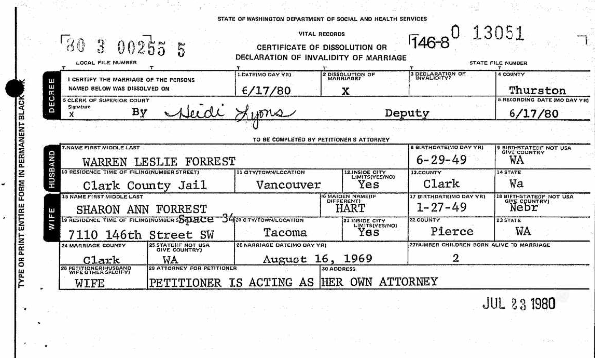
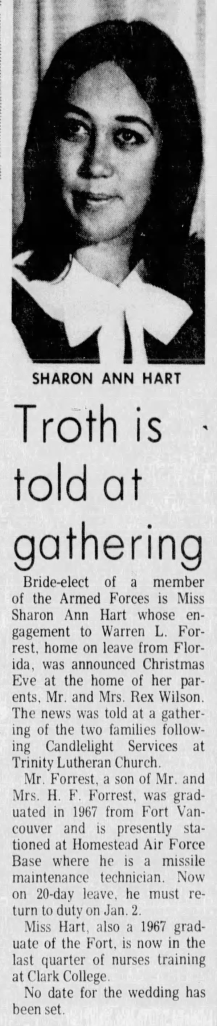
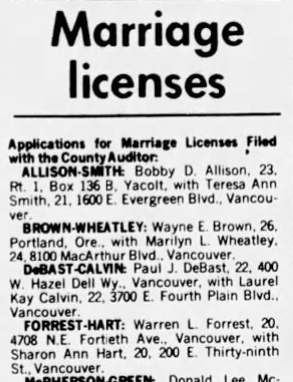
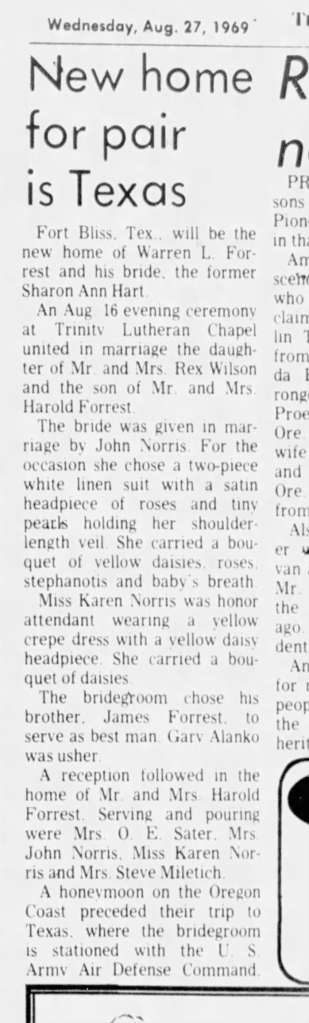
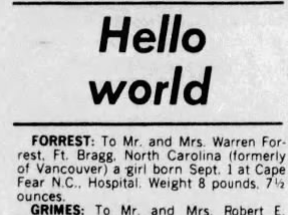
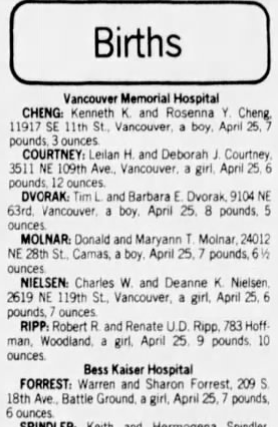
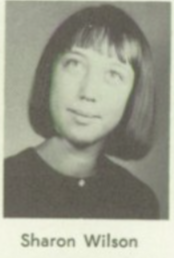
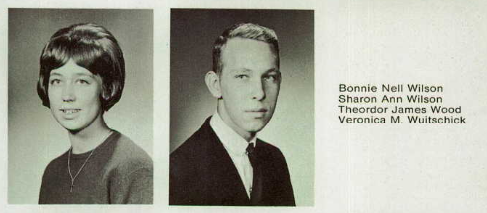
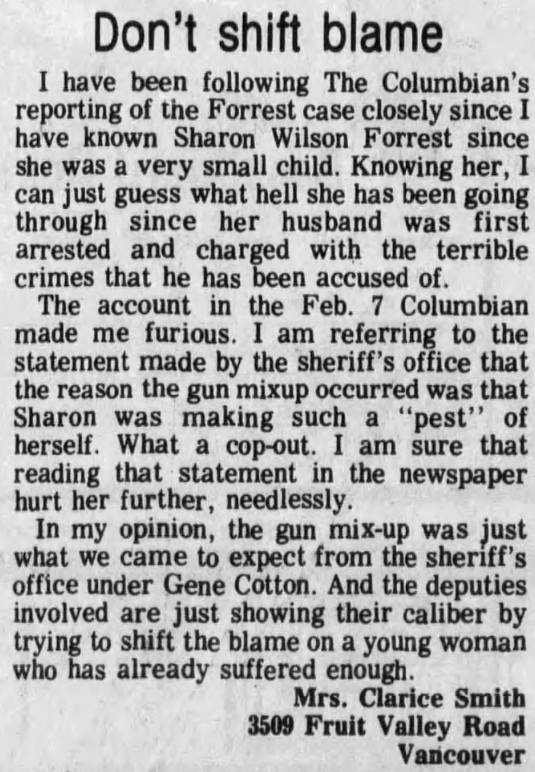
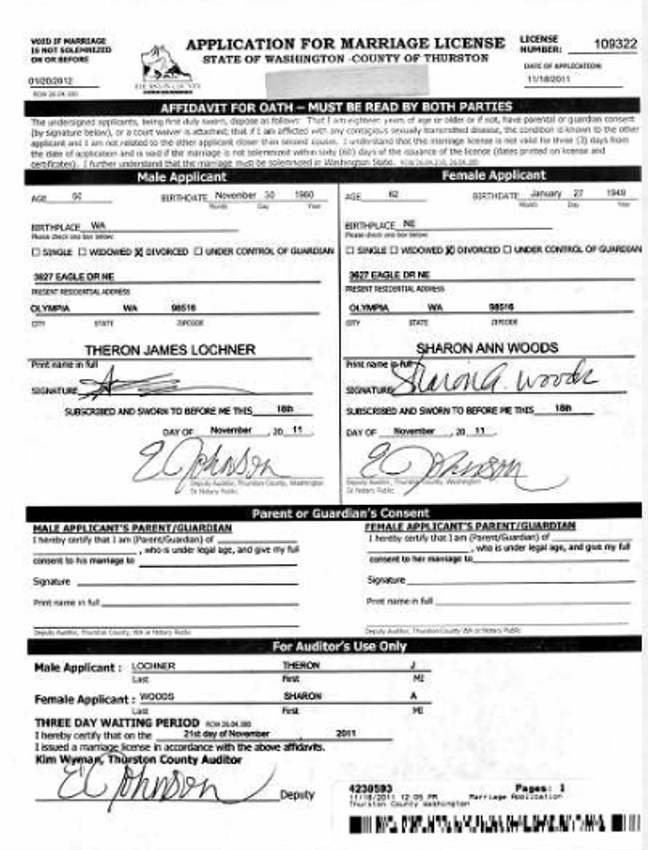
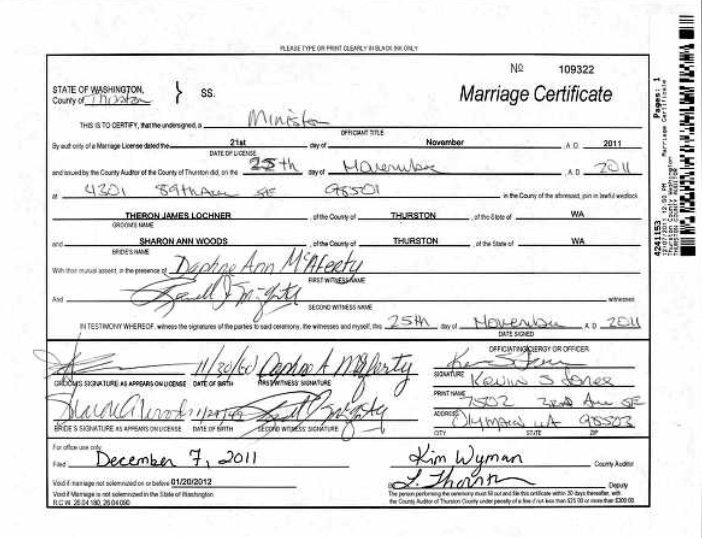
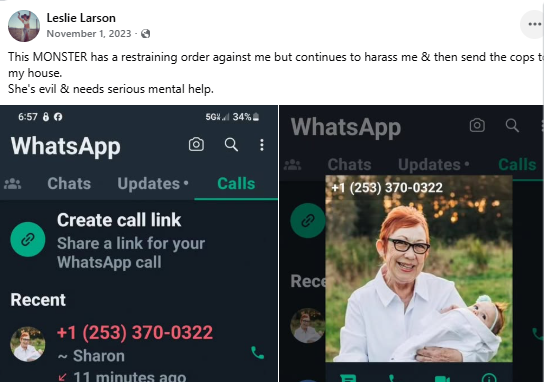
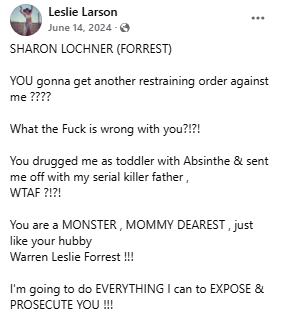
Forrest served a total of two years in the Army (including two and a half months overseas in Vietnam), and upon returning home to Vancouver he married his high school sweetheart, Sharon Ann Hart on August 16, 1969, and the couple had two children together: Leslie (b. 1971) and Lane (b. 1974). After they were married, the couple relocated to Fort Bliss, and according to her: ‘he got back, I met him. He said, I want to get married now because I’m going to Fort Bliss. And I said, but that’s like three weeks from now. So we got married in the small chapel and we packed up the car and drove to Fort Bliss, Texas.’ Sharon was born on January 27, 1949 in Omaha, Nebraska, however as her daughter Leslie pointed out in a semi-recent Facebook post, in every newspaper article about her and Warren’s engagement/marriage, her last name is Hart, but according to her high school yearbook, her full maiden name was ‘Sharon Ann Wilson.’ According to the 1967 Ft. Vancouver High School yearbook (she graduated in the same class as Warren), she performed in the yearly Christmas play and was a member of the marching band, Big Sister/Little Sister, the Future Homemakers of America Club, Pep Band, and the Health Careers Club.
In a December 2017 interview Sharon that did with Detective Lindsey Arnold and retired prosecutor Denny Hunter (both with the Clark County Sheriff’s Office Cold case task force): ‘Warren and I met when we were sophomores in high school, so we were fourteen. And, you know, I was a part of that family and I came from a very dysfunctional family. So, their family seemed like ‘Leave it to Beaver,’ you know, I didn’t know. But now looking back, she was very controlling. She ran the show. Now I think, I wonder how much did that play in Warren’s perception of Women.’
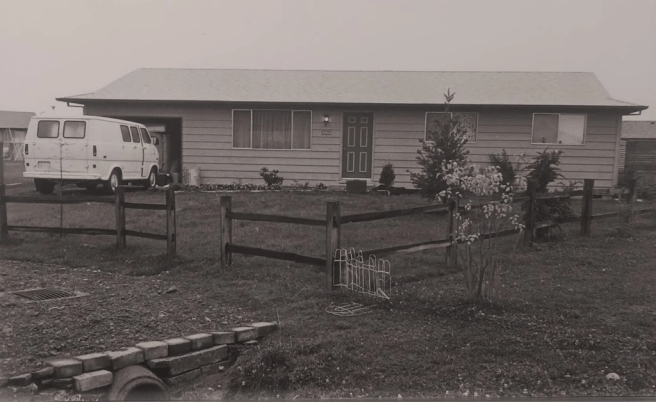
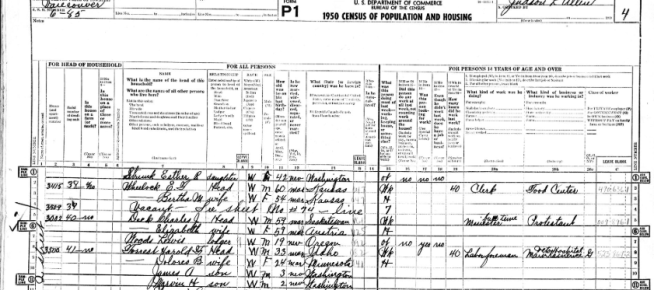
Forrest was honorably discharged from the US Army in September of 1971 right after his first child was born. After they left Fort Bliss they relocated to Newport Beach, CA, where Warren enrolled in classes at the North American School of Conservation and Ecology; he quickly lost interest in academics and dropped out at the end of his first semester. In late 1970, Warren and Sharon moved once again, this time back to Washington state, where they lived in the basement of his childhood home with their near infant child, who was a month old at the time. He quickly found employment with the Clark County Parks Department as a general maintenance worker (he officially began his employment on January 12, 1971), and for a while, everything appeared to be picture perfect for the seemingly happy young family… until suddenly it wasn’t.
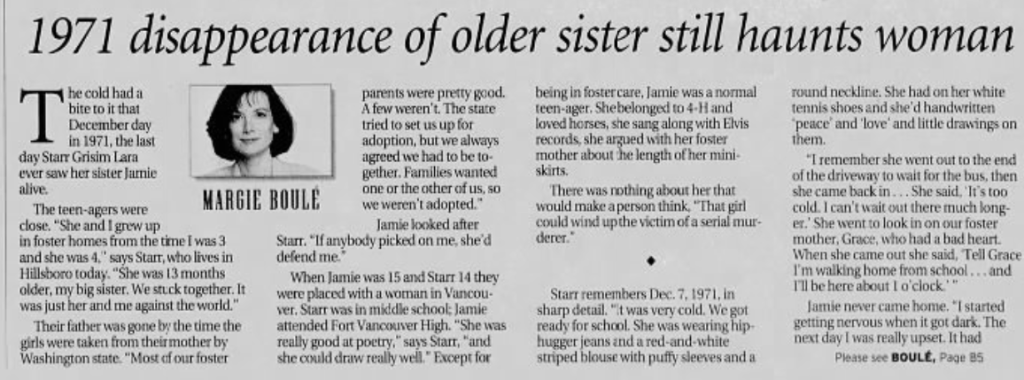
According to Sharon, her mother-in-law was domineering and wanted to have a say in how to raise her grandchild: ‘and I go, please talk to your mom. He goes, it won’t do any good. I said, this is not working. We gotta get out of here.’ She said she later found out that her in-laws lived roughly a mile from the farmhouse in Minnehaha where Jamie Grissom and her sister Star lived, and that Warren was in town just two months prior to Jamie’s disappearance. By 1974, the couple had a second child and had managed to buy a house of their own. In her 2017 interview with Sherriff’s, Sharon said that at various points during their marriage, her husband was ‘often gone,’ but when she asked him where he went, he always had a good excuse to be missing.
According to Sharon, she said, ‘where were you? He said, I hit a female dog. I gotta go bury it. I gotta get a shovel. And I went, oh, I mean, that’s just the kind of guy that he was. He wouldn’t even go hunting because he didn’t want to kill animals. Sweet as gentlest man.’ She also said that he was a ‘loving and attentive father: He always changed diapers and took care of the kids. And he was a good father, a really good father, A good husband. Made meals. He cleaned the kitchen.’
Due to HIPAA laws, most of Warren Forest’s medical records are unavailable to the public, but some of them were recently released and in March of 1974, he allegedly suffered what would be described as some kind of nervous breakdown. After he was discharged from the Army, he signed up for the reserves on the weekends, and according to a court document, the supposed breakdown happened after drinking at the NCO club at the Vancouver barracks. After Warren’s incarceration, he told a psychiatrist that he left the club and began walking back to his in-laws house (who lived nearby), and during this walk, he began thinking about a painful war memory where he allegedly ‘killed a little girl with his M79 grenade launcher,’ and it was something that followed him throughout his entire life. Forrest told the psychiatrist that when he arrived at his in-laws he had a nervous breakdown.
Sharon’s family later told investigators that when he arrived he looked ‘wild,’ and he had been ‘combative:’ they called the police and he was taken to the VA Hospital, where he was admitted for a couple of days; he later claimed to have no memory of that night. After Forrest’s honorable discharge from the military he told friends and family about an event that he said took place when he was in Vietnam, where he was carrying a grenade launcher in a convoy and ‘somebody told him to shoot,’ so he spun around and did exactly that, and as a result killed a small Vietnamese child.
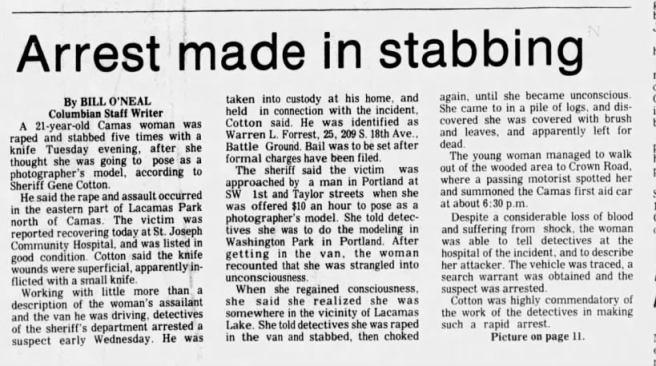
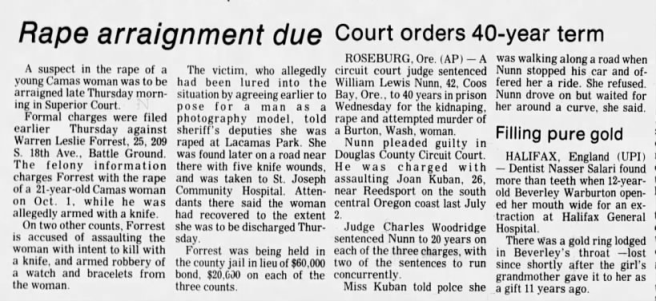
On October 1, 1974Warren Forrest kidnapped twenty-year-old victim* after he saw her standing on a street corner in downtown Portland and pulled over to talk to her: he told her that he was employed at Seattle University and had been working on a thesis project for class and offered her money to pose for pictures for him. She accepted his offer and climbed into his van and accompanied him to the Washington Park area of Portland, and it was at that point that he pulled out a knife and threatened her, and bound her with tape. He then drove roughly 25 miles to Lacamas Park, a heavily wooded and sparsely populated area of Clark County, where he sexually assaulted her; when he was finished, he shot her in the chest with a hand honed dart (which refers to the process of sharpening or refining an edge manually using either a whetstone or steel) from a .177 caliber dart pistol then led her 100 feet down a path by a rope around her neck. * I would like to add that it was requested the victims name be redacted from this so from now on I am referring to her as ‘The Lacamas Lake victim.’
Once they reached his intended destination, he sat the young woman on a log and choked her to the point of unconscientious. From there, he stabbed her five times in the chest then laid her naked body next to a log and covered it with brush and leaves (at some point during the encounter her attacker had removed all of her clothes and taken them with him)… But by some miracle, she was not dead, and after struggling for about two hours finally made her way to a roadway, where she was able to get the attention of a passing motorist, who took her to a nearby hospital. Once she was stabilized, the woman was able to give detectives a description of her assailant along with the details of the very distinctive vehicle that he drove (a blue 1973 Ford van). She also told them that as he was driving through the park he slowed down on several occasions and exchanged greetings with several people, and investigators quickly deduced that their guy was an employee of the department.
After Forrest was finished attacking the Lacamas Lake victim, he drove home, cleaned out his van, stashed her belongings in his garage, then tossed a football around with his next door neighbor; when they were done, he went inside his residence, ate a TV dinner on the couch with his wife and young children (who at the time were one and three), then went to bed.
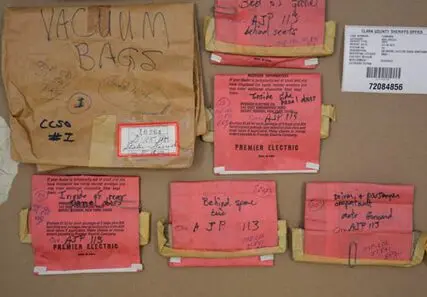
A look at employee records showed that Forrest owned a 1973 blue Ford van that closely matched the one the perpetrator drove, and that he had taken off from work on the day of the attack to ‘go to a doctor’s appointment in Portland.’ Detectives quickly got a search warrant for his home and vehicle, and while searching his residence found jewelry and clothing that belonged to the victim. In a footlocker discovered in his van, detectives found a gun, tape, and baling twine that was similar to what was used on one of his other victims. Also inside Forrest’s van, forensic experts found feather darts and the same Marksman repeater air pistol that the Lacamas Lake victim said her attacker used to shoot darts into her chest; forensic experts also vacuumed his van for evidence and collected pieces of twine as well as a Clark County Parks and Rec master key. When the young woman was shown a picture of the young Park’s Department employee, she was able to make a positive ID, andwas also able to identify the suspect in a lineup.
On the morning of October 2, 1974, Forrest was arrested on charges of kidnapping, rape, and attempted murder, and was held in lieu of $60,000 bond. When the moment finally came to arrest him, investigators came in, ‘guns a-blazing’ and ‘woke the babies,’ and went ‘through everything;’ as he was handcuffed and placed in the back of a squad car, he didn’t say a word to anyone, including his wife.
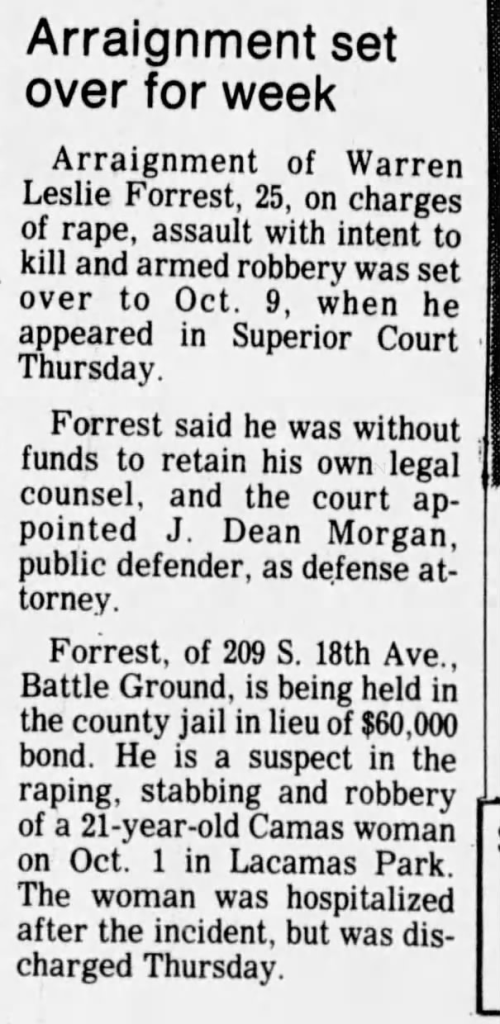
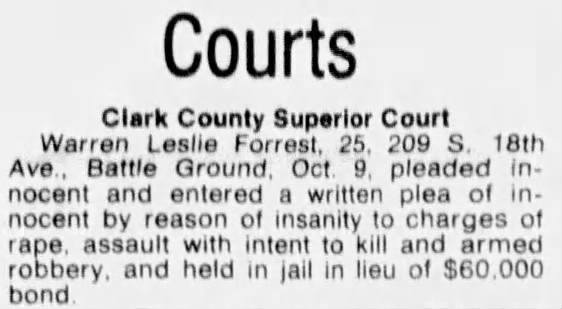
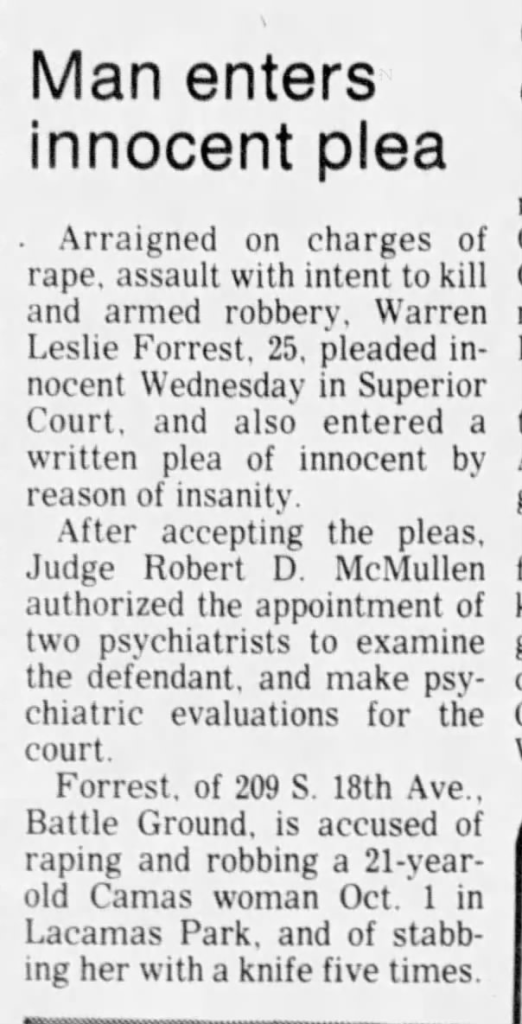
After he was brough to the police station, detectives returned to the Forrest family residence, where they performed a second search. A short time after Warren’s arrest, Sharon visited her husband in jail, which was the first time the couple had spoken after he was arrested: according to her, ‘I remember asking him. It was at the old jail, the courthouse, in Vanda’s cage, where the inmates could go. This was like when he was first arrested. And I said, things, you do it. He looked at me and he goes, ‘I don’t know.’’ When they found the girls possessions in the garage, Sharon said she heard a detective say, ‘we found the girl’s possession. Yeah. It was one of those moments. And did. And, you know, I just. I don’t remember anything after that.’ On October 5, 1974 he was arraigned on charges of rape, assault with the intent to kill, and armed robbery (after he assaulted Wightman, he also took her watch and bracelets), and he entered a plea of not guilty by reason of insanity.
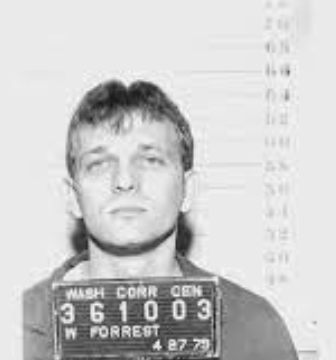
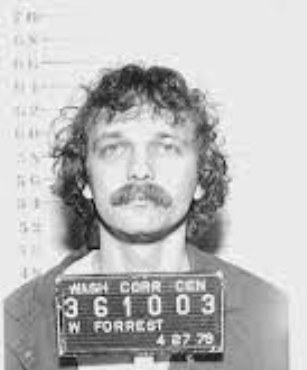
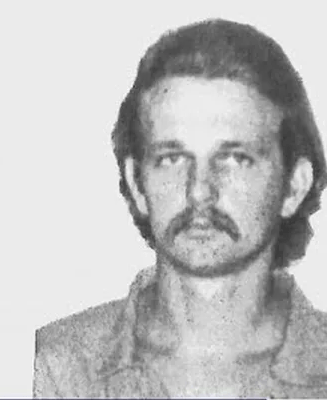
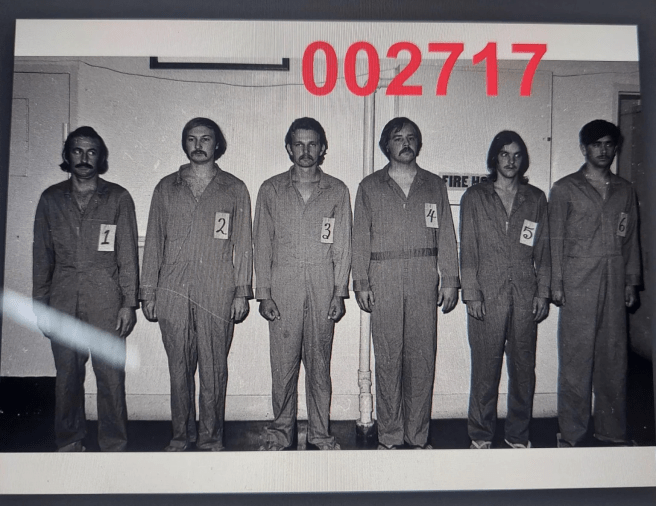
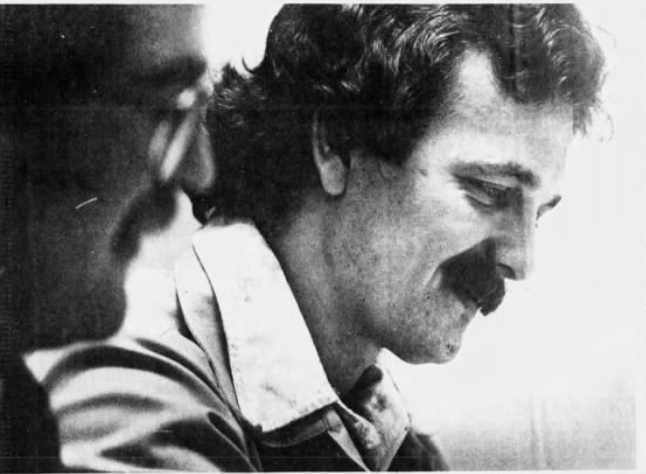
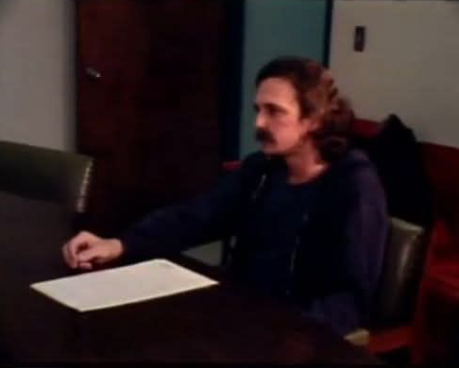
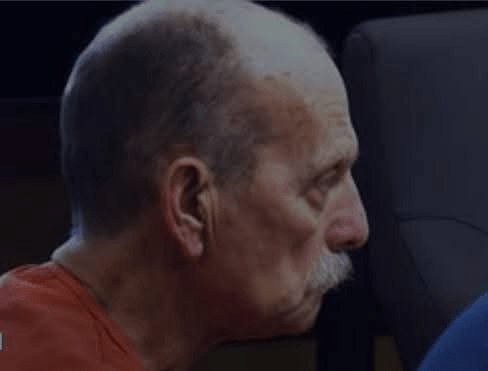
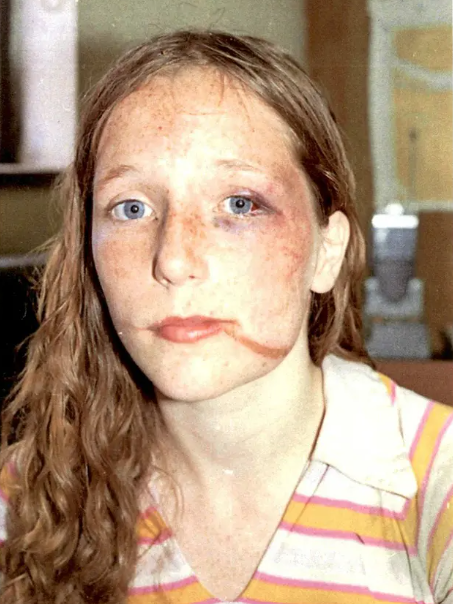
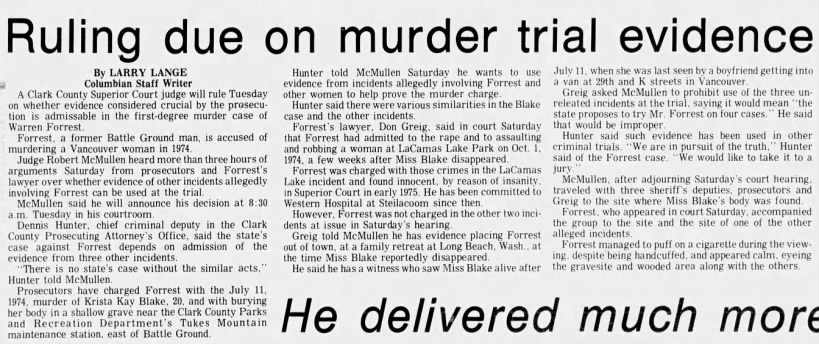
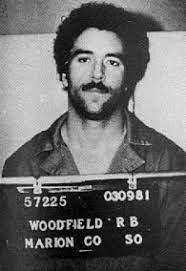
At the time of his arrest, Warren Leslie Forrest was twenty-five-years old and weighed 155 pounds; he stood at 5’9” tall, wore his light brown hair at his shoulders, and had what was described as a ‘bushy mustache.’ Shortly after his arrest was made public, detectives were also able to link him to the kidnapping, rape, and assault of fifteen-year-old Norma Countryman, who had been attempting to hitchhike out of Ridgefield on July 17, 1974 when she got in Warren’s van after he pulled over and offered her a lift. From there, he raped and beat her, and when they reached the slopes of Tukes Mountain, he gagged her with her own bra then hogtied her to a tree and told her he would ‘return’ to her later… but, the petite young woman had a fierce will to live, and chewed her way through her restraints and hide in some nearby bushes until the sun came up, when she was able to flag down a Parks employee for some help. The suspect returned to the scene of the crime the following night and picked up what he had used to bind her to the tree as well as the bra he used to gag her. Despite Countryman’s powerful testimony in court, Forrest was solely charged with the kidnapping and attempted murder of the the Lacamas Lake victim.
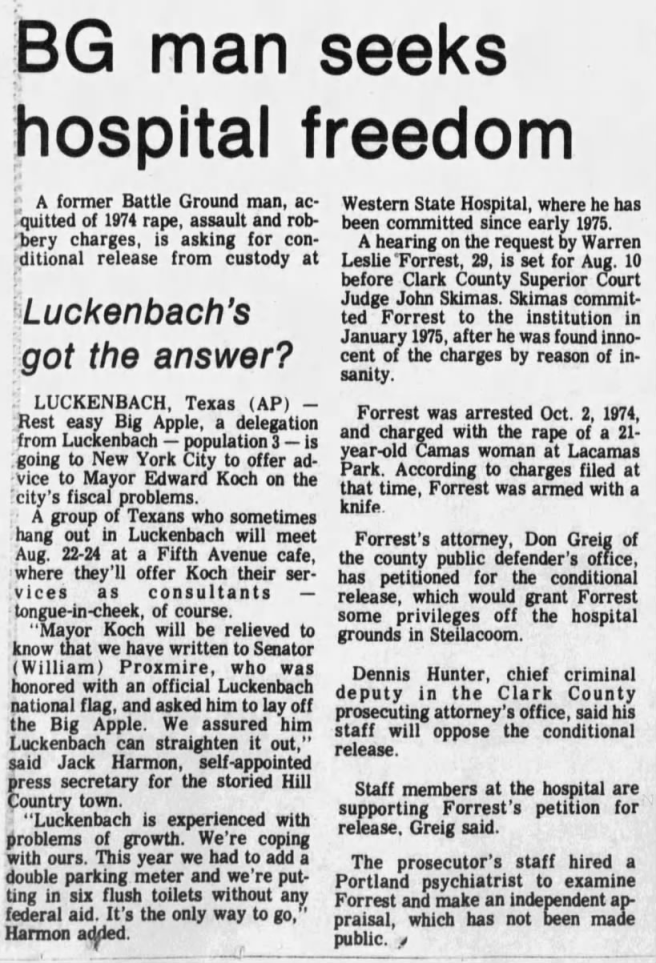
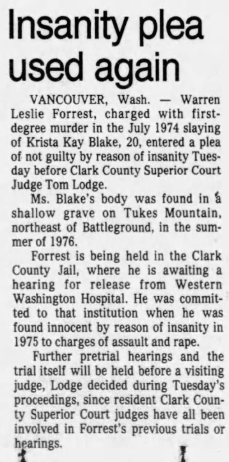
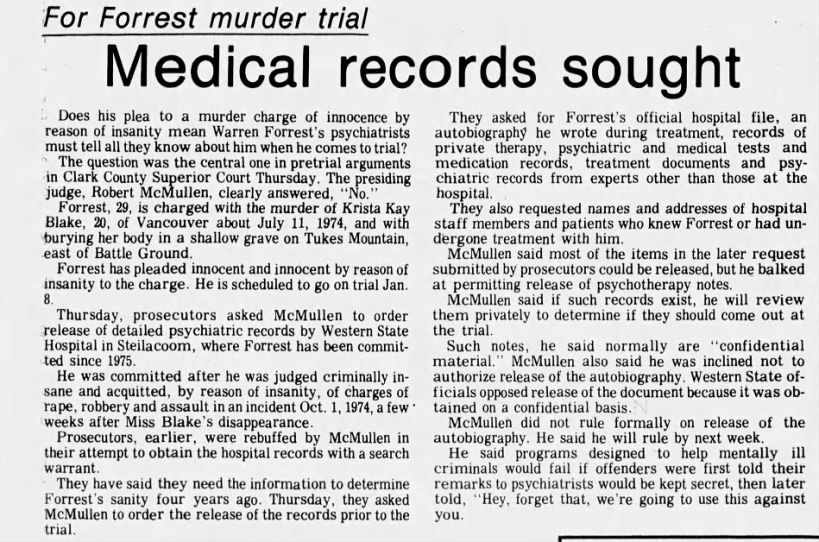
Warren Forrest pled not guilty due to reason of insanity, and his legal team filed a motion for him to undergo a psychiatric evaluation; thanks to examinations by three local psychiatrists (that the state paid for), it was determined that he was criminally insane at the time of his atrocities against. It’s also worth mentioning that the prosecution didn’t attempt to bring in their own experts to contest that these evaluations of mental insanity had any truth to them, and there were no state experts brought in at all: Forrest had an uncontested insanity acquittal. On January 23, 1975, a hearing was held and he was found not guilty of all charges against Wightman by reason of insanity, and a week later on January 31st he was committed to the Western State Mental Hospital in Steilacoom, WA. According to investigators who visited the facility in the 1970’s, they described a place where the inmates seemed to be running the asylum, not the administrators, and it was hard to tell the staff from the patients.
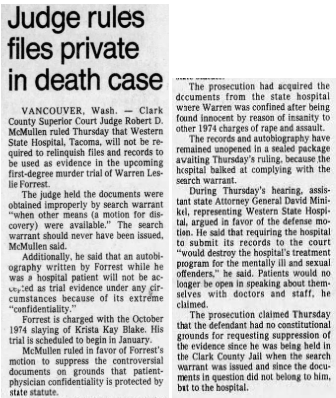
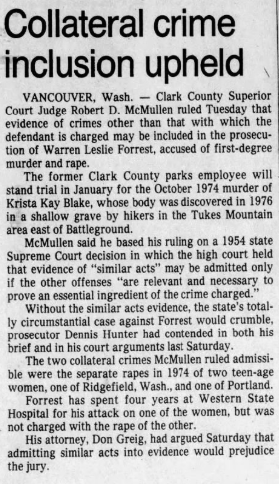
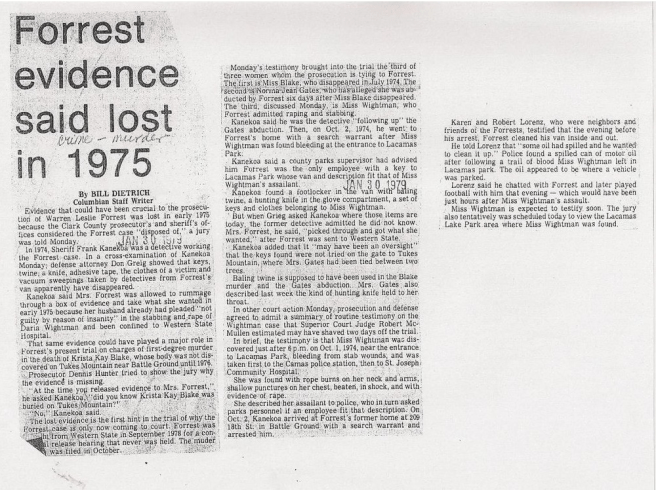
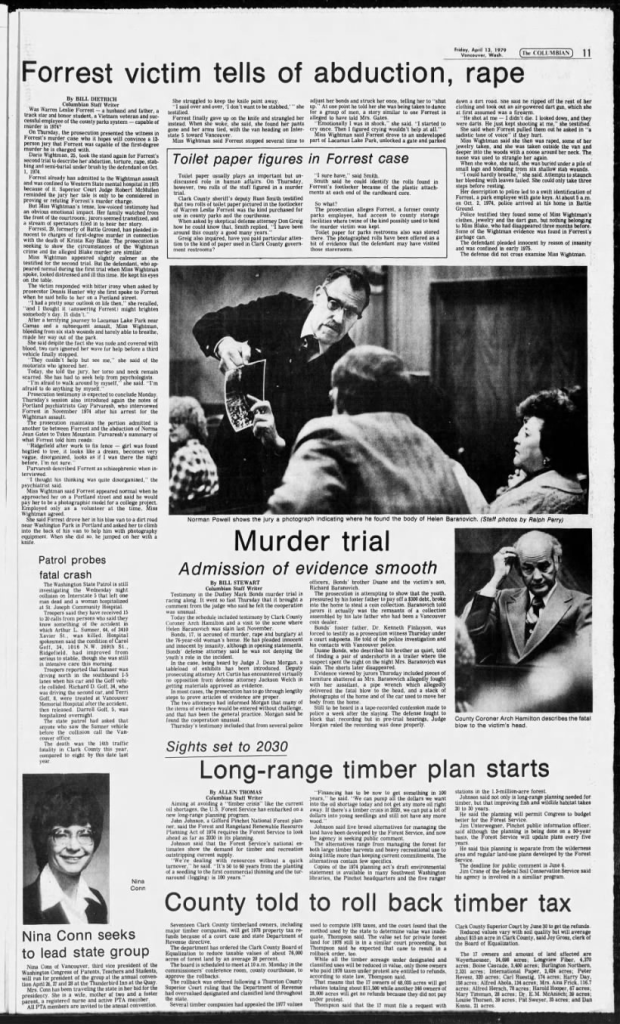
According to a court document, the term of Forrest’s commitment could be for ‘any period up to and including natural life,’ but he would be eligible to petition the court for a conditional discharge if staff at Western signed off that he was no longer a danger to society. It’s important to note that, according to an article published in ‘The Columbian’ on January 30, 1979, evidence was lost in early 1975 when Sharon was allowed to go through a box of her husband’s things after the Clark County prosecutor and sheriff’s department deemed the entire case to be ‘disposed of.’ Amongst the items that were taken were a master key to the Clark County Parks Department, twine, a knife, adhesive tape, a victims clothing, and the ‘forensic vacuum sweepings’ that were taken from Forrest’s 1973 Ford van shortly after his arrest. About the incident, Clark County Detective Frank Kanekoa said that ‘Sharon Forrest was allowed to rummage through a box of evidence and take what she wanted sometime in early 1975 because Warren had already pleaded not guilty by reason of insanity.’ In addition to what Sharon took, after Warren’s acquittal all evidence related to the case was either released or thrown away, aside for some pictures and the marksman repeater air pistol… all of which may have played a major role in Forrest’s later trial in January 1979 for the murder of Krista Kay Blake.
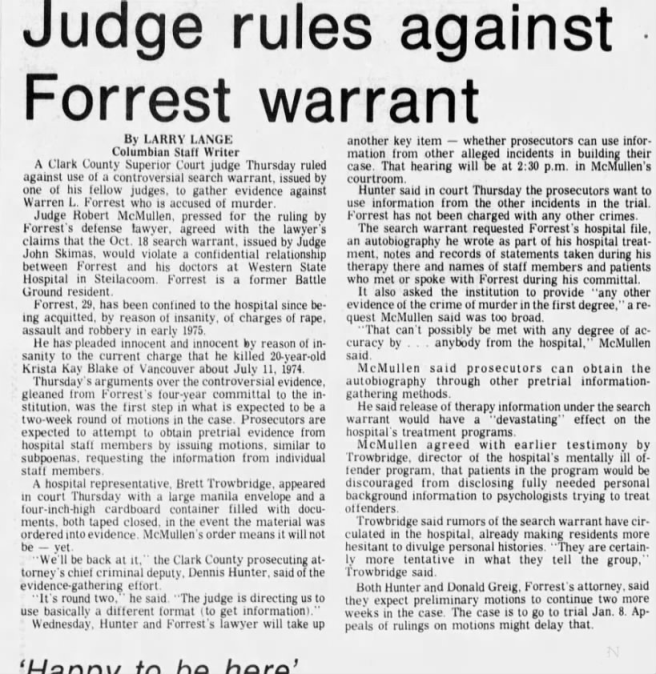
Upon arrival at Western State Hospital, Forrest was assigned to the ‘Omega’ group, which consisted of similar patients that had been committed to the facility for criminal insanity; it contained a variety of individuals that had been charged with a wide range of charges, ranging from minor offenses all the way up to serious ones. Clinical psychologist Dr. Brent Trowbridge was the director of the program, and described the group as follows: ‘a therapist who generally had a master’s degree in the field of social sciences, would lead the omega group. Omega was designed as a confrontational group therapy, which meant that the patients in the group were supposed to help each other with their treatment.’
While at Western State Hospital, WLF was able to keep a car in the parking lot that he was also allowed to ‘work on.’ Shortly after her husband was committed to the facility, Sharon sold their home and moved her and their children closer to the prison: ‘we used to go on Wednesdays to visit him, and then we used to go on weekends and spend, like, the whole day with him and, you know, pack the kids up. And I used to bake meals and take to him and get things that he wanted from the store and stuff. We had birthday parties, you know, for the kids there at the hospital and for him. I remember we celebrated one of our anniversaries there.’ Sharon planned on standing by her man and was going to wait for her husband to be released… until December of 1977, when she found out he was having an affair, and: ‘and I noticed that there was just a change in him. Something was different. One night I was there, and the phone rang, and it was for him, it was a payphone. And he was back whispering on the phone and just acted different. So when he got off the phone, I said, who is that? He goes, none of your business. I said, what’s going on? Nothing. It’s time for you to leave now. So me and the kids left. I was like, wow. Well, come to find out, he was seeing somebody at Western State.’
According to her, it was most likely a hospital employee, and that one time his therapist called her for a meeting between the three of them, who in the beginning prompted her husband: ’Warren, is something going on that you need to tell Sharon? You seeing someone?’ He goes, ‘yeah.’ The therapist said to him, he goes, you’re an asshole. And Warren goes, ‘yep, I am.’ And so I stood up and I said, I’m done. I’m not coming back. I moved here to be close to you, to try to keep our family, and you’re being able to see your kids, and this is how I get remained. And I walked out, and I didn’t go back.’ When police later interviewed a friend of his, he confirmed that Forrest had told him he was seeing an employee at the hospital named ‘Nancy.’
In an interview with forensic psychiatrist Dr. Sidney Pollack in 1978, Forrest described how he worked eight hours a day ‘all over the hospital:’ in the ceramic and sewing rooms, kitchen, greenhouse, and at one point he even worked as a janitor inside the facility and around the hospital grounds. Dr. Pollock questioned Forrest about the loose security protocols which would have ‘made it easy for him to escape:’ he replied with, ‘yeah, I had the opportunity. That’s what I was saying. I had the opportunity and the thoughts.’ At one point during his time there he also got hired to paint a staff member’s house.
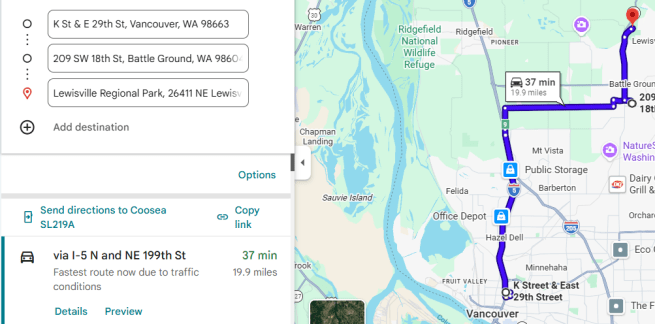
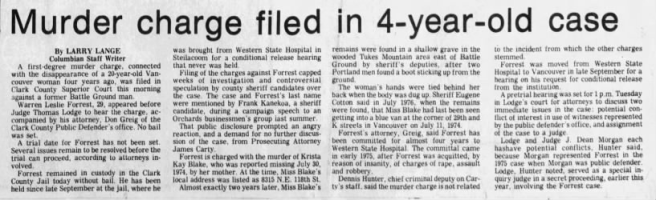
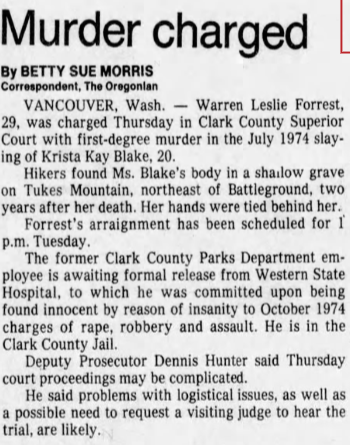
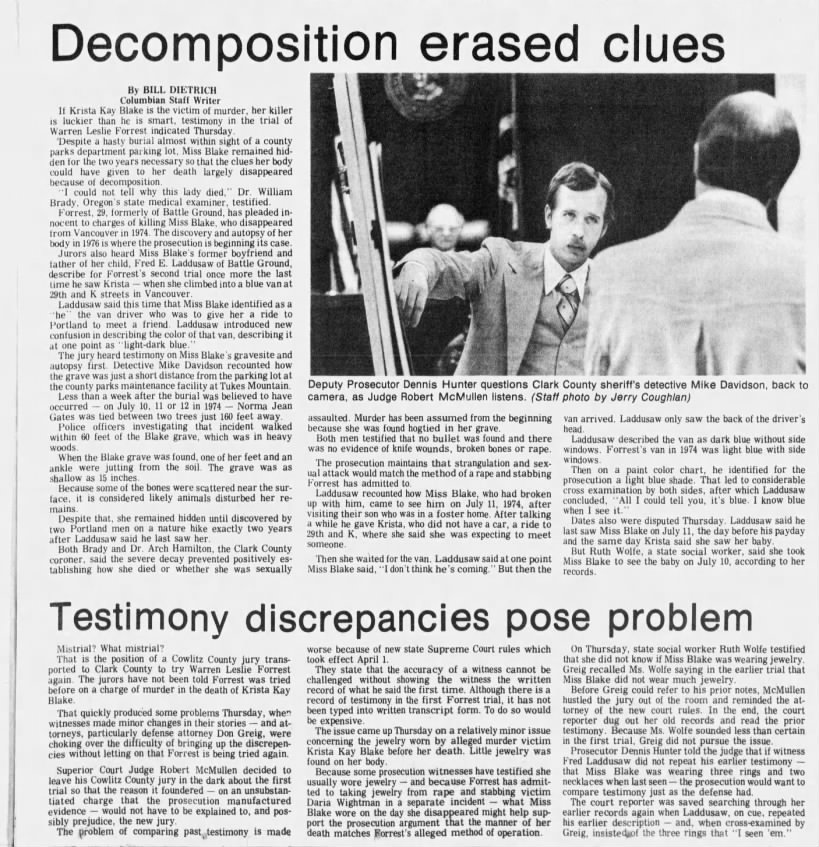
A year and a half went by after Warren Forrest was sent to Western State Hospital. On July 16, 1976 two foragers were out picking mushrooms and wildflowers on some Clark County Parks Department property in Tukes Mountain near Battle Ground when they noticed a small brown shoe sticking out of some bushes: when they gently tugged on it, they realized it was attached to a human foot and immediately notified LE, who discovered the half-skeletonized body of a young woman that had been (poorly) buried in a shallow grave. Forensic examination of the victims mandible led the ME to determine that the remains belonged to Krista Kay Blake, a hitchhiker that vanished without a trace from the area of 29th and ‘K’ Street of Vancouver on July 11, 1974.
Krista had been partially unclothed and had been missing her bra; her hands and feet were ‘hogtied’ behind her back with baling twine (which was discovered around 100 feet from her gravesite), and because her clothes and skeleton showed no signs of stab wounds or bullet holes, the ME concluded that she had most likely been strangled. Nineteen-year-old Blake was known to hitchhike, and at the time she was killed was living on NE 119th Street in Vancouver. After she disappeared two eyewitnesses came forward and told detectives that they observed her and the suspect that had been ‘driving the blue van’ together around the Lewisville Park area sometime prior to the day that she disappeared; other people came forward and reported they had seen the same van driving around Tukes Mountain on or around the date that Blake was last seen alive. It’s worth noting that Norma Countryman’s assault took place one week after the disappearance of Krista Kay Blake.
Because Warren Leslie Forrest owned the same van as the suspect and worked at the park where the victim had been found, he immediately became a person of interest in her death. Because of advanced age of the body a great deal of physical evidence had been lost, however a closer look at the clothing that the young woman had been wearing led to the discovery of incredibly small puncture marks in her T-shirt that forensic experts determined were made by a dart gun that was similar to the one that Forrest had used on his Lacamas Lake victim.
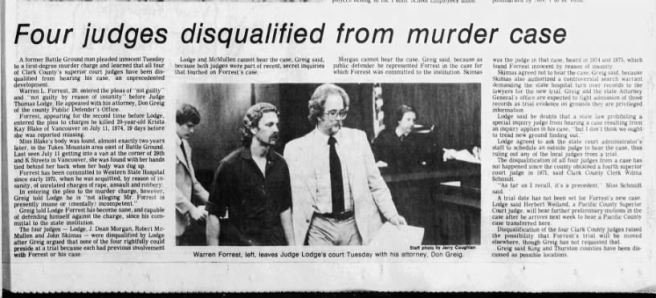
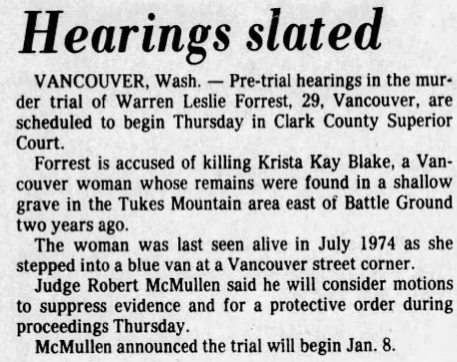
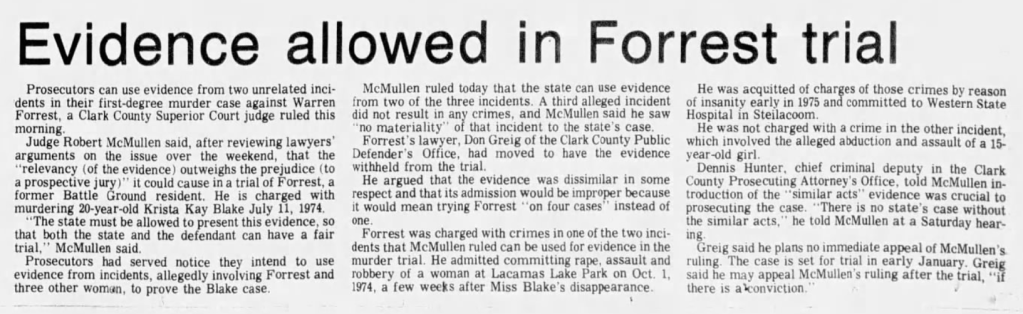
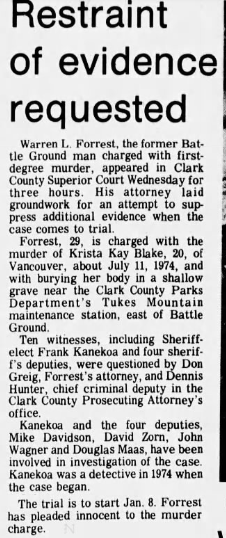
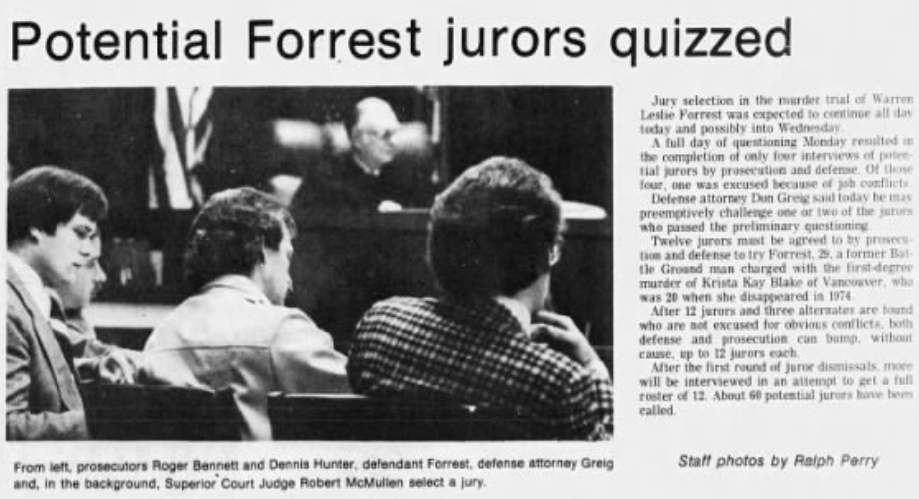
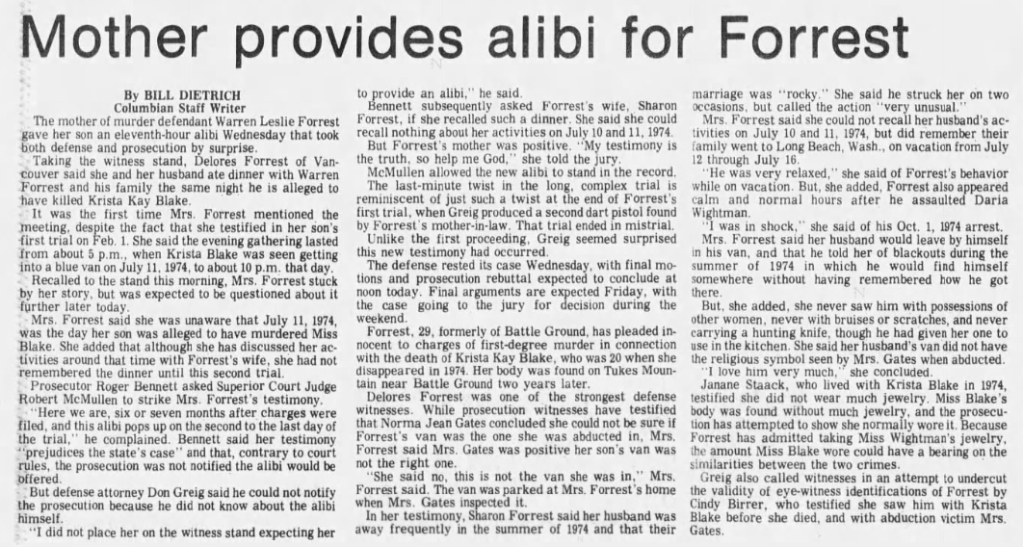
Not long into the murder investigation, detectives realized that on the day Blake had disappeared, Forrest wasn’t at work because reportedly ‘had a doctor’s appointment,’ this was on top of the fact that he had no alibi: his mother said that he had spent part of the day at her house, but had ‘left early in the evening’ and did not return until the following morning. He was charged on this basis with Krista’s murder in October 1978, and despite already being detained inside of an institution, his attorney Don Greig filed a petition for a new psychiatric evaluation, claiming his mental state had greatly improved in recent years… he even wanted to represent himself at trial (a request that had been granted). In the initial stages, the four judges that had participated in WLF’s earlier trials were removed from consideration due to concerns about possible bias, however this decision was later overturned, and Justice Robert McMullen was ultimately chosen to preside over the case.
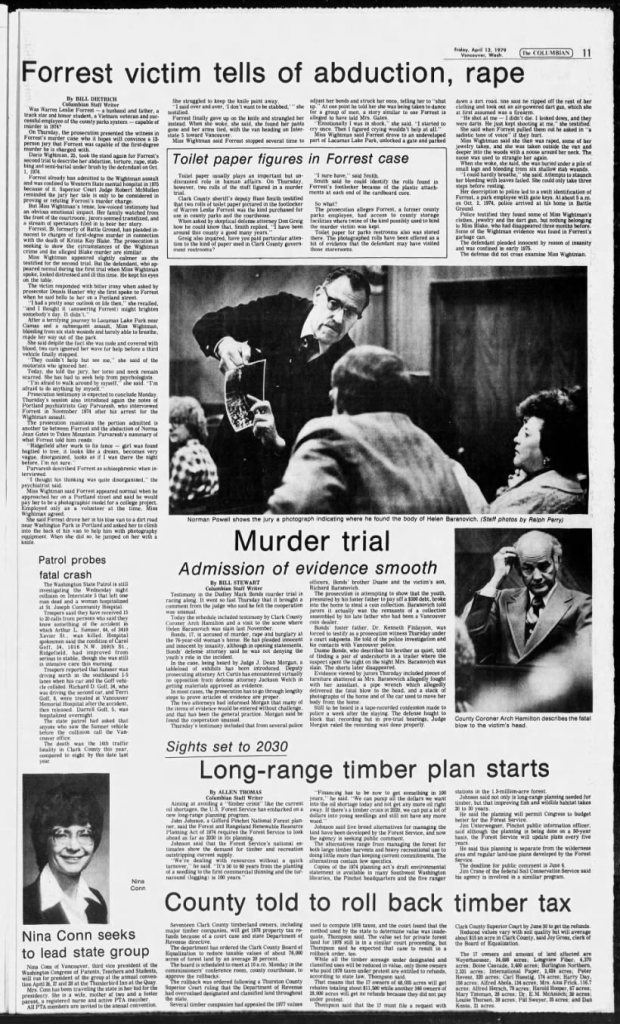
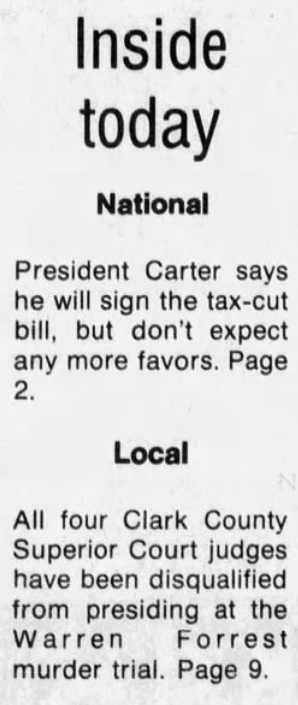
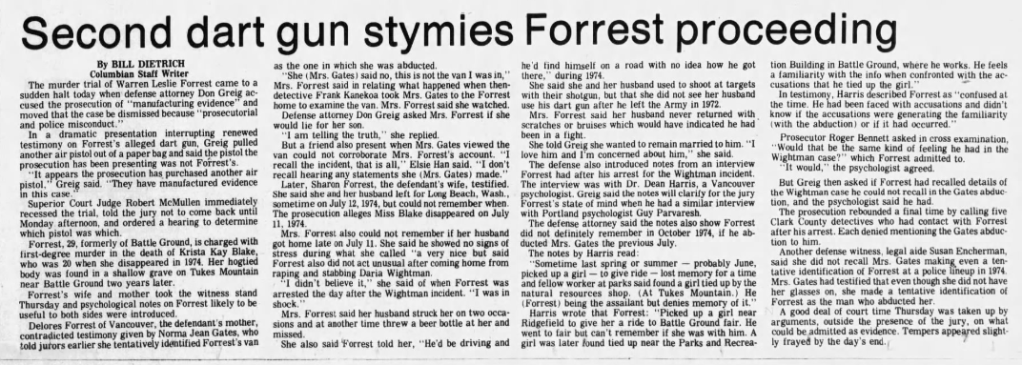
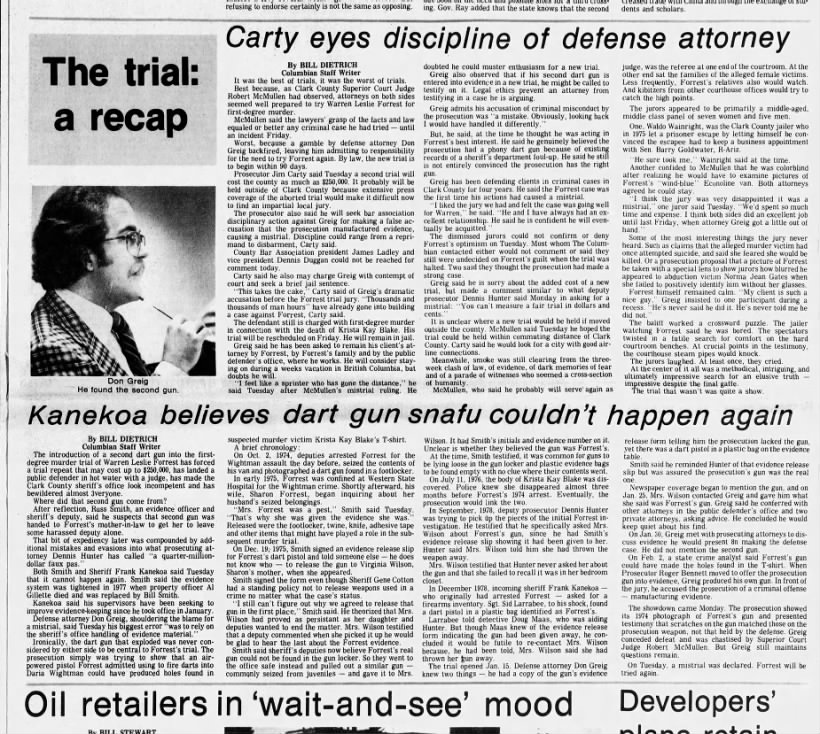
Warren Forrest’s trial for the murder of Krista Blake began in early 1979, however it wasn’t long before the judge declared a mistrial after his attorney erroneously allowed a second dart gun that had been unrelated to the case to be submitted into evidence. After that incident, his defense team filed a motion for a change of venue from Clark County to Cowlitz County, arguing that the media attention surrounding the case would prejudice the jurors against their client; the motion was granted andthe trial resumed in April 1979 in Cowlitz County. In the beginning of the proceedings, Forrest pled not guilty and claimed he had been on vacation with his family in Long Beach at the time of Blake’s murder; this had been backed up by his mother, who said in open court (while under oath) that her son had been at her residence (with her) at the time investigators supposed Krista had gotten into the blue van. However, prosecutors said her testimony was unreliable, pointing out that she had originally told detectives that her son had left her residence in the early evening and didn’t come back until the following morning. In addition to Dolores, Sharon Forrest also testified on Warren’s behalf, although she told the court their relationship had been ‘rocky’ and her husband had at times ‘suffered from blackouts;’ she also insisted that he had been with her the entire time Blake was being abducted and killed, and that he never showed any signs of being violent towards women.
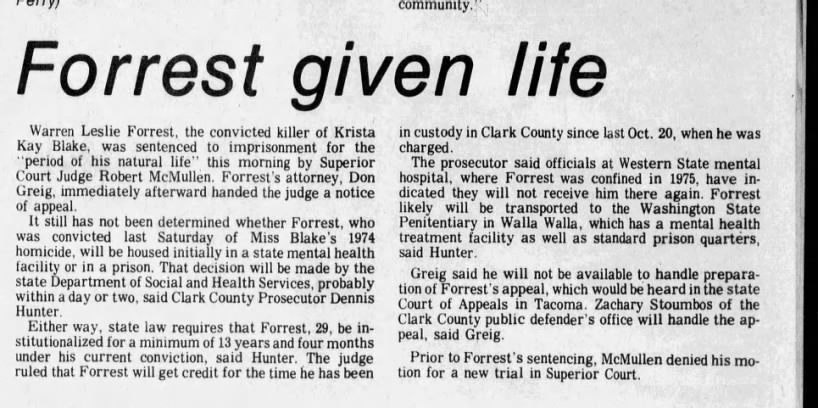
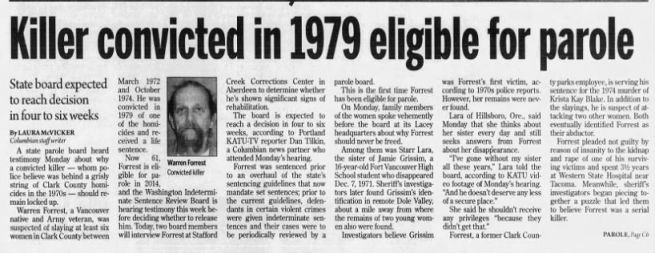
Multiple eyewitnesses testified against Forrest, and claimed he was a known acquaintance of Krista Blake’s and that the two had been seen together at multiple times before her murder; however, some of their claims were scrutinized by his defense team, as two of them had given a description of the suspects van that did not perfectly match the one that he owned. One day during the trial, he admitted guilt to the kidnapping and attempted murder of the Lacamas Lake victim, claiming he attacked her due to ‘untreated PTSD’ from serving in the military. However, when confronted, he absolutely refused to admit guilt for the murder of Krista Ann Blake and the kidnapping and assault of Norma Countryman, and because of this the prosecutor’s office insisted that he was guilty of all charges (as each crime matched his MO). Warren Forrest was ultimately found guilty and was sentenced to life imprisonment with a chance of parole, and was sent to Washington State Penitentiaryin Walla Walla; because he was convicted before mandatory sentencing laws he was eligible for parole for the first time in 2014. Sharon Forrest filed for divorce from Warren in June of 1980.
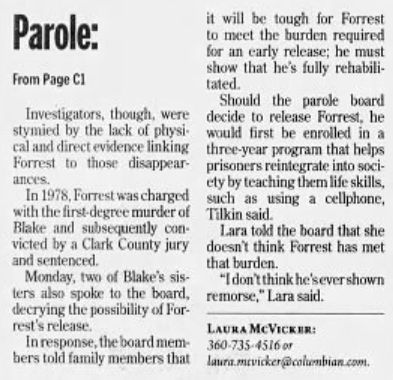
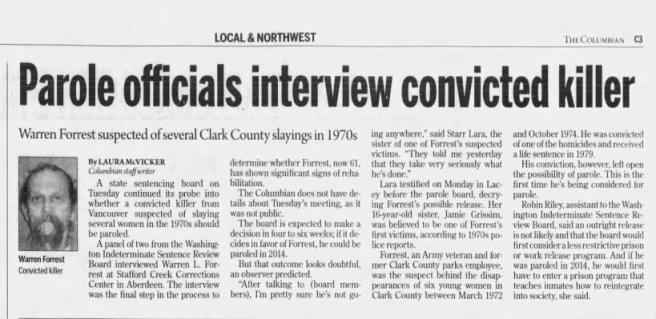
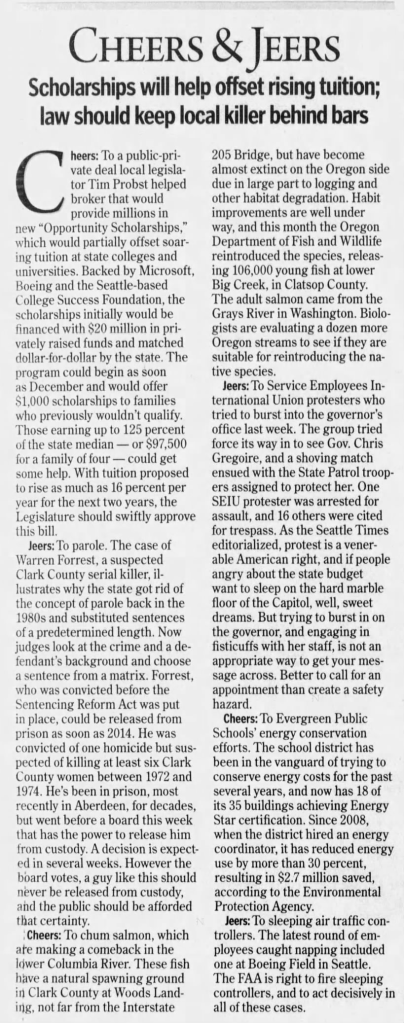
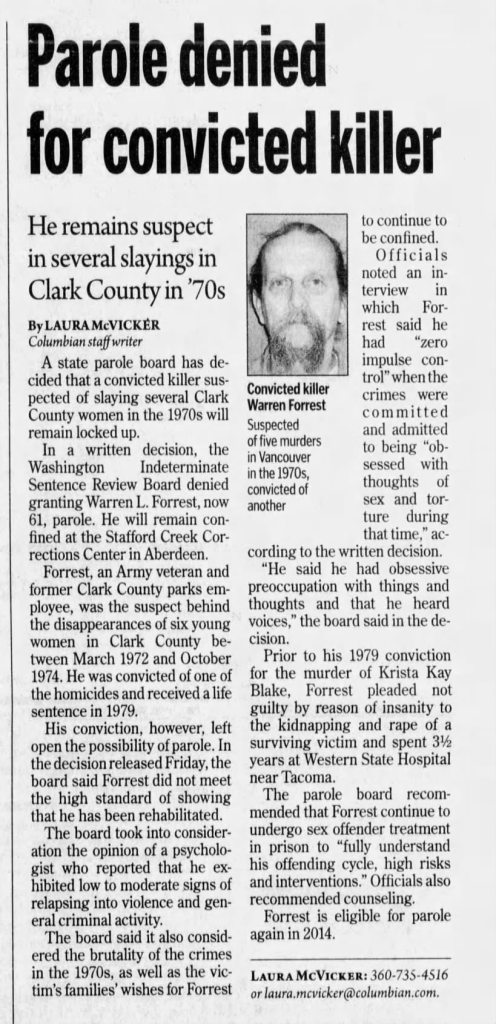
Forrest filed an appeal in early 1982, which was denied later that October; since then, he has filed numerous parole applications over the years (confirmed ones in April 2011, April 2014, July 2017, and May 2022), all of which have been denied due to the fact he is a suspect in many other heinous and violent crimes against women. It’s worth mentioning that during one of his parole hearings, both of his surviving victims took the stand and identified him as their assailant.
The Confession of Krista Blake/2017: Since his initial convictions, Warren Leslie Forrest has remained a suspect in multiple kidnappings, disappearances, and murders around Clark County that took place in the early to middle 1970’s… however, he has largely refused to help multiple policing agencies with their investigations. At a parole hearing in 2017, he finally confessed to killing Krista Blake, stating she had been severely depressed and stressed out at the time of her murder, and he ‘did not intend’ to kill her at first but was forced to after she attempted to get away from him. During that same hearing he also casually confessed to sixteen additional crimes against women that took place between 1971 and 1974, ranging from voyeurism to murder, and claimed he was ‘remorseful for his actions.’ Despite these ‘confessions,’ Forrest’s application for parole was denied and he was prohibited from filing another appeal until March 2022, as the board stated he ‘continued to pose a danger to society and made minimal progress in ameliorating his behavior.’ In an audio recording from one of his parole hearings, he recalled details of the horrific crimes he committed, and reiterated that he was ‘a different person’ now than he was forty years prior, and admitted he: ‘abducted a 19-year-old female stranger under the ruse of giving her a ride…forcing the victim to undress and during a struggle I choked the victim to death.’
In June 2017, Clark County investigators met with Warren Forrest and told him they were working to prove he killed five additional young women across Washington and Oregon:Jamie Rochelle Grisim (1971), Barbara Ann Derry (1972), Carol Louise Platt-Valenzuela (1974), Martha Morrison (1974), and Gloria Nadine Knutson (1974). During one of his hearings, when the parole board asked him about the other possible victims, the only thing he would say was that he ‘felt sorrow for those families,’ and that talk of other crimes was ‘not factually’ accurate; he also said that he only committed the crimes that he did because he was ‘stressed out’ from working two jobs, going to school, and being a husband and father, and: ‘the only option I had was to distract myself, and I chose to live out those violent fantasies.’
Martha Morrison: In December 2019, Warren Forrest was charged with the murder of seventeen-year-old Martha Morrison, who went missing from Portland, OR in September 1974; her skeletal remains were discovered on October 12, 1974 in Clark County close to those of Carol Valenzuela, only eight miles from Tukes Mountain (where Krista Blake’s body was recovered). Both victims were uncovered either behind or between logs and were fully skeletonized; additionally, neither one was wearing clothes and had any identification on them. At the time of the discoveries in 1974, Forest wasn’t considered a suspect in either murder even though the victims were discovered in a heavily wooded area that was ‘slightly upslope’ from a secluded side road that was close to Rock Creek Bridge. Unfortunately, authorities were unable to positively identify Morrison’s remains at the time she was recovered, and she was known simply as a ‘Jane Doe’ for many years. In 2010, Martha’s half-brother Michael submitted a DNA sample to police in Eugene, OR, and in 2014 investigators began re-examining physical evidence from Forrest’s criminal cases to determine if anything from them could be used to solve any unsolved crimes.
Forensic experts from the Washington State Police Crime Lab were able to isolate a partial DNA profile from some dried blood that had been left behind on Forrest’s dart gun, and cross-referenced it with Michael Morrison’s DNA, which lead to the positive identification of Morrison’s remains.In January 2020, WLF was extradited back to Clark County to await charges in Morrison’s murder, and on February 7, 2020 he pleaded not guilty. His trial was scheduled to begin later that year on April 6, 2020 but was delayed on several occasions thanks to the Covid pandemic; it eventually resumed in early 2023, and on February 1, 2023 a jury of his peers found Warren Leslie Forrest guilty of the murder of Martha Morrison. Only sixteen days later, he received another life sentence.He remains the prime suspect in the disappearances and murders of at least five more teenagers and young women, and in each case, the perpetrator exhibited a similar modus operandi to Forrest:
Possible Victims: On December 7, 1971 sixteen-year-old Jamie Rochelle Grisim was last seen walking home from Fort Vancouver High School; she was reported as missing by her foster mother the following day. During one of the searches for her shortly after she disappeared, detectives came across some of her personal belongings in nearby Dole Valley, including her purse and an ID card. It was initially believed that she ran away from her foster home and had left the state, but that theory was quickly disregarded. Since Martha Morrison and Carol Valenzuela were later recovered not far from where her belongings were found, local LE have reassessed their conclusions and now feel that Jamie was abducted and killed by Warren Forrest.
Eighteen-year-old Clark College freshman Barbara Ann Derry went missing on February 11, 1972, and was last seen on a Vancouver highway trying to hitchhike along State Highway 14 East and had been trying to make her way home to Goldendale. Tiny in stature, Derry was only 5’1” tall and weighed a mere 115 pounds, and at the time of her murder had been living on ‘W’ Street in Vancouver. Her remains were discovered by a woman searching for antique bottles the following month on March 29, 1972: she was at the bottom of a silo inside the Cedar Creek Grist Mill and she had been covered with boards and debris in a poor attempt to cover her up. The ME determined that she died from a single stab wound to the chest that had been inflicted by a ‘narrow-bladed instrument;’ she had been partially undressed and had been missing her bra. A positive identification was made thanks to dental records, and it was said (by LE) that she had ‘many male friends,’ and was known to hitchhike frequently. Oddly enough, Barbara’s body was found near the area where a large manhunt had been underway for ‘DB Cooper,’ an unidentified skyjacker that jumped out of a plane asking for a $200,000 ransom (his fate remains unknown to this day despite extensive investigations).
Either Forrest has some incredible self-restraint, or he has some victims that are unaccounted for (I suspect the latter): well over two years went by between the murder of Barbara Derry and the disappearance of his next unconfirmed victim, fourteen-year-old Diane Gilchrist. A ninth grader at Shumway Junior High School in Vancouver, Gilcrist went missing on May 29, 1974 and prior to her disappearance had never shown any problematic behavior: her parents said she had left their home in downtown Vancouver through her second-story bedroom window and vanished into the night, never to be seen or heard from again. As of February 2026, she has never been found, and her fate remains unclear.
Just days away from graduating from high school, nineteen-year-old Gloria Nadine Knutson was last seen by several acquaintances at a Vancouver nightclub called ‘The Red Caboose’ on May 31, 1974, after she turned down an invitation to attend a housewarming party. One eyewitness told investigators that the Hudson Bay High School senior had come to his residence and sought out his help that in those early morning hours, and that she had been claiming somebody had been tried to rape her, and that person was now stalking her; the acquaintance also reported that Knudson had asked him to drive her home, but he couldn’t because his car had been out of gas. Distraught and out of options, Gloria was forced to walk home; her skeletal remains were found by a fisherman in a forested area near Lacamas Lake on May 9, 1978.
On August 4, 1974 married mother of infant twins Carol Louise Platt-Valenzuela went missing while attempting to hitchhike from Camas to Vancouver; the twenty-year-old was not known to be involved in prostitution and had no criminal record. On October 12, 1974, her skeletal remains were discovered by a hunter in Dole Valley just outside of Vancouver, very close to those of Martha Morrison; because of this, detectives strongly suspect Forrest is responsible for the murders of both young women.
Lesser Discussed Possible Victims of WLF: In the first few weeks while he was at Western State Hospital in February 1975 Forrest resided at the same facility where a young woman had been murdered: twenty-five-year-old Karen Louise Wiles suffered from some form of diminished mental capacity and had voluntarily committed herself to the hospital three weeks prior to her death; because she wasn’t court mandated to be there she could come and go as she pleased. Wiles remains were found on February 21. 1975 in the flatlands in Tacoma, roughly eight miles away from the facility; she had been sexually assaulted and had been strangled, and had twine wrapped around her neck. The hospital staff greatly hindered the original investigation and refused to answer questions and help LE in any way.
There are a few additional possible victims of Warren Leslie Forrest that aren’t frequently discussed that do fall in his 1973 gap of inactivity: Rita Lorraine Jolly disappeared out of her West Linn, OR neighborhood while out on a routine nightly walk on June 29, 1973; her remains have never been recovered. It’s worth noting that West Linn is only a fifty-minute drive from Battle Ground, WA (where Forrest had been living at the time with his family).
On August 20, 1973 twenty-three-year-old seamstress Vicki Lynn Hollar was walking out of The Bon Marche in Eugene, which was her new POE (she has only been there for about two weeks, and was a transplant from Flossmoor, IL); she was last seen alive by her supervisor, when the two walked out to their respective vehicles together (Vicki drove a black 1965 VW Bug with the running boards removed). Hollar was supposed to show up at her residence to meet up with a friend, and the two were going to go to a party together, but she never arrived. Neither Vicki nor her vehicle have ever been recovered. It is slightly over a two-hour drive from Battle Ground to the Macy’s that Hollar worked at in Eugene, Oregon.
On November 5, 1973 Suzanne Seay-Justis was last heard from when she called her mother from a pay phone outside of The Memorial Coliseum in Portland; she told her she would be home the following day so she could pick up her young son from school, and despite having her own car Justis hitchhiked to Portland. It’s worth mentioning that the Memorial Coliseum is only a half hour drive from the Forrest family home on SW 18th Street in Battle Ground.
Washington state detectives have never stopped looking into Forrest in regard to the murders that he stands accused of committing, and in December 2025 they were able to locate a long-lost witness in relation to the murder of Jamie Grisim. Additionally, they’re working with the ‘Washington State Search Team and Rescue’ as well as ‘Clark County Search and Rescue,’ and have plans for another coordinated search in the Dole Valley area, this time using dogs that are highly trained in locating human remains that could be decades old and buried deep underground.
Conclusion: Warren’s brother James Allen Forrest died at the age of thirty-four on November 24, 1980 after succumbing to ‘a lengthy illness.’ According to his obituary, he was unmarried at the time of his death and was ‘formerly a member of the Junior Odd Fellows;’ he was also the Past Chief Ruler of the Independent Order of Odd Fellows No. 3 at St. John’s Road. Warren’s father died of leukemia at the age of seventy-three on October 13, 1991 in Portland, and per his obituary, before he retired Harold was the foreman of the labor force at the Vancouver Veterans Hospital for thirty-five years and was a member of the Washington Gateway Good Sam Travel Club (as he was an avid traveler). Dolores Beatrice Forrest died at the age of seventy-seven on Christmas day in 2002 in Walla Walla.
Marvin Forrest married Diane Steigleman at the age of forty-eight on July 23, 1996, and sadly not even four months later on November 23, 1996 he was killed in a plane crash above the Pacific Ocean roughly forty miles outside of the Northern California coast; his body has never been recovered. According to his obituary, he worked at the Portland Air Base as a civilian mechanic, and was a proud member of the Air Force Reserve; he was also a member of the First Church of God. Marvin and Diane both liked old cars and were looking forward to retiring in 2002 and traveling together. He had a son and a daughter, and his widow is now happily retired and living in Lake Havasu City, AZ.
Warren’s younger child Lane has been married to his wife, Monica for almost twenty years and the couple have three children together; he works at Boeing Commercial Airplanes in Seattle as a mill operator. Forrest’s daughter Leslie is fifty-four and currently resides in Bullhead, AZ; sadly she is suffering from a plethora of health concerns, including three inoperable brain tumors.
As of February 2026, Warren Leslie Forrest is seventy-six years old and is housed at Airway Heights Corrections Center in Spokane County, WA. He is still married to his second wife Hilda Ruchert, a nurse that he met while incarcerated and wed on June 20, 1983 that is fifteen years his senior. One of the only facts I was able to find out about the second Mrs. Warren Leslie Forrest is that she was born on September 12, 1934 and (according to an article published in 2017 on ‘koin.com’), she is in her 80’s and still residing in Walla Walla; I could find no record of her death. Sharon Ann Wilson/Hart-Forrest got remarried to a man named Jim Lochner on November 11, 2011, and the couple currently reside in Vancouver, WA; she is retired after a long career of working in the administrative part of a doctor’s office.
Works Cited: ‘Cold Case Team Analyzing Evidence that May Link More Women to Serial Killer Warren Forrest.’ (December 11, 2024). Taken January 6, 2026 from forensicmag.com Fox 12 Staff. ‘Clark County renews search for missing Teen Tied to 1970’s Serial Killer.’ (December 5, 2025). Iacobazzi, Ariel & Plante, Aimee. ‘Cold Case Team Revisits Death Linked to Warren Forrest Plante.’ (December 9, 2024). Taken January 6, 2026 from koin.com Morgan, Branden. Pie in the Sky Media: ‘The Forgotten Serial Killer.’ Taken February 17, 2026 from kslpodcasts.com Nakamura, Beth. Warren Leslie Forrest Clark County murder trial begins. Taken January 6, 2026 from oregonlive.com Osorio, Carolyn. (September 9, 2025). Stolen Voices of Dole Valley, Episode 5: The Good-Looking Stranger. Taken February 12, 2026 from https://pod.wave.co/ Varma, Tanvi. ‘Authorities believe multiple cold cases are linked to suspected Clark County serial killer.’ (December 10, 2024). Taken January 6, 2026 from katu.com ‘Warren Forrest.’ Taken January 6, 2026 from grokipedia.com/page/Warren_Forrest
Warren Leslie Forrest in a group photo for track taken from the 1965 Fort Vancouver High School yearbook.Warren Leslie Forrest from the 1965 Fort Vancouver High School yearbook.Warren Leslie Forrest posing as captain of the track team from the 1967 Fort Vancouver High School yearbook.Warren Leslie Forrest from the 1966 Fort Vancouver High School yearbook.Warren Leslie Forrest in a group photo for cross country from the 1966 Fort Vancouver High School yearbook.Warren Leslie Forrest (middle row, right) in a group photo for cross country from the 1966 Fort Vancouver High School yearbook.Warren Leslie Forrest’s senior year picture from the 1967 Ft. Vancouver High School yearbook.Warren Leslie Forrest’s senior year activities listed in the 1967 Ft. Vancouver High School yearbook.Warren Leslie Forrest (bottom row, far left) in a group picture for track from the 1967 Fort Vancouver High School yearbook.Warren Leslie Forrest (top row, far right) in a group picture for track from the 1967 Fort Vancouver High School yearbook.Warren and Sharon on their wedding day.The best screenshot I was able to get of this particular picture of Warren and Sharon.A picture of Warren with one of his children, photo courtesy of Leslie Forrest.Warren Forrest with his wife and kids taken at the Western State Penitentiary at Christmas 1975, photo courtesy of Leslie Forrest.One of Forrest’s mug shots.Another one of Forrest’s mug shots.Another one of Forrest’s mug shots.A line up with Warren Forrest (he is the third from the left). Photo courtesy of the Clark County Sheriff’s Department/KSL Podcasts.Forrest sitting in court with one of his attorneys.Warren Leslie Forrest.Some details about Forrest along with another picture of him.An older WLF.Warren Leslie Forrest.Warren Forrest.Warren Leslie Forrest on a Zoom call during his trial for Martha Morrison.Warren Leslie Forrest’s military record, courtesy of Starr Grisim.The residence of WLF. Photo courtesy of the Clark County Sheriff’s Department/KSL Podcasts.Forrest’s blue 1973 Ford van. Photo courtesy of the Clark County Sheriff’s Department/KSL Podcasts.Some evidence from Warren Leslie Forrest’s van in vacuum sealed bags. Photo courtesy of the Clark County Sheriff’s Department/KSL Podcasts.Investigators identify a blood stain on the handle of Warren Forrest’s dart gun. Photo courtesy of the Clark County Sheriff’s Department/KSL Podcasts.An older model .177 caliber dart pistol.The Forrest family from the 1950 census.Warren Leslie Forrest and Sharon Ann Hart’s affidavit of applicant for a marriage license that was filed on August 11, 1969.Warren Leslie Forrest and Sharon Hart’s marriage certificate that was filed on August 20, 1969.Warren Leslie Forrest’s confirmed and suspected victims.Jamie Grisim.Barbara Ann Derry.The Grist Mill where the body of a young woman was found. Photo courtesy of the Clark County Sheriff’s Department/KSL Podcasts.The inside of the Grist Mill, where Barbara Derry was found. Photo courtesy of the Clark County Sheriff’s Department/KSL Podcasts.Barbara Derry’s obituary.Diane Sue Gilcrist.Gloria Nadine Knutson.Norma Jean Countryman, one of Forrest’s surviving victims.Norma, after her assault.Norma in the weeks after her attack. Photo courtesy of the Clark County Sheriff’s Department/KSL Podcasts.An artists depiction of Norma Countryman hogtied by Warren Forrest, drawing courtesy of the Clark County Sheriff’s Office.An artists depiction of Norma Countryman hogtied by Warren Forrest, drawing courtesy of the Clark County Sheriff’s Office.Krista Kay Blake (left) and her sister.Police evidence negative of Krista Blake skeletal remains. Photo courtesy of the Clark County Sheriff’s Department/KSL Podcasts.Where Krista Kay Blake was last seen compared to where Warren Leslie Forrest lived at the time he killed her; I also included where Lewisville Regional Park was as well, which is where some eyewitnesses said they saw Blake and Forrest together before she was murdered.Carol Valenzuela.Martha Morrison.A section of forest in Dole Valley where the bodies of Carol Valenzuela and Martha Morrison were discovered. Photo courtesy of the Clark County Sheriff’s Department/KSL Podcasts.The skull of Martha Morrison. Photo courtesy of the Clark County Sheriff’s Department/KSL Podcasts.An article about the trial of Warren Forrest that mentions his other surviving victim that was published in The Columbian on April 13, 1979.Some human remains discovered in the vicinity of Western State Mental Hospital. Photo courtesy of the Clark County Sheriff’s Department/KSL Podcasts.Karen Wiles.Rita Jolly, who vanished out of her West Linn neighborhood on June 29, 1973.Vicki Lynn Hollar, who disappeared on August 20, 1973 after leaving work at The Bon Marche in Eugene, OR.Sue Seay-Justis, who disappeared in Portland on November 5, 1973.Warren Forrest and Sharon Hart’s ‘Certificate of Dissolution or Declaration of Invalidity of Marriage’ dated July 23, 1980.A newspaper clipping announcing that Warren Leslie Forrest won a ‘wolf badge’ that was published in The Columbian on January 30, 1958.Warren Leslie Forrest is mentioned in an article about advancing in the boy scouts that was published in The Columbian on December 16, 1960.An article about two new youth groups being formed in Vancouver, WA that mentions Warren Leslie Forrest that was published in The Columbian on January 4, 1963.An article about two new youth groups being formed in Vancouver that mentions Warren Leslie Forrest that was published in The Columbian on January 14, 1964.A list of students with high GPA’s that includes Warren Leslie Forrest that was published in The Columbian on April 22, 1965.An article about athletes at Fort Vancouver High School that mentions Warren Leslie Forrest that was published in The Columbian on April 20, 1966.Warren Leslie Forrest’s name mentioned in an article about cross country at Fort Vancouver High School that was published in The Columbian on May 5, 1966.A newspaper clipping about a car accident Warren Leslie Forrest got into during his adolescence that was published in The Columbian on May 27, 1966.Forrest is mentioned as the captain of the baseball team from Fort Vancouver High School published in The Columbian on June 3, 1966.Warren Forrest in a list of top athletes at Fort Vancouver High School that was published in The Columbian on March 24, 1967.Forrest is mentioned in a list of graduates from Fort Vancouver High School published in The Columbian on June 2, 1967.A newspaper article about the car accident Warren Leslie Forrest got into in May 1966 that was published in The Columbian on September 21, 1967.Warren Leslie Forrest’s name is listed amongst those that enlisted in the US Army in October 1967 that was published in The Columbian on October 18, 1967.A newspaper article about Warren Leslie Forrest being assigned to the Homestead Air Force Base in Florida during his time in the US Army that was published in The Columbian on March 20, 1968.A newspaper article about the upcoming nuptials of Warren Leslie Forrest and Sharon Ann Hart that was published in The Columbian on December 26, 1968.Warren Leslie Forrest and Sharon Ann Hart are included in a list of people that applied for marriage licenses that was published in The Columbian on August 13, 1969.A newspaper clipping about Warren Leslie Forrest and his new bride Sharon relocating to Texas published in The Columbian on August 27, 1969.Warren Leslie Forrest is included in a list of military related accomplishments (he successfully completed Airborne Jump School at Fort Benning, GA) published in The Columbian on July 7, 1970. The birth announcement of Warren and Sharon’s first child that was published in The Columbian on September 8, 1971.The birth announcement of Warren and Sharon’s second child that was published in The Columbian on April 26, 1974.An article about Warren Leslie Forrest being arrested for a stabbing that was published in The Columbian on October 2, 1974.A quick blurb mentioning Warren Leslie Forrest being arrested by the Clark County Sheriff’s Department that was published in The Columbian on October 3, 1974.An article about a rape arraignment of Warren Leslie Forrest in Clark County, WA that was published in The Columbian on October 3, 1974.An article about a rape arraignment of Warren Leslie Forrest in Clark County, WA that was published in The Columbian on October 4, 1974.WLF listed in court cases being held in Clark County Superior Court that was published in The Columbian on October 10, 1974.A newspaper article about Warren Forrest entering a not-guilty plea that was published in The Columbian on October 10, 1974.An article about Warren Leslie Forrest asking for a conditional release from custody at Western State Hospital that was published in The Columbian on July 25, 1978.An article about Warren Leslie Forrest being charged in a four year old murder case that was published in The Columbian on October 20, 1978.An article about Warren Leslie Forrest being charged for the murder of Krista Kay Blake that was published in The Oregonian on October 21, 1978.The initial blurb in a newspaper about an article about Warren L. Forrest published in The Columbian on October 25, 1978.An article about four judges being disqualified from presiding over the trial of Warren Leslie Forrest that was published in The Columbian on October 25, 1978.An article about Warren Leslie Forrest using an insanity plea during his second trial that was published in The Oregonian on October 25, 1978.An article about pre-trial hearings for Warren Leslie Forrest in relation to the murder of Krista Blake that was published in The Oregon Journal on November 15, 1978.An article about a ruling in documents related to the trial of Warren Leslie Forrest for the murder of Krista Blake that was published in The Oregonian on November 17, 1978.An article about the trial of Warren Leslie Forrest that was published in The Columbian on November 17, 1978.A newspaper article about a ruling in the Warren Forrest trial that was published in The Columbian on December 3, 1978.A newspaper article about a ruling in the Warren Forrest trial that was published in The Columbian on December 5, 1978.A newspaper article the trial of Warren Forrest trial that was published in he Oregonian on December 6, 1978.A newspaper article about the trial of Warren Leslie Forrest that was published in The Columbian on December 21, 1978. A newspaper article about the trial of Warren Leslie Forrest that was published in The Columbian on December 22, 1978.A newspaper article about potential jurors for the trial of Warren Leslie Forrest that was published in The Columbian on January 16, 1979.An article about evidence being lost in the Warren Leslie Forrest trial published in The Columbian on January 30, 1979.An article about evidence being lost in the Warren Leslie Forrest trial published in The Columbian on February 2, 1979.An article about the trial of Warren Leslie Forrest published in The Columbian on February 7, 1979.An article about the trial of Warren Leslie Forrest for the murder of Krista Kay Blake that was published in The Columbian on April 6, 1979.An article about the trial of Warren Leslie Forrest published in The Columbian on April 13, 1979.Forrest is mentioned in the front page of The Columbian on April 19, 1979.An article about Warren Leslie Forrest’s mother giving him an alibi that was published in The Columbian on April 19, 1979.An article announcing Warren Leslie Forrest got life in prison for the murder of Krista Kay Blake that was published in The Columbian on April 26, 1979.Warren Forrest mentioned in ‘year in review (of 1979)’ that was published in The Columbian on January 1, 1980.Part one of a newspaper article about the disappearance of Jamie Grisim that mentions Warren Leslie Forest that was published in The Sunday Oregonian on June 16, 2002.Part two of a newspaper article about the disappearance of Jamie Grisim that mentions Warren Leslie Forest that was published in The Sunday Oregonian on June 16, 2002.Part one of a newspaper article about the disappearance of Jamie Grisim that mentions Warren Leslie Forest that was published in The Columbian on February 11, 2006.Part two of a newspaper article about the disappearance of Jamie Grisim that mentions Warren Leslie Forest that was published in The Columbian on February 11, 2006.A newspaper article about the possible skull of Jamie Grisim that mentions Warren Leslie Forest that was published in The Columbian on February 11, 2006. What was on the front of the newspaper that mentioned Warren Leslie Forrest that was published in The Columbian on April 12, 2011.Part one of a newspaper article about Warren Leslie Forrest being up for parole that was published in The Columbian on April 12, 2011.Part two of a newspaper article about Warren Leslie Forrest being up for parole that was published in The Columbian on April 12, 2011.A newspaper article about Warren Leslie Forrest being up for parole that was published in The Columbian on April 13, 2011.Warren Leslie Forrest is mentioned in a ‘Cheers and Jeers’ part of The Columbian that was published on April 16, 2011.A newspaper article about parole being denied for Warren Leslie Forest that was published in The Columbian on April 27, 2011.A newspaper article about a vigil for one of Warren Leslie Forests victims (Jamie Grisim) that was published in The Columbian on November 26, 2011.An article about DNA evidence linking Warren Leslie Forrest to two additional murders that was published in The Kitsap Sun on August 25, 2017.An article about Warren Leslie Forrest and the murder of Martha Morrison that was published in The Daily Herald on January 2, 2020.An article about Warren Leslie Forrest and the murder of Martha Morrison that was published in The Spokesman-Review on January 2, 2020.An article about Warren Forrest appearing in court for the murder of Martha Morrison that was published in The Longview Daily News on January 7, 2020.An article about Warren Forrest pleading not guilty for the murder of Martha Morrison that was published in The Spokesman-Review on February 8, 2020.Part one of an article about Warren Forrest being found guilty for the murder of Martha Morrison that was published in The Oregonian on February 2, 2023.Part two of an article about Warren Forrest being found guilty for the murder of Martha Morrison that was published in The Oregonian on February 2, 2023.An article about Warren Forrest being found guilty for the murder of Martha Morrison that was published in The Daily Herald on February 3, 2023.An article about some of the murders that Warren Leslie Forrest’s was never charged for that was published in The Longview Daily News on December 10, 2024.
A Reddit comment made on a post about Warren Leslie Forrest.Sharon as a baby.A young Sharon Ann Hart.Sharon sitting with her younger sister.Sharon (far left) with some friends.Sharon Hart.Sharon Ann Wilson’s junior year picture from the 1966 Ft. Vancouver High School yearbook.Even though it was listed in multiple places that Sharon ‘Hart’ went to Ft Vancouver High School and graduated along with Warren in 1967, I could find no evidence of it… until I saw on Leslie’s FB page she went by a different maiden name than the one typically given (Hart). I went person by person until I found her: Sharon Ann Wilson.Sharon Ann Wilson’s senior year activities listed in the 1967 Ft. Vancouver High School yearbook. Sharon Ann Wilson in a group picture for the Future Homemakers of America from the 1967 Ft. Vancouver High School yearbook.Sharon Hart.Sharon in what is (I’m guessing) is her former husband’s Army hat; photo courtesy of her very PUBLIC Facebook page (I don’t want anyone thinking I somehow have connections to inappropriate pictures of WLF’s ex-wife).Sharon.Sharon.Sharon holding her and Warrens first child, Lane.Sharon with her two children and their family dog.Sharon and Leslie.Sharon Lochner.Sharon standing outside a trailer.Sharon and her second husband, Jim.An opinion piece on Sharon Forrest in relation to her husbands atrocities published in The Columbia on February 14, 1979. A picture of Warren Forrest’s second wife Hilda Ruchert published in The Walla Walla Union Bulletin on May 27, 1977.Warren Forrest’s second wife Hilda in a list of people who filed for bankruptcy published in The Spokesman-Review on May 8, 1981.An advertisement for the ‘Whitman Grill’ that mentions Warren Forrest’s second wife working as a bartender that was published in The Walla Walla Union Bulletin on July 19, 1968.The only Facebook picture of Hilda Forrest that was posted on her Facebook page, on April 5, 2020.Harold Forrest’s WWII draft card.Harold Forrest’s military card.A newspaper clipping that mentions Harold Forrest published in The Columbian on September 17, 1946.Warren Leslie Forrest and his second wife Hilda Ruchert’s marriage certificate dated June 28, 1983.Warren Leslie Forrest and Hilda Ruchert listed in the marriage index from June 1983.Harold Forrest and Dolores Harju’s marriage affidavit and application to wed dated June 30, 1944.Harold and Dolores Forrest’s Marriage Statistics dated June 30, 1944.Harold Forrest and Dolores Harju’s marriage certificate dated July 3, 1944.An article about Marvin Forrest hitting a little boy with his car published in The Oregon Daily Journal on January 17, 1966.James Allen Forrest.Marvin Harold Forrest.An article about Dolores Forrest wining a bowling contest published in The Columbian on November 21, 1967.The announcement of the wedding of Marvin Forrest and Darlene Kuzniar published in The Republic on January 31, 1970.A newspaper clipping about the estate of WLF’s grandfather that mentions his mother that was published in The Columbian on February 2, 1979.A picture of Dolores Forrest posing with a painting of her son and daughter-in-law that was published in The Columbian on April 19, 1979.James Forrest’s obituary published in The Columbian on November 26, 1980.James Forrest’s obituary published in The Columbian on November 26, 1980.James Forrest’s death certificate from November 24, 1980 (dated December 2, 1980).The announcement of the upcoming marriage of Marvin Forrest and Viki-Jo Westling published in The Columbian on August 31, 1984.A newspaper article announcing the death of Warren Forrest’s dad, Harold published in The Columbian on October 15, 1991.Harold Forrest’s grave site.Harold Forrest listed in the state of Oregon Death Index.A newspaper clipping that mentions Marvin Forrest’s son Todd returning from a six-month deployment to the western Pacific and Persian Gulf that was published in The Columbian on June 10, 1993.The announcement of the upcoming marriage of Marvin Forrest and Diane M. Steigleman published in The Columbian on June 27, 1996 .The announcement of the upcoming marriage of Marvin Forrest and Diane M. Steigleman published in The Columbian on June 27, 1996.Marvin Forrest and Diane Steigleman’s certificate of marriage dated July 23, 1996.Part one of an article about the death of Marvin Forrest published in The Columbian on November 25, 1996.Part two of an article about the death of Marvin Forrest published in The Columbian on November 25, 1996.Marvin Forrest’s obituary published in The Columbian on November 28, 1996.A picture of Marvin Forrest that was published in The Columbian December 8, 1996.A newspaper article about an accident that caused the death of Marvin Forrest published by The Columbian on April 28, 1997.Sharon Hart’s application for marriage from her second marriage to Jim Lochner from November 2011.Sharon Hart’s marriage certificate from her second marriage to Jim Lochner dated November 25, 2011.Leslie Forrest, who was a runner like her father.A picture of Leslie Forrest (right) running in a race.Lane and Monica Forrest.Leslie Forrest.Another (public) Facebook post made by Leslie Forrest about her mother, Sharon Ann Forrest-Lochner.A restraining order I found that on Leslie Forrests (very public) Instagram page taken out against her by her mother.The second page of a restraining order I found that on Leslie Forrests (very public) Instagram page taken out against her by her mother.An Instagram post made by Leslie Forrest saying she was trying to have her mother prosecuted because she was somehow involved in her husbands atrocities.A (public) Facebook post made by Leslie Forrest about her mother, Sharon Ann Forrest-Lochner.Aella Blu is a pseudonym that Leslie Forrest uses on FacebookA Facebook post made by Leslie Forrest. To be fair, in an article published in The Columbian on January 30, 1979, it was reported that evidence that could have been ‘crucial’ to the prosecution of Warren Leslie Forrest was lost in early 1975 due to the Clark County prosecutor and sheriff’s offices deeming the entire case ‘disposed of.’ Amongst the items that disappeared were keys, twine, a knife, adhesive tape, a victims clothing, and ‘vacuum sweepings’ that has been taken from Forrest’s 1973 Ford van. A birthday card from Warren to his daughter, Leslie.The inside of the birthday card Warren sent his daughter, Leslie.
I’ve been compiling a list of missing and murdered young women from the 1970’s in Oregon in a notebook, and I figured why not also include it here. As I learn of new victims I will update the list… over the years I’ve found dozens of names on various websites and newspaper articles about other missing and murdered women, but they’re scattered all over the internet in a million different sources… why not put them all here?
Faun Moulton Moon: (March 1, 1969, Eugene). Distraught over her recent divorce, the fifty-year-old put her financial affairs in order, sent letters of good bye to her daughters, and walked away from her home and family. She was never seen or heard from again.
Janet Lynn Karin-Shanahan: (April 23, 1969, Eugene). Twenty-two-years-old. Strangled and found in the trunk of her own car.
Beverly Annette Gayley: (June 15, 1969, Deschutes County). Her remains were found in a wind cave covered with a bedspread and rocks; she had a ligature wrapped around her neck. A significant amount of blood was found in Gayley’s home, as well as in the trunk of her car.
Julie Dade: (January 21, 1970, Junction City). Twenty-Year-Old. Julie’s husband, Terry was later found deceased in the couple’s Maple Street apartment. At about 4:20 AM, neighbors in the area of the Maple Street Apartments heard a female yelling and a witness saw a man dragging a screaming woman into a vehicle before leaving the area. A nearby neighbor woke to the sound of an explosion, saw the car on fire and tried to put it out but it was too late.
Sandra Young: (February. 23, 1970, Sauvie Island). Her remains were found on Sauvie Island in 1970 but were not identified until February 2024; her murder remains unsolved.
Joyce Cross: (Remains were discovered on February 11, 1971, Klamath Falls). Her bludgeoned body was found in the Lost River Diversion Channel near the Spring Lake Road crossing. It was later determined Lavon Granville Owens killed the nineteen-year-old after Oregon State Police linked his DNA to evidence from the crime scene in April 2010.
Barbara Katherine Cunningham: (May 25, 1971, Eugene). Thirty-four-years-old. Found deceased in her apartment by her mother.
Barbara Ann Bryson: (July 29, 1971, Stayton). Nineteen-years-old. Was last known to be attending a party.
Anne Marie Lehman: (found on August 19, 1971, Josephine County). Seventeen-years-old. Disappeared from Aberdeen, Washington in the winter or spring of 1971; the circumstances surrounding her case are unclear, although it is rumored she was a victim of human trafficking. Her remains were found by a man and his son while they were out mushroom hunting off the Redwood Highway, close to mile marker thirty-five; it is unclear as to why she was in Oregon.
Josephine County ‘Jane Doe’ (who is also known as ‘Annie Doe): (remains found on August 19, 1971). Body found near the California border; believed to be female victim somewhere between fourteen and twenty-five-years-old.
Fay Ellen Robinson: (March 12, 1972, Eugene). Found deceased in apartment.
Alma Jean Barra: (March 23, 1972, Happy Valley). Twenty-eight-years-old. Found deceased in Willamette National Cemetery.
Beverly May Jenkins: (May 25, 1972, Cottage Grove). Sixteen-years-old. Her remains were found in June1972just off the I-5 roughly ten miles outside of Cottage Grove; she had been strangled to death.
Jane Pellett: (June 7, 1972, Salem). Twenty-eight-years-old. Found deceased on a busy roadside on June 26, 1972.
Geneva Joy Martin: (June 16, 1972, Eugene). Nineteen-years-old. Found deceased on the side of the road by a farmer.
Rita Lorraine Jolly: (June 29, 1973, West Linn). Seventeen-years-old. Disappeared while out on a routine nightly walk.
Allison Lynn Caufman: (July 1973, Portland). fifteen-years-old. Died as a result of head injuries after being shoved from a car moving at a high rate of speed.
Laurie Lee Canaday: (July 9, 1973, Milwaukee). Her remains were recovered on the pavement at the intersection of Southeast Scott Street and McLoughlin Blvd in Milwaukee, OR.
Susan Ann Wickersham: (July 11, 1973, Bend). Seventeen-years-old. Was found deceased from a gunshot wound on January 20, 1976.
Vicki Lynn Hollar: (August 20, 1973, Eugene). Twenty-four-years-old. Disappeared along with her 1965 VW black VW Beetle with IL plates and the running boards removed.
GayleLeClair: (August 23, 1973, Eugene). Twenty-two-years-old. Found stabbed in her apartment.
Kathy Sue Wells (found on September 3, 1973, Portland): the nineteen-year-old had been shot seven times with a .22 caliber gun and her body had been found on a parking strip (near SE 61st Avenue and Stark Street)
Harley & Esther Moon (found on September 8, 1973, Portland): the couple were discovered by Eugene police, dead of ‘chop wounds to the head; neighbors said they had not seen them since a few days prior to the discovery.
Delores Thompson & Gwendolyn Fulce (found on September 8, 1973, Portland): Roy Lee Jernigan, the father of twenty-four-year-old Delores Thompson’s 2.5-year-old son, came to her rented home on the 500 block of North Ivy Street to pick up the boy, and upon arriving he discovered Delores and her best friend, twenty-one-year-old Gwendolyn Fulce bludgeoned to death (most likely with a hammer).
Deborah LeeTomlinson: (October 15, 1973, Creswell/Eugene). Fifteen-years-old. Disappeared along with a friend on her sixteenth birthday. According to her sister (and my friend) Jean she was seen in California after she disappeared).
Virginia Erickson: (October 21, 1973, Sweet Home). Thirty-two years old, mother of six. Disappeared, most likely killed by her husband.
Suzanne Rae Seay-Justis: (November 5, 1973, Portland). Twenty-three-years-old. Was from Eugene, hitchhiked to Portland despite having a car of her own.
Martha Marie Morrison: (September 1, 1974, Portland). Seventeen-year-old Martha was last seen leaving an apartment in Portland. Her murder was eventually tied to Warren Leslie Forrest.
Belinda Cowden, along with her husband Richard and two children, David and Melissa: (September 1, 1974, Copper). The family were the victims of a still unsolved mass murder after they vanished from their campsite near Carberry Creek in the Siskiyou Mountains of Oregon; they were last seen on September 1, 1974, when Richard and David bought milk at the Copper General Store. When they never showed up for dinner at Belinda’s mother’s house later that day, their campsite was found deserted, with their truck, wallets, and a half-full carton of milk left behind. On April 12, 1975, two gold prospectors found their bodies roughly seven miles from the campsite: Richard was found tied to a tree on a steep hillside, and Belinda, David, and baby Melissa were hidden inside a nearby small cave that had been sealed up with rocks. Autopsies later revealed that Belinda and David had been shot with a .22 caliber weapon, while Melissa died from severe blunt force head trauma; Richard’s cause of death could not be determined due to the condition of his remains.
Joyce C. Hess: (October 18, 1974). Fifty-four-years-old.
Marion Vinetta Nagle-McWhorter: (October 1974, Tigard). Twenty-one-years-old. According to McWhorter’s sister, she had been traveling before she disappeared around the Western part of the US. Her body was finally identified in September 2025, but the case remains unsolved.
Leslie Michelle (seven-years-old) and Geoffrey Lyman (five-years-old) Brown. Murders took place on February 22, 1975 and both victims were found on March 12, 1975 in McIver Park, Estacada.
Margo Nerline Ascencio-Castro: (March 1, 1975, Eugene). Twenty-two-years-old. Found stabbed in a motel room, possibly involved with a local motorcycle gang.
Ceceilia Louise Hostetler: (March 26, 1975, Eugene). Last seen leaving the Embers restaurant getting into a vehicle with another person whom she appeared to know. On October 30, 1998, an unidentified deceased female was found burned and stabbed in the forest near 24243 Bolton Hill Road in Lane County, Oregon; it was later identified through dental records as Ceceilia Hostetler.
Caroletta Spencer: (May 20, 1975, Sauvie Island). Seventeen-years-old. Spencer’s was a sex worker whose body was found on a gravel road on Sauvie Island in Oregon. She had been shot four times and most likely had been killed earlier that morning, as she was last seen at Fred’s Place Bar in Portland around 2:20 AM.
Wanda Ann Herr: (June 1, 1976, Government Camp). Nineteen-years-old. Few details about Herr’s life are available, but according to family members, she grew up in Gresham, Oregon, but did not live with her siblings and reportedly ran away from home multiple times as an adolescent. Herr was last seen alive sometime around June 1976 and may have been living in a group home when she disappeared; her upper skull and some miscellaneous bones were discovered on August 2, 1986, near two roads off of Highway 26.
Tina Marie Mingus: (October 1975, Salem). Sixteen-years-old. Murdered, body recovered.
Cherril Sue Miller: (October 12, 1975, Portland). Twenty-eight-years-old. Few details are available in Miller’s case, but she had two children, whom she had left in a neighbor’s care that evening. One of her teeth in the front of her mouth is discolored or capped and she wears eyeglasses with thin bone rims.
Camille Karen Covert-Foss: (October 17, 1975, Hillsboro). Twenty-five-years-old. Found shot in her vehicle at her POE, in a Southwest Portland-area shopping center.
Deborah McNoise-James: (October 28, 1975, Klamath County). Found deceased at the 97 Trailer Court with lacerations to her head, neck, arms, and leg, as well as trauma to her larynx.
Betty Johnson: (November 1975, Estacada).Nineteen-years-old. Not much is known, I only happened to stumble upon her name when searching for a different Oregon woman (Marion McWhorter).
Kim Charleson: (January 7, 1976, Cannon Beach). The twenty-two-year-old had been in college and may have been carrying a small amount of Canadian currency when she disappeared.
Julie Ann Beardslee: (June 30, 1976, Astoria). After Beardslee failed to attend a regularly scheduled Bible study class in Astoria her vehicle was found on July 1, 1976, at Fort Stevens State Park. Her body was discovered by hikers on July 12, 1976 near Coffenbury Lake in Clatsop County, Oregon; she had been stabbed, and her throat had been cut.
Patricia Otto (August 31, 1976, Lewuston): Patty’s body has never been recovered and she was last seen by her husband and two daughters.
Sharon Ryan: (December 16, 1976, Portland): Seventeen-year-old. Vanished going to buy eggs, her body was found near a parking lot in Portland.
Roxanne Marie Sims: (January 1, 1977, Portland). Eighteen-years-old.
Sandra Renee ‘Sandy’ Morden: (1977) Approx sixteen-years-old, her partial skeleton was found in Washington in 1980 and it’s believed that she died in the late 1970’s; she was identified in October 2019.
Karen Jean Lee: (last seen alive, May 26, 1977, Cornelius). Lee ran away with a male companion, fourteen-year-old Rodney L. Grissom. Her possessions and clothes were found by a logging crew sometime in November 1977 however her remains were never recovered. Grissom’s clothes and belongings found in same area, roughly a quarter mile away from Lee’s in November 1982; his remains have also never been found. (Thank you to my friend Ryan AuClair for this information).
Lliana Gay Adank: (June 1977). Sixteen years-old. Was found shot to death along with seventeen-year-old Eric Shawn Goldstrand at the remote Broken Bowl Picnic Grounds near the Fall Creek Dam located about twenty-five miles southeast of Eugene.
Elizabeth ‘Lisa’ Ann Roberts: (July 25, 1977, Roseburg). Found August 9, 1977, formerly known as ‘Precious Jane Doe.’ Roberts was identified on June 16, 2020.
Margie Ann Fernette: (January 24, 1978). Fifteen-years-old. Found in Fairfield Elementary School.
Ann Marie Ellinwood: (April 15, 1978, Corvallis). Twelve-years-old, last seen walking alone ‘during daylight hours.’ Possibly a victim of Earl Patrick Chambers.
Stephanie Ann Newsom: (April 19, 1978, West Salem). Eleven-years-old. Remains found on April 25, 1978 near the Ankeny Wildlife Refuge: possibly a victim of Earl Patrick Chambers.
Elana Jacobs and Teresa Krause: (May 21, 1978, Astoria). Both girls were enrolled in the Tongue Point Job Corp. They were known to go into town to ‘party and socialize,’ which is most likely why they left the compound the night they were last seen alive; their remains were found near Del Rey Beach, Krause’s on December 3, 1978, and two days later Jacobs were discovered; they were most likely stabbed and/or strangled to death.
Finley Creek Jane Doe: (found August 27, 1978, Elgin). The remains of a pregnant woman between the ages of fourteen and twenty-five-years-old; detectives strongly believe she died between 1970 and 1975 and was six to eight months pregnant at the time of her death; fetal remains were found with her. She was found buried face down under a log, and evidence at the scene, including a coaxial cable, suggests she may have been strangled.
Diana Marie Kuhn*: (December 10, 1978, Portland). Twenty-years-old. Remains found in in West Linn, OR.* Thank you for Diana’s cousin Donna Mollema for informing me about her.
Janie Landers: (March 9, 1979, Salem). Eighteen-years-old; she slipped away from the Fairview Training Center in Salem, a residential facility for those with developmental disabilities and mental health problems.
Mary Jo Templeton: (April 1979, remains found on April 30, 1979, Redmond). Forty-nine-years-old. In April 1979, she was renting a room at the El-Rancho Motel when she disappeared; her remains were uncovered in several parts over the time period of a month in Mirror Pond and near the Newport Avenue Dam in Bend. The first remains (a thigh) were found by a utility worker raking intake grates at a dam on April 30, 1979. She had been dismembered with what detectives called a ‘surgical precision,’ leading to theories that her killer may have had experience as a hunter, butcher, or surgeon, butcher (or a combination of the three); she was eventually identified through dental records.
Daisy Motley: (May 8, 1979, Portland). Motley was a sixty-four-year-old, unemployed female who lived alone that had no apparent enemies. Someone anonymously called the manager of her apartment complex to her death and asked them to check on her because they heard a ‘disturbance’ coming from her residence. The last time Daisy was known to be alive was when she talked to her daughter at approximately 9 PM on May 7th.
Lisa Danein Boggs: (June 13, 1979, Salem). Boggs and her boyfriend, Randolph Robertson, left their home state of Missouri on May 7, 1979 and arrived in Salem, Oregon, on May 9, 1979, and lived at a transient camp on property near the KOA at 1595 Lancaster Drive. On June 7, 1979, Salem police were called to the KOA for a homicide, where they discovered that Randolph Robertson, had been killed by two shotgun blasts; Boggs was nowhere to be found. On June 13, 1979, her’ body was discovered in a creek 17.5 miles up Little North Fork Road off Highway 22E in Marion County, Oregon. Her cause of death was drowning, even though she had also sustained a blunt-force injury to the skull behind her left ear. She was found lying on her back, with her head submerged in eleven inches of water; it had been held in place by a large rock
Irin Marie Meyer: (July 20, 1979, Brookings). Twenty-nine-years-old.
SherylWright: (no additional information at this time).
A very helpful Websleuth’s user compiled a list of missing/murdered women from Oregon in the time frame right after I did.The second part of the Websleuth’s post about the missing women from Oregon in 1978 to 2005.
Virginia Mae Erickson was born on April 26, 1941 to Joseph and Virgie (nee Lee) in Mazama, WA. Mr. Ackley was born on February 1, 1910 in Montesano, and Virgie was born on a houseboat on June 12, 1912 in Empire, OR. The couple were wed on March 18, 1928 in Buxton, Oregon and had eight children together: Virginia, Lawrence, Maxine, Joseph, Charles, Jean, David, and a daughter named Joyce that died in childbirth.
On October 18, 1958 seventeen year old Virginia married twenty-one year old David Erickson in Montesano, WA; Erickson was born on May 31, 1937 in Tigerton, Wisconsin. After relocating to Sweet Home, OR the couple had six children together: two boys and four girls. Ginny was a petite woman, and only stood at 5’1” tall and weighed 125 pounds; she had green eyes and curly chestnut hair she wore at her shoulders. She was a devout fundamentalist Christian and dedicated stay at home mother, and played the piano during church service every Sunday morning while her daughters would sing in the choir; on occasion, David would join her and play the guitar (when he attended). Virginia was also very close to her parents who lived in Washington, and she spoke with them frequently and would usually visit every six weeks or so (give or take). Ginny’s younger sister Maxine said she ‘could not go for more than six weeks without going to see her folks and she always had the kids with her. She would not have gone that long without seeing her kids or seeing her mother.’
Virginia was last seen alive by her children in their home on 48th Avenue in Sweet Home on the morning of October 21, 1973: David woke up their oldest childRachel and told her they’d be going to church without them that Sunday because he was taking their mother out hunting. This immediately struck her as being incredibly unusual and out of character for her mother, but she got up anyways and helped get her brothers and sisters (who ranged in age from six to thirteen years old) ready for service. Ginny and David’s sixteen year old nephew Jimmy picked the kids up that morning and took them to Sunday School, and their son David (who goes by Michael) said of the memory: ‘I just remember momma staying home, and she was crying when she was cooking something on the stove, and she gave us hugs goodbye, and she just told me she was sick. My cousin Jimmy picked all of us kids up and took us to church, and my mom never showed up at the church to play the piano, and I thought that was kind of weird, and it was my Uncle Jim and Aunt Shirley’s little church.’
Before leaving for church, Virginia pulled Rachel aside and said to her, ‘if I’m not here when you get home, you feed the kids and take care of them.’ The (then) 13 year old said that she remembers her mother was dressed in a bathrobe but the parts of her that were visible were covered in bruises and that it was almost as if she was trying to hide what was underneath; she also said that her breathing appeared to be labored and almost strained.Rachel said that she remembered her mom being afraid of her dad and that lots of other people were as well, but she also said that he was a sweet talker that could be very charmingand manipulative.
When they arrived at church Rachel found her Aunt Shirley and told her about what happened at home; Shirley immediately got in her car and drove towards the Erickson residence, which was just down the street, and where she cannot say for 100% certainty Rachel strongly speculates she drove to her family’s house to see what was going on between her parents. According to a comment made by Amber Erickson on the website for the ‘Vanished’ podcast about her grandmother, when Shirley went to the Erickson home that Sunday morning David met her at the door with a gun, and threatened not only her but her children as well. When the service was over Jimmy took them home and the kids came back to an empty house, and when their father came home at around 2/2:30 PM he was by himself without Virginia.
Rachel and one of her sisters immediately asked David where their mother was, and he told them that she had simply ‘ran away.’ She was aware that her father had multiple guns, including hunting rifles and high powered pistols, and knew that day he took his .22 with him when he left the house. Later that same day Rachel was able to go back to the church to confront her aunt, and when she cornered her in the nursery Shirley slapped her across the face and said, ‘your mothers dead, don’t ever speak of her again.’
Assuming David was telling them at the very least some partial truths, the children began looking through their mothers personal belongings to see if anything was missing, but everything was left behind, even her shoes. According to Michael, ‘I remember helping Rachel look for missing stuff because I remember Mom and Dads bedspread was gone, and Rachel was screaming that ‘mom would never leave without her glasses. And why are her rings still here? Why are her clothes all still here? She didn’t even wear her shoes.’’
Almost immediately after Virginia disappeared David gave away all of her personal possessions, including her clothes, books, and jewelry, andMichael even saw her set of green and cream colored encyclopedias at his Aunt Shirley’s house (she denied they belonged to his mother). According to him, ‘a whole bunch of church people came into our house the next day, or really soon after mom left that I came home from school and a lot of church people were there taking everything. They took the washing machine, all of her books were gone, a lot of the cooking stuff was gone. Me and Eric were sleeping on the floor, the front room furniture was gone. The TV was gone. So I always thought that was kind of weird.’
According to Rachel, the day before her mother disappeared her parents were arguing about Denise, one of her twelve year old twin sisters, who the day prior had told Virginia that she was no longer menstruating. She remembers hearing her say to their father, ‘I’m bringing Denise to the doctor on Monday and everyone will know now, for sure, what kind of man you are and what you’ve done.’ In response to this, David (who was a golden glove boxer in Wisconsin) screamed at her that she ‘wouldn’t live until Monday’ if she told anybody, then slammed her against the wall and began ‘hitting and punching’ her. This wasn’t out of the ordinary for her father, and Rachel said that on multiple occasions her mother tried telling people about the abuse he inflicted upon his family, but no one had believed her. According to Michael, the Erickson home wasn’t the only place that the children were exposed to sexual abuse, and at their uncle’s church (called The Pentecostal Church of God) a Sunday School teacher named Dale also preyed on the boys; it was later found out that he was caught and served six years in prison for the sexual abuse of a minor.
Eventually the girls told family members (specifically their dads brother Albert, a Pentecostal preacher) about Denise’s pregnancy and the sexual abuse, and the police were eventually notified. Even though everyone in the Erickson family knew that Virginia was missing nobody did anything about it, and the children were gaslite and told their mom ‘ran away.’ Rachel and her brothers and sisters knew she would never run away on her own, and she certainly wouldn’t cheat on her husband and leave her children behind. According to an article published in The Albany Democrat-Herald on May 9, 1997, the sheriff’s department received an anonymous postcard on April 29, 1974 suggesting that they look into Erickson’s disappearance (Rachel later said that it was her grandfather that sent the correspondence). Former Sheriff Dave Burright said in an April 1996 interview that ‘we highly suspect she’s been killed and the husband has been a strong suspect from the very beginning.
In one of the very few newspaper articles I found about Virginia’s disappearance that was written in May 1996, The Albany Democrat-Herald interviewed Denise, who said the family briefly relocated to California after her mother disappeared. In the same interview she also admitted that she had been pregnant with her fathers baby at the time and that the child was stillborn in February 1974; in the months that followed, the family returned to Oregon.
According to The Albany Democrat-Herald, the sheriff’s department received an anonymous postcard on April 29, 1974 suggesting that they look into Erickson’s disappearance (Rachel later said that it was her grandfather that sent the correspondence). Even though he was aware that his father was a bad man, it was still scary for Michael when police came to his house to arrest him: ‘the only thing I remember is the policeman, they came and took Penny out, and she was sitting in the police car in the backseat and when we were walking past the dining room table they had dad bent over that with handcuffs on him with all three of his guns laid out, and some knives on the table. When we walked by, and they were trying to make it so that we couldn’t look, putting their hands by our faces. And then I remember going into the police car, which I thought was kind of strange because me and Eric went in one and Penny went by herself in another. I could see her crying , but we couldn’t get out to help or do anything. We all ended up at the police station, the three youngest kids were together and they were giving us snacks and talking to us and making sure we had something to do. It was terrifying trying to figure out what I was in trouble for, but they wouldn’t say nothing.’
By this time over seven months had passed since Virginia was last seen alive, and David Erickson was arrested September 1974 on three counts of first degree rape for three of his daughters (specifically ‘two thirteen year olds and a 14 year old,’ even though Rachel was only 13). After their fathers arrest the four Erickson daughters were completely removed from the area so that he couldn’t track them down before he was sentenced, an event that took place on Rachel’s fifteenth birthday: January 6, 1975. On February 8, 1975 hebegan his ten year sentence at The Oregon State Penitentiary; he was paroled after less than six years on November 28, 1980. According to Virginia’s granddaughter Trinity, before David went away he had a baby with a local woman that had a crush on him, but it didn’t take long before she left him. After David was sent away most of the six children were shuffled off to different foster homes (although they attempted to keep the two brothers together), although Rachel was sent to live with her maternal grandparents in Washington.
The abuse in the foster homes was so horrific that Michael ran away to his Aunt Shirley’s house, who he lived with for a period of time before becoming legally emancipated. Unfortunately his aunt was incredibly abusive to her sons, and even though she didn’t do much to him beyond yelling at him on occasion he still had a hard time accepting the kind of person she was inside of church versus inside of her home. Most of the Erickson children (and grandchildren) strongly believe that she knew what happened to Virginia, and they always hoped that some form of the truth would ‘slip out’ when they spent time together.
About his Aunt Shirley, Michael Erickson said ‘I know she was abusive. She was loud. She would scream, and she wouldn’t think twice to start swinging at anybody, or anything. But at the same time it was ‘thank you Jesus, thank you Jesus…’ It’s like I said, that she went to church and that kinda stuff, but Shirley ran us out when we were 16.She ran all of us kids out of her house because she had a lot of, not adopted but but adopted kids going through the house all the time. But I never got her to say anything about mom but she did tell her son Jimmy just a few months ago that God has forgiven her for what she’s done. So, we have no idea what else she’s talking about.’
In October 1973 when his wife disappeared David Erickson worked as a contractor with the federal government cutting logging roads in Linn County, and according to Rachel, ‘he was the guy that made all those back roads up there, up into the mountains by Sweet Home. So he had a full forest that he could have stuck her in.’ She also said she has a good feeling as to where he may have left her mother but due to the vastness of the area she would need a place to start, and was looking for ‘a place that he liked to go to.’
In April 2023 Michael’s daughter Trinity reached out to ‘The Vanishing’ podcasters Marissa Jones and Amanda Coleman and expressed interest in having her grandmother featured on the show. She said that she suspects her grandfather took Virginia to Green Peter Lake and one of two things most likely happened: he either put her body under a tree then filled in the area around it, or he cut her up with his chainsaw and then threw the pieces into the water.
At the time Virginia disappeared, Rachel was thirteen years old, followed by ten year old twins Tammy and Denise then came Michael, Eric, and Penny. She along with Michael remembers their mother as being a warm and loving person and a doting wife that adored her family and loved being a mom. According to Rachel, ‘she loved God, she loved going to church all the time. She played piano at the church, she was a very loving mom. I did have a mom that loved me and that I was so close to. I’d sit with her at the piano all the time, and I wanted her to teach me how to play the piano and right before she disappeared she was teaching me the chorus but I couldn’t really put my hands together yet. I would sit for hours with her at the piano, then after she disappeared (this may sound kind of weird to most people) but the Sunday after she disappeared, that night after I got home from Church I sat there and I cried and I said, ‘Jesus, if you’ve taken my momma away to be with you, then please put her hands in my hands so that I can play the piano.’ And ever since that day, I’ve been able to play with my hands together and play anything by ear.’
Another person that may have witnessed quite possibly Virginia’s last moments on earth was her nephew Jimmy, and although he has never spoken publicly about what happened that morning in October 1973 ‘The Vanishing’ podcasters were able to obtain some correspondence between him and another family member that helpsshed some light into what he may have seen. In more recent years Jimmy said that he has gone out in the woods surrounding Sweet Home and looked in the places that he felt that David could have left his aunt, but with no success, and that he ‘has ideas, but no facts.’ He also brought up John Arthur Ackroyd, who was born and raised in Sweet Home, but looking into him he didn’t start killing until 1977 and Virginia doesn’t fit into his MO.
At the end of the email Jimmy said he had ‘given suggestions to investigators as possible locations, but because of the generalizations that I had I’m sure that nothing was ever found. I have went to look in those places too, poking around in places that my intuition sent me. But I’m not a searcher. Not even a little. I haven’t hunted in years. I used to go looking, even drew a circle around how far he could have carried her and made it back in that time frame that he was gone. It’s possibilities are a huge circle. Looked at possible gravesites where he could have put her body under another body to be buried on the following Monday. Still nothing. And there were a few in the circle.’
One theory that has recently been floated around the Erickson family is that David had the help of a neighbor and close friend of disposing of Virginia’s body, and according to Rachel in October 2023: ‘the recent thing that I heard about was this was weeks just before Covid hit, I had heard from my cousin that he heard from a friend that there was a guy, he lived right across the street from us. He was my dads friend and from what I heard from this guy that just recently told my cousin that he helped my dad get rid of my moms body, and wrapped her body around an engine block with a chain and threw it in the Green Peter Dam, in one of the deepest areas. And I’d always known something about Green Peter Dam, and the detective said that it would need to be scheduled to get approved because it was a dam. Then he said he would try to get them to go and look and stuff and then Covid hit and it shut everything completely down. And I haven’t heard anything.’
About the neighbor, Mike said ‘he was crazy, he was drinking all the time and beating his kids all the time. And I was over there one time and he had seen an elk on TV, and he shot the TV. He was in and out of prison all the time, and then dad and him were in prison at the same time. So they were pretty close.’ The Erickson children have been unable to track down the origin of the story and don’t know where it came from.
The Ericksons remember their mom trying to leave their father multiple times over the years, but she always came back. This makes sense, as it was the 1970’s and there weren’t a lot of resources available for a stay at home mom of six with no money and limited education. Mike also believed that his mother didn’t have a strong support system to fall back on, as her own father would tell her to go back to her husband after an argument and ‘figure things out.’ Most of the people in Virginia’s life felt the issues between her and David were ‘husband and wife business,’ and when a fight would occur he would say that she wanted to ‘run off with another man’ and they believed him, so when she disappeared it made it all the more easy to believe that she left willingly.
When his father was released from prison Michael decided he deserved another chance, and reached out to him in an attempt to re-establish a relationship with him, a decision he deeply regrets and that still haunts him to this day. After getting out of prison Erickson wasn’t rehabilitated, and he went on to molest multiple granddaughters and other members of the family: ‘he tried to put things back together, when dad was down at the penitentiary. I thought I could make a go at it with my dad, and then he ended up molesting my daughter Trinity. It made me feel like I failed.’ Michael always said he suspected his father was responsible for his mothers disappearance, and that he ‘asked my dad several times if he’d killed my mom, and he always said no. So I don’t know if he made her shoot herself, like the Russian roulette stuff or if he did kill her… you know, one cop told me it was a nobody homicide, that’s kind of what it went under,’ … ‘ he said they were going hunting, and they got in an argument and he let her out of the Foster store, the little store down the road in between Sweet Home and Foster, which they’re all one, so he let her out then he went hunting is what he told me. But at the same time, my dad was pretty strong but to try to deadlift her… I think he could have done it, I always thought he put her in an old pick up that he had , and drove her into Green Peter Lake up above Foster Lake. I’ve always had that feeling, but I’ve never been able to get anyone to go out there and dive and stuff like that for her. But then all of the sudden he had his brand new Land Cruiser and that pick-up was gone. It’s not like he traded it in or anything like that. But it was just gone.’ … ‘He did tell his brother Albert Erickson, ‘this time she’s not coming back.’
There are two large bodies of water in the Sweet Home area: Green Peter Lake and Foster Lake. Rachel figured out that her father could have traveled roughly forty-five miles on the morning Virginia disappeared before he would have had to turn around and be back by 2/2:30 after church, and both lakes fit into these parameters.
The day he got out of prison, Linn County Detectives questioned Erickson about Virginia’s disappearance on the first of several occasions, and just like he did with his children, he changed his story multiple times, and none of his reasoning fully explained what may have happened to her or where her body could be. On one occasion, he said his wife changed her mind about going hunting because she had a headache and he went without her, and she was gone when he returned. Another time, he claimed they had left the house together but after only making it one block away Virginia asked to go to a store to buy candy, and while inside she used the pay phone to call her boyfriend, then walked back to the house to meet him. A third story involves Ginny leaving him and their family to be with a truck driver from Madras, OR. Erickson also volunteered that he’d seen her a few months after her disappearance and she was ‘fine,’ a sighting that has never been confirmed by investigators.
Someone reported to police that they saw Virginia in Bend, OR and gave them the vehicle’s license plate. Sheriff Burright said that they ‘ran that one down and one of the people looked like her. We’re sure it was a case of mistaken identity.’ According to Burright, three things seemed to be consistent in the case: ‘that Erickson vanished on a Sunday, that she was a devout Christian and would never miss church, and she was very close with her mom and dad.
In the years before his death Denise hounded her father, asking him over and over again what happened to her mother and what he did to her, and on one occasion after telling him that she thought he was responsible for her disappearance he responded, ‘well, I don’t know what to say about that.’ David Erickson died of congestive heart failure and lung cancer at the age of 67 in Lebanon, OR on April 20, 2005, taking all of his secrets to the grave. According to his obituary, he had one more child named Angie and he loved hunting and fishing. The brief write-up also mentioned that he ‘loves his grandchildren,’ and knowing what we do know now about this disgusting creature, it just makes me sick. In 2005 when David died members of the Erickson family were so thankful that they went to his funeral just to make sure he was really gone, an event they were kicked out of. According to Rachel, there’s a few people out there that she feels may know what happened to her mother but refuse to come forward and talk.
Before her grandfathers death Trinity remembers an incident that made her lean towards him being responsible for Virginia’s disappearance: ‘I am 100% sure that he killed her. When I was around 18, I heard him talking, and I thought he was talking to someone. And I heard him.. And he was just sitting there going, ‘I had to kill her, that whore, she would have ruined my life. I had to kill her. I had to put her out. She would have ruined my life.’ And I was like, ‘what?’ and was on the other side of the wall. So I got up and I came out of my room to go to the bathroom and he was in there by himself. He had just been talking to himself.’
Virginia’s daughter Penny declined to do an interview with The Vanishing podcasters, but she did send the girls an email: ‘things I remember: I remember believing they (dad and mom) went hunting. Dad came home without mom. I know we went to church before they left. My dad has told me many different stories on why she didn’t come home. 1) He dropped her off at the end of our street. 2) he dropped her off at Glenns Market. 3) She wanted a candy bar and he dropped her off at the hilltop store. 4) She ran off with a boyfriend. Later cops confirmed she did not. 5) She left us. Those are the ones I remember. I remember one time he was abusing me, sexually, and he said he thought he heard my mom so he made me jump up and get my clothes on and go check to see if she came back. It wasn’t her, and when I came back into his bedroom he noticed in my haste that I had put my clothes on inside out and he told me that I needed to be more careful. I now just realized how cruel that was. I know he knew she was dead. He also told me once that when you bury someone without embalming them the ground does something weird, for the life of me, I can’t remember what he said though. Sorry. My earliest memories are of him manipulating me to play with him. He was mentally and sexually abusive to me. He was all those things and physically abusive to my sisters. My dad on the outside of our house was funny and loving. He would give anyone his last few dollars if they wanted it. He was a habitual liar. Oh, and also I remember one day he said we were going to go find our mom. He started to walk us up a hill near our house then suddenly changed his mind. I don’t know why he ended with that action, but either way it was cruel. I always wondered if he was going to attempt to kill us all or if he was just playing some sort of twisted mind game. I also remember him taking off all he could on the Jeep and washing it. I was the only kid home because all my siblings were in school, I think. I don’t know. Maybe they were in the house, or I wasn’t paying attention. I don’t know if they remember that or not.’
Michael Erickson also shared some horrifying stories about growing up with his father: ‘the worst thing that dad made me do with my momma was, he would tie her to the kitchen chair and then make me play Russian roulette with her. So I’d be crying and everything and he’d hold his hand up underneath my hand and point the gun at her face, and move it down to her chest, then move it down to her belly and stuff like that. But every time I pulled the trigger it would never go off. Sometimes we had to sit there for so long and it wouldn’t go off and I remember one time he put two bullets in it, this was about when I was seven, and I still wouldn’t go off, and it was a .22 revolver, and he was really mad and he grabbed my arm and told me to get outside and my momma, she was just crying for mercy, not wanting to get killed. But thank God the gun wouldn’t fire on her. Then I’d see her with a few bruises and stuff after. But I remember her standing at the sink and crying a lot. When she was at the sink cleaning dishes, I’d give her hugs on her legs.’
Rachel remembers the Russian roulette incidents and other atrocities that her father had inflicted upon her and her brothers and sisters when they were small. She said that one time ‘he wanted to have sex with me one day and I didn’t want to and I was trying to fight him and I went running outside and he kicked me through a barbed wire fence and I have a big ol’ gash on the back of my back from it. He didn’t stop just with us, he molested some of my nieces, and it was like he didnt care what age they were.’
Rachel said that her mothers disappearance split the family generationally, and most of her extended family told her to leave it in the past and to let it go. These are the same people that called David a ‘good Christian man’ that could do no wrong despite the fact that he was convicted of raping his three young daughters. She also said there are two detectives from the Linn County Sheriff’s Department that are currently working on the case, Caleb Riley and Randy Voight.
When the creators of ‘The Vanishing’ podcast asked the Linn County Sheriff’s Department for Virginia Erickson’s case file their request was denied, citing an ‘open investigation,’ and sadly this doesn’t surprise me. The Thurston County Sheriff’s Department in Washington refused to even give me the name of a victim they’re still investigating, and the murder took place in the mid-1970’s.
Despite multiple requests over the years Shirley refused to tell her nieces and nephews what she knew about the disappearance of their mother, and she took what she knew with her to the grave, as she died on December 17, 2023. But one thing is for sure: to this day the extended Erickson clan remains devoted to David, not Virginia, and smears her name every time she is brought up in favor of his. When asked why he still remains so high in the family’s favor, Michael said that he could ‘smooth talk anybody and that he helped a lot of people and things like that. He was always telling jokes, and pulling practical jokes.’
Rachel went on to lead a very successful life: she spent twenty-eight years working as a MWR Program Chief for the US Coast Guard before retiring, and is happily married with two daughters; after living in Kodiak, Alaska for many years she relocated to Woodstock, Georgia. Michael went onto get married and have two beautiful daughters of his own, Trinity and her sister.
Virginia’s father Joseph Ackley died on February 15, 1978 in Bend, and Virgie passed away at the age of 76 on February 9, 1989 in Hoquiam, WA. Her brother Charles died on September 9, 1993 in Montesano, WA, and her other brother Richard died on March 10, 2008 at the age of 80 in Casa Grande, AZ. Her twin daughters Tammy and Denise have both passed away as well after struggling with substance abuse.
As of February 2024 Virginia is considered missing under suspicious circumstances and would be 83 years old. Her children strongly believe that their father murdered her, and detectives investigating the case also suspect he was involved in her disappearance but were never able to gather enough evidence to charge him.
Works Cited: Amanda Coleman and Marissa Jones, The Vanished Podcast, Episode 411: Virginia Erickson Taken January 26, 2025 from thevanishedpodcast.com/episodes/2023/10/2/episode-411-virginia-erickson Chappell, Sky. ‘Virginia Erickson, The Forgotten Sweet Home Woman.’ (October 25, 2023). Taken January 26, 2025 from sweethomenews.com/virginia-erickson-the-forgotten-sweet-home-woman/ The Charley Project: VIrginia Erickson. Taken January 26, 2025 from charleyproject.org/case/virginia-ackley-erickson
Virginia at sixteen. Photo courtesy of The Democrat Albany Herald.Virginia Erickson.A picture of Virginia and her brothers and sisters (the only one missing is Maxine). She is the woman on the far left.Virginia standing on horses. Photo courtesy of Rachel Dyer.A picture of Virginia from 1994 using age-progressive technology to make her look fifty-three.Virginia and her family listed in the 1950 census.David and Virginia Erickson’s marriage certificate. David and Virginia listed in the Portland, Oregon City Directory in 1960.A newspaper clipping mentioning the birth of David and Virginia’s first child published in The Eugene Guard on January 8, 1960.An article that mentions Virginia published by The Albany Democrat-Herald on May 3, 1996.An article about Virginia published by The Albany Democrat-Herald on May 9, 1996.Part one of an article that mentions Virginia Erickson published in The Albany Democrat-Herald on August 8, 1996.Part two of an article that mentions Virginia Erickson published in The Albany Democrat-Herald on August 8, 1996.An article mentioning Virginia published by The Corvallis Gazette-Times on August 9, 1996.David Erickson.A newspaper clipping about Denise Erickson giving birth published in The Albany Democrat-Herald on February 5, 1974.A newspaper blurb mentioning David being charged for three counts of first degree rape published in The Albany Democrat-Herald on September 25, 1974.A newspaper blurb mentioning Erickson pleading not guilty on two charges of rape published in The Statesman Journal on December 4, 1974.A newspaper blurb mentioning Erickson pleading not guilty on two charges of rape published in The Statesman Journal on January 15, 1975.A blurb mentioning David being found guilty of rape published by The Capital Journal on January 16, 1975.A blurb mentioning David being found guilty of rape published in The Statesman Journal on February 12, 1975.A newspaper clipping about David Erickson being sentenced to ten years in prison for rape published in The Statesman Journal on February 15, 1975.A blurb mentioning charges being dropped in relation to a complaint he filed while in prison published by The Statesman Journal on September 15, 1976.David Erickson listed in the Oregon state death index. Erickson mentioned in the death notices section of The Albany Democrat-Herald on April 22, 2005.David Erickson’s obituary published in The Albany Democrat-Herald on April 23, 2005.Virginia’s father, Joseph Richard Ackley.Virginia’s fathers WWII draft card. Virginia’s fathers obituary publishe Bulletin on February 16, 1978.Virgie Ackley.A picture of Virgie Ackley courtesy of Ancestry user ‘oliverwharris.’Virginia’s mother Virgie with some other family members. Photo courtesy of Ancestry user ‘oliverwharris.’Maxine Ackley.A picture of Virginia’s daughters Penny and Denise from The Albany Democrat-Herald on May 9, 1996.A comment that Virginia’s granddaughter Amber left on her episode of The Vanishing podcast.A comment that Virginia’s granddaughter Shelly left on her episode of The Vanishing podcast.A comment that Virginia Erickson’s son-in-law left on her episode of The Vanishing podcast. Trinity commenting on a post about her grandmother on the true crime website, ‘Websleuths.’ A comment on an Instagram post about the Vanished podcast featuring Virginia Erickson.Shirley Erickson and her husband Jim in their younger years. Photo courtesy of the public domain.Shirley and Jim Erickson. Photo courtesy of the public domain.Shirley Erickson’s obituary.
Carol Louise was born on December 30, 1955 to William and Barbara (nee Johnson) Platt in Bemidji, Minnesota. The couple had five children: Carol, David, Gary, Robert, and Gail. After high school Bill Platt attended Bemidji State University and worked in general construction before entering the US Navy during World War II. He returned to the Turtle River area of Minnesota after he was discharged and married Barbara on April 10, 1950. After the couple got hitched, Mr. Platt worked in the local mines, on the iron range, and was self-employed in his later years; Mrs. Platt was a trained cook and worked various jobs including at the Lake Julia Nursing Home, Markham Hotel, Viking Supper Club, and the Turtle Club. Carol eventually relocated to Camas, Washington. Like so many of the other unconfirmed victims I wasn’t able to find much about her background.
Seventeen-year-old Carol married Robert Valenzuela on August 17, 1973 and shortly after the couple became the parents of twins (they were ten months old when she was murdered). The couple were only married for about a year when on August 2, 1974 Carol disappeared after hitchhiking from Camas to Vancouver: she apparently made it to her intended destination and was last seen at a welfare office in Vancouver. At 11:00 AM a case worker told her to come back later that same afternoon at 1 PM to receive food stamps, however she never returned to the office and was never seen from again. Robert reported her missing two days later on August 4; she was eighteen years old. Ms. Valenzuela was not known to be involved in prostitution and had no criminal record. The case quickly went dry.
On the morning of October 12, 1974 a deer hunter stumbled upon a mass of hair in a heavily wooded area roughly fourteen miles northeast of Vancouver not far from the Oregon border. He thought it was an unusual place to find a wig and after investigating the mass with the shank of his gun quickly realized it was attached to a skull and that it wasn’t a wig at all. After law enforcement arrived they quickly realized there wasa second victim and their skeletal remains were scattered throughout the area. According to lab reports, the bones had not completely oxidized and it was determined that their deaths most likely did not occur suddenly, and possibly took place as a result of suffocation. Thebodies were discovered within a mile or so of where 16-year-old Jamie Grissim’s ID was found (she vanished on December 7, 1971 and to this day her remains have never been recovered). It was determined that the second woman’s death took place roughly six weeks before Valenzuela’s. Former Clark County Sheriff Gene Cotton reported that Robert Valenzuela was initially held as a ‘material witness’ although no charges were ever filed against him.
Eventually it was determined that the physical characteristics of the first skeleton matched those of Valenzuela.Former Curator of the Physical Anthropology department at the Smithsonian J. Lawrence Angel said that the second victim was ‘white, between 17 and 23 years old, and was of slender build, weighing about 125 or 130 pounds.’ … he also said that ‘the woman probably had a small face and long, dark brown hair which was coarse, thick and probably with a natural curl.’ He also commented that her upper teeth were ‘noticeably decayed’ and she had a ‘splayed back, protruding buttocks and had apparently given birth.’ When the two bodies were initially found their dental charts were sent to Bemidji, Minnesota as part of a routine check of missing persons in the area, which resulted in the identification of Mrs. Valenzuela. The remains of the second victim were sent to the FBI laboratory in Washington, DC but went unidentified for many years.
Martha Morrison resided in Portland, Oregon and vanished without a trace on September 1, 1974. She grew up in foster care while living in Lane County, Oregon and had a history of substance abuse and running away from home (both her biological and foster families). Morrison was last seen leaving the apartment she rented with a boyfriend; they had reportedly gotten into an argument. DNA was obtained from Morrison’s sister and half-brother, which helped develop a genetic profile to compare to potential matches. After the testing was complete, it was compared to the currently unidentified remains, whose DNA profile was developed in 2012. Similarities in the genetic material were noted, however a definite match was not immediately established. It didn’t help that Morrison’s skull and some other bones were mislabeled as Valenzuela’s while they were sitting in storage (which was one of the reasons why the remains were unidentified for so long). The National Center for Missing and Exploited Children paid to have Morrison’s Fathers body exhumed so they could obtain his DNA to compare it to the unidentified remains, which resulted in a positive identification that the remains were those of Martha Morrison on July 17, 2015. After her body was successfully ID’d, police went to the public, encouraging them to submit tips to help solve the case. In August 2017, law enforcement matched her blood with remnants on a pistol owned by Warren LeslieForrest, who was a longtime suspect. Before Forrest was named as their killer both Ted Bundy and RandallWoodfield (the I-5 Killer) were both considered as ‘people of interest’ in both women’s murders. Forrest was officially charged with Morrison’s homicide in 2020.
At the time Valenzuela disappeared in the summer of 1974 Bundy was still in a long term relationship with Liz Kloepfer and was residing in the Rogers Rooming House on 12th Avenue in Seattle. He was getting ready to move to Salt Lake City to begin his second attempt at law school and was employed with The Department of Emergency Services in Olympia (he worked there just for a few months from May 3, 1974 until August 28). Bundy told law enforcement that he wasn’t responsible for the death of Valenzuela, which is one of the only murders from the Pacific Northwest that he was suspected of that he denied. Most likely because Ted was a habitual liar he remained a suspect of Valenzuela’s murder for quite a few years, as he told investigators before he was executed he may or may not be responsible for additional murders other than the ones he was convicted of.
Enter Warren Leslie Forrest. Forrest apparently liked to pose as a Seattle University photography student and liked to approach women asking if they’d like to pose for pictures for a fee of thirty to forty dollars. The victims would leave with him in his blue murder van where he quickly subdued them and bound them with rope at the ankles and wrists. Forrest was a government employee with the Parks Department which gave him access to a lot of restricted areas in local recreation areas. One of his victims managed to escape after he kidnapped and brutally raped her, and thankfully she was able to get away and flag down a passing motorist who took her to the police. Forrest was eventually tracked down and although law enforcement couldn’t place him in the area at the time of Valenzuela’s disappearance detectives were intrigued by the recurring pattern of victims that were dumped in the woods. They were also struck by the testimony of Forrest’s friends, who were shocked at his actions and claimed he was just a normal, regular guy (which is similar to the way psychologists predicted Bundy acted with his friends).
Warren Leslie Forrest has been in prison on a single murder count since 1974, when he was charged with the murder of nineteen year old Krista Kay Blake. In 2014, detectives began taking another look at physical evidence related to Forrest’s criminal history to help link him to any possible unsolved crimes, but it wasn’t until 2019 that DNA evidence helped link him to the murder of Morrison. Forensic experts from the Washington State Police Crime Lab isolated a partial DNA profile from bloodstains found on Forrest’s dart gun and cross-referenced it with Morrison’s DNA, which led to the positive identification of her remains. As a result, Forrest was identified as her killer. In January 2020 Forrest was extradited to Clark County to await charges in Martha Morrison’s murder. For the first time in 40 years he appeared in court on February 7, 2020, pleading not guilty. The trial was originally scheduled to begin on April 6 2020, but was delayed several times due to the COVID pandemic. The trial finally resumed in early 2023 and on February 1, 2023 a jury found him guilty of the murder of Martha Morrison. Sixteen days later, Forrest was given another life sentence. During the proceedings, he was still apprehensive about admitting hisguilt, but freely gave his opinion that ‘girls from socially disadvantaged environments should not hitchhike or get into cars with strangers due to their vulnerable disposition.’
Sadly, Carols father Bill and her brother David died on January 2, 1986 in a car accident north of Bemidji; Bill was 58 and David was 28. Barbara Platt passed away on February 9, 1993 at the age of 61 in Fargo, ND. It does seem that Robert Valenzuela did eventually remarry. I’m respecting Carols family and will not disclose anything about her twins.
* In October 2024 one of Carol’s grandchildren reached out to me to not only point out some things that were incorrect in my piece but to also voice concern that her grandmothers article didn’t belong on a website about Ted Bundy. After a bit of back and forth I told her I would not remove the article but would add a disclaimer that Carol was not a victim of the serial murderer and more likely was killed by the hands of Warren Leslie Forrest. This blog may have Ted Bundy in the title but it’s turned into so much more than that. And I also want to add that I didn’t pay someone to go find me secret files about Ms. Valenzuela: everything I found was in the public domain and was literally at my fingertips. Where I do understand that it must be incredibly invasive to do a Google search and find an entire article written about your grandmother that was murdered in an incredibly brutal way, but everything I found was either in a newspaper article or from some sort of historical website, like Ancestry/MyHeritage. Also, if something is misspelled (like a name), that is information I pulled from another source, so if it’s not correct in my article it’s also incorrect in the original. I didn’t pull it out of thin air, it came from somewhere. Instead of Googling someone and having to go through 7-8 websites to get everything you need, I’m trying my hardest to be a complete resource. All of this information was easily found, and was free.
Carol Valenzuela.Carol (middle).Carol with her twins; they were ten months old when she disappeared.William Platts WW2 draft card.Carol Valenzuela’s death certificate. An announcement about Robert and Carol published by The Pioneer on April 24, 1974.A clipping about the murder of Carol. Published by The Ellensburg Daily Record on October 24, 1974.A clipping about the murder of Carol published by The Corvallis Gazette-Times on October 24, 1974.An article about the identification of Carol Valenzuela published by the Eugene Register-Guard on October 23, 1974.An article about the identification of Carol Valenzuela published by The Columbian on October 23, 1974.An article about the identification of Carol Valenzuela published by The Albany Democrat-Herald on October 23, 1974.An article about the identification of Carol Valenzuela published by The Longview Daily News on October 23, 1974.An article about the identification of Carol Valenzuela published by The Spokesman-Review on October 24, 1974.An article about the identification of Carol Valenzuela published by The Capital Journal on October 24, 1974.An article about the identification of Carol Valenzuela published by The Capital Journal on November 30, 1974.An article about the identification of Carol Valenzuela published by The News Tribune on November 30, 1974.A picture about of the unidentified victim (that turned out to be Martha Morrison) in an article about the identification of Carol Valenzuela published by the Eugene Register-Guard on November 30, 1974.An article about Carol published by The Columbian on November 29, 1974.An article about the identification of Carol Valenzuela published by the Eugene Register-Guard on November 30, 1974.An article about the identification of Carol Valenzuela published by the Columbian on December 2, 1974.An article about Bundy’s King County victims and their possible relation to Valenzuela’s published by The Columbian on March 12, 1975.An article mentioning Valenzuela published by The Columbian on July 20, 1975.An article mentionong Carol published by The Columbian on July 30, 1978.An article about the possible finding of the remains of plane hijacker DB Cooper that mentions Carol Valenzuela published by the Eugene Register-Guard on February 27, 1980.An article about Bundy’s victims that mentions Carol, published by The Ellensburg Daily Record on January 19, 1989.An article about Bundy’s WA state victims that mentions Carol Valenzuela, published by The Telegraph on January 23, 1989.Part two of an article about a possible stay for Bundy’s January 1989 execution that mentions Carol Valenzuela, published by The Ellensburg Daily Record on January 23, 1989.An article about Bundy’s victims that mentions Carol, published by The Gainesville Sun on January 23, 1989.An article about Bundy’s suspected victims that mentions Carol, published by The Pittsburgh Post-Gazette on January 24, 1989.An article about Bundy’s suspected victims that mentions Carol, published by The Gainesville Sun on January 25, 1989.An article that mentions Carol, published by The Columbian on January 27, 1994.An article mentioning Valenzuela published by The Statesman Journal on August 25, 2017.An article mentioning Valenzuela published by The Longview Daily News on January 20, 2020.The house where Carol was living at the time she was abducted, located at 825 Northwest Ivy Street in Camas, Washington.Carol’s grave stone.Ted’s whereabouts on August 2, 1974 when Carol Valenzuela disappeared according to the ‘TB Multiagency Investigative Team Report 1992.’Bundy’s possible route from his room at the Rogers Boarding House to Vancouver, where Carol was last seen.It’s important to keep in mind that Warren Leslie Forrest didn’t always look like the old, ragged dirtbag he is today: at one time he was young and handsome. Some mugshots of a younger Warren Leslie Forrest.A more recent picture of Warren Leslie Forrest.Warren Leslie Forrest’s blue murder van. A picture of Warren Leslie Forrest victim Martha Morrison.Jamie Grissim.Some suspected victims of Warren Leslie Forrest.Randall Woodfield, an American serial killer nicknamedthe I-5 Killer after the highway he hunted his prey (which ran from Washington to California). Originally from Oregon, Woodfield was convicted of three murders and is suspected of killing up to eighteen people. He is currently incarcerated at the Oregon State Penitentiary.