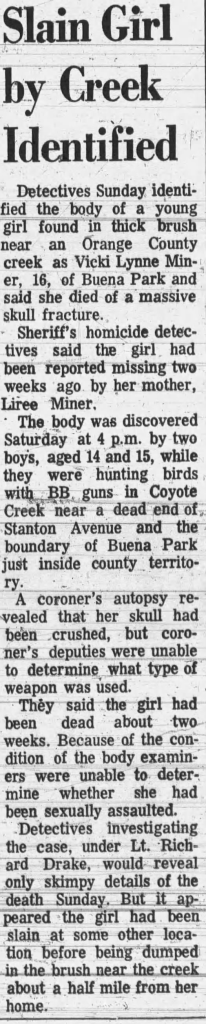
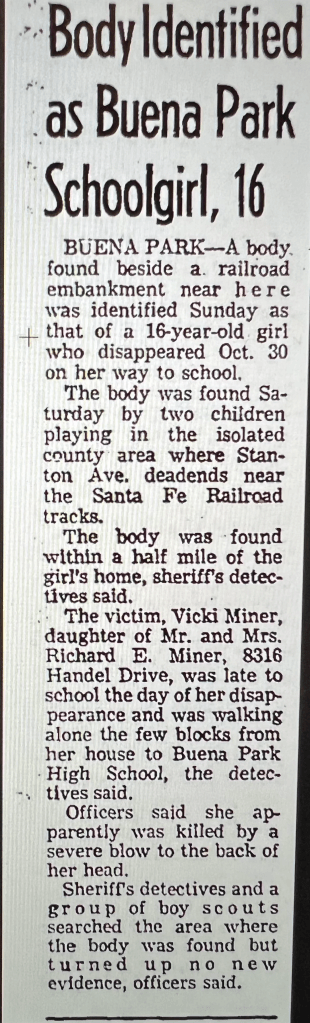
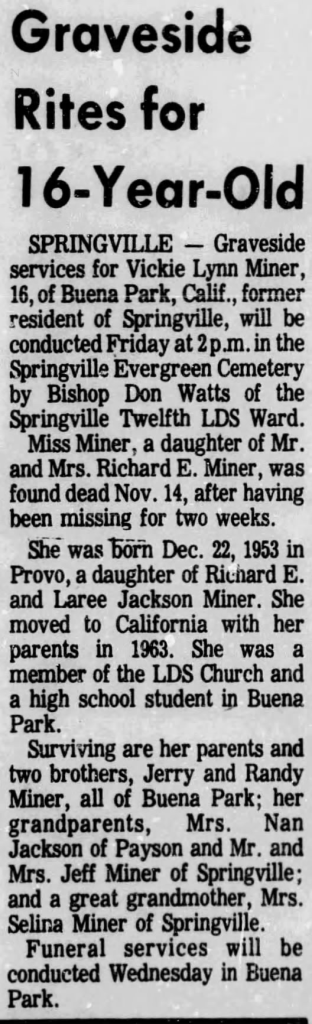
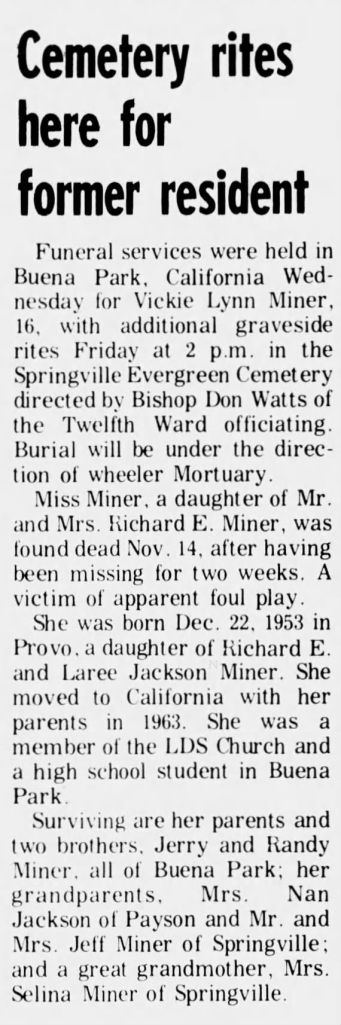
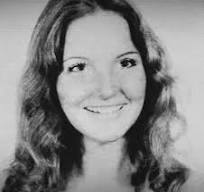
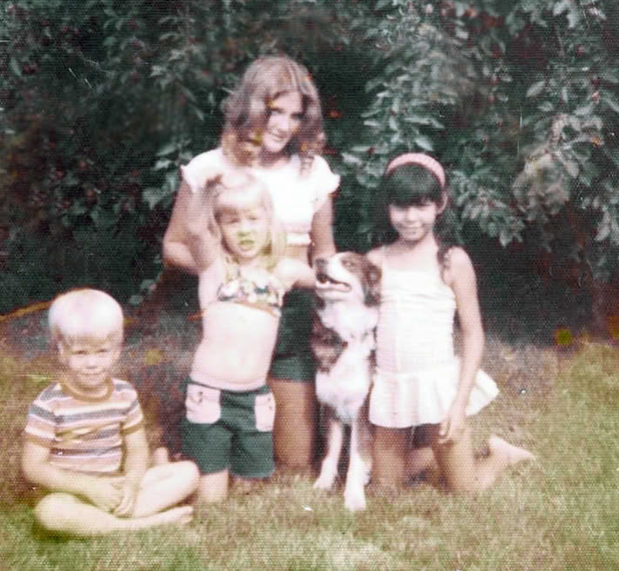
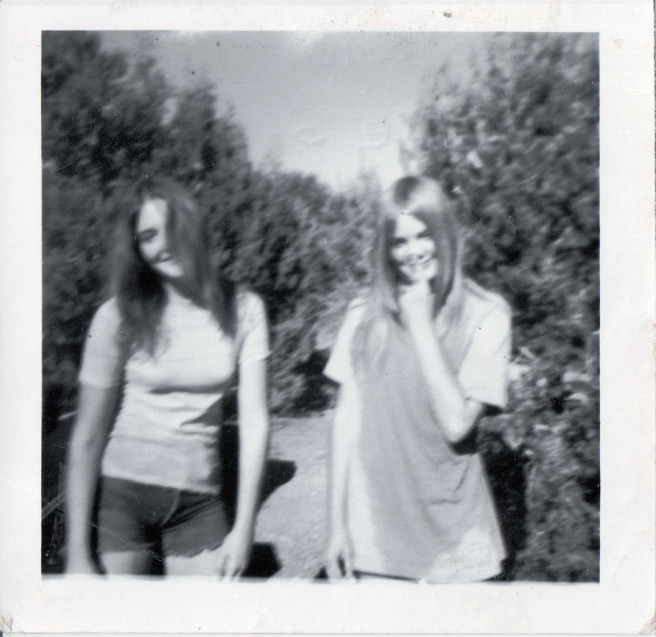
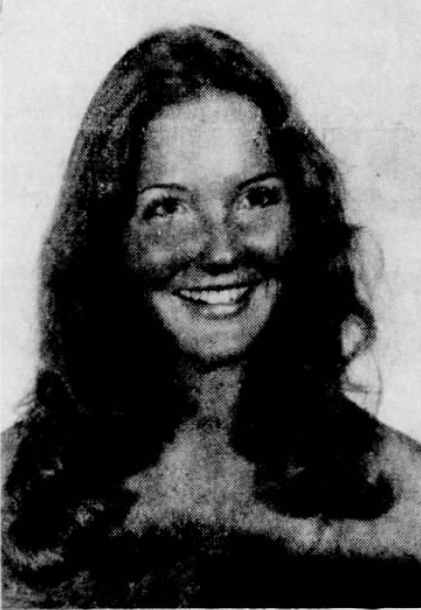
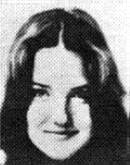
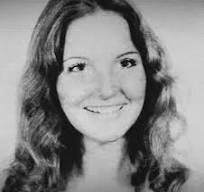
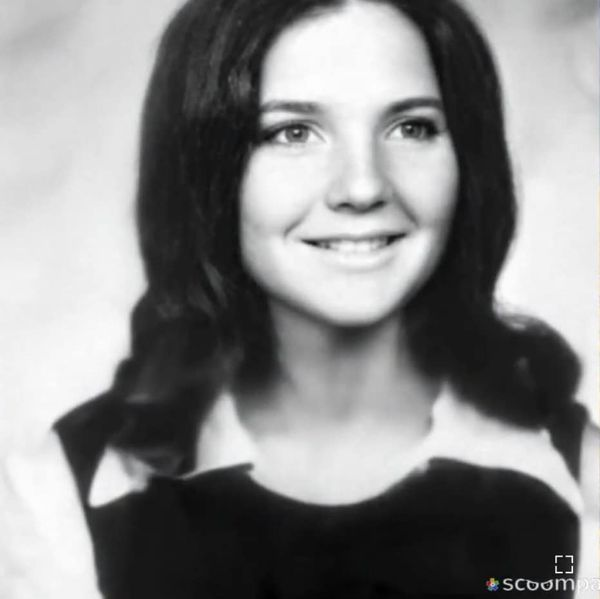
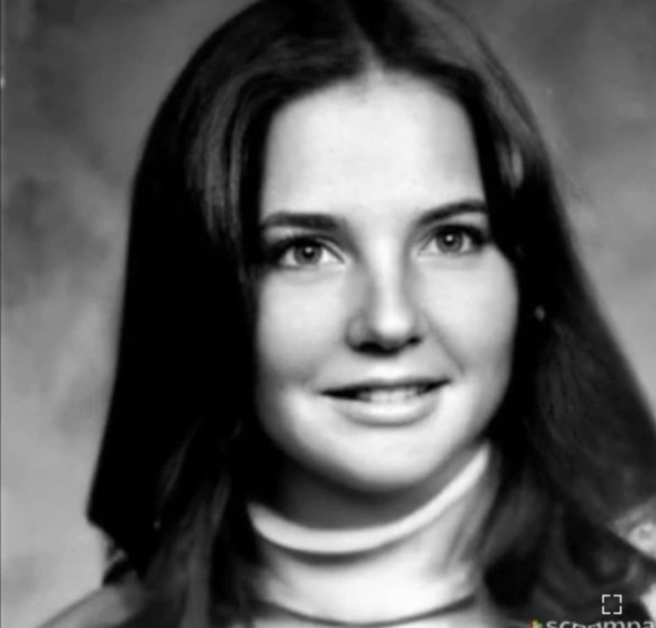
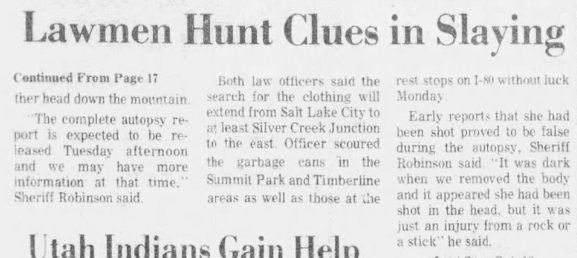
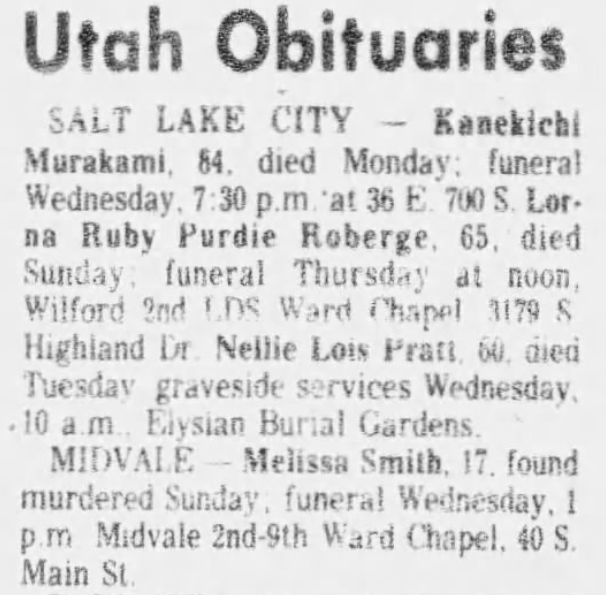
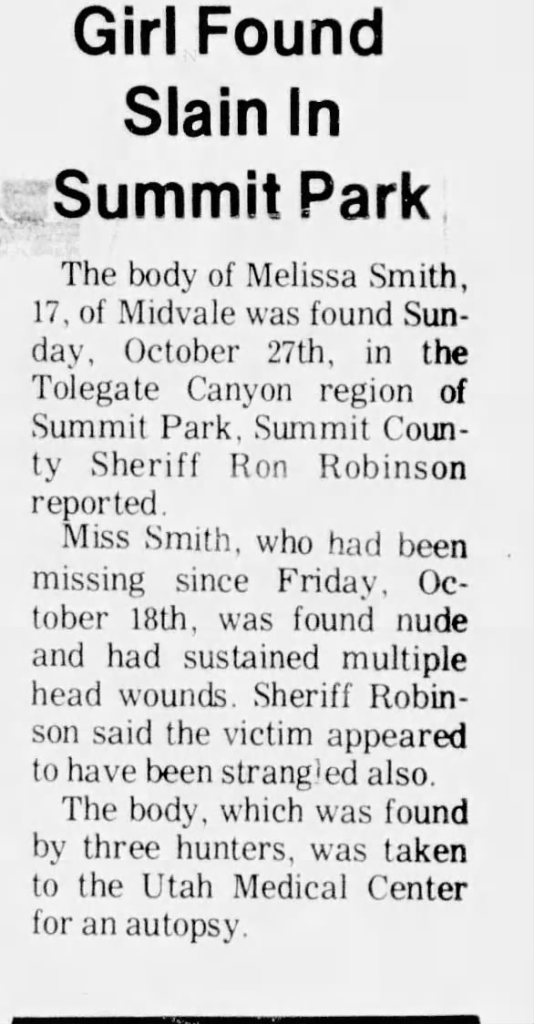
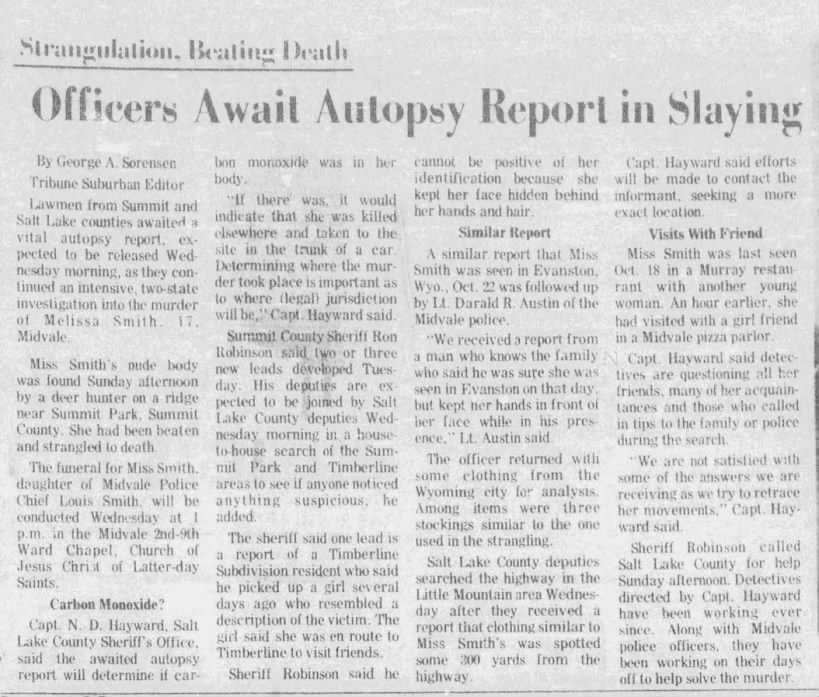
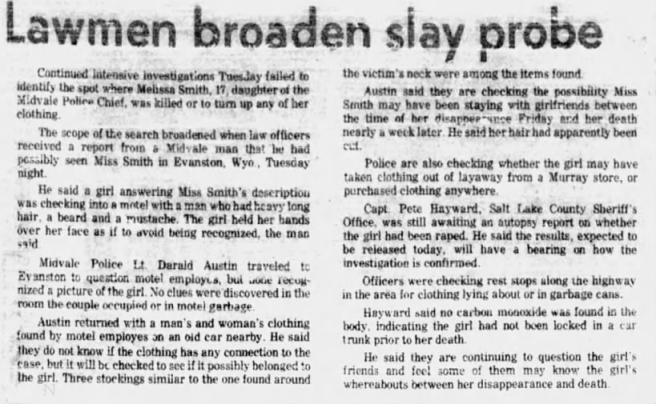
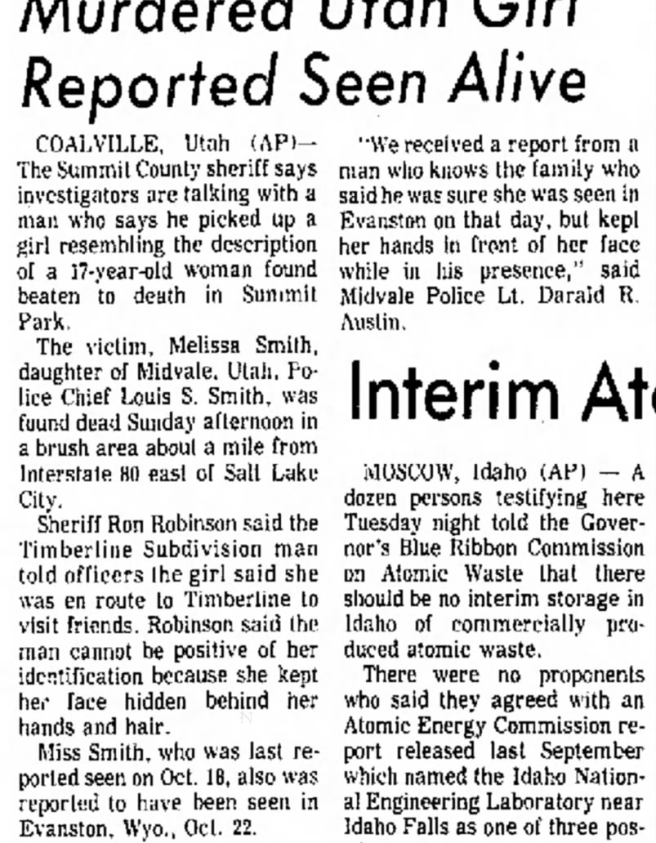
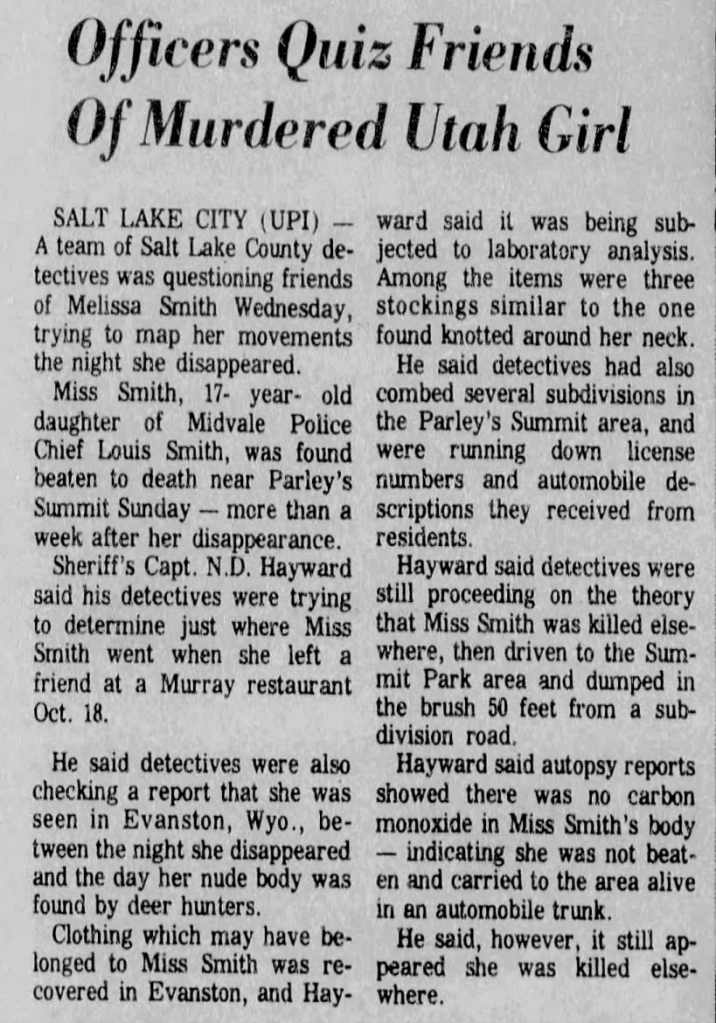
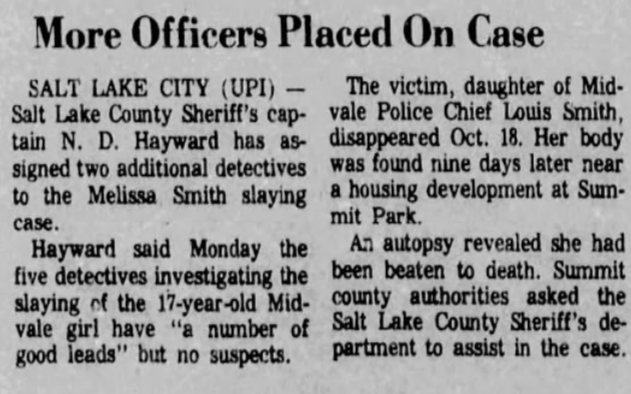
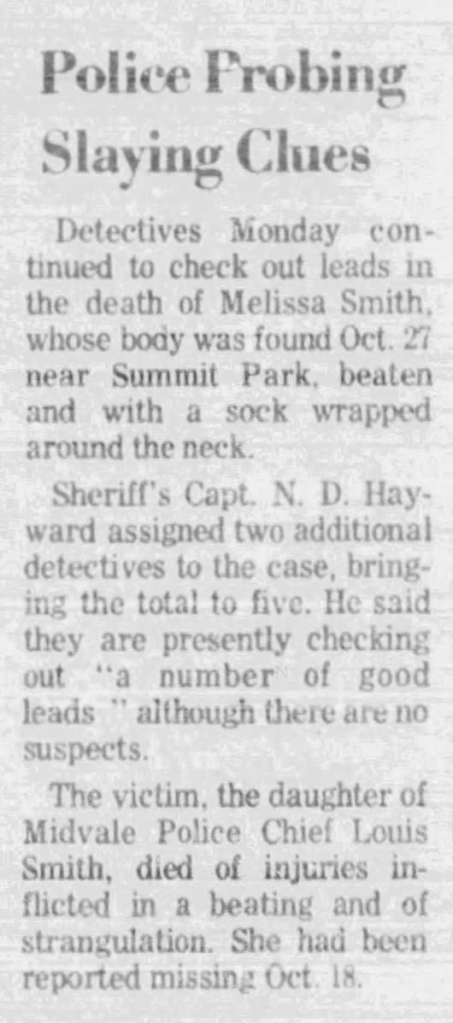
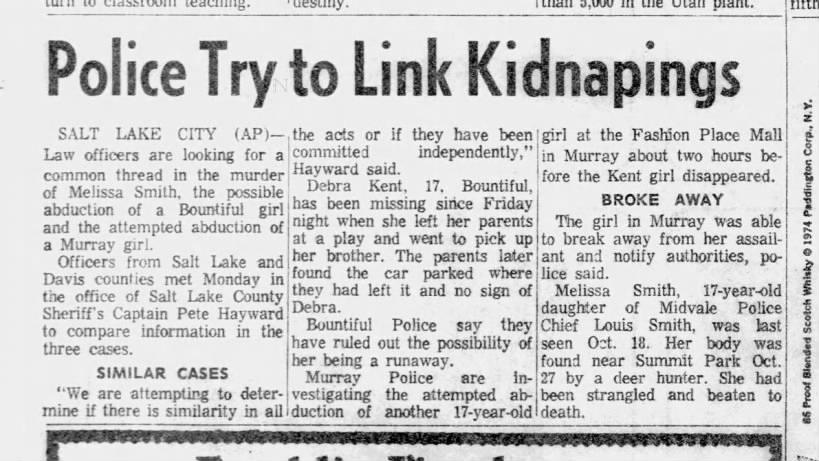
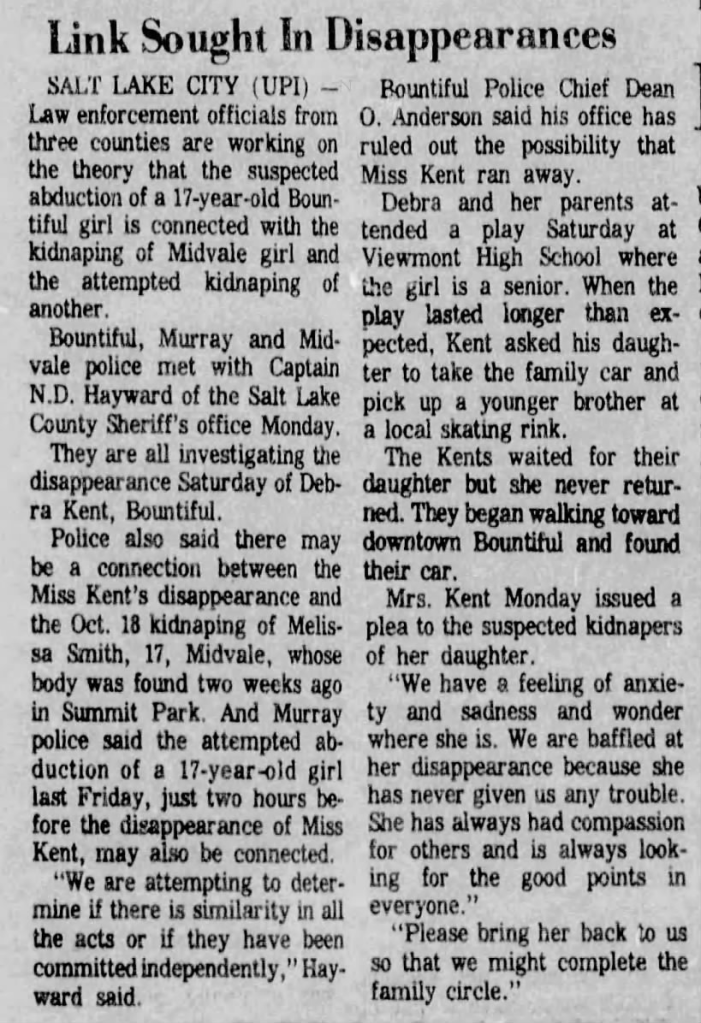
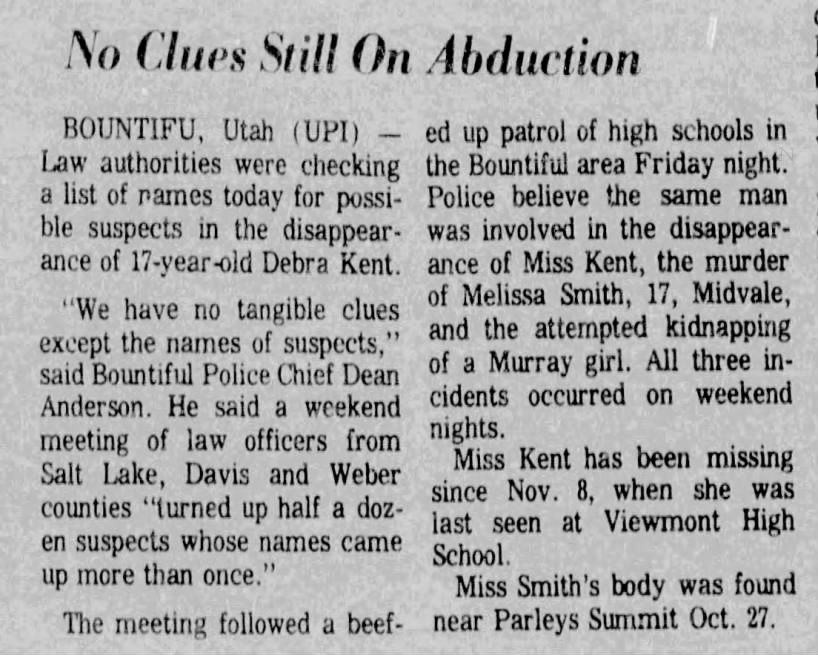
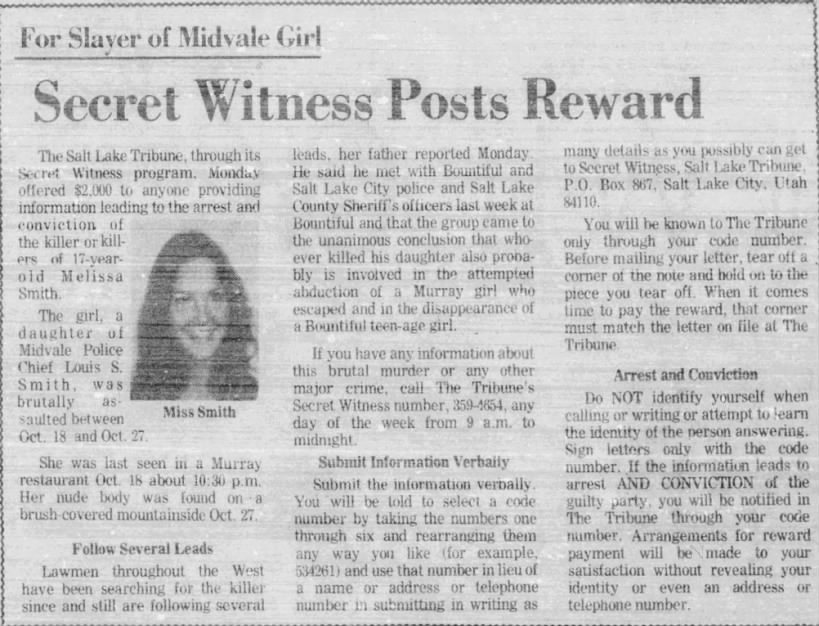
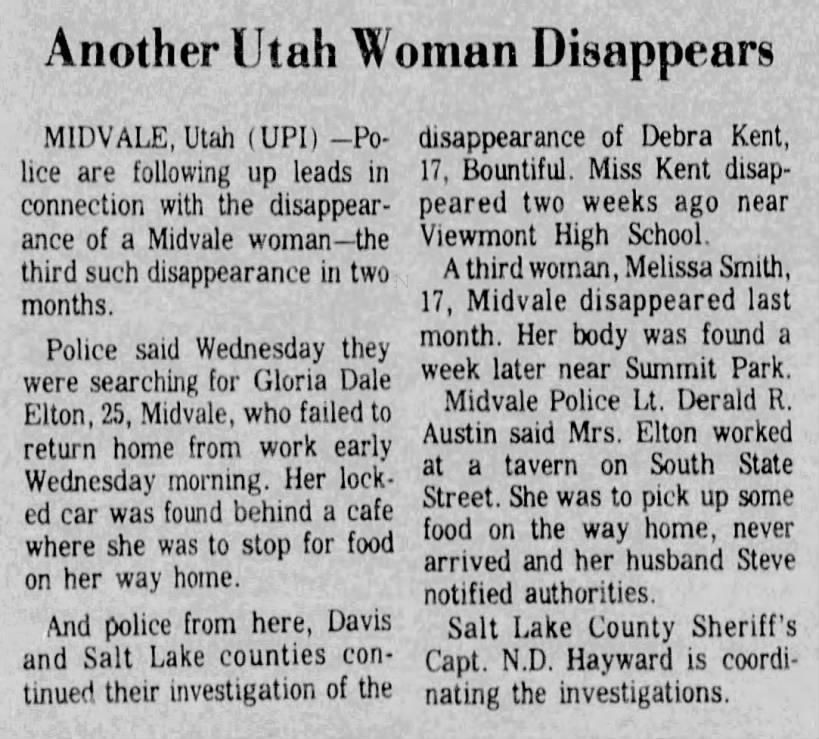
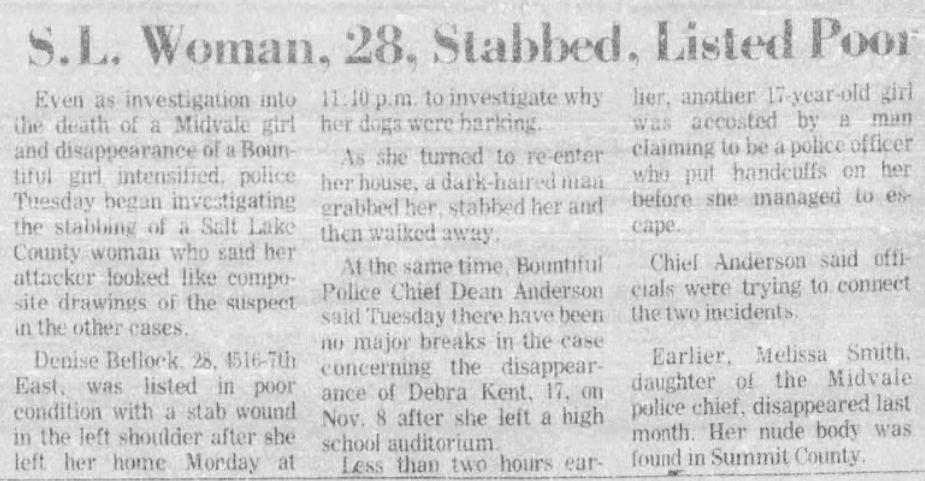
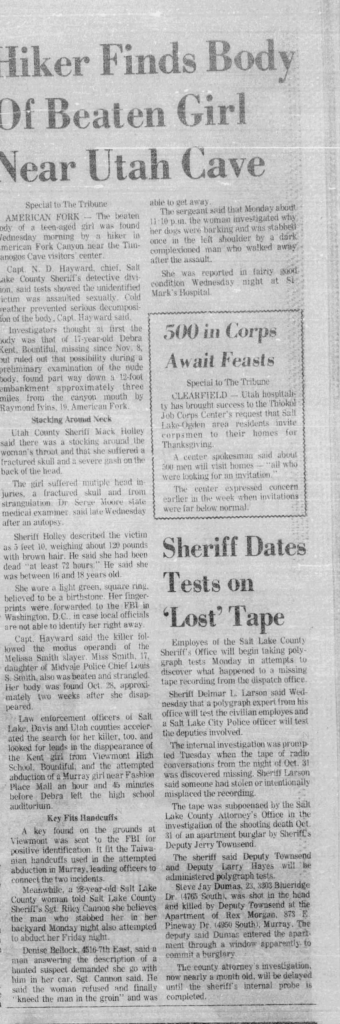
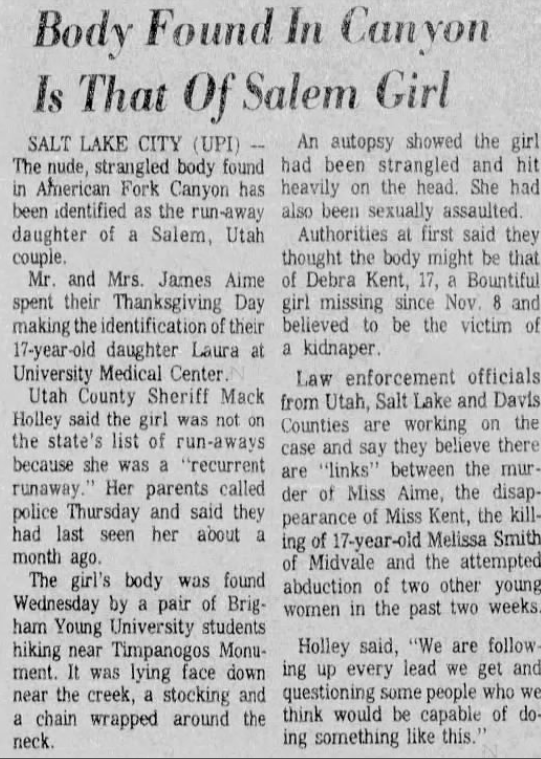
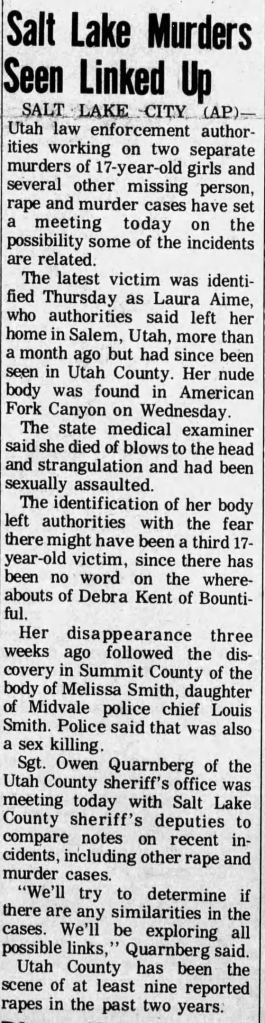
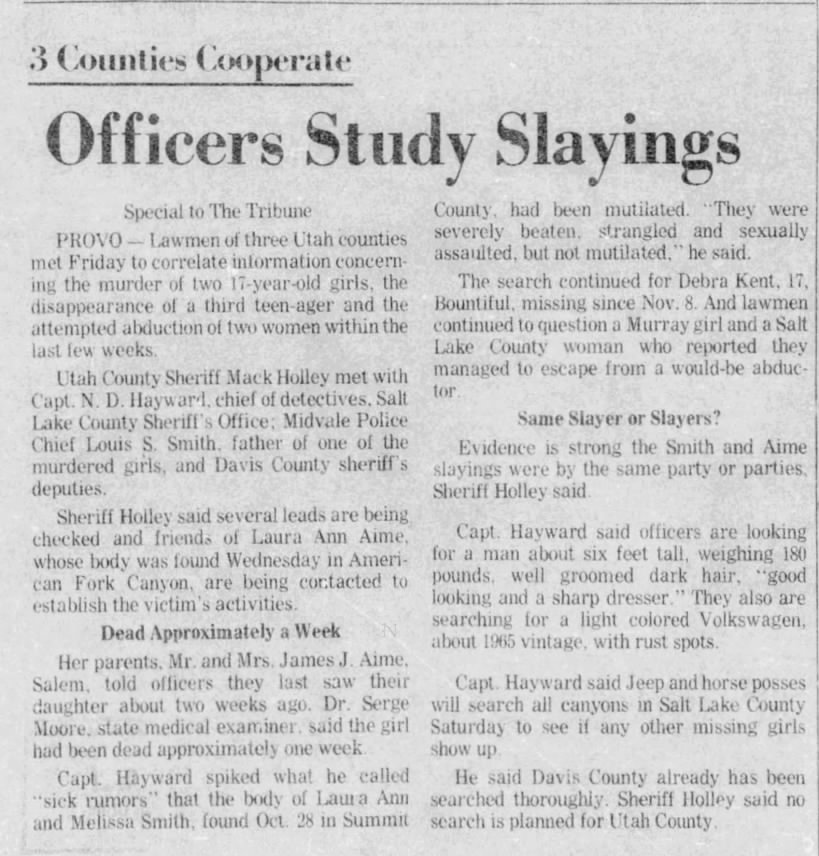
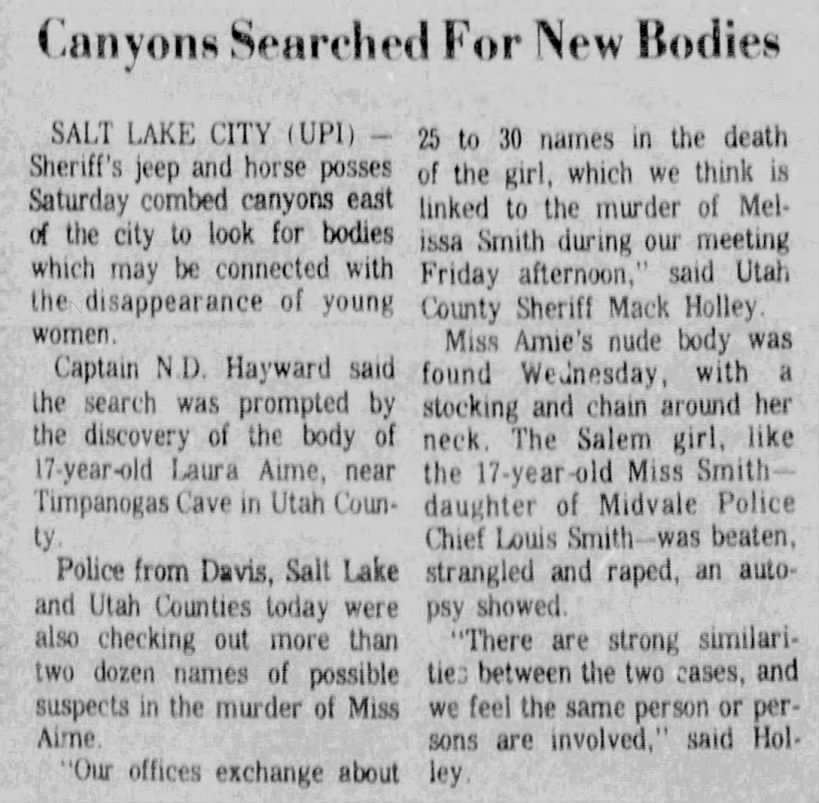
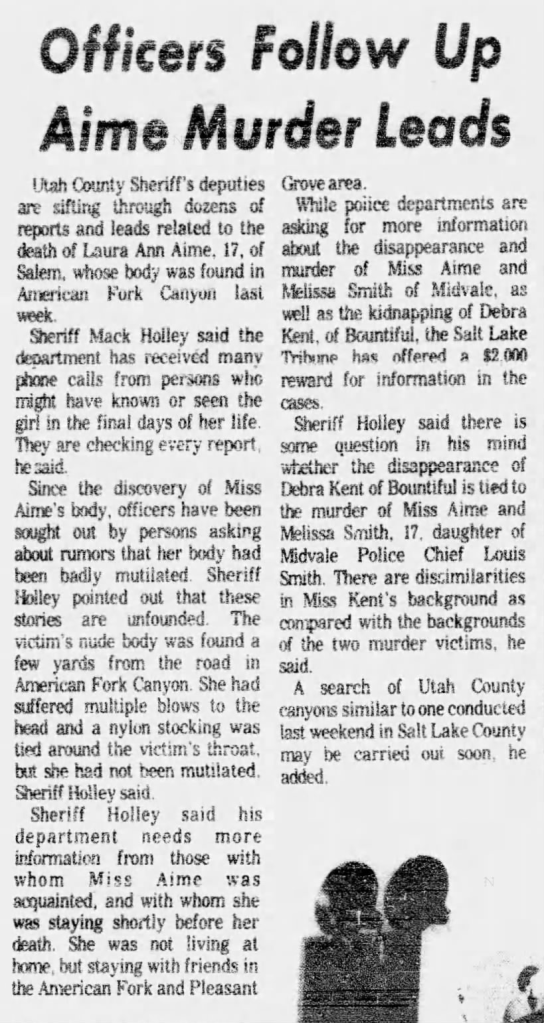
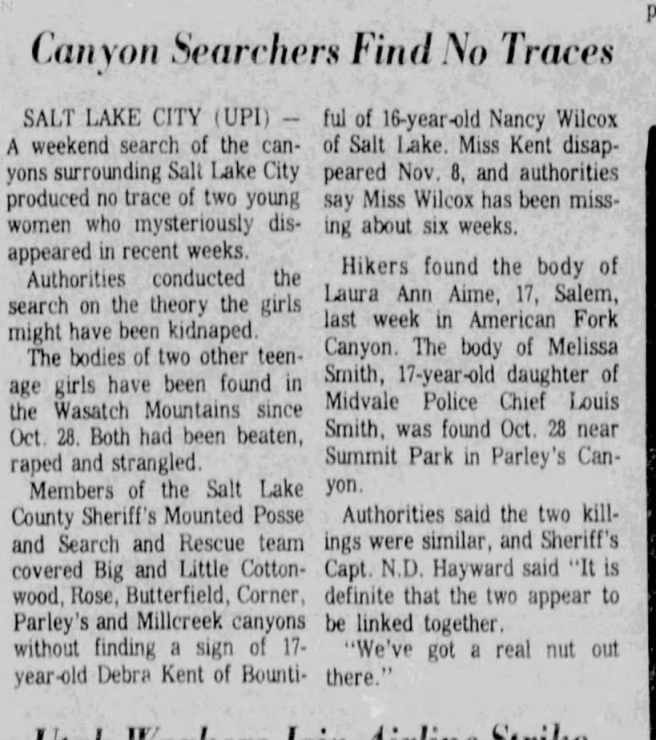
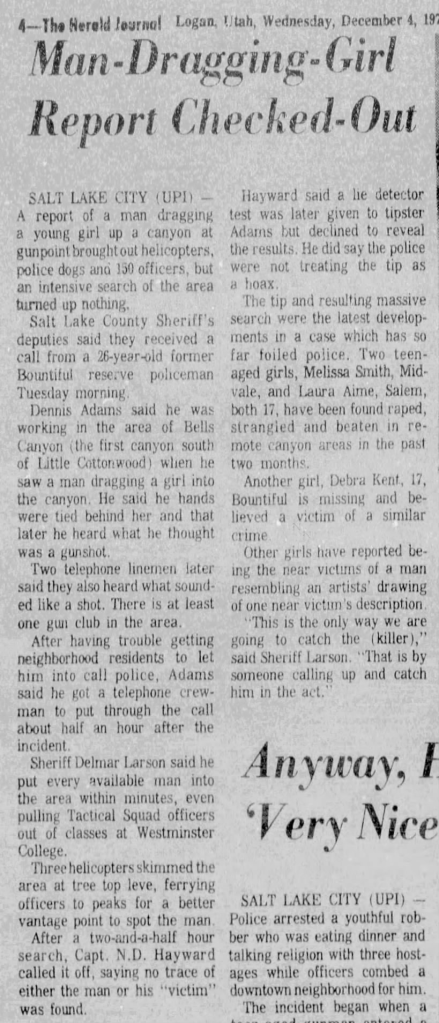
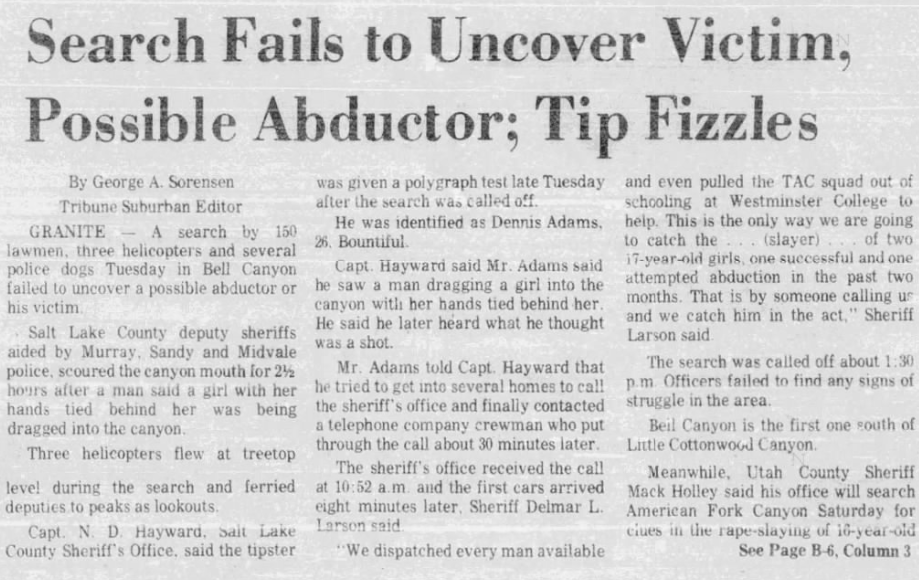
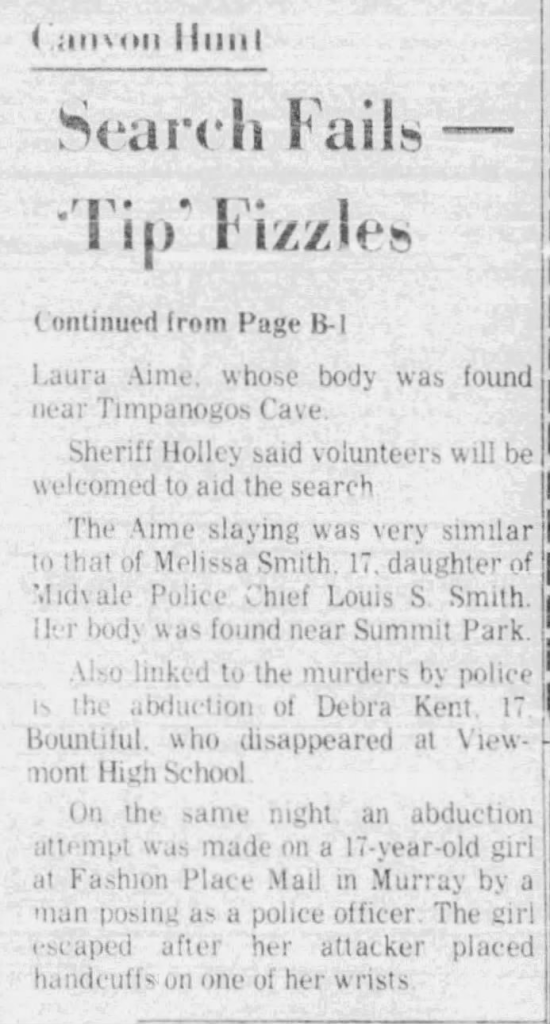
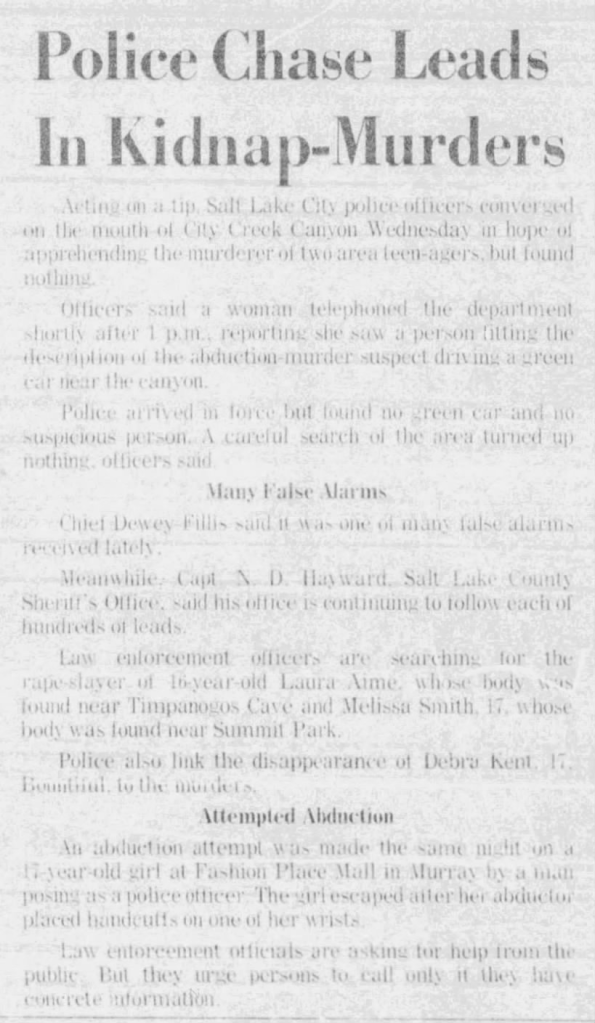
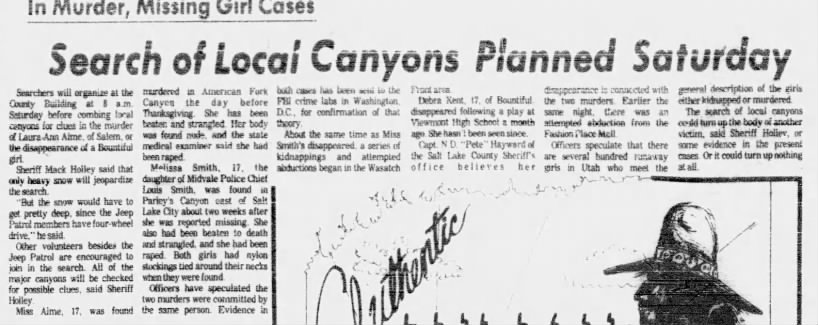
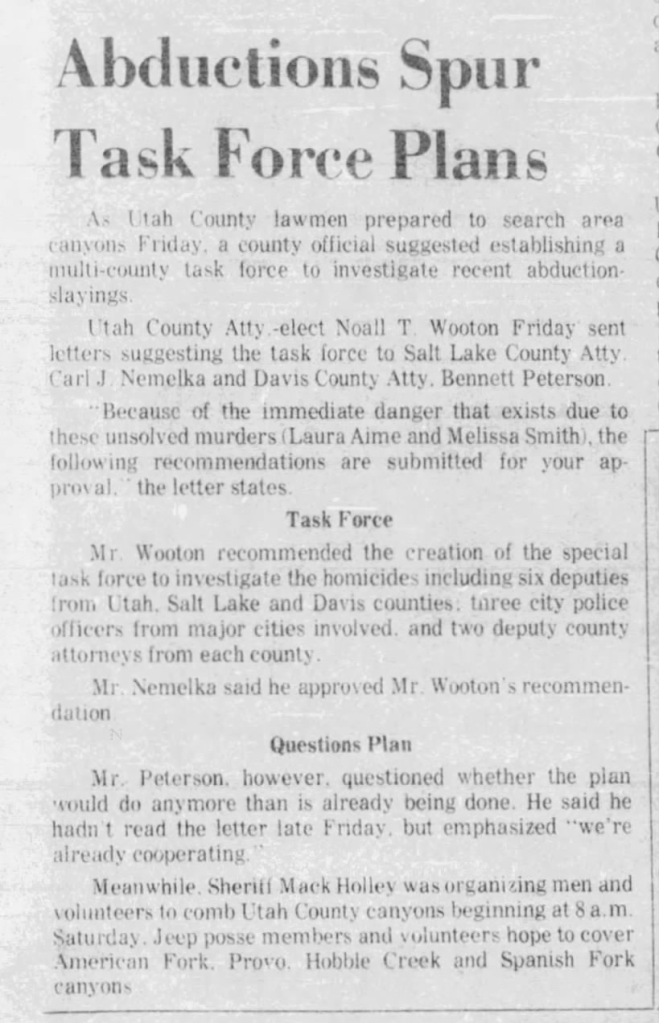
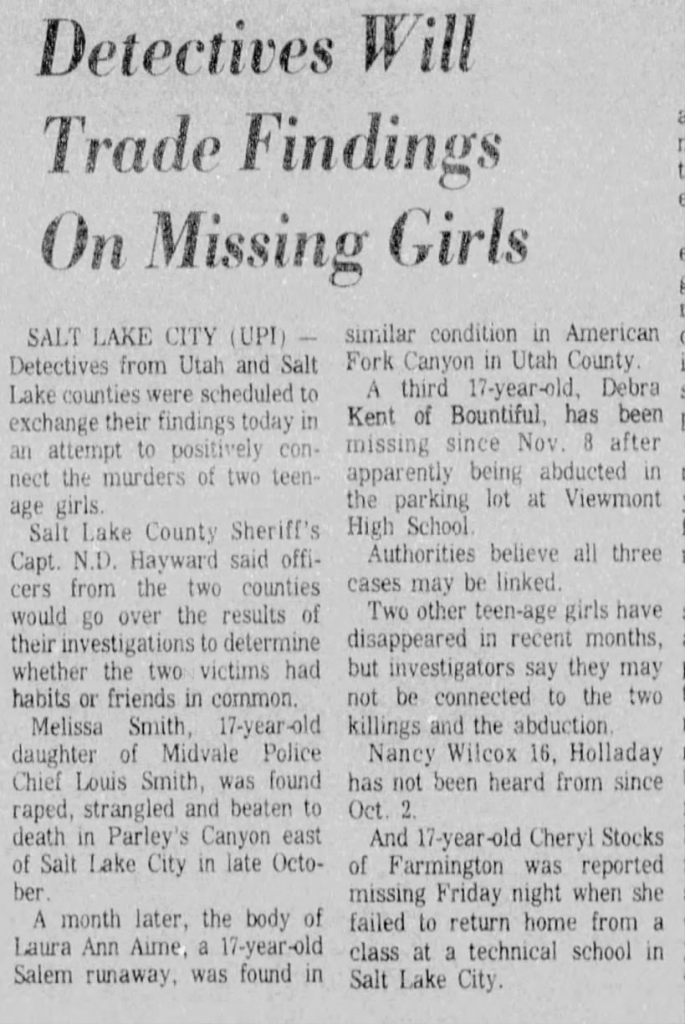
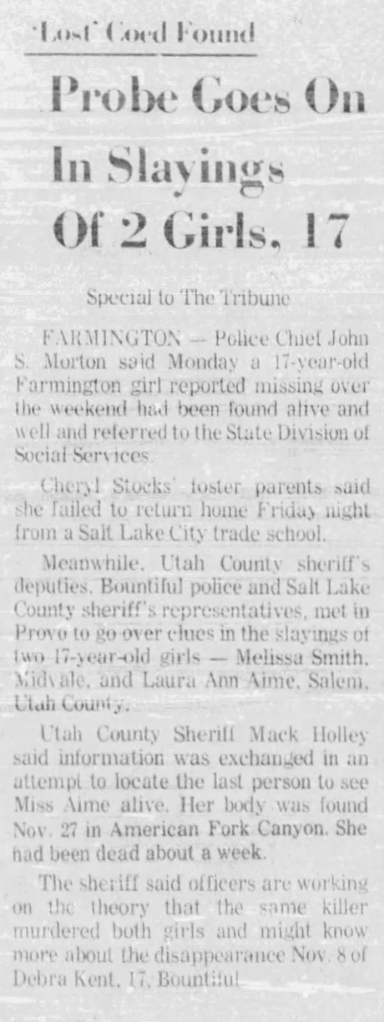
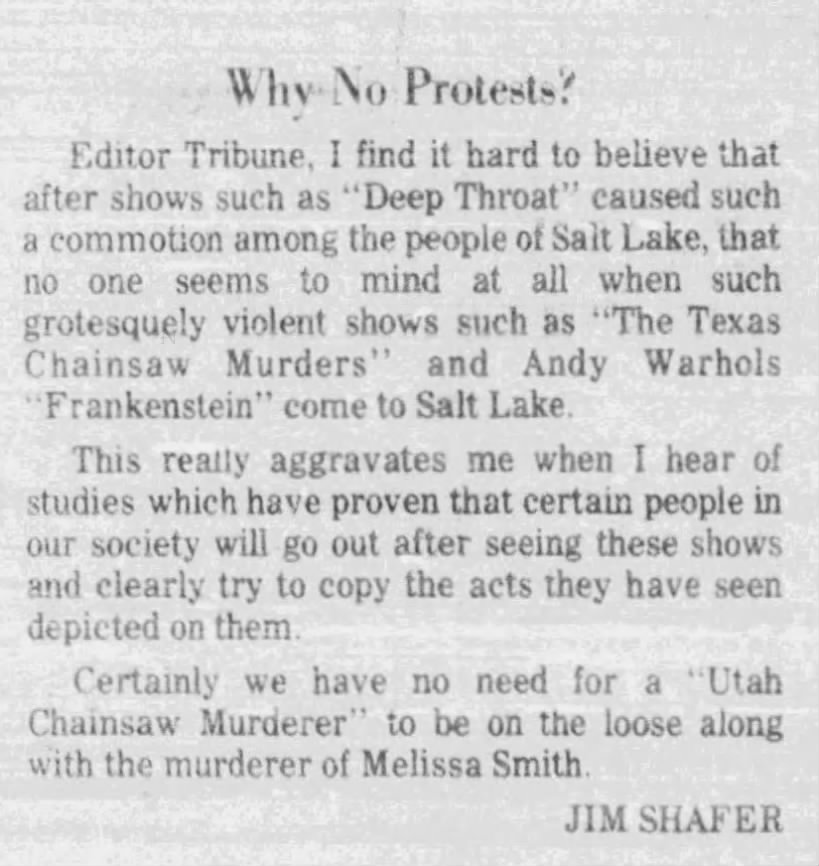
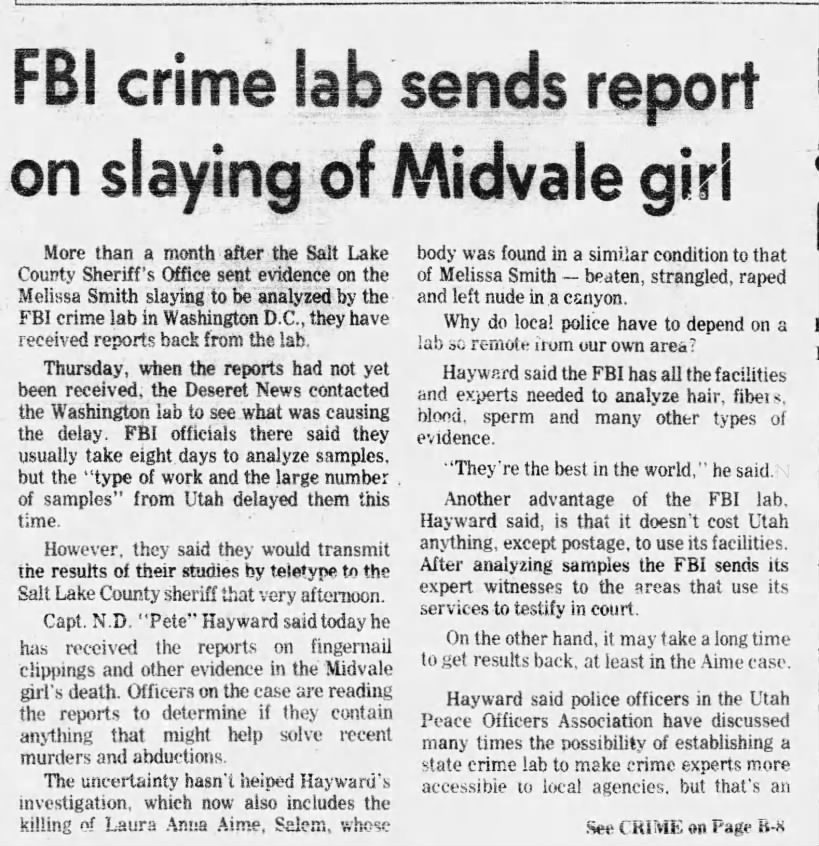
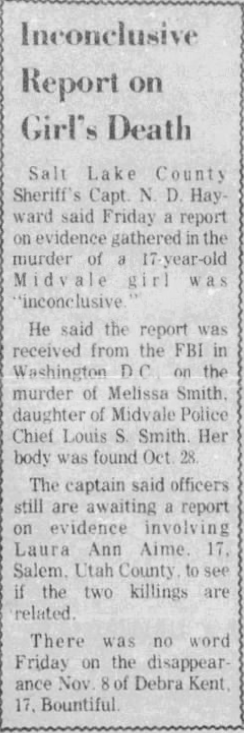
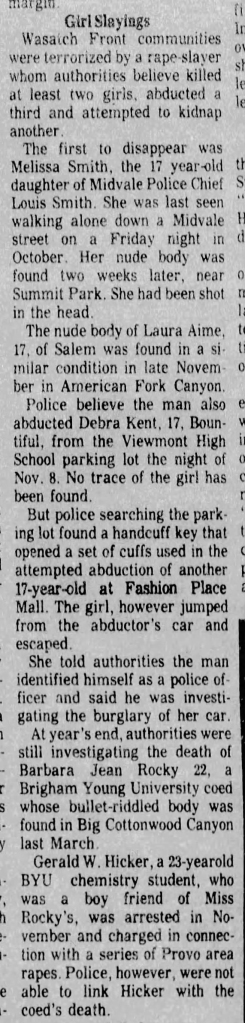
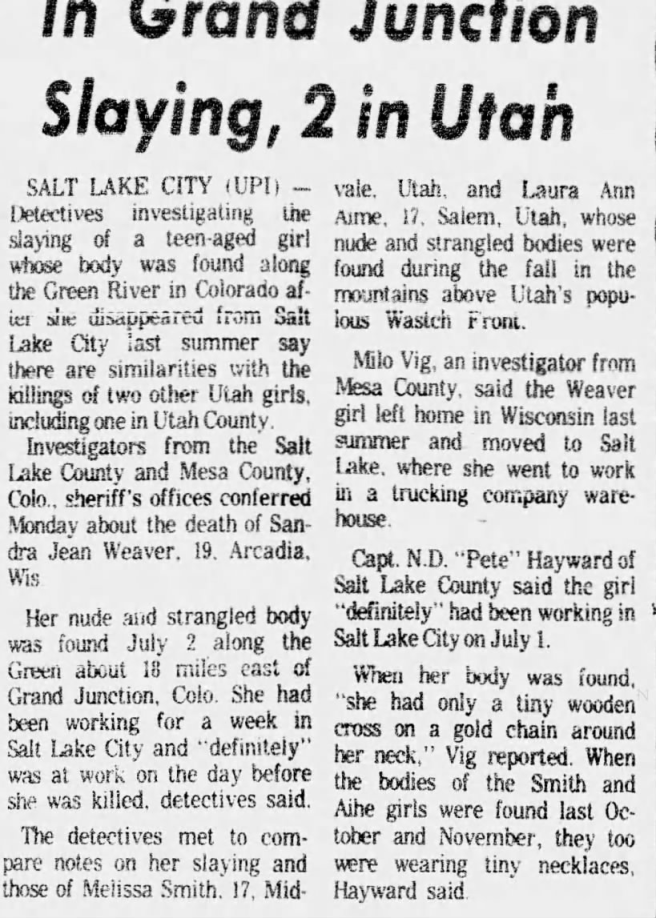
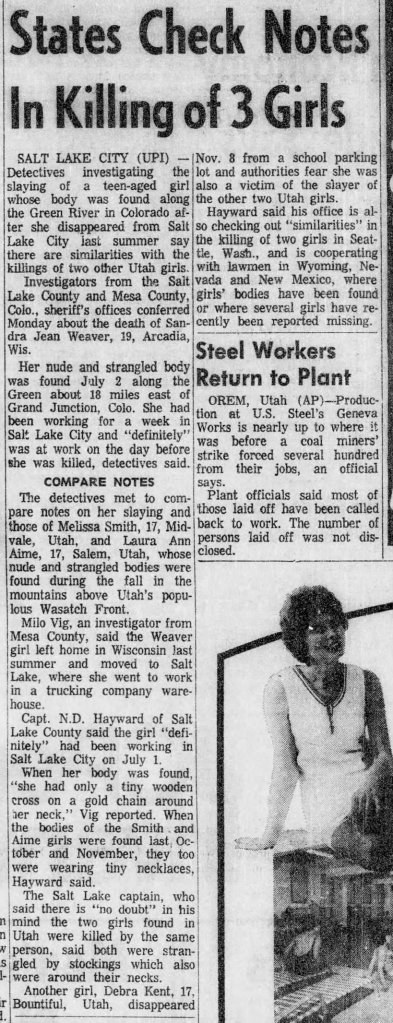
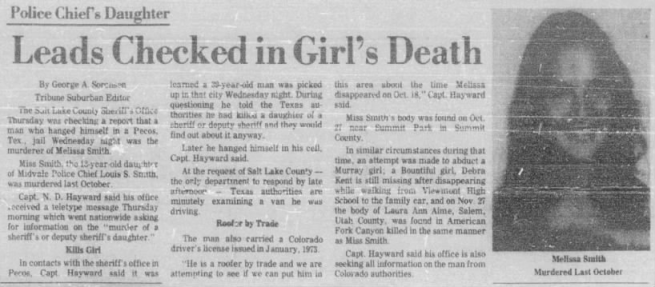
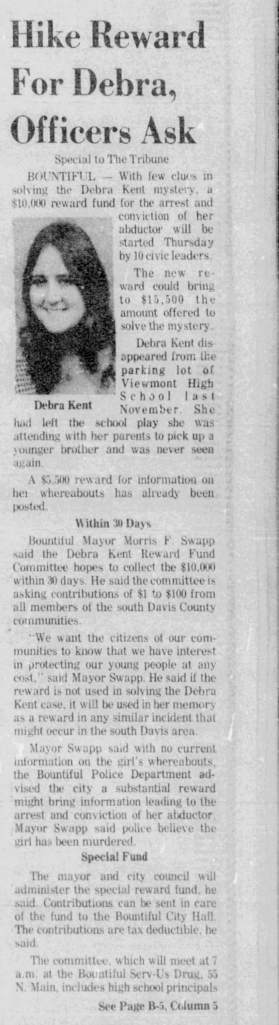
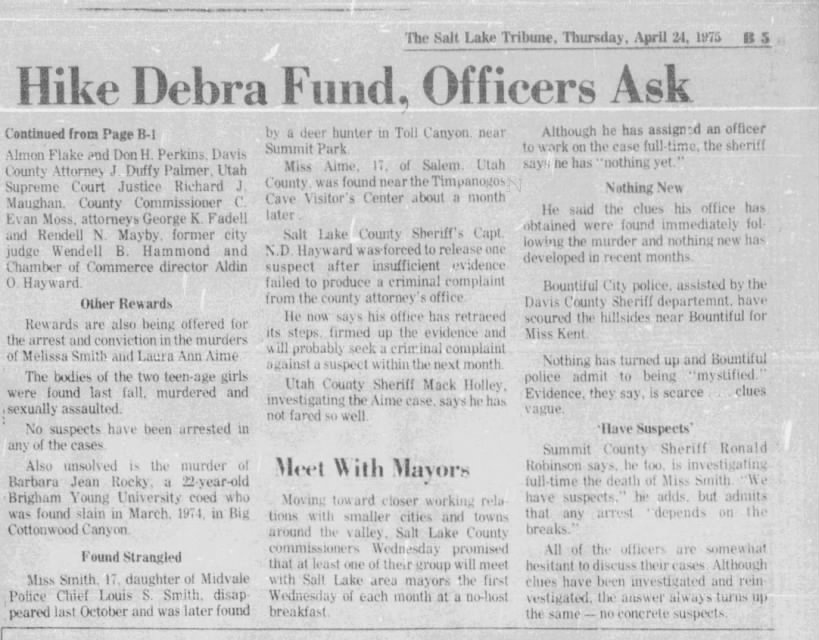
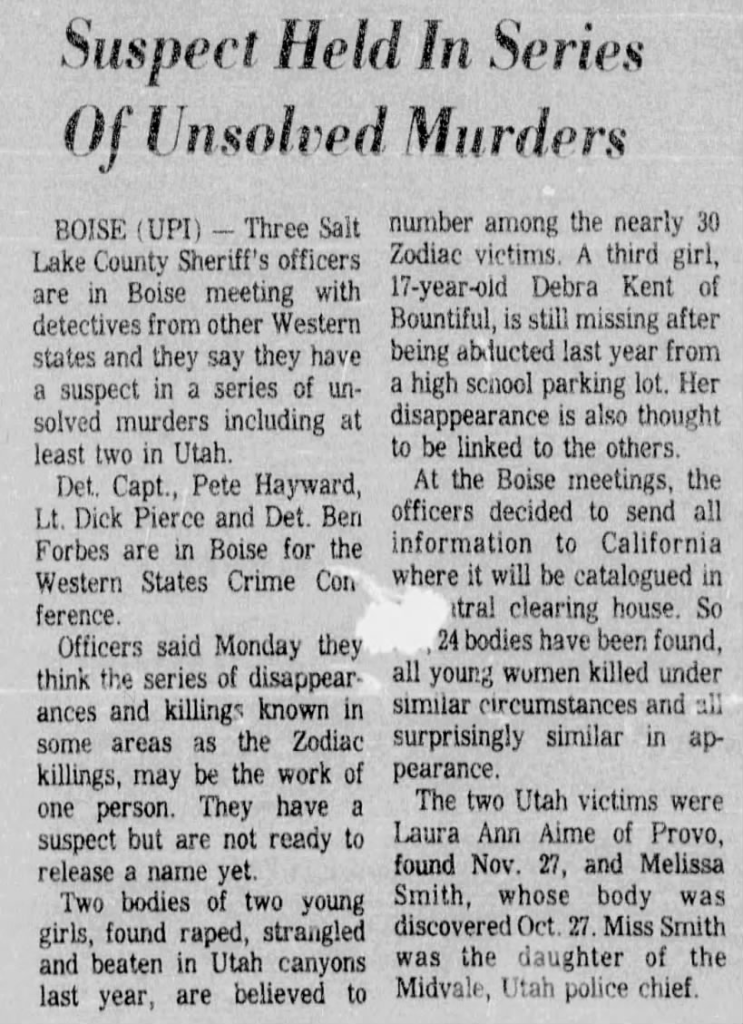
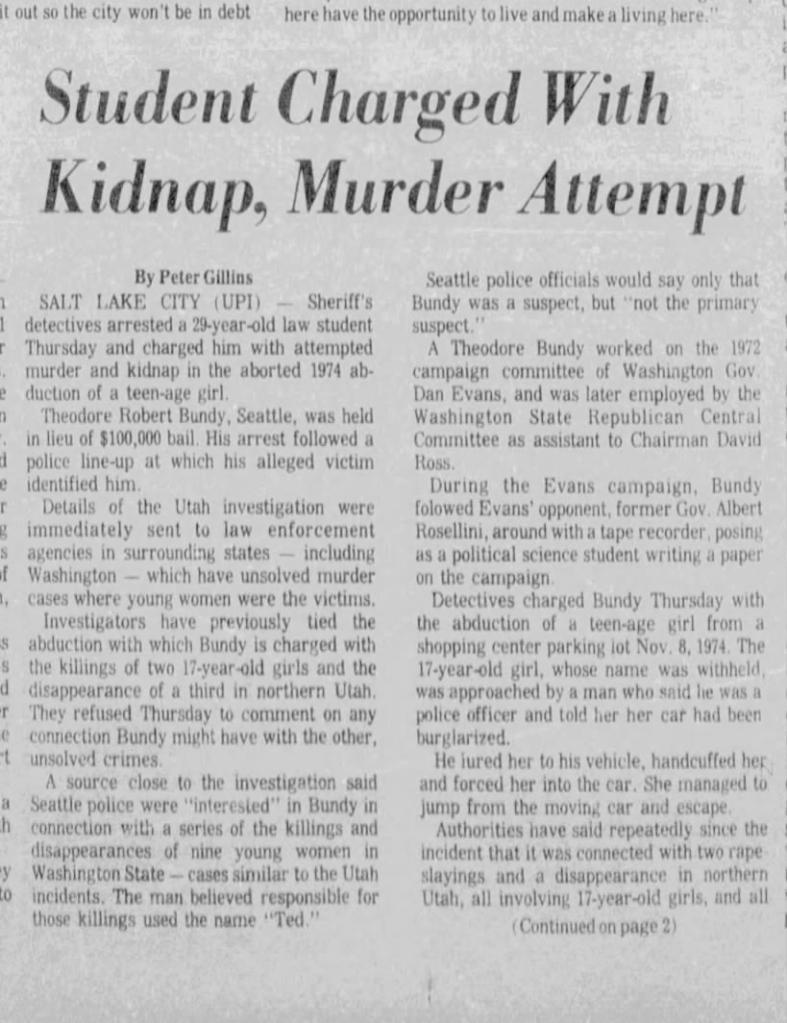
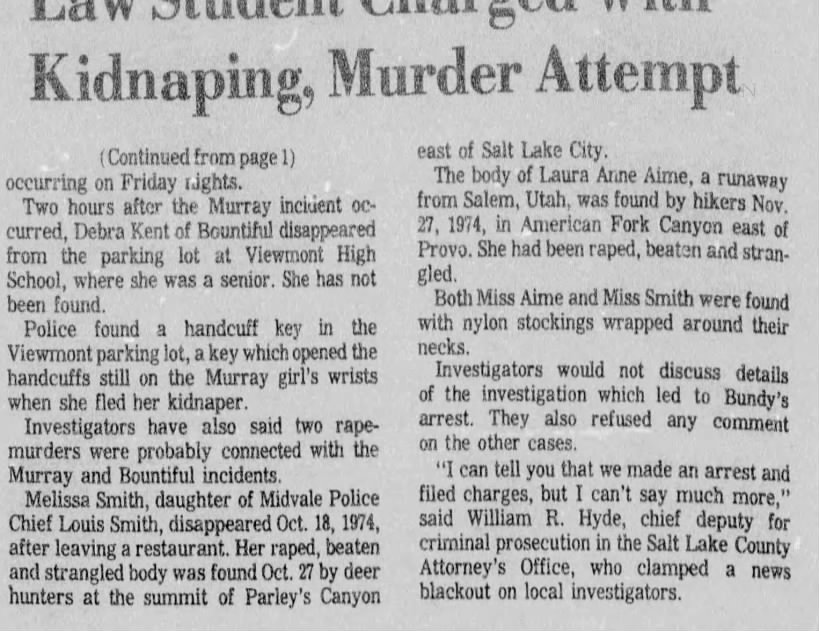
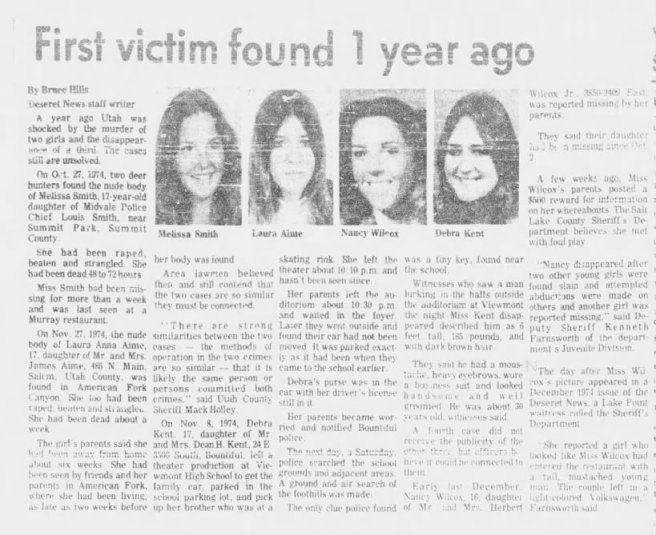
Missing/Murdered Women in Utah, 1965 to 1979.

Tanya Weber (June 26, 1965, Logan): the seventeen-year-old high school student was strangled to death on June 26, 1965, after returning from a wedding reception; in 2024, DNA testing on her clothing allowed the Logan City Police Department to officially close the case and identify a local suspect who died by suicide shortly after the 1965 crime, Owen Hodges Kimball.

Murders Linked to Myron Lance and Walter Kelbach (December 1966): I am going to touch on the murders of Lance and Kelbach as a whole: in December 1966, parolees Myron Lance and Walter Kelbach committed a brutal, multi-victim murder and robbery spree across Salt Lake County, leaving six people dead over a five-day period. The six total victims included gas station attendants, a taxicab driver, and patrons at a local establishment. On December 21, 1966, the pair entered the tavern, shot and killed patrons James Sisemore, Fred Lillie, and Beverly Mace, and wounded another before fleeing with stolen cash. Police apprehended Lance and Kelbach after a shootout at a downtown bar that killed three others at a roadblock roughly three hours after the final shootings at a roadblock near Parleys Canyon. In 1967, a jury convicted both men of first-degree murder, which resulted in the death penalty, however when the US Supreme Court struck down capital punishment in 1972, their sentences were changed to life in prison. In 1968, both prisoners briefly participated in a major maximum-security breakout from the Utah State Prison, but were quickly recaptured. Myron Lance died of natural causes in 2010 at age of sixty-nine, and Walter Kelbach died in prison in 2018.

Myrtle Bear Pete: (found on February 4, 1967, the Skull Valley Indian Reservation in Tooele County): the remains of the twenty-five-year-old Native American woman were discovered on Skull Valley Road, roughly three-hundred yards from her home in Tooele County, UT. Despite her body showing signs of severe trauma (including a broken arm, shoulder, and potential broken neck), detectives and medical experts at the time determined her death was either an accident or exposure related to a being hit by a car.

Fontella Galloway (found on June 19, 1969, Roosevelt): Galloway’s remains were found at her residence in Roosevelt; her cause of death was suffocation.

Gladys Powers (July 22, 1969, SLC): the victim was found by her husband at approximately 5:00 PM on July 22, 1969: she had been laying on the floor in their hallway, with a fork stuck in her chest.

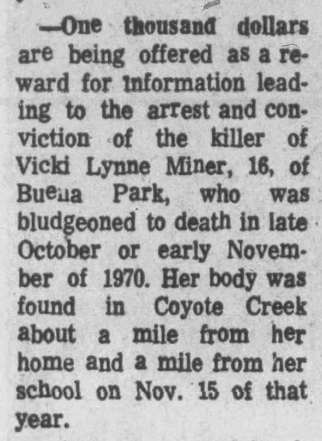
Loretta Jones (July 30, 1970, Price): the twenty-three-year-old single mother was brutally murdered in her home in Price, which was discovered by her four-year-old daughter. Though a prime suspect named Thomas Edward Egley was arrested shortly after, charges were dismissed due to a lack of evidence; after forty-six years, the case was reopened, her body was exhumed for modern forensic review, and Egley finally pled guilty to her murder in 2016.

Dale Jean Langston (April 11, 1970, Layton): twenty-four-year-old Dale Jean Langston and her two young children, Christine Jeffs (age 6) and Troy Don Langston (age 3), were brutally murdered in their home on Marilyn Drive in Layton, Utah. Key details surrounding the infamous Layton cold case include: The victims were found inside their residence in a pool of blood. Dale Jean Langston had been sexually assaulted and stabbed more than 33 times. Both children were also violently attacked; Christine’s throat was slashed, and Troy was stabbed repeatedly and disemboweled. At the time of the murders, Dale Jean’s husband, Don Langston, was away on a trip to Detroit with his brothers and a friend.

The 1970 Washington County ‘Jane Doe’ (October 1970, Gunlock State Park): in October 1970, Gunlock State Park a road crew employee discovered the badly decomposed, skeletal remains of a woman off Gunlock Road, approximately eighteen miles west of St. George near what is now Gunlock State Park. Her remains were found with a few strands of blonde or light-colored hair, and she had been deceased for months to years before her body was found. An autopsy conducted by the Utah Medical Examiner’s Office left the cause of death as undetermined; unable to identify her, officials interred the woman in an unmarked grave with a headstone reading ‘unknown’ at the Hurricane City Cemetery, where she had remained for over five decades. In January 2026, the Washington County Sheriff’s Office announced that its Investigations Division had officially reopened the case.

Johanna Tabitha Virginia Strong Leatherbury (disappeared on August 20, 1971, Olympia): the seventeen-year-old was a recent graduate of Olympus High School, and on the night she disappeared, had been hanging out at a popular teenage gathering spot known as ‘The Complex’ in SLC; witnesses last reported seeing her in a vehicle with two men and several other passengers.

Carolyn Yvonne Kingston (September 2, 1971, SLC): thirty-year-old Carolyn was a clerk at Natters’ Market in Salt Lake City, and on the afternoon of September 2, 1971, an armed gunman entered the established with the intention of committing a robbery; she had her two small children with her at the time and it’s possible she struggled with the man. She and a deliveryman were both shot; the suspect attempted to shoot a second deliveryman, but the gun did not go off. Carolyn died later as a result of her injuries.

Ann Marie Hammer-Woodward (March 2, 1973, Moab): forty-six-year-old Woodward owned and operated Woody’s Tavern (along with her husband, Leslie H. ‘Woody,’ a local establishment where she was killed after closing time. The case remained unsolved for over five decades until it was officially solved by the Moab Police Department: in May 2024, the results positively identified her killer as Douglas K. Chudomelka, a twenty-five-year-old local mine worker whose DNA had been heavily present on the inside of her pants and on her shirt buttons.

Jennifer Lee Klein (May 25, 1974, Moab): Klein was last seen that Memorial Day Weekend with her family at a campground approximately ten miles north of Moab; her father had gone back to the camper for something, and she was playing in the sand. Everyone’s attention was diverted because of a dogfight and when Jennifer’s mother and five-year-old brother turned around, she was gone. It is believed that she may have fallen into the river, but that has not been confirmed.

Nancy Perry-Baird (July 4, 1975, SLC): the twenty-three-year-old single mother disappeared on Independence Day while working at a gas station on Highway 89 in Layton.

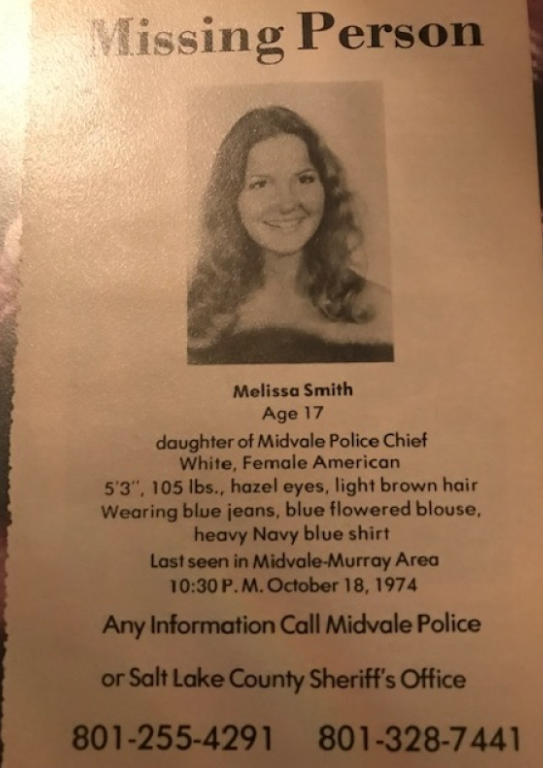
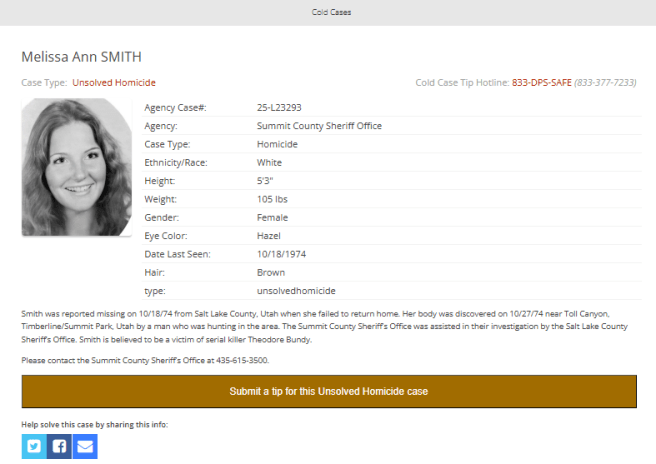
Nancy Wilcox (October 1, 1974, Holladay): the sixteen-year-old vanished in Salt Lake County on October 1, 1974. She is believed to be an early victim of Ted Bundy; her body has never been recovered.

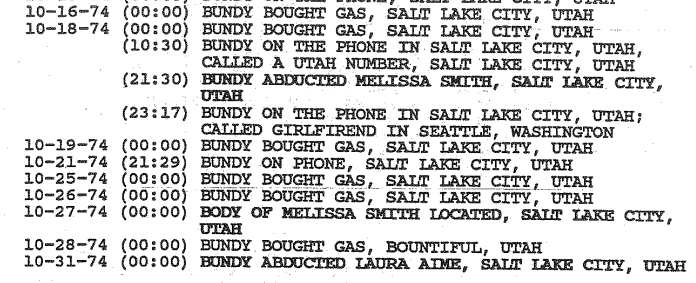
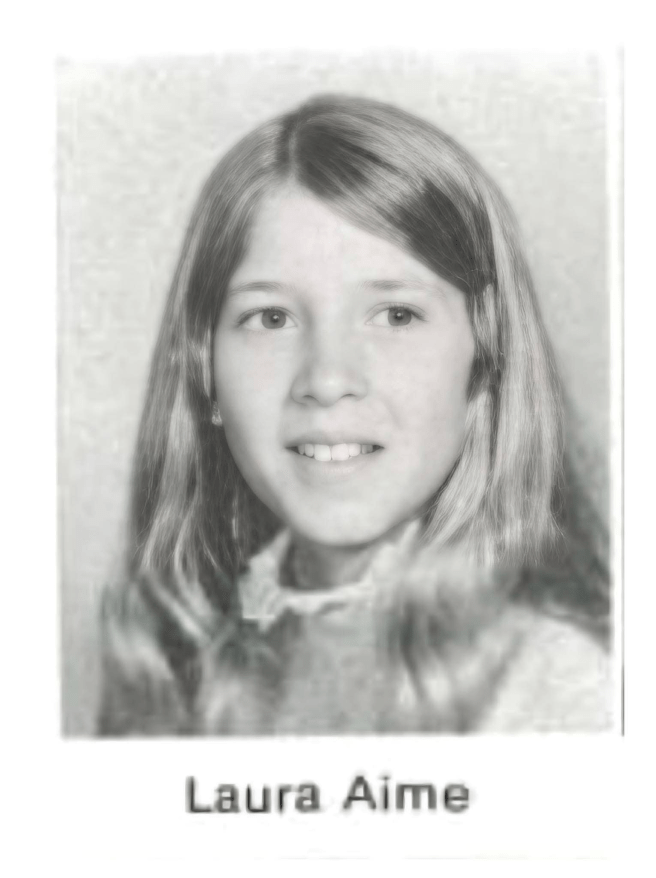
Laura Ann Aime (October 31, 1974, Lehi): the seventeen-year-old disappeared on October 31, 1974, from Lehi, Utah, and her body was later found in American Fork Canyon. Advanced DNA testing officially confirmed Ted Bundy as her killer in April 2026.

Susan Curtis (June 27, 1975, Provo): the fifteen-year-old disappeared while attending a youth conference at Brigham Young University in Provo; she is also highly suspected to be a victim of Ted Bundy.

Debra Diane Smith (February 1976, SLC): seventeen-year-old Debbie’s remains were discovered in April 1976 near the Salt Lake International Airport; her death remains an open cold case investigated by the Salt Lake City Police Department. Historically, investigators and researchers have suspected she may have been a victim of Ted Bundy.

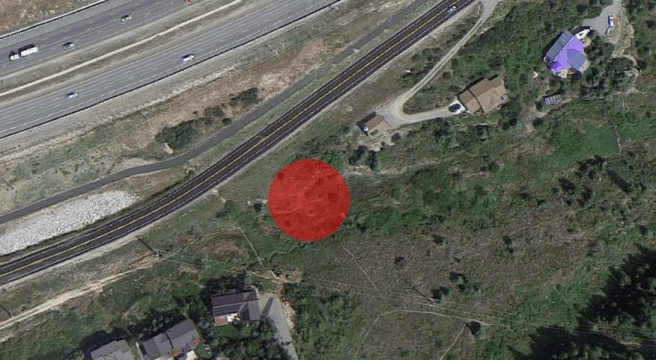
Joy Kathleen ‘Kathy’ Jones-Harmon (March 2, 1976, SLC): Kathy had been out with a friend at the Better Days Bar and left the establishment alone around midnight; investigators located the coat she had worn to the bar inside her apartment, which made them believe she made it home safely that night before being targeted. She was reported missing by her parents after she failed to show up for work the following morning. Four days later a hiker discovered her partially clothed body on the still-frozen slopes between Emigration Canyon and Parleys Canyon, just north of I-80; forensic evidence indicated she had been beaten, raped, and strangled to death.

Orthea Duncan Wamsley (found on May 5, 1976, Neola): Wamsley was abducted from her POE of ‘The Neola Store’ during the middle of a shift; her remains were found north of Neola in a wooded area. Her hands had been bound behind her back, and she had been shot in the head.

Paula R. Scartezina (June 24. 1976, Carbon County): the victim was found deceased in her bed by her husband.

Valaine Briggs (August 18, 1977, SLC):the twenty-one-year-old left her apartment in Salt Lake City to walk to a neighborhood convenience store and never returned. Her body was found shortly after in a remote area of Morgan County. Decades later, her case remains heavily active with investigators continually checking for updated DNA technology leads.

Sharon Lecia Schollmeyer (found on December 5, 1977, SLC): the sixteen-year-old had been found dead inside her Salt Lake City apartment, and had been blindfolded, gagged, and placed in her bathtub. Decades later, advanced DNA testing of the gag identified the building’s former manager, Patrick McCabe, who was subsequently charged with her murder.

Phyllis Ady (disappeared on December 13,1977, Cedar City): fifteen-year-old Ady was reported as missing on December 13,1977, and had been living with her Aunt and Uncle at the time in Cedar City. Her Aunt dropped her off at Hermie’s Drive-In December 12th, where she met an acquaintance she was not seen after that night. On July 2, 1980, skeletal remains were found in an old carrot pit beneath a wooden trap door covered by a mound of dirt in a backyard in Cedar City; they were later identified as Phyllis Ady.

Corazon Cabug Frandsen (February 4, 1978, Unified): the twenty-six-year-old went to dinner with her in-laws on the evening of February 4, 1978, and afterward she picked up a few groceries and then proceeded home to her apartment located at 5272 South Cobble Creek Road. It appears she was first attacked as she got out of her white two-door Mercury Cougar in the parking lot of the apartment complex, and she was found the following morning in the bushes adjacent to the parking lot of a nearby church. She had been severely beaten and was unconscious at the time she was found; she died a short time later at the hospital as a result of blunt force trauma injuries and exposure to the elements.

Marla Rae Scharp (June 29, 1978, Provo): the twenty-one-year-old Brigham Young University student was raped and strangled in her Provo apartment while her roommates were away for only thirty minutes; her case was reopened in late 2019 after it was revealed a previous confession by Henry Lee Lucas was entirely fabricated.

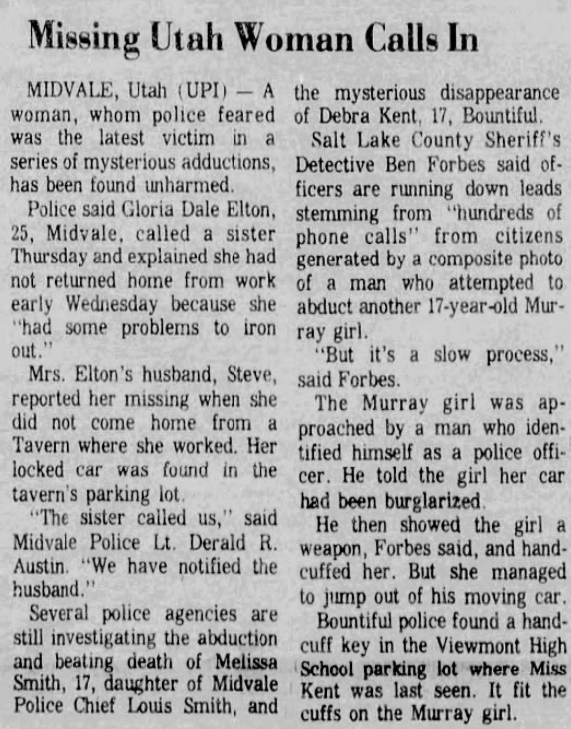
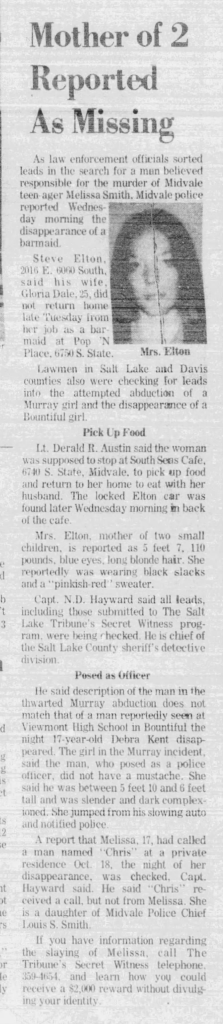
Linda Sue Peterson (disappeared on September 16, 1978, Murray): five and 1/2 months pregnant Peterson was reported missing to the Murray Police Department by her husband, William on September 30, 1978: he said that she had stopped by his work (where he was a pharmacist) and told him she planned a last-minute trip to Kentucky with two unknown ‘girlfriends’ (he said he didn’t know them but strongly thinks one of their names was Susan); he seemingly accepted this news and gave her $300 in cash, and made sure that she also had her master card with her. The credit card was never used after she disappearance and Phil died in 2013.

Patricia Ann Barrett (September 25, 1978, SLC): Patricia was forty-five-years-old at the time of her disappearance, and it is believed she had only been in the Salt Lake area a couple of months prior to vanishing. She was originally from the Texas area had been travelling in the year-and-a-half prior to her death and it’s highly possible she was in the south-east portion of the US (including Texas, Oklahoma, and Louisiana). Contact with Patricia indicated she may have been homeless prior to her disappearance, and she had been diagnosed with schizophrenia. The last known contact with Barrett was with her children on August 31, 1978, and her nude body was found wrapped in carpeting in the old Salt Lake Beach area near the I-80 by a motorist on October 25, 1978; her cause of death was unable to be determined but may have been strangulation, and her time of death was estimated to be approximately one month prior to being found. The body remained unidentified until June of 2012 when DNA testing confirmed her identity as that of Patricia Barrett.

Mona Lee Ulibarri (disappeared on April 17, 1979, SLC): the victim went to Billy-O’s Bar sometime in the evening on April 17,1979; she had been drinking and playing pool. No one remembers seeing her leave the bar that night and her Volkswagen Bug was found the next day close to the bar; its interior had been incinerated. Ulibarriwas found in the Jordan river twelve days later.

Mary Katherine Miller (June 20, 1979, SLC): Mary was ‘emotional and upset’ at the time she disappeared and was last seen by her daughter in Provo. Her car was located at the face of Timpanogos, it was found stuck. She had a bridge on her upper front teeth.

Sandra Matott (disappeared on July 10, 1979, SLC): the thirty-seven-year-old mother vanished from Salt Lake City; her husband, Warren reported her missing eight days later. In August 2021 her identity was finally uncovered after advanced forensic DNA testing identified her as the ‘Millard County Jane Doe,’ who had been discovered on August 19, 1979 after a hunter named Leonard Watts discovered skeletal remains covered in debris near the Interstate 15 Cove Fort exit in rural Millard County; an exact cause of death was never determined. No one was ever convicted or officially named by police as the killer of Matott, however her husband and Henry Lee Lucas were considered to be the two main suspects; both men died before any charges could be filed.

Rachael Arenaz (last seen alive on October 1, 1979, SLC): on May 8, 1980 two young boys out riding horses stumbled upon the remains of Arenaz lying in an irrigation ditch at 2100 North and 4000 West; her time of death was estimated to be anywhere from six months to one year prior.

Dawn Marie Davis (found on October 23, 1979, South SLC): Dawn’s body was found in her apartment after no one heard from her for about two weeks prior to the discovery.

Trial Transcript: Carol Ann DaRonch, February 23, 1976.

Tiffany Jean transcribed the following testimony of Carol DaRonch under direct examination by Deputy County Attorney David Yocom and is from the transcript of Case No. 28629 in the Third District Court of SLC, The State of Utah vs. Theodore Robert Bundy.

Q. Will you state your name and address, please.

A. Carol Ann DaRonch, 5456 South Seventh West.

Q. Carol, I am going to ask you to keep your voice up–the acoustics in here are not the best in the world—so the Judge and counsel can hear. Okay?

A: Okay.

Q: How old are you, Carol?

A: Nineteen.

Q: And what is your birth date?

A: June 8th, 1956.

Q: And how old were you on the 8th day of November, 1974?

A: Eighteen.

Q: And where did you reside at that time, Carol?

A: With my parents.

Q: At the same address?

A: Yes.

Q: Did you own an automobile at that time?

A: Yes.

Q: Would you describe for the Court the type of car you owned?

A: It’s a ’74 maroon Camaro.

Q: Where did you work at that time, if you did?

A: Mountain Dell.

Q: Where is that located?

A: 205 East Second South.

Q: What did you do there?

A: Typist.

Q: Have you had an opportunity, Carol, to check the record with your employer to determine what hours you worked on the 8th day of November, on Friday, 1974?

A: Yes.

Q: And when did you work?

A: I worked from 9:00 to 6:00.

Q: And where did you go after you got off work at 6:00 p.m. that day?

A: I went straight home.

Q: Do you know how long it takes you to get home from Mountain Bell?

A: About 20 minutes.

Q: Do you recall what you did at home?

A: No.

Q: Do you recall the next thing you did?

A: I went to Fashion Place Mall.

Q: And why did you go there?

A: I just went there shopping. I was looking for a birthday present.

Q: Anyone go with you?

A: No.

Q: And not long after you got home did you park at Fashion Place Mall?

A: About 15 to 20 minutes.

Q: Do you recall when, approximately, you arrived at the mall?

A: About 7:00.

Q: Where did you go after you arrived at the Mall— the parking lot, specifically?

A: I parked in Sears’ parking lot.

Q: And where is that located in relationship to the Sears store itself?

A: On the west side of Sears.

Fashion Place Mall Salt Lake City Utah Carol DaRonch Ted Bundy

Sears west parking lot, Fashion Place Mall, 1976.

Q: What did you do after you parked your vehicle there?

A: I got out of my car, and I walked into the Sears store.

Q: Did you stay in the Sears store any length of time?

A: No. I walked through it.

Q: And where did you exit the Sears store?

A: Where it goes into the mall.

Q. You entered and exited the Sears store and proceeded along the main part of the Mall?

A: Yes.

Q: And then you went west in the Mall?

A: Yes.

Q: How far west did you go?

A: To the Castleton’s store.

Q: After you made a left-hand turn and turned down the mall, how far did you go there?

A: Almost to Auerbach’s. To Walden’s Book Store.

Q: During this period of time, did you have any period of conversation or see anyone you knew?

A: Yes.

Q: And who was that?

A: My cousin.

Q: And what is her name?

A: Joanne DaRonch.

Q: And where did that discussion take place, and conversation? About midway in the corridor?

A: Yes.

Q: Was anyone with your cousin?

A: Yes.

Q: Who was that?

A: Jolynne Turner.

Q: And how long did that conversation last?

A: Just a couple of minutes.

Q: What did you do then?

A: Walked down toward Walden’s Book Store.

Q: What did you do at Walden’s?

A: I stopped and looked in the window of the book store.

Q: Did anything happen then?

A: Yes. I turned around, and a man approached me.

Q: Approached you from which direction?

A: I’m not sure.

Q: How long had you been at the window when you first noticed this man?

A: A couple minutes. It wasn’t until I turned around that he came to me.

Q: Did you see him right in front of you, or behind you, or how?

A: Face to face.

Q: How were you dressed at that time, Carol?

A: Had Levi’s on, and a leather coat with fur around it.

Q: How long had you had that coat?

A: A couple weeks.

Q: Was it relatively new then?

A: Yes.

Q: Okay. As best you recall Carol, what were the first words spoken to you by this man?

A: He asked me if I had a car parked in the Sears parking lot.

Q: Parking lot?

A: Yes.

Q: Is that man present in court today, Carol?

Q: Yes.

A: Where is he seated?

Q: Right there (indicated).

A: Will you tell me what he is wearing?

Q: A blue-gray suit.

A: You are referring to the counsel table?

A: Yes.

MR. YOCOM: May the record show the identification of Mr. Bundy?

MR. O’CONNELL: It may.

THE COURT: It will.

MR. YOCOM: Take your time, Carol. Let’s go through it slowly, okay? Now, he asked you if you had a car parked in the Sears parking lot?

A: Yes.

Q: What did you say?

A: I told him yes, I did.

Q: What did he say?

A: He said someone was seen trying to break into it.

Q: Go on, what happened then?

A: He asked me what the license plate number was, and I told him—

Q: What did you tell him the number was?

A: KTO 32.

Q: Did he respond to that?

A: He said yes, that’s the one.

Q: What happened then?

A: Then he asked me if I wanted to go out to the car with him to see if anything was missing. So we walked out the doors between Auerbach’s and Roper’s, out to my car.

Q: Let’s go back a little bit. Did he mention any official capacity that he had? What he was doing and why he was interested in your car?

A: I don’t remember.

Q: Did he say anything about being a police officer at that time?

A: I think so.

Q: Did he say what police department or agency he worked for?

A: No.

Q: Then you say you proceeded away from Walden’s Book Store and went out in the parking lot, is that right?

A: Yes.

Q: As best you can recall, Carol, what were the lighting conditions inside the mall in front of the Walden’s Book Store?

A: It was well lit.

Q: And the area from Walden’s to the exit by Auerbach’s, how was the lighting there?

A: Very bright.

Q: Now, as you were walking to the car, was there any conversation between yourself and Mr. Bundy?

MR. O’CONNELL: Your Honor, I object to Mr. Yocom referring to this man as “Mr. Bundy.” I realize she has identified him, and I suppose if she wants to do it, that’s all right. All the way through these proceedings he, whenever he is talking to this lady, refers to the person as “Mr. Bundy,” and is reinforcing in her mind the identification. I object to it.

THE COURT: Alright, well the objection is sustained for the purposes that Mr. O’Connell has based the objection on.

MR. YOCOM: I don’t understand the Court’s ruling. She has so identified him, and he has admitted that is his name in this courtroom today. He is the Defendant and I think I’m entitled to refer to him by his name, your Honor.

THE COURT: The objection is sustained.

MR. YOCOM. Thank you.

Q: As you proceeded to the car, did you have any conversation with this man?

MR. O’CONNELL: Well, I object to that for the same reason. It’s leading, and he keeps suggesting to her, and that’s what these officers have been doing for the last six months.

MR. YOCOM: There’s no jury here, John. Let me rephrase the question.

Q: Did you have a conversation with the man?

MR. O’CONNELL: That’s why I have an objection.

THE COURT: I understand.

Q: Did you have any conversation with the man, Carol?

A: No.

Q: And do you recall who walked in front or behind, or how you walked to your car?

A: No.

Q: Where was he at this time.

A: He was walking alongside of me.

Q: Do you recall on your right or left?

A: I don’t recall.

Q: When you got to the car, what did you do?

A: I opened my side of the door and got in— I didn’t get all the way in; I just looked in to see if anything was missing.

Q: Is it a two door or a four-door automobile?

A: Two.

Q: And which door did you open?

A: The driver’s side.

Q: And was the car locked at that time?

A: Yes.

Q: Did you notice anything unusual about the car?

A: No.

Q: And when you looked in, did you notice anything unusual?

A: No.

Q: Now, where was this individual at the time you opened the door?

A: Standing by the door.

Q: Which door?

A: The driver’s side.

Q: Across from you?

A: No. He was standing next to me by the car door that I opened.

Q: What happened then?

A: Then I told him nothing was missing, and he walked around to the passenger’s side of the car, and he tried to open the door.

Q: Go on?

A: He said— He asked me if I was sure nothing was gone, and I said no, nothing was. So I shut the door.

Q: The driver’s side door?

A: Yes.

Q: Was the passenger’s side door ever opened?

A: No.

Q: Did he say anything to you about that?

A: No.

Q: What happened then?

A: And then he said they had a man inside that was seen trying to break into my car, and they were holding him inside the mall. So he came back around the side of the car, and we walked back in towards the mall between Sears and the mall, the exit that goes between there.

Q: Did he say who “they” were?

A: No.

Q: How were the lighting conditions in the parking lot at that time?

A: There were street lights that are in the parking lot.

Q: What were the weather conditions that evening? Do you remember?

A: It was a little bit rainy.

Q: When you walked back in the mall, what entrance did you go in?

A: I went in between Sears and the mall.

Q: What happened at that point, Carol?

A: He looked up towards Sears and down towards the mall, and he said they must have taken him down to the substation.

Q: Again, did he say who “they” were?

A: I don’t recall.

Q: Had he mentioned any time up til then why he was with you?

A: I believe he said he was a police officer.

Q: Do you recall at what time he said that?

A: No.

Q: Were you aware at that time whether or not there was a substation in Fashion Place Mall?

A: No.

Q: Now, after you stopped where did he go from there?

A: Walked out the exit straight across from where we just walked in.

Q: And you walked outside?

A: Yes.

Q: What happened then?

A: We walked around the building over by Castleton’s.

Q: He did or you did?

A: We both did. And he talked to me, asked me two things: He asked me how old I was, and if I was doing anything later that night, why I wouldn’t be able to come down, go over there with him and sign a complaint against the man who was trying to break into my car.

Q: And were these conversations while you were walking?

A: Yes.

Q: Was he in front of you or you to the side of him or behind him?

A: I was a little behind him.

Q: Did you have a chance to observe him as you were walking?

A: Yes.

Q: What did you observe?

A: The way he walked.

Q: Anything else?

A: His pants.

Q: What did you notice about those?

A: They were green.

Q: Anything else?

A: No.

Q: When he talked to you, was he looking forward or at you?

A: He was looking sideways at me.

Q: How close were you to him while you were walking?

A: Right next to each other.

Q: On which side?

A: I was on the left side, and he was on the right side.

Q: Is there any lighting as you walk along there that you noticed, Carol?

A: No.

Q: Could you see his facial features as you were walking?

A: Yes.

Q: After you reentered the mall, what happened then?

A: We walked back out through the other exit on the west side.

Q: Do you know what is located in that area, what stores?

A: Farnell’s and Broadway.

Q: Farnell’s Ice Cream store?

A: Yes.

Q: Did you have any conversation with him while you were inside the mall between entering and exiting again?

A: No.

Q: What sort of pace were you walking, how fast?

A: I don’t know.

Q: Did you notice anything unusual about it?

A: No.

Q: How would you describe it as far as your normal pace of walking?

A: Fast.

Q: Fairly fast?

A: Yes.

Q: After you exited the mall, where did you go then?

A: Walked down toward Skaggs.

Q: Did you stop there?

A: No.

Q: Where did you go from there?

A: To the laundromat on the other side of the street.

Q: Okay. Now, what is that street you have indicated there?

A: 6100 South.

Q: Where did you go when you got to that laundromat?

A: To a door that was on the side of the laundromat.

Q: Where did he go?

A: He walked to the door and tried to open it, and it was locked. So he walked down the alley between this building and the laundromat.

Q: Where did you remain at that time?

A: Where I was, out in front on the sidewalk.

Q: You stayed on the sidewalk?

A: Yes.

Q: How far down the alley did he go?

A: He walked about halfway down.

Q: Then what happened?

A: Then he turned around and came back.

Q: What happened then, Carol?

A: I didn’t know what he was doing, so I asked if I could see his badge or some identification.

Q: Where did that take place?

A: Right where I was standing in front of the laundromat.

Q: Why did you ask him at that time, Carol?

A: Because I didn’t know why he walked down the alley and walked back, and why the door wouldn’t be open if it was a substation.

Q: What did he do?

A: Took a wallet out and showed me a badge that was inside the wallet he had.

Q: Did you see where he got that wallet from?

A: No.

Q: Did he have any sort of jacket or coat on?

A: He had a jacket on.

Q: Do you recall the color of that jacket?

A: No.

Q: Did he say anything to you when he produced the wallet?

A: I can’t remember.

Q: Can you describe the badge that he showed you?

A: I think it was silver.

Q: Was it in the wallet itself?

A: Yes.

Q: How large was it?

A: It wasn’t really big. It was kind of oval-shaped.

Q: Did you notice any printing on the badge?

A: No.

Q: Any further conversation take place at that time?

A: He asked me if I would come down to the station with him, because they probably had him down there, and fill out a complaint against him.

Q: Did you respond to that?

A: Yes.

Q: What did you say?

A: I said, “all right.”

Q: How were the lighting conditions at this time on the sidewalk in front of the laundromat?

A: There were street lights and there were lights from the laundromat.

Q: Could you see his facial features at that time?

A: Yes.

Q: How close were you to him?

A: He was right in front of me when he was showing me the badge.

Q: At that time did you get an impression of how tall he was?

A: Yes.

Q: And what was that impression?

A: About six feet.

Q: How did you determine that, Carol?

A: By my own height.

Q: How tall are you?

A: Five seven.

Q: Do you have occasion to be around people about six foot tall very often?

A: Yes.

Q: How about his physical build, his weight, structure? Did you get an impression as to that by then?

A: Yes.

Q: How much would you say that he weighed at that time, or how was he built?

A: He was slim.

Q: An idea or an estimate of how much he weighed?

A: 160 or so— I don’t know.

Q: Anything about his facial features that you noticed at that time?

A: The way his hair was. Greased back off his forehead.

Q: Did you notice any foreign substance on the hair?

A: Oil.

Q: Anything else about his facial features?

A: No.

Q: Did you notice whether he had any facial hair?

A: Yes. A mustache.

Q: Describe that for us.

A: Whether big or bushy?

Q: Just your impression of it.

A: I don’t know, it was just an average-looking mustache?

Q: Light or dark? Heavy?

A: It was dark.

Q: How long?

A: It came about down to here.

Q: You are indicating above the corners of the mouth?

A: Yes.

Q: After your conversation with him there on the sidewalk, what happened then?

A: We walked over to his car.

Q: Where was his car parked?

A: It was parked across the street from the lobby.

Q: How far?

A: I’m not sure of that.

Q: What direction was the car headed while it was parked there?

A: East.

Q: That would be east on 6100 South?

A: Yes.

Q: And what kind of car was it, Carol?

A: It was a Volkswagen.

Q: When you got to the car, what did you do?

A: Got in the car, and he got in the car.

Q: Where did you get in, and where did he gt in?

A: He got in on the driver’s side. I got in on the passenger’s side.

Q: Now did you notice anything unusual about the vehicle at the time you got in it?

A: Yes. It had— the top of the back seat was ripped. Before I got in it, I noticed that it had rust spots on the front. It didn’t have a license plate.

Q: Anything else?

A: No.

Q: Was there any lighting in the area where you got into the vehicle?

A: No.

Q: Were there any lights coming from the Fashion Place Mall parking lot?

A: Yes, from Skaggs.

Q: What was your impression as to the color of the car at that time, Carol?

A: It was a light color. White or beige.

Q: Did you notice anything further about the interior of the car?

A: Just that it had a ripped top of the back seat.

Q: How far did that rip go, or cover, in the back seat of the car?

A: Almost all the way across it. Not quite.

Q: After you got into the car, was there any conversation that took place between you and him at that time?

A: He put on a seat belt and told me that, you know, he would like me to put on my seat belt. I told him no, I didn’t want to. He said, “okay.”

Q: Was there any particular reason why you refused to put on the seat belt?

A: I just didn’t want to.

Q: What was your attitude toward him at this time, Carol?

A: I didn’t know what to think.

Q: What do you mean? Let me ask you this, Carol: Were you frightened at that time?

MR. O’CONNELL: I object to the leading.

THE COURT: Sustained.

Q: What was going through your mind at this time, Carol?

MR. O’CONNELL: I object now. He asked her the question, she couldn’t think of the answer. Since I objected because it’s leading now he asks the question again. I think he ought to drop the matter.

THE COURT: The objection is overruled.

Q: What was going through your mind at that time, Carol?

A: I wasn’t sure about it.

Q: What do you mean by that?

A: He was a stranger.

Q: Okay. After you got into the car and you had this conversation about the seat belts, what happened then?

A: He made a U-turn. The car was facing west. He made a U-turn going east?

Q: You originally said the car was facing east. Was it facing west towards State Street?

A: Yes.

Q: And he made a U-turn in the opposite direction?

A: Yes.

Q: Which would have been east, is that correct?

A: Yes.

Q: Where did the car go then?

A: To the end of the street, then it turned left.

Q: Were there any lights inside the car?

A: I don’t remember.

Q: Could you see him at that time?

A: Yes.

Q: How close were you to him?

A: Sitting in the next seat.

Q: How far away would that be?

A: I don’t know.

Q: Have you ever been in a VW before?

A: Yes.

Q: How far away are the seats in a VW?

A: They are close. They are next to each other.

Q: Are they bucket type seats?

A: Yes.

Q: Okay. When you made the U-turn and proceeded east—

A: Yes.

Q: —where did he go from there?

A: He turned left and crossed a street and pulled over by McMillan School.

Q: Did the car stop for any reason on that trip that you have described?

A: No.

Q: For any stop signs that you noticed?

A: Yes.

Q: Where were they located?

A: Right here.

Q: You are indicating here which is the intersection of 300 East and 5900 South?

A: Yes.

Q: Did the car stop here at this corner?

A: Yes.

Q: Is there a stop sign there?

A: Yes.

Q: Was there any conversation between you and him while you were in the vehicle up until the time it stopped?

A: No.

Q: Could you describe how that stop occurred?

A: He pulled up on the curb a little bit and came back down, then stopped.

Q: What do you mean, “pulled up on the curb”?

A: Two wheels went up over the curb.

Q: Which wheels? Which side of the car?

A: On the right side.

Q: After he brought the car to a stop, what happened next?

A: I started— I asked him what he was doing, this wasn’t the police station. I just wanted to know what he was doing, why he was stopping. He didn’t say anything. He grabbed my arm and put a handcuff around it.

Q: Did you see where he got the handcuff from?

A: No.

Q: Had you noticed those handcuffs prior to this time?

A: Yes. In his jacket.

Q: Where in the course of the events did you notice it? Where were you located?

A: Back at the Sears parking lot.

Q: Where did you see it at that time on his person?

A: In his jacket.

Q: Interior or exterior pocket?

A: Interior.

Q: Breast pocket, like I am indicating here?

A: Yes.

Q: How did you happen to see them back in the Sears parking?

A: When he tried to open the door, his jacket came open.

Q: Now, if you can Carol, describe how he grabbed you when he put the handcuffs on your arm.

A: He grabbed my left arm, I think it’s with his right arm, and put the handcuffs on with his left hand.

Q: Where did he have ahold of your arm?

A: By the wrist, right here.

Q: Did he say anything at that time?

A: No.

Q: What happened then?

A: Then I put my right hand on the door to open it, and he grabbed me by the arm around the neck this way.

Q: Which arm around the neck?

A: I think it was his right arm.

Q: Around your neck?

A: Yes.

Q: What were you doing at this time, Carol?

A: I think I had the door open, and my foot was out of it.

Q: Were you saying anything?

A: I just kept screaming, asking him what he was doing, and he never said anything.

Q: What happened then?

A: And then he pulled the gun out and said he was going to blow my head off.

Q: Did you see where he got the gun?

A: No.

Q: Did you see what hand he had it in?

A: No.

Q: What did you see of the gun?

A: That it was small and black.

Q: Did you see where it was pointed?

A: At me.

Q: What part of your body?

A: I’m not sure.

Q: Did he have ahold of you at that time?

A: Yes.

Q: Where?

A: By the arm.

Q: What were you doing at this time?

A: Trying to get out of the car door.

Q: Okay. What happened then?

A: I got out of the car door, and he came out after me across the seat.

Q: Did he still have ahold of you at any time you got out?

A: I think so.

Q: How did he get out of the car?

A: Came across the passenger’s side out the same door I got out of.

Q: Were you then both outside the vehicle?

A: Yes.

Q: What’s the next thing you recall happening?

A: We were facing each other. I was fighting with him. I tried to get loose. I remember grabbing hold of his arm and his hand and feeling that he had a bar in his hand.

Q: You were fighting with him?

A: Yes.

Q: What were you doing?

A: I was screaming as loud as I could. I was turning away and pulling, scratching.

Q: You have fairly long fingernails today, Carol. Were they that length then?

A: Longer.

Q: Where were you scratching?

A: His arm.

Q: Did he at any time get his arm around you?

A: No.

Q: Behind your head?

MR. O’CONNELL: I object to that. He’s leading, and counsel just motioned to her.

THE COURT: Sustained.

Q: What arm were you scratching him?

A: I’m not sure.

Q: Now, you say you felt a bar?

A: Yes.

Q: Will you describe it for us?

A: Had four sides or six sides.

Q: And where was that?

A: In his hand.

Q: What hand?

A: His right hand.

Q: Where did you feel it?

A: In his hand, around it.

Q: Would you show me how he had that?

A: He had it in his hand, and I had my hand around it, keeping it from coming down on me.

Q: Would you show me how he had it and where you were at the time?

A: He had it up in  the air, and I had my hand up like that.

Q: With one hand or two?

A: One.

Q: Did you get the impression of how large the object was?

A: No.

Q: How big around it was?

A: Yes.

Q: How big was it?

A: About this big.

MR. O’CONNELL: Indicating what, about a half inch?

THE COURT: Approximately.

MR. YOCOM: Thereabouts.

Q: Did you get an impression as to what that object was, Carol?

A: Yes.

Q: What?

A: My impression was that it was a crowbar.

Q: Why did you get that impression.

A: Because I know what they feel like.

Q: How do you know that?

A: Because my dad has one.

Q: Have you felt his crowbar before?

A: Yes.

Q: What was your impression at that time, Carol, as to what he was doing with that crowbar?

MR. O’CONNELL: I object, your Honor. In the first place, I think I should have objected when he asked about the impression and various things. I don’t know what that means. Does that mean he is asking her to guess? Now he is asking her for an opinion as to what somebody’s intent was. I think that is totally improper.

THE COURT: The objection is sustained as to that question.

Q: What was he doing with the crowbar?

A: He was trying to hit me with it.

Q: What made you believe that?

A: Because he was pushing it down on me.

Q: Did you ever have ahold of the crowbar with more than one hand?

A: No.

Q: Which hand did you have ahold of it with?

A: My left hand.

Q: What was he doing with his other hand?

A: I am not— I don’t know. I guess he just had hold of me.

Q: What happened next, Carol?

A: And then I finally broke loose and ran around the front of the car, ran out to the street.

Q: Broke loose from his hold?

A: Yes.

Q: In which direction did you run?

A: Out in front of the car.

Q: The VW?

A: Yes.

Q: Did you see anything at that point?

A: Just that a car was coming.

Q: How did you determine that?

A: I could see its lights.

Q: Did you look back at all?

A: No.

Q: What did you do?

A: I was waving and jumping up and down, and they stopped. I got in the car.

Q: Who opened the door to the car?

A: I don’t remember.

Q: What did you do when you opened the car door— when the door opened, excuse me?

A: I jumped in.

Q: Was there anyone in the car on the passenger’s side?

A: Yes.

Q: Is that the side you got into?

A: Yes.

Q: Who was that?

A: A man and a lady.

Q: What did you do after you got inside?

A: I don’t remember much.

Q: How would you describe your condition at that time?

A: I was hysterical.

Q: Where did you go in this car?

A: I remember asking them to take me to the police station.

Q: Did they?

A: Yes.

Q: What police station did they take you to?

A: Murray.

Q: Did you at any time look back for the car, the VW?

A: When we were driving off, I was in the car with the man and lady.

Q: Did you see it?

A: Yes.

Q: Where was it?

A: It was still parked in the same place, and it was— and he turned around and went back from the same direction he came, and turned left.

Q: Turned left on what street?

A: 5900 South.

Q: So it would have been a left-hand turn on 5900 South?

A: Yes.

Q: Carol, you said you had gotten in the vehicle, then you proceeded somewhere. Where did you go? Not the exact route you took. Where did you end up, I should say?

A: By McMillan School.

MR. O’CONNELL: I think she’s talking— make it clear, the police station. Go ahead, lead her.

MR. YOCOM: Thank you, Mr. O’Connell. I will make it clear.

Q: After you got into the car that stopped for you in the street, where did those people take you?

A: To the police station.

Q: Murray Police Station?

A: Yes.

Q: Do you know where that is located?

A: No, not exactly.

Q: When you arrived there, what is the first thing you recall happening?

A: They asked me what happened.

Q: Do you remember having the handcuffs removed from your arm?

A: Yes.

Q: Do you know what officer did that?

A: No.

Q: Did you give a statement to the officer at that time?

A: Yes.

Q: Do you recall how many different Murray Police officers you talked to that evening?

A: No.

Q: Do you recall the description you gave to them of this man you were with?

A: Yes.

Q: Do you remember telling them anything further about his appearance than what you have already testified to, what he was wearing?

A: No.

Q: Do you recall during any time in walking around the mall of seeing the type of shoes he was wearing?

A: Yes.

Q: Will you describe those for us?

A: They were patent leather.

Q: And the color?

A: They were a dark color.

Q: Why do you remember the shoes, Carol?

A: Because I was watching him walk, and I noticed his shoes and his pants.

Q: Were you looking down?

A: Yes.

Q: While you were in the Murray police station that night, did you observe any photographs?

A: Yes.

Q: And what sort of photographs did you look at?

A: Ones in a book, I think one book, and just some pictures they had.

Q: And how many did you look at?

A: I’m not sure.

Q: Did you look at any other photographs after that time, the next few days following this incident?

A: Yes.

Q: Do you recall where you were at when you looked at them?

A: Yes.

Q: Where was that?

A: At work.

Q: And how many did you see then?

A: About eight or nine.

Q: Did you look at any other photographs after that time?

A: Yes.

Q: About how many times, separate times, did the officer show you photographs?

A: About three or four times.

Q: Do you recall seeing the photograph of a vehicle, a car?

A: Yes.

Q: Do you recall who showed you that photograph?

A: I think it was Jerry Thompson.

Q: Carol, do you recall when Officer Thompson showed you those photographs, the approximate date?

A: No.

Q: I show you what’s been marked for identification purposes as State’s Proposed Exhibit 20, and ask you if you have ever seen that photograph before?

A: Yes.

Q: Is that the photograph that Officer Thompson showed you?

A: Yes.

Q: Likewise with State’s Proposed Exhibit 21, did you observe that photograph at the same time?

A: Yes.

Q: About how long ago did this occur, Carol?

A: I’m not sure.

Q: A month?

A: October, November.

Q: How does Exhibit 20 with regard to content of that photograph compare with what you observed about the Defendant’s vehicle, particularly the back seat, on November 8, 1974?

A: The way it’s ripped and the way the stuffing is coming out.

Q: How does that compare with what you saw?

A: Looks exactly like it.

Q: And with regard to Exhibit 21, showing a VW automobile, how does that compare with the vehicle that you saw on November 8, 1974.

A: The dent in the door and the side.

Q: Did you observe such a dent at that time?

A: Yes.

Q: Carol, did you have an occasion to observe any other photo displays by any other officers?

A: Yes.

Q: Do you recall when or what officers showed you photo displays?

A: Jerry Thompson showed me some. The Bountiful Police showed me some.

Q: Did you ever observe what is commonly known as “mug shots” at the Salt Lake County Sheriff’s Office on the ninth floor?

A: Yes.

Q: Would you give me a rough estimate of about how many photographs you were asked to look at during this period of time from November 8th, say, until around August 1st?

A: How many individual ones I have seen altogether?

Q: Yes, including those in the mug books.

A: I don’t know. A lot.

Q: Closer area than “a lot”?

A: No.

Q: Would it be more than a hundred?

A: Yes.

Q: Less than a thousand?

A: Yes.

Q: Prior to August of 1975, Carol, had you ever identified anyone in those photographs as being your assailant on November 8, 1974?

A: No.

Q: When was the first time that you saw a picture of the Defendant in this action, Mr. Bundy?

A: I think it was Jerry Thompson who showed me.

Q: Do you recall the date of that?

A: No.

Q: Now, speaking generally, when you were asked to look at these photographs, Carol, what would the officers tell you before they gave you photographs to look at?

A: Just that they had some photographs for me to look at, if I saw anything that looked anything like this man, to pick it out; if I didn’t, not to pick one out.

Q: Approximately how many photographs did they show you each time?

A: About eight or nine.

Q: When Jerry Thompson showed you the photographs which contained Mr. Bundy’s photograph, how many photographs did you look at then?

A: About nine.

Q: Do you recall what you told him on that occasion with regard to Mr. Bundy’s photograph?

A: No.

Q: Where were you when this took place?

A: At work.

Q: Do you recall generally how the conversation went? First of all, when he handed you the photographs, what did he say to you?

A: Just to look through them.

Q: Do you recall what you did when you got to Mr. Bundy’s photograph?

A: I think I put it aside and put it in my lap. On my knee.

Q: Then what happened?

A: What do you mean?

Q: After you put the photograph on your lap, did you go through the rest of the photographs?

A: Yes.

Q: And when you got through all of them, what did you do?

A: I handed him the one.

Q: The one back?

A: Yes.

Q: What was said then?

A: I don’t remember.

Q: Do you remember what you told him?

A: No.

Q: Had you at any time up until that time ever seen a photograph of the man sitting at counsel table here, Mr. Theodore Bundy?

A: No.

Q: Had you ever picked out what we refer to as “look-alikes”?

A: Yes.

Q: Do you remember how many times you told the officer that a particular picture looked like the man or had a similar characteristic?

A: No.

Q: Was it a lot or a few?

A: It was a few.

Q: Just a few?

A: Yes.

Q: When is the next time you remember seeing a photograph of Mr. Bundy?

A: I’m not sure.

Q: How long after you saw the photograph that Jerry Thompson had?

A: About two weeks.

Q: Do you remember who showed you that photograph?

A: I think it was the Bountiful Police.

Q: Do these photographs differ in any way from the photographs that you saw that Officer Thompson had? Were they different kinds of photographs?

A: Yes.

Q: What kind were they?

A: Driver’s license.

Q: Do you remember how many that officer showed you?

A: No.

Q: Did you see a picture of Mr. Bundy in that photograph display?

A: I don’t remember.

Q: Do you remember picking someone out?

A: I think so.

Q: Did you have an occasion on the 2nd day of October, 1975, to appear at the Metropolitan Hall of Justice at what is commonly referred to as a lineup, Carol?

A: Yes.

Q: Let me ask you this: did you see a number of participants in that lineup at that time?

A: Yes.

Q: What were you told before the lineup in regard to what was going to happen and what you were supposed to do, if anything?

A: I was supposed to watch them, what they did, not talk to anyone, if I thought— if I saw the man, if I did, to write the number down.

Q: Can you remember how the lineup was conducted, what took place?

A: They walked and they had them talk.

Q: Each one of the members of the lineup?

A: Yes.

Q: Was the Defendant in that lineup?

A: Yes.

Q: Did you have an opportunity to hear him speak at that time?

A: Yes.

Q: Did you have an opportunity to see him walk?

A: Yes.

Q: And did you pick out an individual as being the man that was— and you were in his car on November 8, 1974?

A: Yes.

Q: What number did you pick?

A: Seven.

Q: What time during the course of the lineup did you recognize that individual?

A: When he walked out.

Q: “Walked out,” what do you mean?

A: When they first walked out.

Q: Walked out onto the stage in the lineup room, you mean?

A: Yes.

Q: Were you at that time able to identify him from your recollection of him on November 8th, Carol?

A: Yes.

Q: Did you have any trouble?

A: No.

Q: Did he appear any different then than he did on November 8th?

A: Yes.

Q: In what way?

A: He looked more clean-cut. His hair was shorter. He didn’t have a mustache.

Q: Did you notice anything about his appearance that was identical to the way you observed him on November 8th?

A: The way he walked.

Q: Anything else?

A: His face.

Q: Any particular part of his face?

A: No.

Q: Do you remember any distinctive features, anything about his voice? Do you recall going back to November 8th and hearing it?

A: No.

Q: How would you describe his manner of speaking, to use that term on November 8th, Carol?

A: What do you mean?

Q: Well, was there any particular thing about his voice that stood out in your mind or the way he spoke, the words he used?

A: He was polite, sounded like he was well educated, by the way he talked.

Q: Carol, I show you now what has been marked as State’s Proposed Exhibit 23. Do you recognize that jacket?

A: Yes.

Q: And is that the jacket you were wearing on November 8, 1974?

A: Yes.

Q: After you got home that evening Carol, did you notice anything unusual about that jacket?

A: Yes.

Q: Can you explain to the Court what you noticed at that time?

A: It had blood around one of— the fur of one of the sleeves and around the collar.

Q: Would you show us on the coat where that was located?

A: Up on here. I don’t remember what sleeve it was on, which one.

Q: You are indicating which would be to the back of the jacket?

A: Yes.

Q: On the fur collar?

A: Yes.

Q: What did you do after you noticed that? Did you tell anyone about it?

A: It wasn’t until Monday— the Monday that, when the officer Joel Riet came up to show me some pictures that I told him there was some blood on my coat, and he told me to go get it for him, and I got him the coat, and he cut the fur off some of it.

Q: Cut the fur off the coat collar and the sleeve where the blood was located?

A: Yes.

MR. YOCOM: No further questions.

Part II:

CROSS EXAMINATION BY MR. JOHN O’CONNELL:

Q: Miss DaRonch, did you tell the police on the evening of November 8th, 1974, when you talked to them, that there was anything in particular about the way the man walked?

A: No.

Q: Did you tell them there was anything about the way he talked that was unusual?

A: No.

Q: You said he was just average, didn’t you?

A: Yes.

Q: When did you decide that he sounded like he was well educated?

A: I have told them that before.

Q: When?

A: I don’t know when exactly, but I told them that before.

Q: Before September, ’75?

A: Yes.

Q: Who did you tell?

A: I think it was someone from the Bountiful Police.

Q: Did someone from the Bountiful Police talk to you about the suspect they had up in Bountiful?

A: No.

Q: Did you testify previously about looking at a sketch and saying that it didn’t look like the person because the mustache was different?

A: What sketch?

Q: Well did you look at the sketch of any individual?

A: One.

Q: Who showed it to you?

A: A security guy at Mountain Bell.

Q: Nobody from the Bountiful Police ever showed you their sketch?

A: I don’t know if he got the sketch from Bountiful.

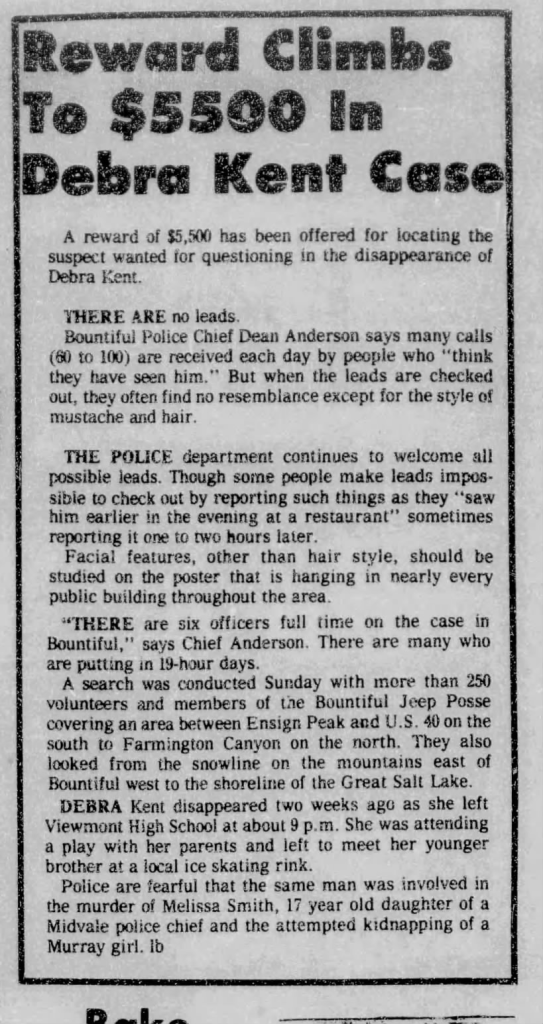
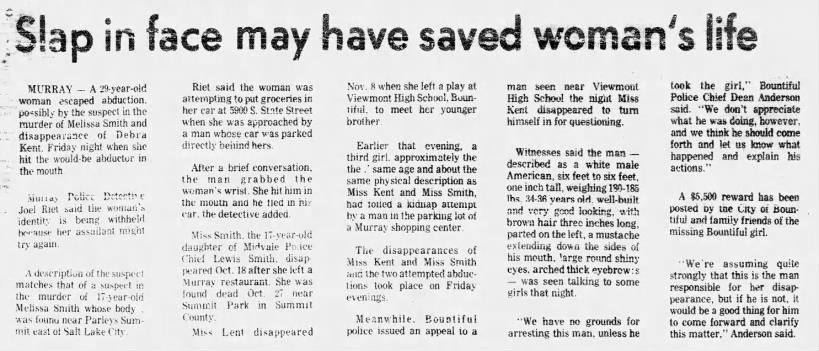
A direct scan of the original composite sketch in the Debra Kent case, 1974. Courtesy Bountiful Police Department.

Q: Showing you what has been marked as Defendant’s Proposed Exhibit 24, is that the sketch you were shown?

A: Yes.

Q: Did you see this brochure?

A: No.

Q: Just the sketch?

A: Yes.

Q: Did it have the description underneath it?

A: No.

Q: You didn’t think that was the man?

A: I didn’t think it looked like him.

Q: Now, you have testified in Court about this incident on two different occasions before this, haven’t you?

A: Yes.

Q: And those times Mr. Bundy was present, wasn’t he?

A: Yes.

Q: I was present?

A: Yes.

Q: Mr. Yocom?

A: Yes.

Q: And you described the incident both those times, didn’t you?

A: Yes.

Q: Did you cry during those times?

A: No.

Q: Is it the crowd here that is making you nervous?

A: Yes.

Q: And you noticed the blood on this coat you say, that night?

A: Yes.

Q: Now, the policemen looked at the coat that night. Didn’t they look to see if there was any blood on it?

A: No.

Q: Didn’t they discuss whether or not there was any blood on you?

A: No. They asked me if I was hurt. I said no.

Q: Do you want to describe the badge the man showed you again?

A: I said it was silver and oval shaped.

Q: Do you recall being asked that at the preliminary hearing?

A: Yes.

Q: Do you know what you said there?

A: Probably that it was silver or gold.

MR. O’CONNELL: I’d ask that her testimony in that regard, in fact, her testimony generally, be published at this time, of the preliminary hearing.

THE COURT: Any objection?

MR. YOCOM: No objection.

THE COURT: The testimony of the witness at the preliminary hearing will be published.

Q: I will just read it, then. Line 5 of page 24:

“Question: Could you describe the badge and where you got it from?”

“Answer: It was silver and blue, or else gold and blue. And it wasn’t a star. It was kind of round, kind of oval-shaped.”

Do you have any explanation for why you said it was blue and silver or blue and gold then?

A: Because it had a symbol on it or writing or something, but I couldn’t see what it was.

Q: Well, you were asked by the police officers on the night this occurred what color it was, weren’t you?

A: Yes.

Q: And that time you said it was all silver or all gold, didn’t you?

A: Did I?

Q: Well, did you?

A: I can’t—

Q: You don’t remember?

A: No.

Q: Was it blue? Did it have blue on it?

A: I think it had a little blue on it, whatever was on it, the symbol or the writing.

Q: Now, when the police officers were questioning you about this, they showed you their badge, didn’t they?

A: Yes.

Q: And you said it was different?

A: Yes.

Q: And how did you tell them it was different?

A: Their badges were bigger.

Q: And what else?

A: Theirs weren’t the same shape.

Q: And what else?

A: I don’t know.

Q: You told them that the badge the man used didn’t have any blue on it, didn’t you, that the badge that the man showed you was like theirs, only it was half as big, and the badge the kidnapper had didn’t have any blue on it like the Murray Police officers, right?

A: Theirs had a lot of blue on it.

Q: That’s right, and that’s what you were describing when you described it at the preliminary hearing, wasn’t it?

A: No.

Q: Well, do you think you told the police officers on November 8th that the badge that the man had had blue on it?

A: I don’t remember.

Q: Now, the wallet the man had the badge in was a wallet like mine, wasn’t it?

A: Similar.

Q: I mean, what I meant was it folds so that the money folds in half?

A: Yes.

Q: Rather than folding it so the money stays straight?

A: Yes.

Q: And the badge was attached to it somehow so that he flipped it open like this, and you could see the badge, right?

A: Yes.

Q: Now, going to the car that was used on the night of November 8th that you took a ride in, what color was it?

A: I said it was a light beige, white.

Q: You said it was a light beige. Could it have been blue?

A: I could have said it was.

Q: I am asking you now, could it have been blue?

A: No.

But you have described it, in fact, on November 8th you described it as a light blue car, didn’t you?

A: I might have.

Q: When did you decide that it was beige? When Jerry Thompson showed you those photos?

A: No.

Q: When?

A: I was really shook up that night. There’s a lot of things I didn’t exactly tell them.

Q: Well, they asked you what color the car was several times, didn’t they?

A: And later on I said it could have been a white or beige, too.

Q: But now you have decided it couldn’t be blue. Why is that?

A: I don’t understand.

Q: Well, on the night it happened, you said that it was light blue or white. Now you say it couldn’t have been blue. What made you come to that conclusion that it couldn’t be blue now when on November 8th you were saying it was light blue.

A: Or beige or white.

Q: All right. When did you eliminate light blue as a possibility? Do you know?

A: No.

Q: Today you testified that when you were walking with this man over to the laundromat, you were walking on his left side. Is that your testimony now?

A: Over to the laundromat?

Q: Yes.

A: No.

Q: Where were you walking?

A: I was walking on his left side outside of the mall, not over to the laundromat.

Q: Where were you walking in relation to him when you were walking over to the laundromat?

A: I don’t remember.

Q: You have testified previously that you were walking a few feet behind him?

A: Yes.

Q: Now, when you were at the laundromat, you said that you were quite suspicious of him, he was a stranger. You indicated to Mr. Yocom that—I don’t know whether you said it or he was just implying it—that you were at that point concerned. Is that true?

A: Yes.

Q: Why did you go?

A: Because he showed me a badge. I thought it was all right.

Q: I see. You also said that you didn’t have to go, right?

A: Right.

Q: It was entirely up to you?

A: Yes.

Q: And so at that point you were reassured that it really was a policeman, or you wouldn’t have gone, right?

A: Yes.

Q: I mean, you wouldn’t have gotten into some strange man’s car and driven off with him if you didn’t think he was a policeman, would you?

A: No.

Q: Did he smell of alcohol?

A: Yes.

Q: Now, you said you saw some rust spots on the car. Where did you see the rust spots?

A: On the very front of it.

Q: Anywhere else?

A: On the side, maybe.

Q: Pardon?

A: On the side.

Q: Where on the side?

A: On the door.

Painted over rust spots on the VW door, October 1975. Courtesy Bountiful PD.

Q: On the door? Do you remember Mr. Yocom at the preliminary hearing asking you the same questions?

Line 10, page 27:

“Question: Now, when you say there were spots on the vehicle, rust spots; where were they located on the vehicle itself, Carol?”

“Answer: On the front, on the hood that opens up.”

“Question: Any other place?”

“Answer: No.”

Do you know why you said that?

A: No.

Q: Have you been looking at these photos of Mr. Bundy’s car recently?

A: No.

Q: Other than in court, have you ever looked at them?

A: No.

Q: Did Mr. Thompson show them to you? Other than Mr. Thompson showing them to you while you were on the witness stand, have you ever looked at the photos of the car with Jerry Thompson?

A: No.

Q: Did you tell Murray Police officers on November 8th about seeing rust on a door?

A: No. I don’t remember.

Q: They questioned you quite thoroughly about that automobile, didn’t they?

A: I don’t remember.

Q: Well, they wanted to know if there was anything unusual about that car, didn’t they?

A: Yes.

Q: And you didn’t tell them about seeing any—in fact, you told them that you couldn’t remember any particular dents or rust spots, didn’t you?

A: I don’t remember.

Q: Do you have a memory, though, of that car not having a license plate on?

A: That night I told them, I was very shook up.

Q: But no license plate would have been something unusual, wouldn’t it?

A: Yes.

Q: More unusual than rust spots on the hood, isn’t it?

A: No.

Q: Don’t practically all old Volkswagens have rusty spots in the front on the hood?

A: I don’t know. Do they?

Q: Now, when did you notice this rip in the upholstery of the car? When you climbed into the car the first time?

A: When we were walking toward the car; when I climbed in the car.

Q: You saw the rip. Now, you did tell the police about that rip, didn’t you?

A: Yes.

Q: What color was the upholstery?

A: I don’t remember.

Q: Did you notice anything else about the interior other than the fact that it had seat belts and it had a rip in the back seat?

A: There was stuff on the floor of the passenger’s side.

Q: Do you have any idea how many light-colored Volkswagen bugs there are with ripped seats?

A: No.

Q: There is quite a few, aren’t there?

A: Probably.

Q: In fact, most of them have ripped seats, don’t they?

A: Most old cars, very old ones.

Q: Particularly Volkswagens?

A: Yes.

Carol DaRonch

Carol DaRonch, circa 1970s. Courtesy Carol DaRonch/Amazon Studios.

Q: You already testified you are 5’7, right?

A: Yes.

Q: How much do you weigh?

A: 108.

Q: And that was roughly your size on November 8th?

A: Yes.

Q: Do you participate in any sports?

A: No.

Q: Ever had any self-defense training?

A: Once.

Q: Was that training, or someone just telling you about it?

A: Someone just telling me about it.

Q: Do you recall how you managed to get away from that man on November 8th?

A: No.

Q: It is your testimony now he was trying to hit you with that iron bar?

A: Yes.

Q: How did you keep him from doing it?

A: I don’t know.

Q: Remember talking to the police officer, I believe it was Joel Riet, about whether or not he was really trying to hurt you on November 8th, 1974?

A: No.

Q: Didn’t you have a little discussion with him where you both decided that he probably wasn’t since he was so much bigger than you were?

A: No.

Q: How tall am I? Do you want to stand up?

A: I have heels on.

Q: What were you wearing that night?

A: Loafers.

Q: Well, can you give a guess how tall I am?

A: No.

Q: Do you have any idea how much I weigh?

A: No.

Q: It is your testimony now that you did scratch this man, is that right?

A: Because my fingernails were all broken.

Q: Going to page 38 of the preliminary hearing, do you recall Mr. Yocom asking this question of you:

“Do you recall ever scratching him with your fingernails?”

And your answer: “No.”

Do you have an explanation for that?

A: No.

Q: In fact, the officers on November 8th asked you if you remembered if you hurt the man in any way, and you told them no too, didn’t you?

A: I don’t remember.

Q: Okay. Let’s go to these green pants. Can you describe them further than that?

A: They were straight legs.

Q: They didn’t have any flare to them?

A: Right.

Q: Did they have a cuff on them?

A: I don’t remember.

Q: Did you tell the police that they did not have a cuff on?

A: Yes.

Q: What kind of jacket?

A: A dress jacket.

Q: Did you tell the police that he had a dress jacket on?

A: I don’t remember.

Q: Or did you tell them you couldn’t remember the jacket?

A: I said it was a jacket, though.

Q: You said it was a jacket. Was it Mr. Yocom who asked you if it was a suit jacket at the preliminary hearing, and you first said that it was a suit jacket, isn’t that true?

A: But it was.

Q: What color was it?

A: I don’t remember.

Q: What kind of shirt did he have on?

A: I don’t remember.

Q: Was he wearing a tie?

A: No.

Q: Now, on the night of November 8th, you couldn’t answer any of these questions, you said you didn’t remember; right?

A: Right.

Q: And you say he was wearing a mustache?

A: Yes.

Q: Shortly after the incident you told Joel Riet that you thought it over and decided the man didn’t have a mustache, didn’t you?

A: Yes.

Q: And sometime later you decided he did, right?

A: Yes.

Q: When did you make that decision?

A: Right after I decided that he didn’t have one.

Q: Did you tell Officer Riet right then that you had changed your mind again that he had a mustache?

A: I don’t remember.

Q: Taking a photo out of what was at the earlier motion Defendant’s Exhibit 13, and it’s a mug shot with the number 63660, 11-1-73, Sheriff’s Office, Salt Lake County. Wasn’t it in regard to looking at this photo that you told Mr. Riet that you didn’t think the man had a mustache?

A: I don’t remember.

Q: Didn’t you say that this looks just like the man only he wasn’t wearing a mustache?

A: I don’t remember.

Q: Do you remember seeing this photo before?

A: No.

Q: You picked out several photos at different times as looking like the man—showing you again from Defendant’s Exhibit 13, which is an envelope full of photographs—and that number, Exhibit 13, is the one from the earlier motion, your Honor, rather than this—showing you Driver’s License A 664002, you said that that looked generally like the man, didn’t you, at one time?

A: The hair.

Q: The hair looked like that?

A: Sort of.

Q: If that what you mean by “greased”? Or was it shiny like that?

A: Yes.

Q: You described on the night of November 8th the man’s hair as being dark brown and black, did you not?

A: Yes.

Q: You just don’t recall all the photos that you picked out that you said looked like the man?

A: Not looked like, just things about them, the way they had their hair cut or their mustache or—

Q: Well, there was one photo that Bountiful showed you that you made an identification of and said it looked quite a bit like the man, and got him in quite a bit of trouble, didn’t you?

A: I don’t know. Did I?

Q: Well, didn’t you say it looked like him?

A: I don’t know what picture you’re talking about.

MR. O’CONNELL: Well, the problem is, I can’t find it. It was one of the photos we used in the last hearing. It was in one of those folders, your Honor, and it’s not there now. Whether it fell out or what.

Q: Now, as far as viewing photographs went, you viewed an awful lot during the first month after this incident, and then quite a period of time went by before they showed you photos again, is that true?

A: Yes.

Q: How many times before the lineup did you see Mr. Bundy’s photo?

A: Twice.

Q: You have testified previously that you saw it three or four times?

A: I might have.

Q: Were you mistaken then?

A: Yes.

Q: And since the lineup, you have seen it some more times, haven’t you? Well, you have seen it in court, for example, haven’t you?

A: Yes.

Q: And you have been reading newspaper stories about this case, haven’t you?

A: No.

Q: You haven’t?

A: No.

Q: You’ve testified at the preliminary hearing you have been reading the Deseret News stories about this case?

A: But not recently.

Q: But you were—between the lineup and the preliminary hearing you were reading the stories in the paper, though?

A: Some.

Q: And they would have had his picture in the paper, wouldn’t they?

A: One.

Q: Just had it in once?

A: I only remember seeing it once.

Q: Now, you don’t remember when Mr. Thompson showed you his picture the first time, right?

A: No.

Q: Well, do you remember him coming to your place of employment on September 1st of 1975 with the pictures of the automobile?

A: Yes.

Q: And they were just ordinary Polaroid size photos at that time, weren’t they, or were they big ones like this?

A: I don’t know.

Q: Referring to State’s Exhibits 20 and 21?

A: I don’t remember if they were big or small.

MR. O’CONNELL: Your Honor, if I may straighten up the record, the photo which I previously identified as coming from Defendant’s Exhibit 13 at the previous hearing and as having number 663660: I said Sheriff, but that is Salt Lake City Police Department and is now Defendant’s Exhibit 25; is that correct Mr. Yocom?

MR. YOCOM: That’s correct.

MR. O’CONNELL: And that’s the photograph I believe you said that you didn’t recall much about, is that correct?

MISS DARONCH: Yes.

MR. O’CONNELL: All right. I will move—I guess she didn’t identify it, so I can’t. I will have to wait on that.

Q: Defendant’s Proposed Exhibit 26 is the photo you said looks something like the man, particularly the hair?

A: Yes.

Q: All right. And you picked that out for Officer Riet? Do you know?

A: I don’t know.

Q: Now, when Officer Thompson showed you the photos of the car—you previously identified State’s Exhibits 20 and 21—he showed you four photos at that time, didn’t he?

A: Yes.

Q: And you told him that that was the car that had been used in the kidnapping, didn’t you?

A: I said it looked a lot like it.

Q: You said, “That’s the car,” right?

A: I might have.

Q: How could you tell from looking at these photos?

A: The rip’s identical to what I saw.

Q: What else?

A: It didn’t have a license plate.

Q: Now, will you please look at Defendant’s Exhibit 29. Do you see the license plate in that photo?

A: No.

Q: Can you see it in Exhibits 28, 20, or 21?

A: No.

Q: So you didn’t recognize that car and the photos because it didn’t have a license plate on it, did you?

A: I don’t know if I said that, even.

Q: Well, you just said it two minutes ago, didn’t you?

A: No. You asked me if that’s what I said.

MR. O’CONNELL: Well, can you go back and read the record, Mrs. Price?

(The record was read)

Q: And we went through the same thing at the preliminary hearing, did we not?

A: Yes.

Q: Where you said the way you told that the car in the photos was the car that you saw November 8th was because it didn’t have a license plate? You said that at the preliminary hearing too, didn’t you? Do you recall?

A: No.

Q: All right. On page 65:

“Question: Now, so you had, I take it, then looked at the car in pictures and said ‘That’s the car’; is that right?”

“Answer: Yes.”

“Question: And how could you tell it was the car?”

“Answer: It didn’t have a license plate on the front, and it was real beat up, the back seat was ripped exactly—”

“Question: But it didn’t have a license plate on the front and because the back seat was torn?”

“Answer: Yes.”

Q: Really, what you are recalling, then, was not the photos but the car you saw up on the Avenues with Officer Collard, is that right?

Ted Bundy Volkswagen VW 1975

The Volkswagen as viewed by Carol DaRonch, September 1975. Courtesy Bountiful PD

A: No.

Q: When did you ever see a car without a license plate other than your statement that you saw it on November 8th, 1974?

A: Just on November 8th.

Q: Okay. So how did you tell that these pictures were the car on November 8th, just because of the rip?

A: Yes.

Q: And the rip only appears in State’s Exhibit 20 and Defendant’s Exhibit 28, right?

A: Right.

Q: In fact, they can be any Volkswagen, couldn’t they?

A: Yes.

Q: Are you telling us that you can look at State’s Exhibit 20 and say that that is the exact same tear that you saw when you climbed into a car on whatever that street was in Murray in November of 1974? You can say that?

A: No. I said it looks a lot like it.

Q: Now, just after you looked at these car photos for Jerry Thompson, he gave you a pack of photos and asked you to look through them, didn’t he?

A: Yes.

Q: And that was the time that you picked out a photo and put it in your lap and went through the rest of the photos, then you gave the photos back to Jerry Thompson and said “He’s not in there,” didn’t you?

A: Did I?

Q: You don’t know?

A: I don’t remember.

Q: And didn’t he say, “Well, what about that photo,” referring to Mr. Bundy’s photo that was in your lap? And it was at that time you said, “I don’t know, I guess it looks more like him—or it looks closer to him than any of the other photos”; isn’t that the way that particular selection went?

A: I don’t remember.

Q: You don’t remember. Well, you remembered at the preliminary hearing, didn’t you? That was a little closer to the incident, wasn’t it? Closer to the time he showed you the photos at the preliminary hearing, wasn’t it?

A: Yes, it was.

Q: Okay. Publishing preliminary hearing, page 79, starting, I guess, at the bottom of the page, line 24:

“BY MR. O’CONNELL:

“Question: And that was when you looked through and said—exactly what happened on that occasion? Was it that you gave them back and that you had took Mr. Bundy’s photograph out from the pack and then you gave the pack back and said there wasn’t anybody there of the person, and they asked, well, why did you take that one out, and you said, ‘Well, that one looks more like him than any other picture.’ Isn’t that how it happened?”

“Answer: Yes.”

“Question: In fact, your first statement was that the man’s picture—that the man who had done it wasn’t in there, but that Mr. Bundy was closer than other people?”

“Answer: Yes.”

I don’t know whether I’m that inarticulate or whether the reporter got it wrong.

Q: Do you remember when the next time was that you saw Mr. Bundy’s photo?

A: I think it was two weeks later.

Q: Wasn’t it on September 4th when the officers from Bountiful came up to get you to go look at a car?

A: No. I don’t think it was that same day.

Q: You don’t think it was that soon after?

A: No, that same day. I don’t remember exactly what day it was.

Q: It was sometime after Officer Thompson had shown you the first pack, right?

A: Yes.

Q: You think it was a couple weeks?

A: I think.

Q: It could have been, say, three or four days?

A: No.

Q: Well, it was on a day that they came up to take you to go see if you could see the car, right?

A: No.

Q: It wasn’t?

A: It might have been.

Q: Well, in fact, you went through the pack of pictures they showed you once, and then you went through it again, and you picked out Mr. Bundy’s photo, and you said, “I think that may be the man,” or something to that effect, didn’t you?”

A: I don’t remember.

Q: Well, let’s put it this way: You never made a positive identification of a photograph, did you?

A: Right.

Q: That’s correct. Well, do you recall the Bountiful officers coming on several occasions to try to take you to see the car itself?

A: Yes.

Q: There were a couple of attempts that weren’t successful, then on September 8th Sgt. Collard took you up and showed you a car on the Avenues, didn’t he?

A: Yes.

Q: Did that car have a license plate on it?

A: No.

Q: And that’s when you remembered, isn’t it, when you were talking about how you identified the photograph because it didn’t have a license plate?

A: I was thinking of the car that night.

Q: Well, obviously, you were thinking of the car that night, because you were trying to see if the car in the photo or the car in the street matched it. But when I asked you how you could tell on two different occasions in two different court proceedings, you said it was because the car and the picture didn’t have the license plate on it. Now, my question was: Were you just confusing the car that you saw in the pictures with the car you saw on the street? You were just wrong, is that it?

A: I don’t know.

Q: Did you tell Officer Collard that the car you saw up on the Avenues was the car you were kidnapped in?

A: I might have, because it didn’t have a license plate. But it looked completely different.

Q: Well, at the preliminary hearing you said you didn’t identify it, right?

A: (No answer).

Q: What else about it made you think it was the car, other than it didn’t have a license plate? It looked completely different, but you identified it anyway, isn’t that true?

A: Because it was supposed to be the car in the pictures.

Q: That’s right, and that’s why you identified it, because it was supposed to be the car?

A: Because it didn’t have a license plate, and I knew it had been changed.

Q: That was your testimony also at the preliminary hearing, was the reason that you identified it was because it was supposed to be the car that was in the picture, and you knew the officers weren’t taking you up to see the wrong car, right?

A: Right.

Q: You pretty well identify what the law enforcement officers want you identify, don’t you?

A: No.

Q: You did at that time, didn’t you?

A: No.

Q: Let’s go to another time. Showing you Defendant’s Exhibit 28. Now, can you identify that? Have you seen that photograph before?

A: Yes.

Q: And at the preliminary hearing, didn’t you on two occasions say—identify that as a picture of the rip in the car that you saw on November 8th, 1974?

A: Yes.

Q: And then I pointed out to you that—or asked you whether or not you had ever seen the car from the back on November 8th, 1974, right?

A: Right.

Q: So how did you identify it at that time?

A: By the flap part that was sticking down.

Q: What flap part? The sponge rubber?

A: Yes.

Q: All right. This is State’s Exhibit 20. This is the way it looked from the front?

A: I could see this part from standing on the side of the car, not directly from the back.

Q: From standing on the side? You get a better shot—this picture is taken from the side, isn’t it?

A: Yes.

Q: In fact, it’s taken from the rear quarter window, isn’t it?

A: Yes.

Q: Okay. Now, show me in this picture what you—you got a better view, more of a view to the back on November 8th than this picture shows?

A: No.

Q: In fact, you were more from the front, weren’t you?

A: Yes.

Q: All right. Now, show me in this picture what there is that you saw that you could remember at the preliminary hearing so that you could identify that rip as the one you saw?

A: Just this top portion.

Q: Well, you can’t see this part, can you, from the front, or even from the side?

A: But it is curving over here.

Q: Well, don’t all Volkswagens curve over?

A: I don’t know. Do they?

Q: Well, you identified that just because Mr. Yocom handed it to you and asked you if you could identify it, didn’t you?

A: And you were pushing it in my face.

Q: Well, let’s go back to when Mr. Yocom was pushing it in your face, young lady.

MR. YOCOM: Your Honor, I think counsel ought to be cautioned—

THE COURT: All right, no argumentation with the witness. On the other hand, I want the witness to just answer the questions.

MR. O’CONNELL: Page 116, this is Mr. Yocom:

“Question: With Exhibit B, do you recognize that photograph?”

“Answer: Yes.”

“Question: And what is that?”

“Answer: It’s the ripped part of the top of the back seat.”

“Question: And in what way, if any, does that resemble the vehicle you were in on November 8, 1974?”

“Answer: It had a rip just like this one.”

BY MR. O’CONNELL:

“Question: I’m showing you State’s Exhibit B. Looking at that, you can say that that’s the ripped seat you saw on November 8, 1974?”

“Answer: Yes.”

“Question: How can you tell?”

“Answer: It just looks like it.”

“Question: Well, do you remember any particular little dents or tears or pieces hanging out or anything like that?”

“Answer: Just the way it’s ripped.”

“Question: Did you ever look at that car on November 8th from the back?”

“Answer: No.”

Have you ever viewed any other Volkswagen automobile, other than the one with Officer Collard up on the Avenues, with a police officer to see if it was the car used on the night?

A: No.

Q: You never have?

A: No.

Q: Didn’t you view one with Officer Paul Forbes shortly after the incident?

A: Yes.

Q: You decided it wasn’t the car?

A: Yes.

Q: Why? What was different about it, do you remember?

A: The rip in the back seat wasn’t the same.

Q: Anything else?

A: I don’t remember.

Q: Remember being taken to the University of Utah to see if you could identify somebody?

A: Yes.

Q: When did you go, do you recall?

A: No.

Q: Well, roughly when, say, in relation to being shown those pictures or the lineup or anything?

A: It was before the lineup.

Q: It was the day before the lineup, wasn’t it?

A: Was it?

Q: I don’t know.

A: I don’t know.

Q: I’m asking you.

A: I don’t know, either.

Q: Do you recall where you went up there?

A: I don’t know what building it was, exactly.

Q: Was it the law school?

A: I’m not familiar with up there.

Q: Well, who all was up there with you?

A: I don’t know their names.

Q: There were a number of police officers and a number of county attorneys, weren’t there?

A: Not a whole lot.

Q: And you hung around a little while with Jerry Thompson inside the building and didn’t see anyone, right?

A: Right.

Q: And Officer Thompson told you the man wasn’t there, right?

A: Yes.

Q: What man did you think he was talking about?

A: I don’t know. He never told me his name.

Q: You knew it was the man whose pictures you had picked and whose car you picked, right?

A: I didn’t know it was the man in the pictures I picked. They never told me anything about anything.

Q: Well, I know, but you gathered it, didn’t you? Didn’t you gather that before the lineup?

A: Well, yes.

Q: All right. Before the lineup, you knew that the man you were looking to see if you could identify was a law student, and that he had a beige Volkswagen, didn’t you.

A: I didn’t know if he was a law student.

Q: Well, you testified previously that you knew that he was a law student and had a beige Volkswagen, didn’t you?

A: (No answer.)

Q: You associated the pictures of the man you had picked with the automobile, hadn’t you?

A: Yes.

Q: And you associated the trip up to the law school or up to the building at the University with the man you had picked, whose photos you had tentatively picked, hadn’t you?

A: Yes.

Q: You knew that these policemen were closing in on a hot suspect, didn’t you?

A: I guess.

Q: Well, weren’t they acting that way, coming and seeing you every couple days and driving you around town and having officers out following somebody around so that you could try to find out where he was to look at him; do you recall all that?

A: Yes.

Q: It was a pretty extensive activity there during the first—or, in fact, all through September, wasn’t it? With Bountiful and with the County Sheriffs?

A: I really don’t know what they were doing.

Q: You knew they were doing something, didn’t you?

A: Yes.

Q: In fact, you were quite frightened at the lineup, weren’t you?

A: Yes.

Q: Because you were pretty certain that the man who kidnapped you was going to go in that lineup and he might see you, weren’t you?

A: No.

Q: Now, in that lineup you could have recognized Mr. Bundy from seeing his pictures even if you hadn’t seen him before, couldn’t you?

A: Yes.

Q: I mean, nobody else in that lineup looked like his picture, did it?

A: No.

Q: Now, do you have separate images in your mind of what the man looked like on November 8, 1974, and what each of the pictures of Mr. Bundy looked like and what Mr. Bundy looked like at the lineup and what he looks like today? Can you flick through your mind and have those images come out?

A: Yes.

Q: Have you ever seen Mr. Bundy in a mustache?

A: I don’t remember.

Q: Have you ever seen his picture in a mustache or a beard?

A: I don’t remember.

Q: Showing you what has been marked Defendant’s Exhibit 27, referring to Driver’s License C 124012, have you ever seen that before?

A: Yes.

Q: Did you pick that picture out and say that that looked a lot like him–the man that abducted you—except for the hair?

A: Yes.

Q: And you said that the officer was showing you these pictures, in fact, I believe he showed you 27 and 27-A at the same time, he said, “Look through these and pick out the hair that looks the most like him,” and you picked Drivers License C 90747, didn’t you?

A: Yes.

Q: He had that kind of hair, you said?

A: Sort of.

MR. O’CONNELL: I will move the introduction of Defendant’s Exhibit 31 as being a transcript of her statement to the police officers, to Officer Joel Riet on November 8, 1974.

MR. YOCOM: No objection.

THE COURT: Exhibit 31 is received.

Q: Showing you a group of photographs 30-A through S, I will ask, you to look through there and see if any of those are photos of ripped back seats, and see if any of those are like the rip that you saw on November 8th, or for that matter, the rip you saw in Mr. Bundy’s car?

A: I really can’t see it too good in some of these pictures.

Q: Do you know if it’s in there?

A: No.

MR. O’CONNELL: That’s all.

MR. YOCOM: You mean that’s all the questions?

MR. O’CONNELL: Yes. That’s all the questions.

REDIRECT EXAMINATION BY MR. YOCOM:

Q: Carol, at any time when you observed photographs shown to you by police officers, did any of them ever—let me rephrase that—what did they tell you each time you were shown photographs?

A: Just to look through them, if I saw anyone that reminded me of the man, to pick it out and show them what reminded me about it; or if I saw the man, to pick it out, or if l didn’t see anything that I liked, I didn’t have to pick out anything.

Q: And was that all that was ever said to you at any time?

A: Yes.

Q: Did anyone ever suggest to you that the suspect’s picture, or a suspect’s picture, was contained in those photographs?

A: No.

Q: Did you know on September 1st when Officer Thompson showed you a group of photographs that there would be a suspect in those photographs?

A: No.

Q: Did you know on the 4th day of September when Officer Beal from Bountiful showed you a group of photographs whether or not the man would be in those photographs?

A: No.

Q: Did you, when you went to the lineup, know that the man that assaulted you—kidnapped you on November 8th—was going to be there?

A: No.

Q: Did anyone tell you he was going to be there?

A: No.

Q: Did you know his name?

A: No.

Q: Did you know his occupation?

A: No.

Q: Did you know anything about Theodore Bundy on October 2nd at the lineup?

A: I don’t think so.

Q: Counsel asked you on cross-examination if you could have identified Mr. Bundy at the lineup without seeing his picture.

MR. O’CONNELL: No. Excuse me. I will call for the record on that. I asked her if—she might object to this even more—I asked her if she could have identified him just from his pictures without having seen him on November 8th, 1974. She said she could have.

THE COURT: Yes. That was the testimony.

MR. YOCOM: Sorry. I must have written it down wrong.

MISS DARONCH: I thought he said the other way too.

Q: What question did you think you were asked?

A: If—what you thought. I mean, I couldn’t from the picture, is what I mean, for sure.

Q: You couldn’t tell if he was the man strictly from the pictures?

A: Yes.

Q: When you saw him in the lineup, could you tell?

A: Yes.

Q: Did you associate the lineup at all with seeing pictures?

A: No.

Q: Seeing Mr. Bundy at the lineup when he first walked into the lineup room, whatdid you associate that with, Carol?

A: When he first walked in was the way he walked on that night.

Q: What night?

A: November 8th.

Q: Did you know immediately?

A: Yes.

Q: And you are positive today?

A: Yes.

MR. YOCOM: No further questions.

RECROSS-EXAMINATION BY MR. O’CONNELL:

Q: Well as to being able to pick him out just from the pictures, we. have gone through that twice, haven’t we? Once at preliminary hearing and once this afternoon? And both times, you said that you could pi.ck him out even if you hadn’t seen him, you could pick him out—and I would follow it up with the question, “Well, nobody else in the lineup looked like his pictures?” And both times, both this afternoon and at the preliminary hearing, you agreed. Is that right?

A: I thought you said the other way around.

Q: Both times you thought—

A: I don’t remember the first time.

Q: Or did you and Mr. Yocom discuss that with regard to the preliminary hearing testimony, is maybe why you made that mistake at preliminary hearing?

A: No.

Q: Now you are saying that you didn’t think the man who kidnapped you was in the lineup, is that right? You didn’t know that he was?

A: No.

Q: You didn’t even suspect that he was, strongly?

A: Yes.

Q: That’s why you testified that you were afraid, wasn’t it? You were worried that he’d see you?

A: I don’t remember.

Q: You said that you associated the man with the car and the pictures and the going to the Law school, and you testified to that two or three times, haven’t you? Haven’t you?

A: (No answer.)

Q: Well, yes or no?

A: Will you say that again?

Q: Haven’t you on two or three times now testified that you associated the man in the lineup, prior to the lineup, going in the lineup, with the pictures, with the viewing of the car, and with the law school; that you knew that the man that you were looking for was a law student and had a tan car? Haven’t you testified that that’s true several times?

A: Yes.

Q: And it is true, isn’t it?

A: Yes.

MR. O’CONNELL: That’s all.

MR. YOCOM: No further questions.

THE COURT: All right. Miss DaRonch, you may step down.
Vicki Dawn Lynee Miner.*

Introduction: Unfortunately, despite a considerable amount of time and effort, I found very little information about the background of Vicki Dawn Lynee Miner, who was born on December 21,1953 in Provo, Utah to Richard and LaRee Miner. Richard Edwin Miner was born on October 15, 1932 in Springville, Utah and Laree Jackson was born on December 11, 1935 in Vernal, UT. LaRee and Richard married on June 2. 1953 in Coalville, Utah and the couple went on to have three children together: Randy (b. September 1957), Jerry (b. August 1956), and Vicki. Richard and LaRee moved their family from Springville, Utah to California in 1962, and at the time of her death, Vicki was a junior at Buena Park High School and was an active member of The Church of Jesus Christ of Latter-Day Saints. * I’m not certain of the exact spelling of one of Vicki’s middle names, as I’ve seen it listed as Lynne and Lynee; I’ve also seen it with and without the ‘Dawn.’

According to a classmate of Miner’s going by the name ‘Loco Moco’ on Facebook: ‘all the guys liked her, but the cool thing about Vicki is that she didn’t ignore us like other older girls did. Instead of dismissing us as the drooling idiots we were she would talk to us like she actually enjoyed being around us. She was always smiling and laughing. She was the sweetest girl I have ever known. I hope her family finds peace and justice.’
DisappearanceAt around 9:30 AM on Friday, October 30, 1970, Vicki Miner was last seen after she left her family’s residence and started her short walk to school; she never made it. Her parents filed a missing person’s report later the same day. According to multiple articles (including The Anaheim Bulletin), on November 14, 1970 her remains were discovered by two fifteen-year old boys that had been out ‘shooting bb guns’ in a creek bottom near a vacant field near Malvern Avenue and Dale Street, roughly fifty feet from the Sante Fe Railway Mainline (the area had reportedly been frequented by horseback and motorcycle riders); she had suffered a massive blow to her head, which caused a skull fracture that resulted in her death. Despite being fully clothed, her pants were unbuttoned and she was missing a brown, size 28 to 30 leather cowhide belt. Additionally, Vicki was missing her size seven, dark brown leather strap sandals that had been shabbily fixed with a piece of orange coated electrical wire, and a dark brown suede finish purse; her handbag had her driver’s license, social security card, several small plastic toy animals, and a small red Bible in it. Sheriff’s detectives and a group of boy scouts searched the area where she was found but it turned up no new evidence.

However, I would like to point out that according to Marcus Gourley (whose father was the Chief of Police in Buena Park in October 1970), who commented on a Facebook post about Miner made by the local Police Department, on the morning she disappeared Vicki had been ‘late for school that morning because of a traffic ticket. Mrs. Willeford saw her walk by that morning, Vicki had a habit of Hitch-Hiking (As we all did then). It’s believed at that someone picked her up, between Dale Street and the HS.’ … ‘The night before she disappeared she gave me a ride home From BPHS. I told my dad later and her Mom by Phone that it was a very unremarkable conversation. I felt so bad when heard from my dad what happened. Her brother’s Jerry and randy also have passed away. Her parents must of gone thru hell. I truly hope they catch the bastard that did this! Vicki was a doll, so sweet and pretty, and she came from a wonderful Mormon family!’ … … ‘She was found by Chris Willeford and his friend! They we’re shooting BB Guns, No horseback riders found her!

Investigation: the young victim had a deep gash on the side of her head, and detectives quickly determined that she had been bludgeoned to death; the coroner estimated that she had been dead for roughly fourteen days before she was found. In the weeks that followed the discovery, detectives remained ‘tight lipped’ about the murder and maintained strict security around it, and Detective Patrick Black with the Buena Park Homicide Department would only comment that the ‘investigation is continuing.’

Suspects, Ted Bundy: In late October and November 1970, Ted Bundy was in the early days of his relationship with Liz Kendall (who he began seeing in September 1969) and was residing at the Rogers Rooming House in the university district of Seattle. Also at this time, he was employed at Pedline Supply company, a family-owned medical supply company, and was a full-time psychology student at the University of Washington, where he later graduated with a degree in psychology. According to the ‘1992 FBI TB Multiagency Team Report,’ on October 30, 1970, Bundy was seen in Seattle (as well as for the following five days), so it is unlikely he was involved in the murder of Vicki Lynne Miner.

Rodney Alcala: Another name that I came across while researching the murder of Vicki MIner is ‘the Dating Game Killer,’ Rodney Alcala, who was active between 1968 and 1979. His life of crime began in 1968 after he assaulted an eight-year-old girl, and his behavior quickly escalated to homicide, and he was eventually convicting of killing eight young women and girls before he was finally apprehended in July 1979 (although investigators feel he may be responsible for upwards of 130 rapes and murders across California, New York, Wyoming and Washington). There is no evidence that he had anything to do with Vicki Miner’s death.

The Zodiac: At the time Vicki was murdered, the Zodiac was in the peak of his heyday, and in fall 1970 he was in the midst of terrorizing the citizens of Northern California while heckling police as well as the news media: he sent multiple taunting communications and cryptic cards to The San Francisco Chronicle detailing his atrocities, and baited investigators. On October 5, 1970 he mailed a 13-hole-punched greeting card (known as the ‘13-hole card’) to The San Francisco Chronicle that contained the mocking message: ‘PS THERE ARE REPORTS city police pig cops are closing in on me. Fk I’m crackproof, What is the price tag now?’ Three days before Vicki was last seen alive on October 27, 1970 it was confirmed that the Zodiac sent a letter to Chronicle reporter Paul Avery (whose name had been misspelled ‘Averly’ on the envelope): in it, he claimed fourteen kills and warned that he was going to pull off something drastic, such as blowing up a school bus by shooting a tire and picking off the children as they ran out. But in my opinion, when it comes down to it, the Zodiac was a showboat and loved to take credit for his work, and he never once alluded to killing Vicki Miner.

The Manson Family?: At one point it was briefly suspected that Vicki had been involved with the Manson family, but that theory was squashed after it was quickly determined there was no truth behind it.

Bruce McGregor Davis, Manson Family Member: One commenter on BPPD’s Facebook page’s post about Vicki Miner named Larry Rosa said that perhaps Bruce McGregor Davis (a high-ranking member of the Manson Family) had killed the pretty young teenager, and went on to suggest that she was his final murder before he was finally arrested on December 2, 1970. In October 1970, Davis was a fugitive of the law and was being sought for his role in the brutal 1969 murders of musician Gary Hinman and stuntman Donald ‘Shorty’ Shea. Unlike the notorious Tate-LaBianca murders, Davis was directly convicted of playing a major part in the deaths of Hinman and Shea and would later receive a life sentence. As of July 2026, he remains incarcerated in a California prison after being repeatedly denied release.

The Golden State Killer: Joseph James DeAngelo Junior is a name that came up a few times while I was researching the murder of Vicki Lynne Miner, but it took place slightly outside of his timeline: in the fall of 1970, DeAngelo was still a student at Sierra College in Rocklin, California, and earlier that May, he became engaged to a nursing student and classmate (she eventually ended their relationship in 1971 after he began to display increasingly worrisome behavior). DeAngelo’s crimes began in 1974 in Northern California, where he committed a minimum of 120 burglaries, at least fifty-one rapes, and thirteen murders before he went dormant in 1986. He was arrested on April 24, 2018 thanks to investigative genetic genealogy.

‘Mystery Man:’ Charles M. Smith: One interesting place I found most of my information about this case was on a Facebook post made by the Buena Park Police Department, and a suspicious name came up in the comments only once: ‘Charles M. Smith.’ Apparently, law enforcement never had enough evidence to hold or arrest him, and he relocated to Hawaii ‘many, many years ago,’ shortly after the murder. If someone reading this can provide me with additional information about this mystery man, please reach out to me.

Cindy Lee Mellin: Months before Graham’s disappearance, Cindy Lee Mellin was last seen on January 20, 1970 in the parking lot of the Buenaventura Shopping Centre in Ventura, CA (roughly two and a half hours away from Buena Park). The nineteen-year-old worked there as a salesclerk at The Broadway Department Store and she left shortly after closing; she was last seen standing next to her car at 9:40 PM and had been accompanied by an unknown Caucasian male between thirty and forty years of age that appeared to be helping to replace her left rear tire. After she failed to come home that night Cindy’s father arrived at the shopping center the following morning at 7:00 AM and immediately noticed her car on the bumper jack with the flat tire still in place; on the ground nearby was the spare. Cindy was nowhere to be seen, and no one has ever seen or heard from her since.

Kathleen Johns: Roughly two months after Cindy Mellin disappeared twenty-two-year-old Kathleen Johns was driving west on Highway 132 near the I-5 in Modesto on March 22, 1970 at around 11:15 PM (along with her ten-month-old daughter) when she observed a light-colored, late-model vehicle following her. When she pulled over it did the same, and with a tire iron in his hand, a man exited his car and approached hers. He said to her, ‘your rear wheel is wobbling. I’ll tighten up the lugs.’ The young mother stayed in her car while the stranger worked on repairing the wheel, and when he was finished working, he informed her it had been mended and that she could go. Of course, as she tried to back up it the wheel fell off completely and when Johns got out to examine it, she realized there was only one bolt holding it in place. The mystery man suddenly returned and offered to take her to a nearby service station; Johns (without any other options) got into his car with her young daughter.

However instead of helping, the man instead drove around on side roads for approximately an hour and a half, and according to John’s police report, he was ’friendly and not threatening,’ but several times when she asked if he was going to stop at a gas station, he would simply ‘elude the question and start talking about something else.’ Kathleen quickly became concerned that he was going to harm her and/or her child, and as a way to escape she told him that she was going to be sick, however as he slowed down for a stop sign, she quickly opened the car door and leapt out with her daughter and hid in a neighboring field; the suspect did not stick sped off. Johns was able to flag down a passing car, and the driver took her to a nearby police station; she was inconsolable and sobbing uncontrollably when she was interviewed by detectives, and at one point had noticed a wanted poster with a composite sketch of the Zodiac Killer on the wall and exclaimed, ‘that’s the man!’ Police later found her car near Byrd Road and Highway 132, incinerated; the Zodiac Killer took credit for this incident in a letter written on July 24, 1970.

Robin Ann Graham: A little over two weeks after Vicki Miner was last seen alive, eighteen-year-old Robin Ann Graham was last seen less than an hour away on the side of a Los Angeles freeway in the early morning hours of November 15, 1970 after her car had run out of gas. She has not been seen or heard from since, nor are there any clues as to her whereabouts or subsequent fate. As of July 2026, her murder also remains unsolved. The murder of Miner and the disappearance of Graham share several striking similarities: both crimes occurred within a span of slightly over two weeks in the fall of 1970, and both victims were young, white coeds that were navigating their normal, everyday routines (Vicki was a high school student, and Robin in her first year of college).

The two young women possessed strikingly similar physical characteristics that were common amongst victims of serial offenders that were active in California at that time: both women were tall, slim and wore their brown hair long and parted down the middle. Both girls had been targeted while they were isolated and vulnerable while in transit: Vicki was walking by herself to school when she was abducted and Robin was stranded alone on the side of a busy highway after her car ran out of fuel. In both cases, distinctive elements of the victims’ footwear and personal belongings became central focus points of the investigation: in Miner’s case, her dark brown leather sandals purse, and her leather cowhide belt were missing and when Robin disappeared, she vanished along with her distinct red clog shoes and her personal leather purse. Despite the commonalities, there is nothing official linking the murder of Vicki Miner to the disappearance of Robin Ann Graham.

Conclusion: Jerry Lee Miner died at the age of twenty-one after her hung himself on July 26, 1977 in Fullerton, California (his mother had been the one to find him). Randy Lee Miner died on September 30, 1998 at the age of forty-one in Anaheim, California from complications of Leukemia.

I’m not sure when or how he died, but I do know that Vicki’s father Richard Edwin Miner is deceased. Her mother Laree Jackson-Miner died on February 7, 2023, in Fullerton, California after a long struggle with cancer. According to her obituary, she was one of seven children, and she grew up on a small farm in Utah and graduated from Payson High School in 1958. On March 25, 1972 she was sealed (along with Richard) in the Los Angeles LDS Temple, and after she retired, LaRee volunteered for the Fullerton Police Department for ten years and she ran several marathons for the Leukemia Foundation.

Vicki Dawn Lynne Miner.
Vickis Miner from the 1969 Buena Park High School yearbook.
Vickis Miner from the 1970 Buena Park High School yearbook.
The Miner family home, located at 8316 Handel Drive in Buena Park, California.
The final resting place of Vicki Dawn Lynne Miner.
A blurb taken from Reddit about the murder of Vicki Miner.
Another blurb taken from Reddit about the murder of Vicki Miner.
An article about the murder of Vicki Miner that was published in The Press-Telegram on November 16, 1970.
An article about the murder of Vicki Lynee Miner.
The Obituary for Vickie Lynn Miner that was published in The Daily Herald on November 17, 1970.
The Obituary for Vickie Lynn Miner that was published in The Springfield Herald on November 19, 1970.
Accordogn to Marcus FOurley, who'se father was the chierlf of
An article about the murder of Vicki Miner that was published in The Anaheim Bulletin on November 24, 1970.
An article about a reward for information related to the murder of Vicki Miner that was published in The Independent on July 9, 1972.
An article about a reward in relation to the murder of Vicki Miner that was published in The The Independent on November 9, 1972.
Some comments about Vicki made on a Reddit post about her murder.
Some comments about the Zodiac Killer in relation to the murder of Vicki Miner that were made on a post about her made on Facebook by the Buena Park Police Department.
Some comments from a Facebook post about Vicki that was created by the Buena Park Police Department.
Some comments about Vicki made on a Facebook post about her murder by the Buena Park Police Department.
Some comments from a Facebook post about Vicki that was created by the Buena Park Police Department.
I was unable to find information about the weather patterns on a statistical weather website, but I was able to find this information.
All of Bundy’s activities in 1970 according to the ‘1992 FBI TB Multiagency Team Report.’
The route from Bundy’s rooming house in Seattle’s University District to Vicki Miner’s house in Buena Park, CA.
A missing persons poster for Robin Ann Graham, who disappeared from nearby Los Angela’s a little over two weeks after Vicki Miner was last seem alive.
According to her obituary, Vicki was a member of the LDS Church, and was buried in the Springville Evergreen Cemetary, and her funeral service was conducted at her home Ward of the Springville Twelf LDS.
Richard Edwin Miner from the 1952 Springville High School yearbook.
A picture of Vicki’s mother, LaRee Jackson taken from the 1952 Payson High School yearbook.
LaRee Jackson from the 1953 Payson High School yearbook.
Vicki’s father is mentioned about a new LDS Ward being established in California in an article that was published in The Salt Lake Tribune on May 5, 1959.
Vicki’s father is mentioned about a new LDS Ward being established in California in an article that was published in The Deseret News on September 23, 1967.
Jerry Miner from the 1972 Richard Gahr High School yearbook.
Jerry Miner from the 1974 Buena Park High School yearbook.
Randy L. Miner’s senior year picture taken from the 1976 Buena Park High School yearbook.
The obituary of Jerry Miner that was published in The Daily Herald on July 29, 1977.
Jerry Dean Miner’s final resting place. Photo courtesy of FindAGrave user Shane Johns.
The obituary for Jerry Lee Miller that was published in The Daily Herald on October 6, 1998.
Randy Lee Miner’s obituary that was published in The Springville Herald on October 7, 1998.
Randy Lee Miner’s final resting place. Photo courtesy of FindAGrave user Shane Johns.
The final resting place of the Miner family. Photo courtesy of FindAGrave user, Darryl Warner.
Vicki’s mother. Photo courtesy of FindAGrave user Lisa M.
Vicki’s mother. Photo courtesy of FindAGrave user, Lisa M.

The State of Utah v. Bundy, 589 P.2d 760, December 28, 1978.

589 P.2d 760 (1978): STATE of Utah, Plaintiff and Respondent, v. Theodore Robert BUNDY, Defendant and Appellant.
Nos. 14741, 15534. Supreme Court of Utah, December 28, 1978.
*761 Bruce C. Lubeck, John D. O’Connell, Salt Lake City, for defendant and appellant.
Robert B. Hansen, Atty. Gen., Earl F. Dorius, Asst. Atty. Gen., R. Paul VanDam, Salt Lake County Atty., Salt Lake City, for plaintiff and respondent.
ELLETT, Chief Justice:
The defendant was charged with, and convicted of, the crime of aggravated kidnapping. The trial was to the court sitting without a jury. An appeal was taken to this court; however, before the appeal was heard, counsel for the defendant claimed that he had newly discovered evidence which would warrant a new trial. This court, having confidence in the integrity of counsel, remanded the case on his motion to the district court where a hearing was had on the motion for a new trial and for extraordinary relief. The district court judge took evidence and heard arguments and finding the motion to be without merit denied it. An appeal was taken from that ruling to this court and the two appeals are now consolidated for our consideration.
The matter of granting or refusing to grant a new trial lies within the sound discretion of the trial judge and we will reverse his decision thereon only where he has abused that discretion.[1] In this case there was no abuse of discretion.
As to the facts of the case as revealed at the trial, the judge, as a trier of those facts, could readily have found beyond a reasonable doubt, and did so find, that an 18 year old girl was in a Shopping Mall where she was approached by a man who told her that someone had been trying to break into her automobile. She thought that he was a police officer. The area was well lighted and she stood face to face with him while they talked. The man asked her to accompany him to the car to see if anything was missing.
Upon reaching the car the girl looked in, determined nothing was missing, and so advised the man. He then told her that the alleged burglar was being held inside the mall, and once inside, the appellant told the girl that “they” must have taken the suspect down to the substation. He and the girl then walked straight across from where they had just entered the mall and walked around the building by a clothing store. Appellant asked her how old she was, if she was doing anything later that night, and why she would not be able to “go over there” and sign a complaint against the person who had allegedly tried to break into her car. This conversation occurred while the two were walking, with the girl slightly behind the man. The girl noticed the way he walked and that he was wearing green pants. Later at a lineup, she identified the appellant as her assailant immediately upon his entering the room because of, among other things, his manner of walking. She also observed that at the time of the offense he was wearing dark patent leather shoes, and that he was slim, weighing about 160 pounds, had greased back hair, and had a dark mustache which did not extend past the corners of his mouth.
She and the man walked to a nearby laundromat. The man tried to open the front door, found it to be locked, walked halfway down an alley between the laundromat and an adjoining building, turned around and came back. During this period of time, the girl again observed appellant’s facial features as he was standing “right in front” of her in very good lighting conditions. She became suspicious of the situation and asked appellant if she could see his badge or some form of identification. He produced a wallet with a badge inside. She *762 described the badge as “thinking it was silver, kind of oval shaped.”
The man then asked her to accompany him to the police station and fill out a complaint since “they probably had him (the alleged burglar) down there.” They walked to his car, described by her as a Volkswagen with a rip on the top of the backseat, rust spots on the front, no license plate, and of light color, either white or beige. The rip was described as going “almost all the way across” the top of the backseat.
They drove a couple of blocks to a school where appellant abruptly stopped, parking the car partially onto the curb. The girl nervously asked him what he was doing and why he was stopping because this was not a police station. The man grabbed her left arm and forcefully placed a pair of handcuffs on it. She grabbed the door on her side, managed to open it and get one foot out. The man grabbed her by the arm and around the neck. She kept screaming, “asking” him what he was doing. He then pulled out a gun, pointed it at her, and said he was “going to blow her head off.” She managed to get out of the car but the man pursued her. They struggled outside the vehicle as she tried to free herself. She grabbed his arm and right hand and then felt an iron he was holding in his hand. She described it as having four or six sides, about one-half inch thick. Her impression was that the object was a crowbar since her father had one which she had felt before. To keep the assailant from striking her with the crowbar, she held it with her left hand.
She continued to scream “as loud as I could.” She then testified that she turned away “pulling and scratching.” Her fingernails, long at the time of the trial, were even longer the night of the incident and were broken in the scuffle. She recalled scratching the assailant during the fighting because she remembered noticing that all her fingernails were broken.
She finally succeeded in breaking away from her assailant. She ran into the street, the handcuffs still dangling from her arm. She managed to get a car to stop for her. She jumped into the car, related briefly what had occurred, and requested them to take her to a police station. They drove her directly to the Murray Police Station.
At trial, the State and appellant’s counsel stipulated that up to this point, the amount of time during which the girl had been with her assailant was between ten to fifteen minutes.
At the police station the victim was questioned by three police officers, one of whom removed the handcuffs which were both on the same wrist.
There is no contention made that no crime was committed. The defendant simply claims that he did not do it.
Two witnesses who lived in the same apartment with the defendant testified that he wore patent leather shoes on occasion.
There was human blood on the sleeve of the victim’s coat which was type O. The defendant’s blood type is O; that of the victim is type A.
Approximately nine months after the assault, at 2:30 a.m. on August 16, 1975, appellant was driving his Volkswagen in a residential area in Granger. Sgt. Robert Hayward of the Utah Highway Patrol, sitting in his patrol car, observed the Volkswagen pass him. Approximately five to eight minutes later, Sgt. Hayward started his car and while rounding a nearby corner, again observed the Volkswagen at the side of the street. As the patrol car approached, the appellant took off at a high rate of speed with his headlights off. Officer Hayward gave chase. Appellant subsequently ran a stop sign in an attempt to evade the officer. Finally appellant brought his Volkswagen to a stop.
Sgt. Hayward exited his car, approached the Volkswagen, and observed a “jimmy type pinch bar” (crowbar) behind the front seat on the back floor. He asked the appellant what he was doing in the area and then inquired, “Can I look in your car?” Appellant’s response was, “go ahead.” Sgt. Hayward stated that at no time did the appellant object to the search. The appellant was then placed under arrest for evading a police officer.
*763 Moments later, Deputy Sheriff Twitchell and Sgt. Fife of the Salt Lake County Sheriff’s Office arrived on the scene and were advised of the situation. Deputy Twitchell then asked the appellant “if he would mind if we looked through his vehicle.” Appellant responded that “it was okay with him.” Officer Twitchell further testified that to the best of his recollection, he did not remember appellant objecting to the search of his vehicle at any time. Appellant, a law student, denied giving his consent and testified that he passively stood by because he was intimidated.
A search of appellant’s vehicle by Deputy Twitchell and Deputy Ondrak, who arrived subsequent to Deputy Twitchell and Sgt. Fife, produced a pair of handcuffs and the crowbar located on the floorboard behind the driver’s seat. Deputy Ondrak testified that he remembered appellant’s Volkswagen as being tan in color.
The victim had described the Volkswagen driven by her assailant as being a light color (white or biege); at one time she had said the car possibly could have been light blue but later eliminated that possibility. In connection with this, it should be noted that Mary Walsh, the first person to talk with the victim following her assault and kidnapping, testified that any confusion regarding the color of the Volkswagen driven by the assailant could be due to the type of lighting in the parking lot at the Mall which makes a car seem to be a different color than it really is. Also, a lady who lived downstairs from appellant in the same apartment building at the time of the kidnapping, testified that she had been in the appellant’s car two or three times during the months of October and November of 1974, and that the color of appellant’s Volkswagen was cream-color. James Dunn, a neighbor of appellant’s, testified on his behalf, and although he admittedly may have been “kind of” color blind, he believed the appellant’s Volkswagen to be “beige, light-colored.”
After Sgt. Hayward was joined by the other deputies and officers at the scene, they asked the appellant what he was doing in that neighborhood. The appellant told the officers that he had attended a movie and then had gone for a drive. Appellant admitted at trial that this was a lie and further testified that he had also lied to one of his attorneys concerning the events of the evening of August 16, 1975.
When questioned at trial about the evening of August 16, 1975, appellant said the reason that he sped away from Sgt. Hayward was because he was “smoking dope” and did not want to be caught doing something illegal.
His final version of the events of that evening was that he was eating dinner and watching television until 12:00 midnight or 12:30 a.m., at which time he decided to visit a friend. Upon arriving at his friend’s house, he noticed the lights were out. He decided not to awaken her and proceeded to drive around for a while, ending up in the Granger area where he decided to smoke some dope. He said he fled from the patrol officer in order to dispose of the marijuana and to open the car window in order to air out the interior of the automobile. The arresting officer testified that he saw nothing thrown from the fleeing car and that there was no smell of marijuana on the defendant or inside the car; and that he was well acquainted with the odor of marijuana. Two other officers at the scene of the arrest testified to the same effect as did the arresting officer.
At a pretrial hearing on a motion to suppress the evidence relating to the crowbar and handcuffs taken from the defendant’s car, the trial judge found by a preponderance of the evidence that the defendant had consented to the search of his car and denied the motion to suppress. An acquaintance of the defendant testified that the defendant told her that he let the officers search his car when he was arrested.
The defendant, some five days after his arrest, gave the police permission to search his apartment. The search revealed several pairs of patent leather shoes. The officers also took several pictures of defendant’s Volkswagen. The victim recognized the rips on the back seat as being like those she *764 had observed while being held captive in defendant’s car. She testified at trial to the same effect. She further testified as to dents and rust spots on the Volkswagen as being the same as those observed at the time of the crime.
Other evidence given at trial clearly connected the defendant with the crime charged. It is not necessary to detail the incriminating evidence any further. The evidence already set out was sufficient to justify the judgment of the court.
Counsel for appellant complains because the court permitted the prosecution to discuss the probabilities of defendant’s guilt by referring to various aspects of the evidence. The prosecutor’s argument was proper for while any one circumstance might not convince the trier of the facts beyond a reasonable doubt, a great number of circumstances, taken together, could do so.
The claims of error have been carefully examined and we find no merit to any of them. The judgment is therefore affirmed.
It is to be noted that Mr. Bundy has fled from Utah and is now in the State of Florida where he is awaiting trial on charges of murder.
CROCKETT, WILKINS, and HALL, JJ., and F. HENRI HENRIOD, Retired J., concur.
MAUGHAN, J., having disqualified himself, does not participate herein.
NOTES
Kettner v. Snow, 13 Utah 2d 382, 375 P.2d 28 (1962); Haslam v. Paulsen, 15 Utah 2d 185, 389 P.2d 736 (1964).

Theodore Bundy, Fugitive Alert.

This document provides an update on the investigation of Ted Bundy that was sent from SLC to Denver, Butte, and Seattle that references earlier teletypes sent between these offices on January 4th and 5th, 1978 regarding the killer, who was wanted for murder in Denver. The update notes that additional information has been developed identifying Bundy’s use of an alias and vehicle in connection with the crimes under investigation.

Melissa Anne* Smith.

Introduction: Melissa Ann Smith was born on July 4, 1957 in Midvale, Utah to Louis and Joan Smith. Louis Shirley Smith was born on March 10, 1927 in Midvale and after graduating from high school he joined the Navy and was in WWII and the Korean War. After getting out of the service he returned to his hometown and joined the police force, where he rose quickly through the ranks and earned the role of the chief of police. Joan Phyllis Levorsen was born on April 20, 1934 in Salt Lake City to Amund RC and Viola May Nokes Levorsen and moved with her family to Murray in 1937, where she graduated from Murray High School in 1952. The couple were married October 8, 1953 in the Salt Lake City Temple and had two daughters together: Melissa and her younger sister Jolene (b. August 9, 1959).

Background: According to Ann Rule’s true crime classic, ‘The Stranger Beside Me,’ at the time of Smith’s murder Midvale was ‘a quiet Mormon community made up of 5,000 people that was located just south of Salt Lake City. It’s a good place to raise kids, and Melissa, although warned, had never had a reason to be afraid.’ The family was a part of the Ninth LDS Ward in Midvale, and Melissa was very active in her faith. At the time of her death, she was seventeen and a senior at Hillcrest High School, and was also a student at Continental School of Beauty, where she was a cosmetology student.

October 18, 1974: Jolene Smith told investigators that she thinks her sister may have left home around 9:10 PM on the evening of October 18, 1974, but she wasn’t positive and stated she could have left as early as 8:10 PM. According to one of Melissa’s two best friends (and fellow HS classmate) Julie Rushton, the two spoke at around 8/8:15 PM (one report said it was 9 PM) when they discussed their plans of meeting up at a local pizza place called ‘The Pepperoni’ (which was also her POE) ‘somewhere around 9 PM, or around 9:30 PM’,** and here’s where I found something interesting: according to the missing person’s report, Julie had ‘some words’ with a friend of theirs named Sherry McClery about her boyfriend earlier in the evening, and she ‘felt low and needed someone to talk to’ (Sherry had been at the pizzeria visiting with another employee named Cindy Howell). In every other source it was reported that Rushton had been having ‘boyfriend problems’ and not friend problems, but this does not seem to be the case (I know this isn’t a major detail, it’s just something that jumped out at me).

Julie said that Melissa stayed for a while and that they chatted a bit, then she ‘left there at approximately 9:30, or between there and 10 PM’ and ‘assumed she was going home’; Sherry left The Pepperoni at roughly 9:30 as well, and had been right behind Melissa. According to the police report, ‘the reason we can say 9:30 is that Sherry M. called her mother to see if she could go to the show. Her mother looked at the clock to see what time it was, and it was 9:15. Sherry left the Pepperoni between ten and fifteen minutes after she called her mother. Also asked Sherry what way Melissa went and her first statement was towards State Street.’

Rushton was also upset that Smith was sleeping over their friend Mindy’s house and it didn’t appear that she was invited, but I wonder if it maybe had to do the fact that Manning went to a different high school (she went to Murray High School and was not a fellow student at Hillcrest). According to Melissa’s case file provided by the Midvale PD, Cindy Howell told investigators that she overheard Julie ‘talking to Melissa, she was upset with Mindy Manning because Melissa was going to stay over at her house on this particular night, but Melissa had been unable to get ahold of Mindy on the phone. She had apparently gone out with someone else and that Melissa was very upset over this. She states that when Smith left there around 9:30 or between there and 10 PM she also assumed that she was going home.’ My interpretation of this is: Melissa was trying to call Mindy to see if Rushton could come along to the sleepover, but she had ditched them both and wasn’t home at all.  

Per Ann Rule, the walk to the pizzeria meant ‘negotiating shortcuts, down a dirt road and a dirt bank, under a highway overpass and a railroad bridge, and across a school playfield.’ When she left the restaurant Melissa’s intended destination was most likely her home so she could pick up her night clothes, and the chances were pretty good that she took the same dark, poorly lit route that she used to get there. She never made it home.

At the time of her disappearance Melissa was a junior at Hillcrest High School in Midvale, Utah, and was active in her faith. According to her family, she was a very cautious girl, and Midvale itself was a small Mormon town: religious and very quiet, and even though her father worried about his girls and taught them to be safety-aware, she had little to fear in the tiny community. At the time of her disappearance Smith weighed 105 pounds, had light brown hair she wore at her shoulders, stood at 5’3″ tall, had hazel eyes, and a fair complexion. She was last seen wearing blue jeans, a blue flowered blouse, and a heavy navy-blue shirt she used for a coat; her purse, identification, and make-up were left at home. Melissa was reported missing by her mother (her father took the official report) and because of the nature of the disappearance and the type of girl Melissa was, foul play was immediately suspected. Jolene Smith said that running away was against everything her sister stood for, and it was something she would never do; she also said that Melissa was the type of person that would have eventually called home had they left suddenly. According to Midvale PD officer Ronald Baarz, the sheriff’s office and various city police departments in the county had joined in on the search.

Julie was employed at the same restaurant that Melissa was last seen at, and she was a student with her not only at Hillcrest High School but also at Continental Beauty School. During her second interview with Detectives Ben Forbes and Jerry Thompson (both with the Salt Lake County Sheriff’s Department) Julie admitted that she had given Melissa $10 so they could buy pot that weekend and said that they had both smoked it before, which was a detail she had left out the first time she spoke with them, most likely because her parents had been present (that time she had been by herself at the beauty school she attended). During that interview Julie was also asked if Melissa wore a lot of makeup and ‘false eyelashes,’ and she replied that she ‘wore a lot of make up around her eyes,’ but that was it; Rushton also said that none of their other girlfriends wore false lashes either so Melissa wouldn’t have gotten them from them. She also clarified that her friend wasn’t the type of person to borrow another person’s clothes or personal items (aside from her sister).

When Rushton was questioned if Melissa had ever used any substance harder than pot, she said to the best of her knowledge no she didn’t, and she had hitchhiked ‘on occasion, if there was no other way to get where they were going.’ When asked if her friend was fearful of getting into a car with a stranger Julie replied, ‘I don’t believe she was afraid of anyone.’ She also said Smith was still a virgin (as far as she knew) and would ‘not give in all the way with any boy regardless of what.’ She also said that her friend was ‘closer to her than her own mother,’ and the only other person that she was that close with was her sister. But aside from her, no matter what came up, problems at home or school, boys or anything, the two always discussed things together. Rushton stated that Melissa left the restaurant at around 9:30 PM and that she had been walking towards State Street.

Investigators looked into multiple alleged sightings of Smith in the days following her disappearance, all the way from Brigham City to Richfield, with no luck; the FBI even stepped in and started an investigation to determine if any federal laws had been violated in relation to her disappearance. Shortly after she disappeared a $1,000 reward was listed for any information that led to the safe return of Melissa Smith. 

October 27, 1974: the remains of Melissa Smith were found by three hunters at 2:30 PM on October 27, 1974 in the Tollgate Canyon region of Summit Park (specifically the discovery was reported by Phillip D. Hughes). There were no signs of a struggle and the lack of dirt on the victims gave rise to the belief that she had been carried to the spot after her death. She had been nude aside from a necklace that had been made of wooden beads that were mostly yellow but had random blue and red ones spaced out (roughly) every three inches, which had been tangled in a man’s navy blue knit sock, which had been tied behind her neck. According to her autopsy, ‘the stocking around the neck of the victim was cut off, and it is observed that the stocking is a navy-blue knit material with a ribbed elastic top approximately 2 1/2 inches long. The knot tied at the back of the neck appears to be just a double granny knot, and several of the victim’s head hairs are interwoven through the knot.’ Smith had been found on her stomach with her left arm completely underneath her body and the right arm extended and unfolded at a 90-degree angle; both of her legs had been bent at the knees. According to investigators, roughly ‘forty-nine paces directly west of where the body was found’ they found a folding patio chair. A positive ID was made thanks to dental records and the fact that Mrs. Smith was also able to identify the necklace as belonging to her daughter.

Smith’s remains were taken to Utah Medical Center, where an autopsy was performed, and according to the ME Dr. Serge Moore, she had been sexually assaulted and ‘there were heavy predominant abrasions over the left and right shoulder blades which extend down to almost the small of the back; there are also heavy abrasions on both buttocks and large scrape marks on both buttocks, with more abrasions on the left leg from the knee extending down approximately roughly inches towards the foot. On closer examination of the head of the victim, approximately six inches above the top vertebra is what appears to be a bullet wound of contact, approximately one half inch by one inch, and this is circumference by powder burn of approximately one-eighth in diameter. There are what appears to be liver-mortis marks on the central part of the back, and as far as rigor mortis is concerned, the lower limbs are fairly rigid at this inspection, but the arms and hands are fairly limber. I would estimate the time of death anywhere from thirty to thirty-six hours.’ During the exam Dr. Moore also discovered a small, irregular, brown-colored birth mark on the lower left back of the victim that had been previously described to investigators by Mrs. Smith that had been hard to see at first because of the multiple scrapes and abrasions covering the victims’ back.

Smith sustained multiple skull fractures, and in the initial stages of the investigation it had been first believed she died from a bullet wound to the back of the head, but the autopsy later proved that wasn’t the case. According to Salt Lake County Sheriff ND ‘Pete’ Hayward (who served as captain of detectives before his twelve-year stint as county sheriff), investigators were awaiting tests to see if carbon monoxide had been found in her body, because ‘if there was, it would indicate that she was killed elsewhere and taken to the site in the trunk of a car. Determining where the murder took place is important to where legal jurisdiction will be.’ Smith’s autopsy eventually showed no CO2 in her body, indicating she was not beaten and transported to the area while still alive in her killers trunk.

Per her autopsy report, Melissa appeared to have her hair styled and makeup done at some time immediately before she had been discovered; her fingernails had been polished as well, and according to Jolene, she had done them the night she disappeared. The younger Smith daughter also told Colorado Detective Michael Fisher that the makeup, false lashes and choice of nail polish that had been discovered on her sister did not belong to her, which helped give rise to the theory that Bundy had been applying makeup and nail polish to his victims at some point during their captivity, either pre or post mortem. It’s also worth mentioning that in the days before her remains were discovered it had snowed roughly five inches in SLC, meaning the crime scene was covered in fresh snow, which only complicated matters.

According to Ronald R. Robinson of the Summit County Sheriff’s Office, ‘about a dozen police officers conducted an intensive search of the area today (on October 28, 1974);’ he also said that investigators hoped to find where the crime had actually occurred but because of the large amount of oak brush in the deeply wooded area the search effort was slowed quite a bit. Louis Smith immediately knew that his daughter had been abducted as she never would have left of her own accord, and when her remains were discovered he turned the case over to Salt Lake County Deputy Sheriff Jerry Thompson, who would eventually be tasked with investigating most of Bundy’s suspected Utah murders.

Detectives spoke with hundreds of Smiths schoolmates, beauty school friends, church friends, family members, and boyfriends, but learned nothing of value that helped in their investigation; according to Captain Hayward, ‘we are not satisfied with some of the answers we are receiving as we try to retrace her movements.’ Per Sheriff Robinson, shortly after Melissa’s murder investigators had ‘two or three new leads,’ and said that one of them involved a Timberline Subdivision resident that picked up a young woman several days prior that resembled the victim; she had told him she had been ‘en route to Timberline to see her friends’ (nothing came of this). A similar report claimed Smith had been seen in Evansville, Wyoming on October 22, a tip that was investigated by Midvale PD but was never verified, and according to Lieutenant Darald R. Austin of the Midvale PD: ‘we received a report from a man who knows the family who said he was sure she was seen in Evansville on that day but she had kept her hands in front  of her face while in his presence.‘ Austin returned from Wyoming with some clothing for analysis, and among the items collected were three stockings that were similar to the one found around Smith’s neck. SLC deputies also searched the highway in the Little Mountain area on October 29 after they received a tip that clothing similar to what Smith was reportedly last seen wearing were spotted roughly two hundred yards from the highway; nothing was recovered.

Jolene Smith’s Interviews: sometime in the days following her sister’s murder (there was no exact date given) Jolene Smith sat down for an informal interview with Detectives Ben Forbes and Thompson with the SLC PD at Hillcrest High School. In the beginning, the investigators said she was ‘very antagonistic, very nasty towards us,’ and when asked if she could help them with her sisters’ case she replied, ‘I don’t know what I can do for you. I’ve told dad everything I’m tired of all this bull shit that’s going around.’ When asked about the evening of October 18, 1974 Jolene said the last time she saw her was around 9 PM and she had been ‘very upset because she was going to stay overnight with a friend of hers, Mindy Manning, and that Mindy had stood her up so to speak, as she was not home and Melissa couldn’t find her.’ She also said that her sister gets very upset when people stand her up and she was also mad at her because she wanted to do some typing downstairs and wouldn’t go with her to the pizzeria. Jolene also stated that her and Melissa had arguments on occasion but it was ‘nothing out of the ordinary;’ she also said Julie Rushton called their family’s home and talked her sister into going to her POE to chat ‘as Julie was having some kind of problem with a boyfriend.’

When Jolene was asked about what her sister had on when she left the house, she said she was ‘wearing a pair of hip hugger, denim dark blue pants, which is the brand name of Fox Moor and has a little fox on the pockets in the back. The two pockets are V-shaped.’ She also stated that she had an identical pair of pants at her home and believes the blouse she had been wearing had been made out of a light knit material and had been a ‘slip-over type with the kind of a V-neck short sleeves, dark blue in color with small or tiny flowers on it. Different colors, some of them pink and some of them red.’ When asked what she thought may have happened to her sister Jolene said, ‘I believe she left the pizza place and went out boogian, and that was her comment, ‘boogian,’ until about midnight. Someone must have picked her up and ripped her off, and that’s the only thing I can think of.’ Looking into this verbiage, by ‘boogiaan’ I am almost positive the detective is trying to say ‘boogieing’ but is spelling it wrong.

About Jolene Smith, Jerry Thompson (who was writing the report and had also been a good friend of Louis Smith’s) commented that: ‘in all my years being a police officer I have never talked to an individual that had an attitude like this young girl did after just having her sister brutally murdered.’ When she was asked if she or Melissa had ever ‘thumbed’ before she stated, ‘no way,’ which he knew was a lie because in an interview with Lori Conti she admitted to picking the hitchhiking sisters up in the days prior to Melissa’s disappearance. Jolene also said her sister would ‘never’ wear fake eyelashes and the only time she ever expressed any interest in them she used the ones that you individually had to stick on ‘one lash at a time, not the type you glue across your eyes.’ When she was told that Melissa was found wearing the long type of fake eyelashes she ‘essence called us a liar. She said that she doesn’t believe it.’

In a sworn statement that took place with Detective Jerry Thompson and Captain Pete Hayward at the Metropolitan Hall of Justice in SLC on April 4, 1975, Jolene said that at the time Melissa disappeared she ‘had curly hair because she had recently had a permanent, and it was kinda dark before, you know not real dark btu it was brown. But she had I streaked, so it was about the color of mine or possibly lighter. Okay, and aaah, she had a permanent, and when it got wet it would frizz out, you know, it’d go really curly.’

It was also during this interaction that Jolene was able to clarify what had happened with Mindy in relation to the evening of October 18th, and that she didn’t see Melissa because she had been ‘out with her friends messing around.’ Jolene also said that if her sister was going to smoke cigarettes (and I didn’t get the impression she did it frequently), ‘she would have bought Kools, not Marlboro’s,’ and wouldn’t have ran in real quick to buy them for a guy, she would have made him go in and buy them himself.

The following is taken directly from Jolene Smith’s sworn statement:
Det: ‘Well, what do you think actually has happened, Jolene.’
Jolene: ‘I think she was probably coming out of Pepperoni and started to go home, and aah, somebody said, hey, come here or something like or wanted to talk to her, grabbed her, and that’s what I think happened. Because she, she’d, you know, she wouldn’t be stuck up. She’d say hello.’
D: ‘She’d go over and talk to them?’
J: ‘She’s very friendly.’
D: ‘Yeah, that’s what we wanted to know.’
J: ‘But she wouldn’t go off with somebody else, ‘cuz that was, I mean, we, possibly we’d go off with people, if there were more girls than guys, but she wouldn’t do it alone.’
D: ‘She wouldn’t do it alone, now that’s the thing that I was really concerned with, if some strnger called her nd said come on over to the car, and she may walk over and see who it is or talk to him, but in your opinion she would never have gotten in tht car alone?’
J: ‘Never.’
D: ‘With somebody that she didn’t know?’
J: ‘No way. And aaahh, I don’t know, he’d have to be good looking or she wouldn’t go over either.’
D: ‘Is that right?’
J: ‘Um hum. She’d just (?), yeah, and walk off, say…’
D: ‘There’s no way that she’s just go over to anybody if he was a crum-looking guy?’
J: ‘No, she, no.’
Detective Thompson: ‘Wha would be her reaction, beings your dad’s a police officer, if someone came up to her and showed her a badge that wasn’t in uniform and things like that and said that he wanted to talk to her, or come and get in my car, or something. Do you know?’
J: ‘I don’t know what she’d do, she didn’t like cops very much.’
Captain Hayward: ‘You don’t think she would have gotten into an automobile with anybody that my have shown her a badge, or…’
J: ‘Possible, but she didn’t like cops very well, she’d say, it, she probably would because you know, most people would, but…’

In the same interview Jolene was questioned about possibly being acquainted with Laura Aime, who had disappeared on Halloween later that month, and to my great surprise, she seemed to have been familiar with her and ‘her Mexican boyfriend,’ saying ‘I’ve seen her.’ Smith was also asked if she ever recalled Melissa mentioning a man going by the name ‘Ted,’ to which she replied, ‘it doesn’t, I don’t think so.’

Lori Conti: in Smith’s case file there is a summary of an interview with a senior at Hillcrest High School named Lori Conti, who had observed her ‘thumbing a ride’ twice: once with her sister about a week before she disappeared (she picked both girls up that time) and for a second time on the evening that she disappeared on: ‘…Friday, October 18th, I had a date with a boy and we were going north on State from 7800 South and I observed Melissa alone, thumbing a ride’ while walking along State Street. It had been somewhere between 9:30 and 10 PM (as her boyfriend had picked her up at 9:30) and she had been positive it had been Smith. When Conti was asked if she recalled what she had been wearing and she replied, ‘all I can remember is that she had on dark blue Levi’s, and she thought she had on a blue kind of like, parka or windbreaker, or something to this effect, but was not sure.’ She also told investigators she didn’t know Smith very well but did remember that a few years prior at a youth conference in Logan ‘during the evening hours Melissa would take off with some boys. She stated that one evening she went with some negro boys and that the next day when she came back or during the night, she observed monkey bites and bites around her neck and around the face area;’ Conti’s mother (who had been present for the interview) was able to verify this, as her daughter had come home and told her all of this when it happened.

Judy Tueller: a senior at Hillcrest High School named Judy Tueller said where she also didn’t know Smith ‘very well’ (she said the two would on occasion say hello to each other at school and exchange small talk), on the night of October 18th she saw her at JB’s Restaurant in Murray at 10:30 PM; when Tueller  was pressed about the exact time she said she was ‘positive’ it had been 10:30 PM, as this was when her boyfriend was supposed to meet her there. Tueller also said that when she observed Smith come into the establishment she walked in with another girl in tow and clarified that she did not know if the two were together or not; the other young woman had a small build and was around 5’5” tall. After Melissa walked in, she went directly to the cigarette machine, and where Judy did not observe her buy anything almost immediately after she came in she walked right back out, and it was then that she observed a pack of Marlboro’s in her hand.

Judy also said that just after Melissa walked in the door she noticed a car parked out front directly in front of a ‘no parking zone,’ and that its driver appeared to be ‘be a cowboy with a cowboy hat on’ and as he drove away she ‘noticed the license plate on the back had a yellow horse on it.’ This stuck out to her because the Murray PD frequently patrolled the area and they loved giving out tickets over it, and she remembered thinking to herself how ‘lucky’ this man was that he didn’t get caught (although she did admit that he hadn’t been there for very long). About the car she said she didn’t know anything about it other than it was dark blue in color and was a four-door and was most likely a Ford: ‘it was something like a Torino, it was not a big car like a LTD or something in this line. She stated that it sounded like it had glass packs, not a bad muffler but kind of a lud pipe when it took off.’ Tueller also said that Melissa left by herself (without the girl that walked in with her) and although she didn’t observe her get in the car it disappeared immediately after she left. She said Smith had been wearing Levi’s, the ‘kind of blue ones possibly a little flair at the bottom. The type that most girls wear, and a shirt that’s flowered, kind of a knit material or one that kind of slips over your head but was not sure.’

JayLynn Boggess: the bartender that had been working at JB’s Restaurant on the evening of October 18, 1974 was another Hillcrest High School student named JayLynn Boggess. Described as having an overall ‘bad attitude,’ Boggess was resistant when it came to talking to investigators because she was afraid if it had somehow gotten out she would find a fate similar to Melissa’s. When detectives questioned her at her high school about Smith’s murder she said, ‘the only damn thing I’m going to tell you is that Melissa came in around 10:30 PM with another girl, long blonde hair, a hard looker, turn around and went back out and I don’t know another thing about it.’ She eventually clarified that ‘on the 18th day of October 1974, around 10:30 & 10:45 PM that Miss Smith came into JB’s and walked into the restroom and stayed approximately five minutes and walked out without saying a word to anyone.’ When asked if she was positive that the second girl was blonde Boggess responded with, ‘what the hell do you think?’ and walked out of the room. After the brief interview Boggess’ father called the school’s principal and let him know that he ‘did not want his daughter taken out of class and did not wish to have her talked to by the police department.’

LaVerne J: in the late afternoon of October 21, 1974 at roughly 5:45 PM Officer Elsby of the Midvale PD spoke with a Midvale resident named LaVerne J, who reported that she heard a female scream come from north of the junior high between 10 and 11 PM on October 18th. At this time Mrs. J was working in her backyard, which is a normal activity for her at this time of night as her husband is one of the departments dispatchers and gardening gives her something to do.

Investigators also spoke with an instructor and acquaintance of Smith’s from Continental School of Beauty named Bernadette Burnham who happened to be at a party with Melissa on one of the Saturday’s before she disappeared (either on September 25th or October 5th); Burnham said that Melissa stayed overnight and didn’t have a lot to drink, and where she had arrived at the gathering alone she quickly noticed her chatting and dancing with a young man named Mike Christensen (he was actually twenty-two), and later that same night she also observed the pair sneaking outside together then returning about a half hour later (Melissa had twigs and leaves in her hair).

Ted Bundy: in October of 1974 Theodore Robert Bundy was enjoying his days as a recent transplant in SLC from Seattle and was in his first few months of his second attempt at law school. He was still in a (fairly) committed relationship with Elizabeth Kloepfer and had been taking a break from any ‘serious’ side relationships: in the Summer of 1974 he briefly dated Becky Gibbs and remained faithful to Liz until early 1975, when he had a fling with Marguerite Maughan (her father tried to cover up their brief affair after he was appointed to the Utah Supreme Court). At the time he was also in between jobs as well (most likely in a lame attempt to focus on law school), as he left the Department of Emergency Services in Olympia on August 28, 1974 and remained unemployed until June of 1975 when he got a position as the night manager of Baliff Hall at the University of Utah (he was fired the following month after he showed up to work drunk).

Despite a meticulous cleaning job, while going through Bundy’s car after his August 1975 arrest on October 15, 1975, forensic experts found ‘a long, spindly hair’ on the stick-shift lever that belonged to Melissa Smith. Additionally, in the trunk of the Bug, techs found a hair from the head of Caryn Campbell, hairs and fibers that belonged to Laura Aime (in the passenger area), and a hair that belonged to Carol DaRonch was found in embedded in the upholstery in the back (one report said her hairs were found on a pair of handcuffs and on the passenger’s side of the vehicle).

Bundy’s Other Utah Victims: in November 1974 detectives in SLC began piecing together the murders that were taking place across the beehive state and began searching for a common thread in the disappearances/murders of Nancy Wilcox, Melissa Smith, Deb Kent, Laura Aime and the botched kidnapping of Carol DaRonch. According to Pete Hayward, ‘we are attempting to determine if there is similarity in all the acts or if they have been committed independently.‘ First of Ted’s Utah victims is Nancy Wilcox, who had been last seen at roughly 9 PM on October 1, 1974 (some reports say it was October 2nd) when she left her family home in Holladay after getting into an argument with her father about her boyfriend’s truck leaking oil on the driveway. She never returned home and her parents reported her as missing the following day, but because of the way she left police immediately classified her as a runaway and didn’t begin investigating her disappearance until October 29th.

On Halloween 1974 eighteen-year-old Laura Ann Aime disappeared out of Lehi, Utah after she left a Halloween party to go get cigarettes; on November 27, 1974, hikers found her remains in American Fork Canyon, northeast of Provo. Authorities determined she had been beaten, sexually assaulted, and had been strangled to death. A little over a week after the abduction of Laura Aime seventeen-year-old Debra Jean Kent disappeared from a showing of ‘The Redhead’ at Viewmont High School in Bountiful on November 8th after she left to pick up her brother from a nearby roller skating rink when the play ran long. It was later discovered that the family car was in the parking lot, but Deb was nowhere to be seen; a handcuff key was later found on the ground near the vehicle, and someone reported hearing screaming in the area at roughly the same time as Kent was last seen alive. Her case was initially investigated as a runaway, but per Bountiful Police Chief Dean O. Anderson, his office was quickly able to rule out the possibility that she had left willingly. The majority of her remains have never been recovered, aside from her patella (which has been found amongst animal bones in 1989 after Bundy’s death row confessions).

According to Hayward, ‘we are attempting to determine if there is similarity in all the acts or if they have been committed independently.’ When the plan lasted longer than they anticipated the Kents asked Deb to go get her younger brother from a nearby skating rink. According to Belva Kent, ‘we have a feeling of anxiety and sadness and wonder where she is. We are baffled at her disappearance because she has never given us any trouble. She has always been compassionate for others and is always looking for the good points in everyone. Please bring her back to us so that we might complete the family-circle.’

Shortly before Debbie Kent was abducted eighteen-year-old telephone operator Carol DaRonch was doing some shopping after work at the Fashion Place Mall in Murray when she was approached by a young man claiming to be a police officer named ‘Officer Roseland.’ He claimed her car had been broken into, but he thwarted the potential robbery and his partner had the suspect at the station and he was tasked with bringing her back to assist in a line-up. DaRonch hesitantly agreed and went back to his car with him, and during their drive to the police station he tried to attack and subdue her, but she fought back and managed to get away.

Conclusion: Louis Smith died suddenly of a heart attack on April 18, 1985 at the age of fifty-eight. According to his obituary, he was a veteran of WWII and had been police chief for twenty-one years before he retired; at the time of his death, he had been employed by Skaggs-Alpha Beta Security; he was also a graduate of the FBI Academy. ‘During his years as chief in Midvale, the department, like the city, experienced rapid growth. As new commercial and residential developments took place, he strove to keep pace. But there were also some dark times, like the kidnap-murder of his daughter Melissa in October of 1974.’ One thing I always found interesting in relation to Melissa’s murder and the Bundy case is the fact that every morning before he went into court (during Ted’s trial for the kidnapping of Carol DaRonch) officials had to frisk Mr. Smith down to make sure he didn’t bring his weapon into the building… they were that concerned he would kill Ted.

After Louis died Joan went on to marry Thomas Frederick ‘Fred’ Griffiths on May 6, 1993 in the Jordan River Temple, and the couple were married for twenty-seven years when he died at the age of ninety-two on July 12, 2020. They loved to travel together and enjoyed going out to eat, specifically at the ‘Chuck-O-Rama’ and Sizzler (where they made many good friends). Mr. Griffiths was born on April 18, 1928 in Treasureton, Idaho and per his obituary, he grew up on a farm in Idaho and joined the Merchant Marines when he was seventeen. He married Shirley Darlene Brough on February 26, 1948 and the couple had four children together; they were married for forty-five years when she passed away. Fred was employed at Union Pacific Railroad as a switchman and did maintenance for Bonded Realty Company on the side doing house repairs.
Jolene Smith died at the age of fifty-five on October 12, 2014 in Las Vegas after a long struggle with Multiple Sclerosis; she left behind her husband Tim, five children, and multiple grandchildren. Joan Smith died at the age of ninety on December 18, 2024, in Kearns, Utah; unfortunately, I was unable to find any additional details about her life.
According to the Utah Department of Public Safety, Smith’s case remains open despite the fact that she is considered one of Ted Bundy’s ‘canonical’ victims. During his last-minute interviews with Utah authorities while on death row in January 1989, Bundy would not discuss any details related to this crime and did not directly admit to being responsible for her murder: instead, he choose to limit his confessions to victims whose bodies had not been discovered, as he had planned to use the survivors of girls whose remains had not yet been recovered to pressure Bob Martinez (the then Governor of Florida) to postpone his execution so he could’ help’ locate them. In April 2026, authorities in Utah confirmed through new DNA testing that Laura Ann Aime was indeed a victim of Ted Bundy, closing the long-standing cold case. Perhaps one day the same will be done for Melissa Smith.

* I have seen Melissa’s middle name spelled as Ann, but it is most commonly spelled Anne.

Works Cited:
Keppel, Robert. ‘The Riverman.’ (1995).
Rule, Ann. ‘The Stranger Beside Me.’
Sullivan, Kevin. ‘The Bundy Murders: A Comprehensive History.’ (2009).
Sullivan, Kevin. ‘The Encyclopedia of the Ted Bundy Murders.’ (2020).
The document titled ‘942737281-Melissa-Case-File’ was provided courtesy of Scribed user ‘Matt Wade.’ Upon closer inspection, it looks to have been written by Tiffany Jean.

699915
Melissa in the background with some kids from church the summer before she was killed. Photo courtesy of Emmanuel Allison/Tiffany Jean.
Melissa and her sister, Jolene.
Melissa Smith.
Melissa Smith.
Smith.
Melissa Smith’s sophomore year picture from the 1973 Hillcrest High School yearbook.
Melissa Smith’s junior year picture from the 1974 Hillcrest High School yearbook.
A missing persons poster for Melissa Smith.
Melissa on the bci.utah.gov website.
A picture from the crime scene related to the murder of Melissa Smith that was published in The Salt Lake Tribune on October 29, 1974.
A picture from the discovery of Melissa Smith from her case file from the Midvale PD.
Another picture from the discovery of Melissa Smith from her case file from the Midvale PD.
A screenshot from a video related to the discovery of the remains of Melissa Smith. Courtesy of Captain Borax.
Another screenshot from a video related to the discovery of the remains of Melissa Smith. Courtesy of Captain Borax.
A picture from Melissa Smith’s crime scene, courtesy of the series: ‘Hunting Ted Bundy.’
Another picture of Melissa Smith’s neck post-mortem, courtesy of the series: ‘Hunting Ted Bundy.’
Another picture of the remains of Melissa Smith post-mortem, courtesy of the series: ‘Hunting Ted Bundy.’
A list of Melissa Smith’s injuries.
Melissa’s home where she lived at the time of her murder, located at 527 Fern Drive.in Midvale, Utah. Picture taken in November 2022.
Another picture of Melissa’s childhood home locaterd in Midvale, Utah.
A screen grab of ‘The Pepperoni’ taken around the time Melissa disappeared. Courtesy of Captain Borax.
fern
A screen grab of the sign for ‘The Pepperoni’ taken around the time Melissa disappeared. Courtesy of Captain Borax.
A route from MEelissa’s house to The Pepperoni.
A menu for The Pepperoni Restaurant, where Melissa Smith was last seen in October 1974. Courtesy of Captain Borax.
Melissa Smith’s grave stone; her death date is actually the day her remains were discovered.
Melissa Smith’s memorial card from her funeral service.
The back page of Melissa Smith’s memorial card from her funeral service.
A picture of the road signed near to where the remains of Melissa Smith were found. Photo taken in March 2025.
A picture of where the remains of Melissa Smith were found. Photo taken in March 2025.
A second shot of where the remains of Melissa Smith were found. Picture taken in March 2025.
Another shot of where the remains of Melissa Smith were found. Picture taken in March 2025.
A Reddit post about Melissa Smith and Ted Bundy’s connection to Mormonism made by user ‘Peadar237.’
A Reddit post about Melissa Smith and Ted Bundy’s connection to Mormonism made by user ‘EddieHazelOG.’
Some comments on a Reddit post about Melissa Smith and Ted Bundy made by users ‘FanComfortable1445 and InternationalPut3250.’
A screenshot of what The Pepperoni Restaurant looks like today, courtesy of Captain Borax.
Another screenshot of what The Pepperoni looks like today, courtesy of Captain Borax.
An aerial image shows Melissa’s most likely route the night she was last seen alive. Photo courtesy of OddStops.
The red circle highlights the general area where Smith’s remains were discovered. Photo courtesy of OddStops.
Bundy’s whereabouts in October 1974 according to the 1992 FBI TB Multiagency Team Report.
A Google Maps route from Bundy’s residence in SLC to The Pepperoni where Melissa Smith was last seen alive.
On the afternoon of October 21, 1974 17:45: Talked to LaVerne J. She states that she heard a girl scream between 22:00
and 23:00 hours on 10/18. The scream came from north of the junior high. At this
time Mrs. J was working in the back yard, for her working in the yard at night is
not uncommon because her husband is one of our dispatchers and this gives her
something to do. Report taken by Midvale Police Officer Officer Elsby.
Melissa in a birthday announcement from an issue of The Deseret News that was published on July 4, 1958.
Melissa in a birthday announcement from an issue The Deseret News that was published on July 4, 1958.
The Smith’s are mentioned in an article published in The Midvale Sentinel on July 29, 1960.
The Smith’s are mentioned in an article published in The Jordan Valley Sentinel on August 5, 1971.
An article about the disappearance of Melissa Smith that was published in The Salt Lake Tribune on October 21, 1974.
An article about the disappearance of Melissa Smith that was published in The Daily Herald on October 21, 1974.
An article about the disappearance of Melissa Smith that was published in The Salt Lake Tribune on October 22, 1974.
An article about the search for Melissa Smith that was published in The Daily Herald on October 23, 1974.
An article about the disappearance of Melissa Smith that was published in The Jordan Valley Sentinel on October 24, 1974.
An article about the disappearance of Melissa Smith that was published in The Deseret News on October 24, 1974.
An article about a reward related to the disappearance of Melissa Smith that was published in The Herald-Journal on October 25, 1974.
An article about the disappearance of Melissa Smith that was published in The Salt Lake Tribune on October 25, 1974.
An article about the disappearance of Melissa Smith that was published in The Daily Herald on October 27, 1974.
An article about the discovery of the remains of Melissa Smith that was published in The Herald-Journal on October 28, 1974.
An article about the discovery of the remains of Melissa Smith by deer hunters that was published in The Herald-Journal on October 28, 1974.
An article about the murder of Melissa Smith that was published in The Ogden Standard-Examiner on October 22, 1974.
An article about the murder of Melissa Smith that was published in The Deseret News on October 29, 1974.
Part one of an article about the murder of Melissa Smith that was published in The Salt Lake Tribune on October 29, 1974.
Part two of an article about the murder of Melissa Smith that was published in The Salt Lake Tribune on October 29, 1974.
One of the obituaries for Melissa Smith that was published in The Daily Herald on October 29, 1974.
Another obituary for Melissa Smith that was published in The Deseret News on October 29, 1974.
A short article about the murder of Melissa Smith that was published in The Park City Coalition on October 30, 1974.
An article about the murder of Melissa Smith that was published in The Salt Lake Tribune on October 30, 1974.
An article about the investigation of the murder of Melissa Smith that was published in The Deseret News on October 30, 1974.
An article about Melissa Smith’s murder investigation that was published in The Idaho State Journal on October 30, 1974.
An article about Melissa Smith’s murder investigation that was published in The Herald-Journal on October 31, 1974.
An article about Melissa Smith’s murder investigation that was published in The Summit County Bee on October 31, 1974.
An article the murder of Melissa Smith that was published in The Jordan Valley Sentinel on October 31, 1974.
An article the murder of Melissa Smith that was published in The Salt Lake Tribune on October 31, 1974.
An article the murder of Melissa Smith that was published in The Deseret News on November 1, 1974.
An article the murder of Melissa Smith that was published in The Herald-Journal on November 5, 1974.
An article the murder of Melissa Smith that was published in The Salt Lake Tribune on November 5, 1974.
An article the murder of Melissa Smith hat also mentions Debra Kent that was published in The Ogden Standard-Examiner on November 12, 1974.
An article the disappearance of Deb Kent and the murder of Melissa Smith that was published in The Herald-Journal on November 12, 1974.
An article about the disappearance of Deb Kent that mentions Melissa Smith that was published in The Herald-Journal on November 13, 1974.
An article about the recent pattern of abductions in SLC that mentions Melissa Smith that was published in The Ogden Standard-Examiner on November 13, 1974.

An article about Melissa Smith’s murder investigation that was published in The Jordan Valley Sentinel on November 14, 1974.
An article about Deb Kent’s disappearance that mentions Melissa Smith that was published in The Salt Lake Tribune on November 17, 1974.
An article about Deb Kent’s disappearance that mentions Melissa Smith that was published in The Herald-Journal on November 18, 1974.
An article about a reward related to the disappearance of Melissa Smith that was published in The Salt Lake Tribune on November 19, 1974.
An article about a reward being offered in relation to the murder of Melissa Smith that was published in The Salt Lake Tribune on November 20, 1974.
An article about the disappearance of a Utah woman named Gloria Dale Elton that mentions Melissa Smith that was published in The Herald-Journal on November 21, 1974.
An article about the Deb Kent disappearance that mentions Melissa Smith that was published in The Davis County Clipper on November 22, 1974.
An article about the possible disappearance of a Utah woman named Gloria Dale Elton that mentions Melissa Smith that was published in The Herald-Journal on November 22, 1974.
An article about the encounter Carol DaRonch had with Ted Bundy that mentions Melissa Smith that was published in The Deseret News on November 23, 1974.
An article about the disappearance of Gloria Dale that mentions Melissa Smith that was published in The Salt Lake Tribune on November 21, 1974.
An article about twenty-eight-year-old Denise Bellock being stabbed as she was making her way back into her home that mentions Melissa Smith that was published in The Salt Lake Tribune on November 27, 1974.
An article about the discovery of Laura Ann Aime that mentions Melissa Smith that was published in The Salt Lake Tribune on November 28, 1974.
An article about the murder of Laura Ann Aime that mentions Melissa Smith that was published in The Herald-Journal on November 29, 1974.
An article about the string of murders in SLC that mentions Melissa Smith that was published in The Kellogg Evening News on November 29, 1974.
An article about the discovery of Laura Ann Aime that mentions Melissa Smith that was published in The Salt Lake Tribune on November 30, 1974.
An article about the discovery of Laura Ann Aime that mentions Melissa Smith that was published in The Herald-Journal on December 2, 1974.
An article about the disappearances and murders in SLC that mentions Melissa Smith that was published in The Daily Herald on December 2, 1974.
An article about the disappearances and murders in SLC that mentions Melissa Smith that was published in The Herald Journal on December 2, 1974.
An article about the murders in SLC that mentions Melissa Smith that was published in The Herald-Journal on December 4, 1974.
Part one of an article about the murders in SLC that mentions Melissa Smith that was published in The Salt Lake Tribune on December 4, 1974.
Part two of an article about the murders in SLC that mentions Melissa Smith that was published in The Salt Lake Tribune on December 4, 1974.
An article about the murders in SLC that mentions Melissa Smith that was published in The Salt Lake Tribune on December 5, 1974.
An article about a search of the local canyons surrounding SLC that mentions Melissa Smith that was published in The Daily Herald on December 6, 1974.
An article about the murders in SLC that mentions Melissa Smith that was published in The Salt Lake Tribune on December 7, 1974.
An article about the murders around SLC that mentions Melissa Smith that was published in The Herald-Journal on December 8, 1974.
An article about the various murdered and missing girls around SLC that mentions Melissa Smith that was published in The Herald-Journal on December 9, 1974.
An article about the murder of Melissa Smith that was published in The Salt Lake Tribune on December 10, 1974.
A ‘letter to the editor’ type of aricle that mentions the murder of Melissa Smith that was published in The Salt Lake Tribune on December 12, 1974.
An article about the murder of Melissa Smith that was published in The Deseret News on December 13, 1974.
An article about the murder of Melissa Smith that was published in The Salt Lake Tribune on December 14, 1974.
An article about the murders of Melissa Smith and Laura Ann Aime that also mentions Carol DaRonch that was published in The Herald-Journal on December 26, 1974.
An article about the recent discovery of Melissa Smith’s drivers license that was published in The Salt Lake Tribune on December 27, 1974.
An article about the discovery of Melissa Smith’s drivers license that was published in The Deseret News on December 27, 1974.
An article about the recent discovery of Melissa Smith’s wallet that was published in The Herald-Journal on December 27, 1974.
An article about the recent discovery of Melissa Smith’s drivers license that was published in The Deseret News on December 27, 1974.
An article about a recent murder of a teenage girl whose body was found in the Green River in Colorado that disappeared from SLC that mentions Melissa Smith that was published in The Daily Herald on January 21, 1975.
An article that mentions Melissa Smith that was published in The Ogden Standard-Examiner on January 21, 1975.
An article about the murder of Melissa Smith that was published in The Salt Lake Tribune on March 14, 1975.
Part one of an article about the murder of Melissa Smith that was published in The Salt Lake Tribune on April 24, 1975.
Part two of an article about the murder of Melissa Smith that was published in The Salt Lake Tribune on April 24, 1975.
An article about a conference between law enforcement officers regarding the missing and murdered women in the Western part of the US that mentions Melissa Smith that was published in The The Herald-Journal on May 13, 1975.
An article about a conference between law enforcement officers regarding the missing and murdered women in the Western part of the US that mentions Melissa Smith that was published in The Salt Lake Tribune on May 14, 1975.
Part one of an article about Ted Bundy being charged with murder and kidnapping that was published in The Herald-Journal on October 3, 1975.
Part two of an article about Ted Bundy being charged with murder and kidnapping that was published in The Herald-Journal on October 3, 1975.
An article about the one-year anniversary of the murders of Bundy’s Utah victims that was published in The Deseret News on October 28, 1975.
An article about Louis Smith testifying in Bundy’s trial that was published in TheThe Ogden Standard-Examiner on November 11, 1977.
An article about Louis Smith testifying in Bundy’s trial that was published in The Salt Lake Tribune on November 11, 1977.
An article about Louis Smith testifying in Bundy’s trial that was published in The Salt Lake Tribune on November 12, 1977.
Laura Aime.
A picture from Laura Aime’s crime scene, courtesy of the series: ‘Hunting Ted Bundy.’ According to the documentary, Aime’s hair had been washed shortly before she was found, and even smelled fresh, like ‘shampoo.’
A picture of the rope found around Laura Aime’s neck, courtesy of the series: ‘Hunting Ted Bundy.’
Melissa’s father Louis as a child (he’s the one holding the dachshund) .
Melissa’s father, Louis Smith.
Joan Phyllis Levorsen.
Melissa’s mother, Joan Phyllis Smith.
Another black and white picture of Melissa’s mother, Joan Phyllis Smith.
Louis Smith’s WWII draft card.
The second part of Louis Smith’s WWII draft card.
Some information related to Louis Smith’s time in the military.
Louis Smith’s Korean draft card.
An announcement that Joan Levorsen and Louis Smith were engaged that was published in The Deseret News on July 27, 1953.
Louis Smith and Joan Levorson are listed as engaged according to The Murray Eagle on July 27, 1953.
The announcement of the marriage of Joan Levorsen and Louis Smith that was published in The Murray Eagle on August 7, 1953.
A clipping announcing that Louis Smith and Joan Levorsen applying for their marriage license that was published in The Deseret News on October 8, 1953.
An article announcing the marriage of Louis Shirley Smith and Joan Levorson that was published in The Deseret News on October 8, 1953.
A clipping announcing that Louis Smith and Joan Levorsen applied for their marriage license that was published in The Murray Eagle on October 9, 1953.
Jolene Smith’s birth announcement that was published in The Midvale Sentinel on August 21, 1959.
Jolene Smith.
Jolene Smith.
Jolene Smith.
The wedding announcement of Jolene Smith and Timothy Day that was published in The Jordan Valley Sentinel on September 7, 1978.
A clipping mentioning Louis Smith in relation to his role as Midvale’s Chief of Police that was published in The Midvale Sentinel on June 22, 1967.
A clipping mentioning Louis Smith in relation to his role as Midvale’s Chief of Police that was published in The Midvale Sentinel on December 11, 1969.
Mr. Smith in a group photo with with Midvale’s second Ward Teachers.
Louis Shirley Smith doing a news interview about his murdered daughter.
Melissa’s father, Louis Shirley Smith.
The obituary for Louis Shirley Smith that was published in The Salt Lake Tribune on April 21, 1985.
The obituary for Louis Smith that was published in The Jordan Valley Sentinel on April 25, 1985.
Louis Shirley Smith’s memorial card from his funeral service.
Jolene Smith-Day’s obituary.
The final resting place of Melissa’s sister, Jolene Smith-Day.
An entry on Jolene Smith-Day’s Legacy page made by someone named Jackie Barrett that mentions Melissa.
An entry on Jolene Smith-Day’s Legacy page.
An entry on Jolene Smith-Day’s obituary page.
Melissa’s mother, Joan Smith.
A black and white picture of Melissa’s mother, Joan Smith.
Thomas Frederick ‘Fred’ Griffiths from his time in the Navy.
Fred Griffiths. Per his obituary, he was a hunter, fisherman, traveler and had been a bishop in two different wards. He had many hobbies; he loved collecting geodes and crafted homemade wooden canes; he also had a deep appreciation for music that extended to Organ, Banjo, and he had a large collection of Harmonica’s.
Joan Smith-Griffiths’s obituary.
Julie Rushton, the friend Melissa went to visit at The Pepperoni the night she vanished. Picture taken from the 1974 Hillcrest High School yearbook.
Melynda Manning, Melissa’s other close friend. Picture taken from the 1975 Murray High School yearbook.
Nancy Wilcox.
Carol DaRonch, who Ted Bundy tried to kidnap on November 8, 1974 in Murray, UT before he abducted and killed Debra Kent from nearby Bountiful.
Deb Kent, who Bundy abducted after the failed kidnapping attempt of Carol DaRonch. After her daughter disappeared, Belva Kent w’we have a feeling of anxiety and sadness and wonder where she is. We are baffled at her disappearance because she has never given us any trouble. She has always been compassionate for others and is always looking for the good points in everyone. Please bring her back to us so that we might complete the family-circle.’