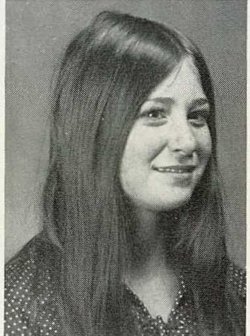
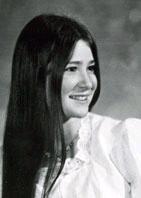
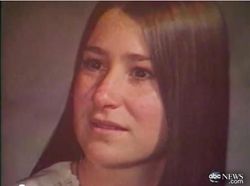
Melanie Suzanne Cooley (also called Suzi by family and friends) was born on October 27, 1956 to Bob and Nina Cooley in Boulder, Colorado. The middle child in a family of six, Ms. Cooley was 18 years old when she disappeared close to the high school she attended in Nederland (which is about 50 miles away from Denver) on April 15, 1975. She was a petite girl with dark eyes and long brown hair she wore parted down the middle. Melanie had a younger adopted sister named Michelle that was six when she disappeared, a younger brother named Cris that was about 18 months younger than her, and an older brother named Bob Jr. that was a sophomore at the University of Colorado. She lived with her family in the foothills west of Boulder on Magnolia Drive, her Father Bob was an airline pilot and her Mother Nina was a student at the nearby University of Colorado, studying both English and Anthropology. Interestingly enough, this is the first time I’ve come across any sort of political notation on any possible Bundy victims: in my research I learned that the Cooley family leaned very much to the left and was very politically active, participating in Vietnam War protests as well as civil rights demonstrations and peace marches.
Nina Cooley said Melanie loved animals, even saving the life of a tiny kitten that was so small it needed to be fed with an eyedropper. Like most 18 year old’s, Melanie had a strained relationship with her parents, and in her later years had an especially tough time getting along with her Mom. Of this time in their lives, Nina Cooley said: ‘as she grew older it often seemed I could do nothing right for Suzi, as though that girl-child had found me inadequate. I took it personally and how it hurt, lost as I was in my own neediness to be loved, I could not see her great need for separation-from-mother and independence of her unique self, and her need for the love and guidance of a mature mother.’ Melanie had big dreams and aspirations and didn’t want to be tied down to her small town roots and was skeptical of the more traditional family values in which she was raised. Despite this, Nina Cooley adored her daughter, saying that: ‘she learned fast, was bright and quick, when she wasn’t somewhere faraway. When she was three years old her favorite book was about a baby rabbit eager to be big and wise enough to leave the nest.’ It was reported to law enforcement that the young girl reportedly experimented with drugs on occasion (including marijuana and some ‘harder substances’) and frequently hitchhiked. Friends said she had no qualms with accepting rides from complete strangers and would often hitchhike home from school with other neighborhood kids largely because she didn’t like taking the bus. Mrs. Cooley said that Melanie was ‘somewhat of a willful girl.’ … ‘she wanted what she wanted right then.’ and that ‘for us, a stranger was a friend we hadn’t met yet.’ Melanie either was sexually active at the time of her death or was planning on engaging in sexual activity shortly before she died (Nina said she bought birth control pills in hopes to soon have a boyfriend).
Described as a good student by her teachers, Suzi was a lover of the arts, and was a gifted artist that loved reading, macrame, painting, journaling, creative writing, and poetry; she was also a talented musician that loved playing the guitar. Melanie also had a deep love for photography and even helped take pictures for her high school yearbook; she stayed active by hiking and skiing. She didn’t play any sports but did help keep score for the basketball team. In addition to being active in academics and after school activities, Melanie was employed as a valet driver at the nearby Eldora Ski Resort. Only six weeks away from graduation, she planned on either attending the University of Colorado (which is where her Mother and Brother attended college as well) or traveling. Her Mom said she would say, ‘I want to get a jeep and just drive!’ and that ‘freedom was her watchword, and had been always.’ … ‘She was desperate to learn. But she wanted to learn about life, and so little in school seemed relevant. She saw the absurdity, the burning irony, of being imprisoned
in an institution of learning while life was going on all around her out there! Her impatience and frustration knew no bounds. So much to learn and so little time,
speak the words of her journal, over and again.’ She had a deep appreciation for nature and was fascinated with learning about Native American heritage and culture. One time Suzi went tent camping alone for three days in the mountains and while she was away from her site hiking a bear came by and raided her camp. She was so excited over the situation she immediately went home, got her mother and brought her back to show her what happened. The bear destroyed her set up and left behind giant footprints, even shredding a container filled with beef jerky. Nina Cooley said that her daughter didn’t always like to follow the rules and that teachers and fellow students either ‘loved her or had a tough time getting along with her.’ … ‘She drew people to her or she repelled them. Her first grade teacher feared and disliked her openly, overtly. The teacher of her second grade class adored her, took her to lunch and on special trips, gave her books of poetry. The pattern continued into high school.’ Nina also said that Melanie had no problems speaking her mind and that on occasion it got her in trouble.
After classes were over on Tuesday, April 15, 1975, Melanie left the high school she attended in Nederland, Colorado where she was a senior and was never seen or heard from again. She was last seen by friends hitchhiking nearby campus, and it’s unclear where or when exactly she got picked up; no one saw the vehicle the young girl climbed into that day. She was last seen wearing blue jeans, a blue denim jacket with an embroidered eagle on the back (that she designed herself), a soft peachy-tan blouse with a background made up of small orange flowers and different colored geometric figures, and knee high tan leather boots. On the day of Melanie’s disappearance, Nina Cooley told law enforcement that she was wearing her hair pinned up ‘in a kind of French roll’ and that ‘she looked very pretty.’ When she didn’t come home that afternoon on the bus with her brother or even call her parents tried to report her missing the very next morning. When Nina voiced her concern to her husband he said, ‘oh, you know how she is, all drama!
We’ll hear from her.
‘ The parents were met with push back from the Boulder County Sheriff’s Department that told them there was nothing they could do until she was missing for at least 48 hours. From there she called Melanie’s two best friends, but neither one of them knew where she was. One girl shared that recently Suzi mentioned a Pink Floyd concert she really wanted to go to but that was the extent of her knowledge.
Two days later on Thursday, April 17 the Cooley’s received a call from the Nederland High School Principal with news that a man came in with a wallet containing Melanie’s’
The Principal called the Cooley’s as a formality to let them know the wallet had been found and let them know he turned it into the Boulder County Sheriff’s Department. Later that day a Boulder County Detective came to speak with the family to get more information and a picture of Melanie to begin search efforts. A few days following that her parents and four sheriff’s deputies combed the area where the wallet had been found, which had previously been a hippie commune and had ‘sheds and outbuildings, piles of old lumber, barrels of trash and rusted auto bodies’ scattered all over it. Mrs. Cooley discovered her daughter’s prescription birth control pills, in a personalized pink case with ‘Suzi’ written on it, discarded in the dirt a few feet away from the side of the road; that wasn’t something Melanie would have been irresponsible or careless about. Something was very wrong. driver’s license and other personal information in it
. He found it near his property and brought it straight to the school, figuring it must have belonged to a student.
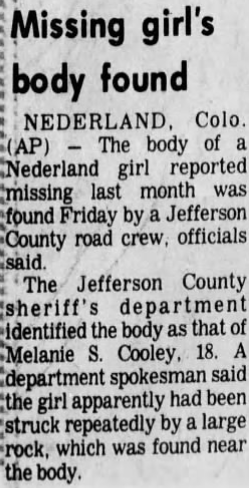
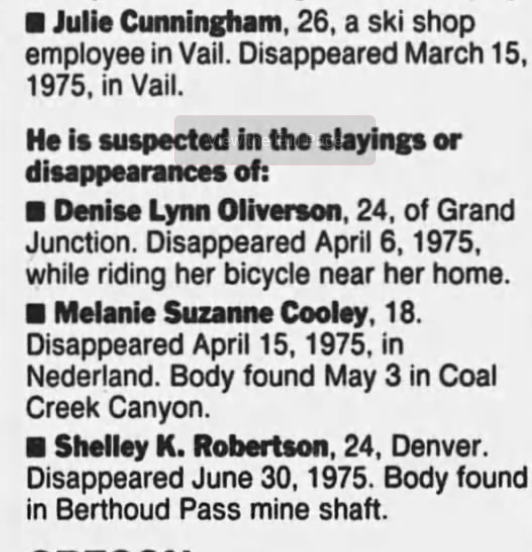
On Friday, May 2, 1975 the body of Melanie Suzanne Cooley was discovered fully clothed and frozen by a maintenance worker on Twin Spruce Road near Coal Creek Canyon about 20 miles away from where she was last seen. Of the discovery, Jefferson County Sheriff Brad Leach said: ‘she had been bludgeoned, perhaps with a stone. Her hands were tied in front with a yellow nylon cord; many, many feet of it, wrapped around and around. She died from a blow to the head and strangulation. Her face had been beaten repeatedly with a rock … One contact lens was missing. The body was in pretty bad shape. What with freezing and thawing, and the wild things, two weeks lying there.’ … ‘Her body, fully clothed, was found by the driver of a bulldozer on a little mountain track up Coal Creek called Twin Spruce Road, a few miles from where the billfold and pill case were recovered. The body was frozen.
‘ It was far worse than anything the Cooley family could have dreamed of. Of her big sisters death, little Michelle said: ‘Suzi always said she wanted to be free. And now she’s free!
‘ Despite that innocent statement the young child quickly developed nightmares about her siblings death and struggled with them for many years.
Author Ann Rule briefly discussed Melanie in her true crime bestseller ‘The Stranger Beside Me’: ‘a filthy pillow case, perhaps used as a garrote, perhaps as a blindfold, was still twisted around her neck,’ which I think suggests the killer was some sort of transient or camping enthusiast (why else use something as obscure as a pillow case?). Cooley’s remains were identified by a report card law enforcement found in her pocket as well as through dental records and a small (less than a quarter inch long), very particular brown birthmark in the shape of a shoe found on her thigh. Mr. and Mrs. Cooley also positively identified her based on the clothing she was wearing. The young girl was believed to have been deceased anywhere from ten days to two weeks before her body was discovered. Because her remains were at an advanced level of decomposition after being exposed to the elements for so long it was impossible to tell if she had been sexually assaulted. In my research on this case I couldn’t find evidence or mention of it anywhere.
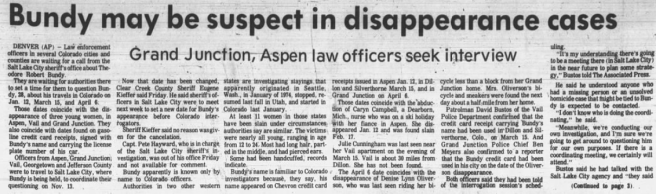
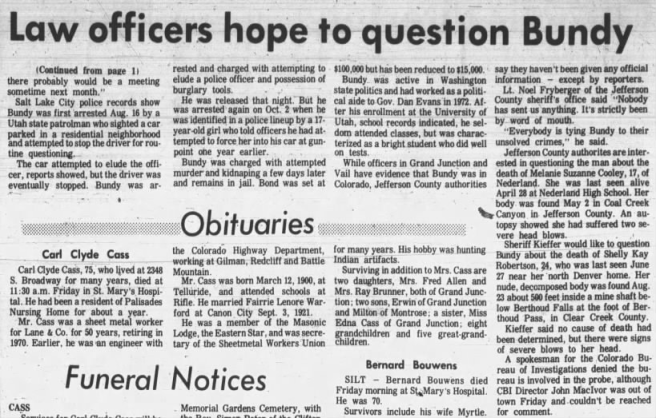
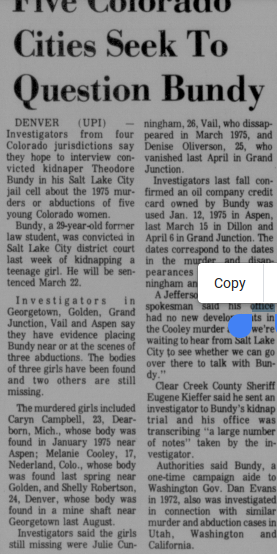
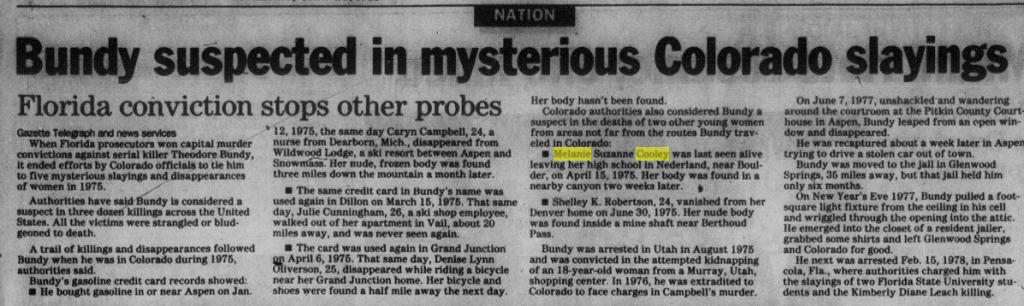
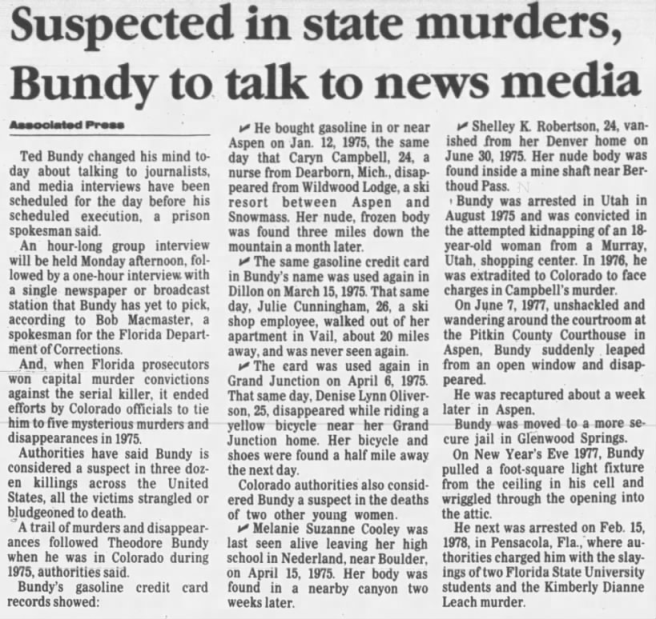
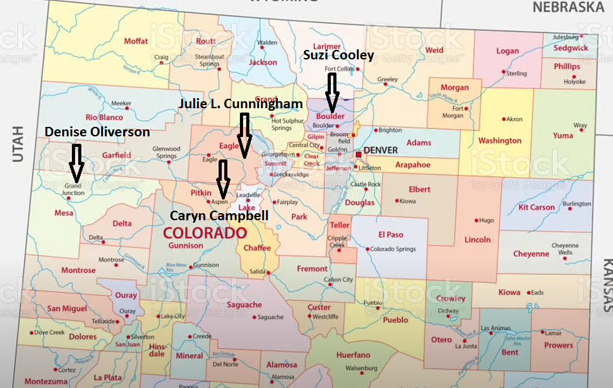
It’s suspected Melanie may have been a victim of Ted Bundy’s, however the only real, semi-compelling evidence is gas receipts that put him close to the scene in Golden, Colorado at some point in the month before Melanie vanished (about 50 minutes away). After killing women in Utah during October and November of 1974, Bundy migrated east in early 1975 to Colorado, killing nurse Caryn Eileen Campbell in January, the first of three confirmed women he killed there. Cooley possessed a lot of the same physical traits that Ted’s other victims did: she was attractive and slim, with long brown hair she wore parted down the middle. Like other Bundy killings surrounding an academic setting (Debbie Kent, Lynette Culver, and Kim Leach), it’s strongly speculated that the killer may have abducted Melanie as she was leaving school, as Ted moved around comfortably in a both high school and college settings (Florida State University, Evergreen State College, Central Washington, Oregon State and Brigham Young University). I do want to point out that Cooley was found fully clothed where Bundy typically left his victims in either a nude or semi-nude state.
Melanie was murdered 9 days after Denise Lynne Oliverson, who was abducted and killed on April 6, 1975 from nearby Grand Junction. Only a few months after Cooley was murdered twenty four year old Shelley Kay Robertson from Golden, Colorado was reported missing after she didn’t show up to work. Robertson was last seen alive in the company of a ‘wild haired man driving an old pickup truck’ by a police officer on July 1, 1975. Seven weeks after she disappeared, Shelley’s body was found in a mine shaft near Georgetown. Ted did drive a VW Beetle as we all know but his brother did have a pick up truck (who I know lived in Tacoma which is a 20 hour drive away but still).
Regarding what Bundy was doing in April of 1975 I can’t find any record of him working anywhere. In August 1974, Ted was accepted to law school for a second time at the University of Utah and moved to Salt Lake City on September 2nd, 1974; he was a student there in April 1975 when Cooley was murdered. Shortly after Melanie’s remains were found in June 1975 he was employed as a night manager in charge of Bailiff Hall at The University of Utah (he was fired for showing up drunk) and in July and August of 1975 he worked as a part-time security guard at the school; his position was terminated due to budget cuts.
Another serial killer investigated (but eventually cleared) of Melanie Cooley’s death was Vincent Groves, who was convicted of strangling at least seven women in Denver, Colorado between March 1979 and July 1988. On July 25, 1988 an investigation into the murder of an Aurora prostitute helped link Vincent Groves to the deaths of 17 sex workers metro-wide; he was arrested on September 1, 1988. He was convicted of the strangulation death of Diane Mancera, whose body was found dumped at the Surrey Ridge exit off of I-25 in July 1988. Groves began to have health problems in the early 90’s and he was eventually diagnosed with Hepatitis C and liver failure. He died on October 31, 1996 in a prison hospital near Denver. Shortly before his death, Groves was asked about other murders but he refused to discuss anything. Sixteen years after his death in 2012 his guilt was conclusively proven in four murders (Emma Jenefort, Peggy Cuff, Pamela Montgomery, and Joyce Ramey) with the help of DNA profiling. According to the Denver Police Department based on circumstantial evidence and a number of testimonies, Groves could have been responsible for more than 20 murders (however at this time his total victim count remains unknown).
Like confirmed Colorado victims Melissa Smith and Laura Aime, Cooley was a small-town girl taken close to her hometown community. Also like both girls, Melanie’s remains were found largely intact in an open, remote area. About the region of Colorado where Melanie lived and was abducted from, Redditor ‘annaflixion’ said: ‘I lived in Rollinsville and went to school in Nederland in the 80’s. It was a . . . weird place. Like all of Colorado, it’s a place where stark opposites live together in uneasy harmony. There are indeed a lot of hippies and granola types, people who collect crystals and want to live in harmony with nature. Then there are the right-wingers whose homes are almost compounds, where they are suspicious of strangers and that sort of thing. A lot of people just wanted to live kind of ‘off the grid.’ Everyone smokes marijuana. No one ever, ever tells the police anything. You could beat your kids or your wife; no one would dream of telling the police. That was the down side of the ‘live and let live’ style up there. I don’t know, it’s been a long, long time since I was there, but honestly I found it insular, though there were nice people, too. I think it would be surprising if she happened to run into Ted Bundy, but it’s possible. Girls especially tended to be very trusting, as I recall. They were pretty sheltered. And holy shit, getting anywhere was impossible, so yeah, hitchhiking would have been the thing. Even my school bus didn’t actually drop me off anywhere near my house. I had like a three mile hike home every day.’ (I just wanted to add, Rollinsville is about 5 or so miles away from Nederland High School). I do want to point out that there are two glaring differences between Smith/Aime’s murders compared to Cooley’s: both girls were sexually assaulted and Bundy accepted responsibility for killing them.
Redditor ‘DepartmentWide419’ commented: ‘I live here and this case fascinates me.’ … ‘Nederland high school is near Eldora. There is essentially a single highway that runs through Ned, the 119. It runs from Boulder (and beyond, but for our purposes, Boulder canyon) to black hawk. It runs through downtown Nederland. The high school is off of another road, Eldora Ave, that heads to a very remote town, Eldora. The only reason a non-local would go down this road is to go to the ski resort, Eldora. In the off season, a non-local would have no reason to go down this road. It contains the high school about .6 miles down the road, a dozen or so houses, and the 4th of July trail, which is fairly popular but could be inaccessible due to snow in April. She may have walked out to the 119 to hitch a ride. But I doubt Ted Bundy would be down Eldora Ave.’ … ‘The 119 is very popular with sightseers and tourists. Bikers, bicyclists and RV-ers are common. But April is a little early. A roving serial killer may have simply heard it is a nice joy ride and been passing through.’ … ‘In terms of small town values, small town values here are smoking marijuana, being sexually active and ‘getting in a jeep to just drive.’ Those are pretty much the pastimes here. Others include skiing, drinking, shooting guns and foraging. We have a couple nice music venues and a pretty famous recording studio. The dead and a bunch of other bands recorded albums just out of town here, so it is remote, but it’s not like her interests were in some way rebellious for the culture here.’ …
‘I’m unsure where is meant by the ‘foothills west of Boulder’ but twin spruce is not exactly in that direction. So she would have been hitching a ride in the wrong direction on the 119 to be brought to twin spruce if she in fact lived west of Boulder, and was trying to go home. Or someone turned around or lied to her about where they were going. Maybe something like, ‘oh yeah I can bring you down to Boulder on Magnolia Road’ but they cut down to coal creek instead. Either way, she would have known she wasn’t going home within 15 minutes. These are also windy roads. Turns are taken at 20 mph in many places. So it seems like a difficult place to kidnap someone from unless you had doors that didn’t open from the inside. Because your captive could literally just jump out of the car. A smaller sedan needs to take roads like magnolia at 15 mph in many places. I have to take those roads at 10 mph in an AWD SUV with studded tires in a lot of places. It’s just too bumpy and curvy. Especially in April before the roads have been resurfaced, they are a mess. A country girl who is familiar with the area could easily pop out and run into the forest and find their way to a trail from magnolia to Nederland. Unless the doors were locked from the inside or there were two people.’ … ‘I think it’s most likely it was a local or a transient with enough time on their hands to learn the back roads and how they all connect. You can take magnolia for instance, cut over to coal creek and then turn on to twin spruce. But it would be a difficult sequence for a non-local to know. Probably more than one person, and someone who lives here.’ … ‘Bikers have a strong hold here and have since the 60’s. Lots of outlaw types and lots of speed. Pretty much anything could have happened to her, but I find Ted Bundy less likely than creepy yokels hopped up on speed or other drugs. LSD is easy to find. All drugs are. A couple of weirdos on a bender seem way more likely. They would have had a reason to be in Ned, maybe leaving a local establishment and heading home to Gilpin/coal creek area. They could see her, find her attractive. They could name nearby places to make her comfortable, maybe offer to smoke a joint over by twin sisters, or the reservoir or other beauty spot on her way home. She says yes. It gets weird. They don’t let her leave. They panic, realize they can’t let her go. Rope could easily already be in the car. A lot of people carry it here. Either kill her on the spot, or bring her home to kill her. (Who has a pillowcase in their car, unless they are homeless? Why would a young girl get in a car with a homeless dude?).’
When digging for information on the unconfirmed victims I sometimes have to get creative in my attempts to find interesting and engaging information. In a YouTube comment on the only (very short) video I found on Melanie Cooley, a childhood friend named Renee Wilson said: ‘I knew her. She was my neighbor, babysitter and friend. I loved her. I was so heartbroken when it all happened and didn’t know who Ted Bundy was. I was 8 at the time and I still feel the emotions.’ … ‘She was very beautiful inside and out. She was kind, giving and fun to be around. I idolized her. I was and still am heartbroken.’ … ‘I am always amazed by the interest in Melanie. She deserves to be remembered. Yes, I do believe Bundy did it. There are things that I know that others do not. She was so sweet and fun.’
There’s another very obvious part of this story that is very frequent in Bundy victims: the hitchhiking aspect. Brenda Ball, the unknown Idaho hitchhiker, Laura Aime… just like Melanie these girls were frequently known to hitchhike (well, I’m assuming the frequent part about the poor Idaho victim). Melanie’s cause of death was a combination of strangulation and blunt force trauma, which is a very frequent Bundy method of murder. Now, when she was found her hands were bound together with a nylon rope, and I feel it’s important that while none of Bundy’s other (confirmed) victims were left this way we do know that he sometimes did use handcuffs to help subdue his victims. He may never have used a nylon in a binding sense however Ted did confess to using one to strangle at least one of his victims.
Bob Cooley passed away on March 31, 2011 in Boulder. On November 20, 2012, Melanie’s Mother Nina published a memoir titled ‘Dream Path: Search for Meaning, Search for Truth.’ It’s description reads: ‘Cooley, now retired and widowed, lived in Texas and Colorado before moving to California with her husband. Desperate for answers to Life’s mysteries following the violent death of her teenaged daughter, she began recording dreams, became a psychotherapist using dreamwork where appropriate. She currently facilitates a small circle of devoted dreamers.’
Regarding Bundy as a suspect of her daughters murder, she said: ‘Ted Bundy, the notorious serial killer, was to be executed in Florida. At least two books and countless brief accounts of Bundy’s biographical information and his trail of terror have been published. As Bundy had been a suspect in my daughter’s murder, it was known that he was in the vicinity when she disappeared, a reporter from the local newspaper came up to my house for an interview. A reporter with a Seattle newspaper called, ‘People Magazine’ too, wanting to do a story. I declined, seeing no need of that kind of publicity. Because Bundy was a suspect in numerous crimes in many places, a large group of journalists, detectives, and other law enforcement personnel traveled to Florida and waited in line to interview him before his execution. By the time the Boulder representative, number thirteen, gained access, Bundy was ready to admit anything and everything, and did so with abandon. They learned nothing of value.’ Law enforcement eventually came forward saying the evidence against Ted was inconclusive and Melanie’s case is considered cold to this day; Bundy denied any involvement with her murder. Personally… I’m not sure about this one. If Ted really did go after ‘slim, long haired brunettes that wore their hair long and parted down the middle’ and Melanie was wearing her hair up in a ‘French roll’ the day she was abducted it would have made her look drastically different from one of his typical victims. But, if he stalked her before abducting her (as he was known to do) then he would have known her hair was indeed not short. This particular ‘what if’ situation reminds me of yet another unconfirmed Bundy victim Sotria Kritsonis, who got her long, dark hair cut short right before supposedly accepting a ride to school from him (he allegedly let her go after realizing she had gotten her hair cut off). I think there’s a semi-decent chance that Cooley was a victim of Ted, however without DNA or any other forensic confirmation we will probably never know for sure.
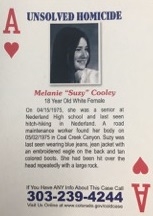
Anyone with information regarding this case is asked to please contact the Jefferson County Sheriff’s Office at 303.271.0211.












 Another Bundy Blog.