
So, most true crime fans are aware that Ted Bundy’s paternal lineage is unknown: Louise either had a completely anonymous one night stand, was with a man who lied to her about his real name/identity, or had a relationship with a guy who just up and left her and she took his identity with her to the grave (or a combination of these theories). There are multiple rumors surrounding the identity of Ted’s father: it’s been said he was a sailor that went by the name of Jack Worthington, an Air Force vet and salesman named Lloyd Marshall, and even Louise’s own father Samuel Cowell (even though DNA evidence proves he wasn’t). The name of Ted’s father was listed as Lloyd Marshall on his birth certificate (before Johnnie Bundy adopted him). Per ‘wikiwand,’ ‘census records reveal that several men by the name of ‘John Worthington’ and ‘Lloyd Marshall’ lived near Louise when Bundy was conceived.’ Mrs. Bundy told the FBI that Ted’s father was a man named Jack Worthington and that she only slept with him once (she also told Agent Bill Hagmaier that she was aware of the rumors and Samuel wasn’t Ted’s Dad).
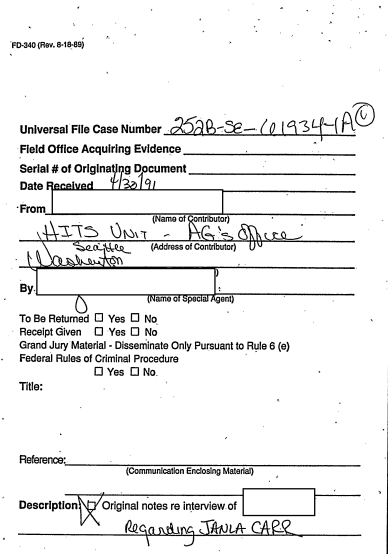
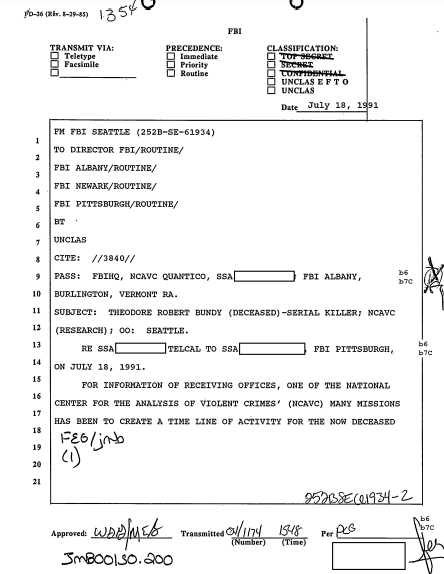
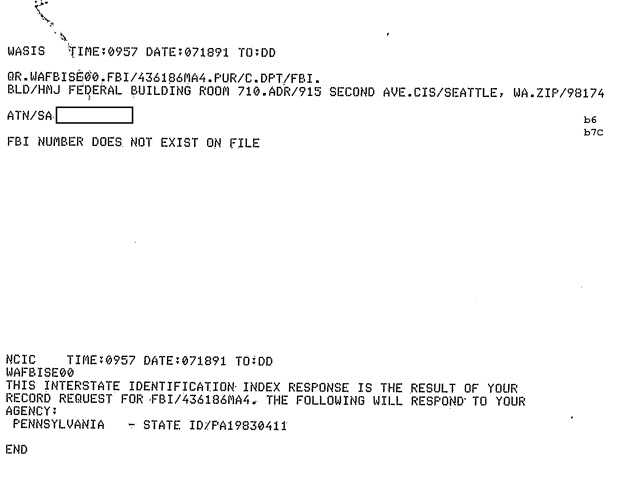
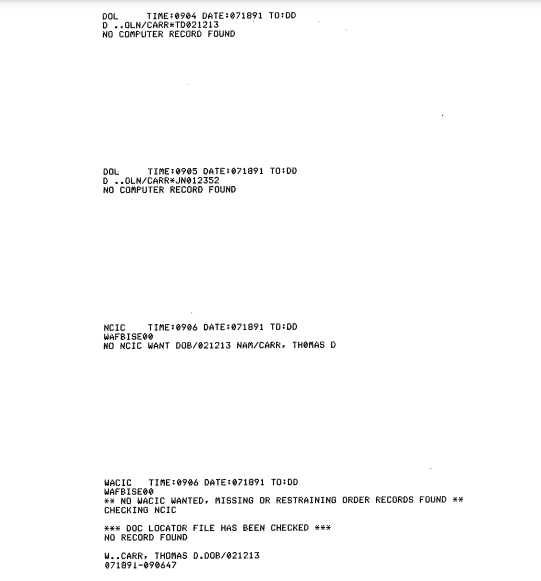
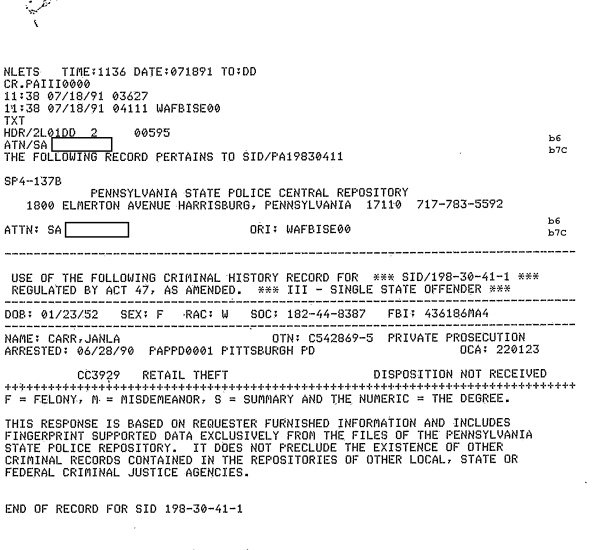
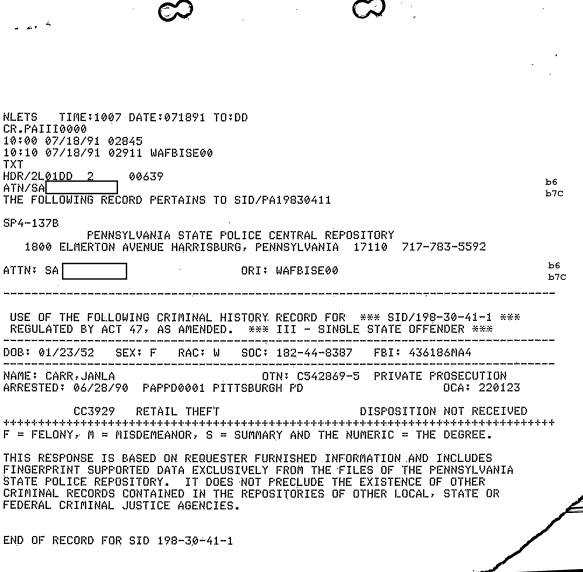
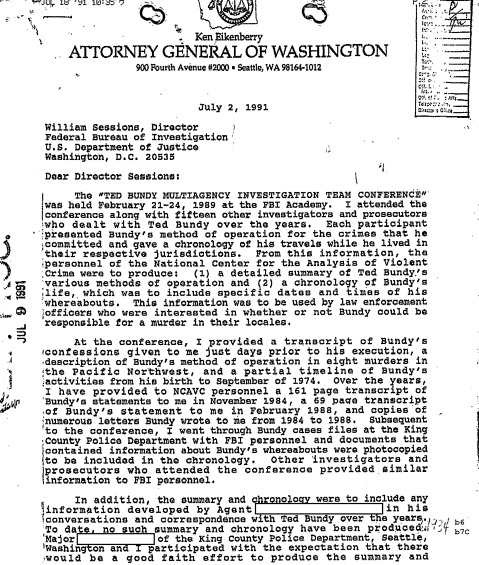
I’m not sure of the year, but ‘vault.fbi.gov’ released three separate documents that contained an absolute gold mine of information about the Bundy case (I included the portions about the Carrs in full at the bottom, as I don’t like leaving my readers hunting for additional information). Part one begins with a document from Salt Lake City law enforcement going over the details of Teds first escape on June 7, 1977 (as we all know he was quickly recaptured but escaped again to Florida later that same year on December 30). The beginning of the third portion is about a Pennsylvania woman named Janla N. Carr, who claims her dad (Thomas Dowling Carr) is Ted Bundy’s real Father. For the tl;dr type of people: Janla Carr claims Ted Bundy is her half-brother, he apparently had a twin brother, and he committed additional murders during early childhood and adolescence (well before 1974).
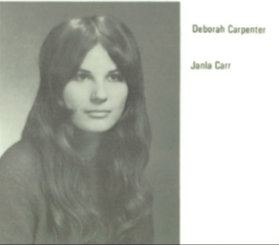
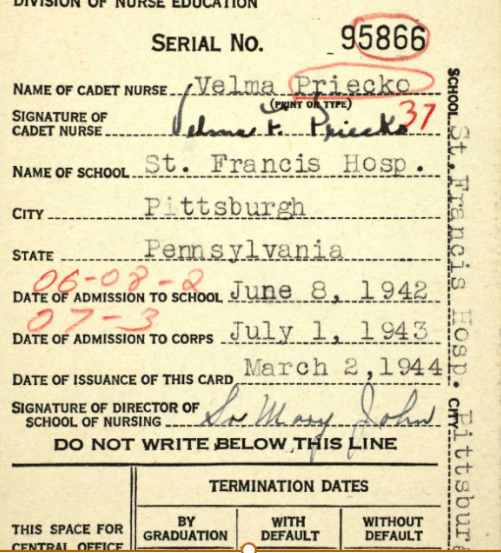
Janla N. Carr was born on January 23, 1952 to Thomas Dowling Carr and Velma F. Priecko out of Pittsburgh, Pennsylvania (Mrs. Carr’s maiden name is occasionally incorrectly listed as Nriecko). Janla was 5’5″ tall, weighed 150 pounds and had brown hair and brown eyes. The son of an undertaker, Thomas was born on February 12, 1913 in Columbus, Ohio and bounced around the country quite a bit before the family eventually settled down in Pittsburgh, PA in 1937 (he went to grade school in Reading, PA and oddly enough lived in Spokane, WA while attending high school, which is only about 4.5 hours away from Bundy’s hometown of Tacoma). After successfully taking a civil service exam, Mr. Carr got a job with the Railroad Mail Service (he began work for them in 1936, at some point became a supervisor, and retired in 1975) and Velma was a Nurse at the Western State Psychiatric Institute & Clinic in Pittsburgh. Family and friends told police that Janla and Thomas had what they would consider a ‘love-hate’ relationship. Additionally, Janla would frequently tell her friends that her dad had abused her and her mother, who passed away from cancer in 1983.
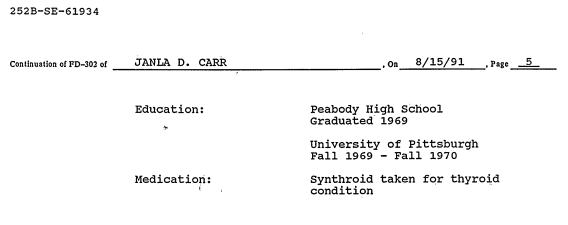
In 1969 Janla graduated from Peabody High School in Pittsburgh and later that fall started college at the University of Pittsburgh (she attended for two semesters). Carr eventually started skipping class before dropping out completely, claiming she had some sort of thyroid condition (I’ll bring this up again later). At some point in her life she experimented with LSD, which can result in altered memories. The use of hallucinogens (even infrequently) can interfere with the action of Glutamate (which helps to regulate pain perception), responses to the environment, and memory. It’s also worth noting that people who use LSD often experience blackouts: even though they may appear to be awake and conscious the entire ‘trip’ in actuality they have no recollection of what happened for either a portion or the entire time they were under the influence. Some users of LSD find their short-term memory is permanently affected and even after they stop using the drug their memories never come back.
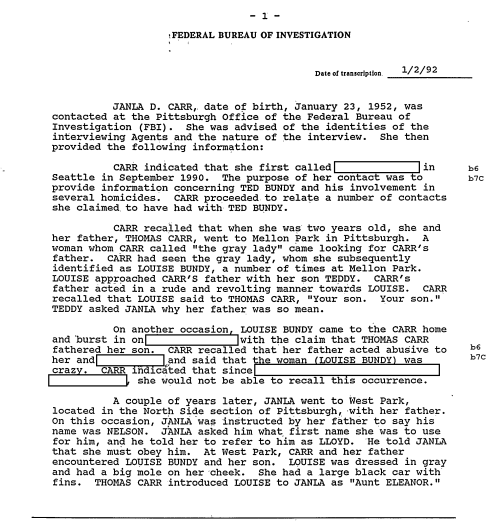
The first time Carr claims she met Ted was when she was two years-old: Mrs. Bundy brought her young son to meet up with Thomas and Janla at Mellon Park in Pittsburgh. Per the document released by the FBI, Janla told them that ‘a woman whom Carr called ‘the gray lady’ came looking for Carrs father. Carr had seen the gray lady, who she subsequently identified as Louise Bundy, a number of times at Mellon Park (although there isn’t a time or any other details of this introduction other than she remembers Louise as appearing gray in color). Thomas Carr denies ever knowing Louise Bundy. I don’t think I believe this story, as Louise moved Ted from Pennsylvania to Tacoma in 1950 and married Johnnie Bundy the next year. Teds half-sister Linda was born in 1952 and Louise had three more children after (Richie is the youngest Bundy-sibling and he was born in 1961)… why would Mrs. Bundy take her little boy ALL THE WAY across the country on multiple occasions and leave her new husband (who as we know stepped up and acted like a Father figure to Ted after he married his mom) and baby(ies) behind to go visit the Carrs? Janla told the FBI that on that occasion her ‘father acted in a rude and revolting manner towards Louise,’ and Teddy even asked Janla why her father was so mean to his mother. She also recalled that Louise said to Thomas Carr, ‘Your son. Your son.’
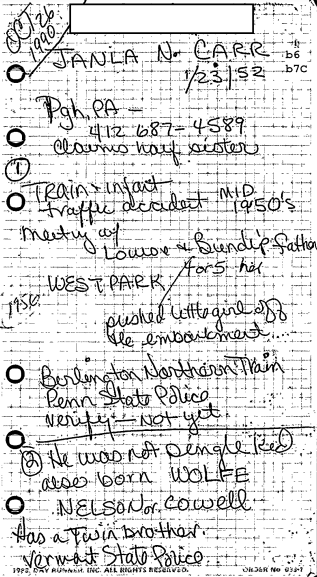
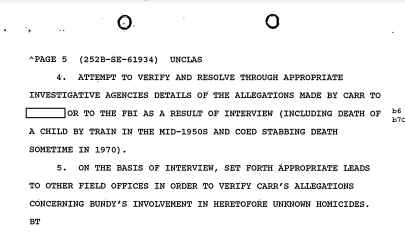
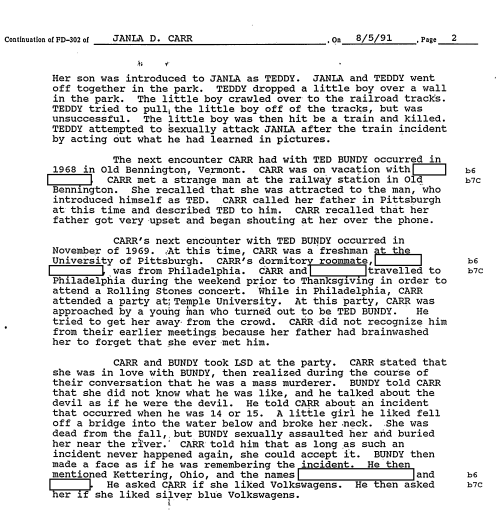
The next time Ms. Carr saw Ted was at West Park in Pittsburgh a couple years later in the mid-1950’s. On this occasion, Thomas instructed his daughter to call Louise ‘Aunt Eleanor’ and to tell her that ‘his name was Nelson. Janla asked him what first name she was to use for him, and he told her to refer to him as Lloyd. He told Janla she must obey him.’ When they met with Louise this time, Carr said she was dressed in gray, had ‘a big mole on her cheek,’ and drove a ‘big black car with fins.’ Like with so many of the other living unconfirmed victims, when writing this I relied heavily on Erin Banks book, ‘Ted Bundy: Examining the Unconfirmed Survivor Stories.’ In it, she discusses that during this second visit the two children wandered away from where the adults were sitting. ‘Janla and Ted went off together in the park. Teddy dropped a little boy over a wall in the park.The little boy crawled over to the railroad tracks. Teddy tried to pull the little boy was then hit by a train and killed.’the child’s mother allegedly witnessed the event. After the murder, Carr insisted that Bundy attempted to rape her and that he was ‘acting out what he had learned in pictures.’ I mean… where do I even start? Erin took all the work out of the equation for me (thanks friend), and pointed out that no police report exists regarding this alleged incident. If the mother witnessed another child murder her precious baby in such a horrifically gruesome way, where is the paper trail that would obviously exist? Or some form of proof of the repercussions of Teds actions? And why was it never discussed before in any Bundy related books or documentaries? It’s a pretty substantial event, much larger than something that could be expunged from a juveniles record at 18 (obviously something like that would make the papers, I would think). Also, Ted was born in 1946, which would have made him only 8 or 9 years-old when this event took place. Banks also points out that the average age that males in the 1950’s reached puberty remained as it was in decades prior at 12.5 years old. I mean, there’s always outliers to the average but how could it be possible that Ted rape Janla if he wasn’t physically able to? Janla discusses another time (there are no details given about when exactly it occurred) where Louise ‘burst in on [redacted] with the claim that Thomas Carr fathered her son. Carr recalled that her father acted abusive to her and [redacted] and said that the woman (Louise Bundy) was crazy. Carr indicated that since [redacted], she would not be able to recall this occurrence.’
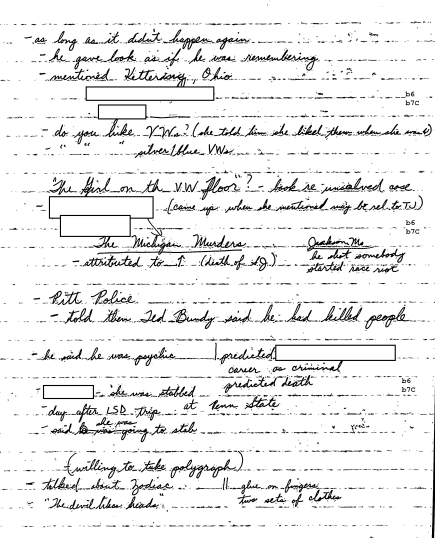
Interestingly enough, Ms. Carrs run-ins with Ted didn’t end when they were children (it actually seems as if the encounters happened more frequently when the two were adults). Janla told the Pittsburgh branch of the FBI that the next time she saw her half-brother was while on vacation in Vermont in 1968: she ‘met a strange man at the railroad station’ in Old Bennington who introduced himself to her as Ted and that she was attracted to him. When she called her Dad and told him about her new friend he became very angry and started yelling at her. After that Carr claimed that she ran into Ted at a Rolling Stones concert in Philadelphia (sometime between 1968 and 1970) while he was attending Temple University and living at his Aunt Julia’s house in Lafayette Hill. It’s worth noting that Bundy did briefly live in Pennsylvania from December 1968 until May 1969 when he moved back to Tacoma (per the ‘TB FBI Multiagency Report 1992.’). Next up: at some point in November 1969 Carr said they ran into each other at a party shortly when she was a freshman at the University of Pittsburgh. She claimed that she didn’t recognize him because at some point in the past her father and Ted hypnotized and brainwashed her (I’ll elaborate more on that later). The two took LSD together while at the party and determined then that she was ‘in love with him’ despite him confessing to her that he was a ‘mass murderer.’ Bundy told Carr that she didn’t know what he was really like, and he talked about ‘the devil as if he were the devil.’ During that trip he started disclosing all of his deepest, darkest secrets to her, including the fact that he already committed several murders at that point in time (even though he told Bob Keppel that he started killing women in 1972) and that one time he incited a race riot after he shot a man in Jackson, Mississippi (you know, because he was known to do that), which ‘bears certain Manson-esque connotations’ (Banks, 54). Carr also claims that Ted confessed to being responsible for the 1969 slayings of Elizabeth Davis and Susan Curtis (also known as the Jersey Parkway Murders). I do want to note, the FBI file said that Ted shared with Janla that he was responsible for A murder on the Jersey Parkway (as in one).. and I don’t know if this is an error or intentional. In her book, Banks points out that ‘Bundy had allegedly intimated to Dr. Ron Holmes that he had killed the two women, yet no recording of it exists. It is noteworthy that Bundy was incarcerated with Gerald Stano at the time, who was a suspect in the case and may have filled Bundy in on several details of the double homicide.’ Carr claims that Ted confessed to a series of murders that was discussed in the book, ‘The Michigan Murders’ as well as some slayings in Ohio. Additionally (although he didn’t give the victims name), she claimed that Ted took responsibility for the disappearance of eight year old Ann Marie Burr from his hometown of Tacoma, WA. Carr claimed that Ted described pushing the little girl off a bridge which resulted in her neck breaking. After she was dead, the fifteen year old sexually assaulted her before he buried ‘her body near a river.’ After this encounter, Bundy hypnotized Janla so she would forget the encounter ever happened.
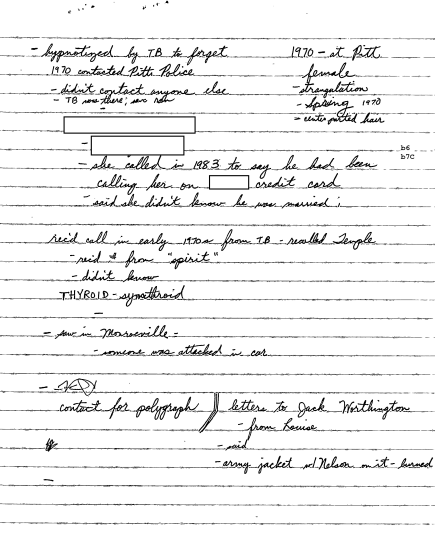
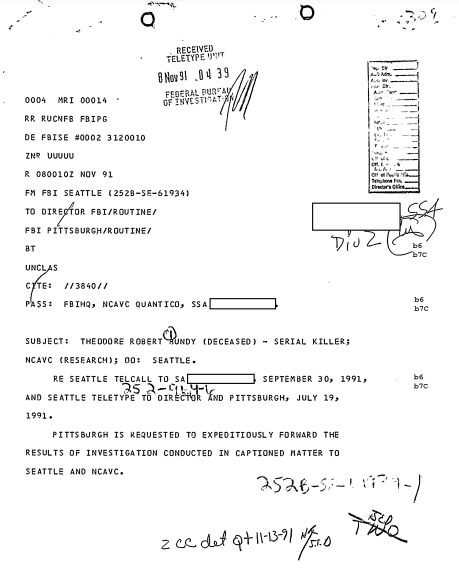
Thomas Carr first remembers his daughter talking about Bundy for the first time at some point in the late 1980’s: he told the FBI that she called someone in Washington about Ted and that he tried to discourage her from doing it again. Thanks to these documents released by the FBI, we know that Janla didn’t begin her delusions of Bundy being her half-brother until around 1990, and she first contacted Seattle law enforcement that September about her speculations (conveniently this was after he was executed in January 1989). Carr told them she wanted to help provide information about his involvement in ‘several homicides.’ At some point in 1991, Ms. Carr learned that Louise Bundy named Jack Worthington as Ted’s father, which per the document ‘relates Janla’s claim that her father told Louise his name was either Lloyd Nelson or Jack Worthington.’ Unfortunately the (handwritten) notes aren’t completely clear (to me, anyways) and it’s tough deciphering what is meant in some parts. It appears Janla attempted to contact the agency multiple times and they finally granted her an interview on October 26, 1990, when she shared with them her alleged past experiences with Ted Bundy (she even offered to undergo a polygraph examination proving she was being truthful). Carr claims Ted was given the surname Wolfe, Nelson, or Cowell at birth and that her Dad ‘thinks she’s nuts’ and that her ‘stories are fabrications.’ Thomas Carr commented that he ‘could not recall any other topic with which his daughter was so obsessed as with Ted Bundy.’ (Fun side note: she also claimed he had two toes that were stuck together).
Additionally she points out that she feels that older pictures of her father ‘bears a resemblance to published photographs of Ted Bundy.’ Carr included a picture of her father from 1946 in the handwritten letters she sent to the FBI, who she felt bore a ‘striking resemblance to Bundy.’ Janla shared that she wrote to Louise on several occasions and that she even wrote her back: in the response Ms. Carr said that Louise ‘discounted everything Carr had written and about.’ She termed Louise Bundy’s response as the ‘original poison pen letter;’ she also claimed that her father destroyed letters from Louise Bundy that were addressed to Jack Worthington as well as ‘an Army jacket with the name Nelson on it.’
Another thing I want to circle back on is the concept that Ted apparently had a twin brother: I’m including this snippet from Banks book because it gave me a good laugh but it also brings up a really good point: ‘Carr is adamant that Bundy had a twin brother. Those leaning towards believing Carr posit that Louise may have taken turns taking Bundy or his twin brother to these family reunion meetings with the Carrs. One person even suggested that it may have been Bundy’s twin who later sought Carr out in Pittsburgh. Obviously this logic is flawed. This isn’t ‘Breaking Bad’ and we’re not talking about the Salamanca twins in real life. The fact aside that the Lund Home did not record a twin birth in Louise’s case, why would Louise not have brought both boys to meet Mr. Thomas Dowling Carr and his daughter Janla? Where exactly was this twin brother when Bundy grew up in the Cowell and later Bundy household? Where is he on any family photos that found their way onto the internet over the decades? He should have been in at least one photo together with his twin. And where is he now? If he resembles Bundy, just imagine the terror and panic that would have followed, had he been spotted someplace after Bundy’s conviction, let alone after his execution. He would have been the most (wrongfully) arrested man in the history of the USA.’ I mean… yeah. This is written so perfectly I don’t need to elaborate further. The idea that Bundy had a twin no one knew about is absurd.
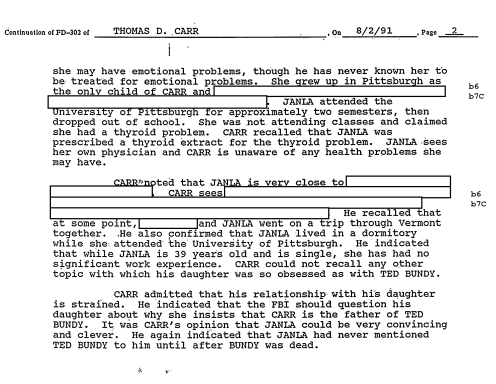
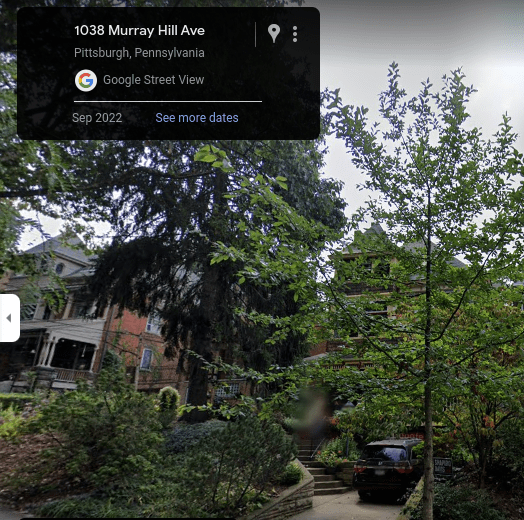
It shouldn’t come as a surprise that Janla had a long history of mental illness: her father claims that she never held a job and he paid the rent for her apartment (located in an old mansion at 5705 Fifth Avenue in the Oakland area of Pittsburgh). Even though Thomas said she didn’t work a company called ‘Telefundraiser / Public Interest Communications’ is listed in the FBI document as Janla’s place of employment with a notation of of April 1990 written by it (I don’t know if they meant that was her current POE and started that April or if it was the only place she’s ever worked, it’s not clear). She also had numerous inpatient stays at the Western Psychiatric Institute and Clinic in Pittsburgh. Her father also shared with the FBI that his daughter also had some sort of ‘thyroid condition‘ and took ‘Synthroid,’ a Doctor prescribed thyroid medication that is used to treat a condition called hypothyroidism in adults and children. It is meant to replace a hormone that is usually made by an under-producing thyroid gland. Looking into the condition, it appears that individuals suffering with this thyroid disease often experience changes in mood, specifically anxiety and depression. It seems that the more advanced the thyroid condition, the more severe the mood shifts.
Janla said she saw Ted next in the spring of 1970: she was a student (and resident) at the University of Pittsburgh and ran into him on campus. Around the same time, a Pittsburgh coed (who wore her ‘hair parted in the center’) was strangled to death. She said that time he ‘told her he had killed people;’ she immediately took this information to the University of Pittsburgh Campus Police. Carr commented that she doesn’t know if they did anything with the information. There isn’t any additional information about this encounter but apparently after it took place Bundy ‘disappeared;’ she doesn’t know if the Campus Police ever checked him out. After that incident Bundy contacted Janla on the telephone at some time in the early 1970’s: he told her that a spirit gave him her unlisted phone number; it was at that time that she remembered meeting up with him while he was at Temple (vault.fbi.gov/TedBundy, page 40).
Janla told the Pittsburgh branch of the FBI that she didn’t begin to remember these events until several years before the interview took place because ‘both her father and Bundy had hypnotized her.’‘ She claims that the two men had hypnotized her in order to make her ‘forget about the family connection;’ per the FBI document, Carr broke free from this spell at some point in 1969. She also said that she did not always recognize Ted when she see him or remember that he was her half-brother. Janla also claimed that Bundy told her that he was psychic and one time predicted that ‘a woman named [redacted] was going to be stabbed.’ She went on to claim that the next day ‘a woman named [redacted] was stabbed at Penn State University.’ He also said that ‘he would have a career as a criminal, and that he would be killed for his crimes.’ Carr claims that at the end of this encounter Bundy hypnotized her so that she would forget everything he told her.
In 1983 Janla said Bundy called her from Florida State Prison and gave her the name of Angela Woods. ‘Also in 1983, Carr received a call from [redacted], who identified herself as [redacted]. She told Carr that Bundy had used [redacted] credit card to call Carr. Carr told [redacted] that she did not know Bundy was married’ (this makes me think redacted is Carole Ann Boone). About four years go by before Carr is contacted by Bundy again: in 1987 she received a phone call from Ted but she ‘didn’t recognize his voice.’ He told her he was ‘the most evil person in the world.’ Carr shared with the FBI that she was ‘half-asleep when he called’ and she didn’t realize until later that it was Ted who called her.
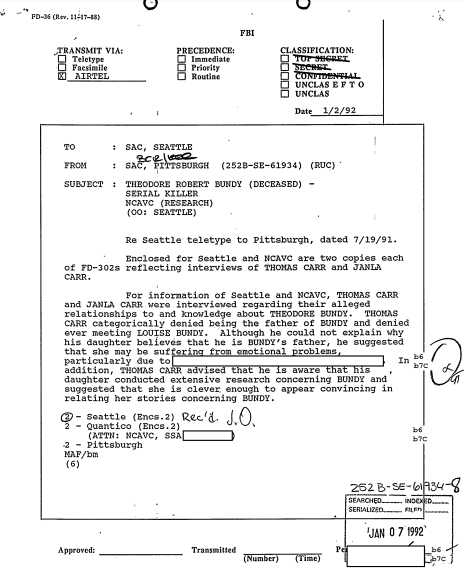
Thomas Carr denied that Ted Bundy is his son and is not sure why his daughter thinks this is true. In an interview with the FBI, he shared that Janla never talked about Ted until after he was executed and that he sought her out because she had ‘incriminating information about him.’ In order to find information that would help corroborate her stories, Thomas said that she would tirelessly research Bundy’s background, trying to find some random fact that would help prove her case. He also shared that Janla became practically obsessed with the serial killer, and would read anything she could get her hands on about him: magazines, newspapers, books. She also utilized computer databases at various libraries in the area (specifically the Carnegie Library as well as the libraries at Carnegie Mellon University and the University of Pittsburgh). Carr claims that his daughter is ‘clever enough to appear convincing in relating her stories concerning Bundy.’
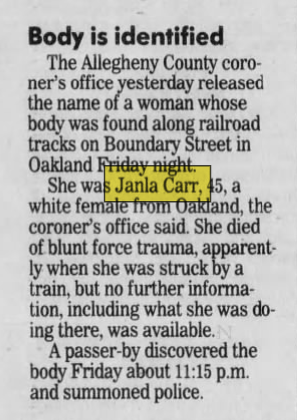
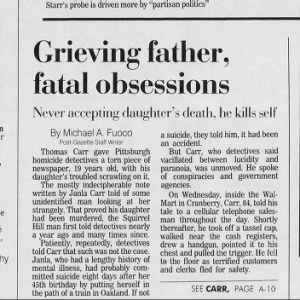
Eight days after her 45th birthday on January 31, 1997 Janla Carr was found dead in a subway tunnel near Central Catholic High School in the Oakland area of Pittsburgh following a stay at a psychiatric hospital. The area was a known hangout for people experiencing homelessness. Friends of Carr told law enforcement that she seemed happy before she died despite the fact that she stopped taking her medication. Pittsburgh Homicide Sergeant Paul Marraway described Janla as ‘eccentric,’ and that ‘she had been in the hospital for psychological problems.’ Because Janla wasn’t a victim of sexual assault and had no physical defensive wounds, investigating officers ruled her death as a suicide (the ME listed her death as ‘undetermined’). But her father knew differently: Thomas Carr went to Pittsburgh law enforcement multiple times over the following year regarding his daughters death. One time he gave homicide detectives a 19 year-old torn piece of newspaper that contained Janla’s handwriting all over it: she claimed that there was an unusual man in her apartment who stood up from the couch he was sitting on and looked at her in an ‘unsettling way’ (Banks, 57). The note was deemed mostly nonsense by the police, however Mr. Carr felt it proved his daughter had been murdered. Police said that it was as if he became obsessed with that piece of paper. Over and over again, detectives patiently told him that his daughters death was a suicide, and if it wasn’t, it was an accident. She wasn’t murdered.
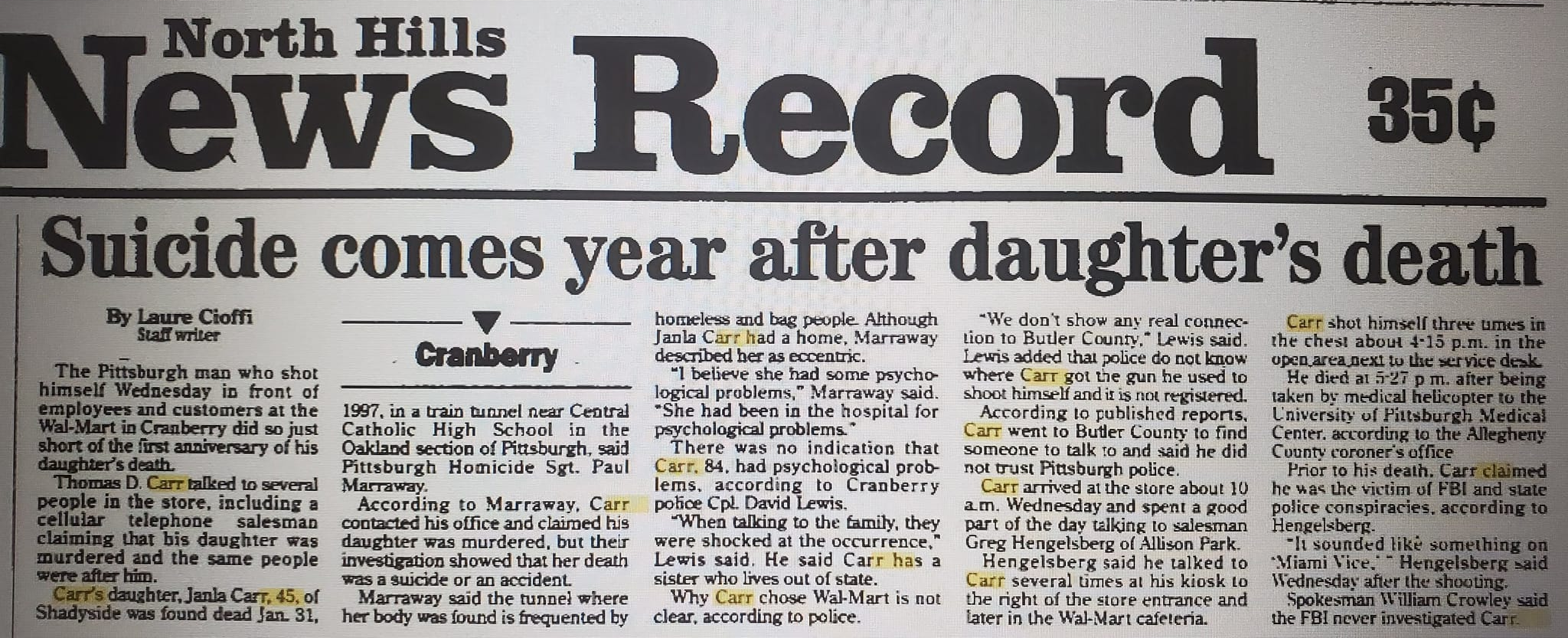
The Pittsburgh branch of the FBI looked into Janla’s story and they eventually determined that it lacked credibility (obviously, as we are all aware Bundy’s paternal lineage remains unknown). Finally Thomas Carr’s delusions of his daughter being murdered by the FBI got the best of him and he had enough: on Wednesday, January 28, 1998 Carr went to the Walmart in Cranberry, PA multiple times. He spent a few hours wandering through the isles and sharing his story with Greg Hengelsberg, a cell phone salesman working at the store. Among the things he shared was that his neighbor broke into his house and stole his stamp collection and that his phone was being tapped by the FBI and whoever is doing that also killed his daughter. Regarding the conversation, Hengelsberg commented that ‘it sounded like something on ‘Miami Vice.’’ Per an article published by the North News Record on January 30, 1998: ‘he said the same people tapping phones were the ones who killed his daughter. He said he was wanted by the FBI and the state police.’ … ‘One minute it would be a normal conversation, and then he would get serious… that they had gotten to his daughter and now were after him and whoever was tapping his phones had played it for the woman he was in love with and and she had duped him and never spoke to him again.’ When he was finished walking the store, Carr took off the tasseled hat he was wearing, walked near the cash registers, pulled out a handgun, pointed it to his chest and pulled the trigger. Clearly hurt, he quickly fired two more shots into his chest; he died later that day. The day before he took his life, Thomas went to the Butler Eagle Newspaper offices and told a member of their staff that he wanted to talk about his daughter’s death. He said that he wanted to talk about his attempts to get the Pittsburgh Police interested in the case but he no longer felt he could trust them. He also said that he was ‘on the run from the law’ and that Janla’s murder involved a top political aide of a gubernatorial candidate. He was referred to Post-Gazette reporter Dennis B. Roddy. According to one-time Cranberry Police Corporal David Lewis, Carr showed no signs of having any psychological problems, and when his family was contacted they were surprised at the news. Lewis further commented that police didn’t know how Carr obtained the gun used to shoot himself and that it’s not registered.
I personally don’t think Janla was Ted’s half sister. I think she suffered from a terrible case of untreated mental illness and the only reason she knew so much about him was because she obsessively and tediously studied him. On the website ‘documentingreality,’ a user going by the name of ‘Susan’ said that Janla ‘knows far too much for her to have been dismissed the way she was later on.’ I mean… I wish Susan would have elaborated a bit on what information she thought was so unique, but there’s so much information out there about Bundy, even back then (as the places Carr utilized contained a lot of helpful sources). Janla easily could have learned a great deal of information about Bundy simply by reading books and newspaper articles.
Thomas Carr was 84 years old when he killed himself.










































 Another Bundy Blog.