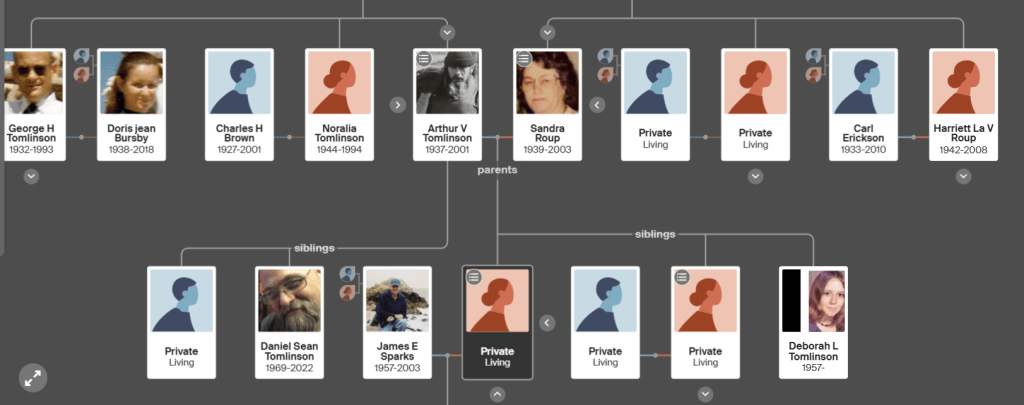
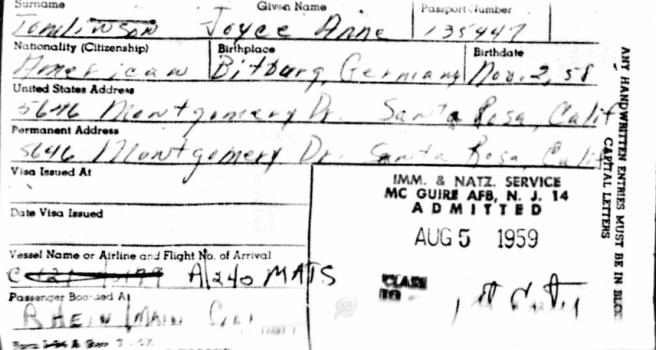
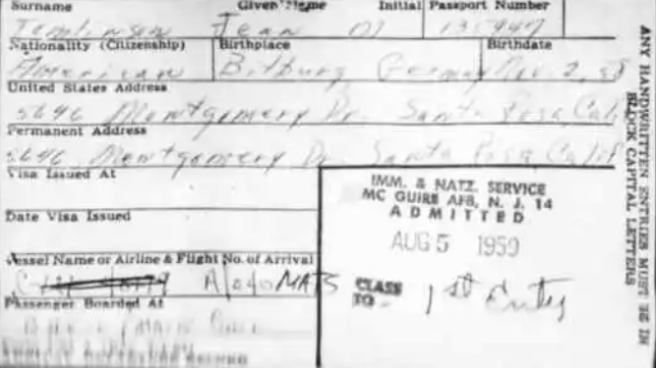
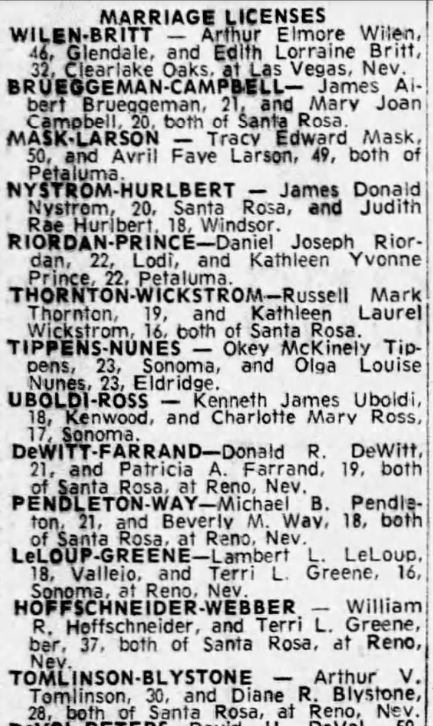
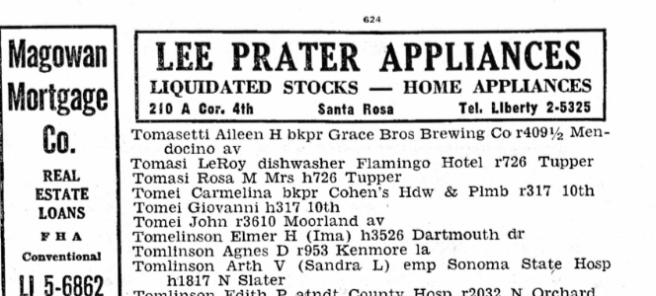
Deborah Lee Tomlinson was born on October 15, 1957 in Bitburg, Germany to Arthur and Sandra (nee Roup) Tomlinson.Arthur Vernon Tomlinson was born on September 22, 1937 in Modesto, California, and Sandra Lee Roup was born on December 31, 1939 in Livingston, Montana. According to the Tomlinson family tree, the couple had three daughters together: Deborah and her twin sisters, Jean and Joyce (b. 1958). At some point they divorced, and Mr. Tomlinson was briefly married again in 1968 (they quickly parted ways; he went on to have a relationship with Sally Morphisand in 1969 they had a son together named Daniel. He got married to Shelley Williams on August 30, 1975 in Orange, CA but their union also didn’t last long, and they split up in February of the following year. Mr. Tomlinson was married for a fourth time, and the couple had a son together. Sandra got remarried to Henry Nelson on May 10, 1963 in Billings, Montana.
After their parents parted ways Deborah, Jean, and Joyce went to live with their father and stepmother in California, and Sandra relocated to Oregon. Because of their parents’ divorce the girls were separated from their mother at a very young age, which Joyce felt prevented them from forming a strong bond because she wasn’t given a chance to raise her own babies.
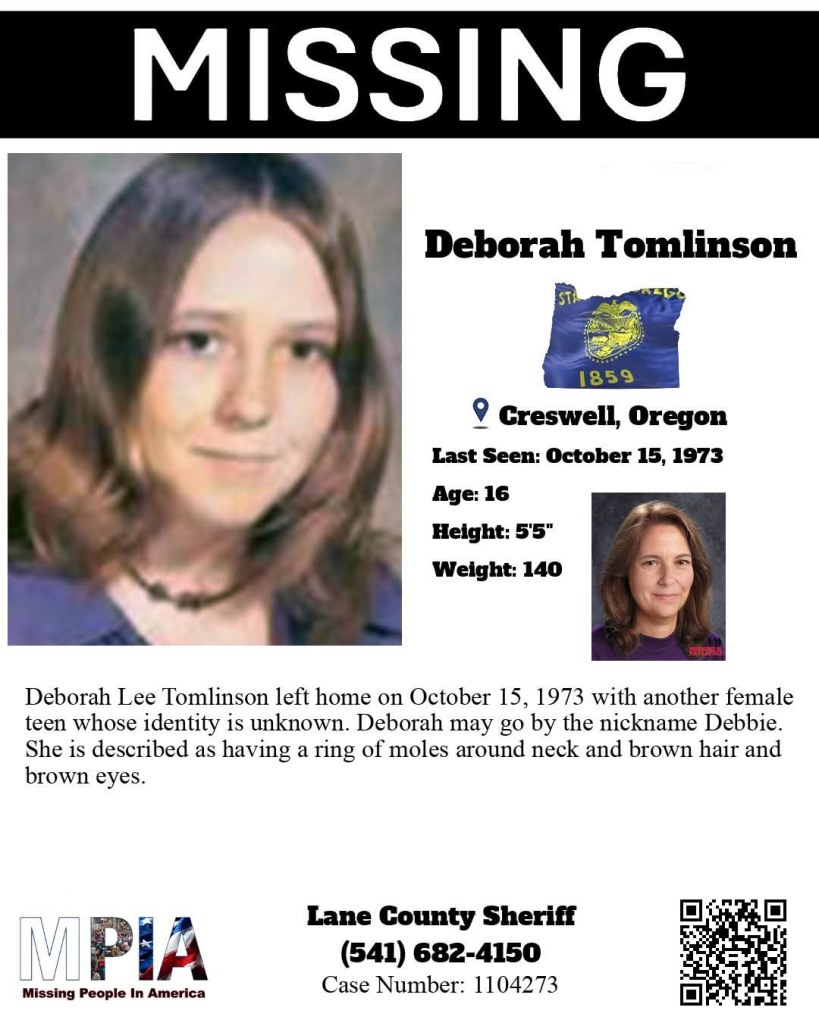
According to most reports online, Deborah Lee Tomlinson disappeared from Creswell, Oregon** on her sixteenth birthday on October 15, 1973.Creswell is an incredibly small town with only one high school, and according to the 1970 census the reported population was made up of a mere 1,199 people (it went up to 5,031 in 2010). Referred to as ‘Debbie’ by family and friends (per Joyce, she hated being called ‘Deb’), Tomlinson had brown eyes, stood at 5’5” tall, and weighed 140 pounds (Joyce felt she may have been slightly heavier); she wore her golden-brown hair at her shoulders and had a ring of moles around her neck. In the initial days following her disappearance investigators strongly believed that she was a runaway,whichmost likely explains why I couldn’t find any newspaper reports or media coverage on her. One of the only other real takeaways I could find regarding her case was that she disappeared with an ‘unidentified teenage friend.’
** After I initially wrote the article on Deborah in April 2024 I was contacted by her sister Jean, and more recently Joyce. Both sisters were kind enough to help fill in some of the gaps in their family background and were able to provide me with some of their thoughts regarding her disappearance. According to Jean, their Aunt Helen told them in more recent years that Deborah had ran away from Eugene, not Creswell, and at one point the family had been contacted by a friend that claimed they had seen her in Santa Rosa, CA with ‘a black guy,’ which was a big deal as their father didn’t approve of people of color (Joyce also said she was there visiting a friend named Lyn). The family member also volunteered that they thought she may have been pregnant at the time as well, but nothing ever came out of that. About this alleged sighting, Joyce doesn’t feel it’s true, as that’s where their grandmother lived and Deborah would never have left the area without paying her a visit, especially if she had been pregnant (the two were especially close).
According to Jean, after their parents split up the girls were raised by their father in California, but because Deborah’s didn’t get along very well with their stepmother she had moved to Oregon to live with their mother (who she also clashed with). She also said that at the time her sister disappeared she seemed mostly happy but had been in a bit of a transition period in her life and may have been under the impression that moving out of state may have resulted in more lenient rules, but that wasn’t the case.
According to Joyce, Debbie was simply acting like any other teenager, doing things like sneaking out at night and smoking: one evening in a quick moment of anger their dad announced that he was pulling a ‘Pontious Pilot’ and was ‘washing his hands of her.’ When she left home Joyce said somehow she knew it would be the last time that she ever saw her, and to this day she struggles with her feelings towards her father about that event. Additionally, she strongly suspects that a missing person’s report was never filed in the days after she was last seen, as she never came across one after contacting local Oregon law enforcement. Because of this, I strongly feel that Debbie didn’t disappear exactly on October 15, 1973, and most likely vanished sometime around it.
Jean shared with me that in the years following her sister’s disappearance neither one of their parents wanted to talk much about her, as it brough up too many painful memories. Because of this she told me that she doesn’t know as much about her as she would like to, but she does know that Debbie loved rock n ’roll music and had gotten caught sneaking out at night several times while she still lived with them in California.
Shortly after Deborah disappeared Joyce told me that their stepbrother had reached out to let her know about a formerly missing woman had been found murdered that happened to have some moles around her neck in a pattern similar to Debbie’s (which she said appeared to be ‘almost like a spaced apart, like a necklace’); it obviously turned out not to be her.
When I asked if perhaps Debbie had run off with a guy, Jean shared with me that was what most likely happened, despite the fact the sisters weren’t allowed to date until they were sixteen. Regarding her feelings on the recent ‘genetic genealogy’ craze and if she thought it could help solve the mystery of what happened to her sister, she said that she has never been contacted by LE about it, however at one point she was told by the National Center for Missing & Exploited Children that any records possibly related to Deborah were destroyed in a fire.
In 1984 Joyce and her husband took a road trip with their grandkids to visit their great-grandmother and Hank, and while there her stepfather shared that he caught Debbie sneaking out one night and she had been smoking marijuana. He told them that this freaked him out and he tried to do a ‘scared straight’ type intervention and had reached out to the local county sheriff (who had happened to be a friend of his), who had come to the house and had a conversation with his teenage stepdaughter; Debbie disappeared shortly after that.
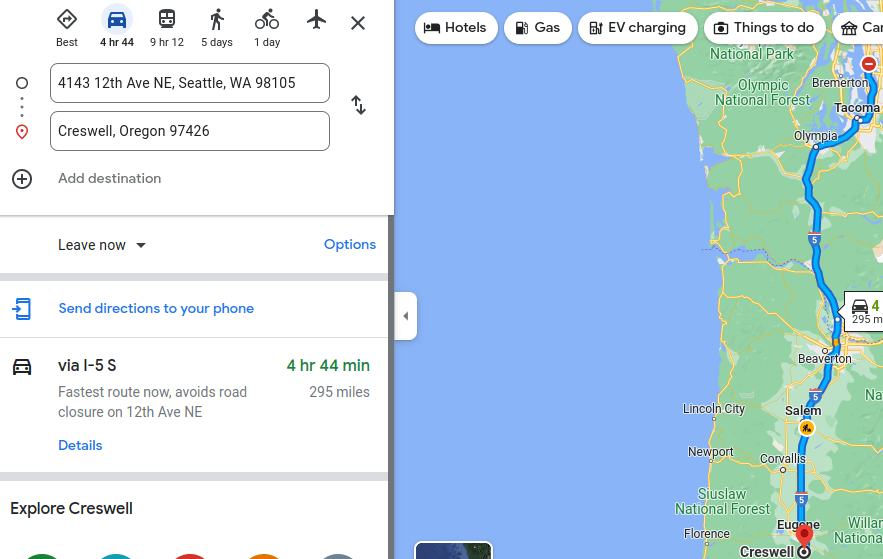
At the time Tomlinson disappeared in October 1973, Ted Bundy was living at the Rogers Rooming House on 12th Avenue Northeast in Seattle, and where it was a five-hour drive (one way) from his residence to Eugene/Creswell, we know he had no problem with traveling long distances to look for prey. Despite being in a long term, (supposedly) monogamous relationship with Liz Kendall, while on a business trip with the Republican Party to California in the summer of 1973 he rekindled his romance with one time girlfriend Diane Edwards. Ted’s former flame visited him in Seattle on multiple occasions in the latter part of the year, and the couple at one point were even briefly engaged… but the happy times didn’t last long, and in January 1974 he abruptly and without reason cut off all contact with her.
On top of juggling two women, in September 1973 Ted enrolled in law school at the University of Puget Sound, and according to the ‘TB MultiAgency Investigative Team Report 1992,’ on Monday, October 15, 1973 when Tomlinson disappeared, he was in class. Additionally, at the time he was in between employment: in September 1973 he was the Assistant to the Washington state Republican chairman and remained unemployed until May 3 of the following year when he got a position with the Department of Emergency Services in Olympia.
In addition to Ted Bundy multiple other serial killers roamed the Pacific Northwest in the early to middle 1970’s: the first one (aside from Ted) that popped in my head was Warren Leslie Forrest, a double murderer that has been sentenced to two life terms in prison for the murders of Krysta Blake and Martha Morrison in 1974; he is also considered the prime suspect in at least five additional murders and disappearances going back as far as 1971. He has been in police custody since 1974 and on February 4, 2023 he was convicted on another murder count after DNA linked him to the murder of Martha Morrison.
On June 8, 1961, Portland police received a call from a housewife whose dog had returned home with a human foot in a paper bag, and when detectives went to her home the animal came back with a hand. Upon investigating, LE found several additional body parts around the woman’s neighborhood, and all of the appendages were deemed to be fresh and were completely drained of blood. Police went through local missing people’s reports and came across the file of twenty-three year old Joan Caudle, a housewife and mother of two that had recently been reported missing by her husband (who of course was an immediate suspect).
Joan’s husband told detectives that where she wasn’t normally a big drinker she had been a bit depressed recently because her mother had been sick, therefore there was a chance she had been at a bar having a few. Police then tracked down a barfly that had a string of arrests for public drunkenness and she told them she had been in a bar on the night of June 7 and met a man going by the name Marquette. The pair had seemingly hit it off when a woman approached them and stole his attention away, and when detectives showed the eyewitness a photograph of Joan Caudle, she said that was definitely the same woman from the bar.
Upon his arrest Marquette admitted that he raped and murdered the Portland housewife then he drained her blood, dismembered her body, and left her head to rot in the woods. Despite being found guilty of first degree murder the jury recommended leniency, and Marquette was sentenced to life in prison.After serving only eleven years of his sentence (during which he was described as a model prisoner), he was released on parole in 1973.
Not even two and a half years after Marquette was released on parole in April 1975, a fisherman discovered a mutilated corpse floating in a Willamette River slough in Marion County, Oregon; it had been bled dry and had been dismembered. Detectives determined the remains were those of thirty-seven-year-old Betty Lucille Wilson (one report said she was thirty-five), a North Carolina native who led a life of extreme poverty and had seven children since marrying her abusive husband at the age of 16. At the time she was killed she was living in an abandoned school bus.
While he was confessing to Wilson’s murder, Marquette also shared with detectives that he killed a second woman in a similar fashion sometime in 1974, and he led them to two shallow graves where he had disposed of the bulk of the remains. Unfortunately because the head was never found, there was no way the victim could be identified, and Marquette admitted that he didn’t know who she was. Her identity remains unknown.
Within a five-month period in the latter part of 1973 five young women went missing in Oregon, and three more were found murdered: first was Rita Lorraine Jolly, who disappeared on June 29 while taking a nightly walk in her West Linn neighborhood; her remains have never been found. On July 9, 1973 the body of Laurie Lee Canaday was recovered in the middle of the road at the intersection of Southeast Scott Street and McLoughlin Boulevard in Milwaukee,OR. Next was seventeen-year-old SusanWickersham from Bend on July 11; her body was discovered in January 1976, only five miles south of her hometown; she had suffered a gunshot wound to the head. Additionally, sometime in July 1973 fifteen-year-old Allison Lynn Caufman of Portland died as a result of head injuries after she was shoved from a car moving at a high rate of speed.
On August 20, 1973 twenty-four-year-old Illinois transplant Vicki Lynn Hollar was last seen getting in her black 1965 Volkswagen Beetle (with the running boards removed) after she left her place of employment at the Bon Marché in Eugene, where she had been working as a seamstress for about two weeks. It’s thought that she was headed home to her apartment, as she had plans of meeting up with a friend to attend a party in her neighborhood later that evening (she never showed up). Friends shared with police that she had a habit of picking up hitchhikers; her VW and personal belongings have also never been recovered. Just three days later on August 23, 1973, Gayle LeClair was found stabbed in her apartment in Eugene, OR. The twenty-two year old had recently moved to the area after she got a job at the Eugene City Library.
Just six days after Deborah Tomlinson was reportedly last seen, thirty-two-year-old VirginiaErickson disappeared from Sweet Home on October 21, 1973; although it’s never been proven, evidence points towards her husband being her killer and that it most likely took place while the two were ‘out on a hunting trip.’ Lastly, we have twenty-three-year-old divorcee Suzanne Justis, who went missing on November 5, 1973. From Eugene, Justis had hitchhiked to Portland (despite owning her own car), and had called her mom from a payphone outside of the Veterans Memorial Coliseum to let her know that she would be home the next day to pick up her son from school; she never showed up. Not one case has been solved.
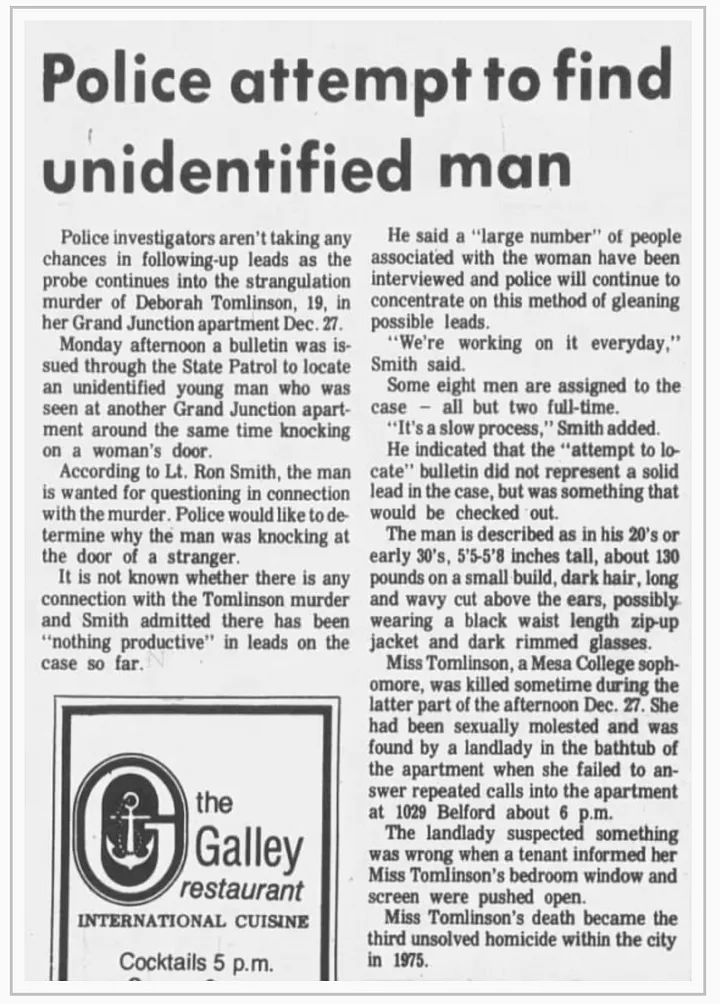
Strangely enough, there was another young woman with the same first and last name as Deborah that had been brutally killed a little over two years after she was last seen in Colorado: nineteen-year-oldDeborah Kathleen Tomlinson was murdered in her apartment complex on Belford Ave in Grand Junction on December 27, 1975. In the days that followed her murder, detectives quickly exhausted all leads and the investigation quickly went cold. Forty-five long years went by. In an article published on December 3, 2020 by the website ‘WesternSlopeNow,’ the Grand Junction PD announced a break in the case: they had partnered with a DNA Technology Company calledParabon to analyze the unknown semen and blood that had been found with the victim at the original 1975 crime scene.
About the process, Parabon’s Chief Genetic Genealogist CeCe Moore said that they analyze ‘the DNA, so we can look at 850,000 genetic markers that will allow us to predict relationships that are distant.’ Also, just as a side note, Moore is the scientist that helped solve the 1971 murder of Roman Catholic schoolteacher Rita Curran out of Vermont (who up until recently was also an unconfirmed Bundy victim). After the samples that were collected from the original 1975 crime scene were processed, Parabon built a family tree using public records in an attempt to identify the unknown person-of-interest, and it was concluded that a man named Jimmy Dean Duncan killed Deborah K. Tomlinson. As ofApril 2024, law enforcement has found no connection between Duncan and Tomlinson, but found that he had a family member that lived close to the college she was attending at the time of her death. Detective Sean Crocker from the Grand Junction Police Department commented that ‘we believe Mr. Duncan visited this relative, and that’s how possibly he could’ve encountered Ms. Tomlinson.’ Jimmy Dean Duncan passed away in 1987.
Arthur Tomlinson died at the age of sixty-four on January 29, 2001 in Las Vegas, NV. Deborah’s mother Sandra Lee Nelson passed away from lung cancer at the age of sixty-three on February 2, 2003, and according to her death certificate, she had been the owner/operator of a café. Sandy’s husband Henry died on March 16, 1994 at the age of 54, most likely in a medical facility in Spokane, WA. Deborah’s brother Daniel Sean Tomlinson died in 2022 at the age of fifty-three in California.
Deborah’s sister Jean retired after almost twenty years in the RV Business in November 2023, and she currently lives in Henderson, Nevada with her husband of almost twenty years, Dave. In 2019 Joyce retired from the Bureau for Child Support Enforcement with the State of West Virginia, and was married to the love of her life until he passed away on May 26, 2003. She currently resides in St Thomas, Pennsylvania. If Deborah was anything like her sisters, she was a kind, compassionate person that would have done a lot of good in this world.
In the years following Deborah’s disappearance the twins remain close, although Jean admitted her disappearance has been incredibly hard on their family. She also confessed that a small part of her always thought her big sister would reach out to one of them when they were adults, after everyone had grown up. More than anything they want closure, and at the very least wish they had a body to properly lay to rest so their sister could be with the rest of their family. Debbie would have been an aunt and great aunt multiple times over, and it’s heartbreaking to think of her never getting to meet either of her brother-in-laws, or nieces and nephews. As of October 2025, Deborah Lee Tomlinson’s case remains open and she would be 68 years old. Joyce said that the family’s DNA is on file with the NCMEC website.
* In October 2025 I finally came across the Tomlinson family’s Ancestry page, which helped give me a lot of background into Deborah’s family life and background. I also updated the article with information from an interview that I did with her sister Jean in February 2025 as well.
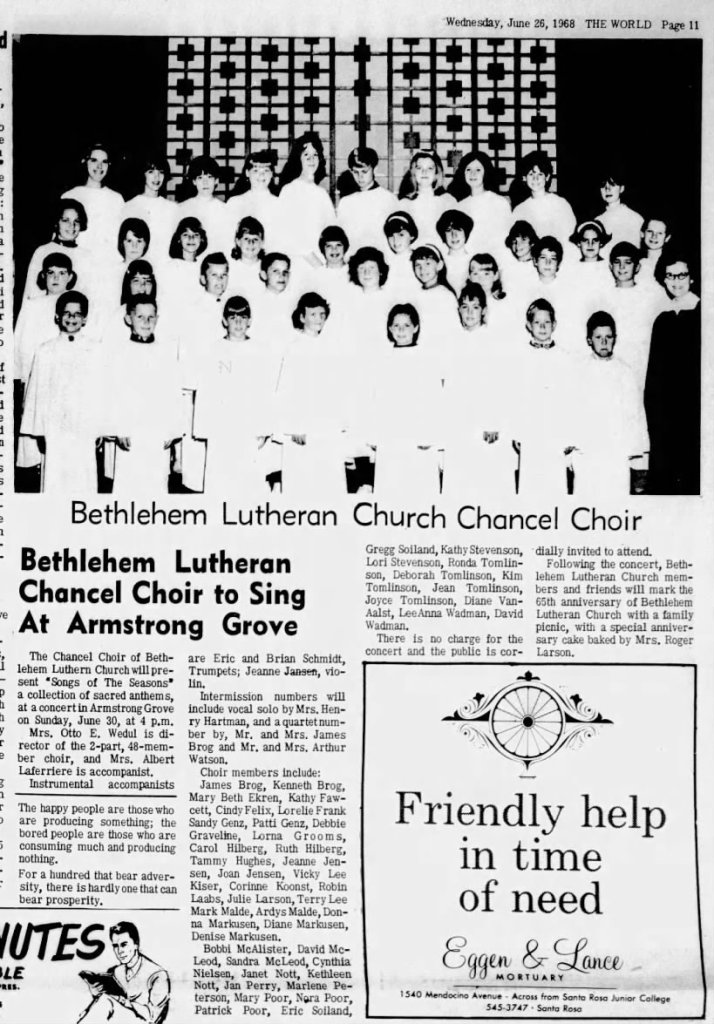
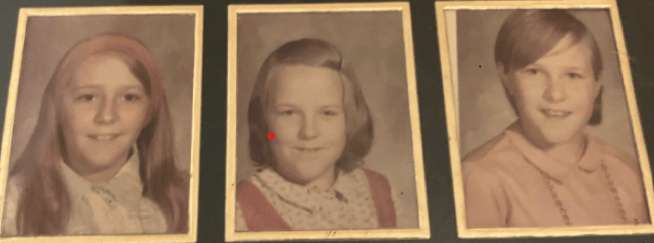
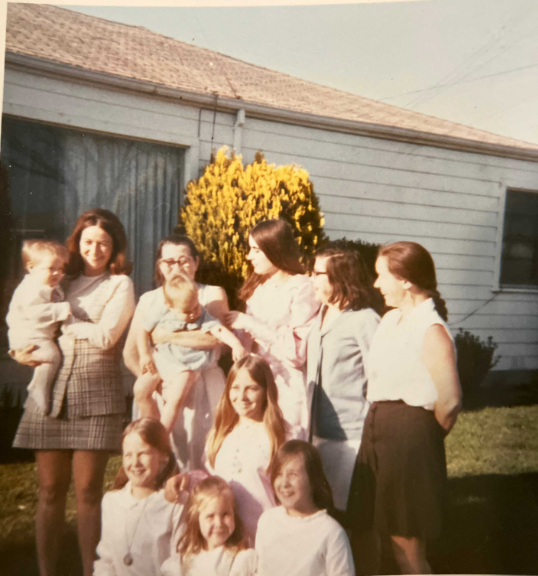
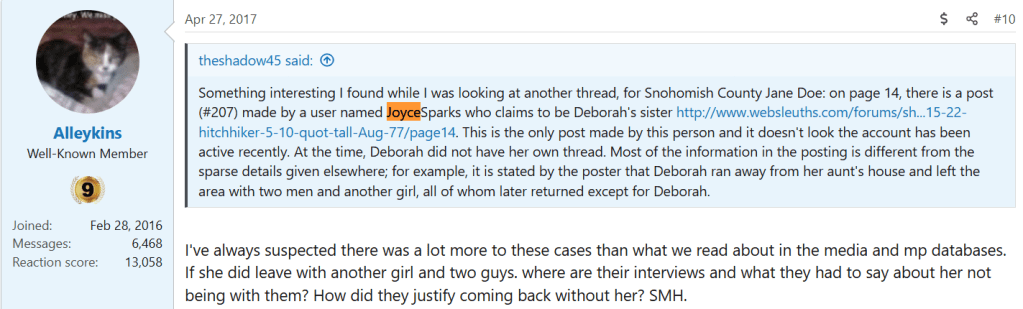
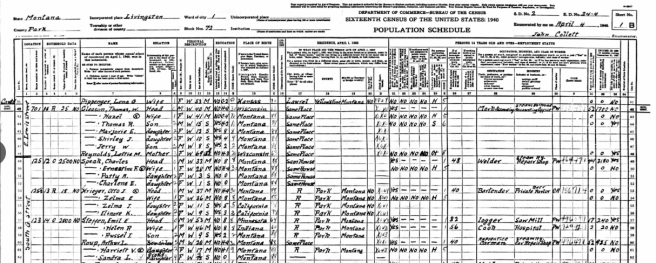
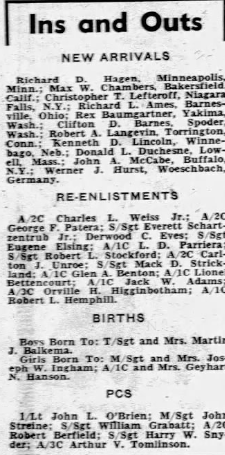
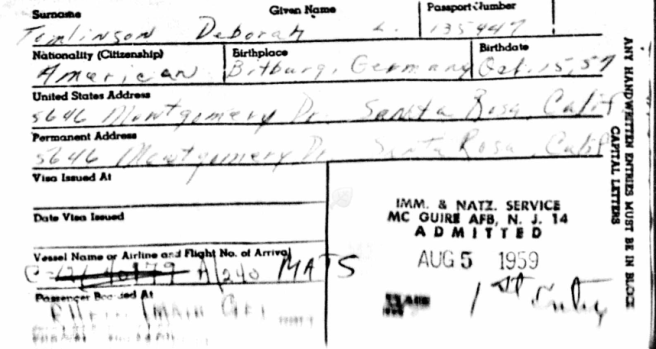
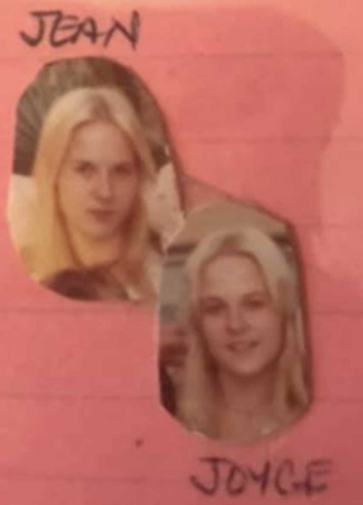
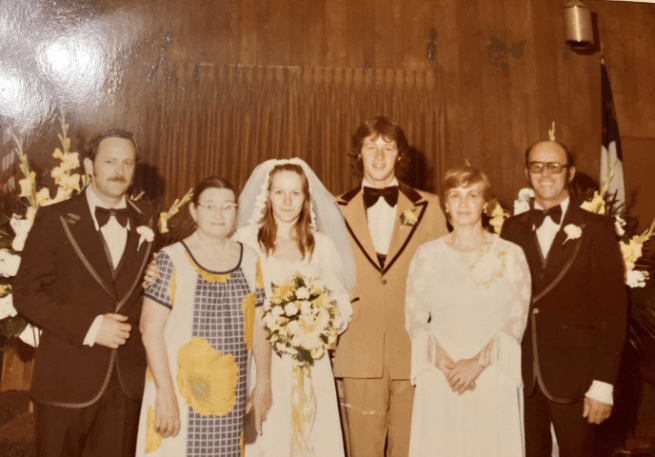
A missing persons poster for Deborah.The girls standing with their dad and Aunt Jean, who Joyce said they were all especially fond of; sadly right after this picture was taken she moved to Virginia. Photo courtesy of the Tomlinson family archives.The three sisters in a picture during their time in the Bethlehem Lutheran Church Chancel Choir that was published in The Rohnert Park Cotati Clarion on June 26, 1968.Deborah (on the far left), Joyce, and Jean. Photo courtesy of the Tomlinson family archives.Some members of the Tomlinson family; it looks like Deborah and her sisters are in the front. Photo courtesy of the Tomlinson family archives.Tomlinson before she disappeared in 1973.What Debbie Tomlinson might have looked like at the age of 53 using age progressing technology, photo released on July 21, 2011.What Debbie Tomlinson might have looked like at the age of 58 using age progressing technology, photo released on June 28, 2016.According to the ‘Ted Bundy MultiAgency Investigative Team Report 1992,’ on October 15, 1973 when Tomlinson disappeared Bundy was supposed to be in class at The University of Puget Sound in Tacoma. Bundy’s fall 1973 law school schedule from the University of Puget Sound.Bundy’s route from where he lived at the Rogers Rooming house to Creswell, OR.Warren Leslie Forrest.A more recent picture of Warren Leslie Forrest.Warren Leslie Forrest’s van.Richard Laurence Marquette.A list of some other missing girls from Oregon from 1969-78. Tomlinson isn’t even listed.A comment on a Websleuth’s page about Deborah’s disappearance made by Joyce Sparks on October 16, 2013.A comment on a Websleuth’s post about Deborah Tomlinson made by user ‘Caring1.’A Websleuth’s comment on a post about Deborah made by a user named ‘theshadow45’ on August 27, 2017.A Websleuth’s comment on a post about Deborah made by a user named ‘Alleykins’ on August 27, 2017.Deborah Kathleen Tomlinson.An article about the murder of Deborah Kathleen Tomlinson published by The Daily Sentinel on January 14, 1976.The Tomlinson family tree, courtesy of Joyce Tomlinson.Deborah’s grandmother Nora and her father, Arthur. Photo courtesy of the Tomlinson family archives.Deborah’s father, Arthur Vernon Tomlinson. Photo courtesy of the Tomlinson family archives.Deborah’s mother listed in the 1940 census.Arthur Tomlinson from the 1951 Westwego High School yearbook.Deborah’s father listed in some Baptism’s that took place in New Orleans, Louisiana in 1951.An article about Mr. Tomlinson’s time in the military in Great Falls, Montana published in The Malmstrom Minuteman on May 25, 1956.A passport log for Deborah’s mother Sandra dated August 5, 1959.A passport log for Deborah, dated August 5, 1959.A passport log for Deborah’s sister Joyce dated August 5, 1959.A passport log for Deborah’s sister Jean dated August 5, 1959,Arthur Tomlinson in a list of people applying for a marriage license published in The Press Democrat on January 11, 1968.Mr. Tomlinson’s address; according to this, he was employed at Sonoma State Hospital at the time.Arthur Tomlinson and his second wife listed in the CA Divorce Index, 1966-1977.Jean and Joyce Tomlinson. Photo courtesy of the Tomlinson family archives.Some of the Tomlinson family at Jean’s wedding. Photo courtesy of the Tomlinson family archives.Some members of Deborah’s family at Joyce’s wedding. Photo courtesy of the Tomlinson family archives.Mr. Tomlinson’s second wife, Shelley.Henry Nelson’s obituary published in The Montana Standard on March 17, 1994.Deborah’s mothers death certificate.Deborah’s half-brother, Daniel Sean Tomlinson.Deborah’s half-brother, Daniel.Deborah’s baby sisters, Joyce and Jean.Deborah’s sister Jean and her husband, Dave.
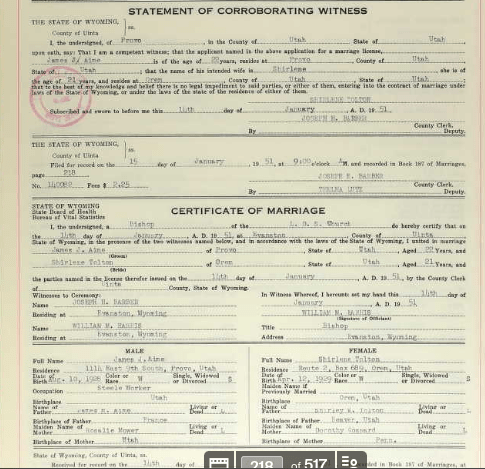
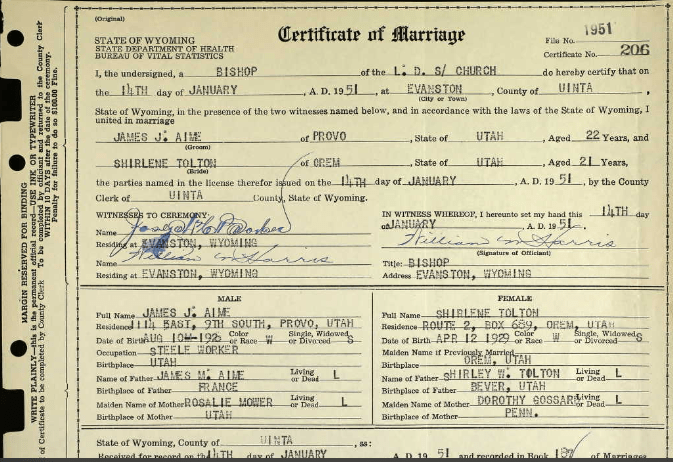
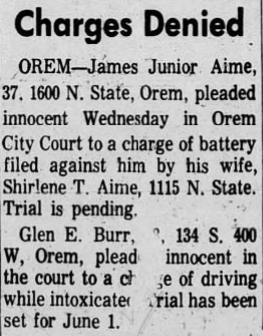
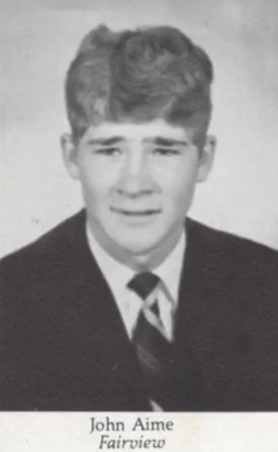
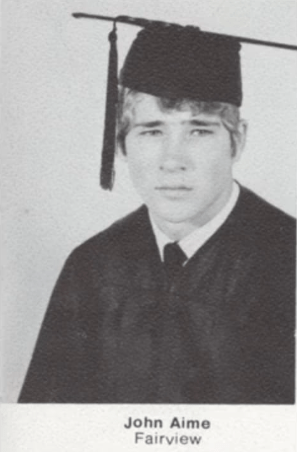
Laura Ann Aime was born on August 21, 1957 to James and Shirlene (nee Tolton) Aime in Lehi, Utah. Mr. Aime was born on August 10, 1928 in Fairview, Utah, and after completing high school he joined the US Navy; after getting out of the military he went on to attend the University of Utah. Shirlene was born on April 12, 1934 in Orem, and the couple were married on January 14, 1951. According to the Aime’s marriage certificate, Jim worked as a steelworker for Geneva Steel.Laura was Jim and Shirlene’s second child, and she had four younger sisters (Evelyn, Michelle, Denna, and Tommi lyn) and an older brother named John. Mrs. Aime filed domestic abuse charges against her husband in April 1966, but they must have worked out their issues because they never divorced.
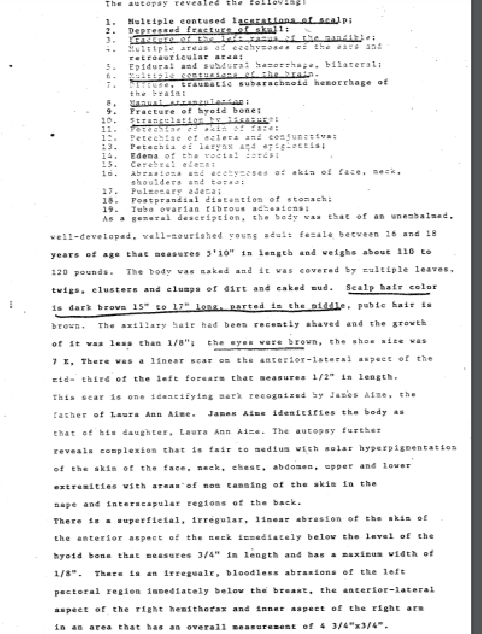
According to her autopsy, Laura had blue eyes, medium length blonde hair, was 5’10” tall, and weighed around 140 pounds. Before Aime dropped out she was a student at North Sanpete High School, and was at one-time a member of the Laurel Class in the Fairview North Ward. She loved animals, and one time a wild deer wandered out of the canyon and she began feeding it, and eventually was able to convince the creature into becoming a family pet. When Laura was eleven she was thrown into a barbed wire fence by her horse, injuring her ring finger, forearm, and upper arm. Jim Aime liked to take his daughter hunting, and she even helped him bag the first prize deer in a Utah hunting contest at the age of ten. Before she was killed Aime somehow seemed to show awareness that she knew her life was going to end soon in a tragic way: Mrs. Aime said one day out of the blue just a few weeks before her daughter died she told her: ‘at my funeral, I don’t want to be buried in a dress.’ Additionally, Evelyn Aime said that her older sister mentioned that she wanted the 1974 Terry Jacks classic, ‘Seasons in the Sun’ to play during the service as well.
Immediately before she disappeared Laura had been staying with her girlfriend Marin Beveridge, who didn’t live far from her childhood home. Despite being raised in a Mormon family, after leaving home she quickly fell in with the latter-day counter-cultural life, and with her long blonde locks and ‘hippie look’ she already had the stereotypical appearance of a runaway. Although the Aimes didn’t care for their daughter’s choice in friends they were just beginning to come to terms with her ‘nomadic’ lifestyle. Often teased about her height, Laura was given nicknames like ‘Wilt the Stilt,’ which greatly upset her, and her Aime’s suspected that the relentless mocking was what made her leave school. She was used to tough work as the family at one time lived in an old farm house in Mount Pleasant, where they kept a plethora of animals, including chickens, cows, peacocks, turkeys, hogs, goats, sheep, dogs and ‘dozens of cats.’ She was also a tomboy (especially during her early years), and she loved playing softball, and played on competitive teams as well as her families LDS ward, even going so far as to winning the 1972 state championship. Growing up, Laura loved horses and was an experienced rider; she even spent several of her teenage years in an all-girls horseback riding club called ‘The Silver Spurs,’ and participated in several competitions with them at different fairs and parades across Utah.
Before she disappeared Laura had been staying with her girlfriend Marin Beveridge, who didn’t live far from her childhood home. Despite being raised in a Mormon family, after leaving home she quickly fell in with the latter-day counter-cultural life, and with her long blonde hair and hippie look she already had the appearance of a runaway. Although the Aimes didn’t care for their daughter’s friends they were just beginning to come to terms with her ‘nomadic’ lifestyle. Often teased about her height, Laura was given nicknames like ‘Wilt the Stilt,’ which greatly upset her, and the Aime’s suspected that the relentless mocking was what made her leave school. Laura was used to tough work as the family at one time lived in an old farm house in Mount Pleasant, where they kept a plethora of animals, including chickens, cows, peacocks, turkeys, hogs, goats, sheep, dogs and ‘dozens of cats.’ She was also a tomboy (especially during her early years), and she loved playing softball, and played on competitive teams as well as her families LDS ward, even going so far as to winning the 1972 state championship. Growing up Laura loved horses and was an experienced rider. She spent several of her teenage years in an all-girls horseback riding club called ‘The Silver Spurs” in SanPete County, and participated in several competitions at different fairs and parades across Utah. Those that knew her remember her as a kind and loving person.
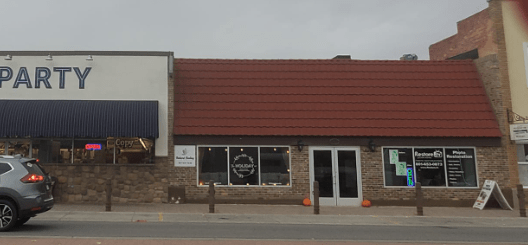
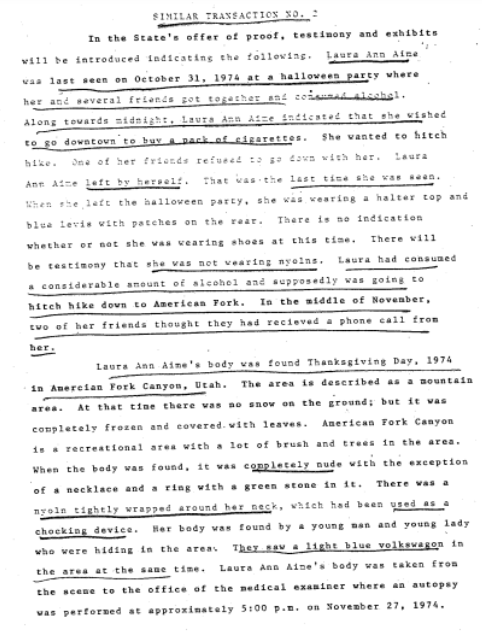
Laura Ann Aime was seventeen when she was abducted by Ted Bundy on Halloween night in 1974: the party she was at never really got going, and she left by herself around ten to get some cigarettes. About a half hour later she was picked up by an acquaintance named George Alley, who later told investigators that he dropped her off at The Knotty Pine in Lehi just after midnight (although according to Captain Borax, Browns as it was called by the locals closed at eleven, so perhaps it was closer to 11:00 versus 12:00). Quick Lehi factoid: ‘The Knotty Pine’ as it was once called was referred to as ‘Mo Browns’ because the gentleman that owned it was named Leon Brown and he reportedly had ‘a huge mole on his face’ (very clever). Alley also shared that Aime complained that before he picked her up a bunch of ‘cowboys’ ignored her outstretched thumb and drove right past her. From Browns, Aime again got bored and walked to Robinson Park. She was last seen wearing silver cross shaped earrings, a tan sleeveless turtleneck-style sweater with white horizontal stripes, a Navy Pea coat with a hood, light brown lace up shoes, and blue Levi’s with ‘patches on the rear;’ various sources report her wearing a halter top as well. Laura was wearing a ring with a yellow stone and had a rubber band around her wrist; her nails were adorned with black polish with silver flakes.
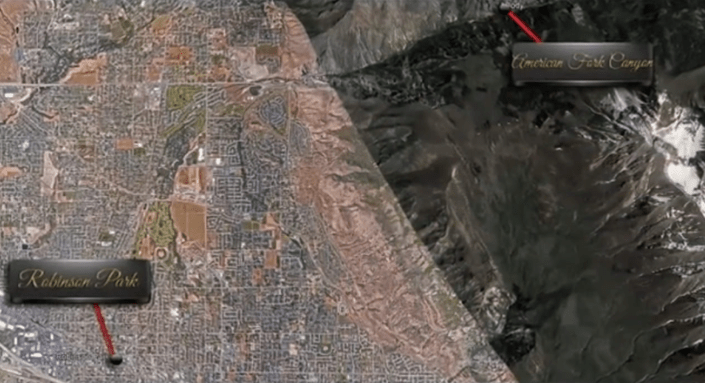
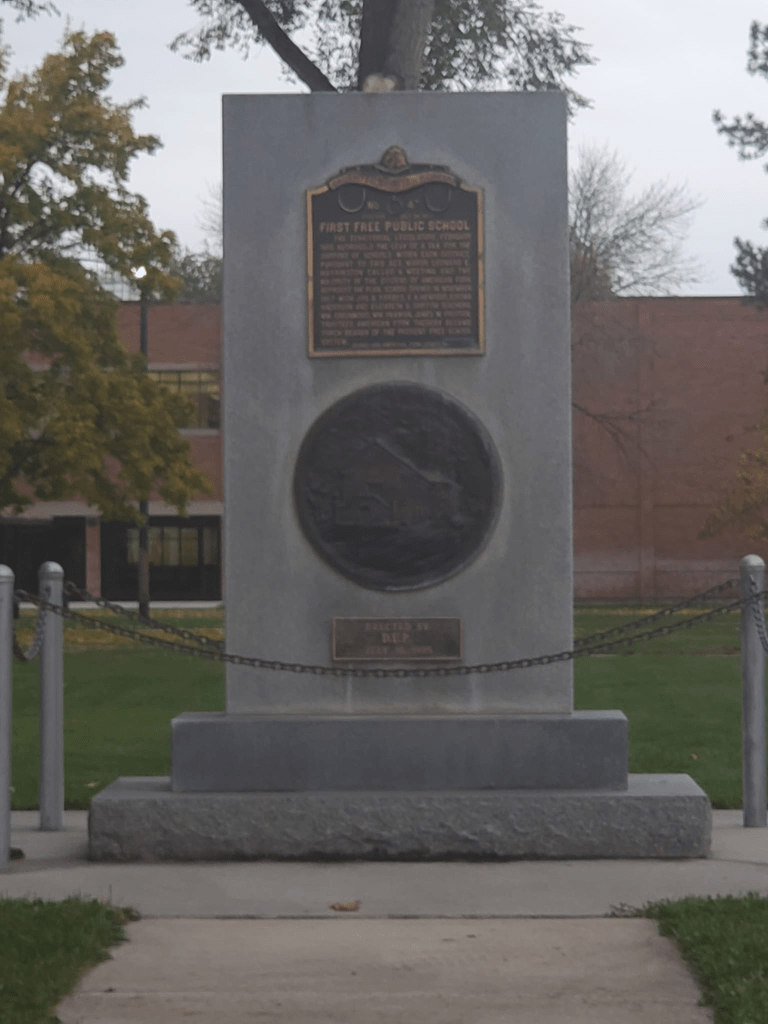
Although it’s (mostly) agreed on that Laura was last seen trying to hitchhike, there’s a few different possible narratives when it comes to where she was right before she disappeared. The most common theory I’ve seen is that she attended a house party at a mobile home in the suburbs of nearby Orem; a second says the party was in Lehi. The third possibility is that the party took place at the Knotty Pine Cafe in Lehi… (although there’s a FOURTH that says there was no party at all). BUT… every single one of these possibilities consistently placed her at the Knotty Pine Cafe for some period of time before she left to hitchhike to Robinson Park. One eyewitness came forward and shared with investigators that they saw Laura at the park in American Fork at around midnight, which is the last time that anyone reported seeing her alive. Robinson Park is about a 3.2 mile drive from the (former) Knotty Pine Cafe, and if she did walk it would have taken her roughly an hour (give or take) to do so. Due to the dropping temperatures (dipping as low as 45 °F) and the distance involved, it’s very likely that she tried to hitchhike back to Lehi after she was done hanging out at the park. Did Bundy see her there then pull up and offer her a ride? There’s also a possibility that he spotted Aime from a distance then crept up behind her and blitzed her, much like he did to Nancy Wilcox. As I mentioned earlier, Laura was in regular contact with her family after leaving home, and at first they weren’t too alarmed when they didn’t hear from her and figured it was only a matter of time before she got in contact with them. It wasn’t until Laura didn’t come home for a planned hunting trip with her father that the Aime’s knew that something was seriously wrong, as that wasn’t something she would miss without a good reason. After she disappeared her story didn’t make the news until her remains were discovered (like so many of the other case’s I’ve written about, for example Brenda Joy Baker out of Maple Valley, WA), which may have partially been due to her transient nature and nomadic lifestyle.
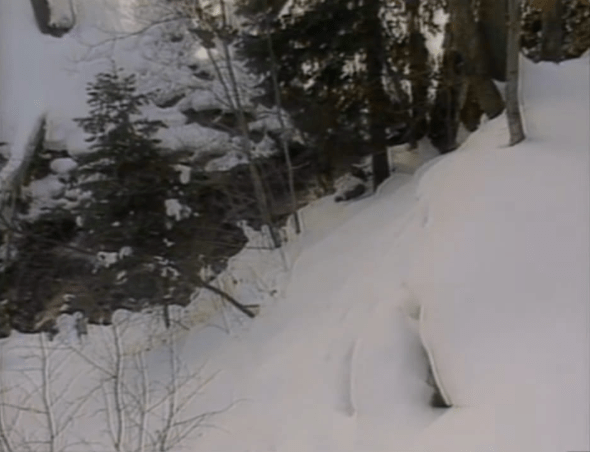
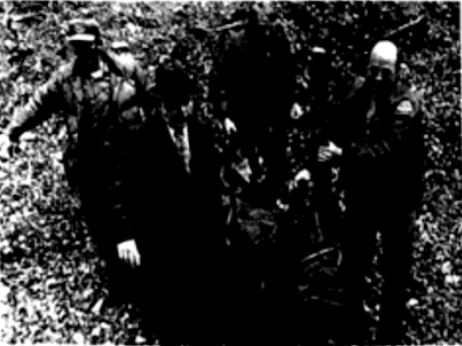
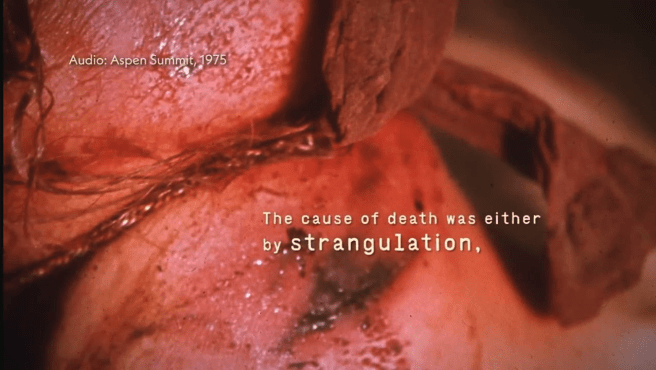
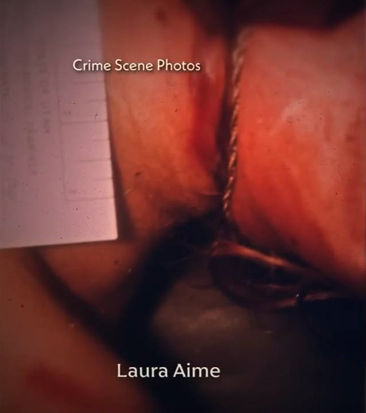
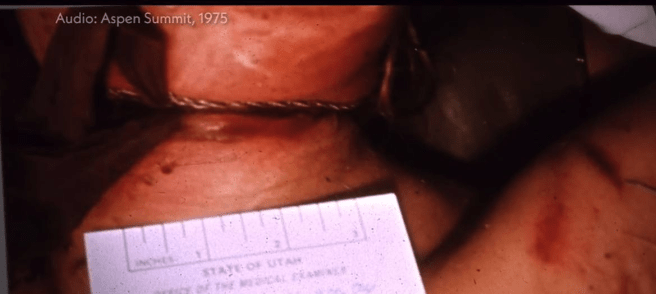
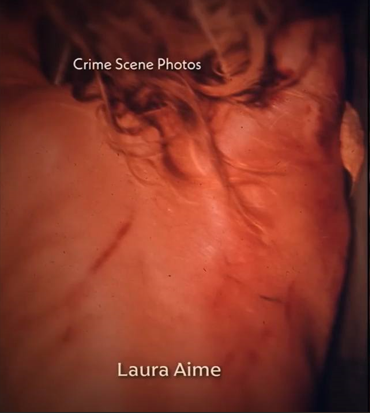
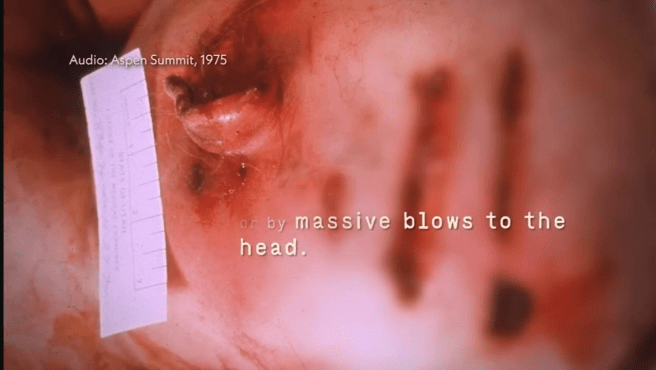
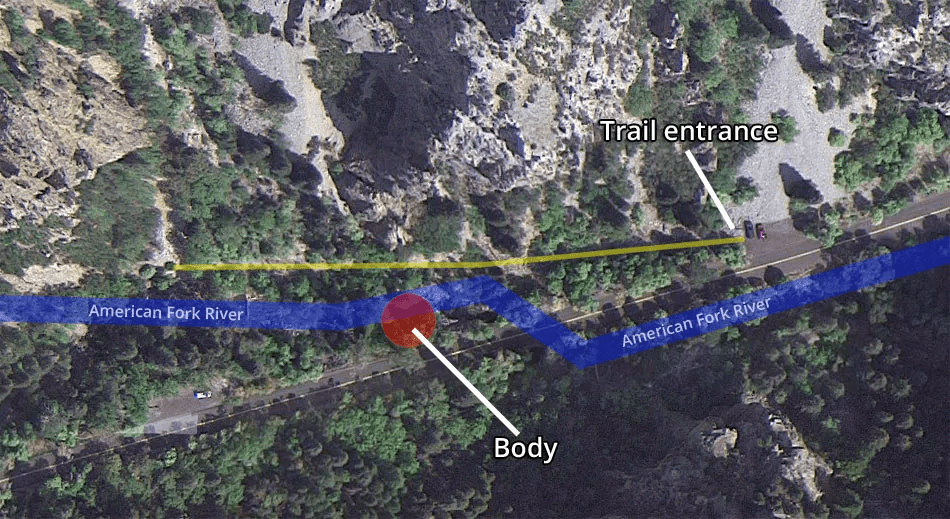
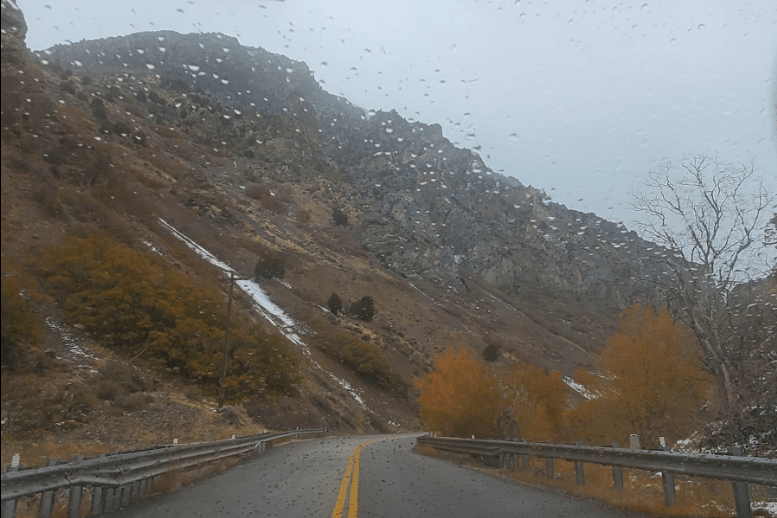
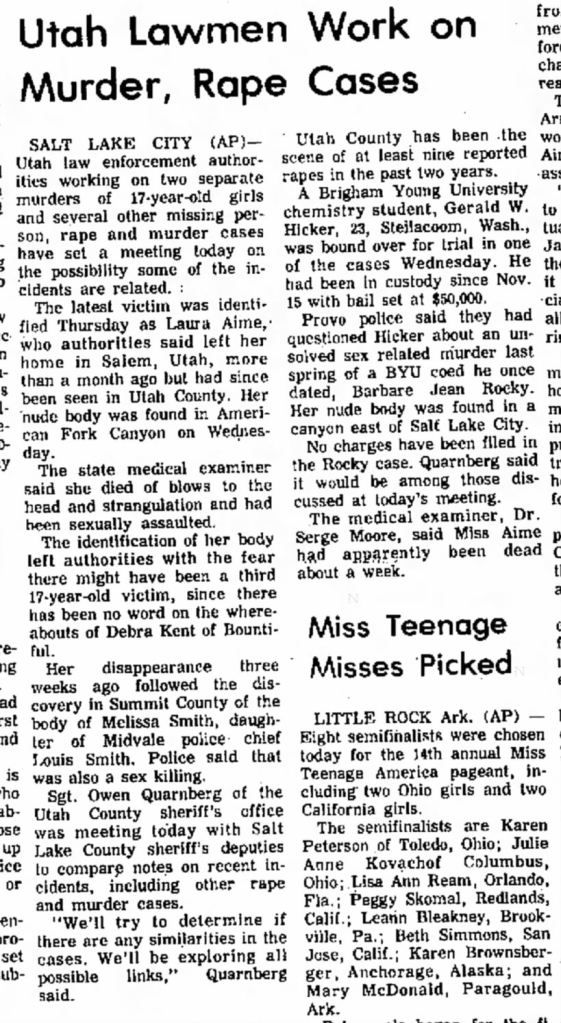
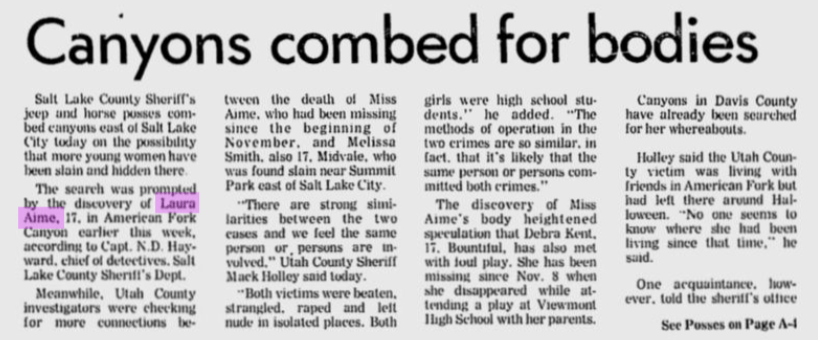
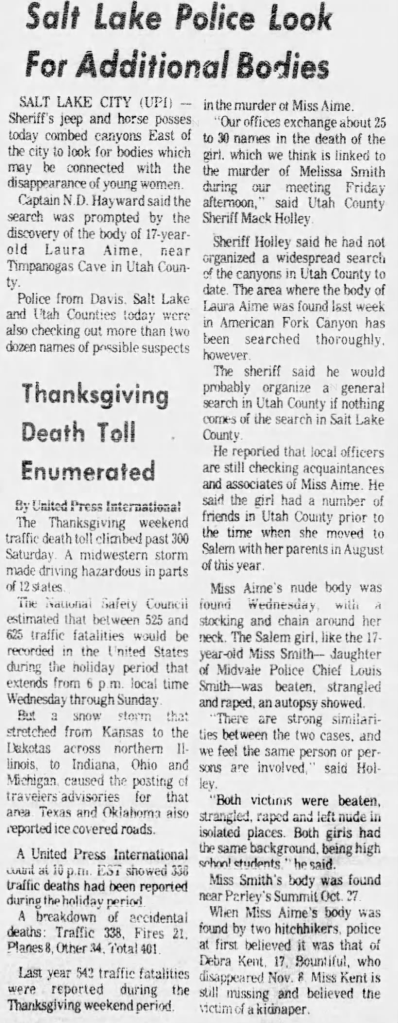
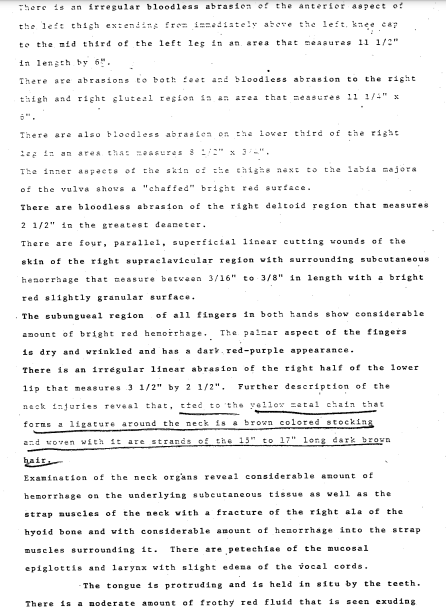
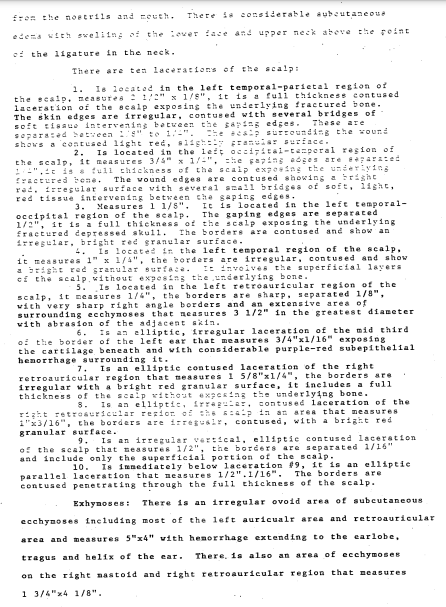
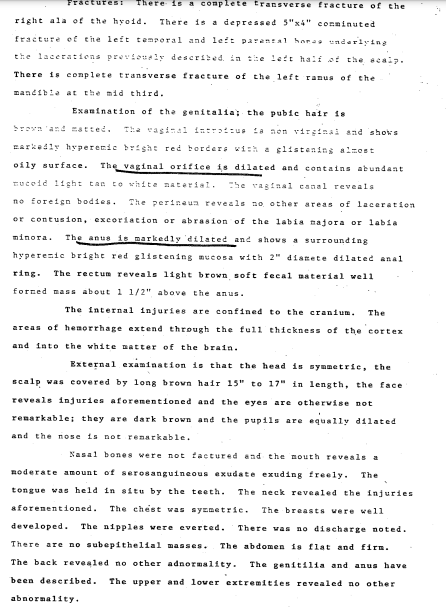
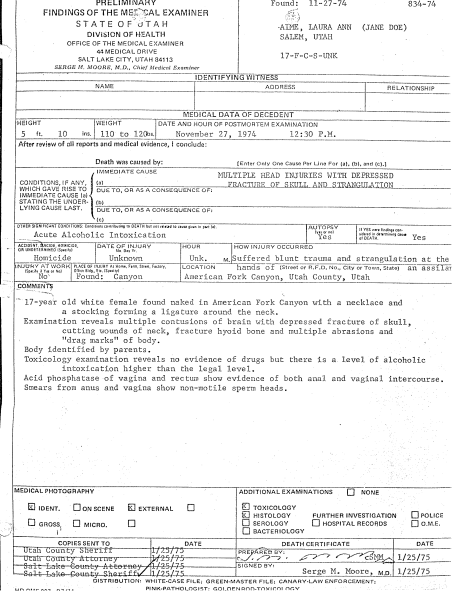
The remains of Aime were found less than a month after she vanished on Thanksgiving Day next to a stream in American Fork Canyon in the Wasatch Mountains by two BYU students that were looking for fossils for their Geology class (Raymond Ivins and Christine Shelly). Fearing that the murderer may still have been lurking in the area, the couple immediately went to the nearest ranger station and reported their discovery. Aime’s body was covered in leaves, twigs, and brush;she had been raped, sodomized, beaten then strangled to death with a pair of stockings. According to her autopsy report done by former Utah State Medical Examiner Dr. Serge Moore*, Laura had depressed skull fractures on the left side and back of her head and the necklace she was last seen wearing was tangled up in the pair of nylons that were cinched around her beck. She had numerous facial wounds (almost too many to count), and her body had deep wounds from where it had been dragged. LE deduced that the weapon used to inflict such brutal injuries was most likely either a pry bar or metal crowbar; her face was incredibly swollen and her tongue was hanging from her mouth. Aime had also suffered a vaginal puncture that may have been made by a weapon of some sort (perhaps an ice pick, and some have also wondered if it was a speculum which is what it’s thought Karen Sparks was assaulted with). Tire patterns that were found in the immediate area were said to be a match with Bundy’s Volkswagen Bug. *Just as a side note (per Kevin Sullivan), Dr. Moore never properly investigated either the temperature or the level of snow during the period that Smith and Aime were abducted. After complaints of sloppy work from Utah law enforcement Moore was investigated, and he officially lost his license in 1979after he failed to produce any proof that he graduated from a University in Mexico City.
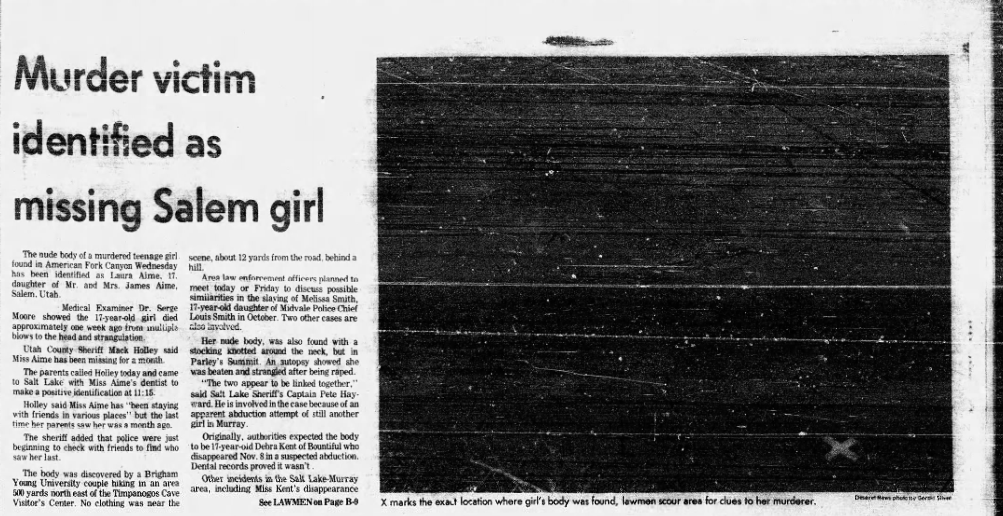
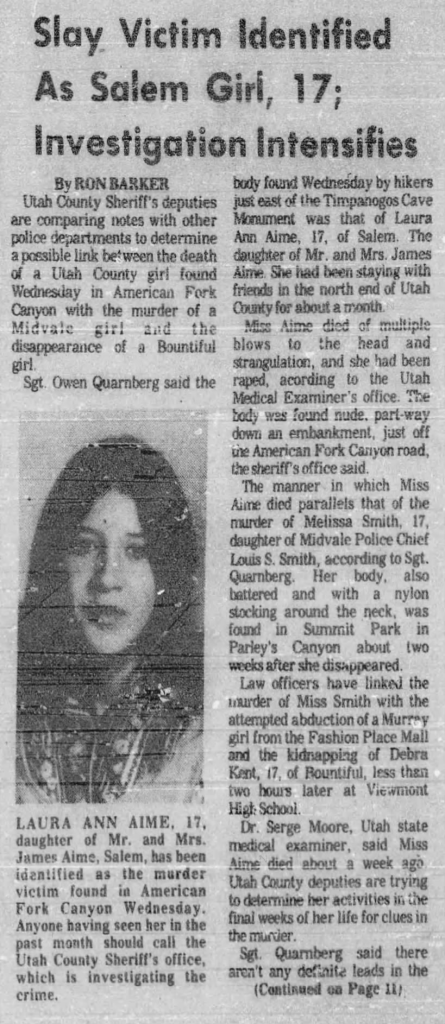
Laura’s cause of death was listed as multiple head injuries with a skull fracture and strangulation. Also, I do want to point out that I’ve seen the date incorrectly listed as both November 26 and 27th, but according to my research, Thanksgiving Day in 1974 was on the 28th. About the discovery, Ivins said: ‘I looked and I thought, you know, it was a deer or something and … it was a girl … It looked like she had been …she was dead. It was really grotesque. There was blood around her neck and breasts and she was naked and lying on that hill and it was a freak-out and I lost it. I thought maybe the guy was still somewhere around and I just panicked, worrying about my girlfriend . . . and we ran down the trail …Came down and ran right through the creek and got in the car and just drove like a maniac, I guess as fast as I could, down to the ranger station and I reported it.’ Swabs taken from Aime’s vagina and anus showed the presence of non-motile sperm, and blood tests showed no signs of substance use aside from alcohol. In the early stages of the investigation it was suspected that her remains belonged to Debra Kent, who had gone missing from Viewmont High School in Bountiful nineteen days earlier.
Several days before she was killed Laura spoke with her mother on the phone: Mrs. Aime begged her daughter not to hitchhike, and told her that she was afraid that she would meet a fate like that of Melissa Smith from nearby Midvale, who had recently been brutally murdered. She assured her she would be ok and told her mom not to worry; it was the last time they would ever speak. After Laura disappeared Mrs. Aime said that ‘she was missing and she had no purse coat, no nothing. I called the sheriff’s office and they said, ‘What do you want us to do about it?’’ On Sunday, November 3 Shirlene reached out to Judy Olsens’ mom, who was confused by her call, saying ‘isn’t she with you? We haven’t seen her since Thursday when she and Judy and Mark left for the Halloween party?’ Two days later on November 5, 1974 Mrs. Aime called the local police to notify them that her daughter was missing, and when she pleaded with them to look for her she told that there were too many ‘young runaways to pursue each one, and after a couple of weeks I just knew she was dead.’ After the remains of a young woman were discovered on a nearby river bank Shirlene reached out to the sheriff’s for a second time, and was again told ‘there’s no way it’s her, it couldn’t be her’ and that the victim was closer to twenty-five and wasn’t as tall as Laura. However the next morning a story in the newspaper mentioned the young woman was wearing a ‘ring with a green stone,’ which happened to be a peridot, which was Laura’s birthstone. Mrs. Aime immediately ran to look in her daughter’s jewelry box, to see if her peridot ring was still there. It was, however, the rest of the coincidences were just too much for her to bear.
Within an hour both Mr. and Mrs. Aime were on their way to the University of Utah morgue, accompanied by Sheriff Mack Hollet and a copy of Laura’s dental charts.Jim said that she had been beaten so severely that he ‘didn’t even recognize her,’ was only able to positively ID her by the scars on her forearm from the horse injury that I mentioned earlier. When he realized that he was looking at his precious little girl, he let out a loud, gut wrenching wail. Shirlene said that she ‘couldn’t believe it had come from a human being.’ Additionally, the dental records that the Aime’s brought with them further verified that it was Laura. Her autopsy revealed a broken jaw, a fractured skull, bruises and lacerations to her head and shoulders, a deep cut to the back of the head, and injuries to the vagina and anus. The ME determined that she had died on November 20, which was roughly twenty days after she disappeared. Many years after his daughter’s murder, Mr. Aime was driving near the spot where her remains were discovered with a friend, and he shared: ‘my little baby was up there all by herself and there was nothing I could do to help her.’
Captain Borax was able to locate a copy of the Lehi Free Press from the night Laura was abducted, and it was apparently an election period in local county government: Mack Holley was running for Utah County Sheriff, and Noall Wootton was running for County Attorney. Wootton was busy promoting his stance on crime prevention while Sheriff Mack Holley was preoccupied with communicating his belief in strong family values, but both men openly discussed the need for increased protection against the dangers that lurked in the night. Together, Wootton and Holley wrestled with a real, live boogeyman that slithered through the shadows of Lehi and American Fork, but at the same time they had no problems with hiding information away from one another. Mack Holley was known to keep information to himself and refuse to share it, and about him Jerry Thompson said ‘all I kept getting was a runaround, so I basically said, ‘to hell with them.’ As early as December 3, 1974 (which is only six days after Aime was found), retired Utah County Sheriff’s Sergeant Owen Quarnery wrote to the FBI crime lab in DC about the case, saying: ‘The MO is similar in many respects to the Smith case. The victims in both cases were beaten, sexually assaulted and strangled. Also many of the wounds were similar in appearance.’
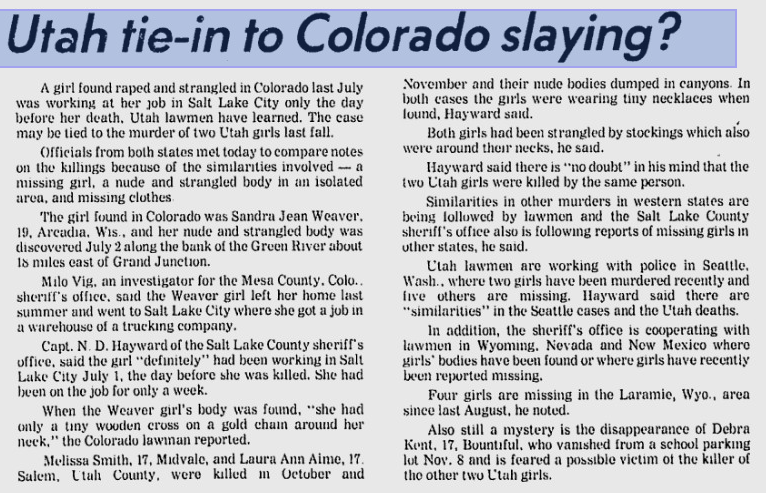
Despite Laura disappearing on the last day in October it was determined she had only been dead for roughy a week when her body was discovered. According to Kevin Sullivans book ‘The Enigma of Ted Bundy,’ her remains showed a very small decomposition, which strongly hints that her killer may have kept her alive after abducting her. Looking into SLC temperatures during November 1974, it was a relatively warm fall and wasn’t very cold meaning the body wouldn’t have preserved because of low temps.Less than two weeks before Aime disappeared on October 18, 1974 Melissa Anne Smith disappeared from nearby Midvale after leaving a pizza parlor at around 9:30 PM. Nine days later her naked remains were found in a nearby mountainous area, and just like with Aime the only thing found on her body was a cross on a delicate chain necklace. One strange commonality I wanted to point out is that unconfirmed Bundy victim Sandra Weaver was also found the same way.
According to David McGowans book ‘Programmed to Kill,’ Melissa Smith’s body was found almost entirely drained of blood, and revealed a somewhat strange abnormality: like Laura, she had not been murdered immediately and had been kept alive for possibly a week after she was abducted. Additionally, her make-up was applied neatly and none of her nails were broken. Strangely there were no signs of restraints or ligatures, so if she was held against her will before her life was taken, there was next to no signs of it (perhaps he kept her in a locked room of sorts?). Retired Colorado investigator Mike Fisher strongly felt that Bundy brought both Smith and Aime back to his first SLC apartment (located at 565 1st Ave), and further elaborated that on occasion other tenants would hear him going down to the cellar in the middle of the night and making noise.
Sullivan feels that Bundy could have kept Aime alive in two possible scenarios: the first one being he kept her in the basement of his rooming house, which was in the rear of the building and that he could keep locked, and because he was the apartment manager he had a key for the area. The second involves him pulling what he calls a ‘reverse Lynda Ann Healy,’ and he carried her into his room in the middle of the night when no one was awake to see (then down and out again when he disposed of her remains). Thinking about it, carrying the body of a young woman out of your room in the middle of the night sounds awfully bold (even if she was alive), but by that time he had lived there for a few months and had most likely gotten familiar with the behaviors of his fellow tenants. We know he didn’t admit to anything related to Laura Aime during his confessions however he did admit to keeping Deb Kent alive in his residence for a period of time before he took her life, so it’s fairly likely that he did the same with Aime (and Smith). Laura’s autopsy report states that in the middle of November 1974 two or three of her friends told LE they think they got phone calls from her but weren’t 100% certain if it was actually her or not.
In the summer of 1974 Sheriff Mack Holley created Utah County’s first Detective Division, and Laura Aime’s murder was their first investigation. Strangely enough, in an interview between (retired) Chief Investigator for Utah County Brent Bollock and True Crime blogger and creator Captain Borax, Bollock said that (former) Utah County Sheriff Mack Holley never believed that Bundy was responsible for Aimes murder, and even wrote about it in one of his books (which I was unable to locate online). In fact, Holley strongly felt that another man was responsible for her murder, one that was later convicted of killing his girlfriend, even going so far as telling a member of the team of investigating detectives: ‘Bundy had nothing to do with our case, so forget him. That man didn’t do our case. I wish you’d get that through your head.’
A little over a week after Aime disappeared on November 8, 1974, Bundy tried (but failed) to kidnap Carol DaRonch from the Fashion Place Mall on South State Street in Murray. After the 18-year-old telephone operator escaped, Ted quickly realized that he needed a new victim, so he drove roughly 25 miles away to Bountiful and abducted 17 year-old Debra Kent (this will also be important later). The family was attending a showing of ‘The Redhead’ at Viewmont High School that went later than expected and Deb volunteered to take the family car and pick up her two younger brothers at a nearby roller skating rink. On her walk out to the parking lot, Bundy abducted her, then killed her and dumped her body roughly 50 miles away in American Fork Canyon.
In 1977 investigators took a second look into Aime’s murder, and they spoke with her girlfriend Marin Beverige, who positively identified Bundy as an individual that was at Brown’s on the night she disappeared. In fact, Marin’s sister worked at the establishment and even claimed to see Ted pull up and pick up Laura the night she disappeared. Beverige told detectives that she first noticed him one day in September 1974, and remembered that he drove a Volkswagen and told her he was a student at the local university. She also recalled one occasion where she was sitting in the sunshine with Laura and a group of friends near a local high school and the man joined them. When a young guy teased Aime by putting some grass down her halter top, he objected, and ‘this guy came unglued and told him Laura was his. He was really weird.’ Marin said that the attractive young man kept randomly showing up all around Lehi, and always seemed to be looking for Laura. She recalled an event that took place one night at The Knotty Pine, where: ‘he came in and was sitting there talking and I got up…..When Laura said, ‘I’m ready to go,’ this guy said, ‘You can’t. I’m going to rape you.’ Laura just laughed and pushed him away.’’
Beverige informed detectives that she had seen the man on multiple occasions, andone evening he even knocked on her front door and asked to speak to Aime privately. She agreed and after the two went outside to speak alone: ‘Laura was really shook up. But she wouldn’t say what happened.’ About the events surrounding her friend’s disappearance, Marin had a completely different account of what happened that night, one that differed greatly from the one gathered by the Utah County Sheriff’s Department: according to Beverige, her, Laura, and a bunch of their friends had gathered at her house for a Halloween party, and some guys had brought a large amount of vodka and Laura had gotten pretty drunk: ‘It was about midnight or so, and she was pretty well drunk. And she wanted me to walk downtown with her to get some cigarettes.’ She said no, and as Aime walked away into the darkness it was the last time Marin ever saw her friend. ‘Around three or four o’clock some of us went to town to look for her, but we couldn’t find her.’ When Beverige was shown a lineup she immediately picked out Bundy; a female clerk employed at Brown’s picked him out as well. She was also asked to take a polygraph test which she agreed to, and passed.
Mrs. Aime called the early stages of her daughter’s murder investigation ‘damned frustrating,’ and said it was filled with ‘blunders, omissions and political jealousies,’ elaboratingthat two of the detectives working the case were incredibly uncoordinated: ‘one would come and ask me a question, and a couple hours later the other would come and ask me the same thing. Neither of them would tell the other anything.’ On one occasion a political rival of the (then current) sheriff came to speak with the family to ask them questions for his own personal investigation, and because the Utah County Sheriff’s Department was so unwilling to share information the Aimes would frequently receive phone calls from other police agencies, asking for information about their daughters murder. Not satisfied with how local LE were handling Laura’s murder, the Aime’s desperately wanted the experienced homicide detectives in Salt Lake City to help with the investigation, but they were turned down and told by (local) officers, ‘if we can’t solve it, no one else can.’ Mr. and Mrs. Aime felt that Laura’s murder had become somewhat coveted politically, and that whoever was able to solve it ‘could have written their own ticket politically.’ But unfortunately it went unsolved, and months went by without investigators learning anything new, and it wasn’t until August 1975, when a handsome young law student was arrested that everything started to come together, and Ted became the first decent suspect in her murder. It was at that point that a highly skilled investigator became involved in the case, Brent Bullock of the Utah County attorney’s office, who the family was incredibly pleased with, and was impressed and encouraged by his ‘professionalism, his relentless search for evidence, and his questioning of witnesses.’
When Bundy escaped prison for the first time in Aspen on June 7, 1977, Jim Aime ‘exploded in anger,’ and he ‘would have gone down there and searched for him myself, if I could have afforded to lay off work.’ Thankfully the father of five remained home with his family (he still had four daughters at home), but because Shirlene was so afraid for the safety of their other girls he bought her a .38-caliber pistol. As we all know Bundy was recaptured just a few days later on June 13, 1977, but he escaped for a second time later that same year on December 30 from the Garfield County jail in Glenwood Springs. By this time in the year they had ‘hocked’ the weapon as they were reportedly ‘hard-pressed financially,’ and by his second escape Jim had become even more angry and bitter, and said that his wife was ‘just scared to death. She quit her job so she can stay home and watch the kids. She won’t let those girls out of her sight.’
Laura’s murder wasn’t the only time that the Aime family had to deal with the ‘keystone cops:’ After graduating from high school John joined the military and became a radar specialist in the Army, but after his sister was killed it was as if the entire family’s lives fell apart. After leaving the service he began working in construction in Tacoma, and on April 28, 1975 at around 10 PM he reportedly approached a young woman on a street, briefly spoke with her, then physically accosted her. She testified that she was ‘grabbed by Aime and dragged toward a brushy area and that the defendant ran when she fell to the ground and screamed,’ (she also said that he tried to ‘drag her’), and after letting out an ear piercing scream he fled, but a passerby caught him and held him at gunpoint until police arrived. Aime later said that he had no intention of harming or molesting the young woman, and his wife Lynn was completely puzzled by that incident and couldn’t provide any explanation for her husband’s actions. John was taken to jail and investigators began digging into his past; a probation officer wrote: ‘he and his family have suffered as a result of his sister being raped and killed in Utah.’ While in jail in Tacoma Aime got married to a medical technician and an Air Force vet; it was an unusual ceremony that took place without the guards’ knowledge. After a two-day trial in June 1977, he was convicted of a misdemeanor assault and was sentenced to a five-year term at Washington’s Western State Hospital at Steilacoom for the rehabilitation of sex-offenders. For obvious reasons, this devastated both of his parents, and about the incident Mr. Aime said that he ‘was just a scared kid from the country.’
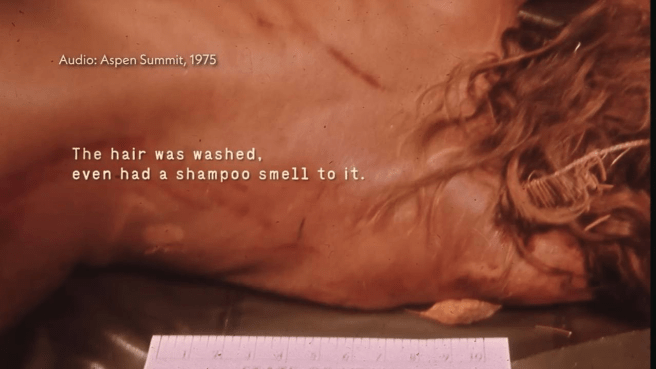
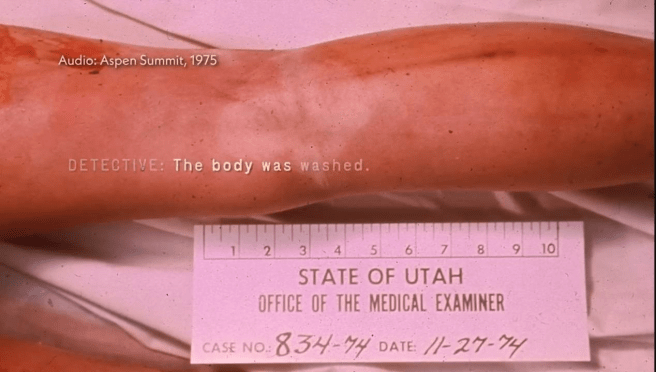
Before Bundy was put to death in Florida, he confessed to killing Laura Ann Aime on January 22, 1989 in a 90-minute confession with (retired) SLC Detective Dennis Couch. The following is an excerpt from Dick Larsen’s ‘The Deliberate Stranger:’ ‘Y’know, there’s always been something about that Laura Aime case, that one in particular, that’s really bothered Theodore. When several case files were given to Bundy in his jail cell, under the discovery procedure …. the first one he went for … and really tore into … was the Aime case…. ‘ When asked about his involvement in Aime’s murder, Ted lowered his head and refused to talk about it. Strangely enough, I’ve heard that he washed some of his victims’ hair and manicured some of their nails as well, but this is the first time I’ve written about a woman that he actually did it to. After Aime’s remains were found, law enforcement determined that her hair had been recently shampooed, making them believe her killer had returned to her corpse on multiple occasions to engage in acts of necrophilia. About this act is a passage from Michaud and Aynesworths book, ‘The Only Living Witness:’ ‘Bundy also indirectly touched on some old mysteries, such as Laura Aime’s freshly-washed hair, and Melissa Smith’s make-up: ‘If you’ve got time,’ he told Hagmaier, ‘they can be anything you want them to be.’’
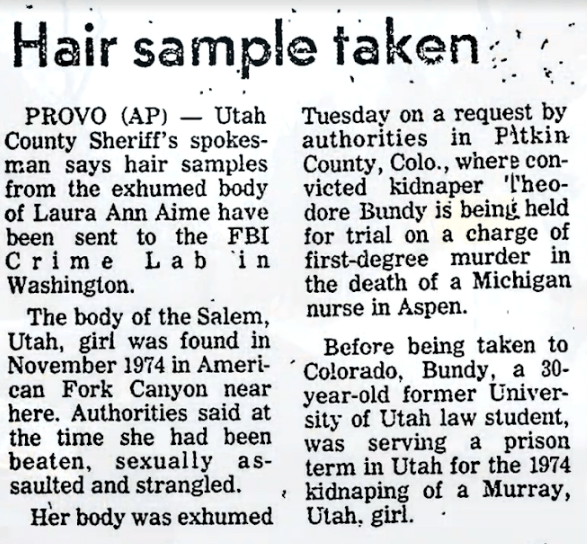
According to an article published by The Salt Lake Tribune right before Bundy was executed, investigators had to exhume Aime’s remains in order to get another hair sample because the first one they obtained after her remains were initially discovered were misplaced. Jim Aime wept at the mere thought of it, but relented, saying ‘why not? They can’t hurt her any more. It seems like these things just couldn’t happen.’ About her daughter’s disappearance, Mrs. Aime commented that ‘there’s no way of putting it out of your mind…’
According to Ann Rule’s true crime classic, ‘The Stranger Beside Me,’ Laura’ toxicology report came back just over 0.1, which is obviously an indicator of impairment (at least from a legal standpoint), but at the same time wasn’t so extreme or outrageous that she wouldn’t have been able to defend herself (or at the very least scream or try to run away). Now, if she really was kept alive up until a week before her death, and she wasn’t murdered immediately after the Halloween party… Was Bundy plying her with alcohol up until her final moments? Another thing that is jumping out at me as being weird is… if Laura Aime was kept alive until roughly a week before her body was discovered, that would put her murder date sometime in between November 17-20 (roughly, give or take)… Did he somehow keep multiple victims alive at the same time (somewhere)? Were Aime and Deb Kent somehow kept alive together in an unknown location for a period of time? Did he kill the one in front of the other, like with the Lake Sammamish murders of Denise Naslund and Jan Ott?
Despite the way she was killed was very similar to Bundy’s MO and she fit the physical description of one of his victims,he initially denied any responsibility for Aime’s murder and refused to talk about her when he was questioned. However, (most likely) in an attempt to delay his execution in the days leading up to his death Ted finally confessed to the murder of Laura Ann Aime.
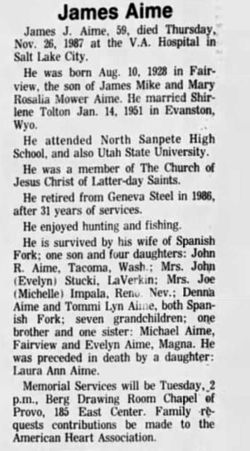
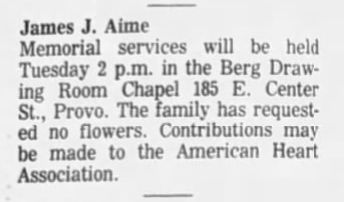
Mr. Aime died at the age of 59 on November 26, 1987. It appears that in 1980 Shirlene Aime adopted her granddaughter Danika, who was given the middle name of Laura after the aunt that she never had the chance to meet. Mrs. Aime died on November 1, 2011 in Reno, Nevada at the age of 77. Laura’s only brother John died at the age of 56 on November 29, 2010 in Gunnison, Utah but itappears that all of her sisters are still alive. Because it’s’ strongly suspected that Bundy kept her alive for a period of time after abducting her, the Aime family chose to list ‘November 1974’ as her official date of death on her gravestone.
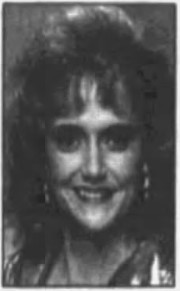
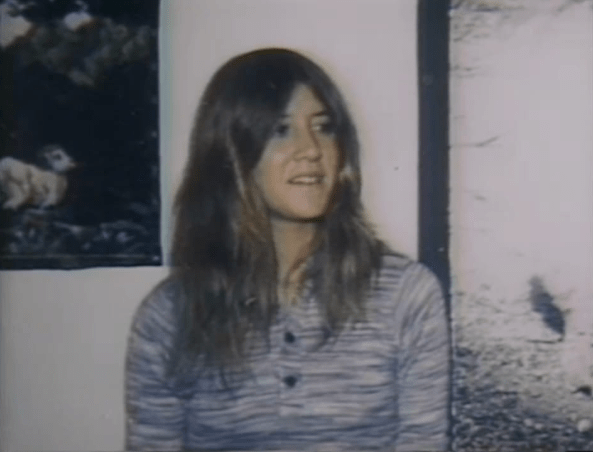
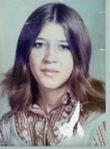
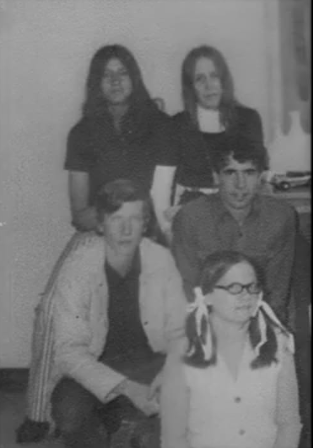
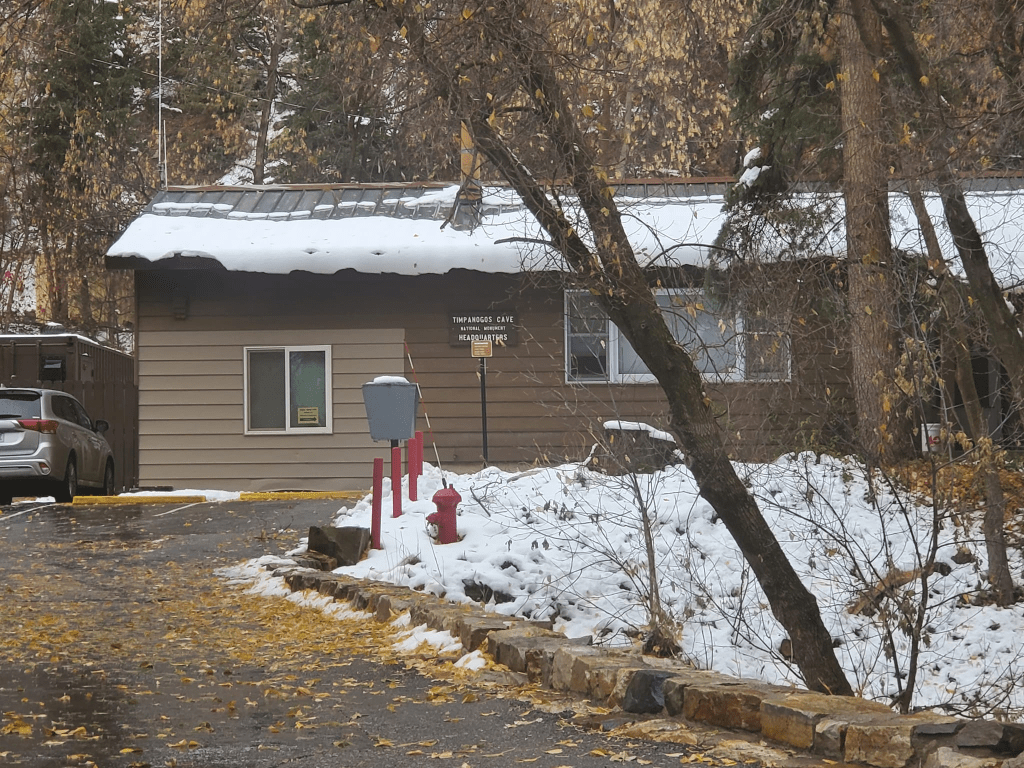
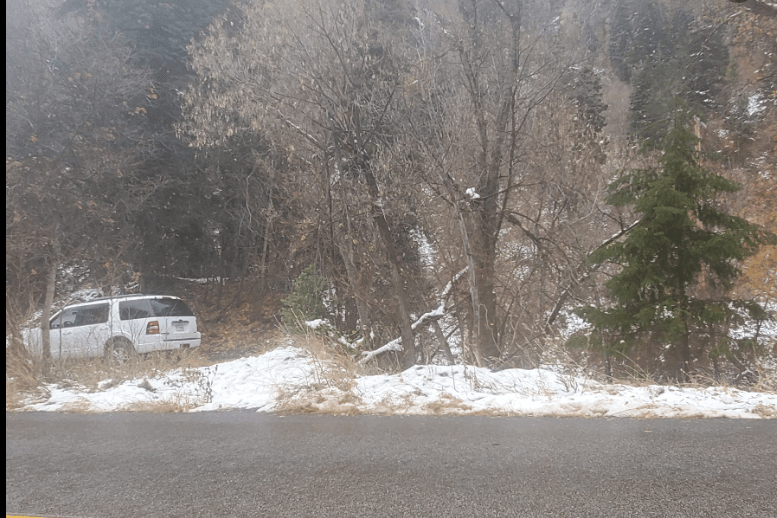
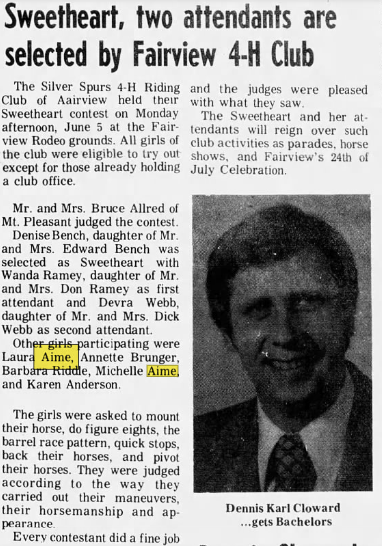
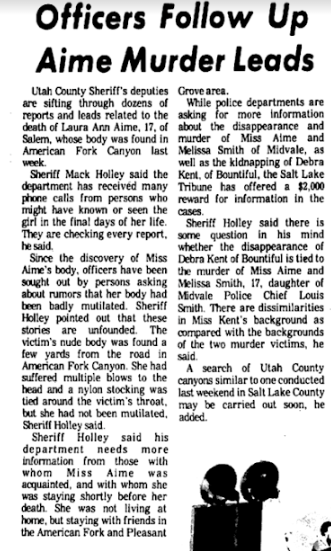
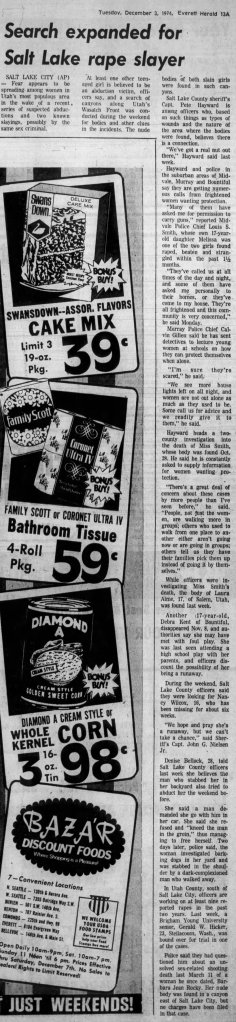
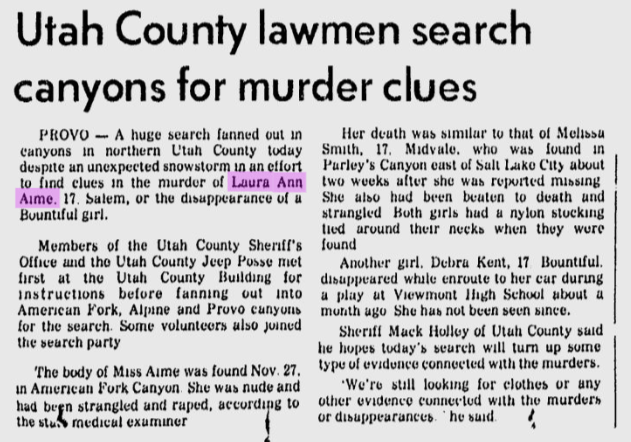
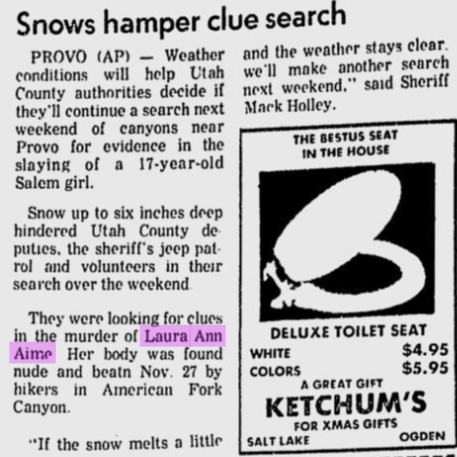
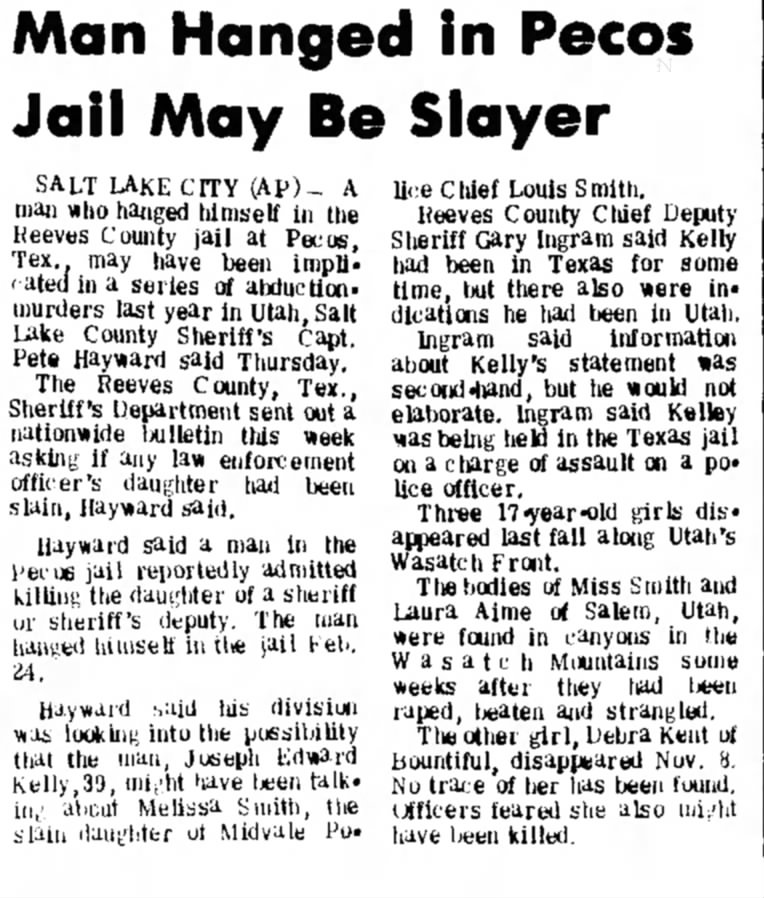
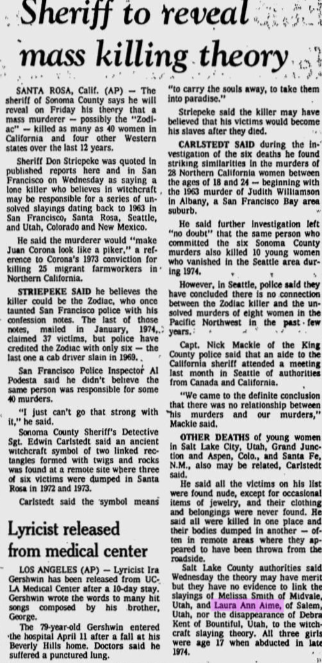
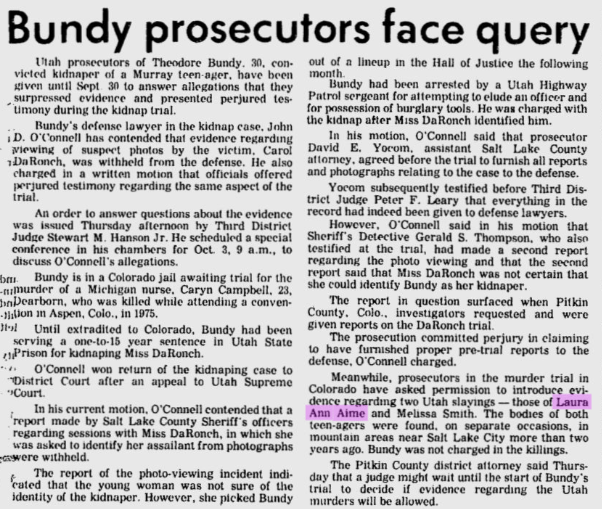
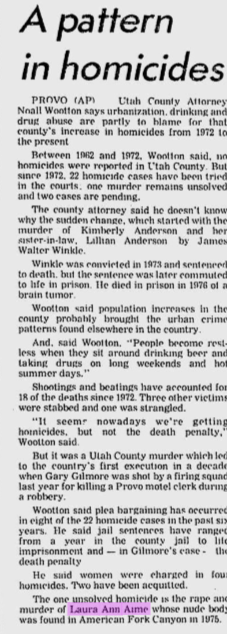
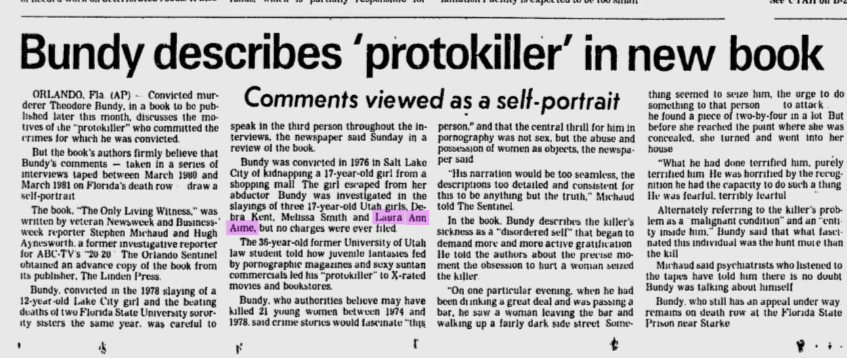
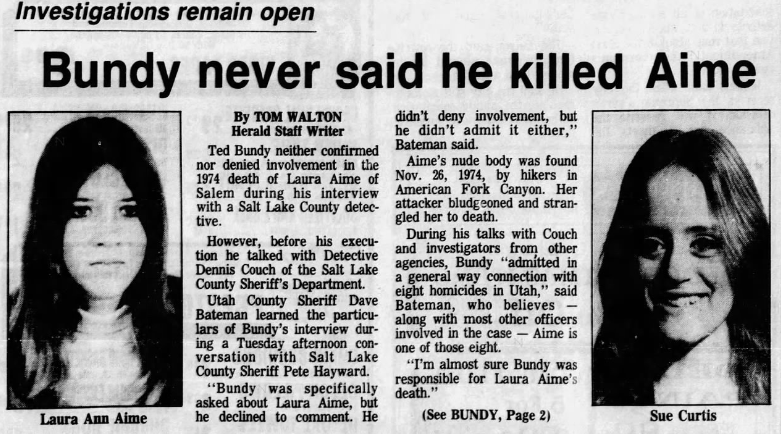
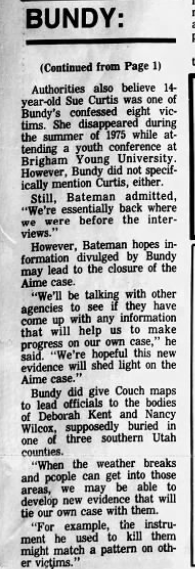
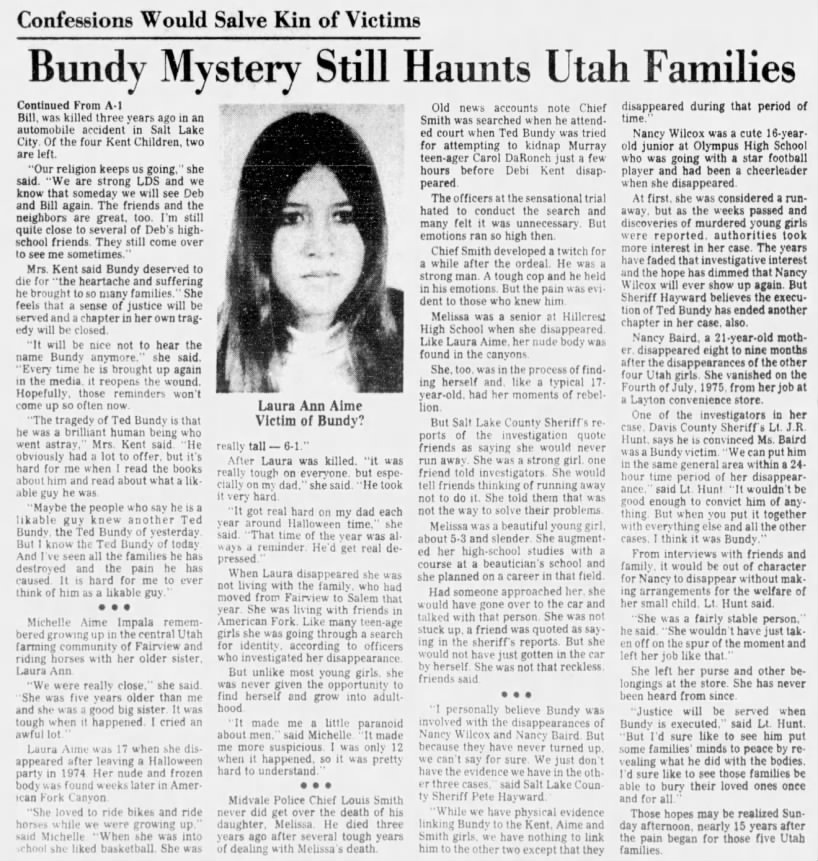
Laura Ann Aime. Her mother said she had ‘hell inside her’ after watching her ride her shining blue Arabian horse at top speed.Laura Ann Aime.Laura Aime.Laura Ann Aime.Laura Aime, blowing a bubble.A group picture from Laura’s time at North Sanpete High School; Laura is in the back row on the far right.Laura in a group photo.Photo courtesy of OddStops.The Aime’s residence. Photo courtesy of ‘Crimes Forgotten by Time.’ Investigators at the site where two students found the remains of Laura Ann Aime. Photo courtesy of OddStops.Investigators at the site where two students found the remains of Laura Ann Aime. Photo courtesy of OddStops.Investigators at the site where two students found the remains of Laura Ann Aime. Photo courtesy of ‘Ted Bundy: I was trying to Think like an Elk.’Investigators at American Fork Canyon carrying out the remains of Laura Aime.A picture from Laura Aime’s autopsy, courtesy of the series: ‘Hunting Ted Bundy.’A picture from Laura Aime’s autopsy, courtesy of the series: ‘Hunting Ted Bundy.’A picture from Laura Aime’s autopsy, courtesy of the series: ‘Hunting Ted Bundy.’A picture from Laura Aime’s autopsy, courtesy of the series: ‘Hunting Ted Bundy.’A picture from Laura Aime’s autopsy, courtesy of the series: ‘Hunting Ted Bundy.’A picture from Laura Aime’s autopsy, courtesy of the series: ‘Hunting Ted Bundy.’A picture from Laura Aime’s autopsy, courtesy of the series: ‘Hunting Ted Bundy.’A labeled aerial map of the dump site of Laura Aime in American Fork Canyon. The yellow line shows the trail the students took when they found her remains. Photo courtesy of OddStops.A labeled map of where Robinson Park is located compared to the dump site of Laura Aime in American Fork Canyon. A chart of the average temperatures in SLC in November 1974 when Laura was missing and possibly being kept alive somewhere.Aime’s gravesite at the Fairview Cemetery in Utah.Where ‘The Knotty Pine’ once stood in Lehi, UT, in the left hand side of the building. Picture taken in November 2022.Where ‘The Knotty Pine’ once stood in Lehi, UT. Picture taken in November 2022.Laura walked down this street the night she disappeared to go to the Knotty Pine. Photo courtesy of Captain Borax. An old advertisement for the Knotty Pine Cafe. Photo courtesy of Captain Borax.William S. Robinson Park in American Fork, Utah. Picture taken in November 2022.William S. Robinson Park in American Fork, Utah. Picture taken in November 2022.William S. Robinson Park in American Fork, Utah. Picture taken in November 2022.A statue at William S. Robinson Park in American Fork, Utah. Picture taken in November 2022.The entrance the American Fork Canyon. Picture taken in November 2022.The entrance the American Fork Canyon. Picture taken in November 2022.The entrance the American Fork Canyon. Picture taken in November 2022.A building at the entrance the American Fork Canyon. Picture taken in November 2022.A gate at the entrance the American Fork Canyon. Picture taken in November 2022.A sign for the Timpanogos Cave at the entrance the American Fork Canyon. Picture taken in November 2022.A sign for the Uinta National Forest at the entrance the American Fork Canyon. Picture taken in November 2022.This white SUV is where the PD coordinates took me from the OddStops website. This white SUV is where the PD coordinates took me from the OddStops website. Former Utah County Attorney, Noall T. Wootton. Photo courtesy of Captain Borax.An article about an antler contest that Mr. Aime won, published by The Pyramid on November 8, 1968.A picture of Mr. Aime with his award winning buck. Photo courtesy of Captain Borax.An newspaper blurb mentioning some of the Aime sisters, published by The Pyramid on September 9, 1971.A newspaper blurb mentioning some of the Aime girls, published by The Pyramid on June 8, 1972.An article about the murder of Laura Aime. An article about the murder of Laura Aime. An undated article about the murder of Laura Aime. An undated article about the murder of Laura Aime. An undated article about the disappearance of Laura Aime.Part one of an article on Aime published by The Deseret News on November 28, 1974.Part two of an article on Aime published by The Deseret News on November 28, 1974.An article on Aime published by The Idaho Statesman on November 29, 1974.An article about the disappearance of Laura Aime published by The Daily Herald on November 29, 1974.Part one of an article about the disappearance of Laura Aime published by The Daily Herald on November 29, 1974.Part two of an article about the disappearance of Laura Aime published by The Daily Herald on November 29, 1974.An article about Bundy mentioning Laura Aime published by The Daily Sitka Sentinel on November 29, 1974.An article about the disappearance of Laura Aime published by The Deseret News on November 30, 1974. An article about Laura Aime published by The Daily Herald on December 1, 1974.An article about Laura Aime published by The Daily Herald on December 3, 1974.An article about Laura Aime published by The Spanish Pyramid on December 5, 1974.An article about the disappearance of Laura Aime published by The Deseret News on December 7, 1974.An article about Aime published by The Deseret News on December 9, 1974.An article about Aime published by The Deseret News on February 7, 1975.An article about Aime published by The Del Rio News Herald on March 14, 1975.An article about Aime published by The Salt Lake Tribune on March 15, 1975.An article about Aime published by The Daily Herald on March 21, 1975.An article mentioning Aime published by The Eugene Register-Guard on April 24, 1975.An article mentioning Aime published by The Bulletin on October 3, 1975.An article mentioning Aime published by The Spokesman-Review on October 3, 1975.An article mentioning Aime published by The Fairbanks Daily News-Miner on October 4, 1975.An article about Bundy mentioning Laura Aime published by The Spokane Chronicle on October 22, 1975.An article about Bundy mentioning Laura Aime published by The Kitsap Sun on October 31, 1975.An article about Bundy being freed on bail that mentions Laura Aime published by The Ogden Standard-Examiner on November 21, 1975.An article about Bundy mentioning Laura Aime published by The Daily Herald on November 21, 1975.An article about Bundy mentioning Laura Aime published by The Spokesman-Review on March 4, 1976.An article about Bundy mentioning Laura Aime published by The Deseret News on September 9, 1977.An article about Bundy mentioning Laura Aime published by The Deseret News on December 16, 1977.An article mentioning Aime published by The Deseret News on April 3, 1978.An article mentioning Aime published by The Evening Independent on July 25, 1979.An article mentioning Aime published by The Deseret News on February 14, 1983.Part one of an article mentioning Aime published before Bundy was executed by The Daily Herald on January 5, 1989.Part two of an article mentioning Aime published before Bundy was executed by The Daily Herald on January 5, 1989.An article mentioning Laura Aime published just before Bundy was executed on January 22, 1989.An article mentioning Laura Aime after Bundy was executed published by The Deseret News Tribune on February 28, 1989.
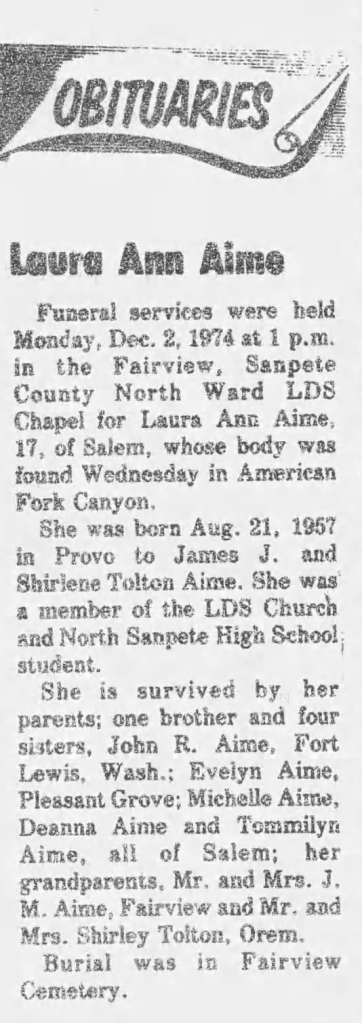
A funeral card for Aime. Courtesy of Captain Borax.Laura Aime’s obituary published by The Daily Tribune on December 1, 1974.
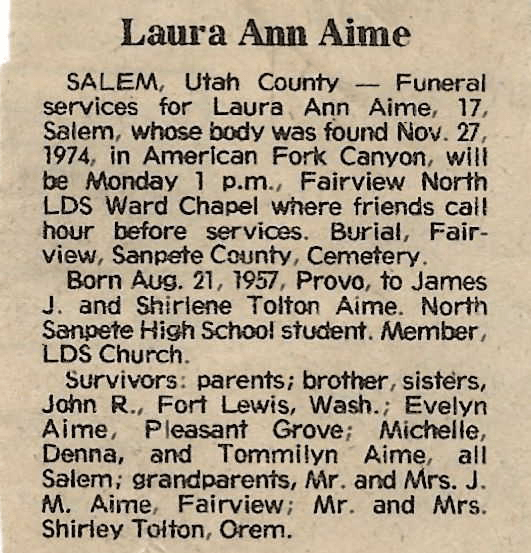
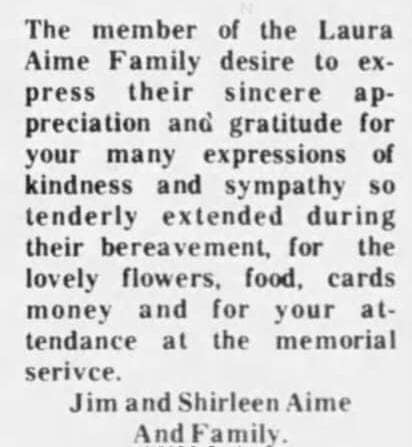
Laura Aime’s obituary published by The Spanish Fork Press on December 4, 1974.Another obituary for Aime.A thank you to the local community from the Aime family regarding their kindness surrounding Laura being killed published by The Pyramid on December 26, 1974.Page one of Laura Aime’s autopsy report. Document courtesy of Erin Banks/CrimePiper.Page two of Laura Aime’s autopsy report. Document courtesy of Erin Banks/CrimePiper.Page three of Laura Aime’s autopsy report. Document courtesy of Erin Banks/CrimePiper.Page four of Laura Aime’s autopsy report. Document courtesy of Erin Banks/CrimePiper.Page five of Laura Aime’s autopsy report. Document courtesy of Erin Banks/CrimePiper.Page six of Laura Aime’s autopsy report. Document courtesy of Erin Banks/CrimePiper.Page seven of Laura Aime’s autopsy report. Document courtesy of Erin Banks/CrimePiper.Page eight of Laura Aime’s autopsy report. Document courtesy of Erin Banks/CrimePiper.Page nine of Laura Aime’s autopsy report. Document courtesy of Erin Banks/CrimePiper.James and his sister, Evelyn Aime.James and Shirlene Aime’s application for a marriage license.James and Shirlene’s marriage certificate.James and Shirlene Aime’s marriage certificate.A newspaper blurb about a domestic incident featuring the Aime’s published by The Daily Herald on April 29, 1966.James Aime’s WWII registration card.The second part of James Aime’s WWII registration card.John Aime.John Aime.Mrs. Aime and her family when she was a kid.Mrs. Aime. Photo courtesy of Ancestry.Shirlene Aime (left). Photo courtesy of Ancestry.Evelyn Aime from the 1977 American Fork High School yearbook.Michelle Aime from the 1977 American Fork High School yearbook.Michelle Aime from the 1978 American Fork High School yearbook.An article about Laura’s brother published by The News Tribune on May 1, 1977.An article about Laura’s brother published by The News Tribune on June 17, 1977.An article mentioning Aime published by The Orem-Geneva Times on August 7, 1980.A notice about Mrs. Aime adopting her granddaughter published in The Orem-Geneva Times on August 21, 1980.Mrs. Aime with the granddaughter she adopted, Danika.James Aime’s obituary published in The Daily Herald on November 29, 1987.A note about James Aime’s memorial service published in The Daily Herald on November 29, 1987.A screenshot of Evelyn Aime from an interview she did with Captain Borax, whose real name is Chris Mortenson. I keep calling him Captain Borax as if its the name his parents gave him that’s listed on his birth certificate.Marin Beverige.A screenshot of Sheriff Mack Holley’s published memoirs, ‘From the Journal of Sheriff Mack Holley, Utah County Sheriff’s Department Events, 1960 to 1985, BYU Basketball, Football, Personal Observations,’ published on January 1, 1986.






































































 Another Bundy Blog.