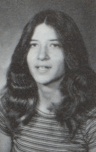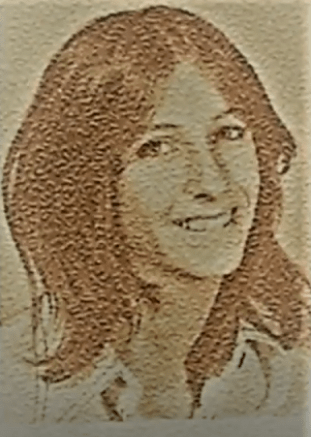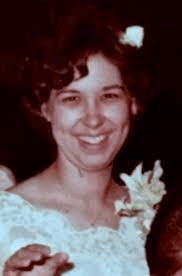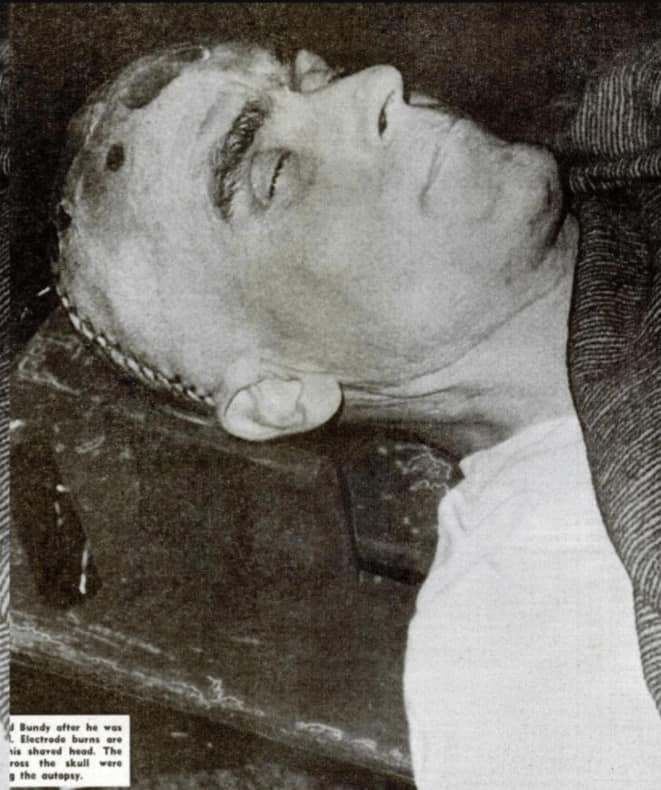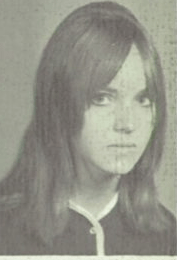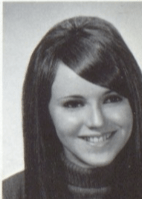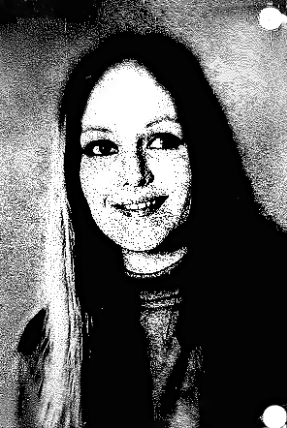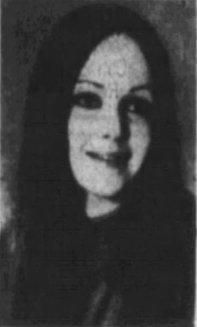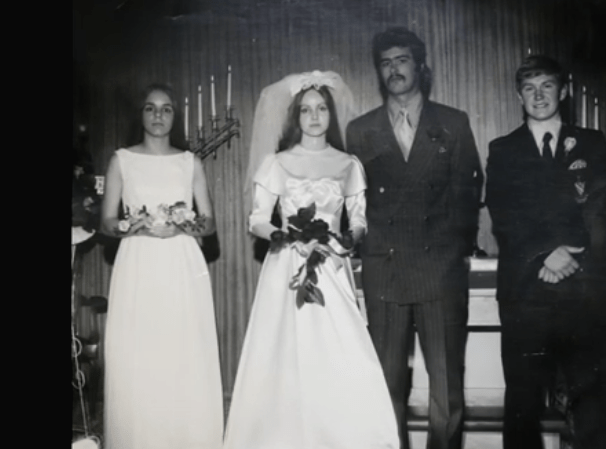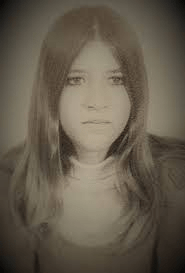
Laura Ann Aime.

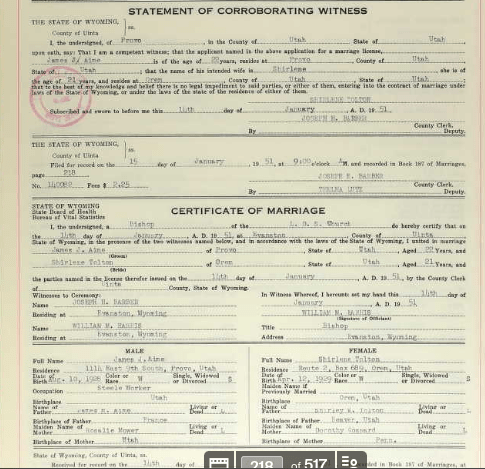
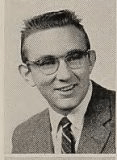
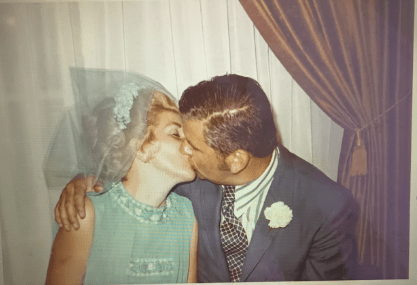
Laura Ann Aime was born on August 21, 1957 to James and Shirlene (nee Tolton) Aime in Lehi, Utah. Mr. Aime was born on August 10, 1928 in Fairview, Utah, and after completing high school he joined the US Navy; after getting out of the military he went on to attend the University of Utah. Shirlene was born on April 12, 1934 in Orem, and the couple were married on January 14, 1951. According to the Aime’s marriage certificate, Jim worked as a steelworker for Geneva Steel. Laura was Jim and Shirlene’s second child, and she had four younger sisters (Evelyn, Michelle, Denna, and Tommi lyn) and an older brother named John. Mrs. Aime filed domestic abuse charges against her husband in April 1966, but they must have worked out their issues because they never divorced.

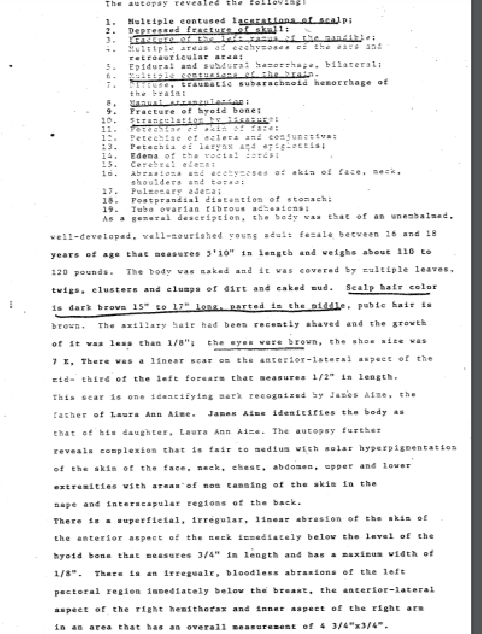
According to her autopsy, Laura had blue eyes, medium length blonde hair, was 5’10” tall, and weighed around 140 pounds. Before Aime dropped out she was a student at North Sanpete High School, and was at one-time a member of the Laurel Class in the Fairview North Ward. She loved animals, and one time a wild deer wandered out of the canyon and she began feeding it, and eventually was able to convince the creature into becoming a family pet. When Laura was eleven she was thrown into a barbed wire fence by her horse, injuring her ring finger, forearm, and upper arm. Jim Aime liked to take his daughter hunting, and she even helped him bag the first prize deer in a Utah hunting contest at the age of ten. Before she was killed Aime somehow seemed to show awareness that she knew her life was going to end soon in a tragic way: Mrs. Aime said one day out of the blue just a few weeks before her daughter died she told her: ‘at my funeral, I don’t want to be buried in a dress.’ Additionally, Evelyn Aime said that her older sister mentioned that she wanted the 1974 Terry Jacks classic, ‘Seasons in the Sun’ to play during the service as well.

Immediately before she disappeared Laura had been staying with her girlfriend Marin Beveridge, who didn’t live far from her childhood home. Despite being raised in a Mormon family, after leaving home she quickly fell in with the latter-day counter-cultural life, and with her long blonde locks and ‘hippie look’ she already had the stereotypical appearance of a runaway. Although the Aimes didn’t care for their daughter’s  choice in friends they were just beginning to come to terms with her ‘nomadic’ lifestyle. Often teased about her height, Laura was given nicknames like ‘Wilt the Stilt,’ which greatly upset her, and her Aime’s suspected that the relentless mocking was what made her leave school. She was used to tough work as the family at one time lived in an old farm house in Mount Pleasant, where they kept a plethora of animals, including chickens, cows, peacocks, turkeys, hogs, goats, sheep, dogs and ‘dozens of cats.’ She was also a tomboy (especially during her early years), and she loved playing softball, and played on competitive teams as well as her families LDS ward, even going so far as to winning the 1972 state championship. Growing up, Laura loved horses and was an experienced rider; she even spent several of her teenage years in an all-girls horseback riding club called ‘The Silver Spurs,’ and participated in several competitions with them at different fairs and parades across Utah.

Before she disappeared Laura had been staying with her girlfriend Marin Beveridge, who didn’t live far from her childhood home. Despite being raised in a Mormon family, after leaving home she quickly fell in with the latter-day counter-cultural life, and with her long blonde hair and hippie look she already had the appearance of a runaway. Although the Aimes didn’t care for their daughter’s friends they were just beginning to come to terms with her ‘nomadic’ lifestyle. Often teased about her height, Laura was given nicknames like ‘Wilt the Stilt,’ which greatly upset her, and the Aime’s suspected that the relentless mocking was what made her leave school. Laura was used to tough work as the family at one time lived in an old farm house in Mount Pleasant, where they kept a plethora of animals, including chickens, cows, peacocks, turkeys, hogs, goats, sheep, dogs and ‘dozens of cats.’ She was also a tomboy (especially during her early years), and she loved playing softball, and played on competitive teams as well as her families LDS ward, even going so far as to winning the 1972 state championship. Growing up Laura loved horses and was an experienced rider. She spent several of her teenage years in an all-girls horseback riding club called ‘The Silver Spurs” in SanPete County, and participated in several competitions at different fairs and parades across Utah. Those that knew her remember her as a kind and loving person.

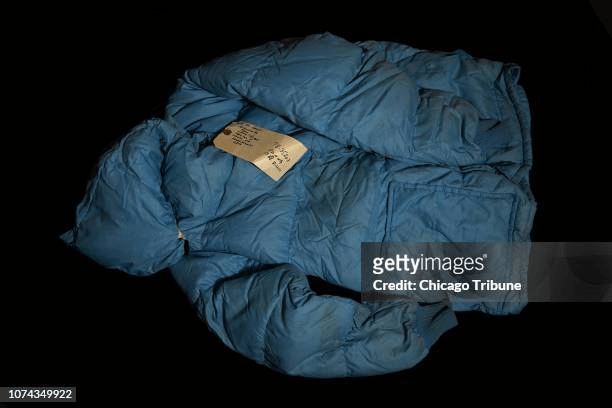
Laura Ann Aime was seventeen when she was abducted by Ted Bundy on Halloween night in 1974: the party she was at never really got going, and she left by herself around ten to get some cigarettes. About a half hour later she was picked up by an acquaintance named George Alley, who later told investigators that he dropped her off at The Knotty Pine in Lehi just after midnight (although according to Captain Borax, Browns as it was called by the locals closed at eleven, so perhaps it was closer to 11:00 versus 12:00). Quick Lehi factoid: ‘The Knotty Pine’ as it was once called was referred to as ‘Mo Browns’ because the gentleman that owned it was named Leon Brown and he reportedly had ‘a huge mole on his face’ (very clever). Alley also shared that Aime complained that before he picked her up a bunch of ‘cowboys’ ignored her outstretched thumb and drove right past her. From Browns, Aime again got bored and walked to Robinson Park. She was last seen wearing silver cross shaped earrings, a tan sleeveless turtleneck-style sweater with white horizontal stripes, a Navy Pea coat with a hood, light brown lace up shoes, and blue Levi’s with ‘patches on the rear;’ various sources report her wearing a halter top as well. Laura was wearing a ring with a yellow stone and had a rubber band around her wrist; her nails were adorned with black polish with silver flakes.

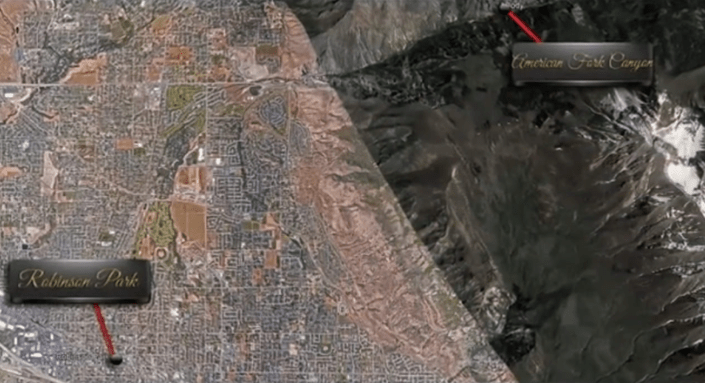
Although it’s (mostly) agreed on that Laura was last seen trying to hitchhike, there’s a few different possible narratives when it comes to where she was right before she disappeared. The most common theory I’ve seen is that she attended a house party at a mobile home in the suburbs of nearby Orem; a second says the party was in Lehi. The third possibility is that the party took place at the Knotty Pine Cafe in Lehi… (although there’s a FOURTH that says there was no party at all). BUT… every single one of these possibilities consistently placed her at the Knotty Pine Cafe for some period of time before she left to hitchhike to Robinson Park. One eyewitness came forward and shared with investigators that they saw Laura at the park in American Fork at around midnight, which is the last time that anyone reported seeing her alive. Robinson Park is about a 3.2 mile drive from the (former) Knotty Pine Cafe, and if she did walk it would have taken her roughly an hour (give or take) to do so. Due to the dropping temperatures (dipping as low as 45 °F) and the distance involved, it’s very likely that she tried to hitchhike back to Lehi after she was done hanging out at the park. Did Bundy see her there then pull up and offer her a ride? There’s also a possibility that he spotted Aime from a distance then crept up behind her and blitzed her, much like he did to Nancy Wilcox. As I mentioned earlier, Laura was in regular contact with her family after leaving home, and at first they weren’t too alarmed when they didn’t hear from her and figured it was only a matter of time before she got in contact with them. It wasn’t until Laura didn’t come home for a planned hunting trip with her father that the Aime’s knew that something was seriously wrong, as that wasn’t something she would miss without a good reason. After she disappeared her story didn’t make the news until her remains were discovered (like so many of the other case’s I’ve written about, for example Brenda Joy Baker out of Maple Valley, WA), which may have partially been due to her transient nature and nomadic lifestyle.

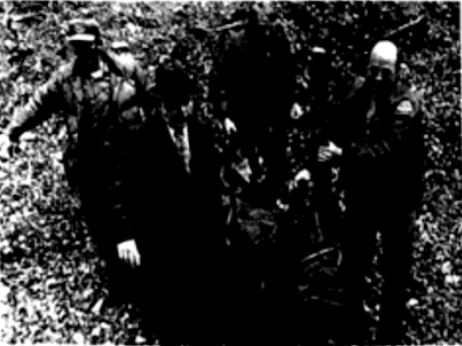
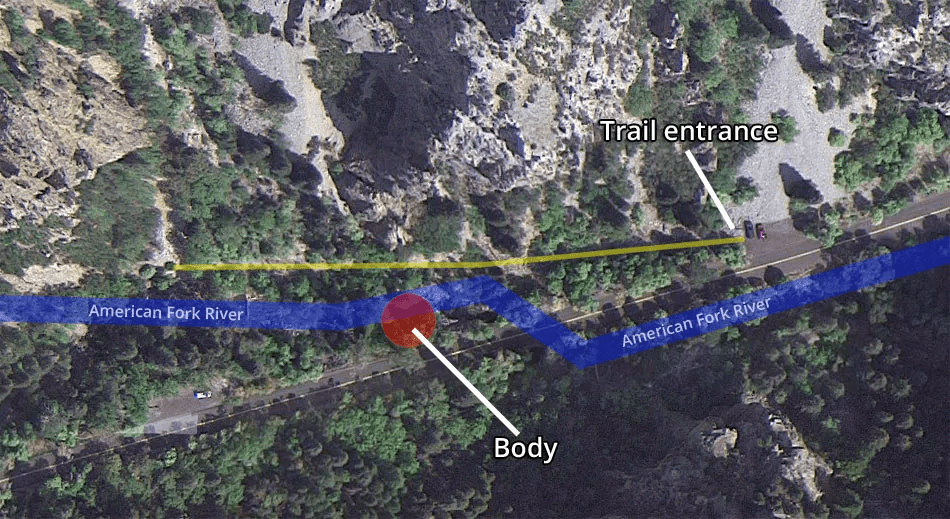
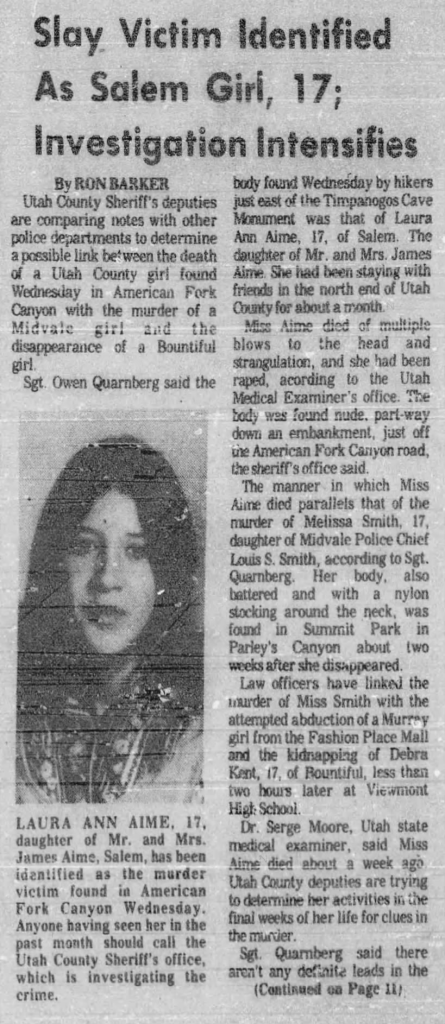
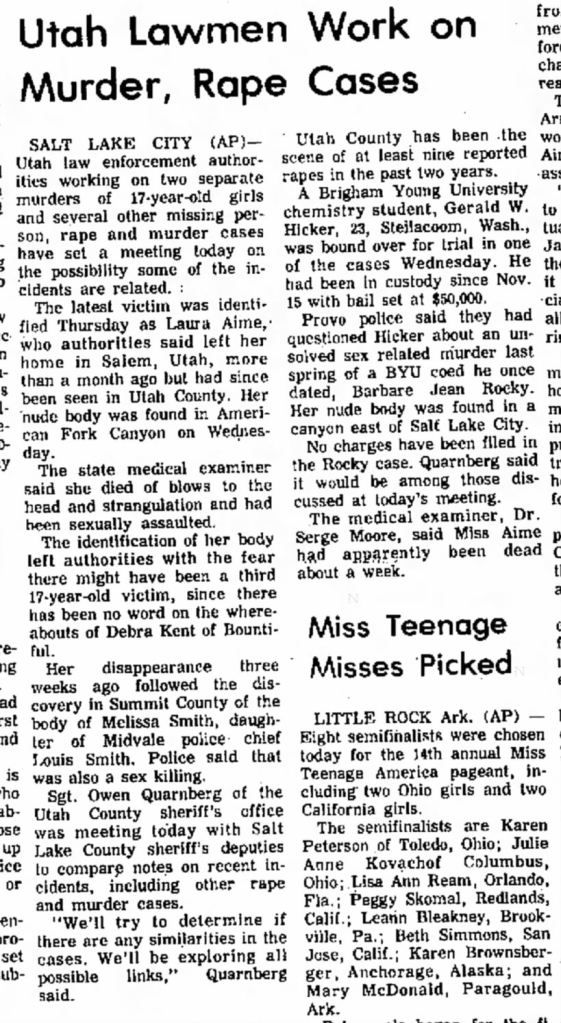
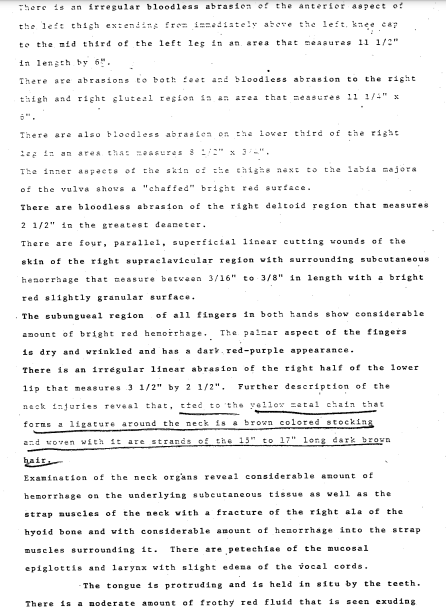
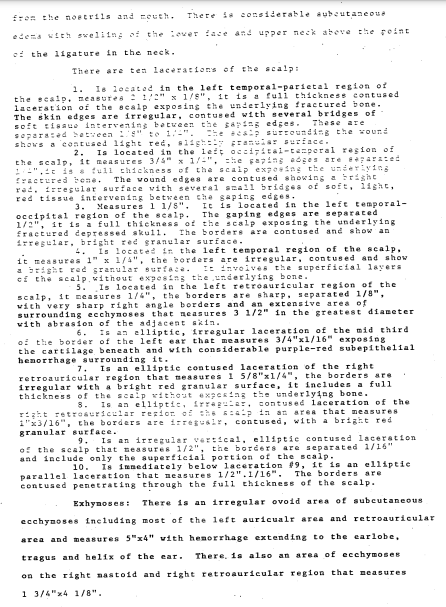
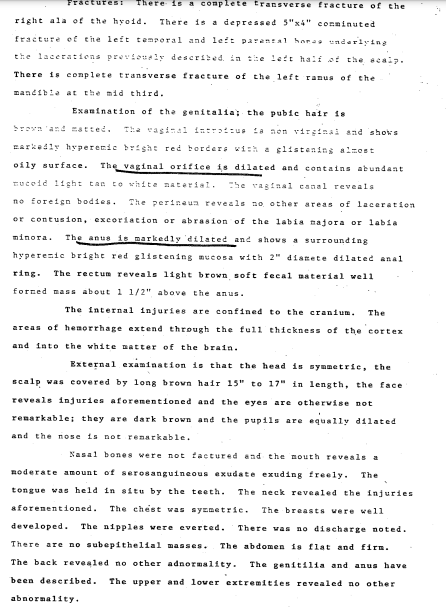
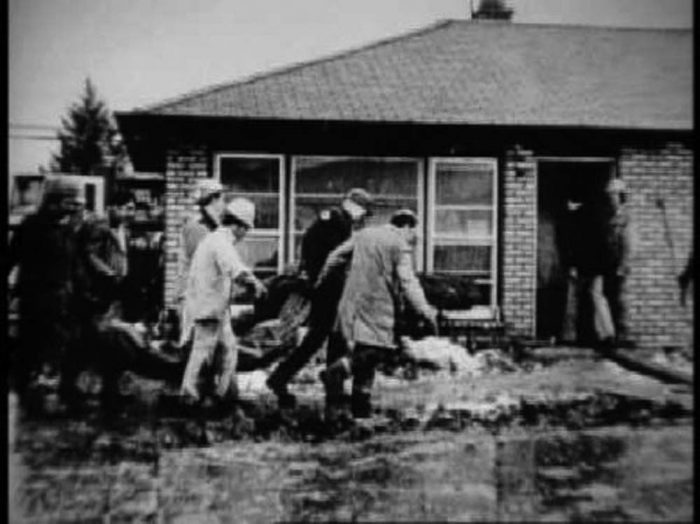
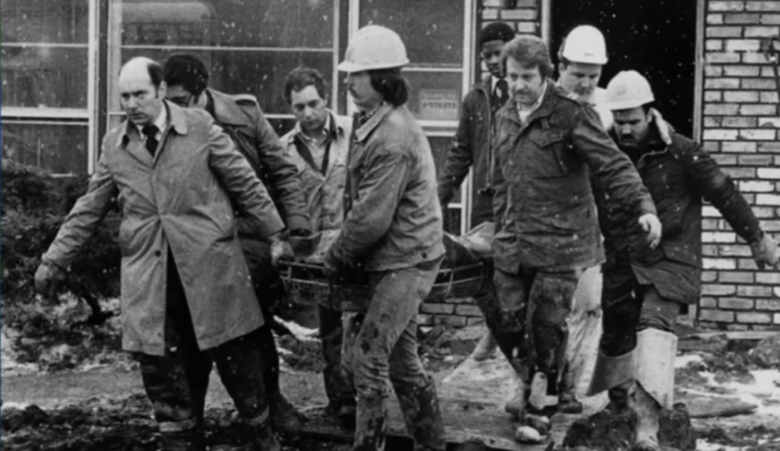
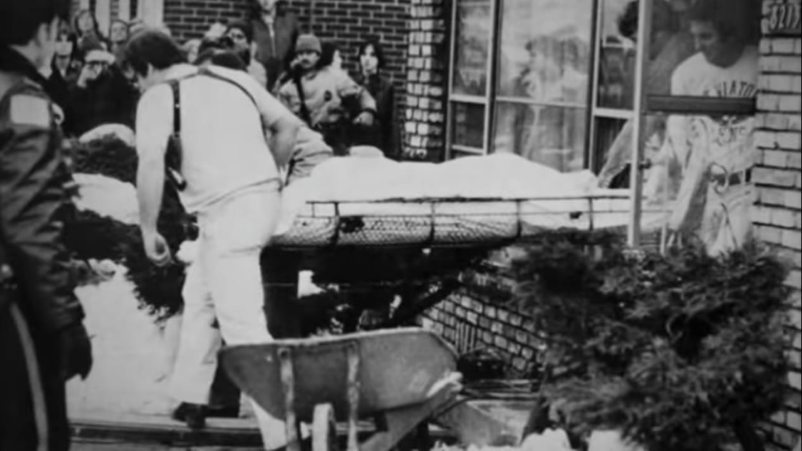
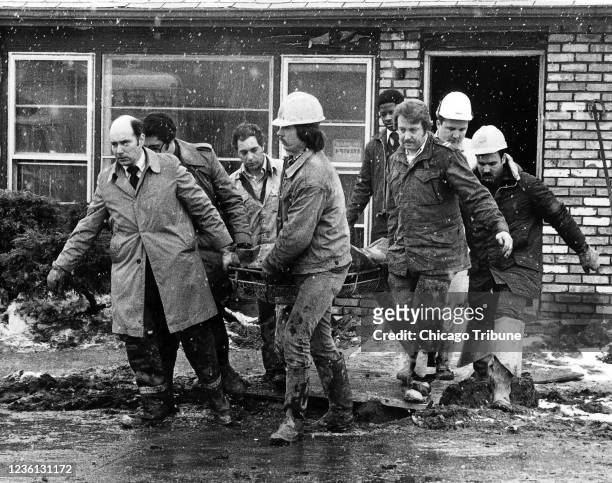
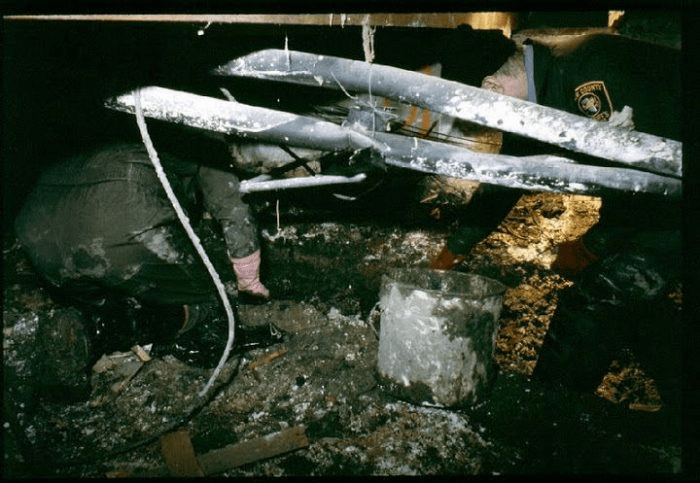
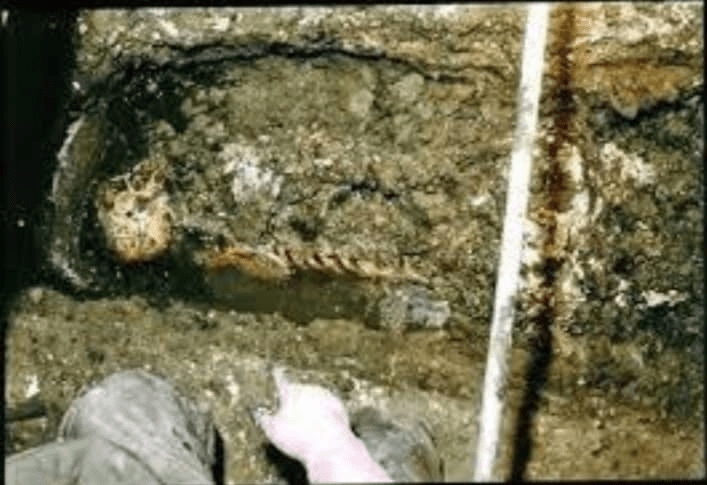
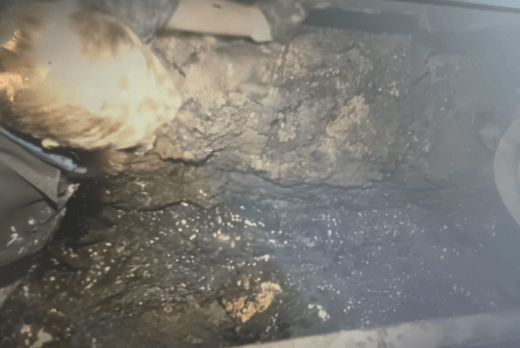
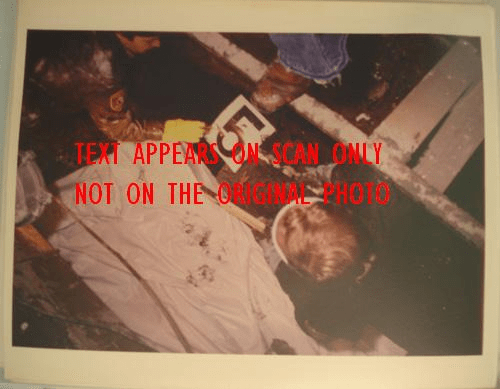
The remains of Aime were found less than a month after she vanished on Thanksgiving Day next to a stream in American Fork Canyon in the Wasatch Mountains by two BYU students that were looking for fossils for their Geology class (Raymond Ivins and Christine Shelly). Fearing that the murderer may still have been lurking in the area, the couple immediately went to the nearest ranger station and reported their discovery. Aime’s body was covered in leaves, twigs, and brush; she had been raped, sodomized, beaten then strangled to death with a pair of stockings. According to her autopsy report done by former Utah State Medical Examiner Dr. Serge Moore*, Laura had depressed skull fractures on the left side and back of her head and the necklace she was last seen wearing was tangled up in the pair of nylons that were cinched around her beck. She had numerous facial wounds (almost too many to count), and her body had deep wounds from where it had been dragged. LE deduced that the weapon used to inflict such brutal injuries was most likely either a pry bar or metal crowbar; her face was incredibly swollen and her tongue was hanging from her mouth. Aime had also suffered a vaginal puncture that may have been made by a weapon of some sort (perhaps an ice pick, and some have also wondered if it was a speculum which is what it’s thought Karen Sparks was assaulted with). Tire patterns that were found in the immediate area were said to be a match with Bundy’s Volkswagen Bug. *Just as a side note (per Kevin Sullivan), Dr. Moore never properly investigated either the temperature or the level of snow during the period that Smith and Aime were abducted. After complaints of sloppy work from Utah law enforcement Moore was investigated, and he officially lost his license in 1979 after he failed to produce any proof that he graduated from a University in Mexico City.

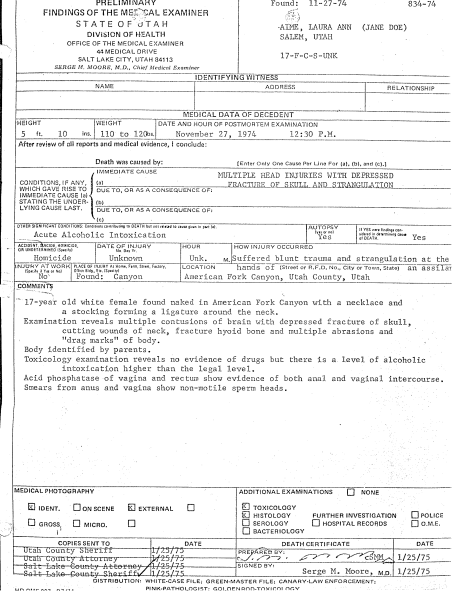
Laura’s cause of death was listed as multiple head injuries with a skull fracture and strangulation. Also, I do want to point out that I’ve seen the date incorrectly listed as both November 26 and 27th, but according to my research, Thanksgiving Day in 1974 was on the 28th. About the discovery, Ivins said: ‘I looked and I thought, you know, it was a deer or something and … it was a girl … It looked like she had been …she was dead. It was really grotesque. There was blood around her neck and breasts and she was naked and lying on that hill and it was a freak-out and I lost it. I thought maybe the guy was still somewhere around and I just panicked, worrying about my girlfriend . . . and we ran down the trail …Came down and ran right through the creek and got in the car and just drove like a maniac, I guess as fast as I could, down to the ranger station and I reported it.’ Swabs taken from Aime’s vagina and anus showed the presence of non-motile sperm, and blood tests showed no signs of substance use aside from alcohol. In the early stages of the investigation it was suspected that her remains belonged to Debra Kent, who had gone missing from Viewmont High School in Bountiful nineteen days earlier.

Several days before she was killed Laura spoke with her mother on the phone: Mrs. Aime begged her daughter not to hitchhike, and told her that she was afraid that she would meet a fate like that of Melissa Smith from nearby Midvale, who had recently been brutally murdered. She assured her she would be ok and told her mom not to worry; it was the last time they would ever speak. After Laura disappeared Mrs. Aime said that ‘she was missing and she had no purse coat, no nothing. I called the sheriff’s office and they said, ‘What do you want us to do about it?’’ On Sunday, November 3 Shirlene reached out to Judy Olsens’ mom, who was confused by her call, saying ‘isn’t she with you? We haven’t seen her since Thursday when she and Judy and Mark left for the Halloween party?’ Two days later on November 5, 1974 Mrs. Aime called the local police to notify them that her daughter was missing, and when she pleaded with them to look for her she told that there were too many ‘young runaways to pursue each one, and after a couple of weeks I just knew she was dead.’ After the remains of a young woman were discovered on a nearby river bank Shirlene reached out to the sheriff’s for a second time, and was again told ‘there’s no way it’s her, it couldn’t be her’ and that the victim was closer to twenty-five and wasn’t as tall as Laura. However the next morning a story in the newspaper mentioned the young woman was wearing a ‘ring with a green stone,’ which happened to be a peridot, which was Laura’s birthstone. Mrs. Aime immediately ran to look in her daughter’s jewelry box, to see if her peridot ring was still there. It was, however, the rest of the coincidences were just too much for her to bear.

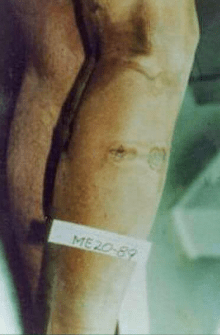
Within an hour both Mr. and Mrs. Aime were on their way to the University of Utah morgue, accompanied by Sheriff Mack Hollet and a copy of Laura’s dental charts. Jim said that she had been beaten so severely that he ‘didn’t even recognize her,’ was only able to positively ID her by the scars on her forearm from the horse injury that I mentioned earlier. When he realized that he was looking at his precious little girl, he let out a loud, gut wrenching wail. Shirlene said that she ‘couldn’t believe it had come from a human being.’ Additionally, the dental records that the Aime’s brought with them further verified that it was Laura. Her autopsy revealed a broken jaw, a fractured skull, bruises and lacerations to her head and shoulders, a deep cut to the back of the head, and injuries to the vagina and anus. The ME determined that she had died on November 20, which was roughly twenty days after she disappeared. Many years after his daughter’s murder, Mr. Aime was driving near the spot where her remains were discovered with a friend, and he shared: ‘my little baby was up there all by herself and there was nothing I could do to help her.’

Captain Borax was able to locate a copy of the Lehi Free Press from the night Laura was abducted, and it was apparently an election period in local county government: Mack Holley was running for Utah County Sheriff, and Noall Wootton was running for County Attorney. Wootton was busy promoting his stance on crime prevention while Sheriff Mack Holley was preoccupied with communicating his belief in strong family values, but both men openly discussed the need for increased protection against the dangers that lurked in the night. Together, Wootton and Holley wrestled with a real, live boogeyman that slithered through the shadows of Lehi and American Fork, but at the same time they had no problems with hiding information away from one another. Mack Holley was known to keep information to himself and refuse to share it, and about him Jerry Thompson said ‘all I kept getting was a runaround, so I basically said, ‘to hell with them.’ As early as December 3, 1974 (which is only six days after Aime was found), retired Utah County Sheriff’s Sergeant Owen Quarnery wrote to the FBI crime lab in DC about the case, saying: ‘The MO is similar in many respects to the Smith case. The victims in both cases were beaten, sexually assaulted and strangled. Also many of the wounds were similar in appearance.’

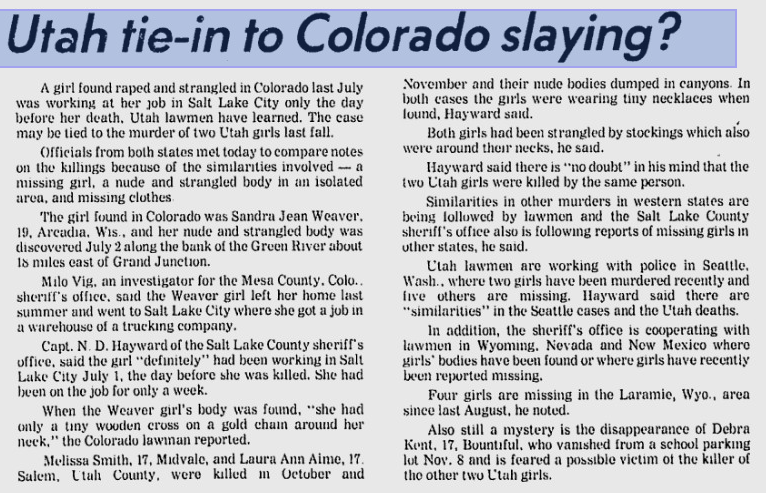
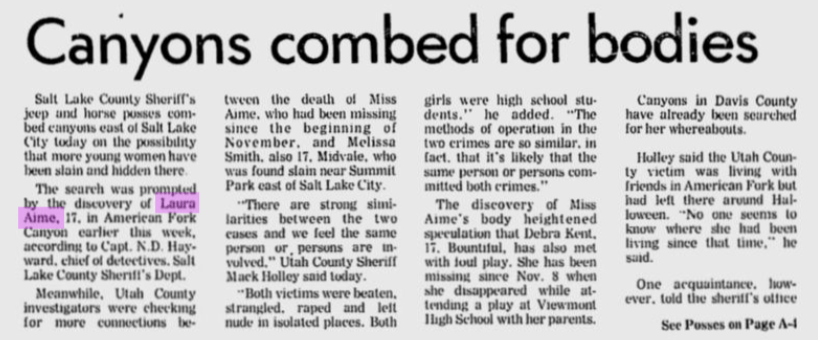
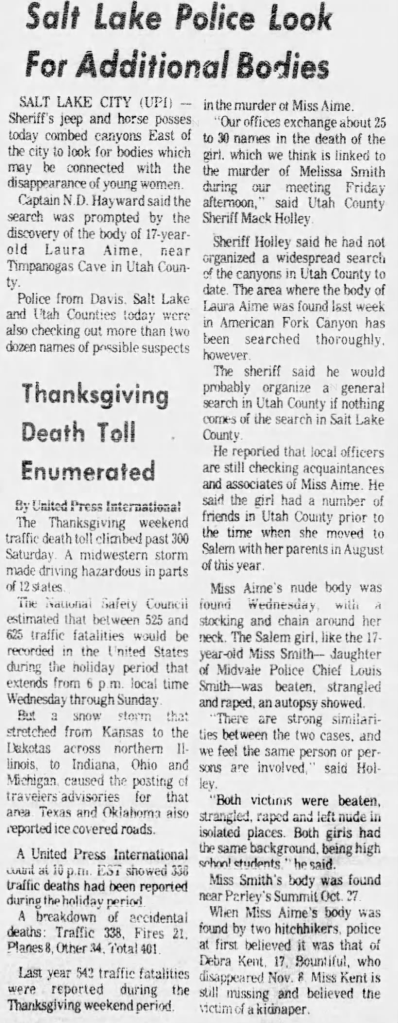
Despite Laura disappearing on the last day in October it was determined she had only been dead for roughy a week when her body was discovered. According to Kevin Sullivans book ‘The Enigma of Ted Bundy,’ her remains showed a very small decomposition, which strongly hints that her killer may have kept her alive after abducting her. Looking into SLC temperatures during November 1974, it was a relatively warm fall and wasn’t very cold meaning the body wouldn’t have preserved because of low temps. Less than two weeks before Aime disappeared on October 18, 1974 Melissa Anne Smith disappeared from nearby Midvale after leaving a pizza parlor at around 9:30 PM. Nine days later her naked remains were found in a nearby mountainous area, and just like with Aime the only thing found on her body was a cross on a delicate chain necklace. One strange commonality I wanted to point out is that unconfirmed Bundy victim Sandra Weaver was also found the same way.

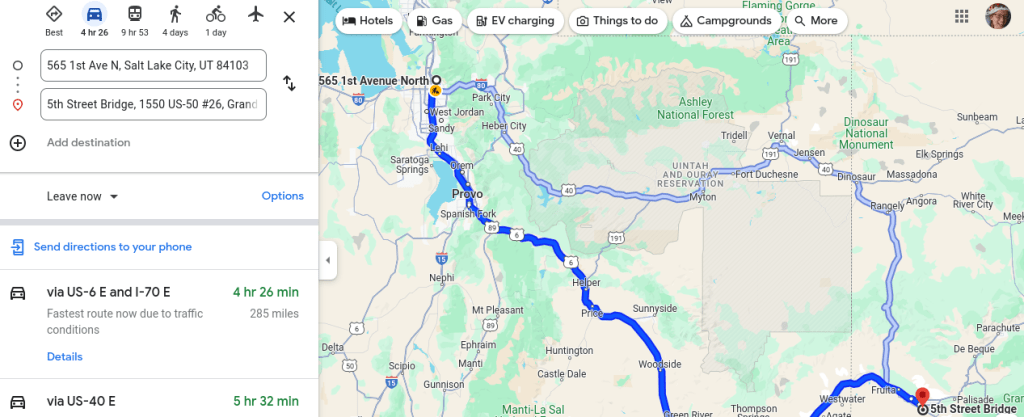
According to David McGowans book ‘Programmed to Kill,’ Melissa Smith’s body was found almost entirely drained of blood, and revealed a somewhat strange abnormality: like Laura, she had not been murdered immediately and had been kept alive for possibly a week after she was abducted. Additionally, her make-up was applied neatly and none of her nails were broken. Strangely there were no signs of restraints or ligatures, so if she was held against her will before her life was taken, there was next to no signs of it (perhaps he kept her in a locked room of sorts?). Retired Colorado investigator Mike Fisher strongly felt that Bundy brought both Smith and Aime back to his first SLC apartment (located at 565 1st Ave), and further elaborated that on occasion other tenants would hear him going down to the cellar in the middle of the night and making noise.

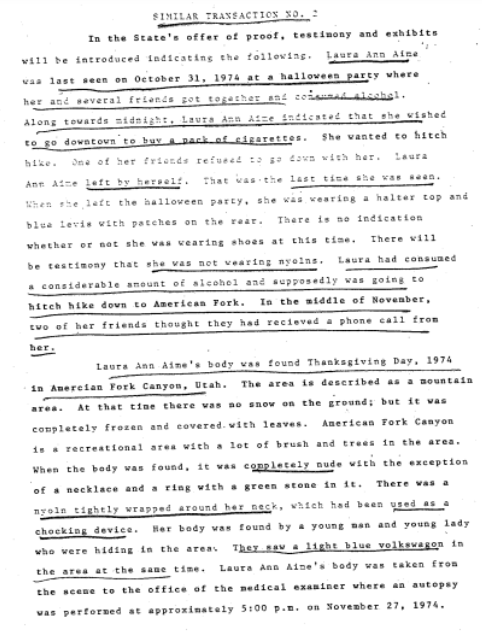
Sullivan feels that Bundy could have kept Aime alive in two possible scenarios: the first one being he kept her in the basement of his rooming house, which was in the rear of the building and that he could keep locked, and because he was the apartment manager he had a key for the area. The second involves him pulling what he calls a ‘reverse Lynda Ann Healy,’ and he carried her into his room in the middle of the night when no one was awake to see (then down and out again when he disposed of her remains). Thinking about it, carrying the body of a young woman out of your room in the middle of the night sounds awfully bold (even if she was alive), but by that time he had lived there for a few months and had most likely gotten familiar with the behaviors of his fellow tenants. We know he didn’t admit to anything related to Laura Aime during his confessions however he did admit to keeping Deb Kent alive in his residence for a period of time before he took her life, so it’s fairly likely that he did the same with Aime (and Smith). Laura’s autopsy report states that in the middle of November 1974 two or three of her friends told LE they think they got phone calls from her but weren’t 100% certain if it was actually her or not.

In the summer of 1974 Sheriff Mack Holley created Utah County’s first Detective Division, and Laura Aime’s murder was their first investigation. Strangely enough, in an interview between (retired) Chief Investigator for Utah County Brent Bollock and True Crime blogger and creator Captain Borax, Bollock said that (former) Utah County Sheriff Mack Holley never believed that Bundy was responsible for Aimes murder, and even wrote about it in one of his books (which I was unable to locate online). In fact, Holley strongly felt that another man was responsible for her murder, one that was later convicted of killing his girlfriend, even going so far as telling a member of the team of investigating detectives: ‘Bundy had nothing to do with our case, so forget him. That man didn’t do our case. I wish you’d get that through your head.’

A little over a week after Aime disappeared on November 8, 1974, Bundy tried (but failed) to kidnap Carol DaRonch from the Fashion Place Mall on South State Street in Murray. After the 18-year-old telephone operator escaped, Ted quickly realized that he needed a new victim, so he drove roughly 25 miles away to Bountiful and abducted 17 year-old Debra Kent (this will also be important later). The family was attending a showing of ‘The Redhead’ at Viewmont High School that went later than expected and Deb volunteered to take the family car and pick up her two younger brothers at a nearby roller skating rink. On her walk out to the parking lot, Bundy abducted her, then killed her and dumped her body roughly 50 miles away in American Fork Canyon.

In 1977 investigators took a second look into Aime’s murder, and they spoke with her girlfriend Marin Beverige, who positively identified Bundy as an individual that was at Brown’s on the night she disappeared. In fact, Marin’s sister worked at the establishment and even claimed to see Ted pull up and pick up Laura the night she disappeared. Beverige told detectives that she first noticed him one day in September 1974, and remembered that he drove a Volkswagen and told her he was a student at the local university. She also recalled one occasion where she was sitting in the sunshine with Laura and a group of friends near a local high school and the man joined them. When a young guy teased Aime by putting some grass down her halter top, he objected, and ‘this guy came unglued and told him Laura was his. He was really weird.’ Marin said that the attractive young man kept randomly showing up all around Lehi, and always seemed to be looking for Laura. She recalled an event that took place one night at The Knotty Pine, where: ‘he came in and was sitting there talking and I got up…..When Laura said, ‘I’m ready to go,’ this guy said, ‘You can’t. I’m going to rape you.’ Laura just laughed and pushed him away.’’

Beverige informed detectives that she had seen the man on multiple occasions, and one evening he even knocked on her front door and asked to speak to Aime privately. She agreed and after the two went outside to speak alone: ‘Laura was really shook up. But she wouldn’t say what happened.’ About the events surrounding her friend’s disappearance, Marin had a completely different account of what happened that night, one that differed greatly from the one gathered by the Utah County Sheriff’s Department: according to Beverige, her, Laura, and a bunch of their friends had gathered at her house for a Halloween party, and some guys had brought a large amount of vodka and Laura had gotten pretty drunk: ‘It was about midnight or so, and she was pretty well drunk. And she wanted me to walk downtown with her to get some cigarettes.’ She said no, and as Aime walked away into the darkness it was the last time Marin ever saw her friend. ‘Around three or four o’clock some of us went to town to look for her, but we couldn’t find her.’ When Beverige was shown a lineup she immediately picked out Bundy; a female clerk employed at Brown’s picked him out as well. She was also asked to take a polygraph test which she agreed to, and passed. 

Mrs. Aime called the early stages of her daughter’s murder investigation ‘damned frustrating,’ and said it was filled with ‘blunders, omissions and political jealousies,’ elaborating that two of the detectives working the case were incredibly uncoordinated: ‘one would come and ask me a question, and a couple hours later the other would come and ask me the same thing. Neither of them would tell the other anything.’ On one occasion a political rival of the (then current) sheriff came to speak with the family to ask them questions for his own personal investigation, and because the Utah County Sheriff’s Department was so unwilling to share information the Aimes would frequently receive phone calls from other police agencies, asking for information about their daughters murder. Not satisfied with how local LE were handling Laura’s murder, the Aime’s desperately wanted the experienced homicide detectives in Salt Lake City to help with the investigation, but they were turned down and told by (local) officers, ‘if we can’t solve it, no one else can.’ Mr. and Mrs. Aime felt that Laura’s murder had become somewhat coveted politically, and that whoever was able to solve it ‘could have written their own ticket politically.’ But unfortunately it went unsolved, and months went by without investigators learning anything new, and it wasn’t until August 1975, when a handsome young law student was arrested that everything started to come together, and Ted became the first decent suspect in her murder. It was at that point that a highly skilled investigator became involved in the case, Brent Bullock of the Utah County attorney’s office, who the family was incredibly pleased with, and was impressed and encouraged by his ‘professionalism, his relentless search for evidence, and his questioning of witnesses.’

When Bundy escaped prison for the first time in Aspen on June 7, 1977, Jim Aime ‘exploded in anger,’ and he ‘would have gone down there and searched for him myself, if I could have afforded to lay off work.’ Thankfully the father of five remained home with his family (he still had four daughters at home), but because Shirlene was so afraid for the safety of their other girls he bought her a .38-caliber pistol. As we all know Bundy was recaptured just a few days later on June 13, 1977, but he escaped for a second time later that same year on December 30 from the Garfield County jail in Glenwood Springs. By this time in the year they had ‘hocked’ the weapon as they were reportedly ‘hard-pressed financially,’ and by his second escape Jim had become even more angry and bitter, and said that his wife was ‘just scared to death. She quit her job so she can stay home and watch the kids. She won’t let those girls out of her sight.’

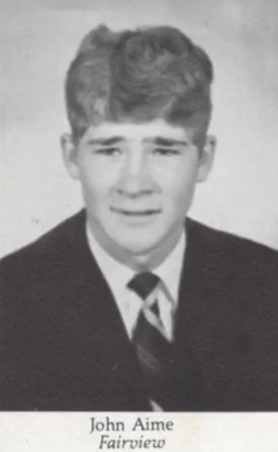
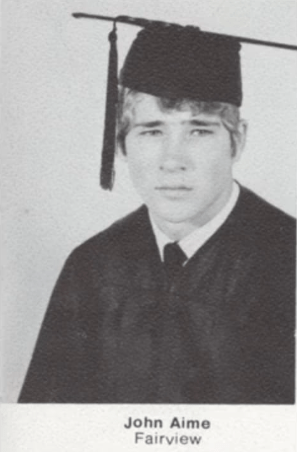
Laura’s murder wasn’t the only time that the Aime family had to deal with the ‘keystone cops:’ After graduating from high school John joined the military and became a radar specialist in the Army, but after his sister was killed it was as if the entire family’s lives fell apart. After leaving the service he began working in construction in Tacoma, and on April 28, 1975 at around 10 PM he reportedly approached a young woman on a street, briefly spoke with her, then physically accosted her. She testified that she was ‘grabbed by Aime and dragged toward a brushy area and that the defendant ran when she fell to the ground and screamed,’ (she also said that he tried to ‘drag her’), and after letting out an ear piercing scream he fled, but a passerby caught him and held him at gunpoint until police arrived. Aime later said that he had no intention of harming or molesting the young woman, and his wife Lynn was completely puzzled by that incident and couldn’t provide any explanation for her husband’s actions. John was taken to jail and investigators began digging into his past; a probation officer wrote: ‘he and his family have suffered as a result of his sister being raped and killed in Utah.’ While in jail in Tacoma Aime got married to a medical technician and an Air Force vet; it was an unusual ceremony that took place without the guards’ knowledge. After a two-day trial in June 1977, he was convicted of a misdemeanor assault and was sentenced to a five-year term at Washington’s Western State Hospital at Steilacoom for the rehabilitation of sex-offenders. For obvious reasons, this devastated both of his parents, and about the incident Mr. Aime said that he ‘was just a scared kid from the country.’

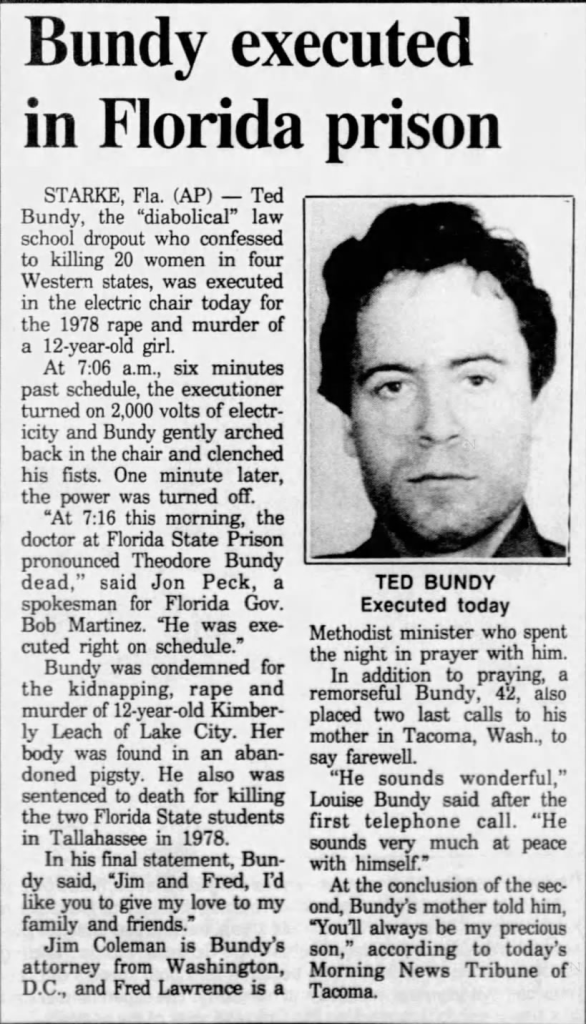
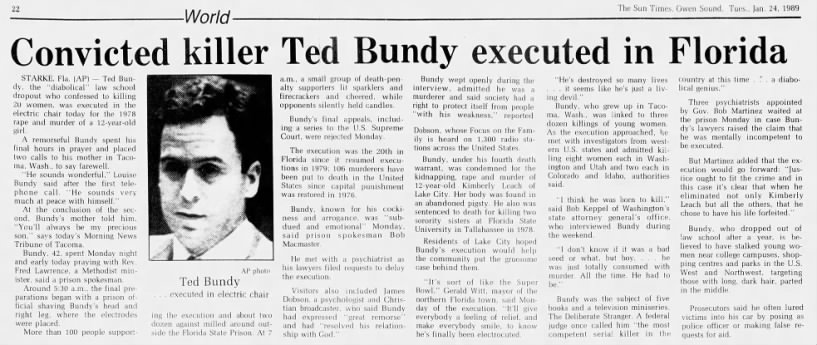
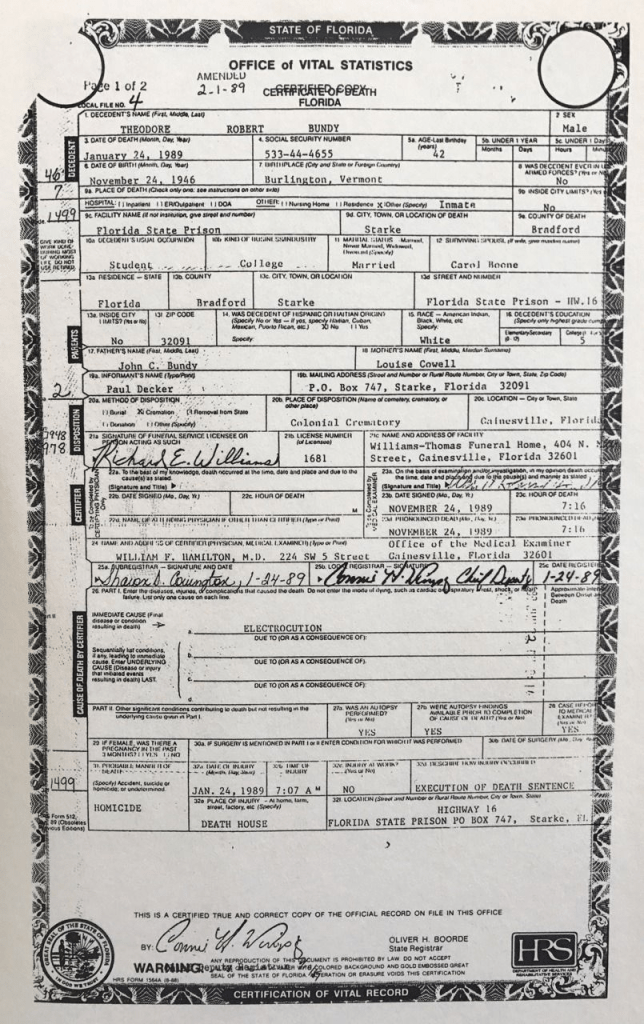
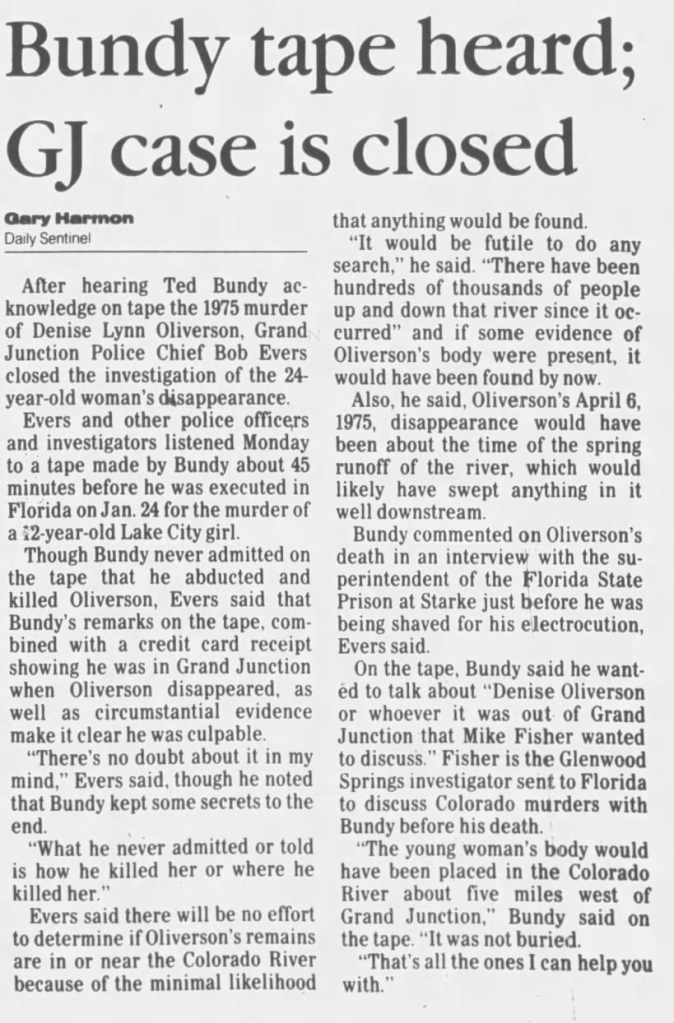
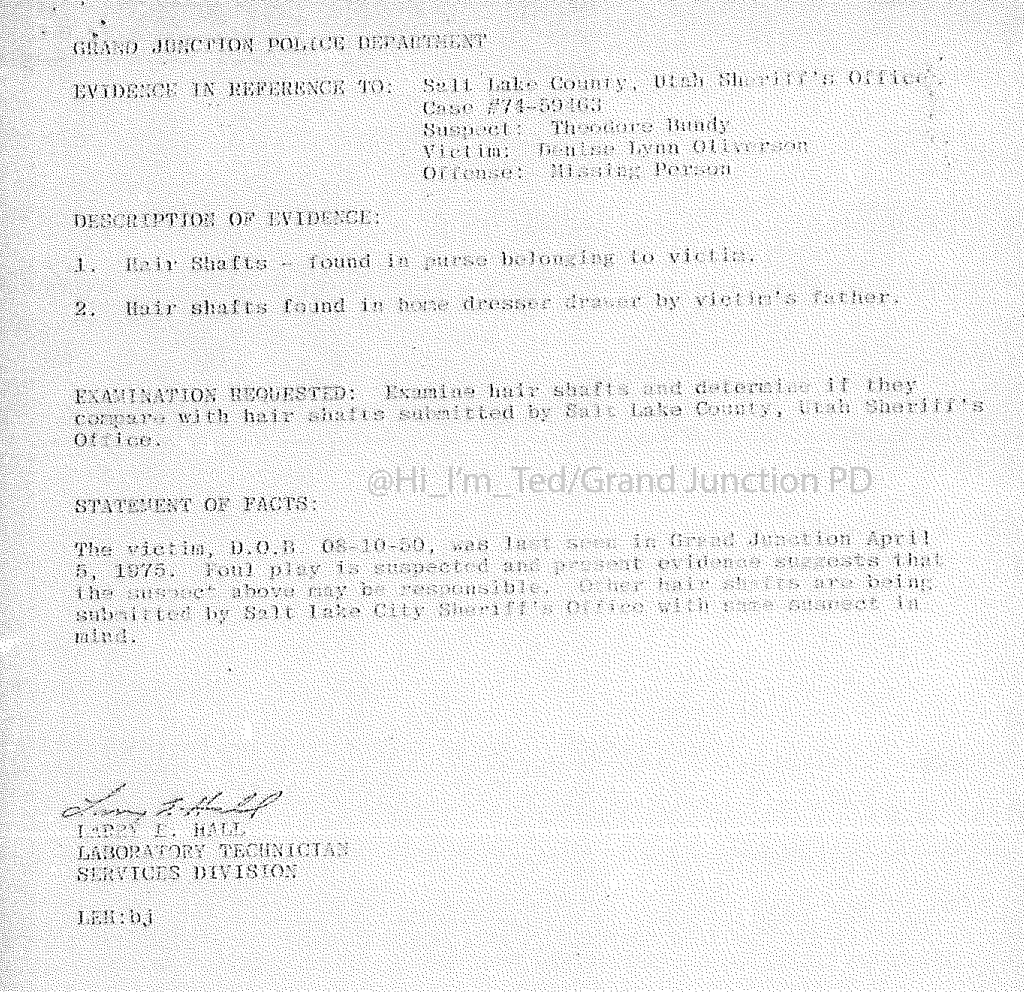
Before Bundy was put to death in Florida, he confessed to killing Laura Ann Aime on January 22, 1989 in a 90-minute confession with (retired) SLC Detective Dennis Couch. The following is an excerpt from Dick Larsen’s ‘The Deliberate Stranger:’ ‘Y’know, there’s always been something about that Laura Aime case, that one in particular, that’s really bothered Theodore. When several case files were given to Bundy in his jail cell, under the discovery procedure …. the first one he went for … and really tore into … was the Aime case…. ‘ When asked about his involvement in Aime’s murder, Ted lowered his head and refused to talk about it. Strangely enough, I’ve heard that he washed some of his victims’ hair and manicured some of their nails as well, but this is the first time I’ve written about a woman that he actually did it to. After Aime’s remains were found, law enforcement determined that her hair had been recently shampooed, making them believe her killer had returned to her corpse on multiple occasions to engage in acts of necrophilia. About this act is a passage from Michaud and Aynesworths book, ‘The Only Living Witness:’ ‘Bundy also indirectly touched on some old mysteries, such as Laura Aime’s freshly-washed hair, and Melissa Smith’s make-up: ‘If you’ve got time,’ he told Hagmaier, ‘they can be anything you want them to be.’’

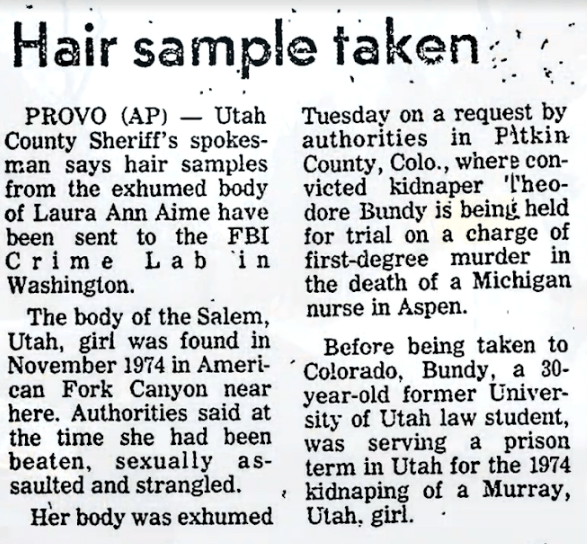
According to an article published by The Salt Lake Tribune right before Bundy was executed, investigators had to exhume Aime’s remains in order to get another hair sample because the first one they obtained after her remains were initially discovered were misplaced. Jim Aime wept at the mere thought of it, but relented, saying ‘why not? They can’t hurt her any more. It seems like these things just couldn’t happen.’ About her daughter’s disappearance, Mrs. Aime commented that ‘there’s no way of putting it out of your mind…’

According to Ann Rule’s true crime classic, ‘The Stranger Beside Me,’ Laura’ toxicology report came back just over 0.1, which is obviously an indicator of impairment (at least from a legal standpoint), but at the same time wasn’t so extreme or outrageous that she wouldn’t have been able to defend herself (or at the very least scream or try to run away). Now, if she really was kept alive up until a week before her death, and she wasn’t murdered immediately after the Halloween party… Was Bundy plying her with alcohol up until her final moments? Another thing that is jumping out at me as being weird is… if Laura Aime was kept alive until roughly a week before her body was discovered, that would put her murder date sometime in between November 17-20 (roughly, give or take)… Did he somehow keep multiple victims alive at the same time (somewhere)? Were Aime and Deb Kent somehow kept alive together in an unknown location for a period of time? Did he kill the one in front of the other, like with the Lake Sammamish murders of Denise Naslund and Jan Ott?

Despite the way she was killed was very similar to Bundy’s MO and she fit the physical description of  one of his victims, he initially denied any responsibility for Aime’s murder and refused to talk about her when he was questioned. However, (most likely) in an attempt to delay his execution in the days leading up to his death Ted finally confessed to the murder of Laura Ann Aime.

Mr. Aime died at the age of 59 on November 26, 1987. It appears that in 1980 Shirlene Aime adopted her granddaughter Danika, who was given the middle name of Laura after the aunt that she never had the chance to meet. Mrs. Aime died on November 1, 2011 in Reno, Nevada at the age of 77. Laura’s only brother John died at the age of 56 on November 29, 2010 in Gunnison, Utah but it appears that all of her sisters are still alive. Because it’s’ strongly suspected that Bundy kept her alive for a period of time after abducting her, the Aime family chose to list ‘November 1974’ as her official date of death on her gravestone.
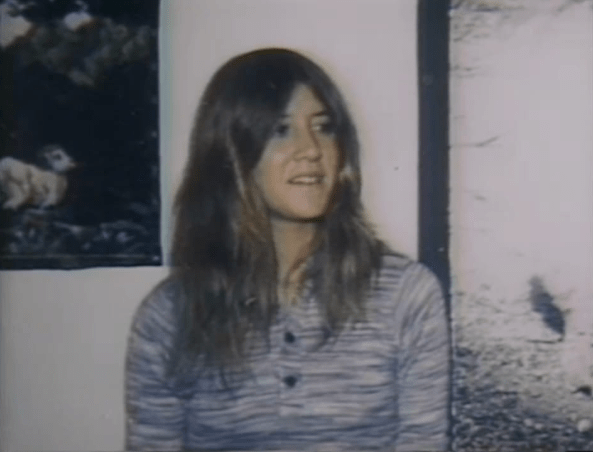
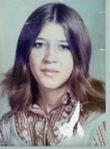
Laura Ann Aime. Her mother said she had ‘hell inside her’ after watching her ride her shining blue Arabian horse at top speed.
Laura Ann Aime.
Laura Aime.
Laura Ann Aime.
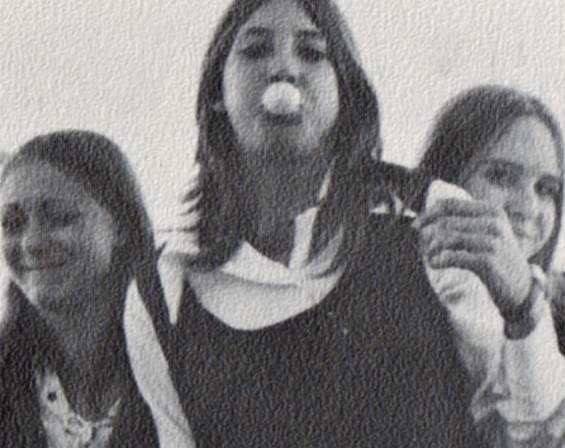
Laura Aime, blowing a bubble.
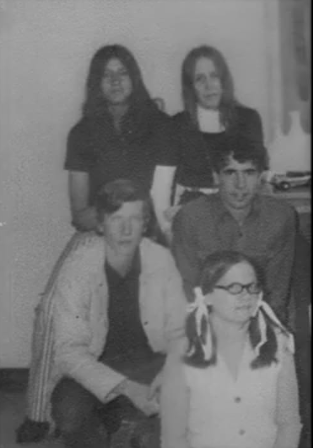
A group picture from Laura’s time at North Sanpete High School; Laura is in the back row on the far right.
Laura in a group photo.
Photo courtesy of OddStops.
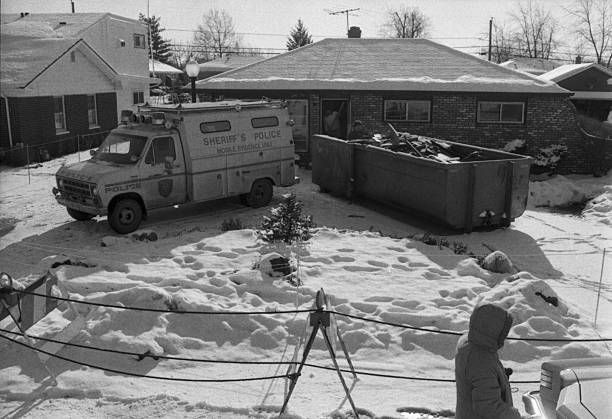
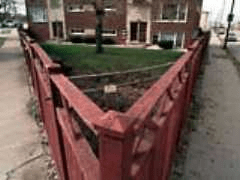
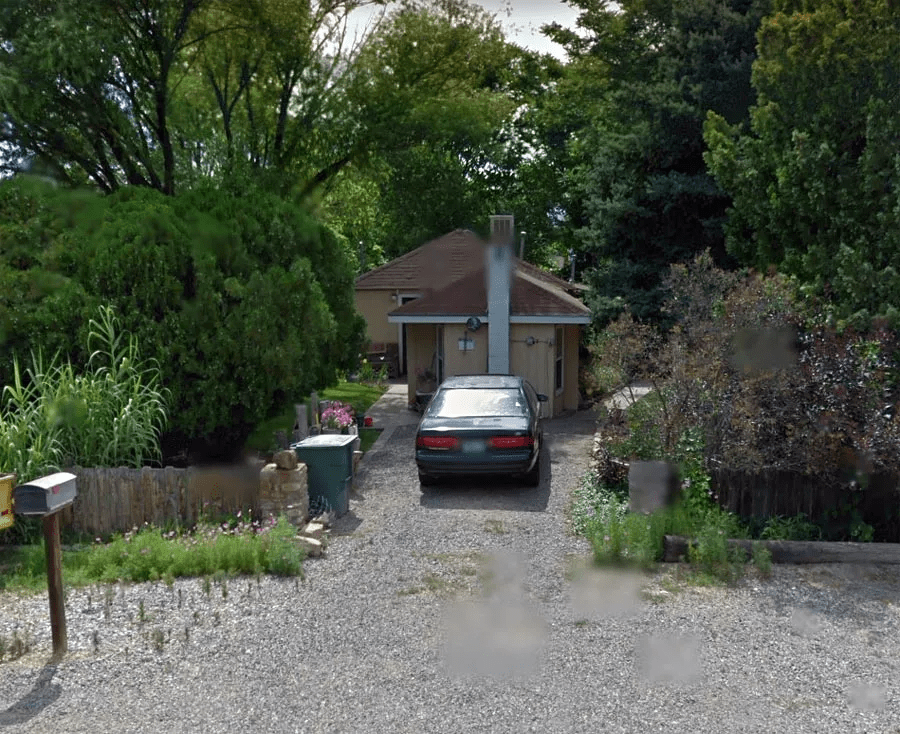
The Aime’s residence. Photo courtesy of ‘Crimes Forgotten by Time.’
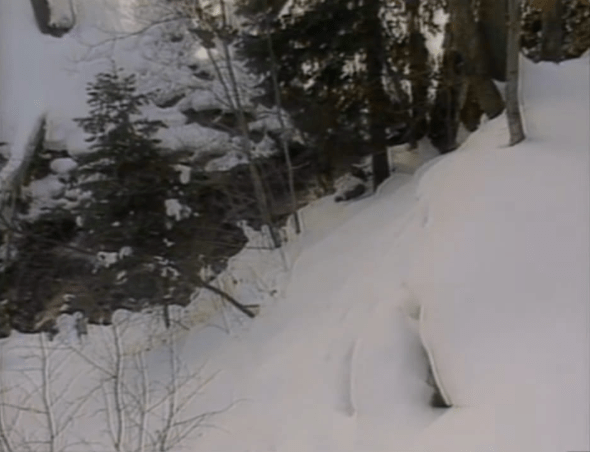
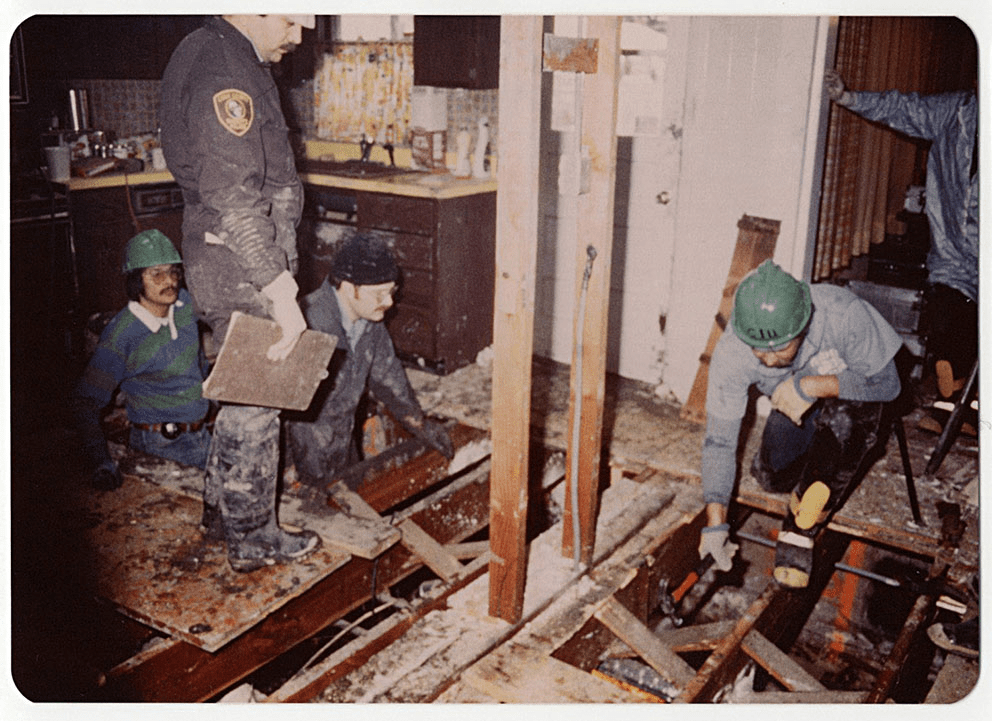
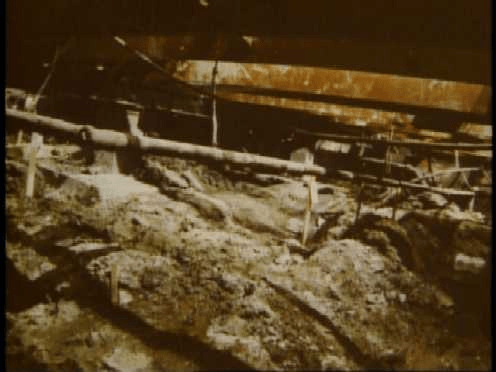
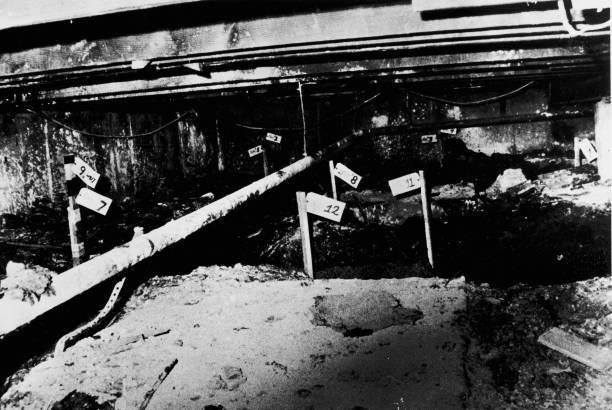
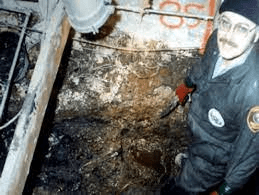
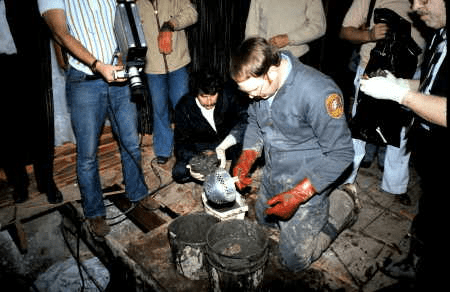
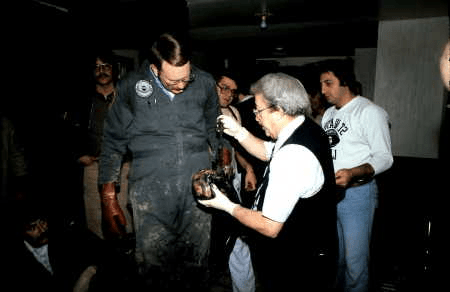
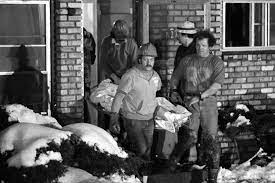
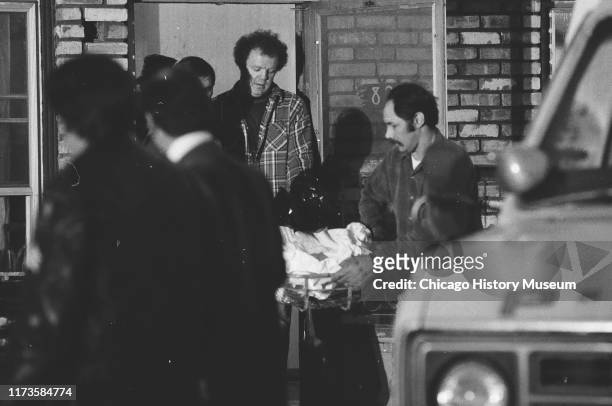
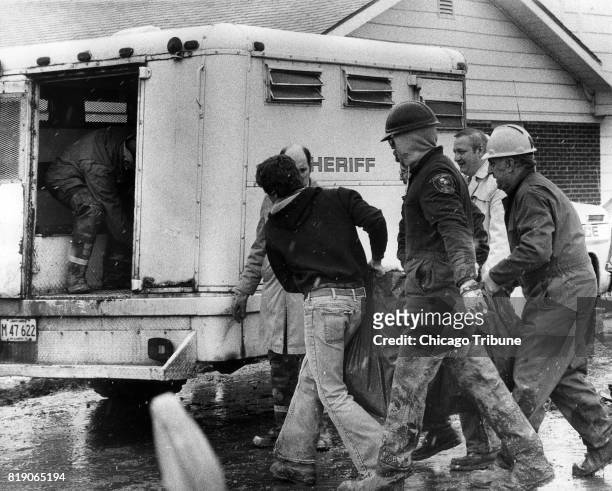
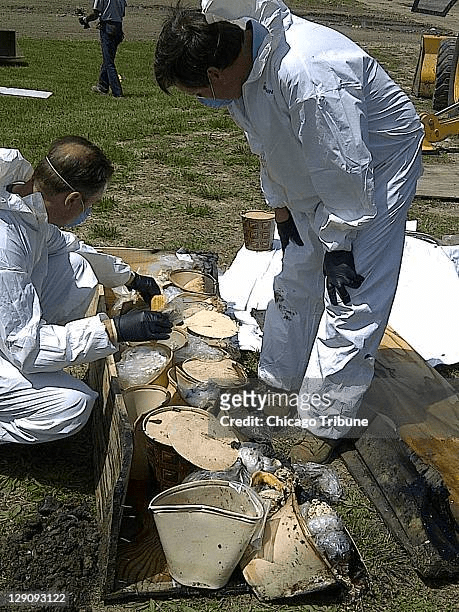
Investigators at the site where two students found the remains of Laura Ann Aime. Photo courtesy of OddStops.
Investigators at the site where two students found the remains of Laura Ann Aime. Photo courtesy of ‘Ted Bundy: I was trying to Think like an Elk.’
Investigators at American Fork Canyon carrying out the remains of Laura Aime.
A labeled aerial map of the dump site of Laura Aime in American Fork Canyon. The yellow line shows the trail the students took when they found her remains. Photo courtesy of OddStops.
A labeled map of where Robinson Park is located compared to the dump site of Laura Aime in American Fork Canyon.
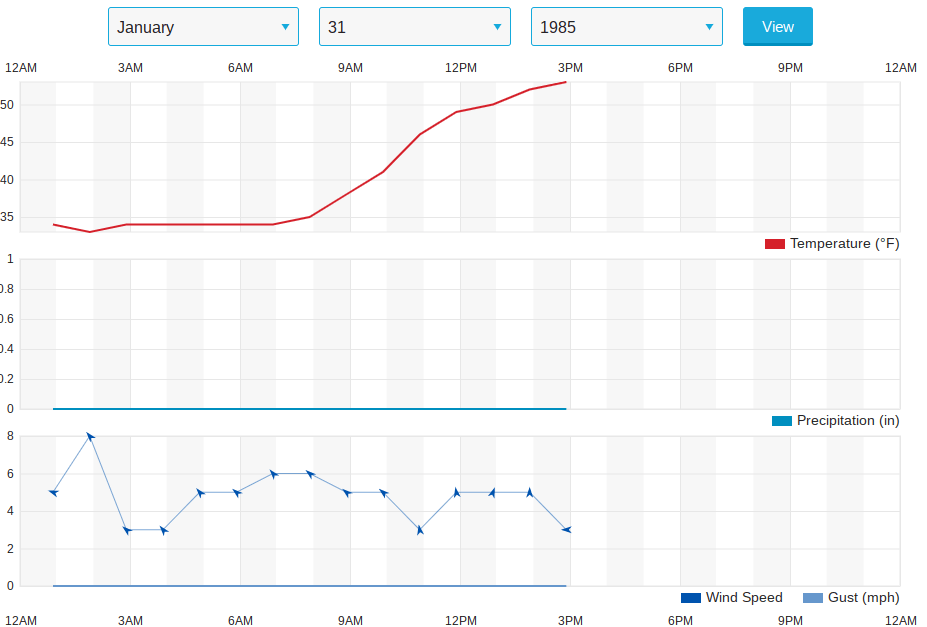
A chart of the average temperatures in SLC in November 1974 when Laura was missing and possibly being kept alive somewhere.
Aime’s gravesite at the Fairview Cemetery in Utah.
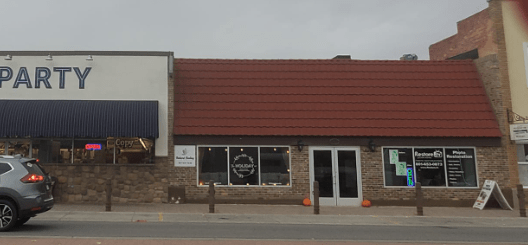
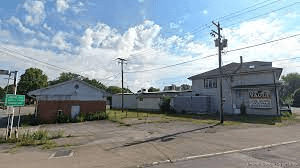
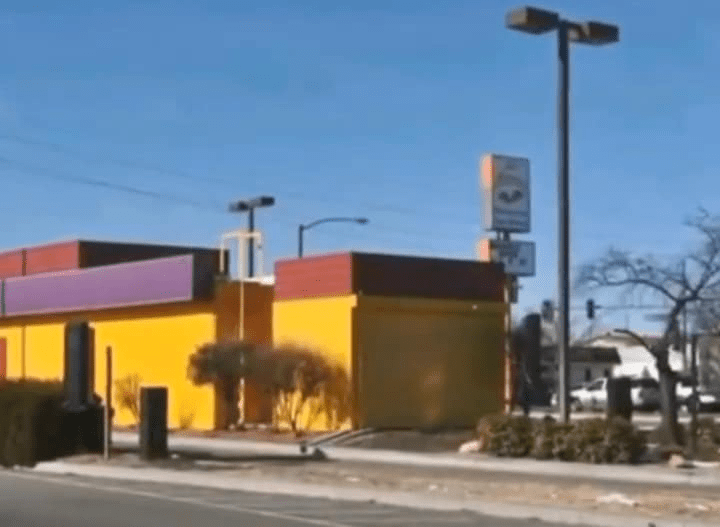
Where ‘The Knotty Pine’ once stood in Lehi, UT, in the left hand side of the building. Picture taken in November 2022.
Where ‘The Knotty Pine’ once stood in Lehi, UT. Picture taken in November 2022.
Laura walked down this street the night she disappeared to go to the Knotty Pine. Photo courtesy of Captain Borax.
An old advertisement for the Knotty Pine Cafe. Photo courtesy of Captain Borax.
William S. Robinson Park in American Fork, Utah. Picture taken in November 2022.
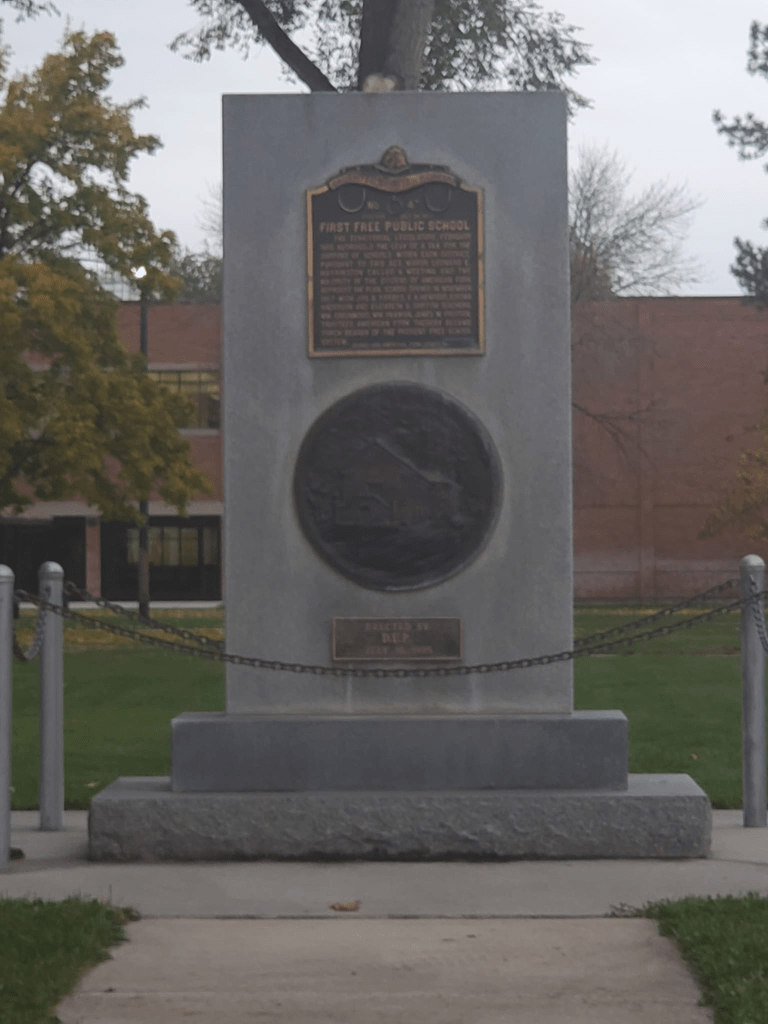
A statue at William S. Robinson Park in American Fork, Utah. Picture taken in November 2022.
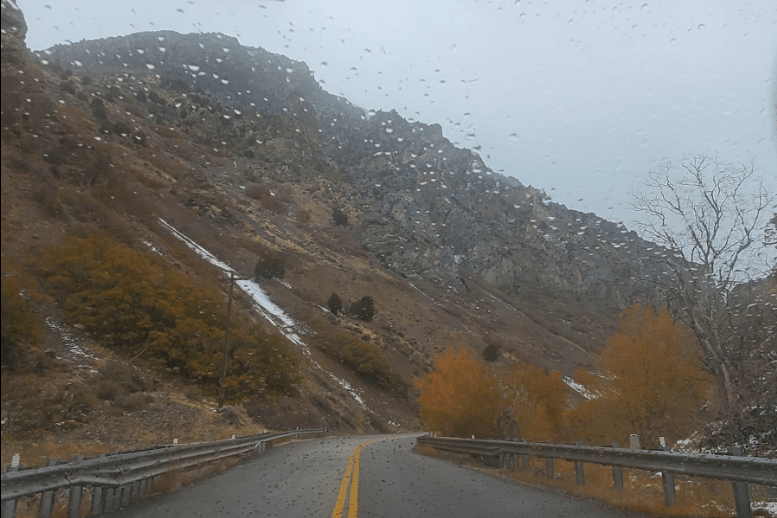
The entrance the American Fork Canyon. Picture taken in November 2022.
A building at the entrance the American Fork Canyon. Picture taken in November 2022.
A gate at the entrance the American Fork Canyon. Picture taken in November 2022.
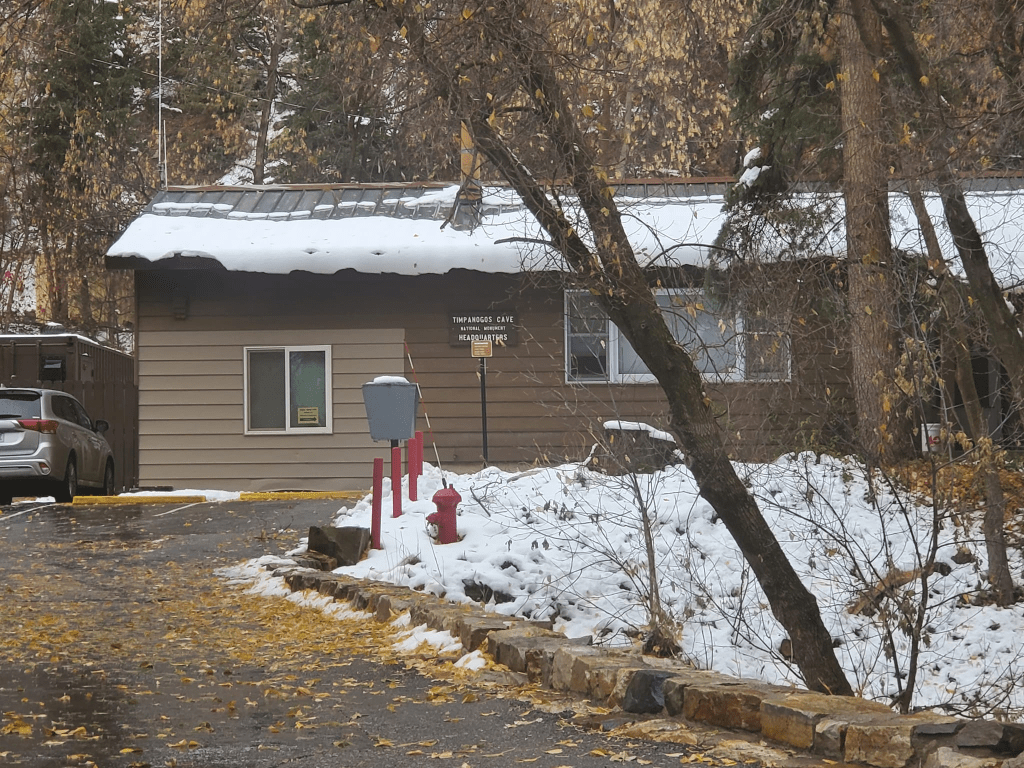
A sign for the Timpanogos Cave at the entrance the American Fork Canyon. Picture taken in November 2022.
A sign for the Uinta National Forest at the entrance the American Fork Canyon. Picture taken in November 2022.
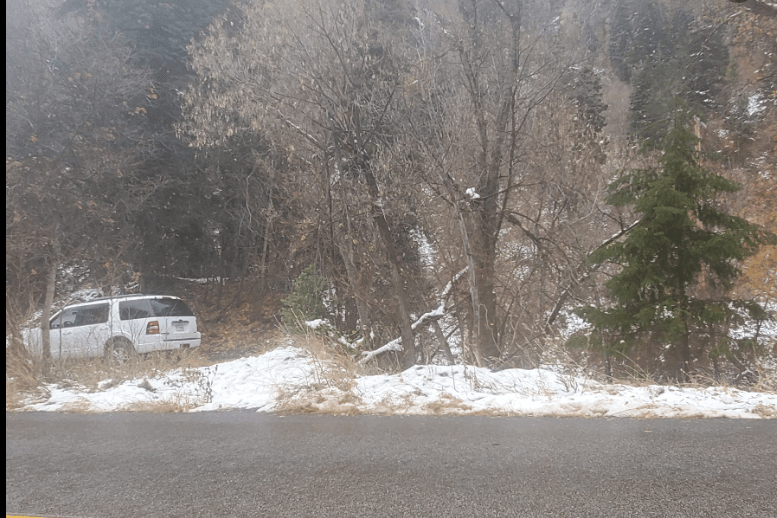
This white SUV is where the PD coordinates took me from the OddStops website.
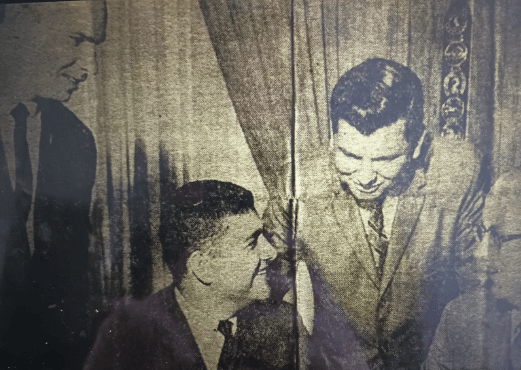
Former Utah County Attorney, Noall T. Wootton. Photo courtesy of Captain Borax.
An article about an antler contest that Mr. Aime won, published by The Pyramid on November 8, 1968.
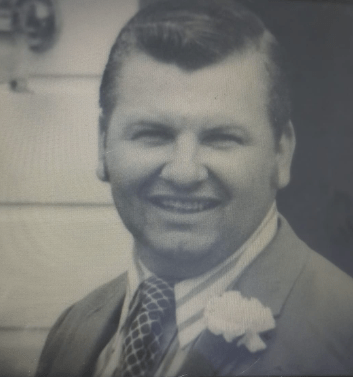
A picture of Mr. Aime with his award winning buck. Photo courtesy of Captain Borax.
An newspaper blurb mentioning some of the Aime sisters, published by The Pyramid on September 9, 1971.
A newspaper blurb mentioning some of the Aime girls, published by The Pyramid on June 8, 1972.
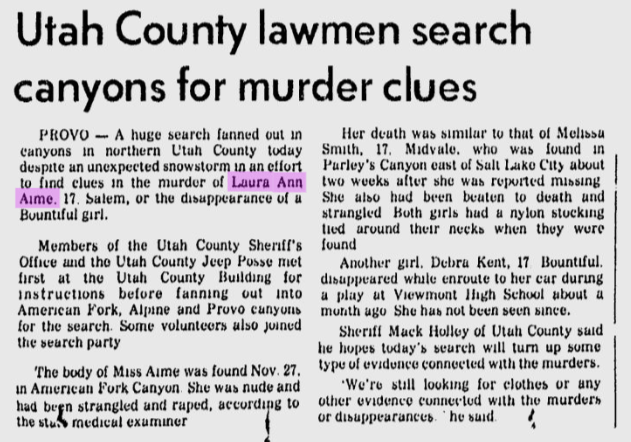
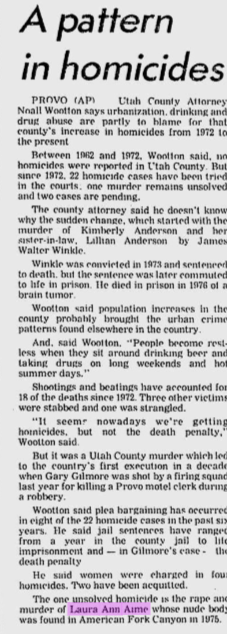
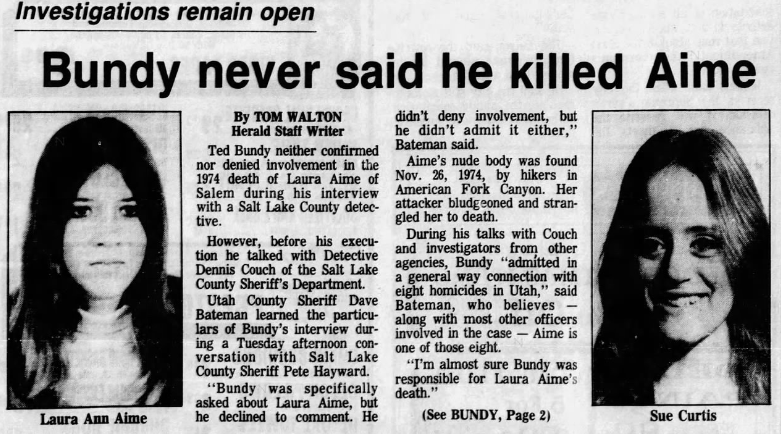
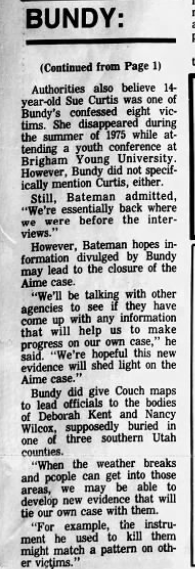
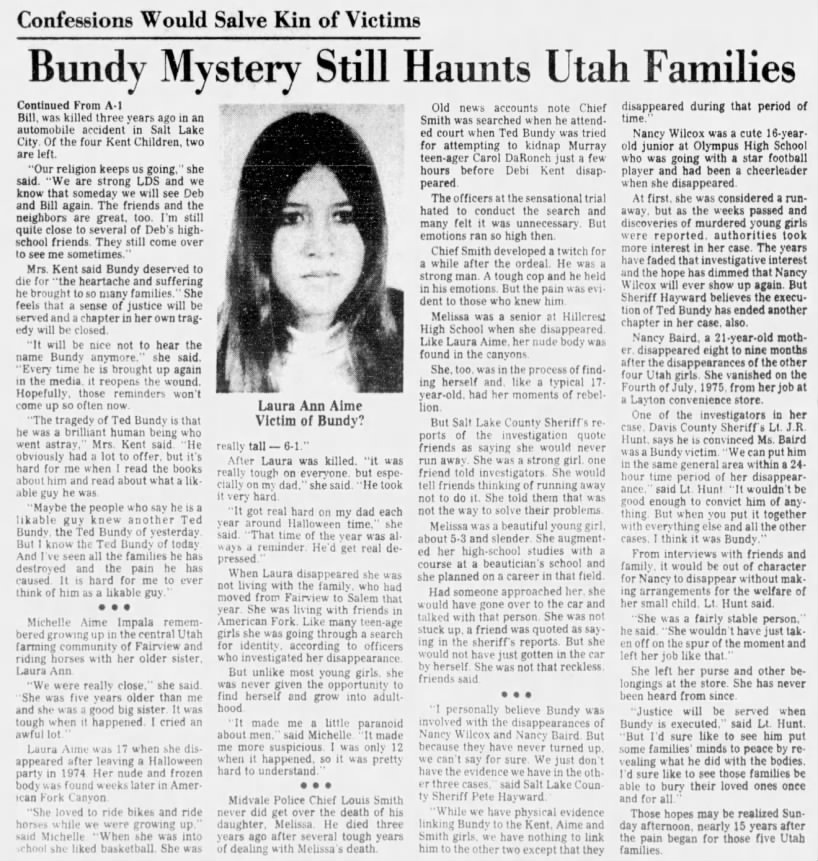
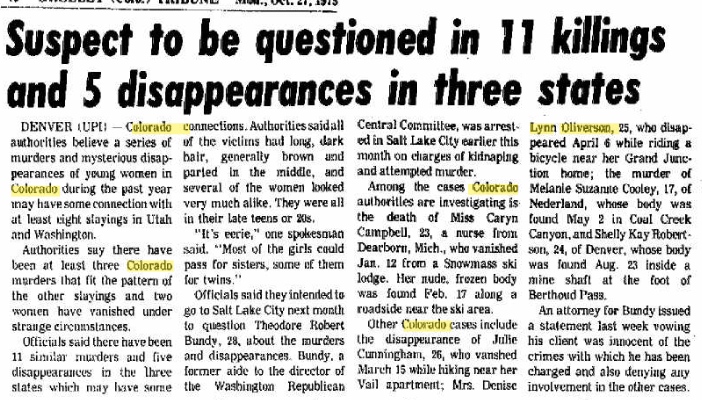
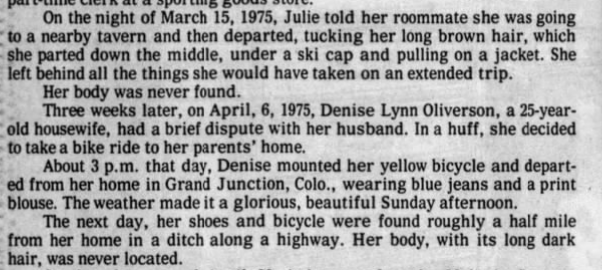
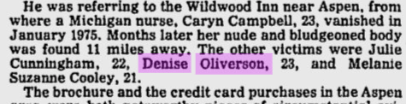
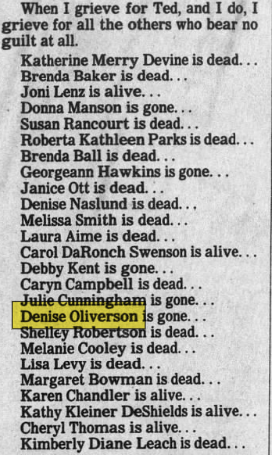
An article about the murder of Laura Aime.
An undated article about the murder of Laura Aime.
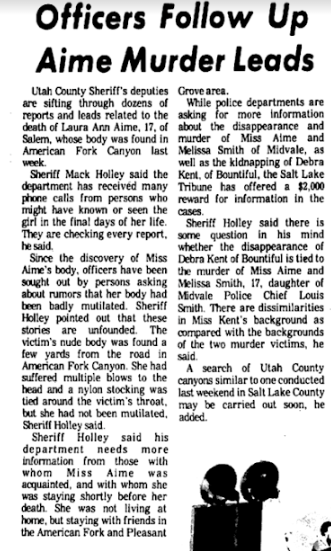
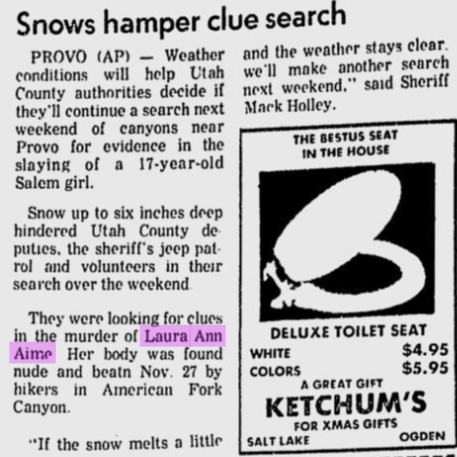
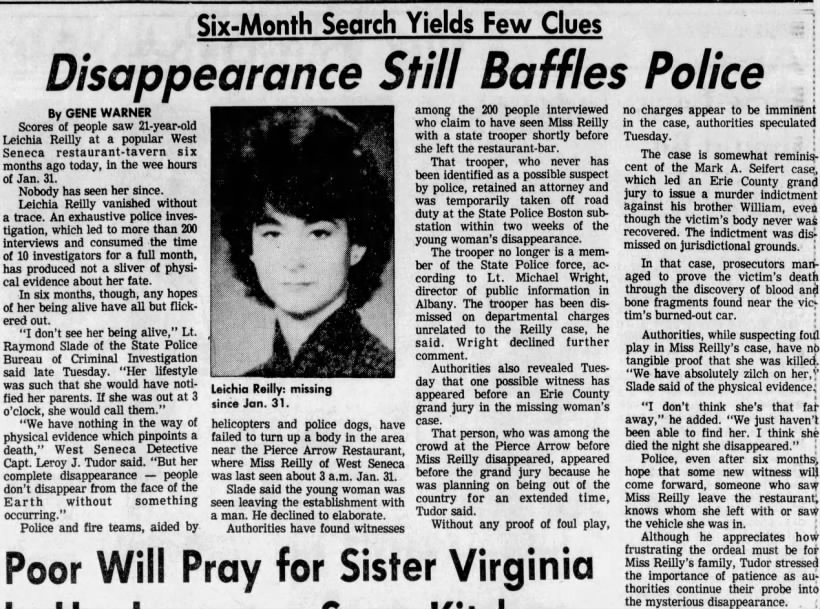
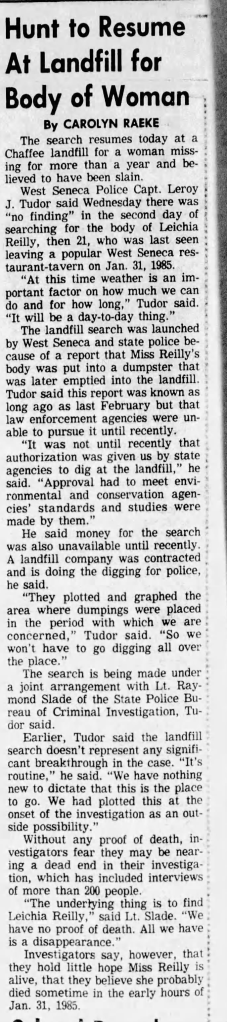
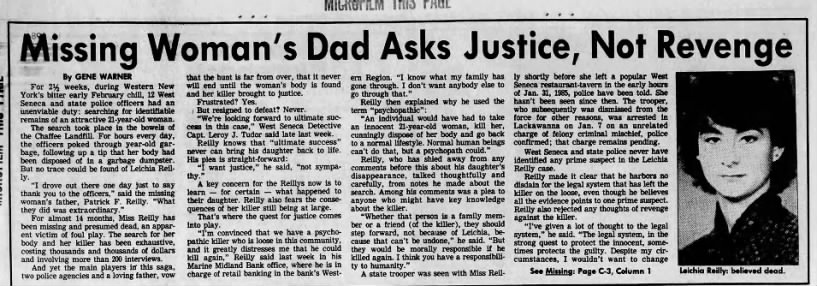
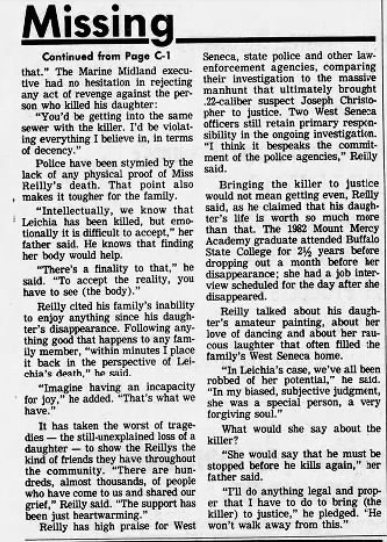
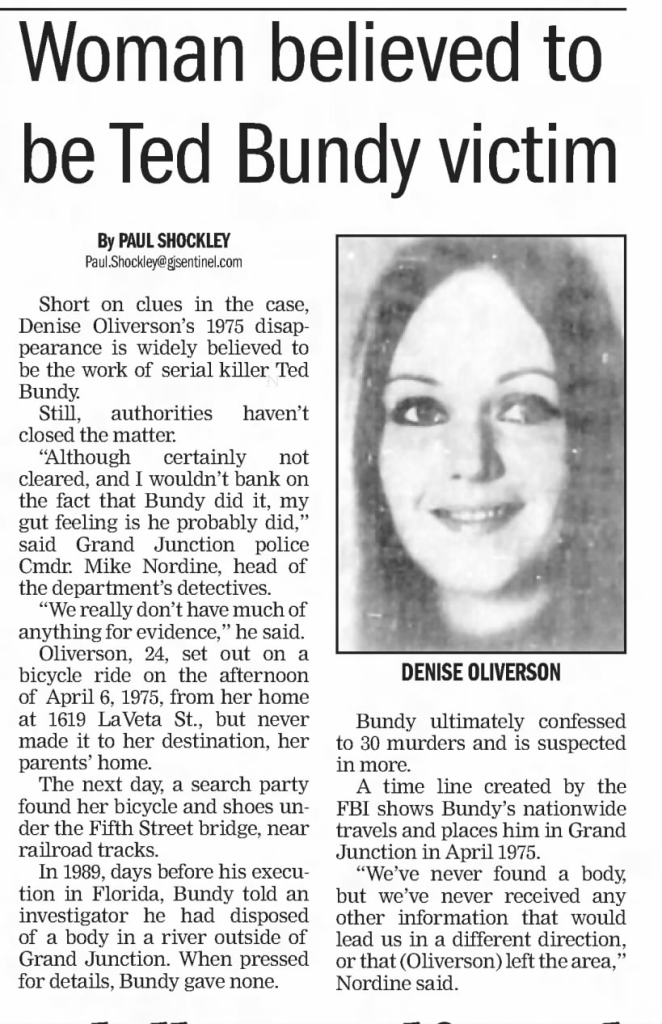
An undated article about the disappearance of Laura Aime.
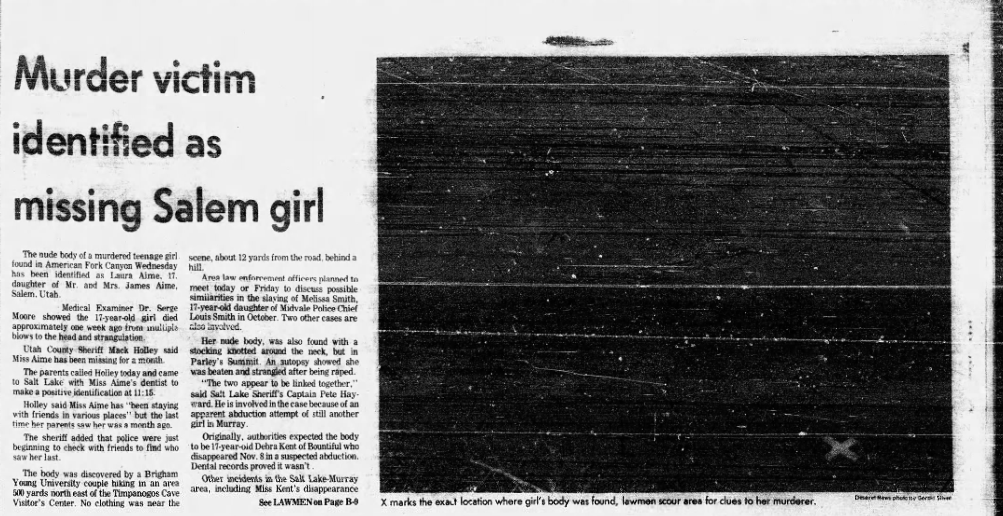
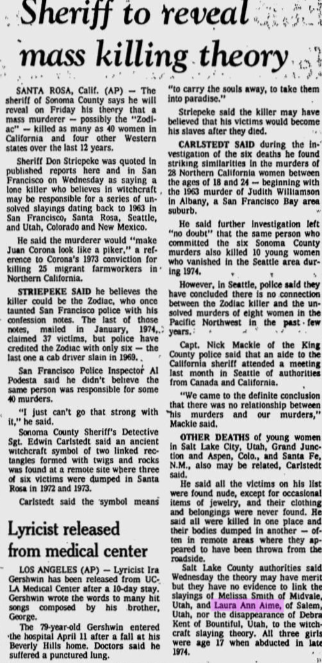
Part one of an article on Aime published by The Deseret News on November 28, 1974.
Part two of an article on Aime published by The Deseret News on November 28, 1974.
An article on Aime published by The Idaho Statesman on November 29, 1974.
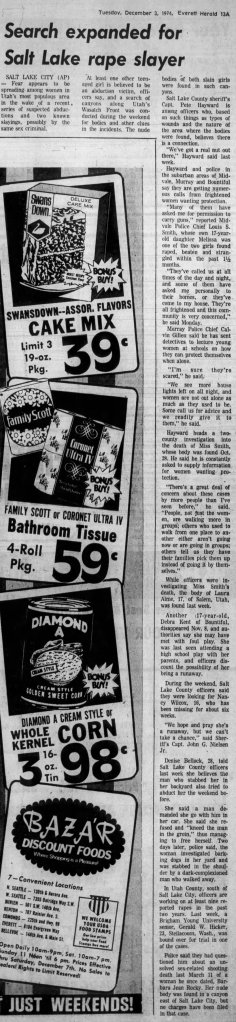
An article about the disappearance of Laura Aime published by The Daily Herald on November 29, 1974.
Part one of an article about the disappearance of Laura Aime published by The Daily Herald on November 29, 1974.
Part two of an article about the disappearance of Laura Aime published by The Daily Herald on November 29, 1974.
An article about Bundy mentioning Laura Aime published by The Daily Sitka Sentinel on November 29, 1974.
An article about the disappearance of Laura Aime published by The Deseret News on November 30, 1974.
An article about Laura Aime published by The Daily Herald on December 1, 1974.
An article about Laura Aime published by The Daily Herald on December 3, 1974.
An article about Laura Aime published by The Spanish Pyramid on December 5, 1974.
An article about the disappearance of Laura Aime published by The Deseret News on December 7, 1974.
An article about Aime published by The Deseret News on December 9, 1974.
An article about Aime published by The Deseret News on February 7, 1975.
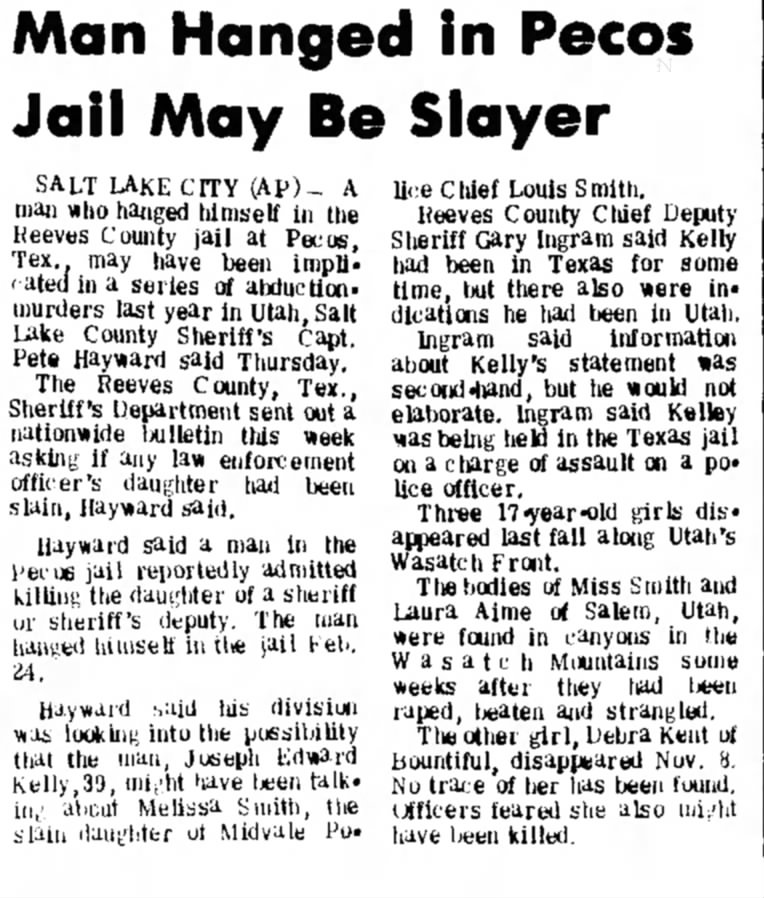
An article about Aime published by The Del Rio News Herald on March 14, 1975.
An article about Aime published by The Salt Lake Tribune on March 15, 1975.
An article about Aime published by The Daily Herald on March 21, 1975.
An article mentioning Aime published by The Eugene Register-Guard on April 24, 1975.
An article mentioning Aime published by The Bulletin on October 3, 1975.
An article mentioning Aime published by The Spokesman-Review on October 3, 1975.
An article mentioning Aime published by The Fairbanks Daily News-Miner on October 4, 1975.
An article about Bundy mentioning Laura Aime published by The Spokane Chronicle on October 22, 1975.
An article about Bundy mentioning Laura Aime published by The Kitsap Sun on October 31, 1975.
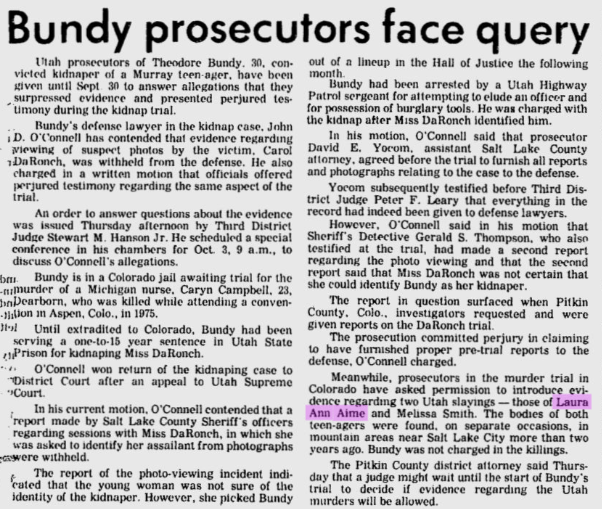
An article about Bundy being freed on bail that mentions Laura Aime published by The Ogden Standard-Examiner on November 21, 1975.
An article about Bundy mentioning Laura Aime published by The Daily Herald on November 21, 1975.
An article about Bundy mentioning Laura Aime published by The Spokesman-Review on March 4, 1976.
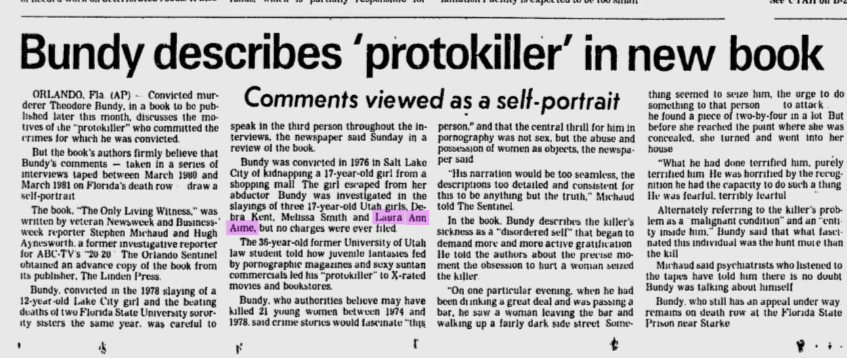
An article about Bundy mentioning Laura Aime published by The Deseret News on September 9, 1977.
An article about Bundy mentioning Laura Aime published by The Deseret News on December 16, 1977.
An article mentioning Aime published by The Deseret News on April 3, 1978.
An article mentioning Aime published by The Evening Independent on July 25, 1979.
An article mentioning Aime published by The Deseret News on February 14, 1983.
Part one of an article mentioning Aime published before Bundy was executed by The Daily Herald on January 5, 1989.
Part two of an article mentioning Aime published before Bundy was executed by The Daily Herald on January 5, 1989.
An article mentioning Laura Aime published just before Bundy was executed on January 22, 1989.
An article mentioning Laura Aime after Bundy was executed published by The Deseret News Tribune on February 28, 1989.
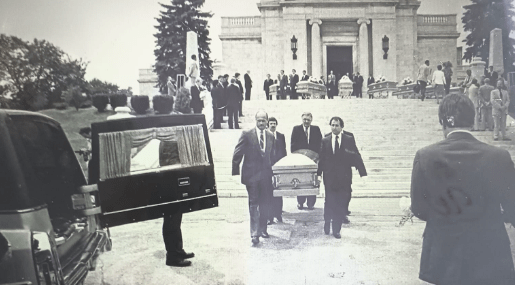
A funeral card for Aime. Courtesy of Captain Borax.
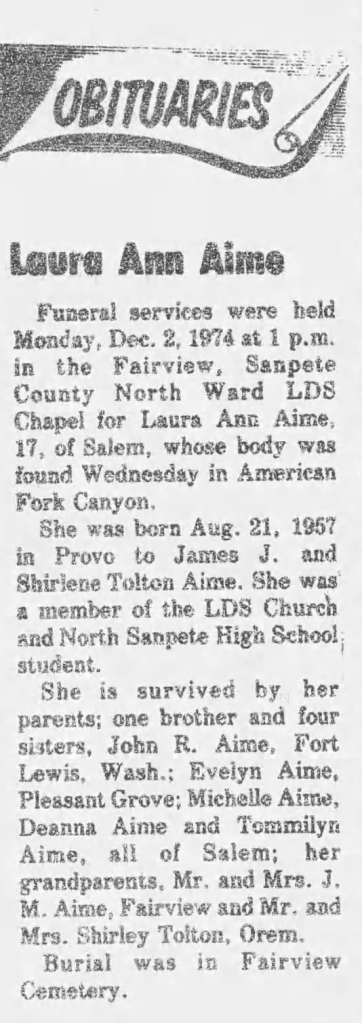
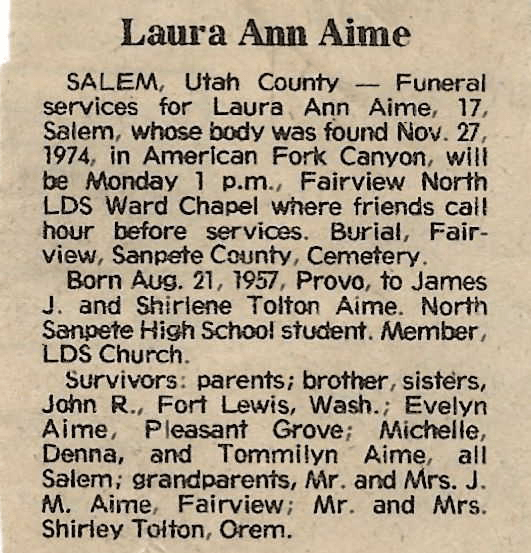
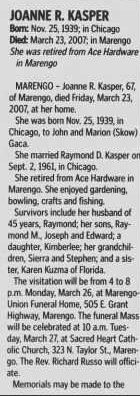
Laura Aime’s obituary published by The Daily Tribune on December 1, 1974.
Laura Aime’s obituary published by The Spanish Fork Press on December 4, 1974.
Another obituary for Aime.
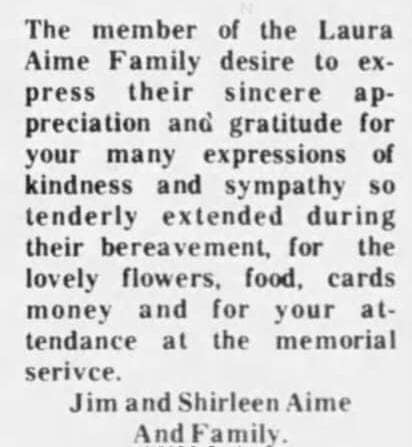
A thank you to the local community from the Aime family regarding their kindness surrounding Laura being killed published by The Pyramid on December 26, 1974.
Page one of Laura Aime’s autopsy report. Document courtesy of Erin Banks/CrimePiper.
Page two of Laura Aime’s autopsy report. Document courtesy of Erin Banks/CrimePiper.
Page three of Laura Aime’s autopsy report. Document courtesy of Erin Banks/CrimePiper.
Page four of Laura Aime’s autopsy report. Document courtesy of Erin Banks/CrimePiper.
Page five of Laura Aime’s autopsy report. Document courtesy of Erin Banks/CrimePiper.
Page six of Laura Aime’s autopsy report. Document courtesy of Erin Banks/CrimePiper.
Page seven of Laura Aime’s autopsy report. Document courtesy of Erin Banks/CrimePiper.
Page eight of Laura Aime’s autopsy report. Document courtesy of Erin Banks/CrimePiper.
Page nine of Laura Aime’s autopsy report. Document courtesy of Erin Banks/CrimePiper.
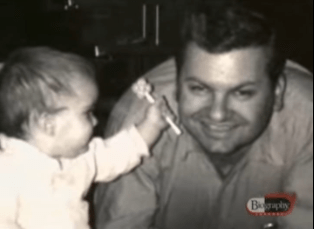
James and his sister, Evelyn Aime.
James and Shirlene Aime’s application for a marriage license.
James and Shirlene’s marriage certificate.
James and Shirlene Aime’s marriage certificate.
A newspaper blurb about a domestic incident featuring the Aime’s published by The Daily Herald on April 29, 1966.
James Aime’s WWII registration card.
The second part of James Aime’s WWII registration card.
John Aime.
John Aime.
Mrs. Aime and her family when she was a kid.
Mrs. Aime. Photo courtesy of Ancestry.
Shirlene Aime (left). Photo courtesy of Ancestry.
Evelyn Aime from the 1977 American Fork High School yearbook.
Michelle Aime from the 1977 American Fork High School yearbook.
Michelle Aime from the 1978 American Fork High School yearbook.
An article about Laura’s brother published by The News Tribune on May 1, 1977.
An article about Laura’s brother published by The News Tribune on June 17, 1977.
An article mentioning Aime published by The Orem-Geneva Times on August 7, 1980.
A notice about Mrs. Aime adopting her granddaughter published in The Orem-Geneva Times on August 21, 1980.
Mrs. Aime with the granddaughter she adopted, Danika.
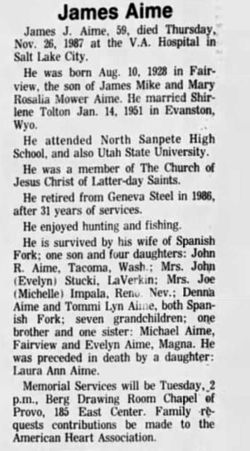
James Aime’s obituary published in The Daily Herald on November 29, 1987.
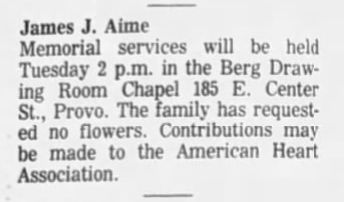
A note about James Aime’s memorial service published in The Daily Herald on November 29, 1987.
A screenshot of Evelyn Aime from an interview she did with Captain Borax, whose real name is Chris Mortenson. I keep calling him Captain Borax as if its the name his parents gave him that’s listed on his birth certificate.
Marin Beverige.
A screenshot of Sheriff Mack Holley’s published memoirs, ‘From the Journal of Sheriff Mack Holley, Utah County Sheriff’s Department Events, 1960 to 1985, BYU Basketball, Football, Personal Observations,’ published on January 1, 1986.

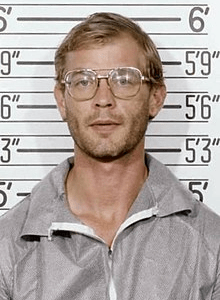
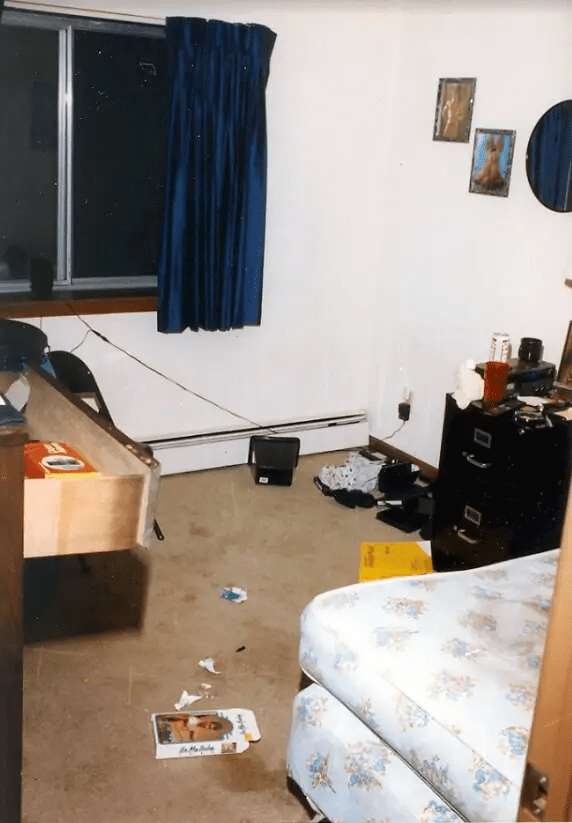
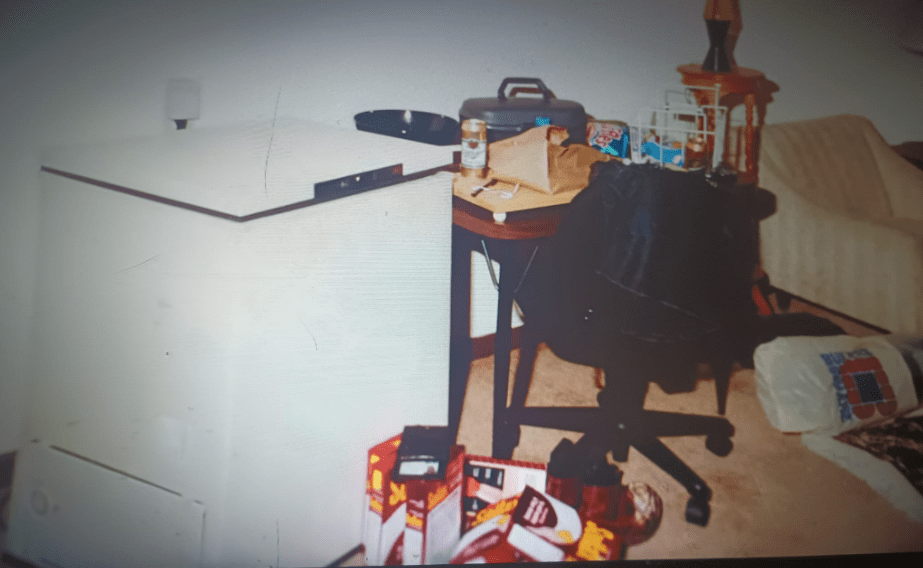
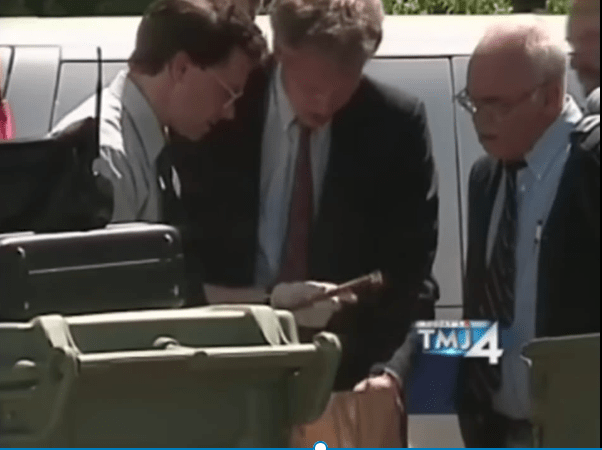
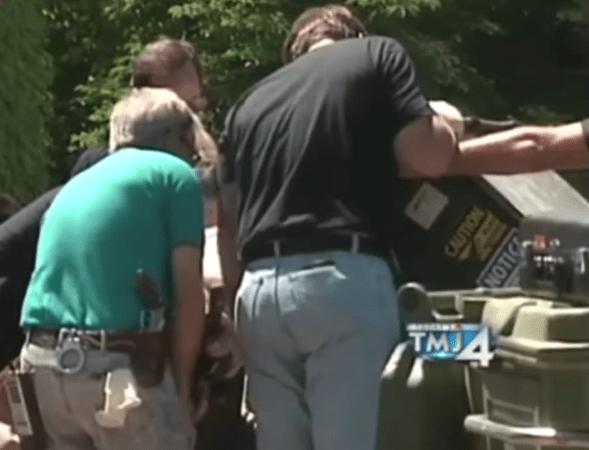
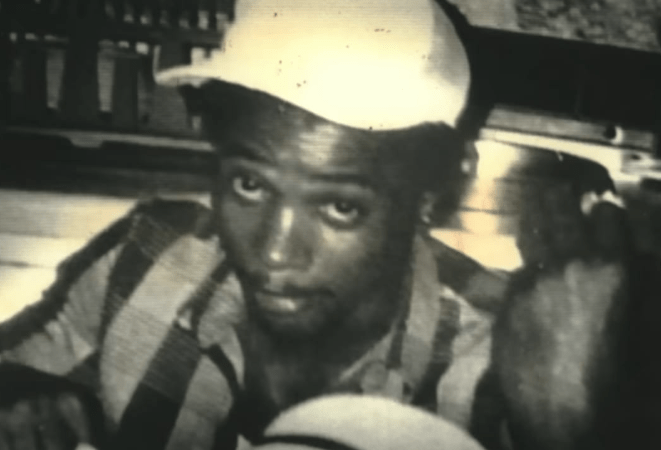
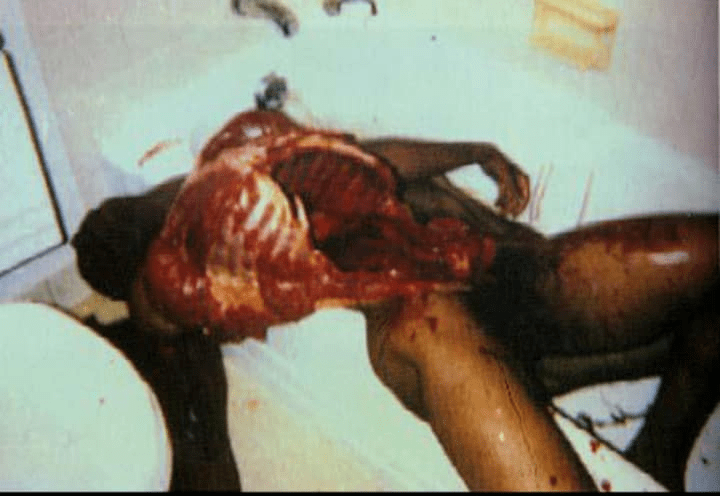
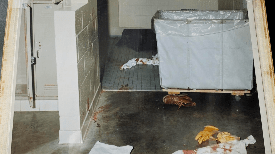
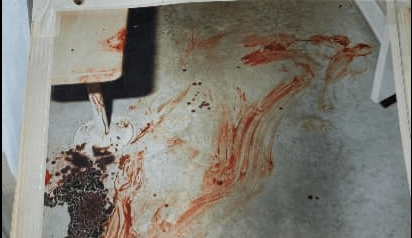
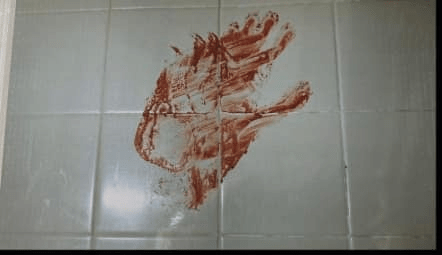
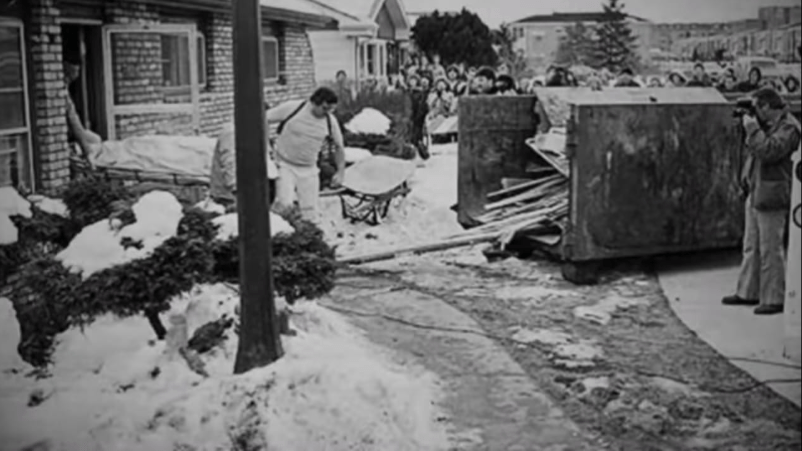
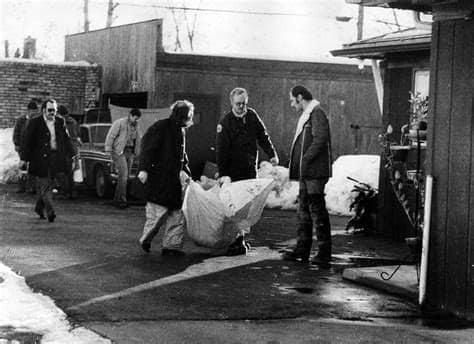
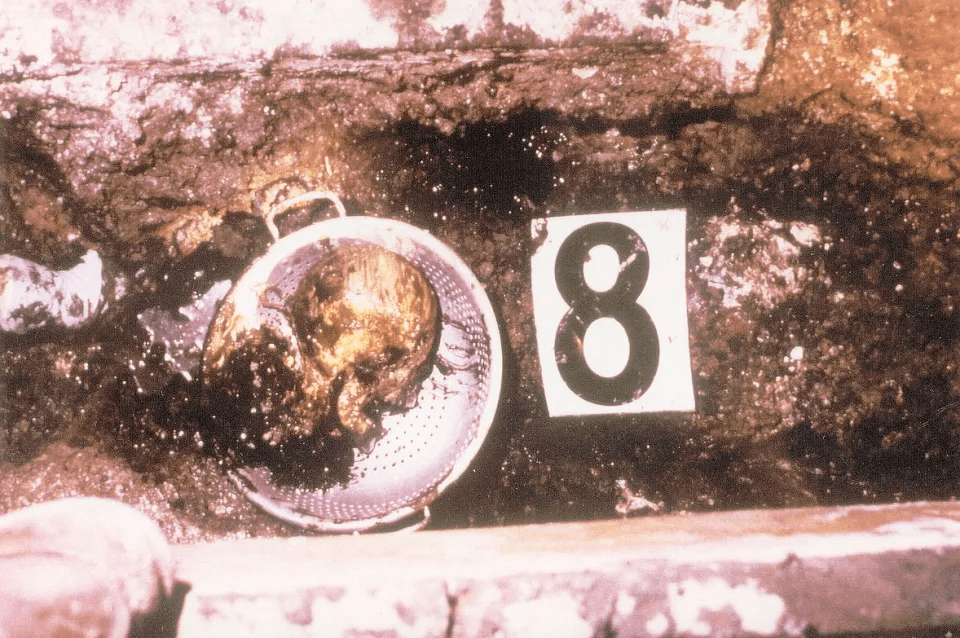
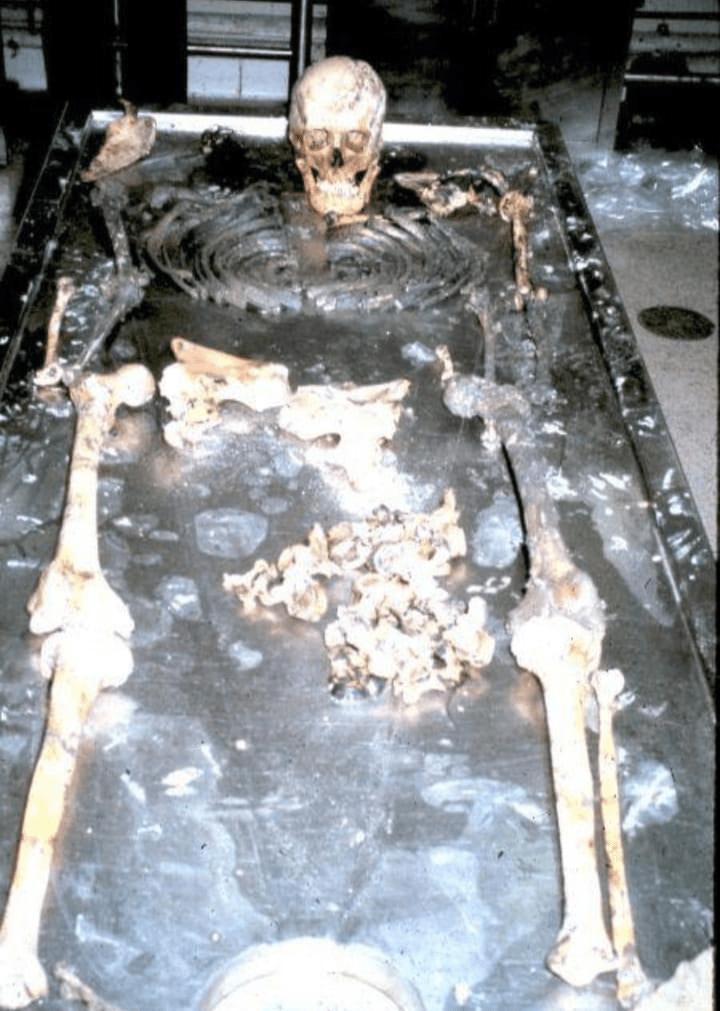
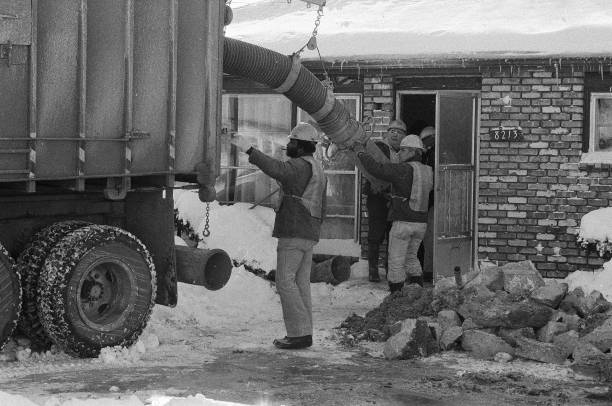
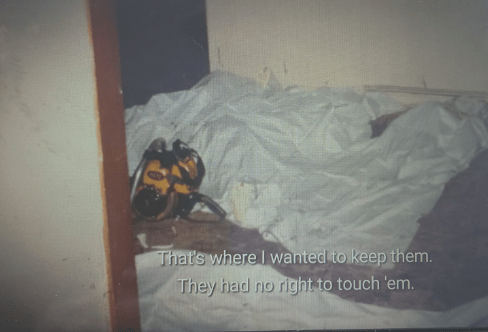
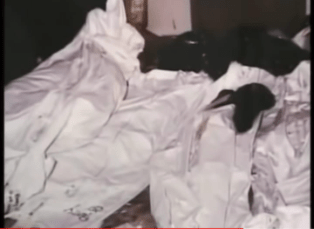
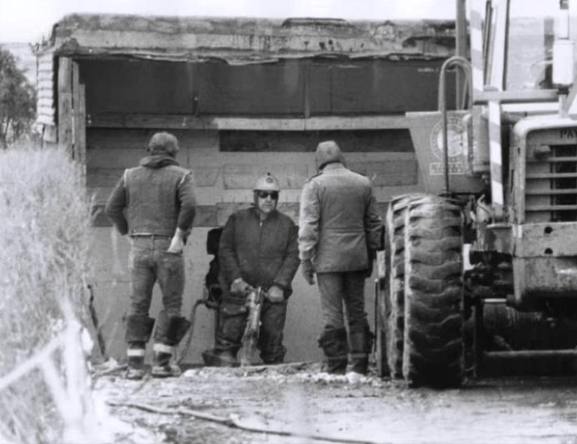
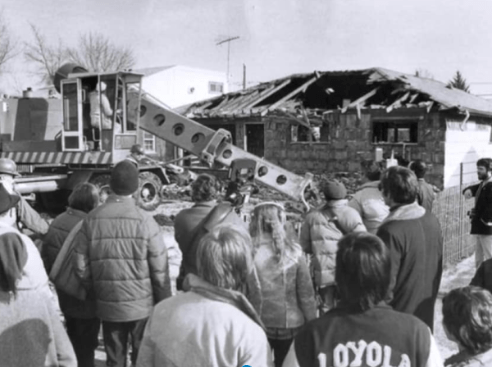
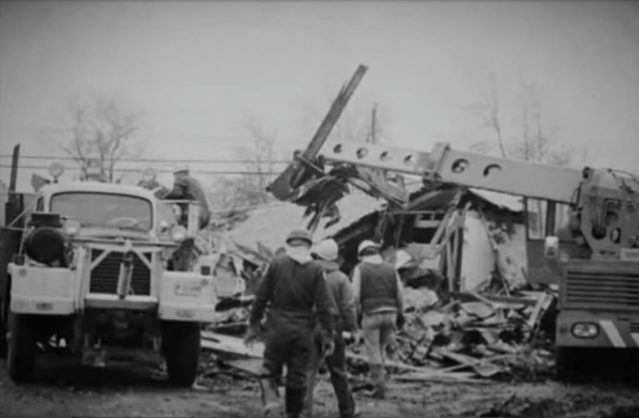
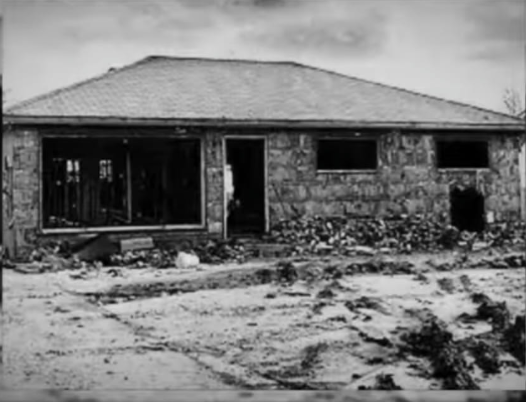
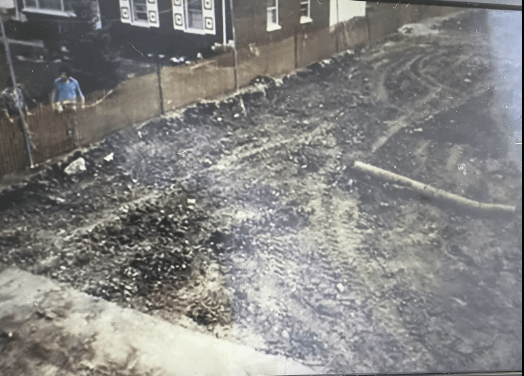
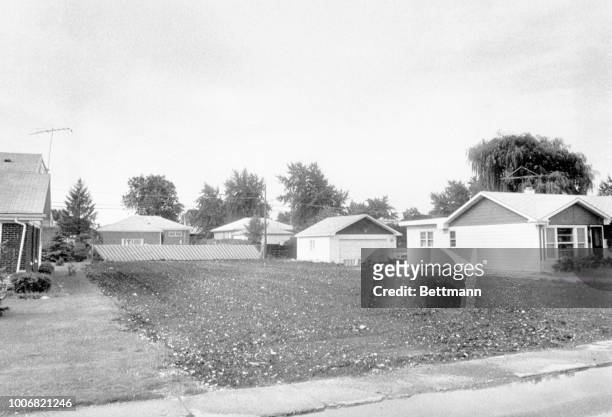
Jeffrey Lionel Dahmer: Crime Scene Pictures.

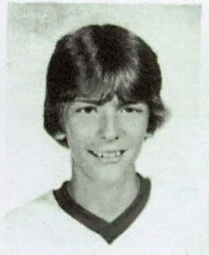
Jeffrey Lionel Dahmer was born on May 21, 1960 to Lionel and Joyce Dahmer in Milwaukee, Wisconsin; he was the oldest of two boys, and had a little brother named David (born on December 18, 1966). Joyce was born on February 7, 1936 in Columbus, Wisconsin and Lionel was born on July 29, 1936 in Milwaukee. In Jeffrey’s younger years his father was a chemistry student at Marquette University, and he later worked as a research scientist; Joyce was a teletype machine instructor. It’s been reported that Mrs. Dahmer was a hypochondriac that was often greedy for attention, and multiple sources have claimed that Jeffrey was deprived of attention as an infant due to her intense struggle with mental illness and depressionOthers however, suggest that he was generally adored and doted on throughout his entire childhood by both of his parents.

As little Jeffrey grew into toddlerhood his mother was beginning to spend more and more time in bed, and by the time he was in first grade his father was mostly absent, as he was away at school. One time Joyce attempted suicide by taking too much of one of her medications called Equanil, which is prescribed to help treat symptoms of anxiety and nervousness. As an adult Jeff said that from a very young age he was ‘unsure of the solidity of the family,’ and that he recalled a large amount of tension in the family home, as well as many fights between his parents in his formative years.

In his early years, Dahmer was a normal, ‘energetic, and happy child,’ but he became visibly subdued after having a double hernia surgery right before his fourth birthday. While in elementary school, little Jeffrey was a timid, quiet child that had few friends, and one of his teachers remembered seeing early signs of abandonment due to Mr. Dahmer’s glaring absence (as well as his mother’s severe mental health issues). It didn’t help that Joyce’s condition got even worse when she became pregnant with David, and after his brother was born Jeff became even more withdrawn, and the family’s fairly-frequent moves didn’t help him establish roots either. The same year David was born Mr. Dahmer graduated from college and got a job as an analytical chemist in Akron, Ohio.

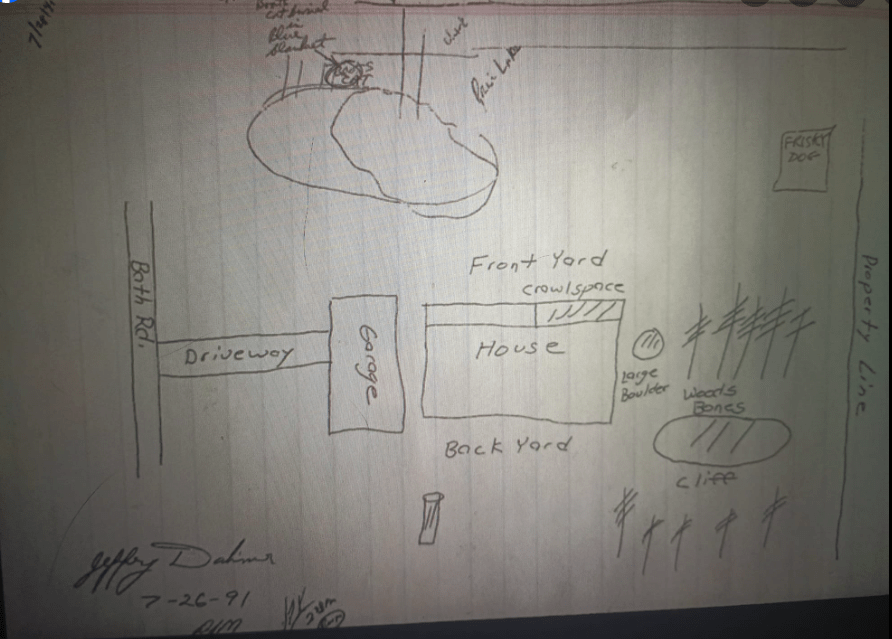
From a young age, Jeff was interested in studying and preserving animal bones, and learned how to clean and preserve them. His fascination may have started at the age of four, when he saw his dad removing animal bones from beneath the family home. According to Lionel, his son was ‘oddly thrilled’ by the sound they made and became preoccupied with bones, initially calling them his ‘fiddlesticks.’ On occasion Jeff would search underneath and around his family home looking for more animal bones, and would often explore the bodies of living creatures to help map out where certain ones were located. In May of 1968 the Dahmer’s moved to Bath Township in Ohio, which was the family’s third house in only two years. The residence stood on one and a half acres of thick trees and woods, complete with a small hut that was only a short jaunt from the home.

During dinner two years after his interest in bones began Jeff asked his dad what would happen if the bones from the chicken they were eating were placed in bleach. Lionel was pleased with what he thought at the time was scientific curiosity, and showed him how to preserve animal bones using bleach, and Jeffrey started incorporating these preservation skills into his collecting techniques. Later that same year, Joyce started taking more than the prescribed daily dose of her sleeping meds, laxatives, and Equanil, which only further alienated her family. Dahmer also started collecting the remains of dead animals (including roadkill), which he would then dissect and bury next to the hut on the family’s property, and on occasion he would place the skull on top of homemade crosses. According to one of Dahmer’s few friends, he shared with them that he was curious as to how animals ‘fit together,’ and on one occasion in 1975 he beheaded the carcass of a dog he found (just by chance) before he nailed its body to a tree then impaled its skull on a stick behind his house. Then later, as a ‘prank,’ he later invited a friend to look at what he did.

As a young child Jeffrey collected large insects, as well as the skulls of small animals that he expertly preserved in formaldehyde. In October of 1966 the Dahmer’s moved to Doylestown, Ohio and as a teenager Jeff was incredibly disengaged with his peers, and didn’t have very many friends. In later interviews he said that his strong interest in murder and necrophilia began around the age of fourteen, and it seems it was the end of his parents’ marriage and their bitter divorce that helped make him turn his desires into actions. Immediately beginning in his freshman year at Revere High School, Dahmer was seen as an outcast, and had started drinking beer and hard liquor at the age of fourteen, oftentimes concealing his booze inside his coat. When a school mate asked why he was drinking scotch during an early morning history class, he just shrugged his shoulders and told him the alcohol was his ‘medicine.’ Despite being mostly quiet and unwilling to communicate, during Jeffrey’s freshman year he was seen as polite and highly intelligent by teachers even though he earned only average grades. Fun Serial Killer Fact #1: during his time in secondary school he played competitive tennis and briefly played in the band.

By the time he reached puberty, Jeff realized he was homosexual, a fact he initially attempted to hide from his parents. During his early teen years he had a short relationship with another boy around his age (although the two never engaged in sexual intercourse). By Jeff’s own admission he had started fantasizing about controlling and dominating a completely submissive male partner in his early to mid-teens, and his masturbatory fantasies slowly evolved to him focusing on chests and torsos, which became interwoven with the idea of human dissection. Around the age of sixteen Jeff developed a fantasy of rendering unconscious a male jogger that he found attractive then making sexual use of his body. He even made an attempt to hide in some bushes with a baseball bat in an attempt to kidnap the man, but (lucky for him) he didn’t happen to pass by that particular day. After his arrest Jeff later admitted that this was his first actual attempt to attack a victim.

Even though he was mostly seen as quiet, Dahmer was considered by his peers and teachers to be a class clown that frequently staged pranks, which earned him a catch phrase: ‘doing a Dahmer.’ These ‘pranks’ included ‘bleating’ and faking epileptic seizures or cerebral palsy at both school and local stores, and on occasion he would perform these antics for cash so that he could buy alcohol. By 1977 Dahmer’s grades had plummeted and his concerned parents hired him a private tutor; this resulted in only limited success. In that same year in a desperate attempt to save their marriage, Lionel and Joyce started marriage counseling, but despite this they continued to fight constantly. When Mr. Dahmer discovered his wife had participated in a short affair in September 1977, they finally decided to divorce, telling both of their sons that they wished to do so ‘amicably.’ Lionel moved out of the family home in early 1978, and despite the best of intentions the process of their separating quickly became increasingly hateful and acrimonious.

By the time of Dahmer’s first murder at the age of eighteen his alcohol consumption had completely spun out of control. A few weeks before he graduated one of his teachers observed him sitting by the school parking lot, drinking several beers. When they threatened to report him, Jeff told them he was experiencing ‘a lot of problems’ at home and that the school’s guidance counselor was aware of them. That spring, Joyce (breaking a court order) moved out of the family home with David and relocated to Chippewa Falls, to stay with family (without informing her ex-husband); Jeff had just turned eighteen and stayed behind. His parents’ divorce was finalized on July 24, 1978, and Mrs. Dahmer was awarded custody of their younger son as well as alimony.

Jeffrey committed his first murder three weeks after he graduated from high school on June 18, 1978: eighteen-year-old hitchhiker, Steven Hicks. He lured the young man (who had been hitchhiking to a rock concert at Chippewa Lake Park) to his house with the promise of ‘a few beers,’ and according to Jeff the sight of the bare-chested young man pulled at his deepest, darkest sexual desires. Unfortunately when the young man began talking about women he immediately knew that any passes he made would be rejected, and after several hours of chatting he told Jeffrey that he ‘wanted to leave.’ Now, this was the exact opposite of what he wanted to hear, so he bludgeoned Hicks to death with a 10-pound dumbbell. Dahmer later confessed that he hit his victim from behind twice as he was sitting in a chair, and when he quickly was rendered unconscious, strangled him to death with the bar of the dumbbell. He then took the young man’s clothes off before he ran his hands along his chest then stood over his remains and masturbated. A few hours after the murder Jeff dragged the remains to his basement, and the following day dissected his body; he later buried it in a shallow grave in his backyard. Several weeks later Dahmer dug up Hick’s corpse and stripped the flesh off his bones then dissolved it in acid before flushing the solution down the toilet. He crushed the bones with a sledgehammer then scattered them in the woods behind his home, and tossed Hicks’ necklace as well as the knife he used to dismember him off of the West Bath Road bridge and into the Cuyahoga River. Six weeks after this murder Lionel (along with his new fiancé) stopped by his former home, where they found Jeff living by himself.

After graduating from high school in August 1978 Dahmer went on to attend Ohio State University, where he planned on majoring in business but dropped out after only one quarter. He failed the majority of his courses, including Classical Civilizations, Administrative Science, and Introduction to Anthropology; the only class he did well in was Riflery, where he earned a B−. At the end of his only attempt at higher learning his GPA was a 0.45. On one occasion Lionel surprised his son with a visit only to find his dorm room a mess and was filled with empty liquor bottles. Despite the fact that he paid for two terms in advance, Jeff dropped out of school after just three months, and with no real plans for his life Mr. Dahmer insisted that his son join the military, and he enlisted in the Army in late December 1978 (I’ve also seen it listed as January 1979).

Dahmer was sent to basic training at Fort McClellan in Anniston, Alabama before beginning his training as a medical specialist at Fort Sam Houston in San Antonio, TX. On one occasion he was reprimanded for being drunk while stationed in Fort Sam Houston, which resulted in his entire platoon being punished, earning him a brutal beating from his fellow recruits. After training was completed Dahmer was sent to Baumholder, West Germany on July 13, 1979 and he served as a combat medic in the 2nd Battalion, 68th Armored Regiment, 8th Infantry Division. Reportedly during Jeff’s first year of military service he was an average or slightly above average’ soldier, and it’s speculated that his worsening alcohol abuse affected his performance and he was deemed to be ‘unsuitable for military service’ and in March 1981 he was discharged from the Army. Because Dahmer’s superior officers didn’t feel that any of the issues he had in the military would be applicable to civilian life, he received an honorable discharge.

On March 24, 1981 Jeffrey was sent to Fort Jackson, South Carolina for a military debriefing and afterwards was given a plane ticket for anywhere in the country. He chose Miami Beach in Florida because he was ‘tired of the cold’ and wanted to see if he could make it completely on his own. Dahmer also told investigators during his confession that he felt like he couldn’t go home to face his dad. While in Florida, Jeff found employment at a sandwich shop, and spent most of his money on booze. He was quickly evicted from the motel he was staying due to non-payment, and at first he spent his nights on the beach as he kept working at the delicatessen but he eventually reached out to Lionel in September and asked if he could come back to Ohio.

After Dahmer’s atrocities came to light, investigators in Germany looked into any possible links between him and any homicides that took place while he was stationed there, and it was eventually determined that he did not commit any murders while serving in the Army overseas. After returning to Ohio he lived with Lionel and his stepmother, and upon moving in he insisted on being given chores to help keep him busy while he was looking for a job. While at home Jeffrey continued to drink heavily, and two weeks after returning home he was arrested for drunk and disorderly conduct; he was given a suspended 10-day jail sentence and was fined $60.

Mr. Dahmer attempted to wean his son off alcohol but was unsuccessful, and in December 1981 Jeffrey was sent to live with his grandmother Catherine in West Allis, Wisconsin. Lionel’s mother was a retired elementary school teacher (specifically history), and she was the only member of the family that Jeff was affectionate with, and his parents hoped that a combination of her influence and the change of location might help convince Jeffrey to quit drinking, find a job, and be a contributing member of society. Initially this arrangement worked out beautifully: he accompanied his grandmother to church on Sunday’s and helped her around the house and yard, all while trying to find employment. He also was mindful of (most of) her rules (despite continuing to smoke and drink), and in early 1982 he got a position as a phlebotomist at the Milwaukee Blood Plasma Center, a job he kept for ten months before eventually getting laid off. After this Jeff remained unemployed for over two years, during which he lived off of whatever spare cash Catherine was able to part with. Unfortunately, old problems reared their ugly head and on August 8, 1982 Dahmer was arrested for indecent exposure at the Wisconsin State Fair Park when he was observed exposing himself ‘on the south side of the Coliseum in which 25 people were present including women and children.’ He was convicted and fined $50 plus court costs.

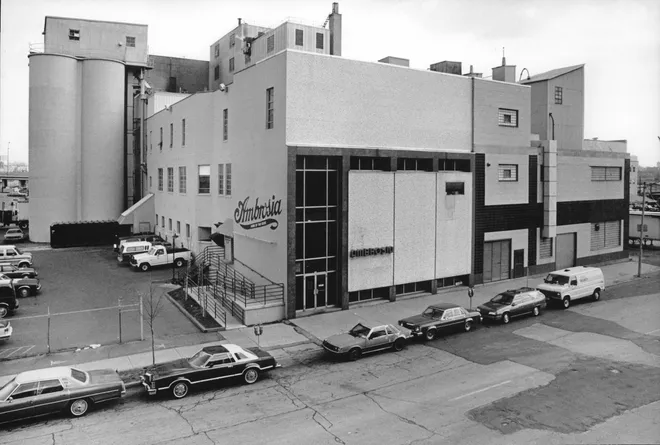
In January 1985 Dahmer got a job as a mixer at the Milwaukee Ambrosia Chocolate Factory, where he worked third shift from 11 PM to 7 AM, six nights per week; he had a set schedule, and had Saturday nights off. Right after he started this position he had a run in at the West Allis Public Library, where he was propositioned by another man while reading who gave Jeffrey a piece of paper with an offer of fellatio. Although he did ignore him the event only stirred up familiar feelings of desire as well as fantasies of control and dominance, and after this event he began to visit the local gay scene, including bars, bathhouses, and bookstores. It’s also around this time that he stole a male mannequin, which he briefly used for sexual reasons until his grandma found it in a closet and forced him to get rid of it.

By late 1985, Dahmer had begun to frequent local bathhouses (which he felt were ‘relaxing’), but was growing increasingly irritated and frustrated during his encounters due to his partners’ moving, elaborating that: ‘I trained myself to view people as objects of pleasure instead of as people.’ It was because of this that in June 1986 he began giving his victims crushed up sleeping pills dissolved in liquor, then waited for them to pass out before he performed various sexual acts on their completely still, nearly lifeless bodies. To convince his physicians to keep him supplied with an adequate amount of this pharmaceutical, Jeff told them that he worked overnights and needed the medication to help him adjust to his new lifestyle. After roughly twelve reported instances of Dahmer acting inappropriately with other members, the bathhouses’ revoked his membership and he was forced to use hotel rooms to keep up with his habit.

It was around this time that Dahmer read an article in a local newspaper about an upcoming funeral of an 18-year-old male, and got the idea to steal his corpse and take it home (WTF?). He confessed that he went to the cemetery and attempted to dig up the remains but found the ground to be too hard and abandoned this particular project. On September 8, 1986 Jeff was arrested for lewd and lascivious behavior for masturbating in front of two 12-year-old boys near the Kinnickinnic River. At first he told police that he was simply urinating and had no idea there was anyone else around, but he quickly caved and admitted to what he did. The charge was changed to disorderly conduct and on March 10, 1987 he was sentenced to one year of probation and had to undergo mental health counseling.

On November 20, 1987 Dahmer encountered Steven Tuomo at a bar and convinced him to come back to the Ambassador Hotel with him, where he had rented a room for the evening. According to Jeff, he had no intention of killing the 25-year-old, and only intended to drug him then lie next to him and ‘explore his body.’ When he woke up the next morning he discovered that Tuomi was in bed next to him, and his chest was ‘crushed in,’ and was covered in ‘black and blue’ bruises. Dried blood was seeping out of his mouth, and Dahmer quickly noticed that his fists and one forearm were also covered in deep purple bruises. He later confessed that he had no recollection of killing the young man, and ‘could not believe this had happened.’

Jeffrey then went out and bought a large suitcase, which he used to take Tuomi’s remains out of the hotel room and to his grandmother’s house. One week later, he cut off Tuomi’s head, arms, and legs then fileted the bones off his body before cutting his flesh into small, easy to handle chunks. Dahmer then placed the skin inside plastic garbage bags then wrapped the bones inside a sheet and pounded them into dust with a sledgehammer. The entire dismemberment process took him approximately two hours and he got rid of everything except for the young mans head; he masturbated on the corpse before disposing of the remains. After having the head for roughly two weeks, Jeffrey boiled it in a mixture of bleach and Soilax (an alkaline industrial detergent) in hopes of preserving the skull, but it eventually became too brittle and he was forced to destroy it. He later admitted that after this particular event his ‘obsession with killing went into full swing’ and he ‘didn’t even try to stop it after that.’ Dahmer killed two more victims at Catherine’s house before she made him move out in 1988. She said that she had no knowledge of her grandson’s crimes but finally had enough of his drinking, his habit to bring young men home, and the horrible smells that started seeping from her basement.

In September 1988 Dahmer moved into his own apartment, a one-bedroom located at 808 North 24th Street in Milwaukee, and just two days after moving in he lured a 13-year-old Laotian boy to his residence by telling him that he wanted to take naked pictures of him. This  act resulted in charges of second-degree sexual assault as well as sexual exploitation. Jeffrey pleaded guilty and said that to him the young victim looked much older, and while he was awaiting sentencing he once again put his grandmothers basement to use: in March 1989 he lured, drugged, strangled, sodomized, photographed, dismembered, and disposed of Anthony Sears. Dahmer found the aspiring model particularly attractive, and after his arrest he confessed that he didn’t want to ’lose him,’ and because of this he preserved a select few of his body parts, even going so far as to mummifying his head and genitals.

In May 1989 while on trial for child molestation, Dahmer was the very definition of sorrow, arguing poignantly in his own defense that he had seen the ‘error of his ways’ and even marked the event as a ‘turning point in his life.’ His counsel told the court that his young client needed treatment, not jail time, and to this the judge agreed: he handed down a one-year prison sentence with a day pass (of sorts), which allowed him to leave and go to work during the day on the condition that he returned to the prison at night. After his release he was also given five-years of probation. Dahmer was granted an early release after serving only 10 months of his sentence; when released he briefly lived with Catherine.

Over the next two years Dahmer would go onto murder twelve more young men. After his short stint in prison his next victim was Raymond Smith, a prostitute that Jeffrey lured to his home for sex. He gave the young man a drink laced with sleeping pills then strangled him to death; Jeff then took pictures of him in suggestive positions before dismembering him. When he murdered his next victim (Edward Smith) he accidentally destroyed his skull while trying to dry it out in the oven, which made it blow up. Dahmer later told LE that he felt ‘rotten’ about this particular murder because he was unable to keep any ‘mementos’ from his body, which to him felt like a real waste.

As Jeff progressed with his hobby he began developing rituals, and started experimenting with different chemicals and eating the flesh of his victims. He also attempted lobotomies, and drilled into the skull of Errol Lindsey while he was still alive and injected him with muriatic acid (which is another term for hydrochloric acid), which is a colorless solution with a very particular and pungent aroma that is technically classified as a ‘strong acid.’ He hoped this would put his victim into a permanent submissive state, but he woke up halfway through and said, ‘I have a headache; what time is it?’ After that, Jeffrey gave up in his attempt and strangled him to death.

A neighbor in Jeffrey’s building named Sandra Smith called the police on May 27, 1991 and told them that there was a young boy of Asian descent that was running around naked in the streets. Despite the fourteen-year-old being incoherent when officers arrived on the scene, they took Dahmer for his word that the boy was his lover and was 19-years-old. The cops, not wanting to get involved in a homosexual domestic dispute, simply escorted the two home. When arriving at Jeffrey’s apartment one of the officers ‘peeked his head around in the bedroom but didn’t really take a good look,’ then left after telling him to ‘take care’ of the boy. After they left, Dahmer injected hydrochloric acid into his brain, killing him. If the police even bothered conducting even a basic search of the residence they would have discovered the body of Tony Hughes.

Between 1978 and 1991 Jeffrey Lionel Dahmer took the lives of 17 boys and young men. When choosing his victims he was careful to choose men on the ‘fringes of society,’ that were borderline criminal or ‘runaways,’ which helped make their disappearance less noticeable which helped to reduce his chance of getting caught. During the murder process Dahmer would frequently stop what he was doing and take Polaroids of his victims so he could relive the experience over and over again.

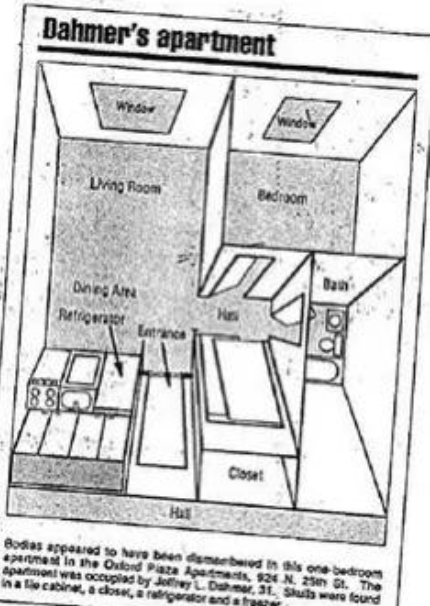
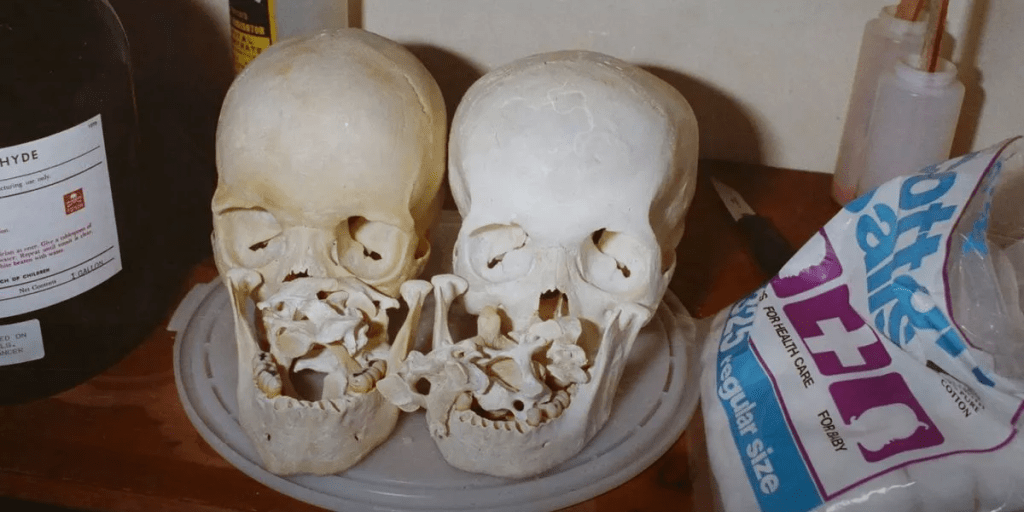
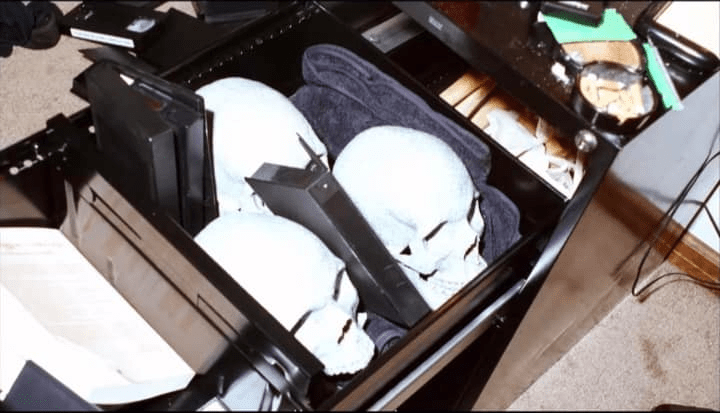
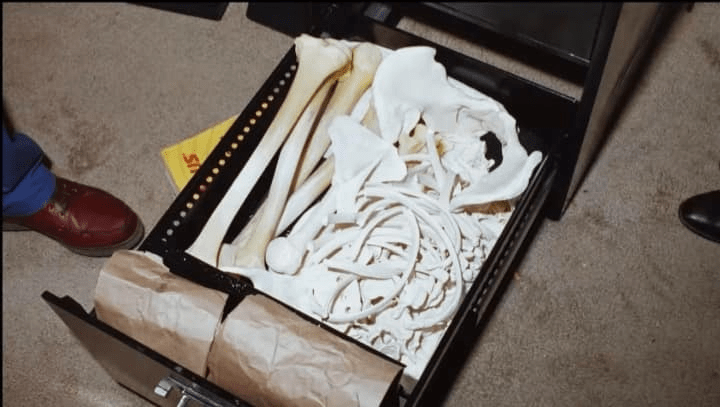
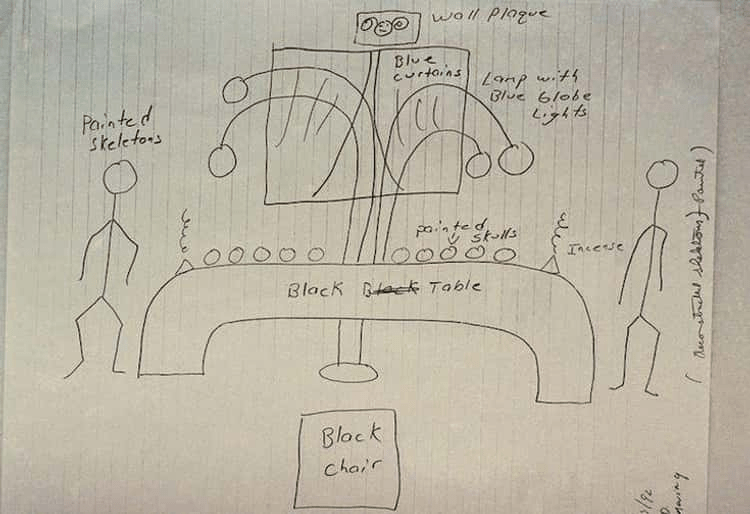
On July 22, 1991 Jeffrey Lionel Dahmer’s rampage through the streets of Milwaukee ended when he was arrested after two police officers were led to his home after picking up his latest intended (escaped) victim, Tracy Edwards. The 32-year-old black man was wandering the streets with handcuffs hanging from his wrist, and officers decided to investigate his claims that a ‘weird dude’ had drugged then restrained him (God, finally). When they got to Dahmer’s apartment he calmly offered to get the keys for the cuffs, and Edwards claimed that the knife he threatened him with was in the bedroom. When the officer went in to look for it he noticed numerous Polaroids of dead bodies lying around, and after he was apprehended and brought into custody he softly muttered: ‘for what I did, I should be dead.’ As investigators searched his apartment they found a head in his refrigerator, three more in the freezer, as well as various additional horrors, including preserved skulls, and jars with formaldehyde-soaked genitalia. During interviews Dahmer said that he planned to build a private altar made out of the skulls of his victims’ (complete with globe lights and incense), which he hoped would be ‘a place where I could feel at home.’

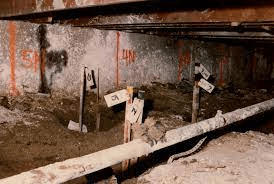
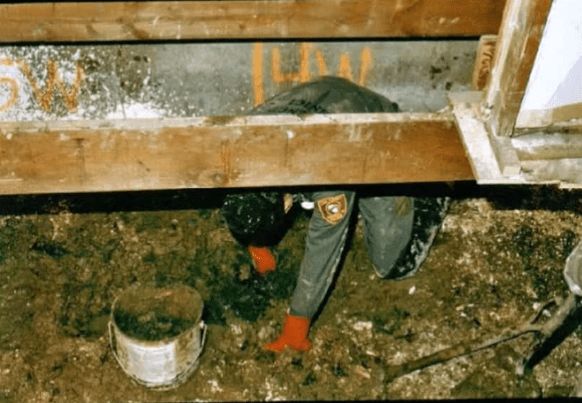
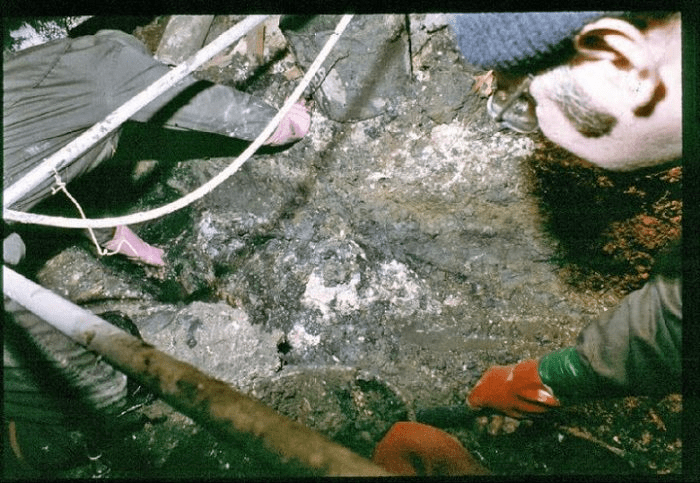
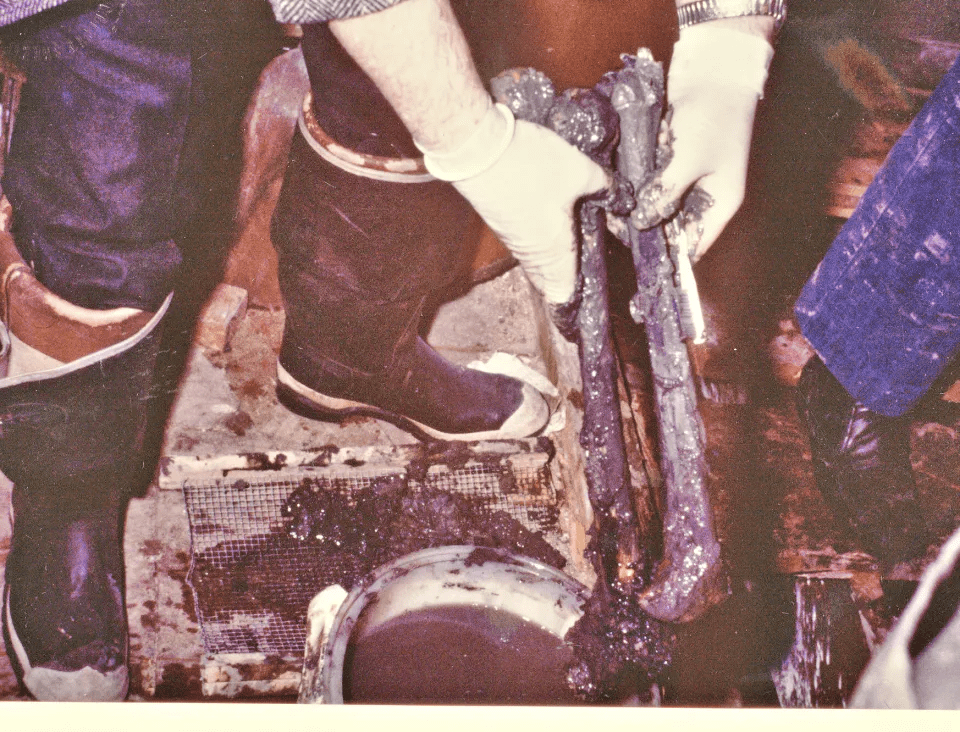
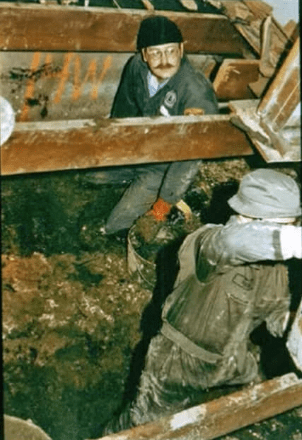
After his arrest in Wisconsin, the Summit County Sheriffs as well as the (local) Bath Township PD combed the property of the Dahmer family’s former home, and unearthed hundreds of bone fragments in the wooded area behind the residence (located at 4480 West Bath Road), specifically a vertebra and two molars of his first victim (Steven Hicks). Jeff was charged for his murder three days later.

Dahmer’s trial of the century began in January 1992, and given that the majority of his victims were black there was a great deal of racial tensions surrounding it, therefore strict security measures were taken, including an eight-foot wall of bulletproof glass separating him from the public. The fact that there was only a single black juror only seemed to make matters worse. Even though he confessed to the atrocities during interviews with police, Dahmer pleaded not guilty to all charges in the beginning… but he eventually changed his plea to ‘guilty by virtue of insanity.’ His defense argued that his gruesome behavior was proof that only someone that was insane would be able to commit such atrocious acts, but thankfully the jury believed the prosecution’s assertion that Jeff was completely aware that what he did was evil, but he chose to do it anyway.

On February 15, 1992 after only ten hours of deliberating, a jury of his peers found Jeffrey Dahmer guilty (and sane) on all counts. He was sentenced to fifteen consecutive life terms in prison, with a 16th one tacked on later that May. It’s been reported that he adjusted well to his new life at the Columbia Correctional Institution, and despite initially being kept away from the general population he was able to convince the jail administration to let him slowly integrate more with other inmates. He found religion in the form of books and photos sent to him by Lionel, and he was even given special permission by the prison to be baptized by a local pastor.

One day for his work assignment Jeffrey was instructed to work with two other inmates: convicted murderers Christopher Scarver and Jesse Anderson. After being left alone by guards to finish their work, Scarver brutally beat both men with a metal rod he swiped from the prison’s weight room, and on November 28, 1994 Dahmer was pronounced dead after roughly one hour; Anderson passed away a few days later. Right after the murders occurred a guard came out and publicly stated that Scarver (a suspected schizophrenic) said that ‘God told me to do it.’ After Jeff’s murder Scarver was bounced around from prison to prison, and eventually landed up in the Centennial Correctional Facility in Colorado, where he remains to this day; he is currently 59 years old. In 2012 an agent representing the killer announced that he planned on writing a tell-all book about how he killed Jeffrey Dahmer; as of March 2024 that book remains unpublished. 

In 2015 Christopher Scarver did an interview with The New York Post about why he killed his two fellow inmates. He told them that he was disturbed not only by Dahmer’s crimes but also because he had a habit of creating ‘severed limbs’ out of prison food as a way to antagonize his fellow inmates. After being ‘taunted’ by both of his victims during their work detail, Scarver said that he confronted Jeffrey about what he did before beating him and the second inmate to death. He also claimed that prison guards allowed the murders to happen because they left the three men alone together.

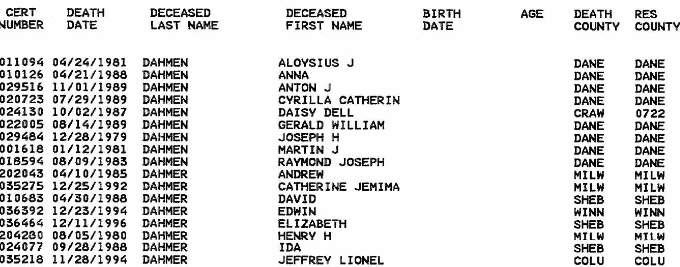
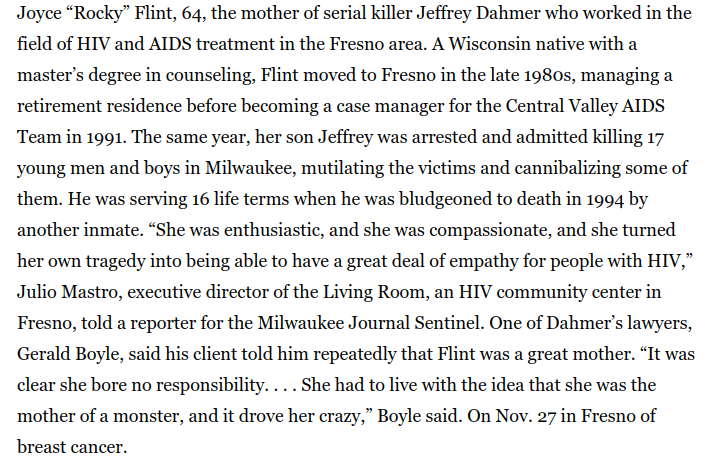
Joyce Dahmer passed away on November 27, 2000 at the age of 64 in Fresno, CA. Lionel and Shari Dahmer lived in Seville, Ohio until their deaths: Shari passed away on January 13, 2023, and Lionel died eleven months later from a heart attack on December 5, 2023. Jeff’s little brother David is still alive, but doesn’t seem to go out in public very much (or at all, really). I did find some recent pictures of him from the one time he recently ventured out and about, but the way they were taken I’m not including them here because it feels very intrusive and invasive.

Works Cited:
https://finwise.edu.vn/jeffrey-da-1693995524238782/ Retrieved on March 1, 2024.
Hicks, Tony (April 27, 2012). ‘Hicks: Jeffrey Dahmer’s killer is shopping a memoir.’ Contra Costa Times. Retrieved March 18, 2024.
https://en.wikipedia.org/wiki/Jeffrey_Dahmer Retrieved on March 19, 2024.
Smith, Jo (September 18, 2023). ‘Jeffrey Dahmer Brags About Mummified Genitals in Box in Newly Released Prison Call.’ Retrieved on March 19, 2024 from https://www.mirror.co.uk/news/us-news/jeffrey-dahmer-brags-mummified-genitals-30967305

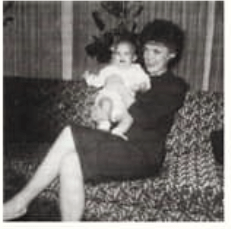
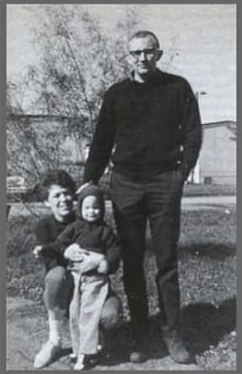
Joyce Dahmer with a baby Jeffrey. Photo courtesy of the Dahmer family archives.
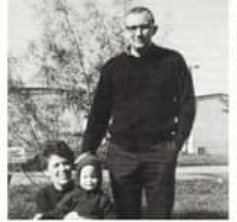
Lionel, Joyce and a young Jeff. Photo courtesy of the Dahmer family archives.
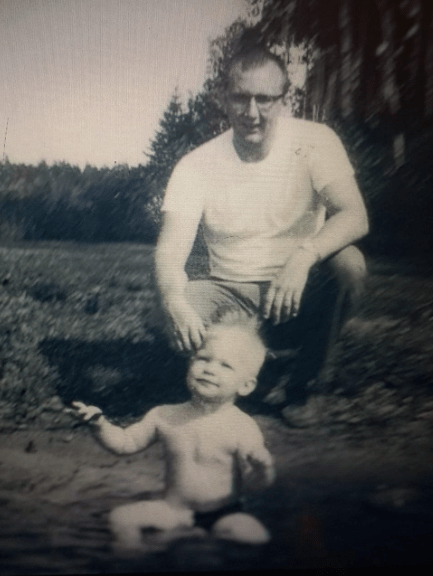
Lionel and a baby Jeff. Photo courtesy of the Dahmer family archives.
Lionel, Joyce and a baby Jeffrey. Photo courtesy of the Dahmer family archives.
Joyce and baby Jeffrey. Photo courtesy of the Dahmer family archives.
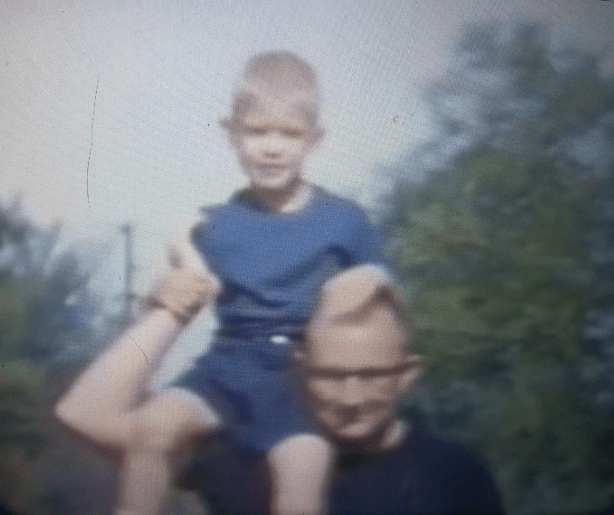
Lionel and a young Jeff. Photo courtesy of the Dahmer family archives.
Another shot of Lionel and a young Jeffrey. Photo courtesy of the Dahmer family archives.
A young Jeffrey Dahmer. Photo courtesy of the Dahmer family archives.
An early shot of the Dahmers. Photo courtesy of the Dahmer family archives.
A screenshot of Lionel and a young Jeffrey. Photo courtesy of the Dahmer family archives.
Another screenshot of Lionel and a young Jeffrey. Photo courtesy of the Dahmer family archives.
A screenshot of a young Jeffrey. Photo courtesy of the Dahmer family archives.
A young Jeffrey. Photo courtesy of Netflix.
Jeffrey with his mom and baby brother David. Photo courtesy of the Dahmer family archives.
Jeffrey giving David a kiss. Photo courtesy of the Dahmer family archives.
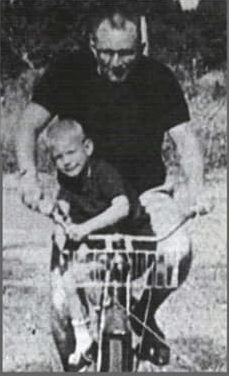
Jeff and his dad on a bike. Photo courtesy of Netflix.
A B&W shot of a young Jeff. Photo courtesy of the Dahmer family archives.
Another B&W shot of a young Jeffrey. Photo courtesy of the Dahmer family archives.
A young Dahmer standing next to a flower. Photo courtesy of Netflix.
A screenshot of little Jeffrey Dahmer at an amusement park. Photo courtesy of Netflix.
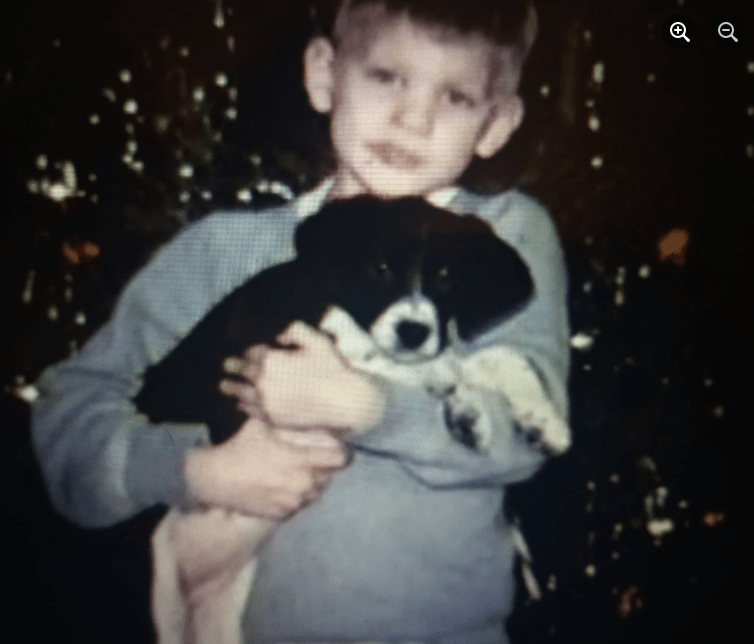
Little Jeffrey holding the family dog. Photo courtesy of Netflix.
Another shot of Jeff holding his dog. Photo courtesy of Netflix.
A picture of Joyce, Lionel, and Joyce. Photo courtesy of Netflix.
A young Jeffrey, playing. Photo courtesy of Netflix.
A young Jeffrey. Photo courtesy of the Dahmer family archives.
Jeff, Lionel, and David Dahmer. Photo courtesy of Murderpedia.
A B&W shot of the Dahmer family. Photo courtesy of Netflix.
A young Jeff. Photo courtesy of Netflix.
Jeffrey and David Dahmer. Photo courtesy of the Dahmer family archives.
A young Jeffrey Dahmer. Photo courtesy of Netflix.
A young Jeffrey in a swimming pool. Photo courtesy of Netflix.
Another shot of Jeffrey Dahmer in a swimming pool. Photo courtesy of Netflix.
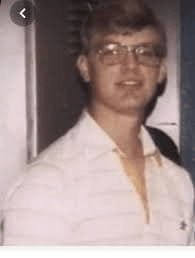
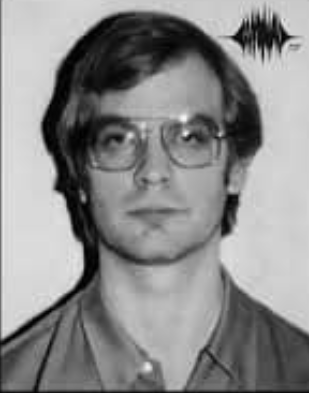
A teenage Jeffrey Dahmer.
A teenage Jeffrey Dahmer from his time at Revere High School.
The Dahmer’s sitting around their kitchen table. Photo courtesy of Netflix (I apologize for the poor quality, it was the only one I could find).
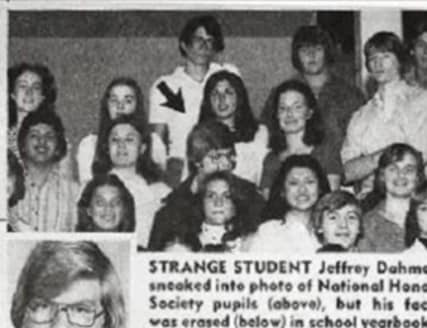
Dahmer in a photo for NHS, which he did not belong to. He would frequently sneak into yearbook photos for clubs and organizations he didn’t belong to.
Dahmer is blacked out in a NHS picture he snuck into.
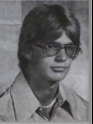
Jeffrey Dahmer from the 1978 Revere High School yearbook.
Dahmer making a face. Photo courtesy of Netflix.
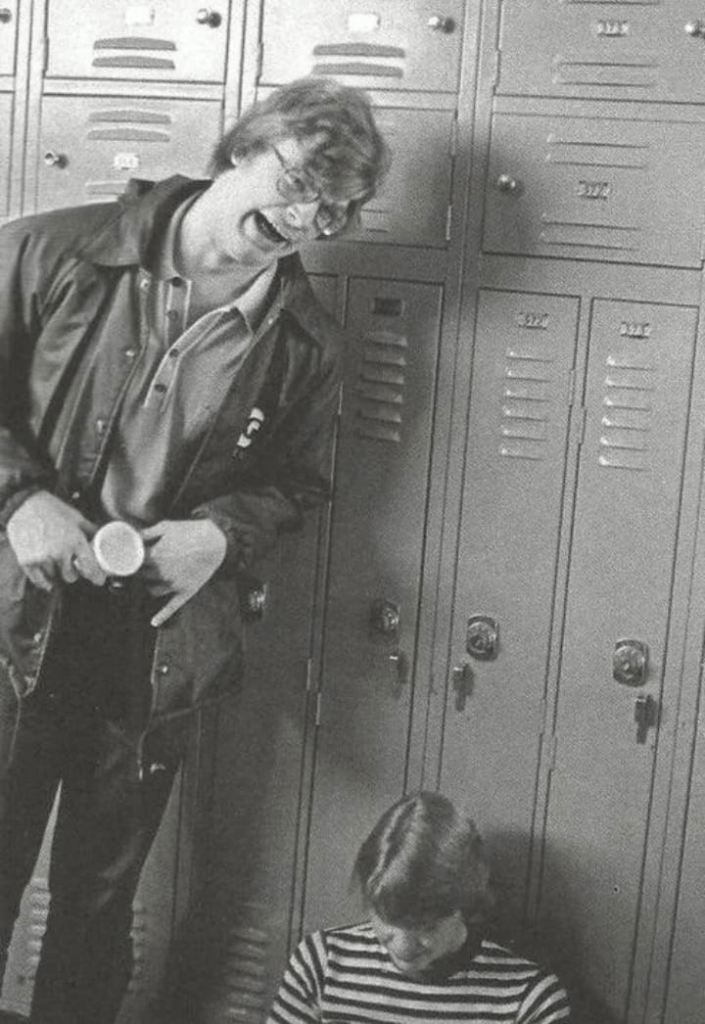
Dahmer with a schoolmate from Revere High School.
Photo courtesy of Netflix.
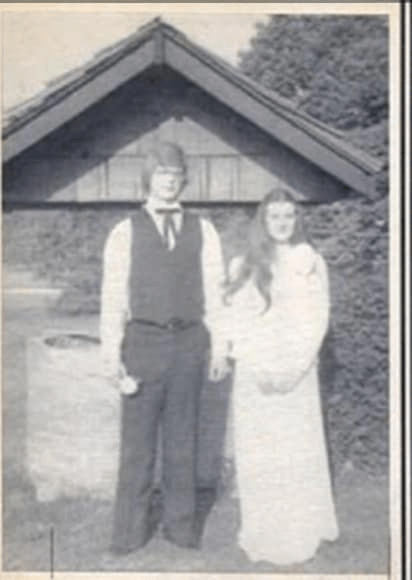
Dahmer at prom, with his date. Apparently during the event Dahmer left and went to McDonald’s. Photo courtesy of ‘Maniac Nanny.’
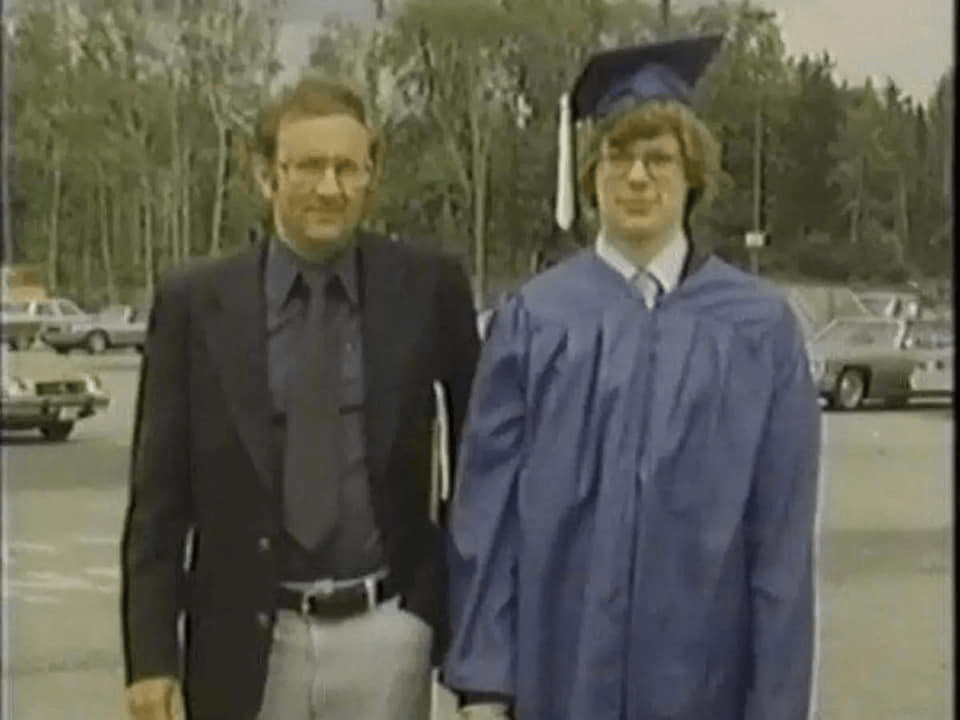
Jeffrey Dahmer on the day of his graduation from Revere High School. Photo courtesy of Netflix.
Jeffrey Dahmer with his father on the day of his high school graduation. Photo courtesy of Netflix.
Jeffrey, Lionel, and David Dahmer. Photo courtesy of Murderpedia.
Jeffrey Dahmer. Photo courtesy of Netflix.
There’s a few pictures of Dahmer floating that are supposedly from his days in the military that are bogus, this is apparently one of the few that exist. Photo courtesy of Netflix.
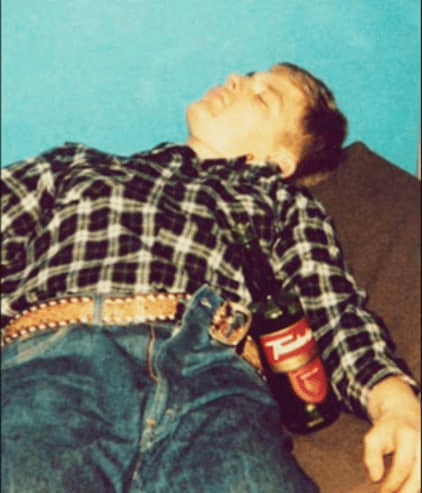
A photo of Dahmer passed out during his time in Germany. He’s drinking Thunderbird brand wine, which apparently is super cheap.
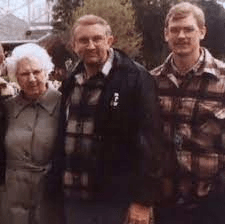
Jeff and Lionel. I’m not sure who the woman is. Photo courtesy of the Dahmer family archives.
Jeffrey, Lionel, and David Dahmer. Photo courtesy of Murderpedia.
Jeffrey Dahmer in a screen grab from an (infamous) old video recording. Photo courtesy of Murderpedia.
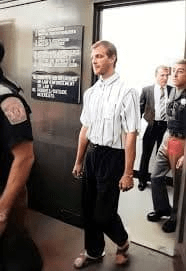
Dahmer walking into court after his arrest. Photo courtesy of Murderpedia.
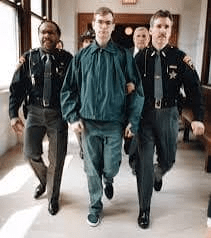
A shot of Dahmer being escorted into court. Photo courtesy of Murderpedia.
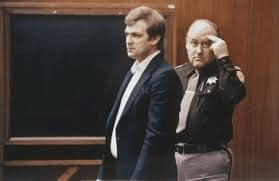
A shot of Dahmer during his trial. Photo courtesy of Murderpedia.
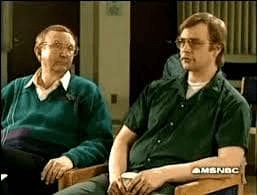
Lionel and Jeff doing an interview. Photo courtesy of MSNBC.
Lionel and Jeff during Jeff’s time in prison. Photo courtesy of Murderpedia.
Jeffrey Dahmer in a booking shot from Bath, Ohio in 1981. Photo courtesy of Agence France-Presse Handout.
Jeffrey Dahmer in a booking shot from August 1982. Photo courtesy of the Milwaukee County Sheriff’s Department.
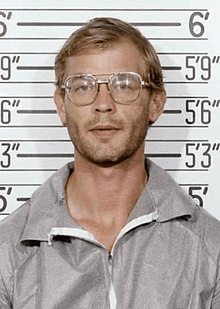
Dahmer’s 1991 mugshot
Jeff while in prison. Photo courtesy of Murderpedia.
Another view of the Oxford Apartments at 924 North 25th Street where Dahmer lived and committed a large amount of his murders. Photo courtesy of The Milwaukee Journal Sentinel.
The flag flying at half-staff outside the Oxford Apartments after Dahmer was arrested. Photo courtesy of Milwaukee Journal Sentinel.
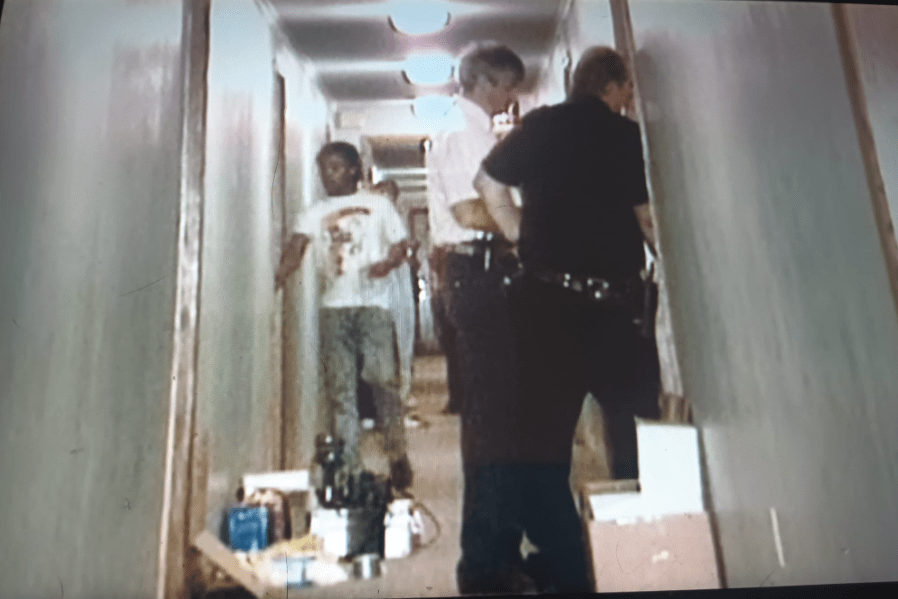
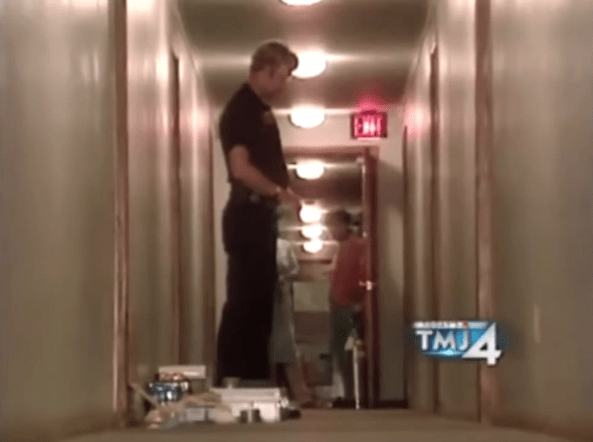
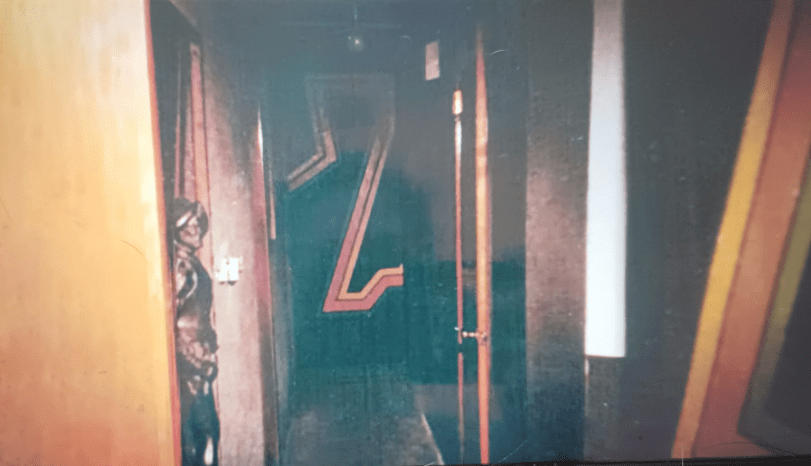
A photo of the hallway outside of Dahmer’s apartment. Screenshot courtesy of Netflix.
Another shot of the hallway outside of Dahmer’s apartment. Screenshot courtesy of Netflix.
Dahmer’s former neighbor Pamela Bass stands outside his apartment. Photo courtesy of Oxygen.
A shot of Dahmer’s apartment door after his 1991 arrest. Screenshot courtesy of Netflix.
The layout of Dahmer’s apartment. Photo courtesy of Redditor ‘Sunny86JD.’
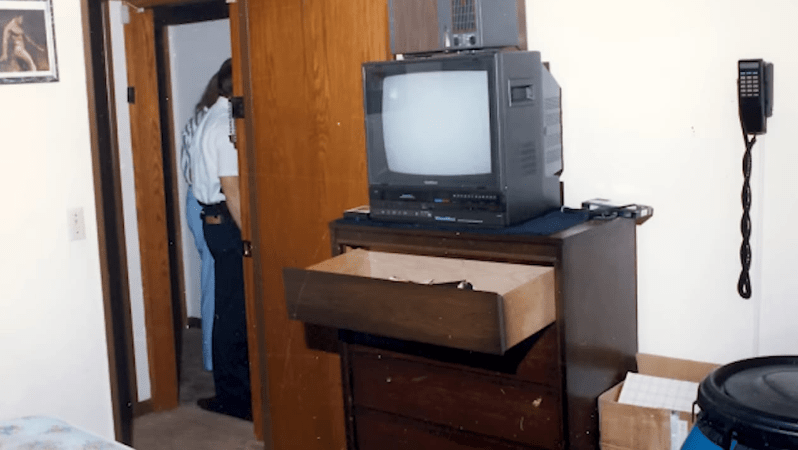
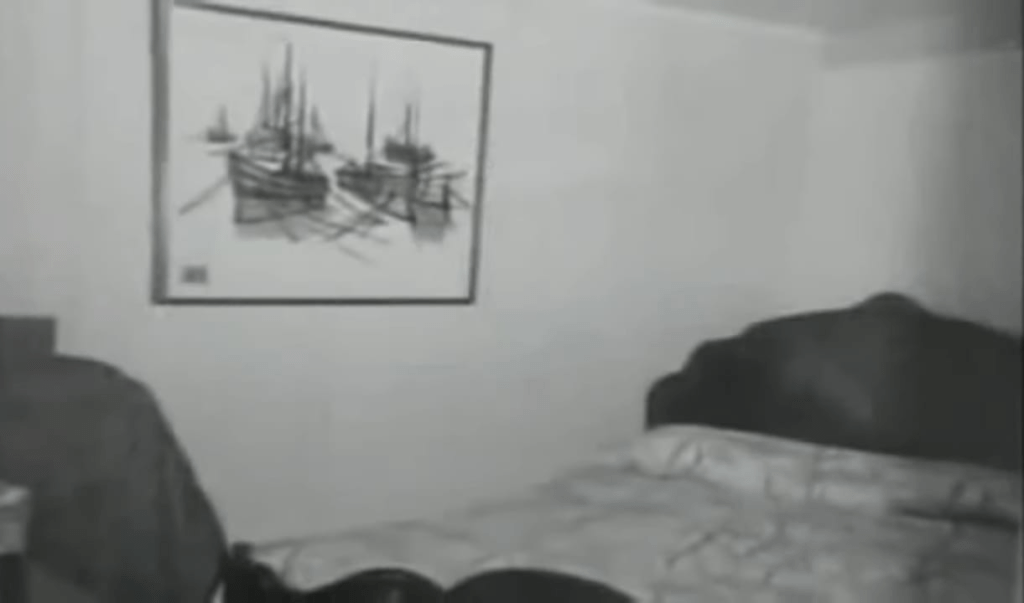
A shot inside Dahmer’s bedroom, including his dresser and TV. Photo courtesy of the Milwaukee County Sheriff’s Department.
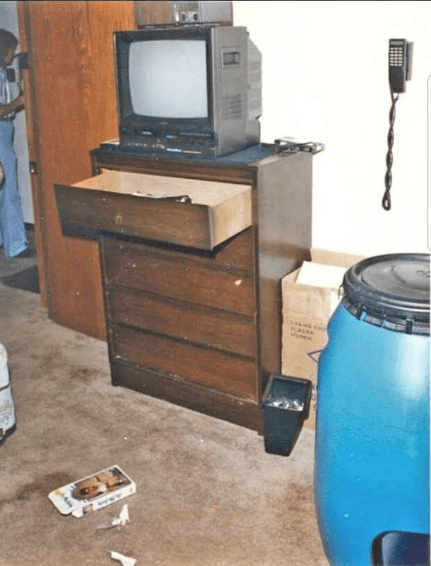
A shot inside Dahmer’s bedroom. Photo courtesy of Murderpedia.
A shot inside Dahmer’s bedroom. Photo courtesy of Redditor ‘Sunny86JD.’
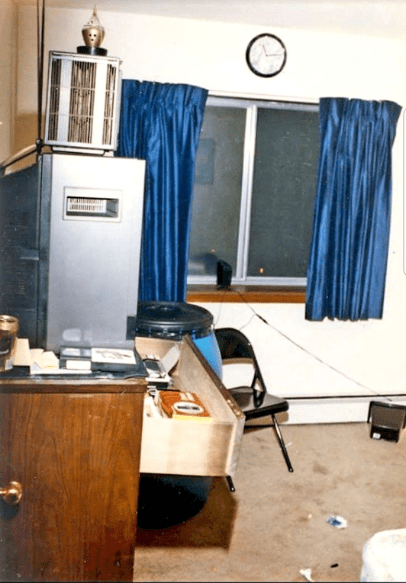
Another shot inside Dahmer’s bedroom. Photo courtesy of Murderpedia.
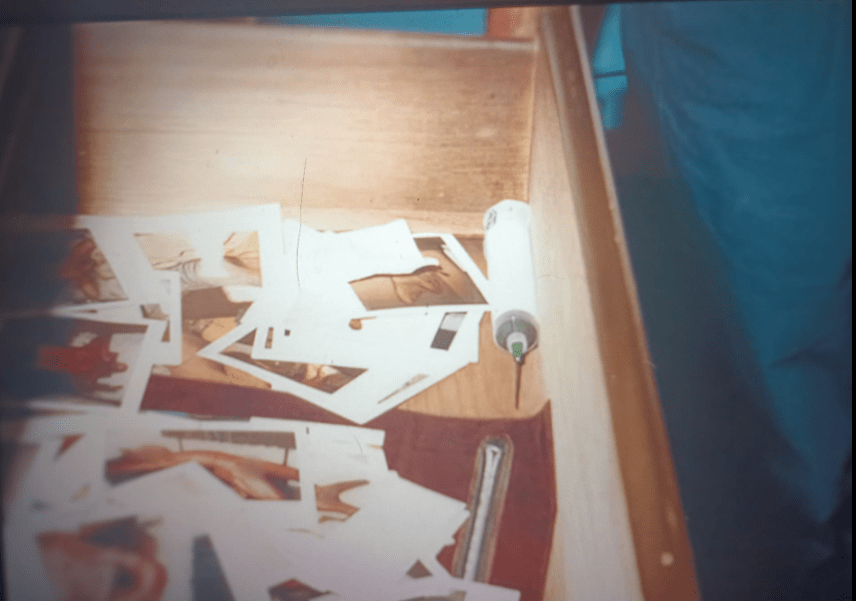
Dahmer’s drawer full of Polaroids. Notice the needle, which was involved in his ‘experiments.’ Photo courtesy of Netflix.
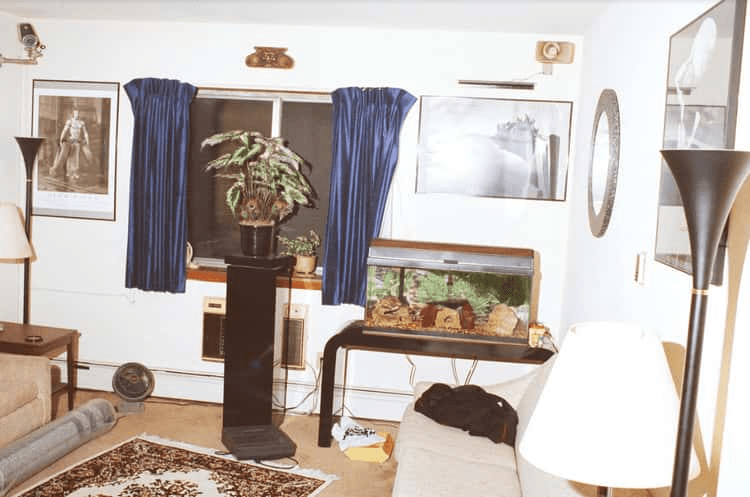
Jeffrey Dahmer’s living room in his apartment. If you look in the top corner, near the ceiling you’ll notice a camera. Apparently Dahmer spent close to $1,000 for a security system (he installed extra locks on his doors as well). Photo courtesy of Murderpedia.
The other side of Dahmer’s living room (notice his infamous smelly fish tank he said was responsible for the bad smell in his apartment). Photo courtesy of Murderpedia.
Another shot of Dahmer’s living room. Photo courtesy of Murderpedia.
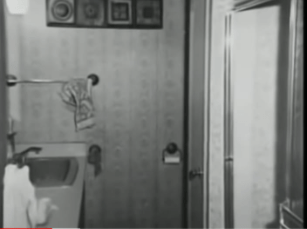
A shot of Dahmer’s bathroom (it looks like its attached to his living room). Photo courtesy of Netflix.
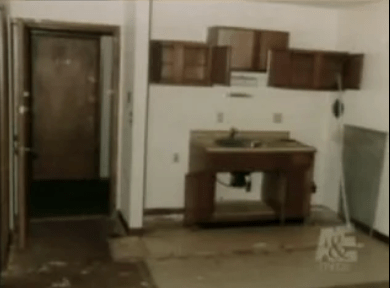
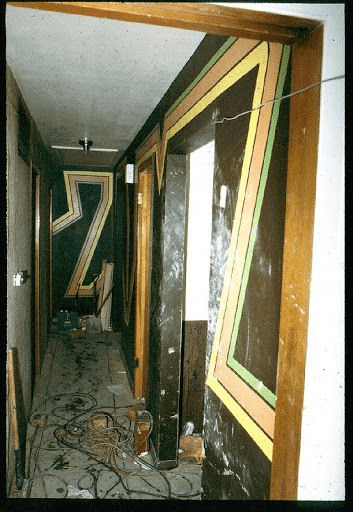
A shot of Dahmer’s apartment. Photo courtesy of A&E.
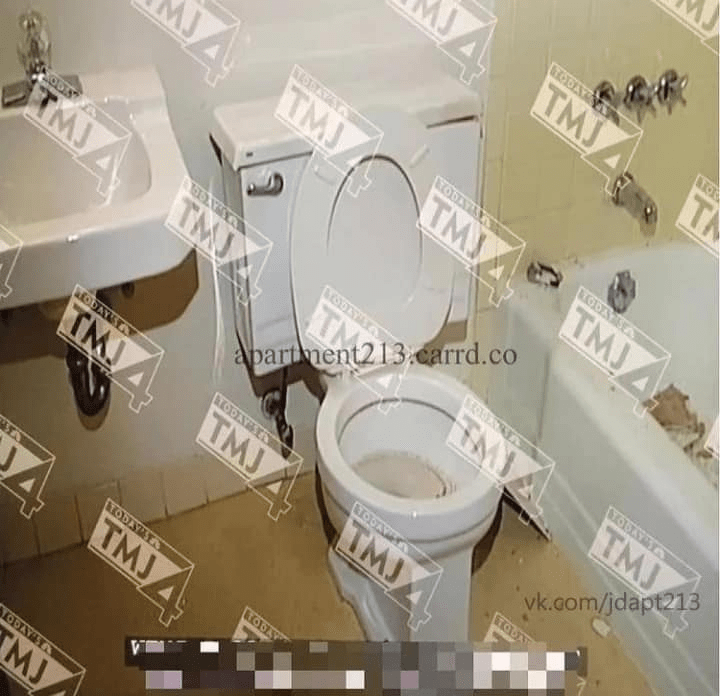
A shot of Dahmer’s toilet inside of his loo. Photo courtesy of TMJ4.
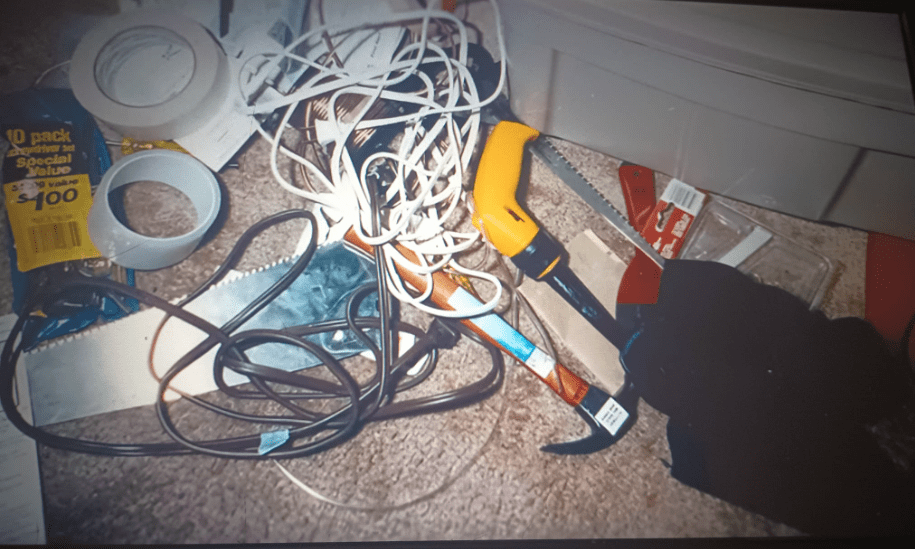
Tools Dahmer used to dismember his victims. Photo courtesy of The Milwaukee Police Department.
Some additional tools Dahmer used to dismember his victims. Photo courtesy of The Milwaukee Police Department.
A shot of the inside of Dahmer’s closet. Photo courtesy of The Milwaukee Police Department.
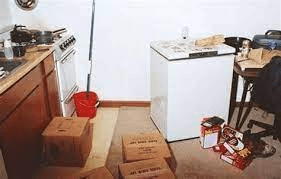
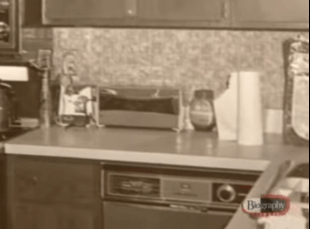
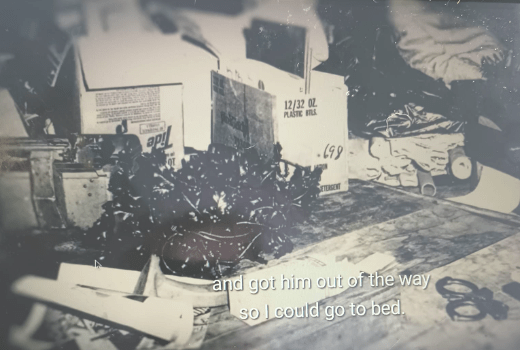
A shot of Dahmer’s kitchen. Photo courtesy of The Milwaukee Police Department.
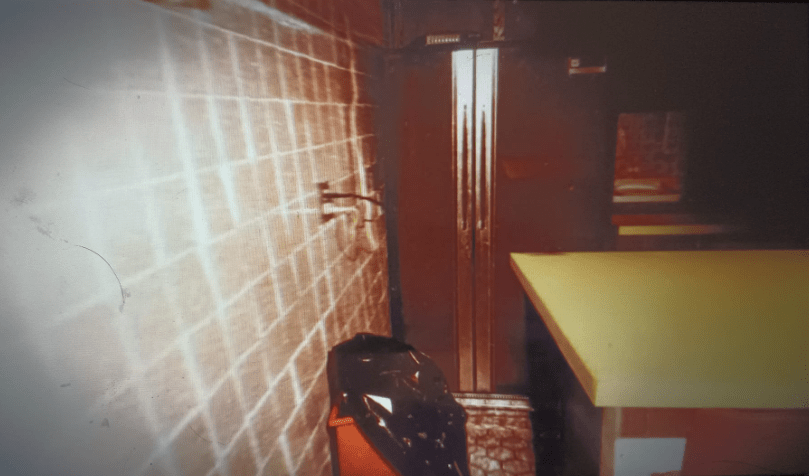
The freezer and boxes of acid in Dahmer’s kitchen. Photo courtesy of The Milwaukee Police Department.
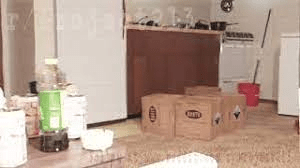
A different perspective in Dahmer’s kitchen. Photo courtesy of Murderpedia.
A freezer in Dahmer’s kitchen. Photo courtesy of Murderpedia.
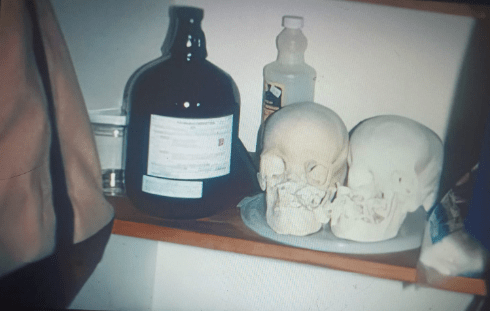
Two skulls found in Jeffrey’s apartment. Photo courtesy of Murderpedia.
Three skulls inside the top drawer of Dahmers bedside filing cabinet.
The full skeleton of Ernest Miller located in the bottom drawer of Dahmer’s bedside filling cabinet.
Two skulls inside a cardboard box inside Dahmer’s bedroom.
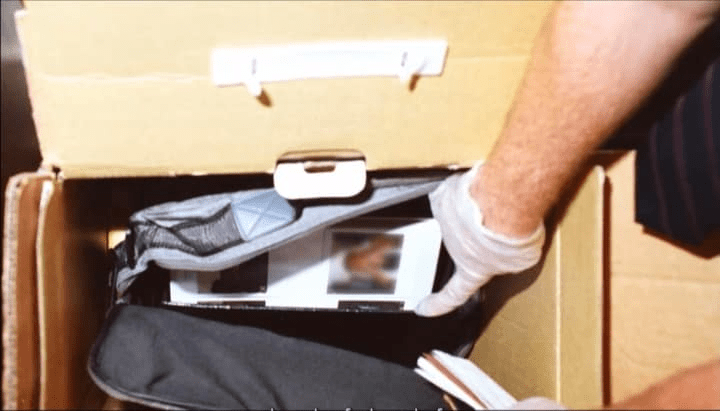
Some Polaroids that investigators found inside of a laptop cover inside of the cardboard box.
Some skulls found in Dahmer’s apartment. Photo courtesy of the Milwaukee Police Department.
Plastic bags that contained human remains, including two heads, the body of Oliver Lacey, and an assortment of body pats.
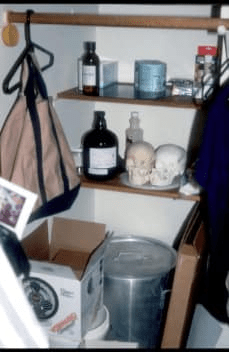
A closet in Jeffrey’s apartment. Photo courtesy of Murderpedia.
A close-up of some items found in a closet in Jeffrey’s apartment. Photo courtesy of Murderpedia.
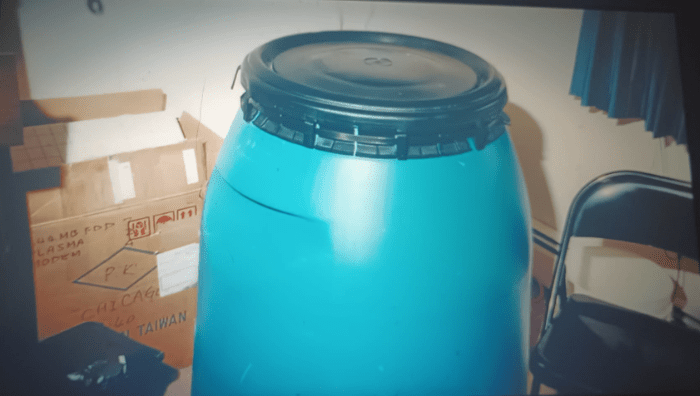
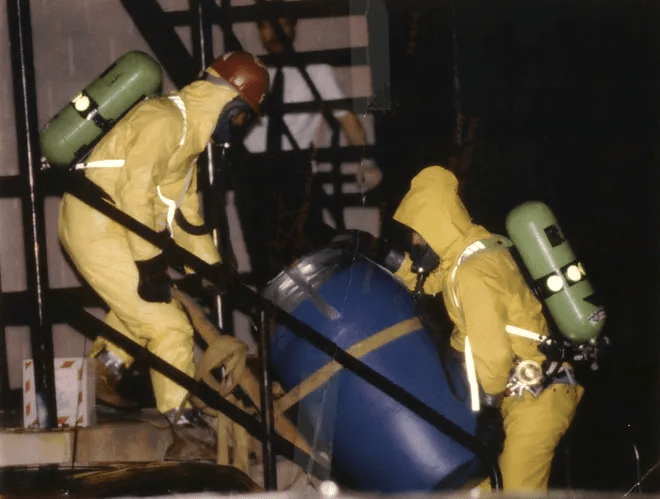
A vat of acid Dahmer used to dissolved bones. Photo courtesy of the Milwaukee Police Department
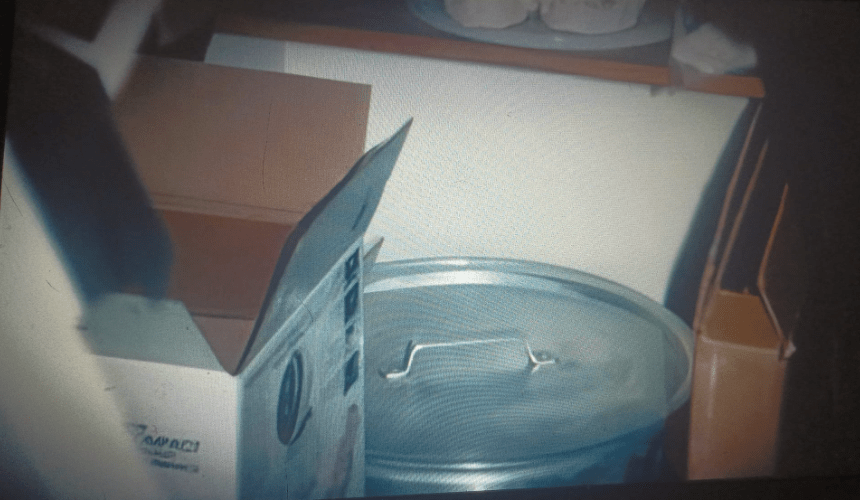
A giant pot Dahmer used to dissolved bones. Photo courtesy of the Milwaukee Police Department.
A picture of Dahmer’s freezer in his apartment. Photo courtesy of Murderpedia.
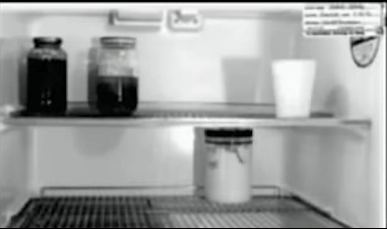
A picture of Dahmer’s refrigerator in his apartment. Photo courtesy of Murderpedia.
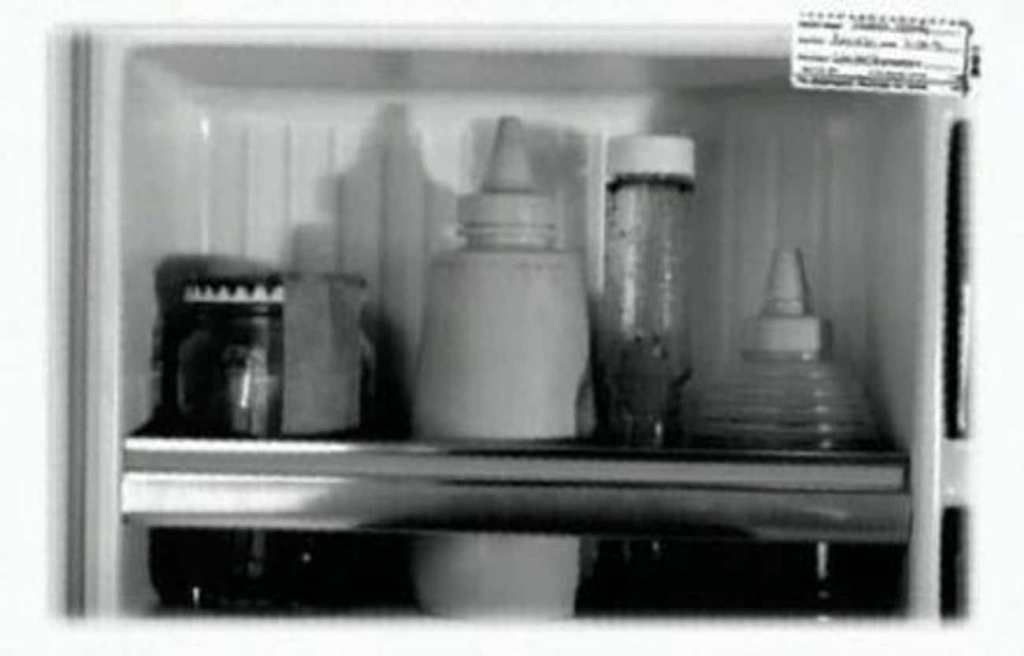
A picture of Dahmer’s refrigerator door in his apartment. Photo courtesy of Murderpedia.
A skull found in Dahmer’s apartment. Photo courtesy of Murderpedia.
Some miscellaneous body parts of some of Dahmer’s victims. Photo courtesy of Murderpedia.
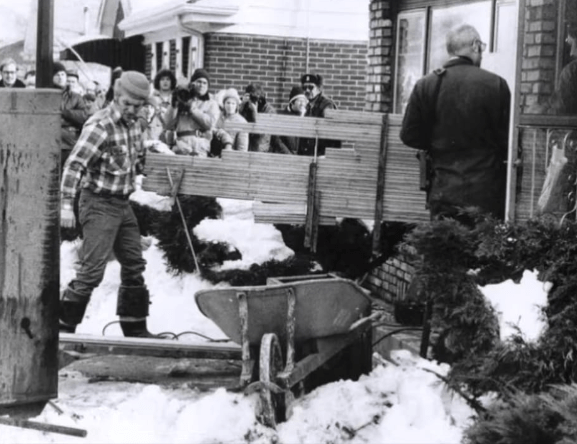
Police bringing Dahmer’s bed out of his apartment. Screen grab courtesy of the Milwaukee Police Department.
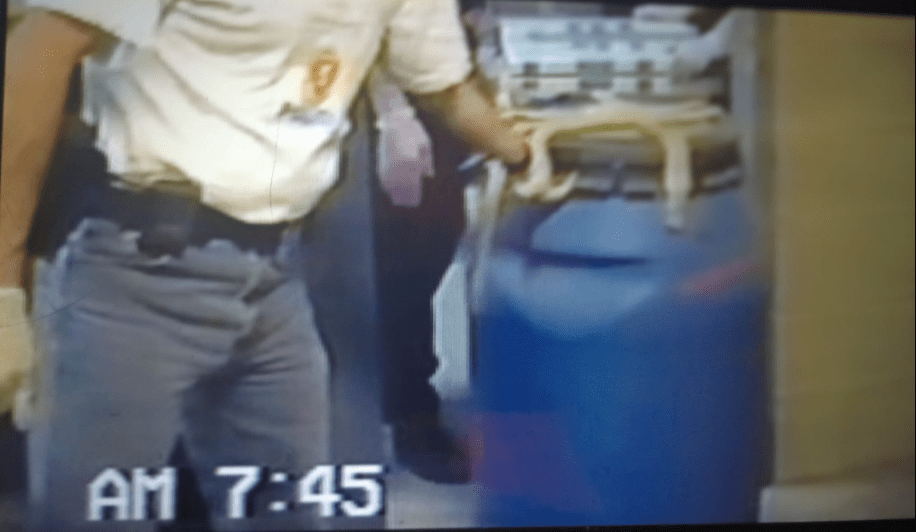
LE bringing the gigantic vat of acid out of Jeff’s apartment. Screen grab courtesy of the Milwaukee Police Department.
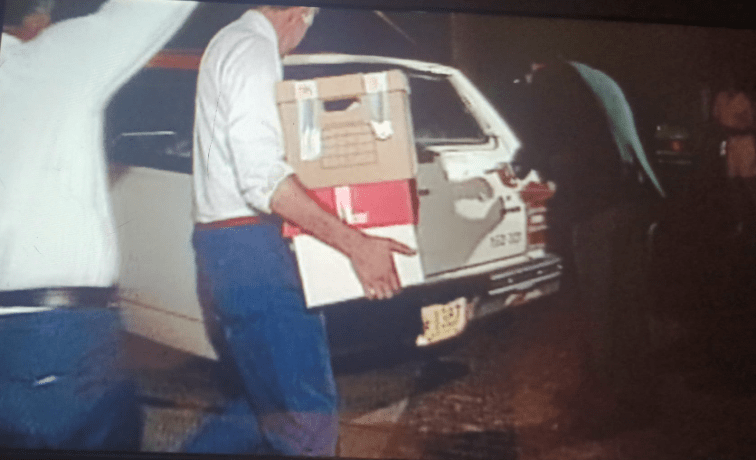
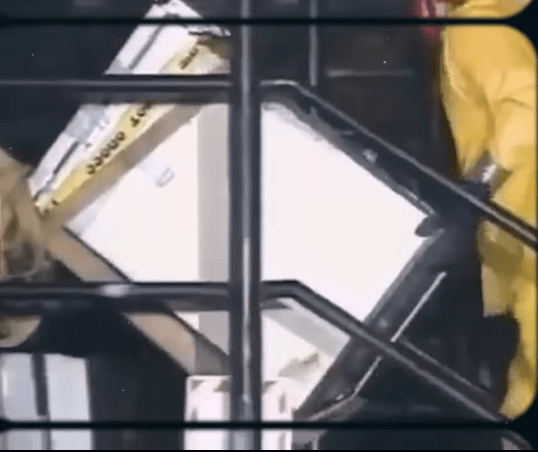
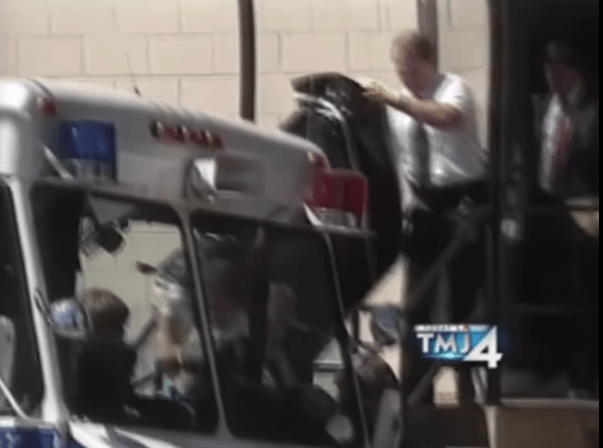
Police bringing items out of Dahmer’s apartment. Screen grab courtesy of the Milwaukee Police Department.
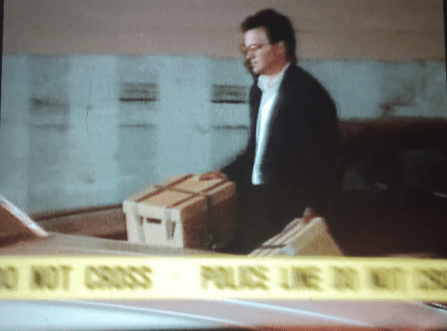
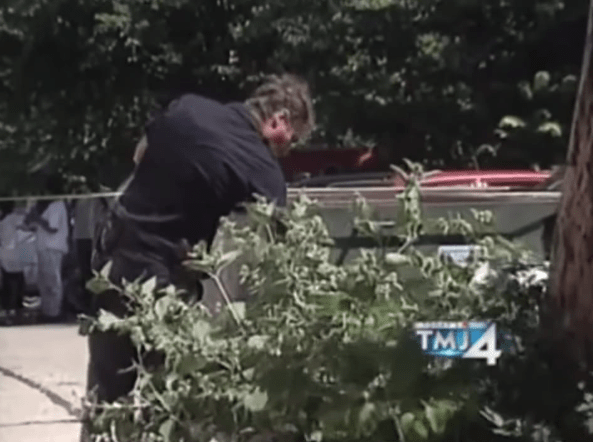
Police bringing items out of Dahmer’s apartment. Screen grab courtesy of TMJ4.
LE taking evidence out of Dahmer’s apartment. Screen grab courtesy of Netflix.
LE taking evidence out of Dahmer’s apartment and putting it into an official vehicle. Screen grab courtesy of Netflix.
LE taking evidence out of Dahmer’s apartment. Screen grab courtesy of Netflix.
Technicians wearing hazmat suits lower Dahmer’s freezer down the stairs at his apartment building in 1991. Photo courtesy of The Milwaukee Journal Sentinel.
Another shot of techs lowering Dahmer’s freezer down the stairs at his apartment. Photo courtesy of The Milwaukee Journal Sentinel.
Technicians wearing hazmat suits lower a vat of acid down the stairs at Dahmer’s apartment building in 1991. Photo courtesy of The Milwaukee Journal Sentinel.
Technicians securing items taken out of Dahmer’s apartment on official police transport vehicles. Photo courtesy of The Milwaukee Journal Sentinel.
The boxes of acid being taken out of Dahmer’s apartment after his arrest in 1991. Photo courtesy of The Milwaukee Journal Sentinel.
Some of the vehicles used to take items out of Dahmer’s apartment. Screen grab courtesy of the Milwaukee Police Department.
LE looking around the outside of Dahmer’s apartment building after his arrest in 1991. Screen grab courtesy of TMJ4.
A police photographer taking pictures of some bones that were found in the back of a building across the alley from the apartment building where Dahmer resided. It could not be determined at the time whether they were human (I believe they were eventually determined to be unrelated to his case). Photo courtesy of the Milwaukee Journal Sentinel.
After combing through Dahmer’s apartment investigators went through the dumpster in the back of his apartment building. Photo courtesy of TMJ4.
Investigators looking at a bone found in a dumpster located in the back of Dahmer’s apartment building. Photo courtesy of TMJ4.
After combing through Dahmer’s apartment investigators went through the garbage located in the back of his apartment building. Photo courtesy of TMJ4.
The apartment where Jeffrey Dahmer once resided was torn down in 1992.
The lot where Dahmer’s apartment once stood.
Some of Dahmer’s Polaroids. Photo courtesy of ‘Maniac Nanny.’
Dahmer victim, Ricky Beeks.
A post-mortem Ricky Beeks. Photo courtesy of Murderpedia.
A post-mortem, handcuffed Ricky Beeks. Photo courtesy of Murderpedia.
A post-mortem shot of Ricky Beeks. Photo courtesy of ‘NairaLand.’
Another post-mortem shot of Ricky Beeks. Photo courtesy of ‘NairaLand.’
The beginning of Dahmer’s dissection of Ricky Beeks. Photo courtesy of Murderpedia.
The more advanced stages of Dahmer’s dissection of Ricky Beeks. Photo courtesy of Murderpedia.
SOne body parts of Dahmer victim, Ricky Beeks. Photo courtesy of ‘NairaLand.’
Dahmer victim, Ricky Beeks. Photo courtesy of ‘NairaLand.’
The ME standing with some of the remains found at Dahmer’s apartment.
The Summit County Sheriff’s Department looking through the area behind Dahmer’s childhood home. Photo courtesy of Supernaught.
Another shot of the Summit County Sheriff’s Department looking through the area behind Dahmer’s childhood home. Photo courtesy of Supernaught.
A local kid reading a note on the door at the home of Catherine Dahmer, which is located on South 57th Street in West Allis. The handwritten note asks that the family be left alone, and mentioned that they have been receiving prank calls. Photo courtesy of Milwaukee Journal Sentinel.
The Ambrosia candy company, where Dahmer briefly worked.
The bathroom where Jeffrey Dahmer was killed. Photo courtesy of Redditor ”DogaCascio.’
The remains of Jeffrey Dahmer. On November 28, 1994 he was bludgeoned to death by convicted killer Christopher Scarver. Photo courtesy of Redditor ‘Frikydraws.’
The remains of Jeffrey Dahmer. Photo courtesy of Redditor ‘Frikydraws.’
Dahmer’s autopsy photo. Courtesy of Redditor ‘Frikydraws.’
Another post-mortem shot of Dahmer.
Jeff’s name listed in the Wisconsin death index from 1979 through 1997.f
Dahmer’s brain. Photo courtesy of Murderpedia.
Another shot of Dahmer’s brain in a jar. It was eventually cremated, per his wishes. Photo courtesy of Murderpedia.
A super cryptic drawing of an altar than Dahmer had planned to create at one point. Courtesy of Murderpedia.
A map drawn by Jeffrey Dahmer. Courtesy of Murderpedia.
A younger picture of Joyce Dahmer.
A blurb about Joyce Dahmer, published in the LA Times published on December 6, 2000.
A picture of Lionel Dahmer from the 1958 University of Wisconsin–Madison yearbook.
David Dahmer from the 1982 Revere High School yearbook.
Dahmer killer, Christopher Scarver.
Jesse Anderson.

John Wayne Gacy: Crime Scene Pictures.

John Wayne Gacy was born on March 17, 1942 to John Stanley and Marion (nee Robinson) Gacy in Chicago, Illinois; he was one of three children and had two sisters, Joanne and Karen. Mr. Gacy was born on June 20, 1900 in Chicago, and John’s Mother was born on May 4, 1908 in Racine, WI. As a child, the sickly Gacy was reportedly close with his mom and sisters but had a poor relationship with his alcoholic father, who was verbally and physically abusive and reportedly beat him regularly. He was hospitalized in 1957 for a burst appendix, and when he was eleven was hit in the head with a swing. As a result of the injury he suffered from seizures and blackouts until the age of sixteen, when a doctor diagnosed him with a blood clot on the brain; the condition was corrected with medication. John Stanley made it clear that he thought his son was faking his illness in an attempt to garner attention and sympathy, and strangely enough his conditions were never formally diagnosed (although his mother and two sisters never doubted him). In 1949, Mr. Gacy was told that John and another boy had been caught sexually molesting a young girl, and he whipped him with a razor strop. Later the same year, a friend of the Gacy family began molesting John in his truck; he never told his father about it as he was afraid that he might somehow be blamed for it.

Despite dropping out of high school his senior year, Gacy still managed to have a fairly successful life: in April 1962 he moved to Las Vegas, where he briefly worked for an ambulance company before moving on to employment in a mortuary. John worked there as an attendant for roughly three months, watching morticians preserve bodies and at times serving as a pallbearer. He slept in the embalming room on a cot, and later confessed that one night while alone he got into a coffin with the body of a teenage male inside. He had a few “intimate moments” with the corpse before going into a state of shock. After this, Gacy returned home to Chicago and enrolled in classes at Northwestern Business College. After finishing his studies, he got a job as a shoe salesman at the Nunn-Bush Shoe Company, and in 1964 he was transferred to a store in Springfield, IL where he met bookkeeper Marlynn Myers. The two were wed in September 1964 and had two children together: a son and a daughter. While living in Springfield Gacy became active in the Waterloo Jaycees, and in 1965 became the chapter’s vice-president. Just in case anyone was curious (I kept hearing about the organization in Netflix’s ‘Conversations with a Killer’ and had no idea what it was), the Jaycees are a civic organization for individuals between the ages of 18 and 40. It provides leadership training and its areas of emphasis are business development, management skills, individual training, community service, and international connections.

In 1966 Gacy began his career managing three KFC’s in Waterloo, Iowa owned by his FIL. He said he enjoyed the first few years of marriage but compared it to constantly being in church… big surprise: it didn’t last long, and the couple divorced after he was arrested for sodomy in December 1968 (which was illegal in Iowa until 1976). John was sentenced to ten years at the Anamosa State Penitentiary, and after his arrest Marlynn took the children and left; the last time Gacy saw them was in 1968.

After serving only eighteen months in prison Gacy was granted parole on June 18, 1970 on the condition he serve a year of probation. As a part of his release he had to move back to Chicago and reside with his mother, and shortly after they bought the infamous murder house located at 8213 West Summerdale Avenue. On February 12, 1971 John was arrested again for reckless conduct and aggravated sexual battery, but the charges were dropped after the victim attempted to blackmail him. In 1971, he established his construction company, ‘PDM Contractors’ (short for ‘Painting, Decorating, and Maintenance’), and with the ‘OK’ of his PO worked nights on side gigs while maintaining his day job as a cook. At first he only took on smaller jobs like minor repair work, but he later expanded to include bigger projects like landscaping, remodeling, and interior design. In August 1971 he got engaged to a divorced mother of two that he briefly dated in high school named Carole Hoff. The couple quickly moved in together (along with her two daughters, Tammy and April) and were married on July 1, 1972; Gacy’s mother moved out shortly before their nuptials.

In 1973, Gacy traveled to Florida with one of his teenage employees to take a look at a piece of property he had recently bought; while there, he raped the young man in their shared hotel room. After returning home to Chicago, the youth drove to John’s house and beat him up in his front yard; he told his wife that he had been attacked after refusing to pay him for a poor painting job. In the middle of the same year, Gacy quit his FT job as a cook so he could fully commit to his construction business. By early 1975 he had shared with his second bride that he was bisexual, and after they had sex on Mother’s Day he informed her that it would be ‘the last time’ he did that with her. After that John started spending most of his time away from the family home, returning early in the morning with the excuse that he had been working late or was preoccupied with ‘business meetings.’ It was also around this time that Carole started to notice her husband was sneaking teenage boys in and out of their garage in the early morning hours of the day. She also found wallets and ID’s amongst his belongings as well as gay pornography, and when she attempted to talk to him about it he told her that it was ‘none of her business.’ By October 1975 Carole had enough of her husband’s shenanigans and after a big blow-up asked him for a divorce, which he agreed to; despite this, she continued to live with him until February 1976 (with his blessing). On March 2, 1976 the couple’s divorce was finalized.

In addition to Gacy’s booming personal business in March 1977 he became a supervisor for a firm specializing in the remodeling of drugstores called PE Systems (remember this tidbit for later), and between the two there were occasions where he was working sixteen hours a day. By 1978, his construction company alone was bringing in over $200,000 annually. Thanks to John’s membership at a nearby Moose Club in late 1975 he became affiliated with a group that called themselves the ‘Jolly Joker Clown Club;’ an organization that regularly entertained sickly children and participated in parades, parties, and other public fundraising events. As he got more and more into clowning, Gacy developed costumes and makeup for different characters such as ‘Pogo’ and ’Patches,’ and described Pogo as a ‘happy clown,’ whereas the latter had a ‘more serious’ side. When performing, John rarely made money and in interviews during his later life he shared that being a clown allowed him to ‘regress into childhood.’

Many of Gacy’s employees were local high school students and men that tended to be on the younger side. He frequently would proposition them for sex, and traded sexual favors in return for the use of his vehicles, money, or advancement of employment. John also made it known that he owned guns, and on one occasion said: ‘do you know how easy it would be to get one of my guns and kill you, and how easy it would be to get rid of the body?’ After his first stint in prison he became active in the local Democratic Party, and after giving them use of his employees to clean their headquarters (at no charge) he was rewarded with an invite to serve on the Norwood Park Township Street lighting committee, which eventually helped him obtain the title of precinct captain. In addition to being active in local politics in 1975 he was made the director of Chicago’s yearly Polish Constitution Day Parade, and it was directly because of his work with the organization that helped him meet the (former) First Lady, Rosalynn Carter. It’s worth noting, in their pictures together Gacy is wearing a pin with a ‘S’ on it, which gave its wearer a special security clearance with the US Secret Service.

After his intended victim was successfully inside his home, Gacy’s typical MO was to give them alcohol and illicit substances in an attempt to gain their trust. He would then pull out handcuffs and tell them he wanted to ‘show them a magic trick,’ sometimes as part of a routine that began with cuffing his own hands behind his back. After a bit of fussing he would eventually uncuff himself (thanks to a hidden key), and when finished he would offer to show the young man how to perform the illusion. Once they were subdued, John would then procede to assault, torture, and rape them. He would also inflict various acts of torture onto the men, including burning them with cigars, violating them with foreign objects (after sodomizing them), and making them pretend to be a horse while he sat on their backs and rode them (while pulling on homemade ‘reins’ he strung around their necks… WTF?). Gacy frequently bound his victims’ ankles together with the help of a two-by-four, complete with handcuffs attached at both ends. He also taunted most of the young men while he was murdering them, and partly drowned several of them in his bathtub before repeatedly bringing them back to life (only to kill them again).

The Killer Clown typically killed his young victims using what he called his ‘rope trick:’ he put a tourniquet made out of a rope around their neck and using a hammer handle progressively made it tighter and tighter. Additionally, several of his young victims died by asphyxiation from cloth gags stuffed down their throats. Gacy typically kept their remains underneath his bed for up to twenty-four hours before moving them to the crawl space underneath the house. On occasion, he would pour quicklime on them in order to speed up the rate of decomp. Looking into it, quicklime (or calcium carbonate) has been used for centuries to help break down human remains. Strangely enough, Gacy took some of his victims out to his garage and embalmed them before they were disposed of underneath his house.

On the afternoon of December 11, 1978, Gacy went to the Nisson Pharmacy in Des Plaines, to talk about a potential remodeling deal with its owner, Phil Torf. While there he met 15-year-old PT employee Robert Piest, and made a point of mentioning that his firm frequently hired teenage boys at far more than what he was making at the pharmacy. Shortly after John left, Mrs. Piest arrived to bring her son home, but he asked her to wait and said ‘some contractor wants to talk to me about a job.’ He walked away from her at 9:00 PM, saying he’d be right back but never returned; by 10 PM, he was dead. When Rob never came home, his family quickly filed a missing person report with the Des Plaines PD. Torf told them Gacy was the contractor his young employee had most likely left his store to speak with, and a quick look into his criminal background showed an outstanding battery charge as well as his Iowa imprisonment. The evening after Piest disappeared three Des Plaines police officers visited Gacy at his home and questioned him about the missing boy; he said he never offered Rob a job and promised to come in later that evening to make an official statement, and that he was unable to go then because his uncle had just passed away. John got to the station around 3:20 AM completely covered in mud, telling detectives he had recently been involved in a car accident.

Suspecting Gacy might be holding the young man, Des Plaines police got a search warrant for his residence on December 13, which revealed several suspicious items (including ropes, sex toys, and handcuffs). He was quickly becoming friendly with the detectives that were in charge of his surveillance, and by December 16 he was regularly inviting them to join him for meals and drinks (both in bars and at his home).

By December 18, Gacy was starting to crack and was showing visible signs of strain from the constant police surveillance. That afternoon, he drove to his lawyers’ office to file a $750,000 civil suit against the Des Plaines PD demanding that they stop their monitoring of him. Later that same day, LE found a photo receipt from the Nisson Pharmacy was found in his kitchen that was traced back to a colleague of Robs named Kimberly Byers, who told them she had borrowed his blue parka earlier in the evening and had put it in his pocket before returning it. The following day Gacy’s lawyers filed the civil suit, and Cook County detectives started compiling information for a second search warrant for his residence. Later that afternoon, he invited the surveillance team inside his home, and as one of them distracted him the other walked into his room in an (unsuccessful) attempt to get the serial number on the back of his Motorola TV that they suspected belonged to one of his victims (John Szyc). While one of the detectives was using Gacy’s restroom, he noticed a very particular odor coming out of his heating duct that he strongly suspected was rotting corpses. The first time the residence was searched it had been cold, and the officers had failed to notice it.

On the evening of December 20, Gacy went to his attorney’s office for a scheduled meeting, most likely to talk about the progress of the civil suit. When arriving he seemed to be visibly nervous and immediately gulped down two cups of whiskey provided by his lawyer, Sam Amirante. By then Amirante was having serious doubts about his client’s innocence, and it was then that he threw down a copy of The Daily Herald and said: ‘you said you had something new to tell me! Something important!’ John picked up the paper, pointed at the front page story about Piest and dramatically announced, ‘this boy is dead. He’s dead. He’s in a river.’ He then proceeded to give a rambling, hours-long drunken confession claiming that he had ‘been the judge, jury, and executioner of many, many people,’ and that he now wanted to be the same for himself. Gacy also volunteered that he had killed ‘at least thirty’ young men, most of which he dismissed simply as ‘male prostitutes,’ ‘hustlers,’ and ‘liars,’ and said that sometimes he would wake up and discover ‘dead, strangled kids’ with their hands handcuffed behind their backs.

Mid-way during his rambling John passed out. When he woke up a couple of hours later he told his lawyer that he couldn’t talk about the night before, and said ‘I can’t think about this right now. I’ve got things to do’ then left. Gacy later said that his memories of his last day of freedom were ‘hazy,’ and that he knew his arrest was only a matter of time and that he intended to drive around and visit his friends and say his last goodbyes. After leaving, John went to a nearby gas station where he handed off a small baggie of marijuana to an attendant, who immediately gave it to the surveillance officers. He said that Gacy told him, ‘the end is coming (for me). These guys are going to kill me.’ John then drove to the home of Ronald Rhode, a friend and fellow contractor, hugged him then burst into tears while sobbing, ‘I’ve been a bad boy. I killed thirty people, give or take a few.’ From there, he left and drove to former employee David Cram’s home to meet with him and Michael Rossi, and as he drove down the expressway, surveillance officers noted he was holding a rosary to his chin and appeared to be praying.

When investigators heard from the surveillance officers that Gacy was showing increasingly erratic behavior, they became fearful that he may have become suicidal and decided to arrest him on a possession charge (for the weed) in order to put him in their custody. On the night of Gacy’s civil hearing a second search warrant  for his residence was granted at 4:30 PM, and when he was informed of their plans to dig up his crawl space to search for Rob Piest’s body he confessed that he killed the boy in self-defense and buried him under his garage. When police and evidence technicians arrived at John’s home they found he had unplugged his sump pump, which flooded the crawl space. After they replaced it and the water drained away, evidence technician Daniel Genty began digging, and within minutes he uncovered a human arm bone as well as rotted flesh. According to Tim Cahill’s novel, ‘Buried Dreams:’ ‘in the northeast corner of the crawl space under John Gacy’s house, the officers found puddles, all swarming with thin red worms. There, two feet from the north wall, they uncovered what appeared to be a knee bone. The flesh was so desiccated that at first they thought is was blue-jean material.’

After Gacy was told that investigators had found remains underneath his house and he was now facing homicide charges, he told them that he wanted to ‘clear the air:’ on December 22, 1978 John Wayne Gacy confessed to murdering roughly thirty young men. He referred to a few of his victims by name, but claimed not to know the majority of them and volunteered that they were all teenage prostitutes or runaways. Gacy also claimed he only dug five of the graves underneath his house, and that his employees dug the remaining ones so that he would have then ‘available.’ In January 1979 he claimed to have plans to further destroy evidence by covering the entire crawl space with concrete.

Gacy murdered at least thirty-three boys and young men between 1972 and 1978, twenty-six of whom he buried in the crawl space of his house. His victims included young men that he knew as well as random individuals he lured from Bughouse Square, the nearby Greyhound Bus Station, or off the streets with the promise of a job, booze/drugs, or cash for sexual favors. Some were grabbed by force, while others were conned into trusting him. After Cook County LE tore apart his residence they investigated a five-unit apartment building in Chicago about four miles away (located at 6114 West Miami Avenue), where he worked as a maintenance man for many years (apparently his mother even lived there at one point). He also told investigators that in 1978 he dumped five of his victims into the Des Plaines River after running out of room in his crawl space, one of which he believed landed on a barge (it is worth noting that only four were ever found). Interesting fact: on more than one occasion the ‘Killer Clown’ committed what he referred to as ‘doubles,’ or two murders in one night.

On March 13, 1980 John Wayne Gacy was sentenced to death; he was executed by lethal injection at the age of 52 on May 10, 1994 at Stateville Correctional Center in Crest Hill, Illinois. Marion Gacy died on December 14, 1989 and John’s older sister Joanne died on March 23, 2007.

Works Cited:
Crime Museum. Taken March 2, 2024 from https://www.crimemuseum.org/crime-library/serial-killers/john-wayne-gacy/
FBI Document: Taken March 4, 2024 from https://vault.fbi.gov
McEvoy, Colin. ‘John Wayne Gacy.’ June 16, 2023. Taken March 2, 2024 from https://www.biography.com/crime/john-wayne-gacy
Wikipedia article on JWG taken March 8, 2024 from en.wikipedia.org/wiki/John_Wayne_Gacy

Gacy at roughly the age of three in 1945.
Gacy as a child. Photo courtesy of Biography.
A young JWG standing in front of a car. Photo courtesy of Biography.
A young JWG. Photo courtesy of Biography.
A young John Wayne Gacy with his second dog, Prince.
A young JWG posing with the scout group he joined as an adolescent; he is on the bottom row, second from the right. Photo courtesy of Biography.
A young John Wayne Gacy is to the far left. Photo courtesy of Barry Boschelli (Gacy’s childhood friend).
The Gacy family posing with some of the Boschelli’s. Photo courtesy of Barry Boschelli.
Another picture of Gacy as a child. Photo courtesy of Altered Dimensions Paranormal.
A young JWG wearing a fancy hat. Photo courtesy of Biography.
A young Gacy (in the middle wearing the dark suit). Photo courtesy of Boschelli.
Some members of the Gacy family; John Stanley is on the far right, and John is in the middle with no shirt on. Photo courtesy of Biography.
John in a vehicle. Photo courtesy of Biography.
A young Gacy at a gathering, on the far right. Photo courtesy of Biography.
Gacy with one of his sisters. Photo courtesy of Biography.
Another pic of a young JWG wearig a suit.
A adolescent Gacy. Photo courtesy of Biography.
JWG. Photo courtesy of Biography.
Gacy is on the far left.
A young Gacy with one of his sisters. Photo courtesy of Murderpedia.
A younger JWG.
Gacy at the age of eighteen, dressed in his uniform for the local civil defense squad. Photo courtesy of the Tumblr account, ‘true-crime-xgirlx.’
Another picture of Gacy in his uniform for the local civil defense squad.
Gacy standing with Miss Illinois.
Another shot of Gacy with Miss. Illinois.
John in his chef’s uniform.
Another John in his chef’s uniform.
Gacy taste testing a dish in his chef’s uniform.
An action shot of John dressed in his chef’s uniform. Photo courtesy of Netflix.
JWG’s first wife, Marlynn Myers. Photo courtesy of Biography.
John on (I think) one of his sisters wedding day. Photo courtesy of Netflix.
Another shot of Gacy and Marlynn on their wedding day. Photo courtesy of Netflix.
JWG and his first wife, Marlynn . Photo courtesy of Netflix.
Another shot of Gacy and Marlynn at some sort of banquet. Photo courtesy of Netflix.
Gacy and Marlynn posing with one of their children. Photo courtesy of Biography.
Marlynn Lee Myers.
A shot of Gacy with his father holding his young son. Photo courtesy of Biography.
A shot of Gacy playing with his young son. Photo courtesy of Biography.
A shot of a younger JWG. Photo courtesy of Netflix.
Gacy with a bunch of men possibly some other JC’s; he is the second one in on the left (do I have to keep doing this? We all know who JWG is).
A dapper JWG. Photo courtesy of Netflix.
Gacy singing in prison after his first arrest. Photo courtesy of Biography.
Gacy worked as the ‘first chef’ during his first stint in prison. Photo courtesy of Biography.
Gacy married his second wife, Carole Hoff on June 1, 1972. She had two little girls, Tammy and April.
John with his second wife and Mom on his wedding day.
Gacy and his second wife on their wedding day. Photo courtesy of Netflix.
John and Carole on their wedding day. Photo courtesy of Netflix.
Gacy feeding his second wife cake on their wedding day. Photo courtesy of Biography.
Gacy giving his new wife a kiss. Photo courtesy of Biography.
John and Carole on their wedding day. Photo courtesy of Netflix.
A picture of Gacy’s and Carole on their wedding day. Photo courtesy of Netflix.
Another shot of John and Carole, this time posing with some money. Photo courtesy of Netflix.
Gacy and his second wife. Photo courtesy of Biography.
John and Carole. Photo courtesy of Netflix.
Gacy and his second wife Carole posing with her two daughters; the couple eventually divorced on March 2, 1976. Photo courtesy of Netflix.
John and Carole. Photo courtesy of Netflix.
Gacy and his second wife. Photo courtesy of Netflix.
Another shot of John and Carole with one of her daughters. Photo courtesy of Netflix.
JWG is on the man on the far left. Photo courtesy of Netflix.
A shot of an invite for a party the Gacy’s threw. Photo courtesy of Netflix.
John in Carole, dressed in cowboy hats. Photo courtesy of Netflix.
Gacy with his second wife Carole in the same home where he hid his victims. Photo courtesy of Netflix.
John and Carole. Photo courtesy of Netflix.
JWG. Photo courtesy of Netflix.
Gacy hard at work for PDM Contractors. Photo courtesy of Netflix.
Gacy is on the right. Photo courtesy of Netflix.
Gacy at some sort of political event. Photo courtesy of Netflix.
Gacy at a party standing with a friend. Photo courtesy of Biography.
Gacy at a JC event. Photo courtesy of Biography.
Another shot of Gacy at a JC event. Photo courtesy of Netflix.
Another shot of Gacy at a JC event. Photo courtesy of Biography.
Another shot of Gacy at a JC event (he’s the second from the left). Photo courtesy of Netflix.
Another shot of Gacy at a JC event (he’s right in the middle). Photo courtesy of Netflix.
Gacy standing on a balcony. Photo courtesy of Biography.
Gacy in his days as a contractor. Photo courtesy of Netflix.
Gacy posing with friends. I couldn’t find much on this picture if anyone knows more about it please let me know.
Gacy and what looks like his sister. Weird.
Gacy hosted a bicentennial party on July 4, 1976. Photo courtesy of The Chicago Tribune. His former business associate, Jim Van Vorous is on his right.
Gacy (far right) regularly held dress-up parties to throw suspicious neighbors off his scent. Photo courtesy of Rafael Tovar and The Sun.
Another shot of Gacy dressed up at a party. Photo courtesy of Netflix.
Another shot of Gacy. Photo courtesy of Netflix.
Gacy dressed up for a party. Photo courtesy of Netflix.
Gacy at a party. Photo courtesy of Netflix.
A commonly used photo of John Wayne Gacy.
A young John and his mom.
Gacy enjoying a meal with his mother.
Gacy with a fake sheriffs badge on at a party. Photo courtesy of Netflix.
JWG at a party. Photo courtesy of Netflix.
JWG at what looks like another costume party. Photo courtesy of Netflix.
JWG at another party. Photo courtesy of Netflix.
Gacy at a parade for a Democratic event. Photo courtesy of Netflix.
Another shot of Gacy at a parade, for a Democratic event. Photo courtesy of Netflix.
Gacy posing with former first lady Rosalynn Carter on May 6, 1978. Photo courtesy of The Chicago Tribune.
Another shot of Gacy with Mrs. Carter. Photo courtesy of The Chicago Tribune.
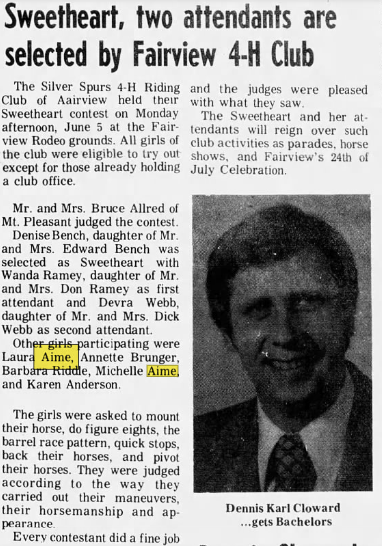
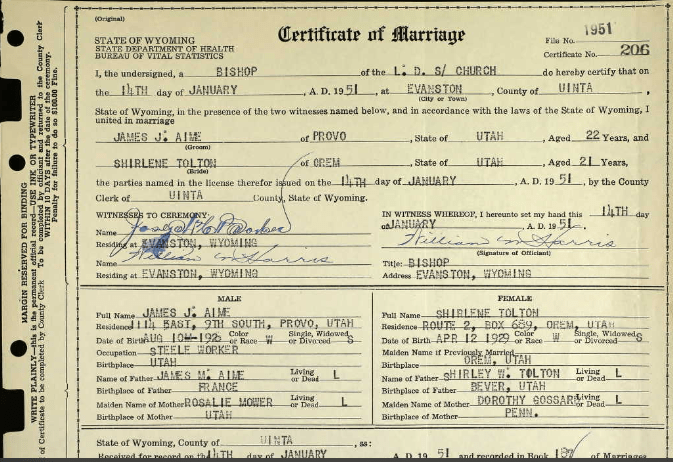
An older picture of Gacy and an unnamed man before his second arrest.
Another shot of Gacy. Photo courtesy of Netflix.
JWG before his second arrest. Photo courtesy of Netflix.
A stock pic of Gacy from 1978. Photo courtesy of Daily Mail.
A picture of Gacy that was smuggled out of jail by a guard, published by The Chicago tribune in 1978.
An older Gacy on death row. Photo courtesy of Murderpedia.
A picture of Gacy holding one of his paintings he dubbed ‘Pennywise The Clown;’ it was taken just five weeks before his execution. Photo courtesy of Murderpedia.
Gacy during his time on death row. Photo courtesy of Netflix.
Gacy in his cell. Photo courtesy of Murderpedia.
Supposedly this is a photo of Gacy awaiting execution. Photo courtesy of finwise.edu.
Gacy dressed as Pogo.
Another photo of Gacy dressed as Pogo the Clown.
Gacy dressed as Pogo.
Another photo of Gacy dressed as Pogo the Clown.
Another shot of Pogo.
A B&W shot of Gacy as Pogo, courtesy of The Chicago Tribune.
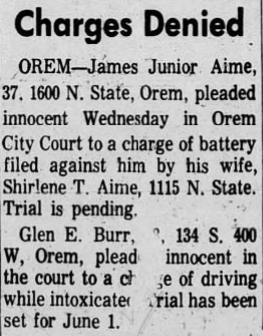
A younger John Stanley Gacy. Photo courtesy of Netflix.
Another shot of a younger John Stanley Gacy. Photo courtesy of Netflix.
John’s parents.
John’s sister Joanne on Oprah. She died in 2007.
John Wayne Gacy’s card for the ‘Democratic Precinct Captain’ of Norwood Park Township. Courtesy of The Chicago Tribune.
John Wayne Gacy’s business card for his personal business, ‘PDM Contractors.’ Courtesy of Newsweek.
Gacy loved flashy belt buckles and frequently wore one with his initials. Photo courtesy of Rafael Tovar and The Sun.
Gacy kept items belonging to his victims that he considered ‘mementos’ that he often looked at. Photo courtesy of Rafael Tovar and The Sun.
Police found necklaces, bracelets and other jewelry belonging to Gacy’s victims. Photo courtesy of Rafael Tovar and The Sun.
Some garters and keys belonging to Gacy’s victims.
John Gacy’s clown shoes. Photo courtesy of finwise.edu.
Gacy was indicted for 33 murders of young boys and men; these are his victims. Notice some remain unnamed to this day, March 2024. Photo courtesy of The Chicago Tribune.
A B&W shot of John Wayne Gacy’s completely intact house located at 8213 West Summerdale Avenue in Chicago, Illinois.
A photo taken on March 19, 1979 showing that certain portions of Gacy’s property in Norwood Park Township have been completely picked through and demolished by members of LE. Photo courtesy of Walter Kale from The Chicago Tribune.
A picture of Gacy’s tiki-themed bar in his living room. Photo courtesy of Cook County Court.
The other side of Gacy’s living room. Photo courtesy of Cook County Court.
A different angle of Gacy’s living room. Photo courtesy of Cook County Court.
JWG’s kitchen, untouched. Photo courtesy of Cook County Court.
JWG’s kitchen counter, untouched. Photo courtesy of Biography.
Another shot of JWG’s kitchen, in color. Photo courtesy of Netflix.
JWG’s bathroom, untouched. One of the detectives that was tasked with trailing Gacy used it one day and when the heat kicked on he immediately recognized the smell of human decomp. Photo courtesy of Cook County Court.
One side of Gacy’s bedroom. Photo courtesy of Cook County Court.
Another shot of Gacy’s bedroom. Photo courtesy of Cook County Court.
Another bed in Gacy’s house. Photo courtesy of Biography.
A picture inside of Gacy’s house. Photo courtesy of Netflix.
The main hallway in Gacy’s house. Photo courtesy of Biography.
A poster related to Gacy’s contracting company, ‘PDM Contractors.’ Photo courtesy of Netflix.
Information related to Gacy’s contracting company, ‘PDM Contractors.’ Photo courtesy of Netflix.
Members of the Cook County Sheriff’s Department carrying a piece of floor out of Gacy’s home.
Members of LE carrying equipment into Gacy’s residence to remove the bodies of his victims.
Investigators bringing out another body from Gacy’s house.
Another body being taken out of Gacy’s house.
A body is recovered from John Wayne Gacy’s house in 1979 and transferred to a sheriff’s van. Photo courtesy of Sally Good from The Chicago Tribune.
Another body being taken out of Gacy’s house.
Another one of Gacy’s victims being taken out of his house.
Cook County investigators carrying another body out of Gacy’s house.
Members of Cook County LE putting one of Gacy’s victims in the back of a vehicle to be further studied.
Police standing in Gacy’s garage. Photo courtesy of Murderpedia.
Investigators opening up Gacy’s garage. Photo courtesy of Netflix.
Members of the Cook County Sherrif’s Department removing the floorboards in Gacy’s kitchen in either late 1978 or early 1979. Photo courtesy of the Cook County Sheriff’s Department.
Members of LE looking through Gacy’s crawl space in either late 1978 or early 1979. Photo courtesy of Netflix.
The kitchen cabinets and partially tore up floorboards in Gacy’s kitchen. Photo courtesy of the Cook County Sheriff’s Department.
After realizing the full extend of Gacy’s atrocities, investigators eventually had to tear up the floors in his house. Photo courtesy of the Cook County Sheriff’s Department.
A technician cuts carpet in Gacy’s home in either late 1978 or early 1979. Photo courtesy of Cook County.
The crawl space underneath Gacy’s house. Photo courtesy of tCook County.
Another shot of the crawl space underneath JWG’s house. Photo courtesy of Cook County.
Another shot underneath Gacy’s house. Photo courtesy of Cook County.
Numbered stakes show where the remains of Gacy’s victims were discovered in the crawl space underneath his house. Photo courtesy of Tribune News Services.
Grids were marked as the crawl space was excavated circa late 1978 or early 1979. Police found the bodies of twenty-nine young men were recovered on his property, and four more were found in Illinois rivers. Photo courtesy of the Cook County Court.
A shot of Gacy’s crawl space. Photo courtesy of Netflix.
Another shot of Gacy’s crawl space. Photo courtesy of Netflix.
Some bones found in JWG’s crawl space.
A member of Cook County LE in the crawl space under JWG’s home.
A member of Cook County LE in JWG’s home. Photo courtesy of Cook County.
A member of Cook County LE in the crawl space under JWG’s home. Photo courtesy of Cook County.
Investigators in Gacy’s residence. Photo courtesy of Cook County.
A technician digging in Gacy’s crawl space. Photo courtesy of Cook County.
Investigators at JWG’s house. Photo courtesy of Cook County.
The hallway of Gacy’s house. Photo courtesy of Cook County.
Investigators tearing apart Gacy’s floorboards. Photo courtesy of Cook County.
The early stages of the Gacy investigation, when his house was mostly intact. Photo courtesy of Cook County.
Investigators at JWG’s house. Photo courtesy of Cook County.
Underneath the floors at Gacy’s house. Photo courtesy of Cook County.
Investigators going through Gacy’s house after his arrest. Photo courtesy of Cook County.
Investigators dismantling Gacy’s kitchen floors. Photo courtesy of Cook County.
Investigators tearing apart Gacy’s floorboards. Photo courtesy of Cook County.
Investigators tearing apart Gacy’s residence. Photo courtesy of Cook County.
LE were forced to remove the floors in Gacy’s house in order to access victims’ bodies. Photo courtesy of Rafael Tovar.
A crime scene technician from Cook County digging in Gacy’s basement. Photo courtesy of Cook County.
LE excavating the crawl space underneath Gacy’s home in either late 1978 or early 1979. Photo courtesy of Cook County.
Investigators digging through Gacy’s basement. Photo courtesy of Cook County.
A member of Cook County LE underneath Gacy’s homes looking for the remains of his victims. Photo courtesy of Cook County.
A member of LE underneath Gacy’s homes looking for the remains of his victims. Photo courtesy of Netflix.
A member of Cook County LE underneath Gacy’s homes looking for the remains of his victims. Photo courtesy of Cook County.
Cook County investigators going through the crawl space under JWG’s home.
A member of LE underneath Gacy’s homes looking for the remains of his victims. Photo courtesy of Cook County
A member of Cook County LE underneath Gacy’s homes looking for the remains of his victims. Photo courtesy of Cook County.
A member of Cook County LE looking through the bones of one of Gacy’s victims. Photo courtesy of Cook County.
One of the skeletons found in Gacy’s crawl space.
Another shot of one of the skeletons found underneath JWG’s house.
Rafael Tovar remembers stumbling across two left femurs. Photo courtesy of Rafael Tovar.
A member of Cook County LE standing up in Gacy’s crawl space, as the floorboards above were removed. Photo courtesy of Cook County.
A member of Cook County LE puling a body out of Gacy’s crawl space. Photo courtesy of Cook County.
A Investigators going through evidence found in Gacy’s crawl space. Photo courtesy of Cook County.
A picture of Gacy’s crawl space; I apologize for the text in the middle, it was the only copy I could find. Photo courtesy of Murderpedia.
Evidence identification marker number eight. Photo courtesy of Murderpedia.
Another view of evidence identification marker number eight. Photo courtesy of Murderpedia.
Evidence identification marker number twelve. Photo courtesy of Supernaught.
Evidence identification marker number fifteen. Photo courtesy of Murderpedia.
Evidence identification marker number sixteen. Photo courtesy of Murderpedia.
Evidence identification marker number seveteen. Photo courtesy of Murderpedia.
Evidence identification marker number twenty. Photo courtesy of Murderpedia.
A pieced together skeleton found under JWG’s house. Photo courtesy of Murderpedia.
Investigators looking into JWG’s crawl space.
The entrance to Gacy’s crawl space. Photo courtesy of Cook County.
The frame of Gacy’s crawl space. Photo courtesy of The Chicago Tribune.
Work continues on removing mud from JWG’s crawl space. Photo taken on on January 5, 1979, courtesy of The Chicago Sun-Times Collection.
A member of Cook County LE looking through the bones of one of Gacy’s victims. Photo courtesy of Cook County.
Members of Cook County LE removing mud from the crawl space underneath Gacy’s house. Photo taken on on January 5, 1979, courtesy of The Chicago Sun-Times Collection.
Investigators taking another body out of Gacy’s house. Photo courtesy of Netflix.
Investigators taking another body out of Gacy’s house. Photo courtesy of The Chicago Tribune.
Investigators carring out the remains of a body found beneath the garage floor on JWG’s property. Photo taken on on December 22, 1978, courtesy of Karen Engstrom from The Chicago Tribune.
Investigators taking another body out of Gacy’s house. Photo courtesy of The Chicago Tribune.
A blurry shot of investigators taking another body out of JWG’s house. Photo courtesy of The Chicago Tribune.
Evidence techs from the the Cook County Sheriff’s Department taking out of one of the bodies that were found underneath JWG’s property. Photo courtesy of Daily Mail.
Investigators and evidence techs taking another body out of Gacy’s house. Photo courtesy of The Chicago Sun-Times.
Sheriff’s officers carry bodies to the county morgue from Gacy’s house. Photo taken on December 22, 1978, courtesy of Quentin C. Dodt from The Chicago Tribune.
Investigators carrying out the remains of a body found in JWG’s crawl space.
The 28th body that was taken out of Gacy’s property in Norwood Park as members of LE transferred it to a sheriff’s van. Photo taken on on March 9, 1979, courtesy of The Chicago Tribune.
A shot of Cook County LE putting one of Gacy’s victims into a transport vehicle. Photo courtesy of Netflix.
JWG’s front yard, (almost) completely empty of Cook County investigators and evidence technicians.
Remains found in Gacy’s crawlspace. Photo courtesy of Netflix.
More remains found in Gacy’s crawlspace. Photo courtesy of Netflix.
Another picture of remains found in Gacy’s crawlspace. Photo courtesy of Netflix.
A body pulled out of JWG’s crawl space. Photo courtesy of Netflix.
Multiple remains uncovered in JWG’s house.
(Retired) Cook County Chief ME Robert Stein examines the case tag of victim number eighteen on December 29, 1978 in a crypt set aside specifically for Gacy victims. Photo courtesy of Gerald West from The Chicago Tribune.
Cook County employees demolishing Gacy’s home.
Workers demolish Gacy’s house in  April 1979. Photo courtesy of Daily Mail.
The house had to be knocked down the inside was gutted in the search for bodies. Photo courtesy of Daily Mail.
The ruins of Gacy’s one-time home. Photo courtesy of Daily Mail.
The shell of JWG’s former home. Photo courtesy of Daily Mail.
The demolition of Gacy’s house. Photo courtesy of Netflix.
The lot where Gacy’s house once stood. Photo courtesy of Netflix.
A barren plot of land where the home of John Wayne Gacy once stood. Photo courtesy of Bettmann Archive.
The house that was built in the lot where Gacy’s house once stood.
The Channahon Fire Department searching for bodies in the Des Plaines River. Photo taken on December 23, 1978, courtesy of Frank Hanes from The Chicago Tribune.
In addition to Gacy’s house, after police honed in on him they investigated this five-unit apartment building located at 6114 West Miami Avenue in Chicago. Photo courtesy of Murderpedia.
On November 23, 1998 technicians from the Cook County Sheriff’s Department began preliminary work on a possible excavation at an apartment building in the Northwest Side of Chicago in search of as many as five additional victims of JWG. Photo courtesy of The Associated Press.
The yard of the apartment building where Gacy’s mother once lived, and at one time he did some construction work there. This information regarding the location was released by retired Chicago police detective and PI Bill Dorsch in late 1998. Dorsch said he had seen Gacy carrying a shovel near the general area at about three in the morning one day in 1975. Photo courtesy of Murderpedia.
Technicians use radar to scan beneath the parking lot at the apartment complex where Gacy once cared for. Photo courtesy of Murderpedia.
Gacy’s car sitting in his driveway. Photo courtesy of Netflix.
The back of John Wayne Gacy’s muddy Oldsmobile. Photo courtesy of Netflix.
JWG’s contracting van. Photo courtesy of Netflix.
The back of JWG’s contracting van. Photo courtesy of Netflix.
A picture of the gas station where Gacy passed off the marijuana. Photo courtesy of Netflix.
Another shot of the gas station where Gacy passed off the marijuana. Photo courtesy of Netflix.
A photo of JWG after his first arrest for sodomy in 1968.
A mugshot from Gacy’s 1968 arrest for sodomy in Waterloo, Iowa.
Gacy’s mugshot taken on December 21, 1978 at the Des Plaines Police Department. Photo courtesy of the Des Plaines PD.
John Wayne Gacy being transported from the Des Plaines Police Station to a hospital on December 23, 1978. Photo courtesy of William Yates from The Chicago Tribune.
At the Des Plaines police station, John Wayne Gacy covers his face with his manacled hands as he emerged after an all-night questioning session on December 22, 1978. Photo courtesy of Roy Hall from The Chicago Tribune.
Gacy being put in a squad car at the Des Plaines Police Station to be transported to a hospital. Photo taken on December 23, 1978, courtesy of William Yates from The Chicago Tribune.
Police floor plans showing location of bodies found in Gacy’s home. Photo courtesy of Murderpedia.
A hand drawn diagram by Gacy of where he buried the bodies of his victims in the crawl space underneath his home. Photo courtesy of Erin Hooley from The Chicago Tribune.
A floor plan drawn by Gacy pointing out the locations of his victims. Photo courtesy of Murderpedia.
A picture from the memorial service for the nine (then) unidentified victims of Gacy; of that, five remain. Photo taken on June 12, 1981, courtesy of The Berkshire Eagle.
The service was held at a cemetery in Hillside, IL on June 12, 1981. The remains will be buried in nine different cemeteries in hopes of preventing a potential tourist attraction. Photo courtesy of The Berkshire Eagle.
Items found in the home of JWG. Photo courtesy of Netflix.
Some of the ‘tools’ Gacy used in his murders. Photo courtesy of Netflix.
A ligature used by Gacy. Photo courtesy of Erin Hooley from The Chicago Tribune.
A pair of handcuffs belonging to John Wayne Gacy. Photo courtesy of Erin Hooley from The Chicago Tribune.
A blue nylon jacket belonging to Robert Piest that was found in Gacy’s home. Photo courtesy of Erin Hooley from The Chicago Tribune.
Porn found in Gacy’s house after his arrest. Photo courtesy of Murderpedia.
Some of the pornography themed literature found in Gacy’s house after his arrest. Photo courtesy of Netflix.
Some more of the pornography themed literature found in Gacy’s house after his arrest. Photo courtesy of Netflix.
One of John Wayne Gacy’s paintings, a ‘self-portrait.’ Photo courtesy of Steve Eichner and WireImage.
Original Artwork by JWG. Photo courtesy of Steve Eichner and WireImage.
Another one of Gacy’s paintings.
Gacy’s paints.
Technicians from the Cook County Sheriff’s examining containers holding some remains of the unidentified victims of JWG in June 2011. For many years they were kept at the Cook County’s ME’s office and in 2009 were buried in a paupers’ grave. After they obtained a court order, investigators dug up a wooden crate at Homewood Memorial Gardens in June 2011 that contained eight smaller, pail-shaped boxes, each holding a victim’s jaw bones and their teeth. Photo courtesy of The Chicago Tribune.
An obituary for John’s sister, published on March 24, 2007.

Leichia M. Reilly.

Leichia M. Reilly was born on October 5, 1963 in West Seneca, NY to Patrick and Suzanne (nee Sharrow) Reilly. Patrick Frances Reilly was born on September 2, 1937 in Buffalo, and Suzanne was born on July 27, 1939 in Lackawanna. The couple were married on August 19, 1961 and had three children together: Brian, Leichia, and Denise. Her first name pronounced ‘Lee-sha,’ Ms. Reilly was raised in a Roman Catholic family in Lockport, NY; her dad was in the banking field, and retired from Marine Midland Bank as a Regional Executive Vice President. A strong student, Leichia excelled at academics and especially loved art, literature, and writing. After graduating from Mount Mercy Academy in 1982 she went on to attend Buffalo State College, and at the time of her disappearance was employed as a server at a pizzeria. She had dreams of one day becoming a writer, and many of her paintings and artwork were on display in the Reilly family home for many years after she disappeared.

Leichia was 5’5, weighed 120 pounds, had brown eyes and dark hair she wore short. She had freckles on her face, moles dotted across her chest, arms, and back and a large scar on her left knee; she also had pierced ears. Reilly was last seen wearing a black waist-length coat with red trim, a sleeveless charcoal-colored cotton jumpsuit with an elastic waistband, a round-necked sweater with multiple colors (including purple and red), and perforated ‘medical grade’ shoes with medium sized heels; she was using a red purse with a shoulder strap. Described by those that loved her as ‘vibrant and full of life,’ Leichia loved art, writing, and books. Like most 21-year-olds, she also enjoyed hanging out with her friends, and enjoyed going to local bars and hangouts like The Pierce Arrow Restaurant, which is where she was last seen before she vanished off the face of the earth. On the frigid, snowy evening of January 30, 1985 Leichia went out dancing with an unnamed girlfriend, and according to eyewitnesses the two danced, had a few drinks, and mingled with other bar patrons. When her friend wanted to leave, Reilly told her to go on without her, and said that she would catch a ride home with someone else. Multiple people reported to investigators that they saw her leaving the establishment at around 3 AM in the company of a white man driving a blue Chevrolet Camaro, an off duty NYS Trooper that she just met named Daniel Rose. Leichia was never seen or heard from again.

There is always the possibility that the young woman may have decided to go home with a guy from the bar that night, especially since she sent her friend home without her…. But according to her family and friends, that was completely out of character for Leichia. Later on in the early morning hours of Thursday, January 31 Mr. and Mrs. Reilly became concerned after their daughter hadn’t returned home, and: ‘in her whole life, Leichia had never been away from our home for any extended period without letting us know where she was. I knew immediately that next morning that something was wrong.’ Reilly didn’t show up for a job interview she was excited about on Friday, February 1st, and didn’t report to the pizzeria for her scheduled shift the following day. Leichia’s distraught Father contacted the West Seneca police and reported her as missing, and they immediately launched an investigation into her disappearance.

A five-year veteran of the NYS Troopers, 28-year-old Rose told investigators that he arrived at the bar at around 11 PM and began drinking with several friends, including Robb Riddick, a one-time running back with the Buffalo Bills. Go Bills. Recently, a reporter reached out to Riddick regarding Reilly’s disappearance, and he told them that he ‘remembers that night well’ because of its tragic outcome. Regarding Rose as a suspect, Riddick said ‘Danny, I considered him my best friend at that time. I know they were investigating Danny for months after that. One time, I went to his place and saw an unmarked police car parked nearby. The police followed me as I left. The police later told me they were tapping my phone for a while, trying to get information about Danny.’ The former NFL player said he is ‘certain’ he remembers his friend leaving the bar with Reilly around 3 AM and if he told investigators that he didn’t it was ‘a lie:’ ‘I saw him leave with her, and other people who were with us saw the same thing. Danny told me, ‘we’ll be right back.’’ The officer came back to the bar by himself roughly 55 minutes to an hour later and immediately went into the men’s bathroom. Investigators spoke with additional, unnamed witnesses that also reported that they saw Rose walk out of the bar with Reilly on the night she disappeared.

According to retired West Seneca Police Captain James Unger, ‘we have a decent timeline of when she was there, when she left, and then essentially after that, there is no sighting of her after that.’ Paul Schwartzmeyer told investigators that he spent the night at Rose’s apartment in Lackawanna the night of Reilly’s disappearance but said that his friend left shortly after they got there to ‘go to some girl’s house.’ When Schwartzmeyer woke up the next morning at around 10:00 AM, Rose told him that the girl he planned on visiting wasn’t home and that the woman he had left the bar with the night before was ‘some blonde’ but wasn’t Reilly. Daniel Rose was let go from the NYS Troopers for poor ‘job performance’ and ‘bad behavior’ related to ‘unrelated charges’ after Reilly disappeared (I’ve seen it reported as taking place two weeks, ten weeks, and a year afterwards). In an interview with The Buffalo News, the retired Director of Public Information for the NYS Police Lieutenant Michael Wright said that Rose had been ‘relieved of duty’ and was no longer employed with them. When asked why he had been terminated and if it had anything to do with Reilly’s disappearance he declined to comment.

The day after Reilly disappeared Rose called into work sick; when questioned by investigators about what he did that day he refused to answer. After the state police were notified of Reilly’s disappearance he was taken off road patrol and was put on desk duty ‘pending further investigation.’ Retired West Seneca Detective Edward A. Tyzcka worked on Reilly’s case for sixteen years, and he pointed out that just a few days after she vanished Rose hired a top defense attorney (the late Harold J. Boreanaz) to represent him and brought the lawyer with him to his interview. ‘That would make you think, well, here’s a guy who could help us. He saw the person we were looking for, why would he not help us?’ … ‘Once he got represented by a lawyer, that put a kibosh on anything we could do.’ Investigators from West Seneca waited two weeks after Reilly disappeared to speak with Rose, and on February 14, 1985 he told investigators that on the evening she disappeared he had been out drinking with buddies and he spoke to several women, including Reilly. During the interview Rose shared he was ‘consistently drinking’ and estimated that he spoke to ‘between six and 10 young women’ that evening. When investigators showed him a picture of Reilly, he said he met her for the first time that night but only spoke with her briefly. He also said that at about 3:00 AM he went out to the parking lot with a young woman named Cathy for about twenty minutes, and specified that it wasn’t with Reilly. Rose told detectives that he didn’t know what happened to Leichia or who she even was, and after giving his initial statement he refused to speak to them again and cooperate any further.

Convinced that Reilly was dead, investigators spent thousands of combined man hours looking for her body, using everything from cadaver dogs to helicopters to aid in their efforts. Beginning on February 4, 1986 and ending on the 26th (in an attempt to be completely accurate, I’ve seen it reported as taking place from the 5th to the 27th), investigators dug through the Chaffee Landfill (located at 10860 Olean Road) during a brutal winter storm after receiving a tip that her body had been disposed of there in a dumpster. The search resulted in nothing.

Even when he was employed with the NYS Troopers Daniel Rose had problems behaving himself and being a law-abiding citizen: in April 1982 he stood trial after being charged with third degree assault after getting into an altercation with Bradford Burnham at a Lyons Police station after he arrested him at a nearby bar. Apparently Rose and a girlfriend met another trooper and his wife out at The Tom Jones club for a night of drinking, and he was off duty at the time of the altercation. Reportedly nineteen-year-old Burnham was making ‘obscene references to the Newark Police Department, and a shouting match ensued.’ He was arrested by Rose for harassment and resisting arrest and was taken to the local police substation for booking. Burnham said that the officer ‘hit him on the head without provocation as he stepped out of a patrol car near the Lyons police station.’ Additionally, while at the station Lyons LE left the trooper alone with the suspect, and after hearing a scuffle they returned and found him on the floor with blood on his face: Rose had struck him in the head. After reviewing the case, the grand jury dismissed the original charges against Burnham and instead returned an indictment against Daniel Rose. When the case was brought to trial a verdict was made after a Wayne County Jury deliberated for only two hours: he was found not guilty. It was a unanimous decision and Rose was able to keep his job as a NYS Trooper.

After losing his job with the NYS Police Rose briefly operated a pizza parlor in Lackawanna called The Big Cheese. In the early 1990’s he eventually got a new position as a bricklayer, and after branches from Niagara Falls, Buffalo, Rochester, Ithaca and the Southern Tier were merged into one the Bricklayers Local 3 was created; Rose worked his way up to the position of union president. He also has had his fair share of criminal charges, including multiple drunk driving arrests in 1998, 2006, and 2009. In addition to DWI’s in April of 1998 he was involved in a two-car accident in the Town of Wheatfield, and was charged with obstructing governmental administration after Niagara County Sheriff’s deputies said that he became belligerent following the collision and kicked an officer; Rose also threatened him and his family. His license was revoked for six months, he was ordered to spend 16 days on a county work program, and he was fined $940. He was sentenced to three years’ probation and was directed to appear before a victim-impact panel of relatives of people that were killed in alcohol-related car accidents. In addition to numerous drunk driving arrests, it’s also been reported that he has a lengthy history of abuse toward women.

In March 1985 retired Erie County DA Richard Arkara announced that authorities would be offering a ten thousand dollar reward for information leading to the discovery of the missing woman or the arrest of her suspected killer. Unfortunately, this offer didn’t really go anywhere nor did it seem to encourage anyone that may have been privy to any information about Reilly’s disappearance to come forward. The investigation continued, however without anything substantial coming in there was little detectives could do to advance it and quickly Leichia Reilly faded from the headlines. Days turned to weeks, weeks to months, and months to years… and the case eventually went cold.

Mr. Reilly spoke very highly of the West Seneca police regarding all of their hard work and dedication in trying to solve his daughters case. Although the Reilly’s mostly preferred to stay out of the limelight, Patrick stepped up as the family’s public representative and when asked about Leichia’s disappearance said: ‘I want justice, not sympathy. I’m convinced that we have a psychotic killer who is loose in this community and it greatly distresses me that he could kill again. I know what my family has gone through, I don’t want anybody else to go through that.’ He went on to say that his family had been incapable of enjoying anything since Leichia disappeared, and: ‘intellectually, we know that Leichia has been killed, but emotionally it’s difficult to accept imagine having an incapacity for joy that’s what we have in Leichia’s case. We’ve all been robbed of her potential, in my biased subjective judgment. She was a special person, a very forgiving soul.’ Mr. Reilly also told the media that he felt all of the evidence pointed towards one individual and he hoped that anyone that had any information regarding what may have happened to his daughter would come forward and end the horrifying situation his family found themselves in.

Retired West Seneca Detective Raymond Slade told the media that even though they lacked evidence he fully believed that Reilly had been murdered the night she disappeared and her killer had managed to successfully dispose of her body in a still unknown location. By July of 1985 investigators were still unable to find any real physical evidence in relation to what may have happened to her, and despite hundreds of hours spent investigating the case, they were unable to produce any solid leads in relation to the missing woman. Since Reilly disappeared, West Seneca police have interviewed and polygraphed over 200 of her friends, family, acquaintances, and coworkers, and unfortunately it didn’t result in much helpful information that aided them in their investigation. Police even met with a self-proclaimed psychic from New Jersey, who had reportedly been helpful in other missing persons investigations. In the weeks after she vanished, Detective Tyzcka said the department spent hundreds of combined man hours searching wooded areas, dumpsters, bodies of water, and fields for any trace of her remains. In an interview before his retirement Tyzcka also said that the inability of LE to find the young woman’s body was one of the ‘most frustrating mysteries of his career.’

Multiple members of West Seneca LE said they were ‘99 percent sure’ that Reilly died of foul play the night she disappeared, and that whoever killed her also hid her body. Lieutenant Kevin Baranowski shared with The Buffalo News that: ‘nobody has ever heard from Leichia since she disappeared that night, but we cannot be 100 percent sure that she’s deceased because we never found her body.’ … ‘I am just going to say what our department has stated right along about Daniel Rose… as far as we can determine, he was the last person seen with Leichia on the night she disappeared.’ Although Rose declined to speak to the media directly, his attorney Robert L. Boreanaz shared that he had nothing to do with Reilly’s disappearance or death and that his client is ‘an innocent man. He’s never been charged because there’s no evidence against him, because he didn’t do it. Every district attorney who has been in office over the past 35 years has passed on this case because there is no case, the evidence is not there.’ In Boreanaz’s eyes, none of the witness statements or additional information found by police makes Rose a legitimate suspect, and ‘their witnesses were people who were drinking at a bar in the early morning hours, in the 1980’s, when people weren’t as careful as they are now, because of the enforcement of DWI laws.’ The attorney declined to answer why his client was fired by NYS Police but did say that ‘it had absolutely nothing to do with this matter in West Seneca.’ According to West Seneca police documents, the state agency was heavily involved in the early stages of the investigation but less so as it advanced. Like with the Bundy cases in the early to mid-1970’s, we’ve all seen how rival police agencies frequently (and purposefully) failed to share information and cooperate with one another. A part of me believes that Rose’s status as a member of law enforcement may have interfered with the investigation, at least in the beginning. I mean, the fact they waited two full weeks before interviewing him is pretty significant, in my opinion. I’m sure it took them some time to get their ducks in a row and track him down, but still… that’s a lot of time.

To me, the fact that Rose was a lifelong resident of NYS and patrolled the area for his employment suggests that he was pretty familiar with the area, and would have most likely known plenty of places where he could have disposed of a dead body. I would think he was also at the very least fairly well-versed in the law as well: I know that in 2024 to be a Trooper in New York state you ‘must have completed 60 college credit hours at an accredited college or university’ and had to take a civil service exam as well.

In a 1989 interview with the Buffalo News, retired West Seneca Detective Captain Jack Slade pointed out that Lake Erie was frozen over and there was more than two feet of snow covering the ground on the night Reilly disappeared, which would have further complicated any attempt to dispose of a body. There’s a variety of different wooded areas and waterways in WNY, such as Cazenovia Creek, 18-Mile Creek, and Cayuga Creek (as well as several others), all of which are major tributaries that feed into Lake Erie. About the case Captain Unger said that they ‘do get tips sporadically throughout every year, and we do follow up on them. Unfortunately, to this point nothing has panned out. Not having a body makes it very difficult for prosecution, and secondly, and maybe even more importantly, is that there could be potential evidence that would be on or near her body which could link us to a suspect.’ According to West Seneca Lieutenant Kevin Baranowski, as recently as 2017 investigators searched a local area after getting a tip on where Reilly’s remains might be. He declined to disclose that location, saying ‘I don’t want the killer to know where we looked.’

Reilly’s disappearance continues to be a great source of pain for those that knew and loved her, including her longtime friend and neighbor Jo’Ann Derry-Bernardo. In an interview with The Buffalo News, Bernardo said: ‘we grew up right across the street from each other. Leichia was a special person. I think about her all the time. Leichia was a very creative, very literate and funny person. She was a bright, sweet, spiritual person. I can’t imagine anyone being evil enough to want to hurt her. Her family was devastated’ … ‘I think Leichia would have settled down with someone who loved her, had a couple of kids and would have written two or three books by now.’

As of February 2024 the body of Leichia Reilly has never been recovered, and Daniel Rose has never been charged in relation to the case. He is now 66, retired, and lives in Niagara County. Erie County District Attorney Kevin Dillon told The Buffalo News that Reilly’s case had never been presented to a grand jury due to the fact that there was not enough evidence to show them, mostly due to the fact that they never found her body. Reilly’s disappearance is still listed as active by both the NYS Police and the West Seneca Police Departments. After his daughter disappeared Mr. Reilly became a fierce advocate in her case, and always felt that she was killed after refusing Daniel Rose’s sexual advances. Despite there being no evidence to help back up this theory, authorities agree that Ms. Reilly most likely met her demise through some form of foul play. About the individual that is responsible for the death of his daughter, Mr. Reilly said ‘I don’t even hate the man. What I’m interested in is truth and justice.’ …’I am absolutely convinced she’s dead.’ … ‘It’s profound, it robs your life of the capacity for joy.’ After retiring he spent his golden years serving on numerous charitable boards, which helped the Western New York areas poor and developmentally disabled populations. Unfortunately, he died on July 13, 2016 at the age of 78 before his daughter’s killer was brought to justice. Suzanne Reilly passed away on February 12, 2021. In my opinion, investigators were most likely unable to find the ‘smoking gun’ that was necessary to make a conviction stick, and let’s keep in mind that her disappearance took place in ‘pre-DNA’ days, and the little evidence investigators did have was circumstantial.

Daniel D. Rose is still considered a suspect in Reilly’s case, and Lieutenant Baranowski said that detectives would ‘love’ to sit down and talk to him again sometime and that ‘there are gaps in his story, and we’d like to discuss the gaps with him.’ Investigators did admit that they have some physical evidence related to the case but refuse to reveal what exactly they have. Captain Unger said that ‘we have been in contact with, you know, state labs, federal labs, trying to see if what we have in evidence could potentially be used with the new technology. And at this point, there hasn’t been a breakthrough for what we have. But we’re hoping that in the near future, that there will be.’ About the case being solved one day Unger said ‘I certainly hope that, you know, even though Leichia’s parents have passed, she still has living relatives, and we just hope that we can give the family some sort of closure of this case.’ Reilly’s brother, sister and other surviving family members are still desperate for answers as to what happened to her, and they are still pushing to make her case a more active investigation. About Mr. Reilly, Detective Tyzcka said that ‘he was a real gentleman, and really broken up about what happened. I never got to call him up and say, we finally made an arrest. He never got closure. I feel bad about that to this day.’

About Reilly’s disappearance, Webslueths’ user ‘WNYer’ said that: ‘Maybe he hid her within an hour of the Pierce Arrow Club, and returned throughout the night (as he did leave his home again THAT night the friend staying with him at the time said) and the next day when he called off of work to finish disposing of her body. Obviously his background in Law Enforcement helped him achieve covering his tracks. They searched the landfill based on a tip she had been put in a dumpster at 7-11. The landfills are huge places and even the best Department could miss something. Perfect place to cover any foul smells bc they already stink. Or there’s the possibility of him having used lye or a fire to finish covering his tracks. Very hard to say where Leichia is and it breaks my heart her Father was never able to give her the proper burial he wanted so badly before passing. I’ll be doing my best to generate tips in the coming year because I’m sure in Niagara County or not, he’s far less intimidating to most people these days than he was back then.’

It’s worth noting, in recent years there have been a couple of local homicide convictions in WNY that were made without a body: on February 13, 1984 thirty-one year old Mark Seifert of West Seneca disappeared after being lured to a deserted country road in Machias. Although his body was never recovered, blood and tissue was found at the scene and in 1987 his brother William was sentenced to 20 years to life in prison after a jury convicted him of murder. To this day Seifert’s body has never been recovered. In 2003 46 year old Town of Tonawanda resident Michael Thuman was sentenced to five to fifteen years in prison for the shooting death of sixteen year old Duane Talmon Jr. on October 30, 1974. Investigators said the murder took place after a marijuana deal went bad, and although Talmon’s body was never recovered Thuman gave police a statement in which he admitted to the slaying. Erie County DA John J. Flynn said he recently spoke to investigators in his department regarding Reilly’s disappearance, and he said that he would not hesitate to pursue charges if new evidence was ever uncovered, but ‘unfortunately, whenever a body cannot be found, that makes it that much more difficult to solve. The deceased body provides us with cause and manner of death evidence. On many occasions, there is DNA evidence from the body. All those potential pieces of evidence are not present when we don’t have a body.’

On January 1, 2014 writer and self-proclaimed numerologist/’graphologist’ Linda Crystal published a book titled ‘Leichia Reilly, Your Family Is Waiting: The Disappearance of Leichia Reilly’ (yes, that’s the actual name). In it, Crystal writes about what she suspected may have happened to Reilly from the viewpoint of a ‘forensic astrologist.’ Not willing to spend the $4.01 on what I’m sure is a piece of hot garbage, Amazon pretty much told me all I needed to know about the text: the five reviews averaged out to 1.8/5 stars, and the general consensus seemed to be that ‘it was mostly about the writer and her ability to use horoscopes to solve murders. The title was deceiving. Not too much about the Leichia Reilly investigation.’

If Leichia Reilly were still alive in February 2024 she would be sixty years old. Anyone that has information that could be helpful in solving her case should contact either the New York State Police at 716-343-2200
or the West Seneca Police Department at 716-674-2280.

Leichia Reilly.
Leichia Reilly in a group photo; it was one of only two pictures that I was able to find of her.
Leichia Reilly’s missing persons poster.
A brief rundown of some facts related to Reilly’s disappearance.
An article about Daniel Rose being probed for Reilly’s disappearance published by The Buffalo News on February 14, 1985.
An article about the disappearance of Leichia Reilly published by The Buffalo News on July 31, 1985.
An article about the disappearance of Leichia Reilly published by The Buffalo News on February 6, 1986.
An article about Reilly published by The Buffalo News on February 6, 1986.
A short article about the disappearance of Leichia Reilly published by The Buffalo News on February 27, 1986.
Part one of an article about Leichia Reilly published by The Buffalo News on March 16, 1986.
Part two of an article about Reilly published by The Buffalo News on March 16, 1986.
An article about Reilly published by The Buffalo News on March 21, 1986.
Part one of an article about Reilly published by The Buffalo News on January 30, 1989.
Part two of an article about Reilly published by The Buffalo News on January 30, 1989.
An article about Leichia Reilly published by The Buffalo News on January 30, 1991.
An article mentioning Reilly published by The Buffalo News on May 31, 1994.
An article about Reilly published by The Buffalo News on January 31, 1995.
Part one of an article about Reilly published by The Buffalo News on July 5, 2003.
Part two of an article about Reilly published by The Buffalo News on July 5, 2003.
Part one of an article about Reilly published by The Buffalo News on January 24, 2020.
Part two of an article about Reilly published by The Buffalo News on January 24, 2020.
A matchbook for the former Pierce Arrow in West Seneca, NY.
he stood trial for third degree assualt in April 1982 after he got into an altercation with a Newark Man at a Lyons PD after he was arrested by Rose for harassent and resisting arrest at the To Joes ightblubin Lyons. Rose was off dty at the tie of the assault and was there drinking. Apparently Rose and a girlfriend met another off duty trooper and his wife at the club, and the ab 'processed to ane obsece references to the ewark Police Department adn a shouting match ensued.' The man was using obsence language andmay have made an obsence gesrure and after Rose arrested him and took him to the police substation and Rose struck him in the head. At the station Lyons D left Rose alone with Burnham andhen they heard a scuffle they returned and foundBurnham on the floor with blood on his face. After reiewin the case the grand jury dismissed the original case against Bradford Burnham and instead returned a indictment against Rose. One thing I do want to point out is he had a different lawyer for this trial, a ma named Leonard Boreonaz.
The former Pierce Arrow Restaurant, most recently ‘The Vault.’ In late 2019 the New York Liquor Authority shut them down after the state found to have ‘trends of violence.’ It soon will be home to a Dollar General.
A sign for ‘The Vault.’
The temperatures from January 31, 1985 in nearby Cheektowaga NY. Graph courtesy of wunderground.com.
Daniel Rose’s senior picture from the Father Baker Victory High School yearbook.
A picture of Daniel Rose from Reilly’s missing persons poster.
A picture of Daniel Rose in relation to his time at the BAC Local Union #3.
An article about Rose being charged with assault during his time as a NYS Trooper published by The Democrat and Chronicle on April 8, 1982.
An article about Rose’s assault trial published by The Democrat and Chronicle on June 17, 1982.
Part one of an article about Rose testifying in his own defense published by The Democrat and Chronicle on June 19, 1982.
Part two of an article about Rose testifying in his own defense in his 1982 trial published by The Democrat and Chronicle on June 19, 1982.
An article about Rose being found not guilty published by The Democrat and Chronicle on June 22, 1982.
An article mentioning Rose from his days as a NYS Trooper published by The Buffalo News on April 12, 1984.
An article about Rose being assaulted published in The Buffalo News on June 6, 1984.
A help-wanted advertisement for the restaurant Rose briefly worked at called ‘The Big Cheese’ published in The Buffalo News on June 2, 1989.
The Buffalo News on November 9, 2003.
A blurb about Rose being charged with a felony DWI in The Star-Gazette on February 17, 2006.
A blurb mentioning Daniel Rose being charged with a felony DWI in The Star-Gazette on July 5, 2007.
A blurb mentioning some activity regarding Rose’s activities in the Local 3 Bricklayers Union published in The Buffalo News on March 8, 2010.
An article about Patrick Reilly being elected as an officer for Marine Midland Bank published in The Buffalo News on June 14, 1971.
Patrick Reilly’s obituary published on The James W. Cannan Funeral Home website.
An obituary for Suzanne Reilly published by The Buffalo News on February 14, 2021.
An interesting theory from a Redditor about the disappearance of Leichia Reilly… sadly I can’t even give credit to the writer because they deleted their account.
A Redditor going by the name of ‘Electronic-Fee-4273’ left this story about an encounter she had with Daniel Rose on a post about the disappearance of Ms. Reilly. What a scary experience.
Robb Riddick’s 1988 Topps trading card from his time as a Buffalo Bill.

Bundy’s Execution: January 24, 1989.

Theodore Robert Bundy was executed in Florida’s Prison’s electric chair on January 24, 1989 after brutally raping and killing dozens of young women between 1974 and 1978 (most likely earlier than that). The infamous serial killer was sentenced to capital punishment after brutally killing three young women in Florida (and countless others across the Pacific Northwest) and had been given the death penalty three times before he was finally killed. Bundy sat on death row for almost a decade when he was finally executed at 7:16 AM EST, and the event became a celebration of sorts for Floridians. On January 23, as the condemned man was spilling his guts in a last ditch effort to push off his execution, a crowd of almost 500 gathered outside the Florida Prison chanting phrases such as ‘die, Bundy, die’ and ‘burn Bundy, burn,’ drinking drank beer and holding signs that read ‘watch Ted fry, see Ted die!’ But not everyone was excited, there was also a small group of anti-death penalty protesters that didn’t want to see the event take place.

Bundy in prison with some of his fellow inmates. Photo courtesy of Supernaught.
Ol’ Sparky, the electric chair at Florida State Prison.
Bundy peering out from behind the bars at Florida State before he was executed. Photo courtesy of Hezakya News.
A drawing of Bundy walking to the execution chair.
A drawing of Bundy on his way to the execution chair.
A drawing of Bundy in the execution chair. Photo courtesy of ‘Ted Bundy: I was Trying to Think like an Elk.’
A drawing of Ted sitting in the electric chair.
A picture from a Florida newspaper after Bundy was executed.
The crowd outside of Florida State Prison before Bundy’s execution in the early morning hours of January 24, 1989. Photo courtesy of Fox 13 News.
News crews gathering outside of Florida State Prison before Bundy’s execution in the early morning hours of January 24, 1989. Photo courtesy of Hezakya News.
A gentleman wearing a ‘Burn Bundy, Burn’ t-shirt outside Florida State Prison before Bundy was executed. Photo courtesy of Hezakya News.
A picture taken the morning of Bundy’s execution.
A picture taken the morning of Bundy’s execution outside Florida State Prison.
A sign someone was holding outside Florida State Prison before Bundy was executed. Photo courtesy of Fox 13 News.
A sign someone was holding outside Florida State Prison before Bundy was executed.
A picture taken before Bundy’s execution.
Some pro-death penalty demonstrators standing outside of Florida State Prison the morning of Ted’s execution.
Some anti-death penalty protesters standing outside of Florida State Prison the morning of Ted’s execution.
A sign hung in the window of a Florida musical instrument store the morning of Bundy’s execution.
A sign hung in the window of The Phyrst, a bar in Florida on the morning of Bundy’s execution.
Mrs. Bundy talking on the phone the morning of Ted’s execution.
The hearse pulling out of Florida State Prison carrying Bundy’s remains after he was executed.
The hearse driving Ted’s remains to the ME’s office after he was executed.
A photo of Ted arriving at the Medical Examiners office after his execution.
A B&W of Bundy after his execution.
A close-up B&W of Bundy after his execution.
A picture of Bundy, post-mortem. Photo courtesy of the Florida state Department of Corrections.
Bundy after his execution.
The top of Bundy’s head after his execution.
Bundy’s legs after his execution.
An article written the day Bundy was executed published by The Greenwood Commonwealth on January 24, 1989.
An article written the day Bundy was executed published by The Enterprise-Journal on January 24, 1989.
An article written the day Bundy was executed published by The Elizabethton Star on January 24, 1989.
An article written the day Bundy was executed published by The Sun Times on January 24, 1989.
Bundys death certificate.
A mock obituary for Ted Bundy created by ‘theodorerobertcowellnelsonbundy.wordpress.com.’ The description reads: ‘I thought he deserved a proper obituary, not some sensationalized news article about the monstrous serial killer celebrating his death.’
An interesting opinion piece Bryan Kohberger’s mother sent to a newspaper about Ted Bundy’s execution, published by The Daily News on February 16, 1989.

The (former) SandPiper: A History.

The space was originally known as the Rainbow Tavern. At some point in the 1960’s, it became the Sandpiper Tavern. It switched back to the old name at some time in the 1970’s.
The SandPiper as it looked when Ted and Liz met in the fall of 1969.
The Fusion Ultra Lounge was the third-last bar to exist at this address. The location picked up a bad reputation for teenage drinking and violence. In February of 2015 everything came to a head when two teenagers were sent to the hospital following a shooting incident. The city of Seattle requested an emergency suspension of the club’s liquor license in response, and shortly afterwards the bar permanently closed it’s doors.
Before Ladd and Lass, the spot was occupied by Floating Bridge Brewing. Unfortunately they were forced to close thanks to the financial strain of the Covid pandemic.
What the former SandPiper looked like in April 2022.

Denise Lynn Oliverson.

Denise Lynn Oliverson (née Nicholson) was born on August 10, 1950 to Robert ‘Bob’ Dale and Nina Marie (nee Jackson) Nicholson in Missouri. Mr. Nicholson was born on June 12, 1927 in Saint Joseph, MO and served in the US Navy during WWII. Denise’s mother was born in St. Louis, Missouri on August 15, 1923 and after graduating from high school enlisted in the US Navy. When the war ended, Nina enrolled at Denver Art Institute, where she met her future husband. The two got married on June 29, 1949 and had two daughters: Denise and her younger sister, Renee. The couple eventually relocated to Colorado and Robert got a job as a commercial artist at The Daily Sentinel. The family settled down in Grand Junction in 1963 after moving from Colorado Springs; after Denise was murdered Mr. Nicholson said he regretted moving there and said that it was ‘a mistake.’

Oliverson had blue eyes, brown hair that she wore long and parted down the middle, and stood at 5’4” tall. She had some lingering facial acne, pierced ears, and a discolored lump on the back of her right hand; she was petite, and only weighed around 105 pounds. After graduating from Grand Junction High School in 1968 she got a job with a company called Ultronix (at least, according to her engagement announcement published in The Daily Sentinel on May 20, 1970). Looking into them, Ultroni was a manufacturing plant that produces electronic resistors, components and log converters but they have since left the Colorado area and moved out of state.

In 1969 Denise was charged with a misdemeanor after being arrested in GJ for marijuana possession, and at some point in the early 1970’s she lived in Spokane, WA with an individual named JC Harrison. Described by her friends and loved ones as being a ‘great, kind person,’ she married Joseph Franklin Oliverson on September 26, 1970. Joe was born in March 1950 in Idaho but his family relocated to Alaska; he was a 1968 graduate of Dimond High School in Anchorage, where he grew up. Oliverson attended Mesa College and when the couple first got married he was employed in Alaska; he eventually relocated to Grand Junction to be with his wife and got a job in insurance and real estate. After going through a rough patch the couple divorced on March 13, 1972. When she was killed Denise was in a new relationship with a man named Raymundo Esteban Romero (who simply went by ‘Steve’). According to her dad, Denise was a frequent drug user and in the early stages of her disappearance he suspected that she may have imbibed in some sort of illegal substances and taken off. Despite a history of running away (she would always return after a few days), Oliversons history in the year prior to her disappearance hinted that she changed a lot and didn’t participate in that behavior anymore. In a letter to Denise dated March 27, 1975 sent from her behavioral health counselor, Lois Kanaly shared that the young divorcee was accepted by the Division of Rehabilitation for services because of her disability, and her anxiety diagnosis was considered ‘a handicap to her employment.’ From there, the letter stated that she had an upcoming therapy appointment on March 31 at 1 PM. At the bottom was a postscript that read: ‘I am pleased. Come in very soon as you can start school this quarter. Enclosed is the Mesa College application.’ Kanaly also advised Denise to look into the schools J.E.T. program. So, obviously Oliverson was in the process of making some big changes in her life, and seemed to be in the process of applying to go to college.

Denise and Steve weren’t together for very long, and seemed to have a healthy relationship at first, however cracks were beginning to show and according to Oliversons friend from high school Marie Parish she wanted him out of her house. At first it appears that she lived at her one bedroom house located on LaVeta Street in GJ alone, but was pressured by Romero to move in with her as a ‘safety precaution’ because of a dangerous former flame. It appears that he was a very jealous and controlling boyfriend and it’s speculated that his motives weren’t entirely gentlemanly and he did it more to get in her house so he could keep an eye on her versus doing it for her safety. Oliverson had a dog named Toma.

On Sunday, April 6th, 1975 Ted Bundy abducted Denise Oliverson at the South 5th Street Bridge in Grand Junction, Colorado. According to the missing persons report dated April 8, 1975, Mr. Nicholson said that the day that his daughter disappeared she stopped by his house with Steve at roughly 1:00 in the afternoon, and from there they went to Lincoln Park. They were taking advantage of a beautiful spring day and were enjoying being outside. Denise saw a friend at the park named Fred Gallegos, but the two didn’t interact. The couple then explored Grand Junction for a bit before returning home. That’s when they got into an argument and around 3 PM Denise said that she was going to ride her bike to her parents house. She left with no coat or personal possessions and Steve said that it’s possible she went back to the park to see her friend. Detectives strongly felt that she was biking down a short path on the east side of the South 5th Street Bridge in Grand Junction when she encountered Ted, which was about 1.7 miles away from her home on LaVeta Street. According to Kevin Sullivans ‘The Encyclopedia of the Ted Bundy Murders,’ several stories about what Denise was doing before she was abducted have emerged or the years since she disappeared, but authorities are certain that she had an argument with her boyfriend and left the one bedroom home she shared with him to go to her parents house, on her a yellow Coast to Coast 10 speed bicycle, serial number 2C174568 to go to her parents house. She never made it.

When Oliverson didn’t come home that night Romero just assumed she spent the night at her parents, as that was a typical occurrence when they had a disagreement. But he immediately became concerned the next day when he called her parents’ house to talk to Denise about coming home and he was told she wasn’t there. Consequently, Mr. Nicholson contacted law enforcement at some point early on April 7, 1975 and reported his daughter as missing; Denise’s parents gave them pictures of her but let them know that they wanted them back. Police didn’t wait to investigate and immediately sprang into action, mapping out the route Oliverson most likely would have taken and searching the road along it. They spoke with members of her family, friends, coworkers, and acquaintances and were told nothing of value. Oliverson’s Dad contacted the FBI for further assistance but was told that they wouldn’t be able to assist in the case unless there was indication that she had been kidnapped or was killed as a result of foul play. At the time she disappeared Denise was employed with Dixson Inc. as an assembler; she wasn’t there for long and only got the position the year before.

On April 7, 1975 an unknown caller from the Denver and Rio Grande Railroads got in contact with the Grand Junction Police Department and told them about an abandoned yellow bicycle that was leaning against a pillar underneath the 5th Street viaduct near the railroad tracks. Retired GJ police officer Lew Fraser was dispatched to the scene at 8:48 AM, and upon arriving he met up with railroad engineer Wilbur M. Class, who shared with him that it had snowed the night before and he had seen what looked like sandals as well as some additional things sitting on the bike’s seat. According to a second railroad employee, the items were scattered haphazardly all over the tracks before he neatly set them out of the way (more on that later). According to Officer Lew there was nothing strange or unusual about the scene that jumped out at him, and it was just another lost bicycle to him. He made a property report, tagged it with a ‘lost and found’ sticker then turned it into the Grand Junctions ‘Old City Shop,’ classifying it as abandoned. When it was eventually determined that the items belonged to Oliverson, LE immediately suspected that foul play was involved but were unable to come up with much else. According to a deep dive by Bundy archivist Tiffany Jean, the investigating officer said in his report that ‘as I was checking it an engineer in a passing locomotive hollered at me and said it had been there since yesterday and that there were some clothes on it and it could have been stolen or something. I checked the immediate area and all I found was a light brown rolled up women’s belt. I checked the bike for stolen and it had not been stolen. Brought the bike to old city shop and filed an abandoned property report and put a found property tag on bike. No further investigation at this time.’

In the early stages of Denise’s disappearance the Grand Junction PD considered Romero a suspect due to his strange and suspicious manner, but nothing conclusive tied him to her disappearance and he was never charged. Law enforcement deemed that he was an unbalanced person but gave him the benefit of the doubt and said that maybe he acted that way because of his girlfriends disappearance. Unfortunately for Oliversons family they were forced to sit back and watch as her case grew cold, and there don’t seem to be any reports of any tips or leads until Bundy confessed on death row in 1989. 

After Bundy was thrown into the spotlight because of his arrest in Granger, (retired) GJ Police Chief Ed VanderTook admitted that he was hesitant at first to acknowledge that Bundy was responsible for Oliverson’s disappearance, however after it was proven that credit card receipts placed him in the area he quickly changed his tune. I mean, thinking about it logically, it wasn’t like he could have easily hit her over the head with a crowbar and dragged her away: she was abducted in the middle of the afternoon. I’m leaning towards him using some sort of ruse to lure her back to his car and then he pounced. It’s strongly speculated that Bundy parked his VW underneath the overpass on South 5th Street, as it was a relatively secluded spot in the mid 1970’s. Did he fake a broken arm and tell her he needed help carrying something back to his car? Or perhaps a broken leg, somehow? Did he ask her to place his briefcase in his car then whack her over the head, shove her in then sped off? Or, was he fearless and blitzed her by the bridge, then dragged her back to his Bug, which was waiting nearby? The possibilities are endless, and we’ll never know what actually happened. There’s yet another theory that maybe Denise was experiencing mechanical problems with her bike and that Ted may have come to her assistance.

Oliverson was last seen wearing a long-sleeved green Indian-print blouse, a pair of Levi’s, sandals and a silver ring on her right pinky finger. According to (retired) GJPD Homicide Investigator Doug Rushing and his then partner Jim Fromm, many of Denise’s personal possessions didn’t make it to the evidence file: her purse, a light brown rolled up belt, and additional personal items were stolen by a Grand Junction officer, who gave the items to his girlfriend because of their high market value and the fact that they were considered ‘nice items.’ In addition to her personal things and handbag, Denise’s bike was taken to Grand Junctions ‘Old City Shops’ with the intent of being stored under ‘unknown owner,’ but unfortunately (according to journalist Steven Winn and multiple other sources), it vanished from police custody; it was also never dusted for prints. About it disappearing, a Grand Junction LEO commented that ‘kids had access to those racks,’ and in response to this, Denise’s father snapped back that it ‘was ‘the only piece of evidence that they had’ (I will discuss this in depth more later). Also according to Winn, shortly after Oliverson disappeared retired chief criminal investigator for the ninth Judicial District in the State of Colorado Mike Fisher received a call from police in Roseburg, OR about a man named Jake Teppler who he was interested in speaking with about her disappearance. After multiple interviews and a polygraph examination, it was eventually determined that Teppler had nothing to do with her case, and his alibi’s were successfully verified.

At around 11:00 AM on July 16, 1976, a sergeant from the Grand Junction PD was contacted by Robert Nicholson, who told him that he and his wife wanted their daughter’s bicycle returned to them, if at all possible. After some back and forth between internal departments in the Grand Junction PD, it was determined that the bike had been removed from the ‘City Shops’ and it was seemingly common knowledge that it was missing (and most likely had been stolen). After it vanished Mr. Nicholson was never informed of the incident nor was a report ever written and upon further investigation the theft took place sometime between April 7 and May 25, 1975. At approximately 4:00 PM later that same day the sergeant reached back out to Mr. Nicholson and shared with him that his daughters bike was missing and had been for some time. After hearing this Robert became very depressed and said that he should have been told about the theft immediately after it happened. He was given a formal apology from the GJ Chief of Police for not keeping him informed and in the loop and was promised that if the bicycle was ever found it would be immediately returned to him.

Early in the morning a few weeks after Denise disappeared on April 19, 1975 an officer from the GJPD was dispatched to Oliverson’s residence to look into a noise complaint: when they arrived at 5:18 AM, he spoke with the complainant, another resident of LaVeta Street (a Mr. Jeff Burns), who said he heard what sounded like a loud gunshot roughly 15 to 20 minutes before reaching out to LE. Upon first hearing the unusual noise, Burns looked out the window but saw nothing out of the ordinary and went back to bed. A few minutes later he heard a voice whimpering and groaning, and when he looked out his window for a second time he saw a man lying in Romero’s driveway, rocking back and forth while groaning; it was then that he decided to call 911. When arriving on the scene, the responding LEO first checked out the driveway as well as the yard in front of the residence but didn’t find anything out of the ordinary. When they peered in the front door and looked in, he noticed a light on and a dog that immediately got up and started barking at him; it was then that he noticed a man of Spanish descent sleeping on the floor.

The policeman knocked on the door several times and it took a couple attempts to wake Romero up. When he finally opened the door he appeared to be crying and distressed, and the officer explained that he was investigating a reported gunshot as well as an individual lying in his driveway. The man replied that he didn’t know anything about a gunshot but that he was the crying man that was lying in the driveway. When the officer asked if there was anything he could do to help he said no, because the police were unable to find his girlfriend, who was missing and he feared might never be found, and was even possibly dead. The LEO asked why he felt that way, and he replied that it was just ‘a feeling he had.’ Throughout the entire conversation Romero was upset and crying, and overall seemed very disturbed. After being given permission to look around the residence the policeman walked around; he saw nobody else and nothing out of the ordinary. Despite being allowed admittance on this occasion, in a separate event on a different day detectives reached out and asked him if they could look through the house for something that might help aid them in their investigation, but he refused them admittance. Although the LEO did feel that it was most likely Romero that shot off the gun they didn’t see a weapon in the house or feel that he was a threat in any way.

On May 25, 1975 that same officer was requested to do a follow-up visit with Romero after Denise’s father called the department asking if there was any movement on his daughters case. Investigators also spoke with a good friend of hers named Marie Parish, who last saw Oliverson on April 4, 1975. Parish told detectives that she reached out to Romero on April 27, 1975 and asked if there was anything she could do to help with the investigation. She reported that he got angry and said that it was none of her business but if she did learn anything new that she better get in contact with him, and not the Nicholsons. On May 18 she saw Steve riding a yellow boys 10 speed bike roughly three blocks from his house but he refused to look at her; she wondered if it was the same bicycle that Oliverson was last seen riding. She also shared that Romero seemed very possessive and jealous of her friend and the few times they did interact he seemed very angry and had a bad temper. Parish told investigators that Denise was recently hung up on by the young man named Fred that she ran into at the park earlier on the day she disappeared. A few days before she disappeared Oliverson had learned that he had recently gotten married, which greatly upset her. Marie also shared that she had mentioned his name a few times in front of Steve, and it made him very upset.

On May 29, 1975, Grand Junction investigators sat down with another one of Oliversons friends Lynn Kaufman, who shared that on occasion Denise would take off for a while but always came back after a few days. She said at the very least she would contact her mother to let her know she was ok. When asked if she knew where Oliverson might have gone to she replied that she didn’t know why but thought it possible that she may have wound up in California, and she had been there once before and enjoyed it there. Kaufman also said that she never learned how to drive and didn’t have a driver’s license.

On May 27, 1975 investigators spoke with Mr. Nicholson, who shared that his daughters friend Marie would probably be the best person to speak with about details regarding her life. By the time Denise disappeared she hadn’t lived at home for quite a few years and he wasn’t always aware of what she was up to, although she did have the habit of coming to visit every Friday and Sunday. He further told investigators that on the day his daughter disappeared it was on a Sunday and she got there after seeing ‘Tim and Fred Gallegos at Lincoln Park.’ After her sister disappeared Renee Nicholson turned herself in to Pueblo State Hospital ‘for treatment of an unknown ailment’ (I got the impression it was most likely mental health and/or depression related due to Denise vanishing without a trace). The officer reached out to Parish and asked if she knew if Oliverson showed up at the hospital to visit her, and was told no (Jean, 2019). I got the impression that Mr. Nicholson and Steve didn’t get along but it appeared that he was friendly and in contact with Renee. Thanks to Captain Borax (Chris Mortenson) I was able to find a copy of a letter he sent her which was basically just generic, filler sentences (you know, like ‘how are you. I hope you’re doing great, I don’t have a lot to say but I’ll write to you again soon’), but he did attempt to offer her some reassuring words and let her know that he would take care of her house and cats while she was away (it looks like it was sent while she was in the hospital).

On May 28, 1975 law enforcement sat down with Steve Romero, who volunteered that by that date in time Denise had been missing for 52 days. He told investigators that the afternoon she vanished they had gone to a local park and he witnessed her acknowledge a man that he didn’t know and became upset when he refused to talk to her. Oliverson appeared to have developed feelings for this individual, as she became visibly upset when she learned he had gotten married. At one point in the past the two apparently had a sexual relationship, but I don’t know if it went beyond that or if they dated at all. Romero said when they were done at the park (I’m not sure if they were walking or biking) they moved onto exploring the downtown area of Grand Junction before returning home. After the couple got home from their excursion Denise told Romero that she was going out for a bicycle ride and was going to stop at her parents house before coming home; He said it was the last time he ever saw her alive.

The following is an interview that took place on June 3, 1975 between former Grand Junction Police Officer James Fromm and Oliverson’s boyfriend at the time she disappeared, Steve Romero:* (I went ahead and put the important parts in bold).

Officer Fromm: Steve the day that Denise disappeared do you remember what day of the week it was?
Steve Romero: It was Sunday.
JF: It was definitely a Sunday?
SR: Definitely… at 3:30, about 3:30 pm.
JF: There was no possible way it could have been a Saturday?
SR: No sir, it was a Sunday.
JF: Did she take any money with her when she left?
SR: She might have had about $8, cause we went to go get her some shampoo for her hair, but that’s all if anything, that’s all, no identification at all.

JF: Was she wearing earrings?
SR: No she wasn’t, she was wearing only… all the jewelry that I can think she was wearing and maybe I’m not for sure, she was wearing a small band ring. It’s a silver ring. She was wearing it on her… I think it was her right hand. And she might have had a St. Christopher medal on.
JF: Around her neck?
SR: Yeah, she might have, I don’t know. She had a long shirt. She might have had it on, because it was mine you see and it had my name on it. It was gold. The whole thing is gold, the chain and the St. Christopher medal.

JF: It is my understanding that you and Denise were living in the same house is that right?
SR: Yes we were.
JF: Did you ever go to bed with her?
SR: No.
JF: Did you ever make a pass at her?
SR: Sure.

JF: Did you ever go out and get drunk together?
SR: Yeah.
JF: Party together?
SR: Yeah.
JF: Did you have another girlfriend Steve?
SR: Yeah, I know a lot of girls you know.
I don’t know how to say it, I know she wanted someone to help her out with the rent so, and I didn’t want to stay at home anymore, so I moved over there.
JF: Are you actively seeing any doctor right now?
SR: Not since I got out of the service. I had a foot injury and that was about it.
JF: When you were in the service did you see any psychiatrist or psychologist or anything like that? Are you actively seeing one now?
SR: No, never, never, never. Never have.
JF: Did Denise entertain any boyfriends while you were living with her?
SR: I don’t know. I don’t know how to answer that really. She liked other people, she liked other dudes. We’re just good friends. She didn’t like me in particular, you know, not as a boyfriend. We had a mutual understanding. We could communicate with each other.
JF: When you were living with her, were there any guys who came over and spent the night?
SR: No, but there were some who wanted to. You see, that’s why she wanted me to move in. There was a cat that was bothering her and he was scaring her pretty bad I guess.
JF: While you were over there was there anyone going to bed with her that you know of?
SR: No, she wasn’t like that.
JF: Can you think of anybody she might have taken off with?
SR: No. I thought the guy from Delta (Gallegos), but it wasn’t.
JF: Did Denise take any other clothes with her when she left?
SR: No, just what she had on.
JF: Do you remember what kind of day it was?
SR: Yeah, it was a nice day then all of a sudden it was really cloudy and ugly. I didn’t report it for about three days because you know, we got into a hassle one time. She went out and told me she was coming home that night and I got worried about her when she didn’t come home that night. So I says, okay, you know, this chick took off on her bicycle and I figures she is 24 years old so she knows what she is doing. So I didn’t bother to report her until the third day. Then I went and told her parents.
JF: Did she take off with her girlfriends often and not come back at night?
SR: It happened before. I never knew her that well. I didn’t spend that much time with her but she did do it that one time so I figured I won’t call in because she… you know… she might get mad at me.
JF: Ok Steve, that will do for now.
SR: I’ll be glad to help you out, cause I’m concerned too. If there is anything I can do for you, let me know.

To summarize: it’s strange, in this interview the narrative he tells police seems to completely contradict everything else I heard about this guy. I mean, he denied him and Denise were a couple, and said that they never had sex, and according to every other source I read about this guy and their relationship, that is a complete and utter lie. Romero also said that he only moved in with her because ‘some cat was bothering her’ and he knew she needed help with paying rent, and that he wasn’t seeing anyone and that she wasn’t dating anyone else either.

In the beginning of the investigation authorities originally felt that Oliverson’s boyfriend had murdered her and hid her body in a crime of passion, but witness testimonies claim that they saw Oliverson leave his house and he did not go after her. The Colorado Bureau of Investigation conducted a polygraph examination on Romero on July 21, 1975 in an attempt to determine if he knew what happened to Denise, her location at that current time, or if he knew whether or not she was harmed in any way (by either him or someone he knew). He said that on Sunday, April 6, 1975 he went to the store with Denise to buy more shampoo from a drug store on North Avenue, and from there they went to the park and visited with several of their friends. Romero then said from there they ‘just messed around town’ then went home, and it was then that she told him she was leaving to go for a bike ride. Denise got her yellow ten speed bicycle out from the front room (where she kept it) and left at approximately 3:30 in the afternoon. She said that she was going to swing by her parents house before returning home, and that was the last time he ever saw her. Romero told police that he didn’t know what happened to Denise but that he didn’t harm her in any way but he strongly felt that something bad happened to her. The officer that administered the polygraph said that it was in their expert opinion that the subject was being truthful. After this, the leads went dry and the case quickly went cold.

In an anonymous letter from an unidentified ‘psychic friend,’ postmarked February 10, 1976, they claimed they saw in a vision that, in addition to being kidnapped, raped, murdered and her remains thrown in river in Dubuque Canyon, Oliverson suffered a violent head wound (by a weapon made of either steel or iron) and her hands were bound in some way (again, using some form of steel or iron) when she was thrown into a river. The psychic also said that a car was also somehow involved in her murder and that her remains would not be found for a very long period of time, if ever. She also said that Denise’s body traveled a long ways downstream from where it was originally thrown in.

Joe Oliverson sat down with Grand Junction law enforcement on May 29, 1975 to go over some details about his ex-wife’s disappearance. He shared that he married Denise in late September 1970 but had divorced her by mid-March 1972; he remarried shortly after it was finalized. In April 1975, Oliverson was employed at a company called Steel Fabricating and the last time he had heard from Denise was about a year prior. He said after their split she always seemed to be in some sort of relationship and always appeared to have a boyfriend, and he knew that she was seeing a guy from either Portland or Seattle but wasn’t sure if he was ever told his name. Joe knew that his ex-wife had a few close friends in Grand Junction and was incredibly trusting, almost to the point of being gullible. He also said that she was a very independent person and was exactly the type that would ‘just take off’ (which strangely enough is the exact opposite of what her friend said about her).

Law enforcement was able to track down Fred Gallego and spoke with him by telephone on May 29, 1975. In the beginning of the conversation when he was asked about Oliverson at first he denied knowing her, then said that he didn’t recall her name (or at least her surname). After the officer refreshed his memory a bit he finally admitted that he did remember her and their fling. Gallego said that when they were together he saw her once or twice every two or three weeks and talked to her for the last time a few months prior to her disappearance in February 1975. He shared that the last time he saw her was the day that she disappeared in the park, but clarified that he had not interacted with her in any capacity. Gallego also said that the reason why he cut off all contact with her was that he had recently gotten married and didn’t want to encourage any future contact with her. When he was questioned if Oliverson had gone back to the park later that day that he last saw her to see him he said no because he never saw her again. Gallego told investigators that he was aware that she had fairly major mental health concerns and always seemed to be looking for an escape from her problems, but he knew that she was talking to a counselor and trying to work through her issues.

Early in the morning on the day his daughter disappeared an unidentified male called his residence and asked if Denise was there. When he answered ‘no’ and asked who was calling, they immediately hung up without answering. The morning after that (Tuesday, April 7) Mr. Nicholson said the same person called again and asked ‘if Denise Oliverson was there.’ Once again, he replied, ‘no, she is not’ and asked who was calling, and it was then that the caller finally answered, ‘this is Steve.’ Later that same day Romero told Robert in a separate phone call that Denise had ‘been hurt by a car.’ Considering this wasn’t true, it’s speculated that Steve said that because he was still incredibly distraught and upset about Denise missing and wanted to make her dad feel pain as well (as if he wasn’t already).

On June 2, 1975 GJ investigators sat down for an interview with railroad engineer Wilbur M. Class, who is one of the employees that found Oliverson’s bike at around 7:30 AM on April 7, 1975. When investigators showed Class the sandals that were found near Denise’s ten speed he positively ID’d them as the ones he saw. Steve Romero also identified them as the pair that belonged to Denise. Mr. Class told LE that the yellow bike wasn’t there the previous day, meaning there was a possibility that he may have overlooked it (which he felt surely was something he would not do). He strongly speculated that someone may have placed the bike there in the dark, late night/early morning hours of April 6th or 7th.

Investigators spoke with a second employee of the railroad named Fidel Lopez that took place on June 25, 1975. Lopez said that while he was switching an engine he noticed a yellow bike and a pair of red sandals laying across the railroad tracks, under the overpass; he retrieved the bicycle then leaned it against a pillar underneath the viaduct, and placed the sandals and other items on its seat. When asked to describe the items and events, Lopez responded that he remembers the bike being yellow and that the shoes were sandals however he didn’t recall on what day he found them (but records within the railroad department showed that he had reported finding the items on April 6, 1975). He specified that he found the bike laying across one rail of the far south railroad track with its front wheel pointing north. Both shoes were found between the two rails on the same track: one was on the east side of the bicycle and the other was on its west side. In his opinion, when he stumbled upon the items they weren’t on the tracks for very long, as they would have probably been noticed right away and removed by someone else. Lopez said he didn’t notice anything that would have made him think a struggle took place in the area and he had not seen anyone in the immediate area.

At the time of Oliverson’s abduction Bundy was a law student at the University of Utah and was living at 565 1st Avenue North in SLC. It looks like it’s roughly 285 miles away from his boarding house to the 5th Street Bridge in Grand Junction, which is about a four hour and forty minute drive, one way. Per my ‘handy dandy TB job chart,’ it appears he was unemployed in April 1975: the last place he worked was at the Department of Emergency Services in Olympia. He resigned on August 28, 1974. Bundy remained without a job until June of the following year, when he became the night manager in charge of Bailiff Hall at the University of Utah (he was fired the next month after coming in drunk). He was still in a long-distance relationship with Liz Kloepfer, although things were getting ready to fizzle out for the final time (they officially broke up after Ted went to prison for the attempted kidnapping of Carol DaRonch in 1976).

When Denise was murdered in April 1975 Bundy wasn’t on the run for much longer: Utah Highway Patrol Sergeant Bob Hayward pulled him over in Granger at around 2:30 AM on August 16, 1975 after he saw his unfamiliar tan VW Beetle pass by him while he was out on patrol. The officer knew the neighborhood and its residents well and had no memory of ever seeing that particular vehicle before. When Hayward turned on his lights to get a better view of its license plate, the driver turned off their headlights and attempted to flee. The Sergeant began to follow the car, which went through two stop signs and eventually pulled into a gas station. When he asked the driver why he was out driving around so late, Bundy replied that he was on his way home from the Redwood Drive-In after seeing the Towering Inferno but lost his way. Two more officers arrived on the scene, and after noticing that the passengers seat was missing they searched the car (with Bundy’s permission) and discovered some incredibly unusual items: a black duffle bag that contained a pair of handcuffs, an ice pick, rope, a crowbar, a flashlight, a ski-mask, a pair of gloves, wire, a screwdriver, large green plastic bags, strips of cloth, and a pantyhose mask.

In addition to his ‘kill kit,’ LE also found maps, brochures of ski resorts, and gas receipts in Bundy’s glove compartment box. When asked why he had such strange items in his car, Ted told the officers that he was in law school and was studying how to arrest criminals. While they weren’t completely convinced the law student was the ‘crazed mass murderer of young women’ that they were looking for, investigators did know he wasn’t completely innocent and arrested him for possession of burglary tools; they didn’t have enough evidence to detain him and he was ROR’ed.

It didn’t take long after his first arrest that investigators began to connect the dots between the attempted kidnapping of Carol DaRonch and the other Utah and Colorado abductions that were taking place during the same time, and they quickly began to suspect that the young law student was responsible. Perhaps one of the most damning pieces of evidence against Bundy were the handcuffs that were found in his car, which were the same style and brand as the ones found on DaRonch’s wrist after her attack. Additionally, the crowbar that officers found  in his ‘murder kit’ was identical to the weapon used to threaten her the previous November, and his tan car matched the description of the one her abductor was driving. There were too many similarities for the police to ignore, but they also knew they needed more evidence to help support their case. A few days after Ted’s arrest on August 21, investigators searched his apartment and found various brochures from the areas where some of the women were missing from, however they failed to search the building’s utility room. Years later, the killer revealed to his lawyer Polly Nelson that he had kept a box of Polaroids of his victims inside that room in a shoebox, which he later destroyed

On February 19, 1976 FBI forensics laboratories sent a letter confirming that they received a sample of Oliverson’s hair for comparison to evidence taken from Bundy’s Bug but nothing came back a match. She is Ted’s second to last confirmed victim (Sue Curtis was his last) until his second escape in late 1977 (although there are some suspected/unconfirmed victims that disappeared after, including Melanie Cooley, Sandra Weaver, Nancy-Perry-Baird, Shelley Kay Robertson, and Debbie Smith). Less than two weeks after Denise vanished on Tuesday, April 15, 1975 eighteen year old Melanie ‘Suzi’ Cooley disappeared out of Nederland, CO. After class was over for the day Cooley left the high school she attended where she was a senior and was never seen or heard from again. She was last seen by friends hitchhiking nearby campus, and it’s unclear where or when exactly she got picked up as no one saw the vehicle the young girl climbed into that day. Just a few weeks later on May 2, the body of Cooley was discovered fully clothed and frozen by a maintenance worker on Twin Spruce Road near Coal Creek Canyon about twenty miles away from where she was last seen.

According to Kevin Sullivan’s true crime classic, ‘The Bundy Murders,’ when Ted was asked about his possible involvement in Oliversons disappearance during his death row confessions by Detective Fisher, he ‘told me again of his tiredness and his wanting to get back to his cell to rest. I explained simply that he had promised to resolve all the questioned murder cases and now at the last minute he wasn’t keeping his side of the deal.’ As Fisher was walking out of the room the condemned man told him, ‘I’ll get back to you on that, I promise.’ The two men never spoke again. In a last minute, taped confession that took place less than an hour before he was put to death at 6:16 AM, Bundy confessed to Florida State Prison Superintendent Thomas Barton that he killed Denise Oliverson (it’s also listed on her ‘Charlie Project’ page that Dr. Robert D. Keppel, PhD was present as well). He said that he killed her in his car then transported her to the state border between Colorado and Utah and dumped her body in the Colorado River, about five miles west of Grand Junction. We don’t know if she was sexually assaulted, and he never shared exactly how he abducted her or took her life, but he specified that she ‘was not buried.’ In a sad, semi-related note, shortly after she disappeared Oliversons dad shared that she didn’t like water and wasn’t a big fan of swimming.

Bundy also shared that he came across Oliverson when he was returning from his second round of dumping Julie Cunninghams remains. Per Tiffany Jean in her case file of Denise, ‘Bundy claims that he encountered Oliverson as he passed through Grand Junction after he had buried Cunningham about 50 miles to the east’ (I have the link to the webpage below in my works cited). The twenty-six year old ski instructor was last seen the evening of March 15, 1975 after she left her apartment in the Apollo Park neighborhood in Vail. She was on her way to a local bar, and was last seen wearing jeans, a ski cap, brown suede jacket, and boots. On crutches and faking a ski injury, Bundy told investigators that he asked her for help carrying his ski boots to his VW, and when they arrived he knocked her unconscious, drove her to a remote area about eighty miles west of Vail and sexually assaulted her. He then strangled her to death then dumped her body in a shallow grave in a high desert area near Rifle, Colorado. Although Ted confessed to killing her on the morning he was executed, Cunningham’s remains have never been found, and her missing persons case still is considered open with the Vail Police Department.

After Bundy’s confession police said that they didn’t bother going to check out the potential dump site, as fourteen years had passed by and upwards of hundreds of thousands of people have walked through the area, trampling through evidence and destroying anything of possible value. Oliverson disappeared in early April, and according to environmental experts that is the time of year that the ‘runoff of the river would most likely have swept anything in it well downstream.’ It also gave local wildlife a good amount of time to pick apart her bones and disperse them throughout the area. Experts determined that if any trace of Denise were to turn up it would have happened by then.

The following is the transcript of a recording by Bundy regarding Denise Oliverson, dated the day of his death on January 24, 1989 at Florida State Prison; it took place in a five minute conversation roughly 45 minutes before his execution: ‘To the ah… Mike Fisher and the, the Colorado detectives ah… the last girl they wanted to talk about, Denise Oliverson, I believe, I’m not sure… out of Grand Junction that Mike Fisher wanted to discuss… ah, I believe that the date was in April 1975. Ah… the young woman’s body would have been placed in the Colorado River about five miles west of Grand Junction. It was not buried. That’s all the uh… the ones that I can help you with… it’s all the ones that I know about that uh… no missing ones outstanding that we haven’t talked about.’

In the same conversation Ted also volunteered that he abducted Susan Curtis from BYU on June 27, 1975 and gave investigators information as to where they would be able to find her body. Gas receipts placed Bundy in Grand Junction on the day that Denise disappeared: he put $3.16 in fuel at a gas station in Grand Junction on his Chevron card right before he abducted her. That same credit card was used to pay for fuel in Aspen and Vail on days his other victims Caryn Campbell and Julie Cunningham (respectively) were abducted as well. It was FBI agent Bill Hagmaier that Bundy confessed his total kill count to: eleven young women in Washington state, eight in Utah, three each in Colorado and Florida, two each in Idaho and Oregon, and one in California. The Oliverson family found out with the rest of the world that their daughter was murdered by the serial killer: they heard it on the news after he was executed. 

In May 2019, the Grand Junction PD changed Denise’s disappearance from a missing persons case to a homicide after they reviewed Bundy’s confession tapes and talked to investigators that spoke with him while he was on death row.

In an interview with The Coloradoan in 2019, former Grand Junction detective Jim Fromm said ‘at the initial time we started the investigation, we didn’t believe that she was anything other than a missing person. And the more people we interviewed, the more concerned we got. It just, it did not make sense.’ With the news of Oliverson’s case closing, Julie Cunningham’s murder is now the only unsolved case directly linked to Bundy in the state of Colorado. A friend of Oliversons from high school named Linda Pantuso told the Coloradoan in the same article that she remembered hearing about her disappearance from Nina Nicholson, who she worked with: ‘We were just in the bathroom one day and I asked how Denise was doing. She went, ‘You haven’t heard? She’s been missing.’ I was just in shock. She was just a really great person.’

Dubbed by locals as ‘The Year of Fear,’ 1975 was a rough period for Grand Junction when it came to missing and murdered women: in addition to Oliverson, on July 28 twenty-four year old Linda Benson and her five year old daughter Kellie were brutally murdered in their residence at the Chateau Apartments. Just as a (strange) side note, according to the website cavdef.org, there is also a possibility that Bundy was present when the young mom and her child were killed: when a neighbor of Benson named Steve Goad saw him on TV after he was arrested in August 1975 he recognized him as a man that was in the apartment complex’s parking lot the evening Benson was murdered. In 2009 DNA linked serial rapist Jerry Nemnich to their murders. Strangely enough, she was friends with another Grand Junction woman that got murdered on August 23 in 1975: Linda Miracle. Twenty-four year old Miracle and her two young sons were killed by a neighbor, Ken Botham Jr. after he killed his wife at the home they shared. On December 27, Deborah Kathleen Tomlinson (not to be confused with Deborah Lee Tomlinson, who disappeared with a friend on her 16th birthday in October 1973 from Creswell, Oregon) was killed in her apartment complex in the 1000 block of Belford Avenue in GJ. She was found lying partially nude in her bathtub and had been sexually assaulted, bound and strangled. In December 2020 using DNA technology investigators identified Jimmie Dean Duncan as the man who killed Tomlinson. 

In 2013, the Grand Junction PD collected DNA samples from Denise’s mother just in case they ever found remains. About his daughter missing, in 1986 Mr. Nicholson said ‘people need to finalize it in their minds, otherwise they’ll be bouncing back and forth. You don’t have a funeral, you can’t have a funeral. When the body is never found. A tragedy like this just tears the whole family up. I’ll never be the same. You raise a child, of course she wasn’t a child anymore. She was a young woman. It’s quite obvious when he got away from Glenwood Springs that he’s sick There’s something wrong up in the attic. There’s always the possibility that he’ll get out and do it again. They say he’s an intelligent young man, but it was channeled in the wrong direction. In the worst way’ Robert Nicholson also felt that Bundy ‘definitely’ should have been executed, and he was ‘just happy he’s been executed because it should have happened a long time ago.’

Denise’s father died at the age of 74 on October 2, 2001 in Grand Junction. Her mother passed away at the age of 94 on December 28, 2017. Nina remained a generous and kind woman despite the plethora of tragedies that took place during her life, and she loved to dance and was fascinated by Koala bears. Always hospitable, she wanted to make sure everyone around her was taken care of. Sadly, right before she passed Denise’s sister Renee died in the summer of 2017. Described in her obituary as a ‘gentle and loving soul,’ as a young woman Renee studied to be a dancer but was very ill in the final few years of her life, which restricted her activities. She died at HopeWest and Hospice Care Center on August 24, 2017. It looks like Steve Romero married a woman named Sandra on February 17, 1982 but they divorced just a few years later on May 22, 1984. He remarried a woman named Wilma on August 17, 1977 and died on November 3, 1996. Although her case has officially been closed, as of January 2024 no trace of Denise Lynn Oliverson has ever been found.

* Thank you to Archivist and Bundy researcher Tiffany Jean for the transcript of this interview. 

Jean, Tiffany. November 20, 2019. ‘Case File: Denise Lynn Oliverson, 1975.’ Retrieved January 17, 2024 from https://archive.ph/2020.07.02-052035/https://hiimted.blog/2019/11/20/case-file-denise-lynn-oliverson-1975/#selection-211.0-211.38
Mortenson, Chris. July 16, 2020. ‘Ted Bundy Location/Denise Oliverson Tour With GJPD Homicide Investigator Doug Rushing (2020 Update). Taken January 19, 2024 from https://www.youtube.com/watch?v=wBVac81zFZY
Sulivan, Kevin. August 12, 2009. ‘The Bundy Murders: A Comprehensive History.’
Sulivan, Kevin. 2020. ‘The Encyclopedia of the Ted Bundy Murders.’

Denise’s sophomore year picture from the 1966 Grand Junction High School yearbook.
Denise’s junior year picture from the 1967 Grand Junction High School yearbook.
Denise’s senior year picture from the 1968 Grand Junction High School yearbook.
Denise Oliverson.
Denise Oliverson.
Oliverson and an ex-boyfriend. Photo courtesy of the Grand Junction PD.
Some photography negatives of Denise. Courtesy of Captain Borax.
Denise Oliverson on her wedding day.
Oliverson’s mug shot after she was arrested in 1969 in Grand Junction for a misdemeanor after being caught with marijuana.
A missing persons bulletin for Oliverson. Photo courtesy of the Grand Junction PD.
A missing persons bulletin for Oliverson. Photo courtesy of the Grand Junction PD/Tiffany Jean.
Oliversons wooden clogs that were found near the 5th Street viaduct close to her yellow bike. Photo courtesy of Captain Borax.
The bottom of the pair of Oliversons sandals that were collected at the abduction site. Photo courtesy of Captain Borax.
Oliversons underwear that were collected at the abduction site. Photo courtesy of Captain Borax.
Denise and Joe’s engagement announcement published in The Daily Sentinel on May 20, 1970.
Denise and Joe’s wedding announcement published in The Daily Sentinel on September 30, 1970.
An article about Joe Oliverson visiting with his family published by The Herald-Journal on February 16, 1972.
An article about Oliverson missing published by The Daily Sentinel on June 24, 1975.
An article about the disappearance of Denise Oliverson published by The Daily Sentinel on October 13, 1975.
An article about the disappearance of Denise Oliverson published by The High Point Enterprise on October 26, 1975.
An article mentioning Denise Oliverson published by The Greeley Daily Tribune on October 27, 1975.
An article mentioning the disappearance of Denise Oliverson published by The Greeley Daily Tribune on October 31, 1975.
Oliverson is briefly mentioned in an article about Bundy’s victims published by The News-Press on June 26, 1979.
An article about the disappearance of Denise Oliverson published by The Daily Sentinel on The Daily Sentinel on July 22, 1979.
Oliverson is briefly mentioned in an article about Bundy’s victims published by The Spokesman-Review on August 22, 1979.
Oliverson included in a list of Bundy’s victims published in The Tallahassee Democrat on October 2, 1980.
Part one of article about the disappearance of Denise Oliverson published by The Daily Sentinel on February 23, 1986.
Part two of article about the disappearance of Denise Oliverson published by The Daily Sentinel on February 23, 1986.
Oliverson is mentioned in an list of Bundy’s confirmed victims published by The St. Petersburg Times on July 8, 1986.
A poor quality picture of an article mentioning Oliverson that was written right before Bundy was executed. Published by The Standard-Examiner on January 27, 1989.
An article about Bundy being executed that mentions Denise at the very bottom published by The Tribune on January 27, 1989.
Oliverson is briefly mentioned in an article written about Bundy’s victims published by The Waycross Journal-Herald on January 28, 1989.
An article about the disappearance of Denise Oliverson published by The Daily Sentinel on January 31, 1989.
A picture of Denise Oliverson from the first part of an article published by The Daily Sentinel on May 29, 2011.
Part two of an article published by The Daily Sentinel on May 29, 2011.
A blurb about Oliverson published by The Windsor Beacon on February 17, 2019.
Three retired investigators that worked Oliversons case. From left: Ron Smith, James Fromm, and Doug Rushing.
Oliversons one bedroom residence located at 1619 LaVeta Street; she lived here with her boyfriend, Steve Romero. Photo courtesy of OddStops.
Oliversons mailbox, at 1619 LaVeta Street.
The inside of Denise’s house on LaVeta Street as it looks today.
The side yard of Denise’s house on LaVeta Street as it looks today.
Robert and Nina Nicholsons home, located at 801 Ouray Ave in Grand Junction. Photo courtesy of Google Maps.
A bike ride from Denise’s residence to her parents house should have taken 20 minutes.
A route from Denise’s house to Lincoln Park to her parents house should have taken her a little over 25 minutes.
A possible route Bundy make have taken to the South 5th Street bridge n Grand Junction, Colorado.
Bundys whereabouts on April 5, 1975 when Oliverson disappeared according to the ‘TB Multiagency Investigative Team Report 1992.’
The former Chevron station where Bundy filled up the day he abducted and murdered Denise in Grand Junction.
Denise and her husband listed in the Grand Junction City Directory in 1971.
Joe and Denise Oliverson’s marriage certificate from September, 1970.
Excerpts from Denise’s journal. Photo courtesy of the Grand Junction PD.
Excerpts from Denise’s journal. Photo courtesy of the Grand Junction PD/Tiffany Jean.
A letter to Denise from her counselor, Lois Kanaly. Photo courtesy of the Grand Junction PD/Tiffany Jean.
A letter from Steve Romero to Denise’s sister, Renee. Photo courtesy of Captain Borax and The Grand Junction Police Department.
Documentation related to Denise’s missing persons case from the Grand Junction PD. Photo courtesy of Captain Borax.
Documentation that Denise’s property was checked into evidence at the Grand Junction PD. Photo courtesy of Captain Borax.
A letter from the Grand Junction Chief of Police to Pitkin County Sheriff asking for assistance. Photo courtesy of the Grand Junction PD/Tiffany Jean.
A letter dated February 19, 1976 from FBI forensics lab confirming receipt of Oliverson’s hair samples for comparison to evidence taken from Bundy’s car. Photo courtesy Grand Junction PD/Tiffany Jean.
Some of Denise’s artwork. Photo courtesy of Captain Borax.
A notation regarding Bundy’s Chevron receipts.
Hand drawn map that came with the ‘psychic letter’ showing where Oliversons remains could be located.
Courtesy of the Grand Junction PD/Tiffany Jean.
An older photo of the bridge where Ted Bundy abducted Denise Lynn Oliverson. Photo courtesy of Captain Borax.
A reporter standing underneath the South 5th Street Bridge with a bike much like the one Denise was last seen riding.
Some more recent graffiti underneath the South 5th Street Bridge in Grand Junction.
The underneath the South 5th Street Bridge in Grand Junction.
A shot of the Colorado River about five miles west of Grand Junction where Bundy says he dumped Denise Oliversons body.
An x-ray of Denise Oliversons teeth. Photo courtesy of Captain Borax.
Another x-ray of Denise Oliversons teeth. Photo courtesy of Captain Borax.
Denise’s mother, Nina Marie (nee Jackson) Nicholson.
Another shot of Denise’s mother, Nina.
Denise’s parents engagement announcement published in The St. Joseph News-Press on June 12, 1949.
Denise’s fathers grave site. Photo courtesy of findagrave.
A notice in the newspaper about Nina Nicholsons death published by The Daily Sentinel on December 31, 2017.
Denise’s moms obituary published by The Daily Sentinel on January 19, 2018.
Renee Nicholson’s sophomore year picture from the 1971 Grand Junction High School yearbook.
Renee Nicholson-West’s obituary published by The Daily Sentinel on September 12, 2017.
Denise’s ex-husband Joe Oliverson’s junior year photo from the 1967 Dimond High School yearbook.
An article about Denise’s husband being appointed as a ‘general life insurance agent’ in Grand Junction published by The Daily Sentinel on April 3, 1974.
An quick blurb about Denise’s ex-husband Joe Oliverson being getting a job at Bray Real Estate in Grand Junction published by The Daily Sentinel on July 22, 2007.
Raymundo Esteban (also known as Steve) Romero in 1970. Photo courtesy of Tiffany Jean.
Fred Gallegos from the 1969 Delta High School yearbook.
Linda Benson.
Linda Miracle and her two sons, Troy and Chad.
Miracle’s obit published by The Daily Sentinel on October 29, 1975.
An article about some of the 1975 murders in rand Junction published by The Fort Collins Coloradoan on October 26, 1975.
Patricia Botham.
Ken Botham Jr.
Deborah Kathleen Tomlinson.

Donna Ann Lass.

Donna Ann Lass was born on November 3, 1944 to James ‘Peter’ and Frances (nee Kukar) Lass in Beresford, South Dakota; when she was born her mother was 43 and her dad was 47. Mr. Lass was born on August 25, 1897 and was the second of three children. He served in WWI and spent most of his career farming in the areas of Beresford and Worthing in South Dakota. He married Frances Mary Kukar in Aurelia, Iowa and the couple had eight children together: two boys (Raymond and Eugene) and six girls (Donna, Marjorie, Mary, Karen, Joan, and Patricia). Mrs. Lass was born on November 24, 1900. They eventually divorced, and on October 18, 1951 James married his second wife, Petrine Horstad, in Worthington, MN.

In high school, Donna was a member of the Future Homemakers of America and sang in the mixed chorus. In an interview during her senior year, she shared that her future plans were ‘to go college or be a nurse,’ and after graduating from Beresford High School in 1962 (there were only 52 kids in her graduating class!) she went on and earned her RN. Described by friends as ‘quiet and shy,’ Donna had blue eyes, was 5’4” tall, and had light brown hair that she dyed blonde and wore short and parted on the side. At the time she disappeared in the fall of 1970 she weighed 139 pounds, wore contact lenses, and wasn’t in a committed relationship; she wore size eight shoes and a size 13 dress. Donna didn’t smoke or imbibe in any drug use, and drank infrequently and very little. She was Roman Catholic and attended church every Sunday at St. Mary’s of the Pines. According to her sister Mary, she had perfect teeth and took excellent care of them. She had pierced ears, a white gold wrist watch with a ‘small chain’ and wore a ring on her right ring finger. Lass was reportedly saving for a trip to Europe she planned on taking in 1971.

In May of 1970 Donna had moved from 4122 Balboa Street in San Francisco to Stateline, Nevada, settling down in the South Lake Tahoe area. She previously worked as a nurse at the Letterman General Hospital in the Presidio Army Base (it’s worth mentioning that the base was north of the site where Zodiac victim Paul Stine was murdered). After relocating she briefly resided with friends Ann and Larry Lowe before getting her own place at the Monte Verde apartments; when she disappeared on September 6 she had only spent one night there. Mrs. Lowe worked with Donna from 1967 to 1969 in Santa Barbara but relocated to South Lake Tahoe with her husband, and it was her that encouraged Donna to move there. After Lass disappeared the young couple set their plans of moving and returning to college aside so they could stick around and help LE with the investigation.

In early September 1970 Lass had recently moved into her new apartment located on 3893 Pioneer Trail Road, which was just a three minute drive from her new POE. On June 6 she started her job as a nurse at the Sahara Tahoe Casino in South Lake Tahoe, Nevada (now called the Golden Nugget Lake Hotel & Casino). On September 5, 1970 Donna was scheduled to work an overnight shift at the first aid station  from 6:00 PM to 2:00 AM, although her last notation in the nursing log was right it was scheduled to end at 1:50 AM (I’ve see a lot of back and forth about the exact time, I’ve seen it vary from 1:15 to 1:50). A pen mark dragged from the last letter of the final word she wrote (which was ‘patient complains of’) and went all the way down to the bottom of the page. I did read on a Reddit comment that Donna’s sister Mary said that the handwriting didn’t belong to her. That entry was for a San Francisco resident named Joan Bentley, who was also the last confirmed person to see Donna alive (at approximately 1:15 AM). A Websleuths user suggested that the ‘drag mark of her pen indicates being grabbed from behind, by perhaps the person who tore out two pages of her notebook, which may have held his name, and then adding the name Joan Bentley.’ I think they were on the right track, however Joan was a real patient that LE spoke with. Ms. Bentley shared with them that she enjoyed making small talk with her pretty young nurse, who appeared to be in a good mood and was ‘very congenial.’ Donna shared with her that she was looking forward to skiing that upcoming winter and that she enjoyed her new job and had plans on staying there for a while.

After Donna left Mrs. Bentley she was never seen alive again, and reportedly no one ever saw her leave the Casino grounds. Her red, 1968 Chevrolet Camaro convertible was found undisturbed in its assigned parking spot at her apartment building, although it’s speculated that she walked to work that day, as it was just a 8-10 minute walk away. ​If Lass walked to work the night that she disappeared it was less likely that her left behind car would attract attention from concerned coworkers. Donna’s vehicle was completely paid for and it appeared that she had an impressive wardrobe and little to no debt. Her uniform was found stuffed in a bag in the nursing office and had mud all over it, and it’s speculated that she may have changed into a blue pants suit with white stripes and a rust colored raincoat. Does Donna changing out of her work outfit and into her street clothes hint at a planned meet-up with someone after her shift was over, maybe a date? Was it with the same person that would ultimately take her life? Since Lass was abducted at the end of her scheduled shift when she wouldn’t be missed as much, was this evidence that her abductor knew her routine and schedule? On a semi-related note, in a press release from the Douglas County Sheriff’s Department, in the weeks prior to Lass’ disappearance two female employees at the Sahara Tahoe were physically assaulted in the parking lot, although there were ultimately no connections established between the incidents.

Unfortunately police didn’t seem very interested in investigating Lass’ disappearance and her case wasn’t taken very seriously in its early stages. On September 25, 1970 Sargent Bezanson from the South Lake Tahoe PD reached out to her friend and former roommate/coworker from San Francisco Jo Ann Goettsch, who shared that she made plans with Lass to visit on September 7th but when she arrived was unable to get in contact with her. The friends made plans for Goettsch to meet up with Lass at her POE and from there she would follow her back to her new place. I should note, there does seem to be some uncertainty on the exact date Goettsch arrived: I’ve seen it reported as the 7th or 8th, but according to a PI report (more on that later) it’s the 7th so I’m going with that. After Donna vanished without a trace, multiple members of her family as well as her friends, acquaintances, and coworkers were interviewed and polygraphed, but unfortunately nothing of value was obtained. After she vanished Lass’ family flew in from Sioux Falls for a week to help look into her disappearance (her sister Mary stayed for two). According to her loved ones, Donna had a lot of friends and ‘would never just run off without telling someone.’

After searching a bit for Donna with another friend, Jo Ann eventually went spoke with one of her coworkers Victor Johnson, who was unable to provide much helpful information about her missing friend. The two stayed with him until around 4 AM, and he kept repeating over and over that he knew nothing about where Lass was or what happened to her. After no luck in finding her friend, Goettsch booked a motel room for that night and drove back to San Francisco the following day. After interviews with friends, family, and acquaintances of Johnson, investigators determined he had an ‘evasive manner,’ which left him as the individual they felt was most likely responsible for Lass’ disappearance as far as motive, opportunity, and reason were concerned. Despite multiple interviews and a polygraph examination, the suspect was never charged in relation to Donna’s disappearance.

Investigators spoke with Dorothy Cullison, who was employed at a local storefront called ‘Tahoe Paradise. She shared with them that she saw Lass the day after she was supposedly last seen on September 7th at roughly 3-4 in the afternoon. She was walking south on Pioneer Trail and was in the company of a young, clean shaven blonde man. Mrs. Cullison was unable to give LE any additional information regarding either individual, however she was insistent that the woman she saw was Donna Lass. She also claimed that they briefly spoke as well. If this is true, then Mrs. Cullison would be the last known person to see Lass alive. According to PI Miller’s report (again, more on that later), on October 21, 1970 the South Tahoe PD spoke with Joe Hershey from the Des Moines FBI office, who reported that he helped expedite a civilian stop order for Lass’ ‘file in Washington.’ Roughly a week later on October 27 a long distance call was made from LE to Jeremiah Murphy, a lawyer in Sioux Falls. Mr. Murphy shared that he was in contact with former FBI Director Herbert Hoover with the request that he help intervene on behalf of the Lass family in order to put the case more in the spotlight; no return call was ever received, however it does appear that Hoover did at one point attempt to help with her case (although I’m not exactly sure what he did).

On September 21, 1970 law enforcement contacted Tahoe National Bank, where Lass had an account and spoke with Clarise Chapman. Mrs. Chapman reported that they received no checks from Donna after September 1 and flagged her account for activity. She also had an account at the Bank of America in Tahoe, and there was no suspicious activity related to that one either (it was flagged as well). Additionally there was no suspicious activity before or after September 6, 1970 that had shown up on her credit card; her drivers license was flagged for activity as well.

George Victor Johnson, a security guard that worked with Donna during her final shift at the Casino, shared with investigators that he interacted with her on multiple occasions the evening she disappeared. Despite no criminal record, there is a notation in the private investigator’s report that he was ‘unstable and a heavy drinker, also not to be believed all the time.’ Another new acquaintance of Donna’s from the casino said that they were friendly and went out for drinks on occasion after work but she didn’t consider her a ‘close friend.’ The unidentified woman also shared that she saw Lass on September 9, 1970 when she went with Lass and another friend Dwight Stogsdale to take a third friend named Teke Holland to San Francisco to join the Army, but investigators determined that she had her dates incorrect and meant to say September 2nd. Additionally, two days before the friends went to San Francisco Lass was seen with two males that were employed at Barney’s Department store. Mrs. Tooker, who worked for the Lake Tahoe Ambulance company, looked into her log from September 6 to the 23rd and didn’t come across any reports of Jane Doe’s that matched Lass’ description.

The Lowe’s shared with law enforcement that the last time they saw Donna was on September 4, 1970 at around 11:30 PM. They also said that she was newly acquainted with a young man named ‘Dave’ that was employed at a local Chevron Station in Stateline. She reportedly went to see him a few times while on her way to work dressed in uniform, and that he went to her POE to visit with her on multiple occasions, but the pair never dated. The couple also volunteered that their friend dated a Maitre D named Ramon Vasuez that also worked at her POE. Apparently at one point during their time together the young man ‘went in for a kiss’ but was rejected; he did apologize to her the next day. Vascuas told investigators that he saw her ‘several times’ that Labor Day weekend but was ‘very busy at the time.’ He also said that he ‘never took her anywhere outside of their place of employment’ and his relationship with her didn’t go beyond a friendly occasional drink and conversation after their shift ended. Just as a side note, I was reading some comments from an interview posted on YouTube that an amateur true crime sleuth did with Larry Lowe, and some viewers pointed out that they felt his demeanor was suspicious and that he appeared to be visibly nervous. Although another commented that these were signs of Parkinson’s disease, so who knows? Lowe was looked into by LE but was eventually cleared.

Before she disappeared Lass briefly dated a writer from Keno, Oregon named Tony Chapman. When LE tracked him down Chapman shared with them that he never really ‘dated’ her but they did get together a few times to talk after she got out of work (on occasion they would end their night at around 5 AM). They went out on three different occasions but never even kissed. The last time he saw Donna was on September 2, when he and another friend named Vern Lauflin went out with her after work for about two hours.

There was a popular rumor floating around (and it was reported on by The Bee) that the day following Donna’s disappearance an unknown male made sinister telephone calls to her employer and landlord claiming that she had returned home to South Dakota due to a family illness (or emergency, I’ve seen it reported as both) and would ‘not be available.’ However, it was eventually determined that no such call was ever received by the landlord, and it cannot be confirmed nor denied whether or not a misleading call was ever received by her employer. Where this story originated from has yet to be identified, and there was no illness in the Lass family at that time. On page three of the Millers PI report there is a notation that a security guard named Gordon Petrovich at the Sahara received a call from a ‘Mr. Davis’ related to Lass. Petrovich claimed that he left a note on the security desk regarding the call; he did not recognize the voice and didn’t remember what time the call came in. When investigators searched Donna’s apartment it was tidy and undisturbed with no signs of a struggle, and there was a pile of neatly folded clothes on her bed, waiting to be put away.  The only unusual thing worth mentioning about the scene was there was a light left on in her bathroom. All of her personal belongings were left behind, including her purse, expensive clothing, and cosmetics bag. No fingerprint samples were taken from Donna’s apartment or vehicle.

A security guard that worked at the same casino as Lass filed a missing persons report for her three days after her disappearance. Less than a month after she disappeared on October 2, 1970 her sister Mary Pilker contacted a Private Investigator named John Miller to help look into her sister’s disappearance. According to the PI report, earlier in the day Lass disappeared she walked through her new apartment with both its old and new managers of the complex (a Nick Davis and Frank DeSimone, respectively) and completed a general move-in checklist. The two men reported her living space was neat and clean, with her bed made and her nurses hat on her dresser. On September 11 DeSimone went into her apartment and noticed it was in similar fashion to the first time he was there, and the only thing unusual was that the bathroom light was left on. After Donna disappeared Sargent Turker picked up her mail at the post office and gave it to Pilker, who drove her car back to California, taking with her Donna’s possessions from her apartment: ‘we drove her convertible home, packed all her things, and we were scared the whole way home.’ A few personal items that belonged to Donna were discovered in a shallow grave, but where that site was and what those items were I don’t know.

In September 1970 when Lass disappeared it looks like Bundy was employed as a delivery driver for Pedline Supply Company, a family owned medical supply company; he worked there from June 5, 1970 to December 31, 1971. In mid-1970, he re-enrolled in the undergraduate psychology program at the University of Washington and was living at the Rogers Rooming House on 12th Avenue. Additionally he was in the early stages of a long-term, committed relationship with Liz Kloepfer at this time, so he had a lot of established roots in the general Seattle area. Although attractive, Lass didn’t really fit Bundy’s typical victim profile: she had blonde hair that she wore short, which obviously doesn’t fit the whole ‘long brown hair parted down the middle’ narrative we are all familiar with (which I think it all just a coincidence and was simply a popular hairstyle in the 1970’s). She was also 25, which (although not entirely out of the question) is definitely on the older end of Bundy’s victims. Additionally, she was taken from her apartment that was in no way related to a college campus. But at the same time, we have to keep in mind that Donna was attractive and well educated, which we ALL know is absolutely Bundy’s type.

When analyzing the logistics of Bundy killing the pretty young nurse, the scene of the abduction was about 12 hours and 55 minutes away (or 764 miles, one way) from where he lived in Seattle… but let’s think about it, he had a lot on his plate at the time Donna disappeared, did he really have time to drive all the way to Nevada to commit a murder? Well, in this instance, it turns out he may have: although not on the ‘the FBI TB Multiagency Investigative Team Report 1992,’ according to Redditor ‘triddy6,’ Ted got a speeding ticket in Lake Tahoe a week before Lass was abducted. At first I was hesitant on believing this, because I could’t find it anywhere else, then I found the following in Rob Dielenbergs ‘Ted Bundy: A Visual Timeline,’ for the date August 20, 1970 ‘Jerry Thompson logged a call from Detective Pat O’Neil from the Sheriff’s Office in Sacramento, California on October 21, 1975. He informed Thompson that Mr. Bundy had a traffic citation on August 20, 1970 in Marin County, the Bay area, and he was driving an old white pick up truck. Liz stated that ‘he purchased a white Ford pick up truck he has presently in the SLC area around one year ago before he left for SLC.’ (Ira Beal report post Liz Kloepfer interview, September 17, 1975).’ So he was at least in the same area in the general time frame that she disappeared. A few entries down in the same text, on September 4, 1970 it’s reported Bundy returned home to Seattle with Liz after returning from vacation: they traveled all over the place, first to the Watastch Mountains in Utah, then to Ogden, then to Yakima, WA then Baker, Oregon then back to Ogden again. His whereabouts for September 6, 1970 seem to be unaccounted for. September is the most popular time of the year to go to Lake Tahoe, and it is a popular area that skiers flock to as well, and we know at least one of Bundy’s victims was abducted from a ski resort (Caryn Campbell on January 12, 1975 from The Wildwood Inn in Snowmass Village near Aspen). Playing devil’s advocate, we know he was an avid night person and had no problem driving long distances when looking for prey. As we know he didn’t mind traveling far to help throw police off his trail, and it didn’t hurt that he was aware that police agencies were reluctant to share information with each other. Was Donna just another one of Ted’s ‘murders of opportunity?’ It’s worth noting that not only do we have confirmed kills from Washington, Colorado, Utah, Oregon, Florida, and Idaho, I’ve also written about numerous other states he could have been active in as well (New Jersey, Arizona, and Vermont). I will say that September 1970 is definitely on the early side of when Ted may have started killing: he told psychologist Arthur Norman that he killed two girls in New Jersey in 1969 (most likely the Garden State Parkway Murders, Susan Perry and Elizabeth Davis), but when he was doing his death row confessions he told Dr. Keppel that he committed his first murders in 1972. Before his execution Bundy was never questioned about Lass’ disappearance.

It’s often wondered if Lass is the final victim of the Zodiac Killer, and she is included in the list of his potential 37 victims. Although I’ve seen that number as high as 48, law enforcement have only confirmed four attacks took place: five victims were killed and two survived. I mean, the Zodiac wasn’t known to abduct his victims, but he was known to contact LE to taunt and anonymously take responsibility for his crimes, as he wanted recognition for what he did. There was a possible link though to Donna and the very first majorly suspected Zodiac suspect: William Joseph Grant, who (like Ted Bundy) got a speeding ticket in his white Chevrolet at roughly the time Lass disappeared. Grant (who is referred to as ‘Andrew Todd Walker’ in Robert Graysmith’s true crime classic, Zodiac) was fifty-seven in September 1970, had glasses, and wore his dark hair combed into a pompadour. He served in the military from January 1942 through November 1945 and allegedly taught cryptography and received code training. Walker lived in Suisun, California and was employed as a real estate salesman in Fairfield. According to a report by the Solano County Sheriff’s Office, he was seen ‘hanging around the rest stop area on Hunters Hill engaging in homosexual activities.’ Sergeant Les Lundblad, who investigated the Zodiacs first confirmed ‘Lake Herman Road murders’ that occurred in the outskirts of Benicia, spoke with the suspect and noted his ‘hostile manner towards a CHP officer.’ Sergeant Lundblad reported Walker to authorities after he played a game of ‘cat and mouse’ with his vehicle on a freeway one evening. One-time California Highway Patrol Officer Lyndon Lafferty was the first to suspect Grant, and he later published his own book titled ‘The Zodiac Killer Cover-Up (aka The Silenced Badge).’

Another serial killer suggested in the strange disappearance of Donna Lass is Joseph James DeAngelo, who is also known as the Golden State Killer. Looking into DeAngelo it appears that he began ransacking homes in 1968 but he didn’t begin his murder spree until April 1974, plus he operated mostly in California’s Sacramento County, so Donna disappeared quite a bit before he started.

A popular name I saw thrown around in relation to the disappearance of Donna Lass was Richard Joseph Gaikowski. A newspaper editor at the time of the Zodiac murders in the late 1960’s, Gaikowski was initially considered a person of interest largely because of his training as a medic in the Army. This is because victim Paul Stine’s shirt was ripped, which was a common bandaging technique taught to medics in the military. In addition to this, Stine’s sister also remembers seeing him at her brother’s funeral. He also had a tendency to shorten his surname to ‘Gike’ or ‘Gyke,’ the latter of which was used in several Zodiac cyphers. Police dispatcher Nancy Slover, who the Zodiac spoke with after his attacks on Darlene Ferrin and Mike Mageau (Ferrin was killed but Mageau survived), claimed that the voice of Gaikowski matched that of the caller. Strangely rough, in 1971 Gaik was involuntarily committed to a psychiatric ward, and the Zodiac communications ceased for roughly three years. Redditor ‘AllyNC’ commented that he ‘had a widows peak, knew about codes, and had been questioned by police.’ Nothing official has ever linked Richard Gaikowski to Donna Lass’ disappearance.

On March 22, 1971, Paul Avery from the ‘San Francisco Chronicle’ received a postcard (with no postmark) from a person claiming to be the Zodiac and insinuated that Donna Lass was one of his victims (Avery was a well known reporter that frequently wrote about the murders). The postcard was an altered advertisement for ‘Forest Pines at Incline: Lake Tahoe’s Forest New Condominiums located in Include Village, Nevada.’ The correspondence contained five phrases glued onto the advertisement: 1. ‘Sierra Club’ 2. ‘Sought Victim 12’ 3. ‘Peek through the pines’ 4. ‘pass Lake Tahoe areas’ 5. ‘Around in the snow (pasted upside down).’ The meaning behind the messages have yet to be determined. It’s thought that it was designed and sent by the Zodiac sometime in between March 19 and March 21, 1971, and was mailed out either on March 22/23.

The Pines postcard never made any direct reference to Lass, and only hinted at a possible connection through the ‘Lake Tahoe’ and ‘Sierra Club’ references. If she was murdered by the Zodiac and this was set by him then the correspondence may hold an important hidden message… or, it may simply be a hoax. Additionally, if the postcards creator was in fact the Zodiac, then there’s always the possibility that he was a resident of the South Lake Tahoe area at the time of Lass’ abduction and that he was connected to her somehow or knew her in some way. The authenticity of the correspondence has divided the true crime community ever since it was received, but according to the creator of the website ‘zodiackiller.com,’ ‘in 1999 a retired detective revealed to me that a former Zodiac investigator had admitted to forging the Lass postcard.’ I want to point out that I only found this information in a single source, and there was nothing of substance to back that up. I mean, there’s so much back and forth with this case, who knows what’s truth and what’s fiction.

Donna’s sister Mary got a strange Christmas card on December 27, 1974 with the signature ‘Best Wishes, St. Donna and Guardian of the Pines.’ The card’s picture was an array of snowy pine trees on a beautiful winter’s day, and its postmark was 940, meaning it was mailed from San Mateo County or an adjacent section of Santa Clara County. Pilker immediately turned it over to law enforcement, and it was eventually determined to be a fake. It was a hoax sent from a couple who read about the Lass case, and had no connection to the Zodiac.  

Before she moved to Nevada Lass lived in the same area where the Zodiac operated out of, and even worked at a hospital in Presidio Park close to where their final (confirmed) victim Paul Stine was killed on October 11, 1969. Did he stalk Lass while she lived in San Francisco but maybe she moved away unexpectedly and prematurely, and he followed her to Nevada to finish what he started? I did read somewhere that if Donna was killed while employed on a military base then her case may have become Federal and would have been under a microscope even more. But on the flip side, there is always a chance that the Pines postcard wasn’t sent by the Zodiac, and was designed by a different assailant in an attempt to deflect attention away from the South Lake Tahoe region and towards the San Francisco Bay area where the Zodiac operated out of?

The search for Donna Lass would be negatively affected by the poor weather conditions in the months following her disappearance: South Lake Tahoe experienced record breaking amounts of snow in November and December 1970. From the onset, former South Lake Tahoe PD Chief Ray Lauritzen said that: ‘we don’t know where we’re going to begin. There’s a four or five foot pack of snow out there and it’s still snowing heavily.’ The Pines postcard made a reference to snow, in an almost sinister way by putting the phrase ‘around in the snow’ at ground level and upside down. By doing this, the creator may have hinted that Lass was buried under snow. A newspaper article stated that ‘the site depicted on the ‘Pines Card’ was from an advertisement published last Sunday by several newspapers. It was an artist’s rendition of houses among the trees at a Boise Cascade Company project at Incline Village, where construction has just begun on the development. While much of the Sierra area is under several feet of snow, Incline Village has only two feet on the ground. Police went to the area to determine if a search is possible.’ ​Chief Lauritzen added that ‘there’s no point to a search at this time. It’s unlikely a victim would be uncovered before spring.’

In his book ‘Zodiac,’ Robert Graysmith interviewed Jo Anne Goettsche, a former roommate of Donna Lass when she was living at 225 Malorca Way in San Francisco. They worked together at Letterman General Hospital at the Presidio Army Base, and lived together until June 1970 when Donna moved to South Lake Tahoe. Just as a side note, the ‘Presidio’ is close to where taxi driver and Zodiac victim Paul Stine was killed on October 11, 1969, and it was where a man that was strongly suspected to have been the Zodiac, was seen walking away immediately afterwards. Goettsche said that she and Donna used to go flying with two men from Riverside when they lived in San Francisco (a bit more on that later). There’s also a comment on a podcast about the Zodiac made by user ‘Sandy Betts’ that Lass ‘feared the dark, and would stay up all night gambling. Before walking home. But then we have the PI who said she walked home when it was dark.’ I didn’t listen to the podcast itself but this is the only source I’ve come across that mentions Donna gambling, but maybe it was fairly new behavior, as she had only recently begun working at a casino. Maybe she was just experimenting.

In August 2000 ​former detective Harvey Hines began to investigate the abduction of Donna Lass. Retired from the Groveland, California police force since 1992, Hines had an avid interest in the Zodiac case and has studied it since 1973. He even became friends with the Lass family, and along with Mary and Don Pilker (Donna’s nephew) became convinced the Zodiac was responsible for Donna’s disappearance. In an interview with The Tahoe Daily Tribune, Hines stated that ‘there was a lot of evidence inside Sahara Tahoe Casino that she left directly from there. She was a very personal person and she left a lot of personal items behind; an opened letter, a dirty uniform and on her log, a pen was dragged from the last word she wrote to the bottom of the page.’

Hines firmly believes that Lass was abducted from her place of employment right at shift change: according to her friends and colleagues, she was a conscientious and reliable worker and would never just take off. This coupled with the strange pen mark (and unusual handwriting) on the nursing log suggests that she was either physically assaulted here, or was possibly distracted and lured away with the ruse of needing help in the casino’s car park (where she was most likely abducted from). Despite the overwhelming evidence that suggests Lass walked to work the evening she disappeared and never left the Hotel on her own, many true crime fans strongly feel that she may have made her way back to her apartment in her Camaro, where her abductor was waiting for her. Or, maybe he followed her from the hotel to the Monte Verde apartments and attacked her there, or even en route. Hines strongly speculated that Lass was buried on the Donner Ski Ranch, which was actually searched after an anonymous tip was mailed in about a suspected dump site. Bomb sniffing and cadaver dogs were taken to Mount Diablo near Donner Canyon to comb the area, but came up with nothing. The following is from an unreleased, 120-page investigative report completed by Hines: ’after studying the card, I drove to Nordin, located on old Highway 40, north of Lake Tahoe, and found the SIERRA CLUB. I learned the club was not called the Sierra Club. It was named the Clair Tappaan Lodge and it was a private club for Sierra Club members only. I believed if I followed the directions on the postcard I would find Donna Lass’ grave. I believe she was buried near the Sierra Club and most likely on the Donner Ski Ranch. I would later have the pictures of the Sierra Club developed. Then using a copy of Zodiac’s card, I cut out the phrases he had pasted on his card. Using these phrases, I overpasted them on the copy of the Sierra Club picture. It was strikingly similar to the original card.’

On April 20, 1970, a cipher was sent to the San Francisco Chronicle that contained only 13 letters, widely known as the ‘My Name Is…Letter.’ Hines felt that he successfully solved it, revealing the name ‘Lawrence Kane.’ Looking into him, Kane worked with Donna at the Letterman General Hospital at the Presidio Army Base, and lived next to her in San Francisco. He was a known peeping Tom and was in the Navy. According to Redditor ‘MozartofCool,’ he moved to Nevada around the same time as Lass and even got a job at the same hotel that she was employed at. Hines also claimed that Kane sold Arizona real estate from an office located across the street from the apartment building where Donna lived. I couldn’t find any proof of any form of relationship between the two, but there is a theory that he became obsessed with her after seeing her when they worked together in California, and ‘grabbed her when he knew she would be alone.’ The former detective drew additional parallels to Kane and the Zodiac, including similar penmanship styles and physical appearance. A former military man, Kane suffered a traumatic brain injury in 1962 and as a result was diagnosed as being able to control his urges and related to ‘self-gratification.’ Nothing of substance ever linked him to the disappearance of Donna Lass. Zodiac killer or not, Kane was a career criminal, even going so far as to rob a bank at one point in his life. Reading through the Zodiac Reddit pages, it seems that he is one of the more heavily discussed suspects. An interesting tidbit about him: in 1992 suspected Zodiac victim Kathleen Johns picked his photo out of a line-up and identified him as the man who attempted to abduct her and her baby in March 1970.

In a YouTube video made by the creator ‘BlackBoxOnlineRadio,’ user ‘captainj1339’ mentioned a possible suspect of James Richard Curry. Curry was a rapist and serial killer that murdered either four or five people in California and Nevada from 1982 to 1983. A few days after he was arrested he hung himself in his cell. He was most famous for posthumously being Id’ed as the killer of Mary Silvani, who was formerly referred to as the Sheep Flats Jane Doe. Looking into him it does appear Lass’ disappearance took place quite a bit before he was active, as his earliest suspected murder took place in 1978. Another YouTube video discussed another potential Zodiac suspect I never heard of before named Don Harden. A school teacher by trade, Harden broke the Zodiacs first (and longest) cipher, the 408 code (sent on July 31, 1969). The code was split into three pieces of equal length: two were mailed to newspapers in San Francisco and one to a paper in nearby Vallejo. He demanded they be printed or he would go on a ‘kill rampage.’ I mean, most of the information I found related to Harden was related to the fact that he solved the cipher, and there’s just a few small niche groups of amateur Zodiac researchers that suspect he created the cipher and is also the best suspect. It doesn’t hurt that his wife Bettye was a graphologist. Yet another new name I came across is Joseph Stephen Holt, a murderer and suspected serial killer who in 2019 was posthumously linked via DNA to two murders committed in South Lake Tahoe that occurred between 1977 and 1979. He was a real estate agent and died in 2014 without ever being considered a suspect. Since he was identified, authorities have been investigating whether he could be responsible for more violent crimes that were committed in the state, including the disappearance of Donna Lass.

I came across another potential suspect one night scrolling through Facebook looking for anything additional I might have missed. A Facebooker named Randall Higgins claims that it was his father, Robert Melvin Higgins that was the Zodiac and the killer of Donna Lass. On his page he goes over a few reasons why he feels this is the case, it’s all mostly cipher related and how he feels they’re particular to his Dad and his life (I’ll include screenshots below), but in a different post he claims that his dad became a much kinder and more caring  person after he quit using amphetamines in 1980. Higgins also said that both of his parents were users of the prescription drug Thalidomide, which he felt might have contributed to his Dads altered mental state and what turned him into the Zodiac. He said his mother took the drug for 2-6 weeks when she was pregnant with him but his Dad took it anytime he could get his hands on it. Looking into it, Thalidomide is used to treat and prevent ‘erythema nodosum leprosum,’ a painful skin disease associated with leprosy and when paired with dexamethasone treats multiple myeloma. It works on the immune system and helps to reduce inflammation. So, I don’t really understand the need to take it with such urgency, it’s not a narcotic and won’t get you high. I was also able to find a TikTok video Mr. Higgins made where he broke down his rationale as to why he feels his dad was responsible for Lass’ death: apparently the weekend she disappeared in September 1970 he sat his entire family down and told them that he was going to Modesto to help take care of his adoptive parents, as his ‘father’ had recently been diagnosed with colon cancer. However Higgins suspected that his father never made it to Modesto and instead went to South Lake Tahoe and killed Donna Lass. He also said his father is DB Cooper so… I don’t know. At this time I’m taking this guy’s tale with a grain of salt.

On one of my final days of doing research, I came across a YouTube Channel of a PhD named ‘David Gold’ who claims to have found the body of Donna Lass in an unmarked grave on some uninhabited land in Lake Tahoe. Looking into this guy, he’s absolutely hellbent that the Zodiac killer is a Alcatraz escapee named Frank Morris as well as DB Cooper, the guy who hijacked a Boeing 727 aircraft on November 24, 1971 (but oddly enough, he isn’t the only person that feels this way). It appears policing agencies didn’t take his claims very seriously and never even looked into the site. The grave, decorated with an array of glued together rocks and pine cones, was obviously deemed not to be the final resting site of Lass, as it was recently announced that her remains were actually recovered in early 1986 (but more on that later). As of January 2024 there is nothing linking Morris or Cooper to the disappearance of Lass (or any other Zodiac murder).

One time Orange County Sheriff’s Inspector Stanley Parsons said that ‘if the Zodiac claims he killed the missing nurse at Lake Tahoe, and if in fact he did slay her, then there is a very good chance he also killed Miss. Hakari and Miss. Bennalack.’ About six months before Lass disappeared on March 7, 1970 23 year-old Judith Hakari had just finished her shift at the Sutter Memorial Hospital in Sacramento. It’s suspected she was abducted shortly after pulling into the parking lot of the Markston apartments where she lived at around 11:30 PM. The young RN had made plans to see her fiance, Raymond Willis, who was planning on meeting her at her home at around 11:45 PM. Willis waited for Hakari and became concerned when she didn’t show up. It was around 1:45 in the morning that he walked around the complex’s parking lot to check if her Mercury Cougar was there. It was, and after seeing it parked in its usual spot he immediately contacted the police. Upon investigating, Hakari’s vehicle showed signs of a struggle: the passenger’s side door was left open, her keys were found on the floorboard, and ripped up strips of a Cannon-brand towel were strewn all over the inside. Her remains were discovered roughly 40 miles from her apartment by hikers in a shallow grave near Ponderosa Way in Weimar on April 25, 1970. The pretty young nurse experienced an absolutely brutal death: her nose was smashed in repeatedly and her hyoid bone was fractured. Her jaw was broken in two places and she had several teeth knocked out. She had also been strangled and raped.

Twenty-seven year old Nancy Bennallack was found stabbed to death in her residence at the Tahitian Apartments on October 25, 1970. She lived just one block away from the Markston Apartments where Judith Hakari lived before she vanished. The attractive young court reporter lived alone in an upstairs apartment and was last seen alive by her fiance on October 25, 1970 at approximately 11:30 PM. When she didn’t come into work the next morning, her coworker called her son to check on her. The friend’s son explained the situation to Nancy’s apartment manager, who was sympathetic and gave him a spare key. After letting himself in, the young man came across a gruesome sight: Nancy had been brutally murdered and was stabbed so viciously that she was nearly decapitated. In 2021 advancements in genetic genealogy helped to identify Bennallack’s killer as Richard John Davis, who lived in the apartment building across from her. Sadly, Davis will never face justice because he died of an alcohol related illness on November 2, 1997.

On July 24, 1977, Brynn Rainey vanished after she was last seen at the Bittercreek Saloon in Stateline, Nevada. Originally from Ohio and employed at the Sahara Tahoe Casino, when the 27-year-old didn’t arrive at work for her usual shift the next day she was reported as missing. After walking through her apartment, investigators determined that there were no signs of a struggle and nothing had been stolen. Rainey was missing for slightly less than a month when a horseback rider found her remains in a shallow grave near a South Lake Tahoe horse riding area called Stateline Stables on August 20. From the small amount of forensic evidence investigators were able to gather from the scene, it was determined that she had been raped and then strangled to death. Less than two years later on June 30, 1979 Carol Andersen traveled from her parents house in Stateline to a party at Regan Beach, which was close to South Lake Tahoe. When her good time was over she declined a ride home from her friends, and it’s speculated that the 16-year-old most likely walked for a bit before eventually thumbing a ride from a passing motorist. The following morning, someone driving by the Pioneer Trail (which is where Donna Lass lived before she disappeared) came across her lifeless body; her killer made no effort to conceal her corpse. After her remains were sent for an autopsy in Sacramento, the coroner determined that she had been bound, gagged and strangled to death by her assailant. Although these murders happened near to where Lass had recently moved to there was nothing linking them to her disappearance.

A name that came up fairly frequently in my Lass research is Charles Hollingsworth, a doctor with a successful practice that lived in South Lake Tahoe. In fall 1970, Dr. Hollingsworth was recently divorced with two young daughters, and his marriage had recently fallen apart after years of infidelity. His ex-wife remarried, but he found himself alone and experiencing financial concerns; members of his family shared that they felt he may have had undiagnosed Manic Depression. On October 26, 1970, Charles left his practice after a disagreement and was never seen or heard from again. His vehicle was found abandoned in a desolate area 24 miles away from where he was last seen; inside it were several of his personal belongings, including a gun and his running shoes. It’s strongly speculated that his case is somehow related to the disappearance of Donna: at one time they may have worked together at Letterman Hospital when she was still living in San Francisco. Charles was also a known gambler, and it’s speculated that he spent a good amount of his spare time at the casino where Lass worked. As I mentioned earlier, the young RN enjoyed going flying with her friend Jo Ann, and Charles had his pilot’s license and owned his own plane (although there is no proof they were ever on an airplane together). Aside from this, they both worked in the medical field and Donna’s new apartment was less than a mile away from where Charles lived (she resided at 3893 Pioneer Trail and he lived at 3840 Pioneer Trail), there really isn’t anything substantial tying the two disappearances together.

In July 2007 the Sierra Sun reported that amateur Zodiac sleuth Clifton Calvez went to South Lake Tahoe PD and told them that he may have located the final resting place of Donna Lass using satellite imagery. After initially being dismissed because of the ‘Angora fires’ that were taking place at the time, Calvez said ‘screw it. I was fed up,’ and took off to check out the site on his own. He brought with him two disposal cameras he bought from a local pharmacy and a printout of the Google Earth map he used in his investigation. A retired colonel in the Air Force, Calvez admitted that he wouldn’t mind receiving the monetary reward for solving the Lass disappearance. According to the article, ‘as he ventured into the woods, Calvez said he saw a baboon and satyr etched into the bark of two trees. The baboon is the guardian referenced in the message to Lass’ sister in the Christmas card that read: ‘Best Wishes, St. Donna & Guardian of the Pine.’ After relentlessly contacting authorities and media representatives via phone calls and emails, investigators gave in, and went to check out the site with him. Retired Lieutenant Marty Hale with the South Lake Tahoe PD said investigators remained interested in what Calvez had to say and were ‘planning on seeing what leads we have there.’

After waiting around for about an hour waiting to get permission to dig from the California Tahoe Conservancy, they started digging. Investigators dug a good four feet into the ground looking for the remains of Lass but sadly found nothing (except for a pair of sunglasses). It was then that Calvez shared that he knew of a second possible site nearby where Lass could have been buried, but this also resulted in nothing. Investigators quickly called off search efforts. Using a house built in 1976 as a reference point, Calvez still believes the young RN is buried somewhere in the same general area, and: ‘I was disappointed, but even at this point I think that’s the place. Somewhere around that tree, no doubt about it.’

On December 31, 1985 a jawbone complete with all of its teeth was found by a fisherman in a drainage ditch as he was traveling towards Lake Valley Reservoir near the I-80 and Highway 20, near the Yuba Gap in Placer County. During a follow-up search of the area conducted by (retired) deputy Lowell Carleton in January 1986, the rest of the skull was discovered near where the mandible was found. No additional body parts or evidence were found at the time. After its discovery investigators kept the skull stored away, waiting for the day where forensic technology would be able to identify the remains. In recent years the sheriff’s office teamed up with the Placer County District Attorney’s office to form a cold case team, and they sent the skull to the California Department of Justice for genetic testing. In December 2023 it came back a match to Lass after a DNA profile was created in 2018 when Mary Pilker gave investigators a sample.

So what took so long for the skull to be identified as belonging to Donna? South Lake Tahoe Police Chief David Stevensen said that at that time it was found DNA evidence just wasn’t advanced enough to get a sample. Despite the positive ID, LE aren’t any closer to solving who it was that took the young nurse’s life, and didn’t share if they think foul play is suspected or how Lass died. South Lake Tahoe police are still actively investigating the case.

One interesting thing I came upon in my research is a comment in a YouTube video by the creator ‘BlackBoxOnlineRadio:’ user ‘colonelreb12014’ said that in an interview on the Peter Turner podcast with the Case Breakers, it was shared that Donna Lass reportedly dated and then dumped their Zodiac suspect Gary Poste’s brother. Some background: in October 2021, a team of cold case investigators calling themselves ‘The Case Breakers’ named US Air Force veteran Gary Francis Poste as the Zodiac killer. The video’s creator replied that he heard the same thing but had to wonder about the authenticity because the same group reported that victim Paul Stine owed Poste some money and that’s why he killed him. The creator said they were going to look into this further but I never saw anything additional from them about this. Despite their ‘discovery,’ the Zodiac investigation remains open to this day.

Interestingly enough, at one point Mary Pilker wondered if maybe Phillip Craig Garrido was responsible for her sister’s disappearance. Although Garrido infamously kidnapped Jaycee Lee Dugard in June 1991 (which is almost 21 years after Lass disappeared), he had an extensive criminal history that began well before then. A frequent drug user (primarily crystal meth and LSD), in 1972 he was charged with sexually assaulting a 14-year-old girl, but the case fell apart after she declined to testify. The following year, Garrido married his high school classmate Christine Murphy, but they later divorced after claims that he was abusive. Murphy also alleged that her husband kidnapped her when she attempted to leave him. While incarcerated at Leavenworth Prison in Kansas, Garrido met Nancy Bocanegra, who was there visiting her uncle, who was another prisoner. He and Bocanegra were married at Leavenworth on October 5, 1981. In 1976, Garrido kidnapped 25-year-old Katherine Callaway in South Lake Tahoe. He then drove her to a warehouse in Reno, Nevada where he brutally sexually assaulted her for five and a half hours. When a cop noticed an unusual vehicle parked outside the unit as well as a broken lock on the warehouse door, he knocked and was greeted by Garrido. The young woman then emerged and asked the officer for help. He was immediately taken into custody and was convicted of felonies in both federal and state courts.

In a 1976 court-ordered psychiatric evaluation, Garrido was diagnosed as a ‘sexual deviant and chronic drug abuser.’ A court appointed doctor recommended he undergo a neurological examination because of his chronic drug use, which may have been ‘responsible in part’ for his ‘mixed or multiple sexual deviations. During the examination, he shared that he enjoyed masturbateing in his vehicle on the side of elementary and high schools while watching young girls. The diagnostic tests came back that he had a: ‘normal neurological examination.’ On March 9, 1977 he was given a 50-year federal sentence on June 30, 1977, and was sent to Leavenworth Penitentiary; he was released only ten and a half years later on January 22, 1988. From there he was sent to Nevada State Prison, where he served only seven months of a five-years-to-life sentence and was granted federal parole on August 26, 1988. Upon his release, Garrido wore a GPS-enabled ankle bracelet and lived with his wife and elderly mother, who had dementia. In an interview with the ‘Reno Gazette Journal’ on April 5, 2014, Pilker said ‘as soon as I heard the Dugard case last week I thought that this could have something to do with my sisters disappearance.’ As of January 2024 nothing has ever officially linked Lass to Philip Garrido. He was apprehended along with his wife on August 26, 2009 and was sentenced to 431 years to life in prison. Nancy was sentenced to 36 years to life in prison.

Just as an interesting side note, according to true crime researcher Tom Voigt fingerprint comparisons were made in February 1989 after Bundy was executed which eliminated him as a person of interest in the Zodiac murders. I’ve seen whispers and rumors about Ted being a possible suspect in the slayings, which took place in 1968-1969… but I guess this confirms it.

Both of Lass’ parents have passed away, as well as the majority of her siblings. Mr. Lass died at the age of 75 on March 30, 1973 and Frances passed away on August 5, 1982; she lived in a nursing home for the last seven years of her life. Donna was listed as a survivor in her dads obituary but was listed as deceased in her mothers. Her brother Raymond died on July 18, 1988 at the age of 69. He was a Master sergeant in the US Marine Corps in World War II and is buried in Riverside, CA. Marjorie (Bellach) died at the age of 77 on July 31, 2006. She loved spending time with her daughters and enjoyed cooking, gardening, and babysitting her grandchildren. Eugene Lass died on March 5, 2014 at the age of 90. He worked in farming and trucking, and enjoyed being outdoors. Mary (Pilker) passed away at the age of 85 on November 17, 2019. Like Donna, she was a nurse and got married to her husband Zane on August 29, 1959. They had four children together before he passed away from cancer only five years later on December 29, 1964 (Mary’s life is especially tragic). Karen (Lounsbery) passed away on February 10, 2020 at the age of 77. After graduating from cosmetology school, she ran a salon out of their home for several years. She raised a family with her husband Gary, and everyone loved her snickerdoodles and pie.

Donna Lass’ freshman picture in the 1959 Beresford High School yearbook.
Donna Lass in a group photo for debate club in the 1960 Beresford High School yearbook.
Donna Lass in a group photo for ‘inexperienced debators’ from the 1960 Beresford High School yearbook.
Donna Lass’ junior picture in the 1961 Beresford High School yearbook.
Donna Lass in an officers picture for the Future Homemakers of America from the 1961 Beresford High School yearbook.
Donna Lass’ senior picture in the 1962 Beresford High School yearbook.
Donna Lass’ activities from her four years at Beresford High School from the 1962 yearbook.
Donna Ann Lass.
Donna Lass.
Donna Lass at the age of 25; photo taken in 1970.
Donna Lass.
Donna Lass.
A picture of Donna Lass using age progression technology.
An article about Donna Lass published by The Sacramento Bee on September 22, 1970.
An article about Donna Lass’ disappearance published by The Sacramento Bee on September 24, 1970.
An article about Donna Lass published by The San Francisco Examiner on September 26, 1970.
An article about the search for Donna Lass published by The Sacramento Bee on September 28, 1970.
An article about Donna Lass published by The Lead Daily Cal on October 6, 1970.
An article about Mary Pilker beginning the search for her sister published by The Argus-Leader on October 9, 1970.
An article about Mary Pilker continuing the search for her sister published by The Argus-Leader on October 17, 1970.
An article about a reward for Donna published by The Sacramento Bee on February 6, 1971.
An article about Donna Lass published by The Oakland Tribune on March 26, 1971.
An article about the Zodiac that mentions Donna published by The Times Standard on March 26, 1971.
An article about the Zodiac that mentions Donna published by The Bryan Times on March 26, 1971.
An article about Donna Lass published by The Napa Valley Register on March 26, 1971.
An article about Donna Lass published by The Bulletin on March 26, 1971.
Part one of an article mentioning Lass published by The Times Standard on March 27, 1971.
Part two of an article mentioning Lass published by The Times Standard on March 27, 1971.
An article about Donna Lass published by The Sacramento Bee on March 28, 1971.
An article mentioning Lass published by The San Francisco Examiner on July 18, 1971.
A blurb about a reward for information leading to the whereabouts of Donna Lass published by The San Francisco Examiner on February 17, 1972.
An article about the Zodiac that mentions Donna Lass published by The Peninsula Times Tribune on March 27, 1972.
An article about the Zodiac that mentions Donna Lass published by The Times-Advocate on March 28, 1972.
An article mentioning Donna Lass published by The Sacramento Bee on August 8, 1972.
An blurb pleading for information leading to the whereabouts of Donna Lass published by The San Francisco Examiner on August 17, 1972.
An article about the Zodiac that mentions Donna Lass published by The Sacramento Bee on April 26, 1975.
An blurb about a reward for the recovery of Donna Lass published by The San Francisco Examiner on August 31, 1975.
An article about the skeletal remains of Donna Lass being found published by The Press-Tribune on January 2, 1986.
An article about Donna Lass’ skull being recovered published by The Press-Tribune on January 23, 1986.
An article about Donna Lass published by The Modesto Bee on September 2, 2000.
An article mentioning Donna Lass published by The Los Angeles Times on September 2, 2000.
An article about Donna Lass published by The Sacramento Bee on November 16, 2000.
A missing persons poster for Donna Lass featuring information about the Zodiac. It was created by a friend of the Lass family in 1997 as an attempt to draw the killer out.
A press announcement regarding the identification of Donna Lass’ skull that was published by the city of South Lake Tahoe PD in late December 2023.
The Lass family’s ‘MyHeritage’ page.
A map of Lass’s POE compared to her new apartment.
The front of the ‘Pines’ Postcard sent to Paul Avery from the ‘San Francisco Chronicle’ on March 22, 1971.
The ‘Pines Postcard.’ The text on the card read: 1. ‘Sierra Club’ 2. ‘Sought Victim 12’ 3. ‘Peek through the pines’ 4. ‘pass Lake Tahoe areas’ 5. ‘Around in the snow (pasted upside down).’ The ‘Pines’ postcards that was sent to Paul Avery from the ‘San Francisco Chronicle.’ The postcard was produced by the Zodiac killer, according to the California Department of Criminal Identification. It was delivered to the San Francisco Chronicle, addressed to reporter Paul Avery. The cross and circle is the symbol used by the Zodiac and the assumption is tat he may have buried a 12th victim under the snow near Lake Tahoe.
The original, untouched advertisement.
The envelope for a letter to Donna’s sister Mary that was mailed in 1974.
A Christmas card sent to Mary Pilker that was mailed in 1974 that was a suspected correspondence from the Zodiac Killer.
A Zodiac cipher from June 26th 1970. where he claims 12 victims. It was sent to the San Francisco Chronicle and the cipher at the bottom was never decoded.
A breakdown of Lass related Zodiac information.
Donna Lass Code Solution.
The Monte Verde apartments.
The Monte Verdi apartments. Photo courtesy of ‘ZodiacKiller.’
The insides of a Monte Verde apartment.
South Lake Tahoe police officer Chuck Owens digs into earth where a Zodiac researcher believes Donna Lass was buried by the serial killer in 1970. The early July 2007 dig did not reveal any human remains. Photo taken on July 27, 2007 and is courtesy of Sierra Sun News Service.
Another picture from the 2007 dig site. Sierra Club stone cross.
A red,1968 Chevy Camaro much like the one Lass drove.
The Sahara Tahoe Hotel & Casino.
Bundy’s whereabouts in fall 1970 according to the ‘1992 FBI Bundy Multiagency Investigative Team Report 1992.’
Richard Joseph Gaikowski.
Lawrence Kane.
Joseph Stephen Holt.
James Richard Curry.
Donald Gene Harden.
An older picture of Zodiac suspect, Don Harden.
A photo of Robert Melvin Higgins and his family (he’s the adult male). Photo courtesy of Randall Higgins.
The first part of Higgins explanation as to why he feels his father is the Zodiac. Screenshots courtesy of Facebook.
The second part of Higgins explanation as to why he feels his father is the Zodiac. Screenshots courtesy of Facebook.
The third part of Higgins explanation as to why he feels his father is the Zodiac. Screenshots courtesy of Facebook.
James P. Lass’ WWI registration card.
The Lass family in the 1950 census. It looks like Donna was child number 7 of 8.
An Obituary for James P. Lass published in The Argus-Leader on March 31, 1973.
An advertisement for an auction regarding the estate of James Lass published in The Argus-Leader on September 9, 1973.
An Obituary for Frances Lass published in The Argus-Leader on August 8, 1982.
A birth announcement for Raymond Lass published in The Argus-Leader on March 21, 1919.
Donna’s sister Mary Pilker.
An obituary for Donna’s sister Mary Pilker published by The Argus-Leader on November 20, 2019.
Marjorie Marie (Lass) Bellach.
The wedding announcement for Marjorie published in The Argus-Leader on December 2, 1948.
Marjorie Marie (Lass) Bellach. She passed away in 2006.
Eugene Lass, who passed away in 2014.
Karen Katherine (Lass) Lounsbery. She passed away in 2020.
The one time speculated gravesite of Donna Lass, thanks to amateur Zodiac researcher David Gold. Looking into him, most of his material is nonsense.
The crucifix on the site where David Gold at one time speculated where Donna Lass’ remains were buried.
Judith Ann Hakari.
Nancy Marie Bennallack.
Brynn Rainey.
Carol Anderson.