
While reading John Henry Browne’s book ‘The Devil’s Defender’ while helping with my local election I discovered a few letters between Ted and John Henry Browne (and one sent to the Green River Task Force) that I never read before. I decided to include them here.
October 31, 1976:
Dear John,
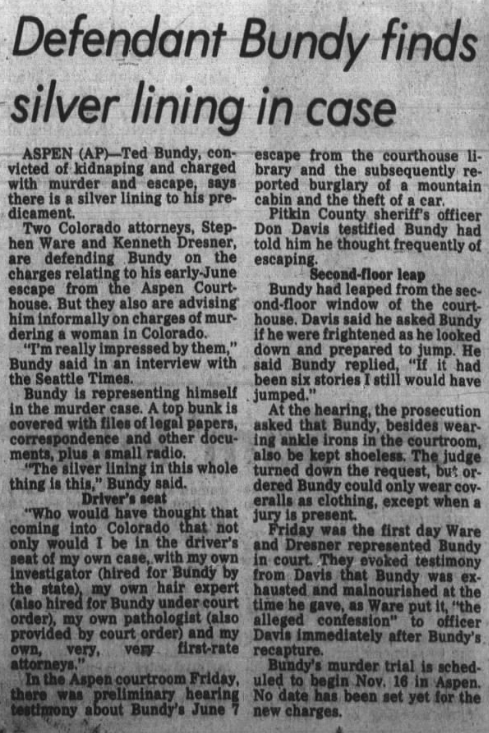
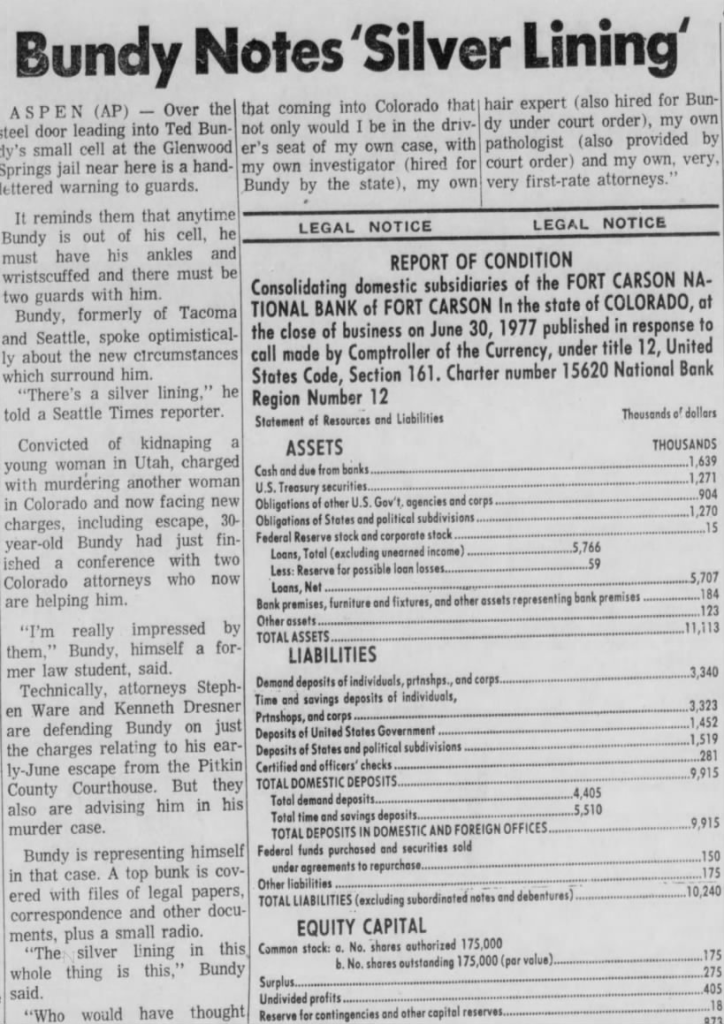
Thank you for your letter of October 27. I too, wish the circumstances of our first contact since last February were different. I had intended to write to you on several occasions during the past several months to express my appreciation for the moral and processional support you have given me and my girlfriend and others close to me.
Recent developments seem to indicate that I will be desperately in need of such support in the near future. I have had a tendency to be overly analytical about the motivations of the Colorado authorities in filing their case at this time. I suppose my real concern should not be ‘why’ they filed but ‘what,’ they filed. Whatever their reasoning, they have taken the plunge and are now committed to follow through. However, according to their own admission, their affidavit outlines the same case they had eight months ago. It is safe to say that bringing the case at this time was prompted by considerations other than the circumstantial evidence contained in the arrest warrant affidavit.
Whether or not their case is a strong one, and I am convinced it is not, the threat I face is considerable for numerous non-evidentiary reasons. First and foremost is the publicity. Next comes my conviction for kidnapping in Utah. The third strike against me involves the significant potential for official misconduct (i.e. falsifying evidence) on the part of those who, ‘believe’ in my guilt and feel as it is their duty to being about my conviction.
Finally, I am at an extreme disadvantage due to both a lack of funds to hire attorneys, investigators and experts. And to the prosecutors seemingly unlimited investigative resources; resources which can, quote, ‘create’ an image of credibility when no case exists. It is this last point [that] most concerns me. If I could fight them on an equal footing I have no doubt I would be acquitted. One man, an attorney. [name removed] no matter how skilled or competent, is no match to prepare a defense to equal the complex case the prosecution has created. Without more assistance, the consequences to my life could be fatal.
You have no obligation to come to my aid, but I am begging you to do so because my life hangs in the balance. I am asking you to provide whatever services you can offer, because I am immensely impressed by your legal intelligence and more so because I like you and feel comfortable with you. I need your help now more than I ever have needed help before in my life. What more can I say except ‘please’ help me?
Sincerely,
Ted
PS: I will avoid discussing details of the Colorado case in letters. I will only talk about the case directly to my present attorneys. If you should have questions, submit them through my present attorneys, and if you haven’t read Colorado’s affidavit, I will ask my present attorney to send you a copy, should you be in a position to help, that is.
November 1976:
Dear John,
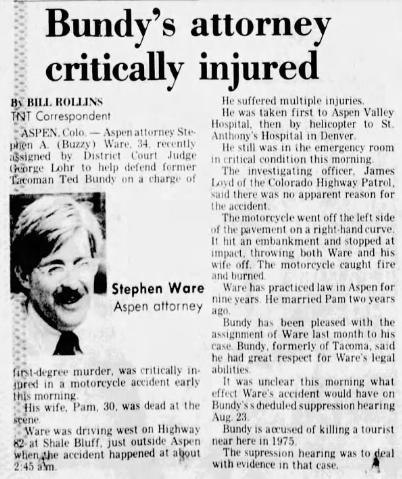
I received your letter of November 10 today and find some encouragement in your news, if only because it indicates your continuing willingness to help. I would like to keep my options open regarding my final choice of counsel. I have no contact with my present attorney and will be unable to make a decision about him until I have talked to him personally and at length. I hope you will understand ,my reservations as it is my belief that I must have complete confidence in someone in whose my life will be placed.; I have written my present attorney asking his opinion on several critical matters, including extradition, and requesting a meeting with him before I go to Colorado.
Of course I would prefer an alliance between my present attorney and you. If I had a choice at this moment between the two of you, I would choose you, but I am not sure I can afford that choice.
I am in complete agreement concerning guaranteed reimbursement for expenses and lost salary should I ask you to handle my case. Is there any way you can give me some general estimate of what this might amount to for Ressler and you? I know how difficult this would be, but if I had an idea, I would be able to determine whether or not I am capable of raising such an amount at all.
I wouldn’t hold you to an estimate in any event, but if you are out of the ballpark, I had better know now.
The question of extradition carries more significance for me than whether by fighting it I can avoid it. I will be extradited too no matter what, but by opposing extradition, are there advantages which outweigh the disadvantages?
In your opinion, in a habeas corpus hearing on the matter, would not it be possible to expose more of the prosecution’s case, if indeed there is more, as well as, quote, ‘freeze’ what they already have? I think there is a positive potential here.
Second, I am convinced that much time will be required to prepare my defense. The prosecution has been investigating and building their case for fourteen months. God knows how many man-hours and how much money has been expended. Positions, such as admitting evidence as a, quote, ‘common scheme and plan,’ involving incidents in other jurisdictions have been thoroughly briefed. I need time, and I would rather spend it in the Utah State Prison than in the Pitkin County Jail, fighting extradition. Fighting extradition will buy some time, don’t you think?
The negative consequences to such a fight would be, as you observed, publicity and inferring my uncooperativeness. This is a difficult issue, which ultimately involves the whole area of pretrial publicity in my case.
The first question is what is the volume and substance of publicity at this point in the Glenwood Springs/Aspen area, and what is it likely to be in the future?
I will ask my attorney to make a study of this, should a motion for postponement on grounds of pretrial publicity be warranted. Will my opposition to extradition do any further harm? I am not convinced that it will, especially since I intend to make it clear the reasons why I am fighting extradition: 1) I was not in Colorado at the time of the commission of the crime; and 2) Need time to overcome great prosecution advantage.
Bad reasons, you know. I just thought the effect of fighting extradition is not nearly as damaging as the impact of losing that fight, which will eventually happen.
Now I have changed my mind a lot. Damn it. I think it is perfectly suicidal to rush into a strange state and be represented by an unknown attorney who has but a few weeks to prepare against a case, which the prosecution has been plotting for over a year. I believe it is literally suicide. What do you recommend?
This is a case which will be won or lost by the ability of the defense to do the following: 1) thoroughly field investigate; and 2) Suppress testimony related to other crimes.
I will elaborate more on that issue later. Can’t fit anymore paper in this envelope. Thanks again for the letter.
Hang in there,
Ted
November 29, 1976:
Dear John,
My issue of the Wednesday, November 24, 1976, Seattle Times contains an article on A4 with a bold heading, quote: ‘FBI Links Hair Samples to Bundy.’ This is just not something I expected from the Times. What are they doing, warming up the cross for my execution?
This is one of the most flagrant examples of prosecution by the press that I have ever seen. The worst thing about this Seattle Times article is that it will be carried by the wire services and broadcast in the Denver and the Aspen area.
Damn it John, I can’t get used to this abuse. The impact of this article is deadly, without the knowledge that hair samples are far from being identification.
He goes on to mention, quote, ‘several’ eyewitnesses, when, as you may know, there was one woman who picks my picture one year after the Colorado disappearance and stated that she had passed a, quote, ‘strange’ man in the hall the night of the disappearance, who looked like me, and observation she neglected to mention to police until a year later.
Note also how the fallacious escape materials, also how the escape material allegations is injected to magnify the inferences of guilt.
The intent of the article is purely malicious and prejudicial. I feel powerless as I watch my conviction firsthand by the media. I see this article as part of a calculated attempt to convince the public of the official belief in my guilt, and to influence the outcome of the Colorado trial.
I had to do something. Enclosed you will find a letter to the editor of the Times. Would you read it and if it seems appropriate, do what you can to have it published? ‘Thanks.’
Best regards,
Ted
July 7, 1977:
Dear John,
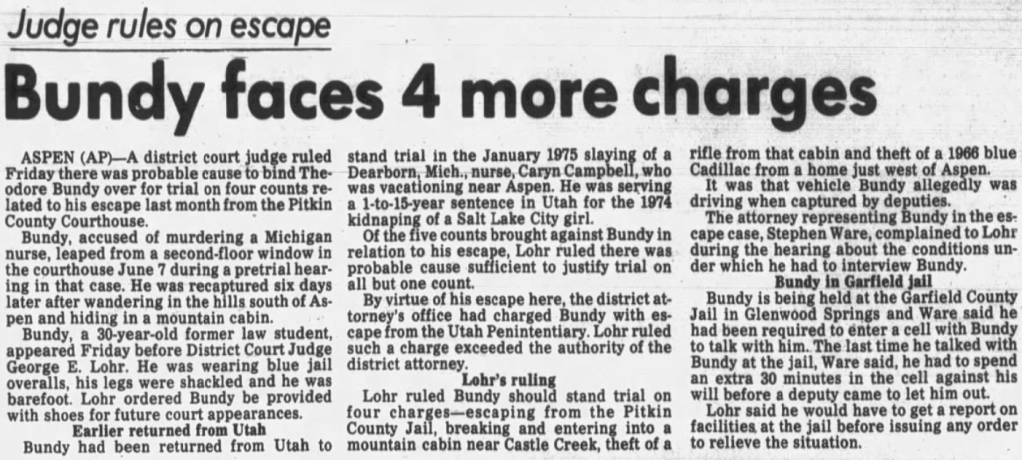
Good heavens… it has been over three weeks since my early morning call to you upon my return to captivity, and I am just getting around to saying, quote, ‘thank you,’ to you for coming to my aid, coming to aspen, and just generally making mew feel less like a fumbling, stupid idiot I was behaving like.
Aw, but the adventurous chapter is behind me, or so I would like to think at this moment. The ghosts of my escapade will return [in] the form of five counts and a new information. I will behave like the hardened convict I am and say, quote, ‘Fuck it. I have got broad shoulders.’ This is what a hard con would say, isn’t it?
Since my return, I have been in procrastination, in a procrastination inspired slump. (‘I have got plenty of time; the suppression hearing isn’t for two months’).
Instead of working, I have been doing push-ups, pull-ups, jumping rope, and have done my best to emulate Tarzan. I am eating nuts, took vitamins, gagged on nutritional yeast, and in the process have (at least to my own mind) become a superb physical specimen.
Now I am sitting here wondering what makes me want to be so damned healthy.
Today I emerged from both my ‘slump’ and my Fourth of July depression, and decided to entertain myself with the criminal law again. What a shameful attitude. However, working on the case has become both fun and distracting, an attitude which no doubt reinforces the point of view that I shouldn’t be handing this case- bit Christ, if a person can’t enjoy the work, why do it? It is just plain challenging.
It is also just a bit frightening at times, too.
Today, for instance, I decided to research the area of suppression of evidence material and favorable to the defense. Since several re-readings of the documents in question convinces me that they alone might warrant a new trial.
I took the amicus brief that you wrote in the Wright case. I looked up a few cases, the most recent US Supreme Court being US vs. Aggers. What a horrendous case. The Berger Court is very unsound. Agurs [sic], on top of Brady, is like mustard on top of a chocolate cake. It just doesn’t make sense and gives me indigestion. Until… I talked to an attorney (I knew they were good for something); the attorney just happened to mention that aggers came down in June 1976 and that all of the discovery in my case took place between November 1975 and February 1976. Thus, Brady and its progeny, free of the Aggers sliding rule (this is where ethe prosecutor slides everything into the police files and says he never saw the stuff, honest!) would be applied in my case.
Still, this is no guarantee, but I am more confident about receiving a new trial now than ever before.
At this point, however, I think I would lose a new trial in the kidnapping case, but hell, getting there would be half the fun, anyway. So I am fat and healthy, munching on something called, ‘peanuts and caramel log,’ one of many goodies sent to me by my friends. Sounds disgusting, and it is, but I have a munchy mentality and I truly love it.
Thanks again. You have done a great deal for me. I want you to know how I recognize it and appreciate it. Now try to take that to the bank. How much is it worth to you to have me tell you that I can’t imagine a finer defense attorney than yourself? It’s true. I consider myself an expert on the good ones and the bad ones.
Best wishes,
Ted
June 1, 1977:
Dear John,
During the time you stayed in Tallahassee, we had a chance to discuss at length developments in the case. If you feel anything like I do, you are sick and tired of hearing about the Bundy case.
It was great seeing you and talking with you again. There can be little question as to why you are doing so well in your practice’ you are an exceptionally bright and concerned person. You are much more than that, but that way in which you reach out to those whose causes you advocate is extraordinary.
I am fortunate to have you on my side and there is no adequate manner to express my gratitude for the time and expense you took to come help me, except to give you a deeply felt, quote, ‘thank you,’ in every way.
Best regards,
Ted
October 15, 1984*:
Dear John,
Are you still there? I mean, are you still in the Smith Tower? I hope this is forwarded to you if you are not.
How are you? Still Running? It has been a while since we have been in touch. Carole told me that she and out daughter, Rosebud, just paid a visit to you around Christmas time last year.
I have a favor to ask you. Would you mind taking the enclosed letter I have written to someone associated with the Green River Task Force who has some sense and can be trusted to take the right steps to see that the letter both receives proper consideration and remains confidential?
I know firsthand how professional egos and agency rivalries and conventional police close-mindedness can drastically reduce the effectiveness of an organization like the Task Force.
I am pretty sure I can provide them with some valuable information if we can transcend such limitations. So please give it to someone with an open mind and creative outlook on investigating such cases. Does such an animal exist? On October 1, I wrote a letter to the Task Force, which I sent via a superior court judge in Tacoma, a longtime family friend. I asked him to let me know that he had received and forwarded it, but in two weeks I have heard nothing from him or the task force.
Actually, I would have sent the letter through you in the first place, but it just didn’t occur to me until after I mailed the letter.
So what’s do you think of the Task Force? What do you know about it? Is it chasing its tail/ It is disorganized? Does it have competent people? Is it well run? Would the people there resent or reject out-of-hand my offer of information and assistance?
There are a number of reasons why I offer my help to the Task Force at this time (please go ahead and read the letter I have written to them, by the way, and it may give you a better understanding of what I am doing). Basically, through, the case fascinates me and challenges me. I would like to figure out what makes the Green River guy tick, and I figure I have as good a chance of doing that than anyone on the Task Force. And I also think that the time seems right in some inexplicable sort of way, and I dins myself saying, quote, ‘why not put some of your knowledge and unique perspective to use. It could be interesting.’
I don’t fancy myself playing detective, but I will bet I can play the man or men they are looking for better than any of them.
Please let me know you received this and what, if anything, happened when you passed it along.
Thank you for your help. Take care of yourself.
Peace,
Ted
PS: And remember, you can arrange to reach me by phone, if you wish.
*I do want to point out that in Robert Keppels book (and movie), ‘The Riverman,’ the letter was sent directly to Keppel and bypassed John Henry Browne completely.
October 15: 1984:
Dear Task Force Members:
On October 1, 1984, I wrote a letter to you and sent it via a superior court judge in Tacoma. I asked the judge to give me some kind of indication that he would- he had received and forwarded that letter to you.
During the intervening two weeks, I have heard nothing from the judge or you, I don’t know what the problem is, or even if there is a problem, but I thought I had better try another means of contacting you in case, for whatever reason, the first failed.
Therefore, I send this letter to you through John Henry Browne, a Seattle criminal defense attorney, who I know and trust.
I must admit that I am being cautious on approaching you. It would not look good to my fellow prisoners if it became known that I offered to help and provide information for your investigation.
This is one reason I do not want to let it be known that I am writing to you.
Mail passes through many hands before it leaves this place, and there are too many curious minds for me to address a letter to you directly.
As broader concern of mine is that my offer of information and whatever other assistance you determine I can provide not be made known outside the Task Force, especially not to the news media, in part because of the reasons I stated above, and in part because such publicity could hamper your investigation in some way.
Olay, with that in mind, I will tell you, as I told you in my other letter, that I have information which I believe would be useful in your investigation. I have a unique perspective on the Green River case, which, while I may not provide you with anything you haven’t thought of before, may cause you to refocus and read re-examine [sic] things you may have neglected or dismissed for some reason or another.
Let me explain how I came to realize I had something of value to offer you at this late date.
While I gather that the Green River matter has been a source of concern in the Pacific Northwest for a couple of years or so, news of these murders did not begin to filter down to this far corner of the country until maybe a year ago, as far as I can recall. Even then, news accounts here were infrequent and very brief. I am sure the news coverage here was microscopic compared to what has been seen in the Seattle Tacoma area.
Not having access to regular, detailed, and comprehensive news coverage, I did not have an opportunity to gain any kind of feel for the Green River situation. I had no basis for developing any ideas or insights. I had no reason to go out of my way to learn more about the cases. There were other things on my mind.
Then two to three months ago, I began receiving a local newspaper from Tacoma. It was the first time in over five years I have received a daily newspaper from the Northwest. It was about a month ago that I got my first real taste of the local coverage of the Green River investigation when the body of a woman, believed to be linked to the Green River cases, was discovered in a remote area of Pierce County.
The news coverage of that discovery, and subsequent and related articles were something of a revelation. I got a feel for what was happening, albeit tentative, and was based on pitifully few facts. But I know your man in a way that facts alone cannot accomplish.
I do not know his face, but I have some pretty good ideas on where you can look to see him for yourselves. There are many reasons why I want to see if I can be of some help to you. I won’t claim some noble, civic-minded motivation. Basically, the case has really begun to intrigue me. But I am sure it intrigues lots if people. The difference is I have knowledge and a point of view to add to your case investigation like no one else does.
I may simply have reached the point where I realized I have something of value and the chance to use it productively.
I would like your assurance that this letter, and any other communications we may have will be kept strictly confidential, and that no one outside of the Task Force will be made aware of what I have said here or will say should we enter into a dialogue.
If you wish to communicate to me by mail, please do so by sending a letter though my prosecutor, lawyer, or a judge that is clearly marked, ‘legal mail.’ Such mail is opened in my presence and not read. Other mail is opened in the mailroom and may be read.
If you would rather send someone to talk with me, I would welcome the opportunity. Eventually, I think you stand to gain more if you meet with me personally. If you do decide to send someone to Florida, I suggest that you have someone from a local office of the FBI help you gain entrance to the prison without divulging the exact reason for your visit.
Well, there you have it. If have no way of knowing if you need or want anything I have to offer. All I can do is let you know I am willing to help any way I can. The rest is up to you.
Good luck.
Sincerely,
Ted Bundy











































 Another Bundy Blog.