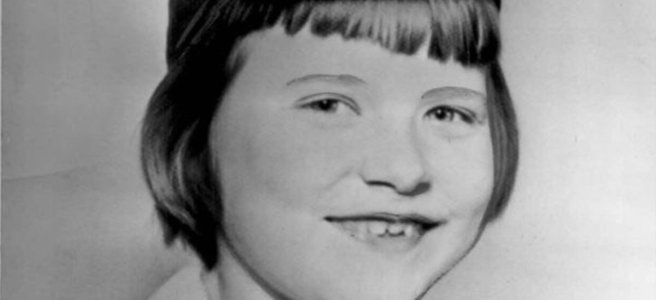
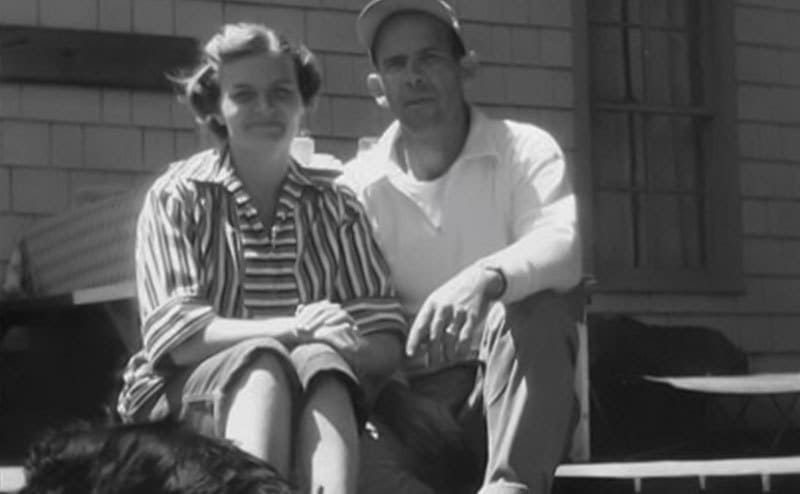
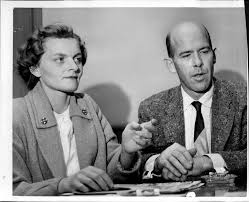
Ann Marie Burr was born on December 14, 1952, in Del Morte County, California, to Donald and Beverly Ann (nee Leach) Burr. Beverly Leach was born January 4, 1928 to Roy and Marie (nee Wadsworth) Leach; her father owned a group of small grocery stores in Tacoma, WA. Bev’s relationship with her mother was never very good, and they clashed her entire life. After high school she went on to attend the University of Washington where she met Don Burr, and they were married in the summer of 1951 (Don never graduated from college). Beverly went on to graduate from Pacific Lutheran University in Tacoma and after graduating got a job teaching school, a position she enjoyed but found incredibly challenging. Her true passion was in journalism or (as she stated proudly), she wanted to be a ‘famous writer.’ Mrs. Leach dreamed of being out in the field and ‘in the trenches’ like a real journalist… in fact, she wanted it so badly in fact she almost didn’t marry Don. In addition to having big career aspirations there was a fellow teacher at her school she debated on running away with; he even told her that he would leave his wife and children for her. Both of those ideas absolutely horrified Beverly’s parents… so she played it safe and got married.
The newlyweds spent the first year of their marriage in Oregon, where Don worked for the logging company he partially owned with his father. At some point, his dad would go behind his back and claim he owned 51% of the company, which made him the majority owner. The older Mr. Burr then sold the entire business without telling his son, and because of this there was bad blood between father and son for the rest of their lives. Later, after Don was given money for the sale of his part of the business, the couple moved to Tacoma, where he became a civilian employee at the local National Guard base in Camp Murray, where he worked his entire career. The Burr family were parishioners of St. Patrick’s Church located in North Tacoma despite the fact that Don wasn’t a practicing Catholic. In later years Bev did admit that her faith would waver and disappear at roughly around the same time Ann died.
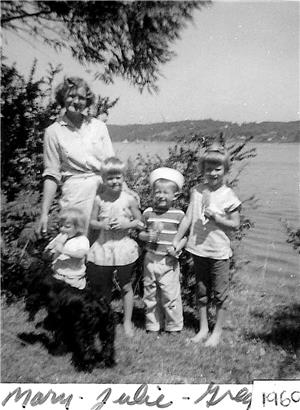
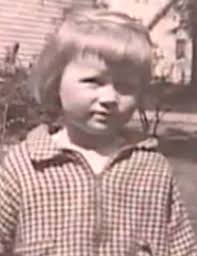
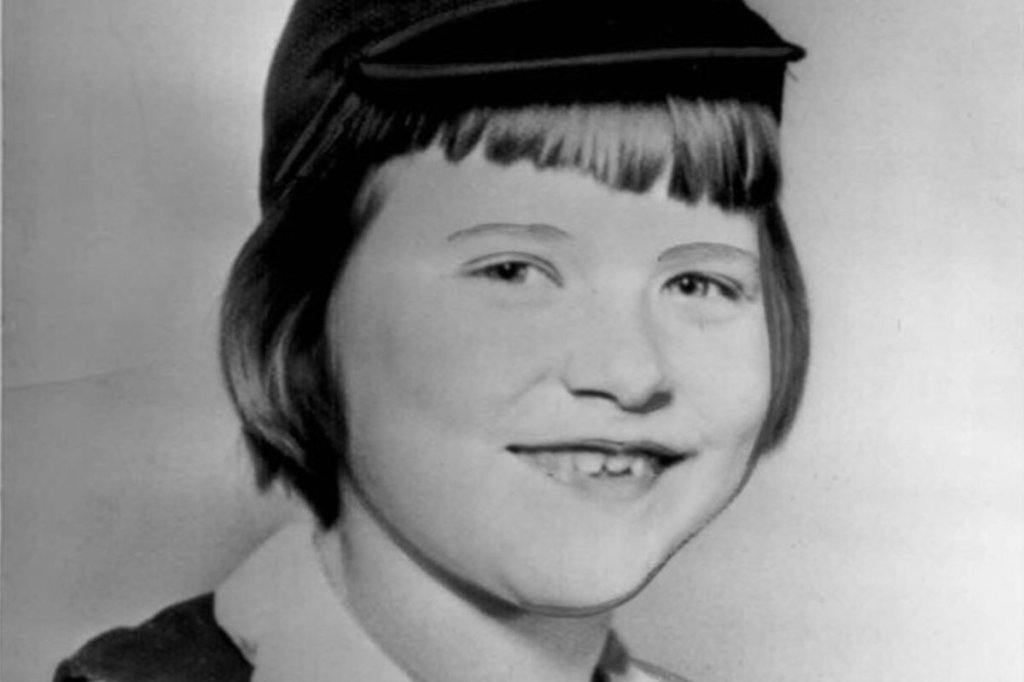
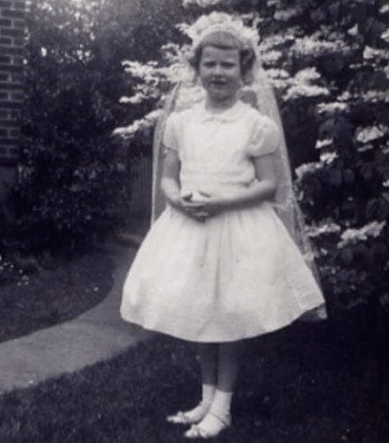
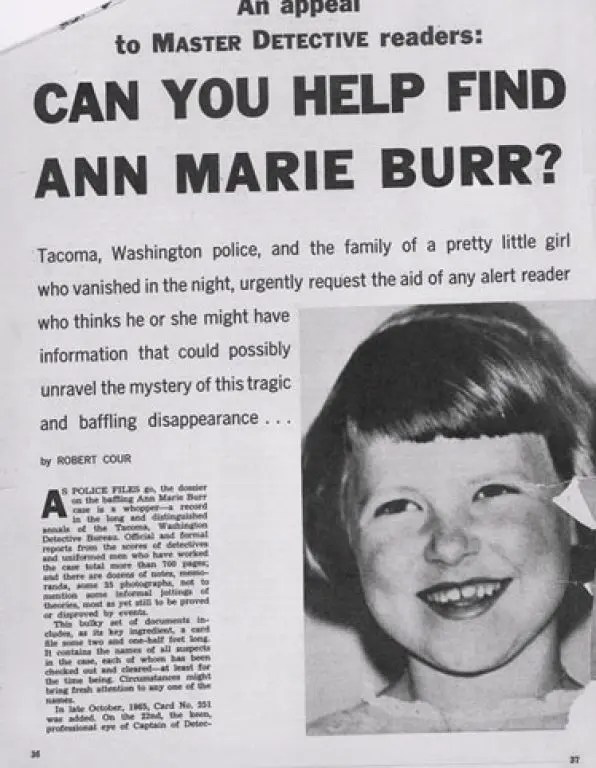
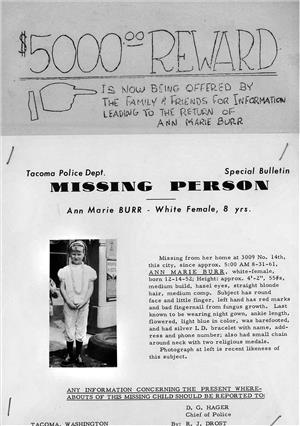
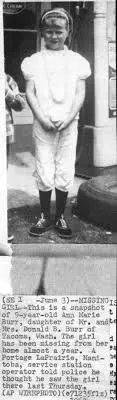
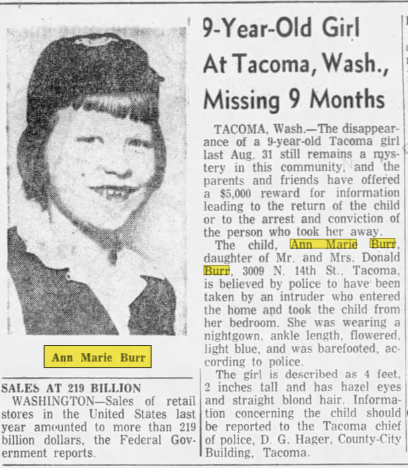
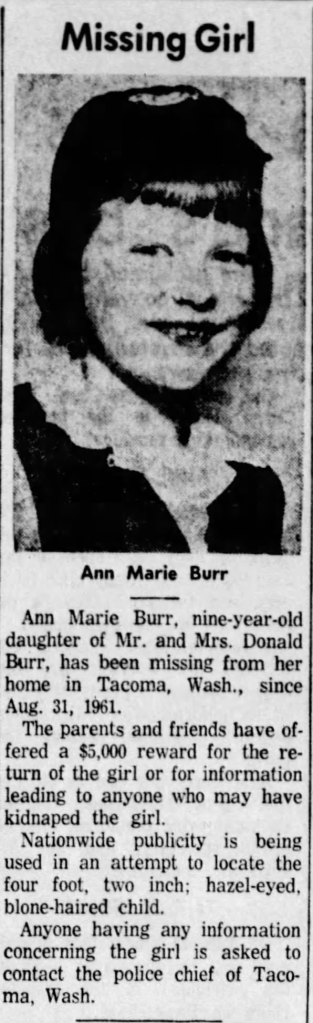
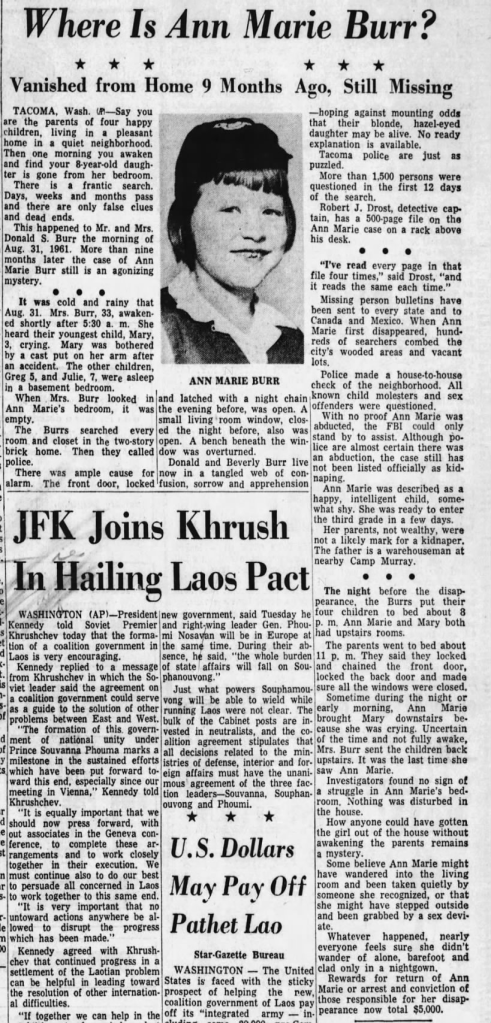
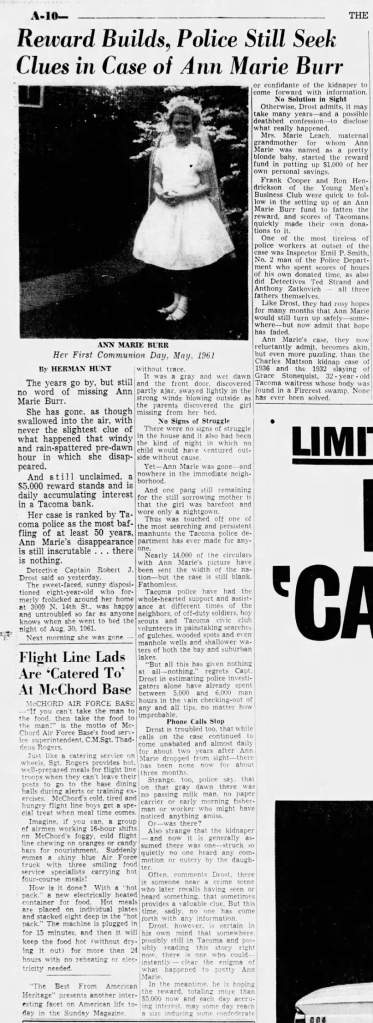
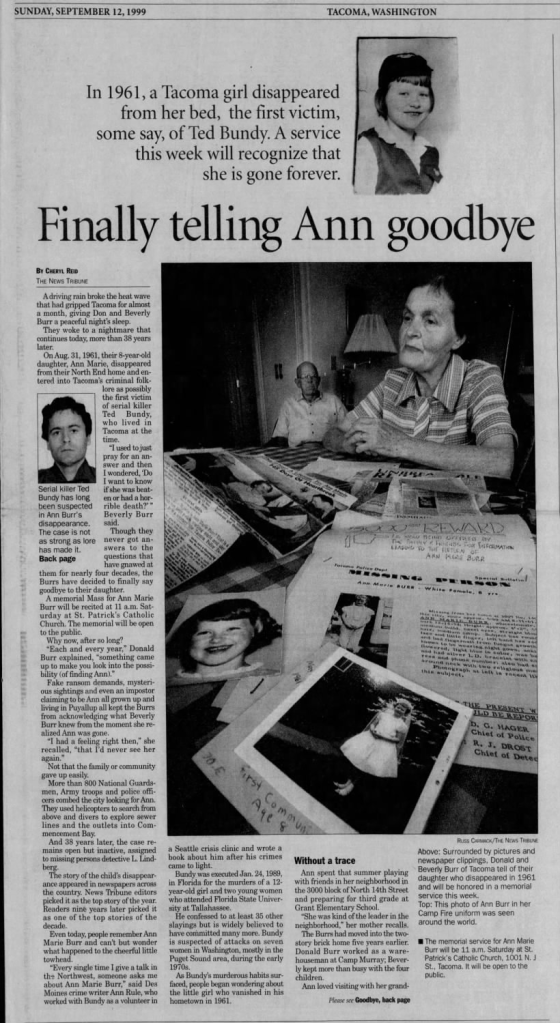
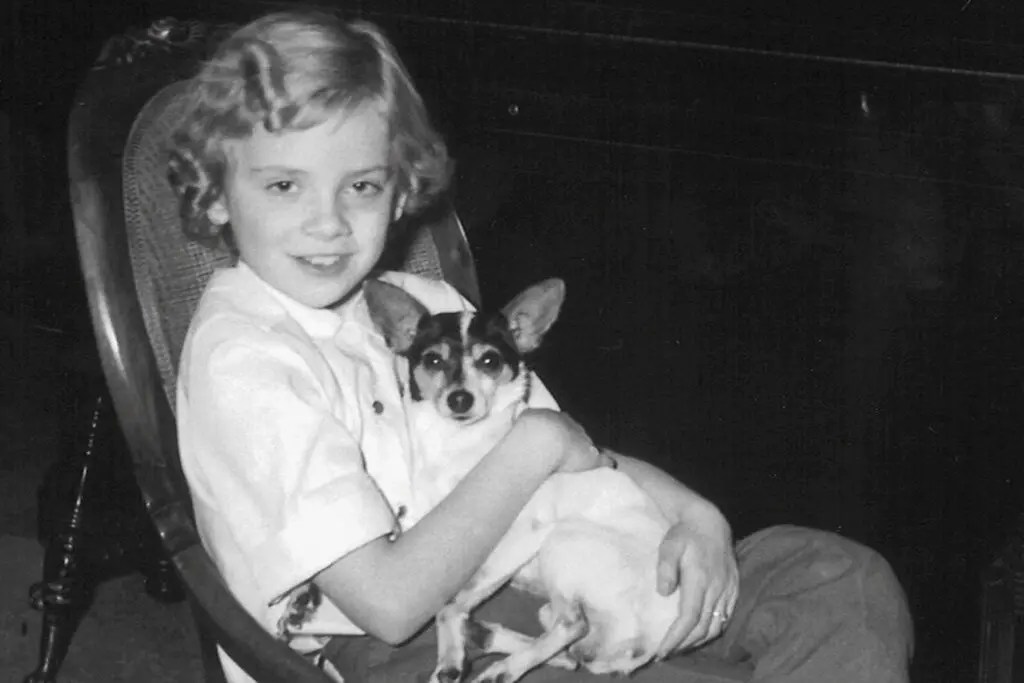
At the time she disappeared in summer 1961, Ann Marie had short, dirty blonde hair, hazel eyes, weighed roughly 35 pounds, and stood at 4’2” tall. She had red marks on her left hand as well as malformed fingernails from a fungal infection. She was the oldest of four and had a mix of three younger brothers and sisters: Mary, Greg, and Julie, In July 1963 after Ann disappeared the Burrs adopted a seven month old girl named Laura Gayle. They kept her adoption public in hopes to keep their oldest daughter’s case discussed and relevant and for Bev, it was just another opportunity to try to find Ann. Laura was said to be by her mother ‘the perfect baby.’
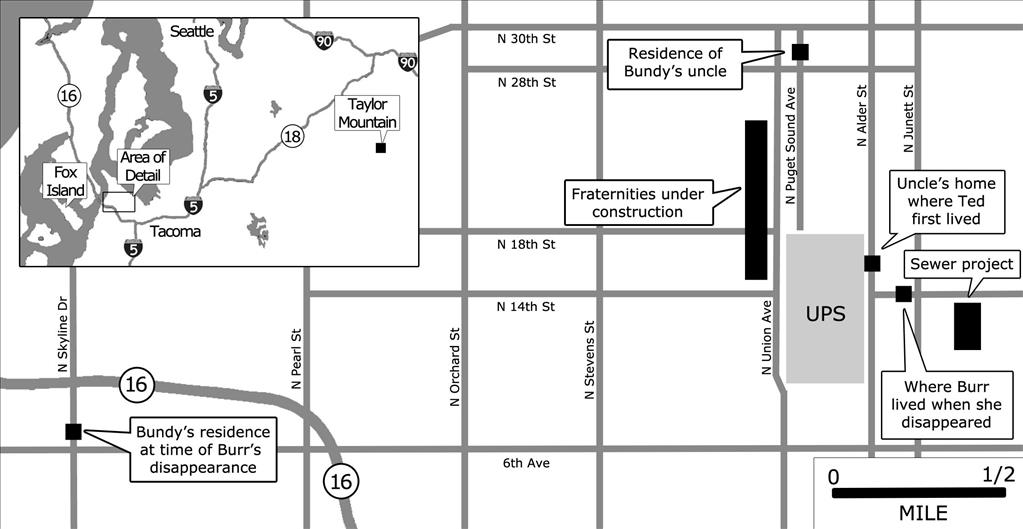
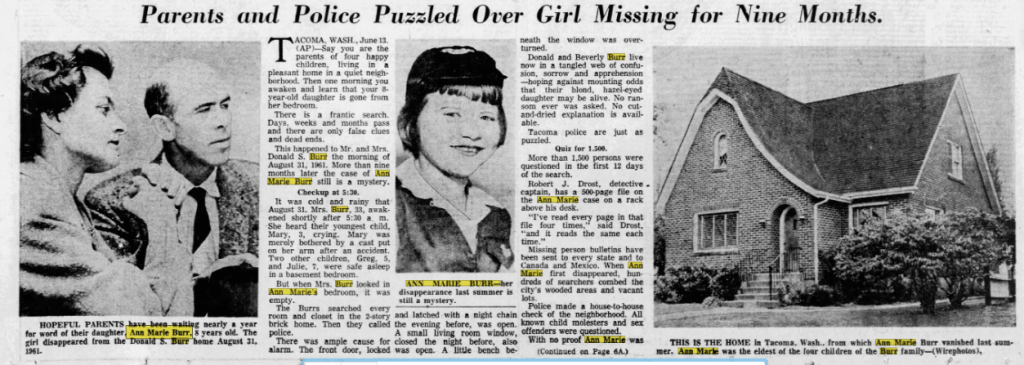
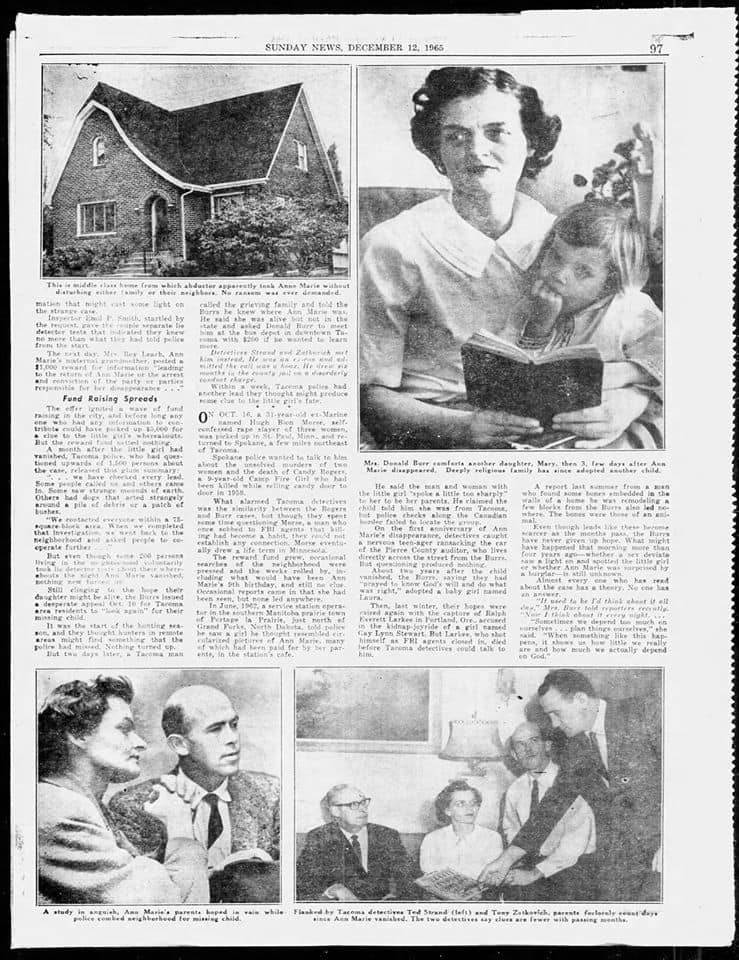
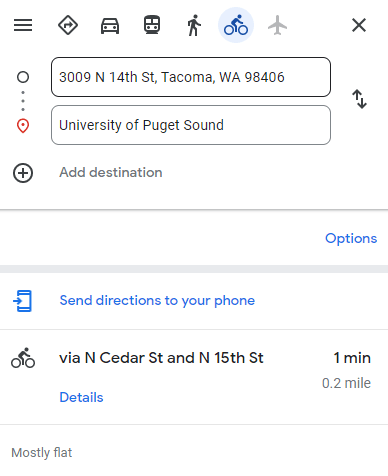
At the time of her disappearance, Ann Marie was eight years old and getting ready to start the third grade at Grant Elementary School in Tacoma. Mr. and Mrs. Burr said she was a shy, well behaved, ‘intelligent, artistically talented and an obedient daughter who didn’t cause any problems at home.’ Her mother raised her to be unafraid of people and independent, traits Mrs. Burr said she eventually regretted teaching her. She said, ‘Ann was so trusting.’ … ‘it was a big mistake. We taught her everyone was good. We didn’t teach them that people could be bad. I still think it was probably someone she knew.’ She even walked the several blocks to school alone starting in kindergarten. Ann’s father admitted that he didn’t trust some of their neighbors, including a lady that lived across the street that spent time in a psychological asylum after giving birth to a mixed-race baby. There was also a man that would occasionally sunbathe nude in his backyard, and the neighborhood children loved to come visit him because he gave them candy. The Burrs lived in a two story bungalow in a middle class neighborhood located at 3009 North 14th Street in the North End section of Tacoma, Washington. Next door to their home was a small but dense orchard filled with apple trees and raspberry bushes owned by their neighbor, Mrs. Gustafson (the neighborhood kids called her ‘Gusty’). Just before that Labor Day weekend in 1961 before Ann disappeared, neighbors of the Burrs reported a man walking the streets selling cookware (which they found odd because he had no pots or pans to show them).
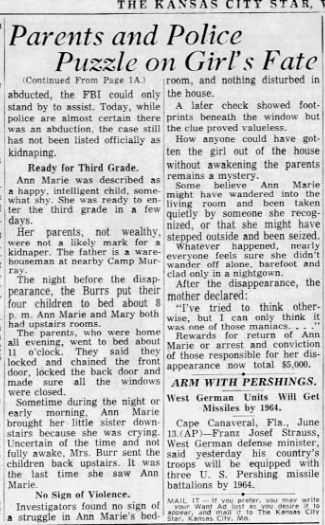
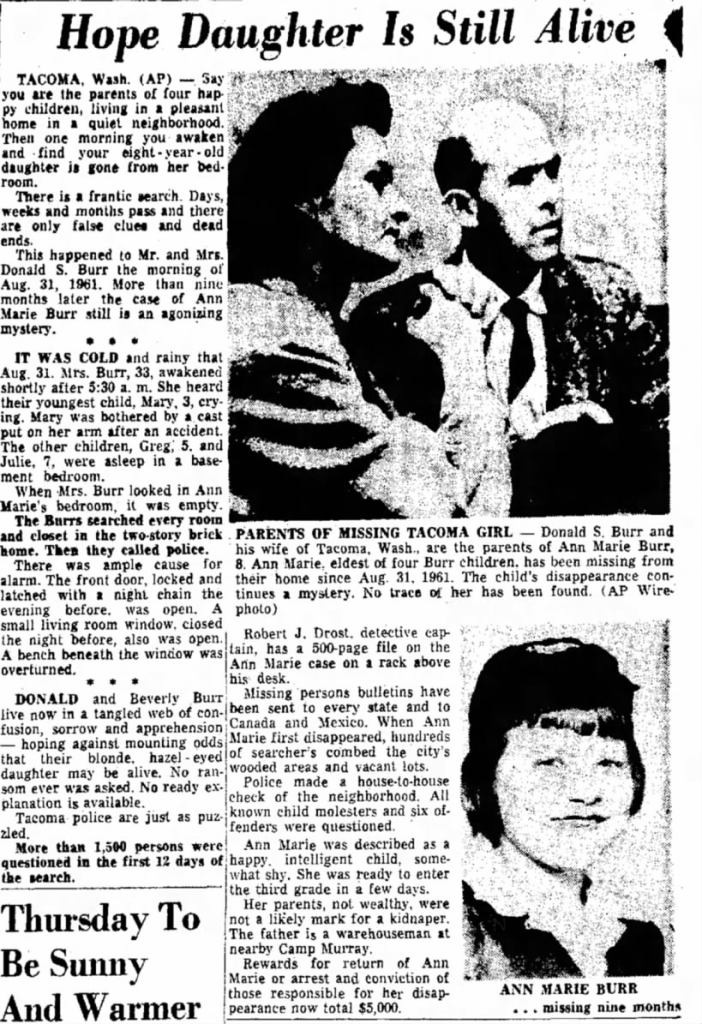
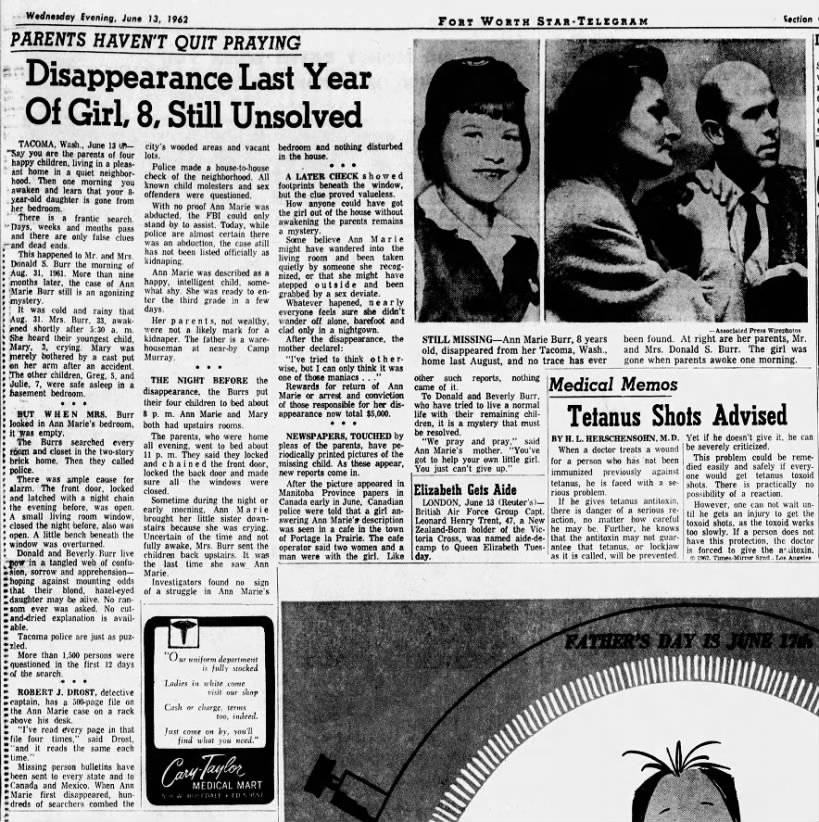
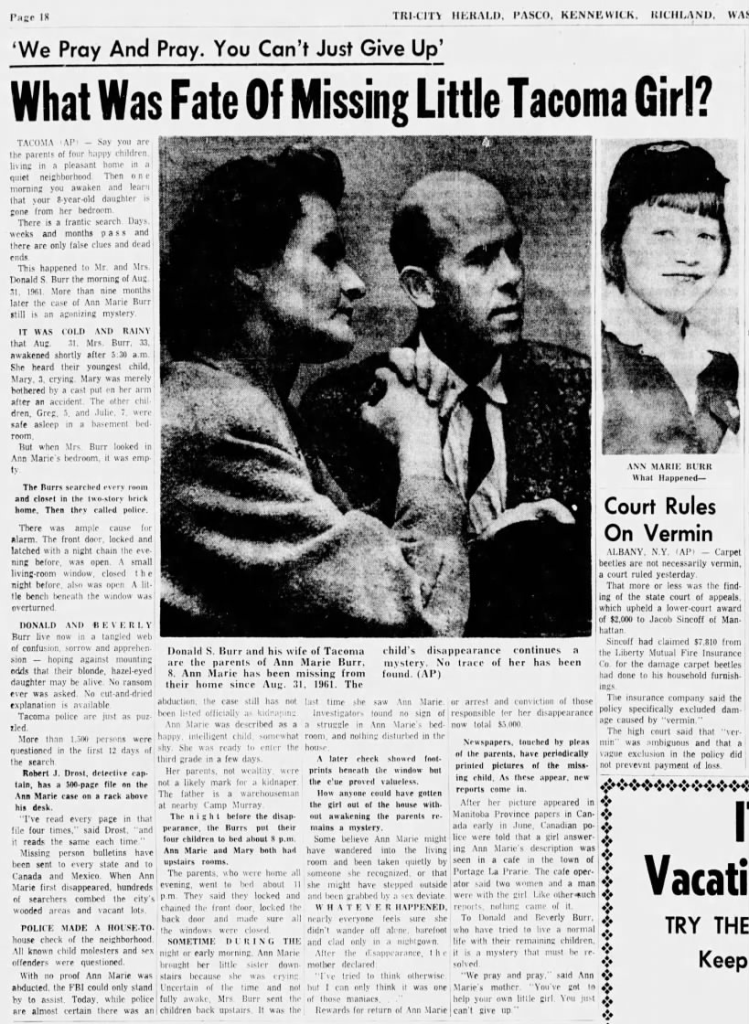
Earlier on that hot, muggy Wednesday, all four of the Burr children spent the day playing with other kids in their neighborhood. Ann Marie ate dinner at a nearby friend’s house, and that same girl asked her to spend the night, however Mrs. Burr said with school starting up again soon maybe it wasn’t the best idea, so she kept her home. Aside from her family, Ann’s neighborhood friends Susie and Christine were the last people to see her alive. Around 8:00 PM on August 30, 1961, all four Burr children were sent to bed: Ann Marie went to sleep in the upstairs bedroom she normally shared with Julie (7), however three year old Mary slept with her that night, while Gregory (5) and Julie were allowed to spend one more night in a recently constructed fort in the basement. Mr. and Mrs. Burr locked the front door at around 11 PM (complete with a chain) and went to bed after. And just like any other night, Mr. Burr put the family’s black cocker spaniel Barney out on the landing, in between their kitchen and back door. Bev said she was exhausted from the hot weather but hadn’t been sleeping well, and in addition to the heat keeping her awake both her and Don thought they heard noises in their yard late at night. It was rainy and stormy that night in late August when Ann disappeared: trees blew over, lights went out, and large areas were thrown into complete blackness. At some point in the middle of the night (Beverly was uncertain of the exact time), Mary started crying so Ann brought her into their parents room; the youngest Burr child broke her arm earlier in the summer and still experienced bouts of pain because of it (she was still in a cast and it was bothering her). Beverly was able to calm Mary down and put both girls back to bed.
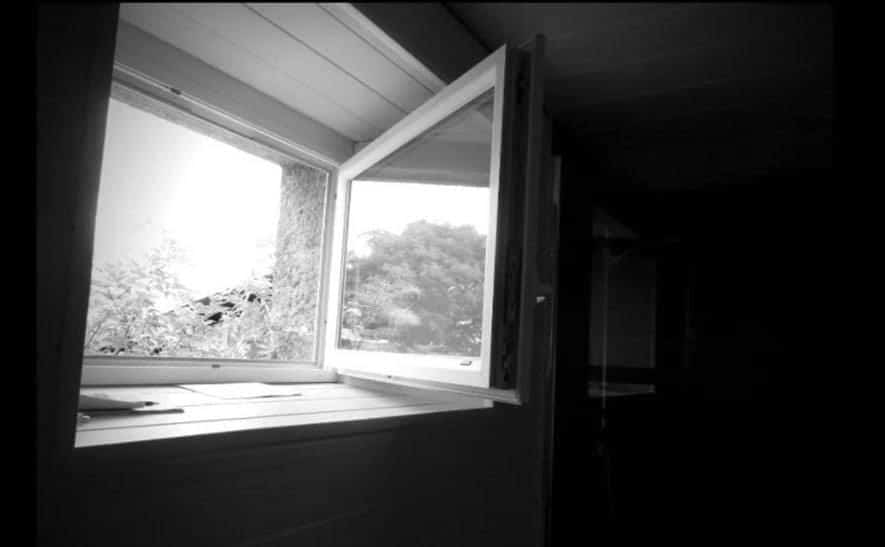
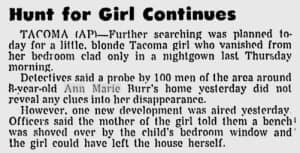
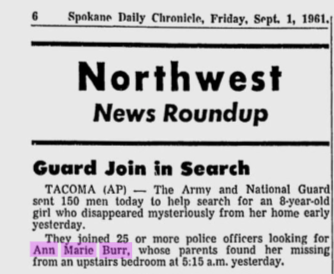
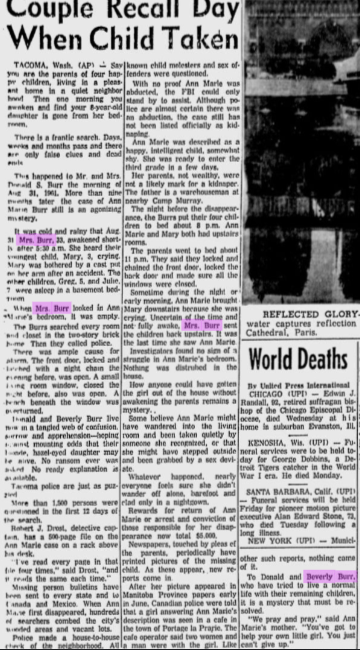
Around 5:30 AM on August 31, 1961 Mrs. Burr woke up feeling uneasy: first she went to the basement to check on Julie and Greg then went up to the second story; it was then discovered that Ann Marie was no longer in her bedroom after she discovered a (once again) crying Mary, this time alone. Upon going downstairs, in the living room Bev found the small window normally left open only a crack “for TV antenna wires” was now wide open; in addition, the front door was left slightly open. Outside there was an upside down bench from the backyard that was found resting against the side of the house; there was also grass from the perpetrator tracked inside the house. There was no sign of a struggle.
After realizing her daughter was missing, Bev (wearing only her bathrobe) walked around the neighborhood and asked a few of her neighbors if they’d seen Ann Marie. After arriving home and seeing a stool from the garden in the backyard propped underneath the open living room window, she woke up Don and had him call the police. When law enforcement arrived, they immediately interviewed the entire family. Right after he was questioned, Don and his brother, Raleigh, went to search the neighborhood. The men walked two blocks to the nearby University of Puget Sound and even combed through the construction sites. At the time of Ann’s abduction there were seven buildings on campus being worked on, and Don reported there were some very deep ditches and excavation sites present. Near one of those buildings, the two men saw a teenage boy kicking dirt into a ditch, while looking at them with a smirk on his face. They immediately went home and told police they should search the campus. Four entire days passed, and on September 3 police finally did what the brothers suggested mere hours after Ann Marie disappeared: they sent officers to search the University of Puget Sound. Unfortunately, by the time they arrived there were no open construction sites and everything was filled in: ‘at this time, all ditches are covered and the roads are open’ (Burr Missing Person Report). When Don went back to look shortly after, cars were driving over the spot where he felt the body of his daughter might have been buried.
All of Ann Marie’s clothes were accounted for by her mother and none of her personal items were missing. It was determined that she left the home wearing a homemade, ankle-length light blue nightgown with blue and white flowers, a small chain necklace with two religious medals (with engraved images of Jesus Christ and the Virgin Mary), and a silver ID bracelet with her name, address and phone number on it along with the phrase ‘Saint Christopher Protect Us.’
At the beginning of the investigation, law enforcement felt that Ann Marie was possibly taken by someone she knew. They surmised that the kidnapper’s silent, almost invisible movements showed a familiarity with the layout of the house. They also spoke with all of the convicted sex offenders living in close proximity to the Burrs but none could be linked to Ann’s disappearance. Police set up camp in the Burr’s basement while they waited for a ransom call or letter that never came. In an interview with Seattle based TV station KOMO-TV hours after her daughter went missing, Beverly said, ‘probably the worst has happened to our little girl. I just hope they find her.’ What she didn’t admit out loud to anyone was that she had little hope about her daughter coming home to her. Years after Ann’s disappearance she said: ‘when I first saw that window open, I knew I would never see her again. I knew I would never know what happened.’ … ‘it came to me, just like that. It was a strong feeling. When they were searching, I thought, ‘What’s the point?’ I knew she was gone, and we would never see her again.’ The police attempted to interview little Mary however the child was too young to be able to properly put into words whether or not she had seen anything helpful. Mrs. Burr told police that several members of the family heard the dog bark at some point in the middle of the night, but at the time they assumed it was because of the unusually rainy weather. They also told law enforcement they heard someone prowling around their yard a few nights before; in addition to the Burrs, three neighbors reported they had seen a peeping tom looking in their windows as well (however no one could come up with a physical description of the perpetrator).
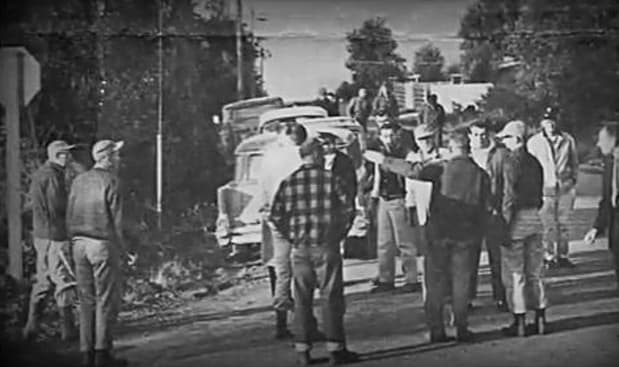
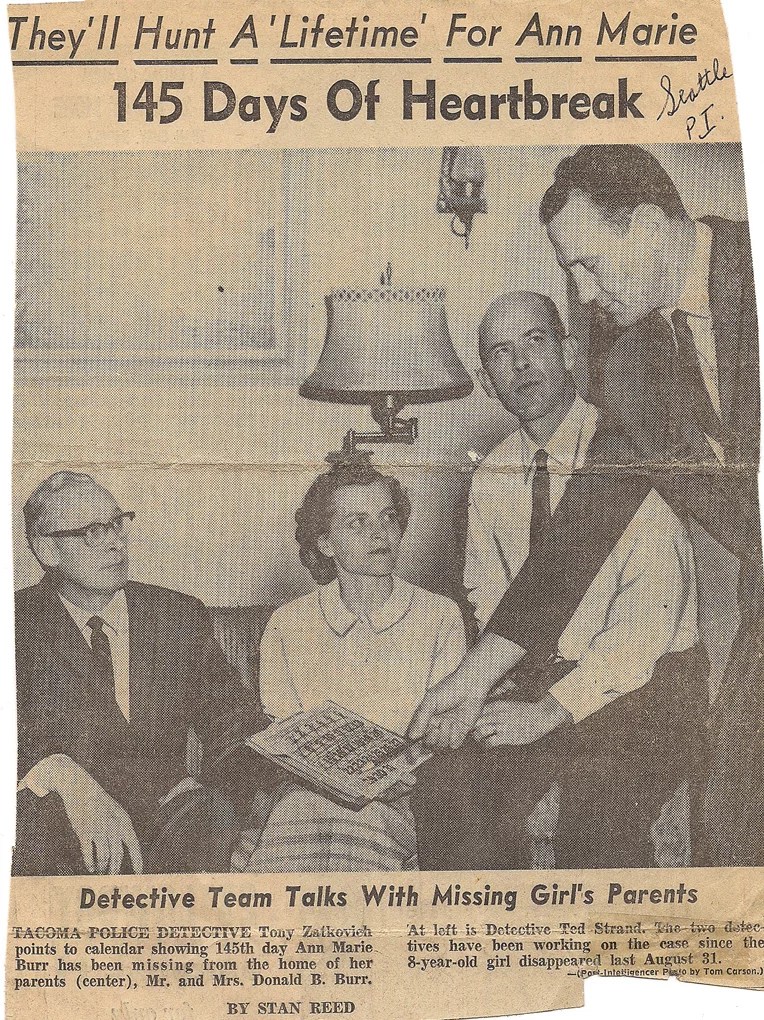
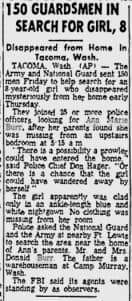
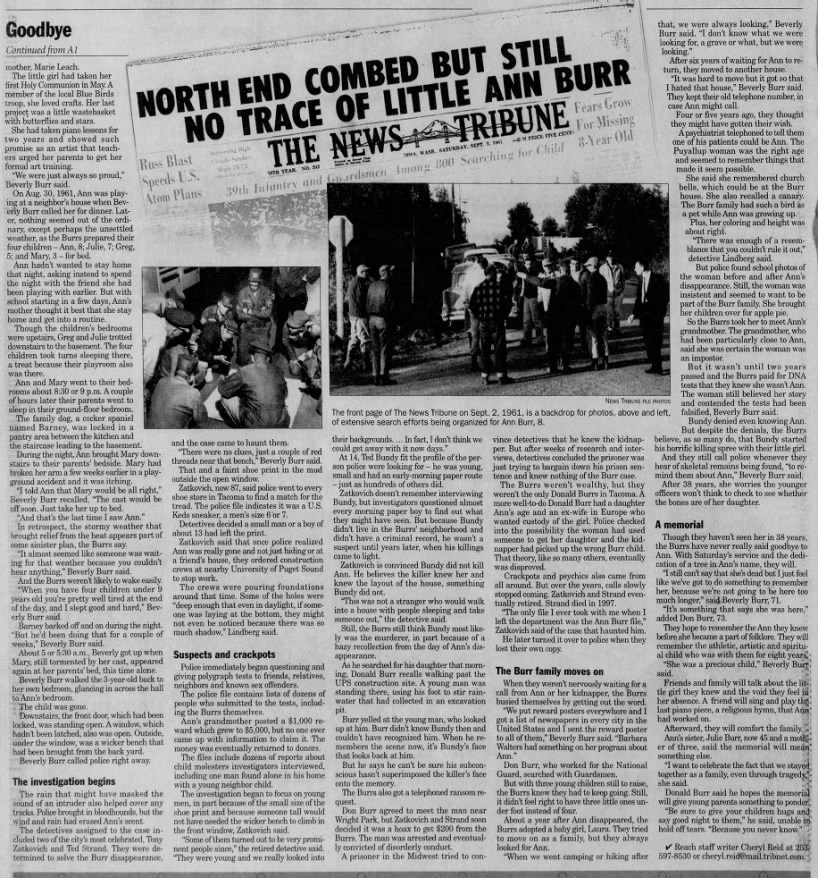
Ann Marie’s disappearance occurred early enough in the morning that it made the first morning edition of the Tacoma News-Tribune. Strangely, it said that the young girl was believed to be a possible victim of amnesia (which I’ve never heard ANYTHING about before I really started looking into this case). The disappearance of Burr brought on the largest missing persons search in Tacoma history (at the time) and lasted for months: on the morning she disappeared, fifty National Guardsman from Camp Murray and 100 soldiers from nearby Fort Lewis (which was only about 11 miles away from the Burrs home) helped local law enforcement in their search. By 11 AM, over 75 square blocks surrounding the Burr home had been thoroughly searched (including several densely wooded areas) but there had been no sign of the little girl; she vanished without a trace. At the time of Ann Marie’s abduction there were open ditches at the end of the street about 30 feet deep for an upcoming city sewer project. Detectives crawled under houses with flashlights searching for her and the Tacoma Public Works Department walked through sewer lines close to the Burr house. Additionally, a three-man crew went underground using portable lights to probe the pitch-black flumes of the city’s sewer network through the North End and scuba divers went to the main outfall pipe on Commencement Bay in low tide, where the rushing flow of storm drainage and sewage was rapid enough to push a body out of the pipe and into the bay (upon inspection it had not). Investigators came up with nothing.
There wasn’t a lot of helpful evidence found at the crime scene, however law enforcement did discover a single red thread that was found snagged on a brick near the living room window. While searching the home, they did notice a table of completely undisturbed figurines right next to the open living-room window, despite someone possibly entering the home through it. The small bench the intruder placed outside the Burr’s window was taken in to be further examined by forensic experts: it had a footprint on it about the size of a teenager’s or a small man’s foot (although it was slightly misshapen from the previous nights rainstorm), and there was a similar print found by the back of the house close to the basement window. Experts determined that the intruder was most likely wearing a size seven or eight Ked’s, and because the tennis shoe apparently had a very particular tread on it law enforcement went to stores in the general Tacoma area in an attempt to track down its owner. They were given the names of nearly 10 individuals that had bought them recently but it appears they only really looked into two of them: a younger boy that was ruled out and a college student who was away at school at the time of Ann’s abduction.
Based on the crime scene, there seemed to be no sign of a struggle, and nothing aside from the single red thread was left behind by the intruder. He came and left completely undetected, almost like a ghost. Does that mean Ann possibly knew the man that abducted her and went with him willingly? In addition to next to no physical evidence there were no witnesses, no vehicle description/license plate for a potential getaway car, no fingerprints, no credible ransom demand, no motive, no weapon, and no body. Because of the lack of concrete evidence indicating that an abduction did indeed take place, the FBI would only assist with this case on a stand-by-basis. A few days after Ann Marie disappeared, a neighbor came forward and reported that she heard a scream coming from a car with California plates the morning the girl went missing. However, when the driver of the vehicle was eventually tracked down they claimed the noise was simply from the radio and everyone in the car was alright. Police even camped out in the Burrs basement during the beginning of the investigation, hoping to record a ransom call from a potential kidnapper that never came.
When the second edition of the paper was released later that day, there was more information about the developing story as well as a photo of Ann Marie. In it, she was wearing a paper lei won at a summer carnival, a headband, a blouse with short, puffy sleeves, and pedal pushers. The front-page headline from the Tacoma News-Tribune read: ‘Girl, 8, Vanishes From Home: Chief Hager Calls for Wide Hunt.’ Unfortunately, Tacoma is well known for its kidnappings, even being nicknamed the ‘Kidnap Capital of the West.’ In 1935, the 9 year old son of Washington timber baron John Philip Weyerhaeuser was grabbed off a Tacoma street in the middle of the day. His parents paid a $200,000 ransom and the boy was released unharmed; there was an arrest made within days. On December 27, 1936 a man broke into the mansion of Tacoma Physician Dr. William Mattson and scared his four children with a loaded gun. He took Mattson’s 10 year old son Charles and fled. The kidnapper left a ransom note asking for $28,000, but two weeks later the boy’s naked body was found on a snow-covered field 60 miles north near Everett, WA. The case remains unsolved to this day.
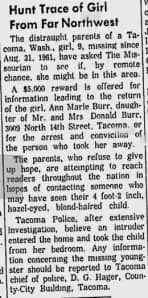
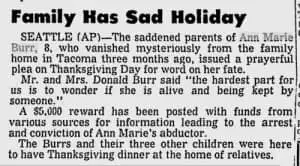
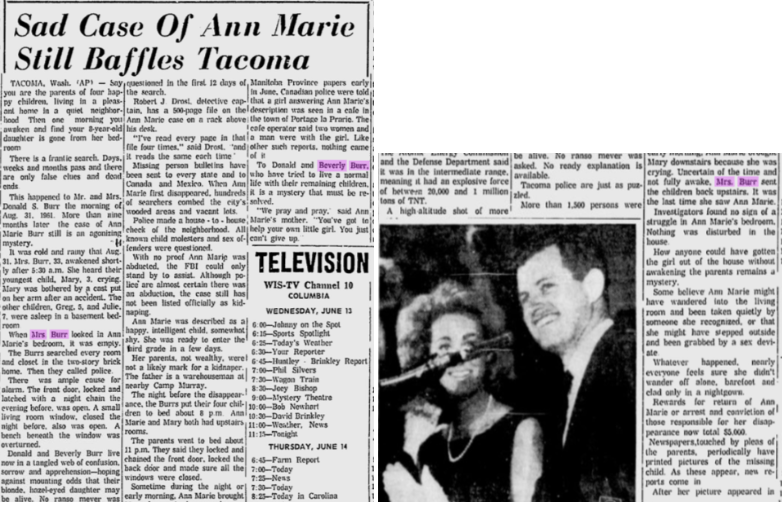
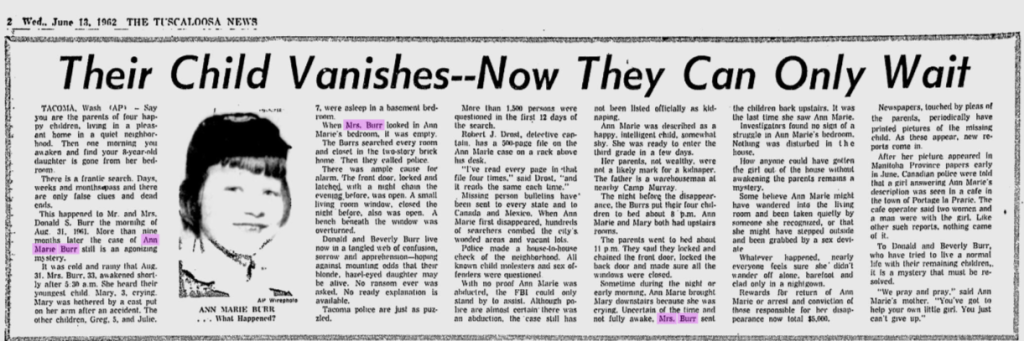
A complete search of Tacoma turned up no clues as to little Ann Marie Burr’s whereabouts. Within the first twelve days after her disappearance, over 1,500 persons were interviewed, and over the course of the entire investigation thousands of people were talked to and hundreds were polygraphed. In the beginning, the leading suspects included a teenage neighbor boy who flirted with the young girl as well as one of her cousins that grew up to be a convicted child molester (both were eventually cleared). On September 8, 1961, Donald and Beverly voluntarily went into the police station and took polygraph examinations in response to whispers that they had withheld information to the police in regards to their daughter’s disappearance. Both Mr. and Mrs. Burr were found to be truthful in their responses. The following day, Burr’s maternal grandmother (Marie Leach) posted a $1,000 reward for information leading to the discovery of Ann Marie, which was eventually increased to $5,000 after allocation of additional funds. As I said earlier, Beverly never got along very well with her mother and the two seemed to butt heads a lot, especially in her youth. Mother and daughter were never seen hugging or being affectionate, and never said ‘I love you’ to each other. It almost seems like as a whole Beverly too wasn’t very warm or physically affectionate with the people she loved: her brother in law Raleigh commented that Don and him always hugged, but Bev would stiffly shake his hand (even after knowing her for 60 years).
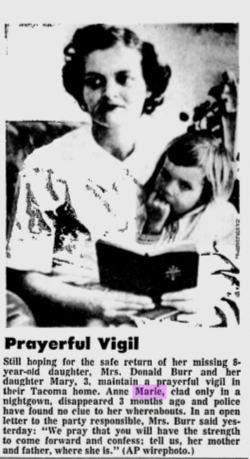
Sadly after the disappearance of their daughter, Beverly and Donald’s marriage began to struggle, with Don becoming verbally abusive and controlling with his wife. He was incredibly cruel and demeaning to Bev, even in front of friends and family, and was so jealous and possessive that she wasn’t even allowed to talk to the mailman or wear shorts outside while doing yard work. One time when they were stranded in Russia on a trip Don berated her for hours after she spoke with a male baggage handler and tried to help resolve the situation. After a single driving lesson in the family’s new car Bev was not allowed to learn how to drive after she accidentally stepped on the gas and floored the car over an embankment and into a busy highway. She called the marriage a big mistake. In her later years Beverly said that she would have left her husband but stuck around for the sake of the children, and she got along with him because she frequently just gave into him. Her relationship with Julie started to get strained in her adolescent years because she often looked at her and wanted to see Ann Marie. In addition to problems with her now oldest child, Mary developed mental health issues starting at an early age as a result of being the last person to see her sister alive. Mrs. Burr tried her hardest to help her daughter with her issues, even going so far as to put her own happiness and the well being of the other children on the line for her. She said, ‘I already lost one daughter, I can’t lose another.’ Julie has said that despite her dad being controlling and damn near abusive he was a loving person and loved his wife dearly. Raleigh Burr said in all the years they were married he didn’t remember ever seeing the couple hold hands or kiss or be openly affectionate towards one another. Of the couple he said that ‘maybe they weren’t outwardly loving but their children all knew they would do anything for them.’ One thing was for sure: Don and Bev were united when it came to their fierce love they felt for their children.
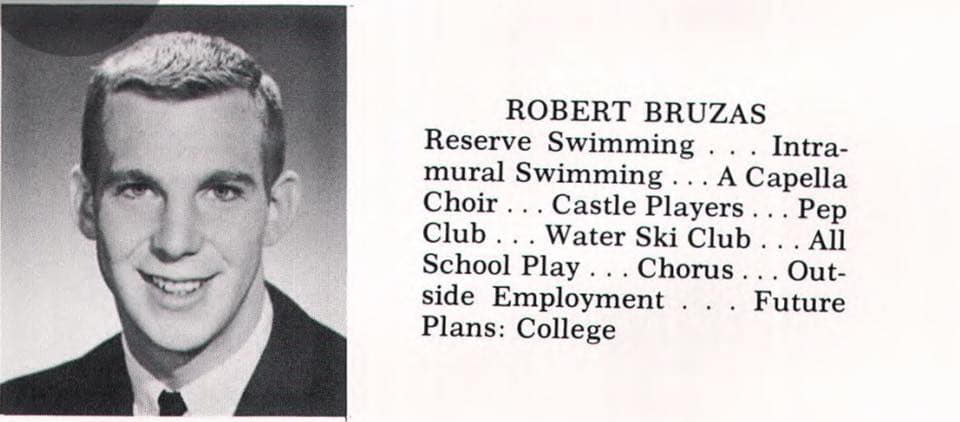
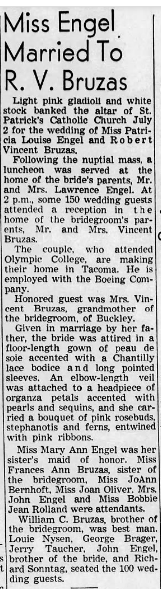
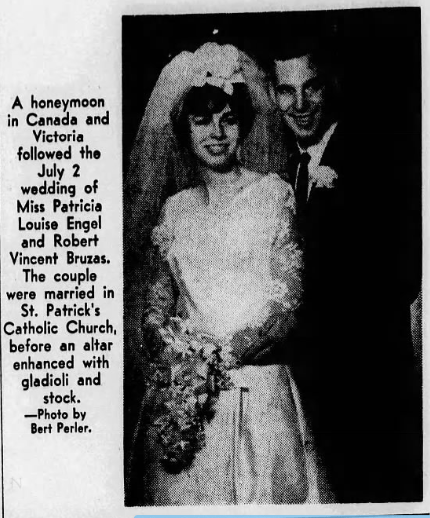
In August of 1961 Robert Bruzas was a teenage boy that lived close to the Burrs and reportedly liked to ‘flirt with Ann Marie.’ He failed an initial polygraph test about the young girls disappearance and it was determined he was lying (he blamed his failure on heightened nerves); however, he did pass a second one. Beverly said she was always nervous about Bruzas as he frequently sat outside their house in his car, but when the police questioned him about this he said he was just listening to the radio. Bev said that Robert had always been very friendly with Ann Marie and it was reciprocated somewhat but they questioned why a 15 year old boy would want to spend so much time with an 8 year old girl. No evidence has ever linked Bruzas to the crime scene, however police never ruled him out as a suspect. There are no arrest records for Robert and there is nothing on record of him ever being inappropriate with children. Bruzas got married in 1966 and worked for Boeing; he died in February 2022.
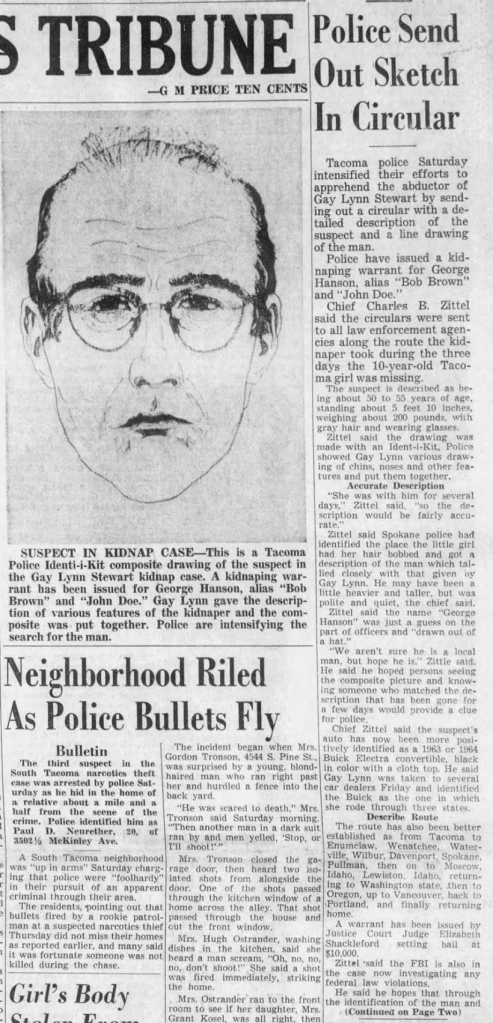
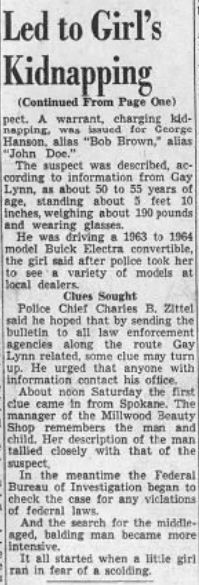
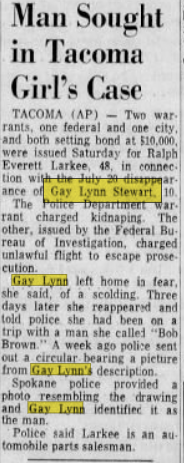
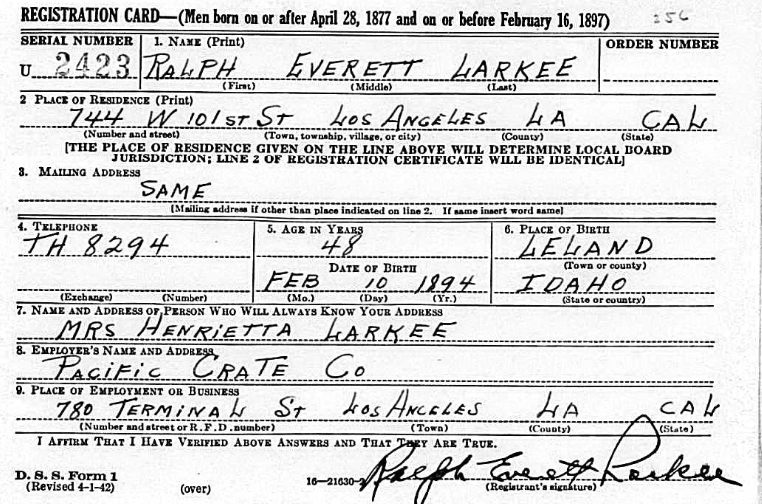
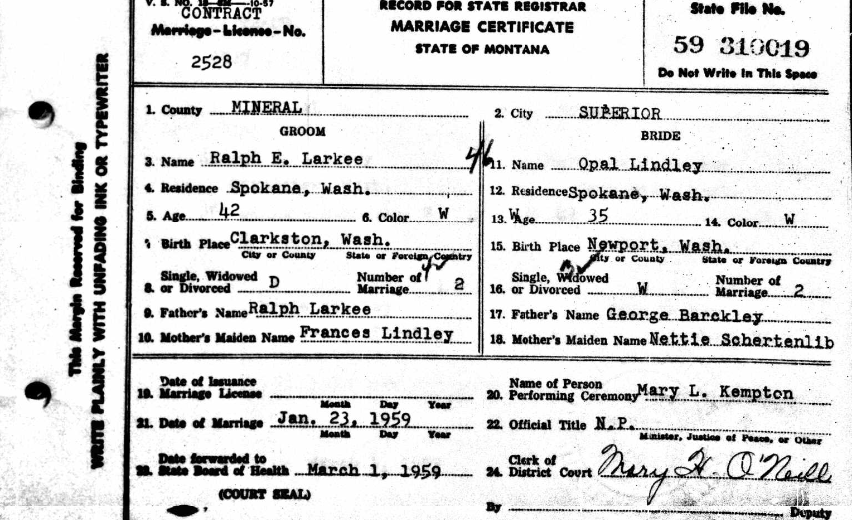
In the winter of 1964 a man named Ralph Everett Larkee, an auto parts salesman from Portland, Oregon, kidnapped a ten year old girl named Gay Lynn Stewart from Tacoma and took her on a 3 day joyride throughout the Pacific Northwest in his Buick Electra convertible. Police called the case the ‘next Ann Marie Burr’ and Larkee was considered a possible suspect in her disappearance as well. Stewart’s parents said that their daughter was very intelligent and was capable of taking care of herself (she had apparently run away before), and because of this they felt her case wasn’t given the same amount of attention as Burr’s because she was considered too ‘worldly’ for her age. Gay was last seen wearing a light blue blouse and cut off jeans and blue tennis shoes. Larkee called himself ‘Bob Brown’ and throughout the excursion kept a small caliber handgun in his glove compartment box; the two ate meals together in restaurants and he eventually dropped her off safely in Tacoma just three days later, with$15 in her pocket, a new haircut, and wearing a brand new outfit complete. When Stewart was finally recognized by a salesclerk the young girl denied who she was and even gave officers the fake name of Mickey Anderson. She was taken to the local police station and after being questioned was briefly allowed to speak with her parents, who left without their daughter in tears. Gay Lynn was taken to Raymond Detention Center where incarcerated children were housed, largely to keep her in a safe place because this ‘Bob Brown’ hadn’t been caught yet. Because he took his victim across multiple state lines the FBI became involved. She helped law enforcement come up with a composite sketch of her abductor and about two months after their excursion they were finally able to track down Ralph Everett Larkee. Larkee was discovered to be living in a Portland apartment building under the name of Paul Lindley when he was caught. On September 9, 1964 Larkee shot himself as the FBI were closing in on his apartment. He survived the suicide attempt and remained in critical condition in a coma for six months before eventually dying on March 31, 1965.
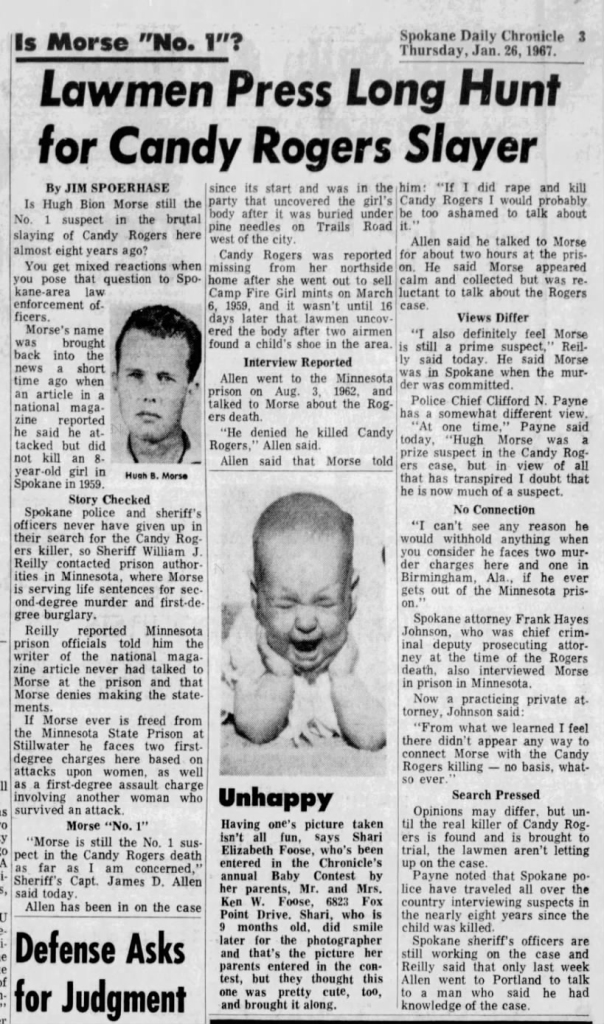
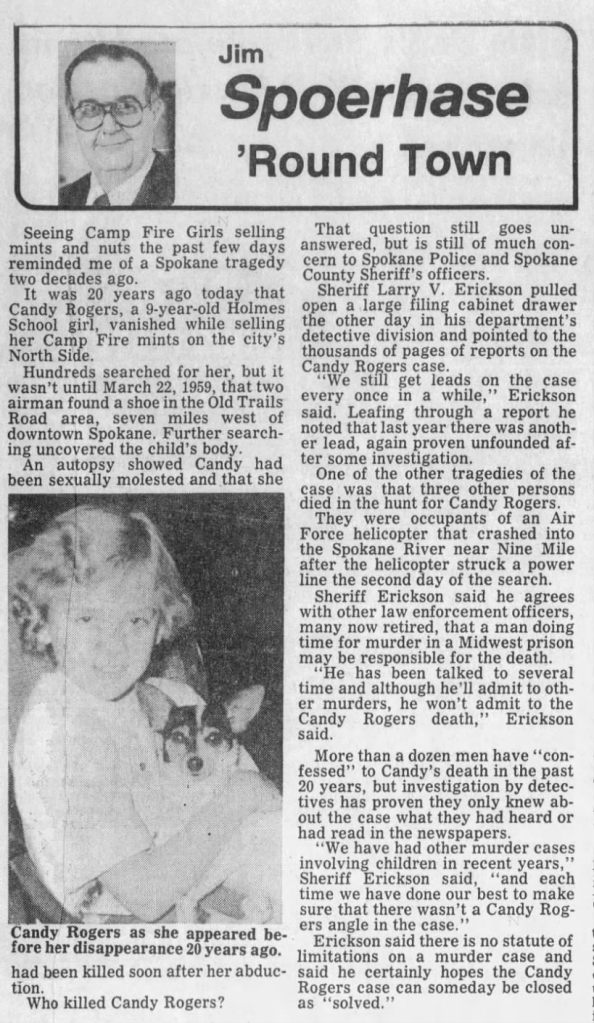
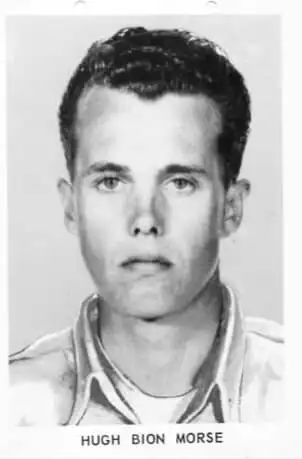
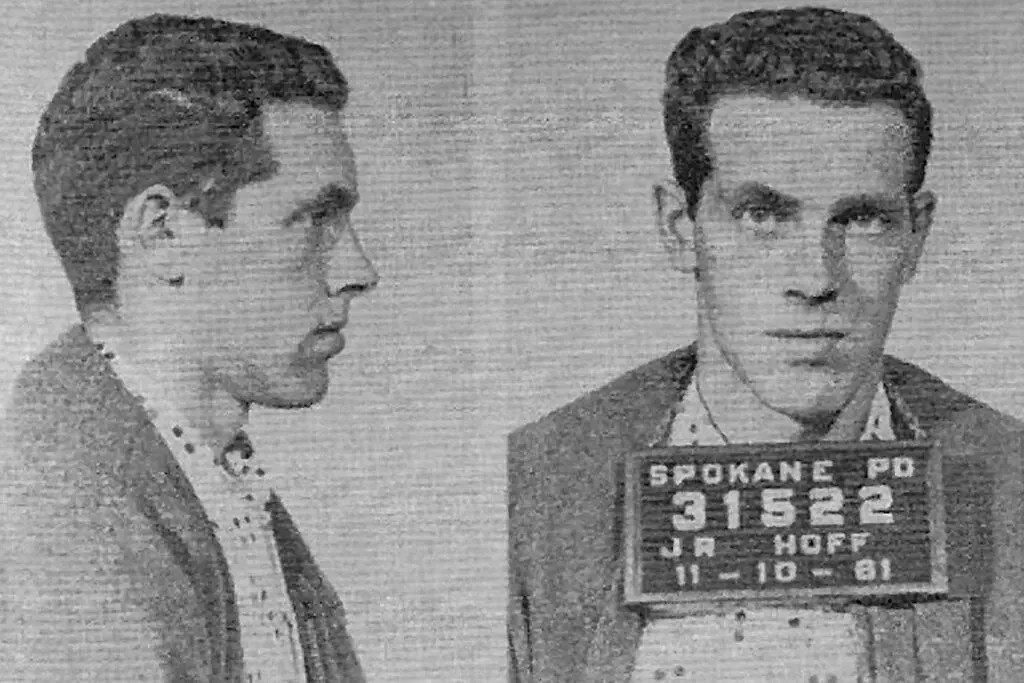
On October 31, 1961, police interviewed Hugh Bion Morse, a 31 year old former Marine at one time suspected in the 1959 murder of a young girl named Candice ‘Candy’ Elaine Rogers from Spokane. Candy was in the fourth grade at Holmes Elementary on West Spark Avenue, and at the time of her disappearance on March 6, 1959 she was out in her neighborhood selling Camp Fire Girls mints. Investigators had very little to go on aside from finding boxes of the candy discarded all along nearby Pettet Drive and after a 16 day search, Candy’s body was discovered in a wooded area in Northwest Spokane County. The young girl had been raped and strangled to death with a piece of her own clothing and sadly three Fairchild airmen died in a helicopter crash during the search efforts. Her murder went unsolved for 62 years until 2021, when Spokane police announced they had finally solved her case using DNA evidence and old-fashioned detective work. The killer of little Candy Rogers was determined to be a man named John Reigh Hoff, who died by suicide in 1970 at the age of 31. His daughter gave police a DNA sample that helped link her father to semen found on the young girls clothing. Oddly enough, Hoff was buried in the same cemetery as Candy. His body was exhumed and a DNA sample taken confirmed it was his semen found on the young child.
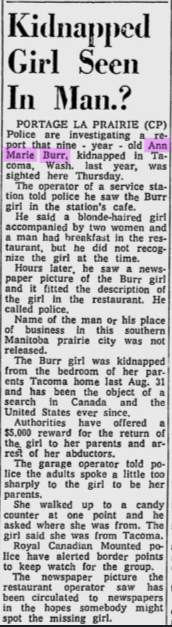
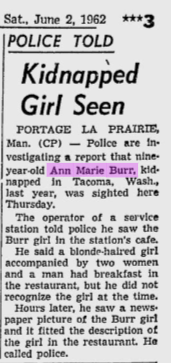
In June 1962, an employee at a full service gas station in Portage la Prairie, Manitoba, Canada (a small city in the Central Plains Region of Manitoba, Canada also located right across the US border from Grand Forks, North Dakota) told law enforcement he saw a young girl fitting the physical description of Ann Marie accompanied by a man and woman who ‘spoke a little too sharply’ to her to be her parents; the employee claimed the girl said she was from Tacoma. There was another man that made a ransom demand however he wound up being an opportunist that had nothing to do with Ann Marie’s disappearance; for that the man was charged with disorderly conduct.
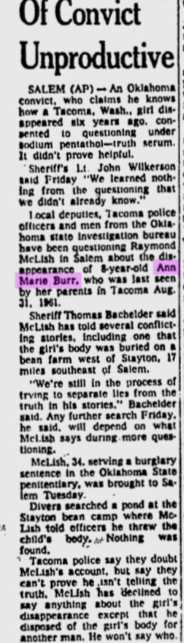
In 1965, an Oklahoma based inmate named Richard Raymond McLish initiated correspondence with the Burrs claiming that he and his friend David Withnell kidnapped Ann Marie while passing through Tacoma in the summer of 1961 looking for work; they further admitted to burying her on a bean farm in Oregon. While incarcerated in McAlester Prison in Oklahoma in 1965, McLish (friends called him ‘Mountain Red’ for his good looks, Native American blood, and curly red hair) read an update in a Tacoma based newspaper on the search for the missing girl on the fourth anniversary of her disappearance. The Associated Press picked up the story and published the article in various newspapers around the US and wouldn’t you know it, Richard McLish received one of the papers: in it, Bev had written an open letter to The Tacoma News Tribune about how her little girl had been missing for four years now and that the $5,000 reward was still being offered. McLish wrote Don Burr and told him it was him who took his daughter and that he knew where her body was located, and in turn, Mr. Burr gave the letter to Tacoma law enforcement. In the correspondence, he claimed that he knew where Ann Marie was, and in exchange for the information all he wanted was for the reward money to go to his family. He said he was driving with a couple who had abducted Ann Marie and that she was living with them in Oklahoma for quite some time and they had told him in passing that they had ‘gotten the wrong child.’ Oddly enough, in the original police report it is noted that a car with two men with a crying child driving a car with either California or Oregon plates inside driving at a high rate of speed sped off from the scene of the crime the night Ann Marie was taken. Detective Tony Zatkovich who, (along with his partner Ted Strand) had been on the case since the beginning immediately called the penitentiary where McLish was being housed. David Withnell killed himself on December 27, 1963 by carbon monoxide poisoning so unfortunately authorities were unable to question him, however they did speak to his widow, who said she could see her ex-husband performing an atrocity like that. She didn’t think, however, that McLish ‘had it in him.’ She reported she took her seven children and left her ex after she discovered he molested one of their daughters. Sometime over the course of that weekend in August 1961 while her husband was in Washington state looking for work, Withnell’s ex-wife noticed that a quilt had disappeared. By the time McLish was questioned by Tacoma law enforcement his story completely changed: he claimed that he and Withnell were the ones who abducted Ann Marie then drove back from Tacoma to Oregon to disposed of her body: McLish said that Withnell paid him to get rid of her so he wrapped the little girls remains in the missing quilt and buried her next to a tree about three feet deep out of the way. This way it was in an area where it wouldn’t be disturbed by a plow. After two years of back and forth between Tacoma police and the prison, on October 11, 1967 officers flew with the prisoner to check out the location where he allegedly dumped Ann Marie’s body. By the time they arrived in Oregon McLish had changed his story yet again: this time claiming they put the tiny body in the pond (still wrapped up in the quilt), even going so far as to point out where he remembered disposing of it on a hand drawn map. Unfortunately a semi-recent flood had drastically altered the landscape of the farm in 1964 and no remains were ever recovered. It’s unsure whether or not the inmate was telling the truth or not (although they were probably lying). The then-current owner of the property (Vern Chamberlain) said that if McLish did indeed dispose of Burr’s body in the pond then it most likely would have been washed away by the flood water. That didn’t stop divers from searching the pond but they came up with nothing. In Tacoma, police showed McLish’s photo to both Don Burrs and neither one of them recognized him, which seemed to confuse the inmate as he swore up and down that he knew Ann Marie’s father. While still in Oregon McLish agreed to an interview while under the influence of sodium pentathol (after turning down a polygraph he initially agreed to), however there is no proof or record anywhere of it ever being performed. Law enforcement in Tacoma told a local newspaper they couldn’t say either way, if he did it or didn’t.
Ar0und the time Burr disappeared there was an unknown girl suffering from amnesia found in Omaha, Nebraska, however it was eventually determined not to be Ann Marie. Another incident involved two boys that discovered a bottle with a note inside claiming that she was being held prisoner by bank robbers (nothing came from that either). Another odd occurrence: her name was found carved on a sandstone cliff near a roadside picnic area just southwest of Tacoma close to the Washington coast. But maybe one of the strangest things happened many years after Ann disappeared: Bev received an empty envelope addressed to the family at their new house; in a panic, she took the envelope to the police along with one of Ann’s old school books to hopefully compare the handwriting. However, the handwriting was deemed by police to be inconclusive and there was absolutely no way to determine whether or not it was from the same person, or even if it were from a child, teenager, or an adult. Was this Ann Marie trying to get in contact with her mother, or just another prank?
In the mid-90’s, Mrs. Burr received a strange phone call from a Tacoma based psychiatrist who felt that Ann Marie was one of his patients. So, Bev baked an apple pie and invited the woman over to her house: ‘I took one look at her and knew it wasn’t her,’ she said years later. The woman said she remembered having a canary (just like Ann) and a few other small details that were true. Mr. and Mrs. Burr met with her five or six times until they were finally talked into a DNA test by Julie: ‘I said, ‘Mom, you’ve got to find out if it’s her.’ After two years of being in communication with the mystery woman, the Burrs had their DNA tested and sadly she was not Ann; strangely Bev kept some pictures of her in family albums.
The cozy bungalow Bev once thought of as her dream home quickly became her biggest nightmare, but she felt she had to stay there in case Ann ever came home. When the family moved into a large colonial on North 28th Street in Tacoma six years to the month after Ann’s disappearance, they published the new address and phone number in the local newspapers in hopes Ann Marie would one day find her way back to them. Some of Ann’s clothes and toys made their way to the new residence. However, this led to many prank calls and a lot of harassment. Beverly received a phone call on February 20, 1964 from a man who sounded young but well-spoken and polite with no distinguishable accent. He claimed that Ann Marie was now living in the Phoenix, Arizona area but he would only give her more information if she ‘undressed for him.’ Despite being incredibly embarrassed, Mrs. Burr did inform police of the call which resulted in them re-installing recording equipment in their home to monitor any additional calls. They eventually found and arrested the culprit: a 17 year old Woodrow Wilson high school student (where Ted Bundy was ironically a junior). The teen had no new information about Ann Marie. In addition to harassing the Burr family, he admitted to making nearly 150 prank calls in the previous 2-3 years around the general Tacoma area.
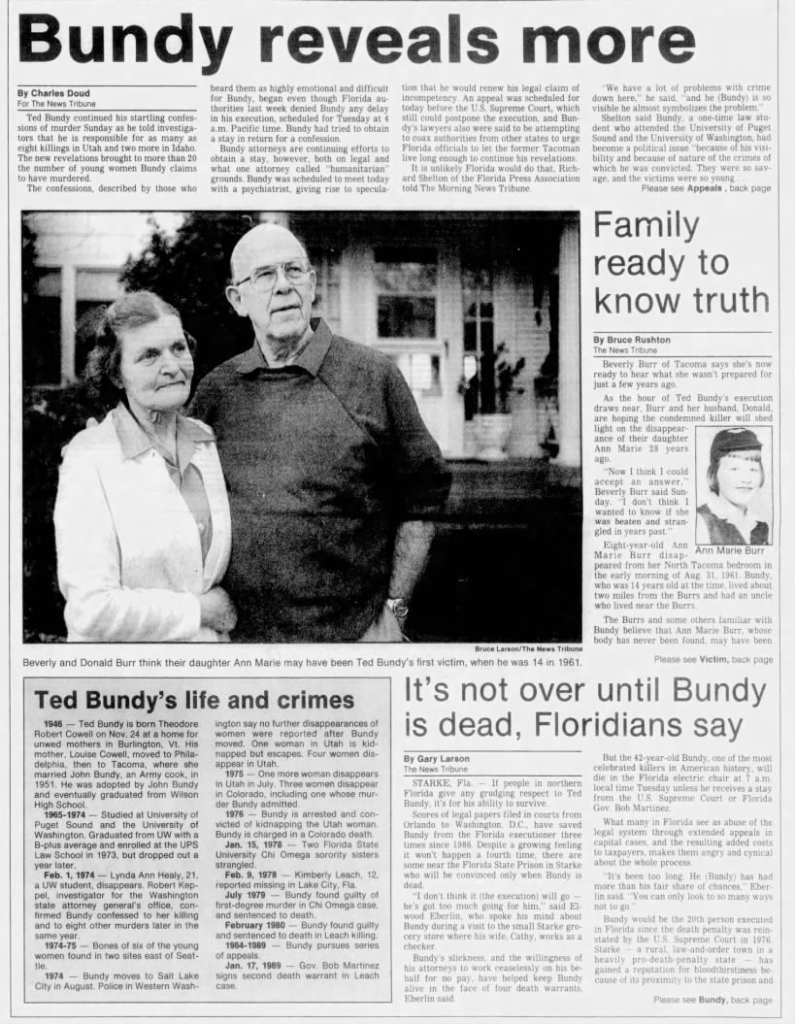
We all know that Ted Bundy didn’t ‘officially’ start killing women and young girls until early 1974… but at the same time it’s widely accepted he started his rampage years before that. Bundy first came up on police radar when he was a kid for being a peeping tom and shoplifter. Ann Marie’s case made national news when she disappeared in 1961, and there was a renewed buzz surrounding it in 1978 after it was realized the infamous serial killer grew up fairly close to her neighborhood. After Ted was arrested in Florida in 1978 he was considered a suspect in Ann Marie’s case when it was revealed that at the time of her disappearance he was 14 and living near the Burrs home in the West End of Tacoma at 658 North Skyline Drive (which is about 3.3 mile away). Additionally, there is no concrete alibi for Ted during the time in which Ann Marie went missing. His parents said he was in bed, but I mean… are they undeniably, 100% certain where he was on a random night in the summer of 1961? It’s impossible. I did read somewhere that at the time of Ann’s disappearance Mrs. Bundy made periodic, frequent walks through the house (she had younger kids at the time), and said she doesn’t remember anything out of the ordinary that particular night. It’s also worth mentioning it’s a pretty popular myth that Ted’s (favorite) Uncle Jack taught Ann Marie piano at one point in time (he didn’t), and he lived at 1514 South Adler Street in Tacoma (which is only 1.4 miles away from the Burrs). Jack Cowell was a professor of music at the nearby University of Puget Sound. Another common myth about Bundy and the Ann Marie Burr case is that he was the family’s paperboy at the time of her disappearance, but it turns out he wasn’t and his route was roughly 3 miles away. At the time Burr disappeared in 1961, 14 year old Ted had no drivers licenses or access to a vehicle, so if he did abduct her he most likely made the trek over to her house on foot. I mean, I was an out of shape 38 year old when I made the walk around Tacoma and it was definitely doable. Although it was stormy the night Ann Marie disappeared, that probably wasn’t enough to stop Bundy from making the walk. Or maybe he rode his bike over to her house and stashed it somewhere until he could come back and retrieve it?
I’ve read a lot of back and forth over the years about whether or not a 14 year old teenager would have been physically capable of committing an atrocity like this. At the end of the day, all I know is I’m 5’2” and when I was back in school for my teaching degree the seventh and eighth grade boys (and some girls) absolutely towered over me, and they were even younger than Bundy at the time. Now, we know Ted wasn’t a huge teenager (as he wasn’t an overly large adult), but I’m sure he was fairly tall, especially compared to Ann Marie’s slight 4’2″ frame. I personally think it’s less ‘could Bundy have physically killed her’ and more ‘what resources does a 14 year old boy with no drivers license (or access to a car, even illegally) or land/property have to properly dispose of a body?’ A part of me is thinking back to that laughing teenage boy Mr. Burr saw kicking dirt into the hole at The University of Puget Sound and is wondering, maybe the killer did dump her body in a hole that was eventually filled in with concrete. But, what about the byproducts of decomposition? I have a background in general chemistry and biology and I wondered about a rotting body’s effect on concrete and how it would hold up over the years. When the human body breaks down and decomposes, carbon dioxide, water, simple sugars and mineral salts are released (gasses and liquids). Well, leave it to my good friend Erin Banks to almost read my mind, because she had the same thought I did (but enough sense to do the research). About this, Ms. Banks said: ‘Many Washingtonians believe that Ann was embedded in cement at the construction site. In the 2010’s, there was a study conducted in the course of which pigs were buried in cement, so as to study the delay and changes in decomposition. Because decomposition involves gasses and fluids, it creates air pockets, impacting the structural integrity of the concrete, causing it to collapse over time. So there is a relatively slim chance for Ann to be buried underneath the former construction site, although we can, of course, never rule it out completely.’
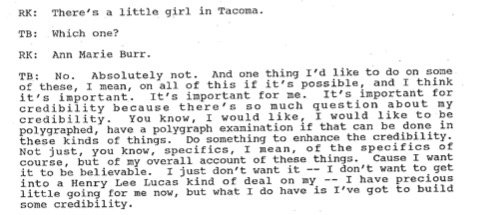
In 1980-81, Ted Bundy conducted his death row interviews with journalists Stephen Michaud and Hugh Aynesworth. In them, he spoke in the third person and often hinted at the crimes he committed. On one occasion Bundy spoke of ‘killing a young girl in an orchard,’ where he talked about attempting to sneak up behind a victim but she heard him and turned around, which forced him to pull out a knife, grab her by the arm and tried to force her to submit. But instead of complying, the victim became loud and vocal, and since there were houses in the area he was worried that someone might hear them: so, in an attempt to force her to be quiet he placed his hands around her throat and she eventually stopped struggling completely. It appeared she was unconscious, but after the assailant removed her clothes and raped her he noticed she wasn’t breathing. Was that Ann Marie Burr? Ted even went into graphic detail, going so far as to give the precise layout of the Burrs neighborhood and set-up of their house.
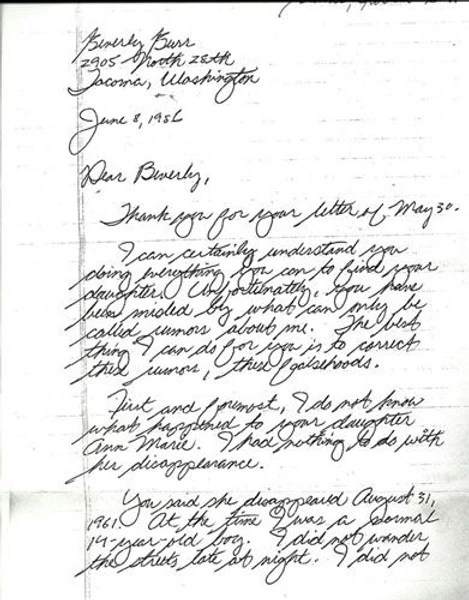
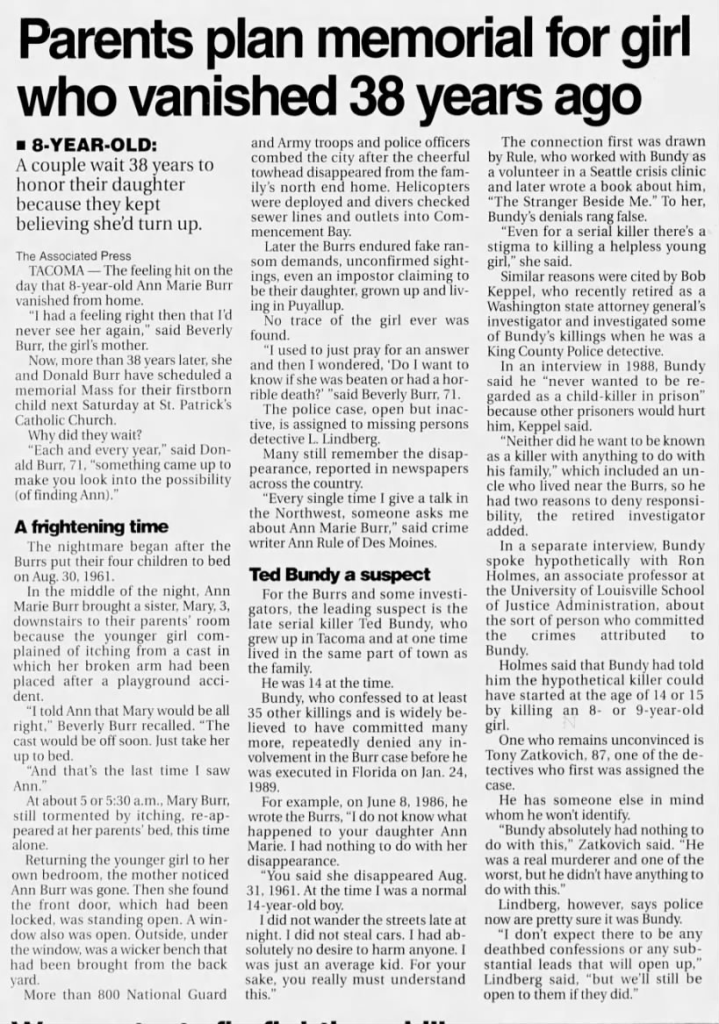
When the book ‘Conversations with a Killer’ was published in 1983, Mr. and Mrs. Burr both read it, and it was shortly after that Beverly first wrote to Bundy. She pleaded with him in a letter dated May 30, 1986: ‘On August 31, 1961, just before school was to start for you and our children, there came a black rainy night with lots of heavy winds. You were 15 and had been wandering the streets late at night and peeping in windows and taking cars. I feel your FIRST MURDER WAS OUR ANN MARIE BURR. The bench from the back yard was used to climb in the living room; the orchard next door was a dark setting for a murder. What did you do with the tiny body? God can forgive you.’ Strangely enough, he responded shortly after on June 8, 1986, saying that he had nothing to do with her disappearance: ‘Dear Beverly, Thank you for your letter of May 30. I can certainly understand you doing everything you can to find your daughter. Unfortunately, you have been misled by what can only be called rumors about me. The best thing I can do for you is to correct these rumors, these falsehoods. First and foremost, I do not know what happened to your daughter Ann Marie. I had nothing to do with her disappearance. You said she disappeared August 31, 1961. At the time I was a normal 14-year-old boy. I did not wander the streets late at night. I did not steal cars. I had absolutely no desire to harm anyone. I was just an average kid. For your sake you really must understand this. Again and finally, I did not abduct your daughter. I had nothing to do with her disappearance. If there is still something you wish to ask me about this please don’t hesitate to write again. God bless you and be with you, peace, ted.’ After two letters back and forth with the convicted serial killer, Beverly felt that ‘he avoided the real questions, talking instead about the Green River murders and world events.’
Later in 1986 Ted told the same story to Dr. Ronald Holmes about the murder of a young girl in an orchard. Dr. Holmes was an associate professor of criminal justice at the University of Louisville’s School of Justice Administration; he had a two-year grant to study serial killers in the United States. Bundy told the Doctor that he had “stalked, strangled and sexually mauled his first victim, an eight-year-old girl who mysteriously vanished from her Tacoma home, 26 years ago” (Holmes interview). This confession didn’t make the news until 1987, when Holmes presented his findings to a conference in Colorado. His admission didn’t make news until the next year, when Holmes presented a paper to a conference in Colorado. Bundy told Dr. Holmes that he had “stashed the body of Ann Marie Burr in a muddy pit, possibly near the University of Puget Sound” (Holmes interview). Many Bundy enthusiasts and law enforcement have disputed the story, however Dr. Holmes never wavered about what Bundy admitted to him. Years after Ann Marie’s disappearance Bundy told law enforcement that he “wouldn’t have hurt a little girl” and denied any involvement with her disappearance. In a 1987 interview with King County detective Bob Keppel Bundy said that there were “some murders” he would “never talk about”, because they were done “too close to home”, “too close to family” or involved “victims who were very young”. Technically, Ann Marie Burr’s strange disappearance checked all three of these boxes.
I do want to point out that Bundy has spoken to a few people about how he raped Nancy Wilcox in an orchard when he was in law school in SLC. During his earlier interviews with Stephen Michaud, Ted implied he strangled a young woman to death in an orchard across the street from her home because she raised her voice and refused to be quiet (I guess technically this could have been either girl as they both lived by orchards). Before he was executed in early 1989, Bundy confessed to Wilcox’s murder: before she vanished on October 2nd Nancy got in an argument with her father about her bf’s truck leaking oil in the driveway and left in a huff. Shortly after, Bundy saw her walking near her home and abducted her: he got out of his Bug and after creeping up on her from behind forced her to walk with him to a closeby apple orchard, where he was able to restrain then put her in his waiting VW. He then told law enforcement that he brought the young girl back to his SLC apartment but didn’t kill her until the next day. Many Bundy scholars don’t believe this confession, as he lived in a boarding house at the time with other tenants and bringing an incapacitated woman back to his room against her will would most likely have been pretty loud (especially when she regained consciousness). He attempted to tell law enforcement where he left her body, however they were never able to find any part of her. To this day, Nancy Wilcox’s remains have never been found, and as a result she is still listed as a missing person.
In 1989, Ted Bundy requested that Dr. Dorothy Lewis come see him while on death row. Lewis was a Yale psychiatrist and scientific researcher working with a pro-bono attorney in an attempt to get the serial killer a new prison sentence. Dr. Lewis had spent her entire career as a clinical psychiatrist talking to serial murderers and rapists in maximum security prisons. She was attempting to figure out what exactly it was that made them do what they did and alleges that when Bundy was ‘twelve, fourteen, fifteen … in the summer … something happened, something, I’m not sure what it was. … I would fantasize about coming up to some girl sunbathing in the woods, or something innocuous like that … I was beginning to get involved in what they would call, developed a preference for what they call, autoerotic sexual activity,’ he told her. ‘A portion of my personality was not fully … it began to emerge … by the time I realized how powerful it was, I was in big trouble (Lewis interview).’
Shortly after Bundy was executed in 1989 Don and Beverly Burr made a public statement, saying they felt their daughter’s body may have been disposed of in one of the seven ongoing construction sites that were taking place on the University of Puget Sound campus.
Author Rebecca Morris wrote a book about the Ann Marie Burr case around Bundy’s confession to Dr. Holmes in 1986 titled ‘Ted and Ann: The Mystery of a Missing Child and Her Neighbor Ted Bundy.’ I waited until the very end to bring up Sandy Holt because I wasn’t sure exactly how to feel about her at first but… now that my research is complete I can confidently say I think she is 100% full of shit. Holt grew up with Bundy in Tacoma and claims to be privy to information that he did unspeakable things to the young girls in the neighborhood, including dragging them to the woods and urinating on them. She also claims he liked to build tiger traps, which obviously resulted in children hurting themselves. Sandy’s older brother Doug was friends with Bundy, and she claims that her father molested Ted while on a boy scouts camping trip (they were seen coming out of a tent together). Now, this Sandy Holt also claims to know more than Beverly Burr (who told law enforcement that her daughter did not know the serial killer in any capacity) and alleges that Ann would follow Ted around like a little lost puppy dog with a schoolgirl crush… she also claimed the eight year old child would sit and watch him fold newspapers, which doesn’t make much sense as Bundy was never the Burrs paperboy and he lived 3.1 miles away from them. Considering there is NOTHING anywhere else on Ted peeing on neighborhood children or making tiger traps as a kid except from this one source just screams ATTENTION SEEKING to me.
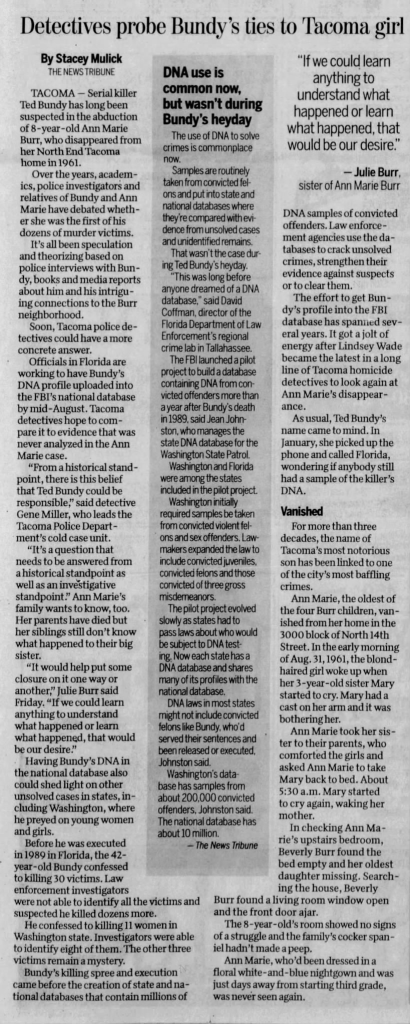
In July 2011 authorities developed a DNA profile utilizing a vial of Bundy’s blood preserved from blood samples taken on March 17, 1978 and shortly after Ann Marie’s DNA was submitted to the Washington State Patrol Crime Lab for DNA comparison. Several weeks later, it was determined that the evidence gathered at the scene of the abduction did not contain enough measurable DNA to produce a complete profile of the assailant. At this time in November 2022, Burr’s disappearance is still a mystery and her body has never been recovered.
One thing I did learn that doesn’t really fit in anywhere is that Beverly Burr and Louise Bundy were casual acquaintances and ‘knew each other in passing,’ however both women said their children didn’t know each other. The two couples strangely enough ran into each other while on a 20 day bus tour of the Ozarks and because of where their last names fell in the alphabet they were placed close to each other for the entirety of the trip. Mr. and Mrs. Burr always tried to get away from Tacoma during the month of August (for what should be logical reasons); they tried to stay out of each others way for those 20 days and made extra careful to not be in any of each other’s pictures. This case reminds me a little of the Lynda Ann Healy abduction in 1974 that took place close to the University of Washington campus. She was Bundy’s first confirmed murder victim and he abducted her from her home in similar fashion to the way Ann Marie was kidnapped. There was no blood left behind with Ann like there was with Healy but the abduction method does show some parallels. We also know that the two youngest Bundy victims were 12 years old (Kim Leach and Lynette Culver), and where Ann Marie was quite a bit younger than them it was brought up by Molly Kloepfer (Ted’s girlfriend Liz’s daughter) that he did touch her inappropriately when she was only seven. So, he obviously has no problem with going after extremely young victims. Beverly never let the people of Tacoma forget her Ann Marie: there were frequent updates regarding the case in the local papers and she made sure her daughter got news coverage. When Bundy was put to death in 1989 the Burr family listened to the broadcast on the radio: they were hoping for some last minute news about Ann’s death but sadly there was none.
At the time of the service many Tacoma and Seattle newspapers published articles about Ann, and there was a resurgence of interest in the case. Mrs. Burr said she was glad that she didn’t know what had happened to her daughter, but that she ‘still thinks it was someone she knew,’ and regarding Bundy commented: ‘you know, he tortured women.’ At her sisters memorial service Julie Burr said of her mother: ‘you probably wanted to crawl into bed and bury your head as each day and year passed with no answer. But instead you gathered strength and provided us with a wonderful childhood.’ After a brief hospitalization where Bev may have had some self-inflicted injuries as a form of ‘attention seeking,’ she briefly considered becoming a nun, a thought her parish strongly discouraged. In the years after the children flew the coup, Don finally allowed his wife to take writing classes and get a job: she worked as a secretary at Bates Technical College in Tacoma and at St. Josephs Hospital. She also volunteered at a local school teaching children how to read. Beverly said that she was always looking into the faces of strangers around her for the little girl that disappeared so many years before. Many years after Ann’s disappearance, Bev was asked by a journalist why there were no pictures of her up in the living room with the other children. She held back tears as she went to the spare bedroom and gathered pictures of her precious Ann Marie: she explained that seeing her up on the wall everyday was just too painful. Beverly did comment that she thought it was odd that the last name of Bundy’s final victim was Leach, which was her maiden name.
Sadly, Donald Burr passed away on September 4, 2003 at the age of 77 and Beverly passed away of congestive heart failure on September 13, 2008 at home in Tacoma. At the time of Dons death the couple had been married over 50 years. They were the parents of five, grandparents of seven, and great-grandparents of three. All four of the remaining Burr children are alive as of November 2022. Ann’s disappearance remains an open case with the Tacoma Police Department.
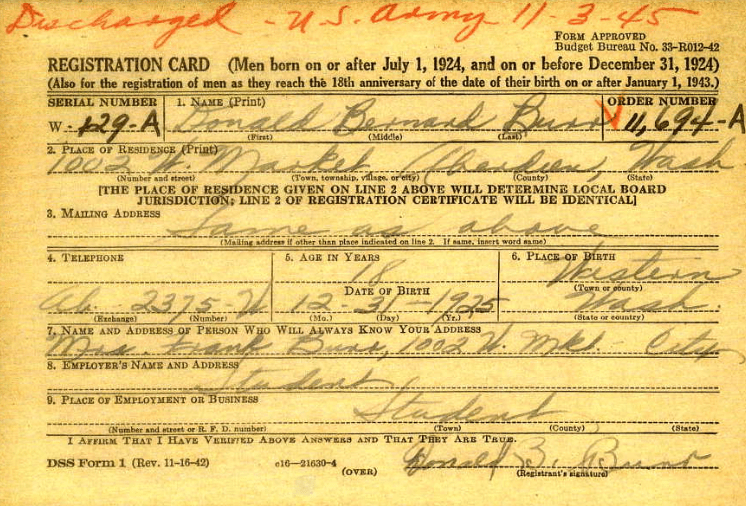
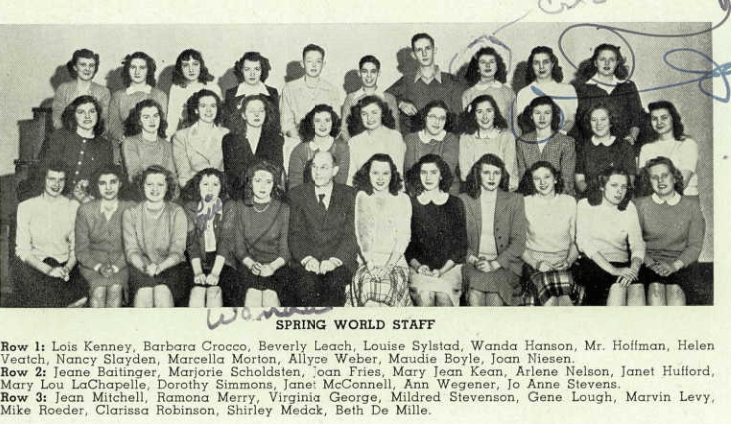
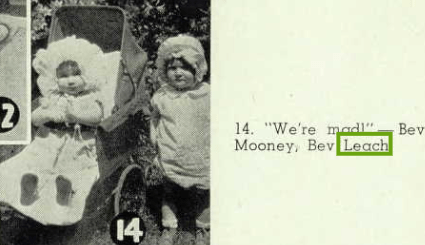


























on July 19, 1963.




















 Another Bundy Blog.