I’ve been compiling a list of missing and murdered young women from the 1970’s in Oregon in a notebook, and I figured why not also include it here. As I learn of new victims I will update the list… over the years I’ve found dozens of names on various websites and newspaper articles about other missing and murdered women, but they’re scattered all over the internet in a million different sources… why not put them all here?
Janet Lynn Karin-Shanahan: (April 23, 1969, Eugene). Twenty-two years old. Strangled and found in the trunk of her own car.
Niki Diane Britten: (July 16, 1969, Albany). Fifteen years old. Frequent run away.
Barbara Katherine Cunningham: (May 25, 1971, Eugene). Thirty-four years old. Found deceased in her apartment by her mother.
Barbara Ann Bryson: (July 29, 1971, Stayton). Nineteen years old. Was last known to be attending a party.
Fay Ellen Robinson: (March 12, 1972, Eugene). Found deceased in apartment.
Alma Jean Barra: (March 23, 1972, Happy Valley). Twenty-eight years old. Found deceased in Willamette National Cemetery.
Beverly May Jenkins: (May 25, 1972, Cottage Grove). Sixteen years old. Her remains were found in June1972just off the I-5 roughly ten miles outside of Cottage Grove; she had been strangled to death.
Jane Pellett: (June 7, 1972, Salem). Twenty-eight years old. Found deceased on a busy roadside on June 26, 1972.
Geneva Joy Martin: (June 16, 1972, Eugene). Nineteen years old. Found deceased on the side of the road by a farmer.
Rita Lorraine Jolly: (June 29, 1973, West Linn). Seventeen years old. Disappeared while out on a routine nightly walk.
Allison Lynn Caufman: (July 1973, Portland). Fifteen years old. Died as a result of head injuries after being shoved from a car moving at a high rate of speed.
Laurie Lee Canaday: (July 9, 1973, Milwaukee). Her remains were recovered on the pavement at the intersection of Southeast Scott Street and McLoughlin Blvd in Milwaukee, OR.
Susan Ann Wickersham: (July 11, 1973, Bend). Seventeen years old. Was found deceased from a gunshot wound on January 20, 1976.
Vicki Lynn Hollar: (August 20, 1973, Eugene). Disappeared along with her 1965 VW black VW Beetle with IL plates and the running boards removed.
GayleLeClair: (August 23, 1973, Eugene). Found stabbed in her apartment.
Deborah LeeTomlinson: (October 15, 1973, Creswell/Eugene). Disappeared along with a friend on her sixteenth birthday. According to her sister (and my friend) Jean she was seen in California after she disappeared).
Virginia Erickson: (October 21, 1973, Portland). Thirty-two years old, mother of six. Disappeared, most likely killed by her husband.
Suzanne Rae Seay-Justis: (November 5, 1973, Portland). From Eugene, despite having a car hitchhiked.
Marion Vinetta Nagle McWhorter: (October 1974, Tigard). According to McWhorter’s sister, she had been traveling before she disappeared around the Western part of the US. Her body was finally identified in September 2025, but the case remains unsolved.
Leslie Michelle (seven years old) and Geoffrey Lyman (five years old) Brown. Murders took place on February 22, 1975 and both victims were found on March 12, 1975 in McIver Park, Estacada.
Margo Nerline Ascencio-Castro: (March 1, 1975, Eugene). Twenty-two years old. Found stabbed in a motel room, possibly involved with a local motorcycle gang.
Tina Marie Mingus: (October 1975, Salem). Sixteen-years old. Murdered, body recovered.
Cherril Sue Miller: (October 12, 1975, Portland). Twenty-eight years old.
Camille Karen Covert-Foss: (October 17, 1975, Hillsboro). Found shot in her vehicle at her POE, in a Southwest Portland-area shopping center.
Kim Charleson: (January 7, 1976, Cannon Beach). The 22 year old had been in college and may have been carrying a small amount of Canadian currency when she disappeared.
Sandra Renee ‘Sandy’ Morden: (1977) Approx sixteen years old, her partial skeleton was found in Washington in 1980 and its believed that she died in the late 1970’s. She was identified in October 2019.
Karen Jean Lee: (last seen alive, May 26, 1977, Cornelius). Lee ran away with a male companion, fourteen year old Rodney L. Grissom. Her possessions and clothes were found by a logging crew sometime in November 1977 however her remains were never recovered. Grissom’s clothes and belongings found in same area, roughly a quarter mile away from Lee’s in November 1982; his remains have also never been found. (Thank you to my friend Ryan AuClair for this information).
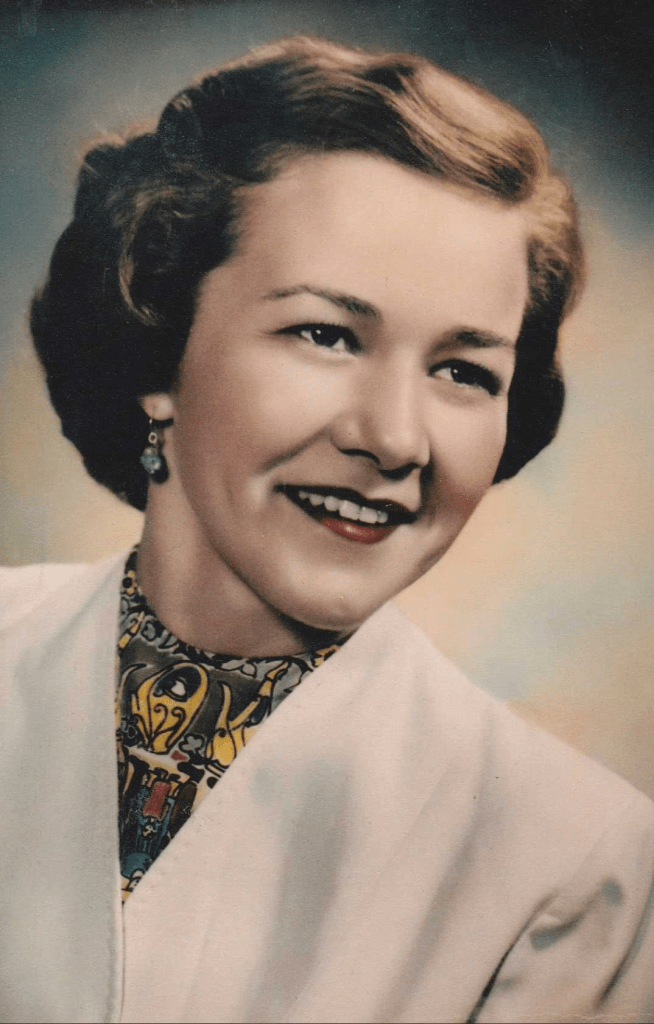
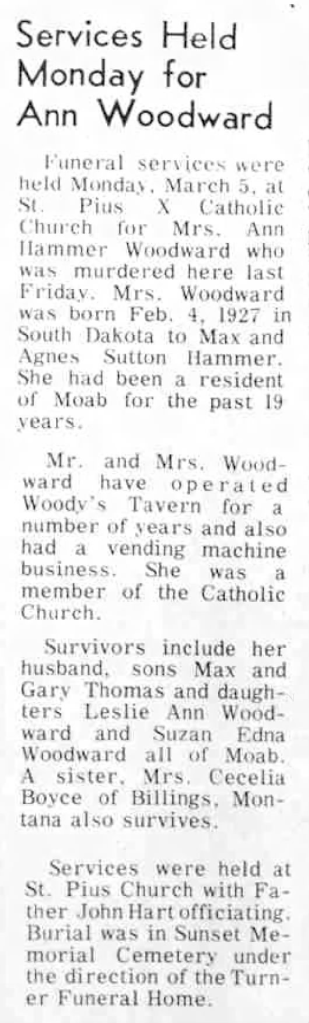
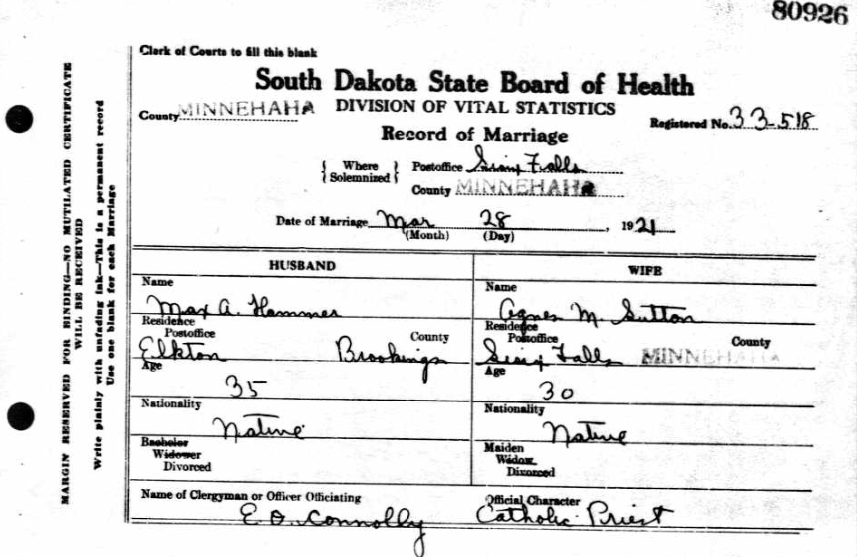
Ann Marie Hammer was born on February 4, 1927 to Maxwell Algernon and Agnes Marie (nee Sutton) Hammer in Aberdeen, SD. She had an older sister named Cecelia Mae (Boyce) and a brother named Lowden William, who was born in December 1921 and sadly only lived to the age of three. Maxwell was born on April 7, 1887 in Hubbard, Iowa, and Agnes was born on August 31, 1890 in Illinois. I wasn’t able to find out very much about Ann’s background, and wasn’t even able to find the name of the high school she graduated from. According to Ancestry.com, the Hammer family lived in Aberdeen, SD in 1930 and in 1935 they moved to Rural, SD. Ann’s father was a WWII vet and was the owner and operator of the Hammer Realtor Company, and president of the Co-operative Building and Sales Company. Sadly he shot himself in the chest in November 1940 with a .410 shotgun, and according to his obituary he had been in poor health for several months prior to his death and had recently learned he had malignant cancer. In late 1940 Mrs. Hammer took her two daughters and moved to Maricopa, AZ.
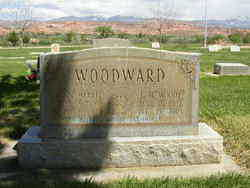
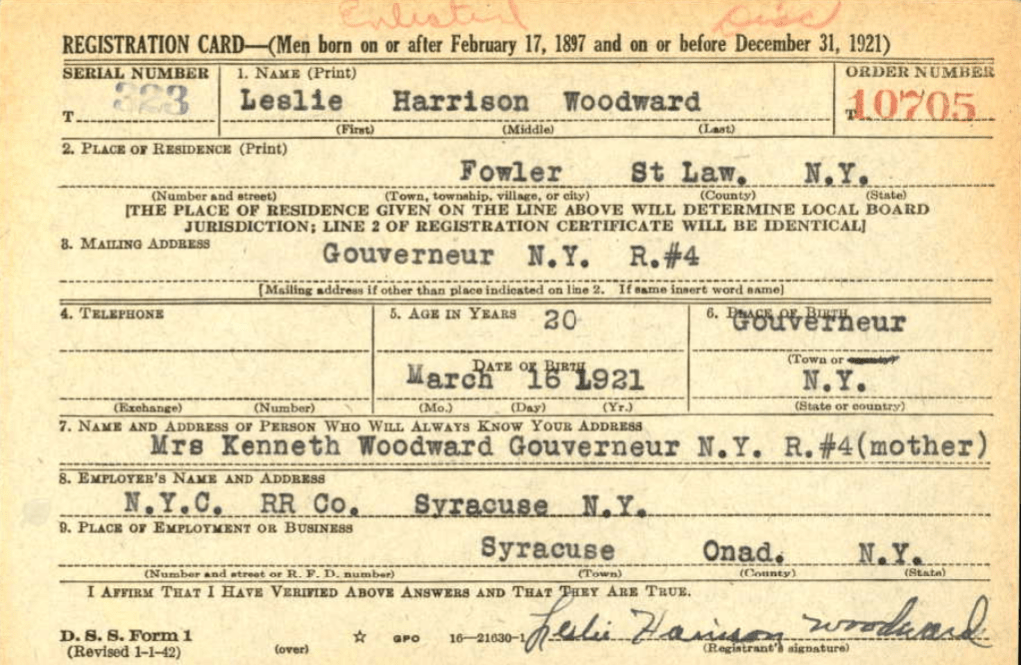
Ann was married twice: she wed her first husband Clarence George Sutherland in Juárez, Mexico, and her second Leslie Harrison ‘Woody’ Woodward on November 17, 1953 in Gallup, NM (she was his third wife). Sutherland was born in June 1912 in Peoria, Illinois and died in June 1996 in San Diego. ‘Woody’ was born on March 19, 1921 in New York, and the couple had four children together: Leslie Ann, Maxwell Joseph, Suzan Edna, and Guy Thomas.
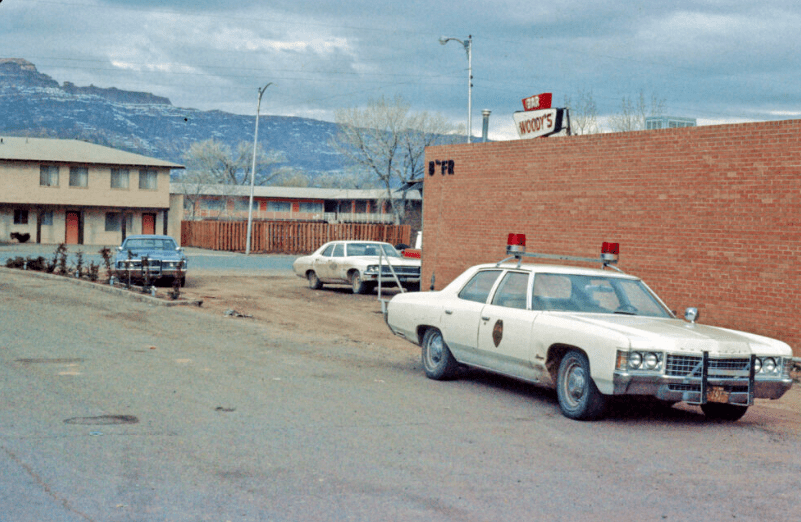
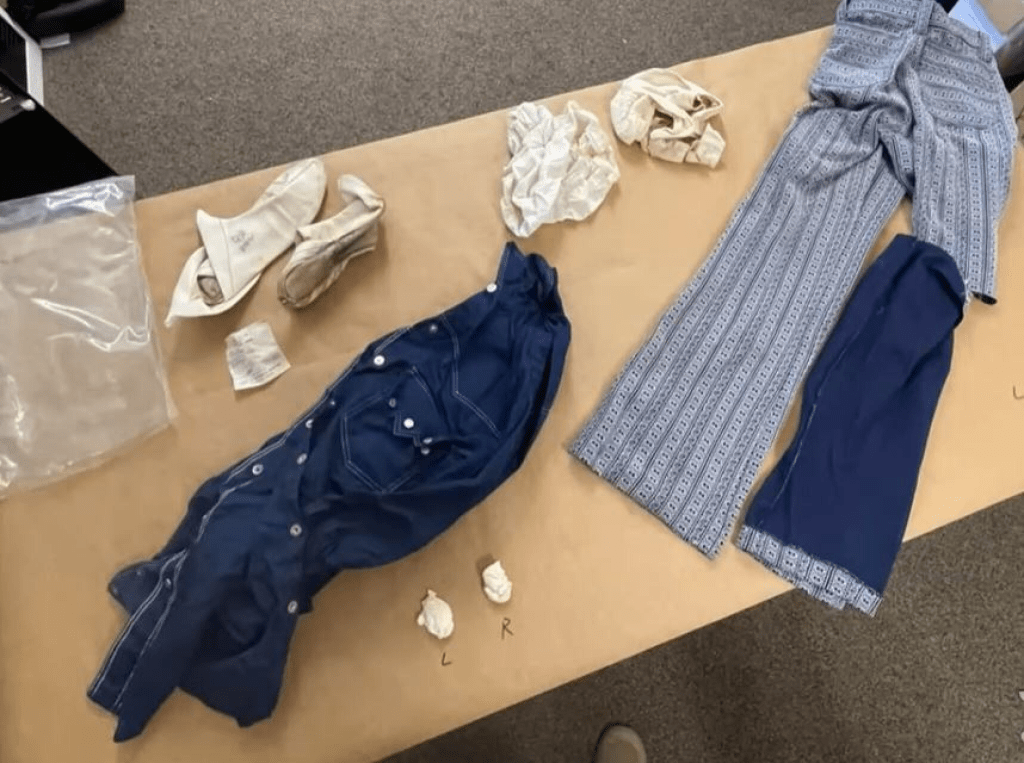
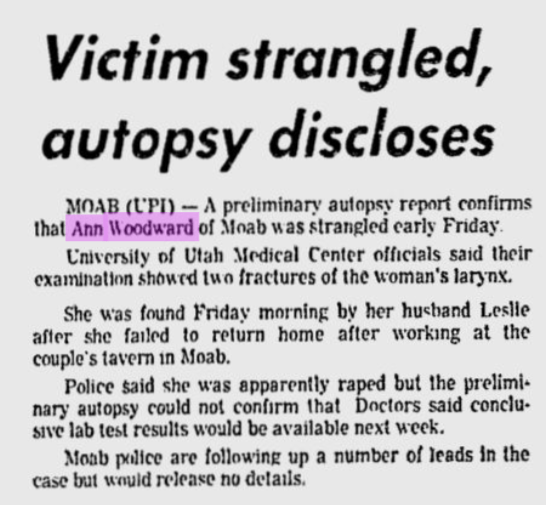
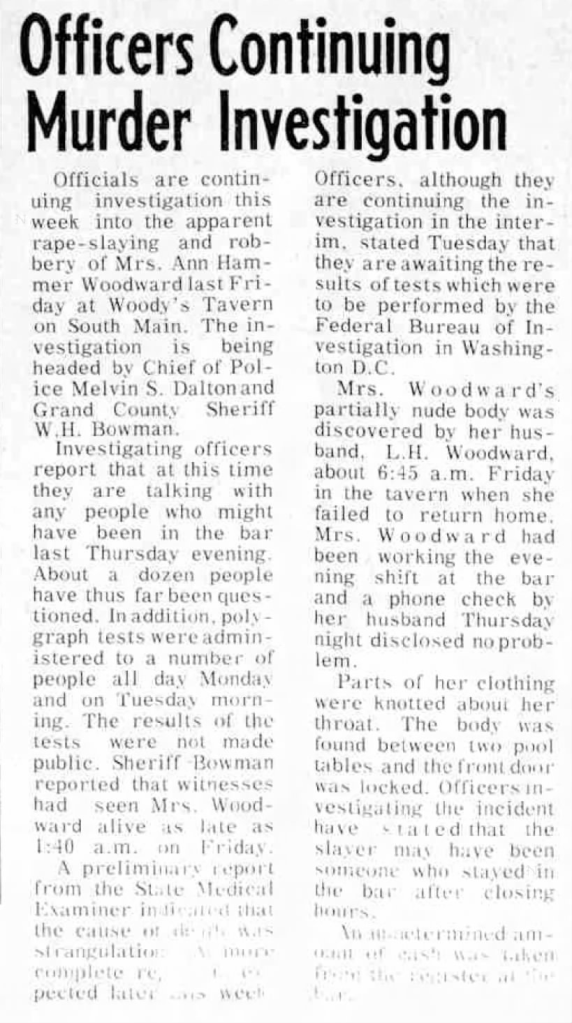
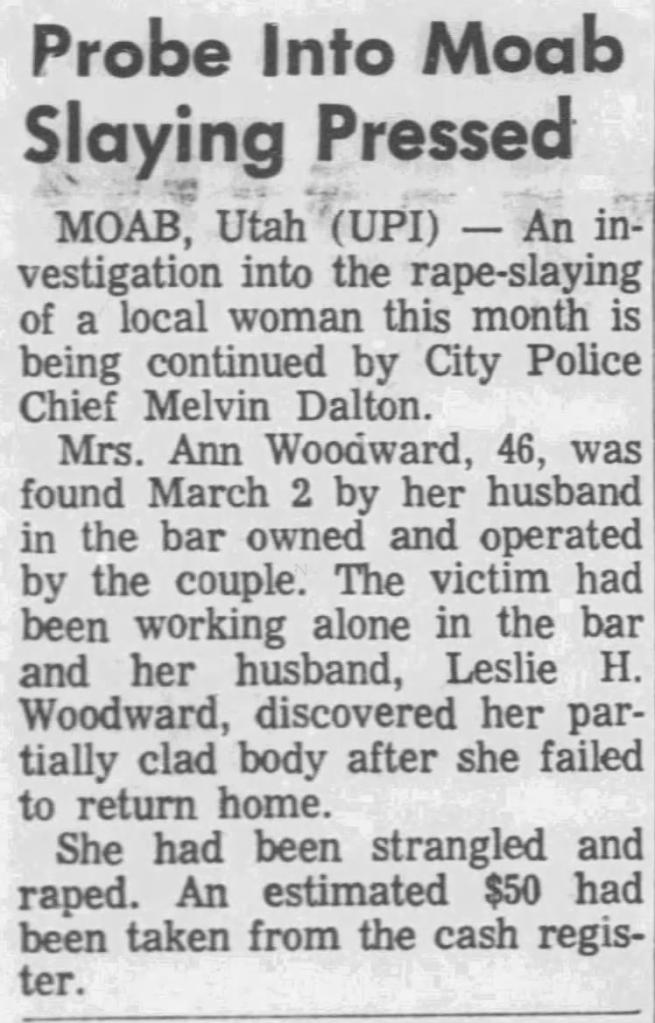
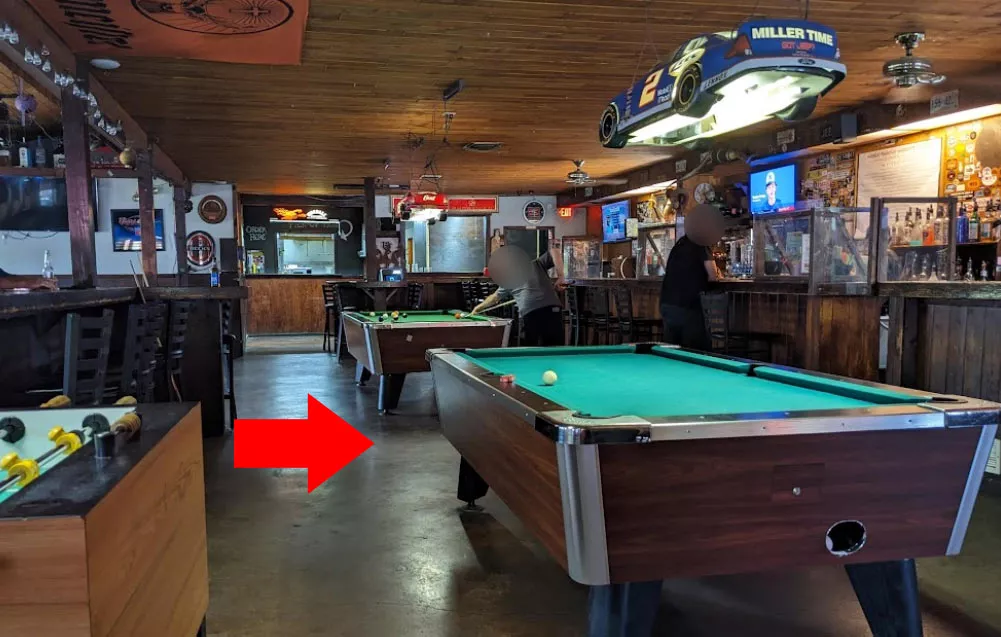
In the early morning hours between 1:40 and 2:30 AM on March 2, 1973 Woodward was killed in the bar she worked at and owned with her husband. After his wife failed to return home Leslie went into the establishment between 6:30 and 6:45 AM to look for her, and stumbled upon a gruesome sight: Ann, deceased. She was half-dressed with her shirt completely unbuttoned and bra exposed, and she had no pants on and was lying on the floor in between two pool tables, with the right leg of her white striped slacks still tied around her neck. Next to her discarded pants were eight dimes and one tissue, and Moab Detective Jeremy Drexler said there were tissues in every one of Ann’s pockets, except for the left pocket. The mother of four had been beaten, raped and strangled. Woody immediately called his friend Heck Bowman, who was the Grand County Sheriff even though the bar was outside his jurisdiction. Typically the case would have fallen into the lap of the Moab PD instead of the sheriff’s, and that ended up playing a large role in how the investigation was handled and why it was mishandled. Detective Drexler commented that based on the notes he read in Woodward’s case file, there seemed to be some bad blood between the two policing agencies, and they didn’t really get along and couldn’t really seem to work together.
In the early morning hours between 1:40 and 2:30 AM on March 2, 1973 Woodward was killed in the bar she worked at and owned with her husband. After his wife failed to return home Leslie went into the establishment between 6:30 and 6:45 AM to look for her, and stumbled upon a gruesome sight: Ann, deceased. She was half-dressed with her shirt completely unbuttoned and bra exposed; she had no pants on and was lying on the floor in between two pool tables, with the right leg of her white striped slacks still tied around her neck. Next to her discarded pants were eight dimes and a single Klenex, and Detective Drexler said there were tissues in every one of Ann’s pockets except for the left one. The mother of four had been beaten, raped and strangled. Woody immediately called his friend Heck Bowman, who was the Grand County Sheriff even though the bar was outside his jurisdiction. Typically the case would have fallen into the lap of the Moab PD instead of the sheriff’s, and this ended up playing a large role in how the investigation was handled (and why it was mishandled). Detective Drexler commented that based on the notes he read in Woodward’s case file, there seemed to be some bad blood between the two policing agencies, and they didn’t really get along or work together.
Found at the scene were two sets of bar glasses as well as some cigarette butts which helped point investigators to where Ann and her killer were most likely sitting. According to Detective Drexler, ‘they wanted to identify that person who sat next to Ann in the worst way. You can see from the original case notes that they were really hoping that fingerprints on the bar glasses would identify him.’ But, sadly that never worked out, and the glassware was sent to the FBI but came back inconclusive.
In recent years Moab police admitted that they didn’t handle the crime scene as well as they should have, and a lot of important evidence was mishandled and lost. While the (now retired) Police Chief Melvin Dalton was meticulous in his investigation, the method in which things were done 51 years ago muddied the waters, and while ‘very neatly put together and ready for our taking’ there was no records management system in place at the time. The two boxes of information related to Woodward’s murder were eventually removed from the sheriff’s office and placed in a building off campus and was eventually forgotten about. Once Drexler discovered the evidence that was lost so many years before things broke wide open: ‘it was 50 years and six months later, but we got it and I knew we had it. I called my wife and told her I had the evidence in the backseat of my truck and I got emotional. It was a treasure trove.’
The evidence related to Woodward’s murder sat collecting dust in the archives of the Grand County Sheriff’s Department until September 14, 2023, when Detective Drexler found them after taking over the investigation. According to him, ‘it was actually on a shelf back next to some Geiger counters. So the evidence was not labeled as evidence, I guess you could say. It’s just a beat-up cardboard box with dust on it.’ … ‘It was truly amazing. We found these boxes in a store room, and they were absolutely pristine. We opened one box and saw that it was Ann’s clothing. I knew right then: we’re going to get him.’ Two months later DNA related to the case was sent to the Utah State Crime Lab for analysis. In May 2024, that genetic evidence was returned and pointed to Chudomelka. Drexler said: ‘He could explain away having his DNA on the outside of her clothes, but not the inside of her pants. No way.’
Upon taking over the case, Detective Drexler initially thought Ted Bundy was his guy using the logic that he was known to be in the general area at the time Ann was killed… but this isn’t really the case, and a quick glance at the ‘1992 TB MultiAgency Investigative Team Report’ would have told him that Ted was nowhere near Utah at that time. In March 1973 Bundy worked for the King County Program Planning and he was still in a long term relationship with Liz Kloepfer (although by this time he was seeing multiple other women and wasn’t being entirely faithful to her). He wouldn’t go on to commit his first (proven) murder until the beginning of 1974, and wasn’t even active in the state until October 2 when he killed Nancy Wilcox.
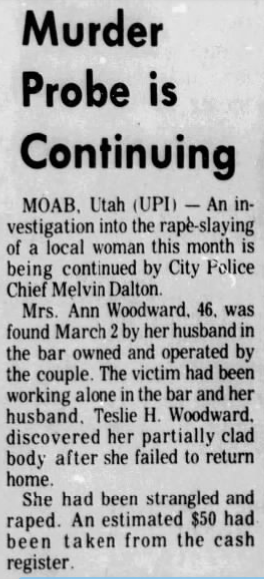
In recent years former Moab Police Chief Melvin Dalton sat down with The Deseret Morning News and shared that when he arrived at the scene of the crime it was chaotic and almost like a party: ‘people were going in and out like they were going to church.’ The former police chief also said that because the sheriff’s had taken over the investigation the Moab PD didn’t have access to very much evidence, and that the case was not handled well by them despite his admission that he and his officers weren’t trained to handle a murder: ‘I wasn’t really trained in homicide, I always felt if we had a really good trained detective, we’d have been in a lot better shape.’
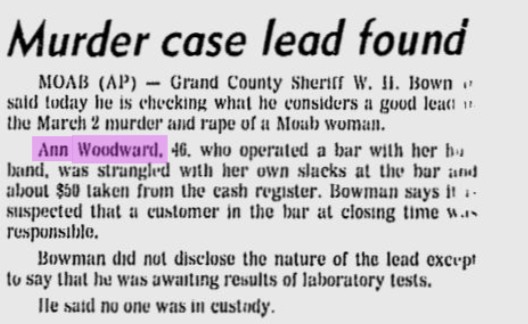
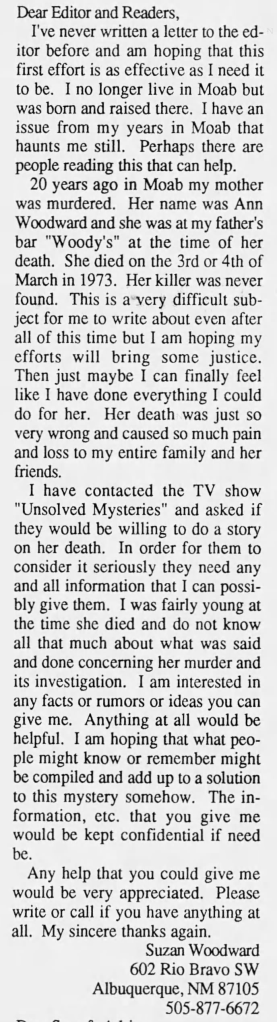
Shortly after the murder took place in March 1973, the Deseret News newspaper reported that Sheriff Bowman had a good lead in the case, but nothing ever came of it. Chief Dalton recalled administering polygraph tests and even came up with a few strong potential suspects, however they both got lawyers and stopped talking. The investigation quickly went cold but was reopened in October 2006 after Ann’s daughter Suzan (who was 16 when her mom was killed) sent a letter to (now retired) Moab Police Chief Mike Navarre asking him for help. The homicide remained unsolved until the summer of 2024 when forensic experts were able to determine that a man named Douglas Keith Chudomelka killed the 46 year old wife and mother.
Detective Drexler speculated that Ann’s killer was angry at her for beating him at poker, but clarified that he wasn’t 100% sure and it could also have been a crime of opportunity versus rage. He said that he does know without a doubt that night that the two played cards and Chudomelka ‘drank beer and smoked Camel cigarettes.’ Using modern scientific techniques, he was able to separate the 29 pieces of evidence (which included ashtrays, fingernails, hair, fingerprints and salt shakers) that were part of the original investigation and break them down into about 80, helping the department analyze the components more thoroughly.
Chudomelka worked at the Rio Algom Mine in the Moab area during the early to middle 1970’s and rented a trailer in the Walnut Lane Mobile Home Park for $100 a month. He was known to frequent Woody’s Tavern when he was done with work for the day and had a long paper trail of documented violence. After he killed Woodward, he went into the establishments cash register and helped himself to $75; he also took the $50 out of her left pants pocket that she won from him playing poker (some sources say it was an undetermined amount of money), and two days later he paid his rent with five $20 bills. Detective Drexler said he has no idea if he gave the landlord the stolen money but it’s definitely a possibility.
The current Moab Police Chief Lex Bell said: ‘that pair of pants is what led us to her killer,’ and Detective Drexler said that in addition to the inside of the slacks Ann was wearing, all the buttons on her shirt had Chudomelka’s DNA on them as well. Forensic testing was also done on items found at the bar as well, which confirmed his presence at the establishment on the night Woodward was murdered.
According to Moab reporter Emily Arnsten, the area was much more conservative in 1973, and the Mormon Church had a much greater influence on the community than it does today. But at the same time, there was also a large, blue-collar mining community that contained a large amount of transient workers that may not have been the most pious of people, and Woody’s was the perfect stomping grounds for these individuals. The establishment was perhaps a bit more wild than it is today as well, as they used to employ the likes of go-go dancers and there was lots of gambling that took place on the premises.
According to Ann’s granddaughter Annie Dalton, Woodward was unlike most of the other more ‘traditional’ women in the area: firstly, she was Catholic, not Mormon, and wasn’t originally from the area. She also ran a bar in a conservative area where a lot of people maybe didn’t drink and was a pretty avid card player. Dalton and Woodward family friend Tim Buckingham wonder if her grandmother’s worldly lifestyle had anything to do with the Moab police’s lack of urgency regarding this murder: ‘’I think that when something that horrific happens in a town like this, to convince yourself that it could never happen to you, to feel safe in that, you do what you can to distance yourself from the person that it happened to. That’s most of what I got, the sense of people who were trying to come up with stories that made sense.’ About her grandmother’s murder, Annie said: ‘it was this thing that my mom carried that was grief and loss, and she ended up passing away from COPD. They say that you carry grief in your lungs, and I’ve always felt like it was just grief that she never was able to process. So they were all carrying this burden in different ways and it never got resolved. It’s a tragedy that just keeps being tragic over and over.’
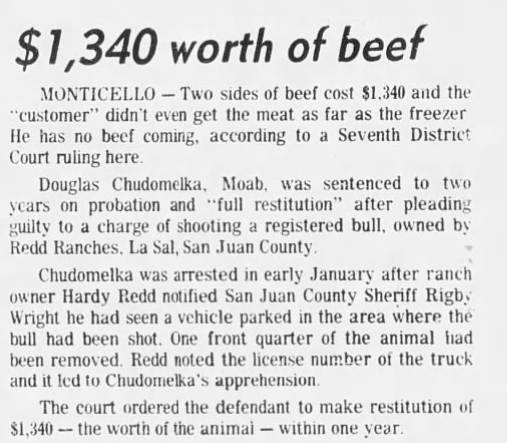
When questioned Chudomelka told investigators that he had not been in Woody’s on the night of the murder, but had instead spent the evening drinking at The Westerner Grill. His girlfriend, Joyce, provided him with an alibi, and told investigating officers that he came home at about 2 AM, however the bartender at The Westerner Grill told police that he was not in at all the night of March 1. Law enforcement asked Chudomelka if he was willing to take a polygraph test, to which he agreed, but in the end they were unable to administer it because when he arrived at the station he was drunk. Eventually, he stopped talking to police and asked for a lawyer and no charges ever stuck. Before he left the area Doug would later be convicted of cattle rustling (which is ‘the act of stealing livestock’) in San Juan County and served out a term of probation. Detective Drexler said he was found guilty of additional crimes in other states, including an atrocity involving a 10-year-old child in Alabama. In 1978, Chudomelka returned to Nebraska, where he managed to (mostly) fly under the radar until his death.
Chudomelka was always considered to be a prime suspect in Woodward’s murder and was one of 25-30 suspects, a number that included acquaintances, bar patrons, and members of the Moab community. Anyone that had been in the tavern on the night of the homicide or was known to be a regular at the establishment was considered a suspect… but he had more going against him than the others: the mid-1960’s Ford sedan that he owned matched the description of the car witnesses reportedly saw parked next to Woodward’s truck late in the evening on March 1, 1973. According to Detective Drexler: ‘they were looking at Doug, they just couldn’t get him. He easily could have killed her and made it home by 2 AM, but the bartender at the Westerner told police Chudomelka was not in at all the night of March 1.’ … ‘They wanted to solve it. All the evidence was there, but they just didn’t have the technology at the time to solve this case beyond a doubt.’
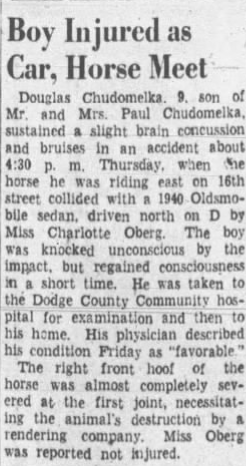
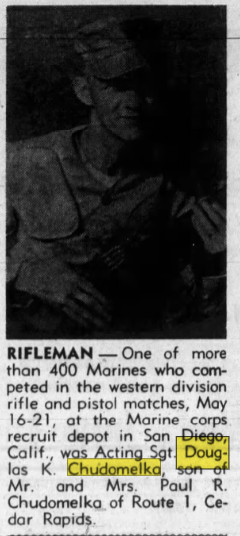
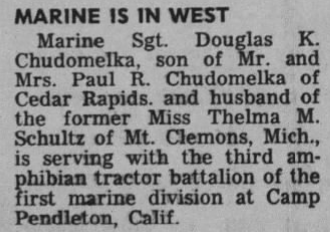
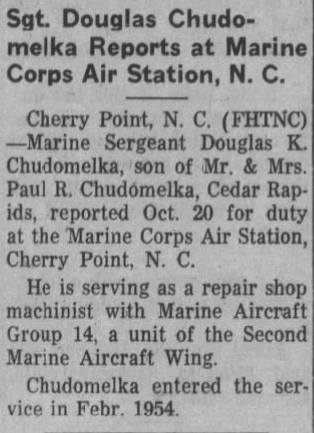
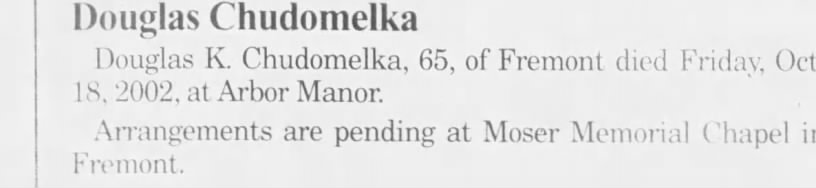
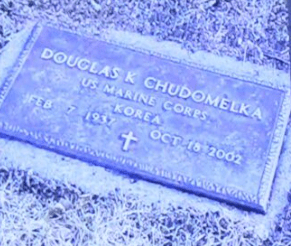
Douglas Keith was born to Paul and Magdalena (nee Arps) Chudomelka in rural Dodge, NE on February 7, 1937. On February 9, 1954 he joined the US Marine Corps and he was married three times: he wed Thelma Mae Scheulz on May 16, 1958 in San Diego, California and the couple had four children together. After they parted ways he met Ernestine Winnie Jolly, and the two were wed on December 3, 1976 in Galveston, TX; I don’t know any details about their divorce but he married Vickie Flowers for a third time at some point before his death. Chudomelka left the military on December 13, 1961 with the rank of sergeant after serving in Korea, then went on to get his CDL and worked as a long haul trucker for several companies across the United States. According to his obituary, at some point after Ann’s murder he moved to Fremont, Nebraska, where he became a lifetime member of the VFW Post 7419 in Nickerson. According to his obituary he had no kids (this is a complete lie) and only left behind siblings (five sisters and two brothers) and three ‘special friends…’ He died on October 18, 2002.
Just a few days after Ann’s murder on March 6, Chief Dalton received permission to pull hairs from the suspects body, and took samples from his belly button, chest, pubic area and head; cigarette butts (which were Camels, like the ones found at the scene of the crime) were also recovered from an ashtray in his residence to see if a saliva sample could be pulled. After the evidence was meticulously collected and preserved it was sent to the FBI, however in 1973 the Bureau was not yet equipped to test hair or saliva, and according to Drexler, ‘this case hinged on the hair Dalton pulled in 1973. I have no idea how he knew that we would be able to do that today. Dalton made this case very easy for us in that aspect.’ The box of evidence was returned (unopened) to the Sheriff’s department along with a letter that (essentially) read: ‘this is a great idea, but we don’t have the technology to do that.’
Douglas Keith Chudomelka was born to Paul and Magdalena (nee Arps) Chudomelka in rural Dodge, NE on February 7, 1937. On February 9, 1954 he joined the US Marine Corps and he was married three times: he wed Thelma Mae Scheulz on May 16, 1958 in San Diego, California and the couple had four children together. After they parted ways he met Ernestine Winnie Jolly, and the two were wed on December 3, 1976 in Galveston, TX; I don’t know any details about their divorce but he married Vickie Flowers for a third time at some point before his death. Chudomelka left the military on December 13, 1961 with the rank of sergeant after serving in Korea, then went on to get his CDL and worked as a long haul trucker for several companies across the United States. According to his obituary, at some point after Ann’s murder he moved to Fremont, Nebraska, where he became a lifetime member of the VFW Post 7419 in Nickerson. According to his obituary he had no kids and only left behind siblings (five sisters and two brothers) and three ‘special friends…’ He died on October 18, 2002.
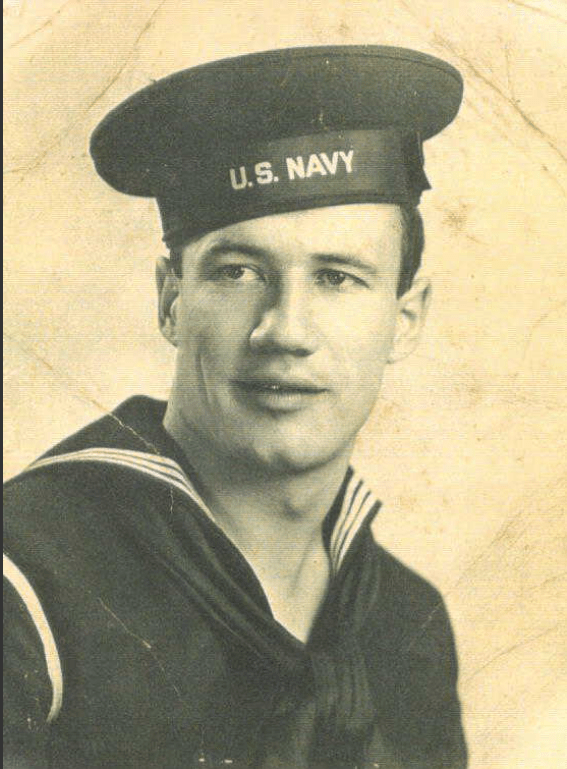
After Ann died Leslie went on to remarry Jane Jaramillo on November 17, 1985, in Las Vegas (I also saw the date listed as November 11, 1984); the two stayed together until his death on Christmas day in 2015 at the age of 84 in Newton, Kansas. According to his obit, Woody served in the US Navy during WWII, where he earned 13 battle stars. He was an entrepreneur and ran several businesses across Moab, including laundromats, gas stations, and Woody’s Tavern, and in his spare time he enjoyed hunting, fishing and exploring the country while on vacation.
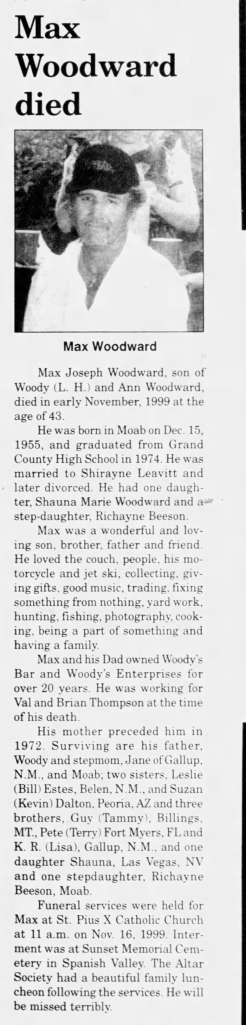
Ann’s sister Cecelia passed away on August 12, 2004. As of November 2024 three of her four children have passed away and the only one remaining is her older daughter Leslie Ann (Estes). According to Estes, ‘there’s no closure for me. It’s still going to go on. She’s still going to be gone tomorrow, and my grandkid, my children have never seen her and don’t ever know what a wonderful grandmother she would have been.’ Max Woodward died in early November 1999 at the age of 43, and Ann’s daughter Suzan passed away on June 1, 2019. According to her obituary, she ‘loved sewing, cross-stitching, driving across the country on adventures, playing with her grandchildren, talking to her daughters and friends, laughing and joking with Pug, going to the mountains, watching sunsets, making pots, and staying in little old hotels with character.’ Guy ‘Bugsy’ Woodward died at the age of fifty on March 13, 2009, and according to his obituary in The Times-Independent, he was a sweet, funny, and loving brother, dad, son, uncle and friend that loved the outdoors, music, yard work, fishing, hunting, making jewelry, heckling his sisters, and being a part of Narcotics Anonymous. His three daughters were the jewels in his crown and were the ‘best accomplishments of his life.’
According to Detective Drexler, ‘if he was alive today, I would be asking Grand County District Attorney Stephen Stocks for an arrest warrant for Douglas K. Chudomelka for the crime of first-degree murder for his actions on March 2, 1973.’ Stacks seemed to be in agreement with Drexlers statement, and said, ‘had he not passed, we would have filed criminal information against him. I hope today brings some closure to the family. I truly believe if this case would have been presented to the jury, he would have been found guilty beyond reasonable doubt for the murder of Ann Woodward.’ Leslie Ann said that her father was the first suspect that LE investigated, and the locals always seemed to be whispering that he was the one responsible for her death; Estes hopes that now these rumors can finally be put to rest. About her father, Leslie Ann said ‘he was larger than life, and it just, it broke our, it broke his heart, but it broke our family, like the splinter never was healed. It never really did even begin to heal.’
Chief Bell said that (as of June 2024) his department was still testing additional items found at Woody’s Tavern, and Detective Drexler commented that both the Moab PD and the Grand County Sheriff’s are ready to start digging into other cold cases.
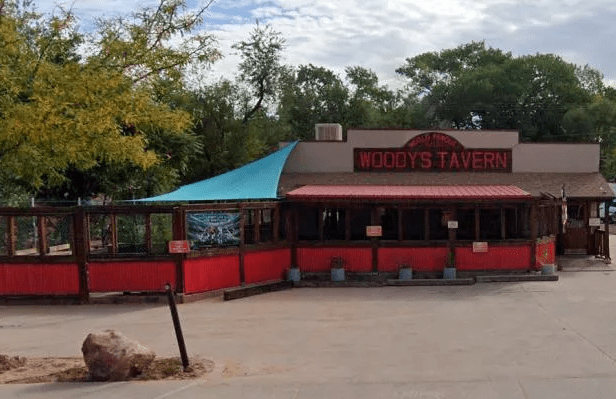
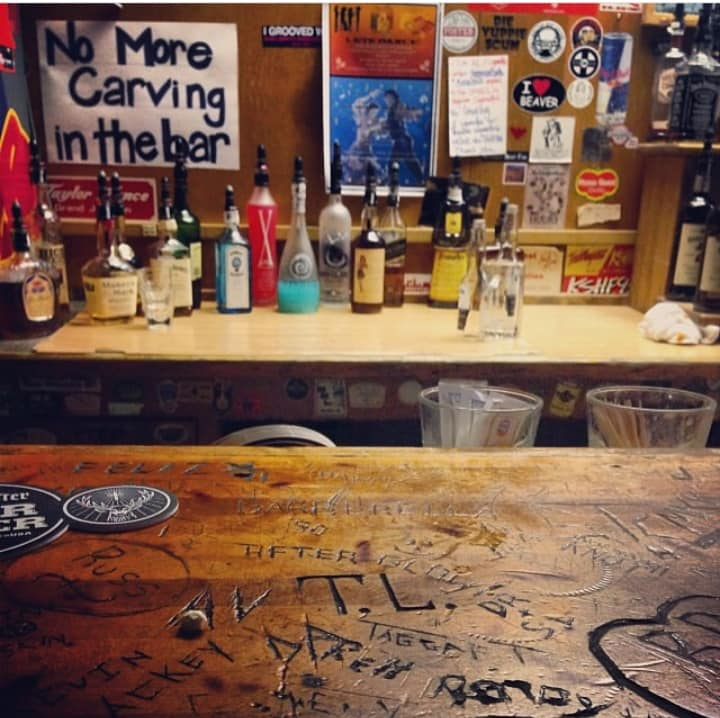
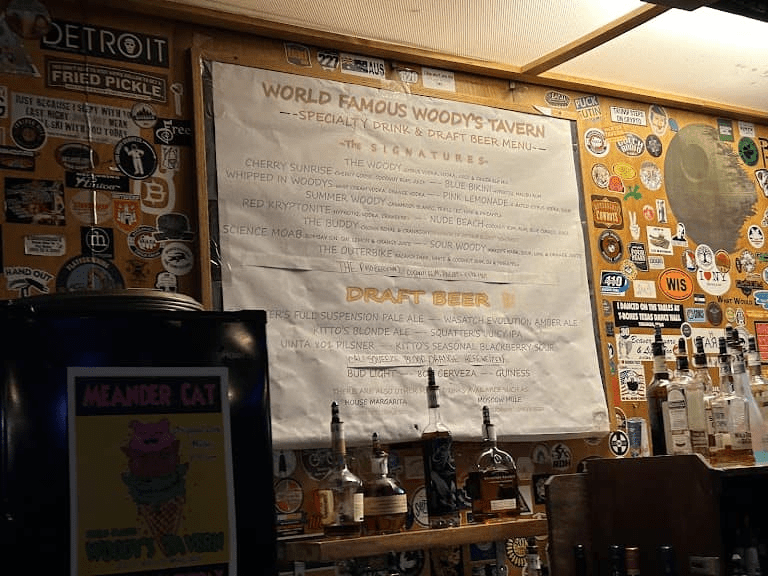
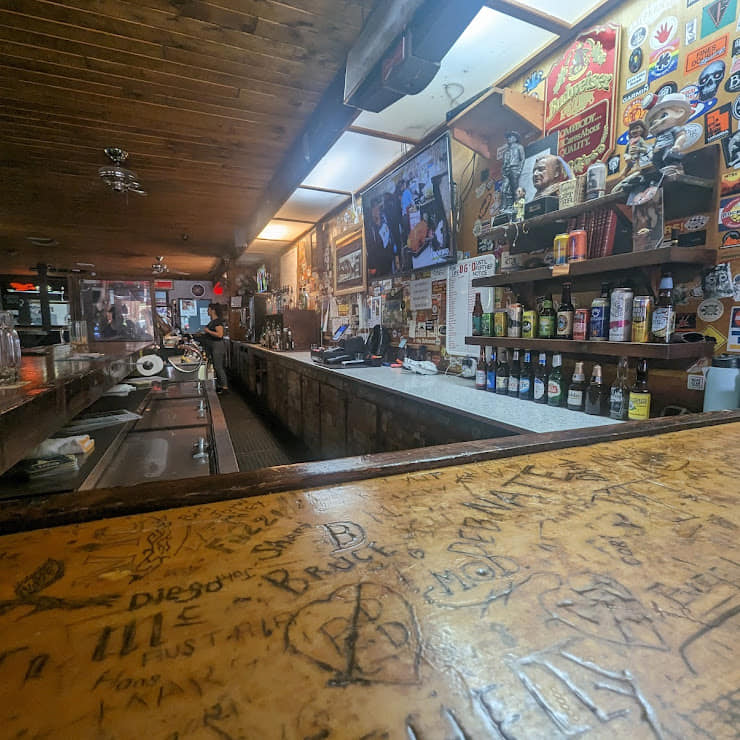
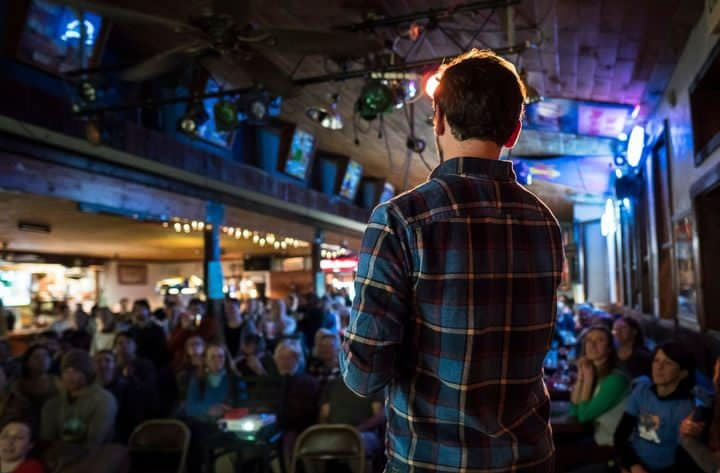
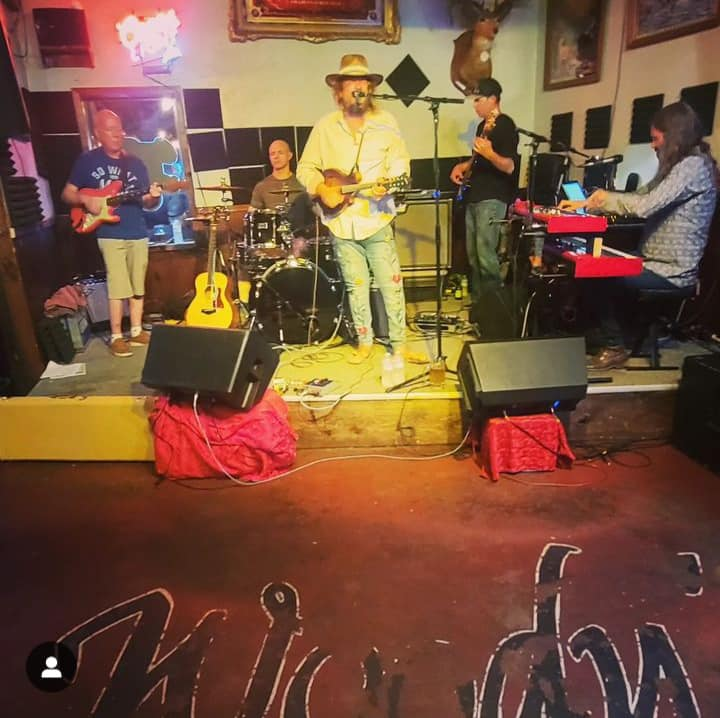
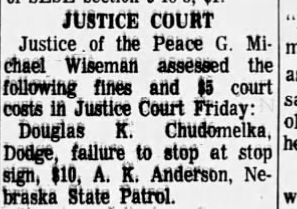
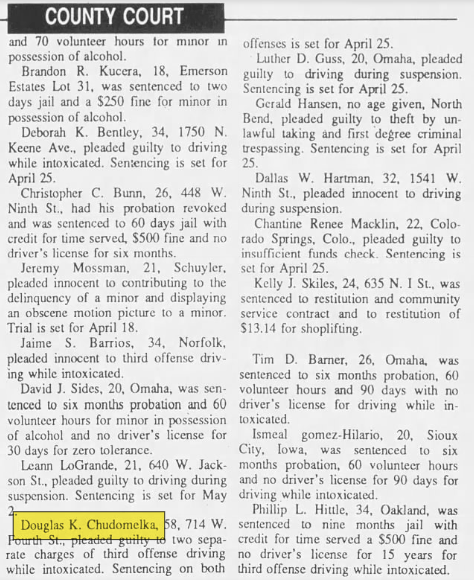
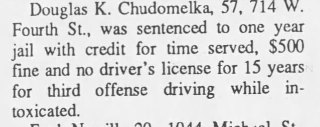
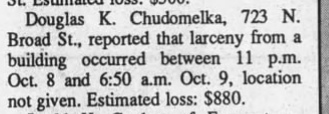
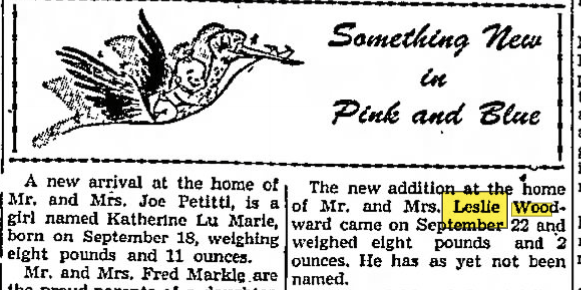
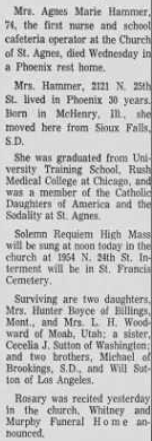
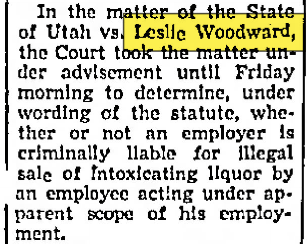
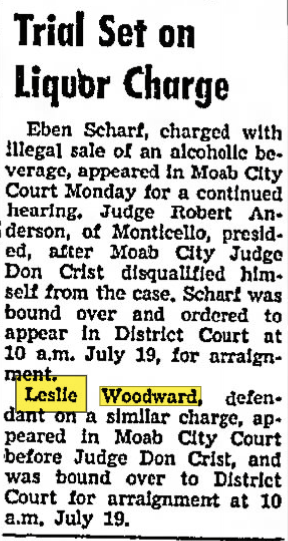
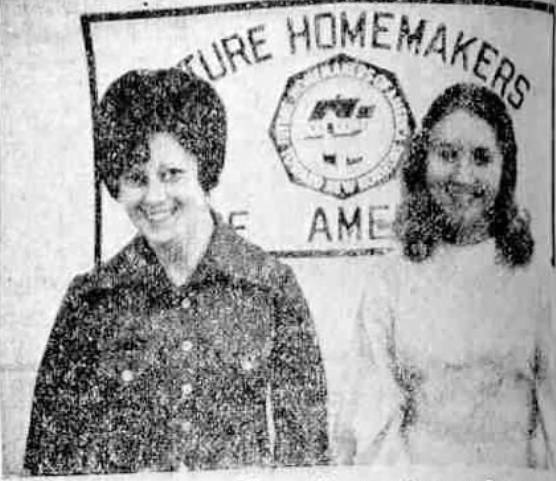
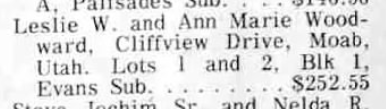
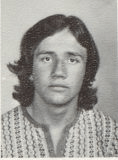
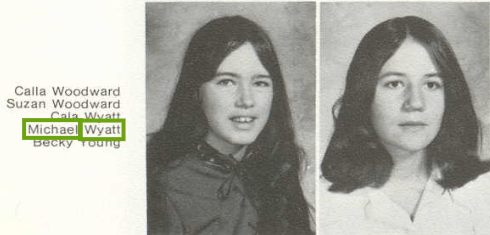
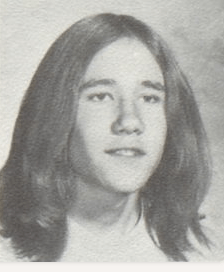
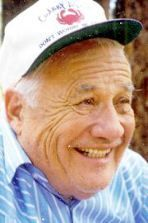
A young Ann Hammer.Woodward.Ann’s grave.A law enforcement unit is parked outside of Woody’s Tavern on March 2, 1973. Photo courtesy of MPDAnn’s clothes.An article about the murder of Ann Woodward published in The Daily Herald on March 2, 1973.An article about the murder of Ann Woodward published in The Deseret News on March 3, 1973.An article about the murder of Ann Woodward published in The Daily Herald on March 4, 1973.An article about the murder of Ann Woodward published in The Deseret News on March 5, 1973.An article about the murder of Ann Woodward published in The Ogden Herald-Journal on March 6, 1973.An article about the murder of Ann Woodward published in The Daily Herald on March 6, 1973.An article about a memorial service being held for Ann Woodward published in The Times-Independent on March 8, 1973.An article about the investigation of the murder of Ann Woodward published in The Times-Independent on March 8, 1973.An article about the continuing investigation related to the homicide of Ann Woodward published in The Times-Independent on March 15, 1973.An article about the continuing investigation related to the homicide of Ann Woodward published in The Salt Lake Tribune on March 25, 1973.An article about the continuing investigation related to the homicide of Ann Woodward published in The Ogden Standard-Examiner on March 26, 1973.An article about the continuing investigation related to the homicide of Ann Woodward published in The Deseret News on March 26, 1973.An article about the continuing investigation related to the homicide of Ann Woodward published in The Daily Herald on March 27, 1973.An article about the murder of Ann Woodward published in The Times-Independent on March 29, 1973.An article about the murder of Ann Woodward published in The Ogden Standard-Examiner on August 19, 1973.An article about unsolved murders in Utah that mentions Ann Woodward published in Deseret News on August 7, 1974.Ann is mentioned in a ‘notice to creditors’ related to her estate; this was published in The Times-Independent on April 3, 1975.A plea to the public from Ann’s daughter Suzan for anyone with information related to the murder of her mother to come forward, published in The Times-Independent on May 20, 1993; sadly she has since passed.A press release put out by the Moab City PD in related to the murder of Ann Woodward.Woody’s Tavern.Woody’s in 1973. Photo courtesy of OddStops.Woody’s in 1973. Photo courtesy of OddStops.DNA evidence proved that Chudomelka had been sitting at the bar that night. Photo courtesy of OddStops.The scene of the murder in March 1973. Photo courtesy of OddStops.The victim’s body was found between a set of pool tables. Photo courtesy of OddStops.Woody’s Tavern as it looks today, photo courtesy of OddStops. The bar is located at 221 South Main Street in Moab, Utah.Woody’s Tavern.The inside of Woody’s Tavern.The bar at Woody’s Tavern.A sign inside Woody’s Tavern. Photo courtesy of Instagram.The bar at Woody’s. Photo courtesy of Instagram.The inside of Woody’s Tavern. Photo courtesy of Instagram.A show at Woody’s (this is a great shot of what looks like the entire bar). Photo courtesy of Instagram.A show at Woody’s. Photo courtesy of Instagram.A band onstage at Woody’s. Photo courtesy of Instagram.Individuals that have been permanently banned from Woody’s Tavern. Photo courtesy of Instagram.A mural on the outside of Woody’s. Photo courtesy of Instagram.Ted’s whereabouts in early March 1973 according to the ‘TB Multiagency Investigative Team Report 1992.’Moab Police Detective Jeremy Drexler giving Ann’s remaining living daughter Leslie Ann Estes a hug at the conclusion of the press conference announcing the case was solved. Photo courtesy of Doug McMurdo.Doug Chudomelka.An older Doug Chudomelka during his time incarcerated at Dodge County Correctional Facility. Doug Chudomelka and Thelma Schultz’s marriage records from 1958.A newspaper clipping about Chudomelka breaking his leg at the age of nine published in The Fremont Tribune on March 1, 1946.A newspaper clipping about Chudomelka being admitted to the hospital in Camp Pendleton published in The North Bend Eagle on November 7, 1957.Part one of an article about Chudomelka getting into a car accident published in The Fallbrook/Bonsall Enterprise on September 3, 1959.Part two of an article about Chudomelka getting into a car accident published in The Fallbrook/Bonsall Enterprise on September 3, 1959.A newspaper clipping about Chudomelka competing in a marksman contest for the Marines published in The Albion News on June 2, 1960.A newspaper clipping about Chudomelka’s time in the US Marine Corps published in The North Bend Eagle on September 8, 1960.A newspaper clipping about Chudomelka serving in the US Marines published in The Boone Companion on February 6, 1961.A newspaper clipping about Chudomelka competing in a marksman contest published in The Boone Companion on May 8, 1961.A newspaper article announcing the birth of Chudomelka’s daughter published in The Fremont Tribune on October 23, 1963.A newspaper clipping about Chudomelka working as a repair shop machinist with the US Marines published in The Cedar Rapids Press on November 26, 1964.A newspaper clipping about Chudomelka being arrested for reckless driving published in The Independent on June 6, 1965.A newspaper clipping about Chudomelka getting into a motor vehicle accident published in The Daily Nonpareil on April 9, 1966.A newspaper clipping about Chudomelka being sued for child support by his ex-wife published in The Daily Nonpareil on August 16, 1967 An article about a car accident Chudomelka was in, I was unable to find the publication date.A newspaper clipping about Chudomelka being fined after a traffic infraction published in The Fremont Tribune on July 22, 1972.A newspaper clipping about Chudomelka being charged with check forgery published in The Fremont Tribune on January 20, 1973.A newspaper clipping about Chudomelka being sued for child support by his ex-wife published in The Fremont Tribune on July 24, 1973.A newspaper clipping about Chudomelka being charged with theft published in The Salt Lake Tribune on January 9, 1974.A newspaper clipping about Chudomelka being charged with theft published in The Times-Independent on January 10, 1974 .A newspaper clipping about Chudomelka being sentenced to two years of probation after pleading guilty to shooting a registered bull published in The Deseret News on February 9, 1974.A newspaper clipping about Chudomelka being charged with theft published in The Daily Herald on May 6, 1974.A newspaper clipping about Chudomelka being charged with theft published in The Manti Messenger on May 9, 1974.A newspaper clipping about Chudomelka being charged with illegal hunting and trespassing published in The Fremont Tribune on May 15, 1985.A newspaper clipping about Chudomelka being charged with a drunken driving charge published in The Fremont Tribune on October 14, 1992.A newspaper clipping about Chudomelka being charged with hitting a fire hydrant with his motor vehicle published in The Fremont Tribune on February 15, 1995.An article mentioning Chudomelka pleading guilty to a DWI published in The Fremont Tribune on April 7, 1995.A newspaper clipping about Chudomelka being charged with hi third DWI published The Fremont Tribune on April 28, 1995.A newspaper clipping about Chudomelka reporting a larceny published in The Fremont Tribune on October 17, 1996.A newspaper blurb announcing that Douglas Chudomelka died published in The Fremont Tribune on October 19, 2002.Chudomelka’s obituary published in The The Fremont Tribune on October 21, 2002.The grave site of Douglas Keith Chudomelka.Ann’s parents record of marriage filed on March 28, 1921. Woody in WWII.Leslie Woodward with his first wife.Leslie Woodward’s WWII draft card.Leslie Woodward and his first wife’s marriage certificate.A letter to Gloria Woodward letting her know that her divorce from Woody was finalized. The wedding announcement for Ann’s parents, Max Hammer and Agnes Sutton. Courtesy of Jan Even on Ancestry.Ann’s father’s obituary, published in The Arizona Republican November 28, 1940.A newspaper clipping regarding Max Hammers funeral, published on November 29, 1940 in Phoenix, AZ.An application for a military headstone for Ann’s father published on September 17, 1941.A newspaper clipping about the birth of Woody and Ann’s daughter published in The Times-Independent on September 25, 1958.An article about a court case involving Leslie Woodward published in The Times-Independent on August 6, 1964.Ann’s mothers obituary published on February 5, 1965.An article about a court case involving Leslie Woodward published in The Times-Independent on June 10, 1965.An article about a court case involving Leslie Woodward published in The Times-Independent on June 17, 1965.Leslie Ann Woodward (r) in a picture for the FHA published in The Times-Independent on March 4, 1971.An article about Ann’s husband Woody getting into some trouble related to a car accident, published in The Times-Independent on September 16, 1971.A newspaper blurb regarding property taxes for Ann and Leslie published in The Times-Independent on December 27, 1973.An article about Woody appearing before a judge for a driving while intoxicated charge, published in The Times-Independent on February 20, 1973.A picture of Leslie Woodword from the 1972 Grand County High School yearbook.A picture of Max Woodword from the 1973 Grand County High School yearbook.A picture of Suzan Woodward from the 1974 Grand County High School yearbook.A picture of Guy Woodword from the 1974 Grand County High School yearbook.A newspaper clipping announcing Guy Woodward’s death published in The Times-Independent on November 25, 1999.Woody.A newspaper clipping announcing Leslie Woodward’s death published in The Wichita Eagle on December 27, 2005.Jane N. Jaramillo, who was born on November 11, 1934 and passed on July 3, 2016.Former Sheriff Heck Bowman.Former Moab Police Chief Melvin Dalton, who took steps in 1973 that allowed current law enforcement officers to solve one of Moab’s most notorious cold cases.Former Moab Police Chief Melvin Dalton.
Thank you to my wonderful friend Erin Banks and her blog CrimePiper for this document.
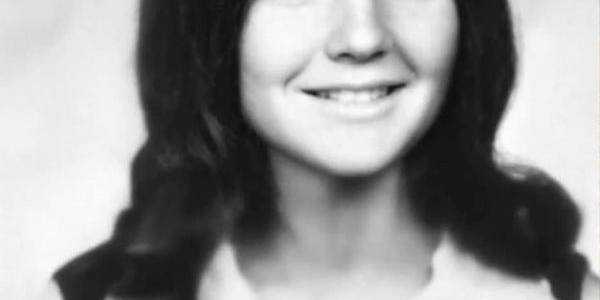
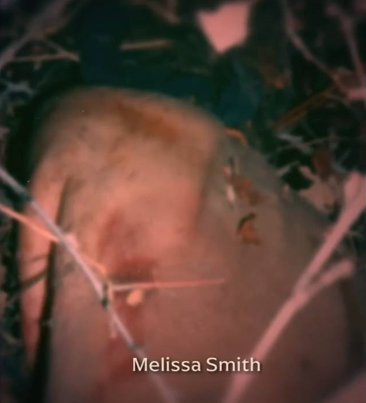
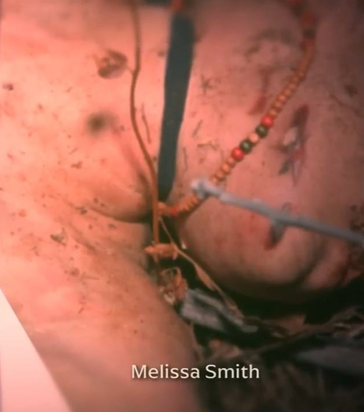
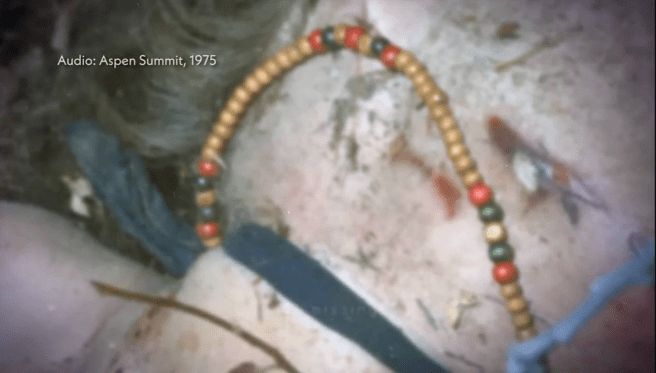
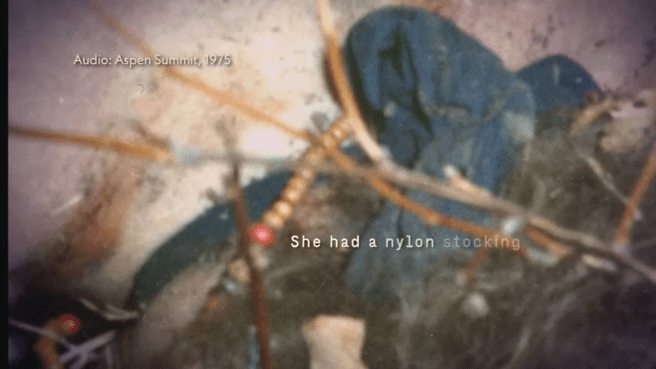
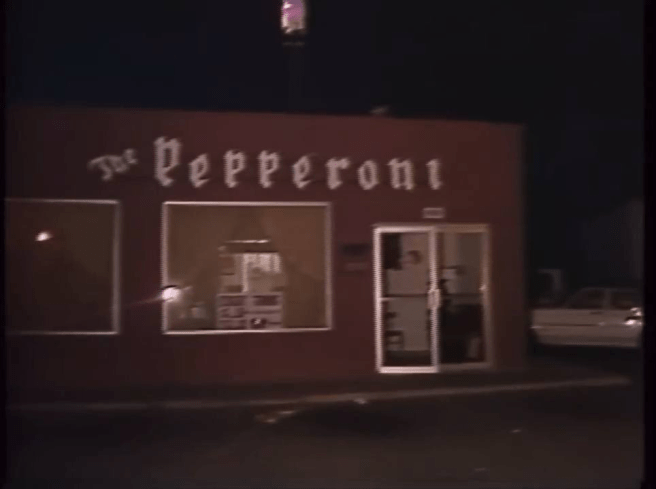
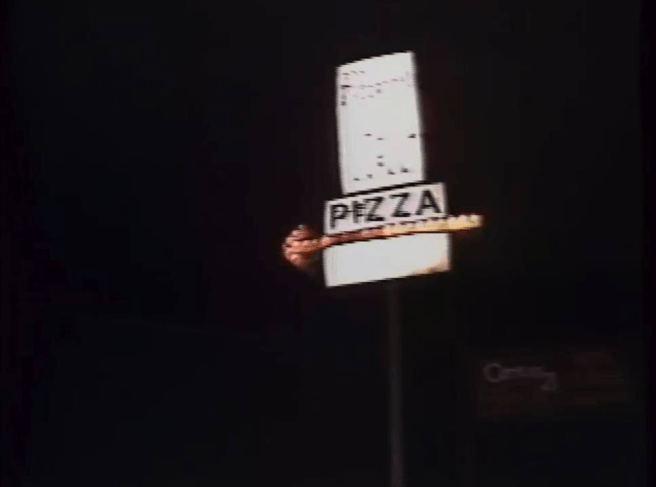
Melissa Smith, photo courtesy of ‘Hunting Ted Bundy.’The remains of Melissa Ann Smith, photo courtesy of ‘Hunting Ted Bundy.’The remains of Melissa Ann Smith, photo courtesy of ‘Hunting Ted Bundy.’The remains of Melissa Ann Smith, photo courtesy of ‘Hunting Ted Bundy.’The Pepperoni Restaurant, where Melissa Ann Smith was last seen alive, photo courtesy of ‘Hunting Ted Bundy.’A sign for The Pepperoni Restaurant, where Melissa Ann Smith was last seen alive, photo courtesy of ‘Hunting Ted Bundy.’
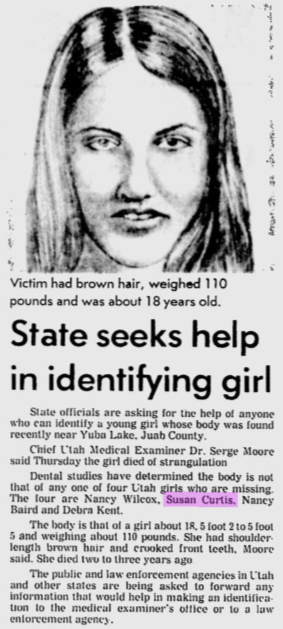
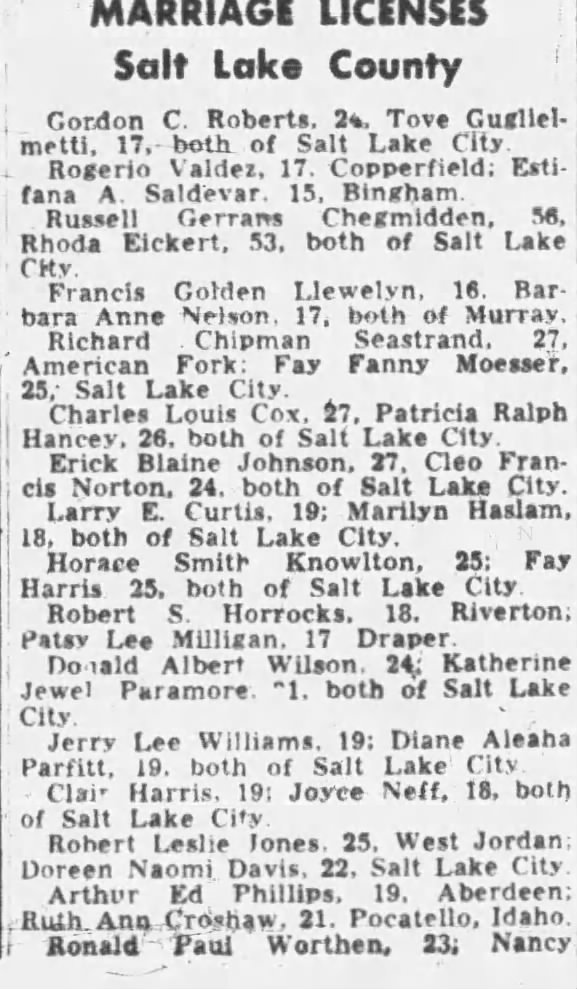
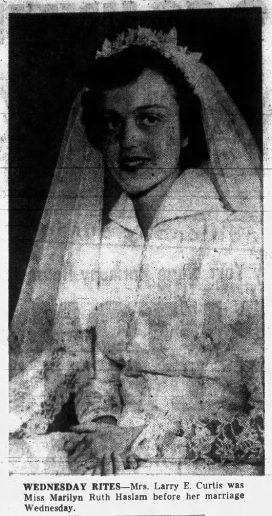
Susan ‘Sue’ Curtis was born on May 18, 1960 to Larry Eugene and Marilyn Ruth (Nee Haslam) in Salt Lake City, Utah. Larry Curtis was born on February 6, 1935 in Salt Lake, and Mrs. Curtis was born on August 27, 1936. The couple were wed on September 22, 1954 and eventually settled down in Bountiful. They had six children but unfortunately I wasn’t able to find out much else about the family. Sue was an honor student that also excelled in athletics and was involved in quite a few extracurricular activities at her high school: she played baseball and volleyball, and was also on the school’s track and basketball teams. She stood at 5’7” tall, weighed 120 pounds, had hazel eyes, and brown hair that she wore long and parted down the middle. Curtis had pierced ears and had just gotten braces the month before she was murdered.
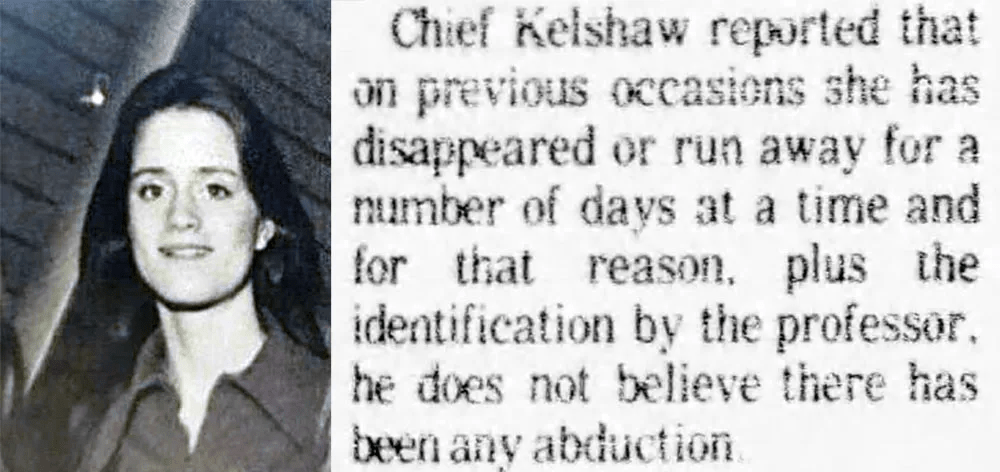
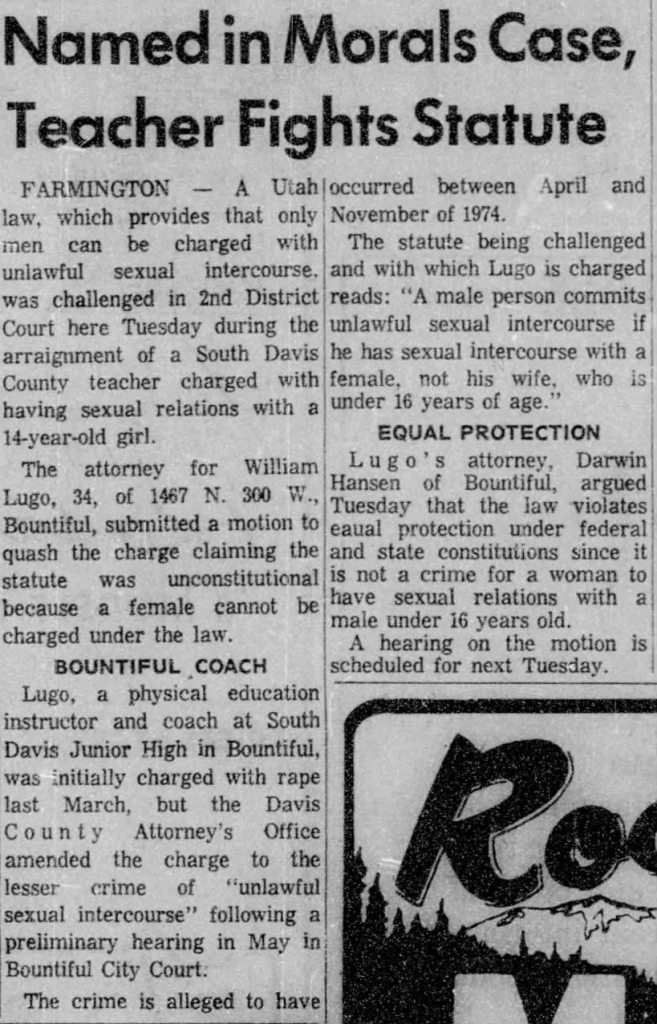
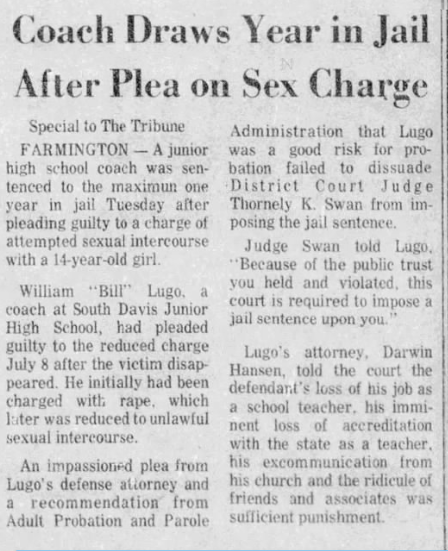
In the summer of 1975, SusanCurtis was fifteen and about to go into her sophomore year at Woods Cross High School. Due toan unhappy home life she had a history of running away, but she was never gone for very long and would always return home after just a few days. Sue hada lot of mental health concerns, and attempted suicide on a couple different occasions. She was also an ongoing victim of sexual assault at the hands of from a former physical education teacher and coach named William ‘Bill’ Lugo, who taught at South Davis Junior High School in north SLC (he was eventually convicted of his crimes)*. In an interview with true crime researcher Chris Mortensen (also known as Captain Borax), Lieutenant Arnold Lemmon from the Brigham Young University campus Police Department (and close friend of the Curtis family) said that Lugo and Sue ran away together the week before she was murdered. He even flew her to Phoenix and put her up in a hotel room. They got caught after Susan had a pregnancy scare and (using the fake name of a friend) arranged for her to go to a clinic and take a test (there was apparently a mix up and the results were mailed to that friend’s parents). He was eventually court ordered to stay away from the FOURTEEN year CHILD and in July 1975 was sentenced to a year in jail for his crimes. Lugo was initially charged with rape but pleaded guilty to the reduced charge of unlawful sexual intercourse. The defendant’s lawyer as well as the ‘Adult Probation and Parole Administration’ both said that the teacher was a good fit for probation, and that he suffered sufficient punishment in the form of his loss of accreditation as a teacher, excommunication from his church, and derision of friends and associates. Thankfully this wasn’t enough to dissuade District Court Judge Thornley K. Swan from imposing the maximum allowed jail sentence: ‘because of the public trust you held and violated, this court is required to impose a jail sentence upon you.’ It’s been reported that the entire experience was pretty traumatizing to Sue, and because of the ‘relationship’ she suffered from a lot of behavioral health issues.
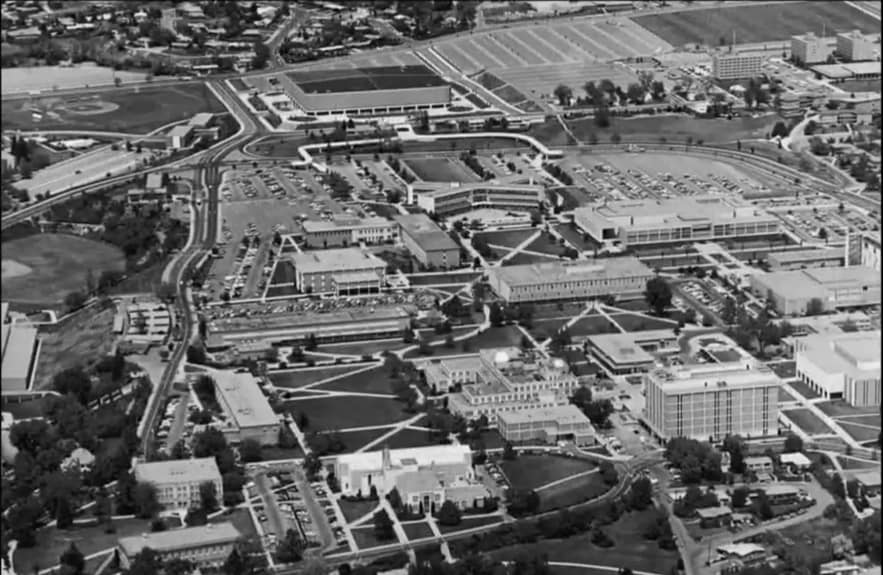
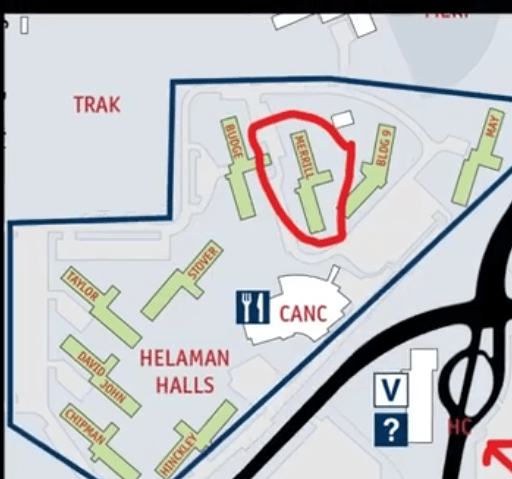
The summer before she disappeared Curtis had been spending much of her time at a friend’s house in Centerville, which is a suburb community north of Bountiful. She wasn’t getting along very well with her family and in an attempt to reconcile with them was picked up by her older sister Barbara on June 24, 1975, who (along with Mr. and Mrs. Curtis) were attempting to bring their ‘Sue-Sue’ back into the family fold. She also registered Sue for a two-day Latter Day Saints conference at Brigham Young University. On June 26, 1975 the sisters rode their bikes (along with a friend named Lynette Stringer) 50 miles from Bountiful to Provo. The girls met up with some other kids from Bountiful’s ‘Orchard Youth Ward’ at the Orchard Stake building in north SLC, and they all made the long ride together. They even stayed the night ‘in a yard at the residence of Eva Smith of Lehi, UT.’ On multiple occasions during the journey, Sue complained of stomach problems, as well as feeling suicidal. They made it to the Mormon university sometime in the mid-morning the following day, and quickly settled into their assigned rooms. Once at the conference, she was going to room with Lynette in Merrill Hall in the HelamanHalls, which is a group of dormatores; Curtis was staying in the all female dormitory in a second story room, specifically number 2121. According to the missing persons report, Barbara was staying nearby in room 2118.
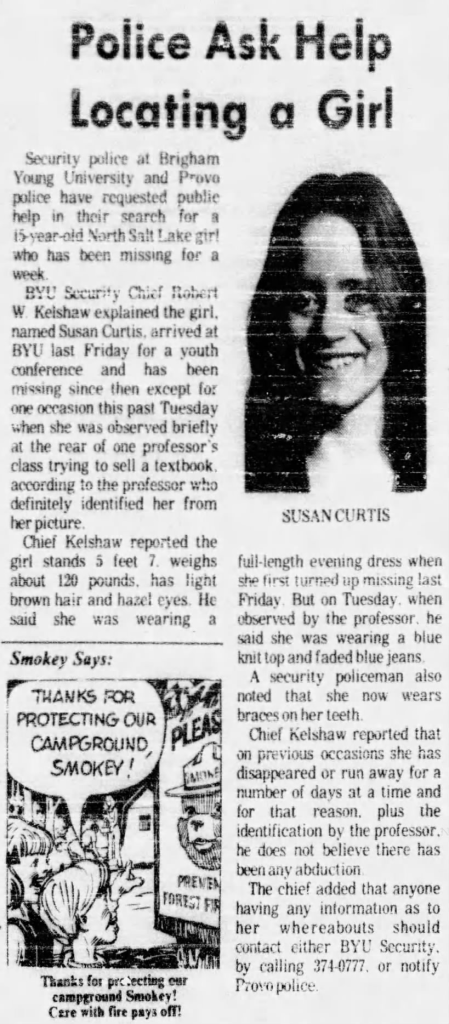
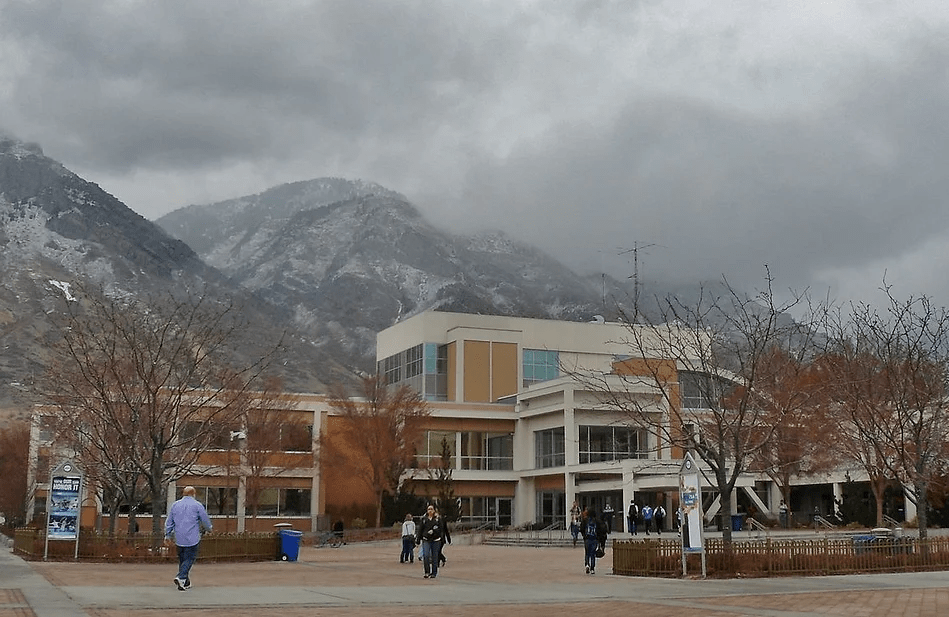
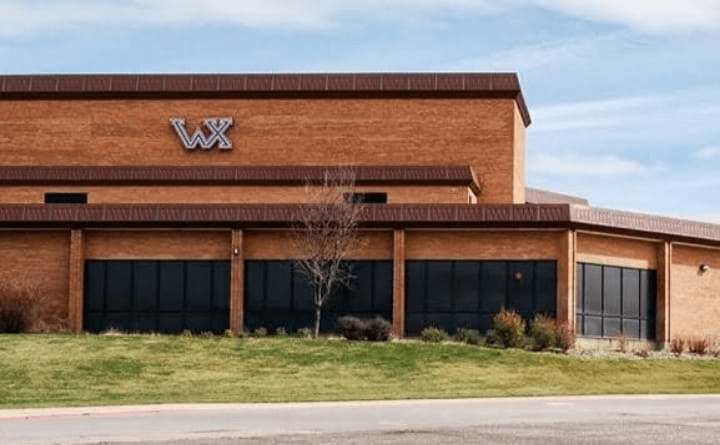
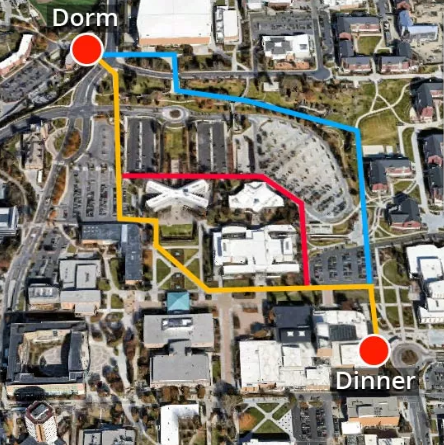
There was a formal banquet early in the evening on the first day of the conference that was held at the Wilkinson Student Center. Curtis was last seen at around 7 PM wearing a full-length, yellow evening gown. She had just eaten dinner and was worried about food possibly being stuck in her new braces, and left her friends to walk the quarter mile back to her room to brush her teeth, telling one of them she’d be back in a few minutes. Although we have to keep in mind that Sue wasn’t a student at BYU and wasn’t incredibly familiar with the layout of its campus (her high heels didn’t help), the journey was fairly short and should have only taken her about 10 to 13 minutes (it was about 0.6 miles in length). When she didn’t come back to the banquet Barbara went looking for her, and when she went to inspect her toothbrush it was bone dry, meaning she never made it back to her room. All of her clothes, money, and personal possessions were left behind, and Susan Curtis was never seen alive again. After Barbara made the initial report with BYU police, the Provo Police, Utah Highway Patrol, Utah County Sheriff, and Orem Police Departments were all notified.
When officers looked through Susans possessions they found $21 in a jewelry box on the dresser. Also left behind were a pair of jeans and some other clothes folded and hanging up in the closet, along with several pairs of shoes, a pendant, and ring that she reportedly would never have left behind. It’s worth noting that there’s a parking lot near the Helaman Halls dormitory buildings, and in the past Bundy had successfully snatched quite a few of his victims from college campuses: Donna Manson, Sue Rancourt, Georgann Hawkins, and Roberta Kathleen Parks… When you think about these other abductions it makes sense he would park his VW in a secluded spot that was slightly out of the way but still within walking distance. This explains why no one witnessed the attack even though it happened in the early evening on a busy college campus.
According to an article published by The Salt Lake Tribune on January 27, 1989, Curtis’ disappearance stirred only a small amount of buzz in the media, although it caused great concern to investigators at BYU. Despite her habit of running away, law enforcement wasn’t hesitant to immediately start investigating her disappearance as an abduction, which is a surprising (but good) change of pace. I feel the need to comment that it didn’t take long for me to notice that a bunch of Bundy related cases weren’t taken seriously in the beginning because the girls were considered ‘runaways…’ even though she’s a unconfirmed victim, Brenda Joy Baker immediately comes to mind, whose disappearance didn’t make the news at all until they found her body. I suspect this is most likely because by this time in mid-1975 there were quite a few young women that had vanished around the general SLC area, and investigators knew that they were all most likely related.
BYU Campus Police and the Provo Police Departments investigated the disappearance, and in the beginning a few witnesses came forward claiming to have seen Curtis around town and on campus. One professor reported he saw her trying to sell a textbook in the back of his class four days after she went missing. He said she was wearing a blue knit top and faded jeans, and was able to positively identify her from a picture. Others claimed to have seen her hitchhiking in the Provo, Orem, and Spanish Fork areas, and one person reported that he saw her hiking up by the ‘Y-mountain’ directly to the east of the Woods Cross football field. According to the missing persons report Barbara gave to the BYU police, at the time Sue disappeared she was seeing a ‘social counselor’ about her mental health issues, who at one time shared with her dad that she had a lot of concerns as well as suicidal tendencies.
The gym teacher quickly became the chief suspect. Dan Clark, who was the lead detective on Sue’s case, polygraphed Lugo, however the examination was determined to be biased and was deemed inadmissible. Lieutenant Lemmon said that nowadays something like that would never fly, and typically an investigator would never be allowed to administer a polygraph to a suspect. In an interview with Captain Borax, Lemmon recently tracked down Lugo (he still lived locally) and asked him about his relationship with Curtis; he lived in an upscale neighborhood and still had all of his mental faculties about him. Lemmon shared that he was working on Curtis’s disappearance and understood that they had an affair many years ago. They briefly discussed it, and Lemmon asked him ‘point blank’ if he killed her, to which he responded ‘no.’ Lugo additionally said no when asked if he was aware of where her body was buried. Nothing ever officially tied him to Sue’s disappearance.
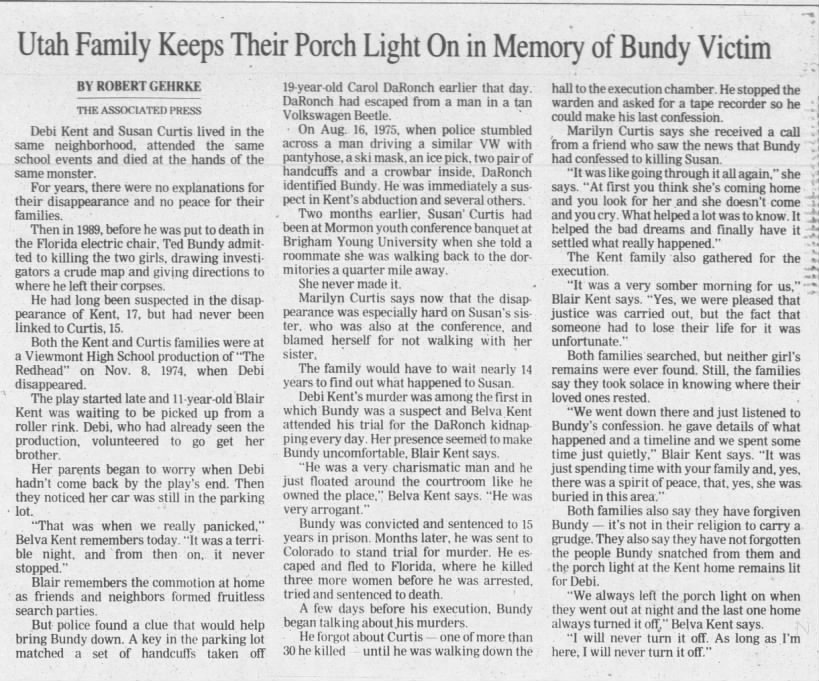
Here’s an interesting fact I learned from Kevin Sullivans book, ‘The Bundy Murders: A Comprehensive History:’ The Curtis family attended the same viewing of ‘The Redhead’ at Viewmont High School as the Kent family the night Deb was abducted in November 1974. This means that Susan was in the same auditorium as Bundy before she became one of his victims roughly seven months later. I wonder if he noticed her that evening? Sue and Deb grew up in the same Bountiful neighborhood and went to the same high school.
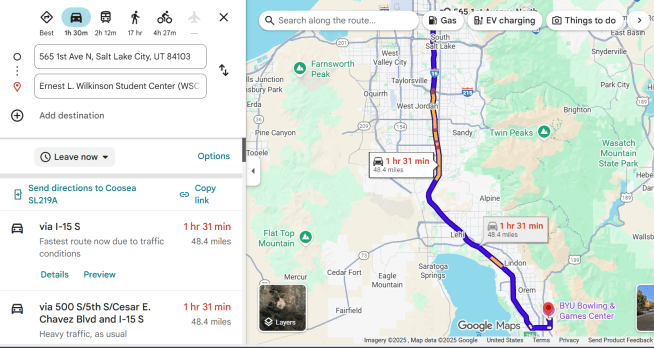
Apparently the Curtis family was so desperate for answers as to what happened to Sue that they hired multiple psychics, but sadly nothing ever came of it. At the time of her abduction Bundy was a law student at the University of Utah and was living at565 1st Avenue North in SLC. Per my ‘handy dandy TB job chart,’ in June and July 1975 he was employed as the night manager in charge of Bailiff Hall at the University (but was terminated after showing up for work drunk). He was still with Liz Kloepfer, although things were getting ready to fizzle out for the final time (they officially broke up after Ted went to prison for the attempted kidnapping of Carol DaRonch in 1976). Also according to Kloepfer he started growing a beard in June 1975, so there’s a good chance he had one when he abducted Curtis.
After Curtis was murdered Bundy wasn’t on the run for long: Utah Highway Patrol Sergeant Bob Hayward pulled him over in Granger at around 2:30 AM on August 16, 1975 after he saw his unfamiliar tan VW Beetle pass by him while he was out on patrol. The officer knew the neighborhood well and had no memory of ever seeing that particular vehicle before. When he turned his lights on to get a better view of its license plate, the driver turned off their headlights and attempted to flee. Sergeant Hayward began to follow the car, which went through two stop signs and eventually pulled into a gas station. When he asked the driver why he was out driving around so late, Bundy replied that he was on his way home from the Redwood Drive-In after seeing the Towering Inferno but lost his way. Two more officers arrived on the scene, and after noticing that the passengers seat was missing they searched the car (with Bundy’s permission) and discovered some incredibly unusual items: a black duffle bag that contained a pair of handcuffs, an ice pick, rope, a crowbar, a flashlight, a ski-mask, a pair of gloves, wire, a screwdriver, large green plastic bags, strips of cloth, and a pantyhose mask.
In addition to his ‘kill kit,’ LE also found maps, brochures of ski resorts, and gas receipts in the VW’s glove compartment box. When asked why he had such strange instruments in his car, Ted told the officers that he was in law school and was studying how to arrest criminals. While they weren’t completely convinced the law student was the ‘crazed murderer of young women’ that they were looking for, investigators did know he wasn’t completely innocent and arrested him for possession of burglary tools; they didn’t have enough evidence to detain him and he was ROR’ed.
It didn’t take long after his first arrest that investigators began to connect the dots between the attempted kidnapping of Carol DaRonch and the other Utah abductions, and they quickly began to suspect that the young law student was responsible. Perhaps one of the most damning pieces of evidence against Bundy were the handcuffs that were found in his car, which were the same style and brand as the ones found on DaRonch’s wrist after her attack. Additionally, the crowbar that officers found in his ‘murder kit’ was identical to the weapon used to threaten her the previous November, and his tan car matched the description of the one her abductor was driving. There were too many similarities for the police to ignore, but they also knew they needed more evidence to help support their case. A few days after his arrest on August 21, investigators searched Ted’s apartment and found various brochures from the areas where some of the women were missing from, however they failed to search the building’s utility room. Years later, the killer revealed to his lawyer Polly Nelson that he had kept a box of Polaroids of his victims inside that room in a shoebox, which he later destroyed.
Curtis is Ted’s last confirmed victim until his escape in late 1977 (although there are some suspected/unconfirmed victims that disappeared after, including Sandra Weaver, Nancy-Perry-Baird, Shelley Kay Robertson, and Debbie Smith). Just a few days after Sue vanished on July 1, 1975 Shelley Kay Robertson was abducted from Golden, Colorado; her remains were found less than two months later on August 21 in a mine in Berthoud Pass. Four days after Robertson was last seen on July 4, 1975, Nancy Perry-Baird was abducted from the gas station where she worked in East Layton, UT and was never seen or heard from again. After Susan Curtis Bundy didn’t kill again until January 1978, when he escaped incarceration for the second time and escaped to Florida, and killed Lisa Levy and Margaret Bowman.
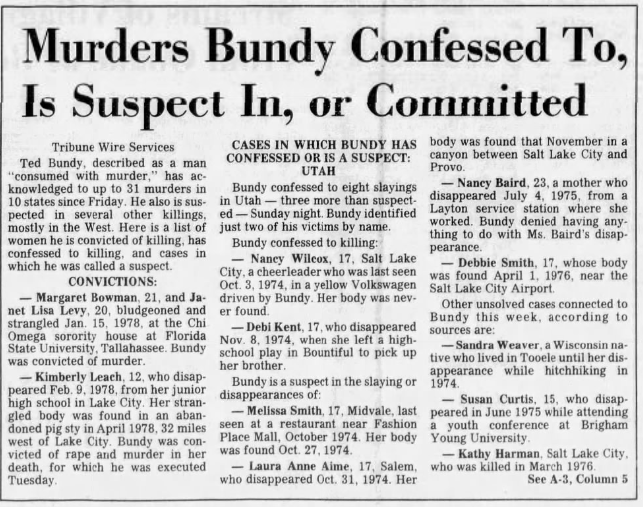
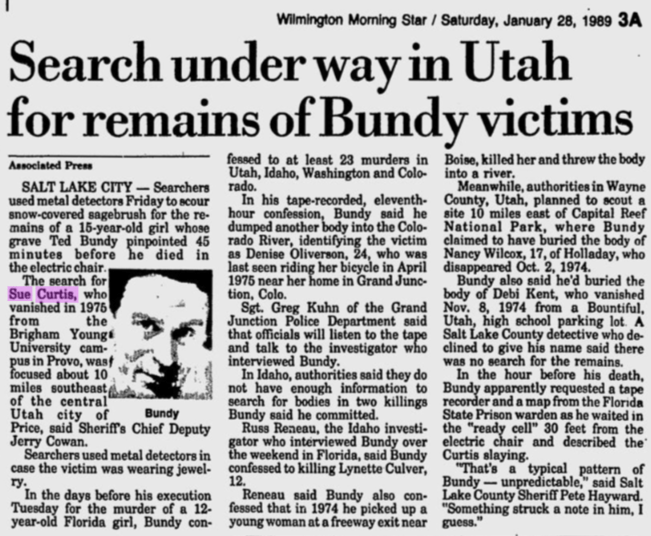
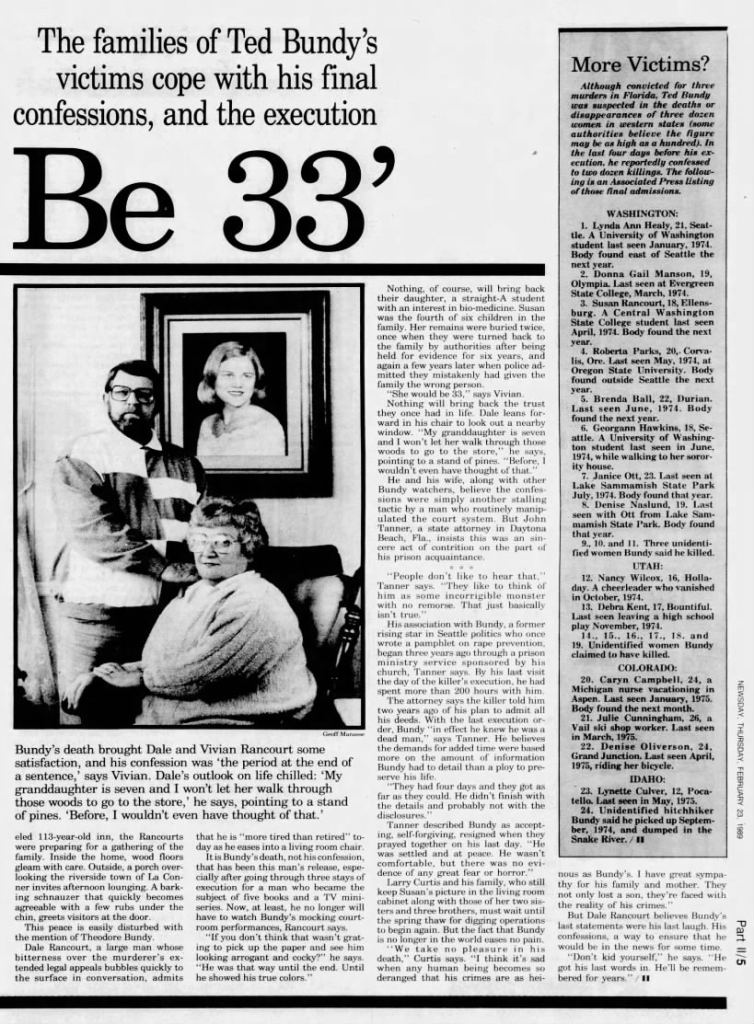
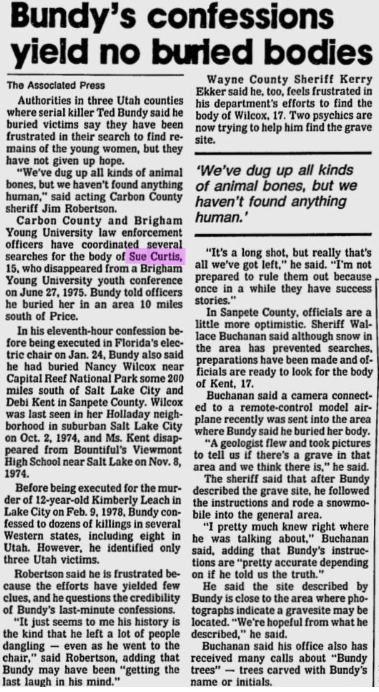
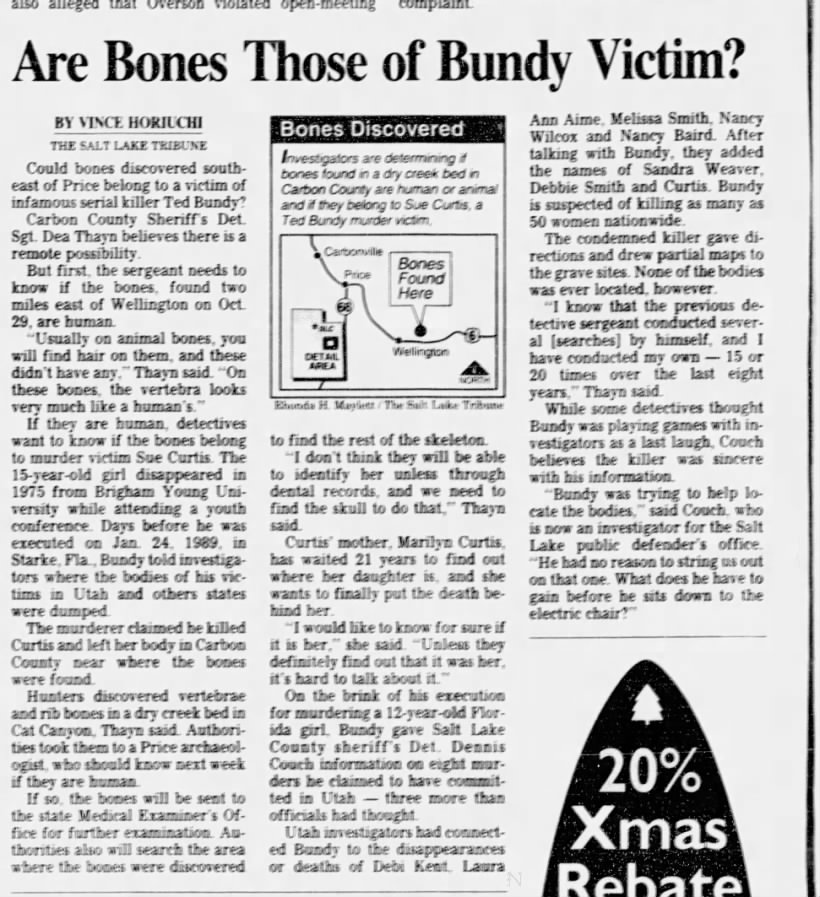
In a last minute, taped confession that took place less than an hour before he was put to death, Bundy confessed to Florida State Prison Superintendent Thomas Barton that he killed Susan Curtis. He also volunteered information as to where investigators would find her body and how they could get to it. Ted said that he dumped her body five to ten miles south of Price right before the Green River, and that he ‘turned left on a side road’ and after about a quarter of a mile took another left. He then drove roughly 200 yards down that dirt road and dumped her remains about 50 yards off of it, to the left. He also shared that he wasn’t aware of her name or identity. In the same confession, he took responsibility for the death of Denise Oliverson, who was last seen riding her bike in Grand Junction in April 1975. He dumped her body in the Colorado River, about five miles west of Grand Junction and specified that she ‘was not buried.’ Ted confessed to killing at least eight young women in the state of Utah: Curtis, Nancy Wilcox, Deb Kent, Melissa Smith and Laura Ann Aime; three more remain unidentified. The Curtis family found out with the rest of the world that their daughter was murdered by the serial killer: they heard it on the news after Bundy was executed.
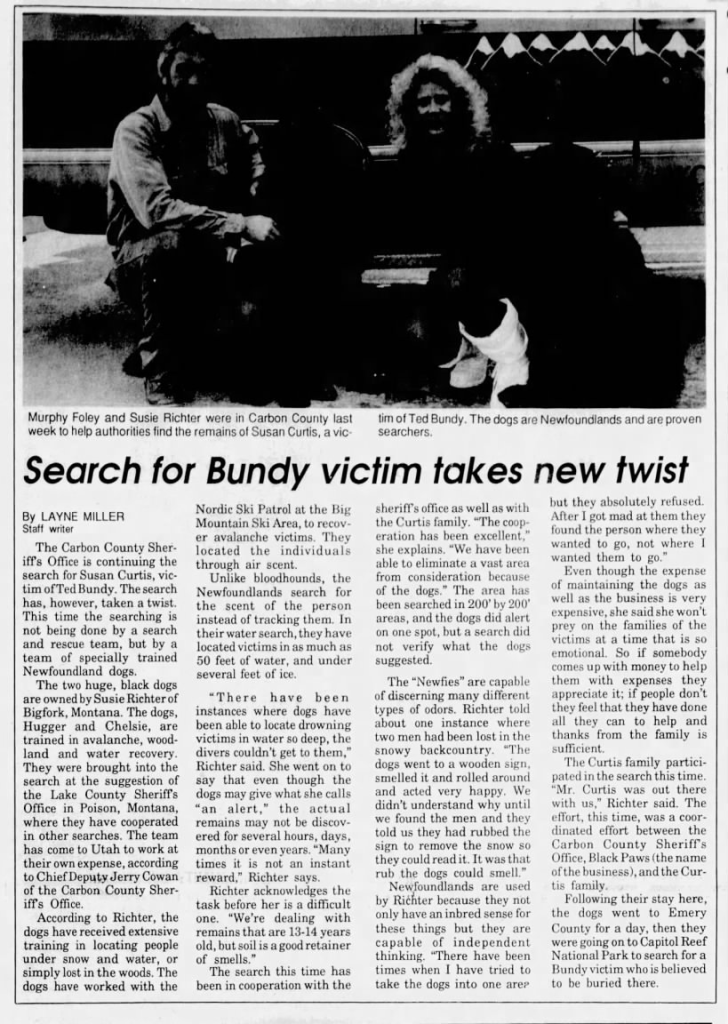
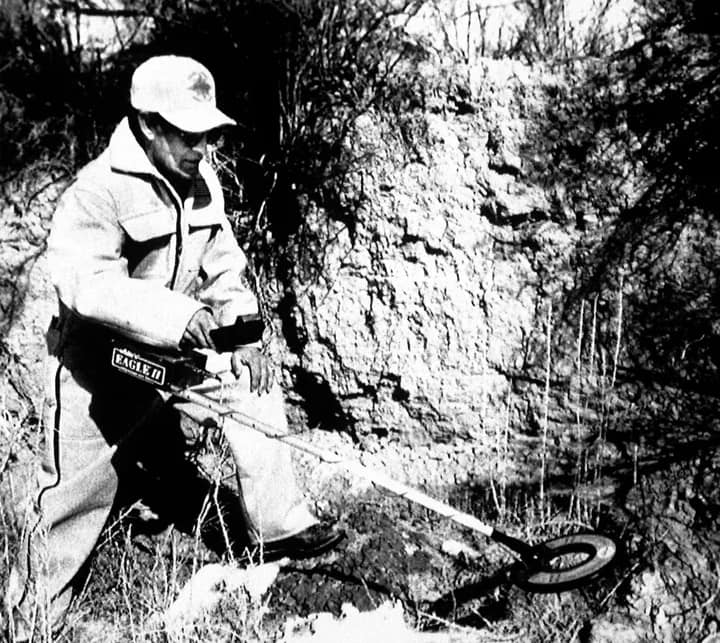
When Bundy confessed to Curtis’s murder in January 1989 fourteen years had passed by. This gave local wildlife a lot of time to pick apart her remains and move them around, dispersing them around the area. After he was executed law enforcement was forced to put off the search efforts until the following spring because of the cold, snowy conditions. Because of the incredible amount of attention the case had garnered, at first Florida law enforcement gave the media only small pieces of his confession related to Curtis’s murder. This was most likely so people wouldn’t take it upon themselves to go check out the crime scene and potentially destroy evidence, or attempt to disrupt recovery efforts. The search team was headed up by the Salt Lake County and the Carbon County Sheriff’s departments, and volunteers combed the area looking for any trace of Curtis. They were hopeful that their metal detectors would be able to pick up her braces, however all they found were pieces of scrap metal, old tires, beer cans, and shell casings. They also used cadaver dogs in their search efforts, mostly because of the deep layer of snow that covered the area. In the years that followed the initial search, Curtis’s family and cold case detectives have searched the hills and fields, with the help of (multiple) mediums and psychics. They also used helicopters in their recovery efforts, but with every attempt they came back with nothing.
As I sit here writing, the abduction of Georgann Hawkins immediately comes to my mind when I think about the circumstances of this case, as they share a lot of similarities: they both took place on college campuses, with the girls walking back to their living spaces. They were both thin, and had brown hair they wore long and parted down the middle. Nancy Wilcox as well (to a point), who was on her way to her high school after getting into an argument with her father about her bf’s truck leaking oil on their driveway (my dad is the same way). She just… vanished into thin air. They all did. I know that with Hawkins Bundy used his ‘injury ruse’ in his abduction technique, I wonder if he did the same type of thing with Curtis. It wasn’t like he could have easily hit her over the head with a crowbar and dragged her away: she was abducted from a busy college campus at around 6-7 in the evening in the middle of summer. I’m leaning towards him using some sort of ruse to lure her back to his car, then he pounced. Maybe he faked a broken arm and told her he needed help carrying his briefcase to his car. Or maybe he faked a broken leg somehow… The possibilities are endless, and we’ll never know what actually happened.
Lieutenant Lemmon collected DNA swabs from Larry and Marilyn Curtis in hopes of one day positively identifying their daughters remains. Mrs. Curtis said that Susans disappearance was especially hard on Barbara, who blamed herself for not walking back to the dorms with her sister. I couldn’t find any record of either one of Susan’s parents passing away. Because her remains have never been recovered she officially remains a missing person. Susan Curtis would be 63 as of December 2023.
*As a personal note, I initially hesitated including this information in this piece. But I learned it from Captain Borax, so obviously it’s out there in the Bundy community, although it doesn’t seem to be widely discussed (I also saw it discussed on WebSleuths as well).
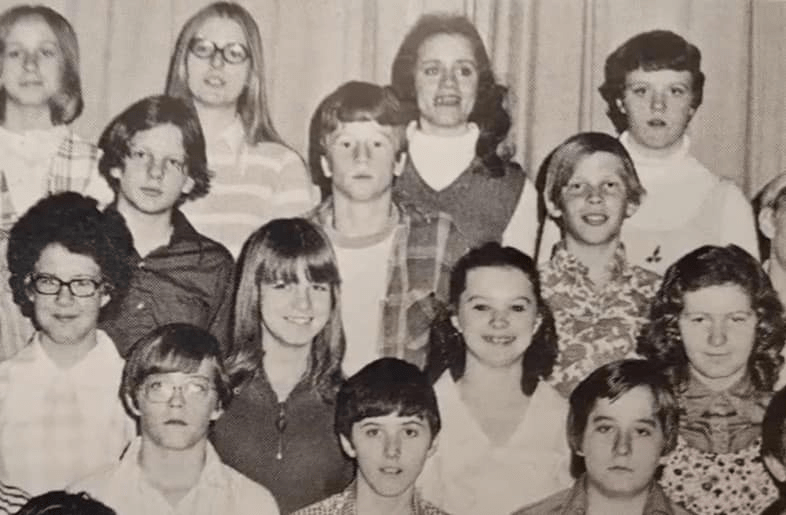
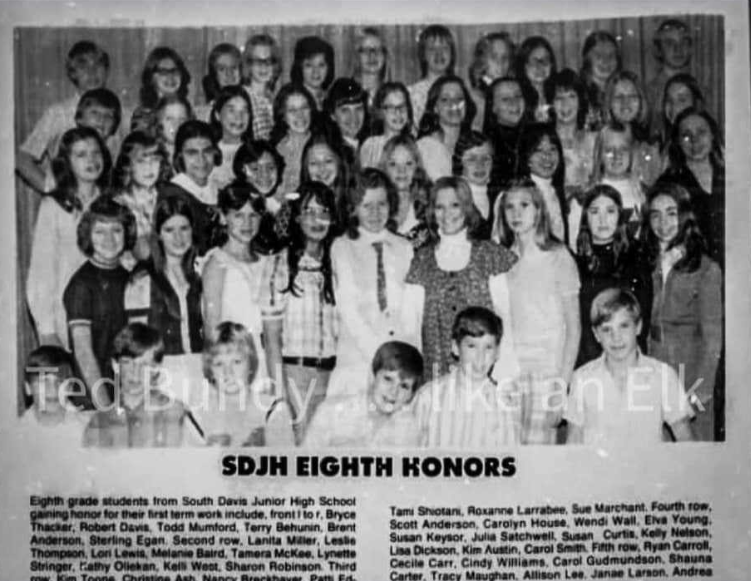
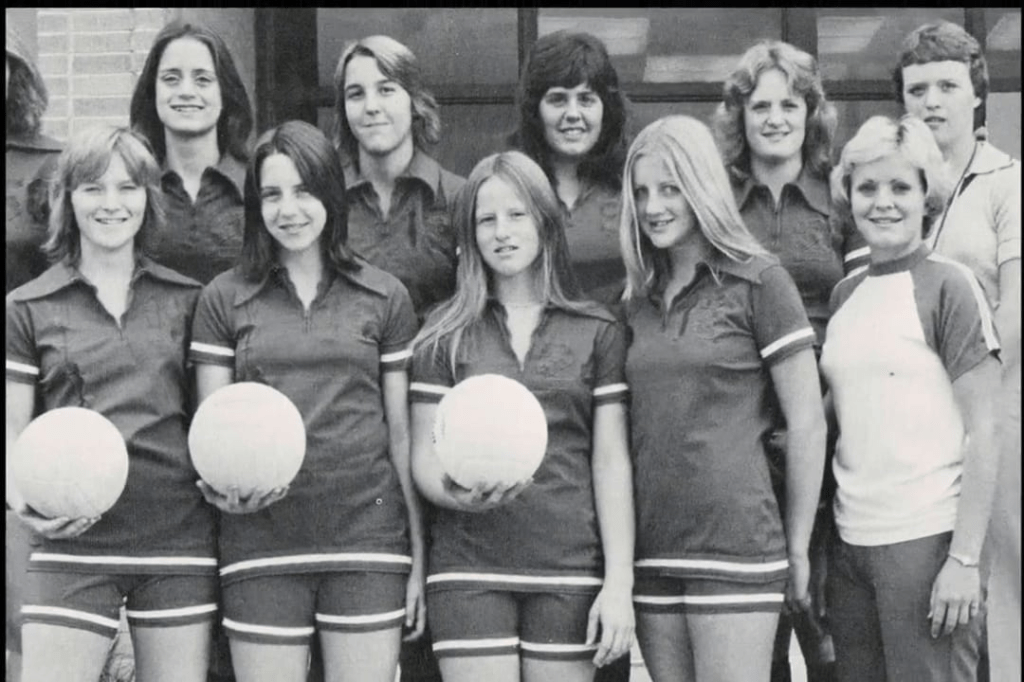
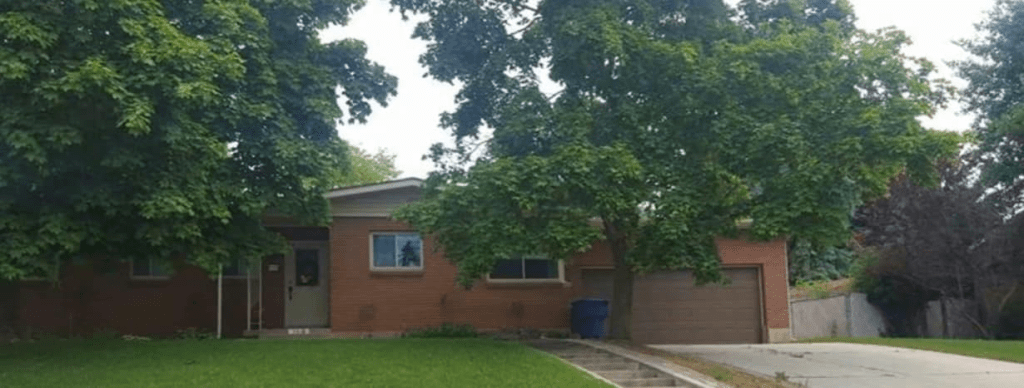
Sue Curtis.Susan Curtis in a group picture from the 1972 South Davis Junior High School yearbook.Sue in a group photo from junior high. Photo courtesy of ‘TB: I was Trying to Think Like an Elk.’ And thank you to Samantha Shore for finding this for me.Sue in a group photo from junior high. Photo courtesy of ‘TB: I was Trying to Think Like an Elk.’ And thank you to Samantha Shore.Sue in a group photo from junior high. Photo courtesy of ‘TB: I was Trying to Think Like an Elk.’ And thank you to Samantha Shore.Sue Curtis’ freshman year picture from the 1975 Woods Cross High School yearbook.Susan in a group picture for the baseball team from the 1975 Woods Cross High School yearbook.Susan in a group picture for the volleyball team from the 1975 Woods Cross High School yearbook.An article about Curtis published by The Daily Herald on July 4, 1975 (which is coincidentally the same date that Nancy Perry-Baird disappeared on).An article mentioning Curtis published by The Deseret News on September 8, 1978.A list of some potential victims of Bundy that mentions Curtis published by The Salt Lake Tribune on January 25, 1989.AAn article mentioning Curtis published by The Idaho Statesman on January 27, 1989.Part one of an article mentioning Curtis published by The Salt Lake Tribune on January 27, 1989.Part two of an article mentioning Curtis published by The Salt Lake Tribune on January 27, 1989.An article mentioning Curtis published by The Spartenburg Weekly Herald on January 28, 1989.An article mentioning Curtis published by The Wilmington Morning Star on January 28, 1989.An article mentioning Curtis published by The Knoxville News-Sentinel on January 29, 1989.An article mentioning Curtis published by The Ukiah Daily Journal on January 29, 1989.An article about the search for Susan Curtis published by The Daily American Republic on January 29, 1989.A newspaper blurb mentioning Curtis published by The Times-Independent on February 9, 1989.An article about the hunt for Curtis published by The Sun-Advocate on February 14, 1989.Part one of an article mentioning Curtis published by Newsday (Suffolk Edition) on February 23, 1989.Part two of an article mentioning Curtis published by Newsday (Suffolk Edition) on February 23, 1989.A ‘thank you’ note written to the investigators that worked Bundy’s case that mentions Susan Curtis, published by The Sun-Advocate on March 16, 1989.An article about the search for Susan Curtis published by The Salt Lake Tribune on March 22, 1989.An article mentioning Curtis published by The Lakeland Ledger on April 25, 1989.An article about the search for Susan’s remains published by The Salt Lake Tribune on November 9, 1996.An article mentioning Curtis published by The Salt Lake Tribune on August 19, 2000.A professor from BYU reported that he had seen Sue trying to sell a textbook at the back of his class. This false sighting, paired with her habit of running away initially made the police wonder if she left willingly and that no abduction had taken place. Photo courtesy of OddStops.The Curtis family’s page on ‘MyHeritage.’ It looks like it’s run by a Marilyn Curtis.An x-ray of the skull of Susan Curtis from when she got her braces. Photo courtesy of Captain Borax.Another shot of an x-ray of the mandible of Curtis. Photo courtesy of Captain Borax.An x-ray of the mandible of Curtis. Photo courtesy of Captain Borax.The notes on an x-ray of Susan Curtis. Photo courtesy of Captain Borax.The missing persons report for Susan Curtis completed by her sister Barbara. Photo courtesy of Captain Borax.An aerial shot of Brigham Young University in 1974. Photo courtesy of Captain Borax.The Wilkinson Student Center in the 1960’s. Photo courtesy of Captain Borax.The Wilkinson Center Cafeteria in the 1960’s. Photo courtesy of Captain Borax.This is a Google Street View image of the Wilkinson Student Center at Brigham Young University. Helaman Halls. Photo courtesy of OddStops.The Wilkinson Student Center at BYU.The set-up of the Helaman Hall group of dorms at Brigham Young University. Photo courtesy of Captain Borax.Merrill West Hall. Photo courtesy of Captain Borax.The Curtis family home at the time Sue disappeared, located at 73 South 250 East North in Bountiful outside of SLC. After she was abducted the family relocated to Wellington, Utah for employment reasons.Woods Cross High School, where Curtis was a student.Bountiful’s ‘Orchard Youth Ward,’ in the northern part of Salt Lake City located at 3599 South Orchard Drive.The route from Bundy’s apartment on 1st Ave in SLC to the Wilkinson Student Center at BYU.This is an aerial image that shows the three possible routes that Curtis may have taken the evening she vanished. Google Maps shows that the orange one is the preferred one, but this may not have been the case back in the summer of 1975. We also have to remember that Curtis wasn’t a student at the University and wasn’t very familiar with the campus. All of these routes are roughly the same length and because of this, there is no way of knowing which one she took. Photo courtesy of OddStops.This is an aerial photograph of the BYU campus taken in September 1969. The Wilkinson Student Center is circled in blue, and the red circle highlights the dorm building that Curtis was planning on walking to the night she was abducted. Some of the parking lots in the area are marked with yellow X’s. Photo courtesy of OddStops.Where Bundy abducted Curtis from and where he claims he dumped her remains. Photo courtesy of OddStops.Joe Ruden from the Carbon County Search and Rescue team uses a metal detector to search for the remains of Susan Curtis. Jim Simone from the Carbon County Search and Rescue team sets out in search for the remains of Sue Curtis.Investigators spent three weeks fruitlessly scratching the frozen earth outside of Price. Picture published in Newsday (Suffolk Edition) on February 3, 1989.Bundy’s whereabouts the day Curtis disappeared according to the ‘TB Multiagency Investigative Team Report 1992.’The outside utility room of the rooming house Bundy lived in SLC. It was the first place he rented while living in Utah, and he lived there from September 1974 to October 1975. Larry Curtis from the 1954 West High School yearbook.Marilyn Haslam-Curtis from the 1954 West High School yearbook.Mr. and Mrs. Curtis’s wedding announcement in The Deseret News on September 27, 1954.Marilyn Curtis on her wedding day.Mr. and Mrs. Curtis’ marriage announcement published in The Deseret News on September 22, 1954.Brett Curtis from the 1976 Viewmont High School yearbook.Calvin Curtis from the 1976 Viewmont High School yearbook.Jeff Curtis from the 1976 Viewmont High School yearbook.Barbara Curtis from the 1976 Viewmont High School yearbook.The layout of where Bundy’s five confirmed Utah victims were abducted from. Photo courtesy of OddStops.William Lugo from a South Davis Junior High School yearbook.An article about the former gym coach from South Davis Junior High School that may have been in an inappropriate relationship with Susan Curtis, published in The Ogden Standard-Examiner on June 25, 1975.An article William Lugo published in The Salt Lake Tribune on July 30, 1975.A article about William Lugo published in The Davis County Clipper on August 1, 1975. I believe the 14 year old girl he was in a relationship with was Susan Curtis.An interesting theory about Curtis’ death from a comment on her Morbid Library article. Fern was on the right track, she just got the teachers last name wrong.












































































 Another Bundy Blog.