
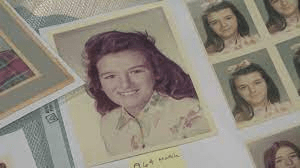
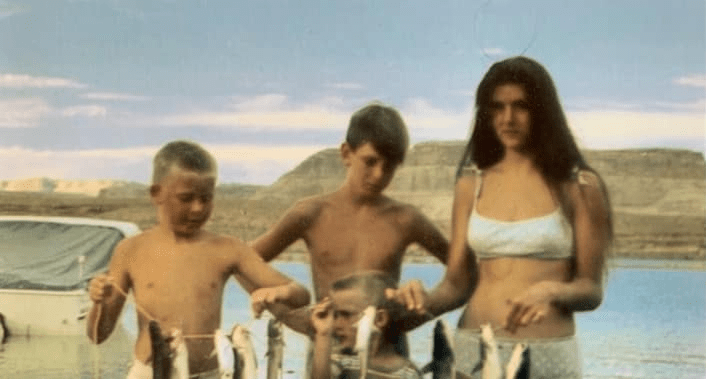
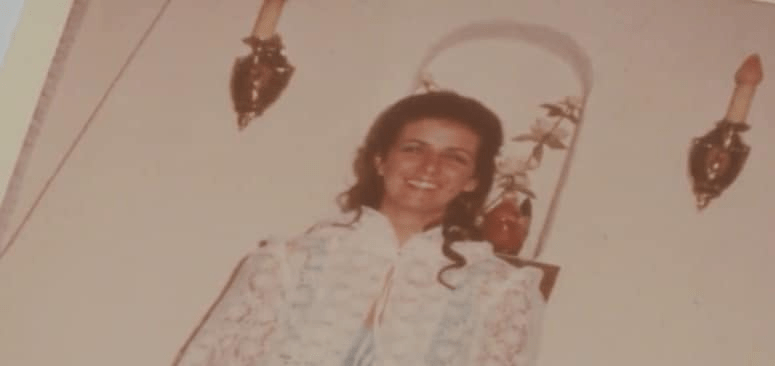
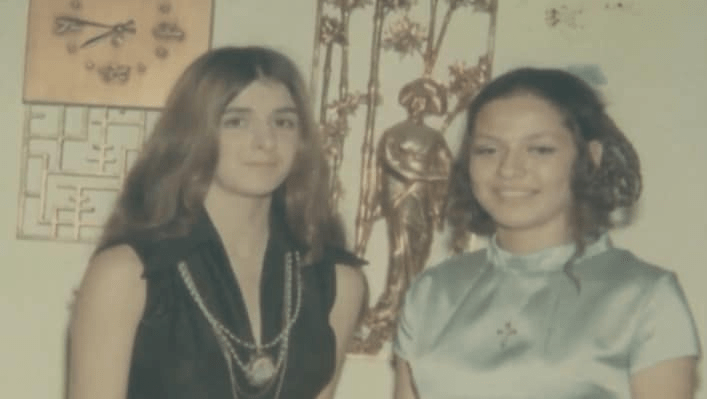
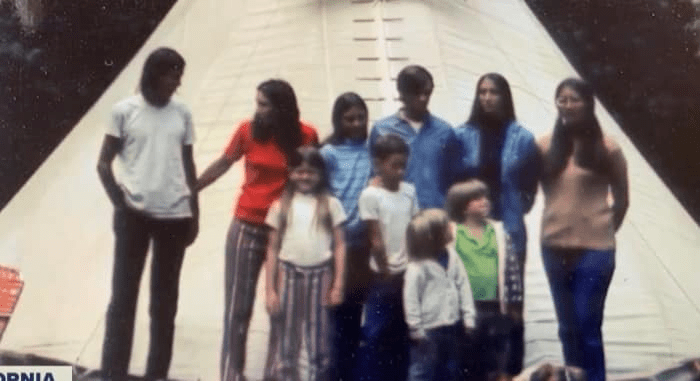
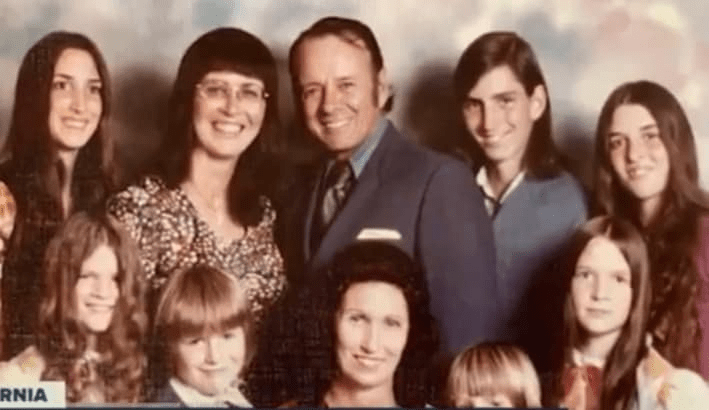
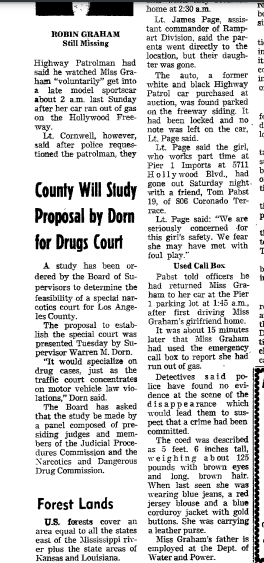
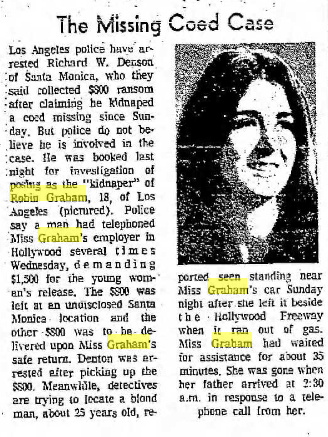
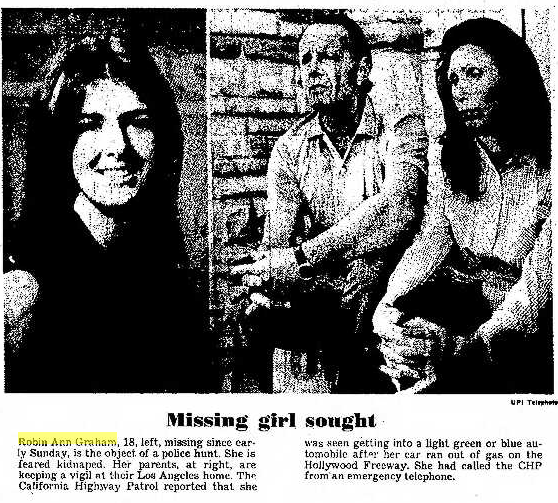
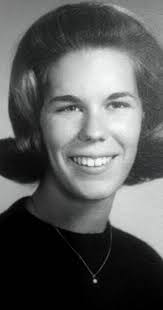
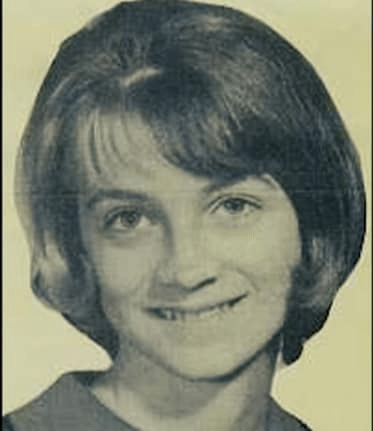
Robin Ann Graham was born on June 22, 1952 to Marvin and Beverly Graham. The family of eleven grew up at 2227 Lemoyne Street in the Silverlake-Los Feliz area of Los Angeles, California; Mr. Graham was employed with the Department of Water and Power. Described as having a big personality and an even bigger heart, at the time of her disappearance Robin stood 5’6” tall, weighed 125 pounds, and had dark brown eyes and long brown hair she wore parted down the middle. A naturally gifted student, Robin graduated from John Marshall High School in June 1970 and was attending Pierce College (a public community college in Woodland Hills, LA) as an art major; the ambitious young lady also worked PT at Pier 1 Imports in Hollywood. At the time of her disappearance Ms. Graham was in a healthy, long-term relationship and had a very busy social life.
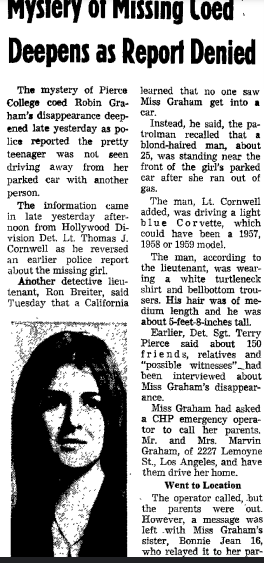
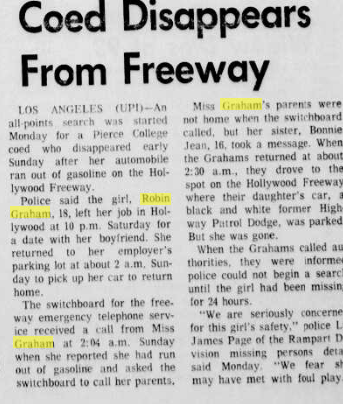
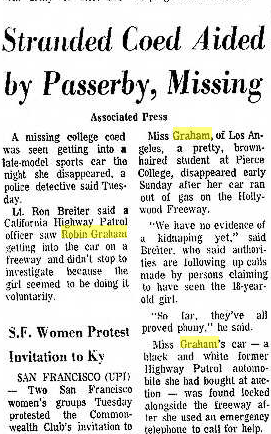
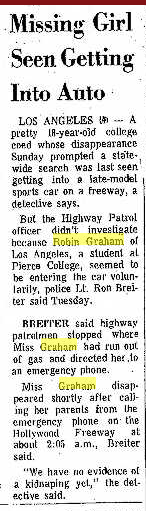
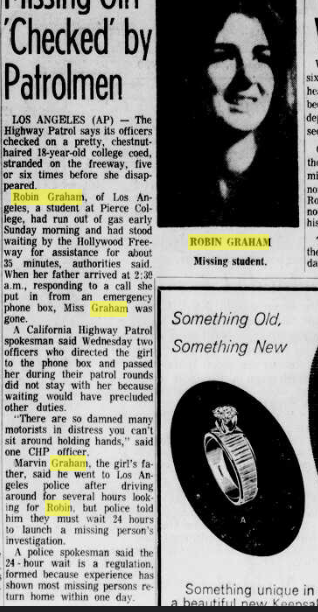
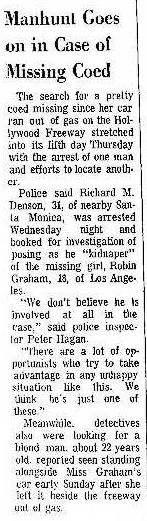
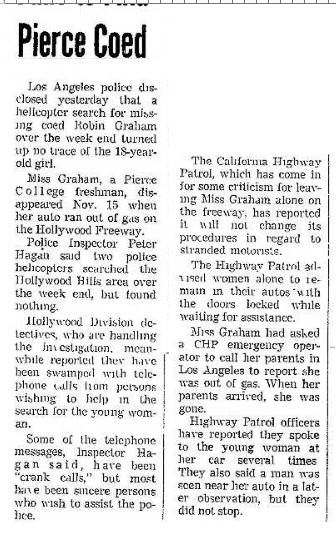
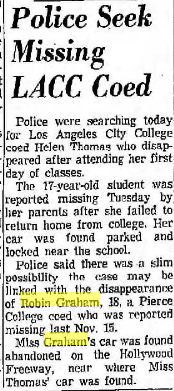
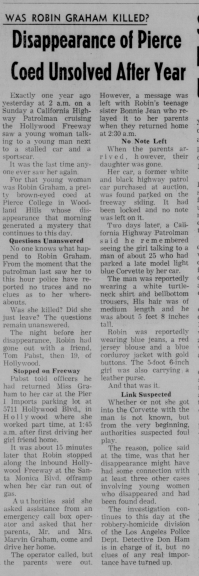
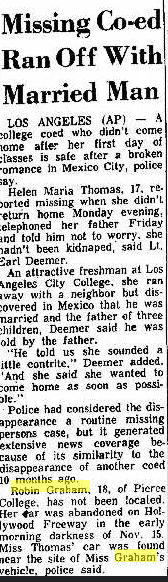
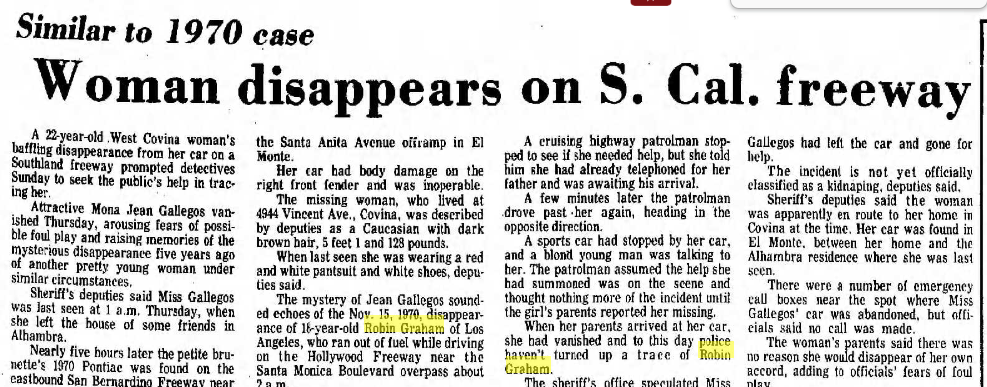
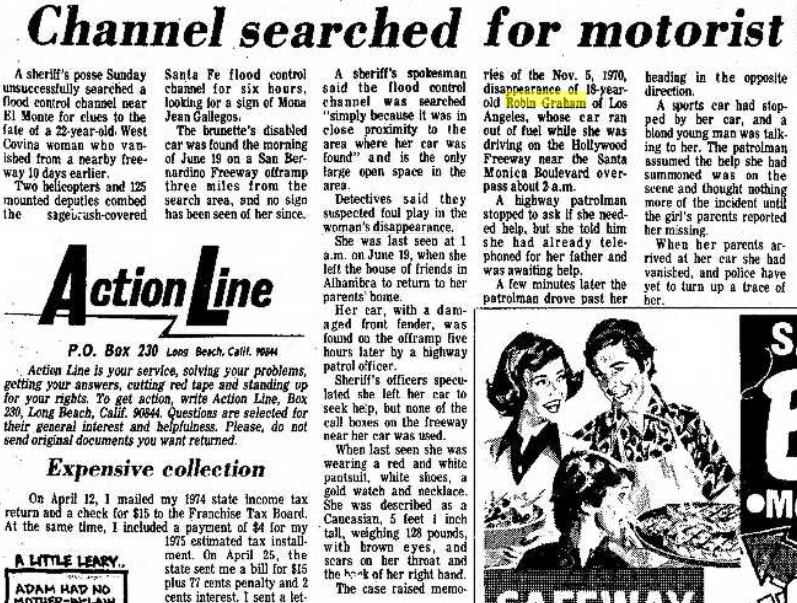
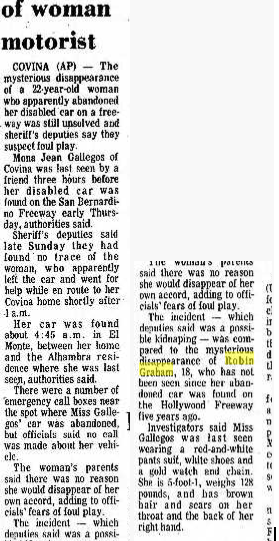
The night before she disappeared on November 14th, 1970 (after dropping off a friend at home), Robin left her vehicle (a former black and white highway patrol car bought at auction) in the Pier 1 Imports parking lot (located at 5711 Hollywood Boulevard) and got a ride with her boyfriend for a night out partying and dancing with college friends. Robin was last seen carrying a leather handbag wearing a dark blue corduroy jacket (with gold buttons), a red jersey blouse, blue jeans and red clogs; she had a birthmark on her lower back and one of her front teeth was just a hair darker than the others. After dropping a friend off at home, I’m reading that Robin was either dropped off at her car by either her boyfriend or by a friend named Tom Palst (sp?), who very well may be her boyfriend, it’s unclear). I’m also coming across varying reports saying she was possibly driving her boyfriends car. Robin immediately set off down the Hollywood Freeway for home. Mere minutes into her journey (somewhere between 1:55-2 AM, accounts vary) the car stalled: she ran out of gas and was stranded on the Santa Monica Boulevard off ramp. Almost immediately after pulling over, California Highway Patrol pulled up beside her and asked if they could offer any assistance, or at the very least call her a tow-truck. At one point during the early morning, they helped push her car further onto the shoulder, as it was slightly sticking out in the Number four lane. Robin politely declined the tow but asked to be directed to the nearest ‘call box,’ which she used to let her parents know she was experiencing car problems; records say the call was placed to the Graham home at 2:04 AM. The officers pulled up a second time when she informed them she did indeed call home and help was on the way: her little sister accepted the call and passed the information along to her parents (who were out at a party). Satisfied with the answer but still wanting to make sure the young lady was OK, they drove away but decided to loop around once again just to check on her and make sure help really was on the way. After they passed her the last time no one knows exactly what happened to Robin: they saw her talking with a Caucasian man roughly around 25/26 years old with medium length brown hair standing at around 5’8.” I do want to point out there is a discrepancy in the hair color of the unidentified male: in one news report it’s said he had “blonde hair” instead of brown. He was wearing bell-bottom pants, a white turtleneck and was driving a 1957 – 1960 blue Corvette. The ‘Doe Network’ claims the car was a ‘hardtop’ which couldn’t be true, as apparently all Corvettes from that time period were convertibles. I found various reports stating that the man was either ‘leaning in her car window’ or was tinkering underneath the hood, inspecting something. CHP assumed it was the relative the young girl called for help so they just kept driving.
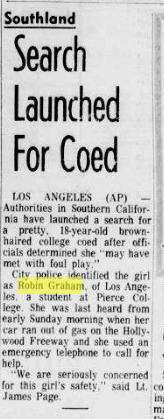
Unfortunately the CHP officers didn’t get close enough to the mystery man to get a good look at his face as they drove past him, and because of this there was never a composite sketch of the suspect done. They reported they saw the blue sports car initially pass Robin’s car, pull off the freeway at the next exit then circle around and come back, eventually parking behind her. The initial report stated that Robin left willingly with the young man, however when that officer was questioned for a second time he clarified he did not see the pair leave together. The last time Graham was seen by law enforcement officers was at roughly 2:00 AM. The call box operated called the Graham home but both parents were out: sixteen year old Bonnie Jean took the message that her sister was stranded and relayed it to her parents when they arrived home at 2:30. They both immediately went to their daughters aide, however when they arrived only her car was there and Robin was nowhere in sight. Additionally, there was no note left behind anywhere in or around her locked vehicle. Law enforcement even fingerprinted the car but were unable to get any viable prints off it and Sergeant Terry Pierce said they interviewed about 150 friends, family members, and acquaintances of Robins in an attempt to gain intel on the cause. Of her disappearance CHP Lieutenant Page said “we are seriously concerned for the girls safety. We fear she may have met with foul play.”
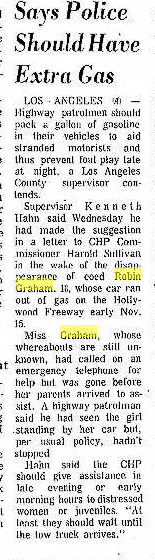
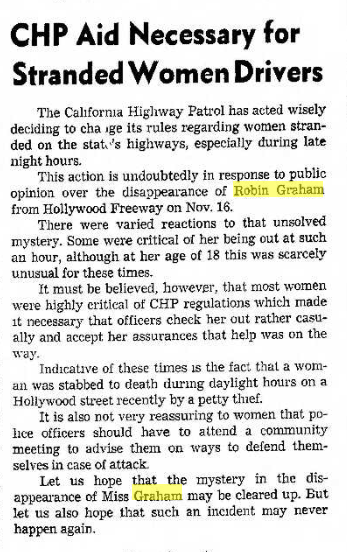
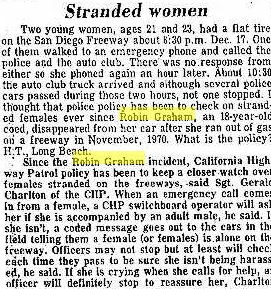
Handling of the incident by law enforcement prompted immediate criticism from LA County Supervisor Kenneth Hahn, and because of the officers failing to stay with Robin and keep her safe the CHP faced immediate backlash: an investigation was launched looking into the conduct of the officers surrounding the night Robin disappeared. People were absolutely livid at the thought of trained police officers leaving a young, vulnerable teenage girl alone in the presence of a male stranger in the wee hours of the morning (which resulted in her abduction). Despite the public outcry, it was eventually determined that the patrolmen in question were acting in accordance with policy. Despite that ruling, California Highway Patrol policy was changed to ensure the safety of all stranded female motorists, stating that CHP officers were to remain with any female motorists that were left stranded on the side of the roads at night until their help arrived. Even though police took these extra precautions, women still continued to go missing under similar circumstances involving vehicles over the following years.
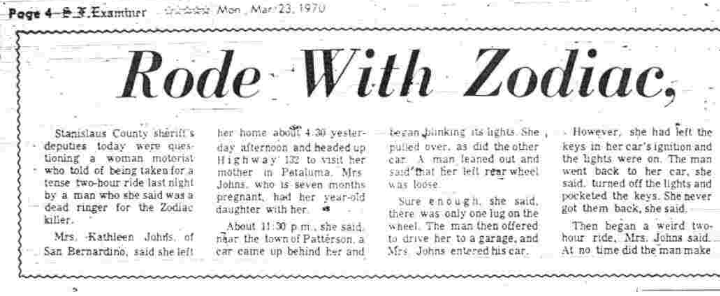
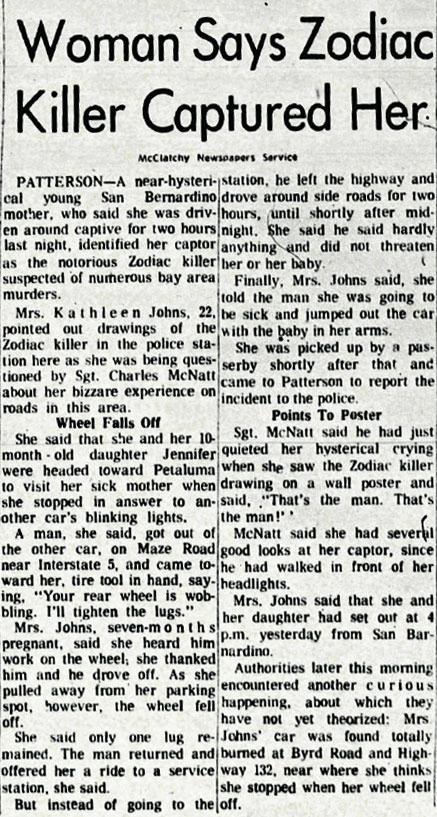
Ms. Grahams mysterious disappearance was first handled by the same detectives at the Rampart Division of the LAPD, who theorized it was linked to other eerily similar cases involving missing young women: in November 1967, law enforcement warned the public of an attacker who flagged down three women pretending to have car problems before he assaulted them; they felt the incidents seem to be linked. Eight months before Robin disappeared, Kathleen Johns was on her way to San Francisco with her infant when the car behind her started flashing its headlights at her. When she pulled over a man got out of the vehicle and said her back wheel was ‘wobbling furiously;’ he offered to fix it however instead of helping he loosened it so it completely fell off as she attempted to drive away. The man then backed up and offered to take her and the baby to a nearby service station, which she accepted. As he wordlessly passed the gas station Johns got nervous and asked where they were going. He kept quiet for a few minutes then said, “before I kill you, I’m going to throw your baby out the window.” They drove around like that for about 90 minutes; he taunted the young mother with similar comments like, “you know you’re going to die.” Johns eventually managed to escape the vehicle, hiding in a field with her baby as he frantically looked for her with a flashlight; he eventually left when a truck approached. She eventually was able to wave down another vehicle, which took her to a nearby police station. While she waited at the police station to make an official report, Johns saw a sketch on the wall of the same man that had spent the past hour terrorizing her: it was a wanted poster for the Zodiac Killer.
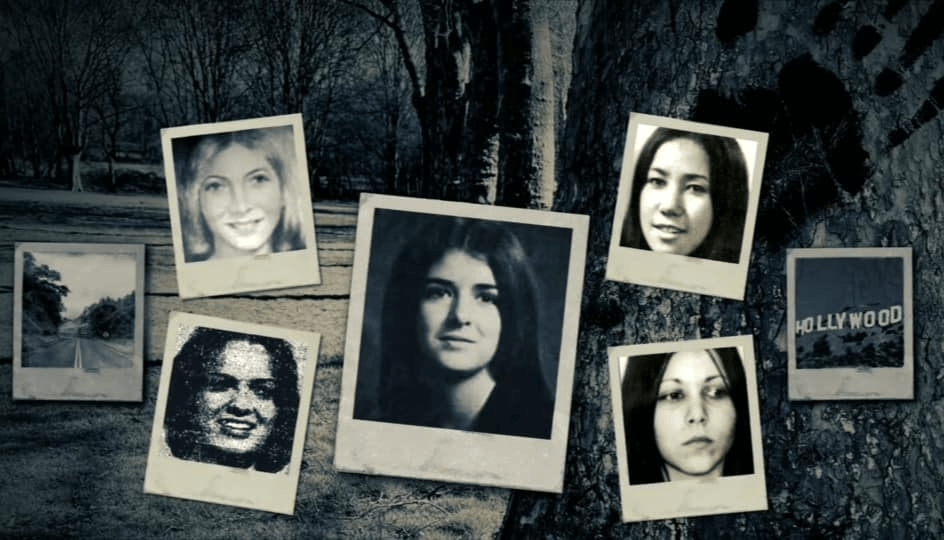
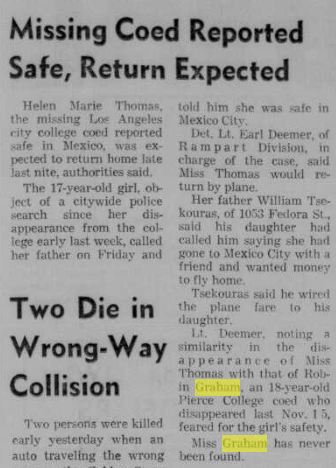
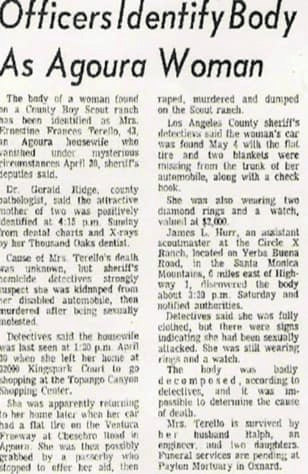
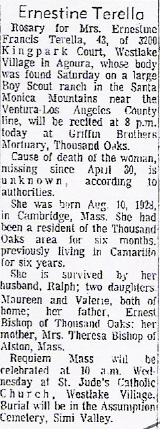
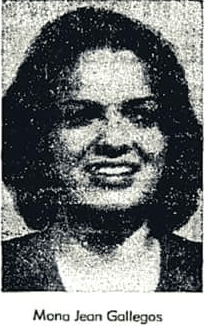
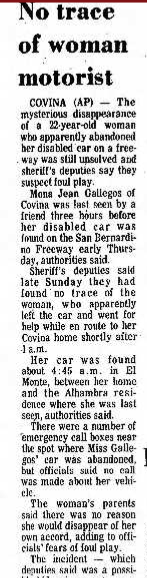
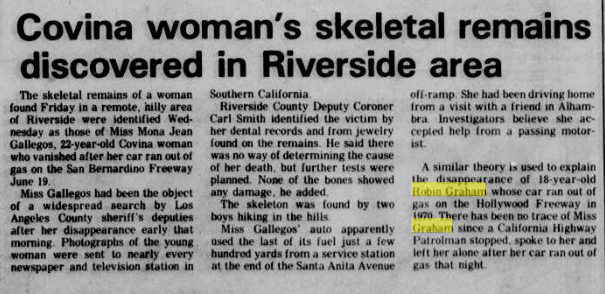
Ms. Graham was the fourth young woman to disappear under mysterious circumstances in the general Hollywood, CA area within a two year period, however, in most of those cases the victims’ remains were eventually found, unlike Graham (whose body has never been found). Most of Bundy’s victims were never discovered so we know he had a way of making bodies disappear (which also might explain why Grahams body was never found). On the evening of October 30,1966 Riverside College student Cheri Jo Bates went to her schools library to study for a few hours, and when she tried to leave for home her VW Bug wouldn’t start. Conveniently right at that very moment, an unidentified man offered her up his assistance, even going so far as to look under the hood of her VW Bug in an attempt to diagnose why it wouldn’t start. The man claimed he was unable to start it but offered her a ride, which she accepted. Her body was found the next day by a groundskeeper at the college: the young co-ed was brutally killed with a knife and was cut and slashed so aggressively that her head nearly came off. Elizabeth Habe was the daughter of author Hans Habe and b-actress Eloise Hardt. She was a student at the University of Hawaii and was home in LA on Christmas vacation when she was murdered on December 29, 1968 after returning home from a double date with John Hornburg (a family friend). She left Johns house at 3:15 AM in her sports car and was abducted when she got home to her Moms house on Cynthia Avenue in West Hollywood. Her body was discovered on New Years Day in 1969 in dense underbrush off Mulholland Drive; she was found fully clothed and her body was burned, with contusions in her eyes and slashes to her throat and heart; the medical examiner determined no sexual assault took place. There were a few rapes in the neighborhood in the weeks before Habe’s brutal death and it’s further speculated that the young student may have been killed by the Manson Family. A former Family associate said that “members of the Family knew her.” Robin’s case also shows some parallels with the May 1969 murder of Rose Tashman, a young woman who was found murdered just hours after her 1965 beige Mustang was discovered abandoned with a flat tire on the side of the Hollywood Freeway. At around 2 AM, the Valley Junior College student was driving home from a friend’s house in Van Nuys, CA after studying for an exam when she got a flat tire. She was stranded on the side of the Hollywood Freeway just a few miles away from where Graham’s car was found in late 1970. The next day, Tashmans Mustang was found abandoned near the Highway Avenue off-ramp on the Hollywood Freeway; road flares had been set up around the vehicle and her left tire was flat. There was also evidence that someone had stopped to “help” assist her with the flat tire. Only nine hours later, the young girls naked body was found in a brushy ravine off Mullholland Drive about a half mile away from where Habe’s body was found; she was strangled and raped. On January 20, 1970, Cindy Lee Mellin got a flat tire in the same general area as Tashman and Graham, and just like the others she vanished without a trace under mysterious conditions. Mellin was a student and employed at the Broadway Department Store in Ventura, California; she was 5’6″ tall, weighed 105 pounds and had brown hair and blue eyes. She was last seen wearing a navy blue dress with red buttons matched with blue shoes with gold buckles (she had her brown corduroy coat with her as well); The Press Courier described the 19 years old as a “pretty Ventura coed.” After work that evening in January, Cindy walked to her car only to discover she had a flat tire. Two of Cindy’s coworkers (who had been picked up by their spouses after work) reported they saw the young girl talking to an unidentified man at about 10:30 PM but assumed it was her Dad so they left. They described te male as tall and slim, between 35 and 40 years old; he drove a light-colored car. Leonard Mellin said that his daughter most likely would not have been able to change the tire herself so the theory that an unidentified man approached Cindy under the guise of helping makes sense. That following morning, after realizing his daughter never came home from work the night before, Mr. Mellin drove to the shopping center where Cindy worked and found her car in the same spot as she’d left it but the spare tire was on the ground nearby; her doors, trunk, and glove box were open, and it appeared that one of the car tires had been purposefully slashed with a knife. Her body has never been recovered. On April 20, 1972 Ernestine Terello got a flat tire near the Ventura freeway in Agoura, CA and surprise surprise… her car was later found abandoned; a month later her body was found on the ‘Circle X Boy Scout Ranch’ in the Santa Monica mountains. Police theorized that a good Samaritan had offered her help fix her tire then abducted her. Strangely her body was found fully clothed, so its possible that sexual assault may not have been a motive. Additionally, she still had on valuable jewelry robbery was most likely also not a motive. This case did not get much press attention and no suspects have ever been mentioned nor have any arrests been made. Similarly, on June 19, 1975 nineteen year old Mona Jean Gallegos was driving home from a friend’s house in Alhambra, CA and at roughly 1 AM ran out of gas near Santa Anita Avenue on the San Bernardino Freeway in El Monte. Her skeletal remains were discovered about six months later in a Riverside ravine.
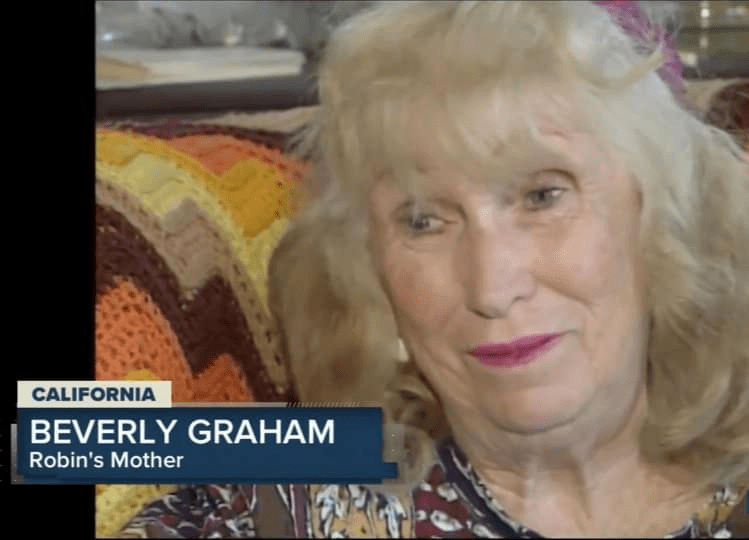
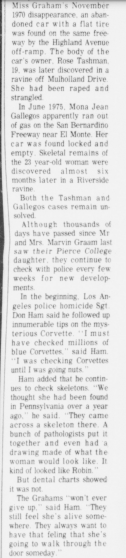
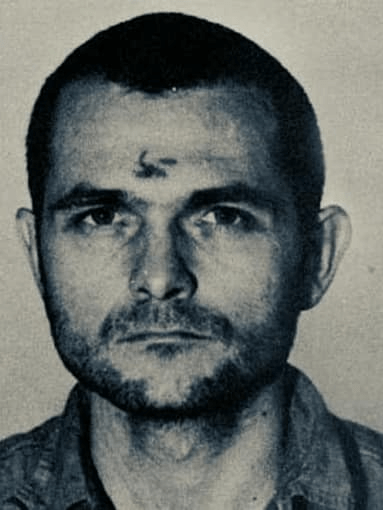
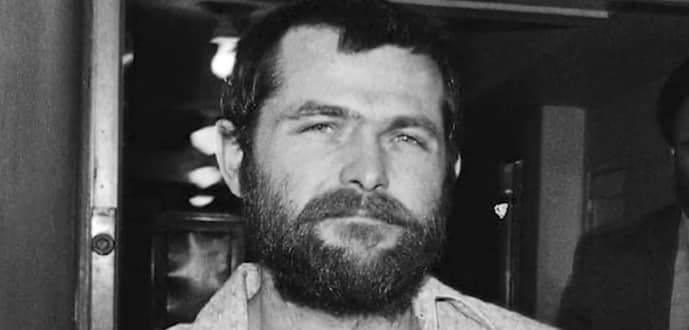
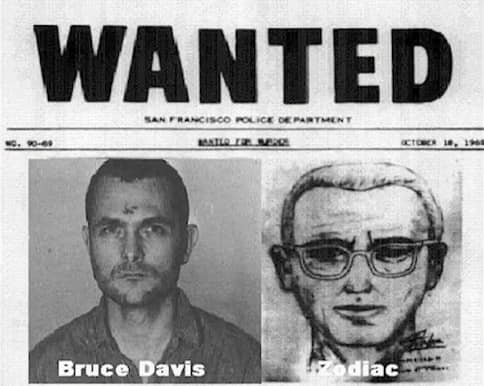
The media was incredibly inconsistent when reporting on Robins case, and law enforcement felt that the “free-spirited nature of the 70’s” made these young girls fairly easy, very trusting targets. Regarding her daughters disappearance, Beverly Graham said: “it’s strange, it happened right in the middle of the city, but there never really were any clues. Maybe it will turn something up. We still live with that hope.” For years after his daughter disappeared, Mr. Graham called LA homicide Sargent Donald Ham every few weeks to get a status update on the case; the two men eventually became friends and would on occasion grab lunch and catch up. In 1975 Sargent Ham thought that Robin “had been found in Pennsylvania [over a year ago], they came across a skeleton there. A bunch of pathologists put in together and even had a drawing made of what the woman would look like. It kind of looked like Robin.” However after a forensics expert investigated dental records it was obvious that the skeleton did not belong to Robin. Ham took over the case in 1976, and in his time investigating it checked out “millions of blue Corvettes.” … ” I was checking Corvettes until I was going nuts.” … “one traffic control officer used to come in every morning with a list of Corvettes he had spotted. It didn’t matter what color they were. He said it could have been painted.” As for Robins parents, he said “they won’t ever five up. They still feel she’s alive somewhere. They always want to have that feeling that she’s going to walk through that door someday… she was a beautiful girl.” After the LA Times ran a story on Robins disappearance a woman wrote to Mr. and Mrs. Graham claiming that she too, had stalled out on the Freeway earlier that same night and that a man driving a similar Corvette claiming to be an off-duty officer offered her a ride. She refused his offer; and it’s unknown if it was the same man who was last seen with Robin. There’s been no proof this is the same man last seen with Robin, but police felt this was a “solid theory. One thing that further confused law enforcement was why Robin left no note on her car for her family; was it for the simple reason she had no pen and/or paper with her? Sadly I never have pens in my car. They were also confused as to why she refused help from uniformed police officers in marked police cruisers just minutes earlier but accepted help from a non-uniformed man in a Corvette? Was she trying to avoid a tow fee from the police? Unfortunately this lead to nothing. The next month the woman identified this unknown man as Bruce Davis, who is one of the numerous people suspected of being the Zodiac Killer. Davis was a serial killer who operated in the California area in the late 1970’s. He is still suspected in many unsolved disappearances and murders in the area, including a couple found in an alley close to the Silver Lake area close to Los Angeles. They had each been stabbed over 40 times. Davis had been a high-profile member of the Charles Mansons ‘Family’ and, although he didn’t participate in the August 1969 murder of actress Sharon Tate he had turned himself into police just weeks after Graham disappeared. He was eventually convicted of two separate murder counts, including that of ranch hand Donald “Shorty” Shea, which is the only murder Manson technically had a direct hand in. After he was taken into custody on December 2, 1970, no further murders took place that were definitively linked to the Zodiac Killer. Davis was sentenced to life in prison, and despite keeping a clean record since 1980 and it being previously recommended he be granted parole seven times (those decisions were rejected by three different CA governors), in 2022 a California panel denied his parole, telling him to try again in three years saying he “lacks empathy.” Bruce Davis has denied being the Zodiac Killer.
It is worth noting that Robin disappeared on the night of a full moon, which is when the Zodiac was known to operate. It was very challenging finding a lot of relevant information regarding the case, but one thing that surprised me was that it was speculated that she was possibly a victim of the Zodiac. I won’t lie, I don’t know a ton about that particular SK: I read Robert Graysmith’s famous book many years ago… But, when looking into it further I guess Graham did live in the right region of California during the right time frame to be a possible victim. He claimed to have killed 37 victims in northern California between 1968 and 1970 and sent letters with hand-drawn ciphers taunting San Francisco Bay Area press taking credit for these murders. It’s worth noting that of these 37 victims the Zodiac takes credit for, law enforcement can only agree on seven confirmed victims (two survived). The case remains unsolved despite a lot of recent activity in the past few years: Earl Van Best Jr. (he was the central figure on the FX show “The Most Dangerous Animal of All”), Arthur Leigh Allen (a former elementary school teacher as well as the only suspect authorities ever publicly named and convicted sex offender who died in 1992), and (this is almost brand new information) Garry F. Poste, a suspect named by a group called ‘The Case Breakers’ that said forensic experts now feel is “a very strong suspect” after a statewide examination recovered new Zodiac evidence. It’s pretty well known that any case from that time period with the weak ‘modus operandi’ involving victims in broken down vehicles was linked to the Zodiac, and unfortunately in recent years a slew of amateur sleuths invested in the case have helped spread much misinformation.
As I stated earlier, the man last seen with Robin that night in 1970 was described as being brunette, 5’8″ tall, and in his mid-20’s (specifically 25-26); at that time in November 1970 Bundy would have been 23, which is pretty consistent with that description. What’s really jumping out at me is the turtleneck part, as that piece of clothing seemed like a staple in Ted’s wardrobe (there’s numerous pictures with him wearing one). Now, Bundy was 5’10” where the man talking to Robin was described as being roughly 5’8” but keep in mind that’s just an estimation. Also at the time it’s thought that Bundy still owned his first VW Beetle, a light blue one he purchased in April 1966; he didn’t buy the infamous yellow one until spring of 1973… so if Bundy did abduct Robin, where did the blue Corvette come from… I probably don’t need to say that we know it didn’t belong to him. Did he borrow it? One thing we do know is that he is a competent car thief (but a bad driver) so is it really that off base for him to have stolen this car then ditched it when he was done with it? We know he was caught in Aspen and Florida after getting pulled over in stolen vehicles and he did it numerous times when he was an adolescent (his mother helped pay for him to have his record expunged when he became legal age so it wouldn’t affect his future career). Bundy did at one point tell law enforcement that he killed a victim somewhere unspecified in California during his reign of terror, and he’s further suspected of committing the Santa Rosa Hitchhiker murders that also took place in the 1970’s. Of the victims in the SRH case, three were raped and three others were too badly decomposed to tell. Detective Bob Keppel shared with ‘SeattlePI’ that “the killings in Santa Rosa would fit his methods, he spent time in the area, and I”m sure he started killing well before 1974. It was an open market for Bundy.” … “one of the last times I talked to Bundy I mentioned California, and he looked at me like, ‘I can’t talk about that right now.’” … “I think he believed his execution would be stayed so he could talk for years about his crimes, but the governor had other ideas.”
In mid-November 1970 when Robin disappeared it looks like Bundy was employed as a delivery driver for Pedline Supply Company (a family owned medical supply company); he worked there from June 5, 1970 to December 31, 1971. In mid-1970, he also re-enrolled at the University of Washington and was living in the Rogers Rooming House on 12th Avenue in Seattle. Additionally he was in a committed relationship with Liz Kloepfer at this time as well, so he had a lot of established roots in the general area. It’s obvious in Robin Grahams description that she fit the profile of one of Teds typical victims: she was tall and slender, with long dark hair parted down the middle. She was even in the right age range and a college student (who we know Ted LOVED to target). When analyzing the logistics of Bundy killing Robin, the scene of the crime was almost 17 and a half hours away from where he lived in Seattle… but I mean, Bundy had a lot on his plate at the time Robin disappeared. Did he really have time to drive all the way to California to commit a murder? Playing devils advocate, we know he was an avid night person and had no problem prowling long distances when looking for prey. It was in early 1970 that Bundy rekindled his relationship with Stephanie Brooks, which helps place him in California; it also appears that he was in the Santa Rosa area of California at some point in that general time frame as well, which is just a hair over a 6 hour drive (with light traffic) to LA. This also helps put him much closer to the scene of the crime (as we know Bundy enjoyed traveling far distances to throw police off his trail). Was Robin Graham just another one of Teds ‘murders of opportunity?’ It’s worth noting that not only do we have confirmed kills from Washington, Colorado, Utah, Oregon, Florida, and Idaho, I’ve also written about numerous other states he could have been active in (Pennsylvania, Vermont, and New Jersey).
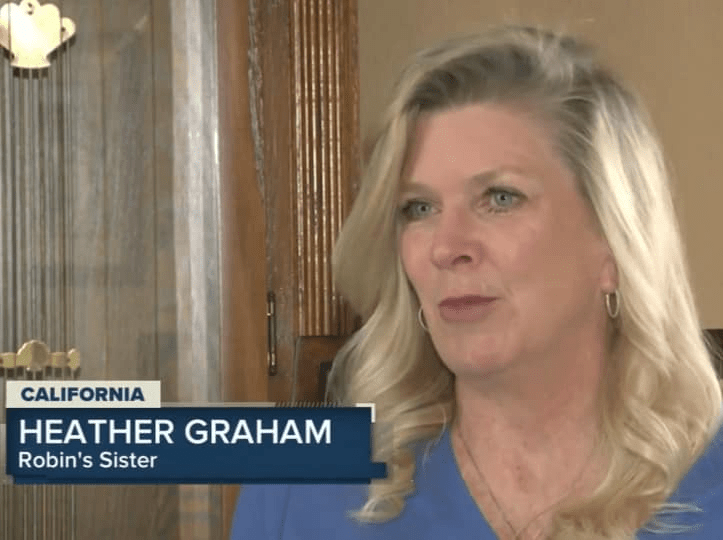
Websleuths user ‘Howard’ commented that they “have researched the Graham case. I know her parents. They are still waiting for a break in the case and have kept their same address and phone number since 1970!” On June 28, 2005, Websleuths user ‘Graham‘ commented back saying: “when you say that you have researched the case I was wondering if you have found anything that is not in the police reports? I just recently spoke with the police regarding the case. I’m Robin’s sister. I would like to hear what info you have found. Thanks.” Seventeen years after Robins strange disappearance in 1986, a mysterious ad caught the attention of a member of the Graham family when it appeared in the LA Times classifieds. Beverly Graham said of the event: “one of our daughters saw it. The funny thing is, she never looks at the personal ads. But this one day…” The ad read: “DEAREST ROBIN You ran out of gas on the Hollywood Frwy. A man in a Corvette pulled over to help. You’ve not been since of since. It’s been 17 years, but it’s always just yesterday. Still looking for you (signed) THE ECHO PARK DUCKS.” The message sounded innocent enough and almost romantic in a way, which made some people speculate it was a clue about the young girls disappearance. The ad was really put under a microscope after KFI disc jockey Geoff Edwards read it on the air, and the phone calls and letters quickly started coming in, which helped establish the link to the missing persons case from 17 years before. Edwards said, “it sounded so romantic. I wondered if anyone knew what it was all about, and I got all kinds of calls and mail. Someone even wondered if the message was a clue to the killing.” It turned out the mystery sender was an old friend of Robins named Al Medrano (who was still living in the neighborhood) just wanted to let the world know that his friend was still missing and that she had not been forgotten about. The Graham family, who also still live in Echo Park, remember Al as a neighborhood friend of their Robins. Why he chose then to put something in the paper, he said: “well, it occurred to me that Nov. 15 (the day of her disappearance) fell on the same day (Sunday) this year as it did in 1970, and I just wanted to show she wasn’t forgotten.” He said the last part about the “Echo Park Ducks” was what they used to call their friend group and he wanted the message to be off all of them.
On October 5, 2012, the blog missingrobinanngraham.blogspot.com, creator Michael Haddan commented: “Please note that there is NO TRUTH to the ‘Find A Grave’ post by someone anonymous claiming that Robin Ann Graham ‘died’ in 1970. This was posted by someone who apparently wants Robin to be dead, to settle the mystery of her disappearance with a completely unfounded and irresponsible statement that hurts both Robin and all who love her. This person wants everyone who has hope for Robin’s safe return to GIVE UP, and for all continuing investigations into her disappearance to end. LAPD Detectives John St. John and Detective Hamm both told me never to assume that she is dead just because I ‘want resolution’ to her case, and that to do so would be not only to give up on Robin, but to show a lack of love and respect for her. I’ve notified this person and asked how Robin ‘died’ and how this person knows this. Of course there is no answer. I thought that he/she would have taken the post down by now, but it still shows up in Google’s priority postings. This is an utter travesty. We’ve had many hoaxes regarding Robin’s disappearance over the decades, and unless this ‘mystery person’ actually knows something–and should therefore contact the LAPD–this is unquestionably just another HOAX.”
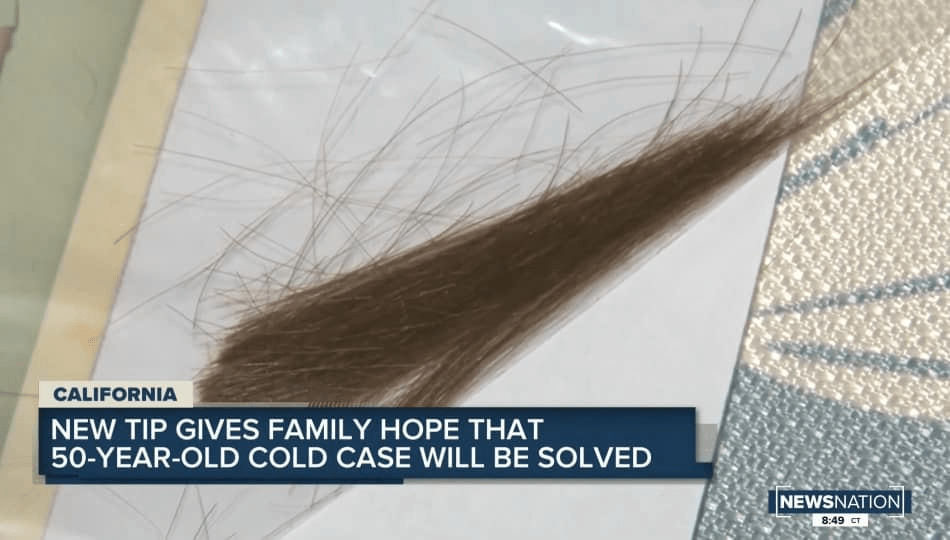
Regarding Robins disappearance, Sargent Ham said: “all we’ve got is a missing persons report. We’ve never found remains. She could be alive somewhere.” At this time, the surviving Graham family is trying to enter pieces of her hair into DNA databases that didn’t exist when she went missing in the early 1970’s; Both Mr. and Mrs. Graham have passed away and Robin would be 70 years old as of February 2023. One thing that is nearly certain about Robins mysterious disappearance is that she fell victim to the good Samaritan ruse.

Robin Ann Graham.










































 Another Bundy Blog.