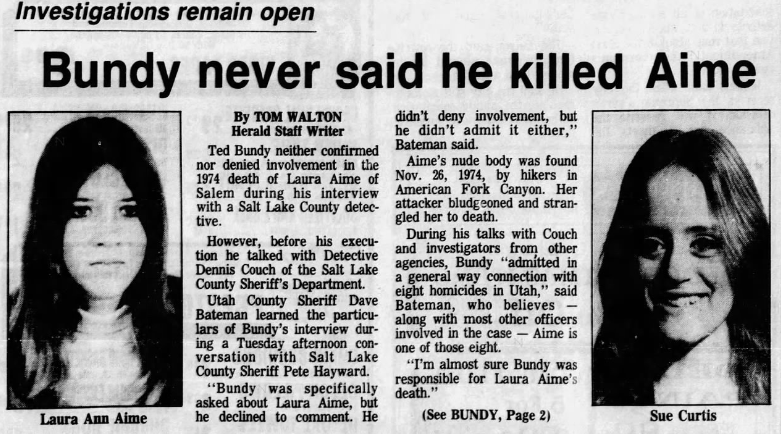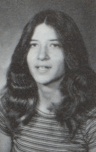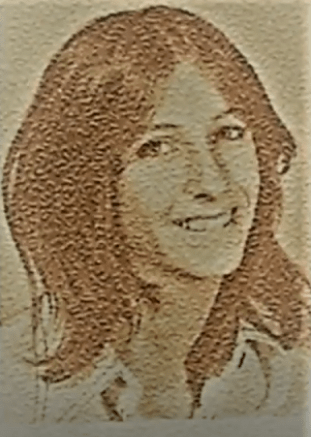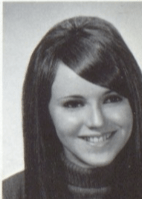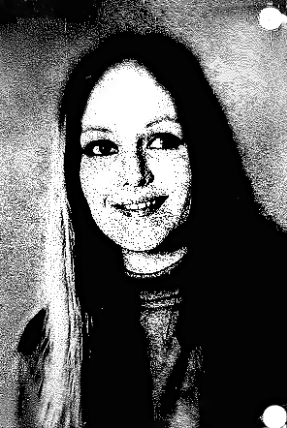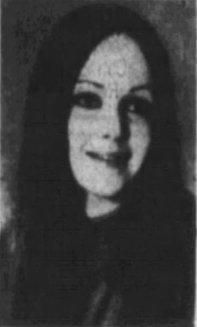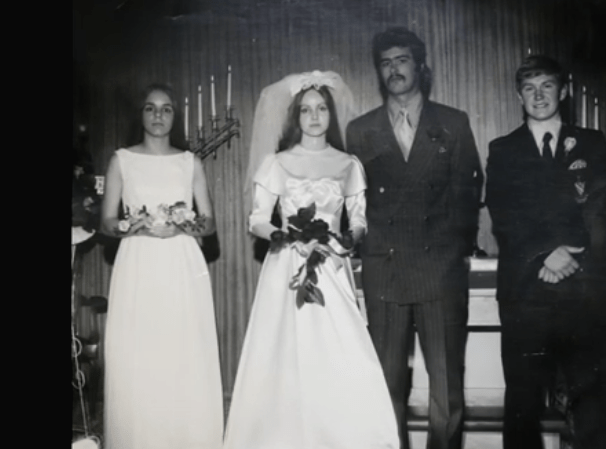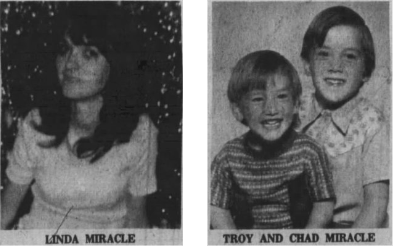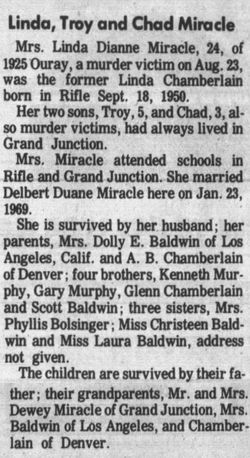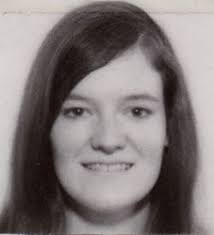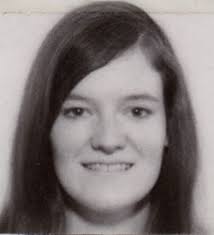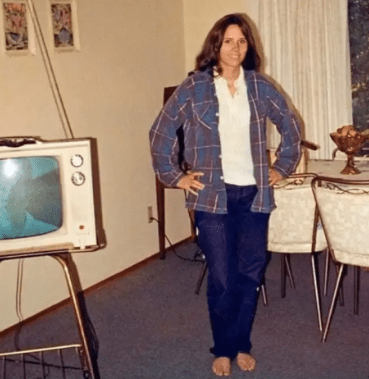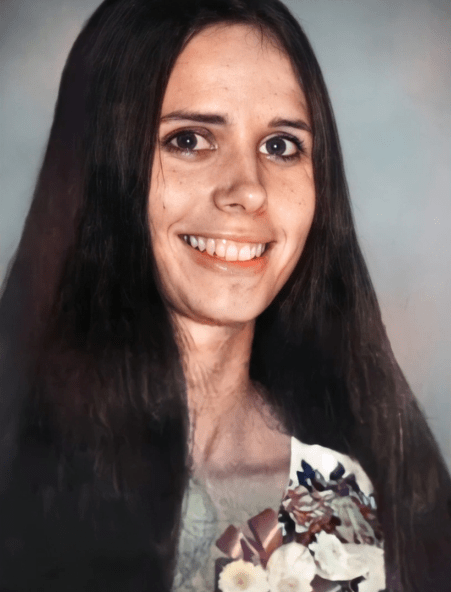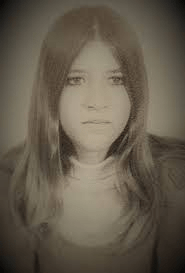
Laura Ann Aime.

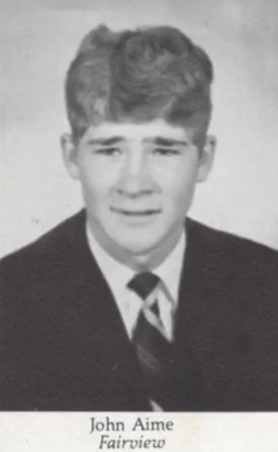
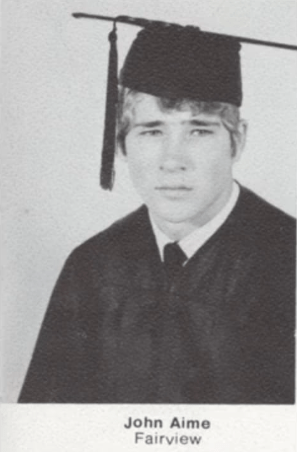
Laura Ann Aime was born on August 21, 1957 to James and Shirlene (nee Tolton) Aime in Lehi, Utah. Mr. Aime was born on August 10, 1928 in Fairview, Utah, and after completing high school he joined the US Navy; after getting out of the military he went on to attend the University of Utah. Shirlene was born on April 12, 1934 in Orem, and the couple were married on January 14, 1951. According to the Aime’s marriage certificate, Jim worked as a steelworker for Geneva Steel. Laura was Jim and Shirlene’s second child, and she had four younger sisters (Evelyn, Michelle, Denna, and Tommi lyn) and an older brother named John. Mrs. Aime filed domestic abuse charges against her husband in April 1966, but they must have worked out their issues because they never divorced.

According to her autopsy, Laura had blue eyes, medium length blonde hair, was 5’10” tall, and weighed around 140 pounds. Before Aime dropped out she was a student at North Sanpete High School, and was at one-time a member of the Laurel Class in the Fairview North Ward. She loved animals, and one time a wild deer wandered out of the canyon and she began feeding it, and eventually was able to convince the creature into becoming a family pet. When Laura was eleven she was thrown into a barbed wire fence by her horse, injuring her ring finger, forearm, and upper arm. Jim Aime liked to take his daughter hunting, and she even helped him bag the first prize deer in a Utah hunting contest at the age of ten. Before she was killed Aime somehow seemed to show awareness that she knew her life was going to end soon in a tragic way: Mrs. Aime said one day out of the blue just a few weeks before her daughter died she told her: ‘at my funeral, I don’t want to be buried in a dress.’ Additionally, Evelyn Aime said that her older sister mentioned that she wanted the 1974 Terry Jacks classic, ‘Seasons in the Sun’ to play during the service as well.

Immediately before she disappeared Laura had been staying with her girlfriend Marin Beveridge, who didn’t live far from her childhood home. Despite being raised in a Mormon family, after leaving home she quickly fell in with the latter-day counter-cultural life, and with her long blonde locks and ‘hippie look’ she already had the stereotypical appearance of a runaway. Although the Aimes didn’t care for their daughter’s  choice in friends they were just beginning to come to terms with her ‘nomadic’ lifestyle. Often teased about her height, Laura was given nicknames like ‘Wilt the Stilt,’ which greatly upset her, and her Aime’s suspected that the relentless mocking was what made her leave school. She was used to tough work as the family at one time lived in an old farm house in Mount Pleasant, where they kept a plethora of animals, including chickens, cows, peacocks, turkeys, hogs, goats, sheep, dogs and ‘dozens of cats.’ She was also a tomboy (especially during her early years), and she loved playing softball, and played on competitive teams as well as her families LDS ward, even going so far as to winning the 1972 state championship. Growing up, Laura loved horses and was an experienced rider; she even spent several of her teenage years in an all-girls horseback riding club called ‘The Silver Spurs,’ and participated in several competitions with them at different fairs and parades across Utah.

Before she disappeared Laura had been staying with her girlfriend Marin Beveridge, who didn’t live far from her childhood home. Despite being raised in a Mormon family, after leaving home she quickly fell in with the latter-day counter-cultural life, and with her long blonde hair and hippie look she already had the appearance of a runaway. Although the Aimes didn’t care for their daughter’s friends they were just beginning to come to terms with her ‘nomadic’ lifestyle. Often teased about her height, Laura was given nicknames like ‘Wilt the Stilt,’ which greatly upset her, and the Aime’s suspected that the relentless mocking was what made her leave school. Laura was used to tough work as the family at one time lived in an old farm house in Mount Pleasant, where they kept a plethora of animals, including chickens, cows, peacocks, turkeys, hogs, goats, sheep, dogs and ‘dozens of cats.’ She was also a tomboy (especially during her early years), and she loved playing softball, and played on competitive teams as well as her families LDS ward, even going so far as to winning the 1972 state championship. Growing up Laura loved horses and was an experienced rider. She spent several of her teenage years in an all-girls horseback riding club called ‘The Silver Spurs” in SanPete County, and participated in several competitions at different fairs and parades across Utah. Those that knew her remember her as a kind and loving person.

Laura Ann Aime was seventeen when she was abducted by Ted Bundy on Halloween night in 1974: the party she was at never really got going, and she left by herself around ten to get some cigarettes. About a half hour later she was picked up by an acquaintance named George Alley, who later told investigators that he dropped her off at The Knotty Pine in Lehi just after midnight (although according to Captain Borax, Browns as it was called by the locals closed at eleven, so perhaps it was closer to 11:00 versus 12:00). Quick Lehi factoid: ‘The Knotty Pine’ as it was once called was referred to as ‘Mo Browns’ because the gentleman that owned it was named Leon Brown and he reportedly had ‘a huge mole on his face’ (very clever). Alley also shared that Aime complained that before he picked her up a bunch of ‘cowboys’ ignored her outstretched thumb and drove right past her. From Browns, Aime again got bored and walked to Robinson Park. She was last seen wearing silver cross shaped earrings, a tan sleeveless turtleneck-style sweater with white horizontal stripes, a Navy Pea coat with a hood, light brown lace up shoes, and blue Levi’s with ‘patches on the rear;’ various sources report her wearing a halter top as well. Laura was wearing a ring with a yellow stone and had a rubber band around her wrist; her nails were adorned with black polish with silver flakes.

Although it’s (mostly) agreed on that Laura was last seen trying to hitchhike, there’s a few different possible narratives when it comes to where she was right before she disappeared. The most common theory I’ve seen is that she attended a house party at a mobile home in the suburbs of nearby Orem; a second says the party was in Lehi. The third possibility is that the party took place at the Knotty Pine Cafe in Lehi… (although there’s a FOURTH that says there was no party at all). BUT… every single one of these possibilities consistently placed her at the Knotty Pine Cafe for some period of time before she left to hitchhike to Robinson Park. One eyewitness came forward and shared with investigators that they saw Laura at the park in American Fork at around midnight, which is the last time that anyone reported seeing her alive. Robinson Park is about a 3.2 mile drive from the (former) Knotty Pine Cafe, and if she did walk it would have taken her roughly an hour (give or take) to do so. Due to the dropping temperatures (dipping as low as 45 °F) and the distance involved, it’s very likely that she tried to hitchhike back to Lehi after she was done hanging out at the park. Did Bundy see her there then pull up and offer her a ride? There’s also a possibility that he spotted Aime from a distance then crept up behind her and blitzed her, much like he did to Nancy Wilcox. As I mentioned earlier, Laura was in regular contact with her family after leaving home, and at first they weren’t too alarmed when they didn’t hear from her and figured it was only a matter of time before she got in contact with them. It wasn’t until Laura didn’t come home for a planned hunting trip with her father that the Aime’s knew that something was seriously wrong, as that wasn’t something she would miss without a good reason. After she disappeared her story didn’t make the news until her remains were discovered (like so many of the other case’s I’ve written about, for example Brenda Joy Baker out of Maple Valley, WA), which may have partially been due to her transient nature and nomadic lifestyle.

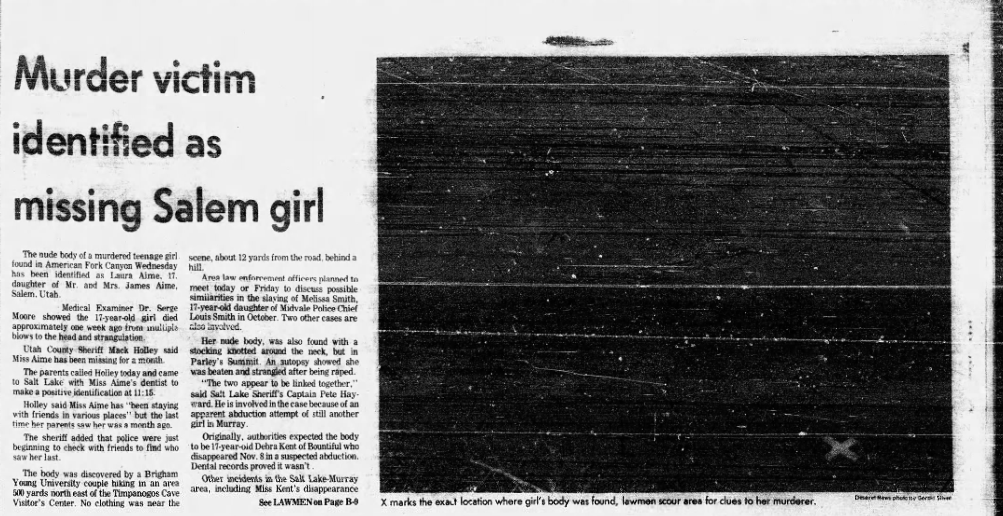
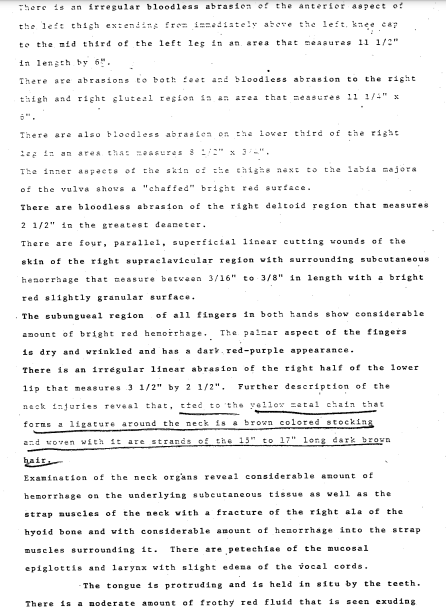
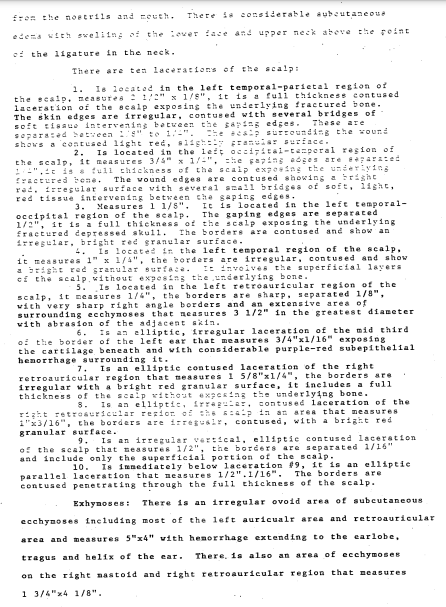
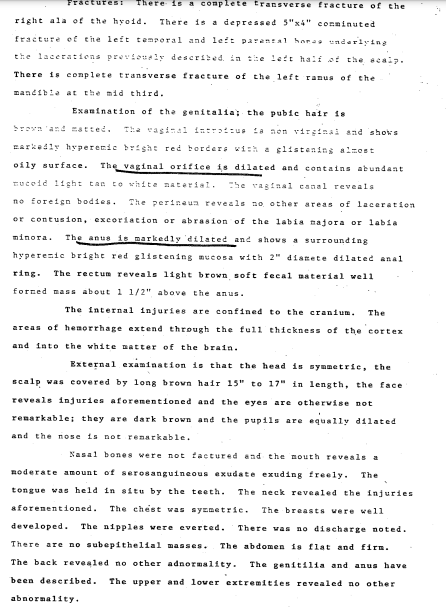
The remains of Aime were found less than a month after she vanished on Thanksgiving Day next to a stream in American Fork Canyon in the Wasatch Mountains by two BYU students that were looking for fossils for their Geology class (Raymond Ivins and Christine Shelly). Fearing that the murderer may still have been lurking in the area, the couple immediately went to the nearest ranger station and reported their discovery. Aime’s body was covered in leaves, twigs, and brush; she had been raped, sodomized, beaten then strangled to death with a pair of stockings. According to her autopsy report done by former Utah State Medical Examiner Dr. Serge Moore*, Laura had depressed skull fractures on the left side and back of her head and the necklace she was last seen wearing was tangled up in the pair of nylons that were cinched around her beck. She had numerous facial wounds (almost too many to count), and her body had deep wounds from where it had been dragged. LE deduced that the weapon used to inflict such brutal injuries was most likely either a pry bar or metal crowbar; her face was incredibly swollen and her tongue was hanging from her mouth. Aime had also suffered a vaginal puncture that may have been made by a weapon of some sort (perhaps an ice pick, and some have also wondered if it was a speculum which is what it’s thought Karen Sparks was assaulted with). Tire patterns that were found in the immediate area were said to be a match with Bundy’s Volkswagen Bug. *Just as a side note (per Kevin Sullivan), Dr. Moore never properly investigated either the temperature or the level of snow during the period that Smith and Aime were abducted. After complaints of sloppy work from Utah law enforcement Moore was investigated, and he officially lost his license in 1979 after he failed to produce any proof that he graduated from a University in Mexico City.

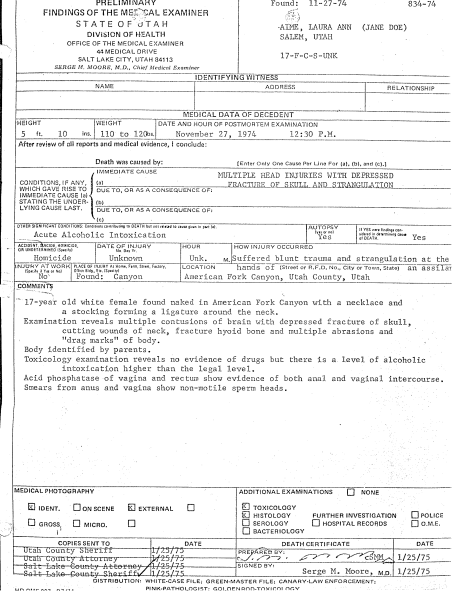
Laura’s cause of death was listed as multiple head injuries with a skull fracture and strangulation. Also, I do want to point out that I’ve seen the date incorrectly listed as both November 26 and 27th, but according to my research, Thanksgiving Day in 1974 was on the 28th. About the discovery, Ivins said: ‘I looked and I thought, you know, it was a deer or something and … it was a girl … It looked like she had been …she was dead. It was really grotesque. There was blood around her neck and breasts and she was naked and lying on that hill and it was a freak-out and I lost it. I thought maybe the guy was still somewhere around and I just panicked, worrying about my girlfriend . . . and we ran down the trail …Came down and ran right through the creek and got in the car and just drove like a maniac, I guess as fast as I could, down to the ranger station and I reported it.’ Swabs taken from Aime’s vagina and anus showed the presence of non-motile sperm, and blood tests showed no signs of substance use aside from alcohol. In the early stages of the investigation it was suspected that her remains belonged to Debra Kent, who had gone missing from Viewmont High School in Bountiful nineteen days earlier.

Several days before she was killed Laura spoke with her mother on the phone: Mrs. Aime begged her daughter not to hitchhike, and told her that she was afraid that she would meet a fate like that of Melissa Smith from nearby Midvale, who had recently been brutally murdered. She assured her she would be ok and told her mom not to worry; it was the last time they would ever speak. After Laura disappeared Mrs. Aime said that ‘she was missing and she had no purse coat, no nothing. I called the sheriff’s office and they said, ‘What do you want us to do about it?’’ On Sunday, November 3 Shirlene reached out to Judy Olsens’ mom, who was confused by her call, saying ‘isn’t she with you? We haven’t seen her since Thursday when she and Judy and Mark left for the Halloween party?’ Two days later on November 5, 1974 Mrs. Aime called the local police to notify them that her daughter was missing, and when she pleaded with them to look for her she told that there were too many ‘young runaways to pursue each one, and after a couple of weeks I just knew she was dead.’ After the remains of a young woman were discovered on a nearby river bank Shirlene reached out to the sheriff’s for a second time, and was again told ‘there’s no way it’s her, it couldn’t be her’ and that the victim was closer to twenty-five and wasn’t as tall as Laura. However the next morning a story in the newspaper mentioned the young woman was wearing a ‘ring with a green stone,’ which happened to be a peridot, which was Laura’s birthstone. Mrs. Aime immediately ran to look in her daughter’s jewelry box, to see if her peridot ring was still there. It was, however, the rest of the coincidences were just too much for her to bear.

Within an hour both Mr. and Mrs. Aime were on their way to the University of Utah morgue, accompanied by Sheriff Mack Hollet and a copy of Laura’s dental charts. Jim said that she had been beaten so severely that he ‘didn’t even recognize her,’ was only able to positively ID her by the scars on her forearm from the horse injury that I mentioned earlier. When he realized that he was looking at his precious little girl, he let out a loud, gut wrenching wail. Shirlene said that she ‘couldn’t believe it had come from a human being.’ Additionally, the dental records that the Aime’s brought with them further verified that it was Laura. Her autopsy revealed a broken jaw, a fractured skull, bruises and lacerations to her head and shoulders, a deep cut to the back of the head, and injuries to the vagina and anus. The ME determined that she had died on November 20, which was roughly twenty days after she disappeared. Many years after his daughter’s murder, Mr. Aime was driving near the spot where her remains were discovered with a friend, and he shared: ‘my little baby was up there all by herself and there was nothing I could do to help her.’

Captain Borax was able to locate a copy of the Lehi Free Press from the night Laura was abducted, and it was apparently an election period in local county government: Mack Holley was running for Utah County Sheriff, and Noall Wootton was running for County Attorney. Wootton was busy promoting his stance on crime prevention while Sheriff Mack Holley was preoccupied with communicating his belief in strong family values, but both men openly discussed the need for increased protection against the dangers that lurked in the night. Together, Wootton and Holley wrestled with a real, live boogeyman that slithered through the shadows of Lehi and American Fork, but at the same time they had no problems with hiding information away from one another. Mack Holley was known to keep information to himself and refuse to share it, and about him Jerry Thompson said ‘all I kept getting was a runaround, so I basically said, ‘to hell with them.’ As early as December 3, 1974 (which is only six days after Aime was found), retired Utah County Sheriff’s Sergeant Owen Quarnery wrote to the FBI crime lab in DC about the case, saying: ‘The MO is similar in many respects to the Smith case. The victims in both cases were beaten, sexually assaulted and strangled. Also many of the wounds were similar in appearance.’

Despite Laura disappearing on the last day in October it was determined she had only been dead for roughy a week when her body was discovered. According to Kevin Sullivans book ‘The Enigma of Ted Bundy,’ her remains showed a very small decomposition, which strongly hints that her killer may have kept her alive after abducting her. Looking into SLC temperatures during November 1974, it was a relatively warm fall and wasn’t very cold meaning the body wouldn’t have preserved because of low temps. Less than two weeks before Aime disappeared on October 18, 1974 Melissa Anne Smith disappeared from nearby Midvale after leaving a pizza parlor at around 9:30 PM. Nine days later her naked remains were found in a nearby mountainous area, and just like with Aime the only thing found on her body was a cross on a delicate chain necklace. One strange commonality I wanted to point out is that unconfirmed Bundy victim Sandra Weaver was also found the same way.

According to David McGowans book ‘Programmed to Kill,’ Melissa Smith’s body was found almost entirely drained of blood, and revealed a somewhat strange abnormality: like Laura, she had not been murdered immediately and had been kept alive for possibly a week after she was abducted. Additionally, her make-up was applied neatly and none of her nails were broken. Strangely there were no signs of restraints or ligatures, so if she was held against her will before her life was taken, there was next to no signs of it (perhaps he kept her in a locked room of sorts?). Retired Colorado investigator Mike Fisher strongly felt that Bundy brought both Smith and Aime back to his first SLC apartment (located at 565 1st Ave), and further elaborated that on occasion other tenants would hear him going down to the cellar in the middle of the night and making noise.

Sullivan feels that Bundy could have kept Aime alive in two possible scenarios: the first one being he kept her in the basement of his rooming house, which was in the rear of the building and that he could keep locked, and because he was the apartment manager he had a key for the area. The second involves him pulling what he calls a ‘reverse Lynda Ann Healy,’ and he carried her into his room in the middle of the night when no one was awake to see (then down and out again when he disposed of her remains). Thinking about it, carrying the body of a young woman out of your room in the middle of the night sounds awfully bold (even if she was alive), but by that time he had lived there for a few months and had most likely gotten familiar with the behaviors of his fellow tenants. We know he didn’t admit to anything related to Laura Aime during his confessions however he did admit to keeping Deb Kent alive in his residence for a period of time before he took her life, so it’s fairly likely that he did the same with Aime (and Smith). Laura’s autopsy report states that in the middle of November 1974 two or three of her friends told LE they think they got phone calls from her but weren’t 100% certain if it was actually her or not.

In the summer of 1974 Sheriff Mack Holley created Utah County’s first Detective Division, and Laura Aime’s murder was their first investigation. Strangely enough, in an interview between (retired) Chief Investigator for Utah County Brent Bollock and True Crime blogger and creator Captain Borax, Bollock said that (former) Utah County Sheriff Mack Holley never believed that Bundy was responsible for Aimes murder, and even wrote about it in one of his books (which I was unable to locate online). In fact, Holley strongly felt that another man was responsible for her murder, one that was later convicted of killing his girlfriend, even going so far as telling a member of the team of investigating detectives: ‘Bundy had nothing to do with our case, so forget him. That man didn’t do our case. I wish you’d get that through your head.’

A little over a week after Aime disappeared on November 8, 1974, Bundy tried (but failed) to kidnap Carol DaRonch from the Fashion Place Mall on South State Street in Murray. After the 18-year-old telephone operator escaped, Ted quickly realized that he needed a new victim, so he drove roughly 25 miles away to Bountiful and abducted 17 year-old Debra Kent (this will also be important later). The family was attending a showing of ‘The Redhead’ at Viewmont High School that went later than expected and Deb volunteered to take the family car and pick up her two younger brothers at a nearby roller skating rink. On her walk out to the parking lot, Bundy abducted her, then killed her and dumped her body roughly 50 miles away in American Fork Canyon.

In 1977 investigators took a second look into Aime’s murder, and they spoke with her girlfriend Marin Beverige, who positively identified Bundy as an individual that was at Brown’s on the night she disappeared. In fact, Marin’s sister worked at the establishment and even claimed to see Ted pull up and pick up Laura the night she disappeared. Beverige told detectives that she first noticed him one day in September 1974, and remembered that he drove a Volkswagen and told her he was a student at the local university. She also recalled one occasion where she was sitting in the sunshine with Laura and a group of friends near a local high school and the man joined them. When a young guy teased Aime by putting some grass down her halter top, he objected, and ‘this guy came unglued and told him Laura was his. He was really weird.’ Marin said that the attractive young man kept randomly showing up all around Lehi, and always seemed to be looking for Laura. She recalled an event that took place one night at The Knotty Pine, where: ‘he came in and was sitting there talking and I got up…..When Laura said, ‘I’m ready to go,’ this guy said, ‘You can’t. I’m going to rape you.’ Laura just laughed and pushed him away.’’

Beverige informed detectives that she had seen the man on multiple occasions, and one evening he even knocked on her front door and asked to speak to Aime privately. She agreed and after the two went outside to speak alone: ‘Laura was really shook up. But she wouldn’t say what happened.’ About the events surrounding her friend’s disappearance, Marin had a completely different account of what happened that night, one that differed greatly from the one gathered by the Utah County Sheriff’s Department: according to Beverige, her, Laura, and a bunch of their friends had gathered at her house for a Halloween party, and some guys had brought a large amount of vodka and Laura had gotten pretty drunk: ‘It was about midnight or so, and she was pretty well drunk. And she wanted me to walk downtown with her to get some cigarettes.’ She said no, and as Aime walked away into the darkness it was the last time Marin ever saw her friend. ‘Around three or four o’clock some of us went to town to look for her, but we couldn’t find her.’ When Beverige was shown a lineup she immediately picked out Bundy; a female clerk employed at Brown’s picked him out as well. She was also asked to take a polygraph test which she agreed to, and passed. 

Mrs. Aime called the early stages of her daughter’s murder investigation ‘damned frustrating,’ and said it was filled with ‘blunders, omissions and political jealousies,’ elaborating that two of the detectives working the case were incredibly uncoordinated: ‘one would come and ask me a question, and a couple hours later the other would come and ask me the same thing. Neither of them would tell the other anything.’ On one occasion a political rival of the (then current) sheriff came to speak with the family to ask them questions for his own personal investigation, and because the Utah County Sheriff’s Department was so unwilling to share information the Aimes would frequently receive phone calls from other police agencies, asking for information about their daughters murder. Not satisfied with how local LE were handling Laura’s murder, the Aime’s desperately wanted the experienced homicide detectives in Salt Lake City to help with the investigation, but they were turned down and told by (local) officers, ‘if we can’t solve it, no one else can.’ Mr. and Mrs. Aime felt that Laura’s murder had become somewhat coveted politically, and that whoever was able to solve it ‘could have written their own ticket politically.’ But unfortunately it went unsolved, and months went by without investigators learning anything new, and it wasn’t until August 1975, when a handsome young law student was arrested that everything started to come together, and Ted became the first decent suspect in her murder. It was at that point that a highly skilled investigator became involved in the case, Brent Bullock of the Utah County attorney’s office, who the family was incredibly pleased with, and was impressed and encouraged by his ‘professionalism, his relentless search for evidence, and his questioning of witnesses.’

When Bundy escaped prison for the first time in Aspen on June 7, 1977, Jim Aime ‘exploded in anger,’ and he ‘would have gone down there and searched for him myself, if I could have afforded to lay off work.’ Thankfully the father of five remained home with his family (he still had four daughters at home), but because Shirlene was so afraid for the safety of their other girls he bought her a .38-caliber pistol. As we all know Bundy was recaptured just a few days later on June 13, 1977, but he escaped for a second time later that same year on December 30 from the Garfield County jail in Glenwood Springs. By this time in the year they had ‘hocked’ the weapon as they were reportedly ‘hard-pressed financially,’ and by his second escape Jim had become even more angry and bitter, and said that his wife was ‘just scared to death. She quit her job so she can stay home and watch the kids. She won’t let those girls out of her sight.’

Laura’s murder wasn’t the only time that the Aime family had to deal with the ‘keystone cops:’ After graduating from high school John joined the military and became a radar specialist in the Army, but after his sister was killed it was as if the entire family’s lives fell apart. After leaving the service he began working in construction in Tacoma, and on April 28, 1975 at around 10 PM he reportedly approached a young woman on a street, briefly spoke with her, then physically accosted her. She testified that she was ‘grabbed by Aime and dragged toward a brushy area and that the defendant ran when she fell to the ground and screamed,’ (she also said that he tried to ‘drag her’), and after letting out an ear piercing scream he fled, but a passerby caught him and held him at gunpoint until police arrived. Aime later said that he had no intention of harming or molesting the young woman, and his wife Lynn was completely puzzled by that incident and couldn’t provide any explanation for her husband’s actions. John was taken to jail and investigators began digging into his past; a probation officer wrote: ‘he and his family have suffered as a result of his sister being raped and killed in Utah.’ While in jail in Tacoma Aime got married to a medical technician and an Air Force vet; it was an unusual ceremony that took place without the guards’ knowledge. After a two-day trial in June 1977, he was convicted of a misdemeanor assault and was sentenced to a five-year term at Washington’s Western State Hospital at Steilacoom for the rehabilitation of sex-offenders. For obvious reasons, this devastated both of his parents, and about the incident Mr. Aime said that he ‘was just a scared kid from the country.’

Before Bundy was put to death in Florida, he confessed to killing Laura Ann Aime on January 22, 1989 in a 90-minute confession with (retired) SLC Detective Dennis Couch. The following is an excerpt from Dick Larsen’s ‘The Deliberate Stranger:’ ‘Y’know, there’s always been something about that Laura Aime case, that one in particular, that’s really bothered Theodore. When several case files were given to Bundy in his jail cell, under the discovery procedure …. the first one he went for … and really tore into … was the Aime case…. ‘ When asked about his involvement in Aime’s murder, Ted lowered his head and refused to talk about it. Strangely enough, I’ve heard that he washed some of his victims’ hair and manicured some of their nails as well, but this is the first time I’ve written about a woman that he actually did it to. After Aime’s remains were found, law enforcement determined that her hair had been recently shampooed, making them believe her killer had returned to her corpse on multiple occasions to engage in acts of necrophilia. About this act is a passage from Michaud and Aynesworths book, ‘The Only Living Witness:’ ‘Bundy also indirectly touched on some old mysteries, such as Laura Aime’s freshly-washed hair, and Melissa Smith’s make-up: ‘If you’ve got time,’ he told Hagmaier, ‘they can be anything you want them to be.’’

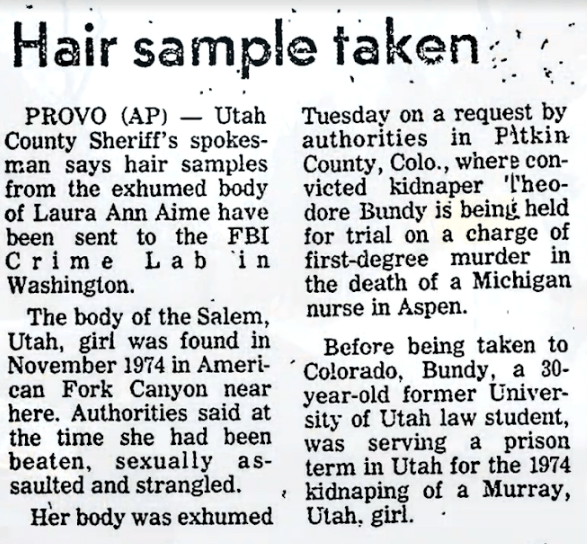
According to an article published by The Salt Lake Tribune right before Bundy was executed, investigators had to exhume Aime’s remains in order to get another hair sample because the first one they obtained after her remains were initially discovered were misplaced. Jim Aime wept at the mere thought of it, but relented, saying ‘why not? They can’t hurt her any more. It seems like these things just couldn’t happen.’ About her daughter’s disappearance, Mrs. Aime commented that ‘there’s no way of putting it out of your mind…’

According to Ann Rule’s true crime classic, ‘The Stranger Beside Me,’ Laura’ toxicology report came back just over 0.1, which is obviously an indicator of impairment (at least from a legal standpoint), but at the same time wasn’t so extreme or outrageous that she wouldn’t have been able to defend herself (or at the very least scream or try to run away). Now, if she really was kept alive up until a week before her death, and she wasn’t murdered immediately after the Halloween party… Was Bundy plying her with alcohol up until her final moments? Another thing that is jumping out at me as being weird is… if Laura Aime was kept alive until roughly a week before her body was discovered, that would put her murder date sometime in between November 17-20 (roughly, give or take)… Did he somehow keep multiple victims alive at the same time (somewhere)? Were Aime and Deb Kent somehow kept alive together in an unknown location for a period of time? Did he kill the one in front of the other, like with the Lake Sammamish murders of Denise Naslund and Jan Ott?

Despite the way she was killed was very similar to Bundy’s MO and she fit the physical description of  one of his victims, he initially denied any responsibility for Aime’s murder and refused to talk about her when he was questioned. However, (most likely) in an attempt to delay his execution in the days leading up to his death Ted finally confessed to the murder of Laura Ann Aime.

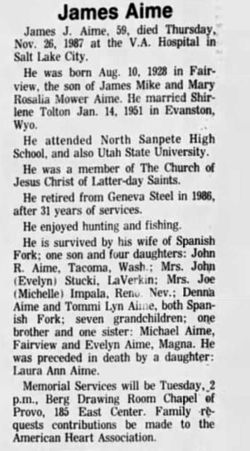
Mr. Aime died at the age of 59 on November 26, 1987. It appears that in 1980 Shirlene Aime adopted her granddaughter Danika, who was given the middle name of Laura after the aunt that she never had the chance to meet. Mrs. Aime died on November 1, 2011 in Reno, Nevada at the age of 77. Laura’s only brother John died at the age of 56 on November 29, 2010 in Gunnison, Utah but it appears that all of her sisters are still alive. Because it’s’ strongly suspected that Bundy kept her alive for a period of time after abducting her, the Aime family chose to list ‘November 1974’ as her official date of death on her gravestone.
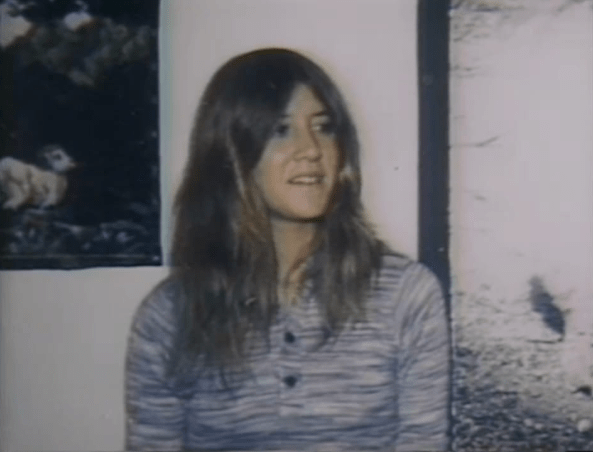
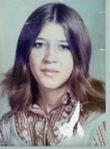
Laura Ann Aime. Her mother said she had ‘hell inside her’ after watching her ride her shining blue Arabian horse at top speed.
Laura Ann Aime.
Laura Aime.
Laura Ann Aime.
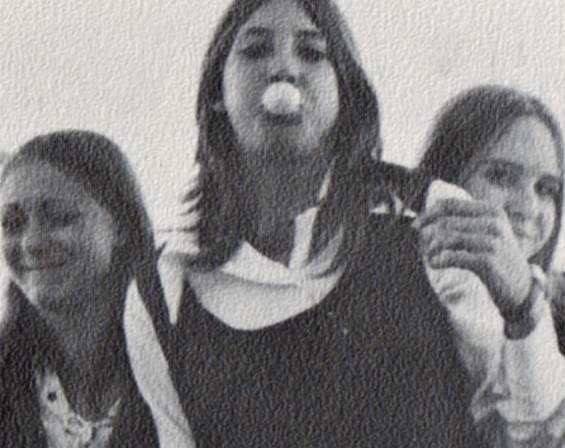
Laura Aime, blowing a bubble.
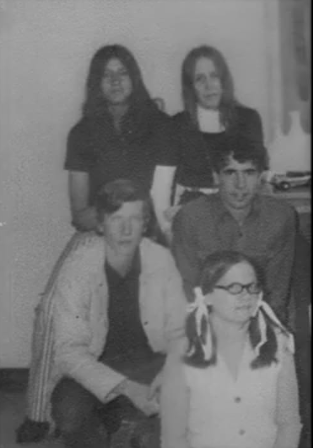
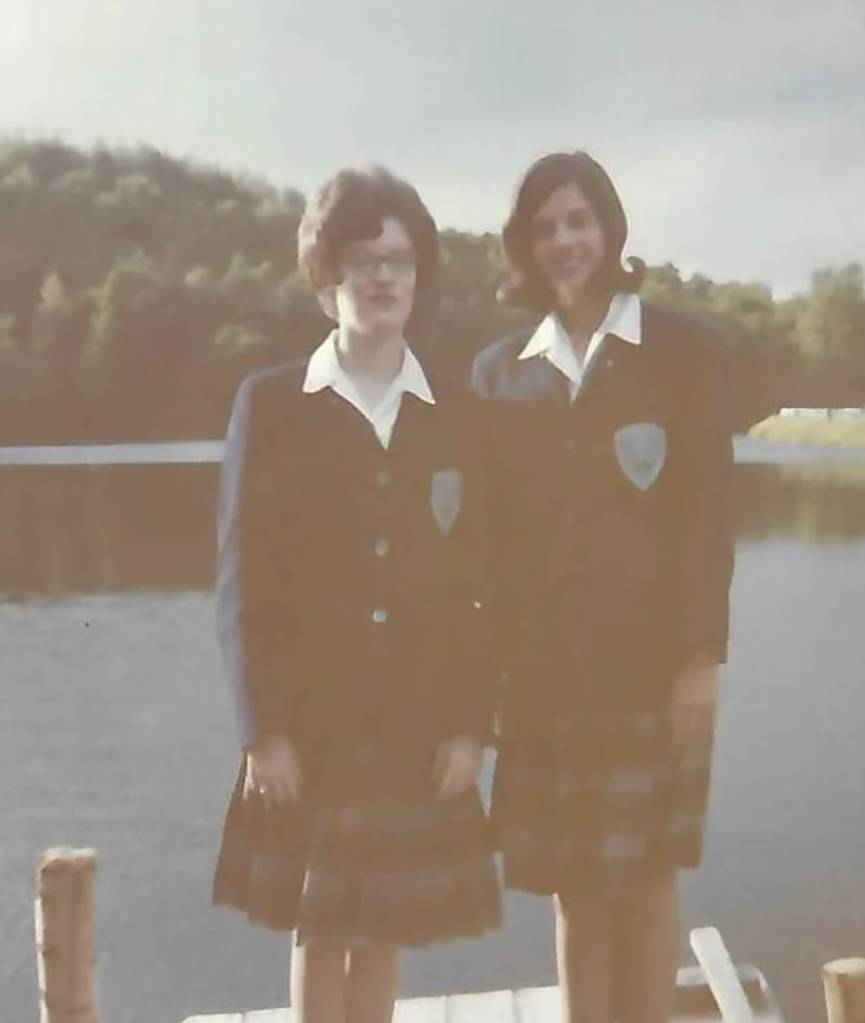
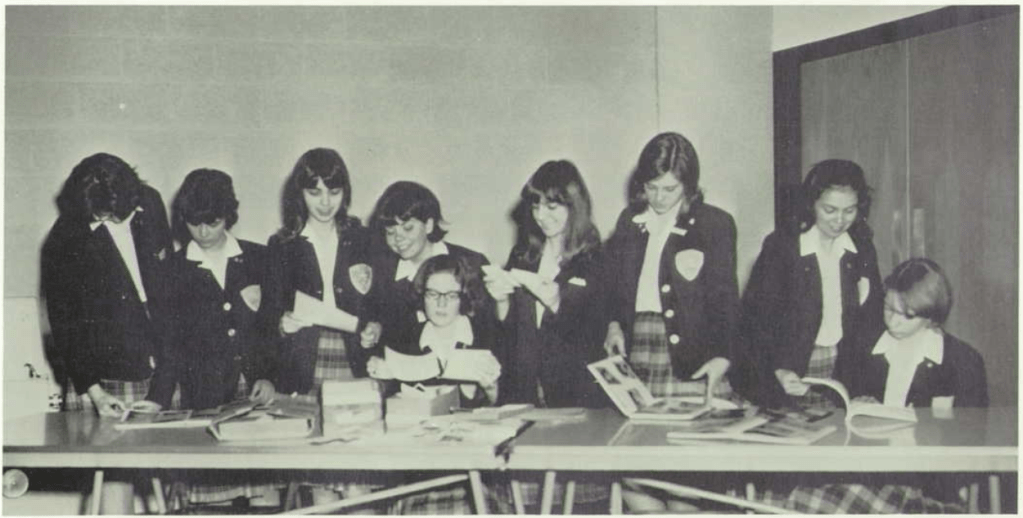
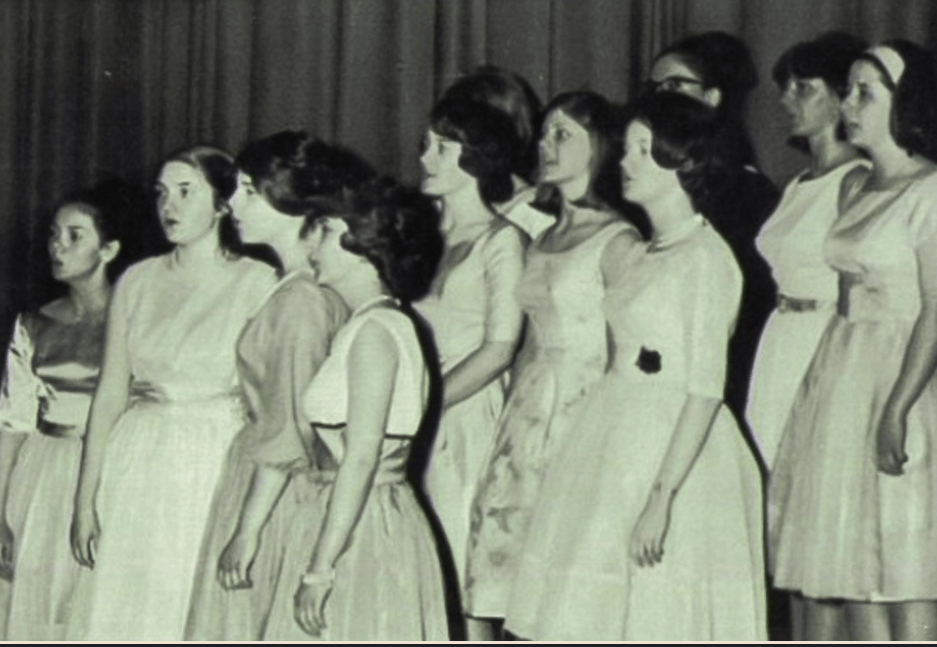
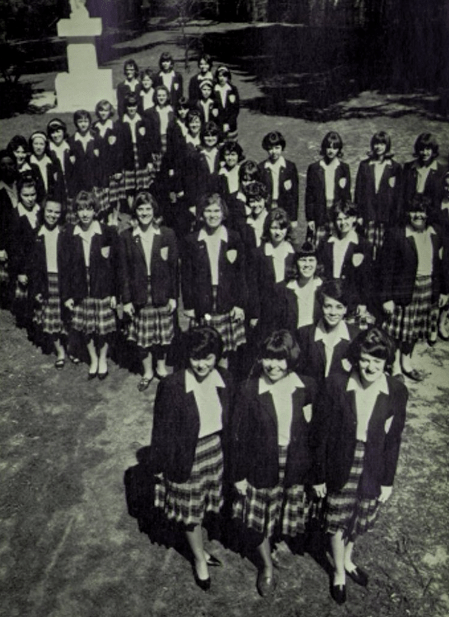
A group picture from Laura’s time at North Sanpete High School; Laura is in the back row on the far right.
Laura in a group photo.
Photo courtesy of OddStops.
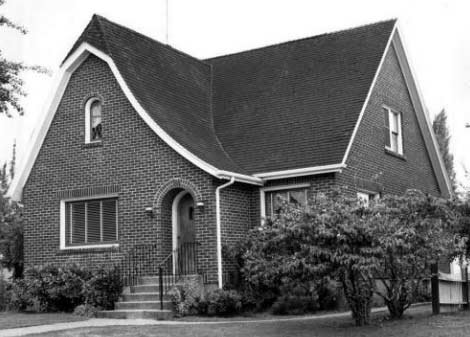
The Aime’s residence. Photo courtesy of ‘Crimes Forgotten by Time.’
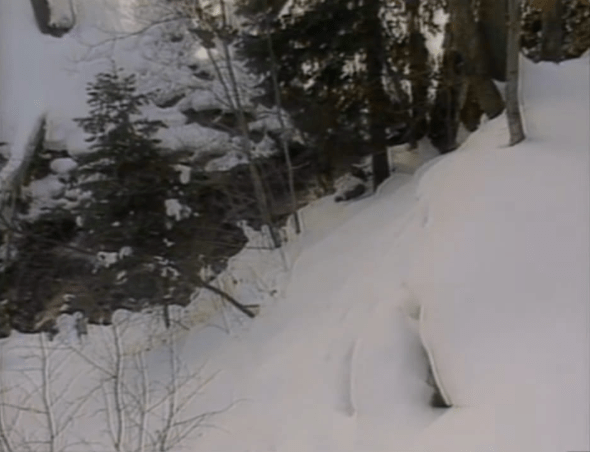
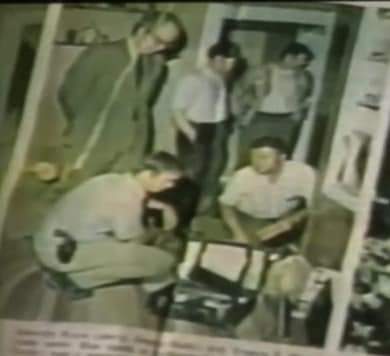
Investigators at the site where two students found the remains of Laura Ann Aime. Photo courtesy of OddStops.
Investigators at the site where two students found the remains of Laura Ann Aime. Photo courtesy of ‘Ted Bundy: I was trying to Think like an Elk.’
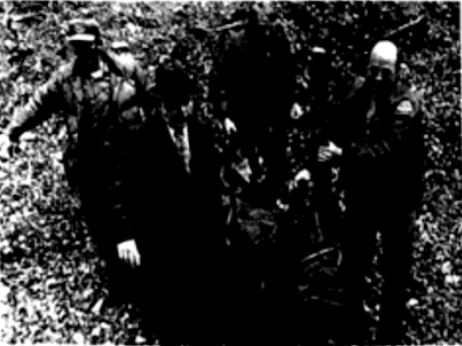
Investigators at American Fork Canyon carrying out the remains of Laura Aime.
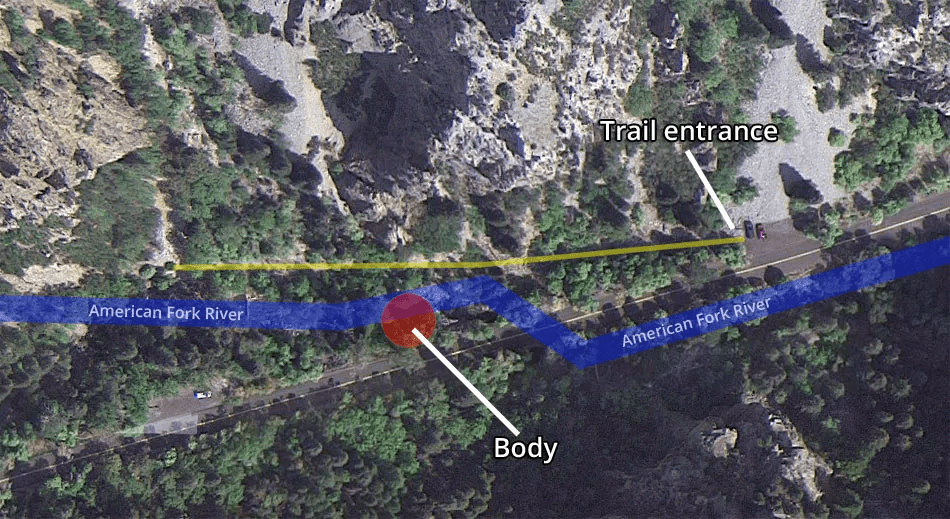
A labeled aerial map of the dump site of Laura Aime in American Fork Canyon. The yellow line shows the trail the students took when they found her remains. Photo courtesy of OddStops.
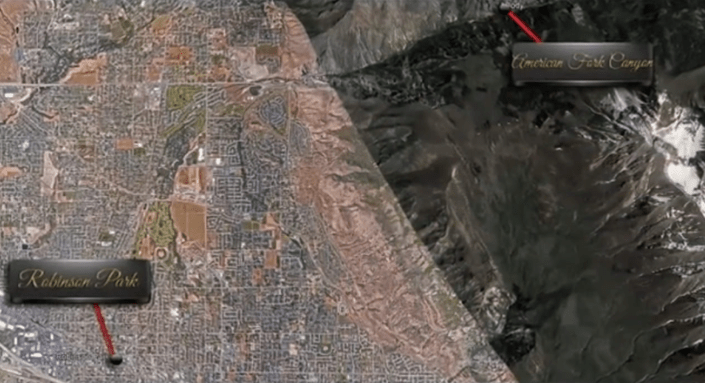
A labeled map of where Robinson Park is located compared to the dump site of Laura Aime in American Fork Canyon.
A chart of the average temperatures in SLC in November 1974 when Laura was missing and possibly being kept alive somewhere.
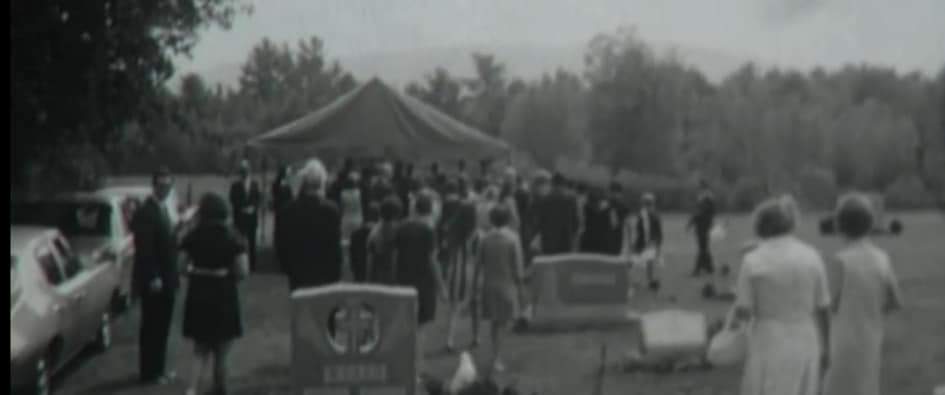
Aime’s gravesite at the Fairview Cemetery in Utah.
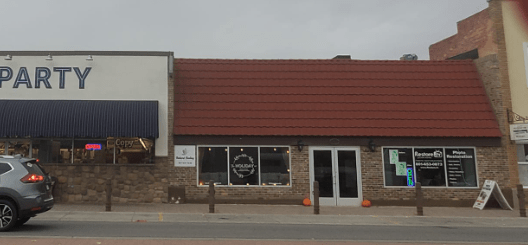
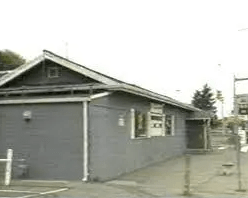
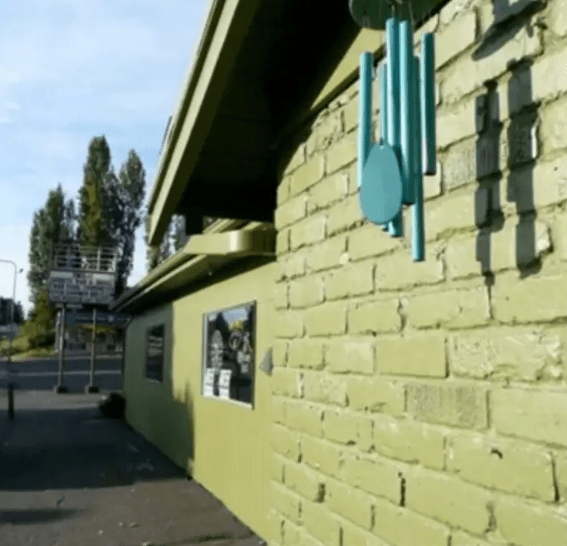
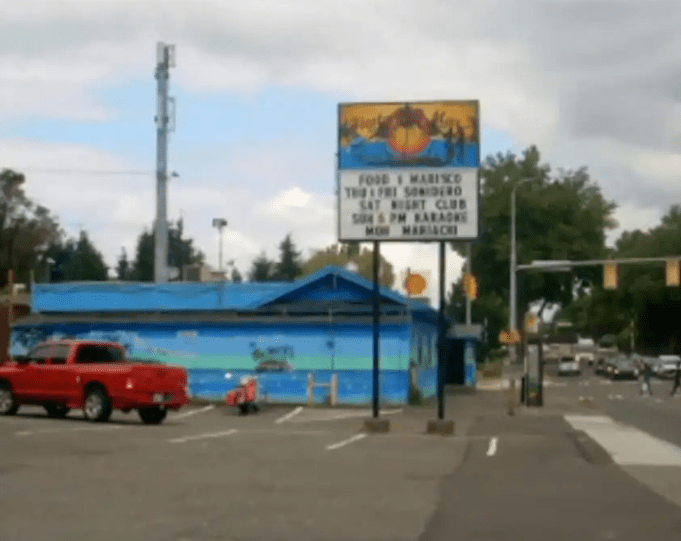
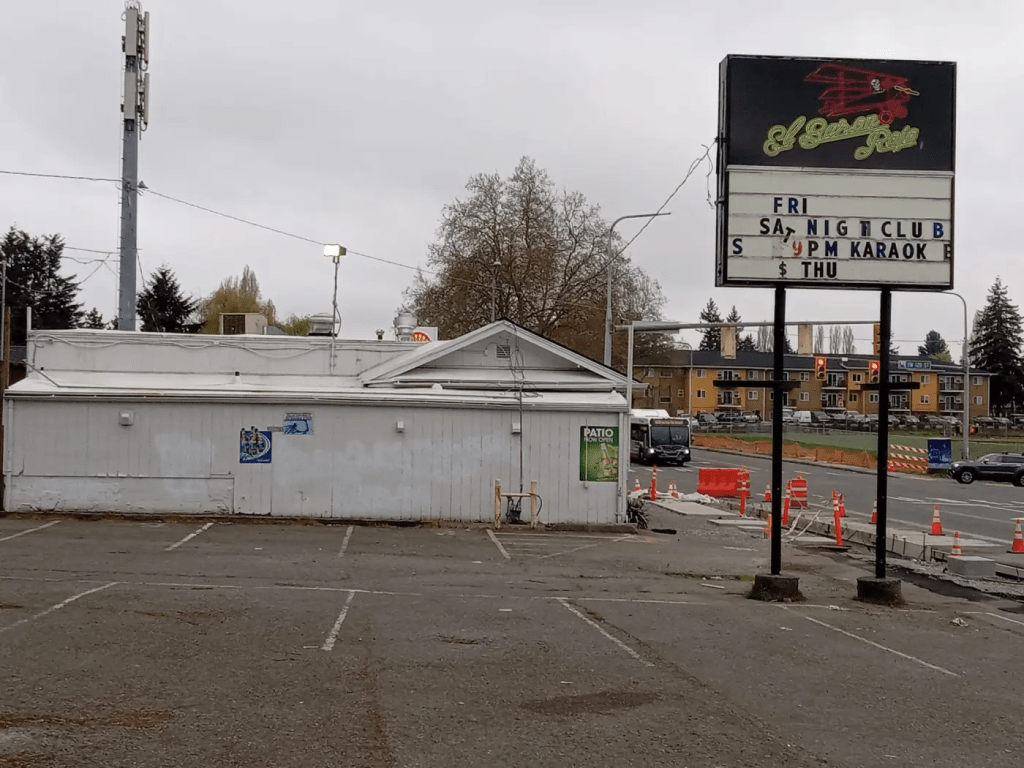
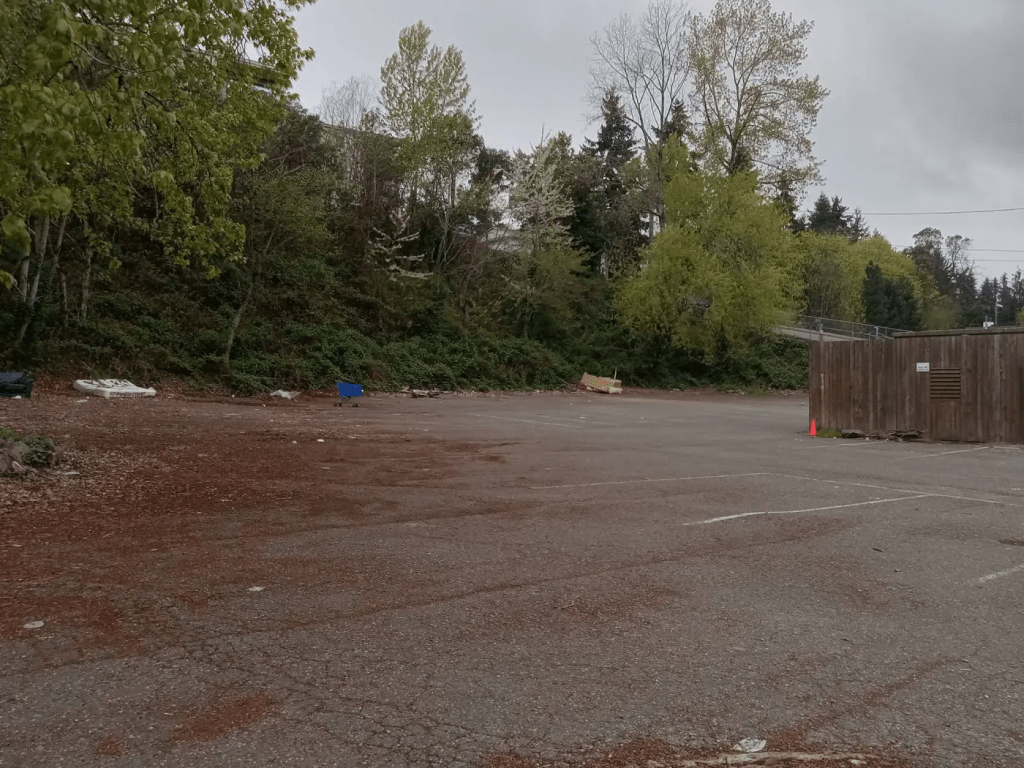
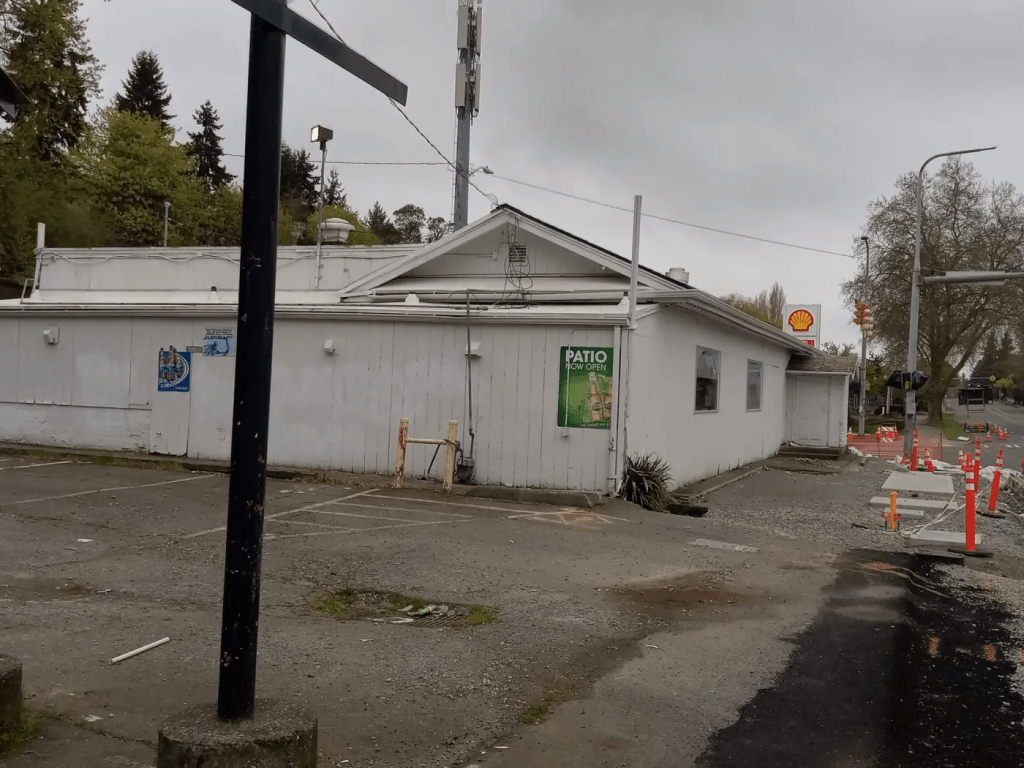
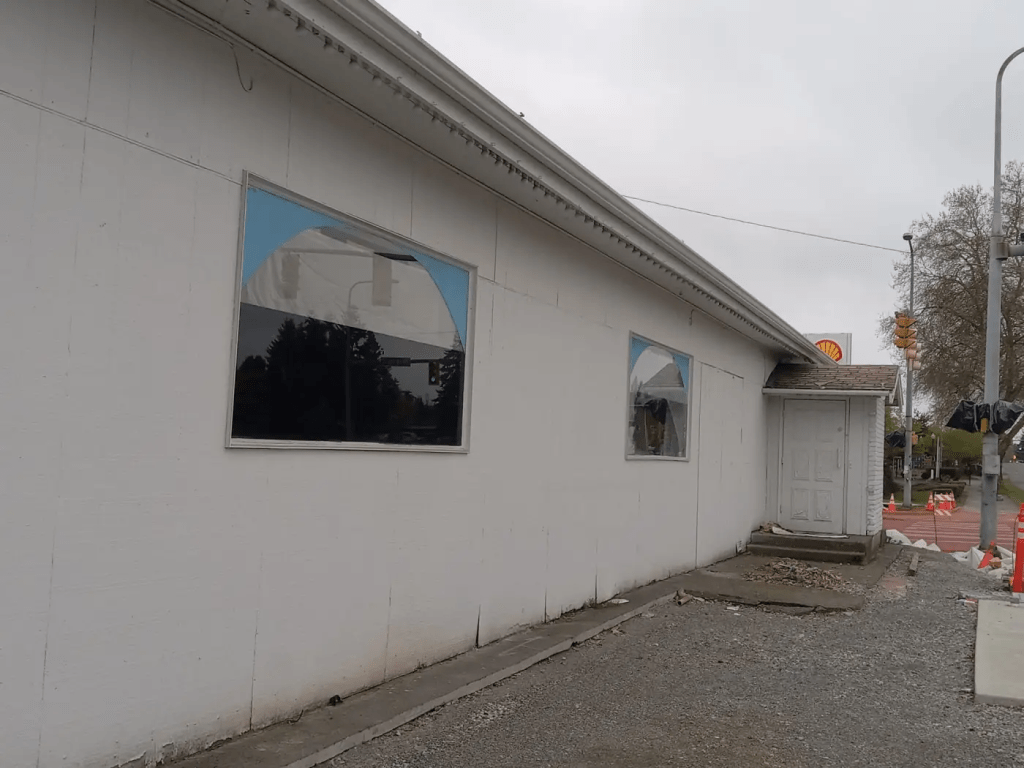
Where ‘The Knotty Pine’ once stood in Lehi, UT, in the left hand side of the building. Picture taken in November 2022.
Where ‘The Knotty Pine’ once stood in Lehi, UT. Picture taken in November 2022.
Laura walked down this street the night she disappeared to go to the Knotty Pine. Photo courtesy of Captain Borax.
An old advertisement for the Knotty Pine Cafe. Photo courtesy of Captain Borax.
William S. Robinson Park in American Fork, Utah. Picture taken in November 2022.
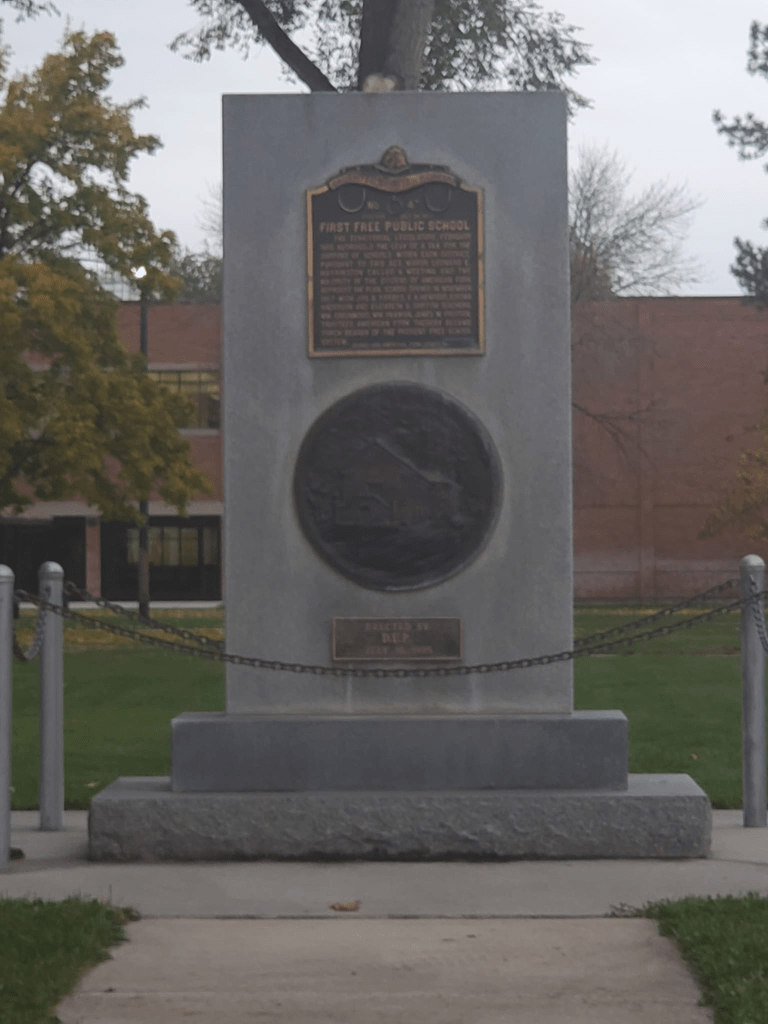
A statue at William S. Robinson Park in American Fork, Utah. Picture taken in November 2022.
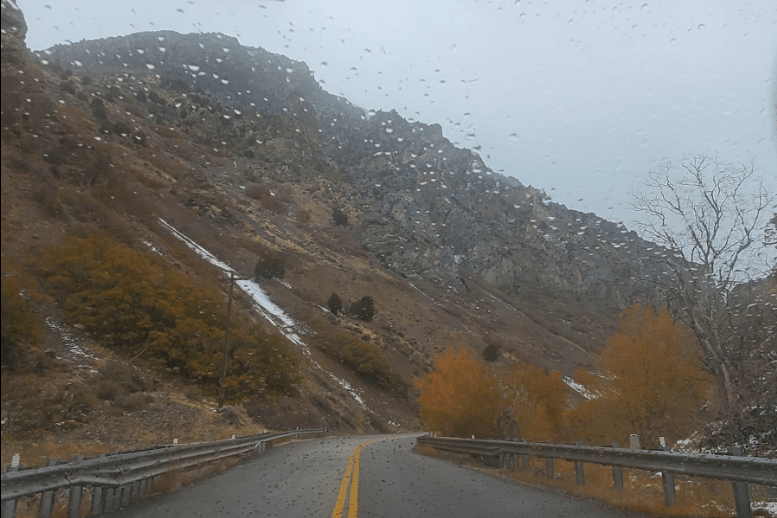
The entrance the American Fork Canyon. Picture taken in November 2022.
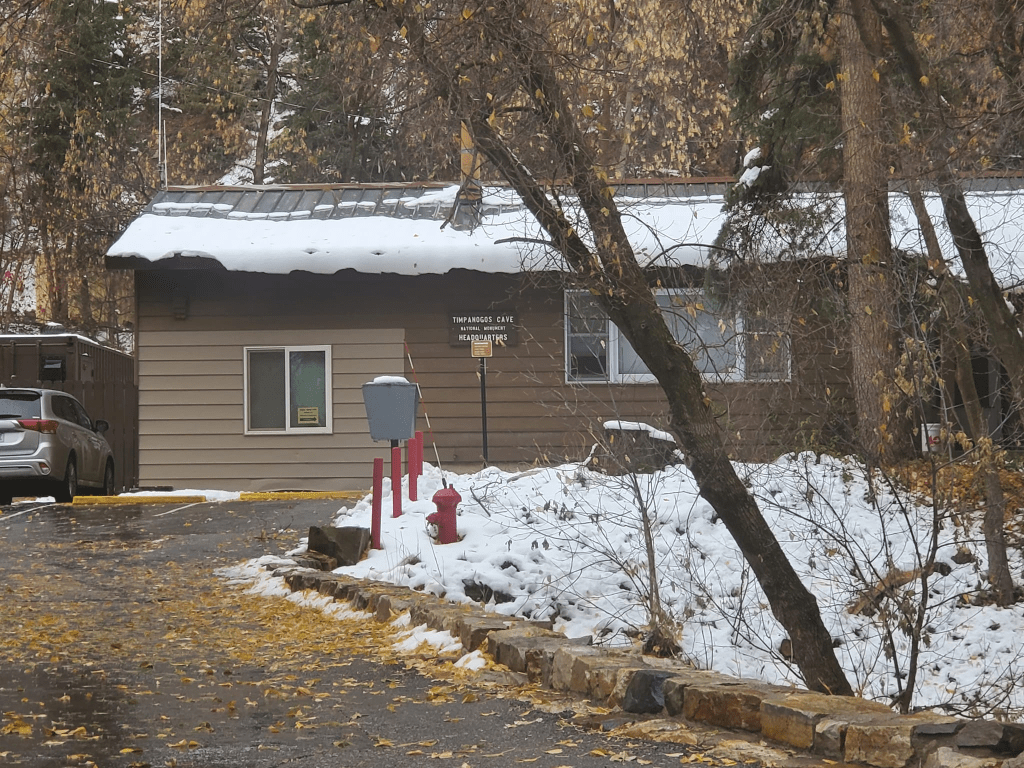
A building at the entrance the American Fork Canyon. Picture taken in November 2022.
A gate at the entrance the American Fork Canyon. Picture taken in November 2022.
A sign for the Timpanogos Cave at the entrance the American Fork Canyon. Picture taken in November 2022.
A sign for the Uinta National Forest at the entrance the American Fork Canyon. Picture taken in November 2022.
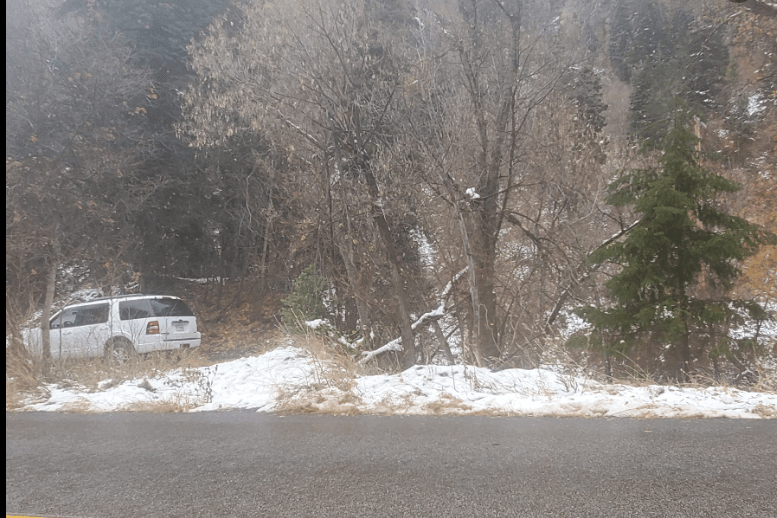
This white SUV is where the PD coordinates took me from the OddStops website.
Former Utah County Attorney, Noall T. Wootton. Photo courtesy of Captain Borax.
An article about an antler contest that Mr. Aime won, published by The Pyramid on November 8, 1968.
A picture of Mr. Aime with his award winning buck. Photo courtesy of Captain Borax.
An newspaper blurb mentioning some of the Aime sisters, published by The Pyramid on September 9, 1971.
A newspaper blurb mentioning some of the Aime girls, published by The Pyramid on June 8, 1972.
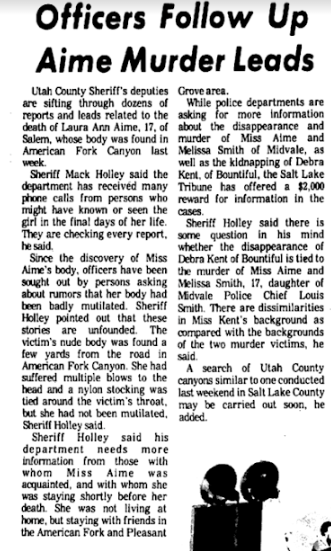
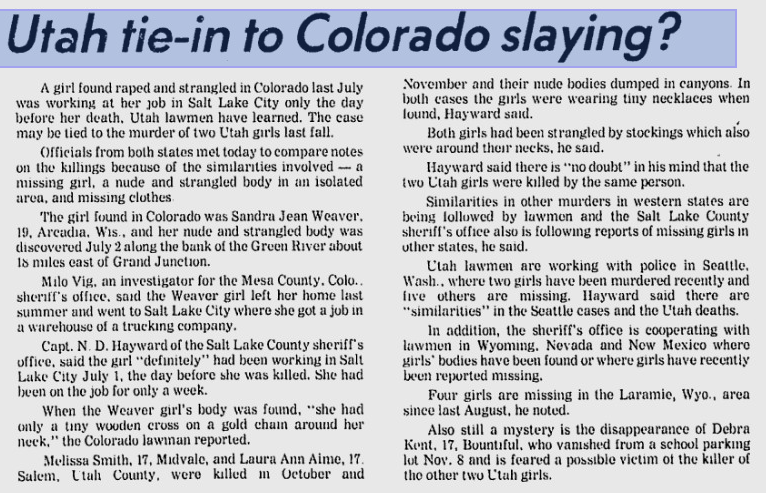
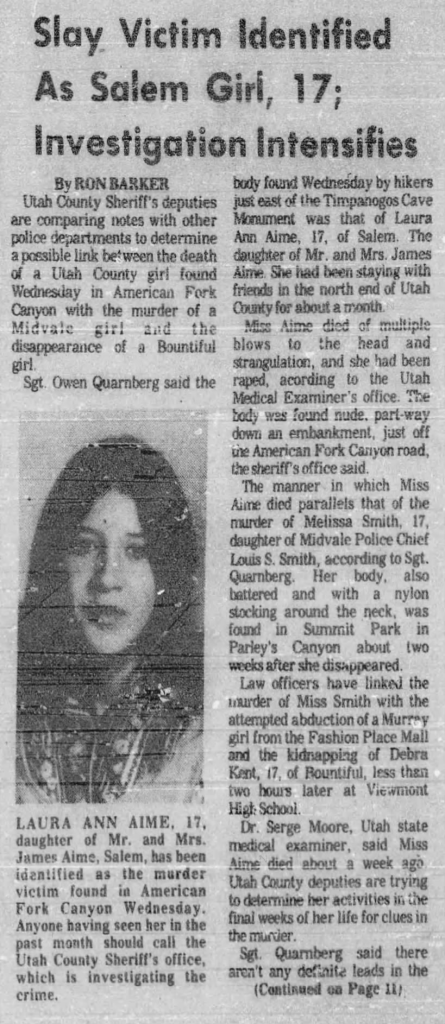
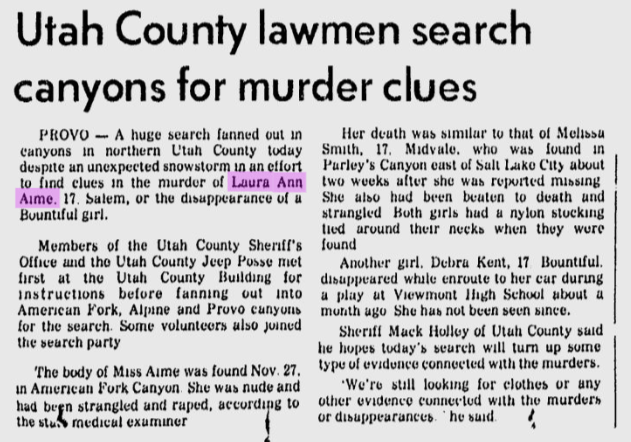
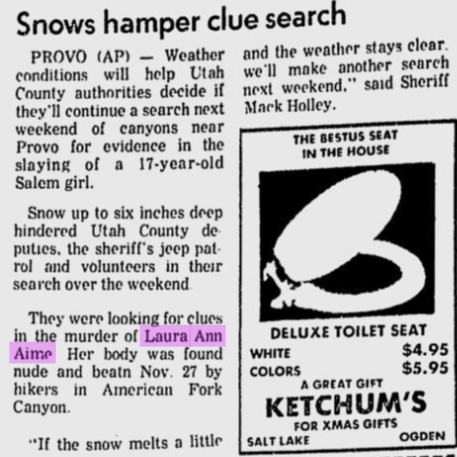
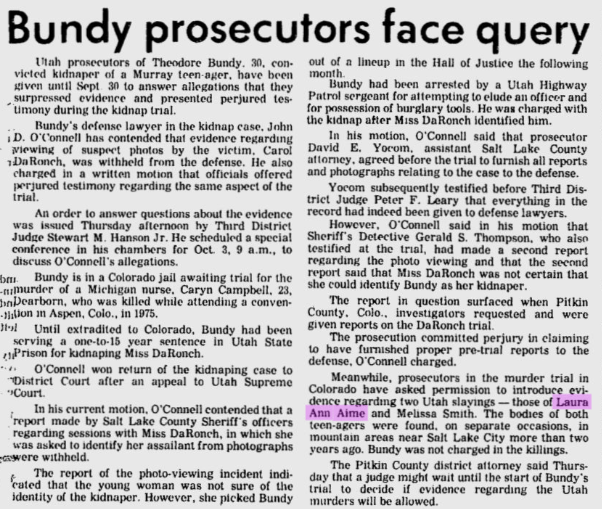
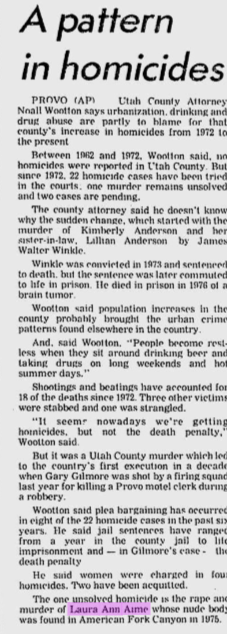
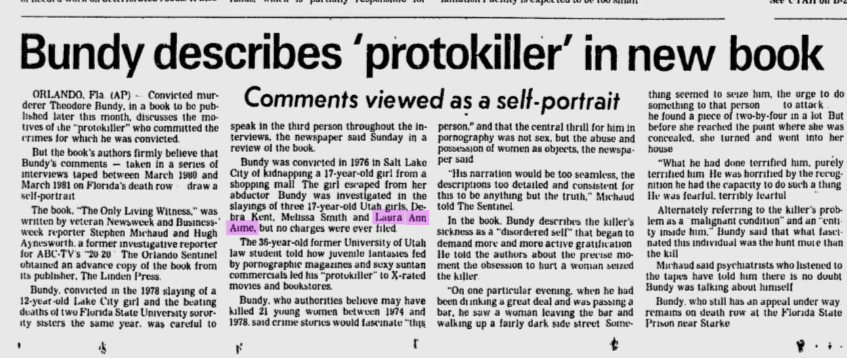
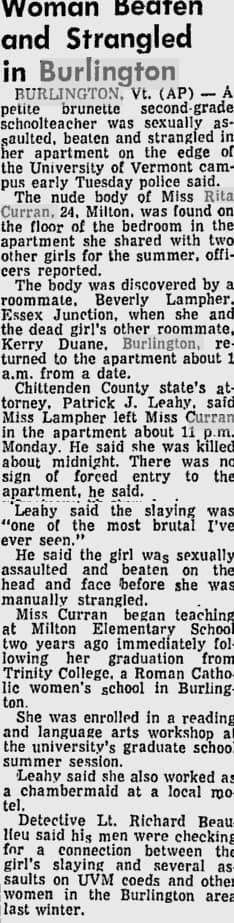
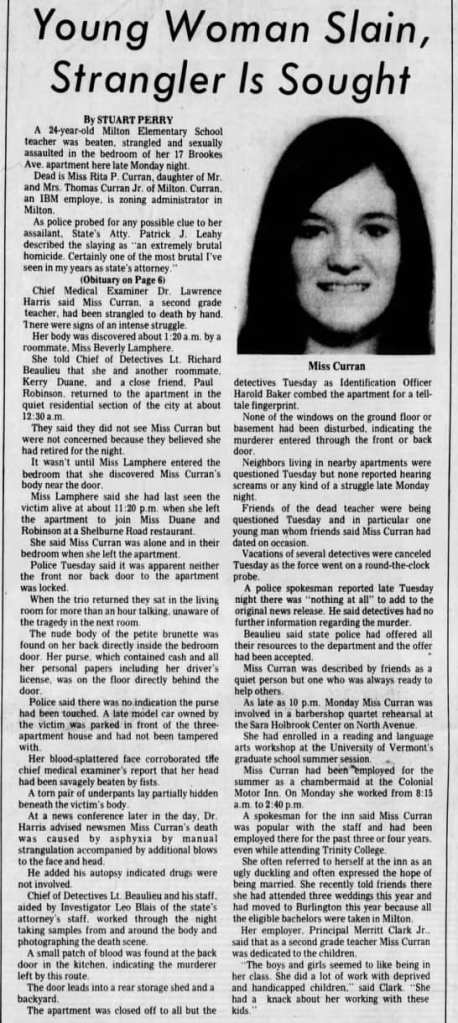
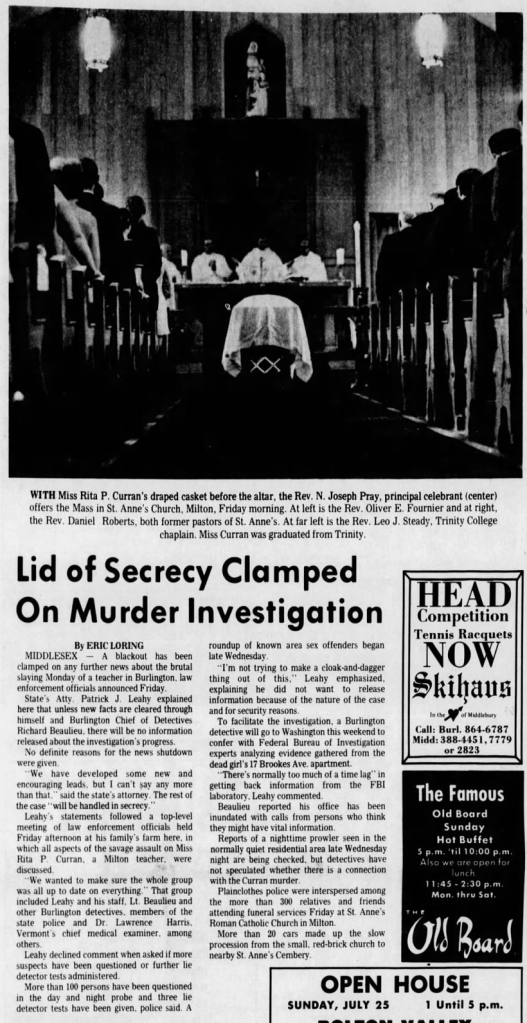
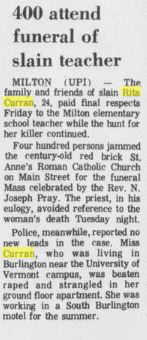
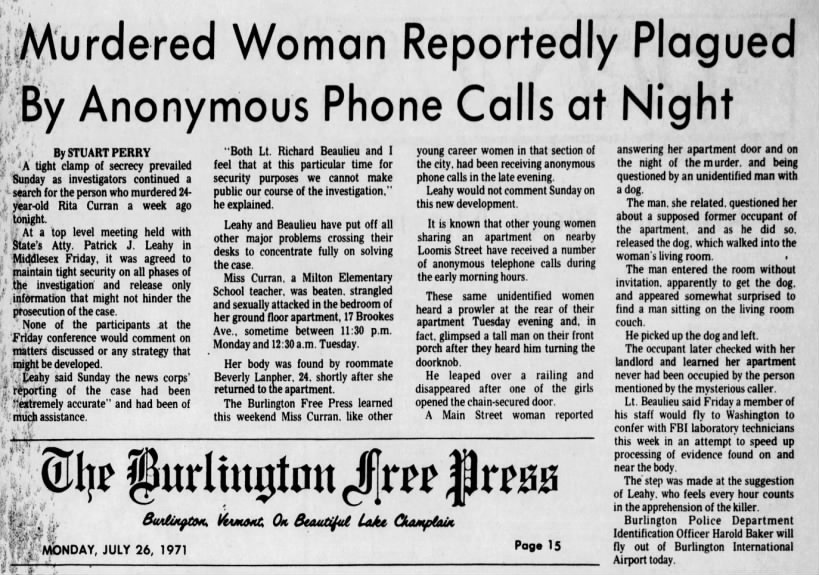
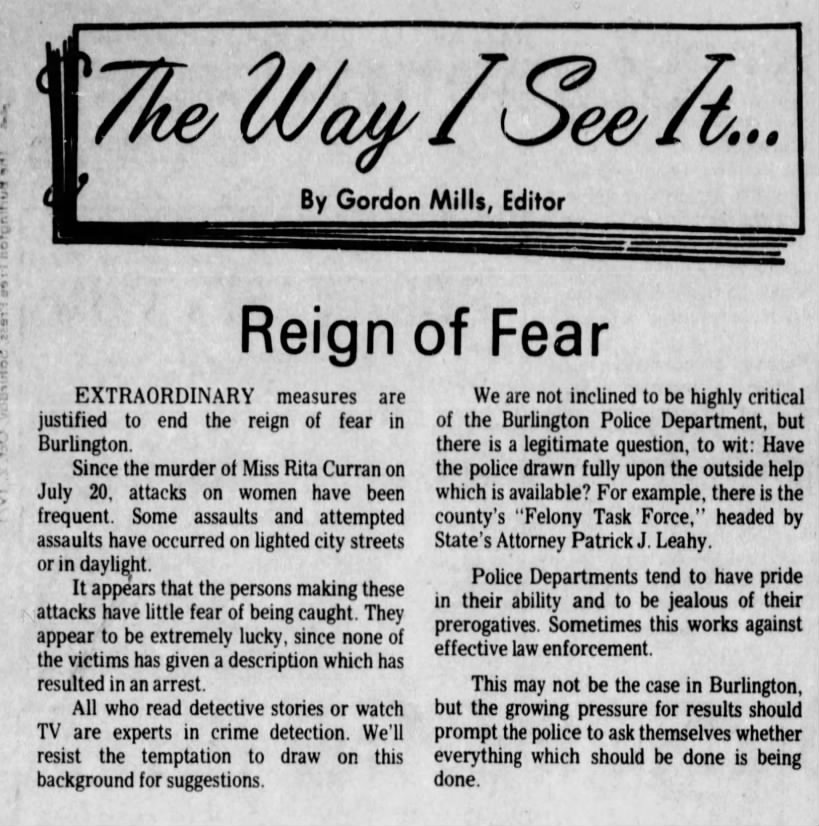
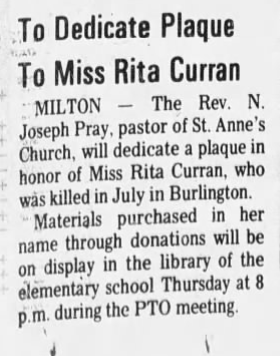
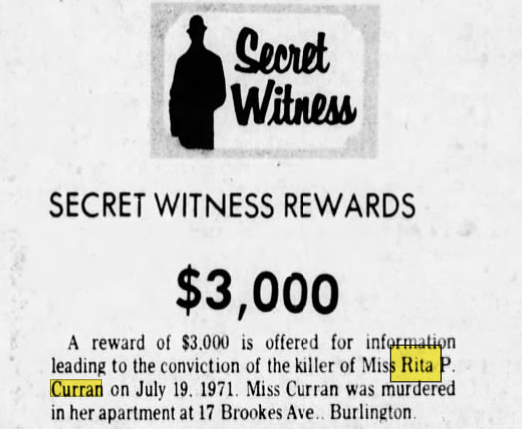
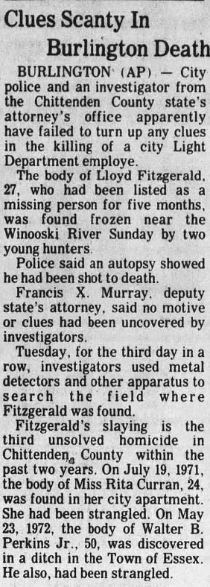
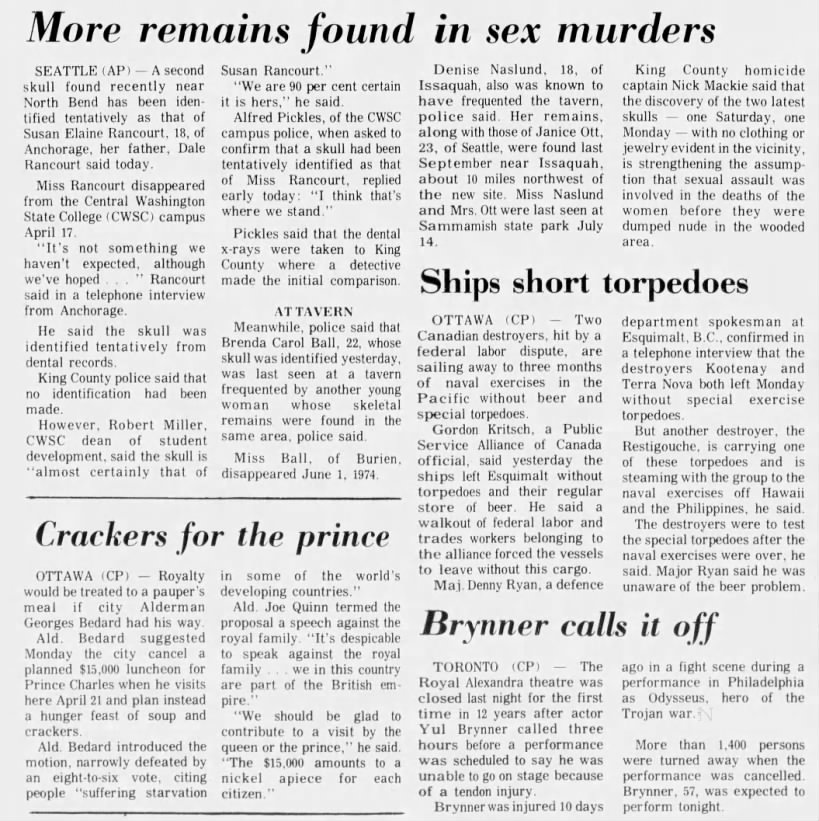
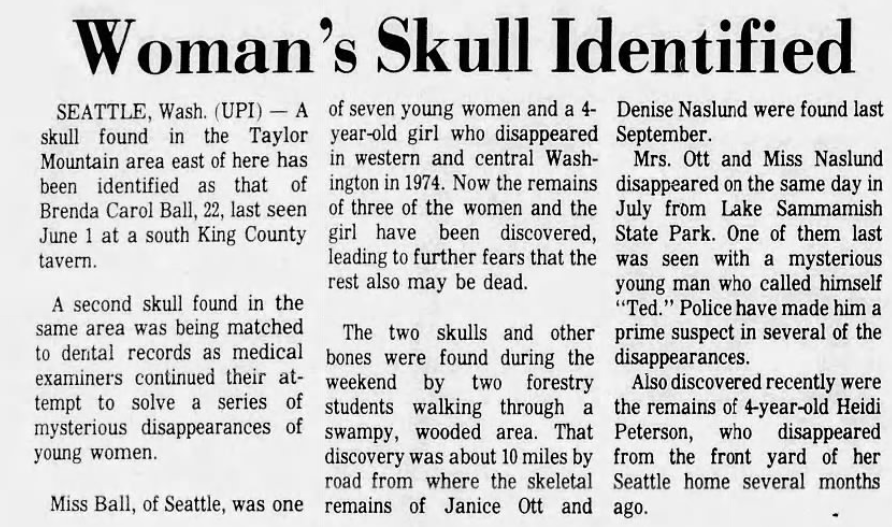
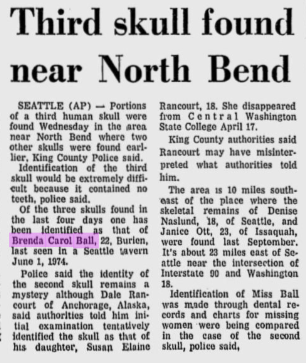
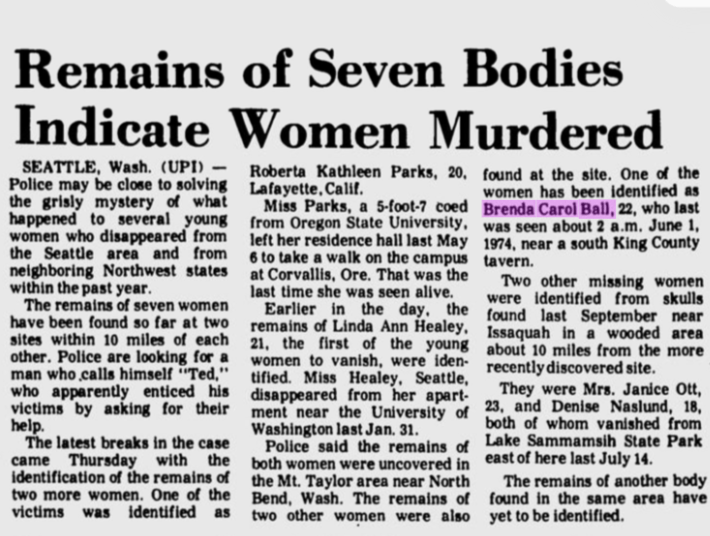
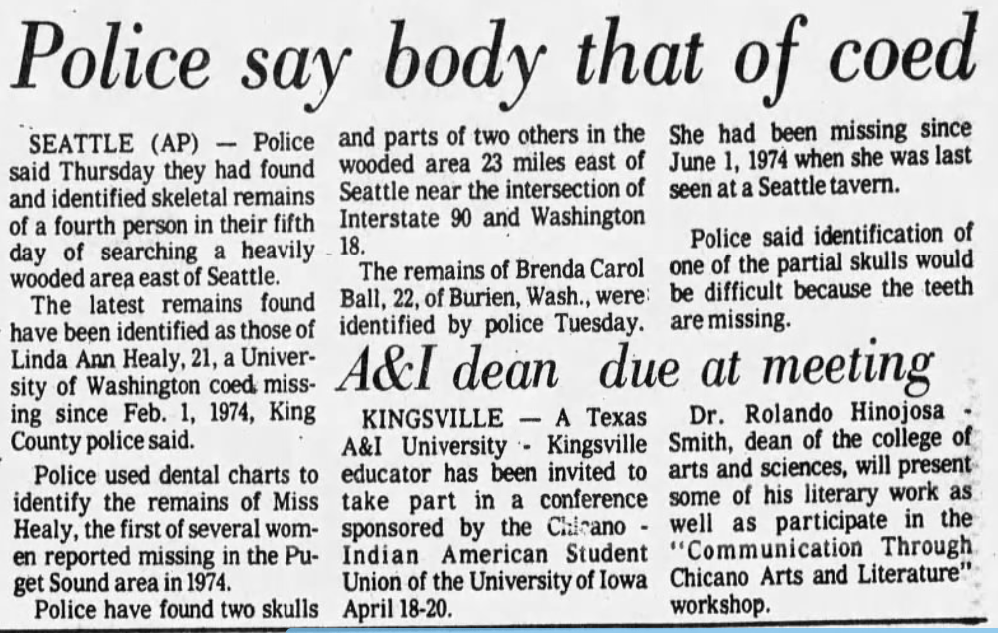
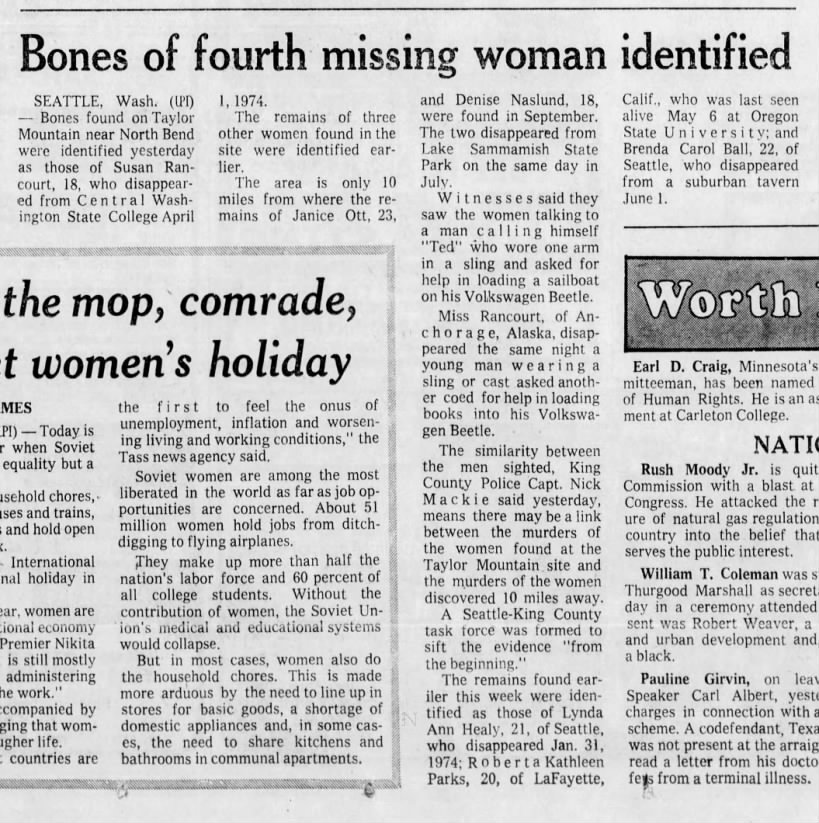
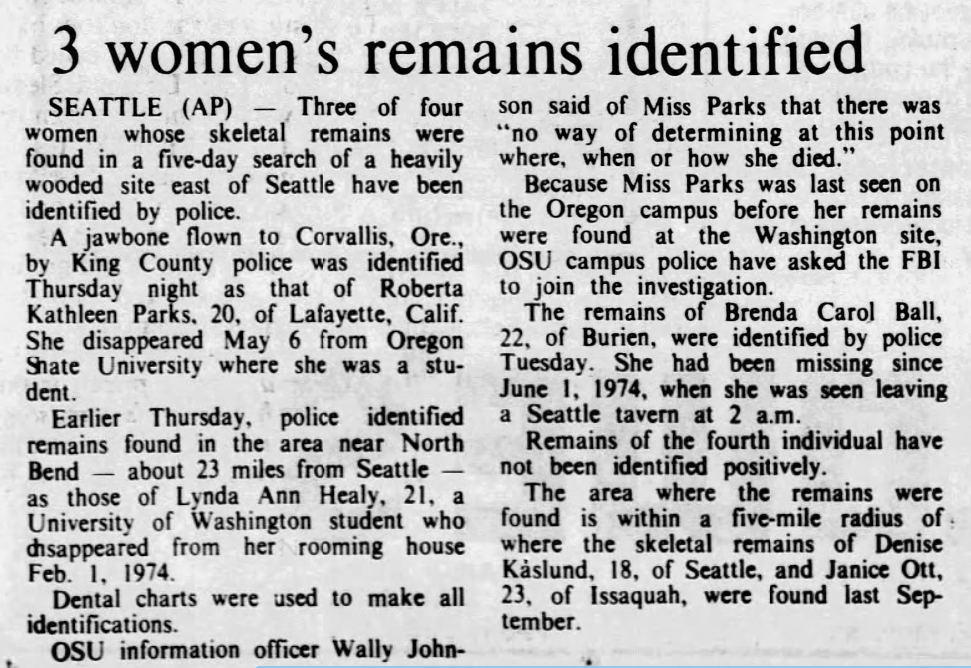
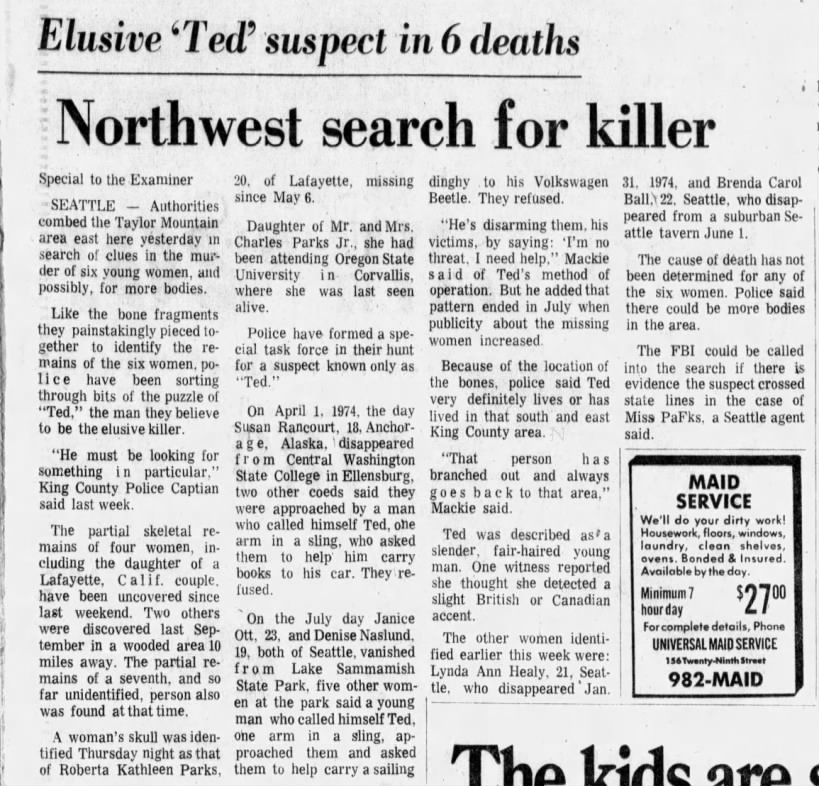
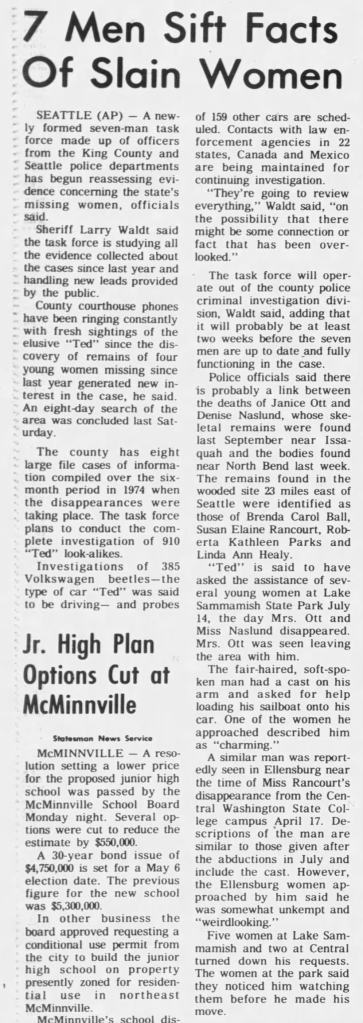
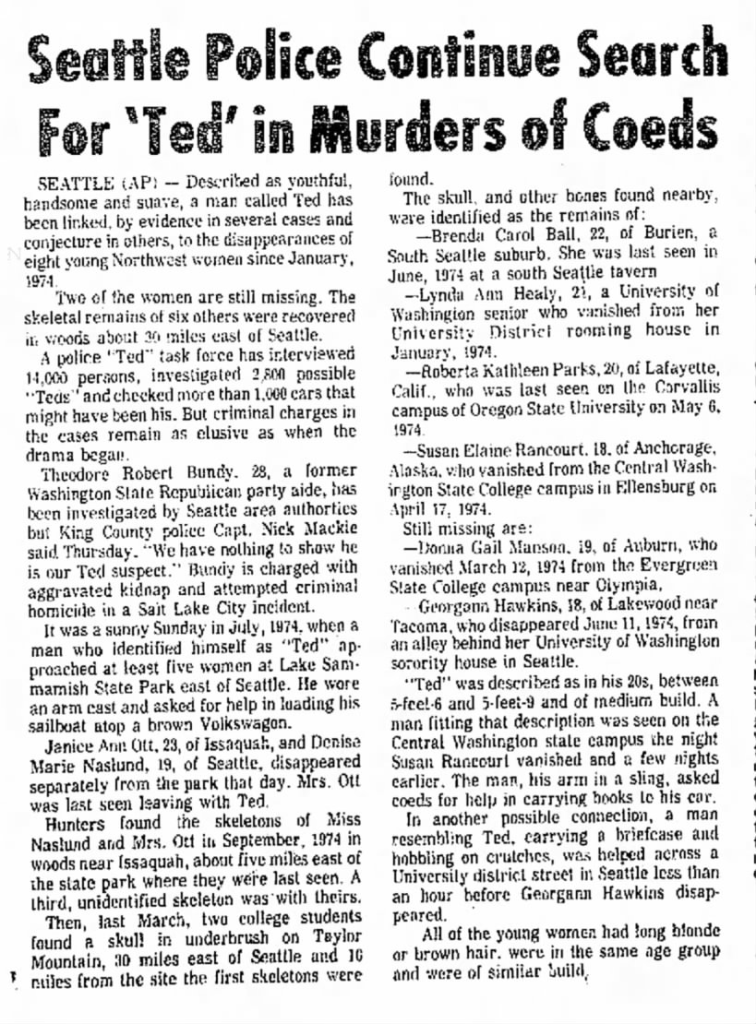
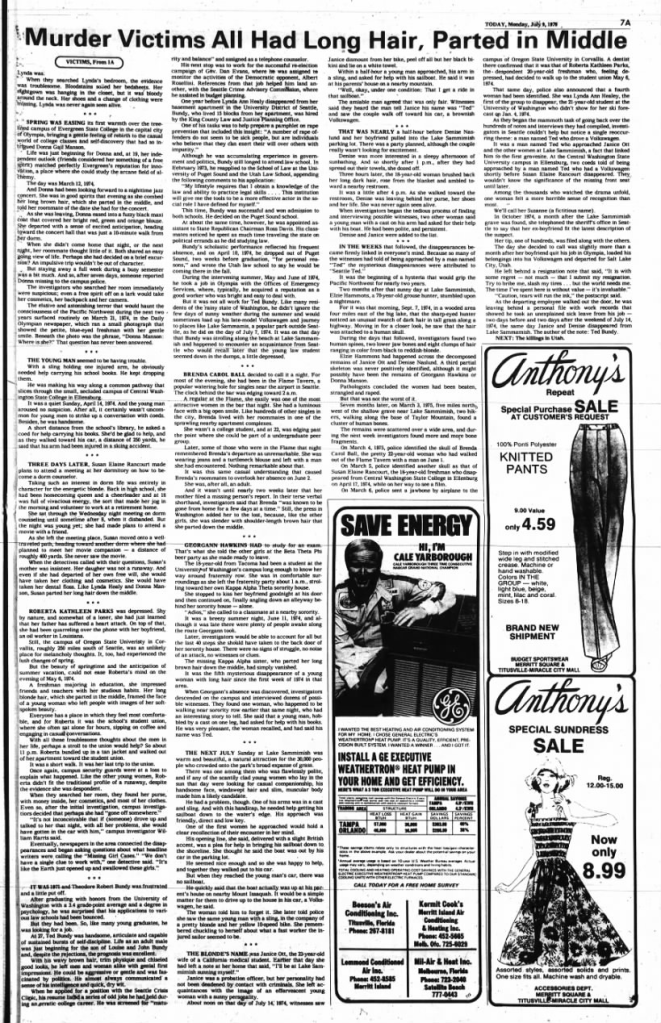
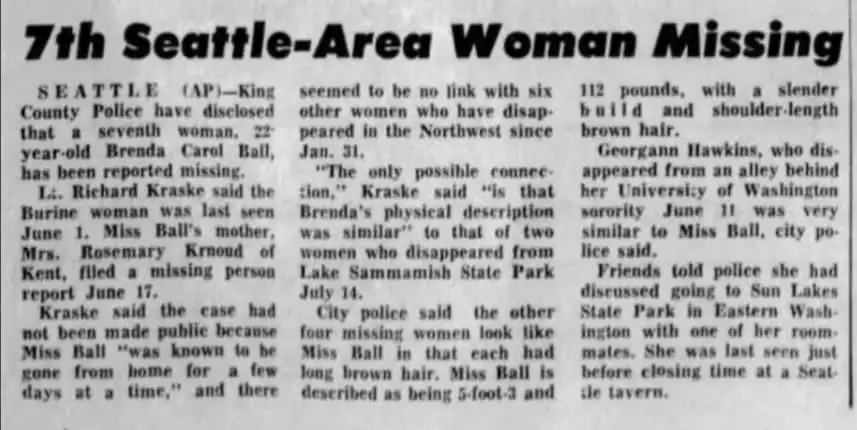
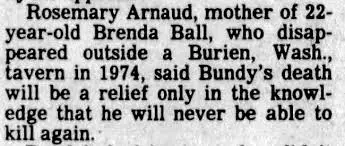
An article about the murder of Laura Aime.
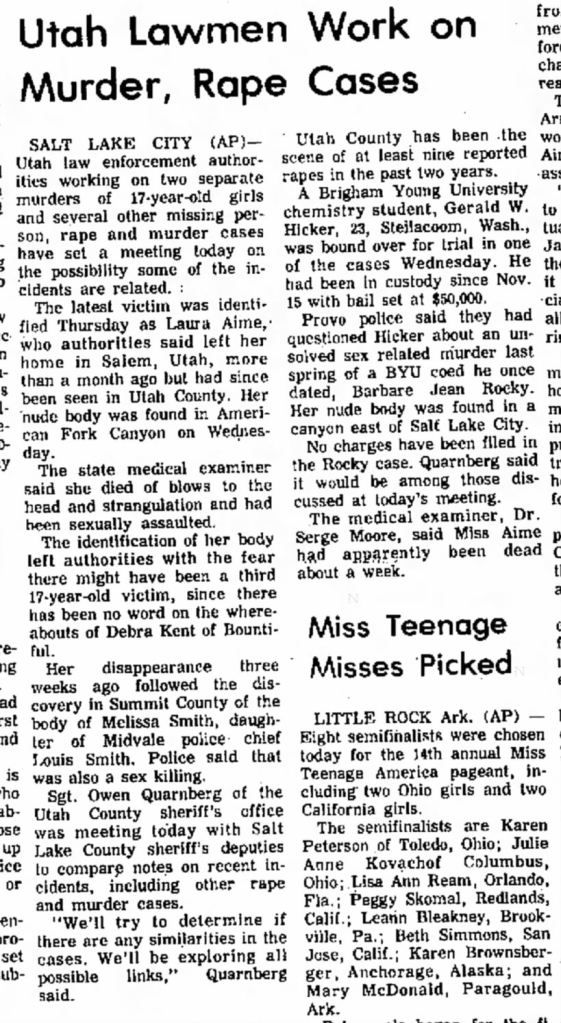
An undated article about the murder of Laura Aime.
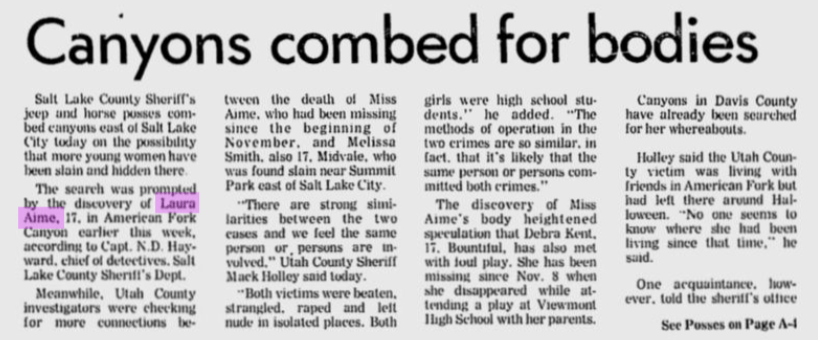
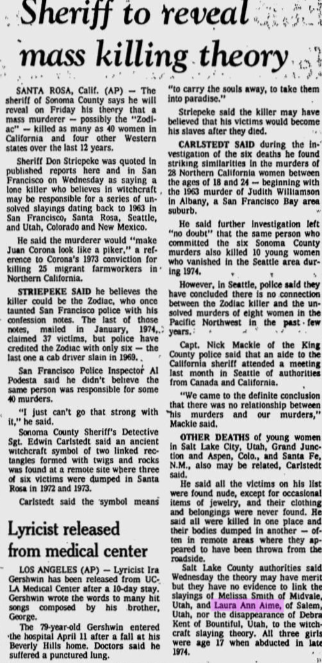
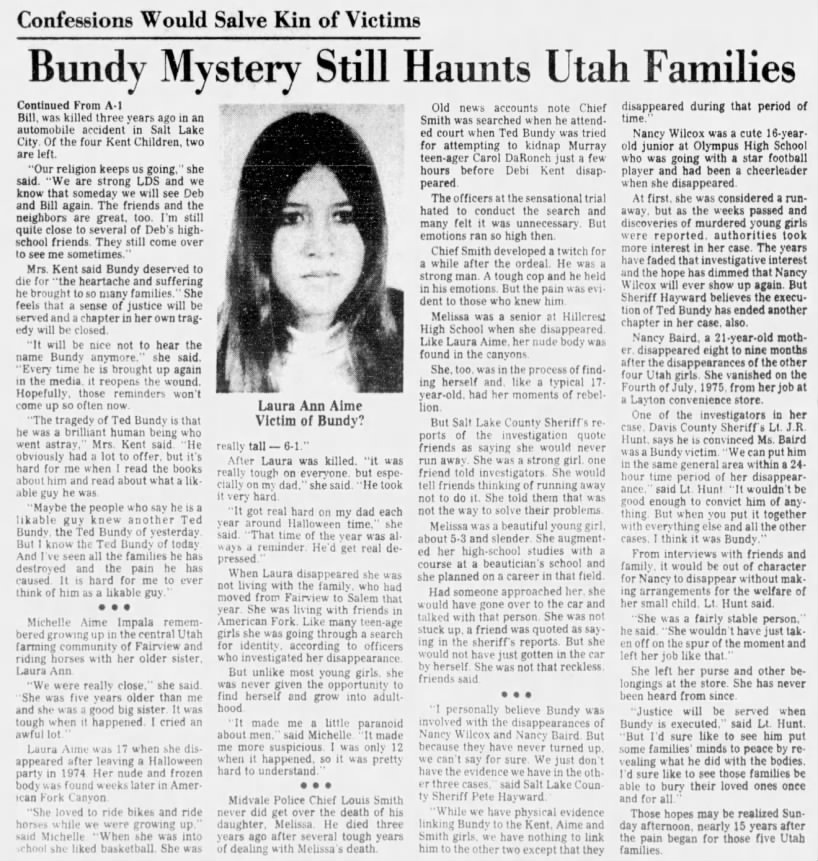
An undated article about the disappearance of Laura Aime.
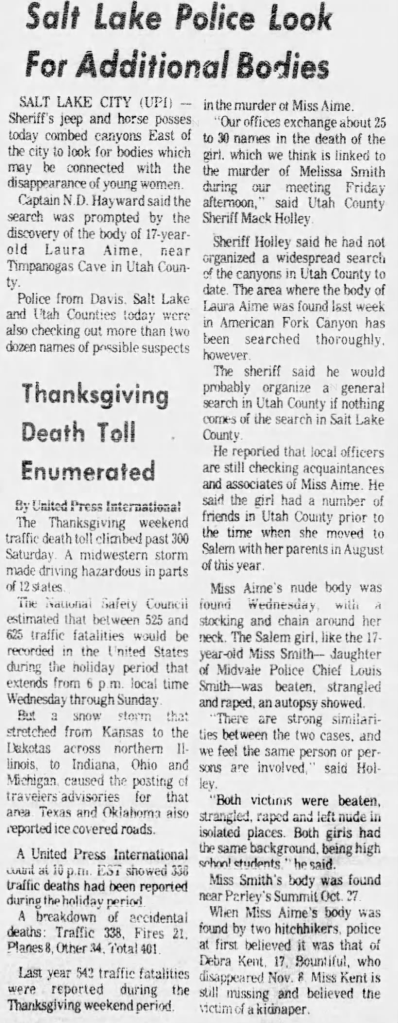
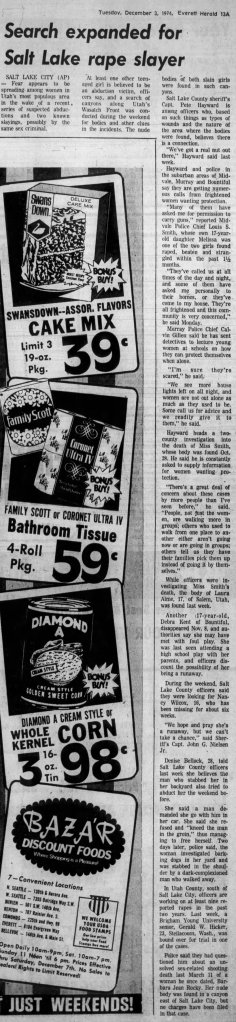
Part one of an article on Aime published by The Deseret News on November 28, 1974.
Part two of an article on Aime published by The Deseret News on November 28, 1974.
An article on Aime published by The Idaho Statesman on November 29, 1974.
An article about the disappearance of Laura Aime published by The Daily Herald on November 29, 1974.
Part one of an article about the disappearance of Laura Aime published by The Daily Herald on November 29, 1974.
Part two of an article about the disappearance of Laura Aime published by The Daily Herald on November 29, 1974.
An article about Bundy mentioning Laura Aime published by The Daily Sitka Sentinel on November 29, 1974.
An article about the disappearance of Laura Aime published by The Deseret News on November 30, 1974.
An article about Laura Aime published by The Daily Herald on December 1, 1974.
An article about Laura Aime published by The Daily Herald on December 3, 1974.
An article about Laura Aime published by The Spanish Pyramid on December 5, 1974.
An article about the disappearance of Laura Aime published by The Deseret News on December 7, 1974.
An article about Aime published by The Deseret News on December 9, 1974.
An article about Aime published by The Deseret News on February 7, 1975.
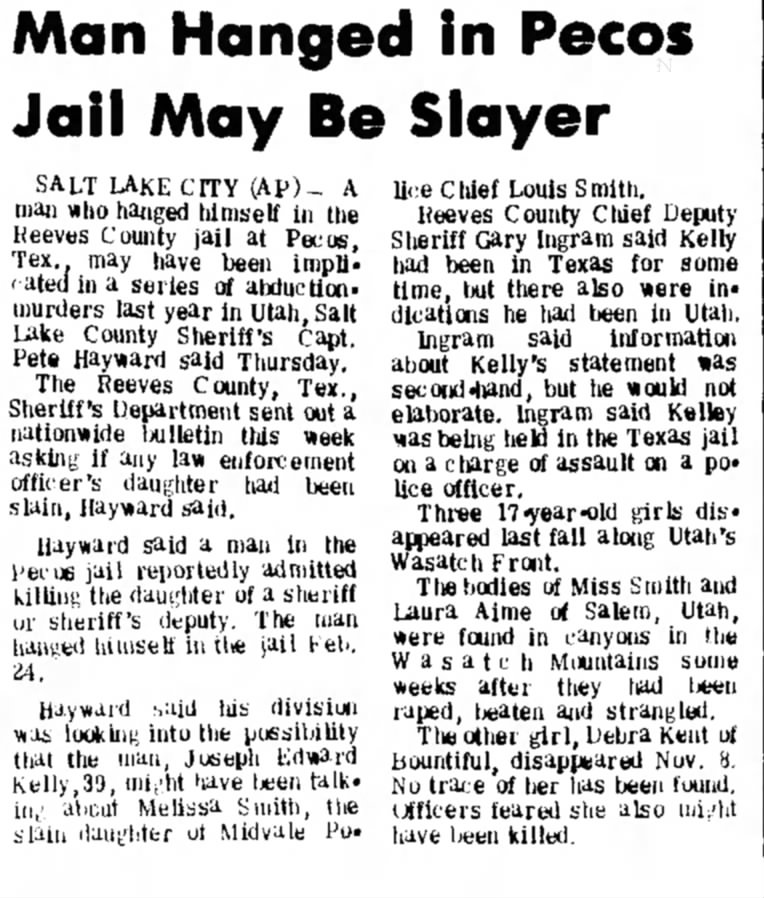
An article about Aime published by The Del Rio News Herald on March 14, 1975.
An article about Aime published by The Salt Lake Tribune on March 15, 1975.
An article about Aime published by The Daily Herald on March 21, 1975.
An article mentioning Aime published by The Eugene Register-Guard on April 24, 1975.
An article mentioning Aime published by The Bulletin on October 3, 1975.
An article mentioning Aime published by The Spokesman-Review on October 3, 1975.
An article mentioning Aime published by The Fairbanks Daily News-Miner on October 4, 1975.
An article about Bundy mentioning Laura Aime published by The Spokane Chronicle on October 22, 1975.
An article about Bundy mentioning Laura Aime published by The Kitsap Sun on October 31, 1975.
An article about Bundy being freed on bail that mentions Laura Aime published by The Ogden Standard-Examiner on November 21, 1975.
An article about Bundy mentioning Laura Aime published by The Daily Herald on November 21, 1975.
An article about Bundy mentioning Laura Aime published by The Spokesman-Review on March 4, 1976.
An article about Bundy mentioning Laura Aime published by The Deseret News on September 9, 1977.
An article about Bundy mentioning Laura Aime published by The Deseret News on December 16, 1977.
An article mentioning Aime published by The Deseret News on April 3, 1978.
An article mentioning Aime published by The Evening Independent on July 25, 1979.
An article mentioning Aime published by The Deseret News on February 14, 1983.
Part one of an article mentioning Aime published before Bundy was executed by The Daily Herald on January 5, 1989.
Part two of an article mentioning Aime published before Bundy was executed by The Daily Herald on January 5, 1989.
An article mentioning Laura Aime published just before Bundy was executed on January 22, 1989.
An article mentioning Laura Aime after Bundy was executed published by The Deseret News Tribune on February 28, 1989.
A funeral card for Aime. Courtesy of Captain Borax.
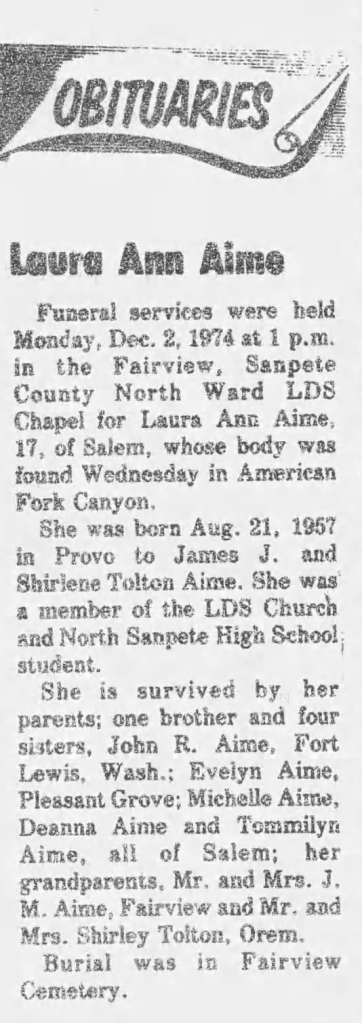
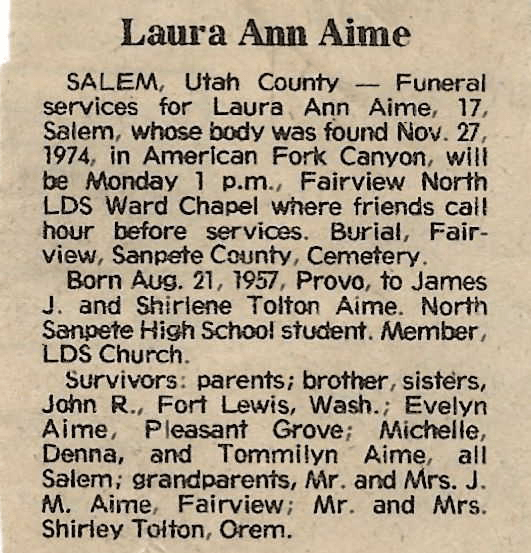
Laura Aime’s obituary published by The Daily Tribune on December 1, 1974.
Laura Aime’s obituary published by The Spanish Fork Press on December 4, 1974.
Another obituary for Aime.
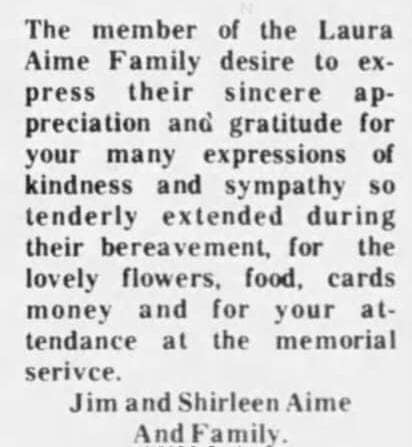
A thank you to the local community from the Aime family regarding their kindness surrounding Laura being killed published by The Pyramid on December 26, 1974.
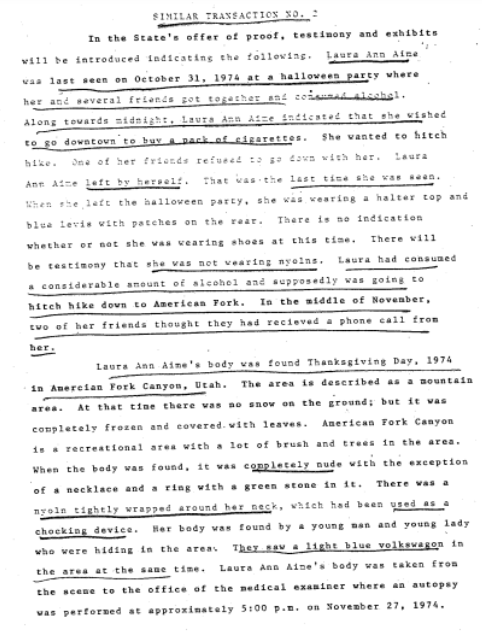
Page one of Laura Aime’s autopsy report. Document courtesy of Erin Banks/CrimePiper.
Page two of Laura Aime’s autopsy report. Document courtesy of Erin Banks/CrimePiper.
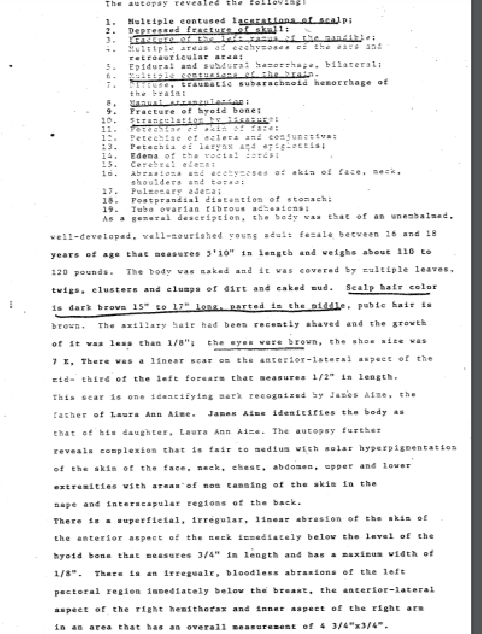
Page three of Laura Aime’s autopsy report. Document courtesy of Erin Banks/CrimePiper.
Page four of Laura Aime’s autopsy report. Document courtesy of Erin Banks/CrimePiper.
Page five of Laura Aime’s autopsy report. Document courtesy of Erin Banks/CrimePiper.
Page six of Laura Aime’s autopsy report. Document courtesy of Erin Banks/CrimePiper.
Page seven of Laura Aime’s autopsy report. Document courtesy of Erin Banks/CrimePiper.
Page eight of Laura Aime’s autopsy report. Document courtesy of Erin Banks/CrimePiper.
Page nine of Laura Aime’s autopsy report. Document courtesy of Erin Banks/CrimePiper.
James and his sister, Evelyn Aime.
James and Shirlene Aime’s application for a marriage license.
James and Shirlene’s marriage certificate.
James and Shirlene Aime’s marriage certificate.
A newspaper blurb about a domestic incident featuring the Aime’s published by The Daily Herald on April 29, 1966.
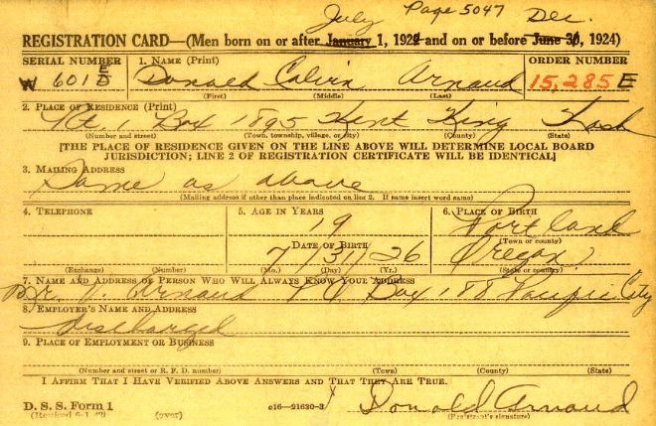
James Aime’s WWII registration card.
The second part of James Aime’s WWII registration card.
John Aime.
John Aime.
Mrs. Aime and her family when she was a kid.
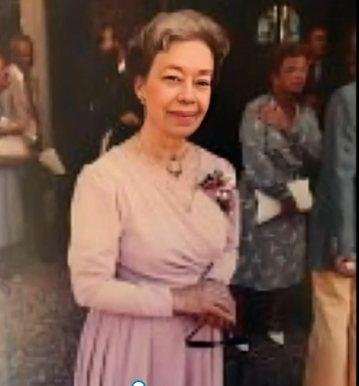
Mrs. Aime. Photo courtesy of Ancestry.
Shirlene Aime (left). Photo courtesy of Ancestry.
Evelyn Aime from the 1977 American Fork High School yearbook.
Michelle Aime from the 1977 American Fork High School yearbook.
Michelle Aime from the 1978 American Fork High School yearbook.
An article about Laura’s brother published by The News Tribune on May 1, 1977.
An article about Laura’s brother published by The News Tribune on June 17, 1977.
An article mentioning Aime published by The Orem-Geneva Times on August 7, 1980.
A notice about Mrs. Aime adopting her granddaughter published in The Orem-Geneva Times on August 21, 1980.
Mrs. Aime with the granddaughter she adopted, Danika.
James Aime’s obituary published in The Daily Herald on November 29, 1987.
A note about James Aime’s memorial service published in The Daily Herald on November 29, 1987.
A screenshot of Evelyn Aime from an interview she did with Captain Borax, whose real name is Chris Mortenson. I keep calling him Captain Borax as if its the name his parents gave him that’s listed on his birth certificate.
Marin Beverige.
A screenshot of Sheriff Mack Holley’s published memoirs, ‘From the Journal of Sheriff Mack Holley, Utah County Sheriff’s Department Events, 1960 to 1985, BYU Basketball, Football, Personal Observations,’ published on January 1, 1986.

Bundy’s Execution: January 24, 1989.

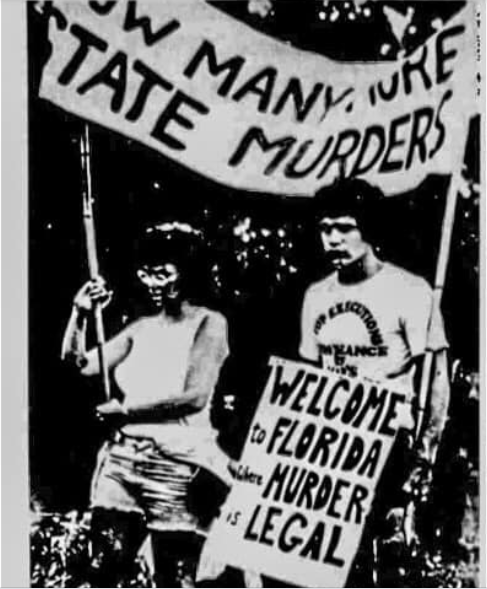
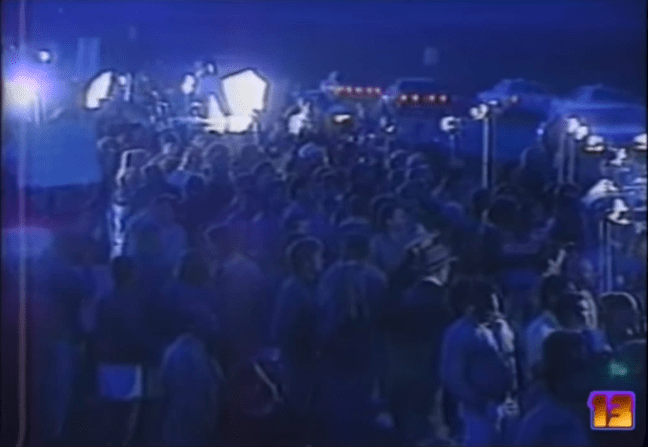
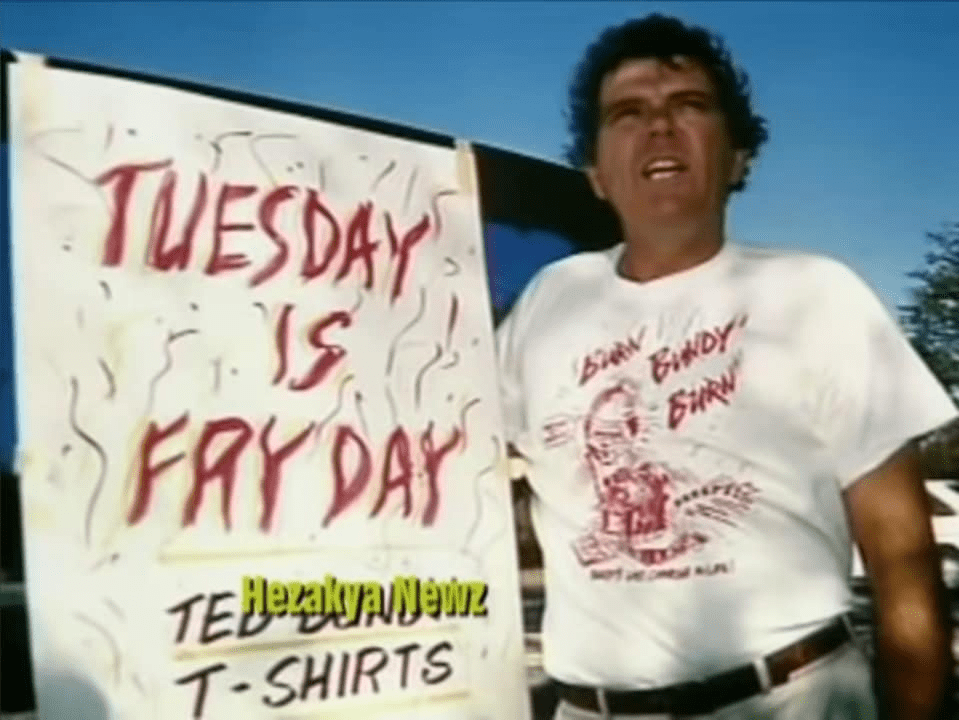
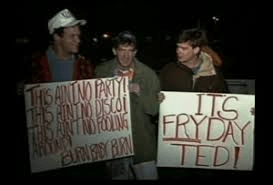
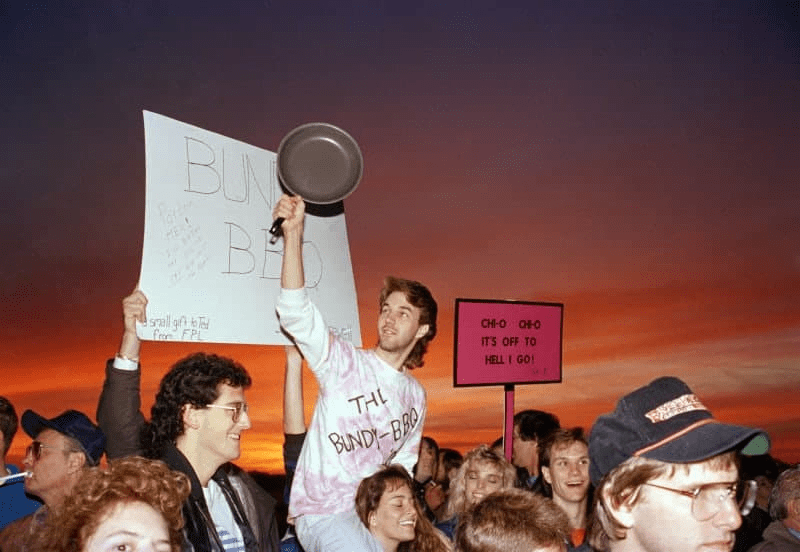
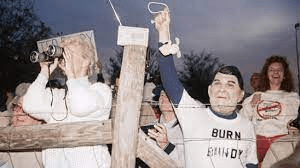
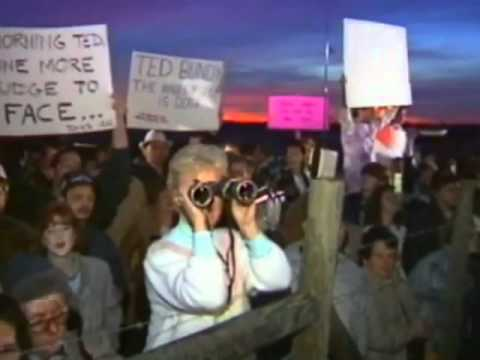
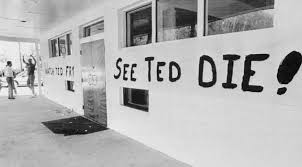
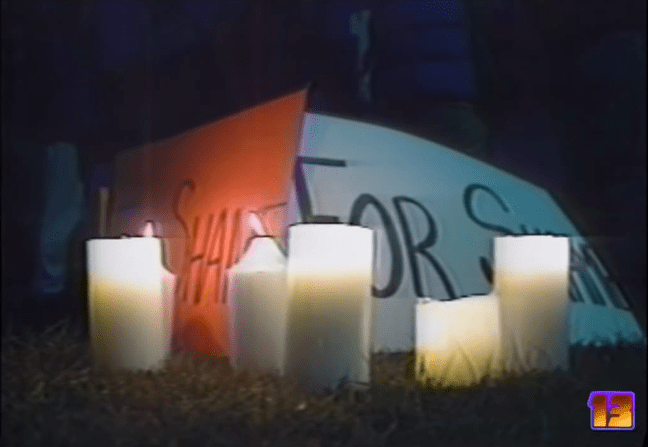
Theodore Robert Bundy was executed in Florida’s Prison’s electric chair on January 24, 1989 after brutally raping and killing dozens of young women between 1974 and 1978 (most likely earlier than that). The infamous serial killer was sentenced to capital punishment after brutally killing three young women in Florida (and countless others across the Pacific Northwest) and had been given the death penalty three times before he was finally killed. Bundy sat on death row for almost a decade when he was finally executed at 7:16 AM EST, and the event became a celebration of sorts for Floridians. On January 23, as the condemned man was spilling his guts in a last ditch effort to push off his execution, a crowd of almost 500 gathered outside the Florida Prison chanting phrases such as ‘die, Bundy, die’ and ‘burn Bundy, burn,’ drinking drank beer and holding signs that read ‘watch Ted fry, see Ted die!’ But not everyone was excited, there was also a small group of anti-death penalty protesters that didn’t want to see the event take place.

Bundy in prison with some of his fellow inmates. Photo courtesy of Supernaught.
Ol’ Sparky, the electric chair at Florida State Prison.
Bundy peering out from behind the bars at Florida State before he was executed. Photo courtesy of Hezakya News.
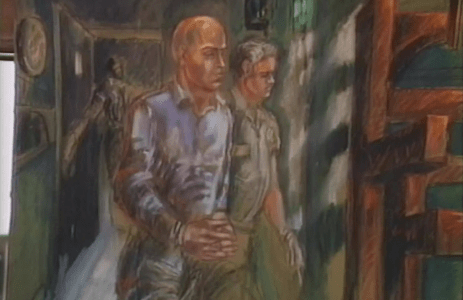
A drawing of Bundy walking to the execution chair.
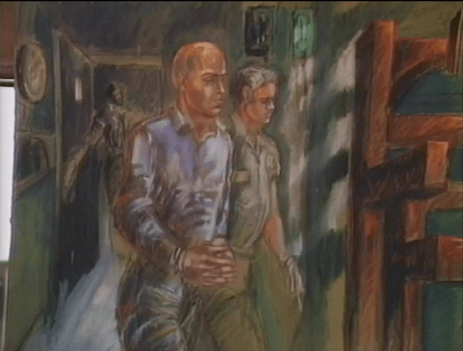
A drawing of Bundy on his way to the execution chair.
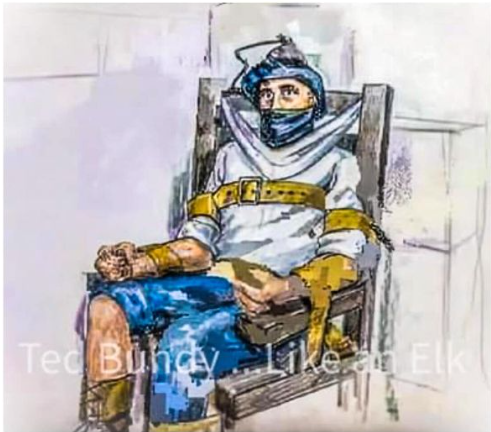
A drawing of Bundy in the execution chair. Photo courtesy of ‘Ted Bundy: I was Trying to Think like an Elk.’
A drawing of Ted sitting in the electric chair.
A picture from a Florida newspaper after Bundy was executed.
The crowd outside of Florida State Prison before Bundy’s execution in the early morning hours of January 24, 1989. Photo courtesy of Fox 13 News.
News crews gathering outside of Florida State Prison before Bundy’s execution in the early morning hours of January 24, 1989. Photo courtesy of Hezakya News.
A gentleman wearing a ‘Burn Bundy, Burn’ t-shirt outside Florida State Prison before Bundy was executed. Photo courtesy of Hezakya News.
A picture taken the morning of Bundy’s execution.
A picture taken the morning of Bundy’s execution outside Florida State Prison.
A sign someone was holding outside Florida State Prison before Bundy was executed. Photo courtesy of Fox 13 News.
A sign someone was holding outside Florida State Prison before Bundy was executed.
A picture taken before Bundy’s execution.
Some pro-death penalty demonstrators standing outside of Florida State Prison the morning of Ted’s execution.
Some anti-death penalty protesters standing outside of Florida State Prison the morning of Ted’s execution.
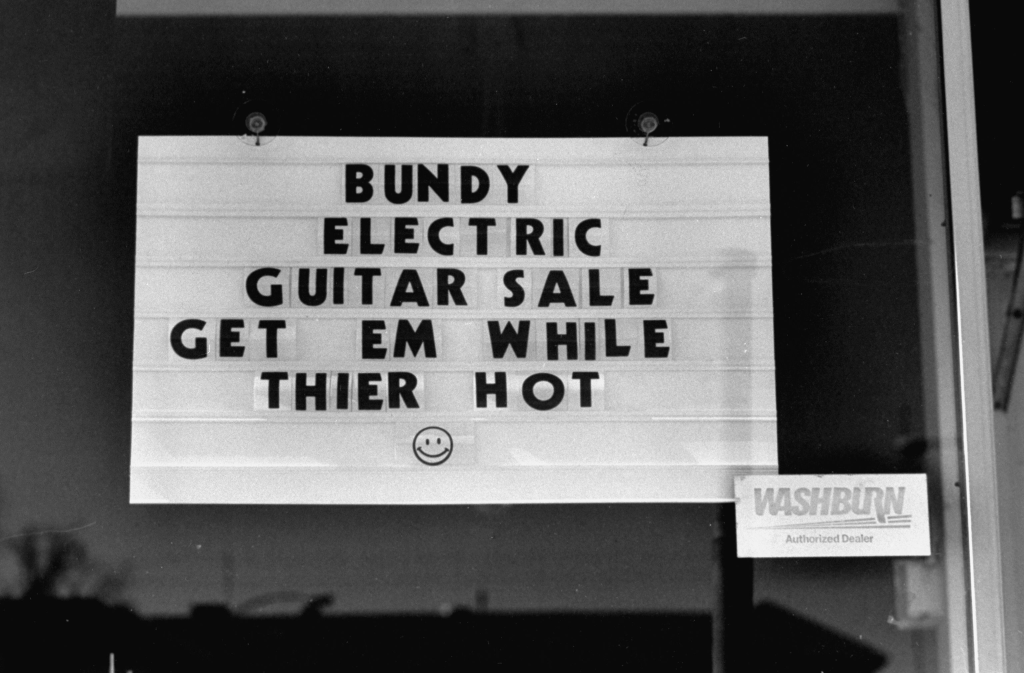
A sign hung in the window of a Florida musical instrument store the morning of Bundy’s execution.
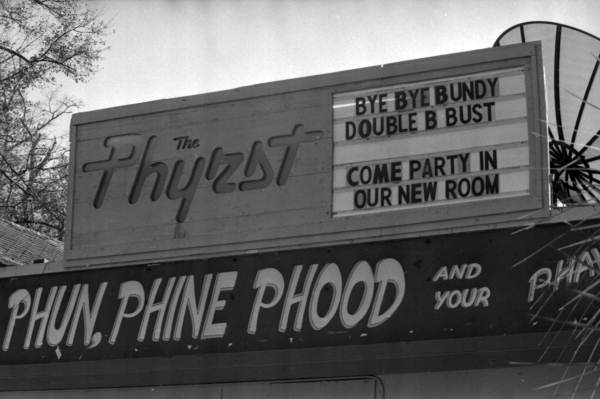
A sign hung in the window of The Phyrst, a bar in Florida on the morning of Bundy’s execution.
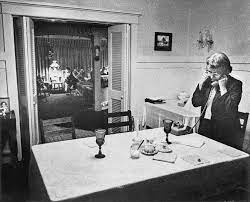
Mrs. Bundy talking on the phone the morning of Ted’s execution.
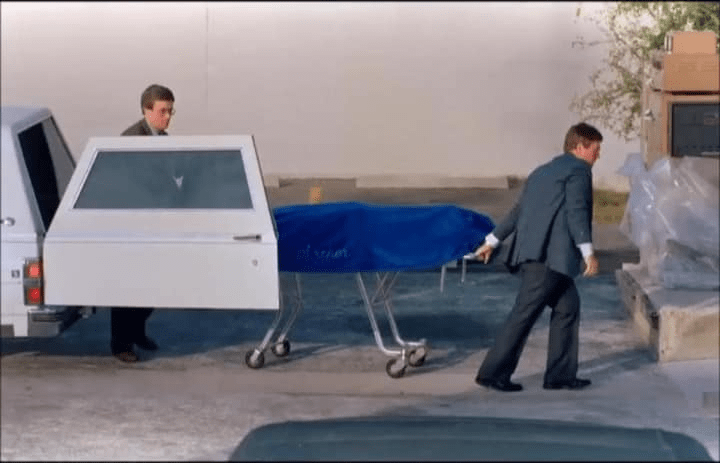
The hearse pulling out of Florida State Prison carrying Bundy’s remains after he was executed.
The hearse driving Ted’s remains to the ME’s office after he was executed.
A photo of Ted arriving at the Medical Examiners office after his execution.
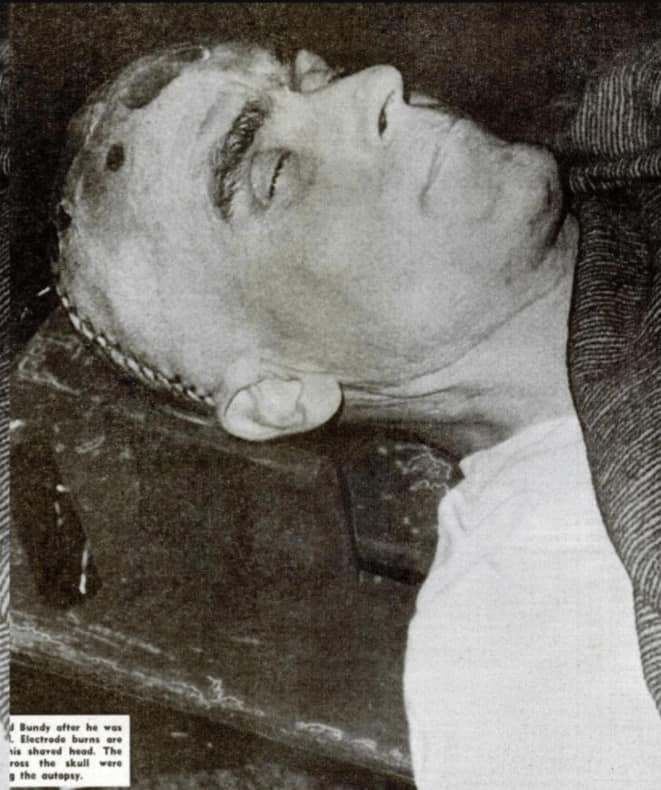
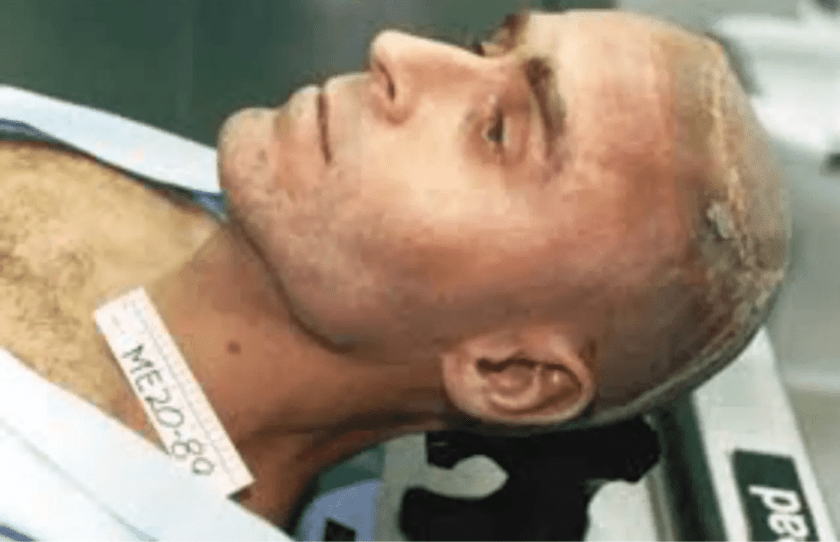
A B&W of Bundy after his execution.
A close-up B&W of Bundy after his execution.
A picture of Bundy, post-mortem. Photo courtesy of the Florida state Department of Corrections.
Bundy after his execution.
The top of Bundy’s head after his execution.
Bundy’s legs after his execution.
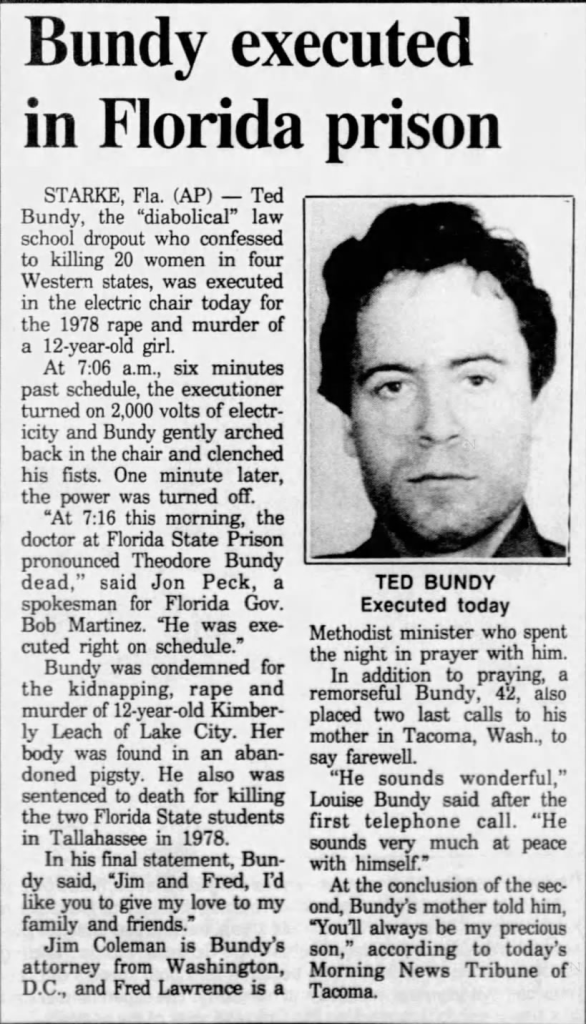
An article written the day Bundy was executed published by The Greenwood Commonwealth on January 24, 1989.
An article written the day Bundy was executed published by The Enterprise-Journal on January 24, 1989.
An article written the day Bundy was executed published by The Elizabethton Star on January 24, 1989.
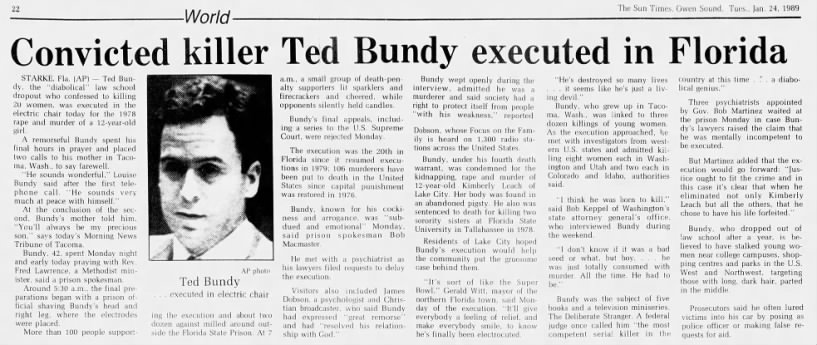
An article written the day Bundy was executed published by The Sun Times on January 24, 1989.
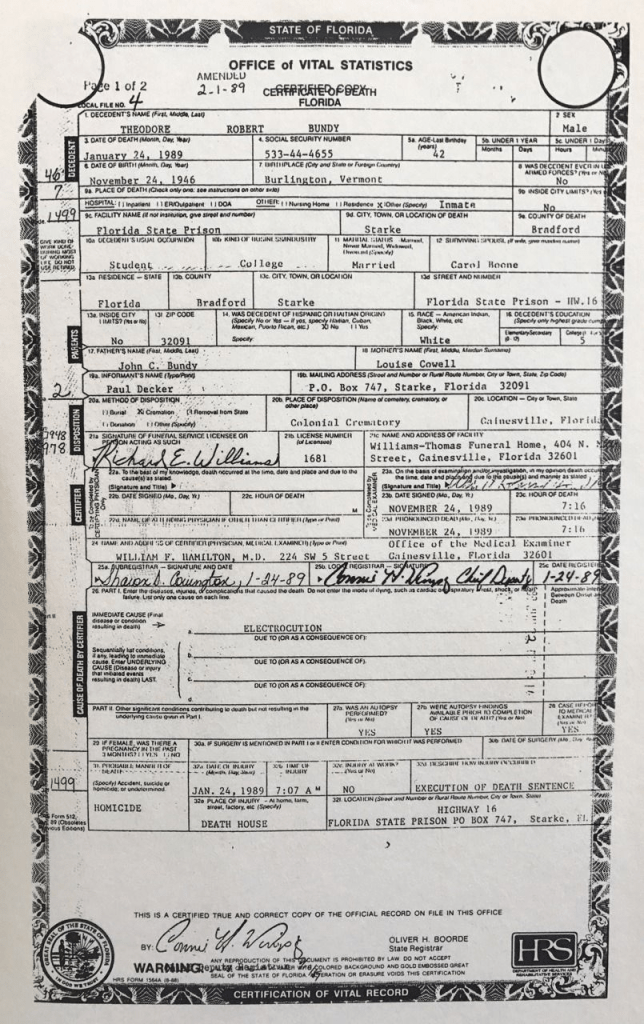
Bundys death certificate.
A mock obituary for Ted Bundy created by ‘theodorerobertcowellnelsonbundy.wordpress.com.’ The description reads: ‘I thought he deserved a proper obituary, not some sensationalized news article about the monstrous serial killer celebrating his death.’
An interesting opinion piece Bryan Kohberger’s mother sent to a newspaper about Ted Bundy’s execution, published by The Daily News on February 16, 1989.

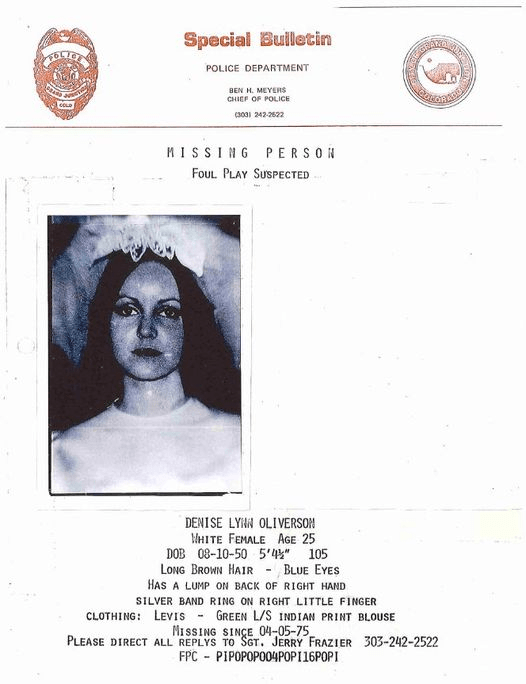
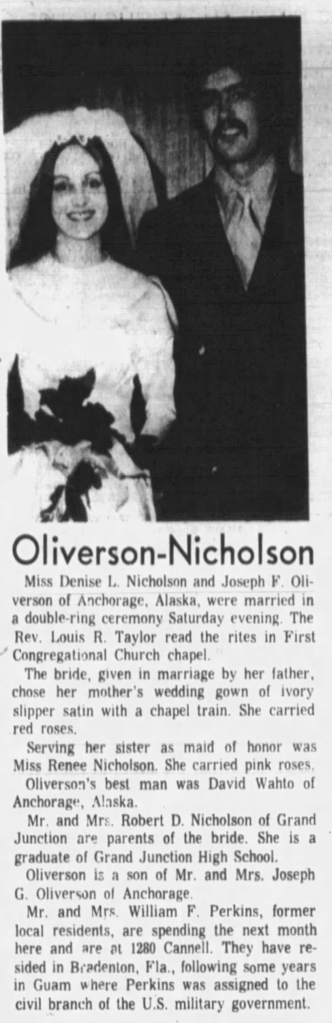
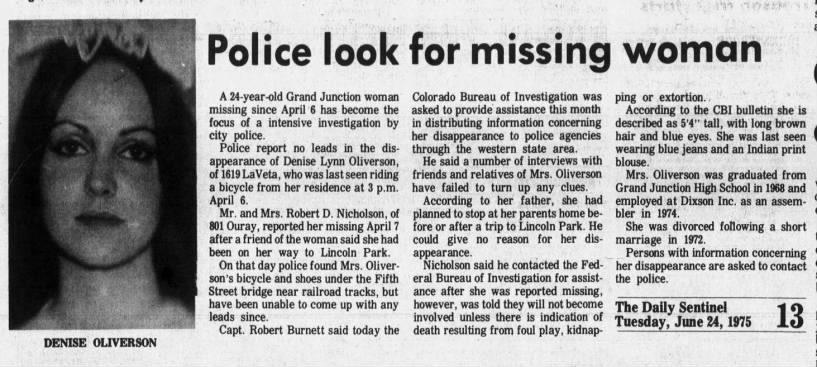
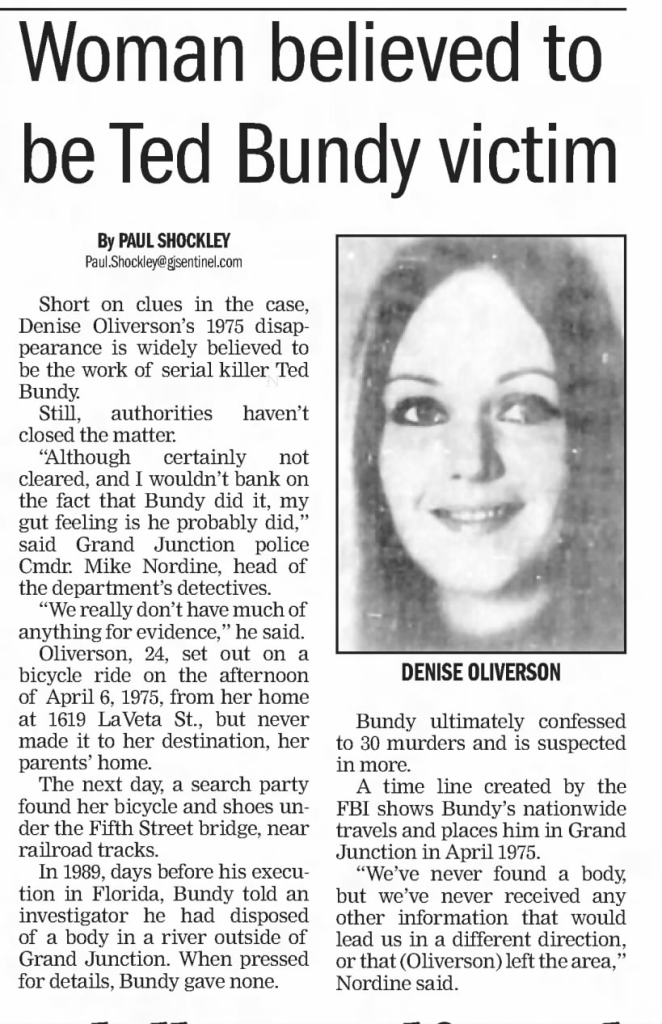
Denise Lynn Oliverson.

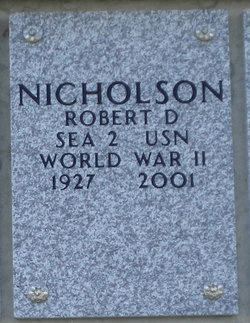
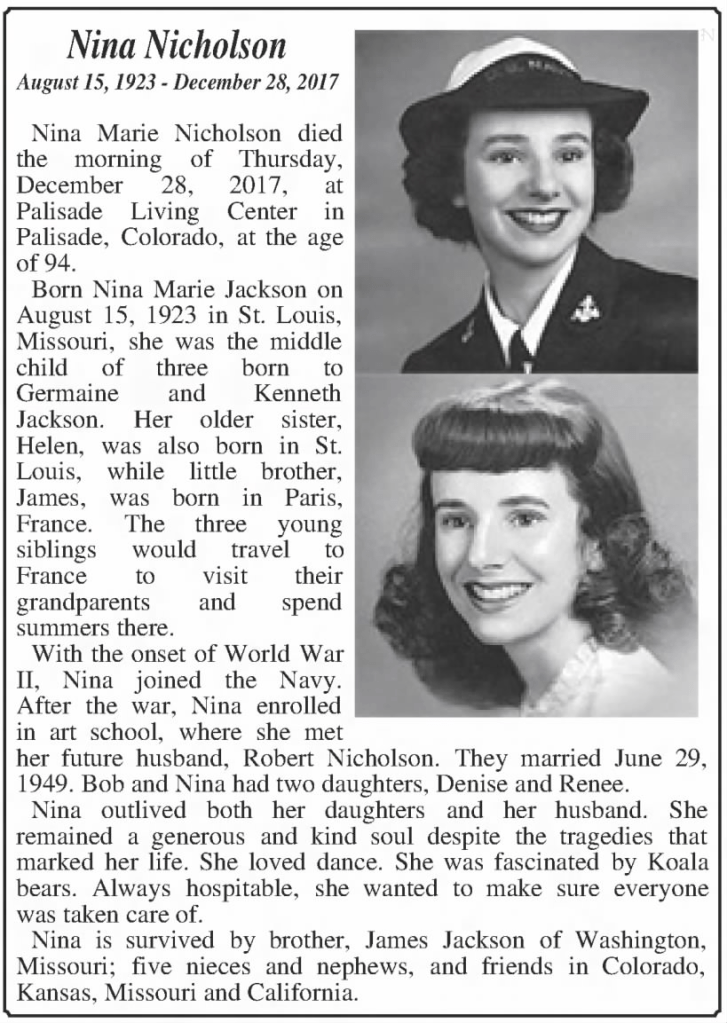
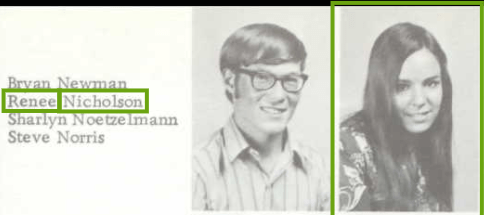
Denise Lynn Oliverson (née Nicholson) was born on August 10, 1950 to Robert ‘Bob’ Dale and Nina Marie (nee Jackson) Nicholson in Missouri. Mr. Nicholson was born on June 12, 1927 in Saint Joseph, MO and served in the US Navy during WWII. Denise’s mother was born in St. Louis, Missouri on August 15, 1923 and after graduating from high school enlisted in the US Navy. When the war ended, Nina enrolled at Denver Art Institute, where she met her future husband. The two got married on June 29, 1949 and had two daughters: Denise and her younger sister, Renee. The couple eventually relocated to Colorado and Robert got a job as a commercial artist at The Daily Sentinel. The family settled down in Grand Junction in 1963 after moving from Colorado Springs; after Denise was murdered Mr. Nicholson said he regretted moving there and said that it was ‘a mistake.’

Oliverson had blue eyes, brown hair that she wore long and parted down the middle, and stood at 5’4” tall. She had some lingering facial acne, pierced ears, and a discolored lump on the back of her right hand; she was petite, and only weighed around 105 pounds. After graduating from Grand Junction High School in 1968 she got a job with a company called Ultronix (at least, according to her engagement announcement published in The Daily Sentinel on May 20, 1970). Looking into them, Ultroni was a manufacturing plant that produces electronic resistors, components and log converters but they have since left the Colorado area and moved out of state.

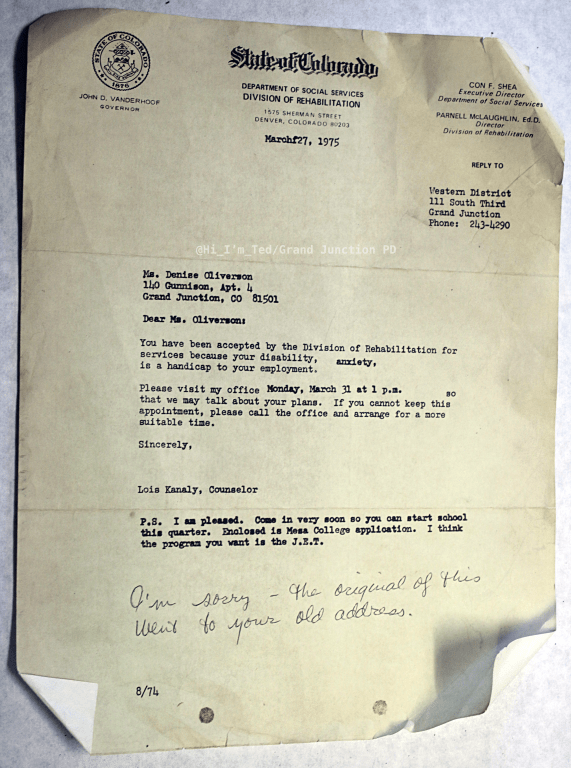
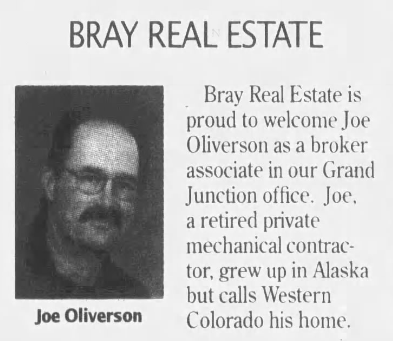
In 1969 Denise was charged with a misdemeanor after being arrested in GJ for marijuana possession, and at some point in the early 1970’s she lived in Spokane, WA with an individual named JC Harrison. Described by her friends and loved ones as being a ‘great, kind person,’ she married Joseph Franklin Oliverson on September 26, 1970. Joe was born in March 1950 in Idaho but his family relocated to Alaska; he was a 1968 graduate of Dimond High School in Anchorage, where he grew up. Oliverson attended Mesa College and when the couple first got married he was employed in Alaska; he eventually relocated to Grand Junction to be with his wife and got a job in insurance and real estate. After going through a rough patch the couple divorced on March 13, 1972. When she was killed Denise was in a new relationship with a man named Raymundo Esteban Romero (who simply went by ‘Steve’). According to her dad, Denise was a frequent drug user and in the early stages of her disappearance he suspected that she may have imbibed in some sort of illegal substances and taken off. Despite a history of running away (she would always return after a few days), Oliversons history in the year prior to her disappearance hinted that she changed a lot and didn’t participate in that behavior anymore. In a letter to Denise dated March 27, 1975 sent from her behavioral health counselor, Lois Kanaly shared that the young divorcee was accepted by the Division of Rehabilitation for services because of her disability, and her anxiety diagnosis was considered ‘a handicap to her employment.’ From there, the letter stated that she had an upcoming therapy appointment on March 31 at 1 PM. At the bottom was a postscript that read: ‘I am pleased. Come in very soon as you can start school this quarter. Enclosed is the Mesa College application.’ Kanaly also advised Denise to look into the schools J.E.T. program. So, obviously Oliverson was in the process of making some big changes in her life, and seemed to be in the process of applying to go to college.

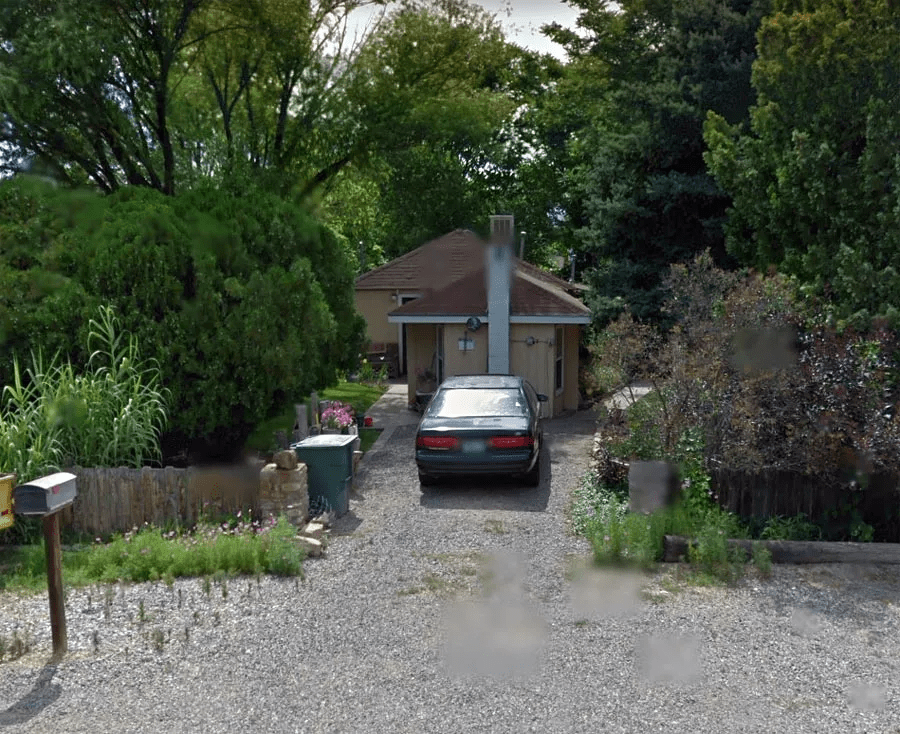
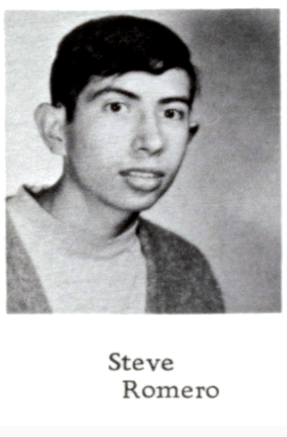
Denise and Steve weren’t together for very long, and seemed to have a healthy relationship at first, however cracks were beginning to show and according to Oliversons friend from high school Marie Parish she wanted him out of her house. At first it appears that she lived at her one bedroom house located on LaVeta Street in GJ alone, but was pressured by Romero to move in with her as a ‘safety precaution’ because of a dangerous former flame. It appears that he was a very jealous and controlling boyfriend and it’s speculated that his motives weren’t entirely gentlemanly and he did it more to get in her house so he could keep an eye on her versus doing it for her safety. Oliverson had a dog named Toma.

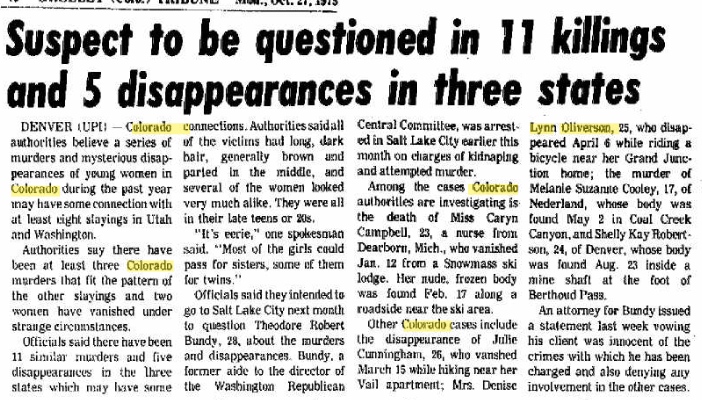
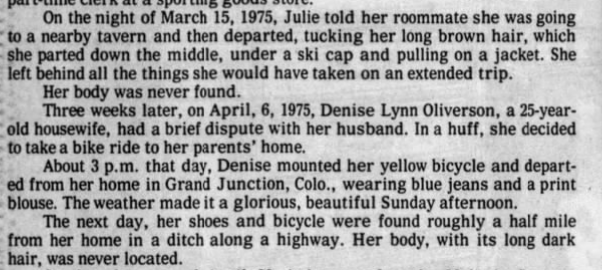
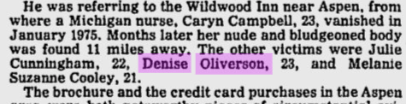
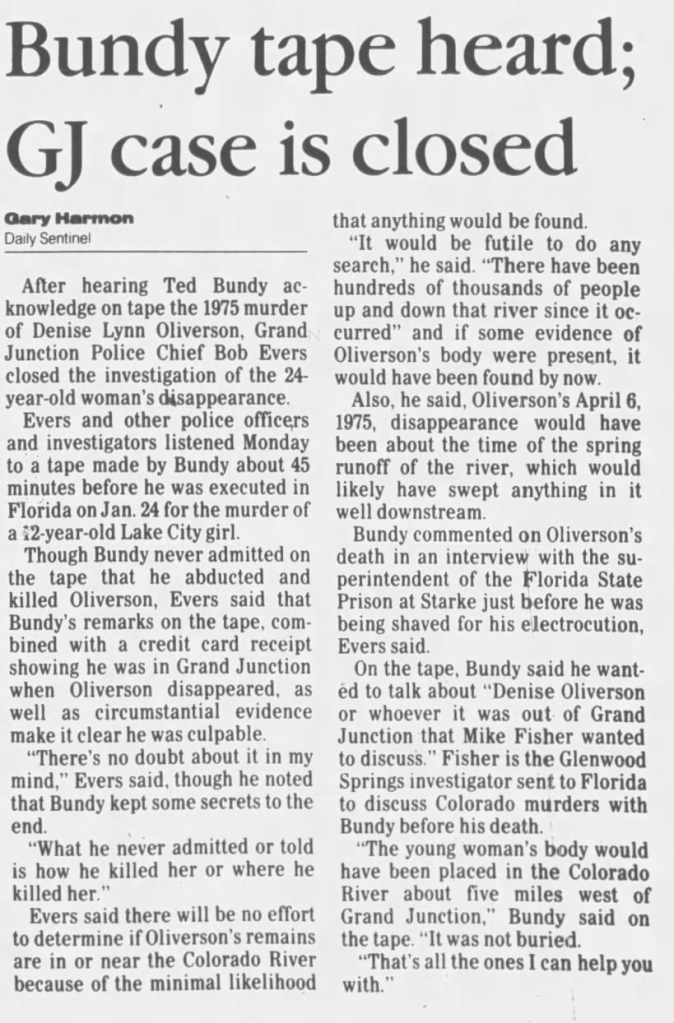
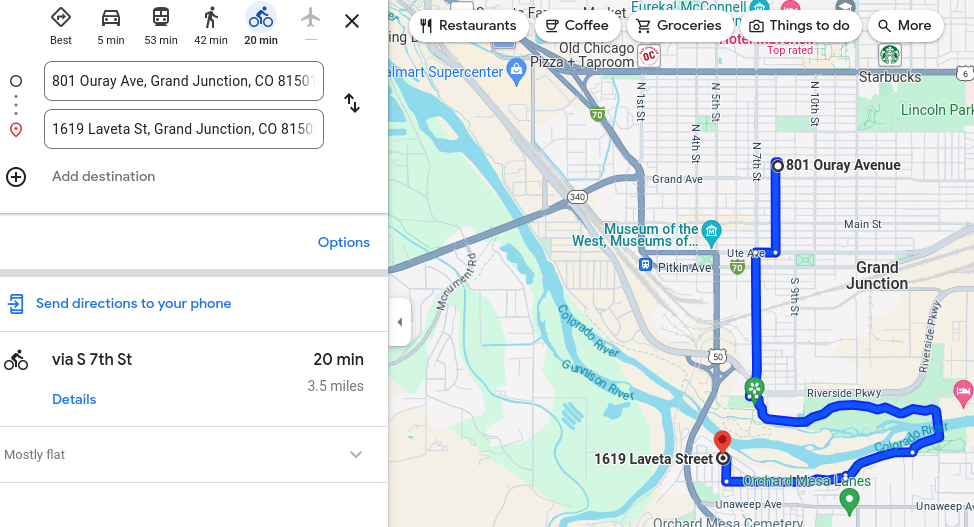
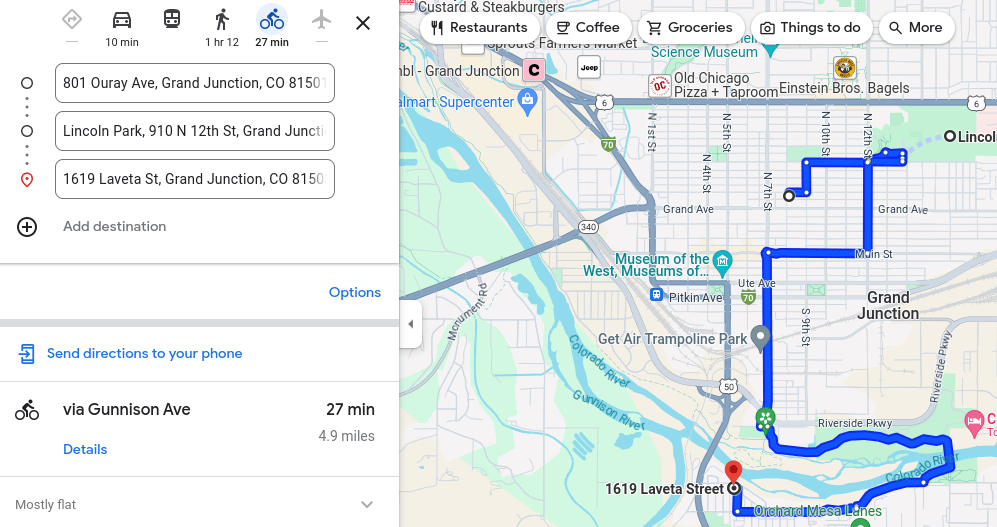
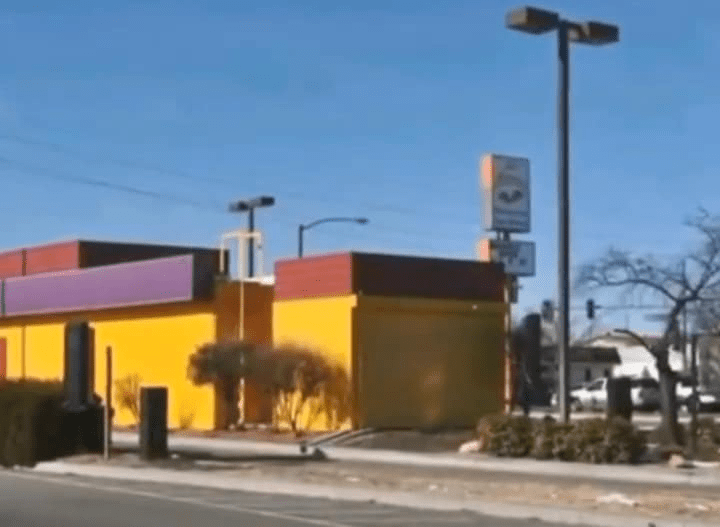
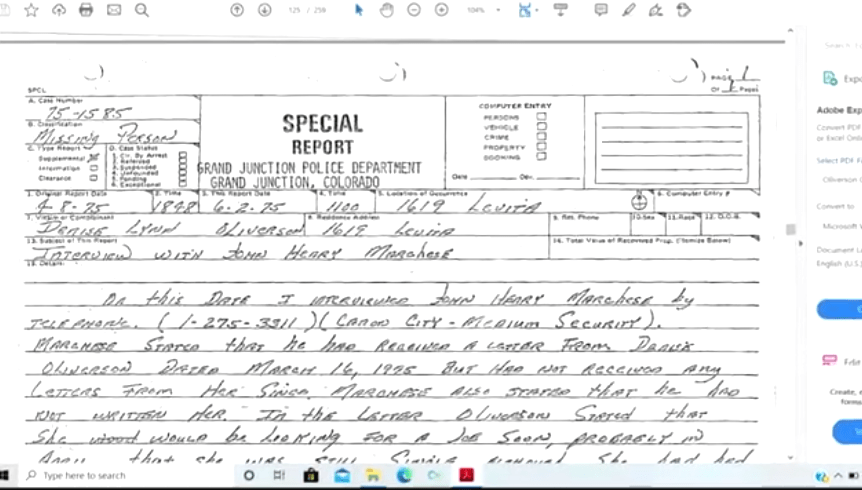
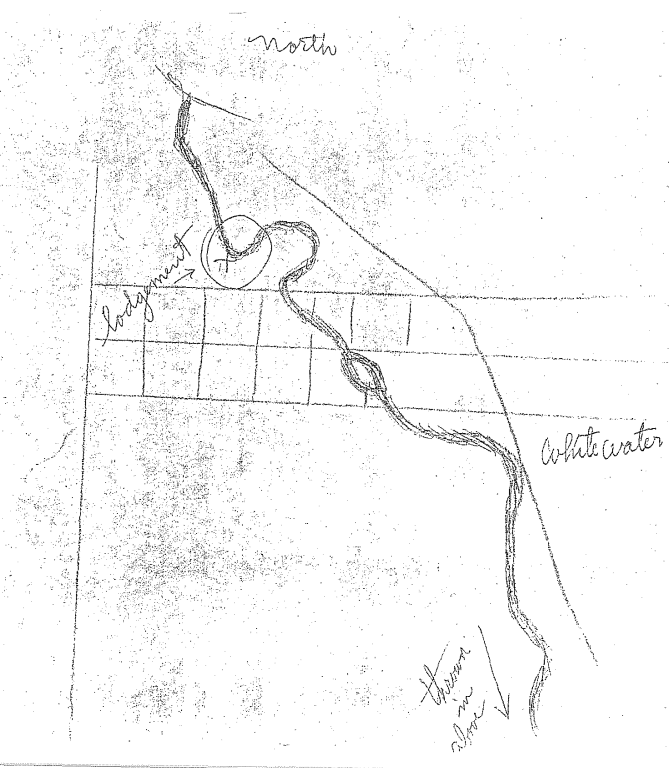
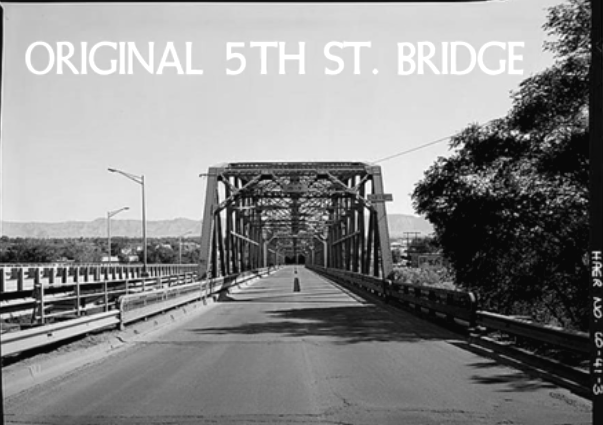
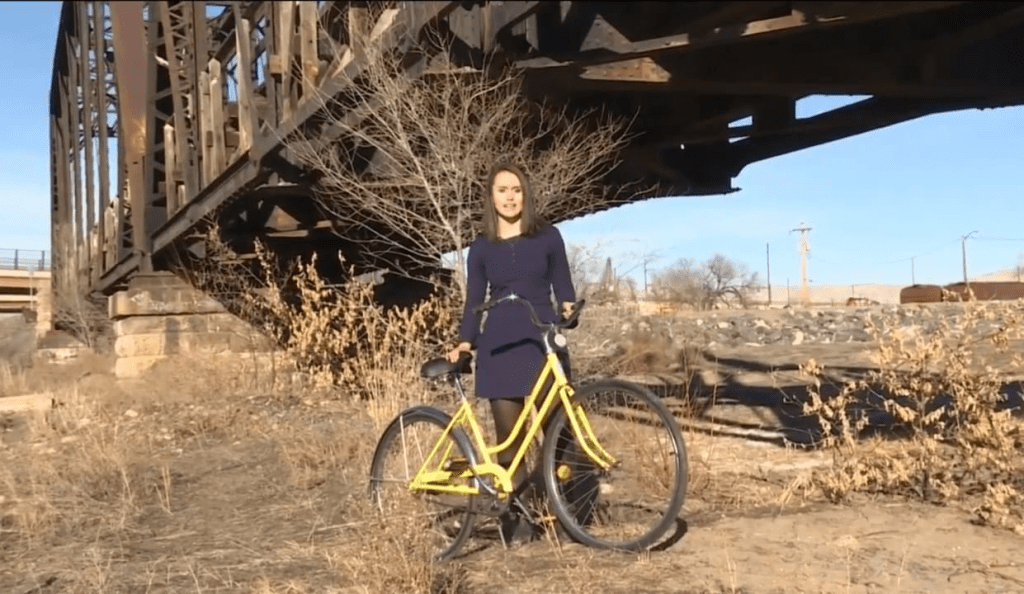
On Sunday, April 6th, 1975 Ted Bundy abducted Denise Oliverson at the South 5th Street Bridge in Grand Junction, Colorado. According to the missing persons report dated April 8, 1975, Mr. Nicholson said that the day that his daughter disappeared she stopped by his house with Steve at roughly 1:00 in the afternoon, and from there they went to Lincoln Park. They were taking advantage of a beautiful spring day and were enjoying being outside. Denise saw a friend at the park named Fred Gallegos, but the two didn’t interact. The couple then explored Grand Junction for a bit before returning home. That’s when they got into an argument and around 3 PM Denise said that she was going to ride her bike to her parents house. She left with no coat or personal possessions and Steve said that it’s possible she went back to the park to see her friend. Detectives strongly felt that she was biking down a short path on the east side of the South 5th Street Bridge in Grand Junction when she encountered Ted, which was about 1.7 miles away from her home on LaVeta Street. According to Kevin Sullivans ‘The Encyclopedia of the Ted Bundy Murders,’ several stories about what Denise was doing before she was abducted have emerged or the years since she disappeared, but authorities are certain that she had an argument with her boyfriend and left the one bedroom home she shared with him to go to her parents house, on her a yellow Coast to Coast 10 speed bicycle, serial number 2C174568 to go to her parents house. She never made it.

When Oliverson didn’t come home that night Romero just assumed she spent the night at her parents, as that was a typical occurrence when they had a disagreement. But he immediately became concerned the next day when he called her parents’ house to talk to Denise about coming home and he was told she wasn’t there. Consequently, Mr. Nicholson contacted law enforcement at some point early on April 7, 1975 and reported his daughter as missing; Denise’s parents gave them pictures of her but let them know that they wanted them back. Police didn’t wait to investigate and immediately sprang into action, mapping out the route Oliverson most likely would have taken and searching the road along it. They spoke with members of her family, friends, coworkers, and acquaintances and were told nothing of value. Oliverson’s Dad contacted the FBI for further assistance but was told that they wouldn’t be able to assist in the case unless there was indication that she had been kidnapped or was killed as a result of foul play. At the time she disappeared Denise was employed with Dixson Inc. as an assembler; she wasn’t there for long and only got the position the year before.

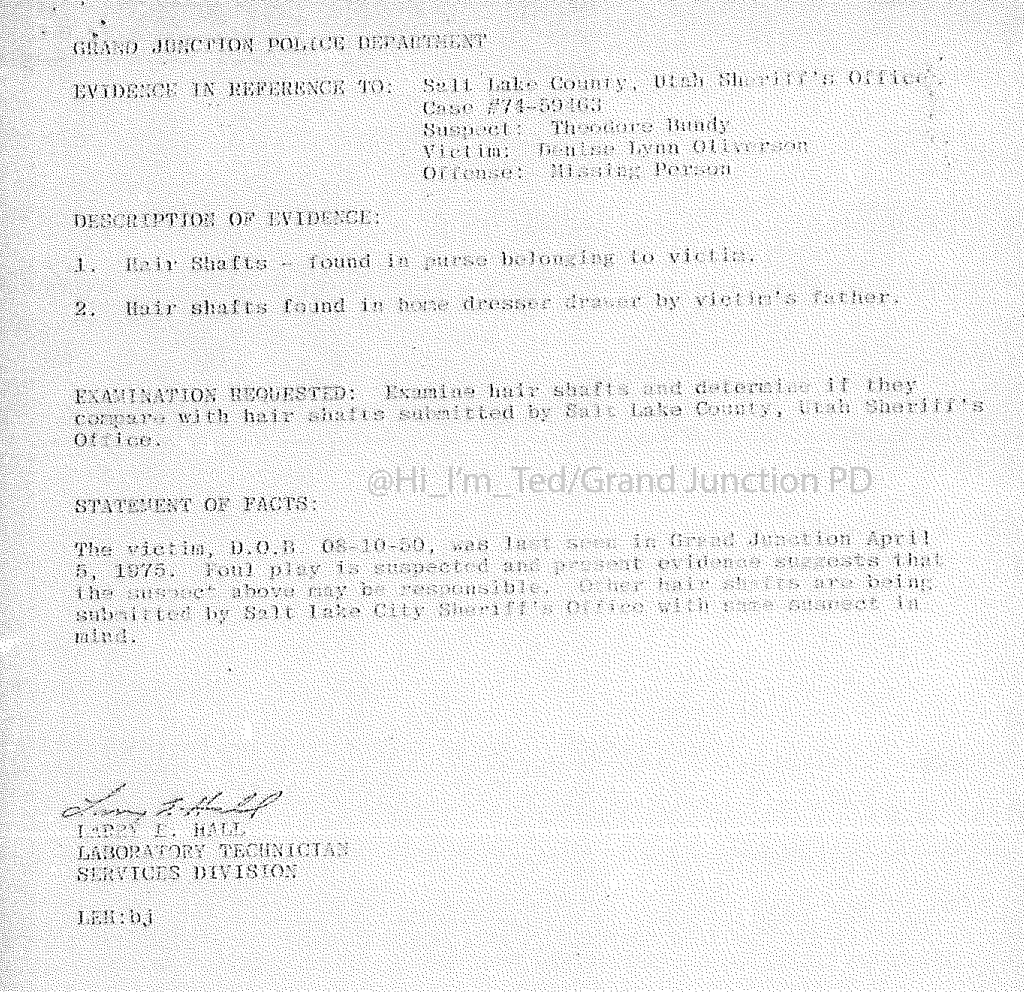
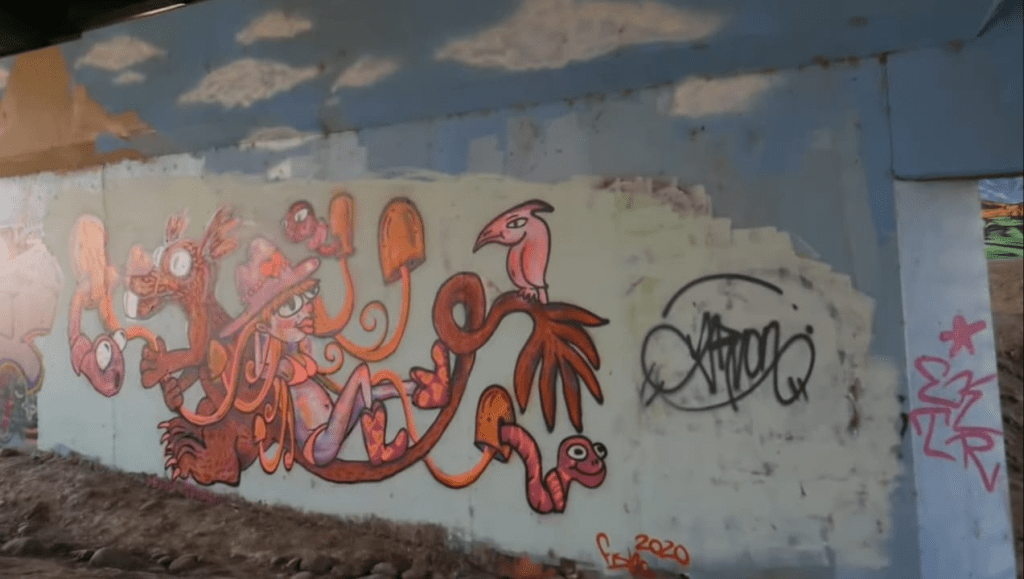
On April 7, 1975 an unknown caller from the Denver and Rio Grande Railroads got in contact with the Grand Junction Police Department and told them about an abandoned yellow bicycle that was leaning against a pillar underneath the 5th Street viaduct near the railroad tracks. Retired GJ police officer Lew Fraser was dispatched to the scene at 8:48 AM, and upon arriving he met up with railroad engineer Wilbur M. Class, who shared with him that it had snowed the night before and he had seen what looked like sandals as well as some additional things sitting on the bike’s seat. According to a second railroad employee, the items were scattered haphazardly all over the tracks before he neatly set them out of the way (more on that later). According to Officer Lew there was nothing strange or unusual about the scene that jumped out at him, and it was just another lost bicycle to him. He made a property report, tagged it with a ‘lost and found’ sticker then turned it into the Grand Junctions ‘Old City Shop,’ classifying it as abandoned. When it was eventually determined that the items belonged to Oliverson, LE immediately suspected that foul play was involved but were unable to come up with much else. According to a deep dive by Bundy archivist Tiffany Jean, the investigating officer said in his report that ‘as I was checking it an engineer in a passing locomotive hollered at me and said it had been there since yesterday and that there were some clothes on it and it could have been stolen or something. I checked the immediate area and all I found was a light brown rolled up women’s belt. I checked the bike for stolen and it had not been stolen. Brought the bike to old city shop and filed an abandoned property report and put a found property tag on bike. No further investigation at this time.’

In the early stages of Denise’s disappearance the Grand Junction PD considered Romero a suspect due to his strange and suspicious manner, but nothing conclusive tied him to her disappearance and he was never charged. Law enforcement deemed that he was an unbalanced person but gave him the benefit of the doubt and said that maybe he acted that way because of his girlfriends disappearance. Unfortunately for Oliversons family they were forced to sit back and watch as her case grew cold, and there don’t seem to be any reports of any tips or leads until Bundy confessed on death row in 1989. 

After Bundy was thrown into the spotlight because of his arrest in Granger, (retired) GJ Police Chief Ed VanderTook admitted that he was hesitant at first to acknowledge that Bundy was responsible for Oliverson’s disappearance, however after it was proven that credit card receipts placed him in the area he quickly changed his tune. I mean, thinking about it logically, it wasn’t like he could have easily hit her over the head with a crowbar and dragged her away: she was abducted in the middle of the afternoon. I’m leaning towards him using some sort of ruse to lure her back to his car and then he pounced. It’s strongly speculated that Bundy parked his VW underneath the overpass on South 5th Street, as it was a relatively secluded spot in the mid 1970’s. Did he fake a broken arm and tell her he needed help carrying something back to his car? Or perhaps a broken leg, somehow? Did he ask her to place his briefcase in his car then whack her over the head, shove her in then sped off? Or, was he fearless and blitzed her by the bridge, then dragged her back to his Bug, which was waiting nearby? The possibilities are endless, and we’ll never know what actually happened. There’s yet another theory that maybe Denise was experiencing mechanical problems with her bike and that Ted may have come to her assistance.

Oliverson was last seen wearing a long-sleeved green Indian-print blouse, a pair of Levi’s, sandals and a silver ring on her right pinky finger. According to (retired) GJPD Homicide Investigator Doug Rushing and his then partner Jim Fromm, many of Denise’s personal possessions didn’t make it to the evidence file: her purse, a light brown rolled up belt, and additional personal items were stolen by a Grand Junction officer, who gave the items to his girlfriend because of their high market value and the fact that they were considered ‘nice items.’ In addition to her personal things and handbag, Denise’s bike was taken to Grand Junctions ‘Old City Shops’ with the intent of being stored under ‘unknown owner,’ but unfortunately (according to journalist Steven Winn and multiple other sources), it vanished from police custody; it was also never dusted for prints. About it disappearing, a Grand Junction LEO commented that ‘kids had access to those racks,’ and in response to this, Denise’s father snapped back that it ‘was ‘the only piece of evidence that they had’ (I will discuss this in depth more later). Also according to Winn, shortly after Oliverson disappeared retired chief criminal investigator for the ninth Judicial District in the State of Colorado Mike Fisher received a call from police in Roseburg, OR about a man named Jake Teppler who he was interested in speaking with about her disappearance. After multiple interviews and a polygraph examination, it was eventually determined that Teppler had nothing to do with her case, and his alibi’s were successfully verified.

At around 11:00 AM on July 16, 1976, a sergeant from the Grand Junction PD was contacted by Robert Nicholson, who told him that he and his wife wanted their daughter’s bicycle returned to them, if at all possible. After some back and forth between internal departments in the Grand Junction PD, it was determined that the bike had been removed from the ‘City Shops’ and it was seemingly common knowledge that it was missing (and most likely had been stolen). After it vanished Mr. Nicholson was never informed of the incident nor was a report ever written and upon further investigation the theft took place sometime between April 7 and May 25, 1975. At approximately 4:00 PM later that same day the sergeant reached back out to Mr. Nicholson and shared with him that his daughters bike was missing and had been for some time. After hearing this Robert became very depressed and said that he should have been told about the theft immediately after it happened. He was given a formal apology from the GJ Chief of Police for not keeping him informed and in the loop and was promised that if the bicycle was ever found it would be immediately returned to him.

Early in the morning a few weeks after Denise disappeared on April 19, 1975 an officer from the GJPD was dispatched to Oliverson’s residence to look into a noise complaint: when they arrived at 5:18 AM, he spoke with the complainant, another resident of LaVeta Street (a Mr. Jeff Burns), who said he heard what sounded like a loud gunshot roughly 15 to 20 minutes before reaching out to LE. Upon first hearing the unusual noise, Burns looked out the window but saw nothing out of the ordinary and went back to bed. A few minutes later he heard a voice whimpering and groaning, and when he looked out his window for a second time he saw a man lying in Romero’s driveway, rocking back and forth while groaning; it was then that he decided to call 911. When arriving on the scene, the responding LEO first checked out the driveway as well as the yard in front of the residence but didn’t find anything out of the ordinary. When they peered in the front door and looked in, he noticed a light on and a dog that immediately got up and started barking at him; it was then that he noticed a man of Spanish descent sleeping on the floor.

The policeman knocked on the door several times and it took a couple attempts to wake Romero up. When he finally opened the door he appeared to be crying and distressed, and the officer explained that he was investigating a reported gunshot as well as an individual lying in his driveway. The man replied that he didn’t know anything about a gunshot but that he was the crying man that was lying in the driveway. When the officer asked if there was anything he could do to help he said no, because the police were unable to find his girlfriend, who was missing and he feared might never be found, and was even possibly dead. The LEO asked why he felt that way, and he replied that it was just ‘a feeling he had.’ Throughout the entire conversation Romero was upset and crying, and overall seemed very disturbed. After being given permission to look around the residence the policeman walked around; he saw nobody else and nothing out of the ordinary. Despite being allowed admittance on this occasion, in a separate event on a different day detectives reached out and asked him if they could look through the house for something that might help aid them in their investigation, but he refused them admittance. Although the LEO did feel that it was most likely Romero that shot off the gun they didn’t see a weapon in the house or feel that he was a threat in any way.

On May 25, 1975 that same officer was requested to do a follow-up visit with Romero after Denise’s father called the department asking if there was any movement on his daughters case. Investigators also spoke with a good friend of hers named Marie Parish, who last saw Oliverson on April 4, 1975. Parish told detectives that she reached out to Romero on April 27, 1975 and asked if there was anything she could do to help with the investigation. She reported that he got angry and said that it was none of her business but if she did learn anything new that she better get in contact with him, and not the Nicholsons. On May 18 she saw Steve riding a yellow boys 10 speed bike roughly three blocks from his house but he refused to look at her; she wondered if it was the same bicycle that Oliverson was last seen riding. She also shared that Romero seemed very possessive and jealous of her friend and the few times they did interact he seemed very angry and had a bad temper. Parish told investigators that Denise was recently hung up on by the young man named Fred that she ran into at the park earlier on the day she disappeared. A few days before she disappeared Oliverson had learned that he had recently gotten married, which greatly upset her. Marie also shared that she had mentioned his name a few times in front of Steve, and it made him very upset.

On May 29, 1975, Grand Junction investigators sat down with another one of Oliversons friends Lynn Kaufman, who shared that on occasion Denise would take off for a while but always came back after a few days. She said at the very least she would contact her mother to let her know she was ok. When asked if she knew where Oliverson might have gone to she replied that she didn’t know why but thought it possible that she may have wound up in California, and she had been there once before and enjoyed it there. Kaufman also said that she never learned how to drive and didn’t have a driver’s license.

On May 27, 1975 investigators spoke with Mr. Nicholson, who shared that his daughters friend Marie would probably be the best person to speak with about details regarding her life. By the time Denise disappeared she hadn’t lived at home for quite a few years and he wasn’t always aware of what she was up to, although she did have the habit of coming to visit every Friday and Sunday. He further told investigators that on the day his daughter disappeared it was on a Sunday and she got there after seeing ‘Tim and Fred Gallegos at Lincoln Park.’ After her sister disappeared Renee Nicholson turned herself in to Pueblo State Hospital ‘for treatment of an unknown ailment’ (I got the impression it was most likely mental health and/or depression related due to Denise vanishing without a trace). The officer reached out to Parish and asked if she knew if Oliverson showed up at the hospital to visit her, and was told no (Jean, 2019). I got the impression that Mr. Nicholson and Steve didn’t get along but it appeared that he was friendly and in contact with Renee. Thanks to Captain Borax (Chris Mortenson) I was able to find a copy of a letter he sent her which was basically just generic, filler sentences (you know, like ‘how are you. I hope you’re doing great, I don’t have a lot to say but I’ll write to you again soon’), but he did attempt to offer her some reassuring words and let her know that he would take care of her house and cats while she was away (it looks like it was sent while she was in the hospital).

On May 28, 1975 law enforcement sat down with Steve Romero, who volunteered that by that date in time Denise had been missing for 52 days. He told investigators that the afternoon she vanished they had gone to a local park and he witnessed her acknowledge a man that he didn’t know and became upset when he refused to talk to her. Oliverson appeared to have developed feelings for this individual, as she became visibly upset when she learned he had gotten married. At one point in the past the two apparently had a sexual relationship, but I don’t know if it went beyond that or if they dated at all. Romero said when they were done at the park (I’m not sure if they were walking or biking) they moved onto exploring the downtown area of Grand Junction before returning home. After the couple got home from their excursion Denise told Romero that she was going out for a bicycle ride and was going to stop at her parents house before coming home; He said it was the last time he ever saw her alive.

The following is an interview that took place on June 3, 1975 between former Grand Junction Police Officer James Fromm and Oliverson’s boyfriend at the time she disappeared, Steve Romero:* (I went ahead and put the important parts in bold).

Officer Fromm: Steve the day that Denise disappeared do you remember what day of the week it was?
Steve Romero: It was Sunday.
JF: It was definitely a Sunday?
SR: Definitely… at 3:30, about 3:30 pm.
JF: There was no possible way it could have been a Saturday?
SR: No sir, it was a Sunday.
JF: Did she take any money with her when she left?
SR: She might have had about $8, cause we went to go get her some shampoo for her hair, but that’s all if anything, that’s all, no identification at all.

JF: Was she wearing earrings?
SR: No she wasn’t, she was wearing only… all the jewelry that I can think she was wearing and maybe I’m not for sure, she was wearing a small band ring. It’s a silver ring. She was wearing it on her… I think it was her right hand. And she might have had a St. Christopher medal on.
JF: Around her neck?
SR: Yeah, she might have, I don’t know. She had a long shirt. She might have had it on, because it was mine you see and it had my name on it. It was gold. The whole thing is gold, the chain and the St. Christopher medal.

JF: It is my understanding that you and Denise were living in the same house is that right?
SR: Yes we were.
JF: Did you ever go to bed with her?
SR: No.
JF: Did you ever make a pass at her?
SR: Sure.

JF: Did you ever go out and get drunk together?
SR: Yeah.
JF: Party together?
SR: Yeah.
JF: Did you have another girlfriend Steve?
SR: Yeah, I know a lot of girls you know.
I don’t know how to say it, I know she wanted someone to help her out with the rent so, and I didn’t want to stay at home anymore, so I moved over there.
JF: Are you actively seeing any doctor right now?
SR: Not since I got out of the service. I had a foot injury and that was about it.
JF: When you were in the service did you see any psychiatrist or psychologist or anything like that? Are you actively seeing one now?
SR: No, never, never, never. Never have.
JF: Did Denise entertain any boyfriends while you were living with her?
SR: I don’t know. I don’t know how to answer that really. She liked other people, she liked other dudes. We’re just good friends. She didn’t like me in particular, you know, not as a boyfriend. We had a mutual understanding. We could communicate with each other.
JF: When you were living with her, were there any guys who came over and spent the night?
SR: No, but there were some who wanted to. You see, that’s why she wanted me to move in. There was a cat that was bothering her and he was scaring her pretty bad I guess.
JF: While you were over there was there anyone going to bed with her that you know of?
SR: No, she wasn’t like that.
JF: Can you think of anybody she might have taken off with?
SR: No. I thought the guy from Delta (Gallegos), but it wasn’t.
JF: Did Denise take any other clothes with her when she left?
SR: No, just what she had on.
JF: Do you remember what kind of day it was?
SR: Yeah, it was a nice day then all of a sudden it was really cloudy and ugly. I didn’t report it for about three days because you know, we got into a hassle one time. She went out and told me she was coming home that night and I got worried about her when she didn’t come home that night. So I says, okay, you know, this chick took off on her bicycle and I figures she is 24 years old so she knows what she is doing. So I didn’t bother to report her until the third day. Then I went and told her parents.
JF: Did she take off with her girlfriends often and not come back at night?
SR: It happened before. I never knew her that well. I didn’t spend that much time with her but she did do it that one time so I figured I won’t call in because she… you know… she might get mad at me.
JF: Ok Steve, that will do for now.
SR: I’ll be glad to help you out, cause I’m concerned too. If there is anything I can do for you, let me know.

To summarize: it’s strange, in this interview the narrative he tells police seems to completely contradict everything else I heard about this guy. I mean, he denied him and Denise were a couple, and said that they never had sex, and according to every other source I read about this guy and their relationship, that is a complete and utter lie. Romero also said that he only moved in with her because ‘some cat was bothering her’ and he knew she needed help with paying rent, and that he wasn’t seeing anyone and that she wasn’t dating anyone else either.

In the beginning of the investigation authorities originally felt that Oliverson’s boyfriend had murdered her and hid her body in a crime of passion, but witness testimonies claim that they saw Oliverson leave his house and he did not go after her. The Colorado Bureau of Investigation conducted a polygraph examination on Romero on July 21, 1975 in an attempt to determine if he knew what happened to Denise, her location at that current time, or if he knew whether or not she was harmed in any way (by either him or someone he knew). He said that on Sunday, April 6, 1975 he went to the store with Denise to buy more shampoo from a drug store on North Avenue, and from there they went to the park and visited with several of their friends. Romero then said from there they ‘just messed around town’ then went home, and it was then that she told him she was leaving to go for a bike ride. Denise got her yellow ten speed bicycle out from the front room (where she kept it) and left at approximately 3:30 in the afternoon. She said that she was going to swing by her parents house before returning home, and that was the last time he ever saw her. Romero told police that he didn’t know what happened to Denise but that he didn’t harm her in any way but he strongly felt that something bad happened to her. The officer that administered the polygraph said that it was in their expert opinion that the subject was being truthful. After this, the leads went dry and the case quickly went cold.

In an anonymous letter from an unidentified ‘psychic friend,’ postmarked February 10, 1976, they claimed they saw in a vision that, in addition to being kidnapped, raped, murdered and her remains thrown in river in Dubuque Canyon, Oliverson suffered a violent head wound (by a weapon made of either steel or iron) and her hands were bound in some way (again, using some form of steel or iron) when she was thrown into a river. The psychic also said that a car was also somehow involved in her murder and that her remains would not be found for a very long period of time, if ever. She also said that Denise’s body traveled a long ways downstream from where it was originally thrown in.

Joe Oliverson sat down with Grand Junction law enforcement on May 29, 1975 to go over some details about his ex-wife’s disappearance. He shared that he married Denise in late September 1970 but had divorced her by mid-March 1972; he remarried shortly after it was finalized. In April 1975, Oliverson was employed at a company called Steel Fabricating and the last time he had heard from Denise was about a year prior. He said after their split she always seemed to be in some sort of relationship and always appeared to have a boyfriend, and he knew that she was seeing a guy from either Portland or Seattle but wasn’t sure if he was ever told his name. Joe knew that his ex-wife had a few close friends in Grand Junction and was incredibly trusting, almost to the point of being gullible. He also said that she was a very independent person and was exactly the type that would ‘just take off’ (which strangely enough is the exact opposite of what her friend said about her).

Law enforcement was able to track down Fred Gallego and spoke with him by telephone on May 29, 1975. In the beginning of the conversation when he was asked about Oliverson at first he denied knowing her, then said that he didn’t recall her name (or at least her surname). After the officer refreshed his memory a bit he finally admitted that he did remember her and their fling. Gallego said that when they were together he saw her once or twice every two or three weeks and talked to her for the last time a few months prior to her disappearance in February 1975. He shared that the last time he saw her was the day that she disappeared in the park, but clarified that he had not interacted with her in any capacity. Gallego also said that the reason why he cut off all contact with her was that he had recently gotten married and didn’t want to encourage any future contact with her. When he was questioned if Oliverson had gone back to the park later that day that he last saw her to see him he said no because he never saw her again. Gallego told investigators that he was aware that she had fairly major mental health concerns and always seemed to be looking for an escape from her problems, but he knew that she was talking to a counselor and trying to work through her issues.

Early in the morning on the day his daughter disappeared an unidentified male called his residence and asked if Denise was there. When he answered ‘no’ and asked who was calling, they immediately hung up without answering. The morning after that (Tuesday, April 7) Mr. Nicholson said the same person called again and asked ‘if Denise Oliverson was there.’ Once again, he replied, ‘no, she is not’ and asked who was calling, and it was then that the caller finally answered, ‘this is Steve.’ Later that same day Romero told Robert in a separate phone call that Denise had ‘been hurt by a car.’ Considering this wasn’t true, it’s speculated that Steve said that because he was still incredibly distraught and upset about Denise missing and wanted to make her dad feel pain as well (as if he wasn’t already).

On June 2, 1975 GJ investigators sat down for an interview with railroad engineer Wilbur M. Class, who is one of the employees that found Oliverson’s bike at around 7:30 AM on April 7, 1975. When investigators showed Class the sandals that were found near Denise’s ten speed he positively ID’d them as the ones he saw. Steve Romero also identified them as the pair that belonged to Denise. Mr. Class told LE that the yellow bike wasn’t there the previous day, meaning there was a possibility that he may have overlooked it (which he felt surely was something he would not do). He strongly speculated that someone may have placed the bike there in the dark, late night/early morning hours of April 6th or 7th.

Investigators spoke with a second employee of the railroad named Fidel Lopez that took place on June 25, 1975. Lopez said that while he was switching an engine he noticed a yellow bike and a pair of red sandals laying across the railroad tracks, under the overpass; he retrieved the bicycle then leaned it against a pillar underneath the viaduct, and placed the sandals and other items on its seat. When asked to describe the items and events, Lopez responded that he remembers the bike being yellow and that the shoes were sandals however he didn’t recall on what day he found them (but records within the railroad department showed that he had reported finding the items on April 6, 1975). He specified that he found the bike laying across one rail of the far south railroad track with its front wheel pointing north. Both shoes were found between the two rails on the same track: one was on the east side of the bicycle and the other was on its west side. In his opinion, when he stumbled upon the items they weren’t on the tracks for very long, as they would have probably been noticed right away and removed by someone else. Lopez said he didn’t notice anything that would have made him think a struggle took place in the area and he had not seen anyone in the immediate area.

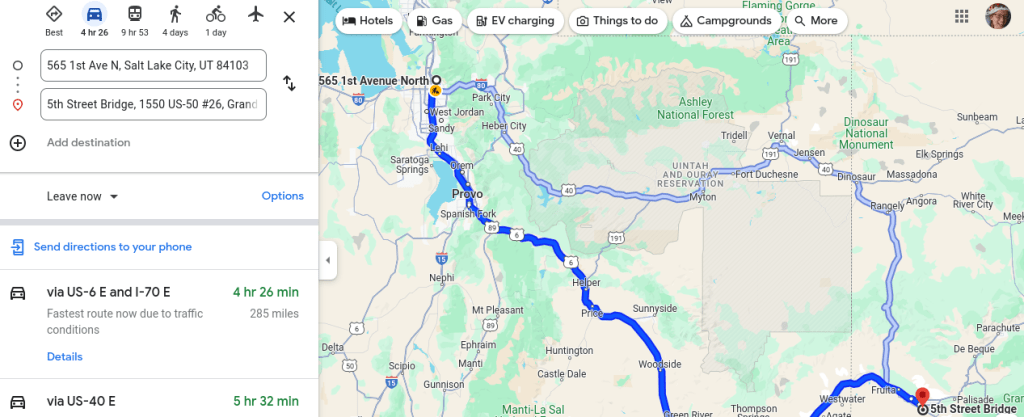
At the time of Oliverson’s abduction Bundy was a law student at the University of Utah and was living at 565 1st Avenue North in SLC. It looks like it’s roughly 285 miles away from his boarding house to the 5th Street Bridge in Grand Junction, which is about a four hour and forty minute drive, one way. Per my ‘handy dandy TB job chart,’ it appears he was unemployed in April 1975: the last place he worked was at the Department of Emergency Services in Olympia. He resigned on August 28, 1974. Bundy remained without a job until June of the following year, when he became the night manager in charge of Bailiff Hall at the University of Utah (he was fired the next month after coming in drunk). He was still in a long-distance relationship with Liz Kloepfer, although things were getting ready to fizzle out for the final time (they officially broke up after Ted went to prison for the attempted kidnapping of Carol DaRonch in 1976).

When Denise was murdered in April 1975 Bundy wasn’t on the run for much longer: Utah Highway Patrol Sergeant Bob Hayward pulled him over in Granger at around 2:30 AM on August 16, 1975 after he saw his unfamiliar tan VW Beetle pass by him while he was out on patrol. The officer knew the neighborhood and its residents well and had no memory of ever seeing that particular vehicle before. When Hayward turned on his lights to get a better view of its license plate, the driver turned off their headlights and attempted to flee. The Sergeant began to follow the car, which went through two stop signs and eventually pulled into a gas station. When he asked the driver why he was out driving around so late, Bundy replied that he was on his way home from the Redwood Drive-In after seeing the Towering Inferno but lost his way. Two more officers arrived on the scene, and after noticing that the passengers seat was missing they searched the car (with Bundy’s permission) and discovered some incredibly unusual items: a black duffle bag that contained a pair of handcuffs, an ice pick, rope, a crowbar, a flashlight, a ski-mask, a pair of gloves, wire, a screwdriver, large green plastic bags, strips of cloth, and a pantyhose mask.

In addition to his ‘kill kit,’ LE also found maps, brochures of ski resorts, and gas receipts in Bundy’s glove compartment box. When asked why he had such strange items in his car, Ted told the officers that he was in law school and was studying how to arrest criminals. While they weren’t completely convinced the law student was the ‘crazed mass murderer of young women’ that they were looking for, investigators did know he wasn’t completely innocent and arrested him for possession of burglary tools; they didn’t have enough evidence to detain him and he was ROR’ed.

It didn’t take long after his first arrest that investigators began to connect the dots between the attempted kidnapping of Carol DaRonch and the other Utah and Colorado abductions that were taking place during the same time, and they quickly began to suspect that the young law student was responsible. Perhaps one of the most damning pieces of evidence against Bundy were the handcuffs that were found in his car, which were the same style and brand as the ones found on DaRonch’s wrist after her attack. Additionally, the crowbar that officers found  in his ‘murder kit’ was identical to the weapon used to threaten her the previous November, and his tan car matched the description of the one her abductor was driving. There were too many similarities for the police to ignore, but they also knew they needed more evidence to help support their case. A few days after Ted’s arrest on August 21, investigators searched his apartment and found various brochures from the areas where some of the women were missing from, however they failed to search the building’s utility room. Years later, the killer revealed to his lawyer Polly Nelson that he had kept a box of Polaroids of his victims inside that room in a shoebox, which he later destroyed

On February 19, 1976 FBI forensics laboratories sent a letter confirming that they received a sample of Oliverson’s hair for comparison to evidence taken from Bundy’s Bug but nothing came back a match. She is Ted’s second to last confirmed victim (Sue Curtis was his last) until his second escape in late 1977 (although there are some suspected/unconfirmed victims that disappeared after, including Melanie Cooley, Sandra Weaver, Nancy-Perry-Baird, Shelley Kay Robertson, and Debbie Smith). Less than two weeks after Denise vanished on Tuesday, April 15, 1975 eighteen year old Melanie ‘Suzi’ Cooley disappeared out of Nederland, CO. After class was over for the day Cooley left the high school she attended where she was a senior and was never seen or heard from again. She was last seen by friends hitchhiking nearby campus, and it’s unclear where or when exactly she got picked up as no one saw the vehicle the young girl climbed into that day. Just a few weeks later on May 2, the body of Cooley was discovered fully clothed and frozen by a maintenance worker on Twin Spruce Road near Coal Creek Canyon about twenty miles away from where she was last seen.

According to Kevin Sullivan’s true crime classic, ‘The Bundy Murders,’ when Ted was asked about his possible involvement in Oliversons disappearance during his death row confessions by Detective Fisher, he ‘told me again of his tiredness and his wanting to get back to his cell to rest. I explained simply that he had promised to resolve all the questioned murder cases and now at the last minute he wasn’t keeping his side of the deal.’ As Fisher was walking out of the room the condemned man told him, ‘I’ll get back to you on that, I promise.’ The two men never spoke again. In a last minute, taped confession that took place less than an hour before he was put to death at 6:16 AM, Bundy confessed to Florida State Prison Superintendent Thomas Barton that he killed Denise Oliverson (it’s also listed on her ‘Charlie Project’ page that Dr. Robert D. Keppel, PhD was present as well). He said that he killed her in his car then transported her to the state border between Colorado and Utah and dumped her body in the Colorado River, about five miles west of Grand Junction. We don’t know if she was sexually assaulted, and he never shared exactly how he abducted her or took her life, but he specified that she ‘was not buried.’ In a sad, semi-related note, shortly after she disappeared Oliversons dad shared that she didn’t like water and wasn’t a big fan of swimming.

Bundy also shared that he came across Oliverson when he was returning from his second round of dumping Julie Cunninghams remains. Per Tiffany Jean in her case file of Denise, ‘Bundy claims that he encountered Oliverson as he passed through Grand Junction after he had buried Cunningham about 50 miles to the east’ (I have the link to the webpage below in my works cited). The twenty-six year old ski instructor was last seen the evening of March 15, 1975 after she left her apartment in the Apollo Park neighborhood in Vail. She was on her way to a local bar, and was last seen wearing jeans, a ski cap, brown suede jacket, and boots. On crutches and faking a ski injury, Bundy told investigators that he asked her for help carrying his ski boots to his VW, and when they arrived he knocked her unconscious, drove her to a remote area about eighty miles west of Vail and sexually assaulted her. He then strangled her to death then dumped her body in a shallow grave in a high desert area near Rifle, Colorado. Although Ted confessed to killing her on the morning he was executed, Cunningham’s remains have never been found, and her missing persons case still is considered open with the Vail Police Department.

After Bundy’s confession police said that they didn’t bother going to check out the potential dump site, as fourteen years had passed by and upwards of hundreds of thousands of people have walked through the area, trampling through evidence and destroying anything of possible value. Oliverson disappeared in early April, and according to environmental experts that is the time of year that the ‘runoff of the river would most likely have swept anything in it well downstream.’ It also gave local wildlife a good amount of time to pick apart her bones and disperse them throughout the area. Experts determined that if any trace of Denise were to turn up it would have happened by then.

The following is the transcript of a recording by Bundy regarding Denise Oliverson, dated the day of his death on January 24, 1989 at Florida State Prison; it took place in a five minute conversation roughly 45 minutes before his execution: ‘To the ah… Mike Fisher and the, the Colorado detectives ah… the last girl they wanted to talk about, Denise Oliverson, I believe, I’m not sure… out of Grand Junction that Mike Fisher wanted to discuss… ah, I believe that the date was in April 1975. Ah… the young woman’s body would have been placed in the Colorado River about five miles west of Grand Junction. It was not buried. That’s all the uh… the ones that I can help you with… it’s all the ones that I know about that uh… no missing ones outstanding that we haven’t talked about.’

In the same conversation Ted also volunteered that he abducted Susan Curtis from BYU on June 27, 1975 and gave investigators information as to where they would be able to find her body. Gas receipts placed Bundy in Grand Junction on the day that Denise disappeared: he put $3.16 in fuel at a gas station in Grand Junction on his Chevron card right before he abducted her. That same credit card was used to pay for fuel in Aspen and Vail on days his other victims Caryn Campbell and Julie Cunningham (respectively) were abducted as well. It was FBI agent Bill Hagmaier that Bundy confessed his total kill count to: eleven young women in Washington state, eight in Utah, three each in Colorado and Florida, two each in Idaho and Oregon, and one in California. The Oliverson family found out with the rest of the world that their daughter was murdered by the serial killer: they heard it on the news after he was executed. 

In May 2019, the Grand Junction PD changed Denise’s disappearance from a missing persons case to a homicide after they reviewed Bundy’s confession tapes and talked to investigators that spoke with him while he was on death row.

In an interview with The Coloradoan in 2019, former Grand Junction detective Jim Fromm said ‘at the initial time we started the investigation, we didn’t believe that she was anything other than a missing person. And the more people we interviewed, the more concerned we got. It just, it did not make sense.’ With the news of Oliverson’s case closing, Julie Cunningham’s murder is now the only unsolved case directly linked to Bundy in the state of Colorado. A friend of Oliversons from high school named Linda Pantuso told the Coloradoan in the same article that she remembered hearing about her disappearance from Nina Nicholson, who she worked with: ‘We were just in the bathroom one day and I asked how Denise was doing. She went, ‘You haven’t heard? She’s been missing.’ I was just in shock. She was just a really great person.’

Dubbed by locals as ‘The Year of Fear,’ 1975 was a rough period for Grand Junction when it came to missing and murdered women: in addition to Oliverson, on July 28 twenty-four year old Linda Benson and her five year old daughter Kellie were brutally murdered in their residence at the Chateau Apartments. Just as a (strange) side note, according to the website cavdef.org, there is also a possibility that Bundy was present when the young mom and her child were killed: when a neighbor of Benson named Steve Goad saw him on TV after he was arrested in August 1975 he recognized him as a man that was in the apartment complex’s parking lot the evening Benson was murdered. In 2009 DNA linked serial rapist Jerry Nemnich to their murders. Strangely enough, she was friends with another Grand Junction woman that got murdered on August 23 in 1975: Linda Miracle. Twenty-four year old Miracle and her two young sons were killed by a neighbor, Ken Botham Jr. after he killed his wife at the home they shared. On December 27, Deborah Kathleen Tomlinson (not to be confused with Deborah Lee Tomlinson, who disappeared with a friend on her 16th birthday in October 1973 from Creswell, Oregon) was killed in her apartment complex in the 1000 block of Belford Avenue in GJ. She was found lying partially nude in her bathtub and had been sexually assaulted, bound and strangled. In December 2020 using DNA technology investigators identified Jimmie Dean Duncan as the man who killed Tomlinson. 

In 2013, the Grand Junction PD collected DNA samples from Denise’s mother just in case they ever found remains. About his daughter missing, in 1986 Mr. Nicholson said ‘people need to finalize it in their minds, otherwise they’ll be bouncing back and forth. You don’t have a funeral, you can’t have a funeral. When the body is never found. A tragedy like this just tears the whole family up. I’ll never be the same. You raise a child, of course she wasn’t a child anymore. She was a young woman. It’s quite obvious when he got away from Glenwood Springs that he’s sick There’s something wrong up in the attic. There’s always the possibility that he’ll get out and do it again. They say he’s an intelligent young man, but it was channeled in the wrong direction. In the worst way’ Robert Nicholson also felt that Bundy ‘definitely’ should have been executed, and he was ‘just happy he’s been executed because it should have happened a long time ago.’

Denise’s father died at the age of 74 on October 2, 2001 in Grand Junction. Her mother passed away at the age of 94 on December 28, 2017. Nina remained a generous and kind woman despite the plethora of tragedies that took place during her life, and she loved to dance and was fascinated by Koala bears. Always hospitable, she wanted to make sure everyone around her was taken care of. Sadly, right before she passed Denise’s sister Renee died in the summer of 2017. Described in her obituary as a ‘gentle and loving soul,’ as a young woman Renee studied to be a dancer but was very ill in the final few years of her life, which restricted her activities. She died at HopeWest and Hospice Care Center on August 24, 2017. It looks like Steve Romero married a woman named Sandra on February 17, 1982 but they divorced just a few years later on May 22, 1984. He remarried a woman named Wilma on August 17, 1977 and died on November 3, 1996. Although her case has officially been closed, as of January 2024 no trace of Denise Lynn Oliverson has ever been found.

* Thank you to Archivist and Bundy researcher Tiffany Jean for the transcript of this interview. 

Jean, Tiffany. November 20, 2019. ‘Case File: Denise Lynn Oliverson, 1975.’ Retrieved January 17, 2024 from https://archive.ph/2020.07.02-052035/https://hiimted.blog/2019/11/20/case-file-denise-lynn-oliverson-1975/#selection-211.0-211.38
Mortenson, Chris. July 16, 2020. ‘Ted Bundy Location/Denise Oliverson Tour With GJPD Homicide Investigator Doug Rushing (2020 Update). Taken January 19, 2024 from https://www.youtube.com/watch?v=wBVac81zFZY
Sulivan, Kevin. August 12, 2009. ‘The Bundy Murders: A Comprehensive History.’
Sulivan, Kevin. 2020. ‘The Encyclopedia of the Ted Bundy Murders.’

Denise’s sophomore year picture from the 1966 Grand Junction High School yearbook.
Denise’s junior year picture from the 1967 Grand Junction High School yearbook.
Denise’s senior year picture from the 1968 Grand Junction High School yearbook.
Denise Oliverson.
Denise Oliverson.
Oliverson and an ex-boyfriend. Photo courtesy of the Grand Junction PD.
Some photography negatives of Denise. Courtesy of Captain Borax.
Denise Oliverson on her wedding day.
Oliverson’s mug shot after she was arrested in 1969 in Grand Junction for a misdemeanor after being caught with marijuana.
A missing persons bulletin for Oliverson. Photo courtesy of the Grand Junction PD.
A missing persons bulletin for Oliverson. Photo courtesy of the Grand Junction PD/Tiffany Jean.
Oliversons wooden clogs that were found near the 5th Street viaduct close to her yellow bike. Photo courtesy of Captain Borax.
The bottom of the pair of Oliversons sandals that were collected at the abduction site. Photo courtesy of Captain Borax.
Oliversons underwear that were collected at the abduction site. Photo courtesy of Captain Borax.
Denise and Joe’s engagement announcement published in The Daily Sentinel on May 20, 1970.
Denise and Joe’s wedding announcement published in The Daily Sentinel on September 30, 1970.
An article about Joe Oliverson visiting with his family published by The Herald-Journal on February 16, 1972.
An article about Oliverson missing published by The Daily Sentinel on June 24, 1975.
An article about the disappearance of Denise Oliverson published by The Daily Sentinel on October 13, 1975.
An article about the disappearance of Denise Oliverson published by The High Point Enterprise on October 26, 1975.
An article mentioning Denise Oliverson published by The Greeley Daily Tribune on October 27, 1975.
An article mentioning the disappearance of Denise Oliverson published by The Greeley Daily Tribune on October 31, 1975.
Oliverson is briefly mentioned in an article about Bundy’s victims published by The News-Press on June 26, 1979.
An article about the disappearance of Denise Oliverson published by The Daily Sentinel on The Daily Sentinel on July 22, 1979.
Oliverson is briefly mentioned in an article about Bundy’s victims published by The Spokesman-Review on August 22, 1979.
Oliverson included in a list of Bundy’s victims published in The Tallahassee Democrat on October 2, 1980.
Part one of article about the disappearance of Denise Oliverson published by The Daily Sentinel on February 23, 1986.
Part two of article about the disappearance of Denise Oliverson published by The Daily Sentinel on February 23, 1986.
Oliverson is mentioned in an list of Bundy’s confirmed victims published by The St. Petersburg Times on July 8, 1986.
A poor quality picture of an article mentioning Oliverson that was written right before Bundy was executed. Published by The Standard-Examiner on January 27, 1989.
An article about Bundy being executed that mentions Denise at the very bottom published by The Tribune on January 27, 1989.
Oliverson is briefly mentioned in an article written about Bundy’s victims published by The Waycross Journal-Herald on January 28, 1989.
An article about the disappearance of Denise Oliverson published by The Daily Sentinel on January 31, 1989.
A picture of Denise Oliverson from the first part of an article published by The Daily Sentinel on May 29, 2011.
Part two of an article published by The Daily Sentinel on May 29, 2011.
A blurb about Oliverson published by The Windsor Beacon on February 17, 2019.
Three retired investigators that worked Oliversons case. From left: Ron Smith, James Fromm, and Doug Rushing.
Oliversons one bedroom residence located at 1619 LaVeta Street; she lived here with her boyfriend, Steve Romero. Photo courtesy of OddStops.
Oliversons mailbox, at 1619 LaVeta Street.
The inside of Denise’s house on LaVeta Street as it looks today.
The side yard of Denise’s house on LaVeta Street as it looks today.
Robert and Nina Nicholsons home, located at 801 Ouray Ave in Grand Junction. Photo courtesy of Google Maps.
A bike ride from Denise’s residence to her parents house should have taken 20 minutes.
A route from Denise’s house to Lincoln Park to her parents house should have taken her a little over 25 minutes.
A possible route Bundy make have taken to the South 5th Street bridge n Grand Junction, Colorado.
Bundys whereabouts on April 5, 1975 when Oliverson disappeared according to the ‘TB Multiagency Investigative Team Report 1992.’
The former Chevron station where Bundy filled up the day he abducted and murdered Denise in Grand Junction.
Denise and her husband listed in the Grand Junction City Directory in 1971.
Joe and Denise Oliverson’s marriage certificate from September, 1970.
Excerpts from Denise’s journal. Photo courtesy of the Grand Junction PD.
Excerpts from Denise’s journal. Photo courtesy of the Grand Junction PD/Tiffany Jean.
A letter to Denise from her counselor, Lois Kanaly. Photo courtesy of the Grand Junction PD/Tiffany Jean.
A letter from Steve Romero to Denise’s sister, Renee. Photo courtesy of Captain Borax and The Grand Junction Police Department.
Documentation related to Denise’s missing persons case from the Grand Junction PD. Photo courtesy of Captain Borax.
Documentation that Denise’s property was checked into evidence at the Grand Junction PD. Photo courtesy of Captain Borax.
A letter from the Grand Junction Chief of Police to Pitkin County Sheriff asking for assistance. Photo courtesy of the Grand Junction PD/Tiffany Jean.
A letter dated February 19, 1976 from FBI forensics lab confirming receipt of Oliverson’s hair samples for comparison to evidence taken from Bundy’s car. Photo courtesy Grand Junction PD/Tiffany Jean.
Some of Denise’s artwork. Photo courtesy of Captain Borax.
A notation regarding Bundy’s Chevron receipts.
Hand drawn map that came with the ‘psychic letter’ showing where Oliversons remains could be located.
Courtesy of the Grand Junction PD/Tiffany Jean.
An older photo of the bridge where Ted Bundy abducted Denise Lynn Oliverson. Photo courtesy of Captain Borax.
A reporter standing underneath the South 5th Street Bridge with a bike much like the one Denise was last seen riding.
Some more recent graffiti underneath the South 5th Street Bridge in Grand Junction.
The underneath the South 5th Street Bridge in Grand Junction.
A shot of the Colorado River about five miles west of Grand Junction where Bundy says he dumped Denise Oliversons body.
An x-ray of Denise Oliversons teeth. Photo courtesy of Captain Borax.
Another x-ray of Denise Oliversons teeth. Photo courtesy of Captain Borax.
Denise’s mother, Nina Marie (nee Jackson) Nicholson.
Another shot of Denise’s mother, Nina.
Denise’s parents engagement announcement published in The St. Joseph News-Press on June 12, 1949.
Denise’s fathers grave site. Photo courtesy of findagrave.
A notice in the newspaper about Nina Nicholsons death published by The Daily Sentinel on December 31, 2017.
Denise’s moms obituary published by The Daily Sentinel on January 19, 2018.
Renee Nicholson’s sophomore year picture from the 1971 Grand Junction High School yearbook.
Renee Nicholson-West’s obituary published by The Daily Sentinel on September 12, 2017.
Denise’s ex-husband Joe Oliverson’s junior year photo from the 1967 Dimond High School yearbook.
An article about Denise’s husband being appointed as a ‘general life insurance agent’ in Grand Junction published by The Daily Sentinel on April 3, 1974.
An quick blurb about Denise’s ex-husband Joe Oliverson being getting a job at Bray Real Estate in Grand Junction published by The Daily Sentinel on July 22, 2007.
Raymundo Esteban (also known as Steve) Romero in 1970. Photo courtesy of Tiffany Jean.
Fred Gallegos from the 1969 Delta High School yearbook.
Linda Benson.
Linda Miracle and her two sons, Troy and Chad.
Miracle’s obit published by The Daily Sentinel on October 29, 1975.
An article about some of the 1975 murders in rand Junction published by The Fort Collins Coloradoan on October 26, 1975.
Patricia Botham.
Ken Botham Jr.
Deborah Kathleen Tomlinson.

Rita Patricia Curran.

Rita Patricia Curran was born on June 21, 1947 to Thomas Sr. and Mary (nee Donahue) Curran in Woodhaven, NY; Rita had a younger brother (Thomas Jr.) and sister Mary (Campbell); Mr. Curran worked for IBM. The strict Roman Catholic family eventually settled down in Burlington, Vermont. Described as ‘quiet, sweet, and almost painfully shy,’ Rita was a small girl with a petite frame, dark eyes, and long brown hair she wore parted down the middle. After graduating from Mount Saint Mary’s Academy, Ms. Curran attended Trinity College in Vermont, an all girls Catholic school that was close to home; in 1969 she earned a Bachelor’s degree in education. Described as ‘a person truly dedicated to her profession’, Rita was in her second year of teaching second-grade at Milton Elementary School in Milton, Vermont. After her untimely passing Milton Elementary Principal Merritt Clark Jr. said of his young teacher: ‘the boys and girls seemed to like her being in class. She did a lot of work with the deprived and handicapped children’ … ‘she had a knack about her working with these kids.’ In her spare time Rita participated in ‘The Champlain Echoes,’ an all-female acapella group and taught a religion class at St. Ann’s Catholic Church in Milton (which was about 20 miles away from where she was staying the summer she was murdered).

Rita’s permanent residence was in Milton, VT however in the summer of 1971 she was renting an apartment with two roommates in Burlington while participating in a reading and language arts workshop at the nearby University of Vermont graduate school. Ms. Curran found an ad for a ‘roommate wanted’ in a local newspaper and had moved into a first story apartment in a converted three-story Victorian house just about two weeks before her death (it was also the first time in her life she lived away from home). She originally planned on staying the entire summer but Mary Curran said her daughter was planning on coming home just a few days after she was murdered. She went on to say that Rita’s two roommates were friends before she moved in and she felt like she didn’t quite fit in with them. Plus she got into an argument with one of them over a boy spending the night. Mary Curran-Campbell said of her sister: ‘she had actually lived at home all her life until June of 1971, and she found an ad in the Burlington Free Press looking for a roommate part-time for the summer. It seemed to be a good fit and so she moved out about one month before she was murdered.’ While living there Curran was employed at the Colonial Motor Inn as a chambermaid (which is strangely only half a mile away from the ‘Elizabeth Lund Home for Unwed Mothers’ where Bundy was born in November 1946). The day of her disappearance, Ms. Curran worked at the Inn from 8:15 AM until 2:40 PM then attended choir practice at The Sara M. Holbrook Community Center located at 66 North Avenue in Burlington, Vermont; she may have been there as late as 10 PM. A representative from the Motor Inn said that Curran was extremely well liked there, was very popular among staff, and had been employed there on and off for about 3-4 years, usually during summer breaks. She often complained to her co-workers that she felt like an ‘ugly duckling’ but held onto hope that she would someday find a man, settle down, and get married. Rita also shared with friends that she already went to three weddings at that point in mid-1971 and moved to Burlington with hopes to find a boyfriend because she felt all the good men in Milton were already taken.

One of Curran’s roommate, twenty four year-old Beverly Lamphere, said she last saw Rita alive at around 11:20 PM when she left the apartment to meet up with her boyfriend Paul Robinson (23) at a Shelburne Road restaurant; their third roommate Kerry Duame met up with the couple at some point. Robinson said that ‘we were gone maybe two or three hours. We had asked Rita to join us that night, but she said no.’ Ms. Lamphere took the only set of keys with her when she left but made sure to leave both the front and back doors unlocked; it was their usual practice as they lived in a safe, residential neighborhood. At around 1:00 AM on July 19, 1971 the friends returned to the apartment with no signs of forced entry; they assumed Curran was sleeping as she was nowhere to be found. After arriving the friends sat in the living room chatting for a while, completely unaware that anything was wrong. It wasn’t until around 1:20 AM that Beverly discovered the gruesome scene straight out of a horror movie: the 24 year-old schoolteacher was lying dead on her bedroom floor, naked and on her back, her torn underwear discarded underneath her; Rita’s face and head were badly beaten. Beverly’s boyfriend attempted to perform life saving measures but it was too late. Curran’s hair was styled up in curlers (just like Seattle flight attendant Lisa Wick), and it was as if she’d been attacked while getting ready for bed. There had been signs of a struggle and it appeared Curran fought for her life. When the roommates were questioned, they weren’t able to give very much helpful information, as they were nowhere near the scene at the time of the murder. Burlington Detective Wayne Liberty said they were eventually ruled out as suspects in 1972. Paul Robinson said he can still remember the screams of horror when his friend discovered Rita’s body: ‘I was the one that called the police. I told them there had been a murder. I have always had a question about whether Rita was still alive when we got back into the apartment that night.’…’This kind of horror was unheard of in Burlington, Vermont. It was a very innocent time. I can’t tell you how fast deadbolts flew off the shelves after Rita’s murder.’

Chief Medical Examiner Dr. Lawrence Harris determined Currans cause of death to be ‘asphyxia caused by manual strangulation’ and that she had been beaten in the head and face (most likely with a closed fist); there were no drugs found in her system. The ME pinpointed her time of death to be sometime between 11:30 PM and 12:30 AM and that she had been sexually assaulted with a crowbar (but she was not raped). Detectives also found blood on her throat. Law enforcement said it was evident by the scene that there were ‘signs of an intense struggle.’ Shortly after Rita’s murder Former Chittenden County States Attorney and now US Senator Patrick Leahy (he was elected to the position in 1974) wanted no information on it released to the public and put a ‘blackout’ on the case, meaning no information at all was released to the public about the murder. This devastated the Curran family, who felt Rita’s death should have immediately been a front page story.

At the time law enforcement called Rita’s murder ‘the most intensive investigation in the city’s history’ and that ‘in their memory there had been no crime of such violence in the history of this city of 38,000 persons.’ Police determined that the murderer entered the apartment through an unlocked door and attacked Curran while she was most likely in bed but not yet asleep. Neighbors said they heard nothing out of the ordinary: no screams or anything during the time the murder took place. Police quickly ruled out robbery as a motive, as Currans purse sat untouched on the floor directly behind the door with about $20 inside (as well as her personal items and driver’s license); her car was also found unbothered in its normal spot in front of the apartment building. In the kitchen police found Currans blood smeared on the inside of the door, which most likely had rubbed off from the suspects hand as he was fleeing through the back door. Police found no fingerprints at the scene.

The murder of Rita Curran terrified the residents of Burlington, as it took place during a time of innocence, and when violent sexual murders were infrequent and rare. An unclaimed $3,000 reward was offered at the time for any information leading to the arrest and conviction of the murderer of Curran. Her sister Mary said that ‘Burlington was considered a very safe place. It was an unbelievable shock to the city when this happened.’ … ‘The phrase ‘it can’t happen here’ just can’t be used because it will happen here, it has happened here. In any hometown that you hear people say that on the news, they’re not being realistic.’ The ‘Burlington Free Press’ reported that Rita told her friends that on multiple occasions she received strange, almost threatening telephone calls late at night with nothing on the other end but heavy breathing. Several other women in the area reported receiving similar types of calls. Additionally reports of a tall, mysterious peeping Tom looking into windows were made as well as others that reported attempted break-ins, where the intruder ran away after they screamed. There was never an official connection made between Rita’s murder, the peeping Tom, and the obscene phone calls, but they supposedly all stopped in September of that year. Detective Richard Beaulieu of the Burlington Police Department had officers look into a possible connection between several assaults on other local women and Rita’s murder in the area. A week before Curran was murdered, a 20 year old Burlington woman was raped in her bed at 4 AM by an assailant she felt was around 16-17 years old. In October 1970, a woman sleeping in her bed suffered a vicious knife attack only three blocks away from Rita’s apartment. Thankfully, the unnamed suspect got spooked when his victim started screaming; it’s unknown if he was ever caught. In September 1971, police claimed they got their first big break in the case and that evidence would soon be handed over to a grand jury. But, weeks passed by then months, and nothing ever came to fruition from that big announcement. Years later it was determined this ‘major break’ most likely stemmed from the fact that police had polygraphed one of Rita’s neighbors after a prior unrelated rape accusation came to light. However, nothing ever came of it and there wasn’t enough evidence to arrest the unnamed male. In addition to the neighbor there were three other suspects that were looked into but all were eventually cleared. Additionally, Burlington Police looked into all males in the area with any known history of sexual offenses. By 1979, two of the four viable suspects in the Curran case died and another two were in prison for homicides that ‘bore no resemblance to the Curran murder.’ Despite the intense public interest in the young school teacher’s murder the case quickly went cold. 

Curran’s case got renewed attention in 1980 after she was named a possible Bundy victim in Ann Rule’s, ‘The Stranger Beside Me.’ In the novel, a retired FBI agent commented that there was a ‘remarkable resemblance between Rita Curran’ and his first girlfriend, Diane Edwards.

One thing I am EXTREMELY thankful for is all the leg work and research other ‘Bundy scholars’ do, largely because I’m just an insurance agent blogging as a hobby. The creator of the ‘hi: I’m Ted’ site said the following about Currans murder: ‘In researching this case, I spoke to a woman who was a teenager in Burlington at the time of the attack and claimed that her parents were close friends with the Currans. The woman (who wished to remain anonymous) said that Rita was found bound with piano wire, which she had apparently struggled against, as her skin was torn and bloodied. She also said that the police suspected the ‘son of a prominent judge’ but did not have enough evidence to charge a high profile member of the community’s son with the crime, and instead his family put him in a mental institution.’ … ‘The piano wire claim is an oddly specific detail that has never been mentioned in any of the news reports from that era or more recently. Binding victims with piano wire while they were still alive was certainly not a known part of Bundy’s modus operandi. The woman I spoke to claimed this detail came directly from the Curran family, but without the case file or the family speaking out, these details cannot be substantiated and may just be rumors. However it is interesting to note that at least some of this information is corroborated by Rita’s mother, who publicly accused the police of a ‘cover up’ in 1979.’

Elizabeth Kloepfer was in a serious, long term relationship with Ted Bundy from fall 1969 to 1975 and she made no mentions of him visiting Vermont in the early 1970’s in her 1980 memoir, ‘The Phantom Prince.’ During that period in July 1971 Liz took Molly and moved into an apartment closer to the Rogers Rooming House even though her and Ted weren’t as strong as they once were. She said their lives were ‘out of sync’ and that they didn’t spend as much time together as they did when they had first started dating. Just as a side note, I cannot tell you how many times I’ve had to refer to my handy-dandy ‘Ted Bundy Job Chart’ over the last 8 months since I started writing this blog. Anyways, in the summer of 1971 when Rita Curran was murdered Bundy worked as a delivery driver for Pedline Supply Company, a family-owned medical supply company. While there he was once caught stealing a picture from a Physician’s office (he was let off with just a verbal warning). Ted began his employment there on June 5, 1970 and was there until December 31, 1971 when they moved their office across town and he quit. Also at that time in 1971 Bundy was still in his undergraduate days at the University of Washington. So as far as any concrete proof putting Bundy in Burlington in July 1971… there just isn’t any (just a lot of rumors and speculative stories). In ‘The Stranger Beside Me,Rule hypothesizes that Ted had some sort of ‘defining moment’ in his 20’s where he went to the Elizabeth Lund home in hopes to track down the truth about his parentage. She further speculates that after Bundy realized he was ‘illegitimate’ and that his birth was the result of a pre-marital tryst he went blind with rage and killed Rita Curran during that brief period he was in Vermont. But this doesn’t seem to make much sense: we know Ted told Liz he already knew about his illegitimacy when they first started dating in late 1969. Rule spoke with retired FBI agent John Bassett who was supposedly ‘intrigued by the remarkable resemblance between Rita Curran and Diane Edwards, the fact that Rita had died of strangulation and bludgeoning to the head, and the proximity of the Colonial Motor Inn where Rita worked to an institution that had wrought so much emotional trauma in Ted Bundy’s life: The Elizabeth Lund Home for Unwed Mothers.’ Another interesting factoid: there’s supposedly a report from animal control that said someone going by the name of ‘Bundy’ was bit by a dog the same week that Curran died (this is all the information I could find on this event). Does that place him at the scene or is it just another coincidence?

Mary Campbell even wrote Bundy a letter before he was executed asking if he murdered her sister: ‘we asked the FBI when they were interrogating him whether if she was one of his case, and we got a letter back from the FBI that said he did not deny it or acknowledge it.’ Bundy was questioned about Curran’s death for the final time shortly before he was executed the morning of January 24, 1989. Thomas Barton, the warden at Florida State Prison in Raiford, asked him about his involvement at around 6:15 that morning. He said: ‘I can say without any question that there is no, uh, nothing for instance, that I was involved in Illinois or New Jersey,’ then when asked specifically about Burlington, Ted said a simple ‘no’ and that was that. Bundy denied any involvement with her murder right up to the very end.

Because it was so widely speculated that Bundy was in the Burlington area at the time of Rita’s murder, Deputy Police Chief Shawn Burke said Vermont law enforcement felt he may have been their guy for quite some time. However, Patrick Leahy said after Vermont investigators spoke with him in Raiford before he was executed they were finally able to ‘discard him as a suspect.’ Additionally, former Burlington Police Chief Kevin Scully said, ‘we have looked into the possibility of Ted Bundy’s involvement, we’re satisfied that at the time of the Rita Curran murder, Ted Bundy was somewhere else in the country.’

Bundy’s DNA was submitted to the CODIS database in 2011; no hits came back on the murder of Rita Curran. In 2016, Vermont detectives said they were taking another look at her case with‘’fresh eyes’ and more modern investigative resources. Leahy told Vermont’s ‘Burlington Free Press’ that Rita’s murder was ‘an extremely brutal homicide. Certainly, one of the most brutal I’ve ever seen in my years as state’s attorney’ and that it was ‘a horrible scene. I can still picture what I saw. A lot of evidence was gathered there. We didn’t have techniques like DNA and thinks like that back at the time. Hopefully, the evidence that was gathered was enough.’ Shawn Burke further commented that, ‘uniquely, there are still witnesses and people of interest who remain alive. It is a case where we have been running down some active leads.’ Since the murder took place in 1971, Vermont law enforcement ruled out dozens of suspects, polygraphed over 100 people and went over hundreds and hundreds of tips related to the case. They also spoke with all of the registered sex offenders that resided in the area close to where she was murdered and still came up with nothing.

Mrs. Curran felt there was some sort of police cover-up regarding her daughters case, saying ‘we felt a lot more could have been done but wasn’t for political reasons.’ Roughly a week before Bundy was executed she sent a telegraph to Bundy begging him to finally tell the truth about his involvement with Rita’s death; it was the FBI who sent her a response, saying Bundy refused to say anything about it, either way. On the 45th anniversary of Rita’s death in 2016, Thomas Jr. and Mary put a notice in the local paper in memory of their beloved sister. It read: ‘we will never forget you. We will never give up hope that we will someday know why you were taken from us.’ The siblings hoped their parents would have answers about their daughters death before they died but sadly that didn’t happen: Mr. Curran died in 1991 and Mrs. Curran passed in 2002. In a July 2021 interview with the ‘Burlington Free Press’, Mary Curran-Campbell said: ‘We’ve lived with this day-in and day-out for 50 years. I can’t say I’m going to give up, but I have to surrender to the powers that be.’ …’fifty years is a long time to grieve, a long time to hope. The fifty-year mark confirms that a resolution in our lifetime to Rita’s murder is not going to happen… We know Rita’s death did not happen in a vacuum. Somebody somewhere knows what happened that night on July 19, 1971 and they will take that information to their grave. May God have mercy on their soul.’

The brutal murder of Ms. Curran remains open to this day and is the oldest cold case that is still under investigation by the Burlington police department. In July 2021, Vermont Detective Tom Chenette said that despite over half of a century going by, that law enforcement could still find justice for Curran. Regarding Rita’s murder, Leahy said: ‘I can only imagine how relieved her family would be if it’s solved.’ Beverly Lamphere was 95 years old when she passed away in late May 2021. Anyone with information regarding the murder of Rita Curran is encouraged to contact the Burlington Police Department Major Crime Unit at 802.244.8781.

Update:

On Tuesday, February 22, 2023 acting Burlington Police Chief Jon Murad made the announcement the Curran family waited almost 52 years to hear: they finally know who killed their beloved Rita. It was a neighbor that lived in the apartment two floors above hers, a man named William Richard DeRoos. DNA collected at the crime scene from a discarded, ‘un-crushed’ cigarette butt ‘laying on the floor’ below Curran’s elbow in 1971 helped law enforcement link DeRoos to the murder. According to the newly released case file, ‘the Lark cigarette butt that was found next to the right arm of Rita’s murdered body had a male DNA profile that was linked to William DeRoos (b. 12.14.1939). This cigarette butt was unique in the sense that it was not crushed, smooshed or butted out. It had burned out there at the scene, as there was ash located on the floor between her body and her right arm. The end of the cigarette butt had jagged paper that was consistent with a cigarette that had burned out on its own.’

An investigative report from February 2023 states that a ‘big break in the case occurred in 2014’ when law enforcement was able to retrieve DNA from the cigarette butt. It is worth mentioning that Bundy’s DNA was among the 13 samples compared to the sample, and he was ruled out. In August 2022, the DNA from the butt was tested against DeRoos’ and investigators finally found a genetic match. Lieutenant Detective James Trieb said ‘that cigarette butt sat in evidence for over 40 years’ until Detective Jeffrey Beerworth sent it to the NYC Office of the Chief Medical Examiner for analysis. It was then that forensic experts found a single strand of male DNA on it, but they ran into another dead end when it didn’t match any results in the Combined DNA Index System (CODIS). It wasn’t until early 2023 that Burlington law enforcement contacted Parabon Nanolabs Chief Genetic Genealogist CeCe Moore for assistance identifying the unmatched strand, which finally resulted in a positive ID earlier this year. Moore commented that ‘this case is over 50 years old, and it only took a few hours to narrow it down to William DeRoos.’

According to a recently unearthed marriage certificate, William and Michelle (nee Roach) DeRoos (who now goes by the name Kylas Nagaarjuna) were wed on July 21, 1971 in Burlington, which helps place him near the scene of the crime around the time of Rita’s death. Additionally, his official mailing address proves he lived in the same house as Curran at the time of her murder. DeRoos was 31 years-old when he took Rita’s life and at the time was married for only two weeks; Michelle was only twenty-four and was several years younger than her new husband. The night of the homicide DeRoos and his wife had an argument and he ‘left for a cool-down walk.’ Almost immediately after the murder William’s wife gave law enforcement an alibi, telling them he was with her the entire night and never left. Chief Murad said during a Tuesday press conference that: ‘five decades later, she gave our detectives a different story: the truth.’ Kylas later admitted to investigators that DeRoos had convinced her to lie so they would not connect him to Curran’s murder. Nagaarjuna elaborated that she didn’t recall exactly how long William was gone but the next day he ‘told her not to mention that he was not at home’ when the murders took place due to his sordid criminal past and because of it law enforcement ‘would try to accuse him of it.’ She told The Daily Beast that she is still ‘overwhelmed’ by the news and that she doesn’t ‘wish to speak to the public about this;’ she further elaborated that she ‘has conveyed a message’ to Curran’s family. In September 2022 law enforcement met with Nagaarjuna who said that her ex had been in prison twice prior to their marriage and that he definitely had a violent streak. On one occasion he went after his second wife’s throat, briefly strangling her and even stabbing one of her friends unprovoked. Law enforcement feels she had no previous knowledge that her husband was involved in the murder.

Chief Murad said that Curran ‘put up a vicious struggle’ with DeRoos and that she ‘fought for her life.’ The morning after the murder, law enforcement asked the newlyweds if they had heard anything suspicious the night before, and they both denied seeing or hearing anything out of the ordinary: ‘they heard nothing and Mrs. DeRoos stated that she had been up around 1:00 AM but had heard no unusual noises or anything else.’ Paul Robinson found this strange because the walls in the two-bedroom apartment were extremely thin: ‘I have to believe that someone heard something that night.’ Shortly after taking Rita’s life, DeRoos left his new wife and ‘moved to Thailand and became a Buddhist monk.’ She eventually followed him there to become a nun, however their relationship fizzled out largely because it was ‘against the rules’ and the couple divorced. DeRoos reappeared in the San Francisco area sometime during 1974 and he married for a second time. He died in 1986 at the age of 46 from ‘acute morphine poisoning’ in a seedy hotel room in San Francisco.

Former Burlington Police Chief Brandon del Pozo was on the case from 2015 to 2019 and shared with The Daily Beast that ‘Rita’s killer may be dead but if this is all the justice Burlington police can offer her spirit and her loved ones, then so be it. Unless the police keep their memory alive and continue the investigation, the victims of unsolved murders are often lost to time. I’m so proud of the Burlington detectives who kept Rita’s case open while I served as chief, traveling in (and around) the country to collect comparison DNA and re-interview witnesses, and who never stopped until today. The Burlington Police Department never forgot about Rita.’

In September 2022, law enforcement met with Nagaarjuna who said that despite her ex-husband being in prison twice prior to their marriage he had never been violent with her. Things changed with his second wife Sarah Hepting, who told police that DeRoos had an extreme propensity for violence. She shared with them an incident where William stabbed a friend of theirs for no apparent reason, which she thinks he was arrested for (police are still trying to confirm this as she is unsure of the time it happened). Hepting also reported that on a separate occasion he strangled her to the point she nearly lost consciousness (again this was unprovoked).

As I said earlier, both of Rita’s parents passed away waiting for their daughter’s killer to be caught. Her siblings thanked the Burlington Police for the compassion they showed their family over the five decades long investigation. Tom Curran said: ‘my mother came here from Ireland and my father from Newfoundland. We were an old-fashioned, strong, Catholic family. I don’t think so much about the guy who did this as I do about Rita and my parents and what they went through. I pray to my parents, and I pray to Rita.’

Chief Murad told The Daily Beast: ‘when people doing an ancestry or genealogy test check the box saying it’s okay for law enforcement to use the results, they are helping solve murders. They are bringing evil-doers to justice. They are delivering closure to families. I am tremendously proud of the detectives who did this for Rita and her family.’

What’s incredibly helpful is Burlington PD finally released the file for Rita’s case; I attached it in a separate piece: https://jjeannejurewicz.wordpress.com/2023/02/22/rita-patricia-curran-case-file/

A young Rita Curran (l) and her siblings Thomas Curran, center, and Mary Curran Campbell pose for a photo in the early 1950’s at their home in Woodhaven, NY. The Curran family resided in New York before moving to Milton, Vermont.
Photo courtesy of Vermont State Police.
Rita Curran.
Rita Curran.
Rita Curran, as shown in a school picture taken at Milton Elementary School while she was a second-grade teacher. Rita Curran in 1970. Photo courtesy Mary Campbell and Burlington Free Press.
Rita Curran in her Mount Saint Mary Academy Yearbook photo from 1965.
The Curran family in April 1971 celebrating the 25th wedding anniversary of Thomas Sr. and Mary. From left to right: Mrs. Mary Curran (Rita’s Mother), Mary Curran-Campbell, Thomas Curran Jr., Rita, Thomas Sr.
Another picture from Mr. and Mrs. Currans 25th wedding anniversary.
Rita’s alma mater: Mount St. Mary’s Academy in Burlington, VT.
Rita Curran (left) and her sister Mary pose for a photo in front of the family pond while wearing their Mount St. Mary’s Academy uniforms in 1964. At the time this was taken Ms. Curran was a high school senior.
Rita (center) in a picture while at Mount St. Mary’s Academy in Burlington, VT.
Rita Curran (second row, third from the right) pictured with fellow members of the Misericordia a Capella Choir, 1964.

Rita in the 1964 Mt. St. Mary’s Academy yearbook.

Rita in the 1964 Mt. St. Mary’s Academy yearbook.

Rita in the 1964 Mt. St. Mary’s Academy yearbook.
Rita Curran (center, sitting down holding a piece of paper in each hand) pictured with fellow Misericordia staff members, 1965.
Rita Patricia Curran (standing in the front row, second from the right) posing with fellow Misericordia staff members, 1965.
Rita in the 1965 Mt. St. Mary’s Academy Yearbook.
Rita Curran in a picture for choir from a Mount St. Mary’s Academy yearbook photo; Curran is in the middle row, far right.
Mount St. Mary’s Glee Club staff yearbook photo; Rita Curran is on the front right.
From left, Mary Curran Campbell, Thomas Curran, and Rita Curran pose for a photo on Thomas Curran’s graduation day from Milton High School in 1968. Rita Curran in 1968. Photo courtesy of Mary Campbell and Burlington Free Press.
A sign at Trinity College, where Rita attended.
A logo for Trinity College.
Rita’s brother Thomas mentioned in The Burlington Free Press on June 5, 1967.
The announcement of Thomas Curran Jr.’s engagement published by The Burlington Free Press on October 11, 1974.
A photo of Rita’s brother Tom on his wedding day.
An advertisement for the choir Rita participated in called ‘The Champlain Echoes.’
An advertisement for the choir Rita participated in.
From early June, 1971, the top ad is probably the one that Rita answered.
Curran’s death certificate.
Photo courtesy of The Burlington Free Press.
A 1971 screen grab of the street where Rita Curran lived before she was murdered.
A 1971 screenshot of the house where Rita Curran lived before she was murdered.
A photo of Rita Currans bedroom the night she was brutally murdered.
A close up photo of Rita Currans bed frame from the night she was brutally murdered.
A photo of the ceiling in Rita Currans bedroom.
A photo of Rita Currans bedroom.
The bloodied floor from Rita Currans bedroom the night she was murdered.
A discarded cigarette butt found at the crime scene
A photo of Rita Curran on a gurney.
Law enforcement working the crime scene of Currans murder.
A photo from Rita’s case file.
A file box with notes related to the murder of Rita Curran.
A photo from Rita Currans funeral service.
The funeral for Rita Curran.de
An article about the murder of Ms. Curran.
An article mentioning Curran before her tragic murder published by The Burlington Free Press on April 24, 1967.
An article mentioning Rita teaching second grade at Milton Elementary published in The Burlington Free Press on September 7, 1970.
A wedding announcement mentioning that Rita stood up in a friends wedding published in The Burlington Free Press on June 21, 1971.
Just before her death Curran performed in a friends wedding; published by The Burlington Free Press on July 19, 1971.
An article about Rita Curran published in the Bennington Banner on July 20, 1971.
An article about the murder of Ms. Curran published in The Victoria Advocate on July 20, 1971.
An article about the murder of Ms. Curran published in The Times Argus on July 20, 1971.
Rita Currans obituary published in The St. Albans Daily Messenger on July 21, 1971.
Rita Currans obituary published in The Burlington Free Press on July 21, 1971.
An article about the murder of Ms. Curran published in The Lewiston Daily Sun on July 21, 1971.
An article about the murder of Ms. Curran published in The Sarasota Herald Tribune on July 21, 1971.
An article about Ms. Curran published by The Lewiston Daily Sun on July 21, 1971.
An article about the murder of Ms. Curran published by The Portsmouth Herald on July 21, 1971.
An article about the murder of Rita Curran published by The Burlington Free Press Burlington, on July 21, 1971.
An article mentioning the murder of Rita Curran published by The Burlington Free Press Burlington on July 21, 1971.
An article about the murder of Rita Curran published by The Bennington Banner July 21, 1971.
An article about Rita Curran published in the Bennington Banner on July 22, 1971.
An article about Rita Curran published in The Burlington Free Press on July 22, 1971.
An article about Rita Curran published in The Times Argus on July 22, 1971.
Part one of an article about Rita Curran published in St. Albans Daily Messenger on July 22, 1971.
Part two of an article about Rita Curran published in St. Albans Daily Messenger on July 22, 1971.
An article about Rita Curran published in the Bennington Banner on July 23, 1971.
An article about Rita Curran published in the Bennington Free Press on July 23, 1971.
An article about Rita Curran published in The Brattleboro Reformer Press on July 23, 1971.
An article about the funeral of Rita Curran published in The Burlington Free Press on July 24, 1971.
An article about Rita Curran published in The Rutland Daily Herald on July 24, 1971.
An article about Rita Curran published in the Bennington Banner on July 24, 1971.
An article about Rita Curran published by The Bennington Free Press on July 26, 1971.
An article about the blackout on Currans case published by The Rutland Daily Herald on July 26, 1971.
An article about Rita Curran published in the Bennington Banner on July 26, 1971.
An article mentioning a mass for Rita Curran published in The Burlington Free Press on July 27, 1971.
An article about the murder of Ms. Curran published by The Burlington Free Press on July 28, 1971.
An article about the murder of Ms. Curran published by The Burlington Free Press on July 31, 1971.
An article about the murder of Rita Curran published by The Burlington Free Press on August 10, 1971.
An article about the murder of Rita Curran published by The Burlington Free Press on August 30, 1971.
An article about the murder of Rita Curran published by The Bennington Banner on September 2, 1971.
An article about Rita Curran published in the Bennington Banner on September 2, 1971.
An article about Rita Curran published in The Rutland Daily Herald on September 2, 1971.
An article about Rita Curran published in The Burlington Free Press on September 17, 1971.
A note from the editor about the murder of Rita Curran published by The Burlington Free Press on October 2, 1971.
An article about Rita Curran published in The Burlington Free Press on October 16, 1971.
An advertisement for secret witnesses to report on information related to the murder of Rita Curran published in The Burlington Free Press on December 15, 1971.
An article about the murder of Ms. Curran published by The Burlington Free Press on January 11, 1972.
An article about the murder of Ms. Curran published by The Burlington Free Press on April 5, 1972.
An advertisement for secret witnesses to report on information related to the murder of Rita Curran published in The Burlington Free Press on May 31, 1972.
An article about the murder of Rita Curran published by The Rutland Daily Herald on March 8, 1973.
An article about the murder of Ms. Curran published by The Burlington Free Press on July 20, 1973.
An opinion piece on rapes in Vermont in the early 1970’s written by Lana Jarvis published by The Burlington Free Press on October 26, 1974.
Part one of an article about Currans murder published in The Burlington Free Press on October 10, 1976.
Part two of an article about Currans murder published in The Burlington Free Press on October 10, 1976.
An article about the murder of Ms. Curran published by The Burlington Free Press on Monday July 23, 1979.
An article about the murder of Ms. Curran published by the Burlington Free Press on January 25, 1989.
An article about the murder of Ms. Curran published by The Brattlebro Reformer on January 27, 1989.
Part one of an article about Curran published by the The Burlington Free Press published on September 7, 2021.
Part two of an article about Curran published by the The Burlington Free Press published on September 7, 2021.
Part one of an article about the murder of Rita Curran published by The Rutland Daily Herald on January 27, 2023.
Part two of an article about the murder of Rita Curran published by The Rutland Daily Herald on January 27, 2023.
An article about Bundy’s possible relation to Rita Currans murder.
An article about the murder of Ms. Curran.
Brandon del Pozo.
Rita’s sister with a news reporter.
Beverly M. Lamphere was 95 years old when she passed away in late May 2021.
A crime magazine advertising an article about Rita.
A sign for Brookes Ave.
17 Brooks Avenue, photo courtesy of Google Earth.
The Sara M. Holbrook Community Center located at 66 North Avenue in Burlington, Vermont.
A Google Maps screenshot of the route from The Rogers Rooming House in Seattle, Washington to 17 Brookes Ave in Burlington, Vermont where Rita Curran resided when she was murdered in 1971.
Milton Elementary School in Vermont.
The gravestone of Rita Curran.
The final resting place of Rita Patricia Curran. She is buried at Saint Ann’s Cemetery in Milton, Vermont.
The back of Currans gravestone. She is buried at Saint Ann’s Cemetery in Milton, Vermont.
A memorial post that was published on the 45th anniversary of Rita Curran’s death in the Burlington Free Press by her siblings.
The Colonial Motor Inn.
The Colonial Motor Inn featured in a postcard.
Colonial Motor Inn.
St. Ann’s Catholic Church in Milton, VT.
The Victorian-style house known as the ‘Home for Friendless Women’ before it was renamed to the ‘Elizabeth Lund Home for Unwed Mothers’ in Burlington, Vermont.
Women gathering at the grand opening of the ‘Elizabeth Lund Home for Unwed Mothers’ on Flynn Avenue in Burlington, Vermont.
What looks like a business card or advertisement for the Elizabeth Lund Home with the address on it.
An obituary for Rita’s Father Thomas published by The Burlington Free Press on October 19, 1991.
An obituary for Rita’s Mother Mary published by The Windsor Chronicle on February 7, 2002.
TB’s whereabouts in July 1971 according to the ‘Ted Bundy Multiagency Investigative Team Report 1992.’
William R Deroos in the 1950 United States Federal Census.
A photo of William DeRoos.
William DeRoos background courtesy of myheritage.
An announcement for DeRoos’ first marriage published by The Burlington Free Press on July 3, 1971.
William and Michelle DeRoos marriage certificate.
William and his second wife’s marriage record.
Courtesy of Twitter.
A photo from the press conference.
A memorial plaque for the Curran family.
A photo from the press conference where the announcement was made that law enforcement solved the murder of Rita Curran.
A photo of some of the Curran family with Senator Patrick Leahy the press conference where the announcement was made that law enforcement solved Rita’s murder.
A photo of Rita’s brother Tom at the press conference where the announcement was made that law enforcement solved Rita’s murder.
A photo of Senator Patrick Leahy at the press conference where the announcement was made that law enforcement solved Rita’s murder.
A photo of Rita’s sister Mary at the press conference where the announcement was made that law enforcement solved Rita’s murder.
CeCe Moore.
A photo mapping out the genetic genealogy surrounding Rita Curran’s murder.
DeRoo’s father, William Henry DeRoos (who was born on 8.5.1912 and died on 5.10.2004).

Brick.

So, it’s common knowledge that everything Ted Bundy has been done before. Whether it be books. Movies. Documentaries. Podcasts. It’s mostly the same information over and over again. On one hand, we know next to nothing about his crimes but what we do know has been studied and analyzed TO. DEATH. Finding content that is still engaging, relevant, and ‘fresh’ has been a bit of a challenge. So, this article is going to be about a brick. Yes, that’s right: I am writing the equivalent of a 5-page paper around a brick I found on campus at the University of Puget Sound.

Unfortunately, I’m not finding my summer course as easy as I was hoping it would be, so I haven’t been able to write as much as I would like to. In April when I was in Washington, I spent over 24 hours in Tacoma (complete with missing my bus back to Seattle so I had to stay overnight at their lovely Comfort Inn & Suites). Most of my sightseeing involved many house-visits (I went to Ted’s Uncle Jack’s former residence, all three Bundy homes, and little Ann Marie Burrs old house), but what I found to be the most pleasant of my sightseeing was my visit to the University of Puget Sound. I know only my friends really care about ME, but I’m a fairly social person and not having very much human contact during my eight-day trip had a very negative affect on my mental health. I feel it was a combination of the loneliness mixed with the negativity that almost clung in the atmosphere around me that made me feel despondent. I noticed this feeling got exponentially worse when I rented a vehicle and started going to 8-9 places a day. I came home and was an absolute raging megabitch to my husband for a good 3-4 weeks and I have no explanation for it. A darkness crept into my head that I’ve never felt before. When I went to Philadelphia, I made sure it was just an overnight trip (even though I was tempted to stay a second night I went home immediately) and any Bundy related traveling in the future will be done with a girlfriend.

Anyways, the point of my rambling is, my visit to The University of Puget Sound stands out a bit in my mind because I was around other people and was able to interact a bit with some students and professionals. I feel SO bad because I never got their names but the girls at the university-run café were VERY sweet and patiently answered all of my questions and even pretended to be interested in my project. So, if any of you are reading this (I told them the name of the blog) thank you for your time and insights; I really enjoyed my cup of earl gray as well. I do want to mention, I drank a LOT of tea in Seattle: there were Starbucks and bubble tea shops EVERYWHERE. Seriously, every other storefront was a coffee shop. I know I’ve expressed in previous posts that I was hesitant to bring up the purpose of my visit during my time in Washington because I didn’t want to rub anyone the wrong way or seem disrespectful, but if I didn’t start talking to these lovely young women I would have missed out on a few REALLY cool Bundy-related things, one of which I’ve never seen before. I also learned that Mrs. Bundy worked at the university during the time of the murders and that she even has a memorial stone near their fountain on campus (I thought she worked in the office at her church until she retired). Louise worked as a secretary for the communications and theater departmentsinthe oldest building on campus, Jones Hall. The girls excitedly went on to tell me about how he lived on campus in either Schiff or Anderson/Langdon Hall but… unfortunately after some research I learned that information was incorrect: Ted lived at home with his family in Tacoma during his first stint at the university, and when he returned in 1973 for law school he resided at the Rogers rooming house on 12th Avenue in Seattle. So, logically I immediately ran over and got a few million photos of both buildings. They also told me that the law school used to be in Thompson Hall, which also unfortunately isn’t true: I asked a woman who appeared friendly where the former law school was located, and she informed me that it was completely off campus. She seemed to be around my mothers age and seemed only mildly interested in answering my question: when the friend she was waiting for arrived she stopped talking to me mid-sentence and went over to say hello. So, whatever…

So, to the girls at the cafe: one out of three ain’t bad… Interestingly, the law school eventually was moved from Tacoma to Seattle and now goes by a completely different name, the Seattle University School of Law. It is described as a ‘professional graduate school affiliated with Seattle University.’ So, perhaps Bundy wasn’t too off track when he said it was subpar, as it obviously needed some form of revamping. The brick was a neat find though, and the campus was really pretty. I also got some pictures of the communications/theater building where Mrs. Bundy worked.
I read an article that in over that years ago, Tacoma librarians had to worry about yearbooks being destroyed because Bundyphiles would rip out entire pages that had Ted’s pictures on them (he attended Woodrow Wilson High School, now called the Dr. Dolores Silas HS). However, they said more recently people have stopped inquiring about the serial killer and his name has faded into nothingness… Perhaps this is because everything about Bundy is simply a Google search away? I don’t think it’s because interest in Ted has faded… in fact, I think it’s the complete opposite.

I am going to say that it was incredibly eerie being on the school grounds knowing there was a good chance that Ted *may* have disposed of little Ann Marie Burr’s body there, somewhere on campus. It’s a well-known theory that the young girl could have been Bundy’s first victim in late August of 1961 when he was 14 and she was just 8. Two of my favorite Bundy myths are associated with the Burr case, the first is that Bundy was the family’s paperboy at the time of Ann’s disappearance (he wasn’t). The Burrs lived 3.1 miles away from the Bundy’s (which is only a 20-minute bike ride), and only 0.1 miles away from the University of Puget Sound. My second favorite is that Ted’s Uncle Jack Cowell was Ann’s piano teacher; he wasn’t.

The school was in the middle of a large expansion project at the time in the summer of 1961, and was in the middle of constructing eight new buildings on campus. Donald Burr claimed that he saw a teenage boy that resembled Bundy digging a hole in a construction site and kicking dirt into it on the schools campus the morning his daughter disappeared. By the time law enforcement got around to investigating it was too late, and the project had advanced to the point of not being able to find any trace of the little girl. If Bundy did indeed dispose of Ann Marie’s body somewhere on the campus at the University of Puget Sound it must have been a real rush to attend classes there: every time he went to a function on campus, he would have revisited a victim, in a way. After just two semesters he left the school in 1966 and transferred to the University of Washington for a brief period to study Chinese. Shortly after he dropped out of school completely and worked an array of menial jobs across Seattle while also volunteering for Nelson Rockefeller’s presidential campaign.

Bundy eventually got his shit together enough (after screwing around at Temple University in Philadelphia for six months in early 1969) and went back to the University of Washington, earning a Bachelor’s degree ‘with distinction’ in psychology in 1972. The following year he went back to the University at Puget Sound, this time for law school. He eventually dropped out again (this is a pattern with Ted) and got a job as the assistant director of the Seattle Crime Prevention Advisory Commission. I don’t mean to get too off track, but I just wanted to point out something I learned just now… it’s widely known that Diane Edwards was Ted’s first real heartbreak, and after he made a name for himself in Washington politics he won her back, even going to far as to propose marriage, which she happily accepted. However, on January 3, 1974, Ted coldly ended things with her without reason, essentially getting his revenge for being dumped by her years prior. It was the very next day that he assaulted and left for dead Karen Sparks, his first (confirmed) victim. I suppose I never thought about the timing of that breakup and how it worked around the murders. Anyways, as everyone knows Bundy moved to Salt Lake City in fall of 1974 and went on to attend the University of Utah’s law school until he was arrested by Bob Hayworth on August 16, 1975. The rest, as they say, is history…

Bundy denied any involvement with Ann Marie Burr’s disappearance. Before his death, the killer was even in correspondence with Beverly Burr, who pleaded with Ted for information about her daughter: ‘I feel like YOUR FIRST MURDER WAS OUR ANN MARIE BURR. The bench from the back yard was used to climb into the living room; the orchard next door was a dark setting for murder. What did you do with her tiny body?’ He wrote back saying that he knew nothing about Ann’s death. Because no real evidence connected anyone else to the crime, little Ann Marie’s case remains open to this day.

South Tacoma Way location of the University of Puget Sound School of Law, Tacoma, Washington, 1973. Photo courtesy of the University of Puget Sound.
An old picture of the Norton Clapp Law Center at the University of Puget Sound School of Law.
A more current picture of what used to be the Norton Clapp Law Center at the University of Puget Sound School of Law.
The view walking up to the University of Puget Sound, 2022.
THIS was a neat find, it’s something I NEVER would have discovered if I didn’t chat up the girls from the university café.
I didn’t know Mrs. Bundy worked at the university; I was under the impression she was the secretary at her church and that was the job she held her entire career. But, like so many other things, I was wrong. I didn’t know Mrs. Bundy worked at the university; I was under the impression she was the secretary at her church and that was the job she held her entire career. But, like so many other things, I was wrong.
Jones Hall at the University at Puget Sound where Mrs. Bundy worked for many years until her retirement, April 2022.
A side view of the Burr house, April 2022. Can’t you see an adolescent Ted prowling around these bushes at night, peeking into the windows and going through trash… freaking weirdo.

“When I first saw that window open, I knew I would never see her again. I knew I would never know what happened.” … “It came to me, just like that. It was a strong feeling. When they were searching, I thought, ‘What’s the point?’ I knew she was gone, and we would never see her again.” – Beverly Burr interviewed by Rebecca Morris
A photo of the Burr’s former house, and it was absolutely lovely, especially with the tree blossoming in the front, April 2022.
The only signs of an intruder was the open living room window (left of the front door) and the footprint of someone wearing a sneaker. This photo is from 1961, I would have used one of my more recent ones but at the time of my visit the window was partially covered with bushes.
An older picture of the Burr’s house and Ann Marie. Photo courtesy of Kevin Sullivan.
Beverly Burr and her four children (Ann on far right). Fox Island, Summer 1960.
Beverly Burr pregnant with Ann.
Ann Marie Burr missing flyer, 1961.
Letter to Ted Bundy from Beverly Burr, written May 20, 1986. Photo courtesy of murderintherain.com.
Letter to Beverly Burr from Ted Bundy, written June 8, 1986. Photo courtesy of murderintherain.com.
Ted’s Uncle Jacks house, April 2022. It is only 1.3 miles away from the Burr’s house.
Ted’s Uncle Jack and his wife, Eleanor. At the time of his death in 2007 they were married for 63 years. He left behind two children: his daughter, Edna Martin and son, John DeCoville.
Diane Edwards senior photo. She didn’t end up too bad, she married a VP at a major financial company, Wells Fargo.
A photo of the Bundy home, 2012.
A photo of the Bundy’s second home, April 2022.
Google maps directions to Ann Maries house from the Bundy’s. “I had a feeling right then that I’d never see her again,” said Beverly Burr, Ann Marie’s mother.
The walk from little Ann Marie’s house to the University of Puget Sound was absurdly short, just a little over 0.1 miles.
A map of the Burrs neighborhood and where it was located compared to Bundy’s home and the University of Puget Sound, courtesy of Rebecca Morris.
The 1965/66 portion of the ‘The FBI Bundy Multiagency Investigative Team Report 1992’ showing he was at the University of Puget Sound in 1965/66.

Brenda Carol Ball.

Before I started this piece all I really knew about Brenda Ball was that she had recently dropped out of college and disappeared from a dive bar just outside of Seattle (which I went to during my visit in April 2022); she (obviously) also fit his typical victim profile: she was young, thin, and beautiful, with dark chocolate eyes and brown hair that she wore long and parted down the middle.

Brenda Carol Ball is Theodore Robert Bundy’s fifth (confirmed) murder victim. She was born on November 4, 1952, to Duane Kaye and Rosemary (nee Rupp) Ball; Mr. Ball was born on April 12, 1930 in Seattle, and Rosemary was born in September 1930; the couple were wed on March 31, 1953 and Brenda was their only child. They parted ways in November 1971 and the reason listed on their divorce certificate is ‘cruelty.’ 

Brenda was twenty-two years old, 5’3” tall, and weighed a mere 112 pounds at the time of her disappearance… just a short side note, most of Bundy’s victims were incredibly ‘dainty’ and petite women: both Georgann Hawkins (5’2”) and Lynda Ann Healy (5’6”) only weighed 115 pounds, Donna Gail Manson was 5’ even and 100 pounds, and Janice Ott was 5’1” and 105 pounds. I wonder if this was due to his sexual preference or because smaller women (in theory) would be easier to subdue.

In 1970 Ball graduated from Mount Rainier High School in Des Moines, WA and at the time she disappeared in 1974 was taking classes at Highline Community College but mysteriously dropped out roughly two weeks before she vanished. She lived with two roommates in a five-bedroom house in Normandy Park, and according to them, she was content and happy regarding her decision to leave school, but was beginning to ‘party a lot.’

In the early morning hours of June 1, 1974, Brenda Ball seemingly vanished into thin air after seeing a band play at The Flame Tavern in Burien, WA. The topless dive bar had a seedy reputation for being a bit rough back in the 1970’s (it definitely isn’t in the greatest of neighborhoods), and has changed hands/names a few times since that fateful night in 1974: at one point it was called ‘El Baron’ before most recently being named ‘Fiesta del Mar.’ As of April 2022 the building sits abandoned (complete with multiple mattresses conveniently located in the back parking lot, for relaxation purposes). The night Brenda disappeared she was wearing blue jeans, a turtleneck with long sleeves, a ‘shirt-style’ jacket, and brown clog-like wedge-heeled shoes; she arrived at the establishment alone to see the band play and stayed until last call.

Immediately following Ball’s disappearance no one seemed overly concerned: her roommates said that she was an adventurous person and would often disappear on trips for days at a time without telling anyone (this reminds me so much of Donna Manson). I further feel that the two young women were similar in the sense that their almost nomadic lifestyles, casual drug use, and frequent habit of hitchhiking put them both in a higher risk pool. However, as time passed by it was glaringly obvious that something very serious was wrong, as Brenda wouldn’t leave for weeks on end without reaching out to somebody. Only adding to the mystery: all of her clothes and personal belongings were left behind, and eventually her roommates decided to reach out to her bank to inquire if there had been any recent activity related to her account. When they learned that there was none, alarm bells started to go off, and it was at this point they called her parents in nearby Kent. They told them that they hadn’t heard from their daughter either, and upon hearing that no one had heard or seen from her daughter, Mrs. Ball immediately called the police. This is why she was not reported missing until June 17, 1974: two and a half weeks later.

According to police reports, the day before she disappeared at roughly 2 PM on Friday, May 31, 1974 Brenda did tell friends that she was thinking about catching a ride to go camp with some friends at Sun Lakes-Dry Falls State Park in the eastern part of the state the Memorial Day weekend after her night at The Flame. The park is located a little over two hundred miles away, and is roughly a four hour drive from Normandy Park.

At first, police didn’t link Balls disappearance to the other missing Seattle girls: by this time in mid-1974, Lynda Ann Healy, Donna Gail Manson, Susan Rancourt and Roberta Kathleen Parks were all abducted from places directly related to a college campus (except Healy who technically lived in an off-campus apartment, but I’m being nitpicky and I think you understand what I’m getting at). Brenda, on the other hand, was a bit older than the other victims (at a whopping 22 years old) and had disappeared from a seedy dive bar. She also had a well-established history of disappearing then reappearing, usually for days at a time. Former King County Detective Bob Keppel claimed that her disappearance didn’t have anything in common with the other missing women, and because of this law enforcement didn’t release any information about her case to the media until August 7, 1974. The police weren’t the only ones that were hesitant to publicly connect the dots between Brenda and the other missing girls: it was incredibly challenging to find newspaper articles related to her, and maybe if her disappearance was treated the same as Lynda Ann Healy’s or Georgann Hawkins they would have caught Bundy sooner.

Although not calling Brenda by name, Seattle based paper ‘The Sunday News’ published an article about her disappearance roughly one month after her case became public. She wasn’t brought up again until the gruesome discovery of her skull at Taylor Mountain in March of 1975 (I’ll talk more about that shortly).

Towards the end of the night after the band wrapped up their set, Ball asked one of its members that she knew for a ride home back to her shared house, but he told her that he was heading in the opposite direction and couldn’t. Now, there are two conflicting possibilities regarding how Ms. Ball possibly left the tavern on the night she disappeared: the first being that she left alone with plans of hitching a ride home, and the second one is that she left with an unidentified man wearing an arm sling.

It was reported by an employee at the Flame Tavern that Brenda was seen talking to a good-looking man that had his arm in a sling towards the end of the evening on May 31, 1974. It is worth mentioning that this statement was probably made at some point later in time (most likely after the initial police report was made in mid-June), because if the witness told law enforcement about the assailant using an arm sling at the beginning of the investigation, then it is highly likely that they would have immediately made the connection between Brenda’s disappearance and the other missing Seattle girls. By August of 1974, King County law enforcement knew that the man they were looking for was using a fake injury ruse, and because of this, it would make one think that any report of Brenda talking to a good-looking man with his arm in a sling would have been more important or prioritized.

On May 31, 1974 Ted was spending the evening with his girlfriend Liz Kloepfer, her daughter Molly, and her parents that were visiting Seattle from Utah. Kloepfer said that Bundy took everyone out for a pizza dinner but was reportedly in a hurry to leave and get out of there at the end of the night. The following is a transcript from one of her interviews: ‘it was a Saturday night, and my parents came out from Utah. The tradition in the Mormon faith is that when you’re eight years old, you get baptized. And so I was going to have my daughter Molly baptized, and my father was going to do the baptism. We went out to dinner the night before, and Ted treated us all to pizza. He was in a big hurry to go after we were done with pizza. The next day, he didn’t show up. He completely missed the baptism. He was probably two hours late. And after it was all done, he showed up at the church. I forget what he said was the excuse. Car trouble or something like that. I was mad because he was making me look bad in front of my parents. But, you know, never in our wildest dreams did we think he was out abducting people.’

Personally, I think Ted was practically giddy at the thought of committing another murder and wanted to get out of there as soon as possible. The last time that he killed was on May 6, when he drove almost four and a half hours to Oregon State College in Corvallis to abduct Kathy Parks. Furthermore, the fact that he was late for Molly’s baptism the following morning citing ‘car troubles’ almost makes one think he was held up trying to get rid of Ball’s body and clean up any lingering mess and simply lost track of time… or, maybe he went back to the body that morning for sexual reasons and his girlfriend was the absolute furthest thing from his mind. We’ll never know.

I think I own every single piece of literature ever written about Ted Bundy (I’m joking, but I do have quite a few and between two jobs, school, and my husband I may one day get through them all). In Michaud and Aynesworth book ‘Conversations with a Killer,’ Ted would frequently speculate about what ‘may have’ happened to the victims while talking in the third-person, and according to him ‘the killer’ may have intentionally changed his modus operandi slightly in Balls case by picking up a hitchhiker. Also, going after a victim that was in a slightly different population helped him fly under the radar a bit as missing young women on college campuses were getting a lot of attention at the time. He furthered that in his journey that night, the killer stumbled upon Brenda, who was looking for a ride home from a bar and after picking her up the two got friendly, and her assailant attempted small talk in an attempt to help keep her distracted and unafraid. When he learned that she didn’t have any plans for the rest of the night/early morning he asked if she wanted to go to a party back at his place, an invitation that she accepted. The drive back to his rooming house may have seemed casual on the outside but it was coldly calculated on the inside: her killer wanted to appear friendly and jovial so as not to alarm and frighten her, as he wanted to keep her relaxed and at ease. But of course, when they arrived there was no gathering, and he then concocted a story about why it was just the two of them. Bundy said that at first Ball seemed slightly hesitant on coming in, however the boredom and drunkenness eventually took over and she went inside. He went on to say that they continued drinking until she was ‘exceptionally intoxicated’ and apparently the two had a ‘consensual’ sexual encounter.

Unfortunately for Ms. Ball, a night of drinking and sex that was ‘more or less’ consensual was not enough to completely squash her killer’s dark desires, and because of this, he waited until she was asleep then strangled her to death. Many members of law enforcement and true crime scholars doubt this pseudo-confession (for obvious reasons): if we pretend Ted is telling the truth then it means that he brought Brenda back to his room at the Rogers Rooming House, and considering that he had lived there for quite a few years by then and was in a well-established relationship with Liz Kloepfer, this would have been an incredibly risky move on his part. What if he ran into another resident, or Ernst and Frieda? I mean… It was 2:00 AM, and Ted lived there for quite a few years by then so I’m sure he knew the nocturnal patterns of his fellow tenants (especially since he was such a night owl himself). But… When you think about the fact that Bundy was often drunk and/or high during his murders, it makes me lean towards him being an impulsive person that didn’t seem to think through his attacks very well. I’m sure for the most part Bundy scholars are overthinking things a bit: drunk Ted didn’t think, he acted… therefore, I think he most likely had a tough time keeping his shit together during the 15-minute drive back to his room from The Flame, and it would have made more sense that he drove Ball to a remote location then killed her.

The following is a quick but super interesting snippet from Michaud and Aynesworth’s book ‘Conversations with a Killer’ regarding Balls disappearance:
Michaud: ‘He’d take her home?’
Bundy: ‘Sure.’
Michaud: ‘It would seem terribly risky.’
Bundy: ‘If you live with someone. But he had his own house.’

Obviously, we know part of this ‘confession’ isn’t true if Bundy is talking about himself: he obviously lived with the Rogers as well as MULTIPLE other people at the time of Brenda’s murder, not in a house, alone. Now what would have happened if he wasn’t perfect in his attempt to kill Ball and she put up a struggle, and let’s say (just a theoretical) she started kicking and screaming while trying to put up a fight? That would have drawn a LOT of attention to him and probably would have gotten him caught, and I think that was the very last thing that he wanted. During interviews while on death row, Bundy told investigators that he cut off the heads of twelve of his victims, and according to Dr. Robert Keppel, he told FBI Agent Bill Hagmaier once that he kept ‘as many as four heads’ in his room on 12th Avenue in Seattle. Was Brenda’s one of them?

I’m not exactly sure why but I absolutely adore Phyllis Armstrong from Netflix’s ‘Falling for a Killer.’ I found her very sweet and easy to like, and I could tell she genuinely loves Georgann, and misses her. In one of her segments during the documentary, Armstrong said that at around 11 PM on May 31, 1974 (roughly three hours before Ms. Ball disappeared) a man using crutches asked her for help carrying a can of gas to his VW Bug on the campus at the University of Washington. She said yes, and when they reached his vehicle he asked her to get inside and push a button located underneath the steering wheel, starting it. At this point Phyllis was starting to get the willies, and after making up an excuse and apologizing she quickly dropped the can got the heck out of there. That gut instinct probably saved her life.
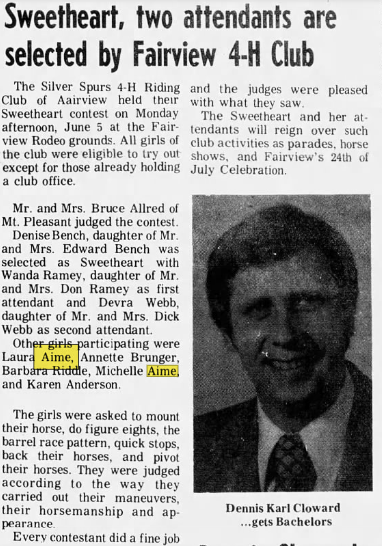
Now think about it: this encounter took place just a few hours before Brenda Ball went missing, which means if the man Bundy was talking about was indeed himself, then his confession about ‘the killer’ changing up his MO to hunt an ‘older woman’ in order to avoid getting caught was just another lie. Meaning, he didn’t switch it up as part of a well thought out plan: he just bombed out with Phyllis and needed to find another girl to kill. I mean, look at what happened when he crapped-out with Carol DaRonach in SLC? He drove to a high school roughly twenty miles away and abducted Deb Kent. After Balls abduction Ted went back to taking his victims from a school setting: Georgann Hawkins was next, and her abduction took place not even two weeks later on June 11th, 1974. She was taken early in the morning on her way home from a party outside of her sorority house at the University of Washington.

It’s also worth bringing up that Ball’s skull had a large fracture in the back of it when it was found on Taylor Mountain, and the King County Medical Examiner determined that she was missing one of her temporal bones, suggesting that her assailant may have struck her in the head with a blunt object (like a crowbar, as TB was known to have used). Bundy never mentioned this during his ‘confession,’ so if he really strangled her to death, then why was a large part of the right side of her skull missing? This injury completely contradicts the statement he made that he strangled her until she expired.

However, thinking in an ‘outside the box’ sort of way, what about foraging animals? Could they have been responsible for the giant hole that was found in Brenda’s skull? The wildlife population in Washington state is pretty diverse… It’s home to bobcats, lynxes, multiple types of bears, wolverines, deer and many other large animals. Could a large outdoor creature have stepped on her skull after Bundy dumped her in the forest, causing the fracture, maybe a bear? The area is home to both grizzly and black bears: an average sized adult male grizzly weighs anywhere from 300-650 pounds, and a male black bear can exceed 600 pounds. Well, apparently I wasn’t the only person that thought of this: according to the King County ME, there is a zero chance that Ball’s skull fracture occurred because of local wildlife. This means that if Bundy was telling the truth about strangling the young woman to death, then it is difficult to see why he would have also needed to inflict such a traumatic injury upon her as well.

The following is a short excerpt regarding Brenda Ball from ‘The Riverman: Ted Bundy and I Hunt for the Green River Killer,’ written by Dr Robert Keppel:
‘The dentition of the skull contained a pattern of silver fillings that were familiar to me. I had memorized the dental work detailed on [victim’s dental] charts and easily recognized the jawless expression of Brenda Carol Ball. My crude on-site identification was to be confirmed by a forensic odontologist three days later. We photographed the cranium from all angles and measured its position to two temporary triangulation stakes. We carefully picked up the skull and preserved it in the position in which it was resting. Since dusk was setting in, we decided to wait until the next day to resume our search for the remainder of the skeleton.’

Despite the fact that LE was hesitant to link Ball to the other missing Washington state girls, ironically it was because of her that they were discovered in the first place: on Sunday, March 1st, 1975, two forestry students from a nearby community college were doing a project at Taylor Mountain when they spotted her skull lying among the damp, moss-covered trees. Shortly after, investigators unearthed the craniums of Lynda Ann Healy, Susan Elaine Rancourt, and Kathy Parks; in addition to skulls, search parties also found clumps of hair as well as an array of human bones, including a mandible and a femur that is strongly believed to have belonged to Georgann Hawkins (however they had nothing else to compare it to and it was eventually misplaced).

The following is an excerpt from the ‘SurivingSara’ GoodReads blogspot; I will include the direct link below if anyone is interested in reading all of it. Just as a side note, I wrote an article about ‘Sara A. Survivor,’ which is a pseudonym for her real name of Susan Roller. She reportedly is a surviving Bundy victim and claims that she suffered from long term abuse by him, and by this I mean she said they had a relationship (of sorts) and she sustained repeated physical and psychological abuse as a result, trauma that she alleges that she still suffers from today. I won’t go too far into her as there’s an entire separate article written about her, but she’s a real piece of work and REALLY has it out for the King County Sheriff’s, specifically Bob Keppel:
‘Skeletal remains at the scene, marked with evidence numbers, were sent to Superior Court, then returned back to the King County Sheriff Office and then sent to the ME: all the evidence numbers of the skeletal remains line up and those numbers verify they were found on site in March of 1975 at the time of the discovery of Taylor Mountain. Further, those remains were sent to Texas in 2005 and identified via DNA three of the four girls found on Taylor Mountain and another who could not be identified. In addition, records show that at least 1-2 individuals besides Ott and Naslund were found at Issaquah and at least 1 individual not matching the four girls found at Taylor Mountain was found at Taylor Mountain. Both crime scenes had girls’ clothing, jewelry, and other evidence. None of this appears to have been preserved.’

On Memorial Day weekend of 2022 I went on an overnight trip to explore Bundy’s former hood in Philadelphia, PA, and I made the drive from Attica, NY which was about a 6.5 hour drive, one way. Making that drive two days in a row was a bit nuts, but I absolutely LOVED it because I renewed my Audible subscription, put on ‘The Phantom Prince,’ and just drove… and I’m really glad I did that because it provided me with a lot of smaller details regarding Balls murder that I wasn’t aware of previously… Because Liz’s Mom kept a detailed journal, there is a detailed account as to exactly what happened on the evening of May 31, 1974:(as I said earlier), Ted treated everyone to dinner at Pizza & Pipes, however she mentioned that the meal seemed rushed and it only lasted for roughly an hour and a half. She went on to say that after everyone was finished eating, Bundy dropped them all off at Liz’s house and said that he was going home.

I am absolutely flabbergasted by how fearless Bundy was: for a good amount of his atrocities he operated VERY close to home, and when I was in Seattle I saw first hand just how close in proximity everything was to one another. When I went to the site of where Karen Sparks once lived (the residence was torn down to make room for apartment buildings) I literally looked up and there was The (former) Sandpiper! Also, The Flame Tavern is only 4.2 miles away from the Rogers Rooming House, which is less than a 15-minute drive. Plus he lived in the general Seattle area since he was a young boy: HOW DID HE NOT RUN INTO ANYONE HE KNEW??! I know if I was going to feign injury while committing multiple felonies I would at least do it in an area where I was positive that I wouldn’t be recognized. Piggybacking off that, the fact that he killed women from the same university that he attended further amazes me. He must have had gigantic stones.

As far as the truth goes… I really think Bundy liked screwing with his audience, whoever it was. Journalists. Members of law enforcement. Carole Ann Boone. He’d tell one person one thing then turn around and tell another something completely different. He would literally change his story for his audience, and lied so frequently about so much… Obviously, like so many other Ted related things, we’re going to have to take his pseudo-confession with a grain of salt, and unless someone discovers his long-lost diary, we’ll probably never know what happened to Brenda Ball. However, one thing is for certain: her life was cut short because of Ted Bundy.
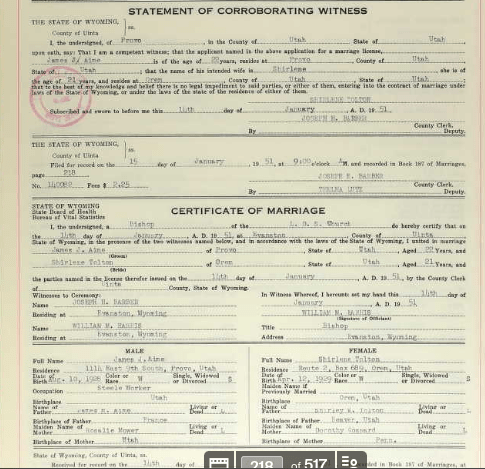
Thanks to the website OddStops (which is amazing, and if you haven’t checked it out yet you totally should), I found some interesting facts about the former Flame Tavern, most recently called ‘El Baron Rojo:’ the building was built in 1928 and in 2007 it sold for $990,000. During the 1970’s, the tavern was known for its live music, and drunken brawls would frequently break out in their parking lot. Denise Naslund (another confirmed victim of Ted’s that he would go on to abduct then kill exactly one month and two weeks later from Lake Sammamish) was a frequent patron of the bar. In addition to Brenda Ball’s abduction, in 1977 twenty-one year-old Rhonda Louise Burse was last seen getting into a car in the tavern’s parking lot and was never seen or heard from again. At one point the watering hole went by the name ‘MVP Sports Bar,’ and in 2008 a man was shot and killed somewhere on the premises with an AK-47 assault rifle, and in 2020, former owner Sonia Olvera Jimenez was arrested for the murder of a gentleman that was renting a room in her house.

Mr. Ball passed away on August 13, 1988 somewhere in Pierce County, WA. Brenda’s mother remarried a man named Donald Arnaud on March 9, 1974 and despite looking EVERYWHERE (Google, Ancestry, MyHeritage, etc…) I was unable to find any record of her passing away (even though she would currently be in her 100’s, but it’s not completely unheard of). According to an Associated News article regarding Bundy’s execution: ‘Rosemary Arnaud, mother of 22-year-old Brenda Ball, who disappeared outside a Burien, Wash., tavern in 1974, said Bundy’s death will be a relief only in the knowledge that he will never be able to kill again.’

Works Cited:
https://www.goodreads.com/author_blog_posts/15965444-skeletal-remains-were-found-at-taylor-mountain
https://apnews.com/article/e83729933cf61be312252a25cf879025

Brenda Ball’s sophomore picture from the 1968 Mount Rainier High School yearbook.
Brenda Ball’s junior picture from the 1969 Mount Rainier High School yearbook.
Brenda Ball’s senior picture from the 1970 Mount Rainier High School yearbook.
A grab from Ball’s 1970 Mount Rainier High School yearbook of her senior activities.
A barefoot Brenda.
Brenda Ball’s ID card.
Brenda Ball.
Brenda Carol Ball.
A missing persons bulletin about the disappearance of Brenda Carol Ball.
An article about the disappearance of Brenda Ball published by The Olympian on August 7, 1974.
An article mentioning Brenda Ball published in The Daily Herald-Tribune on March 5, 1975.
An article about the murder of Brenda Ball published in The Spokane Chronicle on March 5, 1975.
An article about Brenda Ball published in The Sun Post News on March 5, 1975.
An article about Brenda Ball published in The Corpus Christi Times on March 5, 1975.
An article about Brenda Ball published in The Lewiston Tribute on March 5, 1975.
An article about Brenda Ball published in The Spokesman-Review on March 6, 1975.
An article about Brenda Ball published in The Daily Herald on March 6, 1975.
An article about Brenda Ball published in The Middlesboro Daily News on March 7, 1975.
An article about Brenda Ball published in The Corpus Christi Caller-Times on March 7, 1975.
An article mentioning Brenda Ball published in The Minneapolis Star on March 8, 1975.
An article mentioning Brenda Ball published in The Herald on March 8, 1975.
An article mentioning Brenda Ball published in The Statesman Journal News on March 9, 1975.
An article mentioning Brenda Ball published in The San Francisco Examiner on March 9, 1975.
An article about Brenda Ball published in The Longview Daily News on March 11, 1975.
An article about Brenda Ball published in The Statesman Journal on March 11, 1975.
An article about Brenda Ball published in The Gazette on March 12, 1975.
An article about Brenda Ball published in The Idaho State Journal on October 3, 1975.
An article about Bundy that mentions Brenda Ball published in Florida Today on July 9, 1979.
An article about Ann Rule’s true crime classic ‘The Stranger Beside Me’ that mentions Brenda Ball, published in The Miami News on October 22, 1980.
In his statement to the media, Lt. Richard Kraske said that there seemed to be no link between Brenda’s case and the other women. Photo courtesy of ThisInterestsMe.
In the days leading up to Bundy’s execution, Brenda’s mother Rosemary Arnaud said that his death will be a relief because it means that he will never be able to kill again. Photo courtesy of ThisInterestsMe.
The Sunday News published this article one month after Brenda’s case became public; it did not mention her nor feature her picture among the missing. Photo courtesy of ThisInterestsMe.
Brenda Ball’s death certificate.
Brenda Balls grave. I apologize it’s not a better quality picture, it was the only l one could find. When I go back to Seattle next year I’ll get a better one.
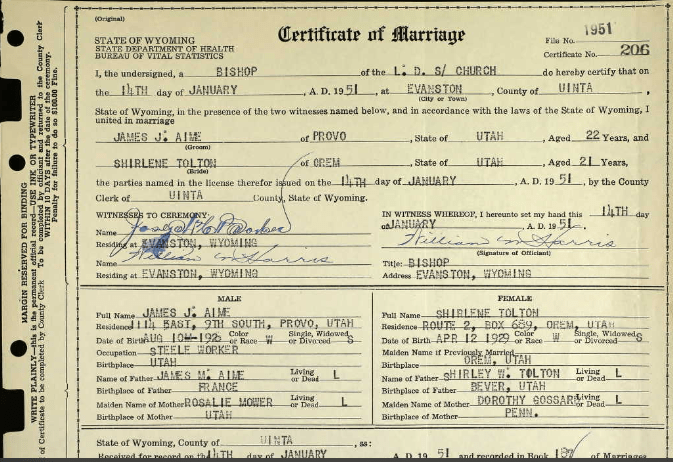
An older image of a sign for the tavern from the 1970’s. Photo courtesy of OddStops.
The band ‘Child Jam’ performing at The Flame Tavern in the 1970’s.
The former Flame Tavern as it looked in the 1970’s’; it’s located at 12803 Ambaum Boulevard in Burien, WA.
An older image of the tavern from the 1970’s. Photo courtesy of OddStops.
This Google Street View image of the bar was taken in 2011. Photo courtesy of OddStops.
The former Flame Tavern as it looked in April 2022; it’s located at 12803 Ambaum Boulevard in Burien, WA. I stopped by as I was on my way to Gary Ridgway’s house (which is shockingly close to where Bundy operated).
The front sign from former Flame Tavern as it looked in April 2022.
The back parking lot of the former Flame Tavern as it looked in April 2022.
The former Flame Tavern as it looked in April 2022.
Pizza and Pipes Restaurant, where Bundy took Liz and her family before he killed Brenda Ball.
A Google map route from The Flame Tavern to Taylor Mountain.
Google Maps directions route from The Flame Tavern to Taylor Mountain.
The old Rogers Rooming House on 12th Ave in Seattle in April 2022.
Highline Community College.
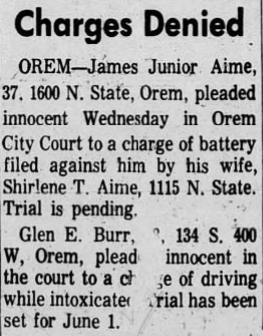
Ted Bundy’s Taylor Mountain dump site.
Taylor Mountain, April 2022.
Brenda Balls skull. Photo courtesy of Tiffany Jean.
A grid of skulls testifies to the changing nature of the case police faced. Theirs was no longer a missing persons investigation. Photo courtesy of Tiffany Jean.
A Google Earth image of the layout of the Taylor Mountain site. Photo courtesy of OddStops.
A map of the skulls found on Taylor Mountain. Photo courtesy of OddStops.
Duane Ball’s senior year picture from the 1948 West Seattle High School yearbook.
A newspaper blurb mentioning Brenda’s mother Rosemary joining the Spokane naval reserve published in The Spokesman-Review on October 21, 1949.
Mr. and Mrs. Ball’s marriage certificate.
Mr. and Mrs. Ball’s divorce certificate.
Brenda’s mothers second marriage certificate.
Rhonda Louise Burse, who was last seen at The Flame Tavern in Burien, Washington on August 8, 1977.