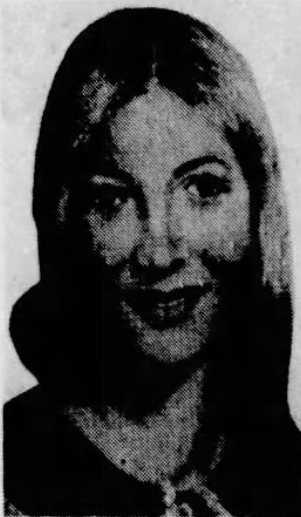
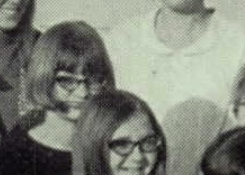
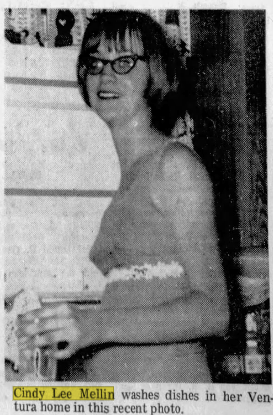
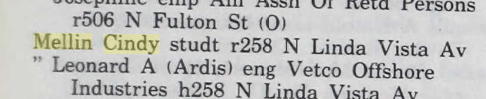
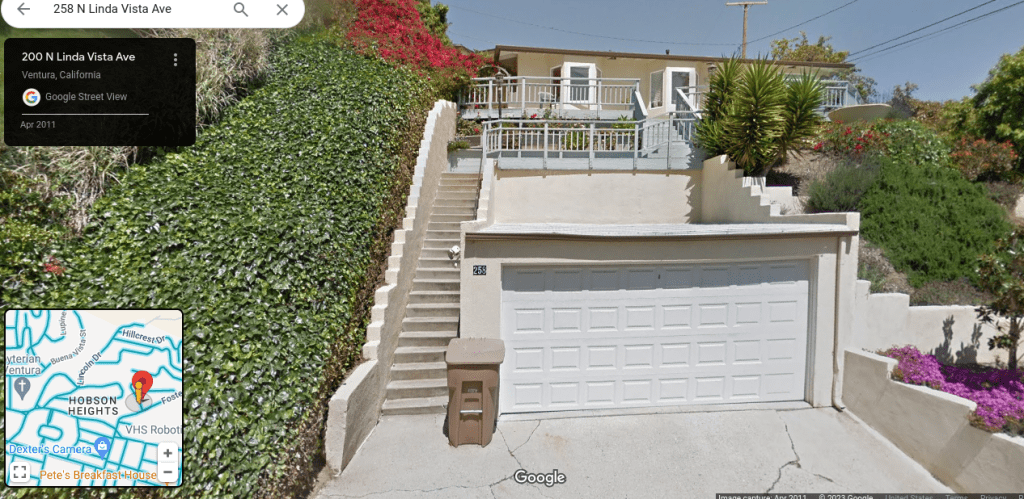
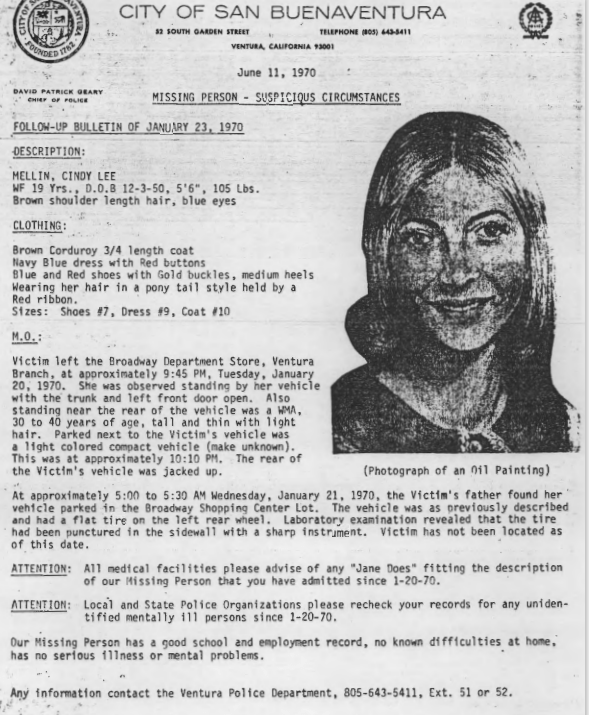
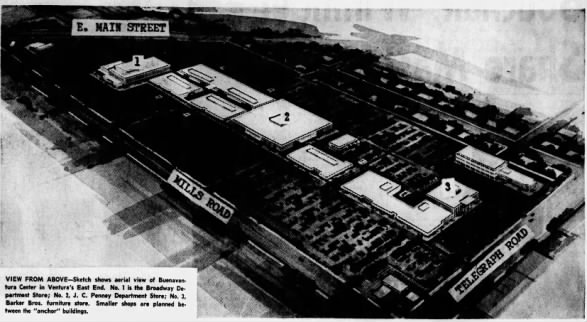
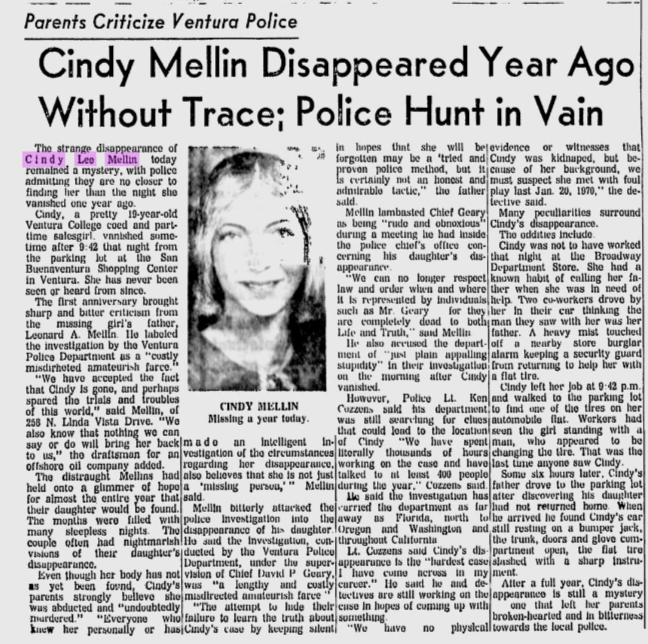
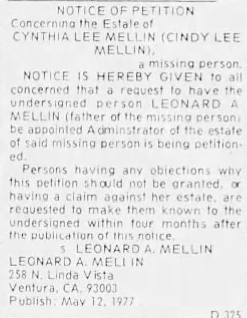
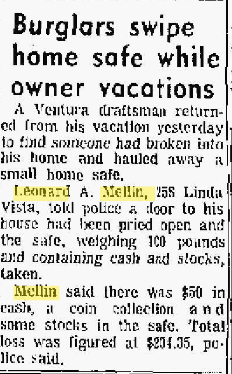
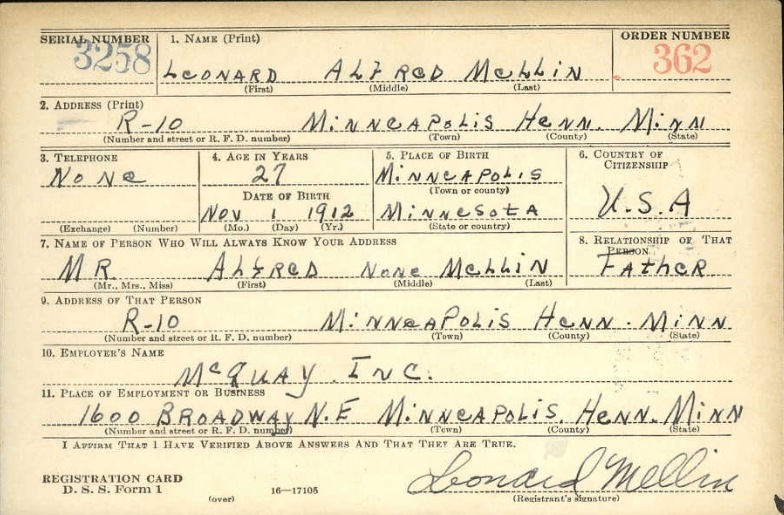
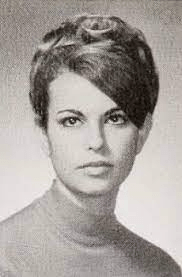
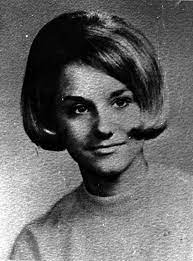
Cynthia ‘Cindy’ Lee Mellin was born on December 3, 1950 to Leonard and Ardis (nee Mauseth) Mellin in Hennepin, Minnesota. Mr. Mellin was born on November 1, 1912 in Minneapolis, Minnesota and Ardis was born on December 15, 1912 in Brooklyn Center, MN. The couple were married in 1934 and had five daughters (Paula, Cindy, Janice Mae, Judith Mae, and Maryann) and eventually settled down in Ventura, California; Mr. Mellin worked as an engineer and draftsman for VETCO Offshore Industries, Inc. After Cindy graduated from Ventura Senior High School in 1968 she went on to attend Ventura College as a full time student majoring in education. She dreamt of becoming a teacher one day, just like her older sister Judith that lived in Pico Rivera; she was planning on transferring to the University of California at Santa Barbara in 1971. Cindy didn’t smoke, drink, or do drugs, and even though she was described as a shy and reserved girl by most people that knew her, she was well liked by her peers and seemed to get along with everyone. Her family members, friends, coworkers, supervisors, and teachers all said that she was an exceptionally kind person and not at all the kind of young woman that would just up and run off. At the time Cindy disappeared in early 1970 she lived at her parents house located at 258 North Linda Vista Avenue in Ventura and worked as a part time sales clerk at The Broadway Department Store at the Buenaventura Shopping Center. She had blue eyes and light brown, shoulder-length hair that she typically wore tied back in a ponytail; she was approximately 5’6” tall, weighed 105 pounds and wore contact lenses.
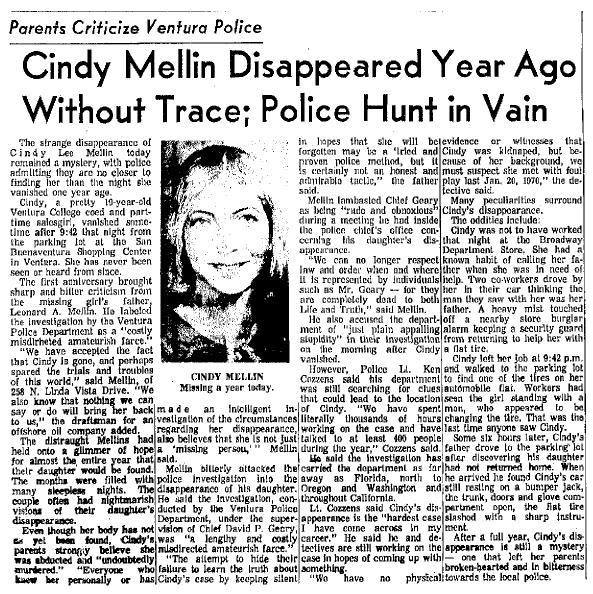
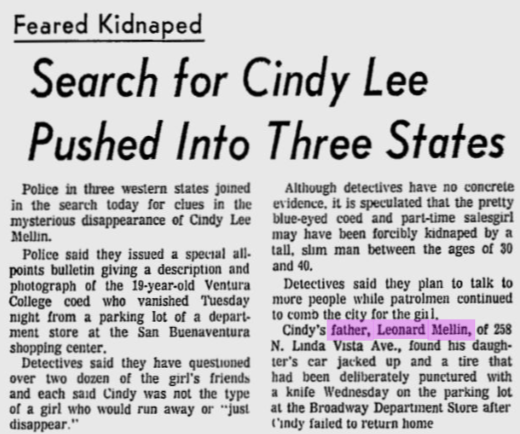
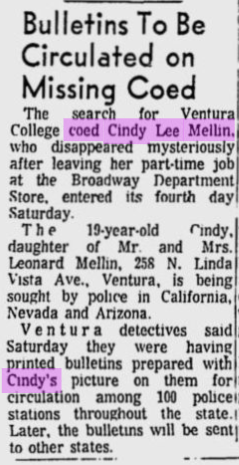
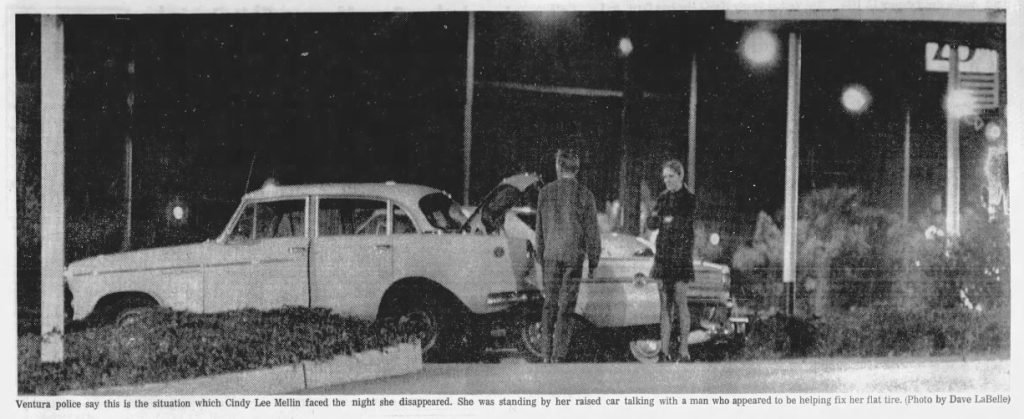
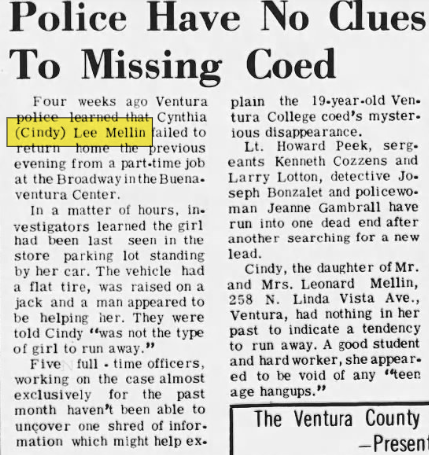
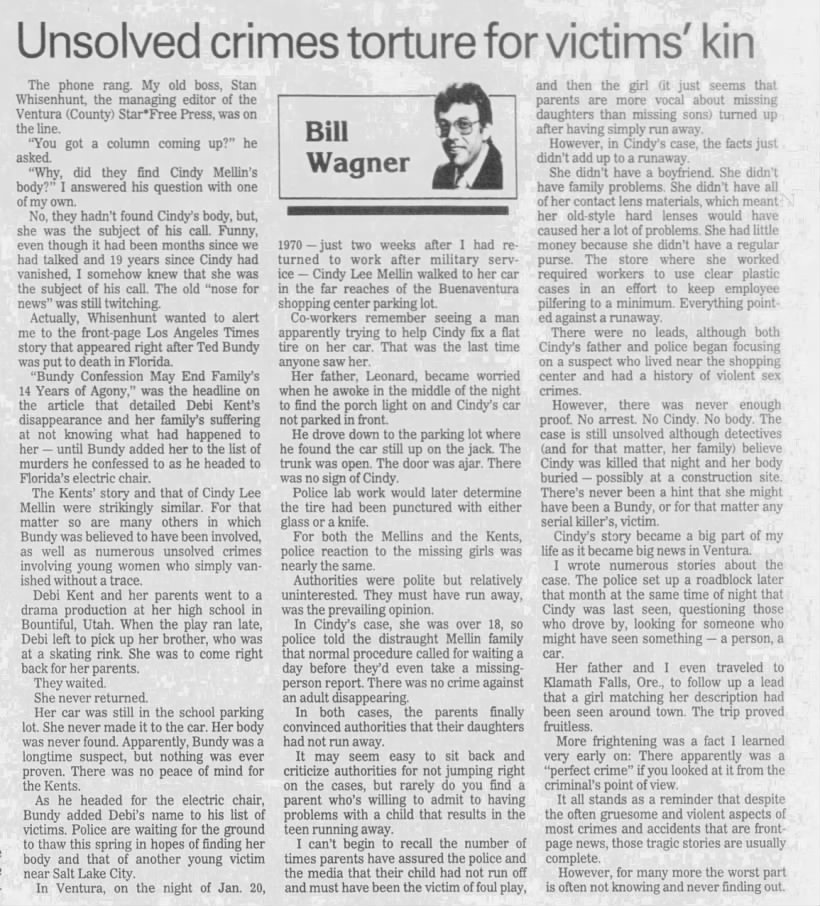
On Tuesday, January 20, 1970, Cynthia Lee Mellin went to class like she did every day, and when she got home in the afternoon received a call from her employer asking if she’d be able to come into work at 5:30 PM. She agreed, and the 19-year-old arrived at her employer without incident; like always, she parked her vehicle in the back part of the parking lot along Main Street. Cindy left work shortly after closing at 9:42 PM and it was then she discovered her left rear tire was flat. She was last seen a few minutes later by two coworkers standing next to her cream blue, 1960 Rambler sedan; the vehicle’s rear bumper was up on a jack and there was an unidentified man there helping her. He drove a small, light-colored car and appeared to be about six feet tall; he was thin in stature, had light-colored hair and appeared to be between 30 and 40 years old. She was last seen wearing a red ribbon in her hair, a navy-blue dress with red buttons going down the front, a brown corduroy three-quarter length coat, medium-heeled blue and red shoes adorned with gold buckles, and a gold ring with a single pearl. The night she disappeared Cindy only had five or six dollars cash on her and didn’t have her purse with her (in an attempt to curb employee theft, The Broadway Department Store didn’t allow their employees to bring in purses or book bags so she had her personal belongings in a clear, plastic bag).
A security guard that was assisting Mellin in changing her tire had to leave and take care of an alarm that was going off thanks to the foggy weather conditions. At around 9:45 PM, two of her coworkers drove past her vehicle and saw her open her trunk, and it was then that a man ‘stepped out of the shadows’ and offered her help. The women had been picked up by their husbands, who also offered to help her with the tire but she waved them away, indicating that everything was fine. After getting a cup of coffee at a nearby restaurant they drove by the parking lot again at around 10:10 PM; this time, it was deserted except for Mellin’s car, which was still up on the jack. They would later tell investigators that they ‘didn’t think anything about it because we thought the man was Cindy’s father and that she was just taken home.’
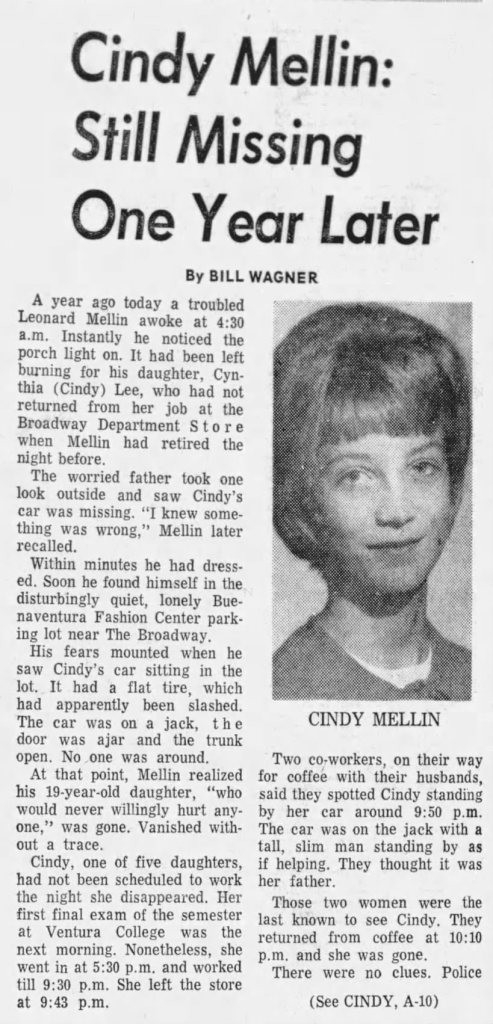
When she worked the closing shift Cindy usually got home around 9:50 PM, and when she didn’t arrive by eleven her father simply thought she went out for coffee with friends and went to bed. He left the front light on like he always did when one of his girls was still out, and although she was out the night Cindy disappeared Mrs. Mellin said that she ‘never could rest until they were all home.’ The next morning at 4:45, Mr. Mellin woke up and immediately noticed that the porch light was still on and his daughter’s vehicle was not parked in the driveway. It was completely out of character for her to stay out all night, especially since she had a final in her biological sciences class later that morning at 8 AM (which was the first of her scheduled final exams).
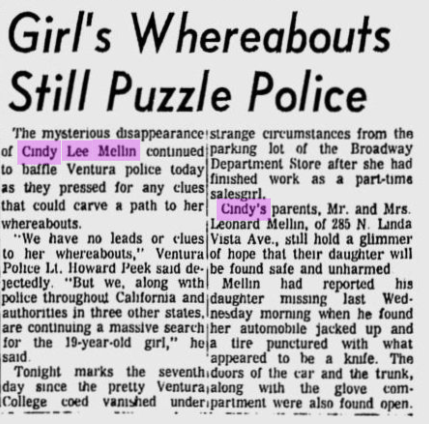
Mr. Mellin then went to her bedroom and saw that Cindy’s bed was still made and had not been slept in, meaning she never came home from work the night before. Within minutes he was dressed and out the door. He immediately drove to the Buenaventura Shopping Center to look for her and came across an ominous site: the parking lot was completely empty except for her car, still up on the jack with the flat tire still on; the spare was lying nearby on the ground. He said that his daughter wouldn’t have been able to operate a jack and had no idea how to change a tire. He was always the person that she called when experiencing car problems, and just a week before he had to come to her aid in the same parking lot when her battery died. The vehicle’s glove compartment box, doors, and trunk were all left wide open, and when he examined the flat it seemed to have been deliberately punctured with a knife, and ‘there was a large slit in one side.’ There was no sign of his daughter at the scene, and he immediately notified law enforcement of the situation. Mr. Mellin immediately suspected foul play, and according to him, ‘Cindy would not go away willingly with anyone.’ He also said that she was ‘practically without problems,’ and ‘would never willingly hurt anyone.’ In the early part of the case, Lieutenant Howard Peek of the Ventura PD said that they ‘were drawing no conclusions at this time. They have a few clues, but we are appealing to anyone who might have seen the girl or who might have information concerning her to get in touch with us.’
From the early stages of the investigation law enforcement immediately suspected that Cindy was abducted and not a runaway. She wasn’t in a relationship or have any problems with anyone in her life. She had stable employment and was a full-time student. Additionally, when she disappeared Mellin was wearing her contacts, which were the ‘old-school,’ hard contacts that weren’t designed to be worn for extended periods of time. Furthermore, she left all of her cleaning and maintenance materials for them at home. Lieutenant Ken Cozzins of the Ventura Police Department said that the department had ‘no evidence or witnesses that Cindy was kidnapped, but because of her background we must suspect she was met with foul play.’ In the beginning, the Mellin’s held onto a glimmer of hope that she was safe, but as the days ticked by their hopes quickly faded. Mrs. Mellin said that they were ‘just in a state of distress, near the breaking point. We just don’t know what to think. It’s just a blank, similar to a nightmare.’ Leonard Mellin said his daughter has ‘never done anything like this before’ and there ‘has never been any family conflicts.’
According to LE, Mellin had no mental health concerns, financial issues, or problems at home, and had never ran away before. Both of her parents said that she was a better than average student that dated only occasionally, and she never really had a serious boyfriend. Cindy had a busy schedule throughout the month of January and letters from friends further proved that there was nothing out of the ordinary in her life. Her savings account was untouched and no money had been withdrawn from it recently. In the beginning of the investigation, Lieutenant Cozzins said that it was ‘still too early to speculate what happened to the teenager, but evidence indicates the girl was apparently kidnapped. But, we are thoroughly investigating every angle possible.’ Regarding her daughter’s disappearance, Mrs. Mellin said ‘we think that she didn’t go willingly. She has a habit of always locking the car even when she leaves it at home. It’s not like Cindy to go off and leave it unlocked.‘ Her father strongly felt that the man that appeared to be helping her change the tire was the same one that abducted her, and that he most likely caught her off guard, grabbed her, then pulled her into his waiting car and sped off. After Cindy was reported as missing investigators spent the next two days canvassing the area around the shopping mall, talking to hundreds of people that worked and lived in the area; they came up empty. Mr. Mellin said that he ‘knew if she were physically able to she would have contacted us. I guess I’ll just have to go back to work and get my mind off of it.’… ‘If she was kidnapped I have no doubts that she will attempt to escape. If she is physically able. The man may have been lurking nearby after puncturing Cindy’s tire with a knife and when she arrived portrayed himself as a Good Samaritan by starting to change the tire to allude suspicion.’ About the nature of the young woman’s disappearance, Lieutenant Cozzins said that ‘we have no physical evidence or witnesses that Cindy was kidnapped, but because of her background, we must suspect she met with foul play.’
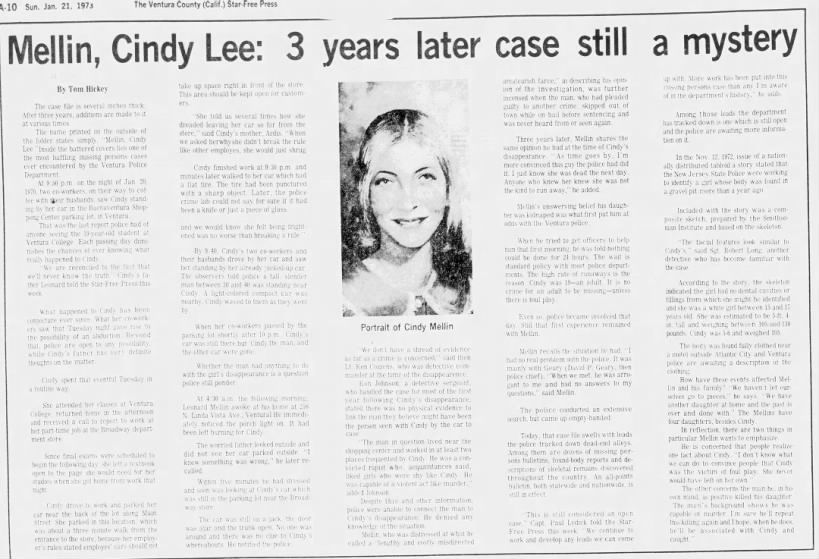
It was no secret that Leonard Mellin was unhappy with the way law enforcement handled his daughter’s disappearance: from the very beginning he labeled the investigation a ‘costly misdirected amateurish farce.’ … ‘We have accepted the fact that Cindy is gone, and perhaps spared the trials and troubles of this world. We also know that nothing we can say or do will bring her back to us.’ He further attacked the Ventura PD, saying that their attempts to find his daughter the morning after she vanished under the supervision of (former) Chief David Gerty was ‘just plain appalling stupidity.’ However, Lieutenant Cozzins disagreed with his harsh statements, and said that his department tirelessly searched for Cindy and had ‘spent thousands of hours working on the case and have talked to at least 400 people during the year.’ He also said that the investigation took them as far as Florida and they searched throughout all of California as well as Washington and Oregon. Despite the fact that her body was never recovered, both of her parents strongly felt that she was abducted and ‘undoubtedly murdered.’ They also said that anyone that knew her personally or that made an ‘intelligent investigation of the circumstances regarding her disappearance’ would agree with them.
All of Mellin’s girlfriends that were interviewed by LE were in absolute disbelief and shock over her disappearance, and all said the same thing: that she was not the type of person that would just up and run away or just disappear. Although she was described as a quiet girl that mostly kept to herself, it is still possible that the man who abducted her may have been friendly with her. Maybe he was a customer from her POE that thought she was pretty? Or, perhaps it was an (older) male classmate from her college that stalked her and learned her pattern, routine, and vehicle. I wonder if maybe that’s why she so casually waved her two coworkers along when they offered her assistance? But, there’s also a pretty good chance that she was simply a victim of opportunity, and the perp noticed her park her car in the beginning of her work day, stabbed her tire, then waited around until her shift was over to offer her help and get her alone. One article published by the Fresno Bee in February 1970 mentions that Cindy’s uncle Stanley Mellin strongly suspected that his niece was being held captive in the general Fresno area and was kept subdued and under the influence of drugs. I’m not sure what exactly would make him think that, as there was nothing that would hint that it was a possibility (I also couldn’t find the article).
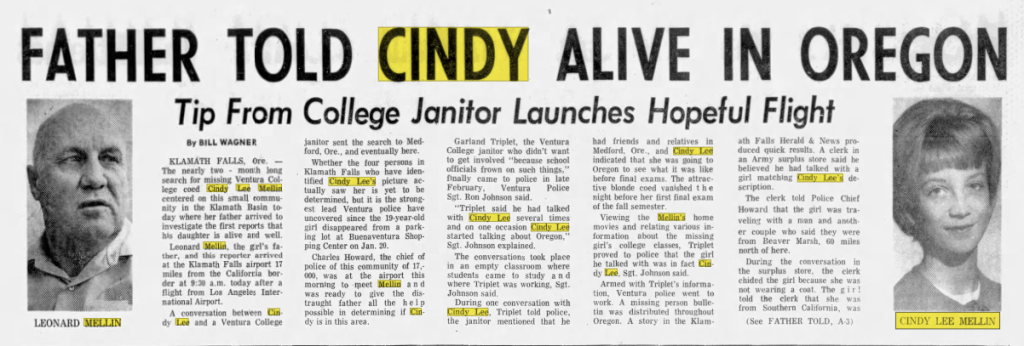
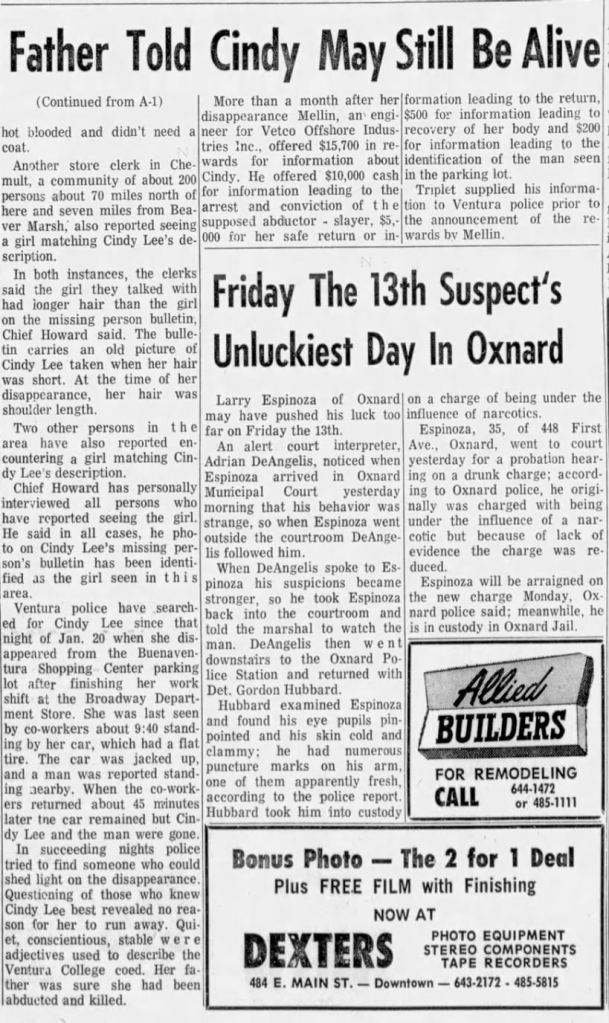
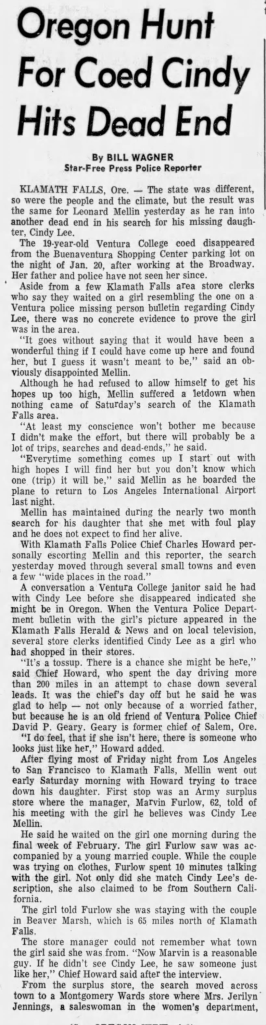
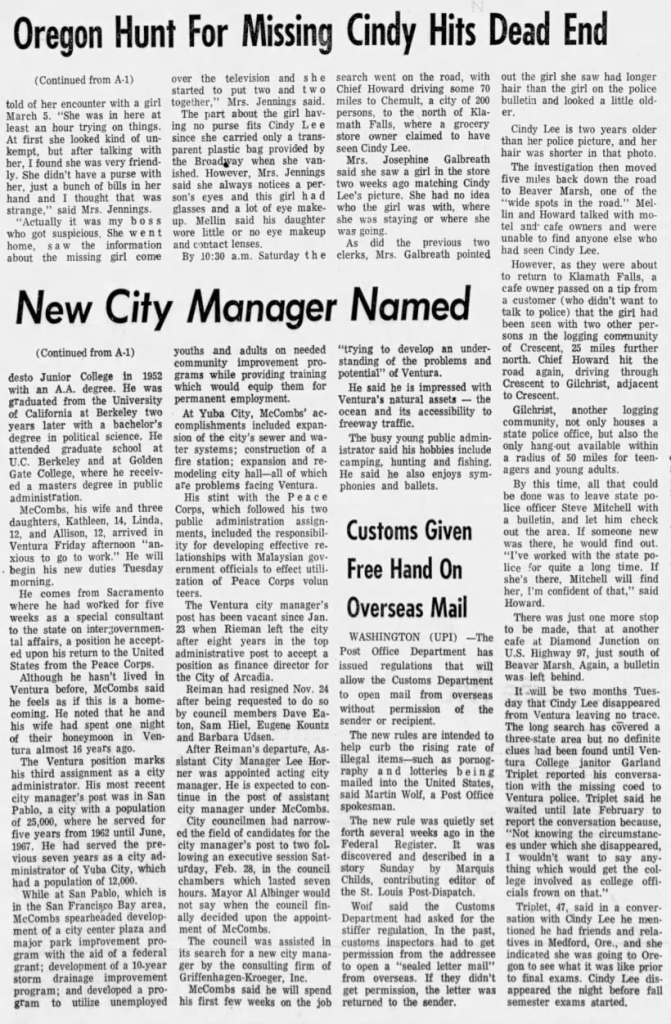
Police waived the typical 24 hour mandatory waiting period and began investigating the young students’ disappearance immediately. But by March 1970, the case was pretty much at a stand still. It was then that a janitor from Ventura College came forward and shared with LE that before she vanished he overheard the young coed say that she was planning a trip to Oregon. At roughly the same time the Klamath, OR police notified the Ventura PD that several residents of their city came forward claiming they saw a girl around town that matched Cindy’s description. A police bulletin with her photo was subsequently aired on Klamath Falls television stations, and the Star Free Press out of Ventura felt so strongly felt that Mellin was in Oregon that they sent her dad and a reporter on a one day trip to visit the area. While there, they talked to a general store clerk, a sales girl at a department store (both in Klamath Falls) and the owner of a small grocery store about 60 miles away that all said that they saw a girl that resembled Cindy. Unfortunately, the young mystery woman was not a recognizable local and didn’t appear to live in the area.
After this incident, the leads on Mellins disappearance were few and far between, but are as follows: (1) an Ojai priest claimed that he had learned that a woman had been attacked in an Oxnard, CA parking lot. The incident occurred on a Tuesday evening around 9:30 PM. The attacker had approached the woman from behind and attempted to drag her away. (2) Three youths in Fillmore, CA reported they saw Cindy driving a purple sports car in the general area. They thankfully thought to get its license plates, and the vehicle was registered to a sailor stationed near San Francisco. However, he had a daughter that matched Mellins description and she happened to be in the area at the time. (3) The August 1970 edition of The LA Free Press contained a cartoon of a young girl dancing, and the caption simply read, ‘Cindy Lee.’ Looking into it, investigators determined there was no connection between the drawing and the disappearance of Cindy Lee Mellin. (4) A woman had psychic visions of Mellin being held captive against her will in a desert house. She described an area in San Bernardino County; a check came up with nothing. (5) Investigators made a trip to the LA Morgue to look into an unidentified female, whose body was never successfully identified. (6) Police made a call to authorities in Florida after they recovered the body of yet another unidentified girl. It was determined not to be Mellin. (7) In mid-January 1971 it was reported that Cindy’s dental records were finally sent to the Contra Costa Sheriff’s Department in Northern California, who had found the body of yet another unidentified female. It was not Cindy Mellin (The Ventura County Star, January 21, 1971). After this, Cindy’s case quickly went cold, and she quickly became just one more name in a long line of young women that disappeared in California during the late 1960’s/early 70’s. We’ll most likely never know what happened to her. Paula Mellin-Stoddard said that the investigation ‘took us nowhere. Nothing ever seemed to pan out.’ The family was so desperate for answers that they contacted psychic medium Peter Hurkos, but sadly nothing came from that either.
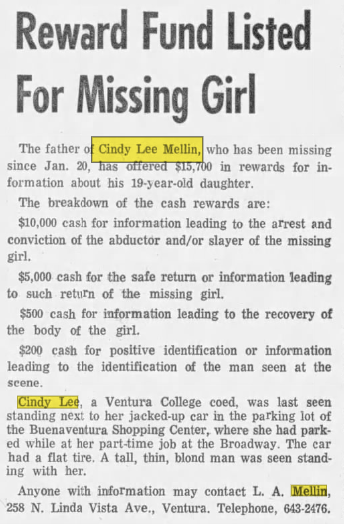
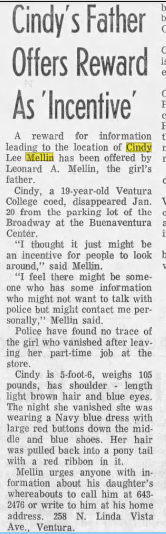
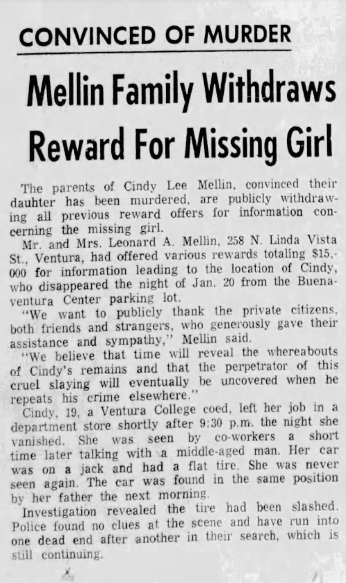
An article published by the Ventura County Star on February 2, 1970 mentioned that Mr. Mellin was offering a $15,700 reward for any information leading to the return of his daughter. To me, what’s interesting is the breakdown of the distribution; there was a $5,000 cash reward for information leading to the safe return of Cindy, $500 cash for information that would lead to the recovery of her body, and $200 cash for the positive ID or information leading to the identification of the man seen at the scene. That same reward was retracted on September 3, 1970 after the Mellins said they realized it was useless because the people with information often would not discuss it with police. Leonard Mellin retained a private investigator but they too were unable to produce any trace of Cindy. The family released a statement saying they wanted ‘to publicly thank the private citizens, both friends and strangers, who generously gave their assistance and sympathy. We believe that time will reveal the whereabouts of Cindy’s remains and that the perpetrator of this cruel slayings will eventually be uncovered when he repeats his crime elsewhere.’
At one time in the investigation investigators thought they had a prime suspect in a convicted rapist that lived near the shopping center where Cindy worked and was employed at two different places that Cindy was known to frequent. But, he denied any knowledge of her disappearance. There was another incident where LE thought Cindy was alive after a janitor at Ventura College said that several days before she disappeared he overheard her talking about taking a trip to Oregon. At roughly the same time police in Klamath Falls, OR got reports of people seeing a girl that resembled Cindy, but nothing ever came from it. Paula Mellin-Stoddard said that it ‘took us nowhere. nothing ever seemed to pan out.’ The family was so desperate for answers that they contacted psychic medium Peter Hurkos, but sadly nothing came from that either.
Early in the investigation detectives talked to a man named Edward Nelson Cole, who matched the description given by Mellins two coworkers. Cole, who went by the alias ‘Sam Roper,’ was suspected by many members of Ventura LE to have been the man that helped Mellin change her tire the evening she disappeared, and that he most likely abducted then killed her. I’ve seen two different reports as to where he worked at the time Cindy disappeared in January 1970: the first said that he was employed at a nearby gas station. The second (and to me, more legitimate and well thought out option) reported that he had a job digging trenches and laying pipes along the southern CA highway; Ventura PD strongly suspect that Cole discarded Cindy’s body somewhere along the developing highway. In later years of the investigation, detectives had trouble locating his whereabouts, but according to a true crime researcher (and public domain websites), he died at the age of 69 on February 5, 2005 in Florida. That researcher was also able to locate the real ‘Sam Roper’ who lived in South Carolina, whose ID Cole had somehow managed to swipe. Strangely enough, Edward and the real Sam Roper shared the same birthday. Just as a weird side note, a young female neighbor of Cole was killed at a lake, and it looks like her murder was never solved. I also want to add, the Cole this other researcher talks about didn’t seem to have any connection to California, and mostly lived his entire life in Florida (I looked into him as well). I’m wondering if they found a different man named Edward Nelson Cole? Just a thought.
Also suspected in Mellins disappearance is a man named Mack Ray Edwards, a serial killer and child sex abuser. He molested and killed three children between 1953 and 1956, and three more in 1968 and 1969. Edwards later confessed that all of his crimes were motivated by a deep desire for sex. In 1970, Edwards and an 15-year-old unnamed male accomplice entered the home of Edgar Cohen of Sylmar, CA, where they kidnapped three sisters: Valerie (12), Cindy (13), and Jan (14) Cohen, who were one time neighbors of his. After forcing the girls to write a note for their parents saying that they were running away from home, Edwards and his accomplice drove the sisters to remote Bouquet Canyon in LA National Forest, north of Newhall,CA. Thankfully, two of the girls escaped, and knowing they could identify him he released the third. Shortly after, on March 6, 1970 he walked into a San Fernando Valley police station and turned himself into the LAPD Foothill Division. He gave detectives his loaded handgun and confessed that he had planned to molest and then kill all three girls. He also confessed to having killed six other children. Although he was sentenced to death, Edwards hung himself in his prison cell. It’s speculated he was responsible for Mellins disappearance but so far there is nothing concrete tying him to her.
At one point in the investigation detectives thought they had a good suspect in an unnamed convicted rapist that lived near the store where Mellin worked that was employed at two different places that she was known to frequent. But during a police interview he denied any knowledge of her disappearance and he was eventually cleared.
At the time Mellin disappeared in January 1970, Ted Bundy was living in Seattle at the Rogers Rooming house on 12th Avenue and was in the early stages of his long-term relationship with Elizabeth Kloepfer. At this time he wasn’t a student, as he re-enrolled at the University of Washington in June 1970. At the time, he was a file clerk and courier for an Attorney Messenger and Process Service’ in Seattle (he was there from September 1969 until May 1970, when he was fired for unjustified absences, as he claimed that he was baby-sitting Liz’s daughter, Molly).
According to Robert A. Dielenberg’s book, ‘Ted Bundy: A Visual Timeline,’ in 1970 Ted spent time at 1252 15th Avenue located just north of San Francisco in Marin County. At this time, the closest physical address this can be associated with is 1252 15th Avenue in San Francisco, across from the SF Botanical Gardens. There is also a dubious claim floating around the interwebs that says Bundy worked at Electro Vector in Forestville (which is just northeast of Santa Rosa in California) for a short period in 1970… although no dates or proof of this could be found anywhere and it’s not listed anywhere on the ‘TB Multiagency Report 1992.’ It’s also reported that Bundy helped Liz find a new apartment on Green Lake in 1970 and in the early part of the year, Kloepfer said that they spent a lot of their nights together (which makes sense as they were in the beginning stages of their relationship). I know some people may have immediately jumped to Ted’s signature tan VW Bug when they saw that Cindy’s possible abductor drove a ‘small, light colored car,’ but he didn’t purchase it until the spring of 1973.
Strangely enough, one of the other unconfirmed victims I wrote about from the same year was also abducted from California: Robin Ann Graham was an eighteen year old student at Pierce College when she vanished from a LA freeway in the early morning hours of November 15, 1970 after her car had broken down. At the time of her disappearance, Robin weighed 125 pounds, had long brown hair, brown eyes, and was 5’6″ tall. California Highway Patrol officers had noted Graham stranded beside her vehicle earlier in the evening before she disappeared and even stopped to check on her several times. When they drove by her the final time they didn’t stop, as they observed her talking to a young man driving a blue Corvette (that is now believed to have been responsible for her abduction). Although they were technically in compliance with 1970 protocol, after Graham’s disappearance CHP policy was officially changed to help ensure the safety of all stranded female motorists.
So, would Ted really have driven the 1,143 miles/8+ hour trip ONE WAY (which is the exact distance from the Rogers Rooming house to the Broadway Department Store in Ventura) to abduct Cindy Mellin on the evening of January 20, 1970? During Bundy’s death row confessions he told Dr. Robert Keppell that he committed his first murder in 1972. But I mean, I’ve written about unconfirmed victims that were murdered as early as 1961 (eight-year-old Ann Marie Burr in 1961 from Tacoma), and it’s no secret he was a compulsive liar, so obviously nothing he says can really be taken as 100% truth. In a separate event, when asked when he committed his first murder the serial killer refused to answer. He did admit to killing one woman in California, but they have not been identified.
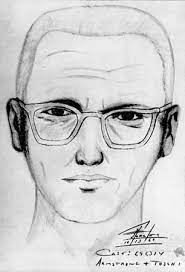
In addition to Bundy, another name frequently thrown out there in relation to Mellin’s disappearance is the Zodiac Killer. It seems like any woman that disappeared out of a certain 50-75 mile radius in Northern California in the late 60’s/early 70’s is automatically classified as a possible victim of the Zodiac. A glaring difference between Mellin’s disappearance and those of Zodiac murders is that she remains missing, whereas Zodiac’s known victims were all found where he killed them. Also the serial killers only verified murder spree took place from 1968 to 1969, so the murder of Cindy Mellin occurred slightly outside of his activity date.
Aside from Robin Graham there’s quite a few other young women that disappeared from California during that same general time frame. Like Mellin, none of their cases have been solved, however the remains of some of the victims were eventually recovered throughout the Hollywood Hills. In the fall of 1968, two young women were walking down Telegraph Avenue in Berkeley when a man pulled up alongside them and asked if they needed a ride; they declined his offer. Early in the morning on May 29, 1969, 19-year-old Rose Tashman vanished just a few miles away from where Graham’s car was found abandoned. She was a student at San Fernando Valley State College and her car was later found abandoned with a flat left tire at around 2:00 AM; she was on her way home to Hollywood after leaving a friend’s house in Van Nuys. Her vehicle was found on the Hollywood Freeway off ramp and had flares set up around it. Her naked body was found dumped in a ravine near Mulholland Drive later that same day at around 6 PM; she was strangled and her throat was bound with wire.
On October 30, 1966 Cheri Jo Bates disappeared from the campus of Riverside City College in Riverside, CA where she was a student. The next morning at around 6:30 AM a groundskeeper discovered her remains on a gravel driveway close to the school’s library. The eighteen year old had been stabbed to death, and had wounds in her back, abdomen and chest; she had also been brutally beaten and stomped in the face, head, and feet. Bates throat had been cut so severely that she was nearly decapitated. About 100 yards away from where her body was found LE discovered her VW Bug, with its keys still in the ignition and three library books on the passenger’s seat; the cars ignition coil wire and distributor had been disabled. In the beginning of the investigation, Riverside LE wondered if maybe she was a victim of the Zodiac Killer after they noticed a number of similarities between the cases, but he was eventually cleared. Bates murder remains unsolved.
In November 1967, multiple Van Nuys,CA women were approached by a man following them and flashing their lights in an attempt to get them to pull over in a way similar to the potential abduction of Kathleen Johns. On March 22, 1970 at around 11:15 PM, Johns was driving west on Highway 132 when she observed a late-model, light colored car following her, blowing its horn and flashing its lights at her in an attempt to get her to pull over. The 22 year old was traveling with her 10-month-old daughter, and when she complied the man pulled over as well. He got out of his vehicle with a tire iron in his hand, and when he approached Johns’ said, ‘your rear wheel is wobbling. I’ll tighten the lugs.’ The young mother stayed in her car as the man fixed the tire, but when he told her she was good to go it came off as she attempted to back it up. When Johns got out to inspect the damage, she saw that there was only one bolt holding the tire in place and it wasn’t long before the mystery man returned, this time with an offer to take her to a nearby service station. Johns hesitantly accepted, and got into the man’s car with her daughter, but instead of taking her for help he drove around on side roads for about an hour and a half. On several occasions when Johns asked if he was going to stop and get help he would ‘merely elude the question and start talking about something else.’ According to a police report at first the man was not threatening and friendly, but it wasn’t long before he grew menacing and threatened her life. When he finally slowed down for a stop sign she was finally able to open the car door and jump out with her daughter, and after he managed to close the door the suspect quickly sped off. Johns ran from her abductor and hid in a neighboring field. After enough time passed and she felt like he wasn’t going to return she was able to flag down a passing car, and from there she went to the police to file an incident report. At one point, she noticed a wanted poster on the station wall with a composite sketch of the Zodiac Killer on it, and said ‘that’s the man!’ Investigators later found her car incinerated near Byrd Road and Highway 132. In a letter dated July 24, 1970, the Zodiac claimed responsibility for this incident.
Another possible victim out of California that I wrote about disappeared almost a year to the day after Mellin vanished is Christine Marie Eastin, who went missing from Hayward on January 18, 1971. She left her home at 10 PM to get her loaner car washed and from there was supposed to pick up her ex-boyfriend at a local Jack in the Box, but never showed up. The 1969 Ford Maverick was found abandoned at a Charlie’s Car Wash with her purse locked inside. She hasn’t been seen or heard from since. In 2019 an unidentified eyewitness came forward and told investigators she saw two men in a white van abduct Christine from the car wash on the evening of January 18, 1971. The witness told LE that she was only able to get a good look at the driver because his accomplice was out of her line of vision as he was busy loading Eastin into the back of the van.
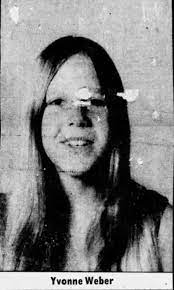
On February 4, 1972 12-year-old friends Maureen Louise Sterling and Yvonne Lisa Weber disappeared around 9 PM after visiting the Redwood Empire Ice Arena. The middle school students were last seen hitchhiking on Guerneville Road, northwest of Santa Rosa. Their bodies were recovered on December 28, 1972 thrown down a steep embankment approximately 66 feet off the east side of Franz Valley Road. A single earring, some orange beads, and a 14-carat gold necklace with a cross were found at the scene. The girls cause of death could not be determined from the skeletal remains. A little over a month later on March 4, 1972 nineteen year old Kim Wendy Allen was given a ride by two men from her POE at Larkspur Natural Foods to San Rafael. They last saw her at approximately 5:20 PM hitchhiking to school near the northbound Bell Avenue entrance to Highway 10 carrying a large wooden soy barrel with red Chinese characters on it. Allens remains were found the next day down an embankment in Santa Rosa, about 20 feet off a creek bed near Enterprise Road. She was found bound at the ankles and wrists and was strangled to death with a cord. She had also been raped. All three of these young women are considered to be victims of the Santa Rosa Hitchhiker Killer.
On April 25, 1972 20-year-old Jeannette Kamahele was last seen leaving her residence by her roommate at 9:30 AM with plans to hitchhike to Santa Rosa Junior College, where she was a student. A friend was just about to pull over and pick her up, but someone else beat him to it. According to that eyewitness, she was picked up near the Cotati on-ramp of Highway 101 by a white male with an afro hairstyle that was between 20 and 30 years old driving a faded brown Chevrolet truck. Her body has never been recovered. Bundy was at one time a suspect in her disappearance but he has since been cleared. It’s also speculated that she could be a victim of the Zodiac, although it’s a bit outside of his time frame.
Just two days later on April 28, 1972 forty-three year old Ernestine Francis Terello was on her way to do some shopping at the Topanga Plaza Centre when her yellow 1969 Plymouth got a flat tire in Agoura; it was later found locked and abandoned near Agoura Road and Chesboro Road on the Ventura freeway. Terello’s husband reported her as missing later that same day. Her remains were found about a month later on May 27 by Boy Scouts hiking off the Pacific Coast Highway, roughly six miles from where her car was found. Because of the advanced stage of decomposition, medical examiners were unable to determine her exact cause of death, but it is strongly speculated that she was sexually assaulted before she was murdered.
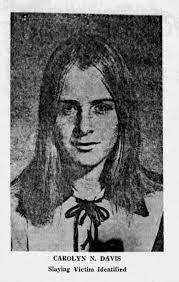
Thirteen year old Lori Lee Kursa ran away from her family on November 11, 1972 after a shopping trip with her mother at a U-Save Market. She reportedly went to stay with friends, and was last seen on November 30, 1972. Kursa was a frequent runaway thanks to a poor home life, and her frozen remains were found on December 14, 1972 in a ravine approximately 50 feet off Calistoga Road in Santa Rosa. On February 6, 1973 fifteen year old Carolyn Nadine Davis ran away from her home outside Anderson, CA. She hitchhiked to her sister Judy’s house in Garberville, and didn’t officially disappear until July 15, 1973 after she was dropped off near the post office by her Grandma, who lived nearby. Davis was last seen hitchhiking later that same afternoon near the Highway 101 southbound ramp and was never seen alive again. In the winter of 1973, 23 year old Theresa Diane Smith Walsh decided to take a road trip, and hitchhiked her way through Santa Rosa and Malibu, visiting friends along the way. But Christmas was quickly approaching, and Walsh grew homesick for her family and decided to start making her way home to her husband and young son for the holidays. She was last seen on December 22, 1973 trying to thumb a ride near Zuma Beach. On December 28, 1973, some kayakers were taking advantage of some high water near the Mark West Creek north of Santa Rosa and came across her body floating in the water in between a boulder and a log. She had expired within the past day or two and she was found completely nude. Her thumbs had been bound together as well as her wrists, which had then been tied to her thighs; her ankles were bound together as well. In a final gesture of cruelty, Walsh’s murderer tied a piece of rope to her ankle bindings then ran it up her back and looped it about her neck, which pulled snug at her heels and against her buttocks. The pain of being tied up in such a severe manner must have been unbearable: stretching her legs out to help relieve the strain would have only tightened the noose around her neck, causing her to slowly and painfully choke herself to death. Theresa’s remains were found within about 100 yards of the fire trail where Lori Lee Kursa had been dumped a year prior.
Mona Jean Gallegos was a twenty-two year old part-time waitress when she was murdered in the early morning hours of June 19, 1975. She had gone over to a friend’s house that sold cars in Alhambra, CA to ask him a few questions about purchasing a ‘new’ (to her, anyways) vehicle; she left his house for home at around 1 AM. Sometime shortly after leaving, Gallegos ran out of gas near Santa Anita Avenue on the eastbound San Bernardino Freeway. Her vehicle was later found locked and abandoned by Highway Patrol at about 4:45 AM, who theorized that a passing motorist may have stopped and offered the young woman a ride to a nearby 24 hour service station, then abducted her. Her skeletal remains were found almost six months later by two teenage boys that were hiking in a remote Riverside ravine. Investigators were unable to pinpoint her exact cause of death due to advanced levels of decomposition but were able to determine that there was no trauma to the bones.
Additionally, the skeletal remains of a young white female was discovered on July 2, 1979 in a ravine off Calistoga Road, roughly 100 yards from where the body of Lori Lee Kursa was discovered seven years prior. One forensics expert that was consulted by authorities determined the victim was most likely killed between 1972 and 1974 and was about 19 years old. Their remains have yet to be identified.
One thing I’ve never come across before is a column from a newspaper dated February 1970, that asked people from a variety of different age ranges, genders, races, and backgrounds how they would approach finding Cindy Mellin, and the results were interesting. Candy Teffe, a fourteen year old ninth grader from Anacape Junior High School, said: ‘two things. Go where she was seen last, and then talk to her friends.’ Ventura College freshman Craig Gottlieb said that ‘there are certain things I would attempt to do but my belief is that she has helped herself disappear. I would find out who she has been associated with and why she’d have reasons for leaving home.’ Restaurant executive Bruce Derns suggested that LE should, ‘offer a sizable reward.’
One interesting article I found while conducting my research is a ghost story that took place at the former Broadway Department Store at the Buenaventura Shopping Center (that is now a Macy’s): a one time sales girl said the building was haunted by none other than Cindy Lee Mellin, and that she heard footsteps and humming on multiple occasions when the space was supposed to be empty. She also noticed that pieces of clothing would frequently move around on their own. I also came across a comment about the haunting by Facebook user Ed Mata, who was employed there as well in the 1980’s and ‘heard the story but didn’t think much of it till I experienced cold and noisy stock rooms and someone humming in the elevator.’
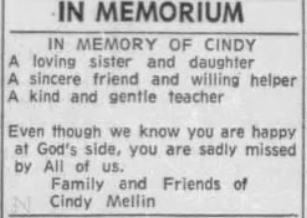
Judith Mellin-Williams said that her sister was ‘quiet, obedient, hard-working, spiritual, a downright goody-two shoes.’ In an article published by The Oxnard Star on January 20, 1995, Paula Mellin-Stoddard (who was only 15 when her older sister was abducted) said that her and Cindy were ‘the little girls in the family that dreamed of growing up, getting married, and having children together. I still feel her presence today, but she’s not there. She’s nothing more than a ghost.’ Judith also said she was a ‘late bloomer, extremely introverted, conservative and definitely not a boat rocker.’ Mellin-Stoddard also said that she considers her sister’s disappearance a painful mystery for her surviving family members, and that they were all haunted by their anger and anguish. Janice Mellin said in the same Oxnard Star article that ‘the only way we’ve been able to deal with it is to assume that she was murdered. But I’ll never be at peace without a body, funeral, or grave site to mourn.’
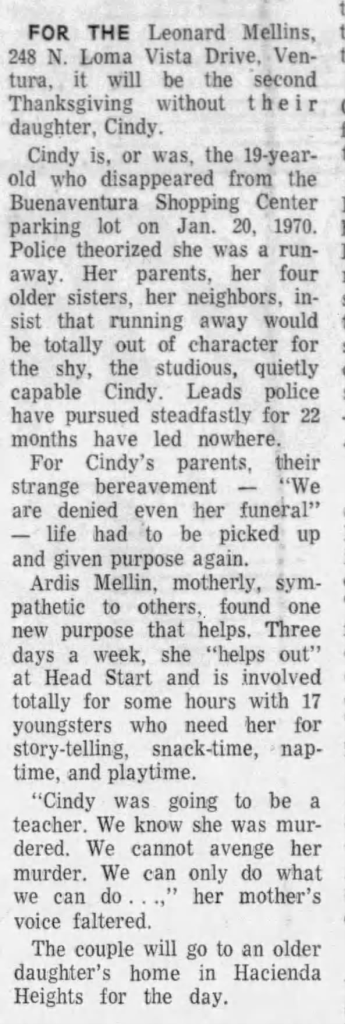
In an article published by The Oxnard Star on January 20, 1995, former Lieutenant Brad Talbot said that they ‘ran out of leads, people to talk to, and places to investigate.’ Regarding the perp, Talbot feels that ‘he might still be around. People sometimes get a guilty conscience and turn themselves in. We’d be willing to clear it all up.’ Oddly enough, later the same year Bundy was executed investigators received a tip that California inmate Gerald Stanely claimed he knew where Mellin’s body was buried. LE went to the San Quentin’s prison where Stanley was on death row to talk to him about the disappearance, but unfortunately the twice convicted killer had a habit of claiming to know about homicides he had no involvement in and was unable to provide anything useful to detectives. Cindy’s sister Janice said ‘it was just another lost hope.’ After her daughter disappeared Mrs. Mellin began volunteering three days a week at a ‘Head Start’ education program for her local school district, and sadly died on June 9, 1975 at the age of 62 from a stroke. Mr. Mellin remarried a woman named Marian E. Guild on February 19, 1977 but died just a few years later at the age of 68 on July 24, 1981. Cindy’s sister Judith died at the age of 42 on July 4, 1979, in Brea, CA, and Janice Mellin passed away at the age of 63 on July 8, 2001. If Cindy was still alive in December 2023 she would be 74 years old. Her dental charts are available and were entered into the national database; her DNA is also on file.














































 Another Bundy Blog.