Documents courtesy of the Seattle Police Department; according to them, they’re largely about Lynda Ann Healy.
Documents about Ted Bundy from the Seattle Police Department: Part One.
Documents courtesy of the Seattle Police Department; according to them, they’re largely about Lynda Ann Healy.
Document courtesy of Erin Banks.

Here is a complete list of missing/murdered women from Washington state from 1965 to 1975.
Lisa Wick and Lonnie Trumbull (June 23, 1966, Seattle): Wick and Trumbull were twenty-year-old United Airlines flight attendants who were brutally attacked in their Seattle apartment in 1966: Lonnie Ree Trumbull suffered a fractured skull and severe brain hemorrhaging and tragically succumbing to her injuries, but Lisa E. Wick survived, but was left critically injured and suffered permanent memory loss regarding the incident. A third roommate, Joyce Bowe, was not home at the time of the attacks. It is a case famously suspected of being linked to Ted Bundy (who had been nineteen at the time), however he denied any involvement and there is no official evidence tying him to the case.
Ruby Agnes Schwanbeck-Lampson (reported as missing on June 6, 1967, Spokane): Lampson lived in an apartment above the Falls View Tavern (a popular local establishment with a rowdy reputation) and was known to frequent and even work at the establishment; she was last seen alive at the nearby Hi-Neighbor Tavern with an unidentified, much younger man. Four years after she vanished, on November 16, 1971, her skeletal remains were discovered in a shallow grave in the remote woods of the Seven-Mile ORV Park (a 600-acre off-road vehicle area located inside Riverside State Park near Spokane); due to the advanced decomposition of her body, medical examiners were unable to determine an exact cause of death. The suspected killer of Dorothy Fielding was Duke J. Pierson, a former detective for the Spokane County Sheriff’s Department.
Dorothy Fielding (reported as missing on August 19, 1967, Spokane): frequented the same local tavern as Ruby Lampson; found in April 1968. disappeared in August 1967 and was found in a shallow grave eight months later in April 1968 at the Seven-Mile ORV Park. She was an avid member of the tavern’s bowling team. The suspected killer of Dorothy Fielding was Duke J. Pierson, a former detective for the Spokane County Sheriff’s Department.
Susan Galvin (discovered on July 13, 1967, Seattle): the twenty-year-old records clerk for the Seattle Police Department had recently moved to the area from her childhood home in Spokane; after failing to show up for work, her body was discovered inside a parking garage elevator at the Seattle Center complex. Autopsy results revealed that she had been sexually assaulted and strangled.
Verla Helen Winter (October 21, 1968, Kent): Last seen at home after she had an argument with her estranged husband, who stayed at the residence and supposedly went to bed. When he awoke, his wife and all of her belongings had disappeared, as well as $400 in cash; she left behind two children who were raised by her parents. Prior to this, Verla was in frequent contact with her family by phone and mail.
Linda Mary Louise Garrison (November 19, 1968, Sumner): about a month before her disappearance the nineteen-year-old had been thrown from a horse and had been treated for back injuries; it’s unknown if the injuries she sustained resulted in scarring or indications of trauma to the bones. She left home after a horse ride.
Murders Linked to John Dwight Canaday (1968–1969, Renton): I am going to touch on the murders committed by John Canaday as a whole, who is a lesser-discussed serial killer from Washington state that killed three women between late 1968 and early 1969. On the evening of December 17, 1968, pregnant newlywed Sandra Darlene Bowman was stabbed to death in her home after she opened the door to her Ballard apartment and apparently let her killer in; she was later found in her bedroom, tied up, raped and stabbed repeatedly, court documents say. On the evening of January 4, 1969, twenty-one-year-old Mary Annabelle Bjornson was at her apartment preparing dinner for a friend when a man knocked on her door claiming he was experiencing car trouble to gain entry. Once inside, he threatened her with a knife, tied her wrists, and drove her to Seattle’s Seward Park, where he strangled her. Canaday’s final victim was twenty-year-old University of Washington junior (some records mention her attending Washington State University) Lynne Carol Tuski, who vanished while walking to her car in northern outside a north Seattle department store; according to her autopsy, he strangled her to death. John Dwight Canaday was apprehended by police on February 22, 1969; he confessed to the murders,saying he strangled his victims and left their remains in Snohomish County; he died on December 26, 2012, while serving his time at the Clallam Bay Corrections Center.
Laura Lee Asynithe Flink (February 21, 1969, Aberdeen): Flink was last seen driving her live-in boyfriend’s 1967 Red Ford Ranchero toward Moclips at about 4 PM on Friday, February 21, 1969 (where she was supposed to pick up some furniture and children’s clothing); she never arrived at her intended destination. Flink’s brown leather wallet was found on a Hoquiam, Washington sidewalk on February 23, 1969, and the vehicle was subsequently recovered on February 24, 1969 (also in Hoquiam). Flink’s wallet was mailed by the Hoquiam Police to her Aberdeen post office box, where it was never picked up. She never returned to her waitress job, and there has been no contact with any family or friends since; she had no alternate source of income, and she left behind a sixteen-month-old son, who she had just won full custody of through the courts.
Dorothy May Thompson (August 25, 1969, Walla Walla): Thompson was fifty-three-year-old at the time she was last seen alive and had been in the custody of Walla Walla penal authorities; upon her release, official records state she was provided with a bus ticket to travel to Vancouver along with explicit instructions to report to a designated officer immediately upon arrival. While penal authorities confirmed providing the ticket, investigators note there is no official verification or proof that she ever boarded the bus; she never checked in with the officer in Vancouver and has not been seen or heard from since.
Murders Linked to Gary Gene Grant (1969–1971, Renton): I am going to touch on the murders committed by Gary Grant as a whole, who is a lesser-known serial killer who raped and murdered four young women in the Renton area between 1969 and 1971. Often referred to as ‘Seattle’s Forgotten Serial Killer, Grant was only eighteen when he began his killing spree, targeting victims who were primarily children or young teenagers: he killed nineteen-year-old Carol Adele Erickson on December 15, 1969, while she was walking home from the Renton Municipal Library; she was stabbed and raped. Grant killed seventeen-year-old Joanne Zulauf on September 20, 1970 after she left her home to take a brief walk before dinner. When she failed to return, her family reported her missing, and her body was discovered two days later in a heavily wooded area; she had been attacked and strangled. On April 20, 1971, Grant committed his final two murders when he abducted two six-year-old boys that were in their front yard playing: he threatened Scott Andrews and Bradley Lyons with a knife and took them into the woods less than two miles away from the Bradleys’ residence; he beat them both and then stabbed Andrews then strangled Lyons. Their bodies were found two days later, and when examining the crime scene, investigators found footprints of the offender’s tennis shoes, of which plaster casts were taken. Following his arrest, Grant confessed to the four murders on April 30, 1971, however, during his trial, he denied legal guilt by claiming he was legally insane. On August 25, 1971, a jury rejected his insanity plea and convicted him of four counts of first-degree murder; he was sentenced to four consecutive life terms in prison.
Grace Foster (1970, Olympia): one-year-old Foster vanished during a family picnic in Olympia sometime in the summer of 1970. Despite the case going cold, Grace’s older brother, Daniel Foster, never gave up hope. He spent decades holding onto the belief that his little sister was still alive somewhere.
Patricia Garrison (January 5, 1970, Olympia): seventeen-year-old Patricia Garrison was found stabbed in a hospital parking lot on January 5, 1970 in Olympia; two days later she died from the over twenty stab wounds and injuries that she sustained in the attack.
Bertha Louise Burke (February 20, 1970, Port Angeles): Burke was a twenty-nine-year-old mother of three when she disappeared on a Friday night in early 1970: she had tucked her young children into bed at their East 13th Street home, and she was gone when they woke up in the morning. She left behind her purse, clothes, and all of her other personal effects.
Gladys Thelma Williams (February 20, 1970, Seattle): Williams was last seen on February 20, 1970 when she dropped her children off at her sister’s residence. Very little information is available about her disappearance.
Jeannette Rose Miller (September 16, 1970, Arlington): seventeen-year-old Miller was last seen walking on the Lincoln Bridge in Arlington, Washington.
Nancy Mae Richards-Winslow (July 26, 1970, Bellingham): twenty-three-year-old whose disappearance and murder became a noted unsolved cold case. Due to the timing, location, and nature of her disappearance, her case has frequently been studied by true-crime researchers investigating unconfirmed victims of the serial killer Ted Bundy.
Janice Marie Hannigan (March 1, 1971, Wapao): the sixteen-year-old was was discharged from a hospital on December 24, 1971. Janice was suffering from numerous bruises on her chest and head when she was admitted to a hospital three days prior. According to her hospital discharge summary, Janice was admitted to the hospital with multiple contusions around the head. It’s not known which hospital Janice was admitted to or the cause of her injuries. She was discharged in satisfactory condition. She never arrived home after her discharge and she hasn’t been seen since. At the time of her disappearance, Janice was living with her father on family land west of Harrah. Their parents were separated and the six younger children were with their mother in Buena.
Joyce Margaret LePage (July 22, 1971, Pullman): on the evening of Thursday, July 22, 1971, Joyce took a skydiving lesson with a friend, went out for a beer afterward, and was dropped off outside her off-campus apartment around 10:00 PM. This was the last time she was seen alive. She failed to show up for classes the next day and missed a planned weekend trip to visit her family in Pasco.
Marilyn Kay Pratt (October 8, 1971, Spokane): Marilyn was last seen on the evening of October 8, 1971 by her husband and friends at a local restaurant. Marilyn’s husband was working as a bartender at the race track. Marilyn was supposed to meet her husband at the track that evening, to bet on a race with him. She didn’t make it, so he placed the bet anyway and lost, which made him angry.
Jamie Grisim (December 7, 1971, Vancouver): climbing into Forrest’s light-blue van near downtown Vancouver. Her remains were found exactly two years later in a shallow grave on Clark County parks property at Tukes Mountain. Jamie Grissim has been missing since December 7, 1971, after she vanished while walking home from Fort Vancouver High School in Vancouver, Washington. Although she was initially categorized by police as a runaway, her high school identification card and purse were found months later along a rural road in the Dole Valley area, prompting authorities to treat her disappearance as a homicide. Her remains have never been found, and her disappearance stands as the oldest active missing person case in Clark County.
Ivah McDonnell (December 2, 1971, Pasco): the sixty-year-old was found dead inside her home at 5008 W. Sylvester Street; she had been brutally beaten with a blunt object, knocked unconscious, and strangled to death with her own pajama bottoms. Her wallet, a change jar, and items of lingerie were missing from the scene. DNA profiling matched Samuel Evans to the crime scene, though he died in prison for a separate murder.
Alisa ‘Lisa’ Francine Watson (January 1, 1972, Tacoma): Alisa had left the family home and may have been living at an apartment in the Seattle area. No contact with family since 1972.
Pamela Burrows (January 1, 1972, Seattle): Pamela and her boyfriend were going to visit her sister in Minnesota, but they never arrived and she was never heard from again; he later told her sister that she had been killed, but it was never confirmed and her body has not been found.
Nancy Jane Liptrap (January 12, 1972, Des Moines): Liptrap was a sixteen-year-old student at Mt. Rainier High School in Des Moines when she was abducted on her way to school and viciously attacked on January 12, 1972; her body was discovered in a field not far from her home.
Barbara Ann Derry (disappeared on February 11, 1972, Vancouver): was an 18-year-old homicide victim from Washington State who is believed to be one of the earliest victims of Southwest Washington serial killer Warren Leslie Forrest. Derry was last seen on February 11, 1972, hitchhiking along State Highway 14. She was traveling from Vancouver toward her hometown of Goldendale, Washington. On March 29, 1972, her body was discovered by a woman hunting.
Kerry Hardy-May (June 13, 1972, Seattle): in June 1972, Kerry was in a period of transition, having recently separated from her husband. After she failed to show up at her family home to help them pack for a trip, her mother reported her missing to the Seattle Police Department. Her whereabouts remained a complete mystery for nearly 40 years. On September 6, 2010, a backhoe operator digging a waterline trench near a golf course at the Suncadia Resort in Roslyn, Washington, uncovered human remains in a shallow grave. Along with the bones, investigators found a gold wedding band and remnants of blue material. In June 2011, the Kittitas County Sheriff’s Office officially identified the remains as Kerry May-Hardy. The breakthrough came after her family noticed a striking resemblance between a forensic composite sketch circulated by authorities and Kerry. The identity was conclusively confirmed via DNA testing by the University of North Texas Center for Human Remains, using a profile her mother had proactively submitted in 2004.
Althea Dayle Blankinship (March 27, 1973, Port Townsend): Althea Blankinship and her son Jeffrey, were last seen in the City of Port Townsend, WA, where they were residing at the time. They were last reported to have been dropped off at SeaTac International Airport. Althea had made plans to travel to Greece with Jeffrey to meet her parents who were already there on vacation. Family members became concerned when it was evident that Althea and Jeffrey never arrived in Greece. They have not been heard from or seen since. Foul play is suspected.
Salie Belle Maxi Signani (June 1, 1973, Renton): she was recently divorced and left home to live with another man. She failed to show up for work on a Monday in early June 1973. Investigation done at that time was apparently lost. A new case originated in 2003.
Jody Loomis (August 23, 1972, Bothell): was a 20-year-old woman from Bothell, Washington, who was sexually assaulted and murdered on August 23, 1972. Her case went unsolved for nearly five decades until it was cracked using groundbreaking forensic genetic genealogy. On the afternoon of August 23, 1972, Jody left her home on her bicycle to visit her horse, Saudi, at a local stable. She never arrived. Roughly 30 minutes after she was last seen, two people discovered her disrobed and suffering from a gunshot wound to the head in a heavily wooded area of Snohomish County (in what is now Mill Creek Road). She was still barely breathing when found but was pronounced dead on the way to the hospital.
Murders Linked to James Edward Ruzicka (1973-1974, Seattle): I am going to touch on the murders committed by James Ruzicka as a whole, who is a lesser-known murderer from Washington state; in1973, twenty-three-year-old Ruzicka was arrested and later pled guilty to second-degree assault with intent to rape after attacking a twenty-one-year-old woman at knifepoint in her Capitol Hill apartment in Seattle. Instead of receiving a standard prison sentence, Superior Court Judge David W. Soukup suspended his ten-year term, and Ruzicka was sent to Western State Hospital after being legally classified as a ‘sexual psychopath.’ In January 1974, he escaped custody from the facility and within weeks, he went on to kidnap, rape, and murder two teenage girls in West Seattle (sixteen-year-old Nancy Kinghammer and fourteen-year-old Penny Marie Haddenham) before he eventually fled to Oregon, where he was ultimately apprehended.
Teresa Kay Davis (November 1, 1973, Tacoma): Teresa was staying with her sister in Tacoma, Washington. On November 1, 1973, Teresa’s sister came home and found that Teresa was not there. The front door was left open and all of Teresa’s belongings remained in the home. Later, her sister reportedly received a letter from Teresa sent from Anchorage, Alaska, but there was no further contact.
Katherine Merry Devine (November 25, 1973, Olympia): fourteen-year-old Kathy was murdered after running away from her Seattle home and hitchhiking on November 25, 1973. Her remains were discovered on December 6, 1973, by caretakers at Camp Margaret McKenny in the Capitol State Forest near Olympia, Washington. An autopsy revealed she had been sexually assaulted and killed by a knife wound to the neck. The mystery was finally solved in 2001 when the Washington State Patrol Crime Lab utilized modern DNA technology to test physical evidence preserved from the crime scene. The DNA perfectly matched William Earl Cosden Jr., a convicted rapist who had already been serving a prison sentence since 1976.
Lynda Ann Healy (January 31, 1974, Seattle): a 21-year-old American college student who became the first widely confirmed murder victim of the notorious serial killer Ted Bundy. She was known by her peers and family as a talented musician who was full of life, self-assurance, and compassion. She attended Newport High School before enrolling at the University of Washington (UW).At the time of her disappearance, she was a senior majoring in psychology and was scheduled to graduate that year. Deeply invested in helping others, she regularly worked with mentally handicapped children. Alongside her studies, she worked part-time for Western Ski Promotions, broadcasting morning weather and ski condition reports to 20 local radio stations across Washington and Oregon.Disappearance and MurderIn early 1974, Healy lived in a pale green off-campus house on 12th Avenue Northeast in Seattle’s University District with four female roommates.On the evening of January 31, 1974, Healy went out to a local establishment with friends, returned home, spoke to her boyfriend on the phone, and went to sleep. During the early morning hours of February 1, 1974, Ted Bundy broke into her basement bedroom. He knocked her unconscious, dressed her in blue jeans and a blouse, and carried her out to his vehicle while her roommates slept undisturbed upstairs.The next morning, her roommates noticed she was missing after her radio alarm clock kept buzzing continuously and she failed to show up for her scheduled morning broadcast. When police examined her room, they found her bed neatly made, but discovered her nightgown hanging in the closet with blood stains on the collar, along with blood on her mattress and pillowcase.
Heidi Birgit Peterson (February 21, 1974, Seattle): a four-year-old girl who was tragically abducted from the front yard of her Capitol Hill home in Seattle on February 21, 1974. Heidi was playing outside with her 2.5-year-old brother when she vanished. Her disappearance sparked one of the largest and most extensive law enforcement searches in the history of the Pacific Northwest at the time. Nearly a year later, on January 24, 1975, her remains were discovered in a park just a block away from her home. Investigators believed her remains had been moved there later, as the park had been thoroughly searched initially; o this day, her killer has never been identified.
Donna Gail Manson (March 12, 1974, Olympia): Manson was last seen at 7:00 PM on campus at Evergreen State College in Olympia by a college roommate whom she told she was going to attend a jazz concert being held on the campus; she was reportedly last seen between the dorms and library on the way to the concert. Ted Bundy confessed on death row to abducting Manson from the Olympia campus but never specifically said where he left her remains. As of July 2026 they have never been recovered.
Susan Elaine ‘Sue’ Rancourt (April 17, 1974, Ellensburg): an eighteen-year-old college student who became the third known murder victim of Ted Bundy. On the evening of April 17, 1974, Sue attended a meeting for future residence hall leaders at Munson Hall. After the meeting concluded around 10:00 PM, she began walking back to her dormitory. Witnesses on campus later recalled seeing a man with his arm in a sling wandering near the parking lots (which is a common ruse Bundy liked to use).
Brenda Joy Baker (May 25, 1974, Maple Valley): the fourteen-year-old was brutally murdered in Washington state in May 1974. She has long been suspected of being an unconfirmed victim of the notorious serial killer Ted Bundy. The details surrounding her disappearance and the subsequent investigation include: Brenda lived with her family in Maple Valley, Washington, and had a history of running away from home. On May 25, 1974, she spent two days staying with friends in Sumner, Washington, who tried to convince her to go home. She refused, stating she was trying to hitchhike south toward Portland, Oregon. She was last seen alive getting into a pickup truck with two men at an on-ramp near Puyallup, Washington. Because her family immediately noticed her absence, they filed a missing person’s report the same day she vanished. On June 17, 1974, approximately three weeks after she went missing, her highly decomposed remains were discovered by chance in an isolated section of Millersylvania State Park in Thurston Count
Diane Sue Gilchrist (May 29, 1974, Vancouver): a teenager from Vancouver, Washington, who went missing on May 29, 1974, at the age of 14. Decades after her disappearance, she is heavily suspected by law enforcement to be a victim of convicted Washington serial killer Warren Leslie Forrest. She was last seen on May 27 or May 29, 1974, leaving her family’s home in the 1800 block of Franklin Street in downtown Vancouver, Washington.
Gloria Nadine Knudson (May 31, 1974, Vancouver): Gloria Nadine Knudson (which I’ve also seen spelled Knutson) was a nineteen-year-old woman that went missing on May 31, 1974 and is a suspected victim of serial killer Warren Leslie Forrest. At the time of her murder she was almost finished with her senior year at Hudson Bay High School and was last seen after visiting a friend’s house on Grant Street, where she reported that an unknown man had chased and stalked her. She left to walk home and never arrived. Her remains were later discovered in 1978 near Lacamas Lake.
Brenda Carol Ball (June 1, 1974, Burien): twenty-two-year-old Ball is the fifth official murder victim of the American serial killer Ted Bundy.( grew up in Washington and graduated from Mount Rainier High School in Des Moines, Washington. Described by friends and family as a petite, “free and fun-loving spirit,” she stood 5 feet 3 inches tall, weighed 112 pounds, and had long brown hair and brown eyes. She had taken classes at Highline Community College but decided to drop out a couple of weeks before her disappearance. At the time, she was living with roommates in an apartment in Burien, Washington. On the evening of May 31, 1974, during Memorial Day weekend, Brenda went out alone to the Flame Tavern, a neighborhood bar in Burien. She had mentioned to her roommates and friends earlier that day that she hoped to find a ride out to Sun Lakes in eastern Washington to join them at a campground later that weekend
Krista Kay Blake (disappeared on July 11, 1974, Vancouver): twenty-year-old Blake was kidnapped and murdered in Washington in July 1974 by Warren Forrest; she was last seen climbing into his light blue Ford Econoline cargo van near downtown Vancouver.
Georgann ‘George’ Hawkins (June 11, 1974, University of Washington, Seattle): Hawkins disappeared from the University of Washington campus after 1am on June 11, 1974. She was last seen in the alley outside of Beta Theta Pi fraternity. She had been to a fraternity party earlier in the evening, and visited her boyfriend, Marvin Gellatly, on the way back to her sorority house. As she left Beta Theta Pi, Georgeann spoke with another friend, Duane Covey, who spoke with her from his second-story window that faced the alley. After saying goodbye to her friend, she headed down the alley toward her sorority house, Kappa Alpha Theta. She never arrived. Ms. Hawkins is the victim of serial killer, Ted Bundy, who confessed to kidnapping and murdering her before his execution in 1989. He confessed to killing her in a remote area “across Mercer Island, east past Issaquah, up the hill, down the road, and up to the grassy area.” Bundy claimed that Georgeann’s remains were found with two of his other victims, Janice Ott and Denise Naslund, in Lake Sammamish State Park; investigators had found an extra leg bone and extra vertebrae at the site, but had been unidentified at the time and – so far – were never positively identified as Georgeann’s.
Janice Ott & Denise Naslund (July 14, 1974, Issaquah): Bundy abducted twenty-three-year-old Janice Ott and nineteen-three-year-old Denise Marie Naslund were abducted four hours apart from Lake Sammamish State Park in Issaquah; it quickly became one of the most notorious moments during the hunt for ‘Ted,’ marking the first time investigators realized the killer went by the name and approached multiple women in broad daylight on the same day That Sunday Lake Sammamish State Park was incredibly crowded, and had around 40,000 visitors, many attending an annual picnic held by Rainier Beer.
Joyce Tyer Jones (November 17, 1974, Bellingham): little is known about the final days of Joyce; she went for a walk and never returned home.
Vonnie Joyce VanDriel-Stuth (disappeared on November 27, 1974. Burien): was initially suspected to be another victim of Bundy, Vonnie was abducted and murdered by serial killer Gary Addison Taylor; the nineteen-year-old newlywed disappeared from her apartment in Burien, Washington. When her husband, Todd Stuth, returned home from work after midnight, he found the lights and television on, an unfinished Thanksgiving meal on the table, and his wife gone. Her only previous hint to family had been a mention of a neighborhood man coming to the door to offer her a dog.
Laurie Lynn Partridge (December 4, 1974, Spokane): on the day she disappeared Partridge left Ferris High School early, complaining about not feeling well walking at 37th & Havana Streets on Spokane’s South Hill. Unable to get a ride, she decided to walk the two-plus miles to the home where she lived with her parents and five younger siblings, saying the air might help her feel better. The family reported her missing after she failed to show up for work that evening at Lincoln Heights Theater. Initially, sheriff’s deputies thought she might have run away from home, given her displeasure when the family moved to Spokane from California, but by the time she vanished she had started to establish roots (she was also engaged to a twenty-year-old man). The couple planned to pick out engagement rings the day Partridge disappeared, and her fiancé was questioned extensively several times but never ruled a suspect.
Lorelee Sue Lhotka (January 1, 1975, Seattle): Lhotka was last seen on some unspecified date in 1975, when she left home to go to a doctor’s appointment; she was supposed to take the bus, but she may have hitchhiked instead, and she never arrived at the doctor’s office. She has never been seen or heard from again. In 1978, Lhotka’s wallet was found at Blewitt Pass in the Wenatchee National Forest.
Diana ‘Dinah’ Peterson (February 14, 1975, Shoreline): sixteen-year-old Dinah snuck out of her family’s home in the Innis Arden/Richmond Beach neighborhood to visit her older boyfriend (whom her parents disapproved of). Later that night, her dad discovered her body in their backyard; she had been stabbed. For decades, investigators primarily focused their attention on Peterson’s then-19-year-old boyfriend, Timothy Diener, who had been arrested shortly after the murder but was never formally convicted (investigators struggled with a lack of concrete evidence). In December 2007, King County Sheriff’s cold-case detectives arrested and charged James Eric Groth, who was also sixteen at the time of the crime and lived two houses away from the Petersons; authorities determined that Groth had been infatuated with Peterson and grew violently jealous of her dating an older guy.
Hallie Ann Seaman (April 29, 1975, Seattle): Seaman was an honor student just two terms away from finishing her master’s degree in architecture and was last seen working late at her drafting table inside the University of Washington’s architecture building. The following afternoon, a passerby discovered her body hidden in the bushes near a parking lot on Eastlake Avenue East; she had been sexually assaulted and repeatedly stabbed. Her case remained an unsolved mystery until advanced DNA testing identified her killer as Charles Rodman Campbell.
Jo Carrol Sanders (July 6, 1975, Camas): the fourteen-year-old was last seen alive near her residence, which was described as being ‘a tight-knit neighborhood where she lived with her father’ and investigators confirmed she was abducted in broad daylight by someone driving either a yellow or green van. Her body was discovered three days later in a gravel pit roughly ten miles east of Camas in Skamania County.
Theodore Robert Bundy, Petitioner-Appellant versus Richard L. Dugger, Secretary, Department of Corrections, State of Florida, Respondent-Appellee. No. 86-3773.
United States Court of Appeals,
Eleventh Circuit.
July 7, 1988.
Polly Nelson, Wilmer, Cutler and Pickering, James E. Coleman, Jr., John Byron Sandage, Andrew James Munro, Washington, D.C., for petitioner-appellant.
850 F.2d 1402
Mark Menser, Asst. Atty. Gen. of Fla., Dept. of Legal Affairs, Tallahassee, Fla., Raymond L. Marky, John M. Koenig, Jr., Asst. Attys. Gen., Tallahassee, Fla., for respondent-appellee.
Appeal from the United States District Court for the Middle District of Florida.
Before Vance, Kravitch, and Johnson, Circuit Judges.
JOHNSON, Circuit Judge:
Theodore Robert Bundy was convicted and sentenced to death in Florida for the murder of Kimberly Leach.1 On direct appeal, the Florida Supreme Court affirmed the conviction and sentence. Bundy v. State, 471 So.2d 9 (Fla.1985), cert. denied, 479 U.S. 894, 107 S.Ct. 295, 93 L.Ed.2d 269 (1986). The Governor of Florida signed a death warrant scheduling Bundy’s execution for November 18, 1986. On November 17, Bundy was unsuccessful in state post-conviction and habeas corpus proceedings. Bundy v. State, 497 So.2d 1209 (Fla.1986).
Bundy immediately filed an application for a stay of execution, a petition for a writ of habeas corpus, and an application for a certificate of probable cause with the United States District Court for the Middle District of Florida. On November 17, the district court, having reviewed the trial record in advance, dismissed the petition without a hearing and denied the applications for a stay of execution and for a certificate of probable cause. Bundy v. Wainwright, No. 86-968-CIV-ORL-18 (M.D.Fla. Nov. 17, 1986). This Court subsequently granted a certificate of probable cause and a stay of execution pending appeal.
After briefing and oral argument, this Court remanded the case to the district court for the limited purpose of conducting an evidentiary hearing into Bundy’s competence to stand trial. Bundy v. Dugger, 816 F.2d 564 (11th Cir.), cert. denied, — U.S. —-, 108 S.Ct. 198, 98 L.Ed.2d 149 (1987). On remand, the district court conducted an evidentiary hearing and concluded that Bundy was competent to stand trial. Bundy v. Dugger, 675 F.Supp. 622 (M.D.Fla.1987). This Court ordered supplemental briefing on the competence to stand trial issue and heard oral argument.
I. Abuse of the Writ: We expressly state at the outset a conclusion implicit in the earlier decision of a limited remand: Bundy’s first federal habeas corpus petition should not be dismissed for abuse of the writ. Typically, ‘abuse of the writ’ principles apply to second or successive petitions that present claims that were raised, or that could have been raised, in previous petitions. Although this is Bundy’s first petition, the district court considered the petition abusive:
At approximately 2:30 PM on November 17, 1986, sixteen and one half hours prior to the time Mr. Bundy is scheduled to be executed, the petitioner filed a 183-page petition for writ of habeas corpus asking this Court to stay the execution and grant relief to the petitioner. This Court considers the petition filed under these conditions to be abusive.
We disagree.2 Even assuming arguendo that a first petition could be dismissed as an abuse of the writ because it was filed on the eve of execution,3 this case does not present an abusive situation. The United States Supreme Court denied certiorari review of Bundy’s direct appeal on October 14, 1986. On October 21, the Governor of Florida signed a death warrant scheduling Bundy’s execution for November 18. Bundy began state postconviction and habeas proceedings on November 7 and those proceedings concluded on November 17. Bundy then filed his federal petition. Under these facts, the filing on the eve of execution does not constitute abuse of the writ.
II. Competence to Stand Trial: As set forth above, the district court, after a limited remand from this Court, conducted an evidentiary hearing and concluded that Bundy was competent to stand trial. Bundy v. Dugger, 675 F.Supp. 622 (M.D.Fla.1987). We begin our analysis by setting forth the applicable legal standards central to our review of the district court’s conclusion. First, ‘the legal test for mental competency is whether, at the time of trial and sentencing, the petitioner had ‘sufficient present ability to consult with his lawyer with a reasonable degree of rational understanding’ and whether he had ‘a rational as well as factual understanding of the proceedings against him.’ Adams v. Wainwright, 764 F.2d 1356, 1359-60 (11th Cir.1985) (quoting Dusky v. United States, 362 U.S. 402, 402, 80 S.Ct. 788, 789, 4 L.Ed.2d 824 (1960)), cert. denied, 474 U.S. 1073, 106 S.Ct. 834, 88 L.Ed.2d 805 (1986). Second, Bundy had the burden of proof on remand: ‘At the ensuing district court hearing, petitioner [the defendant] bears the burden of proving the fact of incompetency by a preponderance of the evidence.’ Price v. Wainwright, 759 F.2d 1549, 1553 (11th Cir.1985) (citing Zapata v. Estelle, 585 F.2d 750, 752 (5th Cir.1978) (en banc)). Third, the standard of appellate review provides:
Before the court can meaningfully apply [the Dusky ] legal standard … it must often ascertain the nature of petitioner’s allegedly incapacitating illness. It is at this initial juncture that expert testimony is particularly valuable, for the existence of even a severe psychiatric defect is not always apparent to laymen. Because of this difficulty in detecting medical diseases, the trial court may find it necessary to make an initial factfinding on whether the accused suffers from a mental defect at all. Although sometimes dispositive of the ultimate competency question, this medical inquiry is properly classified as pure fact finding and reviewable only under the clearly erroneous standard.
Once it is established that an individual suffers from a clinically recognized disorder, the court must decide whether such condition rendered the accused incompetent under the Dusky formulation…. This second stage determination of legal incompetency is subject to a review more stringent than the clearly erroneous rule. To insure protection of valuable constitutional rights, this court is bound to take a hard look at the ultimate competency ‘finding.’
Bruce suggests that a district court’s determination of competency should proceed in two parts: (1) Does the defendant suffer from a clinically recognized disorder? and (2) if so, did that disorder render the defendant incompetent under the Dusky standard? In the present case, Bundy argued that he suffered from bipolar mood disorder.6 Although the district court did not segregate its analysis as suggested by Bruce, our reading of the district court’s opinion, particularly the conclusion,7 indicates that the district court determined that, even if Bundy otherwise suffered from bipolar mood disorder, the disorder was not manifesting itself so as to affect his competence to stand trial. Consequently, pursuant to Bruce, we take a ‘hard look’ at the ultimate competency ‘finding.’
Bundy argues that, although he had a factual understanding of the proceedings against him, he lacked a rational understanding of those proceedings and a rational understanding necessary to consult with his lawyer. We have undertaken a detailed review of the record and given a ‘hard look’ to the district court’s conclusion of ‘competency.’ Based upon the record evidence of the testimony (including depositions) at the evidentiary hearing and the associated exhibits, we hold that the district court’s findings of historical fact were not clearly erroneous, see Amadeo v. Zant, — U.S. —-, 108 S.Ct. 1771, 100 L.Ed.2d 249 (1988), and thus we will not reiterate the district court’s findings here. We do, however, highlight the record evidence that leads us to conclude, after a ‘hard look,’ that Bundy was competent to stand trial.
Dr. Dorothy Lewis and Dr. Emanuel Tanay, both psychiatrists, testified9 that Bundy was incompetent to stand trial. Dr. Charles Mutter and Dr. Umesh Mhatre, both psychiatrists, testified in rebuttal for the State. The district court credited the testimony of Drs. Mutter and Mhatre. We agree with the district court’s observation that their testimony better accorded with the testimony of other witnesses and the associated exhibits.10
For example, Judge Wallace Jopling, the presiding judge at the Lake City trial, and prosecutors George Dekle and Jerry Blair testified about Bundy’s actions at trial. This testimony indicates that Bundy’s actions were inconsistent with the actions of a person manifesting bipolar mood disorder.
In addition, the exhibits from the hearing, largely ignored by Bundy in his supplemental brief, indicate that Bundy was competent to stand trial. The videotape of Bundy’s argument to Judge Jopling prior to sentencing shows that Bundy delivered a cogent, well-reasoned argument. Bundy focused on the effect of pretrial publicity on the jury and argued that the jury was overwhelmed more by the quantity, than the quality, of the state’s evidence. Bundy can be seen flipping pages of a legal pad as he goes through his argument.
The tapes made by Bundy12 while awaiting the verdict and shortly after the verdict strongly demonstrate that Bundy had a rational understanding of the proceedings. For example, on tape I (recorded while the jury was deliberating), Bundy describes his displeasure at one of the trial judge’s instructions, evaluates some of the evidence against him, and criticizes the state’s closing argument for referring to facts not in evidence. On tape G (recorded two hours after the jury returned its guilty verdict), Bundy recalls that after closing argument he bet members of the defense team that the jury would be back within three hours with a guilty verdict: ‘I was attempting to protect myself–insulate myself from the terribly harsh consequences of a guilty verdict….’ On that tape, Bundy recalls evaluating the trial proceedings: ‘I can remember throughout the course of the trial, my counsel, myself, speculating on the reactions of jurors to state witnesses, the reactions of jurors to defense witnesses, speculating on the ineffectiveness of certain state witnesses, and the convincing qualities of our witnesses.’ On tape H (recorded on the morning after the jury returned its guilty verdict), Bundy describes how, when he woke up that morning, ‘I immediately began thinking about the statements I’m going to make to the jury during the penalty phase and the statements I’m going to make to the judge when he sentences me. Right now my concern lies with just what the tenor of those comments should be.’ Consequently, a ‘hard look’ at the record evidence supports the conclusion that Bundy was competent to stand trial.
III. Choice of Counsel: Bundy argues that he was denied his Sixth Amendment right to choice of counsel. This claim overlaps with Bundy’s claim that his counsel provided ineffective assistance of counsel by failing to raise this claim on direct appeal. Shortly after his indictment, Bundy asked the trial court to grant the motion of Georgia attorney Millard Farmer to be admitted pro hac vice. The trial court denied the motion after conducting an evidentiary hearing and allowing oral argument. See State v. Bundy, No. 78-169-CF (Fla.Cir.Ct.Columbia County Sept. 22, 1978) (Jopling, J.) (R. 14,117; vol. 156, app. 37).14 On direct appeal, Bundy did not claim that he was denied the counsel of his choice. Bundy then raised this claim in state postconviction proceedings. The Florida Supreme Court found this claim procedurally barred because it could have been raised on direct appeal. See Bundy, 497 So.2d at 1210. The Court also found Bundy’s related ineffective assistance of appellate counsel claim to be without merit. Id. at 1211.
Bundy then raised the choice of counsel claim and the related ineffective assistance of appellate counsel claim in his federal habeas corpus petition. The district court determined that the choice of counsel claim was procedurally defaulted, see slip op. at 9, and the related ineffective assistance of counsel claim was not a basis for relief because the district court had denied relief on the merits of the choice of counsel claim.15
We conclude that Bundy’s failure to raise the choice of counsel claim on direct appeal constitutes procedural default. See Murray v. Carrier, 477 U.S. 478, 106 S.Ct. 2639, 91 L.Ed.2d 397 (1986). Consequently, Bundy must show both cause for noncompliance with the state rule and actual prejudice resulting from the alleged constitutional violation. Smith v. Murray, 477 U.S. 527, 533, 106 S.Ct. 2661, 2665, 91 L.Ed.2d 434 (1986).
Bundy contends that ineffective assistance of his appellate counsel satisfies the cause requirement.16 See Carrier, 477 U.S. at 488, 106 S.Ct. at 2646 (‘Ineffective assistance of counsel … is cause for a procedural default.’). We disagree as we do not find Bundy’s counsel ineffective.17 The Supreme Court’s decision in Smith informs our analysis. The Supreme Court reasoned that, when viewed in light of state law at the time of direct appeal, the decision not to raise the claim ‘fell well within the ‘wide range of professionally competent assistance’ required under the Sixth Amendment to the Federal Constitution.’ Smith, 477 U.S. at 536, 106 S.Ct. at 2667 (quoting Strickland v. Washington, 466 U.S. 668, 690, 104 S.Ct. 2052, 2066, 80 L.Ed.2d 674 (1984)); see id. at 535, 106 S.Ct. at 2667 (‘Nor can it seriously be maintained that the decision not to press the claim on appeal was an error of such magnitude that it rendered counsel’s performance constitutionally deficient under the test of Strickland v. Washington, 466 U.S. 668 [104 S.Ct. 2052, 80 L.Ed.2d 674] (1984)’); see also Jones v. Barnes, 463 U.S. 745, 751-54, 103 S.Ct. 3308, 3312-14, 77 L.Ed.2d 987 (1983) (recognizing that appellate counsel needs latitude in selecting issues to raise on appeal).
In his direct appeal in the Leon County case, which antedated the direct appeal in the present case, Bundy raised the choice of counsel claim and the Florida Supreme Court found it without merit. See Bundy v. State, 455 So.2d 330, 347-48 (Fla.1984).18 Consequently, pursuant to Smith, Bundy’s counsel was not ineffective for not raising the choice of counsel claim on direct appeal.19 Finally, this is not ‘an extraordinary case’ where the writ should be granted even absent a showing of cause.
IV. Ineffective Assistance of Counsel: Bundy argues that he received ineffective assistance of counsel at trial on a number of grounds. The Florida Supreme Court, see Bundy, 497 So.2d at 1210, and the district court, see slip op. at 9-12, held this claim without merit. We affirm the district court because none of the asserted grounds satisfies both the performance and prejudice prongs enunciated by Strickland v. Washington, 466 U.S. 668, 104 S.Ct. 2052, 80 L.Ed.2d 674 (1984).
Bundy first complains of ineffectiveness of trial counsel in relation to the investigation concerning fiber evidence, the hearing on the motion in limine to exclude such evidence, the failure to object to the conclusions testified to by the state’s expert witness, and the failure to have a defense expert testify regarding the fibers. We have reviewed the record evidence and, particularly based upon the cross-examination regarding the source of the van’s carpet, the users of the van, and the clothes worn in the van; the arguments on the motion in limine; the cross-examination of the state’s expert, and the examination of witnesses recalled as part of the defense’s presentation, we conclude that Bundy has failed to satisfy Strickland ‘s performance prong. In addition, in ruling on this claim in the state postconviction proceeding, the trial court stated that it would have permitted the evidence anyhow. Consequently, it does not appear that the prejudice prong was met.
Bundy next argues that he received ineffective assistance of counsel in connection with the plea agreement. A review of the record again demonstrates that Bundy has not satisfied the performance prong. In addition, Bundy asserts that counsel had to disclose damaging information to the state in the course of negotiations. Bundy does not allege what that information was or whether it was used at trial. Consequently, this assertion does not raise a colorable showing of prejudice sufficient to trigger an evidentiary hearing.
Bundy next claims that he received ineffective assistance of counsel because no evidence was presented at the penalty phase of trial that he was suffering from a mental disorder. As a related claim, Bundy argues that he was denied effective assistance of counsel by counsel’s failure to investigate an insanity defense. The record indicates an insanity defense was investigated and that Bundy rejected any suggestion that such a defense be presented. In addition, Bundy would not admit complicity of the crimes upon which he was convicted. Based upon Bundy’s actions and the actual presentation at the penalty phase, we cannot say that Bundy has satisfied the performance prong. The record also indicates that, even if such evidence were presented, the state could produce countering evidence and thus, in light of the aggravating circumstances, no prejudice resulted.
Finally, Bundy argues that he received ineffective assistance of counsel because no challenge was made to the use of prior convictions as aggravating circumstances. Bundy does not suggest any basis for a challenge to the Utah convictions. We cannot say that Bundy has satisfied the performance prong as to his Leon County convictions. That conclusion is buttressed by the Florida Supreme Court’s subsequent affirmance of those convictions. In addition, we do not believe Bundy has satisfied the prejudice prong. Three aggravating circumstances remain independent of the Leon County convictions.
V. Faretta Inquiry: Bundy claims that the trial court failed to conduct a proper inquiry into whether he should have been allowed to represent himself during critical stages of the prosecution. Faretta v. California, 422 U.S. 806, 95 S.Ct. 2525, 45 L.Ed.2d 562 (1975). This claim overlaps with Bundy’s claim that his counsel provided ineffective assistance of counsel by failing to raise this claim on direct appeal.
On September 21, 1978, after the trial court orally denied the motion for Farmer to appear pro hac vice, the trial court asked Bundy if he had other counsel to represent him. In relevant part, Bundy replied:
[S]eeing that the Court in its wisdom has denied me representation by Mr. Farmer, I will proceed pro se.
In the first instance, I guess I should ask for leave to proceed in proper person and submit in support of my motion the case of Anthony Pasquale Faretta versus the State of California 42 U.S. 806 [95 S.Ct. 2525, 45 L.Ed.2d 562], case decided in 1975.
Supp. R3:144-45 (footnote omitted). The trial court permitted Bundy to proceed pro se. Subsequently, at the request of the state’s attorney, the trial court asked Bundy what education he had. Bundy replied in relevant part:
I have a Bachelor of Science in Psychology from the University of Washington and two years of law school. I think, however, if the Court will read Faretta, the United States Supreme Court has said that the legal background or legal training of a defendant who wishes to represent himself is not an issue. If the man or woman wishes to represent himself or herself, understandingly, knowingly and voluntarily expresses the desire to do so, he or she may exercise that Sixth Amendment right applied to the States through the Fourteenth Amendment and so I don’t really think that an inquiry into my background, beyond my stating that I knowingly and voluntarily and understandingly take this step, is necessary.
Id. at 147-48. On June 21, 1979, Bundy withdrew his waiver of counsel and accepted Victor Africano as his attorney in the Lake City case. R157:14,383. Africano served as Bundy’s attorney from that pre-trial point to the conclusion of the direct appeal. On direct appeal, Bundy did not claim he was denied a proper Faretta hearing. Bundy then raised this claim in state postconviction proceedings. The Florida Supreme Court held:
We find that the appellant’s fourth claim [i.e., the Faretta inquiry] could have been raised on direct appeal and is therefore barred from consideration. Even if we were to examine the claim, however, we would find it lacking in substance. The trial court conducted an inquiry into appellant’s ability to act as his own counsel prior to allowing him to represent himself, and during this inquiry appellant himself alerted the trial court to the teachings of Faretta. We may not now reverse the trial court’s finding of appellant’s ability to pursue his own representation.
Bundy, 497 So.2d at 1210. The Court also found Bundy’s related ineffective assistance of appellate counsel claim to be without merit. Id. at 1211. Although the state asserted before the district court that the Faretta inquiry claim was subject to the procedural default doctrine, the district court did not mention that doctrine but rather concluded that Bundy was not entitled to relief on the merits.
On appeal, the state renews its argument that the claim is subject to the procedural default doctrine. When it is clear that a state court is addressing a particular claim (i.e., the Florida Supreme Court’s reference to ‘the appellant’s fourth claim’) and the state court expressly states that the claim is barred from consideration, we conclude that the state court has not excused the procedural default when it proceeds alternatively and hypothetically to address the merits of the claim. Consequently, we conclude that Bundy’s failure to raise the Faretta inquiry claim on direct appeal constitutes procedural default. See Murray v. Carrier, supra. Bundy thus must show both cause for noncompliance with the state rule and actual prejudice resulting from the alleged constitutional violation.
Bundy again contends that ineffective assistance of his appellate counsel satisfies the cause requirement.20 See Carrier, 477 U.S. at 488, 106 S.Ct. at 2646 (‘Ineffective assistance of counsel … is cause for a procedural default’). Again, we rely on the Supreme Court’s analysis in Smith to conclude that Bundy has not met the cause requirement. In light of Bundy’s citation of the Faretta decision to the trial court, his comments to the trial court, and Africano’s serving as Bundy’s attorney from well before trial to the conclusion of direct appeal, ‘the decision not to press the claim on appeal was [not] an error of such magnitude that it rendered counsel’s performance constitutionally deficient.’ 21 Smith, 477 U.S. at 535, 106 S.Ct. at 2667; see also Jones v. Barnes, 463 U.S. 745, 751-54, 103 S.Ct. 3308, 3312-14, 77 L.Ed.2d 987 (1983) (recognizing that appellate counsel needs latitude in selecting issues to raise on appeal).
Alternatively, if the procedural default doctrine did not preclude us from examining the merits of the Faretta inquiry claim, we would conclude that Bundy was not entitled to relief on this ground. This Circuit generally requires that a trial judge conduct a waiver hearing to make sure that the accused understands the risks of proceeding pro se. See Jackson v. James, 839 F.2d 1513, 1516 (11th Cir.1988) and cases cited therein. In the present case, the passage quoted above indicates that the trial court did not inform Bundy of the disadvantages of proceeding pro se. Bundy, however, cited Faretta to the trial court and asserted that he was ‘knowingly and voluntarily and understandingly taking this step.’ We do not decide whether these facts constitute a ‘rare’ case in which an exception to the hearing requirement will be made. See Fitzpatrick v. Wainwright, 800 F.2d 1057, 1064-68 (11th Cir.1986). Rather, we conclude that any error by the trial court was harmless. As set forth above, well before trial in the Lake City case, Bundy accepted Victor Africano as his attorney. Africano served as Bundy’s attorney from that point to the conclusion of direct appeal. Accordingly, the Faretta inquiry claim and the related ineffective assistance of appellate counsel claim are without merit.
VI. Race of the Victim: Bundy argues that the Florida death penalty is unconstitutionally applied because it is disproportionately imposed in cases, such as the present case, where the victim is white. On collateral review, the Florida Supreme Court held that this claim was without merit. See Bundy, 497 So.2d at 1210-11. Consequently, the procedural default doctrine does not apply.
The district court also held that this claim was without merit. On appeal, Bundy argues that the district court erred in denying him an evidentiary hearing on this claim. We disagree. Bundy relies solely on studies allegedly showing systematic discrimination on the basis of the victim’s race. This Court repeatedly has rejected these studies as grounds for an evidentiary hearing or relief. See Funchess v. Wainwright, 788 F.2d 1443, 1445-46 (11th Cir.), cert. denied, 475 U.S. 1133, 106 S.Ct. 1668, 90 L.Ed.2d 208 (1986); Thomas v. Wainwright, 767 F.2d 738, 747-48 (11th Cir.1985), cert. denied, 475 U.S. 1031, 106 S.Ct. 1241, 89 L.Ed.2d 349 (1986), and cases cited therein. In addition, Bundy points to no evidence that the decision makers in his case acted with discriminatory purpose.
VII. Hypnotically Refreshed Testimony: Bundy argues that the use of Clarence L. ‘Andy’ Anderson’s hypnotically enhanced testimony violated his Sixth Amendment right to confrontation and his Fourteenth Amendment due process right to a fair trial.22 Anderson was the state’s only eyewitness to the abduction of Kimberly Leach on February 9, 1978. On July 18, 1978, Anderson first went to the police because the profile of a person he had seen on a television newscast bore a striking resemblance to the man he had earlier observed with a girl near the Lake City Junior High School. Anderson was hypnotized twice in order to enhance his recollection. After conducting a hearing and taking testimony, the trial court denied Bundy’s pretrial motion to suppress Anderson’s testimony. The denial was without prejudice to Bundy’s right to object at trial to specific portions of that testimony. At trial, Anderson made an in-court identification of Bundy as closely resembling the man he saw and, from a photograph introduced into evidence, identified Kimberly Leach as the girl.
On direct appeal, the Florida Supreme Court held ‘that hypnotically refreshed testimony is per se inadmissible in a criminal trial in this state, but hypnosis does not render a witness incompetent to testify to those facts demonstrably recalled prior to hypnosis. Relying on harmless-constitutional-error cases of the United States Supreme Court, the Florida Supreme Court went on to conclude that the admission of Anderson’s hypnotically refreshed testimony was harmless error.23 Id. at 19. The district court held this claim without merit.
We first address Bundy’s claim that admission of Anderson’s testimony violated the Confrontation Clause of the Sixth Amendment. In Rock v. Arkansas, 107 S.Ct. 2704, 97 L.Ed.2d 37 (1987), the Supreme Court held that a state’s per se rule excluding hypnotically refreshed testimony impermissibly infringed on a criminal defendant’s right to testify. Although the Supreme Court expressly did not address the issue presented here. Its reasoning informs our analysis. The Court stated that ‘it has not been shown that hypnotically enhanced testimony is always so untrustworthy and so immune to the traditional means of evaluating credibility’ such that a per se ban is warranted. Id. at 2714. The Court recognized that cross-examination remained as an effective tool for revealing inconsistencies, id., even though hypnosis may lead to the introduction of inaccurate memories, ‘making effective cross-examination more difficult.’
Rock thus teaches that, although hypnosis may make effective cross-examination more difficult, it does not always make it impossible, thereby preserving the opportunity for effective cross-examination safeguarded by the Sixth Amendment. See Delaware v. Fensterer, 474 U.S. 15, 20, 106 S.Ct. 292, 295, 88 L.Ed.2d 15 (1985) (‘The Confrontation Clause guarantees the opportunity for effective cross-examination….’ (emphasis in original)); accord Delaware v. Van Arsdall, 475 U.S. 673, 678, 106 S.Ct. 1431, 1435, 89 L.Ed.2d 674 (1986). Consequently, we decline to hold that the Confrontation Clause requires a per se ban on the admission of hypnotically refreshed testimony.
We thus examine whether, on the facts of the present case, a Confrontation Clause violation occurred. ‘The sixth amendment confrontation clause is satisfied where sufficient information is elicited from the witness from which the jury can adequately gauge the witness. Such information was elicited here. In particular, Anderson admitted that the hypnotic sessions he underwent, to some degree, had an effect on the testimony he was giving. Moreover, defense counsel explored why Anderson took so long to come forward; Anderson’s activities on the morning of February 9th; the relationship between the prosecution’s search of Anderson’s work schedule records and Anderson’s understanding that February 9th was the date of Kimberly Leach’s disappearance; Anderson’s identifying Bundy on television but never participating in a photo line-up or a live line-up; Anderson’s travelling the route from the fire station past Lake City Junior High School many times before; and the discrepancies between Anderson’s trial testimony and his statements prior to hypnosis. The record does not demonstrate that the trial court impermissibly limited the cross-examination of Anderson. In addition, Bundy examined the two hypnotists concerning their qualifications. Finally, the tape recordings of the two sessions were played to the jury, each juror received a transcript of those sessions, and Bundy presented an expert witness who addressed what he characterized as the flaws in those sessions. In light of these facts, Bundy certainly had the opportunity for effective cross-examination and no Confrontation Clause violation occurred.
We next examine Bundy’s claim that admission of Anderson’s testimony deprived Bundy of his Fourteenth Amendment due process right to a fair trial. We note at the outset that Rock rejects the suggestion that hypnotically refreshed testimony is so unreliable that a per se ban on such testimony is warranted. Accordingly, we must determine whether, on the facts in the present case, the hypnotically refreshed testimony was so unreliable as to violate due process. We conclude that the use of Anderson’s testimony accorded with the dictates of due process.
In the present case, as set forth above, Anderson first went to the police on July 28, 1978, because the profile of a person he had seen on a television newscast bore a striking resemblance to a man he had earlier observed with a girl near the Lake City Junior High School. Before going to the police, Anderson had noticed a resemblance between his niece and Kimberly Leach and thought, before seeing Bundy’s picture on television, that Kimberly Leach was the girl he had seen: I probably knew it for some time. Exactly when I realized that it was the Leach girl, I have no earthly idea. I just would not admit it to myself. Prior to coming to the police, Anderson had thought what he saw was what he testified to at trial. Indeed, during the search for Kimberly Leach, Anderson expressed his thoughts to a fishing companion: And I said, I don’t recall specifically what I said, but I stated that I may have seen the guy that picked the Leach girl up or I may have seen someone that could have picked up the girl.
Anderson gave a statement at the police station. He described the man he had seen as of medium build, 5-foot-7 to 5-foot-10, and having medium or darker brown wavy hair. The man wore a light shirt or jacket. Anderson described the girl as 12 or 13 years old with shoulder-length brown hair parted in the middle. She wore dungarees or slacks and a dark pullover, and carried a sweater, jacket, or large pocketbook. He said the man led the girl, by her elbow, around the front of the van and helped her in. The girl had an unhappy look as if she had been in trouble at school. The van was white and its rear windows were covered so that Anderson could not see the man after he entered the van. He described his observation as taking place in April.
After Anderson gave his statement, the prosecutor asked Anderson if he would undergo hypnosis. Anderson agreed. Thirty to forty-five minutes later, Imogene Keene, a hypnotist, arrived. Prior to hypnosis, Anderson repeated his statement. Keene then began the procedure to hypnotize Anderson. The session was tape recorded. (The tape recording was played to the jury and each juror received a transcript of the session.) The prosecutor and police investigator were also present. Anderson testified at trial that he did not believe he was hypnotized. He recalled that his neck bothered him and affected his concentration. He remembered that people kept walking in and out of the area. The descriptions offered by Anderson suggest that he was not hypnotized. For the most part, Anderson recited the facts he had given in his statement to the police. Although he initially stated that he could not see the girl’s face, in response to a question, he stated that the girl was crying. In addition, Anderson described the color of the van’s license plate, although the true color was different.
At the conclusion of this first session, the prosecutor asked if Anderson would undergo hypnosis again. Anderson agreed and a second session took place three days later on July 31. After the first session, the prosecutor or police investigator suggested that Anderson go home and think about the date of his observation. Prior to the second session, Anderson recalled the date of his observation as February 9th:
[A.] … I talked it over with my wife. I was very concerned about it, very upset about it. I didn’t even know what day the girl was missing. I believe my wife said it was around the time of our little girl’s birthday and then it began to dawn on me as I went over it in my mind that I saw the little girl and the man coming home from the fire department the day after my little girl’s birthday.
Q. What was you little daughter’s birthday?
A. February the 8th.
Q. Had you planned any events in connection with her birthday or what caused you to focus attention on her birthday?
A. My wife had planned a party where [sic] some of her friends and a movie, and I was looking forward to, you know, going to the party and taking the kids to the movies, you know, helping chaperone the kids. And I didn’t make it because I was working overtime at the fire station. I got called in quite often that day to work overtime. It seemed like every time I went home, I walked in the door, the phone would be ringing and them asking me to come back down to the fire station and, late that afternoon, I got a call to go back down to the fire station, they had a trip going to Gainesville, and we needed the money, so I went and I called my wife and told her that I’m sorry, go ahead and take the kids to the party and the movie, I wasn’t going to be able to make it.
Q. Okay. What, if anything, happened on February the 9th, after you got home, that allowed you to tie that incident in with your little daughter’s birthday party?
A. I remember going in. I remember feeling guilty about not being with the kids at the party. Well, the first thing I did was eat a piece of my daughter’s birthday cake. I asked my wife to iron me a shirt, a uniform shirt. I think probably eating the cake and just I remember feeling guilty about not making the party makes me remember it as clear as anything else.
Q. Okay. And are you certain in your own mind, as you have testified this morning, on February the 9th is the date that you made those observations that you have described to the Court?
A. Yes, sir.
Q. Now, do I understand your testimony to be that, in between July the 28th and July the 31st, you made this determination?
A. Yes, sir.
R21:4087-89.
On July 31, the second session took place. Anderson, Keene, the prosecutor, the police investigator, Johnny ‘Jack’ Burnette, and a stenographer were present. The session was tape recorded. (The tape recording was played to the jury and each juror received a transcript of the session.) In this second session, Burnette, another hypnotist, placed Anderson under hypnosis. Anderson believed he was hypnotized during this session. During this session, Anderson stated, inter alia, that his observation was on February 9; that the man was fairly young (29, 30, or 31), was good looking, and was wearing a white jacket or white pullover with a shirt underneath; that the girl was wearing a blue football jersey with ‘3’ and either ‘6’ or ‘8’ on it; and that the van had clear rear windows through which Anderson could see the man scold the girl. After the session, Anderson ‘felt better,’ but ‘there are still some things bothering me. I couldn’t definitely identify the man. I couldn’t remember exactly what the man was wearing. There were still some questions that I had that I would like to have been able to answer.’ R21:4120.
At trial, Anderson testified in relevant part as follows:
Q. What, if anything, did you observe in the vicinity of Lake City Junior High School on that morning [February 9th] as you travelled to your home?
A. The first thing I noticed was there was a white van parked in the westbound lane of Duval Street, that, as I approached it, several cars had, were going around it. There were still two cars behind the van and then my truck. And I was sitting there waiting for the truck to move or waiting for traffic to clear so I could go around it. And on my left, I noticed a young girl, approximately twelve or thirteen years old, dark hair, shoulder length, parted in the middle. Probably the only reason I noticed this girl was she looked very much like one of my nieces.
Q. Was there anyone with the young girl?
A. Yes, sir. With her was a man, approximately early thirties, had brown hair, you know, light to dark brown hair, was full cut of hair. It was one of the things that I really paid any attention to as far as the man was concerned. It was kind of wavy, but it was full cut, you know, really a nice head of hair.
I got the impression that the young girl was either crying or had been crying. The man had a scowl on his face. And I felt like probably the girl had gotten in trouble at the school or misbehaved in some way and had called her father to come pick her up and take her home. And as I was sitting there, watching them, I remember thinking to myself, you know, the daddy is going to take the little girl home and probably, you know, give her a spanking or something like that.
Q. Would you tell us how the girl was dressed, as you recall?
A. She was wearing a pullover football jersey and probably dungarees.
Q. What was the color of the football jersey?
A. It was dark blue.
Q. Did the jersey have any distinguishing marks or characteristics?
A. Yes, sir. It had some letters on it, ’63’ or ’68’, red-orange, something like that.
Q. Did the girl appear to be carrying anything?
A. Yes, sir. In her left arm, kind of clutched to her chest like this (demonstrating), was a medium-sized object like, so it could have been a pocketbook or a rolled-up jacket or maybe both. I don’t know. The man had her by her left arm, right about the elbow, and he was leading her towards the white van. The little girl was not actually resisting. It was pretty evidence [sic] that, that, you know, she wasn’t really anxious to go. They was, from the sidewalk, probably six to ten feet from the sidewalk when I first saw them. They continued to walk to the sidewalk. He stopped–
Q. Did the man have the girl by the left arm during the entire time that you observed them?
A. Yes, sir. They stopped and a car came by, going east, and they crossed in front of the white van. The man opened the door.
Q. Which door did he open?
A. The door on the passenger side. And helped the girl get in the van, slammed the door, and kind of jogged in front of the van, got in the passenger side, and they drove off.
R21:4063-65.
Q. Were you able to tell how the man was dressed?
A. Yes, sir. He had a pullover sweater, with a shirt underneath the sweater. I don’t recall the exact color of either one of them. The sweater was a neutral color, tan, light grey, something like that. I don’t recall the color of his trousers.
Q. You have described the van as being a white van. Can you give any further description of it. particularly with respect to any windows?
A. All I seen was a, was the very back of it and it had two windows, the rear doors.
Q. Okay. I’m going to have you a photograph, which has been marked for identification as State’s Exhibit J. I ask you to examine this photograph and tell us whether or not that photograph is similar to the white van that you observed on the morning of February the 9th in front of the Lake City Junior High School.
A. Yes, sir, it’s very similar.
Q. Now, after the person placed the girl in the white van and got in on the driver’s side, what happened then?
A. The van drove off, you know, a normal rate of speed. As I said before, there were two vehicles between me and the van. The closest one to the van was a small, dark blue foreign car of some kind. I have no idea what kind.
Q. Did you remain behind the white van?
A. Yes, sir.
Q. And approximately at what distance behind the white van?
A. Two car lengths. We were all fairly close together. Nobody was keeping the proper distance between the vehicles, if I remember correctly. Somewhere between the junior high school and 7th Street, which is roughly seven blocks, six blocks, the small car turned off to the right. I don’t recall what street it turned off. And then the van stopped at the red light at 7th Street.
Q. Were you able to observe the driver as he was stopped at the red light there at 7th Street?
[A]. Okay. When the van stopped at 7th Street, I could see the silhouette of the driver turn towards the passenger side.
Q. Could you see anyone in the passenger side at that point in time?
A. No, sir.
Q. Had the girl been sitting up straight in the seat, do you know of any reason why you could not have seen her at that time?
A. No, sir.
Q. What, if anything, did you see the driver doing?
A. He was gesturing, turned to his right, and moving his head like he was talking, and gesturing with his left hand.
Q. And when you say he was turning to his right, that would have been toward the passenger side of the–
A. Toward the passenger side.
Q. How long after that did you lose sight of the van?
A. Approximately two, two and a half blocks, U.S. 90 veers left and West Duval Street continues straight west.
Q. Mr. Anderson, I’m going to hand you a photograph, which is in evidence as State’s Exhibit 1, and I ask you to examine that photograph and tell the members of the jury whether or not you recognize that person depicted.
A. Yes, sir, I do.
Q. Who is that person?
A. It’s the young girl I saw at the school.
Q. On the morning of February the 9th?
A. Yes, sir.
Q. I’m going to ask you, Mr. Anderson, if you will look around the courtroom and tell the members of the jury whether or not you can positively identify the man that you observed leading that young girl from the school ground on February the 9th.
A. No, sir, I’m not absolutely certain.
Q. I ask you then to once again to [sic] look around the courtroom and tell the members of the jury whether or not there is anyone in the courtroom who closely resembles the person that you observed leading the young girl to the white van on the morning of February the 9th.
A. Yes, sir, there is.
Q. Would you point that person out, please?
A. The defendant.
….Q. Are you aware of any dissimilarities in the appearance between the person that you pointed out in the courtroom and the person that you saw leading the girl to the van on that morning?
A. No, sir, they were very much alike.
R21:4068-73.
We hold that Anderson’s hypnotically enhanced testimony was not so wholly unreliable that its admission violated Bundy’s due process right to a fair trial. Indeed, Anderson’s knowledge independent of the hypnosis sessions defeats the inference that the hypnosis was unduly suggestive. The above recitation of the facts makes clear that, prior to going to the police, Anderson strongly suspected that he had seen Leach’s abduction–a suspicion he shared with a fishing companion. Upon seeing Bundy on television, Anderson’s suspicions grew to a certainty that outweighed his fears of getting involved and sending police on a ‘wild goose chase.’ At this point, Anderson went to the police and gave a statement reflecting his thought that a man resembling Bundy had abducted Kimberly Leach. Independent of hypnosis, Anderson recalled that the date of his observation was February 9th.
We also cannot say that the hypnotically enhanced details of Anderson’s trial testimony were the product of impermissible suggestions or techniques by the hypnotist. Indeed, the jury heard tapes of the two sessions, received transcripts of those sessions, and heard testimony of an expert witness who addressed what he characterized as the flaws in those sessions. Cross-examination was the avenue with which to attack Anderson’s testimony. We have held above that an opportunity for effective cross-examination was available here. That holding buttresses our conclusion that Anderson’s testimony was not so unreliable as to violate Bundy’s due process right to a fair trial.
VIII. Exclusion of Jurors: Bundy argues that the trial court erred in denying his motion to limit death qualification of the jury, permitting such qualification, and excusing for cause jurors who expressed opposition to the death penalty, notwithstanding their ability to vote for guilt or innocence. Bundy argues that, because of the capital sentencing procedures of Florida law, the rule enunciated in Witherspoon v. Illinois, 391 U.S. 510, 88 S.Ct. 1770, 20 L.Ed.2d 776 (1968), and refined by its progeny does not apply. Bundy asserts that under Florida law the trial judge solely determines whether a defendant receives a death sentence and that the jury renders an advisory opinion only. Bundy concludes that, because the jury has an advisory role only, Florida lacks the usual state interest in excluding jurors who would automatically vote against the death penalty. As a result, Bundy argues that his interest in a jury composed of a cross-section of the community controls and the trial court erred in excusing those jurors who were unalterably committed to vote against the death penalty.
On direct appeal, the Florida Supreme Court held that it was precluded from ruling on this claim because objections as to this claim were not raised in the trial court. Bundy, 471 So.2d at 19. The district court held that the claim was procedurally barred and, alternatively, without merit.
We conclude that Bundy’s claim is without merit.26 Supreme Court precedent clearly establishes that a state can exclude for cause a prospective juror whose opposition to the death penalty ‘would prevent or substantially impair the performance of his duties as a juror in accordance with his instructions and his oath.’ See, e.g., Wainwright v. Witt, 469 U.S. 412, 420, 105 S.Ct. 844, 850, 83 L.Ed.2d 841 (1985) (quoting Adams v. Texas, 448 U.S. 38, 45, 100 S.Ct. 2521, 2526, 65 L.Ed.2d 581 (1980)). Bundy attempts to avoid the force of this Supreme Court precedent by characterizing the role of the sentencing jury as advisory under Florida law. We disagree. See Mann v. Dugger, 844 F.2d 1446, 1449-54 (11th Cir.1988) (en banc). As a result, Witherspoon and its progeny apply to jury selection in Florida cases. Because Bundy admitted in his brief on direct appeal, see page 56 of that brief, that the jurors were properly excluded under Witherspoon,27 this claim is without merit as are any claims that ‘death qualification’ violates the fair cross-section or impartial jury requirements of the Sixth Amendment. See Lockhart v. McCree, 476 U.S. 162, 106 S.Ct. 1758, 90 L.Ed.2d 137 (1986).
IX. Frye Test: Bundy argues that the trial court erred in not conducting a sua sponte inquiry into the scientific reliability of fiber and shoe track evidence presented by the state. See Frye v. United States, 293 F. 1013 (D.C.Cir.1923) (expert testimony admissible only if based on well-recognized and generally accepted scientific principles). On direct appeal, the Florida Supreme Court noted that Bundy failed to object at trial and thus the claim was procedurally barred. See Bundy, 471 So.2d at 20. The district court held that the claim failed pursuant to the procedural default doctrine and, alternatively, was without merit. See slip op. at 14-15.
This claim is not procedurally barred. If the trial court truly had an independent duty to conduct a Frye test, then Bundy was not obligated to request a Frye test or to object at trial to the court’s failure to conduct one. Consequently, the Florida Supreme Court improperly refused to consider the merits of this claim, and its mistaken reliance on a procedural bar does not provide an adequate basis for denying federal habeas review.
Although this claim is not procedurally barred, it is without merit. In substance, Bundy seeks to avoid Florida’s contemporaneous objection rule and associated procedural default, see Wainwright v. Sykes, 433 U.S. 72, 97 S.Ct. 2497, 53 L.Ed.2d 594 (1977), by requiring that the trial court object sua sponte to the admission of evidence. In Wainwright v. Sykes, 433 U.S. at 86, 97 S.Ct. at 2506, the Supreme Court rejected the suggestion that the trial court had an independent duty to conduct a hearing as to the voluntariness of a defendant’s confession. Similarly, we agree that, even assuming that evidence must meet the Frye test as a matter of constitutional law,28 the trial court has no independent duty to challenge the evidence and the admission of the evidence must be challenged by the defendant at trial or not at all.
X. Jury View: Bundy claims he was denied due process when his motion for a jury view of the scene around the school was denied by the trial court. On direct appeal, the Florida Supreme Court held that the trial court did not abuse its discretion. See Bundy, 471 So.2d at 20. The district court held that this claim was addressed to an issue of state law and thus was not a basis for federal habeas relief. Alternatively, the district court held that the trial court’s ruling did not deny Bundy fundamental fairness. See slip op. at 15.
We disagree with the district court’s characterization of this claim as addressed to an issue of state law. An evidentiary ruling is a cognizable ground for federal habeas corpus relief if it deprived the state court defendant of fundamental fairness. See Jameson v. Wainwright, 719 F.2d 1125, 1126 (11th Cir.1983), cert. denied, 466 U.S. 975, 104 S.Ct. 2355, 80 L.Ed.2d 827 (1984). We agree with the district court, however, that the ruling did not deprive Bundy of fundamental fairness. To constitute a denial of fundamental fairness, the evidence at issue must be crucial and highly significant. 719 F.2d at 1127; see Williams v. Kemp, 846 F.2d 1276, 1282 (11th Cir.1988). In the present case, the scene had been significantly altered because of the construction of a four-lane highway. In addition, photographs of the scene were admitted into evidence, and cross-examination as to the scene was allowed. Consequently, denying the jury an actual view of the scene cannot be said to have deprived Bundy of a fundamentally fair trial.
XI. Evidence of Flight: Bundy claims he was denied due process when his motion in limine to exclude evidence of flight was denied by the trial court and when the trial court instructed the jury regarding the evidence of flight. On direct appeal, the Florida Supreme Court relied on federal cases binding on this panel and held that the evidence was properly admitted and that the related instruction was proper. See Bundy, 471 So.2d at 20-21. The district court noted that this claim raised state-law issues and thus was not a basis for federal habeas corpus relief.29 Alternatively, the district court held that the evidence was properly admitted and that the jury instruction did not render the trial fundamentally unfair. See slip op. at 15-16.
The state presented evidence of two instances of flight by Bundy. The first instance occurred on February 11, 1978 (two days after the abduction of Kimberly Leach) at 1:47 a.m. in Tallahassee, which is approximately 100 miles west of Lake City. In this instance, after being stopped by a police officer, Bundy successfully fled. The second instance occurred on February 15, 1978 (six days after the abduction of Kimberly Leach) at approximately 1:30 a.m. in Pensacola, which is approximately 200 miles west of Tallahassee and 300 miles west of Lake City. After being stopped by a police officer, Bundy began to flee down a street, but was caught and arrested within a few minutes. The trial judge permitted evidence of both instances of flight and, prior to the jury’s deliberations, instructed the jury as follows:
You are instructed that the flight of the defendant is a circumstance which may be taken into consideration with all other facts and circumstances in the evidence and, if you, the jury, believe and find from the evidence beyond every reasonable doubt that the defendant fled for the purpose of avoiding arrest and trial under the charges herein, you may take this fact into consideration in determining guilt or innocence.
R35:6939-40. We find no error in the admission of the evidence of flight and no error in the trial court’s instructions as to that evidence.
XII. Doubling of Aggravating Circumstances: Bundy argues that constitutional error occurred when the trial court relied on Bundy’s conviction in Utah for aggravated kidnapping to find two aggravating circumstances: (1) Bundy was under a sentence of imprisonment when he committed the present crime and (2) Bundy previously had been convicted of a violent crime. On direct appeal, the Florida Supreme Court applied the test enunciated in Blockburger v. United States, 284 U.S. 299, 52 S.Ct. 180, 76 L.Ed. 306 (1932), and rejected Bundy’s claim. See Bundy, 471 So.2d at 22.
The district court recognized the Florida Supreme Court’s reliance on Blockburger and concluded it was ‘convinced that the [Florida] Supreme Court’s decision on this issue [was] correct.’30 Slip op. at 16. We agree that Blockburger renders Bundy’s claim without merit. In Blockburger, the Supreme Court stated that ‘the test to be applied to determine whether there are two offenses or only one, is whether each provision requires proof of a fact which the other does not.’ 284 U.S. at 304, 52 S.Ct. at 182. In the present case, each aggravating circumstance clearly has an element different from the other.
XIII. Penalty for Requesting Jury Trial: Based on the state’s original agreement to a life sentence in this case,31 Africano filed a motion that would have prevented the court from convening the penalty phase and from returning a death sentence. The motion stated that Bundy was unconstitutionally forced to risk death in order to exercise his right to a jury trial. The trial judge denied the motion. Although Bundy challenged this denial in his brief on direct appeal, the Florida Supreme Court did not address it.
In his federal habeas petition, Bundy claimed that the trial court erred in denying his motion to enter a life sentence on the verdict and to prohibit the penalty phase of trial. The district court observed that Bundy ‘essentially concedes that this ground is procedurally barred’ and, alternatively, held the claim without merit. See slip op. at 16-17. Although this claim is not procedurally barred,32 we agree that the claim is without merit. There is no hint in the record that Bundy received a heavier sentence after trial as a result of judicial vindictiveness or punitive action. See Hitchcock v. Wainwright, 770 F.2d 1514, 1518-20 (11th Cir.1985) (en banc), rev’d on other grounds, — U.S. —-, 107 S.Ct. 1821, 95 L.Ed.2d 347 (1987).
XIV. Clemency Hearing: Bundy argues that he was denied his right to apply for executive clemency in violation of the Eighth and Fourteenth Amendments. The Florida Supreme Court, see Bundy, 497 So.2d at 1211, and the district court, see slip op. at 17, held this claim without merit. We affirm the district court, but do not share its reasoning.
We begin our analysis of the procedural due process claim by determining whether Bundy has a protected liberty interest in being accorded a hearing for executive clemency. ‘Liberty interests protected by the Fourteenth Amendment may arise from two sources–the Due Process Clause itself and the laws of the States.’ Hewitt v. Helms, 459 U.S. 460, 466, 103 S.Ct. 864, 868, 74 L.Ed.2d 675 (1983). This Circuit’s predecessor has held that such a liberty interest does not arise from the Due Process Clause itself. See Spinkellink v. Wainwright, 578 F.2d 582, 617-19 (5th Cir.1978), cert. denied, 440 U.S. 976, 99 S.Ct. 1548, 59 L.Ed.2d 796 (1979). Accordingly, we turn to the Florida Rules of Executive Clemency. See Sullivan v. Askew, 348 So.2d 312, 319-25 (Fla.) (setting forth clemency procedures), cert. denied, 434 U.S. 878, 98 S.Ct. 232, 54 L.Ed.2d 159 (1977).
In Hewitt, the Supreme Court observed that the mere enactment of regulations does not automatically give rise to a liberty interest, especially if the regulations are nothing more than guidelines for the exercise of executive discretion. 459 U.S. at 471, 103 S.Ct. at 871. The Court recognized, however, that a liberty interest is present when the regulations are of an ‘unmistakably mandatory character’ and require ‘specific substantive predicates.’ Id. at 471-72, 103 S.Ct. at 871.
Florida’s clemency procedures do not satisfy either requirement. Cf. Sheley v. Dugger, 833 F.2d 1420, 1424 (11th Cir.1987) (Florida ‘rules and regulations concerning administrative segregation and close management create for inmates a liberty interest in remaining in the general prison population’); McQueen v. Tabah, 839 F.2d 1525, 1527-29 (11th Cir.1988) (following Sheley ). First, the clemency procedures do not unmistakably indicate that a prisoner sentenced to death is entitled to a clemency hearing. Rule 7, a special rule for executive clemency in capital cases, provides that ‘the Governor or any member of the Cabinet, after reviewing a certified copy of the conviction and sentence, may request the Florida Parole and Probation Commission to make an appropriate investigation, inquiring into any factors relevant to commutation.’ Although Rule 7 sets forth required procedures, these procedures are required only after the discretionary request to the Commission. See also Sullivan, 348 So.2d at 318 (England, J., specially concurring) (procedures are required ‘once triggered’). Second, no specific substantive predicates govern this discretion; the decision whether to grant clemency is wholly a matter of executive discretion. Sullivan, 348 So.2d at 314-16; Fla. Const. Art. IV, Sec. 8. The clemency rules do not require the Governor to make any factual findings in order to deny clemency to a capital defendant.
Finally, Bundy’s claim that the lack of a clemency hearing violates his Eighth Amendment right is without merit. This is not the situation where a state prohibits executive clemency. See Gregg v. Georgia, 428 U.S. 153, 200 n. 50, 96 S.Ct. 2909, 2937-38 n. 50, 49 L.Ed.2d 859 (1976) (opinion of Stewart, Powell, and Stevens, JJ.) (prohibiting executive clemency ‘would be totally alien to our notions of criminal justice’). In addition, the concern derived from the Eighth Amendment regarding capital cases focuses on the judicial processes of trial and appellate review, not on the discretionary state process (i.e., executive clemency) succeeding them. See Spinkellink, 578 F.2d at 619 & n. 45.
XV. Pretrial Publicity: Bundy argues that his jury was both presumptively and actually prejudiced on account of adverse pretrial publicity concerning his conviction in the Leon County case. By statutory choice of permissive venue, venue initially was in Suwannee County. (Lake City is located in Columbia County.) After the start of voir dire in Suwannee County, the trial court granted Bundy’s motion for a change in venue and moved the case to Orange County. The trial court refused to grant Bundy another change of venue, or abatement in the trial, even though Bundy contended that the jurors in Orange County were as equally prejudiced as the jurors in Suwannee County. The Florida Supreme Court, see Bundy, 471 So.2d at 19-20, and the district court, see slip op. at 17-19, held this claim without merit. On appeal, Bundy argues that the district court erred in denying him an evidentiary hearing on this claim.
Jury prejudice can be presumed from pretrial publicity if that publicity is sufficiently prejudicial and inflammatory and if it saturated the community where the trial was held. Murphy v. Florida, 421 U.S. 794, 798-99, 95 S.Ct. 2031, 2035-36, 44 L.Ed.2d 589 (1975); Rideau v. Louisiana, 373 U.S. 723, 726-27, 83 S.Ct. 1417, 1419-20, 10 L.Ed.2d 663 (1963); Coleman v. Kemp, 778 F.2d 1487, 1490 (11th Cir.1985), cert. denied, 476 U.S. 1164, 106 S.Ct. 2289, 90 L.Ed.2d 730 (1986). This principle is rarely applicable and reserved for extreme situations where pretrial publicity renders ‘virtually impossible a fair trial by an impartial jury drawn from the community.’
We hold that the coverage of the Leon County trial,33 although extensive, does not satisfy the heavy burden associated with presumed prejudice. In support of his motion for a change in venue or abatement of prosecution, Bundy presented the testimony of local television personnel. See R6:1159-98, R7:1202-18. The public television station had broadcast half-hour summaries of the Leon County trial. These summaries were factual accounts; the station was prohibited by law from offering editorial comment. At the time of jury selection in January 1980, the station had not broadcast anything about Bundy since the conclusion of the Leon County trial in late July 1979. Although the commercial television stations provided extensive coverage of the Leon County trial, the coverage was factual in nature and not designed to inflame or prejudice the public. In addition, prior to the verdict, these stations did not broadcast editorials about whether the defendant was guilty in that case. Bundy also presented newspaper articles from the local newspaper. See R12:2222-24. Again, these articles are largely factual in nature. Consequently, unlike Coleman, the coverage of the Leon County case was not infested with inflammatory and prejudicial remarks from the police and prosecutors. See also Murphy, 421 U.S. at 802, 95 S.Ct. at 2037 (news articles were largely factual in nature); United States v. Klacker, 811 F.2d 555, 556 (11th Cir.1987) (‘The news reports detailing appellant’s flight from justice were largely factual reports, devoid of inflammatory material’).
Likewise, we are unpersuaded by a public opinion poll proffered by Bundy in support of his motion. The poll, conducted among residents of Orange County, showed that 98% of those who responded indicated their familiarity with the name Bundy. See R7:1237. Of that number 58% stated that they knew Bundy had been involved in the Leon County case. Of that number, 31% believed that Bundy’s conviction in that case strongly indicated that he was guilty in the present case. See id. at 1240. Although publicity concerning a defendant’s involvement in other crimes is relevant in presuming jury prejudice, especially if the defendant’s involvement in that crime is inadmissible in the guilt/innocence phase, Murphy stands for the proposition that prejudice is not presumed simply because the defendant’s criminal record is well publicized. Thus, even assuming that the methodology of the public opinion poll is such that it accurately reflected the attitude of Orange County residents, the poll does not demonstrate that the community was so predisposed to Bundy’s guilt in the present case that prejudice must be presumed.
Nor can we say that Bundy has demonstrated actual prejudice in the entire venire. See Irvin v. Dowd, 366 U.S. 717, 727, 81 S.Ct. 1639, 1645, 6 L.Ed.2d 751 (1961). We have carefully reviewed approximately 19 volumes of voir dire. We note that the trial court propounded general questions to each set of prospective jurors, the panels ranging from eleven to fifteen persons. As one of the general questions, the trial court requested that prospective jurors raise their hands to indicate if they had heard of the defendant, but that they not reveal the source or extent of their knowledge. Thereafter, those prospective jurors who remained after general questioning were individually questioned by the trial court, one prosecutor, and one defense attorney. No other prospective juror was present during this individual questioning. Our review of the record indicates that as part of this individual questioning the trial court permitted a searching inquiry into knowledge and thoughts about the defendant.
Our review of the record indicates that 172 prospective jurors were called and 56 were excused for reasons relating to health, family, employment, or school. Of the 116 remaining prospective jurors, 42 were excused because they could not (1) be impartial based upon their extensive knowledge of the Leon County case, (2) set aside preconceived notions of guilt, and/or (3) could not accord Bundy a presumption of innocence.34 Of the remaining 74 jurors, a small minority also stated that they had a preconceived notion of guilt. Consequently, we cannot say that Bundy suffered actual prejudice from the entire venire.
Before we examine whether Bundy has demonstrated actual prejudice regarding the trial jury as a whole, we examine Bundy’s challenge to an individual juror. The Supreme Court has recognized that the question of the partiality of an individual juror is one of historical fact to which the presumption of correctness of a state court’s factual findings under 28 U.S.C. Sec. 2254(d) applies. Patton v. Yount, 467 U.S. 1025, 1036, 104 S.Ct. 2885, 2891, 81 L.Ed.2d 847 (1984). ‘Thus the question is whether there is fair support in the record for the state courts’ conclusion that the juror[ ] here would be impartial.’
We conclude that there is fair support in the record for the trial court’s conclusion35 as to this individual juror. This juror, the twelfth juror selected and eventually the jury foreman, was pre-press manager of the local newspaper. In response to the trial court’s questions, he stated that he understood that the defendant was entitled to be tried on the evidence presented in the present case alone, that he would follow the trial court’s instructions as to the law, that he would accord the defendant a presumption of innocence and hold the state to its burden of proof, that he would not require the defendant to take the stand, and that he would set aside any opinion or impression he had about the defendant. See R18:3455-58. Assuming a guilty verdict, he stated that he was not committed to voting automatically for the death penalty or life imprisonment. Id. at 3465. He again stated that the defendant need not take the stand, the defense need not prove the defendant not guilty, and that the burden rested on the state.
On questioning by Africano, see generally id. at 3473-89, the juror stated that he knew Bundy was convicted of murder in Miami of ‘the Tallahassee girls’ and that ‘it sounded like a pretty gory case’ and ‘some brutal murders.’ He knew Bundy was sentenced to death. Unlike most prospective jurors, he recalled the bite-mark evidence from that case, although he stated, ‘I believe that was the Bundy case.’ He guessed that death was by bludgeoning and that there was more than one murder. Unlike most prospective jurors, he recalled that Bundy had escaped from prison in Colorado. He knew that Bundy ‘is highly intelligent and he had some law background or something somewhere along the line.’ He did not recall if co-workers had reached a consensus of Bundy’s guilt prior to the Leon County verdict, but said that family and friends thought Bundy was guilty. Twice, he stated that he had no thoughts as to Bundy’s guilt prior to the verdict.36 After conviction in the Leon County case, his feelings were ‘not too good towards Mr. Bundy.’ He stated that he still felt that way, but that he would listen to the evidence in the present case.37 Upon further questioning, the juror adhered to his earlier stated positions.38 Based upon our examination of the record, we hold that there is fair support for the trial court’s conclusion.
We proceed to examine whether Bundy has demonstrated actual prejudice regarding the trial jury as a whole. In this context, the ‘Supreme Court has questioned whether the ‘fairly supported by the recor’ standard of 28 U.S.C. Sec. 2254(d) supplanted the ‘manifest error’ standard enunciated in Irvin. Patton v. Yount, 467 U.S. at 1031 n. 7, 104 S.Ct. at 2889 n. 7. The Court, however, did not resolve the question because it concluded that the defendant had not satisfied the ‘manifest error’ standard. Id. at 1032 n. 7, 104 S.Ct. at 2889 n. 7. Because we conclude that Bundy has not satisfied Irvin ‘s standard, we also do not determine whether Section 2254(d) has superseded that standard.
We have already set forth the relevant voir dire of the twelfth juror. We now summarize the individual voir dire of the other eleven jurors:
Juror Number One (R6:1017-1049): She stated that she could follow the trial court’s instructions. She knew that Bundy was on trial for some murders in the northern part of Florida. She believed he was convicted, but did not know the sentence. No challenge for cause was made.
Juror Number Two (R6:1080-1116): He stated that he could follow the trial court’s instructions. He had heard Bundy’s name before, but could not recollect why. No challenge for cause was made.
Juror Number Three (R8:1482-1530): She stated that she was not sure that she had a fixed opinion regarding guilt/innocence, but that she would follow the trial court’s instructions. She stated that she was not sure if she had an open mind regarding hypnosis and that she had mixed feelings about the death penalty. Although she ‘may even have the wrong thing,’ it seemed that Bundy was involved in the crime involving three girls in upstate Florida. She had formed a negative opinion about Bundy, but could fairly and impartially judge the evidence, although there might be a glimmer of a doubt that she could do that. She thought she would require some evidence tending to show innocence, even though there is a presumption of innocence. She thought she might be influenced by the fact that Bundy did not take the stand. However, she would just have to keep reminding herself of the instructions of the court. The trial court found a firm indication of impartiality and denied the motion to excuse for cause.
Juror Number Four (R9:1686-1729): He stated that he could follow the trial court’s instructions. He knew that Bundy was found guilty of murder in the previous trial and sentenced to death. He knew nothing of Bundy’s background. He stated that what happened before would not have any effect on the guilt/innocence in the present case. The trial court found that the prospective juror could be impartial and denied the motion to excuse for cause.
Juror Number Five (Rl0:1974-98, Rll:2002-12): He stated that he could follow the trial court’s instructions. He heard Bundy’s name mentioned around his workplace. He knew Bundy was tried for something in northern Florida, but he did not know the charges or the outcome of the trial. He knew nothing of Bundy’s background. The trial court credited the truth of the prospective juror’s testimony and denied the motion to excuse for cause on that basis.
Juror Number Six (R11:2013-51): He stated that he had no preconceived notion of Bundy’s guilt or innocence and that he could follow the trial court’s instructions. He knew that Bundy was tried, convicted, and sentenced to death in Miami for the murders of two sorority sisters at Florida State University. Unlike most prospective jurors, he recalled the dentist’s testimony about the bite marks and recalled that Bundy was a law student out west and possibly wanted out there. Prior to the verdict in the Leon County case, he had formed an opinion that Bundy was guilty. He stated that he had no opinion about Bundy personally and that his knowledge would not influence his decision because the present case was a totally different case. He stated that he believed in the notion of innocent until proven guilty. The trial court denied the motion to excuse for cause.
Juror Number Seven (R14:2698-2737): She stated she could follow the trial court’s instructions. She was dubious about hypnosis, but could consider the testimony. She read the newspaper once she knew Bundy was coming to Orlando for trial. She learned that Bundy had been tried and found guilty. She did not know what sentence was imposed. The trial court denied a motion to excuse for cause.
Juror Number Eight (R14:2737-80): She stated that she could follow the trial court’s instructions. She stated that she first heard of Bundy in the context of jury selection for this case. She expressed no knowledge of the Leon County trial. No challenge for cause was made.
Juror Number Nine (R16:3102-46): She stated that she could follow the trial court’s instructions. She knew that Bundy was convicted of murder in the earlier trial, but did not know if any sentence was imposed on Bundy. No challenge for cause was made.
Juror Number Ten (R16:3191-98, R17:3202-27): She stated that she had no feelings or opinions about the defendant that would prevent her from serving as a fair and impartial juror. She stated that she could follow the trial court’s instructions. She knew there was a prior trial, but did not know where it was held. No challenge for cause was made.
Juror Number Eleven (R17:3227-52): She stated that she could follow the trial court’s instructions. She did not have a television, did not get the newspaper, and heard of Bundy through conversations only. She did not recognize Bundy when she came to court and thought one of the defense attorneys was Bundy. She stated that she had never heard of Bundy before reporting for jury duty. No challenge for cause was made.
Based upon the composition, as summarized above, of the trial jury as a whole, we hold that Bundy has not shown that the trial court committed ‘manifest error.’ Consequently, we reject Bundy’s claim that he suffered presumed or actual prejudice as a result of pretrial publicity. Accordingly, we hold that none of the grounds asserted by Bundy for federal habeas corpus relief merits the granting of his petition. Therefore, we AFFIRM the district court.
During the time Bundy was awaiting trial in this case, he was convicted and sentenced to death for two murders committed in Tallahassee (‘Leon County case’). Bundy v. State, 455 So.2d 330 (Fla.1984). This Court has remanded Bundy’s federal habeas corpus challenge in that case to the district court for proper consideration under 28 U.S.C. Sec. 2254. Bundy v. Wainwright, 808 F.2d 1410 (11th Cir.1987) (Bundy I )
Despite its comment that it considered Bundy’s petition abusive, the district court added that it would ‘give the petitioner a conscientious review of the issues.’ Slip op. at 1. Consequently, it cannot be said that the district court dismissed the petition for abuse of the writ.
The district court misplaced its reliance on Justice Powell’s concurring opinion in Davis. See 107 S.Ct. at 18 (Powell, J., concurring) (‘In the future, and here I can write only for myself, I will expect counsel whose papers are filed with me as Circuit Justice on the eve of the execution date, to make an appropriate explanation.’). Despite Justice Powell’s admonition, the full Supreme Court granted stays of execution, although the applications for stay were not filed until the day before the scheduled execution. Consequently, Davis does not support the district court’s observation. Likewise, none of the cases cited by the state support the proposition that a first petition can be dismissed as abusive because it was filed on the eve of execution. Furthermore, this Court subsequently held in Davis v. Dugger, 829 F.2d 1513, 1514 (11th Cir.1987), that ‘the scheduling of an execution does not, in and of itself, create a basis for dismissing a petition under the abuse of the writ doctrine.’ See also Antone, 465 U.S. at 206 n. 4, 104 S.Ct. at 965 n. 4 (time constraints do not excuse failure to raise claim in a prior petition); Adams v. Wainwright, 804 F.2d 1526, 1533-34 (11th Cir.1986) (time constraints do not excuse failure to develop facts associated with claim raised in a prior petition).
We likewise find no basis to dismiss the petition as a ‘delayed’ petition. See 28 U.S.C. Sec. 2254 Rule 9(a). Similarly, the state’s argument that Bundy’s petition presents frivolous claims and, therefore, that a finding of abuse is warranted is without merit. Rule 9 does not examine the strength of the claims. Cf. 28 U.S.C. Sec. 2254 Rule 4.
From our predecessor circuit we have inherited two somewhat inconsistent lines of authority with respect to the standard of review we should apply to the district court’s finding that Bundy was competent to stand trial. Under one line of cases a district court’s finding of competency to stand trial is a finding of fact that can be set aside only if clearly erroneous or arbitrary. See United States v. Hayes, 589 F.2d 811, 822 (5th Cir.), cert. denied, 444 U.S. 847, 100 S.Ct. 93, 62 L.Ed.2d 60 (1979); United States v. Fratus, 530 F.2d 644, 647 (5th Cir.), cert. denied, 429 U.S. 846, 97 S.Ct. 130, 50 L.Ed.2d 118 (1976); United States v. Stone, 472 F.2d 909, 913 (5th Cir.1973), cert. denied, 449 U.S. 1020, 101 S.Ct. 586, 66 L.Ed.2d 482 (1980); United States v. Gray, 421 F.2d 316, 317 (5th Cir.1970); see also United States v. Birdsell, 775 F.2d 645, 648 (5th Cir.1985), cert. denied, 476 U.S. 1119, 106 S.Ct. 1979, 90 L.Ed.2d 662 (1986). This is consistent with the approach taken by other circuits. See, e.g., McFadden v. United States, 814 F.2d 144, 146 (3d Cir.1987); United States v. Lovelace, 683 F.2d 248, 251 (7th Cir.1982); Chavez v. United States, 656 F.2d 512, 517 (9th Cir.1981); United States v. Caldwell, 543 F.2d 1333, 1349 (D.C.Cir.1974), cert. denied, 423 U.S. 1087, 96 S.Ct. 877, 47 L.Ed.2d 97 (1976) (all using the clearly erroneous standard). In another line of cases, however, the Fifth Circuit has been less deferential, reviewing historical facts under a clearly erroneous standard but taking a more stringent ‘hard look’ at the district court’s ultimate finding of competency. See Lokos v. Capps, 625 F.2d 1258, 1267 (5th Cir.1980); Bruce v. Estelle, 536 F.2d 1051, 1059-60 (5th Cir.1976), cert. denied, 429 U.S. 1053, 97 S.Ct. 767, 50 L.Ed.2d 770 (1977); United States v. Makris, 535 F.2d 899, 907 (5th Cir.1976), cert. denied, 430 U.S. 954, 97 S.Ct. 1598, 51 L.Ed.2d 803 (1977); see also Wheat v. Thigpen, 793 F.2d 621, 631 (5th Cir.1986), cert. denied, — U.S. —-, 107 S.Ct. 1566, 94 L.Ed.2d 759 (1987)
Because we would uphold the district court’s finding that Bundy was competent to stand trial under either standard, we need not resolve this inconsistency. Instead, we will assume that the stricter ‘hard look’ standard applies and analyze the district court’s finding under that standard.
A bipolar mood disorder is better known as manic depressive mental illness. Bipolar mood disorders are characterized by wide changes in mood or mood swings. During the manic phase, the person can be loud, angry, violent, or grandiose. At the other extreme, the person would experience periods of extreme depression
The district court concluded: Upon reviewing the voluminous records in this case, observing the demeanor of each of the witnesses, and considering the expert testimony concerning Petitioner’s competency to stand trial for the murder of Kimberly Diane Leach, the Court accepts the testimony and opinions of Dr. Charles Mutter and Dr. U[m]esh Mha[t]re as being logical and consistent with the testimony of other witnesses, as well as the record evidence, tape recordings and video cassette recordings submitted for consideration in this cause. Accordingly, the Court finds that Petitioner, Theodore Robert Bundy, possessed sufficient present ability to consult with his attorneys with a reasonable degree of rational understanding, and that Petitioner had a rational as well as factual understanding of the proceeding against him at all relevant times during the trial and pretrial proceedings in the Kimberly Diane Leach murder case.
Petitioner appreciated the charges that were pending against him and he understood and appreciated the range and nature of the possible jeopardy he faced if convicted for the murder of Kimberly Diane Leach. Petitioner clearly understood the adversary nature of the proceedings in the Leach murder case and was well informed as to the legal process. Petitioner had the ability and capacity to disclose to his attorneys pertinent facts surrounding the murder of Kimberly Leach. Petitioner also related well with his attorneys in the Leach murder case, and Petitioner, on many occasions, assisted his attorneys during the course of the Leach murder trial and pretrial proceedings. Petitioner was clearly motivated to help his case, and he was actively involved in the planning of defense strategy. Further, it is clear from the numerous depositions taken by Petitioner that Petitioner was not only motivated to present a winning defense, but he was also an effective questioner. Finally, the Court notes that Petitioner had no problem adjusting to the stress of incarceration prior to trial. Consequently, the Court finds as a matter of law that Petitioner, Theodore Robert Bundy, was at all times competent to stand trial for the murder of Kimberly Diane Leach.
Bundy also raises claims concerning ineffective assistance of counsel relating to Bundy’s competence to stand trial. In light of our conclusion that Bundy was competent to stand trial, the related ineffective assistance of counsel claims lack merit.
Dr. Tanay’s testimony was from a deposition taken on December 14, 1987.
Bundy emphasizes in his brief that only Dr. Lewis had recently interviewed him and that Drs. Mutter and Mhatre had not. We agree with the explanation of Drs. Mutter and Mhatre that a recent interview was unnecessary because the narrow issue of focus was Bundy’s competence to stand trial at the time of the trial. Similarly, we reject the suggestion in Bundy’s brief that Dr. Mhatre’s opinion is entitled to less weight because Dr. Mhatre interviewed only one of Bundy’s defense lawyers. Dr. Mhatre interviewed Victor Africano, Bundy’s lawyer during the Lake City trial.
Bundy did express (out of the presence of the jury) dissatisfaction at the selection of one of the jurors. Considerable testimony before the district court, however, suggests that either the outburst was calculated to win favor from Bundy’s peers on death row or it was legitimate in light of the juror’s statements.
These tapes were to be used to prepare a book about Bundy.
We recognize that in the decision of remand this Court focused on ‘strong indicia’ of possible incompetence to stand trial. See Bundy II, 816 F.2d at 567. This Court cautioned, however, that a final determination could be made only after a full and fair evidentiary hearing. Id. at 568. Our review of the record in light of the district court’s observations concerning these indicia convinces us that what appeared as ‘strong indicia’ prior to the hearing are happenings that are consistent with a determination that Bundy was competent to stand trial.
Bundy claims in his federal habeas corpus petition that ‘the ground for the court’s denial was a contempt citation arising from Mr. Farmer’s persistent objection, in a Georgia criminal matter, to the prosecutor referring to the black defendant by his first name rather than by his surname, as the prosecutor referred to other persons in the proceeding.’ See para. 92 (emphasis added) (citing Farmer v. Holton, 146 Ga.App. 102, 245 S.E.2d 457 (1978) (overruled by In re Crane, 253 Ga. 667, 324 S.E.2d 443, 446 (1985)), cert. denied, 440 U.S. 958, 99 S.Ct. 1499, 59 L.Ed.2d 771 (1979)). We note that the trial court did not base its denial solely on the Farmer v. Holton decision. See R:14,121-22. For reasons set forth in the text infra, we do not evaluate the trial court’s denial of the motion to appear pro hac vice.
We agree with Bundy that the district court did not address the merits of the choice of counsel claim and thus erred in its reasoning for rejecting the related ineffective assistance of counsel claim. Because Bundy presented the ineffective assistance of counsel claim as an independent claim to the Florida courts, the exhaustion doctrine is not implicated here.
Because we do not agree that Bundy has satisfied the ’cause’ requirement, we do not examine whether Bundy demonstrated actual prejudice.
We also note that immediately after the denial of the motion to appear pro hac vice in the Leon County case, Bundy filed an action in federal court pursuant to 42 U.S.C. Sec. 1983. Bundy alleged that the denial violated his Sixth Amendment right to counsel. This Court, affirming on the basis of the district court’s opinion, concluded that Younger v. Harris, 401 U.S. 37, 91 S.Ct. 746, 27 L.Ed.2d 669 (1971), precluded a federal court from examining Bundy’s claim.
Accordingly, Bundy could not rely on the novelty of his legal claim as ’cause’ for noncompliance with Florida’s rules.
Bundy cannot argue that this claim is so novel as to constitute cause. See Smith, 477 U.S. at 536-37, 106 S.Ct. at 2667-68. Nor is this ‘an extraordinary case’ where the writ should be granted even absent a showing of cause. Bundy also suggests that the use of this testimony deprived him of his right to a jury trial. This claim is without merit.
Despite the reliance on harmless-constitutional-error cases, it is difficult to ascertain whether the Court relied on federal constitutional law or state evidence law in holding that hypnotically refreshed testimony is per se inadmissible in a criminal case. As discussed in the text infra, we conclude that such testimony is not per se inadmissible as a matter of federal constitutional law.
The Court cited three general characteristics of hypnosis as bases for inaccurate memories: ‘the subject becomes ‘suggestible’ and may try to please the hypnotist with answers the subject thinks will be met with approval; the subject is likely to ‘confabulate,’ that is, to fill in details from the imagination in order to make an answer more coherent and complete; and the subject experiences ‘memory hardening,’ which gives him great confidence in both true and false memories….’ 107 S.Ct. at 2713
Anderson explained that he delayed going to the police ‘because I wasn’t sure of what day I saw the girl. I wasn’t sure at all. I didn’t want to become involved in it. I saw one picture of Mr. Bundy. I looked at the picture. It did not closely resemble the man that I saw with the girl.; R21:4146. He added that ‘the only reason that I can give for not coming forward sooner is, as I stated before, not wanting to be involved, having a lot of other things on my mind at the time, not knowing the exact date that I saw the girl, halfway afraid of creating turmoil, needlessly seeing [sic] law enforcement on a wild goose chase.’ Id. at 4148; see id. at 4074
Bundy argues that the Florida Supreme Court improperly recognized a procedural bar because he raised this issue before the trial court in his motion to limit death qualification of the jury. See R159:14,658; app. 54. This motion does not appear to be based on the same ground as the claim raised on direct appeal. Rather, the motion appears directed at the distinction between the trial and sentencing phases. Cf. Lockhart v. McCree 476 U.S. 162, 180, 106 S.Ct. 1758, 1768, 90 L.Ed.2d 137 (1986) (state has ‘entirely proper interest’ in obtaining a single jury that could impartially decide all of the issues in a capital case). In addition, it appears Bundy argued the same rationale to the trial judge. See R126:11,375-80. Bundy also suggests in his brief that he voiced timely objections at voir dire. We have examined those passages and it again appears that the objections were directed at the distinction between the trial and sentencing phases. Consequently, it does not appear that Bundy raised the present claim before the trial court. We do not determine, however, whether this claim is subject to the procedural default doctrine. Rather, we conclude that the claim is without merit.
Our review of the record indicates that eight prospective jurors were excused because their views on the death penalty precluded them from returning a guilty verdict and/or from voting for the death penalty. Our review also indicates that their exclusion accorded with the standards set forth in Witherspoon and its progeny.
Indeed, this Court has intimated that federal evidence law does not require that the Frye test be met prior to the admission of evidence. This case, not concerning a federal conviction, presents us with no opportunity to address Hope’s intimation.
As set forth above, an evidentiary ruling is a cognizable ground for federal habeas corpus relief if it deprived the state court defendant of fundamental fairness, that is, the improperly admitted evidence was crucial and highly significant.
Because 28 U.S.C. Sec. 2254(d) does not accord a presumption of correctness to a state court’s determination of law, we read the district court as independently agreeing with the Florida Supreme Court’s analysis.
Although the state did agree to life sentences in this case and the Leon County case, Bundy appeared in open court at the joint plea proceeding, challenged the effectiveness of his counsel, and made a motion for replacement of counsel. At this point, the state withdrew the plea offer for fear that Bundy later would challenge his guilty pleas by claiming he had received ineffective assistance of counsel.
We do not fault the district court for its statement. Bundy erroneously stated in his habeas petition that the claim had not been raised on direct appeal.
We reject any notion that press coverage related to the evidence in the present case or related to Bundy’s activities in other states satisfies the heavy burden associated with presumed prejudice. Our review of the voir dire buttresses this conclusion; few prospective jurors had knowledge of the details of the present case or of Bundy’s out-of-state activities.
Three prospective jurors could not accord a presumption of innocence to a defendant in general. In addition to the 12 jurors and three alternates, 36 were excused on the basis of peremptory challenges, eight on the basis of Witherspoon, five for hearing improper comments of or engaging in improper discussion with other prospective jurors, four because of their reaction to the victim’s age or the planned introduction of photographs into evidence, one because of meeting the victim’s father, one because of being in Lake City at the time of the crime, and one because of believing that imposition of the death penalty was automatic upon conviction based on the facts alleged in the indictment.
The trial court rejected the defendant’s challenge for cause: ‘The Court finds that this prospective juror is competent to serve. It has not been shown that he has partiality and as shown by his total testimony, he is able to put aside anything he might have heard or any feelings he might have, and he is competent to serve.’
Q. Did you ever voice or feel that he was guilty before the verdict was handed down?
A. No. I’m one of the rare few that, without seeing or being there when the evidence was given, I really don’t think you can judge.
Q. Okay. And didn’t that ‘he must have done something,’ doesn’t that give you any tendency to feel that he must have been guilty of something?
A. No. It aroused a lot of curiosity, but I can’t judge anyone guilty just because there is a lot of publicity.
R18:3479.
Q. The feelings that you had about Mr. Bundy after the trial in Miami, which you have described as not being very good, do you still carry those feelings with you?
A. Sure.
Q. You do?
A. (Nods head affirmatively)
Q. Well, how do you feel about him as he sits there now?
A. He is a convicted murderer.
Q. Okay. Does that make you feel anything about the charges in this case?
A. Not in this case.
Q. Does the fact that the State of Florida has brought an indictment against him and prosecuting him make you feel that he is in some way guilty of that charge?
A. Not of this charge.
Q. The fact that you know he is a convicted murderer, as you put it, doesn’t make you feel any less like giving him all the presumptions of innocence that the Court has instructed you about?
A. No. The State has to prove that he is guilty in this particular case.
Q. Okay. But how are you going to take out of your mind the bad feelings you have about Mr. Bundy, the fact that you described him as a convicted murderer, and then just look at that evidence totally and completely objectively?
A. He is innocent in this case until the State of Florida proves him guilty. As a juror, I have to listen to the evidence in this case…. Whether I like him or not, what I think about him in the past has to have nothing to do with this case. I will attempt to do that.
Q. I understand you will attempt to do that, but, because I’m not going to get a chance to discuss with you later, and, once you’re passed on as a juror, it’s too late, if you don’t think that you really can do it. This is why we have this opportunity to deal with this at this point in time. And as Mr. Bundy’s lawyer, I need to know how you feel about him. Are you so opinionated about him personally that it might affect your perception about the evidence in this case?
A. Not as far as this case is concerned.
R18:3483-85.
Q. Is what you know and, as a person, feel about Mr. Bundy going to make the State’s burden any less in proving guilt beyond and to the exclusion of every reasonable doubt?
A. No.
Q. If, at the conclusion of the State’s case or all of the evidence in this case, you feel that the State hasn’t quite met its burden, but you do have a reasonable doubt, that this defense has not come forward with any evidence or Ted Bundy did not take the stand and testify and tell you he didn’t do it, is what you know about him and feel about him personally, is that going to make you resolve that reasonable doubt against him?
A. No.
Q. If you resolve in your own mind, at the conclusion of all of the evidence, that the State has not met its burden and you feel and find in your own mind that Ted Bundy is not guilty, would you hold firm in that resolve?
A. Sure.
Q. Even if you were a majority of one of twelve people?
A. (Nods head affirmatively).
R18:3488-89.
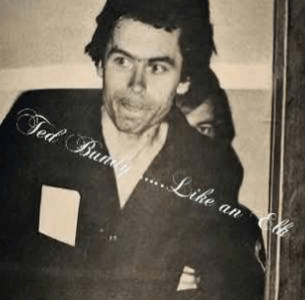
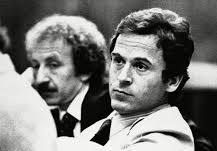
According to Kevin Sullivan, Larry Simposn was the lead prosecuting attorney for the Chi Omega murders, and he was the one that offered Ted the best deal he was going to get: life in prison without the possibility of parole. Bundy accepted the deal at first but later rejected it in open court, as a result ensuring his death in Ol’ Sparky in January 1989.

Introduction: In my early stages of blogging about Ted Bundy I worried that I would eventually run out of things to write about (I figured there were only so many things to delve into). Where at the time I didn’t know a fraction of what I do now, I just assumed I would max out and my blog would eventually just… end. But, thankfully, I didn’t really have anything to worry about: between Ted, his confirmed victims, his unconfirmed victims, his family/lawyers/girlfriends/employment history/vehicles/residences (and so on)… I don’t think I’ll run out of writing material anytime soon.
Background: John Henry Browne was born on August 11, 1946 to Harry and Helen Browne in Oak Ridge, TN. Harry L. Browne Jr. was born on October 12, 1919 in Staten Island and Helen Margaret Brightsen was born on June 16, 1919 in New York. Upon returning home from the Army during WWII (he enlisted on January 1, 1939) the high school sweethearts got married on January 24, 1942 in NYC, and the couple went on to have two children together: Bonita (or Bonnie, b. June 1944) and John. While his wife was still in the hospital recovering from giving birth to their daughter, Harry got a call from Colonel James C. Marshall, who was the military lead on a new governmentally funded engineering program: he wanted the new father to come work for him on a new project. Harry said yes, and the young family packed up their home in New York and moved to Oak Ridge, TN.
Parents: An engineering graduate of Manhattan College in New York City, Harry L. Browne was smart… but according to those that knew them, his wife was smarter: a national merit scholar that read multiple newspapers every day, Helen could ‘understand any math equation, no matter how complex.’ According to John, his father was ‘always in motion:’ he was a member of the NYS Corps of Engineers and was involved in ‘secret government contracting’ that helped lead to the development of the atomic bomb. Additionally, Harry once worked as a nuclear engineer for the Atomic Energy Commission, and eventually retired in Palo Alto, CA as a vice president for the Bechtel Corporation (which is a premier American engineering, procurement, construction, and project management company founded in 1898).
Education: After John graduated from Palo Alto High School in 1964 he went on to attend The University of Colorado at Denver, where he worked majored in philosophy and worked several jobs to get by. After he learned how to play the bass, he became involved in the local music scene and joined a band with some buddies and was even friends with Ron McKernan (of The Grateful Dead) and Jimi Hendrix. According to Browne, his band was in the process of attempting to sign a deal with Elektra Records, but after he was arrested and (briefly) jailed on a ‘bad check’ he pivoted from music to a career in law (the charges were dropped after investigators discovered that the check only bounced because he had moved his account to a different bank by the time it was cashed). According to reports, he was bailed out by his one-time girlfriend Deborah Beeler (more on her later), and by the time he was allowed to contact her he had already spent seventeen hours in police custody. While in jail he spent time with men that has been there ‘for a week,’ but still didn’t have legal representation, and by the time he was released had decided to become a criminal defense attorney.
Accolades: Browne stands at an impressive 6’7″ tall, and has brown eyes; (in his youth) he thick brown hair, and when he let it grow long and had he occasionally would be mistaken for Yanni, the New Age musician (his ‘thick black mustache’ didn’t help). In 1968 John relocated to Washington DC to attended American University’s School of Law, and upon graduating in 1971 he got a Fellowship at Northwestern University’s School of Law; he was also an Oxford Fellow in 1999. From 1971 to his retirement in 2025 he tried over 250 criminal cases and was a member of the Washington State Bar Association; he was also voted one of Washington state’s ‘Super Lawyers on multiple occasions (from 2003-2006 then again in 2008) and had the distinction of being one of ‘The Best Lawyers in American from 2001 to 2002.’ JHB also established the Criminal Trial Practice program at Seattle University’s Law School and taught ‘Criminal Trial Practice’ at the school for five years; he also taught Criminal Law and Procedure’ for four years at the University of Washington.
The ‘Spiro T. Agnew Incident’: while attending law school in the fall of 1969, Browne got a part-time job as a page at ABC News, with some of his duties including escorting guests to where they needed to be as well as keeping them occupied. On one occasion he was responsible for entertaining Spiro T. Agnew, the 39th vice president of the United States, who served from 1969 until his resignation in 1973. Agnew has the distinction of being the only VP in US history to resign due to criminal charges, and was widely known for his aggressive, alliterative rhetoric against the media and anti-war protesters.
For what I feel are fairly obvious reasons, the promising young law student strongly disliked Agnew, and while preparing a cocktail for the VP in the studios greenroom it suddenly dawned on Browne that he had a vial of LSD in his pocket … and maybe it would be a good idea to dose him with it before he went on live television. He ultimately decided against it and while discussing the event in ‘The Devil’s Defender’ he called it ‘a moment of youthful radicalism’ that could have ‘drastically altered my life as well as the course of political history.’
Deborah Beeler: In the late 1960’s, Browne met Deborah Wharton Beeler through a mutual friend when they were both spending time in California, and they fell in love thanks to their shared views on politics, prisoner rights, and the Vietnam War. The twenty-three-year-old teacher, graduate student, and political activist was a transplant from Philadelphia, and sadly not long into their relationship on February 25, 1970, she was found murdered in her cottage in Oakland. The case remains unsolved to this day and Brown has often cited Beeler’s murder as a ‘canon event’ that helped steer the trajectory of his career and perspective on the criminal justice system.
Vietnam: the US officially joined the Vietnam War during Browne’s time at the University of Colorado on March 8, 1965; he was an active opponent of the conflict and felt it was his anti-authoritarian nature combined with his opposition to the system that naturally led him to his career as a criminal defense attorney. While he was in college in Denver, Browne became politically active and formed a chapter of the Students for a Democratic Society to protest the US’s involvement in the Vietnam War. During the conflict, he was able to avoid the draft until he graduated from law school in 1971 (thanks to a 2-S classification), and when his number was called upon graduating, he refused to go, citing military regulations and that individuals over 6 feet 6 inches tall were disqualified from serving. He consulted with pacifist Quakers and doctors and even performed stretching exercises to ensure he met the requirement. When facing recruiters, he was measured at well over 6’6″ and was deemed unfit for service. through a combination of physical height and advocacy he was able to avoid it completely until it ended on January 27, 1973.
Substance Abuse: Browne has admitted to drinking heavily and abusing cocaine while in his 30’s (but did specify in his memoir that he never actively used while handling major cases), and noted that his drug use coincided with a period of his life where his ego was ‘out of control’ and he was heavily focused on the publicity surrounding his work. He said he abused drugs and alcohol in an attempt to ‘change his reality’ and cope with the stress of his career, and one evening while celebrating after winning a death penalty case he had fallen into a ‘puddle of rainwater and cat shit;’ after this wake up call, he attended an intensive workshop in Death Valley and has since then has utilized meditation, yoga, and a focus on spirituality to maintain his sobriety and manage the stress of his high profile legal career.
In 1972 Browne was hired as an assistant attorney general for Washington under then-Attorney General Slade Gorton, despite swearing he didn’t have an interest ‘in being on the government’s side’ (he said he only took the position because it involved prison reform). One time while on the job John (while posing as a prison inmate), spent a few days in the maximum-security wing at the Washington Corrections Center in Shelton, and after some time there rewrote some of the rules on punishment within the institution; additionally, he also got the ‘go-ahead’ for Native American prisoners to conduct religious sweat lodges, a practice that continues to this day.
Early Career: according to Browne’s 2016 book, ‘The Devil’s Defender,’ in December 1975 he was appointment to ‘The Board of Prosecutor Training Standards and Education’ by Washington state Governor Daniel J. Evans (the same one that Bundy campaigned for). He joined the King County Public Defender’s Office earlier that same year, where he moved up the ranks quickly and became chief trial attorney… 1975 was a busy year for the young attorney: that October is when he was first introduced to Ted Bundy (more on him later).
Famous Cases: Browne’s impressive fifty-four year long legal career is defined by his defense of ‘unwinnable’ cases, ones that focus on humanizing his clients in an attempt to avoid the death penalty.
Ted Bundy: Browne first became acquainted with Ted Bundy in October of 1975 after his Utah arrest earlier that August; according to John, he was ‘immediately struck’ by his clients appearance: ‘he wore a turtleneck sweater under a corduroy jacket, khakis, and Bass Weejun loafers. The look seemed to be an attempt to telegraph ‘Ivy League law student,’ but it was a caricature of an Ivy League law student.’ Browne said he referred to his SLC charges as ‘this little stupid case in Utah,’ a fact that he corrected Ted on, stressing that it was a ‘much bigger problem’ (as by that point, Seattle’s newspapers had been running headlines such as ‘is the Utah Ted the Seattle Ted?’); in response, Ted scoffed and said, ‘if they haven’t put it together by now, they never will.’ In the earlier stages of the investigation JHB claimed that Bob Keppel of the King County Sheriff’s Department approached him and said in a case of this magnitude ‘attorney/client privilege shouldn’t apply;’ in response to this, the lawyer laughed and told him to read ‘The Bill of Rights.’ At one point during Browne’s time representing Bundy he arranged for his client to take a lie detector test, something Ted swore he would pass because of his ‘personality type,’ which he was confident would ‘fool the machine’ saying it was ‘just a game’ (it’s worth noting that he failed).
JHB said Ted would use his law office library to research search and seizure laws, and that he became an ‘expert’ on the fallibility of eyewitness identification; he also said that during these visits Browne could see him ‘trying to get closer and closer to me. He knew I was only four months older than he was, and the similarity in our ages seemed like a big deal to him. He started asking where I purchased my clothing and what books, movies, and television shows I enjoyed. If I told him I’d bought, say, my penny loafers at The Bon Marche, the next time I saw him, swear to God, he’d be wearing the same penny loafers. I embarrassed him once when he arrived with actual pennies tucked into the shoes creases, I laughed and said, ‘Ted, that hasn’t been a thing since the early 1960’s.’’
John said at one time during his time representing Ted he shared with him that he wanted ‘to be a good person, but I’m just not,’ and that he had fallen to the floor crying while he made that confession; he has also said on repeated occasions that he didn’t believe people could be born evil, until he met Ted.
When JHB was 29 he sat in Teds Florida Jail cell while he ‘confessed things to me he said he’d never tell anyone else,’ and told him that he had ‘one more confession’: the reason he consulted him as a lawyer was because they were ‘so much alike.’ Browne said he recalls ‘returning to my cheap motel room, lighting a cigarette, and looking at my reflection in the bathroom mirror. I felty sick to my stomach.’
In 1978 after Ted’s second escape Browne flew to Florida and helped negotiate a plea bargain that would have saved him from the death penalty. The deal (that covered multiple jurisdictions across multiple states) would have required Bundy to plead guilty to his crimes… but at the last-minute the killer rejected the deal, a decision that ultimately sealed his fate.
Cynthia Marler: on August 11, 1980, Cynthia Marler was arrested and charged with the murder of Wanda Touchstone, a Polish immigrant that had recently separated from her husband. She hired Browne to defended her against charges that she was a ‘cold blooded killer that hired someone to kill Lou Touchstone’s wife,’ and during her trial it was argued that she was a hired ‘assassin’ that traveled from Bay Area (where she lived) to kill Touchistone; in response to this, JHB argued that it was actually the victim’s husband who had the real motive and ‘he held a great hammer over her head.’ She was ultimately convicted of the murder but appealed her conviction in 1982; the original ruling was upheld.
Duke Fergerson: A former Seattle Seahawk, Duke Fergerson was charged with raping two young women at an apartment complex, and he was arrested on October 23, 1979; Browne represented him in court, and by late 1980 he acquitted of all charges. The case gained additional attention after Jodi Zimbelman, a Seahawks ticket office employee who had previously dated Fergerson, filed a discrimination lawsuit against the team claiming she had been fired because of her interracial relationship with the football player; the team maintained Zimbelman was fired for violating a rule against dating other employees.
Ivy Kelly & Claudia Thacker: Ivy Gail Kelly and Claudia Thacker are the first two women in the US to successfully use the ‘battered woman syndrome’ defense in relation to charges they faced in connection to their husbands’ deaths. Kelly was charged with her spouse’s death after she shot and killed him on August 30, 1980 in their Snohomish County residence. Ms. Kelly’s defense was that her husband (who had been drunk at the time he was killed) had been angry with her and had been try to block the only way out of their house; at the time she believed he wanted to kill her, so she pulled out a pistol and pointed it at him… and even though Kelly claimed she only ‘intended to scare him,’ the weapon discharged, killing him.
Ivy was found guilty of second-degree murder by a jury of her peers and was sentenced to a maximum term of twenty years in prison; she appealed the verdict, claiming she lived through ‘years of ‘extensive previous physical abuse at the hands of her husband,’ and during the proceedings was represented by John Henry Browne. The attorney presented arguments for self-defense based on his client’s history of being an abused spouse and called in a recognized expert in the field of battered women, who testified the incident ‘fit the classic behavioral model of a batterer’ and that Kelly was ‘a victim of the battered woman syndrome.’ The jury eventually acquitted her.
On September 5, 1977 Claudia Thacker ended a twenty-year living nightmare in her Port Orchard, Washington home after she shot and killed her husband, Kenneth after he attacked her during a drunken rage. She was convicted of second-degree murder (which carries a mandatory 5-to-20-year sentence), but in June 1979 was freed on her own recognizance pending the outcome of her appeal with the Washington State Court of Appeals. Claudia claimed she was only defending herself and their young child, and that during the original trial the jury heard very little about her husband’s ‘violent habits.’ On September 11, 1980 Claudia Thacker was officially acquitted of her second-degree murder charge, four years and two trials after she fatally shot her husband in the back.
George Freeman: from 1977 to 1985 Minister George Freeman operated ‘The Monastery,’ an organization in Seattle that simultaneously acted as a gay church, a nightclub, an LGBTQ community center, and a homeless shelter for queer youth all wrapped up in one. For example: on a typical day, Freeman would host DJ’s playing dance music in the early evening, then at 2 AM would stop everything to deliver a sermon. In April 1978 he got busted serving alcohol without a license to an undercover officer, who paid $7 for what the establishment called ‘a tithe’ (they also said he didn’t have the appropriate banquet permit either). During the proceedings, it was noted that The Monastery was registered as a religious organization with the Universal Life Church, and the prosecutor argued that the activities occurring at the Monastery were not religious in nature. For these charges, Freeman was represented by John H. Browne, and in the end the Seattle courts fined him $150.
Benjamin Ng: John Henry Browne also represented Benjamin Ng, who was a part of the 1983 Wah Mee Massacre, which (as of April 2026) is classified as the deadliest mass shooting in Washington state history. On February 18, 1983 three men bound and robbed fourteen people at the Wah Mee Club (an illegal gambling den located in Seattle’s Chinatown district), then opened fire on them, killing thirteen of them; one victim (Wai Chin) survived and testified against them. In addition to Ng two other men were charged for the brutal crime: Kwan Fai ‘Willie’ Mak and Wai-Chiu’ ‘Tony’ Ng.
While acting as Ng’s attorney, Browne admitted that his client participated in the robbery and ‘hog-tying’ of the victims, but denied he actually shot anyone: he portrayed Willie Mak as the sole mastermind and leader who planned to ‘eliminate all witnesses,’ and argued that Mak said he’d ‘kill the victims himself if his partners refused.’ During the sentencing phase, JHB presented evidence that his client suffered from extreme brain damage caused by being repeatedly beaten with wood as a child in Hong Kong. Browne was successful in helping Ng avoid the death penalty and on August 25, 1983 he was convicted on thirteen counts of aggravated first-degree murder and was sentenced to life in prison without the possibility of parole; Willie Mak was originally sentenced to death but his sentence was overturned in 1988, and Tony Ng received a 30-year sentence (he served twenty-eight-years of it before he was released and deported to his native Hong Kong in 2014).
Tony Dictado: in 1982 John Henry Browne represented Tony Dictado after he was charged for arranging the execution styled first-degree murders of two Filipino American cannery-union reformers, Gene Viernes and Silme Domingo. Prosecutors identified Dictado as the leader of a Filipino gang called Tulisan, and argued in June 1981 he ordered the hits because the men blocked the gang’s efforts to establish high-stakes gambling in Alaska canneries. In March 1982, a jury found Dictado guilty of two counts of aggravated first-degree murder after only ten hours of deliberation and he was sentenced to life in prison without the possibility of parole; Browne expressed disappointment with the quick verdict, suggesting it had not been ‘thought out.’ He also handled Dictado‘s appeal, arguing the court erred by allowing conspiracy evidence without an appropriate charge and challenging the constitutionality of the mandatory life sentence. As of April 2026, Dictado remains in prison in Washington state.
Martin Pang: in 1995 JHB represented Martin Pang after four members of the Seattle Fire Department died battling the fire he set to his parents’ Seattle frozen foods warehouse in order to collect the insurance payout. Browne came to Pangs defense after he fled to Brazil in response to these charges, and successfully argued before the Brazilian Supreme Court that his client should not face murder charges because the countries laws prohibited his extradition if he faced murder charges; the courts ruled in Pangs favor and because of this King County Prosecutor Norm Maleng was forced to drop the four counts of first-degree murder and the death penalty. Browne negotiated a plea agreement where Pang pleaded guilty to four counts of first-degree manslaughter and in 1998, he was sentenced to 35 years in prison; after serving roughly twenty-three years, Pang was released from custody on September 27, 2018.
Christopher Scott Wilson: on February 9, 2010 seventeen-year-old Mackenzie Nicole Cowell was last seen at The Academy of Hair Design in Wenatchee, WA where she was a student; her remains were discovered four days later on the banks of the Columbia River. A post-mortem exam determined she had been strangled, stabbed in the neck, and had suffered blunt force trauma to the head, and it wasn’t long before detectives zeroed in on Christopher Scott Wilson, a twenty-nine-year-old classmate of Cowell’s.
DNA found on duct tape close to where Cowell’s body was discovered linked Wilson to the murder, and according to investigators, he left the beauty school shortly after Mackenzie did on the day she disappeared. A search of his apartment revealed the presence of blood which matched Cowell’s DNA and in December 2010, the task force assigned with solving the murder made a second arrest: Wilson’s friend Tessa Schuyleman, who was accused of (but was never charged with) helping him cover up the crime and was instead charged with obstruction of justice for an unrelated case. In a plea agreement, Wilson pleaded guilty to manslaughter and was sentenced to just over fourteen years in prison; he was freed from Monroe Correctional Center on December 11, 2023.
Colton Harris-Moore: also referred to as ‘the barefoot-bandit,’ Harris-Moore led LE on a two-year long manhunt between 2008 to 2010 across the western part of Washington state all the way to the Caribbean, and he stood accused of stealing boats, breaking into countless homes, and hijacking (three) airplanes. The product of an unsavory home life (his mother was a severe alcoholic), by the age of seven he was already breaking into homes to steal food and other survival supplies, and by fifteen he was living in the woods in an attempt to escape his home life.
In 2011, he was charged with sixty-seven felonies, and in January 2012 Browne persuaded a state judge to give his client the low end of the sentencing range: 6.5 years (78 months) in federal prison. The judge expressed sympathy for his ‘terrible upbringing,’ but stressed the necessity of the sentence. Colton was also ordered to pay $1.4 million in court-ordered restitution, and he sold his life story rights to 20th Century Fox for an equal amount.
Robert Bales: on March 11, 2012 after drinking some whiskey with his Army buddies in his barracks, thirty-eight-year-old US Staff Sergeant Robert Bales performed a ‘solo raid’ on two southern Afghan villages known as the Kandahar massacre, where he allegedly shot, knifed, and (in some cases) burned innocent men, women, and children. Armed with a knife, a nine mm pistol, and M-4 rifle outfitted with a grenade launcher, Bales had been on his fourth deployment in almost as many years and was suffering from an extreme case of PTSD. Officials say the father of two from Lake Tapps walked to two villages and took the lives of four men, four women, two boys and seven girls; he then burned some of their remains.
In addition to having alcohol in his system, Bales was also abusing steroids at the time of the killings that were provided to him by his superior officers, and according to JHB: ‘if Sergeant Bales did it… and I do mean if, we as a nation are to blame. We created this situation.’ … ‘I think the message for the public in general is that he’s one of our boys and they need to treat him fairly.’ Browne defended his Bales alongside military lawyers, and described him as ‘mild-mannered,’ and claimed that he only acted the way he did because he ‘was upset after seeing a friend’s leg blown off the day before;’ he also clarified that his client had ‘no animosity toward Muslims.’ In an attempt to avoid the death penalty, Bales pleaded guilty to sixteen counts of murder and six counts of assault and attempted murder in a plea deal, and on August 23, 2013, he was sentenced to life in prison without the possibility of parole. As of April 2026 he is still incarcerated and is being housed at the US Disciplinary Barracks in Fort Leavenworth, Kansas.
Darrell Cloud: Browne was less successful in representing Darrell Cloud, who was accused of murdering his former middle-school teacher with a firearm in 1994 after years of sexual abuse. He guided his client in rejecting a plea bargain then presented an unsuccessful insanity defense during his jury trial, and Darrell was convicted of first-degree murder; he later (successfully) argued that his attorney had harmed his ability to conduct plea negotiations by making an unreasonable assessment of his chances of success in the trial (which he claimed Browne told him there had been a ‘95% chance’ of a favorable outcome). By blaming JHB’s conduct, Cloud was able to obtain a reduced sentence on a lesser charge.
Marriages: Browne has described himself as a ‘serial monogamist’ and an ‘oft-married individual’ that once told ‘The New York Times’ that his marriages ‘would round up toward double digits’ (realistically, he is on his eighth marriage, and the latest Mrs. Browne seems lovely). He says that his work on behalf of women stems from ‘a place of respect,’ and that ‘the world would be better if it was run by women.’
Despite being married multiple times over the course of his life, Browne resents being called a ‘womanizer,’ and said he is ‘always faithful in his relationships’. He married his first wife Jean Albrecht on February 14, 1973 at the Temple of Justice in Olympia, WA; originally from New York state, Albrecht was employed as a teacher during the couples’ union. They weren’t married for very long and divorced on Halloween in 1978. Browne married his second wife Victoria Lee Czerkies on April 24, 1983 in Seattle, and the couple divorced sometime before he married his third wife Patrice Buttell on June 2, 1984. Patrice was a graduate of Sonoma State College and the time they were together she was a (self-employed) massage and movement therapist; the couple were officially divorced on February 5, 1987.
John married his fourth wife, Lisa Rey Thomas on June 9, 1990 and the couple had a son together named Eli. According to her LinkedIn page, Lisa earned her PhD at Washington State University and is a research scientist for The Alcohol and Drug Abuse Institute at the University of Washington in Seattle. After the couple divorced on February 2, 1994 Browne went on to marry his fifth wife, Anne Bremner.
Born in McAlester, Oklahoma on June 4, 1958, Bremner graduated with honors from Stanford University in 1980 with a degree in medieval history and went on to attend Seattle University School of Law (she completed her JD in 1982). In recent years, she has been a television commentator for several high-profile legal cases (including the murder of Meredith Kercher in Italy and Amanda Knox) and describes herself as ‘a liberal, an idealist, and a Democrat,’ and like her former husband is opposed to capital punishment.
I was unable to find any (specific) information about wives six and seven, but I did find a record that he was married to a woman named ‘EA Susen,’ and the two divorced on August 29, 2006. Most recently Browne got married to Debra Amore Selland on February 14, 2022; the newest Mrs. Browne is a trained paralegal and worked for her husband on some of his final murder trials before he retired.
2006 Ethics Charges: in 2006, the Washington State Bar Association admonished Browne as part of a settlement of ethics charges stemming from compensation issues, saying that on one occasion he charged a client more than what had been arranged in a written agreement (such an admonition was the lowest form of disciplinary action doled out by the bar). In response to the charges, he said one of his legal assistants had prepared the written agreement and he had not known about it.
Scandal, Karen Koehler: one of the more scandalous cases that Browne was involved in is the murder of Timothy ‘Mac’ McNamara, who married his biological niece Tracy Nessl after moving from Washington state to Belize: the two began a romantic relationship in 2012 and shortly after they relocated to the foreign country (in an attempt to avoid public scrutiny) they tied the knot. On Christmas Day in 2014, Mac was found dead from a gunshot wound to the back of the head at their home: initially his death was reported as a suicide, however forensic investigators later determined the location of the wound made suicide ‘practically uncomfortable.’ Additionally, detectives discovered that Tracy had recently purchased a 9mm pistol, which was the same type of weapon that had been found at the scene.
In a September 2015 lawsuit filed by Seattle attorney Karen Koehler against Tracy on behalf of Tim’s adult children, it was alleged that their stepmom/cousin had seduced their father in an attempt to gain control of his assets before killing him. In March 2022, a jury in Grant County, Washington found McNamara civilly liable for the 2014 death of her husband/uncle after they determined she had committed battery that proximately caused his death; his children, Jennifer Ralston and Caleb McNamara, were awarded approximately $3.327 million in damages.
In May 2016, a conflict between Browne and Koehler became public after she published excerpts of emails between the two on her blog, ‘The Velvet Hammer,’ claiming he had insulted her physical appearance, used disparaging language towards her, and even called her a ‘whack job.’ In July 2016, Browne sued Koehler and her firm for defamation on behalf of McNamara, claiming her firm had knowingly posted incorrect information and had falsely portrayed her as a ‘murderer’ on their website in an attempt to bias potential jurors.
In November 2016, King County Superior Court Judge James E. Rogers dismissed Browne’s defamation suit and ruled that the defendant’s firm’s online statements were protected under the ‘Fair Report Privilege’ because they recounted information from official legal proceedings. After her victory, Koehler filed a motion seeking sanctions against Browne, alleging he had engaged in an ‘inappropriately intimate relationship’ with his client at the time he represented her, which she claimed clouded his professional judgment and fueled his personal attacks against her; in response, Browne denied the allegations as ‘rumors and gossip,’ and in December 2016 the court denied Koehler’s request (although it is worth nothing that because of their ‘dispute’ the WA state bar association already canceled plans to reprint portions of Browne’s memoirs).
Although authorities in Belize issued a warrant for her arrest on murder charges, McNamara has never been extradited from the US and has never faced a criminal trial for the death of her husband/uncle.
Conclusion: Helen Brightsen-Browne died at the age of sixty-nine after succumbing to a long illness on March 26, 1989. According to her obituary, she was a homemaker and volunteered with the American Red Cross for many years; she was also a member of the First Lutheran Church of Palo Alto. At the time of her death her and Harry had been married for forty-seven years. John’s father Harry L. Browne died on Valentine’s Day in 2015 at the age of ninety-five, and his sister Bonnie passed away at the age of seventy-one on July 24, 2013 in Sacramento, California.
Works Cited:
Ackley, Andrew. (March 28, 2022). ‘Notorious Legal Saga Ends in Jury Verdict: Tracy Nessl McNamara killed Tim McNamara.’ Taken March 30, 2026 from andrewwackley.com
Browne, John Henry. (2016). ‘The Devils Defender: My Odyssey Through American Criminal Justice from Ted Bundy to the Kandahar Massacre.’
Kamb, Lewis. (December 5, 2016).’Sex with Client? Feuding Lawyers get Personal in Wrongful Death case.’ Taken March 17, 2026 from seattletimes.com
Seven, Richard. (March 22, 1998). ‘For The Defense: Bundy, Ng, Pang And An Eagle Scout: Attorney John Henry Browne Has Defended Them All With His Own Peculiar Style.’ Taken February 9 2026 from seattletimes.com
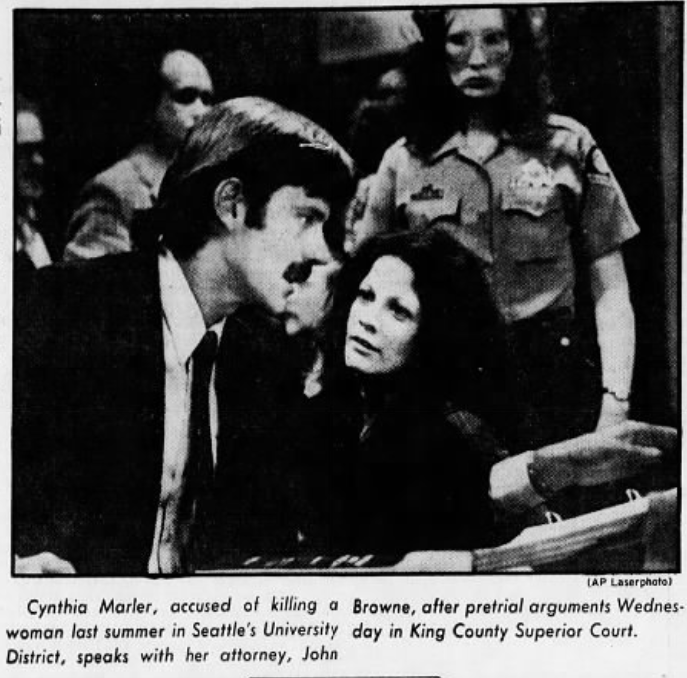
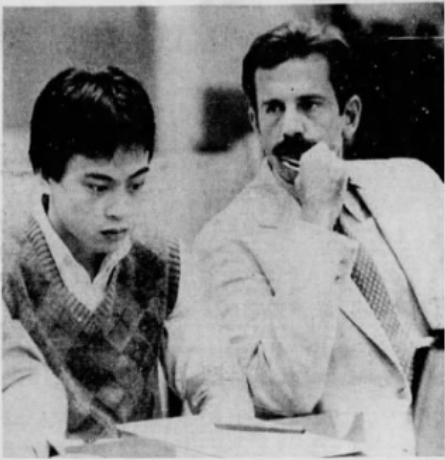
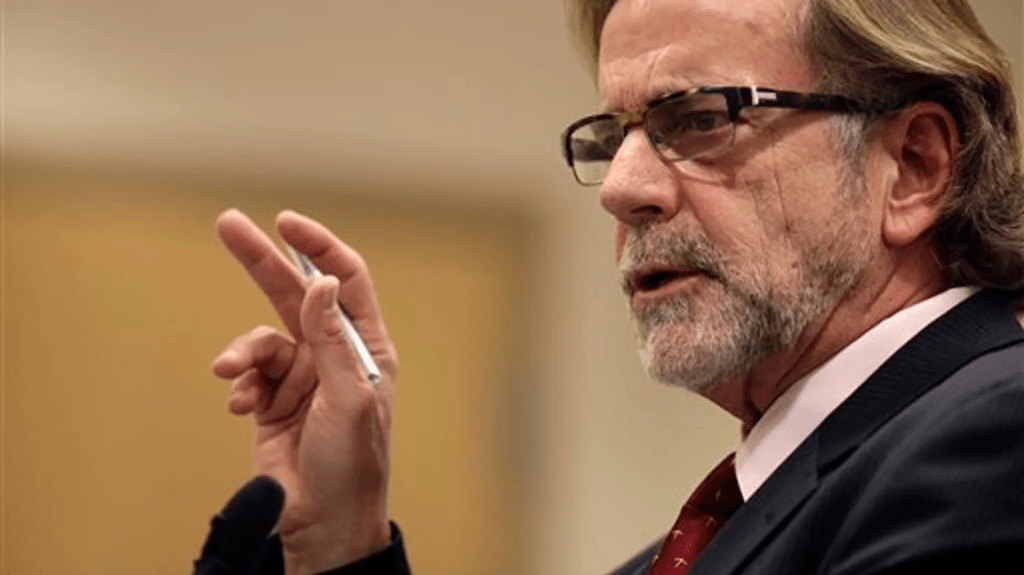
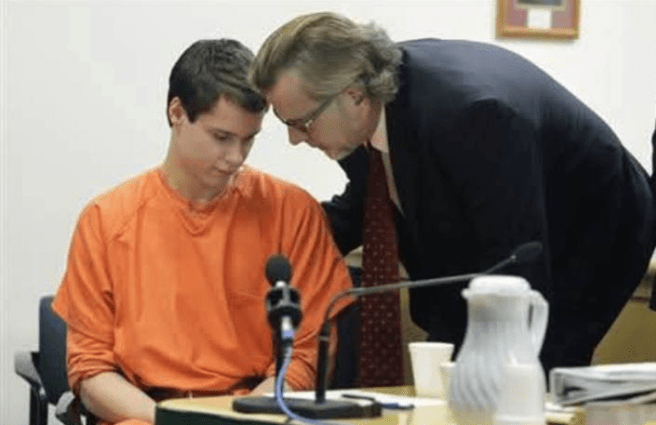



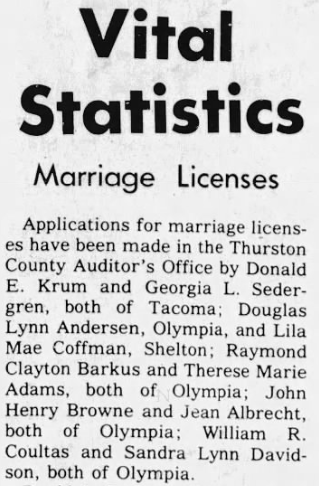
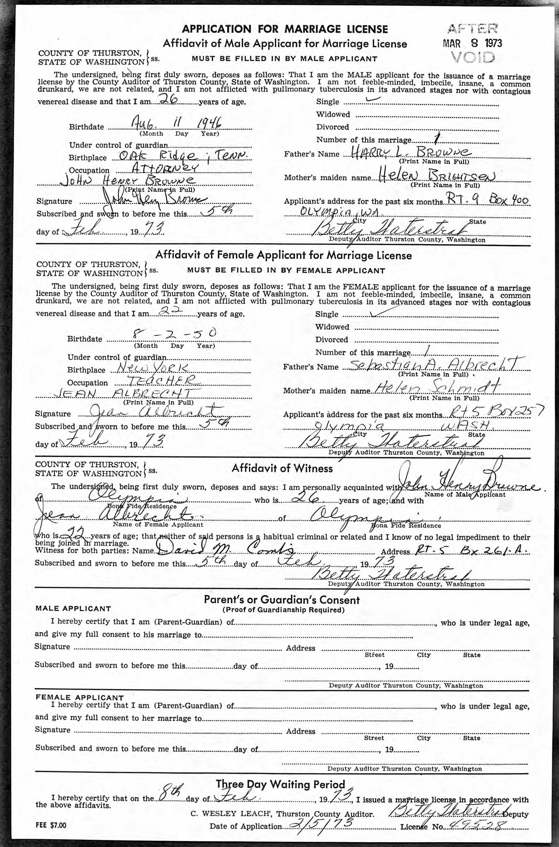
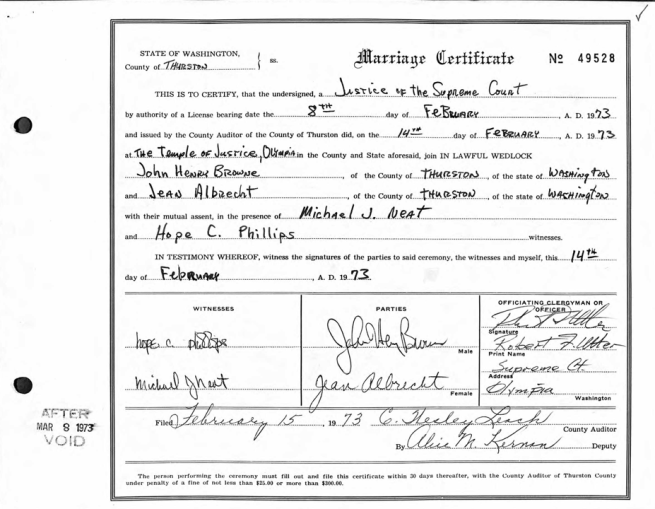
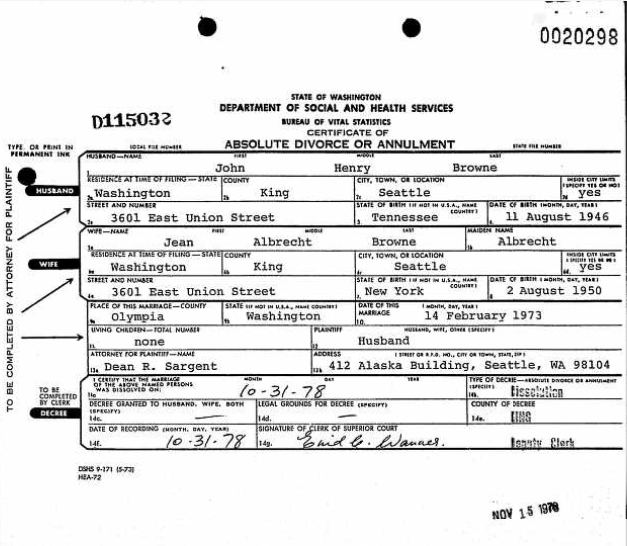
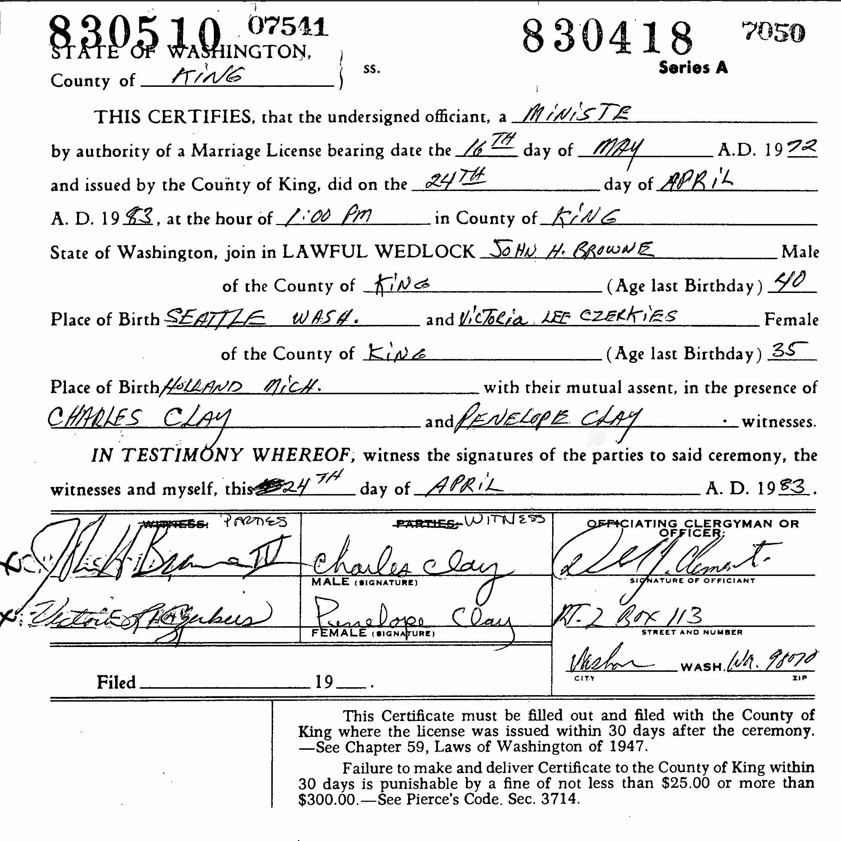
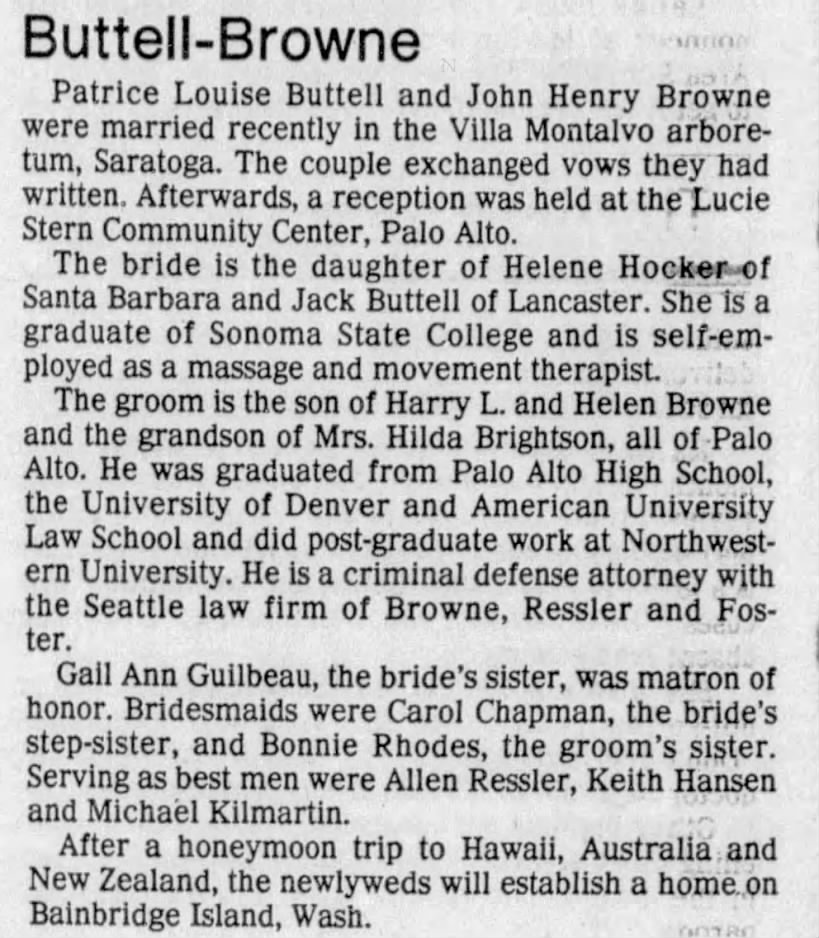

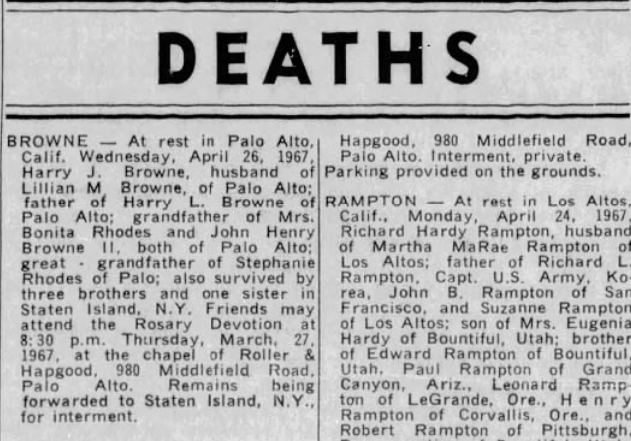
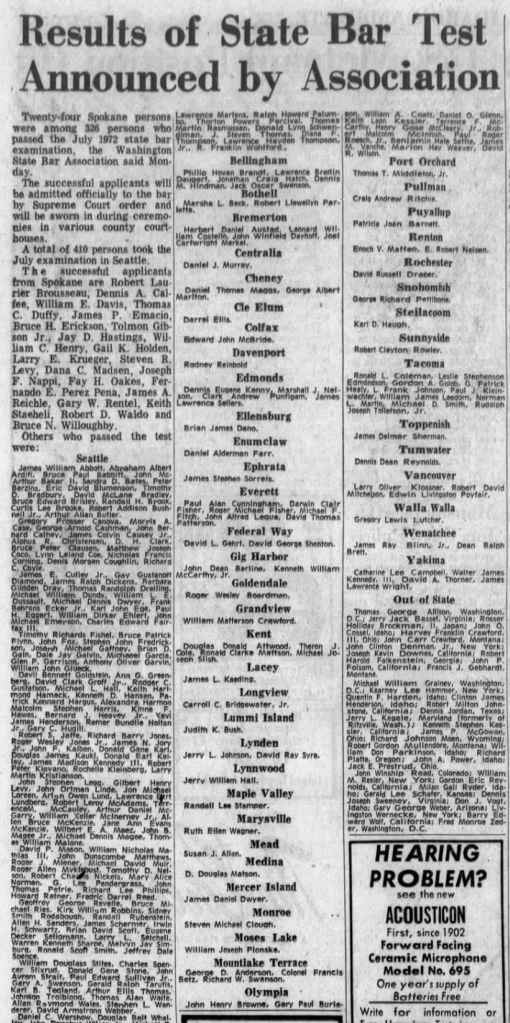
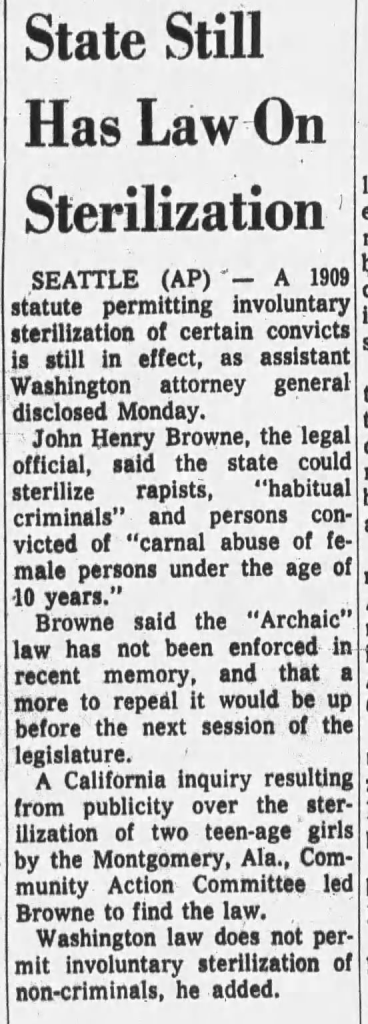
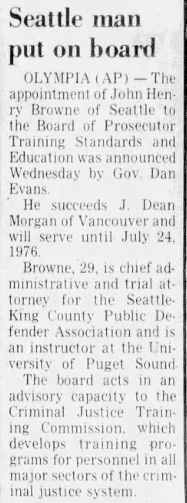

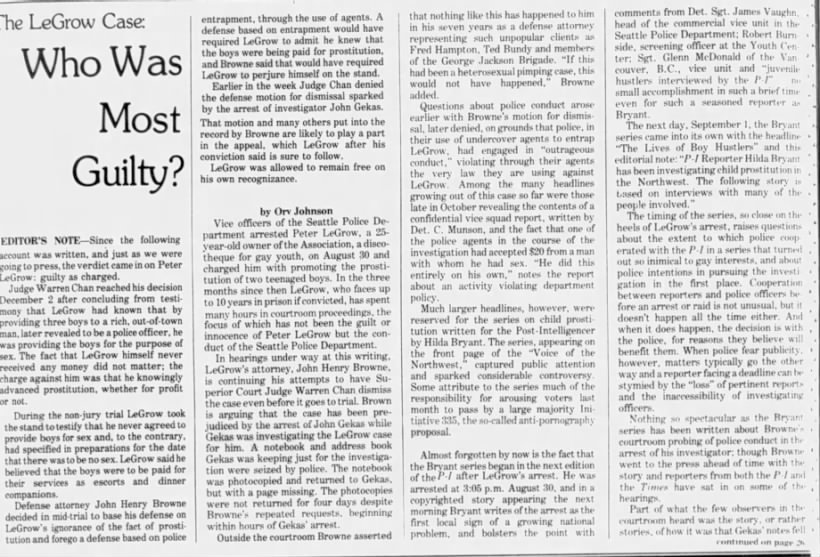
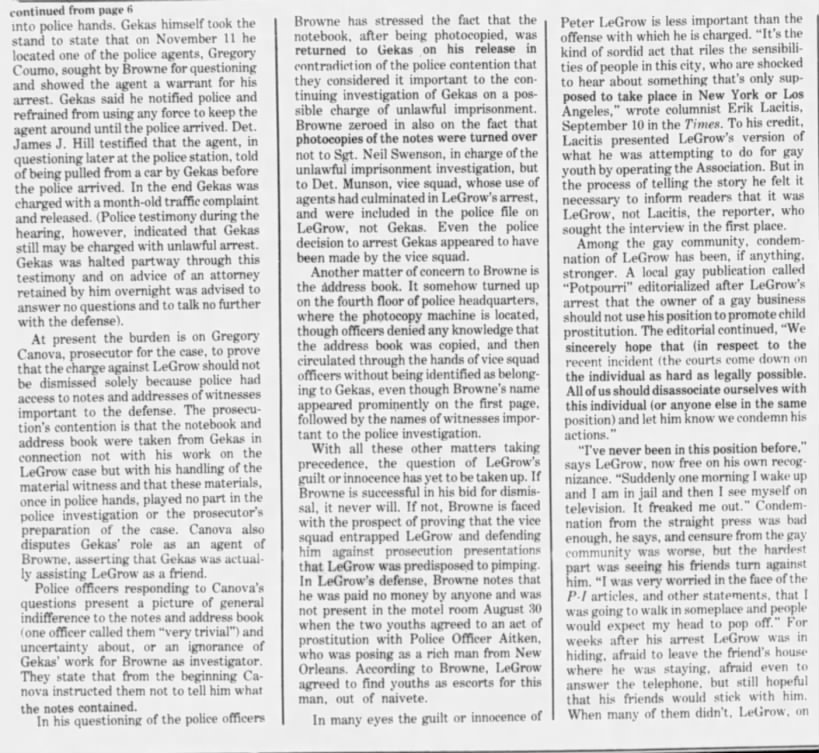
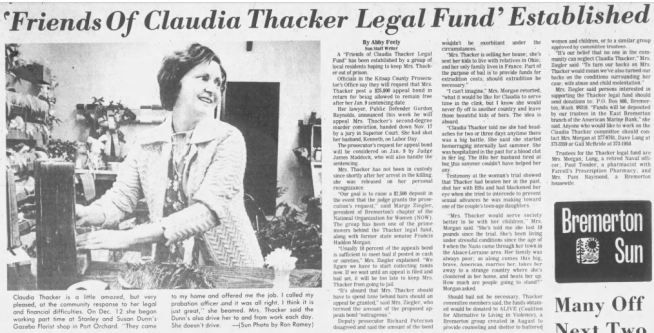
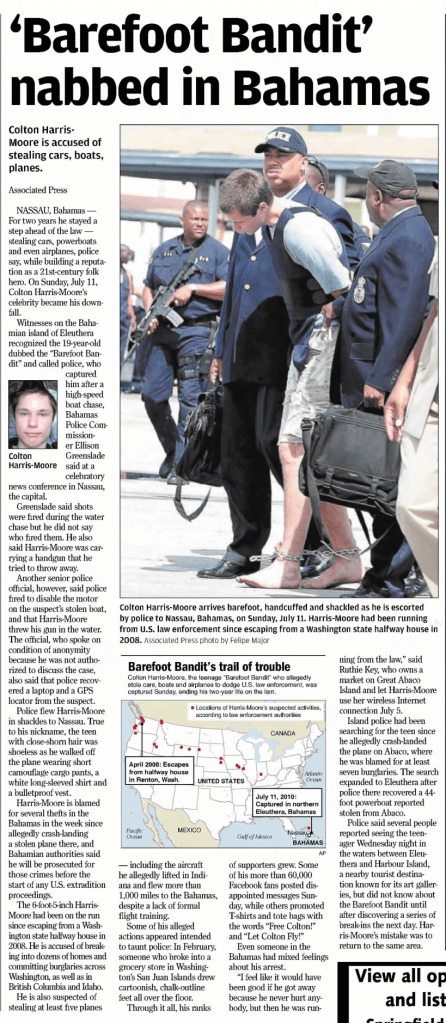
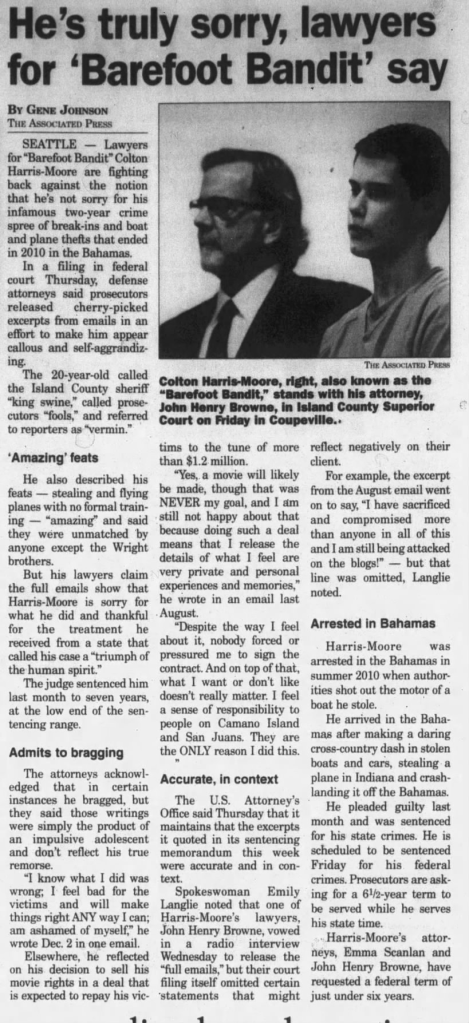
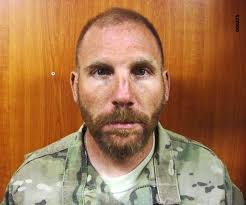

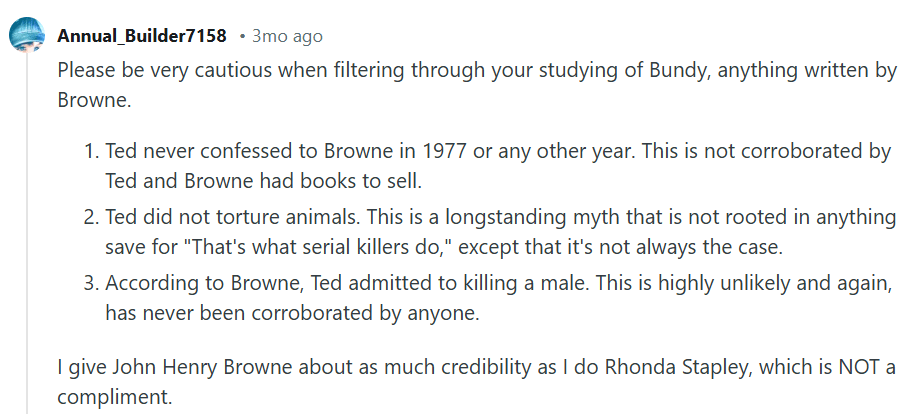


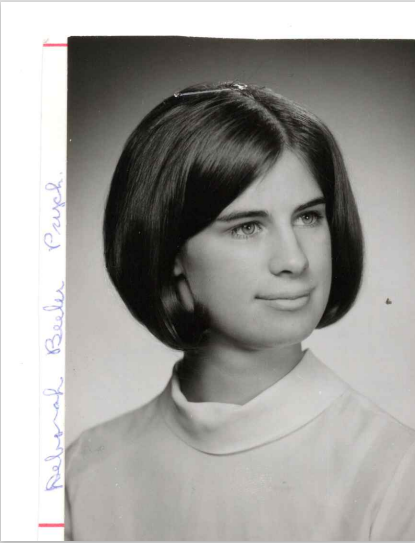
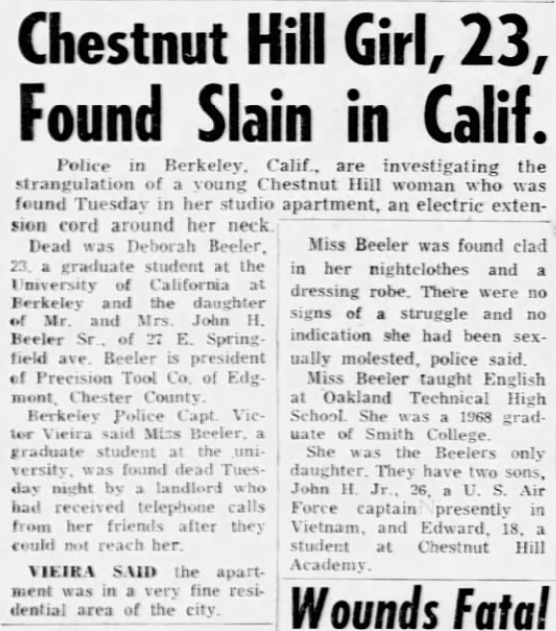

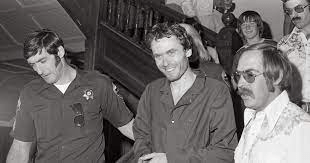
I’ve had this sitting in my drafts folder for a while, and I decided I’m going to publish what I have and add to it as needed.
Sam Cowell is Ted’s Father: there’s a pretty commonly spread myth that Ted’s grandfather Samuel Cowell is his father... but a blood test performed in 2020 by psychiatrist Dorothy Otnow-Lewis determined this to be not true.
Ann Marie Burr: there’s a myth that Ted’s Uncle Jack was Ann’s piano teacher, he wasn’t (although he did live about three miles away)’; there’s also a rumor floating around that Ted was the Burr’s family paperboy, he wasn’t. He also lived over three miles away from her and not exactly in her neighborhood.
Karen Sparks: before she was brutally attacked on the night of January 4, 1974, Sparks recalled being watched by an older-looking man at the laundromat that she usually went to.
Lynda Ann Healy: on the day after she vanished Lynda had plans of making her family a home cooked meal called ‘company casserole;’ additionally, there’s also some evidence that Bundy stalked her before he abducted her in the early morning hours of February 1, 1974, as it was proven by the King County Sheriff’s Department that on the day she was last seen alive he was behind her in the check cashing line at the Safeway they both shopped at. Ted also frequented Dante’s, the bar Lynda went to on the evening that she was last seen alive.
Donna Gail Manson: there are some whispers that Ted was acquainted with Donna, and that she had been seen in the presence of a man that matched his description prior to her disappearance on her school’s campus.
Susan Rancourt: before Ted abducted Sue he approached two other women: Kathleen D’Olivio and Jane Curtis. He approached D’Olivio earlier in the evening on the April 17, 1974 (the same night Sue disappeared), however there’s some discrepancy as to when he approached Jane: in multiple sources it’s alluded that it occurred the same evening, however Curtis said she was approached on a Sunday (Sue was abducted on a Wednesday), so that means she encountered him either on April 14, 1974 or April 21,1974.
Georgann Hawkins: the day after Ted abducted Hawkins he returned to the area close to the crime scene and (very discretely) recovered a pair of her hoop earrings and one of her shoes from an adjoining parking lot (that had all flown off of her because he attached her with such incredible force).
Brenda Carol Ball: according to Bundy’s death row confessions, he admitted that he took twenty-two-year-old Ball back to his rooming house in Seattle after abducting her on June 1, 1974, and the two had consensual sex; he then claimed to he strangled her while she slept. This is inconsistent with the physical evidence, as her skull (which had been discovered in 1975 on Taylor Mountain), showed significant damage from blunt force trauma, proving that she had been severely beaten.
Lake Sammamish Murders: there’s multiple theories as to why he took two women in the same day. One is that because Jan Ott was so small he killed her ‘too quickly’ by accident, and his ‘urges’ weren’t completely satisfied so he had to go back and get another victim. The second theory is that he kept Janice alive and brought Denise back to where he was keeping her and killed the one in front of the other.
Nancy Wilcox: It’s speculated that Bundy may have been grooming Wilcox, as members of her family said she mentioned an older man who would come into the Arctic Circle drive-in that she briefly worked at and flirt with her.
Laura Ann Aime: there were apparently several reports made to police by people that knew Aime that said she claimed that a man matching Bundy’s description had hung out with her at Brown’s Café in Lehi, Utah, and at one point had called her his girlfriend. The man also had said he was going to rape her, and its thought she had been introduced to him by her friends. Additionally, Laura’s family has stated they believe Bundy stalked her and approached her on multiple occasions before he abducted her.
Denise Lynn Oliverson: Denise was not married at the time of her abduction/murder; she was divorced and was in a relationship with a man.
Pulled Over in Florida: before his final arrest in Florida in early 1978 Ted was pulled over in Tallahassee driving a stolen vehicle and as he was being questions by an officer. He simply, ran away… and he got away. This took place just four days before his final arrest on February 11, 1978: when the officer walked back to his patrol car to check the license plate, Bundy ran away and escaped into the night.
Valerie Ann Duke: a student at FSU at the time of Bundy’s Chi Omega murders, Duke had gone home the weekend of the murders and because of that her life was spared (Bundy’s fingerprints were found on her doorknob, meaning had she been there she would have been attacked); she lived with immense survivors guilt and shot herself in her vehicle on May 1, 1979, at the age of 22. She was born on July 27, 1956 and is buried at the Cenizo Hill Cemetery in Mathis, Texas.
Deborah Wharton Beeler: one of Ted’s Seattle attorney’s John Henry Browne dated a woman that was brutally murdered in the same fashion that Bundy killed his victims. Beeler had been found in her rented cottage on February 22, 1970 wearing a housecoat over a nightgown; the twenty-three-year-old had been strangled with an electric hotplate cord. Investigators initially believed she committed suicide because within reach were a pair of pliers that had apparently been used to righten the wire, however an autopsy showed she had been hit over the head and had crashing blows to the side and front of her head (injuries that may have been made by a fist).
A Third Escape?: in July 1984 guards at Florida State Prison found a cut bar, hacksaw blades, and a pair of gloves hidden in Bundy’s cell. Another inmate, Manuel Valle, also had a cut bar in his cell, which suggested a coordinated effort between the two men.
Two Beetles?: Ted actually owned two Volkswagen Beetles, not just one (Liz owned a pigeons egg blue VW Bug as well). In April 1966 he sold his a 1933 Plymouth Coupe to put money towards a pale blue 1958 VW Bug. At some time in the spring of 1973 he purchased his infamous tan 1968 VW Bug from a woman named Martha Helms.
Susan Roller/Sara A. Survivor: a (living) supposed repeat victim of Ted named Susan Roller has published three books under the pseudonym ‘Sara A. Survivor;’ Roller also claims to be a friend of Georgann Hawkins as well, as the two were Daffodil Princesses (in different years)… however, I could find any proof that she knew either Bundy or Hawkins. In her book ‘Reconstructing Sara,’ Roller told her story about being repeatedly assaulted and raped by the SK; as of February 2026 is has been pulled from publication to be rewritten.
Zak Bagan’s, ‘Ghost Adventures’ Episode, ‘Serial Killer Spirits: Ted Bundy Ritual House’ that took place in Bountiful, Utah: also known as the ‘Anson Call house,’ Zak and his crew went in and investigated the old, abandoned house located in Bountiful, that he claims Ted took Debra Kent to after he abducted her on November 8, 1974… but, come to find out, the house was lived in at the time Kent was abducted from nearby Bountiful High School, so there’s no way he brought her back here to be murdered.
‘New’ Living Victims: in recent years multiple women have come forward claiming to be surviving victims of Ted Bundy, and only recently had the courage to come forward and tell their story: Susan Roller. Sotria Kritsonis. Rhonda Stapley. Sherry Deatrick. Rose Warriner.
Janla Carr: there’s some documents in a FBI file in relation to a woman from Philadelphia that alleged Bundy was her ‘half-brother.’ She also claimed he had a twin brother and made various other assertions about his family history that were widely considered by investigators and psychologists to be ‘unsubstantiated’ and ‘full of leaps.’ She passed away at age 45 in January 1997.