California.
The Zodiac Murders.
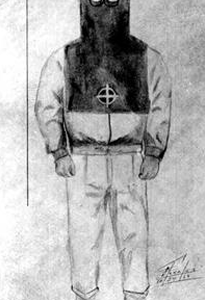
This is an excellent summarization of the Zodiac case.
Diane Edwards Interview with the King County Department of Public Safety, October 15, 1975.
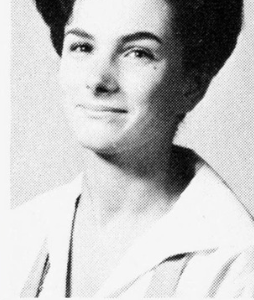
Courtesy of Tiffany Jean.
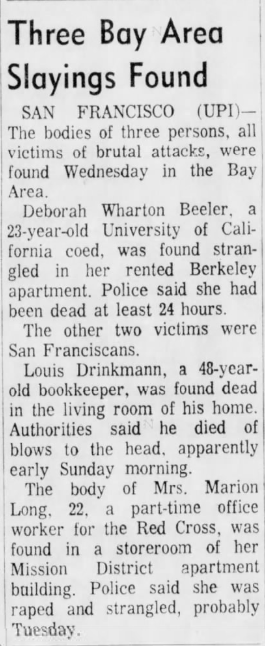
Deborah ‘Debbie’ Wharton Beeler.
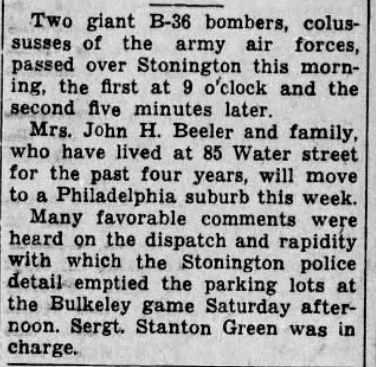
Deborah Wharton Beeler was born in Lawrence Memorial Hospital on October 6, 1946 to John and Elizabeth ‘Betty’ (nee Wharton) in New London, Connecticut. John Hall Beeler Sr. was born on August 3, 1918 in Baltimore, Maryland and according to MyHeritage, he graduated from John Hopkins University with a BS in civil engineering in 1938 and went on to serve in the Army during WWII, where he saw battle in Europe; upon his discharge from the military on April 10, 1944 he was employed at the Arundel Corporation and Consolidated Engineering Company’ and went on to become the president of the Precision Tool Company in Edgemont, Pennsylvania. Elizabeth Sergeant Wharton was born on November 15 1922 in Philadelphia, and graduated from the Agnes Irwin School in 1941; she made her debut later that same year. The Beeler’s were married on October 28. 1942 in the Thomas Virgin Islands and had three children together: Deborah, Edward (b. 1956) and John (b. 1944). After getting hitched the family moved around the US, and briefly lived in Stonington, CT and Maryland before eventually settling down in Pennsylvania.
According to an article published in The Times-Herald on February 26, 1970, the Beelers were ‘listed in the Social Register of Pennsylvania’ which is a directory of ‘prominent and elite families’ in the Philadelphia area and other regions of the state that (historically) focused on ‘old money’ and well-connected families (in more recent years they have expanded to include a more ‘diverse’ membership). In early 1970 the family lived in the Chester Hill area of Philadelphia, and Deborah’s brother John was a Captain in the Air Force and was serving in Vietnam, and her younger brother Edward was attending Chester Hills Academy in Philadelphia.
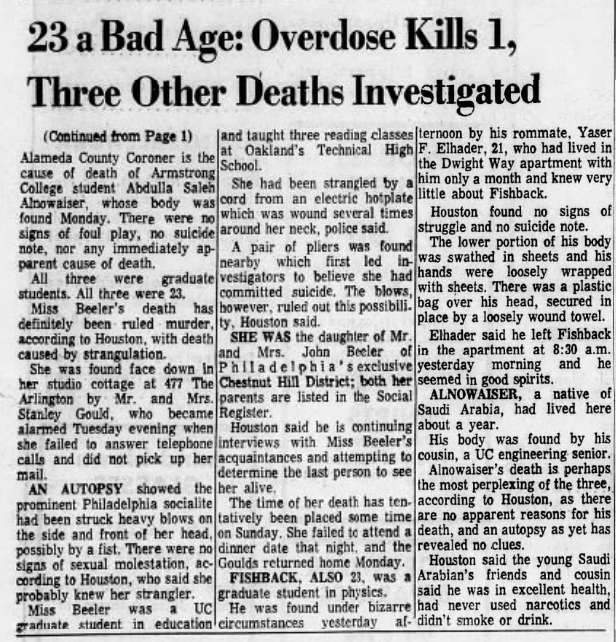
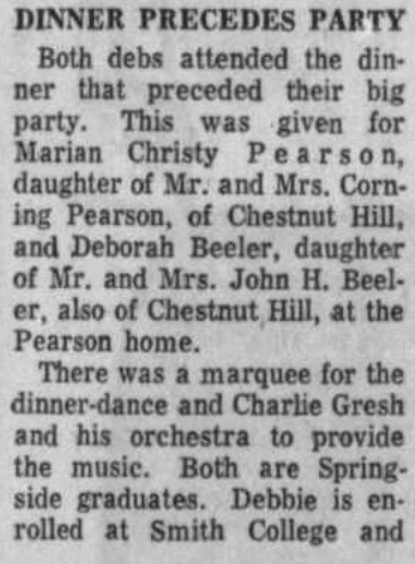
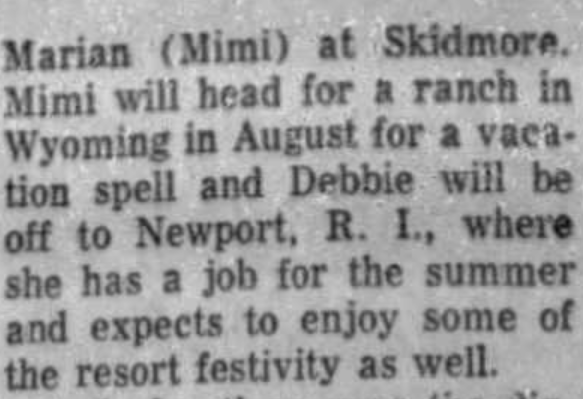
Deborah Beeler seemed to live an incredibly charmed life: described by a loved one as ‘vivacious,’ she was the daughter of a wealthy, high level business executive and graduated from Springside High School in 1964. Springside was an independent college preparatory school in the Chestnut Hill area of Philadelphia, and while there she excelled in academics and participated in drama club, glee club, and wrote for the newspaper. After graduating from high school Beeler went on to attend Smith College in Northampton, Massachusetts, and graduated in 1968; upon completion she relocated to Berkley, where she got a part time intern position teaching three reading classes a day at the Oakland Technical High School, and got her temporary teaching credentials in January 1970 after taking a class in the Golden State.
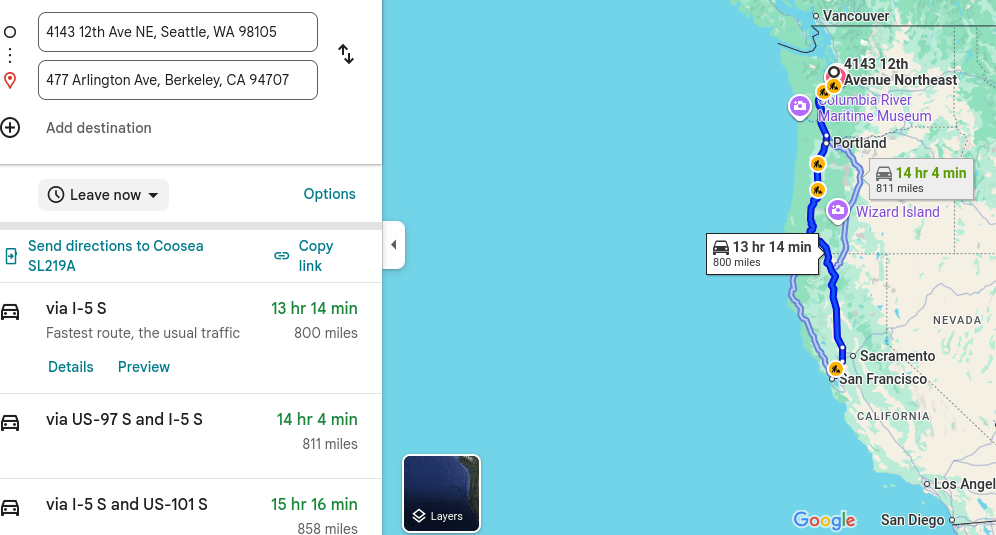
According to Deb’s boyfriend and Ted Bundy’s one time Seattle lawyer John Henry Browne (who Bundy actually sought out to be his attorney), at the time of her death she was a graduate student in English education at UC Berkeley, and in addition to teaching she volunteered PT at a halfway house that was close to the cottage that she rented (which was located in the front part of 477 Arlington Avenue). According to William H. Miller, the principal of the school Beeler taught at, she was ‘outstanding,’ and seemed to get along very well with her students, and friends of hers said she was in good spirits the week prior to her death and was an ‘outdoorsy’ type and enjoyed hiking and skiing.
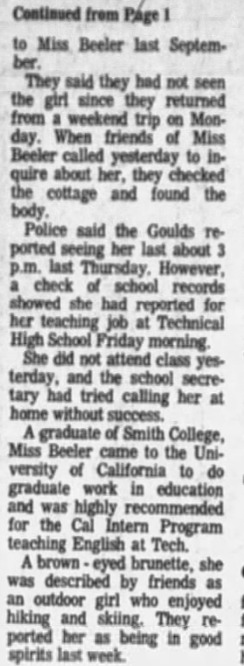
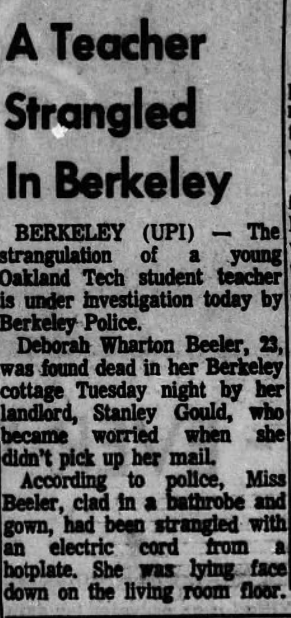
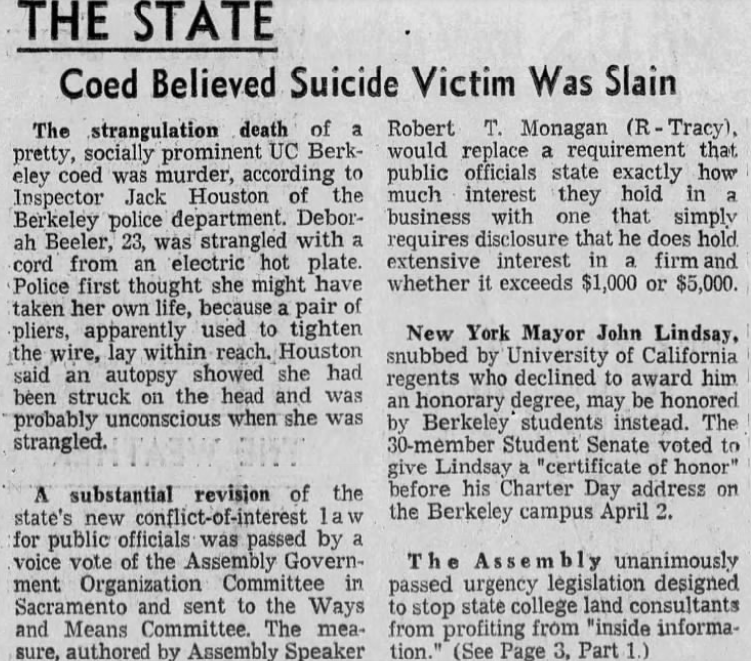
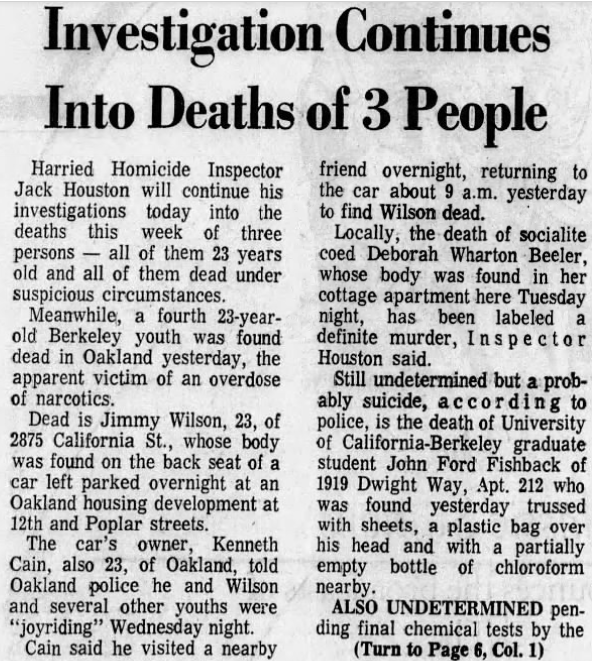
Inspector Jack Houston with the Berkley PD also said that Beeler had gone to her teaching job on Friday, February 20, 1970 and that the following Monday was a holiday (Presidents’ Day), however she failed to report to work on Tuesday, February 24th. The Almeida county coroner said that the twenty-three year old had been found later that day in her cottage by her landlord Stanley Gould, who became worried after she didn’t pick up her mail; her autopsy would later determine she had been deceased for roughly 24 hours. Beeler had been dressed in a ‘slip over housecoat’ and a ‘shorty’ night gown, and was found lying face down on her living room floor; she had been strangled with an electric cord from a nearby hot plate (one source said it was from a lamp), which her killer had looped around her neck multiple times. A pair of pliers that may have been used to tighten the cord lay just within arm’s reach from the victim.
At first, Deputy Coroner David Hitchcock speculated that her death may have been a suicide, but this theory was disregarded (detectives thought this because of the pliers). The ME determined that she died of strangulations but had been hit on the side of the head; she had probably been unconscious when she was strangled. According to William H. Miller, the principal of the school Debbie taught at, she was ‘outstanding,’ and seemed to get along very well with her students. Friends of hers said she was in good spirits the week prior to her death and was an ‘outdoorsy” type, and enjoyed hiking and skiing.
At first, Deputy Coroner David Hitchcock speculated that Beeler’s death may have been a suicide, but this theory was quickly disregarded. The ME determined that she died of strangulation but had also been hit on the side of the head and may have been unconscious at the time she was killed. According to Inspector Houston, ‘there were no signs of a forced entry nor a struggle. I don’t think she would have let anyone in whom she didn’t know while she was wearing her nightclothes. I’m sure that whoever did her in was somebody she knew.’ He also said that she more than likely had let the man that took her life into her apartment willingly, and that she hadn’t been sexually assaulted and her residence showed no sign of a struggle. Detectives interviewed all known loved ones and acquaintances of Beeler: current and former boyfriends, friends, colleagues, family members, residents of the halfway house she volunteered at. No one gave them any helpful information.
I think what is most interesting about Deborah Beeler is, at the time of her murder she was in a relationship with John Henry Browne, who would later become Ted Bundy’s lawyer. While working and going to school in DC Browne made frequent trips to San Francisco, and he connected with Debbie through a friend he nicknamed ‘Punky,’ and the two began dating (an exact time wasn’t given or how long they were together, but I’m thinking it was around 1969). There are no good pictures of Deborah that I could find, however Browne described her in his book as ‘pretty, with brown eyes and long brown hair she parted down the middle.’ The night that they met, the two stayed up until 4 AM talking about a broad range of topics, ranging from war (I’m assuming Vietnam was going on during the time), the death penalty (both were ‘vehemently against it’), and prisoners rights.
According to Browne, ‘she lived in Heights-Ashbury, which in 1969 was the red-hot center of the hippie universe. I started to stay at her apartment, and we’d walked up and down the street, taking it all in. I was struck by her kindness towards strangers. If we came across a homeless man, she would stop and engage him in conversation. And if she had spare change, she would hand it over. It was almost alarming how open she was, how trusting. At Christmas she joined me for a holiday party at my parents house I have a photo from that party that my dad took of her sitting on my lap (Browne, 57)’
According to JHB, Beeler ‘was an angel, and so smart,’ and was as passionate about prisoners’ rights as he was. In the fall of 1969, he left his beloved in Berkeley, quit the band he was in and enrolled in law school at American University in Washington, DC. While there the two ‘maintained a long-distance relationship, talking on the phone, occasionally exchanging letters. When Debbie came out east to see her family, we connected in her hometown of Philadelphia. I met her parents, John and Elizabeth, who had a beautiful home in the tony neighborhood of Chestnut Hill. John, like my father, was an engineer, and was president of Precision Tool Company. Debbie and I talked a lot on that trip about what we wanted out of our relationship. We weren’t anywhere near where Audrey and I had been. We weren’t ready to get engaged, but we loved being around each other, even if we had to live on separate coasts. She was excited about the intern program she’d been accepted, teaching English at Oakland Technical High School. And I was excited about a new program I’d just started with my law school pal Allen Ressler in DC (Browne, 56-57).’
Browne said that some nights he would call her and tell her about the work he was doing with Law-Core, which he described as a ‘university-based prisoners’ rights project,’ and he said she ‘was proud of him.’ He also said that she had ‘recently began to volunteer at a nearby halfway house teaching ex-cons how to write and had recently moved into a cottage in the hills above Berkeley. The phone calls kept me tethered to the Bay area (Browne, 60).’ He also said that there were times that he ‘wouldn’t hear from Debbie for a week or more, or I wouldn’t call her. Our lives were both so busy. So I thought nothing of it until late February when I didn’t hear from her for several days (Browne, 60).’
In the early morning hours of February 26, 1970, Browne received a phone call from his dad from California (that he originally hoped was Debbie), who told him his girlfriend was dead and had been murdered: ‘he was home in Palo Alto and was holding that day’s newspaper: ‘Deborah Beeler had been found dead, lying face down on the living room floor of her Berkeley cottage.’ My whole body went cold, ‘Police said an electrical cord was looped several times around her neck,’ my dad had read to me from The Oakland Tribune: ‘Death was caused by strangulation, but there were indications she was struck on the side of the head. She had been dead for at least 24-hours.’’
After the murder Browne was thrown into a deep depression, and: ‘it really sent me through a loop. I withdrew a lot. I think I was really clinically depressed but didn’t know it.’ … ‘I fell into a deep depression. I didn’t leave my apartment. Didn’t eat. Didn’t answer the phone. I missed classes. I was confused and heartbroken (Browne, 62). He also said that where he had always been passionately against the death penalty he wanted Debbie’s killer to be executed if he was ever caught.
In the first page of Browne’s epilogue, he said that people often ask him if he thinks Bundy killed his one-time girlfriend, and to this he said, ‘the short answer is no. Aside from a few coincidences- both she and her manner of death fit the Bundy profile- there is no direct evidence that Ted was active in the Bay area in early 1970. But the question itself brings up all kinds of complicated thoughts. I’ve never been able to shake the knowledge that Ted knew about my loss before he sought me out as his counsel- and that he kept this secret from me for years. More complicated still is the fact that I defended Ted knowing he had killed countless of women just like Debbie. It was the ultimate test: how committed was I to this life of defending the rights and lives of others, even the most heinous, no matter how much their crimes personally impacted me (Browne, 215).’
In an interview with Washington reporter CR Brown with KCPQ-TV, Browne said that and Bundy had signed a document releasing him from attorney-client privilege and that he could disclose anything he wanted about his time as his lawyer: ‘Ted told me things that he’s never told anyone before… he told me his first victim was a man, and that he had killed over one-hundred people.’ … ‘And I was talking to people who kind of introduced me to Ted, and got me involved with Ted, and I now believe that Ted actually ‘chose me,’ and I found out that he had researched me. He knew where I lived, he knew what kind of clothes I had, what kind of cars I had…. and the women I was dating, they were the same kind of women that he was murdering. I kind of put this together recently, and that kind of creeps me out a lot. Because I had also lost a woman friend to a murderer: my girlfriend when I was in law school was murdered in Berkeley, and I was in DC. And so, he knew that.’ When asked if he thought Bundy had anything to do with his girlfriend’s death, he responded, ‘I pray to God that he didn’t, and I never even thought about that until recently because they reopened some of those cases in California.’ … ‘But it wasn’t in the area where he told me he had killed people.’
Browne said that to this day, he’s not entirely sure why he was willing to defend Bundy in court, but he said Deborah was always on his mind: ‘part of the reason involves my relationship with Debbie and her commitment to being anti-death penalty and her being active in anti-death penalty programs. After she was murdered, I became kind of a believer in the death penalty for a while. But then I had this very powerful dream. Debbie came to me and said, ‘don’t honor me by doing things I didn’t agree with.’ And so, I thought it was a good reminder. If she was around, she would want me to continue fighting against the death penalty. That’s why I’ve been doing this for 40 years now.’
According to his Wikipedia page, John Henry Browne was born on August 11, 1946 and he is a criminal defense attorney practicing in Seattle that is known for his ‘zeal’ in defending his clients, his flair for garnering media attention, and his habit to ‘plead guilty to avoid the death penalty.’ In addition to Bundy, he has represented a number of high-profile defendants, including Colton Harris-Moore (also known as The Barefoot Bandit, he was only a teenager when he was charged with the theft of hundreds of thousands of dollars in property), Benjamin Ng (who was partly responsible for The Wah Mee massacre, which was a multiple homicide that took place on February 18, 1983, in which Ng and two others gunned down fourteen people in the Wah Mee gambling club on Maynard Alley S. in Seattle’s Chinatown), and Martin Pang (an arsonist that served twenty-three years in a Walla Walla prison for the deaths of four Seattle firefighters). Browne has tried over 350 criminal cases and is particularly known for getting sympathetic treatment for his clients by shifting the focus away from the crimes they committed by arguing for consideration of their background, and the circumstances in which the events took place.
At the time Beeler was murdered Ted Bundy was in the early stages of his romance with his long-term girlfriend Elizabeth Kloepfer, and was residing at the Rogers Rooming House on 12th Avenue Northeast in Seattle. He was employed as a ‘messenger and process server’ for an Attorney’s office, and was there from September 1969 to May 1970 and was fired for ‘unjustifiable absences’ after claiming he had been babysitting Liz’s daughter.’ According to the ‘1992 TB FBI Multi agency Team Report,’ he wasn’t a student at that time and didn’t enroll at The University of Washington until June 1970, however he did spend some time in California when he attended Stanford University in 1967; the following year he quit school completely and started traveling around the US, and briefly spent some time in San Francisco.
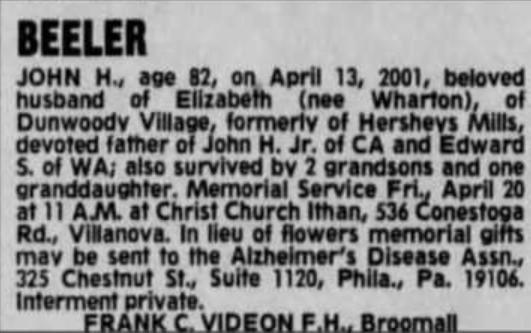
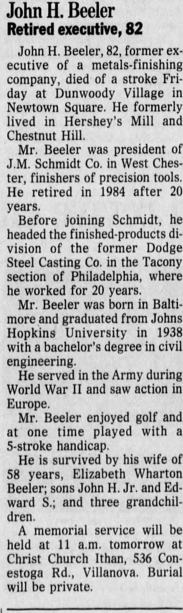
Mrs. Beeler died at the age of ninety-eight on January 3, 2021, and her husband wasn’t too far behind her: John Hall Beeler Sr. died after having a stroke on April 13, 2001 in Hershey’s Mill, PA. According to John’s obituary, the couple had three grandchildren (two boys and a girl) and were residing at Dunwoody Village in Newtown Square before their death (which is a retirement community that provides nursing care, residential apartments, and wellness care to the elderly). In addition to working with Arundel Corp. and The Precision Tool Company, in his younger years Mr. Beeler was president of JM Schmidt Company in West Chester and retired in 1984 after twenty years of service; before working for Schmidt he oversaw the ‘finished products division’ of the former Dodge Steel Casting Company in the Tacony Section of Philadelphia, and was also there for twenty years. He enjoyed golf and at one time played with a ‘five-stroke handicap.’ At the time of Mrs. Beeler’s death the couple had been married for fifty-eight years, and they are buried next to one another and their daughter in Saint Andrew’s Episcopal Cemetery in Ludwigs Corner, PA. As of September 2025, Deborah’s case remains unsolved and open.
Deborah’s brother Ted attended the University of Utah for his undergraduate degree and went onto graduate school at the University of Michigan; he got married in August 1976. According to familysearch.org, John Beeler Jr. is deceased and passed away sometime in 2023.
Works Cited:
Browne, John Henry. ‘The Devil’s Defender: My Odyssey through American Criminal Justice from Ted Bundy to the Kandahar Massacre.’ (2016).
Gardner, James Ross. (July 18, 2012). ‘The Law and John Henry !*@#ing Browne.’ Taken August 28, 2025 from SeattleMet.com


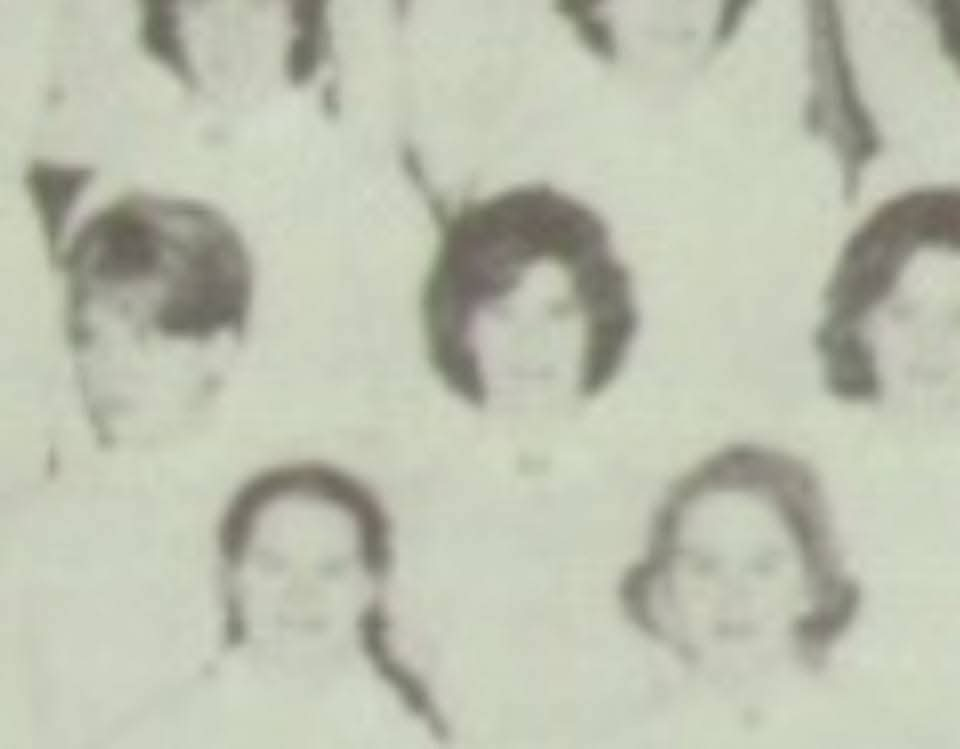

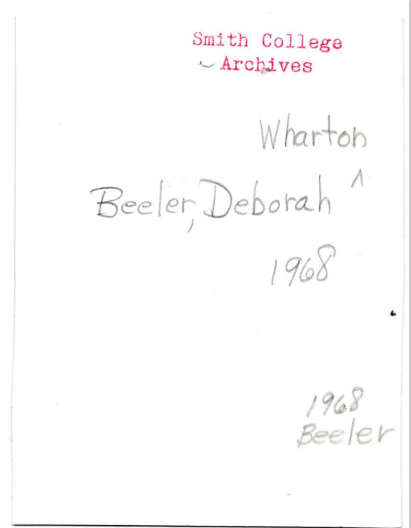



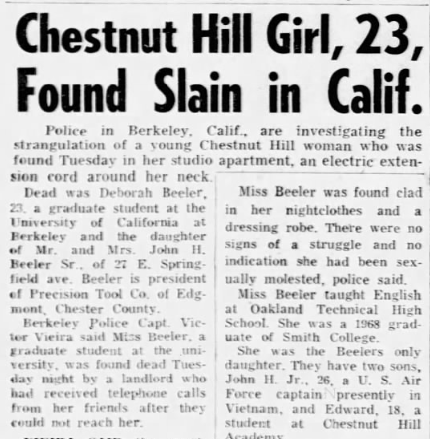

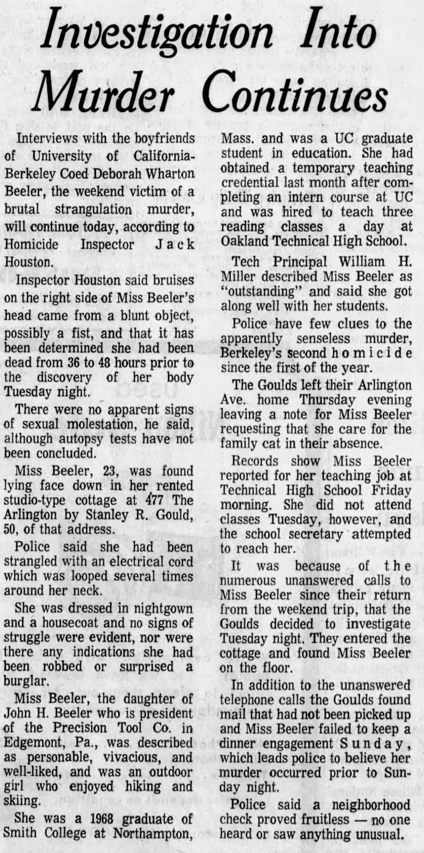

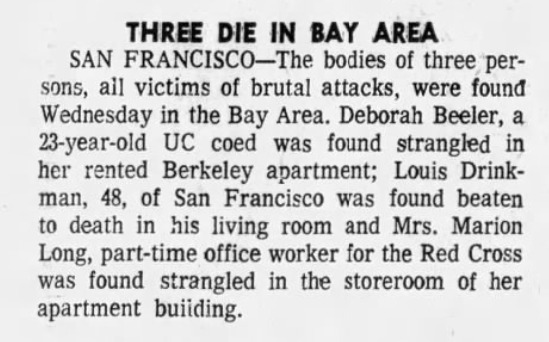
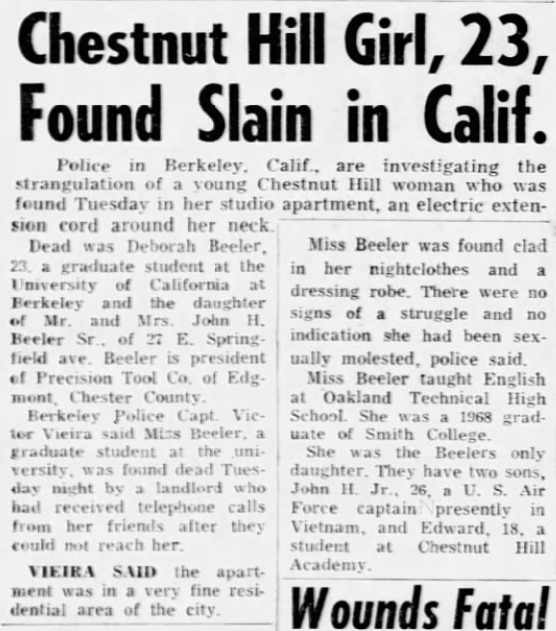



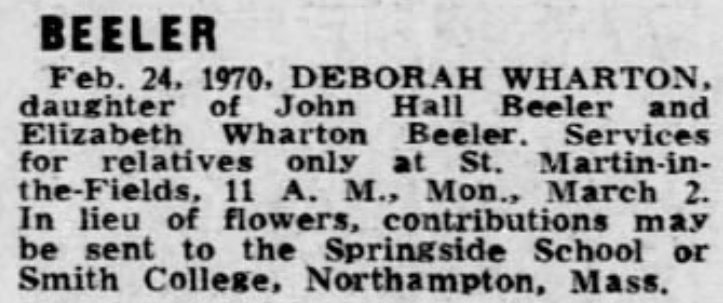
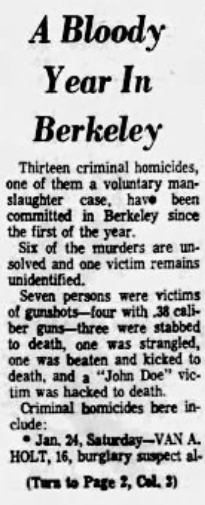
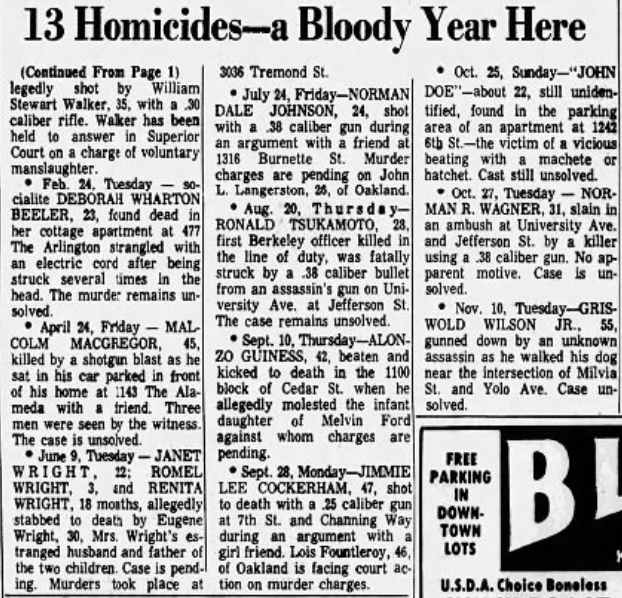




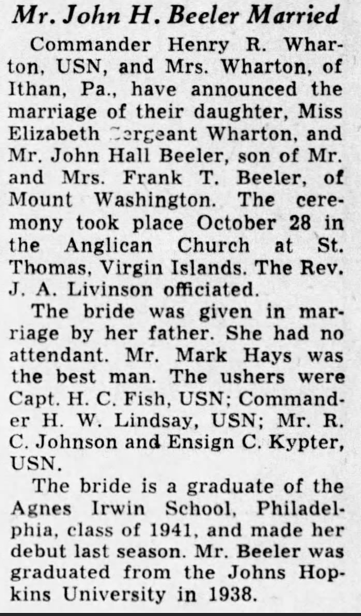



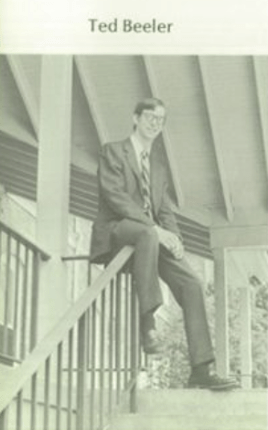
yearbook.







Various ID’s and Missing Person’s Information Related to the Ted Bundy Investigation.
Some information on some possible victims and suspects, document courtesy of the Pitkin County Sheriff’s Department.
Ted Bundy, FBI Files: Court Documents, Confession-Interview Recordings, Research Documents.
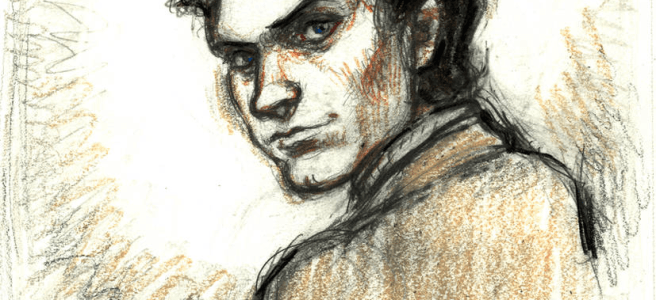
Includes 339 pages of files that were copied directly from FBI headquarters, the 1992 FBI TB Multiagency Investigative Team Report, 71 pages of a FBI Report Serial Murder Multi-Disciplinary Perspectives for investigators (from 2005), 79 pages of FBI Report Serial Murder Pathways for Investigations (from 2011), and over 1,000 pages of information over seven appellate court cases from Florida and Utah, as well as some Bundy-related Congressional Hearings, Reports, and Transcripts
Unconfirmed Victims: Information from the King County Archives.


The Santa Rosa Hitchhiker Murders.

Introduction: ‘The Santa Rosa Hitchhiker Murders’ is a moniker for a group of unsolved homicides that took place in 1972 and 1973 in the general Santa Rosa area, located specifically in Sonoma County in the North Bay region of California. The perpetrator is responsible for at the murders least seven young female hitchhikers, who were all found completely naked in rural areas. Californian detectives strongly suspect that the killer spoke with and was familiar with some of his victims before he killed them.
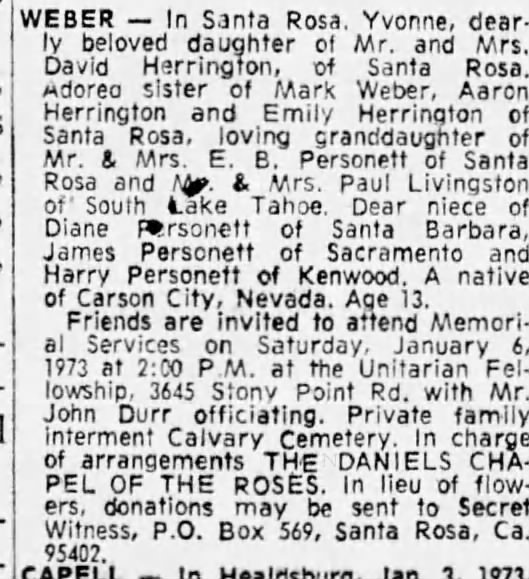
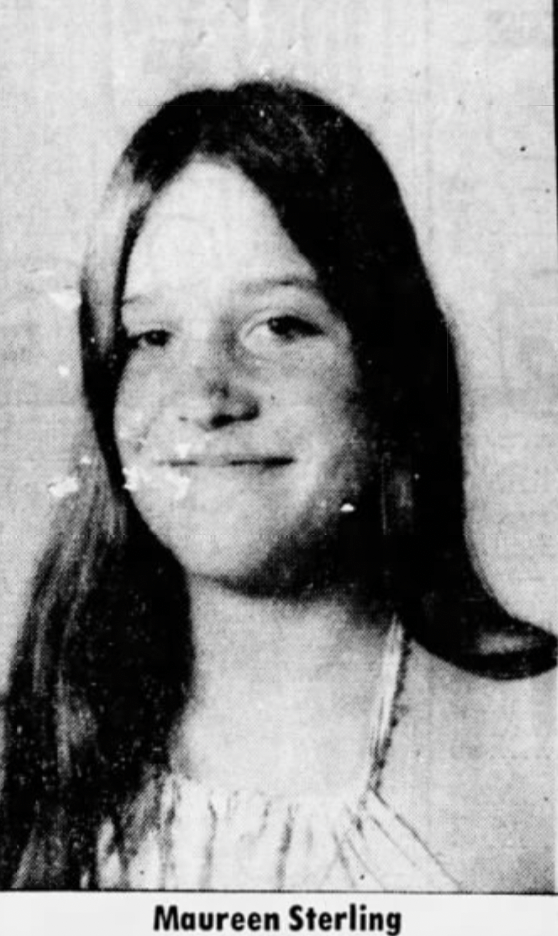
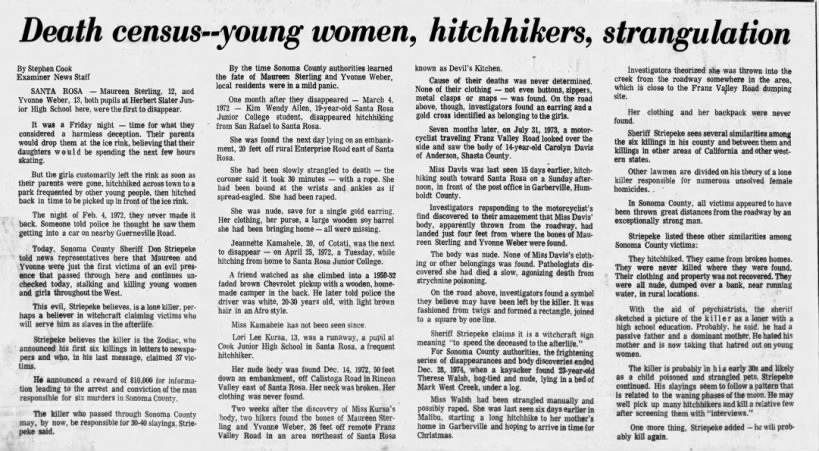
Confirmed Victims: At roughly 9 PM on February 4, 1972 twelve-year-old Maureen Louise Sterling and thirteen-year-old Yvonne Lisa Weber disappeared after being dropped off at the Redwood Empire Ice Arena at around 7:30 PM. Weber was born in Carson City, Nevada on January 29, 1959 and Sterling was native to Santa Rose and was born on February 18, 1959. Maureen’s father Larry tragically died in a skiing accident in August of 1958 just months before her birth at the age of 23, leaving Arleen to raise both her and her older sister, Theresa alone during a time where that was easier said than done).The girls, who were both studentsat Herbert Slater Middle School, had no intention of staying at the skating rink that evening, and had plans to go somewhere else, most likely a nearby park with four older boys (who later took lie detector tests, which ruled them out as suspects). They were last seen getting into a car on Guerneville Road, northwest of Santa Rosa.
Sterling was last seen wearing blue jeans, a purple shirt, a red zip up hoodie and brown suede shoes, and Weber was also wearing jeans, a lavender and white tweed shirt, a black velvet coat, and brown suede shoes. Law enforcement only released that two pieces of evidence in relation to the case that were found with the victims: a single filigree type drop earring with orange beads and a basket weave mixed metal cross attached to a gold chain necklace. Neither item belonged to either one of the girls.
When one of the girls parents came to pick them up from the skating rink at 11pm, they were nowhere to be found, and in the early stages of the investigation LE had felt that they were runaways. Their heavily decomposed bodies were found on December 28, 1972 by 17-year-old Glen Frost and 18-year-old David Brooner, who were hiking through the area known as ‘The Devil’s Kitchen’ and down a steep embankment roughly 66 feet off the east side of the roadway. A single earring, orange beads and a 14-carat gold necklace with a cross were found at the scene, and the victims cause of death could not be determined, due to the advanced state of the remains. By that time Santa Rosa was in a panic, and a county wide program dubbed ‘The Secret Witness Program’ offered a $20,000 reward for any tip that would lead to the apprehension of the girls killer(s).
In 2019 an acquaintance of Weber and Sterling came forward and told detectives that she had spoken with them earlier on the evening they were last seen alive, and that the girls told her that a tall, slim man had asked them to smoke marijuana in the lobby of the ice arena (she declined to go with them), and that he strongly resembled Ted Bundy. However, that same friend was interviewed for the 2024 HBO Max documentary, ‘The Truth About Jim,’ and THAT time she said that Jim Mordecai (the subject of the documentary) was the man that was talking to her friends that evening.
There were also rumors that the girls had been looking for a ride to a nearby bowling alley so they could meet up with some friends, where other sources claim they were in contact with a gentleman who lived along the Russian River; detectives could confirm neither report. Schoolmates were questioned about the missing young women the week after they vanished, but nothing useful came of it.
Kim Wendy Allen was born on July 22, 1952 to Kimball and Roberta Allen, and had a sister named Annilee and a brother named Robert. Of her daughter, Mrs. Allen told The Press Democrat that: ‘she was never a speck of trouble to anyone from the day she came on this earth. She trusted everyone, believed that people were good.’ Kim graduated from the private, all-girls Ursuline High School in Santa Rosa, and despite being her senior class’s spirit leader she was an incredibly private person and usually kept her thoughts and opinions to herself, even with the people that knew her best. Allen lived in the 2200 block of Guerneville Road with two roommates and worked part-time at a natural health food store in Larkspur, located roughly forty miles south of Santa Rosa.
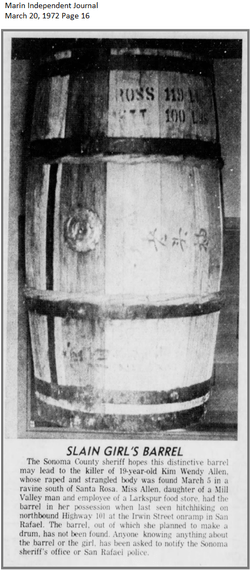
Kim was last seen on Saturday, March 4th, 1972, and in the morning she had been visiting with friends in San Francisco and hitchhiked her way to work in Larkspur shortly before her shift at Larkspur Natural Foods was due to start at noon. She worked for approximately five hours then began making her way back to Santa Rosa, and the second-year art student at Santa Rosa Junior College was picked up by two men outside of her POE. They dropped her off on San Rafael’s Belle Avenue, leaving her with nearly forty miles left to her destination. The men told investigators that they last saw her at roughly 5:20 PM trying to hitchhike near the Bell Avenue entrance to Highway 101, and was carrying an orange, aluminum-frame backpack and a large wooden sauce barrel with red Chinese characters on it. Like Sterling and Webster, she also frequently used hitchhiking as a means to get around despite multiple warnings from her mother and a professor about how dangerous it was.
Allen’s remains were found the following day at the bottom of an embankment in a creek bed roughly twenty feet off Enterprise Road in Santa Rosa. She had been bound at her wrists and ankles and had been strangled with a cord. She had been brutally sexually assaulted, and semen was found on her remains; a single gold hoop earring was found near the body. Detectives found skid marks at the top of the embankment and wondered if her assailant may have slipped or lost their footing while throwing or transporting the body. The two men that gave Allen the first ride (one which had passed a polygraph test) were both ruled out as suspects. Her checkbook was found in a drive-up mailbox across from the Kentfield (CA) Post Office sometime in the morning on March 24, 1972.
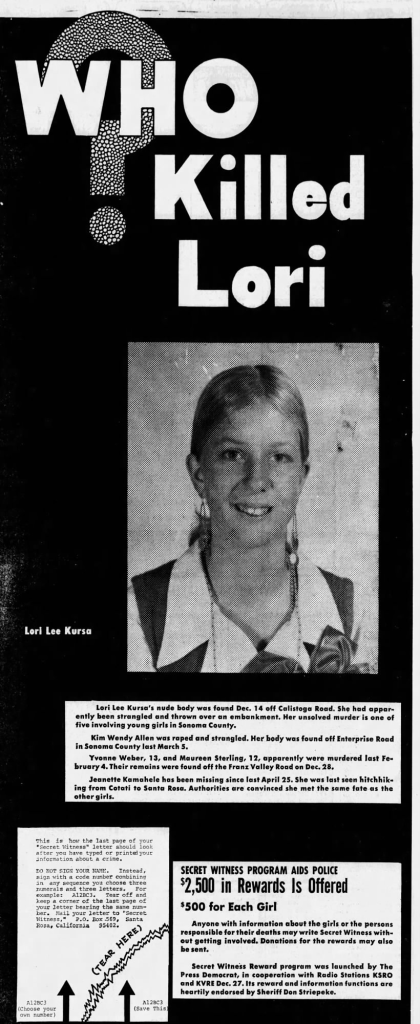
On November 11, 1972 thirteen year old Lori Lee Kursa was reported missing by her mother after disappearing while they shopped at a U-Save, and she was last seen on either November 20/21 in Santa Rosa while visiting friends. Someone reported possibly seeing her hitchhiking on November 30, however that was never positively confirmed by investigators. Kursa had a troubled home life, and she was a known hitchhiker and frequent runaway, and on December 14, 1972 her frozen remains were found in a ravine roughly fifty-feet off Calistoga Road, northeast of Rincon Valley in Santa Rosa. Lori’s murderer had thrown her body at least 30 feet over an embankment, and she was found wearing a single wire loop earring in each earlobe.
On her death certificate, Allens cause of death is listed as a broken neck with compression and hemorrhage of the spinal cord, and she most likely died one to two weeks before her remains were found; she not been raped. Two people later called in tips to LE about possible sightings of Kursa: one shared that they saw two men with a girl fitting her description on Calistoga Road. A second said they saw a young woman with a white male with ‘bushy hair’ driving a pickup truck that had been parked near where her remains were later found. Nothing ever came of either report.
A possible witness to Kursa’s abduction eventually came forward and told investigators that on an evening sometime in between December 3 and 9, 1972 he saw two men with a young woman fitting her description run across Parkhurst Drive then push her into the back of a van that had been parked on the side of the road. They said that the woman seemed to be physically impaired in some way and that the men were holding her up in between them. The driver was a Caucasian man with an afro-type hairstyle and after the three got in the van it quickly drove north on Calistoga Road.
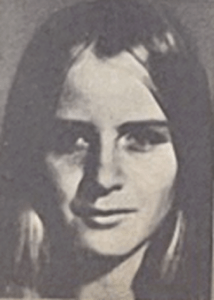
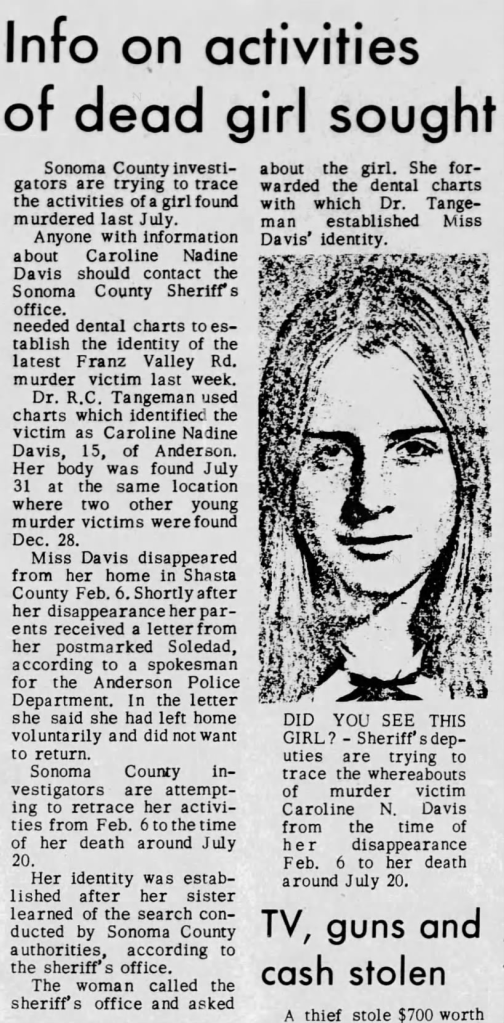
At around 7 AM on February 6, 1973 fifteen year old Carolyn Nadine left her family residence in Shasta County and spent the next five months traveling. She was last seen wearing a brown leather jacket with a fur collar and faded jeans, and before leaving the Anderson Union High School student left a note for her mom and stepdad that read: ‘Dear Mom. Don’t worry too much about me, the only thing I’m gonna be doing is keeping myself alive. Love, Carolyn.’ In 2022 her older sister Judy Wilson told an interviewer that after she ran away Carolyn had stayed with her for a period in her apartment in Garberville, and that she had been an eyewitness to a double murder and was ‘afraid for her life.’
Wilson said that Carolyn was getting increasingly paranoid that she might be discovered by someone that that knew about the murders, and she left her duplex and hitchhiked to Illinois. Davis returned to Garberville in the summer of 1973 because her sister was going to have a baby, and she stayed with her grandmother for two weeks that July before returning to her boyfriend in Illinois. According to multiple reports, her grandma drove her to downtown Garberville on July 15,1973 and shared with her plans to hitchhike to Modesto, California, with plans of staying with friends. She parked in front of the post office located two city blocks away from Highway 101, and Carolyn was last seen hitchhiking in Garberville that afternoon near the Highway 101 ramp going southbound. Her remains were discovered in Santa Rosa on July 31, 1973, just three feet away from where the bodies of Maureen Sterling and Yvonne Weber had been found seven months before.
Carolyn’s naked body had been discovered face-down roughly twenty feet down the embankment, and the fact that the vegetation growing around the body was not disturbed told investigators that her remains had been thrown from the road and she rolled for a few feet after landing. The way detectives discovered her body told them that ‘either a very large, strong man had heaved the dead girl’s body off the roadside, or he had help.’
Davis’s cause of death is listed as strychnine poisoning, administered ten to fourteen days before her remains were found, however the ME could not determine whether the drug had been administered by needle or by pill. Strychnine is sometimes mixed with other poisons, however an autopsy showed no trace of either heroin or amphetamines in her system. Having heard of the unidentified young woman, Carolyn’s sister sent detectives her dental records, and two weeks after her body was discovered, Jane Doe finally had a name: Carolyn Nadine Davis.
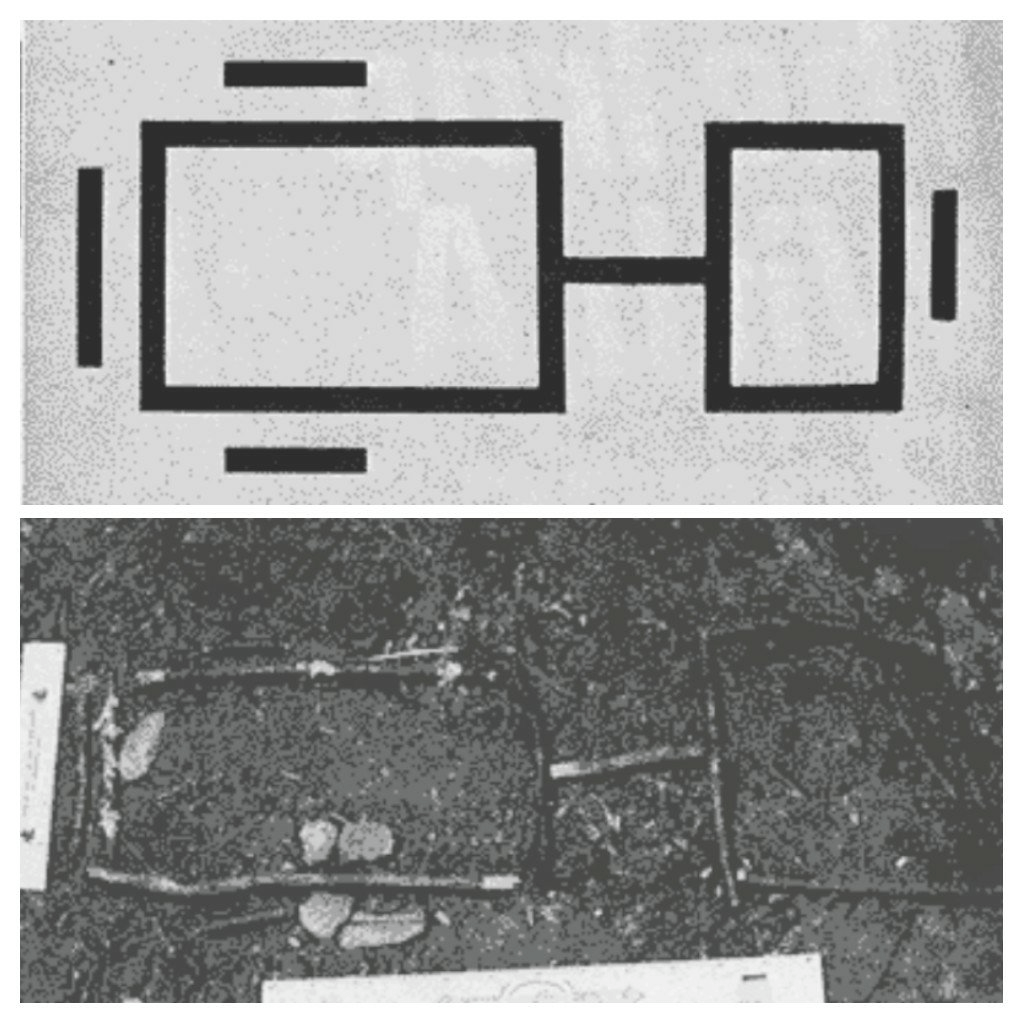
The ME determined that Carolyn’s probable date of death was July 20, 1973, five days after her grandmother had last seen her. It could not be determined if she had been raped, and her autopsy reported that she had an injury to her right earlobe that seemed to be an attempted ear piercing; her left earlobe had not been pierced. Detectives strongly felt that her killer had thrown her body from the road, as the brush on the hillside seemed to be undisturbed, and one investigator said that a witchcraft symbol that meant ‘carrier of spirits’ was found close to her body. In 1975 LE shared that it was ‘a rectangle connected to a square, with bars running alongside’ made up of twigs and sticks, and was identified as an occult symbol going back to medieval England, and possibly hinted at a connection to the Zodiac Killer.
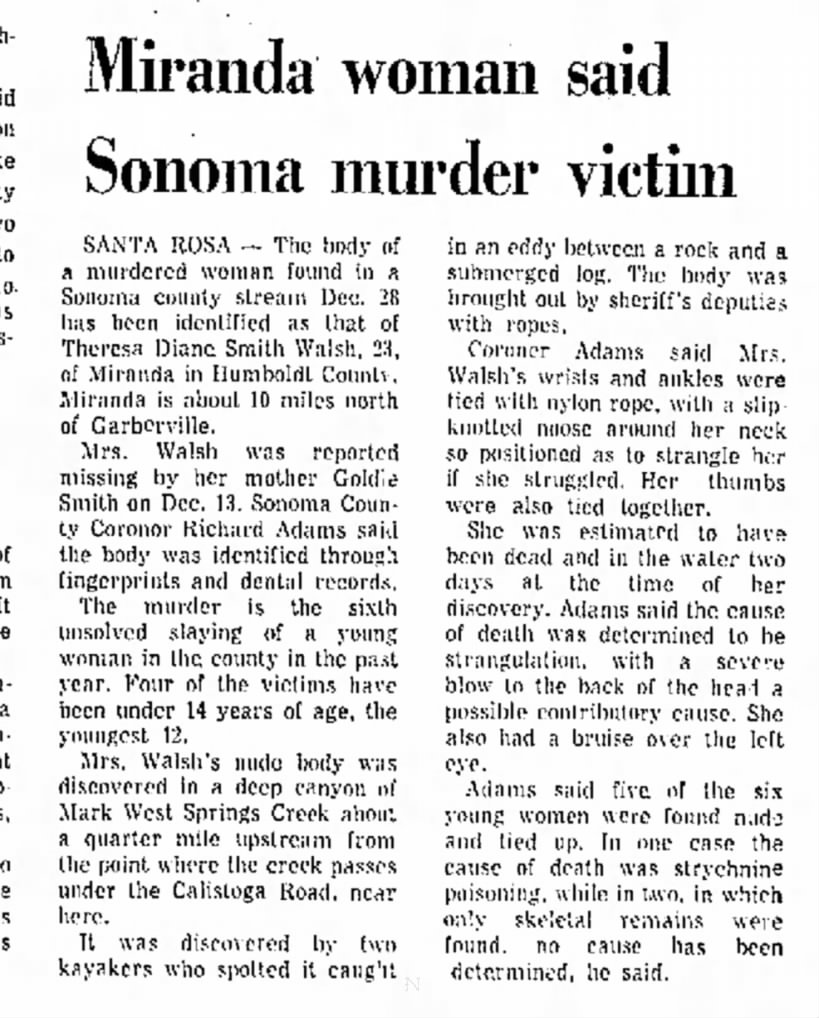
In the winter of 1973 twenty-three-year-old Theresa Diane Smith Walsh left home and hitchhiked across California, making her way to Los Angeles and often traveled using Highway 101. Back home in Miranda, her two-year-old son was in the care of her mother, and she was separated from her husband. In late 1973 Walsh was in Malibu but made plans to go to Garberville for Christmas. She tried to arrange a ride home and even reached out to a group known as ‘Hitchhiker’s Anonymous’ for help but had no luck. At around 9 AM on December 22, 1973 Walsh said goodbye to her friends, who dropped her off near Zuma Beach; she was last seen wearing bell bottoms, a lavender blouse, a faux-fur brown coat, brown hiking boots, and an olive-green Boy Scout knapsack. Her remains were discovered partially submerged underwater six days later by kayakers in Mark West Creek; she had been hogtied with rope, raped, and strangled to death. It was later determined that she had been dead for roughly one week before she had been found, and a combination of high water and heavy rains suggest that she may have floated several miles down the river from where her attacker initially left her.
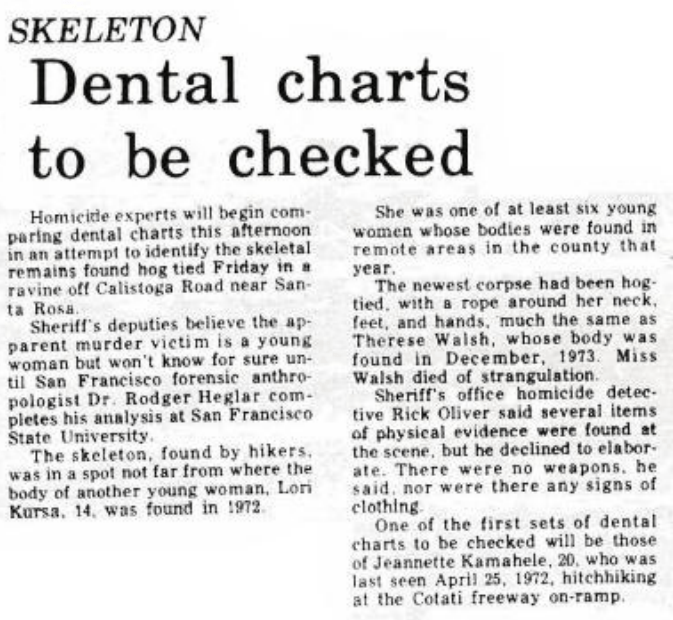
On July 2, 1979 the skeletal remains of a young woman were found in a ravine off Calistoga Road, roughly 100 yards away from where the remains of Lori Kursa were found seven years prior. Due to the advanced level of decomp, at first forensic experts believed that the victim may have been Jeannette Kamahele until dental records later proved this to be false. The young woman had been hogtied, and her arm had been fractured during the struggle at the time of her death; her body had been stuffed into a bag of some sort (maybe a duffel bag) before it was dumped in the ravine. Sonoma County Sheriff’s deputy Rick Oliver said that several pieces of evidence were found near the scene, but didn’t elaborate further.
It was determined that the young woman was between sixteen and twenty-one-years-old, wore hard contact lenses (that she kept in a metal container with cherries on it), had red/auburn/brown hair, was about 5’3”, and had broken a rib at one point in her life. Her weight and eye color could not be determined and no clothes were found at the crime scene. One medical expert hired by the sheriff’s department determined that at the time of her death the victim was roughly nineteen years old and was most likely killed sometime between 1972 and 1973. It’s also worth noting that hard contacts weren’t typically sold in the US and Canada after the mid-1970’s as soft contact lenses had become available.
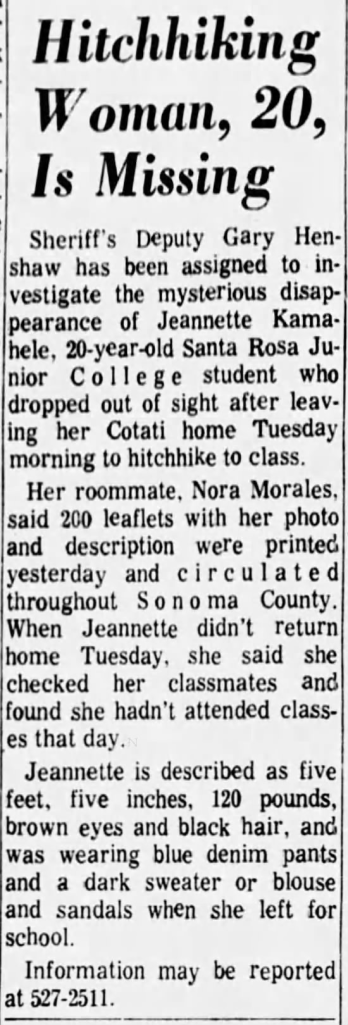
* I have seen the next young woman listed as both a confirmed and unconfirmed Santa Rosa Hitchhiker victim: Twenty-year-old Santa Rosa Junior College student Jeannette Kamahele was last seen by her roommate on April 25, 1972 at around 9:30 PM, and had plans to hitchhike near the Cotati on-ramp of Highway 101. A friend may have (possibly) seen her abduction, and told investigators that she had seen Kamahele get into a faded brown Chevy pickup that had been fitted with a homemade wooden camper in the back and was being driven by a twenty to thirty-year-old white man with an afro-styles hairdo. Jeannette stood at 5’5” tall and weighed 120 pounds; she was of Pacific Island descent and had black hair, brown eyes, and had a large birthmark directly underneath her right breast. She was last seen wearing a dark brown short, Levi’s jeans, and gold-post style earrings.
Born on February 10th, 1952 Jeannette Kamahele spent her formative years in Japan thanks to her dads naval career, and attended Yokohama American High School, which was designated for American children of military service members stationed overseas. After she graduated from high school, Jeannette decided to move stateside, and decided to enroll at Santa Rosa Junior College and moved to Cotati, where she lived along the 900 block of Sierra Avenue with her roommate, Nora Morales. Because she didn’t have a car of her own Jeannette often hitchhiked to get around, and would often catch a ride to class by walking along the nearby Highway 101 on-ramp. No trace of Kamahele has ever been recovered.
Unconfirmed Victims: Seventeen year old Lisa Michele Smith was last seen hitchhiking just a short distance away from her foster home, located along Hearn Avenue in Santa Rosa. Her foster parents reported her as missing from Petaluma, California on March 16, 1971 and shortly after a young woman with the name of ‘Lisa Smith’ went into Novato General Hospital after an incident she had while hitchhiking on March 26, 1971. Smith told investigators that she was picked up by a man that pulled a gun on her and threatened to rape her but she was able to escape by jumping out of the pickup, which was going 55 miles per hour at the time. The young victim was treated for a skull fracture as well as multiple cuts and bruises by physicians, and a nurse at the facility said that she looked to be about twenty-one-years-old. At the time, she was wearing a white blouse with ruffles, a dark pea coat, green bell-bottom jeans, and cowboy boots.
In an article published in The Santa Rosa Press Democrat on April 1, 1971, the ‘Lisa Smith’ that was treated at Novato General Hospital was the same person as the missing 17-year-old Lisa Smith. The young woman that is believed to have been Smith left the hospital before detectives could speak with her, and she reportedly hitchhiked her way back to San Francisco. Her biological parents eventually caught up with her and took her back to their residence in Livermore, California.
In 2011 The Press Democrat reported that the two Lisa Smiths were not the same, and she was not actually found. As of March 2025 it’s still not certain if the two Lisa Smiths were the same person or two separate individuals, and all of the police reports and medical records pertaining to the case were deemed to be missing by 2011.
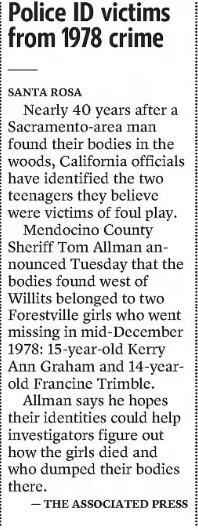
Fifteen-year-old Kerry Ann Graham and fourteen-year-old Francine Marie Trimble of Forestville, California both disappeared on December 16, 1978 after leaving their respective homes to visit a shopping mall in Santa Rosa. Their remains were found wrapped in duct-taped garbage bags that were buried in an embankment of a heavily overgrown wooded area beside a remote part of Highway 20 the following July, roughly 80 miles north of their hometown. Because of the advanced level of decomp, their exact cause of death has never been determined. At first Graham’s remains were mistakenly ID’d as a male, until genetic testing proved otherwise. Both victims remained unknown until November 2015, when their identities were confirmed thanks to DNA profiling.
In 1975, the FBI issued a report stating that fourteen unsolved homicides that took place between 1972 and 1974 were committed by the same perpetrator, which consisted of six of the known SRHM victims as well as the following young women:
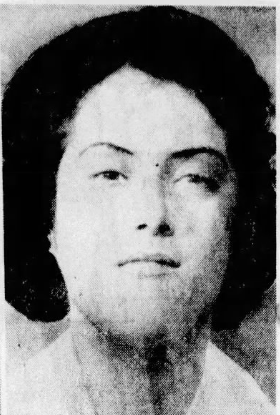
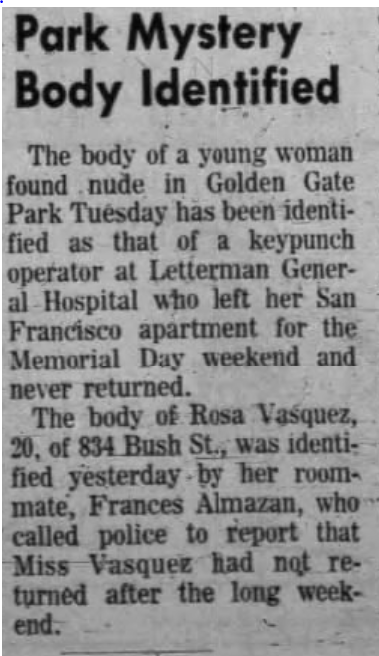
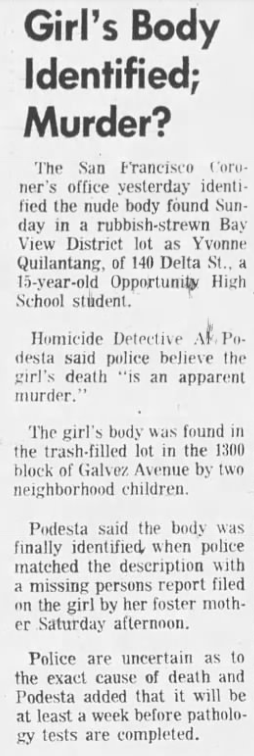
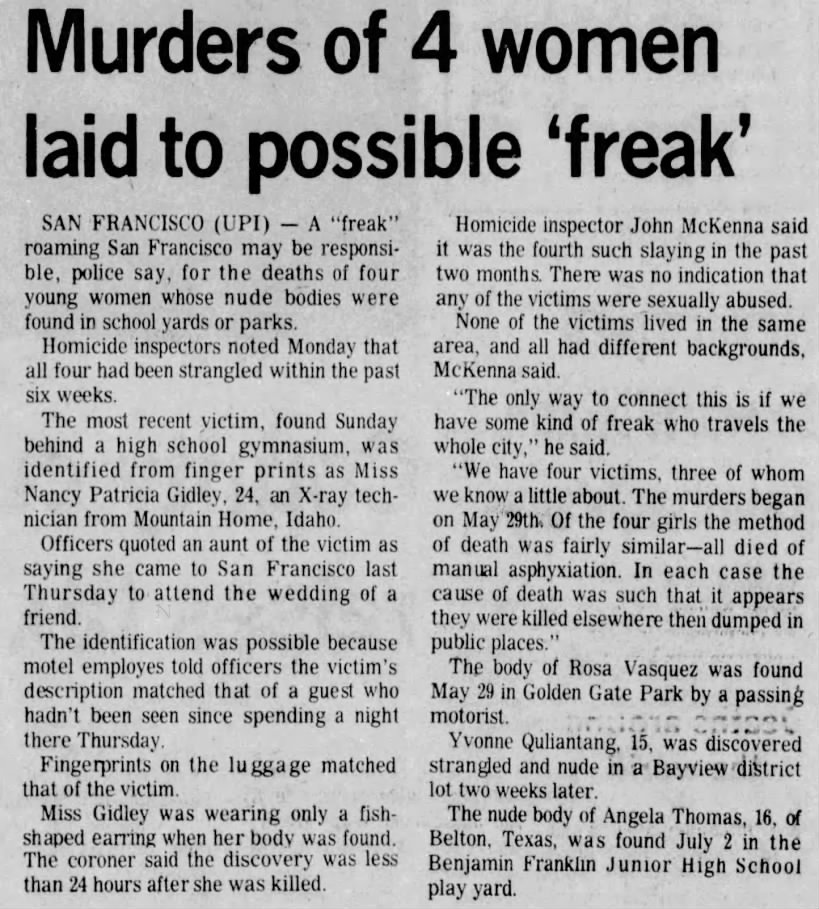
Twenty-year-old Rosa Vasquez was last seen May 26, 1973, and her body was found three days later on May 29 near the Arguello Boulevard entrance at Golden Gate Park in San Francisco; she had been strangled and her remains had been thrown seven feet off the road into some shrubbery. On June 10, 1973 fifteen-year-old Yvonne Quilantang was found strangled in a vacant Bayview district lot; she had been seven months pregnant and was out and about in the community buying groceries.
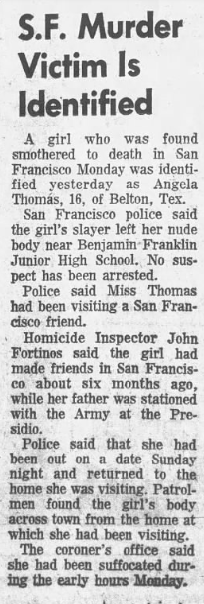
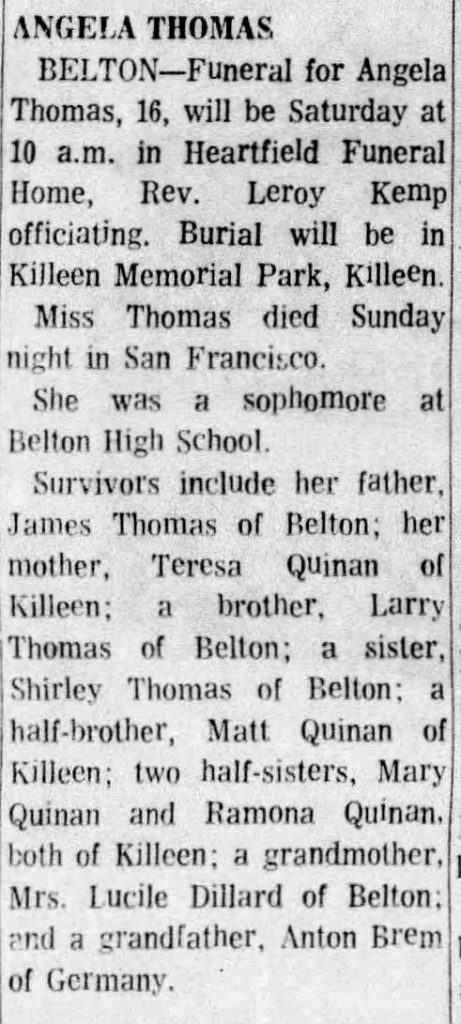
Angela Thomas was found July 2, 1973, smothered to death on the playground of Benjamin Franklin Junior High School in Daly City. The sixteen-year-old was a resident of Belton, Texas and was last seen at 9:00 PM the previous evening walking away from the Presidio in San Francisco; a locket was discovered near the crime scene. Nancy Patricia Gidley was last seen at a Rodeway Inn motel on July 12, 1973, and her remains were found three days later behind the George Washington High School gymnasium. The 24-year-old radiographer had been strangled and was completely nude, except for a single fish-shaped gold earring. It was eventually determined that she died within the previous 24 hours. Gidley had served in the US Air Force for four years prior to her murder, and told friends and family members that she had plans of becoming a freelance writer for the San Francisco Chronicle and was going to San Francisco to be the maid of honour at the wedding of a friend from Hamilton Air Force Base. After some investigating, this was all proved to be false.
Twenty-three-year-old* separated mother of five Nancy Feusi disappeared after going dancing at a club called The Plumbers Hall in the eastern part of Sacramento, and her nearly naked remains were recovered fifteen miles away by a fisherman at 6:30 AM on July 22, 1973, alongside Pleasant Grove Road and Steelhead Creek in Redding; her clothes were recovered nearby, and she had been stabbed twenty-nine times, mostly in the stomach, chest, and arm. She was last seen alive roughly two miles away from the night club, only three and a half hours before her remains were discovered. Detectives found shoe prints and tire tracks close to where Nancy’s remains were found, which opened up the possibility she was possibly killed in another location and was brought to the scene where she was found.
In 2011, one of her daughters, Angela Darlene Feusi-McAnulty was accused of torturing, beating, and starving to death her 15-year-old daughter Jeanette Marie Maples. After she was convicted, McAnulty officially became the second woman in history to be sentenced to death in the state of Oregon, the first since the 1984 reinstatement of the death penalty. *Some sources say that Nancy was twenty-two.
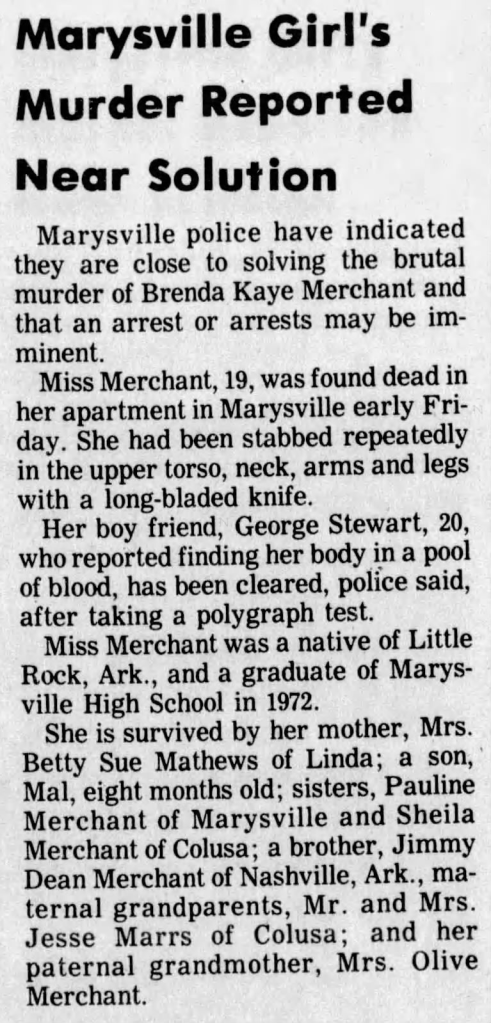
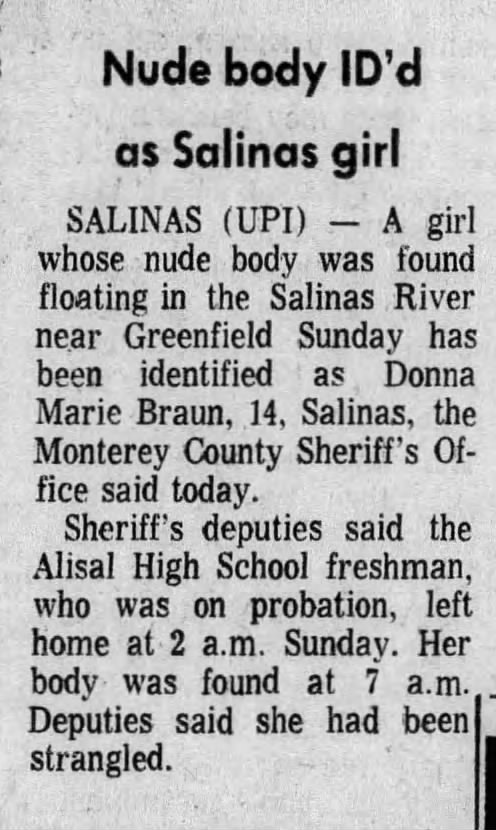
Twenty-one-year old Laura Albright O’Dell was reported missing on November 4, 1973; her remains were discovered three days later in some shrubbery behind the Stow Lake boathouse in Golden Gate Park. Her hands had been tied behind her back, and her cause of death appeared to be from head injuries and/or strangulation. On February 1, 1974 nineteen year old Brenda Kaye Merchant was found dead at her apartment in Marysville; she had been stabbed over 30 times with a long bladed knife and had asphyxiated on her own blood. Her assailant left a bloody handprint behind on the screen door of the residence, and it is believed that she was attacked between 6 PM (when she was last seen) and midnight, when neighbors happened to overhear a loud argument. Donna Maria Braun was only fourteen when her strangled remains were discovered by a crop dusting pilot at 7 PM on September 29, 1974 in the Salinas River near Monterey.
Over the years, California investigators have strongly considered the possibility that the perpetrator of the Santa Rosa hitchhiker murders was also active in Oregon, Washington, Utah, and Colorado, and additionally have looked into the possibility that there was a link to the Flat Tire Murders, which took place in Miami-Dade County in the southern part of Florida between February 1975 and January 1976. Also, in 1986 author Robert Graysmith published a list of forty-nine confirmed and possible Zodiac Killer victims, which included the Santa Rosa victims as well as some additional murders with some striking similarities, including:
Seventeen-year-old Elaine Louise Davis disappeared from family’s home in Walnut Creek, California on December 1, 1969, when she was left to watch her younger sister while her mother went to nearby Concord to pick her husband up from work. When Mr. and Mrs. David arrived home shortly after 11 PM, they found their three year old daughter alone in the residence with no trace of Elaine. At the scene there was no sign of a struggle, however investigators were immediately suspicious of foul play due to the fact that her purse and glasses were left behind. After they arrived home, her little sister told her parents, ‘they took her away, she didn’t want to go,’ and ‘there was a Volkswagen,’ the latter part was corroborated by neighbors. The young woman’s coat was found two days later on the side of the road along Highway 17 near Santa Cruz.
On December 19, 1969 the remains of Elaine Davis were discovered floating near Lighthouse Point near Santa Cruz, however a positive ID was not made until 2001. An initial examination determined that the victim was in her early twenties, which led investigators to dismiss her as a potential match. Her cause of death is undetermined, however medical experts leaned towards strangulation because of some damaged cartilage found in her neck. In 2000, the investigation was reopened as part of a routine review of cold cases and the following year a new examination of the remains were conducted, and the victims dental records proved that the body did belong to Elaine Davis.
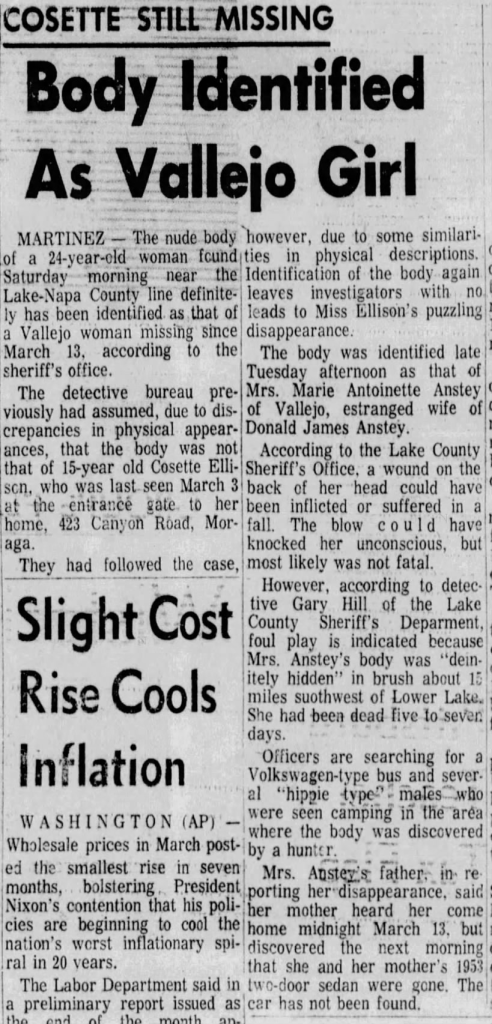
Sixteen-year-old Leona LaRell Roberts had been kidnapped from her boyfriend’s home on December 10, 1969; eighteen days later her nude body was found on the beach at Bolinas Lagoon in Marin County, and although the official cause of death was listed as ‘exposure,’ her case was treated as a homicide. Twenty-three-year-old Marie Antoinette Anste was kidnapped in Vallejo after experiencing a blow to the head, and her body was recovered in rural Lake County on March 21; an autopsy revealed that she had drowned and had traces of mescaline in her bloodstream.
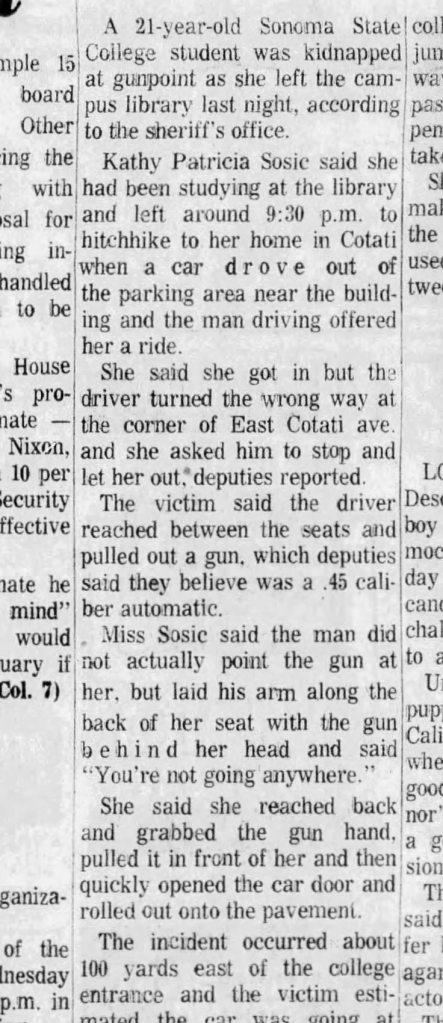
Seventeen-year-old Eva Lucienne Blau was found dumped in a roadside gully near Santa Rosa during the equinox on March 20, 1970, and the medical examiner determined that she had been hit in the head and discovered drugs in her system. Blau was last seen leaving Jack London Hall on March 12 after telling friends that she was going to go home. On the evening of December 3, 1969, twenty-one-year-old Sonoma State College student Kathy Sosic accepted a ride from a stranger outside her school’s library, and at some point during the drive the man pulled out a handgun and tried to assault her. Sosic managed to escape by jumping out of the moving vehicle, and thankfully she was not seriously injured.
Suspects: Over the years there have been quite a few men that have been investigated for the Santa Rosa Hitchhiker Murders, and the first I’m going to talk about is Ted Bundy. When these murders took place in 1972 and 1973 Ted was in an active relationship with Elizabeth Kendall (and was seeing multiple other women as well) and he graduated from the University of Washington in the spring of 1972, and began law school at the University of Puget Sound in the fall of 1973. He had quite a few jobs during this time period, and from September 1971 to May 1972 he worked one night a week at the Seattle Crisis Clinic (with Ann Rule), and between June and September 1972 he had an internship as a counselor at Harborview Mental Health Center in Seattle. From September to November 1972 he worked for Governor Dan Evans’ re-election campaign, and between November of ‘72 and April 1973 he worked at the Seattle Crime Prevention Advisory Commission, and helped draft Washington’s new hitchhiking law, and even wrote a rape‐prevention pamphlet for women. From September 1972 to January 1973 he worked with the Law & Justice Planning in Seattle, and between February to the end of April 1973 he worked for the King County Program Planning, Additionally, in September 1973 he held the title of the Assistant to the Washington State Republican chairman.
s we all know, Ted didn’t ‘officially’ become active until January 1974, when he brutally attacked and left for dead University of Washington student Karen Sparks, but it’s widely speculated that he began killing much earlier than that. Some people even believe he may have begun killing as early as fourteen with the murder of Ann Marie Burr, who was stolen out of her Tacoma residence in late August of 1961. Additionally, it’s thought Bundy killed two young stewardesses in the Queen Anne district of Seattle in 1966, as well as two young friends vacationing in the Jersey Shore in May of 1969. More realistically, he may have started killing in 1973, with the murder of a young hitchhiker in Tumwater, WA.
After Ted was captured for similar crimes in Washington/Colorado/Utah/Idaho he was suspected in the Santa Rosa hitchhiker murders as well, however according to Sonoma County law enforcement he was ruled out as a suspect in the late-1970s then again in 1989 (as his credit card receipts reveal that he was in Washington on the dates of some of the disappearances). I mean, let’s be real: he was known to drive hundreds of miles to commit a murder, and he confessed to having killed in the Golden State before (the ‘1992 TB FBI Multi agency Report’ credits him with one kill in the state). Another reason investigators feel that Ted isn’t responsible for the SRHM is that they believe that the perpetrator most likely lived in the Santa Rosa area, and may have even worked a local job, like as a mail carrier or a public utility worker that would have been familiar with the remote, rural areas where the young women were left.
In an interview with The San Francisco Gate in 2011, retired Seattle Detective Dr. Robert Keppel said of Ted: ‘one of the last times I talked to Bundy, I mentioned California, and he looked at me like, ‘I can’t talk about that right now.’ I think he believed his execution would be stayed so he could talk for years about his crimes, but the governor had other ideas… Bundy is definitely a good suspect. The killings in Santa Rosa would fit his methods, he spent time in the area, and I’m sure he started killing well before 1974… it was an open market for Bundy.’
Some similarities between the cases and Ted’s victims sticks out to members of law enforcement, as the SRHM victim profile is nearly identical to his and were all young women between fifteen and twenty-five-years-old that wore their hair long and parted down the middle. Additionally, he also made sure to dispose of remains in out-of-the-way, rural locations completely nude, and the way the assailant subdued his victims was incredibly similar to Bundy’s, as they were strangled to death, either by hand or with a household item.
Bundy also matched the description of a young, ‘bushy haired’ man that was seen near the scene of at least two of the SRHM. The first is in relation to the disappearance of Jeannette Kamahele, who was last seen getting into the truck of a man with an afro which is a type of style that Bundy wore in 1972. Additionally, it’s worth noting that Ted did own a truck in the mid 70’s, as he bought an inexpensive one to help with his move from Seattle to SLC (I believe he gave it to his brother Glenn, or he at the very least drove it). Then there’s the abduction of Lori Kursa in November of 1972, where a similarly-described man with an ‘afro-styled hairstyle’ was seen waiting in the getaway van that Kursa was shoved into (although in this situation the driver would have been only one part of a three-man operation; whereas Bundy acted alone).
After his first arrest while investigators were looking into his background, they learned that Ted had been in California on several occasions in the late 1960’s/early 1970s, proving that he did have some ties to the area: in 1968 he attended Stanford University and in 1973 he visited Sonoma County while working on a political campaign for the Republican party. He had also driven through the region on numerous occasions between 1968 and 1974 while visiting with his one-time love Diane Edwards, who had lived in Palo Alto and San Francisco.
However, despite his (weak) ties to California, Bundy was not linked to any of the victims from the Santa Rosa Hitchhiker Murders, and investigators would later find evidence that placed him in Washington either right before or after several of the murders. In a January 1976 issue of ‘The Vallejo Times Herald,’ Sonoma County Sergeant Butch Carlstedt said: ‘I tried to tie Bundy to our cases but we found credit card receipts that put him in Seattle at the time of the murders here… He’s definitely cleared as far as we’re concerned.’ However, years later detectives in Sonoma County learned that this was anything but true, as on a few occasions there were two-day periods in between many of his gas receipts that supposedly placed him in Washington, which allowed Bundy upwards of two days to make the drive to California then back home to Seattle.
In 2011, authorities uploaded a sample of Bundy’s DNA into the FBI’s Combined DNA Index System (CODIS) in the hopes of matching to any victims that haven’t been tied to him yet. When speaking to ‘The San Francisco Gate’ in 2011, Sonoma County Lieutenant Steve Brown commented that: ‘the feeling was that one person committed the killings, and Bundy was looked at. But I always thought it must have been a utility worker or a postal worker, someone familiar with the area.’
Another suspect of the SRHM is The Zodiac, thanks to the timing of the murders as well as the general location of where they took place. Additionally, the killer was known to correspond in code using symbols and ciphers, and located on Kim Allen’s missing soy sauce barrel was some chinese characters. Also, there was a crudely constructed symbol made out of twigs close to Carolyn Davis’ remains that looked like it could have been constructed by the Zodiac. Investigators reportedly ruled out the killer as a suspect because the SRHM seem to have a sexual component to them, where the Zodiac murders did not and the killer progressing from homicides involving a knife/gun to brutal slayings involving rape would be a huge shift.
Zodiac suspect Arthur Leigh Allen of Vallejo owned a mobile home at Sunset Trailer Park in Santa Rosa at the time of the murders. In 1968 he had been let go from his job at The Valley Springs Elementary School for suspected child molestation, and in 1972-73 he was a full-time student at Sonoma State University. Allen was arrested by the Sonoma County Sheriff’s Office on September 27, 1974, and was charged with child molestation in an unrelated case involving a young boy. He pleaded guilty on March 14, 1975 and was imprisoned at Atascadero State Hospital until late 1977. In his book ‘Zodiac Unmasked’ true crime writer Robert Graysmith said that a Sonoma County sheriff said that chipmunk hairs were found on all of the Santa Rosa Hitchhiker victims, and that Allen had been collecting and studying the same species of the animal.
Forty-one year old US Army veteran Fredric Manalli was a writing instructor at Santa Rosa Junior College and San Quentin Prison, and after he was killed in a head-on collision after his van veered into oncoming traffic on Highway 12 on August 24, 1976 he was a suspect in the SAHM; at the time of the accident he had no illicit drugs or alcohol in his system, but was taking medication for epileptic seizures. After his death police found sadomasochistic drawings in his van, and amongst his artwork were pieces showcasing Kim Allen, who was one of his former students as well as additional works involving two other young women and himself in a sexual manner. It’s also heavily speculated that he had one of Allen’s backpacks in his possession.
According to Robert Graysmith, ‘when the teacher’s widow was cataloging his property, she came across drawings of people being whipped. The sketches suggested the husband had been involved in S&M. The instructor had drawn himself as a woman and labeled it with the female version of his own name. Chief Wayne Dunham felt the deceased man might have something to do with Kim Wendy Allen’s death.’ In Graysmith’s book ‘Zodiac UnMasked,’ Sergeant Steve Brown said ‘I’ve actually got a photocopy of two of the drawings that they found. He drew Kim and he drew himself as ‘Freda.’ He drew the other girl and those two girls had classes with him. They tested it, but it wasn’t Kim. He probably taught Kim, and when she shows up dead, he became really obsessed with her. A weird dude.’
In 2024 HBO Max created a documentary titled, ‘The Truth About Jim,’ which explored the idea that a high school vocational agriculture teacher and part-time landscape designer named Jim Mordecai might have been responsible for the SRHM. Mordecai was born August 27, 1941 in Santa Rosa, and as early as 1953 his name started appearing in local papers thanks to his skill in basketball and football. He died of cancer in 2008 and his family had an isolated ranch in Sonoma County near Santa Rosa, where he spent a lot of time in the early-1970’s. He had no known criminal record and after his death family members found a box of mismatched jewelry among his belongings, which belonged to no one in the family. One item, a hoop earring with orange beads attached, matched the description of a piece of jewelry that was worn by one of the SRHM victims…but his family threw out the evidence and didn’t hold onto anything. A DNA profile of Mordecai was turned over to the Sonoma County Sheriff’s Department in August 2022.
Philip Joseph Hughes Jr. resided in Pleasanton, CA and was convicted of three murders in Contra Costa County in the early-to-mid 1970’s: in November 1972 he stabbed nineteen-year-old Maureen Field to death after she disappeared after her shift at KMart was over. Two days after she was last seen, her family got a phone call from an unidentified male caller, who said: ‘I’m calling about your daughter. She is dead. I killed her,’ then hung up. Her badly decomposed remains were discovered on February 15, 1973 on Morgan Territory Road. Just over a year after her death on January 26, 1974 fifteen-year old Skyline High School sophomore Lisa Berry disappeared while hitchhiking. It was later determined that Hughes (along with his wife and accomplice Suzanne Perrin) kidnapped Berry at knife point after picking her up near her home then took her to a basement in Oakland, where they sexually assaulted her then stabbed her to death. They then wrapped her remains in a bed sheet then dumped her in a shallow grave in a desolate area in Contra Costa County; she was found five years later in Moraga.
On March 19, 1975, Hughes and Perrin abducted then strangled, raped, and beat (with a hammer) twenty-five-year-old Letitia Fagot. Her nude remains were discovered in her Walnut Creek home after coworkers called on a welfare check when she never showed up for her shift; she had experienced blunt force trauma to the head. Hughes managed to fly under the radar until July 1979 when a friend of his then wife went to police and confessed on her behalf (this supposedly was due to Perrin’s intense fear of her husband). The day after the call to law enforcement was made, Suzanne met up with a Contra County Sergeant at a local restaurant and gave him information about her husband and the murder of Lisa Beery, and on July 13, 1979, detectives got a search warrant for their home. Because Hughes victims were stabbed it’s a deterrent to him being responsible for the SRHM and he is currently serving life imprisonment at California Correctional Institution.
Another serial killer Joseph Naso was investigated for the SRHM: known as ‘The Double Initial Killer,’ Naso was born on January 7, 1934 in Rochester, NY and after serving in the US Air Force in the 1950’s he met his first wife, who he lived with in San Francisco. Together for eighteen years when they separated, Naso continued visiting her and the two had a child together that eventually developed schizophrenia, and he spent a good part of his life caring for him. Nicknamed ‘Crazy Joe’ for his unusual behavior, Naso took classes in a few different colleges in the general San Francisco area in the 1970’s, and in the 80’s resided in the Mission District of San Francisco, then in Piedmont and Sacramento; in 2004 he relocated to Reno, Nevada and worked as a freelance photographer. He also had a long history of lower-level crimes, like shoplifting, which he committed up to his arrest in his mid-seventies.
Nevada law enforcement arrested Naso in April 2010, and while searching his residence discovered a diary where he listed ten unnamed women along with some correlating geographical locations. The journal proved that he stalked and sexually assaulted his victims then photographed them in suggestive poses next to mannequin parts. He was charged with the murders of four sex workers on April 11, 2011 and was later charged with the murders of two additional victims. On August 20, 2013, Naso was given a guilty verdict by a Marin County jury and on November 22, 2013, a judge sentenced him to death.
Another name that came up in my research a few times in relation to the SRHM was Robert Kibbe, or the I-5 Strangler, who was known to target young, vulnerable hitchhikers in the later part of the 1970’s. Kibbe was first arrested for assault and battery in 1987, after he tried to handcuff a sex worker named Debra Ann Guffie, who managed to fight him off and flag down a nearby police officer for help. With her testimony, Kibbe was arrested and sentenced to eight months in country lock-up, and it was at this time that LE began to piece together their case against him. He was arrested in 1988 for the murder of Darcie Frackenpohl that took place the year prior, and was convicted of first degree murder and was sentenced to 25 years to life in prison. The SRHM’s fall a bit outside of when Kibbe was active, as he didn’t begin killing until September 10, 1977 when he met twenty-one-year-old Lou Ellen Burleigh for an interview; the two met again the following morning and she was never seen again. He was also known to cut off the hair of most of his victims in order to remove the duct tape before he would abandon them, and this was never seen in the SRHM murders.
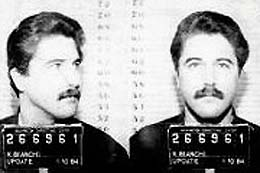
Kenneth Bianchi and his cousin Angelo Anthony Buono Jr. were also briefly investigated for the SRHM but they were both ruled out as suspects, as they weren’t active until October 1977. Known as the Hillside Stranglers, they were convicted of killing ten young women in Los Angeles between October 1977 and February 1978 (Bianchi killed two women in Washington by himself). Buono died on September 21, 2002 and Kenneth Bianchi is currently serving a life sentence in Washington State Penitentiary.
Joaquin Cordova is another possible perpetrator in the SRHM: at the time of the murders in 1972/73, Cordova was a twenty-two-year old bartender that was arrested for the rape and assault of a twenty-nine year old woman in his home. During the assault he told his victim that she was ‘different from the other girls,’ hinting at him doing this multiple times prior. He was ruled out by investigators (as he was in jail during the murders).
I would like to give credit to the ‘unresolved’ true crime website, who said the following about a man named ‘Campo de Santos: ‘outside of these big name, serial offenders, there are a couple of other small-time criminals that I discovered during my research into this case. One is a man named Campo de Santos, who operated under the alias, ‘Deyo.’ By 1975 ‘Deyo’ was spending time on New Mexico’s death row, having been convicted for a crime that was almost identical to the hitchhiking crimes. He was believed to have been in Sonoma County when at least some of the crimes were carried out, but it’s unknown what kind of connection there may be if any. Speaking to The Press Democrat, Sonoma County Sheriff’s captain Jim Caufield would state the following about the suspect: ‘he could be out man in some of these, but he won’t talk to us. It’s essentially possible they’ll send him to the gas chamber and we’ll never know if he’s the man, in fact, it’s possible out killer is dead or locked up somewhere else on other charges.’
True crime writer Gray George strongly suspected that serial killer Jackie Ray Hovarter was responsible for the Santa Rosa Hitchhiker Murders. Hovarter was a long-haul trucker that routinely drove throughout the northern part of California, and he was convicted of kidnapping, raping, and killing 16-year-old Diana Walsh from Willits, CA in August of 1984. He raped a second girl from Fortuna a few months later in December and tried to kill her by shooting her in the head, but she survived; she testified at his trial and helped put him behind bars. George feels that he could be a strong suspect in the murders of Francine Trimble and Kerry Graham.
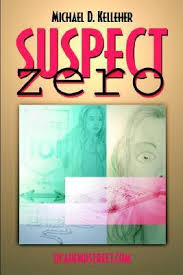
Another name I came across in my research was an individual named Byron Avion, who was described as ‘an odd, portly man that was admittedly obsessed with the Zodiac Killer.’ He had other eccentricities as well, not the least of which was his ‘large collection of cardboard boxes, carefully stacked and tied shut with white nylon rope.’ However, the only place I came across a possible link was one source: a book titled ‘Suspect Zero,’ published on May 15, 2003 and written by Michael D Kelleher. I didn’t read the book so I didn’t learn much about this individual.
Works Cited:
Best, Joseph. ‘Jim Mordecai and the Santa Rosa Hitchhiker Murders.’ (Fenruary 29, 2024). Taken on March 8, 2025 from Medium.com
Fagan, Kevin. ‘Ted Bundy a suspect in Sonoma County cold cases.’ (July 7, 2011). Taken March 8, 2025 from sfgate.com
Hamilton, Francis. ‘Sonoma County Missing and Murdered.’ (September 11, 2019). Taken March 8, 2025 from sonomacountymissingandmurdered.wordpress.com
March, Lisa. ‘Adventurous Shasta County Teen Last Seen in Garberville: An Unsolved Cold Case.’ (May 16, 2022). Taken March 8, 2025 from kymkemp.com
Romano, Tricia. ‘The Case of the Double Initial Murders: An Odd History.’ Taken March 13, 2025 from crimelibrary.com
‘Serial Killer Database: HUGHES, Philip Joseph Jr.’ Taken March 13, 2025 from skdb.fandom.com
The Santa Rosa Hitchhiker Murders. (March 21, 2020). Taken March 8, 2025 from killerqueenspodcast.com/the-santa-rosa-hitchhiker-murders/
Unresolved. ‘The Santa Rosa Hitchhiker Murders.’ Taken March 8, 2025 from https://unresolved.me


























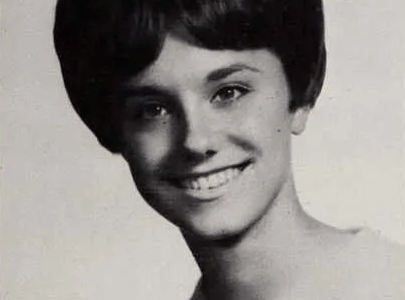
Cheri Jo ‘Josephine’ Bates.
I don’t normally put titles before the sections in my articles, but I’m trying something new since this piece is so overwhelmingly long and I was really struggling to organize it so it flowed easily. I hope you guys don’t mind.
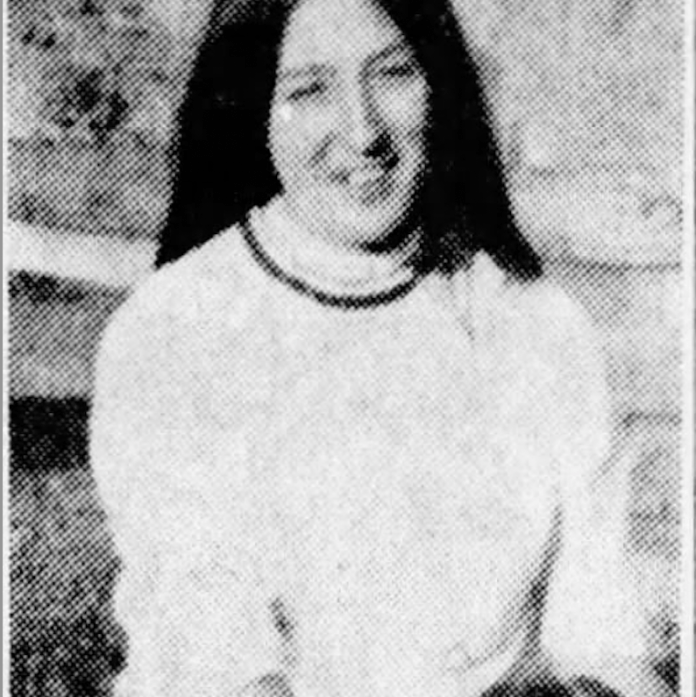
Background: Cheri Josephine Bates was born on February 4, 1948 to Joseph and Irene (nee Karolevitz) Bates in Omaha, Nebraska. Joseph Charles Bates was born on December 3, 1919 in Seneca Falls, NY and after graduating from high school he joined The Republic Aircraft in 1939, working as a machinist. Irene Margaret Karolevitz was born on June 27, 1919 in Lesterville, ND. The couple had two living children together: Cheri Jo and her older brother, Michael. They also had a daughter named Bonita Jo that only lived for ten days at the end of December 1945. In 1957 the family relocated to Riverside, a small suburb in the eastern part of LA where Mr. Bates initially worked on the X-15 recovery program at Edwards Air Force Base before getting a machinist position at the Corona Naval Ordnance Laboratory. The couple divorced in 1965, and at the time she was murdered Cheri Jo lived with her dad at 4195 Via San Jose in Riverside. Mrs. Bates lived nearby but it’s said that at the time of her daughter’s murder she was experiencing mental health troubles and was committed to Patton State Hospital; in an article published by The Daily Oklahoman on November 1, 1966, she was incorrectly listed as deceased. Cheri Jo’s brother Michael was away from home serving in the US Navy.
Described by those that knew her as a sweet but shy young lady (her brother said she had a lot of friends but ‘wasn’t cliquish’), Cheri Jo graduated from Ramona High School in 1966, where she was an honor student, varsity cheerleader (although she dropped out her senior year), and was active in student government. She had dreams of one day becoming a flight attendant and traveling the world, a job she applied for right out of secondary school but was turned down for (apparently she applied to all of the major airlines but you had to be twenty to work in the position at the time). Cheri Jo liked creating things for the people that she cared about, could play the piano, and enjoyed sewing her own clothes. In a 2013 interview with the RCC school newspaper ‘Viewpoints,’ a girlfriend of Bates from junior high named Cherie Curzon recalled a time where the two competed in a talent show together, and (dressed up like sailors) sang ‘I’m Gonna Wash that Man Right Out of My Hair’ from the musical ‘South Pacific:’ ‘for me, the best part of our story was, I was an underclass person who she wanted to help out. The people who were going to do the talent contest with me backed out and she volunteered to be my partner.I will never forget her kindness… We had so much fun rehearsing and then performing, I loved her generosity and kindness toward me…She did it because of who she was; just a wonderful person.’
In high school Bates frequently babysat for the families in her neighborhood, and Jeannie Casil-Miller (who was 12 at the time Cheri Jo watched her little brother) said of her: ‘what a sweetheart, she was such a sweet gal, she never talked to me like a kid. Everybody liked her. She always had a smile for everybody. She needs to be remembered.’ After graduating from high school Bates thought that continuing with her education would help her chances of getting hired at an airline, and went on to attend Riverside City College (she planned on going for two years then reapplying to be a flight attendant). She also got a PT job at Riverside National Bank, which allowed her to earn enough money to purchase a 1960 lime green VW Bug that was her pride and joy (and I get that, I loved my Beetle). The week before she was killed Cheri took her little Bug to a local service station to make sure everything with the vehicle was up to par, and according to her family she loved her little car and was very particular about its condition and cleanliness. She had recently gotten engaged to her high school sweetheart of two years, Dennis Highland on October 22, who had previously attended RCC but after two years transferred to San Francisco State College to play the tight end position on their football team. He was two years older than Cheri Jo and graduated from Ramona High School in 1964. The weekend before she was killed Highlands’ parents visited with the couple in San Francisco (which is about a six hour drive from Riverside), and friends recalled that they were crazy about each other and were head over heels in love.
The Murder: In October 1966 Cheri Jo was in her first semester at Riverside City College and had the rest of her life in front of her. The eighteen-year-old had blue eyes, blonde hair that she wore short in a pageboy style, and according to her father wore eyeglasses when studying; she was petite, and only weighed 110 pounds and stood at 5’3” tall. On the morning of the 30th she attended Sunday mass at St. Catherine of Alexandria Catholic Church with her dad, then the two had breakfast together at Sandy’s, a local diner. After they ate, Mr. Bates asked his daughter if she wanted to go to the beach with him, which was a common family activity they enjoyed doing together; she declined and told him she had to go home and work on a research paper on the electoral college that was due soon. Later that afternoon, Cheri Jo went to her college library to focus on schoolwork and study.
Before departing her house, Bates called a friend named Stephanie Guttman (twice, at 3:00 and between 3:30/3:45 PM) and asked if she wanted to go to the library with her; she declined. Bates then called an unnamed coworker and asked her if she had seen a bibliography for a term paper that she had misplaced. When she replied no, Bates said: ‘now I’ll have to start all over on my note cards.’ I’ve also seen it in a few sources that she was supposed to go to the library with a neighbor and fellow RCC student Kathryn Hunter, who eventually wound up declining her offer (more on that later). At 5:00 and 5:15 PM Mr. Bates called home and got a busy signal.
Based on the contents of her stomach, Cheri’s last meal was a roast beef sandwich (I’ve also seen it reported as ‘some type of dinner-like food’), which she consumed roughly 2-4 hours before her death. It is strongly speculated that she left her residence sometime between 4:30 and 5:00 PM (but most likely more towards 5:00), and when Mr. Bates returned late in the afternoon from the beach at 5 PM there was a note taped to the refrigerator that read: ‘Dad, went to RCC Library.’ Oddly enough, he left the house again that night and left his daughter a note of his own, which he found undisturbed when he arrived back around midnight. A neighbor told police that they recalled seeing her car parked in her driveway at 4:45 PM, and an eyewitness told the Riverside PD that they had seen Bates driving towards RCC at roughly 6:00 PM; a second person said they noticed that she was being closely followed by a bronze 1965/1966 Oldsmobile.
It shouldn’t have taken Cheri long to get to the library from her house, as it was only three miles away. Upon arriving she parked her VW on Terracina Drive, a narrow road between the library and the old Mediterranean style quadrangle. According to the website ‘ZodiacCiphers,’ at exactly 6:13 PM four men in work attire were sitting on a fence outside across from Cheri’s car and noticed her park and walk towards the library. The workmen were there until around 7:15 PM and told investigators they didn’t recall seeing anyone suspicious around her vehicle. At 6:15 PM Bates was seen by an acquaintance, a Mexican-American student who said he later remembered seeing her inside the library ‘writing inside of a blue spiral bound notebook with a ballpoint pen’ immediately after it opened. Just as a side note, there seems to be a bit of black and forth across the internet about the time he saw her: I’ve seen it listed as early as 5:30 PM but the library didn’t even open until 6 PM so that doesn’t make any sense. Additionally, a librarian reported that she saw Bates at some point that evening but didn’t recall exactly when.
Between 6:30-6:45 some RCC students that were acquainted with Bates said they did not recall seeing her at the library, and due to the small size of the building it would have been hard to miss her. Police also said that an eyewitness came forward and reported that at approximately 7:00 PM a tan 1947-52 Studebaker with oxidized paint was seen driving south on Terracina Drive; initially, it was incorrectly reported that the vehicle was a ‘tucker torpedo’ as the two look incredibly similar, but after police looked into them only fifty-one had been made at the time, so that tip was quickly disregarded. A friend of Bates named Walter Siebert was at the library working on homework between 7:15 – 9 PM, and he didn’t remember seeing her. No one saw Cheri Jo leave the library.
One female student reported that at around 9:30 PM she noticed a young man smoking a cigarette that she estimated to be around 19/20 years old and roughly 5’11” lurking in the shadows in the alleyway Bates was later found dead in, located across the street from where her Beetle was parked. The individual had been intently looking in the vehicles direction at roughly the same time the library closed, and when she walked by him they exchanged hellos despite not being acquainted with one another. It was later determined that from where he was standing he could have easily kept an eye on Cheri’s Bug while she was at the RCC library. The eyewitness was able to give LE a description of the clothing on the unknown man, and several years later the Riverside PD showed that eyewitness a lineup containing a suspect’s picture (who I will refer to as ‘Bob Barnett,’ but more on him later), and where she was unable to identify anyone in the lineup the clothes she described previously matched what the suspect was said to be wearing on the night of Cheri Jo’s murder. Police were able to go back and obtain a discarded cigarette butt that was most likely from the same man that was in the alley the night of Bates murder.
At around 7 PM on October 30 Joseph reached out to Cheri’s friend Stephanie to see if she was over at her house or at the very least knew where she was; she told him about their earlier conversations and that the last she had known had gone to the library. After waking up in the early morning hours of Halloween, Mr. Bates discovered that his daughter never came home the night before. He immediately filed a missing person’s report with the Riverside Police Department (which was officially made at 5:43 AM) then called Guttman back at 5:50 AM to see if she had heard from his daughter; she hadn’t.
The Discovery: At 6:28 AM on the morning of October 31, 1966 the remains of Cheri Josephine Bates were found by a groundskeeper named Cleophus Martin. As he passed by the gravel pathway on his street-sweeper he noticed the young girl lying face down in between two vacant fascia board homes on Terracina Drive, close to the library parking lot and roughly 75 yards away from where she had parked her car the evening before. She was still dressed in the clothes that was last seen wearing: a long-sleeve, light yellow blouse and faded pinkish-red capri pants. Her clothes were unaffected but were completely saturated in blood, and there was a bloody handprint found on her pants; strangely, the only thing missing was her shoes. Her large, red and tan woven straw bag still containing both her ID and 56 cents was found partially underneath her leg. Detectives would later find droplets of blood that went from the scene of the crime to Terracina Drive, which made them deduce that the killer took that route after the murder. Despite it being the mid-1960’s, DNA was collected, and the coroner was quickly able to determine that she had not been the victim of sexual assault. Detectives felt that Bates most likely expired while lying on her back and was rolled over post-mortem, due to the way blood had pooled on the back of her pants and how her feet were crossed.
The Investigation: By the end of the day on November 1, 1966 members of Riverside LE had spoken with 75 people and had a combined amount of 133 man hours spent on the investigation; by the 3rd, 125 people had been interviewed. Detectives spoke with anyone that may have had any contact with the coed: friends/coworkers/classmates/acquaintances of the young college student, including numerous RCC students, and had even begun interviewing military personnel stationed at the nearby March Air Force Base (which was only a fifteen minutes drive from campus). By November 6 all but two individuals that were confirmed to have been on the RCC campus when Cheri Jo was murdered had been checked out and eliminated from the investigation. Detectives also looked into testimony from a resident of the nearby Shelly Lane Apartments, who heard short, female screams coming from Terracina Drive on the night of the homicide between 10:15 and 10:45 PM, then a more muffled one just moments later. Only two minutes later she heard what sounded like an old car starting up. A second witness came forward and reported they also recalled hearing a woman’s scream at roughly 10:30.
Let’s think about this: if this story from the eyewitness is accurate and those screams came from Bates then it raises some unusual concerns: if she stayed at the RCC library until 9 PM, where had she been for over an hour/hour and a half? Now, there is actually a completely rational explanation as to why there was such a large gap between 9 PM and when the screams were heard: that particular weekend the Uniform Time Act of 1966 had taken effect, which is the system of uniform daylight saving time throughout the US meaning everyone would ‘fall backwards’ and clocks would have been adjusted Saturday night/Sunday morning. Since it was the first one EVER there was quite a bit of backlash (some people even refused to implement it and ignored it), so it’s very possible that the eyewitness that heard screaming forgot to set back her clocks and may have actually heard Bates between 9:15 and 9:45 PM. I mean, let’s also keep in mind this was many, many years ago and nothing automatically switched over. Any changes made to a clock had to be done manually.
Based on evidence found at the scene, Bates most likely was crawling away from her attacker at one point and he pulled her back. When conducting her autopsy it was determined that Cheri Jo had most likely been killed sometime between 9:23 PM and 12:23 AM on October 30/31 based on the contents of her stomach as well as additional details found at the crime scene. After a very extensive investigation into her background, detectives could find no apparent motive for her murder, and found nothing that would make them think she was classified as a target of any sort of revenge or random non-sexual act of violence. Her autopsy revealed that the young woman had suffered from twenty-six wounds in total, and had been kicked in the head repeatedly. Her hair was disheveled, and had leaves, sticks, and other debris stuck in it. Her left cheek, upper lip, the back of her left hand, and arms had been slashed as well, and she had three cuts to her throat, one that severed her jugular vein. She had also been stabbed twice in the chest, once under the left shoulder blade, and had several puncture wounds on her left breast. The pathologists were able to determine that the wounds to Cheri Jo were inflicted by a knife that was only 1.5” wide and 3.5” long.
At roughly 10:30 AM on the morning of October 31 Bates body was taken to Acheson & Graham Mortuary, where Dr. Rene Modglin immediately began her autopsy. Over the years it has become lore that her head was nearly cut ‘clean off,’ but that is simply not true: her left carotid and jugulars were not in any way affected nor was her windpipe, so her head was in no capacity ‘nearly severed.’ This would have been a nearly impossible feat thanks to the limited amount of time that the killer had in combination with their small knife. It was determined that she had been laying on the ground when she had received the knife wounds to her left shoulder blade and neck. Her killer made contact with her thyroid cartilage twice, making a V-shaped cut to her neck; the knife went through the right carotid and jugular effortlessly with no hesitation, which was deemed by the ME to be the fatal blow.
Pathologist Rene Modglin found fragments of skin underneath the fingernails of Cheri’s right hand as well as several brown hairs at the base of her right thumb that didn’t belong to her; unfortunately the sample was too decomposed to get a full DNA sample from by the time the technology became available in the early 1990’s (more on this later). Bates was found with petechiae on her forehead and scalp, which are small blood spots that form underneath the skin as a result of broken capillaries that form during extreme emotional trauma and duress. The ground surrounding her body was described in her official autopsy report as ‘looking like a freshly plowed field.’ According to a YouTube video made by creator ‘’2S: The Horror Quarters,’ it was initially reported that groundsmen found a knife in the ivy shrubbery close to where Bates remains were found, however no murder weapon has ever been recovered.
There is also a bit of uncertainty out there regarding a footprint that was said to be found at the crime scene: according to an article published by The Press-Enterprise on November 8, 1966, the scene of the crime was completely devoid of footprints. It was said the area was so churned up after the scuffle between Bates and her attacker that it ‘appeared as if a tractor had been through the area.’ Now, a more recent piece published in the Inland Empire Magazine in May 2016 said that ‘footprints indicated that Cheri had walked at a normal pace side by side with someone before the attack.’ The heel print in question was that of a BF Goodrich brand shoe (size 8-10) that were only sold to the federal prison system in Leavenworth, Kansas that was said to be found at the murder scene. Perhaps it’s because of this uncertainty or the location of the print that detectives are somewhat hesitant to say for absolute certainty that it is related to the murder of Bates.
Detectives discovered a cheap Timex wrist watch with white paint flecks on it roughly ten feet away from Cheri Jo’s body that was eventually determined to be a ‘Marlin’ style that was made in either 1963/64. Even though it was noted that the timepiece was stopped at 12:24 it’s unknown when exactly the murder took place (just as a side note, in an attempt to be complete I have seen the time also listed as 9:07, however 12:24 seems to be the most frequently reported one). It was eventually determined that the watch was most likely sold at a military type facility (possibly as far away as England), but where exactly from remains a mystery. Fingerprints found on the timepiece remain unidentified as of July 2024. Small specks of paint were also found that were eventually determined by forensic technicians to be ordinary house paint. After law enforcement received information on the watch in early November 1966 they turned their focus to the March Air Force Base, where they interviewed 154 airmen and had the full cooperation of military authorities. In an interview with Inland Empire magazine in 2010, retired Riverside PD Captain Irv Cross shared his deep regret at not having done more to investigate the military angle of Bates murder.
Despite her small stature, Bates was scrappy and appeared to put up quite a fight: an examination of the crime scene as well as her autopsy showed evidence that an intense struggle took place between the two, and Cheri Jo scratched her assailants arms, face, and head; it’s also speculated that she ripped the watch right off his wrist.
Upon further inspection of the inside of the car, investigators found three books on the US government that she had checked out of the RCC library on her passenger’s side front seat along with the blue spiral notebook I discussed earlier (they were signed out but not time stamped). Law enforcement also found eleven greasy fingerprints and palm prints on both the outside and inside of Bates Bug, and as of July 2024 four finger and three palm prints remain unidentified; they are on file with the FBI. Also, according to a 1974 FBI report there were two unidentified latent prints from the Bates related letters: one from the November 1966 ‘confession’ letter and another from the Riverside PD’s copy of the ‘She had to die’ correspondence. They were compared to the unidentified ones found on the VW and no match was made.
It was determined that Cheri Jo’s killer had torn off the middle wire going from the distributor cap to the ignition coil in her Beetle, most likely in an attempt to leave her stranded and in need of assistance. Doing this essentially cuts the power from the battery and prevents it from reaching the spark plugs, thus incapacitating the ignition. Forensic experts quickly determined that the prints did not belong to Cheri or anyone in her circle of friends/family/acquaintances, and strongly believe they belonged to her killer. Detectives also strongly feel that Bates’ killer most likely surprised her after she made multiple attempts to start her vehicle before he stepped out of the shadows and offered his assistance in the guise of a ‘good Samaritan’ ruse to get her away from the VW before he pounced. When Cheri Jo’s Beetle was investigated immediately after her murder it was discovered that her driver’s side door was left ajar and both of her windows were rolled down; additionally, its keys were left in the ignition.
Did Bates killer offer assistance in the guise of a phone call for help? Perhaps to her dad? Maybe he lied and told her he was a groundskeeper or a school administrator and had a phone in an office or home nearby. If you really think about it, if the killer offered her a ride home she most likely would have grabbed the three library books that were found left behind on her seat, especially if she had homework that was due… The two residences that she was found between were vacant and had recently been purchased by RCC. Maybe she didn’t realize they were empty and followed her killer to the area in hopes of using a phone to call her dad or a friend for help? I read a post on Reddit by user going by the handle ‘Happy_Vincent,’ (which was mostly a good piece but I immediately noticed some errors and I am no Zodiac scholar) that mentions it’s been theorized that maybe Bates was planning on meeting up with a boyfriend, and was only planned on briefly stopping at the library that night. Perhaps there was a guy that she had plans of meeting up with, and while this might sound a tad far-fetched when you think about how she was recently engaged, it’s not; I will return to this idea later.
Another interesting theory comes from YouTuber ‘Planet X Filmworks,’ who suggests that Bates was taken at knife-point and abducted, which may explain why no one saw her leave the library on the night she was killed. Then, after he took her to a secondary location and killed her he then came back to campus and dumped her body at the scene where it was found. But… that doesn’t quite match up with the evidence found at the crime scene. Another interesting fact is there was a chance she was killed after midnight, meaning her murder would have taken place on Halloween on an evening that coincidentally fell on a full harvest moon. Was her murder related to some sort of ritual? Or was it all just a coincidence?
Reenactment: At 8 PM on November 3, 1966 St. Catherine’s Catholic Church had a rosary recital in honor of Bates, and her funeral service was held there as well the following morning. St. Catherines is the same church she attended with her father the morning of her murder. 350 of her loved ones were in attendance and from there she was buried at the Crestlawn Memorial Park in Riverside. Just nine days after Bates’ funeral was held a staged re-enactment of her final hours at the RCC library was organized by Riverside PD in hopes of producing some vital eyewitnesses. Police closed off the library annex between 5 and 9 PM, and at the event were two librarians, 62 students, and one janitor that had been there on the evening of her murder. All parties were dressed in the same clothes they wore on the evening in question and any participants that drove a car to the library on October 30 were asked to park in exactly the same location they did on the evening of the murder. Where this reenactment did bring forward many eyewitnesses no helpful information was obtained.
Every individual that police needed to speak with showed up to the reenactment, except for a heavy-set, bearded man that was seen talking to a young blonde girl; neither individual was seen again after the night of the murder. All male students present submitted hair and fingerprint samples, and they were all cleared. Several additional individuals reported seeing the tan Studebaker that I previously mentioned, and it’s theorized that the heavy set man was the owner of the car; despite exhaustive attempts by members of LE and the local press, unfortunately its owner was never found.
Prior Attempted Murder on RCC’s campus: The year before the homicide of Cheri Jo there was an attempted murder of another young coed that shared many similarities with the her case: on April 13, 1965 a young student named Rosalyn Attwood was viciously attacked as she was leaving night classes. The 19-year-old lived near campus and frequently walked to school, and as she was making her way home through a parking lot near Cutter pool she was approached by a man driving a car that was very insistent on taking her home. After declining his offer multiple times he then got out of the vehicle and followed her a short ways before attacking her. The two began to struggle and after pulling out a weapon of some sort he stabbed her in the stomach. Attwood’s attacker quickly fled the scene but thankfully some good Samaritans found her and helped save her life; she suffered from multiple stab wounds and quite a bit of trauma but luckily she was able to give the detectives a description of her assailant.
After the murder of Cheri Jo the following year Riverside media reported that Attwood hadn’t been far from where her remains were discovered. An arrest was made just a little over two weeks later on April 28, 1965 after fingerprints found on the knife were matched to 19-year-old Rolland Lin Taft. Strangely enough, he also graduated from Ramona High School and lived near Bates as well. Taft was (very briefly) considered a suspect in her murder in the early stages of the investigation but was quickly ruled out, as he was in prison at the time. The infamous ‘desk poem’ (that I will talk about more later) is thought to possibly be about Miss Attwood, not Cheri Jo.
Statutory rape on RCC’s campus: Just four days before the discovery of Bates remains on October 27, 1966, twenty-one men from a RCC fraternity were arrested for statutory rape after they picked up a 16-year-old student from Ramona High School on October 22. During the five days before the assault the young girl tagged along with them to several events on campus, where they plied her with booze. Of the twenty-one suspects, twenty of them were accused of partaking in the activities and two were immediately booked into custody; two additional men were remanded to juvenile authorities and the remaining seventeen were released on $550 bond. I haven’t come across any follow-up stories regarding the incident and I haven’t found any link to this case and the murder of Cheri Jo Bates.
Post-Bates Attempted Murder on RCC’s campus: According to the subreddit ‘ZodiacKiller,’ in a post titled ‘Who do you think murdered Cheri Jo Bates?,’ a user going by the handle ‘MrRedbelly’ said that just three weeks after the murder of Cheri Jo Bates on November 22, 1966 there was an attack on another Riverside CC coed that began with an offer of a ride in his car. Luckily she survived the experience and described her assailant as a heavier-set male that was roughly 35 years old, 5’9″ tall, and had a protruding belly. During the incident the man had repeatedly mentioned Cheri Jo and told her, ‘shall I kill you now or will you take off your clothes?’ Thankfully she was able to get away.
December 1966 Attack in Nearby San Diego: According to an article published in The San Bernardino County Sun in early December 1966, an attack similar in nature to that of Bates took place less than two hours away from Riverside in San Diego: nineteen year old Linda K. Gilllinger was released unhurt after her abductor forced her at gunpoint to drive after waiting in the backseat of her vehicle. The attacker, a young man with short brown hair and a medium build, tried to kiss her and when she slapped him he hit her back then ordered her to get out of the car. After locking all of its doors he then tossed the keys far away from both of them, yelling ‘now you have as good a chance as I do’ before they ran away from one another in opposite directions. It was eventually determined the two incidents were unrelated. Strangely enough, Ms. Gilllinger was also a student at Riverside CC.
Correspondence: Just one day shy of the one-month anniversary of Bates murder, on November 29, 1966 two identical, type-written letters with no return address were sent to the RPD headquarters as well as the editorial offices of The Riverside Press-Enterprise; the correspondence described a possible scenario as to how the young victim had been lured away from her car and subsequently murdered. The author recalled (in vivid detail) how he had disabled her car then stood in the shadows and watched her make repeated attempts to turn it on until the battery was completely drained of power. It was only then that he offered her some help, telling her that his own car was parked down the street, successfully drawing her away from her VW. After they had walked only a short distance he said to her: ‘it’s about time,’ and in response to this she said, ‘about time for what?’ To this, he simply said ‘about time for you to die.’ RPD contacted the FBI the following day regarding the correspondence and asked them to check their records; they came back with nothing. In 1974 the bureau determined that a latent fingerprint was found on the envelope of the letter sent to the Riverside PD that as of July 2024 remains unidentified.
The author then claimed that he put his hand over her mouth and, while pressing a knife to her neck, forced her to walk to a nearby dimly lit alley then proceeded to hit and kick her in an attempt to subdue her before stabbing her to death. The creator of this communication claimed that he knew the victim, and: ‘only one thing was on my mind: Making her pay for the brush-offs that she had given me during the years prior.” Because this letter included details of the homicide that had not yet been released to the public, members of LE initially felt that its author may have been the killer, but it was eventually determined to be a hoax.
A local newspaper printed a further update on Cheri Jo’s murder the following spring on April 29, 1967, and coincidentally the very next day, the Riverside Police, The Press-Enterprise, and Joseph Bates all received handwritten letters from an unknown individual with the chilling message: ‘Bates had to die. There will be more’ (well, to be fair, Mr. Bates’ letter replaced ‘Bates’ with ‘she’). At the bottom of each correspondence was an indecipherable symbol that was either a ‘2’ or a ‘Z.’
In August 2021, the Riverside PD’s cold case unit released an update to the public regarding the three handwritten letters that were supposedly from the Zodiac Killer: in April 2016 detectives received a letter from a San Bernardino resident that claimed responsibility for the letters that were sent in April 1967, and that they had been a distasteful hoax. The unidentified individual expressed remorse for their actions and apologized, saying they had been a troubled teen at the time and that he had written and mailed the letters as a means of seeking attention. These claims were later backed up by a positive DNA match.
In a letter postmarked March 13, 1971, the Zodiac Killer sent a letter to the LA Times taking responsibility for the murder of Cheri Jo Bates, saying: ‘I do have to give the police credit for stumbling across my Riverside activity, but they are only finding the easy ones. There are a hell of a lot more down there.’ The authors use of the word ‘easy’ hints that the killer felt his ties to the Bates homicide as well as his related writings should be glaringly obvious and should have been realized effortlessly. When experts analyzed the handwriting, they found similarities that led them to deduce that it was penned by the same writer that was behind the Riverside communications, and local investigators apparently confirmed this when they called the material a ‘possible forged letter by Zodiac.’
In March 1999, the Riverside police sent all of their physical evidence related to the murder of Cheri Jo Bates to the FBI lab in Quantico to be tested against their prime suspect. They were able to extract a mitochondrial DNA (mtDNA) sequence from one of the hairs that were found in the blood clot at the base of Bates right thumb (Q1.1), and on June 21, 1999 the Bureau announced that they were microscopically different to the hair found on Bates head. The following March it was reported that the mtDNA from the Q1.1 hair sample was not a match to the DNA of RPD’s main suspect. Additionally, the Bureau attempted to extract DNA from the cigarette butt recovered from near the crime scene (its thought to have belonged to the mysterious man standing in the alleyway that appeared to be looking in the direction of Bates VW), however it was determined to be too small to be of use.
In 2017 the History Channel made a TV mini-series titled ‘The Hunt for the Zodiac Killer’, and during filming cold case Detective Ken Mains noticed a droplet of blood on Bate’s pink capri’s that appeared different from the others. He would later share with Zodiac researcher Misty Johansen that two blood drops were tested: one from the front and one from the back. Forensic Serologist Suzanna Ryan used microbial vacuum suction technology (also referred to as a ‘M-Vac’) to collect DNA from the pants and was able to confirm that it came from a Caucasian male and that there was enough of it to compare with another sample. Experts were also able to collect DNA from the Timex watch and confirmed that it did not belong to Cheri or anyone in her family.
Ted Bundy?: At the time of Cheri Jo Bates murder in the fall of 1966, Ted Bundy was nineteen years old and living in McMahon Hall at the University of Washington. He enrolled for the semester on September 26, 1966 and studied Chinese, attending the school until the end of the year. Someone on a message board about Bates said that he attended Stanford in 1966 but according to his timeline he didn’t start at the prestigious university until June 1967. Despite coming across Ted’s name multiple times during my research on Miss Bates, I could find next to no evidence that he played any role in her murder. In fact, there seems to be far better and more realistic suspects that I can think of just off the top of my head: Joseph D’Angelo (AKA The Golden State Killer, but it took about thirty seconds of research to figure out he didn’t start his spree until the mid-1970’s), and in some true crime circles its strongly hypothesized that she may be the first victim of the Zodiac (who I did bring up multiple times earlier), who identity still remains unidentified as of July 2024.
The Zodiac Killer: The Zodiac was active in the northern part of California from the late 1960’s to the early 1970’s, and it’s strongly felt by some that they may have begun in Riverside then relocated to the San Francisco Bay Area. The serial killer was active in the northern part of California from the late 1960’s to the early 1970’s (this timeframe is typically accepted as being ‘for certain’), and it’s felt by some that they may have begun in Riverside then moved to the San Francisco Bay Area. According to the website ‘zodiackiller.com,’ the serial killer was first considered a suspect by LE in the murder of Bates three years after it took place in October 1969. The RPD noted some striking similarities between her case and a confirmed Zodiac attack that took place on September 27, 1969: when 22-year-old Cecelia Shepard her boyfriend, 20 year old Bryan Hartnell were stabbed by a hooded man in Lake Berryessa; Shepard died as a result of her injuries, but Hartnell survived.
By November 1970, the media had started to piece the similarities together, and both the San Francisco Chronicle and Los Angeles Times published stories about the possibility that Bates was a possible victim of the serial killer. Detectives from the San Francisco Bay Area that were assigned to the Zodiac case met with members of the RPD that were in charge of the Bates case, and according to the website ‘zodiackiller.com’ the conclusion was made that the killer was responsible for Cheri’s murder. Now, (mostly) everything else on that website seems legit and factual, but that is the only place I’ve seen it confirmed like that where LE officially said that he was the one responsible for the murder of Cheri Jo Bates. In every other article/TV show/podcast I’ve come across it was clear that the RPD did not want to make any official, ‘on the record’ statement that the Zodiac Killer was responsible for the murder of Bates. Detective Jim Simons, who is the current investigator in charge of the murder, said of the case: ‘I have personally spoken to the previous detectives assigned to the case, and they genuinely believe that the Cheri Jo Bates case is not related to the Zodiac murders; they believe it was an acquaintance of hers, or a scorned love interest.’
One of the most talked about ‘clues’ that support the idea that Bates was a victim of the Zodiac Killer was the discovery of a morbid poem along with a set of lower-case initials (r.h.) carved underneath a desk with a ballpoint pen at RCC. It was found by a custodian six months after the coed was killed, and despite being found tucked away in storage the desk had been in the library in October 1966 at the time of the murder. The carving contained graphic references to repeated assaults on young women using a bladed weapon.
Paul Avery/Sherwood Morrill: In November 1970, a reporter for the San Francisco Chronicle named Paul Avery got an anonymous letter from a ‘tipster’ pointing out some similarities between the murders committed by the Zodiac and the homicide of Bates and urged him to investigate the two cases in greater detail. Avery took these letters to a handwriting expert in California named Sherwood Morrill, who confirmed that the writing in letters related to the Bates murder matched the writing in the Zodiac case. On November 16, 1970, Morrill stated that the poem that was found scrawled underneath a desk at RCC and the 1967 letters that were sent to the RPD, The Press-Enterprise, and Bates’ father were ‘unquestionably’ written by the same person that would later write the Zodiac letters. Avery took his discovery to the Riverside Police, who remained unconvinced of his recent findings.
Zodiac Suspects: One very frequently mentioned name I’ve seen in relation to the murder of Cheri Jo Bates (as well as the Zodiac case as a whole) is Ross Sullivan, and I’ll admit there is quite a bit of compelling evidence that ties him to her murder. Sullivan was born in 1941 across the country from California in Syracuse, NY and in his adolescent years moved to Glendale in the Golden State. After graduating from Glendale High School, Sullivan began attending Riverside City College on September 11, 1961, and got a PT job at the school as a library assistant. A coworker of his from his time at the RCC named Jo Ann Bailey reported that he bragged about being a patient at Patton State Mental Hospital in San Bernardino at some point before entering the school (he actually suffered from schizophrenia). For a class at the college, he wrote an essay on how to purposefully disguise your handwriting, and his thesis was on cryptography methodology; he also played the part of a killer in a short student film. It’s also worth mentioning that Ross’s brother Tim married Cheri Jo’s best friend, Bonnie, and he often wrote poetry but was a poor speller. Sullivan was employed at the school at the time that Bates was murdered, and it’s been said that he made those around him feel uncomfortable. He didn’t come into work for six days after Cheri Jo was murdered, and it’s reported that he acted rather suspiciously afterwards.
I’ve also seen it reported that before the murder of Cheri Jo Bates, Sullivan always wore the same set of clothes, but afterwards dressed in something completely different. Also, when you compare a picture of him next to a composite sketch of the Zodiac they look exactly alike, as he also wore his hair in a crew cut and had a similar style of glasses. Another damning piece of evidence against Sullivan was that he was known to live in the same general area of all five confirmed Zodiac homicides, and after the death of Cheri Jo he moved to Santa Cruz just before the officially recognized murders began the following year in Benicia (on December 20, 1968); this is about a six-and-a-half-hour drive from Riverside. He also supposedly lived at the YMCA in Presidio Heights when Paul Stine was killed. True crime experts also point out that one of the Zodiacs’ letters mentions ‘The Mikado’ by Gilbert and Sullivan, which could possibly be a reference to his name.
In November 2017 the website ‘Bustle’ did an interview with an (at the time) member of the library staff at the Riverside CC that also worked with Sullivan back in the 1960’s. Jo Ann Bailey described him as a quiet, unsocial individual that made her feel uncomfortable and that other employees had openly wondered if he was somehow related to Bates murder. She went on to say that before Cheri Jo was killed he wore the same army jacket and military-style boots to work every day (ones that she felt were very similar to the ones responsible for the shoe prints found at Bates’ murder scene as well as the Zodiac’s Lake Berryessa stabbings), however when he returned from his six day sabbatical he had completely switched things up, and began wearing a completely new set of clothing.
Before his untimely death of a heart attack at the age of 36 on September 29, 1977 (I’ve also read that it was the result of Pickwickian syndrome, also known as obesity hypoventilation syndrome), Ross Sullivan moved back to his home state of New York. Strangely enough, in 1974 there was a confirmed Zodiac correspondence sent from Albany to the LA Times, and all correspondence from the killer ceased after he died. Sullivan did, however, have one thing going for him when it came to the murder of Cheri Jo Bates: he was huge. 6’3” tall and 300 pounds. A size 7 watch and an 8-10 pair of shoes most likely wouldn’t have fit the mountain of a man.
At the time of the murder in October 1966, Allen had been employed as an elementary-school teacher at Valley Springs Elementary School, and by the time that position ended in late March 1968 he had used only one of nineteen available personal days, and oddly enough the day he was sick was November 1, 1966, which was right after Bates murder. But what strikes me as odd about that date is it was a Tuesday (Halloween when Bates was discovered was on a Monday), so did his school district maybe have off that last Monday in October? Why would he go into work on the 31st but call off the next day? Looking into his possible route, it was almost a seven-hour drive from the elementary school where he worked to Riverside City College.
At the time of Bates murder in late October 1966, Allen had been employed as a teacher at Valley Springs Elementary School, and by the time that position ended in late March 1968 he had used only one of nineteen available personal days; oddly enough, the day he used was November 1, 1966, which was right after the murder. But what strikes me as especially strange about that date is it was a Tuesday, and Bates was discovered in the early morning hours on a Monday… did his school district maybe have off that Halloween? Why would he go into work on the 31st but call off the next day? Looking into his possible route, it was almost a seven-hour drive from the elementary school where he worked to Riverside City College.
Earl Van Best Jr. is another name I see pretty frequently in relation to the Zodiac case, especially after the FX show ‘The Most Dangerous Animal of All’ premiered in 2020. In his 2014 book with the same name, Van Best’s son Gary Stewart made a case that his father was the Zodiac. Van Best made the news in San Francisco in the early ‘60s when the 28 year old began a predatory relationship with Stewarts 14-year-old mother Judy Chandler shortly after meeting her at an ice cream parlor. He married her shortly after and the following year she became pregnant with their son (Gary), although Van Best was in prison for statutory rape by the time he was born.
Despite the vast publicity Stewart’s book received, experts quickly dismissed the majority of its claims, as the evidence was weak and mostly fabricated: Van Best (who didn’t raise him) resided in CA at the time of the killings, resembled the composite sketch of the Zodiac, was interested in codes and ciphers, was acquaintances with a Satanist and member of the Manson-family, and liked Gilbert and Sullivan (a Victorian-era theatrical partnership). In an odd coincidence, Stewart’s mother ended up marrying a detective in the San Francisco PD, and in his book he theorized that his bio father’s ties to Zodiac were covered up by the department in order to protect his stepfather. Earl Van Best Jr. died on May 20th, 1984.
Oddly enough, Van Best wasn’t the only Zodiac suspect made infamous by their offspring ratting them out: in 2007 a man named Jack Tarrance was accused of being the serial killer by his stepson Dennis Kaufman, who attempted to back up his accusations by producing items that he thought was proof of his stepfather’s involvement. This includes a broken, bloody knife that he felt matched the description of the one that killed Cheri Jo Bates, rolls of film with disturbing images on them, handwriting samples that he felt were similar to the Zodiac letters, and a black executioner’s style hood that he suspected was worn by the killer during the Lake Berryessa incident in September 1969 that was found rolled up and stuffed inside of an amplifier (which is an electronic device that helps boost power, current, or voltage of a signal). Torrance served in both the US Navy and Air Force and was trained as a radio operator, which may have allowed him to learn coding which may have helped him develop the cryptograms found in at least eight of Zodiac’s letters (possibly more). Jack Torrance was never taken seriously as a suspect and died in 2006.
The name Richard Marshall has come up in a few articles that I’ve written so far, and he does have a link to Riverside in the fall of 1966. A movie projectionist and ham radio operator, Marshall resided in the area at the time Bates was killed and was living close to where Paul Stine was murdered in San Francisco in 1969. Acquaintances of his told police that they found him odd, and on one evening he had talked about finding ‘something much more exciting than sex.’ Additionally, he enjoyed older movies including ‘The Red Phantom,’ which was mentioned in a 1974 Zodiac letter. He also lived in a basement apartment (a detail that the killer brought up) and owned a typewriter and a teletype similar to the one that the Zodiac used; also, both Marshall and the Zodiac were known to use felt-tipped pens as well as unusual sized pieces of paper. Napa County Sheriff’s Detective Ken Narlow (who has been on the case for decades), said that the suspect made for ‘good reading but was not a very good suspect in my estimation.’ Marshall denied being the Zodiac and died in a nursing home in 2008.
Another name that is frequently brought up when discussing the murder of Cheri Bates is Richard Gaikowski, a one-time editor of a ‘counter-culture’ newspaper based in San Francisco. According to ‘history.com,’ a former coworker of Gaikowski sent multiple LE agencies long letters that accused him of being the Zodiac Killer and that he asked him to ‘engage in violent acts together.’ In 2009, the individual (who only goes by the nickname ‘Goldcatcher’) appeared in disguise on an episode of the History Channel show ‘Mystery Quest,’ and was even able to come up with recordings of the suspects voice. The episode featured a retired police dispatcher that spoke to the killer during his heyday, and that person said that she strongly felt that it was the same voice as Gaikowski. Zodiac researcher Tom Voigt also pointed out that ‘Gyke’ appeared in a cipher that the killer said contained his name. Experts concluded that Goldcatcher’s claims have little to no merit, and he is actually a popular (and very vocal) conspiracy theorist that lacks credibility, and was even called ‘one of the three top Zodiac kooks’ by a San Francisco police inspector. Gaikowski died in 2004.
Another possible suspect in the murder of Cheri Jo is Bruce Davis, who was also a member of the infamous ‘Manson family.’ Supposedly, Davis worked at Riverside City College in 1966 while it was being renovated and was also known to go to Newport Beach, a local spot that the Bates family was known to frequent. In 1972, he was convicted of two counts of first degree murder (of Donald ‘Shorty’ Shea and Gary Hinman), conspiracy to commit murder, and robbery. From what I’ve gathered, Davis was known to pal around with a guy named Robert E. Hunter, who also appeared to be briefly investigated for the homicide as well after the San Francisco PD said that he was eliminated when a fingerprint comparison ruled him out. To be honest, Hunter is a really great example as to why I strongly dislike writing about the Zodiac case: despite about a half dozen websites I found that mentioned him, they were all incredibly confusing and I still couldn’t really figure out exactly who he was.
According to the WordPress blog ‘darcsfalcon,’ Bates was supposed to go to the library with a friend that lived nearby and fellow RCC student named Kathryn Hunter, who ultimately said that she couldn’t go because her Uncle Robert happened to be in town that weekend. The day after her friend was killed, nineteen year old Kathryn unenrolled at RCC. Mr. Bates told investigators that he was under the impression that his daughter had visited a friend the night she was murdered, one that ‘only lived one-and-one-half blocks away,’ like Hunter did; Kathryn denied any relation to Robert E. Hunter. It’s been reported that both he and Davis left Riverside the day after Bates was killed and it’s worth mentioning that he shared the same initials as the ones that were carved underneath the infamous ‘desktop poem.’
According to a letter (or possibly an email) between Zodiac enthusiast Eduard Versluijs and a man known only as Howard, an unnamed ‘source’ that went to school at RCC in the fall of 1966 claims that a mustachioed member of the RCC construction crew was ‘highly interested’ in Cheri Jo and was possibly named Bruce (as in, Davis?). Although interesting, I could find no confirmation of this interaction.
A Redditor going by the handle ‘sandy_80’ brought up yet another suspect: Bud Kelley, a member of the RPD that worked as a patrolman in 1966 when Bates was murdered. He was one of the first officers that arrived on the scene and worked her case as a detective beginning in 1972; before joining the Riverside PD in 1960 Kelley served in the US Marine Corp for five years. A 30 year veteran of the force (22 of those spent as a detective), Kelley retired in 1990 and was known to write poetry; he also frequently wrote to The Press-Enterprise, a California based newspaper. Coincidentally, at one point he lived across the street from Bates in Riverside, and it’s strongly speculated that he had her diary in his possession at his home. Just for the record, I saw in a different source that he resided across the street from Ramona High School, and only lived near Bates. It was also noted that whenever the Zodiac was brought up in conversation he would get irrationally angry, and seemed really hung-up on Bob Barnett (much more on him later). Kelley would eventually turn out to be a pedophile, and between January 2003 and December 2004 he molested two seven year old girls. In November 2011 he pled guilty to more than nine felonies for his atrocities and was sentenced to 24 years in prison. Just an interesting tidbit (and I know it’s a bit late in the article for this, I just wanted to make sure I give them the proper credit), the same Redditor mentioned that Cheri Jo was afraid of the dark, and the route she took with her killer the night of her death happened to be considered ‘a very scary dark alley.’
I’m only bringing this person up in an attempt to be complete (because there is absolutely no evidence of any wrongdoing against him), but another name I came across in relation to the murder of Cheri Jo Bates is Gerald Peterson, a teacher from her alma mater, Ramona High School. A Redditor going by the handle ‘ahlimatter’ in the group ‘ZodiacKiller’ pointed out that Peterson happened to teach various mathematics courses at the school, which is alarming since the Zodiac Killer was fond of using higher level math in his codes. Aside from this pure speculation and Mr. Peterson’s deep love for math, nothing officially links him to the murder of Bates.
In his 2009 book titled ‘Most Evil,’ former LAPD investigator Steve Hodel alleges that his father, Dr. George Hill Hodel, was responsible for the murder of Cheri Jo Bates. This ‘confession’ has been taken with a grain of salt, as there is little evidence to back up his claim, and on top of his father being the Zodiac Killer, Hodel claims that he is also responsible for the death of Elizabeth Short and ‘The Lipstick Murders.’ Short, who is often referred to as ‘The Black Dahlia,’ was found naked and cut in half in a vacant lot in the Leimert Park area of LA on January 15, 1947. Her remains were completely drained of blood, which left her skin a pallid white; as of July 2024 her murder remains unsolved. William Heirens was a possible serial killer who confessed to killing three women while under extreme duress and was given the nickname after a message in lipstick was found at the scenes of one of his murders. Despite being incarcerated from 1946 until his death in 2012, Heirens recanted his confession almost immediately and claimed he was the victim of ‘coercive interrogation and police brutality.’ Steve Hodel met Heirens in 2003 and tried to get him out of prison but his efforts were in vain. The only charges Dr. Hodel were ever brought up on were for raping his daughter, of which he was acquitted; he died on May 17, 1999. There is no actual evidence that proves he is the Zodiac Killer.
In October 2021 a group of retired police officers, intelligence officers, and journalists calling themselves ‘The Case Breakers’ claimed to have solved Bates’ murder, and that she was killed by an individual named Gary Francis Poste. They said that among the evidence was the fact that Poste was a painter by trade, which may have explained why the discarded Timex watch had paint flecks on it; he also had brown hair, which might be a match to what was found under Bates’ fingernails. Additionally, at the time of the murder he was receiving care at the nearby March Air Force Base for an ‘accidental’ gunshot wound. All of this was met with extreme skepticism from the RPD, and according to the gossip rag TMZ The Code Breakers claimed that the department had refused their request to submit the hair samples that were found beneath her fingernails for DNA testing. In response to this accusation, the Riverside PD denied that they received any such plea from the group, and maintained that no evidence exists that links Bates homicide to the later Zodiac Killer and that they ‘strongly believe her murderer was native to Riverside County.’
One individual that didn’t come across my radar until right before I was about to release this piece was William Lester Suff, who (according to the website ‘ZodiacCiphers.com’) was a 16 year old high school student that lived close to Riverside at the time Bates was killed. I’m not going to spend much time on this person because I don’t think he has any real ties to the case, but in 1995 Suff was convicted of the murders of 12 women in Riverside County CA (keep in mind this was after being released from a 10-year bid for killing his two-month-old daughter, Dijanet). It’s actually suspected that Suff may have committed up to 22 murders between 1986 and 1992, and according to a LA Times article, he mostly went after prostitutes and drug users. Every victim was either strangled or stabbed (or both), and three of them had been mutilated (he cut a breast off each one). I came across nothing that would make me think Suff had anything to do with the murder of Bates.
A second name I came across at the very end of my research is Robert R. Houser, who was mentioned in a letter from a crime reporter for The Vallejo Times-Herald named Dave Peterson to an individual simply named ‘Jerry’ (who quite possibly could be Jerry Carroll, Riverside’s former Police Chief) that was sent sometime in the 1970’s. The correspondence discusses Houser in relation to the murder of Bates, and according to ‘TapaTalk’ website user ‘bobloblawslawblog,’ its ‘tone and wording seems to indicate (at least to me) that Peterson came to be interested in Houser separate from that murder and is now trying to connect him to it.’ Houser was employed at the Mare Island Naval Shipyard in Vallejo, which is roughly a seven hour drive from Riverside, although it isn’t clear if he worked there at the time the letter was written or the time of Bates’ murder. Like Suff, I could find nothing linking Houser to Bates.
I saved the most interesting suspect for last: Another individual that I consistently came across during my research is that of a man going by the name ‘Bob Barnett.’ Most likely due to the fact that he is still alive, Barnetts true identity has never been made public by LE but in online discussions of the case he was given that pseudonym. Barnett was also a student at RCC in the fall of 1966 and according to the website ‘ZodiacKiller.com,’ he dated Bates in the weeks prior to her murder. Now, I know what you’re thinking: didn’t she just get engaged to a guy named Dennis Highland? How was she also with this Bob guy? Well, what I think happened was she may have dated around a little bit here and there while Highland was in San Francisco, but after they got engaged she cut off all romantic entanglements with any lingering men. I mean, my Grandma encouraged all of her granddaughters to date around and strongly discouraged us to ‘go steady with just one fella’ (she was even against my parents getting engaged and my mother was twenty and they were together until her death for forty-four years). I think it was just a different time back then. I did, however, come across a comment in a website somewhere that said Cheri Jo was faithful to Dennis and wouldn’t have cheated on him, so I guess I’m really not sure what to think. Oddly enough, in the days following Bates’ untimely death a TV station in LA filmed an interview with two young women that claimed they were friends of hers, and that she told them she was ‘going to meet her boyfriend’ on the night of her death. LE eventually dismissed that story as false, as there was no real reason to believe that she planned to do anything else that evening other than go to the RCC library.
After the supposed break-up, the pair got into a public argument somewhere on the RCC campus just days before she was killed, one that was apparently so fiery that he slapped her. Another student that was walking by heard Barnett say to her, ‘have you changed your mind yet?’
On the evening of Cheri’s murder Barnett was playing basketball with friends and she (somehow, as cell phones didn’t exist) reached out to him (for reasons that still remain unknown), and he left the game right away, saying to his buddies ‘that bitch is going to the library.’ He was initially cleared of suspicion immediately after the murder, but became a main suspect around 1968 after the RPD spoke with an informant claiming he bragged to him about being responsible. The informant was incarcerated at the time he came forward but passed a polygraph test, and over the years his story hasn’t changed once.
At roughly 1:30 AM on October 31 neighbors that lived close to the RCC campus noticed two men near the scene of the murder walking around with flashlights that appeared to be searching for something; after roughly 15 minutes, they left. This report made detectives strongly suspect that Barnett had an accomplice, and it’s worth mentioning that his best friend failed a polygraph test. At the advice of his attorney, Bob would later take a lie detector test as well, and where he cooperated at first after being asked some ‘tough questions’ he simply refused to say a word. After a bit of back and forth with the administrator, he finally said, ‘get him the fuck out of here.’
In the early 1990’s nearly thirty years after Cheri Jo’s murder, Barnett’s former best friend finally came clean that he had seen him at roughly 2:30 AM on October 31, 1966 after ‘accidentally’ running into him at ‘The Green Turtle,’ a local eatery; Bob then asked the friend for a ride to campus in help him look for something that he had lost. The unnamed man refused to admit that he had any knowledge that a crime had taken place and eventually was talked into taking a polygraph test, which showed he was being mostly truthful except when it came to questions that may have implicated himself in Bates murder.
A second friend of the suspect came forward and told investigators that a hysterical Barnett came to him early in the morning of October 31, 1966 saying that he had ‘snuffed Cheri;’ this individual was also administered a polygraph test and passed. It’s worth mentioning that where Barnett had no military training or ties, his sister worked at the Norton Air Force Base at the time of the Bates murder, which may explain the discarded watch and military shoe prints that were found near the scene. It’s worth mentioning, Riverside PD do not consider his sister as being a possible accomplice, and the assumption is that she may have given him the watch and shoes as a present of some sort. Family members of Barnett did tell LE that he had a watch similar to the one that was found at the crime scene, but they never saw it again after Cheri Jo was killed.
As I mentioned earlier, when investigators were examining Cheri’s remains they found two to three strands of hair in ‘a clot of blood and tissue’ in the palm of her hand. At the time of Bates murder in the mid-1960’s the technology that was available only showed that they belonged to a white male with ‘sandy-brown hair,’ and coincidentally Barnett is a Caucasian male that had the same color hair… but now that I think about it, other Zodiac suspect Ross Sullivan had blonde hair, so this evidence could technically rule him out.
For years, police were interested in Barnett but didn’t have enough evidence to build a case against him, and it wasn’t until December 1998 that information was received that he was returning to the Riverside area for Christmas from the Philippines (he seems to have lived most of his life outside of the US). According to Redditor ‘efficient-invite,’ when he was approached by the detectives they claimed ‘he had an attitude like, how did it take you so long to catch me?’ RPD managed to get a warrant and met Barnett upon his arrival at Ontario Airport, and took skin, saliva, hair and other samples from him, which were then sent to the FBI Laboratory in Quantico, VA for testing. His DNA was compared to the sample that was found on Bates the night of her murder, and he was cleared of any wrongdoing. Despite this, there are some members of the true crime community that feel he is still somehow involved, and that he had some sort of accomplice that did all of his dirty work.
Riverside Detective Jim Simons has admitted that there is one lingering suspect that is remains of interest to the Riverside PD. In 2016, an article published by The Press-Enterprise said that the department strongly felt that they knew the identity of Bates’ murderer, but due to lack of evidence they were unable to arrest and charge this man.
Memorial Scholarship: After the loss of his sister, Michael Bates established a memorial scholarship at Riverside City College in her honor. The award, titled ‘The Cheri Jo Bates Memorial Endowed Scholarship,’ is given to an individual majoring in music, specifically one focusing on the piano or organ. The recipient should also be active in extracurricular activities, demonstrate financial need, participate in some form of volunteering, and be able to maintain a ‘B’ average.
Aftermath: For reasons that were never made known to the public, the remains of Cheri Jo Bates were exhumed in 1982 by her family and were cremated; her ashes were then spread out to sea. Sadly, Irene Bates died of suicide from strychnine poisoning in early July 1969; at the time of her death, she lived at the Swiss Inn Care Home on Main Street in Riverside. Her body was discovered in her room on July 4, however it’s strongly speculated that she ingested the poison (that was in the form of gopher pesticide) on July 2. Mr. Bates died at the age of eighty on December 29, 1999, in Cayuga, NY. Michael Bates is still alive (as of July 2024). Cheri’s one time fiancé Dennis married a woman named Katherine Jan Rochek on June 7, 1969; the couple had three children together and he found employment in sales at Xerox. Highland is still alive and living in California. The murder of Cheri Jo Bates remains one of Riverside’s most infamous cold cases.
Works Cited:
Dowd, Katie. (March 4, 2020). ‘There’s almost no evidence Earl Van Best Jr. was the Zodiac Killer.’ Taken July 11, 2024 from sfgate.com/crime/article/Zodiac-Killer-Earl-Van-Best-Gary-Stewart-fx-show-15105150.php
Getz, Dana. (November 17, 2017). ‘This New Show Thinks It Can Finally Figure Out Who The Zodiac Killer Is.’ Taken on July 5, 2024 from bustle.com/p/who-is-ross-sullivan-the-hunt-for-the-zodiac-killer-explores-a-popular-theory-5465516
Walker, Dion. (2021). ‘Tragedy in Riverside: The Murder of Cheri Jo Bates.’ Taken July 16.2024 from sites.google.com/view/tragedy-in-riverside/
en.wikipedia.org/wiki/Murder_of_Cheri_Jo_Bates

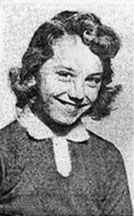
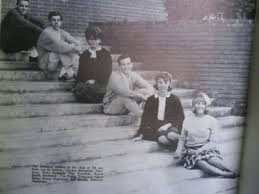


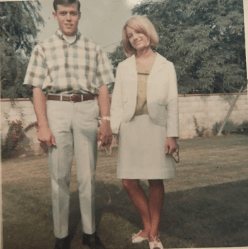

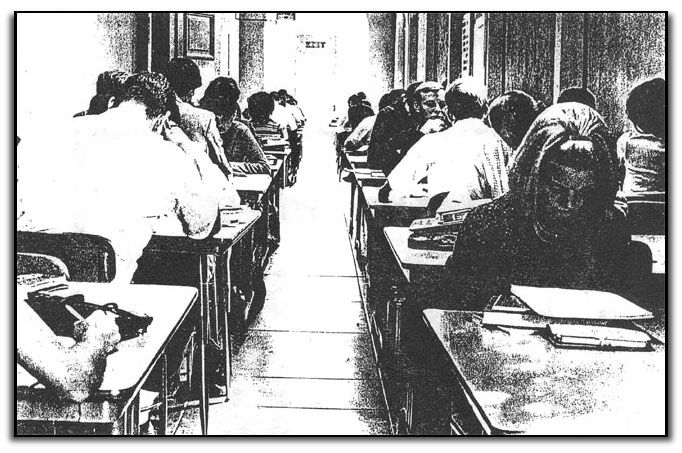



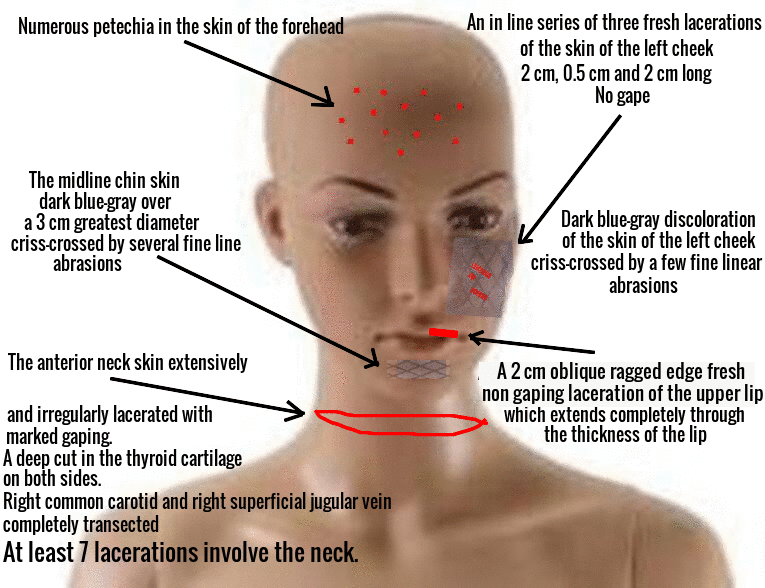
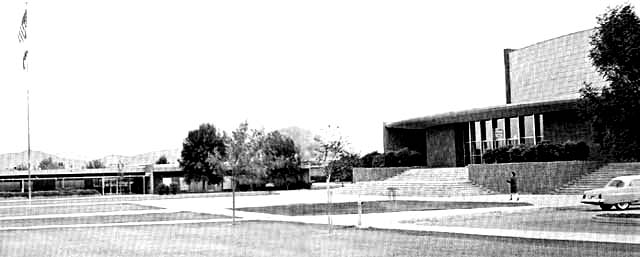

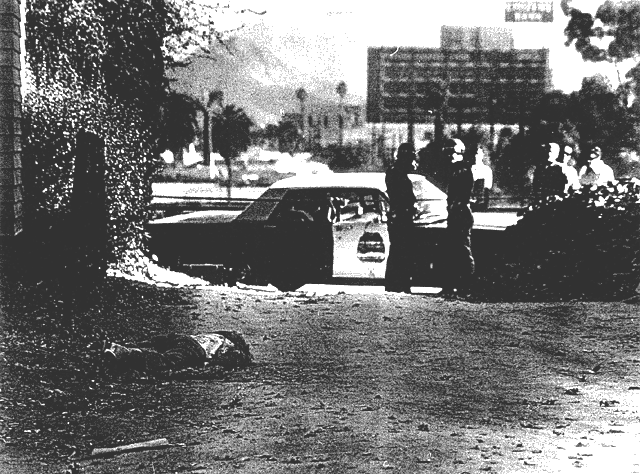


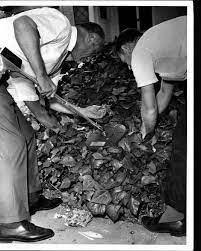
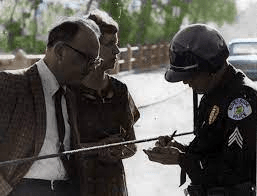


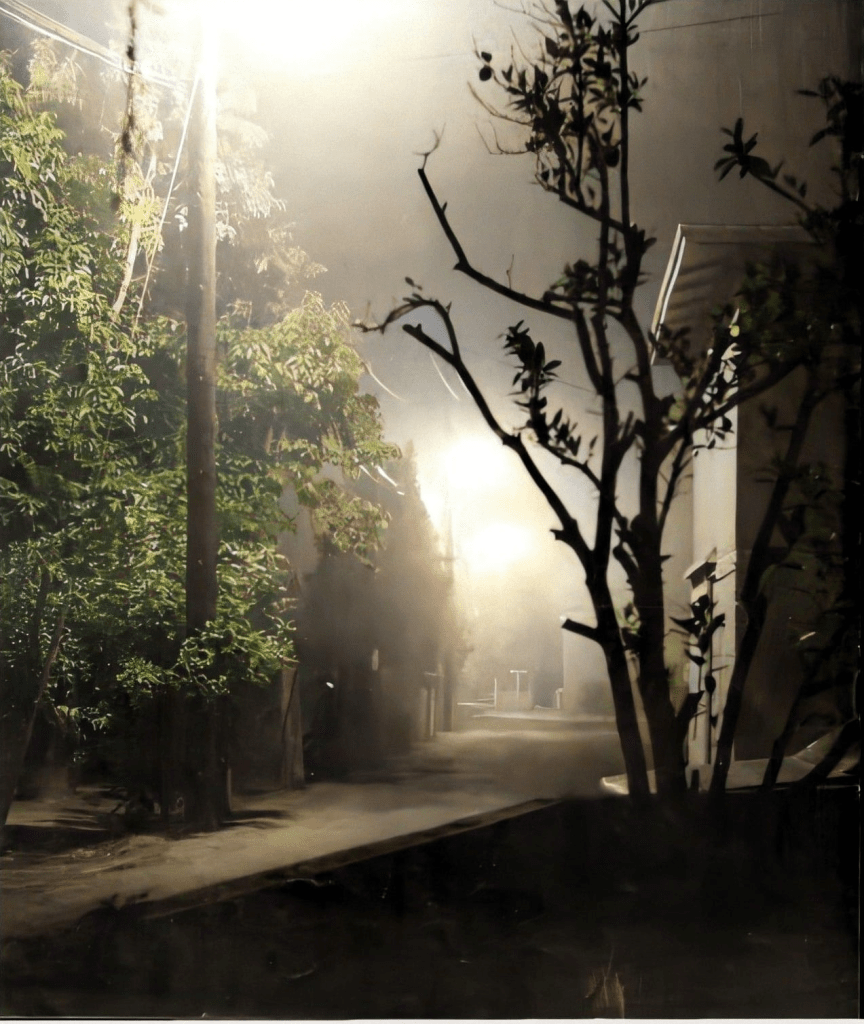
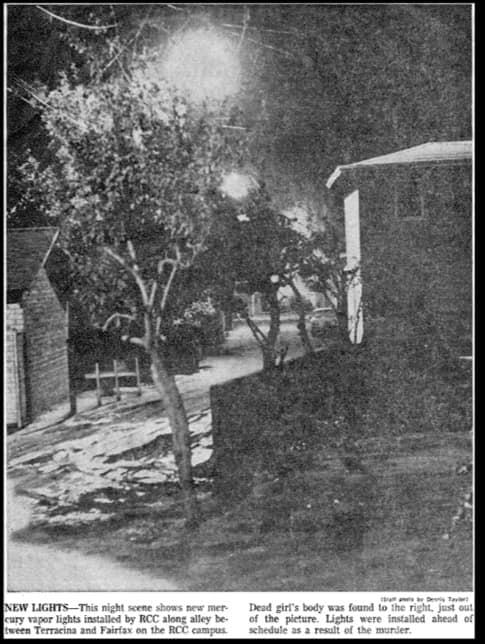

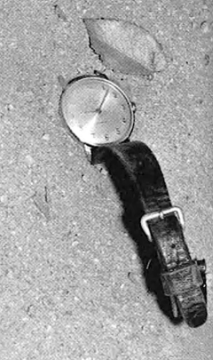
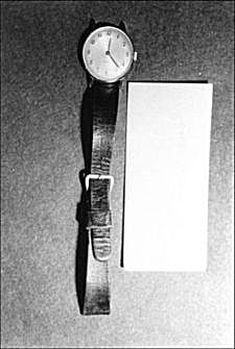


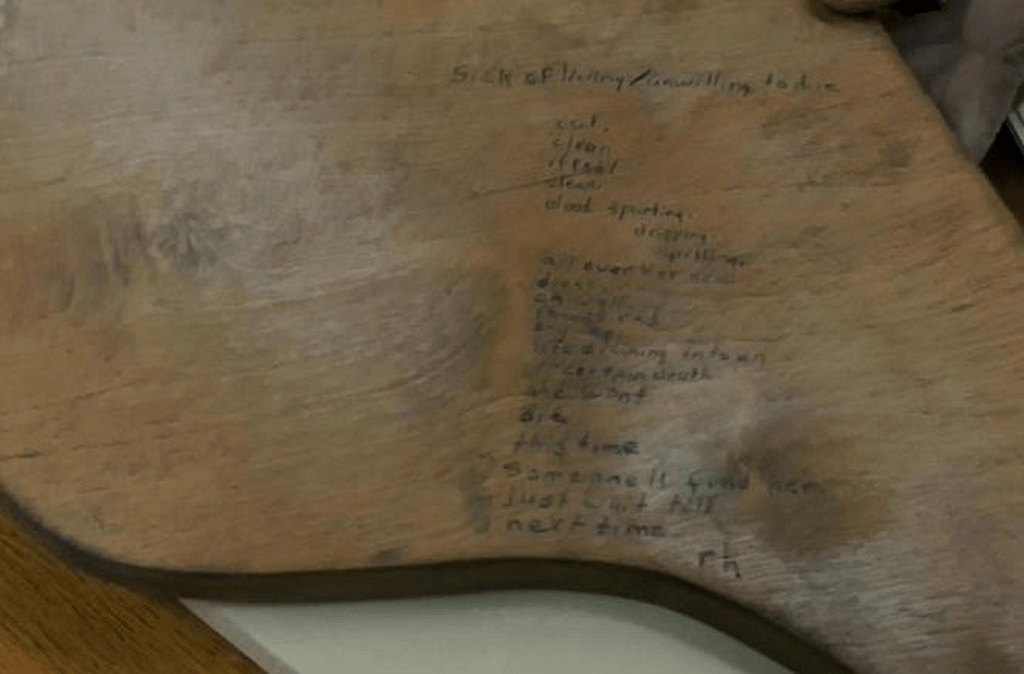


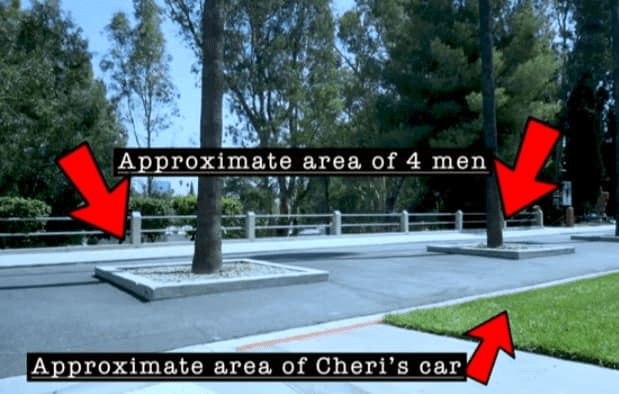
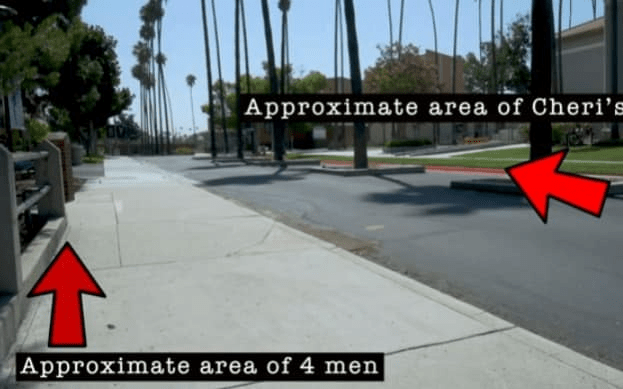
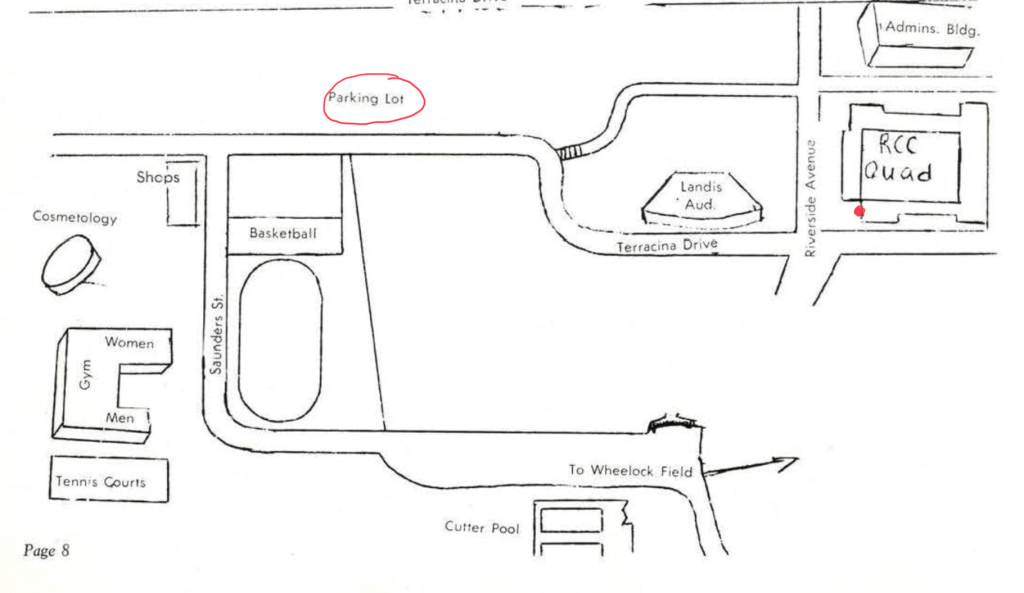

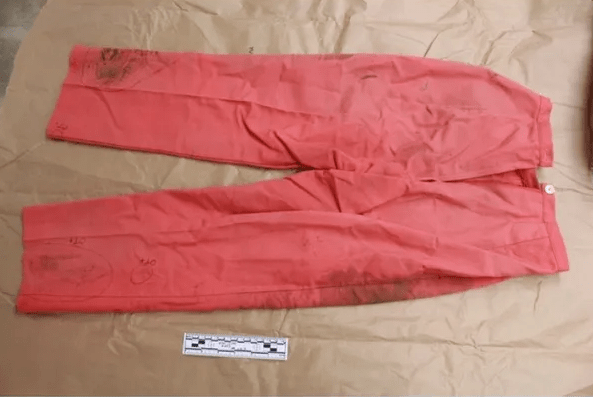
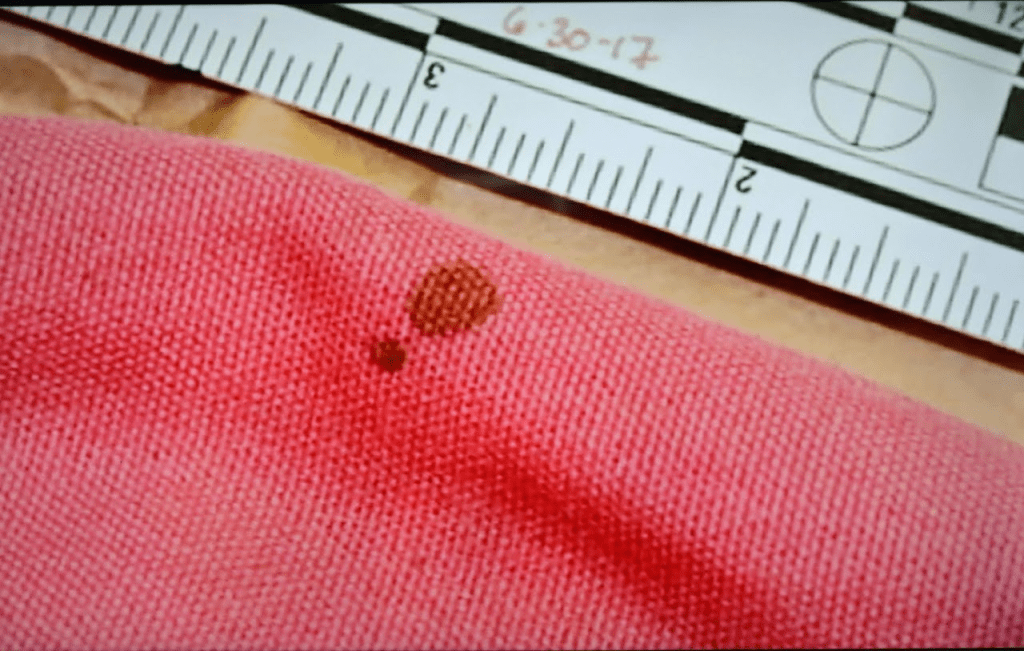


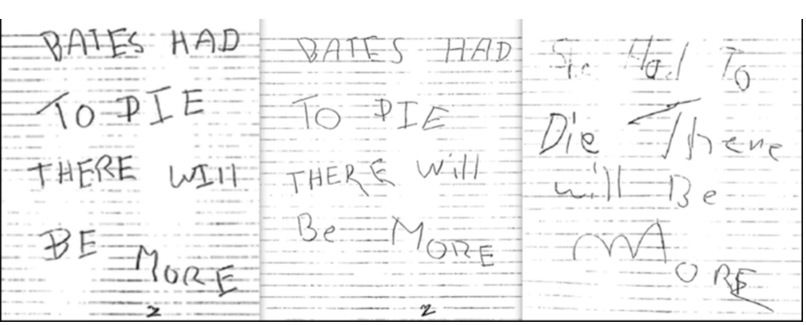
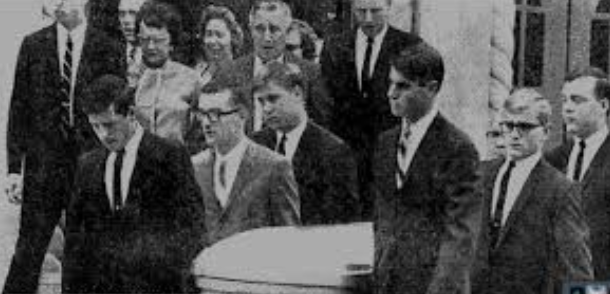




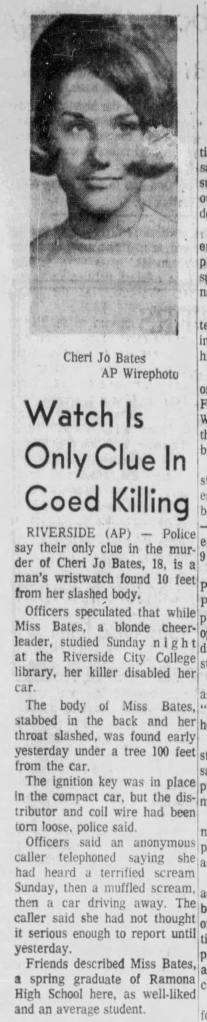
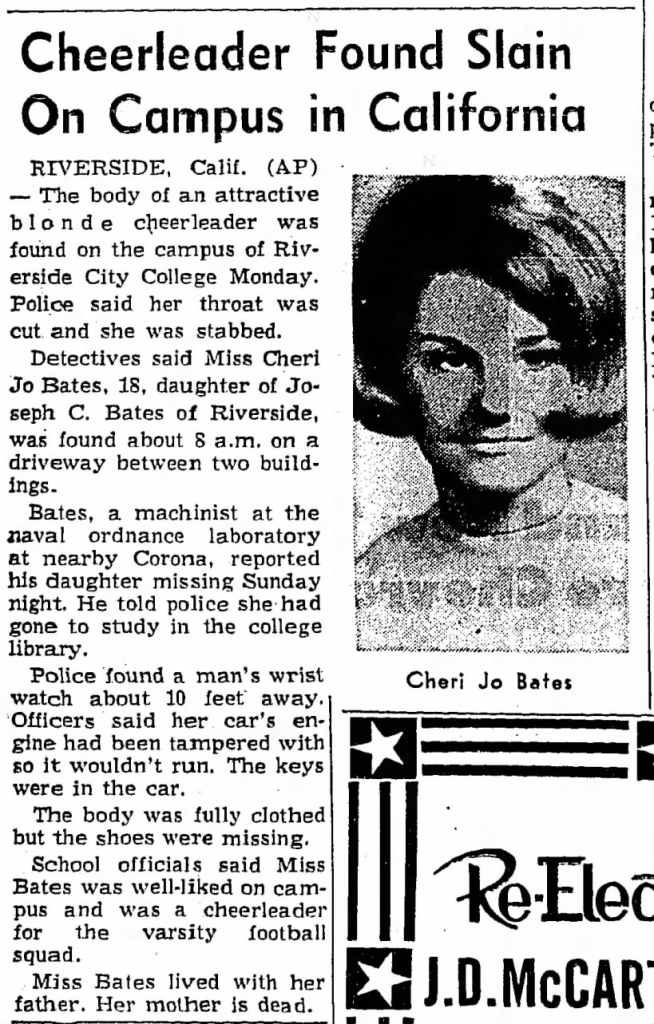

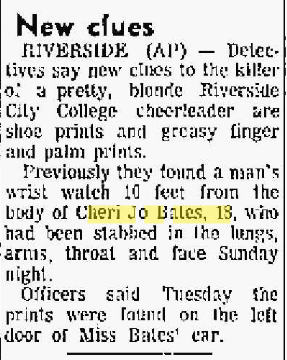
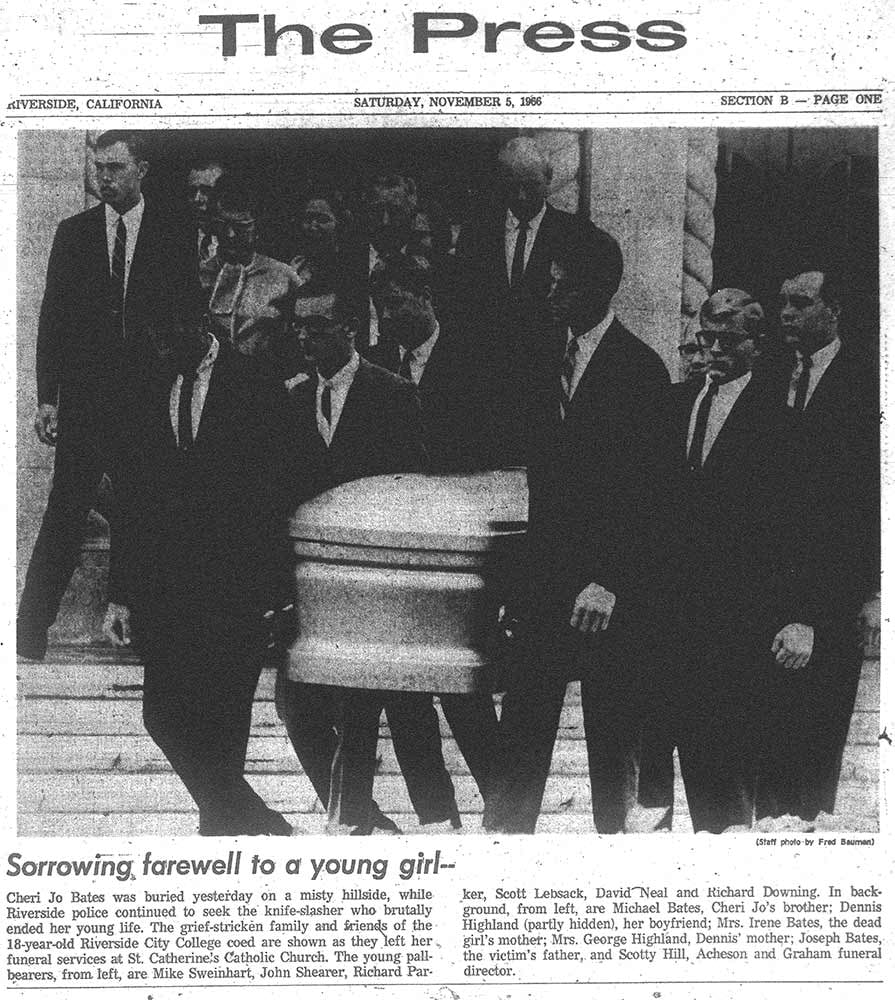
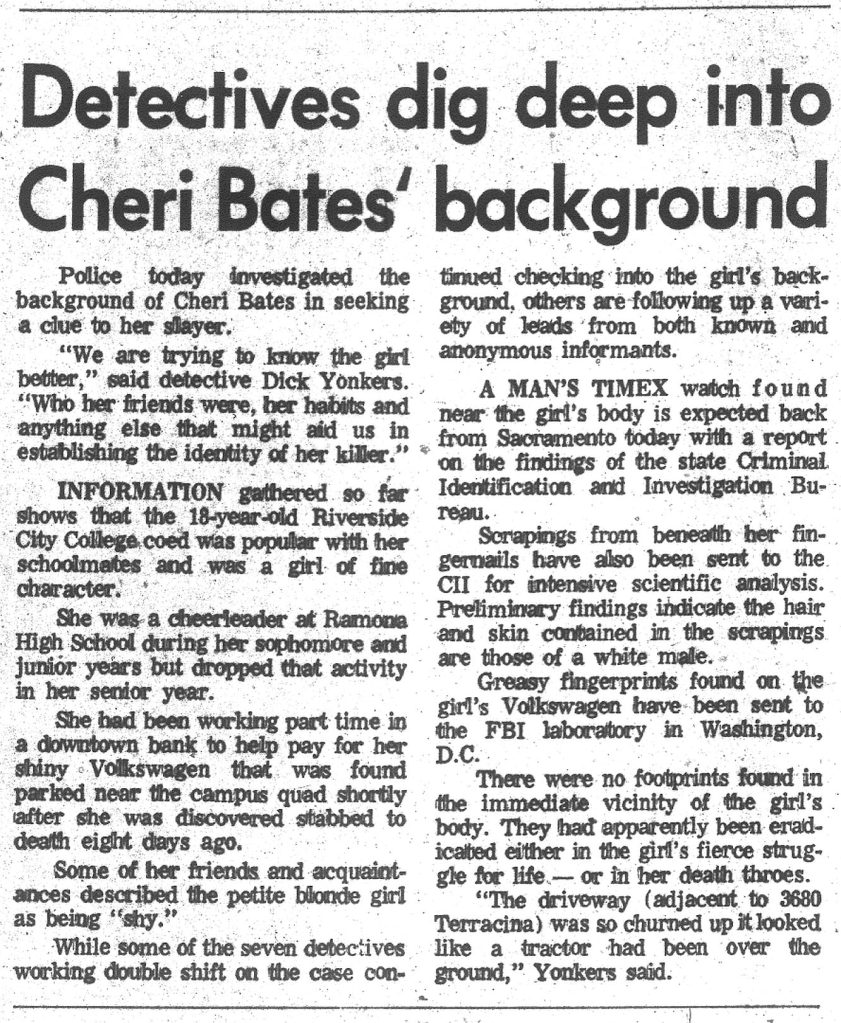


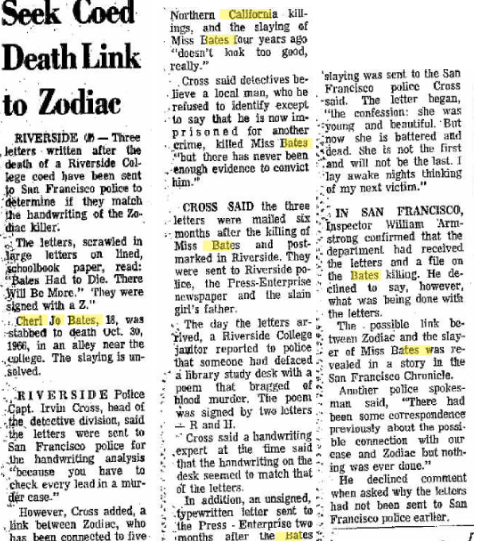
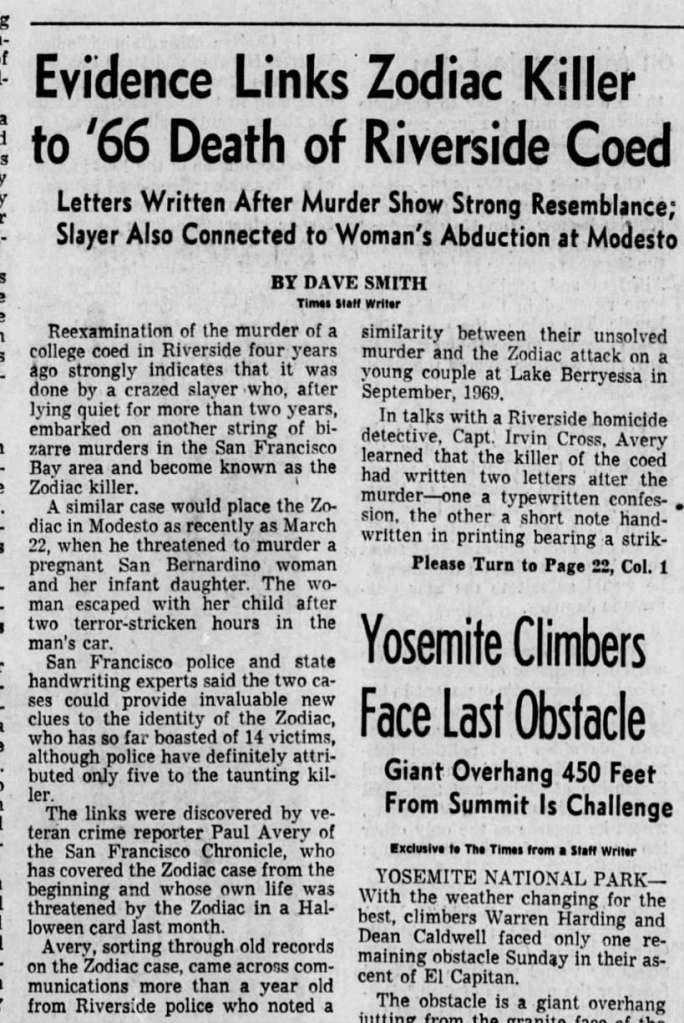


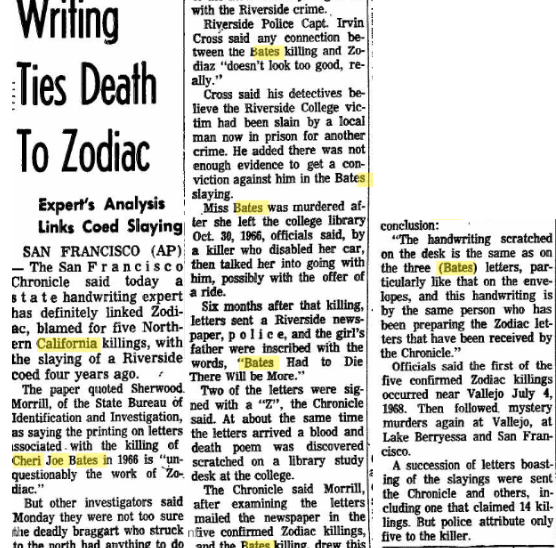
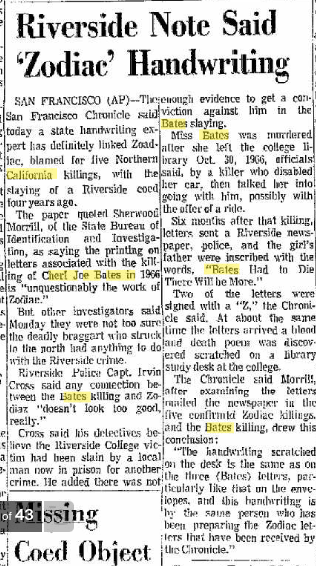
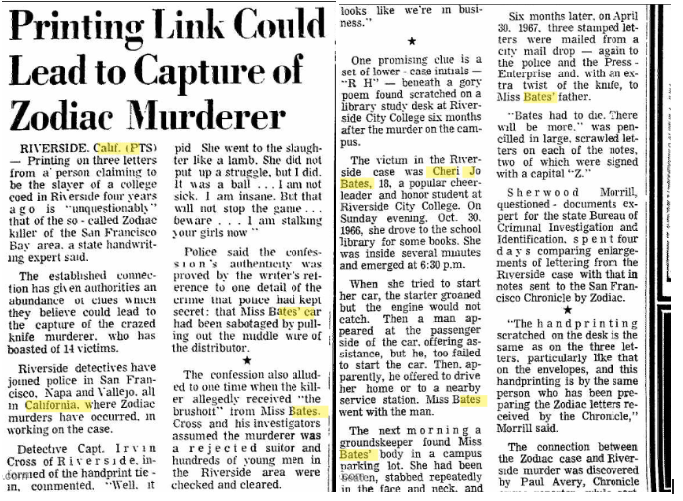


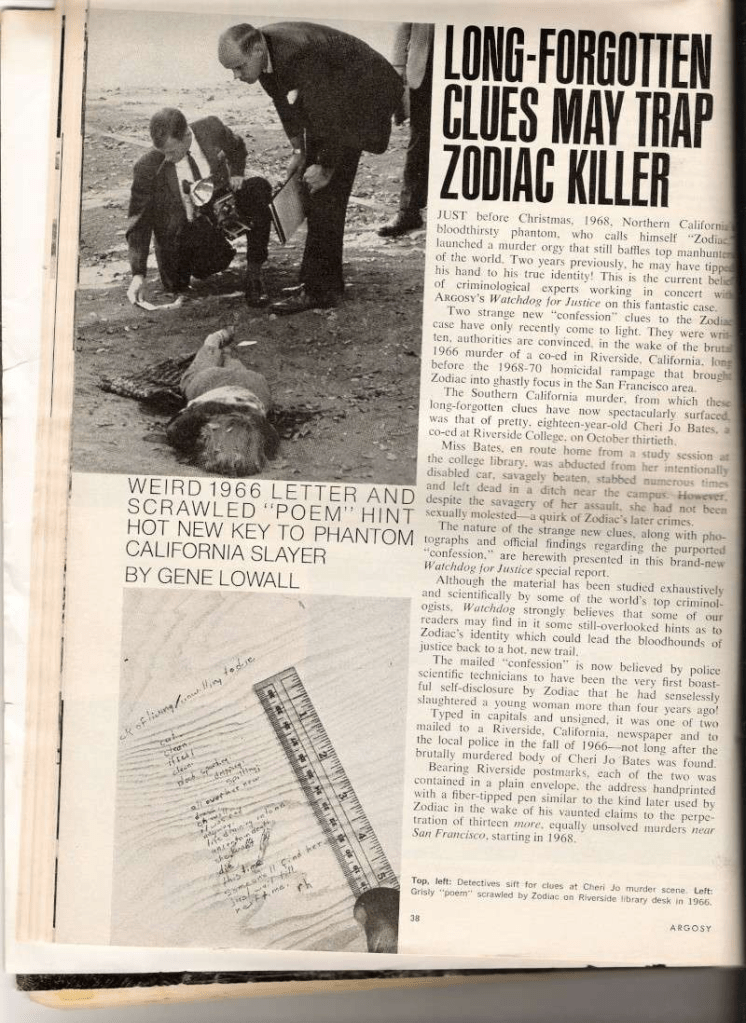


on March 16, 1971.
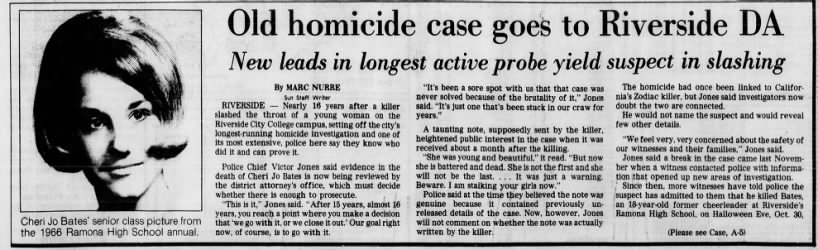

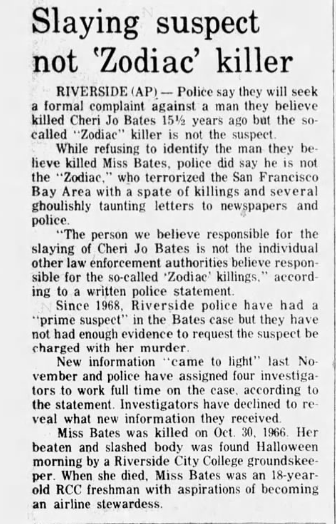
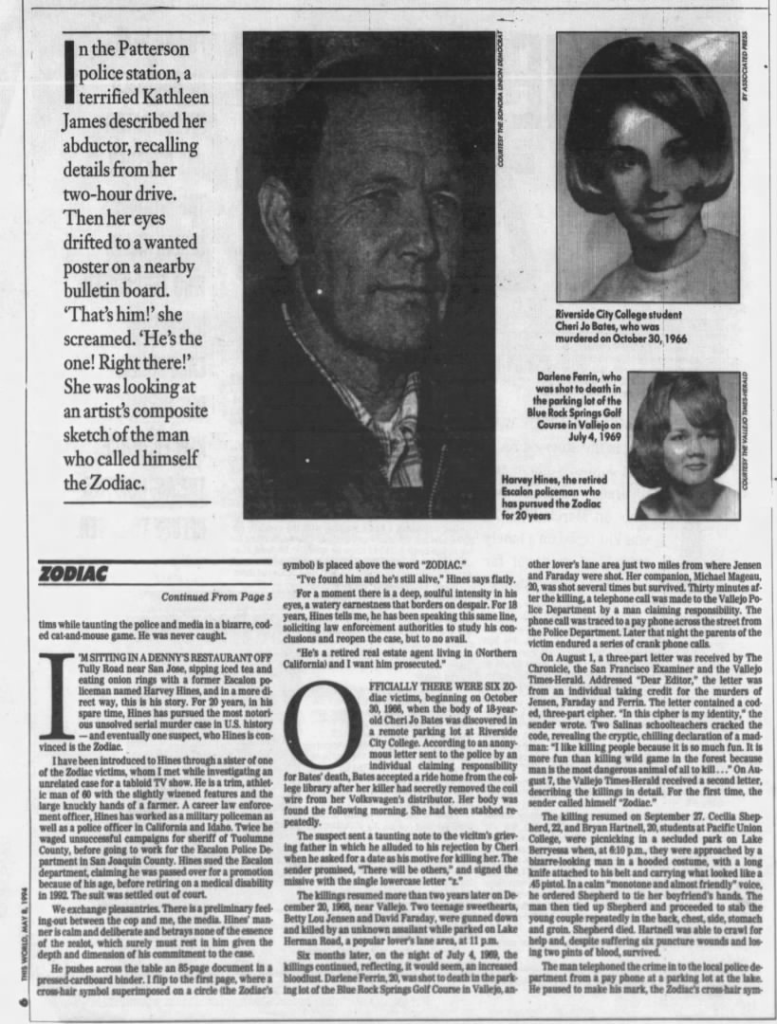
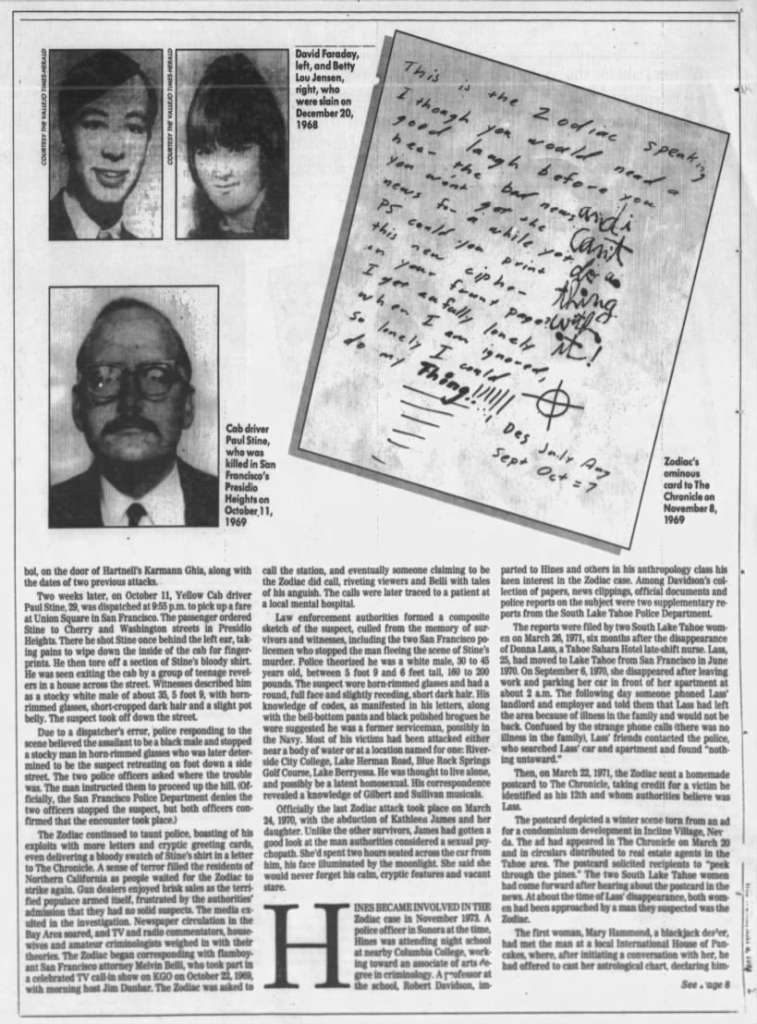
on May 8, 1994.

on May 8, 1994.
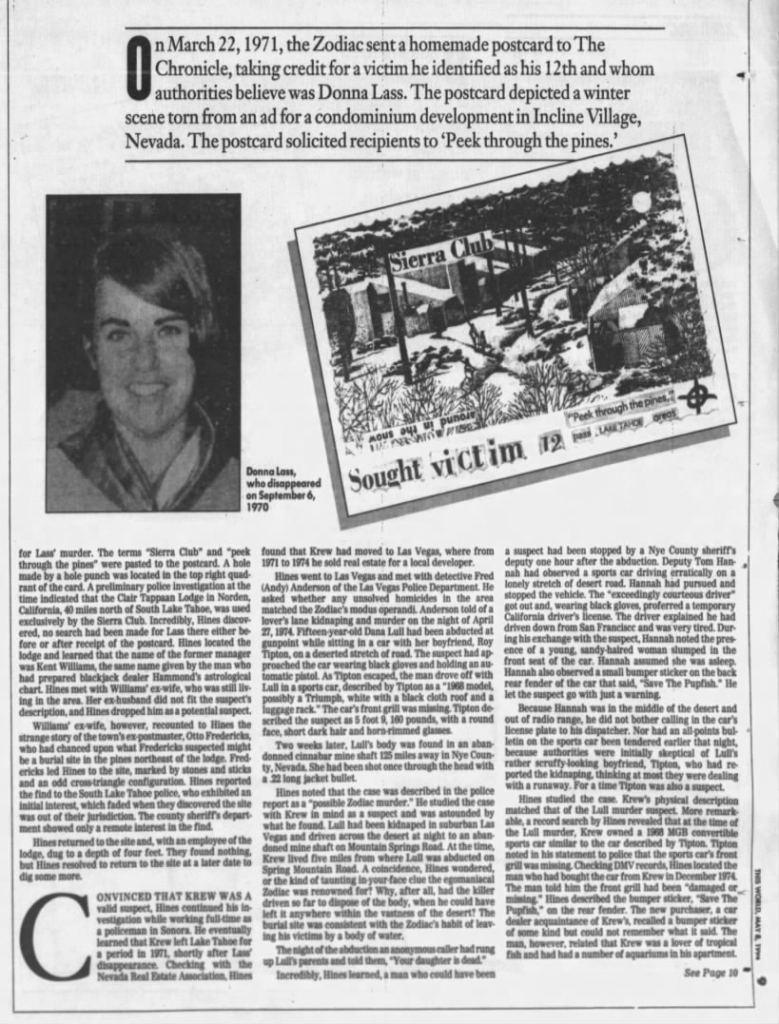
on May 8, 1994.

on May 8, 1994.
on September 27, 1999.
on September 27, 1999.

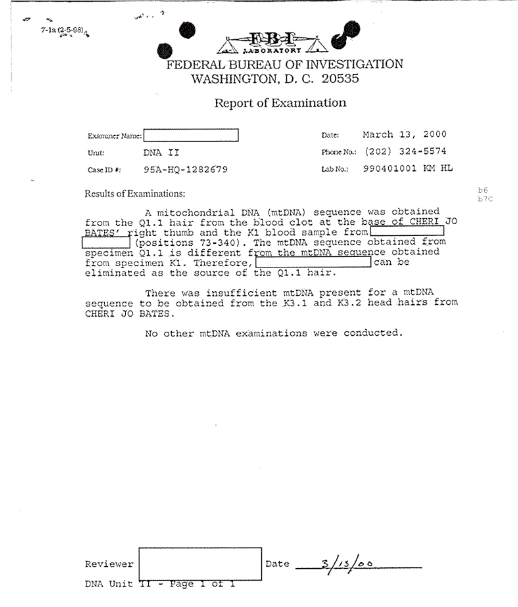
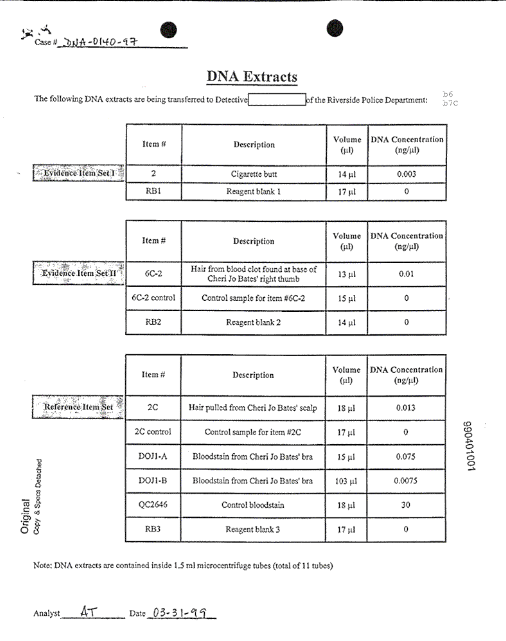
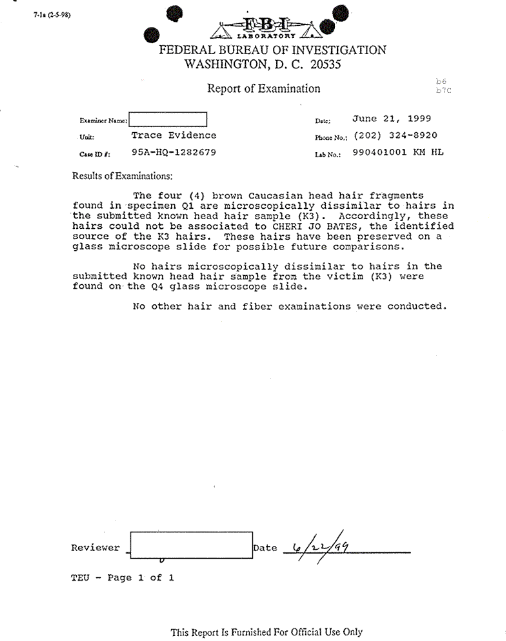

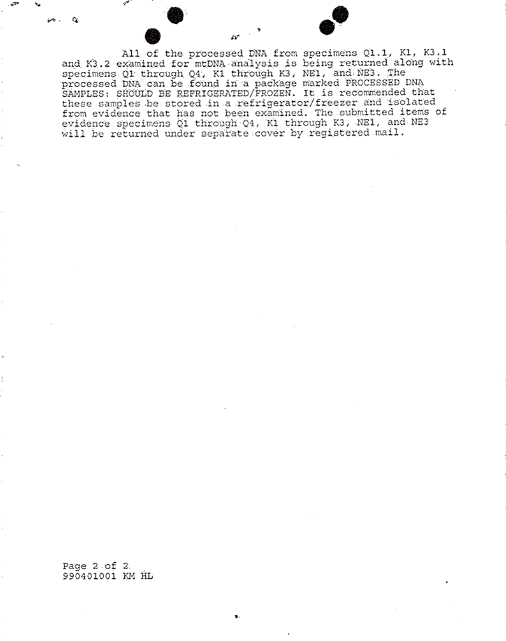


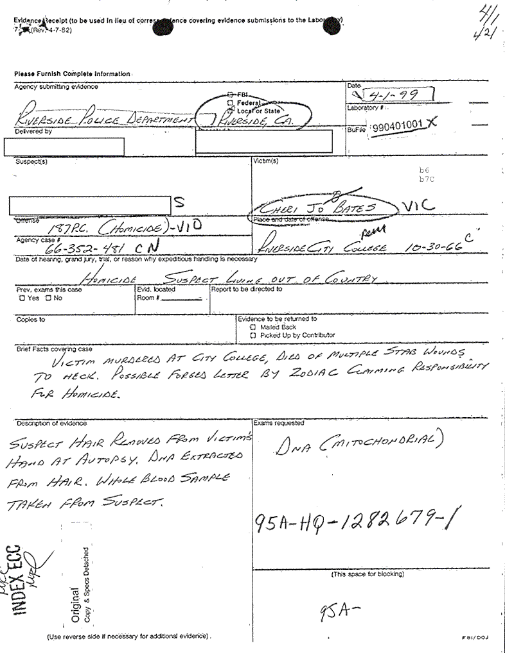

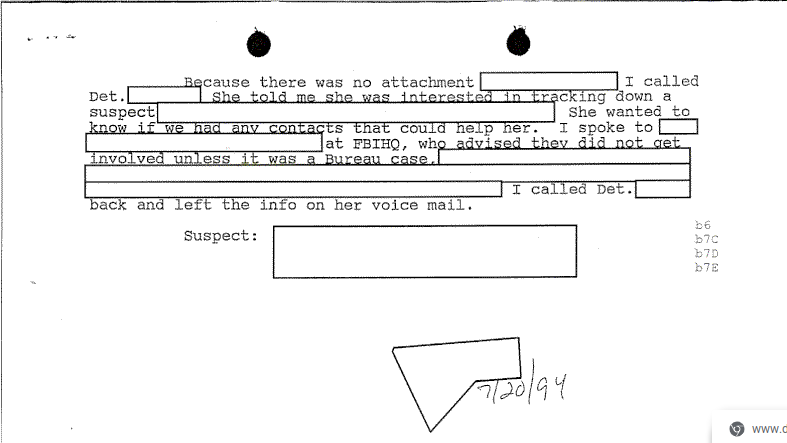

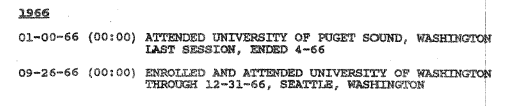
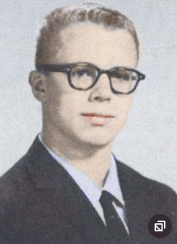

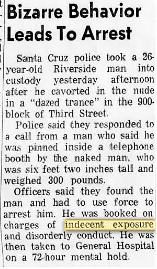
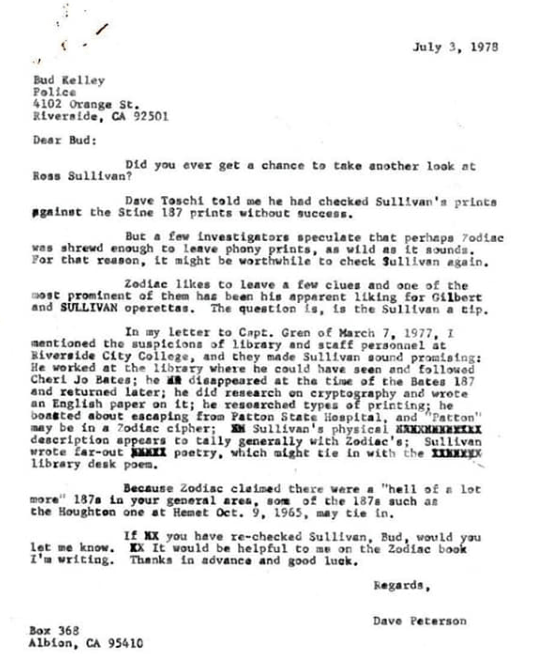


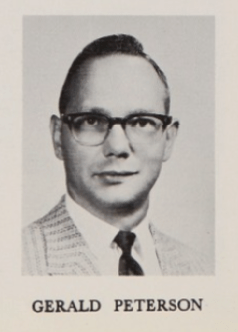




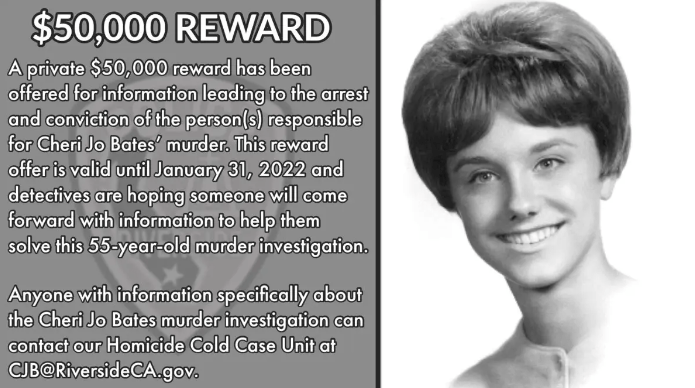
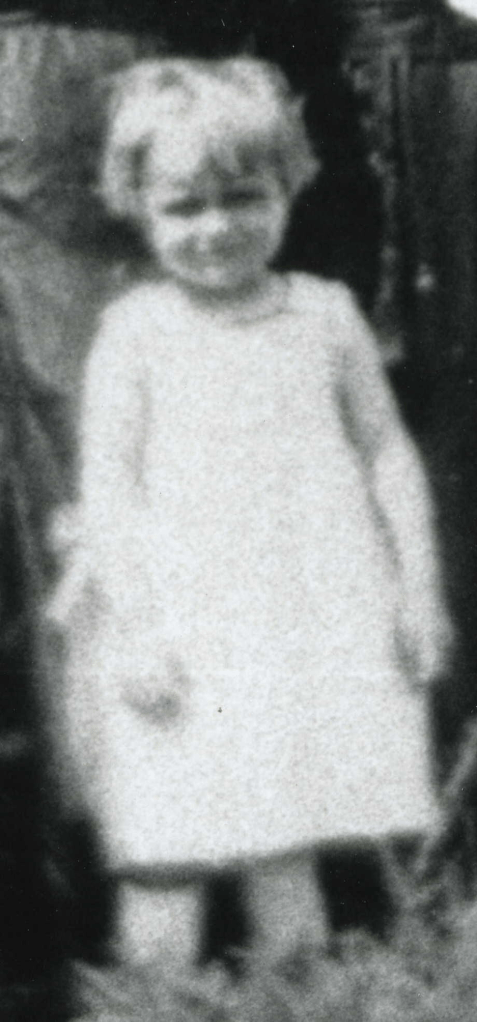
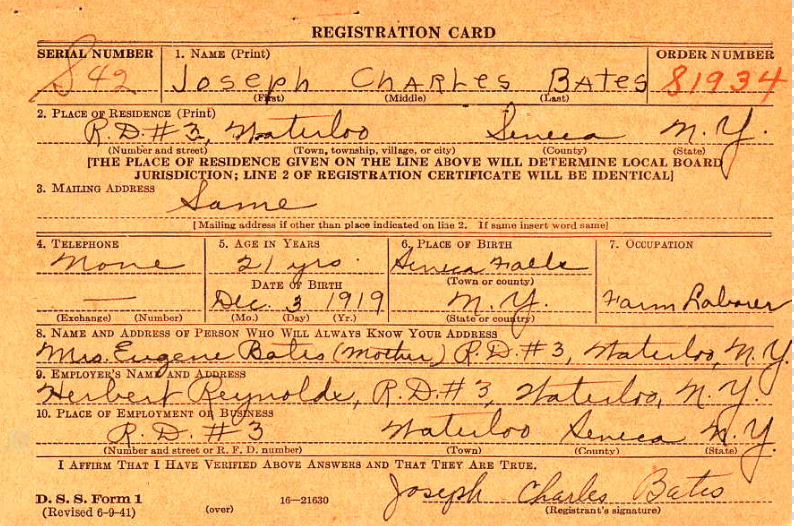
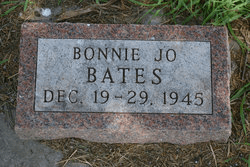
in Dante, SD.
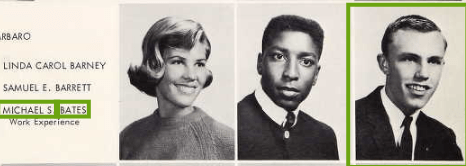
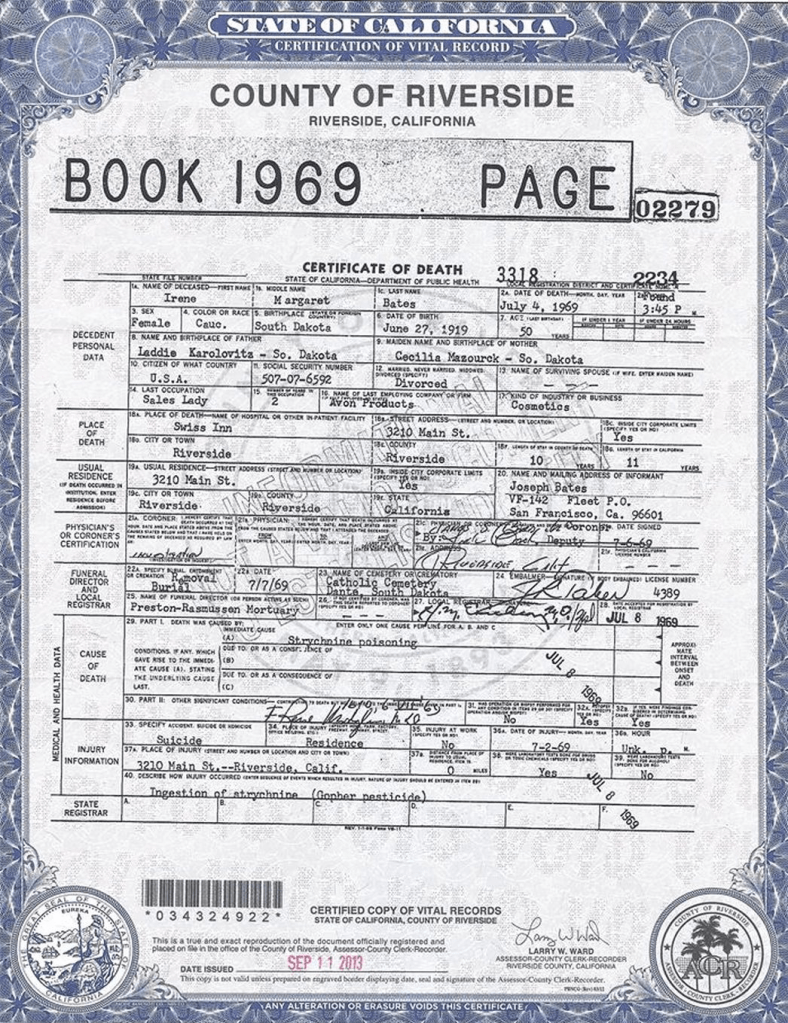



An article about Cheri Jo Bates from the magazine ‘Inside Detective.’
The following is an article about Cheri Jo Bates from the magazine ‘Inside Detective,’ published in January 1969 titled, ‘Your Daughter May be Next.’
 Another Bundy Blog.