Kathleen Clara D’Olivo.

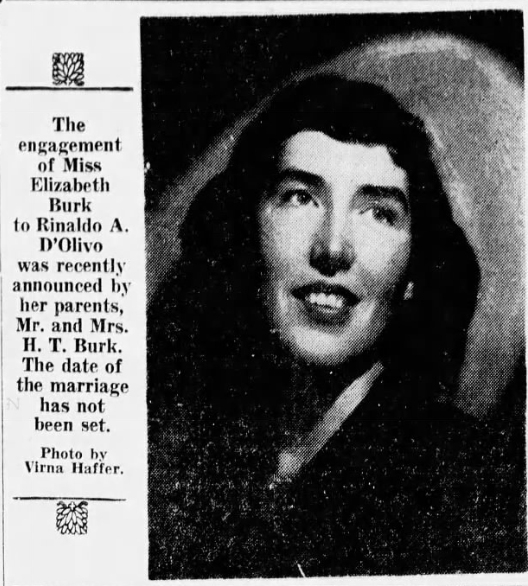
This is the second in a series about young women that were encountered by Ted Bundy on the Central Washington University campus in April 1974: Kathleen Clara D’Olivo was born on October 8, 1952 to Rinaldo and Elizabeth (nee Burk) D’Olivo in Tacoma WA. Rinaldo Anthony ‘Buzz’ D’Olivo was born on January 13, 1928 in Tacoma, and after graduating from Bellarmine Prep he served in the military during WWII; upon returning home he enrolled at Gonzaga University as a marketing major, and in 1974 he founded the company ‘Humdinger Fireworks.’ Kathy’s mother Elizabeth ‘Betty Ann Burk was born on May 9, 1930 in Clare, Iowa. The couple were married on August 26, 1950 and went on to have three children together: Kathy, Douglas (b. 1954), and Rinaldo (b. 1956).

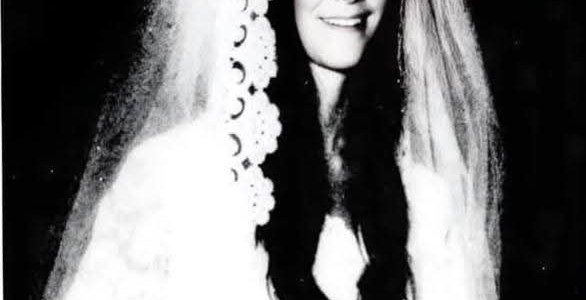
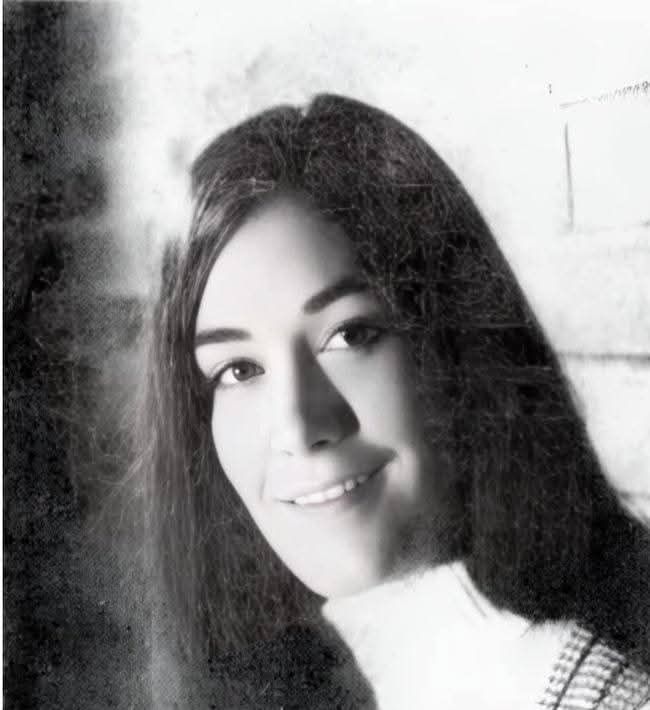
 A traditional Italian beauty, Kathy was tall and slim, and stood at 5′ 9.5″ and weighed 125 pounds; she had hazel eyes and dark brown hair she wore long and parted down the middle. At the time of her encounter, she was living with a roommate in unit #21 at the Knissen Village Apartments located on 14th and ‘B’ Street.

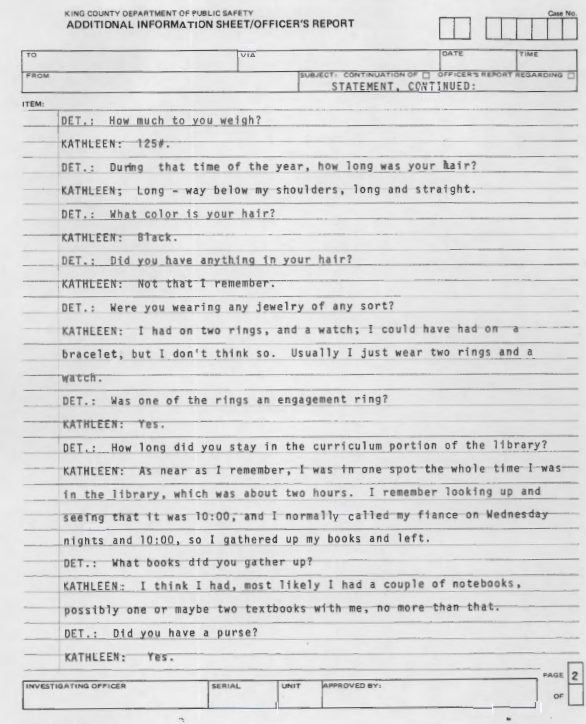
On the evening of Wednesday, April 17, 1974, twenty-one-year-old D’Olivo dropped her roommate off near downtown Ellensburg and drove to CWU’s campus, arriving just after 8:00 PM; she parked her car in the lot next to the Hertz Music Hall (located kitty corner to the library) and went into the main entrance of the Bouillon Library. In an interview with Detective Robert Keppel of the King County Sheriff’s Department on March 1, 1975, Kathleen said that ‘it was a clear night. I don’t remember it being extremely cold or extremely warm.’ She also stated that she was certain she was wearing blue jeans but wasn’t 100% sure of the top she had on, however she thinks it was most likely a blazer. Kathy was wearing two rings (one of them being her engagement ring) and said that she may have also been wearing a bracelet; at the time she was using a navy-blue cross-body purse.

Kathy stayed on the second floor of the library until around 10 PM, studying in an area known as the curriculum laboratory (don’t forget this location, I’m going to bring it up again later). But when she saw the clock nearing 10, she began gathering up her things, as it was time to head home and call her fiancé (a ritual she did every Wednesday at the same time). D’Olivo left the library same way she came in: through the front entrance. She then made a quick right and stepped off the concrete path and began making her way across the grass.

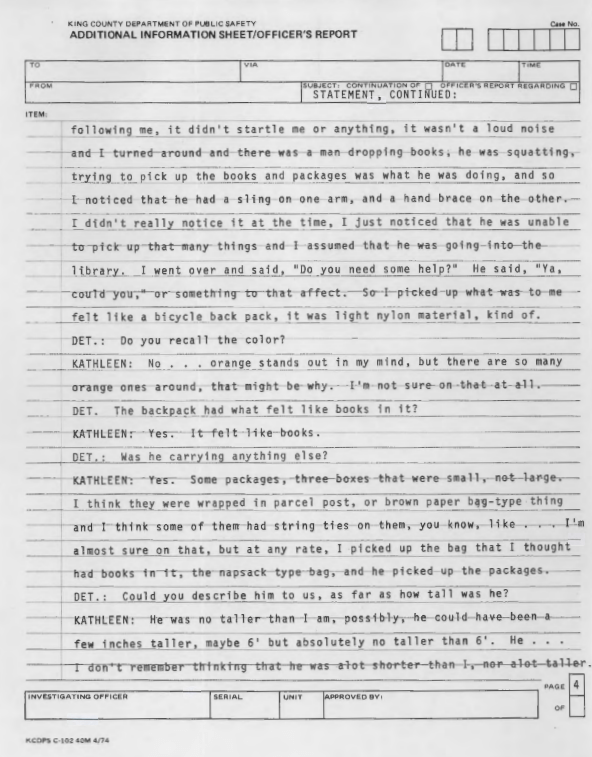
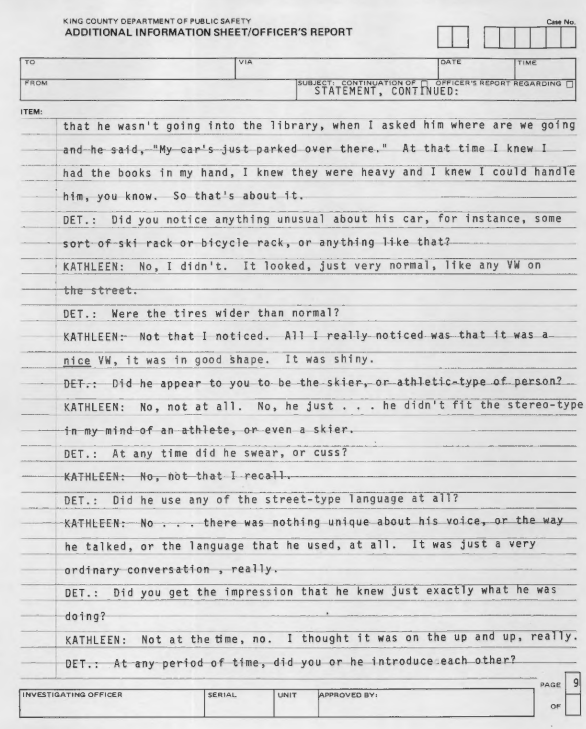
D’Olivo said that she ‘hadn’t quite gotten off the lawn, or sidewalk (wherever I was, I hadn’t reached the main mall stretch) when I heard something behind me. It sounded like something following me, it didn’t startle me or anything, it wasn’t a loud noise and I turned around and there was a man dropping books, he was squatting, trying to pick up the books and packages was what he was doing and so I noticed that he had a sling on one arm, and a hand brace on the other. I didn’t really notice it at the time, I just noticed that he was unable to pick up that many things and I assumed that he was going into the library. I went over and said, ‘do you need help?’ He said, ‘Ya, could you?,’ or something to that affect. So I picked up what to me felt like a bicycle backpack, it was nylon material, kind of.’ Kathy later clarified that he had his right arm in a sling but had metal braces on fingers of both hands, specifically the type that were used on broken fingers.

Kathleen told Detective Keppel that she wasn’t sure what was in the backpack, but it felt like books, and he also had with him ‘some packages, three boxes that were small, not large. I think they were wrapped in parcel post, or brown paper bag-type thing and I think some of them had string ties on them, you know, like… I’m almost sure on that, but at any rate, I picked up the bag that I thought had books in it, the knapsack type bag, and he picked up the packages.’

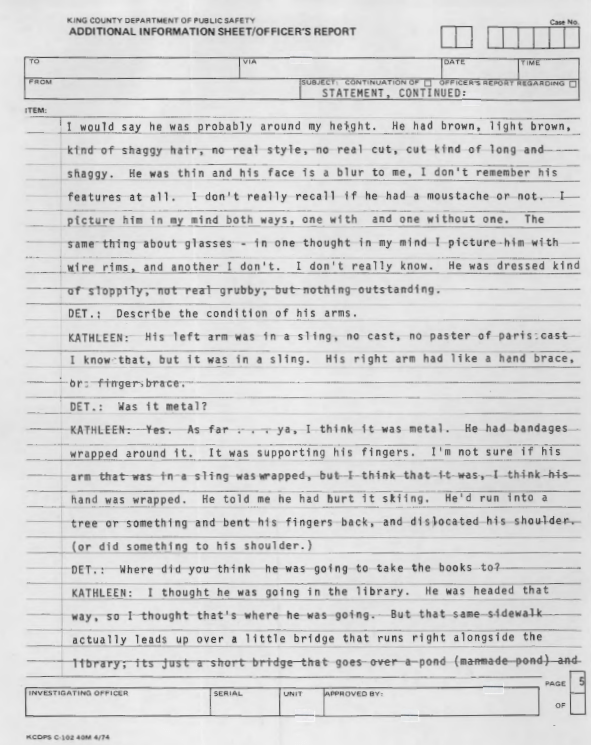
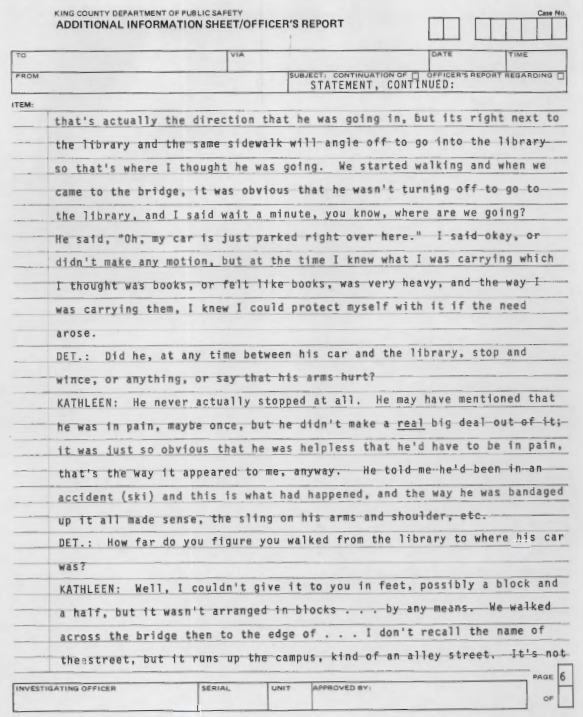
When Detective Keppel asked Kathy where she thought he was taking her as they began their walk, she replied ‘I thought he was going in the library. He was headed that way, so I thought that’s where he was going. But that same sidewalk actually leads up over a little bridge that runs alongside the library, it’s just  short bridge that goes over a pond (man-made pond) and that’s actually the direction that he was going in, but its right next to the library and the same sidewalk will angle off to go into the library so that’s where I thought he was going. We started walking and when we came to the bridge, it was obvious that he wasn’t turning off to go to the library, and I said wait a minute, you know, where are we going? He said, ‘oh my car is just parked right over here.‘ I said okay, or didn’t make any motion, but at the same time I know what I was carrying which I thought was books, or felt like books, was very heavy, and the way I was carrying them, I knew I could protect myself with it if the need arose.’

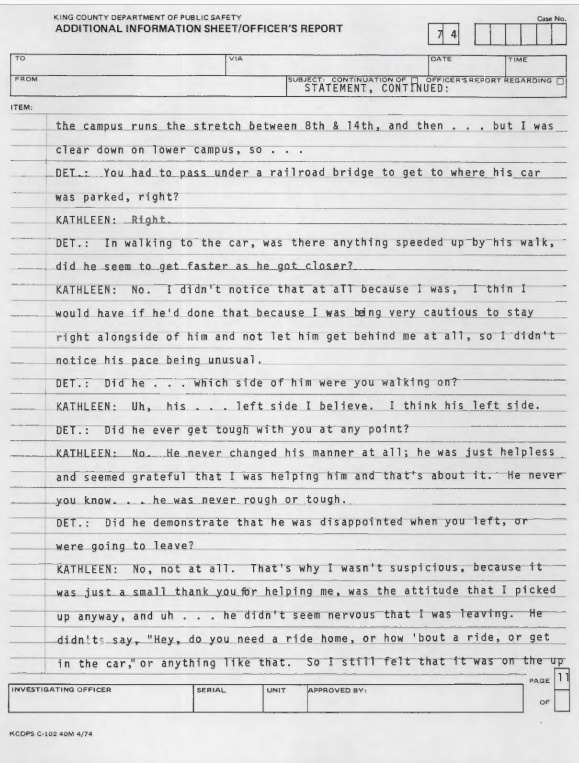
But instead of continuing on the pathway to the Library, the man started walking across the bridge, which immediately threw up a red flag for D’Olivo, and she said to him, ‘well, wait a minute, were are you going?’ He said, ‘well my cars just over here.’ I said, ‘okay,’ so we started walking across the bridge and we were maybe a quarter the way across the bridge and he began telling me about his ski injuries and that conversation took us up to by the other side of the bridge and a little ways beyond that, and then I asked him again, ‘well, where’s your car?’ I expected it to be parked on the street that’s right behind the library. He said, ‘oh, its just right here.’ Then we walked under the trestle to the right there, and it was just barely down that dark stretch.’ She said at that time she ‘assessed the situation,’ and said she ‘was extremely cautious while with him. I never gave him the opportunity of walking behind me.’

When Detective Keppel asked Kathleen what the man looked like, she said he ‘was no taller than I am, possibly, he could have been a few inches taller, maybe 6’ but absolutely not taller than 6’… I don’t remember thinking that he was a lot shorter than I, nor a lot taller. I would say he was probably around my height. He had brown, light brown kind of shaggy hair, no real style, no real cut, cut kind of long and shaggy. He was thin and his face is a blur to me. I don’t remember his features at all. I don’t really recall if he had a mustache or not. I picture him in my mind both ways, one with and without one. The same thing about glasses: in one thought in my mind, I picture him with wire rims, and another I don’t. I don’t really know. He was dressed kind of sloppily, not real grubby, but nothing outstanding.’ 

When asked about the condition of his arms, D’Olivo said ‘his left arm was in a sling, no cast, no plaster of Paris cast I know that, but it was in a sling. His right arm had like a hard brace, or finger brace.’ … ‘I think it was metal. He had bandages wrapped around it. It was supporting his fingers. I’m not sure if his arm that was in a sling was wrapped, but I think that it was. He told me that he had hurt it skiing. He’d run into a tree or something and bent his fingers back, and dislocated his shoulder (or did something to his shoulder).’ She clarified that he did not tell her where the accident happened.

When Keppel asked her if the man ever showed signs of being in any sort of pain from his injury, D’Olivo said that ‘he may have mentioned that he was in pain, maybe once, but he didn’t make a real big deal out of it; it was just so obvious that he was helpless that he’d have to be in pain, that’s the way it appeared to me, anyway. He told me that he’d been in an accident (ski) and this is what happened, and the way he was bandaged up it all made sense, the sling on his arms and shoulder, etc.’

Additionally, she recalled that he was soft spoken, and was dressed ‘sloppily, not real grubby, but nothing outstanding,’ and may have worn jeans with a wrinkled shirt, with ‘the tail hanging out.’ When asked if she recalled what the man was wearing, and if he had on for instance a short or jacket she said, ‘it seems to me that he had a shirt on, like a sport shirt, it was very sloppy or wrinkly looking. It seems to me he had a shirt-tail hanging out. I mean, intentionally hanging out, wearing it on the other side of his pants. I don’t remember what type of pants he had on, just all-around kind of grubby, like jeans or something like that.’

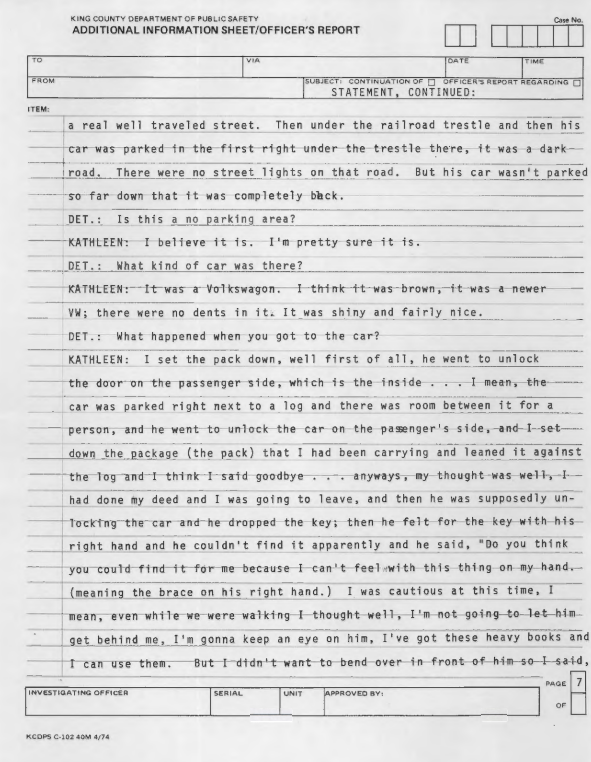
Kathy said that the strangers car was parked on 10th Street, and as they got closer to it she noticed that it was a ‘no parking’ area on the outskirts of campus and was in a secluded, dimly lit area that was ‘not well travelled.’ During their walk, D’Olivo said he talked about how much pain he w as in, and as they went under the railroad trestle, she said that she could vaguely make out the shape of a VW Bug in the distance that was parked to the right of the large trestle: ‘it was a dark road. There were no streetlights on that road … but it wasn’t completely black.’ This would make sense, as the only light available to them was from the library and an adjacent building, both of which were a fair distance away.’

When they got to the car, Kathy said that she ‘set the pack down, well first of all, he went to unlock the door on the passenger side, which is the inside… I mean, the car was parked right next to a log and there was room between it for a person, and he went to unlock the car on the passengers side, and I set down the package (the pack) that I had been carrying and leaned it against the log and I think I said goodbye… anyways, my thought was well, I had done my deed and I was going to leave, and then he was supposedly unlocking the car and he dropped the key; then he felt for the key with his right hand and he couldn’t find it apparently and he said, ‘do you think you could find it for me because I can’t feel with this thing on my hand (meaning the brace on his right hand. I was cautious this time, I mean, even while we were walking I thought well, I’m not going to let him get behind me, I’m going to keep an eye on him, I’ve got these heavy books and I can use them. But I didn’t want to bend over in front of him so I said, lets step back and see if we can see the reflection in the light, so we stepped behind the car, kind of behind the car to the side, and I squatted down and luckily I did see the reflection of the key in the light so I picked up the key and dropped them in his hand and I said goodbye and good luck, or something with your arms, or something to that effect, and that was the end of the conversation.’ She also said that the lack of light made the VW appear shiny and brown in color and that it appeared to be in good shape (which we know isn’t exactly true), and as far as Kathy could remember it did not have a ski rack on top of it.

When Detective Keppel asked D’Olivo if she thought the man’s intentions were sincere, she told him, ‘yes, I did… Ya, and I thought he was just going into the library, it was just a short distance and her really did need help and I thought I could help him.’ She also said that nothing seemed unusual about his car when she was asked, and about it said: ‘it looked, just very normal, like any VW on the street.’ … ‘All I really noticed was that it was a nice VW, it was in good shape. And it was shiny.’

When Detective Keppel asked Kathy if she happened to notice if the VW’s front seat was missing on the passengers side, she replied that she ‘left before he opened the car. I didn’t notice it and I was right alongside the car on the passengers side. I think I would have if there had been a seat missing, but I can’t be certain on that, but it seemed all intact to me and in good shape.’ Like Jane Curtis, she said that the car had no particular odor associated with it, like cigarettes or marijuana smoke. 

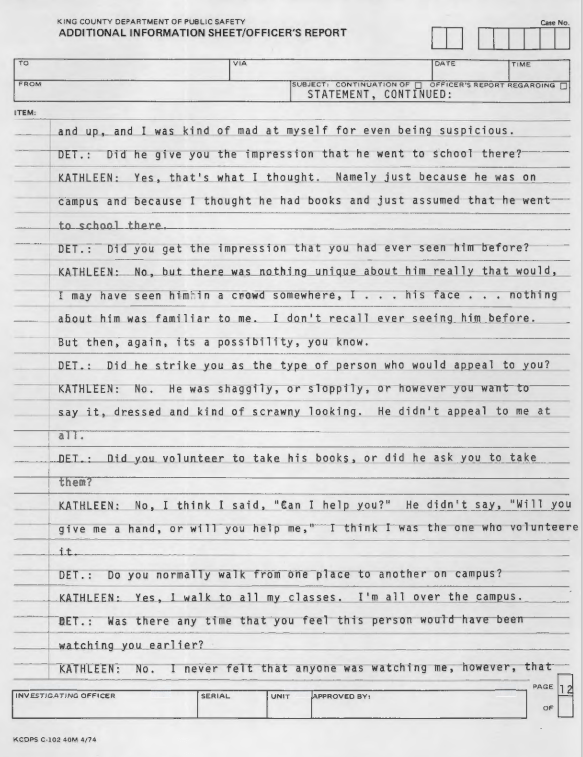
When asked if the man seemed disappointed when she left him, Kathleen said, ‘no, not at all. That’s why I wasn’t suspicious, because it was just a small thank you for helping me, was the attitude that I picked up anyway, and uh… he didn’t seem nervous that I was leaving. He didn’t say, ‘hey, do you need a ride home’ or ‘how ’bout a ride? or get in the car,’ or anything like that. So I still felt that it was on the up and up, and I was kind of mad at myself for even being suspicious.’ When asked if she remembered seeing him around campus (before and after the incident), she said: ‘there was nothing unique about him really that would. I may have seen him in a crows somewhere… I… his face… nothing about him was familiar to me. I don’t recall ever seeing him before.’ Kathleen also said that he was not ‘very appealing’ to her, and ‘he was shaggily, or sloppily, or however you want to say it, dressed and kind of scrawny looking. He didn’t appeal to me at all.’ Ms. D’Olivo further clarified that the stranger was not clean cut nor a hippy, but was ‘kind of weird looking, and when asked if he appeared to be athletic, she replied, ‘no, not at all. No, he just… he didn’t fit the stereotype in my mind of an athlete, or even a skier.’

Another young woman that may have had an encounter with Ted Bundy on Central Washington University’s campus is Jane Marie Curtis: at first I believed Jane’s encounter took place earlier in the same evening that Sue Rancourt was abducted (because that’s the date that was given in everything I’ve read about her), but after reading her interview with Detective Keppel I learned it actually took place on a Sunday evening, most likely on April 14, 1974 or April 21, 1974. Like Kathleen, Curtis had been spending time at the Curriculum Lab at CWU and ‘ran into’ Bundy as she was walking out of the main entrance at the Bouillon Library. She said he used the same ruse that he did with D’Olivo: he had been in a skiing accident and needed help carrying some heavy books to his car, as his arm was in a (poorly made) sling. Like Kathy, Curtis was lucky and managed to leave Bundy alive.

Kathy D’Olivo and Jane Curtis were both able to escape with their lives, but unfortunately Susan Rancourt was not so fortunate: later in the evening on April 17, 1974 around 10/10:30 PM Bundy stumbled upon the pretty young Biology major as she left a meeting about becoming an RA the following school year. After the meeting she had plans to see a German film with a friend but she never made it, and it didn’t take long for her friends and family to become worried, and by 3:00 AM her roommate Diana Pitt called the dorm manager, saying: ‘I got worried she wasn’t back.’ Parts of Rancourt’s skeleton were discovered in Taylor Mountain in March 1975 after two forestry students uncovered multiple sets of human remains; after combing the area, the King County Sheriff’s Department discovered four skulls in total as well as an assortment of other human bones.

In addition to Sue Rancourt, forensic experts were able to determine that the remains belonged to University of Washington coed Lynda Ann Healy, University of Oregon student Roberta Parks, and twenty-two-year-old loner Brenda Carol Ball. Later in the same day that Sue’s skull was identified, the King County ME took X-rays of her skull and mailed them special delivery to her dentist in Alaska, who confirmed it was her. According to CWU’s Police Chief Al Pickles: ‘there were several points of identification that made us almost sure the skull was Rancourt’s. This switches the case from a missing person to a homicide.’

Elizabeth D’Olivo passed away at the age of sixty-eight on March 15, 1999 in Mexico. According to her obituary, Betty was a member of St. Charles Borromeo Church and her life revolved around her friends and family, and she especially loved her four grandchildren. Kathy’s father Rinaldo passed away at the age of eighty on November 22, 2008 in their winter home in San Carlos, Mexico. According to his obit, he continued working in his family’s fireworks company until his time of his death. Kathy’s brother Ron died at the age of fifty-four on March 10, 2011 after a prolonged battle with lung disease. Douglas D’Olivo is currently a seventy-one-year-old resident of University Place, WA. Kathleen and David are still married and reside in University Place, WA; they have two grown daughters together: Amy and Emily.
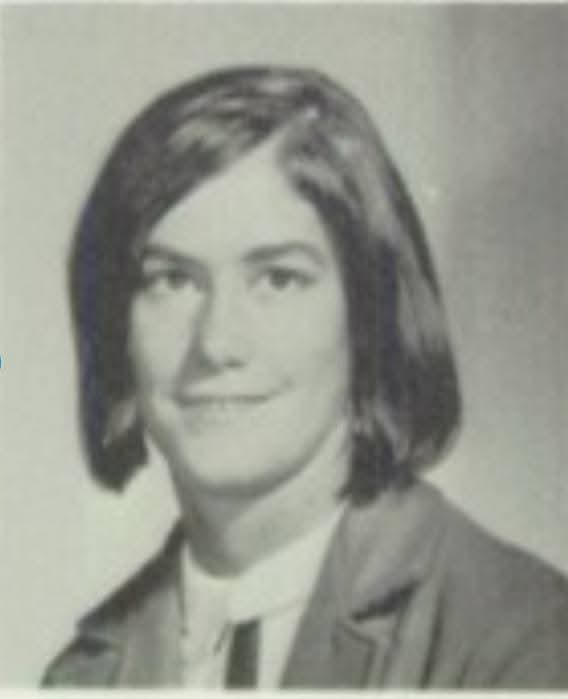
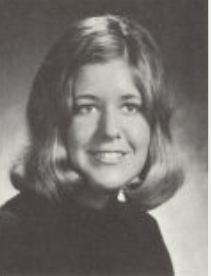
Kathy D’Olivo’s junior year picture from the 1971 Aquinas Academy yearbook.
Kathy Clara D’Olivo.
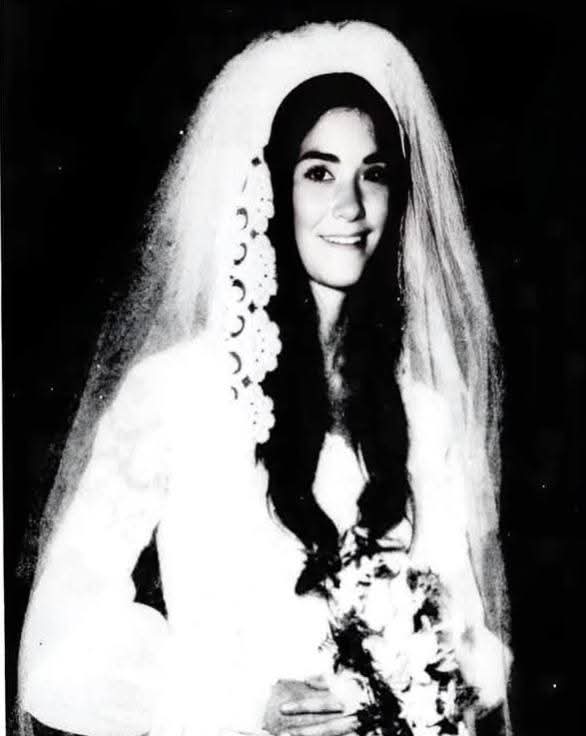
Kathleen on her wedding day.
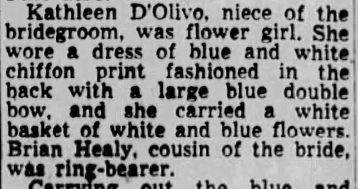
A newspaper clipping about Kathleen being the flower girl in her aunts wedding published in The News Tribune on August 17, 1958.
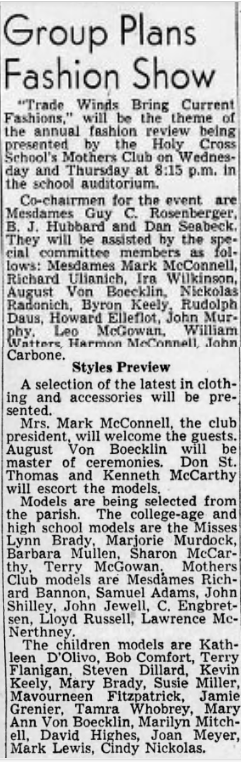
A newspaper clipping about Kathleen being a child model published in The News Tribune on March 1, 1959.
A picture of Kathy from high school published in The News Tribune on May 9, 1970.
Kathleen’s engagement announcement to David H. Swisher published in The Olympian on September 16, 1973.
Kathy’s name in a list of graduates from CWU published in The Kitsap Sun on May 23, 1974.
Kathleen and David’s names are listed on the ‘intent to wed’ list published in The News Tribune on August 7, 1974.
According to her obituary, Betty was a member of the St. Charles Borromeo Church
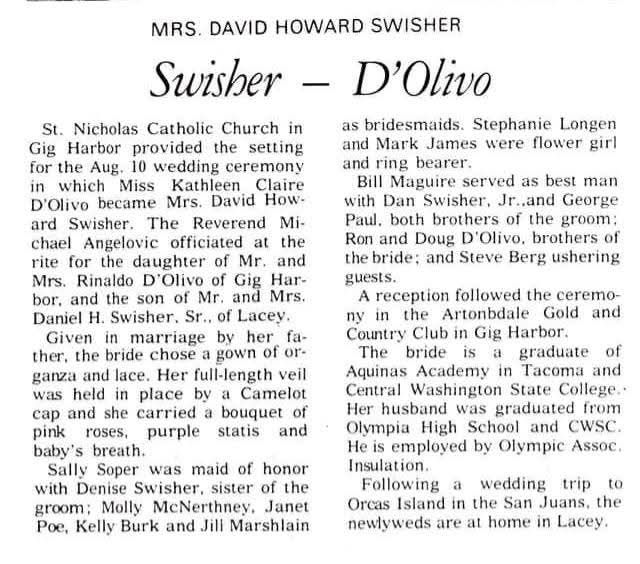
Kathleen’s marriage announcement published in The Olympian on August 25, 1974.
A picture taken in 1964 of the Curriculum Lab at Central Washington University in Ellensburg, WA (the name was changed to the the James E. Brooks Library in 2003).
The route from Ted’s residence at the Rogers Rooming House in Seattle to the CWU Library.
The first page of an interview Kathleen had with Detective Robert Keppel of the King County Sheriffs Department.
The second page of an interview Kathleen had with Detective Robert Keppel of the King County Sheriffs Department.
The third page of an interview Kathleen had with Detective Robert Keppel of the King County Sheriffs Department.
About where the mans car was parked she said 'we walked across the bridge then to the edge of... I don't recall the name of the street, but it runs up the campus, kind of an alley street. It's not a real well traveled street. THen under the railroad trestle and then his car was parked in the front right under the trestle there, it was a dark road. There were no street lights on that road. But his car wasn't parked so far down that it was completely black.'
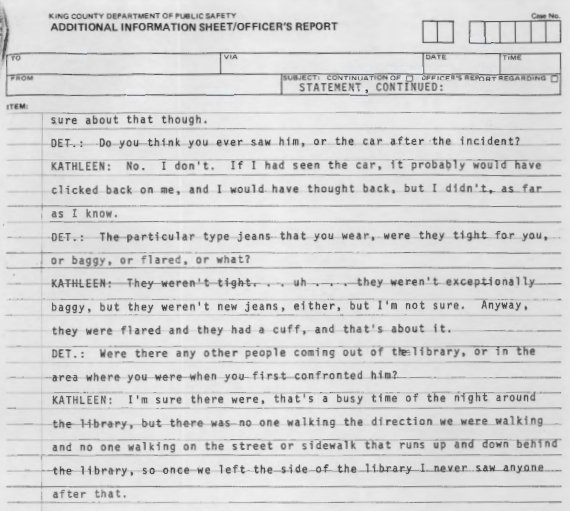
The fourth page of an interview Kathleen had with Detective Robert Keppel of the King County Sheriffs Department.
The fifth page of an interview Kathleen had with Detective Robert Keppel of the King County Sheriffs Department.
The sixth page of an interview Kathleen had with Detective Robert Keppel of the King County Sheriffs Department.
The seventh page of an interview Kathleen had with Detective Robert Keppel of the King County Sheriffs Department.
The eighth page of an interview Kathleen had with Detective Robert Keppel of the King County Sheriffs Department.
The ninth page of an interview Kathleen had with Detective Robert Keppel of the King County Sheriffs Department.
The tenth page of an interview Kathleen had with Detective Robert Keppel of the King County Sheriffs Department.
The eleventh page of an interview Kathleen had with Detective Robert Keppel of the King County Sheriffs Department.
The twelfth page of an interview Kathleen had with Detective Robert Keppel of the King County Sheriffs Department.
The thirteenth page of an interview Kathleen had with Detective Robert Keppel of the King County Sheriffs Department.
The fourteenth page of an interview Kathleen had with Detective Robert Keppel of the King County Sheriffs Department.
The fifteenth page of an interview Kathleen had with Detective Robert Keppel of the King County Sheriffs Department.
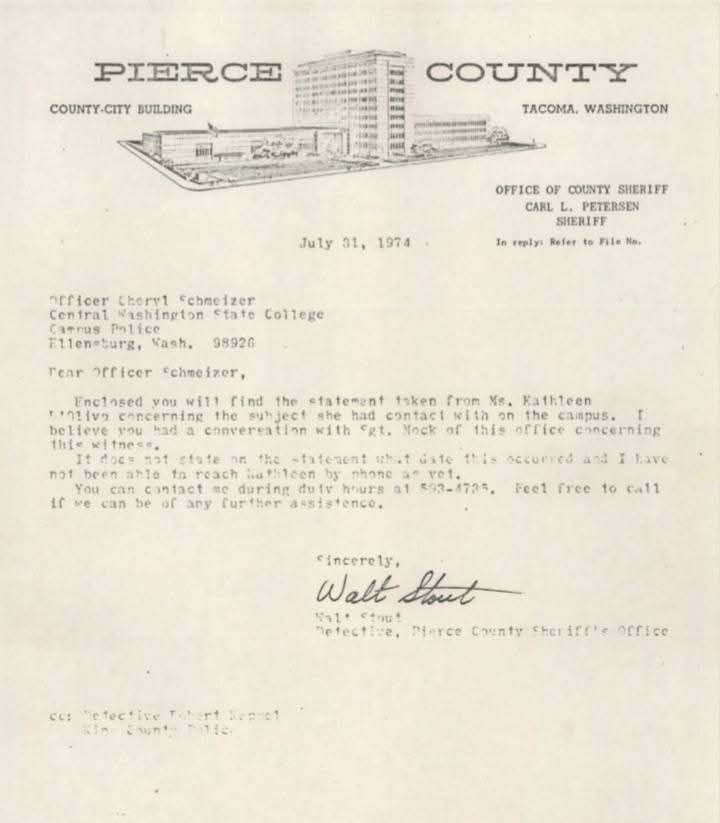
A letter from Walt Stout of the Pierce County Sheriffs Department to Officer Cheryl Schmeizer of the CWU police department about Kathleen D’Olivo dated July 31, 1974.
A statement from Kathleen to the Pierce County Sheriffs Department.
The only thing I could find about a fourth possible encounter Bundy had with a coed on the campus of Central Washington University, screenshot courtesy of thetruecrimedatabase.com. This stories shares a lot of parallels with Jane Curtis’ encounter with Bundy, so I’m not sure how accurate this is.
Kathleen’s mothers birth information.
Mr. Rinaldo D’Olivo from the 1948 Bellarmine High School yearbook.
A picture of Kathy’s father from the 1946 Bellarmine High School yearbook.
Mr. D’Olivo’s WWII draft card.
The announcement of Kathleen’s parents engagement published in The News Tribune on June 17, 1949.
An article about the wedding of Kathleen’s parents published in The News Tribune on September 3, 1950.
David Swisher from the 1968 Olympia High School yearbook.
Doug D’Olivo in the 1971 Bellarmine Preparatory School yearbook.
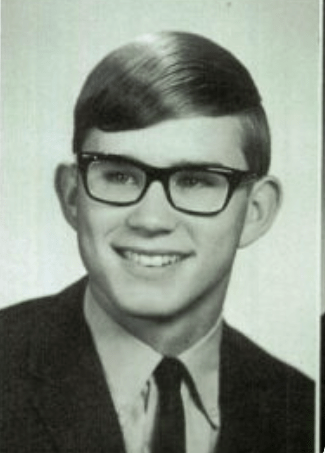
David Swisher from the Olympia High School-WW Miller High School yearbook.
rinaldo
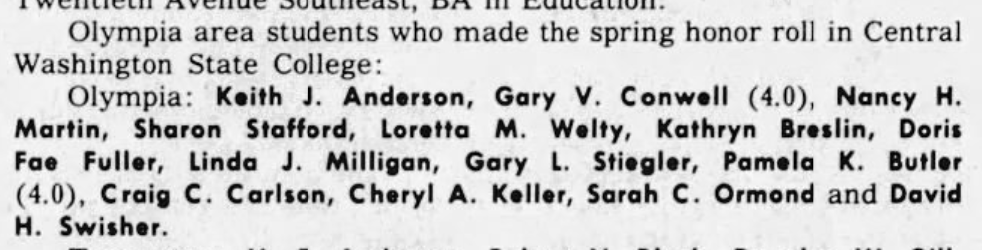
David Swisher in a list of CWU students that lived in Olympia that got a 4.0 GPA at CWU published in The Olympian on June 27, 1973.
Kathy’s brother Doug’s marriage announcement published in The News Tribune on October 16, 1983.
A newspaper clipping that mentions Kathy’s brother Doug and he fathers business, Humdinger Fireworks, published in The Daily Herald on July 4, 1985.
Kathy’s uncles obituary that mentions her published in The News Tribune on January 15, 1997.
Kathy’s mother’s obituary published in The News Tribune on March 22, 1999.
Kathleen’s dads obituary, which was published in The News Tribune on November 29, 2008.
Rinaldo A. D’Olivo, Kathy’s brother. According to his obituary, he also graduated from Central Washington University.
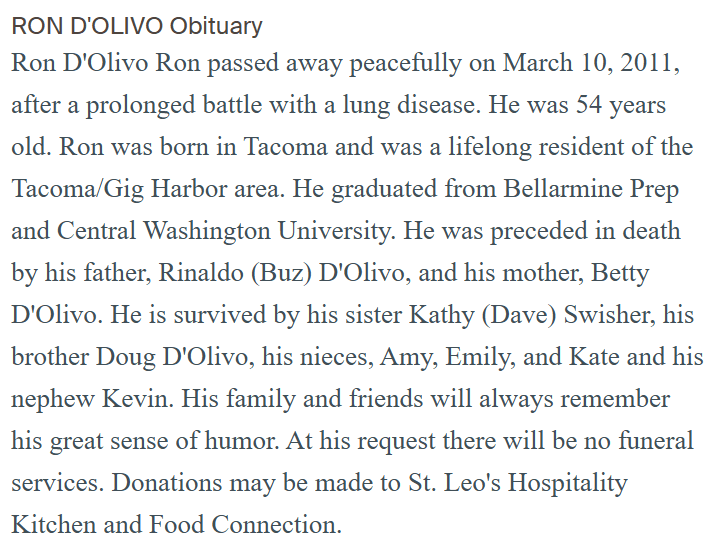
Kathy’s brother Rons obituary, published in News Tribune on March 16, 2011.
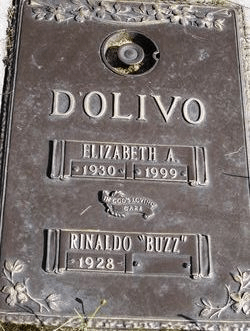
Kathy’s parents gravestone.
An advertisement for Humdinger Fireworks.

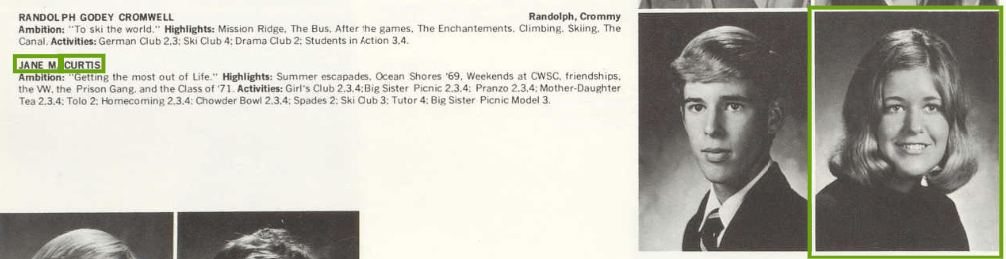
Jane Marie Curtis-Bjork.*

Jane Marie Curtis was born in Washington state in 1953, and grew up in Edmonds; she graduated from Bellevue High School in 1971 and during her time there she participated in multiple clubs and organizations, including ‘Girls Club,’ the Big Sister Picnic, Mother-Daughter Tea, Homecoming Committee, the Chowder Bowl, Spades, and Ski Club. After Curtis graduated from high school she enrolled at Central Washington University, and while there she was a sorority sister and in April 1974 she lived in the dormitories on campus, specifically at ‘Walnut North #46.’

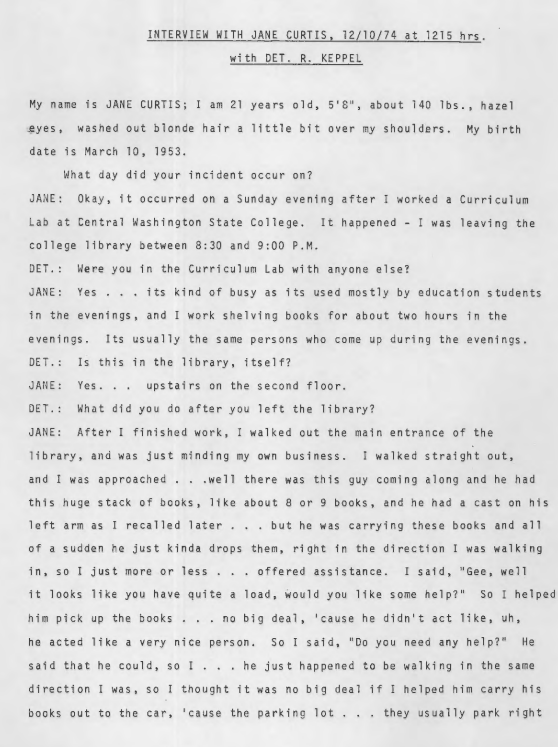
At the time of her encounter with Bundy, Jane was a twenty-one-year-old student at CWU and stood at 5’6″ tall (one report listed her height as 5’8”) and weighed 140 pounds; she had hazel eyes (although one source said they were green), and had ‘washed out blonde hair’ that she wore at her shoulders.

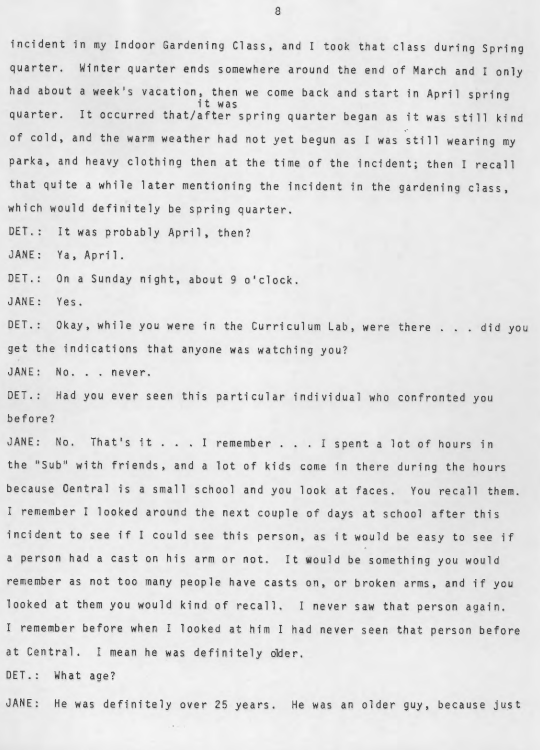
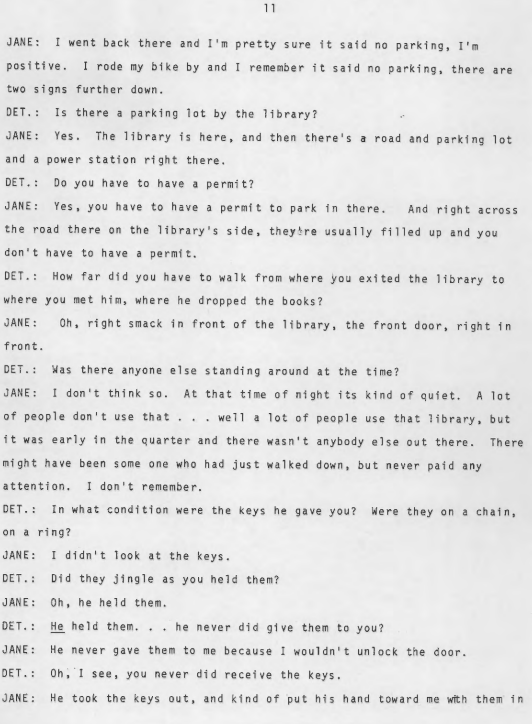
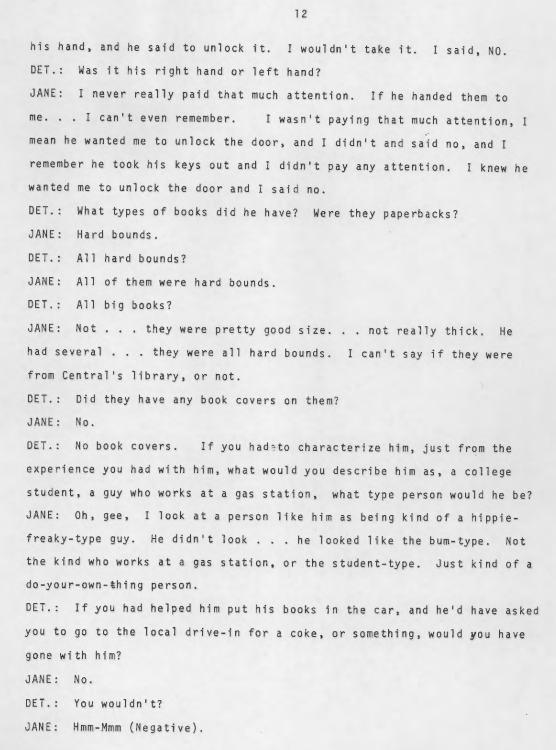
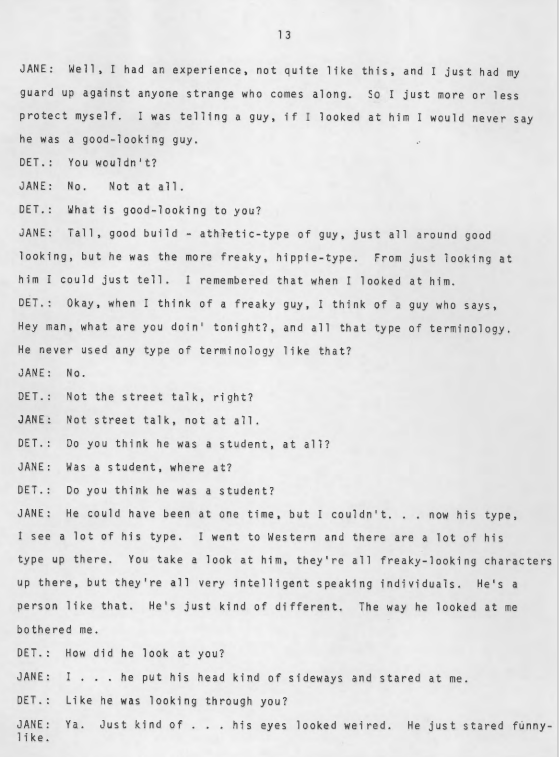
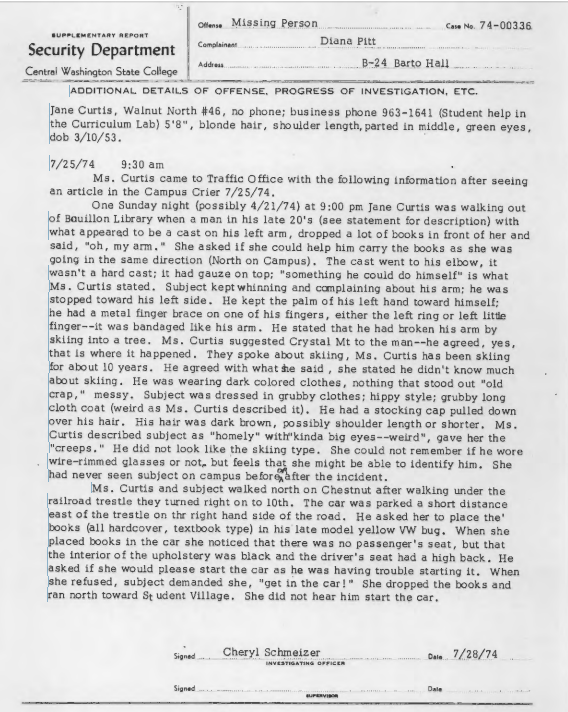
Most websites and articles about Jane’s run-in with Ted claim that she encountered him earlier in the evening on April 17, 1974 (which is earlier in the evening before Sue Rancourt was abducted), but after reading her interview with Detective Robert Keppel of the King County Sheriff’s Department, I learned that it actually took place on a Sunday, (either on April 14, 1974 or April 21,1974) after she left her job at the Curriculum Lab at the James E. Brooks Library at campus, sometime between 8:30 and 9 PM. She worked ten hours a week on the second floor, and upon leaving her POE she walked out of the front door, and shortly after was approached by a young man that was ‘carrying a huge stack of books, like about eight or nine books, and he had a cast* on his left arm as I recalled earlier. But he was carrying these books and all of a sudden he just kinda drops them, right in the direction I was walking in, so I just more or less… offered assistance. I said, ‘gee, well it looks like you have quite a load, would you like some help?’ so I helped him pick up the book, no big deal, cause he didn’t act like, uh, he acted like a very nice person. So I said, ‘do you need any help?’ He said that he could, so I…’  Curtis clarified that he did carry a few of his books, but she carried the majority of them and they were all hardcover. Jane also said that she remembered the man was a bit ‘shorter than she was,’ because she happened to have on platform shoes that day that placed her at around 5’9″. *One sources says that Bundy was using crutches when he approached Curtis, but she never mentioned it in her interviews with LE.

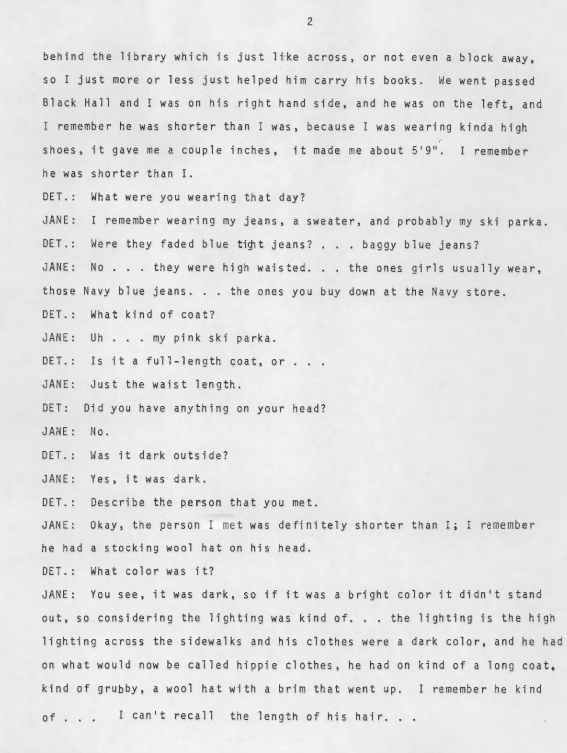
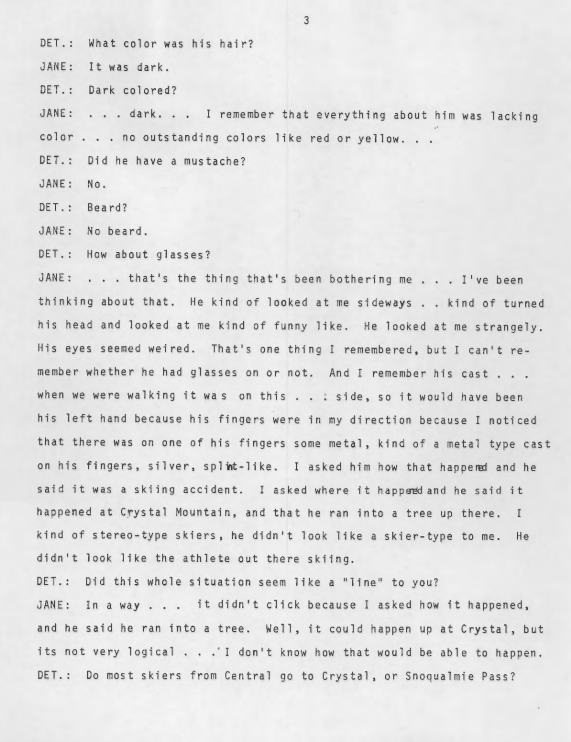
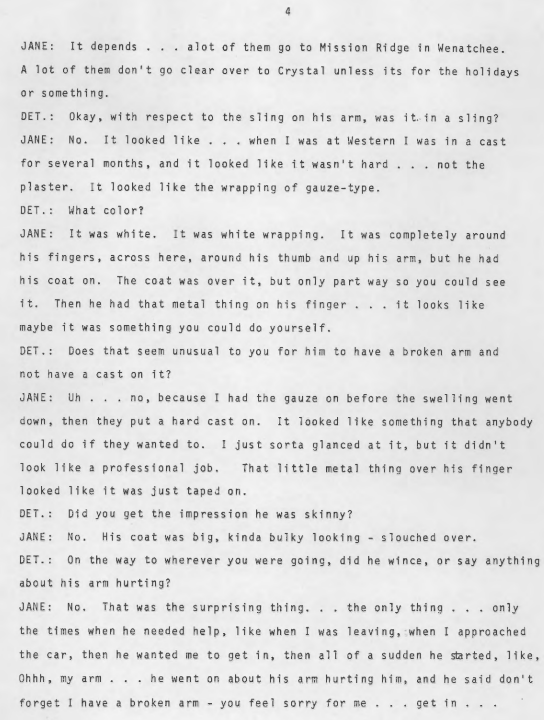
Curtis said the man was wearing a dark colored stocking hat that ‘went up’ on his head and that his ‘hippie clothes’ were on the blackish side and he also had on a long, ‘grubby’ coat. She also stated that he had dark hair and that ‘everything about him was lacking color:’ ‘no outstanding colors like red or yellow.’ She said where she was certain he had no beard or mustache she wasn’t completely certain if he wore glasses or not, as he looked at her ‘strangely,’ and his eyes looked: ‘weird. That’s one thing I remembered, but I can’t remember whether he had glasses on or not.’ In regard to what hand the cast was on, she said it would have been his left hand because when they were walking it was on (…) side, so it would have been his left hand because his fingers were in my direction because I noticed that there was on one of his fingers some metal, kind of a metal type cast on his fingers, silver, splint-like.‘ When Curtis asked the stranger how the injury happened, he said it was from a skiing injury but was reluctant to say much else on it, and after she suggested ‘Crystal Mountain’ as where the accident took place he immediately responded, ‘yes, that’s where it happened, and he elaborated that he ‘ran into a tree up there.’ She commented that he didn’t strike her as the skiing type, and that he didn’t appear to her to be much of an athlete; she also said she thought the scenario could have possibly happened, but she felt it was highly unlikely.

When Detective Keppel asked Jane if the man was skinny, she said no but that his ‘coat was big, kinda bulky looking, slouched over.’ She also said he didn’t appear to be in any pain from his injury and his arm only seemed to hurt when she started to allude that she didn’t want to further help him, or get in his car: ‘the only thing, only the times when he needed help, like when I said I was leaving, when I approached the car, then he wanted me to get in, then all of a sudden he started, like, ‘ohhhh my arm,’ he went on about his arm hurting him, and he said don’t forget I have a broken arm, you feel sorry for me… get in…’

When Keppel asked Curtis what the man’s sling looked like, she said that ‘it looked like, when I was at Western I was in a cast for several months, and it looked like, it wasn’t hard… not the plaster. It looked like the wrapping of gauze-type.‘ … ‘It was white, with white wrapping. It was completely around his fingers, across here, around this thumb and up his arm, but he had his coat up. The coat was over it, but only part way up so you could see it. Then he had that metal thing on his finger, it looks like maybe it was something you could do yourself.’ Curtis told the detective that it was unusual to her that he would have a broken arm and not have a real cast on it: ‘because I had the gauze on before the swelling went down, then they put a hard cast on me. It looked like something that anybody could do if they wanted to. I just sorta glanced at it, but it didn’t look like a professional job. That little metal thing over his finger looked like it was just taped on.’

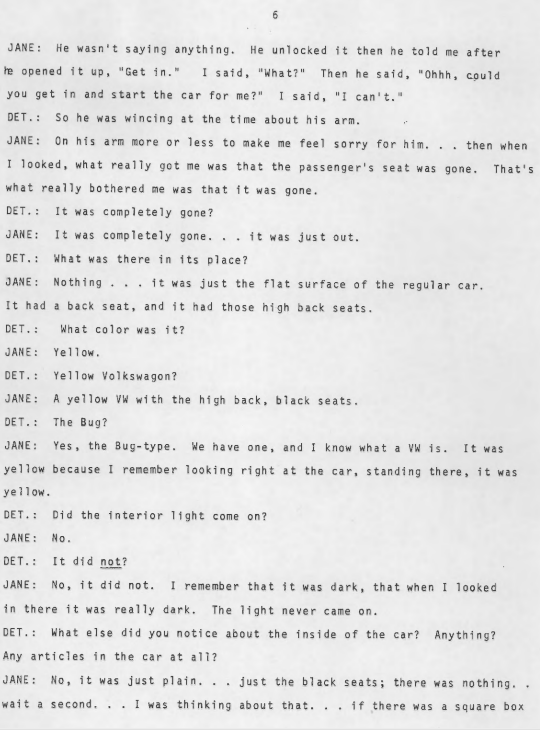
As they approached the car, Bundy told her to open it up, and after she replied ‘what?’ he handed her his car keys, to which she refused and told him no. When they arrived at the VW, the car was locked, and after he unlocked and opened the door, she peered inside of it and immediately noticed that there was no passenger seat: ‘it was simply gone, with nothing in its place.’ She said the man ‘wasn’t saying anything, and after he opened the door he said, ‘get in,’ to which she said ‘what,’ then he quickly said, ‘ohhhh, could you get in and start the car for me?’ I said, I can’t.’ So he was wincing at the time about his arm.’ When pressed about what was inside of the car, Curtis said there was a ‘square box in the back, way in the back in a cubby hole behind the back seat. There was something back there, but there was nothing unusual that struck me except the whole passengers seat was gone.’ Jane said that the car was for the most part non-descript and had no CWU stickers on it.

Curtis told Detective Keppel that the man never touched her and he ‘probably more or less just wanted me to feel sorry, and get in, and I just dropped his books after he told me that and I took off.’ When she turned around and left him she didn’t run, and only briskly walked away and he didn’t chase or come after her and she just went back to her on-campus apartment; she also said that as she was running away from him she never heard him start his car.

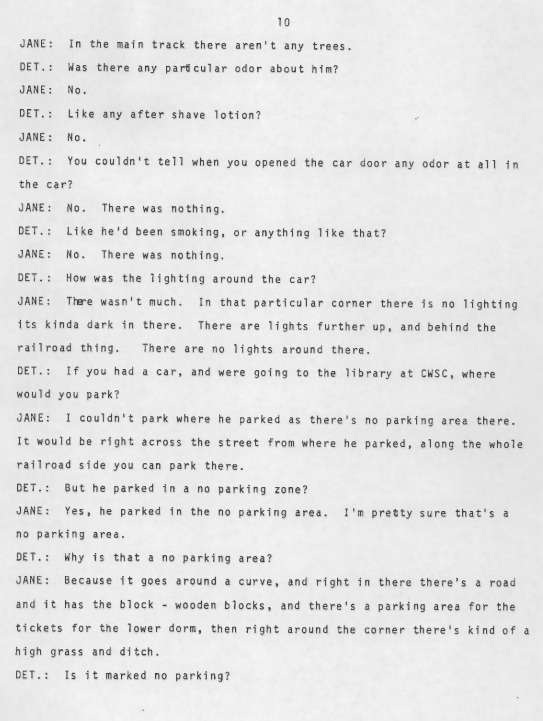
Curtis said the car was yellow in color and didn’t seem to have any particular smell, like he had been smoking in it, andthat it had been parked in a ‘no parking area,’ because it was in an spot that ‘went around a curve, and right in there there’s a road and it has the block-wooden blocks, and there’s a parking lot area for the tickers for the lower dorm, then right around the corner there’s kind of a high grass and ditch.’

At the end of the interview with Detective Keppel, Curtis said that the man told her to: ‘start the car for me, I remembered that. First of all, he told me to get in, I said what, then he went through his little pain bit, and said get in and start the car for me because I can’t. He said because of his arm he couldn’t start it. He wanted me to start it for him.’ She also clarified that the ignition on the VW was on the left hand side.

At around 8 PM on April 17, 1974 (which was about two hours before Sue Rancourt went missing) CWU student named Kathleen D’Olovio reported to police that she was approached by a man using the same ruse as Jane Curtis: he had his arm in a sling and was looking for some help carrying some books to his car. D’Oloviosaidwhen they reached his Volkswagen, the man dropped his keys and asked her for some help finding them, but her suspicions were raised after she noticed the cast on his arm didn’t look as if a medical professional put it on. Wisely, instead of bending over to look for the keys she suggested they look for them using the reflection from a car’s lights: once she found them she immediately snatched them up, tossed them at Bundy then quickly got out of there, an act that most likely saved her life. This most likely threw Ted off, as he was most likely hoping she would lean over so he would have had a good angle to bash her over the head from behind with a crowbar (or tire iron), and she was able to get away unharmed.

As we all know, after the failed abduction of both Jane Curtis and Kathleen D ‘Olivo Ted went on to find a victim in Sue Rancourt, who was last seen around 10 PM on April 17, 1974 leaving a meeting of ‘The Living Group Advisors’ at 9:30 PM in Munson Hall about possibly being an RA the following year (which would have helped her save in tuition costs).

* In November 2025 I received an email from Jane asking me to take the post down, and where I did spend a lot of time thinking about what to do I ultimately decided to take all of the personal details out, but leave the Bundy related information.

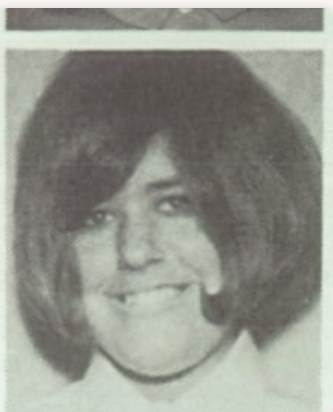
Jane Curtis from the the 1969 Bellevue High School yearbook.
Jane Curtis from the the 1970 Bellevue High School yearbook.
Jane Curtis from the the 1971 Bellevue High School yearbook.
Jane Curtis and Jack Bjork’s marriage license.
The first page of the interview Jane Curtis had with Detective Robert Keppel at 12:15 PM on December 10, 1974.
The second page of the interview Jane Curtis had with Detective Robert Keppel at 12:15 PM on December 10, 1974.
The third page of the interview Jane Curtis had with Detective Robert Keppel at 12:15 PM on December 10, 1974.
The fourth page of the interview Jane Curtis had with Detective Robert Keppel at 12:15 PM on December 10, 1974.
The five page of the interview Jane Curtis had with Detective Robert Keppel at 12:15 PM on December 10, 1974.
The sixth page of the interview Jane Curtis had with Detective Robert Keppel at 12:15 PM on December 10, 1974.
The seventh page of the interview Jane Curtis had with Detective Robert Keppel at 12:15 PM on December 10, 1974.
The eighth page of the interview Jane Curtis had with Detective Robert Keppel at 12:15 PM on December 10, 1974.
The ninth page of the interview Jane Curtis had with Detective Robert Keppel at 12:15 PM on December 10, 1974.
The tenth page of the interview Jane Curtis had with Detective Robert Keppel at 12:15 PM on December 10, 1974.
The eleventh page of the interview Jane Curtis had with Detective Robert Keppel at 12:15 PM on December 10, 1974.
The twelve page of the interview Jane Curtis had with Detective Robert Keppel at 12:15 PM on December 10, 1974.
The thirteenth page of the interview Jane Curtis had with Detective Robert Keppel at 12:15 PM on December 10, 1974.
The fourteenth page of the interview Jane Curtis had with Detective Robert Keppel at 12:15 PM on December 10, 1974.
The fifteenth page of the interview Jane Curtis had with Detective Robert Keppel at 12:15 PM on December 10, 1974.
A brief write-up from the interview Jane Curtis had with a member of CWU’s Traffic Office.
A poem about Jane Curtis written by Caitlin Elizabeth Thomson.
The route from Ted’s residence at the Rogers Rooming House in Seattle to the CWU Library.
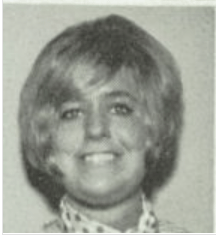
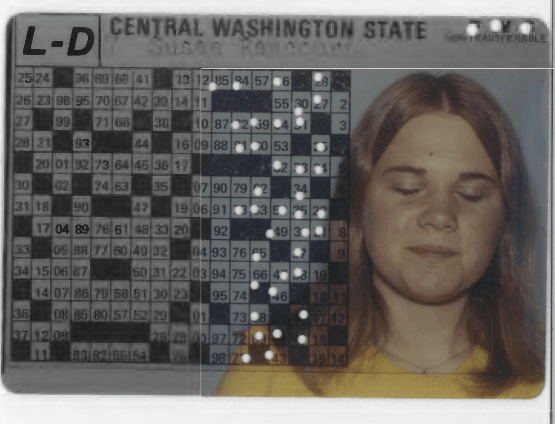
Kathleen D’Olovio.
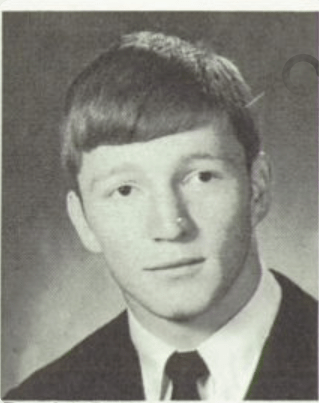
Jack Clayton Bjork from the 1967 Centennial High School yearbook.

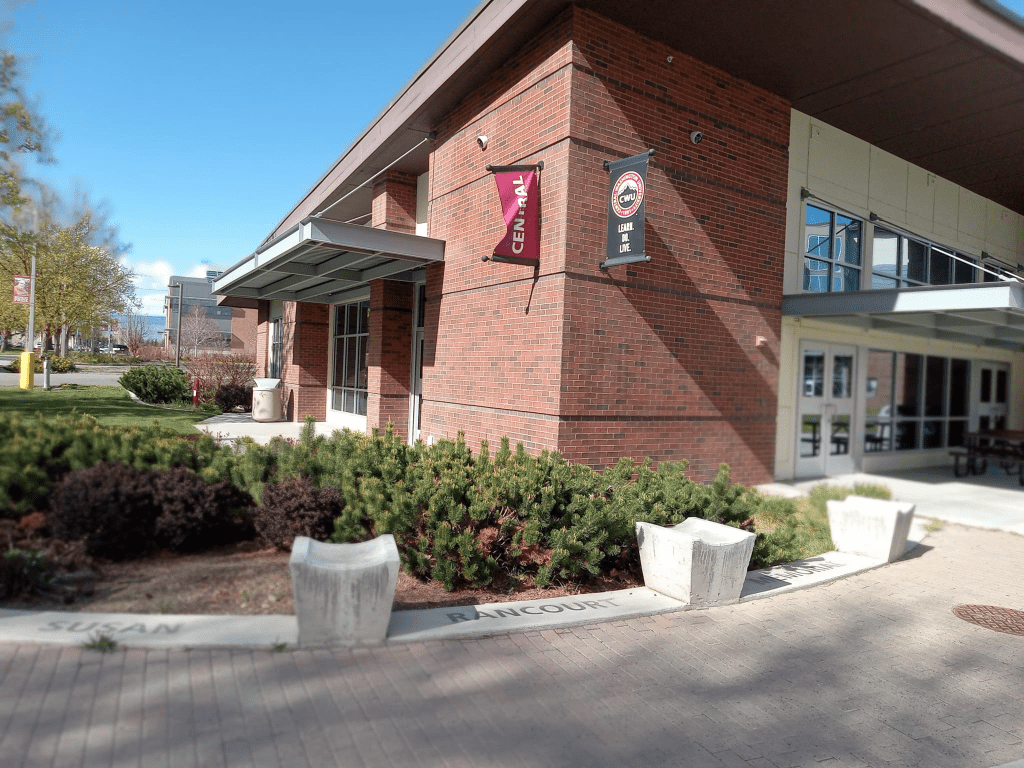
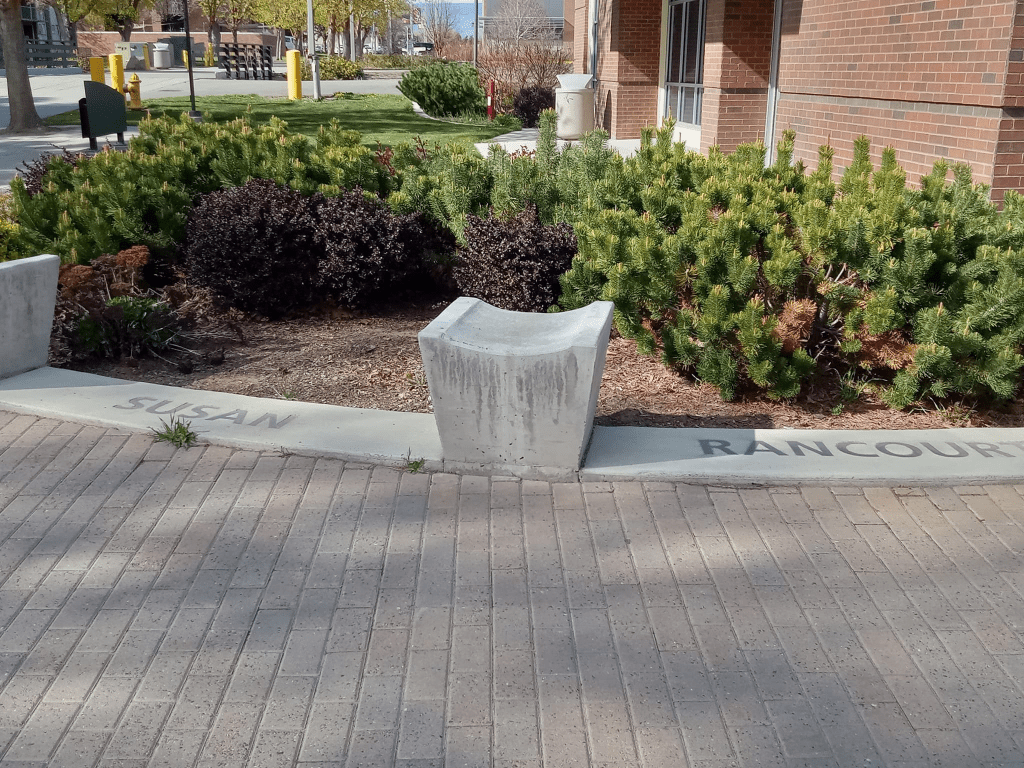
Susan Rancourt Memorial Garden.

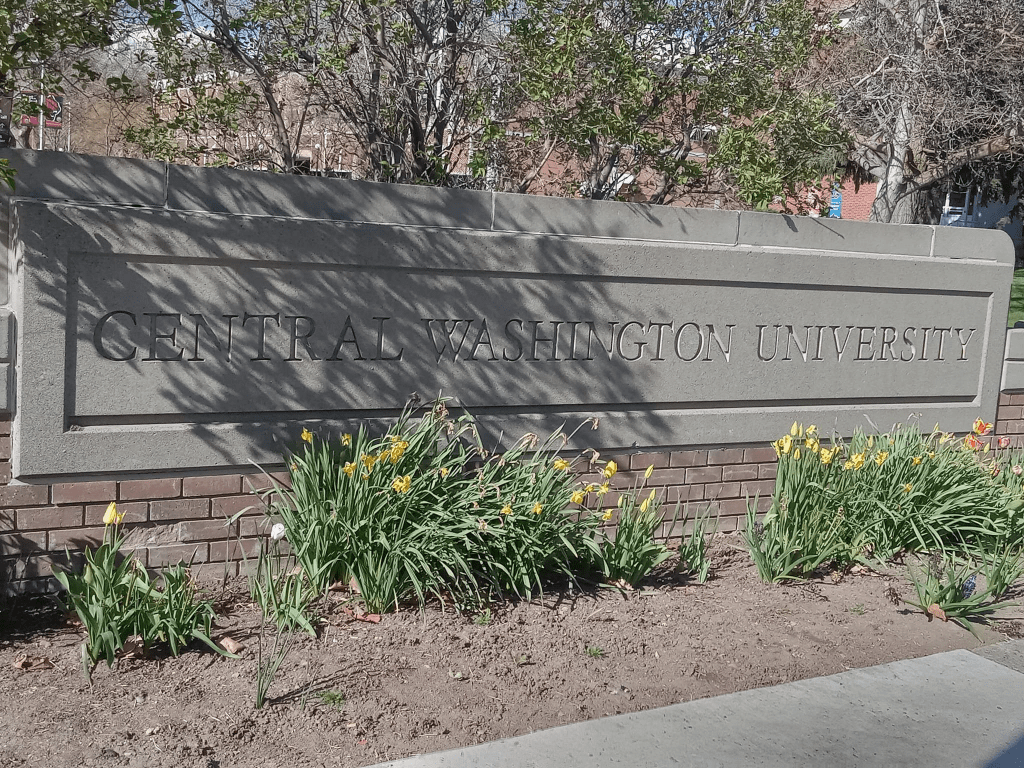
This (short) article is mostly going to be about the memorial garden that Central Washington University in Ellensburg, Washington dedicated to Susan Rancourt in October of 2012; I will focus on her life and murder in a separate article at a different point in time.

The life of Ted Bundy victim Susan Rancourt was memorialized on Friday, October 12, 2012 during the grand opening of the newly renovated Barto Hall at Central Washington University. Rancourt attended the university in 1973 and 1974 before she was abducted on campus and later killed; a beautiful garden was planted near the newly renovated dormitory and dedicated to her memory. While attending CWU as a Biology major, Sue lived at Barto Hall, a dormitory named after the schools’ former registrar, Harold Peter “Pete” Barto. In addition to serving as registrar, Barto also taught history PT and eventually left the role to teach full time (and served as chair of the Division of Social Work for roughly a year). He retired from teaching in 1961 and sadly passed away just a few years later. After his death, CWU built a three-story dormitory and named it after him; it fit 174 beds and opened in 1962.

In attendance at the ribbon cutting ceremony was Susan’s mother Vivian and her husband Bob Winters from Ephrata, WA (unfortunately Susan’s father Theodore “Dale” Rancourt passed away in August, 1990); her sister Judy and (her husband) Tom Zimmerman from La Conner, WA; her brother Dennis Rancourt from Orcas Island, WA; two of Judy’s daughters and Rancourt’s niece, Elena Carter. Mrs. Winters proudly cut the bright red ribbon outside the newly updated Barto Hall, where the beautiful, horseshoe-shaped garden was built in memory of her beautiful Susan. Judy said a few words on behalf of the family during the ribbon cutting ceremony:

“In the late ’60s my brother, Dennis, played football for the Wildcats and graduated with a teaching degree. Four years later my sister, Susan, told my parents she was attending Central.” … “My folks lived in Alaska at that time, my husband and I lived in La Conner.” … “We brought her to Ellensburg and moved her into Barto Hall.”

Zimmerman said that it was a “day of celebration,” and that her little sister really loved life while attending CWU. “On April 18, 1974, Sue’s roommate at Barto Hall phoned me to tell me Susan had not come home from a dorm-leaders meeting the previous evening.” … “My brothers and sisters, my mom and dad, Tom and I immediately came to Ellensburg from all points” … “We were supported in every way by this campus family in the following days” … “We would not find Susan’s body until the following year.” She said that during this incredibly hard time for them, the staff at Central Washington University took very good care of them, putting the family up in dorms and giving them food vouchers for the dining hall on campus. This must have been especially convenient for Dale and Vivian, as they were living in Alaska at the time of their daughters abduction.

“Eighteen years later our son, Tyler, announced to us that he wanted to become a CWU student. My heart froze,” Judy said. But while attending a parent session, any anxiety or fear she felt quickly dissipated, and both of her sons went on to attend the school. It was the right environment, both boys said, and it “felt like home.” Coincidentally, the day of the garden dedication ceremony would have been Susan’s 56th birthday: “It’s just dumb coincidence that this is the day,” Judy said. She went on to thank her niece for helping organize the event: at the time Elena Carter was a senior at CWU and played soccer for the school. “My family is thrilled that you are honoring Susan today. We really are. We humbly thank you for helping us remember our beautiful young Susan, happy and healthy and in her element on this great campus,” Judy said.

The associate dean of students for Student Living Richard DeShields said he hoped that many of Rancourt’s traits would be emulated in today’s students, such as her love for CWU, her passion for learning, and her helpful and kind nature. Sue was premed, majoring in Biology with plans to attend medical school after undergrad. Not only did Sue do very well academically but she also was very active in extracurricular activities around campus: she would sew patches on the uniforms of campus police officers and even went running with them after class. She was also an avid baker and tutored struggling students in German and Biology. About Rancourt, university President James Gaudino said, “she was taken from us too soon.” … “We are honored today to celebrate her life in this memorial.”

On March 2nd, 1975, two forestry students discovered the skull of Brenda Ball while doing field work over 90 miles away from CWU on Taylor Mountain (or as the locals call it, Tiger Mountain)… a day later, King County detective Robert Keppel was combing the area when he fell over a branch and stumbled across the skull of Susan Rancourt. After this gruesome discovery, it immediately became clear to law enforcement that they were dealing with another one of “Ted’s” dump sites: six months prior (and only 12 miles away), two grouse hunters discovered Ted’s Issaquah dump site.

On January 24, 1989 Theodore Robert Bundy was put to death for his heinous crimes against humanity, including the murder of Susan Elaine Rancourt. That morning, Seattle based news station KOMO-TV invited Susan Rancourt’s mom, Mrs. Vivian Winters to appear on TV through satellite from her home to share memories of her daughter as well as her feelings regarding Ted Bundy’s impending death. Just two days earlier, Bundy confessed to her daughters murder and I can only imagine the raw emotion she must have been feeling that morning of his execution. On top of Mrs. Rancourt being live on air, KOMO-TV reporter Dana Middleton Silberstein went to the Bundy family home in Tacoma and asked the emotionally fragile Mrs. Bundy if she would like to talk to one of the mothers of the victims (live, while on air of course). The reporter said that “John Bundy” was surprisingly easy to locate in the Tacoma phone book (despite the family having to change their number multiple times over the years due to threats and obscene calls). Surprisingly, Louise said yes and agreed to talk to Vivian live on air later that morning. On air, Mrs. Rancourt said to the timid Mrs. Bundy: “First of all, we send hugs to her, too” … “It has to be terrible for her. Our suffering is over, our answers are all there, and I think hers are probably just beginning.” When asked if she would like to say anything in response to Vivian, Louise hesitated then says, “I’m glad to be able to say it directly to one of the moms” … “We don’t know why this happened, we feel so desperately sorry for you. We didn’t want our son to do these things. We have two beautiful daughters of our own, and we know how we would feel. I am sorry.” In that moment, they were just two mothers who lost a child.

Despite this being slightly off topic I’m including it anyways (just because this only helps show what a monster Ted actually was, not the handsome, clean cut law student Bundyphiles drool over): When Dana Middleton-Silberstein went to visit Mrs. Bundy the morning of her son’s execution, she made a comment that he was “popular.” Middleton-Silberstein thought to herself that this “popular” man bit one of his victims nipples off during an attack, had sex with their dead corpses, and eventually dismembered them. One of his own lawyers described him as “the very definition of heartless evil.”

I would like to finish this short piece with a quote from Susans Mom: she pointed out that many of the women that became Bundy’s victims attempted to help assist him in some way (he was known to have frequently worn an arm sling or leg cast when hunting for victims). “They did not invite him into their lives.” … “The worst thing most of them did was to try and do a good thing. They offered him help. And it turned out to be the worst mistake they made in their lives.”

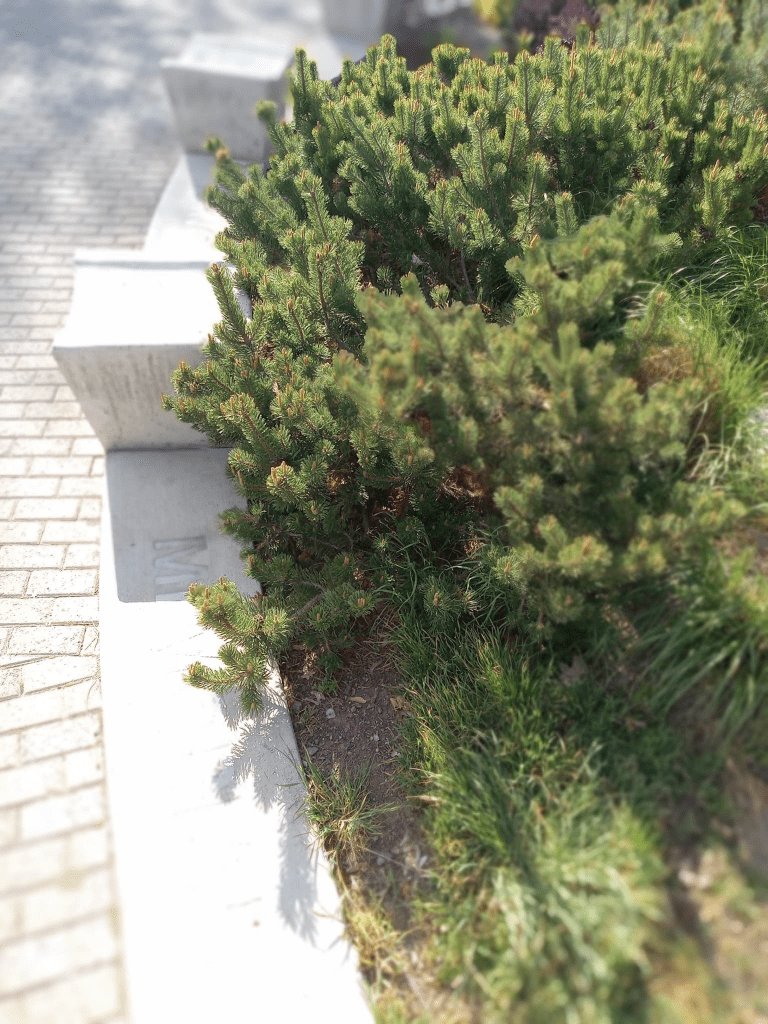
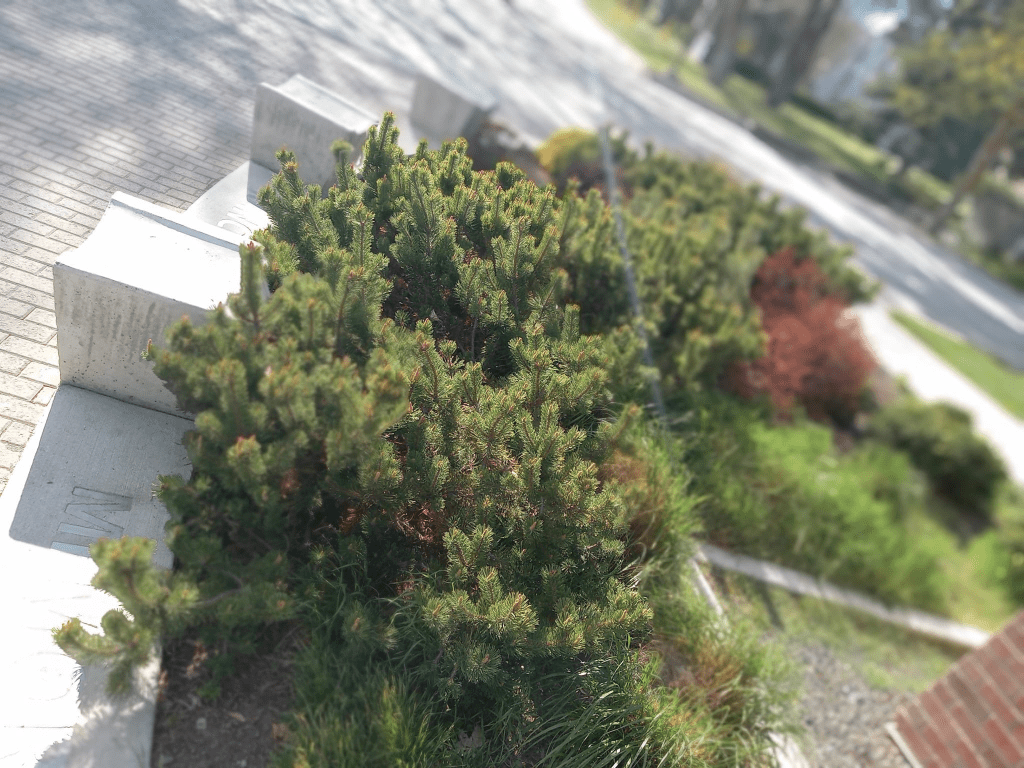
I wish I got the see the garden in spring, when the flowers were in bloom. 2022.
The Susan Rancourt Memorial Garden, April 2022.
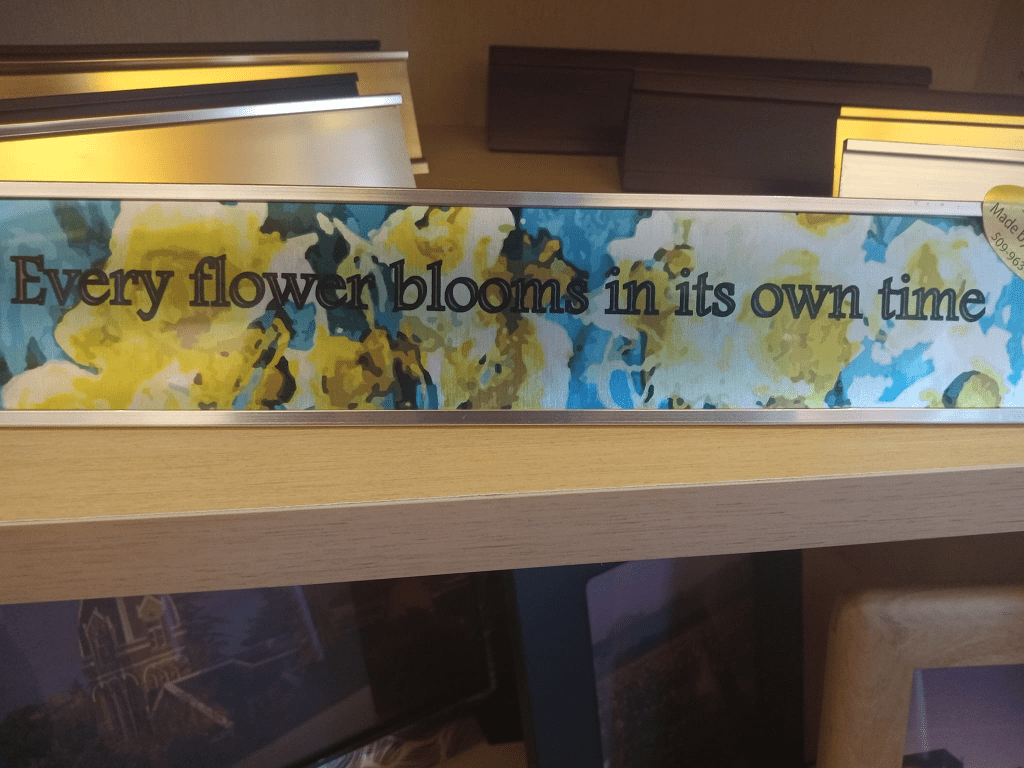
One thing I loved about going to Seattle was how many bookstores I got to go to! I love this placard I found at CWU: it took me 38 years to figure myself out. I’m glad I stuck it out.
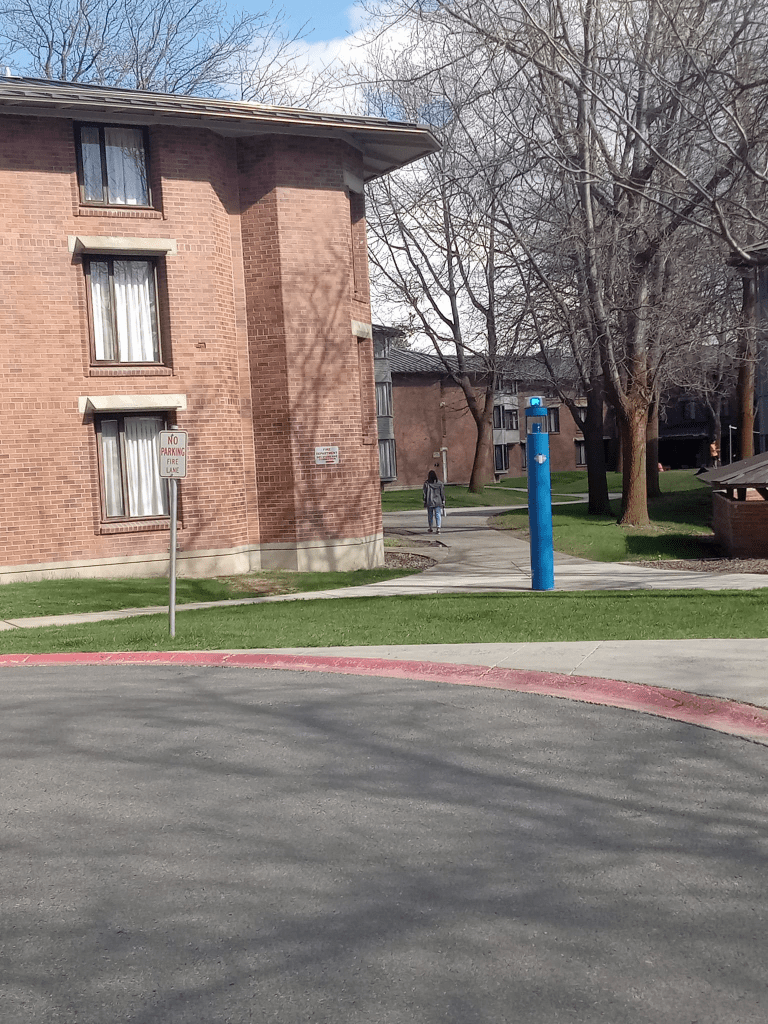
A quick shot of Barto Hall (my rental car is slightly out of shot)…
Surrounded by family, Vivian Winters cuts a ribbon for a garden at Barto Hall dedicated to the memory of her daughter, Susan Rancourt. Photo courtesy of Brian Myrick.
Vivian Winters looks at her daughter Susan’s name in the concrete of a Memorial bench in front of Central Washington University’s new Barto Hall on Fridau, October 12, 2012. Susan, who was a former CWU student and a resident of the original Barto Hall, was murdered by serial killer Ted Bundy in 1974. Photo courtesy of Brian Myrick.
A painting of former Central Washington University student and original Barto Hall resident Susan Rancourt sits in front of the room as CWU president James Gaudino speaks during a dedication ceremony at the new Barto Hall, on Friday October 12, 2012. Photo courtesy of Brian Myrick.
What you see as you’re driving up to CWU in Ellensburg, WA
I had a little bit of trouble finding the memorial garden so I stopped and asked some students. They had NO idea what I was talking about, and there were three people there too. Thankfully a super helpful gal at res life helped me out and pointed me in the right direction. Something else I noticed in Seattle: no one cares about Ted Bundy anymore. I actually got the impression he is a bit of a stain on the city.
One big theme I noticed while doing my Bundy-hunting in Seattle was safety: This is what we used to call “blue rape phones” (which are really just an automatic line to campus safety). It’s found right outside of Barto Hall, where Sue used to live. Outside of where Georgann Hawkins was abducted was a Seattle police officer just watching the area. Also, a dog was chained to a tree in front of Gary Ridgway’s old home, almost like it belonged there simply to guard the house.
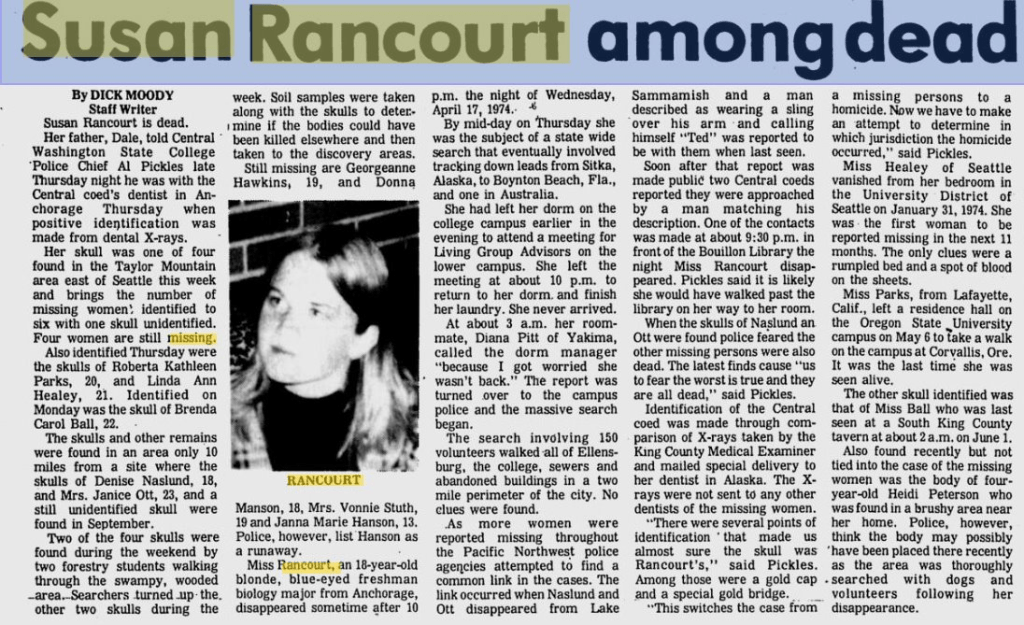
An article about the disappearance of Susan Rancourt.
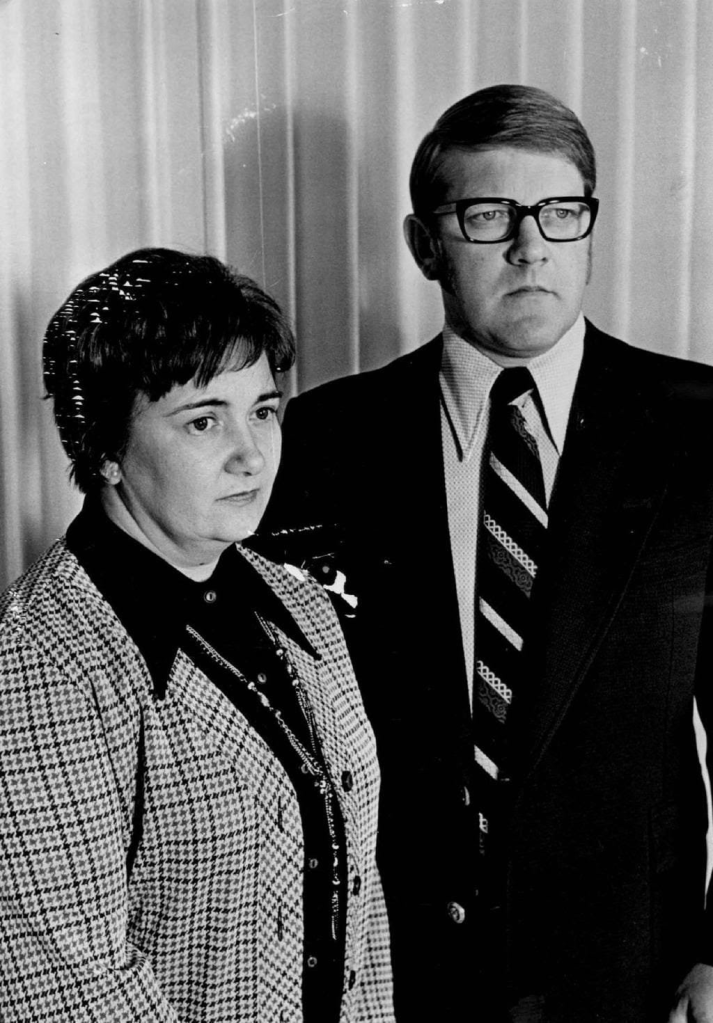
Mr. and Mrs. Rancourt pleading with the public for the safe return of their daughter.
A missing poster for Susan Rancourt after her mysterious disappearance in 1974.