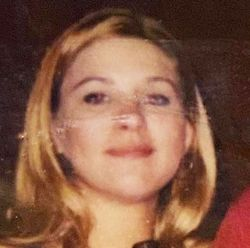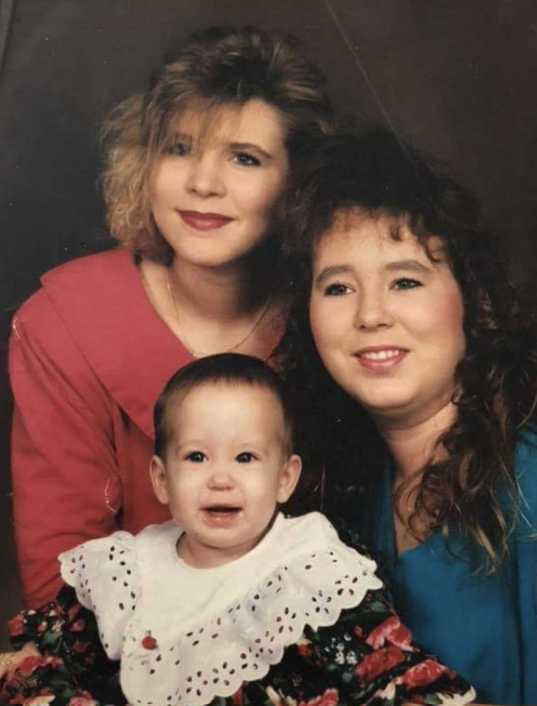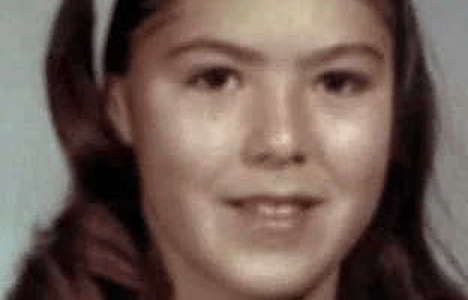
Marion Vinetta Nagle-McWhorter.

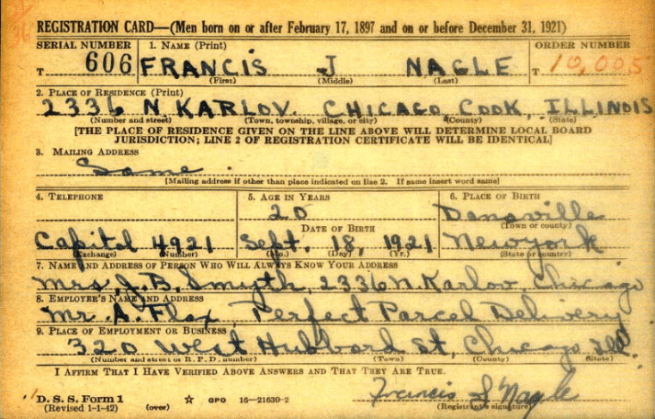
Introduction: Marion Vinetta Nagle was born on January 7, 1953 to Francis and Violet Nagle in Seattle, Washington. Francis Joseph Nagle was born on September 21, 1921 in Dansville, New York and Violet ‘Val’ Jackson was born on July 8, 1927 in Valdez, Alaska (she was of The Ahtna Athabascan culture, an indigenous group of people  from Alaska’s Copper River region). After serving in WWII, Francis and Val tied the knot sometime in 1945 and went on to have five children together: Marion, Richard (b. 1959), William (b. 1955), Patricia (b. 1954), and Valerie (b. 1953). Marion got married at the tender age of sixteen on November 18, 1969 in San Bernardino, California to Kenneth Michael McWhorter, who was born on November 1, 1951 in Brownwood, Texas; the couple had a daughter together named Monica Kay McWhorter (born on February 16, 1971 in San Bernardino, CA).

The Murder: the oldest of her siblings, twenty-one-year-old Marion was living an itinerant life at the time at the time she was last heard from: in late 1974, after separating from her abusive husband, she decided to hitchhike across the northern part of the US, with plans of making her way from California to Seattle then eventually ending up in Alaska. According to her sister Valerie, Marion may have been on her way to ‘The Last Frontier’ in an attempt to find work, as their grandfather lived there at the time she disappeared. In 2024 she told Oregon Live: ‘I always hoped to find her.’ According to reports, in late October 1974 McWhorter stopped in Tigard, Oregon (which is near Mountain), and on the 26th she called her aunt from a pay phone near Washington Square Mall. Valerie said her sister had hoped to stay overnight at her house that was nearby, but she said no, and claimed she had been ‘too busy’ at the time to go pick her up.

According to Valerie, Marion had actually given birth to two daughters but had given the second one up for adoption when she was sixteen and left her older one behind with her estranged husband. Nagle also made it clear that her sister didn’t just up and abandon her child, and that she was simply trying to escape from an abusive relationship: according to police reports, her husband had at one time broken her nose. After Marion disappeared Kenneth filed for divorce in July 1975; shortly after he married Deborah Kay James, who was born on August 19, 1951; the couple had three children together, two sons and Monica’s half-sister Melissa (b. 1979).

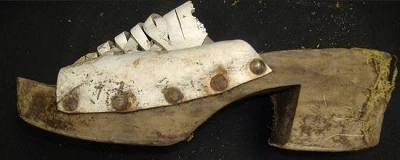
Marion’s weight was unknown at the time of her murder, but she had brown eyes and wore her brunette hair long, and she had a healed fracture on the right part of her nasal bone; she was last seen wearing a leather coat with fringe, Levi ‘s jeans (with a 29-inch inseam), and platform-style sandals with an approximately two-inch heel (one source called them a ‘clog-style shoe’) that had a single white strap with a basket weave section that was attached to the base by 5 round tacks on each side. Valerie shared with detectives that ‘their mother was an Alaskan Native from the Ahtna Athabascan people in the Copper River area in southeastern part of the state, and her oldest sister was named after their aunt who died in 1940 in an American Indian boarding school in Alaska.’

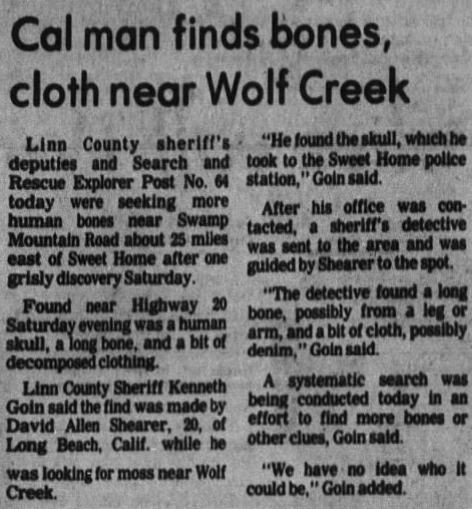
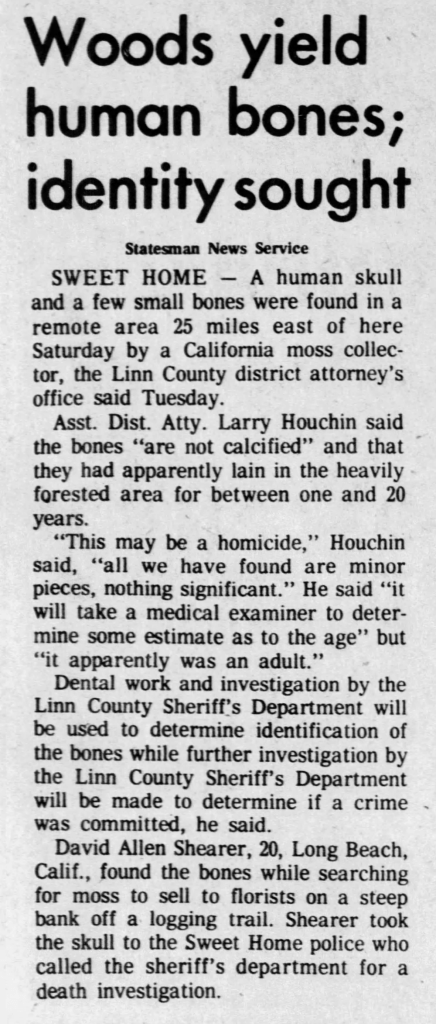
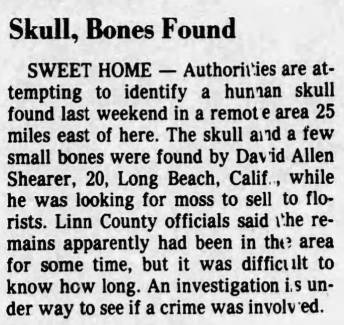
The Discovery: on the afternoon of July 24, 1976, twenty-year-old California native David Allen Shearer that had been out on the side of ‘Swamp Mountain Road’ collecting moss to sell to florist shops when he stumbled upon a skull in the woods about a mile south of US 20 in rural Sweet Home, Oregon. She had been wearing a leather coat with fringe, a leather belt adorned with a decorative phoenix made out of black and white Native American styled beadwork, two metal rings, and Levi’s jeans; a lone clog was found nearby. After their discovery the bones were transferred to the Oregon State Medical Examiner’s Office, where a pathologist and odontologist examined them.

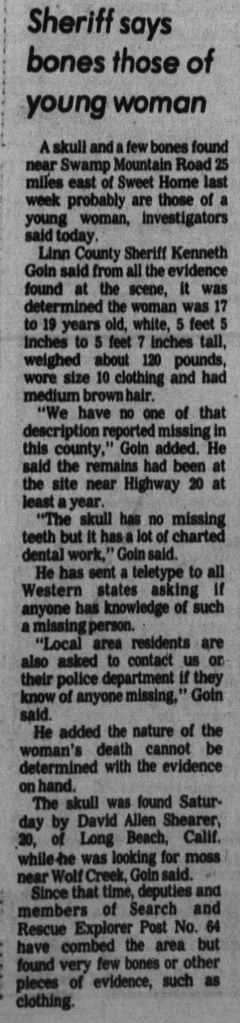
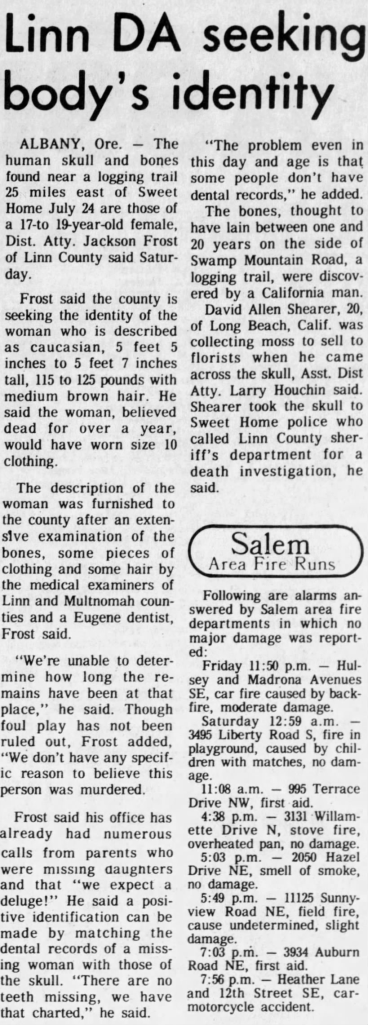
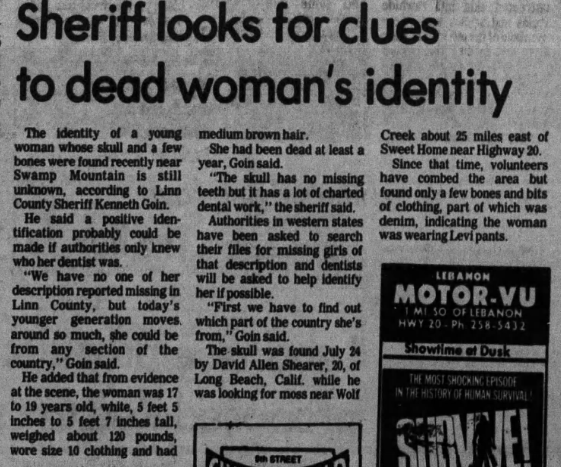
According to Linn County District Attorney Jackson Frost, the county was ‘seeking the identity of the woman who had been described as Caucasian, between 5’5” to 5’7” tall, anywhere from 115 to 125 pounds and had medium brown hair. He further speculated that she had been dead for ‘over a year,’ had worn ‘size ten clothes,’ and was between seventeen and nineteen-years-old: ‘we’re unable to determine how long the remains have been at that place. Though foul play had not been ruled out we don’t have any specific reason to believe this person was murdered.‘ Frost went on to say his office had already received ‘numerous’ phone calls from parents of missing girls asking about their missing daughters, and about the skull said: ‘there are no teeth missing, we have that charted. The problem even in this day is that some people don’t have dental records.’

Because a limited amount of remains that were found (the skull, some teeth, and a few ‘small bones) the examinations came back undetermined: by that point a good amount of time had passed, and on top of the natural decomposition little woodland critters would have done a good job of dispersing their bones all over the area. The odontologist in charge of the dental examination noted several restorations, and per a 2010 Linn County Sheriff’s Office report, a medical examiner identified a ’wound track on her skull, which could have been caused by something similar in size to an ice pick or small caliber firearm.For almost fifty years the remains laid unidentified; she was referred to as the ‘Swamp Mountain Jane Doe.’

The Secret: for many years after her sister disappeared, Valerie said her aunt’s story about their last phone conversation remained consistent, until one day when she shared that Marion had told her that a strange man in a white pickup had offered to give her a ride. Nagle said that when she learned about this piece of the puzzle she: ‘started in earnest with more searching,’ including by checking databases with unidentified persons cases: ‘I remember spending a lot of time on those pages, just scrolling through and trying to look.’ … ‘I never forgot about her.

Valerie also said that her sister’s disappearance was something her parents didn’t often talk about, and she isn’t even positive that they filed a missing person’s report as the Nagle family wouldn’t have ‘known where to even begin looking’ for their daughter and didn’t attempt to organize any search effort. In 2024 The Oregonian newspaper reached out to Tigard law enforcement and requested copies of any missing persons reports filed for Marion; after looking into it, an agency spokesperson said they hadn’t come up with anything. At the time her big sister disappeared Valerie was only eleven and was living in New York state with her parents and one of her brothers, and according to her: ‘I mean, there were, you know, efforts to search, but it was limited. We didn’t have that much to go on.’

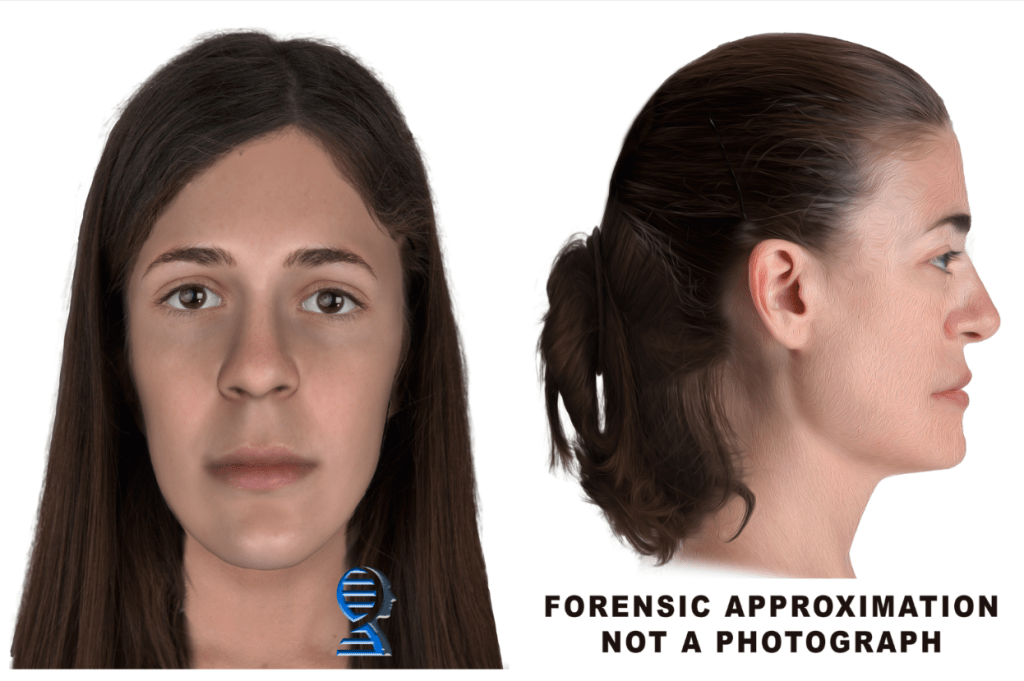
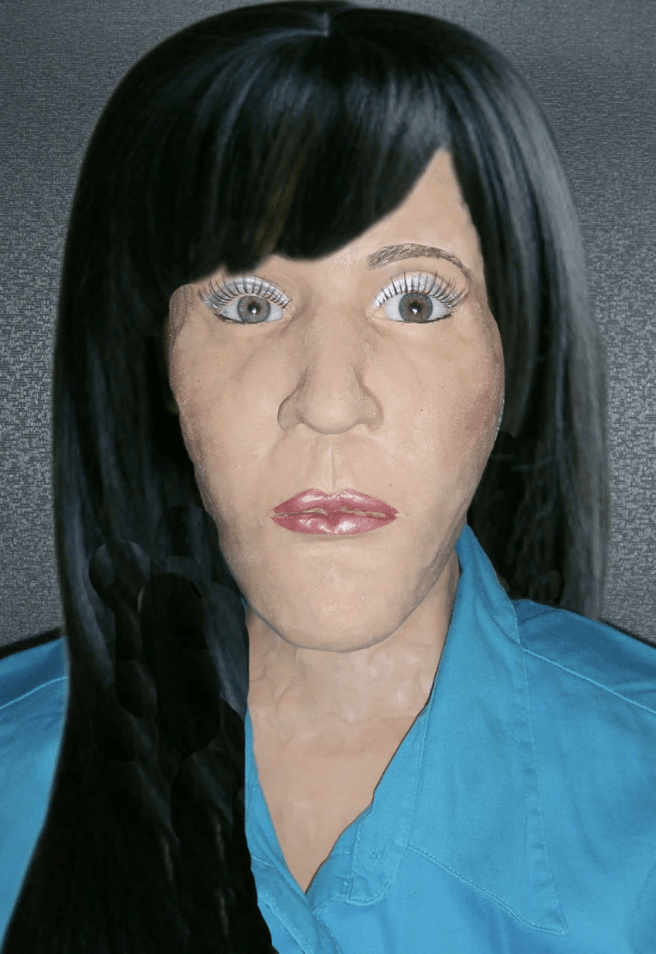
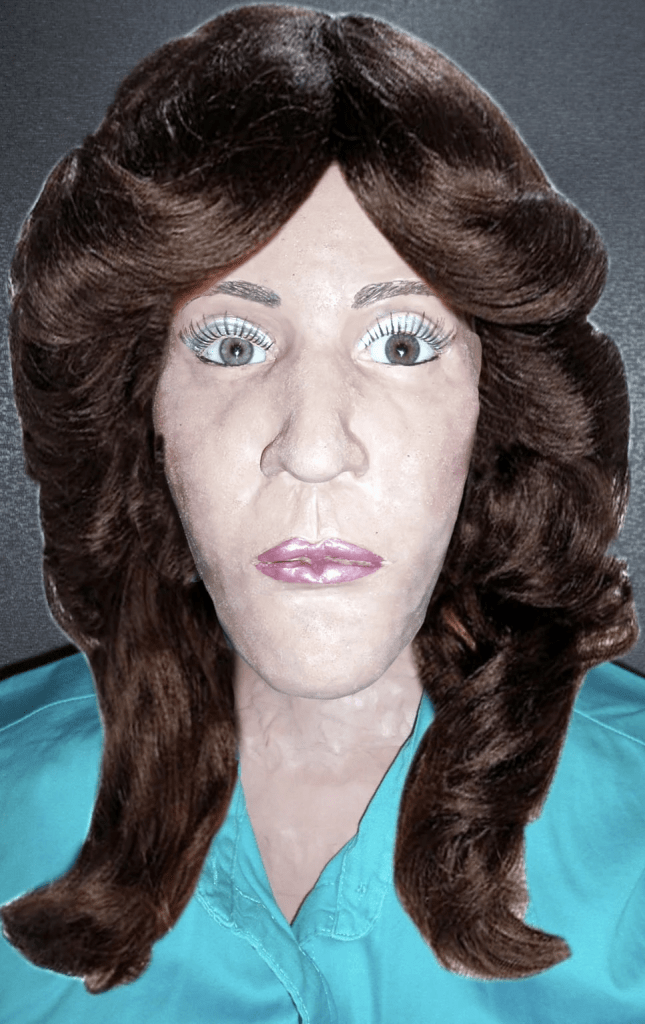
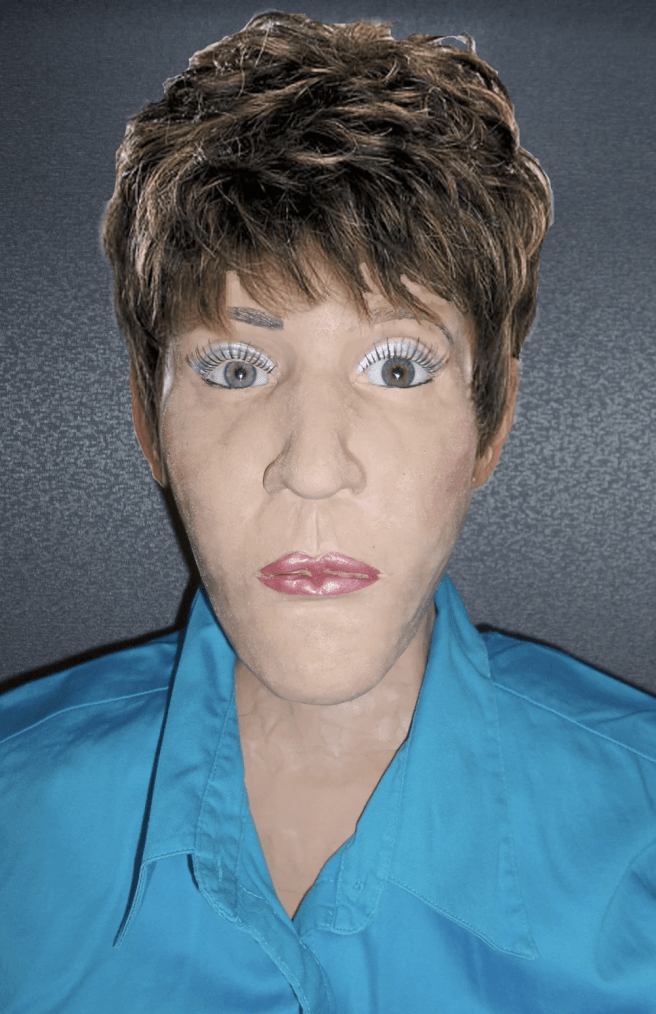
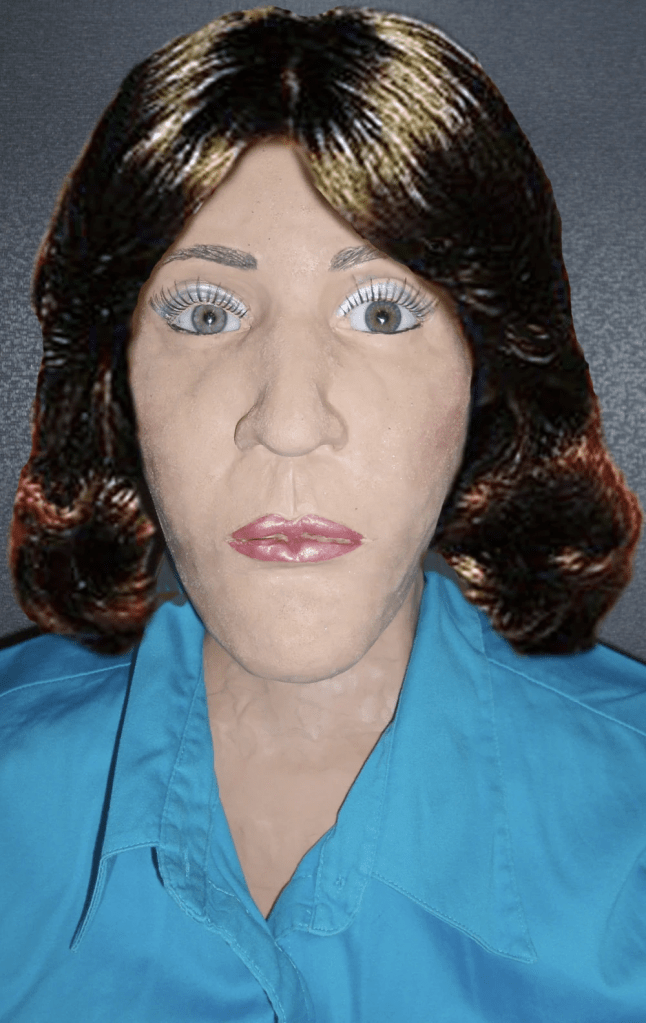
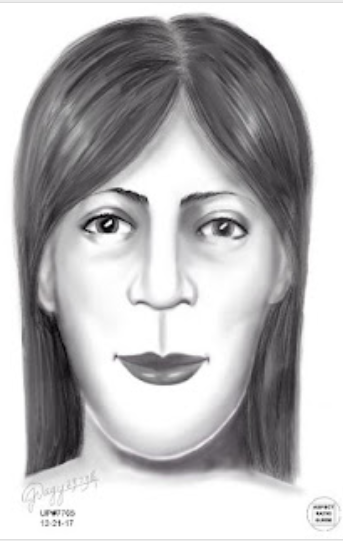
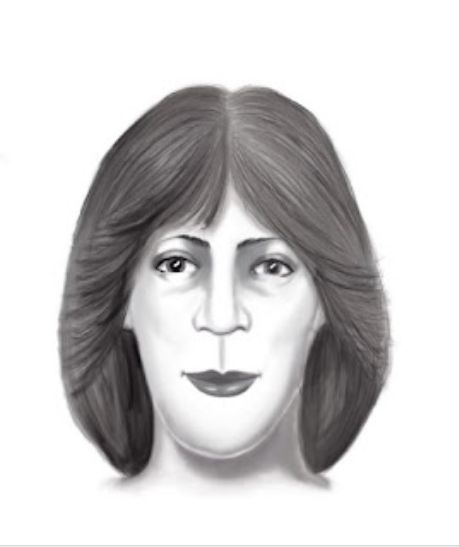
Efforts: over the years a NamUs profile (National Missing and Unidentified Persons System) was created for the ‘Swamp Mountain Jane Doe,’ and forensic techs put her information into CODIS (or the ‘Combined DNA Index System’), which allows federal, state, and local law enforcement laboratories to digitally compare genetic samples. Forensic artists also created multiple recreations of a possible physical renderings of the victims face based on the cranial features of her skeleton as well as a clay model that even featured different hairdos and color/shade ranges that maybe she may have worn in an attempt to create an image that people who knew her may have recognized.

Updates: in 2010, the Oregon Museum of Natural and Cultural History completed an anthropology report of the still unidentified remains of the ‘Swamp Mountain Jane Doe,’ and a biological profile gave investigators demographic information on the individual, noting she was most likely a white female under 35 years old when she died. But still, she remained unidentified; also in 2010, a bone sample from the remains were sent to the University of North Texas Center for Human Identification. An additional piece of bone was submitted for DNA extraction in 2020, which allowed for a unique genetic marker profile to be produced and in 2023, Valerie Nagle submitted a DNA sample to a genealogy website when she signed up for Ancestry.com with the hope that it would result in a clue as to what happened to her sister.

It wasn’t until April 2025 that Oregon investigators got a break in the case after Marion’s first cousin uploaded their genetic profile to the Ancestry-type website ‘Family Tree DNA,’ which allowed genealogists to delve deeper into the ‘Swamp Mountain Jane Doe’s’ family tree and eventually led them to one of Marion’s surviving family members: Valerie. In June 2025 detectives reached out to Nagle ‘out of the blue’ and asked what her thoughts were when it came to Marion possibly being the ‘Swamp Mountain Jane Doe;’ she said when they contacted her she was ‘very surprised that they called. I was really glad that they found me through DNA.’ Nagle gave detectives an oral DNA swab for comparison in June 2025 which quickly confirmed that the remains belonged to Marion.

In an interview with KOIN, Oregon State Forensic Anthropologist Hailey Collord-Stalder commented that: ‘this case was cold for 49 years. That means that family members lived and died without ever knowing what happened to their missing loved one.’ She went on to add that McWhorter most ‘likely did not go missing voluntarily. This was one of our oldest unidentified cases. And I think it just goes to show you that no matter how long somebody persists in being unidentified, we won’t give up trying to identify them.’

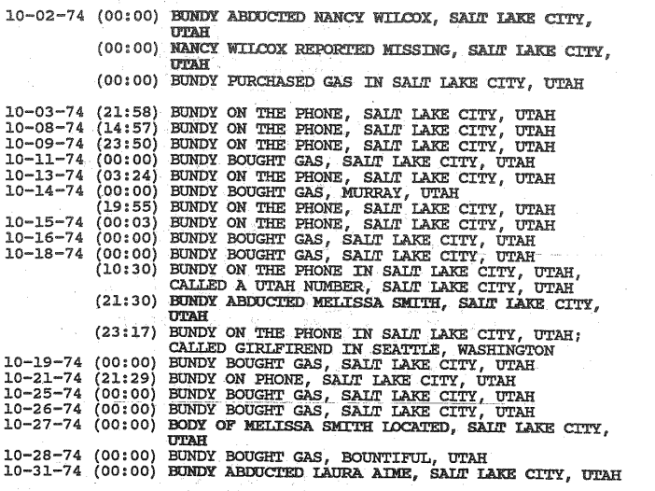
Suspects, Ted Bundy: in October 1974, Ted Bundy was living in a rooming house in Salt Lake City and was attempting his second round of law school at the University of Utah. This period marked a notable change in his criminal activity as he was in the process of moving his ‘playground’ from the Pacific Northwest to the Intermountain West: on October 2 he abducted and killed sixteen-year-old Nancy Wilcox from Holladay, Utah, and on October 18th seventeen-year-old Melissa Smith disappeared out of nearby Midvale; the daughter of the local police chief, Smiths remains were found nine days later. At the end of the month on Halloween night Ted abducted and killed seventeen-year-old Laura Ann Aime, who vanished after leaving a party in Lehi to buy cigarettes.

In the fall of 1974 Ted was also maintaining his long-distance relationship with Elizabeth Kloepfer in Seattle (despite also dating multiple other women) and it’s also worth mentioning that for his move from Washington to SLC he bought an old white pick-up truck at one point in time (I couldn’t find much information about that particular vehicle). I could have sworn I read somewhere that it was his brothers truck, but when I looked into it I couldn’t find much on it other than the fact that he owned it until late 1975 (this is according to the 1992 TB FBI Multiagency Report ).

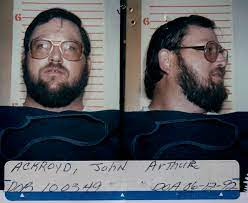
John Arthur Ackroyd: a lesser discussed serial killer from the Pacific Northwest, John Arthur Ackroyd was born on October 3, 1949 in the small logging town of Sweet Home, Oregon. He was one of three kids (he had an older and younger sister), and his dad was a maintenance worker and his mother worked in the office for the Sweet Home Police Department. During his adolescence, he was considered a loner and was frequently bullied, and his high school diploma indicated that he had been in the special education program.

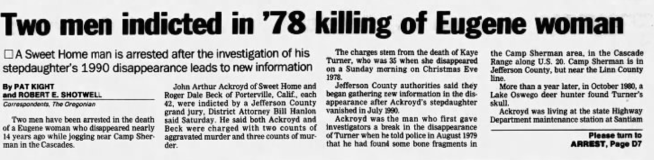
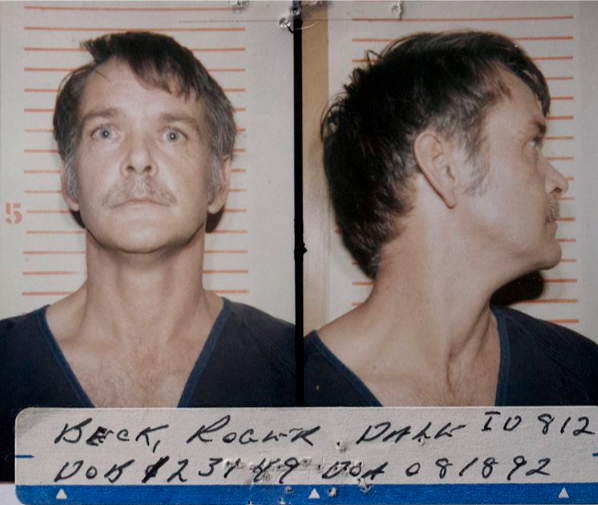
After Ackroyd was accused of felony theft he enlisted in the Army, where he worked overseas as a mechanic. Upon returning home in 1977, he got a job with the Oregon highway department which was located along US Route 20 and ran east to west across The Beaver State; some of his responsibilities included clearing vehicle wrecks, helping those whose cars broke down, and overall basic maintenance. Later that same year he raped twenty-nine-year-old Marlene Gabrielsen, a young mother that he allowed to live (she was the only one). In 1978, Ackroyd and an accomplice, Roger Dale Beck, he abducted and murdered thirty-five-year-old Kaye Turner, who had been out running at the time she was abducted.

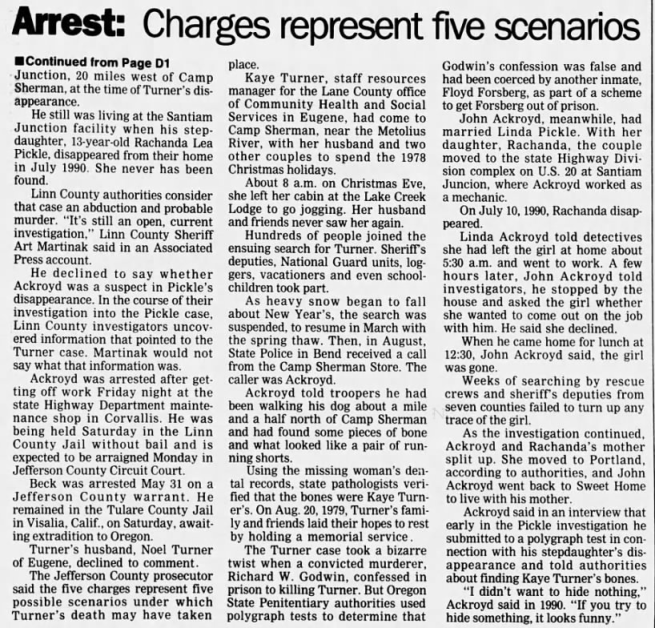
At some time in the mid-1980’s he married a divorcee named Linda Pickle, who had two children from a previous relationship (Rachanda and Byron); the family moved into a house in Santiam Junction, a state highway division compound at the junction of Oregon-126, Oregon-22, and US Highway 20 (other members of the highway department lived there as well, but few of them had children). After only a year of marriage, the couple divorced but continued to live together; he was abusive to both of his former stepchildren, and Rachanda disappeared under mysterious circumstances on July 10, 1990.

By early 1992 Ackroyd had moved in with his mother in Sweet Home: because of his connection to his thirteen-year-old stepdaughter’s disappearance, most of the women and children in Santiam Junction were uncomfortable with him being there, and as a result he began to work out of Corvallis. In May 1992 nineteen-year-old Sheila Swanson and seventeen-year-old Melissa Sanders vanished while on a camping trip with Sanders’ family at Beverly Beach State Park on the central Oregon coast. They were last seen at a payphone near a grocery store on US 101, reportedly planning to hitchhike back home to Sweet Home and Lebanon. Their remains were discovered in October 1992 by hunters in a remote area off a logging road near Eddyville, and due to the advanced level of decomposition, an exact cause of death could not be determined. Ackroyd was arrested for the murder of Kaye Turner on June 12, 1992, and he was charged with Rachanda’s murder in 2013; he pleaded no contest. Lincoln County Investigators with the DA’s Office Ron Benson and Linda Snow were preparing to present evidence against Ackroyd in relation to the murders of the two young women to a grand jury when he died on December 30, 2016 at the age of sixty-seven.

Warren Leslie Forrest: logically, when I was thinking about the timing of Marion’s murder, serial rapist and murder Warren Leslie Forrest immediately popped into my head… but by late October 1974 he had already been arrested (he was taken into custody on October 2, 1974).

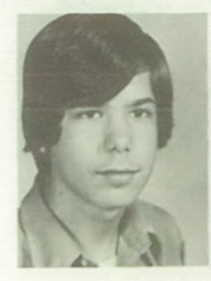
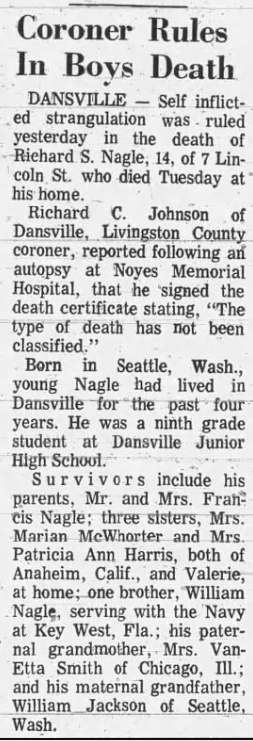
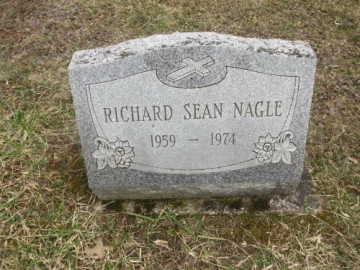
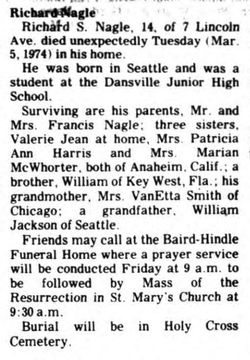
Richard Sean Nagle: sadly, Marion’s younger brother Richard Nagle died from suicide at the age of fourteen on March 6, 1974. He died in his home and according to his autopsy he died of ‘self-inflicted strangulation;’ per his obituary, Nagle was born in Seattle and had moved to Dansville four years prior; he was also in ninth grade at the local junior high school.

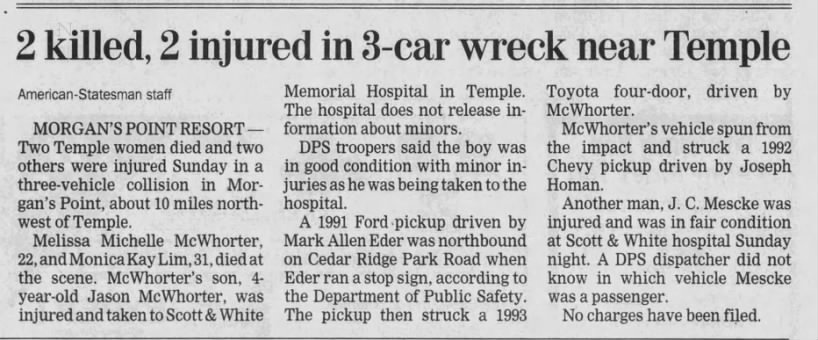
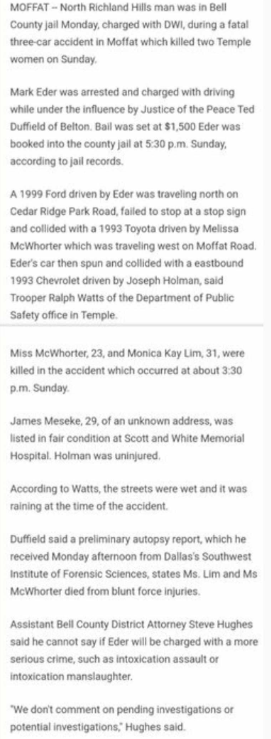
Monica & Melissa: tragically, on April 7, 2002 Marion’s daughter Monica died at the age of thirty-one along with her half-sister, twenty-two-year-old Melissa McWhorter after the vehicle they were driving was hit by a drunk driver in Moffat, Texas. Monica Kay McWhorter married Yeow B. Lim in 1996, and the couple had a son together named Jason Bravo (who fortunately survived the accident with only minor injuries). She is buried in Bell, TX.

Conclusion: the entire Nagle-McWhorter clan is steeped in absolute tragedy: Kenneth Michael McWhorter died at the age of forty-two on July 17, 1994; his widow Deborah died at the age of fifty-six on December 31, 2007. Marion’s brother William Frances Nagle died of a heroin overdose at the age of thirty-eight in Seattle on June 17, 1994. Patricia Ann Nagle-Johnson died from lung cancer at the age of forty-two on January 13, 1997 in Seattle. Marion’s father died on Christmas day in 2002 in Seattle and at the time of his death, he had been married to Violet for fifty-seven years. Violet Nagle died at the age of eighty on May 3, 2008 in Seattle from lung cancer. According to a Reddit post, in recent years Valerie was able to find the daughter that Marion gave up for adoption, but they didn’t get as close to her as they had hoped to. She currently lives in Seattle, Washington and is sixty-three years old. As of April 2026, Marion’s case remains unsolved.

Works Cited:
AP. (September 19, 2025). ‘A woman’s remains were found in Oregon in 1976. They’ve been identified 49 years later thanks to DNA.’ Taken March 4, 2026 from nbcnews.com
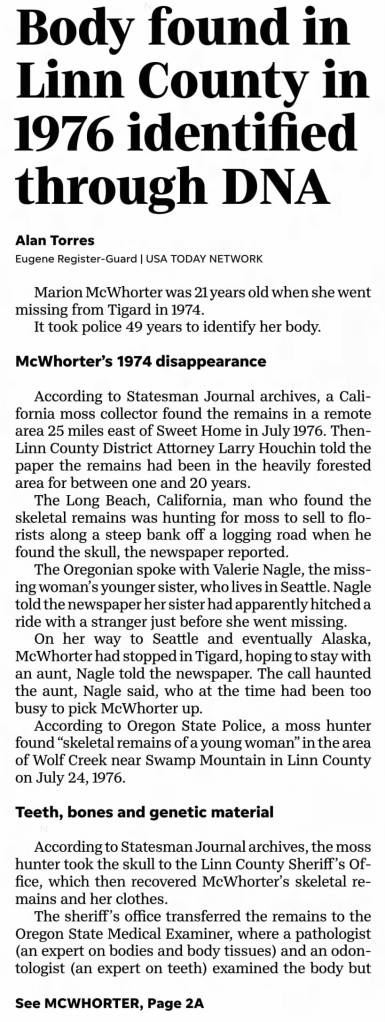
Martin, Saleen. (September 22, 2025). ‘She was Last Heard from 51 Years Ago. Her Remains have Finally been Identified.’ Taken March 4, 2026 USA TODAY
Wasson, Lindsey. (September 19, 2025). ‘A Woman Vanished in Oregon in 1974. Now, Remains Two Years Later have been Identified as her, through DNA.’ Taken March 5, 2026 from cbsnews.com
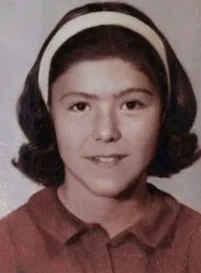
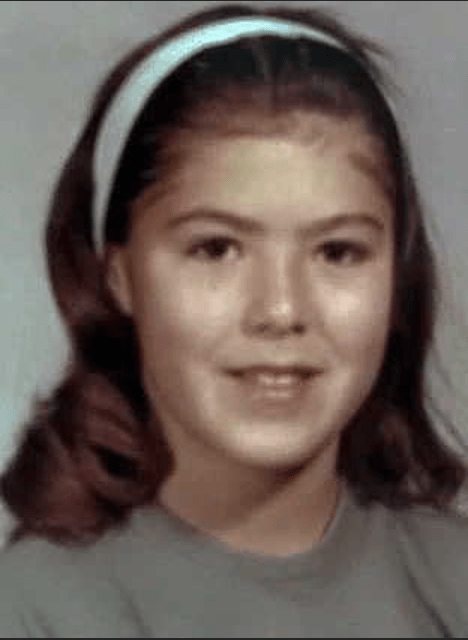
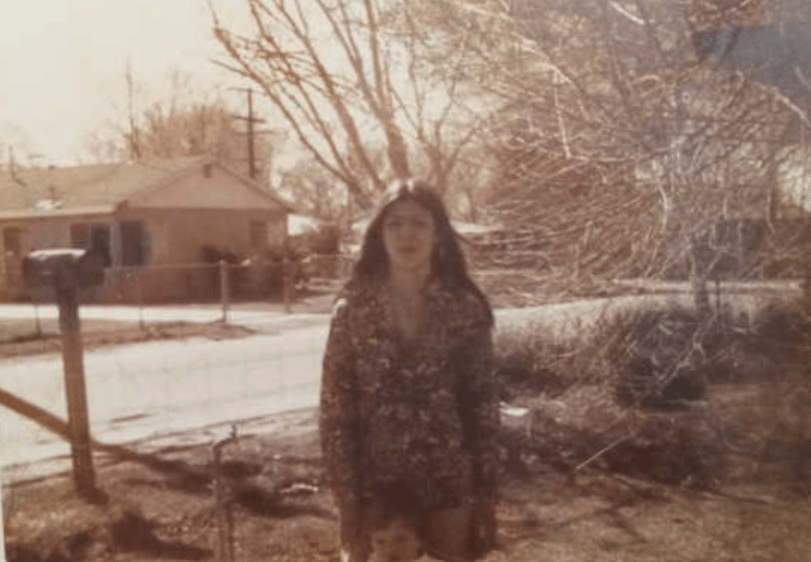
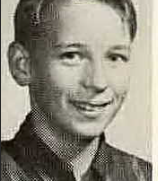
Marion in elementary school.
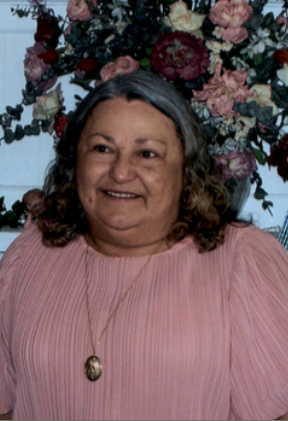
Marion.
Marion.
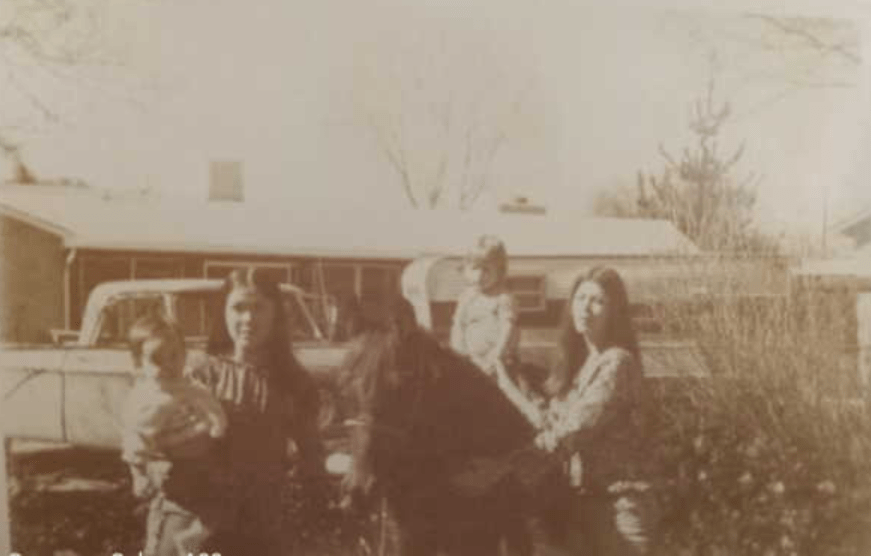
Monica (seated on horse) with her mother Marion and aunt before 1975.
The black and white beaded phoenix that was on Marion’s belt when her remains were discovered.
The clog-like shoe that was found near Marion’s remains.
A forensic approximation of what an older version of Marion Nagle-McWhorter might look like in more recent days.
One of the multiple recreations of the ‘Swamp Mountain Jane Doe’s’ face that was based on the cranial features of her skeleton.
A forensic drawing of the former ‘Swamp Mountain Jane Doe.’
A second forensic drawing of the former ‘Swamp Mountain Jane Doe.’
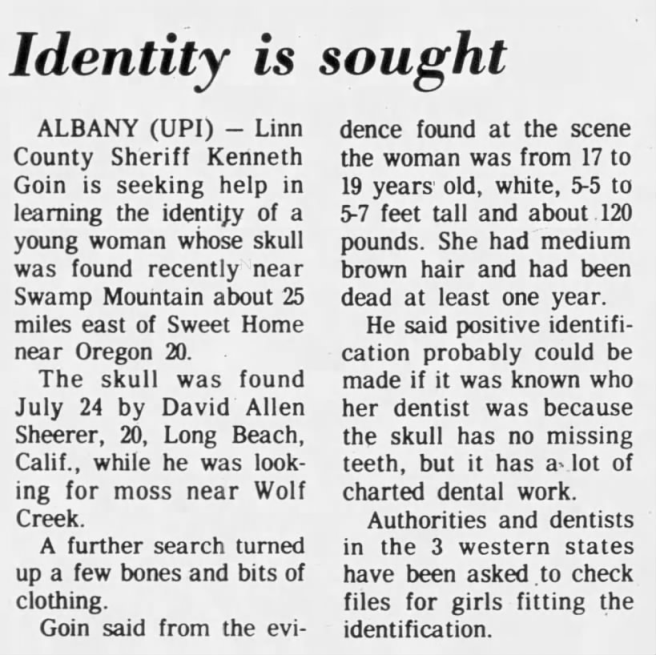
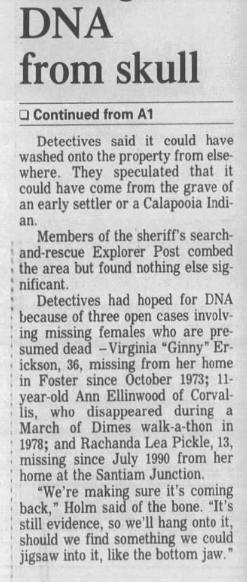
An article about the discovery of the ‘Swamp Mountain Jane Doe’ that was published in The Albany Democrat-Herald on July 26, 1976.
An article about the discovery of the ‘Swamp Mountain Jane Doe’ that was published in The Statesman Journal on July 28, 1976.
An article about the discovery of the ‘Swamp Mountain Jane Doe’ that was published in The Oregon Journal on July 28, 1976.
An article about the discovery of the ‘Swamp Mountain Jane Doe’ that was published in The Albany Democrat-Herald on July 30, 1976.
An article about the ‘Swamp Mountain Jane Doe’ that was published in The Statesman Journal on August 1, 1976.
An article about the ‘Swamp Mountain Jane Doe’ that was published in The Albany Democrat-Herald on August 2, 1976.
An article about the ‘Swamp Mountain Jane Doe’ that was published in The Capital Journal on August 6, 1976.
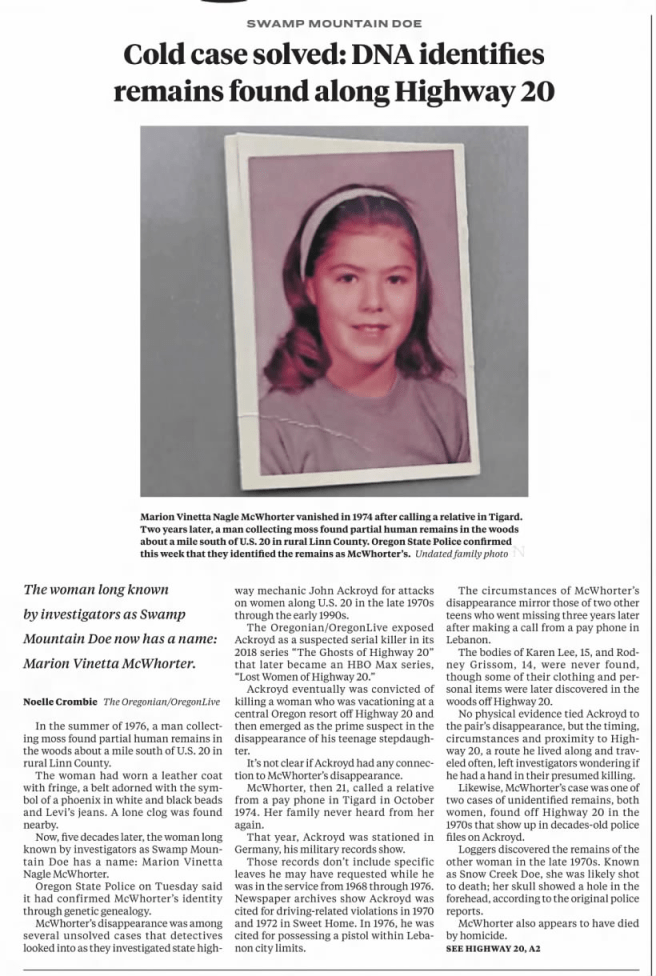
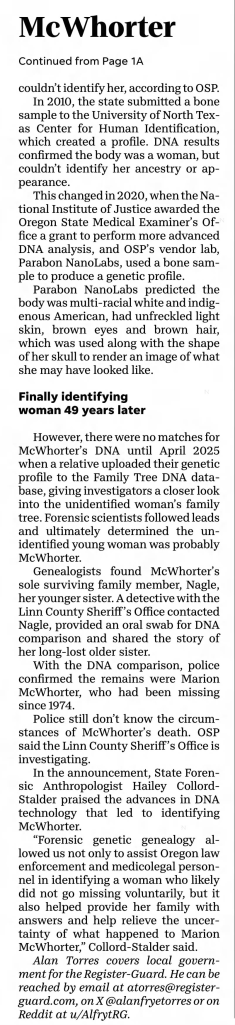
Part one of an article about the discovery that the ‘Swamp Mountain Jane Doe’ was really Marion McWhorter that was published in The Oregonian on September 17, 2025.
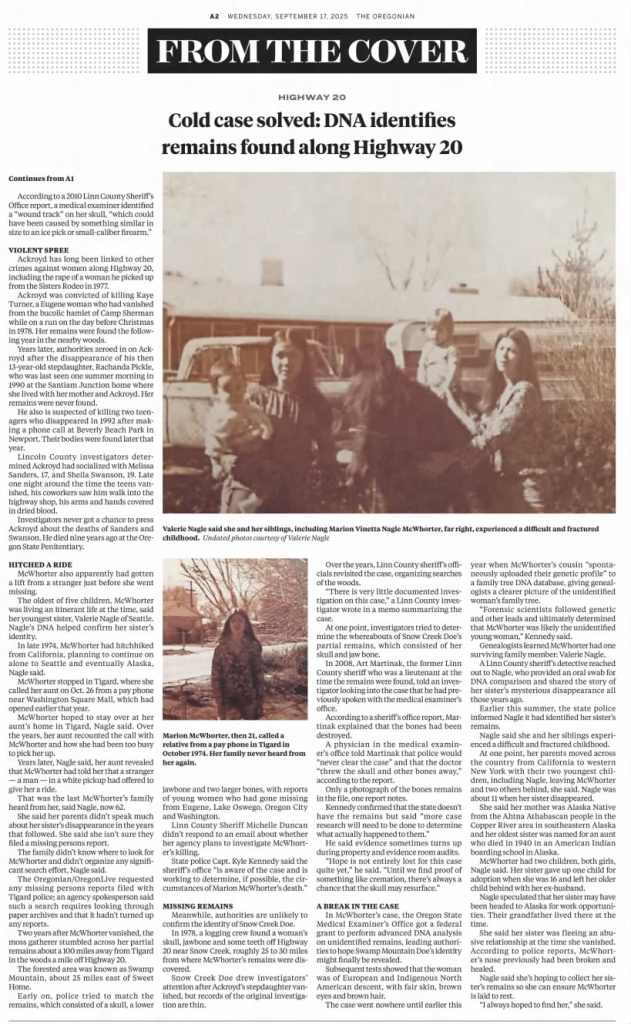
Part two of an article about the discovery that the ‘Swamp Mountain Jane Doe’ was really Marion McWhorter that was published in The Oregonian on September 17, 2025.
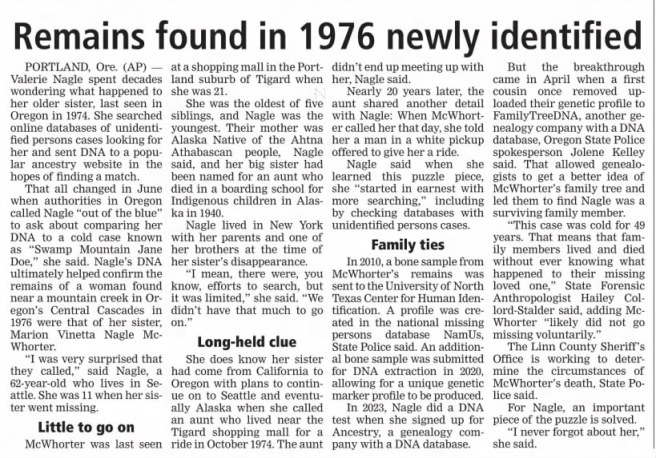
Part one of an article about the discovery that the ‘Swamp Mountain Jane Doe’ was really Marion McWhorter that was published in The Oregonian on September 20, 2025.
Part two of an article about the discovery that the ‘Swamp Mountain Jane Doe’ was really Marion McWhorter that was published in The Oregonian on September 20, 2025.
An article about the death of Monica’s daughter Michelle published in The Press Enterprise on October 18, 2025.
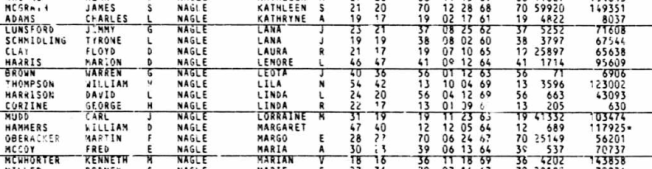
Kenneth and Marion in the California state marriage records.
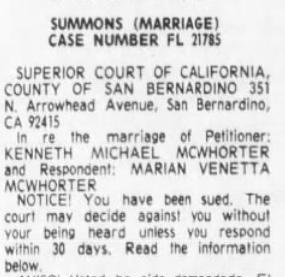
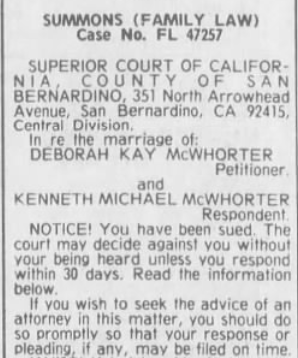
Kenneth and Marion in the California state divorce records from 1975.
I love how her name isn’t spelled even remotely correctly. Published in The San Bernardino County Sun on July 30, 1975.
A comment on a Reddit post about Marion Nagle-McWhorter made by user ‘Sailboat_fuel.’
A comment on a Reddit post about Marion Nagle-McWhorter made by her sister Valerie Nagle, who went by the username ‘PNWpurplepisces.’
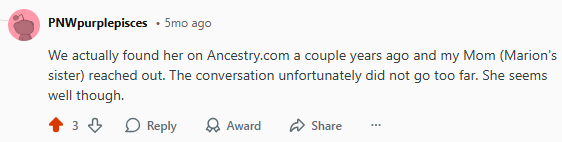
A second comment on a Reddit post about Marion made by her sister talking about how her niece is still alive and seems to be ‘doing well.’
Ted’s whereabouts in October 1974 according to the ‘1992 TB Multiagency Team Report.’
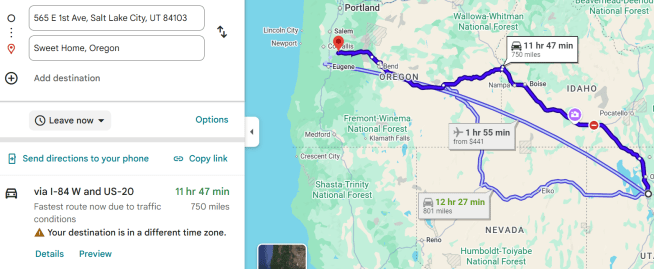
A possible route from Bundy’s residence on Est 1st Avenue in SLC to Sweet Home, Oregon where Marion was last seen alive.
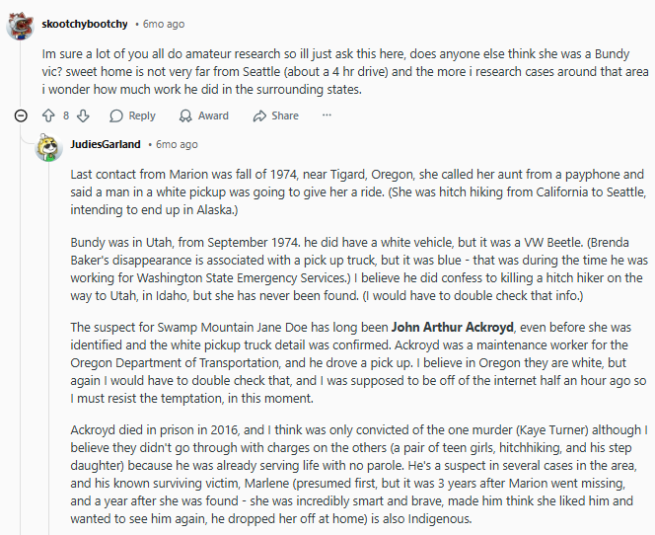
A Reddit comment made by user ‘JudiesGarland’ about Ted Bundy possibly being responsible for Marion’s death.
John Arthur Ackroyd.
Part one of an article about the atrocities of John Arthur Ackroyd published in The Sunday Oregonian on June 14, 1992.
Part two of an article about the atrocities of John Arthur Ackroyd published in The Sunday Oregonian on June 14, 1992.
Roger Dale Beck, accomplice of John Arthur Ackroyd.
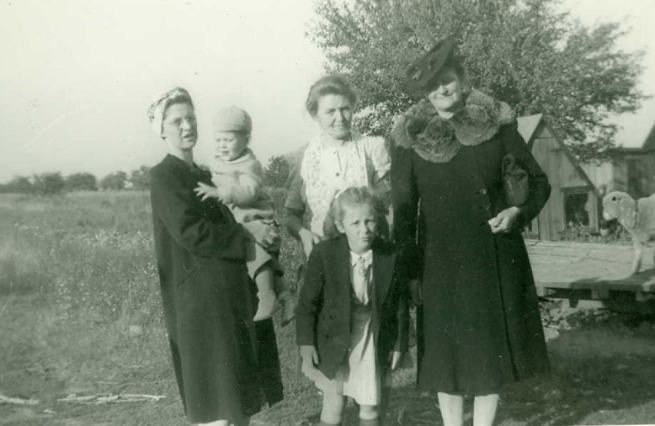
Vinetta Nagle, Jack Nagle, an unknown women and their aunt Vinetta Clara O’Hara (who Marion was named after).
Francis J. Nagle’s WWII draft card.
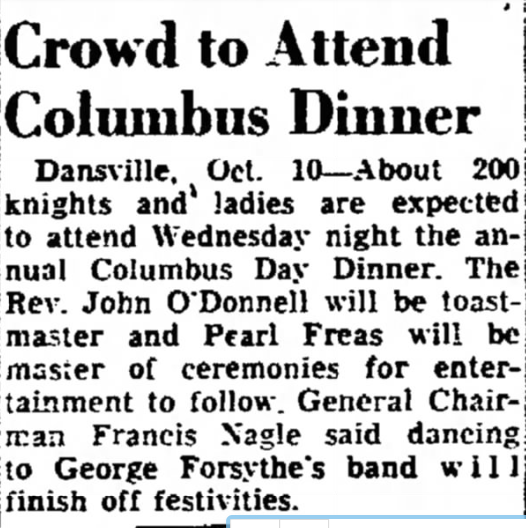
A newspaper article mentioning Francis Nagle published in The Evening Tribune on October 10, 1949.
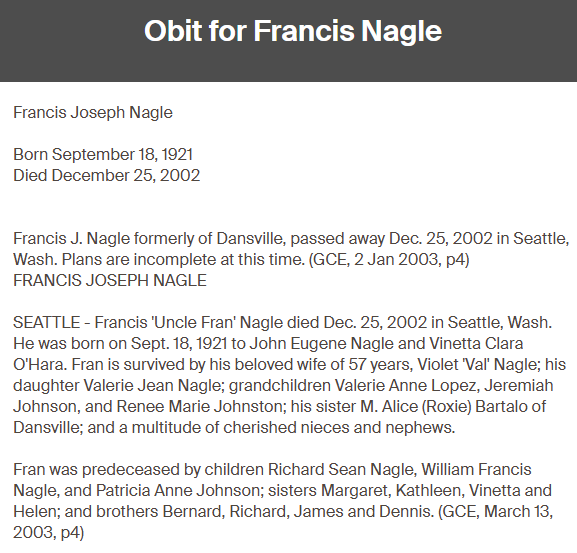
The obituary for Francis J. Nagle.
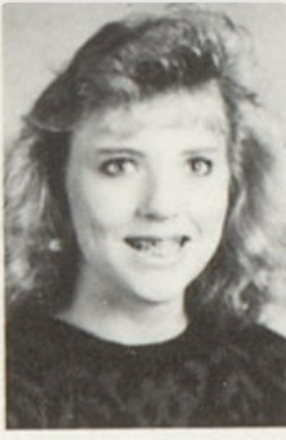
Monica McWhorter from the 1987 Turlock High School yearbook.
Monica Kay McWhorter from her high school days.
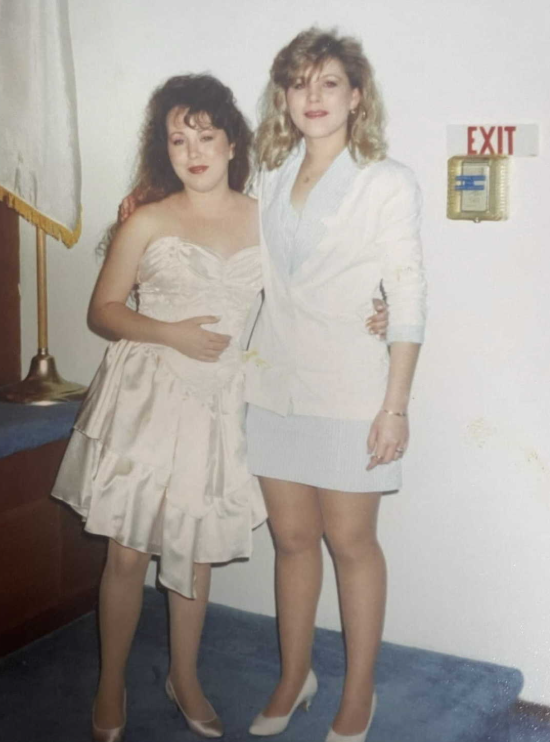
Monica McWhorter, on the right.
Monica Kay McWhorter-Lim.
Monica (left) and her son, Jason Bravo; I’m not sure who the brunette is.
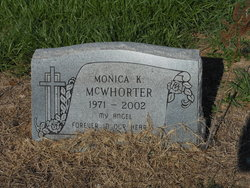
The final resting place of Monic R. McWhorter.
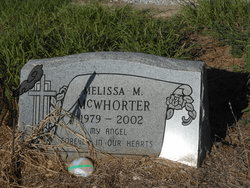
The final resting place of Melissa McWhorter.
An article about the death of Monica’s daughter Michelle published in The Austin American-Statesman on April 8, 2002.
A newspaper clipping a bout the deaths of Monica and Melissa McWhorter.
Richard Sean Nagle.
A newspaper article bout he death of Richard Nagle that was published in The Times-Union on March 7, 1974.
The final resting place of Monica’s brother, Richard Sean Nagle.
Richard Nagle’s obituary.
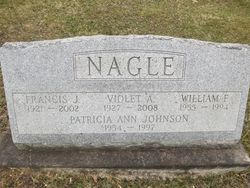
The final resting place of Monica’s parents and brother.
Kenneth Michael McWhorter listed in the Texas, U.S., Birth Index, 1903-1997.
Kenneth Michael McWhorter.
According to this newspaper clipping, Kenneth and Deborah McWhorter suffered from some marriage difficulties at one point in their relationship, published in The San Bernardino County Sun on October 30, 1981.
Kenneth McWhorter’s second wife, Deborah James.
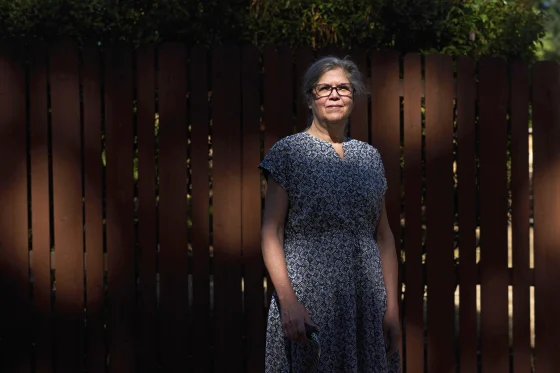
Valerie Nagle in Seattle. Photo taken by Lindsey Wasson of the AP.
Valerie Nagle, photo courtesy of Facebook.

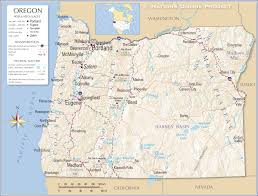
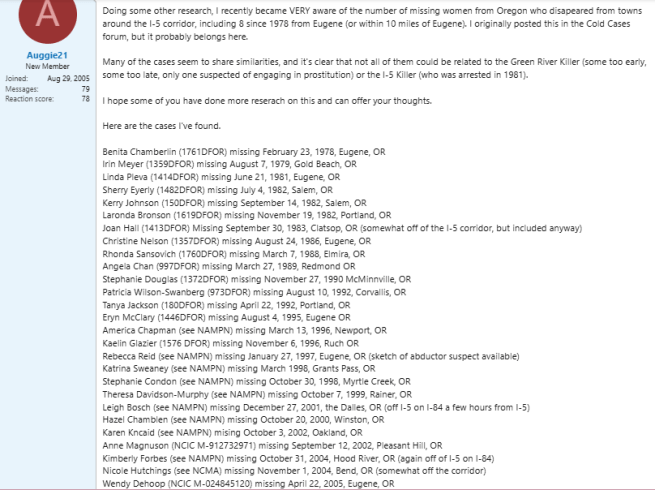
Missing/Murdered Oregon Women, 1969 to 1979.

I’ve been compiling a list of missing and murdered young women from the 1970’s in Oregon in a notebook, and I figured why not also include it here. As I learn of new victims I will update the list… over the years I’ve found dozens of names on various websites and newspaper articles about other missing and murdered women, but they’re scattered all over the internet in a million different sources… why not put them all here?

Janet Lynn Karin-Shanahan: (April 23, 1969, Eugene). Twenty-two-years-old. Strangled and found in the trunk of her own car.

Beverly Annette Gayley: (June 15, 1969, Deschutes County). Her remains were found in a wind cave covered with a bedspread and rocks; she had a ligature wrapped around her neck. A significant amount of blood was found in Gayley’s home, as well as in the trunk of her car.

Niki Diane Britten: (July 16, 1969, Albany). Fifteen-years-old. Frequent run away.

Julie Dade: (January 21, 1970, Junction City). Twenty-Year-Old. Julie’s husband, Terry was later found deceased in the couple’s Maple Street apartment. At about 4:20 AM, neighbors in the area of the Maple Street Apartments heard a female yelling and a witness saw a man dragging a screaming woman into a vehicle before leaving the area. A nearby neighbor woke to the sound of an explosion, saw the car on fire and tried to put it out but it was too late.

Sandra Young: (February. 23, 1970, Sauvie Island). Her remains were found on Sauvie Island in 1970 but were not identified until February 2024; her murder remains unsolved.

Barbara Katherine Cunningham: (May 25, 1971, Eugene). Thirty-four-years-old. Found deceased in her apartment by her mother.

Barbara Ann Bryson: (July 29, 1971, Stayton). Nineteen-years-old. Was last known to be attending a party.

Anne Marie Lehman: (found on August 19, 1971, Josephine County). Seventeen-years-old. Disappeared from Aberdeen, Washington in the winter or spring of 1971; the circumstances surrounding her case are unclear, although it is rumored she was a victim of human trafficking. Her remains were found by a man and his son while they were out mushroom hunting off the Redwood Highway, close to mile marker thirty-five; it is unclear as to why she was in Oregon.

Josephine County ‘Jane Doe’: (remains found on August 19, 1971). Body found near the California border; believed to be female victim somewhere between fourteen and twenty-five-years-old.

Fay Ellen Robinson: (March 12, 1972, Eugene). Found deceased in apartment.

Alma Jean Barra: (March 23, 1972, Happy Valley). Twenty-eight-years-old. Found deceased in Willamette National Cemetery.

Beverly May Jenkins: (May 25, 1972, Cottage Grove). Sixteen-years-old. Her remains were found in June 1972 just off the I-5 roughly ten miles outside of Cottage Grove; she had been strangled to death. 

Jane Pellett: (June 7, 1972, Salem). Twenty-eight-years-old. Found deceased on a busy roadside on June 26, 1972.

Geneva Joy Martin: (June 16, 1972, Eugene). Nineteen-years-old. Found deceased on the side of the road by a farmer.

Rita Lorraine Jolly: (June 29, 1973, West Linn). Seventeen-years-old. Disappeared while out on a routine nightly walk.

Allison Lynn Caufman: (July 1973, Portland). Fifteen-years-old. Died as a result of head injuries after being shoved from a car moving at a high rate of speed.

Laurie Lee Canaday: (July 9, 1973, Milwaukee). Her remains were recovered on the pavement at the intersection of Southeast Scott Street and McLoughlin Blvd in Milwaukee, OR.

Susan Ann Wickersham: (July 11, 1973, Bend). Seventeen-years-old. Was found deceased from a gunshot wound on January 20, 1976.

Vicki Lynn Hollar: (August 20, 1973, Eugene). Twenty-four-years-old. Disappeared along with her 1965 VW black VW Beetle with IL plates and the running boards removed.

Gayle LeClair: (August 23, 1973, Eugene). Twenty-two-years-old. Found stabbed in her apartment.

Delores Thompson and Gwendolyn Fulce: (September 8, 1973, Portland). A double homicide, twenty-four-year-old Thompson and twenty-one-year-old Fulce were found deceased in a home on North Ivy Street.

Deborah Lee Tomlinson: (October 15, 1973, Creswell/Eugene). Fifteen-years-old. Disappeared along with a friend on her sixteenth birthday. According to her sister (and my friend) Jean she was seen in California after she disappeared).

Virginia Erickson: (October 21, 1973, Sweet Home). Thirty-two years old, mother of six. Disappeared, most likely killed by her husband.

Suzanne Rae Seay-Justis: (November 5, 1973, Portland). Twenty-three-years-old. Was from Eugene, hitchhiked to Portland despite having a car of her own.

Belinda Cowden, along with her husband Richard and two children, David and Melissa: (September 1, 1974, Copper). The family were the victims of a still unsolved mass murder after they vanished from their campsite near Carberry Creek in the Siskiyou Mountains of Oregon; they were last seen on September 1, 1974, when Richard and David bought milk at the Copper General Store. When they never showed up for dinner at Belinda’s mother’s house later that day, their campsite was found deserted, with their truck, wallets, and a half-full carton of milk left behind. On April 12, 1975, two gold prospectors found their bodies roughly seven miles from the campsite: Richard was found tied to a tree on a steep hillside, and Belinda, David, and baby Melissa were hidden inside a nearby small cave that had been sealed up with rocks. Autopsies later revealed that Belinda and David had been shot with a .22 caliber weapon, while Melissa died from severe blunt force head trauma; Richard’s cause of death could not be determined due to the condition of his remains.

Joyce C. Hess: (October 18, 1974). Fifty-four-years-old.

Marion Vinetta Nagle-McWhorter: (October 1974, Tigard). Twenty-one-years-old. According to McWhorter’s sister, she had been traveling before she disappeared around the Western part of the US. Her body was finally identified in September 2025, but the case remains unsolved.

Becky Rae Martin: (February 15, 1975, Junction City). Twenty-two-years-old. Throat cut.

Leslie Michelle (seven-years-old) and Geoffrey Lyman (five-years-old) Brown. Murders took place on February 22, 1975 and both victims were found on March 12, 1975 in McIver Park, Estacada.

Margo Nerline Ascencio-Castro: (March 1, 1975, Eugene). Twenty-two-years-old. Found stabbed in a motel room, possibly involved with a local motorcycle gang.

Ceceilia Louise Hostetler: (March 26, 1975, Eugene). Last seen leaving the Embers restaurant getting into a vehicle with another person whom she appeared to know. On October 30, 1998, an unidentified deceased female was found burned and stabbed in the forest near 24243 Bolton Hill Road in Lane County, Oregon; it was later identified through dental records as Ceceilia Hostetler.

Caroletta Spencer: (May 20, 1975, Sauvie Island). Seventeen-years-old. Spencer’s was a sex worker whose body was found on a gravel road on Sauvie Island in Oregon. She had been shot four times and most likely had been killed earlier that morning, as she was last seen at Fred’s Place Bar in Portland around 2:20 AM.

Wanda Ann Herr: (June 1, 1976, Government Camp). Nineteen-years-old. Few details about Herr’s life are available, but according to family members, she grew up in Gresham, Oregon, but did not live with her siblings and reportedly ran away from home multiple times as an adolescent. Herr was last seen alive sometime around June 1976 and may have been living in a group home when she disappeared; her upper skull and some miscellaneous bones were discovered on August 2, 1986, near two roads off of Highway 26.

Shirley Anita Wallace: (July 21, 1975, Eugene). Thirty-one years-old. Found, shot.

Tina Marie Mingus: (October 1975, Salem). Sixteen-years-old. Murdered, body recovered.

Cherril Sue Miller: (October 12, 1975, Portland). Twenty-eight-years-old. Few details are available in Miller’s case, but she had two children, whom she had left in a neighbor’s care that evening. One of her teeth in the front of her mouth is discolored or capped and she wears eyeglasses with thin bone rims.

Camille Karen Covert-Foss: (October 17, 1975, Hillsboro). Twenty-five-years-old. Found shot in her vehicle at her POE, in a Southwest Portland-area shopping center.

​Deborah McNoise-James: (October 28, 1975, Klamath County). Found deceased at the 97 Trailer Court with lacerations to her head, neck, arms, and leg, as well as trauma to her larynx.

Betty Johnson: (November 1975, Estacada). Nineteen-years-old. Not much is known, I only happened to stumble upon her name when searching for a different Oregon woman (Marion McWhorter).

Kim Charleson: (January 7, 1976, Cannon Beach). The twenty-two-year-old had been in college and may have been carrying a small amount of Canadian currency when she disappeared.

Cordelia Sheehan McMinn: (May 1, 1976, Portland). Twenty-six-years-old.

​Julie Ann Beardslee: (June 30, 1976, Astoria). After Beardslee failed to attend a regularly scheduled Bible study class in Astoria her vehicle was found on July 1, 1976, at Fort Stevens State Park. Her body was discovered by hikers on July 12, 1976 near Coffenbury Lake in Clatsop County, Oregon; she had been stabbed, and her throat had been cut.

Sharon Ryan: (December 16, 1976, Portland): Seventeen-year-old. Vanished going to buy eggs, her body was found near a parking lot in Portland.

Roxanne Marie Sims: (January 1, 1977, Portland). Eighteen-years-old.

Sandra Renee ‘Sandy’ Morden: (1977) Approx sixteen-years-old, her partial skeleton was found in Washington in 1980 and it’s believed that she died in the late 1970’s; she was identified in October 2019.

Karen Jean Lee: (last seen alive, May 26, 1977, Cornelius). Lee ran away with a male companion, fourteen-year-old Rodney L. Grissom. Her possessions and clothes were found by a logging crew sometime in November 1977 however her remains were never recovered. Grissom’s clothes and belongings found in same area, roughly a quarter mile away from Lee’s in November 1982; his remains have also never been found. (Thank you to my friend Ryan AuClair for this information).

Lliana Gay Adank: (June 1977). Sixteen years-old. Was found shot to death along with seventeen-year-old Eric Shawn Goldstrand at the remote Broken Bowl Picnic Grounds near the Fall Creek Dam located about twenty-five miles southeast of Eugene.

Cindy Irene King: (July 19, 1977, Grants Pass). Fifteen-years-old. Disappeared.

Elizabeth ‘Lisa’ Ann Roberts: (July 25, 1977, Roseburg). Found August 9, 1977, formerly known as ‘Precious Jane Doe.’ Roberts was identified on June 16, 2020.

Margie Ann Fernette: (January 24, 1978). Fifteen-years-old. Found in Fairfield Elementary School.

Benita Gay Chamberlin: (February 23, 1978, Eugene). Twenty-four-years-old.

Floy Joy/Jean Bennett: (February 23, 1978, Beaverton). Thirty-seven-years-old.

Karen Etta Whiteside: (March 22, 1978). Sixteen-years-old.

Ann Marie Ellinwood: (April 15, 1978, Corvallis). Twelve-years-old, last seen walking alone ‘during daylight hours.’ Possibly a victim of Earl Patrick Chambers.

Stephanie Ann Newsom: (April 19, 1978, West Salem). Eleven-years-old. Remains found on April 25, 1978 near the Ankeny Wildlife Refuge: possibly a victim of Earl Patrick Chambers.

Elana Jacobs and Teresa Krause: (May 21, 1978, Astoria). Both girls were enrolled in the Tongue Point Job Corp. They were known to go into town to ‘party and socialize,’ which is most likely why they left the compound the night they were last seen alive; their remains were found near Del Rey Beach, Krause’s on December 3, 1978, and two days later Jacobs were discovered; they were most likely stabbed and/or strangled to death.

Finley Creek Jane Doe: (found August 27, 1978, Elgin). The remains of a pregnant woman between the ages of fourteen and twenty-five-years-old; detectives strongly believe she died between 1970 and 1975 and was six to eight months pregnant at the time of her death; fetal remains were found with her. She was found buried face down under a log, and evidence at the scene, including a coaxial cable, suggests she may have been strangled.

Diana Marie Kuhn*: (December 10, 1978, Portland). Twenty-years-old. Remains found in in West Linn, OR.* Thank you for Diana’s cousin Donna Mollema for informing me about her.

Christie Lynn Farni: (December 14, 1978, Medford). Six-years-old.

Pem Michelle Yates-Briggs: (January 1, 1979). Fifteen-years-old.

Janie Landers: (March 9, 1979, Salem). Eighteen-years-old; she slipped away from the Fairview Training Center in Salem, a residential facility for those with developmental disabilities and mental health problems.

Mary Jo Templeton: (April 1979, remains found on April 30, 1979, Redmond). Forty-nine-years-old. In April 1979, she was renting a room at the El-Rancho Motel when she disappeared; her remains were uncovered in several parts over the time period of a month in Mirror Pond and near the Newport Avenue Dam in Bend. The first remains (a thigh) were found by a utility worker raking intake grates at a dam on April 30, 1979. She had been dismembered with what detectives called a ‘surgical precision,’ leading to theories that her killer may have had experience as a hunter, butcher, or surgeon, butcher (or a combination of the three); she was eventually identified through dental records.

Daisy Motley: (May 8, 1979, Portland). Motley was a sixty-four-year-old, unemployed female who lived alone that had no apparent enemies. Someone anonymously called the manager of her apartment complex to her death and asked them to check on her because they heard a ‘disturbance’ coming from her residence. The last time Daisy was known to be alive was when she talked to her daughter at approximately 9 PM on May 7th.

Lisa Danein Boggs: (June 13, 1979, Salem). Boggs and her boyfriend, Randolph Robertson, left their home state of Missouri on May 7, 1979 and arrived in Salem, Oregon, on May 9, 1979, and lived at a transient camp on property near the KOA at 1595 Lancaster Drive. On June 7, 1979, Salem police were called to the KOA for a homicide, where they discovered that Randolph Robertson, had been killed by two shotgun blasts; Boggs was nowhere to be found. On June 13, 1979, her’ body was discovered in a creek 17.5 miles up Little North Fork Road off Highway 22E in Marion County, Oregon. Her cause of death was drowning, even though she had also sustained a blunt-force injury to the skull behind her left ear. She was found lying on her back, with her head submerged in eleven inches of water; it had been held in place by a large rock

Irin Marie Meyer: (July 20, 1979, Brookings). Twenty-nine-years-old.

Sheryl Wright: (no additional information at this time).

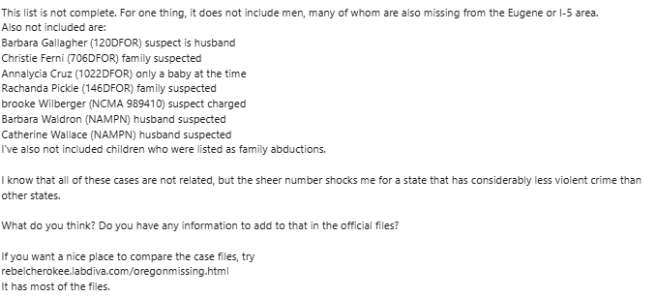
A very helpful Websleuth’s user compiled a list of missing/murdered women from Oregon in the time frame right after I did.
The second part of the Websleuth’s post about the missing women from Oregon in 1978 to 2005.

Virginia ‘Ginny’ Mae Ackley-Erickson.

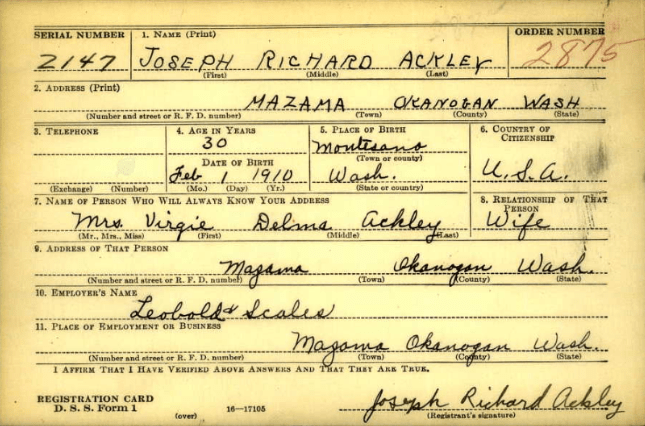
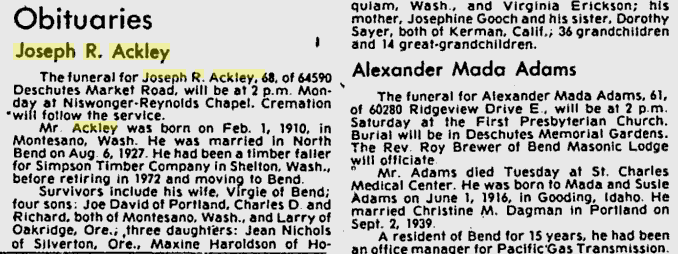
Virginia Mae Erickson was born on April 26, 1941 to Joseph and Virgie (nee Lee) in Mazama, WA. Mr. Ackley was born on February 1, 1910 in Montesano, and Virgie was born on a houseboat on June 12, 1912 in Empire, OR. The couple were wed on March 18, 1928 in Buxton, Oregon and had eight children together: Virginia, Lawrence, Maxine, Joseph, Charles, Jean, David, and a daughter named Joyce that died in childbirth.

On October 18, 1958 seventeen year old Virginia married twenty-one year old David Erickson in Montesano, WA; Erickson was born on May 31, 1937 in Tigerton, Wisconsin. After relocating to Sweet Home, OR the couple had six children together: two boys and four girls. Ginny was a petite woman, and only stood at 5’1” tall and weighed 125 pounds; she had green eyes and curly chestnut hair she wore at her shoulders. She was a devout fundamentalist Christian and dedicated stay at home mother, and played the piano during church service every Sunday morning while her daughters would sing in the choir; on occasion, David would join her and play the guitar (when he attended). Virginia was also very close to her parents who lived in Washington, and she spoke with them frequently and would usually visit every six weeks or so (give or take). Ginny’s younger sister Maxine said she ‘could not go for more than six weeks without going to see her folks and she always had the kids with her. She would not have gone that long without seeing her kids or seeing her mother.’

Virginia was last seen alive by her children in their home on 48th Avenue in Sweet Home on the morning of October 21, 1973: David woke up their oldest child Rachel and told her they’d be going to church without them that Sunday because he was taking their mother out hunting. This immediately struck her as being incredibly unusual and out of character for her mother, but she got up anyways and helped get her brothers and sisters (who ranged in age from six to thirteen years old) ready for service. Ginny and David’s sixteen year old nephew Jimmy picked the kids up that morning and took them to Sunday School, and their son David (who goes by Michael) said of the memory: ‘I just remember momma staying home, and she was crying when she was cooking something on the stove, and she gave us hugs goodbye, and she just told me she was sick. My cousin Jimmy picked all of us kids up and took us to church, and my mom never showed up at the church to play the piano, and I thought that was kind of weird, and it was my Uncle Jim and Aunt Shirley’s little church.’

Before leaving for church, Virginia pulled Rachel aside and said to her, ‘if I’m not here when you get home, you feed the kids and take care of them.’ The (then) 13 year old said that she remembers her mother was dressed in a bathrobe but the parts of her that were visible were covered in bruises and that it was almost as if she was trying to hide what was underneath; she also said that her breathing appeared to be labored and almost strained. Rachel said that she remembered her mom being afraid of her dad and that lots of other people were as well, but she also said that he was a sweet talker that could be very charming and manipulative.

When they arrived at church Rachel found her Aunt Shirley and told her about what happened at home; Shirley immediately got in her car and drove towards the Erickson residence, which was just down the street, and where she cannot say for 100% certainty Rachel strongly speculates she drove to her family’s house to see what was going on between her parents. According to a comment made by Amber Erickson on the website for the ‘Vanished’ podcast about her grandmother, when Shirley went to the Erickson home that Sunday morning David met her at the door with a gun, and threatened not only her but her children as well. When the service was over Jimmy took them home and the kids came back to an empty house, and when their father came home at around 2/2:30 PM he was by himself without Virginia.

Rachel and one of her sisters immediately asked David where their mother was, and he told them that she had simply ‘ran away.’ She was aware that her father had multiple guns, including hunting rifles and high powered pistols, and knew that day he took his .22 with him when he left the house. Later that same day Rachel was able to go back to the church to confront her aunt, and when she cornered her in the nursery Shirley slapped her across the face and said, ‘your mothers dead, don’t ever speak of her again.

Assuming David was telling them at the very least some partial truths, the children began looking through their mothers personal belongings to see if anything was missing, but everything was left behind, even her shoes. According to Michael, ‘I remember helping Rachel look for missing stuff because I remember Mom and Dads bedspread was gone, and Rachel was screaming that ‘mom would never leave without her glasses. And why are her rings still here? Why are her clothes all still here? She didn’t even wear her shoes.’’

Almost immediately after Virginia disappeared David gave away all of her personal possessions, including her clothes, books, and jewelry, and Michael even saw her set of green and cream colored encyclopedias at his Aunt Shirley’s house (she denied they belonged to his mother). According to him, ‘a whole bunch of church people came into our house the next day, or really soon after mom left that I came home from school and a lot of church people were there taking everything. They took the washing machine, all of her books were gone, a lot of the cooking stuff was gone. Me and Eric were sleeping on the floor, the front room furniture was gone. The TV was gone. So I always thought that was kind of weird.’

According to Rachel, the day before her mother disappeared her parents were arguing about Denise, one of her twelve year old twin sisters, who the day prior had told Virginia that she was no longer menstruating. She remembers hearing her say to their father, ‘I’m bringing Denise to the doctor on Monday and everyone will know now, for sure, what kind of man you are and what you’ve done.’ In response to this, David (who was a golden glove boxer in Wisconsin) screamed at her that she ‘wouldn’t live until Monday’ if she told anybody, then slammed her against the wall and began ‘hitting and punching’ her. This wasn’t out of the ordinary for her father, and Rachel said that on multiple occasions her mother tried telling people about the abuse he inflicted upon his family, but no one had believed her. According to Michael, the Erickson home wasn’t the only place that the children were exposed to sexual abuse, and at their uncle’s church (called The Pentecostal Church of God) a Sunday School teacher named Dale also preyed on the boys; it was later found out that he was caught and served six years in prison for the sexual abuse of a minor.

Eventually the girls told family members (specifically their dads brother Albert, a Pentecostal preacher) about Denise’s pregnancy and the sexual abuse, and the police were eventually notified. Even though everyone in the Erickson family knew that Virginia was missing nobody did anything about it, and the children were gaslite and told their mom ‘ran away.’ Rachel and her brothers and sisters knew she would never run away on her own, and she certainly wouldn’t cheat on her husband and leave her children behind. According to an article published in The Albany Democrat-Herald on May 9, 1997, the sheriff’s department received an anonymous postcard on April 29, 1974 suggesting that they look into Erickson’s disappearance (Rachel later said that it was her grandfather that sent the correspondence). Former Sheriff Dave Burright said in an April 1996 interview that ‘we highly suspect she’s been killed and the husband has been a strong suspect from the very beginning.

In one of the very few newspaper articles I found about Virginia’s disappearance that was written in May 1996, The Albany Democrat-Herald interviewed Denise, who said the family briefly relocated to California after her mother disappeared. In the same interview she also admitted that she had been pregnant with her fathers baby at the time and that the child was stillborn in February 1974; in the months that followed, the family returned to Oregon.

According to The Albany Democrat-Herald, the sheriff’s department received an anonymous postcard on April 29, 1974 suggesting that they look into Erickson’s disappearance (Rachel later said that it was her grandfather that sent the correspondence). Even though he was aware that his father was a bad man, it was still scary for Michael when police came to his house to arrest him: ‘the only thing I remember is the policeman, they came and took Penny out, and she was sitting in the police car in the backseat and when we were walking past the dining room table they had dad bent over that with handcuffs on him with all three of his guns laid out, and some knives on the table. When we walked by, and they were trying to make it so that we couldn’t look, putting their hands by our faces. And then I remember going into the police car, which I thought was kind of strange because me and Eric went in one and Penny went by herself in another. I could see her crying , but we couldn’t get out to help or do anything. We all ended up at the police station, the three youngest kids were together and they were giving us snacks and talking to us and making sure we had something to do. It was terrifying trying to figure out what I was in trouble for, but they wouldn’t say nothing.’

By this time over seven months had passed since Virginia was last seen alive, and David Erickson was arrested September 1974 on three counts of first degree rape for three of his daughters (specifically ‘two thirteen year olds and a 14 year old,’ even though Rachel was only 13). After their fathers arrest the four Erickson daughters were completely removed from the area so that he couldn’t track them down before he was sentenced, an event that took place on Rachel’s fifteenth birthday: January 6, 1975. On February 8, 1975 he began his ten year sentence at The Oregon State Penitentiary; he was paroled after less than six years on November 28, 1980. According to Virginia’s granddaughter Trinity, before David went away he had a baby with a local woman that had a crush on him, but it didn’t take long before she left him. After David was sent away most of the six children were shuffled off to different foster homes (although they attempted to keep the two brothers together), although Rachel was sent to live with her maternal grandparents in Washington.

The abuse in the foster homes was so horrific that Michael ran away to his Aunt Shirley’s house, who he lived with for a period of time before becoming legally emancipated. Unfortunately his aunt was incredibly abusive to her sons, and even though she didn’t do much to him beyond yelling at him on occasion he still had a hard time accepting the kind of person she was inside of church versus inside of her home. Most of the Erickson children (and grandchildren) strongly believe that she knew what happened to Virginia, and they always hoped that some form of the truth would ‘slip out’ when they spent time together.

About his Aunt Shirley, Michael Erickson said ‘I know she was abusive. She was loud. She would scream, and she wouldn’t think twice to start swinging at anybody, or anything. But at the same time it was ‘thank you Jesus, thank you Jesus…’ It’s like I said, that she went to church and that kinda stuff, but Shirley ran us out when we were 16. She ran all of us kids out of her house because she had a lot of, not adopted  but but adopted kids going through the house all the time. But I never got her to say anything about mom but she did tell her son Jimmy just a few months ago that God has forgiven her for what she’s done. So, we have no idea what else she’s talking about.’

In October 1973 when his wife disappeared David Erickson worked as a contractor with the federal government cutting logging roads in Linn County, and according to Rachel, ‘he was the guy that made all those back roads up there, up into the mountains by Sweet Home. So he had a full forest that he could have stuck her in.’ She also said she has a good feeling as to where he may have left her mother but due to the vastness of the area she would need a place to start, and was looking for ‘a place that he liked to go to.’

In April 2023 Michael’s daughter Trinity reached out to ‘The Vanishing’ podcasters Marissa Jones and Amanda Coleman and expressed interest in having her grandmother featured on the show. She said that she suspects her grandfather took Virginia to Green Peter Lake and one of two things most likely happened: he either put her body under a tree then filled in the area around it, or he cut her up with his chainsaw and then threw the pieces into the water.

At the time Virginia disappeared, Rachel was thirteen years old, followed by ten year old twins Tammy and Denise then came Michael, Eric, and Penny. She along with Michael remembers their mother as being a warm and loving person and a doting wife that adored her family and loved being a mom. According to Rachel, ‘she loved God, she loved going to church all the time. She played piano at the church, she was a very loving mom. I did have a mom that loved me and that I was so close to. I’d sit with her at the piano all the time,  and I wanted her to teach me how to play the piano and right before she disappeared she was teaching me the chorus but I couldn’t really put my hands together yet. I would sit for hours with her at the piano, then after she disappeared (this may sound kind of weird to most people) but the Sunday after she disappeared, that night after I got home from Church I sat there and I cried and I said, ‘Jesus, if you’ve taken my momma away to be with you, then please put her hands in my hands so that I can play the piano.’ And ever since that day, I’ve been able to play with my hands together and play anything by ear.’

Another person that may have witnessed quite possibly Virginia’s last moments on earth was her nephew Jimmy, and although he has never spoken publicly about what happened that morning in October 1973 ‘The Vanishing’ podcasters were able to obtain some correspondence between him and another family member that helps shed some light into what he may have seen. In more recent years Jimmy said that he has gone out in the woods surrounding Sweet Home and looked in the places that he felt that David could have left his aunt, but with no success, and that he ‘has ideas, but no facts.’ He also brought up John Arthur Ackroyd, who was born and raised in Sweet Home, but looking into him he didn’t start killing until 1977 and Virginia doesn’t fit into his MO.

At the end of the email Jimmy said he had ‘given suggestions to investigators as possible locations, but because of the generalizations that I had I’m sure that nothing was ever found. I have went to look in those places too, poking around in places that my intuition sent me. But I’m not a searcher. Not even a little. I haven’t hunted in years. I used to go looking, even drew a circle around how far he could have carried her and made it back in that time frame that he was gone. It’s possibilities are a huge circle. Looked at possible gravesites where he could have put her body under another body to be buried on the following Monday. Still nothing. And there were a few in the circle.’

One theory that has recently been floated around the Erickson family is that David had the help of a neighbor and close friend of disposing of Virginia’s body, and according to Rachel in October 2023: ‘the recent thing that I heard about was this was weeks just before Covid hit, I had heard from my cousin that he heard from a friend that there was a guy, he lived right across the street from us. He was my dads friend and from what I heard from this guy that just recently told my cousin that he helped my dad get rid of my moms body, and wrapped her body around an engine block with a chain and threw it in the Green Peter Dam, in one of the deepest areas. And I’d always known something about Green Peter Dam, and the detective said that it would need to be scheduled to get approved because it was a dam. Then he said he would try to get them to go and look and stuff and then Covid hit and it shut everything completely down. And I haven’t heard anything.’

About the neighbor, Mike said ‘he was crazy, he was drinking all the time and beating his kids all the time. And I was over there one time and he had seen an elk on TV, and he shot the TV. He was in and out of prison all the time, and then dad and him were in prison at the same time. So they were pretty close.’ The Erickson children have been unable to track down the origin of the story and don’t know where it came from. 

The Ericksons remember their mom trying to leave their father multiple times over the years, but she always came back. This makes sense, as it was the 1970’s and there weren’t a lot of resources available for a stay at home mom of six with no money and limited education. Mike also believed that his mother didn’t have a strong support system to fall back on, as her own father would tell her to go back to her husband after an argument and ‘figure things out.’ Most of the people in Virginia’s life felt the issues between her and David were ‘husband and wife business,’ and when a fight would occur he would say that she wanted to ‘run off with another man’ and they believed him, so when she disappeared it made it all the more easy to believe that she left willingly. 

When his father was released from prison Michael decided he deserved another chance, and reached out to him in an attempt to re-establish a relationship with him, a decision he deeply regrets and that still haunts him to this day. After getting out of prison Erickson wasn’t rehabilitated, and he went on to molest multiple granddaughters and other members of the family: ‘he tried to put things back together, when dad was down at the penitentiary. I thought I could make a go at it with my dad, and then he ended up molesting my daughter Trinity. It made me feel like I failed.’ Michael always said he suspected his father was responsible for his mothers disappearance, and that he ‘asked my dad several times if he’d killed my mom, and he always said no. So I don’t know if he made her shoot herself, like the Russian roulette stuff or if he did kill her… you know, one cop told me it was a nobody homicide, that’s kind of what it went under,’ … ‘ he said they were going hunting, and they got in an argument and he let her out of the Foster store, the little store down the road in between Sweet Home and Foster, which they’re all one, so he let her out then he went hunting  is what he told me. But at the same time,  my dad was pretty strong but to try to deadlift her… I think he could have done it, I always thought he put her in an old pick up that he had , and drove her into Green Peter Lake up above Foster Lake. I’ve always had that feeling, but I’ve never been able to get anyone to go out there and dive and stuff like that for her. But then all of the sudden he had his brand new Land Cruiser and that pick-up was gone. It’s not like he traded it in or anything like that. But it was just gone.’ … ‘He did tell his brother Albert Erickson, ‘this time she’s not coming back.’ 

There are two large bodies of water in the Sweet Home area: Green Peter Lake and Foster Lake. Rachel figured out that her father could have traveled roughly forty-five miles on the morning Virginia disappeared before he would have had to turn around and be back by 2/2:30 after church, and both lakes fit into these parameters.

The day he got out of prison, Linn County Detectives questioned Erickson about Virginia’s disappearance on the first of several occasions, and just like he did with his children, he changed his story multiple times, and none of his reasoning fully explained what may have happened to her or where her body could be. On one occasion, he said his wife changed her mind about going hunting because she had a headache and he went without her, and she was gone when he returned. Another time, he claimed they had left the house together but after only making it one block away Virginia asked to go to a store to buy candy, and while inside she used the pay phone to call her boyfriend, then walked back to the house to meet him. A third story involves Ginny leaving him and their family to be with a truck driver from Madras, OR. Erickson also volunteered that he’d seen her a few months after her disappearance and she was ‘fine,’ a sighting that has never been confirmed by investigators.

Someone reported to police that they saw Virginia in Bend, OR and gave them the vehicle’s license plate. Sheriff Burright said that they ‘ran that one down and one of the people looked like her. We’re sure it was a case of mistaken identity.’ According to Burright, three things seemed to be consistent in the case: ‘that Erickson vanished on a Sunday, that she was a devout Christian and would never miss church, and she was very close with her mom and dad.

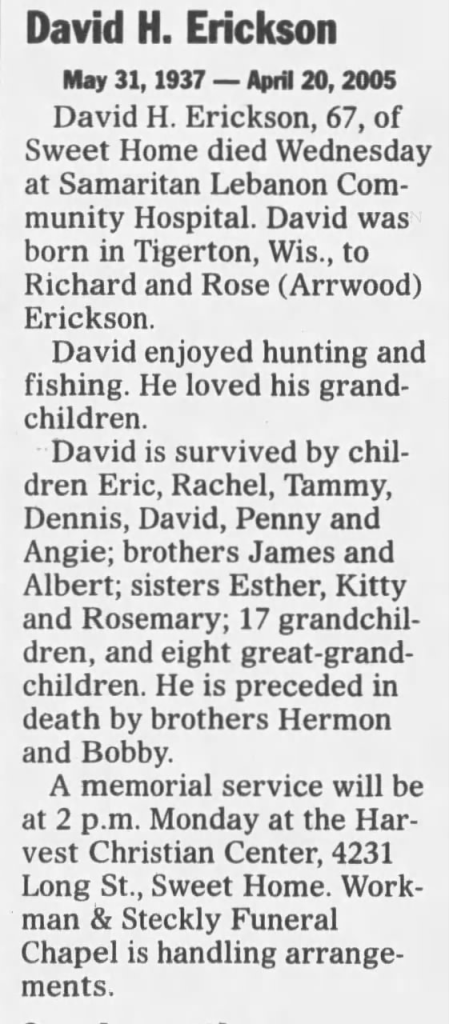
In the years before his death Denise hounded her father, asking him over and over again what happened to her mother and what he did to her, and on one occasion after telling him that she thought he was responsible for her disappearance he responded, ‘well, I don’t know what to say about that.’ David Erickson died of congestive heart failure and lung cancer at the age of 67 in Lebanon, OR on April 20, 2005, taking all of his secrets to the grave. According to his obituary, he had one more child named Angie and he loved hunting and fishing. The brief write-up also mentioned that he ‘loves his grandchildren,’ and knowing what we do know now about this disgusting creature, it just makes me sick. In 2005 when David died members of the Erickson family were so thankful that they went to his funeral just to make sure he was really gone, an event they were kicked out of. According to Rachel, there’s a few people out there that she feels may know what happened to her mother but refuse to come forward and talk.

Before her grandfathers death Trinity remembers an incident that made her lean towards him being responsible for Virginia’s disappearance: ‘I am 100% sure that he killed her. When I was around 18, I heard him talking, and I thought he was talking to someone. And I heard him.. And he was just sitting there going, ‘I had to kill her, that whore, she would have ruined my life. I had to kill her. I had to put her out. She would have ruined my life.’ And I was like, ‘what?’ and was on the other side of the wall. So I got up and I came out of my room to go to the bathroom and he was in there by himself. He had just been talking to himself.’ 

Virginia’s daughter Penny declined to do an interview with The Vanishing podcasters, but she did send the girls an email: ‘things I remember: I remember believing they (dad and mom) went hunting. Dad came home without mom. I know we went to church before they left. My dad has told me many different stories on why she didn’t come home. 1) He dropped her off at the end of our street. 2) he dropped her off at Glenns Market. 3) She wanted a candy bar and he dropped her off at the hilltop store. 4) She ran off with a boyfriend. Later cops confirmed she did not. 5) She left us. Those are the ones I remember. I remember one time he was abusing me, sexually, and he said he thought he heard my mom so he made me jump up and get my clothes on and go check to see if she came back. It wasn’t her, and when I came back into his bedroom he noticed in my haste that I had put my clothes on inside out and he told me that I needed to be more careful. I now just realized how cruel that was. I know he knew she was dead. He also told me once that when you bury someone without embalming them the ground does something weird, for the life of me, I can’t remember what he said though. Sorry. My earliest memories are of him manipulating me to play with him. He was mentally and sexually abusive to me. He was all those things and physically abusive to my sisters. My dad on the outside of our house was funny and loving. He would give anyone his last few dollars if they wanted it. He was a habitual liar. Oh, and also I remember one day he said we were going to go find our mom. He started to walk us up a hill near our house then suddenly changed his mind. I don’t know why he ended with that action, but either way it was cruel. I always wondered if he was going to attempt to kill us all or if he was just playing some sort of twisted mind game. I also remember him taking off all he could on the Jeep and washing it. I was the only kid home because all my siblings were in school, I think. I don’t know. Maybe they were in the house, or I wasn’t paying attention. I don’t know if they remember that or not.’

Michael Erickson also shared some horrifying stories about growing up with his father: ‘the worst thing that dad made me do with my momma was, he would tie her to the kitchen chair and then make me play Russian roulette with her. So I’d be crying and everything and he’d hold his hand up underneath my hand and point the gun at her face, and move it down to her chest, then move it down to her belly and stuff like that. But every time I pulled the trigger it would never go off. Sometimes we had to sit there for so long and it wouldn’t go off and I remember one time he put two bullets in it, this was about when I was seven, and I still wouldn’t go off, and it was a .22 revolver, and he was really mad and he grabbed my arm and told me to get outside and my momma, she was just crying for mercy, not wanting to get killed. But thank God the gun wouldn’t fire on her. Then I’d see her with a few bruises and stuff after. But I remember her standing at the sink and crying a lot. When she was at the sink cleaning dishes, I’d give her hugs on her legs.’

Rachel remembers the Russian roulette incidents and other atrocities that her father had inflicted upon her and her brothers and sisters when they were small. She said that one time ‘he wanted to have sex with me one day and I didn’t want to and I was trying to fight him and I went running outside and he kicked me through a barbed wire fence and I have a big ol’ gash on the back of my back from it. He didn’t stop just with us, he molested some of my nieces, and it was like he didnt care what age they were.’

Rachel said that her mothers disappearance split the family generationally, and most of her extended family told her to leave it in the past and to let it go. These are the same people that called David a ‘good Christian man’ that could do no wrong despite the fact that he was convicted of raping his three young daughters. She also said there are two detectives from the Linn County Sheriff’s Department that are currently working on the case, Caleb Riley and Randy Voight.

When the creators of ‘The Vanishing’ podcast asked the Linn County Sheriff’s Department for Virginia Erickson’s case file their request was denied, citing an ‘open investigation,’ and sadly this doesn’t surprise me. The Thurston County Sheriff’s Department in Washington refused to even give me the name of a victim they’re still investigating, and the murder took place in the mid-1970’s.

Despite multiple requests over the years Shirley refused to tell her nieces and nephews what she knew about the disappearance of their mother, and she took what she knew with her to the grave, as she died on December 17, 2023. But one thing is for sure: to this day the extended Erickson clan remains devoted to David, not Virginia, and smears her name every time she is brought up in favor of his. When asked why he still remains so high in the family’s favor, Michael said that he could ‘smooth talk anybody and that he helped a lot of people and things like that. He was always telling jokes, and pulling practical jokes.’

Rachel went on to lead a very successful life: she spent twenty-eight years working as a MWR Program Chief for the US Coast Guard before retiring, and is happily married with two daughters; after living in Kodiak, Alaska for many years she relocated to Woodstock, Georgia. Michael went onto get married and have two beautiful daughters of his own, Trinity and her sister.

Virginia’s father Joseph Ackley died on February 15, 1978 in Bend, and Virgie passed away at the age of 76 on February 9, 1989 in Hoquiam, WA. Her brother Charles died on September 9, 1993 in Montesano, WA, and her other brother Richard died on March 10, 2008 at the age of 80 in Casa Grande, AZ. Her twin daughters Tammy and Denise have both passed away as well after struggling with substance abuse.

As of February 2024 Virginia is considered missing under suspicious circumstances and would be 83 years old. Her children strongly believe that their father murdered her, and detectives investigating the case also suspect he was involved in her disappearance but were never able to gather enough evidence to charge him.

Works Cited:
Amanda Coleman and Marissa Jones, The Vanished Podcast, Episode 411: Virginia Erickson
Taken January 26, 2025 from thevanishedpodcast.com/episodes/2023/10/2/episode-411-virginia-erickson
Chappell, Sky. ‘Virginia Erickson, The Forgotten Sweet Home Woman.’ (October 25, 2023). Taken January 26, 2025 from sweethomenews.com/virginia-erickson-the-forgotten-sweet-home-woman/
The Charley Project: VIrginia Erickson. Taken January 26, 2025 from charleyproject.org/case/virginia-ackley-erickson

Virginia at sixteen. Photo courtesy of The Democrat Albany Herald.
Virginia Erickson.
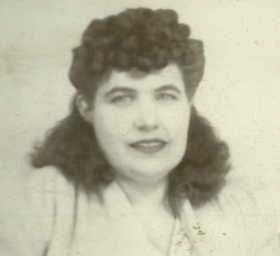
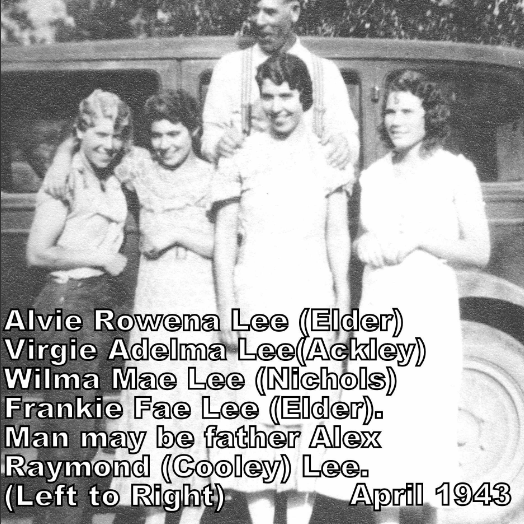
A picture of Virginia and her brothers and sisters (the only one missing is Maxine). She is the woman on the far left.
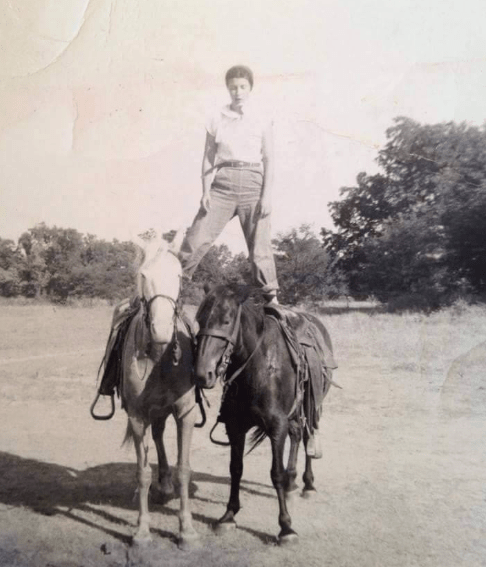
Virginia standing on horses. Photo courtesy of Rachel Dyer.
A picture of Virginia from 1994 using age-progressive technology to make her look fifty-three.
Virginia and her family listed in the 1950 census.
David and Virginia Erickson’s marriage certificate.
David and Virginia listed in the Portland, Oregon City Directory in 1960.
A newspaper clipping mentioning the birth of David and Virginia’s first child published in The Eugene Guard on January 8, 1960.
An article that mentions Virginia published by The Albany Democrat-Herald on May 3, 1996.
An article about Virginia published by The Albany Democrat-Herald on May 9, 1996.
Part one of an article that mentions Virginia Erickson published in The Albany Democrat-Herald on August 8, 1996.
Part two of an article that mentions Virginia Erickson published in The Albany Democrat-Herald on August 8, 1996.
An article mentioning Virginia published by The Corvallis Gazette-Times on August 9, 1996.
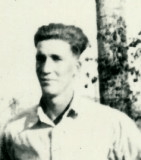
David Erickson.
A newspaper clipping about Denise Erickson giving birth published in The Albany Democrat-Herald on February 5, 1974.
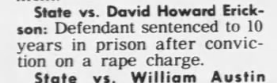
A newspaper blurb mentioning David being charged for three counts of first degree rape published in The Albany Democrat-Herald on September 25, 1974.
A newspaper blurb mentioning Erickson pleading not guilty on two charges of rape published in The Statesman Journal on December 4, 1974.
A newspaper blurb mentioning Erickson pleading not guilty on two charges of rape published in The Statesman Journal on January 15, 1975.
A blurb mentioning David being found guilty of rape published by The Capital Journal on January 16, 1975.
A blurb mentioning David being found guilty of rape published in The Statesman Journal on February 12, 1975.
A newspaper clipping about David Erickson being sentenced to ten years in prison for rape published in The Statesman Journal on February 15, 1975.
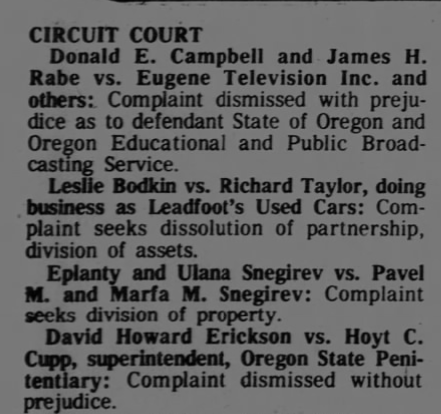
A blurb mentioning charges being dropped in relation to a complaint he filed while in prison published by The  Statesman Journal on September 15, 1976.
David Erickson listed in the Oregon state death index.
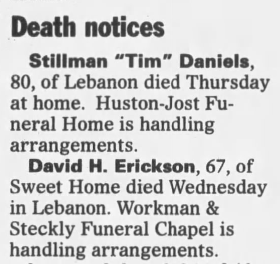
Erickson mentioned in the death notices section of The Albany Democrat-Herald on April 22, 2005.
David Erickson’s obituary published in The Albany Democrat-Herald on April 23, 2005.
Virginia’s father, Joseph Richard Ackley.
Virginia’s fathers WWII draft card.
Virginia’s fathers obituary publishe Bulletin on February 16, 1978.
Virgie Ackley.
A picture of Virgie Ackley courtesy of Ancestry user ‘oliverwharris.’
Virginia’s mother Virgie with some other family members. Photo courtesy of Ancestry user ‘oliverwharris.’
Maxine Ackley.
One of five children, Joseph, Charles, Virginia, and Lawrence.
A picture of Virginia’s daughters Penny and Denise from The Albany Democrat-Herald on May 9, 1996.
A comment that Virginia’s granddaughter Amber left on her episode of The Vanishing podcast.
A comment that Virginia’s granddaughter Shelly left on her episode of The Vanishing podcast.
A comment that Virginia Erickson’s son-in-law left on her episode of The Vanishing podcast.
Trinity commenting on a post about her grandmother on the true crime website, ‘Websleuths.’
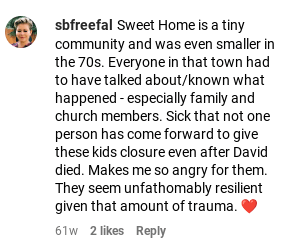
A comment on an Instagram post about the Vanished podcast featuring Virginia Erickson.
Shirley Erickson and her husband Jim in their younger years. Photo courtesy of the public domain.
Shirley and Jim Erickson. Photo courtesy of the public domain.
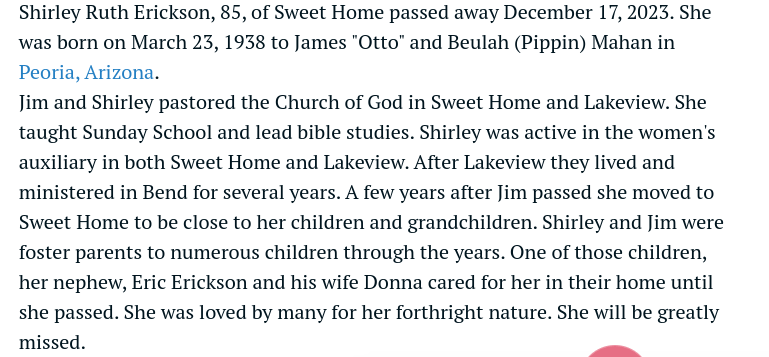
Shirley Erickson’s obituary.

Susan Wickersham.

Susan Ann Wickersham was born on November 21, 1955 to Roy and Sharon Wickersham of 905 SE Roosevelt Ave in Bend, Oregon. “Susie” (as she was called by family and friends) was 5’3” tall, weighed 110 pounds, and had medium length blonde hair. One of three children, at the time she disappeared Susan was 17 years old and had just completed her junior year at Bend High School. Family and friends described her as “a likable young lady with a bubbly, outgoing personality.”

In 1973, Bend, Oregon had a population of approximately 37,000* people and contained only one high school, and (for the most part) its residents were trusting and everyone residing there felt safe. At that time in the 1970’s hitchhiking was common (and legal), as people believed in the goodness of others. At roughly 11:30 PM on Wednesday July 11th, 1973, Susan dropped the family car off at the Sage Room Restaurant where her mother was employed after joyriding around town with a girlfriend (some conflicting reports say she was at a party with friends). Sharon let Susan borrow the vehicle on the condition that she return it before her shift ended. The restaurant has since closed but was located at 855 NW Wall Street in Bend, OR. Mrs. Wickersham asked her daughter if she wanted to sit and wait with her until the restaurant closed and they could drive home together, but Susan said she was going to hitch a ride with friends across the street in front of the Owl Pharmacy. When they didn’t show up she decided to trek the two miles home. Susan was last seen walking away from the drug store toward the intersection of Wall and Franklin streets wearing a ‘brown car coat,’ white slacks, white shoes and a blue and white checkered shirt; she was carrying a brown handbag.

After Susan never came home that summer night, the Wickersham family became frantic with worry and traveled all over Bend in hopes to locate their daughter. They showed anyone willing to look her picture, begging for any information they may know about what may have happened the night she disappeared. Police said that disappearances among young people at the time were a “dime a dozen” and theorized that she took off but would “turn up soon.” Mr. and Mrs. Wickersham immediately suspected foul play and told law enforcement that Susan didn’t runaway and would never leave voluntarily: she had a steady job and no problems in her personal or family life. Unfortunately they didn’t agree and suspected the teen ran away from home. In the months following Wickersham’s disappearance, police received multiple reports of possible sightings of her: former Bend Police Chief Emil Moen said they received calls that she was seen in Vancouver, Klamath Falls, Portland, and Bend. Most of these reports were from people who had seen girls that they felt looked like Susan. Two of them said she was in Klamath Falls a few days after Wickersham disappeared; another report was given by a salesman who said he recognized her as a girl he saw eating breakfast at a restaurant in Klamath Falls after he saw a story about Susan on the news. A Bend woman said that she spoke with a girl fitting Wickersham’s description at a bus stop in Klamath Falls. All reports lead to nothing. Wickershams little sister Rhonda McMurran said that “the police tried to tell them she had run away. I just don’t think they took it real seriously at the time. We knew better.” … “I just knew she was gone, but you still have to hold hope.” The family knew deep down that something bad had happened to their Susan. Because at first they weren’t taken seriously, the Wickersham family feels that law enforcement lost valuable time and evidence in the first few years after she disappeared. The police however claim that’s not true at all, and they did follow up on multiple leads and claim they made a real effort to locate her.

Denice Blake was at the Sage Room Restaurant waitressing the night Susan disappeared in 1973 and told police she remembers seeing her childhood friend briefly when she stopped in to return her mothers car. In 2015, Denice told KTVZ: “It was just a sunny ordinary day. This was Bend, Oregon in 1973, stuff like that didn’t happen here. I worked at the Sage Room Restaurant with (Susan’s) mom. She came in that day and we said ‘hi’ and exchanged greetings. A couple minutes later, I was waiting on a table and I saw her standing across the street in front of what was then the Owl Pharmacy, and the next time I happened to look out the window, she was gone.” A different eyewitness claimed to have seen Wickersham near the Tower Theater a little later on in the night.

On January 20, 1976, Susans remains were discovered about three to five miles south of Bend in the Deschutes River Woods; I read conflicting reports that said a man scouring the area for firewood stumbled upon them and others that said “a logger near a truck weigh station close to Highway 97 found her remains near a cinder pit.” With the body were some “personal items” and scraps of clothing that helped identify her. Like most other cases involving a “dump site” in a remote location, forest creatures had scattered Wickersham’s bones all over the area. Her skull had a bullet hole behind the right ear with no exit wound, and because of this police feel that she most likely met her demise from a small caliber weapon (possibly a .22 pistol). Portland Deputy State Medical Examiner Larry Lewman determined that the bones were there for “probably two years or more” and were those of an individual in their late teens/early 20’s (but had no idea if the skeleton belonged to a male or female). Because Susan’s dental records couldn’t be located (for unknown reasons), Bend law enforcement had to mail the skull to her former dentist, Dr. David Mason (who moved to Stewart, British Columbia to treat Eskimos) in hopes he could ID his former patients teeth from memory. Dr. Lewman said that “we’re depending on memory. There are some distinctive dental characteristics (residual baby teeth, impacted wisdom teeth) which he (Mason) might remember.” Thankfully Dr. Davis did remember because he was able to confirm that the skull belonged to Wickersham as he “recognized the dental work as his own.” Former Deschutes County District Attorney Mike Dugan said that “there was no doubt that she was dead, there’s no question she met death by a homicidal act, so it became a whodunit.”

Unfortunately the amount of evidence found with Susans remains was next to nothing and the case once again went cold. To this day law enforcement has an unnamed person of interest in mind but unfortunately not enough evidence to prosecute them. In 2004 (one source said it was 2005), the Deschutes County Sheriff’s Office assembled their ‘Cold Case Team,’ which consists of veteran law enforcement whose mission is to investigate cases that have long gone nowhere and still remain unsolved. According to a 2011 article published in the Bend Bulletin, “the squad consists of four retired law enforcement officials who volunteer about 20 hours each week poring over binders filled with information on unsolved crimes. And it’s Wickersham’s long-unsolved case that sparked the start of the cold case squad.” They are hoping for members of the public to come forward and help provide new information to help link the suspect to Susan’s murder. On September 12, 2006, the Cold Case Squad joined forces with a FBI crime scene processing team from Portland that included 15 volunteers from the sheriff’s office search and rescue unit. Together they searched an area near Knott and Scalehouse Roads in hopes to collect new evidence related to Wickersham’s case (however they didn’t come up with much).

In July 1973, Ted Bundy was in between jobs: from November 1972 to April 1973 he worked for the Seattle Crime Prevention Advisory Commission helping draft the state’s new hitchhiking laws (ironically he also wrote a rape-prevention pamphlet). He remained unemployed until September 1973 when he was the assistant to the Washington State Republican chairman. The ‘FBI Multi-Agency Team Report 1992‘ has no record of Teds whereabouts on 7.11.1973 (although he was in Olympia the day before and after). Bundy was in between schooling at the time as well: later on in the year he enrolled in the of University of Puget Sound’s Law School in Tacoma (that endeavor didn’t last long). He was also in a long-term relationship with Liz Kloepfer at the time as well. The drive from the Rogers Rooming House in Seattle where Ted was residing at the time to the Sage Room Restaurant in Bend was a bit over six hours, one way (or roughly 330ish miles). Receipts put him in Seattle the day before and after but in my opinion, Ted definitely could have made that trip easily with no issues. and what if he bought gas in cash (so there was no real paper trail)? Now, I know I’m not a cop or criminologist. I know that none of Bundy’s victims suffered from gunshot wounds BUT (and I’m just throwing this out there): in a 2022 interview with People magazine, Carol DaRonch said Ted “brandished a gun” when he attempted to kidnap her in 1975 in Utah. Did Bundy experiment with alternative methods aside from a crowbar and strangulation? In my article about the homicides of Susan Davis and Elizabeth Perry (also known as the New Jersey Parkway Murders), I wrote about how the two girls were vacationing at the Jersey Shore Memorial Day weekend in 1969 and were stabbed to death shortly after they departed for home. Were these early murders ones Bundy committed before he honed and “perfected” his technique? The human body contains a shockingly large amount of blood; was stabbing and shooting too “messy” for Ted, which is why he never returned to these methods again (that we know of anyways)? We do know he carried an extra set of clothes in his car with him at all times in case of emergencies. Personally, I do think this case is a bit of a stretch and poor Miss. Wickersham was most likely murdered by someone else. I don’t think she is a victim of Ted Bundy.

On April 19, 2022 a Reddit user suggested that Wickersham may be the victim of John Arthur Ackroyd. Born on October 3, 1949, Ackroyd was raised in the small logging town of Sweet Home, Oregon (a little over 2 hours away from where Susan was last seen); in 1977 he started working for the Oregon state highway department along US Route 20. That same year, he sexually assaulted Marlene Gabrielson and in 1978 he abducted and murdered Kaye Turner (with the “help” of an accomplice, Roger Dale Beck). Ackroyd’s stepdaughter Rachanda Pickle went missing in 1990 and he was officially charged with her murder in 2013 (he pleaded no contest). He is also suspected of killing Sheila Swanson and Melissa Sanders in 1992 in Lincoln County, Oregon. ‘The Oregonian’ newspaper further alleges he was involved in the murders of several additional women. Despite Ackroyd’s shady history, it was determined that he was stationed oversees in the Army between 1969 and 1976 so he couldn’t have been responsible for Susan’s death. He died on December 30, 2016.

For former Deschutes County Sheriff’s Captain Marc Mills, Susan’s case was personal. The two were classmates at Bend High School, and said that “Susan was happy, free-spirited. We would occasionally be at the same lunch table. It was sad when Susan went missing, and a shock when the town learned how she died. It was disturbing for our Class of 1974.” … “It was one of the first things I wanted to do, was pick this file up as a young detective, the youngest detective at the time. This is one of the cases I really, truly wanted to have closure.” Mills said it was upsetting for everyone in the community when Wickersham went missing, and a horrible shock when everyone learned how she died: “it was disturbing for our Class of 1974. It’s disheartening. Of course, a lot of my classmates had hope, had hope in me.” He said that detectives are “only a clue or two away from cracking the case, but the clock is ticking.” The cold case team uses the 1974 Bend High School yearbook in their interviews to help “jog memories and spark conversation” when trying to obtain new information about Susan. In 2022 former Deschutes County District Attorney Mike Dugan told KTVZ news that “it’s more of a case of a lack of concrete proof than a lack of a theory,” and that “they absolutely believed they knew who did it. The cold case unit came and tried to get us to do a prosecution. My chief deputy district attorney and I reviewed what they had and said, ‘we still don’t have enough’.”

It’s speculated that Susan’s disappearance could be linked to Rita Jolly from West Linn, OR and Vicki Lynn Hollar from Eugene, OR. Jolly vanished on June 29, 1973 while out on a nightly walk and Hollar disappeared while leaving her job at Bon Marche (she was employed there as a seamstress) on August 20, 1973. Unlike Susan, both girls haven’t been recovered. As I said earlier, I don’t think Bundy killed Wickersham but I do think he murdered Jolly and Hollar.

Rhonda said that Susan is never far from her thoughts, “probably because we never had closure. I couldn’t even imagine then that it would take this long to solve.” She hopes that one day she will learn why Susan was taken from them, saying “someday, I’d like to look the guy in the eye and say, ‘Why’d you do this?’ She was just a nice person. You think of all those things that could have been, and all the people who loved her.”

Despite her case being cold for many years, Bend police as well as Susans loved ones still think they have a pretty good idea who is responsible for her murder; they hope one day they’ll come up with enough evidence to be able to make an arrest. Rhonda thinks that she has a good idea who the killer is, saying: “it’s probably going to surprise many of us, and it’s probably going to surprise how close in proximity they were to a number of us in Bend community.” In 2015, Captain Mills said he still holds onto hope that Wickersham’s killer will be caught, and has a message for anyone that knows something but is holding back: “you’re 42 years older. You’re probably near the end of your life. Put some things in motion… at least in the event of your death, so investigators at the sheriff’s office can put this case to rest, and give what family is left closure.” Sadly both of Susan’s parents died before police were able to solve their daughters murder: Mr. Wickersham passed away in 1993 and Mrs. Wickersham in 2006.

* I’ve had numerous residents of Bend reach out to tell me they feel this number is wrong. I would know nothing about that, I pulled that figure off the website ‘oregon.reaproject.org.’

Susan in her 1972 yearbook photo.
Susan Wickersham.
Susan Wickersham’s gravestone.
The Owl Pharmacy in Bend, OR where Susan was last seen; it’s no longer open.
An older shot of Bend, OR.
An article on Susan Wickersham published by The Bulletin on July 17, 1973.
An article on Susan Wickersham published by The Bend Bulletin on July 23, 1973.

An article on Susan Wickersham published by The Bulletin on September 19, 1973.

Article courtesy of ‘Ted Bundy: I was trying to Think like an Elk.
An article on the missing Oregon girls published by The Greater Oregon on December 21, 1973.
An article on Susan Wickersham published by The Bulletin on January 17, 1975.
An article on Susan Wickersham published by The Bulletin on January 21, 1976.
An article about Susan after her remains were found published in The Capital Journal. I couldn’t find the publication date.
An article on Susan Wickersham published by The Bulletin on January 26, 1976.
An article on Susan Wickersham published by The The Bulletin on January 29, 1976.

An article on Susan Wickersham published by The Eugene Register-Guard on February 11, 1976.
A newspaper piece on the Deschutes County Cold Case Squad.
Out of respect I left Susan’s SIL’s name off this Facebook post. When I see posts like this my heart drops to my feet. On occasion I need to ground myself and remember why I’m doing this: for the victims, not Ted Bundy. Monsters like him need to stop being glorified.
Another post from Susans SIL.
Ted’s whereabouts for July 11, 1973’s are unaccounted for in the ‘Ted Bundy Multiagency Investigative Team Report 1992.’
Susan Ann Wickersham listed in the Oregon US, Death Index from 1898-2008.
The house the Wickersham family was living in when Susan was murdered located at 905 Southeast Roosevelt Avenue in Bend, OR.
The most logical route from the Rogers Rooming house where Ted was living at the time to the Sage Room Restaurant in Bend, OR.
A Google Maps route of Susan Wickershams possible walk home from the Sage Room Restaurant.
A Google Maps view of where Susan Wickersham was last seen compared to where her remains were discovered at the Deschutes River Woods.
A Google Maps view of where a recent search for Susan Wickersham took place compared to where her body was found.
Susan’s sisters Rhonda’s write up for her ten year high school reunion booklet, courtesy of bendhigh1969.com/clients/869621/File/10thReunionBookletPart3.pdf.
John Arthur Ackroyd.
Vicki Lynn Hollar.
Rita Jolly around age 10-11.