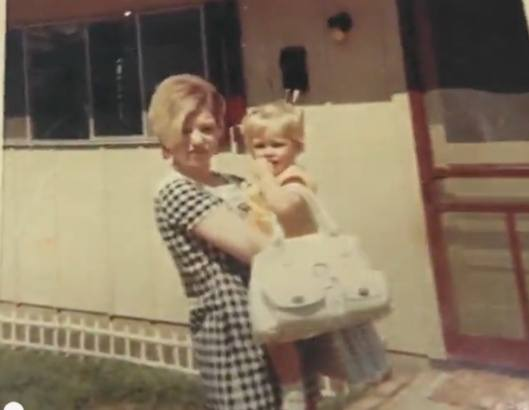
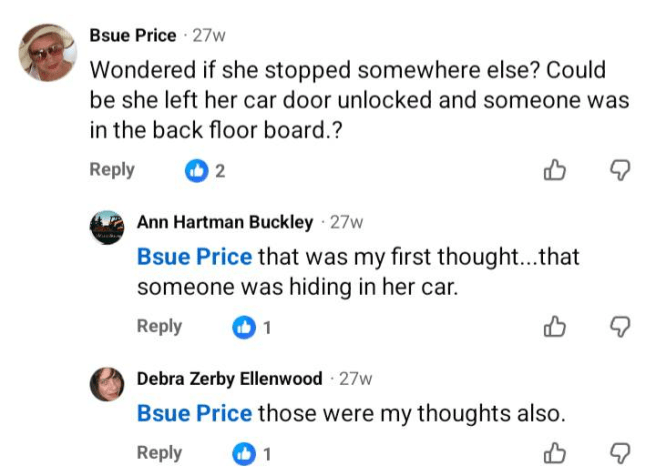
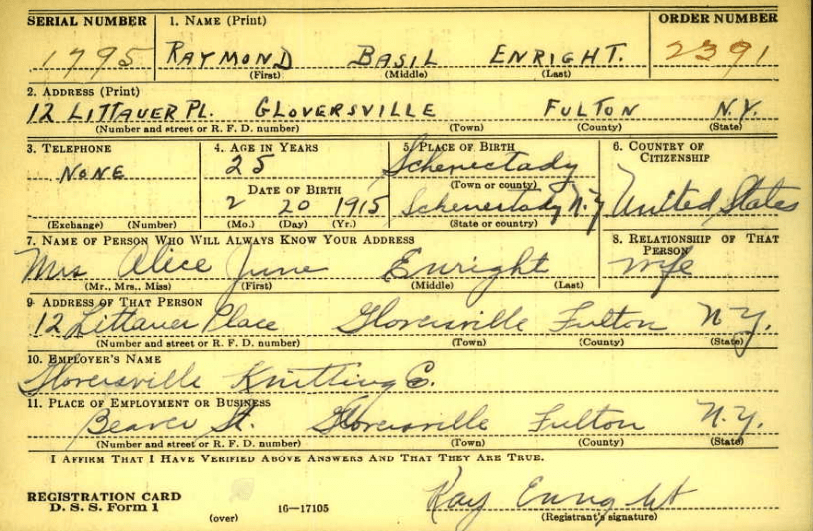
Introduction: Cornelia* June Enright was born on December 19, 1950 to Raymond and Alice Enright in Schenectady, NY. Raymond Basil Enright was born on February 20, 1915 in Schenectady, NY, and Alice Shaw was born on June 30, 1918 (also in Schenectady). The couple were married on May 16, 1936 and went on to have three children together: John (b. 1937), Robert (b. 1943), and Cornelia. Mr. Enright was drafted into WWII on April 17, 1943 (he enlisted on October 16, 1940), and in the early part of his marriage was employed at Gloversville Knitting Company. *I did see Connie’s name listed s ‘Constance’ in one source, but that is incorrect.
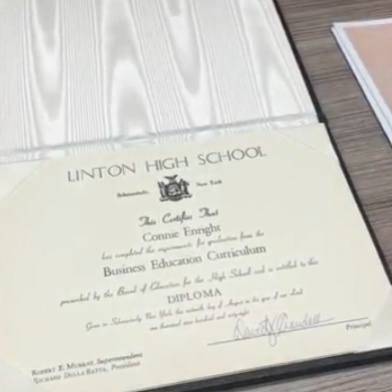
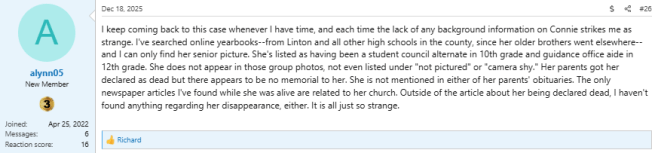
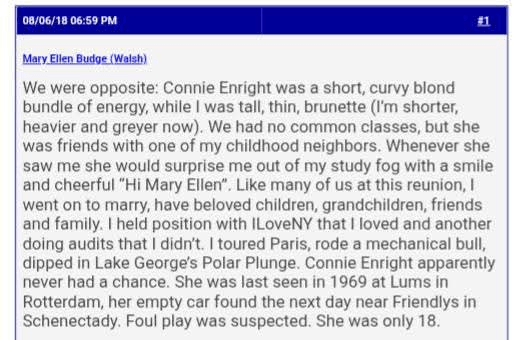
During her time at Linton High School in Schenectady, Connie majored in Business Education and during her sophomore year was an alternate for the student council, and during her senior year she was an intern for the guidance counselor’s office. A former classmate described her as ‘a ball of energy’ that always made a point of going out of her way to say hello, despite them only being casual acquaintances and having no classes together. Enright graduated in 1968, and a few weeks before she disappeared in April 1969 got a full-time job at the Almart’s Discount Store, which (at the time) was located on Central Avenue in Colonie. At the time she disappeared Connie was nineteen, and she wore her strawberry blonde hair short, had blue eyes, stood at 5’2″ tall and weighed 115 pounds.
April 24, 1969:Raymond and Alice last heard from Cornelia around 9:30 PM on April 24, 1969, when she left with the family car to meet up ‘a girlfriend with whom she worked with’ in nearby Rotterdam for a bite to eat. She arrived at Lum’s Restaurant at 9:30 and according to her friend, the two ate and chatted then eventually went their separate ways in the parking lot; she was last seen driving away from the establishment at 11:00 PM.
The Day After: upon realizing their daughter never returned home the prior evening, the next morning at around 8 AM Cornelia’s father called the Schenectady Police Department and filed a police report. Later that same day the Enright family vehicle was found on State Street near Friendly’s Ice Cream Shop; it was locked, and the keys were missing. Her purse was also nowhere to be found. In the days following Connie’s disappearance, her parents searched her bedroom, top to bottom, but found nothing to be missing. It’s also worth mentioning that the day she disappeared was ‘the day before payday,’ and that she only had around ten to fifteen dollars on her.
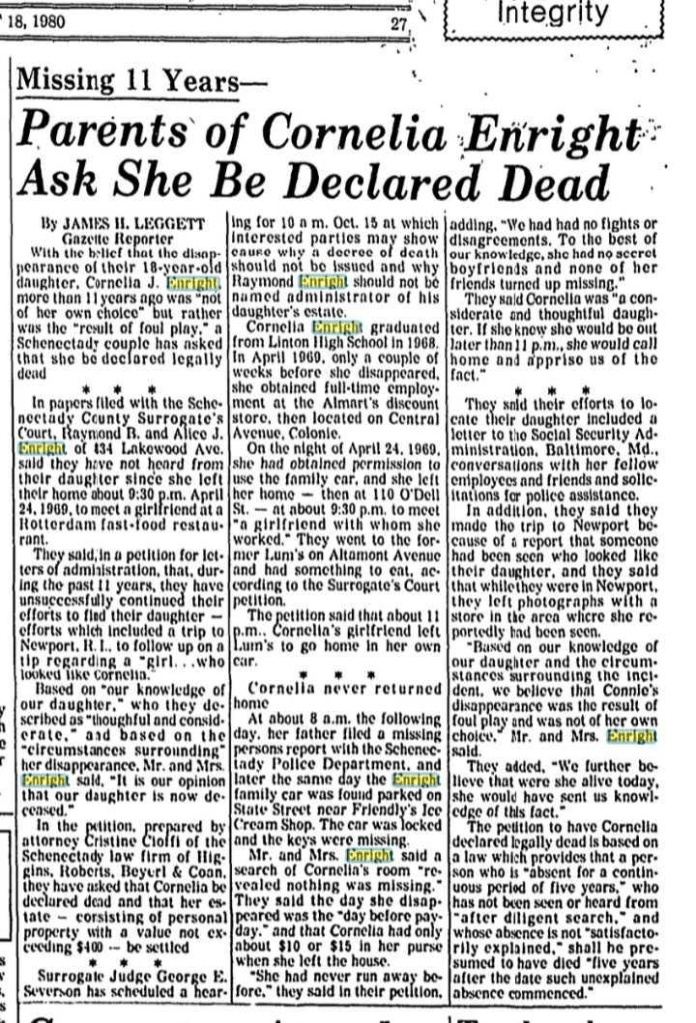
Connie’s parents felt their daughter didn’t leave ‘of her own choice,’ and her disappearance was the ‘result of foul play.‘ After very little movement on her case, in 1980 Mr. and Mrs. Enright filed paperwork to have Connie declared ‘legally dead,‘ and said in their petition that in the eleven years since she disappeared, they have unsuccessfully continued searching for her; it went on to say that their efforts included a trip to Newport, Rhode Island after they received a tip that a young woman matching her description was seen at a local store. Unfortunately, the trip was uneventful, but they left some pictures of her behind at the market (just in case). Cornelia’s parents also said she ‘had never run away before’ and that prior to her disappearing they: ‘had no fights or disagreements. To the best of our knowledge, she had no secret boyfriends and none of her friends turned up missing.’
The Enright’s said that from the ‘knowledge of our daughter,’ based on the ‘circumstances surrounding’ her disappearance, that ‘it is our opinion that our daughter is now deceased.’ The petition, which had been prepared by the couples’ attorney Cristine Ciofi of the Schenectady law firm of Higgins, Roberts, Beyerl & Coan, PC Law Firm Profile requested that Connie be declared dead and that her estate (which consisted of personal property with a value not exceeding $400) be settled.
Ray and Alice said Connie was a ‘considerate and thoughtful daughter. If she knew she would be out later than 11 PM she would called home and appraised us of the fact.’ They also said their efforts to find her also included a letter to the Social Security Administration in Baltimore as well as multiple conversations with her co-workers, friends, and acquaintances. They also added ‘we further believe that were she alive today, she would have sent us knowledge of the fact.’ The petition to have Connie declared legally deceased was based on a law which provides that a person who is absent for ‘a continuous period of five years who has not been seen or heard from after diligent search and whose absence is not satisfactory explained, shall he presumed have died ‘five years after such unexplained absence commenced.’ Their request was approved and Raymond Enright was declared the executive of his daughter’s estate.
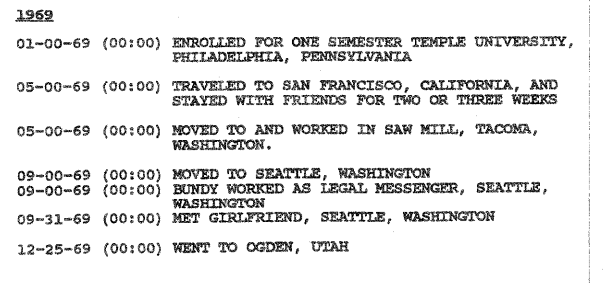
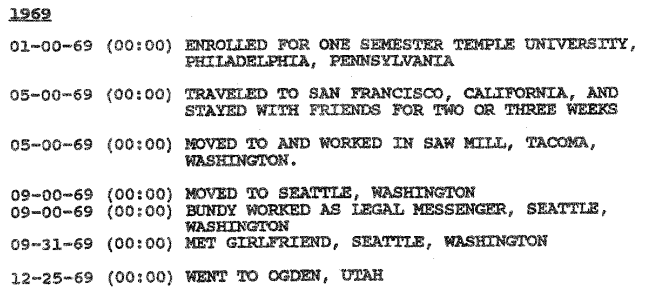
Ted Bundy?: at the end of 1968, Ted left Seattle behind and enrolled at Temple University in Philadelphia, PA, and it was also around this time that he was dumped by his first love, Diane Edwards; reports pointed towards him being in a ‘defeated state of mind,’ and that he was lonely and detached. In early 1969, he briefly relocated to the East Coast and slip-flopped between staying at his grandparents’ house in Roxborough and his aunt’s apartment in Lafayette Hill. He was mostly active in his studies at Temple until early March, when (typical Ted)… he stopped going to class after he got into a minor car accident and hurt his ankle.
After Ted found out about being illegitimate, he used some of his ‘leftover money’ (whatever that is) from when he sold his first VW bug in 1968 and went on a trip to New-York City (supposedly he a friend from school had lent him a car). While there he spent his time exploring ‘flesh-shops and accessing the most explicit forms of pornography’ before he returned to Philadelphia (then eventually Washington).
Also around this time Bundy frequented Ocean City, New Jersey, where his grandparents owned a home on 26th Street (he spent a good amount of time there as a child). Where he isn’t officially linked to the murders, he is heavily suspected of being responsible for the murders of Susan Davis and Elizabeth Perry, two coeds from Monticello Women’s Junior College in Godfrey, Illinois that were were brutally stabbed to death on Memorial Day weekend in 1969. Ted would hint in later interviews that he committed his first abduction and murder in Ocean City, in the ‘early summer or spring’ of 1969.
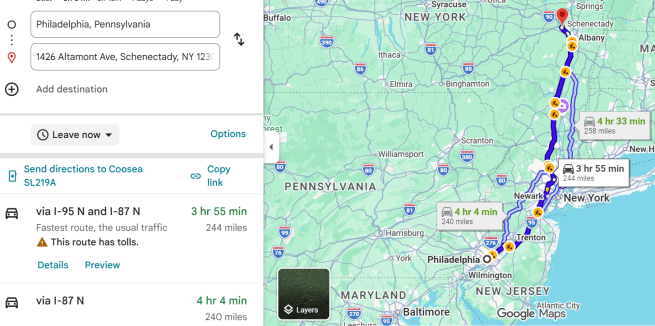
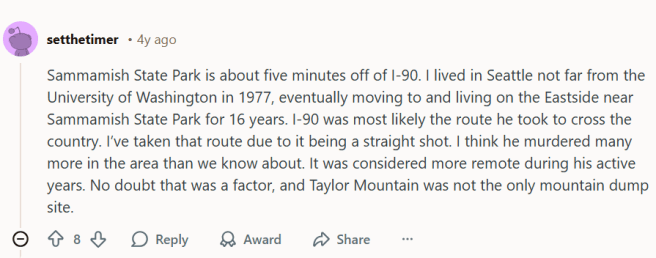
It is worth mentioning that Connie’s car keys were never located, meaning they (most likely) were at some time in the possession of her abductor; Ted’s future girlfriend Liz Kloepfer stated after his first arrest she went snooping around his room at the Rogers Boarding House and she found a bowl full of miscellaneous keys that didn’t belong to him. Cornelia also disappeared at night in a parking lot, which are similar circumstances to many of Bundy’s confirmed victims (Carol DaRonch, Georgann Hawkins, Brenda Ball, Caryn Campbell, Denise Naslund, etc…). Schenectady is also only a few hours away from both Philadelphia and NYC, which puts him fairly near to Connie at the time she disappeared, and we all know Ted had no problem driving hundreds of miles at a time to hunt for his perfect victim. Additionally, we all know that he targeted girls that fit Enright’s physical description, age, personality and socioeconomic background.
Lemuel Warren Smith: one plausible suspect for the abduction of Cornelia Enright is Lemuel Warren Smith, a convicted rapist and serial killer that operated around the general Albany area that is perhaps best known for being the first person in US history to kill an on duty female corrections officer. While serving out his life sentences at the Green Haven Correctional Facility, Smith murdered thirty-one-year-old Donna Payant; her body was found in a landfill after it was discarded in the prison’s trash.
In April 1969, Smith was a free man living in the Capital District of New York following a 1959 conviction for kidnapping and attempted murder in Baltimore, where he served nearly ten years of a twenty-year sentence before he was paroled in May 1968. He largely stayed in the Albany area during this time until he was rearrested on May 20, 1969 when he kidnapped and sexually assaulted two women in a single day. This time Smith was sentenced to four to fifteen years but was paroled again in October 1976 (shortly before he began the murder spree for which he is best known for). He was caught for the final time on August 19, 1977 after he kidnapped and raped eighteen-year-old Marianne Maggio; thankfully when he forced her to drive towards Albany afterwards, LE stopped their vehicle and took Smith into custody (without incident). As of 2024, Smith remains incarcerated at the Wende Correctional Facility in New York, and where he confessed to his earlier murders, he has consistently maintained his innocence regarding the death of Donna Payant, claiming he was framed by other prison guards’ (a theory that Payant’s own son has called to be reinvestigated).
Robert Garrow: one individual from a Schenectady Facebook group (where I posted asking if anyone remembered Connie) suggested that I look into Robert Garrow, but when I did I got the impression he was more of a pervert and (eventually) spree-killer so I don’t think he would have anything to do with Enright’s disappearance (more importently, he was only active in 1973). In April 1969, Garrow was a free man living in the general Syracuse area and had been released from prison for ‘good behavior’ the previous year after serving only six years of a twenty-year sentence for a 1961 rape conviction. Information regarding his day-to-day activities between 1968 and 1973 is sparse, although it has been confirmed that he worked as a mechanic for a bakery in Syracuse around this time. Investigators have suspected him of being responsible for several cold cases during his five years of freedom, including the 1959 murder of Ruth Whitman, who lived close to him at the time she was killed.
Arthur Shawcross: a name that came up only once in my research is serial killer Arthur John Shawcross, who oddly enough had two separate ‘rounds’ of murders as well as two different types of victims: in 1972 he went away for killing two children under the age of ten in Watertown, NY, and after serving only a fraction of his sentence he was released early on ‘good behavior,’ where he went onto kill eleven sex workers in Rochester. In April 1969, Shawcross was involved in some ‘lower-level’ criminal activity (IE not murder), specifically an arson attack at the Knowlton Brothers Paper Mill. Following this and other incidents involving burglary and arson, he was sentenced to a five-year prison term, of which he served only twenty-two months and he was paroled in October 1971; additionally, some records indicate he was honorably discharged from the US Army around April 1969. I could find no link between him and Cornelia Enright (personally, I don’t think she fit into wither of his demographic of victims).
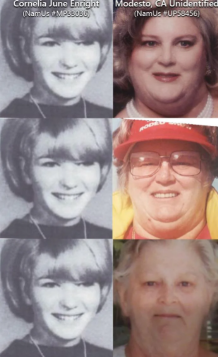
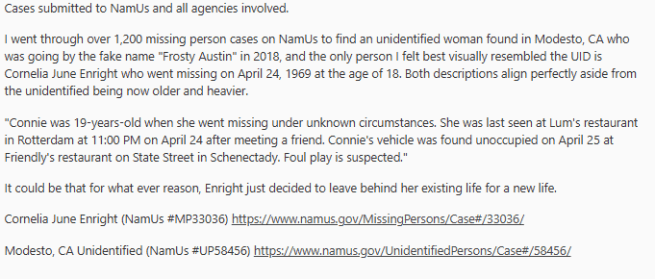
Frosty Austin: right as I was about to hit the ‘publish’ button, I came across one final piece of information regarding the disappearance of Connie Enright… and at the risk of being dramatic, its something that I find incredibly eerie (I actually sat up in bed and said, ‘oh my gosh, oh my gosh’ a bunch of times until my husband finally asked ‘what?’). There was a unhoused woman in Modesto, CA that (even in her ‘advanced age’) looked incredibly similar to a young Connie, and where I’m not normally someone that puts much effort into ‘solving’ missing persons cases (I will never pretend I know more than law enforcement), this made me actually stop and pay attention.
‘Frosty Austin’ is the alias of an unidentified woman that passed away in a Modesto, California nursing home on October 6, 2018, and despite exhaustive efforts by detectives and the FBI, her true identity remains a mystery. Ms. Austin lived in the Stockton, California area for over thirty years and claimed her maiden name was O’Malley. At the time of her death, she was estimated to be around sixty-seven-years old, 5’6″ tall (Connie waas only 5’2”), and approximately 214 pounds; she had strawberry blonde hair and blue eyes.
Authorities and those that were aquainted with her believe Austin may have been a ‘con-woman’ or fraudster that used multiple assumed identities and told conflicting stories about her past. Her case is listed in the National Missing and Unidentified Persons System as case #UP58456, and ‘armchair detectives’ on social media platforms like Websleuths and Reddit have attempted to link her to multiple missing womens cases (although no match has ever been confirmed).
Conclusion: Connie’s father Raymond Basil Enright passed away at the age of eighty-two on November 5, 1997, and at the time of his death he had been married to Alice for sixty-one years. According to his obituary, he was born and educated in Schenectady and was employed with General Electric for thirty-seven years: he started his career as an electrician in the main plant and by the time he retired had worked his way up to being a ‘mechanic analyst’ at the Knolls Atomic Power Laboratory. Mr. Enright was also a member of the GE Quarter Century Club and was part of the flock at the Faith Baptist Church in Schenectady.
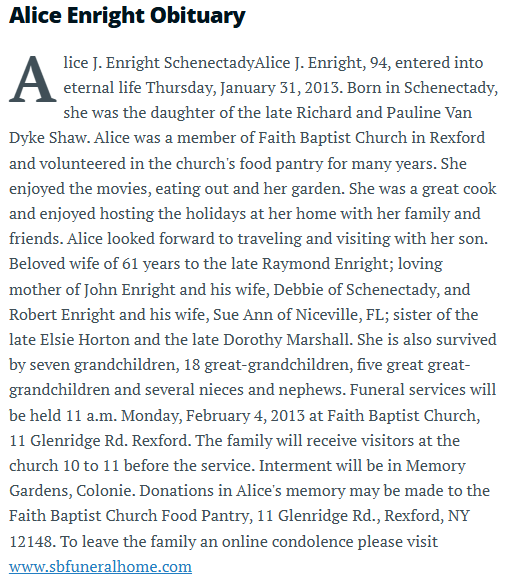
Alice June Enright was ninety-four when she entered into eternal rest on January 31, 2013 in Schenectady, NY. According to her obituary, Mrs. Enright was a member of the Faith Baptist Church in Rexford and was a volunteer with their food pantry for many years. She loved seeing movies at the local theater, going out to eat with her loved ones, and gardening; she was also a great cook and enjoyed hosting holidays at her home with her family and friends. Alice looked forward to traveling and visiting with her son Robert that lived in Florida.
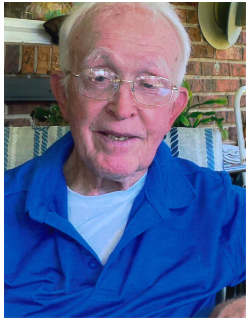
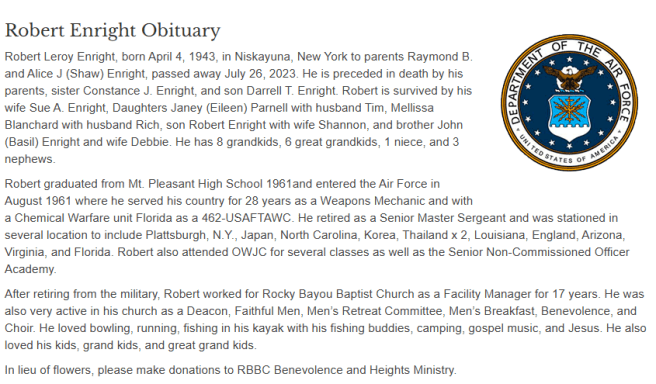
Connie’s brother Robert died at the age of eighty-seven on July 26, 2023 in Niceville, FL. Per his obituary, he graduated from Mount Pleasant High School in 1961 and entered the Air Force shortly after in August 1961, where he served his country for twenty-eight-years as a Weapons Mechanic; he was also involved in the Chemical Warfare unit with the Florida Fish and Wildlife Conservation Commission. Robert retired as a Senior Master Sergeant and was stationed in several location to include Plattsburgh, NY, Japan, North Carolina, Korea, Thailand (twice) Louisiana, England, Arizona, Virginia, and Florida. He took several classes at Okaloosa-Walton Junior College (which is now Northwest Florida State College) and briefly attended the Senior Non-Commissioned Officer Academy; after he retired from the military, he worked maintenance at the Rocky Bayou Baptist Church for seventeen years, where he also served as a Deacon and was involved in multiple organizations (including Faithful Men, Men’s Retreat Committee, Men’s Breakfast, Benevolence, and Choir). He also loved bowling, running, fishing in his kayak with his buddies, camping, gospel music, and Jesus. John B. Enright died at the age of eighty-six on June 14, 2024 in Schenectady, New York.
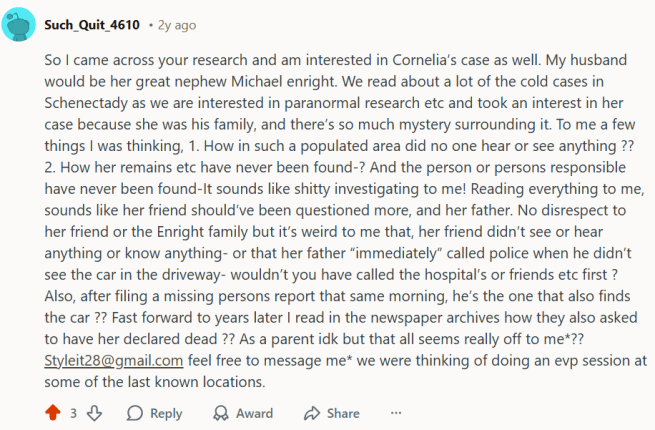
As of April 2026, no trace of Cornelia Enright has never been recovered, and in the years following her disappearance, every member of her immediate family has passed away. It could be that for whatever reason, she just decided to up and leave her existing life behind for a new one… but we’ll probably never know the full story.
Works Cited: charleyproject.org/case/cornelia-june-enright DeCamilla, Jane. (April 24, 2025). ’56 Years Later, Still No Answers in Disappearance of Schenectady Woman.’ Taken April 20, 2026 from cbs6albany.com reddit.com/r/UnresolvedMysteries/comments/v8qprv/link_between_ted_bundy_cornelia_j_enright_and/ Sommers, Ashleigh. (October 10, 2025). Taken April 20, 2026 from /ashmysteries.com troopers.ny.gov/missing-enright-cornelia-june Taken on April 20, 2026. websleuths.com/threads/ny-cornelia-connie-enright-18-rotterdam-24-april-1969.340318/
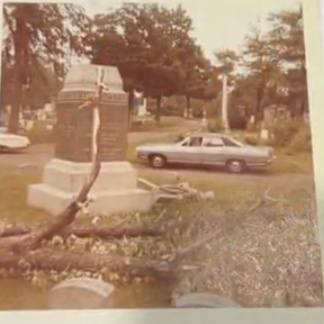
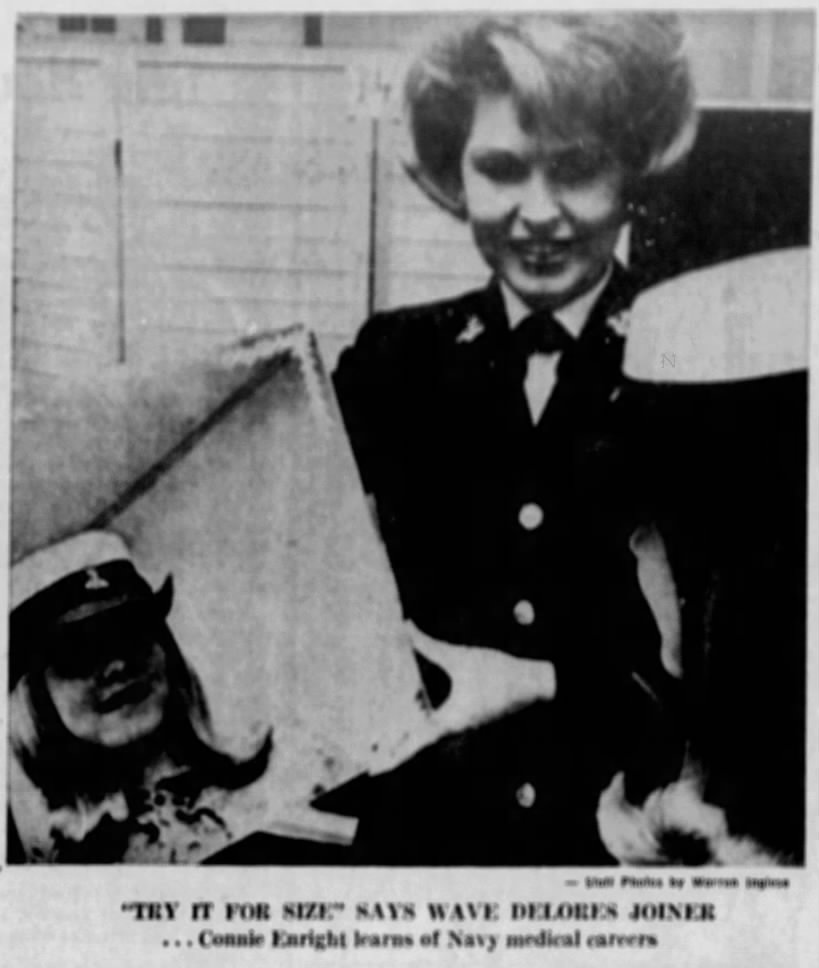
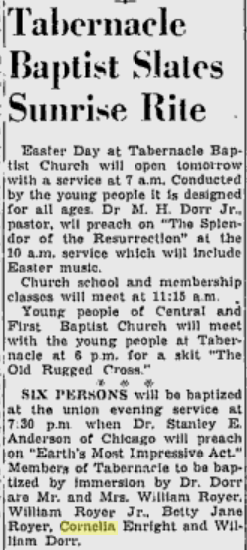
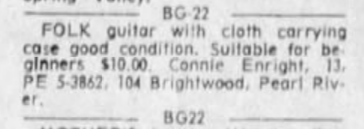
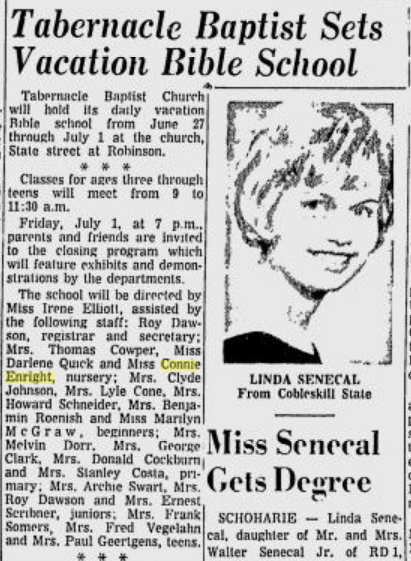
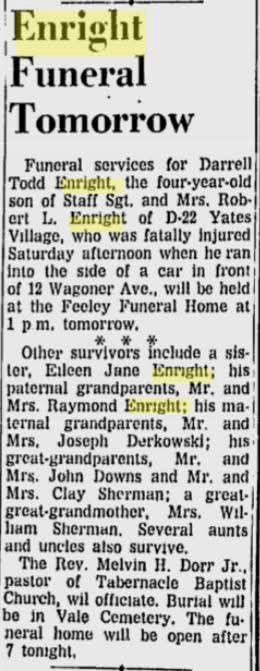
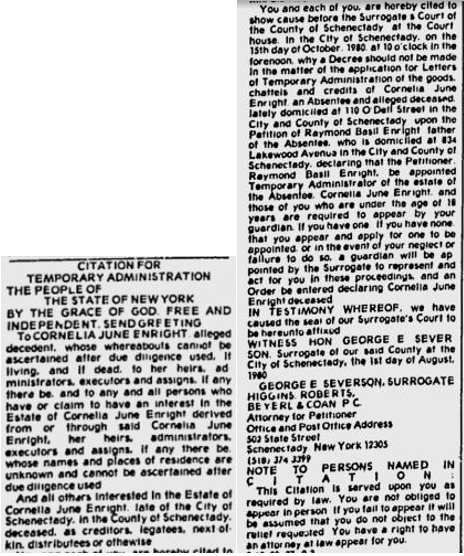
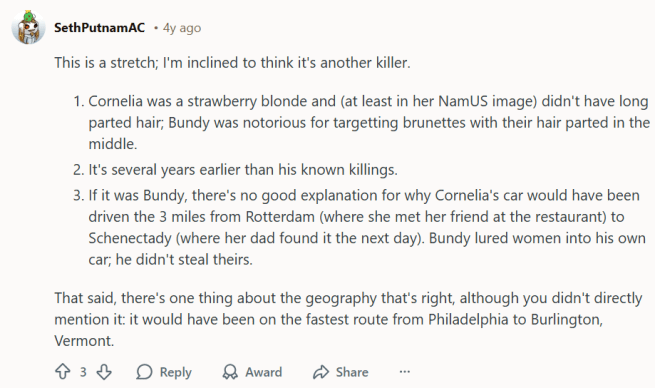
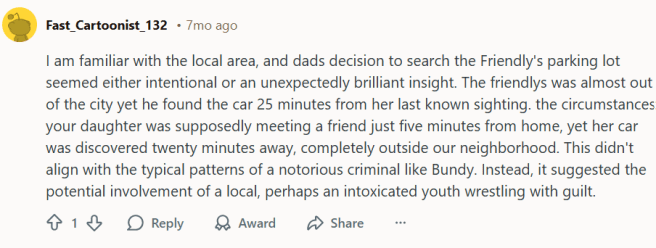
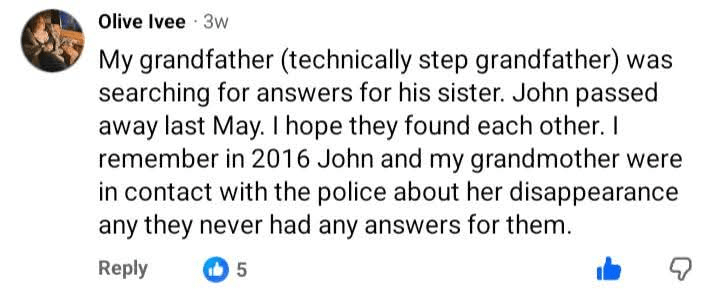
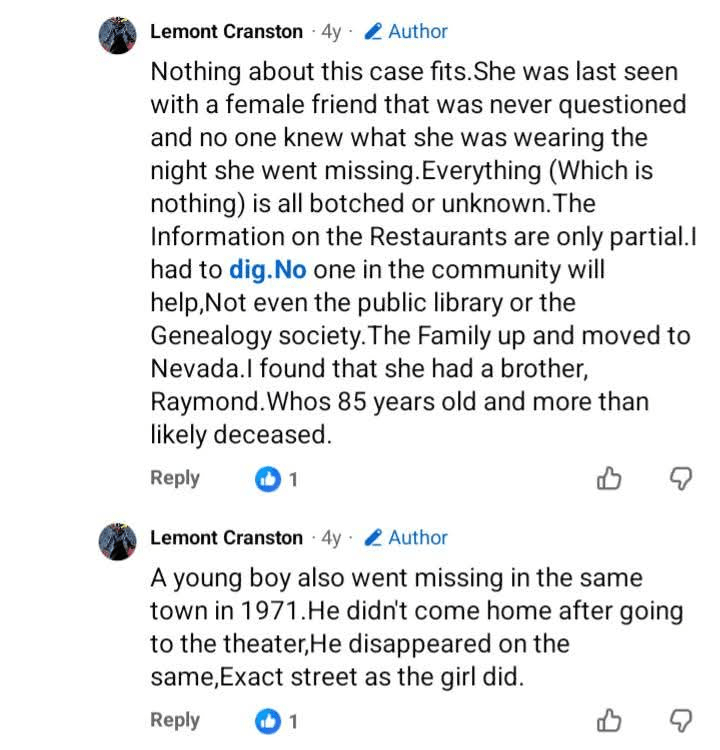
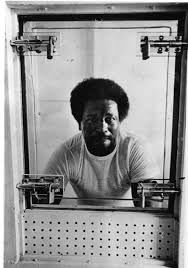
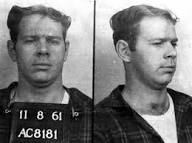
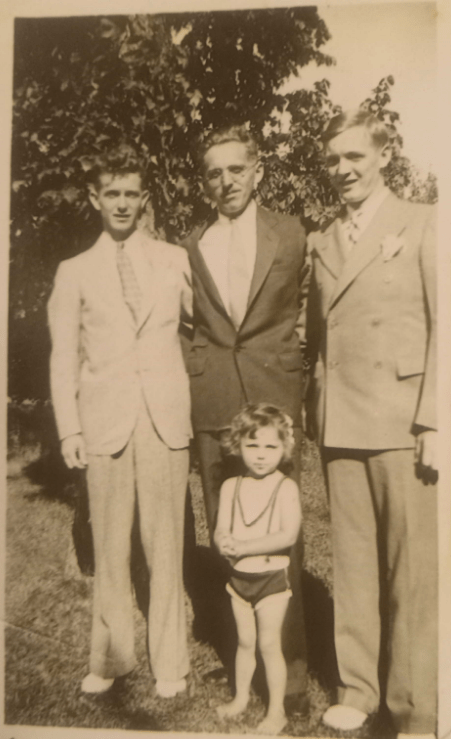
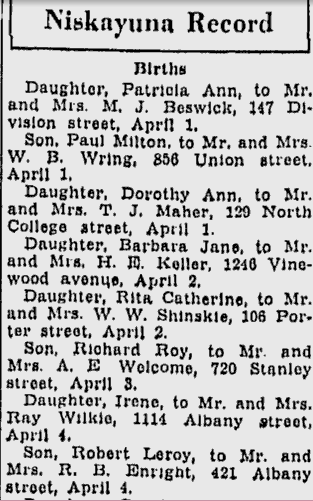
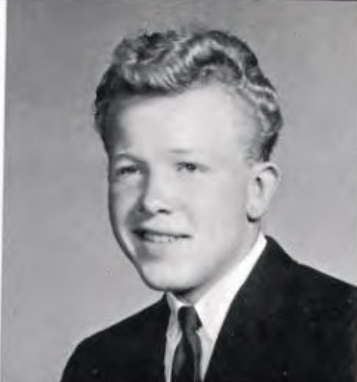
Connie. Photo courtesy of CBS 6 Albany.A picture of the Enright family car, which was found locked and abandoned the morning after Connie was last seen alive in a Friendly’s Ice Cream Parking Lot in Schenectady, NY. Photo courtesy of CBS 6 Albany.A second picture of the Enright family car, this time in the New York snow. Photo courtesy of CBS 6 Albany.A picture of Connie, courtesy of the Facebook page ‘The 518 Veil,’ and Robert Enright.A picture of Connie that was taken from The Journal News on May 26, 1967.Connie’s senior picture from the 1968 Linton High School yearbook.A missing persons flyer created by the group, ‘Missing People in America.’ Connie Enright’s high school diploma.A clipping about a Baptist Church in Schenectady that mentions Connie Enright that was published in The Schenectady Gazette on April 1, 1961.A clipping of a ‘want-ad’ of Connie trying to sell a guitar that was published in The Journal News on May 18, 1965.An article about vacation bible school that mentions Connie Enright that was published in The Schenectady Gazette on June 21, 1966.A newspaper article about Cornelia’s nephew’s funeral that was published in The Schenectady Gazette on May 31, 1967.The only newspaper article about Connie’s disappearance that I could find.A citation related to the disappearance of Cornelia Enright that was published in The Schenectady Gazette on August 20, 1980.Connie versus ‘Frosty Austin.’Some additional information on Frosty Austin.Ted’s whereabouts in 1969 according to the ‘1992 TB Multiagency Team Report.’The route from Philadelphia to Schenectady. The front of Lum’s restaurant in Schenectady, NY.The black and white picture of Lum’s restaurant in Schenectady, NY.The parking lot at the Schenectady Friendly’s where the Enright family car was found the morning after Connie was last seen alive. A comment on a Reddit post about the interstate highway system on a post about Connie made by a user going by the name ‘setthetimer.’A comment on a Reddit post made by a family member of Connie’s.A comment on a Reddit post about Connie made by a user going by the name ‘SethPutnamAC.’A comment on a Reddit post about Connie made by a user going by the name ‘Fast_Cartoonish_132.’A comment on a Reddit post about Connie made by a user going by the name ‘welcometothecortez.’A Facebook comment made by a family member of Connie’s.A Facebook comment made by a Lemont Cranston on a post about Connie Enright.A Facebook comment from a post about Connie Enright.A comment on a Websleuth’s post about Connie Enright made my user ‘alynn05.’A comment made by an acquaintance of Connie’s that went to high school with her.Ted Bundy’s whereabouts in 1969 per the ‘1992 FBI Bundy Multiagency Team Report.’A route from Philadelphia to Lum’s Restaurant in Schenectady, NY.Lemuel Warren Smith.Robert Garrow.Arthur Shawcross.Ray Enright (on the far right) in 1935.Raymond Enright’s WWII draft card. Robert Leroy Enright’s birth announcement published in The Schenectady Gazette on April 16, 1943.Robert Enright from the 1961 Mount Pleasant High School yearbook.Alice June Enright’s obituary.Connie’s brother Robert Enright.Robert Enright’s obituary.John Enright.
Arthur John Shawcross was born at the US Naval Hospital at 4:14 AM on June 6, 1945 in Kittery, Maine to Arthur Roy and Elizabeth (nee Yerakes) Shawcross. According to his mother, heweighed five pounds at birth and was born one month premature, and as a result he spent twenty days in the hospital. Arthur Roy was born on October 7, 1923 in Jefferson, NY and after dropping out of school in the eighth grade he got a position with the Jefferson County Highway Department (which is a position that his father also worked before him), officially becoming their youngest employee on record. After the Japanese bombed Pearl Harbor in December 1941 he enlisted in the Marine Corps, and served honorably in World War II, earning four battle stars.
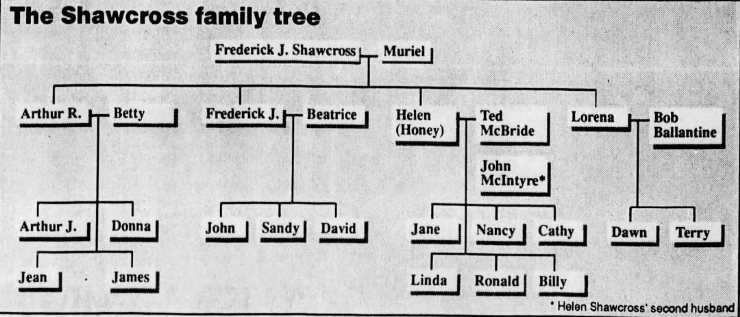
Elizabeth (who went by ‘Bessie/Betty’) was born on August 4, 1926 in Somersworth, New Hampshire and dropped out of high school in the tenth grade to work at a shoe factory to bring in money for her family. During WWII she got a position as a pipefitter’s helper at a Navy Yard in Portsmouth, which is where she met her future husband: after the war was over Arthur Roy was transferred to the Naval Hospital in Portsmouth near Kittery, Maine which is where he met Betty. The couple were married on November 23, 1944 and had four children together: Art, Donna (b. 1946), Jean (b. 1948), and James (b. 1954). Shortly after her first son was born on June 19th, 1945 Mrs. Shawcross took him to Watertown, NY to stay with her SIL until her husband finished his stint in the military. According to those that knew her, Betty was loud, abrasive, and apparently had a vocabulary that could make a sailor blush, where her husband was a calm man, and seemed to be very subdued. Upon returning home Mr. Shawcross returned to his job as a heavy equipment operator and road worker for Jefferson County.
According to one of Art’s cousin’s, he was a gorgeous baby, and had big, beautiful dark eyes and a sweet little face… but there seemed to be something off about him as well: he almost never cried, and frequently had a blank, vacant expression on his face. Shawcross was bornwith a genetic condition known as ‘Jacob’s Syndrome,’ where an individual’s genetic make-up contains an extra copy of their Y-chromosome; those that possess it have an increased risk of having learning disabilities and delayed motor and speech/language skills, as well as an increased risk of behavioral, social, and emotional difficulties. Where it was once thought to cause violent behavior, according to recent studies men with ‘XYY-syndrome’ are not more likely to be more aggressive than others, and this theory has been disproven.
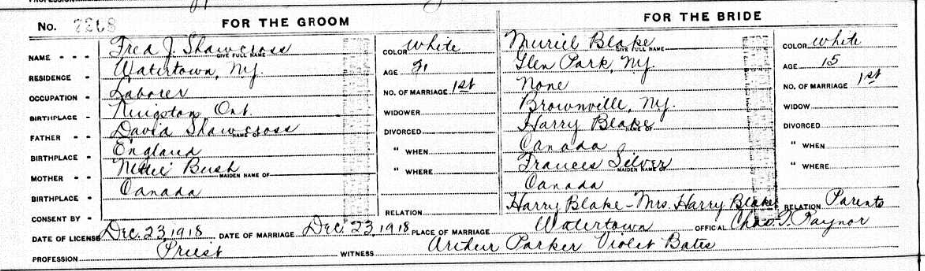
The Shawcross family tree (mostly) goes back to the United Kingdom: one of Art’s ancestors was an attorney general in Great Britain, and a distant cousin was the chief prosecutor of the Nuremberg trials. But alas, scandal wasn’t new to the immediate family: when he was 21, Art’s (paternal) grandpa Fred married a 15 year old named Muriel Blake, completely against her family’s wishes. Her parents called the law and Shawcross was thrown in jail, and when he was released two days later the couple immediately got hitched. They had four children together and stayed married for forty-nine years until Muriel’s death; Fred followed three years later.
At the age of five it was reported by a family member that ‘little Artie’ had missed 33 days of kindergarten and still used ‘baby talk.’ Described as ‘odd’ by those around him (including his own relatives), he frequently had nightmares and wet the bed well into his adolescence. After Shawcross’ little sisters and brother were born his mother didn’t pay nearly as much attention to him, and Bessie’s oldest seemed to especially crave her attention. He began running away from home by the age of six, and in first grade earned A’s and B’s in school, despite his teachers saying he had ‘lazy work habits.’ The following year he began conversing with imaginary friends (most likely a result of having none in real life), and he was relentlessly mocked by his peers, who called him ‘weird’ and gave him the nickname ‘Oddie.’ By the age of eight he was a bully, and often went after younger, smaller children that weren’t as likely to put up much of a fight. It’s no surprise that he had trouble making friends, and in a later interview said that he felt as if his own parents didn’t like him as much as they did his brother and sisters. Arthur was a hypochondriac beginning at a very young age, and always seemed to be suffering from some form of imaginary illness in a desperate ploy for attention.
Artie (John) would later claim that his mother used to punish him with a belt and a broom handle, and that his father would beat him using his belt buckle, and would often hurt him so severely that he would often bleed. A relative of Art’s (that refused to give their identity) said of his early childhood: ‘Arty was a weird little bastard from the time he learned to walk.’
Beginning around the age of eight Arthur became a compulsive masturbater, a habit that his mother tried her hardest to discourage. On the repeated occasions that she caught him she would punish him severely, and claimed that she stuck a broom handle into his behind and even threatened him with a butcher knife on one occasion. Betty Shawcross denied these accusations, and psychologists aren’t 100% certain who is telling the truth.
Things really seemed to go south for Artie at around nine years old: his grades started slipping and his mother found out about his fathers other family in Australia from his time in the Marine Corps: while cleaning up the Guadalcanal island in the South Pacific in February 1943, Arthur Roy went to a dance thrown by the US Marine Corps, and there he met Miss Thelma June Chakros of Yea. According to a 1944 article published by the Watertown Daily Times, on June 14, 1943 the two were wed in Melny; they had one child, a son named Harley Roy. The dominating force in the Shawcross household, Bessie never let her husband forget about his other wife and child, and things never really returned to normal after his second family came to light. Also around this time Art was hit in the head with a rock and was hospitalized; he got stitches and suffered from numbness for years afterwards. He repeated the fourth grade and was always getting into fights with the other kids at school, and would often cry and use baby talk while being bullied by other children. Also at the age of nine Shawcross claimed that he had his first sexual encounter with his Aunt Tina, saying the two had intercourse.
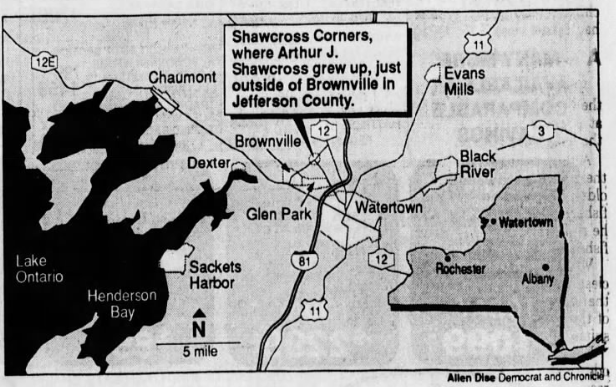
Around the age of ten Arthur began stealing from local stores and homes around Watertown, but was never arrested. In 1958, the family built a small house near Brownsville, NY and because of this Artie no longer had to share a bedroom with his sisters anymore (just his little brother), and eventually three sets of relatives moved onto adjoining pieces of property, thus establishing an area dubbed ‘Shawcross Corners.’ In his later years Arthur would often speak about the difficult relationship he had with his parents and siblings, especially his mom, who he called domineering. Bessie, on the other hand, said that her oldest child was the source of most of her problems.
Despite only having an IQ of 86 (according to the first of many IQ tests, which is signifying less than the average of 100), Shawcross received A’s and B’s during his first two years of grade school. He claimed in later interviews that beginning at the age of thirteen he had sex with one of his male cousins(who denied the allegations) and began having relations with his sister Jeanne, (including ‘constant’ oral sex), which he said went on throughout his middle and junior high school years, prompting his mother to threaten to castrate him when she found out. He also claimed that around this time he had sex with a female neighbor, and when theywere caught by her brother he forced Shawcross to have oral sex with him. Art also said that around this time he was raped by a male stranger and began having sex with a variety of animals (such as sheep, chickens, dogs… maybe a goat occasionally slipped in). At the age of fifteen he was only in the eighth grade, and was still wetting the bed and having nightmares. He was also becoming increasingly violent (especially when provoked), and began torturing small animals and setting brush fires. I just want to point out, Shawcross ticks off all three points of the MacDonald triad, which is a (controversial) hypothesis suggesting a link between violent offenders and three shared childhood behaviors: fire setting, animal cruelty, and bedwetting.
A very literal child, little Artie didn’t seem to understand sarcasm, or phrases like, ‘the cow jumped over the moon’ or ‘the dish ran away with the spoon.’ He would think that a literal dinner plate tried to run away with a tablespoon. His grade school teachers also noticed that he had a strangely complex relationship with his mother, and that he was constantly trying to get her to show love to him. One noticed that he always seemed to be showering her with gifts, even though she didn’t really seem to care. It seemed that the Shawcrosses blamed the school for his poor behavior, and the school seemed to blame Betty.
One of Art’s cousins shared that on one occasion they saw him walking home with a stick on his shoulders, and at the end of it was a snapping turtle: he had speared it with a stick, which went from its backside and out its mouth, and it was most likely alive when he did that. The same relative told another story about Art getting into an argument with his dad, and later that afternoon they saw him in a tree pointing a .22 rifle at Arthur Roy as he was mowing his lawn. Art never went through with it, but afterwards when he was confronted about it he said that he could have easily killed him, and it would have been like ‘shooting fish in a barrel.’
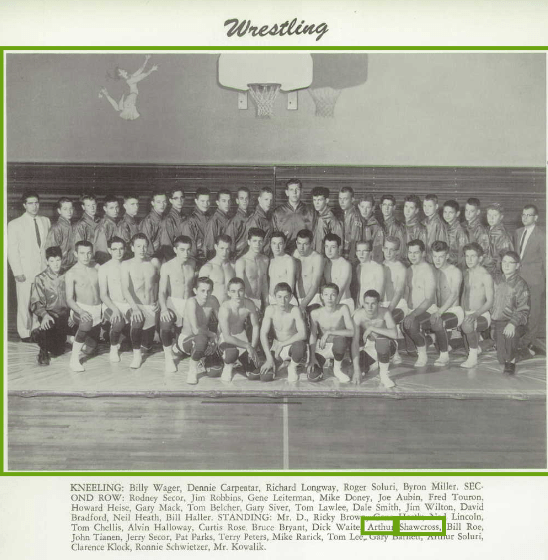
At sixteen Art was described by those acquainted with him as ‘moody,’ and a loner. He joined General Brown High School’s wrestling team, but got hit in the head with a discus and had to spend four days in the hospital. By seventeen he had only made it to the ninth grade and his grades fell to the lowest they had ever been; he eventually dropped out of school completely at the age of nineteen in 1960. It was also around this time that he began breaking into homes and peeping through windows, and in 1963 he was arrested for breaking into a Sears store; he received eighteen months of probation and was charged as a ‘youthful offender.’ Just two years laterhe was arrested again for second degree burglary, and was sentenced to six additional months of probation.
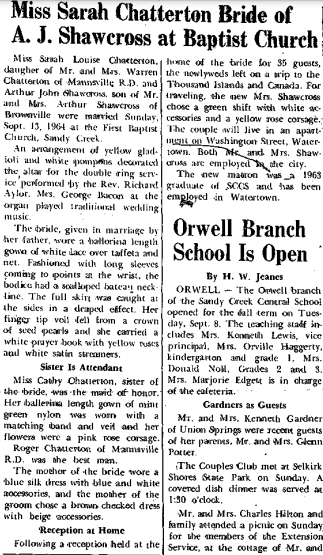
Around the time he was on probation he met his first wife, a woman named Sarah Louise Chatterton that he worked with at the local Family Bargain Center (a job he was let go from due to ‘poor customer service’ skills). The couple got married on September 13, 1964, and they did not consummate their marriage for several weeks after their wedding. Art and Sarah had a son together named Michael, who was born roughly a year after their wedding on October 2, 1956. During their marriage Shawcross had a hard time holding a job, and was fired from several employers (he said that his favorite job was at a butcher shop).
After less than two years of marriage Sarah and Art divorced; he relinquished all rights to his son (who he never saw again), and her new husband eventually adopted him. Around this time Shawcross was arrested after he chased a thirteen year old kid into his home after he threw a snowball at his car; he received another six months of probation. Around this time he also fell off of a 40-foot ladder and hit his head, earning him another concussion.
On April 7, 1966 Arthur Shawcross was drafted into the US Army. Surprisingly he scored above average on intelligence tests, but only scored an 88 on a military administered IQ test, which (when combined with his overall low motivation) made him unsuitable for many higher level jobs. Where he initially had some minor disciplinary problems, Art eventually settled into his role and served one tour of duty with the 4th Supply and Transport Company of the 4th Infantry Division in Vietnam.
In September 1967 while on a 30 day furlough before being deployed to Vietnam Shawcross met a woman named Linda Neary at a bar, and since they both figured he would die overseas the two decided to get married. Born Phyllis Lee Brown, Linda was given up at birth and was adopted by the Neary family and was later renamed. After graduating from high school in Clayton, NY she got engaged to a kind, soft-spoken young man that she only dated for a few months, but only three days before the wedding he came out to her as gay and called off the wedding. Linda begged him to go through with the wedding, but he said no, and told her that he couldn’t involve her in his ‘sexual confusion.’ Shortly after he relocated to Rochester, and eventually passed away due to complications from the AIDS virus.
According to Jack Owen’s book, ‘The Misbegotten Son,’ after Sarah saw their marriage announcement published in ‘The Watertown Daily Times’ she reached out to Linda, and told her: ‘I can tell you an awful lot about your husband if you want to know.’ The former Mrs. Shawcross told the new one that her new husband was violent, and that after their son was born she had always been afraid of what he might do to him. Neary said she didn’t believe a word she said, and figured it must simply be ‘sour grapes.’ She had seen Art with his young son on multiple occassions, and he seemed like a good father and was very gentle with him. Sarah also hinted that he beat her, however didn’t elaborate any further than that.
Just as she did with her previous fiance, Linda and Art abstained from sex until they were married and tied the knot in September 1967; only a month later, twenty-two year old Shawcross was sent to Vietna b vcm, where he worked as a supply parts specialist. In October of 1968 after the war was over he was sent to Fort Sill, Oklahoma where he worked as an armorer, repairing weapons. He was honorably discharged from the Army in Spring of 1969, and moved to Clayton, NY (which is where his new bride was from).
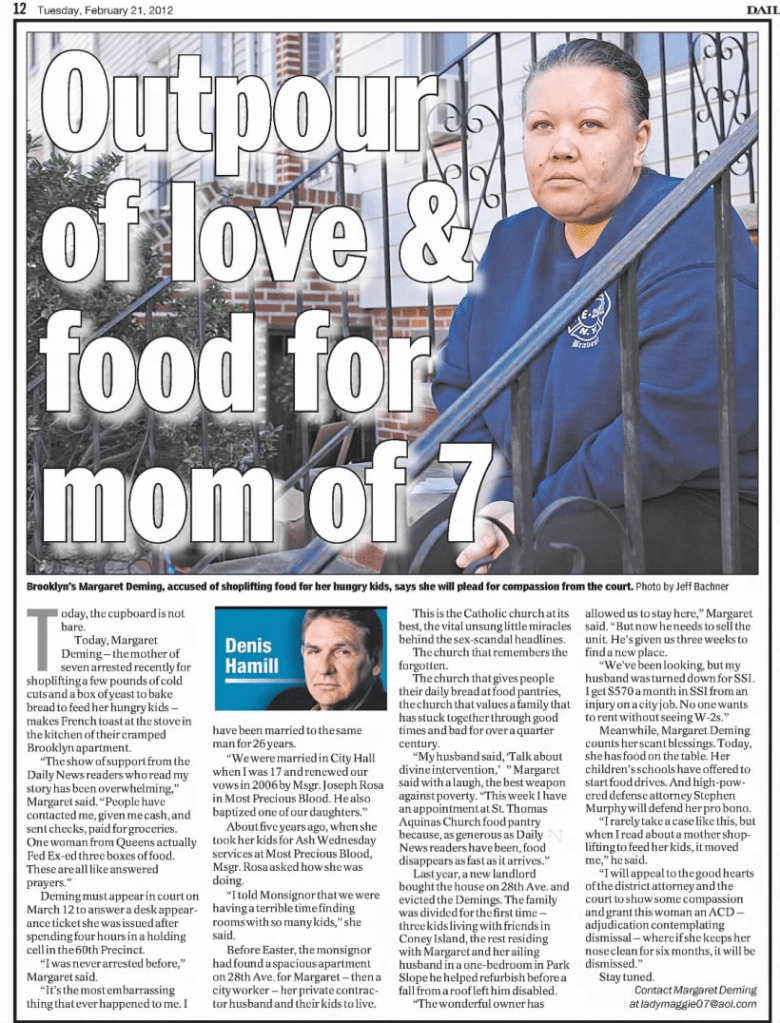
In the middle of 1968 Shawcross had an affair with a woman while on leave from the Army in Hawaii that led to the birth of his daughter, Margaret ‘Maggie’ Deming, who was born on Valentine’s Day in 1969. In 2001 Maggie learned the true identity of her father and decided to get in contact with him, and the two began a relationship of sorts, and he even met her seven children. Deming has called Arthur ‘very gentle,’ ‘soft-spoken,’ and ‘grandfatherly,’ and the two remained in contact until his death in November 2008.
Upon returning home from overseas, Art told anyone willing to listen that he was a member of an elite detachment and was personally sent to ‘take out’ entire villages (he said that his ‘kill count’ was 39 people). He also claimed to have PTSD, and bragged about some truly abhorrent (and made-up) combat exploits, including ‘beheading mama-sans and nailing their heads to trees as a warning to the Vietcong’ and acts of cannibalism. One of Shawcross’ favorite lies to tell about his time in Vietnam was that he once murdered and cannibalized two young girls after he found them hiding guns in a tree. He tied one to a tree, then shot the other and cut her head off, which he said he speared on a post ‘for the Vietcong to see’ (but not before he cut off a piece of her thigh and ate it). His second victim lost control of her bowels (most likely out he fear), but despite this Shawcross said that he sexually assaulted her then shot on the head.
After his arrest he said that the war was his introduction to murder, and that while in Vietnam he invented gruesome ways to torture and kill his victims (which included men, women, and children). But in reality, Shawcross never served in a combat position, and his military career was completely unremarkable. After his second arrest in Rochester, FBI Profiler Robert Ressler looked into his PTSD claim on behalf of the prosecution, and after an exhaustive look into Shawcross’ background he came to the conclusion that most of his claims from his time in Vietnam were ’untrue,’ and that he concocted his tales thanks to some descriptive books and movies (as well as an overactive imagination). A psychiatrist also stated that he had antisocial personality disorder.
When Artie was reunited with his new wife things quickly got violent (at one point he killed the family dog in a fit of rage), and after surviving a suicide attempt he decided to see an Army psychiatrist. The Doctor told Linda that her husband got intense sexual pleasure from setting fires andasked that she sign paperwork to have him committed to a psychiatric hospital, as he felt that Arthur was very possibly dangerous to herself and others. Neary, who hardly knew her husband, asked his mother what her thoughts on the matter were, and Mrs. Shawcross refused to answer, saying that it was her choice. According to Linda, the Mr. and Mrs. Shawcross were emotionally distant with all of their children, and almost never hugged them or showed them any sort of affection. In the end, she chose not to have Art committed (one of the reasons being she was a strict Christian Scientist), and the Army determined that they did not have enough of a reason to commit him themselves.Shortly after the evaluation in June 1969 he got drunk and beat her up so badly that she miscarried (she was four months along); she divorced him later that fall.
In addition to treating his wife poorly, after Art’s return from Vietnam his general behavior became increasingly problematic. In 1969 he was convicted of helping rob $407 from a local gas station, and was brought up on three separate arson charges: a barn in Delafarge Corners, The Knowlton Brothers Paper Mill in April (there was over $250,000 in repairs needed), and extensive damage to Crowley’s Food Mart in September. In December of 1969 he was sentenced to five years in Attica prison. During his stint he claimed to be raped by three black inmates (although he said that he eventually got his revenge), and in June 1970 he was transferred to Auburn Prison, where he served out the rest of his sentence. Ultimately he only served twenty-two months and was paroled early to his parents after he saved the life of a prison official during a riot on October 18, 1971.
Upon his release from prison Shawcross returned to Watertown and got a job with the local public works department. He reconnected with a single mother of two that he knew from high school named Penny Nichol Sherbino in January 1972 after they ran into one another in front of the Watertown JC Penney’s. The couple got pregnant after only five dates and got married on April 22, 1972; they moved into the Cloverdale Apartments (which was income based, subsidized housing) but she later miscarried. Strangely enough, despite working at the city dump, Art required his wife to have a freshly ironed, white button up shirt for him to wear everyday, and he refused to get his driver’s license. Interestingly enough, she said that he had the unique hobby of painting on panes of window glass, and he ‘would lay a pane of glass atop a picture and trace a copy in a bright-colored paint.’ To Penny, some of his paintings seemed sellable, but he didn’t have any interest in turning a profit. When she asked where he learned the technique, he immediately changed the subject (my guess: jail) (Olsen, 44).’ Neither one of them drank or did drugs, however Art did like to drink coffee and hang out with the local cops, something Penny never understood (as she didn’t trust the police). On one occasion Shawcross left a bouquet of wildflowers on a female neighbor’s door step, along with a note that said ‘these are for your grave.’ When questioned about it he refused to elaborate why he did it.
But, despite multiple ‘second chances’ Arthur couldn’t seem to keep his nose clean, and at one point during his marriage to Penny had been required to pay a $10 fine after he got caught spanking a small boy then stuffing grass into his pants. It wasn’t until this event that Sherbino became aware that her husband was even on parole, and only learned about it after seeing a notation on his court paperwork that said ‘paroled to Lyle Sylver’. He also got caught putting a small child in a burning barrel of garbage and grabbing another ‘by the neck,’ incidents that eventually blew over.
According to Art’s third wife, it never seemed as if Betty had any interest in seeing her son, and according to her he never seemed to do anything right (and she had no problem telling him so). Penny also said that her MIL once shared that Art was the ‘bane of her life’ and that ‘it just seems that no matter what he does he can’t seem to get along with people.’ She also shared that she thought there was something wrong with her son’s brain, most likely a result of suffering multiple head injuries during his developmental years. The two also exchanged stories about Art’s letters: Betty reported that he told her he had been ‘wounded by shrapnel’ (something that he never shared with his wife) and about a ‘big battle’ that he played a large part of (which was most likely a lie in an attempt to get some sort of positive reaction from her). She also said that her husband seemed almost afraid of the tiny matriarch, and wondered if his need for ‘comforting’ had anything to do with her lack of affection towards him (she said he frequently would choose sitting with his head in her lap while she ‘tickled his back’ over love making). Art swore to Penny that he loved his mother deeply and ‘sang her praises,’ but at the same time appeared nervous and almost uncomfortable while in her presence.
A hobby that Art seemed to deeply enjoy was fishing: according to Penny, he went every day, however she said he ‘couldn’t catch a cold,’ as he never came home with any fish she could make for dinner. Art seemed to lack general direction in his life, and it was around the summer of 1972 that he began walking long distances around Jefferson County. He would frequently stop to fish along the Black River, and it was during one of these excursions that he met a local 10 year old boy, Jack Owen Blake. Jack’s mother Mary (nee Lawton) was born on November 29, 1934 in Watertown NY (which also happened to be Thanksgiving Day) and was one of fourteen children. She had a dysfunctional upbringing: her father was an alcoholic and wife beater, and her mother cheated on her dad and had multiple children by another man (she said that no one really seemed sure of which kid was fathered by what man).
A Korean War veteran, Alan Blake (who went by the nickname ‘Big Pete’), was born on December 7, 1931 in Kalamazoo, Michigan. The couple met at a bar when Big Pete was stationed at Pine Camp (now Fort Drum) with the Army in 1953, and he got Mary pregnant with their oldest son Richie and her parents made them get married. A petty thief, Big Pete lost an arm in a motor vehicle accident that took place while he was fleeing a robbery while drunk. In name only, the couple went on to have nine children together, as Mary would later admit to having an extramarital affair with a man named Bob, and she is largely sure that he is Jack’s real father (although no DNA test was ever performed). About her husband, Mrs. Blake said ‘when he wanted sex, he took down his pants. He gave me kids but he din’t want no part of ’em. Dr. Rossen told him, ‘I oughta take a shotgun and blow that thing right offa ya and tie it up on the wall with a ribbon. Your family’d be better off’ (Olsen, 11).
With no high school diploma or skills, Big Pete had a hard time finding employment, and eventually got a position picking potatoes for a local farmer named Bob Gardner. After forging a check from his parents in Michigan, they agreed to drop all charges against him as long as he promised to never return to the state again.
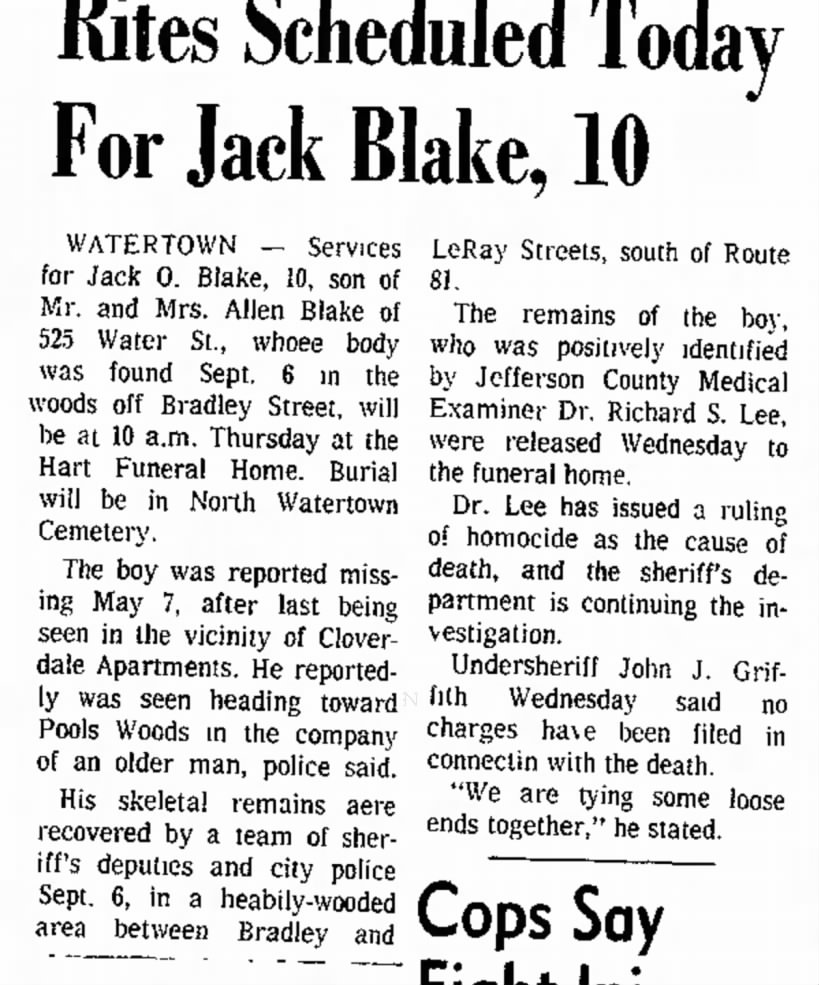
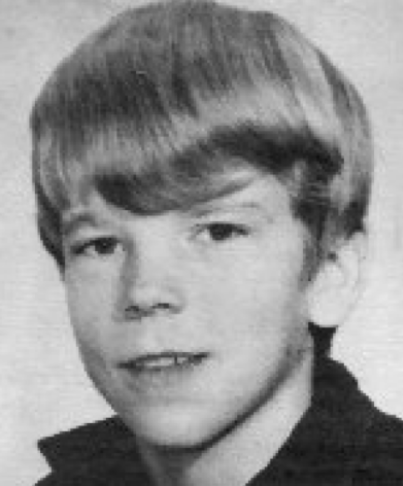
Jack Owen Bake was born at Mercy Hospital in Watertown NY on October 18, 1961 to Mary and Allen Blake. The seventh of nine brothers and sisters, he had straw blond hair, freckles, big ears and a pug nose, and according to the Blakes, at the time of his murder was a typical, fun-loving 5th grader that once saved his older sister from drowning in the Black River.
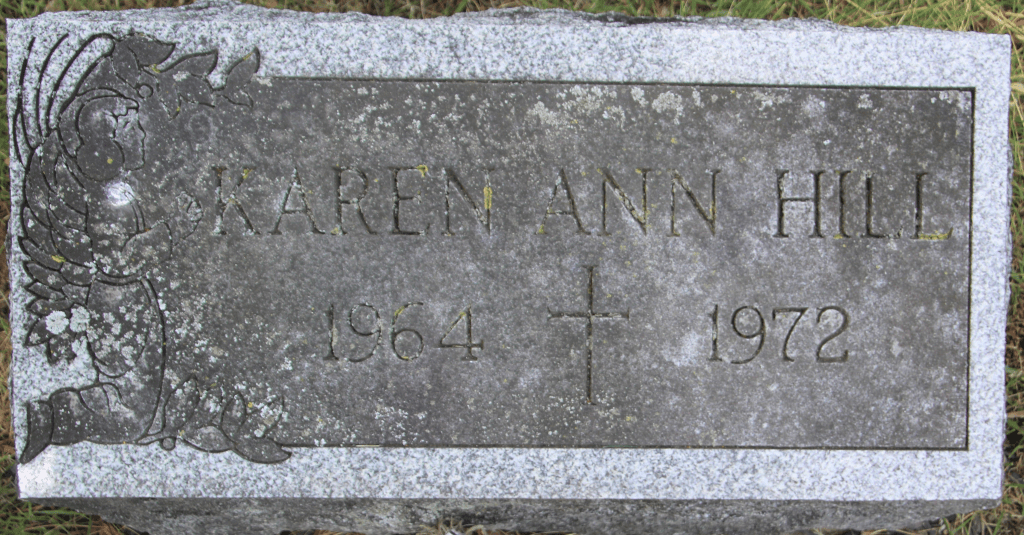
On May 7, 1972 during one of their afternoons fishing together Shawcross’ violent fantasies came to a head, andBlake disappeared after telling his mom he was going outside to play near the Cloverdale apartments. I do want to add (just for the sake of being complete) that I’ve also seen it reported in multiple places as April 7, 1972, however May seems to be most frequently used and is on his tombstone as well. The two had gone fishing together a few days prior to when he was last seen, and when Mary found out she told her son not to go near him again.
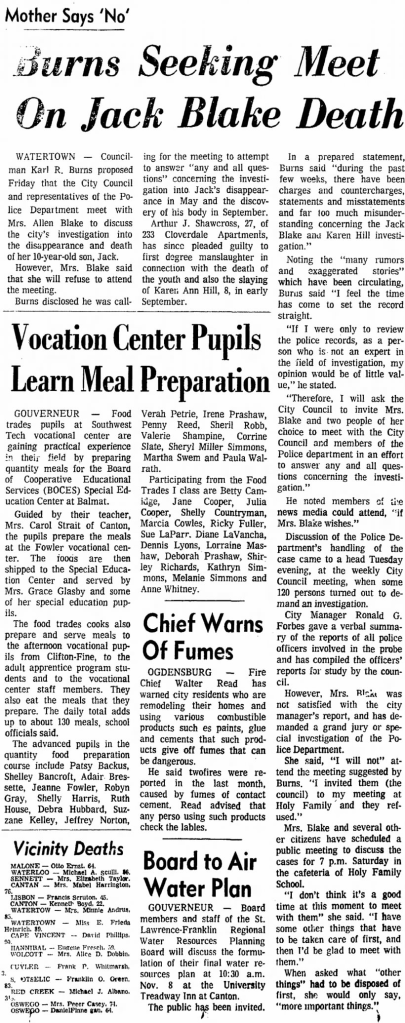
Shawcross was questioned about the disappearance and denied having any involvement, and in the initial stages of the investigation he was not high on the Watertown PD’s suspect list (despite receiving concerns by Mary Blake). Law enforcement did not make Jack’s disappearance easy on the Blakes, and as a result the family had a deep hatred for LE (Mary called them ‘piggie-wiggies’). After Mrs. Blake first reached out to police to tell them that her son was missing they didn’t take her seriously, and refused to investigate. At one point they even searched the family home after they claimed to ‘received a tip that Jack’s body was somewhere in the basement.’ The family had frequent run-ins with LE, and one of them always seemed to be in some sort of legal trouble (whether it was shoplifting, truancy, or fighting).
It was also in the summer of 1972 that Shawcross confessed to his parole officer that he was beginning to have troubles in his (third) marriage, but was willing to accept blame and was ‘beginning to have doubts about the true meaning of love.’ He also used the interview as an excuse to get in a few good jabs in about his mother, and told his PO that she ‘was a domineering person’ that ‘downgraded her husband and son (Olsen, 79).’ Sylver immediately sent him for a mental health evaluation, where he was found to be functioning at a ‘borderline level of intelligence’ and was ‘exhibiting defective moral and social development.’ The psychotherapist/social worker (he was referred to as both) also said that ‘when he becomes upset he acts impulsively… he describes himself as always having felt that rules are to be broken and did everything in his power to break rules at home as a child and in school… his mother had a very bad temper’ (Olsen, 80).
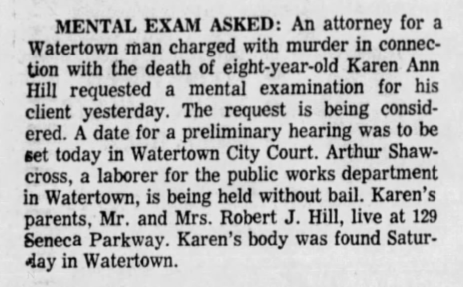
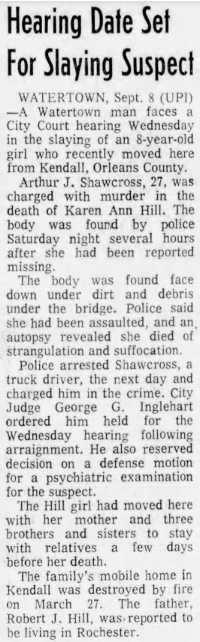
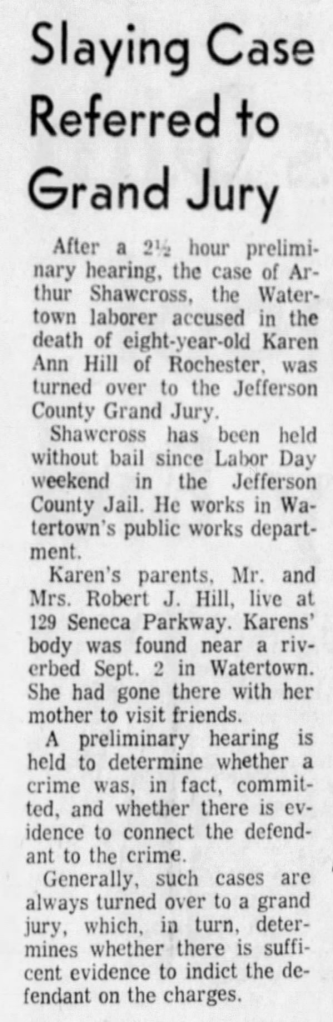
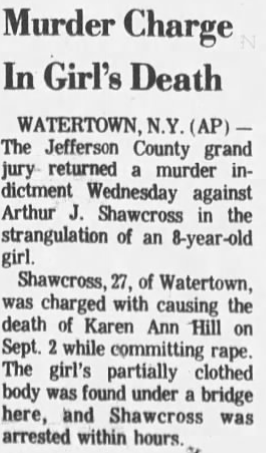
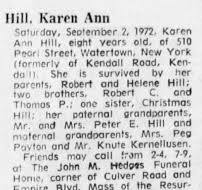
Later that same year on September 2, 1972 Arthur Shawcross killed Karen Ann Hill, who was born on Fathers Day in 1964 to Joseph and Helene (nee Korneliusen) Hill in Rochester, NY. Mr. Hill was born on March 2, 1933 and worked for Eastman Kodak as a machinist and (according to his ex-wife) had a bit of a drinking problem; Helene was born on May 20, 1937. The couple were wed on August 25, 1955 and had four children together (two boys and two girls), but divorced in 1971. After Karen was born her mother said to the nurse, ’that’s not my baby, look at that pitch-black hair,’ but within four weeks it turned light blond. A native of Rochester, Helene was in Watertown with Karen and her two year old sister Christmas to visit with her new bf’s family for the Labor Day holiday (12 y/o Bob and 10 y/o Tom were left at home with her sister). Hesitant to get into a new relationship so soon after her divorce (especially with four young children to take care of), she liked Stan Fisher’s warm and likable personality, and it helped that her kids seemed to adore him (she said that where it definitely ‘wasn’t love but it beat loneliness’). When Fisher suggested a weekend trip away to Watertown to see his half sister and her family, at first Helene was just going to bring Chrissy, but then her older daughter begged to go too at the very last minute as well, and she relented. Mrs. Hill said Karen had an independent streak and her dream was to grow up and become a movie star.
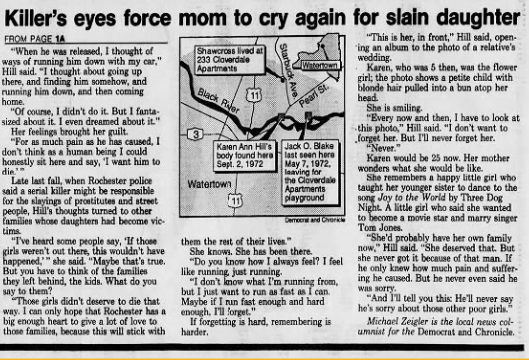
Little Karen Ann had large, chocolate brown eyes and honey-blonde hair that her mother styled long and girlish. At a bit before 2 in the afternoon on September 2, 1972, Karen told her mother that she wanted to go and play outside, which Helene said was ok but told her to ‘stay close,’ as she wanted to wash her hair to help make a good impression on Stan’s family. She told police that the last time she checked on her daughter she was playing with a little white bunny that belonged to one of her bf’s sisters kids, and the last thing she said to her was, ‘honey, mommy’s gonna wash her hair. You stay in the yard, okay?’ To this request, Karen replied, ‘I will, Mom.’ When she failed to turn up after a few hours, Helene went for a walk around the neighborhood and asked if anyone had seen her daughter. After being met with multiple ‘no’s’ she began to worry, and called Watertown Police at 5:45 PM; the responding officer only took five minutes to show up (if only Jack Blake was given the same level of care).
Shortly after Karen disappeared Mary Blake’s SIL went to her house and asked if she had seen her. She hadn’t, and where she wanted to go and help in the search for the little girl she had her children of her own to take care of; she immediately knew that Shawcross was responsible.
At roughly 2 PM a local college student named David McGrath was driving over the Pearl Street Bridge and saw a small blonde girl climbing the yellow fence near the Black River. He noticed that she appeared to be looking for something on the ground and that there was a newer brown and white 10-speed bicycle propped up against the ‘latticed laced iron fence.’ McGrath’s first thought was that a child that young shouldn’t be alone in such a dangerous spot, but at the same time he firmly believed in minding his own business and kept driving. On his return trip about ten minutes later he noticed the bike was still there but the child was gone. After hearing about the missing child he reached out to LE, and it was his call that led to the discovery of Karen Hill.
A few minutes later four teenage girls on their way to visit a relative just happened to be walking by the same bridge as McGrath and witnessed a man climbing up the river bank then climbing up and over the fence. As they passed by him they noticed that his clothes were stained and his legs were wet, and he was carrying with him two fishing poles.
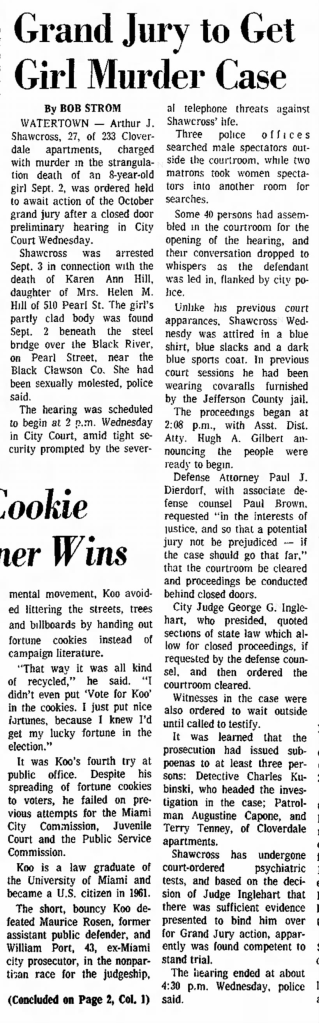
At 2:45 PM Terrey Roy Tenney was walking past Gateway Electronics near the railroad tracks on Factory Street when he noticed Art riding his bike nearby. The sixteen year old was on his way home to the Cloverdale Apartments and had his arms full of clothes, something Shawcross noticed because a few minutes later he circled around and came up behind him. His neighbor asked if he wanted an ice cream cone, which he accepted (although hesitantly) and later observed that Shawcross was ‘out of uniform’ and wasn’t dressed in his ‘normal’ neat clothes (he was wearing ‘soiled dark blue shorts and a dirty t-shirt’). Art volunteered that he had ’been fishing’ and offered to carry his bags of clothes home for him; he accepted, but stressed not to lose anything. When Tenney arrived at Cloverdale ten minutes later Shawcross was already there, along with his clothes. The boy said that it was his first real interaction with him, and they’ve never really spoken before; it was later suspected that he was Art’s way of establishing an alibi.
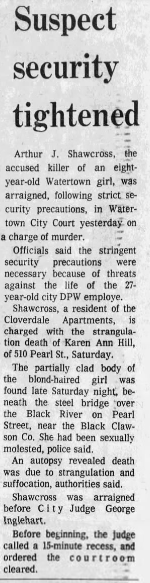
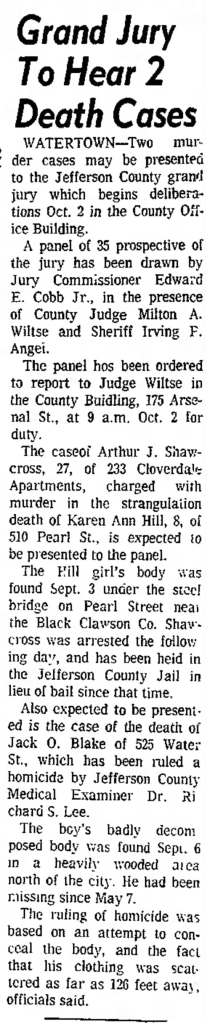
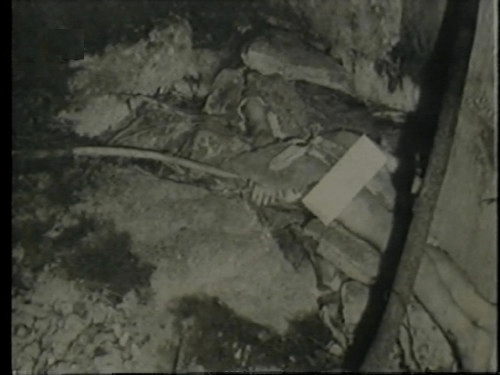
The body of Karen Ann Hill was found under an old iron bridge that went over the Black River by Watertown Police Officer Augustine Capone, who saw her feet sticking out above the water and ‘her whole upper torso buried in rocks;’ she had grass and leaves stuffed down her throat and was naked from the waist down. The Pathologist that performed her autopsy said that she had been dead anywhere from eight to twelve hours and there was a chance that she’d been killed before she’d been sexually assaulted. Immediately Shawcross was a suspect, most likely because of the debris that was found in her mouth and throat; locals told LE they remembered seeing him with a young girl matching her description earlier in the day that she disappeared, with one even reporting they saw him sitting with her on the same bridge where her body was later discovered; the two were eating ice cream.
I’m just curious: what did Shawcross say that made the girl go with him? Her mother said she walked eight blocks to school everyday alone in the city of Rochester, and that it was uncharacteristic that she would just wander off with a stranger. What I personally think happened is the little white rabbit Karen was playing with ran away and she simply ran after it without thinking. Shawcross was probably fishing when the child approached him and he somehow convinced her to come over to him (maybe he told her he knew where the creature had gone?). Sadly we’ll never know.
After police connected the dots between Karen’s murder, Jack Blake, and Art’s new bike that was seen near the scene of the crime, police quickly brought him in for questioning. Shawcross arrived at the police station shortly after midnight, and he told LE that he left his apartment at 7 AM earlier that day and after a few hours of fishing he went home for a break. He then volunteered that he rode his bike to the local bargain center and visited with a friend before he eventually ran into Tenney from Cloverdale. He bought his teenage neighbor an ice cream cone then carried a bag home for him, arriving there at 3:15 in the afternoon. Shawcross also mentioned that he returned to the shopping plaza two additional times that day, where he purchased a few things for himself as well as some sneakers for his stepson; he then claimed he spent the rest of the day at home with his wife.
During their interview, Watertown Detective Charles Kubinsky observed that Shawcross went out of his way to give an explanation as to why he was near the bridge when he was, and that he also seemed desperate to make it clear that he was nowhere near it at the time that Hill disappeared. Shawcross remained at the police station talking to detectives until around 2 AM, and he was released. Early the next day Kubinsky read the report from the teenage girls, who said they saw him on the bridge at roughly the time Hill was murdered, which destroyed Art’s alibi. The detectives immediately brought Shawcross in for a second interview.
During this interview Shawcross was inconsistent when it came to the time that he was near the bridge, and he eventually stopped answering their questions and he was released again.At around 8 AM on September 3rd a sniffer dog was brought in to track the scent of Karen Hill, and it led investigators from the bridge where she was found right to the Cloverdale Apartments.Shawcross was arrested on the third time he was brought into the Watertown Police station for questioning.
As Detective Kabinsky wrote his report on Karen Hill he recalled a report from a man named William Corky Murkock, who reported a suspicious looking man that came out of the woods behind his motel and gas station around the time that Jack Blake disappeared. After some additional questions later that same day at roughly 10 PM Shawcross hinted that he knew where the Blake kid was buried, saying ‘okay Charlie, I’ll help you. And maybe you can help me. But let me sleep on it.’ The detective thought to himself that Art seemed to enjoy having the upper hand, and that he probably wanted to make a deal.
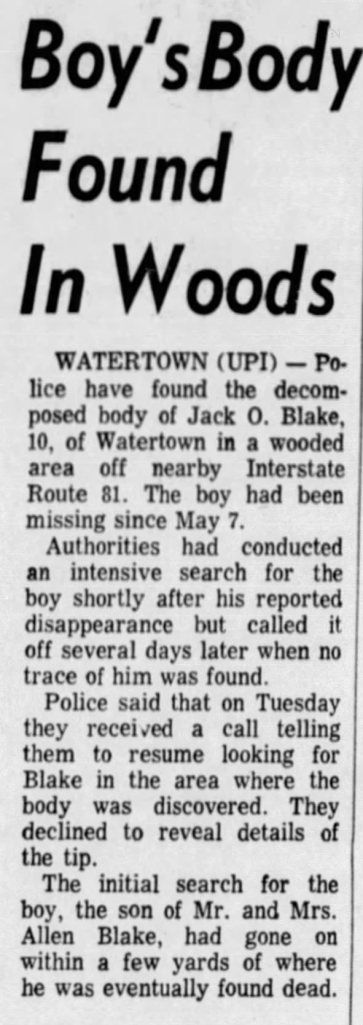
He confessed to burying the child somewhere in some swampland off of Route 81, just north of Watertown. Police quickly formed yet another search party on September 6, 1972, and when they stumbled upon human remains they immediately knew they found Jack: the name ‘Blake’ was written on the back of the child’s t-shirt, one that had written on the front, ‘I act different because I am different.’ Big Pete and Mary weren’t even contacted by the authorities after their son’s remains were discovered, and they had to find out just like everyone else: on the news. It was determined that the initial search for Jack took place within yards of where his body was eventually found.
The pathologist determined that Blake had been suffocated to death, and that his remains showed signs of sexual abuse. Shawcross would later admit to luring the boy into the woods, then forced him to strip naked then run from him before taking his life. He also said that he returned to his remains on several occasions and had sex with the corpse, and that he cut out the child’s genitals and heart then ate them. Because the level of decomp was so advanced nobody really could say that it did or did not happen.
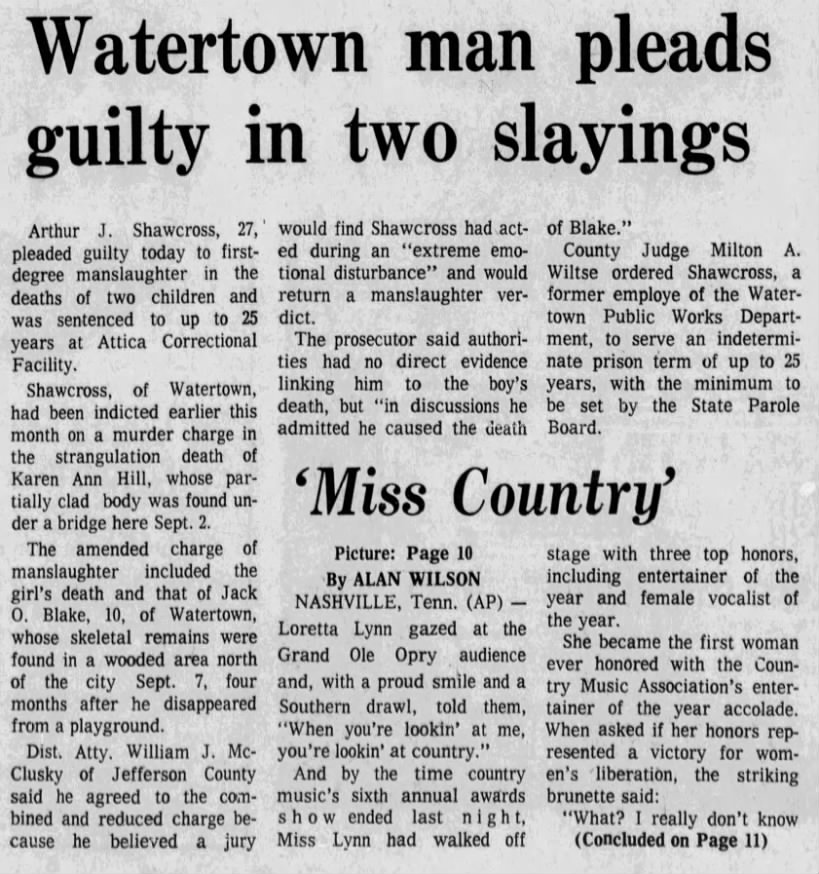
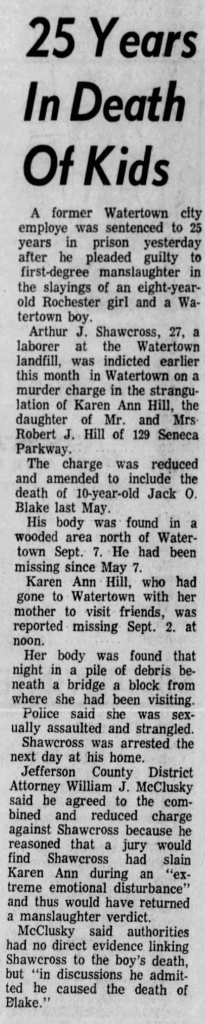
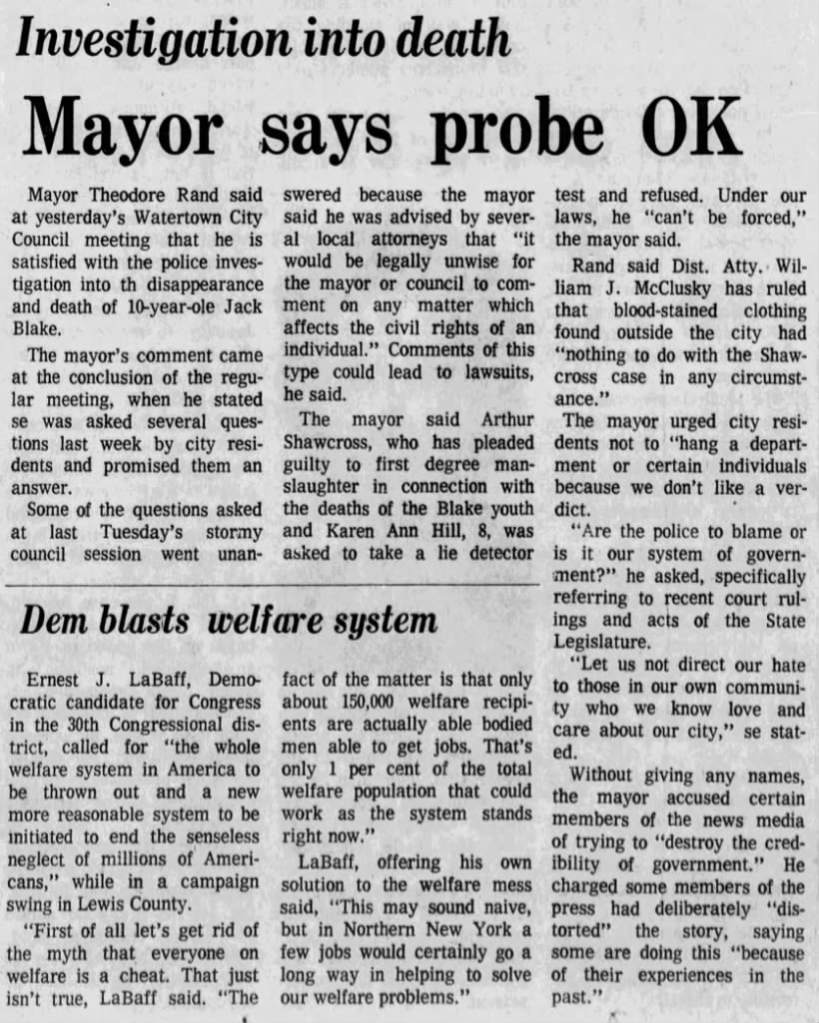
The day after Art confessed he sent a friend to his ex-wife Linda with a message for her: that he didn’t mean to do it and was having a ‘Vietnam War flashback’ when he killed Karen Hill. Exactly two weeks later on September 17, 1972 a plea bargain was struck, and in return for a guilty plea for a first-degree manslaughter charge for the murder of Karen Hill no charges would be filed against him related to the homicide of Jack Blake (thanks to a statute that acknowledges the killer’s ‘extreme emotional disturbance’). The former Jefferson County DA William McClusky rationalized the plea bargain by stating that aside from his confession to detectives, there was no direct evidence linking him to the murder of Jack Blake. McClusky also suggested that had the case gone to trial Shawcross may have argued that he was under ‘extreme emotional disturbance,’ and a jury would have most likely agreed upon a verdict of manslaughter anyway. He confessed that he encountered Karen while she was playing by the Black River, then proceded to lure her away before he raped then strangle her to death.
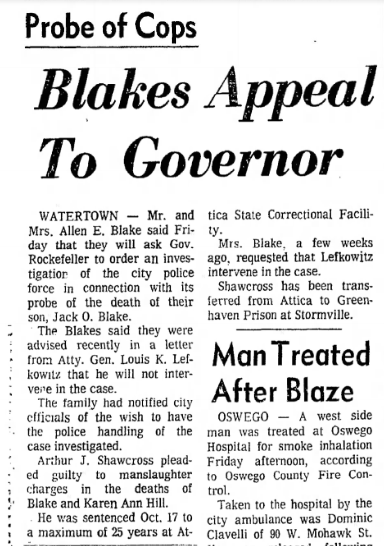
Arthur John Shawcross was sentenced to an indeterminate term, with a maximum of 25 years at Attica Correctional Facility. In November of 1972 he was transferred to Green Haven Correctional Facility, and two years later he became violent after receiving constant threats from other inmates. In 1975 he filed for divorce from Penny after she wouldn’t visit him, and the same year he also claimed to have sex with a nurse’s aide (something that has never been confirmed). After Shawcross was in prison for fourteen years, inexperienced prison staff and social workers concluded that he was ‘no longer dangerous’ (completely disregarding the warnings of psychiatrists who had assessed him as a dangerous ‘schizoid psychopath’), and he was released on parole in April 1987. This is where I’ll end this portion of my article, and the second part will be about his crimes in Rochester.
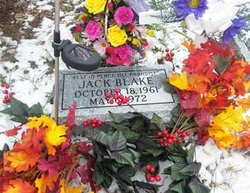
Initially after the discovery of Jack Blake’s body in September 1972 he was laid to rest in North Watertown cemetery in an unmarked grave in Section W between the stones of William Howard and Leland Parker. However in November 2013 an unnamed childhood friend of Jack’s reached out to the Blake family and donated a marker for Jack, which was installed at a dedication ceremony later that same month.
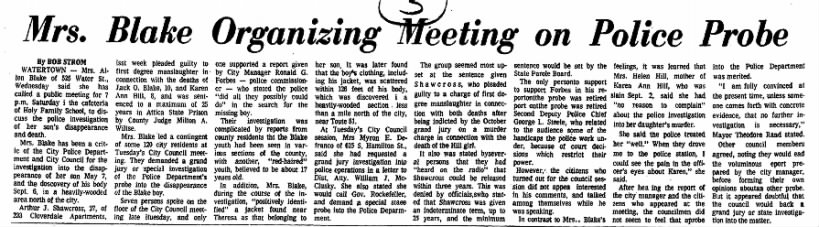
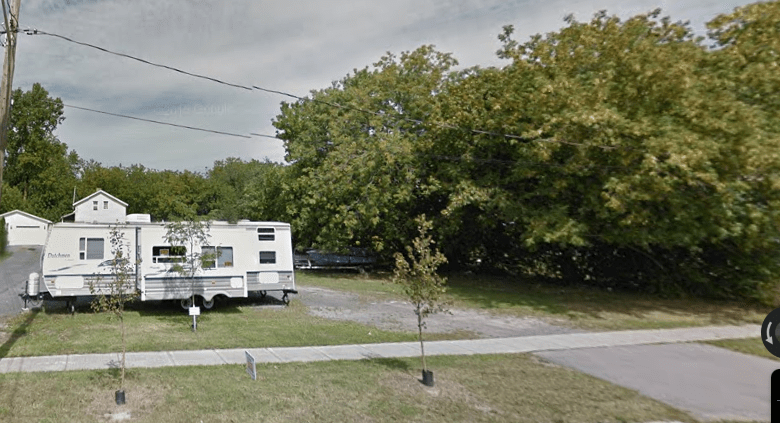
Mrs. Blake struggled with Jack’s death until the end of her life, and even thought that police lied about finding his remains and that Shawcross was innocent of both murders in 1972 (she even thought they buried an empty coffin). Years after the murders she met with Helene Hill, who she told her crackpot theories to, and after a few phone calls and a sit-down with some Rochester detectives Mrs. Hill was told to ‘get rid of that woman,’ because her whole family was bad news and was always in trouble. I mean, it’s rude but fair: all of the Blakes (Mary included) were constantly in and out of the Watertown Police Department on a various (small) misdemeanor charges (mostly fighting and shoplifting). Strangely enough, Richie Blake was sentenced to Green Haven for burglary, and happened to be assigned the same counselor as Shawcross.
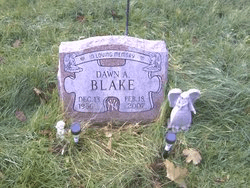
Sadly Big Pete and Mary’s marriage couldn’t withstand the murder of their precious son and they eventually separated. After she took the kids and left he turned to hard drugs and booze, and got so sick that (according to her) his ‘liver exploded.’ Despite being divorced, she had to sign him into rehab towards the end of his life for alcoholism, and he died at Mercy Hospital in Watertown on February 10, 1984 at the age of 52. Mrs. Blake died of congestive heart failure at the age of 69 on January 1, 2004. According to her obituary, she was a homemaker and enjoyed playing bingo.Jack’s sister Dawn passed away at the age of fifty on February 18, 2007. A waitress at various restaurants around Watertown, Ms. Blake enjoyed playing cards and going for walks. Rose Marie Blake died at the age of 43 on April 9, 2003 of acute respiratory failure due to pneumonia. She loved cats and like her sister also worked as a waitress; she briefly lived in New Jersey, where she cared for race horses.
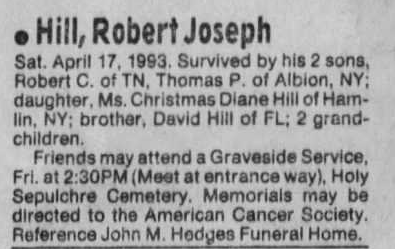
Karen Hill’s father Robert died at the age of sixty on April 17, 1993. Helene Hill remarried a man named Larry E. Southwick on September 13, 1992 in Collin, TX and passed away on April 21, 2024 in Walworth, NY.Karen’s sister Christmas Madama died on May 17, 2021; Chrissy worked at Eastman Kodak and as a bus driver for Brockport Central Schools, and loved riding her motorcycle, gardening, and going to concerts. She was happily married and enjoyed spending time with her husband and daughter. Karen’s brother Bob Hill is currently residing in Florida, and Thomas lives in Albion, NY.
In the years he spent in prison after his second round of murders Doctors ran Shawcross’ blood work, and discovered that he suffered from ‘pyroluria,’ which is a fairly unusual physiological abnormality. Also referred to as Malvaria, Kryptopyrroluria, and Hemepyrrole, pyroluria is a condition that causes ones body to make too many ‘pyrroles,’ which is a byproduct of the formation of hemoglobin that is believed to be caused by an abnormality during its synthesis. A normal level of pyrroles in the blood is between 0 – 10 μg/dL, where samples between 10 – 20 μg/dL are considered borderline, and those above 20 μg/dL are deemed elevated; Shawcross had a level of around 200. People that have the disorder typically have behavioral problems and are poor at controlling their anger, especially when provoked.
Works Cited: Aamodt, Mike. Retrieved August 27, 2014 from maamodt.asp.radford.edu/Psyc%20405/Shawcross%20Presentation.pdf Cummins, Dan. (January 31, 2022). ‘Timesuck with Dan Cummins: 281, Arthur Shawcross: The Genesee River Killer.’ Taken September 9, 2024 from podscripts.co/podcasts/timesuck-with-dan-cummins/281-arthur-shawcross-the-genesee-river-killer Cowiki, Jeff. Taken August 28, 2024 from jeffcowiki.miraheze.org/wiki/Arthur_Shawcross Olsen, Jack. (1993). ‘The Misbegotten Son.’ ’47,XYY syndrome.’ Taken August 26, 2024 from medlineplus.gov/genetics/condition/47xyy-syndrome/#synonyms
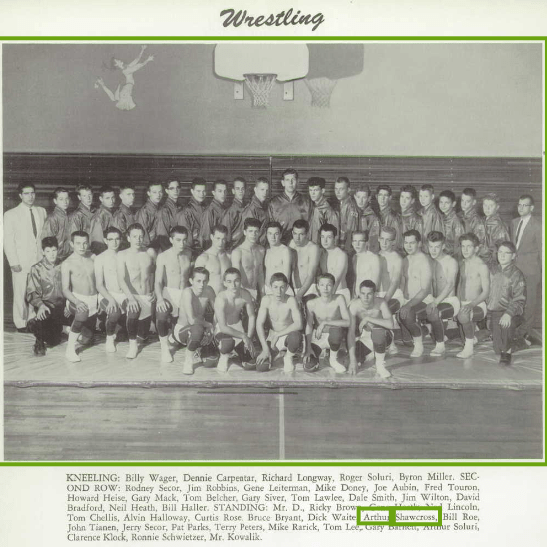
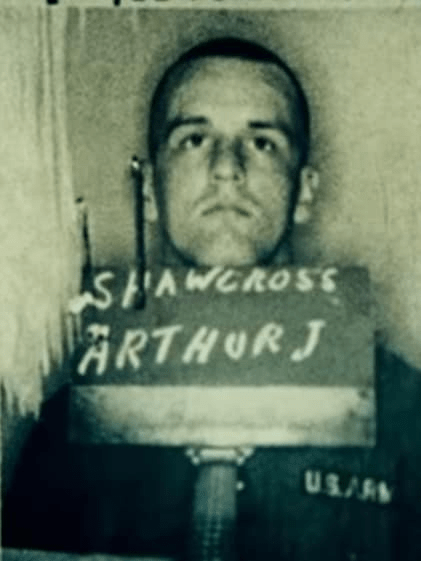
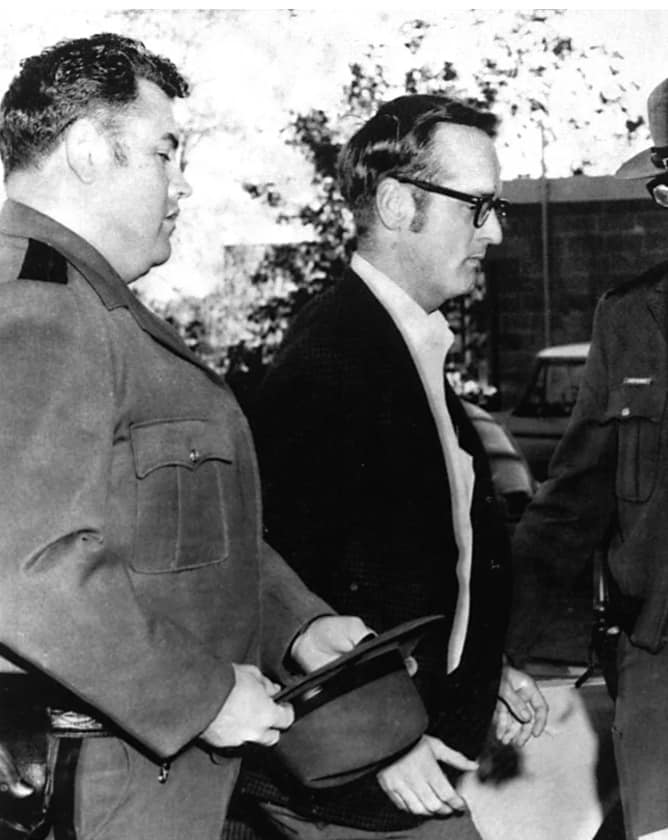
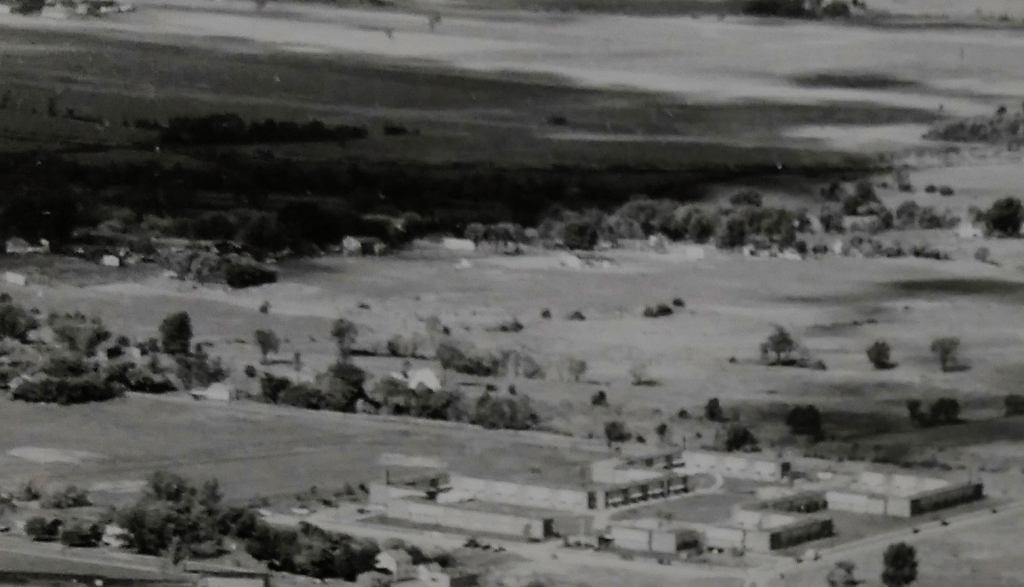
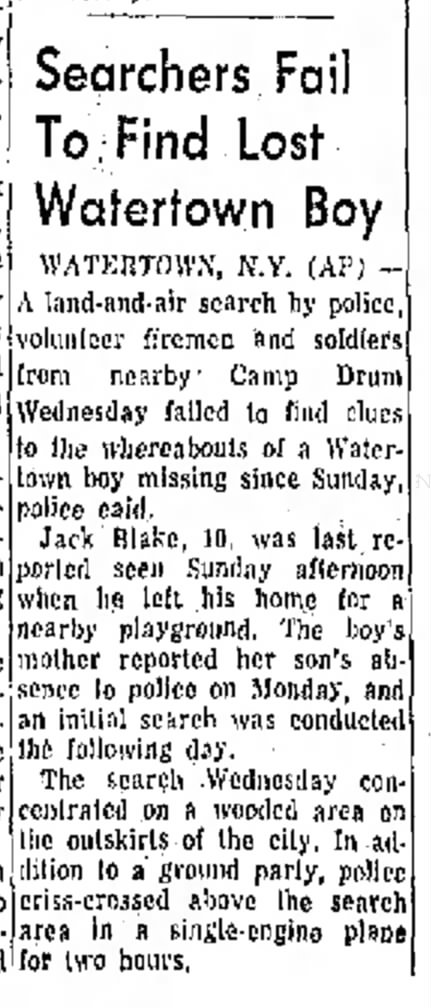
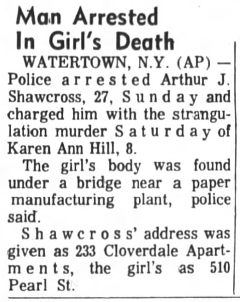
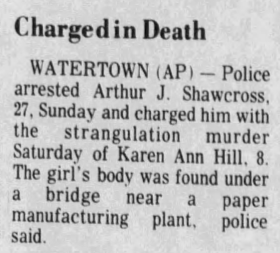
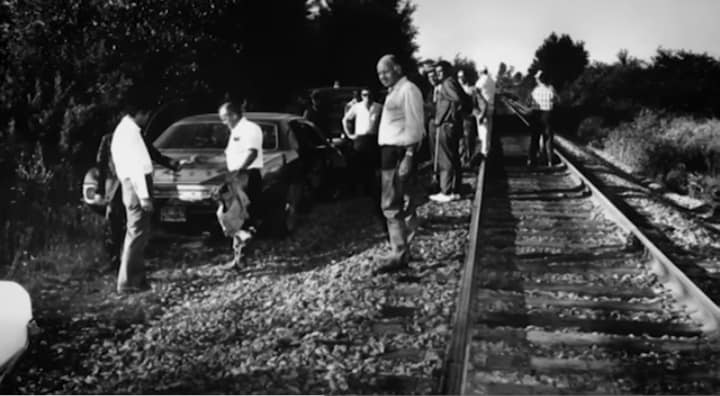
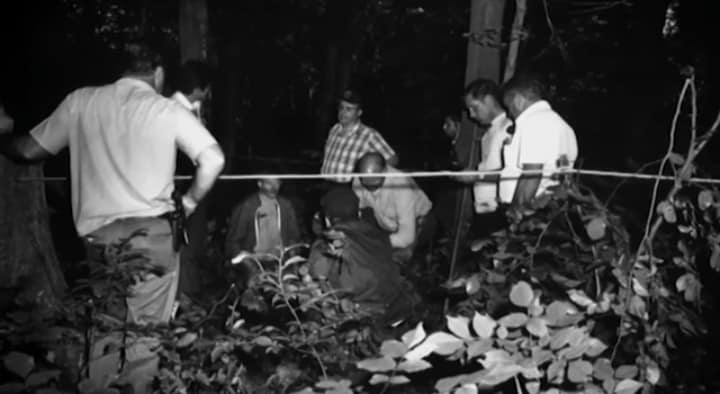
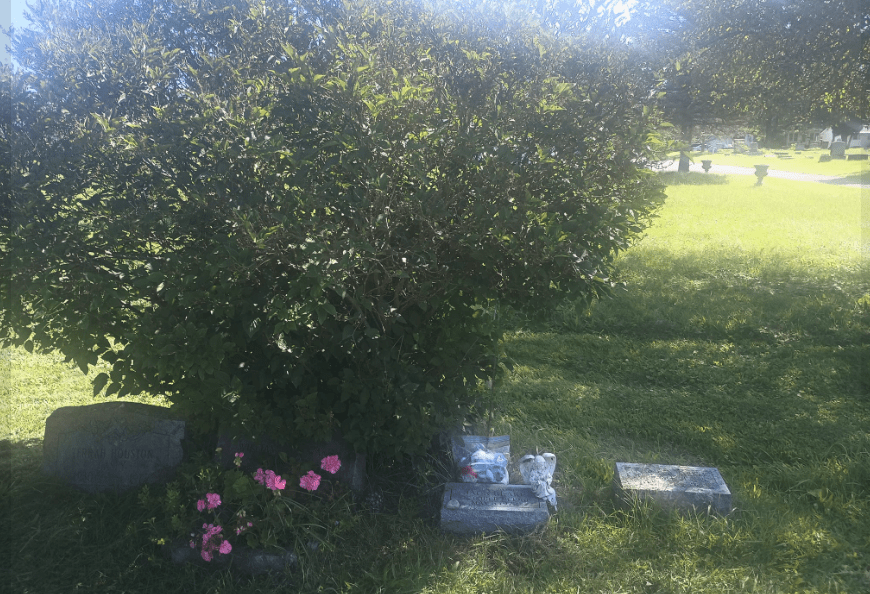
A picture of Arthur Shawcross from seventh grade, published in The Democrat and Chronicle on March 25, 1990.Shawcross in a group photo for the eight grade from the 1961 General Brown High School yearbook.Shawcross in a wrestling picture from the 1961 General Brown High School yearbook.Shawcross in a photo from his time in the US Army.One of the very few picture of a young Arthur Shawcross that I could find. One of Arthur Shawcross’ earlier mugshots. Photo courtesy of ‘All That’s Interesting’/YouTube.A Jefferson County Sheriff’s deputy escorting Arthur Shawcross to the local jail after he plead guilty to first degree manslaughter for the death of Karen Hill. Photo published in The Post-Standard on October 18, 1972.A young Shawcross doing something related to his first murder trial.Arthur Shawcross in 1972.A young Arthur Shawcross covering his face with his hands as he’s being led into court.A young Shawcross in court.Arthur Shawcross with his fourth wife, Rose. Photo courtesy of Supernaught.The Shawcross family tree, published in The Democrat and Chronicle on March 25, 1990.A map of where the Shawcross family lived near Watertown, published in The Democrat and Chronicle on March 25, 1990.The Shawcross family home located in Watertown.A side view of the Shawcross family home located in Watertown, NY.Some children playing in front of the Cloverdale apartments in 1951, courtesy of the Facebook page, ‘Nostalgic Watertown, NY.’An aerial picture of the Cloverdale Apartments in Watertown, courtesy of the Facebook page, ‘Nostalgic Watertown, NY.’A new residential complex stands where the Cloverdale apartments once did. Picture taken in August 2024. Knowlton Technologies in Watertown, which is one of the buildings that Shawcross set on fire in the early 1970’s.An article about the search for Jack Blake published by The Times Record on May 11, 1972.An article about the search for Jack Blake published by The Oneonta Star on May 11, 1972 An article about the search for Jack Blake published by The The Daily News on May 12, 1972.An article about the search for Jack Blake published by The Press and Sun-Bulletin on May 13, 1972.An article about the disappearance of Jack Blake published by The Post-Standard on June 7, 1972.An article about Shawcross being arrested for the murder of Karen Hill published by The Poughkeepsie Journal on September 4, 1972.An article about Shawcross being arrested for the murder of Karen Hill published by The Ithaca Journal on September 4, 1972.Part one of an article about the murder of Karen Hill published by The Democrat and Chronicle on September 4, 1972. Part two of an article about the murder of Karen Hill published by The Democrat and Chronicle on September 4, 1972. An article about Arthur Shawcross published by The Syracuse Herald-Journal on September 5, 1972.An article about the murder of Karen Hill, published by The Democrat and Chronicle on September 5, 1972.An article about a request for a psychiatric evaluation for Shawcross after his 1972 arrest published by The Democrat and Chronicle on September 6, 1972.An article about Shawcross’ first murders published by The Syracuse Herald-Journal on September 7, 1972.An article about the discovery of Jack Blake’s body published by The Daily News on September 8, 1972.An article about a hearing for Arthur Shawcross in relation to the murder of Karen Hill published by The Buffalo News on September 8, 1972.An article about the discovery of Jack Blake, published by The Democrat and Chronicle on September 8, 1972.An article about the death of Jack Blake being ruled a homicide published by The Troy Record on September 9, 1972An article about security in relation to the Arthur Shawcross case published by The Syracuse Herald-Journal on September 14, 1972.An article about Shawcross’ first murders, published by The Democrat and Chronicle on September 14, 1972.An article about Shawcross’ first murders going to a grand jury published by The Post-Standard on September 14, 1972.A newspaper articles about Jack Blakes funeral published in The Post-Standard on September 14, 1972.A newspaper article about Shawcross’ first murders going to a grand jury published byThe Post-Standard on September 22, 1972.An article about Shawcross’ first prison sentence, published by The Post-Standard on October 3, 1972.An article about Shawcross’ being indicted in connection to the murder of Karen Hill published by The Democrat and Chronicle on October 5, 1972.An article about Shawcross being charged for the murder of Karen Hill published by The Post-Star on October 5, 1972.An article about Shawcross being indicted by a grand jury for the manslaughter of Karen Hill published by The Post-Standard on October 5, 1972.An article about Shawcross denying any involvement in the murder of Karen Hill published by The Post-Standard on October 6, 1972.An article about Shawcross pleading guilty for the murder of Karen Hill published by The Syracuse Herald-Journal on October 17, 1972.An article about Shawcross’ first prison sentence published by The Post-Standard on October 18, 1972.An article about Shawcross’ prison sentence for the murder of Karen Hill published by The Democrat and Chronicle on October 18, 1972.An article about the handling of Jack Blakes death published by The Post-Standard on October 24, 1972.An article about the handling of Jack Blakes death published by The Post-Standard on October 25, 1972.An article about a probe into how the murder of Jack Blake was handed published by The Post-Examiner on October 26, 1972.An article about a probe into how the murder of Jack Blake was handed published by The Post-Standard on October 28, 1972.An article about a probe into how the murder of Jack Blake was handed published by The Syracuse Herald-Journal on October 31, 1972.rAn article about a probe into how the murder of Jack Blake was handed published by The Post-Standard on November 7, 1972.An article about Shawcross being transferred to a different prison after he was convicted of manslaughter published by The Post-Standard on November 21, 1972.An article about a probe into how the murder of Jack Blake was handed published by The Post-Standard on November 25, 1972.An article about a probe into how the murder of Jack Blake was handed published by The Post-Standard on December 16, 1972.Jack Owen Blake.Some members of the Blake family; Jack is on the bottom left. There were nine children total: Little Pete, Jack, Dawn, Rose, Pam, Deb, Robin, Susan, and Richie.A picture from the crime scene in relation to the murder of Jack Blake. A picture from the crime scene in relation to the murder of Jack Blake. A picture of the cemetary where Jack Blake is buried, taken in August 2024. A picture of Jack Blakes gravestone, taken in August 2024. I found this bag laying near Jacks headstone. I didn’t touch it but looking closely it appears to be some croched animals. I wonder if one of his siblings made them for him, or if they were maybe from his childhood.Mary Agnes (nee Lawton) Blake, right, with one her daughters, Pam. Like Helene Hill, Mrs. Blake hoped for a reconciliation with her deceased child: ‘I know Jack’s not dead, but if he is, well… I’ll join him when I die. I know I will. Whatever happened, I don’t believe Jack felt any pain. I think your spirit leaves your body in a gentle, loving way.’The vacant lot where the Blake family’s house once stood. Picture taken in August 2024.Karen Ann Hill.Karen Hills obituary published in The Democrat and Chronicle on September 5, 1972.The remains of Karen Hill found under a bridge in Rochester, NY.Karen HIlls grave stone. The bridge in Rochester where Shawcross left the body of eight year old Karen Hill.The bridge in Rochester where Shawcross left the body of eight year old Karen Hill.A b&w of the bridge in Rochester where Shawcross left the body of Karen Hill.New York State, Marriage Index, 1881-1967 (they got married in 1965).Part one of an article about Karen Hill published in The Democrat and Chronicle on January 9, 1990.Part two of an article about Karen Hill published in The Democrat and Chronicle on January 9, 1990.Part one of an article mentioning Karen Hill published in The Democrat and Chronicle on June 8, 1990.Part two of an article mentioning Karen Hill published in The Democrat and Chronicle on June 8, 1990.A picture of Sarah Chatterton from the 1961 Sandy Creek High School yearbook.Art and Sarah’s marriage announcement published in The Sandy Creek News on September 17, 1964.Linda Neary.A picture of Penny Ester Sherbino taken from the 1967 General Brown High School yearbook.Watertown Police Officer Augustine Capone, who found the remains of Karen Hill.A picture of Helene Hill (Borelli at that time) hugging prosecutor Charles Siragusa after Shawcross’s guilty verdict during his 1990 murder trial in Rochester. Photo courtesy of Brian Bubak/The Democrat and Chronicle, pubished on on December 14, 1990.An campaign ad for Charles Siragusa. Picture taken from The Democrat and Chronicle on September 21, 1991.A quote from Helene Hill during Shawcross’ second murder trial in Rochester, published in The Democrat and Chronicle on June 8, 1990.The marriage record filed with Jefferson Country from Fred Shawcross’ and Muriel Blake’s wedding from 1918; the two remained married for forty-nine years, until her death.A newspaper clipping announcing the death of Fred Shawcross published in The Post-Standard on July 1, 1971.Shawcross’ mother is mentioned at the bottom of this article, published in The Portsmouth Herald on February 17, 1942.Arthur Roy Shawcross’s WWII draft card.Arthur R. Shawcross is mentioned in a newspaper clipping about the Marine Corps published in The Syracuse Herald Journal on December 16, 1941.A picture of Artie’s sister Donna from the 1961 General Brown High School yearbook.A picture of Artie’s sister Jeanne from the 1966 General Brown High School yearbook.A picture of Artie’s brother James from the 1966 General Brown High School yearbook.The gravesite of Arthur Shawcross’ parents. Maggie Deming’s mother. Maggie Deming, Shawcross’s daughter. A photo of Arthur Shawcross, his daughter Maggie, and one of his grandchildren. Photo courtesy of Andrew Dodge.An article about Shawcross’ daughter Maggie published in The Daily News on February 21, 2012.The lot where the Blake family home once stood, located at 525 Water Street in Watertown, NY. It was right down the road from where Karen Hill was staying with her mother when she was killed four months after Jack.In November of 2013 a childhood friend of Jack’s anonymously donated a grave marker for him; it was installed at a dedication ceremony on November 26, 2013.Mr. Blake’s gravestone; he served in the Korea War and died in February 1984.Dawn Blake’s headstone.Mr. Hills obituary published on April 21, 1993.Christmas Hill’s obituary published in The Democrat and Chronicle on May 23, 2021.