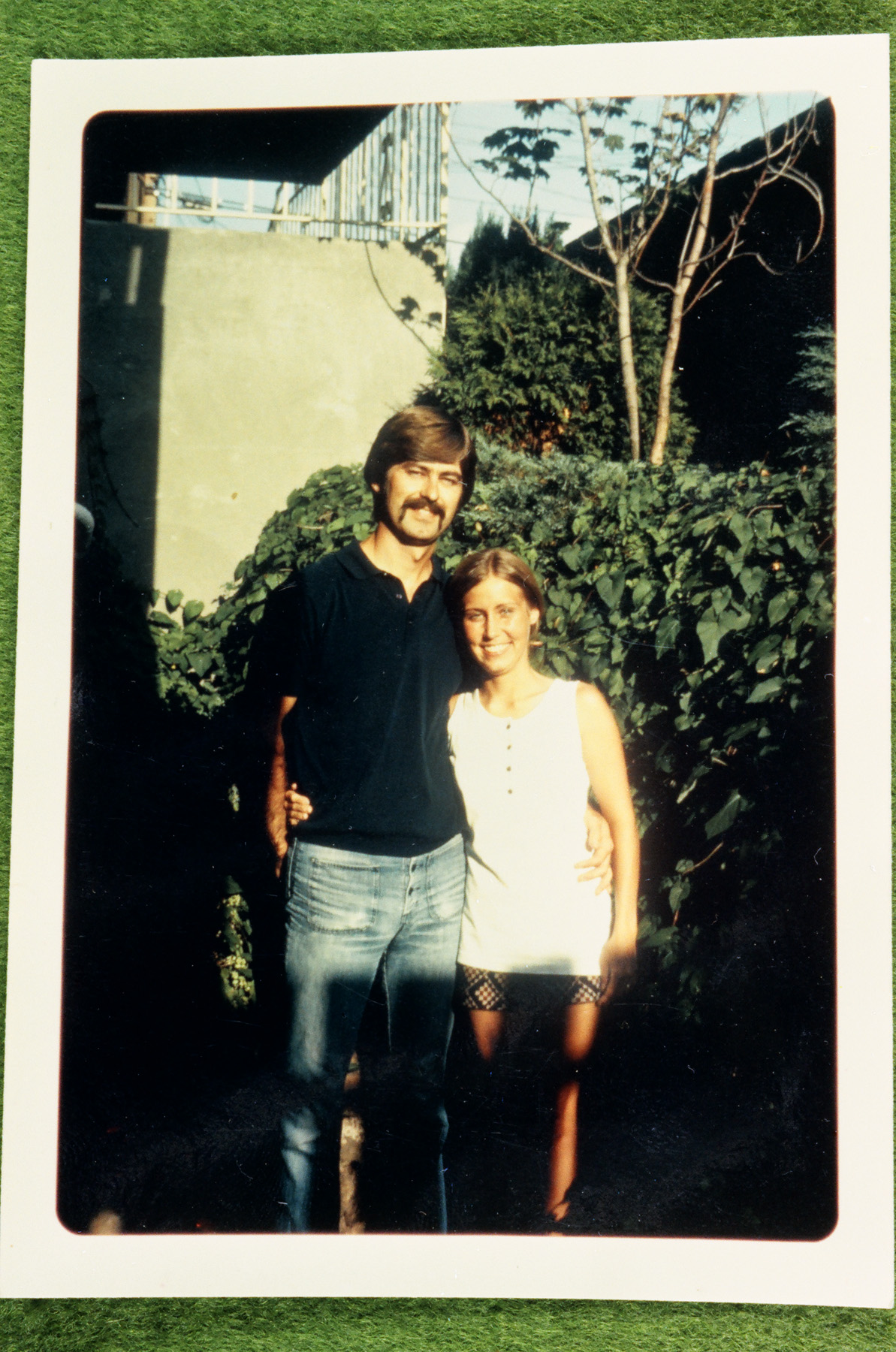
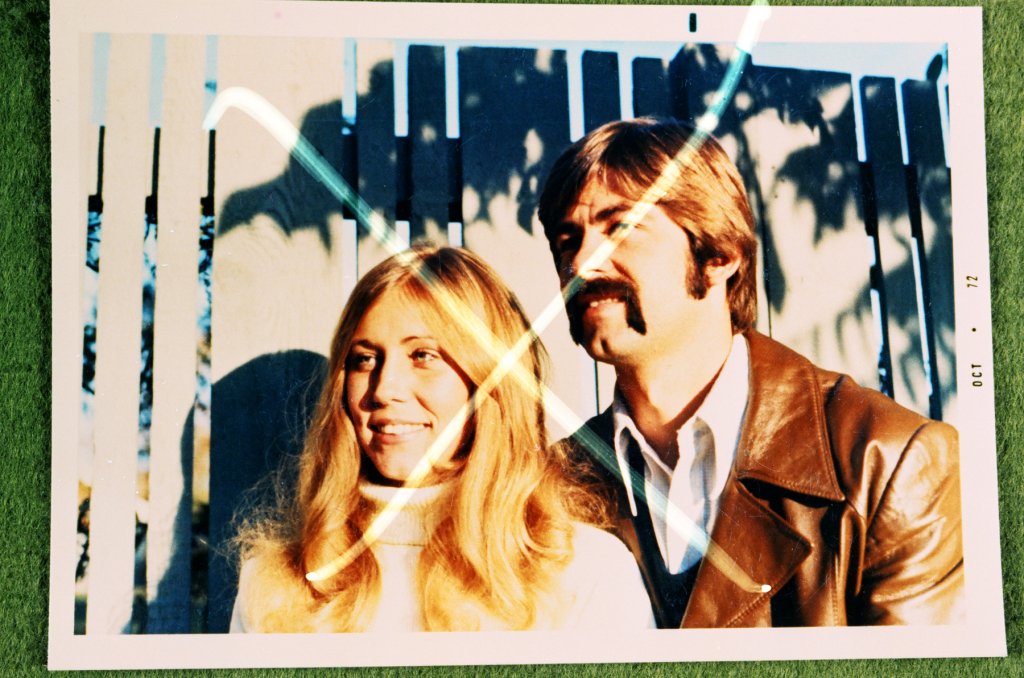
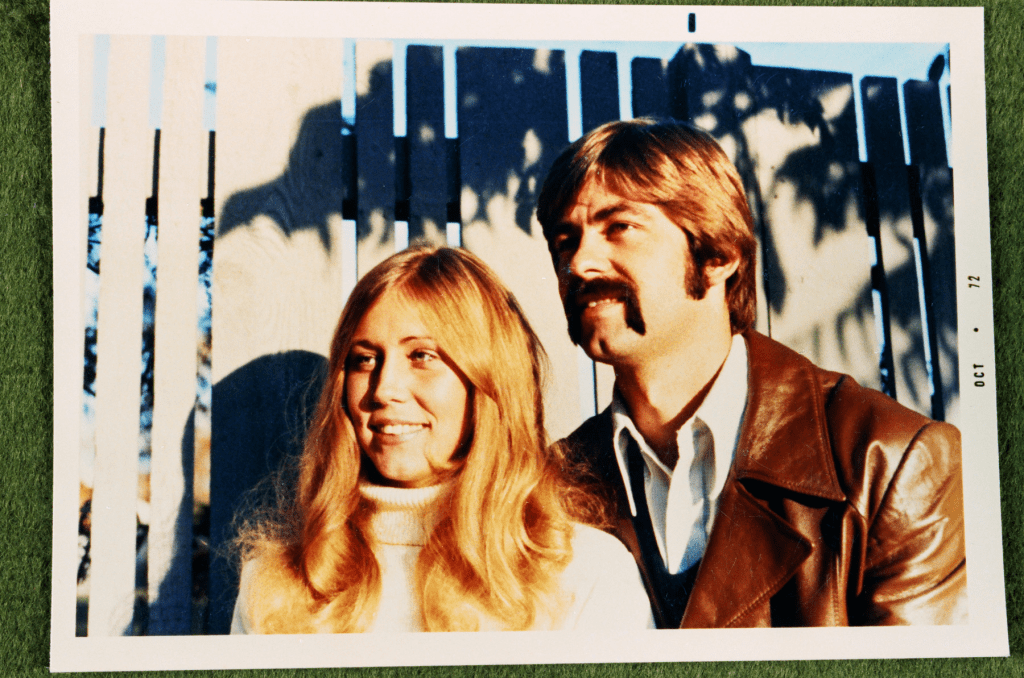
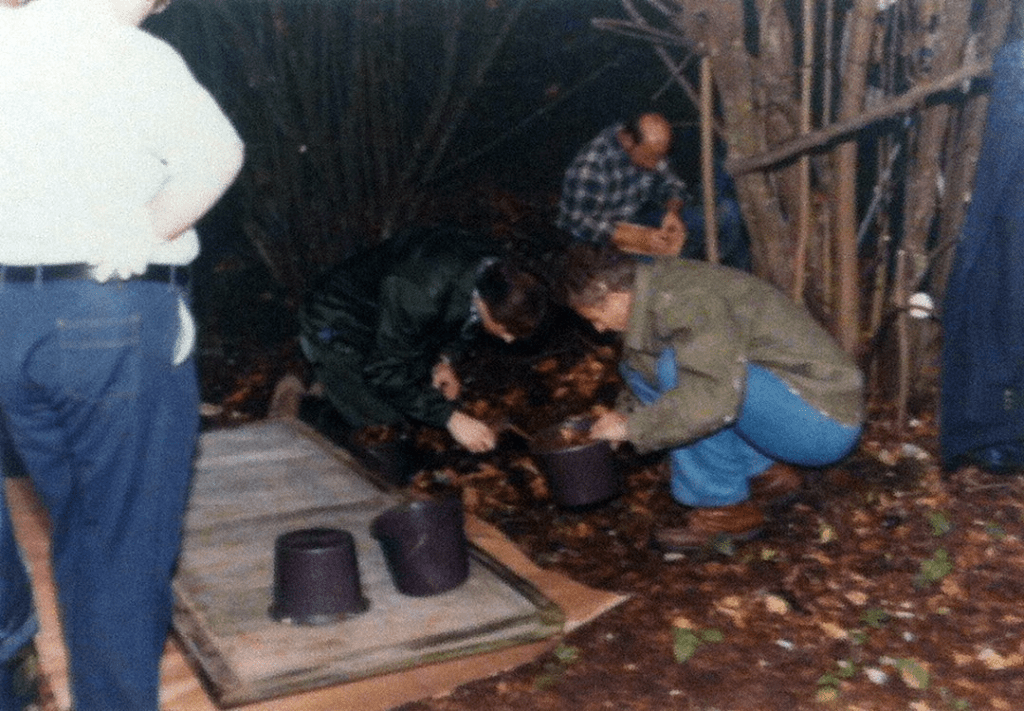
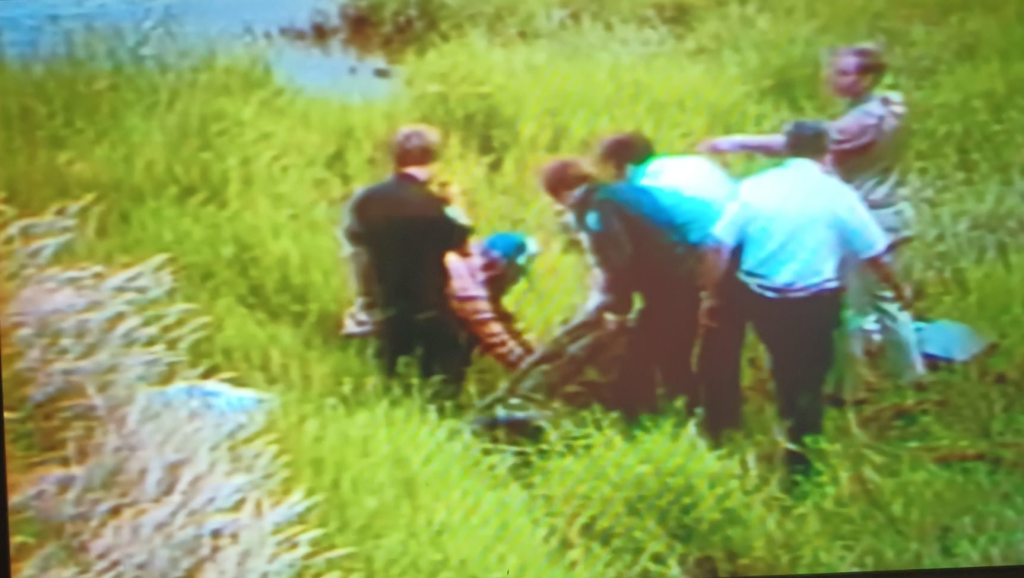
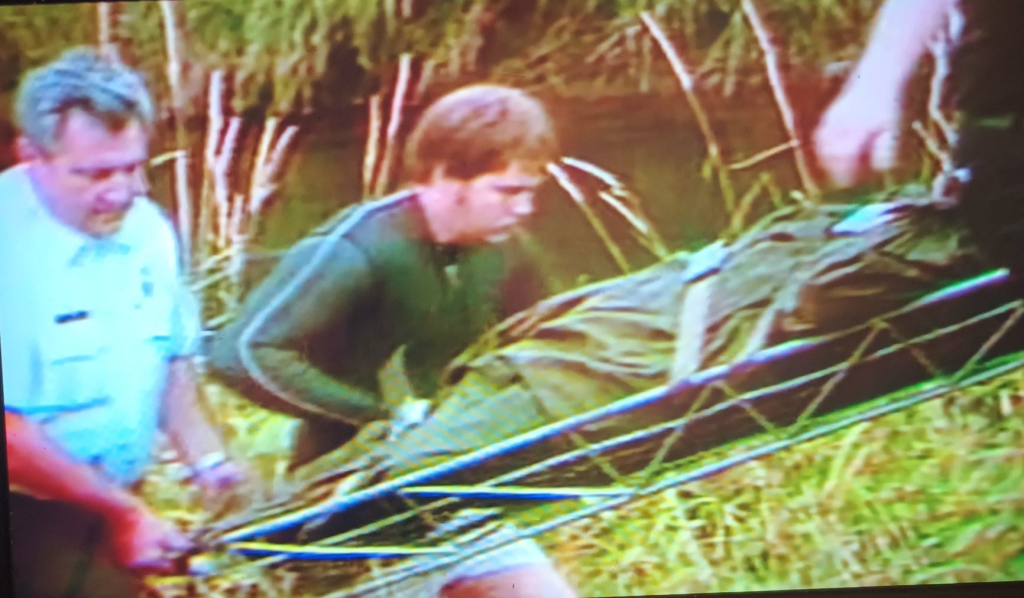
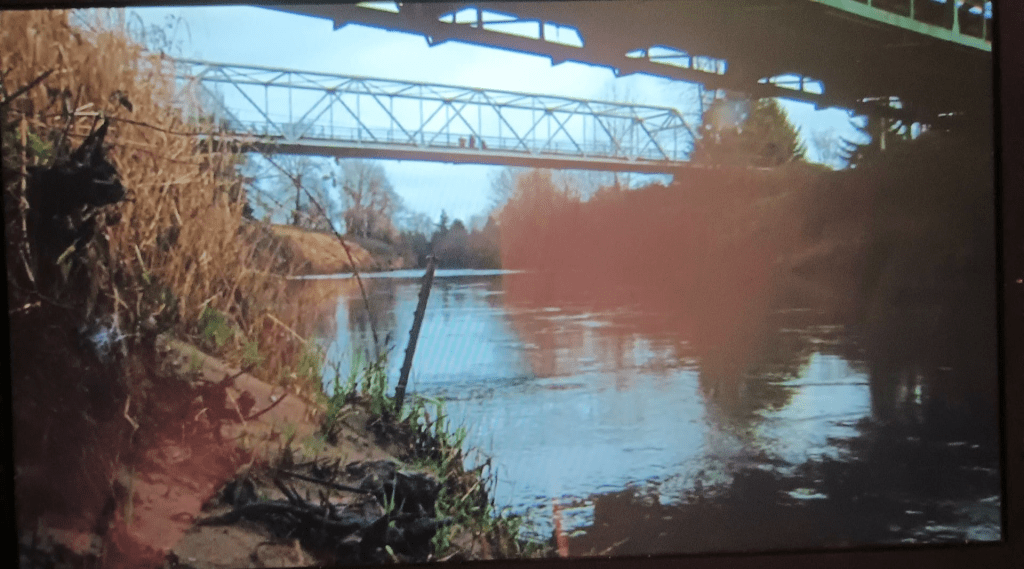
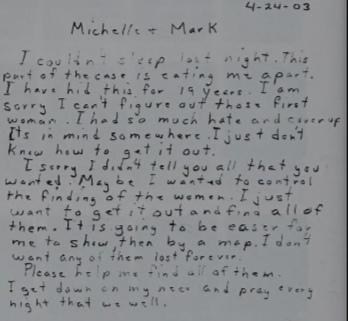
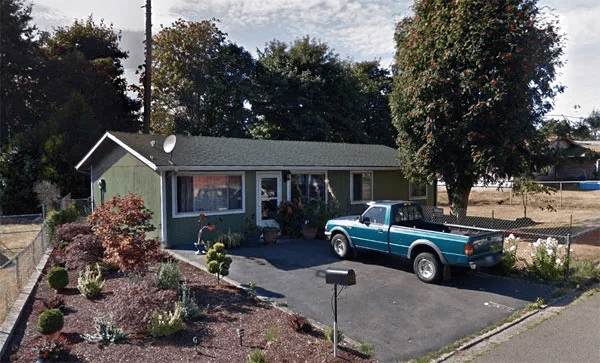
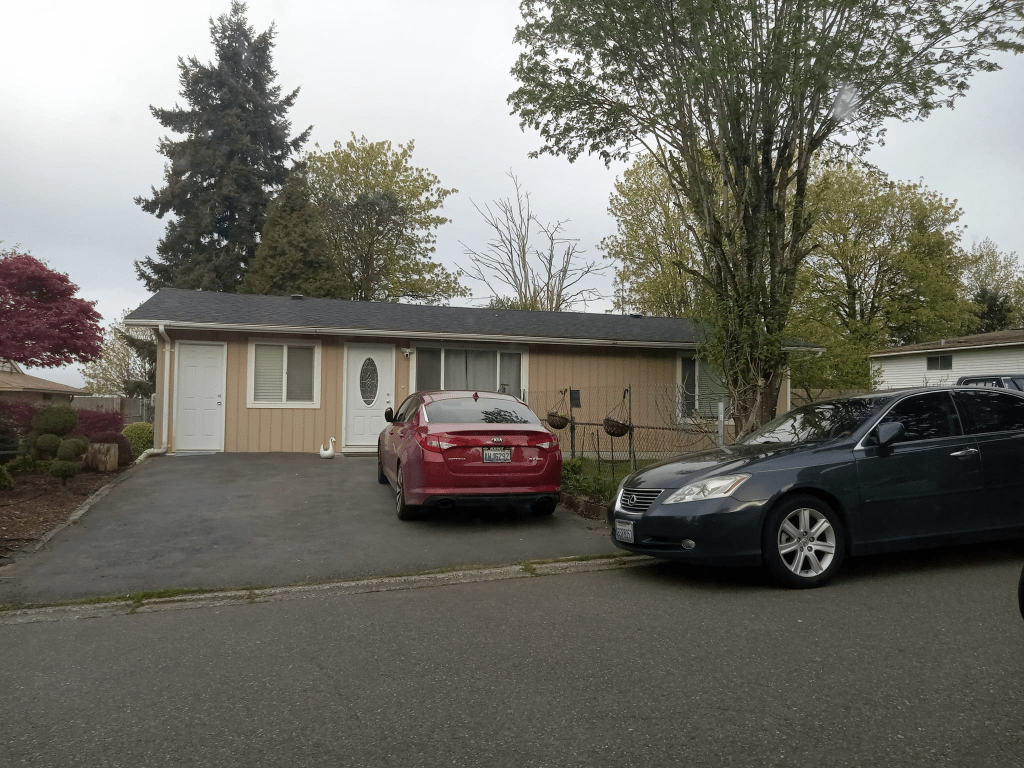
The third installment of Ted Bundy-related records released by the King County Sheriff’s Office’s Public Disclosure Unit. On July 14, 1974 twenty-three-year-old Janice Ann Ott disappeared from Lake Sammamish State Park, after having been last seen leaving the area with a young man that called himself ‘Ted.’ Her skeletal remains were found by two grouse hunters four miles away on September 7, 1974.’ Photos courtesy of the ‘Internet Archives’/Maria Serban.
Photo 1/18. Courtesy of Maria Serban.Photo 2/18. Courtesy of Maria Serban.Photo 3/18. Courtesy of Maria Serban.Photo 4/18. Courtesy of Maria Serban.Photo 5/18. Courtesy of Maria Serban.Photo 6/18. Courtesy of Maria Serban.Photo 7/18. Courtesy of Maria Serban.Photo 8/18. Courtesy of Maria Serban.Photo 9/18. Courtesy of Maria Serban.Photo 10/18. Courtesy of Maria Serban.Photo 11/18. Courtesy of Maria Serban.Photo 12/18. Courtesy of Maria Serban.Photo 13/18. Courtesy of Maria Serban.Photo 14/18. Courtesy of Maria Serban.Photo 15/18. Courtesy of Maria Serban.Photo 16/18. Courtesy of Maria Serban.Photo 17/18. Courtesy of Maria Serban.Photo 18/18. Courtesy of Maria Serban.
Like I usually do, I’m relying on the ‘Ted Bundy Multiagency Investigative Team Report 1992‘ for my information on this article but I’m also heavily depending on a piece my friend Erin Banks wrote to help fill in the gaps and fix the inaccuracies (I posted the link to her article below).
The first time I remember Bundy commenting on a vehicle was when he was talking about his stepfather’s car: he said that he often felt humiliated being seen in Johnnie’s run-down oldRambler. Fun fact: Ted apparently learned how to drive at 15 (before he legally had his license).
Despite consistently owning cars Ted was known to borrow vehicles from loved ones and acquaintances:
Around 1969 he borrowed his cousins car for an entire summer after Diane Edwards ended their romance (I don’t know any other details).
He not only had Mrs. Ferris’ (from his days at the Seattle Yacht Club) drive him places he also borrowed her car on occasion. Despite scouring the internet I couldn’t find what the make and model of her vehiclewas.
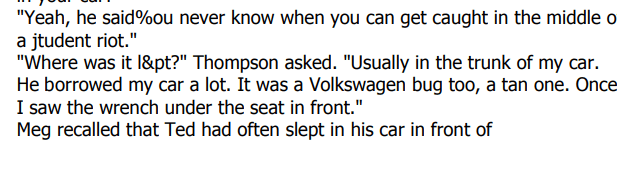
Bundy often “borrowed” his gf’s Liz Kloepfer’s 1973 light blue Beetle (on two occasions she thinks he took it without asking).
Ted was an accomplished car thief long before his jail breaks began in 1977: he had a lengthy juvenile record that LouiseBundy helped pay to have sealed when he turned eighteen (as to not potentially damper his “bright future”).
In September1965, Bundy bought his first car: a 1933 Plymouth Coupe withmoney he earned working as a forklift operator working at ‘City Lights Tacoma’ (he was also a student at the time at the University of Puget Sound).
In April 1966 he sold the Coupe to put money towards a pale blue 1958 VW Bug. It was smaller, more reliable and got better gas mileage than his clunky old car.
Bundy owned a white pickup truck at some point in time (I couldn’t find much information about that particular vehicle). I could have sworn I read somewhere that it was his brothers truck but when I looked into it I couldn’t find any information on it. According to the TB Multiagency Report he owned it until late 1975 (November/December).
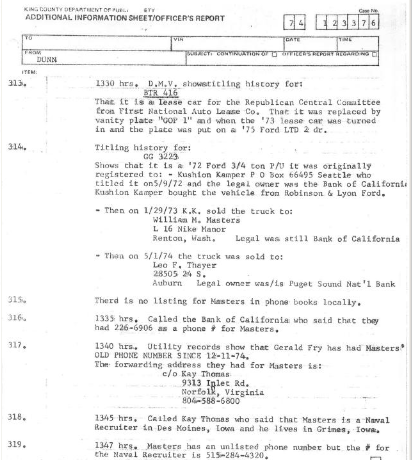
A blurb from the website ‘the outline’ mentions that Ted’s friend Marlin Vortman owned a VW Bug similar to the one he drove; I wonder if this is the ‘Washington TAG OYU-19 (7-18-1973) Owned by friend of Bundy, King County Washington, Make/Model Unknown’ mentioned in the TB Multiagency Report.
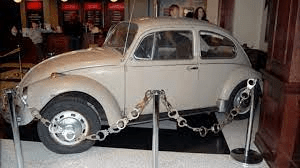
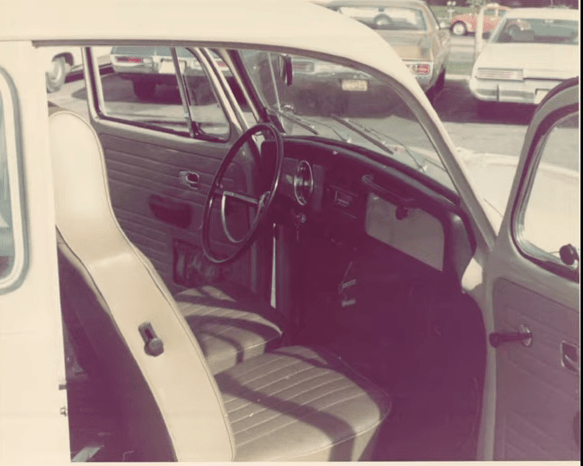
At some time in the spring of 1973 Ted purchased his infamous tan 1968 VW Bug from a woman named MarthaHelms. Countless murder victims (many of them unknown) across multiple states were inside of this car. On August 15, 1975, Bundy fled the scene in this vehicle when Utah Highway Patrol officer Bob Hayward tried to pull him over in Granger. When Officer Haywood eventually caught up to him and searched it he found: “a crowbar behind the driver’s seat, a box of large green plastic garbage bags, an ice pick, a flashlight, a pair of gloves, torn strips of sheeting, a knit ski mask, a pair of handcuffs, and a strange mask made from pantyhose.” Law enforcement also observed that the passengers seat had been removed and placed in the back seat. Bundy was arrested for evading an officer and was released the next day on bail (there was nothing found in the car at the time linking him to any additional crimes). When the Bug was impounded after Ted was arrested forensic experts found DNA in it that helped link him to the murders. In 1978, SLC Sheriff’s Deputy Lonnie Anderson bought the death wagon for $925 (US) and it sat for in storage for almost twenty years. Deputy Anderson put it up for sale for $25,000 in 1997 and it was purchased by a well-known Murderabilia collector named Arthur Nash. In 2010 Nash leased it to the ‘National Crime And Punishment Museum’ in Washington DC and when that museum closed in 2015 it was moved to the ‘East Alcatraz Crime Museum.’ At one point Nash said he had plans to have the vehicle swabbed for DNA however as of April 2023 this has not happened. Who even knows if there would be any usable genetic information remaining after so much time has passed? I think one of my favorite Bundy back-and-forth’s is whether or not he removed the VW’s door handle (I don’t think he did). Looking into the particular make and model of Beetle it doesn’t seem that it was as easy as just taking a few screws out of the mechanism and popping out the handle: you most likely needed to take the entire door panel off and it was a process. I know unconfirmed (and living) Bundy victims Sotria Kritsonis and Rhonda Stapley both claim that the man that lured them into his VW Bug removed the inside door handle, however no one else reported ever seeing this. Liz never commented that she was ever in his car without a passenger’s side handle on occasion, nor did any of his other friends.
Thanks to a lot of time spent digging I was finally able to come across a small snippet of information I’ve only seen in one source: On the afternoon of Saturday. February 10, 1978 Ted made his first attempt to depart Tallahassee, FL (he had killed KimLeach the day before): sometime between 4 and 6 PM he started looking inside parked cars for keys left in the ignition. Within minutes he found a 1975Toyota in the parking lot of an auto repair shop and was off. He took the car back to The Oak (where he watched TV with a friend for awhile, FrancesMessier) then went out for the night. That same time Tallahassee Police Officer Roy Dickey was sitting in an unmarked patrol car trying to find information related to the Chi Omega case. He saw Bundy walking near his vehicle and said Bundy noticed him immediately. and made a quick getaway. When he arrived back at The Oak he immediately started packing the stolen Toyota. dickey he had parked it about a block away. Around 1 AM Deputy Keith Dawes was doing patrol and came across Bundy “locking or unlocking a car door.” The officer said that where the individual didn’t do anything in particular to warrant his attention he was still drawn to him for an unknown reason. Deputy Dawes got out of his patrol car and approached Bundy, immediately asking him for ID. Ted quickly said he didn’t have any on him but mentioned he’d just come out to grab something quick from his car. When the officer asked “where do you live” he answered almost without thinking, “College Avenue.” As they continued to chat a bit the officer started looking around the vehicle with his flashlight and spotted a single license plate in the backseat. When questioned about it Bundy said that he had found it laying around somewhere and wasn’t sure exactly what to do with it. It was then that he got spooked and quickly (and successfully) sprinted away. The car and property inside of it was immediately impounded (Sullivan, The Bundy Murders).
On February 12, 1978 at around 11 AM Bundy attempted to steal a white 1972 Mazda but didn’t make it very far: there was a sort of “shimmy” in the front end and it wasn’t safe to operate. He quickly ditched it for something else.
Immediately after Ted ditched the Mazda he found a VW Bug but realized almost right away it was somebody’s baby (just by the way it was souped up and decorated). He quickly got rid of it (he has a conscience about a car but not for human life?).
Bundy eventually came across an orangish-red 1972 Volkswagen Beetle owned by RickGarzaniti, who had purchased the car in April 1974. The evening of February 12, 1978 Garzaniti went to a buddy’s house and left the keys in the car (he didn’t plan on staying long) but got distracted by a Burt Reynolds movie (haven’t we all?). He left it parked behind the friends residence in an alleyway. When Rick eventually went to leave he discovered his car had vanished; he immediately reported it as stolen. Three days later he got a call from law enforcement letting him know that his vehicle had been found however it was being held as evidence; it wasn’t released to him until almost two months later. When he finally got it back it was covered in dark black fingerprint powder, a sizable chunk was missing from the upholstery, and the backseat was gone. Additionally Garzaniti found some items in it that didn’t belong to him, including several license plates and some random bicycle parts.
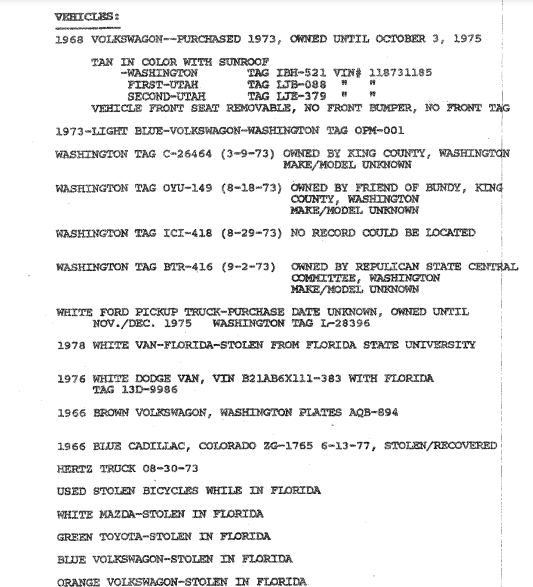
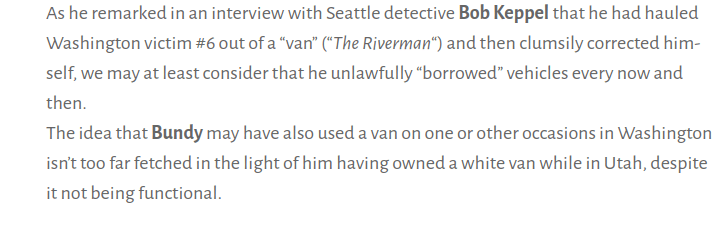
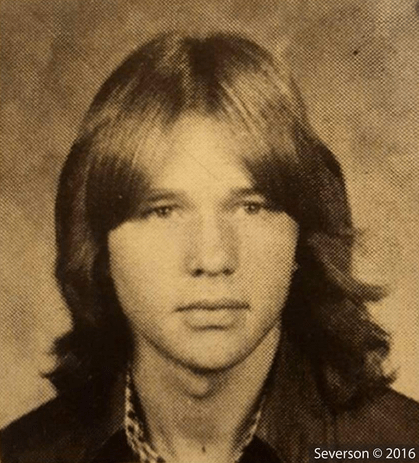
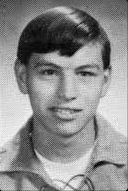
Works Cited.Ted’s vehicle history according to the ‘Ted Bundy Multiagency Investigative Team Report 1992.’An interesting factoid I stumbled upon in my research thanks to Erin Banks/CrimePiper.A blurb from the website ‘theoutline’ mentions the fact that Ted’s friend Marlon Vortman owned a VW Bug similar to the one he drove; I wonder if this is the ‘Washington TAG OYU-19 (7-18-1973) Owned by friend of Bundy, King County Washington, Make/Model Unknown” in the TB Multiagency Report.A notation about Marlin Vortman from the ‘Ted Bundy and File 1004 documents from Seattle PD’ document, courtesy of the ‘Internet Archives’.A 1965 “Rambler” style type car that Mr. Bundy drove (Ted hated it). Erin Banks commented that he “considered it to be a mediocre car for people of the lower middle class.”A 1933 Plymouth Coupe. What a neat old car…A car similar to Bundy’s first VW: a pale blue, 1958 Bug.Bundy’s infamous tan VW. On September 19, 1975 he tried to get rid of it by selling it to Bryan Severson, an 18 year old high school senior for $800 (US) after giving it a very deep cleaning (obviously to remove any lingering forensic evidence).The front of Bundys tan VW. The inside passengers side door of Ted’s VW Bug. As you can see, the door handle is in tact.An excerpt of Ann Rule’s “The Stranger Beside Me” mentioning how Liz (in this she’s called Meg) told police that Ted often borrowed her car. Bryan Severson, photo courtesy of Chris Mortensen/Erin Banks.
Arthur Nash, current owner of Bundy’s tan VW Bug.A ‘robin’s egg blue’ 1973 VW Beetle much like the one Liz drove. On two separate occasions she speculates Ted took her car without asking her permission. As Banks points out in her article, “there are certainly many who believe that Bundy began murdering prior to 1974 as well, and may have used Kloepfer’s car in the hope that should police become suspicious of him, they would not forensically examine her VW.”The ‘Ted Bundy Multiagency Investigative Team Report 1992’ mentioning Bundy stealing the white van from FSU on February 5, 1978.The white FSU van Bundy stole and abducted Kim Leach in.The inside of the van Bundy stole from FSU. A record of Ted stealing the green 1975 Toyota on February 10, 1978 according to the ‘Ted Bundy Multiagency Investigative Team Report 1992.’A white 1972 Mazda.A rare act of abstaining for Bundy, excerpt from Kevin Sullivan’s ‘The Bundy Murders: A Comprehensive History Paperback.”In 1978, Rick Garzaniti sold his reddish-orange VW Bundy stole earlier that same year for $1,300 (US) to a 16 year old girl (it was her first car, her Dad bought it for her).The back of Rick Garzaniti’s VW.According to the ‘Ted Bundy Multiagency Investigative Team Report 1992,’ Ted stole Garzaniti’s VW on February 12, 1978.A 1966 brown VW Bug.A 1966 blue Cadillac.Some misc. car related information related to Bundy from the ‘Ted Bundy and File 1004 documents from Seattle PD’ document, courtesy of the ‘Internet Archives’.
Edit, November 2023: One thing I routinely try to do is go through my resources and update my articles when I find more information. When I was in Florida this past May I came across a 59 page document from the Trempealeau County Sheriff’s Department in Wisconsin regarding the case of Sandra Jean Weaver. At first, I thought about putting the new information in a simple addendum, but there’s so much that I’m just going to rewrite the entire piece. The report is broken down into four parts: the first is a write up (almost like a report) that Detective Daryl L. McBride had with Weaver’s friend, Joan Elkins at the LaCrosse Police station on January 11, 1975. The second is a verbatim interview between Glade Gamble and the Toole County Sheriff’s Department, Detective Jerry Thompson from the Salt Lake County Sheriff’s department, and Officer Milo Vig from the Mesa Co. Sheriff’s Department on January 22. The third is an interview between Ken Jones and the same members of LE as the Gamble interview that took place on January 22, 1975, and the last portion is an interview with the same officers and Phillip Quintana on January 21, 1975.
Sandra ‘Sandy’ Jean Weaver was born on August 5, 1955 to Bruno and Marlene of Arcadia, Wisconsin. She had two brothers (Randy and Billy) and two sisters (Nancy and Julie); the Weavers also had a son named Joseph who sadly passed away two days after he was born in 1961. Sandy had blue eyes, was 5’7” and weighed 120 pounds; she wore her brown hair long and parted down the middle. She attended Arcadia High School, and during her time there was on the drill team, participated in the Future Homemakers of America, Girls Athletic Association, worked PT as a librarian and was the junior editor of the newspaper. After graduating in 1973, she studied commercial art at Western Wisconsin Technical Institute in La Crosse, WI.
Sandra left home in the summer of 1974and moved to Salt Lake City, hitchhiking the entire way there with her two friends, Joan Elkins and Jeffrey L. Skarboszewski. According to an investigator for the Mesa County Sheriff’s office, after arriving in Utah the friends went to Toole, where they stayed in a canyon for a few days. It was there they met a guy named Ken Jones, who invited them to come stay in his trailer near Toole. Jeff got a job part time working with Jones father and both girls found employment full time for the Manpower program. Looking into it, Manpower appears to be sort of on the job training program based out of SLC. For their first week the girls took inventory of motion picture products, and the second week they were sent to the Wycoff warehouse (which was a trucking company); Weaver had been on the job for a little over a week when she was murdered. The position was roughly forty miles away from Jones’ trailer, and the friends hitchhiked back and forth everyday. In a conversation with her mother in June 1974, Sandra said she was planning on going home for her sister Nancy’s wedding on July 27th, but didn’t specify an exact date she planned on being back. It’s known that Weaver was a frequent, heavy drug user and had a tendency to ‘sleep around’ (oh good Lord, weren’t we all young once?). The guy she was with the night before her disappearance (a young man named Glade Gamble) said that they engaged in intercourse the night before she vanished (but more on him later)…
On Friday, June 28 Sandra and Joan bought some groceries in SLC then hitchhiked back to Jones’ trailer, arriving around 7 PM. At around 11:00 that evening a friend from their new job named Phillip Quintana (aka Phillip Martinez) showed up with the intention of spending the weekend with them (he arrived with a random friend). In addition, Jones had a friend that was staying with him that was between 18 to 20 years old and was an ‘athletic freak.’ That night, Sandra slept with Ken and Joan slept with Phill (his friend spent the night in a chair). The following day, Weaver left the residence and went to a friend named Jeanine’s trailer in Toole. There, Weaver met Glade Gamble and the two took a drive through the canyon in Jeanine’s blue VW Beetle.
At roughly 7 PM on June 29th, Weaver returned to Jones’ trailer and picked up Joan, Phillip, and his friend. From there, the group got dinner then went to a party at Jeanine’s trailer. At the gathering, Weaver introduced Elkins to a guy named Bruce Bolinder, who she had met that afternoon while driving around with Gamble. According to Weaver, Bolinder was supplying Gamble with THC. It is speculated Sandy snorted some THC and used some phenobarbital (and possibly Nembutal) at some point in the evening. There were roughly 25 people at the gathering and most of them were imbibing in some form of drug use. At some point early in the evening Phillip fell asleep on the floor of the trailer, and after a while Joan woke him up to go sleep outside in Gambles VW van. Around midnight she woke Phillip up for a second time to let him know they could catch a ride back to Jones’ trailer with Bolinder. Weaver stayed behind at Jeanine’s trailer. At some point in the conversation with law enforcement Elkins mentioned that when she left her friends trailer with Phillip, there were four vehicles in the driveway: Bruce Bolinders gold Cadillac, Glades red and white VW Bus, Jeanine’s VW Bug, and a fourth vehicle (she wasn’t sure of the make and model or its owner).
At some point during the day, Weaver purchased $15 worth of phenobarbital from Bolinder. Joan said Sandy used some the night of the party as well as on June 30 and July 1, and during this time she stayed at Jeanine’s trailer. At some point on Sunday, June 30 Elkins called Jeanine’s trailer and talked to Gamble, asking to speak to Sandy. He told her she was sleeping but that he would take them to work the next morning. On Monday, July 1, 1974 Sandra returned to Ken’s trailer to change her clothes and wake up Joan for work. Elkins told her she wasn’t feeling well and wasn’t going in that day. Weaver asked to borrow some cash, and she gave her $5 from her purse (which at some point during the day Elkins noticed was missing). Joan said Sandy was wearing blue corduroy shorts and a halter top, and this was the last time she saw her friend. The next day on July 2, she received a call from the secretary at Manpower asking why either of them hadn’t come into work. Joan told her that she was sick, to which the secretary replied, ‘yes I know, Sandy told me.’ She went on to tell her that Weaver had worked until 11:30 in the morning the day before then left and never returned.
The body of Sandra Weaver was discovered the next day on July 2, 1974 around 4:00 PM by tourists hiking in the area near DeBeque, CO by the Colorado River about sixteen to eighteen miles east of Grand Junction. Her naked body was beaten and strangled, found off a service road in the Palisades Canyon (some sources say it was DeBeque Canyon) in Colorado; the only item found on her body was ‘a tiny wooden cross on a gold chain around her neck’ (which she was most likely wearing when she was last seen). I know I’m jumping the gun a bit here but something odd is jumping out at me: two other Utah victims (Laura Ann Aime and Melissa Smith) were also both found the same way: naked only wearing a ‘small necklace.’ Additionally, both girls were strangled in the same fashion as Weaver. Sheriff Haywood has ‘no doubt’ that the killer of Aime and Smith killed Sandra as well. Additionally, Salt Lake City DetectiveJerry Thompson said that the facts in the Weaver case ‘are very similar’ to the ones surrounding those of the Smith and Aime murders. She had been sexually assaulted and died by suffocation due to strangulation; her fingernails were also freshly manicured shortly before her death. Because there were no footprints or drag marks found anywhere near Weaver’s remains it’s speculated she was killed somewhere else then dumped off at the top of the canyon, and she just sort of rolled down it. Unfortunately her body wasn’t identified until January 1975: according to an article titled ‘Services Pending for Murder Victim, Weaver was identified through a nationwide check of persons reported missing. Law enforcement also found a very particular type of contact lens on the victim, and using optometric tests forensic experts were able to determine that it belonged to Weaver; dental records were also used.
In a conversation with detectives on January 11, 1975, Elkins said that Sandra was ‘pretty doped up’ when she returned to Jones’ trailer on the morning of July 1, 1974. She suspects this may have been the reason that she showed up to work without shoes on. Later in the day on July 2nd, Bolinder came to Jones’ home and visited a bit with Joan. He came to see her a few more times in the next few days and eventually invited her to move in with him, which she did a little over two weeks later in the latter part of July 1974 (bringing Glade Gamble with her). Joan finally reported Weaver as missing to the SLC police around the 5th or 6th of July; they advised her to call the Toole County Sheriff’s as well. She also shared the news with Sandra’s mother in Wisconsin. She told LE that she asked Bolinder to help her locate Weaver, but he just pushed her request off. Elkins stayed with him for about three weeks then moved in with another friend named Danny Quinn. She eventually left SLC and returned home to LaCosse on August 15, 1974. She brought all of Sandra’s belongings back with her, returning them to her parents.
Seventeen year old Dick Pehrson was a former employee of the Wycoff warehouse and a friend of the girls. He told Joan that Phillip Quintana got dropped off with Sandra the morning she disappeared but he didn’t know who was driving. He also told her that Quintana told a secretary at Manpower that Weaver had been talking to a truck driver the morning she disappeared. Additionally, the same secretary told Marlene Weaver that Quintana told her that her daughter had been seen on a bus headed for Idaho.
Bruno Weaver traveled from Arcadia to Salt Lake and Toole in November 1974 and got in touch with a number of his daughter’s friends/acquaintances; he also spoke with Quintana on the phone around the same time. During that conversation, Phillip denied going to Jeanine’s party the night of July 29 but said that his friend ‘Martinez’ was there. Mr. Weaver also spoke with Bruce Bolinder, who shared with him that a friend named Steve Symonds gave Sandra and Phillip a ride to Salt Lake City the morning of July 1st. The police report stated that ‘all of the men seemed uncooperative and hesitant to talk to Mr. Weaver.’ Jones did tell Mr. Weaver that he had a pair of Sandra’s shoes at his trailer despite both Joan and Jeff telling him she only brought two pairs with her (which were already accounted for). Skarboszeski told LE that to the best of his memory he never saw Sandra go to work without shoes on and didn’t think she would ever go to her POE barefoot.
Elkins admitted to using some of the phenobarbital Weaver bought on June 30 and July 1, but couldn’t explain how the drugs got back to Jones residence because her friend hadn’t been back to his trailer at that point (she briefly came back the morning of July 1 to borrow money and change her clothes before leaving right away for work). Strangely enough, the blue corduroy shorts that Joan claims she last saw Sandy wearing were found amongst her belongings that were returned to the Weavers.
In the second portion of the document from the Trempealeau County Sheriff’s Department, Glade Gamble sat down with members of law enforcement (specifically, the Toole County Sheriff’s Department, Jerry Thompson, and Milo Vig). The interview began at 1:35 in the afternoon on January 22, 1975 and lasted for 45 minutes. In the beginning, Gamble is shown a picture of Weaver and was asked if it resembled the individual he spent time with in June of the previous year. He said yes it did and that she was ‘a good looking girl.’ I mean, most of the ‘interview’ is traditional back and forth between suspect and police, however one particularly interesting portion jumped out at me: investigators questioned, ‘within hours of leaving you, she was murdered brutally, and I am not kidding you when I say brutally. I probably shouldn’t do this but there is a little difference isn’t there? As you can see, I don’t think many human lives deserve that kind of treatment. So if you can help me for God’s sake, give me some information. I don’t care if any drugs were involved, cause we’re not here or have no interest at all in petty crimes or drugs at this time, I am interested in that.’ In response to that, Glade said that he told them everything he knew the first time they spoke except for dates, which he didn’t elaborate on so I don’t know if he meant he forgot them or was purposely withholding information. He said the only phone number Sandra probably had was Ken Jones’ at his trailer.
Some of the key points I took away from this interview are as follows: Mr. Weaver met with Gamble at his house sometime in November 1974. He said the majority of the time he saw the two friends they were wearing shorts, although he thinks he remembers Sandy wearing pants the last time he saw her (since she was on her way to work). He made it clear to the detectives that he didn’t remember if she was wearing shoes or not the last time he saw her and had to be told by a friend that she showed up at work barefoot later that morning. Gamble was able to tell LE that he remembered she normally wore a pair of slip-on clogs but she left them behind at Jeannine’s (if she’s anything like me she probably figured she’d be back there soon enough and it was no big deal). He also speculated that Elkins may have picked the clogs up with the rest of Sandra’s belongings before she returned home to WI. He left Jeanine’s trailer at around 6 AM and speculated that Weaver was stopping back at Jones’ residence before going into work and that she would just pick up another pair of shoes there. He did share that he remembers someone saying that Joan’s purse got stolen, and wondered if it happened at the party the Saturday before Sandy disappeared. He also said that he took off the Tuesday after she disappeared but couldn’t remember the reason why.
When LE asked Gamble how Elkins felt about Bruce Bolinder he replied that she may have been a bit afraid of him in the sense that she worried he might kick her out and send her home. Apparently, he had a bit of a reputation as a ‘ladies man’ and speculated that Joan was probably aware of this and was nervous that he might get sick of her and move on; he didn’t remember the two ever arguing or fighting in any way. Also on the topic of Bruce being a ladies man, Gamble said that he thought that girls in general seemed to like him but didn’t get close with him. He also said that he thought Sandra and Joan met him on June 29th (which was the night of the party) and that he asked Sandy out a time or two but nothing ever came of it. When asked if Bollinder had a violent temper, Gamble replied that he ‘heard of him fighting but had never been there.’ He also allegedly had deep contacts in the local drug world that neither girl was aware of. When Glade was questioned on whether or not he knew of anyone that would have a reason to kill Weaver, he said he had no idea why anyone would want to ‘brutally murder a girl like this.’ and that ‘nobody really argued with her that he knew about.’ He speculated that Joan probably left them to go back to Kenny’s trailer with Phillip because she most likely ‘just got tired of Bruce.’
The detective repeated the question: why would anyone want to brutally murder a girl like Sandra, asking: ‘you certainly couldn’t say it was a sexual act because she certainly would have given in (gross).’ Gamble told them that the only thing about Weaver that upset him was that she was kind of ‘slow mentally’ and wasn’t very quick to react to things, but that he would never act on his frustrations and didn’t know how anyone could do that. When questioned about when he became aware that Sandy may have either been abducted or murdered, he said that he quickly grew suspicions after no one heard from her and that both him and Joan almost immediately wondered if she was dead after she stopped coming around: ‘I didn’t know why anyone would kill her or how or anything else but I figured she would have gotten ahold of somebody sooner or later.’ He also told detectives that he was aware that Joan had some minor drug charges but nothing major and he had some minor charges as well as a drunk driving arrest. He told them that he had no contact with Elkins in any capacity after Sandy disappeared.
Per Gamble, Sandy had taken two downers he gave her on Friday night, and that he wasn’t sure if Joan ever reported her friend as missing as he never witnessed her make a call to Toole LE. He also said he wasn’t sure if he was there when she talked to Sandy’s parents on the phone but that he was there when she made some calls to Wisconsin regarding her friend. The last time he claimed to have sex with Weaver was sometime after midnight on Sunday night/early Monday morning, but wasn’t sure what the exact time was. When asked if they engaged in anal intercourse Gamble didn’t respond to the question. To the best of his knowledge he said that he wasn’t sure if Sandy had slept with anyone else in that Friday/Saturday/Sunday time frame other than him, and that he ‘wasn’t with her all the time,’ but did clarify that he spent two nights with her. The last time he saw her she was getting into a car with Steve Simons and Scott Williams to go to SLC for work around 6 AM on Monday, July 1. He said that he learned of Weaver’s death after seeing it on the news but didn’t know when she died. By the time of the interview in early 1975 Gamble sold his VW bus and purchased a 1972 Grand Prix. He shared that even though he didn’t know her very well he knew that Joan wasn’t overly fond of cops and wasn’t sure if she would hold anything back for that reason. The interview ended with Gamble agreeing to take a voluntary polygraph examination.
The third interview took place with the same members of law enforcement and Kenneth H. Jones on January 22, 1975. He told the detectives that he met all three friends when they were ‘up hitchhiking up in Settlement Canyon’ around June 10/11, 1974 and that somehow turned into them coming and staying with him. He further shared that Glade Gamble met the girls at his trailer and that he didn’t know Bruce Bolinder very well. In the beginning of the conversation LE told him that the reason they are speaking to him for a second time is because it was determined that Sandra had been murdered shortly after leaving his trailer. There’s a lot of back and forth between the officers and the suspect, with LE saying they ‘needed to get some answers if we can. I realize this was six months ago and it is hard to remember, and I don’t expect you to remember everything. We have had a chance to go over this and some other things that have come up that need to be answered, and I was hoping that you could help me or hide me to the right person. Now correct me if I’m wrong. I understand that Sandy left the trailer on Monday morning, July 1st to go to work with a Mexican kid by the name of Phillip Quintana, who had stayed at the trailer that night with Joan. Is that correct?’ To this, Jones simply answered, ‘ah huh.’ He said that he didn’t attend the party at Jeanine’s trailer the Saturday before Sandy disappeared and wasn’t home when Joan and Phillip got back early Sunday morning. He also shared that he wasn’t sure who was left behind at the trailer when Sandy and Quintana departed for Salt Lake around 7/7:30 AM the Monday morning she disappeared. He did say that when he came home from work around 4 PM Elkins was still there and ‘it wasn’t right away but she couldn’t figure out why she didn’t come back. You know she figured maybe she would come back later, and she never did. She was worried about her.’ … ‘Well right at first, you now she thought she might have had a pretty good excuse and then after she didn’t show up for a day or so, well then she was getting worried.’ When detectives inquired, ‘I don’t know how much attention you paid, but this is a really critical point in the line of clothing, I understand both these girls had very little clothing when they lived here, is that correct?’ .. ‘ As far as you seen, give me an idea, five or six changes, one of two? Can you give me an idea? Did they wear shorts much of the time, a lot?’ He replied, ‘yeah, they wore shorts,’ but did specify that Elkins had a home made dress made out of Levi’s jean material.
Like with the other interviews, the investigators were very focused on the girl’s footwear and asked Jones if Weaver had a lot of shoes, to which he replied she had a pair of sandals and some clogs and that Elkins took them with her when she went home to Colorado. About a week after Sandy disappeared Elkins left Ken’s trailer and moved in with a guy named Danny Quinn; she didn’t give an explanation as to why she left but it was on her own accord and he didn’t ask her to leave. Jones told LE that he was aware that the girls mainly hitch hiked to get around and frequently caught rides with both friends and strangers. He also shared that at no point after her friend disappeared did Elkins ever mention that she was going to go look for her, but that she ‘contacted Sandra’s parents and they decided to put it in the paper, her picture, and I think she turned it in, she said she turned it in.’ Jones said that when Joan finally got around to notifying the Toole County Sheriff’s department about Weaver’s disappearance they told her to also get in touch with SLC LE as well. When asked if he thought Sandy and Elkins were ‘close’ he replied, ‘yes, they were real close.’ He also commented that she seemed to be almost smitten with Bruce Bolinder and talked about him a lot. He said the weekend before Sandra disappeared she wasn’t at his trailer at all but that she most likely came back early Monday morning to get Joan and get ready to go to work. When asked if he knew of anyone that had ‘heard if Sandy came back into town that Monday morning after she left and went back to work that morning,’ Jones simply said ‘no.’
According to Ken, Sandy’s father came to see him about a month and a half before the interview (so November/December 1974). When asked what he thought happened to Weaver he replied that if she made it to work that day then it must have been someone from her POE that she ‘decided to go with.’ Ken said he felt it ‘must have been somebody she didn’t know or she just met that day or somebody she just went with. Maybe they told her they would give her a ride home or take her out somewhere else overnight or something.’ He also shared that Joan had no idea what happened to her friend and she thought that maybe she left with somebody from work or ‘something like that.’ When Ken was confronted with ‘well like I said, we realize the drug traffic. We are not here to bother anyone, that we are not trying to make a case. Did she know anything about any major drug deals and somebody thought she knew too much that you know of?;’ he again replied with a simple, ‘no.’ When the detectives inquired, ‘you wouldn’t have to kill her to rape her, correct?,’ Jones answered ‘uh huh’ and that she would probably just go along with it.
Ken said that when he returned home from work at 4:30 around that Monday, Joan was there (she was sick and didn’t go into work) and the last time he saw Sandy was on Friday the night before she left for the party. When the investigators commented that they understood he told Mr. Weaver that he had a pair of his daughter’s shoes, he clarified ‘after she had left and it was either that night or the next day she didn’t show up Joan said something about ‘that is the only pair of shoes or something.’ And she left them and she ain’t got no shoes or something. She couldn’t figure out why she would leave without shoes.’ There was a lot of back and forth about the missing footwear, with the investigators trying to make Jones admit that he had them (which he vehemently denied). When they asked if Weaver’s last paycheck ever got mailed to his trailer or if Joan ever mentioned what happened to it he said that Elkins had it but he wasn’t certain if she cashed it or not (but he strongly suspects that she did).Jeff Skarboszewski left SLC about a week before Sandra disappeared and went to Phoenix. About the trios mystery friend, Jones said that Jeff seemed to treat both girls real good and always wanted to do what was best for them. At the end of the interview he agreed to a voluntary polygraph examination.
In between the third and fourth parts is a photocopy of Bruce Bolinder’s drivers license.
The fourth part of the document is an interview between investigators and Phillip Quintana that took place on January 25, 1975 (this is where things get interesting). The conversation starts out strong right from the get go, with LE asking if he remembers telling a friend named Dirk that Sandra had gone to Idaho or someplace out of state, and where he got that information from. To this, Phillip said it was one of two hitchhiking incidents that took place in the second half of 1974 in which Weaver’s name came up: ‘this guy that picked her up hitchhiking, but I can’t remember his name. He said he saw her and she was supposed to be living with this guy that she was living with in Memory Grove she was supposed to leave with him to Idaho.’ … ‘I was just asking if he knew Joan and Sandy from Toole and he said yeah, that Sandy was supposed to be living in Memory Grove with some guy.’ Quintana said the man was driving a newer model white Ford and was around 21/22 years of age, between 6’2″/6’3” tall, and had shaggy brown hair. One of the detectives told him it was a man named Danny Brumfield that picked him up that day and the event took place sometime aroundAugust/September of 1974.
The second hitchhiking incident took place around Halloween 1974 and involved a 23/24 year old man driving an older model light red/dark orange GMC pickup truck. When asked by this mysterious stranger if he wanted to go to a party that both Joan and Sandy would be at, Phillip told him that he had just been to one and had no interest in attending another: ‘well, I was hitchhiking. He picked me up then asked if I wanted to go to a party, he said do you smoke dope, I said yeah, and he said do you want to go to a party, and I said no, and he lit up a joint, and he asked me if I wanted to go to a party out in Toole and said no, and he said, and then I said who is going to be out there, do you know a lot of people out there and he said, ‘I know a chick named Joan and one named Sandy and this dude named Glade, that Glade was supposed to be having it,’ and I told him no I was, and he just dropped me off.’ … ‘They said Sandy and Joan, I don’t know if they were the same chicks but he said Sandy and Joan. Might be two different chicks, I don’t know.’ When questioned about the day Sandra disappeared Phillip said that he ‘thought she was going back to work, she was going to work, and anyway they didn’t want me back over there and so I just went down to my moms’ and that he never saw either girl again after July 1st (I deduced that he was briefly employed with Manpower but was terminated). He acknowledged to LE that he was aware that Elkins was trying to get in contact with him around the 13th of July but wasn’t successful in her attempts. When asked if he knew that Weaver was missing at this point in time Phillip said no and that he didn’t know she was gone until the month before (which would have been December 1974).
Quintana said that he and Joan went back to Jones’ trailer at around 3 or 4 in the morning and crashed immediately; they woke up around 6 PM the following evening. He said Monday morning Sandy called Joan at Ken’s trailer and asked if she was going to go to work, and he told her that Joan wasn’t going to but he was getting a ride to SLC and could bring her along. He reported that Manpower attempted to get in touch with him about Sandra’s disappearance around the 1st or 2nd week of December but that he never talked to Bruno Weaver. In response to that, investigators said that ‘he claims he did, how about him calling you on the phone Phillip. I am going to try to refresh your memory. And you told him: ‘he asked you if you were at a party with his daughter in Toole, and you said no not me but my friend Martinez.’ Do you recall that?’ … ‘see, I talked to Mr. Weaver, Sandra’s Dad and he said he called you on the phone, I have the date written down and I will be getting it; him and his attorney was out here and he called you on the phone and he asked you, he talked to Phillip Quintana, he asked about the party, you said, or this Quintana said that he knew Sandra, that he didn’t attend the party in Toole but a friend Martinez did. You don’t recall him saying that to you?’ In response to the third degree, Phillip said, ‘I don’t even remember talking to him, I am pretty sure I didn’t.’
This is when he talked about his two last names, clarifying that his legal name is Quintana and it’s the one he always went by: ‘I guess you came out to my moms, she said that you were looking for me, she said that you asked for Phillip Martinez, or a Phillip Quintana, and she asked me if I was using another name and I told her no. Because I found well, when my Dad got married when he first married my mother I was on probation and I started using his last name and it took them six months to find me, and when they did they told me if I used it again they would stick me in state school because I was using an illegal name.’ When asked what theillegal name he used was he responded with ‘Gurule,’ but that he has used his real name ever since and that he now has a clean record. Later in the interview he repeated himself that he never spoke with Bruno Weaver and when asked if anyone at the party went by the last name of Martinez he said he wasn’t sure because people mostly only went by their first names.
When the investigators asked how the girls got to work everyday Phillip said that after the first day they all drove in together, and ‘when Manpower had a job for them they have them a call out in Toole and they hitchhiked to the job. The very first day they started Manpower called them about 8:00 I guess, they got there around 10:00 10:30.’ When asked if he recalled what time Sandra arrived back at the trailer the Monday morning she disappeared Phillip responded that ‘she had to be to work at 8:00 AM so it was around 7:00 AM;’ he also shared that after she left for the day he wasn’t sure who was left behind in the trailer. Also in the vehicle were two other guys, Steve Simons and Scott Williams; they dropped Weaver off near the Wyckoff building at 3rd West but that she wanted to stop at the store before her shift started to buy some cigarettes. The boys dropped Phillip off at his moms, which wasn’t far from Weaver’s POE. He commented that on their drive Williams and Simons mostly talked to each other and didn’t really seem interested in chatting with him or Sandy. When LE asked him if ‘Sandy gave him any indication when she got off that she was going to come back at noon, or that she didn’t feel well, or that she was going to go back and see Joan or anything like that,’ Quintana responded that ‘she said that cause she didn’t feel well that morning she was kind of burned she said that if she still felt that way at lunch she was just going to go back to Toole’ but didn’t elaborate on how she was going to get there. The detectives shared with him that they knew she took some speed that morning before she left for work and that he took some as well (she gave him five and a friend named Danny another five). To that Phillip responded that he thought she took downers and had a baggie of about 50 of them with her (apparently she purchased 100 of them at the beginning of the weekend but was going through them pretty quickly).
After Phillip mentioned that Joan wasn’t feeling well and had menstrual cramps the detectives asked if she started her period the day before. He replied that he thought ‘she started it that day because the night she was starting to get them bad’ and that she might have gotten her monthly on Sunday night (but he ‘didn’t check’). In response to this, the officers replied: ‘oh Jesus, you know you got me almost to think I am going to send you out to the nut farm and have you checked out there. Was she pretty well smashed out, Joan, that Monday morning or was it mainly from her cramps.’ (wow). To this, he responded it was ‘mainly from her cramps.’ When asked if Joan had a thing for Glade Gamble, Quintana replied that he wasn’t sure but it wouldn’t have surprised him because she ‘acted kind of funny towards him.’ When asked how she may have felt about Bruce Bolinder he said that it seemed as if she wanted nothing to do with him and when they all got in the car together she made a comment about Gamble sitting next to him, and seemed irritated when he refused. When the investigators asked him how the girls may have felt about Kenny Jones he said that ‘they said they liked him, he was a pretty nice guy, but they were just staying because of their relationship, just a place to stay I guess. I guess they were giving him something to say there, some money or something to stay with him but they never did say. He said that he showed up at the party but ‘came a little later.’ When the investigators asked Phillip if Elkins was afraid of any of the guys that they hung around with he answered ‘no, not that I know of, she didn’t tell me’ and when they asked the same question about Weaver he said ‘well they got along real good with everybody out there as far as I know.’
When asked if any of the guys Weaver hung out with ‘would kill that girl,’ Phillip’s initial answer was ‘I can’t really say… I don’t know them, but I know what kind of people they are.’ However he quickly changed his tune and said that the owner of the gold Cadillac (Bruce Bolinder) was the only person he could think of that ‘looked like he could do something like that.’ He elaborated that he didn’t talk much and was kind of mean; Bolinder was also where Gamble was getting his dope from. There’s something interesting that jumps out at me at the end of page 56: the detectives ask Phillip if he remembers telling anyone that ‘he saw Sandy talking to a Wycoff truck driver at about 11:30 on the 1st of July,’ to which there is no verbal (or written) answer. Quintana later stated that the last time he saw her was when she was dropped off at her POE and doesn’t remember ever seeing her talk to a truck driver. He also shared that he didn’t hear from Joan at all after she left for CO and that he knew she lived in WI but wasn’t exactly sure where. Just like with the other gentleman, LE asked if he was willing to undergo a polygraph examination, to which he responded sure and that he had nothing to hide.
As far as the confirmed victims go, Bundy killed 18 year-old Georgeann Hawkins on June 11, 1974 after abducting her from the University District in Seattle (just eleven days earlier he murdered Brenda Ball on June first). Almost two weeks after Weaver was abducted and killed on July 14, 1974 he abducted both Janice Ott and Denise Naslund from Lake Sammamish State Park in Issaquah. When it comes to the unconfirmed victims, Brenda Joy Baker disappeared on May 27, 1974 from Puyallup and on August 2, 1974 Carol Valenzuela was last seen hitchhiking near Vancouver, WA. At the time of Weavers murder Ted was living at the Rogers Rooming house on 12th Ave in Seattle and was employed with the Department of Emergency Services in Olympia (he was there from May 3, 1974 to August 28, 1974). Obviously the drive to SLC wasn’t exactly impossible, as he eventually moved there for law school, but it definitely wasn’t just a quick jaunt down the street. The route Ted would have driven to SLC from Seattle then to DeBeque, Colorado where her remains were found was roughly 1,150 miles ONE WAY (he obviously would have had to take the same trip BACK to Seattle). This is a lot of driving. He was in between schooling at the time, as he graduated from the University of Washington in 1972 and didn’t move to Salt Lake City for law school (part deux) until September 2, 1974. Did Bundy kill Weaver on a trip to Utah to do something for his upcoming education (maybe he had to fill out something at the bursar’s office or check out an apartment)? According to the ‘TB Multiagency Investigative Team Report 1992,’ Ted went on leave (without pay) from the Department of Emergency Services in Seattle, WA on July 1, 1974 (the same day of Weavers abduction); additionally, gas receipts put him in Seattle the same day. Lets not also forget he was in a relationship at the time with Liz Kloepfer, which was just one more thing taking up his time.
This is a rare instance where the more I researched the more information I found, which I know sounds fairly obvious but I have run into countless dead ends writing about some of these girls. For example, I can’t even find Deborah Lee Tomlinson on Ancestry, so I tried to think outside the box and joined a few Facebook groups related to her hometown of Creswell OR, in hopes that maybe I would find a relative or an old friend of hers that could help fill in the gaps surrounding her background… but again, I got nothing. Right before I was about to re-publish this I found even more information about Weaver on cavdef.org… nothing huge or ground breaking, just a few small details. In a comment on the website ExecutedToday.com, an individual going by the name of Philip Conrad commented that he ‘knew Sandra Weaver, the Colorado detectives talked to me and my x wife in lacrosse wi because we thought the guy that left with her might have had something with her death. I do believe Ted Bundy killed her.’ Additionally I found Glade Gambles obituary (which I included below).
In an article written by a Salt Lake journalist after Bundy was executed, Pete Haywood said that authorities placed Bundy in Utah as early as 1970 when he was only 23, which ‘certainly widens the window of time we are looking at in terms of unsolved cases.’ There’s conflicting reports that say the serial killer mentioned Weavers during his death row confessions: some sources say he did, others say he didn’t. Former Mesa County Sheriff said two different television stations ran stories claiming that Bundy took responsibility for Weavers death, and the Salt Lake Tribune ran a story saying the same.
Weaver in her freshman year photo from the 1970 Arcadia High School yearbook. Weaver in a group picture for the drill team from the 1970 Arcadia High School yearbook. She’s the first girl in the first row. Sandra Weaver in a group picture for the Future Homemakers of America from the 1970 Arcadia High School yearbook. Sandra Jean Weaver’s sophomore year picture from the 1971 Arcadia High School yearbook.Sandra Jean Weaver in a group shot for the Future Homemakers of America from the 1971 Arcadia High School yearbook.Weaver in a group picture from the Drill Team from the 1971 Arcadia High School yearbook.Weaver in a group picture from the 1972 Arcadia High School yearbook. Weaver in a group picture for the newspaper from the 1972 Arcadia High School yearbook.Weaver in a group picture for the Girls Athletic Association from the 1972 Arcadia High School yearbook.Sandra Jean Weaver’s senior picture from the 1973 Arcadia High School yearbook.I pulled this from ‘Classmates.com;’ it looks like Weaver signed above her picture in the 1973 Arcadia High School yearbook.Weaver in a group picture for the school play from the 1973 Arcadia High School yearbook.Another shot of Weaver in a group picture for the school play from the 1973 Arcadia High School yearbook. It looks like she is in the middle row, second from the right.Weaver’s senior year activities from the from the 1973 Arcadia High School yearbook.Sandra Jean Weaver.Sandra Jean Weaver.A caricature of Sandra Weaver drawn by John Krupa (from the ‘Freedom to Draw Unsolved Mysteries’ YouTube page).An announcement that Bruno Weaver was going to serve in the Korean War, published by The Winona Daily News on February 29, 1952.Bruno and Marlene Weaver’s marriage announcement, published in The Winona Daily News on July 14, 1954.An article about Bruno and Marlene Weaver’s son, who was born in March 1961 but passed away shortly after; death notice published in The Winona Daily News on March 29, 1961.Nancy Weaver from the 1971 Arcadia High School yearbook. Cheryl Weaver’s freshman year picture from the 1972 Arcadia High School yearbook.Randall Weaver’s picture from the 1973 Arcadia High School yearbook.Bryan Weaver’s picture from the 1978 Arcadia High School yearbook.Marlene Weavers picture fro the 1974 Arcadia High School yearbook. It looks like she worked there as a cook.A more recent picture of Marlene Weaver, courtesy of Facebook.A more recent picture of Nancy Weaver, courtesy of Facebook.Bruno Weaver’s death notice from by The Winona Daily News published on June 17, 1996.Some notes about Sandra Weaver from a document titled ‘Bundy History’ on the Internet Archives (it’s a document from the Pitkin County Sheriff’s Department that was released on November 24, 1975).Page two of a document pertaining to Weavers murder from the SLC PD.Page three of a document pertaining to Weavers murder from the SLC PD.An article about Sandra Jean Weaver, published by the Wisconsin Rapids Daily Tribune on January 11, 1975. An article about Sandra Jean Weaver, published by The La Crosse Tribune on January 11, 1975. An article titled ‘Services Pending for Murder Victim’ about Sandra Jean Weaver, published by the Eau Claire Leader Telegram on January 11, 1975. An article about Sandra Jean Weaver, published by The Sheboygan Press on January 11, 1975. An article about Sandra Jean Weaver, published by The Daily Sentinel on January 11, 1975. An article about Sandra Jean Weaver, published by the Stevens Point Daily Journal on January 11, 1975. An article about Sandra Jean Weaver, published by The Ironwood Globe on January 11, 1975.An article about Sandra Jean Weaver, published by The Janesville Gazette on January 11, 1975. An article about Sandra Jean Weaver, published by the Racine Journal Times on January 11, 1975.An article titled ‘Murder Victim may be Arcadia Girl’ about Sandra Jean Weaver, published by the Winona Daily News on January 12, 1975. An article about Sandra Jean Weaver, published by The Daily Sentinel on January 13, 1975.An article about Sandra Jean Weaver, published by the Winona Daily News on January 13, 1975. An article about Sandra Jean Weaver, published by the Madison Capital Times on January 13, 1975.An article about Sandra Jean Weaver, published by the Winona Daily News on January 14, 1975.An article titled ‘Services Pending for Murder Victim’ about Sandra Weaver, published by the Winona Daily News on January 16, 1975. Part one of an article titled ‘Services Pending for Murder Victim’ about Sandra Jean Weaver, published by the Winona Daily News on January 16, 1975. An article about Sandra Jean Weaver, published by the Winona Daily News on January 17, 1975. An article about Sandra Jean Weaver, published by The Daily Sentinel News on January 17, 1975. An article about Sandra Jean Weaver, published by The Desert News on January 20, 1975.An article about Sandra Jean Weaver, published by The Daily Sentinel on January 21, 1975.An article about Sandra Jean Weaver, published by The Logan Herald Journal on January 21, 1975. An article about the murder of Sandra Jean Weaver published in The Daily Herald on January 21, 1975.An article about Sandra Jean Weaver, published by The Salt Lake Tribune on January 21, 1975.An article about Sandra Jean Weaver, published by The Ogden Standard-Examiner on January 21, 1975.An article about Sandra Jean Weaver, published by the La Crosse Tribune on July 2, 1975.An article about Sandra Jean Weaver, published by The Daily Sentinel on October 3, 1975.An article about Sandra Jean Weaver, published by The Daily Sentinel on October 13, 1975.An picture mentioning Sandra Jean Weaver, published by The Salt Lake Tribune on January 23, 1989 before Bundy was executed.An picture mentioning Sandra Jean Weaver, published by The Salt Lake Tribune on January 23, 1989 before Bundy was executed.An article about Sandra Weaver published by the La Crosse Tribune on January 24, 1989.An article about Bundy possibly being linked to the murder of Sandra Weaver published by The Winona Daily News on January 25, 1989.An article mentioning Sandra Weaver after Bundy was executed in 1989.An article mentioning Sandra Weaver after Bundy was executed in 1989.An article mentioning the possible discovery of the remains of Sandra Weaver published by The Salt Lake Tribune on November 9, 1996.Photo courtesy of journal6other.files.wordpress.com.A picture of Sandra’s friend Joan Elkins from the 1971 Logan High School yearbook.Another picture of Joan Elkins from the 1971 Logan High School yearbook.A picture of Sandra’s friend Jeff Skarboszewski from the 1970 Central High School yearbook.Bruce L. Bolinder from the 1965 Grantsville High School yearbook.Bruce L. Bolinder’s wedding announcement published in The Tooele Bulletin on April 11, 1967.Bruce Bolinder’s divorce announcement published in The Transcript-Bulletin on September 12, 1969.A photocopy of Bruce L. Bolinder’s ID pulled from the investigative documents regarding her murder from the Trempealeau County Sheriffs Department.Glade A. Gamble obituary published in The Tooele Transcript-Bulletin on January 21, 1997.A map of the (one way) route Ted would have had to drive to SLC from Seattle then to DeBeque,Colorado. He obviously would have had to take the same trip BACK to the Rogers Rooming house. This is a lot of driving. I tried finding a picture of the old Manpower building Sandra worked at but wasn’t successful. Weavers grave site. Notice her brother that passed away in March 1961 is buried next to her.
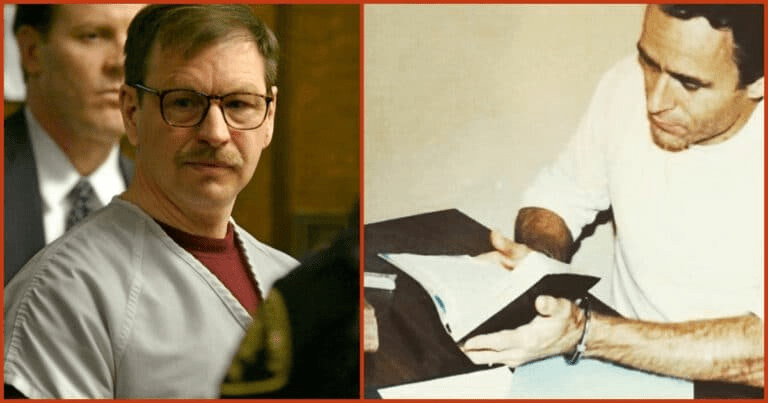
He lives alone. Never married and failed in relationships with women.” – Theodore Robert Bundy regarding the identity of the Green River Killer, 1984.
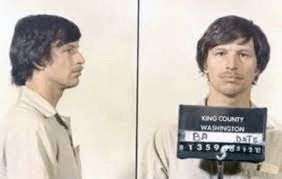
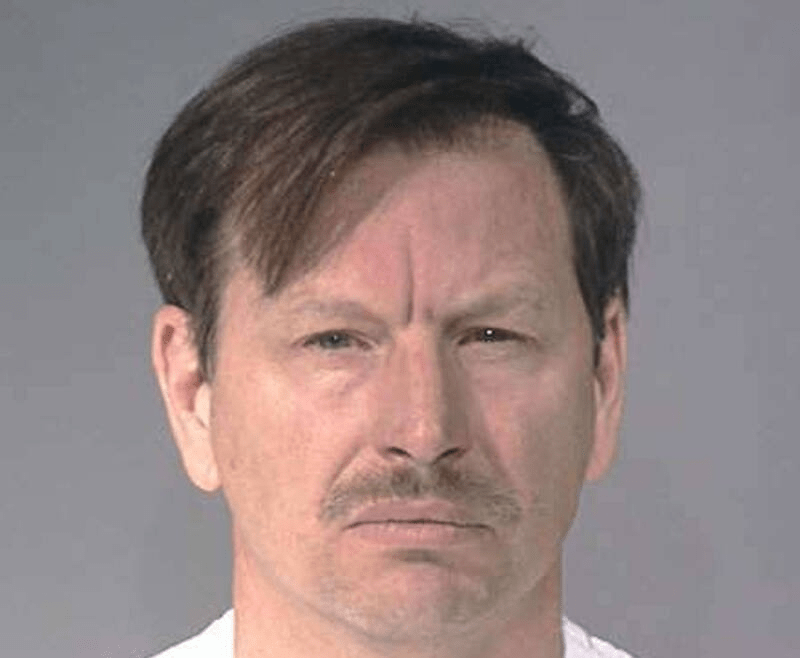
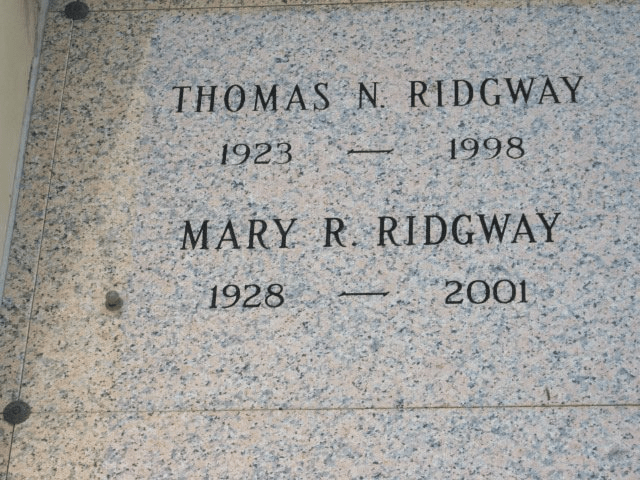
Gary Leon Ridgway was born February 18, 1949 to Thomas and Mary (nee Steinman)ma Ridgway of Salt Lake City, Utah. The family eventually relocated to Washington state where Thomas got a job as a bus driver and would frequently complain about the presence of sex workers on his driving route. His mother was employed as a sales clerk at JCPenney’s and was frequently called domineering by the people around her. Gary was the middle child and had two brothers (Gregory Leon born in November 1947 and Thomas Edward) and it’s widely known that his older sibling Gregory was the family favorite. It’s often theorized that he felt inferior to him, who ran for student office while in high school and went on to major in physics at Studied Physics Major at the University of Washington. In comparison, Gary was diagnosed with dyslexia, was held back twice in school, and had an IQ in the low 80’s. An attorney for the prosecution, Patty Eakes was able to shed some insight into Ridgway’s state of mind, claiming the only time she ever saw him express any sort of real emotions was when talking about his own intelligence: ‘he was so obviously limited, intellectually. The one time he genuinely cried was when he talked about how afraid he was of being put on the ‘short bus.’ I suspect that having a brilliant brother was a big thing that shaped him. Gary’s the troubled one, not the smart one. I suspect that was a big issue for him throughout his life. Perhaps being a killer of women was something he could succeed at.’ … ‘He came from a very middle-class family. There was nothing really that remarkable about him.’
Aside from feeling inferior to his older brother, Ridgway’s home life was considered incredibly dysfunctional: he was a chronic bed-wetter until the age of 13, and after each episode Mrs. Ridgway would wash her sons’ genitals. He would later tell psychologists that he had both feelings of extreme rage and sexual attraction toward her, and often fantasized about killing her. Some behavioral scientists feel that his crimes may have been a case of ‘displaced matricide’ and he was unconsciously ‘killing his mother over and over again’ even though he didn’t actually take her life.
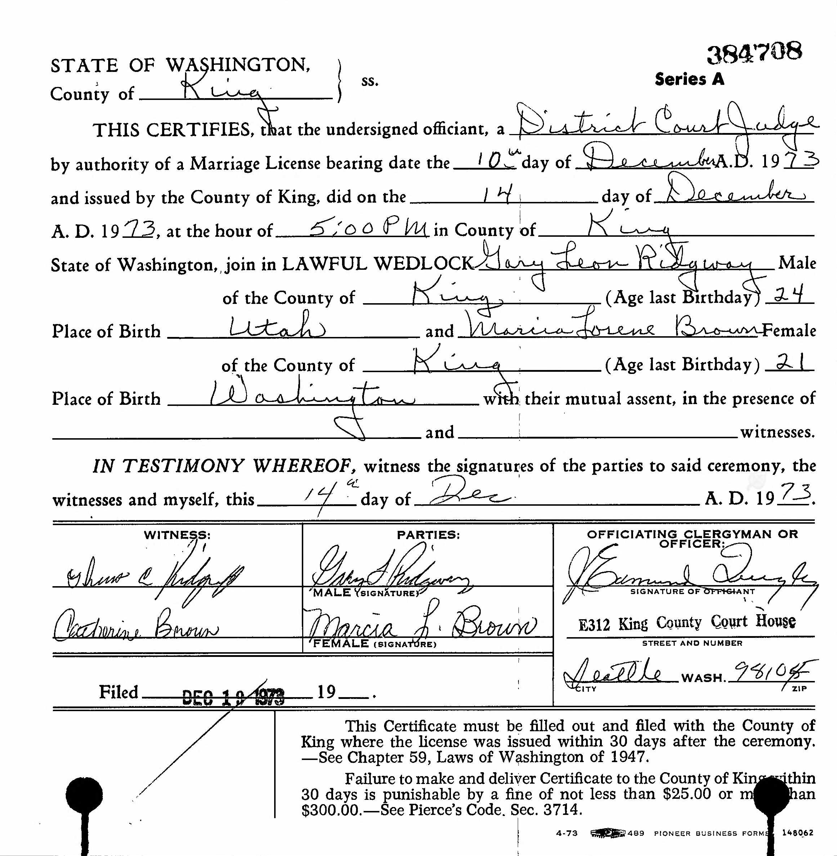
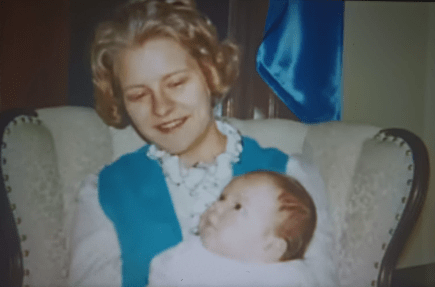
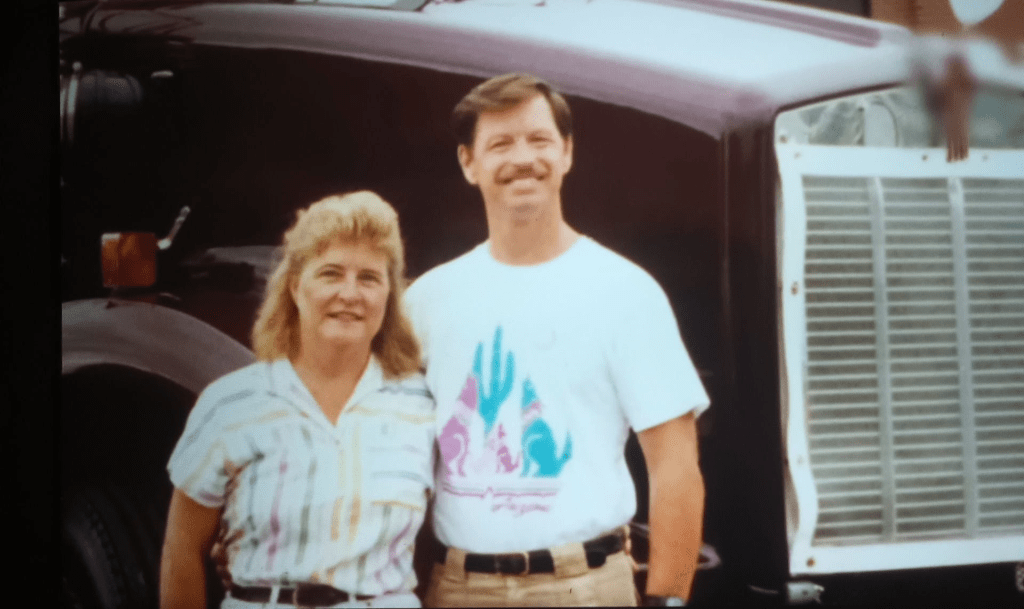
Gary graduated from Tyee High School in 1969 at twenty years old and the following year married Claudia Kraig, his longtime sweetheart. He then joined the Navy and served onboard a supply ship after being sent to Vietnam. During his time in the service Ridgway was frequently unfaithful to his new wife, often engaging in activities with sex workers. Despite becoming angry after contracting gonorrhea, he continued his risky behavior without using any sort of barrier protection; the couple divorced in 1972. Ridgway wasn’t single for long and married Martha Wilson in 1973. This relationship also ended in divorce because of his frequent infidelity. He encouraged Wilson to participate in risqué activities like sex in locations where he left some of his victims and she even accused him of putting her in a chokehold at some point during their marriage. Ridgway shared a son with her they named Matthew (b. 1975), and reportedly had him in his truck during some of the murders that took place on the weekends. He later admitted to detectives that if his son would have developed any sort of inkling as to what was going on he would have killed him immediately to silence him.
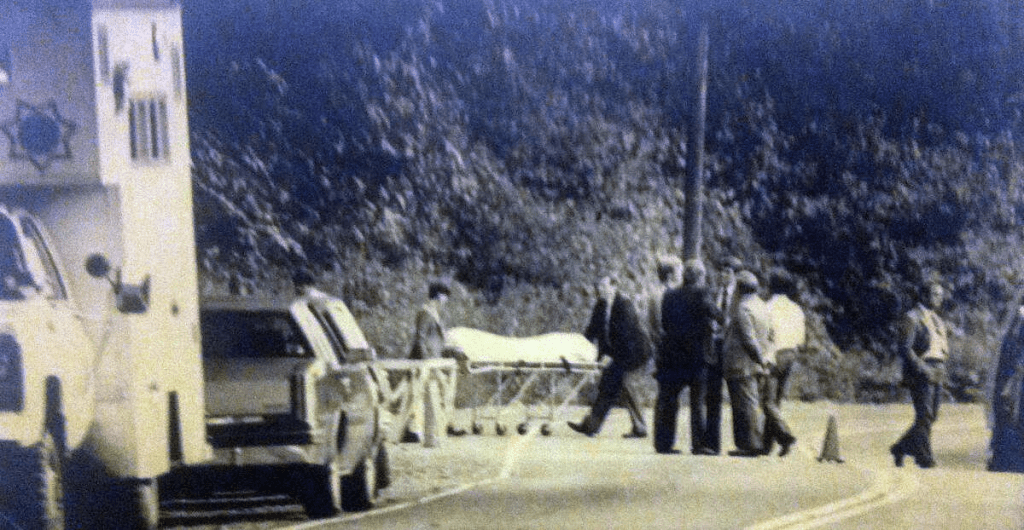
After returning from Vietnam, Ridgway got a job painting semis at the Kenworth Trucking Company, and in 1982 bought his house on 32nd Place South. The same year, teenage runaways and prostitutes began disappearing from major roadways throughout King County, Washington. Throughout the 1980’s and 90’s, Ridgway confessed to murdering at least 71 teenage girls and women in the Seattle/Tacoma area (although that number is speculated to be about 90 or more). In order to gain their trust and lower their defenses, on occasion Ridgway would show the women a picture of his son. After a few minutes of sexual intercourse from ‘behind,’ he would often strangle his victims by wrapping his forearm tightly around their necks, then use his other arm to pull back as tightly as he could. Ridgway killed the majority of his victims in his home then left their remains in wooded areas. Multiple bodies wound up making their way to the river and eventually washed up to shore, giving him the nickname ‘The Green River Killer.’ Ridgway would frequently contaminate the crime scenes with gum and cigarette butts (even though he wasn’t a smoker or a gum chewer) just to throw law enforcement off his trail. He would also leave his victims in one place, leave it for a while, then return and transport it to a second location in order to create a false trail; at least two of his victims were transported as far away as Portland, Oregon.
In the early 1980’s, the King County Sheriff’s Office formed the ‘Green River Task Force.’ In November 1984, Ted Bundy contacted the department after seeing an article in a local newspaper about the Green River case. The doomed serial killer was on death row when the murders began in 1982, and a part of me thinks he was jealous of the attention that ‘the Riverman’ was receiving, as he was no longer in the spotlight. So, six years into his death sentence Bundy sent a 22-page letter to King County chief criminal investigators Robert Keppel and Dave Reichert asking if they’d like his assistance to help solve the Green River case. In the letter, Bundy said: ‘don’t ask me why I believe I’m an expert in this area, just accept that I am and we’ll start from there.’ Regarding being contacted by Bundy, Dr. Keppel said: ‘it was a letter from a ‘wanna-be’ consultant and the most unlikely person I ever expected to be of assistance in the Green River murders. The letter came from a cell on death row in Florida; the sender was Theodore Robert Bundy. I was stunned.’ Turns out I was right about my jealousy theory: Keppel and Reichert both stated that they sensed a bit of jealousy from Ted regarding the GRK stealing his thunder. At the time Bundy sent the letter to detectives he was still the primary suspect in many unsolved homicides across multiple states. Because of this, the two detectives accepted the serial killer’s ‘help’ when in actuality they were only interested in seeing if they could get any sort of information regarding their unsolved cases.
In 1972, Bundy graduated from the University of Washington with a Bachelor’s degree in Psychology, and around 1974 young girls and women in the general Seattle area started disappearing. There were rumblings of an attractive young man wearing an arm sling or using crutches as a ruse to help lure pretty young coeds into his car by asking for assistance. After he made a mistake at Lake Sammamish on July 14, 1974 by not only taking two victims on the same day (from the same place) AND using his real name, he quickly left the area and enrolled in law school at the University of Utah in Salt Lake City. We all know he was eventually pulled over and arrested there on August 16, 1975. After Bundy escaped not once but twice, he fled to Florida where he was eventually caught after killing Chi Omega sisters Lisa Levy and Margaret Bowman as well as sweet little 12-year-old Kimberly Leach.
Two years before Bundy ‘created’ his criminal profile of the GRK, in 1982 FBI Special Agent John E. Douglas had already come up with his own profile that was fairly accurate and mentioned a few key points: the unsub was a divorced, white male who drove an older model vehicle. He often visited with sex workers and was very familiar with the area where he disposed of the bodies. Douglas also felt the killer was somewhere between the ages of 25-35, and it just so happens that at the beginning of his rampage Gary Ridgway was 33-years-old. However, a profile is not considered to be evidence, simply a tool used to help narrow down a list of suspects. Despite Bundy’s impact on the Ridgway case being completely overblown, numerous movies, documentaries, and books have been made over the years simply for the sake of shock value. This is a great example as to how Ted’s capabilities and ‘intelligence’ is frequently exaggerated for the sake of a good story. For some, the idea of a serial killer helping track down another serial killer is straight out of a movie, and the fact that it may have sort-of happened is far too fascinating to be thwarted by facts.
Ted also theorized to Keppel and Reichert that the GRK was returning to his burial sites to have ‘intimate relations’ with his victims: ‘I think he might be … intending to return to the scene to either view his victim, or in fact, interact with the body in some way.’ He went on to tell the detectives that if they ever stumbled upon a ‘fresh grave’ they should stake it out and wait for him to come back. During his allocution, Ridgway admitted that he did indeed return to his victims’ remains and violated their corpses. Bundy also told the detectives that they could possibly catch the killer if they staked out his old burial sites, and Keppel admitted they did that but the media would often show up and blow their cover.
Reichert: ‘Do you think that he parks his vehicle?’ Bundy: ‘Oh sure and just watches. My feelings about the guy is he’s very low key and inoffensive.’ He went on to say: ‘I think there’s an excellent chance that he picked up a number of prostitutes that he has later released for any number of reasons. He knows what these girls are like and what they need. Employment, money, or drugs.’
Once again, Bundy got it right: after he was in custody, Ridgway did share with detectives that he not only would park his pickup truck and watch the prostitutes walk by, but he also promised some of them extra cash or a chance of ‘honest’ employment, even going so far as to staying in touch with few of them by the phone. They were all empty promises, and not a single one was fulfilled.
Bundy also advised Keppel and Reichert that the police department most likely already had contact with the perpetrator of these heinous crimes at some point in the past, saying: ‘there’s a chance this guy has already been reported. Field card here, arrested there, reported over here, license plate shows up over here.’ Again, Bundy got another trait correct: in the 1980’s, Ridgway came into contact with the police at least ten times. Some matters were routine but others involved some of his victims.
One victim did stand out to Ted as not being a victim of the GRK: Amina Agisheff, saying, ‘it seems to me those circumstances, but not necessarily, eliminates Agisheff as a victim of the Riverman. This is most likely because at 36 she was older than many of the other victims, and the minute amount of time between Agisheff’s disappearance and that of Wendy Coffield.’ When Ridgway was in custody, detectives inquired about an unsolved murder just to see if he would confess; he denied it saying, ‘why if it isn’t mine? Because I have pride ….. in what I do, I don’t wanna take it from anybody else.’
About the convicted serial killer, Keppel said ‘Bundy was right on the money all the way around. He knew what to expect out of this guy. That’s the experience of a real killer.’ Reichert commented that Bundy had several traits in common with Ridgway, especially regarding his mindset: ‘first off, there’s no remorse. He doesn’t have any feelings toward anybody, his family included. And that’s what I saw in Bundy and what I saw in Ridgway.’ In an interview with the New York Times, Reichert said: ‘like Mr. Bundy… Mr. Ridgway craved attention and control and was prideful when discussing his killings.’
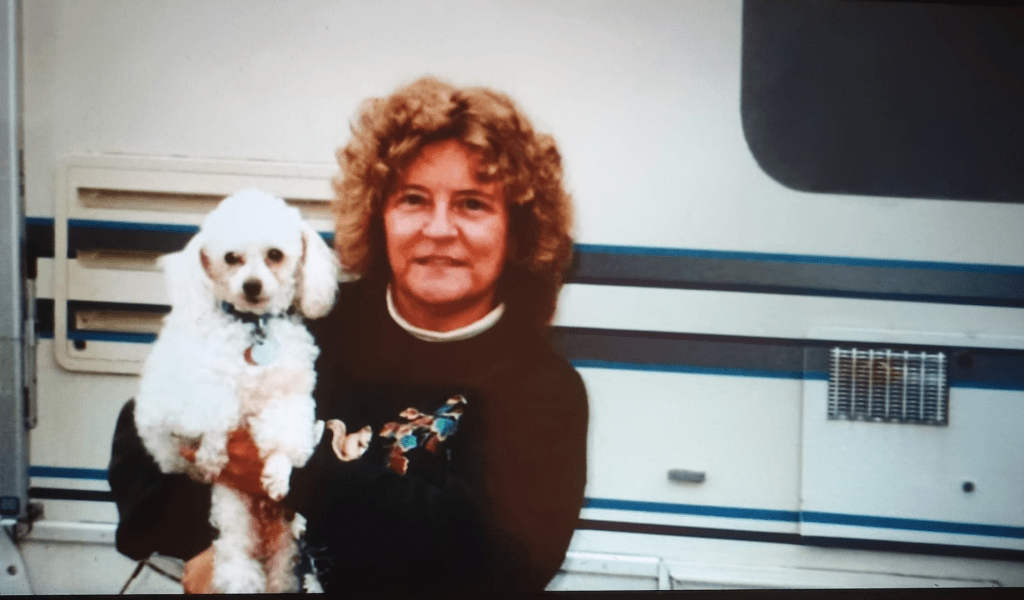
In 1985, Ridgway started seeing Judith Mawson after they met at the White Shutters Tavern; he eventually made her his third wife in 1988. Mawson claimed in a 2010 TV interview that when she moved into his house the floors were bare and there was no carpet. Detectives told her that Ridgway most likely wrapped a body in the carpet and never bothered to replace it. He did in fact bring most of his victims back to his house before murdering them. In that same interview, Mawson mentioned that her husband would frequently leave for work very early in the morning on some days, telling her it was for ‘overtime.’ She theorized that Gary must have committed some of his atrocities while allegedly working this early morning OT. Judith went on to say that she had no knowledge of his activities until she was contacted by detectives in 1987, even claiming to have had no knowledge of the Green River Killer at all due to the fact that she did not watch the news or read the paper.
During an interview with writer Pennie Morehead in prison, Ridgway pointed out that while he was married to Mawson his kill rate greatly decreased due to the fact that he was happy and genuinely loved her. In fact, of the 49 women he slaughtered he only killed three while he was involved with Judith. In an interview with the same reporter, Mawson said: ‘I feel I have saved lives … by being his wife and making him happy.’ She at one time called Ridgway the ‘perfect husband’ and that despite being together for 17 years he always treated their relationship as if they were newlyweds. Ridgway did confess he was tempted to kill Mawson on multiple occasions, and the feeling only passed when he realized it would have increased the odds of him getting caught. Despite his psychopathic tendencies, Ridgway did admit that he loved his wife.
Gary Ridgway’s first attempt at murder wasn’t a very successful one: he was sixteen and went after a six-year-old boy in his neighborhood. The children weren’t fighting or disagreeing about anything in any capacity: they were just two kids from the same neighborhood that had just met moments earlier. The young boy was close to home when Ridgway asked if he wanted to go build a fort in the wooded area nearby. Moments later, he stabbed the child in his midsection, puncturing his liver. ‘Why did you kill me?’ the young child implored to Ridgway, who simply laughed and answered, ‘I always wanted to know what it felt like to kill someone.’ He served no jail time for this crime. About this, Ridgway told Bob Keppel, ‘a boy was playing and I stabbed him inside. Didn’t kill him…. I just took the knife outta my pocket and stabbed him in the ah, side…I wanted to see how to stab somebody.’
Many of Ridgway’s victims were known to be sex workers, teenage runaways, and women in other vulnerable circumstances. After the first five bodies were pulled out of the river the press granted him the nickname ‘The Green River Killer.’ Ridgway typically strangled his victims by hand but on occasion would use ligatures. After taking their lives, he would leave their bodies in overgrown, wooded areas in King County, often returning to the bodies to have sexual intercourse with them. As a side note, this sounds almost exactly like behavior Bundy participated in. Ridgway was originally convicted of 48 murders, however in 2011 one more conviction was added to the count, bringing the total number up to 49. This helped establish him as the second most prolific serial killer in United States history. The first is Samuel Little, who confessed to the murders of 93 women across multiple states between 1970 and 2005. He died in prison in 2020.
Ridgway was arrested in 1982 and 2001 on charges related to soliciting prostitution. He officially became a suspect in the Green River killings in April 1983 when 18-year-old Marie Malvar disappeared after being seen getting into a truck that looked exactly like Ridgways. Her pimp and boyfriend Robert Woods remembered the vehicle because of the way it ‘sped up:’ from his experience, Johns usually drove away much slower. The following day, Woods and Malvar’s father went looking for the mystery pickup and found it parked outside of Ridgway’s house in his SeaTac neighborhood. Unfortunately, there was not enough evidence for police to arrest him, and of course he denied any contact with the missing teenager. Even though police had no evidence to prove he was lying it did help put Ridgway on their radar.
It wasn’t until June 1983 when Keli Kay McGinness was last seen getting in a pickup truck that looked exactly like Ridgways that he was officially bumped up to a ‘top priority’ suspect. After the 18-year-old vanished without a trace, law enforcement immediately zeroed in on Ridgway and got a search warrant for his house, and despite searching the property with a fine-toothed comb there was not enough evidence found to incriminate him in any crimes. In 1984 Ridgway was administered a polygraph test and passed. On April 7, 1987, law enforcement obtained warrants for samples of his hair and saliva, which was used to successfully match him to semen left behind at the crime scenes.
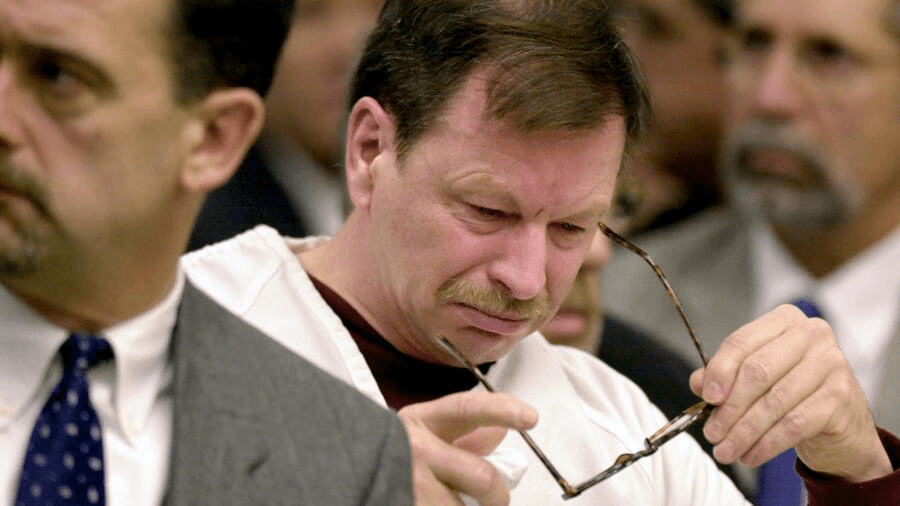
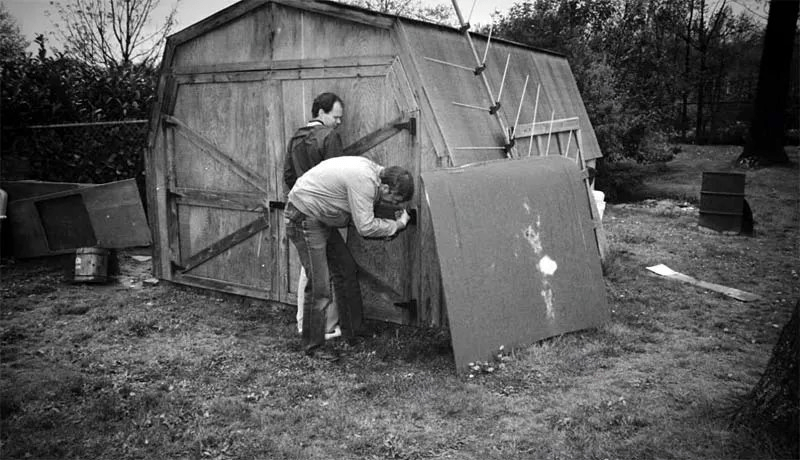
Roughly 20 years after being identified as a potential suspect in the Green River murder case, on November 30, 2001 Gary Leon Ridgway was arrested as he was leaving his place of employment. He was officially charged for the brutal slayings of four women thanks to DNA evidence as well as paint flecks found at the crime scenes and at his job. A forensic scientist found microscopic particles that matched a specific brand and composition of spray paint he used at his job during the specific time period when these victims were killed.The four victims were Marcia Chapman, Opal Mills, Cynthia Hinds, and Carol Ann Christensen. This means it was actually science that led to Ridgway’s arrest, NOT Ted Bundy’s criminal profile. In March 2003 three more victims were added to the indictment: Wendy Coffield, Debra Bonner, and Debra Estes.
As part of his plea bargain arrangement, Ridgway was given a sentence of life imprisonment without the possibility of parole. He was spared the death penalty on the condition that he tell law enforcement where he left the bodies of his victims. He took law enforcement to the locations of where he left several of his victims, even sharing with them intimate details on how he killed each one. On December 18, 2003, Ridgway was sentenced to 48 consecutive life sentences at the Washington State Penitentiary; ten additional years were added to each sentence for the crime of tampering with evidence which increased his prison term by 480 years. In 2011, a 49th body was discovered and linked to the Green River killer, adding another life sentence to his already absurdly long term. Gary Ridgway took the lives of more people than Jeffrey Dahmer, Son of Sam, and BTK combined.
Keppel stated: ‘our man Ridgway is as clever or maybe even cleverer than Bundy ever thought he was. Because this guy has a methodology to him that is unprecedented anywhere. Try and find a killer that’s gone on as long as he had, as intense as he did, with the apparent ability to turn the faucet on and off any length of time that he wants.’
Ted Bundy was put to death in Florida’s electric chair in January 1989 and wasn’t alive to see the capture of the Green River Killer; he’ll never know how accurate his profile of the serial killer was. Dr. Robert Keppel wrote the book ‘The Riverman: Ted Bundy and I Hunt for the Green River Killer’ about his time spent with the serial killer, and where Bundy didn’t really aide law enforcement in solving the case of ‘The Riverman,’ he was pretty spot on regarding his profile. Unlike Bundy, Gary Ridgway is alive today and is currently 72 years old. He will spend the rest of his life behind bars at the Washington State Penitentiary in Walla Walla, Washington. In Thomas Harris’s 1988 best selling novel ‘Silence of Lambs,’ Bundy was used as inspiration for the villainous Buffalo Bill, who feigned injury when approaching women asking for help before knocking them out then abducting them. Like Buffalo Bill, one of Bundy’s primary methods of killing was strangling his victims. Although Harris has not publicly spoken about the similarities between his fictional killer and Ted Bundy, he did attended parts of Bundy’s Florida trial and even sent him a copy of Red Dragon, which introduced the character of Hannibal Lecter.
Ted Bundy was put to death in Florida’s electric chair in January 1989 and wasn’t alive to see the capture of the Green River Killer. Gary Ridgway is alive as of September 2023 and is currently 74 years old. He will spend the rest of his life behind bars at the Washington State Penitentiary in Walla Walla, Washington. Truthfully, before I started this article I didn’t know much about him; I knew he was married three times but I was shocked to learn he fathered a child. I dug a little deeper into Matthew Ridgway and was a little surprised to learn he wasn’t like Bundy’s daughter Rose/a, and has done some interviews with the media. I want to mention an article I found about Matthew, who remembers a very different version of his father than the one depicted on TV… To him, Gary Leon Ridgway was just ‘Dad’: a frugal, chill man who rarely yelled or raised his voice. That helped teach him how to play sports and never missed one of his baseball or soccer games. The day after his dad was arrested, Matthew told investigators: ‘even when I was in fourth grade, when I was with soccer, he’d always, you know, be there for me… I don’t think I ever remember him not being there.’ He told detectives that he had no idea who his father really was until he was 24 years old, after he was arrested. Gary Ridgway had given him a normal and happy childhood, something that he would always be thankful for. After high school Matthew joined the Marines, got married, and now works as a trained chef. Gary’s father Thomas passed away in 1998 at the age of 71 and his mother died on August 15, 2001.
A young Gary Ridgway strangling a cat. A pic of Ridgway as a child in coloreakes.Gary Ridgway’s freshman year picture from the 1966 Tyee High School yearbook.Gary Ridgway’s sophomore year picture from the 1967 Tyee High School yearbook.Gary Ridgway in (one of) his sophomore year pictures 1968 Tyee High School yearbook.Gary Ridgway’s senior year picture from the 1969 Tyee High School yearbook.Ridgway joined the Navy in 1969 after graduating from high school (he was 20-years-old). He was almost immediately sent to fight in the Vietnam War.A photo of Ridgway’s arrest from soliciting a prostitute on May 12, 1982. Ridgway was long suspected in the killings but not arrested until 2001.Ridgway’s first wife, Claudia L Kraig-Barrows. They were married from 1970-1972. Photo courtesy of the 1969 Lincoln High School yearbook.Ridgway’s second wife, Marcia Lorraine (Brown) Coldiron. They were married from 1973–1981.Gary and Marcia’s marriage certificate dated December 19, 1973.Washington, US, Divorce Index, June 23, 1991 for Gary L Ridgway.Judith Mawson.Gary and Judith Ridgway on their wedding day.Gary and Judith cutting the cake on their wedding day.Gary and Judith sharing a drink on their wedding day.Judith Mawson was Ridgway’s third wife, the pair met and danced at the White Shutters Tavern on Highway 99 in 1985 and were married three years later. Following their marriage, Ridgway’s murder rate dropped significantly: only about 6% of his 71 suspected murders took place between 1988 and 2001.Ridgway and Judith.Gary and Judith.Gary and Judith standing in front of one of the semi’s from the Kenworth Truck Factory.Gary and Judith with one of their pups standing in front of an RV.Judith and one of her dogs.A handwritten note from Gary to Judith from an old birthday card.A handwritten note from Gary to Judith from an old card.A handwritten note from Gary to Judith from an old card.Regarding his crimes, Ridgway said: ‘I have tried a long time to get these things out of my mind. I tried for a long time to keep from killing any more ladies.’Gary Ridgway’s mugshot from his 2001 arrest.Ridgway sat stoic throughout the entirety of his court appearances and broke down only once: when Robert Rule forgave him for killing his 16-year-old daughter (Linda) in September 1982: ‘There are people here that hate you. I’m not one of them. I pity you, sir. You won’t have a Christmas. You won’t have the love around you that everyone needs at Christmas time.’I looked everywhere to see if Ridgway suffers from trichotillomania, which is a compulsion to rip ones hair out due to underlying anxiety. I couldn’t find anything telling me he has this condition, so this must have been on a bad hair day.After listening for more than two hours as his victims’ loved ones told him how he’d devastated their lives, Ridgway apologized, saying: ‘I’m sorry for killing all those young ladies. I have tried to remember as much as I could to help the detectives find and recover the ladies. I’m sorry for the scare I put in the community.’A 2017 mugshot of Ridgway from Walla Walla, Washington.A side by side of the Green River Killer and Ted Bundy, ‘The Ladykiller.’Gary Ridgway’s dad, Thomas.Mr. Ridgway with Gregory in 1948.Mary Ridgway. Friends and family described her as someone who frequently would wear short skirts, low cut tops, lots of make-up and bigger hair, which was not the norm at the time. A friend of the family stating that she ‘always looked glamorous.’Thomas Jr. and Mary Ridgway in 1995. She died on August 15, 2001; the cause of her death is not public information. She was 73 years old is laid to rest in Federal Way, WA. Mary Ridgway.Mary Rita Ridgway was born on January 22, 1928 and died on August 15, 2001 at age 73. She was laid to rest in Gethsemane Cemetery in Federal Way, WA next to her husband Thomas Jr, who was 74 when he passed in early 1998.Gary’s older brother, Gregory Leon Ridgway.On December 1, 2001 Matthew Ridgway told investigators, ‘even when I was in fourth grade, when I was with soccer, he’d always, you know, be there for me.’ … ‘I don’t think I ever remember him not being there.’Gary Ridgway was married three times, and Matthew (b. 1975) is a product from his second marriage to Marcia Lorene Brown. They got married in 1973 and divorced in 1981. Because of the separation, Gary was not a constant presence in Matthew’s life, but he did have visitation rights for every other weekend.Gary Ridgway’s victims. As you can see, he did not discriminate by age or race, as some of his victims are as young as 14 years old.A picture of Ridgway in shackles at court.A photograph of detectives searching a shed in the back yard. Despite scouring the property from top to bottom, investigators were unable to find any evidence to incriminate him.Investigators move the body of a woman found slain on July 11, 1983. Photo courtesy of MOHAI.On November 22, 1983, Jenne Gibbs was one of about 36 people who demonstrated demanding that police crack down on prostitution along state Route 99 near Jackson International Airport in south King County. Police say victims of the Green River killer were linked to prostitution in the area. Photo courtesy of MOHAI.Bill Haglund, right of the King County Medical Examiner’s Office helps remove human remains found near a baseball field just north of Sea-Tac Airport in March 1984. Photo courtesy of MOHAI.On September 20, 1984 an elderly couple found the body of a young woman who apparently was killed within the prior few days and was found yards from the Green River. Photo courtesy of MOHAI.On June 20, 1985, Washington County, Oregon deputy sheriffs and explorer scouts search a heavily wooded area on for clues that may link the deaths of two women to Seattle’s Green River killer. Numerous bones were found at the site and were expected to be linked to an unidentified teenage girl. Another set of bones found last week were identified as the remains of Denise Darcel Bush, 23, who disappeared near Sea-Tac Airport in October 1982. Photo courtesy of MOHAI.On August 13, 1983 members of an Explorer Search & Rescue unit comb a field north of Sea-Tac Airport. Photo courtesy of MOHAI.On October 27, 1983, port police and investigators for the King County Medical Examiner’s Office comb the area where a full human skeleton was found. It was partially buried in a grave some 200 yards north of South 192nd Street. Photo courtesy of MOHAI.A photo of the Green River taken sometime in the 1980’s.Detectives Dave Reichert (center, green jacket) and Pat Ferguson gather evidence from sites where bodies were found south of Sea-Tac Airport in the fall of 1983. Photo courtesy of MOHAI.A photo of the Green River Task force.One of the members of the Greek River Task Force.Two members of the Green River Task Force.One of the victims of Ridgway.A victim of the Green River Killer being loaded into a transport vehicle.A dive team exploring the Green River.Members of the Green River Task Force.The Green River Task Force bringing a body to a transport vehicle.Law enforcement investigating the Green River.The Green River.This police sketch of the Green River Killer was drawn in 1986 from a description by Paige Miley.In response to the volatile fuel prices and shortages resulting from the oil embargo of the 1970’s, Kenworth engineers developed the industry’s first truly aerodynamic model, the Kenworth T600 with its sloped hood. In this pic, Kenworth employees look on as the first production model T600 rolls off the assembly line at the Seattle manufacturing plant in 1985. Photo courtesy of Kenworth Truck Co’s Facebook page.Ridgway’s pickup truck.Ridgway took his victims to his master bedroom at his first house to have sex. Ironically he choose a wall mural that resembled the lonely woods where he planned to leave their bodies.A letter from Gary to his lawyers Michelle Shaw and Mark Prothero.A Google Street View image from September, 2011. Photo courtesy of oddstops. An older photograph of the back yard. On the left, you can see two trailers. On the right, you can see a wooden shed. Photo courtesy of oddstops. A dead end sign at the beginning of Gary Ridgway’s former neighborhood on 32nd Pl South in SeaTac, Washington. Photo taken in April 2022.Gary Ridgways home. Photo taken in Aprl 2022.Ridgway sold the house on May 28th, 1999 for $112,950, two years before he was arrested as the Green River Killer. Photo taken in April 2022.In 2021, Zillow estimated that the 32nd Pl S address is worth $392,800. Photo taken in April 2022.The 3 bedroom/1 bath house is 1,150 square feet and it was built in 1970. Photo taken in April 2022.This guard pup reminded me of the Seattle PD car stationed near the scene where Georgann Hawkins was abducted. Photo taken in April 2022.Gary Ridgways former backyard at his first home. Photo taken in April 2022.The backyard of Ridgways first home. Photo from April 2022.A side view of Ridgways first home. Photo from April 2022.Ridgway got his nickname because of his habit of leaving his victim’s bodies near the Green River in Washington. Photo from April 2022.A satellite photograph of the Green River Killer’s house in SeaTac. Photo courtesy of oddstops.An aerial photograph showing the back of the property. Photo courtesy of oddstops. In September of 1997, Gary and Judith move to this home at 4633 South 348th St. in Auburn, WA.A cover of ‘The Riverman: Ted Bundy and I Hunt for the Green River Killer,’written by Robert D. Keppel and William J. Birnes. Robert D. Keppel was the chief consultant to the Green River Murders Task force who helped develop the strategy behind the arrest of current suspect Gary Ridgway. He has since retired as the chief criminal investigator for the Washington State Attorney General’s Office. He has received a number of grants from the U.S. Bureau of Justice Administration to aid local police agencies in tracking serial homicides.A poster for ‘The Riverman’, a made for TV movie made in 2004 starring Bruce Greenwood as Robert Keppel, Sam Jaeger as Dave Reichert, Cary Elwes as Ted Bundy and David Lawrence Brown as Gary Ridgway. This is the best movie adaptation of the story (in my opinion). It also has the highest IMDB score of the lot as well,with a whopping 5.9/10.A movie poster for ‘The Capture of the Green River Killer,’ a TV Mini Series made in 2008 that starred Tom Cavanaugh. The actor who plays Gary Ridgway, John Pielmeier, co-wrote the script.A poster for the 2005 straight to video film, ‘Green River Killer.’ This got the lowest IMDB score of the bunch, coming in at an impressive 1.8/10. The most interesting piece of trivia I could find regarding this was that it recycled the same sets from Zombie Nation (2004) and Cannibal (2006).A poster for ‘Bundy and the Green River Killer’ made in 2019. Most of the dialogue between Detective Richards and Gary Ridgway in the police interview scene is based on the real life taped interview between King County Sheriff David Reichert and Gary Ridgway that was recorded shortly after his arrest in 2001.A second movie poster for ‘Bundy and the Green River Killer’ made in 2019.
A comment made on Tiffany Jean’s article about Lisa Wick and Lonnie Trumbull made by Dick Kraske, a retired LEO that at one point served as a Major for the King County Sheriff’s Department. In it, he gives his expert opinion on the GRK case.