I’ve really been enjoying writing about the unconfirmed Bundy victims lately: so far I’ve done Lisa Wick/Lonnie Trumbull (the Seattle flight attendants who were attacked in their Queen Anne Hill basement apartment), Brenda Joy Baker, Katherine Kolodziej and Sotria Kritsonis (I wrote a short article briefly discussing the disappearance of Ann Marie Burr but she deserves her own full piece*). Last spring when I was in Seattle I debated on whether or not I was going to actually follow through with my lifelong dream of starting a blog or once again take the easy way out and just post my pictures as I took them. I was genuinely nervous about putting out unimaginative, run of the mill content that’s been written about a thousand times before. So, I started digging even further into the Bundy verse, beyond the confirmed victims (such as Georgeann Hawkins) and commonly discussed places (like the Rogers Rooming House on 12th Ave in Seattle).’ So, I started looking into Ted’s unconfirmed victims. His places of employment. The former dorm building he kept a key for after moving out so he could go back and sleep there (he at one time had a room on the 4th floor in the South Tower of McMahon Hall at the University of Washington). The brick with Mr. and Mrs. Bundy’s names on it at the University of Puget Sound (where she was employed for many years as a secretary). I’m going to Utah in November and Colorado in December (I have the time off work) but I’m putting Florida off until last because it’s the state that scares me the most… Margaret Bowman‘s crime scene photos will forever haunt me.
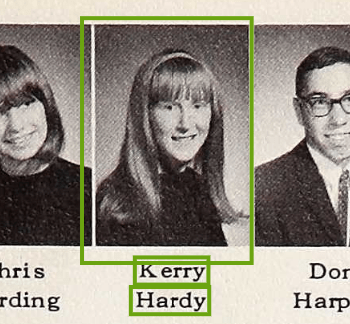
I ran into a lot of snags in my research of May-Hardy, and unfortunately it’s becoming a consistent issue with the unconfirmed victims: I’m finding that if the woman is not directly related to Bundy there’s little or next to no information out there on them. Even simply figuring out Kerry’s exact date of birth took quite a bit of effort, and I’d like to thank my husband for allowing me to use one of his credit cards so I could sign up for another free trial of Ancestry. I was able to find some neat things on Kerry May-Hardy that I hadn’t seen anywhere else: before my discoveries I found exactly ONE picture of her on the internet (along with her composite sketch after her skeletal remains were found). I ran into this lack of information issue with Brenda Baker, the Seattle flight attendants (Lonnie Trumbull and Lisa Wick), and to an extent Kathy Kolodziej (I say this because I was in contact with the detective working the case as well as her cousin which helped make it a little more personal for me… plus there was a fair amount of information about her on Reddit message boards). I do want to add that after I really got digging on Kerry I found a bit more information that I was expecting… BUT at the same time there wasn’t a single YouTube video or Reddit thread on her and the small amount of information I found didn’t compare to the information you can find about (for example) Georgann Hawkins or Lynda Ann Healy. None of the unconfirmed victims got the attention that they deserved… for example, there’s next to NO information out there about the murder of 14 year-old Brenda Joy Baker and I think that’s a real shame. AND to be truthful I was struggling to find interesting facts about Brenda Ball and she was one of Ted’s more widely known Seattle victims (hers was the first skull found on Taylor Mountain). I think I read somewhere that there were 18,000 murders that occurred in 1972 across the US. It’s too bad you had to have been murdered by a serial killer to deserve any recognition for the case.
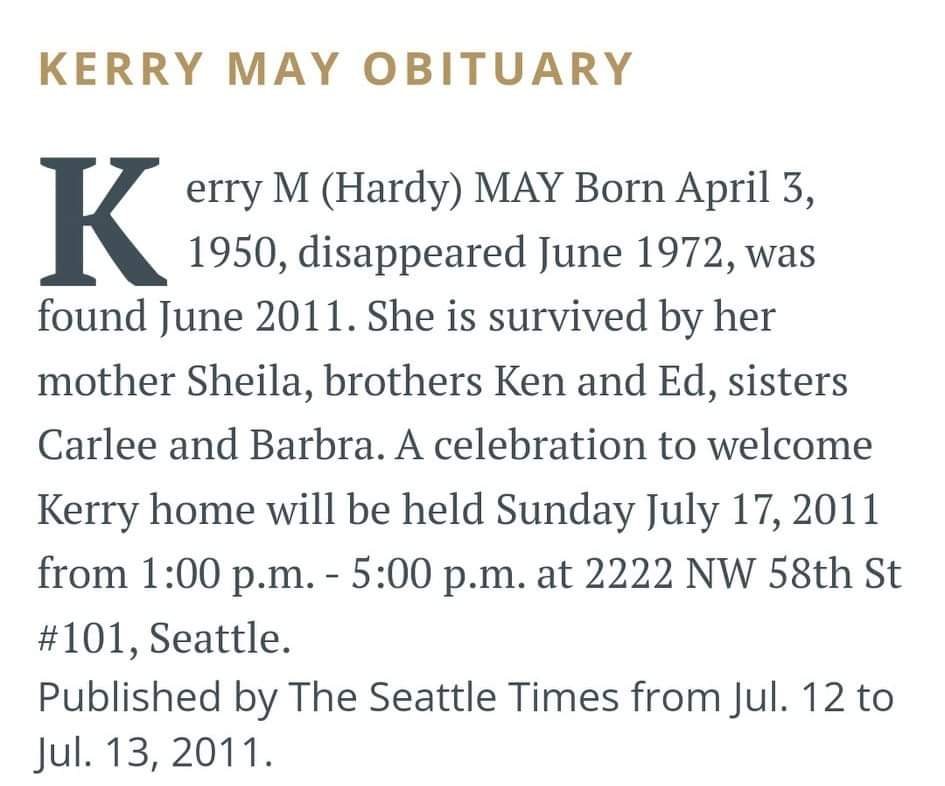
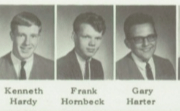
Kerry M. May-Hardy was born on April 3, 1950 in Seattle, Washington to Donald and Sheila (most recently Olson) Hardy; she had an older brother named Kenneth, two younger half-sisters (Carlee and Barbra), and a half-brother (Ed). According to a June 2011 article from the Vancouver Sun, Kerry’s parents were only married for a few years before they divorced in 1960. Sheila remarried Carol Olson the following year and Donald married Yvonne Lathrop on December 7, 1956. Mrs. Olsen described her daughter as a ‘free spirit,’ and the first person that popped in my head after I read that was Donna Gail Manson, who’s been called the same thing (and I could see it for myself looking at her pictures). Hardy grew up in the Capitol Hill district of Seattle and attended Lincoln High School in Seattle before dropping out her senior year. In a 2021 interview with ‘hi: I’m Ted’ blogger Tiffany Jean, Ken Hardy said that his sister ‘had hair like a brand new copper penny, and one of those personalities that you instantly liked her. Very friendly and outgoing, but engaging too, and when she started to talk, it didn’t matter where you came from, you wanted to listen to what she had to say.’ After graduating from high school in 1967 Ken went to serve in the Vietnam War; he came home to Seattle two years later in 1969. At that time his younger sister had left school a year early and adopted a ‘free and easy flower child way of living in the Seattle music scene.’ Hardy commented that, ‘I was the older one, so she took a back seat the whole time we were growing up, and all our friends would say, ‘oh yeah, that’s Ken’s little sister.’ But when I got back home, all of a sudden it was, ‘oh you’re Kerry’s brother!’ She really jumped out because her personality was so attractive.’
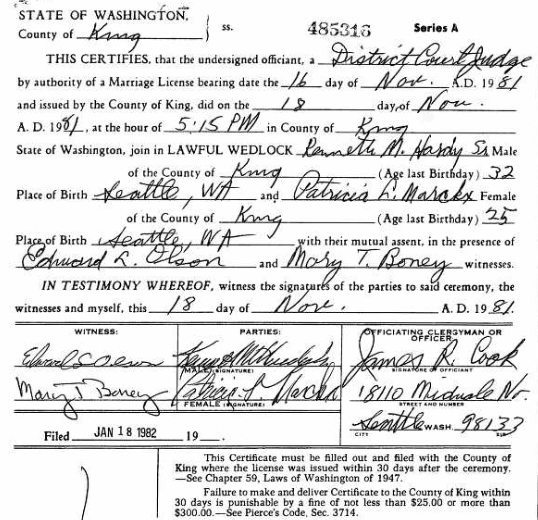
After a short courtship, Kerry Hardy married James May in a ceremony at the Central Lutheran Church in the Capitol Hill area of Seattle on May 15, 1971; at the time he was studying to be a court transcriber. Although the Hardy-Olsen clan didn’t know him very well, they immediately disliked Kerry’s new husband. Mrs. Olsen commented that ‘He wasn’t a very outgoing person. I just know she was very much in love.’ Ken on the other hand didn’t mind being more truthful, saying that his new brother-in-law ‘was a jerk, and they were always arguing.’ He also said that only six months into his little sisters brand new marriage ‘a friend of ours found out that James was beating up on her and so he got him up against a wall one night when James was alone. Warned him that if he ever did that again, he’d kill him.’ The newlyweds separated shortly after that incident, and Kerry left him and stayed with friends. It is speculated but unconfirmed that Mr. May eventually remarried and relocated to Hawaii.
Ken said that the first time he remembered that his sister was missing his ‘parents and m younger siblings were going on a family trip out of town, and Kerry was supposed to go over and help pack some clothes for my youngest sister, who has Down’s Syndrome, but she never showed up.’ Sheila said the phone calls and visits from her daughter stopped abruptly about a week before the family was supposed to leave on vacation to Minnesota. She also said that while away she ‘made frequent phone calls home during the trip to see if anyone had heard from her (Vancouver Sun, 2011).’ When the family got home in late June 1972 there still was no word from Kerry. In the time they were gone James May never thought to report his wife as missing to the police (although he did claim he didn’t see her since they separated). After calling every one of her daughters friends she could think of, Mrs. Olson went to the Seattle Police Department to report her as missing a week after returning home from vacation, however she was turned away because ‘her husband would have to report.’ She went right home and had James May do that. After he was done she immediately made a second call back to the police to file her own report, I’m assuming because there was now another (MALE) one on file? Unfortunately nothing ever came of either report and no one ever came forward to volunteer anything helpful regarding Kerry’s disappearance.
Ken Hardy commented that ‘because of the separation of her marriage, they didn’t pay that much attention to it at first, because they figured she just went off somewhere.’ The news media never reported on her disappearance, and not a single time was her name ever mentioned in the news. Weeks then months passed by, and Sheila kept contacting law enforcement over and over again, begging them to do more work on her daughter’s case. Eventually one of the officers got irritated and barked, ‘Mrs. Olson, your daughter is not dead!’ then hung up. As the years passed by with no news or resolution, Kerry mom said of her daughter: ‘I knew she was dead. … she would have called.’ Sheila described herself as ‘a mess’ the year after her daughter vanished but thankfully she was able to get herself together for the sake of her other children. She said at the time surrounding her daughter’s disappearance the thought never crossed her mind that Ted Bundy could have been Kerry’s killer.
Mrs. Olson said that her daughter, ‘knew all these people and they knew her: she was amazed, one time when, walking down the street, her daughter stopped to talk at length to a woman in a mink coat and then to a hippie down the block.’ The evening before Kerry disappeared she spent the night at a girlfriends house in the Woodland Park area of Seattle and from there (per a note she left behind) was going to a second girlfriends house roughly ten miles away on Beacon Hill. Years into the investigation Seattle cold case detective Mike Clestnski said that at some point it was reported she was last seen alive hitchhiking around the Woodland Park area on June 13, 1972 (a day after what was initially reported).
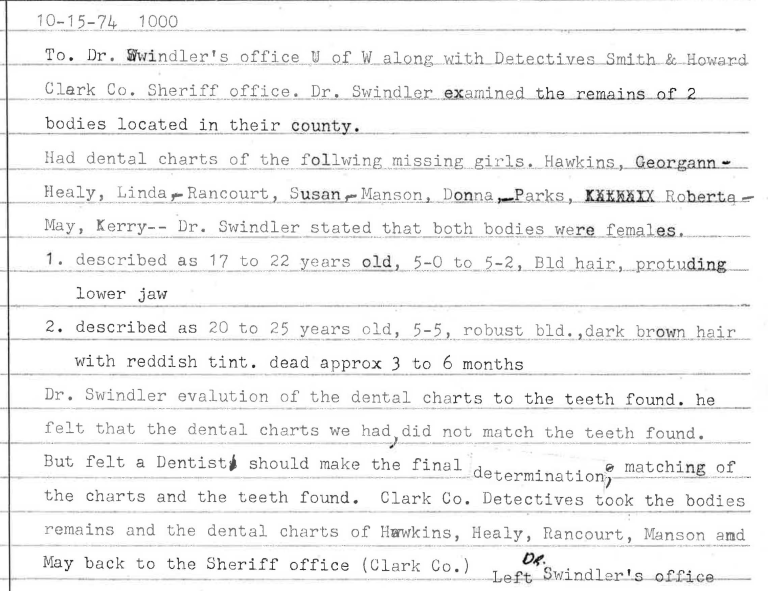
At some point in October 1974 Seattle law enforcement compared Kerry’s dental records against the teeth of two skulls that were discovered in Dole Valley near Vancouver, Washington. One of the bodies was immediately identified as Carol Valenzuela and after quite a few years the second was determined to be Martha Morrison; it is strongly speculated that both girls were victims of Warren Leslie Forrest. It is unknown if there was any additional investigative work done related to Hardy’s case at the time and unfortunately the original documents related to her case file have been destroyed (why?). According to Ken, the Seattle Police Department didn’t seem overly concerned in conducting a thorough investigation into his sisters case, and they did not keep in contact with the Hardy/Olson family at all after she disappeared. With no sightings of the young flower child and no one coming forward with information Kerry’s case quickly went cold. This absolutely broke her parents’ hearts. Ken shared with Tiffany Jean a terribly sad story: ‘one day my stepdad calls up and has me come over to the house. I was a single parent then, with two young kids. My stepdad said that he was really worried about my mom and that they would get my truck fixed up and take care of my kids if I went out looking for my sister. At first I thought it was a good idea, but reality sunk in immediately. I looked at him and said, that sounds great, but where do you want me to start? New York, Florida, southern California, you know? I kept having talks with my mom about it, but there just wasn’t anything to do.’
A drug bust in Seattle’s Fremont District in 1974 helped give the family hope: according to Ken, Kerry’s estranged husband was involved in dealing drugs, however ‘he just kind of walked through the middle of this huge mess and nobody touched him… so our feeling at that point was that Kerry had probably turned state’s evidence on the drug situation and made a deal for her husband, because she still loved him. Like maybe my sister had made a deal which led to this huge bust under the condition that he didn’t get touched, you know? That’s what it seemed like.’ But as more and more time passed by this ideal scenario seemed less and less probable. ‘She wouldn’t have stayed away that long, even in witness protection, because we were close.
It didn’t take long before the Hardy/Olson clan began to suspect that somehow James May was involved in Kerry’s disappearance. Ken said that ‘James said that he’d tried to contact several mutual friends that she would have been in contact with, looking for her. We found out that that was a lie. He never contacted anybody. One time he came over to my parents’ house when I was there, and my stepdad was so pissed at him that he wouldn’t even allow him inside. When we confronted him about her disappearance, he just acted totally ignorant.‘I haven’t talked to her since she left.’ That’s all he would say. That and ‘I don’t know.’’ After a few years passed by Ken ran into his former brother-in-law at a coffee house in Seattle’s University District. ‘James was sitting at the bar, and he jumped off his stool when he saw me. He came up to me and said, ‘Hey, Ken, how ya doin?’ and boom, he hit me in the arm. I just kind of turned sideways and elbowed him in the side of the head. Laid him out on the floor and walked out.’
Ken thinks that at some point in the week before the family was supposed to leave for Minnesota James and Kerry met up and the visit turned violent: ‘I kind of assumed, knowing her as I did, that eventually she was going to think about either getting a divorce or reconciling with her husband. And I don’t know if the attempt to do one or the other of those two things got them together. I just don’t know.’ At the time Kerry vanished she wasn’t sure how she wanted to move forward with her life. Ken commented that she was still wearing her wedding ring and that ‘she wore it all the time. Getting married, even at her young age… it was an important thing for her.’ Eventually James May moved away from Seattle, and his former in-laws lost contact with him completely. Ken said that ‘all we had was speculation, no evidence.’
Over time the Hardy/Olson clan came to realize that their sweet Kerry was never coming back to them. Mrs. Olson said that ‘at some point I knew Kerry was dead. She would have called.’ Years then eventually decades passed by without any word from investigators. It wasn’t until 2004 when the King County Medical Examiner gathered DNA samples from Sheila Olson with hopes to maybe help link Kerry to one of the unidentified bodies found during the Green River Killer investigation. Sadly none were a match to her Kerry. She remained missing for six more years.
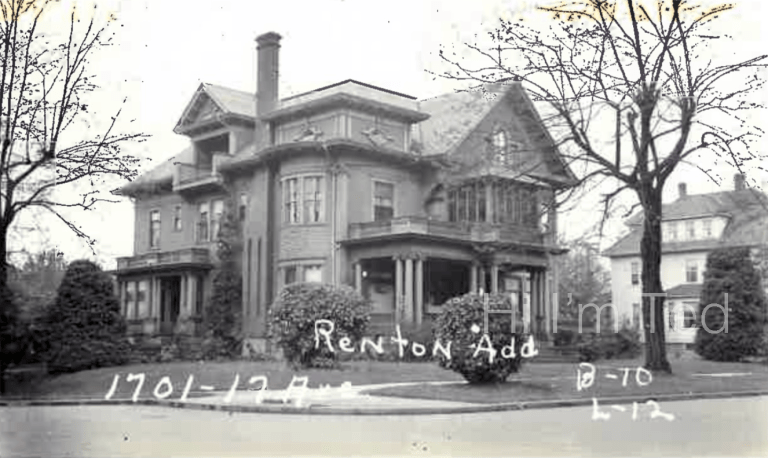
Now I know what you’re thinking? Jessica, who is this young lady and why have we never heard of her before (I know the ‘hi: I’m Ted’ page did a Patreon piece for a $3 monthly fee but I’m not sure how many people subscribe… at the completion of my article I’ve stumbled upon a few other noteworthy sources as well)?** So where’s the Bundy related evidence related to Kerry May-Hardy and is it believable? First off, Kerry’s murder took place in mid-1972… even a fledgling Bundyphile knows that his first ‘official victim’ was Karen Sparks in early January 1974 (as my own personal side, note I think Bundy killed Ann Marie Burr when he was 14 and I think he’s been killing ever since then but that’s my opinion and I understand not everyone agrees with me). Aside from Hardy fitting his typical victim profile, what I think jumped out at me the most is the fact that her mother told law enforcement she thinks roughly two years before Kerry vanished she lived above a crisis clinic in Seattle’s University District (however she isn’t completely certain). Again, most Bundy aficionado’s know that he met Ann Rule when she volunteered and he was a PT work study at the Seattle Crisis Clinic in 1971. However, Sheila Olson’s timeline alleges that her daughter lived there in 1970 and Bundy worked there in 1971, so this information doesn’t quite add up. When Kerry supposedly lived above the crisis center Bundy was employed for an Attorney Messenger and Process Service in Seattle as a file clerk and courier; he was employed there from September 1969 to May 1970 when he was fired for ‘unjustifiable absences’ (he claimed to have been babysitting Molly, Liz’s daughter). Job #2 in 1970 for Mr. Bundy lasted from June 5 to December 31, 1971 where he was a delivery driver for Pedline Supply Company, a family owned medical supply company. He quit the job at the end of 1971 when the office moved to another part of Seattle. However it is worth noting that while Hardy was alive and in Capitol Hill Bundy was just 2-4 miles away the entire time, living at the Rogers Rooming House on 12th Avenue in Seattle’s University District. Kerry was also close friends with Cathy Swindler, daughter of Herb Swindler who was employed at one time as the Head of Homicide for the Seattle Police Department and he happened to work the Georgeann Hawkins and Lynda Ann Healy investigations. Strangely enough, Cathy briefly went out with Bundy (she wasn’t aware he was still dating Elizabeth Kloepfer while seeing her). It’s speculated she introduced Kerry (who was a high school friend) to Ted while they were student interns together at Harborview Medical Center (where he coincidentally interned from June 1972 until September 1972, which is consistent with the date of Kathy’s disappearance on June 12, 1972). Physically, I think Kerry’s appearance would have been striking and memorable to Bundy: she was slender and beautiful, with long copper hair parted down the middle. … What if he stalked then approached her as she was attempting to thumb a ride and lured her into his car? Despite all this, at this time there is no actual evidence linking Ted to Hardy’s murder. Tiffany Jean points out that ‘the potential for a previous social connection is enticing. Perhaps Cathy introduced her to Ted while they were a couple, or ran into her around town while out on a date. Physically, Kerry’s appearance would have been striking and memorable. What if Ted had approached a hitchhiking Kerry a few years after dating Cathy, and lured her into his girlfriend’s car with that famous veneer of charm? ‘Hi Kerry, I’m Ted! Remember me? We met through Cathy, do you need a ride somewhere?’ Of course, without Cathy’s confirmation, this entire scenario is pure speculation, and could merely be an eerie coincidence.’
The Crisis Clinic was first located in an office close to Seattle University (which was located on 12th Street) before relocating to an old Victorian style house in Capitol Hill. Ann Rule and the night supervisor at the time Bundy worked there claimed that there were no other tenants in either building due to the confidential nature of the work done and the records present on site. So if Kerry did live above a Crisis Center it must have been at a different one than the one Ted worked at. Whether or not Hardy lived somewhere close to the Crisis Clinic is under investigation at this time (per an article written in mid-2011). At the end of the day, Sheila Olson strongly feels that Bundy isn’t responsible for the murder of her daughter: ‘I just don’t… a mothers feeling.’ Ken thinks that James May seems like a far likelier suspect instead of the serial killer. At the end of their 2021 interview Ken shared with Tiffany Jean that he was ‘pretty sure, I’m pretty confident in my assumption… I think you can rule the Bundy thing out.’ Unfortunately there is no direct evidence of May’s involvement, only suspicious context. According to Ken, Kerry’s remains were close to property that the May family owned and was even dug up with machines owned by the family. A records search pretty much confirms that story: James May’s father did in fact own a large amount of land in the Kittitas County area. Perhaps what is most incriminatory is Mr. Hardy’s allegation that he was physically abusive to his sister, and as most true crime fans are aware, when a wife disappears under mysterious circumstances her husband is usually the first suspect. In her article, Tiffany Jean comments that ‘circumstantial and character evidence are always difficult to prosecute. In the case of James May, the sum value of these circumstances, while compelling to laymen, probably would not hold up in court. Without any telltale trauma to her bones, her body itself offers no clues. A third possibility, that Kerry’s murder was a random attack by an unidentified perpetrator, also remains. Sadly, without DNA evidence to analyze, and short of a confession, it seems unlikely that Kerry Hardy-May’s murder will ever officially be solved.’
Former Kittitas County Sheriff Andrea Blume said as of 2011 that detectives are still looking into the case and are ‘looking at all possibilities;’ the Seattle Police are also working with the Sheriffs on the case. I want to mention that the original missing persons file from 1972 was somehow ‘destroyed’ (that’s all the Vancouver Sun article said with no further explanation… that sounds oddly sinister). What’s interesting to me is there’s not one but TWO Seattle based serial killers that have been investigated for Hardy’s murder: the second was none other than ‘The Riverman’ himself, Gary Ridgway. In 2004, King County Sheriffs requested (and were granted) Kerry’s mothers DNA to compare it to that of the Green River Killer case and Ridgway was eventually ruled out as a killer. After Kerry’s family came forward to law enforcement that they felt the composite sketch was similar to hers, the familial DNA sample from 2004 was sent off to the University of North Texas. Kittitas County Undersheriff Clayton Myers said the DNA sample was sent to the Center for Human Remains at UNT where it was entered into a national DNA database: ‘the database would search all the human remain samples there for a match.’
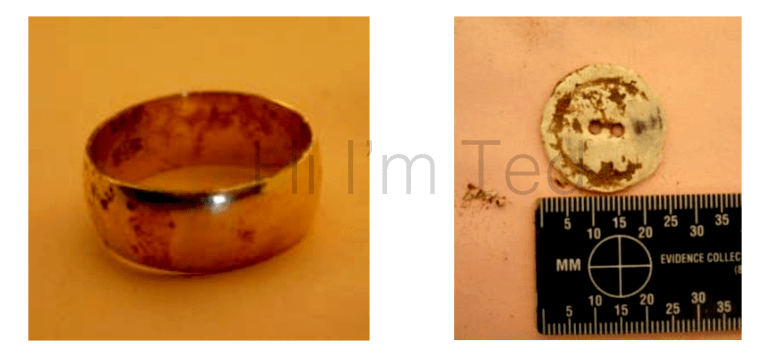
Kerry May-Hardy’s disappearance remained a mystery until September 6, 2010: while digging at a construction site machinery disturbed her remains about five miles from Interstate-90 near the Suncadia Resort (a golf club) in Roslyn, Washington. Her body was uncovered when a backhoe operator digging a waterline ditch came across her remains; at first, the operator noticed her clothing mixed in with the dirt. This site is in fairly close proximity to where Ted Bundy hunted AND lived (in fact, it’s only about 5 miles away from one of his dump sites that was discovered three years after Kerry vanished). She was found in a shallow grave less than two feet below the earth’s surface (to be exact, the depth ranged from 18 to 24 inches) and her skeleton was clad in a blue-colored, long-sleeved shirt with pink buttoned cuffs and a 14-carat gold ring on her left finger, roughly a size 5-6. According to the autopsy, the woman had been dead for at least twenty years, but possibly as long as fifty. No cause of death could be determined from the remains.In a KIRO-TV article published March 22, 2011, Kittitas Sheriff’s department said of the discovery: ‘she had fairly straight teeth with extensive dental work.’ Bundy often left his victims bodies sans clothes so if this was indeed one of his victims perhaps he was in the midst of either perfecting his technique or was too inebriated and sloppy to have remembered to do it? Ted certainly was familiar with the rural portion of I-90 east of Seattle where Kerry was discovered. In early 1974 he drove down that highway many times to get to his ‘dumping grounds’ at Taylor Mountain and Issaquah. He traveled two hours further east that April to abduct Susan Rancourt, a confirmed victim that attended Central Washington College in Ellensburg, WA. The Suncadia Resort is located about halfway between the Taylor Mountain gravesite (where Rancourt’s skull was found) and the college. Much like Bundy’s Taylor other two gravesites, Kerry’s burial place was wooded and remote, yards away from a gravel side road off the interstate. In 1989, Bundy described burying Colorado victim Julie Cunningham in a similar location, saying he would get on the highway and just drive until he found an isolated place to turn off: “I found a side road, a dirt road, turned off onto it and drove maybe a quarter mile off the road.” He made similar declarations about Utah victims Debra Kent and Nancy Wilcox.
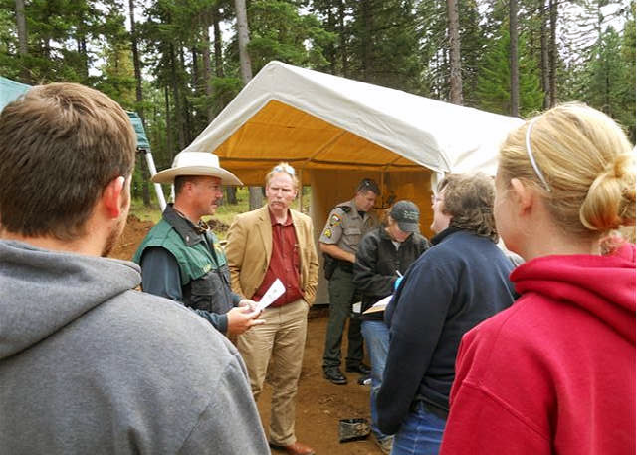
Kerry gravesite was roughly 100 yards away from a minor gravel road off the highway that had been around before the conversion. Law enforcement began careful excavation of the body the very afternoon it was found. Two tents were set up: one related to the excavation site, the other for processing. In addition to the Sheriff’s Department combing the area, two archaeologists from Central Washington University were also on site to help recover and preserve remains, bits of clothing, and any other evidence that was found. It took two full days to remove the entire skeleton. Law enforcement said Kittitas County didn’t have any unsolved cases involving missing women around that time, therefore they felt the victim was an outsider not from the area. One time Kittitas County Undersheriff Clayton Myers said, ‘we have a team of investigators who are working locally and with neighboring counties for missing adult females. It’s a little too early to tell which ones are in the ballpark because we are still struggling with our time frame.’ At the time of Kerry’s disappearance in 1972 the area was isolated, heavily wooded, and used for logging, and it’s worth noting that Bundy often left his victims in remote, wooded locations (such as Taylor Mountain and the Issaquah dump site).
A report regarding the excavation of the body states that it didn’t take investigators long to realize the remains were probably moved there at one point and it wasn’t the original dumpsite (meaning it couldn’t have been Bundy since he was put to death in early 1989). It took law enforcement until the following March to determine that the young victim’s estimated date of death was determined to be sometime in between 1960 and 1990. It was further determined the young girl was between 5’4” and 5’10,” tall and was between 19 and 40 years old (I feel like date of death, height and weight range are all surprisingly broad), and had a large amount of expensive dental work done. At first it was speculated that she was possibly of Hispanic ethnicity however it was eventually determined she was not. Forensic experts entered the victims dental records into a national database and surprisingly there were no hits.
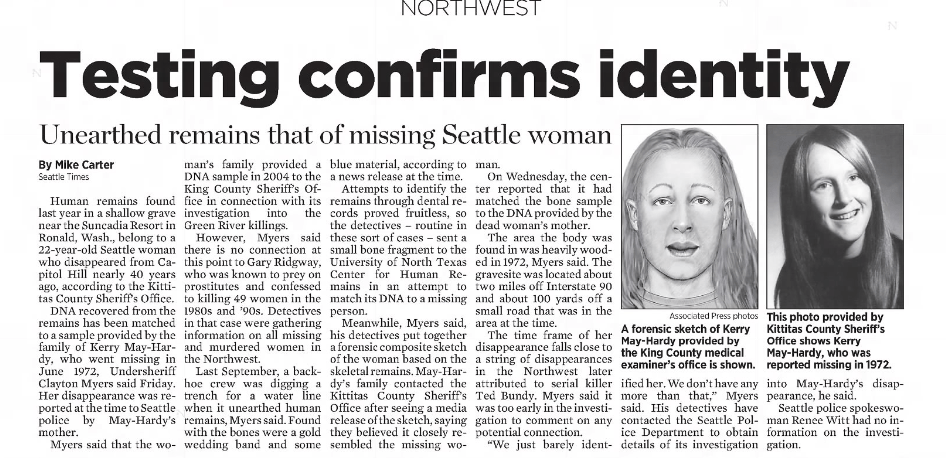
Local Kittitas County law enforcement from where the body was discovered found no female missing persons cases that took place in the county that were consistent with the found remains; because of this police felt that the victim wasn’t from the area. A facial reconstruction image was generated from the remains by forensic artist Natalie Murry in conjunction with the King County Medical Examiner’s Office in hopes that the victim would be identified. Oddly enough, Kerry’s family members did contact law enforcement after they saw the composite drawing and told them that they felt it looked like her. Jeff Norwood (Kerry’s younger sister Carlees husband) said that ‘my wife and my mother-in-law both looked at it and said, ‘Yes, that’s Kerry’’ … ‘when you put her picture up to it. It was Kerry.’ They immediately went to law enforcement to tell them their thoughts. The King County Medical Examiner’s Office used DNA from the 2004 sample they took from Kerry’s mother and compared it to DNA extracted from a bone sample that was sent to the University of North Texas’ Center for Human Remains for genetic testing.
On June 1, 2011 the remains were officially determined to be a match for Kerry May-Hardy. It was announced to the public two days later in a statement by The Kittitas County Sheriff’s Office in conjunction with Dr. Kathy Taylor of the King County Medical Examiner’s Office. On June 6, 2011 Seattle’s KOMO-TV News spoke with Kittitas Undersheriff Clayton Meyers who said investigators were still looking into the possibility that Hardy’s murder could have been related to Ted Bundy: ‘We’ll look into everything’ … ‘we’ll be working with the Seattle and King County investigators who are responsible for those Bundy cases. We don’t have anything at this point, it’s very early.’ Olson said she was almost ecstatic when it was determined that her daughter’s remains were finally identified, saying ‘I don’t care if they find who did it or not. My daughter is going to be home by the end of the week and that’s all I care for.’ Hardy’s sister Carlee Norwood was only 9 years old when her sister disappeared in 1972, however she said that none of the family ever forgot her. She told Seattle based news station KIRO-TV Channel 7 that: ‘she was fun… she was my sister…. she was very close with our whole family, with everybody.’ She went on to say the family never gave up hope that Kerry would come home to them, but that discovery in 2006 did nothing but confirm her worst fears: ‘you always hope, you never give up hope.’ … ‘realistically, I think we knew. My mom did. We all knew. But you just want that closure.’
A dailyrecordnews.com article written by Mary Swift mentions that Rick Norwood was the designated ‘Hardy-Olsen family spokesperson’ for the case, and regarding his sister-in-laws murder commented that: ‘we kind of knew then… we were shocked. We were shocked and also relieved … We’re relieved that Kerry’s been found and we are able to finish the grieving process. She had been gone almost 40 years.’ … ‘We are just now going through the process of dealing with this. At some point, we’ll probably have some kind of service but that has not been totally decided. Kerry’s remains have not been released yet. It’s now a criminal investigation. We don’t know what’s going to happen.’ Norwood never met his sister in law, however he said loved ones described her as ‘a loving family person who cared about the family very much. She was quite a bit older than my wife. She cared for and doted on my wife.’ Lastly Norwood praised the police department, saying ‘we’re grateful to the Kittitas County Sheriff’s Office and Detective Blume for all that they’ve done.’ … ‘They’ve been very wonderful with this family and helping us through this process.’
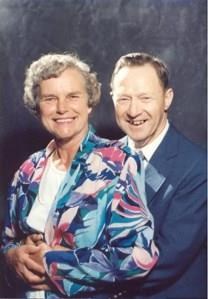
Ms. Olson was 80 years old in 2011 when her daughter’s remains were discovered, and after they were found the Hardy-Olsen family held a celebration of life in her honor. Since Kerry’s disappearance she has fallen out of touch with James May (who remarried in 1992). Sheila said she held onto one thought after being told her daughter was finally found after so many years: ‘welcome home.’ Per Legacy.com she passed away on December 9, 2015.
Bundy’s attorney Polly Nelson claimed her client confessed to her that he attacked and killed a young lady in her apartment building then took her body back into the woods. Was this Kerry May-Hardy? Or one of his many other victims? Obviously her body was moved to where it was found at some point after the golf club was constructed in 2002 but… maybe it wasn’t the original killer who moved it. Maybe a big wig at the golf club who didn’t want to deal with an expensive construction project screeching to a halt stumbled upon the corpse, panicked and moved it (for whatever reason, maybe they didn’t want to deal with the police)… well, that doesn’t make sense, why would they allow a construction team to dig there in 2006? Law enforcement questioned Bundy before he was put to death in January 1989 and he claimed to know nothing about her disappearance.
As of July 2023 Kerry’s case remains unsolved. Ken Hardy still remembers and misses his sister. He grew emotional as he spoke of her, saying that ‘she was musically and artistically talented. Whatever she had decided to do in her life, it would have been cool and she would’ve been recognized for it. I often wonder, how would my life have been different, if Kerry was still here?’ Both of Kerry’s parents passed away before her case was solved: Mr. Hardy died on January 11, 1989 at the age of 59 in Federal Way, Washington; Mrs. Olsen passed on December 9, 2015. The case is being actively investigated by the Kittitas County Sheriff’s Office. If anyone has any information regarding Kerry May-Hardy in 1972, they are asked to contact Detective Andrea Blume at 509-962-7069.
**Edit one: I did eventually write a full piece on Ann Marie (and it took FOREVER).
**Edit two: The piece recently became available at no cost, which allowed me to update this article with new information.










 Another Bundy Blog.
Hi there, just a note to let you know that my blog isn’t called “hi. I’m Ted blog” it’s Ted Bundy: A Killer in the Archives, http://www.killerinthearchives.blog.
I’m glad you liked my article on the Hardy-May case! Here it is, for anyone interested. https://killerinthearchives.blog/the-unconfirmed-cases-kerry-hardy-may-1972/
LikeLike
Every time you’ve ever reached out to me was to point out I was wrong about something.
LikeLike
I’m sorry if I ever hurt your feelings, that was not my intention. I don’t perceive politely worded corrections as being hurtful, personally, so I was surprised that you did. I tried reaching out to you about it, but you ignored me. So, I’d like to apologize if I came off the wrong way or that we got off on the wrong foot. I really was just trying to help, because I do know this subject matter rather well, and I thought I’d share my knowledge. It wasn’t personal, and it wasn’t an attack.
LikeLike
Tiffany, all your stuff is watermarked with Hi I am Ted. She wanted to give credit for the pic. We know it is you because of the watermark and the pics were found on the blog when it was up and running so she was right where she found it.
LikeLike
That’s why I left a friendly correction as to the rebranding. She refers to the blog by a previous title, so I wanted to share the update.
LikeLike
What is the rebranding? Most of your stuff says Hi Im Ted, but what do you want us to put if we use something and yes, I know nothing from the patreon. ( spelling?) Are you now Killer in the Archives? Oh yes, I see it now, half blind, lol She wrote this a while back when you had Hi.
LikeLike