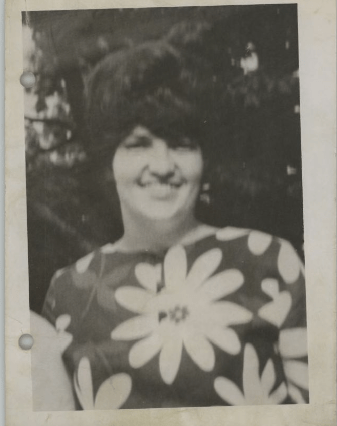
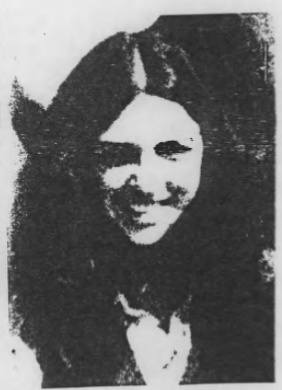
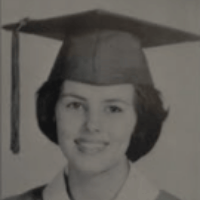
Marjorie ‘Margie’ Sue Fithian.

Background: Marjorie ‘Margie’ Sue Fithian was born on June 4, 1952 to Robert and Elizabeth ‘Betty’ (nee Talkington) Fithian in Greeley, Colorado. Robert Warren Fithian was born on November 23, 1920 in Bayard, Nebraska and after graduating from high school he joined the Army and served in WWII; when he returned home from the war he enrolled at Colorado State College of Agriculture and Mechanic Arts and graduated in 1946. He was employed as an ‘Assistant County Agent.’ Elizabeth May Talkington was born on May 4, 1923 in Belfield, ND, and according to her Ancestry page, after graduating from Fryberg High School in 1941 she attended North Dakota State University in Fargo, where she earned a BS with a focus in Home Economics in 1945; she went on to get a job as a home service director at a gas and electric company. The couple were married on September 19, 1948 and had four children together: Christine (b. 1949), Virginia (b. 1957), David (b. 1960), and Marjorie. They divorced on June 3, 1970 and Mr. Fithian got remarried to a woman named Erma on July 15, 1977 in Reno, NV. After separating from Robert, Betty went back to school at UNC and earned her education degree, and began her career at a local HeadStart Program; she later taught elementary school in district six in Greeley (primarily focusing on Kindergarten). 

A petite woman, Margie stood at a mere 5’0” tall and weighed only 108 pounds; she had auburn hair, green eyes, andwas described as a ‘free spirit’ and a ‘hippie chick’ by her loved ones. She was very trusting almost to a fault and no one could think of any reason why anyone would ever want to hurt her. At the time of her death in June 1975 she was enrolled at Aims Community College in Greeley, and according to the local newspaper she was employed there as well. At some point after graduating from high school Fithian married Vietnam War veteran James Patrick Reese, who was born on June 24, 1945, but the couple divorced on April 5, 1971. After separating from her husband she moved into a trailer in her hometown of Greeley with her 18-month-old son, Dylan Sage (who eventually dropped Dylan from his name), and where no source ever came right out and said that her ex-husband was his father some articles gave the child the last name of ‘Reese;’ Sage’s Dad wasn’t ‘in the picture,’ and lived outside of Colorado.

June 1975: On Friday, June 20, 1975 Marjorie and Sage, along with a single suitcase, made their way to the bus station in Greeley; the twenty-three-year-old single mom had a fun, family-oriented weekend in Denver planned with her aunt and uncle and had intentions of returning early Monday morning. Mother and son arrived safely at their destination and enjoyed some quality time with family, and when their visit was over at around 7 AM on Sunday, June 23rd*, her uncle dropped them at a bus station in Denver to return home on a bus that departed at 7:30 AM (one report specifically says they parted ways at 7:20 AM); the two never boarded. The Greyhound bus driver was later tracked down and interviewed by detectives, and he said that Marjorie and Sage had not been on his bus that morning. *I did see it incorrectly reported that Fithian was dropped off at the bus stop on June 23 but wasn’t found until the 24th, but that doesn’t seem to be accurate, as they went for a weekend and the 24th was a Tuesday (and every other report says that she was found later the same morning).

Marjorie’s cousins, who were with her the weekend before she was killed, were also interviewed by investigators, and they said that nothing unusual had occurred during their brief visit and they had no idea what could have happened to her. When he returned home after dropping the two off at the bus station, Fithian’s Uncle realized that she had dropped some change and had left it behind at his residence, so there is a chance that she may have not had enough money to have been able to purchase the tickets (remember, this is well before the time of cell phones, and a bunch of quarters was a decent amount of currency in the 1970’s). Because of this, some people wonder if maybe she had been forced to hitchhike due to lack of other options.

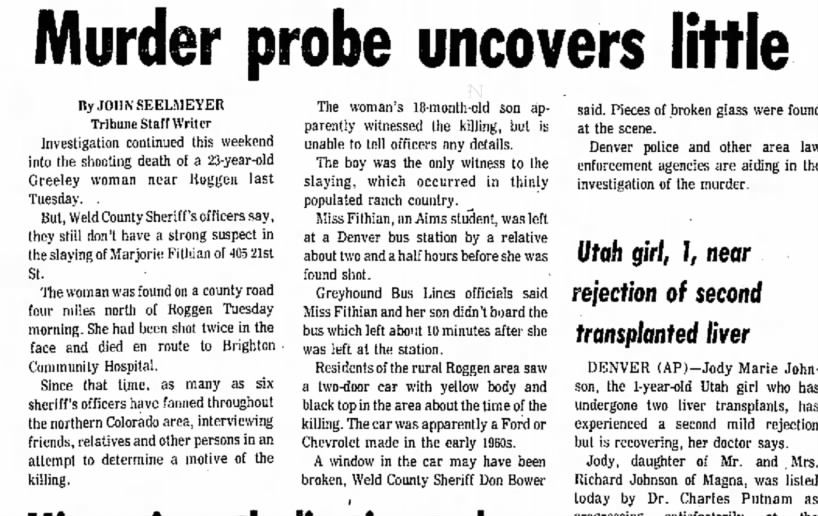
Discovery: At around 9 AM roughly two hours after Fithian’s uncle dropped her off at the bus stop a twenty-four-year-old ranch hand named Terry Furnish was making his way from the eastern part of ‘The Painter Ranch’ to the west side on Weld County Road 386, located between Interstate’s 76 and 35, about four miles north of Roggen. As he was making his way down the gravel road he noticed a car barreling towards him that was moving at a high rate of speed, which was unusual due to the lack of activity in the area: the driver had been in an early 1960’s model two door car (possibly a Ford or Chevrolet) that may have had a broken window and a yellowish/brown body with a black roof that was possibly ripped in one spot. As Furnish got closer to the entrance of the I-76 he came across a ghastly site: a woman lying in the middle of the road covered in blood; sitting with her was a little blond-haired boy, calmly holding her hand. Responding investigators strongly felt that Terry stumbled upon them only moments after they were left there.

Furnish moved the child out of the glass, got back in his truck and flew down the road to a company vehicle that contained a CB Radio. After sending a message out with his location and a description of what happened he raced back to Sage, where he picked up him up and tried to soothe him the best that he could before help arrived. A Colorado state Trooper was the first to arrive on the scene, and after determining that Marjorie had a faint pulse he called for a medic; unfortunately she died on the way to the hospital. According to Weld County Sheriff Don Bower, the child wasn’t harmed and that Fithian was found ‘within a matter of minutes’ after the shooting took place.

Terry’s family had managed The Painter Ranch in Roggen since 1955, and he had only been there visiting from South Dakota, where he was working as a field man (in a newspaper I also saw it called ‘The Two-Bar Ranch’). The stretch of road where Fithian was found was desolate and surrounded by empty fields ‘as far as the eye could see,’ as there were only two ranches in the area at the time and the road wasn’t heavily traveled.

Unsure of what to do with Sage, the officer put him in the back of his patrol car, and it wasn’t long before more state troopers, Weld County Sheriff’s deputies, and a handful of ranch hands that heard the announcement arrived. Looking back at what happened so long ago, Furnish said: ‘I didn’t know what to do. I didn’t know whether to put him in the pickup, but I set him just out of the glass. You just don’t know what would have happened to the little guy, and his mom, too. It’s just so unfortunate, it was so remote then, the ambulance took a long time, over an hour if I remember right.’  

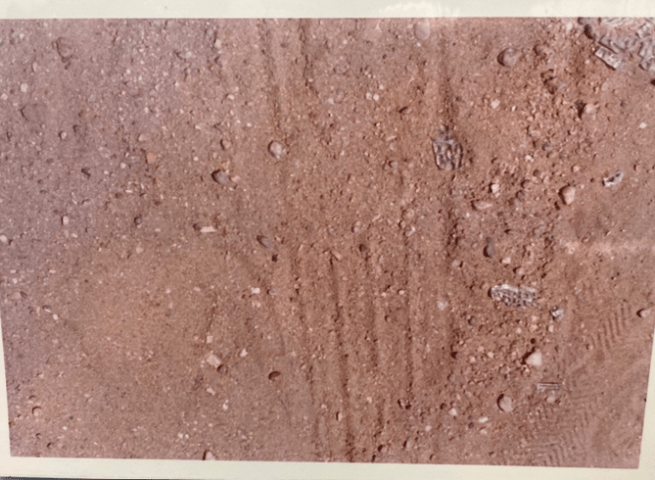
Investigation: First responders immediately secured the scene and began canvassing the area, and even though the roadway had very little traffic LE still shut it down. Tire tracks close to Marjorie and Sage showed the suspect drove their vehicle to the scene from the Interstate-76, pulled a U-turn, then went back towards the highway. As the hours ticked by the investigators had no choice but to take Sage back to the police station while they tried to find someone to claim him. Close to where her body was found, investigators found her coat and a blanket (both of which were placed over her) and up the road they found her suitcase: in it were clothes for mother and son as well as a slip of paper with a phone number scrawled on it that belonged to her Betty Fithian, her mother. This was incredibly helpful, as Marjorie was not carrying any identification with her. Jack Van Arsdale, who was the only detective with the Weld County Sheriff’s Department at the time of the murder in June 1975, said that she told him that her daughter and grandson had traveled by bus to Denver to visit with family.

Elizabeth was able to identify the young victim as her daughter, and told detectives that the young child that was with her was her grandson. Detectives told her to come to the police station to pick up Sage and upon learning the news about Marjorie’s death was ‘absolutely devastated.’ Because the body was still at the morgue being autopsied, investigators were unable to show her the remains when she arrived but decided not to wait for its findings to start investigating the case as a homicide.

Before Betty left with Sage she sat down and spoke with investigators about what may have happened to her daughter: she told them that she had known that the two had gone to Denver to visit with family and were due to return home later that morning because she had classes the next day. At the time she expressed concern regarding the fact that so much was still unknown and what happened and that she was afraid for her grandson, and wasn’t sure if he would be safe.

After speaking with Betty, investigators contacted Denver police, who immediately sent detectives to interview Marjorie’s Uncle. He said the usual things: that they had a nice visit and that nothing out of the ordinary had happened, however he did share that while in Denver his niece had gone on a date with a man that she had been casually seeing. He had taken Margie and her son to the zoo and said that it ‘seemed as if they all had a really good time.’ After learning this the Denver detectives knew they had to track this mystery date down…. But according to Ashley Flowers they had no luck, and there’s no mention that they ever found him in Fithian’s case file (more on this later). However, they did manage to track down Sage’s father, and he had an alibi and was nowhere near Colorado at the time of his ex’s murder.

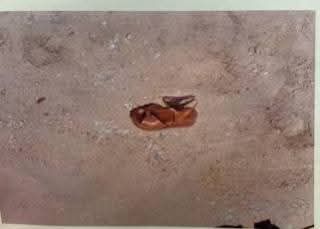
Marjorie was shot twice in the face execution style, and a spent .25 caliber casing was found near her body that investigators felt was most likely discharged from an automatic pistol. She had been wearing jeans, a blouse, and brown leather sandals, one of which had been kicked off to the side of the roadway; her auburn hair had been cut into a classic 70’s shag, and her feathered bangs were saturated in blood from what appeared to be a gunshot wound to her forehead.

Investigators took samples of the broken pieces of glass that were found at the scene and determined that it most likely came from a car headlight or window, which made them suspect that a struggle had taken place before Kithian was shot; additionally, according to her autopsy she had not been sexually assaulted. Notably missing from the scene was any sort of weapon, and as of July 2025 one was never recovered in relation to the murder. Responding officers asked Furnish if the woman had said anything in the moments before they arrived on the scene, but he told them she had been unconscious and actually had thought she had been deceased.

Clues point to the idea that Fithian had been shot elsewhere and had been brought to the dirt road where she was recovered. In an interview with ‘The Deck’ podcast creator Ashley Flowers, Detective Van Arsdale said that as he was making his way to the crime scene he passed the ambulance, and when the EMT briefly stopped he asked if he could hop in and sit with the victim just in case she woke up so he could take a statement, but the paramedic told him that she had just expired. About the incident, Van Arsdale said: ‘I proceeded on down to the crime scene, it was a pretty confusing mess. State patrol cars, a couple farmers, couple of ranchers… a couple of our guys. There was a lot of stuff going on, on the dirt road.’ Afterwards, instead of taking her to the hospital EMT’s took her to the local mortuary, which at the time was owned and operated by the Weld County Coroner’s Office.

Almost right after the murder, Weld County Sheriff’s brought Terry Furnish in for an ‘official’ sit down interview to get the specific details of what happened down in print while they were still fresh in his mind. He told them that he still couldn’t’ recall any specific details about the driver of the yellowish sedan, one thing that did stand out to him was that the cloth on the top part of the vehicle was ripped, that he was ‘100% certain of.’ After learning this, Detective Van Arsdale immediately radioed dispatch and put out a BOLO on the vehicle. Investigators used every single possible option that they had at the time to locate the oddly specific car with the very particular visual flaw, and according to Van Arsdale, ‘they did a lot of work on finding vehicles like that through the Colorado Department of Motor Vehicles. They got a long list of license plates for vehicles that matched that description and looked into who these vehicles were registered to. But ultimately it didn’t come up with any leads, but not for a lack of trying.’  

After he arrived on the scene, Detective Van Arsdale realized that if the crime had taken place shortly after they arrived then they had to act quickly, as it meant the assailant was still somewhere nearby. One of the ranch workers told investigators there were some ‘unusual tire tracks nearby,’ which they determined ‘looked fresh’ and were very close in proximity to the shooting. The Weld County Sheriff’s also reached out to the public and asked for their assistance and requested if anyone had seen anything suspicious the morning of June 23, 1975 to please reach out to them immediately. According to (current) Sheriff Steve Reams, ‘where this crime occurred, is not easily accessible off the highway. You don’t just take an exit ramp and turn, you kinda hafta go out of your way to get where they ended up at.’

On June 25, 1975 Detective Van Arsdale and the Weld County Sheriff returned to the scene of Marjorie’s murder, this time on horseback: the two law enforcement officers rode up and down Weld County Road 386 looking for more evidence that may have missed immediately after the murder… but all they found was more broken glass. Later that same day investigators also searched Marjorie’s residence in Greeley, but they didn’t find anything helpful. It’s also worth mentioning that at her residence detectives found only a small amount of marijuana residue, and there was no indication at all that pointed towards heavy substance use.

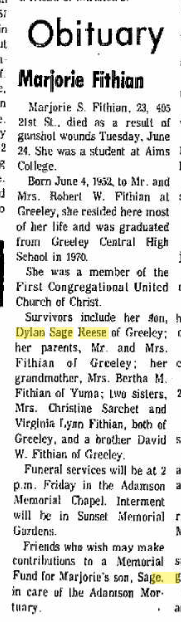
On June 26th news of Fithian’s murder hit the local newspaper, and in addition to publishing her obituary The Greeley Daily Tribune also announced the establishment of a memorial fund for Sage. A handful of locals contacted police and reported that they had seen mother and son at a nearby cafe eating breakfast earlier in the morning before she was killed; another tip claimed that several men had witnessed someone picking them up from the parking lot of ‘The Picadilly Restaurant’ in Denver. In the weeks following the murder detectives across multiple police jurisdictions in Colorado investigated hundreds of Fithians friends/family/acquaintances/and classmates, but didn’t learn much useful information. 

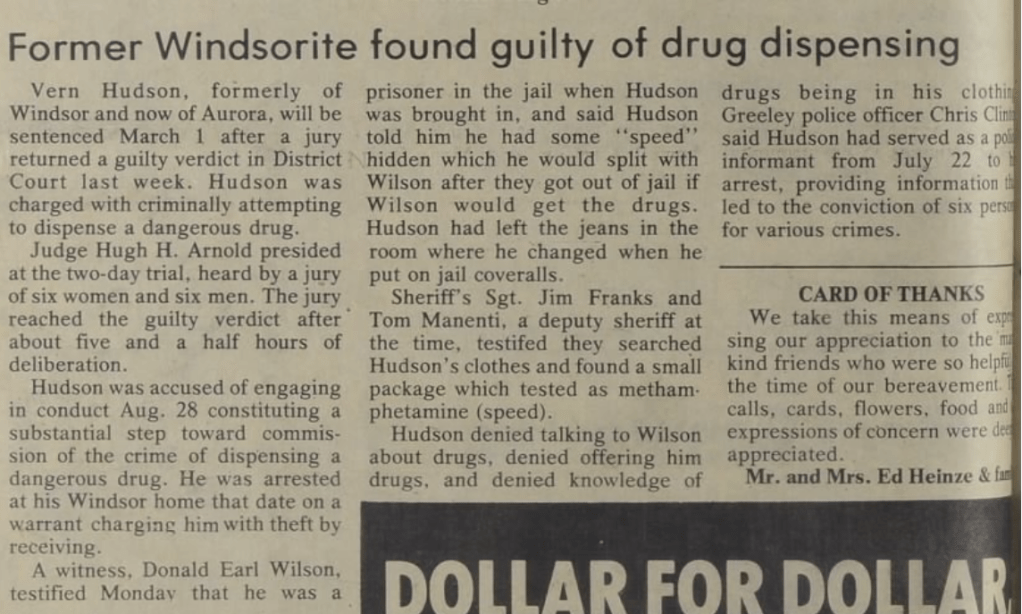
Police also began getting tips about some seemingly low-level criminals, specifically four men named Robert Davis, Vern Hudson, Jerry Walker, and Larry Hernandez, who were all investigated for Fithian’s murder. They were already aware of the four men after having multiple run-ins with all of them, and from the beginning didn’t think that any of them had anything to do with the case.

Around mid-July investigators were notified that two of the men, Jerry and Robbie, had been arrested in a neighboring town for burning down Vern’s garage, which made them even more suspicious in their eyes. This also hinted that there had been a sort of falling out with the members of the friend group, and wondered if it had possibly had anything to do with Fithian’s murder.

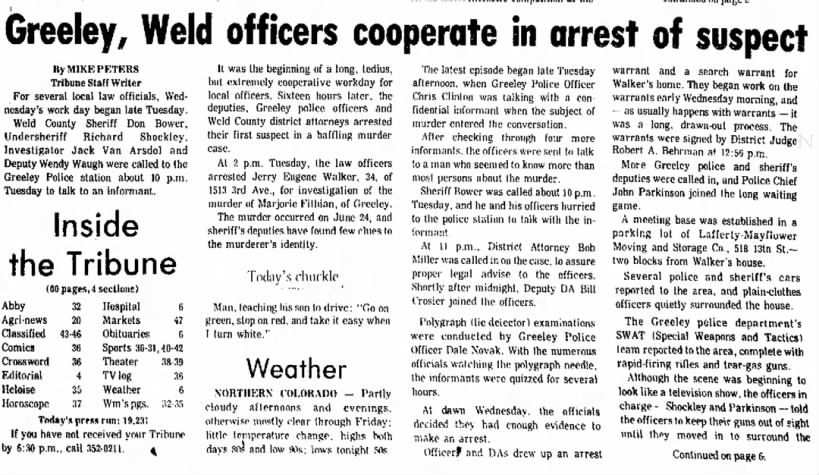
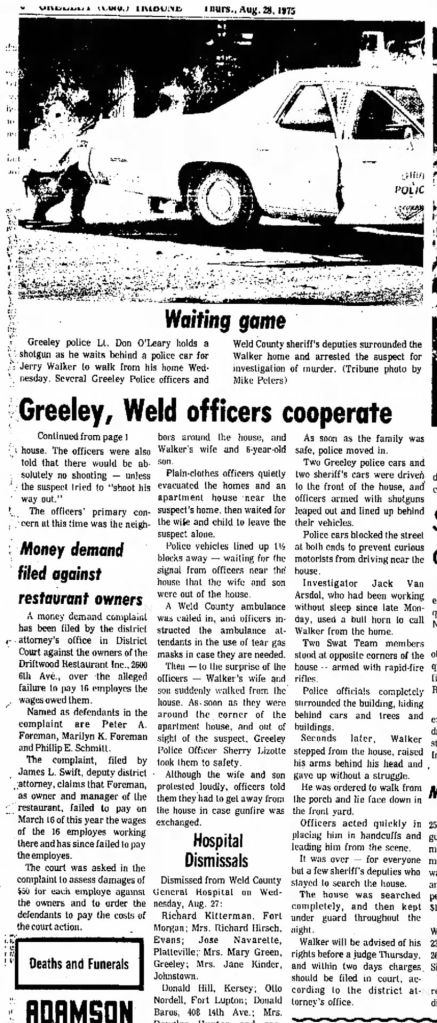
An Arrest: Just a little over two months after Fithian was murdered an arrest was finally made: on August 27, 1975 the Weld County Sheriff’s Department arrested thirty-four year old Jerry Eugene Walker on first degree murder charges based on information provided to the office from a CI. According to Greeley Police Officer Chris Clinton, a local confidential informant reached out to him and shared that Walker told him that he ‘shot the bitch in the face,’ and bragged about killing the young mother; he had also shown him one black and white photo and two color ones of a wounded Marjorie that had ‘gunshot sounds to her face’ and was ‘suffering from wounds.’ After he was taken into custody detectives went to his house armed with a search warrant with hopes of finding the murder weapon, ammo, or any photos of Fithian; they didn’t find anything.

When Walker was arrested a story ran in the local newspaper, which included a picture of him being led away by detectives in handcuffs. The day after Mrs. Fithian called the Weld County Sheriff’s Department and told them that ‘something weird had happened,’ and according to Detective Van Arsdale: ‘she called me and said that the strangest thing just happened: Sage just looked at the picture and said, ‘oh, that’s Jerry.’ It’s the only person that he’s ever identified, or said anything about.’ It was the first thing that Sage ever said about his mother’s death, and it gave the investigating officer chills, and he wondered if maybe the boy recognized Walker because she had a relationship of some kind with him. Until then, the detective had been unsure of Walkers involvement with Fithian, but that made him question things. 

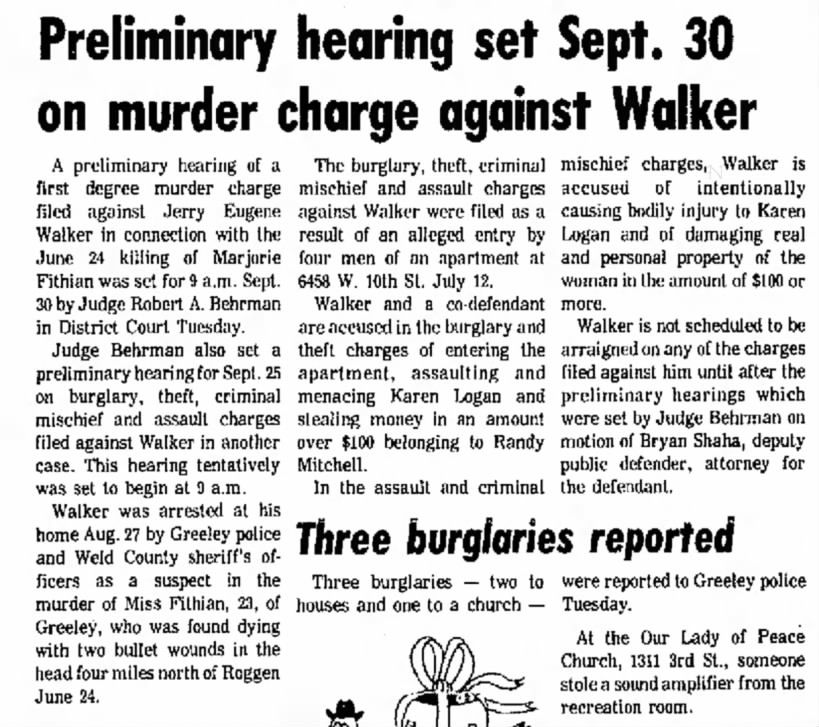
Walker told investigators that he picked up Fithian and her son from the Denver bus station because she was supposed to be transporting drugs for him, but when she failed to produce the substances or money he killed her. On September 30, 1975 the murder charge against him was dismissed due to a ‘lack of evidence,’ however because he was being still being charged with the misdemeanor crimes of arson, criminal mischief, and assault he was released on $5,000 bond; the charges were ‘dismissed without prejudice’ indicating that they could be refiled again in the future if sufficient evidence was found. According to The Greeley Daily Tribune, Walker and a co-defendant were accused of the burglary and theft charges of entering the apartment, assaulting, and menacing Karen Logan and stealing money in an amount over $100 belonging to Randy Mitchell. Additionally, he is charged with causing intentional bodily harm to that of Ms. Logan and of damaging real and personal property of the woman in the amount of $100 or more.

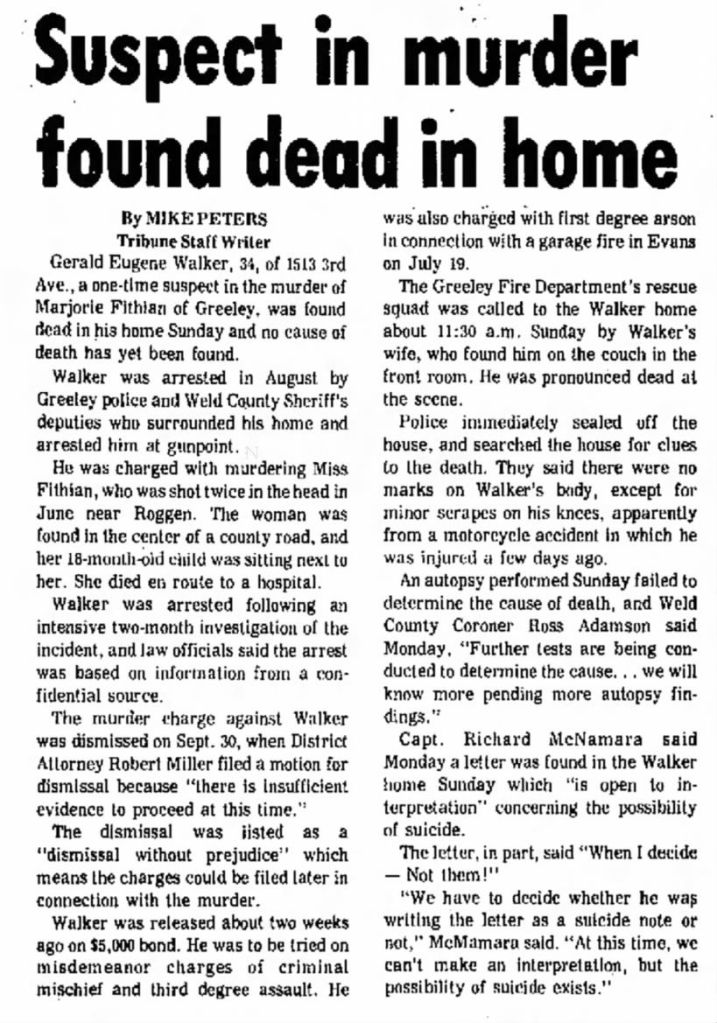
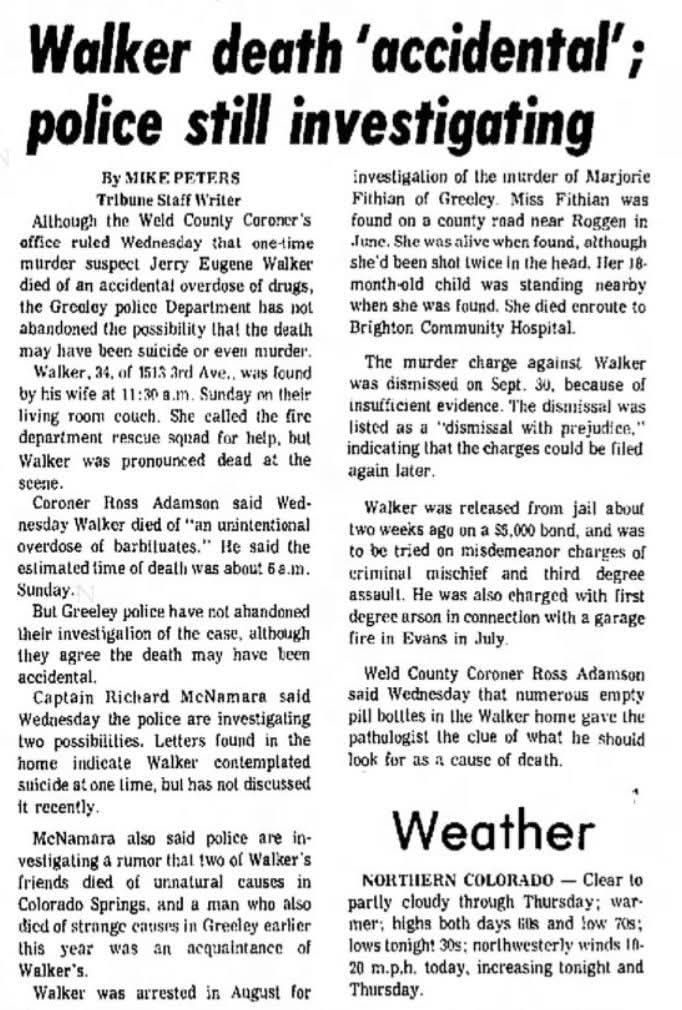
Two weeks after his release, Walker died of an accidental drug overdose while sitting at home in a living room couch: Weld County Coroner Ross Adamson said that Walker died of an ‘unintentional overdose of barbiturates,’ and put his estimated time of death at around 6 AM on Sunday, October 12, 1975. When police and paramedics arrived on the scene they found ‘lots’ of empty pill bottles, and the coroner ultimately ruled the death as an accidental overdose. A Captain with the Greeley PD told the local newspaper that letters found in Walkers house brought up suicide, however according to those that knew him he hadn’t brought it up recently. Captain Richard McNamara of the Greeley PD said that investigators were also looking into a rumor that two of the deceased friends had recently died of unnatural causes in Colorado Springs, and another had passed in Greeley earlier in the year but nothing ever came of it. According to Ashley Flowers, some informants told police that Walkers death wasn’t accidental and was actually ‘tied to Marjorie’s death.’

The investigating detectives got word of a ‘drug party’ that some of the suspects would be attending on October 1, 1975 and they were able to secure a search warrant and raided the event; they arrested everyone present. Jack spoke to Robbie later that night, who said that he ‘was in the car with Vern and Larry when Vern shot her in the face.’ It was at this moment that investigators realized they didn’t know who was telling the truth, as they all seemed to have a problem with one another. Detective Van Arsdale said that at the end of the day he didn’t really believe any of the men’s stories, because every last detail they talked about was public knowledge and was published in the local newspaper: they didn’t give any information that only the killer would have been privy to.

After Jerry died Fithian’s case completely stalled and a year went by with little movement: Weld County didn’t have concrete evidence that linked Walker or Vern Hudson to the murder, and the men kept changing their stories and going back and forth on what happened. In early 1977 the Sheriff’s Department brought Larry Hernandez in for a lie detector test, and before talking with detectives, he allowed himself to be administered sodium pentothal (or truth serum). During the interview he told them that he had made the entire story up about Marjorie’s murder and knew nothing about her death, but he did admit that he sold her weed a few times and the two had gone to the local community college together.

As it turned out, he barely knew her: when he was initially interviewed about the murder in 1975 he was briefly left alone with her case file, and he took it upon himself to read through it and learn intimate details surrounding her murder. Hernandez also volunteered that he fabricated the entire thing because he was angry at the man he previously claimed was Fithian’s killer for ‘ratting on him.’ According to Byron Kastilahn, an investigator with the Weld County Sheriff’s Department: ‘he said he did this because he was mad at the other drug dealer who he’d named as Fithian’s killer. They had a criminal history between them and they’d been narking each other out to the police.’

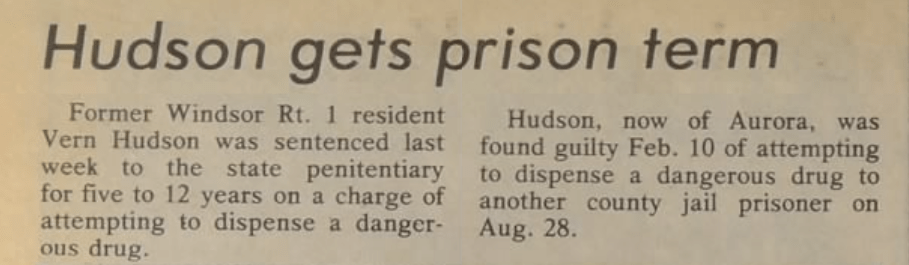
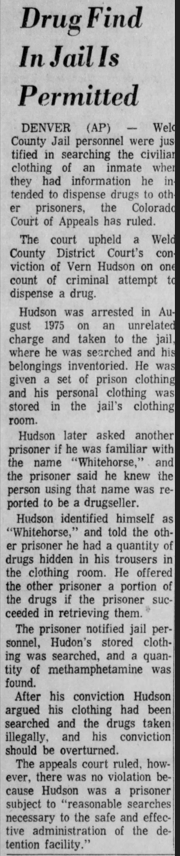
After that, investigators tracked down Vern, who by that time was in prison in Wyoming state and was facing drug trafficking charges. He spoke with them, but like Hernandez he denied having anything to do with Fithians murder. They even gave him a chance to rat on his former friends, but he admitted that the entire thing had been a lie and none of them had anything to do with her death. Hudson died in 2006. In 2020, Kastilahn tracked down Hernandez, who maintained the exact same story that he told in 1977.

After talking to Hernandez, detectives were aghast at the thought that the entire year and a half they spent investigating had been for nothing, and started looking into other possibilities, including the idea that Fithian had been killed by a random person and the murder was a crime of opportunity and not one with motive. They also wondered if perhaps her killer had tried to ‘put the moves on her,’ and when she turned him down he got angry and attacked her. Additionally, they were almost certain that robbery wasn’t the reason for the homicide, as she didn’t have any money and all of her possessions were found at the scene. According to Detective Van Arsdale, ‘I think somebody picked her up… her dad said that she was a pretty friendly gal, I think somebody realized at the bus station that she didn’t have any money and offered her a ride.’

But, Sheriff Reams said that two gunshot wounds to the face execution style didn’t sound like a random crime: ‘to me, it always seemed like it was a very personal thing, I guess the circumstances surrounding Marjorie’s death. Someone knew that she was going to be traveling with her kid… now, could they have just picked them up at a bus stop? Yes, but to kill her and leave her son behind. That’s almost as if there’s a personal relationship that was formed there, with anger involved… that’s what it came across as to me. But, we just don’t know. Obviously, it doesn’t really take that many shots to kill someone, typically we would call that an overkill. It’s not necessary, and again, just taking her out to a remote location, and she trusted whoever enough to at least travel with them.’   

But if Marjorie and Sage did take a stranger up on an offer for a ride home to Greeley, how did they wind up in Roggen? After a certain amount of driving in the wrong direction wouldn’t she have said something (or maybe she did, we’ll never know)? According to Sheriff Reams, ‘she was trusting enough of someone to not even try to get out of the car at a stop sign or anything like that, which tells me that there was some kind of relationship that was probably there. And then the two shots then the dragging her out of a car and leaving her on the side of the road with her kid with her kid, then driving off. That speaks to me as a stranger killing, but I can’t rule that out.’ There is a slight chance that when Margie and Sage were left on the dirt road that she was already fatally wounded, however detectives strongly feel that it was the location where she was shot, as there is no other way to explain the glass found on the ground. According to Detective Van  Arsdale, ‘I think she was shot inside the car. He went around, he took her out, then shot her a second time on the ground.’

To Detective Van Arsdale, it all came back to timing: there was only a two-hour window in which Fithian could have been killed, and it took roughly an hour and a half to get to Denver from Greeley; from there, it was (almost) another hours drive to Roggen, which means it would have been highly unlikely that she would have called Walker (or one of the other three men) for a ride, and they wouldn’t have been able to pull it off unless they were already in the area. According to Detective Van Arsdale, ‘I don’t believe any of them. I keep coming back to: 7:30, she got on the bus, or the bus was there. And she didn’t get on it but her uncle dropped her off there at 7:30, and then at 9:30 she’s on a dirt road out in Roggen. I don’t think she could have called Jerry Walker to come and pick her up and give her a ride home, or Vern Hudson. And I don’t know if they would have been at the bus station. And I don’t think anybody knew because she was just coming home from her uncles from spending the weekend there.’ 

Drugs?: With no real leads in the investigation, theories began to swirl about what may have happened to Marjorie. One that detectives considered was that she may have been transporting drugs from Greeley to Denver, given she had what the Weld County Sheriff’s Department called a ‘history of marijuana use,’ and according to Detective Kastilahn: ‘they thought (Fithian) might have acted as a drug mule, transporting drugs from Denver somewhere else.’ Other theories included that she may have been hitchhiking or had been purposefully ‘targeted by an unknown assailant,’ which Detective Van Arsdale called ‘unlikely.’

Ottis Toole: Months then years went by with almost no movement on Marjorie’s case. In 1982 a serial killer came onto investigators radar after he admitted to committing some murders in the state of Colorado in the 1970’s: Ottis Toole. According to a 1984 article published in The Daily Sentinel (which is a newspaper based out of Grand Junction), Toole confessed to a 1974 murder in Colorado Springs, which he later recanted. Despite this, investigators were able to find evidence that helped prove that he was in fact in the state of Colorado in the summer of 1975, so they went to talk to him while he was in prison, but he wasn’t very helpful. There is no actual evidence that Fithian was killed by Ottis Toole, and as we all know he would often confess to murders that he didn’t commit. He died at the age of forty-nine while in prison.

Detective Kastilahn suspects that because Toole knew he was going to die in prison he had nothing to lose, and that is probably why he confessed to so many homicides that he had nothing to do with: ‘he claimed to have killed people in Colorado, but he was so vague in his statements that to my knowledge, he wasn’t really linked to anything in Colorado. He claimed to have been in Colorado, and claimed to have killed people in Colorado, but that wasn’t verified.’ … ‘He said, you know, he really couldn’t remember… um, the detective was trying to describe where the murder happened, north of Denver, northeast of Denver. He was just, non-committal. Like, ‘yeah, I’m not sure if I was there. I might of killed her,’ is what he basically said.’  

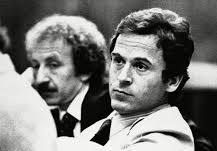
Ted Bundy: At the time Marjorie was killed in late June 1975 Ted Bundy was still out in the community living the good life and wasn’t arrested until later that August. He was residing in his first Utah apartment located on First Avenue in SLC and was attending law school at the University of Utah; he was towards the end of his multi-year, long-distance romance with Elizabeth Kloepfer, who he was not even remotely faithful to.

In a Reddit group called ‘r/CrimeJunkiePodcast,’ a user going by the handle ‘Awakeningosiri’  posted about Fithian’s murder and whether or not Bundy could have been responsible for it, and she brought up a lot of good points: ‘Bundy was in the right region, at the right time, with a known victim type and vehicle match. This case has more circumstantial alignment than many others tied to him. His geographic range and risk profile by 1975 make him a strong person of interest.’

Roggen is only about an hour and a half away from Vail, where Bundy abducted 26-year-old ski instructor Julie Cunningham on March 15, 1975, and as we know he was known to drive long distances when stalking his prey and often did it in public places (like a bus station). For example, he drove over 262 miles to Sackett Hall at Oregon State College to abduct Kathy Parks while he was living at the Roger’s Rooming House on 12th Avenue in Seattle. However, Fithian was killed with a gun, and where it isn’t confirmed that Ted used such a weapon Carol DaRonch said that when he tried to kidnap her on November 8, 1974 he pulled out ‘a small pistol’ (its also worth mentioning that most of his victims weren’t recovered so we’ll never really know how he killed them). Additionally, it was reported that the suspicious vehicle fleeing the scene was a 1960’s yellow/brownish car with ripped black roof, and as we all know Bundy drove a solid-colored beige 1968 VW Beetle.

This is also fairly obvious, and if you’re a seasoned reader you don’t need me to point out that Marjorie also fit very neatly into Bundy’s typical victim type: she was slim, young, and beautiful, and had light brown hair that she wore long and parted down the middle. She was also traveling alone and was in a public place, however I’ve never heard of him going after a woman that had a child with them. Like Toole, there is no evidence linking Ted to Fithian’s murder.

Recent Years: In the early 2000’s Fithian’s case was reopened, and detectives hoped that a fresh set of eyes on the investigation (as well as modern day forensic techniques) would help them, however that wasn’t exactly what happened. According to Sheriff Reams, who was a detective at the time, ‘in 1975 in Weld County the resources just probably were not as available to work a case like this. And the manpower that would have been necessary to track down those leads and find people in Denver and various other areas and it seems simple now, I wish we could go back and try again. And every year that goes by you realize it’s just that much farther from probably having that likelihood. I worry about all that stuff, and to be honest with you when I went back and looked for this case file I was able to find a certain amount of information that was stored on-site. And then once I got back from the FBI Academy I went out to a place where we used to store archives and I found another box of documents or evidence related to this case: photo and what not that were in a place where those items should have never been. And so, yeah I worry about  what steps were done and not properly documented or not or were properly retained. I hate the idea of potentially saying, ‘hey, basics steps weren’t taken, and if they were they certainly weren’t done in a way that was documented that we would have expected by today’s standards.’’

Even Detective Van Arsdale said that looking back, if he could do it all over again, he would have handled the case completely differently and would have done a much better job at documenting what happened: ‘We didn’t have our act together very well. We had not gotten our crime scene techs trained yet, they weren’t in place. So we had those patrol officers trying to do their job but they didn’t really know what they were doing.’

Sage: Marjorie’s son is now in his fifties and agreed to speak with Ashley Flowers and her team of investigators for a podcast about his mother: ‘my first name is Dylan, and I’m named after Bob Dylan. And then Sage I think after Sage Brush. So, you know, that’s definitely from that era of time, I think. She was a painter, she wrote poetry and I have a couple scrapbooks of some of her work. And we all have pictures or paintings as well.’ He went on to tell Flowers that he has some of his mom’s vinyl albums and where none of his kids got her red hair he wonders if perhaps they got some of her talents. He also said that his aunt and grandma did a good job of protecting him from the brutal details surrounding her death when he was a kid, and about it he said, ‘you know, I think about my children at that age, and to tell them… yeah, that would be difficult for them. I had a good support system around me.’ He also said that over the years he’s tried not to obsess about the investigation or why his life was spared, but he would still like to know who did it, if only for his family: ‘I don’t think you can lose a daughter or a sister or a mother and not be traumatized by it., especially when it’s the way that it happened. So, you know, kind of putting the pieces together, again, just to bring closure for everybody.’

In March 2020 Detective Kastilahn began working on Weld County cold cases full time, and he knew there was a lot of pressure to get this murder in particular solved. So, he immediately got to work reading through all the case notes and began reinterviewing everyone that was still alive from the original investigation. The following month he tracked down Robbie, who was the only one of the four original men that were investigated for Fithian’s murder: he admitted that he lied about everything and had completely made up the story about Vern shooting Fithian because he was mad at him about something at the time, and said that was why they had burned down his garage.

In the spring of 2020, Detective Kastilahn was able to track down the young man that Marjorie had gone on a date with on the day before her murder, who told him that he was in fact interviewed by police back when the crime took place in 1975 despite there being no record of it anywhere in the case file (even though he was never considered a suspect). The detective did admit that one thing stuck out to him about the man that made absolutely no sense to him: he said that he was the one that dropped Marjorie and Sage off at the bus station in Denver the morning she was killed, which completely contradicts what police thought was the truth. Fithian’s uncle has since passed away so there’s no way to confirm this, however Kastilahn suspects it’s a simple memory mix-up and that he was confused. Ashley Flowers asked the detective what kind of car he drove at the time and if it matched the sedan that was seen speeding away from the scene on the morning of the murder, but he said he has no idea.

Detective Kastilahn also tracked down the cousins that Fithian had visited with in the days prior to her death, and they all maintained that they don’t remember anything out of the ordinary about the visit: ‘It’s an unfortunate case as far as leads go. Nobody had threatened her and her family and friends didn’t know of anyone that had a problem with her.’

The last significant event in relation to the case happened in the fall of 2020 when Weld County Sheriff’s received a phone call from a woman who had a strange encounter in June 1975 around the same time that Marjorie was killed: according to Detective Kastilahn, ‘she said that she was walking north of UNC, maybe on 13th Avenue on 12th Avenue or someplace around there. Back around this time in June 1975 there was this guy in a van slowly following her, and she’s walking down the road. And she’s looking back and he’s just staring at her. And she looks super creepy. And she’s not liking this at all. So the van finally goes ahead and turns right, so she keeps walking and then as she’s walking she sees the van is parked on that cross street, like it was waiting for her. And so she starts walking up to this house, like maybe he’ll think that I live here and he’ll leave me alone. Well, the van starts up and comes over and parks in front of the house so she goes into the house and she’s freaking out now and she thinking ‘thank God the door was unlocked. So she goes into the house and closes the door. And then there’s this old couple in their sixties that were sitting in their chairs reading the newspapers going, ‘what is this lady doing?’’

‘And she locks the door and hides behind the door, and the guy comes up and starts banging on the door and he tries to open the door. Like, thank God she locked it. So, that’s a crazy story. She didn’t get a license plate or anything but she wanted to give this information to us.’ The detective said that he couldn’t help but wonder if perhaps there was a man stalking young women in June 1975 in Colorado and wishes there was some DNA to work with, but none was collected at the scene and that ‘it’s going to take either a confession or somebody to get implicated. A confession is probably the best thing that’s going to get complete closure and a conviction.’

Sheriff Reams told Flowers that he has worked some nasty cases, but never one quite like this one: ‘It’s only by the grace of God that kid is still alive, and his life was spared. I can’t imagine what went through someone’s head or how they could sleep from that day forward, knowing what they’d done. Even if we never solve it, I hope that they burn in hell for the rest of their lives for what they did.’

Conclusion: Thankfully about his mother’s murder Sage doesn’t remember anything, and only knows stories about her secondhand through her family and friends memories. He now resides outside of Colorado with his wife and children.

PFC James Reese died at the age of 71 in Phoenix, CA and according to his meager obituary, he ‘passed away on June 29, 2016 and if you have any information regarding this person, please call Legacy Funeral Home.’

Marjorie’s father died at the age of eighty-four on February 27, 2005 in Greeley and he is laid to rest at Fort Logan National Cemetery in Denver; his wife Erma passed away on November 2, 2001. Her mother passed away at the age of eighty-six on December 12, 2009 in Greeley, and according to her obituary she retired from teaching in 1987 and afterwards became a Peer Counselor for North Range Behavioral Health for five years; Betty was a life long student, reader, artist, and strong Christian woman. As of July 2025, Marjorie’s sister Virginia Lynn is 68 years old and lives in Elizabeth, Colorado, and her other sister Christine is still residing in their hometown of Greeley; David Warren Fithian also currently resides in Greeley with his wife.

About the murder, in 2002 Terry Furnish said: ‘as long as it’s been, it’s hard to say. I wish I knew more, I really do. I’ve thought about it a thousand times. Had I come up on it right when it happened and the people would have been there you wonder what you would have done then because there’s probably a good chance you would have been shot at, also. It’s a sad thing and you’d like to see closure but with it being so long ago it’s a hard thing, but they do that every once in a while.’ As of July 2025 it is unknown if Marjorie’s DNA was ever tested with modern forensic techniques, however it is known that no sample was collected at the crime scene back in June 1975.

Works Cited:
‘Cat Leigh.’ ‘Toddler Found Holding His Dying Mother’s Hand On The Side Of A Road.’ (August 5, 2023). Taken July 8, 2025 from medium.com
Ashley Flowers, The Deck Podcast: ‘Marjorie Sue Fithian – Wild Card, Colorado.’ Taken July 10, 2025 from thedeckpodcast.com
Gabel, Rachel. ‘Rural Colorado murder from 1975 sparks national attention.’ (August 19, 2022). Taken July 7, 29025 from thefencepost.com
Hudson, Edward. ‘City Detective Held As a Slayer for Hire.’ (February 15, 1976). Taken July 11, 2025 from theNewYorkTimes.com
Moylan, Joe. ‘A look at more of Weld’s most heinous crimes.’ (May 28, 2020). Taken July 10, 2025 from GreeleyTribune.com
‘Segura, Daniella. ‘Toddler found holding dead mom’s hand in 1975, CO cops say. Now, push for answers.’ (June 25, 2025).
‘TaraCalicosBike’ on Reddit, post titled: ‘In June of 1975, twenty three year old Marjorie Fithian was found dead on a desolate gravel road in Colorado. She had gunshot wound to her face, and her 18 month old son was sitting beside her, holding her hand. Who killed Marjorie?’ in the hub, ‘UnsolvedMysteries.’
Worrell, Georgia. ‘Greeley woman killed for unknown reasons.’ (April 22, 2022). Taken on July 8, 2025 from http://www.longmontleader.com

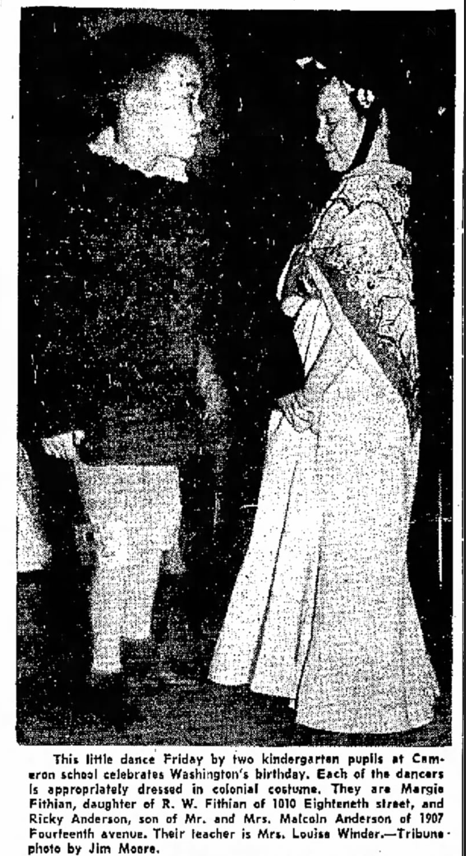
A picture of a little Marjorie published in The Greeley Daily Tribune on February 22, 1958.
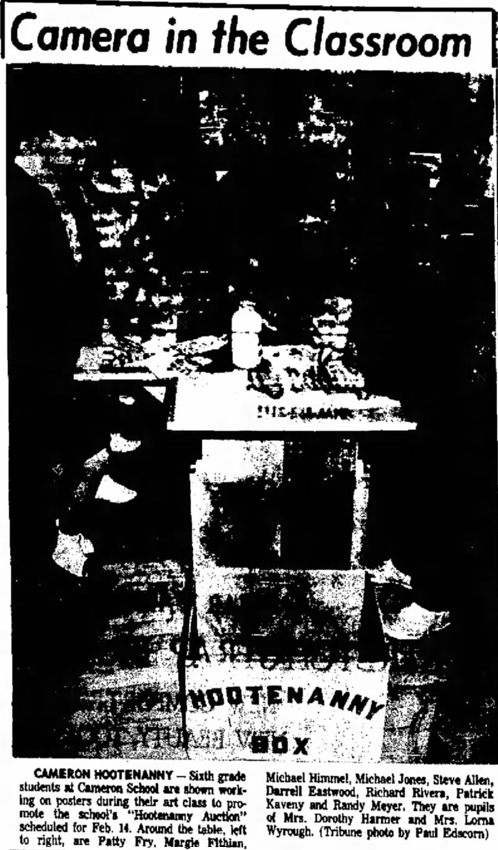
A horrible quality picture including Marjorie from her time at Cameron Elementary School published in The Greeley Daily Tribune on January 21, 1964.
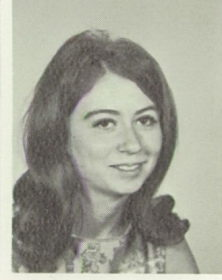
Marjorie from the 1968 Greeley Central High School yearbook.
The only picture of Marjorie from the 1970 Greeley High School yearbook (she didn’t get her senior portrait done).
A picture of Marjorie after she won an art contest published in The Greeley Daily Tribune on March 26, 1970.
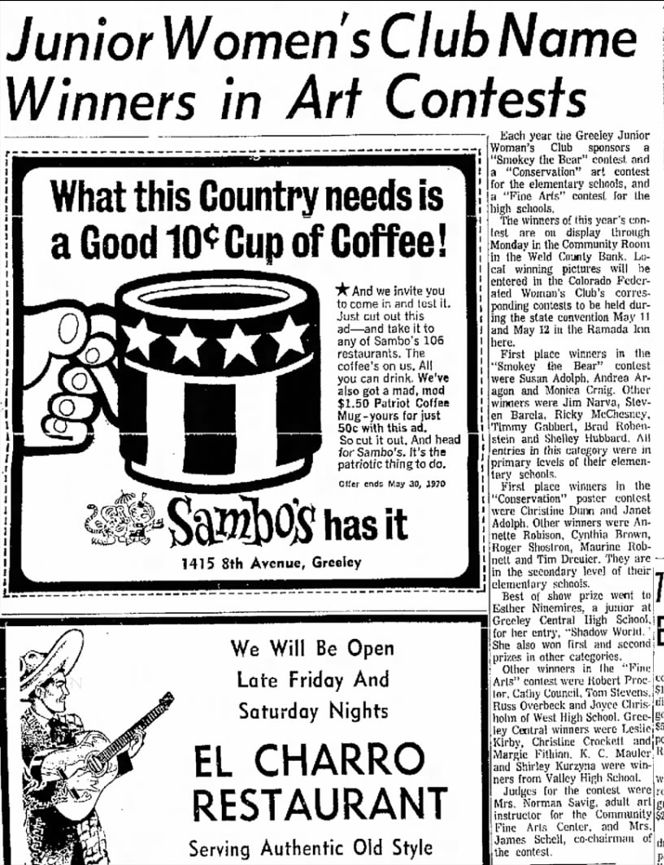
Marjorie’s name is listed in an article published in The Greeley Daily Tribune on March 26, 1970. It’s about an art contest that was judged by Greeley’s ‘Junior Women’s Club,’ and she won in the ‘fine arts’ category.
Marjorie’s name is listed among the graduates of Central High School published in The Greeley Daily Tribune on June 2, 1970.
Marjorie and her son.
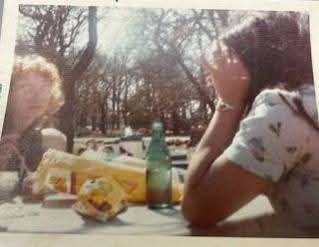
Marjorie and a friend.
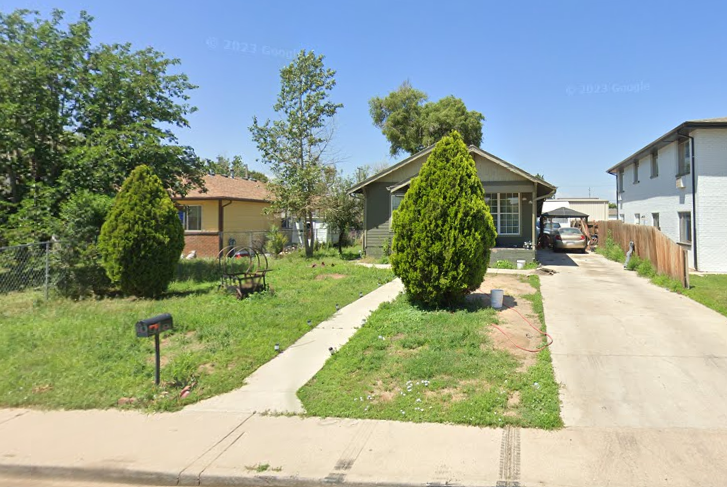
Marjorie’s residence at the time of her death located at 405 21st Street in Greeley, Colorado.
Marjorie’s final resting place.
Marjorie was found on the side of Weld County Road 386, a dirt road in Roggen, Colorado along with her eighteen-month-old son Sage in June 1975; photo courtesy of the Weld County Sheriff’s Department.
The stretch of road where Marjorie and Sage were found in June of 1975, photo courtesy of the Weld County Sheriff’s Department.
A spent .25 casing, one of Fithian’s sandals, a jacket and blanket used to cover Fithian by first responders, and a suitcase were found at the scene, photo courtesy Weld County Sheriff’s Office.
Marjorie’s sandal, which was found near her body; photo courtesy of the Weld County Sheriff’s Department.
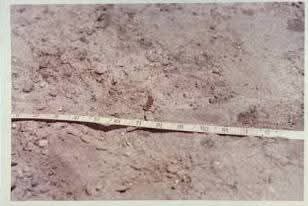
Upon arriving on the scene, investigators from multiple police jurisdictions found a spent bullet casing near Marjorie and Sage, which was most likely from a .25 automatic pistol. Photo courtesy of the Weld County Sheriff’s Department.
A farmer found these tire tracks close to the crime scene; photo courtesy of the Weld County Sheriff’s Department.
What the road where Marjorie and Sage were found looks like today; photo courtesy of the Weld County Sheriff’s Department.
Where Roggen, Colorado is located when compared to Denver and Greeley.
This is the picture of Jerry Walker that Sage saw and identified, photo courtesy of the Weld County Sheriff’s Department.
A picture of Weld County Deputies along with members of the Greeley PF arresting Jerry Walker, published in The Greeley Daily Tribune on August 28, 1975.
Where Jerry Walker was living at the time of Fithian’s murder, located at 1510 3rd Avenue in
Greeley, Colorado. Technically, it’s where he died as well.
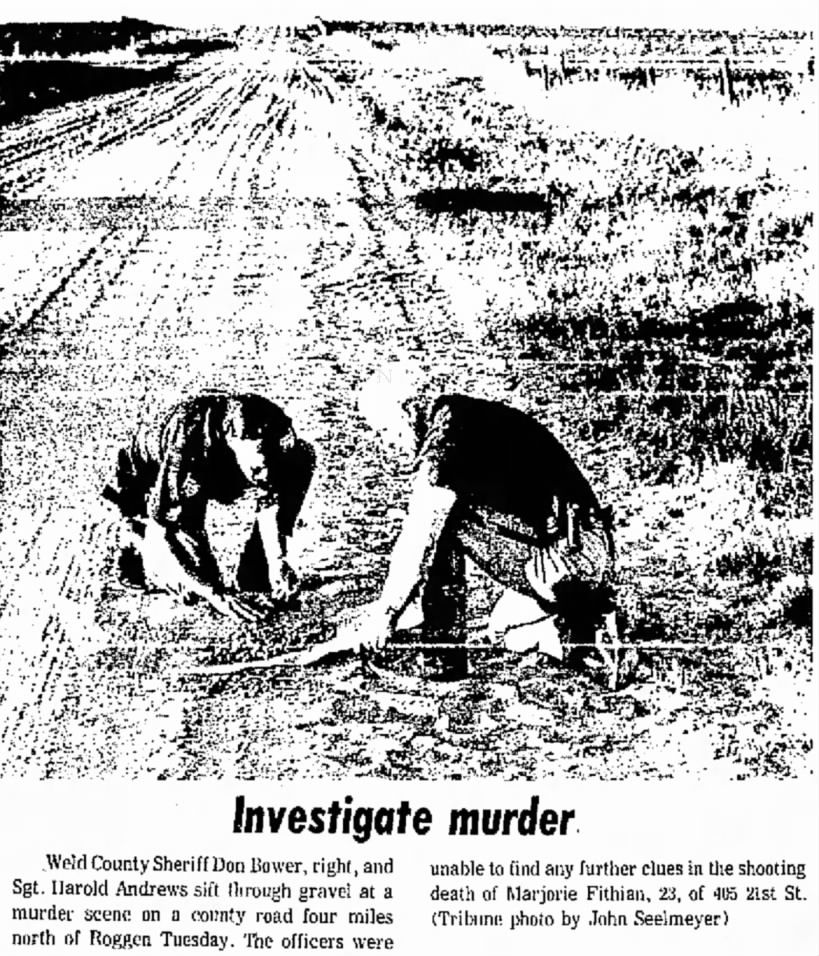
A picture of Sheriff Bower and Sergeant Harold Andrews investigating the scene of Marjorie Fithian’s murder, courtesy of The Greeley Daily Tribune on June 25 1975.
A picture of investigators at the scene of Marjorie’s murder published in The Greeley Daily Tribune on June 30, 1975.
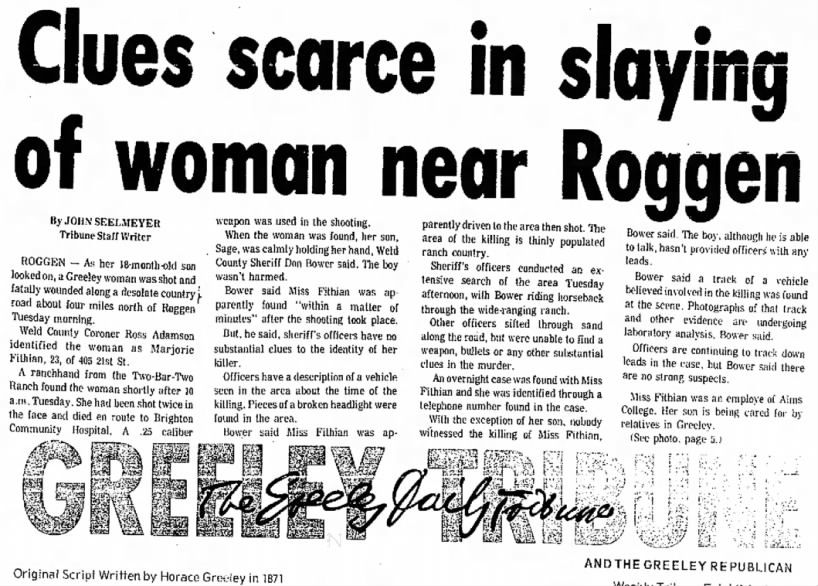
An article about the murder of Marjorie Fithian published in The Greeley Daily Tribune on June 25, 1975.
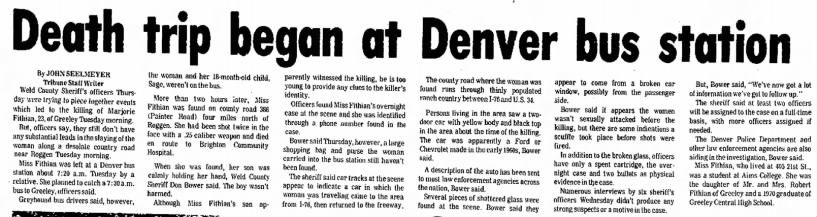
An article about the murder of Marjorie Fithian published in The Greeley Daily Tribune on June 26, 1975.
Marjorie’s obituary published in The Greeley Daily Tribune on June 26, 1975.
An article about the murder of Marjorie Fithian published in The Greeley Daily Tribune on June 30, 1975.
An article about Marjorie Fithian being honored post-humorously for some volunteer work she was involved with published in The Greeley Daily Tribune on June 30, 1975.
An article about the investigation of the murder of Marjorie Fithian published in The Greeley Daily Tribune on July 14, 1975.
An article about the a suspect being arrested for the murder of Marjorie Fithian published in The Greeley Daily Tribune on August 27, 1975.
Part one of an article about the arrest of Jerry Walker for the murder of Marjorie Fithian published in The Greeley Daily on August 28, 1975.
Part two of an article about the arrest of Jerry Walker for the murder of Marjorie Fithian published in The Greeley Daily on August 28, 1975.
An article about the arrest of Jerry Walker for the murder of Marjorie Fithian published in The Greeley Daily Tribune on September 10, 1975.
An article about the arrest of Jerry Walker for the murder of Marjorie Fithian published in The Greeley Daily Tribune on September 26, 1975.
An article about charges being dismissed against Jerry Walker for the murder of Marjorie Fithian published in The Greeley Daily Tribune on September 30, 1975.
An article about the death of Jerry Walker published in The Greeley Daily Tribune on October 13, 1975.
An article about the arrest of Jerry Walker for the murder of Marjorie Fithian published in The Greeley Daily Tribune on October 15, 1975.
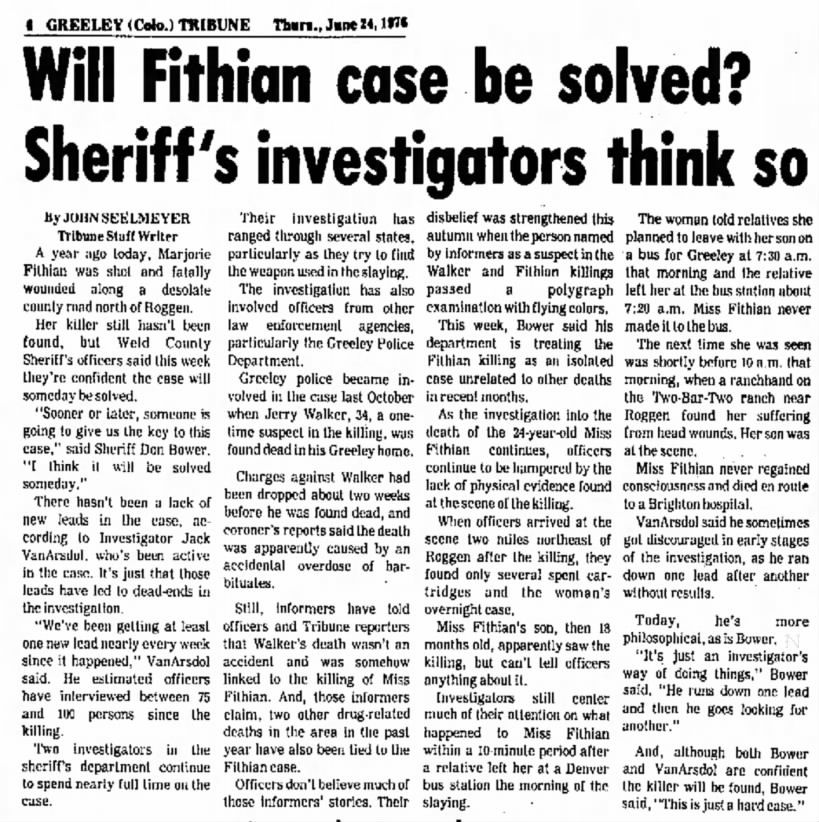
An article about the murder of Marjorie Fithian published in The Greeley Daily Tribune on June 14, 1976.
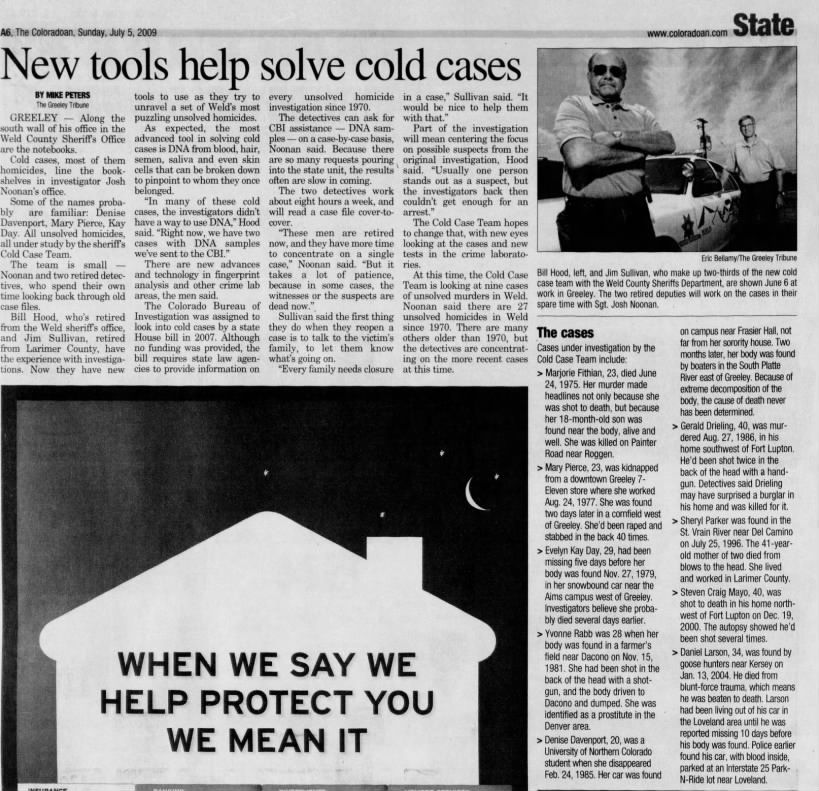
An article about new technology helping solve cold cases in Colorado that mentions Marjorie Fithian published in The Fort Collins Coloradoan on July 5, 2009.
A newspaper clipping about Marjorie’s sister petitioning for custody of her son published in The Greeley Daily Tribune on August 11, 1975.
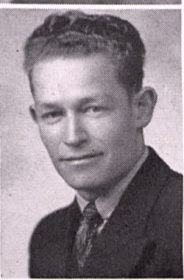
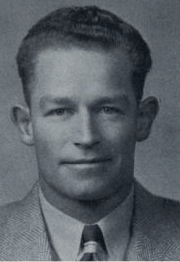
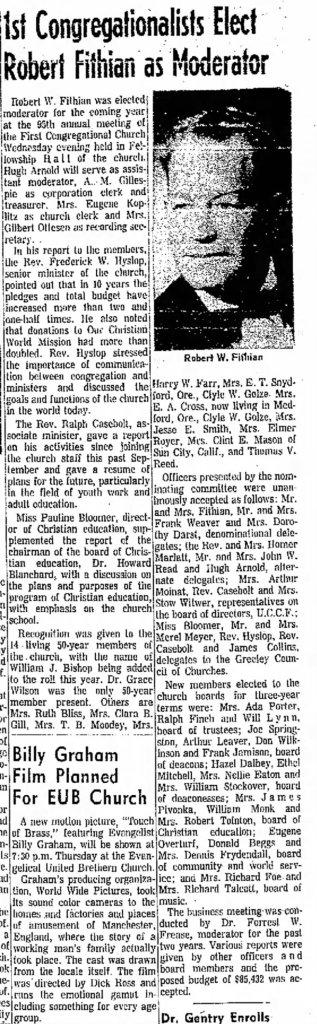
Marjorie’s father, Robert Warren Fithian.
A picture of Robert Fithian from the 1946 Colorado State College of Agriculture and Mechanic Arts yearbook.
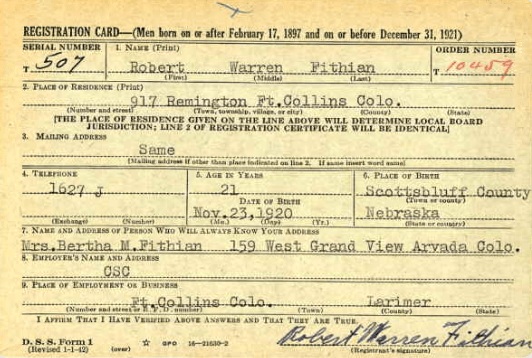
Robert Warren Fithian WWII draft card.
A clipping about Robert Fithian recommending that the public make sure to ‘cut their alfalfa crops’ so they don’t get infested with weevils, published in The Windsor Beacon on June 17, 1948.
‘Well it’s weevil season, but we were prepared.’
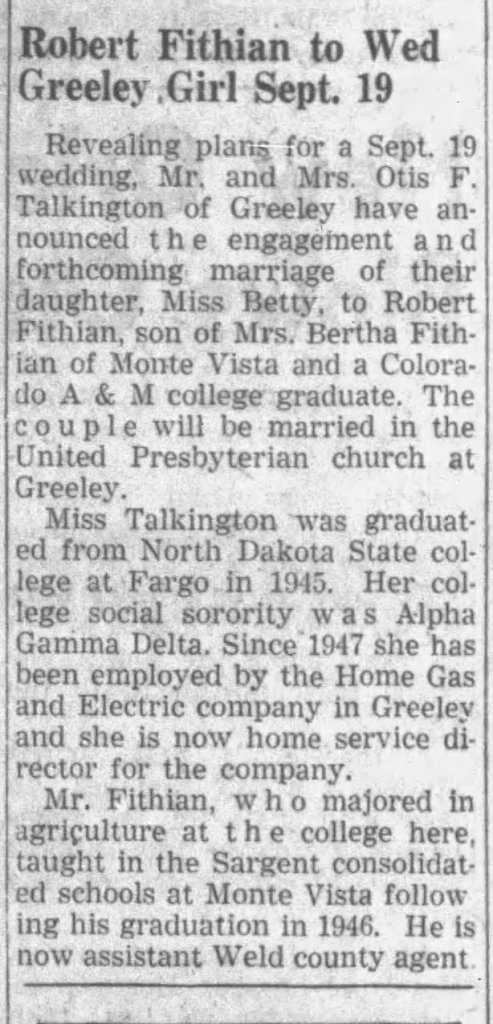
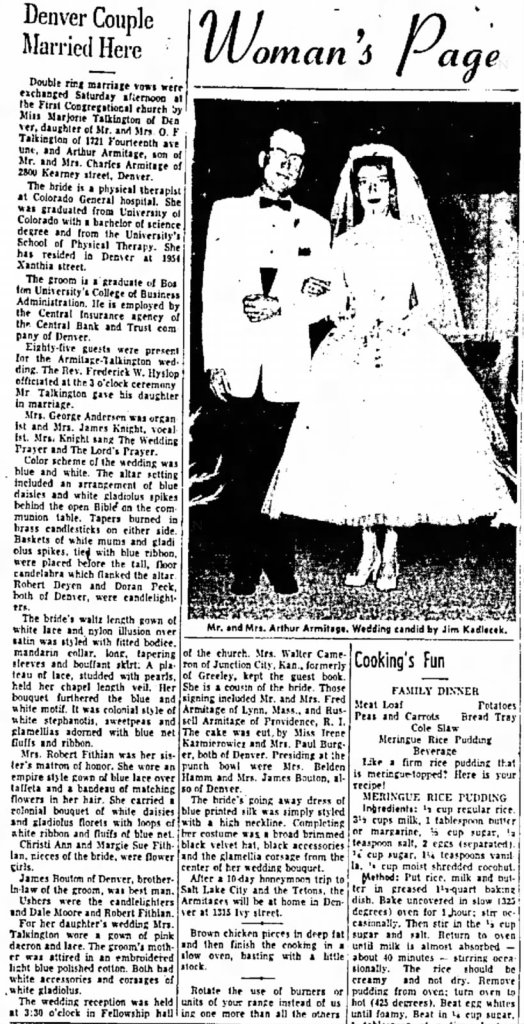
Robert and Elizabeth’s wedding announcement published in The Fort Collins Coloradoan on September 5, 1948.
The wedding announcement of Robert and Berry Fithian published in The Fort Collins Coloradoan on September 22, 1948; it’s interesting to me that the bride’s sister was also named Marjorie.
A clipping announcing the birth of Marjorie’s little sister published in The Greeley Daily Tribune on January 26, 1957.
An announcement that Marjorie’s aunt got married that mentions she was a flower girl that was published in The Greeley Daily Tribune on July 22, 1957.
A newspaper article about Marjorie’s father published in The Greeley Daily Tribune on January 22, 1965.
Christine Fithian’s picture from the 1967 Greeley Central High School yearbook.
Christine Fithian’s wedding announcement that mentions Marjorie published in The Greeley Daily Tribune on June 9, 1970.
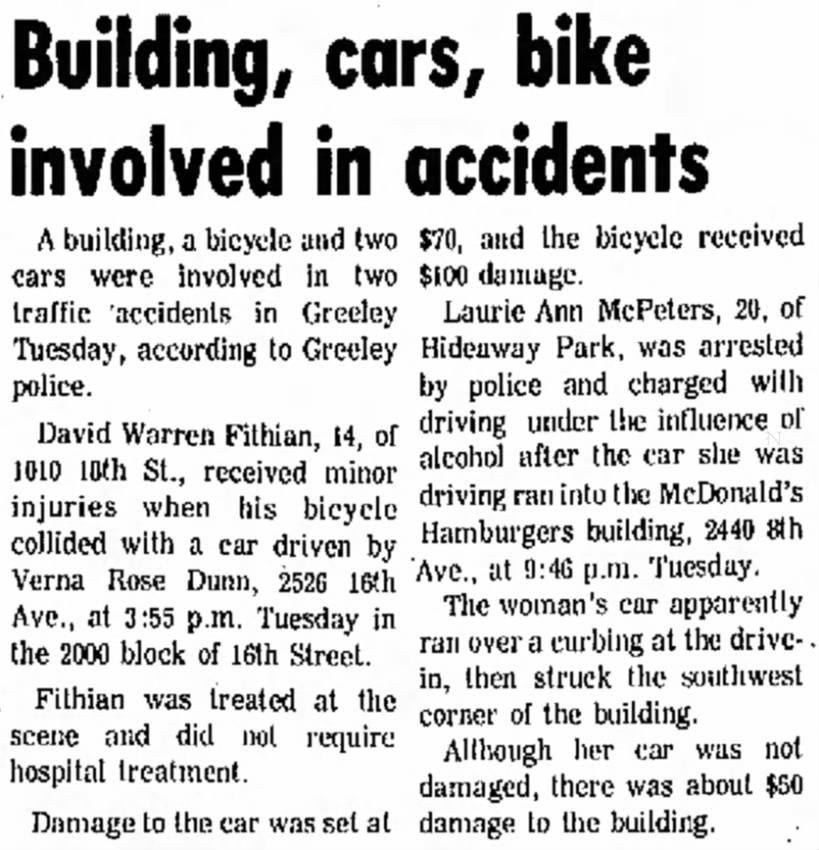
A newspaper article about Marjorie’s brother getting injured in a bicycle accident published in The Greeley Daily Tribune on May 29, 1974.
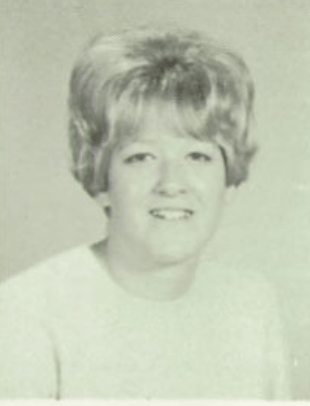
Virginia Fithian’s picture from the 1974 Greeley Central High School yearbook.
David Fithian’s picture from the 1977 Greeley Central High School yearbook.
An article mentioning Marjorie’s brother David getting into a drunk driving accident published in The Desert Dispatch on November 9, 1981.
Robert Fithian’s final resting place, located at Fort Logan National Cemetery in Denver, CO; he is located in section 15, site 139.
The picture from Marjorie’s sister Christine’s LinkedIn page. She is a graduate of University of Northern Colorado and is a sales rep at Atmos Energy.
Mrs. Betty Fithian, photo courtesy of her Legacy page.
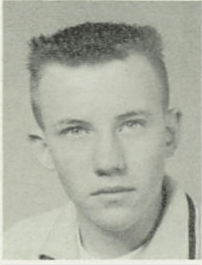
James Reese in the 1960 Fort Collins High School yearbook.
Marjorie’s ex-husband, James Patrick Reese.
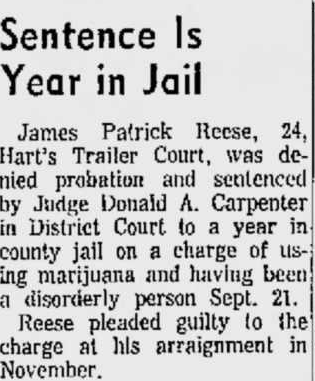
A newspaper clipping mentioning Marjorie’s ex-husband being sentenced to prison for a year published in The Greeley Daily Tribune on on January 9, 1970.
James P. Reese’s gravestone.
The very short obituary of James Reese published in The Arizona Republic on July 25, 2016.
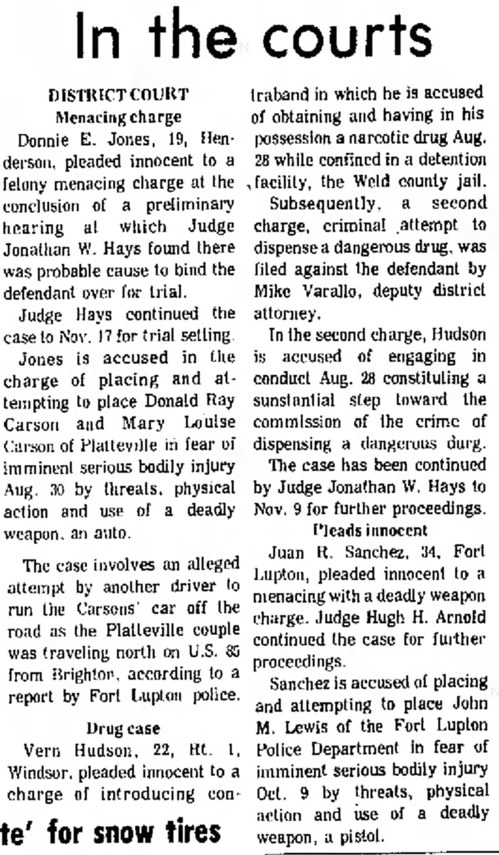
An article about Vern Hudson being charged with drug trafficking published in The Greeley Daily Tribune on October 27, 1975.
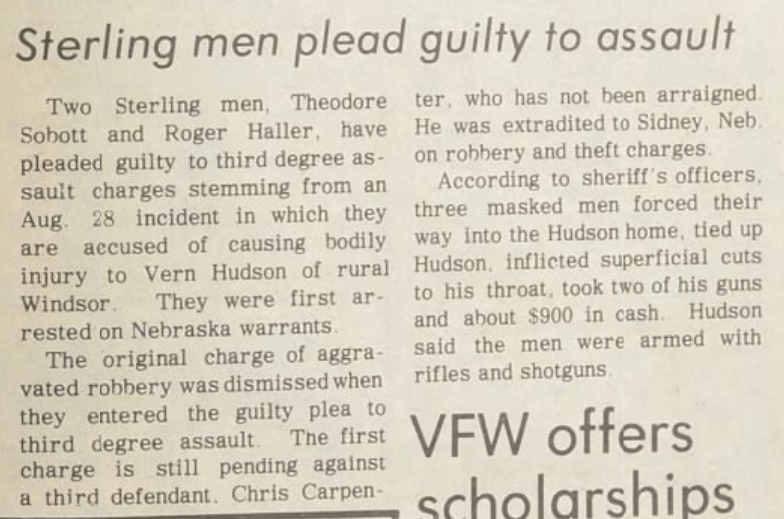
A newspaper article about two men being charged with the assault of Vern Hudson published in The Windsor Beacon on November 26, 1975.
An article about Vern Hudson being charged with drug trafficking published in The Windsor Beacon on February 19, 1976.
A newspaper blurb mentioning Vern Hudson being sentenced to prison published in The Windsor Beacon on March 25, 1976.
An article about Vern Hudson being charged with possession of drugs while already in prison published in The Colorado Springs Gazette-Telegraph on June 28, 1977.
A clipping about Larry Hernandez being arrested for failure to appear in court The Greeley Daily Tribune on April 12, 1974.
An article about Larry Hernandez and his wife Barbara being arrest for the possession of drugs published in The Greeley Daily Tribune on April 27, 1976.
Bundy’s whereabouts in June 1975 according to the 1992 TB FBI Multiagency Team Report.
The possible route Bundy could have taken from his residence at 565 E 1st Avenue in Salt Lake City to Weld County Road 386 north of Roggen, Colorado.
Ted’s VW; as you can see, it’s yellowish in color however the top isn’t black, and it the same color as the rest of the car.
Terry Furnish, photo courtesy of Facebook.
A comment on a Reddit post about Marjorie’s murder, created by user ‘nehemiahsucks.’
A comment on a Reddit post about Marjorie’s murder, created by user ‘quant1000.’
A comment on a Reddit post about Marjorie’s murder, created by user ‘toothpasteandcocaine.’

Notes from a Meeting Regarding Ted Bundy that took place on November 13 & 14, 1975, Courtesy of the Pitkin County Sheriff’s Department.

A copy of the notes from a meeting about Bundy that took place on November 13 and 14, 1975 at the Aspen Holiday Inn. The document begins with a letter from Lieutenant William H. Baldridge of the Pitkin County Sheriff’s Department, and was organized by Pitkin County deputy Mary Wiggins.

Unconfirmed Victims: Information from the King County Archives.
Nancy Winslow, a young woman from Whatcom County in Washington that was killed in late July 1970.
Suzanne Justis.

Caryn Eilene Campbell.

Caryn Eilene Campbell was born on September 20, 1951 to Robert and Audrian (nee Merryman) Campbell in Garden City, MI. Robert Campbell was born on on July 23, 1917 in Pana, Illinois, and Mrs. Campbell was born on April 16, 1918 in Kansas. The couple were married on October 22, 1937 and went on to have four children together: Sandra (b. 1938), Sandra (b. 1938), Caryn (b. 1951), and Robert ‘Bob.’ A petite woman, Caryn was 5’4” tall and weighed s mere 105 pounds; she had brown eyes, and at the time of her death wore her brown hair at her shoulders. She graduated from Dearborn High School in 1969, and according to the bio underneath her senior year picture, she was in ski club, choir, and ‘intramurals.’ Ms. Campbell went on to attend nursing school, and eventually became a RN.

In early 1975 Caryn was working as a registered nurse at Hospital and was engaged to a co-worker named Ray Gadowski, a divorced cardiologist with two children, Gregory (eleven) and Jenny (nine). Dr. Raymond Francis Gadowski, DO was born on June 19, 1943, and despite the nine year age difference between the couple Caryn got along well with both children, and the couple seemed happy. Ray and ‘Car,’ as he called her (or on occasion ‘Cams’) had been living together for around a year when she was killed, and were residing in Farmington, MI (Winn, 63).

On Saturday, January 11, 1975 Caryn, along with Dr. Gadowski, Gregory, and Jenny, traveled from Michigan to The Wildwood Inn in Snowmass Village, Colorado for a medical conference turned impromptu ski vacation. Friends of the couple told investigators that she was looking forward to getting some skiing in, however other reports said they were arguing about their wedding date as well: unlike her, Gadowski was not particularly in any particular rush to get married, which upset her. Despite arriving with a slight case of the flu, she was still able to take the kids skiing and sightseeing the following day. According to an article published in The Ann Arbor News on January 25, 1975 the couple had ‘purchased five days worth of ski passes.’

On the evening of January 12, 1975 the quartet went to dinner at a restaurant down the slope from the lodge called ‘The Stew Pot,’ along with some other medical professionals they met at the conference (including Campbell’s one time boyfriend, Dr. Alan Rossenthal). At dinner, Caryn ordered beef stew, and while everyone else imbibed on beer and cocktails she was still feeling ‘queasy’ and stuck with milk. The meal ended around 6:30/6:45 PM, and despite the frigid temperatures they decided to walk back and forth from their hotel to the restaurant, leisurely walking the busy street window shipping on their way home, and the group stopped at a Walgreens to browse their magazine section, and according to Kevin Sullivan’s ‘The Bundy Murders:’ ‘apparently Brinkman (a pseudonym for Dr. Rosenthal) had a Playboy to keep him company on the trip, and as he and Caryn were joking about it, Caryn offered to switch with him what she insisted was a much better magazine, her current issue of Viva. With a laugh, Brinkman agreed to the offer.’

When they arrived back at about 8:30 PM everyone settled in front of a large fire in the front lounge: Dr. Gadowski read the evening paper, and it was then that Dr. Rosenthal reminded Caryn about the copy of Viva up in her room. With a sigh, and a small hope that her fiancé would offer to run up and get it (he declined), Campbell announced that she was returning to their room and would return shortly, taking with her the family’s only room key. Greg and Jenny trailed behind her and tried to tag along, but she left them at the elevator and told them to stay by the fire. As she left the lounge, so did Rosenthal, as he returned to his room to get that Playboy. It was the last time Dr. Gadowski ever saw her alive.

After getting off the elevator at the second floor, Campbell briefly chatted with several physicians that she’d met up with at the convention, including a nurse that she worked with at the hospital, and at the time, she had been wearing blue jeans, a light brown ‘wooly jacket,’ and boots. Two of her friends that were staying in the inn that night told investigators that they saw her walk out of the second-floor elevator going in the direction of her room, and was last seen in an open corridor overlooking the pool. According to court records (and Kevin Sullivan), a couple named Dr. and Mrs. Yoder ‘observed Caryn Campbell, with whom they were familiar, exit the elevator on the second floor of The Wildwood Inn. Miss Campbell told the Yoders that she was going to her room to get a magazine and that she would return immediately to the lobby, and they watched her walk down the hallway towards room 210.’ There may however, be some discrepancy as to the extent of the interaction that the couple had with Caryn: according to an article published in The Daily Sentinel on April 5, 1977: ‘Ida Yoder, whose husband is a Physician in Littlejohn, commented that she only saw Caryn and that they didn’t speak, and didn’t know what floor she got off of.’

Dr. Gadowski and the kids waited for Caryn to return in the lounge, and in the first few moments he wasn’t immediately concerned, however as the time passed by with no word from her he decided to go looking for her and returned to their room. As he didn’t have a key, upon arrival he knocked on the door, wondering if perhaps she was in the bathroom, as he knew that she wasn’t feeling well. After running to the front desk and getting a duplicate key, upon entering Gadowski found no signs of a struggle, and the room looked exactly as it did when they’d left earlier. Caryn’s purse was nowhere to be found, however the magazine that she’d intended to get was still on the nightstand next to their bed. Gadowski called the Aspen Police Department shortly after ten PM, and two Pitkin County Sheriff’s deputies arrived roughly an hour later.

When police arrived, they interviewed Dr. Gadowski, and almost immediately began searching the inn, inspecting elevator shafts and crawl spaces, but found no trace of Caryn. On January 13, 1975 uniformed members of the sheriff’s department conducted an extensive search of the buildings and grounds of The Wildwood Inn, including all 140 rooms. They came up with nothing. According to Kevin Sullivan’s ‘Ted Bundy’s Murderous Mysteries,’ ‘background information was obtained on all the employees of The Wildwood Inn and checked against the NCIC (National Crime Information Center) network for reported criminal records locally and out of state. No leads were developed (Sullivan, 158).’

In addition to staff, investigators obtained complete lists of registered lodgers in the general Aspen area around the time Campbell was last seen (starting on January 10), as well as the passenger manifests from Denver to Aspen (then back again) on the only two commercial airlines that served the area at the time. Chief Criminal Investigator for the Ninth Judicial District of the state of Colorado Michael Fisher and the other detectives did extensive background checks on Dr. Gadowski and Alan Rosenthal, as well as all of Campbell’s old boyfriends and male friends/co-workers/acquaintances, and came up with nothing (Sullivan, 158). Ultimately, Investigator Fisher interviewed more than 100 people in relation to the Caryn Campbell case, and he came across no evidence that would indicate that anyone was involved in her disappearance.

When Campbell disappeared it was well past sunset, and weather conditions had dropped significantly: according to historical records, the temperature in Snowmass Village on the evening of January 12, 1975 hovered around -2, therefore it stands to reason that the lot where Bundy parked his car was pretty deserted and absent of any people lingering. Additionally, in the days following her disappearance conditions were below freezing, and by January 15th detectives were fairly certain that the young nurse hadn’t left Colorado by any form of commercial transportation (plane, train, or bus). They also had checked out all of the area’s medical facilities and hotels/inns/resorts, and no unnamed young woman that matched Caryn’s description had been admitted or checked in. Airports and bus companies around the general Aspen area were notified of the missing young woman, and were given photos and a description of her (Sullivan, 159).

While staying in Colorado the couple did not rent a vehicle, and Caryn’s skis were found left behind in her room. It is strongly believed by those that knew her that she would never have never wandered away on her own, and because of the harsh weather Investigator Fisher said that ‘most people couldn’t walk more than 30 feet’ from the road.

In the early part of the investigation detectives focused on Dr. Gadowski, but he was quickly cleared. Additionally detectives did an extensive look into Dr. Rosenthal’s background as well, and he was also cleared of any wrongdoing. Both Gadowski and Dr. Rosenthal was polygraphed by Investigator Fisher (Raymond twice), and both men passed. According to Mike Fisher, ‘I’ve seen some gals take a quick walk on their boyfriends when they’ve got a beef, but this is another thing altogether.’ … ‘I’ve ruled out gypsies, flying saucers, occult people, and cattle rustlers.’

After Caryn disappeared, Dr. Gadowski stayed behind at The Wildwood Inn for a week with hopes that she would somehow return to him, but sadly that never happened and he returned home to Michigan. After weeks of combing the general Aspen area investigators determined that there was no evidence pointing towards Campbell having met with foul play, and called off their search. Almost immediately after her disappearance Investigator Fisher reached out to Campbells dentist and got a copy of her dental records and x-rays, a Dr. Richard H. Mentzer of Dearborn, MI.

Looking at the layout of The Wildwood Inn and its surroundings, at the time of Caryn’s abduction there were a number of smaller parking lots on the western side of the building, and when you consider Ted’s modus operandi (specifically the murders of Georgann Hawkins and Susan Rancourt) it is likely that he purposefully parked his Bug in the most out-of-the-way spot that he could find. After Bundy (somehow) convinced Campbell to come with him, he got her in his 1968 VW Bug and drove the 3.1 miles away to Owl Creek Road, which was (at the time) covered in snow and was most likely why he didn’t put a lot of effort into hiding her body. Although her body had been somewhat disrupted by scavenging animals, Caryn’s autopsy showed that she had died about two hours after she was abducted due to the level of digestion of the stew and milk in her stomach.

A little over a month since she was last seen alive, on February 17, 1975 Caryn Campbell’s frozen remains were found face down on a dirt road just outside Aspen on the south side of Owl Creek Road, just west of Sinclair Divide. A passing recreational employee stumbled upon her remains when the weather began to warm and he noticed birds of prey flying above her. The young victim had suffered extreme decomposition and damage to the upper body, most likely the result of animal predation (probably coyotes), which made immediate identification impossible. There were no footprints or tire tracks found at the scene, however according to Kevin Sullivan,’approximately three and a half feet from the south shoulder of the road was a deep depression which perfectly matched that of a body, which had laid on its side, head pointing west. It was also apparent that the body laid facing the open field (????) both earrings, small gold earrings for pierced ears, were found where the head had been positioned. Surrounding the depression were several coyote tracks. Leading from the depression were several coyote tracks. Leading from the depression (head position) were drag marks (Sullivan, TB’s Murderous Mysteries, 161).’ An extensive search of the area by law enforcement failed to locate Caryn’s clothing.

Upon arrival at the crime scene, Investigator Fisher spoke with Pitkin County DA Steve Waters, who told him, ‘Fish, you’ll never find out who did this. You’ve got nothing to work with’ (Sullivan, 124). According to her autopsy, Ms. Campbell had been badly beaten, and the back of her skull had sustained three heavy fractures. She had also suffered from deep cuts from an unknown sharp weapon, and her hyoid bone had been cracked; her left earlobe was slit. The ME was unable to determine if she had been strangled or sexually assaulted due to the advanced level of decomp, however the nude condition of her remains pointed to sexual gratification as a motive. Additionally, the pathologist was able to find phosphorus on the remains, however when interviewed Gadowski said that he and Caryn had sex on the evening of January 11th.

Almost immediately after her body was discovered Dr. Gadowski was interviewed by a reporter, and regarding the tentative identification, he said, ‘that’s kind of what we expected. We’ll have to wait and see what happens… This endless waiting has been very difficult for everyone involved. But I hope it’s not her.’ After a positive identification was made, Caryn’s remains were flown to Detroit for burial. In February and March 1975 Pitkin County investigators traveled to Michigan on multiple occasions in order to dig into Campbell’s background (as well as Dr. Gadowski and Dr. Rosenthals’).

The day after the discovery was made the remains were taken to Denver General Hospital, where Pathologist Dr. Donald Clark performed an autopsy and a positive ID was made thanks to dental records.*  Also, Caryn’s dentist determined that ‘in his unqualified opinion, after comparing the dental charts and x-rays with the dental work on the body, that the body is in fact Caryn Eilene Campbell.’ *Just as a side note, Kevin Sullivan reported that she was flown to ‘Howards Mortuary,’ located in Denver.

After allowing the body to thaw out for roughly 24 hours, Caryn’s autopsy revealed that ‘the cause of death was blows to the back of the head with a blunt object combined with exposure to sub zero elements.’ She also had a cracked tooth, and suffered extreme tissue damage in her face, head, and one of her arms due to exposure to wildlife, and had bite marks on her cranium. She also had ligature marks on her wrists, which pointed towards her being tied up at one point. Based on the contents of her stomach, it’s strongly suspected that Campbell was killed within two to five hours after she disappeared, and according to (retired) Colorado DA Frank Tucker, ‘all indications are that this is a homicide.’ 

For some of the detectives that were familiar with the large amount of recent homicides in the general part of the US, it was suspected that Campbell had possibly fallen victim to a violent predatory killer who by that time had already claimed the lives of (at least) twelve other young women in the west. However when pressed about a possible connection in the cases Frank Tucker said that he was ‘interested in convicting someone of this crime, not in hearing someone’s pipe dreams. We have no evidence to tie this murder to any other we’ve had in the West at all at this point.’

Seven months after the murder of Caryn Campbell, Utah Highway Patrol Sergeant Bob Hayward arrested twenty-eight-year-old law student Theodore Robert Bundy after a brief police chase. Inside Ted’s VW (which they were given verbal permission to do, a fact that Bundy later denied), officers found several items that commonly doubled as burglary tools, including a pantyhose mask, crowbar, (off-brand) handcuffs, and an ice-pick. While searching his apartment later that same day, detectives found a list of Aspen ski resorts with an x next to The Wildwood Inn, as well as a program from the play ‘The Redhead” that was performed at Viewmont High School, which is the school that Deb Kent was abducted from on November 8, 1974. Credit card receipts from January 12, 1975 seem to point towards Ted buying gas in Glenwood Springs, Colorado, which puts him in close proximity to The Wildwood Inn.

According to the ‘1992 TB Multiagency Team Report,’ on October 2, 1975 Bundy stood in a lineup in SLC for the attempted kidnapping of Carol DaRonch (which occurred earlier in the day that Deb Kent vanished), and after she picked him out he was arrested two hours later. Additionally, Ted’s Volkswagen matched the description of the vehicle that was used by the kidnapper. 

At the time of Caryn’s murder in January 1975 Ted was a full-time law student at the University of Utah, and was living in his first SLC apartment located at 565 1st Avenue. He was unemployed at the time, and remained that way until June 1975 when he got the position of night manager of Bailiff Hall at the University of Utah (he was fired for showing up intoxicated). He was also in a long term relationship with Elizabeth Kloepfer, even though they were on the down swing of their romance.

Ted was bailed out of jail on November 20, 1975, and his trial for the kidnapping of Carol DaRonch began on February 23, 1976. During the trial Bundy decided to act as his own attorney, and openly admitted to having no accountability for his whereabouts on November 8, 1974, when DaRonch was abducted. Despite being adamant that he never met Carol DaRonch, he was ultimately found guilty and sentenced to between one and fifteen years in prison.

With a possible suspect behind bars, detectives in Washington and Colorado began to piece their cases together, and hunted for more proof that linked Bundy to the homicides in their state. Ted’s tan 1968 Volkswagen was impounded and picked apart by forensic technicians, and despite multiple deep cleanings he had missed important pieces of evidence. On January 29, 1976 investigators were told that a hair sample that was found in the vehicle matched that of Caryn Campbell, as well as three additional suspected victims. It was also determined that the wounds found in Campbell’s skull matched the pattern made by the crowbar that had been taken from Bundy’s vehicle on the night of his arrest.

On October 21, 1976 Ted was officially charged by Pitkin County for the murder of Caryn Campbell, and on January 28, 1977 he was transferred from custody in SLC to the Garfield County Jail in Glenwood Springs to stand trial. Once again, he decided to act as his own attorney, which allowed him access to the make-shift ‘law library’ located in the back of the second story courtroom, which he escaped from on June 6, 1977, and the rest is history… (in reality, I’ve already written about it a half dozen times before).

According to Kevin Sullivan’s 2016 book, ‘The Trail of Ted Bundy,’ a woman named Elizabeth Harter (who I’ve also seen called Lisbeth) was staying at The Wildwood Inn at the time of Caryn’s murder, and she said the evening she disappeared she happened to notice Ted standing next to a ‘outdoor service closet’ and across from an elevator because he looked so out of place, saying that he: ‘certainly wasn’t dressed for it (meaning the cold temperatures), as he was wearing dress slacks and a shirt. His appearance looked so odd that Elizabeth Herter noticed him and immediately wondered why he would be doing such a thing. He stood out, she later told police investigators, and she thought it was weird.’

In a way there’s a lot of parallels to the Campbell murder and the disappearances of Georgeann Hawkins from the University of Washington in June of 1974 and Sue Rancourt from Central Washington University on April 17, 1974 in Ellensburg. Both young women were most likely approached by a man that was using an injury ruse looking for help, and were lured away to a secondary location that involved his waiting vehicle. Did Ted lure Campbell from the second-floor hallway of The Wildwood Inn, perhaps pretending to have a broken appendage…? But why would anyone be at a ski resort with a broken arm or leg? I guess it would have made for an interesting conversation starter.

According to a 1979 KOMO news report, in the early portion of the investigation there was another suspect that was looked at for the disappearance of Caryn Campbell: an individual Ruth Walsh dubbed ‘Jones’ (a pseudonym), who happened to be in the Aspen area for at least eleven days prior to her murder and one day after. After about thirty seconds of investigating (reading through the documents related to the case that were recently released by the Pitkin County Sheriff’s Department), Jones’ real name is Hugh Joseph Michael Temos.

Temo had been employed (and fired) as a maid/dishwasher at (at least) four hotels/reports in the general Aspen/Snowmass Village area, specifically at the Holiday Inn (for three days), The Pomegranate Inn (for three days), The Plum Tree Inn (for seven days), and ‘The Top of the Village’ (for one week). His former coworkers testified that he was disruptive, weird,’ a sexual deviant, athletic, ‘physically attractive,’ hyperactive, scary, not playing with a full deck, crazier than hell, and hostile towards women.’ On January 13, 1975, Temos picked up his final paycheck and walked out, leaving the Aspen area for good. The next time he surfaced was at the city jail in Roseburg, Oregon, where other inmates described him ‘bursting into spontaneous laughter at empty space,’ and drinking his own urine, with one man even admitting he was ‘terrified of him.’

Chris Haper, one of the managers at ‘The Top of the Village,’ told Pitkin County investigators that the day before Campbell’s disappearance on January 11, 1975 he had tried to fire Jones, who had consequently became aggressive, and turned into an incident that made him ‘fear for his life.’ On the 12th of January Haper said that when Jones left work at The Top of the Village he announced that he was going to go watch cross-country skiers, and perhaps it’s worth mentioning that the TotV is only one block away from The Wildwood Inn. A maid at The Wildwood testified that she saw Temos near the pool on the night Campbell vanished, and it was because of this tidbit that detectives brought him in for a polygraph. The results found no indication that he killed the pretty young nurse and he was officially cleared, however it was determined that the test was administered without a blood pressure cuff, which may have affected the results.

Seattle polygraph expert Lieutenant Joe Nicholas, while not directly commenting on Temo’s test specifically, took a ‘dim view’ in regards to the validity of a polygraph test administered without a blood pressure cuff, and when pressed by Walsh he admitted that if any one of the three key elements were omitted, it would definitely affect its accuracy despite there being other things to look at (breathing, for example).

Walsh also mentions that there was ‘a postscript’ in regards to this Jones individual: she said that he was living in Seattle during Bundy’s heyday in 1974, and on September 8, 1974 (a day after the discovery of Ted’s Issaquah dump site) he was arrested by the King County Sheriff’s on a charge of indecent exposure (he flashed a cops wife), and went on to serve 180 days in jail. After getting out, he made his way to Colorado, and it was around this time that he developed a reputation for violence, largely towards the opposite sex, and exhibited a large amount of mental instability. In an on-air interview with King County Sheriff Lieutenant Jim Harris, Walsh asked him about Temos and if he served time in the King County Jail on the dates she provided him with, which he did confirm. 

In another report conducted by the FBI, Sergeant Ivan Beason commented that ‘in checking records, the Seattle area was having almost one missing girl per month, but after the suspect (Jones) was incarcerated, the missing girl stopped. In the opinion of the reporting detective, Jones looks good as a suspect.’ The missing girls referred to in this report are of course the eight confirmed Bundy victims from 1974.

But wait, it gets even weirder: Temos lived only two blocks away from the alley that Georgiana Hawkins disappeared from in June 1974, which is a murder that has a lot of parallels with Caryn Campbell. He also lived within two blocks of Lynda Ann Healy, who vanished without a trace in the early morning hours of February 1, 1974. At the end of the segment Walsh reported that at the time of the broadcast in July 1979 nobody knew what had happened to Jones, and he had seemingly dropped completely off the radar. 

Another person that was investigated for the murder of Caryn Campbell is Pitkin County undersheriff Ben Meyers. The true crime website ‘CAVDEF’ pointed out something odd involving the eyewitness Lisbeth Harter took place at Bundy’s pretrial hearing, an event that Ann Rule detailed in ‘The Stranger Beside Me:’ ‘this time, the eyewitness was the woman tourist who had seen the stranger in the corridor of The Wildwood Inn on the night of January 12, 1975. Aspen Investigator Mike Fisher had shown her a lay-down of mug shots a year after that night and she’d picked Ted Bundy’s. Now, during the preliminary hearing in April of 1977, she was asked to look around the courtroom and point out anyone who resembled the man she’d seen. Ted suppressed a smile as she pointed, not to him, but to Pitkin County Undersheriff Ben Meyers (Rule, 230).’

The creator of the ‘CAVDEF’ web page seems to write around conspiracy theories, and the idea that Ted Bundy (at the very least) either had help with his murders or he wasn’t responsible for all of the ones that he is (or both). In a blog post written about Caryn Campbell, they creator mentions that at first Harter’s identification of Meyers was quickly dismissed as a mistake, however when one considers his rumored connection to several murders in Grand Junction later in 1975 it almost makes you wonder if he was the man that she saw at The Wildwood Inn on the evening of January 12, 1975. As the Grand Junction murders (including Denise Oliverson) seemed to center largely around local organized crime, this suggests that if Meyers was somehow involved, Campbell’s murder was then most likely a targeted hit. On that note, it is worth mentioning that Caryn’s brother Bob is a retired Fort Lauderdale police officer, which is an area that remains a major center for drug trafficking activity to this day.

Denise Oliverson was the first of many young women to either disappear or be murdered in Grand Junction in 1975. All of these crimes were suspected of revolving around the drugs and prostitution activity in the city, in which many officers including police chief Meyers were complicit. Oliverson was known to be a fairly heavy drug user, which put her in at least some contact with the local drug scene.

Vail Colorado ski instructor Julie Cunningham, who disappeared on March 15, 1975, also may not have been just a random victim: she was reportedly good friends with the daughter of Salem Oregon chief of detectives Jim Stovall, who worked directly under Ben Meyers when he was Salem’s chief of police. In fact, Stovall was the very first officer of the department that Meyers nominated for a national law enforcement award, and the two traveled together to Atlantic City in New Jersey for the ceremony. Eagle County, where Vail is located, was also a known center for the nationwide drug trade: Allen Riverbark, a known trafficker that operated in the area during the 1970’s until he died in a plane crash in November 1981, owned the Black Mountain Guest Ranch, which was located thirty miles outside of Vail. It doubled as a hideout for East Coast mobsters, and served as a distribution point for Rivenbark’s network of drug dealers, a ring that was based in Fort Lauderdale. FL (CAVDEF, 2022).

Harter was obviously the foundation of the state’s case, and they had no other ‘proof’ that placed Bundy inside of The Wildwood Inn on the evening Caryn disappeared, and that evidence disappeared with her identification of somebody other than him. The only things that the prosecuting attorneys had left in their arsenal was the gas receipt linking him to the general Snowmass Village area on January 12, 1975, an inconclusive (and since-discredited) DNA analysis conducted by the FBI that placed Campbell’s hairs in his VW, and an attempt to introduce cases in other states that he was only suspected of but never even stood trial for.

In an old audiotape that had been recorded by Bundy on February 2, 1980 for journalists Steven Michaud and Hugh Aynesworth (provided by Maria Serban on behalf of Dr. Rob Dielenberg), the killer talked about Mike Fisher’s dedication to his conviction in regards to the murder of Caryn Campbell:And while this doesn’t have anything to do with Fisher, I think it’s interesting if you read the transcript of the preliminary hearing in the Campbell case, how thoroughly he was discredited as an investigator. This is chiefly with respect to the rather amateurish way in which he handled Elizabeth Harter who was allegedly the kingpin of the case: she was a woman who said she saw a man or men standing by elevator one evening at Snowmass, Colorado, on the evening that Caryn Campbell disappeared. It was a year later, when she returned to Snowmass for the same type of convention they have, that a photo display was shown to her and she picked up my photo as being the man standing by the elevator.’ 

‘You have to compare, to really appreciate how badly Fisher handled this situation… you must compare the language and the information in the Campbell case with the testimony which actually came out at the preliminary hearing. Basically, unusually, I guess, Fisher grossly exaggerated the statements made by Mrs Harter with respect to her photo identification and the set of circumstances which gave rise to that identification. Of course, when Mrs Harter was called in Aspen to make an identification, she failed to identify me… She also said that she had never told Michael Fisher that she was sure of what she was seeing and what she had seen, it was dark, she never got a good look at the man she had seen, that she was some 40 ft away from the man she had seen, and that the photo she picked out, she picked out as only remotely resembling the man that she had seen and she could not form an opinion that the man in that photo was exactly the man she had seen…’

‘Of course, the representation Fisher must have made toward getting the information in the first place is far different.’ … ‘The embarrassment suffered by the prosecution at that preliminary hearing as a result of Fisher’s half-hazardous, vague investigations, is the worst I’ve seen in any case that I’ve been the object of. Plus the bottom line of that handling of Miss Harter was that she not only failed to identify me in the courtroom – that is she did not identify me in the courtroom, but in fact identified the under-sheriff who had accompanied me from Utah to Aspen just a few weeks before. The name of the under-sheriff was Ben Meyers by the way.’

‘Anyhow, a law enforcement official of questionable character, he had held a number of jobs, he had been in a variety of law enforcement agencies throughout his career, and there were a number of rumors, most probably unsubstantiated of course as far as I can say, concerning his conduct in the various agencies that had employed him.

‘Interestingly enough, the last position he held before coming to Aspen was… before coming to the Pitkin County Sheriff’s Office as under-sheriff… was of chief of police in Grand Junction, Colorado, where there had been a series of murders of young women… And my understanding is that it took a great deal of pressure… and there was a failure of his department to solve these murders… I don’t believe that was the sole reason of him leaving.’ … ‘Ben Meyers himself was not effective in the investigation in the prosecution of my case, other than the fact that he was identified as most resembling the man that Mrs Harter saw the night of Caryn Campbell’s disappearance.’

‘I saw Fisher on numerous occasions: most in the courtroom, in Aspen, during the many months that I attended the pre-trial hearing there… The only occasion when he testified that I can recall was the occasion of the preliminary hearing. But it seems as though he was always present, whispering in the ear of Frank Tucker, the district attorney delegated to try the case for Fisher… Or sitting somewhere in the front row of the courtroom. It was clear he had a personal interest in this case. And I had been told, although I can say this from personal experience, that he had developed something of a close friendship with the former fiancé of Caryn Campbell. I always got the feeling that despite his rather laidback manner, his rather non-law enforcement demeanor, that he was deeply, deeply devoted and dedicated to obtaining a conviction of me in this case.’

‘After the preliminary hearing in Aspen, of course, there were numerous contacts with Michael Fisher which I will relate to you as I go on this tape… In many ways… I don’t know… certainly I had something of a dislike for him, because obviously, from where I stood… he did not seem to be equipped to handle the job that he had taken on for himself. It’s hard for me to describe that feeling any further… I wouldn’t call what I felt for him as a form of pity… that’s just not what I’m trying to say, but I just felt when I looked at the man and listened to him and watched him, I couldn’t believe that he was actually someone who had been delegated with the serious responsibility of a serious investigation of a serious criminal case. Certainly appearances are deceiving, but in Fisher’s case, his appearance, I think was reflected in his ability…’

‘After the day that I arrived in Aspen, Fisher asked me if I wished to talk to him. He and I never spoke directly again until I had been captured after my escape from Aspen jail in June 1977… I never saw him back in the jail area at the Pitkin County Jail where I was being held. I rarely saw him in the sheriff’s office. Mainly because the prosecuting attorney’s office where he worked was in a building maybe 15 yards away from the courthouse itself. But there is no doubt that whether he was experienced or not, whether he had the ability or not, or whether he was a policeman or a law enforcement officer or just someone who fancied themselves as a law enforcement officer… There is no doubt he had an active and major role investigating the Caryn Campbell case.’

‘I believe he was present… a peeping-tom policeman… No, I believe he was present at the autopsy of Caryn Campbell, although I can’t say for sure… I wish I’d known if he was present at the scene shortly after her body was discovered… I know that he examined a number of items in evidence or trace materials… One time a vehicle rented by a friend of Campbell’s fiancé was examined for dirt and other debris, which may have indicated whether Campbell was in contact with that vehicle. I know for instance that he tried to track down a number of suspects other than myself, and this would be reflected in the reports that you’ll find.’

And Ted seemed to be concerned with the things Fisher was doing during the period of time before Ted became a suspect in the Campbell case: ‘I know that he took a hair sample, sat in my car… As far as I know he came to take my statement…’ ‘He did a great deal of investigation, specifics of which I’m not familiar, but I believe that one time he represented to me that he and another investigator checked every hotel and motel in the Aspen vicinity to see whether there was someone like me who fit my description who registered there.’ … ‘I wish I had known everything he had done and that might be of some value to me in that case.’

Bundy then also says that he knows that Fisher traced down his credit cards and came up with a credit card that Fisher believed placed Bundy in Glenwood Springs, Colorado on the day when Caryn Campbell was last seen [according to press reports, police had discovered that Bundy used a credit card on Jan. 12, 1975, in Aspen, the day Caryn Campbell disappeared from her hotel room].

And Bundy then says that he believed Fisher also traveled back to Michigan, to the area where Caryn Campbell was from, and that Bundy’s discovery records indicated that Fisher sent out hundreds of letters to different law enforcement agencies inquiring about the Campbell case… ‘Many many letters to agencies followed up the lead on different suspects. No question he was chief investigator and he engaged in enormous amount of work in that case, both before and after the time I became a suspect. This portion should be reflected in many of the documents I collected in Colorado. So one cannot fault him for being diligent, being amateurish but diligent in pursuit of solving the Caryn Campbell murder.’

Bundy is then also heard saying that Fisher had no substantial case in the Campbell murder, and Fisher had ‘expectations, the unrealistic belief that given enough pressure of some sort, that I’d give him the easy way out, that I would confess to whatever it was that he wanted me to confess to. I think it’s interesting to know that following my arrest in Pensacola, Florida, in February of 1978, that he and Milt Blakey, special prosecutor from Colorado assigned to the Campbell case, immediately flew to Pensacola and were present while I was being interrogated by the police in Pensacola. But he [Fisher] never showed his face, I never knew he was there… or whatever made me aware of his presence there. Later when I was transferred to Tallahassee he too went to Tallahassee and was present during…’

Bundy ends the tape by saying that Fisher was absolutely convinced, in his own mind, that he was responsible for Caryn Campbell’s murder. And he is also heard, right before the tape ends, teasing that the real him would not be captured on those tapes… I received this tape from Rob Dielenberg, who had obtained it from David Von Drehle’s archive. 

Before Bundy was executed in January 1989 Investigator Fisher flew to Raiford Prison in Starke and spoke with him regarding his Colorado murders, and according to ‘Ted Bundy’s Murderous Mysteries,’ he did a news conference in Aspen the following day to go over his findings: according to an article published in The Aspen Times, ‘Bundy told Fisher that he drive around Aspen several hours before the murder and then headed up to Snowmass Village carrying ski boots… Bundy told Fisher he stopped at the edge of The Wildwood’s pool and was hoping a woman nearby would help him carry his ski boots to the car. But the woman ignored Bundy and he waited for several minutes until Campbell, his second choice, walked across a balcony and asked Bundy if he needed some help.’ As the article continues, Bundy admitted to Fisher that it wasn’t long before he hit Caryn ‘with the boots’ (just incapacitating and not killing her) then ‘stuffed her into his vehicle (Sullivan, 163-164).’

The final thing that Investigator Fisher was asked by reporters was whether or not Campbell had been sexually assaulted, which was a question he briefly hesitated on then refused to answer (probably for the sake of the Campbell family and Dr. Gadowski). It wasn’t until he was being interviewed for Kevin Sullivan’s book, ‘Ted Bundy’s Mysterious Murders’ in 2009 that he finally admitted that he told him that he took her life ‘just like the others (hitting her in the head) just once,’ before mentioning that he ‘did his thing right there in the car (Sullivan, 124).’ Fisher also mentioned that Ted did confirm that he did kill Caryn away from The Wildwood Inn.

Raymond Gadowski remarried a woman named Marvelyn (née Moser) in 1979 and died at the age of 69 on February 20, 2022. According to his obituary, he graduated from Southfield High School in 1961 then went on to attend Michigan State University, graduating in 1965. He attended medical school at Chicago College of Osteopathic Medicine, and after completing his cardiology fellowship in 1978 he went on to practice medicine for 44 years in the Greater Detroit area. He had another child with his second wife and his son Gregory went on to become a Doctor. In addition to working as a physician and teaching Dr. Gadowski had a very active life, and enjoyed fishing, skiing, and playing golf at his beloved Oakland Hills Country Club. He loved spending time with his grandchildren and always shared his ice cream with his dogs.

The day before the execution of his daughter’s killer, Robert Campbell did an interview with The Free Press, saying: ‘you never really forgive something like that. You just try to put it behind you… the thing I’d like to have back, I can’t.’ He went on to say that despite Caryn’s senseless murder that he didn’t feel strongly one way or another when it came to capital punishment, and that he was ‘not a vindictive person, but certainly you can’t go around killing people… reluctantly, but I don’t think executing Bundy will be a deterrent. People will keep killing.’

Audrian Campbell passed away at the age of 67 on March 10, 1986 in Detroit, and Mr. Campbell died at the age of 79 on July 28, 1996. Caryn’s sister Sandra Lee ‘Sandy’ Leabo died on September 27, 2017 in Northport, MI and Nancy Ann passed away at the age of eighty in Wyandotte on January 5, 2023.

Works Cited:
Sullivan, Kevin, ‘The Bundy Murders: A Comprehensive History.’ (2009).
Sullivan, Kevin. ‘Ted Bundy’s Murderous Mysteries: The Many Victims Of America’s Most Infamous Serial Killer.’ (2019).
Winn, Steven. ‘The Killer Next Door.’ (1979).

Caryn Campbells sophomore year picture from the 1967 Dearborn High School yearbook.
Caryn Campbells junior year picture from the 1968 Dearborn High School yearbook.
Caryn Campbells senior year picture from the 1969 Dearborn High School yearbook.
A picture of Caryn that was published in The Ann Arbor News on February 19, 1975.
Caryn Campbell.
Campbell.
Caryn Campbell.
Caryn and a family member.
Campbell’s drivers license.
A shot of the remains of Caryn Campbell lying in the snow. Photo courtesy of Vanessa West.
Vince Lahey holding a crowbar over Campbells autopsy photo. Photo courtesy of Erin Banks.
The skull of Caryn Campbell. Photo courtesy of Vanessa West.Thank you to my friend Samantha Shore for letting me know the identity of this victim.
The Stew Pot restaurant, where Caryn dined before she was killed by Bundy.
A sign for The Stew Pot, where Caryn had dinner with Dr. Gadowski and her kids the night that she was abducted and murdered.
A picture of The Wildwood Inn, taken in the 1970’s.
A sign for The Wildwood Hotel (formerly Inn) located in Snowmass Village, Colorado. I’m shocked at how squished together everything is, I imagined this beautiful, sprawling hotel… but it was all so close together. 2/10, would not recommend.
The Wildwood Hotel (formerly Inn), where twenty-three-year-old Michigan nurse Caryn Campbell was staying with her fiancé when she disappeared on January 12, 1975; her body was found on February 17, 1975, less than three miles away on the side of Owl Creek in the outskirts of Aspen. Picture taken in March 2025.
A picture of how Room 210 at The Wildwood Inn looked in the 1970’s. Photo courtesy of Chris Mortensen, 2016.
This is the GPS coordination’s where Caryn Campbells remains were discovered on Owl Creek Road in Aspen. Picture taken in March 2025.
An aerial image of the area where a local worker discovered Campbell’s frozen remains located exactly 3.1 miles away from The Wildwood Inn in Snowmass Village. Photo courtesy of OddStops.
A sign for the entrance of The Wildwood Inn as it looked in the 1970’s.
The entrance of The Wildwood Inn as it looked in the 1970’s.
The hallway at The Wildwood Inn leading to room 210 that Caryn walked down the evening she was abducted.
The pool area of The Wildwood Inn.
One of the parking lots on the western side of The Wildwood Inn. Photo courtesy of OddStops.
Bundy had a number of parking lots to choose from. Once Campbell agreed to help him, it would have been a relatively short walk to his vehicle. This would explain why she seemingly vanished into thin air. Photo courtesy of OddStops.
The layout of rooms at The Wildwood Inn, taken from Detective Kathy McChesney’s notes.
The layout of The Wildwood Inn, taken from Detective Kathy McChesney’s notes.
The temperatures in Snowmass Village on January 12, 1975.
The temperatures in Snowmass Village in January 1975.
The temperatures in Snowmass Village in February 1975.
An article about the disappearance of Caryn Campbell published in The Aspen Times on January 23, 1975.
An article about the disappearance of Caryn Campbell published by The Ann Arbor News on January 25, 1975.
Part one of an article about the disappearance of Caryn Campbell published in The Detroit Free Press on January 25, 1975.
Part two of an article about the disappearance of Caryn Campbell published in The Detroit Free Press on January 25, 1975.
An article about the disappearance of Caryn Campbell published in The Battle Creek Enquirer on January 26, 1975.
An article about the disappearance of Caryn Campbell published in The Gallup Independent on January 27, 1975.
A newspaper article about the discovery of the remains of Caryn Campbell published in The Ann Arbor News on February 19, 1975. 
An article about the discovery of the remains of Caryn Campbell published by The Bay City Times on February 19, 1975.
An article about the murder of Caryn Campbell published in The Detroit Free Press on February 19, 1975.
A newspaper article about the murder of Caryn Campbell published in The Ann Arbor News on February 20, 1975.
An article about the murder of Caryn Campbell published in The Detroit Free Press on February 20, 1975.
The obituary of Caryn Campbell published by The Detroit Free Press on February 20, 1975.
A newspaper article about the discovery of Caryn Campbell published in The Kalamazoo Gazette on February 26, 1975.
An article about the death of Caryn Campbell published in The Petoskey News-Review on February 27, 1975.
An article about the murder of Caryn Campbell published by The Petoskey News-Review on February 27, 1975.
Part one of an article about the murder of Caryn Campbell published in The Jackson Citizen Patriot on May 25, 1975.
Part two of an article about the murder of Caryn Campbell published in The Jackson Citizen Patriot on May 25, 1975.
An article about Ted Bundy that mentions Caryn Campbell published in The Greeley Daily Tribune on October 27, 1975.
An article about Ted Bundy that mentions Caryn Campbell published in The Greeley Daily Tribune on October 31, 1975.
An article about Ted Bundy that mentions Caryn Campbell published in The Daily Sentinel on November 2, 1975.
An article about Bundy being investigated for the death of Caryn Campbell published in The Jackson Citizen Patriot on February 23, 1976.
An article about Ted Bundy being charged for the murder of Caryn Campbell that was published in The Ironwood Daily Globe on February 23, 1976.
An article about Ted Bundy that mentions Caryn Campbell published in The Herald-Palladium on October 23, 1976.
A newspaper blurb about Ted Bundy that mentions Caryn Campbell published in The Ann Arbor News on November 26, 1976.
An article about Ted Bundy that mentions Caryn Campbell published in The Jackson Citizen Patriot on November 26, 1976.
An article about Ted Bundy that mentions Caryn Campbell published in The Flint Journal Flint on November 28, 1976.
An article about Ted Bundy being charged with the murder of Caryn Campbell published in The Herald-Palladium on November 30, 1976.
An article about Ted Bundy that mentions Caryn Campbell published in The Ann Arbor News on February 1, 1977.
An article about the murder of Caryn Campbell published in The Daily Sentinel on April 5, 1977.
An article about Ted Bundy’s first escape that mentions Caryn Campbell published in The Jackson Citizen on June 8, 1977.
An article about Ted Bundy that mentions Caryn Campbell published in The Jackson Citizen Patriot on June 8, 1977.
An article about Ted Bundy that mentions Caryn Campbell published in The Ann Arbor News on June 24, 1977.
An article about the trial of Ted Bundy that mentions Caryn Campbell published in The Record-Eagle on November 17, 1977.
An article about the recapture of Ted Bundy in Florida that mentions Caryn Campbell published in The Flint Journal on February 17, 1978.
Part one of an article about Ted Bundy that mentions Caryn Campbell published by The Daily Sentinel on February 21, 1978
Part two of an article about Ted Bundy that mentions Caryn Campbell published by The Daily Sentinel on February 21, 1978
Part one of an article about Ted Bundy being charged in Florida published by The Grand Rapids Press on July 28, 1978.
Part two of an article about Ted Bundy being charged in Florida published by The Grand Rapids Press on July 28, 1978.
An article about Bundy that mentions Caryn Campbell that was published in The Detroit Free Press on October 4, 1978.
An article about Ted Bundy that mentions Caryn Campbell published in The Daily Sentinel on August 1, 1979.
An article about Bundy’s execution that mentions Caryn Campbell published in The Herald-Palladium on January 24, 1989.
An article about Bundy’s execution that features a quote from Robert Campbell published in The South Florida Sun Sentinel on January 25, 1989.
The ski brochure for ski country in Aspen, Colorado from the 1974/75 season that was found amongst Bundy’s belongings and was used in his trial.
The ski brochure for ski country in Aspen that has an ‘x’ next to The Wildwood Inn that was found among Bundy’s trial and was used in his trial.
A picture of the credit card receipt that places Bundy around the Glenwood Springs area around the time of Caryn Campbell’s murder, courtesy of Vince Lahey.
An interesting bit of information about the layout of The Wildwood Inn, courtesy of Reddit and Cynthia Walker.
A Reddit comment about a suspicious looking man loitering around The Wildwood Inn on the evening of January 12, 1975.
A screenshot of some information related to the murder of Caryn Campbell taken from the TB Facebook group, ‘TB: I was Trying to Think Like an Elk.’
A comment made by Vince Lahey attempting to get in contact with Dr. Gregory Gadowski, taken from Facebook.
A picture of Ted’s first apartment, located at 565 1st Avenue in SLC; he lived here in January 1975 when he abducted and killed Caryn Campbell.
A possible route from The Wildwood Inn to where Caryn’s remains were found on Owl Creek Road.
Bundy’s drive from his apartment in SLC to The Wildwood Inn in Snowmass Village, Colorado.
Proof that Bundy was coming to Aspen since 1968: an index card with research on it from the Pitkin County Sheriff’s Department, found by Vince Lahey.
A picture of Dr. Alan Rosenthal (if interested, you can find more information about him in the document below).
Ted’s activities in January 1975 listed in the ‘1992 TB Multiagency Team Report.’
The discovery of Campbells remains listed in the ‘1992 TB Multiagency Team Report.’
One of Bundy’s mug shots taken in Glenwood Springs on April 12, 1977. Photo courtesy of the Facebook group, ‘TB: I was trying to Think Like an Elk.’
Ruth Walsh, reporter for KOMO. Screenshot courtesy of Tiffany Jean.
‘Jones,’ a main suspect in Campbell’s murder before Bundy was identified. Screenshot taken from the 1979 KOMO News Special on Caryn Campbell featuring reporter Ruth Walsh screenshot courtesy of Tiffany Jean.
Another sketch of ‘Jones,’ screenshot taken from the 1979 KOMO News Special on Caryn Campbell featuring reporter Ruth Walsh, courtesy of Tiffany Jean. Here is a fun fact about the Ted Bundy case (courtesy of Tiffany): Ms. Walsh was the roommate of Carole Ann Boone while they were staying in a Miami motel for the trial.
Another picture of ‘Jones’ taken from the 1979 KOMO news special, screenshot courtesy of Tiffany Jean.
Seattle polygraph expert Lieutenant Joe Nicholas, screenshot courtesy of Tiffany Jean.
Investigator Mike Fisher.
Robert Campbell from the 1935 Dearborn High School yearbook.
Audrian Merryman in the 1936 Dearborn High School yearbook.
Mr. Campbell’s WWII draft card.
Caryn’s parents marriage license.
Caryn’s parents marriage certificate.
Caryn’s brother Bob’s senior year picture from Dearborn High School.
Caryn’s sister Nancy Campbell’s picture from the 1960 Dearborn High School yearbook.
Sandy Campbell in the Dearborn High School yearbook.
The write-up for Sandra Campbells (second) wedding published in The Abilene Reporter-News on July 16, 1967.
A picture of Sandra Campbell on her (second) wedding day published in The Abilene Reporter-News on July 16, 1967.
Audrian Campbell.
An article that mentions Caryn’s brother Bob published in The Fort Lauderdale News on March 11, 1980.
The obituary for Mrs. Campbell published in The Detroit Free Press on March 13, 1986.
Caryn’s Father, Robert Campbell.
Robert Campbell’s obituary published in The Detroit Free Press on July 31, 1996.
Robert Campbell’s obituary published in The Detroit Free Press on August 1, 1996.
The final resting place of Robert and Audrian Campbell.
Sandra Lee Campbell.
Nancy Ann Campbell.
The final resting place of Caryn’s sister Sandy.
Greg, Ray, and Jenny Gadowski from 1972.
A younger picture of Dr. Raymond Gadowski.
Dr. Raymond Francis Gadowski.
Dr. Gadowski’s gravestone.
Raymond Gadowski’s obituary published in The Detroit Free Press on February 27, 2022.
Page one of Caryn Campbell’s autopsy.
Page two of Caryn Campbell’s autopsy.
Page three of Caryn Campbell’s autopsy.
Page five of Caryn Campbell’s autopsy.
Page six of Caryn Campbell’s autopsy.
Page seven of Caryn Campbell’s autopsy.
Page eight of Caryn Campbell’s autopsy.
Page ten of Caryn Campbell’s autopsy.
A court document mentioning Caryn Campbell’s hair being found in Bundy’s car.
How Ted said he killed Caryn.