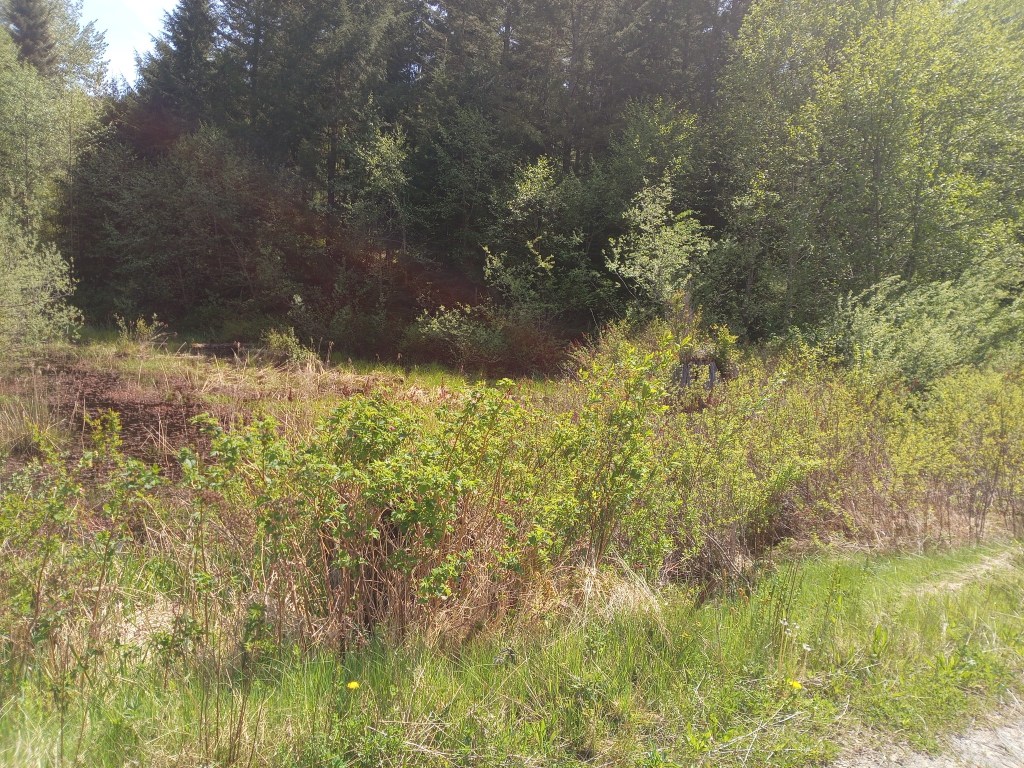
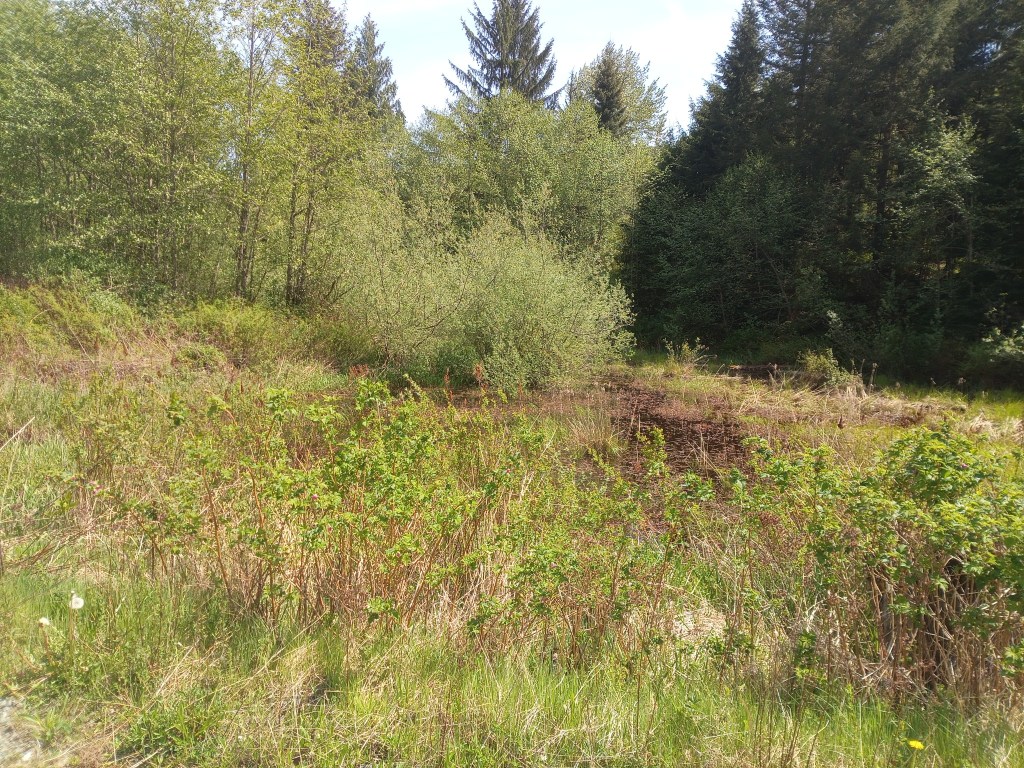
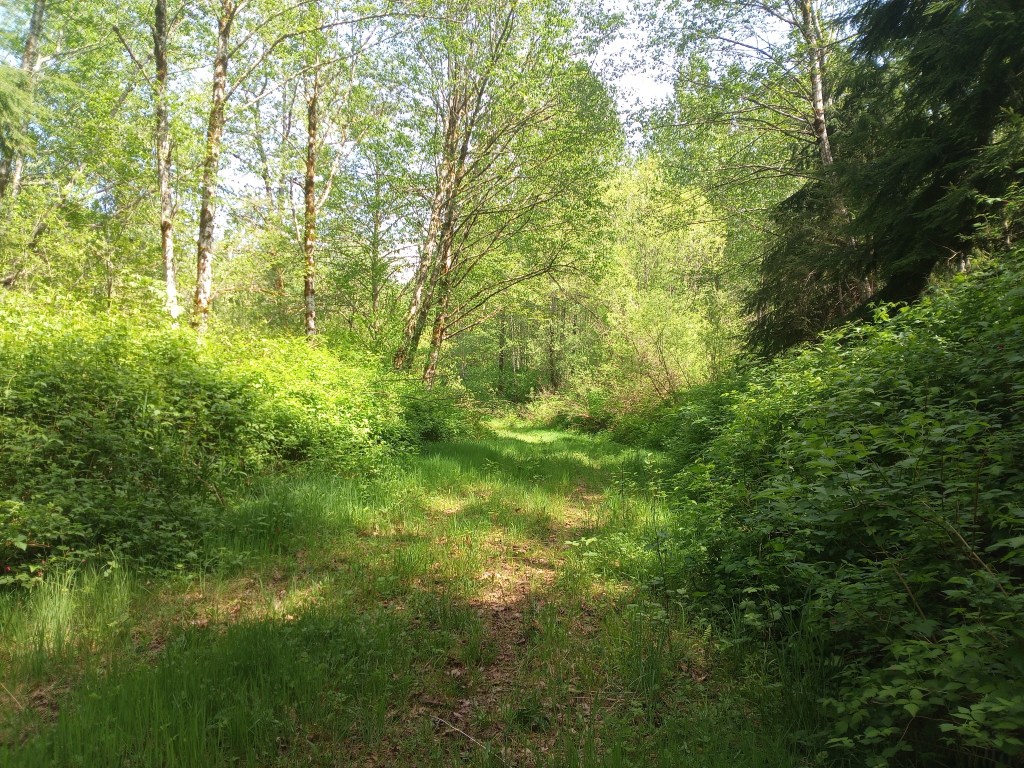
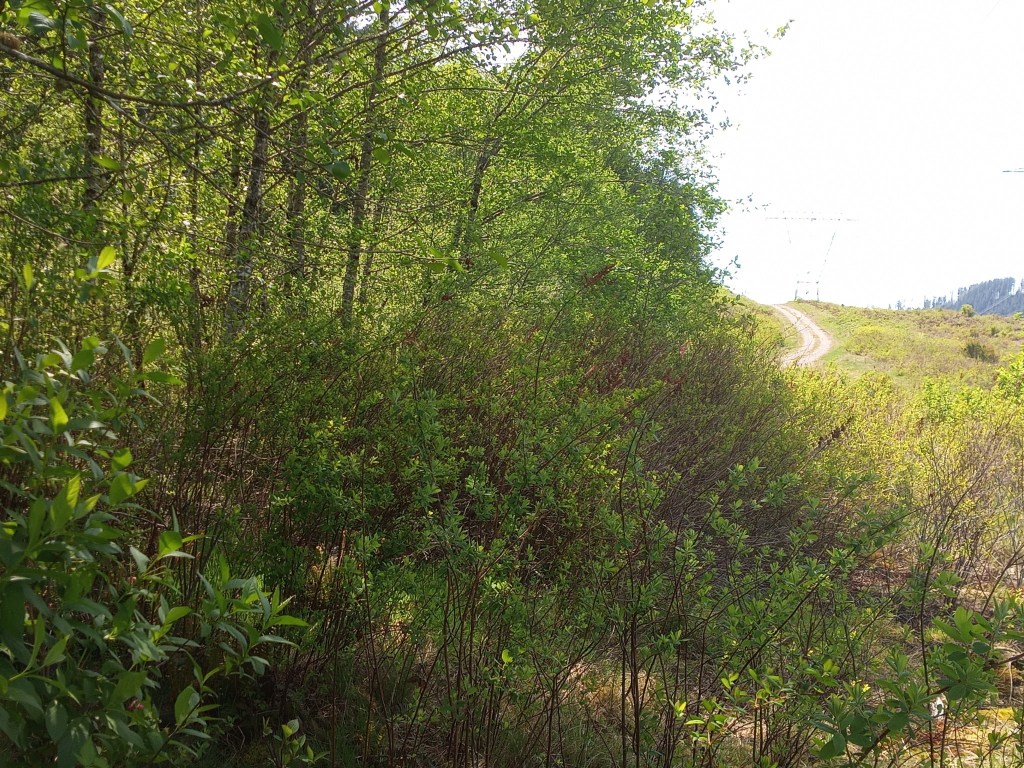
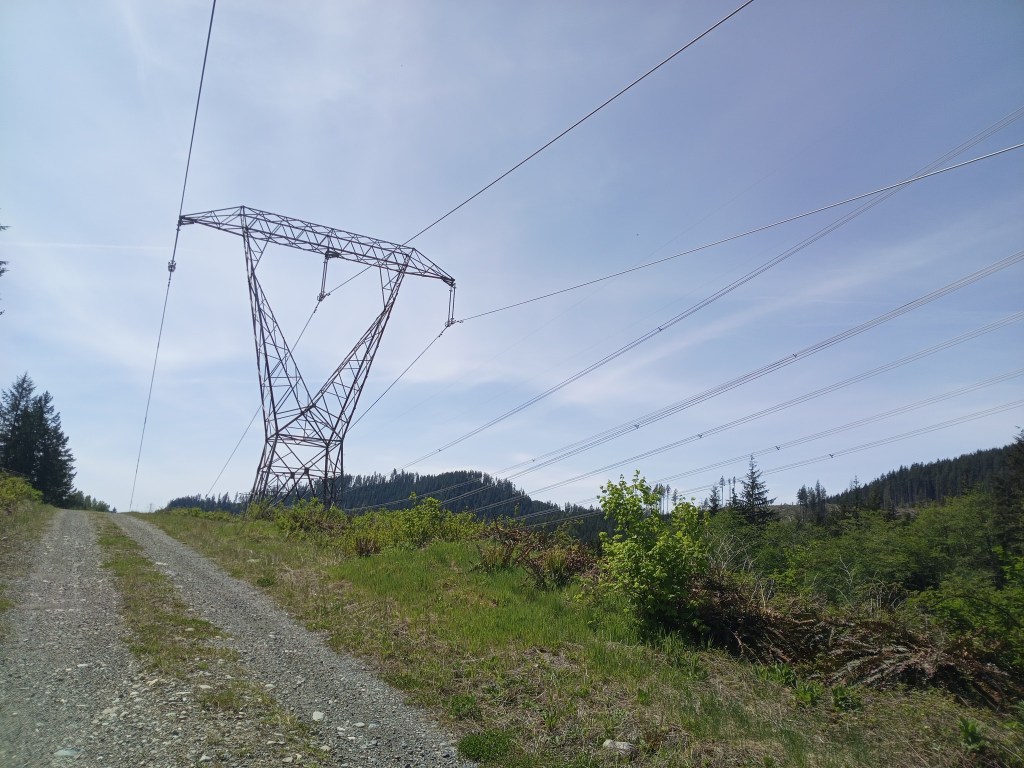
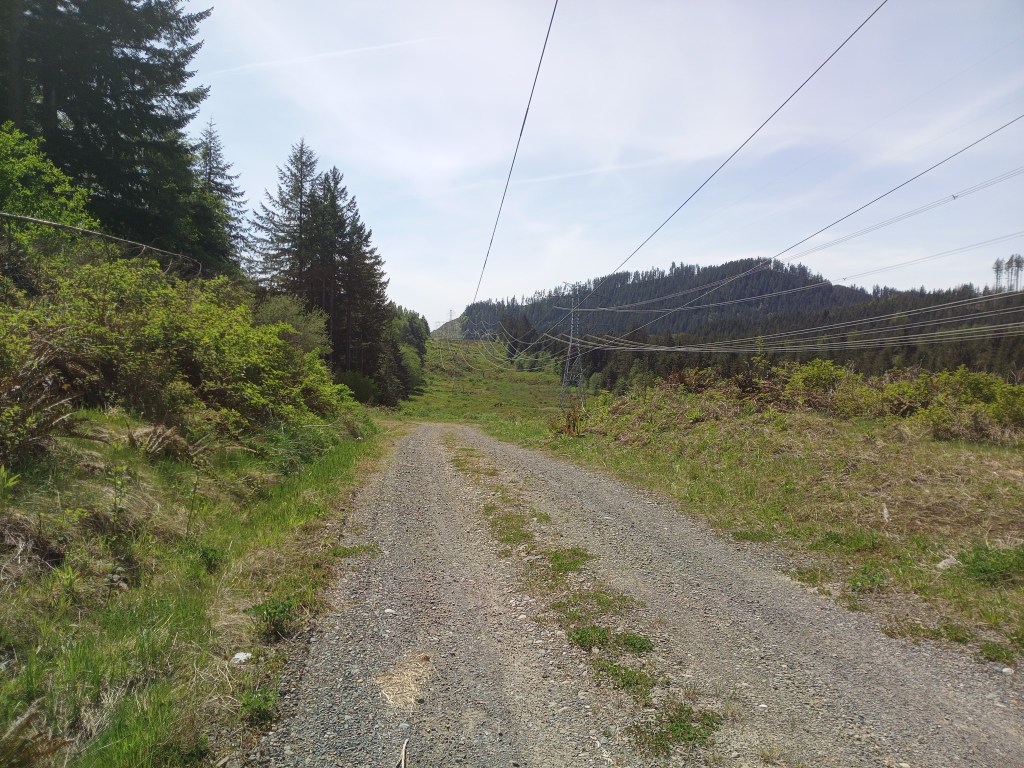
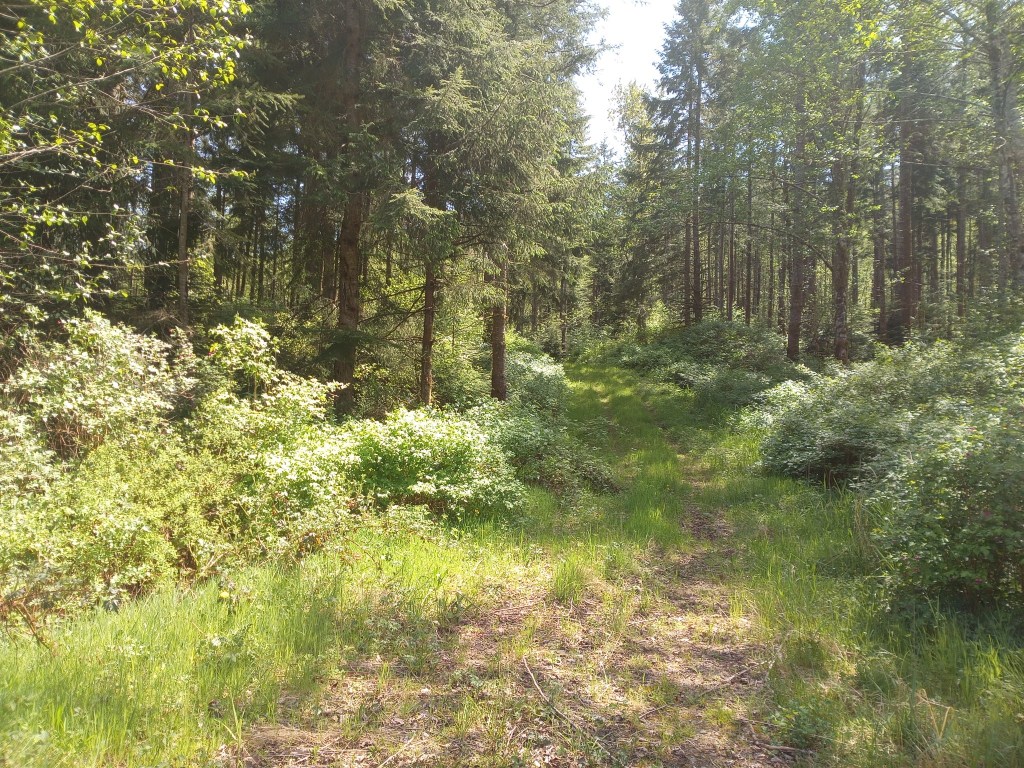
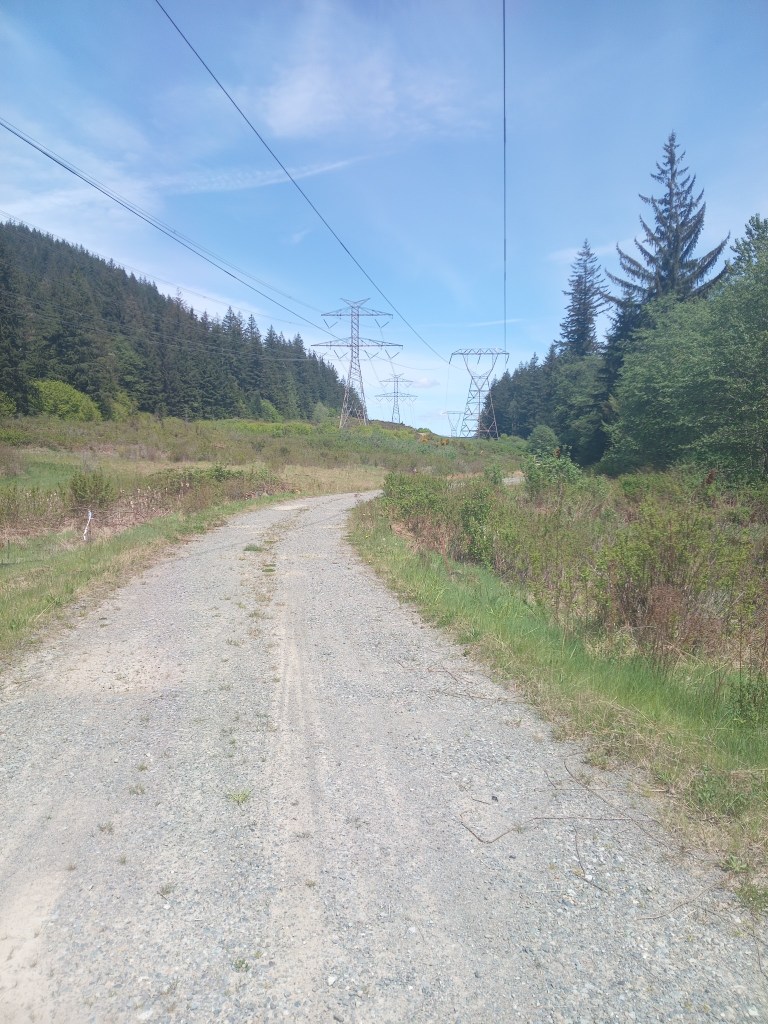
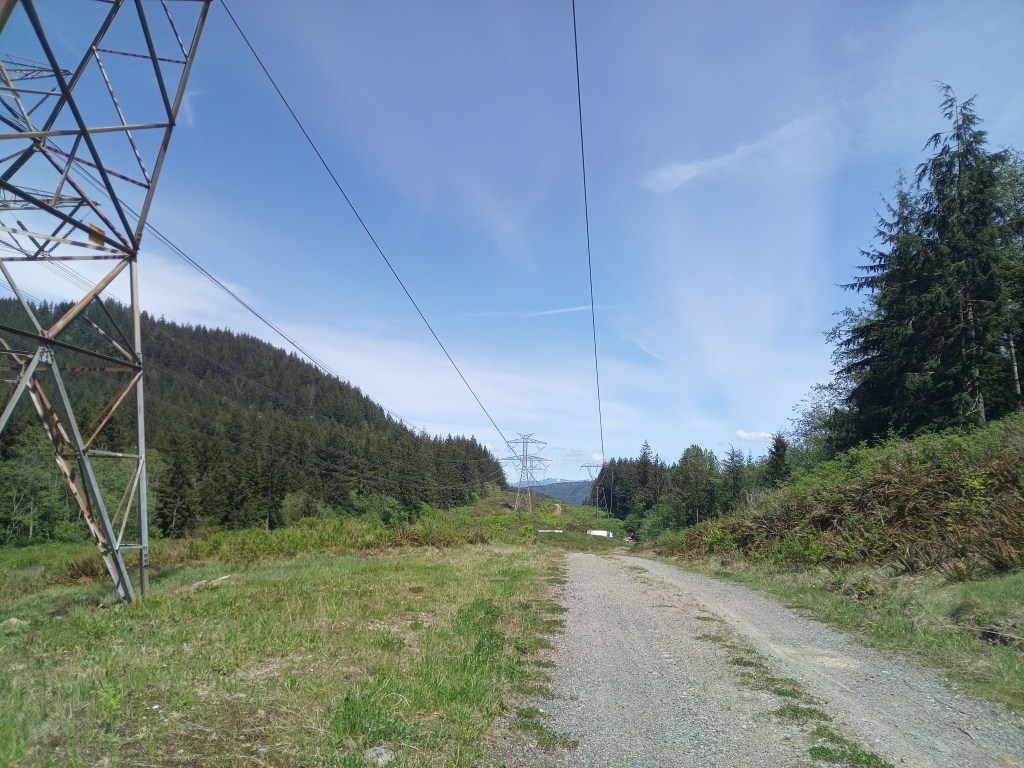
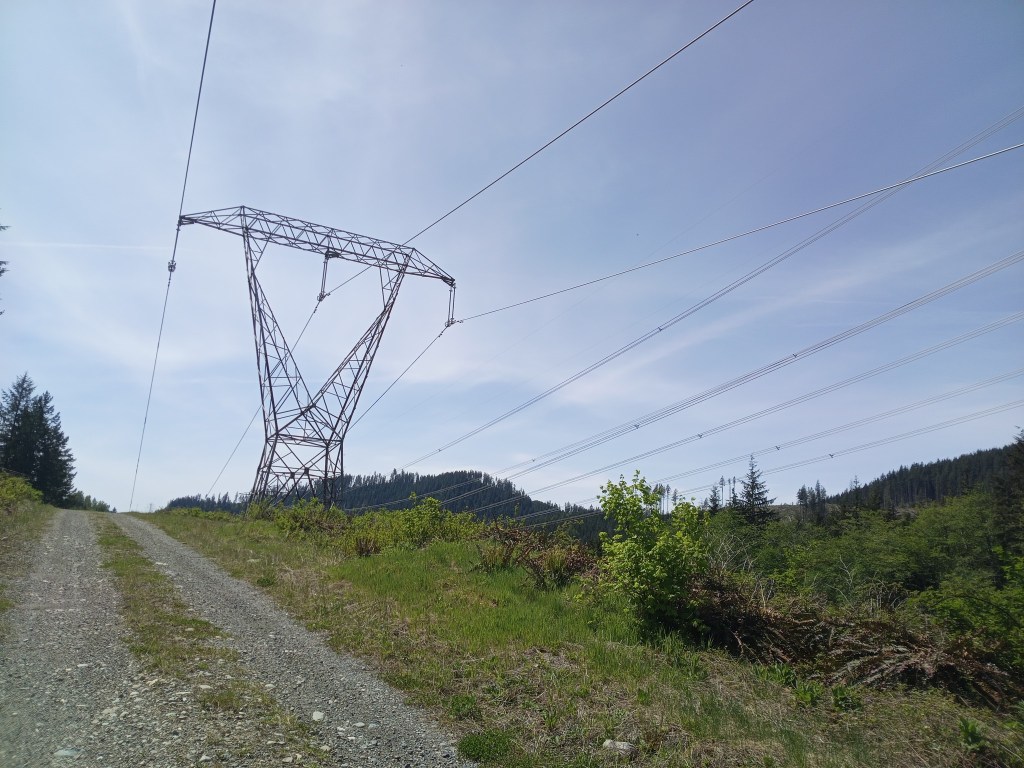
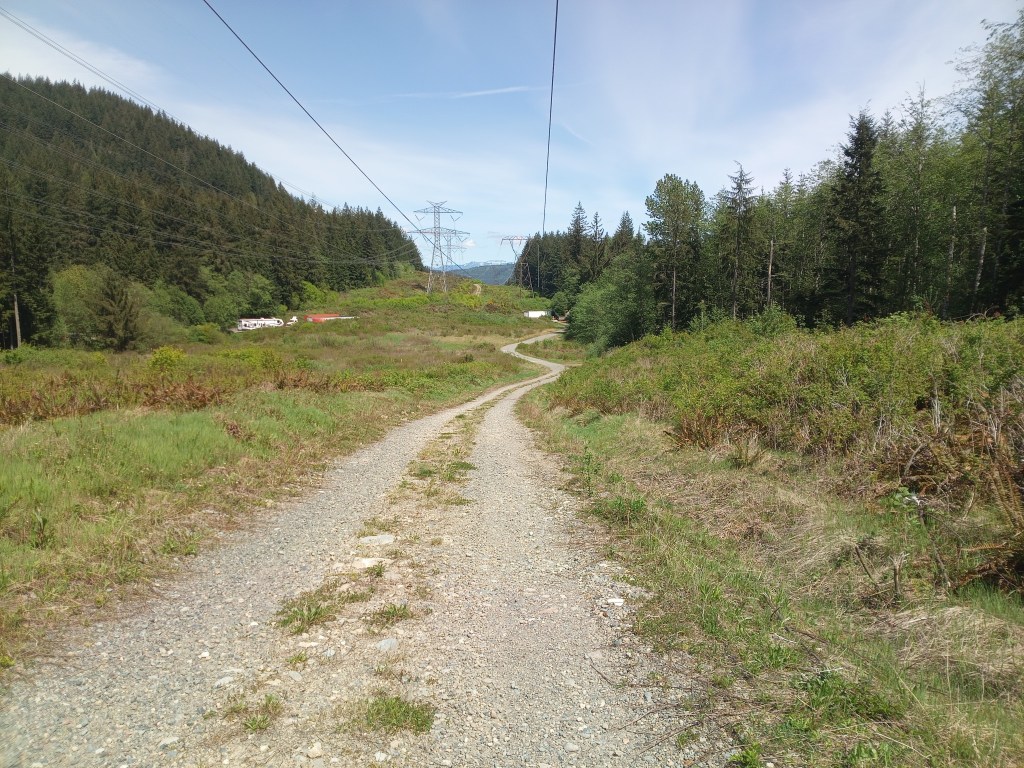
I needed to take a break from uploading the documents from the King County Sheriff’s Department and decided to post some pictures from my recent Seattle trip. Even before I checked in to my Air BnB, the first thing I did after leaving the Sea-Tac Airport was drive straight to Taylor Mountain, because I knew my time in Washington was limited and I wanted to make the most of it. When I went in 2022 and 2024 I didn’t venture in very far, and just took my pictures and left. This time I made sure to wear appropriate footwear and walked through the entire area, and I learned that it was much larger than I previously thought, and even had a lake and separate walking path.
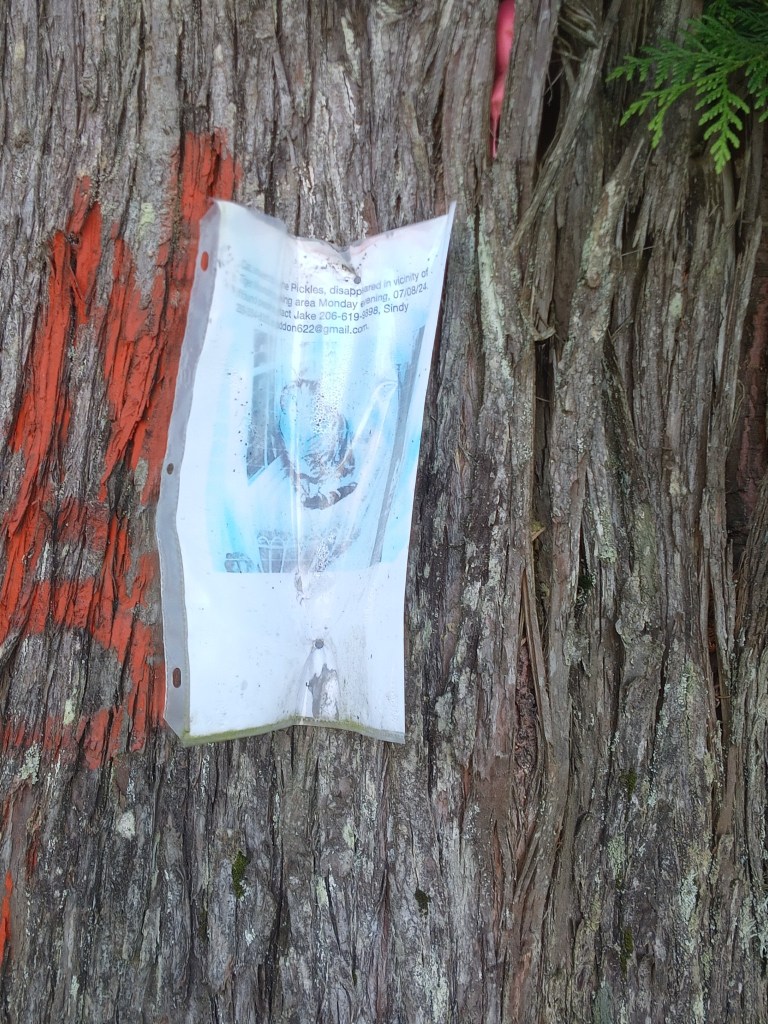
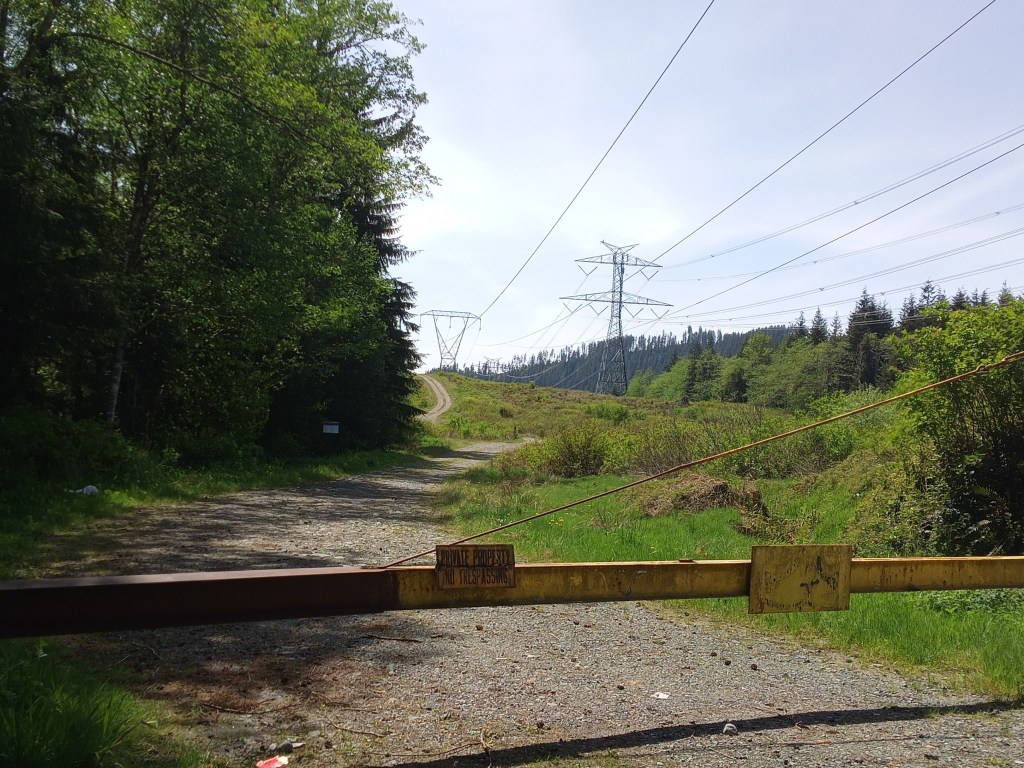
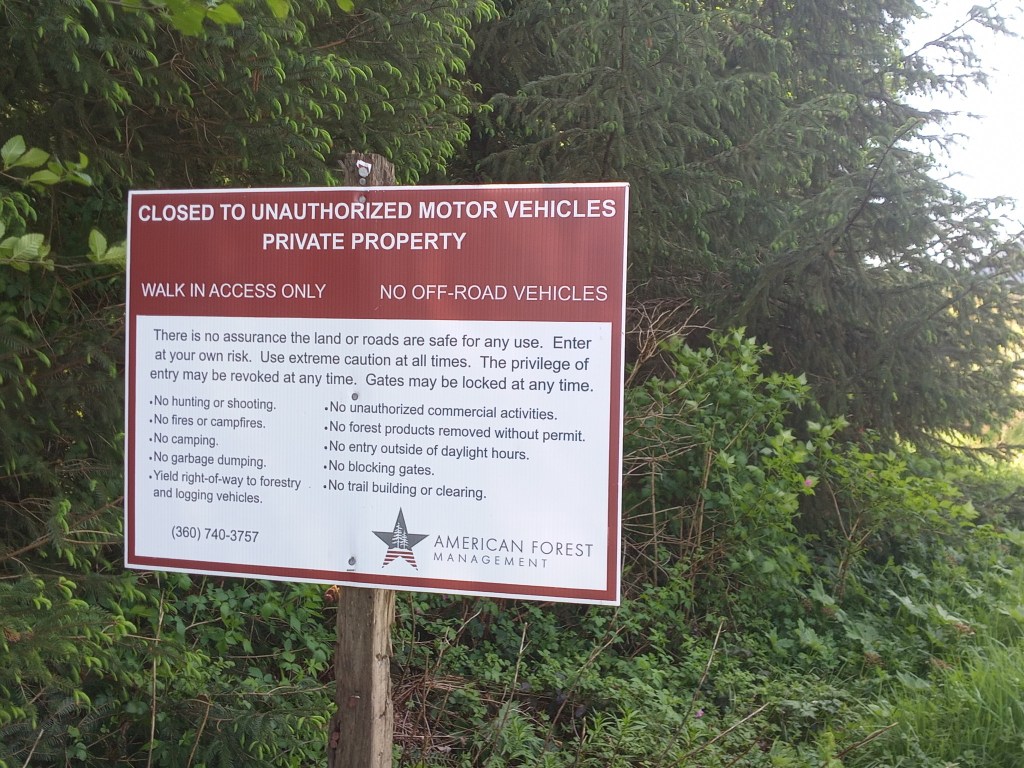
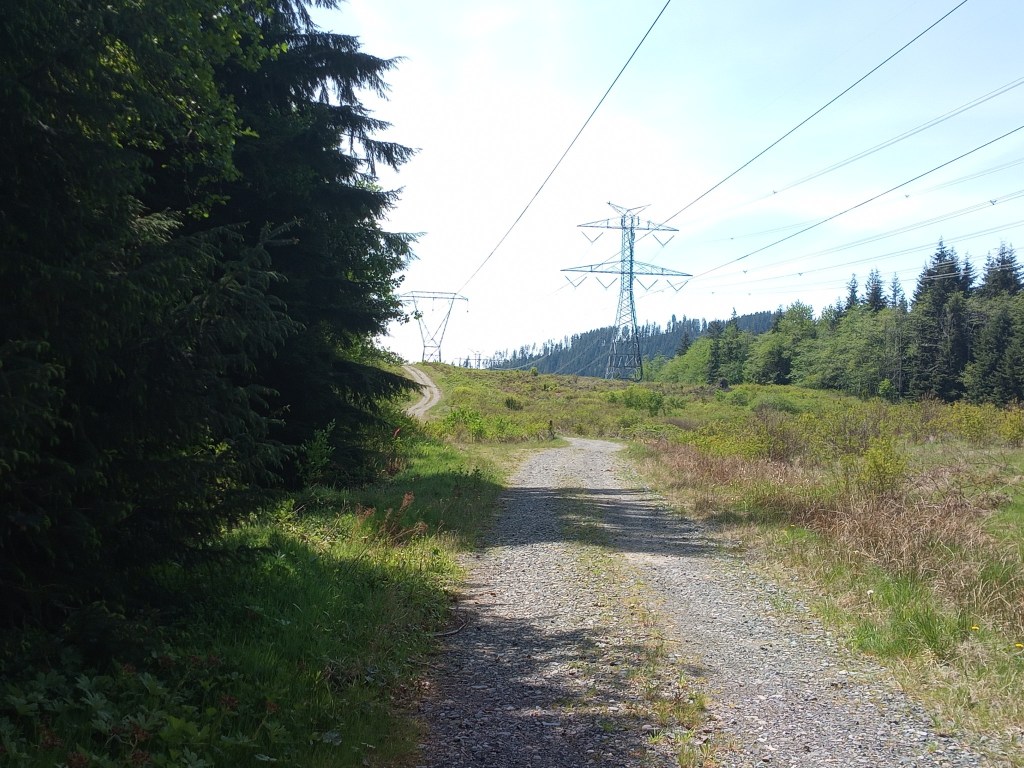
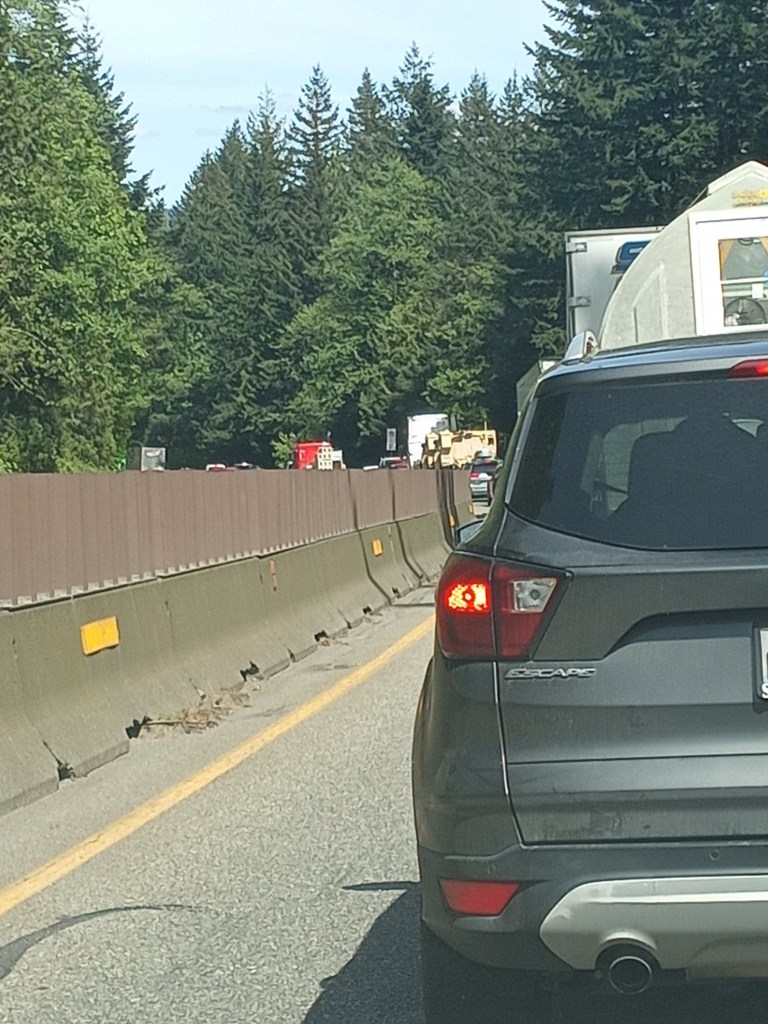
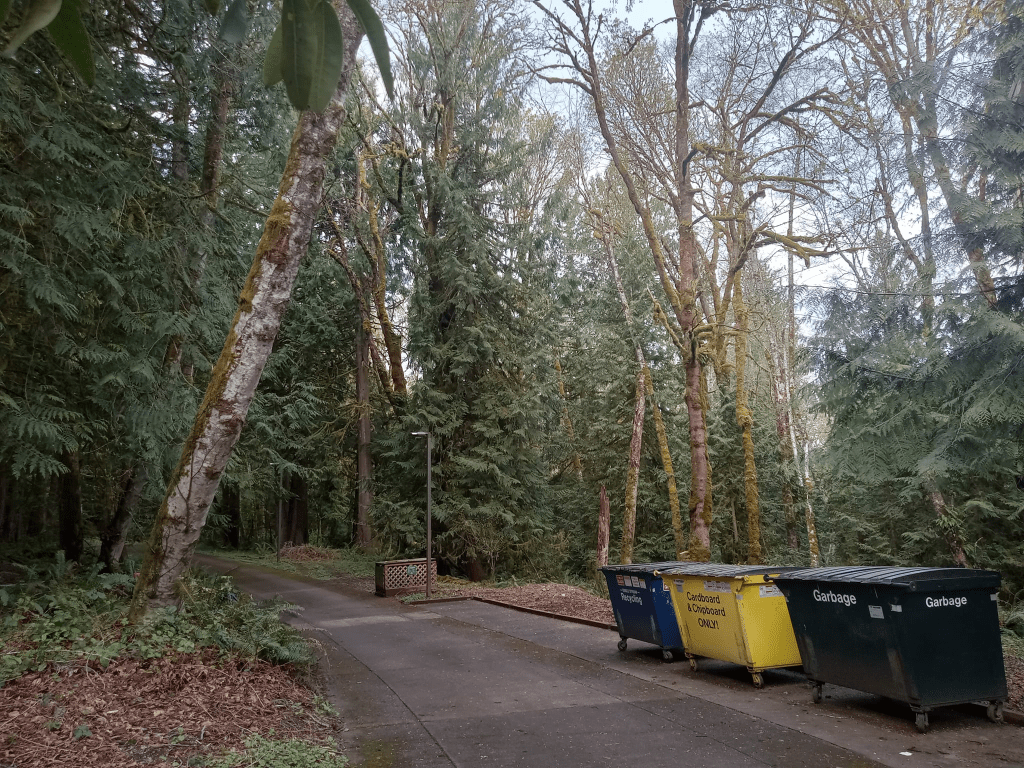
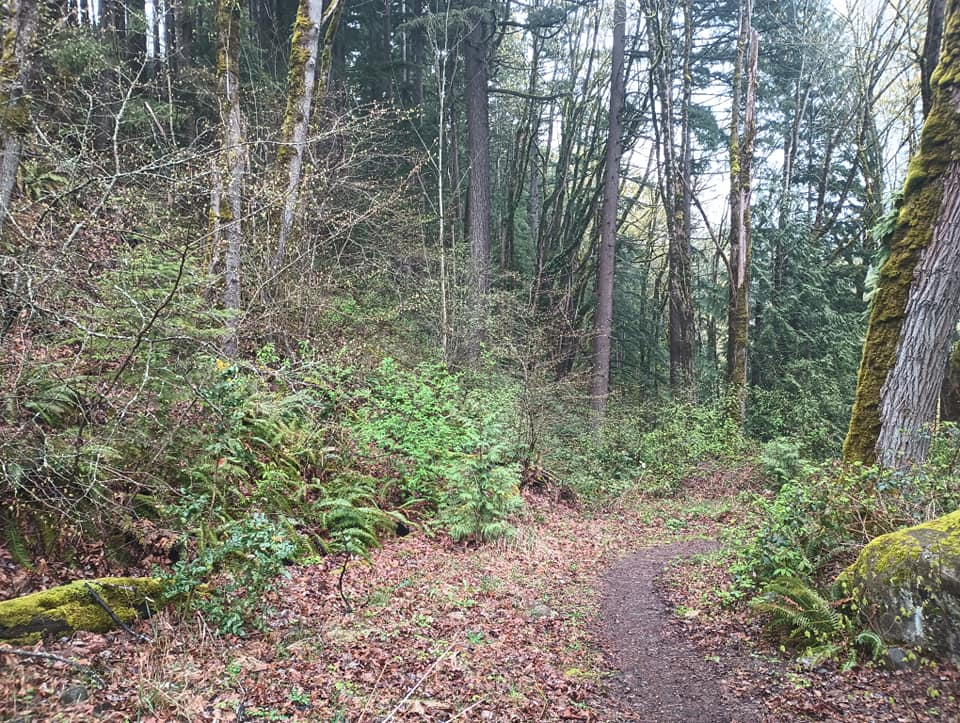
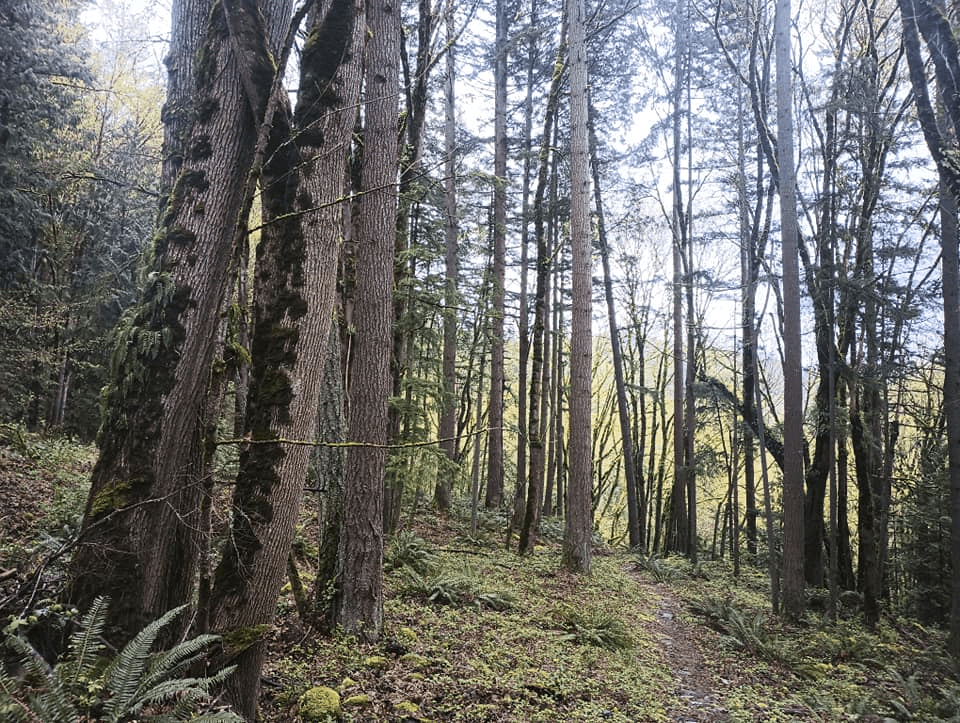
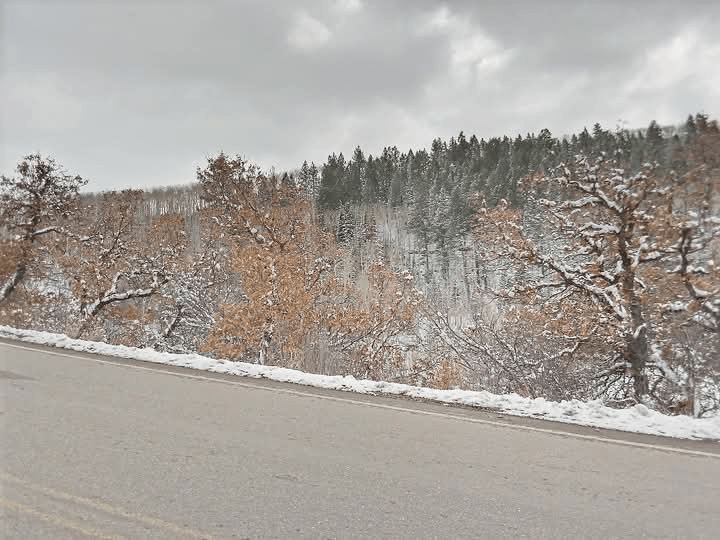
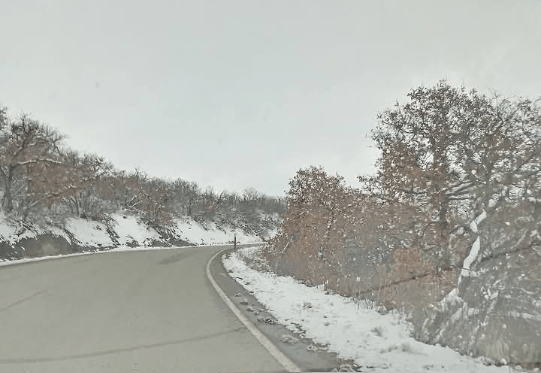
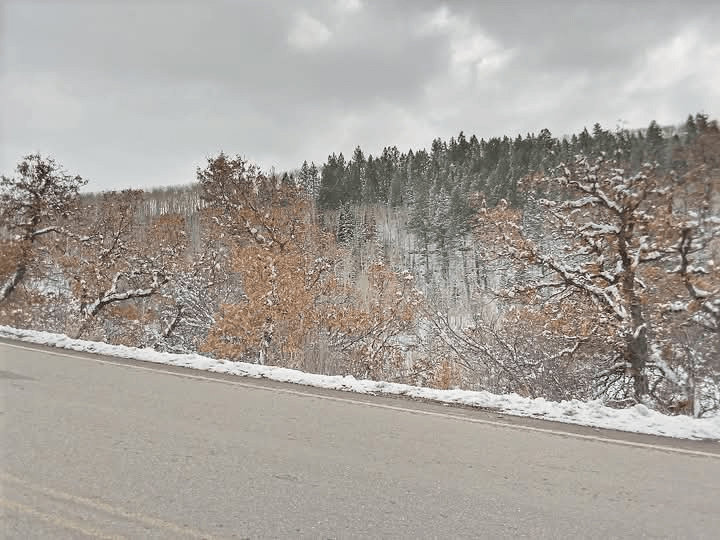
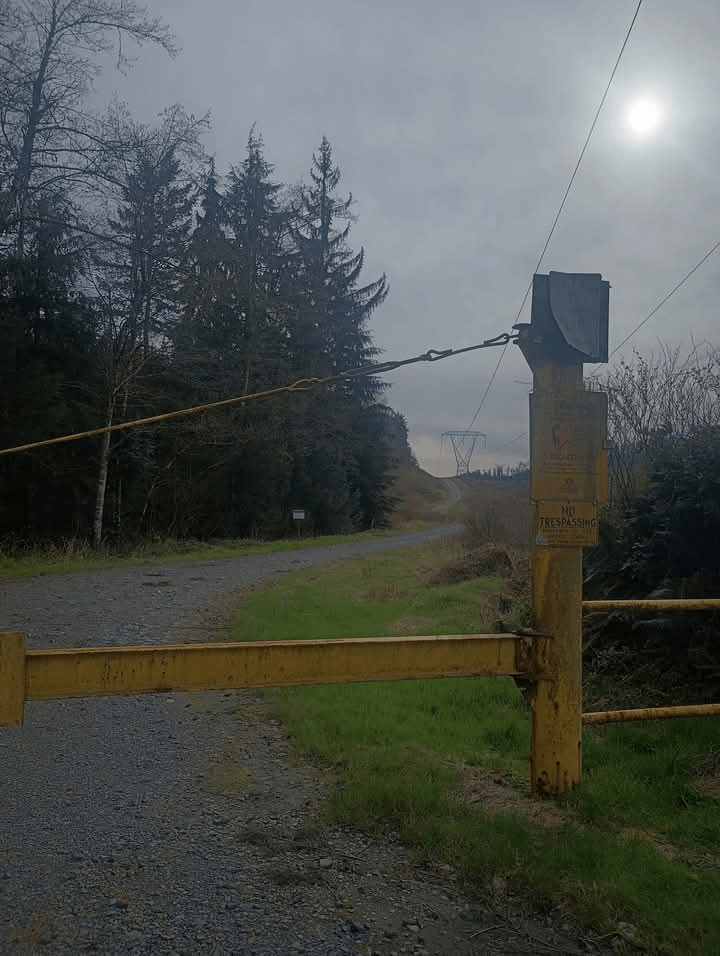
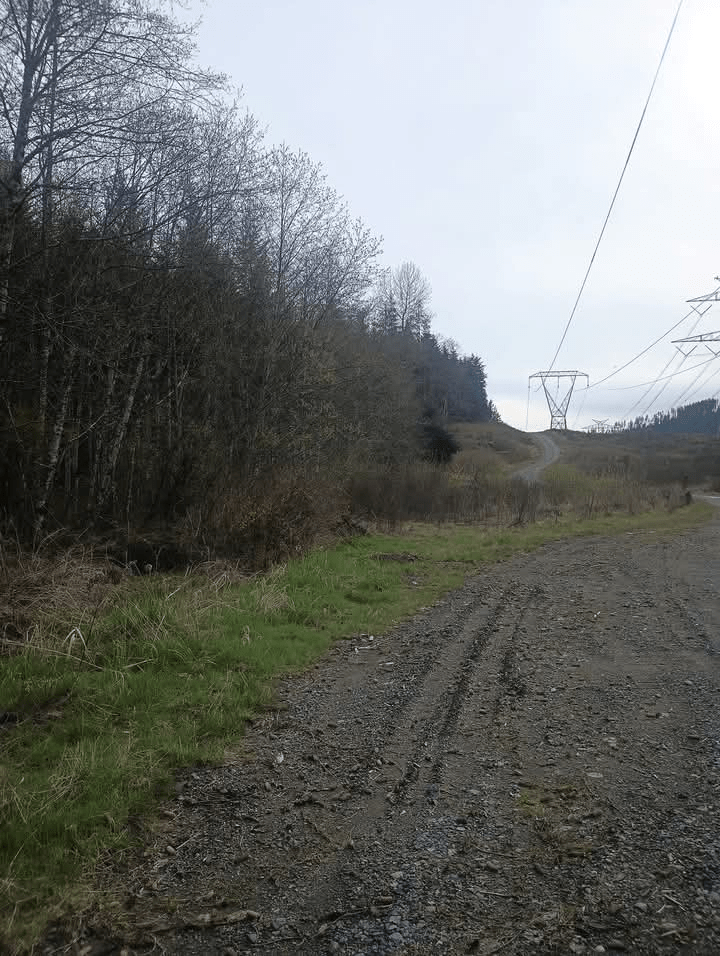
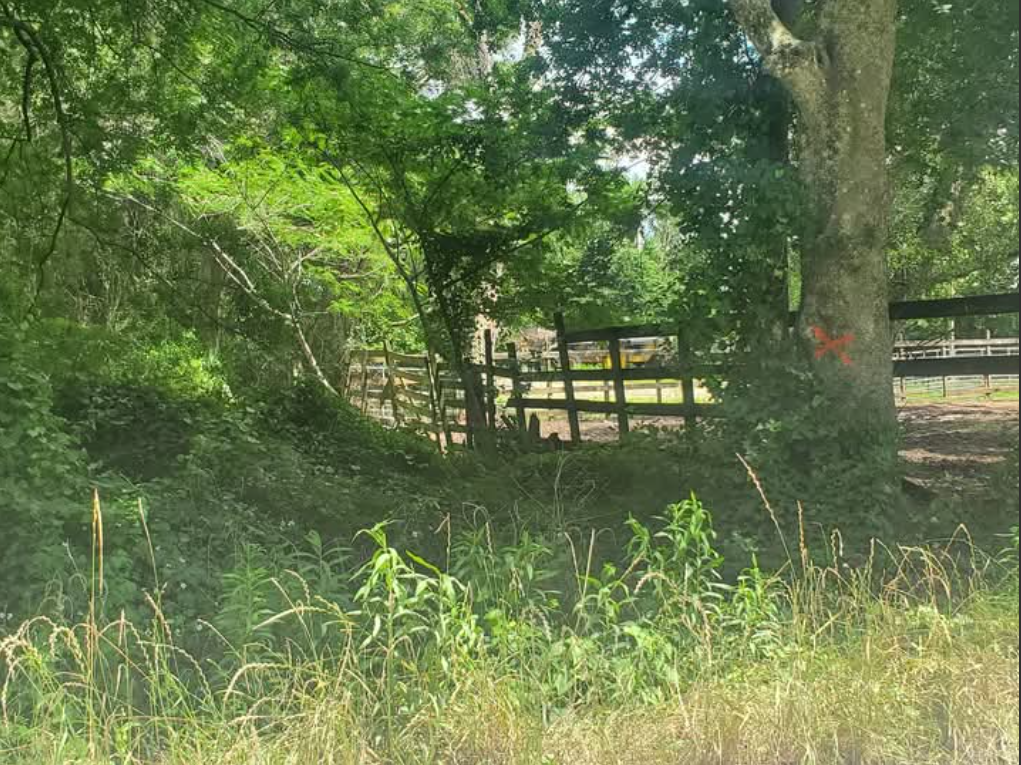
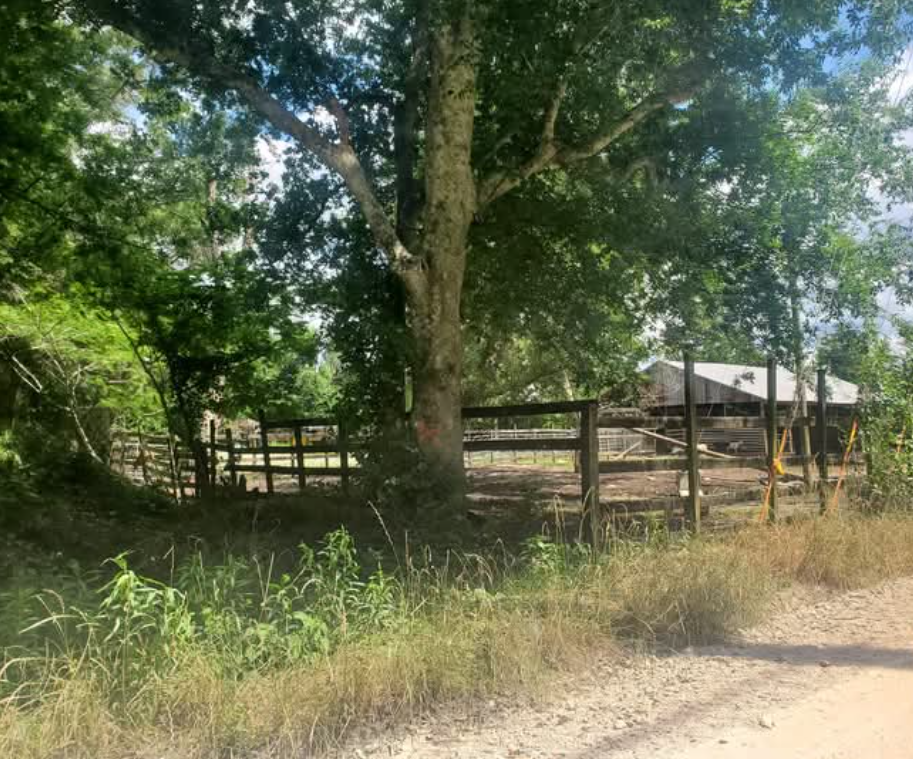
The sign for Tiger Mountain, which is very close to Taylor Mountain (I incorrectly thought they were one in the same, but they are not): while they are very close to one another and are considered to be ‘neighbors,’ they are two distinct geographical areas that are separated by the Raging River and offer ‘different trails and elevations.’ Picture from May 2025. The pull off for Taylor Mountain is almost right after this road sign.A sign for a missing dog at Taylor Mountain. Picture from May 2025.A close up of the entrance to Taylor Mountain. Picture from May 2025.Another shot of the entrance to Taylor Mountain. Picture from May 2025.Another shot of the entrance to Taylor Mountain. Picture from May 2025.A sign at the entrance to Taylor Mountain. Picture from May 2025.Taylor Mountain. Picture from May 2025.The main roadway on Taylor Mountain. Picture from May 2025.A lake at Taylor Mountain. Picture from May 2025.A lake at Taylor Mountain. Picture from May 2025.A trail at Taylor Mountain. Picture from May 2025.Taylor Mountain. Picture from May 2025.A plant at Taylor Mountain. Picture from May 2025.Taylor Mountain. Picture from May 2025.Taylor Mountain. Picture from May 2025.The main roadway at Taylor Mountain. Picture from May 2025.Taylor Mountain. Picture from May 2025.Taylor Mountain. Picture from May 2025.Taylor Mountain. Picture from May 2025.The roadway after the electric towers on Taylor Mountain. Picture from May 2025.Taylor Mountain. Picture from May 2025.A path at Taylor Mountain. Picture from May 2025.A path at Taylor Mountain. Picture from May 2025.A path at Taylor Mountain. Picture from May 2025.Taylor Mountain. Picture from May 2025.Another picture taken at Taylor Mountain. Picture taken in May 2025.One of the paths at Taylor Mountain. Picture taken in May 2025.The main roadway at Taylor Mountain. Picture from May 2025.Taylor Mountain. Picture taken in May 2025.Almost at the top of the main road at Taylor Mountain. Picture taken in May 2025.The view looking down on the top of the main road at Taylor Mountain. Photo taken in May 2025.Driving away from Taylor Mountain, if you look closely you can see an Army vehicle, (most likely) from the nearby Joint Base Lewis-McChord, which is just outside Lakewood, Washington and encompasses both Fort Lewis Army Base and McChord Air Force Base. Picture from May 2025.
Up until about five years ago I lived paycheck to paycheck, and after getting two really good jobs I banked quite a bit of money and decided to start traveling. In April 2022 I went to Seattle and since then have been to Florida, Philadelphia, Salt Lake City, Colorado, Cobleskill (in NY, for a suspected Bundy victim) and Portland (on that trip I also went back to Seattle). I’ve been retracing the steps of Ted Bundy and taking pictures along the way.
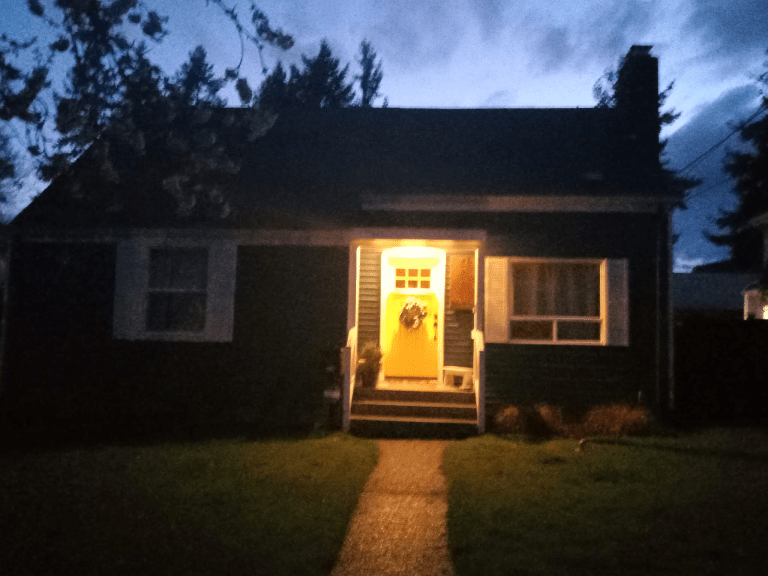
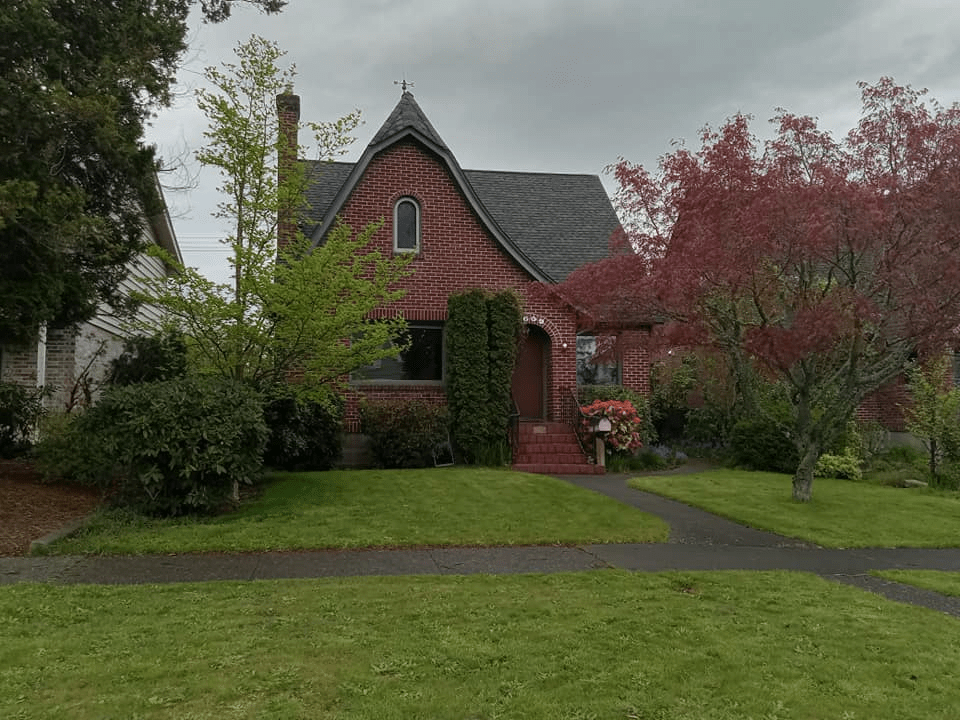
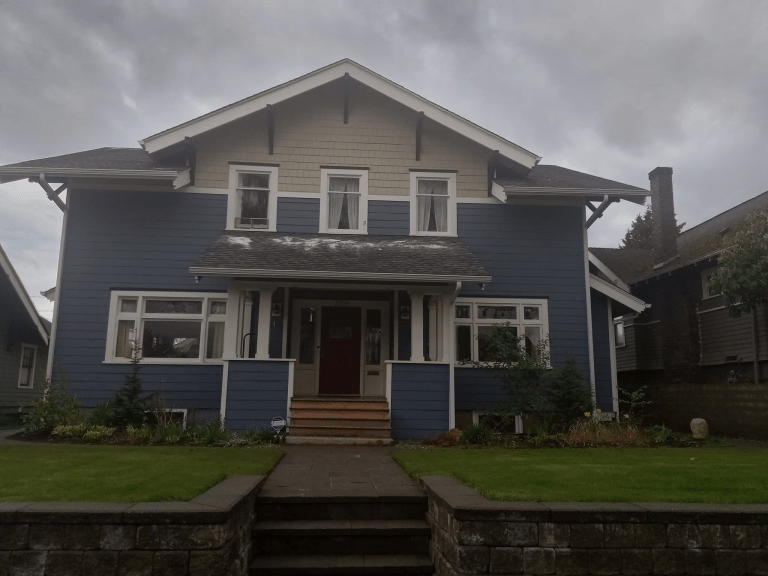
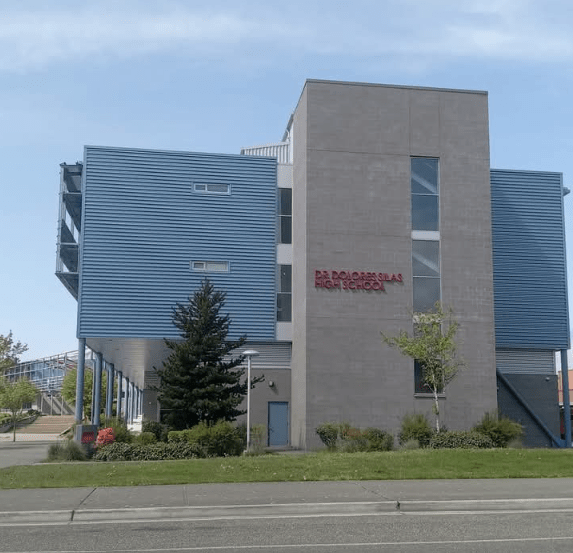
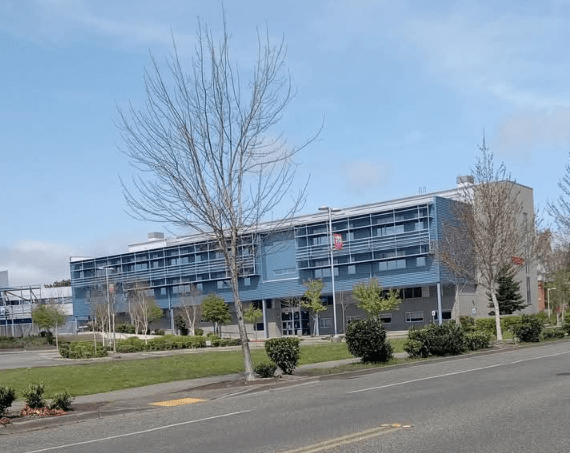
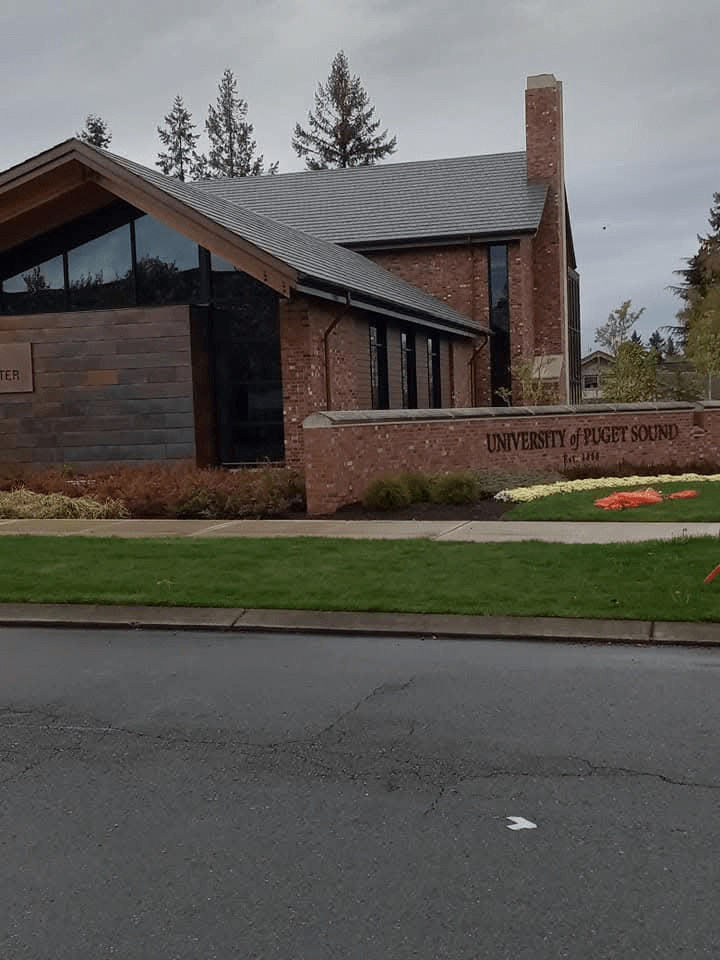
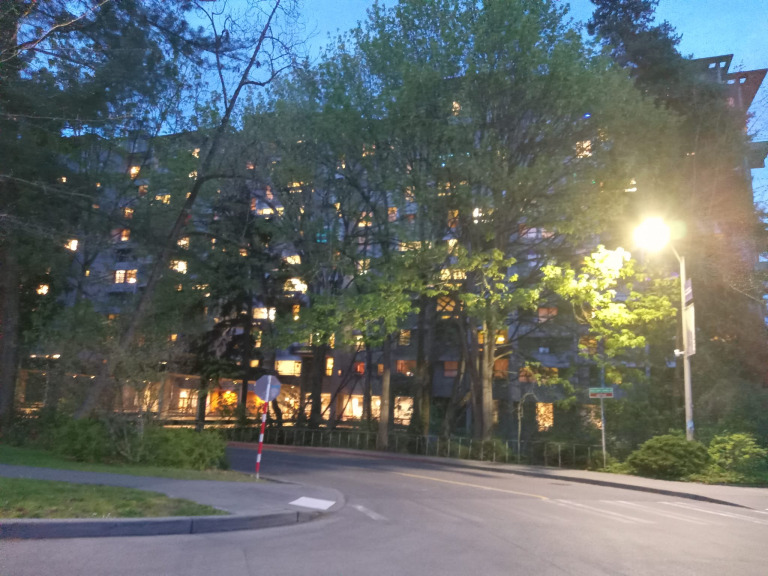
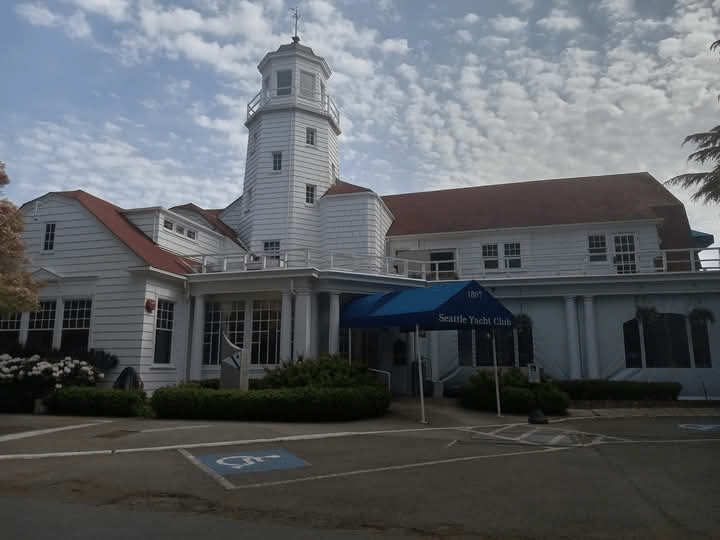
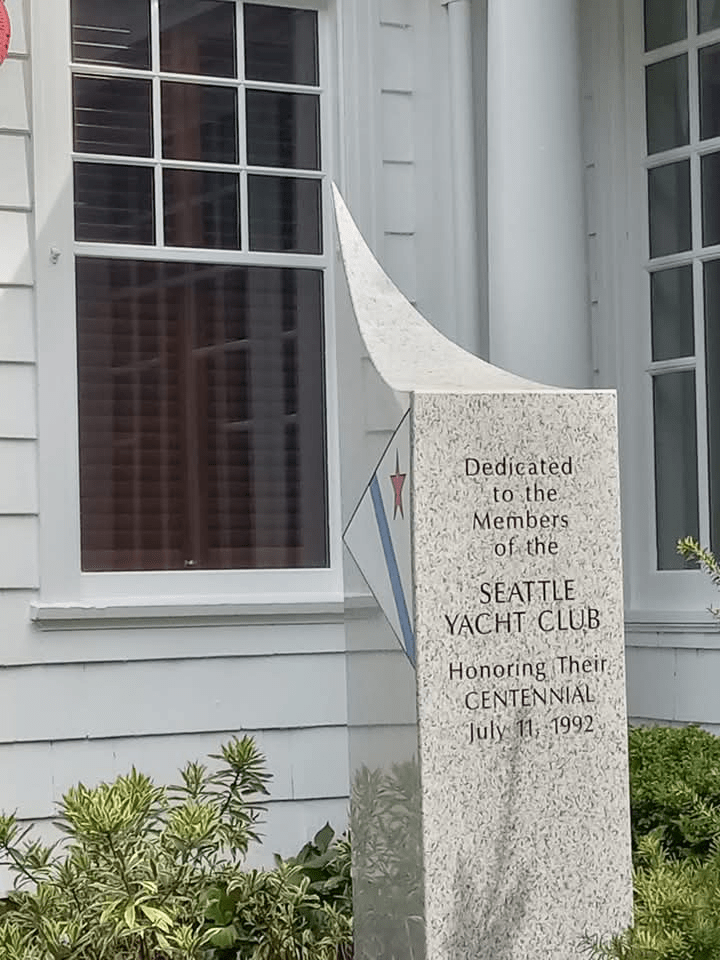
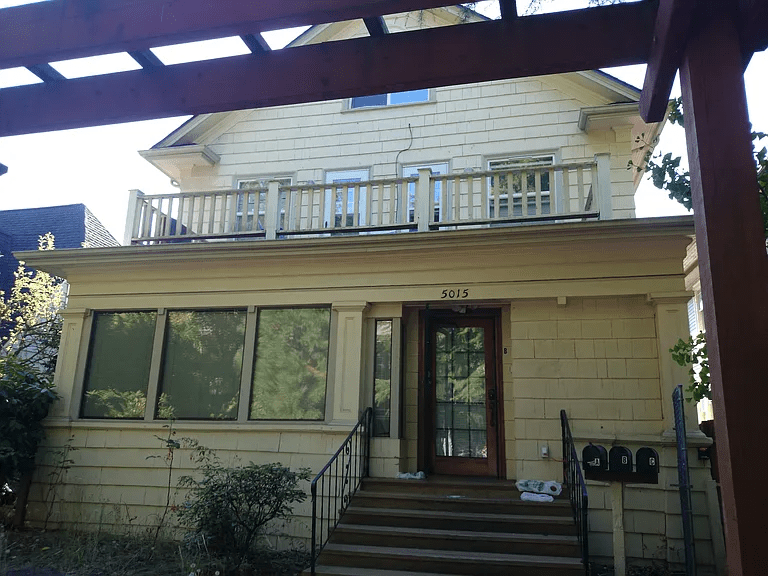
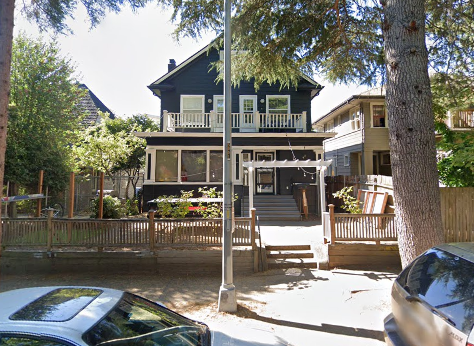
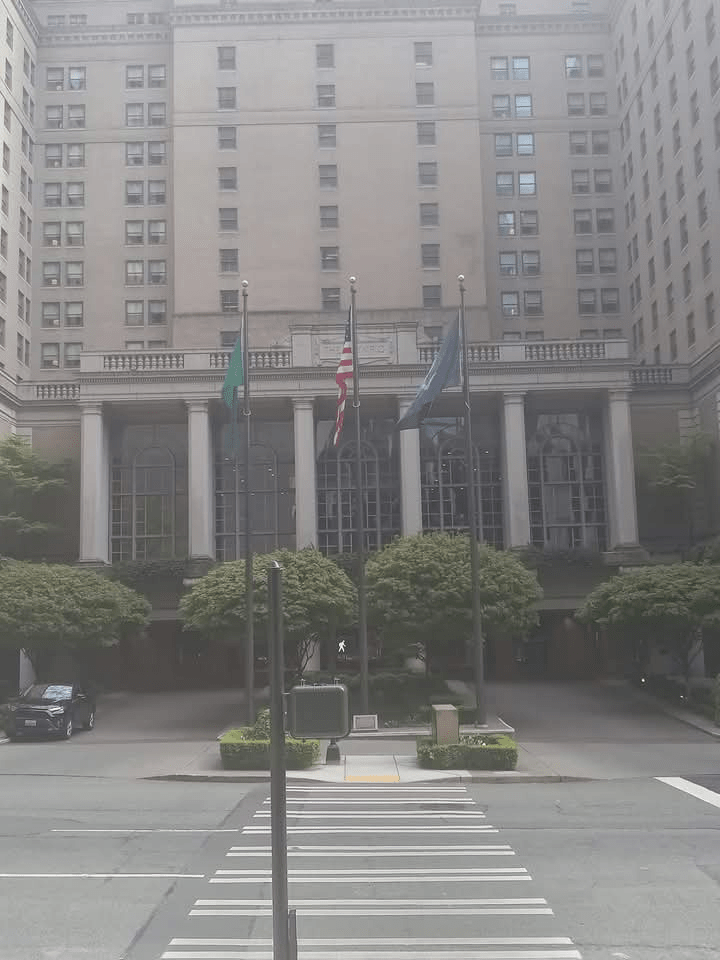
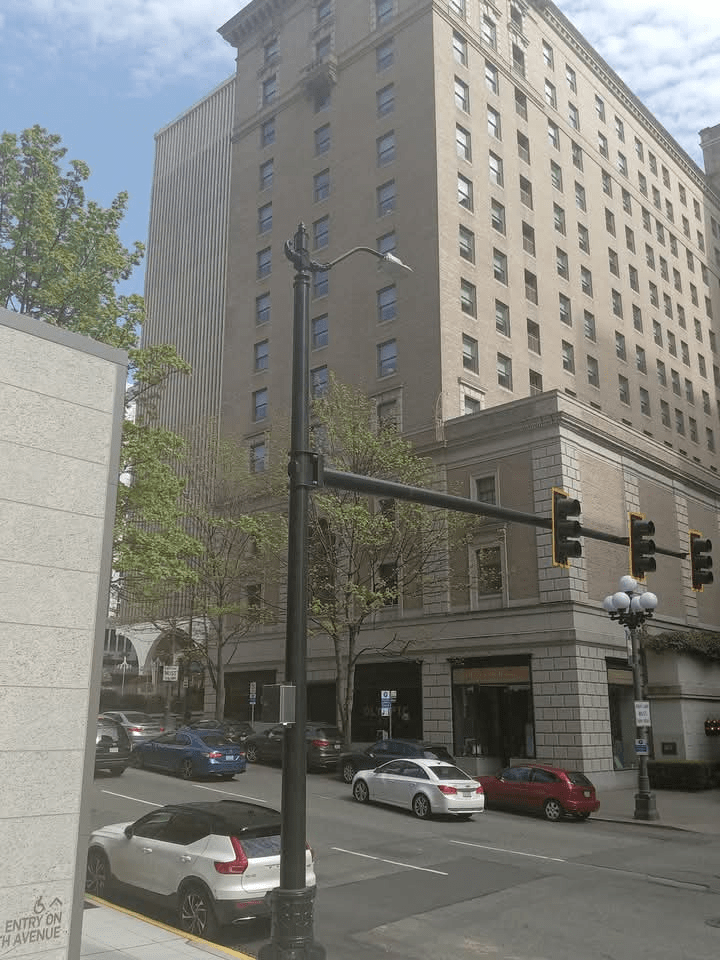
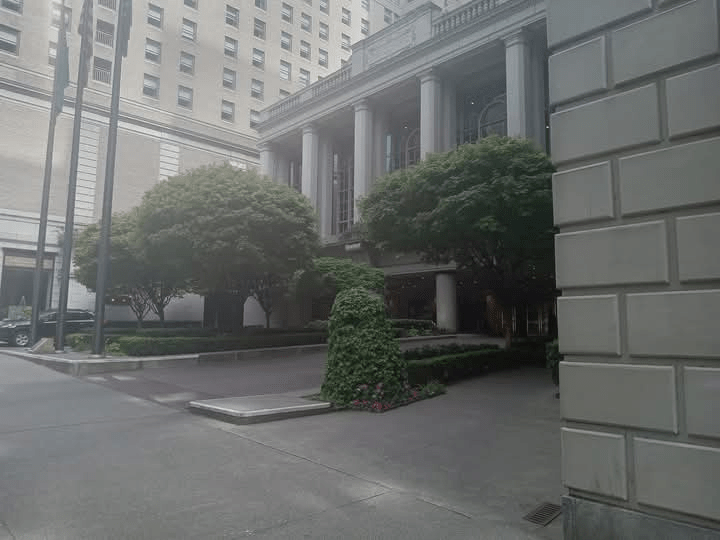
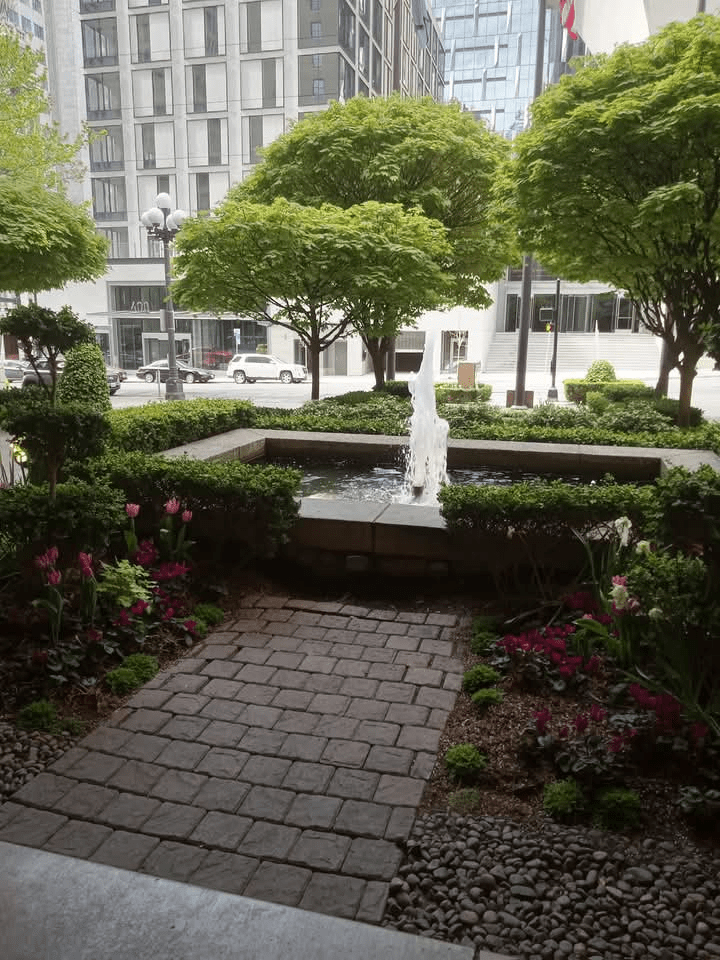
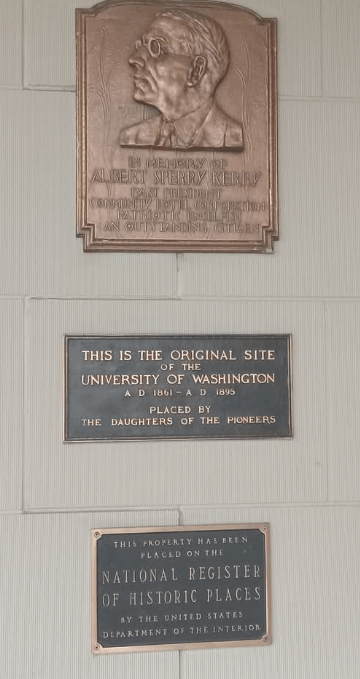
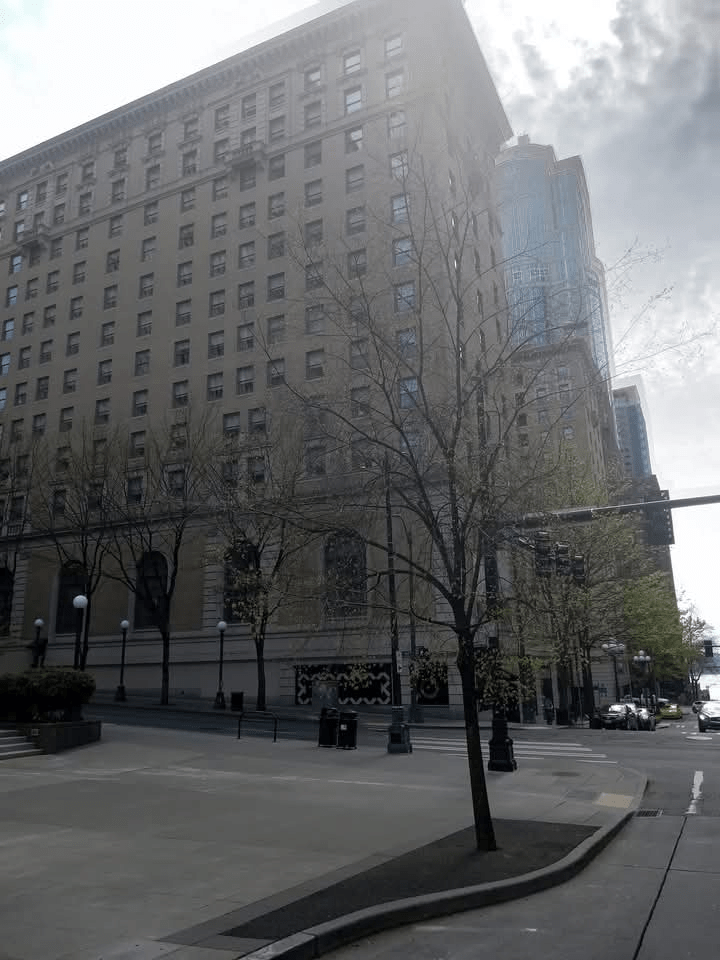
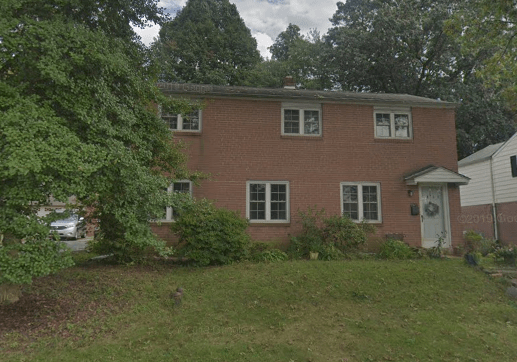
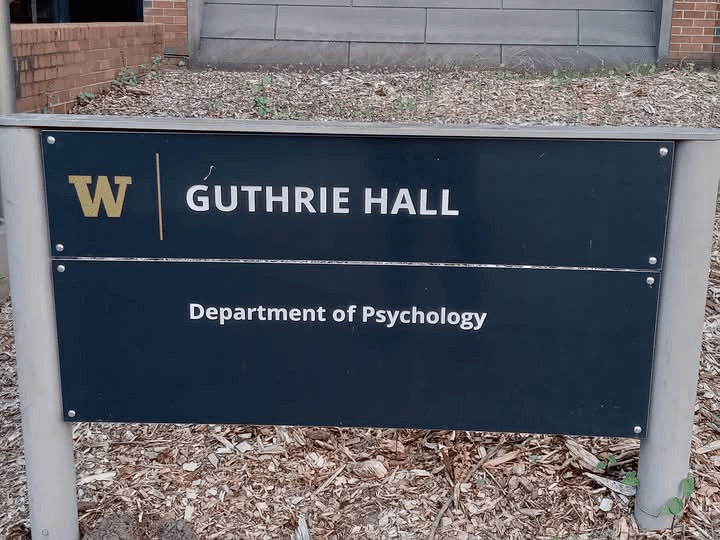
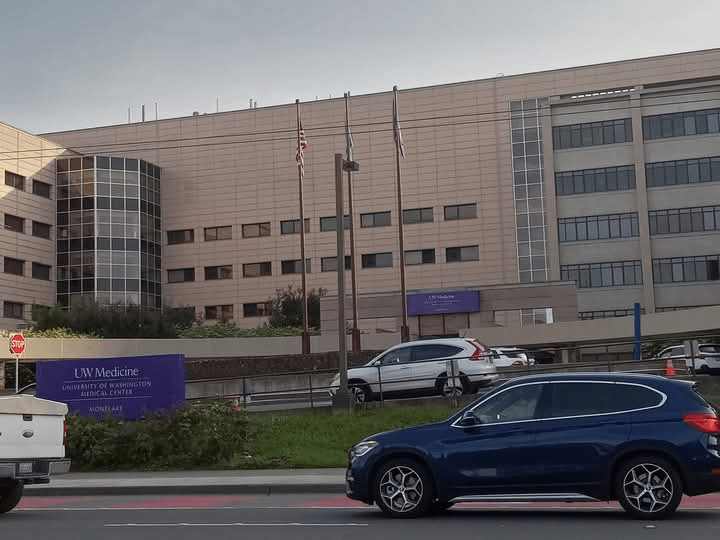
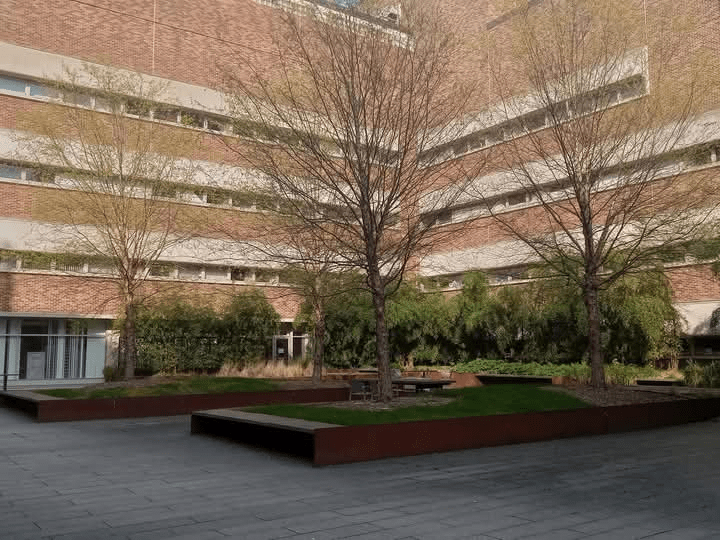
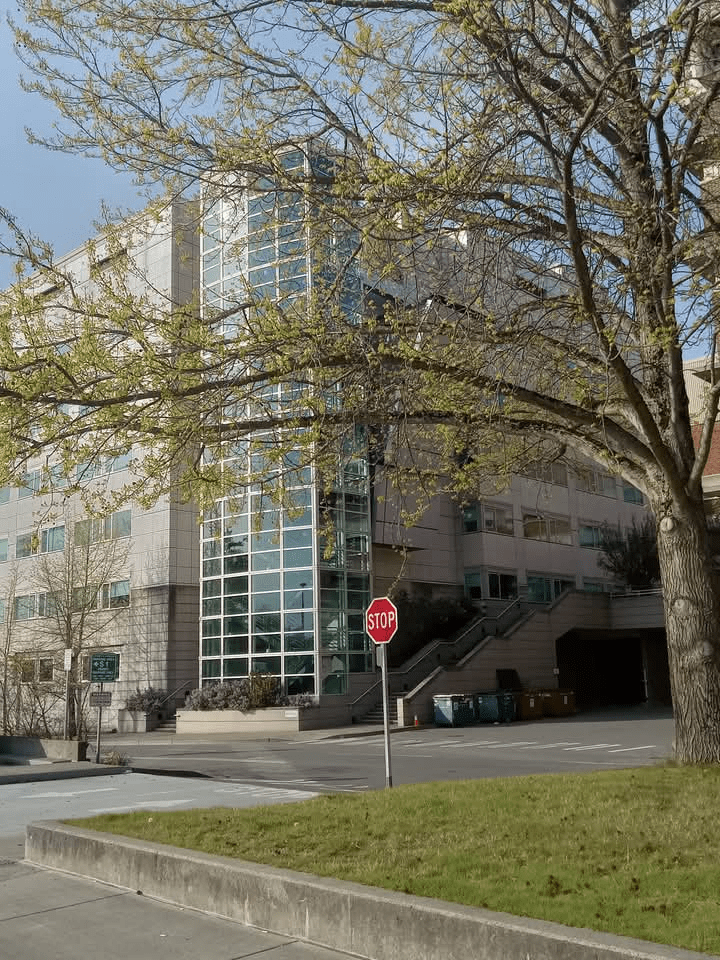
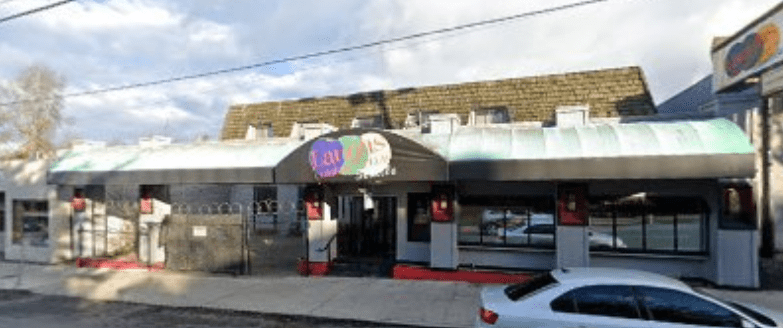
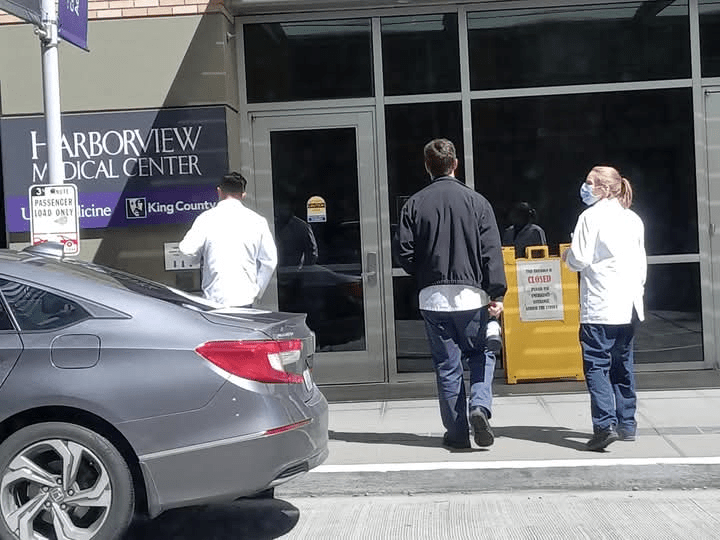
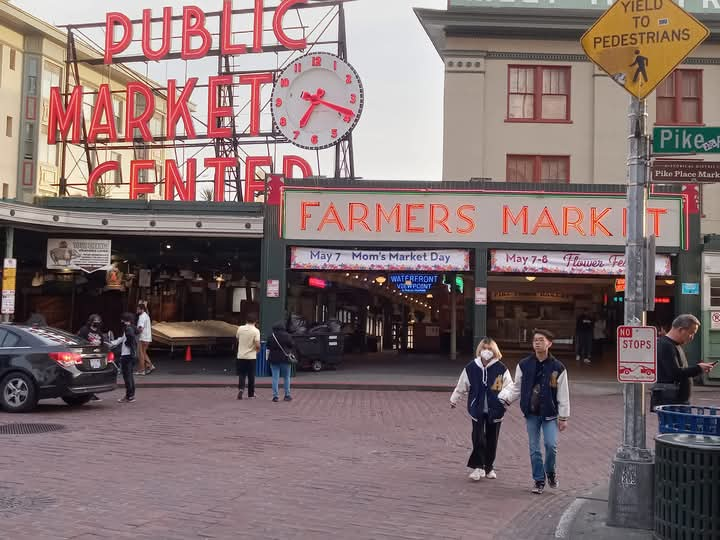
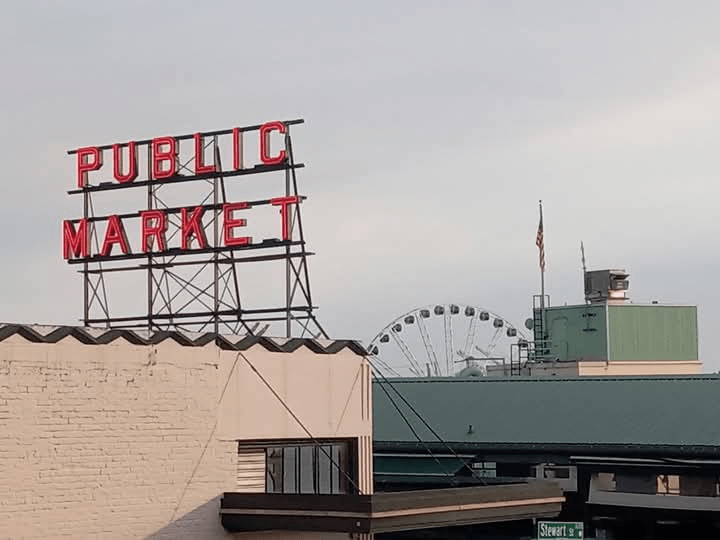
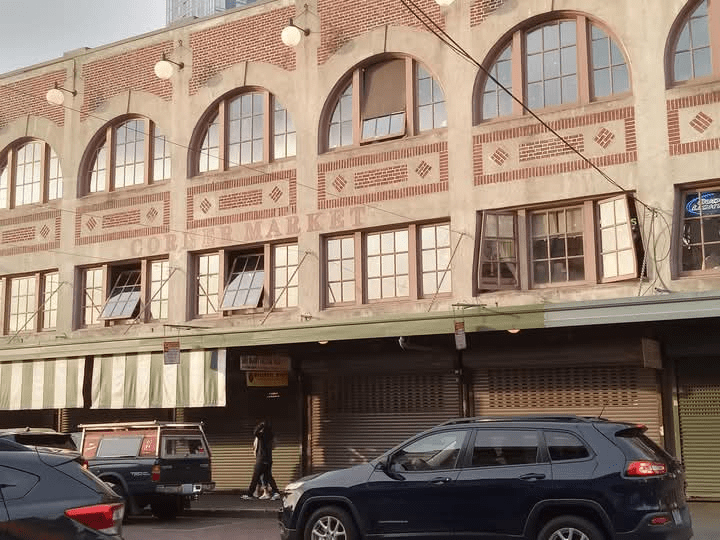
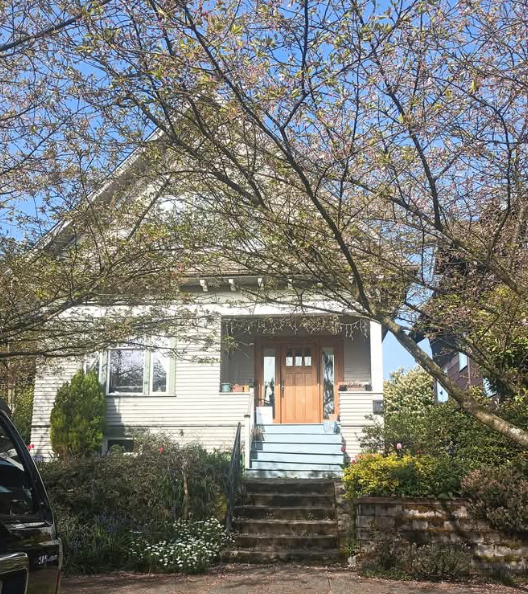
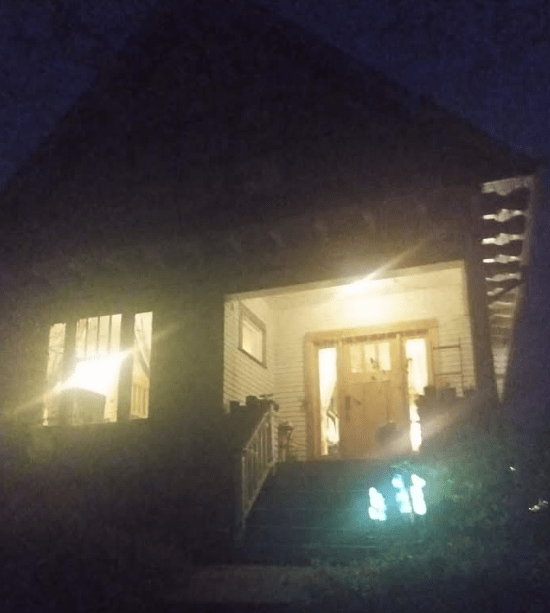
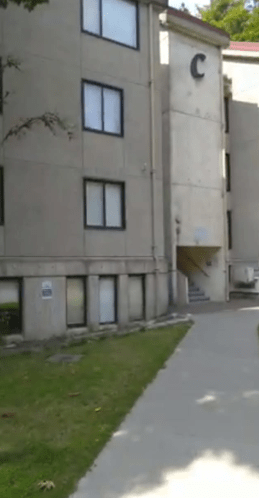
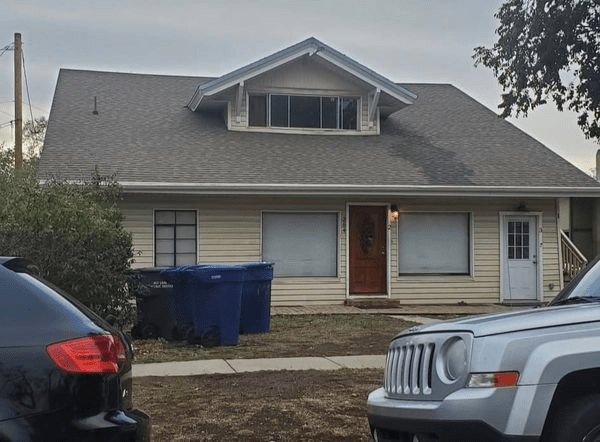
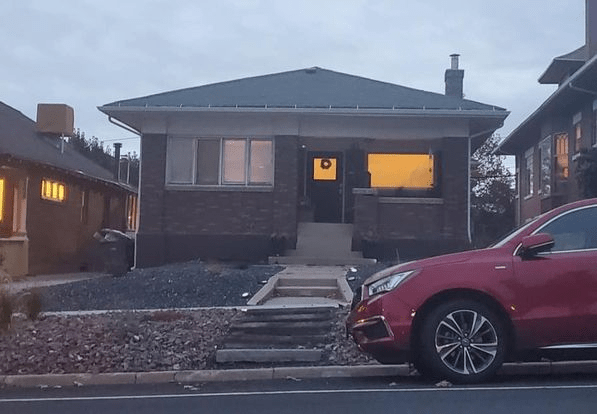
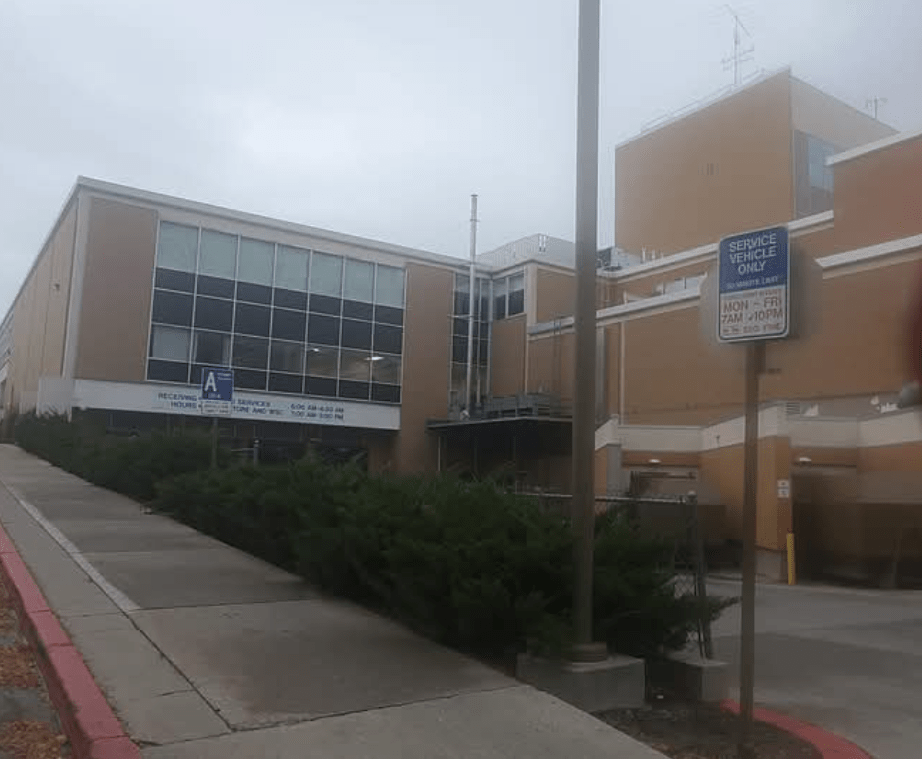
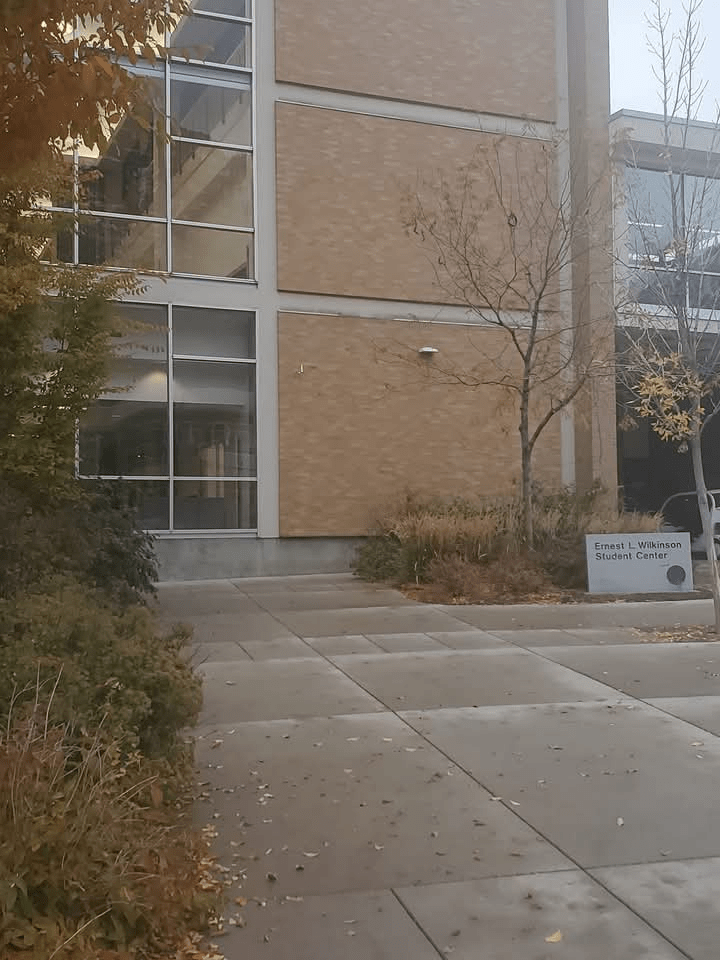
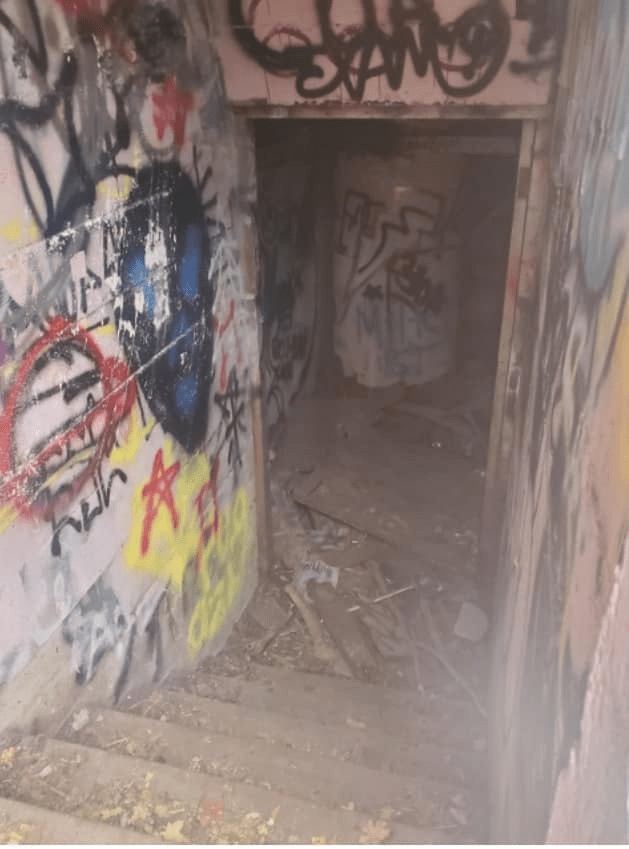
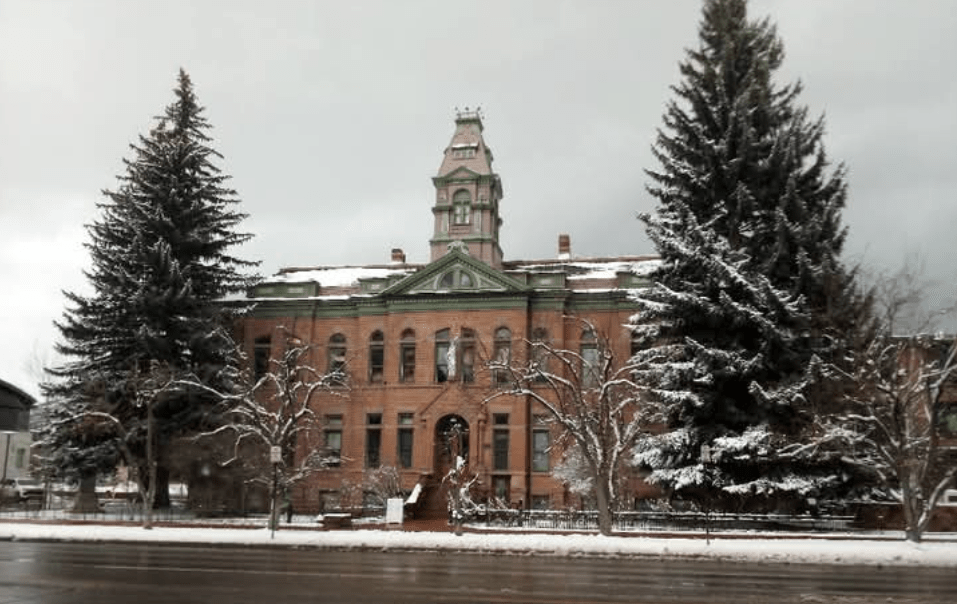
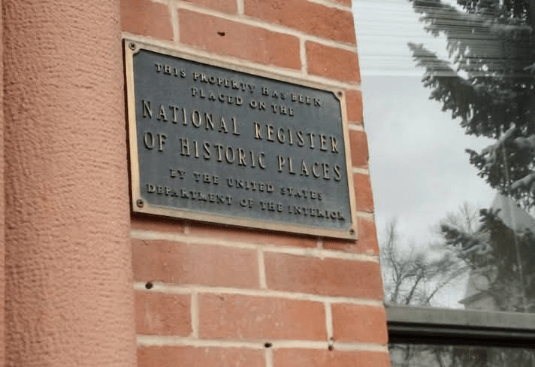
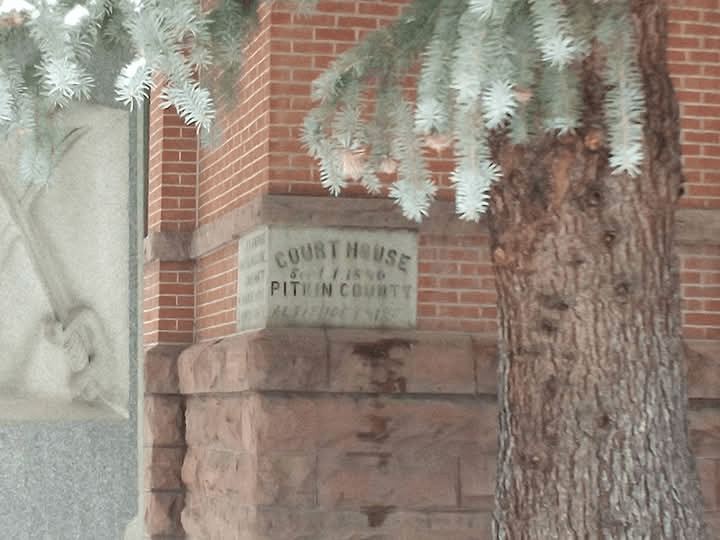
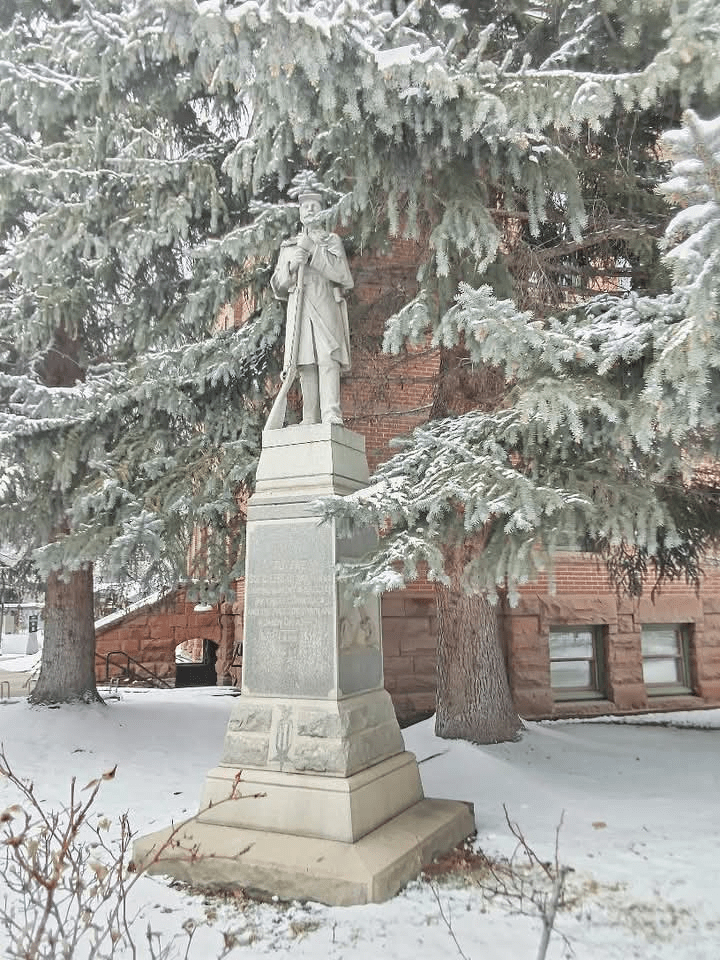
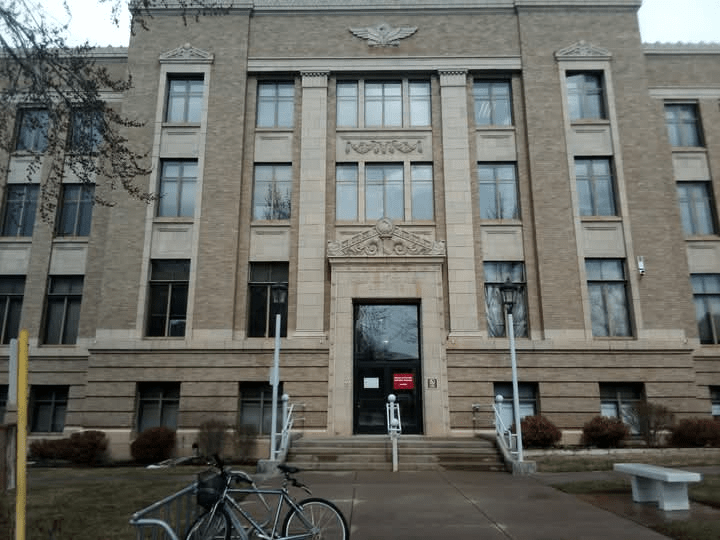
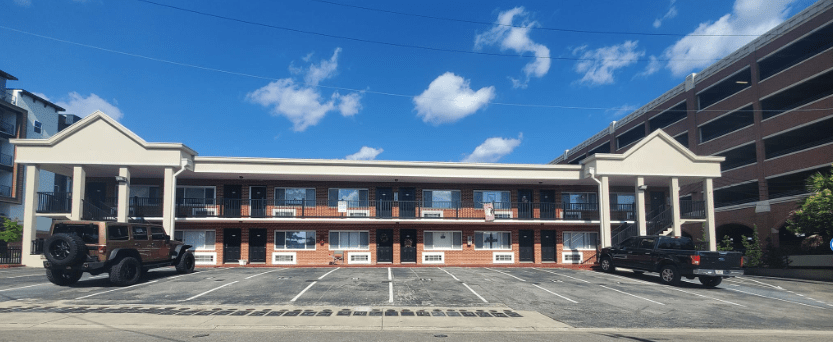
Where Bundy’s very first home once stood in the Roxborough neighborhood of Philadelphia, where he lived with his mother, aunt, and maternal grandparents until he was three years old; it was formerly located at ‘7202 Ridge Avenue’ and is now ‘499 Domino Lane.’ Picture taken in May 2023.The Cowell family’s second home. A diabetic (and agoraphobic), Eleanor Cowell had suffered a stroke in the mid-1950’s and underwent electroconvulsive therapy (ECT) for depression. She passed away at the age of 76 in April 1971, and in December 1983 Samuel passed away at the age of 85.Ted’s Uncle Jack Cowell’s house, located at 1514 South Alder Street in Tacoma, WA. Louise and Ted lived here briefly when they moved to Washington state in 1951. Picture taken in April 2022.The Bundy family’s first home, April 2022. During an interview with author Stephen G. Michaud, Ted talked about his time living here: ‘Our house was on Sheridan Street in Tacoma. It was the second house from the corner, on the west side of the street. We moved there, I would guess, in about 1951. My boyhood on Sheridan Street was not an unpleasant one. I remember those days, of roaming with my friends. The adventure, the exploration. Those were the days of frog hunting and marble playing.’The Bundy family’s second home, located at 658 North Skyline Drive in Tacoma; Ted spent a good portion of his adolescent years living here. Picture taken in April 2022.The former house of eight-year-old Ann Marie Burr, located at 3009 North 14th Street in Tacoma, WA. The oldest of five, on the morning she went missing on August 31, 1961 her mother, Beverly, woke up early and noticed that Ann wasn’t in her room, and after walking downstairs, she noticed that the front door was slightly open along with the living room window. There’s so many rumors about Bundy and Ann Marie Burr: my favorite is that his Uncle Jack was her piano teacher, and where she did take lessons, he wasn’t her instructor. Also, it’s said that Ted was her neighbor as well as the Burrs’ paperboy… and where he did deliver newspapers as a youngster, he was not hers, and where they didn’t live super far away from one another they were hardly neighbors (I made the 3.3 mile walk from the Ann’s house to Ted’s during my first trip to Seattle). Picture taken in April 2022.The front of Ann Marie Burrs house, picture taken in April 2022. I thought the trees were beautiful.The third and final home of Johnnie and Louise Bundy, located at 3214 North 20th Street in Tacoma. The family moved here in 1968 after selling their second house on North Skyline Drive and lived there until the late 2000’s. In May 2007, Johnny died at the age of 86 and two years later, Louise sold the property for $305,301. In December 2012, Mrs. Bundy passed away at the age of 88. Picture taken in April 2022.This is the front of Silas High School, formerly Woodrow Wilson High School, where Ted graduated from in 1965. Picture taken in April 2022.Ted Bundy’s alma mater: Dr. Dolores Silas High School, located at 1202 North Orchard Street in Tacoma. From its founding in 1958 until July 2021 it was called Woodrow Wilson High School. Picture taken in April 2022.Dr. Dolores Silas High School, in Tacoma, WA. Pictures taken in April 2022.The music building at Silas High School in Tacoma, WA. Picture taken in April 2022.The entrance to the University of Puget Sound, a school that Ted attended twice: right after he graduated from high school (then dropped out) then again for his (first attempt) at law school (he once again dropped out). Picture taken in April 2022.The University of Puget Sound, picture taken in April 2022.Another shot of the entrance to the University of Puget Sound in Tacoma, WA. Picture taken in April 2022.While getting a cup of tea at the University of Puget Sounds coffee shop, one of the baristas reminded me that Louise Bundy used to work at the school, and that she had a brick on campus near the water fountain. Picture taken in April 2022.A broader shot of Johnnie and Louise’s brick on the campus of the University of Puget Sound, picture taken in April 2022.McMahon Hall located at the University of Washington. In 1966 during Ted’s first year at the school he lived on the 4th floor of the dormitories South Tower, and reportedly kept a key after ‘officially’ moving out and would return there on occasions to take naps. Picture taken in April 2022.The apartment building where flight attendants Lisa Wick and Lonnie Trumbull lived when they were attacked in the early morning hours of June 23, 1966, located 2415 8th Ave North in the Queen Anne district of Seattle. Ted is still considered a suspect in their attacks (Wick survived but Trumbull sadly did not). Picture taken in April 2024.Another shot of ‘The Sherri Lee Apartments,’ picture taken in April 2024. The back portion of ‘The Sherri Lee Apartments,’ picture taken in April 2024.The Seattle Yacht Club, where Ted worked as a busboy until he was fired for stealing food. Its strongly thought he began his employment there in September 1967, but how long he was there for seems to be a bit of a gray area: Mrs. Ferris said he was there for roughly six weeks, but Ann Rule wrote in ‘The Stranger Beside Me’ that he worked there for six months. Additionally, Dr. Robert Dielenberg’s true crime masterpiece ‘A Visual Timeline’ said he parked cars at the club and left in January 1968.The Seattle Yacht Club, located at 1807 E Hamlin Street in the Montlake neighborhood of Seattle. Picture taken in April 2022.A sign at the entrance of The Seattle Yacht Club, picture taken in April 2022.A memorial outside The Seattle Yacht Club, picture taken in April 2022.5015 16th Street Seattle, WA, Picture taken in April 2024. According to the ‘1992 FBI TB Multiagency Report,’ Ted lived here sometime in 1967. Picture taken in April 2024. One of Bundy’s residences, located at 5015 16th Northeast Avenue in Seattle. The dates and circumstances of Ted living here are unknown, however according to the ‘1992 TB Multiagency Report 1992,’ he lived here at various intervals between 1966 and 1967 (which is before his relationship with Liz and roughly around the time he started seeing Diane Edwards). I will say, I’m not sure if this address is a mistake, as it is incredibly similar to 5015 16th Street, but who knows. Picture taken in April 2024.The (former) Olympic Hotel in Seattle, where Ted worked in March 1968. This is where he met his friend Sybil Ferris, who was employed here as a pastry chef. The establishment, now called The Fairmont Olympic Hotel, was built in 1924 on the original site of the University of Washington and was originally part of a larger development plan that included the Metropolitan Theatre. He was fired for stealing from lockers. Picture taken in April 2022.The sign outside the entrance for The Fairmont Olympic Hotel, picture taken in April 2022.The Fairmont Olympic Hotel, picture taken in April 2022.The entrance to The Fairmont Olympic Hotel, picture taken in April 2022.The fountain in the plaza outside The Fairmont Olympic Hotel, picture taken in April 2022.Some plaques on the side of the entrance of The Fairmont Olympic Hotel, picture taken in April 2022.The Fairmont Olympic Hotel, picture taken in April 2022.The Safeway that Bundy worked at as a stock boy in the Queen Ann neighborhood of Seattle from April 12, 1968 to July 26, 1968. According to his friend Sybil Ferris: ‘I helped him get a job at Safeway for a short while and he just quit, not even going back to work to tell them he was leaving.’ Picture taken in April 2022.The inside of the Seattle Safeway where Ted Bundy worked, picture taken in April 2022.This is Ted’s Aunt Julia’s house, and he stayed here while attending Temple University in Philadelphia during the late 1960’s, located at 4039 South Warner Road in Lafayette Hill (in the outskirts of Philadelphia). Picture taken in May 2022.The University of Washington campus in Tacoma, picture taken in April 2022.The entrance of the University of Washington in the heart of Seattle. Picture taken in April 2022.What the former SandPiper looked like in April 2022.During his time at The University of Washington Ted was a psychology major, and the main building on campus for psych majors is Guthrie Hall. Picture taken in April 2022.The back of Guthrie Hall, picture taken in April 2022.A sign for Guthrie Hall, picture taken in April 2022.The University of Washington School of Medicine, where Liz Kloepfer worked when she was in a relationship with Ted Bundy. Picture taken in April 2022.When employed at The University of Washington, Liz Kloepfer worked for the Medical School on campus. Picture taken in April 2022.The University of Washington School of Medicine, which opened in 1946 and was founded as part of a larger School of Health Sciences. It quickly gained recognition and received full accreditation from the AMA and AAMC in 1949 and by 1970, it had become a national leader in biomedical research grants. Picture taken in April 2022.Another shot of the University of Washington School of Medicine, picture taken in April 2022.The parking lot where Dante’s once stood, April 2022.The former ‘O’Banion’s Tavern,’ where Bundy frequented during his time living in Seattle located at 5220 Roosevelt Way NE. As of April 2025,it is the home of the Laughs Comedy Club. In an interview with the King County Sheriff’s Department Elizabeth Kloepfer, told investigators that Bundy and his neighbor, John Neeler went to O’Banion’s Tavern a few times each month, along with Dante’s Tavern and The Pipeline Tavern. It’s also only a few steps away from where Dante’s Tavern once stood. Picture taken on April 2022.Harborview Medical Center, where TB interned from June 1972 to September 1972. He had a lot of jobs and never seemed to stick around for very long. Picture taken in April 2022.Harborview Medical Center, picture taken in April 2022.The Pike Place Market, located in Seattle, Washington. The open market was created on August 17, 1907 in response to public outcry over high food costs, and is one of the oldest continuously operating public farmers’ markets in the US. Picture taken in April 2022.Another shot of The Pike Place Market, Picture taken in April 2022.Another shot of the Pike Place Market, picture taken in April 2022.I love this shot, picture taken in April 2022.Another part of The Pike Place Market, picture taken in April 2022.Another part of The Pike Place Market, taken in April 2022.The front of the Rogers’ Rooming House, located at 4143 12th Northeast Avenue in Seattle, Washington. Bundy lived here from September 1969 to September 2, 1974. Picture taken in April 2022.The residence housed multiple tenants (along with the owners, Ernst and Freda Rogers) that shared the same facilities. Ted lived in a room on the second floor for four years until he left for his second attempt at law school on September 2, 1974. Picture taken in April 2022.This is the apartment where Liz Kloepfer lived in when her and Bundy began dating, located at 5208 18th Avenue NE in Seattle. She lived here with her daughter, Molly in an apartment on the first floor, on the right side of the building. Although Bundy was known to stay here a lot he still formally lived at the Rogers’ Rooming House. Picture taken in April 2022.
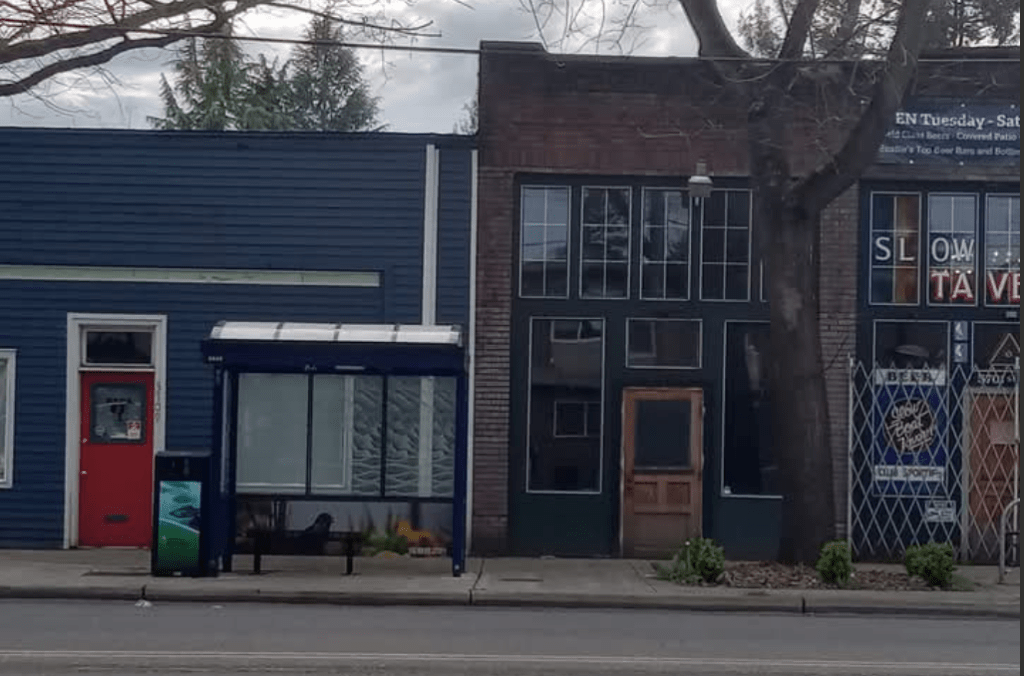
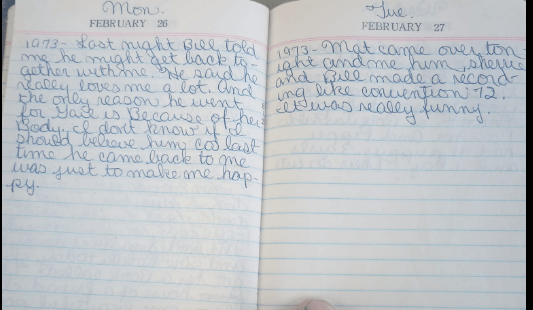
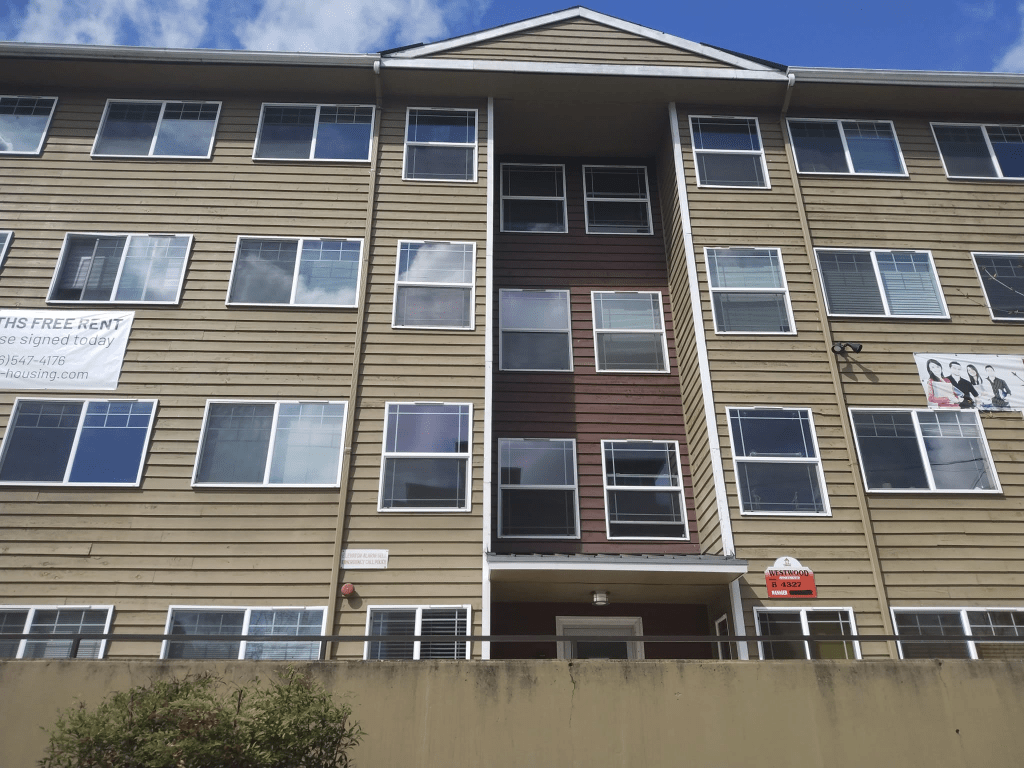
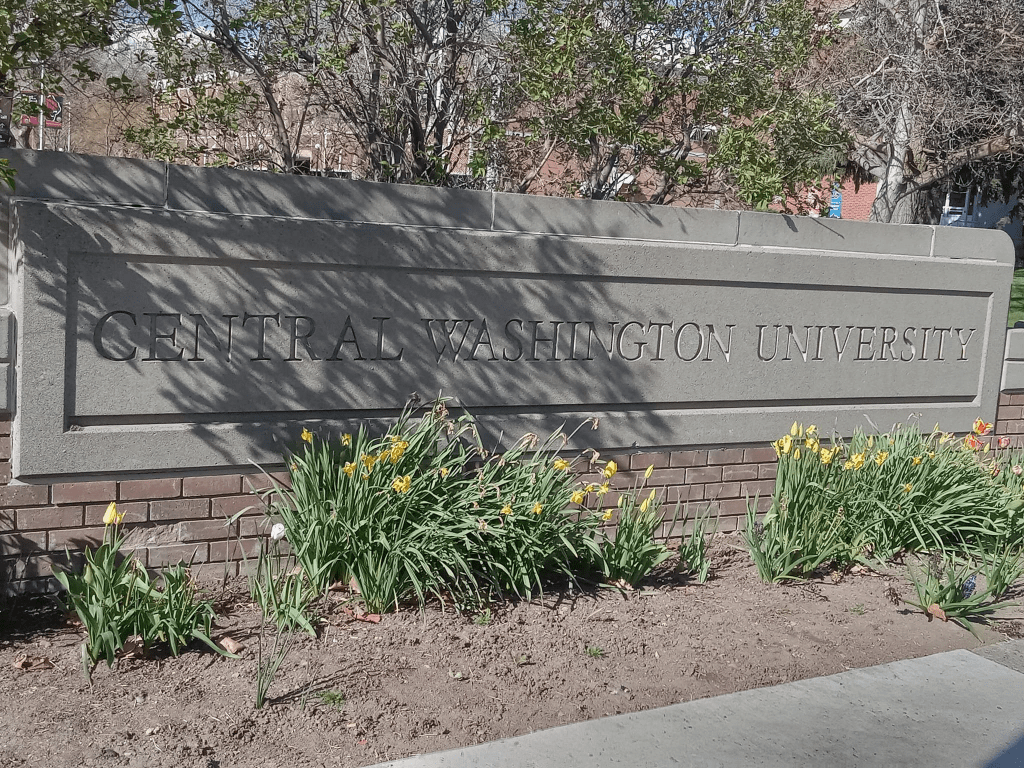
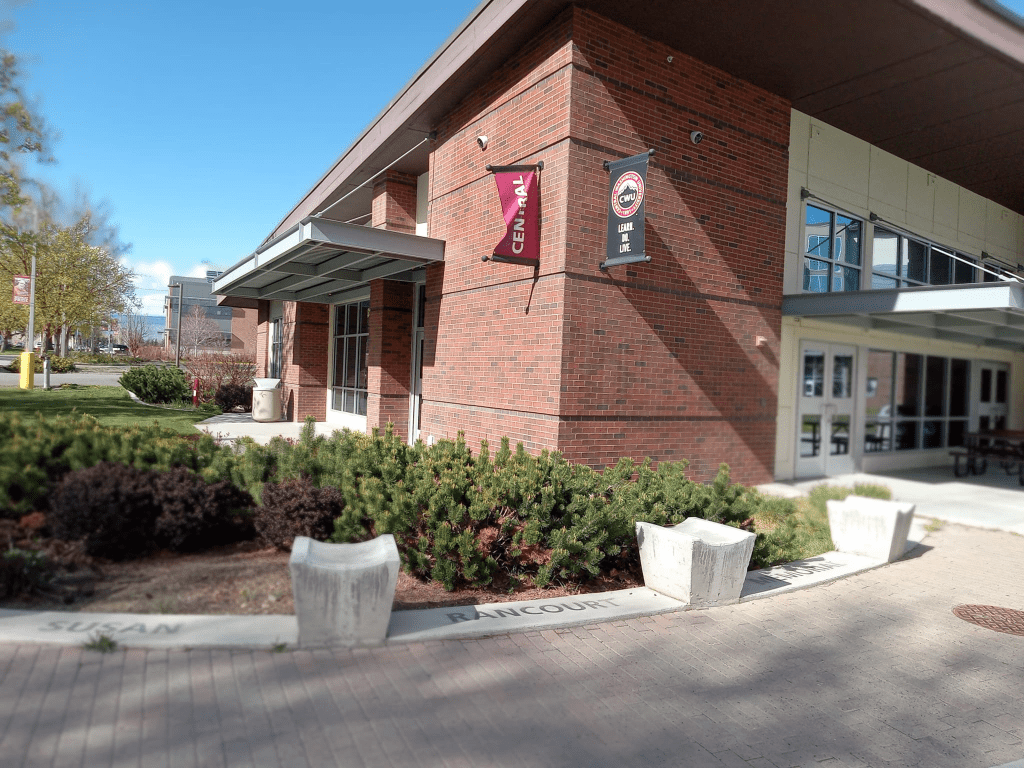
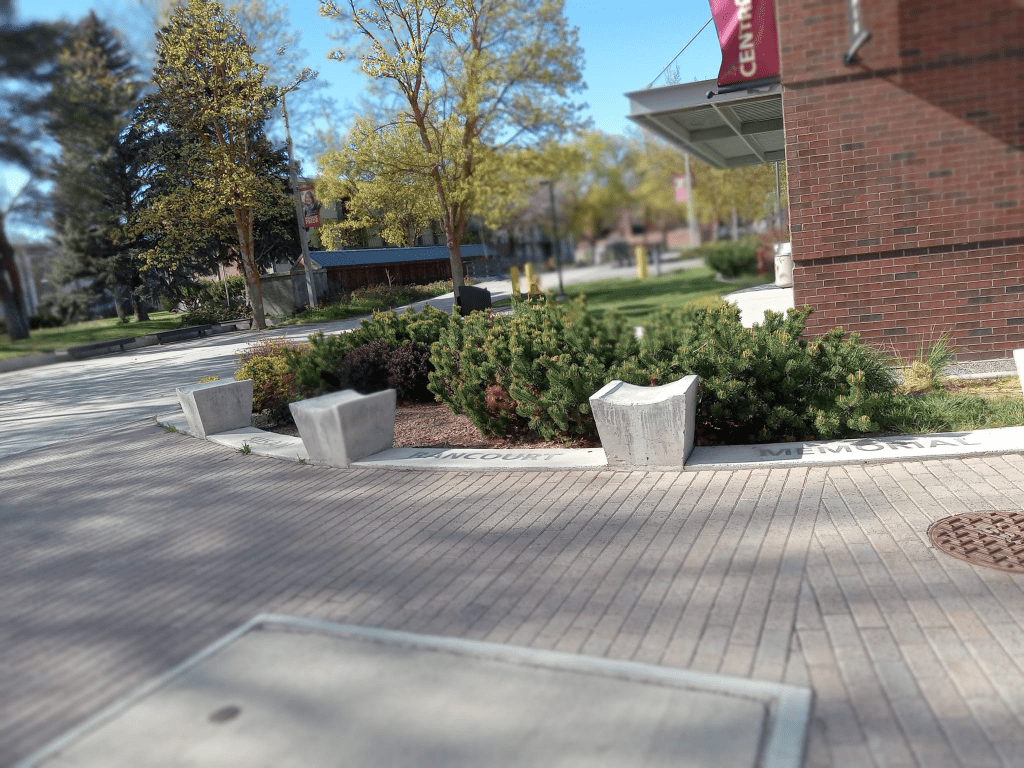
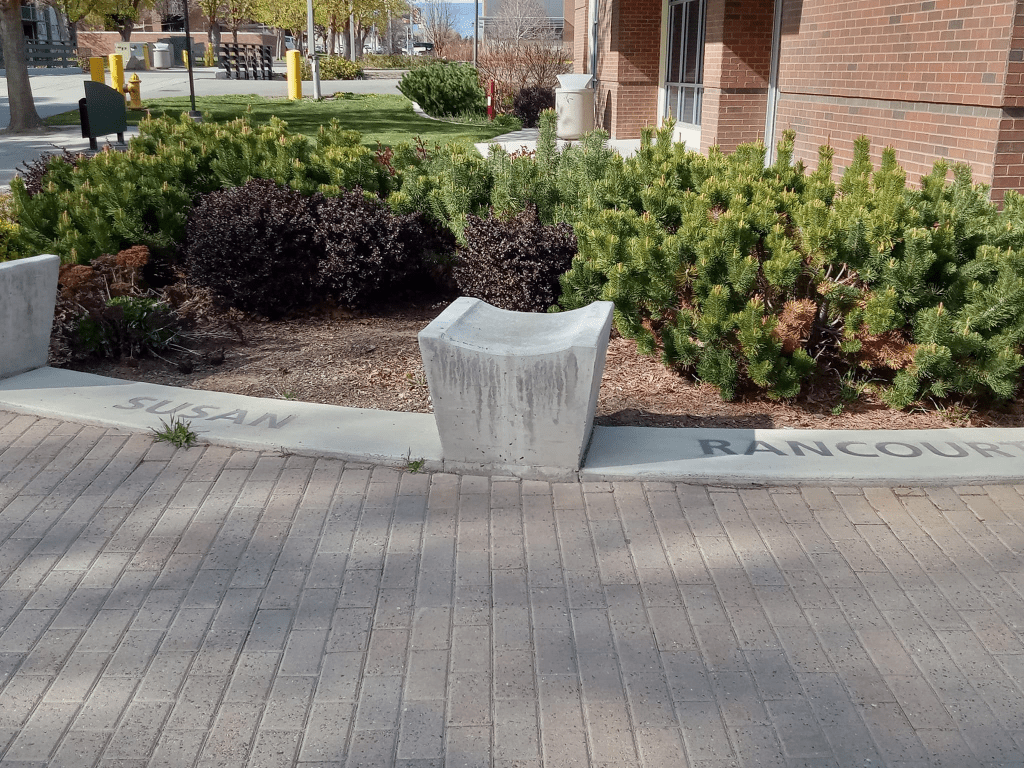
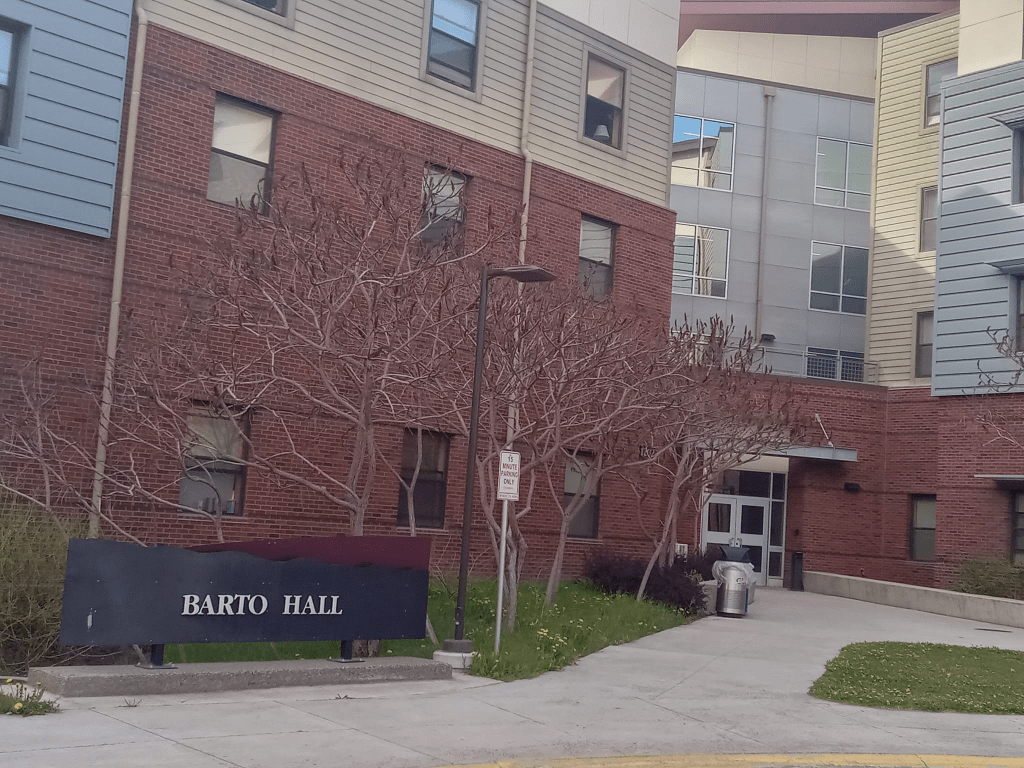
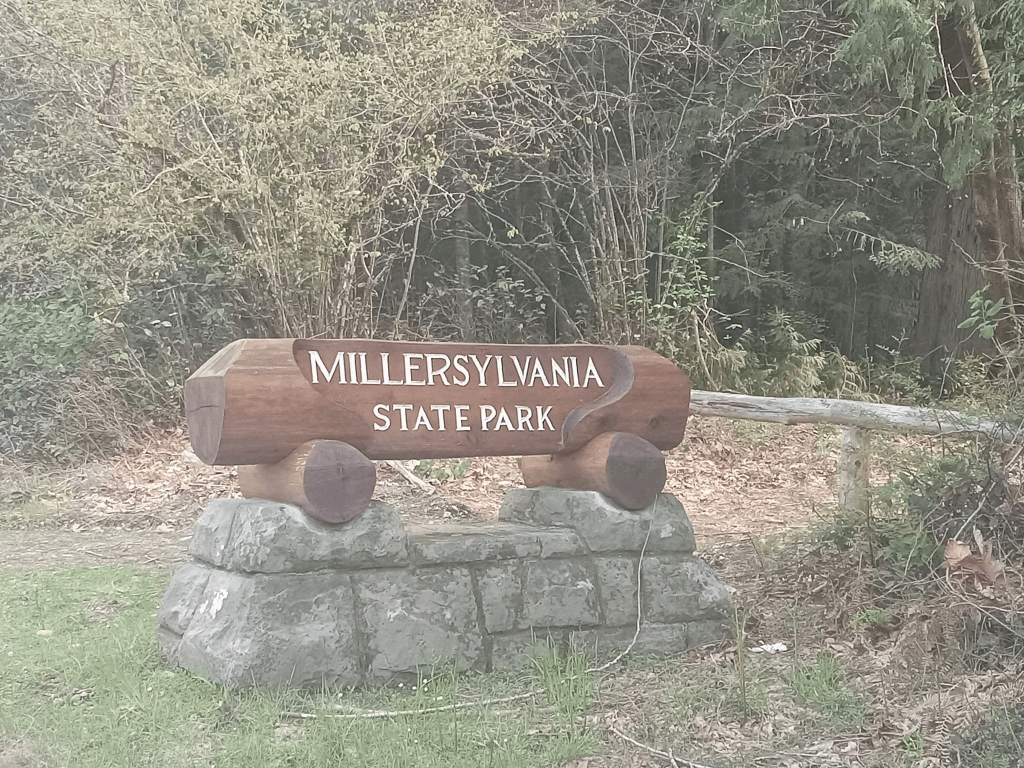
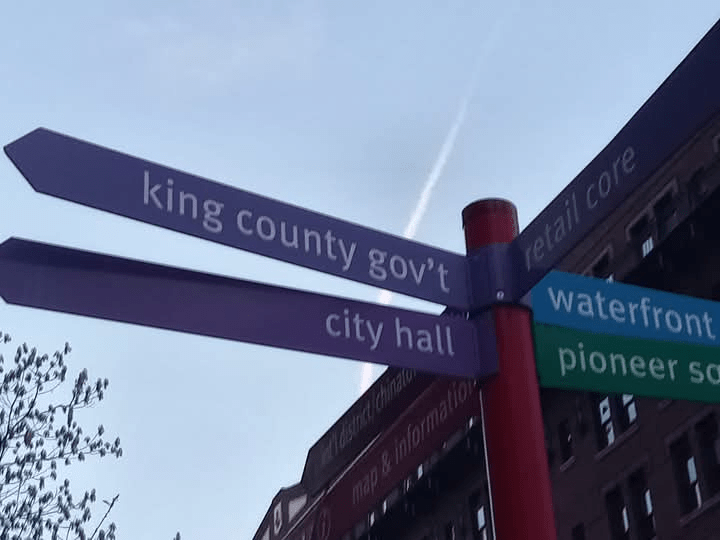
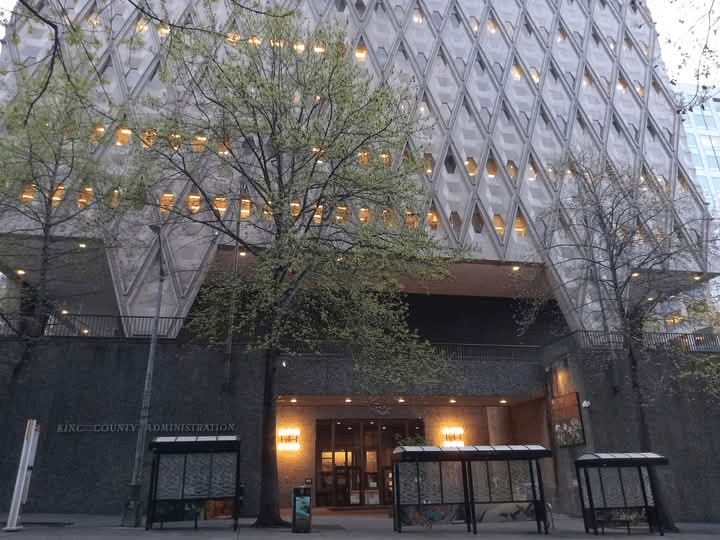
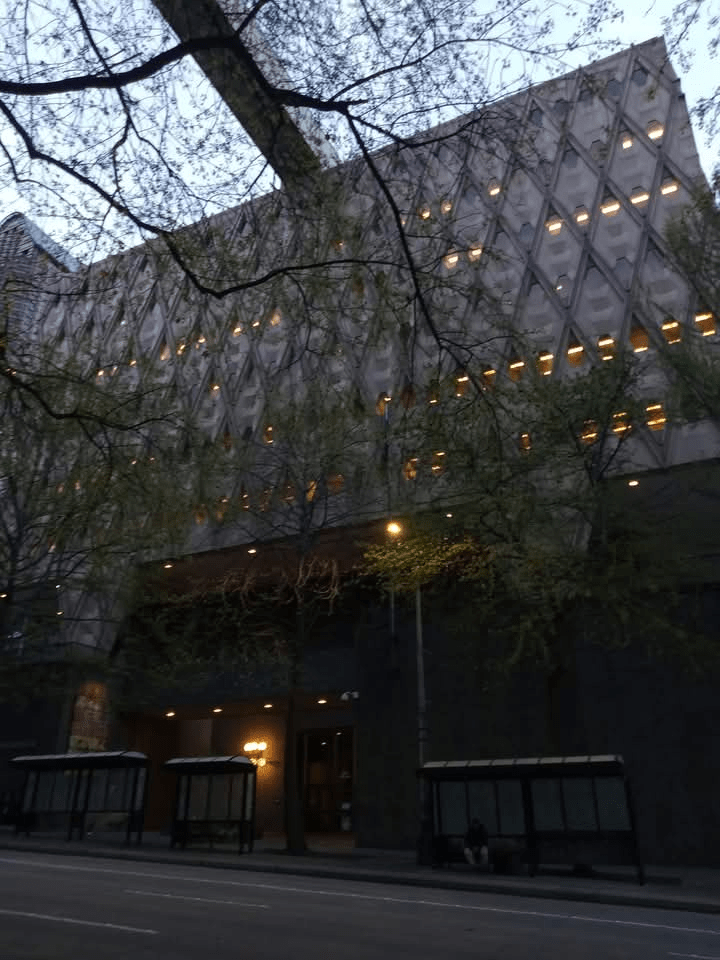
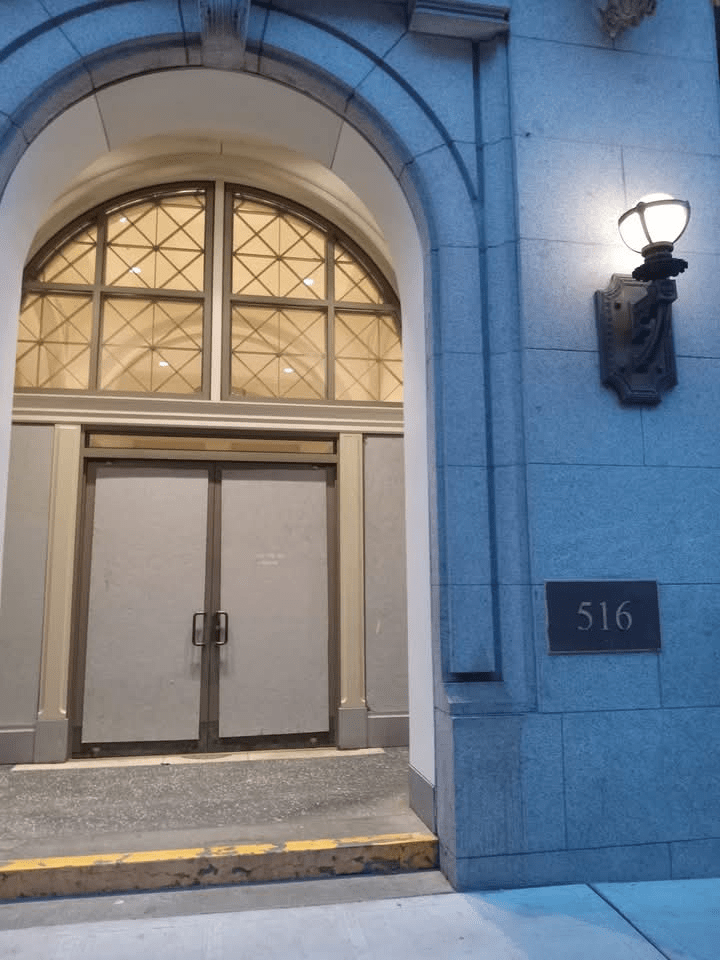
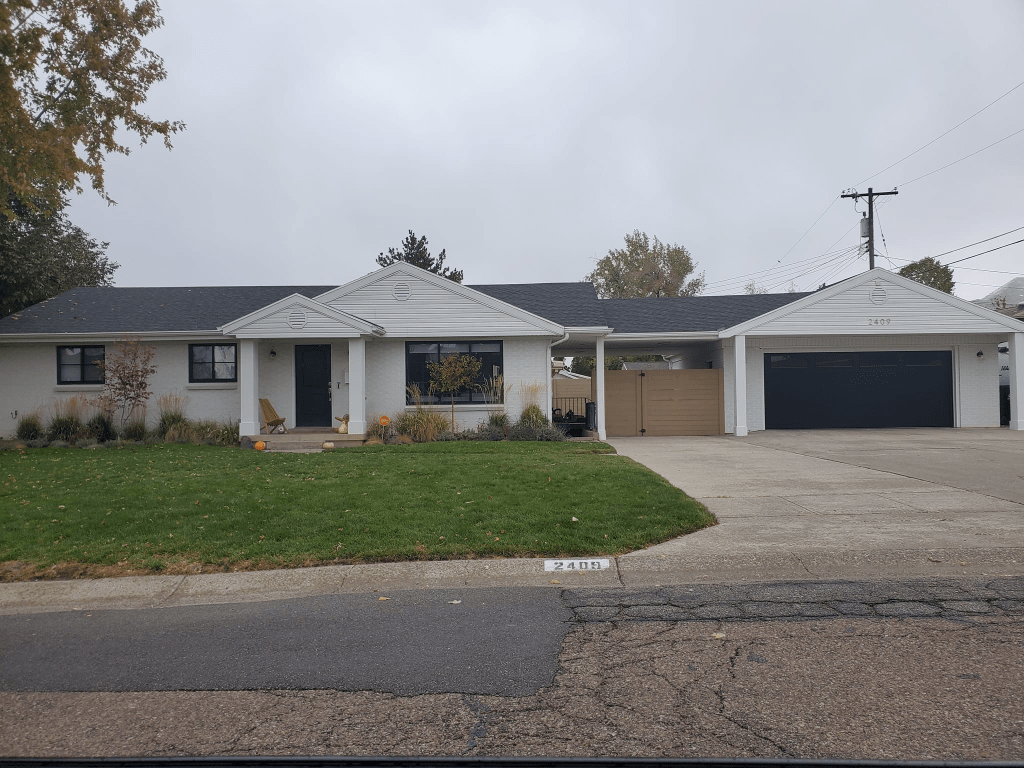
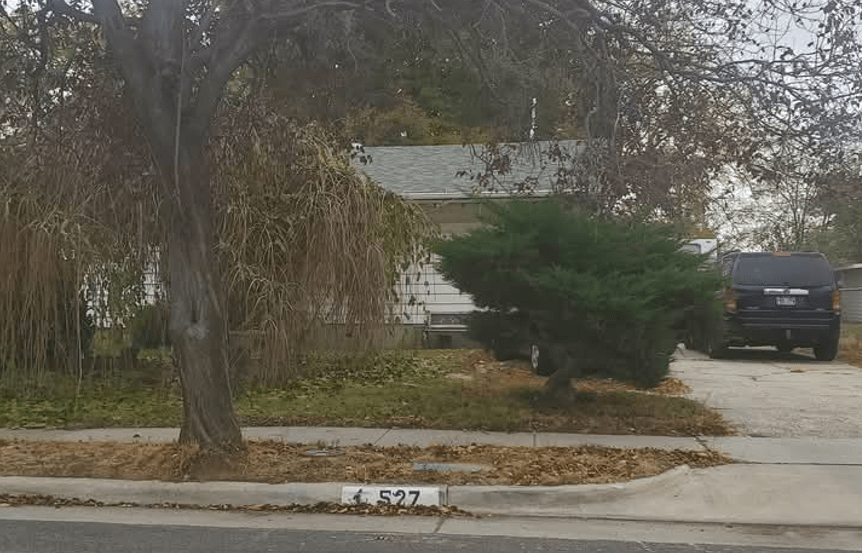
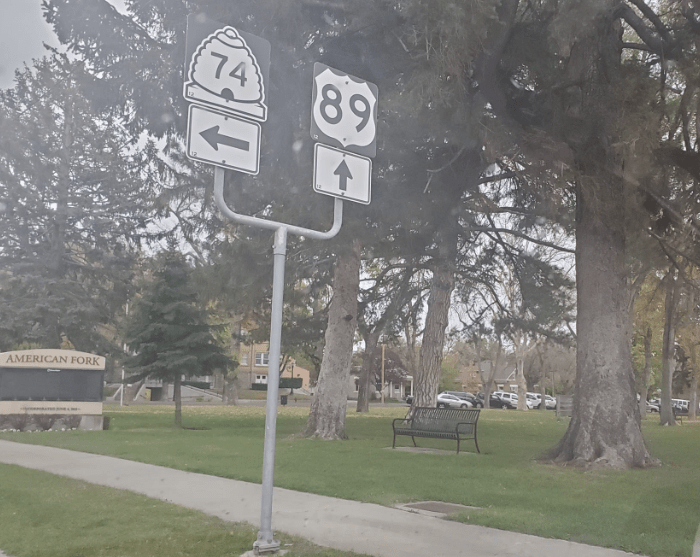
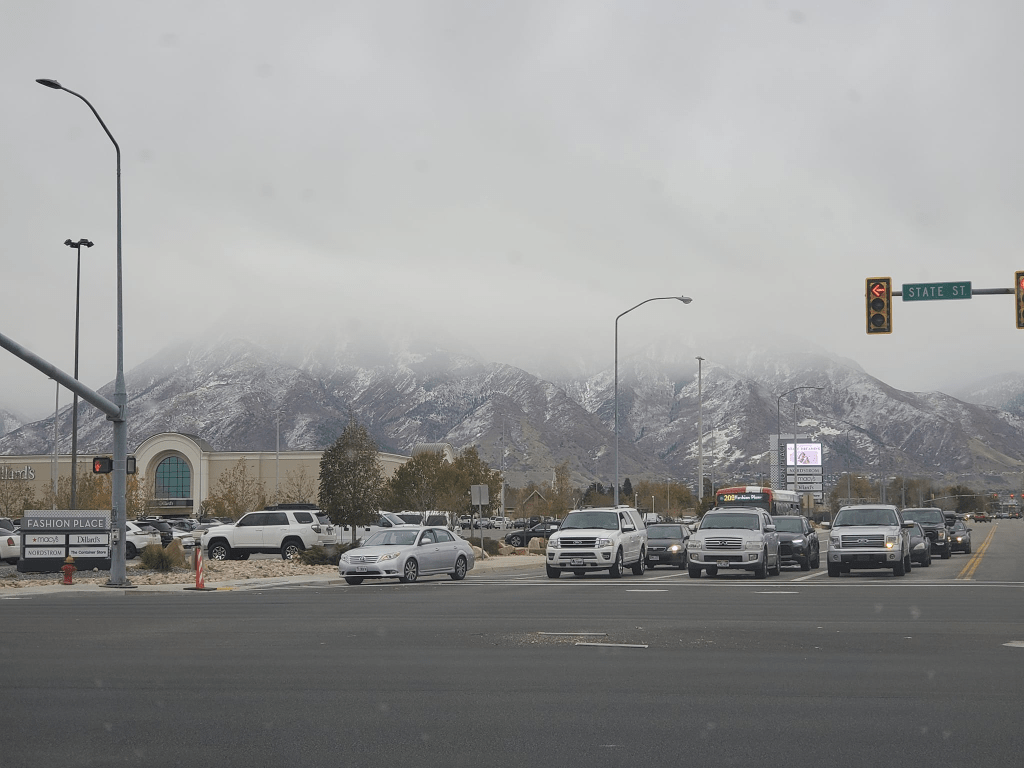
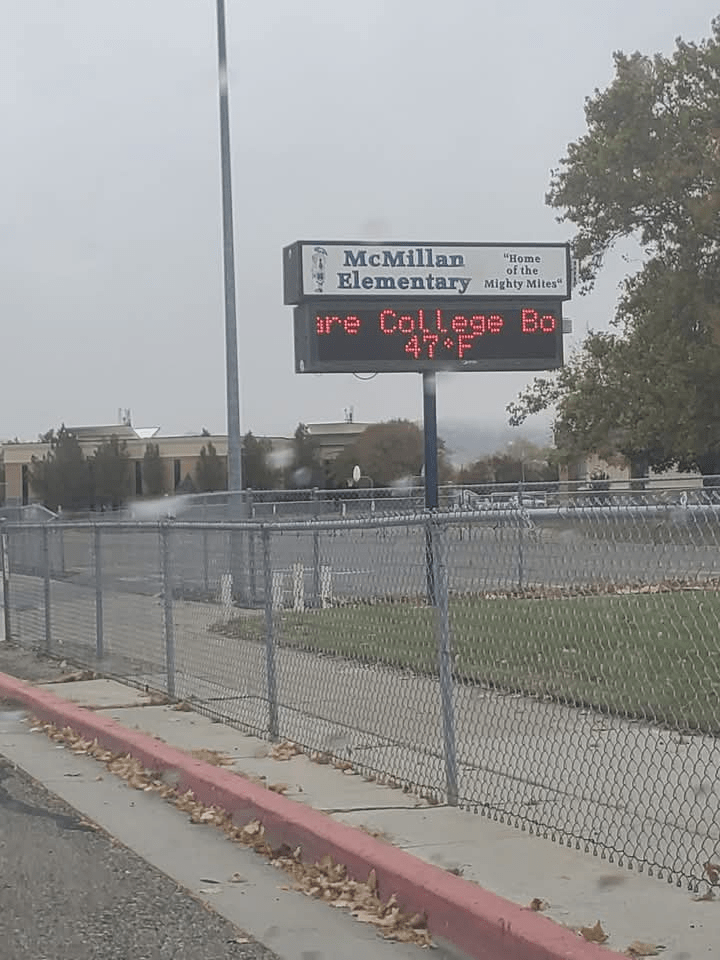
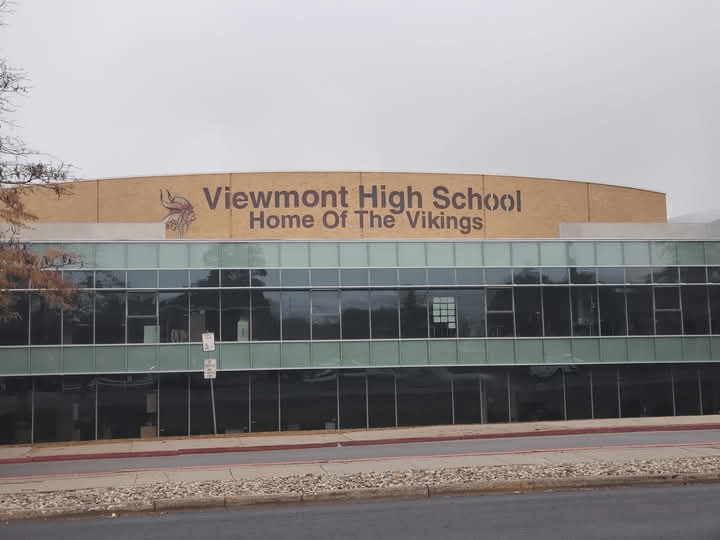
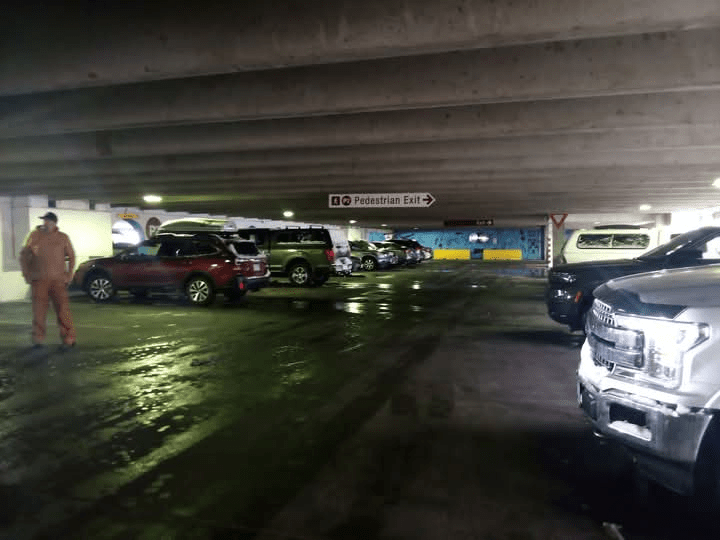
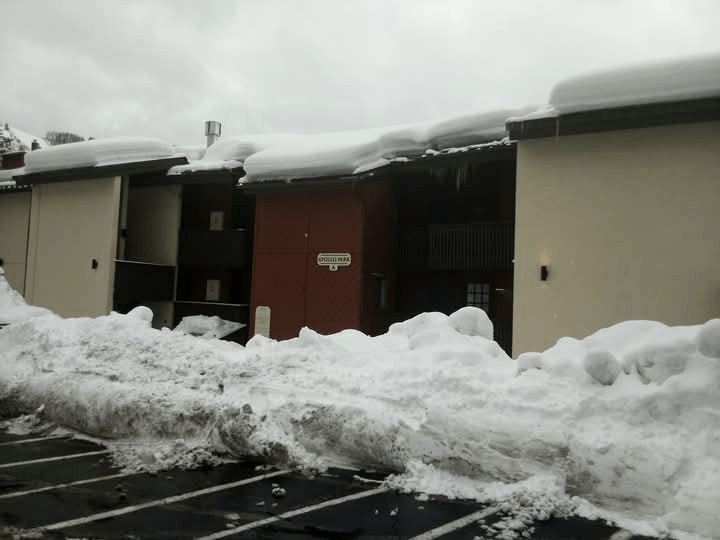
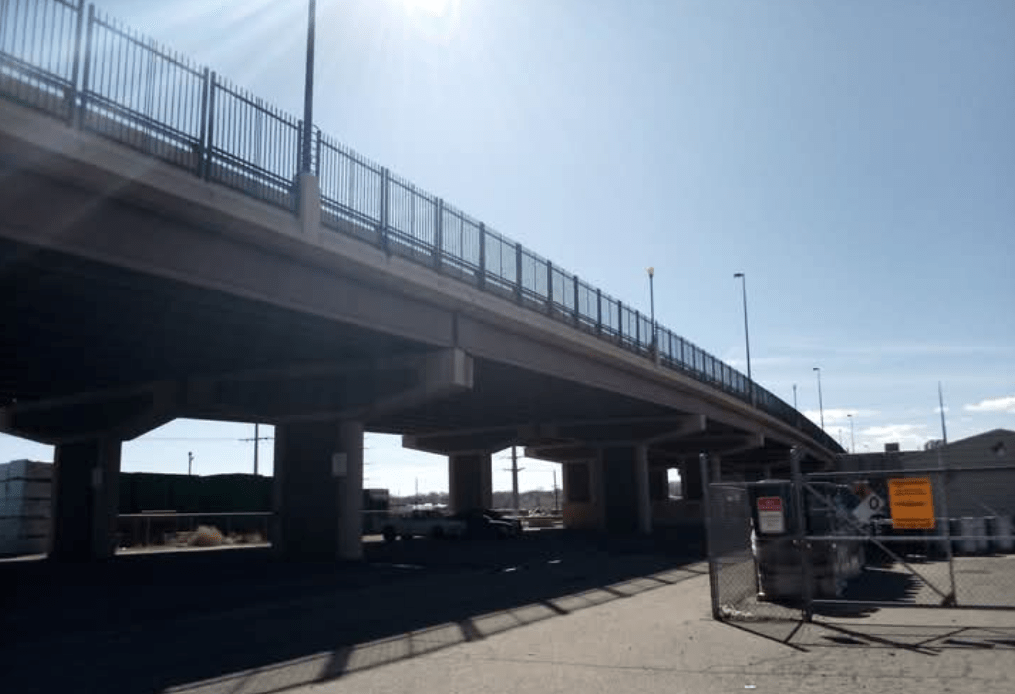
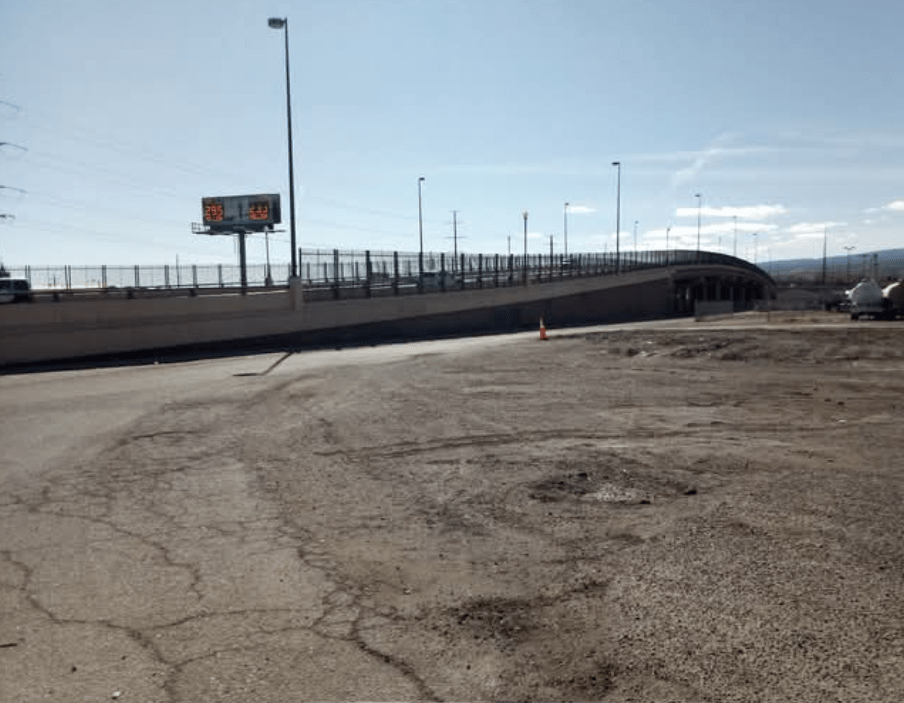
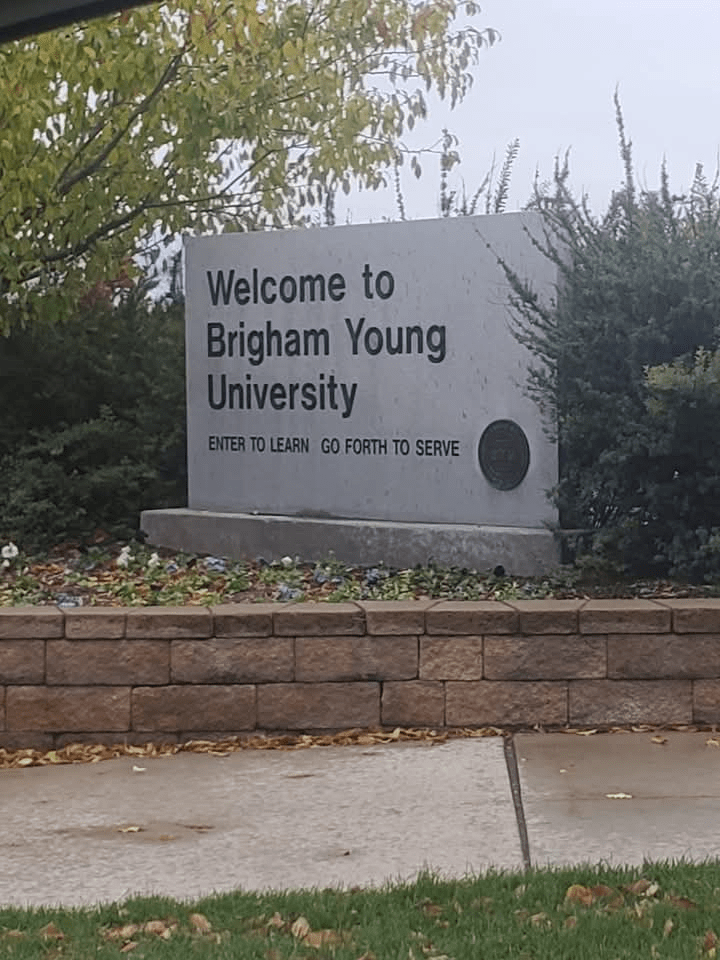
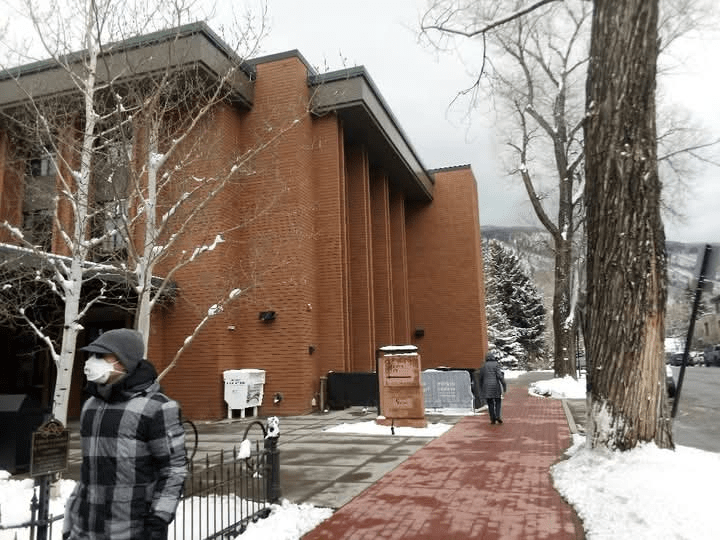
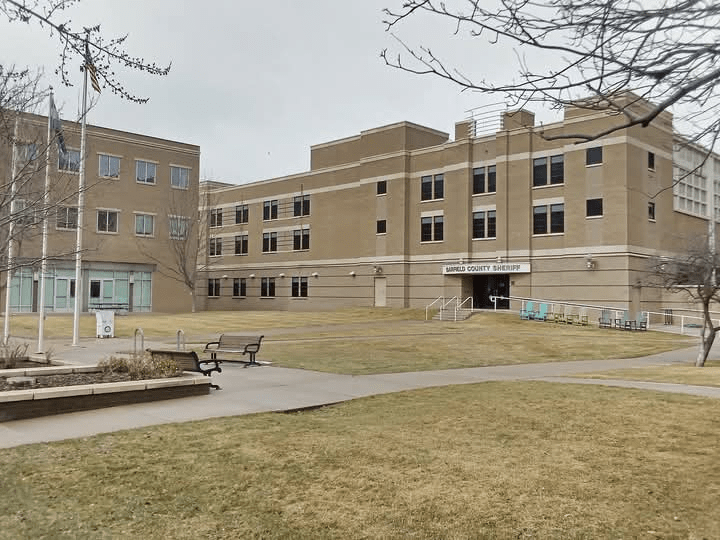
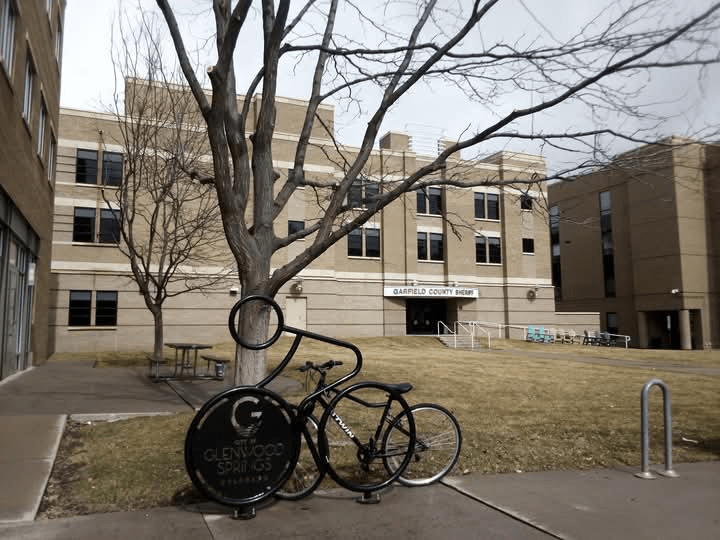
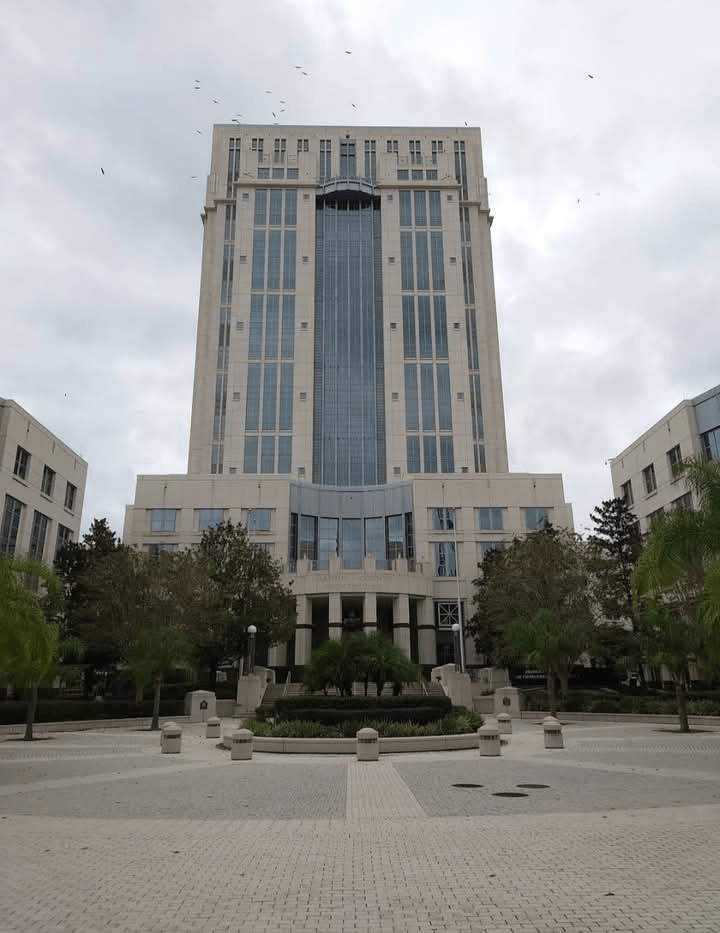
According to the ‘1992 TB Multiagency Report 1992,’ Ted lived here briefly with Marlin Vortman and his wife sometime in late 1973, located at 3510 West Elmore Street in Seattle. Photo taken in April 2024.A shot of where Sotria Kritsonis claims she was abducted from, picture taken in April 2022.A shot of where Sotria Kritsonis claims she was abducted from, picture taken in April 2022.A shot of where Sotria Kritsonis claims she was abducted from, picture taken in April 2022.The final resting place of Katherine Merry Devine, picture taken in April 2024.Kathy Devine’s diary, courtesy of Charlene Devine-Gonzales. Picture taken in April 2024.A picture of a page taken from Kathy Devine’s diary, courtesy of Charlene Devine-Gonzales. Picture taken in April 2024.Where the apartment of Karen Sparks once stood, who Bundy attacked and left for dead in her basement apartment on January 4, 1974. Picture taken in April 2022.This is the house where Ted Bundy attacked and abducted his first known murder victim, Lynda Ann Healy located at 5517 12th Avenue NE in Seattle, Washington. Picture taken in April 2024.A path located on the side of the house (and in the back) that Lynda Ann Healy was renting at the time of her murder. Picture taken in April 2024.A picture of Lynda Ann Healy’s former house taken in April 2022. On the evening of January 31, 1974, Healy and her roommates were drinking at Dante’s Tavern, but because she needed to be at her job the following morning at 5:30 to read the ski report they didn’t stay out late and returned home around 10 PM (their friend Pete also had to catch a bus back to his place). A picture of the side of Lynda Healy’s former house, taken in April 2022. Donna Manson’s former dormitory located on the campus of The Evergreen State Collegein Olympia, WA. Picture taken in April 2022.A path near Manson’s dormitory, picture taken in April 2022.A path in the back of the dorm buildings that Donna may have taken the night of her murder, picture taken in April 2022.Some interesting trees in front of the Daniel J. Evans Library on the campus of The Evergreen Sate College. Picture taken in April 2022.The Library on the campus of The Evergreen State College, picture taken in April 2022.A picture taken at the entrance of Central Washington University from April 2022. Susan Rancourt was abducted from campus on April 17, 1974.Before Bundy came across Sue Rancourt he approached two other young women, Jane Curtis and Katherine Clara D’Olivo. Earlier in the evening both women said they were approached by a man with his arm in a sling onthe schools campus.Another picture of the Susan Rancourt Memorial Garden located on the campus of Central Washington University. Picture taken in April 2022.Another picture of the Susan Rancourt Memorial Garden located on the campus of Central Washington University. Picture taken in April 2022.Another picture of the Susan Rancourt Memorial Garden located on the campus of Central Washington University. Picture taken in April 2022.Barto Hall, where Rancourt was living at the time of her murder. Picture taken in April 2022.Before her murder Sue Rancourt was attending a meeting about being a residential advisor the following school year, picture taken in April 2022.A safety phone on the campus of Central Washington University. Picture taken in April 2022.Millersylvania State Park as it looked in April 2022. This is where the remains of Brenda Joy Baker were discovered in May 1974. Most likely Brenda was killed by a man named William Cosden Jr., but because no DNA was ever taken at the crime scene we will most likely never know for sure who took her life.One of the signs for the entrance of Millersylvania State Park as it looked in April 2022.The sign for the entrance of Millersylvania State Park as it looked in April 2022.The former Flame Tavern as it looked in April 2022. On May 31, 1974 Brenda Ball vanished without a trace after seeing a band play here, and was last seen in the company of a handsome man with his arm in a sling. The former Flame Tavern as it looked in April 2022.The former Flame Tavern as it looked in April 2022.The former Flame Tavern as it looked in April 2022.The alley where Bundy first encountered Georgann Hawkins, picture taken in April 2022.The alleyway where Ted first encountered Hawkins, picture taken in April 2024.The parking lot where Bundy abducted Georgann Hawkins on June 11, 1974 from outside the Phi Sigma Sigma sorority house on the University of Washington campus. Picture taken in April 2024.Another shot of the parking lot where Bundy first encountered Georgann Hawkins, taken in April 2024.A sign at the entrance of Lake Samammish State Park in Issaquah, WA. Picture taken in April 2022.The entrance of Lake Sammamish, picture taken in April 2022.Lake Sammamish, picture taken in April 2022.A beach at Lake Sammamish for Tibbetts Beach. Picture taken in April 2022.A beach at Lake Sammamish for Tibbetts Beach. Picture taken in April 2022.A sign at Lake Sammamish for Tibbetts Beach. Picture taken in April 2022.A sign for some King Country Government buildings, picture taken in April 2022.The King County Sheriff’s office, located at 516 3rd Ave in Seattle… To be honest, I went here right before I was due to come home, and as I was walking around taking my pictures I saw a young man smoking crack in one of the buildings alcove. In that moment, I was ready to come home, and I had enough of my vacation. Like so many other things I experienced that week, if was definitely a first. Picture taken in April 2022.Another shot of the King County Sheriff’s Department, picture taken in April 2022.The King County Sheriff’s Department, picture taken in April 2022.The side of the King County Sheriff’s Department, picture taken in April 2022.A door to the King County Sheriff’s Department, picture taken in April 2022.Another door at the King County Sheriff’s Department, picture taken in April 2022.A photo I took of the Issaquah burial site in April 2024.A photo I took of the Issaquah burial site in April 2024.A photo I took of the Issaquah burial site in April 2024.A photo I took of the Issaquah burial site in April 2024.A photo I took of the Issaquah burial site in April 2024.A photo I took of the Issaquah burial site in April 2024.A photo I took of the Issaquah burial site in April 2024.A photo I took of the Issaquah burial site in April 2024.This is the former boarding house where Bundy rented a room in during his second attempt at law school in SLC, located at 565 1st Avenue; he lived here from September 2, 1974 to September 1975. Picture taken in November 2022.The house where Nancy Wilcox lived when she was abducted and killed by Bundy. It’s located at 2409 Arnette Drive in Salt Lake City, is 1,482 square feet in size and was built in 1957. I took this picture in November 2022.A picture of where the orchard once stood located across the street from Nancy Wilcox; I took this picture in November 2022.A picture of Big Cottonwood Canyon taken in November 2022. This is where Rhonda Stapley claims Ted took her after abducting her in October 1974.A picture of a couple signs from Big Cottonwood Canyon taken in November 2022.Where The Pepperoni Pizza restaurant once stood, where Melissa Smith died with a friend before she was last seen. Picture taken in November 2022.The intersection close to where the remains of Melissa Smith were found, picture taken in November 2022.On October 18th, 1974, Bundy abducted Melissa Anne Smith from outside of a pizzeria in Midvale, and her nude remains were discovered twenty-three miles away by deer hunters nine days later, on this hillside in Summit Park. The seventeen-year-old had a man’s blue nylon sock tied around her neck raped, beaten, and then strangled. She was found face down in some scrub oak. Picture taken in November 2022.The home of Melissa Smith, located at 527 Fern Drive in Midvale, Utah. Picture taken in November 2022.William S. Robinson Park in American Fork, which is one of the places Laura Aime was possibly last seen alive. Picture taken in November 2022.Where Laura Ann Aime was possibly last seen, this is where ‘The Knotty Pine’ was once located in Lehi, UT. Picture taken in November 2022.This white SUV is where Bundy left the remains of Laura Ann Aime and is located off Utah State Route 92 in American Fork (per the OddStops website). Pictures taken in November 2022.A beautiful shot in front of The Fashion Place Mall in Murray, where Carol DaRonch was abducted from. Photo taken in November 2022.A shot of front sign for The Fashion Place Mall in Murray. It’s where Bundy attempted to abduct 18 year old Carol DaRonch from on November 8th, 1974. At the time the store was home to Sears, now it is a Dillards Department Store. Photo taken November 2022.The ‘police substation’ that Bundy took Carol DaRonch to when he pretended to be a police officer in an attempt to abduct and most likely kill her. Picture taken in November 2022.The door to the entrance of the ‘police substation.’ Photo taken in November 2022.Where my rental car sits is where Carol DaRonch fled Bundy’s car. It’s on the western side of McMillan Elementary School, close to the intersection between South Fashion Boulevard and 5900 South. Photo taken in November 2022.McMillan Elementary School, located close to the intersection between South Fashion Boulevard and 5900 South. Photo taken in November 2022.Viewmont High School in Bountiful, UT. Picture taken in November 2022.Viewmont High School, located at 120 West 1000 North in Bountiful, UT. Photo taken in November 2022.Viewmont High School, in Bountiful, UT. Picture taken in November 2022.The doors for the auditorium at Viewmont High School, where Debra Kent was abducted from. Picture taken in November 2022.The parking lot in Viewmont High School that Bundy abducted Deb Kent from. Picture taken in November 2022.Where Deb Kent was abducted from, picture taken in November 2022.A broader shot of the entrance to Fairview Canyon, where Deb Kent’s remains were found. It’s about an hour and a half outside of Salt Lake City. Photo taken in November 2022.This is close to where Bundy buried the remains of 17-year-old Debra Jean Kent, near a dirt road in Fairview Canyon around 105 miles away from Viewmont High School. During one of his final confessions, he said he left her near a steep dirt road that ‘wound up to the left’ and buried her about three feet deep and then covered her with heavy rocks. Photo taken in November 2022.The entrance to where the remains of Deb Kent were foundA shot of the entrance to Fairview Canyon, where Deb Kent’s remains were found. Photo taken in November 2022.A sign for the Wildwood Hotel (formerly Inn) located in Aspen. I’m shocked at how squished together everything is, I imagined this beautiful, sprawling hotel… but it was all so close together. 2/10, would not recommend.The Wildwood Hotel (formerly Inn), where twenty-three-year-old Michigan nurse Caryn Campbell was staying with her fiancé when she disappeared on January 12, 1975; her body was found on February 17, 1975, 3.1 miles away on the side of Owl Creek in the outskirts of Aspen. Picture taken in March 2025.This is the GPS coordination’s where Caryn Campbells remains were discovered on Owl Creek Road in Aspen. Picture taken in March 2025.Bundy moved into an apartment on the right side of the top floor of this residence located at 364 Douglas Street in SLC on September 26, 1975. He claims that he moved here because it was within walking distance of the University of Utah. Picture taken in November 2022.A picture of where Caryn Campbells remains were found on Owl Creek Road, picture taken in March 2025.On January 12, 1975 Bundy bought gas in Glenwood Springs and Bundy abducted 23-year-old Caryn Campbell from the Wildwood Lodge in Snowmass, Colorado. Picture taken in March 2025.Bundy’s Douglas Street apartment, located at 413 ‘B’ Street in SLC, Utah. He moved here some time before March 22, 1976, during his trial for the kidnapping of Carol DaRonch, and was also under heavy police surveillance. He didn’t live here for very long: on March 1, 1976, he was found guilty of kidnapping Carol DaRonch and was immediately taken intp custody. Picture taken in November 2022.A photo I took of the entrance to the Taylor Mountain burial site in April 2024. On March 3, 1975 the remains of Lynda Ann Healy, Susan Rancourt, Roberta Parks, and Brenda Carol Ball were discovered by two forestry students at Green River Community College.A photo I took of the Taylor Mountain burial site in April 2024.A photo I took of the Taylor Mountain burial site in April 2024.A photo I took of the Taylor Mountain burial site in April 2024.A photo I took of the road from the Taylor Mountain burial site in April 2024.On March 15, 1975 Bundy came across 26-year-old ski instructor Julie Cunningham near this covered bridge by Gore Creek Drive in Vail, Colorado. Picture taken in March 2025.An area close to the parking garage where Julie Cunningham was abducted from. Picture taken in March 2025.The parking lot where Bundy abducted Julie Cunningham from, picture taken in March 2025.The parking lot where Bundy abducted Julie Cunningham that is located at 395 South Frontage Road in Vail, Colorado. At the time of the murder, it was a regular ground-level parking lot however in more recent times it is home to a multi-story car park. Picture taken in March 2025.The underground parking lot where Bundy abducted Julie Cunningham from in Vail, Colorado. Picture taken in March 2025.The entrance to the Apollo Park Apartments, where Julie Cunningham was living at the time of her murder. Picture taken in March 2025.The Apollo Park Apartments, where Julie Cunningham was living at the time of her murder. Picture taken in March 2025.The back of Cunningham’s apartment complex in Vail, picture taken in March 2025.1619 LaVita Street in Grand Junction, Colorado, where Denise Oliverson lived at the time of her murder. Picture taken in March 2025.This is the South 5th Street Bridge in Grand Junction, where Bundy abducted Denise Lynn Oliverson from on April 6, 1975.A (blurry) shot of the South 5th Street Bridge where Denise Oliversons’ bike was found the day after she disappeared. Picture taken in March 2025.The South 5th Street Bridge, in Grand Junction. Denise Oliverson vanished after leaving her nearby house on April 6th, 1975, and the next day, a railway worker found her yellow bike and sandals underneath this overpass. Photo taken in March 2025.A shot of the alley next to the South 5th Street Bridge in Grand Junction, picture taken in March 2025.The entrance of Brigham Young University, where Ted Bundy abducted Susan Curtis in June 1975. Originally from Bountiful, the fifteen-year-old was attending the Bountiful Orchard Youth Conference at the school when she disappeared. She had ridden her bicycle fifty miles to Provo to attend the conference and was last seen on June 27, 1975, the first day of the conference. After a formal banquet that evening, Susan left her friends and made the quarter mile walk to her room to brush her teeth. No trace of Curtis has ever been recovered. Picture taken in November 2022.Brigham Young University, where Ted Bundy abducted Susan Curtis from in Provo, Utah On June 27th, 1975, Curtis attended the Bountiful Orchard Youth Conference at the Wilkinson Student Center. Picture taken in November 2022.The Wilkenson Student Center on Brigham Young’s campus, where Susan Curtis was last seen alive. Picture taken in November 2022.I had great plans of hiking Berthoud Pass, where the remains of Shelley Kay Robertson were found on August 23, 1975, but my rental car kept getting stuck so this was as far as I was able to go. On July 1, 1975, the twenty-three-year-old failed to come into work at her family’s printing business in Colden, and she was last seen earlier that same day and was in ‘the company of an unknown man.’ Picture taken in March 2025.A picture of a sign announcing my arrival in Pitkin County, taken in March 2025.The ‘Ted Bundy Murder Cellar,’ which is a urban legend of sorts where locals claim he brought victims to (there is no evidence that proves this). Picture taken in November 2022.The inside of the TB Murder cellar. Even though it was two o’clock in the afternoon when I visited this location this was as far as I would venture in. My momma didn’t raise no fool, taken in November 2022.This house was the focus of a Ghost Adventuress episode about Ted, and is located near Viewmont High School in Bountiful where Deb Kent was abducted from. Zak Baggins claims that Bundy brought her back her to torture her, but there’s no evidence to back this up (in fact, there’s proof that a family lived there at the time). The (fuzzy) picture was taken in November 2022.A current picture of where Bundy got arrested for the first time, taken in November 2022.A horrible quality picture of Bundy’s first arrest site (as I am no master photographer), taken in November 2022.The entrance to the Utah State Corrections Facility, picture taken in November 2022. I was actually wrong that Ted was housed here before he was transferred to Colorado to stand trial: he actually was in Utah State Prison, and in July 2022 (just a few mere months before I went there) it was replaced by the Utah State Correctional Facility.The Pitkin County Courthouse, where Bundy escaped for the first time on June 7, 1977.A close up shot of the side of the building Bundy escaped from, picture taken in March 2025.A (terrible) shot of the window Bundy would have jumped out of when he escaped from the Pitkin County courthouse on June 7, 1977. Picture taken in March 2025.A plaque on the Pitkin County Courthouse that it is in the ‘National Registry of Historic Places.’ Picture taken in March 2025.An inscripted stone on the Pitkin County Courthouse. Picture from March 2025.This is (roughly) the grassy area that Bundy would have landed on when he jumped out the second story window of the Pitkin County Courthouse in Aspen on June 7th, 1977. Picture taken in March 2025.A picture I took in March 2025 of a statue of a generic Civil War soldier that’s located in front of the Pitkin County Courthouse in Aspen. The monument, which is dedicated ‘to the soldiers of 1861-1865’ and is intended as a symbol of national healing, does not representing either the Union or Confederacy and was erected on Memorial Day in 1899 and is dedicated to all of the soldiers that fought in the Civil War.The Pitkin County Clerk and Recorder building located at 530 East Main Street next to the Pitkin County Courthouse in Aspen, Colorado. Picture from March 2025.The Aspen Police Department, located two buildings down from the Pitkin County Courthouse. Picture taken in March 2025.The house that Bundy stole a Cadillac from in the early hours of June 13, 1977, located at 805 Bonita Drive in Aspen. Picture taken in March 2025.This is the only picture I was able to get that was close to where (I think) Fritz Kaeser’s cabin is located… I rented a piece of junk Ford Focus with bald tires and got stuck on a back road searching for it. I have no problem admitting I underestimated my husbands warnings of how bad Aspen winters can be, as I’m from Buffalo and have no problems driving in the snow… but what I have never encountered before is snow AND mountains. Where I hate admitting defeat, I knew I would have to take the L on this one. I didn’t have cell phone signal on top of it all and I was STUCK stuck, but thankfully the girls house I got stuck in front of helped me get out thanks to kitty litter and a board). It all worked out.The entrance to the Glenwood Springs government building, picture taken in March 2025.A picture of the Garfield County Jail, taken in March 2025.Another shot of the Garfield County Sheriff’s Department, picture taken in March 2025.A picture of the Garfield County Jail, taken in March 2025.The keystone on the Garfield County Court Building, picture taken in March 2025.The Chi Omega sorority house, located at 661 West Jefferson Street in Tallahassee. On January 15, 1978 Bundy entered the dormatory armed only with a piece of firewood, and killed twenty-one-year-old Margaret Bowman and twenty-year-old Lisa Levy; he also brutally harmed Karen Chandler and Kathy Kleiner, but thankfully both women survived. Picture taken in May 2023.Another shot of the Chi Omega sorority house.Where Sherrod’s night Club once stood, located next door to the Chi Omega sorority house at 675 West Jefferson Street in Tallahassee. Photo taken in May 2023.The road sign for Dunwoody Street and Pensacola Street, photo taken in May 2023.This is where Ted brutally attacked (and most likely left for dead) twenty-one-year-old dancing student Cheryl Thomas, in her residence located in one side of a duplex located at 431 Dunwoody Street in Tallahassee. Photo taken in May 2023.The area near Dunwoody Street where Cheryl Thomas was living at the time she was attacked by Ted Bundy. Photo taken in May 2023.The sporting goods store where Ted Bundy purchased a hunting knife on February 8, 1978, located at 8764 Normandy Boulevard in Jacksonville. Picture taken in May 2023.This is where the mall parking lot was once located on Blanding Boulevard where on February 8th, 1978 Bundy attempted to abduct-fourteen-year-old Leslie Parmenter. The daughter of Jacksonville PD’s Chief of Detectives, Parmenter was confronted by Ted (who had introduced himself as Richard Burton from the Fire Department) after leaving Jeb Stuart Junior High School, but said he backed down when her older brother showed up. Back in 1978 it was home to a Kmart, and today it houses an Amazon Hub. Photo taken in May 2023.This is the school where Bundy abducted twelve-year-old Kimberly Dianne Leach located at 372 West Duval Street in Lake City, Florida. Photo taken in May 2023.On the morning of February 9th, 1978, Kim left her gym class in the auditorium and walked over to her homeroom when she realized that she had lost her purse. After going back and getting it, Leach started back to the auditorium but never got there. Picture taken in Mat 2023.The house where Bundy stole an orange VW ‘Super Bug’ from its owner Rick Garzaniti. On February 12, 1978 Garzaniti and his wife parked their 1972 Volkswagen outside this residence located at 515 East Georgia Street in Tallahassee and went inside to pick up their toddler from the babysitter. He admitted to leaving the keys in the vehicle, as they weren’t sticking around for very long. Picture taken in May 2023.The location of Ted Bundy’s final arrest, picture taken in May 2023. This is where he was arrested by Officer David Lee at roughly 1 AM on February 15, 1978, located at West Cross Street in Pensacola.A broad shot of an area of the farm where Kim Leach’s body was recovered, photo taken in May 2023.Another area of the farm where Kim Leach’s body was recovered, photo taken in May 2023.An area of the farm where Kim Leach’s body was recovered, photo taken in May 2023.An area of the farm where Kim Leach’s body was recovered, photo taken in May 2023.Another shot of an area of the farm where Kim Leach’s body was recovered, photo taken in May 2023.An area of the farm where Kim Leach’s body was recovered, photo taken in May 2023.An area of the farm where Kim Leach’s body was recovered, photo taken in May 2023.An area of the farm where Kim Leach’s body was recovered, photo taken in May 2023.A road named ‘Kimberly’ that is located close to the cemetery where Kim Leach is buried. Photo taken in May 2023.The entrance to the cemetery where Kim Leach is buried in Memorial Cemetery in Lake City. Picture taken in May 2023.The gravesites of Kim Leach and her brother, Michael. Photo taken in May 2023.The entrance to the Leon County Detention Center, picture taken in May 2023.The Leon County Courthouse, where Bundy stood trial in 1980 for the Chi Omega/Cheryl Thomas attacks. Picture taken in May 2023.The courtyard in front of the Leon County Courthouse, picture taken in May 2023.The entrance to the Richard E. Gerstein Justice Building, located at1351 NW 12th Street in Miami. Picture taken in May 2023.
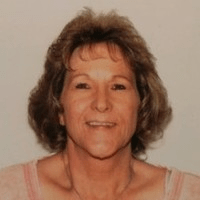
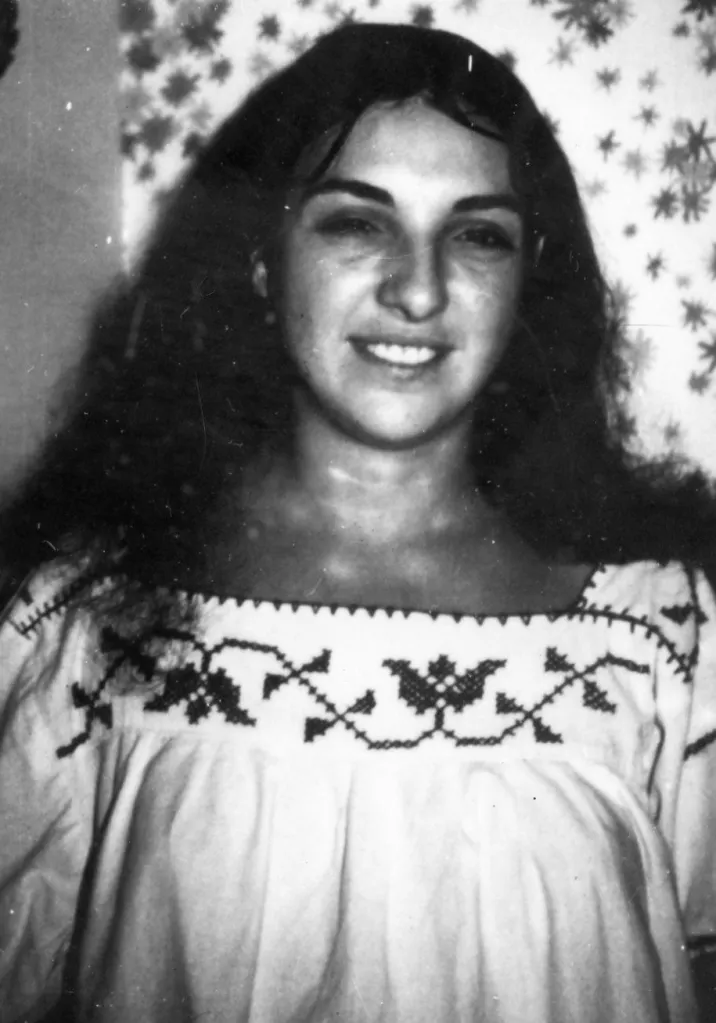
These past few months I’ve had an uptick in the amount of feedback I’ve received from victims family members and loved ones, and I’ve had the pleasure of chatting with Deborah Lee Tomlinson’s sister Jean, who was kind enough to answer some questions for me.
Tell me about your sister, what was she like? What do you remember most about her? I remember she seemed happy to go live with our biological Mother, she thought she could do whatever she wanted with no limits. She found out that wasn’t true.
How many siblings did she/you have? Do you happen to know where she went to high school? There were at the time 4 of us and two step brothers. My Aunt Helen recently told me she ran away from Eugene and not Creswell, then we were told she was spotted in Santa Rosa, CA. With a black guy ( our Dad didn’t like people of color) they think she was maybe pregnant. But who knows.
Whatdid your parents say about Deborah, and how would they describe her? By that I mean, what was she like? What was her favorite book, or band? They absolutely refused to talk about her at all, with either me or my twin Joyce. I know she loved Rock and Roll. She got caught several times sneaking out at night and didn’t get along with our step mother.
How was the relationship she had with your parents? Were they close? Our father raised us with a step mother at the time and they didn’t get along.
It’s often reported that Deb ran away with an unidentified friend. Do you know who it was? I have no idea if its true or who she was.
What do you know about the circumstances surrounding Deborah’s disappearance? Is there anything important that stands out to you that you feel is important? Just that she was spotted in Santa Rosa with a guy.
I know she was young but did your sister date often, that you know of? Not allowed to date until we were 16.
There were quite a few murders and disappearances in Oregon around the time Deb disappeared. Do you think any of the cases could be related? I’m not sure but that’s how I found your blog.
What are your current feelings or emotions regarding your sisters disappearance? The new “big thing” in the world of forensics is genetic genealogy. Have the Eugene police been in touch with you at all recently about your sister? Never a word, but the NCMEC (or the National Center for Missing & Exploited Children) said all records were destroyed in a fire.
What do you hope to see happen in regard to the investigation? How did your sisters disappearance affect your family dynamics? Joyce and have always been close and Debbie running away was hard for many years. We always thought once we all grew up she would make contact.
I learned about Deborah’s disappearance only because her name was included in a list of young women that could possibly be linked to Ted Bundy. Do you think he had anything to do with her disappearance? I wish I knew, but like I said she was spotted in Santa Rosa by a close family friend but I was never told by who. Our Grandmother lived there.
I think it’s a shame that Deborah’s disappearance isn’t discussed more publicly, and that she didn’t get any news time. Do you think if it was handled differently by police the case might be solved by now? I always thought so.
What do you think happened to your sister? I think she fell in love with the guy and ran off with him.
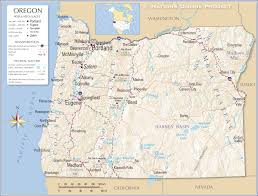
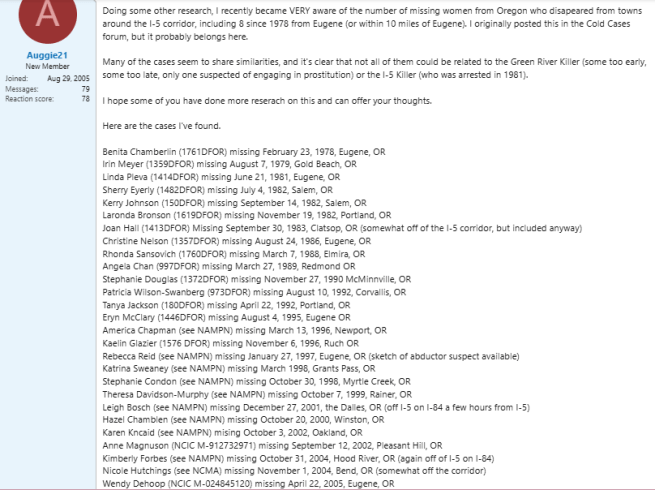
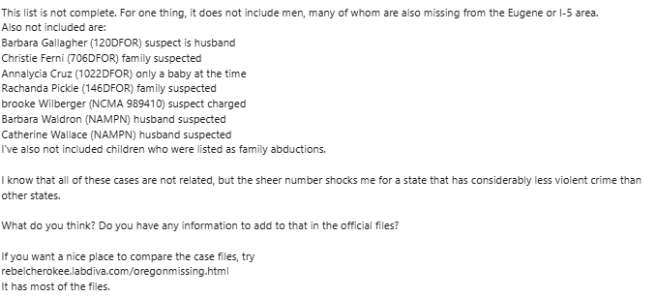
I’ve been compiling a list of missing and murdered young women from the 1970’s in Oregon in a notebook, and I figured why not also include it here. As I learn of new victims I will update the list… over the years I’ve found dozens of names on various websites and newspaper articles about other missing and murdered women, but they’re scattered all over the internet in a million different sources… why not put them all here?
Faun Moulton Moon: (March 1, 1969, Eugene). Distraught over her recent divorce, the fifty-year-old put her financial affairs in order, sent letters of good bye to her daughters, and walked away from her home and family. She was never seen or heard from again.
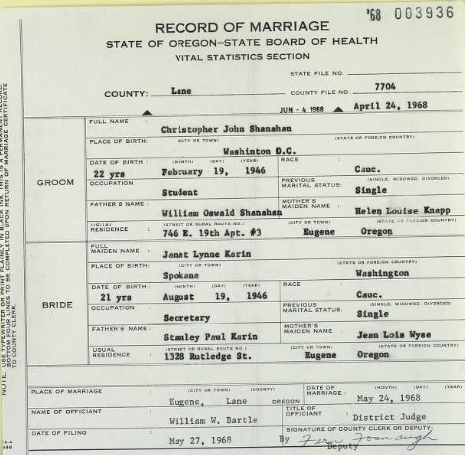
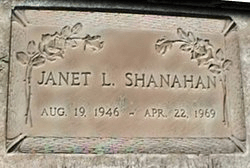
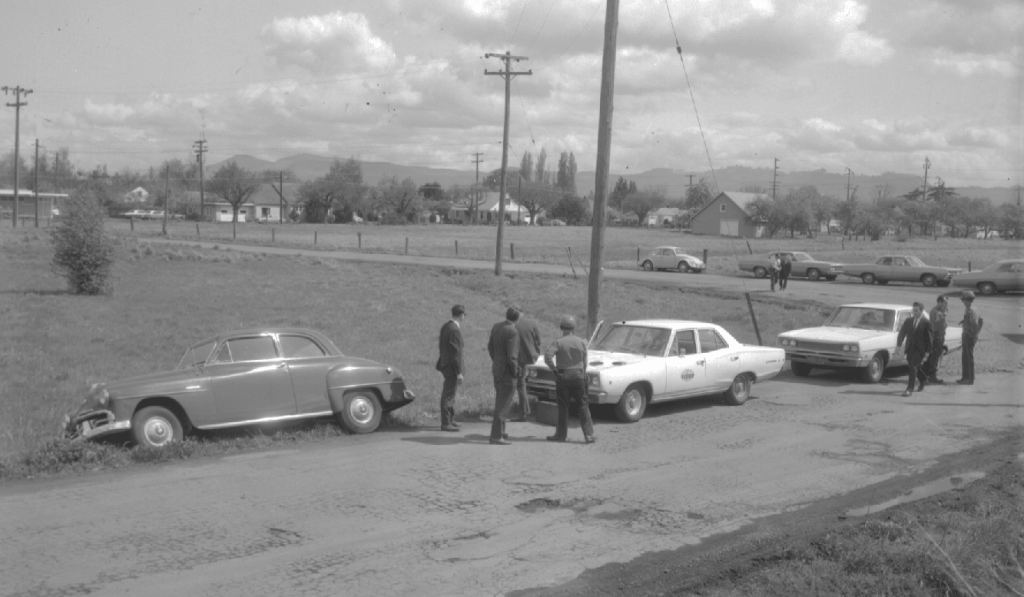
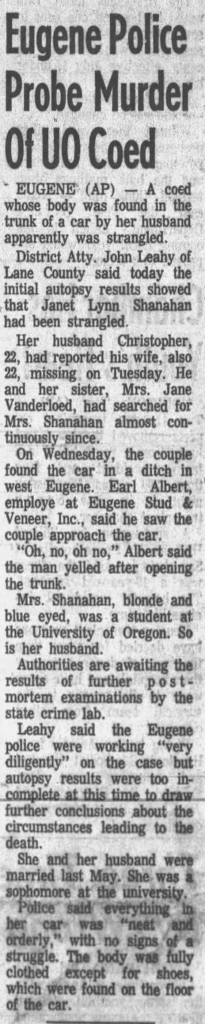
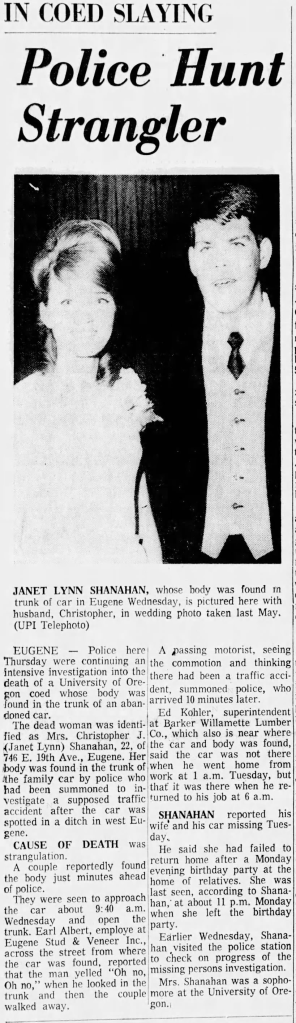
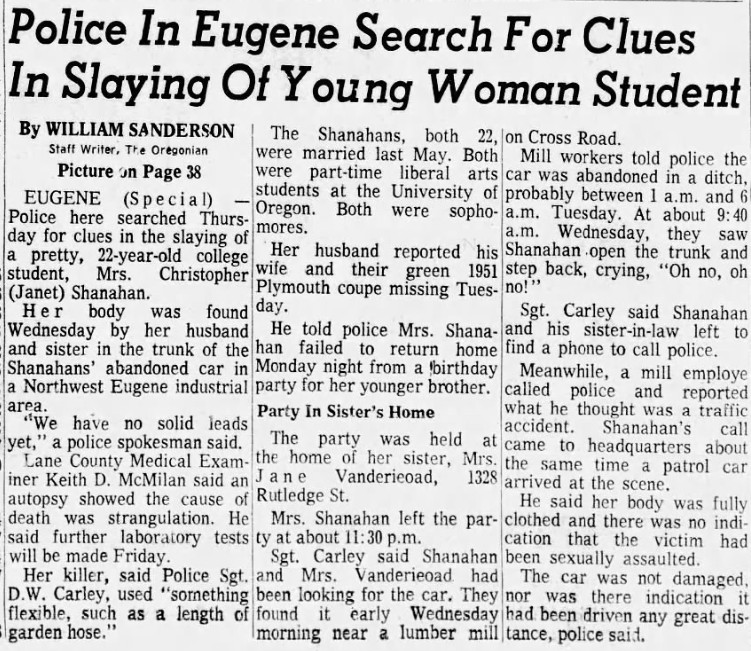
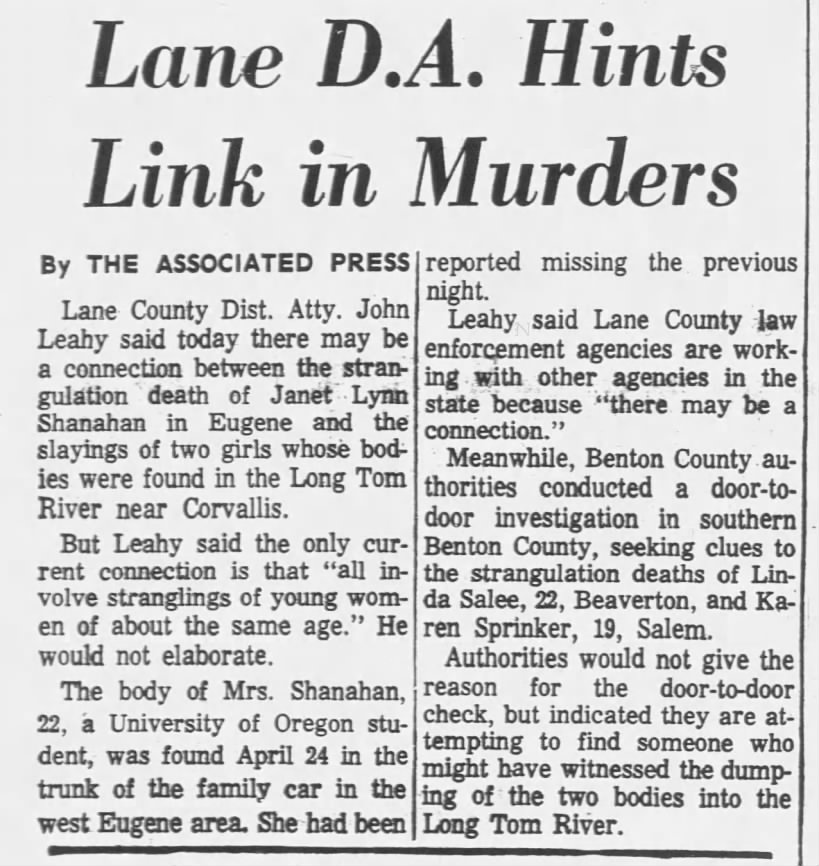
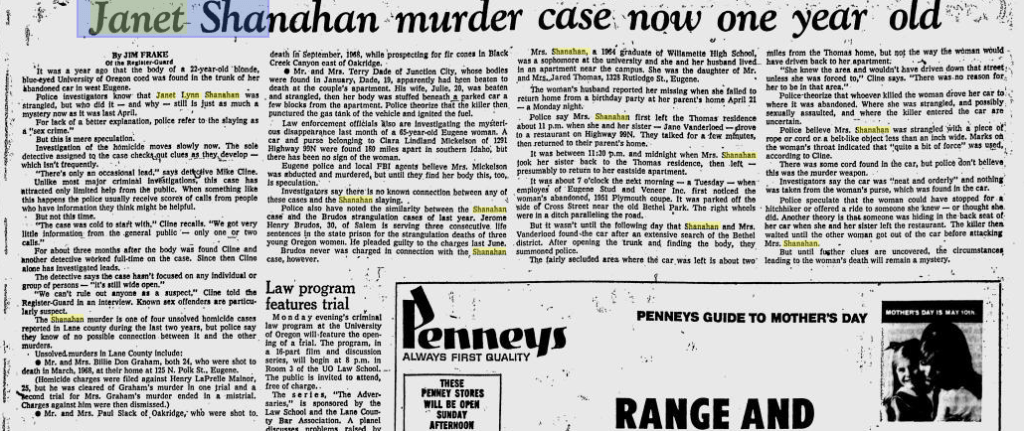
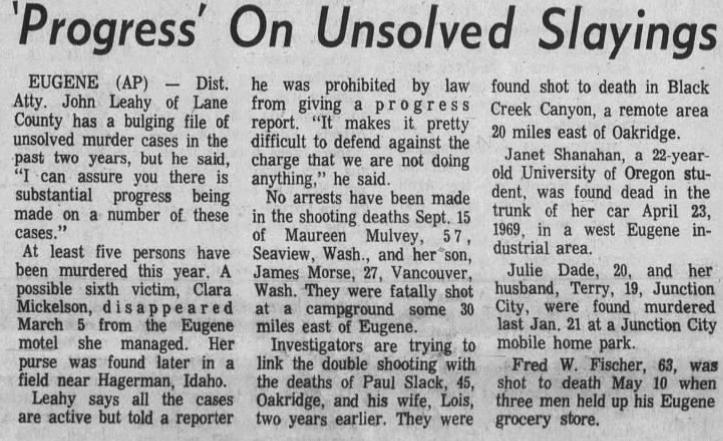
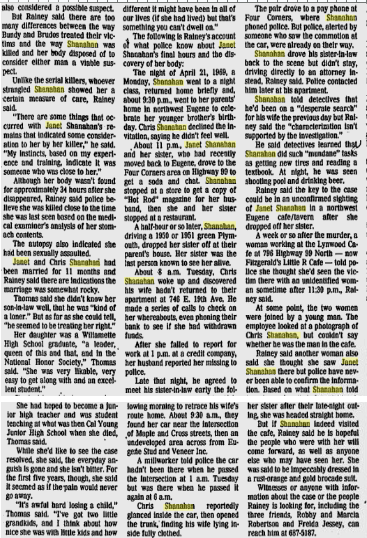
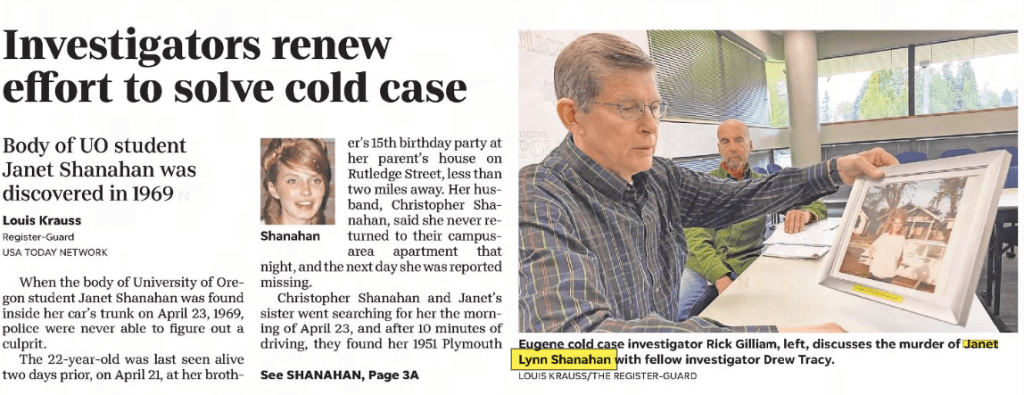
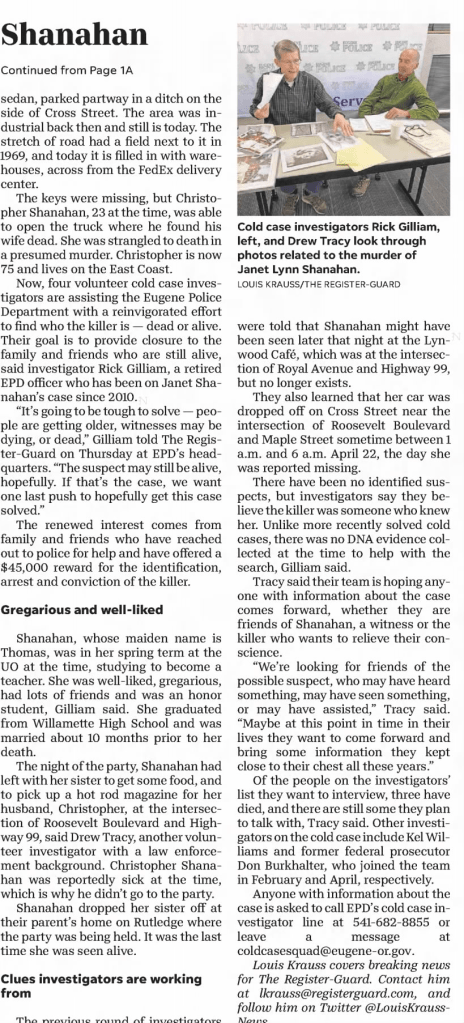
Janet Lynn Karin-Shanahan: (April 23, 1969, Eugene). Twenty-two-years-old. Strangled and found in the trunk of her own car.
Beverly Annette Gayley: (June 15, 1969, Deschutes County). Her remains were found in a wind cave covered with a bedspread and rocks; she had a ligature wrapped around her neck. A significant amount of blood was found in Gayley’s home, as well as in the trunk of her car.
Julie Dade: (January 21, 1970, Junction City). Twenty-Year-Old. Julie’s husband, Terry was later found deceased in the couple’s Maple Street apartment. At about 4:20 AM, neighbors in the area of the Maple Street Apartments heard a female yelling and a witness saw a man dragging a screaming woman into a vehicle before leaving the area. A nearby neighbor woke to the sound of an explosion, saw the car on fire and tried to put it out but it was too late.
Sandra Young: (February. 23, 1970, Sauvie Island). Her remains were found on Sauvie Island in 1970 but were not identified until February 2024; her murder remains unsolved.
Joyce Cross: (Remains were discovered on February 11, 1971, Klamath Falls). Her bludgeoned body was found in the Lost River Diversion Channel near the Spring Lake Road crossing. It was later determined Lavon Granville Owens killed the nineteen-year-old after Oregon State Police linked his DNA to evidence from the crime scene in April 2010.
Barbara Katherine Cunningham: (May 25, 1971, Eugene). Thirty-four-years-old. Found deceased in her apartment by her mother.
Barbara Ann Bryson: (July 29, 1971, Stayton). Nineteen-years-old. Was last known to be attending a party.
Anne Marie Lehman: (found on August 19, 1971, Josephine County). Seventeen-years-old. Disappeared from Aberdeen, Washington in the winter or spring of 1971; the circumstances surrounding her case are unclear, although it is rumored she was a victim of human trafficking. Her remains were found by a man and his son while they were out mushroom hunting off the Redwood Highway, close to mile marker thirty-five; it is unclear as to why she was in Oregon.
Josephine County ‘Jane Doe’ (who is also known as ‘Annie Doe): (remains found on August 19, 1971). Body found near the California border; believed to be female victim somewhere between fourteen and twenty-five-years-old.
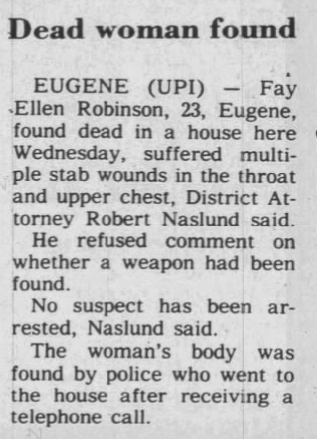
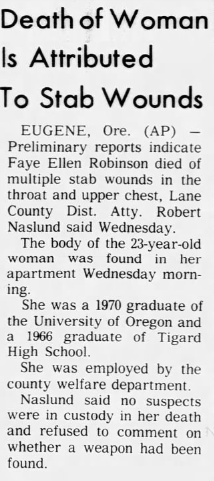
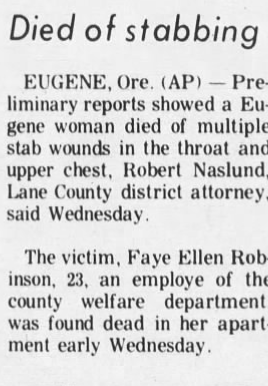
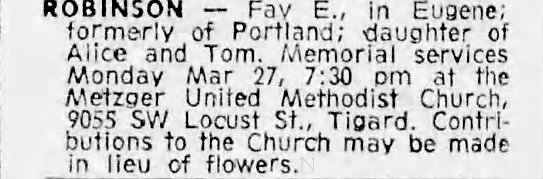
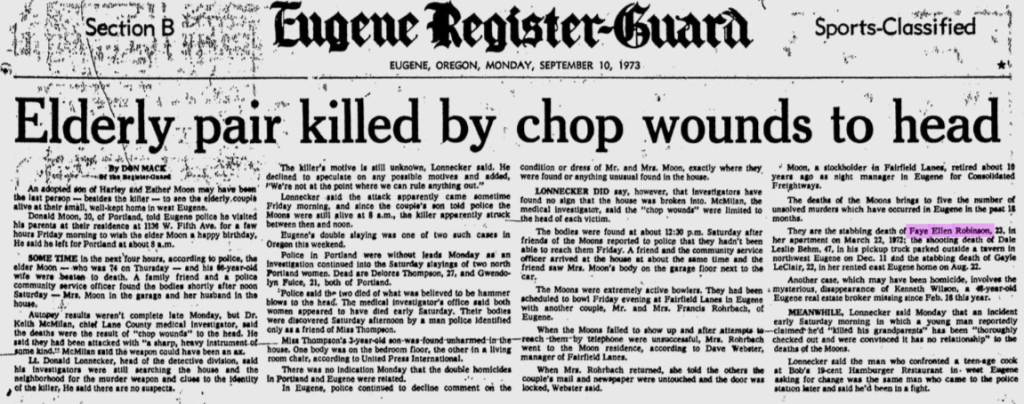
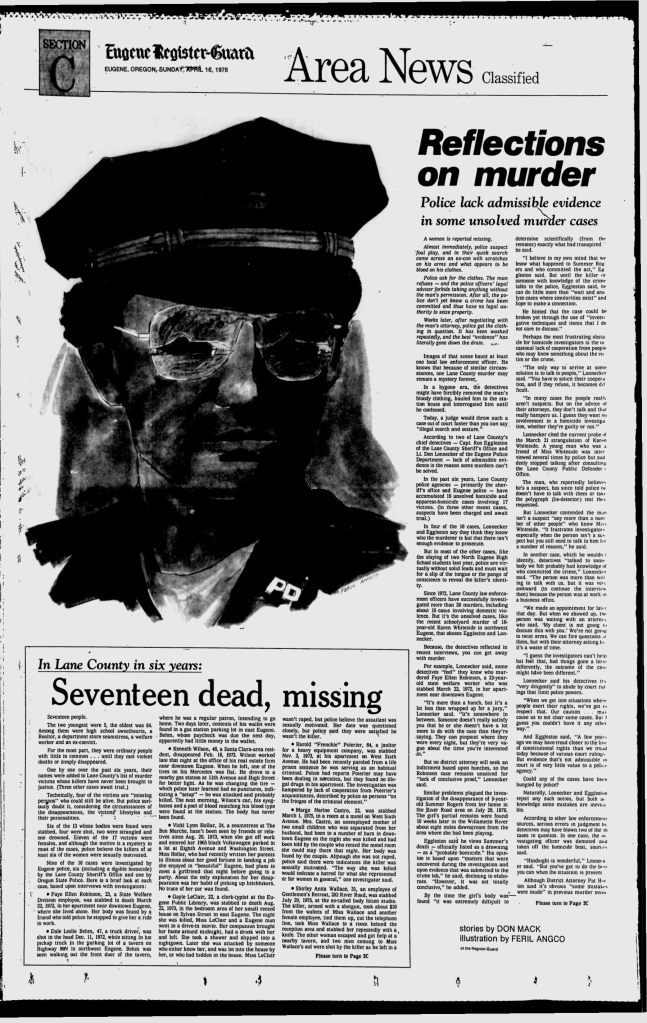
Fay Ellen Robinson: (March 12, 1972, Eugene). Found deceased in apartment.
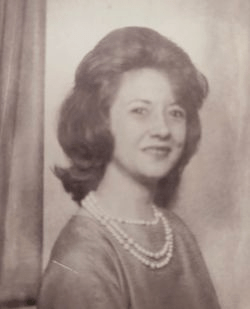
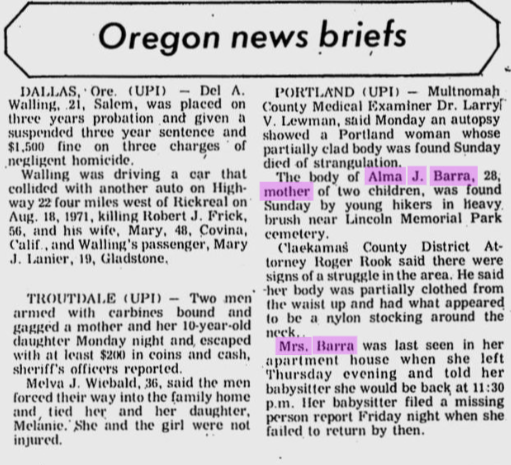
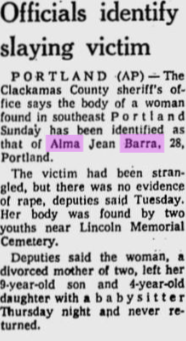
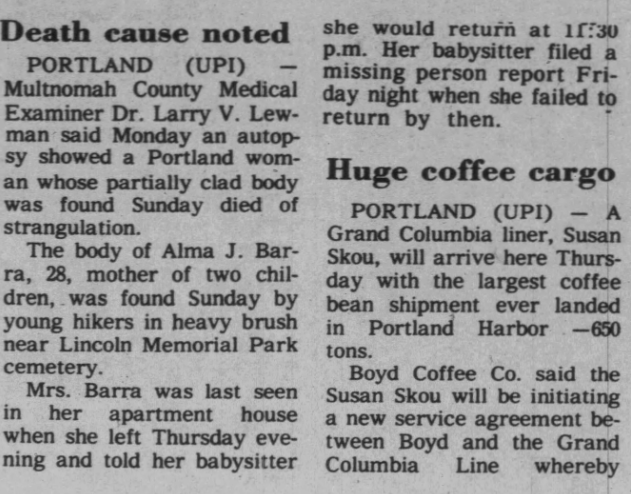
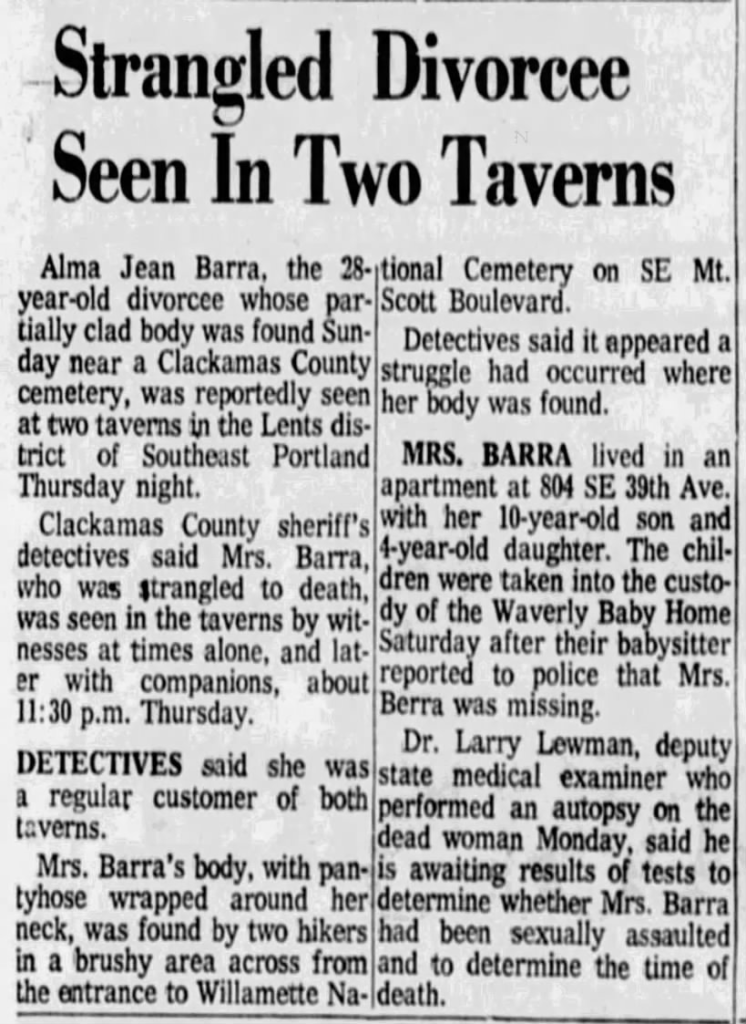
Alma Jean Barra: (March 23, 1972, Happy Valley). Twenty-eight-years-old. Found deceased in Willamette National Cemetery.
Beverly May Jenkins: (May 25, 1972, Cottage Grove). Sixteen-years-old. Her remains were found in June1972just off the I-5 roughly ten miles outside of Cottage Grove; she had been strangled to death.
Jane Pellett: (June 7, 1972, Salem). Twenty-eight-years-old. Found deceased on a busy roadside on June 26, 1972.
Geneva Joy Martin: (June 16, 1972, Eugene). Nineteen-years-old. Found deceased on the side of the road by a farmer.
Rita Lorraine Jolly: (June 29, 1973, West Linn). Seventeen-years-old. Disappeared while out on a routine nightly walk.
Allison Lynn Caufman: (July 1973, Portland). fifteen-years-old. Died as a result of head injuries after being shoved from a car moving at a high rate of speed.
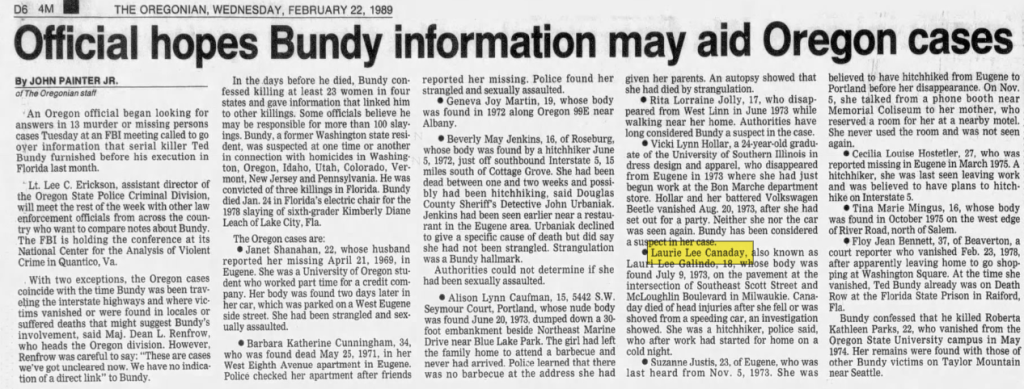
Laurie Lee Canaday: (July 9, 1973, Milwaukee). Her remains were recovered on the pavement at the intersection of Southeast Scott Street and McLoughlin Blvd in Milwaukee, OR.
Susan Ann Wickersham: (July 11, 1973, Bend). Seventeen-years-old. Was found deceased from a gunshot wound on January 20, 1976.
Vicki Lynn Hollar: (August 20, 1973, Eugene). Twenty-four-years-old. Disappeared along with her 1965 VW black VW Beetle with IL plates and the running boards removed.
GayleLeClair: (August 23, 1973, Eugene). Twenty-two-years-old. Found stabbed in her apartment.
Kathy Sue Wells (found on September 3, 1973, Portland): the nineteen-year-old had been shot seven times with a .22 caliber gun and her body had been found on a parking strip (near SE 61st Avenue and Stark Street)
Harley & Esther Moon (found on September 8, 1973, Portland): the couple were discovered by Eugene police, dead of ‘chop wounds to the head; neighbors said they had not seen them since a few days prior to the discovery.
Delores Thompson & Gwendolyn Fulce (found on September 8, 1973, Portland): Roy Lee Jernigan, the father of twenty-four-year-old Delores Thompson’s 2.5-year-old son, came to her rented home on the 500 block of North Ivy Street to pick up the boy, and upon arriving he discovered Delores and her best friend, twenty-one-year-old Gwendolyn Fulce bludgeoned to death (most likely with a hammer).
Deborah LeeTomlinson: (October 15, 1973, Creswell/Eugene). Fifteen-years-old. Disappeared along with a friend on her sixteenth birthday. According to her sister (and my friend) Jean she was seen in California after she disappeared).
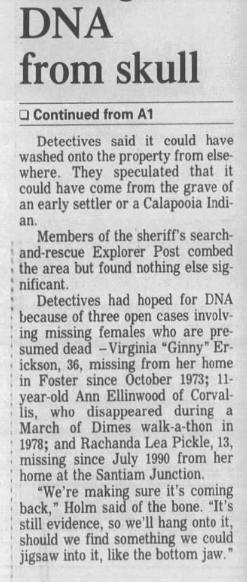
Virginia Erickson: (October 21, 1973, Sweet Home). Thirty-two years old, mother of six. Disappeared, most likely killed by her husband.
Suzanne Rae Seay-Justis: (November 5, 1973, Portland). Twenty-three-years-old. Was from Eugene, hitchhiked to Portland despite having a car of her own.
Martha Marie Morrison: (September 1, 1974, Portland). Seventeen-year-old Martha was last seen leaving an apartment in Portland. Her murder was eventually tied to Warren Leslie Forrest.
Belinda Cowden, along with her husband Richard and two children, David and Melissa: (September 1, 1974, Copper). The family were the victims of a still unsolved mass murder after they vanished from their campsite near Carberry Creek in the Siskiyou Mountains of Oregon; they were last seen on September 1, 1974, when Richard and David bought milk at the Copper General Store. When they never showed up for dinner at Belinda’s mother’s house later that day, their campsite was found deserted, with their truck, wallets, and a half-full carton of milk left behind. On April 12, 1975, two gold prospectors found their bodies roughly seven miles from the campsite: Richard was found tied to a tree on a steep hillside, and Belinda, David, and baby Melissa were hidden inside a nearby small cave that had been sealed up with rocks. Autopsies later revealed that Belinda and David had been shot with a .22 caliber weapon, while Melissa died from severe blunt force head trauma; Richard’s cause of death could not be determined due to the condition of his remains.
Joyce C. Hess: (October 18, 1974). Fifty-four-years-old.
Marion Vinetta Nagle-McWhorter: (October 1974, Tigard). Twenty-one-years-old. According to McWhorter’s sister, she had been traveling before she disappeared around the Western part of the US. Her body was finally identified in September 2025, but the case remains unsolved.
Leslie Michelle (seven-years-old) and Geoffrey Lyman (five-years-old) Brown. Murders took place on February 22, 1975 and both victims were found on March 12, 1975 in McIver Park, Estacada.
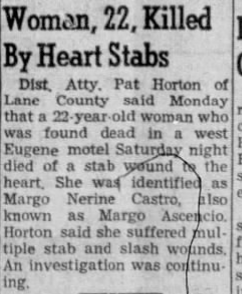
Margo Nerline Ascencio-Castro: (March 1, 1975, Eugene). Twenty-two-years-old. Found stabbed in a motel room, possibly involved with a local motorcycle gang.
Ceceilia Louise Hostetler: (March 26, 1975, Eugene). Last seen leaving the Embers restaurant getting into a vehicle with another person whom she appeared to know. On October 30, 1998, an unidentified deceased female was found burned and stabbed in the forest near 24243 Bolton Hill Road in Lane County, Oregon; it was later identified through dental records as Ceceilia Hostetler.
Caroletta Spencer: (May 20, 1975, Sauvie Island). Seventeen-years-old. Spencer’s was a sex worker whose body was found on a gravel road on Sauvie Island in Oregon. She had been shot four times and most likely had been killed earlier that morning, as she was last seen at Fred’s Place Bar in Portland around 2:20 AM.
Wanda Ann Herr: (June 1, 1976, Government Camp). Nineteen-years-old. Few details about Herr’s life are available, but according to family members, she grew up in Gresham, Oregon, but did not live with her siblings and reportedly ran away from home multiple times as an adolescent. Herr was last seen alive sometime around June 1976 and may have been living in a group home when she disappeared; her upper skull and some miscellaneous bones were discovered on August 2, 1986, near two roads off of Highway 26.
Tina Marie Mingus: (October 1975, Salem). Sixteen-years-old. Murdered, body recovered.
Cherril Sue Miller: (October 12, 1975, Portland). Twenty-eight-years-old. Few details are available in Miller’s case, but she had two children, whom she had left in a neighbor’s care that evening. One of her teeth in the front of her mouth is discolored or capped and she wears eyeglasses with thin bone rims.
Camille Karen Covert-Foss: (October 17, 1975, Hillsboro). Twenty-five-years-old. Found shot in her vehicle at her POE, in a Southwest Portland-area shopping center.
Deborah McNoise-James: (October 28, 1975, Klamath County). Found deceased at the 97 Trailer Court with lacerations to her head, neck, arms, and leg, as well as trauma to her larynx.
Betty Johnson: (November 1975, Estacada).Nineteen-years-old. Not much is known, I only happened to stumble upon her name when searching for a different Oregon woman (Marion McWhorter).
Kim Charleson: (January 7, 1976, Cannon Beach). The twenty-two-year-old had been in college and may have been carrying a small amount of Canadian currency when she disappeared.
Julie Ann Beardslee: (June 30, 1976, Astoria). After Beardslee failed to attend a regularly scheduled Bible study class in Astoria her vehicle was found on July 1, 1976, at Fort Stevens State Park. Her body was discovered by hikers on July 12, 1976 near Coffenbury Lake in Clatsop County, Oregon; she had been stabbed, and her throat had been cut.
Patricia Otto (August 31, 1976, Lewuston): Patty’s body has never been recovered and she was last seen by her husband and two daughters.
Sharon Ryan: (December 16, 1976, Portland): Seventeen-year-old. Vanished going to buy eggs, her body was found near a parking lot in Portland.
Roxanne Marie Sims: (January 1, 1977, Portland). Eighteen-years-old.
Sandra Renee ‘Sandy’ Morden: (1977) Approx sixteen-years-old, her partial skeleton was found in Washington in 1980 and it’s believed that she died in the late 1970’s; she was identified in October 2019.
Karen Jean Lee: (last seen alive, May 26, 1977, Cornelius). Lee ran away with a male companion, fourteen-year-old Rodney L. Grissom. Her possessions and clothes were found by a logging crew sometime in November 1977 however her remains were never recovered. Grissom’s clothes and belongings found in same area, roughly a quarter mile away from Lee’s in November 1982; his remains have also never been found. (Thank you to my friend Ryan AuClair for this information).
Lliana Gay Adank: (June 1977). Sixteen years-old. Was found shot to death along with seventeen-year-old Eric Shawn Goldstrand at the remote Broken Bowl Picnic Grounds near the Fall Creek Dam located about twenty-five miles southeast of Eugene.
Elizabeth ‘Lisa’ Ann Roberts: (July 25, 1977, Roseburg). Found August 9, 1977, formerly known as ‘Precious Jane Doe.’ Roberts was identified on June 16, 2020.
Margie Ann Fernette: (January 24, 1978). Fifteen-years-old. Found in Fairfield Elementary School.
Ann Marie Ellinwood: (April 15, 1978, Corvallis). Twelve-years-old, last seen walking alone ‘during daylight hours.’ Possibly a victim of Earl Patrick Chambers.
Stephanie Ann Newsom: (April 19, 1978, West Salem). Eleven-years-old. Remains found on April 25, 1978 near the Ankeny Wildlife Refuge: possibly a victim of Earl Patrick Chambers.
Elana Jacobs and Teresa Krause: (May 21, 1978, Astoria). Both girls were enrolled in the Tongue Point Job Corp. They were known to go into town to ‘party and socialize,’ which is most likely why they left the compound the night they were last seen alive; their remains were found near Del Rey Beach, Krause’s on December 3, 1978, and two days later Jacobs were discovered; they were most likely stabbed and/or strangled to death.
Finley Creek Jane Doe: (found August 27, 1978, Elgin). The remains of a pregnant woman between the ages of fourteen and twenty-five-years-old; detectives strongly believe she died between 1970 and 1975 and was six to eight months pregnant at the time of her death; fetal remains were found with her. She was found buried face down under a log, and evidence at the scene, including a coaxial cable, suggests she may have been strangled.
Diana Marie Kuhn*: (December 10, 1978, Portland). Twenty-years-old. Remains found in in West Linn, OR.* Thank you for Diana’s cousin Donna Mollema for informing me about her.
Janie Landers: (March 9, 1979, Salem). Eighteen-years-old; she slipped away from the Fairview Training Center in Salem, a residential facility for those with developmental disabilities and mental health problems.
Mary Jo Templeton: (April 1979, remains found on April 30, 1979, Redmond). Forty-nine-years-old. In April 1979, she was renting a room at the El-Rancho Motel when she disappeared; her remains were uncovered in several parts over the time period of a month in Mirror Pond and near the Newport Avenue Dam in Bend. The first remains (a thigh) were found by a utility worker raking intake grates at a dam on April 30, 1979. She had been dismembered with what detectives called a ‘surgical precision,’ leading to theories that her killer may have had experience as a hunter, butcher, or surgeon, butcher (or a combination of the three); she was eventually identified through dental records.
Daisy Motley: (May 8, 1979, Portland). Motley was a sixty-four-year-old, unemployed female who lived alone that had no apparent enemies. Someone anonymously called the manager of her apartment complex to her death and asked them to check on her because they heard a ‘disturbance’ coming from her residence. The last time Daisy was known to be alive was when she talked to her daughter at approximately 9 PM on May 7th.
Lisa Danein Boggs: (June 13, 1979, Salem). Boggs and her boyfriend, Randolph Robertson, left their home state of Missouri on May 7, 1979 and arrived in Salem, Oregon, on May 9, 1979, and lived at a transient camp on property near the KOA at 1595 Lancaster Drive. On June 7, 1979, Salem police were called to the KOA for a homicide, where they discovered that Randolph Robertson, had been killed by two shotgun blasts; Boggs was nowhere to be found. On June 13, 1979, her’ body was discovered in a creek 17.5 miles up Little North Fork Road off Highway 22E in Marion County, Oregon. Her cause of death was drowning, even though she had also sustained a blunt-force injury to the skull behind her left ear. She was found lying on her back, with her head submerged in eleven inches of water; it had been held in place by a large rock
Irin Marie Meyer: (July 20, 1979, Brookings). Twenty-nine-years-old.
SherylWright: (no additional information at this time).
A very helpful Websleuth’s user compiled a list of missing/murdered women from Oregon in the time frame right after I did.The second part of the Websleuth’s post about the missing women from Oregon in 1978 to 2005.
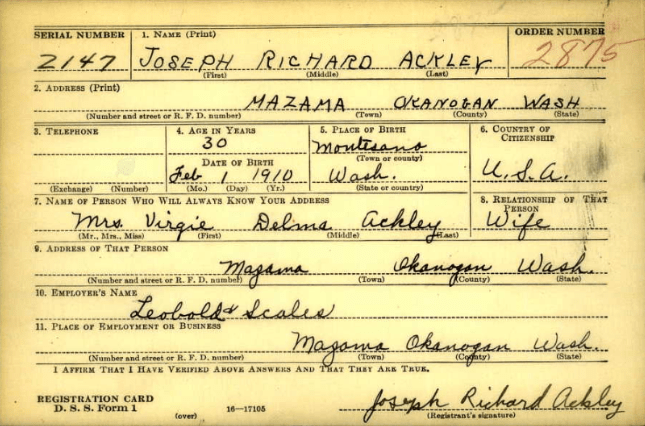
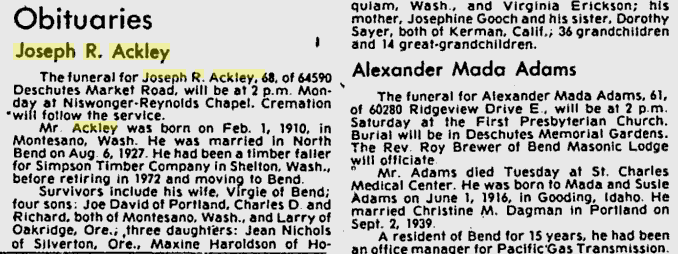
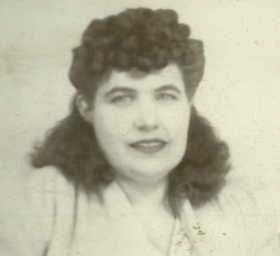
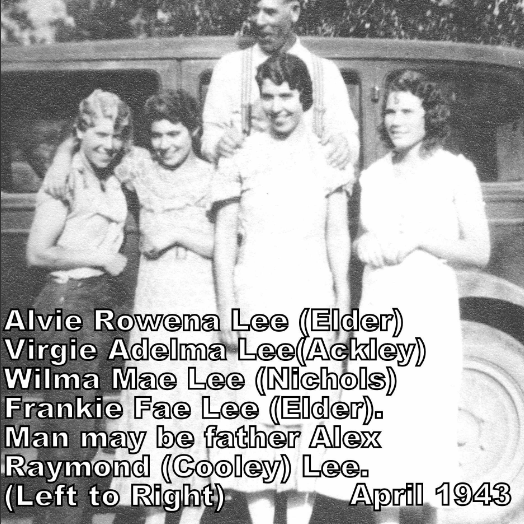
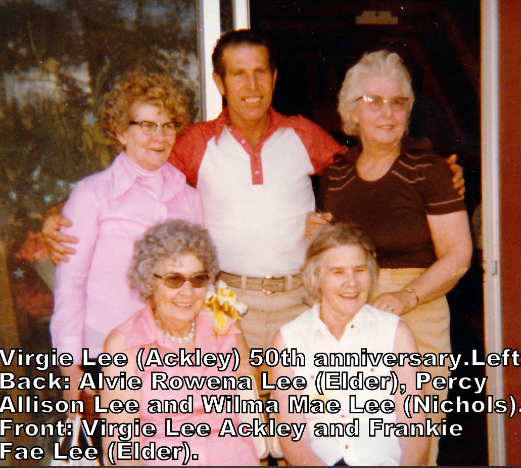
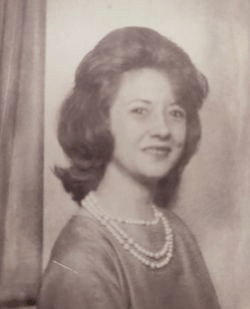
Virginia Mae Erickson was born on April 26, 1941 to Joseph and Virgie (nee Lee) in Mazama, WA. Mr. Ackley was born on February 1, 1910 in Montesano, and Virgie was born on a houseboat on June 12, 1912 in Empire, OR. The couple were wed on March 18, 1928 in Buxton, Oregon and had eight children together: Virginia, Lawrence, Maxine, Joseph, Charles, Jean, David, and a daughter named Joyce that died in childbirth.
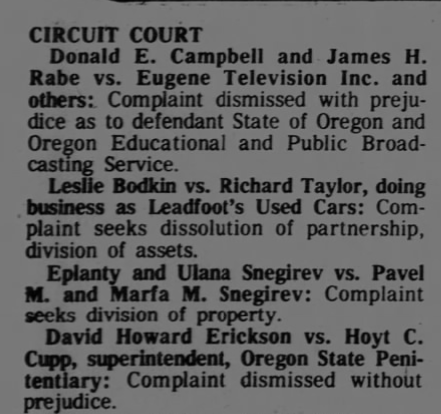
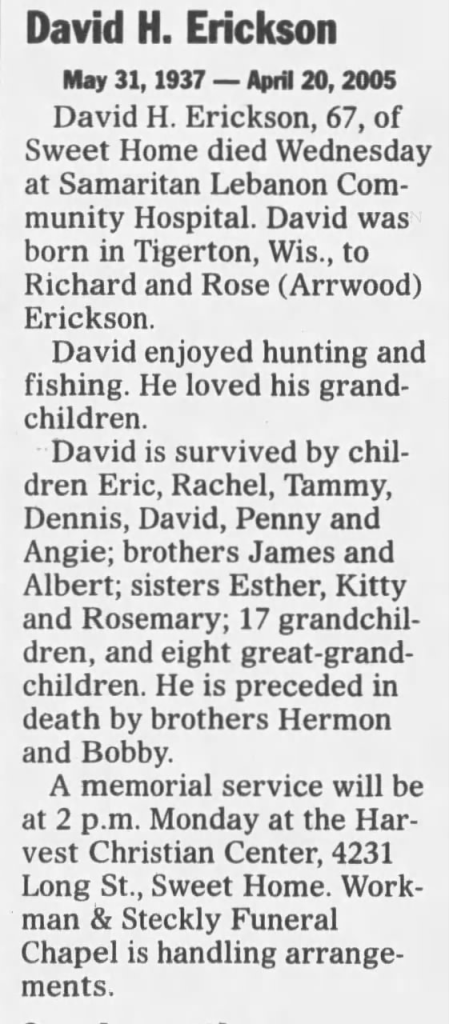
On October 18, 1958 seventeen year old Virginia married twenty-one year old David Erickson in Montesano, WA; Erickson was born on May 31, 1937 in Tigerton, Wisconsin. After relocating to Sweet Home, OR the couple had six children together: two boys and four girls. Ginny was a petite woman, and only stood at 5’1” tall and weighed 125 pounds; she had green eyes and curly chestnut hair she wore at her shoulders. She was a devout fundamentalist Christian and dedicated stay at home mother, and played the piano during church service every Sunday morning while her daughters would sing in the choir; on occasion, David would join her and play the guitar (when he attended). Virginia was also very close to her parents who lived in Washington, and she spoke with them frequently and would usually visit every six weeks or so (give or take). Ginny’s younger sister Maxine said she ‘could not go for more than six weeks without going to see her folks and she always had the kids with her. She would not have gone that long without seeing her kids or seeing her mother.’
Virginia was last seen alive by her children in their home on 48th Avenue in Sweet Home on the morning of October 21, 1973: David woke up their oldest childRachel and told her they’d be going to church without them that Sunday because he was taking their mother out hunting. This immediately struck her as being incredibly unusual and out of character for her mother, but she got up anyways and helped get her brothers and sisters (who ranged in age from six to thirteen years old) ready for service. Ginny and David’s sixteen year old nephew Jimmy picked the kids up that morning and took them to Sunday School, and their son David (who goes by Michael) said of the memory: ‘I just remember momma staying home, and she was crying when she was cooking something on the stove, and she gave us hugs goodbye, and she just told me she was sick. My cousin Jimmy picked all of us kids up and took us to church, and my mom never showed up at the church to play the piano, and I thought that was kind of weird, and it was my Uncle Jim and Aunt Shirley’s little church.’
Before leaving for church, Virginia pulled Rachel aside and said to her, ‘if I’m not here when you get home, you feed the kids and take care of them.’ The (then) 13 year old said that she remembers her mother was dressed in a bathrobe but the parts of her that were visible were covered in bruises and that it was almost as if she was trying to hide what was underneath; she also said that her breathing appeared to be labored and almost strained.Rachel said that she remembered her mom being afraid of her dad and that lots of other people were as well, but she also said that he was a sweet talker that could be very charmingand manipulative.
When they arrived at church Rachel found her Aunt Shirley and told her about what happened at home; Shirley immediately got in her car and drove towards the Erickson residence, which was just down the street, and where she cannot say for 100% certainty Rachel strongly speculates she drove to her family’s house to see what was going on between her parents. According to a comment made by Amber Erickson on the website for the ‘Vanished’ podcast about her grandmother, when Shirley went to the Erickson home that Sunday morning David met her at the door with a gun, and threatened not only her but her children as well. When the service was over Jimmy took them home and the kids came back to an empty house, and when their father came home at around 2/2:30 PM he was by himself without Virginia.
Rachel and one of her sisters immediately asked David where their mother was, and he told them that she had simply ‘ran away.’ She was aware that her father had multiple guns, including hunting rifles and high powered pistols, and knew that day he took his .22 with him when he left the house. Later that same day Rachel was able to go back to the church to confront her aunt, and when she cornered her in the nursery Shirley slapped her across the face and said, ‘your mothers dead, don’t ever speak of her again.’
Assuming David was telling them at the very least some partial truths, the children began looking through their mothers personal belongings to see if anything was missing, but everything was left behind, even her shoes. According to Michael, ‘I remember helping Rachel look for missing stuff because I remember Mom and Dads bedspread was gone, and Rachel was screaming that ‘mom would never leave without her glasses. And why are her rings still here? Why are her clothes all still here? She didn’t even wear her shoes.’’
Almost immediately after Virginia disappeared David gave away all of her personal possessions, including her clothes, books, and jewelry, andMichael even saw her set of green and cream colored encyclopedias at his Aunt Shirley’s house (she denied they belonged to his mother). According to him, ‘a whole bunch of church people came into our house the next day, or really soon after mom left that I came home from school and a lot of church people were there taking everything. They took the washing machine, all of her books were gone, a lot of the cooking stuff was gone. Me and Eric were sleeping on the floor, the front room furniture was gone. The TV was gone. So I always thought that was kind of weird.’
According to Rachel, the day before her mother disappeared her parents were arguing about Denise, one of her twelve year old twin sisters, who the day prior had told Virginia that she was no longer menstruating. She remembers hearing her say to their father, ‘I’m bringing Denise to the doctor on Monday and everyone will know now, for sure, what kind of man you are and what you’ve done.’ In response to this, David (who was a golden glove boxer in Wisconsin) screamed at her that she ‘wouldn’t live until Monday’ if she told anybody, then slammed her against the wall and began ‘hitting and punching’ her. This wasn’t out of the ordinary for her father, and Rachel said that on multiple occasions her mother tried telling people about the abuse he inflicted upon his family, but no one had believed her. According to Michael, the Erickson home wasn’t the only place that the children were exposed to sexual abuse, and at their uncle’s church (called The Pentecostal Church of God) a Sunday School teacher named Dale also preyed on the boys; it was later found out that he was caught and served six years in prison for the sexual abuse of a minor.
Eventually the girls told family members (specifically their dads brother Albert, a Pentecostal preacher) about Denise’s pregnancy and the sexual abuse, and the police were eventually notified. Even though everyone in the Erickson family knew that Virginia was missing nobody did anything about it, and the children were gaslite and told their mom ‘ran away.’ Rachel and her brothers and sisters knew she would never run away on her own, and she certainly wouldn’t cheat on her husband and leave her children behind. According to an article published in The Albany Democrat-Herald on May 9, 1997, the sheriff’s department received an anonymous postcard on April 29, 1974 suggesting that they look into Erickson’s disappearance (Rachel later said that it was her grandfather that sent the correspondence). Former Sheriff Dave Burright said in an April 1996 interview that ‘we highly suspect she’s been killed and the husband has been a strong suspect from the very beginning.
In one of the very few newspaper articles I found about Virginia’s disappearance that was written in May 1996, The Albany Democrat-Herald interviewed Denise, who said the family briefly relocated to California after her mother disappeared. In the same interview she also admitted that she had been pregnant with her fathers baby at the time and that the child was stillborn in February 1974; in the months that followed, the family returned to Oregon.
According to The Albany Democrat-Herald, the sheriff’s department received an anonymous postcard on April 29, 1974 suggesting that they look into Erickson’s disappearance (Rachel later said that it was her grandfather that sent the correspondence). Even though he was aware that his father was a bad man, it was still scary for Michael when police came to his house to arrest him: ‘the only thing I remember is the policeman, they came and took Penny out, and she was sitting in the police car in the backseat and when we were walking past the dining room table they had dad bent over that with handcuffs on him with all three of his guns laid out, and some knives on the table. When we walked by, and they were trying to make it so that we couldn’t look, putting their hands by our faces. And then I remember going into the police car, which I thought was kind of strange because me and Eric went in one and Penny went by herself in another. I could see her crying , but we couldn’t get out to help or do anything. We all ended up at the police station, the three youngest kids were together and they were giving us snacks and talking to us and making sure we had something to do. It was terrifying trying to figure out what I was in trouble for, but they wouldn’t say nothing.’
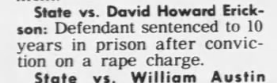
By this time over seven months had passed since Virginia was last seen alive, and David Erickson was arrested September 1974 on three counts of first degree rape for three of his daughters (specifically ‘two thirteen year olds and a 14 year old,’ even though Rachel was only 13). After their fathers arrest the four Erickson daughters were completely removed from the area so that he couldn’t track them down before he was sentenced, an event that took place on Rachel’s fifteenth birthday: January 6, 1975. On February 8, 1975 hebegan his ten year sentence at The Oregon State Penitentiary; he was paroled after less than six years on November 28, 1980. According to Virginia’s granddaughter Trinity, before David went away he had a baby with a local woman that had a crush on him, but it didn’t take long before she left him. After David was sent away most of the six children were shuffled off to different foster homes (although they attempted to keep the two brothers together), although Rachel was sent to live with her maternal grandparents in Washington.
The abuse in the foster homes was so horrific that Michael ran away to his Aunt Shirley’s house, who he lived with for a period of time before becoming legally emancipated. Unfortunately his aunt was incredibly abusive to her sons, and even though she didn’t do much to him beyond yelling at him on occasion he still had a hard time accepting the kind of person she was inside of church versus inside of her home. Most of the Erickson children (and grandchildren) strongly believe that she knew what happened to Virginia, and they always hoped that some form of the truth would ‘slip out’ when they spent time together.
About his Aunt Shirley, Michael Erickson said ‘I know she was abusive. She was loud. She would scream, and she wouldn’t think twice to start swinging at anybody, or anything. But at the same time it was ‘thank you Jesus, thank you Jesus…’ It’s like I said, that she went to church and that kinda stuff, but Shirley ran us out when we were 16.She ran all of us kids out of her house because she had a lot of, not adopted but but adopted kids going through the house all the time. But I never got her to say anything about mom but she did tell her son Jimmy just a few months ago that God has forgiven her for what she’s done. So, we have no idea what else she’s talking about.’
In October 1973 when his wife disappeared David Erickson worked as a contractor with the federal government cutting logging roads in Linn County, and according to Rachel, ‘he was the guy that made all those back roads up there, up into the mountains by Sweet Home. So he had a full forest that he could have stuck her in.’ She also said she has a good feeling as to where he may have left her mother but due to the vastness of the area she would need a place to start, and was looking for ‘a place that he liked to go to.’
In April 2023 Michael’s daughter Trinity reached out to ‘The Vanishing’ podcasters Marissa Jones and Amanda Coleman and expressed interest in having her grandmother featured on the show. She said that she suspects her grandfather took Virginia to Green Peter Lake and one of two things most likely happened: he either put her body under a tree then filled in the area around it, or he cut her up with his chainsaw and then threw the pieces into the water.
At the time Virginia disappeared, Rachel was thirteen years old, followed by ten year old twins Tammy and Denise then came Michael, Eric, and Penny. She along with Michael remembers their mother as being a warm and loving person and a doting wife that adored her family and loved being a mom. According to Rachel, ‘she loved God, she loved going to church all the time. She played piano at the church, she was a very loving mom. I did have a mom that loved me and that I was so close to. I’d sit with her at the piano all the time, and I wanted her to teach me how to play the piano and right before she disappeared she was teaching me the chorus but I couldn’t really put my hands together yet. I would sit for hours with her at the piano, then after she disappeared (this may sound kind of weird to most people) but the Sunday after she disappeared, that night after I got home from Church I sat there and I cried and I said, ‘Jesus, if you’ve taken my momma away to be with you, then please put her hands in my hands so that I can play the piano.’ And ever since that day, I’ve been able to play with my hands together and play anything by ear.’
Another person that may have witnessed quite possibly Virginia’s last moments on earth was her nephew Jimmy, and although he has never spoken publicly about what happened that morning in October 1973 ‘The Vanishing’ podcasters were able to obtain some correspondence between him and another family member that helpsshed some light into what he may have seen. In more recent years Jimmy said that he has gone out in the woods surrounding Sweet Home and looked in the places that he felt that David could have left his aunt, but with no success, and that he ‘has ideas, but no facts.’ He also brought up John Arthur Ackroyd, who was born and raised in Sweet Home, but looking into him he didn’t start killing until 1977 and Virginia doesn’t fit into his MO.
At the end of the email Jimmy said he had ‘given suggestions to investigators as possible locations, but because of the generalizations that I had I’m sure that nothing was ever found. I have went to look in those places too, poking around in places that my intuition sent me. But I’m not a searcher. Not even a little. I haven’t hunted in years. I used to go looking, even drew a circle around how far he could have carried her and made it back in that time frame that he was gone. It’s possibilities are a huge circle. Looked at possible gravesites where he could have put her body under another body to be buried on the following Monday. Still nothing. And there were a few in the circle.’
One theory that has recently been floated around the Erickson family is that David had the help of a neighbor and close friend of disposing of Virginia’s body, and according to Rachel in October 2023: ‘the recent thing that I heard about was this was weeks just before Covid hit, I had heard from my cousin that he heard from a friend that there was a guy, he lived right across the street from us. He was my dads friend and from what I heard from this guy that just recently told my cousin that he helped my dad get rid of my moms body, and wrapped her body around an engine block with a chain and threw it in the Green Peter Dam, in one of the deepest areas. And I’d always known something about Green Peter Dam, and the detective said that it would need to be scheduled to get approved because it was a dam. Then he said he would try to get them to go and look and stuff and then Covid hit and it shut everything completely down. And I haven’t heard anything.’
About the neighbor, Mike said ‘he was crazy, he was drinking all the time and beating his kids all the time. And I was over there one time and he had seen an elk on TV, and he shot the TV. He was in and out of prison all the time, and then dad and him were in prison at the same time. So they were pretty close.’ The Erickson children have been unable to track down the origin of the story and don’t know where it came from.
The Ericksons remember their mom trying to leave their father multiple times over the years, but she always came back. This makes sense, as it was the 1970’s and there weren’t a lot of resources available for a stay at home mom of six with no money and limited education. Mike also believed that his mother didn’t have a strong support system to fall back on, as her own father would tell her to go back to her husband after an argument and ‘figure things out.’ Most of the people in Virginia’s life felt the issues between her and David were ‘husband and wife business,’ and when a fight would occur he would say that she wanted to ‘run off with another man’ and they believed him, so when she disappeared it made it all the more easy to believe that she left willingly.
When his father was released from prison Michael decided he deserved another chance, and reached out to him in an attempt to re-establish a relationship with him, a decision he deeply regrets and that still haunts him to this day. After getting out of prison Erickson wasn’t rehabilitated, and he went on to molest multiple granddaughters and other members of the family: ‘he tried to put things back together, when dad was down at the penitentiary. I thought I could make a go at it with my dad, and then he ended up molesting my daughter Trinity. It made me feel like I failed.’ Michael always said he suspected his father was responsible for his mothers disappearance, and that he ‘asked my dad several times if he’d killed my mom, and he always said no. So I don’t know if he made her shoot herself, like the Russian roulette stuff or if he did kill her… you know, one cop told me it was a nobody homicide, that’s kind of what it went under,’ … ‘ he said they were going hunting, and they got in an argument and he let her out of the Foster store, the little store down the road in between Sweet Home and Foster, which they’re all one, so he let her out then he went hunting is what he told me. But at the same time, my dad was pretty strong but to try to deadlift her… I think he could have done it, I always thought he put her in an old pick up that he had , and drove her into Green Peter Lake up above Foster Lake. I’ve always had that feeling, but I’ve never been able to get anyone to go out there and dive and stuff like that for her. But then all of the sudden he had his brand new Land Cruiser and that pick-up was gone. It’s not like he traded it in or anything like that. But it was just gone.’ … ‘He did tell his brother Albert Erickson, ‘this time she’s not coming back.’
There are two large bodies of water in the Sweet Home area: Green Peter Lake and Foster Lake. Rachel figured out that her father could have traveled roughly forty-five miles on the morning Virginia disappeared before he would have had to turn around and be back by 2/2:30 after church, and both lakes fit into these parameters.
The day he got out of prison, Linn County Detectives questioned Erickson about Virginia’s disappearance on the first of several occasions, and just like he did with his children, he changed his story multiple times, and none of his reasoning fully explained what may have happened to her or where her body could be. On one occasion, he said his wife changed her mind about going hunting because she had a headache and he went without her, and she was gone when he returned. Another time, he claimed they had left the house together but after only making it one block away Virginia asked to go to a store to buy candy, and while inside she used the pay phone to call her boyfriend, then walked back to the house to meet him. A third story involves Ginny leaving him and their family to be with a truck driver from Madras, OR. Erickson also volunteered that he’d seen her a few months after her disappearance and she was ‘fine,’ a sighting that has never been confirmed by investigators.
Someone reported to police that they saw Virginia in Bend, OR and gave them the vehicle’s license plate. Sheriff Burright said that they ‘ran that one down and one of the people looked like her. We’re sure it was a case of mistaken identity.’ According to Burright, three things seemed to be consistent in the case: ‘that Erickson vanished on a Sunday, that she was a devout Christian and would never miss church, and she was very close with her mom and dad.
In the years before his death Denise hounded her father, asking him over and over again what happened to her mother and what he did to her, and on one occasion after telling him that she thought he was responsible for her disappearance he responded, ‘well, I don’t know what to say about that.’ David Erickson died of congestive heart failure and lung cancer at the age of 67 in Lebanon, OR on April 20, 2005, taking all of his secrets to the grave. According to his obituary, he had one more child named Angie and he loved hunting and fishing. The brief write-up also mentioned that he ‘loves his grandchildren,’ and knowing what we do know now about this disgusting creature, it just makes me sick. In 2005 when David died members of the Erickson family were so thankful that they went to his funeral just to make sure he was really gone, an event they were kicked out of. According to Rachel, there’s a few people out there that she feels may know what happened to her mother but refuse to come forward and talk.
Before her grandfathers death Trinity remembers an incident that made her lean towards him being responsible for Virginia’s disappearance: ‘I am 100% sure that he killed her. When I was around 18, I heard him talking, and I thought he was talking to someone. And I heard him.. And he was just sitting there going, ‘I had to kill her, that whore, she would have ruined my life. I had to kill her. I had to put her out. She would have ruined my life.’ And I was like, ‘what?’ and was on the other side of the wall. So I got up and I came out of my room to go to the bathroom and he was in there by himself. He had just been talking to himself.’
Virginia’s daughter Penny declined to do an interview with The Vanishing podcasters, but she did send the girls an email: ‘things I remember: I remember believing they (dad and mom) went hunting. Dad came home without mom. I know we went to church before they left. My dad has told me many different stories on why she didn’t come home. 1) He dropped her off at the end of our street. 2) he dropped her off at Glenns Market. 3) She wanted a candy bar and he dropped her off at the hilltop store. 4) She ran off with a boyfriend. Later cops confirmed she did not. 5) She left us. Those are the ones I remember. I remember one time he was abusing me, sexually, and he said he thought he heard my mom so he made me jump up and get my clothes on and go check to see if she came back. It wasn’t her, and when I came back into his bedroom he noticed in my haste that I had put my clothes on inside out and he told me that I needed to be more careful. I now just realized how cruel that was. I know he knew she was dead. He also told me once that when you bury someone without embalming them the ground does something weird, for the life of me, I can’t remember what he said though. Sorry. My earliest memories are of him manipulating me to play with him. He was mentally and sexually abusive to me. He was all those things and physically abusive to my sisters. My dad on the outside of our house was funny and loving. He would give anyone his last few dollars if they wanted it. He was a habitual liar. Oh, and also I remember one day he said we were going to go find our mom. He started to walk us up a hill near our house then suddenly changed his mind. I don’t know why he ended with that action, but either way it was cruel. I always wondered if he was going to attempt to kill us all or if he was just playing some sort of twisted mind game. I also remember him taking off all he could on the Jeep and washing it. I was the only kid home because all my siblings were in school, I think. I don’t know. Maybe they were in the house, or I wasn’t paying attention. I don’t know if they remember that or not.’
Michael Erickson also shared some horrifying stories about growing up with his father: ‘the worst thing that dad made me do with my momma was, he would tie her to the kitchen chair and then make me play Russian roulette with her. So I’d be crying and everything and he’d hold his hand up underneath my hand and point the gun at her face, and move it down to her chest, then move it down to her belly and stuff like that. But every time I pulled the trigger it would never go off. Sometimes we had to sit there for so long and it wouldn’t go off and I remember one time he put two bullets in it, this was about when I was seven, and I still wouldn’t go off, and it was a .22 revolver, and he was really mad and he grabbed my arm and told me to get outside and my momma, she was just crying for mercy, not wanting to get killed. But thank God the gun wouldn’t fire on her. Then I’d see her with a few bruises and stuff after. But I remember her standing at the sink and crying a lot. When she was at the sink cleaning dishes, I’d give her hugs on her legs.’
Rachel remembers the Russian roulette incidents and other atrocities that her father had inflicted upon her and her brothers and sisters when they were small. She said that one time ‘he wanted to have sex with me one day and I didn’t want to and I was trying to fight him and I went running outside and he kicked me through a barbed wire fence and I have a big ol’ gash on the back of my back from it. He didn’t stop just with us, he molested some of my nieces, and it was like he didnt care what age they were.’
Rachel said that her mothers disappearance split the family generationally, and most of her extended family told her to leave it in the past and to let it go. These are the same people that called David a ‘good Christian man’ that could do no wrong despite the fact that he was convicted of raping his three young daughters. She also said there are two detectives from the Linn County Sheriff’s Department that are currently working on the case, Caleb Riley and Randy Voight.
When the creators of ‘The Vanishing’ podcast asked the Linn County Sheriff’s Department for Virginia Erickson’s case file their request was denied, citing an ‘open investigation,’ and sadly this doesn’t surprise me. The Thurston County Sheriff’s Department in Washington refused to even give me the name of a victim they’re still investigating, and the murder took place in the mid-1970’s.
Despite multiple requests over the years Shirley refused to tell her nieces and nephews what she knew about the disappearance of their mother, and she took what she knew with her to the grave, as she died on December 17, 2023. But one thing is for sure: to this day the extended Erickson clan remains devoted to David, not Virginia, and smears her name every time she is brought up in favor of his. When asked why he still remains so high in the family’s favor, Michael said that he could ‘smooth talk anybody and that he helped a lot of people and things like that. He was always telling jokes, and pulling practical jokes.’
Rachel went on to lead a very successful life: she spent twenty-eight years working as a MWR Program Chief for the US Coast Guard before retiring, and is happily married with two daughters; after living in Kodiak, Alaska for many years she relocated to Woodstock, Georgia. Michael went onto get married and have two beautiful daughters of his own, Trinity and her sister.
Virginia’s father Joseph Ackley died on February 15, 1978 in Bend, and Virgie passed away at the age of 76 on February 9, 1989 in Hoquiam, WA. Her brother Charles died on September 9, 1993 in Montesano, WA, and her other brother Richard died on March 10, 2008 at the age of 80 in Casa Grande, AZ. Her twin daughters Tammy and Denise have both passed away as well after struggling with substance abuse.
As of February 2024 Virginia is considered missing under suspicious circumstances and would be 83 years old. Her children strongly believe that their father murdered her, and detectives investigating the case also suspect he was involved in her disappearance but were never able to gather enough evidence to charge him.
Works Cited: Amanda Coleman and Marissa Jones, The Vanished Podcast, Episode 411: Virginia Erickson Taken January 26, 2025 from thevanishedpodcast.com/episodes/2023/10/2/episode-411-virginia-erickson Chappell, Sky. ‘Virginia Erickson, The Forgotten Sweet Home Woman.’ (October 25, 2023). Taken January 26, 2025 from sweethomenews.com/virginia-erickson-the-forgotten-sweet-home-woman/ The Charley Project: VIrginia Erickson. Taken January 26, 2025 from charleyproject.org/case/virginia-ackley-erickson
Virginia at sixteen. Photo courtesy of The Democrat Albany Herald.Virginia Erickson.A picture of Virginia and her brothers and sisters (the only one missing is Maxine). She is the woman on the far left.Virginia standing on horses. Photo courtesy of Rachel Dyer.A picture of Virginia from 1994 using age-progressive technology to make her look fifty-three.Virginia and her family listed in the 1950 census.David and Virginia Erickson’s marriage certificate. David and Virginia listed in the Portland, Oregon City Directory in 1960.A newspaper clipping mentioning the birth of David and Virginia’s first child published in The Eugene Guard on January 8, 1960.An article that mentions Virginia published by The Albany Democrat-Herald on May 3, 1996.An article about Virginia published by The Albany Democrat-Herald on May 9, 1996.Part one of an article that mentions Virginia Erickson published in The Albany Democrat-Herald on August 8, 1996.Part two of an article that mentions Virginia Erickson published in The Albany Democrat-Herald on August 8, 1996.An article mentioning Virginia published by The Corvallis Gazette-Times on August 9, 1996.David Erickson.A newspaper clipping about Denise Erickson giving birth published in The Albany Democrat-Herald on February 5, 1974.A newspaper blurb mentioning David being charged for three counts of first degree rape published in The Albany Democrat-Herald on September 25, 1974.A newspaper blurb mentioning Erickson pleading not guilty on two charges of rape published in The Statesman Journal on December 4, 1974.A newspaper blurb mentioning Erickson pleading not guilty on two charges of rape published in The Statesman Journal on January 15, 1975.A blurb mentioning David being found guilty of rape published by The Capital Journal on January 16, 1975.A blurb mentioning David being found guilty of rape published in The Statesman Journal on February 12, 1975.A newspaper clipping about David Erickson being sentenced to ten years in prison for rape published in The Statesman Journal on February 15, 1975.A blurb mentioning charges being dropped in relation to a complaint he filed while in prison published by The Statesman Journal on September 15, 1976.David Erickson listed in the Oregon state death index. Erickson mentioned in the death notices section of The Albany Democrat-Herald on April 22, 2005.David Erickson’s obituary published in The Albany Democrat-Herald on April 23, 2005.Virginia’s father, Joseph Richard Ackley.Virginia’s fathers WWII draft card. Virginia’s fathers obituary publishe Bulletin on February 16, 1978.Virgie Ackley.A picture of Virgie Ackley courtesy of Ancestry user ‘oliverwharris.’Virginia’s mother Virgie with some other family members. Photo courtesy of Ancestry user ‘oliverwharris.’Maxine Ackley.A picture of Virginia’s daughters Penny and Denise from The Albany Democrat-Herald on May 9, 1996.A comment that Virginia’s granddaughter Amber left on her episode of The Vanishing podcast.A comment that Virginia’s granddaughter Shelly left on her episode of The Vanishing podcast.A comment that Virginia Erickson’s son-in-law left on her episode of The Vanishing podcast. Trinity commenting on a post about her grandmother on the true crime website, ‘Websleuths.’ A comment on an Instagram post about the Vanished podcast featuring Virginia Erickson.Shirley Erickson and her husband Jim in their younger years. Photo courtesy of the public domain.Shirley and Jim Erickson. Photo courtesy of the public domain.Shirley Erickson’s obituary.
Janet Lynn Shanahan was born on August 19, 1946 to Stanley Paul and Jean Lois (nee Wyse) Karin in Spokane, WA. Janet’s father Stanley was born on September 30, 1916 and her mother Jean was born on November 2, 1924 in Illinois. The couple had two daughters together (Janet and her younger sister Jane) but eventually divorced, and it looks like Stanley was involved in some lower-level criminal activity and even served some jail time. Jean got remarried to a man named Jared Thomas, and it looks like he adopted Janet and Jane; the couple had two sons together, Jared and Timothy. Blonde haired, blue eyed Janet was an honor student, and attended Willamette High School in Eugene, Oregon. She was very active during her time there and was involved in multiple after school groups and activities, including drama club, the art guild, and the newspaper. During her senior year she was crowned prom queen and was voted ‘Girl of the Year, and according to those that knew her, Shanahan was incredibly outgoing, well-liked, and she had a lot of friends. After graduating high school in 1964 she got a part time job at a credit card company and attended the University of Oregon with the goal of one day becoming a junior high school teacher; according to her mother: ‘she was a leader, queen of this and that, and in the National Honor Society. She was very likable, very easy to get along with, and an excellent student.’
Janet married fellow OU student Christopher John Shanahan on May 24, 1968. He was born on February 19, 1946 in Washington DC and after his family relocated to Oregon he graduated from South Eugene High School in 1963. On the Shanahans marriage certificate Chris’ occupation is listed as student, and in April 1969 the couple had been married for about eleven months. In between classes and her PT job Janet was also student teaching at Cal Young Junior High School, and at the time of her murder she was in the spring semester of her sophomore year (Chris was in his junior). According to an article published in The Eugene Register Guard on January 5, 1997, Janet’s mother said that she didn’t know her new SIL very well, as they haven’t been married very long, but did say he was ‘kind of a loner’ but that as far as she could tell he seemed to be treating Janet right.’
On the evening of Monday, April 21, 1969 Janet attended a night class then briefly stopped home before leaving around 9:30 PM to attend her younger brother’s fifteenth birthday party at her parents house, about two miles away on Rutledge Street. Christopher Shanahan was reportedly sick at the time and stayed at home in bed. An article published in 1997 says that after the party at around 11:00 Janet went out for around 30-minutes with Jane (who had just recently moved home to their parents house in Eugene) to get some food at the nearby Lynwood Cafe. After the girls ate they went to a local convenience store and picked up a car magazine for her husband, then Janet dropped her sister off at their parents house when they were done. The night she was last seen alive she was wearing a rust and cold colored brocade suit.
The timeline of when Janet was reported missing is a bit unclear:an article published in April 1969 states that she was reported missing later that same evening, but according to The Statesman Journal in 1997, Chris Shanahan woke at 8 AM the following morning, ‘and discovered his wife hadn’t returned home. After she failed to report for work at 1 PM at a credit company, Shanahan reported her as missing.’
I’ve seen some sources list the day Janet was discovered as April 22 and others that say it was April 23, but if she wasn’t reported as missing until one o’clock in the afternoon after she dropped Jane off at her parents house then it’s safe to say she was recovered two days after she was last seen, roughly thirty-four hours later. On the morning of April 23, 1969, Christopher contacted his SIL asking her to accompany him in an attempt to retrace Janet’s steps from the evening she disappeared in hopes of finding her 1951 Plymouth coupe. At roughly 9:40 AM after only ten minutes of looking they noticed the sedan in a ditch in an industrial area near a lumber mill, less than two miles away from her parents house on Cross Street, at the intersection of Roosevelt Boulevard and Maple Street. Employees from the nearby lumber mill report the vehicle being there since somewhere between 1 AM and 6 AM the previous morning.The keys were missing, but Chris was still able to get the trunk open, and that’s when they found Janet’s body; she had been strangled to death.
After finding Janet’s body Chris called police using a nearby pay phone, then dropped Jane off at home, and immediately went to his attorney’s office. A passing motorist saw Chris and Janes reactions and thought there was a car accident and contacted police as well. Where he did initially cooperate with police, after the discovery Shanahan told investigating detectives that he’d been on a ‘desperate search’ for his wife, but in reality he did everyday, mundane tasks like reading for class and getting new tires on his car. The night before she was found, he had been seen out, drinking beer and shooting pool. After April 25, 1969 he never contacted police for news again on his wife’s death, and didn’t stick around for long after either, and shortly after moved across the country to Connecticut, where he still resides as of January 2025.
An employee at nearby Eugene Stud & Veneer, Inc named Earl Albert said he saw the couple walking towards the car, and after the young man ‘glanced’ in the front part of the vehicle he then opened the trunk and repeatedly screamed, ‘oh no, oh no, no’ over and over again. Police reported that the inside of her sedan was ‘neat and orderly,’ and there were no signs of a struggle. Janet’s body was fully clothed except for her shoes, which were found lying next to her, and despite there being no outward signs of sexual assault it was later determined that she was indeed violated. Upon searching the scene for clues investigators didn’t find much useful information, and Sergeant DW Carley said that to kill Shanahan her assailant most likely ‘used something flexible, such as a length of garden hose.’
Over the years detectives have interviewed hundreds of Shanahan’s friends, family members, school mates, and acquaintances, with little to no luck. Because genetic evidence was not properly stored in the 1960’s, there is no DNA sample related to Janets murder, therefore detectives are largely relying on tips from the general public to solve her case. According to cold case detective Drew Tracey, ‘we have already done a pretty thorough investigation, and we have our thoughts, but thoughts do not convict people.’
In a January 1997 article published in The Statesman Journal, Eugene Police Detective Les Rainey said investigators were looking for an unidentified man and woman that may have been with Shanahan at a cafe on the evening she disappeared sometime after she left with her sister, which alludes to Janet possibly returning after she dropped her sister off. Rainey also said that he hopes to get in contact with two friends of the Shanahans, Robbie and Marcia Robertson as well as an acquaintance of Chris’ named Freida Jessey (this is her maiden name, which is all that was released). Detective Rainey made it clear that the three individuals were not suspects and could possibly help shed some new light on what Chris’s frame of mind was like after his wife was killed.
In 1996 while on the east coast for a separate investigation a detective working the investigation tracked Chris Shanahan down in New Milford, Connecticut and tried to talk to him about his wife’s murder, and this time his demeanor had completely changed: he became angry, and combative, and refused to answer any questions, directing the detective to his attorney. About Shanahan, Rainey said ‘we have some concerns and some suspicions, but if there’s information that would clear him, we’re interested in that too.’ In a 1997 (attempted) interview with The Register-Guard, Chris Shanahan said ‘no comment, that’s my comment. Please don’t contact me again. If you do, I’ll be real upset.’ Jean Thomas said of her son in law, ‘I don’t think he could ever do that, and I told the detective that.’ According to Les Rainey, ‘my instincts, based on my experience and training, indicate it was done by someone who was close to her.’
A week after Janet’s murder a waitress that was working at a cafe along Highway 99 in Eugene came forward to LE and told them that the young newlywed had come into the restaurant sometime after 11:30 PM the night that she was killed. She was with two other women and were eventually joined by a young man, and it was never made clear if the other woman she was with was her sister. The waitress was shown a picture of Christopher Shanahan, but was unsure if it was him. A second woman came forward and told LE that she saw a woman that strongly resembled Janet Shanahan on the evening she was last seen alive. Both reports were investigated, but nothing ever came of it.
In the beginning of the investigation authorities tried to link Janet’s murder to the strangulation deaths of two other Eugene women: twenty-two year old Linda Salee on April 23, 1969 and eighteen year old Karen Sprinker on March 27, 1969, who were eventually determined to be the victims of serial killer Jerry Brudos.
Despite there being no serious suspects in relation to Janet’s murder two serial killers that were known to be active in the Oregon area around the time were investigated: Ted Bundy and Jerry Brudos. In April 1969 when the homicide took place it looks like Bundy was attending Temple University in Philadelphia, and was living with his Aunt Julia in Lafayette Hill, Pennsylvania, so that pretty much rules him out as a suspect. Jerry Brudos operated mostly out of Salem, Oregon and is responsible for four deaths that took place between January 1968 and June 3, 1969, about a month and a half after Shanahan was killed. Also known as ‘The Lust Killer’ and the ‘Shoe Fetish Slayer,’ Brudos is also known to have attempted to abduct two other young women.
There are only a few commonalities that might make one think Brudo’s could be responsible for Shanahan’s death, and they’re weak and largely circumstantial: he was active at the time and he had a shoe fetish, and she was found without her footwear on… but that’s really where it ends. The serial killer was known to dismember his victims and was known to have saved certain body parts (usually their breasts or feet ), so the fact that Janet was found in one piece leads me to believe he isn’t the one responsible for her death. Also, YouTuber ‘Steve the Amateur Historian’ pointed out that he mainly operated in the Salem area, and not Eugene. Another reason I think Brudos wasn’t responsible for Shanahan’s death is the fact that all of his murders took place either in his vehicle or in his basement/garage workshop of one of the two homes that he lived in at the time, where he wouldn’t have had enough time to kidnap Janet, drive to his residence, kill her, bask in it, then drive back to Eugene to dispose of her remains in only thirty-fours hours time.
On June 27, 1969, Brudos entered a plea of guilty to three counts of first-degree murder and was sentenced to three consecutive terms of life imprisonment with the possibility of parole served at Oregon State Penitentiary. He (unsuccessfully) appealed his conviction on multiple occasions, and died of liver cancer in 2006.
In June 2022 some family and friends of Janet that wished to remain anonymous approached investigators offering a $45,000 reward for the identification, arrest and conviction of her killer. They feel that because of how many years had passed, time is fleeting and this may be the last realistic effort to solve the case. According to Eugene Cold Case Detective Rick Gilliam, ‘the importance is, the fact this is 53 years old, and individuals out there are getting older, and the suspect may not have many more years to live. And the friends and family members would just like to resolve this case once and for all, so that’s why that reward’s out there.’
Janet’s biological father Stanley Karen died shortly after her murder at the age of 52 on June 10, 1969. Her mother Jean died on December 4, 1979 in Cook, IL, and her stepfather Jared Thomas died on May 5, 2009. Christopher Shanahan is now 78 and currently lives in New Milford, Connecticut. He never remarried and was never cleared in his wife’s murder.
Works Cited: Bull, Brian. ‘$45,000 reward offered in Eugene murder case from 1969.’ Taken January 24, 2025 from klcc.org Cascadia Crime & Cryptids: Episode 50: The Unsolved Murder of Janet Lynn Shanahan. Taken January 26, 2025 from cascadiacrimepod.libsyn.com/episode-50-the-unsolved-murder-of-janet-lynn-shanahan ‘Reward offered in 1969 Murder of Janet Shanahan.’ June 9, 2022. Taken January 23, 2025 from eugene.or.govo
Janets freshman year photo from the 1961 Willamette High School yearbook.Janets sophomore year photo from the 1962 Willamette High School yearbook.Janet’s junior year picture from the 1963 Willamette High School yearbook.Janet in a photo from drama club from the 1963 Willamette High School yearbook.Janet in a picture from homecoming taken from the 1964 Willamette High School yearbook.Janet in another picture from homecoming taken from the 1964 Willamette High School yearbook.Janet in a photo from drama club from the 1963 Willamette High School yearbook.Janet in a picture for prom taken from the 1964 Willamette High School yearbook.Janet in another picture from prom taken from the 1964 Willamette High School yearbook.Janet in another picture from prom taken from the 1964 Willamette High School yearbook.Janet being crowned prom queen taken from the 1964 Willamette High School yearbook.Janet was voted taken from the 1964 Willamette High School yearbook.Janet in a picture taken from the 1964 Willamette High School yearbook.Janet in a picture taken from the 1964 Willamette High School yearbook.Janet in a picture from her schools newspaper taken from the 1964 Willamette High School yearbook.Janet in another picture for her schools newspaper taken from the 1964 Willamette High School yearbook.Janet in a picture for the art guild taken from the 1964 Willamette High School yearbook.Janet’s senior year picture from the 1964 Willamette High School yearbook.Janet Shanahan.Janet.Shanahan.Shanahan.Janet Shanahan.Shanahan.Shanahan.Janet Lynn Shanahan, on her wedding day, May 24, 1968.A picture of Janet and her husband from their wedding day published in The Statesman Journal on April 25, 1969.Janet’s birth announcement published in The Spokane Chronicle on September 21, 1946.Christopher and Janet’s marriage certificate. Christopher and Janet’s marriage announcement published in The Eugene Register-Guard on June 9, 1968.Janet’s death certificate.Janet’s gravestone in the West Lawn Memorial Park cemetery in Eugene, OR; she is laid to rest in the Garden of Memory plot.Murder victim Janet Lynn Shanahan (inset), and authorities investigating the crime scene where she was found in the trunk of her 1951 Plymouth sedan (dark vehicle, left side of photo.)The victim’s 1951 Plymouth at the 1969 crime scene. Photo courtesy of the Eugene Police Department.Janet’s 1961 Plymouth sedan. Photo courtesy of the Eugene Police Department.What the industrial park where Janet’s remains were found looks like today. Janet listed in Oregon’s death index.Lynwood Cafe.An article about the murder of Janet Shanahan published in The Corvallis Gazette-Times on April 24, 1969.An article about the murder of Janet Shanahan published in The Statesman Journal on April 24, 1969.An article about the murder of Janet Shanahan published in The Oregon Daily Journal on April 24, 1969.An article about the murder of Janet Shanahan published in The Capital Journal on April 24, 1969.An article about the murder of Janet Shanahan published in The Statesman Journal on April 25, 1969.An article about the murder of Janet Shanahan published in The Oregonian on April 25, 1969.An article about the murder of Janet Shanahan published in The Capital Journal on April 25, 1969.An article about the murder of Janet Shanahan published in The Corvallis Gazette-Times on April 25, 1969.An article about the murder of Janet Shanahan published in The Eugene Register-Guard May 6, 1969.An article about Jerry Brudos that mentions the murder of Janet Shanahan published in The Capital Journal on May 20, 1969.An article about Jerry Brudos that mentions the murder of Janet Shanahan published in The Greater Oregon on May 23, 1969.An article about Jerry Brudos that mentions the murder of Janet Shanahan published in The World on May 22, 1969.An article about Jerry Brudos that mentions the murder of Janet Shanahan published in The Eugene Register-Guard on May 24, 1969.An article about Jerry Brudos that mentions the murder of Janet Shanahan published in The Statesman Journal on June 3, 1969.An article about Jerry Brudos that mentions the murder of Janet Shanahan published in The Albany Democrat-Herald on June 28, 1969.An article about the murder of Janet Shanahan published in The Eugene Register-Guard on April 26, 1970.An article about Jerry Brudos that mentions the murder of Janet Shanahan published in The Corvallis Gazette-Times on October 1, 1970.An article about Jerry Brudos that mentions the murder of Janet Shanahan published in The Corvallis Gazette-Times on June 22, 1995.Part one of an article about the murder of Janet Shanahan published in The Eugene Register-Guard on January 5, 1997.Part two of an article about the murder of Janet Shanahan published in The Eugene Register-Guard on January 5, 1997.An article about the murder of Janet Shanahan published in The Statesman Journal on January 6, 1997.Part one of an article about the murder of Janet Shanahan published in The Statesman Journal on June 13, 2022.Part one of an article about the murder of Janet Shanahan published in The Statesman Journal on June 13, 2022.Bundy’s activities in 1969 according to the ‘1992 Ted Bundy Multiagency Investigative Team Report..’A picture of Jerry Brudo’s taken after his arrest published in The Albany Democrat-Herald on June 28, 1969.A picture of Janet’s stepfather Thomas Jared Hill from the 1945 Oregon State College yearbook.A birth announcement for Janet’s younger sister published in The Spokesman-Review on November 25, 1947.A newspaper blurb mentioning the divorce of Janet’s parents published in The Spokane Chronicle on June 11, 1948.Information related to a 1949 arrest of Janet’s biological father, Stanley Karin.A newspaper clipping about some criminal activity Janet’s father was involved in published in The Oregonian on January 25, 1957. The marriage certificate for Janet’s mother and stepfather.Jane Thomas’ picture from the 1962 Willamette High School yearbook.Chris Shanahan’s junior year picture from the 1962 South Eugene High School yearbook.Chris Shanahan’s senior year picture from the 1963 South Eugene High School yearbook.Janet’s stepfather.Janet’s stepfather’s obituary published in The Register-Guard.Chris and Janet’s apartment building located at 746 East 19th Avenue in Eugene, OR 97401.A picture of where the birthday party took place on April 21, 1969 at 1328 Rutledge Street in Eugene, OR.
Alma Jean ‘Jeannie’ was born on October 12, 1943 to Oren and Orphey ‘Pearl’ Reynolds in Peoria, IL. Mr. Reynolds was born in 1920 and her mother Pearl was born on December 30, 1926 in St. Louis, MO. She was divorced from Thomas Barra and the couple had two children together: at the time of her death their daughter was four and their son was nine. Mr. Barra was born on February 12, 1930 in Johnson, IL and was quite a bit younger than his wife. It appears that Alma spent most of her life in Illinois but after splitting with her husband she took her children and relocated to Portland, Oregon. She was a petite woman, and stood at 5’1” tall and at the time of her murder weighed a mere ninety pounds; she dyed her strawberry blonde hair black and wore it at her shoulders.
Alma was seen earlier in the day around her apartment building before eventually leaving her kids with a babysitter, telling her that she would return at 11:30 later that evening, but when she failed to return home her sitter reported her as missing to local law enforcement. The twenty-eight year old was last seen leaving the Copper Penny Tavern in the company of an unknown gentleman driving southbound on 92nd Avenue between 11 and 11:30 PM on March 23, 1972. There’s some discrepancy as to what she was last wearing: according to the Clackamas County Sheriff’s website, she was dressed in a white sweater, turtleneck, maroon vest and pants, but according to an article published in The Oregon Daily Journal, she had been wearing a green pantsuit with a vest that was adorned with gold buttons on the side. Barra’s remains were discovered by two sixteen year olds out hiking, Joseph Venini and Lawrence Staub (one report said they were actually out riding their bikes) in an area that contained a heavy amount of brush near Lincoln Memorial Park Cemetery, roughly forty feet off of Mount Scott Boulevard.
One-time Multnomah County Medical Examiner Dr. Larry V. Lewman said that Barra died of strangulation and had what appeared to be nylon stockings cinched around her neck; she was nude from the waist down but showed no sign of sexual assault. Lieutenant Vern White with the Clackamas County Sheriff’s Department said there were signs of a struggle at the scene, and the victim put up quite a fight before she was finally subdued. There was a fifteen foot diameter around the remains that were ‘torn up,’ and investigators noted that moss, fern, hazel, and blackberry vines were all damaged during the attack. Some of her clothes were removed and were found scattered around the crime scene, and one of her shoes was found nearby on the side of the road; the other was found discarded in some nearby brush; missing from the area entirely was Barra’s black patent leather purse. After a positive identification was made her apartment was searched for clues, but investigators came up with nothing.
Alma Barra is one of over a dozen women that were either murdered or went missing in the state of Oregon in the early to mid 1970’s, and at the risk of being redundant (because I have written about them in all of my other pieces) I’m only going to gloss over all but one. I’ll only really dig into the new young woman that I recently learned about.
Thirty-four year old Barbara Katherine Pushman-Cunningham was discovered strangled to death in her Eugene apartment by her mother on May 25, 1971. On March 22, 1972 Fay Ellen Robinson was found dead in her bed in her downtown apartment in Portland, and later that same year on June 16 the badly decomposed remains of Geneva Joy Martin were found face down in a ‘woody, roadside ditch’ by a local farmer. Also in June 1972 the remains of sixteen year old Beverly May Jenkins were discovered just off the I-5 roughly ten miles outside of Cottage Grove; she had been strangled to death. On July 11th, 1973 Susan Ann Wickersham was abducted out of Bend, Oregon, and her remains were discovered on January 20th, 1976. On August 23, 1973 Gayle Elizabeth LeClair failed to come in for her scheduled shift at the Eugene Municipal Library, and when her supervisor went to her house to check on her she was found to be deceased as a result of multiple stab wounds.
In my opinion, there’s three cases that took place in mid to late 1973 that all fit very neatly into TB’s MO: Rita Lorraine Jolly, Vicki Lynn Hollar, and Suzanne Rae Seay-Justis. I know Ted only confessed to two additional Oregon murders aside from Roberta Kathleen Parks, but we all know he didn’t tell the truth very often… Seventeen year old Rita Lorraine Jolly left her family home in West Linn at around 7:15 PM on June 29, 1973 to go for a routine walk, and was seen for the last time a few hours later between 8:30 and 9:00 PM. Not even two months later on August 20, 1973 twenty-four-year-old seamstress Vicki Lynn Hollar was last seen getting into her black 1965 Volkswagen Beetle after leaving The Bon Marche in Eugene at 5:00 PM; neither her nor her vehicle have ever been recovered. Suzanne Rae Seay-Justis was last heard from on November 5, 1973 after she called her mother from outside the Memorial Coliseum in Portland.
Personally, I feel Bundy is most likely responsible for the murder of Rita Jolly and Sue Justis, and where Hollar looks exactly like most of his other victims I’ve never heard of him disposing of a vehicle before. We know he had a history of car theft, but did he really have the means to dispose of an entire vehicle? I do want to note that most of the major bodies of water surrounding Eugene were dredged in the years following Vicki’s disappearance, and her VW remains unaccounted for to this day.
While writing this piece I learned the identity of another young woman that was killed in the state of Oregon in the mid 1970’s: Camille Karen Covet-Foss. On October 17th, 1975, Ms. Covet-Foss was last seen alive leaving her job at Sears-Roebuck in Washington Square at 5 PM to drop off a check at the bank. The twenty-five year old was married but had no kids yet, and had been employed with Sears for seven years, and had only come to the store from the main branch in Portland about three months prior to her murder (she was the stores head cashier). Later that same day at roughly 9:30 PM a security guard for the Southwest Portland-area shopping center named Claudia Shaw found Camille‘s body inside her light olive 1969 Chevrolet Impala, which was parked outside of the building where she worked.
Oregon state ME Dr. William Brady said Camille was shot twice: a bullet grazed one of her thumbs before penetrating her neck, and the other hit her chest. The wounds were inflicted by a large-caliber handgun that was fired at close range (either a .38 or 357-magnum revolver); Dr. Brady also said she also had been beaten in the face. Detectives said nothing appeared to be missing from the car, including the bank deposit.
As I mentioned earlier, most of the women I write about from Oregon were most likely not victims of Ted Bundy, and that includes Ms. Covet-Foss… but, because this is a blog about him I do feel the need to mention that we know he wasn’t responsible for her death, as he was just beginning his legal troubles in Utah and was tied up at the time.
Alma’s ex-husband Thomas died at the age of 67 on January 11, 1998 in Johnson City, IL; according to his obituary, he was a Korean war veteran and served in the US Army as a Specialist 3rd Class. Alma’s mother Pearl Richardson passed away at the age of 96 in Branson, MO on August 17, 2023. She loved being a mom and a grandmother, and loved to shop, bowl, and fish, but her greatest love was her Lord and Savior Jesus Christ. Despite my best efforts I was unable to find any information about Ms. Barra’s children, but I quickly realized there is most likely a reason for that and stopped. If I made any mistakes in my research or if anyone from her family that comes across this would like to reach out to me directly, my contact information is on my home page.
Alma.Alma, photo courtesy of Amber Geye.Alma, photo courtesy of Amber Geye.A newspaper article about the murder of Alma Barra published in The Oregon Daily Journal on March 27, 1972.A newspaper article about the murder of Alma Barra published in The Oregon Daily Journal on March 27, 1972.A newspaper article about the murder of Alma Barra published in The Capital Journal on March 28, 1972.A newspaper article about the murder of Alma Barra published in The Corvallis Gazette-Times on March 28, 1972.A newspaper article about Alma Barra published in The Capital Journal on March 28, 1972.A newspaper article about the murder of Alma Barra published in The Oregon Daily Journal on March 29, 1972.A newspaper article about the murder of Alma Barra published in The Oregon Daily Journal on March 29, 1972.A newspaper article that mentions the murder of Alma Barra published in The The Oregonian on January 25, 1983.Barra’s name in the list of deaths in Oregon state.An want-ad for a bar maid at the Copper Penny Tavern published in The Oregonian on August 13, 1971.Tom Barra’s grave stone.Alma’s ex-husbands obituary.Ted’s whereabouts in the middle of October 1975 according to the 1992 TB FBI Multiagency Investigative Report.Alma’s mother, Pearl.
Fay Ellen Robinson was born on October 7, 1948 to Thomas Harvey and Alice Susan (nee Prentiss) in Portland, Oregon.Thomas Harvey Robinson Jr. was born on September 29, 1912 in Corsicana, TX, and Alice was born on September 15, 1916 in Oregon. Mr. Robinson graduated from Oregon State University in 1935 with a degree in electrical engineering,** and he had a long and successful career with The Bonneville Power Administration. The couple were married on September 6, 1938, in Longview, WA and had three children together: Fay, Patricia (b. 1943), and Randolph (b. 1946). Fay was a 1966 graduate of Tigard High School, where she excelled at academics and was a member of National Honor Society; she was also in her schools play group, Spanish Club, and Ski Club. Robinson went on to attend the University of Oregon, and after graduating in 1970 she moved to Eugene and got a job with the State Public Welfare Division. At the time of Fay’s murder her sister Patricia lived across the street from her.
At around 7 AM on Wednesday, March 22, 1972 Fay Ellen Robinson was found dead in her bed in her downtown apartment. According to former Lane County Public Attorney Robert Naslund, a friend and coworker named Samuel Owens made the gruesome discovery and had stopped by to give her a ride to work. She was fully clothed, dressed in pants and a sweater, and suffered from stab wounds in her neck and upper chest. According to police, Robinson’s apartment was located alongside an east-west alley located off Oak Street, and her neighbors said they heard her return home the night before at around 10 PM but didn’t hear anything unusual after that.
Fay’s boss and the manager of the Welfare Division David Kuhns said that Robinson had been an intake worker at the department’s office building since January, and said she was ‘a very quiet, serious type of person and very interested in her job. I have no idea why someone would want to harm her.’ According to reports, Robinson was a ‘rather gregarious person with a number of friends, and they’re being questioned by police,’ and in an article published in The Eugene Register-Guard, no motive had been established and police were at a loss for who would want to hurt her. Her autopsy was performed later in the same day she was discovered, and showed that she suffered from multiple stab wounds to her upper chest and neck.
According to the ‘TB MultiAgency Report 1992,’ Bundy’s whereabouts are mostly unaccounted for in early 1972. At the time Ms. Robinson was murdered Ted was living in Seattle at the Rogers Rooming House on 12th Avenue, and was in the middle ofa long term relationship with Elizabeth Kloepfer. He was in the final semester of his undergraduate psychology degree from the University of Washington, and was getting ready to start an internship at Harborview Medical Center in Seattle in June (he also started at the Seattle Crime Commission around the same time).
As I’ve said in multiple other articles, its Bundy canon that the serial murderer began killing in early January 1974 with his brutal attack on fellow University of Washington student Karen Sparks (I can only assume he thought she was dead when he left her). But during his confessions before his execution he hinted to Dr. Robert Keppel that he may have started as early as 1972 with a young girl in Seattle (but of course didn’t elaborate any further than that). But… I’ve also read that he confessed to a different person that he began killing in 1969 in the Jersey Shore, and yet another that suggests 1971.
In the 2.5+ years that I’ve spent writing this blog I seem to stumble upon a new victim from Oregon every few months, and there’ve been quite a few cases of young women in the area with fates similar to Robinsons. The first one that jumped out at me is Alma Jean ‘Jeannie’ Barra, who was last seen leaving the Copper Penny Tavern in Portland the day after Fay was killed on March 23, 1972. The 28-year-old was last seen between 11 and 11:30 PM wearing a white sweater, turtleneck, maroon vest and pants and was in the company of an unknown male driving southbound on 92nd Avenue. Three days later Ms. Barra’s body was found roughly 40 feet off of Mount Scott Boulevard in an area of heavy brush of the Willamette National Cemetery in Happy Valley, OR.
In my opinion, there’s three murders that took place in mid to late 1973 that all fit very neatly into TB’s MO:Rita Lorraine Jolly, Vicki Lynn Hollar, and Suzanne Rae Seay-Justis. I know Ted only confessed to two additional Oregon murders aside from Roberta Kathleen Parks, but we all know he didn’t tell the truth very often… Seventeen year old Rita Lorraine Jolly left her family home on Horton Road in West Linn at around 7:15 PM on June 29, 1973 to go for a routine walk, and was last seen a few hours later sometime between 8:30 and 9:00 PM walking uphill on Sunset Avenue. She has never been heard from again.
24-year old Vicki Lynn Hollar was last seen getting into her black 1965 Volkswagen Beetle (with Illinois plates and the running boards removed) in a parking lot at 8th Avenue and Washington Street in Eugene at 5:00 PM on August 20, 1973. She and her supervisor walked together to their respective vehicles after work and that was the last time Hollar was ever seen alive; additionally, her Beetle has never been recovered.
Suzanne Rae Seay-Justis was last heard from on November 5, 1973 after she called her mother from outside the Memorial Coliseum in Portland. During the call, Justis said that she would return to Eugene the following day to pick up her son from school. Law enforcement recovered her vehicle left behind near her residence, and it was reported that she frequently hitchhiked to get around. Sue’s mother reserved a room for her for the night at a nearby hotel, but it was never used, and she never arrived home the following day. For reasons that are unknown, a missing persons report wasn’t filed for Justis until 1989.
According to an article published in The Oregonian on February 22, 1989, investigators in Oregon were looking into murders that Bundy could have been linked to far before 1972: a student at the University of Oregon, Janet Lynn Shanahan was married and worked PT at a credit union when her remains were found stuffed in the trunk of her car on April 23, 1969. Her vehicle and remains were found in West Eugene by her husband, who reported her missing two days before her body was recovered; according to the medical examiner, she had been raped and strangled. On May 24, 1971 thirty-four Barbara Katherine Cunningham was found deceased in her West Eighth Ave apartment; she had also been raped and strangled.
Gayle Elizabeth LeClair, who was found deceased in a similar manner that’s almost identical to that of Robinson. LeClair was a clerk/typist at the Eugene Municipal Library, and she was found stabbed in her rental house by her supervisor on August 23, 1973 after she failed to come in for her scheduled shift at 10:30 AM.Gayle had a date with a known acquaintance the night before, and the pair went to a drive-in movie then back to her apartment for a nightcap. She was last seen alive by him at 1:30 AM, and after a conversation with detectives the young man was quickly cleared as a suspect.
At roughly 1 PM on June 16, 1972 the badly decomposed remains ofGeneva Joy Martin were found face down in a ‘woody, roadside ditch’ by Frank Miller, a local farmer. Martin wasonly wearing a coat and shoes, and her hair was caked with dried mud and sediment. She remained unidentified for roughly ten days,and because of the advanced level of decomposition police were unable to pinpoint her cause of death, but it’s suspected she had fallen in with a bad crowd and was dabbling in substance abuse. Also in June 1972 the remains of sixteen year old Beverly May Jenkins were found just off the I-5 roughly ten miles outside of Cottage Grove; she had been strangled to death.
On July 9, 1973 the remains of Laurie Lee Canaday were recovered on the pavement at the intersection of Southeast Scott Street and McLoughlin Blvd in Milwaukee, OR. According to LE, she was a frequent hitchhiker and was on her way home from work when she was abducted. Fifteen year old Alison Lynn Caufman’s nude remains were found on June 20, 1973 after she was dumped down a 30 foot long embankment near the Northeast Marine Drive near Blue Lake Park. She told her parents that she had plans of going to a BBQ, but LE later learned that there was no get-together at the address she had given them; an autopsy showed that she had died from strangulation and been sexually assaulted.
Deborah Lee Tomlinson disappeared on her sixteenth birthday along with an unnamed friend on October 15, 1973 from Creswell, OR.Creswell is an incredibly small town with only one high school, and the reported population according to the 1970 census was a mere 1,199 (it went up to 5,031 people in 2010). Called Debby by family and friends, Tomlinson had brown eyes, was 5’5”, weighed 140 pounds, and had golden brown hair she wore at her shoulders; she had a ring of moles around her neck. Not even a week later Virginia Erickson vanished without a trace on October 21, 1973 out of Sweet Home, OR. Earlier in the day that she disappeared, Erickson told her oldest daughter: ‘Rachel, if I’m not here when you get home, you feed the kids and take care of them,’ which she then did, and her dad stayed home with their mom to ‘go on a hunting trip.’ After the service was over Rachel and her younger siblings returned to an empty house, and no trace of Virginia has been seen since.
According to an article published by The Sunday Oregonian on December 7, 1975, in March 1974 the remains of seventeen year old Caroletta Spencer were discovered on a road in Sauvie Island; she suffered from multiple gunshot wounds. On the evening of March 1, 1975 the remains of twenty-two year old Margo Nerine Ascencio/Castro were found in a room at the El Don Motel on West 6th Avenue. She had been brutally attacked and died as the result of multiple stab wounds, which she had all over her body. Detectives quickly learned that at one time Ascencio had ties to the Hessian Motorcycle Club, and her murder remains unsolved. Cecelia Louise Hostetler* was twenty seven when she was reported missing out of Eugene in 1975 (even though local LE could find no record of her in their files), and was last seen leaving her POE. It’s speculated that she had plans to hitchhike home using the I-5 and her remains have never been recovered.
I think the next two girls can be quickly debunked as TB victims, as he was in prison when they were both killed. Tina Marie Mingus was only 16 years old when her body was found in Salem, OR in October 1975, and Floy Joy Bennet (who went by Jeanne) was 37 (and obviously a bit out of Bundy’s preferred age range) when she vanished in February 1978.What’s strange is I couldn’t find any more information about any of these women out there on the interwebs. It’s almost as if they never existed.
Fay’s sister Patricia died from pneumonia at the age of 64 on May 2, 2008 in Beaverton, WA.Thomas Robinson passed away from heart failure on February 21, 2003 in Silverdale, Washington. He retired from an eventful career as an electrical engineer in 1973 and was a member of the Tri County Gun Club in Sherwood, Oregon. Mrs. Robinson died at the age of 93 on January 31, 2010 in Bremerton, WA.As of December 2024 the murder of Fay Ellen Robinson remains unsolved.
* I would like to thank a reader going by the handle ‘BG’ for this. I left the old (and obviously incorrect) information about Cecelia Hostetler in the article because it was what was reported on at the time. But she eventually turned up and died at the age of 74 in a nursing home, and it was most likely an errant missing persons report that was relayed to the news, and when she was found the police likely didn’t have a file on her because she was an adult, and the public was never updated on her case.
** A big big thank you to Fay’s brother Randy for helping me correct some inconsistencies. I really appreciate you.
This is Fay’s sophomore year photo from the 1964 Tigard High School yearbook (it looks like they don’t do individual pictures aside from the senior class).Fay in a group picture from Ski Club taken from the 1964 Tigard High School yearbook.Fay in the a picture for Mother’s Tea in the 1964 Tigard High School yearbook.Fay in a group photo from the play ‘Once Upon a Midnight’ taken from the 1964 Tigard High School yearbook.Fay in a group picture for Spanish Club taken from the 1964 Tigard High School yearbook.Fay in the NHS in the 1964 Tigard High School yearbook.Fay’s senior picture from the 1966 Tigard High School yearbook.Fay in a group photo for Ski Club from the 1966 Tigard High School yearbook.Fay in a group photo for IRL Club from the 1966 Tigard High School yearbook.Fay in a group photo for the Tigrettes from the 1966 Tigard High School yearbook.Fay in a group picture for the Tigrettes taken from the 1966 Tigard High School yearbook.Fay in a picture for the Tigrettes from the 1966 Tigard High School yearbook.Fay in a group picture for NHS taken from the 1966 Tigard High School yearbook.Fay Ell Robinson in the Death Index for Oregon, 1898-2008.An article about the murder of Fay Ellen Robinson published in The Eugene Register-Guard on March 22, 1972.An article about the murder of Fay Ellen Robinson published in The Oregon Daily Journal on March 23, 1972.An article about the murder of Fay Ellen Robinson published in The Capital Journal on March 23, 1972.An article about the murder of Fay Ellen Robinson published in The Eugene Register-Guard on March 23, 1972.An article about the murder of Fay Ellen Robinson published in The Eugene Register-Guard on March 22, 1972.An article about the murder of Fay Ellen Robinson published in The Statesman Journal on March 23, 1972.An article about the murder of Fay Ellen Robinson published in The Albany Democrat-Herald on March 23, 1972.Fay Ellen Robinson’s obituary published in The Oregonian on March 25, 1972.An article about a Eugene woman that killed her husband that mentions the murder of Fay Ellen Robinson published in The Eugene Register-Guard Apr 4, 1972.An article about the murder of Fay Ellen Robinson published in The Eugene Register-Guard on September 10, 1973.An article about unsolved murders in Lane County that mentions Fay Ellen Robinson published in The Eugene Register-Guard on April 16, 1978.The first part of an article mentioning Robinson’s murder published in The Eugene Register-Guard on April 16, 1978.The second part of an article mentioning Robinson’s murder published in The Eugene Register-Guard on April 16, 1978.An article about Bundy’s possible Oregon victims that mentions Fay Robinson published in barbThomas, Alice, and Fay’s gravestone, which is located in Cor 201, Niche 200 at the River View Cemetery in Portland, OR.Fay’s mother’s birth certificate. Fay’s parent’s wedding announcement published in The Corvallis Gazette-Times on August 9, 1938.Mr. and Mrs. Robinson’s record of marriage.Thomas H. Robinson’s WWII draft card.Fay and the rest of her family listed in the 1950 US census.Patricia Robinsons senior picture from the 1961 Tigard High School yearbook.A picture of Randy Robinson from the 1964 Tigard High School yearbook.Mr. Robinson’s obituary, published in The Sun on February 21, 2003.Patricia Robinson-Gardner’s obituary published in The Sunday Oregonian on May 11, 2008.Teds whereabouts in early 1972 according to the ‘1992 TB FBI Multiagency Report.’ Rita Lorraine Jolly, who disappeared out of her West Linn neighborhood at 7:15 PM on June 29, 1973 after leaving to go for a walk.Justis was last heard from on November 5, 1973 after she called her mother from outside the Memorial Coliseum in Portland, OR.Vicki Lynn Hollar, who disappeared from Eugene, OR on August 20, 1973. Alma Jean Barra, who was last seen leaving the Copper Penny Tavern in Portland between 11 and 11:30 PM on March 23, 1972A newspaper article about the strangulation death of Janet Lynn Shanahan published in The Oregon Daily Journal on April 24, 1969.A newspaper article about the strangulation death of Barbara Katherine Cunningham published in The Oregon Daily Journal on May 27, 1971.Gayle Elizabeth LeClair, who was found deceased in her Eugene apartment on August 23, 1972.The gravestone of Geneva Joy Martin, who was found deceased on the side of the road in Eugene by a local farmer in July 1972. A newspaper article about the death of Laurie Canaday published in The Oregon Journal on July 9, 1973.A newspaper article about the strangulation death of Alison Caufman published in The Sunday Oregonian on June 24, 1973.Deborah Lee Tomlinson disappeared out of Creswell, OR with an unidentified girlfriend on her sixteenth birthday on October 15, 1973.Virginia Erickson, a resident of Sweet Home, OR that has been missing since October 21, 1973. An article about Floy Joy ‘Jeanne’ Bennet published in The Bulletin on March 2, 1988.An article about the homicide of Margo Nerine Castro published in The Greater Oregon on March 7, 1975.
Nancy Diane Wyckoff was born to Brian and Claire (nee Nimmy) in Los Angeles on January 5, 1954 (just as a side note, I’ve seen her referred to as both Nancy and Diane). Mr. Wyckoff was born on June 10, 1927 in LA, and Claire was born on August 11, 1922 in Oak Park, IL; at some point she relocated with her family to Georgia. The couple were wed on May 15, 1953 and settled down in Glendale, California; they had one child together but at some point divorced. Brian married again on July 4, 1958 andhad two more children, including Nancy’s half-sister Sarah Wendeline, who was born on August 5, 1963 in San Diego.
An overall exceptional and bright young woman, Nancy’s parents described her as a diligent and loving child that only wanted the best for herself. She was a 1970 graduate of Herbert Hoover High School, where she was on the senior prom committee, the swim team, and the drill team. Wyckoff was also the Editor-in-Chief of the school newspaper and was secretary of the science club. She maintained a 3.88 GPAand ranked ten out of 490 out of her graduating class, and was considered an excellent, well-rounded young woman. She especially loved math and science, and was a Mu Alpha Theta Jr. Honor Scholar.
According to her parents, Nancy had an independent streak, and after graduating high school moved to Corvallis, OR where she enrolled at Oregon State University as a mathematics major. She lived in Poling Hall in room 333, and according to an article published in The Olympian, women lived on the first, third, and fourth floors and men lived on the second and fifth floors. Wyckoff was in the honors program, and had received a $1,000 National Merit Scholarship from the Signal Oil Company, where her mother had been employed for 15 years in Glendale. She was interested in politics, nature, and music, and especially loved horseback riding and camping.
Although she dated around, Nancy had no steady boyfriend at the time of her murder, and according to her mother she: ‘choose to live in a coed dorm because it was the ‘now’ thing to do. Nancy was very much a 1972 girl, in the finest sense.’ Taking an impressive 19 credit hours, Wyckoff was the dormitory coordinator of OCU’s recycling program and was active in the school’s Sierra Club, an organization that cherishes and protects natural beauty. A friend of hers from Herbert Hoover High School that also attended Oregon State said that Nancy was ‘always doing things. She always knew what was going on. But she was a considerate person. She never made you feel stupid just because she was smart.’
Before Diane’s murder two separate attacks took place on OSU’s campus: at around 8 PMon Thursday, February 3, 1972 a young woman named Elizabeth Ann Gleckler was walking by the Agronomy Building when she got hit in the back of the head with something hard. She fell to the ground and began to scream, which scared off her assailant; she needed stitches and it was eventually determined the weapon her attacker used was a chunk of concrete. Gleckler told campus security that although she didn’t see her assailant’s face she said he was short and young. Just a few days later on February 6, another coed named Connie Kennedy was attacked at around 2:30 AM. She had left her dorm room in Cauthorn Hall and went down to the basement to get a snack from the vending machines, and as she was making her selection felt a blow to the back of her head. A struggle ensued, but thankfully Kennedy was able to get away from her attacker and run away. Like Ms. Gleckler, she didn’t get a good look at her attacker but described him as ‘young, short, brown hair, I think.’
Around 3:45 AM on Tuesday, February 8, 1972 (although I’ve seen it listed as early as 3:00) residents of Poling Hall woke up to two separate screams that came from room 333 on the third floor, then the sound of someone running down the hall and the slam of the north facing fire door. Upon hearing the signs of distress, girls went running to Nancy’s room, and when they arrived they were met with a ghastly sight: Wyckoff’s bare feet, sticking out of the door frame, which prevented it from closing. The clothing on the upper part of her body was saturated in blood, and her head was resting against her bed frame. The young coed was dressed in pajamas, and a large amount of blood had already started to poole underneath her body. Her dorm room was decorated with driftwood and shells she collected from the Oregon coast, which was a popular weekend getaway for OSU students. At the foot of her bed was a poster of a gross green frog with a caption underneath that read: ‘kiss me.’ Her windows had faced the school’s quad, and glued on them were letters that formed the phrase: ‘cowgirl in the sand,’ which is a song by Neil Young that was released in 1969.
The young ladies quickly called the head resident, a young man named William Lex, who ran to Nancy’s room to assess the situation. He knelt beside her, and although she was gravely injured he could still make out faint, shallow breathing. He then made three separate calls: the first to 911 for emergency care, the second to the Corvallis PD, then finally to the OR State Trooper that was assigned to OSU to help augment the university’s police force.
Wyckoff had bled out quickly and it didn’t take long before she succumbed to her injuries; she died before the paramedics arrived. Investigators quickly determined that the young coed had been stabbed, and an 8-inch bone handled carving knife was found lying beside her; its tip was slightly bent.Two foreign hairs had been found in the pool of blood found underneath her. Investigators also found a small, red flashlight that was left behind in Nancy’s bedroom, a type that didn’t take batteries and had a removable portion that could be plugged into a wall and charged, which was missing. Its discovery was initially kept a secret from the public.
Dr. William Brady, who was the Oregon state medical examiner that performed a post mortem examination on Wyckoff, determined that she had suffered three different wounds, and their length and widths all aligned perfectly with the knife that was found left behind at the crime scene. The wound that proved to be fatal penetrated the upper part of her heart, and was six inches long; he said that she ‘she would have succumbed in two or three minutes as a result of this wound. And, it was dealt with considerable force, severing cartilage in its path.’ The second wound entered at the lower part of her neck immediately above the left clavicle and stopped at the top of her right lung. The third was the one that caused the assailant’s knife to bend: it was a shallow wound in her left shoulder, and the only reason it wasn’t deeper is because the shoulder bone is located right below the skin, and it resisted the thrust of the weapon. She was not sexually assaulted in any capacity.
According to those that knew her well, Nancy was a trusting girl, too trusting, and sadly this may have been her downfall: all rooms in her dormitory had locks on them, but she had not utilized hers on the night of her murder. According to Claire Wyckoff, ‘Nancy scoffed at locks. She pooh poohed at the idea of locking doors. She was inclined to be scornful of precautions that her mother wanted.’ After the murder the President of the University ordered a mandatory 10:30 PM curfew on campus: all dorms were to be locked by 7 PM, and all visiting between buildings ceased.
All three policing agencies working the case set up headquarters in the Gill Coliseum on OSU’s campus in order to be close to the investigation, and surprisingly they all seemed to work very well together. Typically LE in the 1970’s didn’t like to share information with each other, and I think of the 1971 murder of Joyce LePage, where the investigation was hindered because the different agencies working the case hoarded information and refused to share it with one another. So much data was collected over the course of Wyckoffs investigation that 1700 pages worth of reports were produced, and the Corvallis Police Sergeant Jim Montgomery (along with his partner, Mel Cofer) alone talked to 199 people during his time working the case.
On February 11, 1972 at roughly 8 PM a young student named Michael C. Stinson stumbled into Weatherford Hall, clutching his neck, barely able to speak. Finally, after much effort he was able to say that as he’d been looking at stars on the veranda of the men’s dorm someone had come up from behind him, slipped a cord around his neck and he subsequently blacked out. Stinson was taken to the Student Health Center where he was evaluated, and physicians said that the pressure from the wire or rope is what made the thin red line left behind on his neck.This only clouded the MO of the sneaky assailant even more.
As the days ticked by and the month of February came to an end, tensions on OSU’s campus lessened somewhat despite no movement being made on the case. On March 1 a decision was made and pictures of a knife that was identical to the one used to kill Wyckoff as well as the recovered flashlight were published in the OSU newspaper along with a plea that anyone that may know more about either to please come forward. When investigators released the picture of the flashlight they left out that it was found in Nancy’s room, and only stated it had been located ‘somewhere in Poling Hall.‘ LE was able to determine that the knife had been made in Japan and came in a kit along with a fork, and where several stores in Corvallis sold these sets unfortunately they didn’t keep records of their customers.
Shortly after the publication a student named Marlowe James Buchanan came forward and told police that he recognized the flashlight, and said: ‘you know, I think that might be my flashlight. I lost it the night before the murder, must have been around 11.’ The young man said that he couldn’t remember exactly where he lost it, but remembered seeing friends on February 7 and surmised that he probably misplaced it then. Buchanan then gave investigators the names of the buddies that he’d been with that night, however they quickly determined that his story had some inconsistencies to them: the boys said they didn’t recall that Marlowe was with them the evening before the murder and that when the article was published he’d asked them not to talk about the fact that he lost his flashlight, and when they asked why, he said ‘its not important, and the police would just bug me about it.’
Marlowe James Buchanan was 5’6″ tall and weighed 150 pounds. He maintained a 4.0 average and was known to be brilliant amongst those that knew him, and even graduated from high school a year early after skipping the fifth grade. During an initial interview with investigators, he told them ‘if I’d ever been in her room, it would have been way back at the start of the school year,’ so like all of the other students that admitted to being in Wyckoff’s room, he was fingerprinted. On the third occasion Buchanan spoke with LE he shared: ‘I’ve been thinking, you might find my prints on that fire door. I went up to the third floor to rat fink the girls up there. You know, set off a smoke bomb in the hall. But I changed my mind.’ Investigating officers said he seemed to like talking to them but had a flippant, uncaring facade to him, and that his story wasn’t ‘holding water.’
On March 15, 1972 Benton County Sergeant BJ Miller and his partner Corporal Harris of the Oregon State Police asked Buchanan to come in again to speak to them at their makeshift office in Gill Coliseum. They asked the young man over and over again where the replaceable charging unit had gone from his missing flashlight, and in response he told them that he flushed it down the toilet the morning after the murder because ‘the flashlight was lost, and when something’s gone, it’s gone, so there was no use in keeping the unit.’ He then changed his story, and said he recalled waking up the morning of February 8th feeling that something was ‘terribly wrong,’ and that made him get up, out of bed, and flush the battery down the toilet.
When investigating officers realized that no battery had been found after being disposed of through OSU’s plumbing system, they rushed to the schools custodian, but despite their best efforts the charging unit was gone. Criminologist Bart Reid had done some DNA testing on the hair that was found underneath Wyckoff’s body, and it was determined to be a match to a sample pulled from Buchanan. And Reid’s lab report was shown to the young engineering student, they said to him: ‘we don’t believe you: this report shows you were in her room,’ and his smugness immediately vanished; he still didn’t ask for a lawyer. Harris placed a picture of the murder weapon in front of him and after a while asked, ‘will you go through life with her death on your conscience?” Buchanan began softly crying, and after a few moments he blurted out the entire story.
The young student had been ‘inspired’ by the recent attacks around campus (that he called ‘pranks’), and he wanted to throw the biggest one of all. Buchanan’s previous reference to smoke bombs only alluded to the truth of what really happened: he said he originally intended to scare the young women on the third floor, but the greatest thing he could dream up was to set off one of those bombs inside one of the girls’ rooms, and he only went into Nancy’s because she left it unlocked. He told investigators that he snuck in, knelt beside the sleeping girl, and placed the knife on the floor; he then reached into his pocket for the smoke bomb but as he was fumbling for it the flashlight fell onto the floor, which woke Wyckoff up. He said ‘ I reached for the flashlight but I got the knife instead,’ and when asked (repeatedly) why he needed the piece of cutlery, he never gave detectives a valid answer. When investigators searched Buchanans dormitory they found a set of knives that had one missing, which was a match to the one that was found next to Wyckoff.
Buchanan volunteered that he had been experiencing mental health issues at the time of the incident, and when he went in her room, she woke up, screamed, then quickly ran towards him, which caused him to panic. He said that because he had been raised with ‘conservative values’ he did not want to be caught alone in a female’s bedroom in the early hours of the morning, so he (logically) panicked and ‘unintentionally’ stabbed and killed Nancy in an effort to force her to be quiet.
Only four months shy of turning eighteen, Buchanan was quickly transferred out of juvenile court and was tried as an adult. On April 7, 1972 he was indicted on a charge of intentional murder, meaning there was no delegation between first and second degree murder. It is defined as the killing of another person intentionally and is punishable by a minimum of 25 years in prison without parole.The freshman electrical student plead not guilty, citing mental incompetence.
Skilled at chess and bridge, like Nancy Marlowe excelled at math and science, but his social skills and maturity level were not ‘in pace’ with his mind, and he had limited contact with the opposite sex and hadn’t started dating yet. The Buchanan family moved from Southern California to West Oswego, Oregon in 1967 because ‘there were things happening there that we could no longer live with, and we felt the schooling would be better in Oregon.’ He said he had danced with a girl once but that had been the extent of his experience with women, and also suffered from allergies. When asked by a reporter what Marlowe was like, one of his classmates replied with, ‘small thin, slightly built with a baby face and a baby voice.’
Marlowe waived his right to a jury trial and left his fate up to Circuit Court Judge Richard Mengler. Portland based attorneys Nick Chaivoe and Gary Petersen worked for the defense, and at the beginning of the trial Chaivoe said ‘whatever acts were committed were not done in such a way to enforce free will,’ and that Buchanan was ‘suffering from a mental disease or defect and acted without criminal intent.’ No effort was made by the defense to deny that he killed Wyckoff, but psychiatric testimony was introduced which purported that he was a sick person and would be a danger to society if not properly treated.
Doctors that later examined Buchanan dismissed his claims of mental incompetence and determined him to be mentally stable enough to be tried as an adult. The prosecution brought in multiple psychologists to testify on their behalf, all of which reported that he had not been battling any form of mental illness at the time of the homicide but did suggest that he may have been emotionally stressed and had possibly undergone a psychotic break. Experts deemed him to be immature and felt that he panicked beyond the point of rationality at the sound of his victims’ screams, which is why he stabbed her.
During the trial the defense called psychiatrist Dr. Guy Parvarvesh to the stand, who told the court that said ‘Buchanan thought of himself as a normal kid, when instead, he was very shy, introverted. He grew up with the idea that he was in full control, because he never failed at anything he tried.’ He also said that Marlowe developed a schizoid personality,most likely as a result of growing up with a ‘benevolent father and domineering mother. ‘As a result, this led to him ‘having doubts as to his masculinity, and naturally this developed much anger underneath, that he can never admit to anyone or himself.’ The Doctor also said that the defendant enjoyed playing pranks, which was very normal for a person who is ‘sweet on the outside but has anger underneath that can’t be expressed.’ Pranks were a socially acceptable way to express these feelings, while at the same time he was able to relieve these repressed emotions on an unconscious level.’ Dr. Parvarvesh went on to say that ‘Marlowe is a sick person, if he is not treated he will remain a very dangerous person, but if he undergoes extensive psychotherapy, I feel he can become a normal law abiding citizen.’ On Thursday, May 18, 1972 Buchanan received a 10-year prison sentence for the crime, as it was believed he had not entered the room with criminal intent. He was sent to The Oregon Correctional Institute to serve out his sentence.
In June 2024 the Lifetime Network released a made for TV movie (loosely) based on Wyckoff’s murder titled: ‘Danger in the Dorm’ (it’s technically based off of the Ann Rule short story of the same title, to be specific). It stars Bethany Frankel (who got top billing even though the movie is about her daughter, but whatever) and Clara Alexandrova as her daughter Kathleen, a college student that is supposed to be Nancy. While the movie somewhat (mostly) accurately tells Wyckoff’s story, the characters names were obviously changed and there were several occurrences of dramatization that took place. Also, just by watching the trailer, the biggest thing that jumped out at me was: the film takes place today, not in the 1970’s. According to the synopsis on the films IMDB page: ‘after the murder of her childhood best friend and fellow classmate, Kathleen must catch a killer who’s preying on young girls around campus.’ I may or may not watch it later. Stay tuned.
In late February 1972 Nancy’s alma mater of Herbert Hoover High School in Glendale, CA dedicated their journalism room to her memory. In July 1972 students at Oregon State University planted a sequoia tree in her honor in front of Kidder Hall, its plaque reading: ‘Nancy Diane Wyckoff / 1965-1972 / ‘In wilderness is the preservation of the World.’ / -Thoreau.’ Also in the fall of 1972, OSU dedicated their Volleyball Court to Wyckoff’s memory. Brian and Claire Wyckoff established a $1,000 scholarship in their daughter’s honor, and specified that it be divided between a male and female student that were residents of Poling Hall that showed academic excellence along with a financial need. Brian Wyckoff died at the age of 64 on January 10, 1992 and Claire passed at the age of 85 on July 7, 2007. Nancy’s sister Sarah died on April 11, 2023 in San Diego, California.
As of December 2024 Marlowe James Buchanan still lives in his hometown of West Oswego, Oregon with his wife, Elizabeth Ann (nee Houser). The couple were married on July 22, 1995 in Washington, OR and have no children. I wasn’t able to find much information about him, but I wasn’t able to find any additional criminal activity linked to him, so he seems to have flown under the radar since being released from prison. He may have gone on to finish his education after he got out of prison, as I found his name linked to some patents that were filed while he was employed at Eaton Intelligent Power Limited. As I found myself digging and digging but still coming up with nothing I suddenly realized that Mr. Buchanan most likely does not want to be found, and I’m going to let him be.
* Just as a side note, I have seen Nancy’s last name spelled Wyckoff and Wycoff; I’m going by the spelling used in almost EVERYTHING, including her high school yearbooks and newspaper articles… although it’s spelled Wycoff on her gravestone (which is actually VERY weird to me, of all the things that it should be correct on it should be that).
Works Cited: Dawn, Randee. (June 16, 2024). ‘Who killed Nancy Wyckoff? The true story behind Lifetime’s ‘Danger in the Dorm.’’ Taken November 30, 2024 from today.com/popculture/tv/danger-in-the-dorm-true-story-rcna156410 Rule, Ann. (1994). ‘True Crime Archives: Volume One.’ SInha, Shivangi. (June 8, 2024). ‘Nancy Wyckoff Murder: How Did She Die? Who Killed Her?’ Taken November 30, 2024 from thecinemaholic.com/nancy-wyckoff/ Shrestha, Naman. (June 12, 2024). ‘Marlowe James Buchanan: Where is the Killer Now?’ Taken November 30, 204 from thecinemaholic.com/marlowe-james-buchanan/
:
Wyckoff’s sophomore picture from the 1969 Herbert Hoover High School yearbook.Wyckoff in a group photo for the Modern Dance Club from the 1970 Herbert Hoover High School yearbook.Wyckoff’s junior picture from the 1970 Herbert Hoover High School yearbook.Another picture of Wyckoff from the 1970 Herbert Hoover High School yearbook.Wyckoff in a group photo for the Purple Press Staff, from the 1970 Herbert Hoover High School yearbookWyckoff’s senior year picture from the 1971 Herbert Hoover High School yearbook.Wyckoff’s in a group picture from the 1971 Herbert Hoover High School yearbook.Wyckoff’s in a group picture for the school newspaper from the 1971 Herbert Hoover High School yearbook.Wyckoff in a picture for homecoming court from the 1971 Herbert Hoover High School yearbook.Nancy Diane Wyckoff.The Agronomy Building on OSU’s campus. A few days before Wyckoff was killed another female student was attacked outside the building after she was hit in the head with a chunk of concrete.Poling Hall, where Diane lived at the time of her murder.A picture of the outside of Nancy’s building taken from The Oregonian on February 9, 1972.Detectives looking at the killers escape route, looking for evidence. Photo courtesy of Ann Rule.Investigators examining locks at the scene of Wyckoff’s murder.An investigator at the scene of Wyckoff’s murder, photo courtesy of The Barometer.Pictures related to the scene of Wyckoff’s murder, courtesy of The Barometer published on February 11, 1972.The knives that were found at the scene of the crime. Photo courtesy of the OSU school newspaper ‘The Barometer,’ published on March 2, 1972.The flashlight found at the scene of the crime. Photo courtesy of the OSU school newspaper ‘The Barometer,’ published on March 2, 1972.Wyckoff’s parents and maternal grandmother at a press conference related to her murder. Photo courtesy of The Statesman Journal, published on February 10, 1972.A clipping of a police sketch of the wanted killer published in The Oregonian in February 1972.An article about the attack of a coed on OSU’s campus before the murder of Nancy Wyckoff published in The Statesman Journal on February 5, 1972.An article about the murder of Nancy Diane Wyckoff published in The Olympian on February 8, 1972.An article about the murder of Nancy Diane Wyckoff published in The Corvallis Gazette-Times on February 8, 1972.An article about the murder of Nancy Diane Wyckoff published in The Columbus Telegram on February 8, 1972.An article about the murder of Nancy Diane Wyckoff published in The Corvallis Gazette-Times on February 8, 1972.An article about the an attack on campus published in The Oregon Daily Journal on February 9, 1972.An article about the murder of Nancy Diane Wyckoff published in The Spokane Chronicle on February 9, 1972.An article about the murder of Nancy Diane Wyckoff published in The Albany Democrat-Herald on February 8, 1972 .An article about the murder of Nancy Diane Wyckoff published in The Daily News on February 9, 1972.An article about the murder of Nancy Diane Wyckoff published in The Oregonian on February 9, 1972.An article about the murder of Nancy Diane Wyckoff published in The Kellogg Evening News on February 9, 1972.An article about the murder of Nancy Diane Wyckoff published in The Oregonian on February 9, 1972.An article about the murder of Nancy Diane Wyckoff published in The Oregonian on February 9, 1972.An article about the murder of Nancy Diane Wyckoff published in The Arizona Republic on February 9, 1972.An article about the murder of Nancy Diane Wyckoff published in The Oregonian on February 9, 1972.An article about the murder of Nancy Diane Wyckoff published in The Oregonian on February 9, 1972.An article about the murder of Nancy Diane Wyckoff published in The Sacramento Bee on February 10, 1972.An article about the murder of Nancy Diane Wyckoff published in The Sacramento Bee on February 10, 1972.An article about the murder of Nancy Diane Wyckoff published in The Statesman Journal on February 10, 1972.The first article about the murder of Wyckoff published in The Albany Democrat-Herald on February 10, 1972.The second article about the murder of Wyckoff published in The Albany Democrat-Herald on February 10, 1972.An article about the murder of Nancy Diane Wyckoff published in The Sacramento Bee on February 10, 1972.An article about the murder of Nancy Diane Wyckoff published in The Oregon Daily on February 10, 1972.An article about an assault on OSU campus that mentions the murder of Nancy Wyckoff published in The World on February 10, 1972.An article about the level of security on OSU’s campus after Wyckoff’s murder published in The Oregon Daily Journal on February 11, 1972.An article about the level of security on OSU’s campus after Wyckoff’s murder published in The Albany Democrat-Herald on February 11, 1972.An article about an assault on OSU campus that mentions the murder of Nancy Wyckoff published in The Greater Oregon on February 11, 1972.An article about a composite sketch from an attack on OSU’s campus that mentions Nancy Wyckoff published in The Albany Democrat-Herald on February 11, 1972.An article about the atmosphere on OSU’s campus published in The Oregon Daily Journal on February 12, 1972.An article about a curfew on OSU’s campus after the murder of Nancy Wyckoff published in The Gazette on February 12, 1972.An article about the attacks on OSU’s campus in February 1972 published in The Albany Democrat-Herald on February 15, 1972.An article about a reward for information about the murder of Nancy Wyckoff published in The Oregon Daily Journal on February 16, 1972.An article about another attack on OSU’s campus published in The Los Angeles Times on February 17, 1972.An article about another attack on OSU’s campus published in The Barometer on February 17, 1972.An article about OSU moving forward with ‘Dad Day’s’ after the murder of Nancy Wyckoff published in The Capital Journal on February 18, 1972.An article about activities on OSU’s campus that mentions Nancy Wyckoff published in The Oregon Daily Journal on February 18, 1972.An article about an incident on OSU’s campus that mentions Nancy Wyckoff published in The Star News on February 19, 1972.An article about the curfew on OSU’s campus being lifted that mentions Wyckoff published in The Capital Journal on February 21, 1972.An article about the coed dorms on OSU’s campus possibly being responsible for Wyckoff’s murder published in The Greater Oregon on February 25, 1972.An article about the journalism room at Herbert Hoover High School being dedicated to Wyckoff’s honor published in The LA Times on February 26, 1972.An article about the reward for information related to Wyckoff’s murder published in The Capital Journal on March 2, 1972 An article about Buchanan being charged for the murder of Nancy Wyckoff published in The Corvallis Gazette-Times on March 16, 1972.An article about the trial of Marlowe Buchanan published in The Corvallis Gazette-Times on March 16, 1972.An article about the trial of Marlowe Buchanan published in The Vancouver Sun on March 16, 1972.An article about the trial of Marlowe Buchanan published in The Albany Democrat-Herald on March 17, 1972.An article about the trial of Marlowe Buchanan published in The Redlands Daily Facts on March 17, 1972.An article about the trial of Marlowe Buchanan published in The Sacramento Bee on March 17, 1972.An article about Marlowe Buchanan retaining legal council published in The Corvallis Gazette-Times on March 21, 1972.An article about the trial of Marlowe Buchanan published in The Albany Democrat-Herald on March 22, 1972.An article about security in OSU dorms being amped up after the murder of Nancy Wyckoff published in The World on March 22, 1972.An article about no decision being made regarding remanding Marlowe Buchanan published in The Oregonian on March 24, 1972.An article about OSU being vigilant after a bout of attacks published in The Anchorage Times on March 28, 1972.An article about Marlowe Buchanan being remanded to adult court published in The Albany Democrat-Herald on April 7, 1972.An article about Marlowe Buchanan being indicted for intentional murder published in The Albany Democrat-Herald on April 8, 1972.An article about Marlowe Buchanan entering a plea published in The Corvallis Gazette-Times on April 8, 1972.An article about a trial date being set for Marlowe Buchanan published in The Corvallis Gazette-Times on April 26, 1972.An article about the trial date for Marlowe Buchanan published in The Capital Journal on May 13, 1972.An article about the trial of Marlowe Buchanan published in The Desert Sun on May 16, 1972.An article about the trial of Marlowe Buchanan published in The World on May 16, 1972.An article about the trial of Marlowe Buchanan published in The Statesman Journal on May 16, 1972.An article about the trial of Marlowe Buchanan published in The Eugene Register-Guard on May 16, 1972.An article about the trial of Marlowe Buchanan published in The Statesman Journal on May 17, 1972.An article about the trial of Marlowe Buchanan published in The Albany Democrat-Herald on May 17, 1972.An article about the trial of Marlowe Buchanan published in The Corvallis Gazette-Times on May 18, 1972.An article about the trial of Marlowe Buchanan published in The Statesman Journal on May 18, 1972.An article about the trial of Marlowe Buchanan published in The World on May 18, 1972.An article about the trial of Marlowe Buchanan published in The Statesman Journal on May 19, 1972.An article about Buchanan receiving ten years in prison published in The Statesman Journal on May 23, 1972.An article about the trial of Marlowe Buchanan published in The Daily News on July 23, 1972.An article about the death of Nancy Wyckoff published in The Albany Democrat-Herald on February 8, 1973.An article about Buchanan published in The Albany Democrat-Herald on February 10, 1973.An article about finances related to psychiatric care in the state of Oregon that mentions Marlowe Buchanan published in The Albany Democrat-Herald on March 1, 1973.An article about public safety on OSU’s campus after what turned out to be the Ted Bundy murders in Florida that mentioned Nancy Wyckoff, published to The World on January 28, 1978. An article about the murder of Nancy Wyckoff published in The Daily News on September 8, 1991.A newspaper clipping about the 25th anniversary of the murder of Nancy Diane Wyckoff published in The Statesman Journal on May 17, 1997.Kenneth R. White, who was the VP of Whites’ Electronics in Sweet Home, OR using one of his metal detectors on OSU’s campus outside of Weatherford Hall, near where Nancy was killed. Photo published in The Albany Democrat-Herald on March 17, 1972.A picture of Buchanan walking into the county court building with detectives after his arrest published in The Corvallis Gazette-Times on March 16, 1972.Marlowe James Buchanan walking out of Benton County Jail on his way to a preliminary hearing in Benton Co. Juvenile Court. Photo published in The Albany Democrat-Herald on March 17, 1972. Marlowe James Buchanan walking into court. Photo published in The Barometer on April 10, 1972.Buchanan walking into the county court building with detectives after his arrest.Benton County District Attorney James Brown and and former DA Frank Knight worked together to prosecute Buchanan.The sequoia tree dedicated to Nancy Wyckoff at Oregon State. Picture taken in July 1972, courtesy of the Oregon Digital Archives.Wyckoff’s tree on OSU’s campus.The plaque on Nancy’s memorial tree.The Volleyball court dedicated to Nancy Diane Wyckoff at Oregon State University. Picture taken in 1972.The plaque dedicating volleyball court to Nancy Diane Wyckoff at OSU. Picture taken in 1972.Brian Barr Wyckoff from the 1944 Glendale High School yearbook.A picture of Claire Wyckoff published in The Atlanta Constitution on July 30, 1939.A picture of Claire Wyckoff published in The Atlanta Journal on March 24, 1940.An article mentioning Claire Nimmy published in The Atlanta Constitution on January 11, 1942.Brian and Claire Wyckoff’s marriage certificate. Sarah Wendeline Wyckoff.Marlowe James Buchanan’s eighth grade picture from the 1967 Lake Oswego Junior High School yearbook. He was born on July 13, 1954 in Washington, OR.Marlowe James Buchanan’s sophomore picture from the 1969 Lake Oswego High School yearbook.Marlowe James Buchanan’s junior picture from the 1970 Lake Oswego High School yearbook.Marlowe James Buchanan’s senior picture from the 1971 Lake Oswego High School yearbook.Buchanan in a candid shot taken at an event related to chess club taken from the 1971 Lake Oswego High School yearbook.An announcement that Buchanan was granted a marriage license published in The Oregonian on July 20, 1995.Buchanan in the 1995 Oregon state marriage index.Where Marlowe Buchanan is said to live (according to public record) in Lake Oswego, OR.I know TB has nothing to do with this case, but it wouldn’t feel like an article if I didn’t account for his whereabouts in February 1972, according to the Ted Bundy Multiagency Investigative Team Report.Nancy’s spot in The Forest Lawn Memorial Park Cemetery, in Glendale, CA. She is located in the Fucshia Terrace in The Great Mausoleum, Columbarium of the Dawn, Niche 30161.A Reddit post about a possible experience with Wyckoff’s spirit. Ann Rule’s book: True Crime Archives, Volume One, which features the short story about Wyckoff, ‘Danger in the Dorm.’ A promotional sign for the Lifetime movie, ‘Danger in the Dorm.’A still from the Lifetime movie, ‘Danger in the Dorm.’