In late April 2024 I requested the files related to the murder of Kathy Devine from the Thurston County Sherrif’s department in Washington state, and they finally got around to getting them to me at the end of June. I shouldn’t be so salty, I’m very thankful they were willing to send them to me. Included in the information was a bunch of newspaper articles about Kathy, and I almost didn’t include them because most of them I found on newspapers.com (and are in my article), but it was important that I release Kathy’s case file in it’s entirety. They did tell me that sometime in August additional information will be ‘made available’ so… that’s also exciting.
Documentation released by the FBI that is related to the John Wayne Gacy murders. In 1979, Gacy was arrested for a series of murders in the area of Des Moines, Illinois and the following year he was convicted of murdering young men ranging in age from 14 to 21; he was given a death sentence.
Geneva Joy Martin was born on November 16, 1952 to Robert Eugene and Florence (nee Boldt) Martin in Hastings, MI. Mr. Martin was born on August 7, 1930 and Florence was born on March 16, 1914 in Hutchinson, Minnesota; her occupation is listed as ‘secretary’ in her ‘geni’ profile, and the couple had two daughters but eventually divorced. In 1942 Florence moved her family to Anchorage, Alaska, where she would eventually get remarried to a man named Maurice Green, who worked for the state railroad. The couple would have two daughters together: Lynella Faith (Grant) and Madelon Grace (Mottet). Aside from a DOB and where she was born I couldn’t find any more details about Ms. Martins childhood.
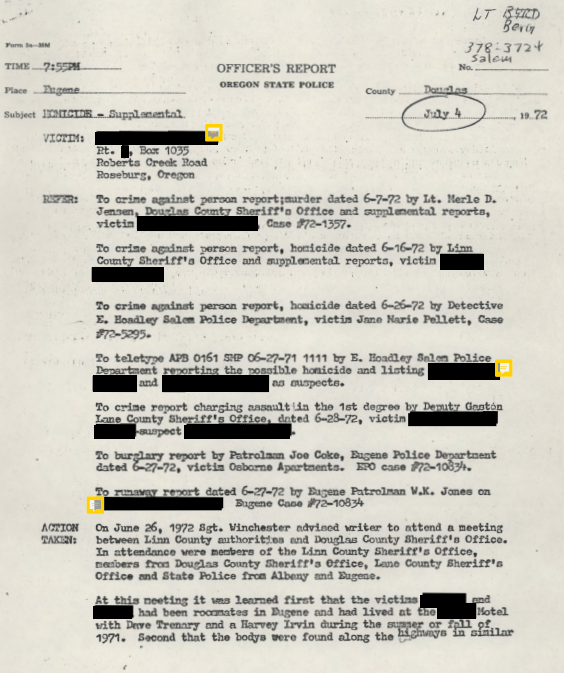
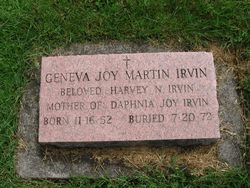
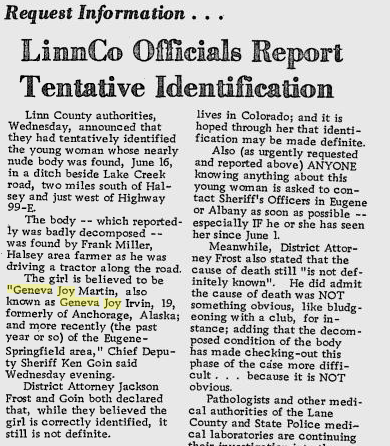
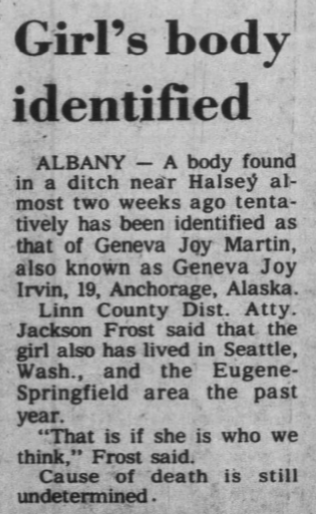
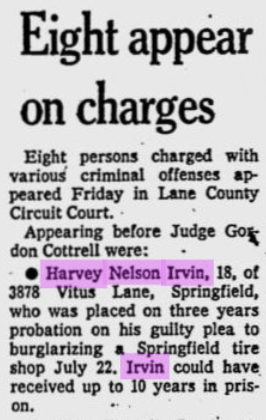
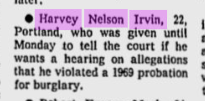
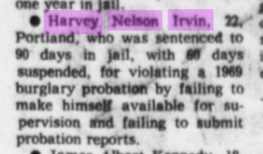
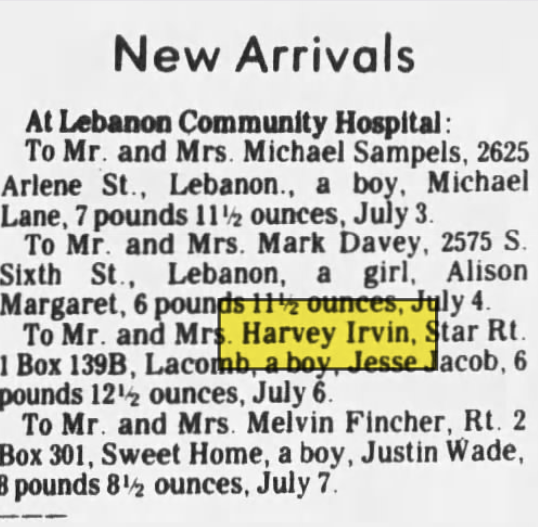
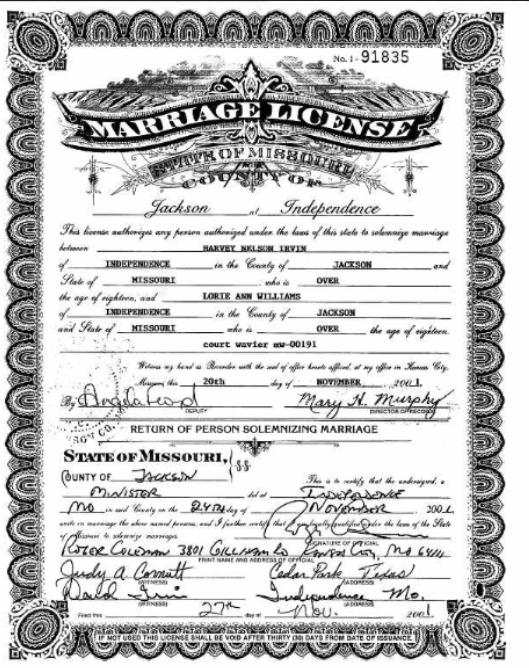
At some point before her death Geneva married Harvey ‘Stormy’ Nelson Irvin … or, at least that’s what it says on her tombstone. I could find no record of their nuptials anywhere and he isn’t mentioned once in any articles about her aside from the fact that she used his last name on occasion ‘as an alias…’ I did, however, find four other marriage certificates for Mr. Irvin on Ancestry. The couple had a daughter named Daphnia Joy that was two months old when nineteen year old Geneva was found deceased, and in the year prior to her disappearance she briefly lived in Seattle and the Eugene/Springfield, OR area. Harvey was born on February 15, 1950, and after Geneva was killed he wasn’t single for very long: he married Patricia Connelly less than three years later on May 22, 1975 in Reno, Nevada.
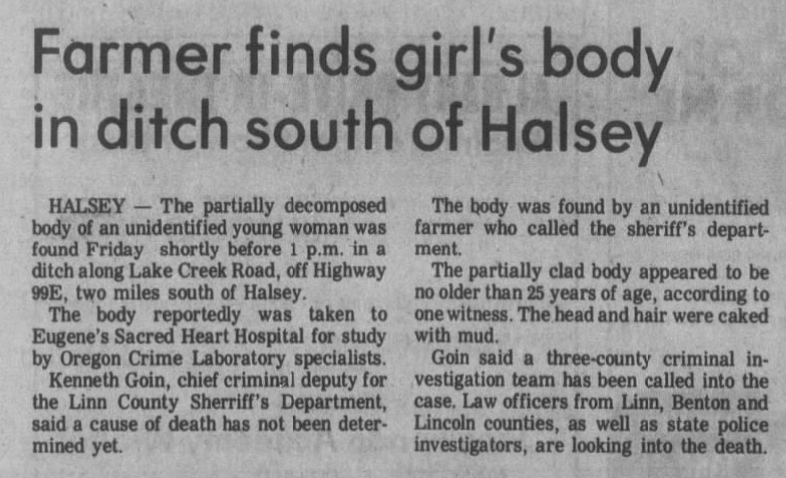
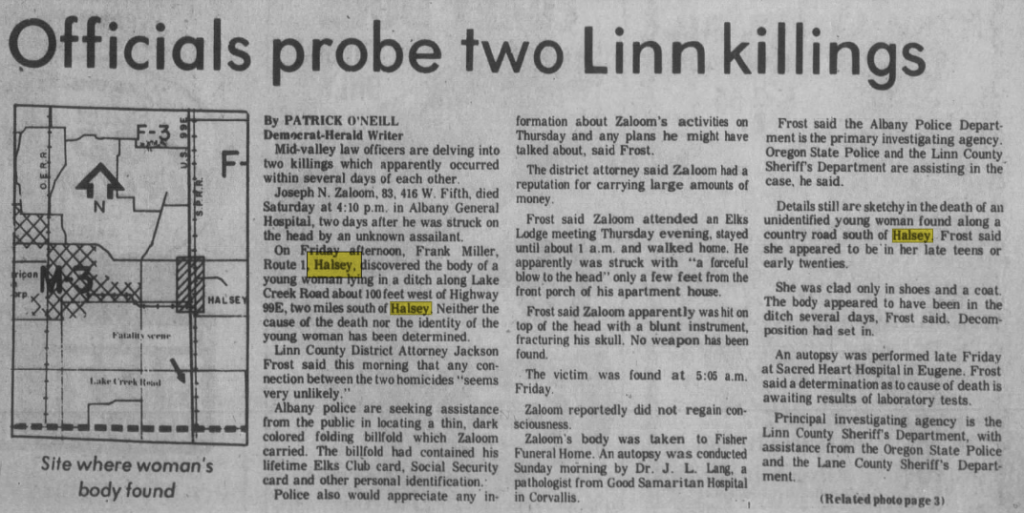
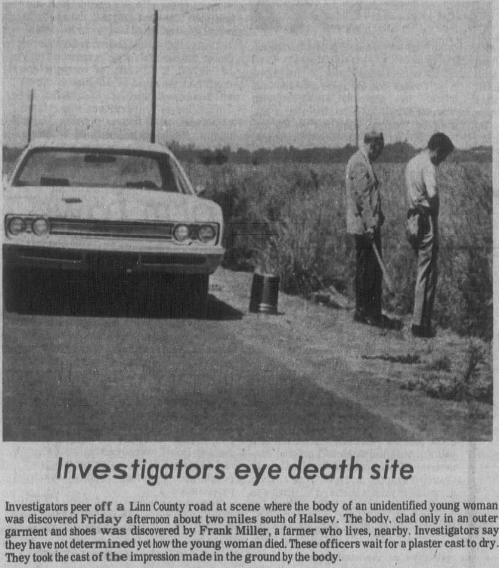
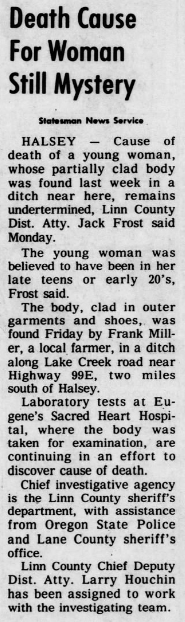
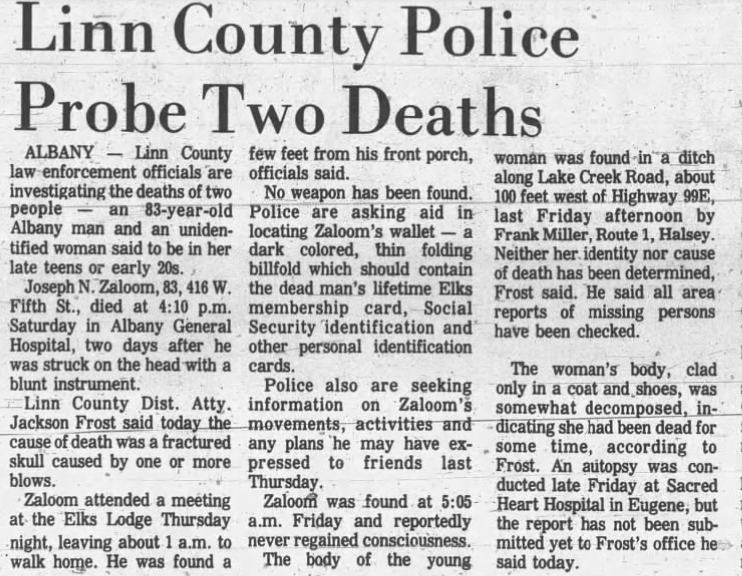
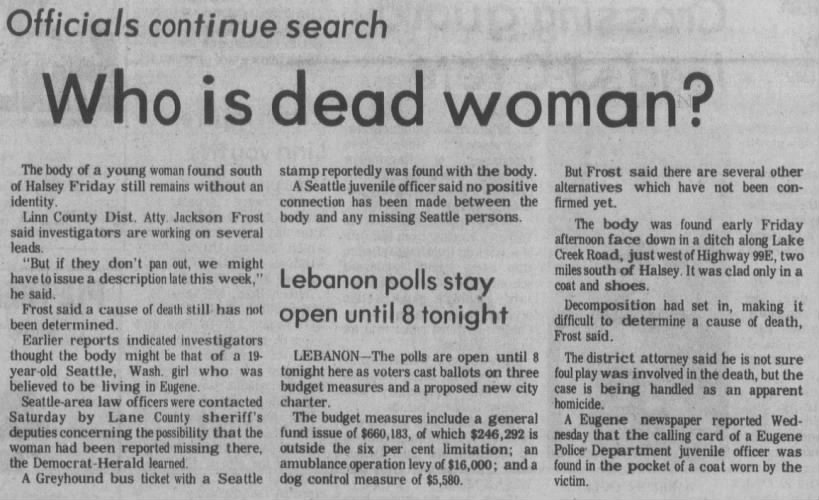
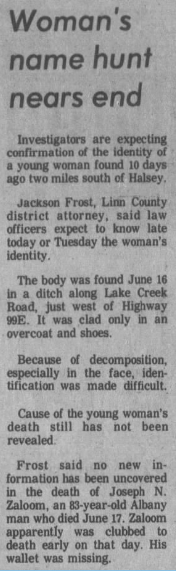
At roughly 1 PM on June 16, 1972 the remains of a decomposed, ‘partially clad young woman’ were found face down in a ‘woody, roadside ditch’ by Frank Miller, a local farmer. She was only wearing a coat and shoes, and her hair was caked with dried mud and sediment; she remained unidentified for roughly ten days while detectives searched for clues. At the scene investigators made a plaster cast of where the victim was found in the ditch in hopes to further aid in the investigation… and this is where not having a background in policing/criminology/forensics hurts me because I didn’t know that was a thing. Looking into it, ‘casting’ is when experts preserve impressions from crime scenes (for example larger, 3D impressions such as tire marks or footprints). The process works almost the same way an orthodontist makes a mold of a patient’s teeth, and forensic experts and LE use an array of materials to help create the ‘casts.’
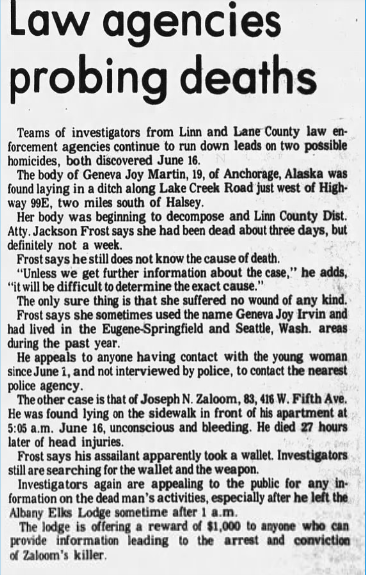
The young victim was taken to Eugene’s Sacred Heart Hospital, where specialists from the Oregon Crime Laboratory got to work on identifying her. According to (retired) Linn County DA Jackson Frost, they were able to tell that she was in the ditch for ‘about three days, but definitely not a week,’ and were immediately able to determine that she was no older than 25. Thanks in part to an advanced stage of facial decomp, it took thirteen days and $162 worth of long distance phone calls to Alaska (where Martin received care) before dental experts were able to make a near positive identification; a sister living in Colorado helped make an absolute positive ID. Despite an autopsy as well as ‘all kinds of lab tests,’ investigatorswere never able to pinpoint Martin’s exact cause of death due to her having ‘no violent wounds;’ I also found no mention of sexual assault. In the beginning of the investigation medical examiners thought they detected drugs in her system however it was later determined that the advanced state of decomp produced a chemical that masked the presence of narcotics. Despite there being 150 pages worth of notes in Martins case file, there is next to no information out there on her.
In the end of an article published in The Greater Oregon on June 30, 1972, DA Frost commented that ‘the young woman apparently was living under circumstances where she might not want to use her true name, thus the alias.’ In an article published by The Albany Democrat-Herald on June 28, 1973, Frost said that Martin was a known drug user and had recently been in treatment for ‘drug related mental problems’ in Eugene. At the time of her death detectives learned she had been living in Eugene for several months and a week before she was last seen had cashed her monthly welfare check then quietly slipped out of sight; it was the last time she was seen alive.
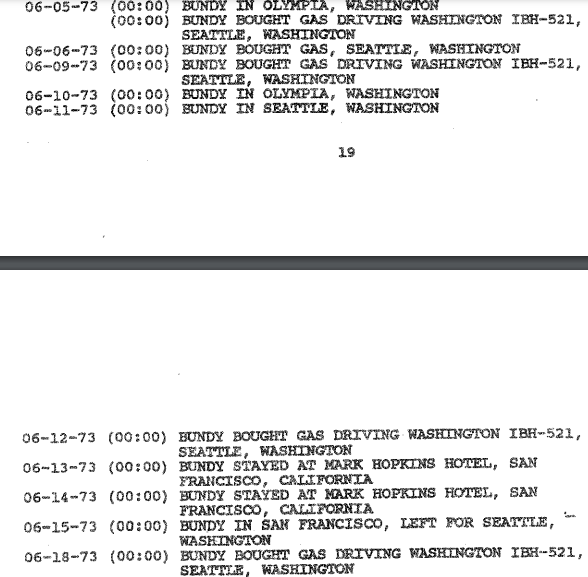
At the time Geneva was murdered Ted Bundy was living in Seattle at the Rogers Rooming House on 12th Avenue, and was in the middle ofa long term relationship with Elizabeth Kloepfer. He had just finished his undergraduate psychology degree from the University of Washington and was getting ready for his first (unsuccessful) attempt at law school at the University of Puget Sound (which he began the following year). At the time Ted was interning as a counselor at Harborview Mental Health Center in Seattle (he was only there from June to September 1972), and according to the ‘TB MultiAgency Report 1992,’ Bundy was mostly in Seattle the week before she was found dead but made a trip to San Francisco on June 13 and stayed until the 15th; his whereabouts are then unaccounted for until June 18 when he bought gas in Seattle. As I’ve said in multiple other articles, its Bundy cannon that the serial murderer began killing in early January 1974 with his brutal attack of fellow University of Washington student Karen Sparks in her basement apartment, but during his confessions before his execution he hinted to Dr. Robert Keppel that he may have started as early as 1972 with a young girl in Seattle (but of course didn’t elaborate further than that).
I didn’t know Bundy was ever actually suspected in any additional Oregon murders on top of Roberta Parks (for sure) and (possibly) Vicki Hollar/Rita Jolly/Sue Justis, but according to an article published by The Eugene Register-Guard on February 24, 1989, Martin was at one time considered a possible victim of his as well as Beverly May Jenkins, Allison Lynn Caufman, Laurie Lee Canaday, Tina Marie Mingus, and Floy Jean Bennet. Now, I am in no way saying these women are really possible victims of Ted Bundy, I’m just saying they were in the very least in the correct place at the right (or wrong) time (well sort of, as some if the dates are completely off). Sixteen year old Beverly May Jenkins was from Roseburg, OR and in June 1972 her remains were found just off the I-5 roughly ten miles outside of Cottage Grove; she had been strangled to death. Fifteen year old Portland native Allison Lynn Caufman died as a result of head injuries after being shoved from a car moving at a high rate of speed in July 1973. I think the last two girls can be quickly debunked, as Bundy was in prison when both victims were killed. Tina Marie Mingus was only 16 years old when her body was found in Salem, OR in October 1975, and Flow Joy Bennet was 37 (and obviously a bit out of Bundy’s preferred age range) when she vanished in February 1978. What’s strange is I couldn’t find any more information about any of these women out there. It’s almost as if they never existed.
But there’s more dead and missing women, on top of that article. Twenty year old Faye Ellen Robinson was found deceased from multiple stab wounds in the upper part of her body in March 23, 1972. Like most Bundy victims, she was educated and had a good job working in county government: she graduated from the University of Oregon in 1970 and was employed by the Lane County Welfare Department. Also on March 23 Alma Jean Barra was last seen after leaving the Copper Penny Tavern in the company of an unknown man driving southbound on 92nd Avenue between 11 and 11:30 PM. The 28-year-old’s body was found in an area of heavy brush of the Willamette National Cemetery, roughly forty feet off of Mount Scott Boulevard; she had been strangled and showed no signs of sexual assault. Next is 17 year old Susan Wickersham, who disappeared from Bend, OR on July 11, 1973 after dropping off the family car at her mom’s POE after joyriding around town with a gf (some conflicting reports say she was at a party). Wickershams remains were found on January 20, 1976 and her skull had a bullet hole behind the right ear with no exit wound. Gayle LeClair was murdered in her rental house on August 23, 1973; a clerk/typist at the Eugene Municipal Library, she had been found by her supervisor stabbed to death after she failed to come in for her scheduled shift. Lastly, Deborah Lee Tomlinson vanished without a trace after running away from Creswell, OR with an unnamed friend on her sixteenth birthday on October 15, 1973.
I tried my hardest to find some sort of link between Ms. Martin and any other victims from the area, but not having a cause of death makes it really hard to compare. What I (personally) think happened: she met up with some undesirable friends and together they used some illegal substances, then Geneva overdosed and they panicked then got rid of her body in the most convenient and easiest way they could think of. I mean, to me it sounds plausible that they dumped her on the side of the road (possibly in the middle of the night) because they got scared and didn’t want to be held responsible for her death. In 1972 ‘Good Samaritan’ laws didn’t exist, so if anyone was present when she died then most likely they would have been held responsible in some capacity.
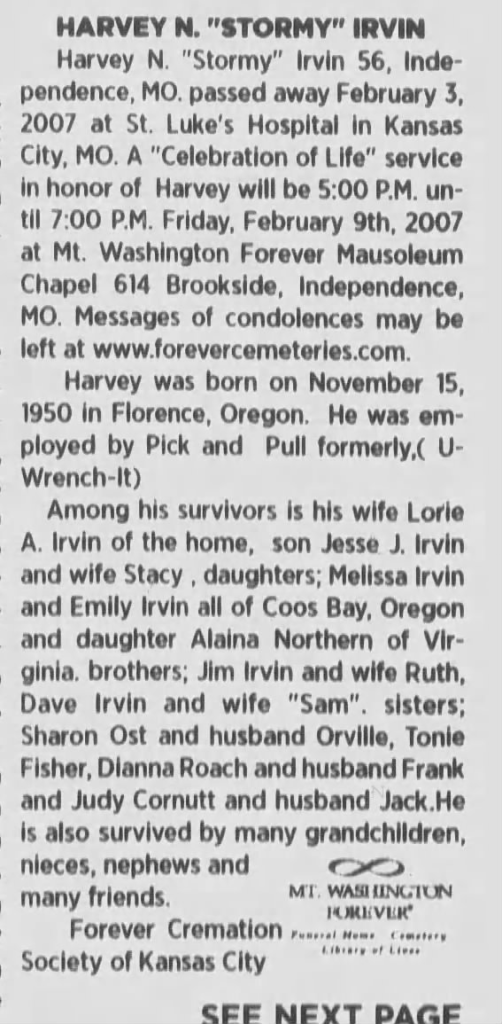
After the death of her mother Daphnia was sent to live with relatives out of state. Per the Green family’s myheritage site, she got married and had a son. Harvey went on to marry (and divorce) numerous times and had four more children; he passed away on February 3, 2007 at the age of 56. Geneva’s father passed away at the age of 84 in 2014 in Garibaldi, OR, and Mrs. Green died January 13, 1994 at the age of 79 due to a smoking related illness. Both of her half-sisters have led incredibly remarkable lives: Dr. Lynella Faith Grant is a psychologist, statistician, lawyer, personnel director, inventor, marketer, publisher, and author; Dr. Madelon Green-Mottet got her PhD in Fisheries from the University of Washington in Seattle and taught classes on aquaculture at a small college in Sitka, Alaska.
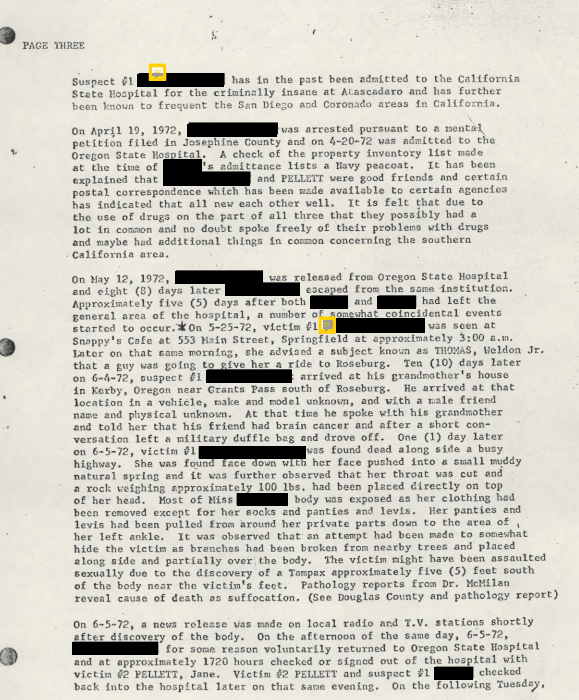
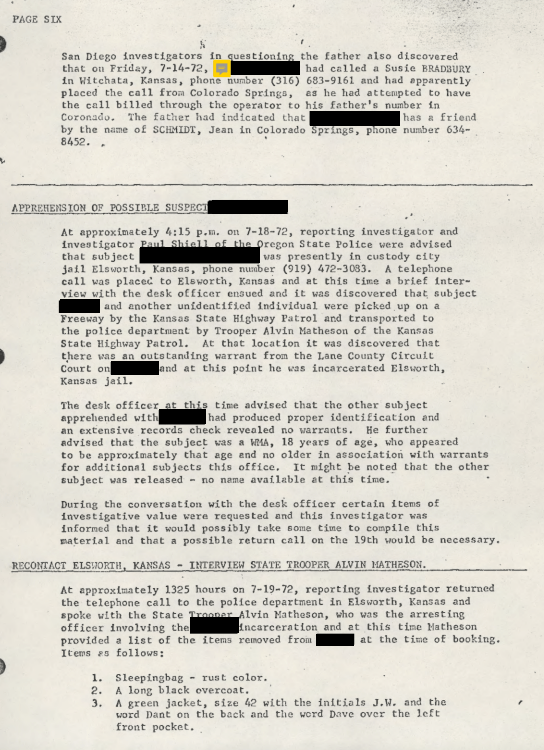
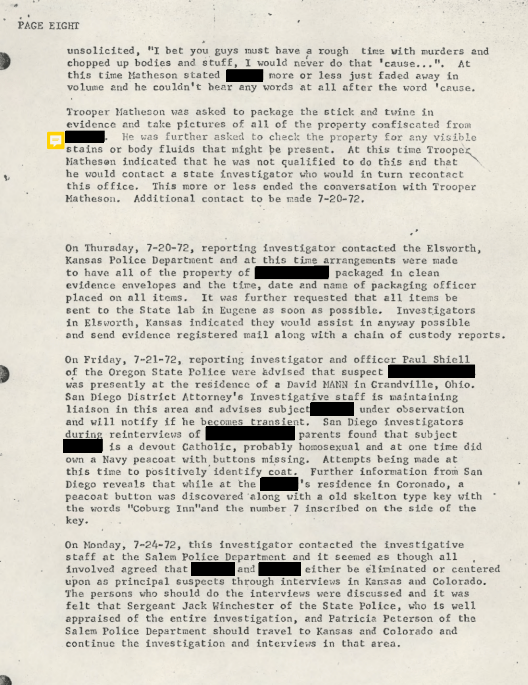
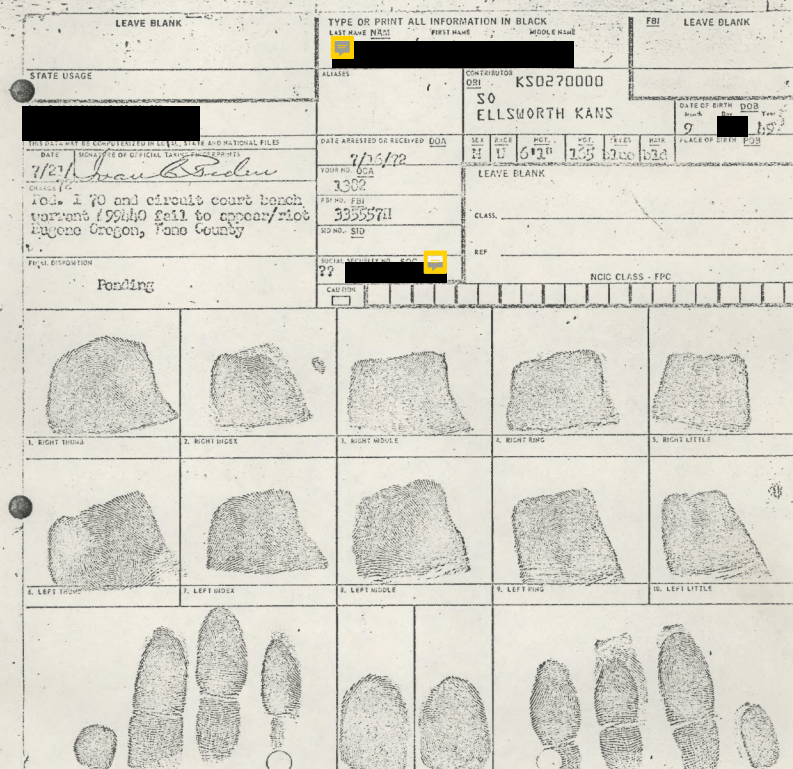
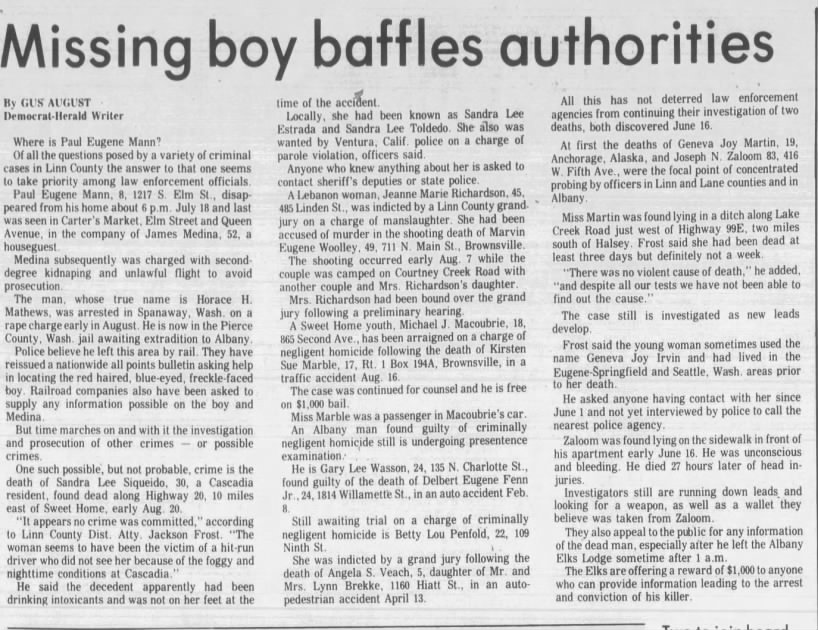
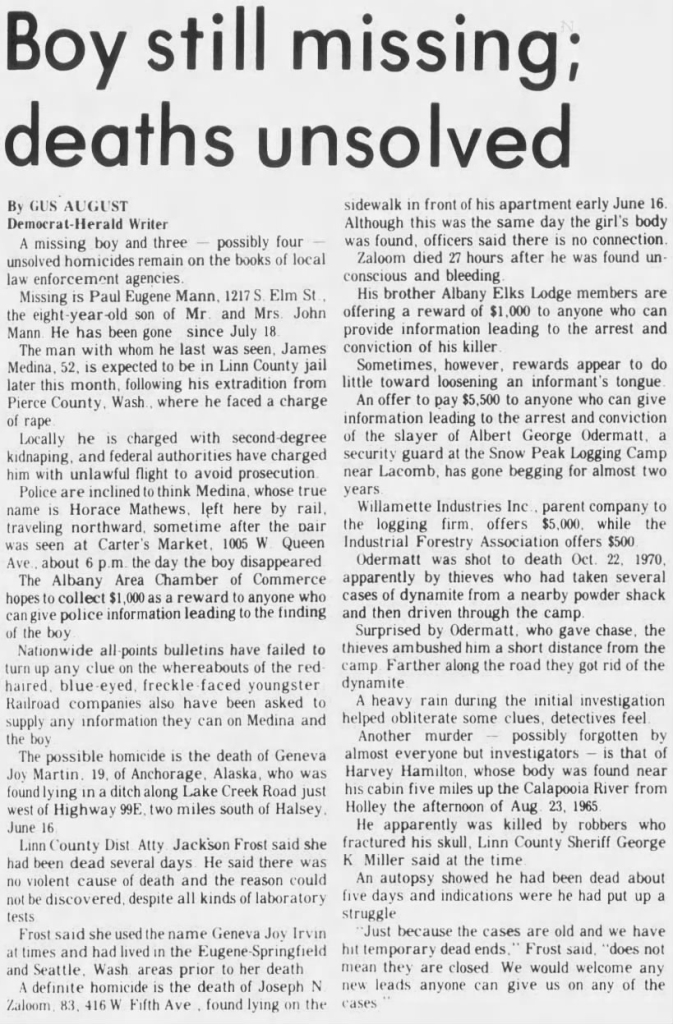
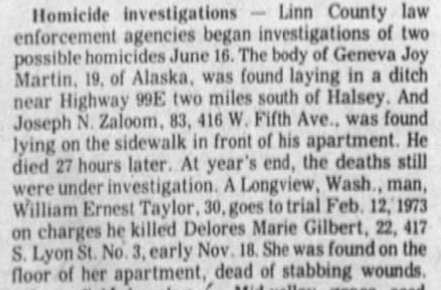
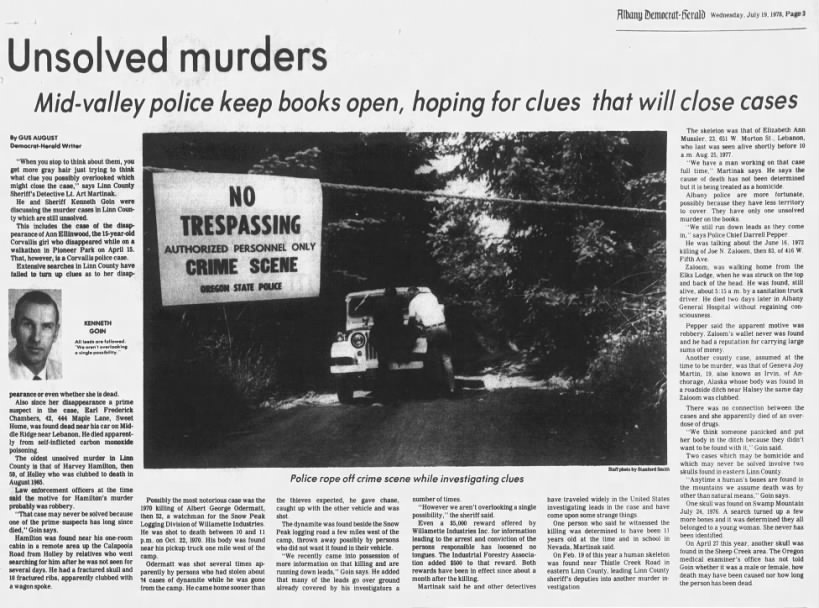
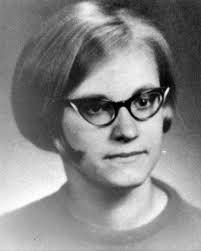
Some information related to the death of Geneva Joy Martin, courtesy of the King County Sheriff’s Department.Some information related to the death of Geneva Joy Martin, courtesy of the King County Sheriff’s Department.Some information related to the death of Geneva Joy Martin, courtesy of the King County Sheriff’s Department.Some information related to the death of Geneva Joy Martin, courtesy of the King County Sheriff’s Department.Some information related to the death of Geneva Joy Martin, courtesy of the King County Sheriff’s Department.Some information related to the death of Geneva Joy Martin, courtesy of the King County Sheriff’s Department.Some information related to the death of Geneva Joy Martin, courtesy of the King County Sheriff’s Department.Some information related to the death of Geneva Joy Martin, courtesy of the King County Sheriff’s Department.Some information related to the death of Geneva Joy Martin, courtesy of the King County Sheriff’s Department.Some information related to the death of Geneva Joy Martin, courtesy of the King County Sheriff’s Department.Some information related to the death of Geneva Joy Martin, courtesy of the King County Sheriff’s Department.Some information related to the death of Geneva Joy Martin, courtesy of the King County Sheriff’s Department.Some information related to the death of Geneva Joy Martin, courtesy of the King County Sheriff’s Department.The grave stone of Geneva Joy Martin. She is buried in plot 21 at The Mulkey Cemetery in Eugene, Oregon.The family history of Ms. Martin according to myheritage.com.An article about the discovery of Martin’s remains published by The Statesman Journal on June 17, 1972.An article about Martin’s body being discovered (but unidentified), published by The Albany Democrat-Herald on June 17, 1972.An article about the murder of Joseph N. Zaloom that mentions Geneva Martin published by The Albany Democrat-Herald on June 19, 1972.A picture from an article about the discovery of Martin’s remains published by The Albany Democrat-Herald on June 19, 1972.An article about the discovery of Martin’s remains published by The Statesman Journal on June 20, 1972.An article about the discovery of Martin’s remains published by The Albany Democrat-Herald on June 20, 1972.An article about the discovery of Martin’s remains published by The Corvallis Gazette-Times on June 20, 1972.An article about the discovery of Martin’s remains published by The Corvallis Gazette-Times on June 21, 1972.An article about the discovery of Martin’s remains published by The Albany Democrat-Herald on June 22, 1972.Part one of an article about the discovery of Martin’s remains published by The Times on June 22, 1972.Part two of an article about the discovery of Martin’s remains published by The Times on June 22, 1972.An article mentioning Martin published by The Albany Democrat-Herald on June 24, 1972.An article mentioning Martin published by The Albany Democrat-Herald on June 26, 1972.An article about the identification of Geneva Joy Martin-Irvin’s remains published by The Corvallis Gazette-Times on June 29, 1972.An article about the death of Geneva Joy Martin-Irvin published by The Albany Democrat-Herald on June 29, 1972.Part one of an article about the discovery of Martin’s remains published by The Times on June 29, 1972.Part two of an article about the discovery of Martin’s remains published The Times on June 29, 1972.An article about the death of Geneva Joy Martin-Irvin published by The Spokesman-Review on June 30, 1972.An article about the positive identification of Geneva Joy Martin-Irvin’s remains published by The Capital Journal on June 30, 1972.An article about the positive ID of Geneva Joy Martin’s remains published by The Statesman Journal on June 30, 1972.An article about the death of Geneva Joy Martin published by The Greater Oregon on June 30, 1972.An article about the death of Geneva Martin published by The Albany Democrat-Herald on July 6, 1972.An article about the death of Geneva Joy Martin published by The Albany Democrat-Herald on July 26, 1972.An article mentioning the death of Geneva Joy Martin-Irvin published by The Albany Democrat-Herald on August 29, 1972.An article mentioning the death of Geneva Martin published by The Albany Democrat-Herald on September 14, 1972.An article about the death of Geneva Joy Martin published by The Albany Democrat-Herald on December 26, 1972.An article mentioning the death of Geneva Joy Martin published by The Albany Democrat-Herald on June 28, 1973.An article mentioning the death of Geneva Martin published by The Albany Democrat-Herald on July 19, 1978.Part one of an article about potential Bundy victims out of Oregon published after his execution from The Eugene Register-Guard on February 24, 1989.Part two of an article about potential Bundy victims out of Oregon published after his execution from The Eugene Register-Guard on February 24, 1989.Bundy’s whereabouts the week before Geneva was found murdered according to the ‘TB Multiagency Investigative Team Report 1992.’An article about a burglary performed by Geneva’s ‘husband’ published in The Eugene Register-Guard on November 8, 1969.A newspaper blurb about a burglary performed by Geneva’s ‘husband’ published in The Eugene Register-Guard on January 27, 1973.A newspaper blurb about Geneva’s ‘husband’ published in The Eugene Register-Guard on March 6, 1973.An article about Harvey Irvin having another baby with his new wife published by The Albany Democrat-Herald on July 10, 1975.An article about Geneva’s ‘husband’ driving with a suspended license published in The Lebanon Express on April 12, 1976.Harvey Irvin and Lorie Ann William’s marriage certificate from 2001.Harvey Irvin’s obituary published in The Kansas City Star on February 3, 2007.Mrs. Green’s obituary.Madelon Green Mottet from the 1963 West Anchorage High School yearbook.Dr. Madelon Green Mottet, PhD.Dr. Madelon Mottet’s bio on her Amazon page.
Gayle Elizabeth LeClair was born on January 26, 1951 to Donald and Barbara LeClair in Gold Beach, Oregon.Mr. LeClair was born on June 4, 1930 and was employed as a car salesman, and Barbara Jean was born on July 8, 1930 in Redondo Beach, CA and worked as a bank teller at Western Bank. The couple were wed on February 10, 1950 and had two children together (Gayle and her younger brother Cleve*), but sadly divorced in September 1970. After his marriage ended he had a daughter named Leah with a woman he only dated for a short period of time. The woman put her up for adoption and Mr. LeClair wasn’t aware of her existence until around 2000. He went on to get remarried in December 1970 and had a son named Frank; the couple remained together until the early 1980’s. On September 22, 1985 Mr. LeClair remarried for a third time to a woman named Leola Wilson, who he remained with until his death.
Gayle LeClair was a petite, attractive young woman, with blue eyes and light blonde hair that she woreshort while in high school but according to her mother grew out in college, and often wore it tied up with a leather barrette. After graduatingfrom Gold Beach High School in 1969 LeClair went on to attend Southwestern Oregon Community College for two years. While at SWOCC she was active in the schools theater group, and during her first semester there was on the crew during a production of ‘Don’t Drink the Water.’ According to her mother, Gayle was a studious young woman that excelled in math and had dreams of continuing her education and becoming a teacher one day. When she lived at home she would (on occasion) attend service at Emmanuel Episcopal Church in Coos Bay. LeClair moved to Eugene in January 1972 after she graduated from community college and got a job at the Eugene Municipal Library as a clerk-typist.
After Gayle failed to come in for her scheduled shift at 10:30 AM on August 23, 1973 (or answer multiple phone calls) her supervisor went to her house to check on her. Upon arrival, there was no sign of forced entry and the front door was unlocked, and after walking towards LeClair’s bedroom the unidentified supervisor discovered her deceased from multiple stab wounds shortly after 11:00 AM; upon the discovery she immediately went next door and used a neighbor’s telephone to contact police. Gayle had a date with a known acquaintance the night before; they went to a drive-in movie then went back to her apartment for a nightcap. She was last seen alive by him at 1:30 AM, and after a conversation with detectives the young man was quickly cleared as a suspect.
Lieutenant Donald Lonnecker with the Eugene Police Department said the LeClair was dressed for bed when she was murdered and a ‘preliminary autopsy indicated no evidence of sexual assault.’ Before moving into the house she was killed in, from January 1972 to May 1973 she resided at 3760 Concord Street in the Bethel-Echo neighborhood of West-Eugene; she lived by herself in both residences. Mrs. Duane Brown lived next door to the victim on Concord Street and said where they weren’t close and didn’t talk often she said she was a ‘nice, pleasant person.’ Miss LeClair seemed to have a healthy relationship with her family, and before she was murdered her brother Cleve visited her (he lived in North Bend with their mother), and Barbara said of her daughter ‘she would pick up the phone in the evening just to ask how our day had been.’ Neither Gayle’s mother nor father could come up with any reason why anyone would want to hurt their daughter.
Members of law enforcement were immediately baffled at the motive behind the murder of LeClair. Lieutenant Lonnecker said that the victim ‘spent a lot of time socially with people’ and ‘had a lot of friends,’ and those that knew LeClair said she was ‘both outgoing and moody, depending on who knows her and in what way;’ he also said that she was ‘pleasant, and socially active,’ had a lot of friends, and a busy social life. Despite this, neighbors of LeClair didn’t seem to know her at all, and one of them even thought the house she lived in was vacant. According to an article published in The World on August 30, 1973, the small home that LeClair rented had lots of trees, shrubs and other greenery on the property despite being in a residential neighborhood, which would make it very easy for someone to hide in her yard and look through her windows. Her landlord, J. Sidney Armstrong, was a former Lane County District Attorney that moved into private practice, and at one point even dated the victim (although not recently). Armstrong told investigators that his ex ‘had a lot of boyfriends’ and was eventually cleared of any wrongdoing. On August 24, 1973 Lane County DA J. Pat Horton said they never recovered the murder weapon, but did clarify they think it was either a ‘knife or some other sharp instrument.’
At the time of her murder in August 1973, Ted Bundy seemed to be in between jobs: from February to April of that year he worked for King County Program Planning then took a break from employment until September 1973, when he got a position as the Assistant to the Washington State Republican chairman. Although it wasn’t as intense as their first few years together he was still in a relationship with Liz Kloepfer… but he was also seeing his ex-girlfriend Stephanie Brooks on the side as well (they rekindled their romance earlier that year). He was also getting ready to start law school at the University of Puget Sound (which he started the following month in September 1973). According to the ‘Ted Bundy Multiagency Investigative Team Report 1992,’ on the day of LeClair’s murder Bundy got into a car accident in Kloepfer’s eggshell blue VW Beetle.
Now, it’s widely accepted that Bundy’s murder rampage began in January 1974, when he brutally assaulted (and most likely left for dead) fellow University of Washington student Karen Sparks in her basement apartment. But, most people in the true crime community strongly suspect he started well before this (some people think as early as 1961 with little Ann Marie Burr in his hometown of Tacoma). I feel it’s worth mentioning that during his final death row interviews with Dr. Bob Keppel, Bundy confessed to starting his murder spree in 1972, not 1974:
Robert Keppel: ‘There’s a gal in 1971, Thurston County.’ Ted Bundy: ‘No.’ RK: ‘Not that far back. Nothing that far back?’ TB: ‘1972.’
Additionally, after Bundy was executed forensic psychologist Arthur Norman told New Jersey based news magazine ‘The SandPaper’ that the killer once told him that he murdered ‘two women in the Philadelphia area’ (most likely Elizabeth Perry and Susan Davis), which he suspected were his first two homicides. Dr. Norman even notified Atlantic City Prosecutor Jeffrey Blitz about his confession, who immediately shot down the story, calling it inconclusive. He never investigated it.
Ted confessed to abducting Roberta Kathleen Parks from Oregon State University on May 6, 1974: he drove her over 250 miles away to Taylor Mountain, where he raped and killed her. She is his only confirmed Oregon victim. In interviews with law enforcement, Bundy confessed to murdering two additional women in the ‘Beaver State’ but refused to elaborate any further; according to most law enforcement, Vicki Hollar and Rita Jolly are the best candidates. On June 29, 1973 seventeen year old Rita Lorraine Jolly left her family home to take a walk, something she did every night before bed. She never returned home. Not even two months later on August 20, 1973 twenty-four-year-old Hollar disappeared without a trace after leaving the Bon Marche in Eugene, where she had just gotten a new job as a seamstress two weeks prior. Detectives tried but were unable to question Ted regarding Vicki’s disappearance before his execution in 1989, eliminating the chance of closing the case in relation to the serial killer. I was not able to find anything from the Hollar family in regards to Bundy, however I did find a quote by Jill Jolly: ‘as I recall, my mother told me that the local detectives managed to get a direct question about Rita through to him before his execution, and his reply was ‘No. No more in Oregon.’ Bundy withheld many secrets in the end in hopes to parlay them into yet another stay of execution, and even told detectives that ‘there are other buried remains in Colorado’ (then of course he refused to elaborate any further).
Regarding how close the Bon Marche in Eugene was compared to LeClair’s residence, WebSleuths user BlueJean40′ points out that ‘both of these locations are relatively close on the same side of our city. Just wondered if anyone had read anything about them possibly being connected.’ Not even three months after LeClair was killed on November 5, 1973 twenty-three year old Suzanne Justis most likely hitchhiked from her home in Eugene to Portland, as her car was found left behind at home. She spoke to her mother from a phone booth located outside of the Memorial Coliseum. Justis told her mother she was planning on coming home the following day to pick up her young son from school but never showed up. No trace of her has ever been recovered.
Now, when I say this I’m in no way implying that Ted Bundy was responsible for every single murder that took place in the state of Oregon in 1973… but I am surprised that after two years of very intense research I’m still coming across names that I’ve never seen before. During my research into Gayle LeClair I learned about a young women named Faye Robinson (her high school yearbook spelled her first name ‘Fay’), who was found deceased from multiple stab wounds in the upper part of her body not even six months before LeClair in March 1973. Like Gayle, Robinson was educated and worked in county government: she graduated from the University of Oregon in 1970 and was employed by the Lane County Welfare Department.
Another girl I want to mention is 17 year old Susan Wickersham, who disappeared on July 11, 1973 after dropping off the family car at her mom’s POE in downtown Bend after joyriding around town with a girlfriend (some conflicting reports say she was at a party). Her remains were found on January 20, 1976 and her skull had a bullet hole behind the right ear with no exit wound. Lastly, a 15 year old girl named Alison Lynn Caufman disappeared out of Portland sometime in 1973 (I was unable to find an exact date or any more details about her) as well as eighteen year old Laurie Lee Caniday from nearby Milwaukie (yes, that’s spelled correctly).
Now, I want to (briefly) talk about the May 1969 Garden State Parkway killings separately from the other missing/murdered girls for a moment, just because I feel that they share some (very) general commonalities with the murder of Miss. LeClair (even though I personally don’t think Bundy was responsible for the murder of Susan Davis and Elizabeth Perry): like LeClair, both victims expired as a result of multiple stab wounds, and even though none of Ted’s other victims(that we know of, anyways) ever suffered from any similar types of injuries we do know that he used a (dull) knife to cut the throat of little Kimberly Dianne Leach in Florida on February 9, 1978.
Aside from Ted, another name that came up in relation to the murder of Gayle LeClair is Dayton Leroy Rogers, an American serial killer that has been linked to the slayings of at least eight ‘street’ women (which is code for sex workers/addicts/runaways) across Oregon. He was convicted of the murder of his final victim in 1988, and two years later in May 1989 he was sentenced to death after being found guilty of six additional homicides. Rogers was actually sentenced to death on three separate occasions, but all three times the Oregon Supreme Court vacated the decision and remanded the cases for a new trial; he was sentenced to death for a fourth time on November 16, 2015. According to Roger’s defense attorney, the killer said that he would have waived all future appeals and allocated to his atrocities in exchange for a life sentence rather than receiving the death penalty. His death sentence was overturned for the fourth time on November 12, 2021 partially thanks to a new law signed by Governor Kate Brown limiting the amount of ‘aggravating factors required for seeking the death penalty.’ Governor Brown commuted the death sentences of everyone on Oregon’s death row to life without parole on December 13, 2022. Dayton is still alive as of June 2024, and will live out the rest of his days behind bars.
Now, nothing in my research told me that TedBundy was ever considered a suspect in LeClair’s murder, despite her living in a fairly accessible area to him and fit neatly into his preferred age range, as he killed young females anywhere from 12 years old (possibly even as young as eight if you throw Ann Marie Burr into the mix) up to 26 years old (ski instructor Julie Cunningham). Miss. LeClair also fit the physical description of one of Ted’s victims, as she was beautiful and slim and had long hair and a petite build. But these superficial details are pretty much where any possible link to Bundy ends.
Mr. LeClair died at the age of 74 on January 27, 2009 due to a ‘smoking related illness.’ He was an avid outdoorsman, loved racing, and was a member of the Fraternal Order of Eagles. Gayle’s brother Cleve died of heart failure on May 9, 2009. He was active in a local HAM radio club and was trained to help run a radio station in the event of an emergency. Frank LeClair was able to tell me that Barbara LeClair passed away on December 11, 2024.
* Edit, January 2025: I would like to thank Gayle’s brother Frank, who was kind enough to reach out to me and point out a few mistakes I made and give me some updates about his sister’s case. He shared with me that a detective from the Eugene PD Cold Case Squad had been in touch with him in recent years, who shared they had uncovered a piece of evidence in relation to the murder that unfortunately at the time had not been properly processed into evidence, therefore there was no chain of custody and it wouldn’t hold up in court. But they did however send a piece of the sample to a laboratory that specializes in recovering DNA and they were able to uncover two partial but separate genetic profiles from the blood evidence. The detective shared with him that they needed a blood sample from an immediate family member in order to determine which portion belonged to Gayle, and unfortunately since Frank was only a half-sibling he didn’t qualify, as it needed to come from a ‘more direct relative.’ He helped them get in touch with Ms. LeClair’s motherBarbara, who happily volunteered a sample. After receiving it the lab was able to isolate the suspected killers DNA from the sample taken from the crime scene, however because of the age and the fact that the sample was degraded they weren’t able to obtain a full set of genetic markers.
But Frank did tell me that recently they were able to get genetic samples from every person of interest in relation to the case, and if they were deceased they got one from one of their children. So far investigators have been able to clear every suspect except for one, who died several years ago; his child has refused to voluntarily give up a DNA sample. The detective told Frank the names of a few different suspects that were eliminated after the DNA evidence was analyzed, but he forgot most of them. The ones that stuck out the most were Gayle’s date that night and the landlord, John Sydney Armstrong.
Gayle LeClair’s junior year picture from the 1968 Gold Beach Union High School yearbook.Gayle LeClair’s senior year picture from the 1969 Gold Beach Union High School yearbook.The final resting place of Gayle LeClair. She is buried at Rogue River Cemetery in Gold Beach, OR.LeClair listed in the Oregon state death index.LeClair mentioned in an article published by The World on February 10, 1954.An article about a play called ‘Don’t Drink the Water’ put on by Southwestern Oregon Community College in the fall of 1969. Gayle LeClair is mentioned at the bottom, it was published in The World on November 15, 1969.A newspaper blurb about the murder of Gayle LeClair published by The Albany Democrat-Herald on August 24, 1973.A picture of the Sylvan Street crime scene published in The Eugene Register-Guard on August 24, 1973.Part one of an article about the murder of Gayle LeClair published in The Eugene-Register Guard on August 24, 1973.Part two of an article about the murder of Gayle LeClair published in The Eugene-Register Guard on August 24, 1973.Part one of an article about the murder of Gayle LeClair published by The World on August 30, 1973.Part two of an article about the murder of Gayle LeClair published by The World on August 30, 1973.Gayle LeClair’s obituary published in The World on August 27, 1973.An article mentioning LeClair published by The Eugene Register-Guard on September 10, 1973.An article about multiple murders in Lane County, Oregon that mentions the murder of Gayle LeClair published by The Eugene Register-Guard on April 16, 1978 (there is more to this but it doesn’t mention LeClair).The first part of a newspaper article about serial killer Dayton Leroy Rogers that mentions the murder of Gayle LeClair published in The Eugene Register-Guard on September 19, 1987.The second part of a newspaper article about serial killer Dayton Leroy Rogers that mentions the murder of Gayle LeClair published in The Eugene Register-Guard on September 19, 1987.3760 Concord Street, where LeClair lived from January to May 1973.1781 Sylvan Street, where LeClair was murdered. Donald and Barbara’s marriage announcement published in The World on February 21, 1950.Donald and Barbara LeClair’s marriage certificate that was filed on June 5, 1950.A newspaper clipping about Mr. LeClair being charged with a DUI published in The World on January 9, 1969.Donald and Barbara’s divorce announcement published in The World on June 20, 1970 .Donald and Barbara LeClair’s divorce paperwork, filed on September 29, 1970.An obituary for Gayle’s brother Cleve published in The World on May 12, 2009.Some kind words written by a friend about Gayle’s brother Donald from his memorial page on Legacy.com.I was unable to find out much about Gayle but I did find this on WebSleuths that was written by someone that knew her.Bundy’s whereabouts on August 24, 1973 according to the ‘TB Multiagency Team Report 1992.’A list of just some of the missing (and murdered) girls from Oregon between 1969-78.Fay (Faye?) Robinsons senior picture from the 1966 Tigard High School yearbook.An article about Robinson’s murder published by The Statesman Journal on March 23, 1972.Dayton Leroy Rogers.
When I went to Seattle in April 2022 there were a few places I never got around to seeing, one of them being Bundy’s Issaquah dump site… but it certainly wasn’t for lack of trying: I drove around the same three mile area for almost two hours one day trying to find it (Google Maps really dropped the ball with that one, IMO). I finally had to give up because it was taking precious time away from other places I needed to see, and as I was driving away I remember thinking to myself that I’d never get back there again and I blew it. But, thankfully in May 2024 I was able to spend a few days in Washington state during my vacation to Oregon and I was finally able to locate it, with a little help with my friend Cole Kaiser, who is awesome and deserves recognition for his help.
Issaquah is a small city located about fifteen miles east of Seattle. Back in 1974, it was much (much) less populated than it is today, going from 4,500 residents to roughly 40,000. The Issaquah dump site is where Ted Bundy dumped the bodies of Janice Ann Ott, Denise Marie Naslund, and (most likely) Georgann Hawkins (despite her body never positively being identified). A University of Washington student, Hawkins was last seen in the early morning hours of June 11, 1974 after leaving a party early and stopping by her boyfriend’s dormitory room to get some Spanish notes for an upcoming final she was worried about.She stopped and chatted with a male friend named Duane (who was a Beta Theta Pi fraternity brother, like her bf) out his window then walked off into the night and was never seen again. Twenty-three year old Ott and nineteen year old Naslundboth disappeared on July 14th, 1974 from Lake Sammamish State Park, which is located just ten minutes away from the dump site. All three girls vanished without a trace until later that year on September 6th, when two hunters discovered what they strongly suspected were human skeletal remains while out looking for grouse.
Upon arrival Seattle based LE discovered a variety of human bones, most of which had been dispersed throughout the wooded area thanks to local wildlife (including, but not limited to, bobcats, bears, coyotes, and cougars). Among the bones found were teeth, a jawbone, pelvis, a skull, five femurs, and a spine, and investigators quickly determined that some of them belonged to Ott and Naslund. During Bundy’s death row confessions he also claimed that he buried Hawkins at the site as well, but investigators were never able to positively confirm this.
At the time of the murders in the mid-1970’s forensic experts (in most cases) needed either a mandible or skull to make a positive ID, as they often relied on matching teeth against dental records due to the fact that DNA testing wasn’t a ‘thing’ back then. Some of the bones that were found at the site were cremated and as a result were never able to be tested, as it was apparently ‘department policy’ to incinerate bones that were left unidentified in storage for too long. As I said earlier, the search team recovered five femur bones from the area, which retired King County Detective Dr. Robert D. Keppel said proved that Bundy dumped at least three victims there.
Looking at the pictures that I included below (of the site from the 1970’s to now), it’s obvious the area has undergone quite a transformation over the past fifty years. For example, Highlands Drive wasn’t there at all, and the Swedish Issaquah Campus wasn’t built until over 30 years after the murders took place. Additionally, back in 1974 the area could only be accessed through a narrow and winding dirt pathway, and the railway line that ran through the city’s Olde Town neighborhood was taken out and replaced by the Rainier and Issaquah-Preston walking trails that are still there today.
Despite The Issaquah dump site being the first one that was found it wasn’t the first one that Bundy utilized: six months after its discovery in March 1975 a second dumping ground of bodies was discovered at nearby Taylor Mountain (also called Tiger Mountain) when two forestry students from nearby Green River Community College stumbled upon skeletal remains while marking trees for a school project. I wonder what Bundy’s logic was for switching up his dump sites, moving from Taylor Mountain (where he left Lynda Healy, Brenda Ball, Kathy Parks, and Sue Rancourt) to Issaquah. Did he want to move somewhere else in an attempt to throw off law enforcement? We also know that he was impulsive and often made decisions quickly and without much thought: did he just stumble across this location one day and decide to utilize it? Or did Ted maybe have a close call at Taylor Mountain, possibly running into other (late night) hikers or even a policeman out on patrol?
During his January 1989 confession Ted told Dr. Keppel that he buried Georgann’s head in an area that was very close to the dump site, roughly 25–50 yards north parallel to the dirt road before turning left and walking about ten years ‘through the trees, eventually coming across an area he described as ‘very rocky’ and ‘very rocky.’ Investigators didn’t wait long to go looking for Hawkin’s remains after Bundy was put to death, and on February 15, 1989 search teams combed through the Issaquah dump site once again, but were unable to find any trace of the young co-ed. We do know that Ted was known to imbibe during his murders, and very well could have been drunk, high, or both. When you consider that and the fact that the murder was committed nearly fifteen years prior to his confession it might explain why no trace of George was ever found. Or… was Bundy purposefully giving investigators the bare minimum in an attempt to get another stay of execution. Or, was it all just another lie?
Jan Ott, Bundy’s first Lake Sam victim.Denise Naslund, who Bundy abducted roughly four hours after Jan Ott.Nine different shots of the dirt road leading to the Issaquah dump site in September 1974. Photo courtesy of the King County Archives/Tiffany Jean.A photo of the search of the Issaquah dump site. Picture courtesy of OddStops.Denise Naslund’s skull found in the dump site, was found by two hunters on a hillside just east of Issaquah less than ten miles from Lake Sammamish. Photo courtesy of KIRO-7.Denise Naslund’s hair at the Issaquah dump site. Photo courtesy of the King County Archives.Another shot of Denise Naslund’s hair at the Issaquah dump site. Photo courtesy of the King County Archives.A rib cage at the Issaquah dump site. Photo courtesy of the King County Archives.Another shot of the rib cage at the Issaquah dump site. Photo courtesy of the King County Archives.A picture from the Issaquah dump site. Photo courtesy of Oxygen.A mapping of where the different bones were found at the Issaquah dump site.Ted at the Issaquah dump site; he was there with Liz that day.This aerial photo was taken roughly two years before Bundy started using it as a dump site in September 1972. Picture courtesy of OddStops.An aerial photo taken of the dump site by the United States Geological Survey in 1977. Picture courtesy of OddStops.This is an aerial photograph taken by police of Bundy’s Issaquah dump site. Picture courtesy of OddStops. A map of map of Issaquah from 1950. Bundy’s dump site is just north of an abandoned cabin on the north side of the railway. Picture courtesy of OddStops.On the left is an older map that pinpoints the exact location of the dump site taken from ‘Ted Bundy: A Visual Timeline’ by Rob Dielenberg. On the right is a recent aerial photograph of the area. As of June 2024 the region was turned into a walking trail.The dump site as it looks today. Photo courtesy of OddStops.A snapshot taken at the Issaquah dump site on February 15, 1989 when investigators were looking for the remains of Georgann Hawkins after Bundy discussed her murder during his death row confessions. Photo courtesy of the King County Archives.Another picture taken at the Issaquah dump site on February 15, 1989. Photo courtesy of MSNBC.A picture of the possible dump site of Georgann Hawkins taken in February 1989. Photo courtesy of MSNBC.A screen grab of the map Cole Kaiser sent me that helped me get to the Issaquah dump site. Thanks homie.Driving by the Issaquah dump site as it looks today.A photo I took of the Issaquah Dump Site in May 2024.A photo I took of the Issaquah Dump Site in May 2024.A photo I took of the Issaquah Dump Site in May 2024.A photo I took of the Issaquah Dump Site in May 2024.A photo I took of the Issaquah Dump Site in May 2024.A photo I took of the Issaquah Dump Site in May 2024.A photo I took of the Issaquah Dump Site in May 2024.A photo I took of the Issaquah Dump Site in May 2024.
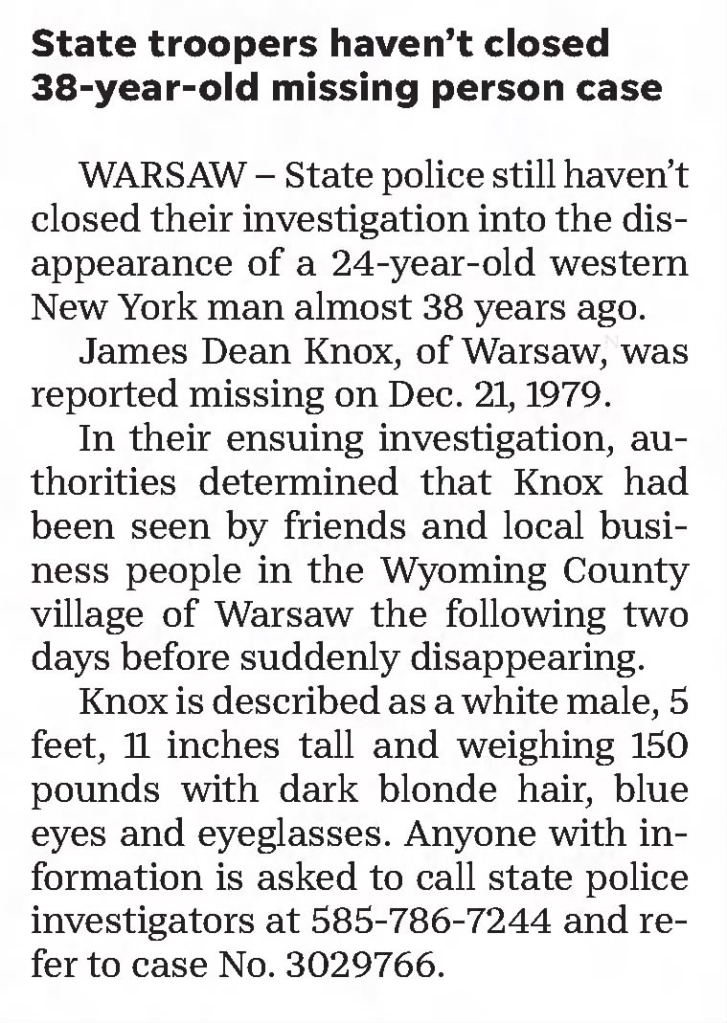
James Dean Knox was born on April 4, 1955 in Warsaw, NY; he has an older sister named Cynthia and a son named James Dean Knox III. Twenty four year old Knox was last seen on December 11, 1979 and his Grandmother (who saw him two days prior in her home in the southern part of Warsaw) waited ten days to report him as missing to the authorities. All of his clothes, possessions, and money was left behind.
I found very little information regarding this case on the internet, however this is the only instance where quite a few people from local (Warsaw, NY) Facebook groups reached out to me when I asked for more information, offering me their insight and even what they think may have happened to him. Per his best friend, Jimmy’s mother thinks that her son is in the witness protection program, however he feels that he fell in with the wrong crowd, began experiencing money issues and as a result wound up at the bottom of a well on an abandoned farm in nearby Java. Neither theory seems to have any merit to it.
Knox has blue eyes, dark blonde hair, is 5’11” tall, and weighed 150 pounds at the time of his disappearance; he was last seen wearing a red plaid jacket, blue jeans and black boots. He wore corrective lenses with plastic frames and was suffering from unknown health concerns, which he was apparently pretty upset over. Because of these ongoing issues he was on leave from his POE at the Leroy Machine Company.
Knox lived in the heart of Warsaw on Wyoming Street and frequently ate at a local pizzeria. Before his disappearance he served in the US Navy for roughly one month before being honorably discharged due to medical reasons on May 25, 1979.
Per WIVB both of Knox’s parents and his grandmother have passed away, and his sister still resides in Warsaw. As recently as 2021 New York State Police released a statement about Knox asking that anyone with information related to his disappearance come forward and contact Investigator John Neeley at 585-786-7244, referencing case #3029766. As of June 2024 no trace of Knox has ever been recovered.
Works Cited: 13wham.com/news/local/nysp-continues-to-investigate-warsaw-mans-disappearance-41-years-later charleyproject.org/case/james-dean-knox troopers.ny.gov/missing-knox-james-d
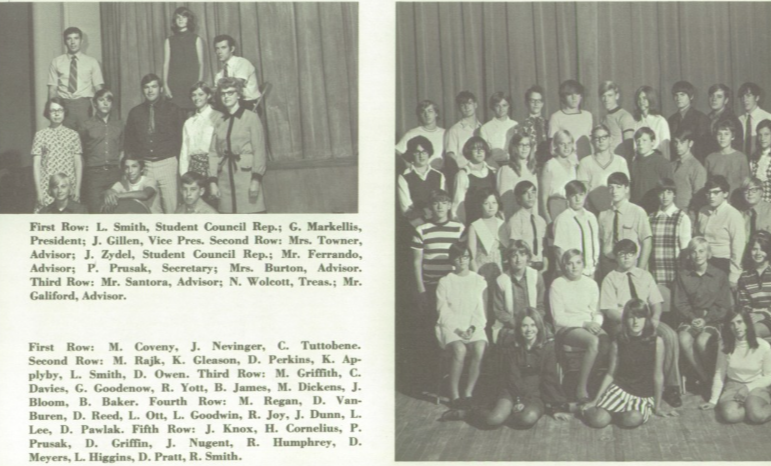
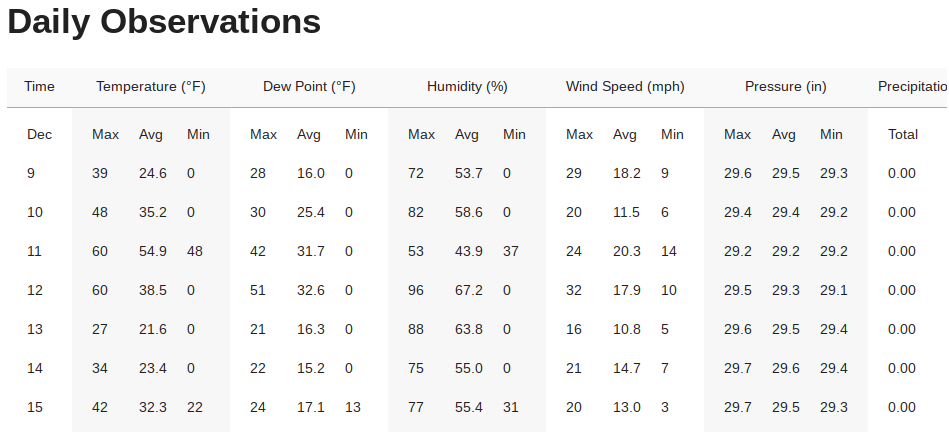
James Knox’s second grade picture from the 1963 Warsaw Elementary School yearbook.James Knox’s fourth grade picture from the 1965 Warsaw Elementary School yearbook.James Knox’s fifth grade picture from the 1966 Warsaw Elementary School yearbook.James Knox’s fifth grade picture from the 1966 Warsaw Elementary School yearbook.James Knox’s freshman year picture from the 1971 Warsaw High School yearbook.One of the more commonly circulated photo’s of Knox, it looks like a mugshot. One of the more commonly circulated photo’s of Knox. The only article I could find about Knox published by The Press and Sun-Bulletin on November 26, 2017.Some weather stats in Warsaw, NY from December 1979. The date Knox was last seen (December 11, 1979) it got as warm as 60 degrees… was he taking advantage of a nice day, went for a walk in the woods then got injured?The temperature in Warsaw, NY the week in December 1979 that Knox was last seen. 35 Wyoming Street in Warsaw, NY where Knox was living at the time he disappeared.In 2019 a Redditor going by the handle of ‘unleashthenuge’ posted this blurb about the disappearance of Knox, it’s a pretty interesting theory.A comment about Knox on his ‘WebSleuths’ page about some of his distinguishing characteristics.James’ sister Cindy’s freshman year picture from the 1967 Warsaw High School yearbook.


































 Another Bundy Blog.