This is the second installments of documents from the Thurston County Sheriff’s Department related to William Cosden Jr.
Thurston County Sheriff’s Office, documents related to their investigation into William Earl Cosden Jr., Part Two.

This is the second installments of documents from the Thurston County Sheriff’s Department related to William Cosden Jr.
Below is a copy of a letter that Ted Bundys one time girlfriend Liz Kloepfer sent his probation officer Don Hull, voicing her annoyance that detectives were prying into his personal life. It is part of Judge Stewart Hanson’s private collection and was digitized and sent to Maria Serban by Sean Papanikolas, Stewart’s grandson.
The third installment of documents from the Thurston County Sheriff’s Department related to the murder of Brenda Joy Baker from Maple Valley, WA.
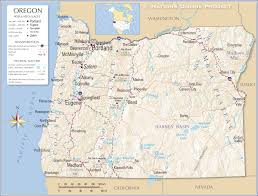
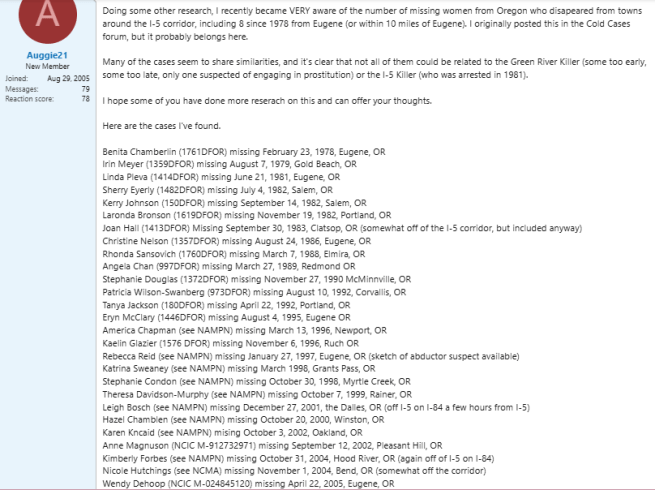
I’ve been compiling a list of missing and murdered young women from the 1970’s in Oregon in a notebook, and I figured why not also include it here. As I learn of new victims I will update the list… over the years I’ve found dozens of names on various websites and newspaper articles about other missing and murdered women, but they’re scattered all over the internet in a million different sources… why not put them all here?
Faun Moulton Moon: (March 1, 1969, Eugene). Distraught over her recent divorce, the fifty-year-old put her financial affairs in order, sent letters of good bye to her daughters, and walked away from her home and family. She was never seen or heard from again.
Janet Lynn Karin-Shanahan: (April 23, 1969, Eugene). Twenty-two-years-old. Strangled and found in the trunk of her own car.
Beverly Annette Gayley: (June 15, 1969, Deschutes County). Her remains were found in a wind cave covered with a bedspread and rocks; she had a ligature wrapped around her neck. A significant amount of blood was found in Gayley’s home, as well as in the trunk of her car.
Niki Diane Britten: (July 16, 1969, Albany). Fifteen-years-old. Frequent run away.
Julie Dade: (January 21, 1970, Junction City). Twenty-Year-Old. Julie’s husband, Terry was later found deceased in the couple’s Maple Street apartment. At about 4:20 AM, neighbors in the area of the Maple Street Apartments heard a female yelling and a witness saw a man dragging a screaming woman into a vehicle before leaving the area. A nearby neighbor woke to the sound of an explosion, saw the car on fire and tried to put it out but it was too late.
Sandra Young: (February. 23, 1970, Sauvie Island). Her remains were found on Sauvie Island in 1970 but were not identified until February 2024; her murder remains unsolved.
Joyce Cross: (Remains were discovered on February 11, 1971, Klamath Falls). Her bludgeoned body was found in the Lost River Diversion Channel near the Spring Lake Road crossing. It was later determined Lavon Granville Owens killed the nineteen-year-old after Oregon State Police linked his DNA to evidence from the crime scene in April 2010.
Barbara Katherine Cunningham: (May 25, 1971, Eugene). Thirty-four-years-old. Found deceased in her apartment by her mother.
Barbara Ann Bryson: (July 29, 1971, Stayton). Nineteen-years-old. Was last known to be attending a party.
Anne Marie Lehman: (found on August 19, 1971, Josephine County). Seventeen-years-old. Disappeared from Aberdeen, Washington in the winter or spring of 1971; the circumstances surrounding her case are unclear, although it is rumored she was a victim of human trafficking. Her remains were found by a man and his son while they were out mushroom hunting off the Redwood Highway, close to mile marker thirty-five; it is unclear as to why she was in Oregon.
Josephine County ‘Jane Doe’ (who is also known as ‘Annie Doe): (remains found on August 19, 1971). Body found near the California border; believed to be female victim somewhere between fourteen and twenty-five-years-old.
Fay Ellen Robinson: (March 12, 1972, Eugene). Found deceased in apartment.
Alma Jean Barra: (March 23, 1972, Happy Valley). Twenty-eight-years-old. Found deceased in Willamette National Cemetery.
Beverly May Jenkins: (May 25, 1972, Cottage Grove). Sixteen-years-old. Her remains were found in June 1972 just off the I-5 roughly ten miles outside of Cottage Grove; she had been strangled to death.
Jane Pellett: (June 7, 1972, Salem). Twenty-eight-years-old. Found deceased on a busy roadside on June 26, 1972.
Geneva Joy Martin: (June 16, 1972, Eugene). Nineteen-years-old. Found deceased on the side of the road by a farmer.
Rita Lorraine Jolly: (June 29, 1973, West Linn). Seventeen-years-old. Disappeared while out on a routine nightly walk.
Allison Lynn Caufman: (July 1973, Portland). fifteen-years-old. Died as a result of head injuries after being shoved from a car moving at a high rate of speed.
Laurie Lee Canaday: (July 9, 1973, Milwaukee). Her remains were recovered on the pavement at the intersection of Southeast Scott Street and McLoughlin Blvd in Milwaukee, OR.
Susan Ann Wickersham: (July 11, 1973, Bend). Seventeen-years-old. Was found deceased from a gunshot wound on January 20, 1976.
Vicki Lynn Hollar: (August 20, 1973, Eugene). Twenty-four-years-old. Disappeared along with her 1965 VW black VW Beetle with IL plates and the running boards removed.
Gayle LeClair: (August 23, 1973, Eugene). Twenty-two-years-old. Found stabbed in her apartment.
Kathy Sue Wells (found on September 3, 1973, Portland): the nineteen-year-old had been shot seven times with a .22 caliber gun and her body had been found on a parking strip (near SE 61st Avenue and Stark Street)
Harley & Esther Moon (found on September 8, 1973, Portland): the couple were discovered by Eugene police, dead of ‘chop wounds to the head; neighbors said they had not seen them since a few days prior to the discovery.
Delores Thompson & Gwendolyn Fulce (found on September 8, 1973, Portland): Roy Lee Jernigan, the father of twenty-four-year-old Delores Thompson’s 2.5-year-old son, came to her rented home on the 500 block of North Ivy Street to pick up the boy, and upon arriving he discovered Delores and her best friend, twenty-one-year-old Gwendolyn Fulce bludgeoned to death (most likely with a hammer).
Deborah Lee Tomlinson: (October 15, 1973, Creswell/Eugene). Fifteen-years-old. Disappeared along with a friend on her sixteenth birthday. According to her sister (and my friend) Jean she was seen in California after she disappeared).
Virginia Erickson: (October 21, 1973, Sweet Home). Thirty-two years old, mother of six. Disappeared, most likely killed by her husband.
Suzanne Rae Seay-Justis: (November 5, 1973, Portland). Twenty-three-years-old. Was from Eugene, hitchhiked to Portland despite having a car of her own.
Martha Marie Morrison: (September 1, 1974, Portland). Seventeen-year-old Martha was last seen leaving an apartment in Portland. Her murder was eventually tied to Warren Leslie Forrest.
Belinda Cowden, along with her husband Richard and two children, David and Melissa: (September 1, 1974, Copper). The family were the victims of a still unsolved mass murder after they vanished from their campsite near Carberry Creek in the Siskiyou Mountains of Oregon; they were last seen on September 1, 1974, when Richard and David bought milk at the Copper General Store. When they never showed up for dinner at Belinda’s mother’s house later that day, their campsite was found deserted, with their truck, wallets, and a half-full carton of milk left behind. On April 12, 1975, two gold prospectors found their bodies roughly seven miles from the campsite: Richard was found tied to a tree on a steep hillside, and Belinda, David, and baby Melissa were hidden inside a nearby small cave that had been sealed up with rocks. Autopsies later revealed that Belinda and David had been shot with a .22 caliber weapon, while Melissa died from severe blunt force head trauma; Richard’s cause of death could not be determined due to the condition of his remains.
Joyce C. Hess: (October 18, 1974). Fifty-four-years-old.
Marion Vinetta Nagle-McWhorter: (October 1974, Tigard). Twenty-one-years-old. According to McWhorter’s sister, she had been traveling before she disappeared around the Western part of the US. Her body was finally identified in September 2025, but the case remains unsolved.
Becky Rae Martin: (February 15, 1975, Junction City). Twenty-two-years-old. Throat cut.
Leslie Michelle (seven-years-old) and Geoffrey Lyman (five-years-old) Brown. Murders took place on February 22, 1975 and both victims were found on March 12, 1975 in McIver Park, Estacada.
Margo Nerline Ascencio-Castro: (March 1, 1975, Eugene). Twenty-two-years-old. Found stabbed in a motel room, possibly involved with a local motorcycle gang.
Ceceilia Louise Hostetler: (March 26, 1975, Eugene). Last seen leaving the Embers restaurant getting into a vehicle with another person whom she appeared to know. On October 30, 1998, an unidentified deceased female was found burned and stabbed in the forest near 24243 Bolton Hill Road in Lane County, Oregon; it was later identified through dental records as Ceceilia Hostetler.
Caroletta Spencer: (May 20, 1975, Sauvie Island). Seventeen-years-old. Spencer’s was a sex worker whose body was found on a gravel road on Sauvie Island in Oregon. She had been shot four times and most likely had been killed earlier that morning, as she was last seen at Fred’s Place Bar in Portland around 2:20 AM.
Wanda Ann Herr: (June 1, 1976, Government Camp). Nineteen-years-old. Few details about Herr’s life are available, but according to family members, she grew up in Gresham, Oregon, but did not live with her siblings and reportedly ran away from home multiple times as an adolescent. Herr was last seen alive sometime around June 1976 and may have been living in a group home when she disappeared; her upper skull and some miscellaneous bones were discovered on August 2, 1986, near two roads off of Highway 26.
Shirley Anita Wallace: (July 21, 1975, Eugene). Thirty-one years-old. Found, shot.
Tina Marie Mingus: (October 1975, Salem). Sixteen-years-old. Murdered, body recovered.
Cherril Sue Miller: (October 12, 1975, Portland). Twenty-eight-years-old. Few details are available in Miller’s case, but she had two children, whom she had left in a neighbor’s care that evening. One of her teeth in the front of her mouth is discolored or capped and she wears eyeglasses with thin bone rims.
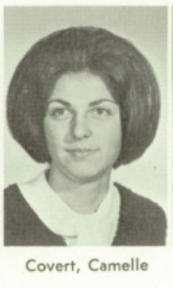
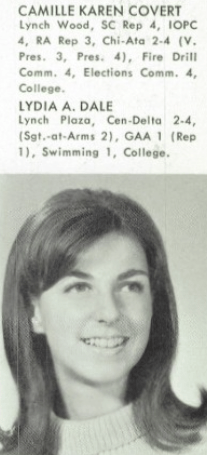
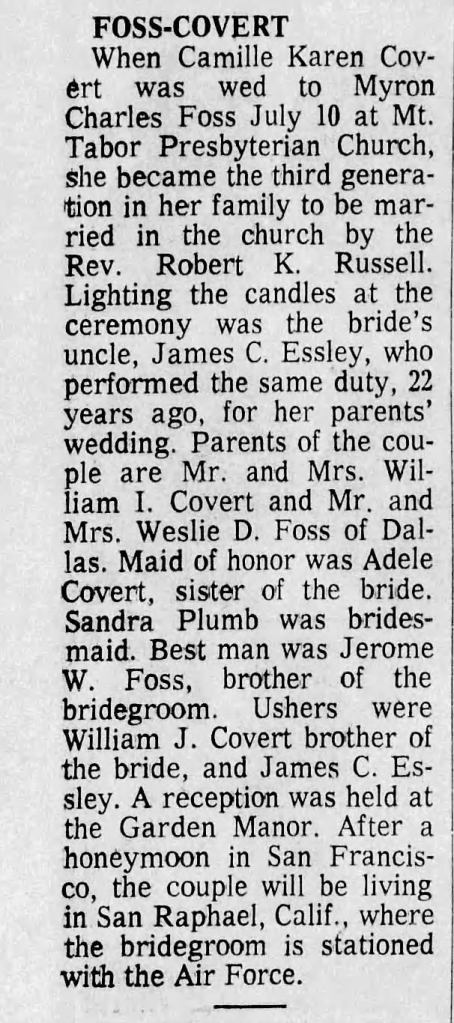
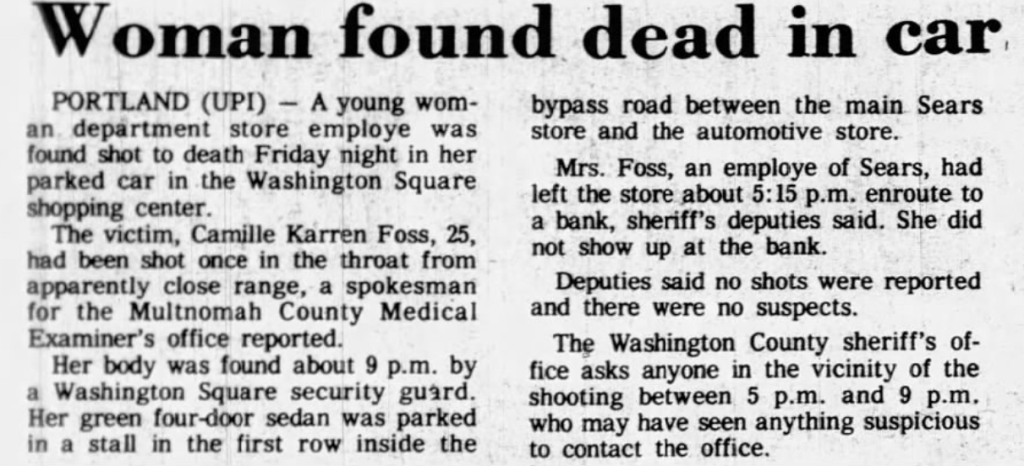
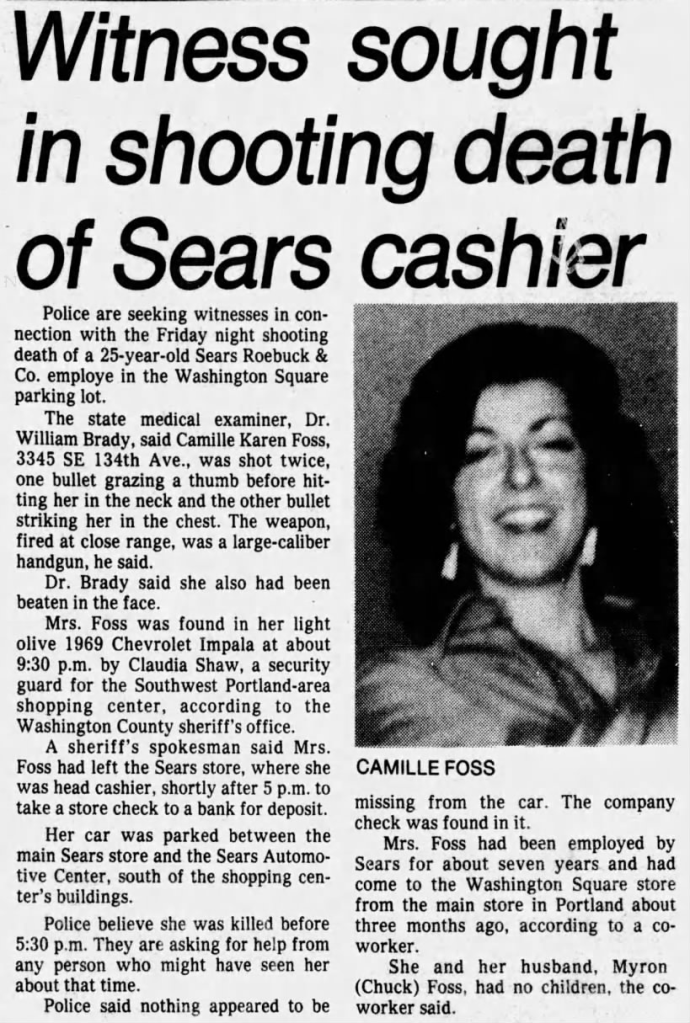
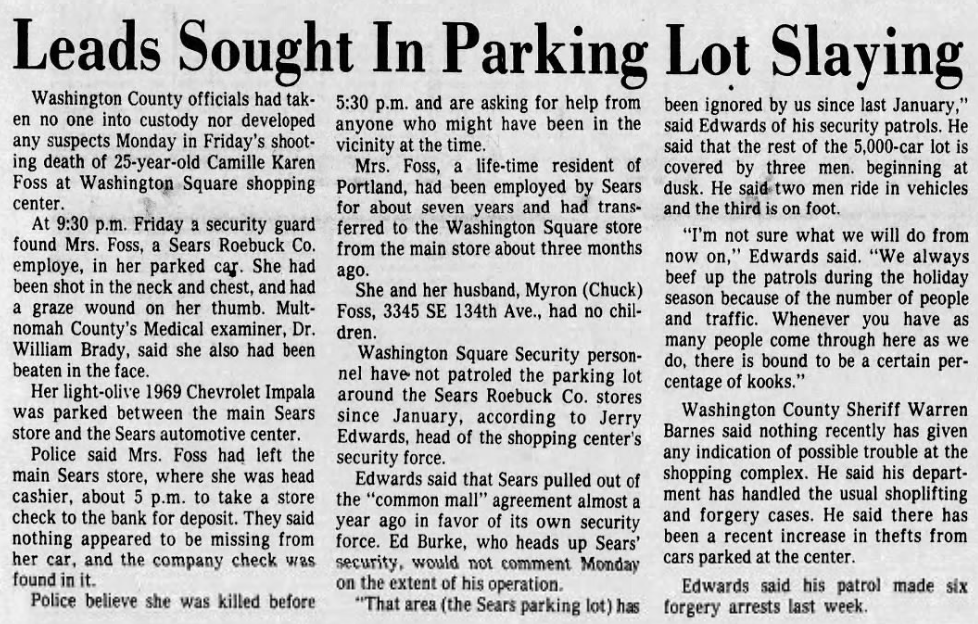
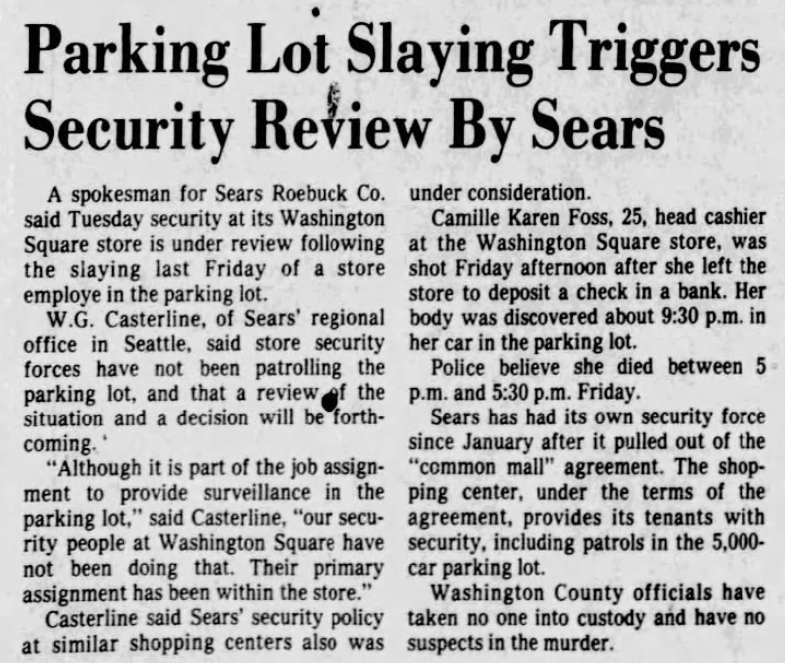
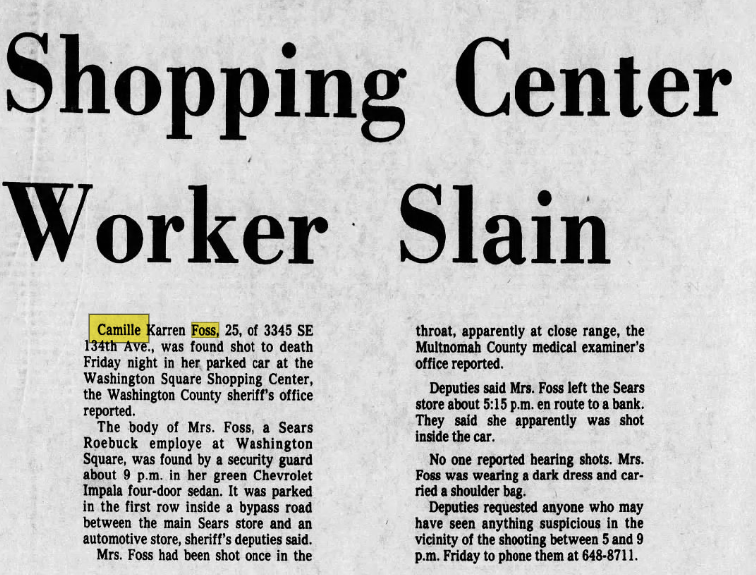
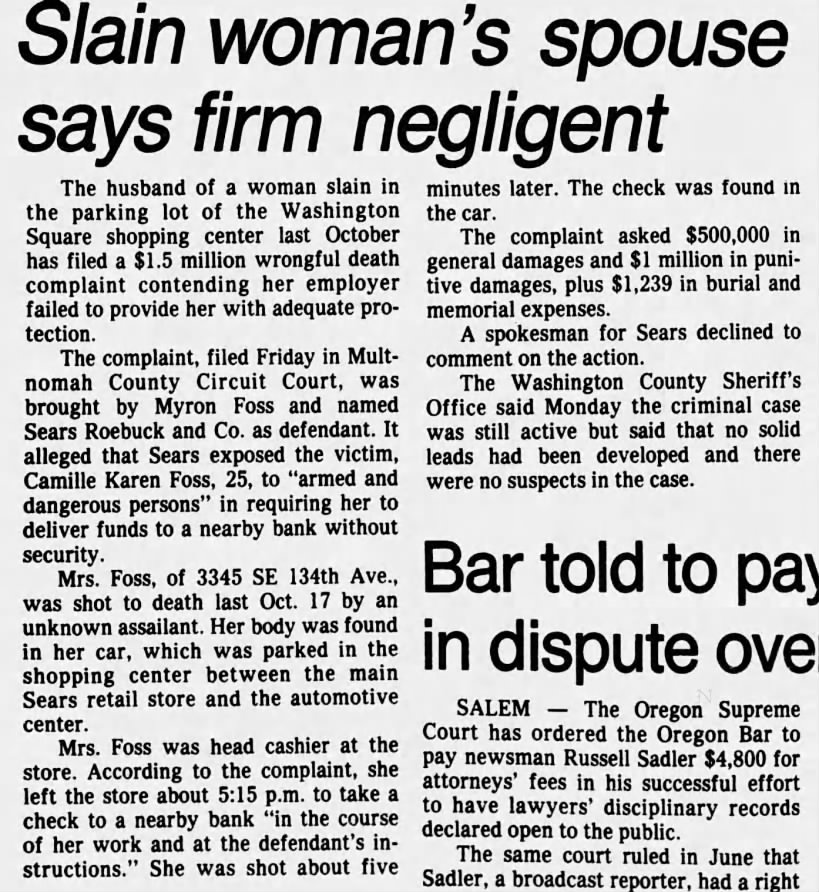
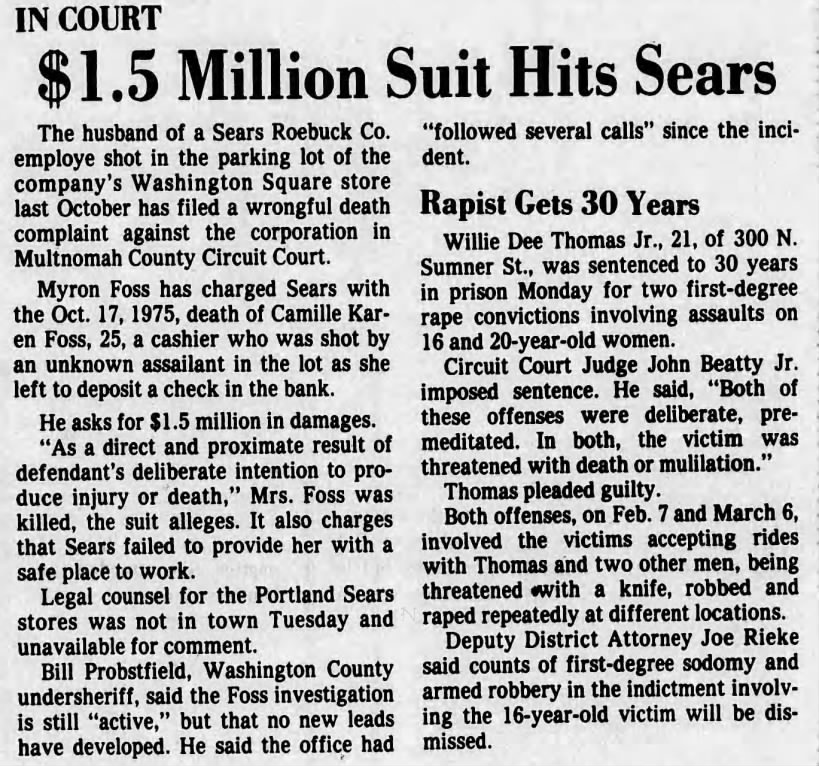
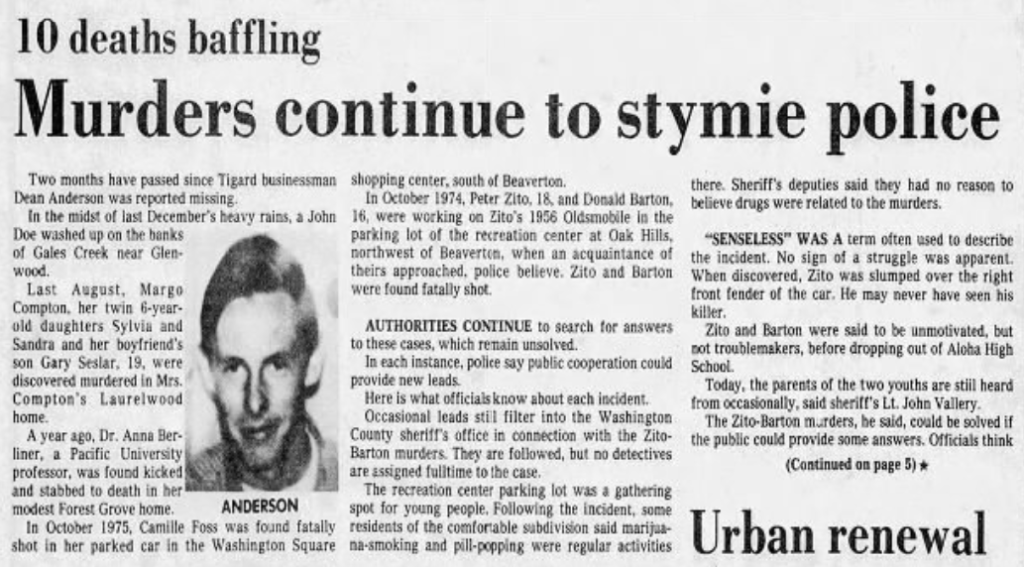
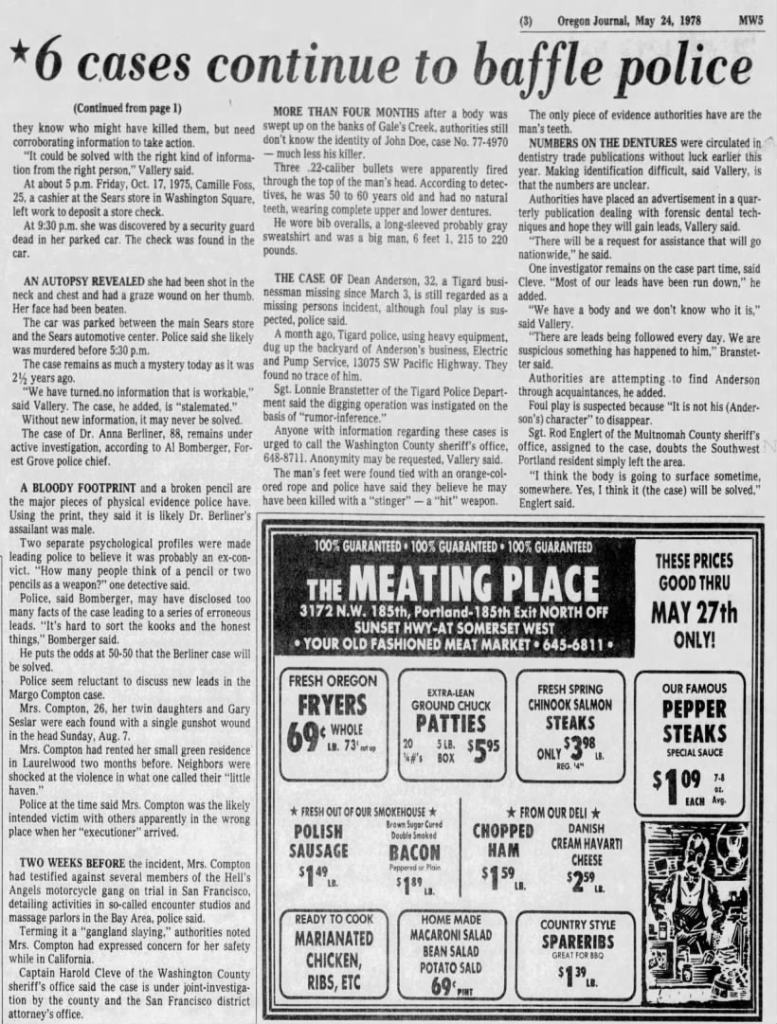
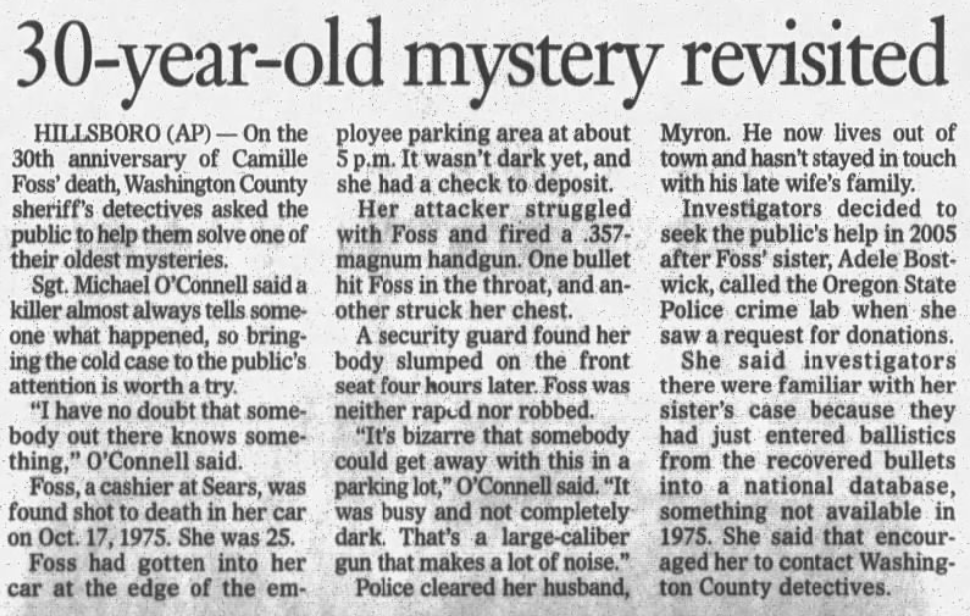
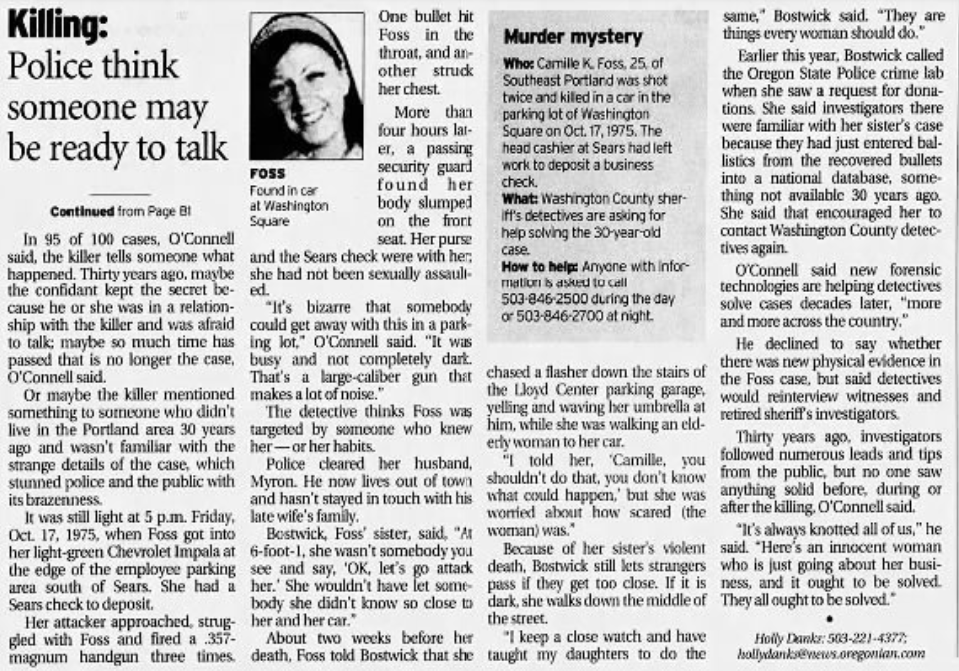
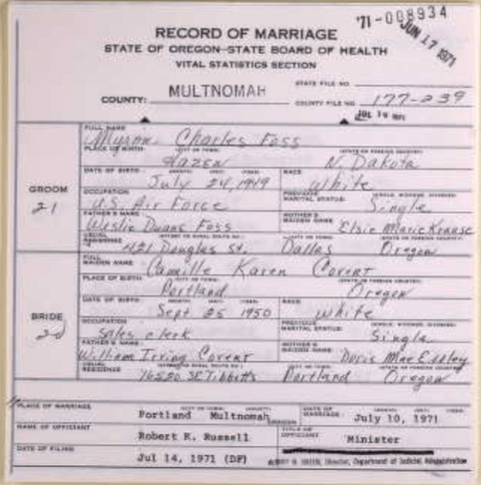
Camille Karen Covert-Foss: (October 17, 1975, Hillsboro). Twenty-five-years-old. Found shot in her vehicle at her POE, in a Southwest Portland-area shopping center.
Deborah McNoise-James: (October 28, 1975, Klamath County). Found deceased at the 97 Trailer Court with lacerations to her head, neck, arms, and leg, as well as trauma to her larynx.
Betty Johnson: (November 1975, Estacada). Nineteen-years-old. Not much is known, I only happened to stumble upon her name when searching for a different Oregon woman (Marion McWhorter).
Kim Charleson: (January 7, 1976, Cannon Beach). The twenty-two-year-old had been in college and may have been carrying a small amount of Canadian currency when she disappeared.
Cordelia Sheehan McMinn: (May 1, 1976, Portland). Twenty-six-years-old.
Julie Ann Beardslee: (June 30, 1976, Astoria). After Beardslee failed to attend a regularly scheduled Bible study class in Astoria her vehicle was found on July 1, 1976, at Fort Stevens State Park. Her body was discovered by hikers on July 12, 1976 near Coffenbury Lake in Clatsop County, Oregon; she had been stabbed, and her throat had been cut.
Patricia Otto (August 31, 1976, Lewuston): Patty’s body has never been recovered and she was last seen by her husband and two daughters.
Sharon Ryan: (December 16, 1976, Portland): Seventeen-year-old. Vanished going to buy eggs, her body was found near a parking lot in Portland.
Roxanne Marie Sims: (January 1, 1977, Portland). Eighteen-years-old.
Sandra Renee ‘Sandy’ Morden: (1977) Approx sixteen-years-old, her partial skeleton was found in Washington in 1980 and it’s believed that she died in the late 1970’s; she was identified in October 2019.
Karen Jean Lee: (last seen alive, May 26, 1977, Cornelius). Lee ran away with a male companion, fourteen-year-old Rodney L. Grissom. Her possessions and clothes were found by a logging crew sometime in November 1977 however her remains were never recovered. Grissom’s clothes and belongings found in same area, roughly a quarter mile away from Lee’s in November 1982; his remains have also never been found. (Thank you to my friend Ryan AuClair for this information).
Lliana Gay Adank: (June 1977). Sixteen years-old. Was found shot to death along with seventeen-year-old Eric Shawn Goldstrand at the remote Broken Bowl Picnic Grounds near the Fall Creek Dam located about twenty-five miles southeast of Eugene.
Cindy Irene King: (July 19, 1977, Grants Pass). Fifteen-years-old. Disappeared.
Elizabeth ‘Lisa’ Ann Roberts: (July 25, 1977, Roseburg). Found August 9, 1977, formerly known as ‘Precious Jane Doe.’ Roberts was identified on June 16, 2020.
Margie Ann Fernette: (January 24, 1978). Fifteen-years-old. Found in Fairfield Elementary School.
Benita Gay Chamberlin: (February 23, 1978, Eugene). Twenty-four-years-old.
Floy Joy/Jean Bennett: (February 23, 1978, Beaverton). Thirty-seven-years-old.
Karen Etta Whiteside: (March 22, 1978). Sixteen-years-old.
Ann Marie Ellinwood: (April 15, 1978, Corvallis). Twelve-years-old, last seen walking alone ‘during daylight hours.’ Possibly a victim of Earl Patrick Chambers.
Stephanie Ann Newsom: (April 19, 1978, West Salem). Eleven-years-old. Remains found on April 25, 1978 near the Ankeny Wildlife Refuge: possibly a victim of Earl Patrick Chambers.
Elana Jacobs and Teresa Krause: (May 21, 1978, Astoria). Both girls were enrolled in the Tongue Point Job Corp. They were known to go into town to ‘party and socialize,’ which is most likely why they left the compound the night they were last seen alive; their remains were found near Del Rey Beach, Krause’s on December 3, 1978, and two days later Jacobs were discovered; they were most likely stabbed and/or strangled to death.
Finley Creek Jane Doe: (found August 27, 1978, Elgin). The remains of a pregnant woman between the ages of fourteen and twenty-five-years-old; detectives strongly believe she died between 1970 and 1975 and was six to eight months pregnant at the time of her death; fetal remains were found with her. She was found buried face down under a log, and evidence at the scene, including a coaxial cable, suggests she may have been strangled.
Diana Marie Kuhn*: (December 10, 1978, Portland). Twenty-years-old. Remains found in in West Linn, OR.* Thank you for Diana’s cousin Donna Mollema for informing me about her.
Christie Lynn Farni: (December 14, 1978, Medford). Six-years-old.
Pem Michelle Yates-Briggs: (January 1, 1979). Fifteen-years-old.
Janie Landers: (March 9, 1979, Salem). Eighteen-years-old; she slipped away from the Fairview Training Center in Salem, a residential facility for those with developmental disabilities and mental health problems.
Mary Jo Templeton: (April 1979, remains found on April 30, 1979, Redmond). Forty-nine-years-old. In April 1979, she was renting a room at the El-Rancho Motel when she disappeared; her remains were uncovered in several parts over the time period of a month in Mirror Pond and near the Newport Avenue Dam in Bend. The first remains (a thigh) were found by a utility worker raking intake grates at a dam on April 30, 1979. She had been dismembered with what detectives called a ‘surgical precision,’ leading to theories that her killer may have had experience as a hunter, butcher, or surgeon, butcher (or a combination of the three); she was eventually identified through dental records.
Daisy Motley: (May 8, 1979, Portland). Motley was a sixty-four-year-old, unemployed female who lived alone that had no apparent enemies. Someone anonymously called the manager of her apartment complex to her death and asked them to check on her because they heard a ‘disturbance’ coming from her residence. The last time Daisy was known to be alive was when she talked to her daughter at approximately 9 PM on May 7th.
Lisa Danein Boggs: (June 13, 1979, Salem). Boggs and her boyfriend, Randolph Robertson, left their home state of Missouri on May 7, 1979 and arrived in Salem, Oregon, on May 9, 1979, and lived at a transient camp on property near the KOA at 1595 Lancaster Drive. On June 7, 1979, Salem police were called to the KOA for a homicide, where they discovered that Randolph Robertson, had been killed by two shotgun blasts; Boggs was nowhere to be found. On June 13, 1979, her’ body was discovered in a creek 17.5 miles up Little North Fork Road off Highway 22E in Marion County, Oregon. Her cause of death was drowning, even though she had also sustained a blunt-force injury to the skull behind her left ear. She was found lying on her back, with her head submerged in eleven inches of water; it had been held in place by a large rock
Irin Marie Meyer: (July 20, 1979, Brookings). Twenty-nine-years-old.
Sheryl Wright: (no additional information at this time).
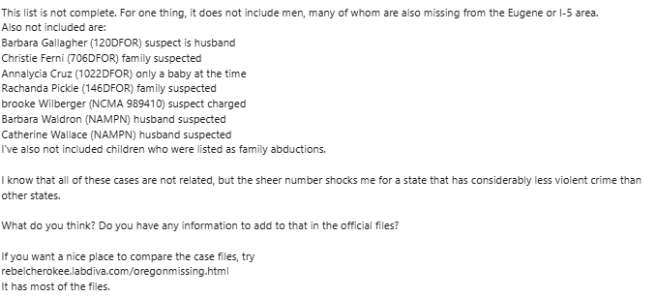

Introduction: ‘The Santa Rosa Hitchhiker Murders’ is a moniker for a group of unsolved homicides that took place in 1972 and 1973 in the general Santa Rosa area, located specifically in Sonoma County in the North Bay region of California. The perpetrator is responsible for at the murders least seven young female hitchhikers, who were all found completely naked in rural areas. Californian detectives strongly suspect that the killer spoke with and was familiar with some of his victims before he killed them.
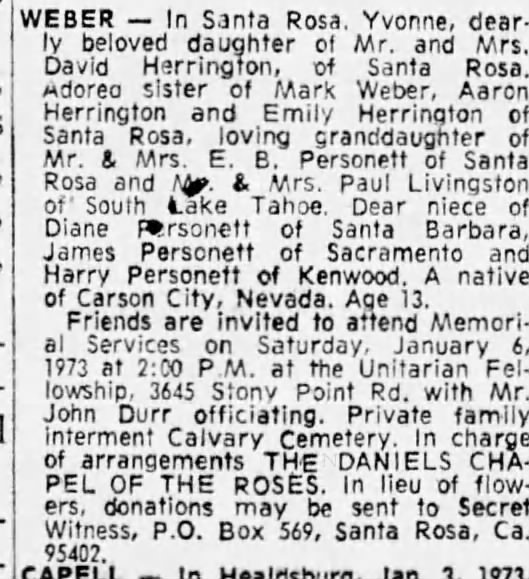
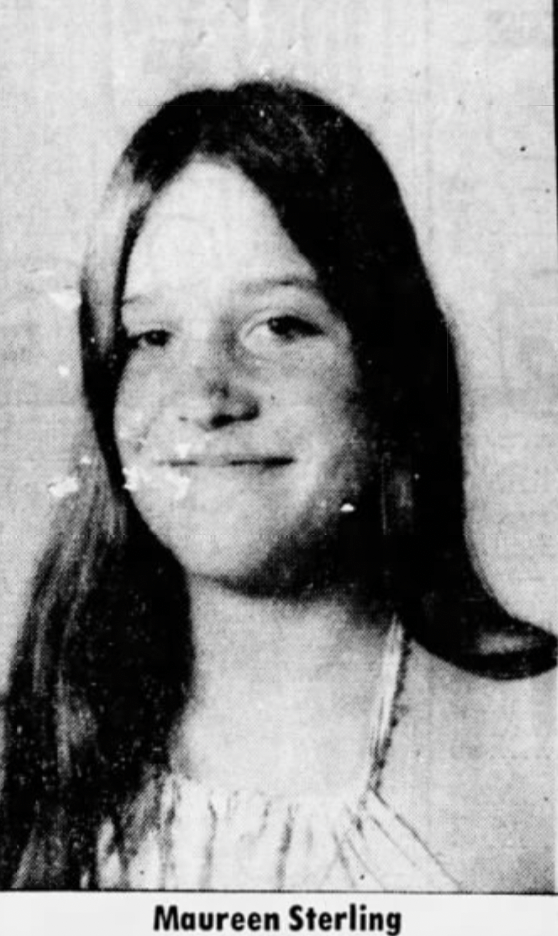
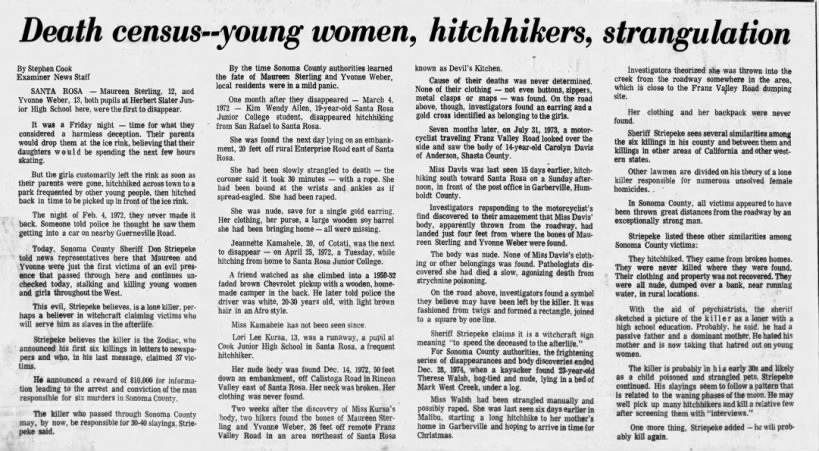
Confirmed Victims: At roughly 9 PM on February 4, 1972 twelve-year-old Maureen Louise Sterling and thirteen-year-old Yvonne Lisa Weber disappeared after being dropped off at the Redwood Empire Ice Arena at around 7:30 PM. Weber was born in Carson City, Nevada on January 29, 1959 and Sterling was native to Santa Rose and was born on February 18, 1959. Maureen’s father Larry tragically died in a skiing accident in August of 1958 just months before her birth at the age of 23, leaving Arleen to raise both her and her older sister, Theresa alone during a time where that was easier said than done).The girls, who were both studentsat Herbert Slater Middle School, had no intention of staying at the skating rink that evening, and had plans to go somewhere else, most likely a nearby park with four older boys (who later took lie detector tests, which ruled them out as suspects). They were last seen getting into a car on Guerneville Road, northwest of Santa Rosa.
Sterling was last seen wearing blue jeans, a purple shirt, a red zip up hoodie and brown suede shoes, and Weber was also wearing jeans, a lavender and white tweed shirt, a black velvet coat, and brown suede shoes. Law enforcement only released that two pieces of evidence in relation to the case that were found with the victims: a single filigree type drop earring with orange beads and a basket weave mixed metal cross attached to a gold chain necklace. Neither item belonged to either one of the girls.
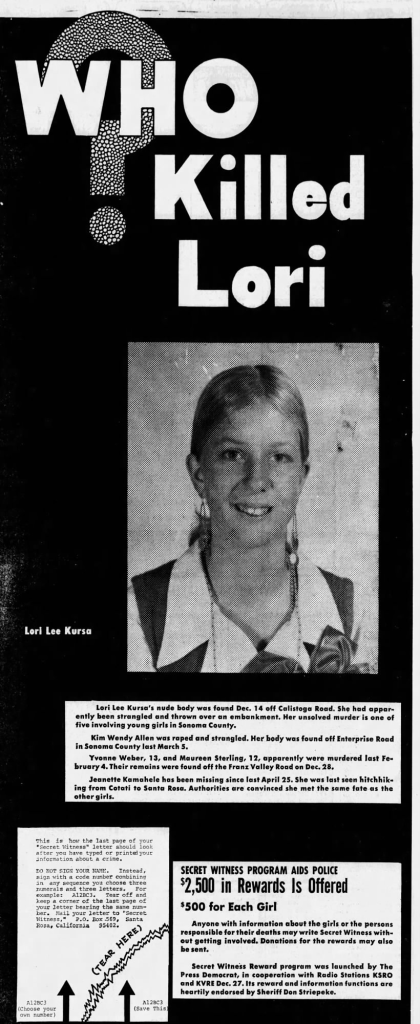
When one of the girls parents came to pick them up from the skating rink at 11pm, they were nowhere to be found, and in the early stages of the investigation LE had felt that they were runaways. Their heavily decomposed bodies were found on December 28, 1972 by 17-year-old Glen Frost and 18-year-old David Brooner, who were hiking through the area known as ‘The Devil’s Kitchen’ and down a steep embankment roughly 66 feet off the east side of the roadway. A single earring, orange beads and a 14-carat gold necklace with a cross were found at the scene, and the victims cause of death could not be determined, due to the advanced state of the remains. By that time Santa Rosa was in a panic, and a county wide program dubbed ‘The Secret Witness Program’ offered a $20,000 reward for any tip that would lead to the apprehension of the girls killer(s).
In 2019 an acquaintance of Weber and Sterling came forward and told detectives that she had spoken with them earlier on the evening they were last seen alive, and that the girls told her that a tall, slim man had asked them to smoke marijuana in the lobby of the ice arena (she declined to go with them), and that he strongly resembled Ted Bundy. However, that same friend was interviewed for the 2024 HBO Max documentary, ‘The Truth About Jim,’ and THAT time she said that Jim Mordecai (the subject of the documentary) was the man that was talking to her friends that evening.
There were also rumors that the girls had been looking for a ride to a nearby bowling alley so they could meet up with some friends, where other sources claim they were in contact with a gentleman who lived along the Russian River; detectives could confirm neither report. Schoolmates were questioned about the missing young women the week after they vanished, but nothing useful came of it.
Kim Wendy Allen was born on July 22, 1952 to Kimball and Roberta Allen, and had a sister named Annilee and a brother named Robert. Of her daughter, Mrs. Allen told The Press Democrat that: ‘she was never a speck of trouble to anyone from the day she came on this earth. She trusted everyone, believed that people were good.’ Kim graduated from the private, all-girls Ursuline High School in Santa Rosa, and despite being her senior class’s spirit leader she was an incredibly private person and usually kept her thoughts and opinions to herself, even with the people that knew her best. Allen lived in the 2200 block of Guerneville Road with two roommates and worked part-time at a natural health food store in Larkspur, located roughly forty miles south of Santa Rosa.
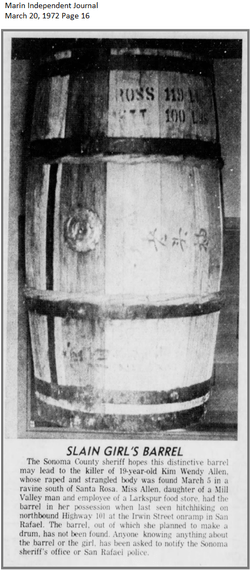
Kim was last seen on Saturday, March 4th, 1972, and in the morning she had been visiting with friends in San Francisco and hitchhiked her way to work in Larkspur shortly before her shift at Larkspur Natural Foods was due to start at noon. She worked for approximately five hours then began making her way back to Santa Rosa, and the second-year art student at Santa Rosa Junior College was picked up by two men outside of her POE. They dropped her off on San Rafael’s Belle Avenue, leaving her with nearly forty miles left to her destination. The men told investigators that they last saw her at roughly 5:20 PM trying to hitchhike near the Bell Avenue entrance to Highway 101, and was carrying an orange, aluminum-frame backpack and a large wooden sauce barrel with red Chinese characters on it. Like Sterling and Webster, she also frequently used hitchhiking as a means to get around despite multiple warnings from her mother and a professor about how dangerous it was.
Allen’s remains were found the following day at the bottom of an embankment in a creek bed roughly twenty feet off Enterprise Road in Santa Rosa. She had been bound at her wrists and ankles and had been strangled with a cord. She had been brutally sexually assaulted, and semen was found on her remains; a single gold hoop earring was found near the body. Detectives found skid marks at the top of the embankment and wondered if her assailant may have slipped or lost their footing while throwing or transporting the body. The two men that gave Allen the first ride (one which had passed a polygraph test) were both ruled out as suspects. Her checkbook was found in a drive-up mailbox across from the Kentfield (CA) Post Office sometime in the morning on March 24, 1972.
On November 11, 1972 thirteen year old Lori Lee Kursa was reported missing by her mother after disappearing while they shopped at a U-Save, and she was last seen on either November 20/21 in Santa Rosa while visiting friends. Someone reported possibly seeing her hitchhiking on November 30, however that was never positively confirmed by investigators. Kursa had a troubled home life, and she was a known hitchhiker and frequent runaway, and on December 14, 1972 her frozen remains were found in a ravine roughly fifty-feet off Calistoga Road, northeast of Rincon Valley in Santa Rosa. Lori’s murderer had thrown her body at least 30 feet over an embankment, and she was found wearing a single wire loop earring in each earlobe.
On her death certificate, Allens cause of death is listed as a broken neck with compression and hemorrhage of the spinal cord, and she most likely died one to two weeks before her remains were found; she not been raped. Two people later called in tips to LE about possible sightings of Kursa: one shared that they saw two men with a girl fitting her description on Calistoga Road. A second said they saw a young woman with a white male with ‘bushy hair’ driving a pickup truck that had been parked near where her remains were later found. Nothing ever came of either report.
A possible witness to Kursa’s abduction eventually came forward and told investigators that on an evening sometime in between December 3 and 9, 1972 he saw two men with a young woman fitting her description run across Parkhurst Drive then push her into the back of a van that had been parked on the side of the road. They said that the woman seemed to be physically impaired in some way and that the men were holding her up in between them. The driver was a Caucasian man with an afro-type hairstyle and after the three got in the van it quickly drove north on Calistoga Road.
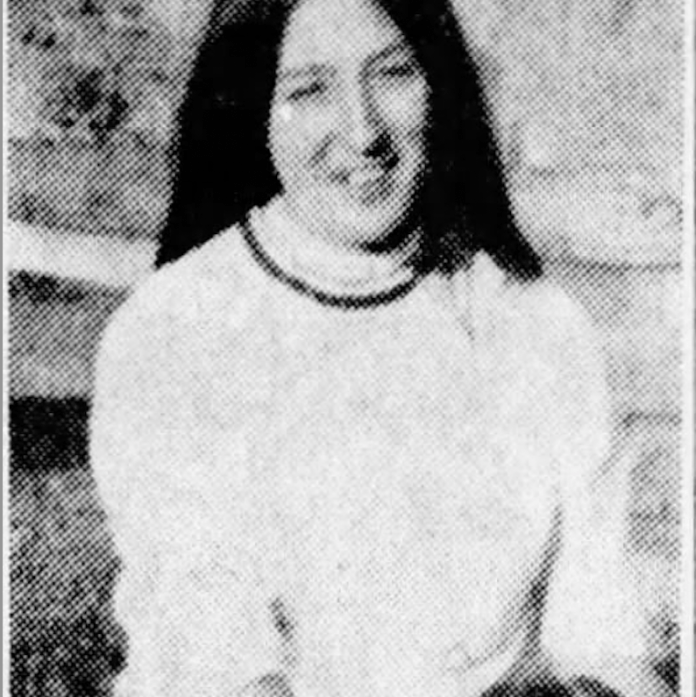
At around 7 AM on February 6, 1973 fifteen year old Carolyn Nadine left her family residence in Shasta County and spent the next five months traveling. She was last seen wearing a brown leather jacket with a fur collar and faded jeans, and before leaving the Anderson Union High School student left a note for her mom and stepdad that read: ‘Dear Mom. Don’t worry too much about me, the only thing I’m gonna be doing is keeping myself alive. Love, Carolyn.’ In 2022 her older sister Judy Wilson told an interviewer that after she ran away Carolyn had stayed with her for a period in her apartment in Garberville, and that she had been an eyewitness to a double murder and was ‘afraid for her life.’
Wilson said that Carolyn was getting increasingly paranoid that she might be discovered by someone that that knew about the murders, and she left her duplex and hitchhiked to Illinois. Davis returned to Garberville in the summer of 1973 because her sister was going to have a baby, and she stayed with her grandmother for two weeks that July before returning to her boyfriend in Illinois. According to multiple reports, her grandma drove her to downtown Garberville on July 15,1973 and shared with her plans to hitchhike to Modesto, California, with plans of staying with friends. She parked in front of the post office located two city blocks away from Highway 101, and Carolyn was last seen hitchhiking in Garberville that afternoon near the Highway 101 ramp going southbound. Her remains were discovered in Santa Rosa on July 31, 1973, just three feet away from where the bodies of Maureen Sterling and Yvonne Weber had been found seven months before.
Carolyn’s naked body had been discovered face-down roughly twenty feet down the embankment, and the fact that the vegetation growing around the body was not disturbed told investigators that her remains had been thrown from the road and she rolled for a few feet after landing. The way detectives discovered her body told them that ‘either a very large, strong man had heaved the dead girl’s body off the roadside, or he had help.’
Davis’s cause of death is listed as strychnine poisoning, administered ten to fourteen days before her remains were found, however the ME could not determine whether the drug had been administered by needle or by pill. Strychnine is sometimes mixed with other poisons, however an autopsy showed no trace of either heroin or amphetamines in her system. Having heard of the unidentified young woman, Carolyn’s sister sent detectives her dental records, and two weeks after her body was discovered, Jane Doe finally had a name: Carolyn Nadine Davis.
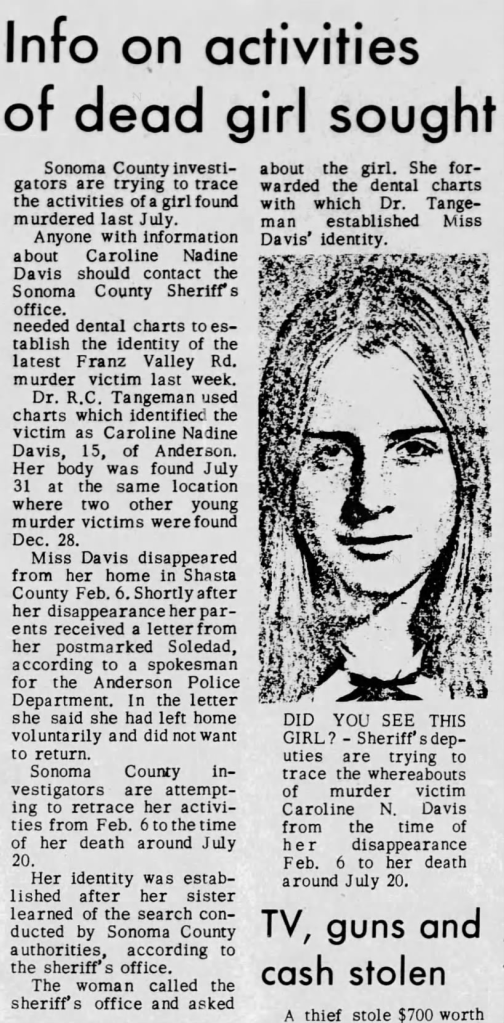
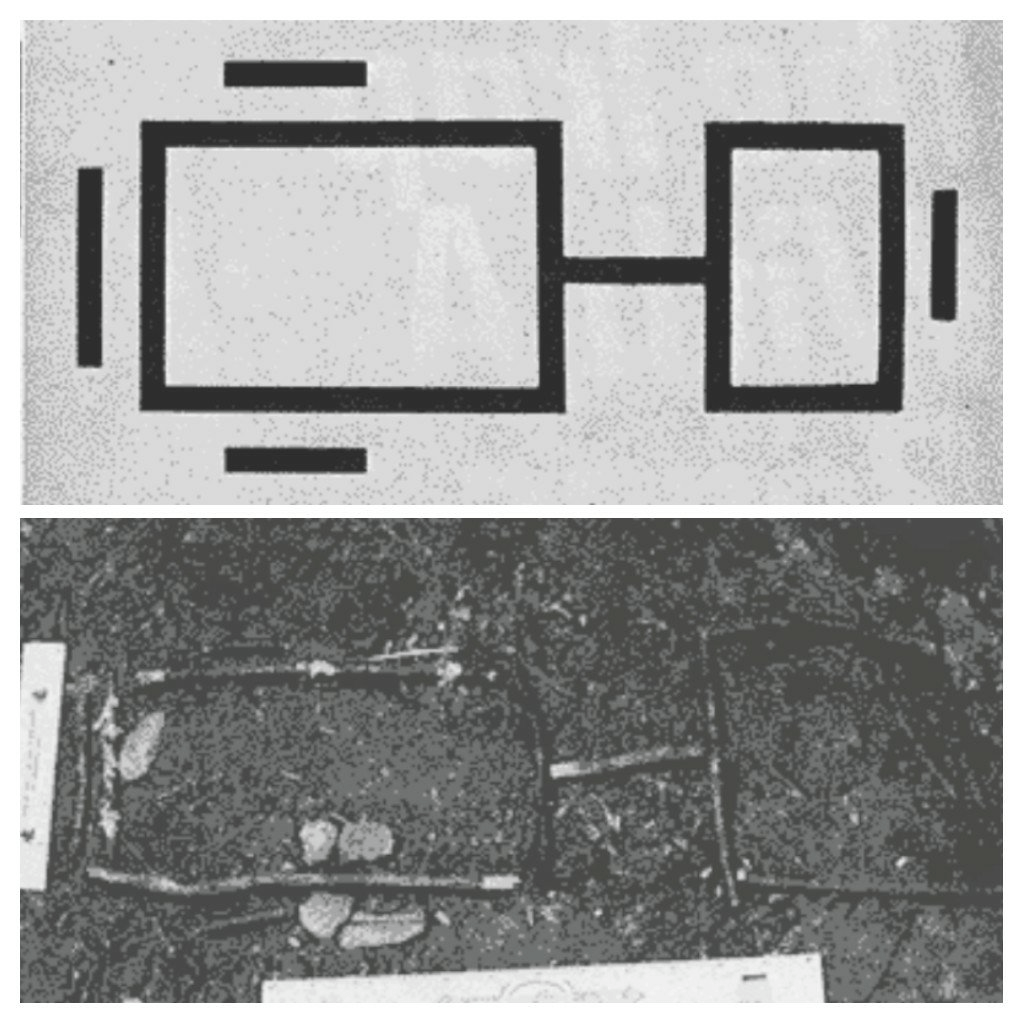
The ME determined that Carolyn’s probable date of death was July 20, 1973, five days after her grandmother had last seen her. It could not be determined if she had been raped, and her autopsy reported that she had an injury to her right earlobe that seemed to be an attempted ear piercing; her left earlobe had not been pierced. Detectives strongly felt that her killer had thrown her body from the road, as the brush on the hillside seemed to be undisturbed, and one investigator said that a witchcraft symbol that meant ‘carrier of spirits’ was found close to her body. In 1975 LE shared that it was ‘a rectangle connected to a square, with bars running alongside’ made up of twigs and sticks, and was identified as an occult symbol going back to medieval England, and possibly hinted at a connection to the Zodiac Killer.
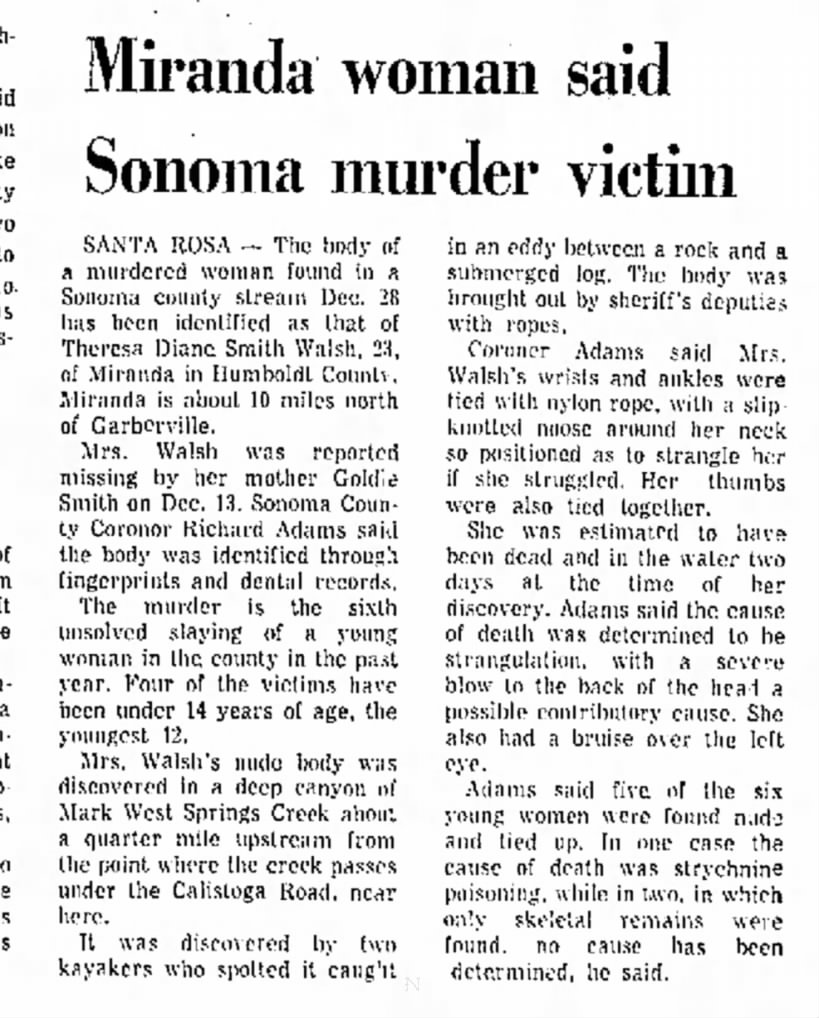
In the winter of 1973 twenty-three-year-old Theresa Diane Smith Walsh left home and hitchhiked across California, making her way to Los Angeles and often traveled using Highway 101. Back home in Miranda, her two-year-old son was in the care of her mother, and she was separated from her husband. In late 1973 Walsh was in Malibu but made plans to go to Garberville for Christmas. She tried to arrange a ride home and even reached out to a group known as ‘Hitchhiker’s Anonymous’ for help but had no luck. At around 9 AM on December 22, 1973 Walsh said goodbye to her friends, who dropped her off near Zuma Beach; she was last seen wearing bell bottoms, a lavender blouse, a faux-fur brown coat, brown hiking boots, and an olive-green Boy Scout knapsack. Her remains were discovered partially submerged underwater six days later by kayakers in Mark West Creek; she had been hogtied with rope, raped, and strangled to death. It was later determined that she had been dead for roughly one week before she had been found, and a combination of high water and heavy rains suggest that she may have floated several miles down the river from where her attacker initially left her.
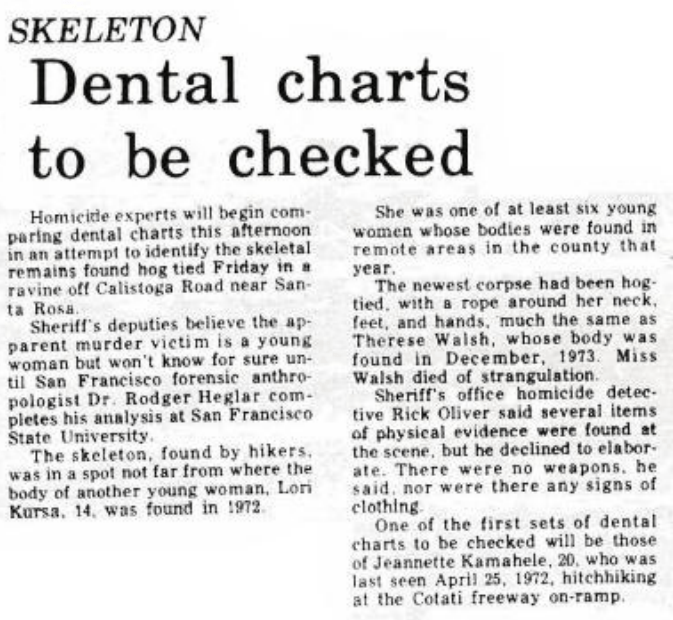
On July 2, 1979 the skeletal remains of a young woman were found in a ravine off Calistoga Road, roughly 100 yards away from where the remains of Lori Kursa were found seven years prior. Due to the advanced level of decomp, at first forensic experts believed that the victim may have been Jeannette Kamahele until dental records later proved this to be false. The young woman had been hogtied, and her arm had been fractured during the struggle at the time of her death; her body had been stuffed into a bag of some sort (maybe a duffel bag) before it was dumped in the ravine. Sonoma County Sheriff’s deputy Rick Oliver said that several pieces of evidence were found near the scene, but didn’t elaborate further.
It was determined that the young woman was between sixteen and twenty-one-years-old, wore hard contact lenses (that she kept in a metal container with cherries on it), had red/auburn/brown hair, was about 5’3”, and had broken a rib at one point in her life. Her weight and eye color could not be determined and no clothes were found at the crime scene. One medical expert hired by the sheriff’s department determined that at the time of her death the victim was roughly nineteen years old and was most likely killed sometime between 1972 and 1973. It’s also worth noting that hard contacts weren’t typically sold in the US and Canada after the mid-1970’s as soft contact lenses had become available.
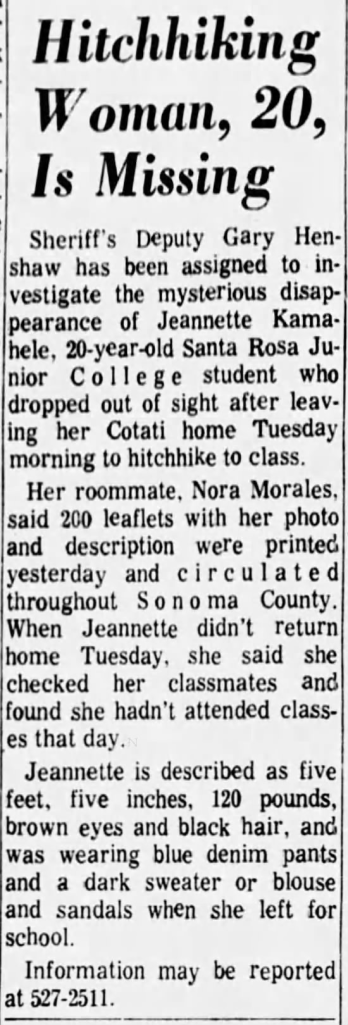
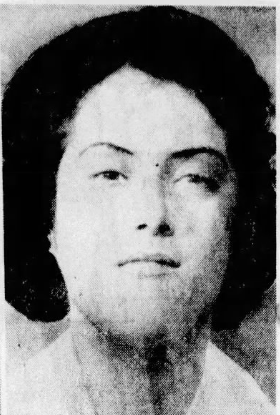
* I have seen the next young woman listed as both a confirmed and unconfirmed Santa Rosa Hitchhiker victim: Twenty-year-old Santa Rosa Junior College student Jeannette Kamahele was last seen by her roommate on April 25, 1972 at around 9:30 PM, and had plans to hitchhike near the Cotati on-ramp of Highway 101. A friend may have (possibly) seen her abduction, and told investigators that she had seen Kamahele get into a faded brown Chevy pickup that had been fitted with a homemade wooden camper in the back and was being driven by a twenty to thirty-year-old white man with an afro-styles hairdo. Jeannette stood at 5’5” tall and weighed 120 pounds; she was of Pacific Island descent and had black hair, brown eyes, and had a large birthmark directly underneath her right breast. She was last seen wearing a dark brown short, Levi’s jeans, and gold-post style earrings.
Born on February 10th, 1952 Jeannette Kamahele spent her formative years in Japan thanks to her dads naval career, and attended Yokohama American High School, which was designated for American children of military service members stationed overseas. After she graduated from high school, Jeannette decided to move stateside, and decided to enroll at Santa Rosa Junior College and moved to Cotati, where she lived along the 900 block of Sierra Avenue with her roommate, Nora Morales. Because she didn’t have a car of her own Jeannette often hitchhiked to get around, and would often catch a ride to class by walking along the nearby Highway 101 on-ramp. No trace of Kamahele has ever been recovered.
Unconfirmed Victims: Seventeen year old Lisa Michele Smith was last seen hitchhiking just a short distance away from her foster home, located along Hearn Avenue in Santa Rosa. Her foster parents reported her as missing from Petaluma, California on March 16, 1971 and shortly after a young woman with the name of ‘Lisa Smith’ went into Novato General Hospital after an incident she had while hitchhiking on March 26, 1971. Smith told investigators that she was picked up by a man that pulled a gun on her and threatened to rape her but she was able to escape by jumping out of the pickup, which was going 55 miles per hour at the time. The young victim was treated for a skull fracture as well as multiple cuts and bruises by physicians, and a nurse at the facility said that she looked to be about twenty-one-years-old. At the time, she was wearing a white blouse with ruffles, a dark pea coat, green bell-bottom jeans, and cowboy boots.
In an article published in The Santa Rosa Press Democrat on April 1, 1971, the ‘Lisa Smith’ that was treated at Novato General Hospital was the same person as the missing 17-year-old Lisa Smith. The young woman that is believed to have been Smith left the hospital before detectives could speak with her, and she reportedly hitchhiked her way back to San Francisco. Her biological parents eventually caught up with her and took her back to their residence in Livermore, California.
In 2011 The Press Democrat reported that the two Lisa Smiths were not the same, and she was not actually found. As of March 2025 it’s still not certain if the two Lisa Smiths were the same person or two separate individuals, and all of the police reports and medical records pertaining to the case were deemed to be missing by 2011.
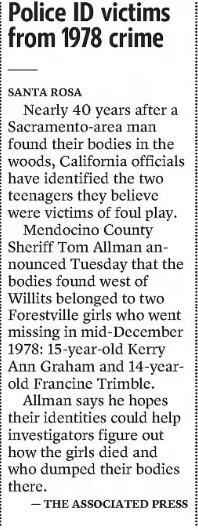
Fifteen-year-old Kerry Ann Graham and fourteen-year-old Francine Marie Trimble of Forestville, California both disappeared on December 16, 1978 after leaving their respective homes to visit a shopping mall in Santa Rosa. Their remains were found wrapped in duct-taped garbage bags that were buried in an embankment of a heavily overgrown wooded area beside a remote part of Highway 20 the following July, roughly 80 miles north of their hometown. Because of the advanced level of decomp, their exact cause of death has never been determined. At first Graham’s remains were mistakenly ID’d as a male, until genetic testing proved otherwise. Both victims remained unknown until November 2015, when their identities were confirmed thanks to DNA profiling.
In 1975, the FBI issued a report stating that fourteen unsolved homicides that took place between 1972 and 1974 were committed by the same perpetrator, which consisted of six of the known SRHM victims as well as the following young women:
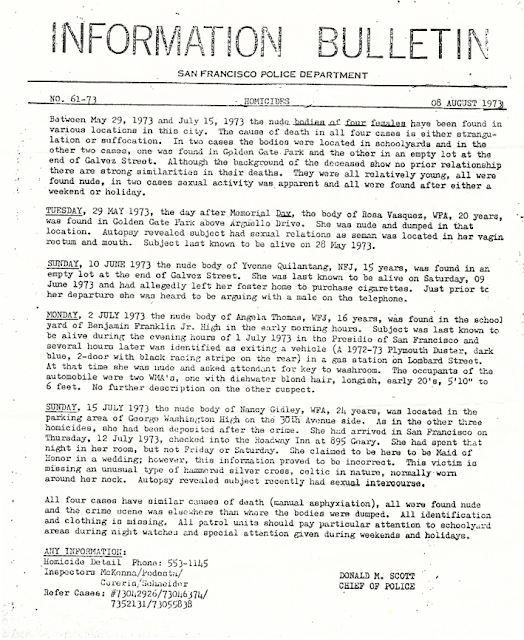
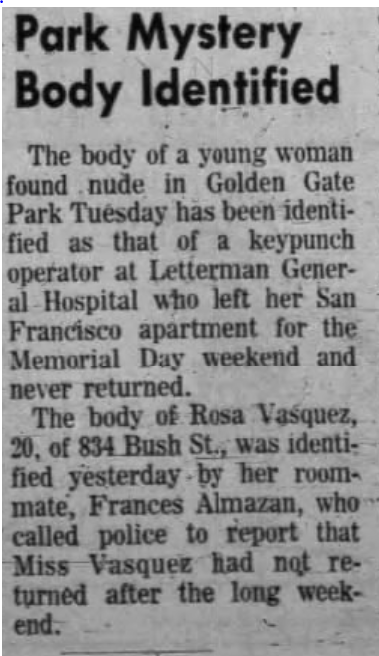
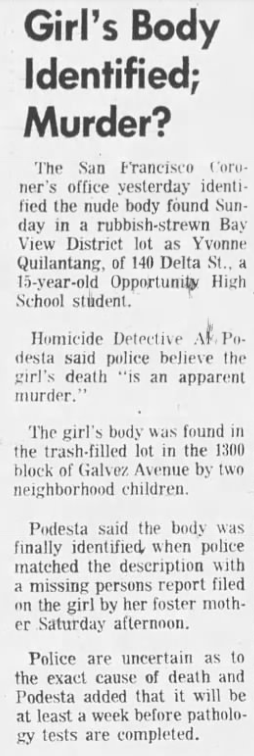
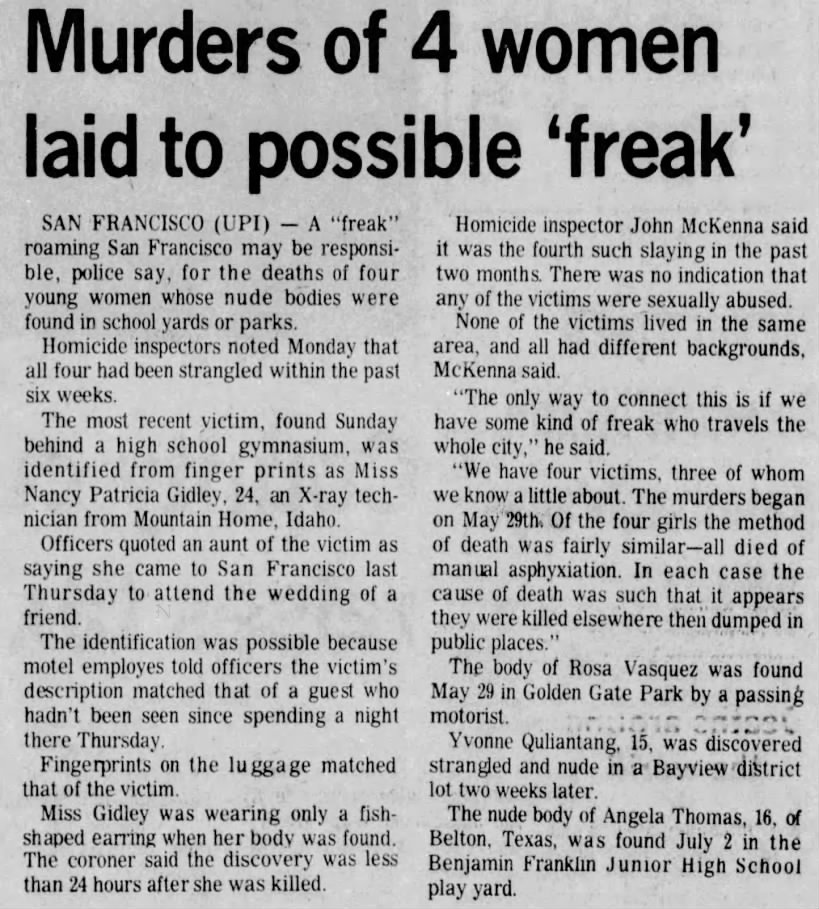
Twenty-year-old Rosa Vasquez was last seen May 26, 1973, and her body was found three days later on May 29 near the Arguello Boulevard entrance at Golden Gate Park in San Francisco; she had been strangled and her remains had been thrown seven feet off the road into some shrubbery. On June 10, 1973 fifteen-year-old Yvonne Quilantang was found strangled in a vacant Bayview district lot; she had been seven months pregnant and was out and about in the community buying groceries.
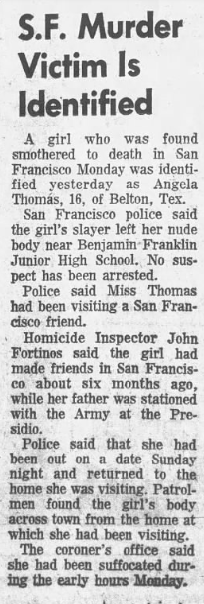
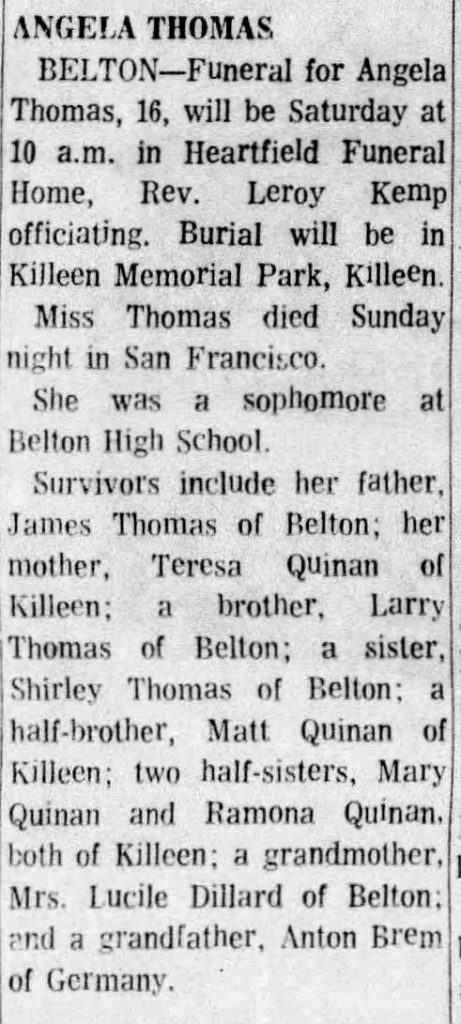
Angela Thomas was found July 2, 1973, smothered to death on the playground of Benjamin Franklin Junior High School in Daly City. The sixteen-year-old was a resident of Belton, Texas and was last seen at 9:00 PM the previous evening walking away from the Presidio in San Francisco; a locket was discovered near the crime scene. Nancy Patricia Gidley was last seen at a Rodeway Inn motel on July 12, 1973, and her remains were found three days later behind the George Washington High School gymnasium. The 24-year-old radiographer had been strangled and was completely nude, except for a single fish-shaped gold earring. It was eventually determined that she died within the previous 24 hours. Gidley had served in the US Air Force for four years prior to her murder, and told friends and family members that she had plans of becoming a freelance writer for the San Francisco Chronicle and was going to San Francisco to be the maid of honour at the wedding of a friend from Hamilton Air Force Base. After some investigating, this was all proved to be false.
Twenty-three-year-old* separated mother of five Nancy Feusi disappeared after going dancing at a club called The Plumbers Hall in the eastern part of Sacramento, and her nearly naked remains were recovered fifteen miles away by a fisherman at 6:30 AM on July 22, 1973, alongside Pleasant Grove Road and Steelhead Creek in Redding; her clothes were recovered nearby, and she had been stabbed twenty-nine times, mostly in the stomach, chest, and arm. She was last seen alive roughly two miles away from the night club, only three and a half hours before her remains were discovered. Detectives found shoe prints and tire tracks close to where Nancy’s remains were found, which opened up the possibility she was possibly killed in another location and was brought to the scene where she was found.
In 2011, one of her daughters, Angela Darlene Feusi-McAnulty was accused of torturing, beating, and starving to death her 15-year-old daughter Jeanette Marie Maples. After she was convicted, McAnulty officially became the second woman in history to be sentenced to death in the state of Oregon, the first since the 1984 reinstatement of the death penalty. *Some sources say that Nancy was twenty-two.
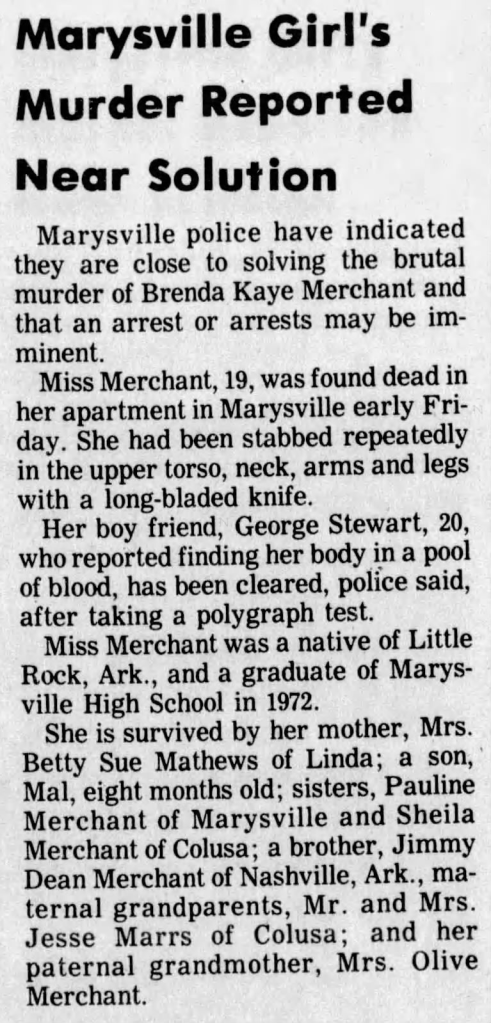
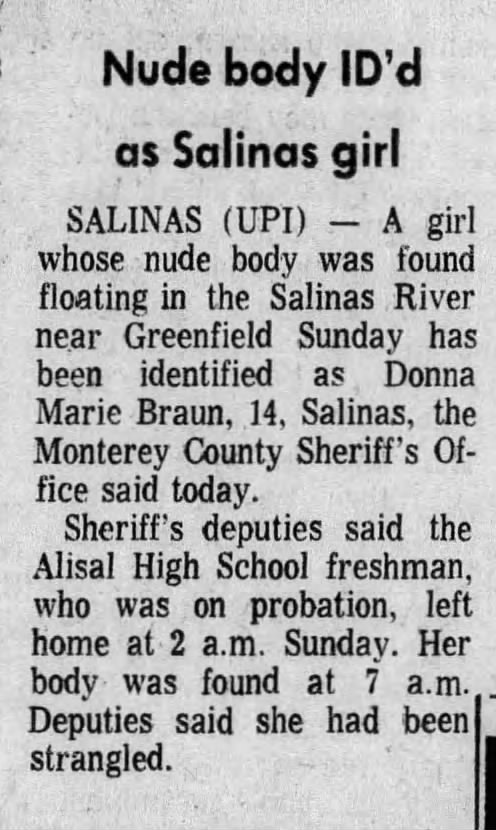
Twenty-one-year old Laura Albright O’Dell was reported missing on November 4, 1973; her remains were discovered three days later in some shrubbery behind the Stow Lake boathouse in Golden Gate Park. Her hands had been tied behind her back, and her cause of death appeared to be from head injuries and/or strangulation. On February 1, 1974 nineteen year old Brenda Kaye Merchant was found dead at her apartment in Marysville; she had been stabbed over 30 times with a long bladed knife and had asphyxiated on her own blood. Her assailant left a bloody handprint behind on the screen door of the residence, and it is believed that she was attacked between 6 PM (when she was last seen) and midnight, when neighbors happened to overhear a loud argument. Donna Maria Braun was only fourteen when her strangled remains were discovered by a crop dusting pilot at 7 PM on September 29, 1974 in the Salinas River near Monterey.
Over the years, California investigators have strongly considered the possibility that the perpetrator of the Santa Rosa hitchhiker murders was also active in Oregon, Washington, Utah, and Colorado, and additionally have looked into the possibility that there was a link to the Flat Tire Murders, which took place in Miami-Dade County in the southern part of Florida between February 1975 and January 1976. Also, in 1986 author Robert Graysmith published a list of forty-nine confirmed and possible Zodiac Killer victims, which included the Santa Rosa victims as well as some additional murders with some striking similarities, including:
Seventeen-year-old Elaine Louise Davis disappeared from family’s home in Walnut Creek, California on December 1, 1969, when she was left to watch her younger sister while her mother went to nearby Concord to pick her husband up from work. When Mr. and Mrs. David arrived home shortly after 11 PM, they found their three year old daughter alone in the residence with no trace of Elaine. At the scene there was no sign of a struggle, however investigators were immediately suspicious of foul play due to the fact that her purse and glasses were left behind. After they arrived home, her little sister told her parents, ‘they took her away, she didn’t want to go,’ and ‘there was a Volkswagen,’ the latter part was corroborated by neighbors. The young woman’s coat was found two days later on the side of the road along Highway 17 near Santa Cruz.
On December 19, 1969 the remains of Elaine Davis were discovered floating near Lighthouse Point near Santa Cruz, however a positive ID was not made until 2001. An initial examination determined that the victim was in her early twenties, which led investigators to dismiss her as a potential match. Her cause of death is undetermined, however medical experts leaned towards strangulation because of some damaged cartilage found in her neck. In 2000, the investigation was reopened as part of a routine review of cold cases and the following year a new examination of the remains were conducted, and the victims dental records proved that the body did belong to Elaine Davis.
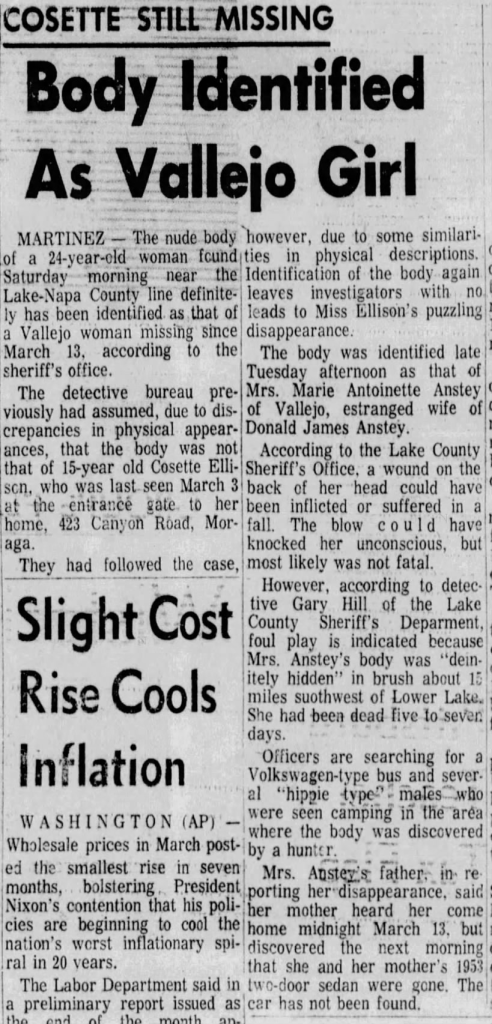
Sixteen-year-old Leona LaRell Roberts had been kidnapped from her boyfriend’s home on December 10, 1969; eighteen days later her nude body was found on the beach at Bolinas Lagoon in Marin County, and although the official cause of death was listed as ‘exposure,’ her case was treated as a homicide. Twenty-three-year-old Marie Antoinette Anste was kidnapped in Vallejo after experiencing a blow to the head, and her body was recovered in rural Lake County on March 21; an autopsy revealed that she had drowned and had traces of mescaline in her bloodstream.
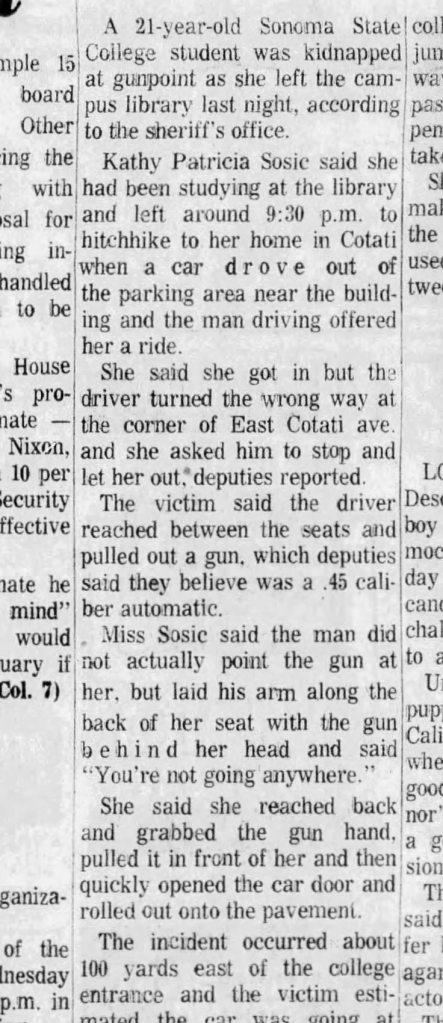
Seventeen-year-old Eva Lucienne Blau was found dumped in a roadside gully near Santa Rosa during the equinox on March 20, 1970, and the medical examiner determined that she had been hit in the head and discovered drugs in her system. Blau was last seen leaving Jack London Hall on March 12 after telling friends that she was going to go home. On the evening of December 3, 1969, twenty-one-year-old Sonoma State College student Kathy Sosic accepted a ride from a stranger outside her school’s library, and at some point during the drive the man pulled out a handgun and tried to assault her. Sosic managed to escape by jumping out of the moving vehicle, and thankfully she was not seriously injured.
Suspects: Over the years there have been quite a few men that have been investigated for the Santa Rosa Hitchhiker Murders, and the first I’m going to talk about is Ted Bundy. When these murders took place in 1972 and 1973 Ted was in an active relationship with Elizabeth Kendall (and was seeing multiple other women as well) and he graduated from the University of Washington in the spring of 1972, and began law school at the University of Puget Sound in the fall of 1973. He had quite a few jobs during this time period, and from September 1971 to May 1972 he worked one night a week at the Seattle Crisis Clinic (with Ann Rule), and between June and September 1972 he had an internship as a counselor at Harborview Mental Health Center in Seattle. From September to November 1972 he worked for Governor Dan Evans’ re-election campaign, and between November of ‘72 and April 1973 he worked at the Seattle Crime Prevention Advisory Commission, and helped draft Washington’s new hitchhiking law, and even wrote a rape‐prevention pamphlet for women. From September 1972 to January 1973 he worked with the Law & Justice Planning in Seattle, and between February to the end of April 1973 he worked for the King County Program Planning, Additionally, in September 1973 he held the title of the Assistant to the Washington State Republican chairman.
s we all know, Ted didn’t ‘officially’ become active until January 1974, when he brutally attacked and left for dead University of Washington student Karen Sparks, but it’s widely speculated that he began killing much earlier than that. Some people even believe he may have begun killing as early as fourteen with the murder of Ann Marie Burr, who was stolen out of her Tacoma residence in late August of 1961. Additionally, it’s thought Bundy killed two young stewardesses in the Queen Anne district of Seattle in 1966, as well as two young friends vacationing in the Jersey Shore in May of 1969. More realistically, he may have started killing in 1973, with the murder of a young hitchhiker in Tumwater, WA.
After Ted was captured for similar crimes in Washington/Colorado/Utah/Idaho he was suspected in the Santa Rosa hitchhiker murders as well, however according to Sonoma County law enforcement he was ruled out as a suspect in the late-1970s then again in 1989 (as his credit card receipts reveal that he was in Washington on the dates of some of the disappearances). I mean, let’s be real: he was known to drive hundreds of miles to commit a murder, and he confessed to having killed in the Golden State before (the ‘1992 TB FBI Multi agency Report’ credits him with one kill in the state). Another reason investigators feel that Ted isn’t responsible for the SRHM is that they believe that the perpetrator most likely lived in the Santa Rosa area, and may have even worked a local job, like as a mail carrier or a public utility worker that would have been familiar with the remote, rural areas where the young women were left.
In an interview with The San Francisco Gate in 2011, retired Seattle Detective Dr. Robert Keppel said of Ted: ‘one of the last times I talked to Bundy, I mentioned California, and he looked at me like, ‘I can’t talk about that right now.’ I think he believed his execution would be stayed so he could talk for years about his crimes, but the governor had other ideas… Bundy is definitely a good suspect. The killings in Santa Rosa would fit his methods, he spent time in the area, and I’m sure he started killing well before 1974… it was an open market for Bundy.’
Some similarities between the cases and Ted’s victims sticks out to members of law enforcement, as the SRHM victim profile is nearly identical to his and were all young women between fifteen and twenty-five-years-old that wore their hair long and parted down the middle. Additionally, he also made sure to dispose of remains in out-of-the-way, rural locations completely nude, and the way the assailant subdued his victims was incredibly similar to Bundy’s, as they were strangled to death, either by hand or with a household item.
Bundy also matched the description of a young, ‘bushy haired’ man that was seen near the scene of at least two of the SRHM. The first is in relation to the disappearance of Jeannette Kamahele, who was last seen getting into the truck of a man with an afro which is a type of style that Bundy wore in 1972. Additionally, it’s worth noting that Ted did own a truck in the mid 70’s, as he bought an inexpensive one to help with his move from Seattle to SLC (I believe he gave it to his brother Glenn, or he at the very least drove it). Then there’s the abduction of Lori Kursa in November of 1972, where a similarly-described man with an ‘afro-styled hairstyle’ was seen waiting in the getaway van that Kursa was shoved into (although in this situation the driver would have been only one part of a three-man operation; whereas Bundy acted alone).
After his first arrest while investigators were looking into his background, they learned that Ted had been in California on several occasions in the late 1960’s/early 1970s, proving that he did have some ties to the area: in 1968 he attended Stanford University and in 1973 he visited Sonoma County while working on a political campaign for the Republican party. He had also driven through the region on numerous occasions between 1968 and 1974 while visiting with his one-time love Diane Edwards, who had lived in Palo Alto and San Francisco.
However, despite his (weak) ties to California, Bundy was not linked to any of the victims from the Santa Rosa Hitchhiker Murders, and investigators would later find evidence that placed him in Washington either right before or after several of the murders. In a January 1976 issue of ‘The Vallejo Times Herald,’ Sonoma County Sergeant Butch Carlstedt said: ‘I tried to tie Bundy to our cases but we found credit card receipts that put him in Seattle at the time of the murders here… He’s definitely cleared as far as we’re concerned.’ However, years later detectives in Sonoma County learned that this was anything but true, as on a few occasions there were two-day periods in between many of his gas receipts that supposedly placed him in Washington, which allowed Bundy upwards of two days to make the drive to California then back home to Seattle.
In 2011, authorities uploaded a sample of Bundy’s DNA into the FBI’s Combined DNA Index System (CODIS) in the hopes of matching to any victims that haven’t been tied to him yet. When speaking to ‘The San Francisco Gate’ in 2011, Sonoma County Lieutenant Steve Brown commented that: ‘the feeling was that one person committed the killings, and Bundy was looked at. But I always thought it must have been a utility worker or a postal worker, someone familiar with the area.’
Another suspect of the SRHM is The Zodiac, thanks to the timing of the murders as well as the general location of where they took place. Additionally, the killer was known to correspond in code using symbols and ciphers, and located on Kim Allen’s missing soy sauce barrel was some chinese characters. Also, there was a crudely constructed symbol made out of twigs close to Carolyn Davis’ remains that looked like it could have been constructed by the Zodiac. Investigators reportedly ruled out the killer as a suspect because the SRHM seem to have a sexual component to them, where the Zodiac murders did not and the killer progressing from homicides involving a knife/gun to brutal slayings involving rape would be a huge shift.
Zodiac suspect Arthur Leigh Allen of Vallejo owned a mobile home at Sunset Trailer Park in Santa Rosa at the time of the murders. In 1968 he had been let go from his job at The Valley Springs Elementary School for suspected child molestation, and in 1972-73 he was a full-time student at Sonoma State University. Allen was arrested by the Sonoma County Sheriff’s Office on September 27, 1974, and was charged with child molestation in an unrelated case involving a young boy. He pleaded guilty on March 14, 1975 and was imprisoned at Atascadero State Hospital until late 1977. In his book ‘Zodiac Unmasked’ true crime writer Robert Graysmith said that a Sonoma County sheriff said that chipmunk hairs were found on all of the Santa Rosa Hitchhiker victims, and that Allen had been collecting and studying the same species of the animal.
Forty-one year old US Army veteran Fredric Manalli was a writing instructor at Santa Rosa Junior College and San Quentin Prison, and after he was killed in a head-on collision after his van veered into oncoming traffic on Highway 12 on August 24, 1976 he was a suspect in the SAHM; at the time of the accident he had no illicit drugs or alcohol in his system, but was taking medication for epileptic seizures. After his death police found sadomasochistic drawings in his van, and amongst his artwork were pieces showcasing Kim Allen, who was one of his former students as well as additional works involving two other young women and himself in a sexual manner. It’s also heavily speculated that he had one of Allen’s backpacks in his possession.
According to Robert Graysmith, ‘when the teacher’s widow was cataloging his property, she came across drawings of people being whipped. The sketches suggested the husband had been involved in S&M. The instructor had drawn himself as a woman and labeled it with the female version of his own name. Chief Wayne Dunham felt the deceased man might have something to do with Kim Wendy Allen’s death.’ In Graysmith’s book ‘Zodiac UnMasked,’ Sergeant Steve Brown said ‘I’ve actually got a photocopy of two of the drawings that they found. He drew Kim and he drew himself as ‘Freda.’ He drew the other girl and those two girls had classes with him. They tested it, but it wasn’t Kim. He probably taught Kim, and when she shows up dead, he became really obsessed with her. A weird dude.’
In 2024 HBO Max created a documentary titled, ‘The Truth About Jim,’ which explored the idea that a high school vocational agriculture teacher and part-time landscape designer named Jim Mordecai might have been responsible for the SRHM. Mordecai was born August 27, 1941 in Santa Rosa, and as early as 1953 his name started appearing in local papers thanks to his skill in basketball and football. He died of cancer in 2008 and his family had an isolated ranch in Sonoma County near Santa Rosa, where he spent a lot of time in the early-1970’s. He had no known criminal record and after his death family members found a box of mismatched jewelry among his belongings, which belonged to no one in the family. One item, a hoop earring with orange beads attached, matched the description of a piece of jewelry that was worn by one of the SRHM victims…but his family threw out the evidence and didn’t hold onto anything. A DNA profile of Mordecai was turned over to the Sonoma County Sheriff’s Department in August 2022.
Philip Joseph Hughes Jr. resided in Pleasanton, CA and was convicted of three murders in Contra Costa County in the early-to-mid 1970’s: in November 1972 he stabbed nineteen-year-old Maureen Field to death after she disappeared after her shift at KMart was over. Two days after she was last seen, her family got a phone call from an unidentified male caller, who said: ‘I’m calling about your daughter. She is dead. I killed her,’ then hung up. Her badly decomposed remains were discovered on February 15, 1973 on Morgan Territory Road. Just over a year after her death on January 26, 1974 fifteen-year old Skyline High School sophomore Lisa Berry disappeared while hitchhiking. It was later determined that Hughes (along with his wife and accomplice Suzanne Perrin) kidnapped Berry at knife point after picking her up near her home then took her to a basement in Oakland, where they sexually assaulted her then stabbed her to death. They then wrapped her remains in a bed sheet then dumped her in a shallow grave in a desolate area in Contra Costa County; she was found five years later in Moraga.
On March 19, 1975, Hughes and Perrin abducted then strangled, raped, and beat (with a hammer) twenty-five-year-old Letitia Fagot. Her nude remains were discovered in her Walnut Creek home after coworkers called on a welfare check when she never showed up for her shift; she had experienced blunt force trauma to the head. Hughes managed to fly under the radar until July 1979 when a friend of his then wife went to police and confessed on her behalf (this supposedly was due to Perrin’s intense fear of her husband). The day after the call to law enforcement was made, Suzanne met up with a Contra County Sergeant at a local restaurant and gave him information about her husband and the murder of Lisa Beery, and on July 13, 1979, detectives got a search warrant for their home. Because Hughes victims were stabbed it’s a deterrent to him being responsible for the SRHM and he is currently serving life imprisonment at California Correctional Institution.
Another serial killer Joseph Naso was investigated for the SRHM: known as ‘The Double Initial Killer,’ Naso was born on January 7, 1934 in Rochester, NY and after serving in the US Air Force in the 1950’s he met his first wife, who he lived with in San Francisco. Together for eighteen years when they separated, Naso continued visiting her and the two had a child together that eventually developed schizophrenia, and he spent a good part of his life caring for him. Nicknamed ‘Crazy Joe’ for his unusual behavior, Naso took classes in a few different colleges in the general San Francisco area in the 1970’s, and in the 80’s resided in the Mission District of San Francisco, then in Piedmont and Sacramento; in 2004 he relocated to Reno, Nevada and worked as a freelance photographer. He also had a long history of lower-level crimes, like shoplifting, which he committed up to his arrest in his mid-seventies.
Nevada law enforcement arrested Naso in April 2010, and while searching his residence discovered a diary where he listed ten unnamed women along with some correlating geographical locations. The journal proved that he stalked and sexually assaulted his victims then photographed them in suggestive poses next to mannequin parts. He was charged with the murders of four sex workers on April 11, 2011 and was later charged with the murders of two additional victims. On August 20, 2013, Naso was given a guilty verdict by a Marin County jury and on November 22, 2013, a judge sentenced him to death.
Another name that came up in my research a few times in relation to the SRHM was Robert Kibbe, or the I-5 Strangler, who was known to target young, vulnerable hitchhikers in the later part of the 1970’s. Kibbe was first arrested for assault and battery in 1987, after he tried to handcuff a sex worker named Debra Ann Guffie, who managed to fight him off and flag down a nearby police officer for help. With her testimony, Kibbe was arrested and sentenced to eight months in country lock-up, and it was at this time that LE began to piece together their case against him. He was arrested in 1988 for the murder of Darcie Frackenpohl that took place the year prior, and was convicted of first degree murder and was sentenced to 25 years to life in prison. The SRHM’s fall a bit outside of when Kibbe was active, as he didn’t begin killing until September 10, 1977 when he met twenty-one-year-old Lou Ellen Burleigh for an interview; the two met again the following morning and she was never seen again. He was also known to cut off the hair of most of his victims in order to remove the duct tape before he would abandon them, and this was never seen in the SRHM murders.
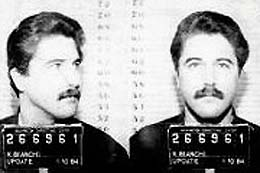
Kenneth Bianchi and his cousin Angelo Anthony Buono Jr. were also briefly investigated for the SRHM but they were both ruled out as suspects, as they weren’t active until October 1977. Known as the Hillside Stranglers, they were convicted of killing ten young women in Los Angeles between October 1977 and February 1978 (Bianchi killed two women in Washington by himself). Buono died on September 21, 2002 and Kenneth Bianchi is currently serving a life sentence in Washington State Penitentiary.
Joaquin Cordova is another possible perpetrator in the SRHM: at the time of the murders in 1972/73, Cordova was a twenty-two-year old bartender that was arrested for the rape and assault of a twenty-nine year old woman in his home. During the assault he told his victim that she was ‘different from the other girls,’ hinting at him doing this multiple times prior. He was ruled out by investigators (as he was in jail during the murders).
I would like to give credit to the ‘unresolved’ true crime website, who said the following about a man named ‘Campo de Santos: ‘outside of these big name, serial offenders, there are a couple of other small-time criminals that I discovered during my research into this case. One is a man named Campo de Santos, who operated under the alias, ‘Deyo.’ By 1975 ‘Deyo’ was spending time on New Mexico’s death row, having been convicted for a crime that was almost identical to the hitchhiking crimes. He was believed to have been in Sonoma County when at least some of the crimes were carried out, but it’s unknown what kind of connection there may be if any. Speaking to The Press Democrat, Sonoma County Sheriff’s captain Jim Caufield would state the following about the suspect: ‘he could be out man in some of these, but he won’t talk to us. It’s essentially possible they’ll send him to the gas chamber and we’ll never know if he’s the man, in fact, it’s possible out killer is dead or locked up somewhere else on other charges.’
True crime writer Gray George strongly suspected that serial killer Jackie Ray Hovarter was responsible for the Santa Rosa Hitchhiker Murders. Hovarter was a long-haul trucker that routinely drove throughout the northern part of California, and he was convicted of kidnapping, raping, and killing 16-year-old Diana Walsh from Willits, CA in August of 1984. He raped a second girl from Fortuna a few months later in December and tried to kill her by shooting her in the head, but she survived; she testified at his trial and helped put him behind bars. George feels that he could be a strong suspect in the murders of Francine Trimble and Kerry Graham.
Another name I came across in my research was an individual named Byron Avion, who was described as ‘an odd, portly man that was admittedly obsessed with the Zodiac Killer.’ He had other eccentricities as well, not the least of which was his ‘large collection of cardboard boxes, carefully stacked and tied shut with white nylon rope.’ However, the only place I came across a possible link was one source: a book titled ‘Suspect Zero,’ published on May 15, 2003 and written by Michael D Kelleher. I didn’t read the book so I didn’t learn much about this individual.
Works Cited:
Best, Joseph. ‘Jim Mordecai and the Santa Rosa Hitchhiker Murders.’ (Fenruary 29, 2024). Taken on March 8, 2025 from Medium.com
Fagan, Kevin. ‘Ted Bundy a suspect in Sonoma County cold cases.’ (July 7, 2011). Taken March 8, 2025 from sfgate.com
Hamilton, Francis. ‘Sonoma County Missing and Murdered.’ (September 11, 2019). Taken March 8, 2025 from sonomacountymissingandmurdered.wordpress.com
March, Lisa. ‘Adventurous Shasta County Teen Last Seen in Garberville: An Unsolved Cold Case.’ (May 16, 2022). Taken March 8, 2025 from kymkemp.com
Romano, Tricia. ‘The Case of the Double Initial Murders: An Odd History.’ Taken March 13, 2025 from crimelibrary.com
‘Serial Killer Database: HUGHES, Philip Joseph Jr.’ Taken March 13, 2025 from skdb.fandom.com
The Santa Rosa Hitchhiker Murders. (March 21, 2020). Taken March 8, 2025 from killerqueenspodcast.com/the-santa-rosa-hitchhiker-murders/
Unresolved. ‘The Santa Rosa Hitchhiker Murders.’ Taken March 8, 2025 from https://unresolved.me





















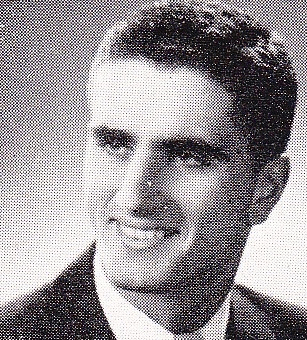









These are some audio files from interviews FBI agents (specifically Bob Keppel and Dave Reichert) did with serial killer Ted Bundy during his time on death row in the 1980’s in Florida State Prison in Raiford.

Virginia Mae Erickson was born on April 26, 1941 to Joseph and Virgie (nee Lee) in Mazama, WA. Mr. Ackley was born on February 1, 1910 in Montesano, and Virgie was born on a houseboat on June 12, 1912 in Empire, OR. The couple were wed on March 18, 1928 in Buxton, Oregon and had eight children together: Virginia, Lawrence, Maxine, Joseph, Charles, Jean, David, and a daughter named Joyce that died in childbirth.
On October 18, 1958 seventeen year old Virginia married twenty-one year old David Erickson in Montesano, WA; Erickson was born on May 31, 1937 in Tigerton, Wisconsin. After relocating to Sweet Home, OR the couple had six children together: two boys and four girls. Ginny was a petite woman, and only stood at 5’1” tall and weighed 125 pounds; she had green eyes and curly chestnut hair she wore at her shoulders. She was a devout fundamentalist Christian and dedicated stay at home mother, and played the piano during church service every Sunday morning while her daughters would sing in the choir; on occasion, David would join her and play the guitar (when he attended). Virginia was also very close to her parents who lived in Washington, and she spoke with them frequently and would usually visit every six weeks or so (give or take). Ginny’s younger sister Maxine said she ‘could not go for more than six weeks without going to see her folks and she always had the kids with her. She would not have gone that long without seeing her kids or seeing her mother.’
Virginia was last seen alive by her children in their home on 48th Avenue in Sweet Home on the morning of October 21, 1973: David woke up their oldest child Rachel and told her they’d be going to church without them that Sunday because he was taking their mother out hunting. This immediately struck her as being incredibly unusual and out of character for her mother, but she got up anyways and helped get her brothers and sisters (who ranged in age from six to thirteen years old) ready for service. Ginny and David’s sixteen year old nephew Jimmy picked the kids up that morning and took them to Sunday School, and their son David (who goes by Michael) said of the memory: ‘I just remember momma staying home, and she was crying when she was cooking something on the stove, and she gave us hugs goodbye, and she just told me she was sick. My cousin Jimmy picked all of us kids up and took us to church, and my mom never showed up at the church to play the piano, and I thought that was kind of weird, and it was my Uncle Jim and Aunt Shirley’s little church.’
Before leaving for church, Virginia pulled Rachel aside and said to her, ‘if I’m not here when you get home, you feed the kids and take care of them.’ The (then) 13 year old said that she remembers her mother was dressed in a bathrobe but the parts of her that were visible were covered in bruises and that it was almost as if she was trying to hide what was underneath; she also said that her breathing appeared to be labored and almost strained. Rachel said that she remembered her mom being afraid of her dad and that lots of other people were as well, but she also said that he was a sweet talker that could be very charming and manipulative.
When they arrived at church Rachel found her Aunt Shirley and told her about what happened at home; Shirley immediately got in her car and drove towards the Erickson residence, which was just down the street, and where she cannot say for 100% certainty Rachel strongly speculates she drove to her family’s house to see what was going on between her parents. According to a comment made by Amber Erickson on the website for the ‘Vanished’ podcast about her grandmother, when Shirley went to the Erickson home that Sunday morning David met her at the door with a gun, and threatened not only her but her children as well. When the service was over Jimmy took them home and the kids came back to an empty house, and when their father came home at around 2/2:30 PM he was by himself without Virginia.
Rachel and one of her sisters immediately asked David where their mother was, and he told them that she had simply ‘ran away.’ She was aware that her father had multiple guns, including hunting rifles and high powered pistols, and knew that day he took his .22 with him when he left the house. Later that same day Rachel was able to go back to the church to confront her aunt, and when she cornered her in the nursery Shirley slapped her across the face and said, ‘your mothers dead, don’t ever speak of her again.’
Assuming David was telling them at the very least some partial truths, the children began looking through their mothers personal belongings to see if anything was missing, but everything was left behind, even her shoes. According to Michael, ‘I remember helping Rachel look for missing stuff because I remember Mom and Dads bedspread was gone, and Rachel was screaming that ‘mom would never leave without her glasses. And why are her rings still here? Why are her clothes all still here? She didn’t even wear her shoes.’’
Almost immediately after Virginia disappeared David gave away all of her personal possessions, including her clothes, books, and jewelry, and Michael even saw her set of green and cream colored encyclopedias at his Aunt Shirley’s house (she denied they belonged to his mother). According to him, ‘a whole bunch of church people came into our house the next day, or really soon after mom left that I came home from school and a lot of church people were there taking everything. They took the washing machine, all of her books were gone, a lot of the cooking stuff was gone. Me and Eric were sleeping on the floor, the front room furniture was gone. The TV was gone. So I always thought that was kind of weird.’
According to Rachel, the day before her mother disappeared her parents were arguing about Denise, one of her twelve year old twin sisters, who the day prior had told Virginia that she was no longer menstruating. She remembers hearing her say to their father, ‘I’m bringing Denise to the doctor on Monday and everyone will know now, for sure, what kind of man you are and what you’ve done.’ In response to this, David (who was a golden glove boxer in Wisconsin) screamed at her that she ‘wouldn’t live until Monday’ if she told anybody, then slammed her against the wall and began ‘hitting and punching’ her. This wasn’t out of the ordinary for her father, and Rachel said that on multiple occasions her mother tried telling people about the abuse he inflicted upon his family, but no one had believed her. According to Michael, the Erickson home wasn’t the only place that the children were exposed to sexual abuse, and at their uncle’s church (called The Pentecostal Church of God) a Sunday School teacher named Dale also preyed on the boys; it was later found out that he was caught and served six years in prison for the sexual abuse of a minor.
Eventually the girls told family members (specifically their dads brother Albert, a Pentecostal preacher) about Denise’s pregnancy and the sexual abuse, and the police were eventually notified. Even though everyone in the Erickson family knew that Virginia was missing nobody did anything about it, and the children were gaslite and told their mom ‘ran away.’ Rachel and her brothers and sisters knew she would never run away on her own, and she certainly wouldn’t cheat on her husband and leave her children behind. According to an article published in The Albany Democrat-Herald on May 9, 1997, the sheriff’s department received an anonymous postcard on April 29, 1974 suggesting that they look into Erickson’s disappearance (Rachel later said that it was her grandfather that sent the correspondence). Former Sheriff Dave Burright said in an April 1996 interview that ‘we highly suspect she’s been killed and the husband has been a strong suspect from the very beginning.
In one of the very few newspaper articles I found about Virginia’s disappearance that was written in May 1996, The Albany Democrat-Herald interviewed Denise, who said the family briefly relocated to California after her mother disappeared. In the same interview she also admitted that she had been pregnant with her fathers baby at the time and that the child was stillborn in February 1974; in the months that followed, the family returned to Oregon.
According to The Albany Democrat-Herald, the sheriff’s department received an anonymous postcard on April 29, 1974 suggesting that they look into Erickson’s disappearance (Rachel later said that it was her grandfather that sent the correspondence). Even though he was aware that his father was a bad man, it was still scary for Michael when police came to his house to arrest him: ‘the only thing I remember is the policeman, they came and took Penny out, and she was sitting in the police car in the backseat and when we were walking past the dining room table they had dad bent over that with handcuffs on him with all three of his guns laid out, and some knives on the table. When we walked by, and they were trying to make it so that we couldn’t look, putting their hands by our faces. And then I remember going into the police car, which I thought was kind of strange because me and Eric went in one and Penny went by herself in another. I could see her crying , but we couldn’t get out to help or do anything. We all ended up at the police station, the three youngest kids were together and they were giving us snacks and talking to us and making sure we had something to do. It was terrifying trying to figure out what I was in trouble for, but they wouldn’t say nothing.’
By this time over seven months had passed since Virginia was last seen alive, and David Erickson was arrested September 1974 on three counts of first degree rape for three of his daughters (specifically ‘two thirteen year olds and a 14 year old,’ even though Rachel was only 13). After their fathers arrest the four Erickson daughters were completely removed from the area so that he couldn’t track them down before he was sentenced, an event that took place on Rachel’s fifteenth birthday: January 6, 1975. On February 8, 1975 he began his ten year sentence at The Oregon State Penitentiary; he was paroled after less than six years on November 28, 1980. According to Virginia’s granddaughter Trinity, before David went away he had a baby with a local woman that had a crush on him, but it didn’t take long before she left him. After David was sent away most of the six children were shuffled off to different foster homes (although they attempted to keep the two brothers together), although Rachel was sent to live with her maternal grandparents in Washington.
The abuse in the foster homes was so horrific that Michael ran away to his Aunt Shirley’s house, who he lived with for a period of time before becoming legally emancipated. Unfortunately his aunt was incredibly abusive to her sons, and even though she didn’t do much to him beyond yelling at him on occasion he still had a hard time accepting the kind of person she was inside of church versus inside of her home. Most of the Erickson children (and grandchildren) strongly believe that she knew what happened to Virginia, and they always hoped that some form of the truth would ‘slip out’ when they spent time together.
About his Aunt Shirley, Michael Erickson said ‘I know she was abusive. She was loud. She would scream, and she wouldn’t think twice to start swinging at anybody, or anything. But at the same time it was ‘thank you Jesus, thank you Jesus…’ It’s like I said, that she went to church and that kinda stuff, but Shirley ran us out when we were 16. She ran all of us kids out of her house because she had a lot of, not adopted but but adopted kids going through the house all the time. But I never got her to say anything about mom but she did tell her son Jimmy just a few months ago that God has forgiven her for what she’s done. So, we have no idea what else she’s talking about.’
In October 1973 when his wife disappeared David Erickson worked as a contractor with the federal government cutting logging roads in Linn County, and according to Rachel, ‘he was the guy that made all those back roads up there, up into the mountains by Sweet Home. So he had a full forest that he could have stuck her in.’ She also said she has a good feeling as to where he may have left her mother but due to the vastness of the area she would need a place to start, and was looking for ‘a place that he liked to go to.’
In April 2023 Michael’s daughter Trinity reached out to ‘The Vanishing’ podcasters Marissa Jones and Amanda Coleman and expressed interest in having her grandmother featured on the show. She said that she suspects her grandfather took Virginia to Green Peter Lake and one of two things most likely happened: he either put her body under a tree then filled in the area around it, or he cut her up with his chainsaw and then threw the pieces into the water.
At the time Virginia disappeared, Rachel was thirteen years old, followed by ten year old twins Tammy and Denise then came Michael, Eric, and Penny. She along with Michael remembers their mother as being a warm and loving person and a doting wife that adored her family and loved being a mom. According to Rachel, ‘she loved God, she loved going to church all the time. She played piano at the church, she was a very loving mom. I did have a mom that loved me and that I was so close to. I’d sit with her at the piano all the time, and I wanted her to teach me how to play the piano and right before she disappeared she was teaching me the chorus but I couldn’t really put my hands together yet. I would sit for hours with her at the piano, then after she disappeared (this may sound kind of weird to most people) but the Sunday after she disappeared, that night after I got home from Church I sat there and I cried and I said, ‘Jesus, if you’ve taken my momma away to be with you, then please put her hands in my hands so that I can play the piano.’ And ever since that day, I’ve been able to play with my hands together and play anything by ear.’
Another person that may have witnessed quite possibly Virginia’s last moments on earth was her nephew Jimmy, and although he has never spoken publicly about what happened that morning in October 1973 ‘The Vanishing’ podcasters were able to obtain some correspondence between him and another family member that helps shed some light into what he may have seen. In more recent years Jimmy said that he has gone out in the woods surrounding Sweet Home and looked in the places that he felt that David could have left his aunt, but with no success, and that he ‘has ideas, but no facts.’ He also brought up John Arthur Ackroyd, who was born and raised in Sweet Home, but looking into him he didn’t start killing until 1977 and Virginia doesn’t fit into his MO.
At the end of the email Jimmy said he had ‘given suggestions to investigators as possible locations, but because of the generalizations that I had I’m sure that nothing was ever found. I have went to look in those places too, poking around in places that my intuition sent me. But I’m not a searcher. Not even a little. I haven’t hunted in years. I used to go looking, even drew a circle around how far he could have carried her and made it back in that time frame that he was gone. It’s possibilities are a huge circle. Looked at possible gravesites where he could have put her body under another body to be buried on the following Monday. Still nothing. And there were a few in the circle.’
One theory that has recently been floated around the Erickson family is that David had the help of a neighbor and close friend of disposing of Virginia’s body, and according to Rachel in October 2023: ‘the recent thing that I heard about was this was weeks just before Covid hit, I had heard from my cousin that he heard from a friend that there was a guy, he lived right across the street from us. He was my dads friend and from what I heard from this guy that just recently told my cousin that he helped my dad get rid of my moms body, and wrapped her body around an engine block with a chain and threw it in the Green Peter Dam, in one of the deepest areas. And I’d always known something about Green Peter Dam, and the detective said that it would need to be scheduled to get approved because it was a dam. Then he said he would try to get them to go and look and stuff and then Covid hit and it shut everything completely down. And I haven’t heard anything.’
About the neighbor, Mike said ‘he was crazy, he was drinking all the time and beating his kids all the time. And I was over there one time and he had seen an elk on TV, and he shot the TV. He was in and out of prison all the time, and then dad and him were in prison at the same time. So they were pretty close.’ The Erickson children have been unable to track down the origin of the story and don’t know where it came from.
The Ericksons remember their mom trying to leave their father multiple times over the years, but she always came back. This makes sense, as it was the 1970’s and there weren’t a lot of resources available for a stay at home mom of six with no money and limited education. Mike also believed that his mother didn’t have a strong support system to fall back on, as her own father would tell her to go back to her husband after an argument and ‘figure things out.’ Most of the people in Virginia’s life felt the issues between her and David were ‘husband and wife business,’ and when a fight would occur he would say that she wanted to ‘run off with another man’ and they believed him, so when she disappeared it made it all the more easy to believe that she left willingly.
When his father was released from prison Michael decided he deserved another chance, and reached out to him in an attempt to re-establish a relationship with him, a decision he deeply regrets and that still haunts him to this day. After getting out of prison Erickson wasn’t rehabilitated, and he went on to molest multiple granddaughters and other members of the family: ‘he tried to put things back together, when dad was down at the penitentiary. I thought I could make a go at it with my dad, and then he ended up molesting my daughter Trinity. It made me feel like I failed.’ Michael always said he suspected his father was responsible for his mothers disappearance, and that he ‘asked my dad several times if he’d killed my mom, and he always said no. So I don’t know if he made her shoot herself, like the Russian roulette stuff or if he did kill her… you know, one cop told me it was a nobody homicide, that’s kind of what it went under,’ … ‘ he said they were going hunting, and they got in an argument and he let her out of the Foster store, the little store down the road in between Sweet Home and Foster, which they’re all one, so he let her out then he went hunting is what he told me. But at the same time, my dad was pretty strong but to try to deadlift her… I think he could have done it, I always thought he put her in an old pick up that he had , and drove her into Green Peter Lake up above Foster Lake. I’ve always had that feeling, but I’ve never been able to get anyone to go out there and dive and stuff like that for her. But then all of the sudden he had his brand new Land Cruiser and that pick-up was gone. It’s not like he traded it in or anything like that. But it was just gone.’ … ‘He did tell his brother Albert Erickson, ‘this time she’s not coming back.’
There are two large bodies of water in the Sweet Home area: Green Peter Lake and Foster Lake. Rachel figured out that her father could have traveled roughly forty-five miles on the morning Virginia disappeared before he would have had to turn around and be back by 2/2:30 after church, and both lakes fit into these parameters.
The day he got out of prison, Linn County Detectives questioned Erickson about Virginia’s disappearance on the first of several occasions, and just like he did with his children, he changed his story multiple times, and none of his reasoning fully explained what may have happened to her or where her body could be. On one occasion, he said his wife changed her mind about going hunting because she had a headache and he went without her, and she was gone when he returned. Another time, he claimed they had left the house together but after only making it one block away Virginia asked to go to a store to buy candy, and while inside she used the pay phone to call her boyfriend, then walked back to the house to meet him. A third story involves Ginny leaving him and their family to be with a truck driver from Madras, OR. Erickson also volunteered that he’d seen her a few months after her disappearance and she was ‘fine,’ a sighting that has never been confirmed by investigators.
Someone reported to police that they saw Virginia in Bend, OR and gave them the vehicle’s license plate. Sheriff Burright said that they ‘ran that one down and one of the people looked like her. We’re sure it was a case of mistaken identity.’ According to Burright, three things seemed to be consistent in the case: ‘that Erickson vanished on a Sunday, that she was a devout Christian and would never miss church, and she was very close with her mom and dad.
In the years before his death Denise hounded her father, asking him over and over again what happened to her mother and what he did to her, and on one occasion after telling him that she thought he was responsible for her disappearance he responded, ‘well, I don’t know what to say about that.’ David Erickson died of congestive heart failure and lung cancer at the age of 67 in Lebanon, OR on April 20, 2005, taking all of his secrets to the grave. According to his obituary, he had one more child named Angie and he loved hunting and fishing. The brief write-up also mentioned that he ‘loves his grandchildren,’ and knowing what we do know now about this disgusting creature, it just makes me sick. In 2005 when David died members of the Erickson family were so thankful that they went to his funeral just to make sure he was really gone, an event they were kicked out of. According to Rachel, there’s a few people out there that she feels may know what happened to her mother but refuse to come forward and talk.
Before her grandfathers death Trinity remembers an incident that made her lean towards him being responsible for Virginia’s disappearance: ‘I am 100% sure that he killed her. When I was around 18, I heard him talking, and I thought he was talking to someone. And I heard him.. And he was just sitting there going, ‘I had to kill her, that whore, she would have ruined my life. I had to kill her. I had to put her out. She would have ruined my life.’ And I was like, ‘what?’ and was on the other side of the wall. So I got up and I came out of my room to go to the bathroom and he was in there by himself. He had just been talking to himself.’
Virginia’s daughter Penny declined to do an interview with The Vanishing podcasters, but she did send the girls an email: ‘things I remember: I remember believing they (dad and mom) went hunting. Dad came home without mom. I know we went to church before they left. My dad has told me many different stories on why she didn’t come home. 1) He dropped her off at the end of our street. 2) he dropped her off at Glenns Market. 3) She wanted a candy bar and he dropped her off at the hilltop store. 4) She ran off with a boyfriend. Later cops confirmed she did not. 5) She left us. Those are the ones I remember. I remember one time he was abusing me, sexually, and he said he thought he heard my mom so he made me jump up and get my clothes on and go check to see if she came back. It wasn’t her, and when I came back into his bedroom he noticed in my haste that I had put my clothes on inside out and he told me that I needed to be more careful. I now just realized how cruel that was. I know he knew she was dead. He also told me once that when you bury someone without embalming them the ground does something weird, for the life of me, I can’t remember what he said though. Sorry. My earliest memories are of him manipulating me to play with him. He was mentally and sexually abusive to me. He was all those things and physically abusive to my sisters. My dad on the outside of our house was funny and loving. He would give anyone his last few dollars if they wanted it. He was a habitual liar. Oh, and also I remember one day he said we were going to go find our mom. He started to walk us up a hill near our house then suddenly changed his mind. I don’t know why he ended with that action, but either way it was cruel. I always wondered if he was going to attempt to kill us all or if he was just playing some sort of twisted mind game. I also remember him taking off all he could on the Jeep and washing it. I was the only kid home because all my siblings were in school, I think. I don’t know. Maybe they were in the house, or I wasn’t paying attention. I don’t know if they remember that or not.’
Michael Erickson also shared some horrifying stories about growing up with his father: ‘the worst thing that dad made me do with my momma was, he would tie her to the kitchen chair and then make me play Russian roulette with her. So I’d be crying and everything and he’d hold his hand up underneath my hand and point the gun at her face, and move it down to her chest, then move it down to her belly and stuff like that. But every time I pulled the trigger it would never go off. Sometimes we had to sit there for so long and it wouldn’t go off and I remember one time he put two bullets in it, this was about when I was seven, and I still wouldn’t go off, and it was a .22 revolver, and he was really mad and he grabbed my arm and told me to get outside and my momma, she was just crying for mercy, not wanting to get killed. But thank God the gun wouldn’t fire on her. Then I’d see her with a few bruises and stuff after. But I remember her standing at the sink and crying a lot. When she was at the sink cleaning dishes, I’d give her hugs on her legs.’
Rachel remembers the Russian roulette incidents and other atrocities that her father had inflicted upon her and her brothers and sisters when they were small. She said that one time ‘he wanted to have sex with me one day and I didn’t want to and I was trying to fight him and I went running outside and he kicked me through a barbed wire fence and I have a big ol’ gash on the back of my back from it. He didn’t stop just with us, he molested some of my nieces, and it was like he didnt care what age they were.’
Rachel said that her mothers disappearance split the family generationally, and most of her extended family told her to leave it in the past and to let it go. These are the same people that called David a ‘good Christian man’ that could do no wrong despite the fact that he was convicted of raping his three young daughters. She also said there are two detectives from the Linn County Sheriff’s Department that are currently working on the case, Caleb Riley and Randy Voight.
When the creators of ‘The Vanishing’ podcast asked the Linn County Sheriff’s Department for Virginia Erickson’s case file their request was denied, citing an ‘open investigation,’ and sadly this doesn’t surprise me. The Thurston County Sheriff’s Department in Washington refused to even give me the name of a victim they’re still investigating, and the murder took place in the mid-1970’s.
Despite multiple requests over the years Shirley refused to tell her nieces and nephews what she knew about the disappearance of their mother, and she took what she knew with her to the grave, as she died on December 17, 2023. But one thing is for sure: to this day the extended Erickson clan remains devoted to David, not Virginia, and smears her name every time she is brought up in favor of his. When asked why he still remains so high in the family’s favor, Michael said that he could ‘smooth talk anybody and that he helped a lot of people and things like that. He was always telling jokes, and pulling practical jokes.’
Rachel went on to lead a very successful life: she spent twenty-eight years working as a MWR Program Chief for the US Coast Guard before retiring, and is happily married with two daughters; after living in Kodiak, Alaska for many years she relocated to Woodstock, Georgia. Michael went onto get married and have two beautiful daughters of his own, Trinity and her sister.
Virginia’s father Joseph Ackley died on February 15, 1978 in Bend, and Virgie passed away at the age of 76 on February 9, 1989 in Hoquiam, WA. Her brother Charles died on September 9, 1993 in Montesano, WA, and her other brother Richard died on March 10, 2008 at the age of 80 in Casa Grande, AZ. Her twin daughters Tammy and Denise have both passed away as well after struggling with substance abuse.
As of February 2024 Virginia is considered missing under suspicious circumstances and would be 83 years old. Her children strongly believe that their father murdered her, and detectives investigating the case also suspect he was involved in her disappearance but were never able to gather enough evidence to charge him.
Works Cited:
Amanda Coleman and Marissa Jones, The Vanished Podcast, Episode 411: Virginia Erickson
Taken January 26, 2025 from thevanishedpodcast.com/episodes/2023/10/2/episode-411-virginia-erickson
Chappell, Sky. ‘Virginia Erickson, The Forgotten Sweet Home Woman.’ (October 25, 2023). Taken January 26, 2025 from sweethomenews.com/virginia-erickson-the-forgotten-sweet-home-woman/
The Charley Project: VIrginia Erickson. Taken January 26, 2025 from charleyproject.org/case/virginia-ackley-erickson


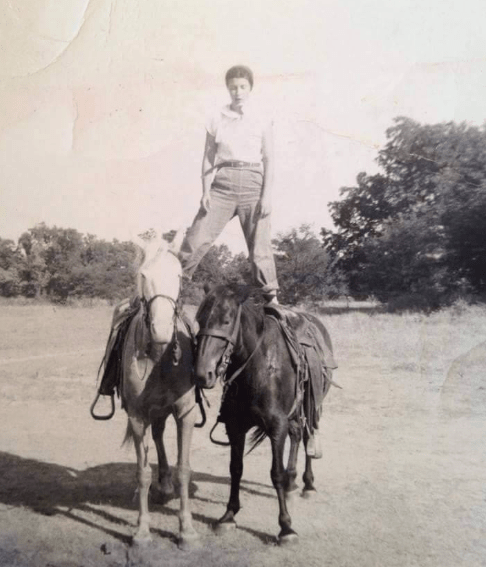






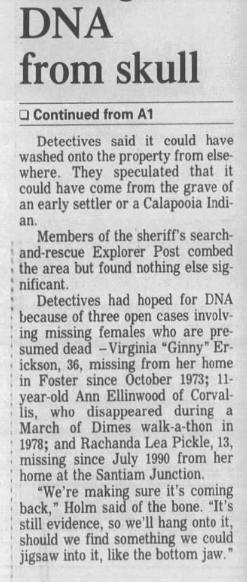


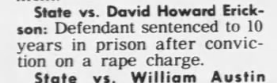

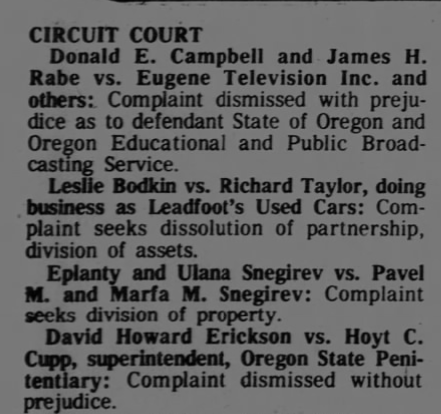

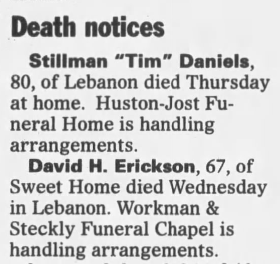
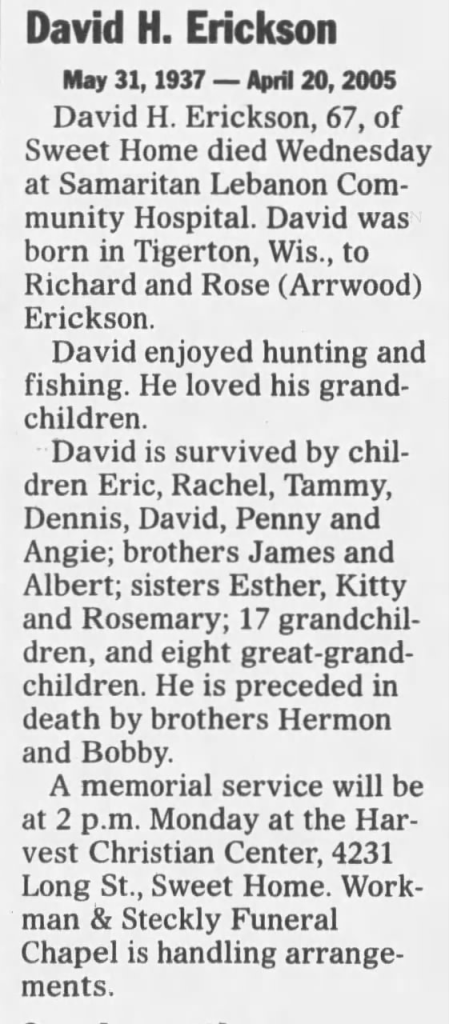
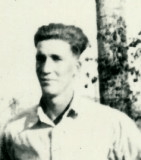
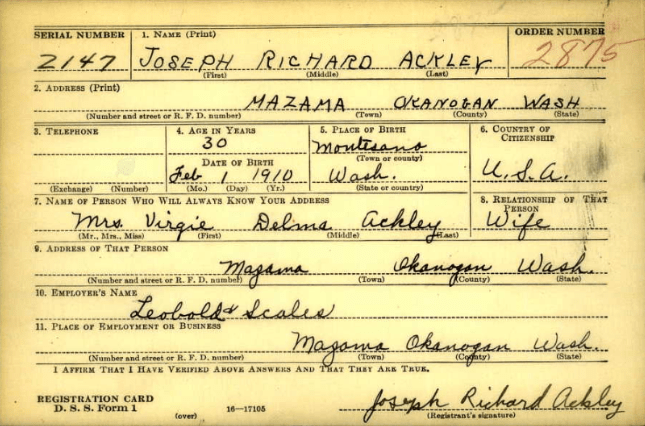
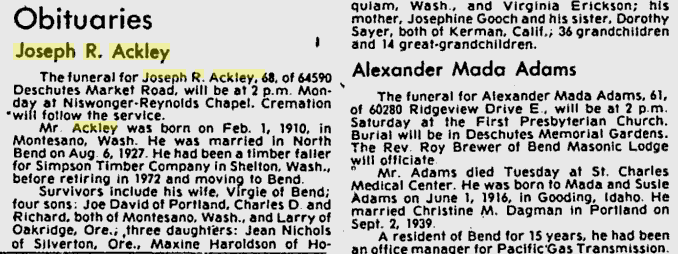
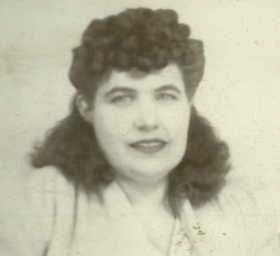
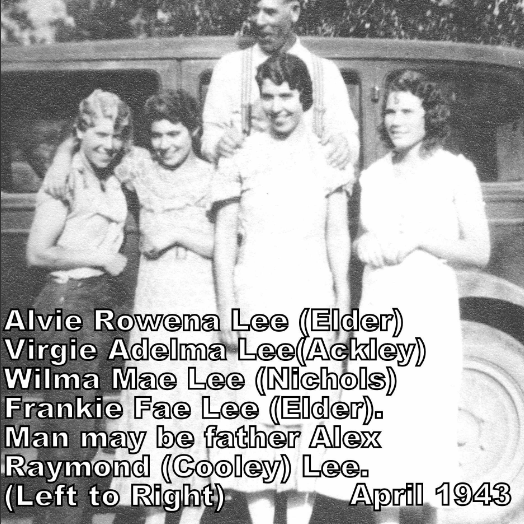
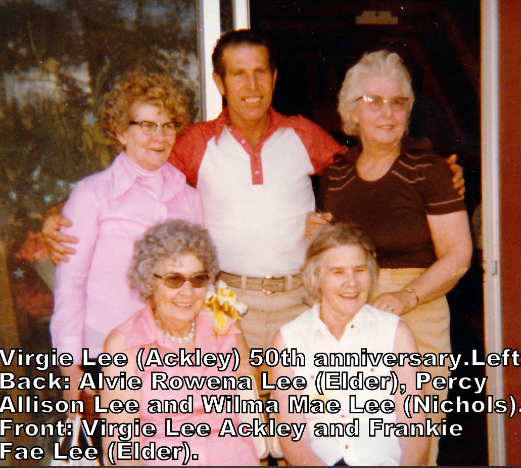



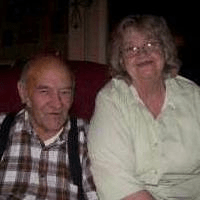
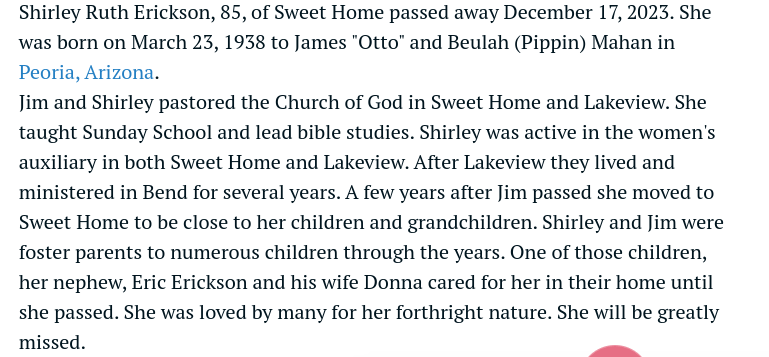

Janet Lynn Shanahan was born on August 19, 1946 to Stanley Paul and Jean Lois (nee Wyse) Karin in Spokane, WA. Janet’s father Stanley was born on September 30, 1916 and her mother Jean was born on November 2, 1924 in Illinois. The couple had two daughters together (Janet and her younger sister Jane) but eventually divorced, and it looks like Stanley was involved in some lower-level criminal activity and even served some jail time. Jean got remarried to a man named Jared Thomas, and it looks like he adopted Janet and Jane; the couple had two sons together, Jared and Timothy. Blonde haired, blue eyed Janet was an honor student, and attended Willamette High School in Eugene, Oregon. She was very active during her time there and was involved in multiple after school groups and activities, including drama club, the art guild, and the newspaper. During her senior year she was crowned prom queen and was voted ‘Girl of the Year, and according to those that knew her, Shanahan was incredibly outgoing, well-liked, and she had a lot of friends. After graduating high school in 1964 she got a part time job at a credit card company and attended the University of Oregon with the goal of one day becoming a junior high school teacher; according to her mother: ‘she was a leader, queen of this and that, and in the National Honor Society. She was very likable, very easy to get along with, and an excellent student.’
Janet married fellow OU student Christopher John Shanahan on May 24, 1968. He was born on February 19, 1946 in Washington DC and after his family relocated to Oregon he graduated from South Eugene High School in 1963. On the Shanahans marriage certificate Chris’ occupation is listed as student, and in April 1969 the couple had been married for about eleven months. In between classes and her PT job Janet was also student teaching at Cal Young Junior High School, and at the time of her murder she was in the spring semester of her sophomore year (Chris was in his junior). According to an article published in The Eugene Register Guard on January 5, 1997, Janet’s mother said that she didn’t know her new SIL very well, as they haven’t been married very long, but did say he was ‘kind of a loner’ but that as far as she could tell he seemed to be treating Janet right.’
On the evening of Monday, April 21, 1969 Janet attended a night class then briefly stopped home before leaving around 9:30 PM to attend her younger brother’s fifteenth birthday party at her parents house, about two miles away on Rutledge Street. Christopher Shanahan was reportedly sick at the time and stayed at home in bed. An article published in 1997 says that after the party at around 11:00 Janet went out for around 30-minutes with Jane (who had just recently moved home to their parents house in Eugene) to get some food at the nearby Lynwood Cafe. After the girls ate they went to a local convenience store and picked up a car magazine for her husband, then Janet dropped her sister off at their parents house when they were done. The night she was last seen alive she was wearing a rust and cold colored brocade suit.
The timeline of when Janet was reported missing is a bit unclear: an article published in April 1969 states that she was reported missing later that same evening, but according to The Statesman Journal in 1997, Chris Shanahan woke at 8 AM the following morning, ‘and discovered his wife hadn’t returned home. After she failed to report for work at 1 PM at a credit company, Shanahan reported her as missing.’
I’ve seen some sources list the day Janet was discovered as April 22 and others that say it was April 23, but if she wasn’t reported as missing until one o’clock in the afternoon after she dropped Jane off at her parents house then it’s safe to say she was recovered two days after she was last seen, roughly thirty-four hours later. On the morning of April 23, 1969, Christopher contacted his SIL asking her to accompany him in an attempt to retrace Janet’s steps from the evening she disappeared in hopes of finding her 1951 Plymouth coupe. At roughly 9:40 AM after only ten minutes of looking they noticed the sedan in a ditch in an industrial area near a lumber mill, less than two miles away from her parents house on Cross Street, at the intersection of Roosevelt Boulevard and Maple Street. Employees from the nearby lumber mill report the vehicle being there since somewhere between 1 AM and 6 AM the previous morning. The keys were missing, but Chris was still able to get the trunk open, and that’s when they found Janet’s body; she had been strangled to death.
After finding Janet’s body Chris called police using a nearby pay phone, then dropped Jane off at home, and immediately went to his attorney’s office. A passing motorist saw Chris and Janes reactions and thought there was a car accident and contacted police as well. Where he did initially cooperate with police, after the discovery Shanahan told investigating detectives that he’d been on a ‘desperate search’ for his wife, but in reality he did everyday, mundane tasks like reading for class and getting new tires on his car. The night before she was found, he had been seen out, drinking beer and shooting pool. After April 25, 1969 he never contacted police for news again on his wife’s death, and didn’t stick around for long after either, and shortly after moved across the country to Connecticut, where he still resides as of January 2025.
An employee at nearby Eugene Stud & Veneer, Inc named Earl Albert said he saw the couple walking towards the car, and after the young man ‘glanced’ in the front part of the vehicle he then opened the trunk and repeatedly screamed, ‘oh no, oh no, no’ over and over again. Police reported that the inside of her sedan was ‘neat and orderly,’ and there were no signs of a struggle. Janet’s body was fully clothed except for her shoes, which were found lying next to her, and despite there being no outward signs of sexual assault it was later determined that she was indeed violated. Upon searching the scene for clues investigators didn’t find much useful information, and Sergeant DW Carley said that to kill Shanahan her assailant most likely ‘used something flexible, such as a length of garden hose.’
Over the years detectives have interviewed hundreds of Shanahan’s friends, family members, school mates, and acquaintances, with little to no luck. Because genetic evidence was not properly stored in the 1960’s, there is no DNA sample related to Janets murder, therefore detectives are largely relying on tips from the general public to solve her case. According to cold case detective Drew Tracey, ‘we have already done a pretty thorough investigation, and we have our thoughts, but thoughts do not convict people.’
In a January 1997 article published in The Statesman Journal, Eugene Police Detective Les Rainey said investigators were looking for an unidentified man and woman that may have been with Shanahan at a cafe on the evening she disappeared sometime after she left with her sister, which alludes to Janet possibly returning after she dropped her sister off. Rainey also said that he hopes to get in contact with two friends of the Shanahans, Robbie and Marcia Robertson as well as an acquaintance of Chris’ named Freida Jessey (this is her maiden name, which is all that was released). Detective Rainey made it clear that the three individuals were not suspects and could possibly help shed some new light on what Chris’s frame of mind was like after his wife was killed.
In 1996 while on the east coast for a separate investigation a detective working the investigation tracked Chris Shanahan down in New Milford, Connecticut and tried to talk to him about his wife’s murder, and this time his demeanor had completely changed: he became angry, and combative, and refused to answer any questions, directing the detective to his attorney. About Shanahan, Rainey said ‘we have some concerns and some suspicions, but if there’s information that would clear him, we’re interested in that too.’ In a 1997 (attempted) interview with The Register-Guard, Chris Shanahan said ‘no comment, that’s my comment. Please don’t contact me again. If you do, I’ll be real upset.’ Jean Thomas said of her son in law, ‘I don’t think he could ever do that, and I told the detective that.’ According to Les Rainey, ‘my instincts, based on my experience and training, indicate it was done by someone who was close to her.’
A week after Janet’s murder a waitress that was working at a cafe along Highway 99 in Eugene came forward to LE and told them that the young newlywed had come into the restaurant sometime after 11:30 PM the night that she was killed. She was with two other women and were eventually joined by a young man, and it was never made clear if the other woman she was with was her sister. The waitress was shown a picture of Christopher Shanahan, but was unsure if it was him. A second woman came forward and told LE that she saw a woman that strongly resembled Janet Shanahan on the evening she was last seen alive. Both reports were investigated, but nothing ever came of it.
In the beginning of the investigation authorities tried to link Janet’s murder to the strangulation deaths of two other Eugene women: twenty-two year old Linda Salee on April 23, 1969 and eighteen year old Karen Sprinker on March 27, 1969, who were eventually determined to be the victims of serial killer Jerry Brudos.
Despite there being no serious suspects in relation to Janet’s murder two serial killers that were known to be active in the Oregon area around the time were investigated: Ted Bundy and Jerry Brudos. In April 1969 when the homicide took place it looks like Bundy was attending Temple University in Philadelphia, and was living with his Aunt Julia in Lafayette Hill, Pennsylvania, so that pretty much rules him out as a suspect. Jerry Brudos operated mostly out of Salem, Oregon and is responsible for four deaths that took place between January 1968 and June 3, 1969, about a month and a half after Shanahan was killed. Also known as ‘The Lust Killer’ and the ‘Shoe Fetish Slayer,’ Brudos is also known to have attempted to abduct two other young women.
There are only a few commonalities that might make one think Brudo’s could be responsible for Shanahan’s death, and they’re weak and largely circumstantial: he was active at the time and he had a shoe fetish, and she was found without her footwear on… but that’s really where it ends. The serial killer was known to dismember his victims and was known to have saved certain body parts (usually their breasts or feet ), so the fact that Janet was found in one piece leads me to believe he isn’t the one responsible for her death. Also, YouTuber ‘Steve the Amateur Historian’ pointed out that he mainly operated in the Salem area, and not Eugene. Another reason I think Brudos wasn’t responsible for Shanahan’s death is the fact that all of his murders took place either in his vehicle or in his basement/garage workshop of one of the two homes that he lived in at the time, where he wouldn’t have had enough time to kidnap Janet, drive to his residence, kill her, bask in it, then drive back to Eugene to dispose of her remains in only thirty-fours hours time.
On June 27, 1969, Brudos entered a plea of guilty to three counts of first-degree murder and was sentenced to three consecutive terms of life imprisonment with the possibility of parole served at Oregon State Penitentiary. He (unsuccessfully) appealed his conviction on multiple occasions, and died of liver cancer in 2006.
In June 2022 some family and friends of Janet that wished to remain anonymous approached investigators offering a $45,000 reward for the identification, arrest and conviction of her killer. They feel that because of how many years had passed, time is fleeting and this may be the last realistic effort to solve the case. According to Eugene Cold Case Detective Rick Gilliam, ‘the importance is, the fact this is 53 years old, and individuals out there are getting older, and the suspect may not have many more years to live. And the friends and family members would just like to resolve this case once and for all, so that’s why that reward’s out there.’
Janet’s biological father Stanley Karen died shortly after her murder at the age of 52 on June 10, 1969. Her mother Jean died on December 4, 1979 in Cook, IL, and her stepfather Jared Thomas died on May 5, 2009. Christopher Shanahan is now 78 and currently lives in New Milford, Connecticut. He never remarried and was never cleared in his wife’s murder.
Works Cited:
Bull, Brian. ‘$45,000 reward offered in Eugene murder case from 1969.’ Taken January 24, 2025 from klcc.org
Cascadia Crime & Cryptids: Episode 50: The Unsolved Murder of Janet Lynn Shanahan. Taken January 26, 2025 from cascadiacrimepod.libsyn.com/episode-50-the-unsolved-murder-of-janet-lynn-shanahan
‘Reward offered in 1969 Murder of Janet Shanahan.’ June 9, 2022. Taken January 23, 2025 from eugene.or.govo





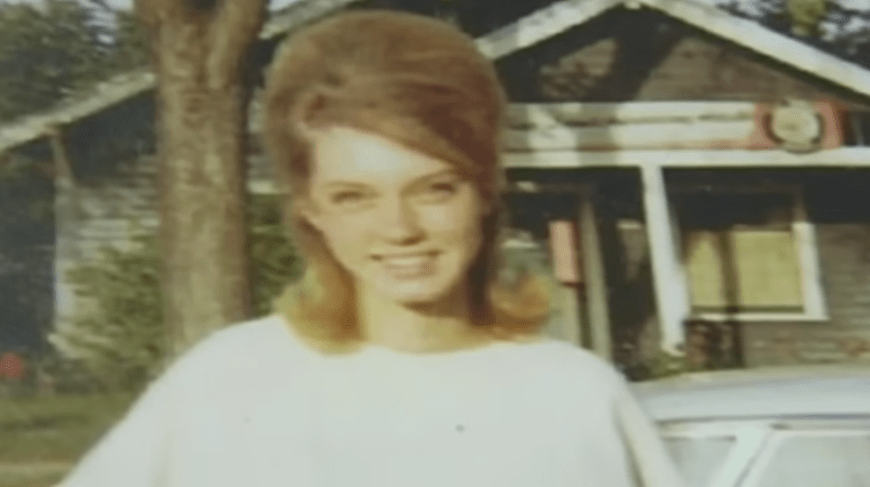




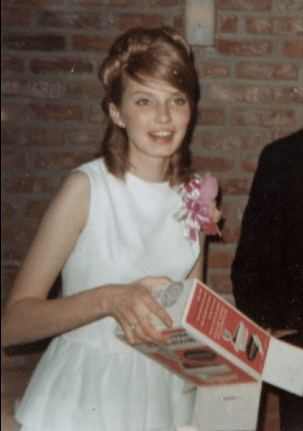


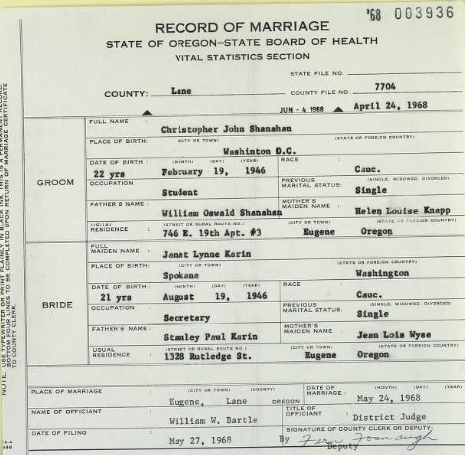


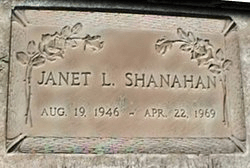
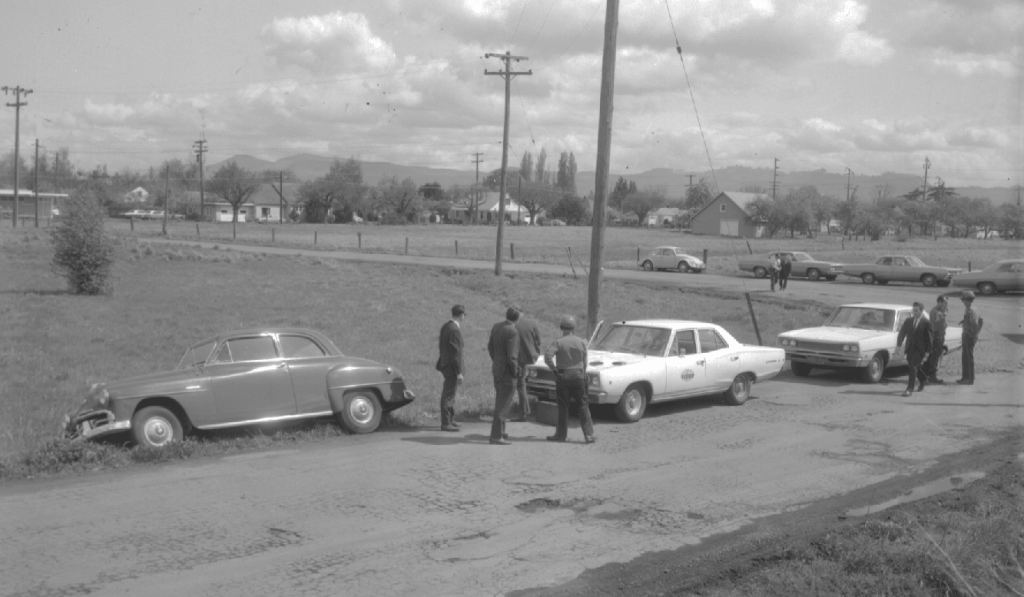


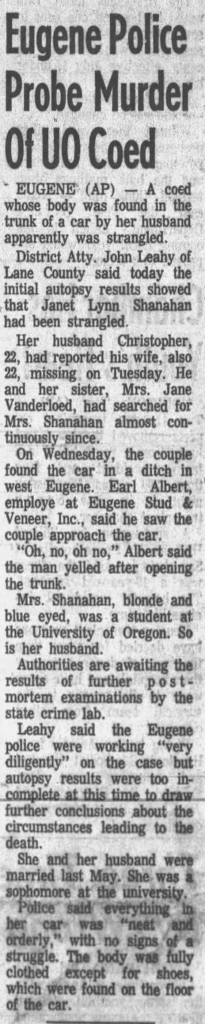

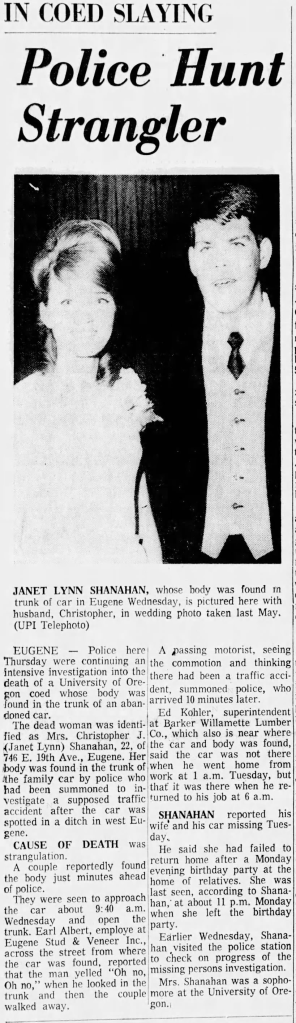


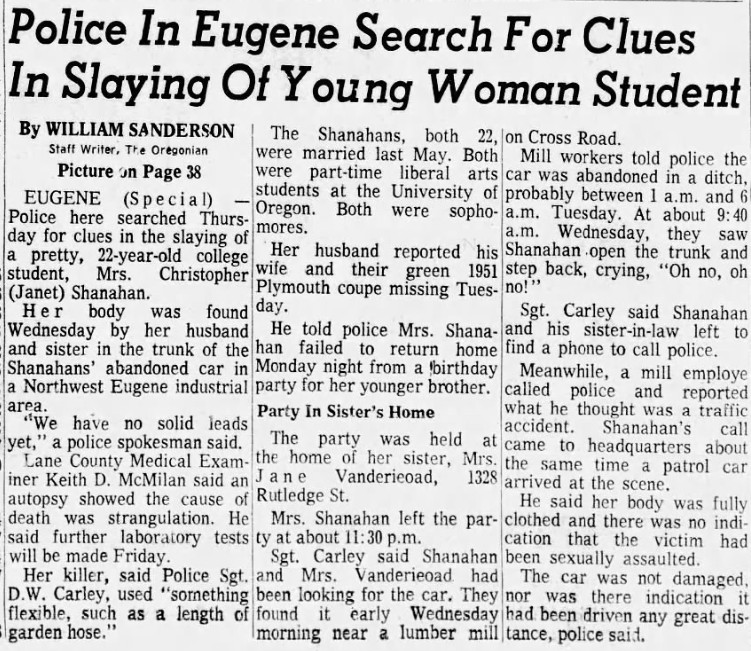


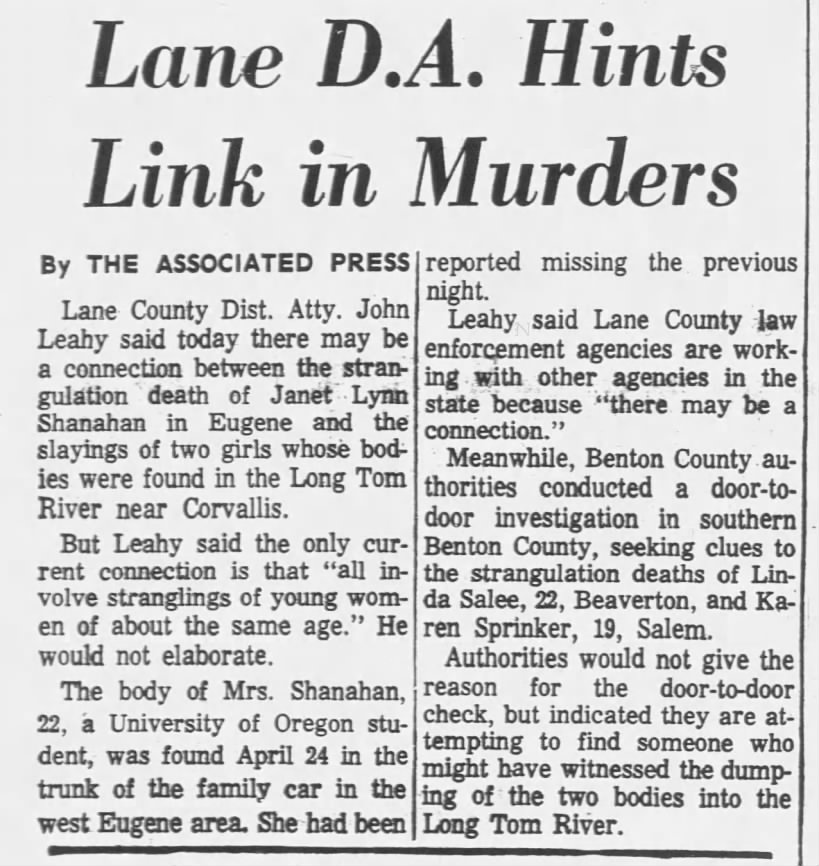



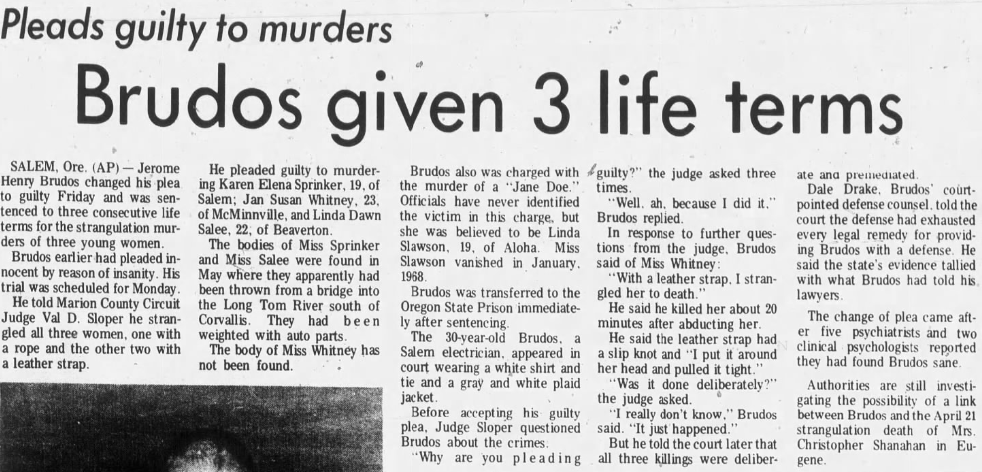
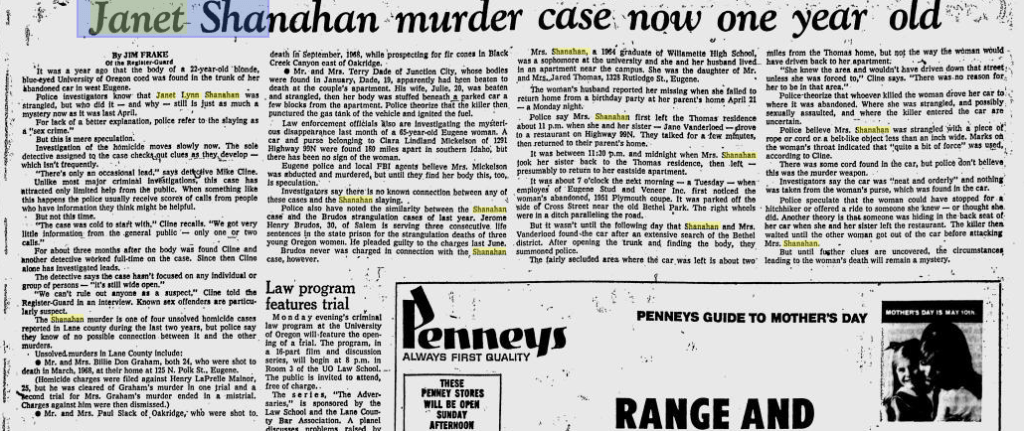
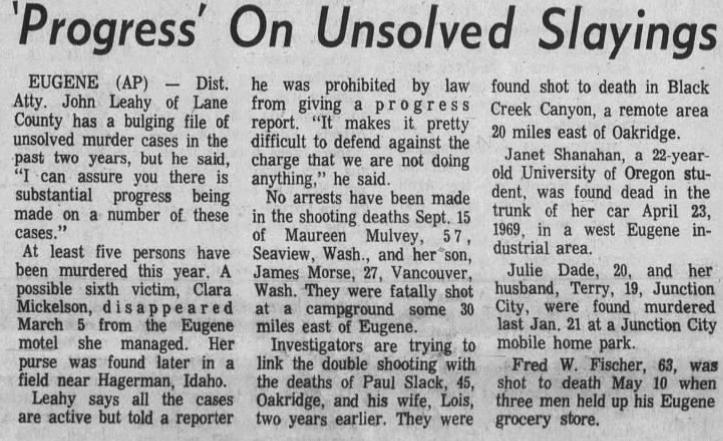


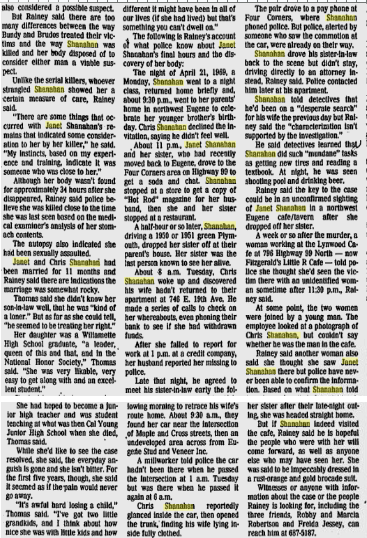

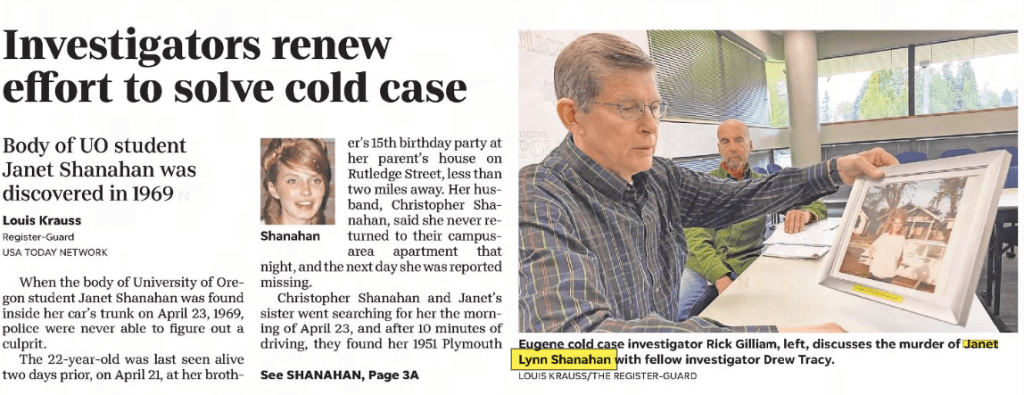
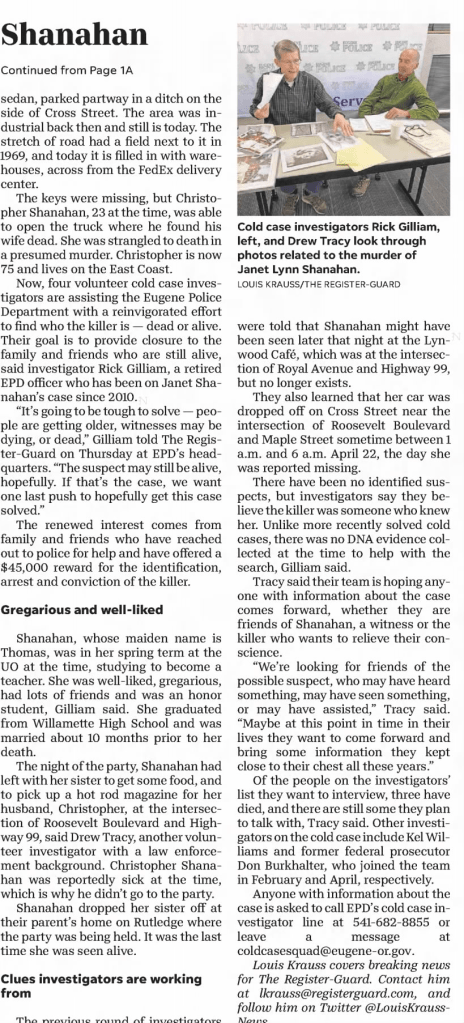




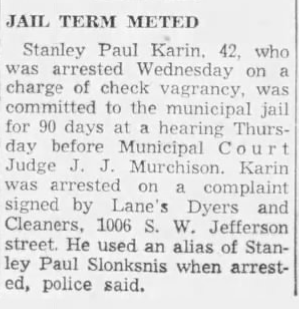
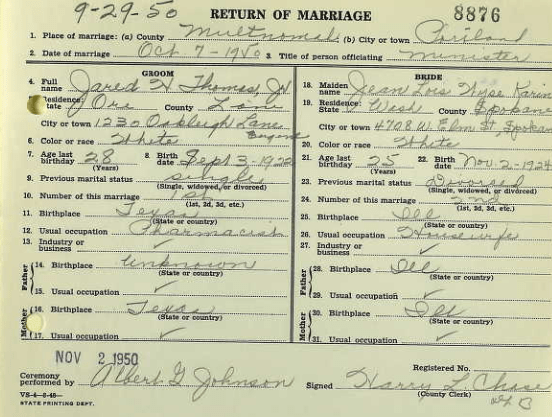



Camille Karen Covet was born on September 25, 1950 to Wilfred and Delores (nee Essley) in Portland, OR. Mr. Covert was born on March 12, 1927 in Medford and her mother was born on July 3, 1931 in Portland. The couple had three children together (Camille, William, and Adele) but divorced on July 20, 1972, and Doris got remarried to a man named Herman Crane on May 10, 1974. Camille attended Centennial High School in Gresham, and after graduating in 1968 she went on to briefly attend the University of Oregon and got a job at a nearby Sears. A tall young woman with the looks and figure of a runway model, she stood at 6’1″ and had deep chocolate brown eyes and shoulder length brunette hair.
Camille’s husband, Myron Charles Foss (who went by Chuck) was born on July 24, 1949 in Hazen, North Dakota. At some time in Chuck’s adolescence the Foss family relocated to Portland, and after graduating from Franklin High School in 1967 he went on to join the US Air Force, and was stationed in Okinawa. After Chuck returned home from Japan the couple were married on July 10, 1971 in Portland.
On October 17th, 1975, Ms. Covet-Foss was last seen alive leaving her job at Sears-Roebuck in Washington Square at 5 PM to drop off a check at the bank. The twenty-five-year-old had been employed with the department store for seven years, and had only come to that location from the main branch in Portland about three months prior to her murder (she was the stores head cashier).
Roughly an hour after Camille was last seen at 6:00 PM the bank called Sears to make sure the deposit was on its way, as they were getting ready to close. Later that same day at 9:30 PM a security guard for the Southwest Portland-area shopping center named Claudia Shaw found her body in the front seat of her light olive green 1969 Chevrolet Impala, which was parked between the main Sears store and the Sears Automotive Center, south of the shopping center’s buildings. According to an article published in The Capital Journal on October 18, 1975, despite the incident taking place in the middle of the day on a Friday Multnomah County Sheriff’s said that no shots were reported. According to Sergeant Michael O’Connell with the Washington County Sheriff, law enforcement received numerous leads and tips from the public, but no one reported anything helpful.
Oregon state ME Dr. William Brady said Covert-Foss was shot twice: a bullet grazed one of her thumbs before penetrating her neck, and the other hit her chest. The wounds were inflicted by a large-caliber handgun that was fired at close range (either a .38 or 357-magnum revolver) and Dr. Brady said she had also been beaten in the face. When the investigation was reopened in 2005, Sergeant O’Connell said ‘it’s bizarre that somebody could get away with this in a parking lot. It was busy and not completely dark. There’s a large-caliber gun that makes a lot of noise.’ Detectives said nothing appeared to be missing from the scene, including the bank deposit.
Law enforcement cleared Camille’s husband almost immediately and said that she showed no signs of being sexually assaulted. Two weeks before her murder Adele told investigators that her sister shared with her that while she was escorting an older woman to her car she chased a flasher down the stairs of the Lloyd Center parking garage, yelling and waving her umbrella at him in a successful attempt to scare him away. She told her ‘Camille, you shouldn’t do that. You don’t know what could happen,’ but she was too busy worrying about how scared the woman was to care about much else.
In August 1976 it was reported that Camille’s husband Chuck filed a wrongful death suit against Sears Roebuck and Company for $1.5 million dollars: $500,000 in general damages and one million in punitive damages, plus an additional $1,239 in burial and memorial costs to lay his wife to rest. Foss alleged that the company was negligent and exposed his wife to ‘armed and dangerous persons’ in making her take money to the bank without any form of security. I was unable to find any information about the outcome of the lawsuit.
In an article about reopening the case published by The Oregonian on October 18, 2005, Adele said of her sister: ‘in her honor, I just have to give this one last try. I’m just asking for help because her life was worth so much.’ Fifteen years later, in a November 2020 interview with KATU reporter Katherine Kisiel, Bostwick said ‘I think this person didn’t just kill my sister, it did kill my father and my mother. My father took his own life just as he turned 60, and a few years later my mother died of pancreatic cancer, which is the only cancer proven to be related to depression. I do feel like I should have been there. Nobody was there with her, and I just need to do everything I can to make sure how she died isn’t forgotten.’
Most of the women I write about from Oregon were most likely not victims of Ted Bundy, and that includes Ms. Covet-Foss… but, because this is a blog about him I do feel the need to mention that we know he wasn’t responsible for her death, as he was just beginning his legal troubles in Utah and was tied up at the time.
William Covert died on March 15, 1988 at the age of 61, and Camille’s mother died at the age of sixty on September 13, 1991. Chuck Foss died at the age of sixty on December 14, 2009 in Salem, OR. He worked for Stark Vacuum in Portland and Business Machines in Gresham before going to work for his dad at the Portland Glove Company; he later purchased the business but in 1993 he sold it due to his declining health. Mr. Foss enjoyed playing pool and music, and especially loved The Beatles. According to his obituary, he was in a long term relationship with a woman named Beverly Ball and in an article published by The Albany Democrat-Herald on October 18, 2005, he didn’t stay in touch with Camille’s family in the years after her death.