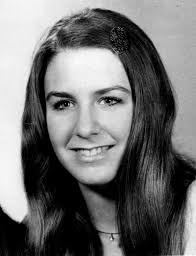
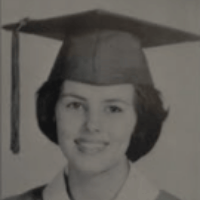
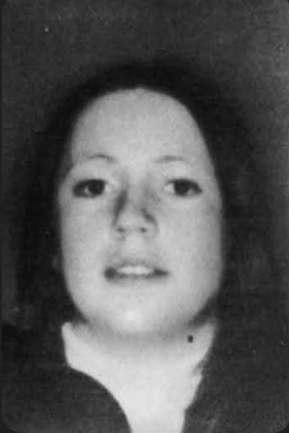
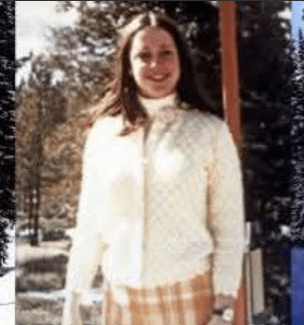
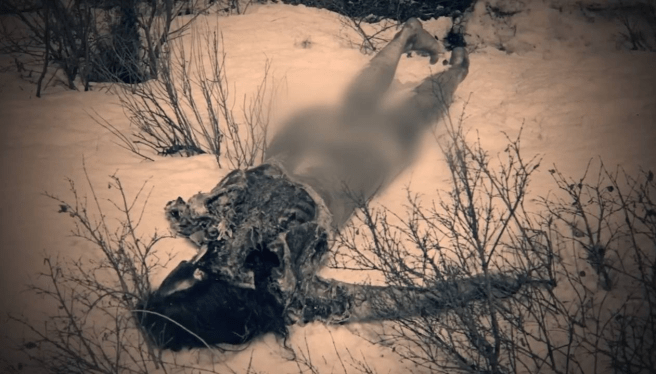
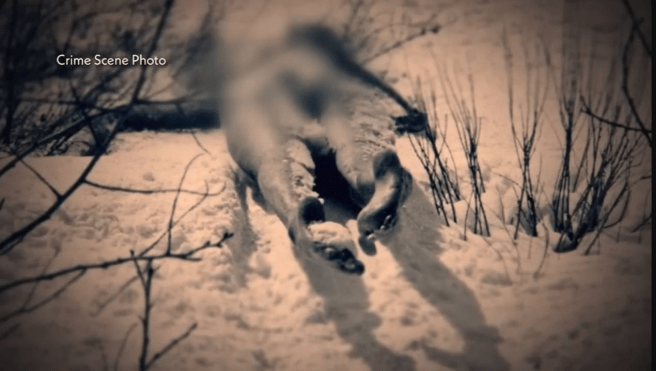
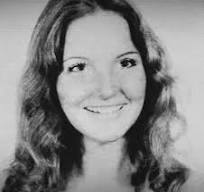
Cynthia ‘Cindy’ Lee Mellin was born on December 3, 1950 to Leonard and Ardis (nee Mauseth) Mellin in Hennepin, Minnesota. Mr. Mellin was born on November 1, 1912 in Minneapolis, Minnesota and Ardis was born on December 15, 1912 in Brooklyn Center, MN. The couple were married in 1934 and had five daughters (Paula, Cindy, Janice Mae, Judith Mae, and Maryann) and eventually settled down in Ventura, California; Mr. Mellin worked as an engineer and draftsman for VETCO Offshore Industries, Inc. After Cindy graduated from Ventura Senior High School in 1968 she went on to attend Ventura College as a full time student majoring in education. She dreamt of becoming a teacher one day, just like her older sister Judith that lived in Pico Rivera; she was planning on transferring to the University of California at Santa Barbara in 1971. Cindy didn’t smoke, drink, or do drugs, and even though she was described as a shy and reserved girl by most people that knew her, she was well liked by her peers and seemed to get along with everyone. Her family members, friends, coworkers, supervisors, and teachers all said that she was an exceptionally kind person and not at all the kind of young woman that would just up and run off. At the time Cindy disappeared in early 1970 she lived at her parents house located at 258 North Linda Vista Avenue in Ventura and worked as a part time sales clerk at The Broadway Department Store at the Buenaventura Shopping Center. She had blue eyes and light brown, shoulder-length hair that she typically wore tied back in a ponytail; she was approximately 5’6” tall, weighed 105 pounds and wore contact lenses.
On Tuesday, January 20, 1970, Cynthia Lee Mellin went to class like she did every day, and when she got home in the afternoon received a call from her employer asking if she’d be able to come into work at 5:30 PM. She agreed, and the 19-year-old arrived at her employer without incident; like always, she parked her vehicle in the back part of the parking lot along Main Street. Cindy left work shortly after closing at 9:42 PM and it was then she discovered her left rear tire was flat. She was last seen a few minutes later by two coworkers standing next to her cream blue, 1960 Rambler sedan; the vehicle’s rear bumper was up on a jack and there was an unidentified man there helping her. He drove a small, light-colored car and appeared to be about six feet tall; he was thin in stature, had light-colored hair and appeared to be between 30 and 40 years old. She was last seen wearing a red ribbon in her hair, a navy-blue dress with red buttons going down the front, a brown corduroy three-quarter length coat, medium-heeled blue and red shoes adorned with gold buckles, and a gold ring with a single pearl. The night she disappeared Cindy only had five or six dollars cash on her and didn’t have her purse with her (in an attempt to curb employee theft, The Broadway Department Store didn’t allow their employees to bring in purses or book bags so she had her personal belongings in a clear, plastic bag).
A security guard that was assisting Mellin in changing her tire had to leave and take care of an alarm that was going off thanks to the foggy weather conditions. At around 9:45 PM, two of her coworkers drove past her vehicle and saw her open her trunk, and it was then that a man ‘stepped out of the shadows’ and offered her help. The women had been picked up by their husbands, who also offered to help her with the tire but she waved them away, indicating that everything was fine. After getting a cup of coffee at a nearby restaurant they drove by the parking lot again at around 10:10 PM; this time, it was deserted except for Mellin’s car, which was still up on the jack. They would later tell investigators that they ‘didn’t think anything about it because we thought the man was Cindy’s father and that she was just taken home.’
When she worked the closing shift Cindy usually got home around 9:50 PM, and when she didn’t arrive by eleven her father simply thought she went out for coffee with friends and went to bed. He left the front light on like he always did when one of his girls was still out, and although she was out the night Cindy disappeared Mrs. Mellin said that she ‘never could rest until they were all home.’ The next morning at 4:45, Mr. Mellin woke up and immediately noticed that the porch light was still on and his daughter’s vehicle was not parked in the driveway. It was completely out of character for her to stay out all night, especially since she had a final in her biological sciences class later that morning at 8 AM (which was the first of her scheduled final exams).
Mr. Mellin then went to her bedroom and saw that Cindy’s bed was still made and had not been slept in, meaning she never came home from work the night before. Within minutes he was dressed and out the door. He immediately drove to the Buenaventura Shopping Center to look for her and came across an ominous site: the parking lot was completely empty except for her car, still up on the jack with the flat tire still on; the spare was lying nearby on the ground. He said that his daughter wouldn’t have been able to operate a jack and had no idea how to change a tire. He was always the person that she called when experiencing car problems, and just a week before he had to come to her aid in the same parking lot when her battery died. The vehicle’s glove compartment box, doors, and trunk were all left wide open, and when he examined the flat it seemed to have been deliberately punctured with a knife, and ‘there was a large slit in one side.’ There was no sign of his daughter at the scene, and he immediately notified law enforcement of the situation. Mr. Mellin immediately suspected foul play, and according to him, ‘Cindy would not go away willingly with anyone.’ He also said that she was ‘practically without problems,’ and ‘would never willingly hurt anyone.’ In the early part of the case, Lieutenant Howard Peek of the Ventura PD said that they ‘were drawing no conclusions at this time. They have a few clues, but we are appealing to anyone who might have seen the girl or who might have information concerning her to get in touch with us.’
From the early stages of the investigation law enforcement immediately suspected that Cindy was abducted and not a runaway. She wasn’t in a relationship or have any problems with anyone in her life. She had stable employment and was a full-time student. Additionally, when she disappeared Mellin was wearing her contacts, which were the ‘old-school,’ hard contacts that weren’t designed to be worn for extended periods of time. Furthermore, she left all of her cleaning and maintenance materials for them at home. Lieutenant Ken Cozzins of the Ventura Police Department said that the department had ‘no evidence or witnesses that Cindy was kidnapped, but because of her background we must suspect she was met with foul play.’ In the beginning, the Mellin’s held onto a glimmer of hope that she was safe, but as the days ticked by their hopes quickly faded. Mrs. Mellin said that they were ‘just in a state of distress, near the breaking point. We just don’t know what to think. It’s just a blank, similar to a nightmare.’ Leonard Mellin said his daughter has ‘never done anything like this before’ and there ‘has never been any family conflicts.’
According to LE, Mellin had no mental health concerns, financial issues, or problems at home, and had never ran away before. Both of her parents said that she was a better than average student that dated only occasionally, and she never really had a serious boyfriend. Cindy had a busy schedule throughout the month of January and letters from friends further proved that there was nothing out of the ordinary in her life. Her savings account was untouched and no money had been withdrawn from it recently. In the beginning of the investigation, Lieutenant Cozzins said that it was ‘still too early to speculate what happened to the teenager, but evidence indicates the girl was apparently kidnapped. But, we are thoroughly investigating every angle possible.’ Regarding her daughter’s disappearance, Mrs. Mellin said ‘we think that she didn’t go willingly. She has a habit of always locking the car even when she leaves it at home. It’s not like Cindy to go off and leave it unlocked.‘ Her father strongly felt that the man that appeared to be helping her change the tire was the same one that abducted her, and that he most likely caught her off guard, grabbed her, then pulled her into his waiting car and sped off. After Cindy was reported as missing investigators spent the next two days canvassing the area around the shopping mall, talking to hundreds of people that worked and lived in the area; they came up empty. Mr. Mellin said that he ‘knew if she were physically able to she would have contacted us. I guess I’ll just have to go back to work and get my mind off of it.’… ‘If she was kidnapped I have no doubts that she will attempt to escape. If she is physically able. The man may have been lurking nearby after puncturing Cindy’s tire with a knife and when she arrived portrayed himself as a Good Samaritan by starting to change the tire to allude suspicion.’ About the nature of the young woman’s disappearance, Lieutenant Cozzins said that ‘we have no physical evidence or witnesses that Cindy was kidnapped, but because of her background, we must suspect she met with foul play.’
It was no secret that Leonard Mellin was unhappy with the way law enforcement handled his daughter’s disappearance: from the very beginning he labeled the investigation a ‘costly misdirected amateurish farce.’ … ‘We have accepted the fact that Cindy is gone, and perhaps spared the trials and troubles of this world. We also know that nothing we can say or do will bring her back to us.’ He further attacked the Ventura PD, saying that their attempts to find his daughter the morning after she vanished under the supervision of (former) Chief David Gerty was ‘just plain appalling stupidity.’ However, Lieutenant Cozzins disagreed with his harsh statements, and said that his department tirelessly searched for Cindy and had ‘spent thousands of hours working on the case and have talked to at least 400 people during the year.’ He also said that the investigation took them as far as Florida and they searched throughout all of California as well as Washington and Oregon. Despite the fact that her body was never recovered, both of her parents strongly felt that she was abducted and ‘undoubtedly murdered.’ They also said that anyone that knew her personally or that made an ‘intelligent investigation of the circumstances regarding her disappearance’ would agree with them.
All of Mellin’s girlfriends that were interviewed by LE were in absolute disbelief and shock over her disappearance, and all said the same thing: that she was not the type of person that would just up and run away or just disappear. Although she was described as a quiet girl that mostly kept to herself, it is still possible that the man who abducted her may have been friendly with her. Maybe he was a customer from her POE that thought she was pretty? Or, perhaps it was an (older) male classmate from her college that stalked her and learned her pattern, routine, and vehicle. I wonder if maybe that’s why she so casually waved her two coworkers along when they offered her assistance? But, there’s also a pretty good chance that she was simply a victim of opportunity, and the perp noticed her park her car in the beginning of her work day, stabbed her tire, then waited around until her shift was over to offer her help and get her alone. One article published by the Fresno Bee in February 1970 mentions that Cindy’s uncle Stanley Mellin strongly suspected that his niece was being held captive in the general Fresno area and was kept subdued and under the influence of drugs. I’m not sure what exactly would make him think that, as there was nothing that would hint that it was a possibility (I also couldn’t find the article).
Police waived the typical 24 hour mandatory waiting period and began investigating the young students’ disappearance immediately. But by March 1970, the case was pretty much at a stand still. It was then that a janitor from Ventura College came forward and shared with LE that before she vanished he overheard the young coed say that she was planning a trip to Oregon. At roughly the same time the Klamath, OR police notified the Ventura PD that several residents of their city came forward claiming they saw a girl around town that matched Cindy’s description. A police bulletin with her photo was subsequently aired on Klamath Falls television stations, and the Star Free Press out of Ventura felt so strongly felt that Mellin was in Oregon that they sent her dad and a reporter on a one day trip to visit the area. While there, they talked to a general store clerk, a sales girl at a department store (both in Klamath Falls) and the owner of a small grocery store about 60 miles away that all said that they saw a girl that resembled Cindy. Unfortunately, the young mystery woman was not a recognizable local and didn’t appear to live in the area.
After this incident, the leads on Mellins disappearance were few and far between, but are as follows: (1) an Ojai priest claimed that he had learned that a woman had been attacked in an Oxnard, CA parking lot. The incident occurred on a Tuesday evening around 9:30 PM. The attacker had approached the woman from behind and attempted to drag her away. (2) Three youths in Fillmore, CA reported they saw Cindy driving a purple sports car in the general area. They thankfully thought to get its license plates, and the vehicle was registered to a sailor stationed near San Francisco. However, he had a daughter that matched Mellins description and she happened to be in the area at the time. (3) The August 1970 edition of The LA Free Press contained a cartoon of a young girl dancing, and the caption simply read, ‘Cindy Lee.’ Looking into it, investigators determined there was no connection between the drawing and the disappearance of Cindy Lee Mellin. (4) A woman had psychic visions of Mellin being held captive against her will in a desert house. She described an area in San Bernardino County; a check came up with nothing. (5) Investigators made a trip to the LA Morgue to look into an unidentified female, whose body was never successfully identified. (6) Police made a call to authorities in Florida after they recovered the body of yet another unidentified girl. It was determined not to be Mellin. (7) In mid-January 1971 it was reported that Cindy’s dental records were finally sent to the Contra Costa Sheriff’s Department in Northern California, who had found the body of yet another unidentified female. It was not Cindy Mellin (The Ventura County Star, January 21, 1971). After this, Cindy’s case quickly went cold, and she quickly became just one more name in a long line of young women that disappeared in California during the late 1960’s/early 70’s. We’ll most likely never know what happened to her. Paula Mellin-Stoddard said that the investigation ‘took us nowhere. Nothing ever seemed to pan out.’ The family was so desperate for answers that they contacted psychic medium Peter Hurkos, but sadly nothing came from that either.
An article published by the Ventura County Star on February 2, 1970 mentioned that Mr. Mellin was offering a $15,700 reward for any information leading to the return of his daughter. To me, what’s interesting is the breakdown of the distribution; there was a $5,000 cash reward for information leading to the safe return of Cindy, $500 cash for information that would lead to the recovery of her body, and $200 cash for the positive ID or information leading to the identification of the man seen at the scene. That same reward was retracted on September 3, 1970 after the Mellins said they realized it was useless because the people with information often would not discuss it with police. Leonard Mellin retained a private investigator but they too were unable to produce any trace of Cindy. The family released a statement saying they wanted ‘to publicly thank the private citizens, both friends and strangers, who generously gave their assistance and sympathy. We believe that time will reveal the whereabouts of Cindy’s remains and that the perpetrator of this cruel slayings will eventually be uncovered when he repeats his crime elsewhere.’
At one time in the investigation investigators thought they had a prime suspect in a convicted rapist that lived near the shopping center where Cindy worked and was employed at two different places that Cindy was known to frequent. But, he denied any knowledge of her disappearance. There was another incident where LE thought Cindy was alive after a janitor at Ventura College said that several days before she disappeared he overheard her talking about taking a trip to Oregon. At roughly the same time police in Klamath Falls, OR got reports of people seeing a girl that resembled Cindy, but nothing ever came from it. Paula Mellin-Stoddard said that it ‘took us nowhere. nothing ever seemed to pan out.’ The family was so desperate for answers that they contacted psychic medium Peter Hurkos, but sadly nothing came from that either.
Early in the investigation detectives talked to a man named Edward Nelson Cole, who matched the description given by Mellins two coworkers. Cole, who went by the alias ‘Sam Roper,’ was suspected by many members of Ventura LE to have been the man that helped Mellin change her tire the evening she disappeared, and that he most likely abducted then killed her. I’ve seen two different reports as to where he worked at the time Cindy disappeared in January 1970: the first said that he was employed at a nearby gas station. The second (and to me, more legitimate and well thought out option) reported that he had a job digging trenches and laying pipes along the southern CA highway; Ventura PD strongly suspect that Cole discarded Cindy’s body somewhere along the developing highway. In later years of the investigation, detectives had trouble locating his whereabouts, but according to a true crime researcher (and public domain websites), he died at the age of 69 on February 5, 2005 in Florida. That researcher was also able to locate the real ‘Sam Roper’ who lived in South Carolina, whose ID Cole had somehow managed to swipe. Strangely enough, Edward and the real Sam Roper shared the same birthday. Just as a weird side note, a young female neighbor of Cole was killed at a lake, and it looks like her murder was never solved. I also want to add, the Cole this other researcher talks about didn’t seem to have any connection to California, and mostly lived his entire life in Florida (I looked into him as well). I’m wondering if they found a different man named Edward Nelson Cole? Just a thought.
Also suspected in Mellins disappearance is a man named Mack Ray Edwards, a serial killer and child sex abuser. He molested and killed three children between 1953 and 1956, and three more in 1968 and 1969. Edwards later confessed that all of his crimes were motivated by a deep desire for sex. In 1970, Edwards and an 15-year-old unnamed male accomplice entered the home of Edgar Cohen of Sylmar, CA, where they kidnapped three sisters: Valerie (12), Cindy (13), and Jan (14) Cohen, who were one time neighbors of his. After forcing the girls to write a note for their parents saying that they were running away from home, Edwards and his accomplice drove the sisters to remote Bouquet Canyon in LA National Forest, north of Newhall,CA. Thankfully, two of the girls escaped, and knowing they could identify him he released the third. Shortly after, on March 6, 1970 he walked into a San Fernando Valley police station and turned himself into the LAPD Foothill Division. He gave detectives his loaded handgun and confessed that he had planned to molest and then kill all three girls. He also confessed to having killed six other children. Although he was sentenced to death, Edwards hung himself in his prison cell. It’s speculated he was responsible for Mellins disappearance but so far there is nothing concrete tying him to her.
At one point in the investigation detectives thought they had a good suspect in an unnamed convicted rapist that lived near the store where Mellin worked that was employed at two different places that she was known to frequent. But during a police interview he denied any knowledge of her disappearance and he was eventually cleared.
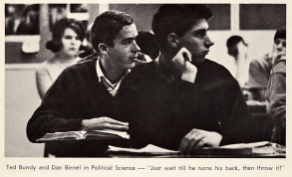
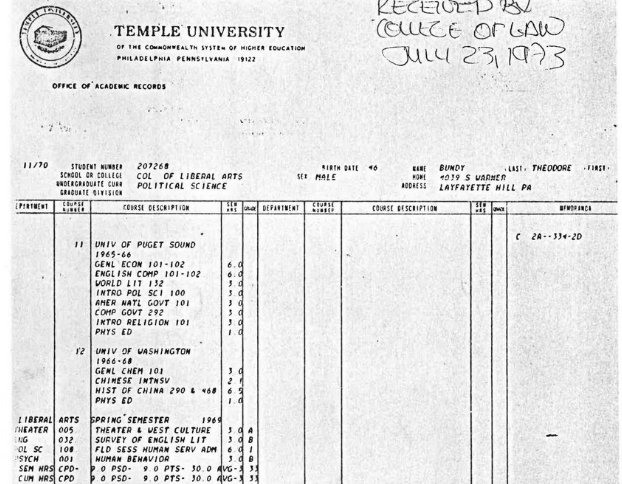
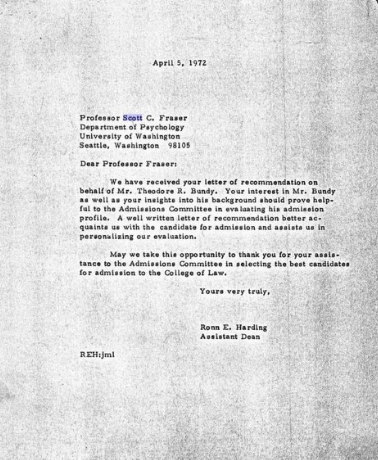
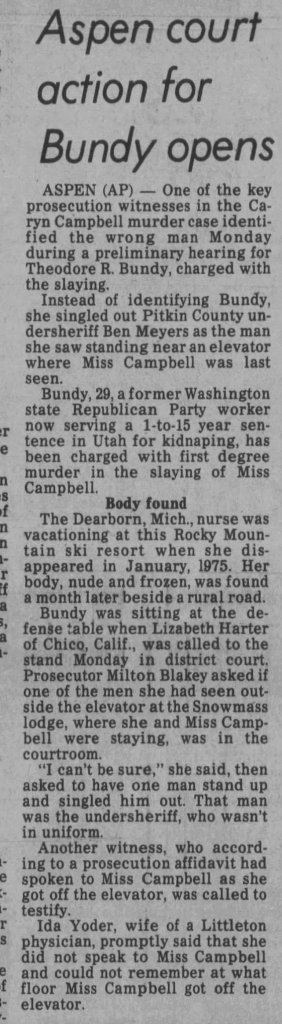
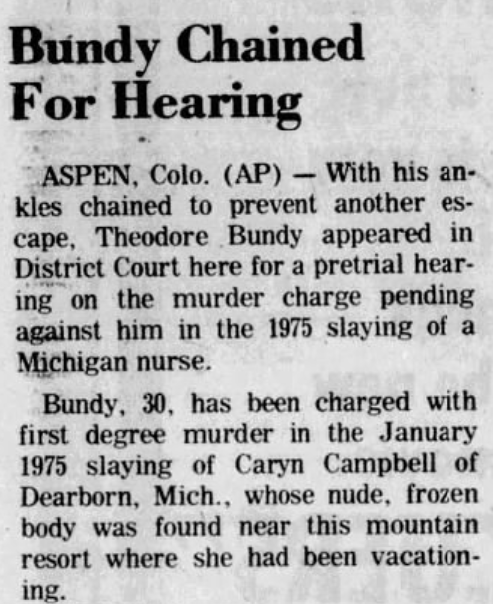
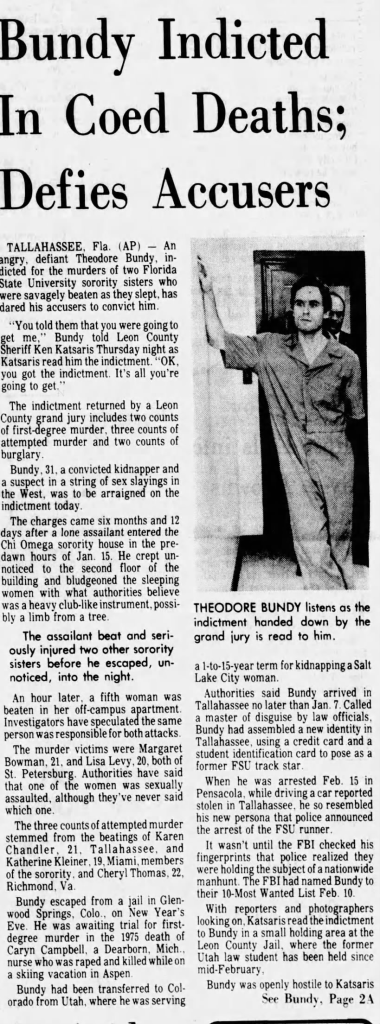
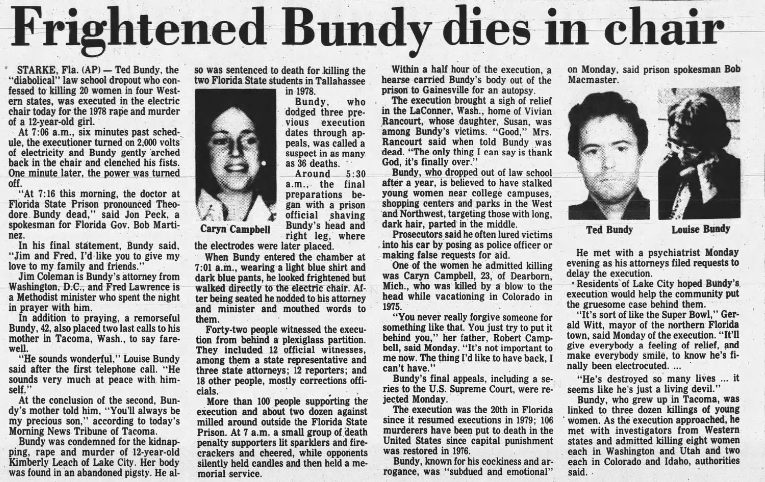
At the time Mellin disappeared in January 1970, Ted Bundy was living in Seattle at the Rogers Rooming house on 12th Avenue and was in the early stages of his long-term relationship with Elizabeth Kloepfer. At this time he wasn’t a student, as he re-enrolled at the University of Washington in June 1970. At the time, he was a file clerk and courier for an Attorney Messenger and Process Service’ in Seattle (he was there from September 1969 until May 1970, when he was fired for unjustified absences, as he claimed that he was baby-sitting Liz’s daughter, Molly).
According to Robert A. Dielenberg’s book, ‘Ted Bundy: A Visual Timeline,’ in 1970 Ted spent time at 1252 15th Avenue located just north of San Francisco in Marin County. At this time, the closest physical address this can be associated with is 1252 15th Avenue in San Francisco, across from the SF Botanical Gardens. There is also a dubious claim floating around the interwebs that says Bundy worked at Electro Vector in Forestville (which is just northeast of Santa Rosa in California) for a short period in 1970… although no dates or proof of this could be found anywhere and it’s not listed anywhere on the ‘TB Multiagency Report 1992.’ It’s also reported that Bundy helped Liz find a new apartment on Green Lake in 1970 and in the early part of the year, Kloepfer said that they spent a lot of their nights together (which makes sense as they were in the beginning stages of their relationship). I know some people may have immediately jumped to Ted’s signature tan VW Bug when they saw that Cindy’s possible abductor drove a ‘small, light colored car,’ but he didn’t purchase it until the spring of 1973.
Strangely enough, one of the other unconfirmed victims I wrote about from the same year was also abducted from California: Robin Ann Graham was an eighteen year old student at Pierce College when she vanished from a LA freeway in the early morning hours of November 15, 1970 after her car had broken down. At the time of her disappearance, Robin weighed 125 pounds, had long brown hair, brown eyes, and was 5’6″ tall. California Highway Patrol officers had noted Graham stranded beside her vehicle earlier in the evening before she disappeared and even stopped to check on her several times. When they drove by her the final time they didn’t stop, as they observed her talking to a young man driving a blue Corvette (that is now believed to have been responsible for her abduction). Although they were technically in compliance with 1970 protocol, after Graham’s disappearance CHP policy was officially changed to help ensure the safety of all stranded female motorists.
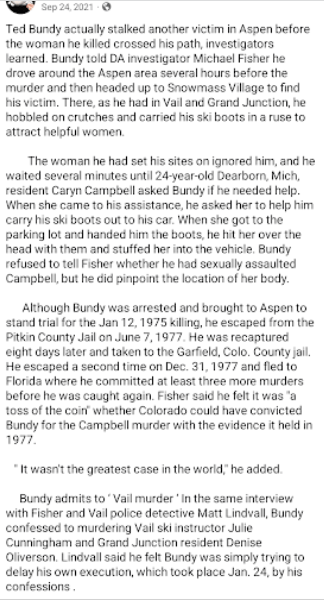
So, would Ted really have driven the 1,143 miles/8+ hour trip ONE WAY (which is the exact distance from the Rogers Rooming house to the Broadway Department Store in Ventura) to abduct Cindy Mellin on the evening of January 20, 1970? During Bundy’s death row confessions he told Dr. Robert Keppell that he committed his first murder in 1972. But I mean, I’ve written about unconfirmed victims that were murdered as early as 1961 (eight-year-old Ann Marie Burr in 1961 from Tacoma), and it’s no secret he was a compulsive liar, so obviously nothing he says can really be taken as 100% truth. In a separate event, when asked when he committed his first murder the serial killer refused to answer. He did admit to killing one woman in California, but they have not been identified.
In addition to Bundy, another name frequently thrown out there in relation to Mellin’s disappearance is the Zodiac Killer. It seems like any woman that disappeared out of a certain 50-75 mile radius in Northern California in the late 60’s/early 70’s is automatically classified as a possible victim of the Zodiac. A glaring difference between Mellin’s disappearance and those of Zodiac murders is that she remains missing, whereas Zodiac’s known victims were all found where he killed them. Also the serial killers only verified murder spree took place from 1968 to 1969, so the murder of Cindy Mellin occurred slightly outside of his activity date.
Aside from Robin Graham there’s quite a few other young women that disappeared from California during that same general time frame. Like Mellin, none of their cases have been solved, however the remains of some of the victims were eventually recovered throughout the Hollywood Hills. In the fall of 1968, two young women were walking down Telegraph Avenue in Berkeley when a man pulled up alongside them and asked if they needed a ride; they declined his offer. Early in the morning on May 29, 1969, 19-year-old Rose Tashman vanished just a few miles away from where Graham’s car was found abandoned. She was a student at San Fernando Valley State College and her car was later found abandoned with a flat left tire at around 2:00 AM; she was on her way home to Hollywood after leaving a friend’s house in Van Nuys. Her vehicle was found on the Hollywood Freeway off ramp and had flares set up around it. Her naked body was found dumped in a ravine near Mulholland Drive later that same day at around 6 PM; she was strangled and her throat was bound with wire.
On October 30, 1966 Cheri Jo Bates disappeared from the campus of Riverside City College in Riverside, CA where she was a student. The next morning at around 6:30 AM a groundskeeper discovered her remains on a gravel driveway close to the school’s library. The eighteen year old had been stabbed to death, and had wounds in her back, abdomen and chest; she had also been brutally beaten and stomped in the face, head, and feet. Bates throat had been cut so severely that she was nearly decapitated. About 100 yards away from where her body was found LE discovered her VW Bug, with its keys still in the ignition and three library books on the passenger’s seat; the cars ignition coil wire and distributor had been disabled. In the beginning of the investigation, Riverside LE wondered if maybe she was a victim of the Zodiac Killer after they noticed a number of similarities between the cases, but he was eventually cleared. Bates murder remains unsolved.
In November 1967, multiple Van Nuys,CA women were approached by a man following them and flashing their lights in an attempt to get them to pull over in a way similar to the potential abduction of Kathleen Johns. On March 22, 1970 at around 11:15 PM, Johns was driving west on Highway 132 when she observed a late-model, light colored car following her, blowing its horn and flashing its lights at her in an attempt to get her to pull over. The 22 year old was traveling with her 10-month-old daughter, and when she complied the man pulled over as well. He got out of his vehicle with a tire iron in his hand, and when he approached Johns’ said, ‘your rear wheel is wobbling. I’ll tighten the lugs.’ The young mother stayed in her car as the man fixed the tire, but when he told her she was good to go it came off as she attempted to back it up. When Johns got out to inspect the damage, she saw that there was only one bolt holding the tire in place and it wasn’t long before the mystery man returned, this time with an offer to take her to a nearby service station. Johns hesitantly accepted, and got into the man’s car with her daughter, but instead of taking her for help he drove around on side roads for about an hour and a half. On several occasions when Johns asked if he was going to stop and get help he would ‘merely elude the question and start talking about something else.’ According to a police report at first the man was not threatening and friendly, but it wasn’t long before he grew menacing and threatened her life. When he finally slowed down for a stop sign she was finally able to open the car door and jump out with her daughter, and after he managed to close the door the suspect quickly sped off. Johns ran from her abductor and hid in a neighboring field. After enough time passed and she felt like he wasn’t going to return she was able to flag down a passing car, and from there she went to the police to file an incident report. At one point, she noticed a wanted poster on the station wall with a composite sketch of the Zodiac Killer on it, and said ‘that’s the man!’ Investigators later found her car incinerated near Byrd Road and Highway 132. In a letter dated July 24, 1970, the Zodiac claimed responsibility for this incident.
Another possible victim out of California that I wrote about disappeared almost a year to the day after Mellin vanished is Christine Marie Eastin, who went missing from Hayward on January 18, 1971. She left her home at 10 PM to get her loaner car washed and from there was supposed to pick up her ex-boyfriend at a local Jack in the Box, but never showed up. The 1969 Ford Maverick was found abandoned at a Charlie’s Car Wash with her purse locked inside. She hasn’t been seen or heard from since. In 2019 an unidentified eyewitness came forward and told investigators she saw two men in a white van abduct Christine from the car wash on the evening of January 18, 1971. The witness told LE that she was only able to get a good look at the driver because his accomplice was out of her line of vision as he was busy loading Eastin into the back of the van.
On February 4, 1972 12-year-old friends Maureen Louise Sterling and Yvonne Lisa Weber disappeared around 9 PM after visiting the Redwood Empire Ice Arena. The middle school students were last seen hitchhiking on Guerneville Road, northwest of Santa Rosa. Their bodies were recovered on December 28, 1972 thrown down a steep embankment approximately 66 feet off the east side of Franz Valley Road. A single earring, some orange beads, and a 14-carat gold necklace with a cross were found at the scene. The girls cause of death could not be determined from the skeletal remains. A little over a month later on March 4, 1972 nineteen year old Kim Wendy Allen was given a ride by two men from her POE at Larkspur Natural Foods to San Rafael. They last saw her at approximately 5:20 PM hitchhiking to school near the northbound Bell Avenue entrance to Highway 10 carrying a large wooden soy barrel with red Chinese characters on it. Allens remains were found the next day down an embankment in Santa Rosa, about 20 feet off a creek bed near Enterprise Road. She was found bound at the ankles and wrists and was strangled to death with a cord. She had also been raped. All three of these young women are considered to be victims of the Santa Rosa Hitchhiker Killer.
On April 25, 1972 20-year-old Jeannette Kamahele was last seen leaving her residence by her roommate at 9:30 AM with plans to hitchhike to Santa Rosa Junior College, where she was a student. A friend was just about to pull over and pick her up, but someone else beat him to it. According to that eyewitness, she was picked up near the Cotati on-ramp of Highway 101 by a white male with an afro hairstyle that was between 20 and 30 years old driving a faded brown Chevrolet truck. Her body has never been recovered. Bundy was at one time a suspect in her disappearance but he has since been cleared. It’s also speculated that she could be a victim of the Zodiac, although it’s a bit outside of his time frame.
Just two days later on April 28, 1972 forty-three year old Ernestine Francis Terello was on her way to do some shopping at the Topanga Plaza Centre when her yellow 1969 Plymouth got a flat tire in Agoura; it was later found locked and abandoned near Agoura Road and Chesboro Road on the Ventura freeway. Terello’s husband reported her as missing later that same day. Her remains were found about a month later on May 27 by Boy Scouts hiking off the Pacific Coast Highway, roughly six miles from where her car was found. Because of the advanced stage of decomposition, medical examiners were unable to determine her exact cause of death, but it is strongly speculated that she was sexually assaulted before she was murdered.
Thirteen year old Lori Lee Kursa ran away from her family on November 11, 1972 after a shopping trip with her mother at a U-Save Market. She reportedly went to stay with friends, and was last seen on November 30, 1972. Kursa was a frequent runaway thanks to a poor home life, and her frozen remains were found on December 14, 1972 in a ravine approximately 50 feet off Calistoga Road in Santa Rosa. On February 6, 1973 fifteen year old Carolyn Nadine Davis ran away from her home outside Anderson, CA. She hitchhiked to her sister Judy’s house in Garberville, and didn’t officially disappear until July 15, 1973 after she was dropped off near the post office by her Grandma, who lived nearby. Davis was last seen hitchhiking later that same afternoon near the Highway 101 southbound ramp and was never seen alive again. In the winter of 1973, 23 year old Theresa Diane Smith Walsh decided to take a road trip, and hitchhiked her way through Santa Rosa and Malibu, visiting friends along the way. But Christmas was quickly approaching, and Walsh grew homesick for her family and decided to start making her way home to her husband and young son for the holidays. She was last seen on December 22, 1973 trying to thumb a ride near Zuma Beach. On December 28, 1973, some kayakers were taking advantage of some high water near the Mark West Creek north of Santa Rosa and came across her body floating in the water in between a boulder and a log. She had expired within the past day or two and she was found completely nude. Her thumbs had been bound together as well as her wrists, which had then been tied to her thighs; her ankles were bound together as well. In a final gesture of cruelty, Walsh’s murderer tied a piece of rope to her ankle bindings then ran it up her back and looped it about her neck, which pulled snug at her heels and against her buttocks. The pain of being tied up in such a severe manner must have been unbearable: stretching her legs out to help relieve the strain would have only tightened the noose around her neck, causing her to slowly and painfully choke herself to death. Theresa’s remains were found within about 100 yards of the fire trail where Lori Lee Kursa had been dumped a year prior.
Mona Jean Gallegos was a twenty-two year old part-time waitress when she was murdered in the early morning hours of June 19, 1975. She had gone over to a friend’s house that sold cars in Alhambra, CA to ask him a few questions about purchasing a ‘new’ (to her, anyways) vehicle; she left his house for home at around 1 AM. Sometime shortly after leaving, Gallegos ran out of gas near Santa Anita Avenue on the eastbound San Bernardino Freeway. Her vehicle was later found locked and abandoned by Highway Patrol at about 4:45 AM, who theorized that a passing motorist may have stopped and offered the young woman a ride to a nearby 24 hour service station, then abducted her. Her skeletal remains were found almost six months later by two teenage boys that were hiking in a remote Riverside ravine. Investigators were unable to pinpoint her exact cause of death due to advanced levels of decomposition but were able to determine that there was no trauma to the bones.
Additionally, the skeletal remains of a young white female was discovered on July 2, 1979 in a ravine off Calistoga Road, roughly 100 yards from where the body of Lori Lee Kursa was discovered seven years prior. One forensics expert that was consulted by authorities determined the victim was most likely killed between 1972 and 1974 and was about 19 years old. Their remains have yet to be identified.
One thing I’ve never come across before is a column from a newspaper dated February 1970, that asked people from a variety of different age ranges, genders, races, and backgrounds how they would approach finding Cindy Mellin, and the results were interesting. Candy Teffe, a fourteen year old ninth grader from Anacape Junior High School, said: ‘two things. Go where she was seen last, and then talk to her friends.’ Ventura College freshman Craig Gottlieb said that ‘there are certain things I would attempt to do but my belief is that she has helped herself disappear. I would find out who she has been associated with and why she’d have reasons for leaving home.’ Restaurant executive Bruce Derns suggested that LE should, ‘offer a sizable reward.’
One interesting article I found while conducting my research is a ghost story that took place at the former Broadway Department Store at the Buenaventura Shopping Center (that is now a Macy’s): a one time sales girl said the building was haunted by none other than Cindy Lee Mellin, and that she heard footsteps and humming on multiple occasions when the space was supposed to be empty. She also noticed that pieces of clothing would frequently move around on their own. I also came across a comment about the haunting by Facebook user Ed Mata, who was employed there as well in the 1980’s and ‘heard the story but didn’t think much of it till I experienced cold and noisy stock rooms and someone humming in the elevator.’
Judith Mellin-Williams said that her sister was ‘quiet, obedient, hard-working, spiritual, a downright goody-two shoes.’ In an article published by The Oxnard Star on January 20, 1995, Paula Mellin-Stoddard (who was only 15 when her older sister was abducted) said that her and Cindy were ‘the little girls in the family that dreamed of growing up, getting married, and having children together. I still feel her presence today, but she’s not there. She’s nothing more than a ghost.’ Judith also said she was a ‘late bloomer, extremely introverted, conservative and definitely not a boat rocker.’ Mellin-Stoddard also said that she considers her sister’s disappearance a painful mystery for her surviving family members, and that they were all haunted by their anger and anguish. Janice Mellin said in the same Oxnard Star article that ‘the only way we’ve been able to deal with it is to assume that she was murdered. But I’ll never be at peace without a body, funeral, or grave site to mourn.’
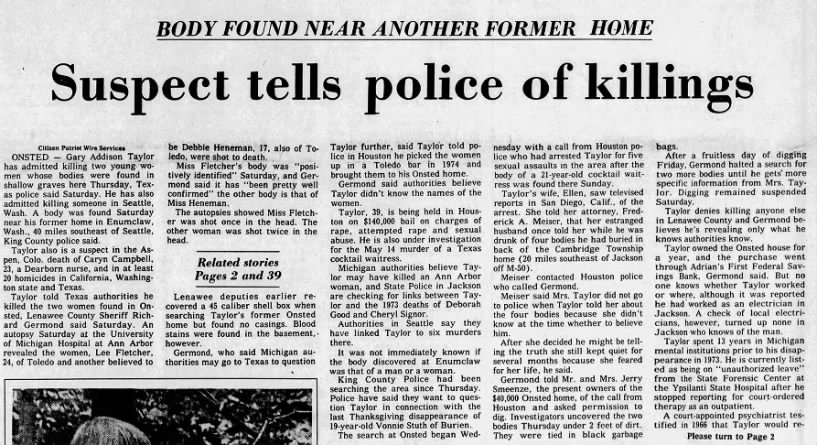
In an article published by The Oxnard Star on January 20, 1995, former Lieutenant Brad Talbot said that they ‘ran out of leads, people to talk to, and places to investigate.’ Regarding the perp, Talbot feels that ‘he might still be around. People sometimes get a guilty conscience and turn themselves in. We’d be willing to clear it all up.’ Oddly enough, later the same year Bundy was executed investigators received a tip that California inmate Gerald Stanely claimed he knew where Mellin’s body was buried. LE went to the San Quentin’s prison where Stanley was on death row to talk to him about the disappearance, but unfortunately the twice convicted killer had a habit of claiming to know about homicides he had no involvement in and was unable to provide anything useful to detectives. Cindy’s sister Janice said ‘it was just another lost hope.’ After her daughter disappeared Mrs. Mellin began volunteering three days a week at a ‘Head Start’ education program for her local school district, and sadly died on June 9, 1975 at the age of 62 from a stroke. Mr. Mellin remarried a woman named Marian E. Guild on February 19, 1977 but died just a few years later at the age of 68 on July 24, 1981. Cindy’s sister Judith died at the age of 42 on July 4, 1979, in Brea, CA, and Janice Mellin passed away at the age of 63 on July 8, 2001. If Cindy was still alive in December 2023 she would be 74 years old. Her dental charts are available and were entered into the national database; her DNA is also on file.


Rhonda Stapley was born on August 19, 1953 to Rulon and Vivian Stapley in Richfield, Utah. Rulon (who seemed to go by his middle name of Floyd) was born on July 22, 1928 in Joseph, UT and Vivian was born on October 19, 1933 in Austin, UT. The couple were wed on April 11, 1948, in Coconino, Arizona and eventually settled down in the Salt Lake City area. Together they had 4 children: two boys (Rulon Dale and Michael John) and two girls (Rhonda Karol and Bonita Rae). Mr. Stapley worked as an operator of a frozen food company but passed away in a plane crash on October 3, 1967 at the age of 39. Vivian had a variety of jobs in her life, and was employed as a school lunch lady, in fast food and retail stores. She remarried Stanley Redfern in 1978 and passed away at the age of 87 on October 7, 2021. The Stapley family apparently had a small-scale ‘claim to fame’ after developing a couple patents for some potato products. Rhonda graduated from Connell High school in 1971 and went on to attend the University of Utah. After completing her degree in pharmacy, the petite 4’11” brunette married Barry Robert Godding on (either) April 23/24, 1979 in SLC (according to Ancestry). In the acknowledgments portion of her book she mentions she has ‘daughters’ but doesn’t elaborate any further .
On an unusually warm and sunny day in October 1974 Rhonda Stapley was waiting for the bus to pick her up to take her back to her dormitory when a young man in a light colored VW Bug pulled up and asked if she’d like a ride: ‘just as it passed me, it stopped and he put it in reverse and backed up. He rolled down the passenger window and he says, ‘Hey where are you going?’’ When she replied ‘the University of Utah,’ he told her that’s where he was headed as well and asked if she’d like a ride, which she happily accepted. The shy young college student had been at the dentist and her mouth was still sore from the extensive work she had just had done. He introduced himself as Ted and told her he was a first year law student. Stapley immediately noticed his striking blue eyes and told him that she was close to being done with a degree in pharmacy. In an interview for the documentary ‘Ted Bundy: The Survivors,’ she shared that it ‘didn’t feel like hitchhiking, what I did. This felt like a friendly college student helping another college student, and that seemed normal and not out of place.’ But, it didn’t take long before Rhonda realized that the handsome stranger wasn’t taking the normal route back to school. When she asked him about it he politely inquired if it would be okay if he just ran a quick errand up by the zoo, to which she said no, she didn’t. But when the zoo came and went, Rhonda quickly became concerned again, to which the man simply told her that the errand wasn’t AT the zoo but near it. And that’s when things began to get extremely uncomfortable for her: ‘the ride started to become strained, he stopped talking to me altogether, he just had both hands on the steering wheel just driving.’ Desperate to escape, when Stapley reached for the door handle she realized it was missing, and that’s when she REALLY began to panic.
At around 3-3:30 PM, the young man eventually reached Big Cottonwood Canyon and ‘suddenly he pulled over. It seemed like he was looking for a place to park. At this point I did not expect a murder attempt, I was more anticipating an attempt at a romantic parking episode, and I wasn’t afraid of that either, just not interested, and wanting to get out of that potential situation without embarrassing either of us. I still thought he was a nice and somewhat charming guy right up to the moment.’ … ‘He turned a way that wasn’t the normal route to the university. You could get there that way, but it wasn’t the normal route and I questioned him about that. I said, ‘Where are we going?’And that was when the ride started to become strange. He just had both hands firmly on the steering wheel and was just driving.’
After finding a secluded spot off the beaten track, Stapley’s abductor stopped the car and turned to face her directly. The naive young Mormon woman was certain he was going to make a move on her and lean in for a kiss: ‘in my mind, I think he’s looking for a place to pull over and park and make out.’ The thought of such casual intimacy with a complete stranger was something she wasn’t comfortable with, not only because of her devout faith but also her sore mouth. However instead of a smooch he looked at her, his bright blue eyes now black, and said completely without emotion: ‘I am going to kill you.’ … ‘Then he puts his hands ’round my throat and starts squeezing and shaking me, and I’m thinking, ‘Why? Why does he want to kill someone and why is it me?’’ After dragging her out of his VW, Rhonda’s captor proceeded to physically and sexually assault her for hours in the public canyon near a picnic table. During the assault he choked her out, repeatedly taking her to the brink of consciousness then stopping; he even slapped her across the face to wake her up. Stapley also claims that he bit her on the right breast and would yell at her, ‘you should be thanking me that you are even still alive. I can kill you anytime I want.’ She said that: ‘he was angry, more angry than I’ve ever seen anybody. His fists were clenched and his veins were bulging on his forehead and his neck, and his face was bright red. His eyes were almost black.’ Interesting fact about the bite: Rhonda said the marking reappeared roughly forty years later (which immediately made me think of the stigmata markings on Christ during his crucifixion).
When his back was briefly turned and he was ‘distracted by something near his car,’ Stapley was able to escape her captor by jumping into a ‘fast moving mountain river’ and floating to safety: ‘As soon as I jumped up and started to run, I fell into a fast-moving mountain stream, which is probably what saved my life.’ When she got far enough away (I got the impression she was at one point unconscious while in the stream and woke up land), she managed to get herself out of the water then walked the roughly ten miles back to the University of Utah. She traveled mostly through the woods, petrified that her attacker would find her if she walked along the main roadway. She credited her new boots as one of the main reasons she was able to make the long walk back, and on the CrimePiper website, user ‘Fra La’ commented that ‘she has added yet another reason why she was on foot, she had new hiking boots to break in. New details cropping up all the time, lol. Too many details.’ To this, site creator (and good friend of mine) Erin Banks replied: ‘convenient plot twist to explain why she still had her pants on when she walked back home for 6-7 hours. The boots were a brilliant idea, I’ll give her that (when Stapley jumped in the running water she claimed that her pants were still around her ankles).’ After her long journey back to the University of Utah, Rhonda took a long, hot shower then assessed her injuries: she had bruising on her face, a large ‘goose-egg’ over her eye, bruises and markings all over her body (but especially around the neck), and a few broken ribs. Somehow, no one ever questioned her about any of it, including her friends, roommates, and professors, who all saw her routinely after the incident. Despite the headlines she saw that reported other women from the Salt Lake area were vanishing at an alarming rate, Stapley kept the incident to herself and didn’t come forward with her story until 2016.
Because Rhonda left some of her personal belongings (including her drivers license) behind in her abductor’s car, she was afraid that he would somehow eventually track her down. But, thankfully she never updated the DMV with her new mailing address after she moved so he couldn’t locate her through her ID. The identity of her attacker remained a mystery until roughly a year after her assault, when she saw his face in a newspaper in August 1975 when it was reported that a local law student was arrested for the unsuccessful kidnapping of Carol DaRonch. After Bundy (who she referred to as ‘her bad guy’) was finally caught, Stapley said that his arrest brought not only relief but also a ‘wave of guilt. It was another proof that it was him. ‘That’s the guy.’ Maybe I should have done something about it.’ She rationalized her decision of not going to LE because other women had since reported him and she felt that she had nothing else of value to add. She also feared unwanted attention from those who wondered why she didn’t report the incident to police earlier.
Fearing that if her mother found out she had been assaulted she’d make her dropout of school and return home, Stapley blamed herself for accepting a ride from a stranger. Also, at the time of her abduction she was a virgin as well as a devout Mormon, and didn’t want people to think poorly or less of her if they knew she was no longer pure: ‘the teachings in the LDS church at that time was that your virtue and your chastity were the most important thing a young woman could have, and if you come to a point giving up your chastity or your life, you’re better off eternally if you die.’ … ‘I felt ashamed and embarrassed and stupid; stupid for even getting into such a dangerous situation.’ … ‘I imagined people whispering, ‘that’s that girl who was raped.’ I didn’t want attention. I still don’t.’
When enough time passed and Stapley was finally ready to date again, she left little notes all over her (shared) apartment (including underneath garbage cans) sharing where she was and who she was with. She hoped that if she ever went missing again her roommates (or the police) would eventually find them and because of them they would be able to locate her. That I do think is a little weird: were they not friendly? I have friends who are devoutly religious and they still talk openly about dating and men. It’s not forbidden, why all the secrets and weird notes? And what if the garbage can got dirty and they needed to clean it? Ever have a bag of trash leak garbage juice all over the can? It’s not pretty… personally, I would have most likely hosed it off… So what’s to say the note would have even been found?
Could you imagine how many lives Stapley could have saved if she came forward immediately after she was attacked? I stopped commenting on Facebook posts of people talking about how it was her ‘faith that forced her to keep her mouth shut and she was embarrassed and ashamed.’ I’m sorry, I just don’t buy that. Being sexually assaulted was completely out of her control, and if she went to the police right after it happened maybe Bundy would have been caught sooner, which would have prevented some of his Utah and Colorado killings as well as everything in Florida. When asked why she didn’t go to police earlier she told People magazine: ‘I thought that I just needed to put it away and make life like it was before and just pretend it never happened.’
Rhonda kept the assault to herself until 2011, when a supervisor at her POE using the same type of threatening language as Bundy did put her in an uncomfortable situation, which forced the memories of her assault to immediately come rushing back to her. The nightmares and flashbacks finally forced her to seek help: ‘I couldn’t control my tears, I couldn’t sleep, I couldn’t eat. I thought I was going crazy. But I knew it had to be related to the Bundy stuff, because that’s what my dreams and my nightmares and my panic attacks were about.’ Stapley sought mental health therapy, and like many other Americans turned to the internet for help. After an anonymous online friend shared a run-in with the serial killer she was finally able to gather the strength and tell loved ones what happened to her after almost 37 years: ‘there’s no group of Ted Bundy survivors that I could sign up and join. But there are other people who have experienced trauma. They can understand not wanting to tell, and the shame and embarrassment and all those things that go along with rape. The main thing I wanted to tell people was that they’re not alone. Even though their traumatic experience may be different than my traumatic experience, at least there’s someone who can recognize those feelings and people who can understand.’ Looking into it, Rhonda publicly came forward with her story in the spring of 2016: I see she did an interview with Dr. Phil on April 26, 2016 and published her book ‘I Survived Ted Bundy: The Attack, Escape & PTSD that Changed My Life’ (complete with forward by Bundy bff Ann Rule) on May 5, 2016. She also did an interview with People magazine roughly a week later on May 13, 2016.
Rhonda kept the assault to herself until 2011, when a supervisor using the same type of threatening language that Bundy used put her in an uncomfortable situation, forcing her past to immediately come back to haunt her. The nightmares and flashbacks finally forced Stapley to seek help: ‘I couldn’t control my tears, I couldn’t sleep, I couldn’t eat. I thought I was going crazy. But I knew it had to be related to the Bundy stuff, because that’s what my dreams and my nightmares and my panic attacks were about.’ She sought mental health therapy, and like most other Americans, turned to the internet for help. After an anonymous friend shared a run-in with the serial killer, Stapley was finally able to tell loved ones her story after almost 37 years: ‘there’s no group of Ted Bundy survivors that I could sign up and join. But there are other people who have experienced trauma. They can understand not wanting to tell, and the shame and embarrassment and all those things that go along with rape. The main thing I wanted to tell people was that they’re not alone. Even though their traumatic experience may be different than my traumatic experience, at least there’s someone who can recognize those feelings and people who can understand.’ Looking into it, she publicly came forward with her story in the spring of 2016: I see she did an interview with Dr. Phil on April 26, 2016 and published her book ‘I Survived Ted Bundy: The Attack, Escape & PTSD that Changed My Life’ (complete with forward by Bundy bff Ann Rule) on May 5, 2016. She also did an interview with People magazine roughly a week later on May 13, 2016.
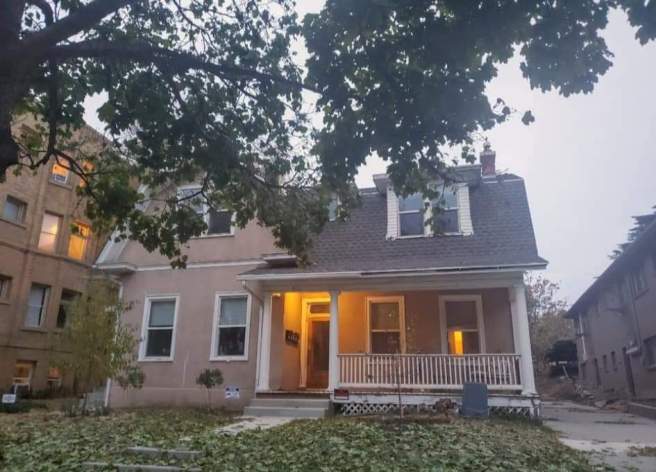
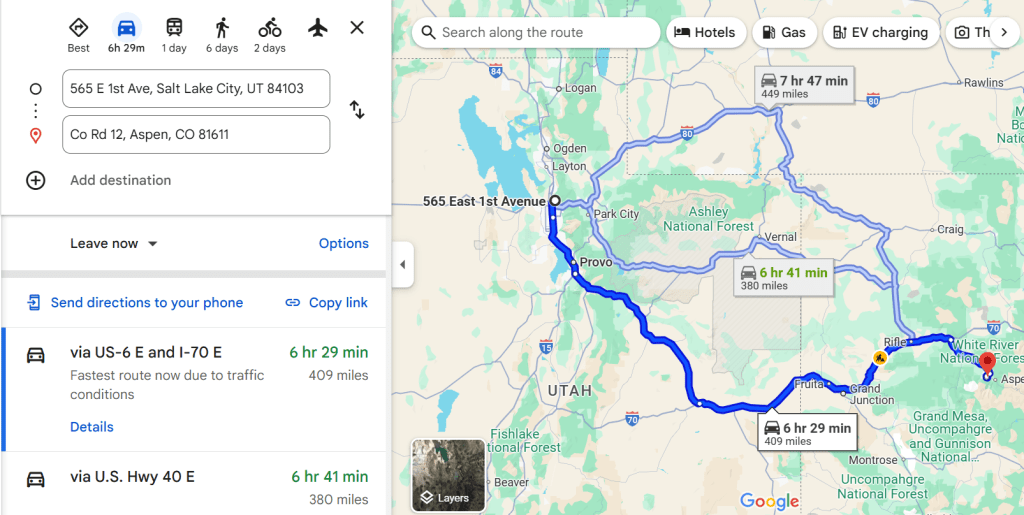
Stapley stated her assault took place in the ‘autumn of 1974,’ which does line up with when Bundy was living in Utah for his second (unsuccessful) attempt at law school (he moved there from Seattle on September 2, 1974). He was living at his first SLC apartment located at 565 1st Avenue North, and from what I understand he made a decent attempt his second time around and made a point of going to most of his classes. He was in between jobs at the time, but previously worked at the Department of Emergency Services in Olympia from May 3, 1974 to August 28, 1974. He remained unemployed until June 1975, when he briefly was employed as the night manager of Bailiff Hall at the University of Utah (he was fired the next month for coming in inebriated). Bundy was still in a long distance relationship with Liz Kloepfer, even though things seemed to be strained and sort of fizzling out at that point.
In my opinion, the most damning piece of evidence against Stapley’s claims is the missing VW handle. Like Sotria Kritsonis, Rhonda claims that the passenger’s side door handle was completely missing from the car, and I’m sorry… that’s never been brought up in any other CONFIRMED Bundy case (Kritsonis does not apply). I personally don’t believe it. As Erin Banks’ points out in her book, ‘Ted Bundy: Examining the Unconfirmed Survivor Stories:’ ‘the 1968 Beetle would not open if the outside door handle was still attached to the door while the inner door handle had been dismounted, Several researchers have credibly demonstrated that in the past. If the inner latch had been discounted, the integral part of the door handle, the cylinder pin latch assembly, and mounting screws holding inside and outside of the door handles together, and only separated by the door/panel itself, would sit loosely in the door. If one now tugged on the outer latch in an attempt to open the door, one would inevitably pull out the entire door handle from the outside.’ I don’t think I need to go on, as this right here proves there really was no way she would have been able to let herself in the vehicle if it had no inside handle. The only other thing I want to touch on regarding this topic is when I was in Seattle I listened to the Phantom Prince on Audible and I remember thinking to myself how often Ted drove around in his Beetle with Liz, Molly, and other friends… if he took the door handle off his vehicle he would have the run the risk of someone in his life seeing it, and no one in his inner circle ever reported seeing it missing. We also have to remember that he was drunk and/or high a good chunk of the time he was out ‘hunting’… he could have very easily forgotten that he took it off, running the risk of getting caught by Liz (or any other woman he was sleeping with). Lets also think back to Carol DaRonch, who had no problem exiting Bundy’s car on her own and never said anything about a missing door handle when she had her own experience with him a month later in early November, 1974.
Another thing about Stapley’s story that jumps out of me is her complete lack of any sort of substantial head wound. Most of Ted’s victims (if not all of them) suffered from some sort of skull injury in order to help incapacitate them, but Rhonda said her attacker didn’t go after her in any such way. He also didn’t use any sort of medium (like a cable or rope) in his strangulation technique aside from his hands, which is unusual for him (for example, with Cheryl Thomas he used a pair of pantyhose to choke her). Also, despite the fact that Stapley said it was an unseasonably warm fall day, the water she floated away in still would have been incredibly cold: according to my research, the waterways in and around SLC in October would have been in the high-50’s to low/ mid-60’s, and experts say that you should consider any water temperature below 70 degrees Fahrenheit with extreme caution. I guess I just find it hard to believe that she would have been able to gather the energy and strength to walk the TEN MILES back to her dormitory after being submerged in freezing cold water… Especially when you throw some (self-diagnosed) broken ribs, a painful dental surgery, and hours upon hours of being brutally sexually assaulted into the equation… I mean, the journey would have taken her hours, and since she traveled through the woods instead of the main roadway the conditions would have been a bit rough and less than ideal. In her book, Banks reports that when you take her height, weight, and normal everyday level of activity into account it would have taken her at least 15-20 minutes per mile of walking (and that was a healthy, uninjured individual). Also, when Stapley woke up after moving down the river she reported it was dark outside (meaning it was after 7 PM), which is the time of sunset in SLC in October. Don’t get me wrong, I’m sure her adrenaline was really pumping, especially at first… but her walk back would have taken hours, it would have eventually worn off.
Additionally, Ms. Banks spoke with residents of SLC that lived near the area of Cottonwood Canyon where Stapley said she was assaulted. They reported that the level of water present at that time of year would have been minimal, and the depth of a puddle: ‘just a few short inches high during fall and winter.’ Banks also said there were lots of large boulders in the water which would have further prevented Stapley from ‘floating away from her abductor.’ Something interesting Erin points out in her book is that after the assault Stapley attempted suicide but half-way through had a change of heart. She called a suicide prevention hotline for help, and the man that answered her call (named Dave) immediately dropped the phone and rushed to her address in order to save her life. I mean… I work for a health insurance company, I have a pretty good understanding of HIPAA laws and how important it is to follow them. Even in a time as unregulated as the 1970’s, I never heard of a crisis hotline employee (or ANY other mental health professional) breaking every single rule put in place so they could go and help the person that called in. Stapley and ‘Dave’ somehow ran into each other again years later (he had since earned his doctorate), and after catching up a bit and telling him her story he told her that she was his hero and that he ‘put her on a pedestal right alongside my family members who work as first responders or who have been in military combat.’ I mean, what? Why would anyone say that to her?
Stapley is one of a few women that claimed to have been kidnapped and/or assaulted by Ted Bundy and lived to tell the tale. I know one individual from my Facebook group that said she was a victim of his but requested that I respect her privacy and not pry any further (she is working on a book from what I understand)… I know of a few others that have some pretty obvious mental health issues. Please keep in mind, when I say this I’m not talking about his confirmed victims, like Karen Sparks/Carol DaRonch/Kathy Kleiner/Karen Chandler/Cheryl Thomas. Just like Sotria Kritsonis (whose abduction site was my very last stop when I went to Seattle in April 2022), Rhonda came forward later in life to tell the tale of her run in with Ted. On February 9, 2018, Kritsonis did an interview with KIRO-TV where she discussed her 1972 alleged kidnapping attempt, which was very similar to Stapley’s: it also began at a bus stop on her way to college (just minus the dental surgery) and the car she got into was also missing its passengers side door handle. Just as a side note, one thing that does irritate me is how people say Rhonda isn’t ‘attractive enough to be a Bundy victim,’ which absolutely drives me nuts because first of all, attractiveness is subjective and (in my opinion), she was a pretty girl in her younger years. I mean, I personally think the serial killer was an opportunist that took advantage of whoever he happened to stumble across… Let’s look at his younger victims, like Kimberly Leach, or Lynette Culver. This is probably borderline inappropriate to say but I don’t think Bundy looked at these TWELVE YEAR OLD GIRLS and thought, ‘ they’re attractive and totally my type, they’re going to be my next victim.’ He simply took them because they were there.
The reviews for Stapley’s book on Amazon seem to be mostly good: as of December 2023, it had 677 reviews and a rating of 4.4 out of 5 stars. Some are overwhelmingly positive, for example one was written by a private investigator that said it ‘should be mandatory reading at all police academies’ Another that said: ‘the author’s story of survival, and struggle with PTSD is incredible. This is one person’s description of how trauma influenced her decision-making process. From an outsider’s point of view, it was enlightening, terrifying, awe-inspiring and educational. I encourage all law enforcement officers to read and study this book.’ However, others completely write off her story, and say that the entire scenario never happened and was made up for attention. This is just my personal observation, but most of the people that picked up her book and believed her story seem to be true crime novices, and didn’t have a very complete understanding of Bundy’s story, where the ones that were doubtful have a stronger background in true crime and have a deeper understanding of the case.
On June 22, 2016, Rhonda went on KATU’s morning show and told the host that her alleged encounter with Bundy was more serious and relevant than Carol DaRonch’s because she was sexually assaulted but DaRonch wasn’t, saying: ‘she actually escaped as soon as she got into the car so she wasn’t really assaulted.’ It’s absurd to think that because DaRonch wasn’t raped or brutally beaten that she wasn’t ‘really assaulted.’ The woman fought off a crowbar and escaped with a handcuff around her wrist. She clearly suffered horribly at the hands of her attacker. Of course she was assaulted.
I always wondered how Stapley’s family and other loved ones felt about her story, specifically if her husband and daughters believed her. Apparently, Barry Godding didn’t fully support his wife’s decision to publicly come forward after so many years and was even less enthused at the idea of her writing a book. She said that he liked to throw temper tantrums about her ‘quest to tell her truth and often insulted her with insensitive remarks about finally getting over that pesky rape all those years ago.’ I went through Rhonda’s FB page a few times in preparation for this article and interestingly enough, Erin Banks had the same mentality that I did about a heart attack Barry suffered the same year that she came forward about what happened to her, saying: ‘in a 2016 status update on one of her Facebook profiles Stapley speaks of how relieved she is that her husband is finally recovering after his heart attack, for she can now finally get back to promoting her and selling her book. I found this statement to be incredibly tone deaf and revealing as to her own level of empathy: ‘Barry seemed to think that I was dredging up ancient history for some devious purpose. I got the impression he thought that I was competing with him, that I had decided to become upset about a long ago trauma just as he was dealing with his own health crisis.’’
When I write an article, I have a set list of resources I go through, such as Reddit, YouTube, Ancestry, MyHeritage, and so on and so forth. One of my favorites is CrimePiper, which is run by Erin Banks, who is the author of the book I mentioned earlier. When I visited the sites files section something interesting caught my eye: a professor at the University of Utah and Rhonda’s one time mentor through the LDS church named Dr. Victor B. Cline published a paper on May 24, 2009 titled ‘Pornography’s Effects on Adults & Children,’ and on page nine he mentions Bundy. Rhonda said that Dr. Cline was ‘the first man to take a personal interest in her after the attack,’ and he requested to be assigned as her home teacher. Typically this is something the church does with all of the members of a family present, however in Stapley’s case he worked with her alone. The PhD told her he was famous and that people paid good money to receive his counseling services, but because they were meeting through the church he was providing her with those services for free. A great point that Ms. Banks brings up is that when Dr. Cline reached out to Rhonda, he had no idea that she had been assaulted by Bundy, and ‘she believed he, a virtual stranger, just ‘seemed to sense’ that something was wrong with her. To take such an extensive and personal interest in a female student, considering the obvious possible connotations of the nature of his interest, is astounding for someone who has much to lose as Cline did. It’s ‘not recommended’ by the LDS that a man and a woman who are not married or not otherwise related to one another interact without witnesses present or in great frequency. Still, Cline showered young Rhonda with attention. (Banks, 19).’ So, this man that apparently had a big impact on Stapley in her post sexually assaulted years wrote a paper that mentioned Bundy, and suddenly two years later she comes forward claiming that he assaulted her in October 1974? Come on.
Stapley still lives in SLC with her husband, and in a 2016 interview with People magazine she referred to herself as ‘an inventor’ as well as a pharmacist, wife, mother, and grandmother. In January 2003 Rhonda and her sister Bonita Hunt founded SnuggleHose, which is defined on her website as ‘warm, soft, cozy covers for CPAP (Continuous Positive Airway Pressure machines for patients with sleep apnea) hoses and ventilator machines.’ Stapley came up with the idea after she was diagnosed with sleep apnea in June 2002 and started using a CPAP. She is active on multiple social media platforms and even participates in ‘Ted Bundy trivia’ on the Facebook group ‘TB: All Opinions Matter.’ About her experience of living through being raped by Bundy, she said: ‘I think my experience with Ted Bundy affected every aspect of my life. It changed my level of self-confidence, it changed my trust, even my trust in myself. I became more introverted, less outgoing.’
I want to end this article with a quote from Erin Banks’ book: ‘Mrs. Stapley’s worth as a human being is indisputable. Her story is not.’ Before I wrote this article, a (very small) part of me wondered if *maybe* the young college student was raped (even though I didn’t think it was by Bundy). But, then I remember when I had my wisdom teeth extracted: my mouth was incredibly sore and puffy, plus I was numb from the novocaine. Not to mention I was bloody and stuffed full of gauze. Was Bundy really so hell bent on sexually assaulting a woman that he did it to one in such an off putting situation? Stapley said that he even raped her orally, which surely would have not been ideal for him considering the condition of her mouth (she said he was so rough that he ripped out some of the stitches in her cheek, which would have only made her 10 mile walk home even more hellish). Oddly enough, much like the bite mark on her breast that reappeared forty years after it happened, on one occasion when Stapley was thinking about the assault and how her oral stitches were ripped out her gums began to bleed for no reason. I mean, if I were Rhonda and I had just endured hours upon hours of hell, I would have looked for the first person available for help, not wandered back to campus, probably unsure of where I was going, hoping and praying I’d make it back alive. There’s just so many parts of this story that don’t really make any sense. A small part of me does feel bad for doubting a potential rape victims story, but I can’t help it.


Christine ‘Christy/Christie’ Marie Eastin was born to Barney and Dorothy (nee Martin) on January 4, 1952. Mrs. Eastin was born on August 15, 1918 in Whitman, Washington and Barney was born in Bowling Green, Missouri on July 26, 1920; after getting married the family briefly lived in Seattle before settling down in Hayward, California. It appears that Christine’s Dad died when she was only ten years old at the age of 42 on September 23, 1962. I couldn’t find much else about her background other than she had an older sister named Victoria that was born in 1946. The blonde haired, blue eyed homecoming queen graduated from Sunset High School in 1970. She was 5’7″ and at the time of her disappearance weighed 130 pounds. Christine had a ⅜ inch long scar in the center of her forehead and a surgical scar on her abdomen from an intestinal operation.
Christy was popular and very well liked among her peers; her friends and loved ones said she was a very sweet, beautiful young woman with a gentle spirit that was kind to everyone. In high school she participated in the drama club, was a ‘song girl’ (which was Sunset HS’s version of a cheerleading squad), and a member of Orchesis (which looks like some sort of chorus group). Judy Ruiz-Verhoek, a childhood friend of Eastin’s, said she was ‘just very sweet. Just a gentle spirit, very kind.’ Six months out of high school, in early 1971 Christy was taking classes at Chabot College and was supposed to start a new job at a bank the morning after she disappeared. The nineteen-year old had finally saved up enough money to buy a pair of black boots she had her eye on, so early in the evening on January 18, 1971 she went shopping with her friend Sandy Lemmon-McBride at Mervyn’s in nearby San Lorenzo. In a KTVU interview, Sandy said of the trip: ‘we went to Mervyn’s, we got the boots, she dropped me off at 9:30, and before she left added, ‘’I’m going to go wash the car,’ which she promised she’d do before returning it.’ After the friends were done shopping Eastin dropped Sandy off then went home, which was in a middle-class neighborhood in Hayward, California. After showering she told her family she was going to have her loaner car (a blue 1969 Maverick) washed before she picked up its owner (her ex-bf George Sponsel) from work at a Jack in the Box restaurant located at Mission & Pinedale Court. Despite their relationship technically being over, Christy reportedly still had feelings for her ex-bf and according to reports she desperately wanted to get back together with him. Her friend Sandy said: ‘I know they dated for a while, and she really, really liked him.’ … ‘It sounded like he was ready to move on, and she wasn’t.’ She left her house roughly around 10 PM and was expected to arrive at the Jack in the Box around 11 PM (giving her a little less than an hour to get the car washed when you take drive time into consideration). Christine was last seen wearing a black/brown leather coat, blue pants, her new knee-high black boots, a red/white/blue pinstripe tunic, and a bluish gold scarf.
But Eastin never showed up to pick up George. At around midnight, he called her house asking where she was, and her mother woke up the household then drove straight to the car wash. The Maverick was there, but Chris wasn’t. The car was locked and her purse and scarf were found on the front seat. Immediately after arriving on the scene LE noted several strange details: some papers were found scattered on the ground on the passenger’s side of the vehicle, almost as if there had been a struggle (I did read in two different places that the papers were found next to the drivers side versus the passengers). Despite these alarming signs, investigators initially treated her case as if she were a runaway and her disappearance was barely reported by the media: a local newspaper printed a short blurb on her but nothing more (I was unable to find it despite hours of searching). The first time her story made the TV news was over 30 years after she vanished. I mean, let’s think about her disappearance logically: Eastin was a nineteen year old woman that lived at home her entire life and completely vanished off the face of the earth. All of her worldly possessions were left behind and she had no money; her bank accounts went untouched and her social security number hasn’t had any activity associated with it as well. She had no vehicle and nowhere to go. Obviously she disappeared before the days of the internet and cell phones, so she didn’t meet some guy online then leave to go be with him. Why didn’t the police take situations like this more seriously from the beginning? There’s no reason to hold off investigating and they obviously lose valuable time when they wait like that.
Before leaving home that fateful night Christine didn’t tell any of her loved ones that she was going anywhere other than the car wash then the Jack in the Box. Her family immediately knew something was wrong: she had left everything behind and had a lot of plans for the future. She would never just up and run away. Her sister said: ‘The car was parked by the vacuum cleaners, and her purse and scarf were on the front seat, and the car was locked.’ Eastin was unaccounted for for less than 2 hours, and it’s as if she vanished off the face of the earth. After speaking to Sponsel, investigators allowed him to take his car home a few days later and it was never processed for evidence.
The weekend before she disappeared, Chris spent some time with a group of girlfriends at Charlene Cox’s home on Alice Street in Haywood. The friends gossiped, shared secrets, and even worked on a 1,200 piece puzzle (which was put away unfinished and never touched again). After she vanished Cox and the other friends searched the hills surrounding Hayward looking for Eastin but came up with nothing. Ruiz-Verhoek has made it a priority in her life to solve the mystery of what happened to her friend. Christine’s childhood classmate has looked into reports of dead bodies, looked for clues on the streets of her hometown, and even took the ‘advice’ of psychics who told her where they thought her remains might be located. Judy even dug up a skeleton that later was determined to be animal in nature.
Eastin’s loved ones feverishly searched Hayward and its surrounding areas, showing strangers her picture while pleading with them for any information they may have had on the missing young woman. Charlene Cox said that: ‘If you knew Chris Eastin, I bet you remember exactly what you were doing when you heard she’d disappeared. Her mother’s frantic call woke me up that night, something I’ll never forget, even though I reassured her Chris must be on her way home. I never imagined she’d leave us in such an abrupt and brutal fashion. Chris, Holly Pekkonen and I used to play together at Highland Elementary School in the Hayward hills. They moved, we lost touch, until years later when high school varsity games reconnected Christy and me, both song girls, she for the Sunset High Falcons, and I for the Hayward High Farmers. Later, it was great to further refresh our long-ago friendship at Chabot College, but Christy would only know the exhilaration of being a teen in college for one full session. If you sent her a card that Christmas, it still exists. She’d kept them, treasuring her friendships. So many of you were much closer friends of hers than I, who shared all those ‘growing-up’ years.’ … ‘‘She was one of those sweet people everyone seemed to like. There was never any gossip about her. She didn’t cut school, didn’t do drugs… she was very much into being rah-rah for class spirit.’
In a KTVU interview from March 7, 2019, Christine’s sister Victoria Eastin-Cordova commented about the carefree time of the 70’s and that ‘everyone was kind of footloose and fancy-free and kind of taking off in their what, Volkswagen buses.’ Because of this, the Hayward Police Department most likely suspected that she may have just taken off and didn’t take her disappearance very seriously in the beginning. Chris wasn’t involved in ‘hippie culture’ and didn’t use drugs in any capacity. She had a good group of friends and didn’t hang out with the wrong crowd. Ruiz-Verhoek speculates that on the night she disappeared Eastin may have been in a vulnerable situation to someone with sinister intentions, being alone at night, and: ‘I just always felt that she would be a sitting duck, you know? She was so pretty and striking.’ About the ex-boyfriend as being a suspect in her disappearance, former Hayward PD Captain Jason Martinez said ‘We’ve pretty much eliminated him as a suspect.’ According to Christine’s NAMUS page, George Sponsel was killed in an industrial accident about a month after she disappeared (I did see in a few articles that he died in a car accident).
Sunset High School’s 1970 Homecoming King was Simon Flores, who has always felt that it was possible someone could have seen Chris as an attractive target: ‘Christine was a beautiful young lady. She was like a Barbie doll.’ … ‘I think somebody sort of stumbled upon her, somehow.’ According to loved ones, she was a reliable young woman that would never make her family worry needlessly. She wasn’t depressed or suicidal, and was excited about her new job as a bank teller and the future in general. Victoria said that ‘the police didn’t touch it for 72 hours or take it seriously.’ Most missing persons cases are opened and closed within a week, said retired Concord Police Detective Kurt Messick. He also said that suspicious disappearances are rare but that Eastin’s case would most likely trigger an intense investigation if it happened today. Former Hayward police Captain Manuel Silva went to Sunset High School with Eastin and seemed to be on the same page as Messick: that investigators handle missing persons cases completely differently now and that when Chris disappeared it was customary to wait 72 hours to take a report (which could only be a paragraph in length). In today’s times, LE is required by the state Department of Justice to take a report immediately and policing agencies must give ‘priority to handling of the report.’
Dave Legro was the Hayward police officer that took the report at the self-operated car wash back in 1971. He saw the Ford Maverick in the parking lot, and: ‘to me, it looked like it was staged,’ and that it looked like that the scene may have tried to make it look like Christy was kidnapped, and that: ‘the papers on the ground looked like it was for dramatic appeal.’ According to Legro, he ‘learned that she might have been pregnant and wondered if that somehow played a part in her disappearance.’ To this, her sister commented: ‘very possibly, she could have maybe said, you know, ‘I’m pregnant or something, you’ve got to be with me’ or maybe things got out of hand that way.’ Legro said that the case has bothered him his entire life.
Strangely enough, another young woman I talked about in a previous article named Cindy Lee Mellin disappeared two days after Christine was last seen (I mentioned her in my article on Robin Graham, who is coincidentally also from California). The 19 year old college student was last seen in Ventura, CA at 9:40 PM on January 20, 1970 at the Buenaventura Shopping Center. She was standing by her car and was in the company of a man who appeared to be between 30 and 40 years old and was driving a light colored vehicle. He appeared to be helping Mellin change the left rear tire in her car. Her dad found her vehicle at the mall the next day with a bumper, jack, and flat tire left behind; a sharp object had perforated the side of the tire and the spare was found nearby. Cindy Mellin was never seen or heard from again, and no trace of her has ever been recovered.
At the time Eastin was murdered in January 1971, Bundy was living in Seattle at the Rogers Rooming house on 12th Avenue and was in a long term relationship with Elizabeth Kloepfer. He was also an undergraduate psychology student at the University of Washington, and something interesting I learned while researching this article is that the school follows a quarter system instead of semesters. Under normal circumstances he would have either been on winter break or in the first week or two of classes, but this may not have been the case since they were on quarters (as Bundy may have been in the middle of a semester at the time). At the time he was employed as a delivery driver for Pedline Supply Company, which was a family-owned medical supply company (he was there from June 5, 1970 to December 31, 1971). There’s been a few unconfirmed victims from 1971 I’ve written about, Joyce LePage and Rita Curran are the first two that come to mind. LePage was a 21-year-old junior taking summer classes at Washington State University and was last seen alive on the evening of July 22, 1971 when friends dropped her off at her apartment. Her remains were found nine months later on April 16, 1972 in a gully about 10-15 miles south of Pullman in remote Wawawai Canyon. Rita Curran was a schoolteacher taking summer classes in Burlington, VT that was murdered in her bed in the early morning hours of July 20, 1971. The Burlington Medical Examiner determined that she had been beaten, sexually assaulted, and asphyxiated. They also found evidence that the young woman had fiercely resisted her attacker and put up a ‘vicious struggle.’ In February 2023 it was determined that William DeRoos killed Curran.
The ‘TB Multiagency Investigative Team Report 1992’ doesn’t give much information for Bundy’s whereabouts for 1971… just that he was in school at the University of Washington and that he left his job at Pedline at the end of the year. I also referenced my copy of Dr. Robert Dielenberg’s text, ‘Ted Bundy: A Visual Timeline,’ and on page 86 it says: ‘January 1971: Ted back again at the Univ. Wash; takes up studies in psychology.’ (page 86.) Did he make the 10+ hour drive to Hayward from Seattle to abduct then kill Eastin in January 1971? During Bundy’s death row confessions he told Dr. Robert Keppell that he committed his first murder in 1972. But I mean, it’s no secret he was a compulsive liar so obviously nothing he says can really be taken as 100% truth. In a separate event, when asked when he committed his first murder the serial killer refused to answer. He did admit to killing one woman in California but they have not been identified.
Another serial killer whose name frequently comes up in relation to the disappearance of Christine Eastin is Richard Allen Davis. Davis is a serial murderer whose actions began efforts for the passage of California’s ‘three-strikes law’ for repeat offenders and the involuntary civil commitment act for sex offenders and predators; it was signed into law on March 8, 1994. By the time he was 12, Davis was placed on probation for burglary and forgery. He dropped out of school his sophomore year of high school and told a psychiatrist that stealing relieved any ‘tensions’ that were building up inside him. When Davis was in court for a motorcycle theft at 17 a judge gave him the choice of joining the US Army or going to the California Youth Authority. He chose the Army and received a dishonorable discharge after 13 months of service. On October 12, 1973 he went to a party at the home of Marlene Voris, who was found dead of a gunshot wound later that same night. There were several notes found at the scene, and LE concluded that the 18-year-old committed suicide (although friends believe it was Davis that killed her). A few weeks after Voris’ death, he was arrested for attempting to pawn property he had stolen. He confessed to a string of burglaries in La Honda and served six months in the county jail. Five weeks after his release on May 13, 1974 he was arrested for another burglary. He was sentenced to 6 months to 15 years in prison and was released on parole after serving only a year of his sentence.
On October 1, 1993 12-year-old Polly Klaas and two friends were having a slumber party at her home in Petaluma, California. Around 10:30 PM, an intoxicated Richard Davis entered her bedroom carrying a knife he stole from the Klaases’ kitchen. He told them that he was only there for money and wouldn’t hurt them. He tied Polly’s friends up, put pillowcases over their heads, told them to count to 1,000, then left with Klaas. On the evening of December 4, 1993, Davis confessed to kidnapping and murdering Polly Klaas and told investigators they would find her remains in a shallow grave about a mile south of the city limits of Cloverdale, CA. He was diagnosed with avoidant personality disorder, antisocial personality disorder, and schizoid personality disorder. In 1977, he told a psychiatrist that Voris’ death had deeply affected him and he heard her voice in his head. In 1996, he was convicted of first-degree murder with special circumstances: burglary, robbery, kidnapping, and an attempted lewd act upon a child under the age of 14. As of December 2023, he remains on death row in the Adjustment Center at San Quentin State Prison in California. But just to be clear, I found nothing tying Richard Allen Davis to Christine Eastin’s disappearance other than a comment made by a WordPress blogger ‘whereaboutsstillunknown,’ saying that he was ‘said to have kidnapped and raped a teenage girl in Hayward in 1971.’ However when I started looking into his timeline I could verify no such fact. The only thing I could find about his whereabouts and actions in the early 1970’s is that he was arrested on September 15, 1970 for participating in a motorcycle theft and he entered the Army in July 1971.
Another name that is thrown around in Eastin’s case is The Zodiac Killer, and if I can be truthful he was the first suspect I thought of when I started my research. I mean, the timing sort of makes sense, and so does the location: as far as his confirmed victims go, he was active in California in 1968 and 1969 (well, obviously this is a bit before January 1971). If I can be honest, I’m no Zodiac expert. I probably know more than the average person but at the same time there is a LOT that I don’t know about the case. However, according to Ruiz-Verhoek, a retired San Francisco detective named Armond Pelisetti said that the MO didn’t fit, and the Zodiac left his victims in the open waiting to be found, where Eastin just vanished off the face of the earth.
Another name thrown out there regarding the disappearance of Eastin is Joseph James DeAngelo. Also dubbed ‘the Golden State Killer,’ DeAngelo is a former mechanic, former cop, burglar, rapist, and serial killer that committed at least 13 murders, 51 rapes, and 120 burglaries throughout California between 1974 and 1986. He is responsible for three separate crime sprees throughout the state, each one generating a new nickname in the press before it became obvious that the atrocities were committed by the same individual (the other two are the East Area Rapist and the Original Night Stalker). I do think we can rule out DeAngelo in Eastin’s disappearance, as the timing doesn’t quite match up.
Phillip Garrido has also been suggested as possibly being responsible for Eastin’s disappearance. I’ve never heard of this guy before, but looking into him his first crime was reported over a year after she disappeared: in 1972, he was arrested and charged with sexually assaulting a 14-year-old girl, although the case never went to trial because she declined to testify. In 1977, he was sentenced to 50 years in prison for kidnapping a woman then taking her to a storage unit in Reno to sexually assault her. Despite the long sentence, under 1970’s-era sentencing laws he was eligible for federal parole after just 10 years; he was released in 1988. In 1991, he kidnapped 11-year-old Jaycee Lee Dugard and held her captive for 18 years until his arrest in August 2009. During this time, he fathered two children with her. In my opinion, he never should have been released in 1988.
Oddly enough, one of the last things I found during my research on Eastin was a TikTok video, and in the comments section someone suggested that maybe the Toolbox Killers may have been responsible for her disappearance. Looking into them, Lawrence Sigmund Bittaker and Roy Lewis Norris were rapists and serial killers that committed the kidnapping, rape, torture, and murder of five teenage girls across the southern part of California over a five-month period in 1979. FBI Special Agent John Edward Douglas described Bittaker as the most disturbing individual for whom he has ever created a criminal profile. Despite receiving the death penalty on March 24, 1981, he died of natural causes while on death row at San Quentin State Prison in December 2019. On May 7, 1980 Norris accepted a plea deal where he agreed to testify against Bittaker in return for a life sentence with the possibility of parole after serving thirty years. He died of natural causes at the all-male California Medical Facility in Vacaville in February 2020. They became known as the ‘Tool Box Killers’ because most of instruments they used to inflict torture upon their victims were items typically found inside a household toolbox; these items included sledgehammers, ice picks, and pliers. Strangely enough, according to my research Bittaker was out of prison and unaccounted for when Eastin disappeared in January 1971: a month after he was paroled in July 1967 he was again arrested for leaving the scene of an accident and theft. He was released in April 1970 and again wasn’t out for long: less than a year later in March 1971 he was again arrested for burglary. I mean, he didn’t have any reported murders before 1979, so again I think we can count him out in Eastin’s case.
Christine’s case quickly went cold. No new information related to her case was released to the public until 1999, when LE released a photo of what she may look like at 47 years old hoping it could lead to possible answers. In early 2005, the (former) Governator of California Arnold Schwarzenegger offered a $50,000 reward for any information that led to the recovery of Christine Eastin. After the reward was announced, a billboard was constructed in late February of 2005 near the car wash that she disappeared from. At this time, former Hayward Police Chief Lloyd Lowe said that he believed there were still people out there that had first-hand knowledge of the crime that needed an incentive to contact law enforcement, and asked that a state reward be offered to encourage these people to come forward.
Things settled down again until 2019 when an unidentified female came forward and shared with investigators that she saw two men abduct Christine from the car wash before driving off in a white van. The witness said she didn’t report it at the time because she wasn’t sure what exactly she was seeing. They were only able to get a good look at the driver, as the accomplice was out of view putting Eastin in the back of the vehicle. The witness described the van as having a very particular style of rectangular side mirrors known as ‘west coast mirrors.’ In September of 2019 a composite sketch of the suspect was released to the public. If I can be honest… I don’t know if I completely buy her story. What made her come forward after all of this time? Was it a personal decision that she made with herself in 1971 to not get involved? Perhaps she possibly thought it might have been a domestic dispute between lovers (even though this sounds like a stretch)? Or maybe she genuinely had no clue what was going on until she saw a story on the news about the case (there’s been a lot on her in recent years) and it made her realize that she saw something more than she originally thought? I don’t know, in my opinion it’s just an odd detail to remember after almost fifty years.
The latest update in Eastin’s disappearance occurred in January of 2020, when LE went to the public asking them to share any information they may have regarding the case: ‘it has been 49 years since she disappeared. But this will remain an open investigation until we can bring long sought answers to Christine’s family. To achieve this goal, we have a dedicated detective assigned to this investigation. There is a suspicion of foul play in Christine’s disappearance.’
At the 25th Sunset High School Reunion on August 23, 1996, a classmate of Eastin’s named Tannis Krist-Janson handed out fliers that (now retired) Detective Frank Daley from the Hayward Police Department had designed that contained Christine’s picture as well as a summary of the case. When the two girls were freshman they sang in the chorus together in the school’s prodution of ‘Oliver.’ Of her friend, Krist-Janson said: ‘A lot of people remembered her and thought it was really sad. There were clusters of conversations all around and you could tell they were talking about her.’ About 90 people attended the reunion, which was for the graduating classes of 1969 through 1972.
There is a homemade, almost crude website for the 25th reunion for the Sunset High School classes of 1969 through 1972, and a good portion of it is dedicated to the memory of Christine Eastin. Posted on the page is a letter from Detective Daley to the Alumni of Sunset High School dated December 23, 1998. A portion of that correspondence states: ’I have been searching for anyone that would be willing to provide us with any facts about Chris and her activities on that day. During the past five years I have interviewed numerous friends of Chris concerning their thoughts on what could have happened to her. I have interviewed her ex-boyfriend George Sponsel. He was unable to provide any information on what might have occurred to Chris. I have spoken to her friends, Rebecca Harris, Tannis Kristjanson and several other people that knew her. All of the persons contacted said Christine would have never left the area unless she was forced to. No one has heard from her since the day she was reported missing. I would like to talk to anyone that can tell me about other friends that Christine had that might be able to help me put this puzzle together. If you have any knowledge of places that Christine would frequent or people that she knew I would appreciate a telephone call or a letter.’
In another portion of the website ‘25th Reunion Rekindles Death Probe,’ a letter written by Glenn Chapman dated September 2, 1996 says: ‘I knew Chris, went to Sunset with her. I wonder what the ties are to Richard Allen Davis to make people think that he may have abducted her? Was he living in Hayward at the time? Wouldn’t he have talked about it by now? Chris was intelligent but also very kind. Now if someone came up to me at a car wash, and looked like Richard Allen Davis (rough looking, tattoos, etc.) I’d lock my doors and get out. However, if someone came up to me and asked for help and looked like Phillip Garrido did back in 1971, I might be inclined to help out. (yes, shades of Ted Bundy here) Maybe Phillip Garrido did exactly what he did to Katie Calloway to Chris, asked for some help with something and then bam. Maybe that’s why the car was locked, but her purse left inside, because she went to help someone else. That would be Chris, she was a kind, giving person. Did they ever find the keys? Were they in the car or not? If not, did anyone look for them at Garrido’s place, he WAS a hoarder, you know. This sounds more like a PG scenario than a Richard Davis crime scene. She was also his ‘type’, blond with blue eyes. Where was Phillip Garrido in 1971? Can’t seem to find much on him from back then. In her police report, Katie Calloway said PG told her he had done ‘this’ (raped a woman) twice before, in the Bay Area and in Las Vegas. Where are those women now? If they are alive, why aren’t they coming forward? It is a horrible tragedy that Chris’ mom is now gone and had to go to her grave not ever knowing what happened to her beautiful daughter. None of us who knew her, will ever forget her!’
In the over 50 years since Eastin disappeared law enforcement have chased countless dead ends, leads, and rumors that have all led to nothing. Her mother died at the age of 66 in February 1985 in Boise, Idaho. Victoria shared that her sisters disappearance aged her mother 20 years, and ‘she could have looked 86 instead of 66.’ When asked in an interview what she thanks happened to her sister, Victoria sighed and said, ‘I don’t know. I have gone over, I bet you, a trillion scenarios in the last 47 years.’ … ‘Please, come forward. We just need to put this to rest. It’s been such a burden for so many years.’ … ‘When you don’t know what happened, you think of a hundred thousand scenarios of what could have happened that drive you up the wall.’ … ‘The persistent efforts by Detective Daley gives me the confidence that there will be a resolution to Christy’s disappearance. If anyone has a tidbit of memory about someone/something please express it, as it may be the one piece that proves very important.’
Eastin-Cordova has set up a ‘gofundme’ page for donations to help in the recovery of her little sister. On it, Victoria says: ‘Chris, a Sunset High School graduate and Chabot College student, was happy and about to start a new job the next day. She had plans for her future and certainly was not a runaway. She was my only sibling. Donations will fund a new, comprehensive effort by Tracy Olson [phone redacted]. Any funds beyond the cost of the investigation will go toward flyers and other expenses, and possibly to enhance the existing reward established by the State of California in 2005. Where previous efforts have failed, we hope this private investigation will dig deep and finally shed light on Christine’s demise. Not knowing what really happened to her; not being able to bring resolution to her life story has been and still is distressing to her family and friends, all who loved her.’
If Christine Marie Eastin was alive in December 2023 she would be 71 years old; her disappearance is currently Hayward PD’s oldest missing-persons case. Former Captain Martinez said: ‘we would love to get closure on this case.’ … ‘There are a variety of different theories behind the case, however nothing substantial that we can absolutely pinpoint and say, ‘this is what I think happened.’’ Retired Detective Daley said that maybe ‘an old friend or someone from the class might know something and decide it is time the police know about it.’ Not that I have any training in criminology or police work, but my gut tells me Eastin was abducted by an opportunistic stranger that took advantage of the beautiful, kind-hearted young woman that was by herself at night. I think her abductor was driving by the car wash and noticed her alone and in a vulnerable situation then took advantage of her. He probably pulled up next to her, maybe he asked her for directions… lulled her into a false sense of security then pounced. And unless someone comes forward, we will never know.


Johanna Tabitha Virginia Strong Leatherbury was born on May 17, 1953 to Jack and Gayle (nee Strong) in Cedar City, UT. Mr. Leatherbury was born on September 16, 1916 in Eureka, UT and her mother was born on July 21, 1920. The couple were wed on May 22, 1939 in Heber City and eventually settled down in Holladay outside of Salt Lake City. Jack was a graduate of Brigham Young University and worked for the Union Pacific railroad for 43 years. The couple had ten children: six boys (Jack, Charles, Paul, Christopher, Marshall, and Greg) and four girls (Roxanne, Johanna, Suzanne and Jacquine, who died the same day she was born on February 22, 1940).
Johanna stood at 5’3″ tall and weighed 135 pounds at the time of her murder. In 1971, she graduated from Olympus High School and was employed at Ballast Hall, a dormitory at the University of Utah. She was also a member of the Holladay Sixth Ward Chapel, a branch of the Church of Jesus Christ of Latter-Day Saints. The evening of August 20, 1971 was no different than any other: before she left her family home to go hang out with her friends the 17 year-old said goodbye to her parents and siblings. It would be the last time the Leatherbury’s would see her alive. The night turned into morning, and she never came home. This wasn’t like Johanna at all and her family knew right away that something was wrong. Immediately they began to search the area in hopes of finding her.
Described by one of her brothers as ‘thoughtful and kind,’ Johanna was very well liked by her peers and was deeply loved by family and friends. She always made time to visit her grandfather at the VA, who was an injured World War II veteran and loved spending time with her nieces, who said their aunt would often take them out for coffee with her friends and never treated them like children. Like most teenagers on the cusp of adulthood, Leatherbury liked going out with friends and ‘hanging out:’ on the evening of Friday August 20th, she met up with friends at a popular hangout referred to as ‘The Complex,’ which is best described as a vacant field where kids from the areas high schools went to hang out. Leatherbury had just graduated and was moving on to college (most likely the University of Utah where she worked), and it’s important to keep in mind it was the end of August, which is right before school starts up again. Of the spot, Jack Leatherbury said that it was just a normal teenage haunt, and that the areas two schools (Skyline and Olympus High) were just a five minute, 1.7 mile drive apart so many of the students knew each other from growing up in the same area: ‘the kids from Skyline and Olympus High School all hung out at this area. They played games and did what teenagers do.’
I have two different reports as to where Johanna was last seen: in an article published by The Ogden Standard-Examiner on August 24, 1971, it stated that ‘Miss Leatherbury was last seen Friday night when she drove a friend home.’ However the more frequently given account is that she was last seen getting into a car with two unidentified gentlemen containing an unknown number of people by friends near The Complex (which was located at the intersection of State Street and 2100 South Street) at roughly 11:00 PM on August 20, 1971 (I read one source that said it was as late as 11:25 PM and listed the location at 2500 South State Street and West Temple). No one caught the type of car that Johanna got into, however the public was given a description of two different makes and models that were said to be in the area where she was last seen: on August 26th just days after Leatherbury was murdered LE issued an all points bulletin on two cars and their drivers that were reported to be near The Complex. One of them was a 1959/60 black (or dark green) Chevrolet Impala with an engine that ‘sounded like a washing machine’ that was driven by an approximately 24 year-old male with ‘hair down to his ears.’ The second vehicle in question was a 1970/71 Dodge Charger with white racing stripes painted on the sides and a black stripe on the rear that was driven by a person described as ‘young and blonde.’ Unfortunately, it seems that police were unsuccessful in their search efforts.
The day after Johanna was last seen her older brother Jack heard a report on the radio that immediately alarmed him: ‘it was a bulletin on the radio that said there had been a body discovered in the surplus canal out by the Great Salt Lake.’ … ‘Good Lord, I could tell you where we were about every hour from the day to the time they discovered her.’ Per KSL, her younger sister, Roxanne said that ‘when she didn’t show up, we all began to panic.’ The Leatherbury family’s search attempts didn’t yield any answers; however her body was quickly discovered the next day.
On August 21, sometime between 4 – 4:45 PM the naked remains of Johanna Leatherbury were discovered in a marshy area near the Great Salt Lake by David Russell and Neal Draper. The men happened to be fishing in the canal, which was located about a half mile west of the west stock bridge on the Goggin’s Drain by the Great Saltaire, an abandoned entertainment complex that had been destroyed in a fire in November 1970. Goggins Drain is a bypass canal that drains water from a surplus canal and helps transport water from 21st South to the Great Salt Lake. At first the two fishermen thought they found an old department store mannequin, however after they brought it to shore and further inspected it they quickly realized that wasn’t the case at all: it was the corpse of a young woman.
Because it was 1971 and not 2023 the men had no cell phones, so they drove to the closest town of Magna, UT to inform law enforcement about their discovery. Once detectives arrived on the scene and pulled the body out of the water it was obvious to them what happened to the young woman: she had been shot in the chest and head nine times and stabbed in the chest and stomach four times (I did see it reported she was stabbed five times and another that said was shot only three times). She had also been raped and pistol whipped. In the very beginning, responding officers thought the body may have belonged to 17-year-old Sheri Martin, who disappeared from her POE of Winchells Donut House on August 12, 1971. Martin’s body was eventually found by two hikers 15 miles south of Wendover on September 6; she also died from gunshot wounds.
Captain Pete ‘ND’ Haywood of the Salt Lake County Sheriff’s Department told the public that they’re ‘looking into many leads in the killing of Leatherbury, but we have no suspects at this time.’ Strangely enough, a 20 year-old woman named Leeora Looney disappeared the same evening in August 1971 that Johanna was murdered after she was reported missing from her POE at a doughnut shop in Lakewood. According to court documents, her car and purse were also both left behind, completely untouched. Several witnesses reported seeing two men in the shop just before she disappeared that were later identified as serial killers Sherman Ramon McCrary and Carl Taylor. Three days after Looney disappeared her naked remains were found in a remote field; she had been strangled, raped, and shot in the head. It was later determined McCrary and Taylor were responsible for her death as well as Shari Martins. The McCrary family is suspected of at least 24-26 additional murders (I’ve read varying amounts) and all involved young women that were last seen alive at doughnut shops throughout Colorado, Texas, Florida, Kansas City and Utah between 1970 and 1971. In 1988, 62-year-old Sherman Ramon McCrary hung himself in his cell while serving time in prison; he would have been eligible for parole in 1997.
It wasn’t long before police identified the woman as Johanna Leatherberry. After she was found, SLC deputies thoroughly combed the marshes that bordered the Great Salt Lake for clues. Additionally, on August 22-23 two Utah National Guard helicopters helped in the search and they combed through the area where her remains were found; unfortunately, this failed to find anything of value. Detectives speculated that she was killed early in the morning after she disappeared then was transported to Goggins Drain. After arriving, her assailants dragged her body into the water, where it floated for roughly eight hours before it was discovered. Investigators found multiple tire tracks and footprints near where the remains were recovered as well. On August 26, 1971 detectives executed a search warrant to enter an undisclosed Salt Lake residence, where they confiscated a .22 caliber gun as well as a switchblade, which may have been connected with the crime. Ballistics tests were done on the weapon and comparisons were made with slugs taken from the girls remains. A total of three .22 caliber pistols as well as the knife were sent into the FBI crime lab in Washington DC; also sent in were the victim’s fingernail clippings, hair samples, her Chrysler car, and her purse as well as its contents. Captain Haywood told the media that all possible leads were being investigated and any pistol which deputies came across in their routine duties were being run through ballistics.
At first, the investigation was on a fast track and LE were certain an arrest would quickly be made, however all leads were deemed to be a ‘dead ends’ and fizzled out; the case quickly went cold. Weeks turned into months, which turned into years, then decades. Hopes for a quick arrest vanished after multiple persons of interest were questioned and cleared. In an article published on August 27, 1971, it’s reported that at one point five full time detectives were assigned to the Leatherbury case. They conducted interviews with hundreds of Johanna’s family members, friends, school/church mates, acquaintances, and coworkers, but no one could provide them with anything of value. One of Captain Haywood’s ‘hottest leads’ was a phone call from a man that wished to remain anonymous that claimed he had seen a girl abducted near the County Complex the same night Johanna was last seen. Officers asked the man to call them back and Haywood even offered to protect his identity.
Captain Haywood said that one of LE’s biggest handicaps regarding the investigation was that no one that was with the victim at The Complex the night she disappeared ever came forward to offer information. Because of this, investigators had to keep going back to find individuals to check out certain pieces of information, which took up a lot of valuable time and made their job much harder. Haywood speculated there were at least a dozen kids at The Complex the night Leatherbury disappeared (if not more), but nobody wanted to come forward and volunteer anything helpful. It also made him wonder if maybe there was some form of illegal activity going on that night that nobody wanted to get in trouble for.
According to KTSU, today the vacant lot where Leatherbury was last seen is now occupied by The Salt Lake County Clerk’s Office and an assisted living development. One odd fact about this case is that her wallet and checkbook were found on the roof of the World Motor Motel which was located at 1900 South and State Street in SLC. Eventually, two juveniles (one of them was an industrial school escapee) came forward that had items in their possession that belonged to Johanna; they were questioned, cleared, and released. The boys admitted to rifling through her Chrystler early on Saturday, August 21st and stealing her purse, which she left behind on the backseat. The two then went through the bag, throwing its contents on the roof of the motel; they threw the purse itself in some nearby bushes. LE found the belongings thanks to a breeze that blew several of Leatherbury’s papers off the roof of the motel, which alerted them to the location of the items as they combed the area for evidence. Detective Haywood said that Leatherbury’s vehicle was found a couple blocks away from The Complex parked on Westminster Avenue between State Street and 200 East near the Salt Lake County Complex in the early morning just hours after she disappeared.
A night watchman from the Morton Salt Company told LE that he saw a brown International Harvester Scout driving in the area where Johanna’s remains were recovered at around 5 AM on August 21; this is the same time that investigators suspect her remains were dumped. When detectives located the vehicle’s owner and spoke to him, he was cleared as well. Captain Haywood said of the killer, ‘there’s no doubt in the world that this is a crime committed by a local person.’ The SLC Chief of Detectives seemed to back him on his claim, saying that Leatherbury’s body was found in ‘practically an unknown spot’ and that the individual would have had to had to have known the area ‘intimately’ to find his way in and out on the three trails leading to the area. One of those three paths was useless and led directly to a muddy mess.
On September 5, 1971, Haywood announced that he saw links between Johanna’s case and the brutal murders of William Rulon Shaw and a young delivery driver named Mike Bown. Shaw was a 65 year old florist that was killed three days after Johanna on August 24, 1971 after he was shot during a robbery of his shop. Michael Preston ‘Mike’ Bown was a 23 year-old deliveryman in Provo and was shot in the back of the head on September 2, 1971 while dropping off bread at Natter’s Market on South 700 East Street. The bullet struck him in his left cheek and exited through his right eye, killing him instantly. Another employee, 33 year-old Carolyn Kingston was also shot in the head through her right temple but survived. The suspect got away with less than a hundred dollars. There was a second delivery man on the scene and I read conflicting reports that either the suspect’s gun jammed or that he ran out of ammo, but regardless as to what happened that person’s life was spared that day. According to him, the robber was between 18 to 20 years of age, had curly hair, was short and well groomed. Left behind at the crime scene was a gold Timex watch with a dark blue face and a blue and gray striped nylon band. The timepiece used Roman numerals rather than numbers and is strongly believed to have belonged to the suspect. Additionally, there were reports of a 1959 Black Chevrolet Impala four-door sedan at the scene with its engine running, much like the one seen the night Johanna disappeared. Haywood said that he saw similarities in the deaths of Bown, Leatherbury, and Shaw: they all involved a .22 caliber pistol and that the ‘mode of operation’ in the Bowe and Shaw homicides were similar.
At the time Johanna was murdered Bundy was living in Seattle at the Rogers Rooming house on 12th Avenue and was in a long term relationship with Elizabeth Kloepfer. He was also an undergraduate psychology student at the University of Washington (although he was in between semesters at the time, as it was the middle of August). At the time he was a delivery driver for Pedline Supply Company, which was a family-owned medical supply company (he was there from June 5, 1970 to December 31, 1971). One of the first things that jumped out at me regarding Johanna being a possible Bundy victim is the fact that she was shot multiple times. None of Ted’s victims were ever shot, and aside from Carol DaRonch’s claim that he pulled out a gun during her attempted kidnapping I never heard of him using such a weapon in any capacity. The only other unconfirmed victim I wrote about that suffered from gunshot wounds is Susan Wickersham. On July 11th, 1973 at 11:30 PM, the 17-year-old dropped the family car off at the restaurant her mother was working at in Bend, Oregon then left to wait across the street for some friends to pick her up. When they never showed up, she decided to walk home instead and was never seen alive again. Wickersham’s skeletal remains were found in the woods by a man collecting firewood on January 20, 1976. Examination of her skull by the state medical examiner’s office determined she had suffered from a gunshot wound to the head. Personally, I don’t think Bundy killed Susan and it seems like her family doesn’t either (I briefly spoke with one of her SIL’s on FB and she agrees with me).
Officials in charge of Leatherbury’s murder said that most of the files related to the case were damaged by flooding at the police station years ago. Despite going cold, her case is still considered ‘active’ and officials exhumed her body in 2017; the results of this examination have not been shared with the public or even her family, which deeply upsets them. Johanna’s niece Sandy said that they ‘weren’t privy to hardly anything. We appealed for the file, and we were denied.’ … ‘She deserved more. She deserved to have whoever did this to be caught.’ … ‘We just didn’t have any follow-through. There was no follow-through. It was just put up on the shelf and left.’ … ‘I am so angry and frustrated because there was a door being slammed in our face all of the time.’ However, a spokeswoman for the Unified Police Department named Melody Gray disagreed with that statement, explaining that the case is still active and that they ‘have a full-time cold case investigator and he has actively been working this case including right now.’
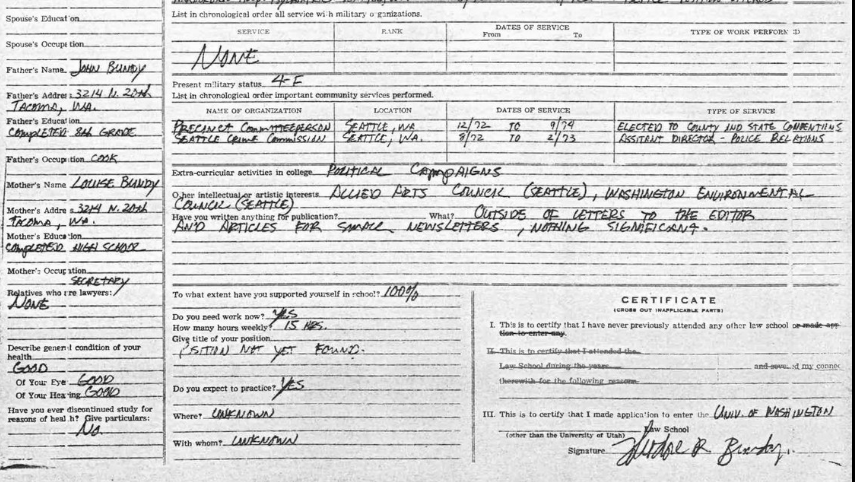
A newsletter for the police society VIDOCQ dated December 15, 2015 mentions a presentation the organization put on regarding the case of Johanna Leatherbury (looking through their website I couldn’t find any additional information on her). In the article, Deputy Police Commissioner Bill Gill reported that Chief Medical Examiner Dr. Todd Grey was able to secure a sample of Leatherbury’s DNA as well as her mandible for further testing. The same article mentioned that the group was going to speak with a serial killer named ‘Robert Lee Sales,’ who was serving time at the Utah State Prison for murders similar in nature to Leatherbury’s. Incarcerated since 1973, Sells raped and murdered multiple young woman around Johanna’s age in the early 1970’s. He was convicted of the murder of JoAnn Poulsen from Corinne, UT, who was recovered from the PineView Reservoir on September 26, 1971. Oddly enough she disappeared on August 21, 1971, which is the same day that the remains of Leatherbury’s were recovered.
About her sister, Roxanne Leatherby-Brough said that Johanna ‘was a good kid. She tried hard to please other people, help us all. I don’t know. I miss her a lot.’ The remaining members of the Leatherbury family haven’t gotten much information related to Johanna’s case over the years, and unfortunately both of her parents died before seeing their daughter’s killer brought to justice: Gayle passed away at the age of 64 on November 6, 1984 and Mr. Leatherbuty died at the age of 73 on May 6, 1990. Their son Jack said he watched as the gruesome details and gnawing unknown tore his parents apart, and because of the death of their daughter they both went to their graves completely changed people. A few of Johanna’s siblings have passed away as well: her brother Paul died at the age of 55 on November 23, 1997 in Murray, UT (which is coincidentally where the Fashion Place Mall is located, which is where Carol DaRonch’s attempted abduction took place). According to his obituary, he was a past President of the Utah Arabian Horse Association and he loved his horses, fishing, and traveling. He had a great zest for life and was known to those who loved him as ‘the world’s greatest salesman.’ On July 5, 2012 Greg Leatherbury died of complications from diabetes at the age of 61. He was known to loved ones as ‘the great organizer’ because he excelled at planning events and activities, including an annual Father’s Day Open Golf Tournament. Charles Leatherbury died at the age of 73 on December 27, 2018; he was in the US Army and fought in the Vietnam War.
Because of their extreme dissatisfaction with the way law enforcement handled the investigation, the Leatherbury family recently joined forces with the Utah Cold Case Coalition to help get answers in Johanna’s case. The coalition is a Utah based organization that helps to bridge the gap between police and the families of cold case murder victims. Two of Johanna’s nieces, sisters Sandy and Cindy, said they were told that information related to their aunt’s case could not be shared because it is still an open and active investigation. Cindy Leatherbury-Grange commented that: ‘we really have felt the case was solvable, but now it’s so many years past.’… ‘We’re wondering if these people are dead, what has happened. Thirty years ago, we might have had a chance.’ The coalition’s co-founder Jason Jensen is certain Johanna’s killer is local to Salt Lake City. In a post on their FB page about the Leatherbury case, the ‘Cold Case Coalition’ commented that: ‘it’s been exactly 48 years since Johanna Leatherbury was found dead in a drainage ditch near Saltair in Salt Lake County. She had been raped, shot, and stabbed. 48 YEARS. Yet Unified P.D. won’t release any records because it’s ‘still an open case’s This is the same response we get from Unified in every case. If you haven’t solved the case in nearly half a century, can someone else have a try?’
In an article published by ABC4, Johanna’s family got an email from a Salt Lake detective in mid-February 2022 with news they’ve been waiting many, many years to receive: ‘They have identified new DNA from the crime scene and he was securing funds to send it to their lab for testing and hopefully he’ll be able to use genetic genealogy.’ Jensen commented that this new evidence could be a variety of things: ‘if it was an article of clothing or something that was handled by an investigator 30 or 40 years ago chances are great that it’s an incidental from an investigator. But if it’s something concrete like semen, then it’s going to be the bad guy.’ This technique is quickly becoming very common with law enforcement and helps to identify familial DNA, and from there authorities are able to narrow down the search in hopes of finding a possible suspect. The article said it would be months before LE got the results of the DNA analysis and considering it’s now the end of 2023, I’m leaning towards them not finding anything of value from the sample. As a side note, in early 2023 Rita Curran’s killer was found in the same manner, and it was determined that her neighbor William DeRoos killed the pretty young teacher in her bed on July 19, 1971 in Burlington, VT.


Ted Bundy’s Last Will and Testament from 1989, courtesy of Erin Banks/CrimePiper.


This is the complete autopsy of Caryn Campbell. Document courtesy of Erin Banks/CrimePiper.


Written by Teri Phillips-Offield.
Intro: Jessica told you about the monster behind these heinous crimes, and now, I am going to tell you about the victims. I think it is important to know about their lives and not the fact that they died, but that they lived. The victims are the ones who should be remembered.
I feel that his sisters were among his first victims along with Helen Pilkerton. They suffered abuse at his hand and also were used to lure unsuspecting victims. To my utter disbelief, there were not much information for the beautiful lost souls, and none for the hitchhikers they fell victim to him. I want them to know that I, a complete stranger, do not know who you are or where you are, did not forget you.
I also feel that if his parents would have not covered for him and turned him in, many lives would have been saved. This is my opinion but after hearing the whole story from his sisters, my opinion is that they didn’t protect them and then did not protect the poor innocent girls from this monster.
Ted Bundy was suspected of Kathy’s death, but DNA proved to be William Cosden Jr. He was in prison for attacking Beverly Pearson already hiding right under their nose. It took 28 years and DNA evidence to find the truth. Here is the havoc this man created and the grief he inflicted on the families of his victims. I will start with his earliest victims, his sisters, and then go on to victims he raped, and killed, and finally Kathy Devine, his final known victim. A story full of senseless killings that never should have happened if he would have stayed in jail where he belonged.
Early Victim, Helen Pilkerton: Cosden was sent to a mental hospital in Maryland for killing a woman in 1967 and was serving a three to four-year term at the McNeil Island Corrections Center near Tacoma for a 1976 rape and murder conviction. Her name was Helen Patricia Pilkerton. She was an employee of the Lexington Park Motel and was just 20 years old. Helen Patricia Pilkerton was born on May 24th, 1945, in St. Mary’s, Maryland, her father, John was 22 and her mother Helen was 21. She had one brother and four sisters. She died on April 16, 1967, at the age of 21, and was buried in Hollywood, Maryland.
Helen was found in a stream by two teenage girls and her body was badly beaten. Cosden had just returned from active duty in Vietnam where he was discharged due to violent behavior. The family of the victim had to sue the Military because of the outrageous leniency of the sentence. To my utter disbelief, Cosden was free after 6 years to rape and kill again. Deputy Prosecutor Philip Harju said, “He is an obvious danger to society.” Yet, he was released to rape and kill again. The story should have ended here, better yet not allowed at all.
His sisters, Karen and Susan: They were told their brother was away at a hospital and so his sisters thought he was all better when he came home. There was no warning from their parents whatsoever. They never told them why he was away and never took steps to protect them. He would get in constant trouble at home and in school almost like he invited the punishment. He always had to be in control. His sisters wished their parents were more aware. He loved to torment his sisters and animals. He got pleasure in making his sisters cry. When Karen was 4, he started sexually abusing her. He warned her he would hurt the whole family if she told. The same thing happened to Susan in a few years. He took steps to encourage them to not be close.
When Susan was 8, her brother can downstairs all dressed up to go out. The next morning, she woke to find the sheriff at the kitchen table. They came for her brother. He had confessed to his father that he had killed a woman the night before. The sisters were beginning to see just how evil he was. He did four years in a mental hospital. Four years. His parents told the girls he had went to get well and he was well. That very night he came home, he sexually assaulted his sister.
He was also a firebug and burned down the family home. His mother suspected it was him but did nothing. Again. The cause of the fire was listed as electrical. A house down the block burned too. He seemed to get away with everything. He would also burn his truck to cover evidence.
Then one day the paper was showing about a body found. He got more and more agitated as the paper was read and screamed at them to stop reading. This turned out to be Kathy. He would go to “help” people on snow days when in fact he was looking for prey. One day after a snow day he was arrested for rape.
In 1986, Susan came across his file that showed he was going to be released, she freaked out. She went to the police department to talk about her abuse. The detective she talked to said he believed her brother killed Kathy and would not retire until he found out. Susan told her story and wanted to make sure he didn’t get out. DNA tests were done, and he was convicted. She even flipped him the bird as they were sentencing him. Her family was actually mad at her for doing this. Susan, you are a hero to me.
In 2015, he died alone of a heart attack. They had to deal with the effects of their traumatic past as adults, with one of the sisters even nearing death. Despite the difficulties, the sisters band together to discuss the harm done to them and make an effort to make things right. About a week after filming, Sisters in Silence, Karen Harris passed away following a battle with lung cancer. RIP Karen.
Hitchhikers: Restover Truck Stop in Tumwater, just off Interstate 5, focal point for hitchhikers where he worked there, and his father owned. As I pointed out, Susan says her brother Williams Cosden Jr. would use her as bait to pick up women hitchhikers. The women would feel safe getting into his truck with a little girl there. He would tell his mom he was taking Susan to get ice cream and then take her to pick up hitchhikers. Once the girls were in the truck, he would lock Susan in the back. Many hitchhikers would disappear during this time. We may never know all his victims and which ones were Bundy’s. I apologize for not finding any names of the hitchhiker victims, it makes me wonder how many girls are in unmarked graves all over because of men like Cosden. I wonder if these families ever knew what happened to their daughters. My heart goes out to these families. I hope they found some kind of closure.
Beverly Pearson: On November 30th, 1975, 24-year-old Beverly Pearson stopped to get gas. As she was filling up, she encountered Willian Cosden Jr. She recognized him, but finished getting gas and drove away. On her way home, she lost control of her truck and pulled over. She noticed that Cosden pulled over right behind her. She told him she was fine, but when she went to get back in her truck, he hit her with a rubber mallet. He then forced her into his truck and kept threatening her and she kept saying to not hit her again.
He pulled over at a wooded area and sexually assaulted her. She remembers thinking to try to get him to talk. Her step father was a police commissioner and taught her to try and get anyone who attacks you to talk. She asked him personal questions and told him if he let her go, he could come visit her at home. It worked and he took her back to her truck. She immediately called the police and Cosden was picked up Cosden was found guilty and was sentence to serve a 49-year sentence. Because of her bravery, he was off the streets.
Kathy Devine: I got most of Kathy’s story from Jessica because she wrote it better than any article I read. According to Jessica, Katherine Devine was born to Sally and William L. Devine in Seattle in King County, Washington, on December 25, 1958. She was a Christmas baby. Her family remembered how the kind-hearted teen thought she was destined to become a Minister after being born on Christmas Day. Kathy regularly brought home stray animals and homeless children living on the streets to take care of them. She had a big heart and always sought to help the less fortunate and helpless individuals.
Witnesses last saw the 14-year-old teen hitchhiking in Seattle near North 91st Street and Aurora Avenue North. Her mother stared Kathy had just broken up with her boyfriend and was headed south to visit relatives in Rockaway, Oregon. Her family had reported her to the authorities as a runaway. Little did they know that was the last time their daughter would be seen alive. On December 6, 1973, a young couple stumbled across the remains of the 14-year-old girl in Margaret McKenny Campground in Thurston County.
The victim’s throat had been slashed, and she was lying face down. An examination further revealed she had been brutally sodomized and strangled to death. According to police reports, the officers found the victim’s pants were deliberately torn. Authorities figured that since the place was deserted and it would take a local to know their way around the campground, the killer must be local. The decomposed remains were not immediately identified until Kathy’s sister Sherrie Devine, then 16, saw a television news program in Seattle of the discovery and recognized an embroidered patch on the pair of jeans the victim was reported wearing.
Witnesses saw Cosden come in the night of the murder with stains on his clothing. The witnesses called police. After leaving the truck stop, Cosden’s truck caught fire and was destroyed three miles from the truck stop. During initial interviews with police, Cosden denied ever seeing Kathy Devine.”
Kathy was first thought to be a victim of Ted Bundy. When Ms. Devine disappeared in 1973 Ted was attending the University of Puget Sound Law School and lived within two miles from where she was last seen. Everyone knows he drove the yellow, cream-colored Beetle for years before his arrest, but supposedly his brother owned a white pickup truck. During his death row confessions before his execution in 1989, Bundy told law enforcement that he picked up a hitchhiker in 1973, killed her then left her body close to where Kathy’s remains were found in Olympia, however he couldn’t remember the exact location. He denied having any involvement with Devine’s murder. But this makes me wonder if he did indeed kill Kathy. Cosden was surprised to be convicted and Bundy admitted to killing a hitchhiker and they only found Kathy at that site.
Kathy’s ex-boyfriend was a suspect but passed the polygraph. Another man said he saw the whole thing but was very uncooperative with police. While searching his house, a lot of newspaper articles about Kathy were found along with a blood-stained knife. When they brought him in, he denied all charges and said he could explain. He said the knife was for hunting and after testing, the knife did indeed have animal blood on it. He was cleared of the charges.
An anonymous man called detectives and suggested they investigate Cosden. The man said he looked in the back of Cosden’s truck and found a blood-soaked sleeping bag along with a single shoe. He was looking in Cosden’s truck because he claimed he was a co-worker and Cosden was stealing from him. Before the police had a chance to investigate Cosden’s truck “mysteriously” caught in fire. Remember, Kathy was found missing a shoe. The shoe found on Kathy matched what the man described but they never got the evidence since it burned.
The police went to the jail to confront Cosden and he denied it even though they have DNA proof found on Kathy. Luckily, they had enough to convince a jury and his sister, Susan helped, and he was convicted.
He lived in the area at the time of Kathy’s disappearance and murder. According to witnesses, William was seen wearing bloodstained clothes at the Truck Stop on November 26, 1973. He worked at the truck shop owned by his father and was reportedly working an early morning shift. After leaving the truck stop, Cosden’s truck caught fire and was destroyed three miles from the truck stop.
Additionally, witnesses claimed to find what appeared to be bloodstains inside William’s truck late on November 25, the very day Kathy was last seen alive.
William Cosden was already in prison for sexually assaulting Beverly Pearson when he was convicted of Kathy’s death. it was be the oldest open murder case in the state to have been solved by DNA “fingerprinting,” authorities said.
After Cosden was finally convicted of his daughter’s murder, Mr. Devine said: ‘It’s finished. There’s a justice system, and it works.″ ‘It doesn’t bring Kathy back, but it sure does help. “It was very creepy,” Sherrie Devine, the victim’s older sister, said of the court appearance. Devine’s mother, Sally, said she was nervous about seeing Cosden for the first time. “It would have been worse if we would have had to look directly at him,” I cannot help thinking that if the justice system kept this monster behind bars after his first murder and rape in 1967, Kathy would still be alive. And why weren’t his sisters protected from this monster? They were just little girls.
Conclusion: It took many years to finally catch her killer, but finally the family has answers and hopefully a little bit of peace. Such an unnecessary waste of her and of the beautiful souls who left this world too soon. My heart goes out to everyone whose life was touched by William Cosden Jr. I want to thank Jessica for not letting these girls be forgotten and reminding us they did live and not only die. And Charlene and Sherrie, you should have never had to endure this kind of horror in your family. My heart goes out to you and much respect for coming out the other side of this tragedy. A long as Jessica and I are here, we will not let her be forgotten.


Cites:
Katherine Devine Murder: Where is William Cosden Jr Today? Update (thecinemaholic.com)
Life term for man whom DNA linked to murder (seattlepi.com)
Closing ceremony, tour of McNeil Island prison (seattlepi.com)
Evil Lives Here, Sisters in Silence. Season 13, Episode 10.
Katherine Devine Murder: Where is William Cosden Jr Today? Update (thecinemaholic.com)
Katherine Merry “Kathy” Devine. | Another Bundy Blog. (wordpress.com)
Most pictures were taken from Another Bundy Blog: Kathy Devine
Facebook page Cowards ad Killers
Man sentenced to life in prison for 1973 murder | The Seattle Times
Historical Newspapers from 1700s-2000s – Newspapers.com
On the case with Paul Zahn, Season 12, Ep 4, Waving Goodbye.
Other info, Another Bundy Blog. (wordpress.com)
https://www.heraldnet.com/news/rapist-charged-in-1973-killing/
Written by Jessica J. Jurewicz-Woods.
William Earl Cosden Jr. was born on December 19, 1946 to William Earl Sr. and Janet (nee Bakke) in Baltimore, Maryland. The couple were married on June 6, 1945 and eventually settled down near Seattle in Washington and had two girls and two boys: Karen (Harris), Susan (Keller), William Jr. and Timothy. Mr. Cosden worked as a mechanic and owned a truck stop near Olympia, WA. After high school (I’m not sure if he graduated and I couldn’t find the name of the institution he attended), ‘Billy’ joined the Marines and fought in the Vietnam War. Not long after arriving back in the US, he was charged with the murder of Helen Patricia Pilkerton. The 22 year-old disappeared on April 16, 1967 and her body was eventually found by two teenage girls in a stream by Flat Iron Road in the Great Mills area of Baltimore. Two court appointed psychiatrists testified in court that the war vet ‘lacked the substantial capacity to appreciate the consequences of the crime.‘ Circuit Court Judges Perry Brown and J. Dudley Diggs determined that the then twenty-year-old Cosden was ‘insane at the time of the murder,’ which saved him from ‘hard time.’ He was sentenced to reside at the Clifton T. Perkins Hospital in Jessup, MD until ‘he no longer constitutes a danger to others or himself under the dictates of the law.’ Regarding the verdict, Judge Diggs said that ‘the facts substantiated by the State prove that the defendant (Cosden) is really but not responsible for his actions because of mental illness.’ Just as a side note, this really passes me off. If the judges realized who exactly they had in their custody and sentenced him to prison it may have prevented the death of Katherine Devine and the brutal rape and assault of Beverly Pearson.
Four years later Cosden was released from the psychiatric hospital and moved to Washington state to be with his family. He began working at his father’s business, the Restover Truck Stop in Tumwater, which happened to be a popular hangout for hitchhikers. On November 25, 1973, Katherine Merry Devine vanished without a trace while attempting to hitchhike about 200 miles away to her cousin’s house in Rockaway, Oregon. The next day, a coworker noticed bloodstains in Cosden’s truck, which coincidentally caught fire immediately after. Although LE had their suspicions about Cosden being involved in the 14 year old’s death, they had no proof tying him to the crime.
William managed to fly under the radar until 1975, when he was arrested for the brutal assault and rape of Beverly Pearson (in some older newspaper articles she has the last name Frederick). Early in the morning on November 30, 1975, thirty year-old Cosden brutally raped and assaulted the 24-year-old, who was a customer at his truck stop. The weather that night was snowy and driving conditions were treacherous, and he asked the pretty young pharmacy technician if she’d like him to follow her home to make sure she got there safely. She politely declined his offer however he insisted. At some point during their drive, Billy purposely drove his truck into a ditch then pretended to need help getting it out. After Beverly got out of her car to check on him, Cosden subdued her by hitting her on the head from behind and threatening her with a rubber mallet. Pearson told him that she would ‘do anything if he wouldn’t hurt her’ and at one point during the assault Billy grabbed her by the throat and asked how she was going to explain her ‘new bruises.’ After raping her twice, he took her to his property in Maytown. During the drive, Beverly tried to jerk the wheel in an attempt to make him lose control, and even tried to escape by trying to open the door and crawling out. She was unsuccessful.
The attack took place in a secluded wooded area near Maytown Road. Miraculously, Beverly was able to convince her attacker to let her go and he was arrested a few days later, just hours after she made the report to police. Pearson told the sheriff’s department that she was assaulted by a man ‘named Bill at the Lathrop Road Truck Stop.’ FBI Agent Myron Scholberg said the victim’s hair was found on Cosdens overalls and in his truck, which helped officially link him to the crime. A second federal agent named Allison Semmes positively identified stains that were left behind on Beverly’s underwear and panty hose as Cosdens sperm; the same substance was found on the overalls he was wearing that night. Strangely enough, when law enforcement examined his truck they were unable to find any identifiable fingerprints.
At Cosdens’ trial, a nurse that treated Pearson the night she was assaulted testified that she had ‘bruises and reddened areas around her head and shoulders’ and a Doctor said her injuries were consistent with the results of wounds caused by a blunt object. Dr. Torre Nielson (a Psychiatrist for the defense) said that ‘the performance of two sexual acts in succession in cold weather was highly unlikely.’ He also said that it’s common for a man to experience impotence when thinking of his wife and child. A Seattle based pathologist told the jury that based on lab tests done at around 9 AM later the same day the attack took place, no intercourse had occurred in the previous 12 hours.
While testifying in his own defense, Cosden said when Beverly first saw him early that morning she waved to him, flirting as if they knew each other and happily accepted his offer to follow her home because of the weather. The defendant said that Pearson deserted her pickup in the middle of the intersection at 101st Ave and Case Road, backing it up into the wrong lane then leaving it to get in his vehicle ‘to talk.’ He went on to say that she sat in the middle of his seat, wrapped her arms around him, and asked him to drive them to a place where they could ‘be alone.’ William testified that she talked about her divorce and that he never threatened her or hit her in any capacity. He took her to some property he owned in Mayfield and at no point during their time together did Pearson try to get away from him or leave his company; he also said that at any point if she changed her mind about being with him he would have stopped everything and taken her back to her pickup. He shared with the jury that he never threatened her with a gun ‘hidden under the seat, as she had testified’ and didn’t even keep a weapon in his truck. The married man also claimed that he completely turned down her advances, and that he couldn’t partake in sex with Beverly because all he could think about was his wife and child. When asked how he felt about what happened, Cosden said that he ‘felt like a damned fool.’
Cosden also testified that Beverly drove to his house on January 5, 1976 looking for him. After she pulled away, he immediately called his Attorney Don Taylor and told him about the incident.
On February 18, 1976 William Earl Cosden Jr. was sentenced to 32 years in prison for the rape and brutal assault of Beverly Pearson. He was up for parole in 1990 however the board denied his release, saying he was not safe to be released into the community. Apparently Cosden had quite a temper and on two separate occasions he was brought back to prison after being thrown out of pre-release housing units. In 1999 he was up for parole again but was denied.
In 1986, Thurston County Detective Mark Curtis got a court order for Cosdens blood, but because the technology wasn’t available at the time the sample sat in evidence for so long that he forgot it was even taken. Because of some grant money available through the WA state Attorney General’s HITS program, Curtis was able to take part of the DNA sample to compare to Devines. In 2001, a comparison was done and the test came back a match: William Cosden Jr. killed Katherine Merry Devine. After the successful identification, Detectives Joe Vukich and Brian Schoening went to the prison Cosden was being housed at on McNeil Island and questioned him about his involvement with the murder of Devine. He claimed to know nothing about it.
In 2002 the rest of the DNA sample Cosden provided in 1986 was used in a second analysis, and there was no doubt about it: he was the man that killed Kathy Devine. Detectives David Haller and Tim Rudolf went to talk to Cosden about the positive identification; this time he said he may have had sex with her but didn’t kill her. He was furious when detectives arrested him for the 1973 murder, despite already being in prison. Thankfully, prosecutors were able to argue that Kathy’s DNA was a match to the blood found in his truck and on his clothes. William Cosden Jr. was 55 when he was sentenced to life in prison without the chance of parole in June 2002. Former Deputy Prosecutor Philip Harju said that he was ‘an obvious danger to society,’ and former Thurston County Superior Court Judge Daniel Berschauer agreed with his assessment before passing on the life sentence.
William Earl Cosden Jr. died at the age of 69 in 2015 while incarcerated outside of Seattle, Washington. William Cosden Sr. passed away on December 8, 1983, and Mrs. Cosden died on May 3, 2014 at the age of 88. Susan Cosden-Keller began her career as a teacher but went back to school for her nursing degree. Karen Cosden-Harris worked as a reading specialist at Evergreen Elementary School in Washington. Timothy Cosden was a massage therapist until recently, when on October 5, 2022 his license was suspended after he was accused of sexual assault (Bilbao, The Olympian).*
On Easter Sunday 2023, an episode of the Discovery Plus show ‘Evil Lies Here’ premiered that featured William Cosden Jr.’s two younger sisters. Karen and Susan also fell prey to their older brother, who made them keep his secrets to themselves. The two women lost touch over the years, each one becoming busy with their own careers and lives all while trying to heal and move on from their painful childhoods. But after Karen received a terminal diagnosis of stage four lung cancer, they reunited on the show to talk through their shared trauma in hopes of healing and coming to terms with what happened to them in their younger years. Karen Cosden-Harris sadly passed away on November 4, 2022.
* Bilbao, Martin. ‘Thurston County Massage therapist, 68, suspended for alleged sexual assault.’ October 12, 2022. https://www.theolympian.com/news/local/article267212417.html


Sharon Pulaski was born at some time in 1963 to Andrew and Sophie (nee Urbanski) Pulaski in Alden, NY. The couple were married in Cheektowaga on November 7, 1959 and had three children: two boys (Andrew and Brian) and Sharon. Mr. Pulaski served in the US Army, and the family eventually settled down at 1369 Townline Road on the Lancaster/Alden border. Sharon graduated from Alden High School in 1980, but aside from that little is known about her background. I found some pictures of her on classmates.com, and going through her high school yearbook I was able to see that she participated in a number of different extracurricular activities, including poetry workshop, photography club, and science club. From what I’ve gathered (through comments on social media posts about her), the Pulaski’s were a very close-knit, loving Roman Catholic family that were private and mostly kept to themselves. They were very involved with their church and helping people in the local community.
Sharon had green eyes, brown hair, was 5’4″ tall, weighed 130 pounds and wore corrective lenses. She had a two inch long scar on her right shoulder, a tattoo of a heart on her right arm, and was last seen wearing white sneakers, blue jeans, and either a black or white shirt. On October 7, 1983 Sharon gave birth to a son named Steven, who she raised at her parent’s home up to her disappearance. Strangely enough, I went to high school with him and graduated the year before him. We were in different social circles and I didn’t hang out with him but I remember he was nice and very passionate about his faith.
Before she left, Sharon told her mother that she was running to the store but would be back in fifteen minutes. Mr. Pulaski reported to law enforcement that his twenty-four year daughter had left home on July 20, 1987 and never returned home; she has not been seen or heard from since. Sharon left the residence in her vehicle, a blue 1985 Plymouth Reliant with NY tags, license plate number 6679-BLZ. Just a few months later in August of 1987 Pulaski’s vehicle was pulled over in California, however she was not one of the four people inside. To be fair, she was reported missing in New York and it was the 1980’s. There was a good chance the officer had no idea the vehicle’s owner was missing. But wouldn’t it be suspicious regardless? A car with New York plates gets pulled over across the country and its owner isn’t one of the four occupants inside? Obviously it was eventually figured out (as we know about it), but I wonder if the cop that pulled the car over even bothered getting the names of the people inside? Was this situation ever revisited and were they questioned? For some reason a police report was never filed and the individuals were never taken in for questioning. In September 1987 Pulaski’s sedan was found abandoned in Seattle.
After I posted on a few Alden, NY Facebook groups asking for more information about Sharon, I had a few people reach out to me that knew her. Additionally, going through the comments, a few acquaintances of hers said that they had absolutely no idea where she went and didn’t even have so much as a working theory as to what happened to her. According to a post about Sharon on the Facebook group ‘Jane Does and Missing 1970’s-1980’s,’ she did on occasion take off for short periods of time but always came back… until she didn’t. An individual by the name of Andrew Pulaski commented that ‘she’s my aunt, she disappeared the day of mother’s baby shower, according to my parents she said she wasn’t able to attend that day and when they came back home she was gone but all of her son’s documents (SSN, birth certificate, medical docs) were left neatly on the bed.’ I also got some information about Pulaski from a childhood friend of mine, Michael Mack. He said his mom Karen (who I also know, as they lived down the street from my family for many years) grew up with her. When I spoke to her a few days later she confirmed that they were best friends until she disappeared. Just like everyone else I spoke with, Karen had absolutely no idea what happened to Sharon or where she went. It’s as if the earth just swallowed her up.
This is just my own personal observation, but I find that investigating agencies are far less likely to take a missing persons case seriously if they feel the individual left in any way on their own accord. I even look at Bundy cases, like Brenda Ball and Donna Manson, who were both frequent hitchhikers and would often take off for brief periods of time before eventually turning up again. LE was extremely hesitant to even link Balls disappearance to the other Ted murders that were taking place all over the Seattle area at the time (although it was her skull that was the first one discovered at Taylor Mountain on March 1, 1975). I wonder if that’s why I couldn’t find any articles or news reports on Sharon, because they thought she was a runaway. Fourteen year old Brenda Joy Baker also comes to mind, as her disappearance didn’t make the news until her body was discovered (for my non-Bundy readers, she was a frequent hitchhiker that ran away from home on multiple occasions and was last seen getting into a pick-up truck in May 1974).
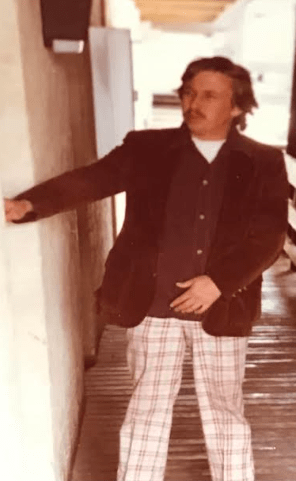
Looking into it there were quite a few possible routes to get to the golden state from Alden. One incredibly frustrating part of all this is the lack of information out there. California is a large state… Where exactly was her car pulled over? It’s at least a day and a half trip, and that’s driving straight through. I think there’s a few different possibilities that could have happened to Sharon… maybe she got tired of small town living and simply left? That theory reminds me of Nancy Perry-Baird out of Utah, who vanished without a trace from the gas station she worked at on the 4th of July in 1975. Like Pulaski, Nancy also had a young son, roughly the same age as Steven. But why would anyone willingly leave their child behind? And Perry-Baird was GONE gone (just like Sharon). Or was there maybe a more sinister aspect to her disappearance? Perhaps she picked up a hitchhiker that pulled a weapon on her, taking control and subduing the young mother? Or did she plan on taking off only for a few days but something happened along the way that prevented her from returning home. One possible suggestion I read on a FB post was maybe she fell in with the wrong crowd, which somehow resulted in her untimely demise? But where would she be after all this time? According to Karen Mack, NO ONE has any clue what happened to her. Her disappearance came completely out of left field to everybody and made absolutely no sense.
In a write-up for Pulaski on the Facebook page ‘Jane Does and Missing 1970’s-1980’s,’ someone commented that serial killer Tommy Lee Sells was in the general western NY area just before Pulaski disappeared in 1987, and sure as shit they were right. Also referred to as The Coast to Coast Killer, Sells killed twenty-eight year old Suzanne M. Korza on May 2, 1987 after getting in a fight with her fiance and leaving a Lockport bar. Eight years later her skeletal remains were found at the base of an escarpment near Niagara Falls. Susan was from Lancaser, NY and strangely enough went to the same high school as my Mom (St. Mary’s, but Suzanne was a couple of years younger than she was). Korza’s official date of death is listed as September 5, 1995, which was the date she was found. Her case went unsolved until 2004, when Sells confessed to her murder while he was waiting to be executed for the murder of a young girl in Texas.
On December 31, 1999 Sells entered a Del Rio residence and sexually assaulted 13-year old Kaylene Harris. He sexually assaulted then killed the teenager, stabbing her sixteen times and slashing her throat. He then cut the throat of her friend, 10 year old Krystal Surles, who luckily survived the brutal attack. Unfortunately, Sells was a lot like Henry Lee Lucas and liked to confess to murders and crimes he didn’t commit (he claimed to have killed over 70 people). Regardless of what the number really was, he was found guilty of killing Harris on September 18, 2000. Two days later he was sentenced to death. Because of his link to Lockport (which is about 45 to 55 minutes away from Alden), Pulaski and a second unidentified missing woman were deemed to be possibly linked to Sells. Interestingly enough, Facebook user Kelly Rosemellia commented that the serial killer being considered a potential suspect in Sharon’s disappearance was just a crackpot theory dreamt up by some lazy detectives that didn’t feel like investigating her disappearance properly. Additionally, most people from the general Alden area that knew Pulaski don’t buy the theory that Sells had something to do with her disappearance.
Just a few months after Sharon disappeared on October 15, 1987, Sells drugged Stefanie Stroh with LSD before he strangled her to death. Stroh was hitchhiking home to San Francisco after a year-long trek through Europe and Asia. The day the 20-year-old disappeared Stefanie was seen standing next a road with her thumb out in Winnemucca, Nevada. After accepting a ride from the serial killer, Sells killed her. He then encased her feet in concrete and dumped her remains in a desert hot spring. Her body has never been recovered. Sells was executed by lethal injection at the age of forty-nine at 6:14 PM on April 3, 2014.
According to one Facebook user whose parents lived across the street from the Pulaski family, ‘We weren’t close, but they seemed like a nice hard working family. I asked my parents if they recalled anything about the event. They do remember her leaving and never returning. And my Dad recalled that their family received a call saying they found her car down south. Our family just assumed that she ran away to start a new life. I don’t recall ever seeing any news reports or articles about her saying that she was missing.’
I had a new friend reach out to me about the fact that Sharon’s father was a member of the Knights of Columbus. Per his obituary, Andrew Pulaski specifically was a Fourth Degree member of the Father John Schaus Council of the K of C’s, 4652. The Fourth Degree is the highest degree of the order and members who reach this elite status are addressed as ‘Sir Knight.’ In 1985, Pulaski was given the title of man of the year by the Holy Name Society and was even named knight of the year by the Father Joseph Schaus Council in 1987. I mean this makes sense, as the Pulaski family was very active at their home parish of St. John the Baptist out of Alden. Looking into it, the Knights of Columbus is the world’s largest Catholic family fraternal service organization, with 1.7 million participants. It provides its members and their families with volunteer opportunities in service to the Catholic Church, their communities, families and young people. This new friend however suggested a more ominous, ritualistic aspect surrounding the society, and even suggested that they possibly had something to do with Sharon Pulaski’s disappearance. I mean, no secret society is going to admit to being a secret society. Of course they’re going to say they don’t have anything less than the very best of intentions. On a semi-related note, I had a friend from elementary school whose mother accidentally walked in on a Masons meeting one night and saw something… dark, and not exactly right (I don’t know if she had to use their bathroom or needed directions or what exactly). My GF said it was almost as if her mom walked in on a ritual of some sort… thankfully she realized that she shouldn’t have been there and quickly left.
After graduating from high school in 2002, Steven went on to attend ECC for a bit before eventually getting hired at FedEx. Unfortunately, while looking for information about his mom I learned he died sometime in 2020. I couldn’t find any sort of obituary for him. Sharon’s dad Andrew passed away on May 11, 1989 in Buffalo, and her mother died on February 15, 2013. Her brother Andrew lives in Alden and Brian resides in Lancaster. If Sharon was alive in November 2023 she would be sixty years old.