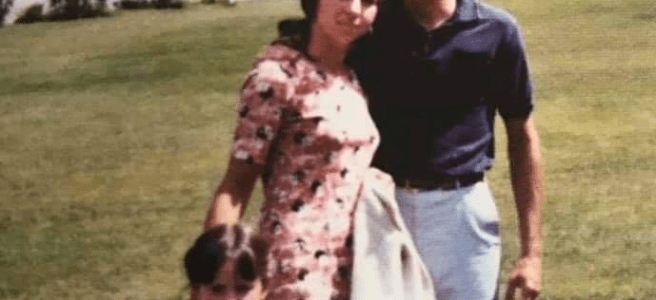
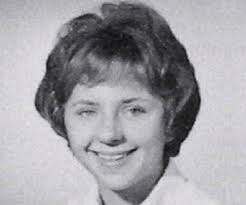
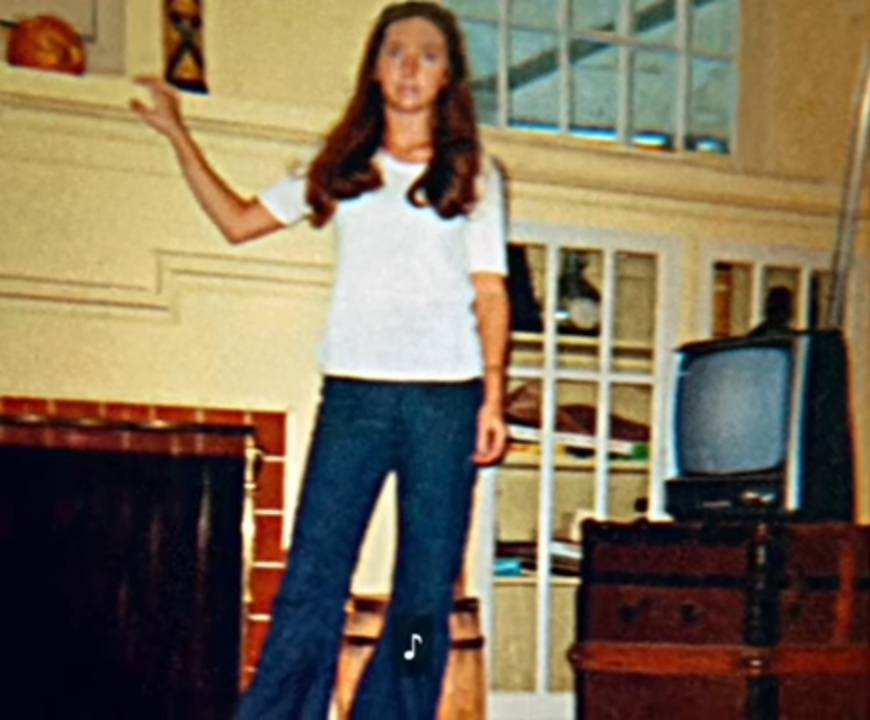
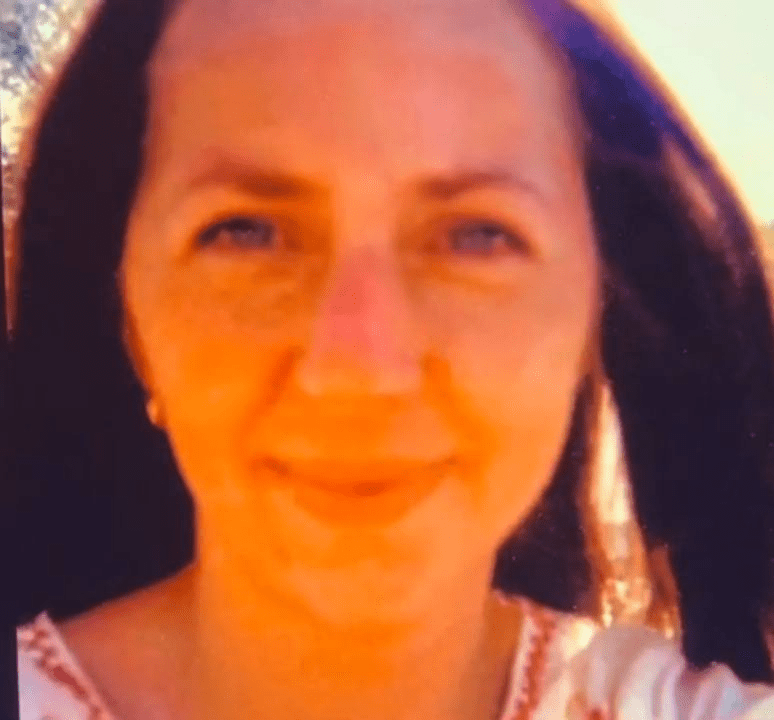
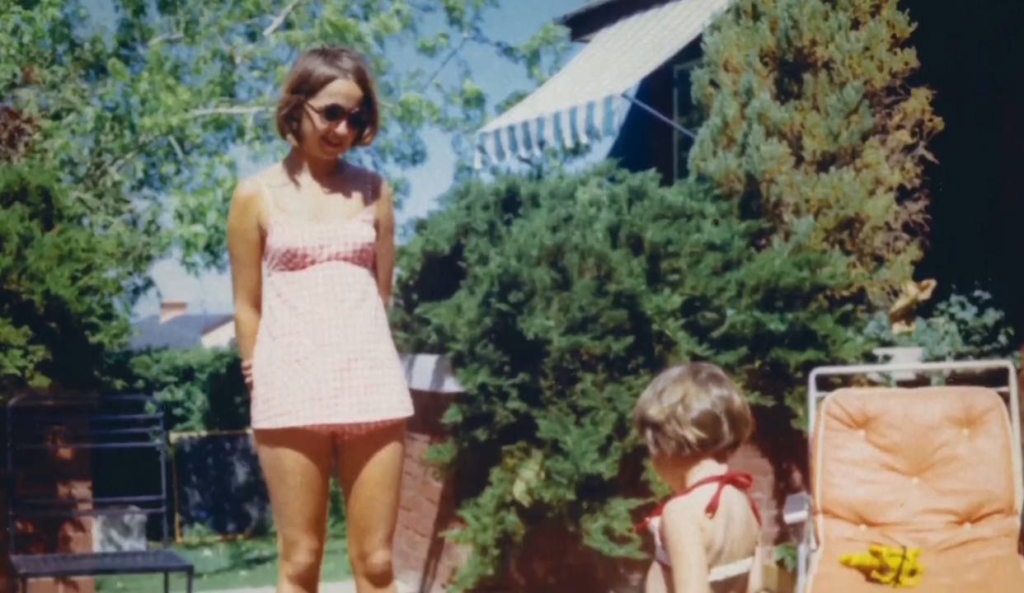
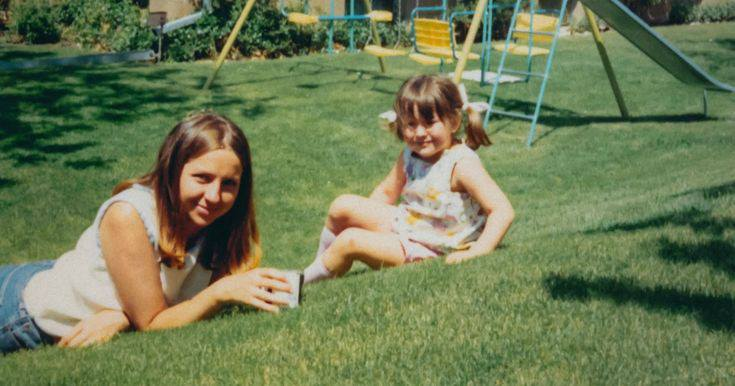
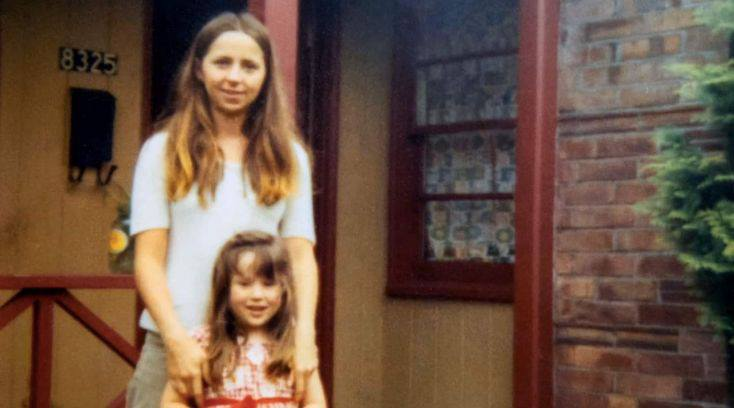
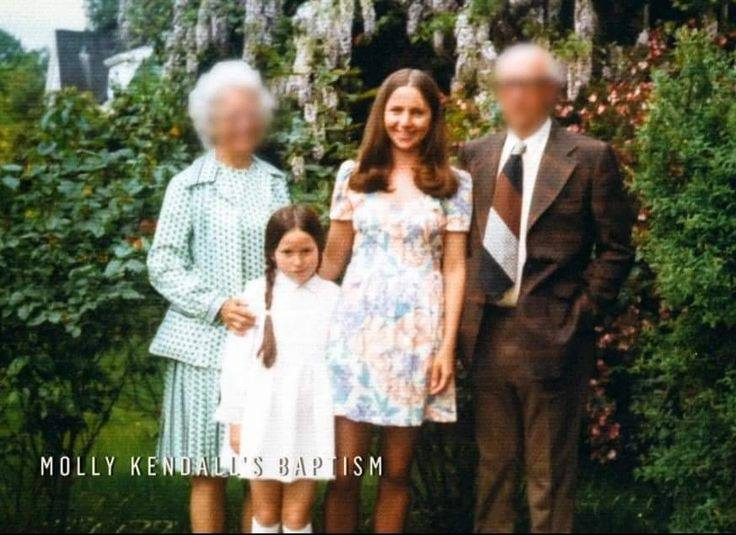
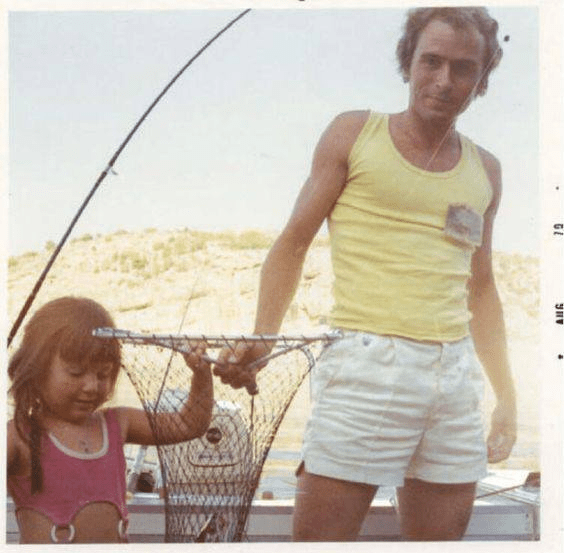
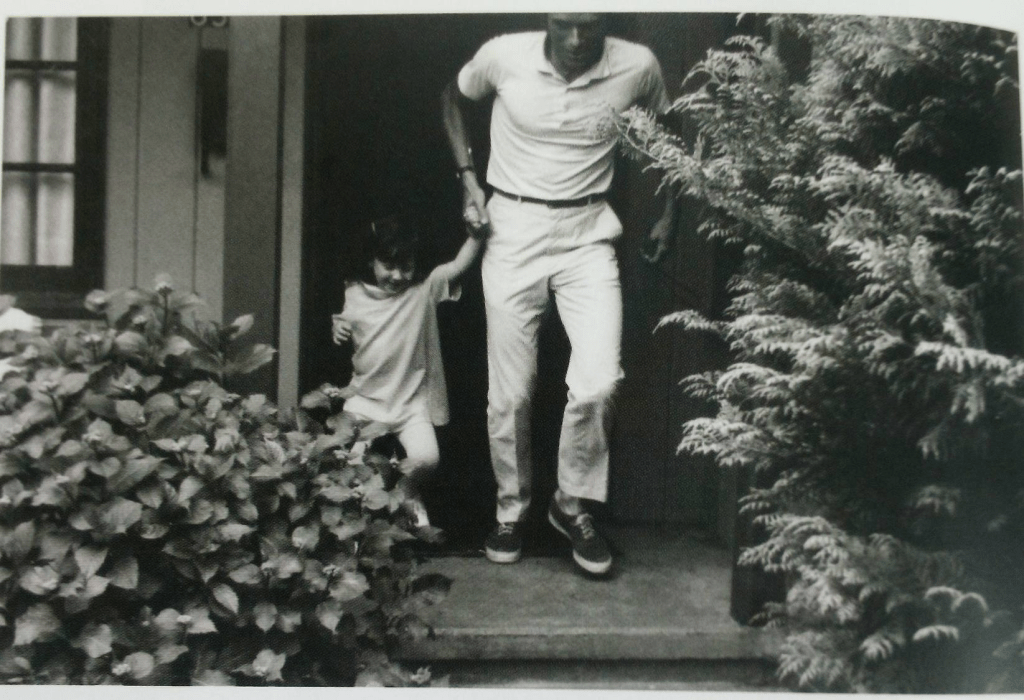
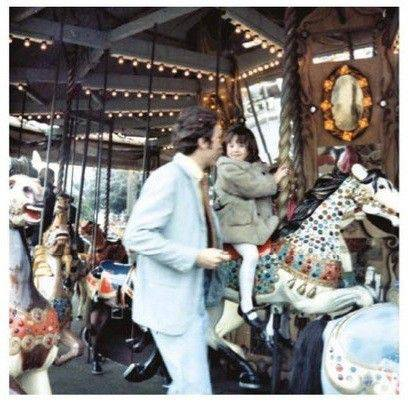
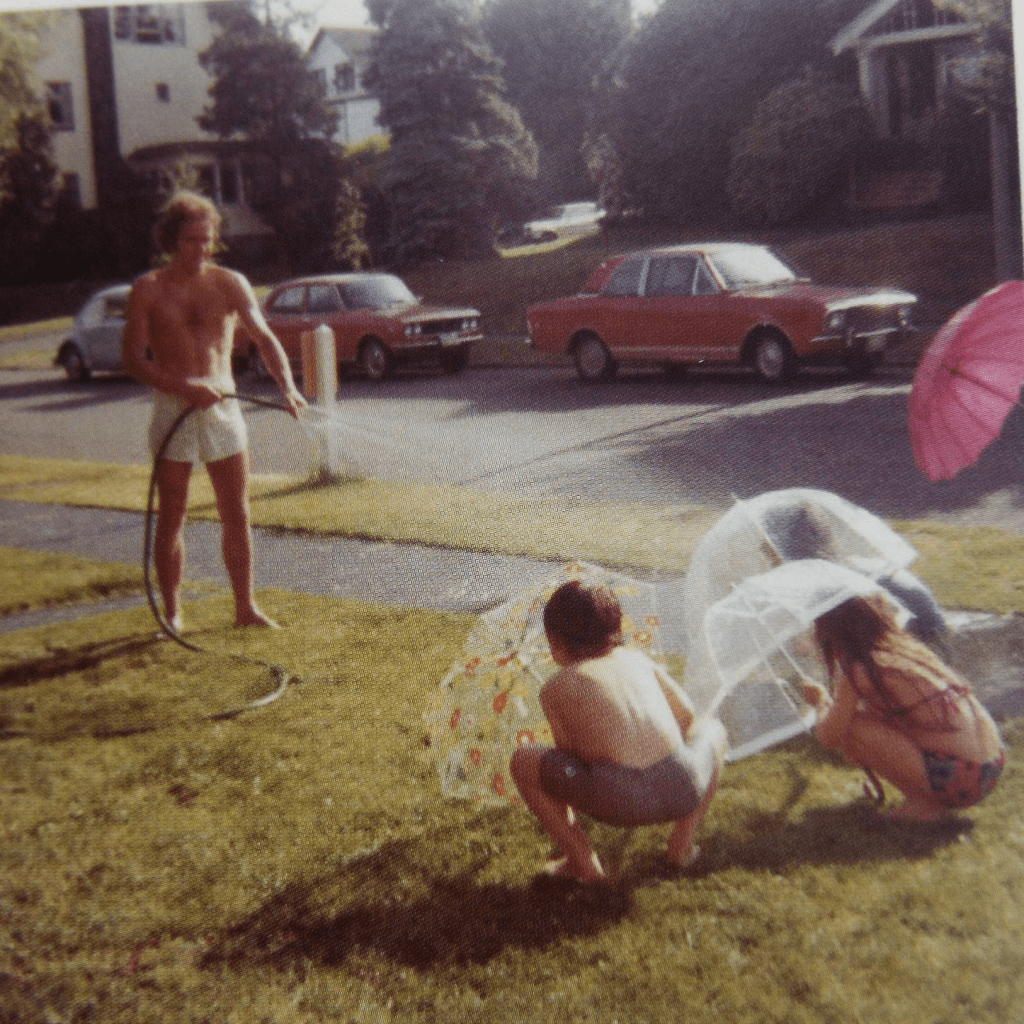
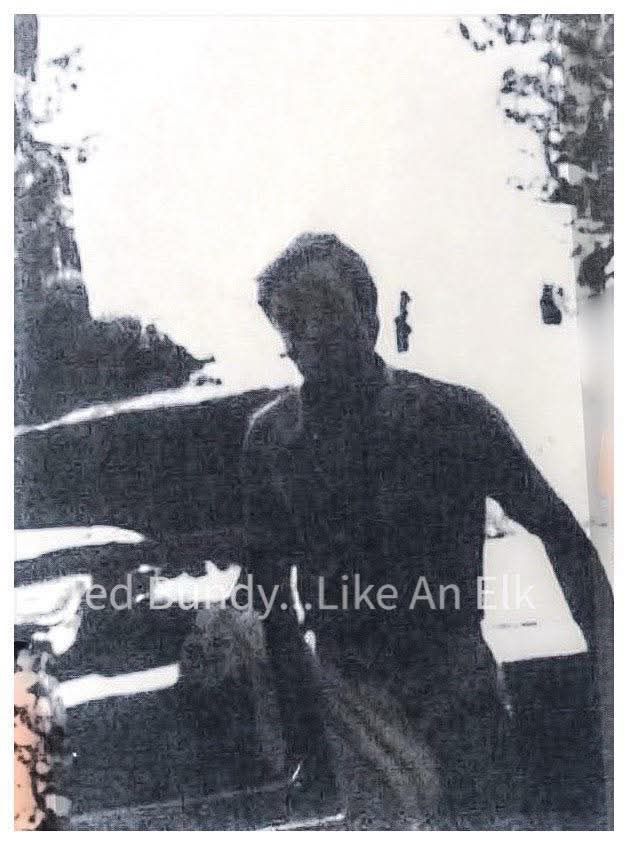
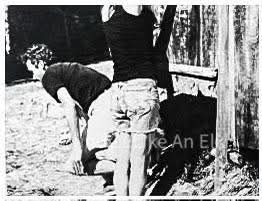
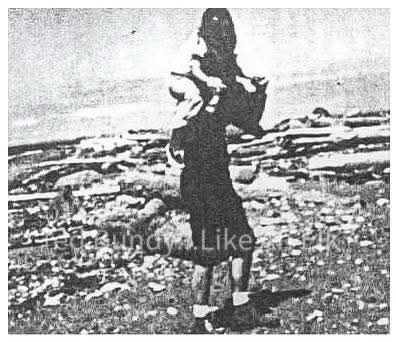
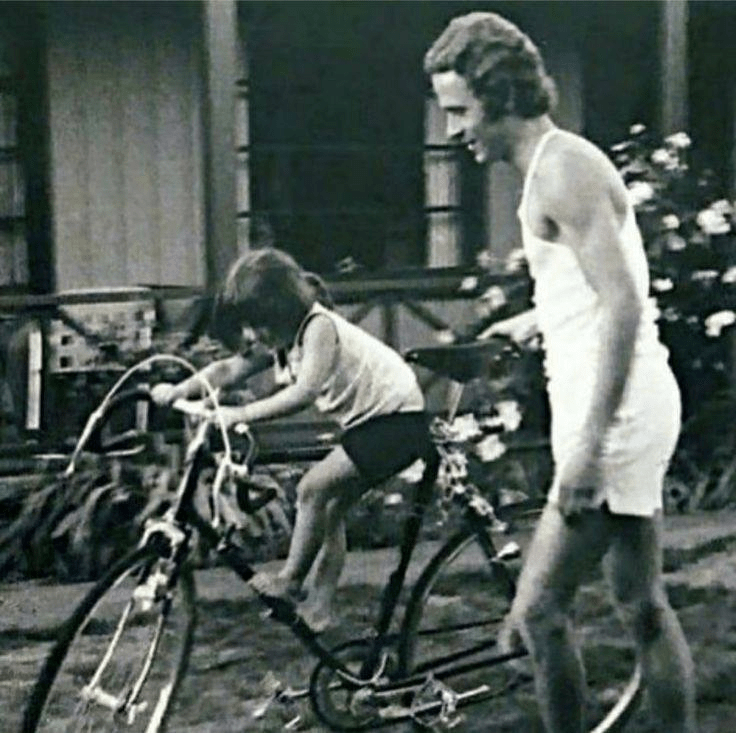
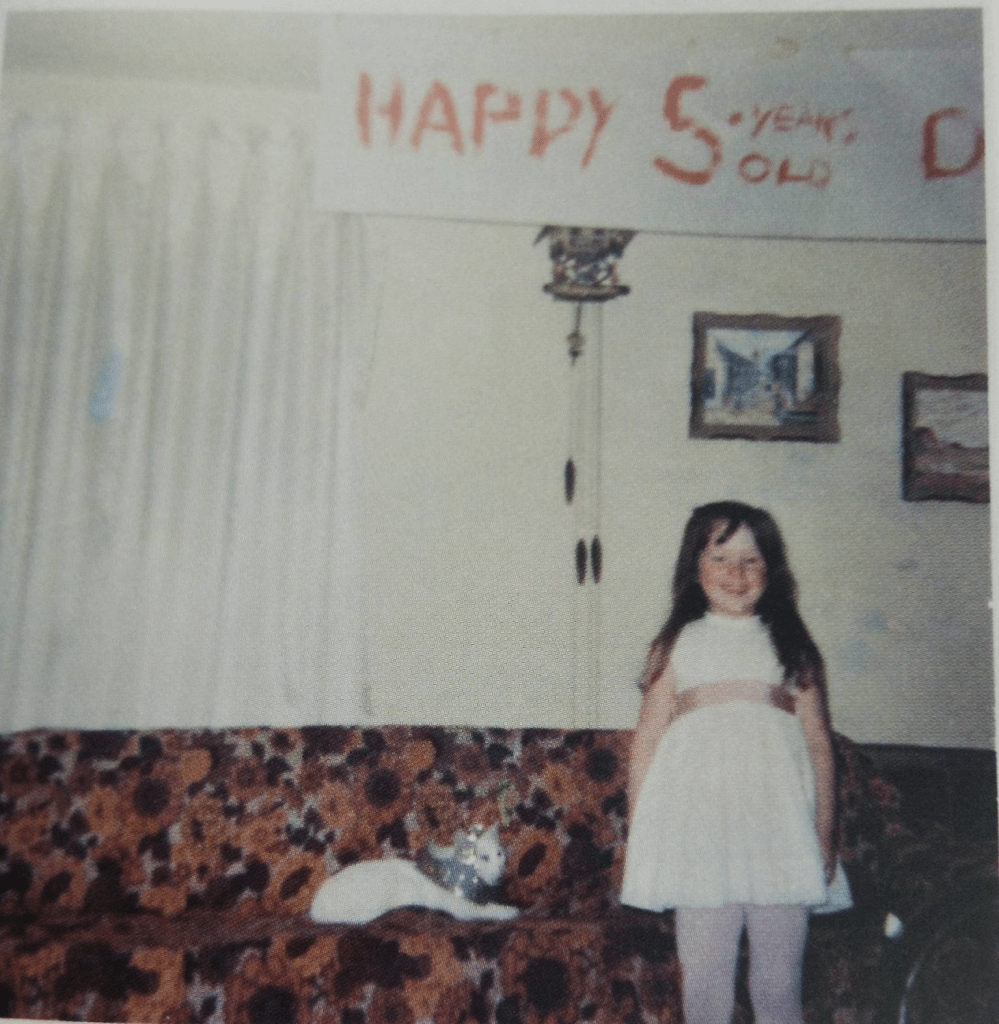
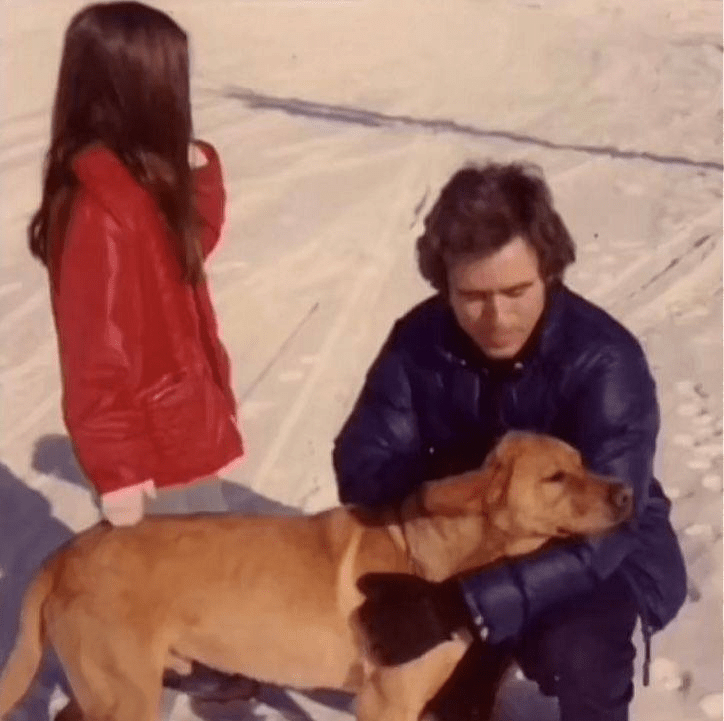
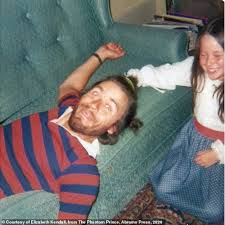
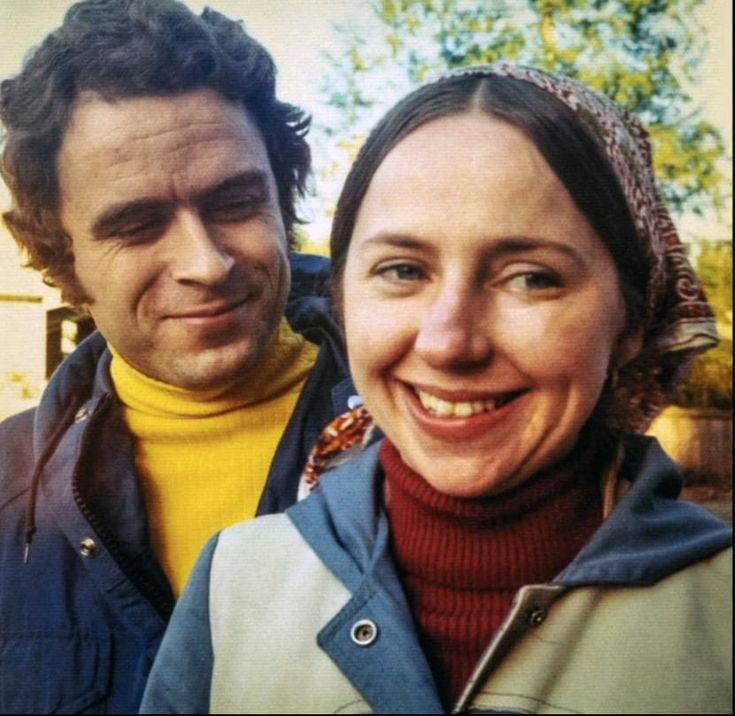
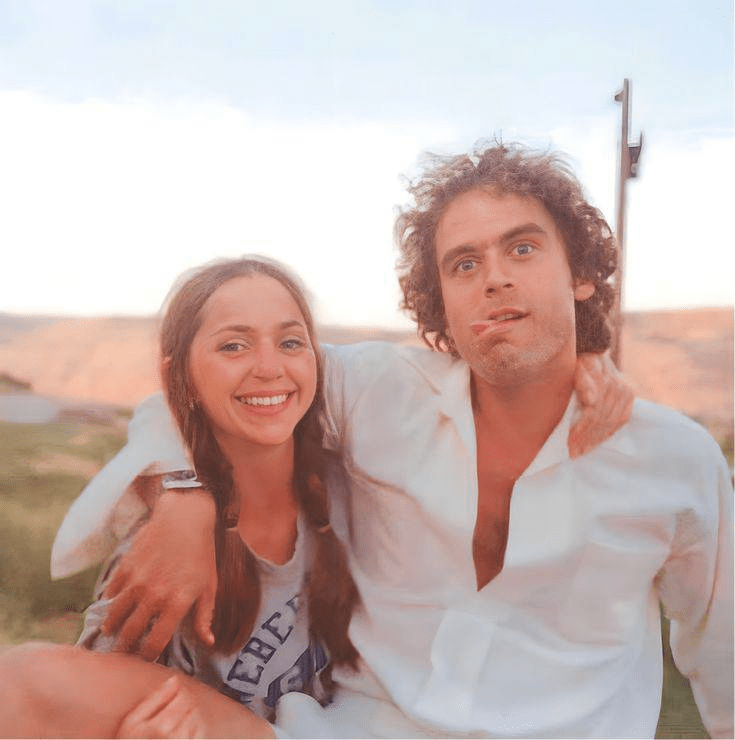
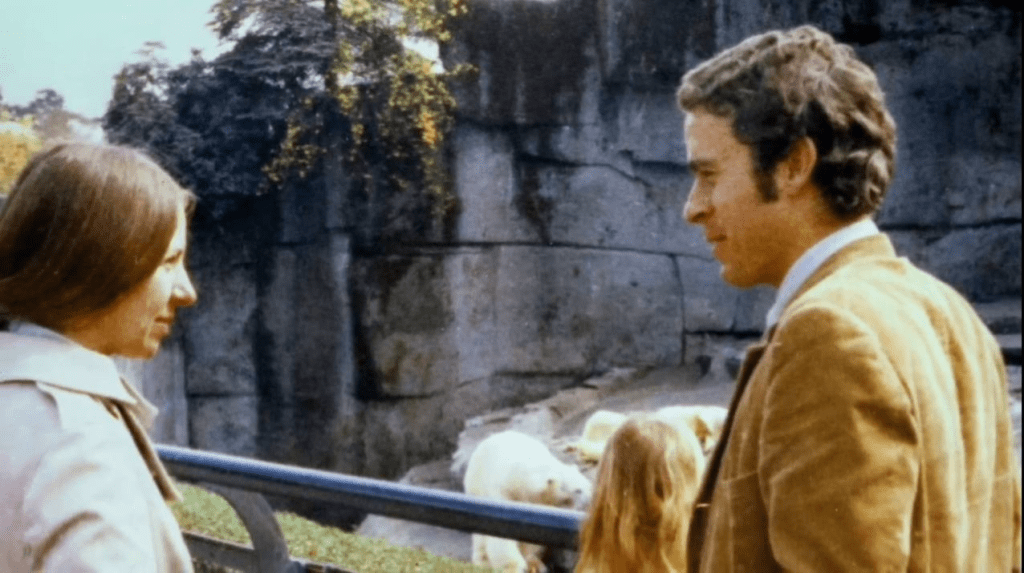
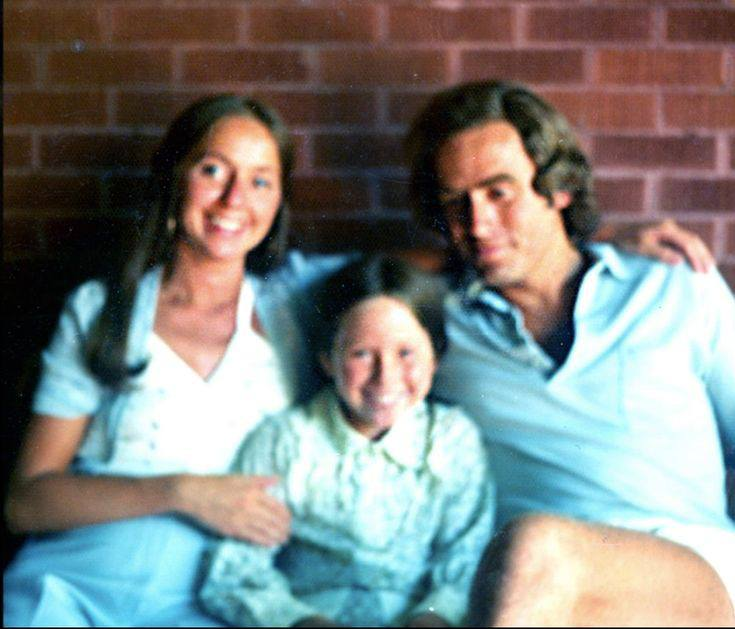
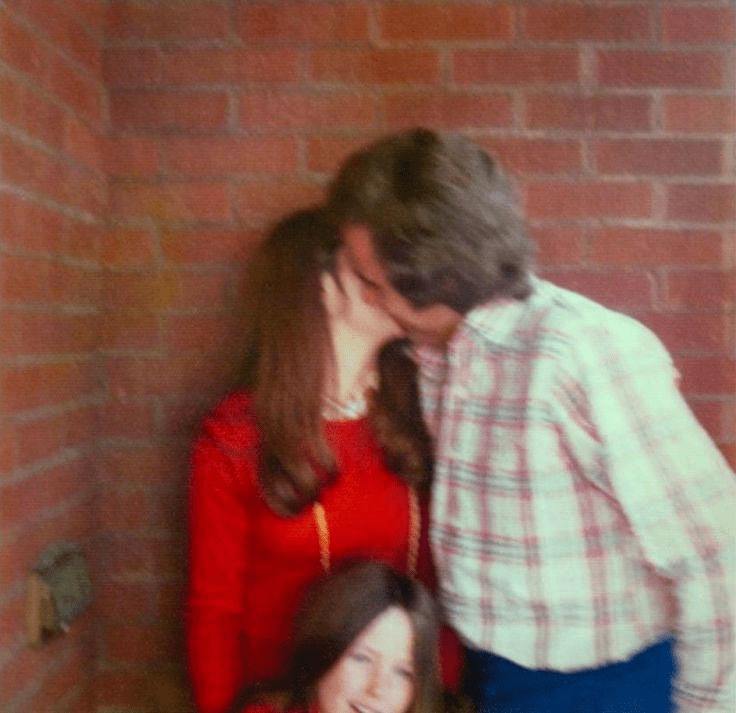
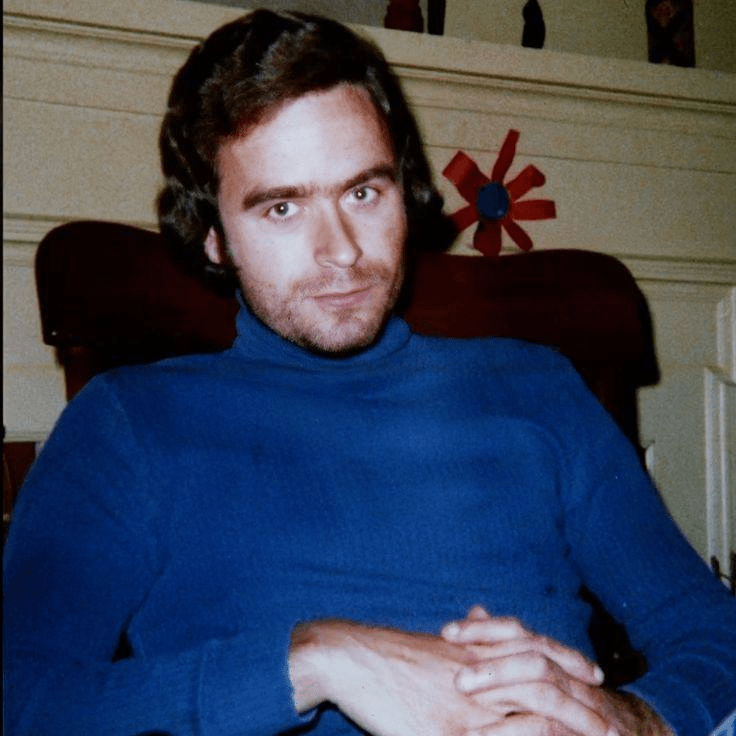
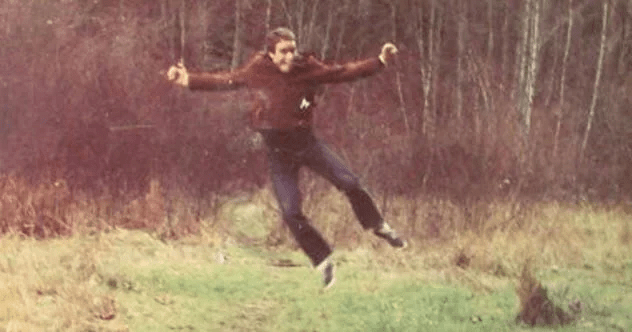
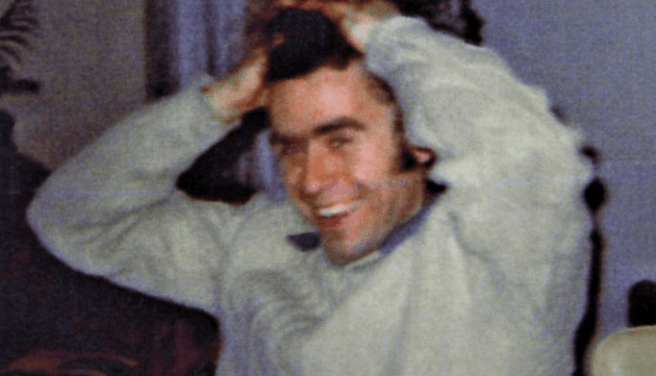
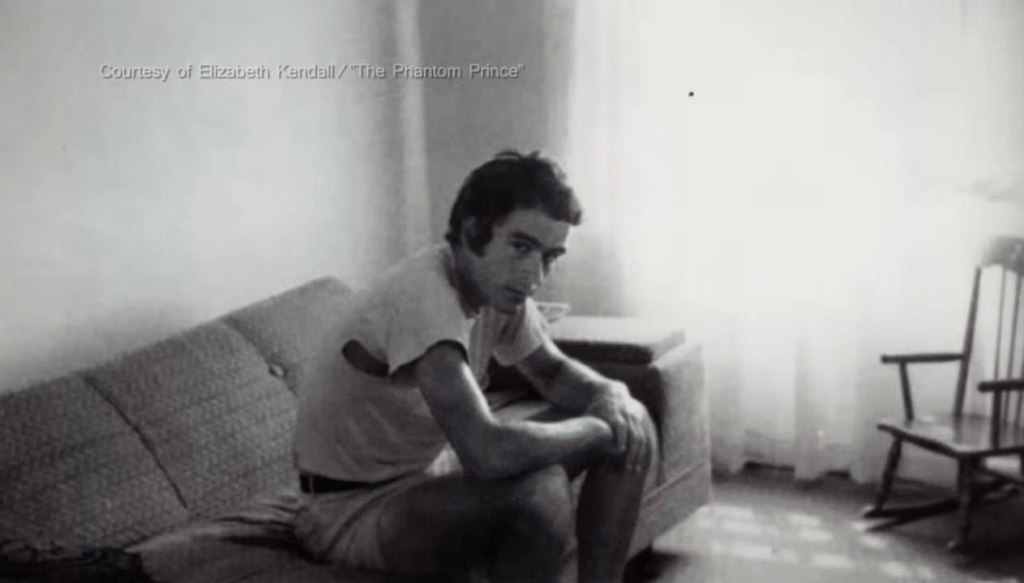
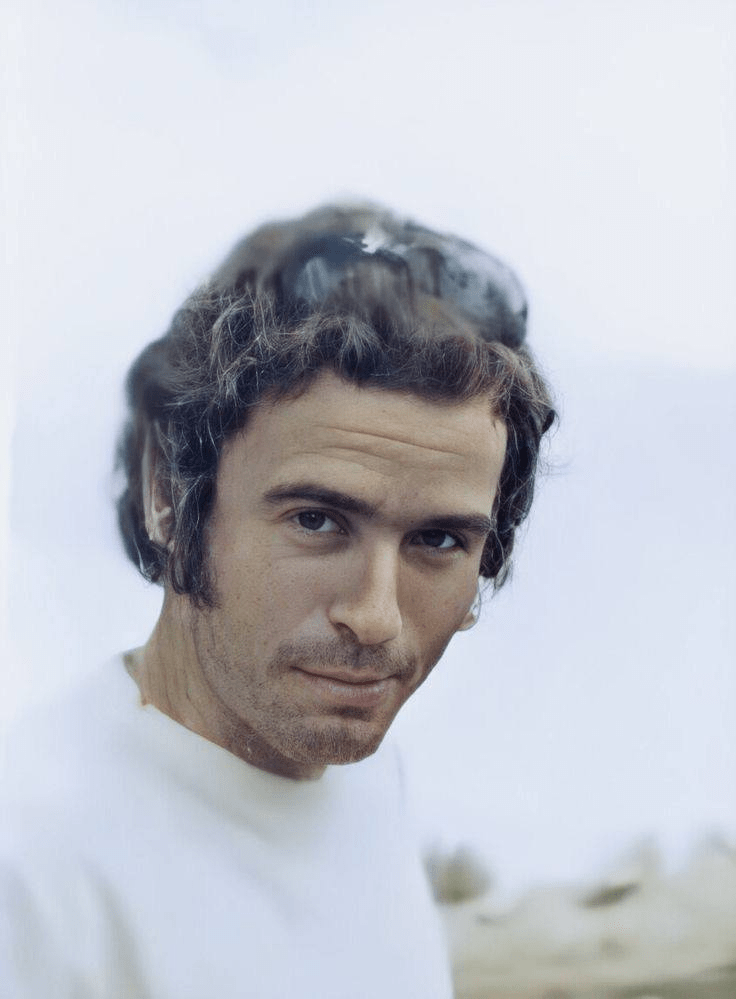
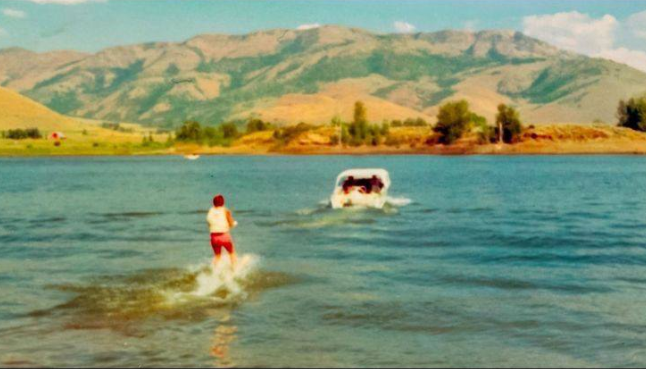
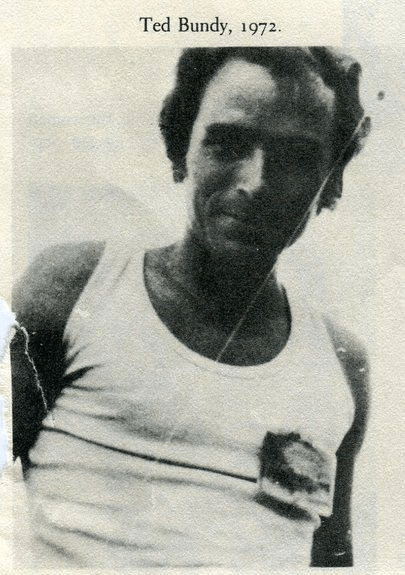
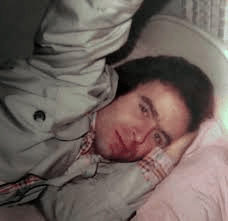
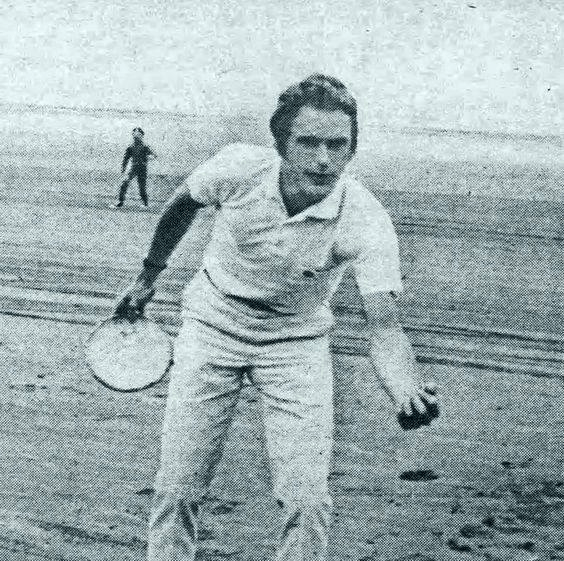
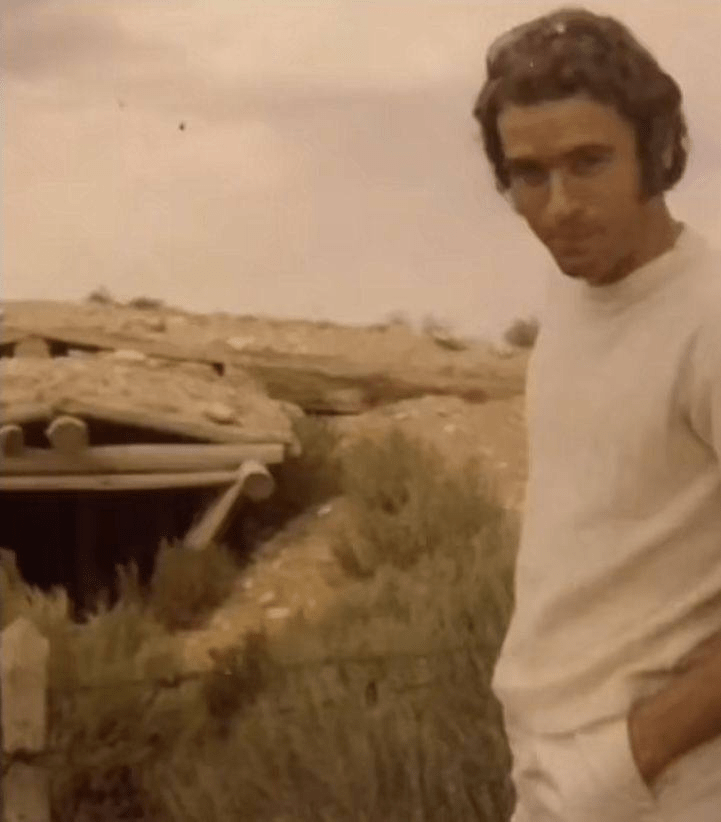
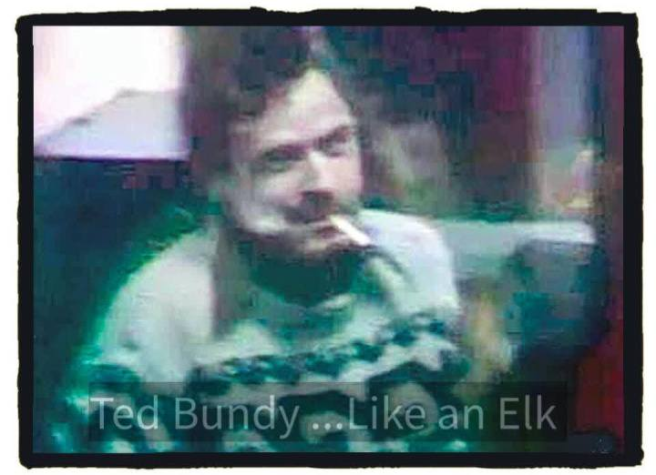
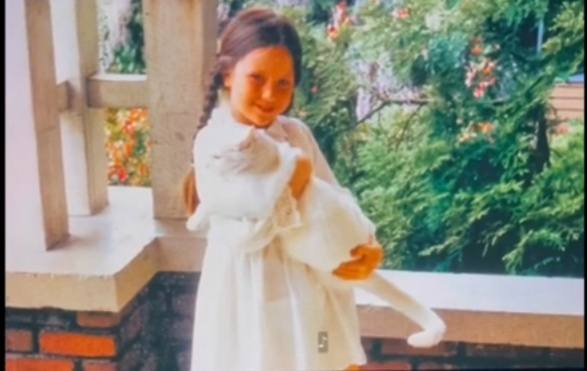
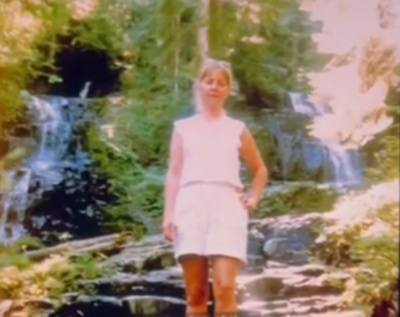
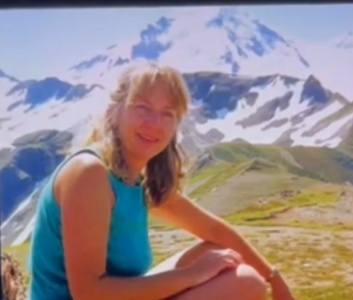
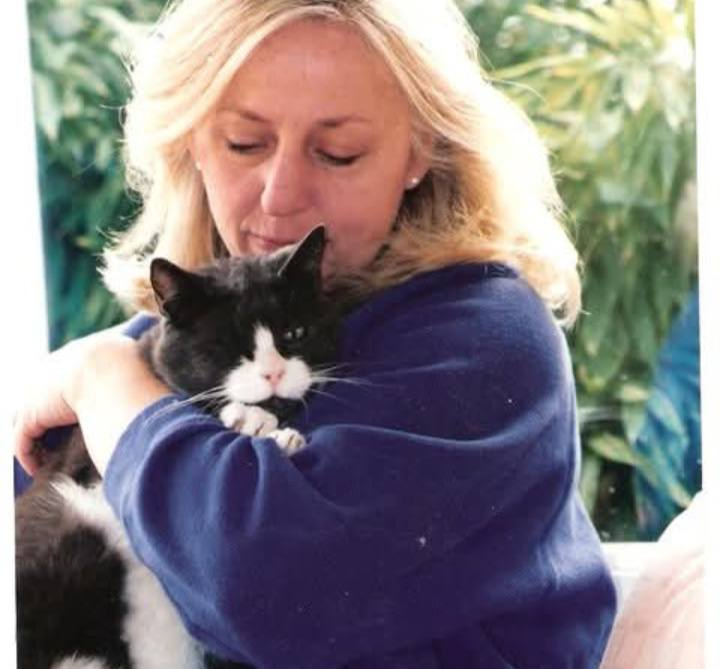
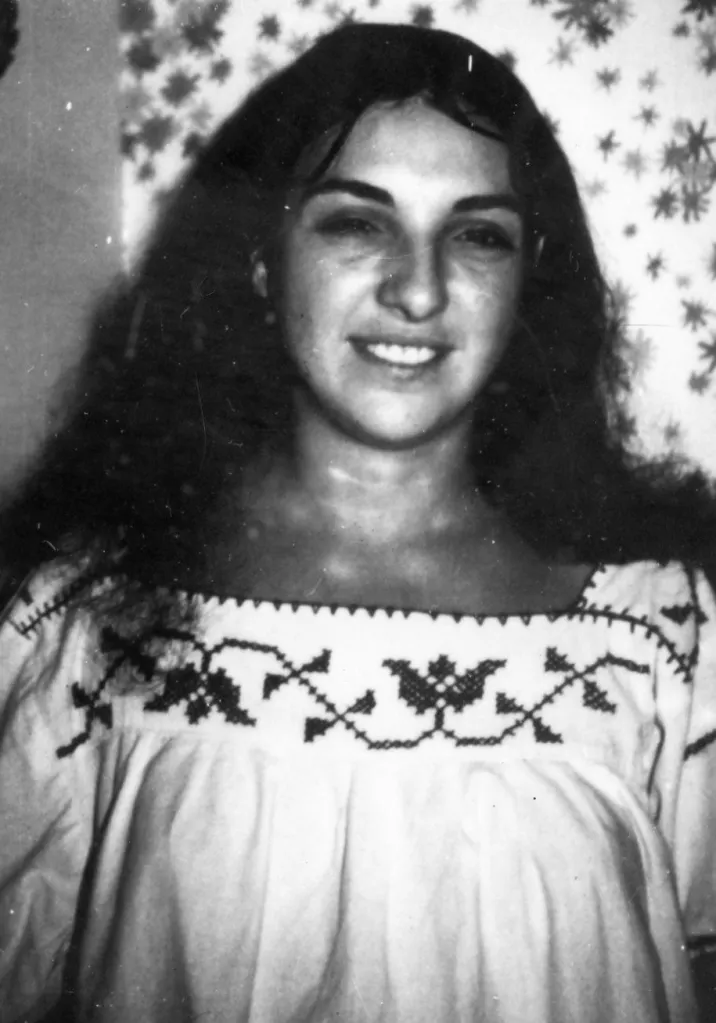
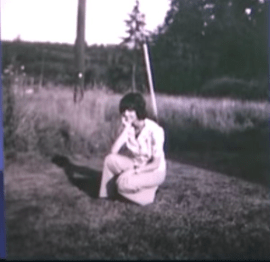
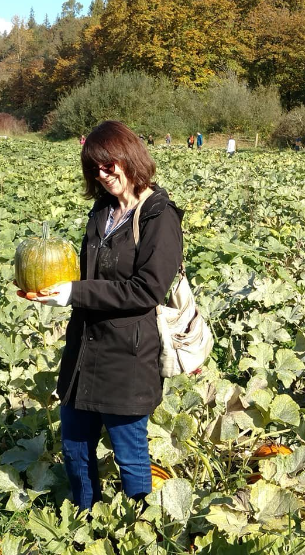
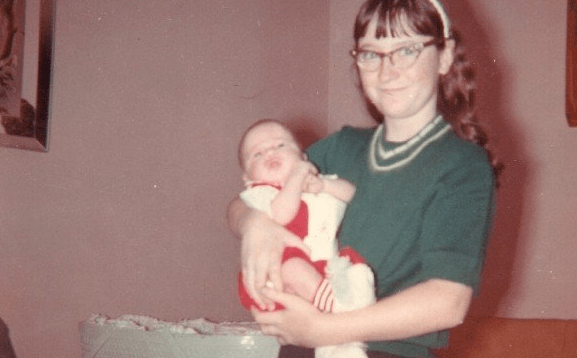
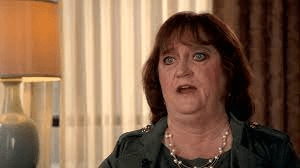
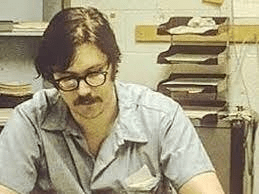
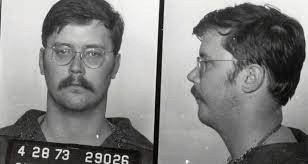
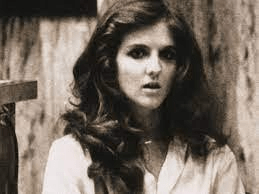
I was able to find a few pictures of Ted, Liz, and Molly these past few days and I wanted to share them here. Ted and Liz had a tumultuous relationship that began in September 1969 and eventually fizzled out after his kidnapping conviction in 1976. Both Liz and Molly are alive as of December 2024 and they reside in Seattle, Washington.
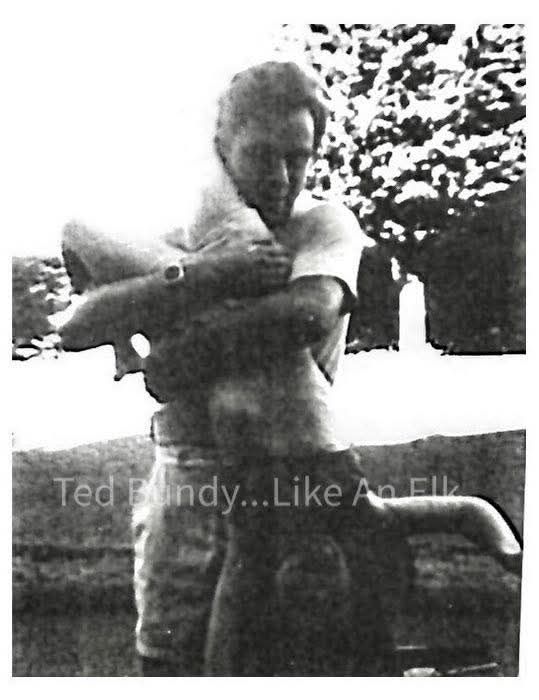
A young Elizabeth.A young Elizabeth Kendall. Liz at her college graduation from the University of Utah, taken in 1968.Liz standing in front of her fireplace in her University District apartment.A picture of Liz taken at he POE, at the University of Washington in Seattle. Liz at work.A young Liz.Liz.Liz and a young Molly.Another shot of Liz and Molly taken outside in the sunshine.Liz and Molly.A picture of Liz and Molly taken at the Pacific Science enter in Seattle, 1970.Liz and Molly at Molly’s baptism. Ted was late because the night before he abducted Brenda Ball.Ted and Molly watching the ‘veg-o-matic man’ at the Washington State Fair in Puyallup, 1970.Ted and Molly fishing for rainbow trout in Flaming Gorge, UT in 1970. Molly playing with the hose with Ted in the background; picture taken in July 1970 in Green Lake, Seattle.Molly and Ted walking out of his parents cabin in Green Lake, Seattle; picture taken in July 1970.Ted and Molly baking cookies at Green Lake in Seattle, 1970.Ted swinging Molly around in Flaming Gorge, UT; picture taken in 1970. The Flaming Gorge is a popular recreation area that spans Utah and Wyoming that features a reservoir, dam, and scenic landscape.Ted and Molly driving a boat.I couldn’t find another copy of this, I don’t know why Molly’s face is covered up and the other childs isn’t.Ted and Molly on a carousel at the Seattle Center, 1970.Ted spraying water on Molly and the neighborhood children.Ted. Photo courtesy of ‘Ted Bundy: I was Trying to Think Like an Elk.’Ted playing with Molly. Photo courtesy of ‘Ted Bundy: I was Trying to Think Like an Elk.’Ted. Photo courtesy of ‘Ted Bundy: I was Trying to Think Like an Elk.’Another picture of Ted. Photo courtesy of ‘Ted Bundy: I was Trying to Think Like an Elk.’Another picture of Ted. Photo courtesy of ‘Ted Bundy: I was Trying to Think Like an Elk.’Ted, Molly, and Liz. Photo courtesy of ‘Ted Bundy: I was Trying to Think Like an Elk.’Photo courtesy of ‘Ted Bundy: I was Trying to Think Like an Elk.’Ted and Molly playing by the water. Photo courtesy of ‘Ted Bundy: I was Trying to Think Like an Elk.’Ted and Molly playing outside.Ted teaching Molly how to ride his bike, picture taken in Green Lake in 1970.Ted teaching Molly how to ride a bike. Another picture of Ted teaching Molly how to ride a bike.Ted and Molly at Christmastime in Ogden in 1970.Another shot of Ted and Molly in Ogden at Christmastime in 1970.Ted and Molly celebrating Christmas at Green Lake in 1970.A picture from Molly’s fifth birthday. Ted made the banner. Taken at Green Lake in Seattle, 1971.Christmas Day in Utah, 1974.Christmas Day in Utah, 1974.Ted and Molly around Christmas in 1974. Picture taken at the Hardware Ranch in Utah.Ted and Molly in their ‘hippie clothes; picture taken in Seattle’s University District in 1975.Ted swinging Molly around in the University DIstrict in 1975.Molly putting barrettes in Teds hair during a visit to Seattle. Taken in June 1975 at Liz’s apartment in the University District. Ted and Molly outside of Liz’s residence in the Universtiy disctict in Seattle, 1975.Ted and Liz on the lake, about to go waterskiiing, picture taken at Flaming Gorge, UT in 1970. Flaming Gorge is a 91-mile-long reservoir created by damming the Green River in 1958, and is known for its sapphire blue water and is a top destination for boating, fishing, and other water activities. Ted, Liz, and Molly visiting family in Ogden, UT. Picture taken in 1970.Ted and Liz at Hood Canal in Washington. Picture taken in 1973.Ted carrying Liz on his back.Liz hugging Ted from the back. Does that sweater look familiar? It was the one he wore during his first escape in 1977.A picture of Ted and Liz; her father is on the other side of her.Liz and Ted sunbathing.Ted and Liz.Ted and Liz in front of a fireplace, picture taken in Ogden, UT in December 1974.Ted and Liz in Flaming Gorge, Utah in 1975. Liz laying on Ted’s waterbed in his room at the Rogers Rooming House in Seattle. Photo courtesy of ‘Ted Bundy: I was Trying to Think Like an Elk.’Liz, Ted, and Molly on a vacation visiting Liz’s family in Ogden, taken in 1970.The trio on horses outside of the Liz’s childhood home in Ogden, UT.Ted tickling Molly, picture taken in December 1974.Ted and Liz on a trip to the zoo with Molly.Ted, Liz, and Molly. Ted and Liz sharing a kiss.Ted and his little brother Richie on a camping trip.Ted sitting in front of Liz’s fireplace.Ted jumping for joy and his first camping trip with Liz; picture taken in 1970 at what would later turn out to be his Issaquah burial site.Ted playing with his hair.Ted waking up from a nap at Green Lake in Seattle, 1971.Ted in 1972.Ted at Hood Canal, WA in 1973. A young Ted wearing a suit.Ted waterskiing.Ted holding a dog.A picture of Ted taken in 1972.Ted taking a nap on Liz’s childhood bed at Christmastime in Utah, 1974.Ted playing Frisbee on the beach.An action shot of Ted playing Frisbee on the beach.Ted in Wyoming on his way to Flaming Gorge, UT.Ted, smoking. Photo courtesy of ‘Ted Bundy: I was Trying to Think Like an Elk.’Molly with her biological dad.A young Molly.A picture of Molly from high school.Molly.Liz Kloepfer.Liz featured in a news special about Bundy.Liz after her relationship with Bundy, taken in the 1980’s.Liz.Liz.Liz Kloepfer.Liz Kloepfer after her relationship with Bundy.Elizabeth Kloepfer. Elizabeth Kloepfer.Liz and Molly in a promotion photo for Amazon’s, ‘Falling for a Killer.’
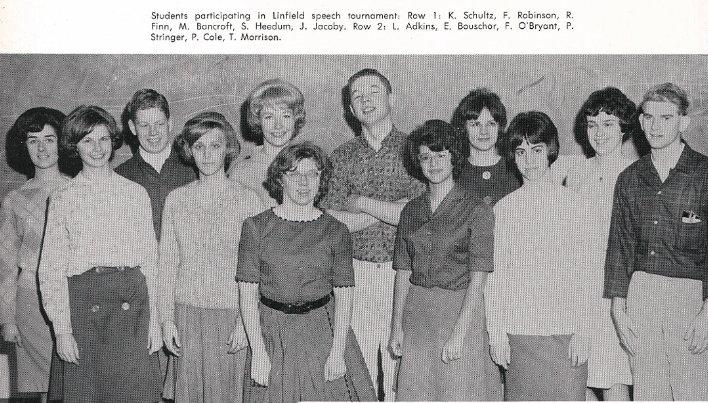
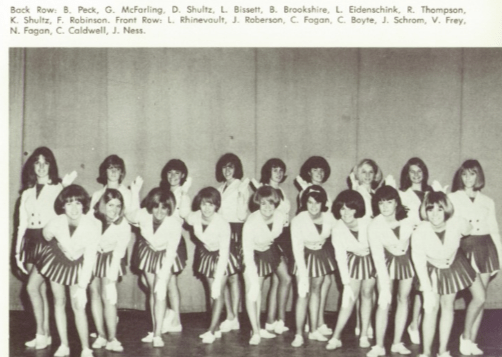
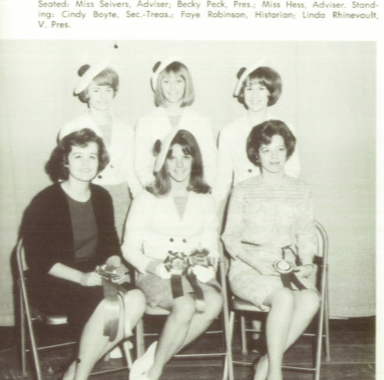
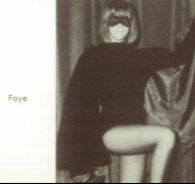
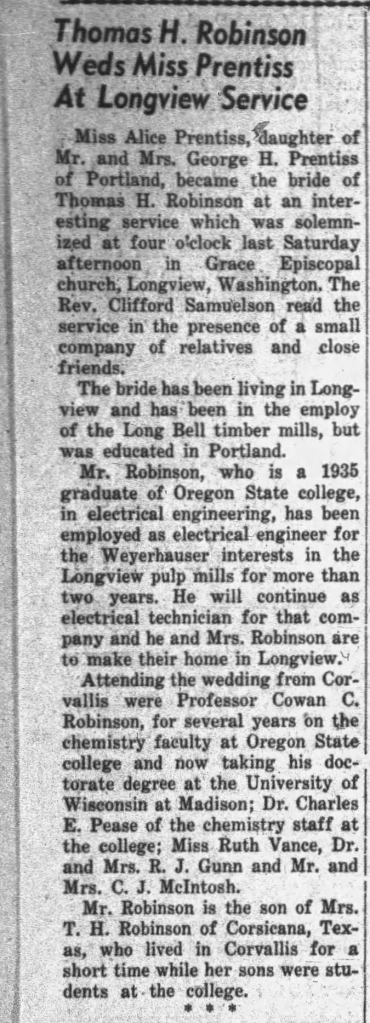
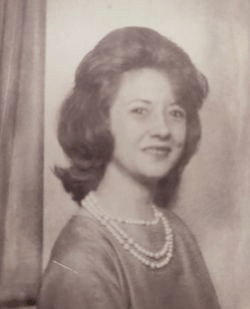
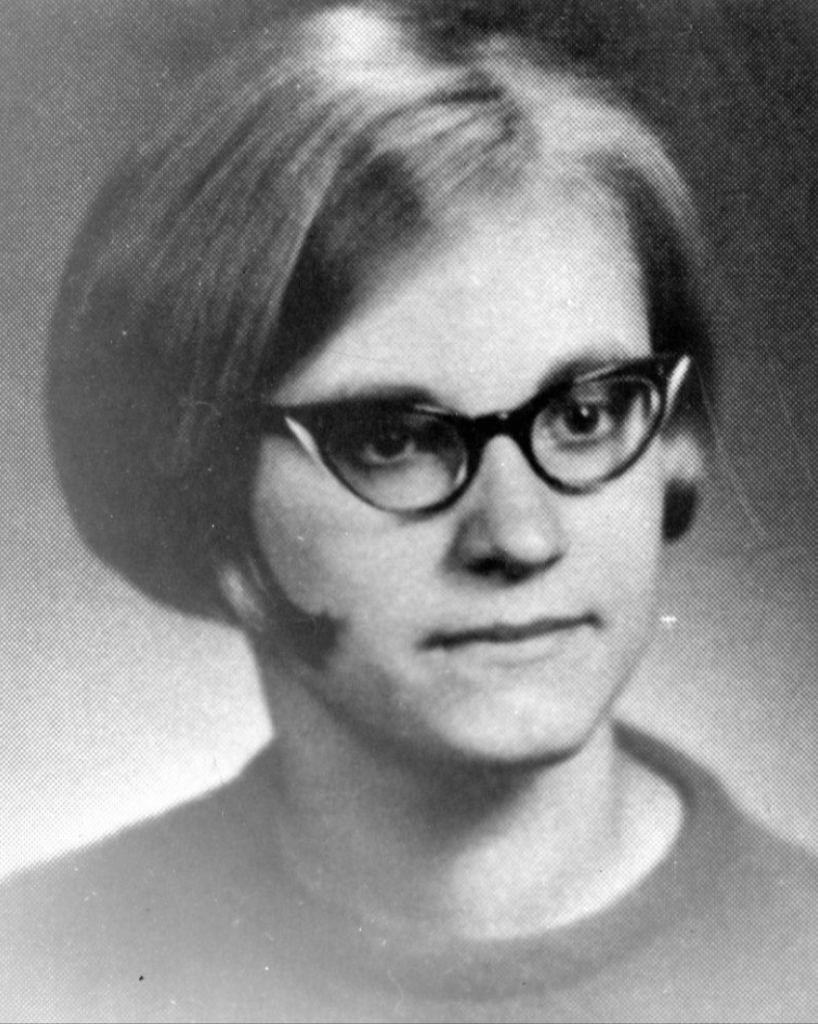
Fay Ellen Robinson was born on October 7, 1948 to Thomas Harvey and Alice Susan (nee Prentiss) in Portland, Oregon.Thomas Harvey Robinson Jr. was born on September 29, 1912 in Corsicana, TX, and Alice was born on September 15, 1916 in Oregon. Mr. Robinson graduated from Oregon State University in 1935 with a degree in electrical engineering,** and he had a long and successful career with The Bonneville Power Administration. The couple were married on September 6, 1938, in Longview, WA and had three children together: Fay, Patricia (b. 1943), and Randolph (b. 1946). Fay was a 1966 graduate of Tigard High School, where she excelled at academics and was a member of National Honor Society; she was also in her schools play group, Spanish Club, and Ski Club. Robinson went on to attend the University of Oregon, and after graduating in 1970 she moved to Eugene and got a job with the State Public Welfare Division. At the time of Fay’s murder her sister Patricia lived across the street from her.
At around 7 AM on Wednesday, March 22, 1972 Fay Ellen Robinson was found dead in her bed in her downtown apartment. According to former Lane County Public Attorney Robert Naslund, a friend and coworker named Samuel Owens made the gruesome discovery and had stopped by to give her a ride to work. She was fully clothed, dressed in pants and a sweater, and suffered from stab wounds in her neck and upper chest. According to police, Robinson’s apartment was located alongside an east-west alley located off Oak Street, and her neighbors said they heard her return home the night before at around 10 PM but didn’t hear anything unusual after that.
Fay’s boss and the manager of the Welfare Division David Kuhns said that Robinson had been an intake worker at the department’s office building since January, and said she was ‘a very quiet, serious type of person and very interested in her job. I have no idea why someone would want to harm her.’ According to reports, Robinson was a ‘rather gregarious person with a number of friends, and they’re being questioned by police,’ and in an article published in The Eugene Register-Guard, no motive had been established and police were at a loss for who would want to hurt her. Her autopsy was performed later in the same day she was discovered, and showed that she suffered from multiple stab wounds to her upper chest and neck.
According to the ‘TB MultiAgency Report 1992,’ Bundy’s whereabouts are mostly unaccounted for in early 1972. At the time Ms. Robinson was murdered Ted was living in Seattle at the Rogers Rooming House on 12th Avenue, and was in the middle ofa long term relationship with Elizabeth Kloepfer. He was in the final semester of his undergraduate psychology degree from the University of Washington, and was getting ready to start an internship at Harborview Medical Center in Seattle in June (he also started at the Seattle Crime Commission around the same time).
As I’ve said in multiple other articles, its Bundy canon that the serial murderer began killing in early January 1974 with his brutal attack on fellow University of Washington student Karen Sparks (I can only assume he thought she was dead when he left her). But during his confessions before his execution he hinted to Dr. Robert Keppel that he may have started as early as 1972 with a young girl in Seattle (but of course didn’t elaborate any further than that). But… I’ve also read that he confessed to a different person that he began killing in 1969 in the Jersey Shore, and yet another that suggests 1971.
In the 2.5+ years that I’ve spent writing this blog I seem to stumble upon a new victim from Oregon every few months, and there’ve been quite a few cases of young women in the area with fates similar to Robinsons. The first one that jumped out at me is Alma Jean ‘Jeannie’ Barra, who was last seen leaving the Copper Penny Tavern in Portland the day after Fay was killed on March 23, 1972. The 28-year-old was last seen between 11 and 11:30 PM wearing a white sweater, turtleneck, maroon vest and pants and was in the company of an unknown male driving southbound on 92nd Avenue. Three days later Ms. Barra’s body was found roughly 40 feet off of Mount Scott Boulevard in an area of heavy brush of the Willamette National Cemetery in Happy Valley, OR.
In my opinion, there’s three murders that took place in mid to late 1973 that all fit very neatly into TB’s MO:Rita Lorraine Jolly, Vicki Lynn Hollar, and Suzanne Rae Seay-Justis. I know Ted only confessed to two additional Oregon murders aside from Roberta Kathleen Parks, but we all know he didn’t tell the truth very often… Seventeen year old Rita Lorraine Jolly left her family home on Horton Road in West Linn at around 7:15 PM on June 29, 1973 to go for a routine walk, and was last seen a few hours later sometime between 8:30 and 9:00 PM walking uphill on Sunset Avenue. She has never been heard from again.
24-year old Vicki Lynn Hollar was last seen getting into her black 1965 Volkswagen Beetle (with Illinois plates and the running boards removed) in a parking lot at 8th Avenue and Washington Street in Eugene at 5:00 PM on August 20, 1973. She and her supervisor walked together to their respective vehicles after work and that was the last time Hollar was ever seen alive; additionally, her Beetle has never been recovered.
Suzanne Rae Seay-Justis was last heard from on November 5, 1973 after she called her mother from outside the Memorial Coliseum in Portland. During the call, Justis said that she would return to Eugene the following day to pick up her son from school. Law enforcement recovered her vehicle left behind near her residence, and it was reported that she frequently hitchhiked to get around. Sue’s mother reserved a room for her for the night at a nearby hotel, but it was never used, and she never arrived home the following day. For reasons that are unknown, a missing persons report wasn’t filed for Justis until 1989.
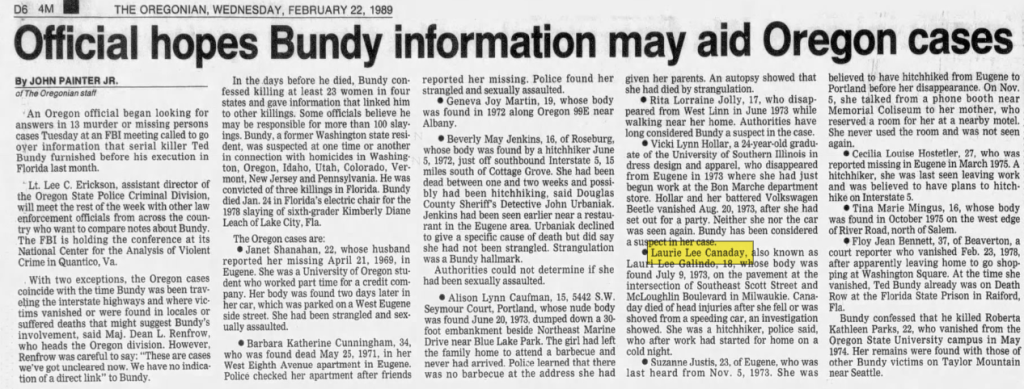
According to an article published in The Oregonian on February 22, 1989, investigators in Oregon were looking into murders that Bundy could have been linked to far before 1972: a student at the University of Oregon, Janet Lynn Shanahan was married and worked PT at a credit union when her remains were found stuffed in the trunk of her car on April 23, 1969. Her vehicle and remains were found in West Eugene by her husband, who reported her missing two days before her body was recovered; according to the medical examiner, she had been raped and strangled. On May 24, 1971 thirty-four Barbara Katherine Cunningham was found deceased in her West Eighth Ave apartment; she had also been raped and strangled.
Gayle Elizabeth LeClair, who was found deceased in a similar manner that’s almost identical to that of Robinson. LeClair was a clerk/typist at the Eugene Municipal Library, and she was found stabbed in her rental house by her supervisor on August 23, 1973 after she failed to come in for her scheduled shift at 10:30 AM.Gayle had a date with a known acquaintance the night before, and the pair went to a drive-in movie then back to her apartment for a nightcap. She was last seen alive by him at 1:30 AM, and after a conversation with detectives the young man was quickly cleared as a suspect.
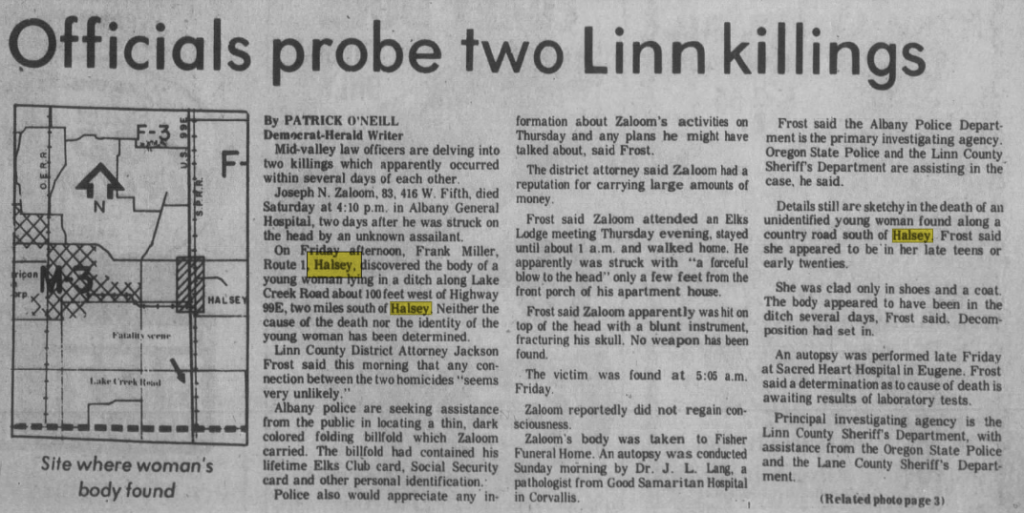
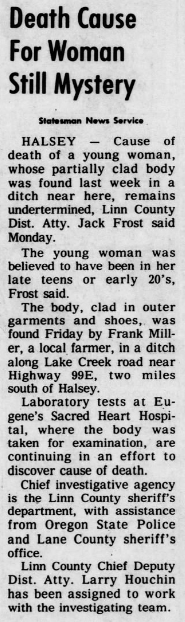
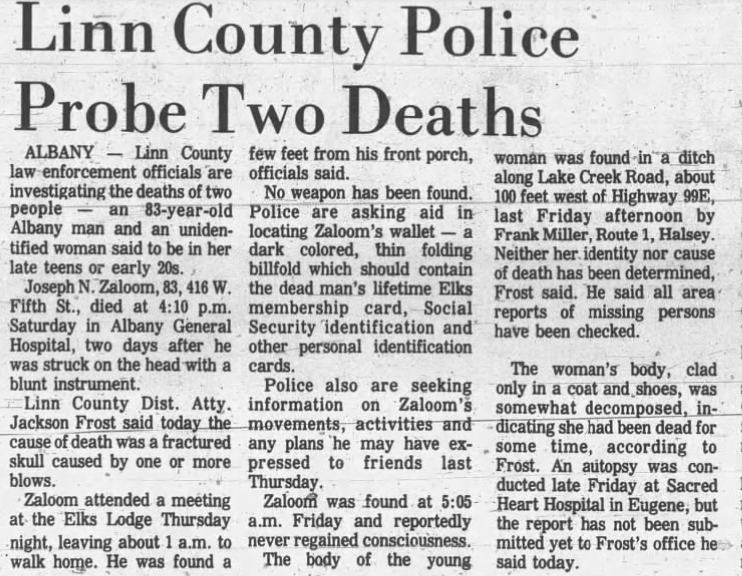
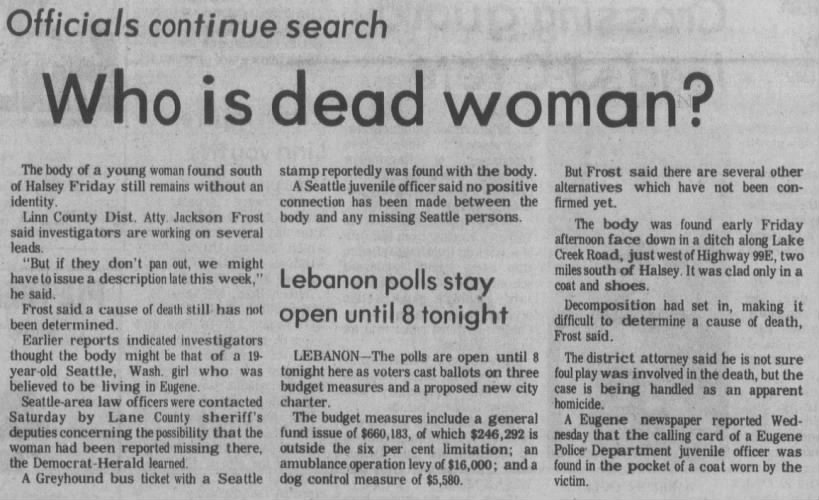
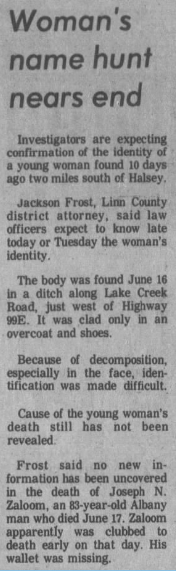
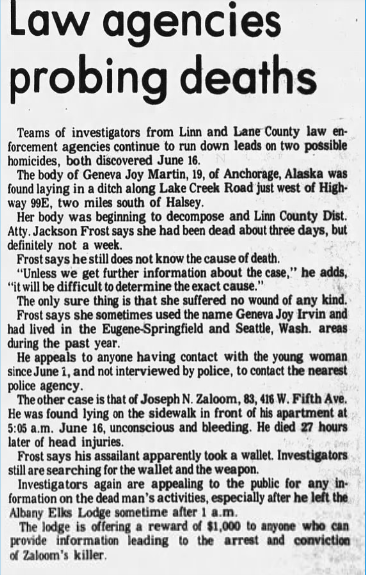
At roughly 1 PM on June 16, 1972 the badly decomposed remains ofGeneva Joy Martin were found face down in a ‘woody, roadside ditch’ by Frank Miller, a local farmer. Martin wasonly wearing a coat and shoes, and her hair was caked with dried mud and sediment. She remained unidentified for roughly ten days,and because of the advanced level of decomposition police were unable to pinpoint her cause of death, but it’s suspected she had fallen in with a bad crowd and was dabbling in substance abuse. Also in June 1972 the remains of sixteen year old Beverly May Jenkins were found just off the I-5 roughly ten miles outside of Cottage Grove; she had been strangled to death.
On July 9, 1973 the remains of Laurie Lee Canaday were recovered on the pavement at the intersection of Southeast Scott Street and McLoughlin Blvd in Milwaukee, OR. According to LE, she was a frequent hitchhiker and was on her way home from work when she was abducted. Fifteen year old Alison Lynn Caufman’s nude remains were found on June 20, 1973 after she was dumped down a 30 foot long embankment near the Northeast Marine Drive near Blue Lake Park. She told her parents that she had plans of going to a BBQ, but LE later learned that there was no get-together at the address she had given them; an autopsy showed that she had died from strangulation and been sexually assaulted.
Deborah Lee Tomlinson disappeared on her sixteenth birthday along with an unnamed friend on October 15, 1973 from Creswell, OR.Creswell is an incredibly small town with only one high school, and the reported population according to the 1970 census was a mere 1,199 (it went up to 5,031 people in 2010). Called Debby by family and friends, Tomlinson had brown eyes, was 5’5”, weighed 140 pounds, and had golden brown hair she wore at her shoulders; she had a ring of moles around her neck. Not even a week later Virginia Erickson vanished without a trace on October 21, 1973 out of Sweet Home, OR. Earlier in the day that she disappeared, Erickson told her oldest daughter: ‘Rachel, if I’m not here when you get home, you feed the kids and take care of them,’ which she then did, and her dad stayed home with their mom to ‘go on a hunting trip.’ After the service was over Rachel and her younger siblings returned to an empty house, and no trace of Virginia has been seen since.
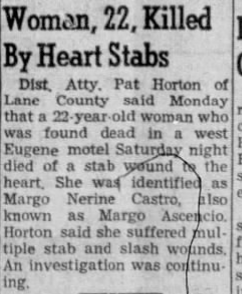
According to an article published by The Sunday Oregonian on December 7, 1975, in March 1974 the remains of seventeen year old Caroletta Spencer were discovered on a road in Sauvie Island; she suffered from multiple gunshot wounds. On the evening of March 1, 1975 the remains of twenty-two year old Margo Nerine Ascencio/Castro were found in a room at the El Don Motel on West 6th Avenue. She had been brutally attacked and died as the result of multiple stab wounds, which she had all over her body. Detectives quickly learned that at one time Ascencio had ties to the Hessian Motorcycle Club, and her murder remains unsolved. Cecelia Louise Hostetler* was twenty seven when she was reported missing out of Eugene in 1975 (even though local LE could find no record of her in their files), and was last seen leaving her POE. It’s speculated that she had plans to hitchhike home using the I-5 and her remains have never been recovered.
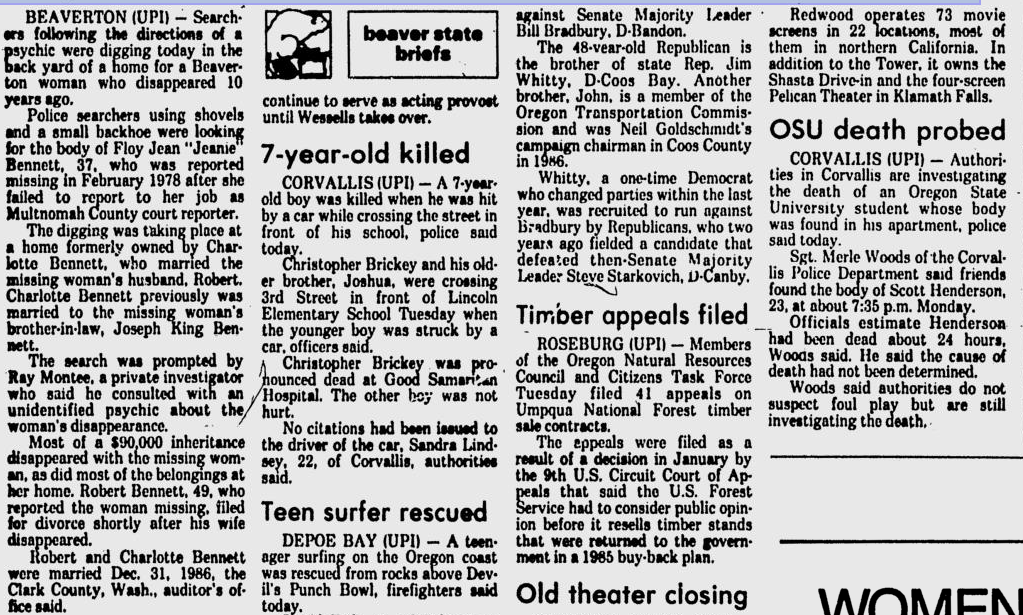
I think the next two girls can be quickly debunked as TB victims, as he was in prison when they were both killed. Tina Marie Mingus was only 16 years old when her body was found in Salem, OR in October 1975, and Floy Joy Bennet (who went by Jeanne) was 37 (and obviously a bit out of Bundy’s preferred age range) when she vanished in February 1978.What’s strange is I couldn’t find any more information about any of these women out there on the interwebs. It’s almost as if they never existed.
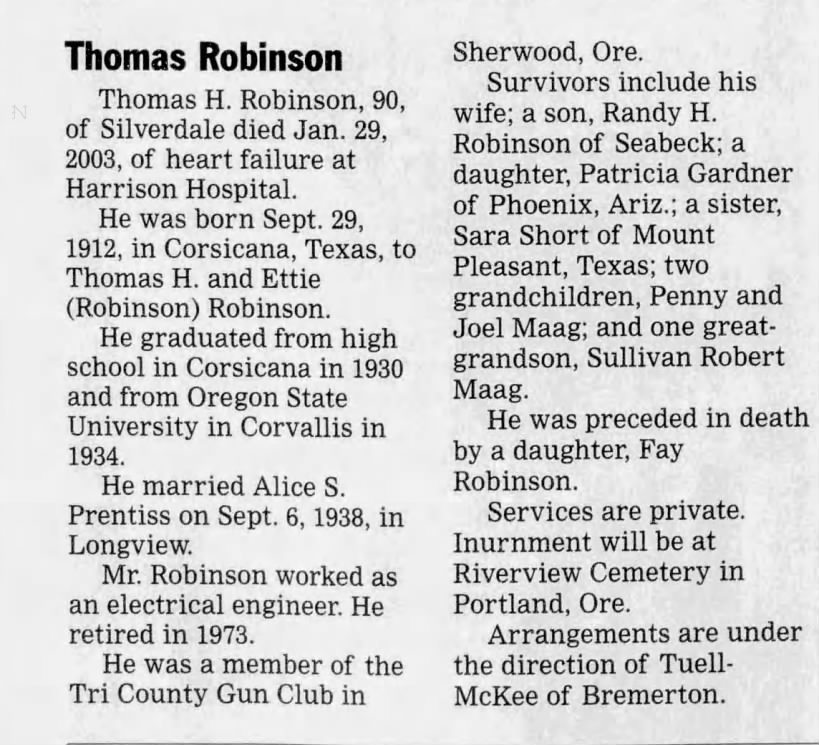
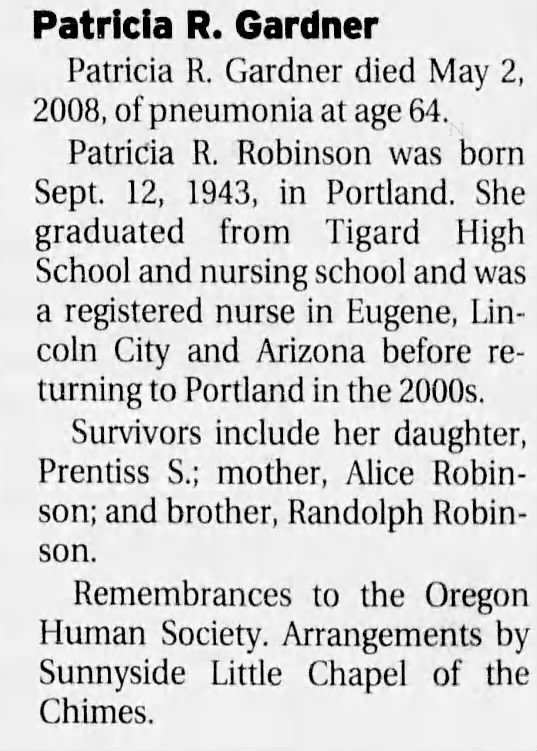
Fay’s sister Patricia died from pneumonia at the age of 64 on May 2, 2008 in Beaverton, WA.Thomas Robinson passed away from heart failure on February 21, 2003 in Silverdale, Washington. He retired from an eventful career as an electrical engineer in 1973 and was a member of the Tri County Gun Club in Sherwood, Oregon. Mrs. Robinson died at the age of 93 on January 31, 2010 in Bremerton, WA.As of December 2024 the murder of Fay Ellen Robinson remains unsolved.
* I would like to thank a reader going by the handle ‘BG’ for this. I left the old (and obviously incorrect) information about Cecelia Hostetler in the article because it was what was reported on at the time. But she eventually turned up and died at the age of 74 in a nursing home, and it was most likely an errant missing persons report that was relayed to the news, and when she was found the police likely didn’t have a file on her because she was an adult, and the public was never updated on her case.
** A big big thank you to Fay’s brother Randy for helping me correct some inconsistencies. I really appreciate you.
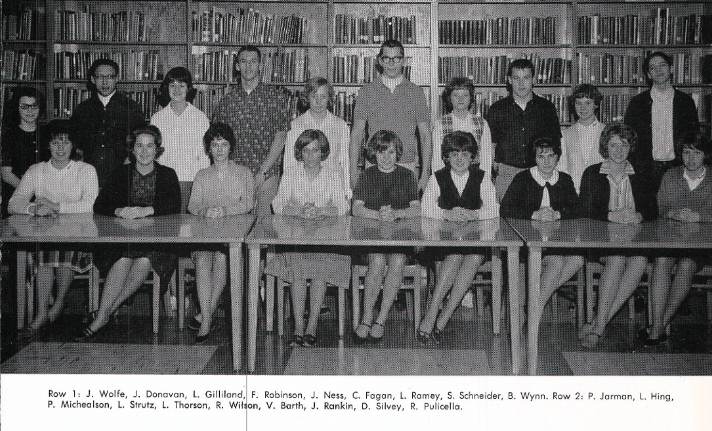
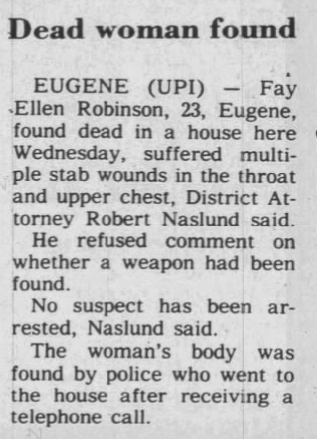
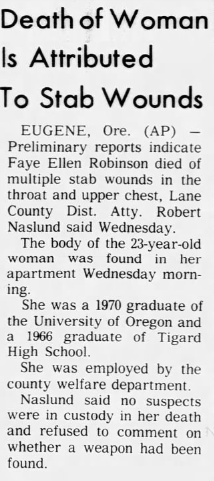
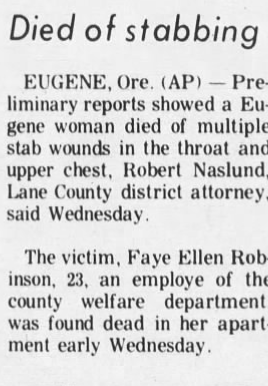
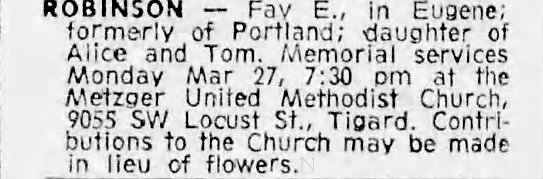
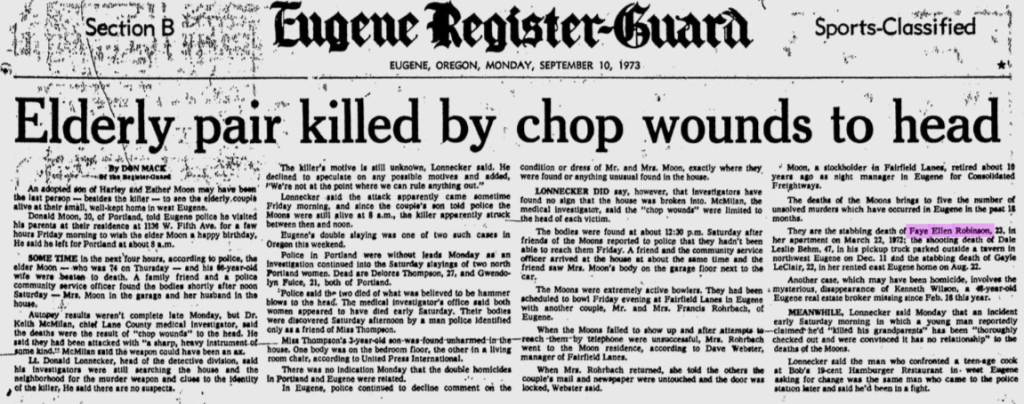
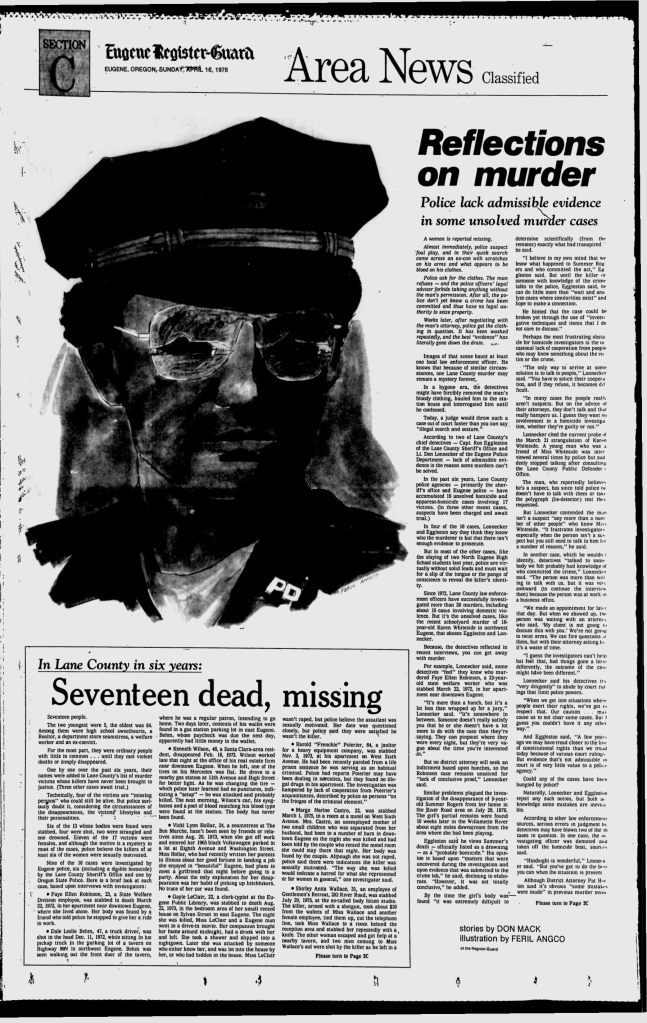
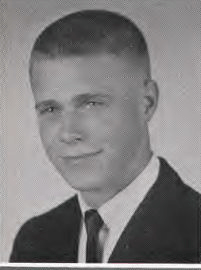
This is Fay’s sophomore year photo from the 1964 Tigard High School yearbook (it looks like they don’t do individual pictures aside from the senior class).Fay in a group picture from Ski Club taken from the 1964 Tigard High School yearbook.Fay in the a picture for Mother’s Tea in the 1964 Tigard High School yearbook.Fay in a group photo from the play ‘Once Upon a Midnight’ taken from the 1964 Tigard High School yearbook.Fay in a group picture for Spanish Club taken from the 1964 Tigard High School yearbook.Fay in the NHS in the 1964 Tigard High School yearbook.Fay’s senior picture from the 1966 Tigard High School yearbook.Fay in a group photo for Ski Club from the 1966 Tigard High School yearbook.Fay in a group photo for IRL Club from the 1966 Tigard High School yearbook.Fay in a group photo for the Tigrettes from the 1966 Tigard High School yearbook.Fay in a group picture for the Tigrettes taken from the 1966 Tigard High School yearbook.Fay in a picture for the Tigrettes from the 1966 Tigard High School yearbook.Fay in a group picture for NHS taken from the 1966 Tigard High School yearbook.Fay Ell Robinson in the Death Index for Oregon, 1898-2008.An article about the murder of Fay Ellen Robinson published in The Eugene Register-Guard on March 22, 1972.An article about the murder of Fay Ellen Robinson published in The Oregon Daily Journal on March 23, 1972.An article about the murder of Fay Ellen Robinson published in The Capital Journal on March 23, 1972.An article about the murder of Fay Ellen Robinson published in The Eugene Register-Guard on March 23, 1972.An article about the murder of Fay Ellen Robinson published in The Eugene Register-Guard on March 22, 1972.An article about the murder of Fay Ellen Robinson published in The Statesman Journal on March 23, 1972.An article about the murder of Fay Ellen Robinson published in The Albany Democrat-Herald on March 23, 1972.Fay Ellen Robinson’s obituary published in The Oregonian on March 25, 1972.An article about a Eugene woman that killed her husband that mentions the murder of Fay Ellen Robinson published in The Eugene Register-Guard Apr 4, 1972.An article about the murder of Fay Ellen Robinson published in The Eugene Register-Guard on September 10, 1973.An article about unsolved murders in Lane County that mentions Fay Ellen Robinson published in The Eugene Register-Guard on April 16, 1978.The first part of an article mentioning Robinson’s murder published in The Eugene Register-Guard on April 16, 1978.The second part of an article mentioning Robinson’s murder published in The Eugene Register-Guard on April 16, 1978.An article about Bundy’s possible Oregon victims that mentions Fay Robinson published in barbThomas, Alice, and Fay’s gravestone, which is located in Cor 201, Niche 200 at the River View Cemetery in Portland, OR.Fay’s mother’s birth certificate. Fay’s parent’s wedding announcement published in The Corvallis Gazette-Times on August 9, 1938.Mr. and Mrs. Robinson’s record of marriage.Thomas H. Robinson’s WWII draft card.Fay and the rest of her family listed in the 1950 US census.Patricia Robinsons senior picture from the 1961 Tigard High School yearbook.A picture of Randy Robinson from the 1964 Tigard High School yearbook.Mr. Robinson’s obituary, published in The Sun on February 21, 2003.Patricia Robinson-Gardner’s obituary published in The Sunday Oregonian on May 11, 2008.Teds whereabouts in early 1972 according to the ‘1992 TB FBI Multiagency Report.’ Rita Lorraine Jolly, who disappeared out of her West Linn neighborhood at 7:15 PM on June 29, 1973 after leaving to go for a walk.Justis was last heard from on November 5, 1973 after she called her mother from outside the Memorial Coliseum in Portland, OR.Vicki Lynn Hollar, who disappeared from Eugene, OR on August 20, 1973. Alma Jean Barra, who was last seen leaving the Copper Penny Tavern in Portland between 11 and 11:30 PM on March 23, 1972A newspaper article about the strangulation death of Janet Lynn Shanahan published in The Oregon Daily Journal on April 24, 1969.A newspaper article about the strangulation death of Barbara Katherine Cunningham published in The Oregon Daily Journal on May 27, 1971.Gayle Elizabeth LeClair, who was found deceased in her Eugene apartment on August 23, 1972.The gravestone of Geneva Joy Martin, who was found deceased on the side of the road in Eugene by a local farmer in July 1972. A newspaper article about the death of Laurie Canaday published in The Oregon Journal on July 9, 1973.A newspaper article about the strangulation death of Alison Caufman published in The Sunday Oregonian on June 24, 1973.Deborah Lee Tomlinson disappeared out of Creswell, OR with an unidentified girlfriend on her sixteenth birthday on October 15, 1973.Virginia Erickson, a resident of Sweet Home, OR that has been missing since October 21, 1973. An article about Floy Joy ‘Jeanne’ Bennet published in The Bulletin on March 2, 1988.An article about the homicide of Margo Nerine Castro published in The Greater Oregon on March 7, 1975.
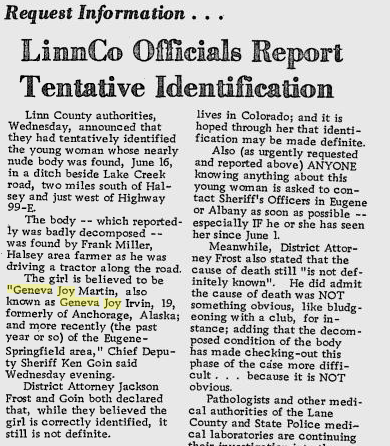
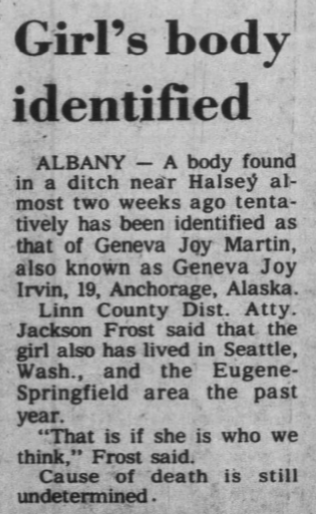
Geneva Joy Martin was born on November 16, 1952 to Robert Eugene and Florence (nee Boldt) Martin in Hastings, MI. Mr. Martin was born on August 7, 1930 and Florence was born on March 16, 1914 in Hutchinson, Minnesota; her occupation is listed as ‘secretary’ in her ‘geni’ profile, and the couple had two daughters but eventually divorced. In 1942 Florence moved her family to Anchorage, Alaska, where she would eventually get remarried to a man named Maurice Green, who worked for the state railroad. The couple would have two daughters together: Lynella Faith (Grant) and Madelon Grace (Mottet). Aside from a DOB and where she was born I couldn’t find any more details about Ms. Martins childhood.
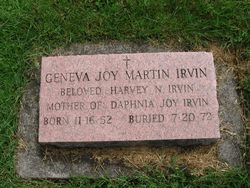
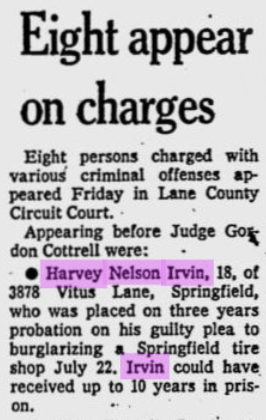
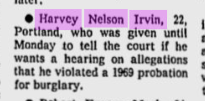
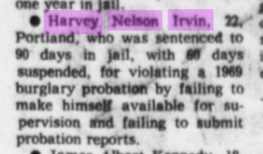
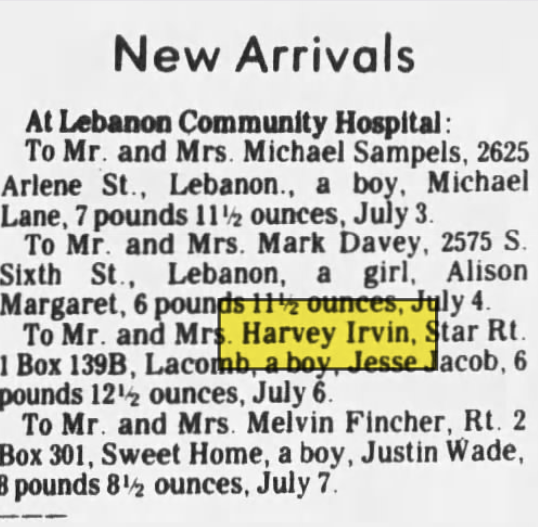
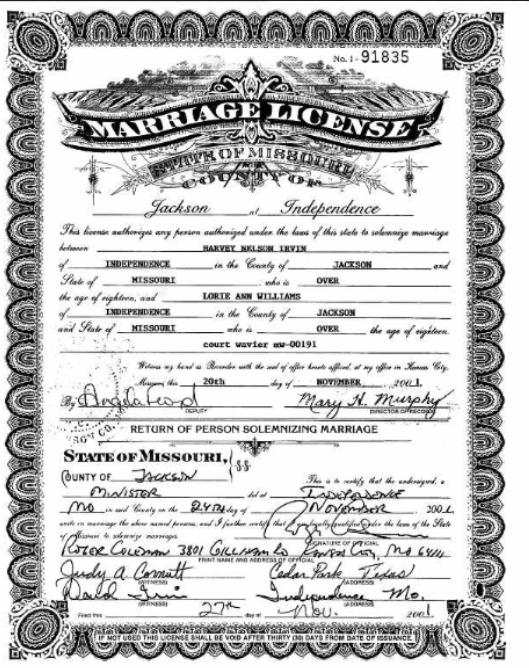
At some point before her death Geneva married Harvey ‘Stormy’ Nelson Irvin … or, at least that’s what it says on her tombstone. I could find no record of their nuptials anywhere and he isn’t mentioned once in any articles about her aside from the fact that she used his last name on occasion ‘as an alias…’ I did, however, find four other marriage certificates for Mr. Irvin on Ancestry. The couple had a daughter named Daphnia Joy that was two months old when nineteen year old Geneva was found deceased, and in the year prior to her disappearance she briefly lived in Seattle and the Eugene/Springfield, OR area. Harvey was born on February 15, 1950, and after Geneva was killed he wasn’t single for very long: he married Patricia Connelly less than three years later on May 22, 1975 in Reno, Nevada.
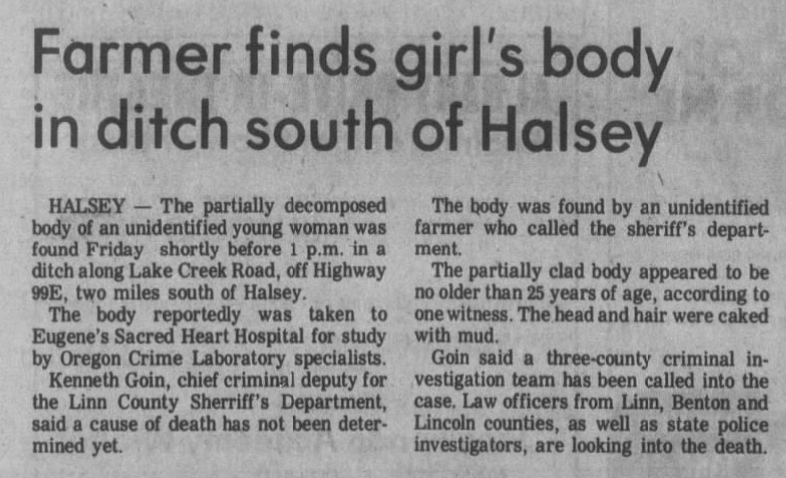
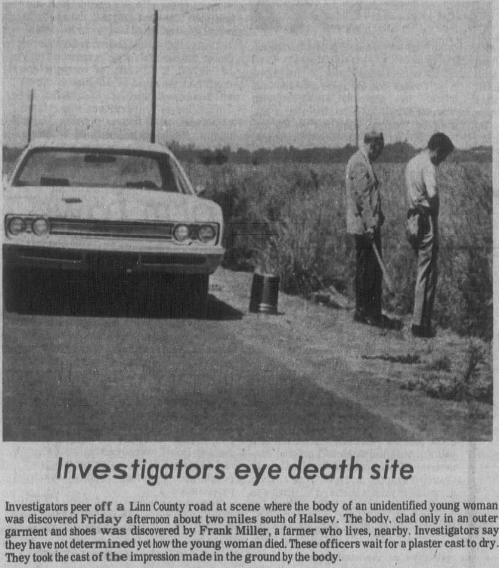
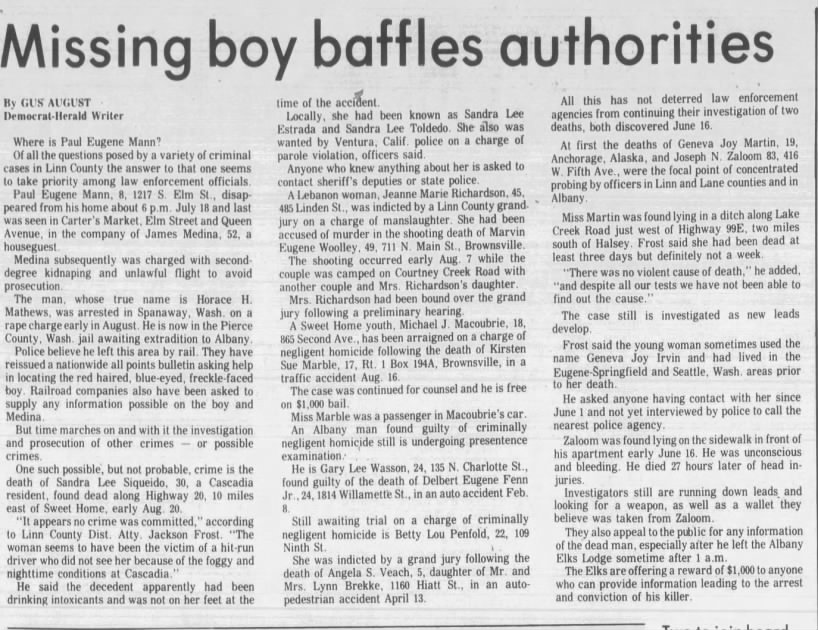
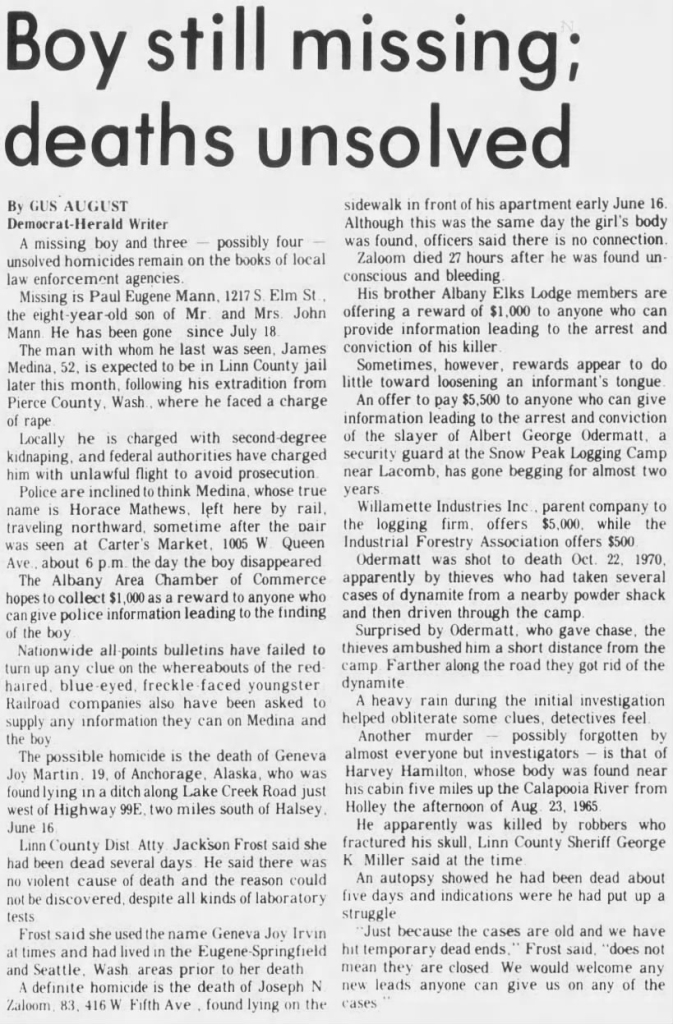
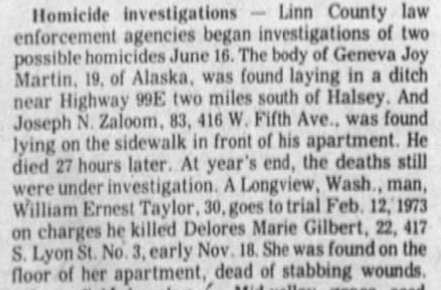
At roughly 1 PM on June 16, 1972 the remains of a decomposed, ‘partially clad young woman’ were found face down in a ‘woody, roadside ditch’ by Frank Miller, a local farmer. She was only wearing a coat and shoes, and her hair was caked with dried mud and sediment; she remained unidentified for roughly ten days while detectives searched for clues. At the scene investigators made a plaster cast of where the victim was found in the ditch in hopes to further aid in the investigation… and this is where not having a background in policing/criminology/forensics hurts me because I didn’t know that was a thing. Looking into it, ‘casting’ is when experts preserve impressions from crime scenes (for example larger, 3D impressions such as tire marks or footprints). The process works almost the same way an orthodontist makes a mold of a patient’s teeth, and forensic experts and LE use an array of materials to help create the ‘casts.’
The young victim was taken to Eugene’s Sacred Heart Hospital, where specialists from the Oregon Crime Laboratory got to work on identifying her. According to (retired) Linn County DA Jackson Frost, they were able to tell that she was in the ditch for ‘about three days, but definitely not a week,’ and were immediately able to determine that she was no older than 25. Thanks in part to an advanced stage of facial decomp, it took thirteen days and $162 worth of long distance phone calls to Alaska (where Martin received care) before dental experts were able to make a near positive identification; a sister living in Colorado helped make an absolute positive ID. Despite an autopsy as well as ‘all kinds of lab tests,’ investigatorswere never able to pinpoint Martin’s exact cause of death due to her having ‘no violent wounds;’ I also found no mention of sexual assault. In the beginning of the investigation medical examiners thought they detected drugs in her system however it was later determined that the advanced state of decomp produced a chemical that masked the presence of narcotics. Despite there being 150 pages worth of notes in Martins case file, there is next to no information out there on her.
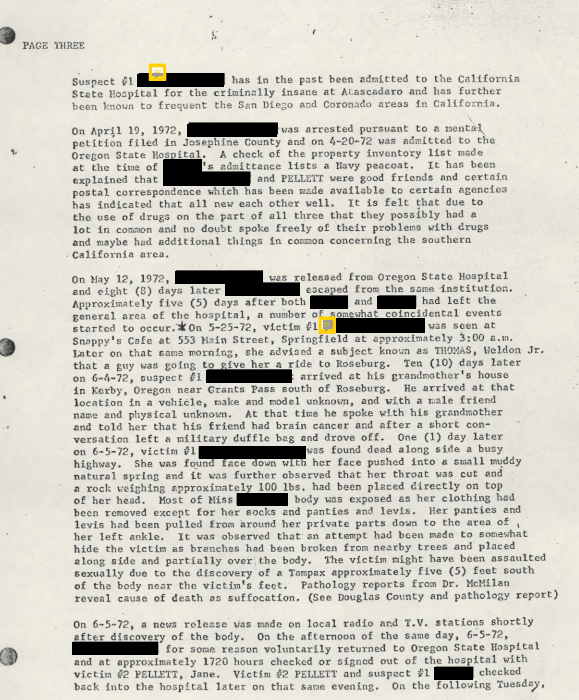
In the end of an article published in The Greater Oregon on June 30, 1972, DA Frost commented that ‘the young woman apparently was living under circumstances where she might not want to use her true name, thus the alias.’ In an article published by The Albany Democrat-Herald on June 28, 1973, Frost said that Martin was a known drug user and had recently been in treatment for ‘drug related mental problems’ in Eugene. At the time of her death detectives learned she had been living in Eugene for several months and a week before she was last seen had cashed her monthly welfare check then quietly slipped out of sight; it was the last time she was seen alive.
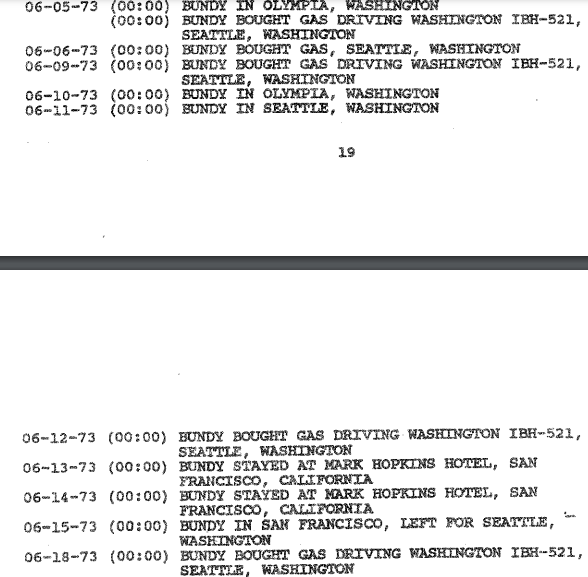
At the time Geneva was murdered Ted Bundy was living in Seattle at the Rogers Rooming House on 12th Avenue, and was in the middle ofa long term relationship with Elizabeth Kloepfer. He had just finished his undergraduate psychology degree from the University of Washington and was getting ready for his first (unsuccessful) attempt at law school at the University of Puget Sound (which he began the following year). At the time Ted was interning as a counselor at Harborview Mental Health Center in Seattle (he was only there from June to September 1972), and according to the ‘TB MultiAgency Report 1992,’ Bundy was mostly in Seattle the week before she was found dead but made a trip to San Francisco on June 13 and stayed until the 15th; his whereabouts are then unaccounted for until June 18 when he bought gas in Seattle. As I’ve said in multiple other articles, its Bundy cannon that the serial murderer began killing in early January 1974 with his brutal attack of fellow University of Washington student Karen Sparks in her basement apartment, but during his confessions before his execution he hinted to Dr. Robert Keppel that he may have started as early as 1972 with a young girl in Seattle (but of course didn’t elaborate further than that).
I didn’t know Bundy was ever actually suspected in any additional Oregon murders on top of Roberta Parks (for sure) and (possibly) Vicki Hollar/Rita Jolly/Sue Justis, but according to an article published by The Eugene Register-Guard on February 24, 1989, Martin was at one time considered a possible victim of his as well as Beverly May Jenkins, Allison Lynn Caufman, Laurie Lee Canaday, Tina Marie Mingus, and Floy Jean Bennet. Now, I am in no way saying these women are really possible victims of Ted Bundy, I’m just saying they were in the very least in the correct place at the right (or wrong) time (well sort of, as some if the dates are completely off). Sixteen year old Beverly May Jenkins was from Roseburg, OR and in June 1972 her remains were found just off the I-5 roughly ten miles outside of Cottage Grove; she had been strangled to death. Fifteen year old Portland native Allison Lynn Caufman died as a result of head injuries after being shoved from a car moving at a high rate of speed in July 1973. I think the last two girls can be quickly debunked, as Bundy was in prison when both victims were killed. Tina Marie Mingus was only 16 years old when her body was found in Salem, OR in October 1975, and Flow Joy Bennet was 37 (and obviously a bit out of Bundy’s preferred age range) when she vanished in February 1978. What’s strange is I couldn’t find any more information about any of these women out there. It’s almost as if they never existed.
But there’s more dead and missing women, on top of that article. Twenty year old Faye Ellen Robinson was found deceased from multiple stab wounds in the upper part of her body in March 23, 1972. Like most Bundy victims, she was educated and had a good job working in county government: she graduated from the University of Oregon in 1970 and was employed by the Lane County Welfare Department. Also on March 23 Alma Jean Barra was last seen after leaving the Copper Penny Tavern in the company of an unknown man driving southbound on 92nd Avenue between 11 and 11:30 PM. The 28-year-old’s body was found in an area of heavy brush of the Willamette National Cemetery, roughly forty feet off of Mount Scott Boulevard; she had been strangled and showed no signs of sexual assault. Next is 17 year old Susan Wickersham, who disappeared from Bend, OR on July 11, 1973 after dropping off the family car at her mom’s POE after joyriding around town with a gf (some conflicting reports say she was at a party). Wickershams remains were found on January 20, 1976 and her skull had a bullet hole behind the right ear with no exit wound. Gayle LeClair was murdered in her rental house on August 23, 1973; a clerk/typist at the Eugene Municipal Library, she had been found by her supervisor stabbed to death after she failed to come in for her scheduled shift. Lastly, Deborah Lee Tomlinson vanished without a trace after running away from Creswell, OR with an unnamed friend on her sixteenth birthday on October 15, 1973.
I tried my hardest to find some sort of link between Ms. Martin and any other victims from the area, but not having a cause of death makes it really hard to compare. What I (personally) think happened: she met up with some undesirable friends and together they used some illegal substances, then Geneva overdosed and they panicked then got rid of her body in the most convenient and easiest way they could think of. I mean, to me it sounds plausible that they dumped her on the side of the road (possibly in the middle of the night) because they got scared and didn’t want to be held responsible for her death. In 1972 ‘Good Samaritan’ laws didn’t exist, so if anyone was present when she died then most likely they would have been held responsible in some capacity.
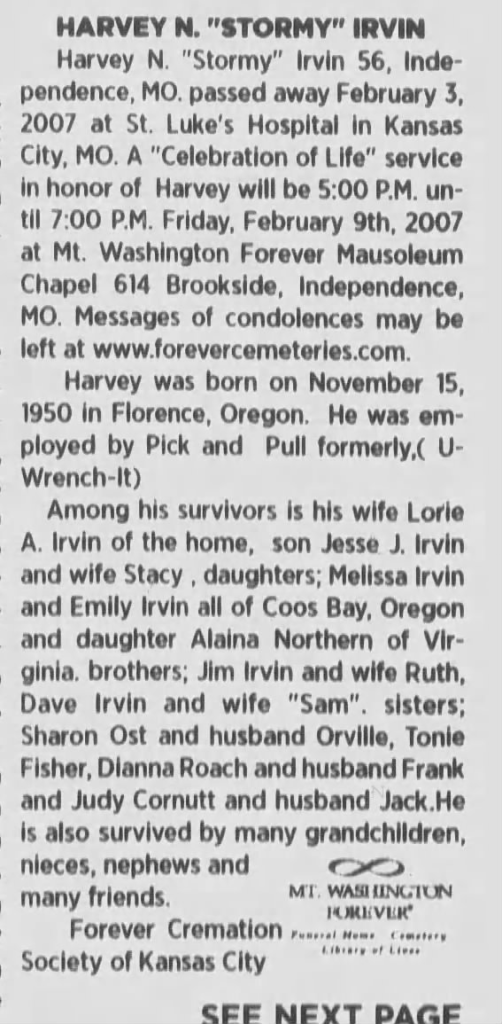
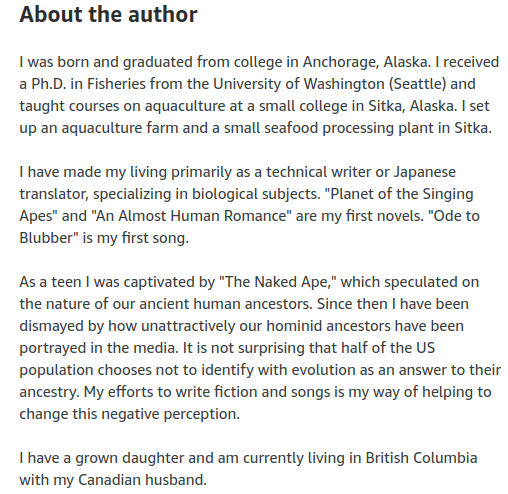
After the death of her mother Daphnia was sent to live with relatives out of state. Per the Green family’s myheritage site, she got married and had a son. Harvey went on to marry (and divorce) numerous times and had four more children; he passed away on February 3, 2007 at the age of 56. Geneva’s father passed away at the age of 84 in 2014 in Garibaldi, OR, and Mrs. Green died January 13, 1994 at the age of 79 due to a smoking related illness. Both of her half-sisters have led incredibly remarkable lives: Dr. Lynella Faith Grant is a psychologist, statistician, lawyer, personnel director, inventor, marketer, publisher, and author; Dr. Madelon Green-Mottet got her PhD in Fisheries from the University of Washington in Seattle and taught classes on aquaculture at a small college in Sitka, Alaska.
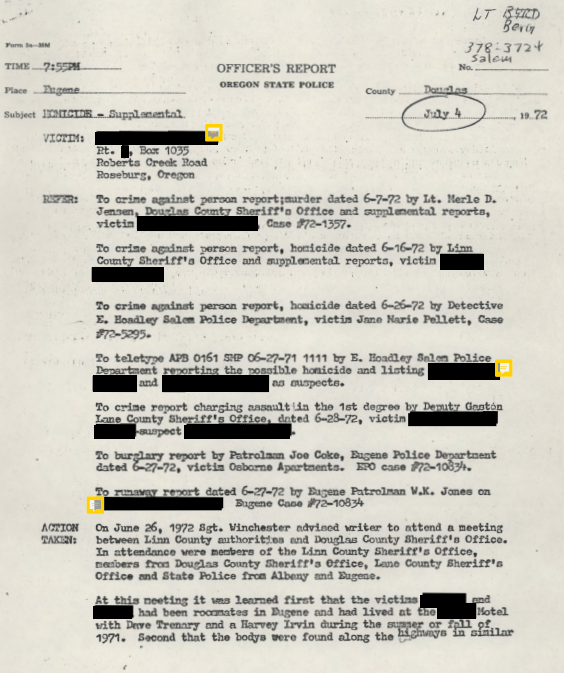
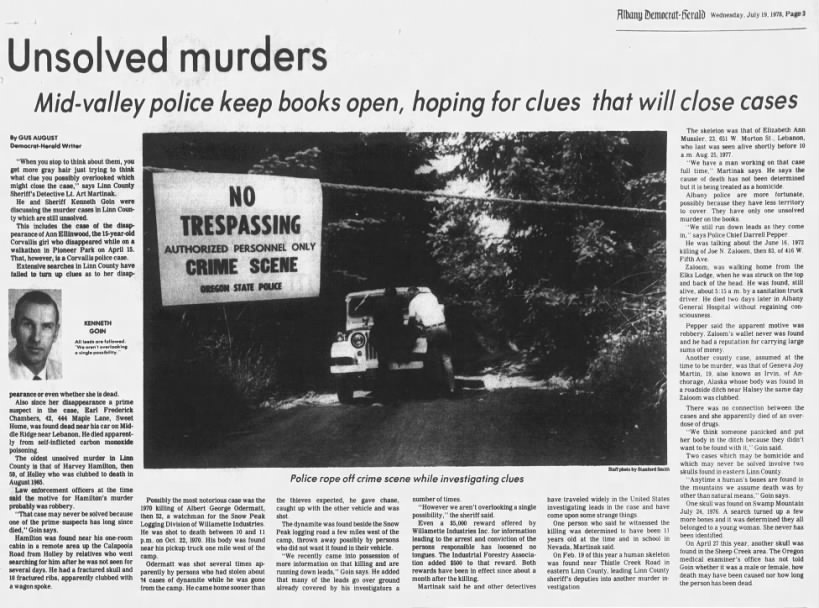
Some information related to the death of Geneva Joy Martin, courtesy of the King County Sheriff’s Department.Some information related to the death of Geneva Joy Martin, courtesy of the King County Sheriff’s Department.Some information related to the death of Geneva Joy Martin, courtesy of the King County Sheriff’s Department.Some information related to the death of Geneva Joy Martin, courtesy of the King County Sheriff’s Department.Some information related to the death of Geneva Joy Martin, courtesy of the King County Sheriff’s Department.Some information related to the death of Geneva Joy Martin, courtesy of the King County Sheriff’s Department.Some information related to the death of Geneva Joy Martin, courtesy of the King County Sheriff’s Department.Some information related to the death of Geneva Joy Martin, courtesy of the King County Sheriff’s Department.Some information related to the death of Geneva Joy Martin, courtesy of the King County Sheriff’s Department.Some information related to the death of Geneva Joy Martin, courtesy of the King County Sheriff’s Department.Some information related to the death of Geneva Joy Martin, courtesy of the King County Sheriff’s Department.Some information related to the death of Geneva Joy Martin, courtesy of the King County Sheriff’s Department.Some information related to the death of Geneva Joy Martin, courtesy of the King County Sheriff’s Department.The grave stone of Geneva Joy Martin. She is buried in plot 21 at The Mulkey Cemetery in Eugene, Oregon.The family history of Ms. Martin according to myheritage.com.An article about the discovery of Martin’s remains published by The Statesman Journal on June 17, 1972.An article about Martin’s body being discovered (but unidentified), published by The Albany Democrat-Herald on June 17, 1972.An article about the murder of Joseph N. Zaloom that mentions Geneva Martin published by The Albany Democrat-Herald on June 19, 1972.A picture from an article about the discovery of Martin’s remains published by The Albany Democrat-Herald on June 19, 1972.An article about the discovery of Martin’s remains published by The Statesman Journal on June 20, 1972.An article about the discovery of Martin’s remains published by The Albany Democrat-Herald on June 20, 1972.An article about the discovery of Martin’s remains published by The Corvallis Gazette-Times on June 20, 1972.An article about the discovery of Martin’s remains published by The Corvallis Gazette-Times on June 21, 1972.An article about the discovery of Martin’s remains published by The Albany Democrat-Herald on June 22, 1972.Part one of an article about the discovery of Martin’s remains published by The Times on June 22, 1972.Part two of an article about the discovery of Martin’s remains published by The Times on June 22, 1972.An article mentioning Martin published by The Albany Democrat-Herald on June 24, 1972.An article mentioning Martin published by The Albany Democrat-Herald on June 26, 1972.An article about the identification of Geneva Joy Martin-Irvin’s remains published by The Corvallis Gazette-Times on June 29, 1972.An article about the death of Geneva Joy Martin-Irvin published by The Albany Democrat-Herald on June 29, 1972.Part one of an article about the discovery of Martin’s remains published by The Times on June 29, 1972.Part two of an article about the discovery of Martin’s remains published The Times on June 29, 1972.An article about the death of Geneva Joy Martin-Irvin published by The Spokesman-Review on June 30, 1972.An article about the positive identification of Geneva Joy Martin-Irvin’s remains published by The Capital Journal on June 30, 1972.An article about the positive ID of Geneva Joy Martin’s remains published by The Statesman Journal on June 30, 1972.An article about the death of Geneva Joy Martin published by The Greater Oregon on June 30, 1972.An article about the death of Geneva Martin published by The Albany Democrat-Herald on July 6, 1972.An article about the death of Geneva Joy Martin published by The Albany Democrat-Herald on July 26, 1972.An article mentioning the death of Geneva Joy Martin-Irvin published by The Albany Democrat-Herald on August 29, 1972.An article mentioning the death of Geneva Martin published by The Albany Democrat-Herald on September 14, 1972.An article about the death of Geneva Joy Martin published by The Albany Democrat-Herald on December 26, 1972.An article mentioning the death of Geneva Joy Martin published by The Albany Democrat-Herald on June 28, 1973.An article mentioning the death of Geneva Martin published by The Albany Democrat-Herald on July 19, 1978.Part one of an article about potential Bundy victims out of Oregon published after his execution from The Eugene Register-Guard on February 24, 1989.Part two of an article about potential Bundy victims out of Oregon published after his execution from The Eugene Register-Guard on February 24, 1989.Bundy’s whereabouts the week before Geneva was found murdered according to the ‘TB Multiagency Investigative Team Report 1992.’An article about a burglary performed by Geneva’s ‘husband’ published in The Eugene Register-Guard on November 8, 1969.A newspaper blurb about a burglary performed by Geneva’s ‘husband’ published in The Eugene Register-Guard on January 27, 1973.A newspaper blurb about Geneva’s ‘husband’ published in The Eugene Register-Guard on March 6, 1973.An article about Harvey Irvin having another baby with his new wife published by The Albany Democrat-Herald on July 10, 1975.An article about Geneva’s ‘husband’ driving with a suspended license published in The Lebanon Express on April 12, 1976.Harvey Irvin and Lorie Ann William’s marriage certificate from 2001.Harvey Irvin’s obituary published in The Kansas City Star on February 3, 2007.Mrs. Green’s obituary.Madelon Green Mottet from the 1963 West Anchorage High School yearbook.Dr. Madelon Green Mottet, PhD.Dr. Madelon Mottet’s bio on her Amazon page.
I’m going to preface this by saying I decided to split this article into two parts: the first will be about Sara A. Survivors background (whose real, legal name is Susan Lorrayne Roller) and her supposed relationship with Ted Bundy. The second piece will be a breakdown and review of her second book, ‘Reflections on Green River: The Letters of, and Conversations with Ted Bundy.‘
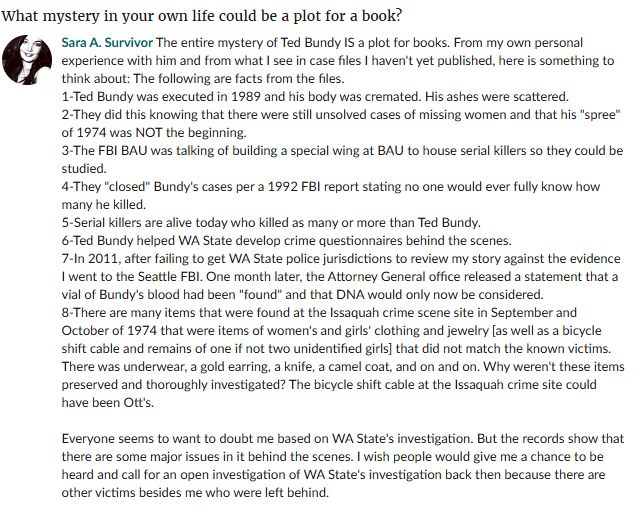
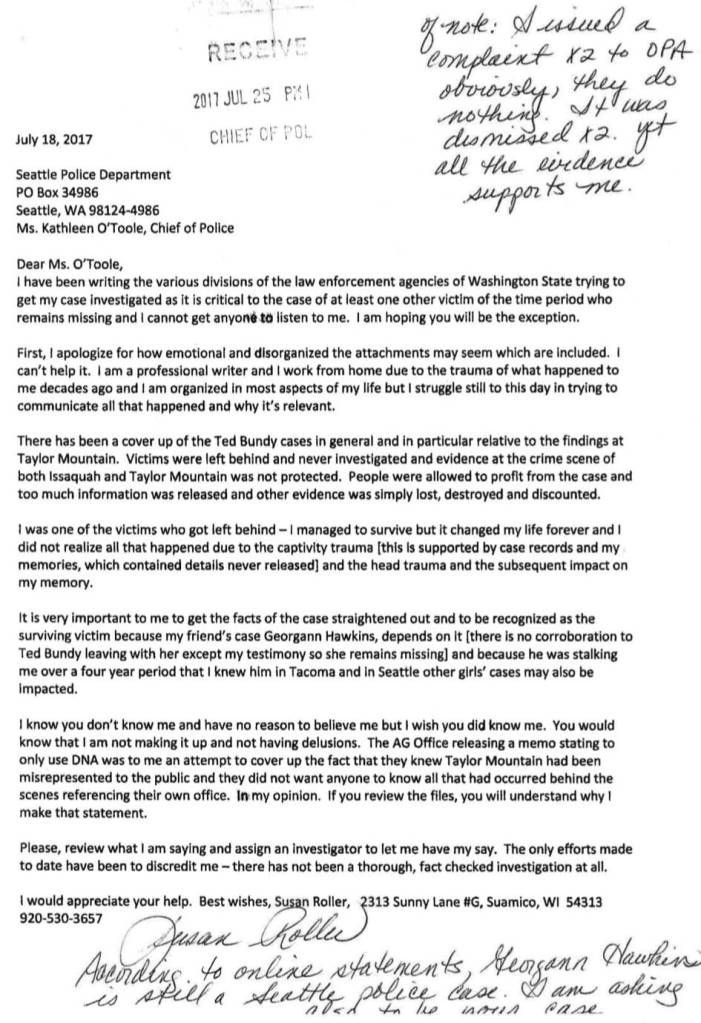
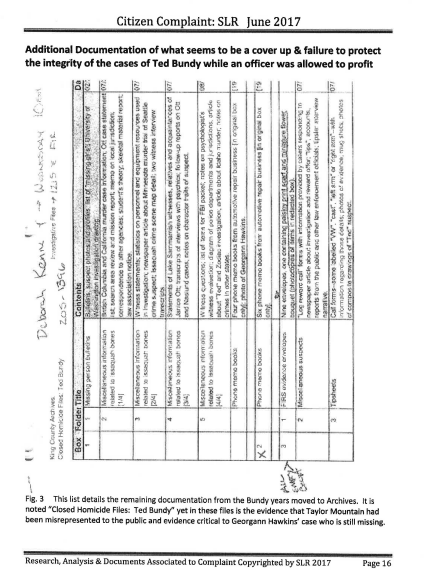
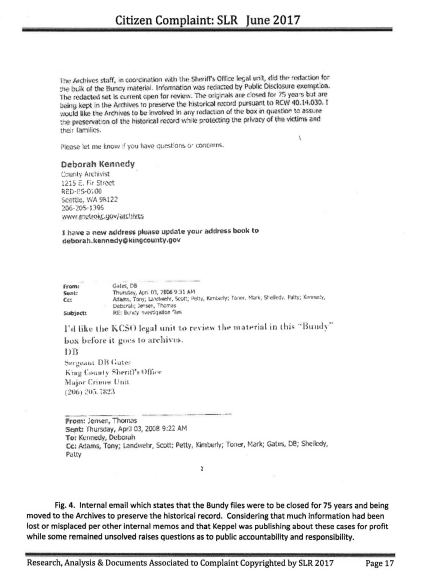
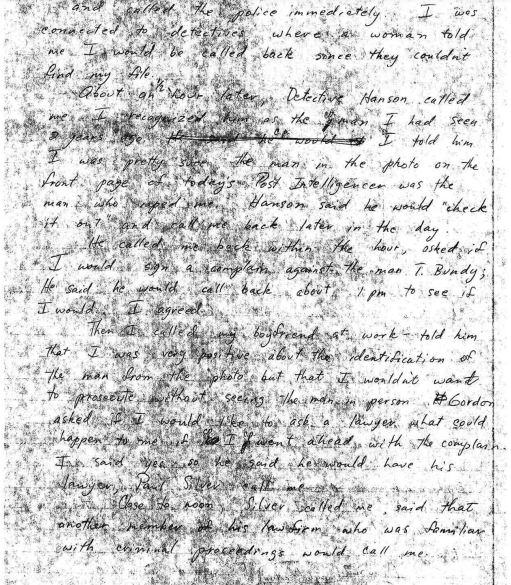
The tl;dr version of Ms. Survivors story is (whose real name is easily found in police documents so the need to publish under a pseudonym doesn’t make any sense): she isa surviving victim of Ted Bundy and over a four year period while in high school and college he repeatedly stalked, kidnapped, and sexually assaulted her. Survivor further claims that Seattle based law enforcement purposefully left out evidence in Bundy related reports (specifically related to the Taylor Mountain burial site), and even goes so far as to suggest there were additional victims that law enforcement refuses to investigate or even acknowledge. In a letter written to former Seattle Police Chief Kathleen O’Toole dated July 18, 2017, Survivor said that ‘there has been a cover up of the Ted Bundy cases in general and in particular relative to the findings at Taylor Mountain. Victims were left behind and never investigated and evidence at the crime scene of both Issaquah and Taylor Mountain are not protected. People were allowed to profit from the case and too much information was released and other evidence was simply lost, destroyed and discounted.’
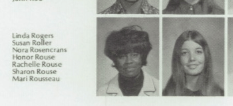
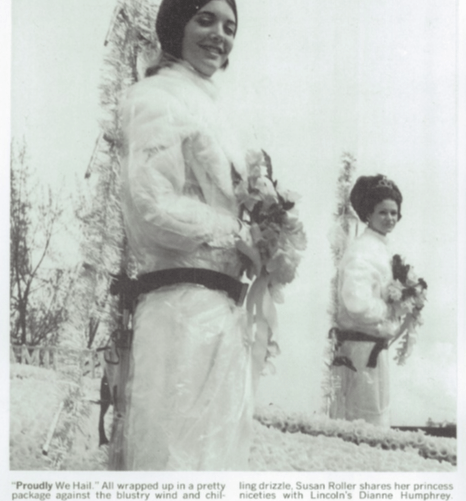
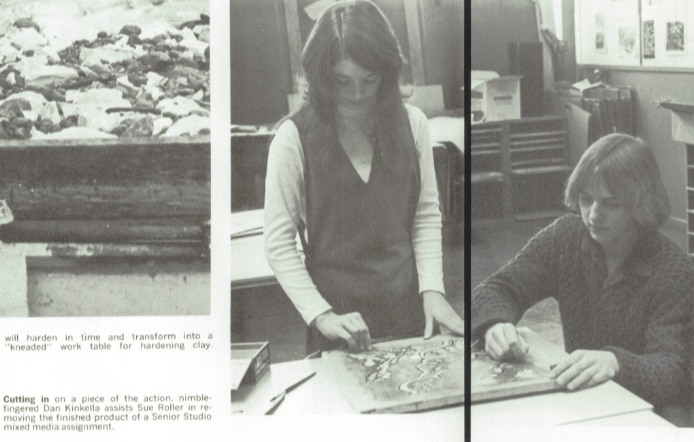
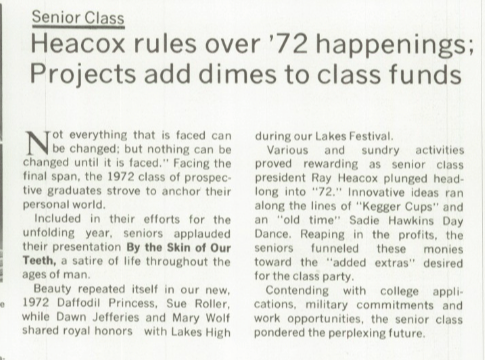
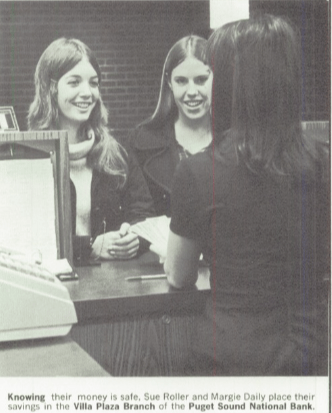
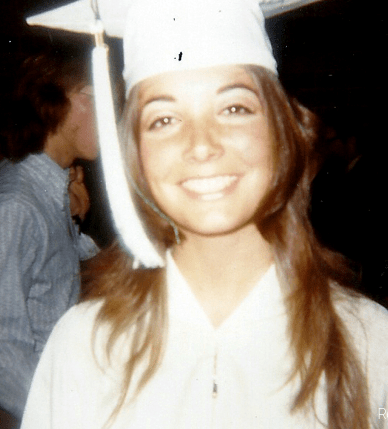
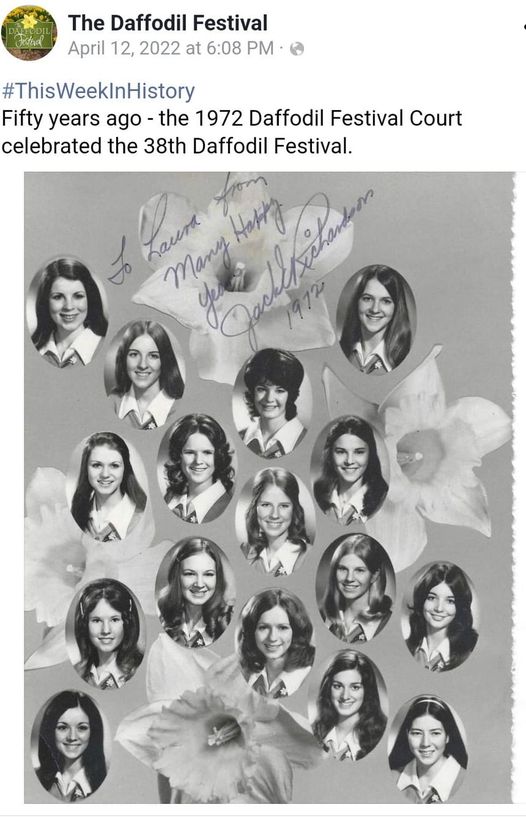
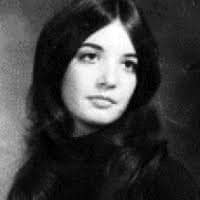
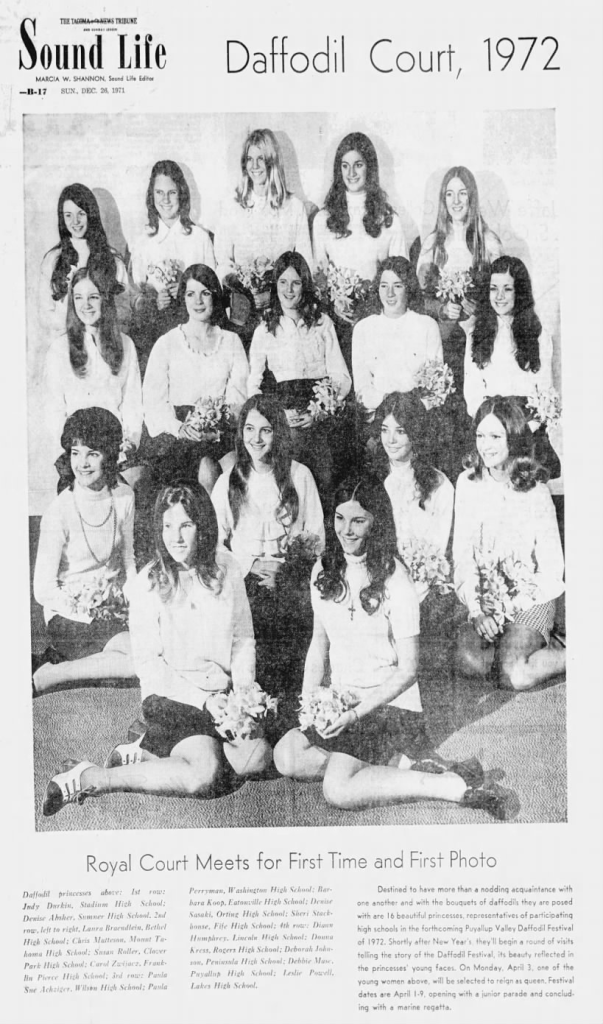
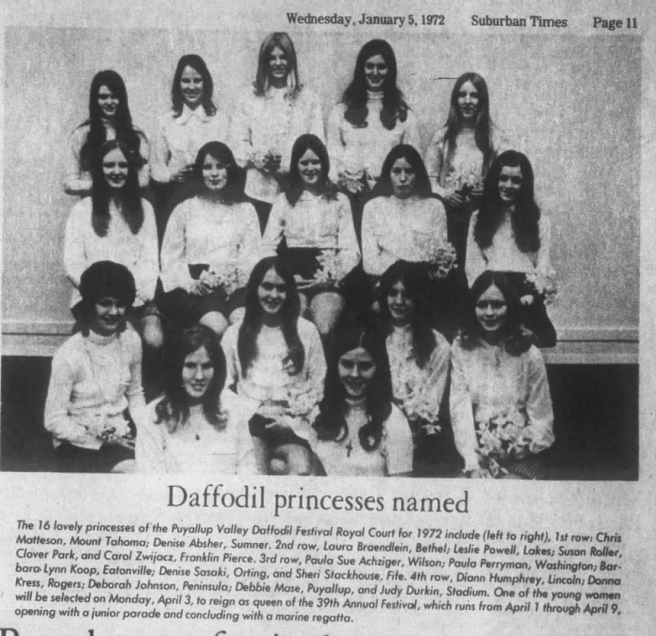
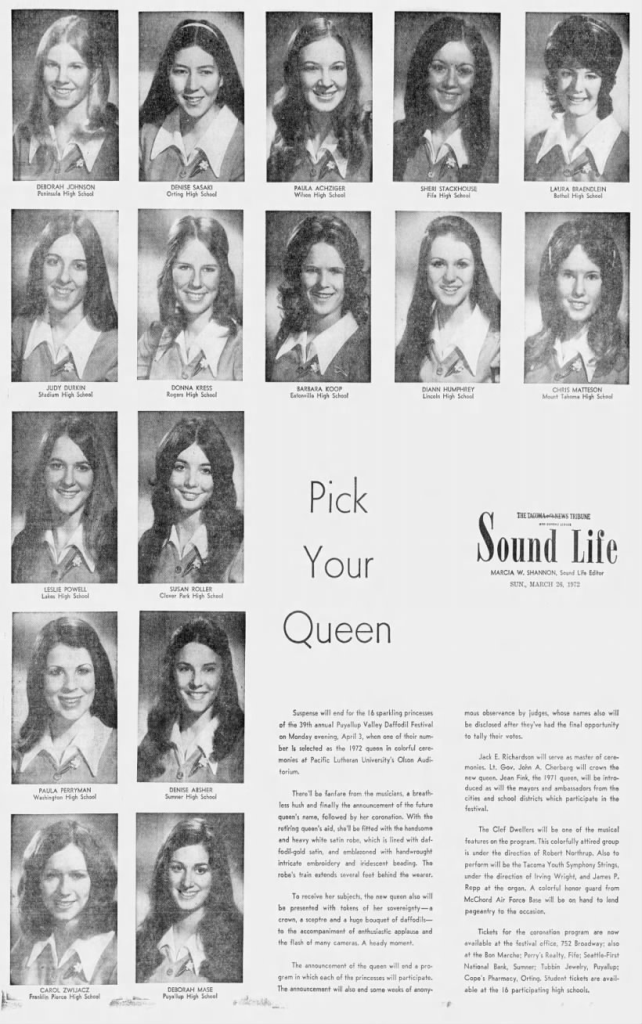
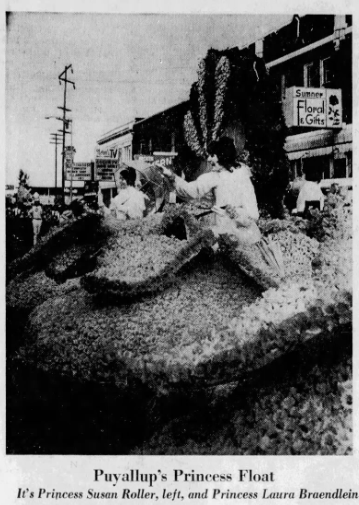
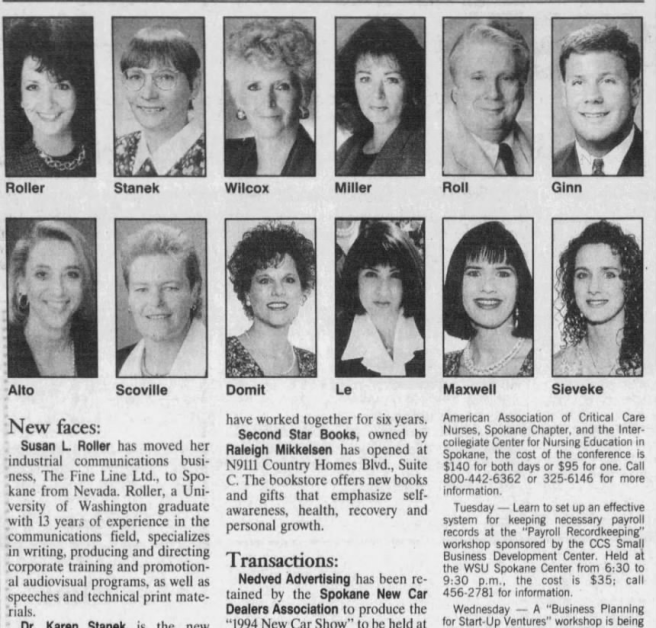
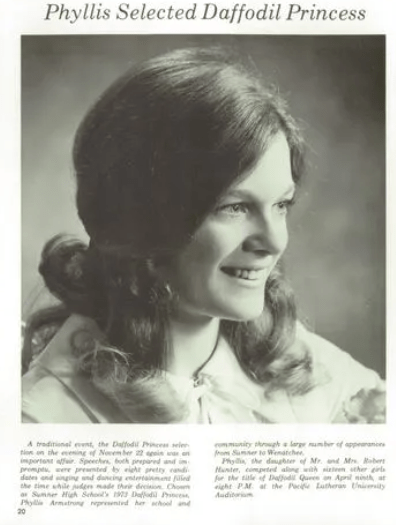
Susan Lorrayne Rollerwas born on September 13, 1954 to Gilbert and Lois (nee Moore) in Portsmouth, Virginia; the family eventually relocated to Lakewood, Washington. She graduated from Clover Park High School in 1972, the same year she was elected to represent her high school as Daffodil Princess in the Pierce County Daffodil Festival (an event to help support the flower bulb business). She went on to attend the University of Washington in Seattle, where she was a member of the KappaKappa Gamma sorority; Roller graduated with her Bachelor of Science in Medical Sciences in 1976. At first, I wasn’t able to find a great deal of information on her background (not having access to her memoir put me at a huge disadvantage), however once I discovered her real name I was able to find quite a bit more information. Well, let me clarify: I only found a handful of websites with useful information BUT this is one of those instances where quality is more important than quantity because the few sources I found were VERY helpful (I will include all links in the works cited section at the bottom)… Personally, I’d rather have 3-4 informative, high-quality resources than twenty crappy ones rehashing the same information over and over.
Beginning in 2016, a woman going by the name of ‘Sara A. Survivor’ published a trilogy of books about the Ted Bundy case. Her first release, ‘ReconstructingSara: The Lost Victim of Ted Bundy,‘ is (for the most part) a memoir that is currentlyout of circulation waiting to be rewritten by a professional writer (as of May 2023). I tried my hardest to get my hands on a copy (I searched many websites, used bookstores, and even asked my sister the bookworm to check her local library but sadly she was unsuccessful). For that reason, I heavily relied on information from a variety of different sources including Erin Banks’ extremely well written book ‘Ted Bundy: Examining the Unconfirmed Survivor Stories.’ On the ‘Google Books’ page for Survivors first novel is the blurb: ‘what happened to Sara, both with Ted Bundy and with law enforcement, needs to be publicly reviewed. Bullying, cover up of materials (moving them into sealed areas during the time Sara was coming forward), and deciding who gets access to the justice system and who doesn’t are not elements of a democracy. They do not represent what the justice system of the United States was intended to be.’ Ms. Survivors second book is the one I’m reading, ‘Reflections on Green River: The Letters of, and Conversations with Ted Bundy.‘ The is composed of never before released interviews, transcripts, and information that took place between 1984 and 1988 related to Ted’s Washington state murders while he was on death row in Florida.
Last is the transcript of Bundy’s Final Prison Interview with Bob Keppel in January 1989: ‘In Defense of Denial: Ted Bundy’s Florida ConfessionInterview.’ Right before Ted was strapped into ‘Ol’ Sparky’ he met with Dr. Keppel in what would be his final interview with law enforcement regarding his atrocities in Washington. Nearly all of his confessions have been published in full through a variety of different mediums, however ‘Ms. Survivors’ final book is the transcript of it in full (as provided by her FOIA request originally made in June of 2015). In 2014 and 2015, she requested (and was granted) over 1,000 pages of original documents related to the Bundy case never before released to the public in their entirety as well as over 12 hours of original audio files. Upon reviewing the newly obtained files, she came to the conclusion that the case out of Washington state was ‘peppered with problems,’ and there was evidence that was purposefully misplaced. She elaborated that ‘documents couldn’t be found in some instances, and witness statements were not factored into the entire spectrum of the case in a consistent cohesive manner.’ The FOIA, or the ‘Freedom of Information Act’ was created in 1966 and states that any person has the right to request access to federal agency records. Survivor claims that the transcript is proof that information was purposefully withheld by law enforcement in relation to crimes Bundy committed before 1974 (when his ‘official’ reign of terror began with the brutal assault of Karen Sparks). On her website, ‘Sara discusses her concern that law enforcement withheld information about the Bundy case to the public (she specifically called it ‘incomplete information), elaborating that: ‘questions need to be raised as to why Bundy cases were released publicly with so much information put out when girls were still missing and not all was known. The case was never protected in the event future witnesses and victims came forward.’ The book (or more specifically, the transcribed original document) was not changed or altered in any way from how it was released to her (aside from taking out some names not directly related to the case). Perhaps I’ll read it after ‘Reflections on GRK.’
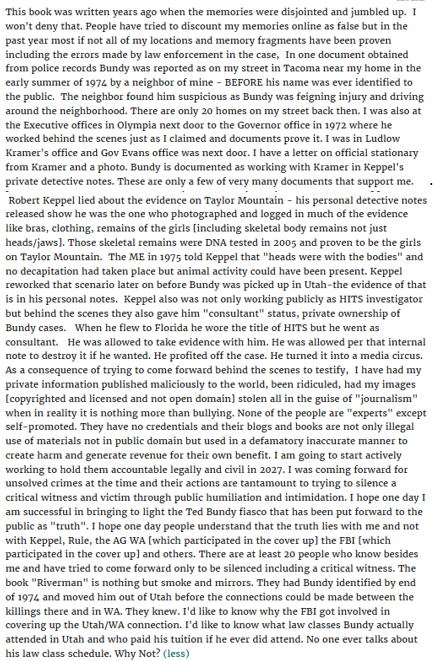
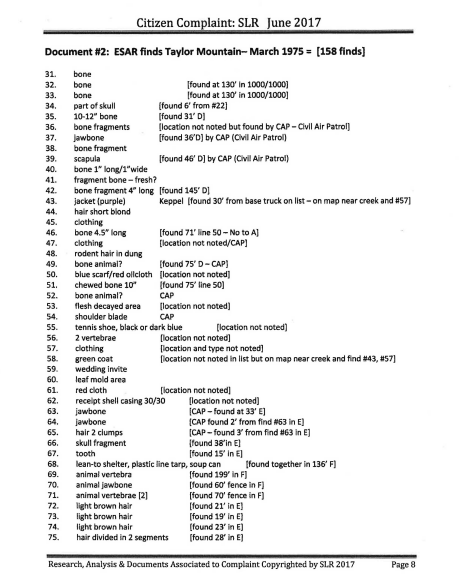
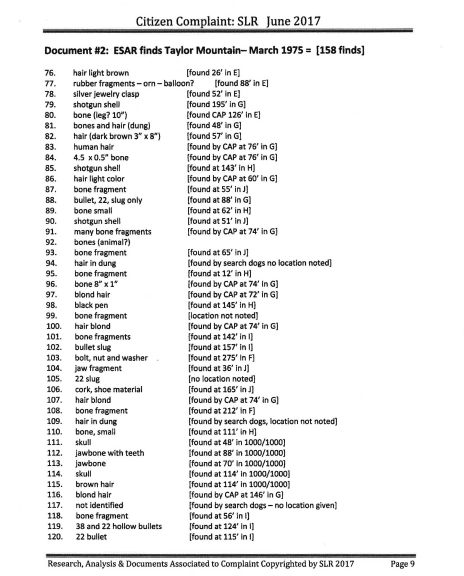
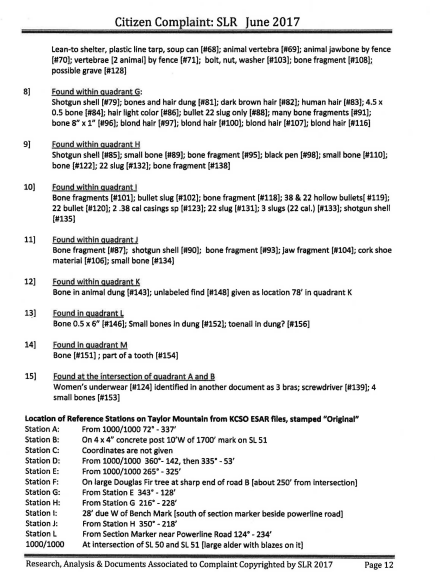
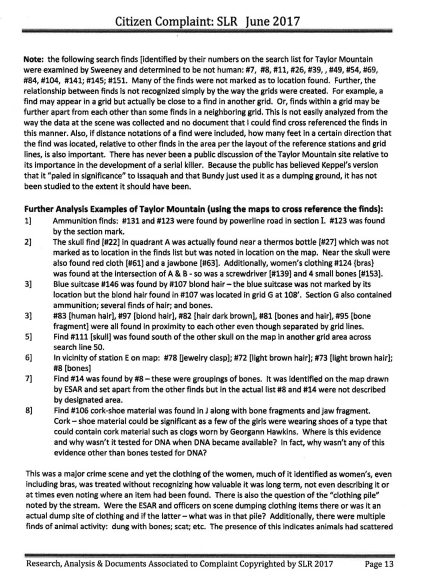
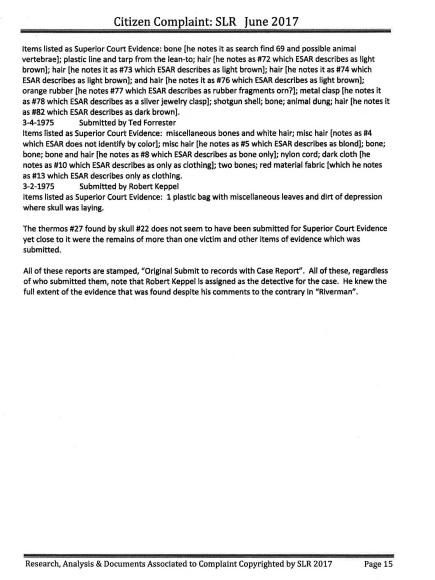
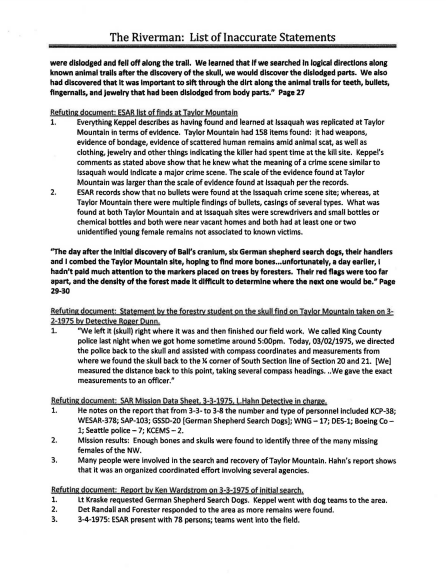
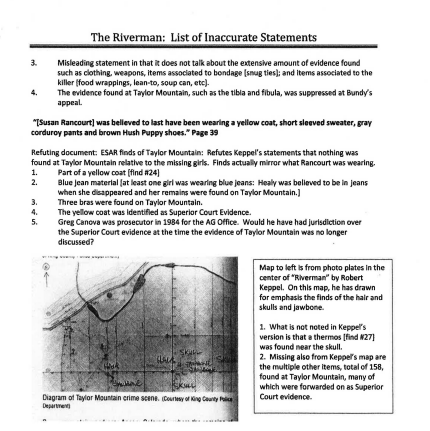
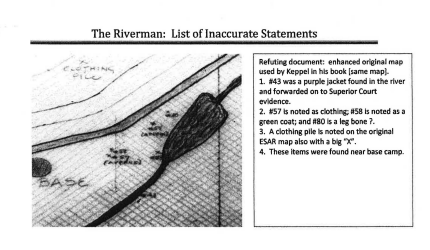
One of Sara’s more shocking revelations (for what I think are obvious reasons) is that detectives deliberately left important information out of case files, including the fact that they found ‘additional heads were found on Taylor Mountain.’ She claims the information released to her is proof that ‘158 items of evidence were found that included: skeletal remains, women’s clothing, evidence the killer spent time there; jewelry; signs of bondage and weapons (shotgun casings, gun shells, snug tie, etc) animal trails indicating animals had scattered the remains and human remains (female) who were not identified as being with the known victims there. There was also an abandoned home nearby and the ME statement states that the girls known and found there were not decapitated as has been claimed publicly. At Issaquah, there were also findings of women’s clothing, jewelry and a bicycle shift cable (labeled with a question mark). Much of this evidence was significant enough that at the time it was forwarded on to the Superior Court so why was it publicly denied? Evidence supports Sara and her contentions: her memories time and date stamped contained details which at the time the memories emerged as far back as 2001 had never been publicly released. They also contain details that are still not publicly released.’ I included the document in full below, and for this particular portion please refer to pages 12-15 of the Susan L. Roller document from cavdef.org.
In her first book, Ms. Survivor admits that she isn’t 100% certain when exactly she became acquainted with Bundy, however feels it most likely happened sometime in her junior year of high school in the winter months of 1970/71. One way that Survivor speculated she could have met him was on a ski trip to the Washington Cascade Mountains with her friend ‘Robert.‘ While there, she attracted the attention of Ted, who just happened to be there at the same time; she alleges to remember the two men fighting over her at some point. Sadly, Robert died about a year and a half after the incident in a waterskiing accident. Regarding the circumstances surrounding her friends death, Sara can’t help but wonder if somehow Ted was involved (whether it was from screwing around with his jet skis or boat), and despite having absolutely no tangible proof of this her inner voice ‘felt something was wrong back then…’ I’m sorry, but why would Bundy give one single crap about some guy he randomly met a year and a half earlier, one time? Was he so obsessed with Survivor that he jealously killed any other man that showed any sort of interest in her? Keep in mind at this timeTed was in a committed, long-term relationship with Liz (in fact this was towards the beginning of their romance, where Kloepfer reported they spent a lot of time together). He was also a student at the University of Washington as well and from June 5, 1970 to December 31, 1971 was employed as a delivery driver for Pedline Supply Company (a small, family-owned medical supply company). This is obviously a busy, vigorous schedule and his life was pretty busy at this time… so, let me get this straight: Survivor is saying Ted had all this extra time to follow her around AND was still able to go about his normal, everyday routine? Although I don’t believe Bundy had anything to do with Roberts death, in her book Ms. Banks does point out that one’s of his Seattle based attorneys John Henry Browne wrote in his book ‘TheDevils Defender‘ that Ted allegedly confessed to him (and conveniently onlyhim) that his first murder victim was a male (although it’s widely speculated Browne often embellished and wasn’t always truthful in his storytelling).
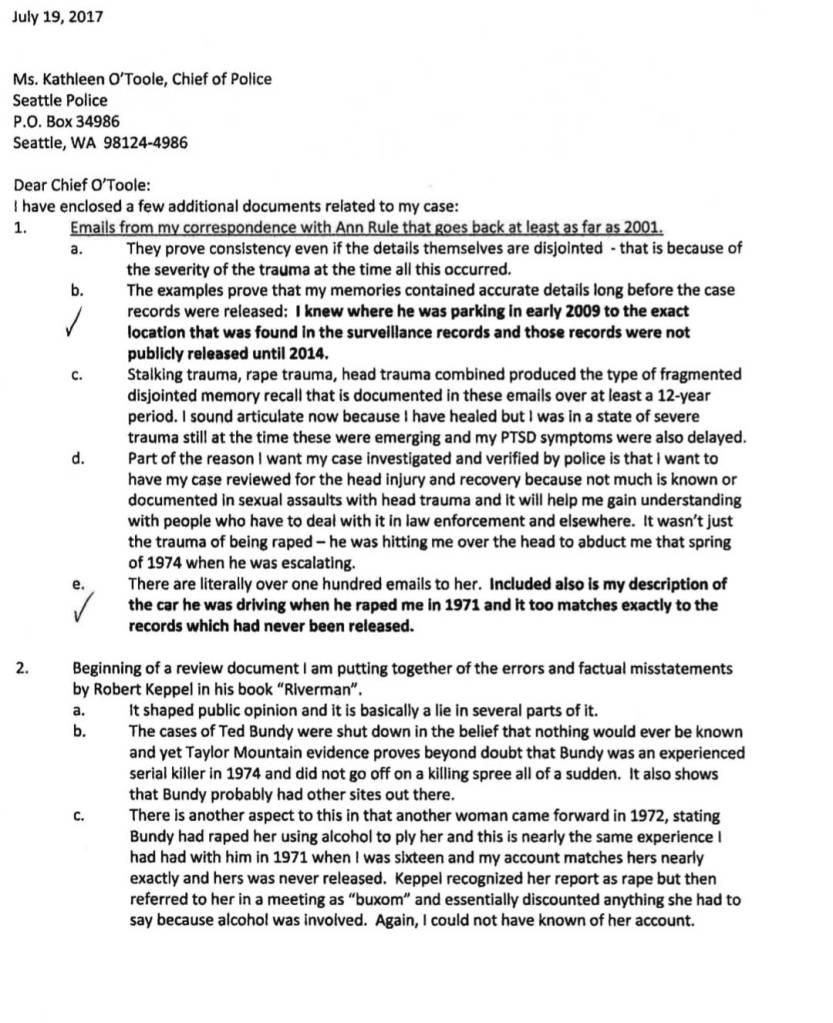
A second scenario Sara said she could have possibly become acquainted with Bundy was through her modeling job, and that he was stalking her while at shoots across various states. In her book, Ms. Banks points out that Survivor ‘repeatedly points out in her memoir how beautiful and petite she was at the time. This seems to hold particular meaning to her, as though it validated her claim that Bundy had targeted her. Bundy, she writes, came to stalk her at her tearoom, runway, and photography modeling jobs, yet she neither recognized him as the person who’d previously dated a friends sister in California nor as the man who had approached her during a prior ski trip (Banks, 81).’ Survivor claims their relationship started off innocently enough (like most do): movies, late night walks, skiing trips (you know… normal, nonthreatening dates). It didn’t take long before the date part of their meet-ups disappeared, only to turn into walks in the dark alone, which eventually led to the first time Ted sexually assaulted her. He apologizedafter, saying he had been drinking before their date and she forgave him. In an email to true crime writer and Bundy bff (kidding) Ann Rule, Susan said that ‘the relationship was not about fear. There were many times on many walks and nights on the phone, where we just talked in the beginning of 1974, he was asking me out skiing, to movies, to do things. I canceled a skiing date due to weather, but shortly after that he stopped asking for the traditional dating things and we wound up basically just on walks and talks. But, he had overpowered me in Tacoma when I knew him (when I was in high school) and he had raped me there, this was the violent time that hurt me physically and I never said anything because I blamed myself and he had been drinking and he was apologetic about it afterwards, to at least claimed to be that I forgave him.’ Survivor then claims that she began dating Bundy again in 1974 but couldn’t get past the sexual assault as well as his increasing possessiveness of her, to the point she suspected he was following her late at night and was slowly isolating her from her friends. Further on in the same email to Rule, Survivor said her ‘injuries were done in Tacoma and they were bad: I never went to a hospital but probably should have. I developed severe endometriosis (normally only seen in seat belt injury or violent rape) on nearly ever organ and space in the abdomen as well as on my lungs. Doctors said it was the worst case they had ever seen.’
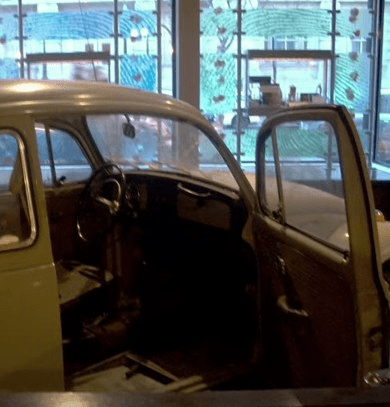
Ms. Survivor said she remembers Bundy coming to her house at some time in late 1970/early 71 (despite the fact she didn’t know or recognize him in any capacity) to play with her pet raccoon (I want one). She further alleges he pulled up to her house driving a cream-colored VW Beetle BUT… a damning piece of evidence against her story is that Bundy drove a light blue VW Beetle at that time in the early 70’s: he didn’t purchase his yellow (or cream/tan/gold/bronze/ beige) roving death machine until sometime in the spring of 1973. Sara also claims that in 1971 Bundy started calling her family home despite not knowing her name, phone number, or where she lived. She further claims that one of the reasons he contacted her was to offer up his counseling services to her, and I mean… Why would he do that when he didn’t have his Psychology degree until 1973? Obviously Survivor took him up on the offer (I mean, who wouldn’t accept help from some stranger on the phone?) and began freely sharing all of her deepest, most personal secrets with this mystery man, such as her feelings about her parents splitting up, the fact that she was frequently left home alone, and that she was suffering from extreme loneliness as a result of the whole situation. It’s worth mentioning that Sara freely admits she was drinking quite a bit at this time, which would most likely affect her memory in some capacity.
In ‘Reconstructing Sara,’ Survivor claims she was so terribly victimized by the serial killer that a Stockholm Syndrome type relationship began taking place. Stockholm Syndrome is defined as a condition where hostages develop a psychological bond with their captors and occurs when a specific set of circumstances or criteria occur. In most situations, it’s directly related to the power imbalances that take place in hostage-taking/kidnapping/abusive relationships. Survivor often referred to herself as Teds ‘secret friend’ and even made a promise to him that she wouldn’t tell anyone about their ‘relationship.’ In an email to ‘BlueZinnia9@aol.com,’ Sara said that a friend named ‘Anne’ can confirm the time frames of Survivors ‘secret friend,’ and that ‘it started slowly after we moved into the annex which she believes was in October and which I think was more than likely November, but sometime in here. She also told me that she remembered it gradually escalating from the point until becoming more intense right before we left for California.’ Ms. Survivor also claims that sometime in 1971 Bundy began aggressively stalking her, even claiming he broke into her childhood bedroom (while her entire family was home). On page 16 of the cavdev.org document, Survivor said that ‘Ted lived in Tacoma; I lived in a nearby suburb Lakewood. Ted’s parents lived less than one mile from my fathers home in Tacoma in 1974 and prior to that even closer to my fathers apartment at the time (he was separated from my mother in summer of 1971 when Ted was actively stalking me). Phone records would prove contact with him if they still exist. There are other facts as well that would prove what I am saying. I think he was using me as a blueprint for his killing, he stated to FBI he was abducting a woman and releasing her to test his skill as a ‘dry run.’ A dry run is against a target by definition.’ Additionally, Survivor is fairly certain that he followed her and some friends while they were on a walk one night into a secluded, wooded area. She said that the violence Bundy inflicted on her was so extreme that it left her with permanentpsychological and structural brain damage: psychological because of the incredible amount of stress, trauma, and grief he inflicted on her and structurally because of repeated violent head injuries she sustained by him. Ms. Survivor further alleges the memory loss she experienced before Bundy came into her life was the result of being sexually abused by multiple other men during her childhood and adolescence.
Now, I could be totally off base so forgive me if I get too far off track but I’ve been studying Bundy for quite a few years now, and it wasn’t until I was in Seattle in April 2022 that I stumbled upon Ms. Survivors story (I’ve spent MANY nights in the past few years going down the Ted Bundy rabbit hole at 3 AM)… on a side note, has anyone ever really looked into ‘Bundy isinnocent‘ theories or that he was somehow involved with the ‘MKUltra’project? I’m not saying I believe he’s innocent (he obviously wasn’t) or that I think the government had a hand in Bundy killing innocent young girls (I don’t)… I’m just saying, there is some really weeeeeeeeeeeeird shit out there. Anyways, I digress… back to Sara. There was a night I literally didn’t sleep a single wink while in Washington and while surfing the interwebs I stumbled upon Sara’s story (I didn’t do very well being away from my new husband and leaving my Wellbutrin at home really messed with my mental health). I did buy Erin’s book back when it was first published in 2021 and read it right away but to be truthful, at the time I was more interested in the confirmed victims just because I was still learning the basics (I felt like I was reading a masterclass level text while at a beginners skill level, to be truthful). When I picked it up again while researching this story (I can’t even call it a case because technically it isn’t) it was like, 11:30 at night and as I was flipping through it I sat up in bed and said ‘OH MY GOD!’ really loudly, to which my husband said ‘you’re not staying up all night reading, we’re going to bed.’ Just… I know I made a post about it already on my FB page but wow! What a wealth of information. If you haven’t read it yet you’re missing out. Anyways, I had zero knowledge of Survivors story before my trip in April 2022 and I’ve read many (many many) books on Bundy (I’ll post a picture of my collection below), but for the life of me I don’t recall ever seeing anything about this victim before (even under her ‘real name’). Maybe I’m wrong but if there is anything written about her it must be very short and concise because I can’t for the life of me remember anything. Anyways, her first book is said to be written in ‘fragmented, confused and repetitive order in which most of these events and the emotions that are associated to them still exist in her mind.’ Sara claims she blocked out all of her traumatic memories until ‘recently’ (for reference, her first book was published on September 13, 2016) and she regained only partial ones from the damaged regions of her brain: all of the memories she experienced with Bundy during that four-year period in her youth came back to her in pieces between 2001 and 2009. The book/website said that ‘her memory fragments documented in emails back and forth between Sara and law enforcement over a fourteen-year period dating back to 2001 containing specific details of the Bundy case that were never publicly released. Her physical features, locations, travels and proximity to Bundy in high school and in college also line up to the case overall.’
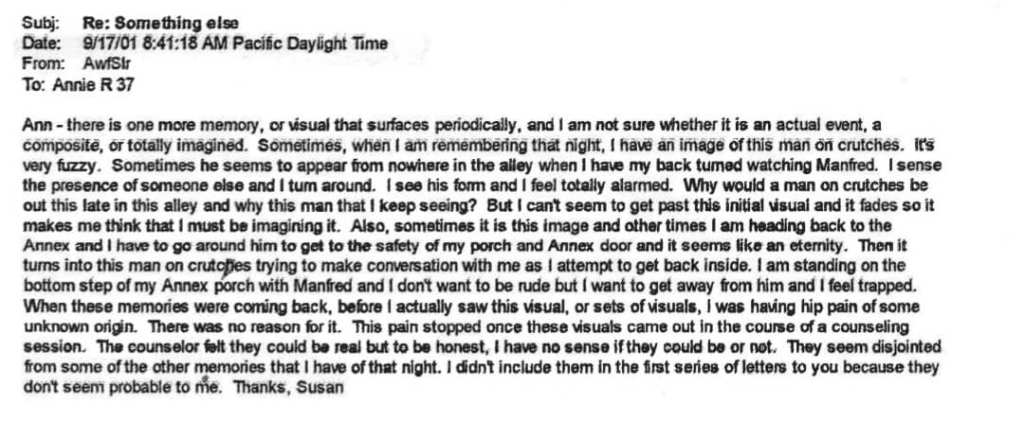
In a letter to Kathleen O’Toole, Survivor started out by apologizing for being so ’emotional and disorganized,’ and that she can’t help it: ‘I am a professional writer and I work from home due to the trauma of what happened to me decades ago and I am organized in most aspects of my life but I struggle still to this day in trying to communicate all that happened and why it’s relevant. There has been a cover up of the Ted Bundy cases in general and in particular relative to the findings at Taylor Mountain. Victims were left behind and never investigated and evidence at the crime scene of both Issaquah ad Taylor Mountain was not protected. People were allowed to profit from the case and too much information was released and other evidence was simply lost, destroyed and discounted.’ Common sense should tell you (plus it’s still widely discussed in the true crime community) that law enforcement is still looking to solve all unsolved Ted-related cases and put them to bed. Despite this, Survivor claims that for over 14 years they refused to investigate any of her claims (that they admitted to her anyways, remember how police were still investigating Bundy despite telling Liz they cleared him?), acknowledge her as a victim (or even talk to her), or even assign her a case number. It is worth noting that people in general have trouble remembering events that happened a long time ago (I think I’ve said that in my last few articles when discussing Bundy’s family attempting to answer questions about Teds activities as a youth). Ms. Survivor heavily implies that Ann Rule helped plant false memories into her head and that was why she gave contradictory statements and false memories (which could be why she pulled her book from publication and is rewriting parts of it); I am including some screen shots of these emails below (Banks, 80).
Something really interesting Erin touched on in her book was that Ms. Survivor claimed that after spending time in Modesto, California she realized she looked strikingly similar to many of the Santa Rosa Hitchhiking victims (which were at one time also thought to be committed by Bundy)… now, why she felt this way we’ll probably never know, as the girls had a broad range of hair colors (light/dark… black, blonde, and brunettes) and were ‘Caucasian, Polynesians, South-East Asians, Hispanic Americans, and those of mixed ethnicity (Banks, 82).’ Why did she feel she somehow looked like this very broad range of women? The SRH murders took place in 1972 and 1973 throughout both Sonoma and Santa Rosa counties in the North Bay region of California. There are seven unsolved homicides related to the case and involve femalehitchhikers, all of which were discovered completely naked in rural areas close to steep embankments or creek beds close to roadways. The case remains unsolved to this day; Bundy was strongly suspected in relation to these cases after he was taken into custody for the final time in 1978 (it’s proven he had spent some time in nearby Marin County in California). Ted was eventually ruled out a suspect by Sonoma County detectives twice: once in the 1970’s then again in 1989 thanks to credit card receipts and Bundy being placed in Washington state at the times of some of the disappearances. However, in 2011 ‘The San Francisco Chronicle’ published an article looking into the logistics of Ted’s potential trips from Seattle to California and after comparing the dates and times of his credit card receipts to the where the murders took place it was determined he would have been enough time to drive to California, commit the murders, then hightail it back to Seattle in time for his alibi (it would have taken slightly over 12 hours to drive from the Rogers Rooming House on 12th Ave in Seattle to Santa Rosa County, one-way). Some law enforcement officials feel Ted was a poor suspect in the SRH murders because they strongly felt the killer was native to the Santa Rosa area… perhaps someone who worked as a rural letter carrier or utility worker that would have been familiar with the remote areas where the bodies were left. However, about his relation to the case, Bob Keppel said that ‘Bundy is definitely a good suspect. The killings in Santa Rosa would fit his methods, he spent time in the area, and I’m sure he started killing well before 1974. It was an open market for Bundy.’
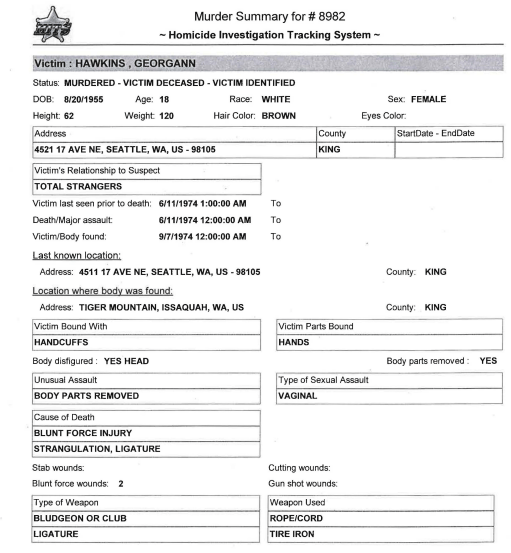
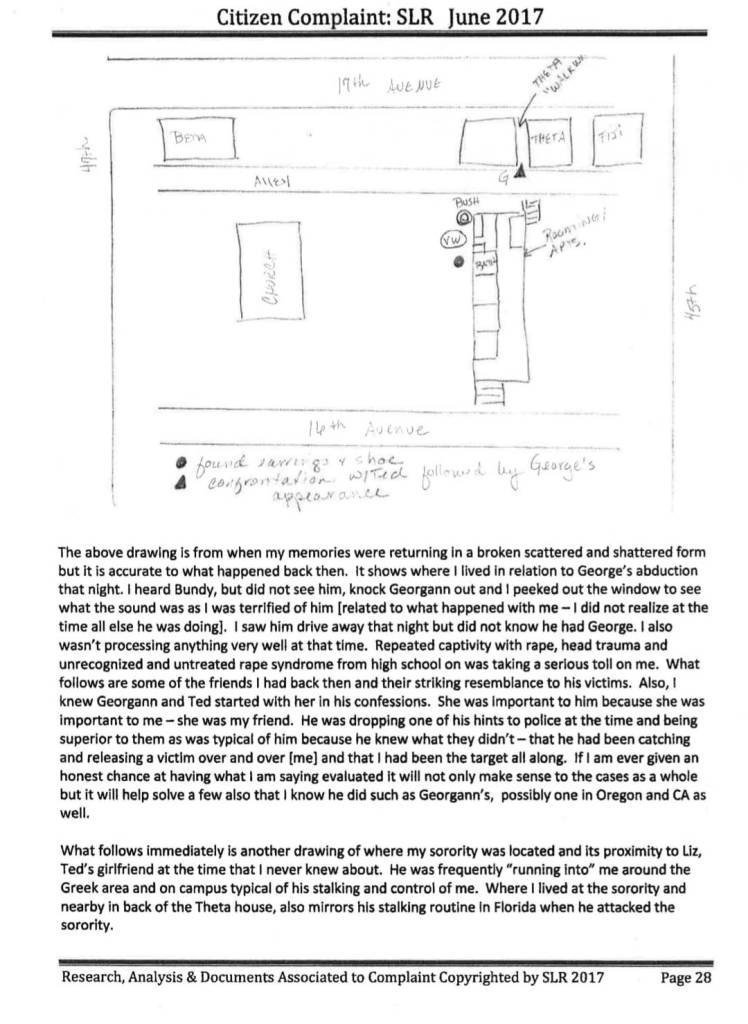
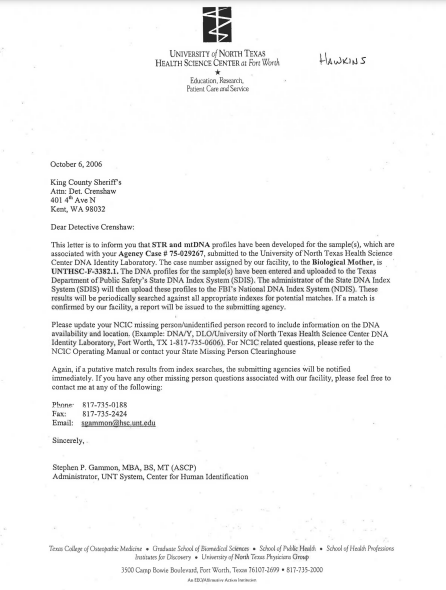
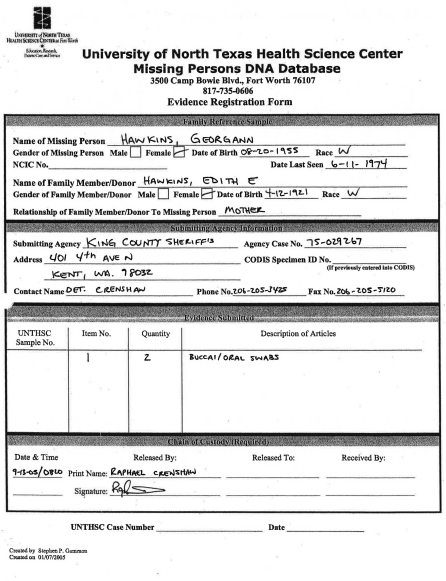
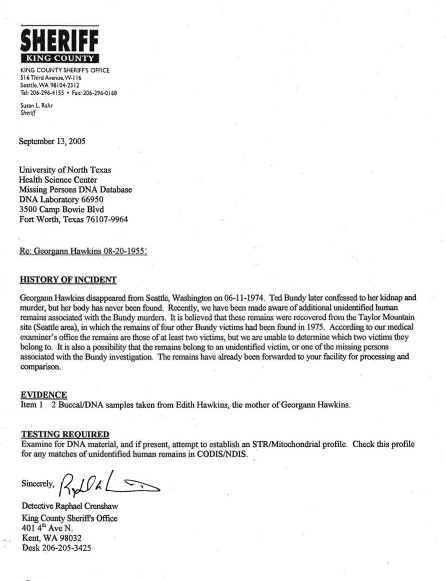
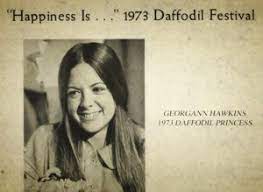
From page 28 of ‘Citizens Complaint: SLR June 2017’: ‘also, I know Georgann and Ted started with her in his confessions. She was important to him because she was important to me: she was my friend. He was dropping one of his hints to police at the time and being superior to them as was typical of him because he knew what they didn’t: that he had been catching and releasing a victim over and over (me) and that I had been the target all along.’ I mean, this just sounds like the ramblings of a person suffering from delusions: why wouldn’t he just talk about Roller? Why would he be so insistent on keeping his relationship with her a secret? If I can be completely honest, I was almost ready to completely write off Ms. Survivors claims that she knew Georgann Hawkins in any sort of capacity. And where I couldn’t find actual proof of their friendship I did discover that Sara was a Daffodil Princess in 1972… It’s fairly common knowledge in the Bundy community that Georgann was Pierce County’s Daffodil Princess the following year in 1973… now, I scoured the internet to find any pictures/videos of them together and came up with absolutely nothing. Perhaps this isn’t the groundbreaking proof I originally thought it was, however it does make me wonder if they were at the very least acquaintances through events with the flower bulb business. It definitely makes me wonder…
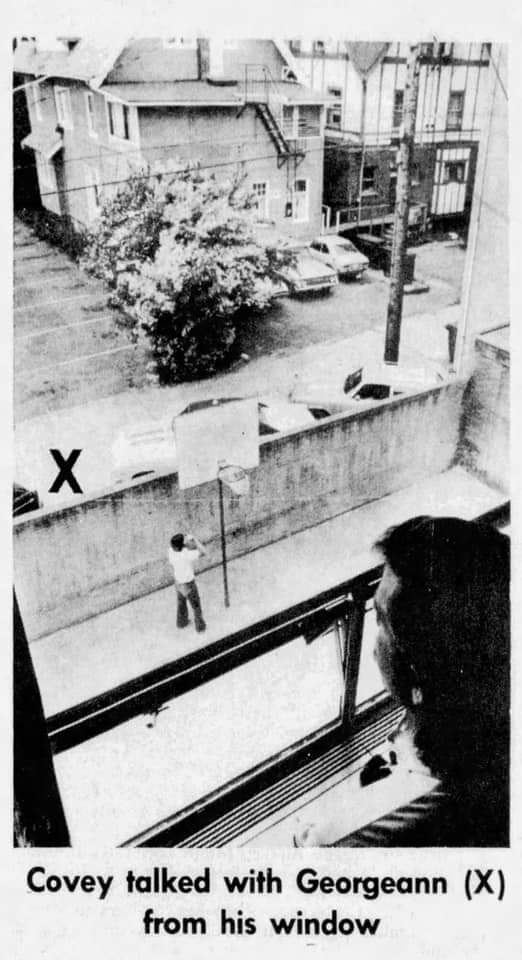
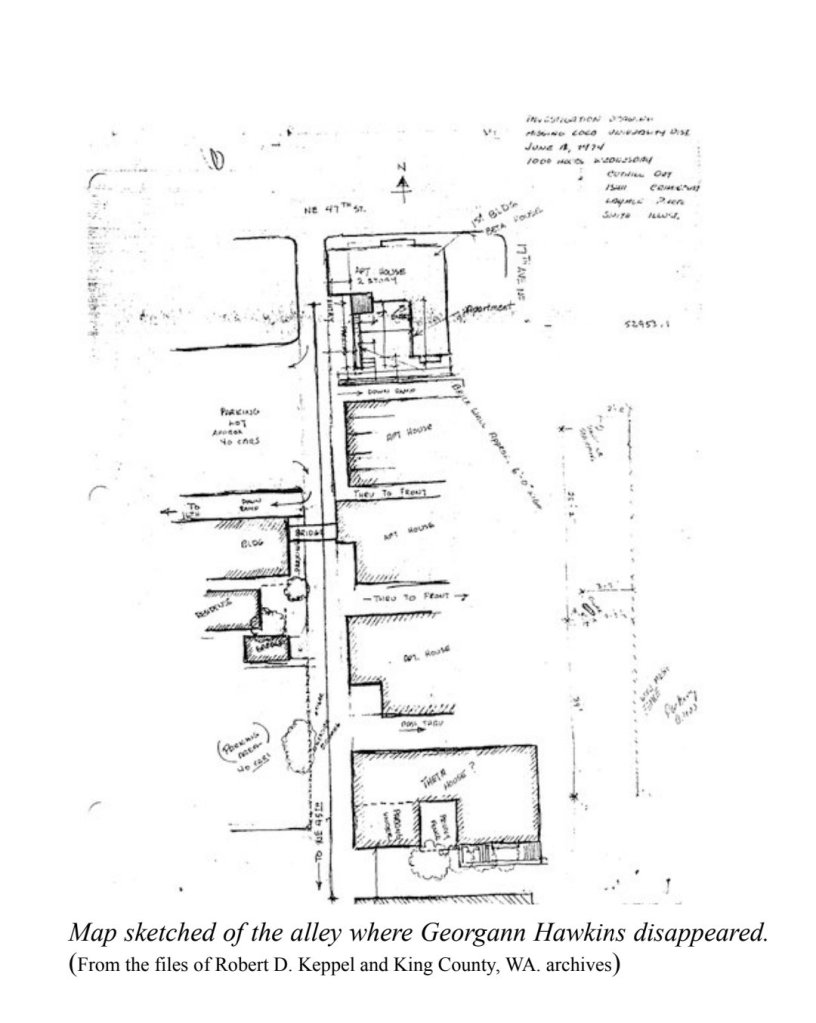
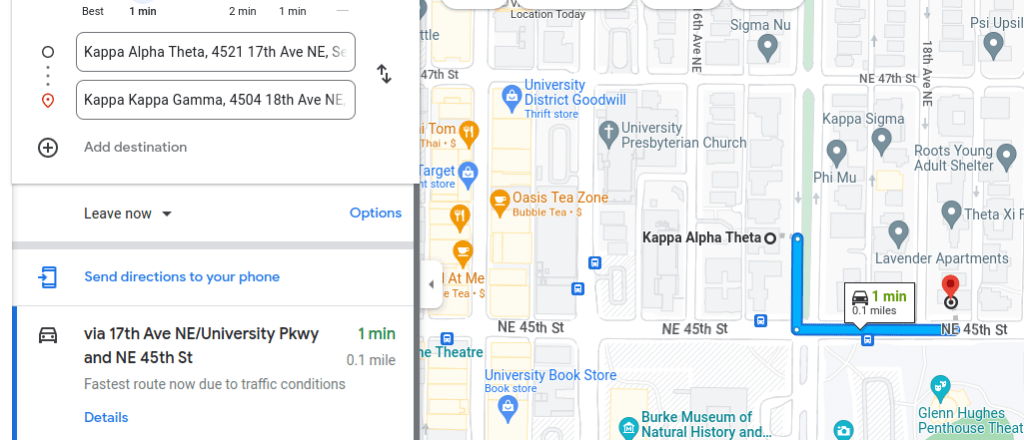
The severe PTSD and ‘fragmentedmemory’ Ms. Survivor claims to suffer from is due to the severe head trauma she experienced from multiple head fractures inflicted on her by Bundy and previous assailants. In her memoir she claims the only reason Bundy even abducted Georgann was because she was trying to stop him from pursuing his frequent attacks, assaults, and abductions on her. Survivor claimed that Hawkins walked through the pathway by the Theta house when she was talking to Ted: he was mad at her for avoiding him (she said it had been going on for a few weeks). During her freshman year, Hawkins joined the sorority Kappa Alpha Theta and lived in their house on campus, where Sara was a sister and resident at the Kappa Kappa Gamma house. Ted told Survivor that he ‘wanted her to carry the briefcase and go out for a drive with him to talk but Manfred (who I’m assuming is a dog) was pacing at the door to go in and I was not supposed to have him in the annex and he could get in trouble so I told him that I would go later to talk. George volunteered to help Ted, she was my friend, we were close and had been in Daffodil and she was like another little sister to me (similar to Anne) and I think she could tell that there was tension between us and she was trying to help me. They walked me to the annex door, which was only a short distance with George having to stop and wait for Ted several times as he kept trying to get me to go with him. I went in and left the light off to go to bed and put my pajamas on and shortly thereafter I heart the noise outside my window. It sounded like a body falling. I kept telling myself I was imagining things. I was also alarmed because the lot was big and rarely did anyone park outside of my window at night unless it was Ted. I was alarmed as I had not seen the lights of his car and if he was indeed parked outside of my window then he had broken his routine and not put his lights on and that frightened me. I snuck to the window and peeked out the side, lower edge of it. He did not see me. All I saw was him, standing by his VW, with the door open staring into my window. I never saw George, but just the actions and the sound terrified me. I tried to call the police as I stated, but I had nothing to go on but a noise.’ Additionally, per the ‘Citizens Complaint: SLR June 2017,’ on the evening that Georgann Hawkins was abducted Survivor said that she: ‘heard Bundy but I did not see him, knock Georgann out and I peeked out the window to see what the sound was as I was terrified of him (related to what happened with me, I did not realize at the time all else he was doing).’ … ‘I saw him drive away that night but did not know he had George. I also wasn’t processing anything very well at that time. Repeated captivity with rape, head trauma, and unrecognized and untreated rape syndrome from high school was taking a serious toll on me.’
One of the biggest parts of Survivors story that I don’t understand is why Bundy would keep her alive. I mean, this is the first time I ever heard about him leaving a victim alive like this, and a part of me feels like an asshole picking apart a possible sexual assault victims story but immediately after looking into her background Sotria Kritsonis and Rhonda Stapley came to my mind, and I’m sorry, I don’t believe either one of them. Rhonda because she’s… Rhonda and Ms. Kritsonis because of her claim that Bundy LET HER GO BECAUSE OF HER HAIR/the missing door handle lie. Just off the top of my head, Kim Leach had shorter hair at the time she was killed and I’m sorry, the long brown hair parted down the middle was simply NOT an absolute requirement when Bundy picked his victims. Quite a few of them had light hair even on the medium length side. Anyways, I digress…
Ms. Banks points out that in Sara’s ‘memoir,’ roughly 1/3 of the text is simply a list of discovered items not properly cataloged in relation to the Bundy burial sites. Survivor claims that King County law enforcement purposefully kept this information from the community and that ‘what was put before the public for decades by Keppel and others especially early on has been incomplete, misrepresented, fabricated and blatant lies.’ This part I pulled directly from ‘Reflections on Green River’ (from the ‘table of contents’): ‘There were additional audio tapes noted in the files beyond the ones given here but they were designed ‘unplayable.’ Where are the transcripts of those tapes? What did those tapes contain in information? Why were records allowed to be held privately?’ … ‘Keppel set the tone of the case from the beginning and made sure he was the face of it but his positioning of the case was inaccurate at best and self-serving. He made every effort he could for years even after he ‘retired’ to use his connections to the justice system and to media to silence me and continue to control the case as the ‘expert’ but from what I see in the records some of his maneuverings in the case files were illegal. His statements to press were false and misleading about the case in general in WA.’ She further claims that there were many additional, never before released to the public items found at both burial sites that law enforcement never even bothered cataloging. I’m again citing Erin Banks, who very eloquently commented: ‘anyone who read Bob Keppel’s ‘TheRiverman,’ knowing how meticulously the young Detective and his team combed Taylor Mountain and its surrounding area for skeletal remains and any evidence that could have been relevant to solving the case. Thousands of items were collected, thousands of items were collected thousands of callers reported their boyfriends, co-workers, family members and suspicious neighbors to the police tip line.’ Despite a massive amount of data collected from law enforcement in relation to the Bundy case that translated into a massive amount of physical documentation… Sara still claimed they (for whatever reason) purposefully left out items found at crime scenes (like skeletal human remains) in official reports. Not willing to take into account that perhaps if anything were to be missing it was more likely due to human error instead of being done purposefully. Banks also points out that ‘The Ted Task Force consisted of relatively few members. And, untoward as it may be, even investigators make mistakes, including misspelling names and losing evidence. If it looks like a duck, and quacks like a duck, it most likely is a duck.’ I’m going to have to agree with her, 100%. Sara seemed to have a particular disdain for Dr. Keppel, even going so far as to suggest or hint that he had some sort of collaborative type-relationship with Bundy, which was why certain things were left off the record.
Survivor further claims that investigatorsinSeattle were in communication with other states where Bundy was active (even though they said to have had no awareness of his general activities during that period in the 1970’s)… in fact, there are quite a few documents that prove law enforcement was keeping tabs on him at the time (for example, they were aware he worked for the Seattle Crime Commission studying rape, the WA state Republican Party, the Olympic Hotel, The Seattle Yacht Club, and Pedline Medical Company). In her blog, Survivor said: ‘his sites in WA had multiple bodies each (skeletal remains) and over 100 pieces of evidence at both locations including clothing that matched the description of what at least some missing girls were wearing. This evidence found on site appears per record sheets at the time to have been earmarked for Superior Court of WA. Why was it denied as existing by Keppel? Missing girls found at WA state sites of Bundy were even from out of King County jurisdiction (Rancourt and Parks) and out of WA State (Parks). Yet the public claim for decades was that this never existed. That evidence from one site was lost and per Keppel nothing existed at the other site. Interstate abduction of a young girl (Parks) and FBI was never called in when her remains were found? Multiple bodies at two major crime sites? Private ownership and profit off a multiple serial case by one cop who works the media while still under color of law to the detriment of the cases and families and victims?? There needs to be some answers and accountability. I firmly believe having seen so many of these records that Keppel attacked me publicly and behind the scenes as a ‘consensual’ survivor knowing full well that I was a victim because he didn’t want anyone in law enforcement to review the case and realize all that he had done that was not only unethical but also in my opinion appears to be illegal.’ Personally, I think that Keppel didn’t buy Survivors stories and didn’t attempt to hide it, which is why she most likely writes about him in a very negative light.
As I said earlier, I didn’t read ‘Reconstructing Sara’ (although I did notice the Amazon site said it’s available for ‘professional use only,’ but I feel I don’t quite apply) so I can’t give it any sort of review. I read through her write up in Erin Banks book multiple times when preparing for this piece, who said a good portion of what was in it could be found on her WordPress page (I included that in the works cited portion). When I first stumbled upon Sara’s story in April 2022 her website was fully operational and all of her blog posts and articles were still available (the page is also titled ‘Reconstructing Sara: The Lost Victim of Ted Bundy’). However, now (or as of May 2023) it appears that most articles have been pulled and are no longer available. When I clicked on numerous articles it took me to a page that said ‘Oops! That page can’t be found. It looks like nothing was found at this location.’ The pieces had names such as: ‘Ted Bundy Evidence Taylor Mountain: 158 items: Denied, Destroyed, Discounted for Decades,’ ‘Ted Bundy & The Public Image The Authorities Initially Created Of Him To Create Their Own ‘Super Cop’ Scenarios,’ ‘Ted Bundy & Pornography: He talked of it years before the execution,’ ‘Refuting Riverman: Doesn’t Match Original Case Files In Multiple Places,’ and ‘1989 Ted Bundy Final Confession: Was it Planned and Rehearsed?’ I wonder if this is possibly because Survivor is working on a rewrite of the book (per her Amazon page). Oddly enough, only one remains; it’s titled ‘Ted Bundy: WA Crime Sites Itemized’ and discusses how she thinks Bob Keppel purposefully tainted the Bundy investigation in Seattle and goes over the 158 items related to the Taylor Mountain evidence list. She starts it with the intro: ‘this website isn’t as much about me anymore as about justice process in the Bundy case. Keppel’s original efforts to become the face of the case suppressed important case information that should have been worked – his suppression of Bundy’s comments about Rule’s book sending it to psychiatrists instead of into evidence and suppression of Bundy’s comments about Michaud’s interview being possibly not all fact [Bundy claimed some was done by Bundy for effect] shows his willingness to protect his buddies behind the scenes and also to lessen any evidentiary probe into possible facts that were included in Bundy’s complaints [its not always just psychology – Bundy claimed Hawkins was found at Taylor Mountain with Ott and Naslund and the records appear to support that]; even the attack on me over the years as to my character was an effort to redirect any investigation away from the facts of my experiences versus what actually happened: a psychological behind the scenes gas lighting of me – no one was evaluating the correlations and facts of my experiences objectively. Keppel walked the line between ‘author’ and ‘expert’ for decades, ‘updating’ as ‘new’ what was already in evidence years earlier, using the inherent protections of both roles to cover up his original transgressions. This type of loophole in current justice system standards needs new laws.’
I had a fairly tough time getting through parts of Sara’s writing. I found it to be very wordy and almost made a point of being elegant on purpose (I hope this makes sense, in my opinion Bundy oddly wrote the same way). I found my eyes glazing over whenever I attempted to read it (on multiple occasions) and I quickly grew bored with what I was trying to process.
As I said earlier, Ms. Survivor claims that Bundy stalked and followed her while in school (both at Clover Park High School in Tacoma and the University of Washington), even going so far as to follow her when she traveled for modeling jobs throughout the western part of Washington state and beyond… she said that wherever she went, Bundy was there, waiting… but WHY? And how? I hopefully don’t need to say this took place way before the days of social media. Yes, I definitely think Bundy stalked his prey before he went in for the kill but how did he track her from states away? Logically, it makes absolutely no sense and timewise… how would he have been able to pull something that time consuming off and not have anyone notice this incredibly erratic behavior? Survivor claimed that what Bundy did to her back in the 1970’s is still being looked into by law enforcement. On page 28 of ‘Citizens Complaint: SLR June 2017, ‘if I am ever given an honest chance at having what I am saying evaluated it will not only make sense to the cases as a while but it will help solve a few also that I know he did such as Georgann’s, possibly one in Oregon and CA as well.’
Per her website, ‘what happened to me back then is being investigated and so too I hope is the behind the scenes maneuvering that favored the killer instead of the victims and for now I am going to defer to, and trust in, those who have committed their time and expense to giving what happened back then the comprehensive, objective investigation it warrants. I am grateful the investigation is being done for my own sense of closure, but in addition to that for a lot of reasons, including reviewing the maneuverings back then that allowed critical evidence to be denied, moved about without chain of custody and destroyed. The Bundy cases were never an example of good police work though some did do their jobs faithfully. In my opinion, having healed enough to process some of this it was about politics. And those politics continued into the present day and the stalking, threats, and intimidation tactics used against me to prevent any of this from coming into public awareness. It makes me sad and upset that politics back then over-rode common decency and that politics continued to influence the silencing that occurred decades later. The Bundy cases deserved a new investigation. It needed to be done.’
Roller currently resides in Oneida, WI. Per her ‘classmates’ page, she said: ‘I am living in the midwest now after many years in Washington. I am very happy here. I am still actively working and enjoying life. The older I become the more I appreciate the journey and the intangibles in life. The updated photo is from Christmas 2019. I have a collie now that is my constant companion at home and at work, always by my side. She is a blessing as keeps me active walking her at least 2 miles a day even when I wish I didn’t have to such as in the snow or rain. I love the Midwest storms, the approaching thunderstorms, and the hard wood forests. I grew up in the Midwest. For me, this region is like coming home.’ After completing her degree at the University of Washington, Roller got a job as the Director Medical Programming for the Omnia Corporation from 1980 to 1982. After leaving them she got a position with Golle & Holmes in Minneapolis as a program developer; she left the following year. In 1983 Susan was briefly employed as the Director of Marketing for The Santal Corporation in St. Louis. In 1984 she started a company called ‘Fine Line, Ltd.’ based out of Reno, Nevada; her position is the President. Additionally under the ‘career’ section of her website ‘independent film producer and writer’ is listed as well. Under the ‘achievements’ portion is: ‘screenwriting, cowboy poetry, skiing, art FC.’ Roller is also a member of the Reno Chamber of Commerce, is a practicing Episcopalian, and sides with the Republican party.
Works Cited: Banks, Erin. ‘Ted Bundy: Examining The Unconfirmed Survivor Stories.’ Published March 7, 2021. Survivor, Sara A. ‘Reflections on Green River: The Letters of, and Conversations with, Ted Bundy.’ Published on April 5, 2016. archive.org/details/953-32-10-bundy-notes-keppel-redacted/page/n44/mode/2up (Opinion at the end of document is that of Maria Serban). http://www.sfgate.com/news/article/Ted-Bundy-a-suspect-in-Sonoma-County-cold-cases-2355670.php books.google.com/books/about/Reconstructing_Sara.html?id=TGhYvgAACAAJ reconstructingsara.com
Page 154 from the Downey High School 1969 yearbook.Susan’s education background, photo courtesy of classmates.A photo of Sara A. Survivor, photo courtesy of Erin Banks/CrimePiper.A photo of Sara A. Survivor.Page 44 from the Clover Park High School 1972 yearbook.Page 56 from the Clover Park High School 1972 yearbook.Page 78 from the Clover Park High School 1972 yearbook.Page 169 from the Clover Park High School 1972 yearbook, photo courtesy of classmates.com.Page 177 from the Clover Park High School 1972 yearbook, photo courtesy of classmates.com.Page 214 from the Clover Park High School 1972 yearbook, photo courtesy of classmates.com.Page 228 from the 1972 Clover Park High School yearbook.A write up from page 215 of the Clover Park High School 1972 yearbook, photo courtesy of classmates.com.Page 234 from the Clover Park High School 1972 yearbook, photo courtesy of classmates.com.Page 263 from the Clover Park High School 1972 yearbook, photo courtesy of classmates.com.Page 263 from the Clover Park High School 1972 yearbook, photo courtesy of classmates.com.A photo from the 1972 Daffodil Parade.Photo courtesy of classmates.com.Photo courtesy of Facebook.Sara A. Survivor.A photo of a 15 year old Sara A. Survivor, photo courtesy of Erin Banks/The CrimePiper.A photo of Sara A. Survivor while in nursing school at the University of Washington, photo courtesy of Erin Banks/The CrimePiper.A photo of Sara A. Survivor with some confirmed Bundy victims, photo courtesy of Erin Banks/The CrimePiper.An article about the Daffodil Princesses that mentions Susan Roller published in The News Tribune on December 26, 1971.Susan and some fellow Daffodil Princesses in an article published by The News Tribune on February 20, 1972.Susan and some fellow Daffodil Princesses in an article published by The Suburban Times on February 20, 1972.Susan and some fellow Daffodil Princesses in an article published by The News Tribune on March 26, 1972.Susan and some fellow Daffodil Princesses in an article published by The News Tribune on April 2, 1972.Susan and some fellow Daffodil Princesses in an article published by The News Tribune on April 9, 1972.A post card from Bundy to Detective Keppel. Per Maria Serban’s write up on ‘archives.org’ (I’ll leave the link in the works cited section): ‘Awhile ago I received from the King County archivists a .pdf file with Robert Keppel’s notes, related to Ted Bundy. The notes in this pdf file basically contain Keppel’s early 80’s correspondence from people about Bundy, also notes from experts who claimed they might help Keppel decipher Ted’s personality based on his handwriting (bogus claim, in my opinion), and also a postcard that was signed ‘Ted B’ (Bundy himself never signed his letters to Keppel ‘Ted B,’ but usually he would sign them ‘ted’ – lower case). The postcard also spelled ‘Raiford’ wrongly, and it had a taunting tone, very different from the tone Bundy was using with Keppel in the 80’s, and the handwriting wasn’t Bundy’s either. I dare say I’m 100% persuaded that the postcard was a phony one, not sent by Bundy himself. Almost all of Bundy’s letters to Keppel have been transcribed in the book ‘Reflections on Green River: The Letters of, and Conversations with, Ted Bundy’ by ‘Sara: A Survivor.’ The tone in those letters was professional, sober, never taunting, unlike the tone in the phony postcard included in Keppel’s files. Bundy’s correspondence with Keppel started when Bundy sent the Green River Task Force (Dave Reichert and Robert Keppel) a letter, on October 2, 1984, offering his help in solving the Green River serial murders. He signed that first letter ‘ted’ (lower case), and sent it via Tom Swayze, a Republican superior court judge in Tacoma whom Bundy knew from his campaigning days. On October 15, 1984, Bundy sent the Green River Task Force a second letter, this time via his former attorney John Henry Brown, again offering his help in solving the Green River serial murders. He signed this second letter, ‘Sincerely, Ted Bundy.’ Photo courtesy of Maria Serban.Part one of an article about Susan Roller published by The News Tribune on November 30, 1971.Part two of an article about Susan Roller published by The News Tribune on November 30, 1971.Susan featured in an article about new hires that was published in The Spokesman-Review on November 7, 1993.Susan’s work history taken from her website.On her GoodReads webpage, Roller answers the question, ‘What mystery in your own life could be a plot for a book?’A note about her book ‘Reconstructing Sara’ that Sara posted on the website ‘GoodReads.’ https://www.goodreads.com/author/show/15149861.Sara_A_SurvivorThe cover of Sara’s first book.This is what you see when you try to read the majority of the articles on the ‘ReconstructingSara’ web page.Some of the articles on the ‘ReconstructingSara’ web page that have been pulled.Some of the articles on the ‘ReconstructingSara’ web page that have been pulled.A hand drawn map at the beginning of the only article remaining on Sara’s page, titled ‘Ted Bundy: WA Crime Sites Itemized.’ The second portion of the introduction for the only article remaining on Sara’s page, titled ‘Ted Bundy: WA Crime Sites Itemized.’ Page one of a document regarding Susan L. Roller from cavdef.org.Page two of a document regarding Susan L. Roller from cavdef.org.Page three of a document regarding Susan L. Roller from cavdef.org.Page four of a document regarding Susan L. Roller from cavdef.org.Page five of a document regarding Susan L. Roller from cavdef.org.A letter from Susan Roller to the Seattle police chief on 7/18/2017 claiming that there was ‘a cover up of the Ted Bundy cases in general and in particular relative to the findings at Taylor Mountain,’ asserting that crime scenes were unprotected and evidence was ignored or destroyed while people ‘were allowed to profit from the case.’ Page six of a document regarding Susan L. Roller from cavdef.org.Page seven of a document regarding Susan L. Roller from cavdef.org.Page eight of a document regarding Susan L. Roller from cavdef.org.Communication between Survivor and Ann Rule. Page nine of a document regarding Susan L. Roller from cavdef.org.Page ten of a document regarding Susan L. Roller from cavdef.org.Survivor discussing possible or imagined memories with a man using crutches. Page eleven of a document regarding Susan L. Roller from cavdef.org.Page twelve of a document regarding Susan L. Roller from cavdef.org.Page thirteen of a document regarding Susan L. Roller from cavdef.org.Page fourteen of a document regarding Susan L. Roller from cavdef.org.Page fifteen of a document regarding Susan L. Roller from cavdef.org.Page sixteen of a document regarding Susan L. Roller from cavdef.org.Page seventeen of a document regarding Susan L. Roller from cavdef.org.Page eighteen of a document regarding Susan L. Roller from cavdef.org.Page nineteen of a document regarding Susan L. Roller from cavdef.org.Page twenty of a document regarding Susan L. Roller from cavdef.org.Page twenty-one of a document regarding Susan L. Roller from cavdef.org.Page twenty-two of a document regarding Susan L. Roller from cavdef.org.Page twenty-three of a document regarding Susan L. Roller from cavdef.org.Page twenty-four of a document regarding Susan L. Roller from cavdef.org.Page twenty-five of a document regarding Susan L. Roller from cavdef.org.Page twenty-six of a document regarding Susan L. Roller from cavdef.org.Page twenty-seven of a document regarding Susan L. Roller from cavdef.org.Page twenty-eight of a document regarding Susan L. Roller from cavdef.org.Page twenty-nine of a document regarding Susan L. Roller from cavdef.org.Page thirty of a document regarding Susan L. Roller from cavdef.org.Page thirty-one of a document regarding Susan L. Roller from cavdef.org.Page thirty-two of a document regarding Susan L. Roller from cavdef.org.A drawing and recollection of Susans first hand testimony of what happened the night Georgann Hawkins was abducted. Page thirty-three of a document regarding Susan L. Roller from cavdef.org.Above is a drawing (from memory) of Sara’s recollection of where her dorm room was in comparison to Liz Kloepfer’s apartment. Page thirty-four of a document regarding Susan L. Roller from cavdef.org.Page thirty-five of a document regarding Susan L. Roller from cavdef.org.Page thirty-six of a document regarding Susan L. Roller from cavdef.org.Page thirty-seven of a document regarding Susan L. Roller from cavdef.org.Page thirty-eight of a document regarding Susan L. Roller from cavdef.org.Page thirty-nine of a document regarding Susan L. Roller from cavdef.org.Page forty of a document regarding Susan L. Roller from cavdef.org.Page forty-one of a document regarding Susan L. Roller from cavdef.org.Page forty-two of a document regarding Susan L. Roller from cavdef.org.Page forty-three of a document regarding Susan L. Roller from cavdef.org.Page forty-four of a document regarding Susan L. Roller from cavdef.org.Page forty-five of a document regarding Susan L. Roller from cavdef.org.Page forty-six of a document regarding Susan L. Roller from cavdef.org.Page forty-seven of a document regarding Susan L. Roller from cavdef.org.Page forty-eight of a document regarding Susan L. Roller from cavdef.org.Page forty-nine of a document regarding Susan L. Roller from cavdef.org.Page fifty of a document regarding Susan L. Roller from cavdef.org.Page fifty-one of a document regarding Susan L. Roller from cavdef.org.Page fifty-two of a document regarding Susan L. Roller from cavdef.org.Page fifty-three of a document regarding Susan L. Roller from cavdef.org.Page sixty-seven of a document regarding Susan L. Roller from cavdef.org.Page seventy of a document regarding Susan L. Roller from cavdef.org.Page seventy-one of a document regarding Susan L. Roller from cavdef.org.Page seventy-two of a document regarding Susan L. Roller from cavdef.org.Page seventy-three of a document regarding Susan L. Roller from cavdef.org.Page seventy-four of a document regarding Susan L. Roller from cavdef.org.Page seventy-five of a document regarding Susan L. Roller from cavdef.org.Page seventy-six of a document regarding Susan L. Roller from cavdef.org.Page seventy-seven of a document regarding Susan L. Roller from cavdef.org.Page seventy-eight of a document regarding Susan L. Roller from cavdef.org.Page seventy-nine of a document regarding Susan L. Roller from cavdef.org.Page eighty of a document regarding Susan L. Roller from cavdef.org.Page eighty-one of a document regarding Susan L. Roller from cavdef.org.Page eighty-three of a document regarding Susan L. Roller from cavdef.org.Page eighty-four of a document regarding Susan L. Roller from cavdef.org.Page eighty-five of a document regarding Susan L. Roller from cavdef.org.Page eighty-six of a document regarding Susan L. Roller from cavdef.org.Page eighty-seven of a document regarding Susan L. Roller from cavdef.org.Page eighty-eight of a document regarding Susan L. Roller from cavdef.org.Page eighty-nine of a document regarding Susan L. Roller from cavdef.org.Photo courtesy of ‘CrimePiper.’A photo of Georgann Hawkins at Pierce County’s 1973 Daffodil Festival.A photo of Georgann Hawkins from her Lakes High School yearbook in 1973.Friend of Georgann Hawkins, Phyllis Armstrong from her 1973 yearbook. Armstrong was also featured on Amazon’s ‘Falling for a Killer.’ Photo courtesy of ‘CrimePiper.’A picture of the where Georgann Hawkins was abducted.A map of the alley that Hawkins walked the night she disappeared. Photo courtesy of King County Archives.A Google Maps image of Georgann’s sorority house compared to where Rollers sorority house is.I took this picture of the alley where Georgann Hawkins was abducted in April 2022. The pathway above is where Georgann was walking when Bundy approached her. While she was leaving the Beta Theta Pi House, she stopped for a moment to talk to her boyfriends friend Duane Covey.The University of Washington Greek Row, also the alley where Georgann Hawkins disappeared on June 13, 1974. Photo courtesy of Greg Gilbert from ‘The Seattle Times.’Susan’s father, Gilbert John Roller.
I’ve really been enjoying writing about the unconfirmed Bundy victims lately: so far I’ve done Lisa Wick/Lonnie Trumbull (the Seattle flight attendants who were attacked in their Queen Anne Hill basement apartment), Brenda Joy Baker, Katherine Kolodziej and Sotria Kritsonis (I wrote a short article briefly discussing the disappearance of Ann Marie Burr but she deserves her own full piece*). Last spring when I was in Seattle I debated on whether or not I was going to actually follow through with my lifelong dream of starting a blog or once again take the easy way out and just post my pictures as I took them. I was genuinely nervous about putting out unimaginative, run of the mill content that’s been written about a thousand times before. So, I started digging even further into the Bundy verse, beyond the confirmed victims (such as GeorgeannHawkins) and commonly discussed places (like the Rogers Rooming House on 12th Ave in Seattle).’ So, I started looking into Ted’s unconfirmed victims. His places of employment. The former dorm building he kept a key for after moving out so he could go back and sleep there (he at one time had a room on the 4th floor in the South Tower of McMahon Hall at the University of Washington). The brick with Mr. and Mrs. Bundy’s names on it at the University of Puget Sound (where she was employed for many years as a secretary). I’m going to Utah in November and Colorado in December (I have the time off work) but I’m putting Florida off until last because it’s the state that scares me the most… Margaret Bowman‘s crime scene photos will forever haunt me.
I ran into a lot of snags in my research of May-Hardy, and unfortunately it’s becoming a consistent issue with the unconfirmed victims: I’m finding that if the woman is not directly related to Bundy there’s little or next to no information out there on them. Even simply figuring out Kerry’s exact date of birth took quite a bit of effort, and I’d like to thank my husband for allowing me to use one of his credit cards so I could sign up for another free trial of Ancestry. I was able to find some neat things on Kerry May-Hardy that I hadn’t seen anywhere else: before my discoveries I found exactly ONE picture of her on the internet (along with her composite sketch after her skeletal remains were found). I ran into this lack of information issue with BrendaBaker, the Seattle flight attendants (Lonnie Trumbull and Lisa Wick), and to an extent KathyKolodziej (I say this because I was in contact with the detective working the case as well as her cousin which helped make it a little more personal for me… plus there was a fair amount of information about her on Reddit message boards). I do want to add that after I really got digging on Kerry I found a bit more information that I was expecting… BUT at the same time there wasn’t a single YouTube video or Reddit thread on her and the small amount of information I found didn’t compare to the information you can find about (for example) Georgann Hawkins or Lynda Ann Healy. None of the unconfirmed victims got the attention that they deserved… for example, there’s next to NO information out there about the murder of 14 year-old Brenda Joy Baker and I think that’s a real shame. AND to be truthful I was struggling to find interesting facts about Brenda Ball and she was one of Ted’s more widely known Seattle victims (hers was the first skull found on Taylor Mountain). I think I read somewhere that there were 18,000 murders that occurred in 1972 across the US. It’s too bad you had to have been murdered by a serial killer to deserve any recognition for the case.
Kerry M. May-Hardy was born on April 3, 1950 in Seattle, Washington to Donald and Sheila (most recently Olson) Hardy; she had an older brother named Kenneth, two younger half-sisters (Carlee and Barbra), and a half-brother (Ed). According to a June 2011 article from the Vancouver Sun, Kerry’s parents were only married for a few years before they divorced in 1960. Sheila remarried Carol Olson the following year and Donald married Yvonne Lathrop on December 7, 1956. Mrs. Olsen described her daughter as a ‘free spirit,’ and the first person that popped in my head after I read that was Donna Gail Manson, who’s been called the same thing (and I could see it for myself looking at her pictures). Hardy grew up in the Capitol Hill district of Seattle and attended Lincoln High School in Seattle before dropping out her senior year. In a 2021 interview with ‘hi: I’m Ted’ blogger Tiffany Jean, Ken Hardy said that his sister ‘had hair like a brand new copper penny, and one of those personalities that you instantly liked her. Very friendly and outgoing, but engaging too, and when she started to talk, it didn’t matter where you came from, you wanted to listen to what she had to say.’ After graduating from high school in 1967 Ken went to serve in the Vietnam War; he came home to Seattle two years later in 1969. At that time his younger sister had left school a year early and adopted a ‘free and easy flower child way of living in the Seattle music scene.’ Hardy commented that, ‘I was the older one, so she took a back seat the whole time we were growing up, and all our friends would say, ‘oh yeah, that’s Ken’s little sister.’ But when I got back home, all of a sudden it was, ‘oh you’re Kerry’s brother!’ She really jumped out because her personality was so attractive.’
After a short courtship, Kerry Hardy married James May in a ceremony at the Central Lutheran Church in the Capitol Hill area of Seattle on May 15, 1971; at the time he was studying to be a court transcriber. Although the Hardy-Olsen clan didn’t know him very well, they immediately disliked Kerry’s new husband. Mrs. Olsen commented that ‘He wasn’t a very outgoing person. I just know she was very much in love.’ Ken on the other hand didn’t mind being more truthful, saying that his new brother-in-law ‘was a jerk, and they were always arguing.’ He also said that only six months into his little sisters brand new marriage ‘a friend of ours found out that James was beating up on her and so he got him up against a wall one night when James was alone. Warned him that if he ever did that again, he’d kill him.’ The newlyweds separated shortly after that incident, and Kerry left him and stayed with friends. It is speculated but unconfirmed that Mr. May eventually remarried and relocated to Hawaii.
Ken said that the first time he remembered that his sister was missing his ‘parents and m younger siblings were going on a family trip out of town, and Kerry was supposed to go over and help pack some clothes for my youngest sister, who has Down’s Syndrome, but she never showed up.’ Sheila said the phone calls and visits from her daughter stopped abruptly about a week before the family was supposed to leave on vacation to Minnesota. She also said that while away she ‘made frequent phone calls home during the trip to see if anyone had heard from her (Vancouver Sun, 2011).’ When the family got home in late June 1972 there still was no word from Kerry. In the time they were gone James May never thought to report his wife as missing to the police (although he did claim he didn’t see her since they separated). After calling every one of her daughters friends she could think of, Mrs. Olson went to the Seattle Police Department to report her as missing a week after returning home from vacation, however she was turned away because ‘her husband would have to report.’ She went right home and had James May do that. After he was done she immediately made a second call back to the police to file her own report, I’m assuming because there was now another (MALE) one on file? Unfortunately nothing ever came of either report and no one ever came forward to volunteer anything helpful regarding Kerry’s disappearance.
Ken Hardy commented that ‘because of the separation of her marriage, they didn’t pay that much attention to it at first, because they figured she just went off somewhere.’ The news media never reported on her disappearance, and not a single time was her name ever mentioned in the news. Weeks then months passed by, and Sheila kept contacting law enforcement over and over again, begging them to do more work on her daughter’s case. Eventually one of the officers got irritated and barked, ‘Mrs. Olson, your daughter is not dead!’ then hung up. As the years passed by with no news or resolution, Kerry mom said of her daughter: ‘I knew she was dead. … she would have called.’ Sheila described herself as ‘a mess’ the year after her daughter vanished but thankfully she was able to get herself together for the sake of her other children. She said at the time surrounding her daughter’s disappearance the thought never crossed her mind that Ted Bundy could have been Kerry’s killer.
Mrs. Olson said that her daughter, ‘knew all these people and they knew her: she was amazed, one time when, walking down the street, her daughter stopped to talk at length to a woman in a mink coat and then to a hippie down the block.’ The evening before Kerry disappeared she spent the night at a girlfriends house in the Woodland Park area of Seattle and from there (per a note she left behind) was going to a second girlfriends house roughly ten miles away on Beacon Hill. Years into the investigation Seattle cold case detective MikeClestnski said that at some point it was reported she was last seen alive hitchhiking around the Woodland Park area on June 13, 1972 (a day after what was initially reported).
At some point in October 1974 Seattle law enforcement compared Kerry’s dental records against the teeth of two skulls that were discovered in Dole Valley near Vancouver, Washington. One of the bodies was immediately identified as Carol Valenzuela and after quite a few years the second was determined to be MarthaMorrison; it is strongly speculated that both girls were victims of Warren Leslie Forrest. It is unknown if there was any additional investigative work done related to Hardy’s case at the time and unfortunately the original documents related to her case file have been destroyed (why?). According to Ken, the Seattle Police Department didn’t seem overly concerned in conducting a thorough investigation into his sisters case, and they did not keep in contact with the Hardy/Olson family at all after she disappeared. With no sightings of the young flower child and no one coming forward with information Kerry’s case quickly went cold. This absolutely broke her parents’ hearts. Ken shared with Tiffany Jean a terribly sad story: ‘one day my stepdad calls up and has me come over to the house. I was a single parent then, with two young kids. My stepdad said that he was really worried about my mom and that they would get my truck fixed up and take care of my kids if I went out looking for my sister. At first I thought it was a good idea, but reality sunk in immediately. I looked at him and said, that sounds great, but where do you want me to start? New York, Florida, southern California, you know? I kept having talks with my mom about it, but there just wasn’t anything to do.’
A drug bust in Seattle’s Fremont District in 1974 helped give the family hope: according to Ken, Kerry’s estranged husband was involved in dealing drugs, however ‘he just kind of walked through the middle of this huge mess and nobody touched him… so our feeling at that point was that Kerry had probably turned state’s evidence on the drug situation and made a deal for her husband, because she still loved him. Like maybe my sister had made a deal which led to this huge bust under the condition that he didn’t get touched, you know? That’s what it seemed like.’ But as more and more time passed by this ideal scenario seemed less and less probable. ‘She wouldn’t have stayed away that long, even in witness protection, because we were close.
It didn’t take long before the Hardy/Olson clan began to suspect that somehow James May was involved in Kerry’s disappearance. Ken said that ‘James said that he’d tried to contact several mutual friends that she would have been in contact with, looking for her. We found out that that was a lie. He never contacted anybody. One time he came over to my parents’ house when I was there, and my stepdad was so pissed at him that he wouldn’t even allow him inside. When we confronted him about her disappearance, he just acted totally ignorant.‘I haven’t talked to her since she left.’ That’s all he would say. That and ‘I don’t know.’’ After a few years passed by Ken ran into his former brother-in-law at a coffee house in Seattle’s University District. ‘James was sitting at the bar, and he jumped off his stool when he saw me. He came up to me and said, ‘Hey, Ken, how ya doin?’ and boom, he hit me in the arm. I just kind of turned sideways and elbowed him in the side of the head. Laid him out on the floor and walked out.’
Ken thinks that at some point in the week before the family was supposed to leave for Minnesota James and Kerry met up and the visit turned violent: ‘I kind of assumed, knowing her as I did, that eventually she was going to think about either getting a divorce or reconciling with her husband. And I don’t know if the attempt to do one or the other of those two things got them together. I just don’t know.’ At the time Kerry vanished she wasn’t sure how she wanted to move forward with her life. Ken commented that she was still wearing her wedding ring and that ‘she wore it all the time. Getting married, even at her young age… it was an important thing for her.’ Eventually James May moved away from Seattle, and his former in-laws lost contact with him completely. Ken said that ‘all we had was speculation, no evidence.’
Over time the Hardy/Olson clan came to realize that their sweet Kerry was never coming back to them. Mrs. Olson said that ‘at some point I knew Kerry was dead. She would have called.’ Years then eventually decades passed by without any word from investigators. It wasn’t until 2004 when the King County Medical Examiner gathered DNA samples from Sheila Olson with hopes to maybe help link Kerry to one of the unidentified bodies found during the Green River Killer investigation. Sadly none were a match to her Kerry. She remained missing for six more years.
Now I know what you’re thinking? Jessica, who is this young lady and why have we never heard of her before (I know the ‘hi: I’m Ted’ page did a Patreon piece for a $3 monthly fee but I’m not sure how many people subscribe… at the completion of my article I’ve stumbled upon a few other noteworthy sources as well)?** So where’s the Bundy related evidence related to Kerry May-Hardy and is it believable? First off, Kerry’s murder took place in mid-1972… even a fledgling Bundyphile knows that his first ‘official victim’ was KarenSparks in early January 1974 (as my own personal side, note I think Bundy killed Ann Marie Burr when he was 14 and I think he’s been killing ever since then but that’s my opinion and I understand not everyone agrees with me). Aside from Hardy fitting his typical victim profile, what I think jumped out at me the most is the fact that her mother told law enforcement she thinks roughly two years before Kerry vanished she lived above a crisis clinic in Seattle’s University District (however she isn’t completely certain). Again, most Bundy aficionado’s know that he met AnnRulewhen she volunteered and he was a PT work study at the Seattle Crisis Clinic in 1971. However, Sheila Olson’s timeline alleges that her daughter lived there in 1970 and Bundy worked there in 1971, so this information doesn’t quite add up. When Kerry supposedly lived above the crisis center Bundy was employed for an Attorney Messenger and Process Service in Seattle as a file clerk and courier; he was employed there from September 1969 to May 1970 when he was fired for ‘unjustifiable absences’ (he claimed to have been babysitting Molly, Liz’s daughter). Job #2 in 1970 for Mr. Bundy lasted from June 5 to December 31, 1971 where he was a delivery driver for Pedline Supply Company, a family owned medical supply company. He quit the job at the end of 1971 when the office moved to another part of Seattle. However it is worth noting that while Hardy was alive and in Capitol Hill Bundy was just 2-4 miles away the entire time, living at the Rogers Rooming House on 12th Avenue in Seattle’s University District. Kerry was also close friends with CathySwindler, daughter of Herb Swindler who was employed at one time as the Head of Homicide for the Seattle Police Department and he happened to work the Georgeann Hawkins and Lynda Ann Healy investigations. Strangely enough, Cathy briefly went out with Bundy (she wasn’t aware he was still dating Elizabeth Kloepfer while seeing her). It’s speculated she introduced Kerry (who was a high school friend) to Ted while they were student interns together at Harborview Medical Center (where he coincidentally interned from June 1972 until September 1972, which is consistent with the date of Kathy’s disappearance on June 12, 1972). Physically, I think Kerry’s appearance would have been striking and memorable to Bundy: she was slender and beautiful, with long copper hair parted down the middle. … What if he stalked then approached her as she was attempting to thumb a ride and lured her into his car? Despite all this, at this time there is no actual evidence linking Ted to Hardy’s murder. Tiffany Jean points out that ‘the potential for a previous social connection is enticing. Perhaps Cathy introduced her to Ted while they were a couple, or ran into her around town while out on a date. Physically, Kerry’s appearance would have been striking and memorable. What if Ted had approached a hitchhiking Kerry a few years after dating Cathy, and lured her into his girlfriend’s car with that famous veneer of charm? ‘Hi Kerry, I’m Ted! Remember me? We met through Cathy, do you need a ride somewhere?’ Of course, without Cathy’s confirmation, this entire scenario is pure speculation, and could merely be an eerie coincidence.’
The Crisis Clinic was first located in an office close to Seattle University (which was located on 12th Street) before relocating to an old Victorian style house in Capitol Hill. AnnRule and the night supervisor at the time Bundy worked there claimed that there were no other tenants in either building due to the confidential nature of the work done and the records present on site. So if Kerry did live above a Crisis Center it must have been at a different one than the one Ted worked at. Whether or not Hardy lived somewhere close to the Crisis Clinic is under investigation at this time (per an article written in mid-2011). At the end of the day, Sheila Olson strongly feels that Bundy isn’t responsible for the murder of her daughter: ‘I just don’t… a mothers feeling.’ Ken thinks that James May seems like a far likelier suspect instead of the serial killer. At the end of their 2021 interview Ken shared with Tiffany Jean that he was ‘pretty sure, I’m pretty confident in my assumption… I think you can rule the Bundy thing out.’ Unfortunately there is no direct evidence of May’s involvement, only suspicious context. According to Ken, Kerry’s remains were close to property that the May family owned and was even dug up with machines owned by the family. A records search pretty much confirms that story: James May’s father did in fact own a large amount of land in the Kittitas County area. Perhaps what is most incriminatory is Mr. Hardy’s allegation that he was physically abusive to his sister, and as most true crime fans are aware, when a wife disappears under mysterious circumstances her husband is usually the first suspect. In her article, Tiffany Jean comments that ‘circumstantial and character evidence are always difficult to prosecute. In the case of James May, the sum value of these circumstances, while compelling to laymen, probably would not hold up in court. Without any telltale trauma to her bones, her body itself offers no clues. A third possibility, that Kerry’s murder was a random attack by an unidentified perpetrator, also remains. Sadly, without DNA evidence to analyze, and short of a confession, it seems unlikely that Kerry Hardy-May’s murder will ever officially be solved.’
Former Kittitas County Sheriff Andrea Blume said as of 2011 that detectives are still looking into the case and are ‘looking at all possibilities;’ the Seattle Police are also working with the Sheriffs on the case. I want to mention that the original missing persons file from 1972 was somehow ‘destroyed’ (that’s all the Vancouver Sun article said with no further explanation… that sounds oddly sinister). What’s interesting to me is there’s not one but TWO Seattle based serial killers that have been investigated for Hardy’s murder: the second was none other than ‘The Riverman’ himself, Gary Ridgway. In 2004, King County Sheriffs requested (and were granted) Kerry’s mothers DNA to compare it to that of the Green River Killer case and Ridgway was eventually ruled out as a killer. After Kerry’s family came forward to law enforcement that they felt the composite sketch was similar to hers, the familial DNA sample from 2004 was sent off to the University of North Texas. Kittitas County Undersheriff Clayton Myers said the DNA sample was sent to the Center for Human Remains at UNT where it was entered into a national DNA database: ‘the database would search all the human remain samples there for a match.’
Kerry May-Hardy’s disappearance remained a mystery until September 6, 2010: while digging at a construction site machinery disturbed her remains about five miles from Interstate-90 near the Suncadia Resort (a golf club) in Roslyn, Washington. Her body was uncovered when a backhoe operator digging a waterline ditch came across her remains; at first, the operator noticed her clothing mixed in with the dirt. This site is in fairly close proximity to where Ted Bundy hunted AND lived (in fact, it’s only about 5 miles away from one of his burial sites that was discovered three years after Kerry vanished). She was found in a shallow grave less than two feet below the earth’s surface (to be exact, the depth ranged from 18 to 24 inches) and her skeleton was clad in a blue-colored, long-sleeved shirt with pink buttoned cuffs and a 14-carat gold ring on her left finger, roughly a size 5-6. According to the autopsy, the woman had been dead for at least twenty years, but possibly as long as fifty. No cause of death could be determined from the remains. In a KIRO-TV article published March 22, 2011, Kittitas Sheriff’s department said of the discovery: ‘she had fairly straight teeth with extensive dental work.’ Bundy often left his victims’ bodies sans clothes so if this was indeed one of his victims perhaps, he was in the midst of either perfecting his technique or was too inebriated and sloppy to have remembered to do it? Ted certainly was familiar with the rural portion of I-90 east of Seattle where Kerry was discovered. In early 1974 he drove down that highway many times to get to his ‘burial grounds’ at Taylor Mountain and Issaquah. He traveled two hours further east that April to abduct SusanRancourt, a confirmed victim that attended Central Washington College in Ellensburg, WA. The Suncadia Resort is located about halfway between the Taylor Mountain gravesite (where Rancourt’s skull was found) and the college. Much like Bundy’s Taylor other two gravesites, Kerry’s burial place was wooded and remote, yards away from a gravel side road off the interstate. In 1989, Bundy described burying Colorado victim JulieCunningham in a similar location, saying he would get on the highway and just drive until he found an isolated place to turn off: ‘I found a side road, a dirt road, turned off onto it and drove maybe a quarter mile off the road.’ He made similar declarations about Utah victims Debra Kent and Nancy Wilcox.
Kerry gravesite was roughly 100 yards away from a minor gravel road off the highway that had been around before the conversion. Law enforcement began careful excavation of the body the very afternoon it was found. Two tents were set up: one related to the excavation site, the other for processing. In addition to the Sheriff’s Department combing the area, two archaeologists from Central Washington University were also on site to help recover and preserve remains, bits of clothing, and any other evidence that was found. It took two full days to remove the entire skeleton. Law enforcement said Kittitas County didn’t have any unsolved cases involving missing women around that time; therefore, they felt the victim was an outsider not from the area. One time Kittitas County Undersheriff ClaytonMyers said, ‘we have a team of investigators who are working locally and with neighboring counties for missing adult females. It’s a little too early to tell which ones are in the ballpark because we are still struggling with our time frame.’ At the time of Kerry’s disappearance in 1972 the area was isolated, heavily wooded, and used for logging, and it’s worth noting that Bundy often left his victims in remote, wooded locations (such as Taylor Mountain and the Issaquah burial site).
A report regarding the excavation of the body states that it didn’t take investigators long to realize the remains were probably moved there at one point and it wasn’t the original burial site (meaning it couldn’t have been Bundy since he was put to death in early 1989). It took law enforcement until the following March to determine that the young victim’s estimated date of death was determined to be sometime in between 1960 and 1990. It was further determined the young girl was between 5’4” and 5’10,” tall and was between 19 and 40 years old (I feel like date of death, height and weight range are all surprisingly broad) and had a large amount of expensive dental work done. At first, it was speculated that she was possibly of Hispanic ethnicity however it was eventually determined she was not. Forensic experts entered the victims’ dental records into a national database and surprisingly there were no hits.
Local Kittitas County law enforcement from where the body was discovered found no female missing persons cases that took place in the county that were consistent with the found remains; because of this police felt that the victim wasn’t from the area. A facial reconstruction image was generated from the remains by forensic artist Natalie Murry in conjunction with the King County Medical Examiner’s Office in hopes that the victim would be identified. Oddly enough, Kerry’s family members did contact law enforcement after they saw the composite drawing and told them that they felt it looked like her. Jeff Norwood (Kerry’s younger sister Carlees husband) said that ‘my wife and my mother-in-law both looked at it and said, ‘Yes, that’s Kerry’’ … ‘when you put her picture up to it. It was Kerry.’ They immediately went to law enforcement to tell them their thoughts. The King County Medical Examiner’s Office used DNA from the 2004 sample they took from Kerry’s mother and compared it to DNA extracted from a bone sample that was sent to the University of North Texas’ Center for Human Remains for genetic testing.
On June 1, 2011 the remains were officially determined to be a match for Kerry May-Hardy. It was announced to the public two days later in a statement by The Kittitas County Sheriff’s Office in conjunction with Dr. Kathy Taylor of the King County Medical Examiner’s Office. On June 6, 2011 Seattle’s KOMO-TV News spoke with Kittitas Undersheriff Clayton Meyers who said investigators were still looking into the possibility that Hardy’s murder could have been related to Ted Bundy: ‘We’ll look into everything’ … ‘we’ll be working with the Seattle and King County investigators who are responsible for those Bundy cases. We don’t have anything at this point, it’s very early.’ Olson said she was almost ecstatic when it was determined that her daughter’s remains were finally identified, saying ‘I don’t care if they find who did it or not. My daughter is going to be home by the end of the week and that’s all I care for.’ Hardy’s sister CarleeNorwood was only 9 years old when her sister disappeared in 1972, however she said that none of the family ever forgot her. She told Seattle based news station KIRO-TV Channel 7 that: ‘she was fun… she was my sister…. she was very close with our whole family, with everybody.’ She went on to say the family never gave up hope that Kerry would come home to them, but that discovery in 2006 did nothing but confirm her worst fears: ‘you always hope, you never give up hope.’ … ‘realistically, I think we knew. My mom did. We all knew. But you just want that closure.’
A dailyrecordnews.com article written by Mary Swift mentions that Rick Norwood was the designated ‘Hardy-Olsen family spokesperson’ for the case, and regarding his sister-in-laws murder commented that: ‘we kind of knew then… we were shocked. We were shocked and also relieved … We’re relieved that Kerry’s been found and we are able to finish the grieving process. She had been gone almost 40 years.’ … ‘We are just now going through the process of dealing with this. At some point, we’ll probably have some kind of service but that has not been totally decided. Kerry’s remains have not been released yet. It’s now a criminal investigation. We don’t know what’s going to happen.’ Norwood never met his sister in law, however he said loved ones described her as ‘a loving family person who cared about the family very much. She was quite a bit older than my wife. She cared for and doted on my wife.’ Lastly Norwood praised the police department, saying ‘we’re grateful to the Kittitas County Sheriff’s Office and Detective Blume for all that they’ve done.’ … ‘They’ve been very wonderful with this family and helping us through this process.’
Ms. Olson was 80 years old in 2011 when her daughter’s remains were discovered, and after they were found the Hardy-Olsen family held a celebration of life in her honor. Since Kerry’s disappearance she has fallen out of touch with James May (who remarried in 1992). Sheila said she held onto one thought after being told her daughter was finally found after so many years: ‘welcome home.’ Per Legacy.com she passed away on December 9, 2015.
Bundy’s attorney PollyNelson claimed her client confessed to her that he attacked and killed a young lady in her apartment building then took her body back into the woods. Was this Kerry May-Hardy? Or one of his many other victims? Obviously her body was moved to where it was found at some point after the golf club was constructed in 2002 but… maybe it wasn’t the original killer who moved it. Maybe a big wig at the golf club who didn’t want to deal with an expensive construction project screeching to a halt stumbled upon the corpse, panicked and moved it (for whatever reason, maybe they didn’t want to deal with the police)… well, that doesn’t make sense, why would they allow a construction team to dig there in 2006? Law enforcement questioned Bundy before he was put to death in January 1989 and he claimed to know nothing about her disappearance.
As of July 2023 Kerry’s case remains unsolved. Ken Hardy still remembers and misses his sister. He grew emotional as he spoke of her, saying that ‘she was musically and artistically talented. Whatever she had decided to do in her life, it would have been cool and she would’ve been recognized for it. I often wonder, how would my life have been different, if Kerry was still here?’ Both of Kerry’s parents passed away before her case was solved: Mr. Hardy died on January 11, 1989 at the age of 59 in Federal Way, Washington; Mrs. Olsen passed on December 9, 2015. The case is being actively investigated by the Kittitas County Sheriff’s Office. If anyone has any information regarding Kerry May-Hardy in 1972, they are asked to contact Detective Andrea Blume at 509-962-7069.
**Edit one: I did eventually write a full piece on Ann Marie (and it took FOREVER).
**Edit two: The piece recently became available at no cost, which allowed me to update this article with new information.
Kerry’s yearbook picture from 1967.A color version of Kerry May-Hardy. Photo courtesy of ‘hi: I’m Ted.’Kerry May-Hardy in her 1966 yearbook picture at Lincoln High School in Seattle, Washington. Photo courtesy of Classmates.com.The Hardy family in the 1950 census.The marriage certificate of Kerry May-Hardy and James May. Photo courtesy of Legacy.Kerry’s death certificate.Kerry May-Hardy’s Obituary courtesy of The Seattle Times.A facial reconstruction image that was generated from the remains by forensic artist Natalie Murry of ID Forensic Art in conjunction with the King County Medical Examiner’s Office.Seattle Police Departments notes for October 15, 1974 mentioning May-Hardy. Photo courtesy of ‘hi: I’m Ted.’The gold wedding band and button found in Kerry’s grave. Photo courtesy of the Kittitas County/’hi: I’m Ted.’The Victorian mansion on Capitol Hill, later converted into the Crisis Clinic where Ted and Anne worked, pictured in 1937. Photo courtesy of ‘hi: I’m Ted.’The second location of the Seattle Crisis Clinic, located on the second story.Kittitas County and the King County Medical Examiner excavating Kerry’s gravesite in 2010. Photo courtesy of ‘hi: I’m Ted.’A Kittitas County detective consults with King County Medical Examiner Kathy Taylor in 2010. Photo courtesy of ‘hi: I’m Ted.’A photo of Kerry May-Hardy’s mother, Sheila M. Olson. Photo courtesy of Legacy. Ms. Olson passed away peacefully at the age of 85 surrounded by family on December 9, 2015. Sheila Olson in 2012. Photo courtesy of Ken Hardy/’hi: I’m Ted.’Ken Hardy.Kerry’s brother Ken Hardy in 1967. Photo courtesy Ken Hardy/’hi: I’m Ted.’Ken Hardy with his kids around 1975. Photo courtesy of Ken Hardy/’hi: I’m Ted.’Ken Hardy’s marriage certificate.An article about Kerry published by The Spokesman-Review on June 04, 2011.
I won’t lie, the two Washington victims I have left to write about (Denise Naslund and Brenda Ball) are also the ones I know the least about, and the thought of doing another deep dive is incredibly overwhelming to me and I’ve been putting it off. So, I’m going to do one more unconfirmed abduction that strangely enough wasn’t discussed for the first time until February 2018. To be honest, of ALL the unusual spots I made a point of seeing during my time in Seattle, perhaps the strangest and most boring one was the bus stop where Sotria Kritsonis was allegedly abducted from, located at the intersection of Rainier Ave South and South Orcas South. If you don’t recognize the name of this victim don’t worry: much like Rhonda Stapely, Ms. Kritsonis held onto her experience for a very large portion of her life. It wasn’t until 2018 when she finally opened up and walked KIRO-7 reporter Dave Wagner through what happened to her that snowy winter day in early 1972.
Finding this site in Seattle was a bit of a challenge for me. It took a fair amount of internet sleuthing to figure it out, but with some time and effort I pulled it off. I must have driven around for a solid two hours searching for it too… When I finally was able to find it, a very curious but polite gentleman watching me from across the street seemed genuinely baffled as to why I was so interested in taking pictures of an old, run down bus stop. He kept offering to give me directions to where I was trying to go and couldn’t quite seem to grasp that was my intended destination. And now that I think about it, I’m pretty sure this was my VERY last Bundy-location I visited and I doubt he would have been able to properly understand why I was so excited: I was DONE!
Sotria Linda Kritsonis was born on April 29, 1949 in Bellevue, WA. In early 1972, the twenty two year old student was waiting in the cold for a city bus to arrive and take her to school. After about an hour of waiting a VW Bug pulled up alongside of her, and the handsome young driver politely asked if she was waiting for a bus. After sharing that he didn’t see a bus coming for miles, he asked if she would like a ride to school. Sotria didn’t think for a second that this friendly stranger would do her any harm in the middle of the day so she happily accepted his offer to get out of the brutal Seattle cold and into a warm car: ‘he goes, ‘I’ve come down Rainier Avenue and that’s a long way and there’s no bus in sight. Would you like a ride?’’ The little tan Bug immediately started driving south on I-5 toward Tukwila, which was the opposite direction of where she told him her school was located (in Renton). Sotria became increasingly concerned when he began reaching under the seats: ‘he just started yelling at me, ‘why did you take this ride? Why did you even think about taking this ride? You’re never going to make it to school.’ It was then that Kritsonis considered jumping out of the vehicle but when she reached for where the door handle should have been she realized it was missing: ‘He said, ‘don’t even think about that. You’re not making it. I told you that before.’ Despite sobbing and pleading with him to let her go, her assailant continued to yell at her to shut up and stop screaming.
It was then that Sotria said Bundy made a strange request that made her realize he’d seen her before: ‘‘take your hat off.’ And I said, ‘what do you mean, take my hat off? What for?’’ … ‘I took my hat off and he saw that something was different about me.’ Just the week prior, she cut her once long brown hair up to her shoulders. Her abductor looked at her as though he was somehow aware of this change: ‘He goes, ‘Why did you cut your hair?’’ … ‘I keep thinking, did he stalk me? Did he see me somewhere?’ … ‘Was he waiting for me, or was he watching me?’ Kritsonis felt that he must have followed her previously, in a way marking her as his next victim. It’s widely speculated that Bundy had a preference for slim, long haired brunettes, and up until about a week before she would have been his ideal victim. After aimlessly driving around for about an hour, the man eventually dumped Sotria off in front of her college, saying she was ‘lucky’ as he threw her onto the sidewalk. She never filed a police report and only told her family about what happened: ‘I didn’t talk about it, because I was a little bit embarrassed.’ It wasn’t until about a year and a half later when she saw Bundy on the news that Kritsonis realized who exactly her abductor had been: ‘I knew 100 percent that was the guy.’ … ‘I’m more than lucky. I just thank God I’m alive, every day.’
Perhaps my biggest issue with Ms. Kritsonis’ story (aside from the part about Ted not liking her new hairdo) is her account of the missing door handle. Most Bundy scholars firmly believe that the passengers door in the serial killers car was completely intact and undisturbed, which is obvious when you study the story of an actual confirmed escapee like Carol DaRonch, who never once mentioned a missing handle (and she obviously was able to use it to get away from her attacker). It’s also worth mentioning that DaRonch was abducted on November 8, 1974, which is after Sotria claimed her abduction occurred. Now, let’s really think about this: I don’t think Bundy would have done something so outlandish like taken the door handle off his vehicle when he was trying to pass as a normal, everyday law student. Also, if Ted drove Liz or Molly around I’m sure they would have been alarmed if the car’s door handle mysteriously disappeared. Personally, I think she stole this detail from Rhonda Stapley, who most likely got her serial killers mixed up: it was Ed Kemper who jacked up the passengers side door handle, often shoving something inside it (usually a tube of chapstick), preventing it from opening on the inside, essentially trapping the victim inside his deathwagon.
I’m only briefly touching on Ms. Stapley as I haven’t been to Utah yet and am not super well versed with her story. I do want to mention how similar it is to what happened to Sotria: both started at a bus stop and were able to escape their attacker. In 2016, Ms. Stapley shared her story with KUTV-2 out of Salt Lake City, telling them: ‘I was waiting for a city bus downtown by Liberty Park. A tan Volkswagen came by and offered me a ride and I got in.’ … ‘Instead of taking me back up to campus where he told me he was going to take me, we ended up in Big Cottonwood Canyon, and I was assaulted. I didn’t tell anyone for 40 years. I felt shame.’ Stapley claimed that on October 11, 1974,Bundy noticed her waiting at a bus stop in Utah and asked if she’d like a ride to her college campus. Instead, he took her to a deserted canyon, where he brutally raped and assaulted her for hours. Additionally, he strangled her multiple times to the brink of death then revived her: ‘he did that several times.’ … ‘Revive me and choke me again.’ Rhonda made her escape when Bundy turned his back on her and she bolted: ‘I was able to run. And then I tripped and fell into a mountain river that swept me away from my attacker and saved my life.’ She then hiked 10 miles back to her dormitory at the University of Utah and kept the secret to herself until 2016, when she published her book, ‘I Survived Ted Bundy: The Attack, Escape & PTSD that Changed My Life.’ About the attack, she said: ‘I bathed and just decided never to tell anybody.’ … ‘I was afraid that people would treat me differently if they knew what happened. I wanted to put it behind me and get on with my life, pretend it never happened.’ Now, I do NOT want to victim doubt or shame, I don’t know what happened to Rhonda and there’s only two people (maybe three) in the entire world that do: Ted, Rhonda, and the potential assailant if it wasn’t Bundy. I feel one of the most important things worth mentioning is, like Kritsonis, Rhonda claimed the passengers side door of the VW Beetle had no inside handle, and that’s why she couldn’t escape.
While doing research for this article I stumbled upon a piece written by Shane Lambert titled, ‘Bundy, His Timeline, and Sotria Kritsonis: Filling in a Gap,’ published on January 6, 2021. In it, he dissects Sotria’s story and claims based largely on information found in the ‘Ted Bundy Multiagency Team Report 1992,’ which has been described as ‘exhaustive documentation of Bundy’s activities… in the hopes that his suspected participation in crimes other than those he confessed to can be clarified’ (from the report’s ‘Director’s Comments’). Not only does it contain important events related to Ted’s murders (for example the time and places of where he was when he killed his confirmed victims), but it also includes normal, everyday events, like what supermarket he did his grocery shopping at and where he bought gas. Lambert comments that the news piece done by KIRO-7 is not entirely accurate because it doesn’t give complete information; for example, the exact date of Kritsonis’ encounter isn’t given as well as the address where the abduction occurred. But, in a way I sort of get that: Bundy was a hot topic at the time the story was on the news and people were clamoring for any information related to him. Plus, in a way it was just a fluff piece for a local news station, not a scholarly journal article that required every single minute detail. I mean, let’s say the story is true. It doesn’t help that it happened over 45 years ago, and the memory doesn’t usually improve with time. However, the general time frame in question was given (winter of 1972) and the location can be found (obviously, as I was able to go there). Now, did it occur in early 1972 or late 1972? Living in Buffalo I am well aware you can have snow at two completely different times of the year: beginning (January, February, and March), and end (October, November, December). Lambert feels (and I agree) that the alleged abduction most likely occurred in early 1972 because Kritsonis says she was 22 at the time and at the end of the year she would have been 23. Thus, the time frame in question is January to March of 1972, and there’s no information provided during that time period in the ‘TB Multi agency Report 1992.’ It shows an entry for Bundy on New Year’s Eve in 1971 then nothing until April 15th, 1972. The encounter between Bundy and Kritsonis appears to be somewhere in that period of time and if we take her story to be true, then it shows that he was active during this period.
I’m not going to talk about everything Lambert discussed in his article (you can read it yourself, I’ll include the link at the end) but another important thing I want to touch on is that the news piece says that Kritsonis saw Bundy on television a year and a half after her botched kidnapping. If this is true, and she did in fact see him on the news in 1973, then what was it related to? Ted didn’t get arrested until August 1975, seeing him on TV before then makes absolutely no sense. I mean, we all know about how Bundy posed as a college student during 1972’s election and that he secretly traveled with Governor’s Dan Evans Democratic opponent monitoring their campaign activities. That did make the news in August of 1973 and could have been when Sotria claims she saw, but I doubt it.
Like Lambert, I don’t believe this woman’s story, however I disagree with his timeline on when Bundy started killing: he thinks it was in 1974, however I feel the murders started years earlier and Lynda Ann Healy wasn’t his first victim (although I think he thought he killed Karen Sparks). Just my personal opinion, I guess I’ll elaborate more at a different time. I also did not read the ‘Ted Bundy Multiagency Investigative Team Report 1992’ so I can’t comment much on that either (in fact I didn’t know it existed until now). Lambert also pointed out that it was a coincidence a good amount of the victims had long dark hair parted down the middle, as it was the style at the time (I can attest to this, in a picture from 1974 my Mom is a dead ringer for Kathy Parks). However, not all of his victims had brown hair:Lynette Culvers hair was light blonde, and little Kim Leach had dirty blonde locks (both girls were coincidentally only 12 years old by the way, and were also Bundy’s youngest confirmed victims). It’s also worth mentioning that the only victim Ted admitted to letting go was a woman in Seattle who claimed she had a child waiting for her at home.
I do want to touch on another unconfirmed escaped victim briefly, just because I want to ‘share the wealth of Bundy-knowledge,’ so to speak. When I was in Seattle I didn’t sleep very well being away from my new husband so I spent many late nights going down the true crime rabbit hole, so to speak. One of the WEEEEEEEEEEEEEEIRDEST things I discovered was a book written by another supposed living victim named Sara A. Survivor. The review on Amazon says, ‘Reconstructing Sara is not a ‘story.’ It is testimony. Anyone thinking of buying the book and expecting some dramatic recounting of events that reads like a story is going to be disappointed. Sara does not have the ability to do that even though she writes for a living. Her mind simply can’t function that way due to the severe trauma she sustained while under the control of Ted Bundy.’ In a nutshell, this woman claims to have been repeatedly raped and assaulted by Ted Bundy; she also alleges that Bob Keppel mocked victims and destroyed important evidence related to the Bundy case. About the author, Amazon says, ‘Sara A Survivor is a pseudonym for the actual victim of Ted Bundy. She is writing the book under a pseudonym to protect her identity as she continues to move through the healing process as a survivor and tries to rebuild her life. The impact of the kidnappings and ‘relationship’ with Ted developed through intimidation, stalking, rape and coercion, lasted nearly a lifetime. The memory loss of the events of that time period for so many decades delayed the healing; but she was lucky in that she survived. What happened to Sara may help others in similar situations.’ I don’t want to get too off topic but this is something worth looking into (if just because she’s a wacko and this is entertaining) and there’s a wealth of information on her website despite the book being out of print. Per Amazon, ‘Reconstructing Sara is being taken out of circulation to be rewritten by a professional writer with new areas of information added. The original version will be available to professionals only upon request. Reconstructing Sara is not a story, it is a testimony.’ Maybe I’ll do a separate piece on this at a later point in time (after I do my research), but I do want to comment that I couldn’t find a copy of this book ANYWHERE and I tried looking in some pretty unconventional spots. I got nada. So, the search continues.
I am good friends with Erin Banks, and before I even went to Seattle I remember being surprised when I stumbled upon her write-up on this victim, because I never heard about her. At the end of Ms. Banks article on her wonderfully written blog ‘The Crimepiper” was a comment left by Ms. Kritsonis’s brother defending his sister, saying something along the lines of ‘you didn’t see the look on her face that day she saw him on the news…’ I don’t know. I guess a part of me kind of gets it: he believes her, and wants to defend his sister, who he loves and wants to protect.
Now, keep in mind this is my personal opinion. Take this information and please formulate your own thoughts. I feel perhaps Ms. Kritsonis was briefly kidnapped by a man in a VW Bug (it was after all a very popular car at the time), but I don’t think it was Ted Bundy who did it. It just makes no sense to me, especially when she claims she saw him on TV only a year and a half later in 1973. Also, I don’t think her new haircut would have stopped him either, not when she was already in his vehicle, unable to escape. And why would he randomly ask her to take her hat off? It’s almost as if Kritsonis was searching for excuses that Bundy didn’t assault and take her life. That paired with the obvious door handle lie just doesn’t add up.
Kritsonis’ sophomore year picture from the 1965 Franklin High School yearbook.A photo of Kritsonis in the 1970’s, courtesy of KIRO-7.A photo of Sotria Kritsonis with her brown hair cut short, courtesy of KIRO-7.A close-up of Kritsonis’ short haircut Sotria Kritsonis in 2018, walking the route of her abduction with KIRO-7 reporter Dave Wagner.A photo of Kritsonis as she give an interview to KIRO-7 reporter Dave Wagner, courtesy of KIRO-7.A more current photo of Sotria Kritsonis, courtesy of Facebook.A more current photo of Sotria Kritsonis, courtesy of Facebook.A more current photo of Sotria Kritsonis, courtesy of Facebook.TB’s whereabouts in early 1972 according to the ‘Ted Bundy Multiagency Investigative Team Report 1992.’An article mentioning Bundy before his 1975 arrest published by The Tri-City Herald on May 17, 1973.An article mentioning Bundy spying on Dan Evans Democratic opponent before his 1975 arrest published by The Olympian on August 29, 1973. An older shot of the bus stop where Sotria Kritsonis said she was kidnapped from by Ted Bundy in 1972.A current shot of the scene across the street from where Sotria Kritsonis claims she was abducted from, 2022.A current shot of the scene across the street from where Sotria Kritsonis claims she was abducted from, 2022.A current shot of the scene across the street from where Sotria Kritsonis claims she was abducted from, 2022.A current shot of the scene across the street from where Sotria Kritsonis claims she was abducted from, 2022.A current shot of the scene across the street from where Sotria Kritsonis claims she was abducted from, 2022.A current shot of the scene across the street from where Sotria Kritsonis claims she was abducted from, 2022.A current shot of the scene across the street from where Sotria Kritsonis claims she was abducted from, 2022.A current shot of the scene across the street from where Sotria Kritsonis claims she was abducted from, 2022.It’s worth noting that the water levels at the time Stapley claims she was assaulted in the canyon were checked by some dedicated Bundy researchers and they came to the conclusion that they weren’t high enough to have swept her away.‘I said, ‘My name is Rhonda, and I’m a first-year pharmacy student.’ And he said, ‘My name is Ted, and I’m a first-year law student. It didn’t seem scary or wrong. He just seemed like a fellow college student,” said Stapley. ‘There was nothing alarming at all about him.’A more current photo of Ms. Rhonda Stapley, who claims she was sexually assaulted by Bundy in 1975 but didn’t come forward with her story until 2016. ‘I thought he was going to kiss me & instead he said I’m going to kill you. And then he started strangling me.’‘She was an innocent Mormon girl. He was America’s most notorious serial killer. When their paths crossed on a quiet autumn afternoon, he planned to kill her. But this victim had an incredible will to survive and would live to tell her story nearly three decades after he met death in a Florida electric chair. Ted Bundy brutally attacked Rhonda Stapley in a secluded Utah canyon in 1974. She miraculously escaped and hid her dark secret until now. This compelling real story of triumph over tragedy is both shocking and inspiring and told with the true courage of a victim turned survivor (foreword by Ann Rule).’Sara A. Survivor, at the age of 17. Photo courtesy of reconstructingsara.com.Sara with the 1972 Daffodil Princesses, photo courtesy of Facebook.Here is a picture of the inside passengers side door of Bundy’s VW Beetle. You can clearly see the door handle is in perfect condition on the car. Today, Bundy’s tan 1968 VW Beetle is among the star attractions at the Alcatraz East Crime Museum in Pigeon Forge, Tennessee.Edmund Emil Kemper III is an American serial killer who murdered six college students before murdering his mother and her best friend from September 1972 to April 1973, following his parole for murdering his paternal grandparents.On the outside it seemed a harmless ride to the next destination, but inside was a murderous trap: Ed Kemper’s car was a used yellow 1969 Ford Galaxie 500 with a black interior and hardtop. He bought it with the money he received after suing a female driver after he broke his left arm in a motorcycle accident. Not long after he got the Ford Galaxie, he crashed it, causing some damage to the left rear fender. Kemper roughly patched the rear bumper and light himself and it was in this condition when he was arrested. While driving around, he noticed a large number of young women hitchhiking, and began storing plastic bags, knives, blankets, and handcuffs in his car. He then began picking up girls and peacefully letting them go, and according to Kemper, he picked up around 150 hitchhikers before he began acting on his homicidal sexual urges, which he called his ‘little zapples.’ As a side note, the first thing that popped in my head after reading about this was BTK’s ‘factor X,’ which he described as the internal, insatiable drive to kill that he does not comprehend.Heres an interesting tidbit: while in prison, Ed Kemper voiced many audio books, including Star Wars and Flowers in the Attic.Ed Kempers deathwagon. He often jammed a foreign object (usually a chapstick tube) in the passengers side door handle so his victim couldn’t escape. Rhonda Stapley most likely confused her serial killers when she concocted her story in 2016.A photo of Clarnell State after she was killed by her son, Edward Kemper on April 21, 1973.Aside from having to travel to court a few days here and there, after the attack DaRonch said, ‘My life continued normally.’ … ‘I was able to detach myself from an event that could have ruined my life.’ … ‘It may not be a reasonable solution for everyone, but it is how I have been able to move on.’ Aside from an incident right after the attempted kidnapping, when a magazine-seller approached her car in a grocery store parking lot, DaRonch has expressed that she’s experienced no fear regarding the attempted kidnapping has lingered in her. However, she grew ‘more cautious around strangers, more aware of my surroundings and less trusting,’ however she didn’t allow Bundy to take up space in her head. Bundy’s periodic trials were only pauses in her return to normalcy, including night classes and weekends away to the lake with her boyfriend. DaRonch went on to earn a degree in business management and has long worked in the telecommunications industry, where she met Michael, her current partner of over 15 years. They live together in a suburb of Salt Lake City, the same place she was living with her parents when Bundy first approached her. ‘Even reliving it now, I’m not entirely comfortable.’ … ‘I enjoy my anonymity, when I have it. I also realize that it is an important story to tell, and if someone can benefit in a positive way from it, then that’s what I want.’