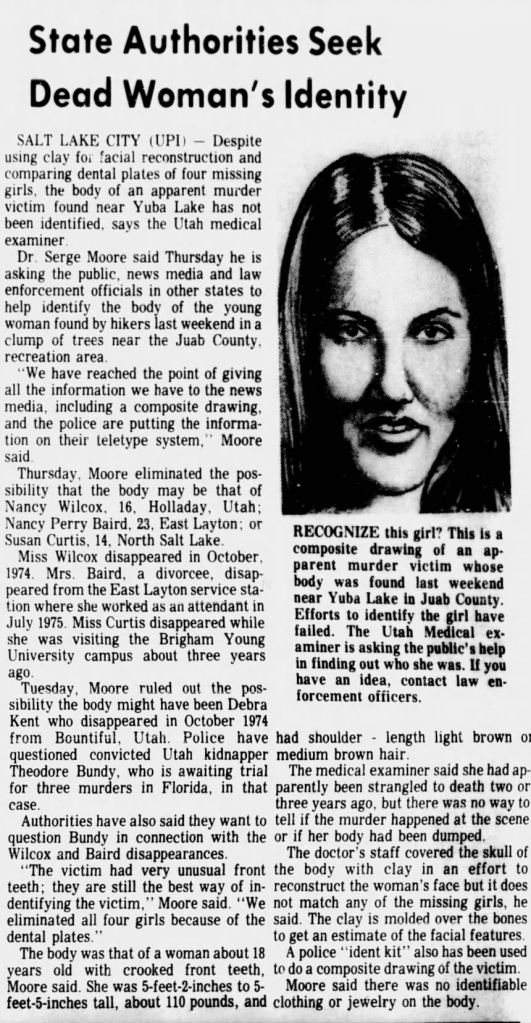
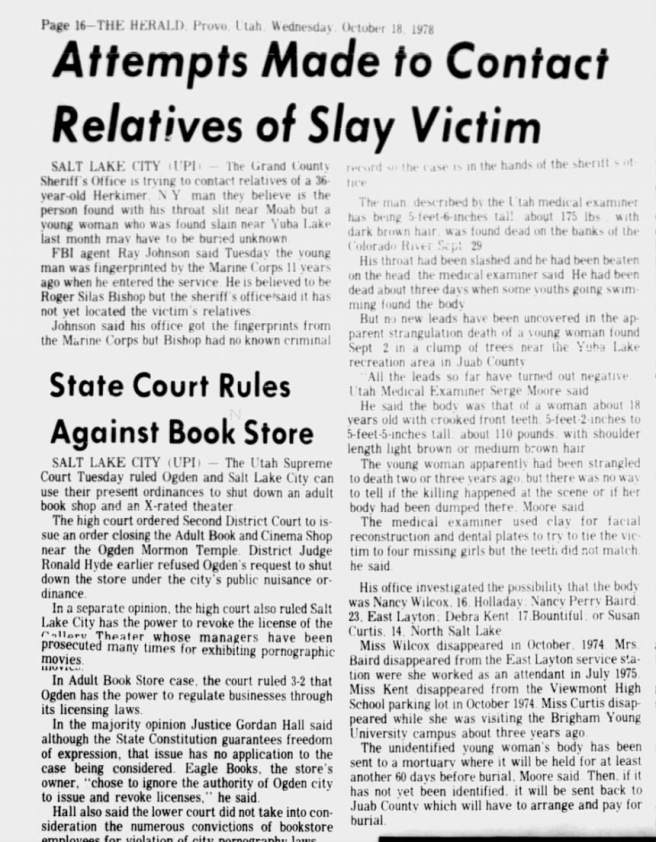
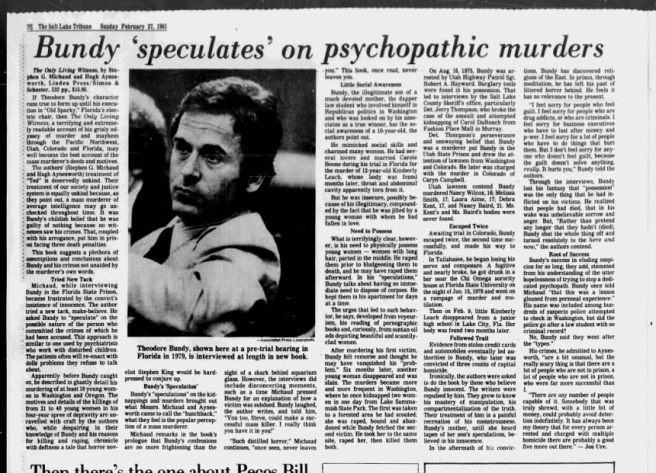
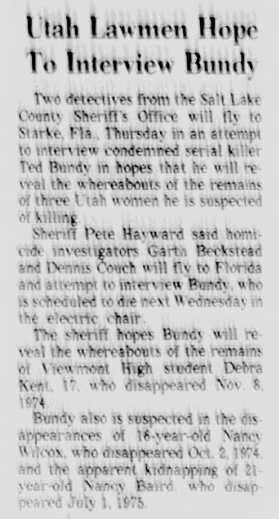
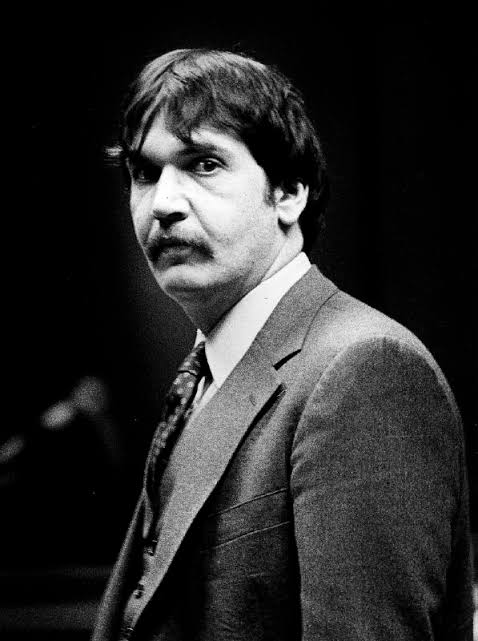
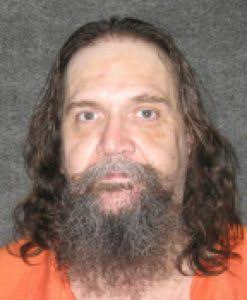
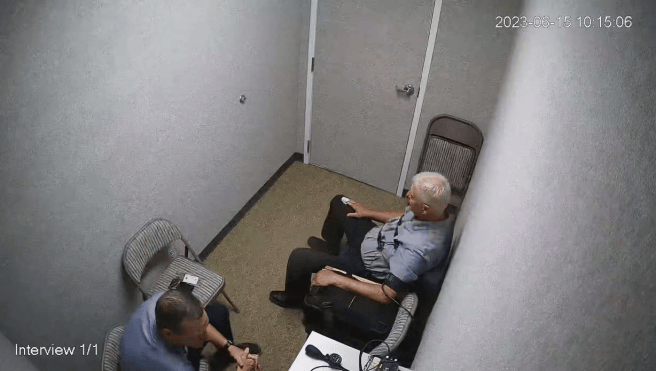
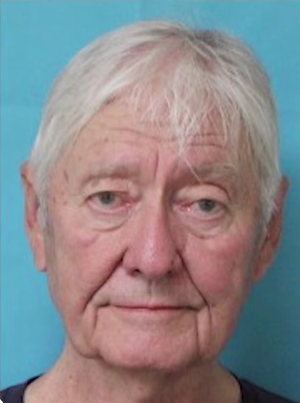
The following is an impromptu interview that the creators of ‘The Cold Podcasters’ conducted with Thomas Richard Jackson, who is a suspect in the Nancy Perry-Baird disappearance.
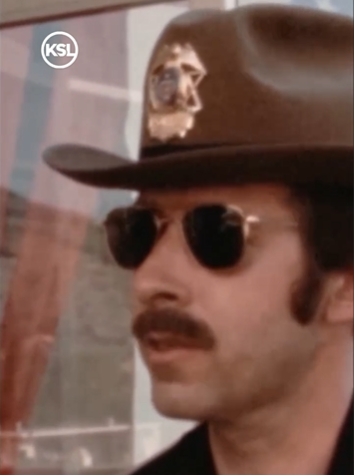
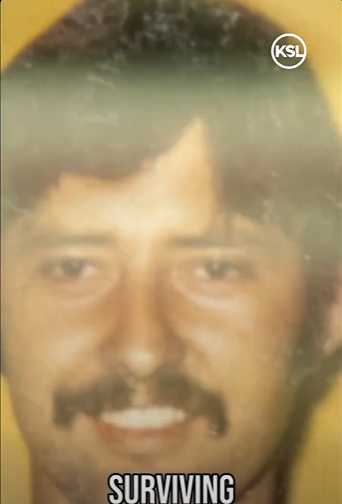
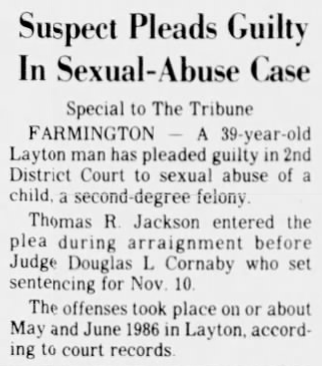
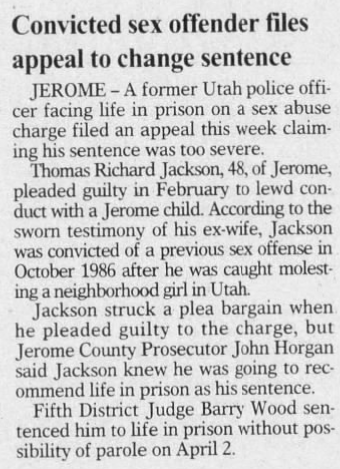
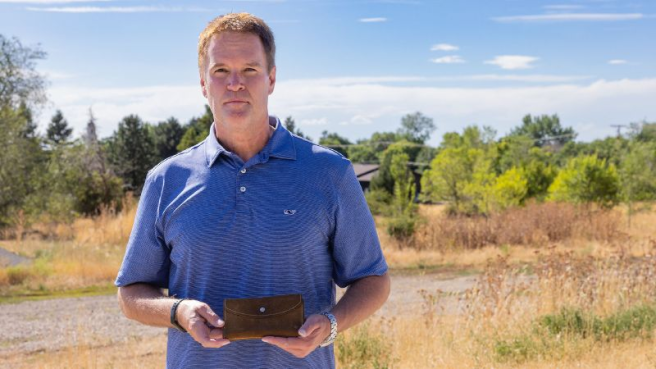
Dave Cawley: We’ve come, unannounced, in the hopes of talking to one of the other men who worked for the East Layton Police Department in 1975. (Sound of seat belt click) Sheryl Worsley: We’ll see. (Laughs) Dave Cawley: See what kind of reception we get. Dave Cawley: His name is Thomas Jackson, Junior. As we walk toward his door, a tall white-haired man steps out. Dave Cawley (to Tom Jackson): Hi, how you doing? Are you Tom? Dave Cawley: Tom Jackson can see the microphone in my hand. He asks “uh oh, what did I do now” with a bit of a laugh. Dave Cawley (to Tom Jackson): You did nothing. Sheryl Worsley: You didn’t do anything. (Laughs) Dave Cawley: We’re doing a history project on the Nancy Baird case. From way back in— Tom Jackson: Oh, Nancy Perry Baird? Dave Cawley: You got it. Tom Jackson: When I was a cop? Yeah. Dave Cawley: Yeah. Sheryl Worsley: Yeah. Tom Jackson: Oh, that’d be great. Uh, you want to come in? Dave Cawley: Is that ok? Sheryl Worsley: Is that alright? Dave Cawley: He ushers us inside and makes space on the couch. Tom Jackson: I’m glad you’re here. Man, this is, just been exciting to know that her case is still open and is, I’m tickled. Dave Cawley: Tom Jackson was about four years older than Nancy Baird. And he confirms, they knew each other as kids. Tom Jackson: She was a pretty gal. Dave Cawley: Tom’d lived just down the street from Nancy. In fact, he’d even married one of Nancy’s friends, a neighbor girl. They’d stayed in the neighborhood, living just off Cherry Lane, a little ways behind the Fina station where Nancy’d worked. Tom worked a full-time job, but around the start of 1975 also accepted a part-time position as a reserve officer for the East Layton police department. His reserve role was a little different than Cary Hartmann’s, which we heard about in Cold season 3. East Layton was a lot smaller than Ogden City, so it asked much more of its reserves. As a result, Tom worked a more regular schedule, received a paycheck, and wrote a lot of tickets. Tom told me on the day Nancy Baird disappeared, he’d been driving around in one of the town’s two police cars. Tom Jackson: I didn’t even hear anything on the radio about it. Dave Cawley: Which is a little strange, since officer Dave Anderson did describe radioing dispatch about Nancy in his report. In any case, Tom said he’d stopped by the Fina station that evening and found his chief, Ray Adams, and officer Dave Anderson there. Tom Jackson: I pulled in, I was like “what’s going on?” And they said “Nancy’s gone.” I said “what the crap, what?” Dave Cawley: Tom remembered going to Nancy’s house and helping retrieve her address book. According to a report, Tom and the chief then went and looked around a place called Fernwood Park, as the dark of night descended. Why Fernwood? Well, it was home to a sort of “lover’s lane,” a place in the hills where couples would park their cars and make out. The police found no sign of Nancy there. Records show Tom Jackson didn’t have any involvement with the Nancy Baird case after that. He intentionally opted out. Tom Jackson: At that time, I don’t think I was, I don’t know, I wasn’t a good cop, I would say. I wanted to, I wanted to let someone else handle it. I didn’t want to mess it up. Dave Cawley: In spite of this, East Layton sent Tom Jackson to the Utah police academy in September of 1975. That’s only about two-and-a-half months after Nancy Baird disappeared. Why did Tom go to the academy, instead of officer Dave Anderson? I’m not sure. Tom didn’t remember. I’ve talked to one of Tom’s academy classmates. He said Tom struggled a bit, but Tom did graduate the academy and was certified to work in law enforcement. He replaced Dave Anderson as East Layton’s full-time police officer. At some point in the middle of all this, Tom talked to the Davis County Sheriff’s Office about next-steps in the Nancy Baird investigation. East Layton had jurisdiction. It was their call. Tom Jackson: The county asked me, says “you want to handle this?” And I says “no way! All we are is just little hick town cops here so if we’re gonna find her, you guys is the ones that’s gotta do it.” Dave Cawley: Tom knew the county had already tracked down several of Nancy’s boyfriends, working off her address book. Tom Jackson: They had the book and whatever name was in there, they went after ‘em. Dave Cawley: But the boyfriend leads ran dry, right around the time Ted Bundy entered the picture. Tom Jackson: Yeah, there was suspicion of him. Dave Cawley: Tom’s mind didn’t settle on Bundy, though. He figured Nancy’s abductor could’ve been much closer. Tom Jackson: This person must’ve been someone she knew and had some trust in him. That’s the other reason why I thought it was one of the cops, that one cop. Dave Cawley: Former officer Dave Anderson. Tom remembered Dave Anderson spending a lot of time at the Fina station. Tom Jackson: He spent too much time looking at women, too. Dave Cawley (to Tom Jackson): Thinks he’s a lady’s man, maybe— Tom Jackson: Yeah. Dave Cawley: —a little bit? Tom Jackson: He was a good-looking guy, so I’m sure he thought so. Dave Cawley: This description of former officer Dave Anderson reminded me of Cary Hartmann and his brief time in the Ogden police reserve corps, which we talked about during Cold season 3. There are some people who are drawn to law enforcement jobs for all the wrong reasons. Dave Anderson, it seems, might’ve been one of them. This idea was overlooked though, probably because the East Layton police department was itself in crisis. Its chief, Ray Adams, shouldn’t have been chief. He’d wasn’t a cop. He’d secured his position through the good ol’ boy system. State law required he attend the academy, but he wasn’t willing to take a leave from his full-time job to do that. So, in April of 1976, Ray Adams vacated the chief of police position. He instead became a justice of the peace for the town, a form of low-level judge, a job for which Adams was also not qualified. Officer Tom Jackson departed the East Layton police department not long after that. He decided to leave law enforcement entirely, and went into private security work. So within about a year of the disappearance of Nancy Baird, the entire East Layton police force turned over. Tom Jackson: Real Mayberry thing. (Laughs) Dave Cawley: There is one other point I need to acknowledge here: former officer Tom Jackson has a criminal record. In 1986, 11 years after the disappearance of Nancy Baird, Davis County prosecutors filed a criminal charge against Tom. He stood accused of sexually abusing two young girls. He pleaded guilty to a second-degree felony, which made him eligible for a sentence of up to 15 years in prison. But the judge only placed Tom on probation. Tom’s wife divorced him in the years that followed. He left Utah, remarried, and then, in 1995, police arrested Tom Jackson again, this time on charges of lewd conduct with a child under 16 years of age. He again pleaded guilty, but the Idaho judge showed none of the leniency the Utah judge had. Tom received a life sentence. But Tom’s no longer in prison, clearly. He won an appeal that reduced his sentence to 15 years. He served that time, a fact he and I discussed at the start of our interview. Tom confided he felt a bit nervous going on tape. He hoped I wouldn’t make a monster of him. I promised to treat him fairly. And Tom acknowledged his past complicates how we might see him. Tom Jackson: I wouldn’t doubt if I was a suspect and all that. And that’s ok with me. Dave Cawley: Because, Tom says, he’s taken polygraph after polygraph as part of his probation. Tom Jackson: And one of the questions in there is “you committed any other crimes that we don’t know about?” And when I said “no, not at all.” And it come up true, so. Dave Cawley (to Tom Jackson): I mean, it’s— Tom Jackson: Y’know, that pretty much cleared me right there. Dave Cawley: —it’s a lot of years, right? You would think if you were a suspect, someone would’ve come and talked to you a long time ago— Tom Jackson: Yeah, yeah. Dave Cawley: —right? Tom Jackson: That’s true. Dave Cawley: After Tom Jackson left his job at the East Layton Police Department a year following Nancy Baird’s disappearance, the town hired a new officer, a guy named Dave Davis. Town leaders quickly promoted Davis to chief. Davis told The Salt Lake Tribune he was “working wonders” with the small budget provided to him in a 1977 newspaper story comically headlined “Yes, East Layton has a police department.” Gary McFarland: They just did not have the funding to take and keep somebody. Dave Cawley: Chief Davis also inherited the Nancy Baird case. He did nothing with it until, in 1979, four years on from Nancy’s disappearance, Davis hired a new patrol officer named Gary McFarland. Gary McFarland: And it came down to where it was just me covering 12 hours and the other, the chief would cover the other 12 hours. And there was a promise from the city that if I did that, they would send me to the police academy. Dave Cawley: Chief Davis gave Gary former East Layton police officer Dave Anderson’s report about the disappearance of Nancy Baird. Gary McFarland: There just wasn’t a lot. We were, y’know, a very small community. There was very few things going on. Property disputes, loose cows, loose, loose horses. (Laughs) That kind of thing. It just, that was, that was a pretty big case. Dave Cawley: At this same time, Ted Bundy was standing trial for murder in Florida. John Hollenhorst (from July 24, 1979 KSL TV archive): As the verdict approached, reporters, editors and photographers prepared for the climax of the trial. The Bundy case has generated vast amounts of publicity all over Florida and in the western states of Utah, Colorado and Washington. In all those places, Bundy is suspected of murders. All involving young women. Dave Cawley: Gary, and many others, believed Ted Bundy might’ve killed Nancy Baird. It wasn’t much of a leap: Bundy had been in Utah the summer Nancy disappeared. Gary McFarland: She had the appearance of some, the females that he preferred. That’s all we had, is the method of operation fit. Dave Cawley: But that suspicion didn’t give Gary any direction as to where to look for Nancy’s remains. Gary McFarland: It was becoming a cold case, basically. Dave Cawley: A little kerfuffle erupted in East Layton around this same time. The mayor fired police chief Davis, who responded by telling the news media it was an attack on the entire department. Dave Davis (from March 24, 1980 KSL TV archive): They may be looking into an outside agency to contract to and dissolve the police department as a whole. Dave Cawley: I suspect you probably don’t much care about this small town political squabble, but I promise you, it’s relevant to the Nancy Baird case because of what happened in the end. Gaylen Young (from March 26, 1980 KSL TV archive): Nearly 400 angry residents were in attendance at the city council meeting because mayor Delin Yates was not going to keep police chief Dave Davis on the job. East Layton resident (from March 26, 1980 KSL TV archive): We don’t want a contract with Davis County. We don’t want a contract with Layton City. We want the police force we have with the responsible, interested service that we get from them. Dave Cawley: This protest proved ineffective. East Layton dissolved its police department. Officer Gary McFarland, fresh out of the academy, no longer had a job. But it didn’t stop there. The residents of East Layton voted to disincorporate at the end of 1980. Their town ceased to be and neighboring Layton City swallowed it whole. The records of the East Layton police department were lost to time. All except for the report of former police officer Dave Anderson about the disappearance of Nancy Baird. Gary McFarland still had it. Gary McFarland: It ended up with me. No direction as to what to do with it. But it was in my custody. Dave Cawley: But with East Layton gone, who would inherit jurisdiction over Nancy Baird’s case? Did it belong to Layton City, which absorbed East Layton? Or did the Davis County Sheriff’s Office bear responsibility, given the work deputies there had done assisting East Layton early on? Gary McFarland: Davis County provided a lot of the crime scene investigations because small communities could not provide that service. Dave Cawley: As we saw with the Sheree Warren case in Cold season 3, victims fall through the cracks when police agencies fail to communicate. And that’s what also appears to have happened with Nancy Baird. No one took the initiative. It wasn’t Gary McFarland’s case, but he felt duty-bound to safeguard the reports. Gary McFarland: Because it was one of those cases that you knew someday would have a lead. Dave Cawley: Gary ended up taking another police job at a different agency. Year after year, he waited for a phone call that might break the case. Gary McFarland: Nobody ever came forward. Nobody was ever found. Not one tip, not nothing. Dave Cawley: Gary McFarland retired in 2012. He turned the East Layton police report on Nancy Baird over to the Davis County Sheriff’s Office. Gary McFarland: They’d come up with some other theories, besides the only one that I ever came up with. Dave Cawley (to Gary McFarland): Bundy? Gary McFarland: Yeah. Dave Cawley: Is that what you mean? Gary McFarland: Yeah, ‘cause I’m stuck on it. It will, until I’m proven different. Dave Cawley: Gary still believes Ted Bundy is the most likely suspect in Nancy Baird’s presumed murder. But he knows that’s not the only theory. Gary McFarland: The theories were that it was possibly a law enforcement officer that worked in East Layton. Dave Cawley: The story we’ve heard so far leaves me deeply skeptical about any conclusion regarding Nancy Baird’s death being the work of serial killer Ted Bundy. To my mind, there are too many other plausible scenarios. And, Tiffany Jean, the archivist, told me she’s unsure as well. Tiffany Jean: I, I looked at the case a little bit. And I thought that it didn’t quite fit his M.O., with what I know about how he operated. Dave Cawley: What was different? For one, the location. Ted Bundy was never known to abduct a woman from a gas station during daylight hours. Tiffany Jean: And while Bundy was capable of doing that, he mostly operated at night. And he mostly avoided places where he could be seen or picked out. Dave Cawley: In his early crimes in Washington state, Bundy sometimes approached women while claiming to be injured, needing help to put something in his car. Would Nancy Baird have taken that kind of bait? Tiffany Jean: It seems unusual that she would have been willing to leave her post to do that when there was no one else at the station. Dave Cawley: Bundy liked to lure women to his car—a light tan 1968 Volkswagen Beetle—then handcuffed them or knocked them unconscious. If he’d done something like that with Nancy Baird, it probably would’ve happened right in the parking lot outside the Fina station. Tiffany Jean: And that seems like kind of a big risk for Bundy to have taken. Dave Cawley: None of the witnesses from the Fina station reported seeing a Volkswagen Beetle like Bundy’s. And the descriptions provided by the Williams children didn’t match Ted Bundy, either. Tiffany Jean: So, that’s another reason that seems unlikely that it would have been him. Dave Cawley: Nancy Baird vanished from the Fina station within the space of just five or ten minutes. Kenny Payne: Yeah I mean she’s just, she’s just gone. Dave Cawley: No signs of a struggle, no indication she ran away. Kenny Payne: I mean she’s got a, a child at home. Dave Cawley: So retired sheriff’s detective Kenny Payne gets why even some of his former colleagues believe to this day Ted Bundy abducted and murdered Nancy Baird. Kenny Payne: But then you have to try and figure out whether or not the first thought of “it’s gotta be Ted Bundy” well no, what can you find that tells me a story? Dave Cawley: What Kenny’s saying is the elements necessary to build a narrative about Ted Bundy killing Nancy Baird just aren’t there. Tiffany Jean also shared another, more compelling reason why she questions Ted Bundy’s supposed involvement. Bundy, she told me, might have an alibi for the day Nancy Baird disappeared. And Tiffany could be the first person to ever piece it together. Ted Bundy first moved to Utah in September of 1974, having come from Washington state to attend law school at the University of Utah in Salt Lake City. Tiffany Jean: He had a steady girlfriend who lived in Seattle who was originally from Ogden. And she was probably the reason why he came to Utah in the first place, because she had roots there. And eventually they planned on settling down there, if they ever got married. But y’know, he was not a good person. (Laughs) So in addition to everything else bad that he did, he also cheated on her quite a bit. Dave Cawley: In June of 1975, just a few weeks before Nancy Baird disappeared, Ted Bundy met a young school teacher named Leslie Knudsen at a party in Salt Lake City. Bundy and Leslie started seeing one another. Tiffany Jean: And they dated until August, she saw that he was arrested and didn’t want anything more to do with him. Dave Cawley: Leslie spoke to investigators back in 1975, but she was never called as a witness in court and has kept a very low profile all the years since. Her story is not well known, even among Ted Bundy experts. Tiffany Jean: But I was able to find her phone number, and an associate of mine called her. And this was back in 2019. And it took a little while for her to warm up and agree to, to speak at all. But she gave some, y‘ou ‘know, some kind of overall arching details about her time that she spent with him. And she mentioned that he had visited her family, and she’d introduced him to her entire family at a family reunion on the 4th of July, 1975. And that struck me immediately because Nancy Baird disappeared on 4th of July, 1975. And if Leslie Knudson was accurate in her recall, then Ted probably could not have done that, if he was with her, and being introduced to her entire family at their July 4th family reunion. But it doesn’t seem like anyone else has ever put those together that he was with her on the day that this crime occurred. Dave Cawley: I’ve listened to a recording of this interview with Leslie Knudson. There are legal and ethical considerations that prevent me from sharing the audio with you, but I can tell you what Leslie said: she and Bundy had “gone to the family ranch” on the 4th of July. Leslie didn’t say where the ranch was, and she’s not responded to multiple messages I’ve left for her. But I did some genealogy research and can tell you Leslie’s maternal grandfather was a prominent sheep rancher in an area of Utah called the Uinta Basin. When Leslie’s mother died, the obituary described how she’d spent “many summers in the Fruitland, Utah area on the family ranch.” Fruitland is in the Uinta Basin. This is likely where Leslie Knudson took Ted Bundy on the day Nancy Baird disappeared. Tiffany Jean: And so it’d be pretty difficult for him to have done both things on that day because it would have been quite a drive. Dave Cawley: More than 100 miles. Quite the drive, indeed. But once investigators in the Nancy Baird case honed in on Ted Bundy as a suspect, all efforts involving other persons of interest came to a halt. Tiffany Jean: I was amazed at how many people went through that gas station in that tiny frame of time, within like 15 minutes. And nobody saw her leave? Dave Cawley: My look into the Nancy Perry Baird case came about because a jailhouse informant once told the FBI Cary Hartmann had known Nancy. I haven’t seen any sign that tip was ever shared, investigated or corroborated. What I’ve learned, is there are other, more likely leads still left unexplored. But after nearly 50 years, so many people important to solving this puzzle are gone. And former East Layton officer Tom Jackson told me his health is on the decline. Tom Jackson: One of the first people I want to see, other than my parents when I get to the other side, is Nancy. ‘Cause she has bugged me for so long. What could I have done to have been there for her? ‘Cause she’s, she was not the type, to’ve just bugged out and said, y’know, “I’m tired of the world.” Dave Cawley: “She was not the type…” This is a common refrain we hear in so many cases of missing women, and to be honest, it’s getting under my skin. Because who is the type? Sure, people do run away, but in this podcast we’ve repeatedly heard how more sinister circumstances often surround the disappearances of women. It happened with Sheree Warren. Her disappearance, 10 years after Nancy Baird’s, bore many similarities. Both were young mothers, just out of unhappy marriages. Both were last seen at work. Neither just walked away. But in both cases, speculation about about serial killers distracted investigators, drawing attention away from more probable suspects. Tom Jackson: And boy, whoever did it, he’s another Bundy. Dave Cawley: Against the backdrop of turnover and jurisdictional dysfunction we’ve explored, it’s easy to understand how Ted Bundy filled a vacuum. His entrance to the scene took pressure off East Layton police. Nancy Baird’s friends and relatives were placated by the belief Bundy did it, even though no proof ever emerged to support that. But there are too many unexplored avenues of investigation for me to accept that conclusion. Like the man who stalked, “molested” and threatened Nancy a couple of nights before she disappeared. Or the two “hippie type” guys chatting with her at the Fina station moments before she vanished. Or even an East Layton police officer with a troubled past. Until these other leads are closed, how can anyone accept taking “the convenient alternative?”
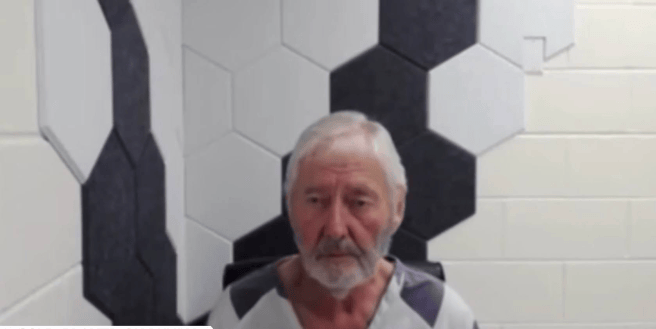
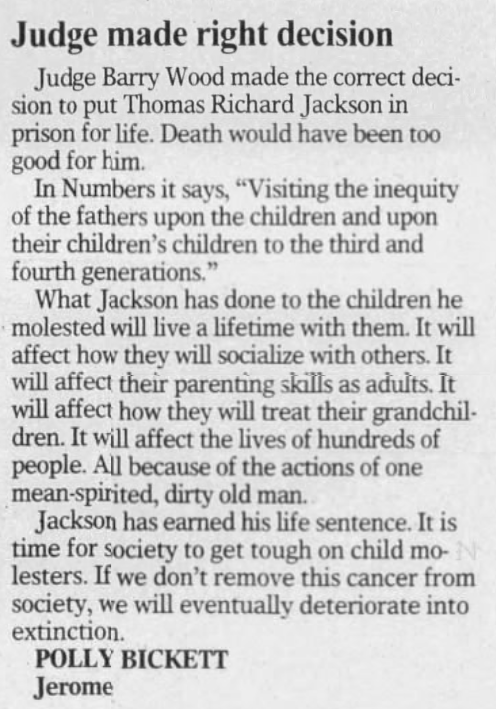
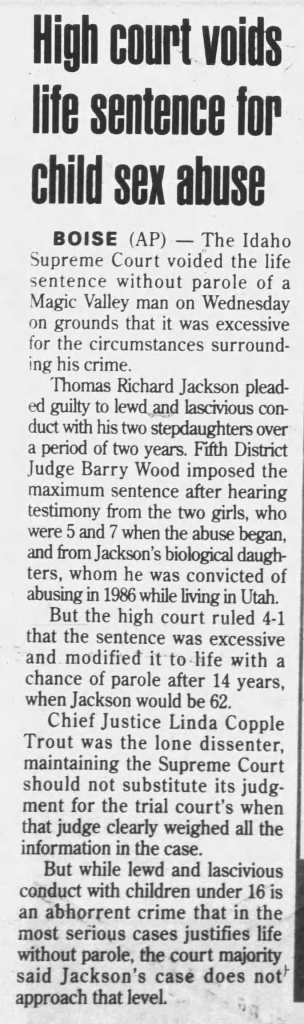
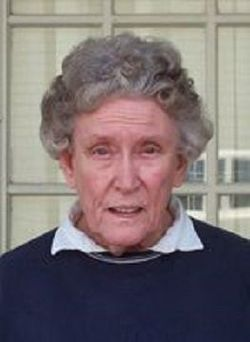
Thomas Richard Jackson is a former part-time reserve police officer for the now-defunct police department in East Layton, Utah (where he served from April 1975 to July 1976) that has drawn renewed media and law enforcement attention in connection to the 1975 cold case disappearance of twenty-three-year-old gas station attendant, Nancy Perry-Baird. In 1996, he pled guilty to child sex crimes in Idaho and was subsequently sentenced to an indeterminate life sentence with a fifteen-year fixed term, and although he was originally released on parole in 2011, he has since been returned to custody.
STATE of Idaho, Plaintiff-Respondent, v. Thomas Richard JACKSON, Defendant-Appellant.
No. 22892, Decided: April 09, 1997
Byington, Holloway, Whipple & Jones, Jerome, for appellant. Alan G. Lance, Attorney General; L. LaMont Anderson, Deputy Attorney General, Boise, for respondent.
This is a review of a sentence and an order denying an I.C.R. 35 motion. Thomas Richard Jackson (Jackson) pled guilty to one count of lewd and lascivious conduct with a child under sixteen, specifically, his stepdaughters. After hearing evidence, including that Jackson had been convicted in Utah of sexually molesting his biological daughters, the district court sentenced Jackson to a determinate sentence of life in prison, and denied a subsequent Rule 35 motion. Jackson appeals his sentence and the denial of his Rule 35 motion. Jackson argues that the district court abused its discretion in sentencing, and that the prosecution’s alleged failure to follow the plea agreement by not affirmatively recommending retained jurisdiction amounted to fundamental error.
I: FACTS AND PROCEDURE.
Jackson was originally charged with two counts of lewd conduct with a minor under sixteen, Idaho Code § 18-1508. Jackson entered into a plea agreement, under which Jackson plead guilty to one charge of lewd conduct with a minor under sixteen. The State also agreed to make the following sentence recommendation:
The State recommends the above-named defendant be sentenced to an underlying penitentiary sentence with no agreements as to the recommendation for the underlying sentence; and that the State will recommend that the Court retain jurisdiction; however, the State does not bind itself to follow the recommendations of the 180-day review report.
The charges against Jackson stemmed from several instances of lewd conduct involving Jackson and two of his stepdaughters, who were seven and nine at the time of the sentencing hearing. The abuse had been occurring for approximately two years. The first instances of abuse involved Jackson having the victims touch his penis and escalated to the point where Jackson would have the victims sit on his penis and move back and forth. The victims were always dressed, and there was a blanket between Jackson and the victims. In addition, there were never any instances of penetration of any type, and Jackson made no threats of violence to his victims. The only threat he made was a comment that if the girls told what he had done, he would have to leave. here is one other related charge in Jackson’s record. In 1986, Jackson was convicted in Utah of sexual abuse of a child, specifically, his biological daughters. He received probation and was required to perform 20 hours of community service and undergo counseling.
After hearing testimony from Jackson’s biological daughters, his stepdaughters, and his first wife; reviewing the presentence investigation materials; and listening to argument from the attorneys on both sides, the district court sentenced Jackson to a fixed term of life in prison, without a retained jurisdiction period. At the time the judgment of conviction was entered and the sentence imposed; Jackson was forty-eight years of age.
II: STANDARD OF REVIEW.
Sentencing is a matter for the trial court’s discretion. Our standard of review of a sentence, as well as the factors to be considered in evaluating the reasonableness of the sentence, are well-established. We have said that “[w]here a sentence is within statutory limits, an appellant has the burden of showing a clear abuse of discretion on the part of the court imposing the sentence.” State v. Cotton, 100 Idaho 573, 577, 602 P.2d 71, 75 (1979). In determining whether the sentencing court abused its discretion, we review all the facts and circumstances of the case. State v. Broadhead, 120 Idaho 141, 143, 814 P.2d 401, 403 (1991). In order to show an abuse of discretion, the defendant must show that in light of the governing criteria, the sentence was excessive, considering any view of the facts. Id. at 145, 814 P.2d at 405. The governing criteria, or objectives of criminal punishment are: “ ‘(1) protection of society; (2) deterrence of the individual and the public generally; (3) the possibility of rehabilitation; and (4) punishment or retribution for wrongdoing.’ ” Id. (quoting State v. Wolfe, 99 Idaho 382, 384, 582 P.2d 728, 730 (1978)).
III: THE DISTRICT COURT ABUSED ITS DISCRETION IN SENTENCING JACKSON TO A FIXED TERM OF LIFE IN PRISON.
As noted above, this Court reviews a sentence handed down by a district court for abuse of discretion. It is not often that we vacate and modify a sentence, but for the reasons discussed below, we feel compelled to do so in this case.
A fixed or determinate life sentence is a serious penalty and should not be imposed lightly. We note with approval the language of our Court of Appeals when it stated that: ‘a fixed life sentence may be deemed reasonable if the offense is so egregious that it demands an exceptionally severe measure of retribution and deterrence, or if the offender so utterly lacks rehabilitative potential that imprisonment until death is the only feasible means of protecting society. Unfortunately, in making these determinations, a judge has complete information only in regard to retribution and deterrence, ․ The judge must attempt to predict the defendant’s future response to rehabilitative programs and the degree of risk he might pose to society if eventually released․’
State v. Eubank, 114 Idaho 635, 638, 759 P.2d 926, 929 (Ct.App.1988). Although it recognized the difficulty of predicting future behavior, the Court of Appeals also wisely cautioned that:
a fixed sentence should not be regarded as a judicial hedge against uncertainty. To the contrary, a fixed life term, with its rigid preclusion of parole or good time, should be regarded as a sentence requiring a high degree of certainty-certainty that the nature of the crime demands incarceration until the perpetrator dies in prison, or certainty that the perpetrator never, at any time in his life, could be safely released.
Id: This Court and the Court of Appeals have upheld some fixed life sentences for crimes involving lewd and lascivious conduct with a minor under sixteen. In State v. Pugsley, 128 Idaho 168, 911 P.2d 761 (Ct.App.1995), the defendant was sentenced to three concurrent life terms for lewd conduct. The defendant was convicted of three counts of lewd conduct with his minor biological daughter, conduct which at a minimum included genital-to-genital contact. He had been previously convicted of raping his half-sister, had allegedly raped another half-sister, and had threatened his daughters with death if they ever told what he had done. The defendant had an extensive criminal record, including three felonies as an adult, all of which were violent crimes. Id. at 179-80, 911 P.2d at 762-63.
In another recent case, the Court of Appeals upheld a fixed life sentence for a man who pled guilty to one count of lewd and lascivious conduct with a minor under sixteen, as Jackson did in this case.State v. Hibbert, 127 Idaho 277, 899 P.2d 987 (Ct.App.1995). The defendant in Hibbert had repeatedly violently attacked his minor daughter and forced her to have intercourse with him. He also kept her a virtual prisoner in their home, not allowing her to have friends, use the telephone, or go to school. During the course of the proceedings, Hibbert made death threats to his daughter, a friend and the prosecutor. Therefore, the Court of Appeals upheld the sentence. Id. at 278-79, 899 P.2d at 988-89. See also State v. Lewis, 123 Idaho 336, 352-53, 848 P.2d 394, 410-11 (1993) (upholding a fixed life sentence for a defendant who had previously been convicted for a sexual offense against a minor, attempted penetration, knew at the time of the crime that he was HIV-positive and denied he committed the crime); State v. Martinez, 111 Idaho 281, 723 P.2d 825 (1986) (upholding fixed sentences of thirty years for rape, thirty years for lewd conduct, and fifteen years for aggravated battery, which amounted to a fixed life sentence; the victim suffered extreme physical trauma requiring surgery, and it was doubtful that she would ever make a full recovery).
Although a fixed life sentence is a serious sentence, lewd and lascivious conduct with a minor under sixteen is a serious crime. The physical injures can be severe, and the mental and emotional trauma can be permanent. However, a fixed life sentence is not appropriate in every lewd and lascivious conduct case, and as illustrated above, is rendered and upheld in cases where the defendant’s conduct was violent, repetitive, very cruel, or life-threatening. Phrased differently, and considering the four goals of sentencing, a fixed life sentence is appropriate if necessary to protect society, to deter the individual and the public, if rehabilitation is unlikely, or if the behavior giving rise to the crime was so egregious that a determinate life sentence is necessary for proper punishment or retribution.
In this case, Jackson admits that he molested two of his stepdaughters, and he does have a previous conviction for similar behavior with his biological daughters. However, the behavior involved in this particular case did not involve penetration of any type, nor were there any allegations of force. Further, the record indicates that although Jackson was required to participate in some form of counseling under his prior conviction, the counseling was not part of a recognized sex-offender treatment program. This becomes important because Jackson has indicated that he wishes to undergo treatment and will cooperate in every way necessary. In addition, an evaluator indicated that the proper treatment could help prevent Jackson from re-offending. It is also significant that the appellant took full responsibility for his actions, and did not blame the victims in any way. Finally, Jackson had abstained from drugs and alcohol and had worked fairly steadily throughout his adult life.
With any crime, there is a chance that the defendant will re-offend. Indeed, the evaluator in this case offered no guarantees that Jackson would not re-offend, even if he undergoes sexual offender treatment. However, as our Court of Appeals noted, a fixed life sentence should not be imposed as a hedge against uncertainty. The behavior exhibited in this case, while reprehensible, is not so egregious that Jackson should die in prison.
For the reasons discussed above, and after conducting our own careful review of the record in this case, we hold that a fixed term of life in prison is excessive in this case. Considering the four goals of sentencing, we note that although society does need to be protected from sex offenders, and Jackson and the public must be deterred from such behavior, a fixed term of life in prison is not necessary to accomplish those goals. Further, Jackson has indicated that he wants to undergo treatment, has shown a desire to change his behavior and exhibits a possibility for rehabilitation. Finally, while Jackson deserves to be punished for his behavior, a fixed life term in prison is not necessary or justified in this case.
Therefore, Jackson’s sentence is hereby modified to an indeterminate life sentence with a fixed term of fifteen years in prison. When fifteen years have passed, the earliest time that Jackson would be eligible for parole, the youngest victim in this case will be over 21 years of age. Thus, the victims in this case will both be adults.
As to the issue of the breach of the plea agreement, although it was raised as an issue in his opening brief, Jackson subsequently withdrew this issue in his brief on his Motion to Reconsider Denial of Appellant’s Motion to Augment the Issues on Appeal. Accordingly, we do not reach this issue.
IV: CONCLUSION.
In light of all the facts in this case, and considering the four goals of sentencing, we hold that Jackson has met his burden of showing that the district court abused its discretion in sentencing him to a fixed life sentence. We therefore modify the sentence to an indeterminate life sentence with a fifteen year fixed period of incarceration.
I write only to indicate that I believe that the trial court is in the best position to make the determination of the appropriate sentence. Where the record reflects that the sentencing judge carefully considered the evidence and statements presented to him and the four goals of sentencing, this Court should set aside the sentence only where reasonable minds could not differ as to the excessiveness of the sentence.State v. Broadhead, 120 Idaho 141, 145, 814 P.2d 401, 405 (1991) (quoting State v. Small, 107 Idaho 504, 505, 690 P.2d 1336, 1337 (1984), overruled in part on other grounds by State v. Brown, 121 Idaho 385, 393, 825 P.2d 482, 490 (1992)). This Court should not substitute its judgment for that of the sentencing judge where reasonable minds could differ as to whether the sentence is necessary to achieve the four goals of sentencing. Id., 120 Idaho at 145, 814 P.2d at 405 (quoting State v. Toohill, 103 Idaho 565, 568, 650 P.2d 707, 710 (Ct.App.1982)). The record here reflects that the trial judge carefully considered the heinous nature of the offense, the devastating impact on the victims, and the fact that Jackson had previously been convicted of this offense, as well as society’s need to be protected from this type of predator. I find no abuse of discretion and, thus, must respectfully dissent.
SILAK, Justice. JOHNSON, McDEVITT and SCHROEDER, JJ., concur.
This is the initial police report regarding Nancy’s disappearance completed by Officer D.R. Anderson on July 4, 1975. I already wrote about her but I’m going to go back and edit my piece; I am constantly updating my articles when I stumble across new information and boy did I find a great new source.
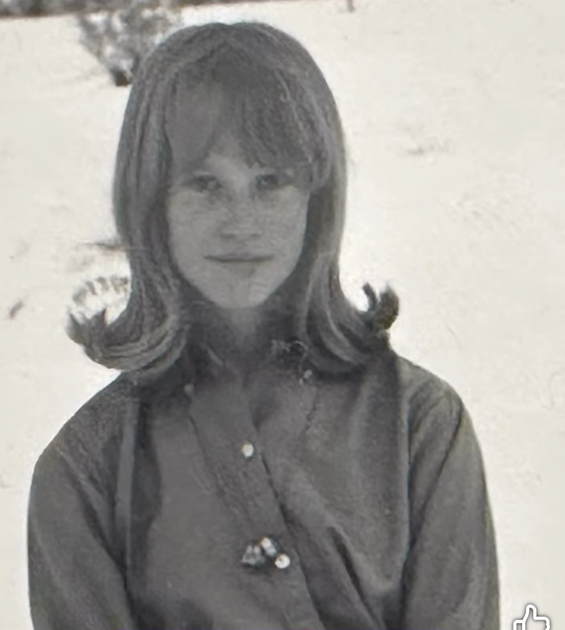
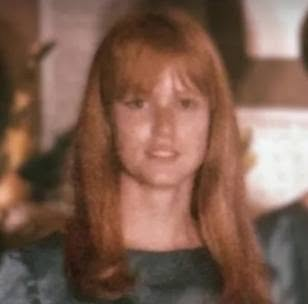
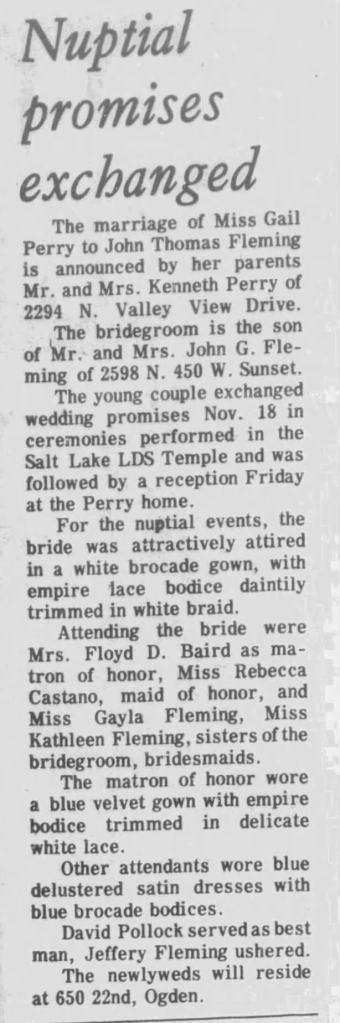
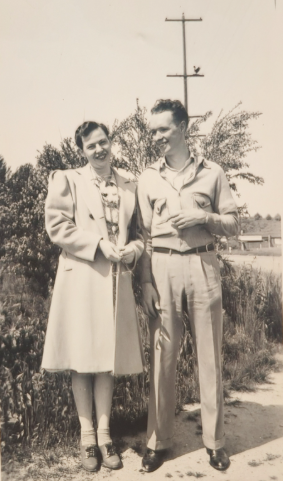
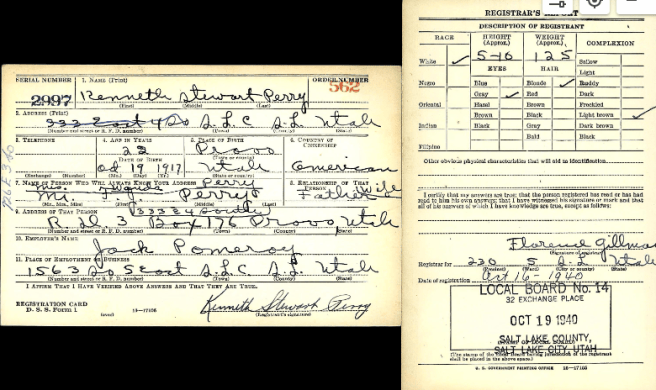
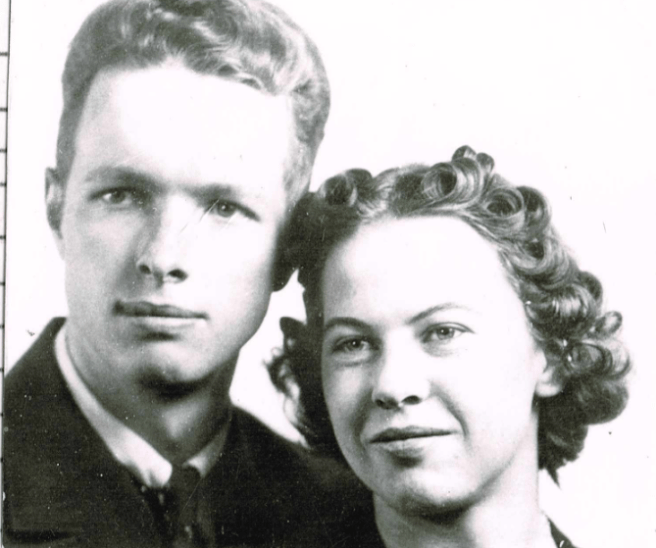
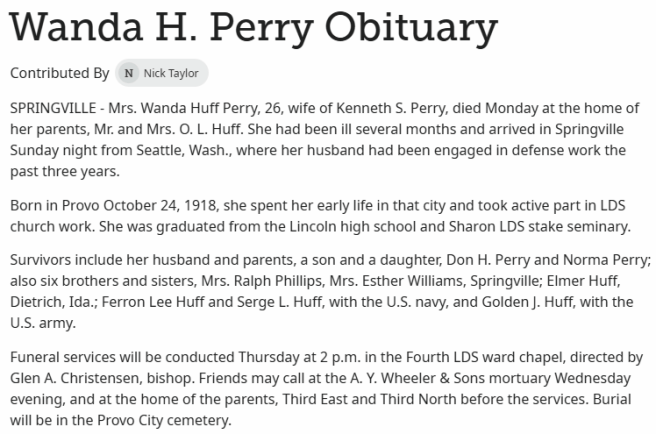
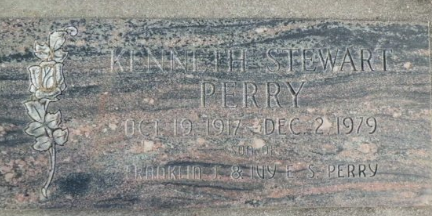
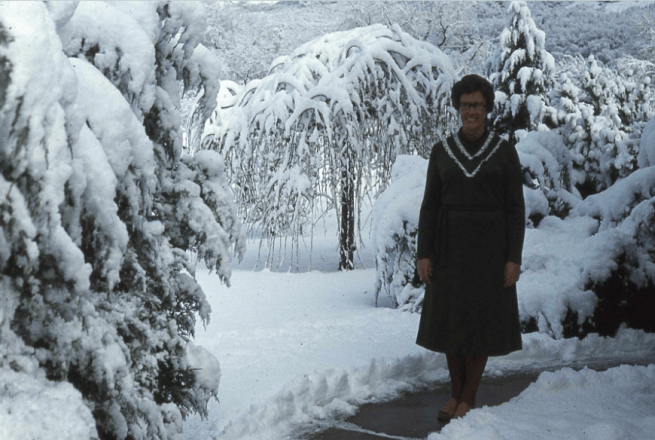
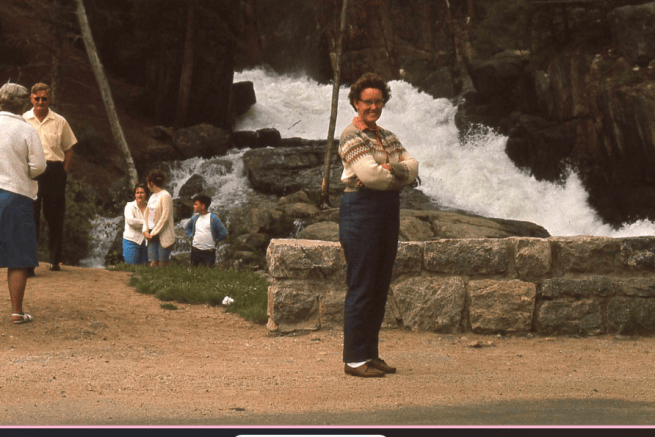
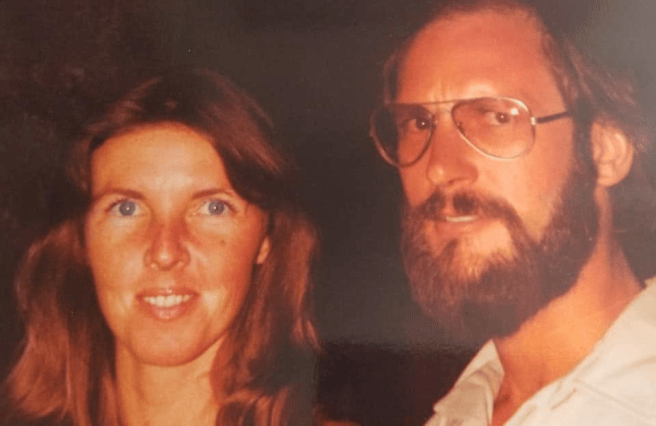
Nancy Perry-Baird was born on January 14, 1952 to Kenneth and Elna (nee Stueler) Perry of Provo, Utah. Kenneth ‘Kay’ Stewart Perry was born on October 19, 1917 in Provo, UT, and Nancy’s mother Elna was born September 11, 1924, in Washington, DC, but moved to Phoenix, Arizona at the age of four; when she was nine, her family moved to Provo, Utah. On July 21, 1947, Kenneth and Elna wed and the couple eventually laid down roots in Layton, Utah. They had three daughters together: Nancy, Pat, and Gail. They had a happy marriage, never fought, and were best of friends. They always knew what each other wanted and always had the others needs and wants first priority. Before Nancy’s mother, Mr. Perry was married once before: he got hitched to his first wife Wanda on May 10, 1939, and the couple had two children together, Don and Norma; she sadly passed away on January 1, 1945. Here’s a funny quote about their relationship that I found in Mr. Perry’s obituary in relation to his first marriage: ‘Kay and Wanda Huff met in high school. They were in the same class. Wanda was disappointed when for graduation she was given a watch and not an engagement ring’ Elna was a graduate of Brigham Young University and earned degrees in both accounting and education; she retired from the IRS in Ogden after working there for fifteen years. Nancy had fair skin with long strawberry blonde hair and hazel eyes; she stood 5’2”/5’3″tall and had scars on the inside of both wrists from a failed suicide attempt (interesting factoid: she has type O-positive blood).
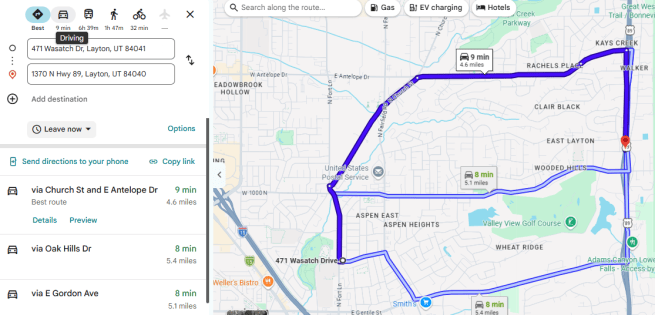
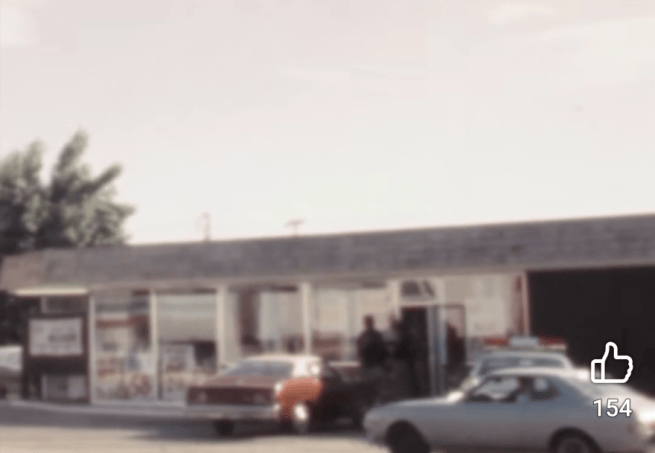
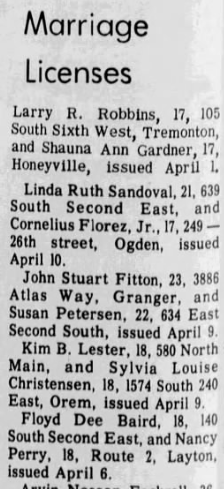
At the time of her disappearance Nancy was living at 471 Wasatch Drive in Layton, Utah and was employed at the Triangle Oil Company’s Fina Gas Station at 1378 North Highway 89. I wasn’t able to find a lot about Nancy’s early life or family background, but everything I came across pointed towards her having a relatively normal childhood. She went to Layton High School in Utah and got married to Floyd (Dee) Baird in 1970 after she graduated (they were both eighteen at the time). Floyd was employed as a master electrician, and the couple had a son together in the Winter of 1971; they later got divorced in the spring of 1975.
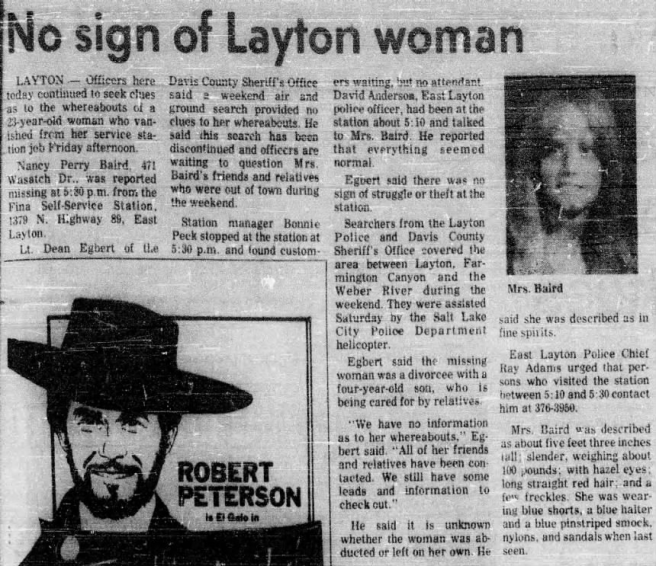
On July 4, 1975,twenty-three-year-old Nancy was working a 3-11 PM shift (some sources say it was until midnight) as an attendant at the Fina self-service gas station in East Layton, Utah. At the time of her disappearance, she lived close to her POE, her son lived with family, and her ex-husband lived in the state of Wyoming. A little after five o’clock EastLayton PoliceOfficerDavidAnderson stopped and chatted with Nancy a little bit during his shift; he bought a bottle of soda water then left a few minutes later to investigate a potential alcohol violation at the Shamrock gas station on the other side of the highway; he returned to the Fina station around 5:30 PM, and at that time he noticed a green van and a couple of lingering ‘hippie-types,’ and he felt he had to assess the situation.
In his report, Anderson described glancing back towards the Fina between 5:20 and 5:30 PM and he ‘went over to check it out,’ without ever explaining why exactly the van piqued his suspicion. Anderson’s report does not say what became of the van or whether he made contact with its driver: it only says that by the time he got back to the Fina station, Nancy Perry-Baird was no longer there: her purse, keys and car were all there, and Anderson saw no signs of a struggle inside the store. He quickly contacted his chief, who in turn requested the assistance of the Davis County Sheriff’s Office in mounting a search for Nancy Perry-Baird. At the time of Nancy’s disappearance, the East Layton Police Department was made up of four officers: a part-time police chief named Ray Adams, full-time Officer Anderson, and two part-time reserve officers: Gerald Burton and Thomas Jackson; none of those men had received formal police training, and none of them had attended Utah’s police academy. the town disincorporated the department five years later when it was annexed into Layton City in January of 1981.
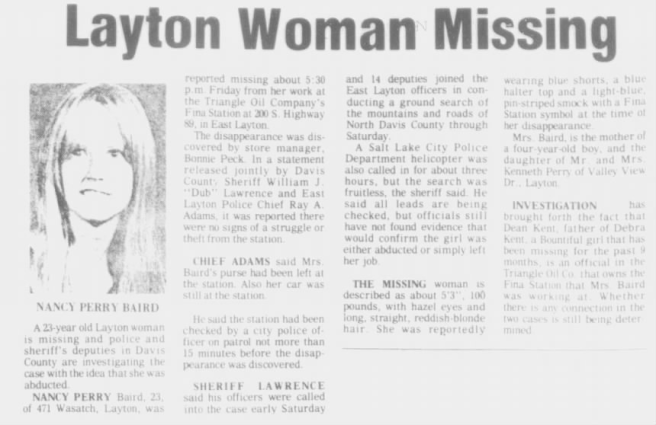
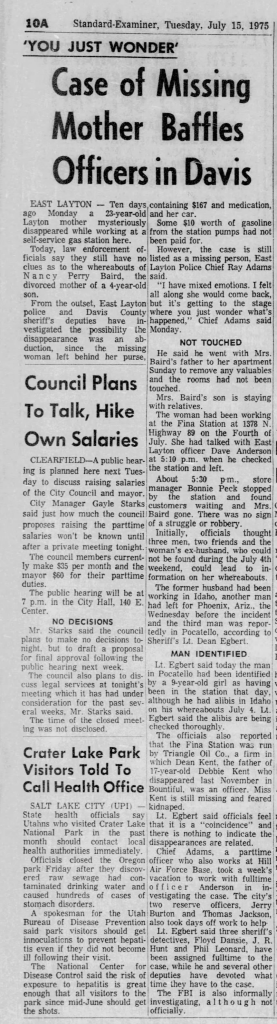
When Perry-Baird’s manager Bonnie Peck popped in to pick up some soda water at around 5:30, she came into a line of customers and no cashier. Not long after Officer Anderson returned, he encountered Peck and quickly realized that sometime in the past fifteen to twenty minutes Nancy Perry-Baird had somehow vanished off the face of the earth. The only thing out of the ordinary was that there was $10 worth of gas on a pump that hadn’t been paid for (the average cost of a gallon of gas in 1975 was .57 cents, so that was a good amount of fuel). Nancy’s locked car was still in the parking lot, and her handbag that contained her cashed paycheck ($167), car/house keys, headache medications, and other personal belongings were found inside the station. She was last seen wearing a blue halter top with blue shorts, a gold pinky ring inlaid with a ruby in the center that had two smaller rubies on each side of the center stone, and over her street clothes was her work attire: a blue pinstriped smock-type shirt with the Fina Gas Station logo embroidered on it. At the time Nancy was working her son was with relatives.
Immediately after Nancy disappeared the East Layton police immediately requested assistance of the Davis County Sheriff’s Office in searching for Nancy Perry-Baird. By July 7th, law enforcement exhausted their land and air searches and shifted their focus to talking to Nancy’s family, friends, acquaintances, and customers. Police were able to obtain receipts from the gas station for the hours she worked and were able to track down a good number of her customers. One by the name of Denzel G. Williams who was a resident of Kaysville was contacted by law enforcement because a credit card receipt proved that he had purchased gasoline during the time Nancy was there.
By July 7th, law enforcement exhausted their land and air searches and shifted their focus to talking to Nancy’s family, friends, acquaintances, and customers. Police were able to obtain receipts from the gas station for the hours she worked and were able to track down a good number of her customers that day, one of those people being Denzel G. Williams, who was a resident of nearby Kaysville: Davis County sheriff’s detective Kenny Payne interviewed Williams on July 5, 1975, who shared he was there to fill up the family car and a gas can before a trip to Park City the next morning, and was there with his thirteen-year-old son David and nine-year-old daughter, Jana; he estimated they were there between roughly 5:10 and 5:15 PM. Williams himself never entered the service station, but his daughter went in to buy a bottle of raspberry soda (she only had 28 cents on her and the beverage cost 29, but Nancy let the penny slide and gave it to her anyways). The report said Nancy Perry-Baird had not appeared ‘alarmed or nervous’ at the time of her interaction with Jana Williams, who later said in an interview with COLD that she does ‘remember that she was very kind.’ In that same interview David said, ‘I didn’t want to interrupt this conversation they were having. They weren’t in a hurry to leave or anything.’
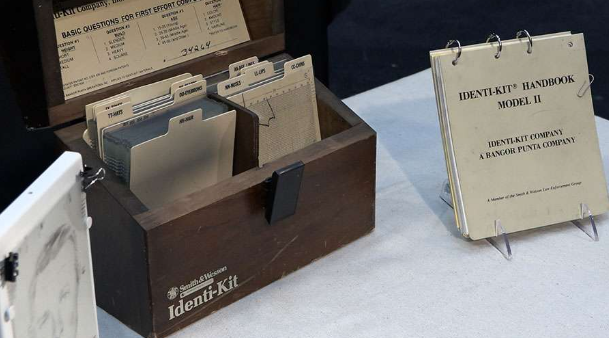
The young girl also said that two young white men that were in their early twenties’ were chatting with Nancy at the other end of the counter but didn’t appear to be buying anything. The Williams children were able to provide police with descriptions of the men they saw, which allowed them to use a tool called an ‘Identi-Kit’ that helped build composite images. Police labeled the men ‘subject #1’ and ‘subject #2,’ and both were determined to be ‘hippie type individuals’ (why does this term keep coming up?): Subject #1 was described as ‘skinny, had shoulder-length hair, a beard and mustache and wore a denim jacket with frayed edges.’ Subject #2 also had a beard and mustache, however his hair only came to the bottom of his ears and he was wearing a yellow long-sleeved shirt.
Jana Williams-Grow recalled in her interview that she felt scared at the time she gave her initial interview in July 1975, and she had been worried the men she and her brother described to police might try to seek revenge against them: ‘I thought they’d find me.’ The long-forgotten feeling resurfaced when she viewed the composites again, saying: ‘I got a little bit sick to my stomach when I saw him because I do remember him.’
Mr. Williams remembered seeing what he thought was a bright yellow 1973 four-door Ford Maverick with a white stripe along the side and that the recalled seeing a third man outside the gas station, who he described as being between fifty-five to sixty years old and very slender, with a full head of gray hair and overly prominent veins on his arms. He said the gentleman went into the exterior men’s restroom and came out while he was still pumping his gasoline. Williams said that he never went inside the station and after he filled up his gas tank gave his card to his son David, who went inside and paid. He said that it takes about four to five minutes to drive to his house from the Fina station, and he very clearly remembered being home before 5:30, which was exactly when his brother came over for a visit.
Another important eyewitness is Mrs. Henry Heath, who reached out to the police because she had stopped by the gas station around 5:30 PM to buy film and witnessed several people milling around the counter waiting for assistance. She distinctly remembered a Caucasian man in his late 20’s with medium length brown hair styled neatly with a bit of facial stubble buying what appeared to be a ‘canned beverage.’Mrs. Heath further reported that she saw a Mexican man with two small boys that were also standing at the counter waiting to purchase some items. Lastly, there was a visibly irritated tall, thin, white male in his fifties’ who (most likely upset by the lack of customer service) put a six pack of beer down and walked out. It was at this point that the older woman started poking around the store to see exactly what was going on: she checked the women’s restroom and noticed the door was open and there was no one inside. The man with the two boys looked in the office, which had also been unoccupied. Mrs. Heath also reported seeing a yellow pickup truck hauling a shell camper with a young couple inside; they stopped to get gas and when they weren’t serviced right away blew their horn. After she had been waiting around for roughly five to seven minutes the store manager (Bonnie Peck) came in, and as she was in a hurry made a beeline to the counter. A male customer (obviously a regular that recognized her) made a joke asking if she stepped away for a moment to grab a beer, which is when she asked what was going on and where her cashier was. At this point three people in a van pulled up asking for directions to the Sheriff’s Office (they also announced that one of their vehicles had been impounded), and upon discovering the mess, Peck quickly jumped into action and cashed out the waiting customers. Mrs. Heath paid for her film and remembered getting home roughly ten minutes before 6 PM.
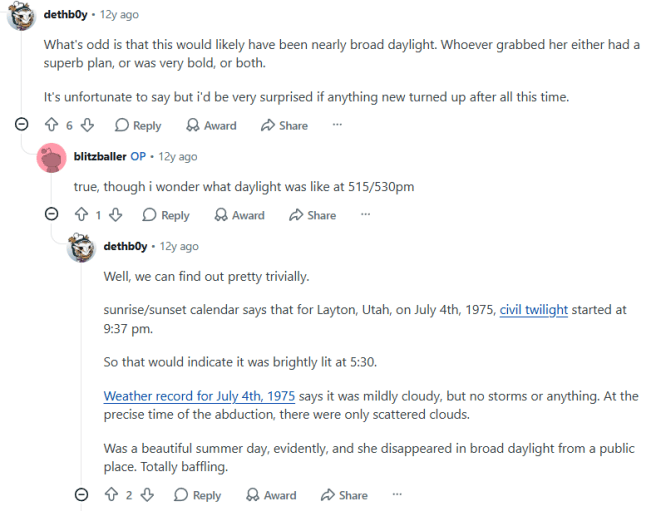
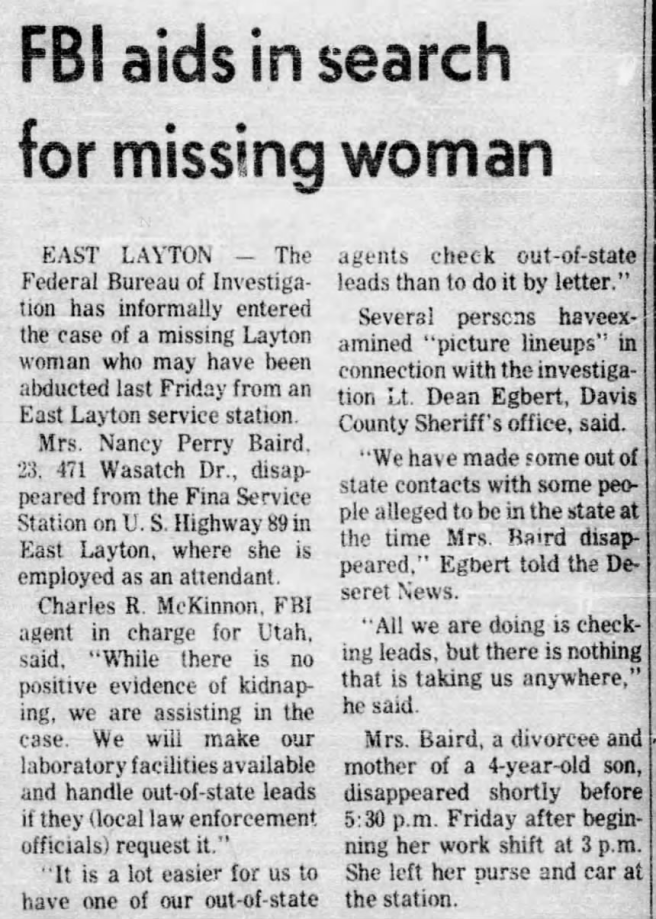
What happened in the fifteen to twenty minutes between Mr. Williams leaving the gas station and Mrs. Heath showing up? One of the stranger parts of this case is (to me) how she was abducted in the middle of the day on a holiday during peak business hours. Why risk abducting someone then? Why not wait until 9:00 or 10:00 at night when there’s fewer customers and you’re protected by a cloak of darkness? The FBI briefly got involved in the case because initially it was suspected that maybe Nancy had been kidnapped, but after about six weeks and no leads they eventually left things in the hands of local law enforcement (as they were unable to prove anything and weren’t able to officially take on the investigation if she was abducted). Over the years since she disappeared hundreds of Nancy’s family, friends, and acquaintances were interviewed and polygraphed and everyone passed.
In a joint statement released by former Davis County Sheriff William J. ‘Dub’ Lawrence and Chief Adams, it was reported there were no signs of a struggle or theft from the Fina station (aside from the $10 worth of gas). Thankfully Nancy’s disappearance was taken seriously from the start, but it makes sense it was when comparing this case to the other missing girls in Utah at the time… after all, she had a young son, a stable job, and was a bit older than most of the other victims (even though Caryn Campbell was also twenty-three, Denise Oliverson was twenty-four, and Julie Cunningham was twenty-six). Family and friends told LEO’s there were no signs that Nancy had any intention of leaving or taking off and all of her personal belongings were left behind in her residence and no money was taken, which almost makes me think she was an intended target and the attack was not meant to be a robbery. Additionally, her manager said she was always on time to work and was a good employee, which makes me think she wouldn’t have just walked off the job or just left.
Law enforcement interviewed Perry-Baird’s family the night she disappeared, but they were unable to offer much help, however they did say that they felt it especially odd that she left behind $167 in cash… but what if Nancy staged an abduction so she could intentionally disappear? Maybe then it might make sense? Law enforcement officer’s spoke with RichardMarinoka from the employment office in Ogden, UT on July 8, who said that Nancy had come in to speak with someone earlier that March because she was apparently unhappy at her job and wanted to find a better one. Was she depressed about her current situation and trying to disappear?
When police searched Nancy’s bedroom, they found a phone number scribbled on a pad of paper near the phone that belonged to a female relative in Lakewood, Colorado, however when they called her, she claimed she hadn’t had any contact with Perry-Baird for about two and a half years. From her residence, law enforcement also collected a hairbrush that had strands of Nancy’s hair tangled in the bristles as well as her birth control pills (which showed that she hadn’t taken any since April 7), her address book, and a photo album. Now…. why does a woman stop taking the pill? Well, there are a few reasons: 1) she was not having any sex at all, 2) she wanted to get pregnant, or 3) she already was; this (in my opinion) throws a wrench in things. It’s also worth mentioning that (according to the police report) there were nine different men that Nancy had some sort of past or current romantic involvement with, so my educated assumption is she had some sort of active sex life.
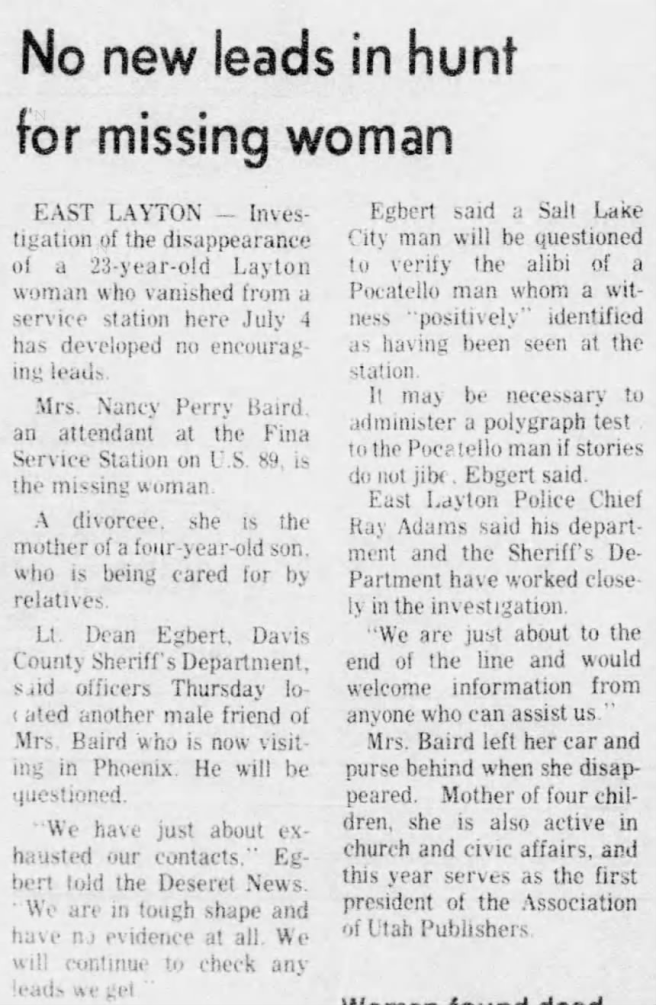
Sheriff’s detectives compared pictures in Nancy’s photo album to the two composite images of the men that David and Jana Williams had reported seeing inside the Fina station, and in her case file a lieutenant with the sheriff’s department wrote: ‘there was a very similar likeness of one of the Identi-Kit composites to a picture’ that had the name ‘Monty’ written on it. Deputies quickly identified the man in the photo as Monty Torres, and when they showed the photo to Jana Williams, she was able to ‘positively identified Monte (sic) Torres as one of the hippie type individuals that was in the service station.’
Sheriff Lawrence brought fourteen deputies to the general area where Nancy was last seen early on Saturday, July 5, and those LEO’s joined the four East Layton officers in a ground search of the mountains and roads of nearby North Davis County. Lawrence commented that: ‘we’re treating it as if it were the worst, but hoping she’ll come home.’ A SLC Police Department helicopter was also brought in for about three hours to search both sides of the highway, but with no success. The sheriff said that all leads were checked out, but the case quickly ran dry then eventually went cold. About two months after she vanished two residents in Castle Rock, Utah reported that they thought they saw Nancy shopping at a local food store (unfortunately nothing came from that sighting), and it’s worth mentioning that Castle Rock is only a 30 minute drive away from Lakewood, which is where that female relative of Nancy’s lived whose phone number was written down on the pad of paper next to her bed.
Floyd Baird was out of state when his ex-wife disappeared, and he was officially cleared by authorities in late 1975; at the time Nancy disappeared he had been working on an electrical job in Rexburg, Idaho, and spent the fourth of July in Jackson Hole with a friend (Rick Thomas), either river running or kayaking. Interestingly enough, he did share with investigators that despite being separated from Nancy they still went out on the occasional date now and then; additionally, her other boyfriends alibi’s held up as well, and one of them (a man named Dennis Forsgren), told investigators that he had been out of state vacationing with his family at the time (this was later verified).
According to neighbors, Nancy hired Monty Torres to mow her lawn the month before she disappeared, and when Davis County Sheriff’s deputies were finally able to him down, he was in Pocatello, ID and clarified that he had been there on the afternoon of July 4, 1975 as well. LEO’s in Utah asked the Bannock County Sheriff’s Office in Idaho to locate and interview him. When a detective made contact with him, they described him as being ‘quite jittery;’ despite this, Torres reportedly said he’d been at Lava Hot Springs on the afternoon of Nancy Perry–Baird’s disappearance.
Torres was able to provide detectives with multiple alibis (who confirmed they saw him at 1 PM and again at 7 PM), and told investigators the last time he saw Nancy was about a month before she disappeared (his mom volunteered that she hadn’t seen her son in about three months). Additionally, two other male acquaintances of the young divorcee were questioned: Reed Miller and a man whose name was redacted. DeputyBen Reichel interviewed Miller, (who like Nancy’s ex-husband was also in the Jackson Hole area that holiday weekend), who shared that he knew her since the winter of 1972, and at one point the two were pretty serious, but when he shared that he didn’t have any interest in getting married things cooled down pretty quick. The two saw each other for the last time on June 28th when they went out on a date. Miller, Torres, and Baird were polygraphed and all three men passed.
Not many details are known about Nancy’s mystery man, but one fact that was made public is that law enforcement tried to speakto him on multiple occasions, but he dodged their every attempt. In a report completed by Officer Anderson that was dated July 8,1975, Perry-Baird’s parents provided investigators with two pictures of the mystery boyfriend, and according to reports, he worked in a warehouse setting and his foreman/supervisor shared that he left for Phoenix to see his parents on July 2nd and wasn’t due to be back to work until either July 12/13. After they exhausted all efforts to speak to him, law enforcement tried to locate members of his family, and the closest ones they found were a cousin and an aunt: the cousin shared that he split up with his wife in June 1975 but was supposedly thinking about getting back together with her, and his aunt (Mrs. Frank Olson) stated she didn’t associate with her brother or his side of the family.
At the time Nancy was abducted in the summer of 1975, Sheriff Lawrence said the department was investigating quite a few high-profile cases and for about a month after she vanished they talked to multiple people of interest but were unable to pinpoint a suspect. He commented that: ‘when a police officer does this for years you develop a sixth sense. You feel it. (Bundy) was the worst of the worst criminals and it took its toll on most of us. We had five missing women at one time. Half we found part of the bodies, some of them.’
Enter Ted Bundy… in the summer of 1975, Ted was enrolled in classes at the University of Utah School of Law and was living at 565 1st Avenue in SLC (he was there from September of 1974 to September of 1975); according to the FBI Bundy Multiagency Investigative Team Report 1992, his activity is unaccounted for on July 4, 1975. From June to July 1975, he was briefly employed as the night manager in charge of Bailiff Hall at the University of Utah (he was fired for showing up drunk), and from July to August 1975 he was a PT security guard for the school (his position was terminated due to budget cuts).
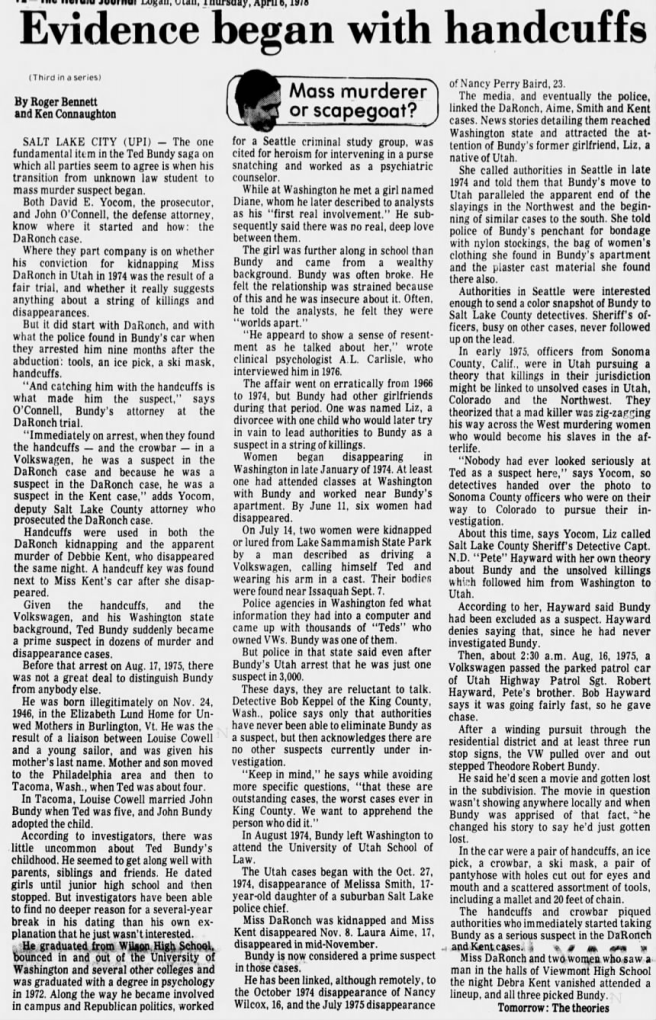
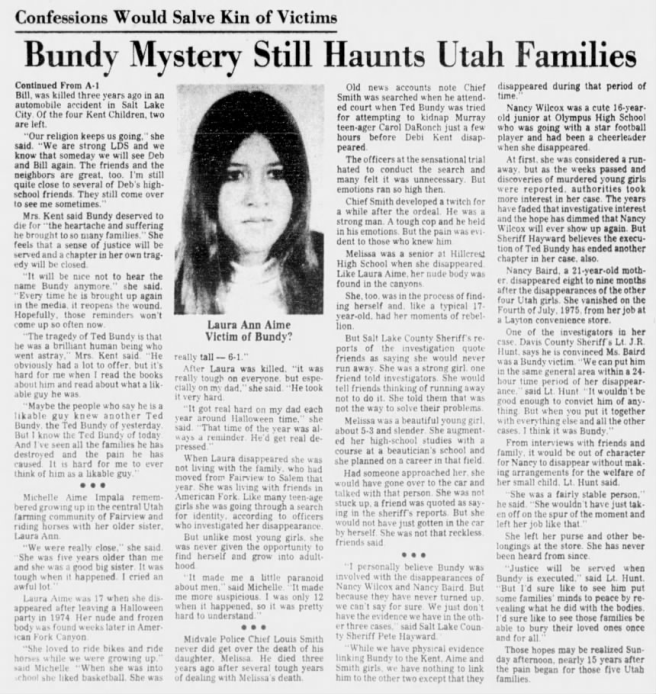
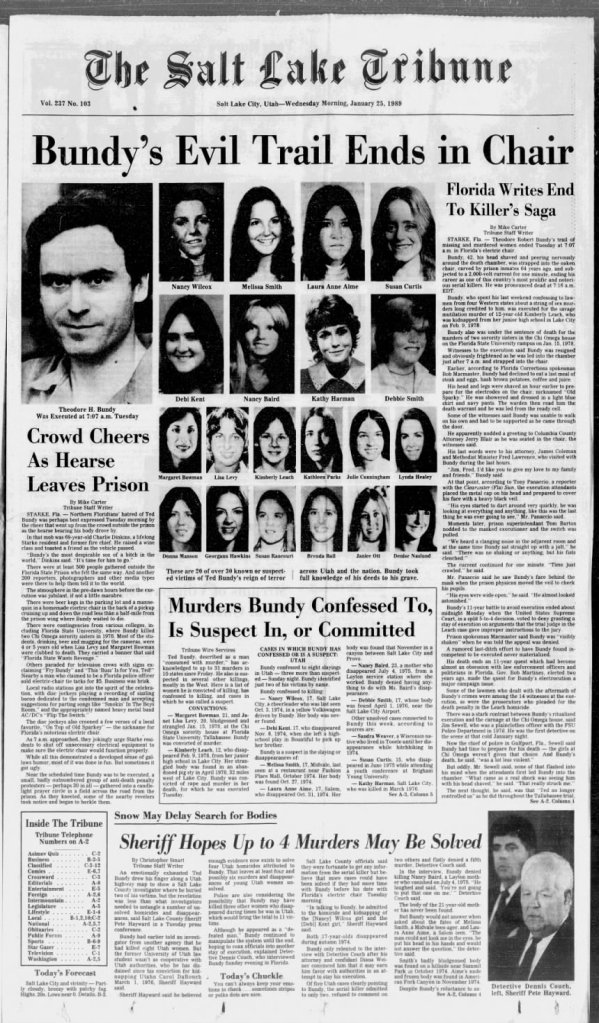
It’s obvious by her physical description that Nancy fit Bundy’s typical victim profile, however it is worth noting that the scene is outside of a school setting, and I never heard of Ted going after anyone at a store/gas station before. Before Perry-Baird’s disappearance, his last confirmed victim was Susan Curtis on June 28, 1975 out of Provo, Utah: the 12 year old child vanished from Brigham Young University and Ted later told law enforcement he buried her roughly seventy-five miles away… but, if you’re considering the unconfirmed victims, on June 29, 1975, Shelley K. Robertson disappeared out of Golden, CO, and her body was found in a mine shaft near Georgetown seven weeks later. Ted’s reign of terror didn’t last much longer after Nancy disappeared, and early in the morning on August 16th, 1975 Utah State Trooper Sergeant Bob Hayward arrested him in Granger after leading him on a mile and a half long car chase.
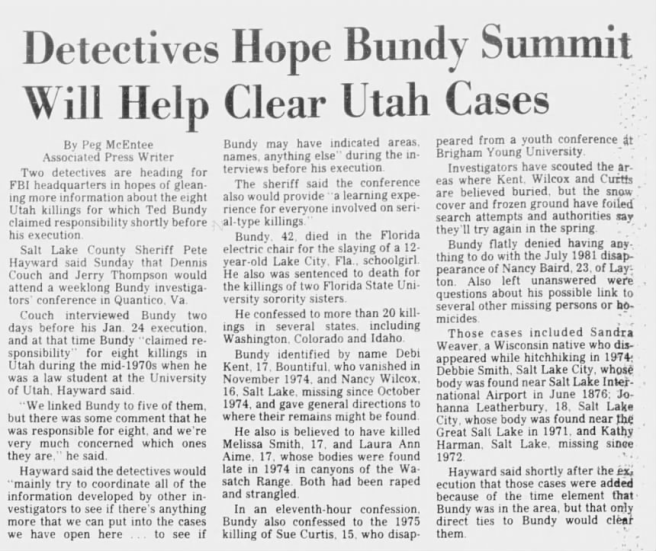
Bundy residing in the area is really the only thing police have linking him to Perry-Baird’s disappearance: no one at the Fina station reported seeing a VW nearby (let’s face it, a Bug is a fairly memorable vehicle) or a man that fit his physical description, and unlike Nancy Wilcox (for example), there was never any mention of a mysterious law student in her life (it’s been speculated Ted went into the cafe where Wilcox worked and flirted with her). When asked about Nancy Perry-Baird’s disappearance during his death row interviews, Ted denied any responsibility: during his interview with Ted, Dennis Couch asked him, ‘do you recall what type of place it was (Perry-Baird) was working at or where it was located?,’ to which he replied: ‘no, I didn’t have anything to do with that.’ Later in the interview, the detective showed Bundy a picture of Nancy, and to this, he said, ‘Nancy Baird, who’s that?’
After Ted was arrested in SLC, Sheriff Lawrence’s team of detectives started looking into his background in relation to Nancy’s abduction, saying ‘we had him in Rock Springs, Wyoming which put him on Interstate-80 coming back from Colorado.’ From Rock Springs, Lawrence said Bundy headed west into Utah and chose to return to Salt Lake using Interstate-84: ‘we don’t have any gas receipts that he stopped in the area.’ The Sheriff theorized that at one point Ted headed south on Highway-89, the same roadway where the Fina gas station Nancy worked at was located, saying ‘there’s no women missing (along I-80). There was no abduction on 80-coming in.’ The sheriff strongly believes that the serial killer murdered Perry-Baird then disposed of her remains in Lambs Canyon, saying ‘Ted Bundy was tired, he had driven all day. I believe he went to somewhere that was close. It was handy, it was safe, it was secure.’
Sheriff Lawrence also said that Bundy was familiar with that particular area in Utah and that the body of Melissa Smith was found just about ten miles away in Parleys Canyon: ‘it’s what we call the law of probability. It’s not provable but if you work back by process of elimination you come up with the most logical scenario.’ In the pictures section below, I included a WebSleuth’s comment saying that East Layton law enforcement claimed Bundy fueled up at Nancy’s POE at least once in 1975, and according to Investigative Sergeant Ryan Kirkman with the Davis County Sheriff’s Office in Utah: ‘I wouldn’t say that we’re heavily looking at Ted Bundy. He is a name in the case file that certainly hasn’t been 100% ruled out, but it’s nobody that we’re focusing on at this time.’
The Davis County Sheriff’s Office provided a sample of Nancy Perry-Baird’s hair (that was collected from her hairbrush) to the FBI to compare to the unidentified hairs collected from Bundy’s car, and it was eventually determined that federal agents did not find a match to the samples that were taken from Ted Bundy’s 1968 VW Bug. Despite this, some investigators continue operating on a belief Bundy was somehow involved in whatever had happened to Perry–Baird.
Sadly, at the end of the day Ted’s involvement with the disappearance of Nancy Perry-Baird is just a theory with nothing but weak, circumstantial evidence and at the end of the day there just wasn’t enough for prosecutors to bring him up on charges. Despite Ted denying any involvement with Perry–Baird’s death, Sheriff Lawrence doesn’t believe him: ‘he admitted that he had some of the heads of his victims in Utah at his apartment. He mentioned Lamb’s Canyon.’ Additionally, Perry-Baird’s in-laws don’t believe Bundy either and also felt he was responsible for her murder: her FIL Wally Baird felt Ted’s denial could have possibly been a cover-up: ‘he may have been that way because he didn’t know at the time that she had kids, a child and had been married. That was something that was contrary to his MO.’
According to Killer in the Archives creator Tiffany Jean, records from the Carol DaRonch kidnapping case show that during the summer of 1975 Bundy briefly dated a SLC schoolteacher named Leslie Knudson:Jean said that Knudson was able to provide law enforcement with an alibi for her beau on that fourth of July weekend in 1975 and the pair had attended a family reunion at her family’s ranch. Her maternal grandfather was a sheep rancher and owned property in Fruitland, UT, which is more than one-hundred miles from the gas station where Nancy Perry-Baird disappeared from. According to Jean, ‘it would be pretty difficult for (Bundy) to have done both things on that day because it would have been quite a drive, but it doesn’t seem like anyone else has ever put those together, that (Bundy) was with (Knudson) on the day that this crime occurred.’
According to Leslie, ‘I know he was in Colorado that summer, for sure, I just don’t know the weekend. And the 4th of July is when we would’ve gone to the family ranch. So I was definitely seeing him the 4th of July.‘ … ‘I took him to a family reunion so all of my relatives got to meet him. He was appealing, for sure. My parents were very proud of me.’ Leslie did not disclose the whereabouts of her family ranch in her phone call with Chris, but COLD used genealogical records to pinpoint the ranch’s location as Deep Creek, located between Strawberry Reservoir and the town of Fruitland in the Uinta Basin (which is a prominent physiographic and geologic structural basin located primarily in northeastern Utah but extends slightly into northwestern Colorado).
If Bundy had left the Deep Creek ranch, driven to East Layton to abduct Perry-Baird, thenreturned to the ranch, the round trip would have required roughly four hours (and that isn’t including the time spent abducting Nancy, killing her; then disposing of her body): If Bundy instead departed the Deep Creek ranch and headed for his home in SLC, his most likely route would not have taken him through East Layton, and to pass by the Fina station while on his way home from the ranch, he would have needed to make a lengthy and indirect detour north on Interstate-84 to Weber Canyon, then south along US Highway-89 (which runs along the Wasatch foothills on the eastern edge of Layton, positioned just east of the main city center and Hill Air Force Base).
Additionally, at the time of Perry-Baird’s disappearance investigators commented that they found no evidence that made them think her case had anything to do with the then nine-month-old disappearance of Debbie Kent, who was abducted from the parking lot of Viewmont High School on November 8,1974 in Bountiful (for reference, the school was about a forty-five-minute drive away from the gas station); as of March 2023, only Kent’s patella has been recovered. Here’s an interesting factoid: according to a 1975 article published by the Davis County Clipper, Deb’s father was employed with the Triangle Oil Company, which owned the Fina gas station that Perry–Baird was employed at.
Recently a new theory on Perry-Baird’s strange disappearance has emerged: The Utah Cold Case Coalition noticed that the investigation pretty much stopped after Bundy was arrested and came into the picture, and one of their co-founders Karra Porter commented that ‘a lot of the investigation stopped there. So, we talked to quite a few people that were never interviewed’ (some of them including former LEO’s that worked the case when Nancy first disappeared). The coalition has recently come across two possible persons of interest, one of them being a young man that was trying to date Perry–Baird at the time she disappeared (the feeling wasn’t mutual), and one of the names we’ve been given by former law enforcement does have a subsequent history of sex offenses and a criminal record and so that at least adds to the red flag (he even had a history that landed him in prison)’ … ‘What we’ve learned so far is that one of the two suspects would be consistent with potentially having a pickup like that.’ Porter elaborated that new eyewitnesses that were never before interviewed said they remember seeing a pickup truck leaving the area at roughly the time Nancy was abducted, (which jumps out at me a bit because when Bundy relocated from Seattle to SLC he did have an old pickup truck to help with the move); she also said that of the two potential suspects one stands out a touch more than the other.
It’s speculated that Nancy’s case may somehow be related to the disappearance of another young woman named Cheryl Scherer. Nineteen-year-old Scherer vanished out of thin air from Rhoades Pump-Ur-Own self-service station in Scott City, Missouri sometime between 11:40 and 11:50 AM on April 17, 1979. The two women shared many similar characteristics (such as age, body type, and hairstyle) and disappeared under incredibly similar circumstances. Two hours before her shift ended, Cheryl called her mother who later told police nothing about the conversation was out of the ordinary and that her daughter seemed to be in a good mood. A coworker eventually came in to find the station deserted and ransacked. Just like Perry-Baird, Scherer’s car was left in the parking lot (with the keys inside) and her purse and checkbook were left inside her POE (however in this situation $480 was missing from the cash register). Police speculated the young girl was abducted after a robbery but there were no witnesses. The depraved serial killers OtisToole and Henry Lee Lucas admitted to an abduction during that time and it’s strongly suspected they are responsible for Scherer’s disappearance. Both men denied any involvement in either girls disappearance.
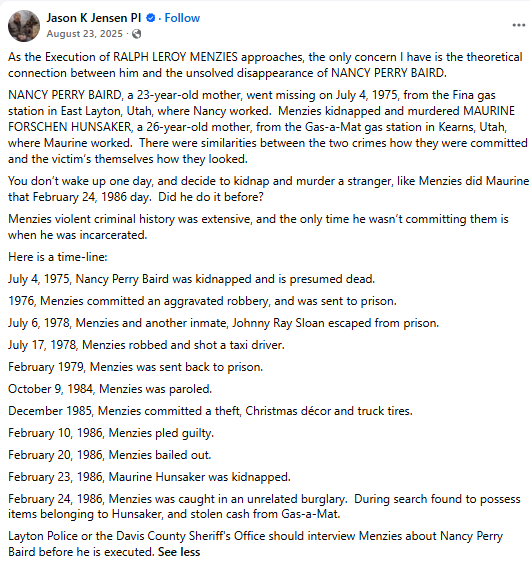
Ralph Leroy Menzies: one name that I came across while researching Nancy Perry-Baird’s case was Ralph Menzies, a convicted serial killer that spent thirty-seven years on death row in Utah. On February 23, 1986, Menzies abducted twenty-six-year-old mother Maurine Hunsaker from her job at a gas station in Kearns, Utah; her body was discovered two days later tied to a tree in Big Cottonwood Canyon. She had been strangled and her throat was slashed. Investigators linked Menzies to the crime after finding his ID cards in a jail booking area following an arrest for an unrelated offense, and a subsequent search of his apartment uncovered Hunsaker’s purse. In March 1988, he was found guilty of capital murder and aggravated kidnapping, and he was given a death sentence.
Menzies’ case drew significant national attention during his final years due to his rapidly deteriorating health: during the nearly four decades he spent at the Utah State Correctional Facility, he developed severe vascular dementia, and his lawyers argued that he required a wheelchair and supplemental oxygen and no longer understood why he was there or why he was being punished. He was scheduled to be executed on September 5, 2025, but in August 2025, the Utah Supreme Court issued a stay of execution, ruling that his progressive cognitive decline raised serious constitutional questions regarding his competence to be executed.
Just days before his death (which was supposed to be by firing squad), an evaluation by the Utah Department of Health and Human Services concluded that Menzies was mentally incompetent for execution and that his condition was untreatable. He died at a local hospital before the state could formally challenge the medical report or hold its scheduled December competency hearing. According to media reports from the Associated Press, his death brought a sense of relief and closure to the family of Maurine Hunsaker after thirty-seven years of legal uncertainty. Menzies passed away at age sixty-seven from natural causes on November 26, 2025, just weeks before a critical legal hearing regarding his mental competency.
Thomas Richard Jackson: at the time Nancy vanished in July of 1975, a young reserve officer named Thomas Jackson was the newest member of the East Layton police force, and her case file shows he didn’t play a huge role in her investigation… but he did share with COLD that he didn’t feel Ted Bundy was responsible for Perry-Baird’s disappearance, and instead speculated it was his colleague, officer Dave Anderson that caused the young mothers demise (in his opinion, ‘Anderson spent too much time looking at women’). At the time of her disappearance in July 1975, he had only been a police officer for about ten months, and a few former law enforcement-related sources familiar with East Layton police operations in the 1970’s shared with the podcast that most of Anderson’s time was spent patrolling US Highway-89, which is the same stretch of road that Nancy’s place of employment was located on; he left his position with the East Layton PD almost right after she vanished, and case records do not show that he was ever investigated or challenged in any way regarding his account of her disappearance.
Conclusion: after she disappeared, Perry-Baird’s son was told that his mother was ‘vacationing’ and he was sent to live with relatives. Newer technology at a Texas University helped forensic experts create a DNA profile for her based on genetic samples provided by her family. Nancy Perry-Baird would be 74 years old as of October 2026, and despite her remains never being recovered, she has a memorial stone in Provo City Cemetery; her date of death is listed as July 4, 1975.
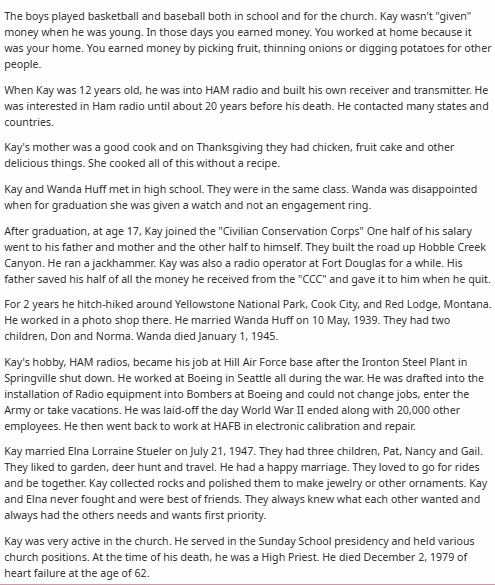
Nancy’s Father Kenneth Stewart Perry. passed away of heart failure at the age of sixty-two on December 2, 1979; he was buried in Provo City Cemetery. According to his obituary, after he graduated from high school, he joined the ‘Civilian Conservation Corps,’ a federal work relief program established by President Franklin D. Roosevelt in 1933 as part of the New Deal. Upon completion of the program he hitch-hiked around Yellowstone National Park, Cook City, and Red Lodge, Montana for two years.
During WWII, Kay worked at Boeing in Seattle, and his HAM radio hobby became his job at Hill Air Force base after the Ironton Steel Plant in Springville was shut down. After he was laid off the day World War II ended, he eventually went back to work at HAFB in electronic calibration and repair. His hobbies included gardening, deer hunting and traveling. He was also very active in his church and served in the Sunday School presidency and held various church positions (at the time of his death, he was a High Priest).
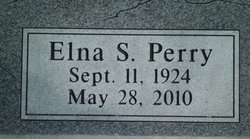
Nancy’s mother Elna Lorraine Stueler-Perry of South Ogden passed away at the age of eighty-five on May 28, 2010. According to her obituary, the Perry family were devoted members of The Church of Jesus Christ of Latter-Day Saints (where she was the organist and visiting teacher for many years), and in 1948 her and Kenneth were sealed in the Salt Lake Temple. She enjoyed embroidery, crochet, gardening, rock collecting, all animals, and the desert; her greatest love was driving, and she would take daily trips to ‘get lost,’ have lunch, and visit friends and family. She was loved for her spunk and ‘tell it like it is’ attitude.
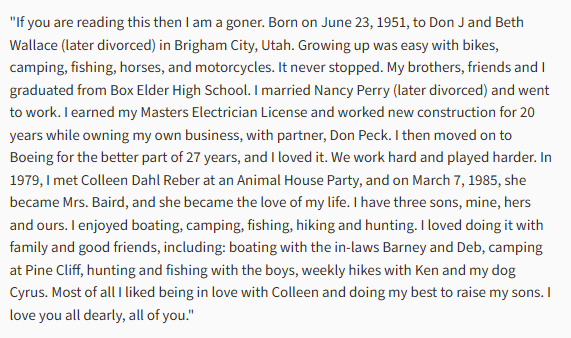
Floyd Dee Baird passed away peacefully at the age of sixty-six on March 17, 2018 in his home in Salt Lake City after years of battling Idiopathic Pulmonary Fibrosis; Dee is survived by his wife Colleen Dahl Reber-Baird, three sons, two grandchildren, and his faithful four-legged companion named Kolt. According to his Legacy page, he was an extraordinary man who lived life to the fullest while making a positive impact on all those he came across that loved with all his heart, and in return was loved by so many. If Dee couldn’t fix it, then it couldn’t be fixed. Some of Dee’s greatest memories include ‘The Hook Willey,’ an annual guy’s only fishing trip down The Green River during Mother’s Day weekend. He was an avid fly fisherman and loved waking up early to catch the first fish of the day. Other great memories include Lake Powell, Starvation Reservoir, going on long mountain drives with a truck full of family and friends, sitting around the campfire telling stories, and raising too many dogs to name. Dee was an avid U of U sports fan (‘GO UTES!), and in his younger days he loved bowling, and was in a few different leagues; he also loved snow skiing at Snowbasin with his family.
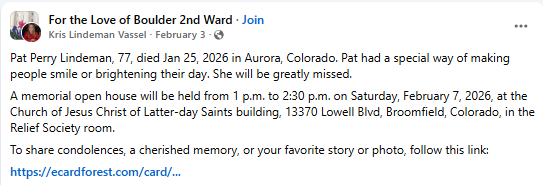
Nancy’s sister Pat Perry-Lindeman died at the age of seventy-seven on January 25, 2026 in Aurora, Colorado. According to her obituary, Pat was born on July 17, 1948, and she had a special way of making people smile or brightening their day; she was always non-judgmental and kind. She will be greatly missed.
*** Update, August 2023: I’m always updating my articles as I come across new information, and recently I found the initial police report (thanks to the COLD Podcast) as well as a newly published article by ksltv.com. After initially being denied a request for Nancy’s case file by Davis County Sheriff’s Office, the podcast filed an appeal, and the original determination was overturned and the request was granted (with portions redacted).
Perry-Baird’s name came to the attention of the podcast’s co-collaborators Dave Cawley and Keira Fairmont while conducting research on the Sheree Warren case, a twenty-five-year-old Utah woman who mysteriously disappeared on October 2, 1985 after she left her temporary workplace at the Utah Employees Credit Union in SLC; though her vehicle was recovered weeks later in Las Vegas, her body has never been recovered. Apparently, an informant named William Babbel began communicating with the FBI in February of 1989 while incarcerated at Florida State Prison, who shared that he was at one point incarcerated with Warren’s ex-boyfriend Cary Hartmann, who at the time was serving a prison sentence of fifteen-years-to-life for an aggravated sexual assault in Ogden. Although Fairmont vanished years after Nancy in 1985, their cases had some eerie similarities: both women were recently divorced from (or were in the process of the act) and their spouses and were primary caregivers for their young sons. Additionally, they were about the same age at the time of their disappearances, and both women were last seen at their places of employment.
Babbel reportedly claimed that Hartmann had been ‘openly talking about Warren’s disappearance’ and the FBI clarified that he told one of their agents he ‘questioned why Ted Bundy was blamed for the disappearance of Nancy Perry-Baird.’ … ‘on one occasion, Hartmann was looking at a newspaper article depicting Ted Bundy along with photos of many of his victims. Hartmann placed an ‘X’ by the photos of five of Bundy’s alleged victims.’ FBI Special Agent Gregory Hall later commented that Babbel ‘learned that Cary Hartmann was an acquaintance of Nancy Baird. Baird’s disappearance allegedly occurred while Hartmann was experiencing a divorce.’ At the time Nancy disappeared in July 1975, Hartmann had been between his two marriages, so Babbel’s information seemed to have at least a glimmer of credibility, however the agency later dropped the inmate as an informant, claiming he was unreliable. In addition to Perry-Baird and Warren, he also attempted to tell the FBI about information related to the disappearance of Joyce Yost, a thirty-nine-year-old woman from Utah who was murdered in August 1985 by Douglas Anderson Lovell. She was killed to prevent her from testifying against him in an upcoming rape trial and her body has never been recovered.
One new piece of information I gathered from Nancy’s case file that I didn’t know beforehand was an account from a friend of hers named Deloris Drake, who lived in nearbyOgden. She told a detective that on the evening of July 2, 1975 they went to a few bars together along Ogden’s Washington Boulevard, including Rigos and the Iron Horse. When they were finished with their night out Drake drove them back to her house at around 2:30 AM on July 3, 1975 and from there Nancy left for her own residence in East Layton. About thirty minutes after leaving, she returned to her friend’s home, saying she ‘appeared to be quite shaken and frightened because a man named Tom in a yellow Volkswagenvan had followed her home.’ Tom had apparently pursued Perry-Baird and followed her back to Drakes and was making threatening comments towards her as she entered the residence; Deloris later told law enforcement that she had seen a second man with ‘Tom’ that was on a motorcycle.
*** Update, October 2026: on September 23, 2026, the COLD Podcast premiered a new episode of its acclaimed investigative series titled, ‘Who Took Nancy Baird?,’ where the host Dave Cawley went over Perry-Baird’s original case file, exposing how the now-defunct East Layton Police Department heavily fumbled the initial investigation. In that episode, Nancy’s son Brant (who had only been four years old at the time his mother vanished) came forward and spoke publicly for the first time about his mom since she disappeared in July 1975.
Brant Baird: Nancy Perry-Baird’s parents, ex-husband, her son Brant, and the rest of her family stayed out of the intrusive public eye brought on by the ‘Bundy hype,’ and coped with their grief in quiet anonymity. For decades, Brant avoided talking about it with almost anyone, and ‘growing up, it was really painful. Any kind of question about my parents, I’d always just say my mother died when I was young.’ About the recent interest in his mom’s disappearance amongst true crime fans, Brant said ‘she’s been on multiple podcasts and many articles and blogs. There’s been a bunch of stuff, but I’ve never really gone down those rabbit holes.’
A relative of Brants who had listened to COLD told him that he ought to make an exception, because the podcast had obtained his mother’s case file and uncovered a great deal of newly released information that included the fact that Ted Bundy had an alibi for the day she disappeared: ‘my cousin’s wife called me and was like, ‘Hey, you may want to listen to this,’ so I listened to it over and over.’
Thomas Richard Jackson: in recent years there has been a rejuvenated investigative effort by the Davis County Sheriff’s Office that pivoted almost entirely toward former East Layton police officer Thomas Richard Jackson (who as of October 2026 is seventy-years old). Jackson served as an officer with the department from April 1975 to July 1976 and was one of the initial individuals handling the disappearance of Nancy. In recent years investigators revealed that he was subjected to a polygraph test in 2023 regarding the disappearance, which he failed after giving inconsistent timeline statements.
In 1986, Jackson was arrested and convicted in Utah on felony charges of sexual abuse of a child (which involved his biological daughters), and for this conviction, he received probation, community service, and ordered counseling; his wife (the children’s mother) immediately divorced him after what he did came to light. Sometime upon the termination of his probation, Jackson relocated to Idaho, and where the exact date of the move is not publicly known, records indicate he made the move sometime in the late 1980’s/early 1990’s (where he quickly remarried). In 1995, he was arrested in Jerome County, Idaho, on two counts of lewd conduct with a minor under the age of sixteen when he was charged with the sexual abuse of his stepdaughters; he entered a plea agreement and pled guilty to one count and the district court initially handed down a fixed life sentence, which the Idaho Supreme Court later modified to an indeterminate life sentence with a fifteen-year fixed term; he was released to parole supervision on June 16, 2011.
Acting on tips that he may have been involved in the disappearance of Nancy Perry-Baird, on May 8, 2025 detectives secretly used cadaver dogs and ground-penetrating radar to excavate Jackson’s former 1975 backyard on Gilman Drive. According to Sergeant Kirkman: ‘we were working off a hunch, initially, to be quite honest,’ and that ‘hunch’ was that Perry–Baird’s remains might be buried in the back of Jackson’s one time property. In a search warrant affidavit, Sergeant Kirkman wrote the dog handlers observed ‘alert behavior’ in one spot in the yard. From there, Davis County brought in a private contractor to perform a ground-penetrating radar survey of the yard, which identified a subsurface ‘void’ in the same general area where the dogs had shown their alert behavior. SergeantKirkman presented those circumstances to a judge and requested a search warrant, which would allow detectives to excavate the ‘void,’ but ultimately that specific dig (which has not been previously reported on until later that September 2026) yielded no human remains.
About the dig, according to Sergeant Kirkman, ‘we were working off a hunch, initially, to be quite honest,’ and that ‘hunch’ was that Perry-Baird’s remains might be buried in the back of Jackson’s one time property. Detectives had already searched the yard with the assistance of human remains detection canines, otherwise known as cadaver dogs. In a search warrant affidavit, Kirkman wrote the dog handlers observed ‘alert behavior’ in one spot in the yard. From there, Davis County brought in a private contractor to perform a ground-penetrating radar survey of the yard, who was able to identify a subsurface ‘void’ in the same general area where the dogs had shown their alert behavior. Sergeant Kirkman presented those circumstances to a judge and requested a search warrant, which would allow detectives to excavate the ‘void.’
According to an interview Sergeant Kirkman had with Cold: ‘we ended up ultimately getting a search warrant and digging quite a large hole. Nothing came of that’, and detectives did not locate any trace of human remains and the ‘void’ turned out to be a false positive. About the dig, Kirkman said that Jackson ‘didn’t really care either way that we were back there. We’ve since ruled out the possibility that his former residence could be involved. Investigators also confirmed that as of late 2026 the Davis County Sheriff’s Office is actively investigating two additional potential burial sites tied to Jackson.
In an interview with the COLD podcasters in April of 2023 about his role investigating the Nancy Perry-Baird case, Jackson said he’d first learned she had gone missing when he’d driven by the FINA gas station where she worked and saw Chief Ray Adams and fellow officer David Ray Anderson looking for her. He also shared that he’d informed Adams and Anderson he couldn’t join the search right at that exact moment, as he was on his way to the county sheriff’s office, but according to him, ‘I says, ‘I got to go into County,’ and ‘I’m just going there and coming right back,’ I don’t remember why I was going into the sheriff’s office.’ Based on a timeline of events from an official report authored by officer Anderson, Jackson’s arrival at the scene of Perry-Baird’s disappearance would’ve occurred at approximately 7:30 PM, after she had been missing for about two hours, and it is highly likely that the county offices were closed at this time, as it was after business hours on a federal holiday.
Later in Jackson’s interview with COLD, he made a contradictory statement implying he was on the scene five minutes prior to when Nancy was presumably abducted from her workplace, saying: ‘I wished I would’ve had some kind of an inclination to stick around five minutes, I would’ve loved to have caught somebody doing that.’ The podcast published portions of Jackson’s interview in a podcast episode titled ‘The Convenient Alternative’ in May of 2023,’ and several weeks after its release, detectives from the Davis County Sheriff’s Office and the Layton Police Department visited him at his residence in Idaho; it was at this time consented to speak with investigators and to submit to a polygraph examination about Perry-Baird’s disappearance.
A partial recording of that interrogation obtained by COLD through an open records request showed Jackson denied any involvement in Perry-Baird’s disappearance and he expects to learn the truth of what’d happened to her in the afterlife: ’I’m looking forward to seeing Nancy, I didn’t do that to her. I wouldn’t do that to her. I couldn’t do murder-type things.’ During a polygraph examination that was administered to him on June 15, 2025, Jackson repeatedly answered ‘no’ when asked if he’d physically caused Perry-Baird’s disappearance, if she was dead or dying the last time he’d seen her, or if he could take investigators to Perry-Baird’s body; detectives also questioned him about confirmed instances of the child sex crimes he committed that were unrelated to the Perry-Baird case. A detective later told him that he did not believe he was fully honest in his answers.
During a polygraph examination he was administered on June 15, 2025, Jackson repeatedly answered ‘no’ when asked if he’d physically caused Perry-Baird’s disappearance, if she was dead or dying the last time he’d seen her, or if he could take investigators to Perry-Baird’s body, and detectives also questioned him about confirmed instances of the child sex crimes he committed that were unrelated to the Perry-Baird case. A detective subsequently told Jackson he did not believe Jackson was fully honest in his answers.
As of October 2026, the seventy-eight-year-old Jackson is considered a person of interest in Nancy Perry-Baird’s disappearance, but he is not the only one: investigators have also speculated about the possible involvement of other members of the former East Layton Police Department, including Jackson’s former colleague, David Anderson. Per Sergeant Kirkman, ‘we have various theories about what we think may have happened. We’re working off those. This case is still very active.’
John Sparks: another name that came up in the COLD Podcast is John Sparks, an ex-boyfriend of Nancy’s that she dated before she met her husband. A longtime suspect in the case, former East Layton police officer Thomas Richard Jackson, explicitly redirected attention toward Sparks in interviews, and it’s also worth mentioning that his brother is Kelly Sparks, who later served as the Sheriff ofDavis County. Because of this familial connection, the COLD Podcast raised questions regarding whether John Sparks’ status as an ex-boyfriend created a potential conflict of interest within local law enforcement’s handling or review of the file. As of October 2026 nothing officially links him to Nancy’s disappearance.
The disappearance of Nancy Perry-Baird remains unsolved as of October 2026; the Davis County Sheriff’s Office recently assigned an investigator to review the cold case, in cooperation with the Layton City Police Department.
Works Cited: Cawley, Dave. ‘Son of woman claimed to have been abducted by serial killer Ted Bundy breaks silence.’ (September 24, 2026). Taken from ksl.com on October 3, 2026. Cawley, Dave. ‘Davis County deputies excavate back yard of former police officer in search of cold case victim.’ (October 1, 2026). Taken October 3, 2026 from ksl.com McFall, Michael. ‘Detectives take Another look at Woman’s 4th of July Disappearance.’ (July 5, 2014). Taken March 13, 2023 from archive.sltrib.com
A baby picture of Nancy from 1952.Nancy as a baby in 1952.Nancy Perry-Baird as a child, photo taken in 1960 when she was around eight-years-old.Nancy Perry-Baird as a child, photo taken in 1960 when she was around eight-years-old.Nancy Perry-Baird in her youth sitting at a piano.Nancy Perry-Baird as a child.Nancy with a cat.Nancy.Nancy at the age of fifteen, photo courtesy of Brant Baird.Nancy Perry-Baird’s sophomore year photo taken from the 1968 Layton High School yearbook.Nancy Perry-Baird’s senior year picture taken from the 1969 East Layton High School yearbook.Nancy Perry-Baird’s black & white senior picture taken from the 1969 East Layton High School yearbook.Floyd and Nancy at her high school graduation in 1969.Nancy.A wedding invitation from Floyd and Nancy’s wedding.Nancy on her wedding day.Floyd and Nancy on their wedding day.Nancy with family on her wedding day.A photo from Nancy’s wedding day.Nancy and her son.Nancy Perry-Baird, photo courtesy of KSL.Nancy on a motorcycle.A ‘NamUs’ missing persons poster for Nancy.A Google Maps view of where Nancy was living at the time she disappeared, located at 471 Wasatch in Layton Utah.A Google Maps route from where Nancy was living at the time she disappeared to the gas station she was working at located at 1370 North Highway-89 in Layton.Nancy’s gravestone.A picture of the Finley Creek Jane Doe (l) next to Nancy Perry-Baird (r).Another composite sketch of the Finley Creek Jane Doe
A screenshot of the Fina gas station where Nancy Perry-Baird was working on July 4, 1975, taken from a news story filmed shortly after Nancy disappeared, courtesy of KSLA screenshot of the signs in front of the Fina gas station where Nancy Perry-Baird was working on July 4, 1975, taken from a news story filmed shortly after Nancy disappeared, courtesy of KSLA screenshot of the store portion of the Fina gas station where Nancy Perry-Baird was working on July 4, 1975, taken from a news story filmed shortly after Nancy disappeared, courtesy of KSLA Google Earth view of the Fina gas station where Nancy worked.A screen grab of a comment made on Nancy’s Websleuth’s post made by an acquaintance of hers in high school.Some comments on a Reddit post about the disappearance of Nancy Perry-Baird.Some comments on a Reddit post about the Cold Podcast’s episode about the disappearance of Nancy that was created in August 2026.A comment made on Nancy’s WebSleuth’s page made by someone who now lives close to where the gas station that also lived in the area when she disappeared in 1975; I think the most interesting part is: ‘I have followed this case and know that Bundy used his credit card at that location, at least once (per the East Layton police).’A Facebook post made by true crime researcher Jason K. Jenson about Ralph Menzie’s possible involvement in the disappearance of Nancy Perry-Baird.Floyd and Nancy’s names listed amongst those who applied for their marriage licenses that was published in The Box Elder Journal on April 16, 1970.A birth announcement for Floyd and Nancy’s son published in The Ogden Standard-Examiner on October 14, 1970, clipping found by Teri Offield.Nancy and Floyd are mentioned in Floyd’s sisters’ marriages announcement that was published in The Sun Chronicle on December 2, 1971.An article about Nancy’s disappearance that was published in The Salt Lake Tribune on July 6, 1975.An article about Nancy’s disappearance that was published in The Salt Lake Tribune on July 7, 1975.An article about Nancy’s disappearance that was published in The Deseret News on July 7, 1975.An article about Nancy’s disappearance that was published in The Ogden Standard-Examiner on July 7, 1975.An article about Nancy’s disappearance titled ‘Police Question Friends of Missing Woman, 23’ that was published by The Daily Herald on July 7, 1975.An article about Nancy’s disappearance that was published in The Ogden Standard-Examiner on July 8, 1975.An article about Nancy’s disappearance that was published in The Salt Lake Tribune on July 8, 1975.An article about the FBI informally joining Nancy’s case that was published by The Ogden Standard-Examiner on July 9, 1975.An article about the FBI joining Nancy’s case that was published in The Deseret News on July 9, 1975.An article about the FBI assisting in Nancy’s disappearance that was published in The Salt Lake Tribune on July 9, 1975.An article about Nancy’s disappearance that was published in The Ogden Standard-Examiner on July 10, 1975.An article about Nancy’s disappearance titled ‘Help Sought to Locate Woman, 23′ that was published in The Daily Herald on July 10, 1975.An article about Nancy’s disappearance that was published in The Logan Herald Journal on July 10, 1975.An article about Nancy’s disappearance that was published in The Salt Lake City Tribune on July 10, 1975.An article about the Layton police department checking out a suspect in Pocatello, ID in relation to the disappearance of Nancy Perry-Baird that was published in The Deseret News on July 10, 1975.An article about the disappearance of Nancy Perry-Baird that was published in The Utah Provo Daily Herald on July 10, 1975.An article about the disappearance of Nancy Perry-Baird that was published in The Deseret News on July 11, 1975.An article about the disappearance of Nancy Perry-Baird that was published in The Davis County Clipper on July 11, 1975.An article about Nancy’s disappearance titled ‘Case of Missing Mother Baffles Officers in Davis’ that mentions both David Ray Anderson and Thomas Jackson that was published in The Ogden Standard-Examiner on July 15, 1975.An article about no new leads in relation to Nancy Perry-Baird’s disappearance that was published in The Deseret News on July 28, 1975.An article about the disappearance of Nancy Perry-Baird that was published in The Salt Lake City Tribune on August 25, 1975,An article about Nancy’s disappearance titled, ‘Authorities Still Baffled by Missing Woman, 23’ published in The Ogden Standard-Examiner on September 2, 1975.An article about Nancy’s disappearance titled ‘Missing Layton Woman Spotted? Story Checked’ published in The Ogden Standard-Examiner on September 5, 1975.An article about Nancy’s disappearance that was published in The Ogden Standard-Examiner on November 19, 1975.An article that mentions Nancy Perry-Baird that was published in The Ogden Standard-Examiner on January 13, 1976.An article written a full year after the disappearance of Nancy Perry-Baird.An article about Ted Bundy that mentions Nancy Perry-Baird that was published in The Tampa Tribune on April 5, 1978.An article about Ted Bundy that mentions Nancy Perry-Baird that was published in The Herald-Journal on April 6, 1978.An article about Ted Bundy that mentions Nancy’s disappearance that was published in The Deseret News on July 10, 1978, found by Teri Offield.An article written about Utah authorities looking for a dead woman’s identity that mentions Nancy-Perry-Baird that was published in The Daily Herald on September 8, 1978.An article written the less than a year before Bundy’s execution that mentions Nancy Perry-Baird that was published in The Herald on October 18, 1978.An article written about Ted Bundy that mentions Nancy Perry-Baird that was published in The Salt Lake Tribune on February 27, 1983.An article written about Ted Bundy that mentions Nancy Perry-Baird that was published in The Walla Walla Union Bulletin on May 23, 1986.An article about members of Utah law enforcement hoping to talk to Ted Bundy before his execution that was published in The Salt Lake Tribune on June 26, 1986; I apologize for the poor quality, it was the only copy I could find.An article about Ted’s name being carved on a tree possibly being a clue in relation to some Utah murders and disappearances that was published in The Manti Messenger on August 21, 1986.An article written the less than a year before Bundy’s execution that mentions Nancy Perry-Baird that was published in The Texan Newspaper on March 2, 1988.An article mentioning Nancy among the list of Ted’s victims after his 1989 execution.An article written two days before Bundy’s execution that mentions Nancy Perry-Baird that was published in The Salt Lake Tribune on January 22, 1989.An article written the day after Bundy’s execution that mentions Nancy Perry-Baird that was published in The Salt Lake Tribune on January 25, 1989.An article written the day after Bundy’s execution that mentions Nancy Perry-Baird that was published in The Herald-Journal on January 25, 1989.An article written after Bundy’s execution that mentions Nancy Perry-Baird that was published in The Salt Lake Tribune on February 20, 1989.Some articles about the disappearance of Nancy Perry-Baird.According to the 1992 FBI TB Multiagency Investigative Team Report,’ Bundy’s activity is unaccounted for on July 4, 1975, when Nancy Perry-Baird disappeared.A picture of Ted’s one-time girlfriend Leslie Knudson, who provided him with an alibi for the day of Nancy’s disappearance.Google Maps view from the Fina gas station where Nancy worked to Bundy’s boarding house in SLC.Ralph Leroy Menzies.Ralph Leroy Menzies.
Nancy Perry-Baird went to this bar with a friend two days before she vanished, photo courtesy of the COLD Podcast.A yellow 1973 four-door Ford Maverick similar to the one Mr. Williams remembered seeing at the gas station on July 4, 1975; the one he saw specifically had a white stripe along the side and and he described its driver as being between fifty-five to sixty years old and very slender, with a full head of gray hair and overly prominent veins on his arms. Bonnie Peck.Jana Williams-Grow and David Williams as they look today; picture from the article titled, ‘Blamed on Bundy: COLD Podcast Challenges Popular Theory in Nancy Baird Cold Case’ that was released on May 15, 2023 (written by Dave Cawley and Keira Fairmont).What is an Identi-Kit, you may ask? (I did). It’s a 1970’s-era kit that helped law enforcement to generate composite facial sketches by stacking transparencies of individual features; photo courtesy of KSL-TV.David and Jana Williams provided information to the Davis County Sheriff’s Office about two men they’d seen speaking to Nancy Baird minutes prior to her disappearance. A detective used that information to generate these two Identi-Kit composites.The Identi-Kit composite of ‘subject #1’ in the Nancy Perry-Baird case, sketch courtesy of the COLD Podcast. The Identi-Kit composite of ‘subject #2’ in the Nancy Perry-Baird case, sketch courtesy of the COLD Podcast. The Identi-Kit composite of ‘subject #3’ in the Nancy Perry-Baird case, sketch courtesy of the COLD Podcast.Sheriff William ‘Dub’ Lawrence.Officer Dave Anderson of the now defunct East Layton Police Department. Thomas Jackson, photo courtesy of KSL.A picture of Tom Jackson, courtesy of ‘Crime without Closure.’Former East Layton, Utah police officer Thomas Jackson undergoing a polygraph examination on June 15, 2025, where he was interrogated about his possible involvement in the disappearance of Nancy Perry-Baird on July 4, 1975. Photo courtesy of the Davis County Sheriff’s Office.Tom Jackson.An article about Thomas Jackson pleading guilty to sexual abuse of a child (which is a second-degree felony) that was published in The Salt Lake Tribune on October 15, 1986.An article about Thomas Jackson filing for an appeal, claiming his sentence for molesting his stepdaughters was ‘too severe’ that was published in The Times-News on April 13, 1996.An opinion piece related to the sentence that Thomas Jackson received that was published in The Times-News on April 30, 1996.An article about Thomas Jackson’s life sentence being voided by the Idaho high court that was published in The Coeur d’Alene Press on April 10, 1997.A site at the former residence of Tom Jackson, who is a suspect in relation to the disappearance of Nancy Perry-Baird, photo courtesy of the Davis County Sheriff’s Office.A tape measure showing how deep the hole was in the former backyard of Tom Jackson that was dug by the David County Sheriff’s Department, photo courtesy of the Davis County Sheriff’s Office.A hole dug in the former backyard of Tom Jackson by the David County Sheriff’s Department, photo courtesy of the Davis County Sheriff’s Office.A still of a Davis County deputy inside of a hole digging in the one-time back yard of former police officer Thomas Richard Jackson in search of the remains of Nancy Perry-Baird, courtesy of KSL News Utah, taken on September 30, 2026.A still of a Davis County deputy digging in the former back yard of former police officer Thomas Richard Jackson in search of the remains of Nancy Perry-Baird, courtesy of KSL News Utah, taken on September 30, 2026.A hole in the former back yard of former East Layton reserve police officer Thomas Richard Jackson in search of the remains of Nancy Perry-Baird, photo courtesy of the Davis County Sheriff’s Office.
Cheryl Scherer.Cheryl Scherer.A map of reference from East Layton (where Nancy Perry-Baird was abducted from) to Scott Hill, Missouri, where Cheryl Scherer was last seen alive.Nancy’s mother, Elna Lorraine Perry, photo courtesy of FamilySearch.Elna Perry and an unknown male friend, photo courtesy of FamilySearch.Wanda Huff-Perry and Kenneth Stewart Perry, photo courtesy of FamilySearch.Kenneth Perry’s WWII draft card, courtesy of FamilySearch. Nancy’s Father, Kenneth Stewart Perry with his first wife, Wanda.Wanda H. Perry’s obituary courtesy of FamilySearch.The first part of Nancy’s father’s obituary (it was far too long to fit in a single picture), courtesy of the website, ‘FamilySearch.’The second part of Nancy’s father’s obituary (it was far too long to fit in a single picture), courtesy of FamilySearch.The final resting place of Nancy’s father, Kenneth Perry. Elna Perry, photo courtesy of FamilySearch.Elna Perry, photo courtesy of FamilySearch.Elna Lorraine Stueler-Perry.The final resting place of Nancy’s mother, Elna Perry. Nancy’s sister, Pat Perry-Lindeman.A Facebook post announcing Pat Perry-Lindeman’s passing. Some comments taken from the announcement of Pats death on a Facebook post that were made by those that knew her.This picture was taken when Nancy’s son Brant entered kindergarten weeks after she disappeared, photo courtesy of Brant Baird.Nancy Perry-Baird’s son in grade school.Nancy’s son holding her wallet that she left behind the day she disappeared.A close up of Nancy’s wallet being held by her son, Brant Baird, screenshot courtesy of KSL.Floyd Dee Baird.Floyd and his second wife, Colleen, courtesy of Colleen Baird’s Facebook.Another picture of Floyd and his second wife, Colleen, courtesy of Colleen Baird’s Facebook.Floyd Dee Baird.Floyd Baird’s obituary, written by him before he passed.