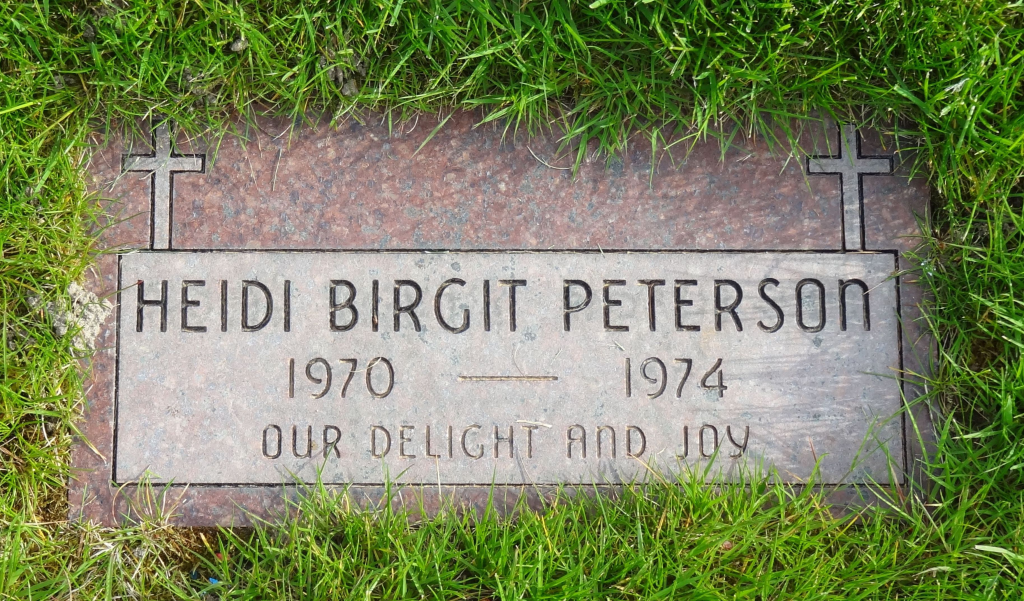
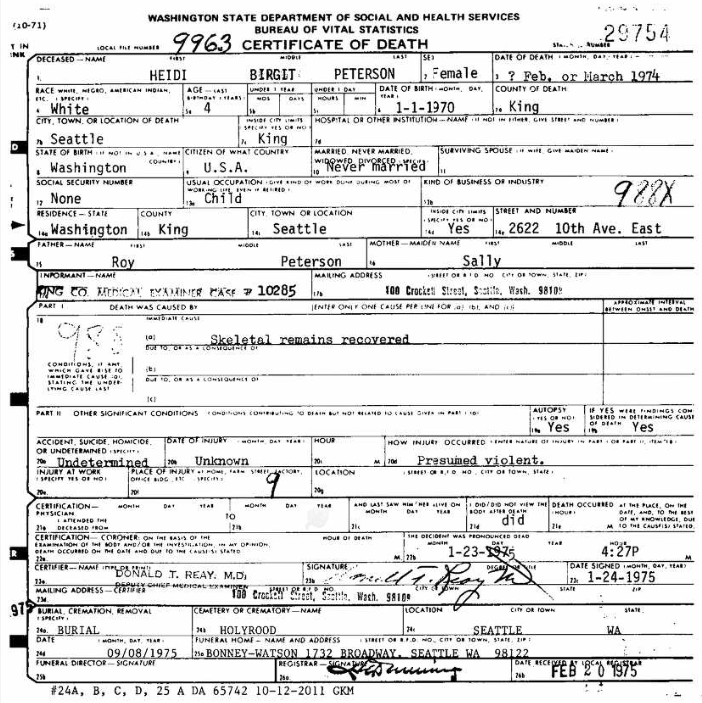
Background: Heidi Birgit Peterson was born on January 1, 1970, in Washington state to Roy and Sally Peterson. This case was an unusual instance where I was unable to find out much about the Peterson family, but I took that as a sign to stop investigating and to just let them be. There is obviously a reason.
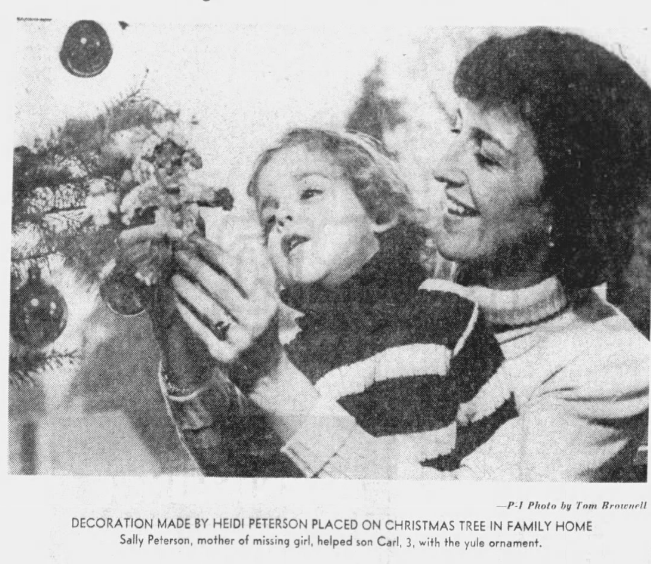
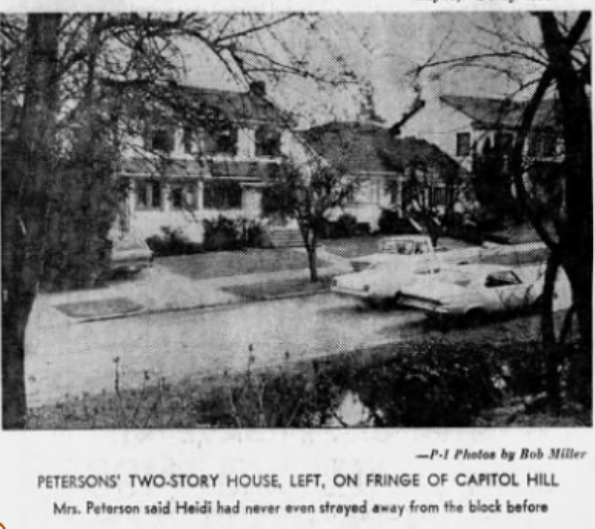
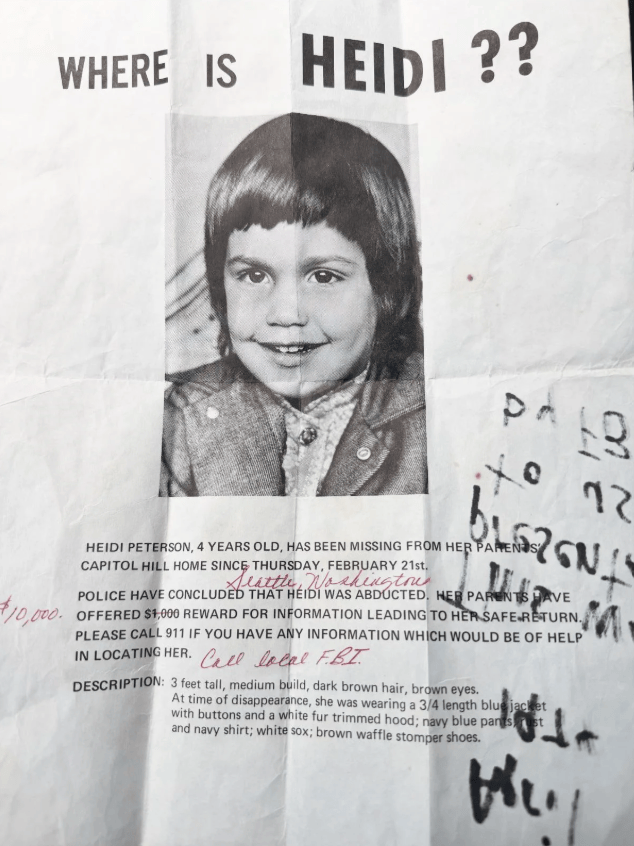
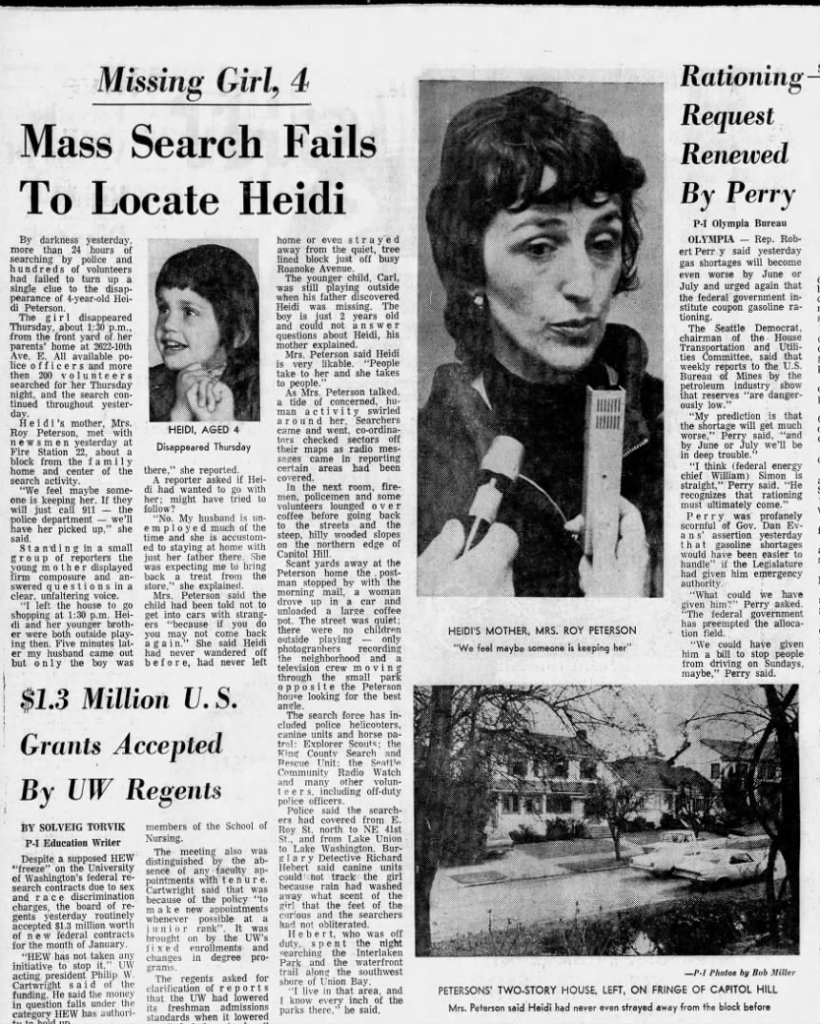
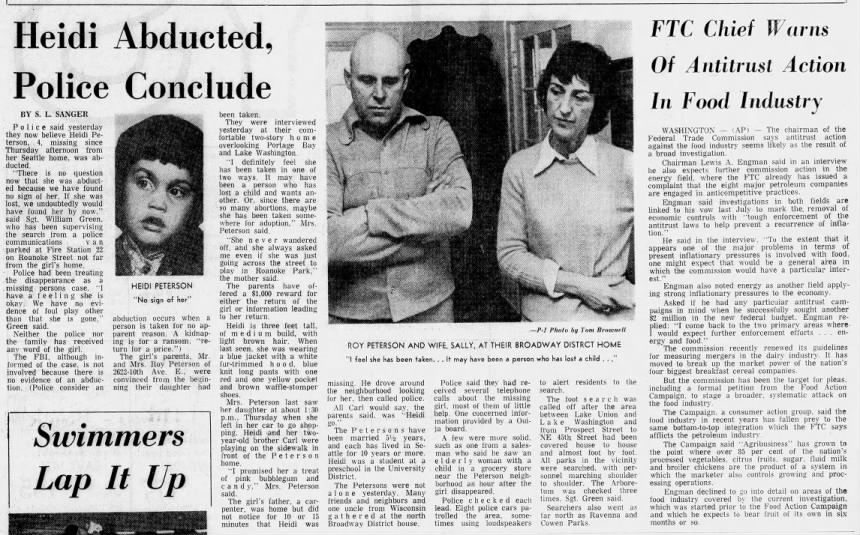
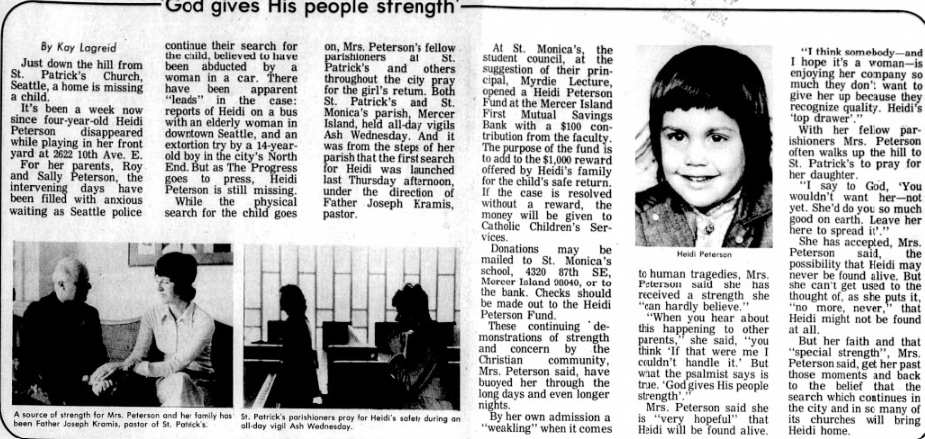
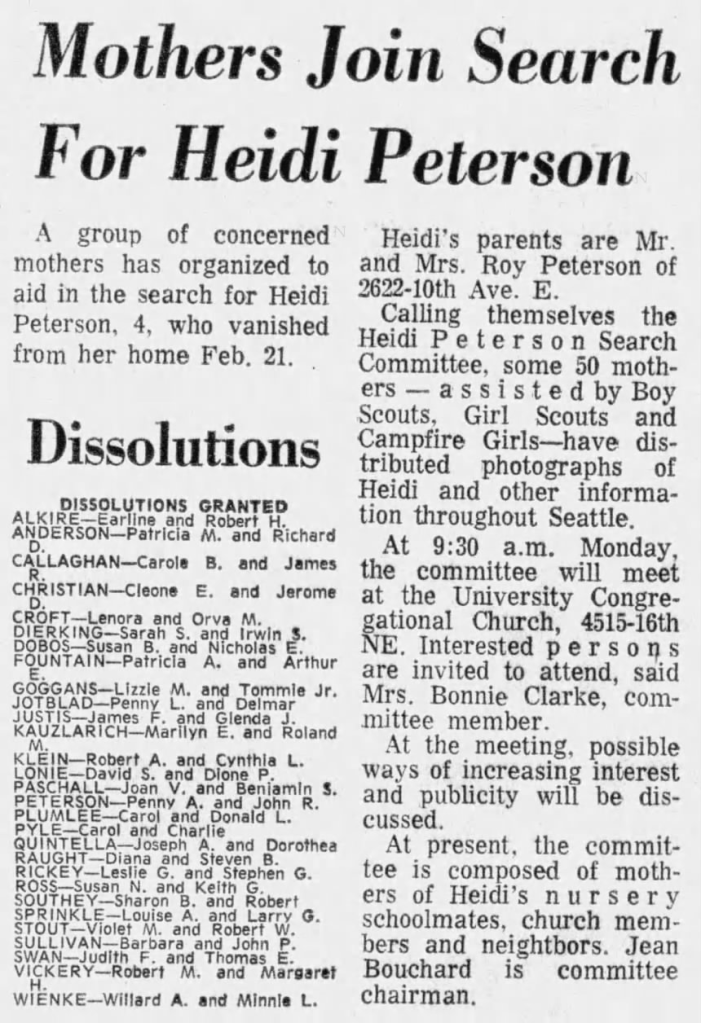
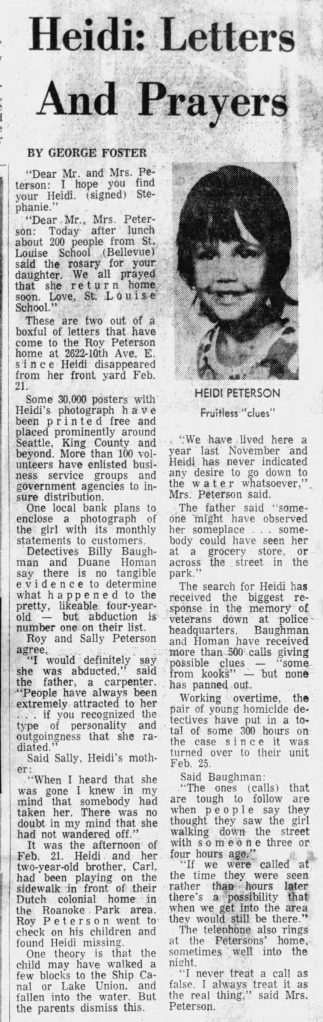
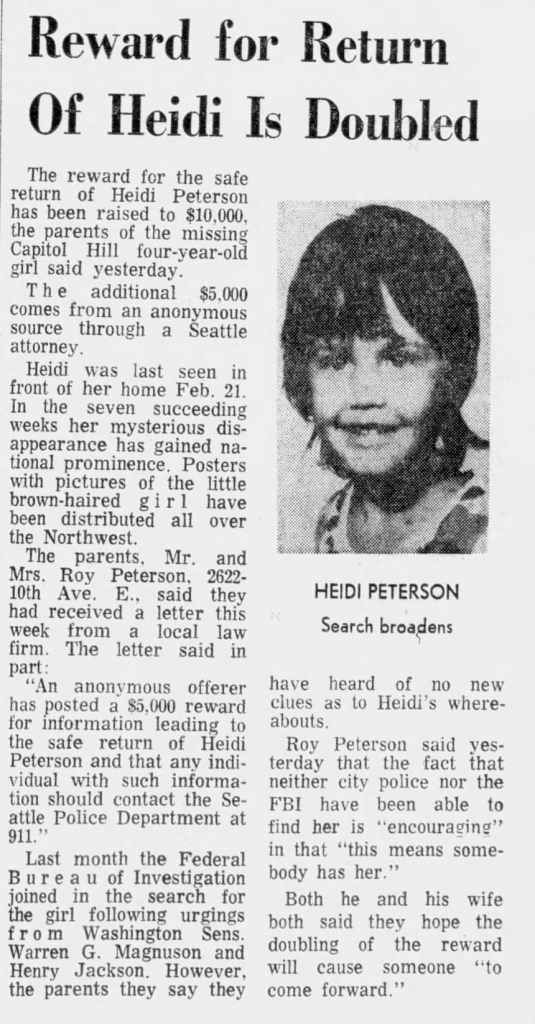
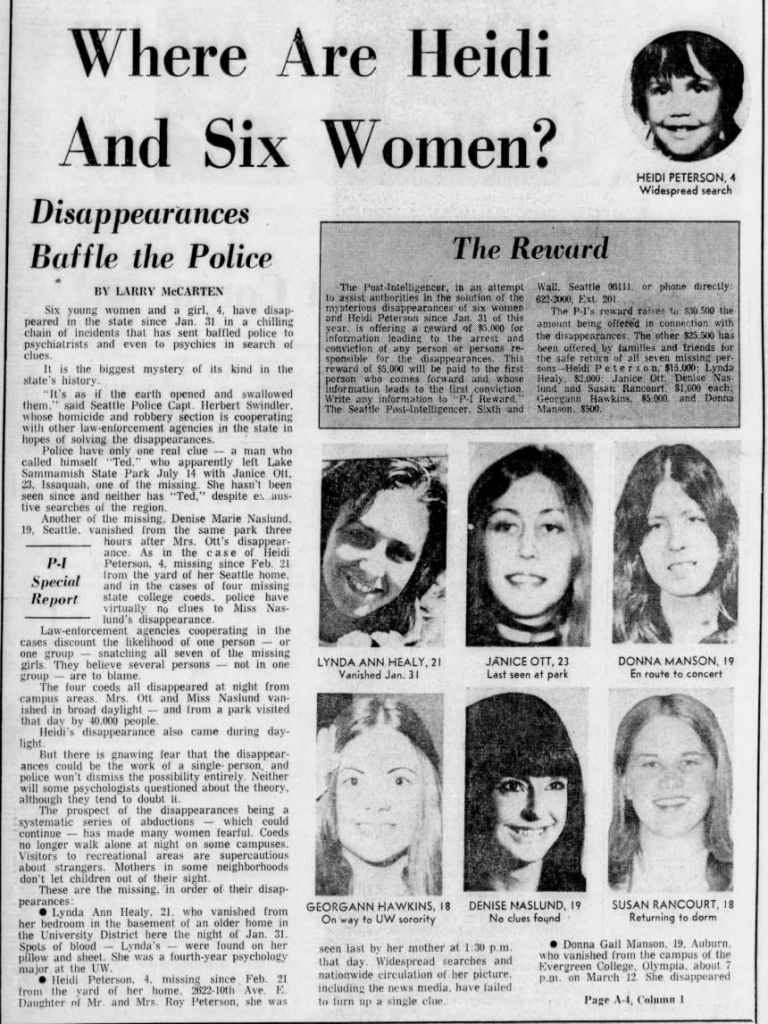
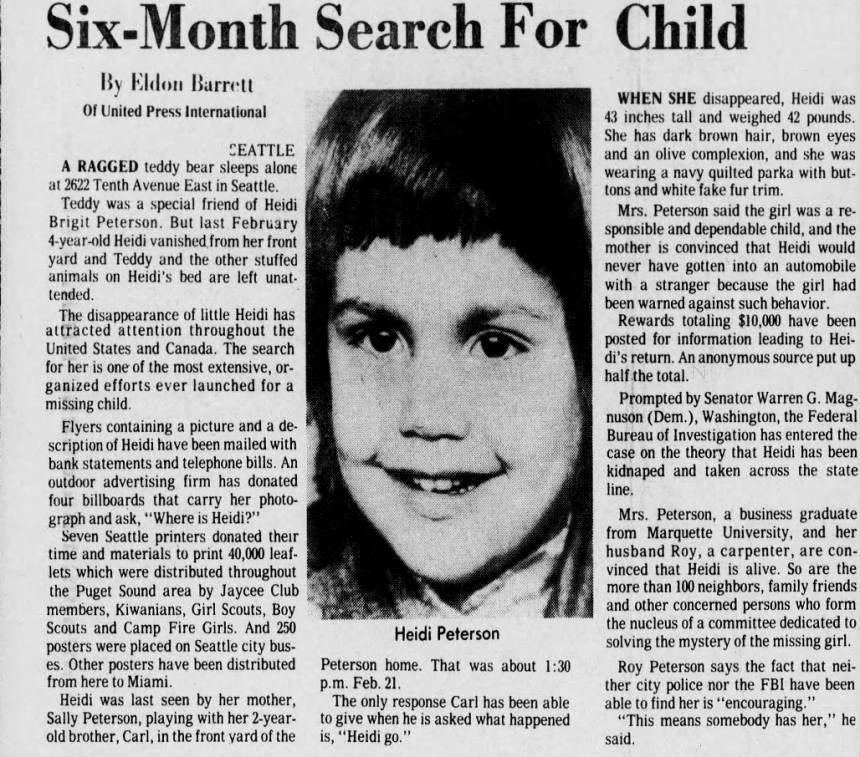
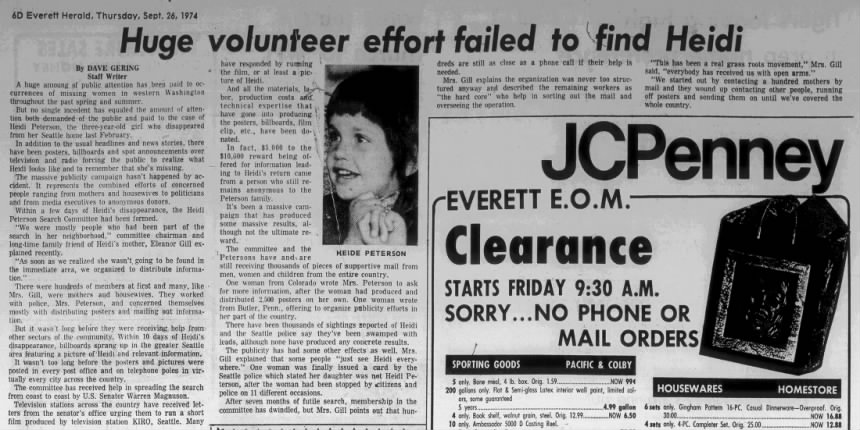
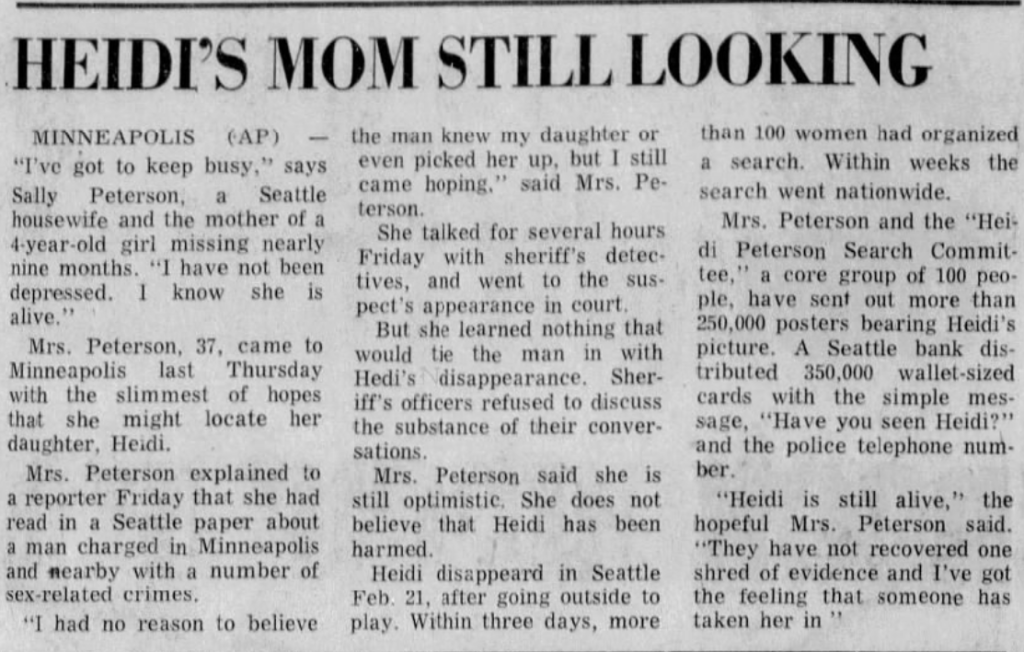
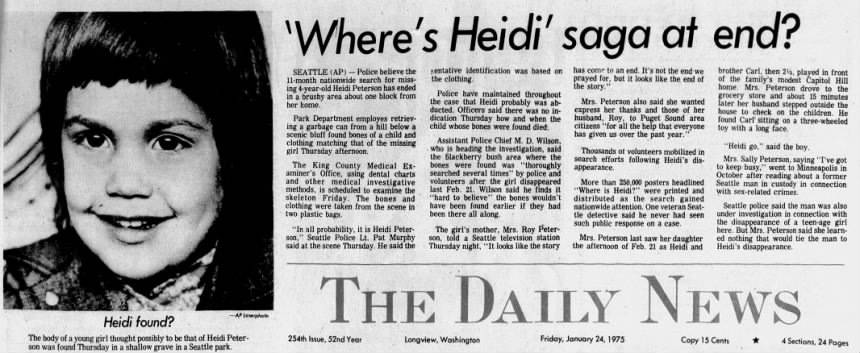
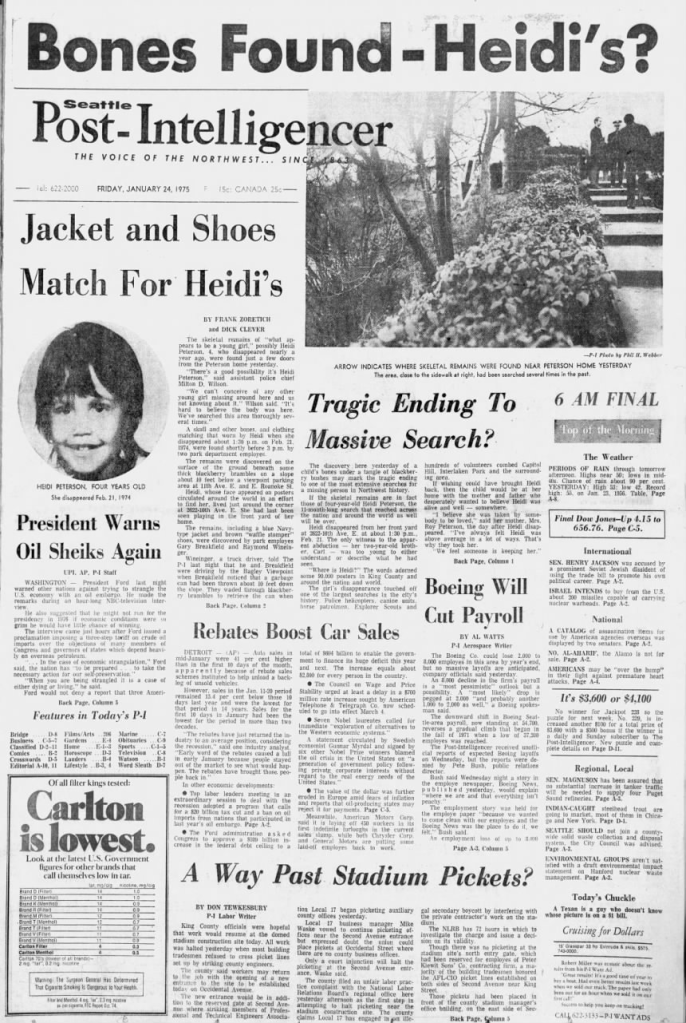
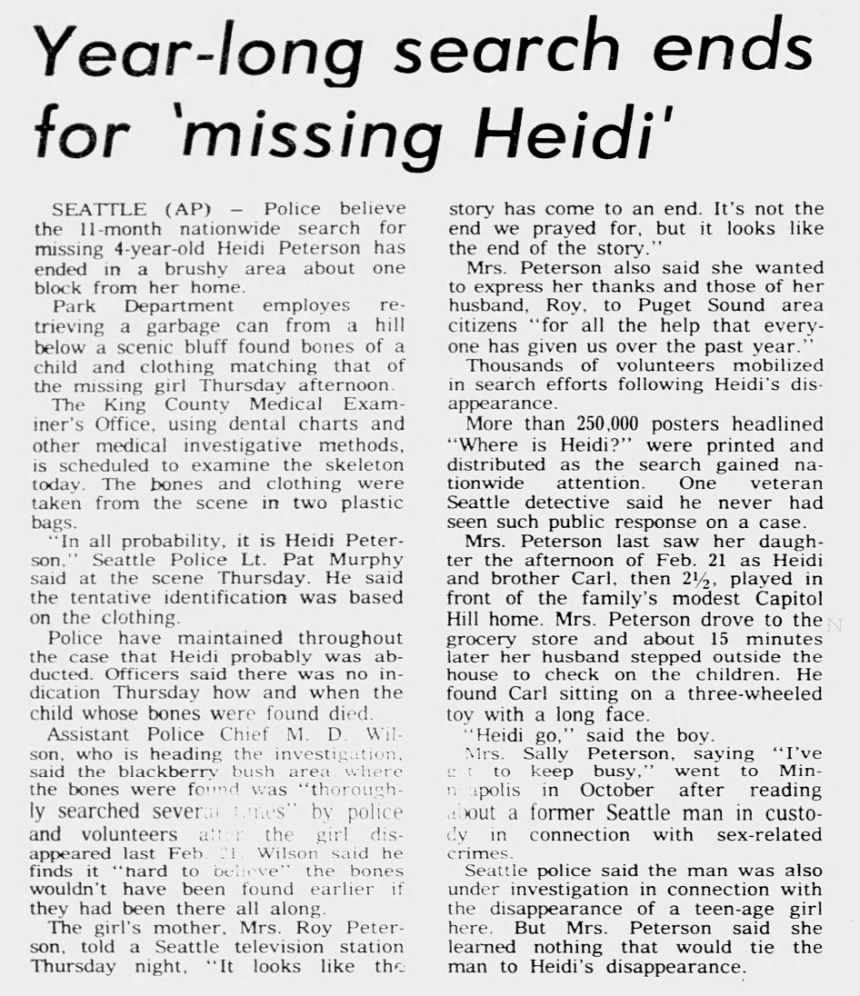
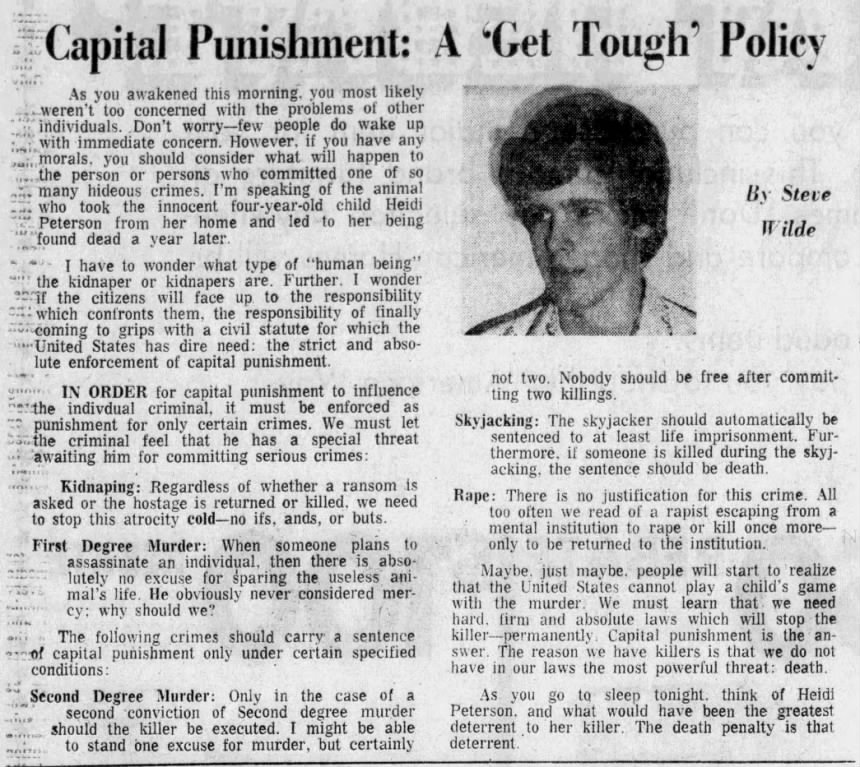
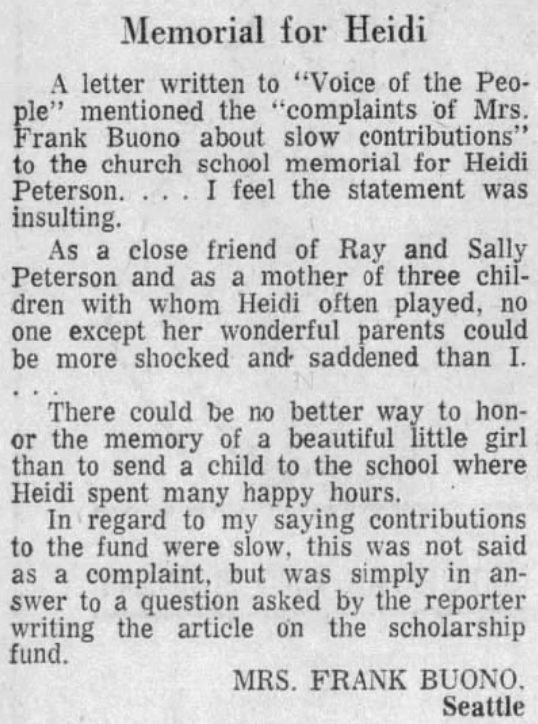
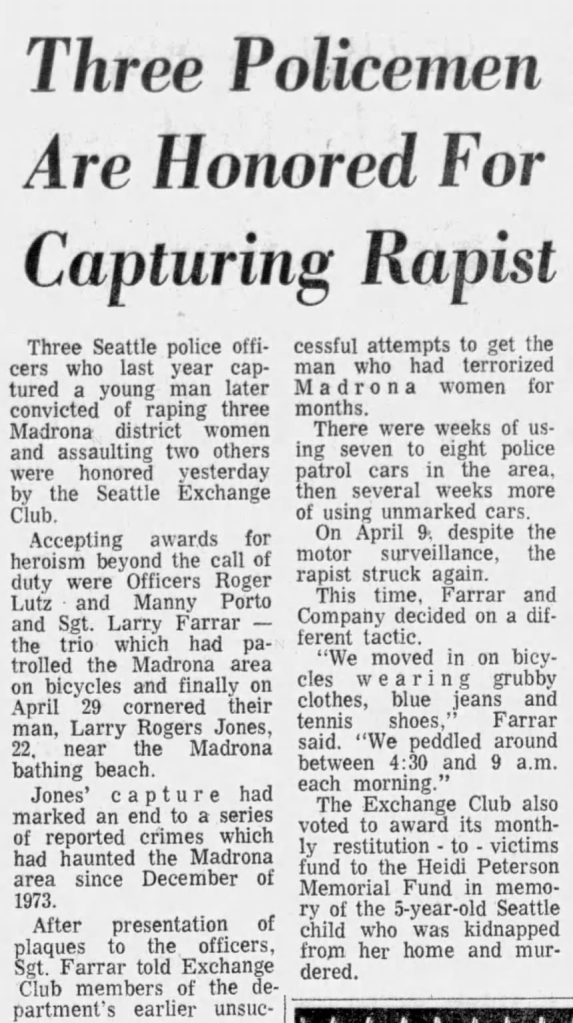
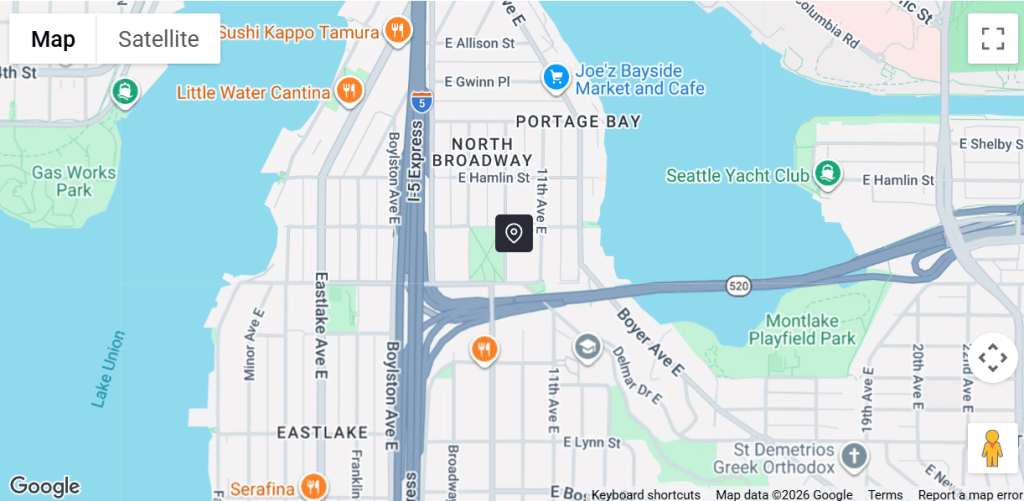
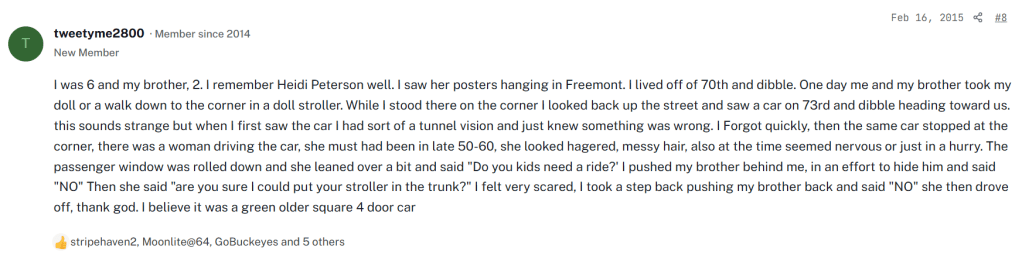
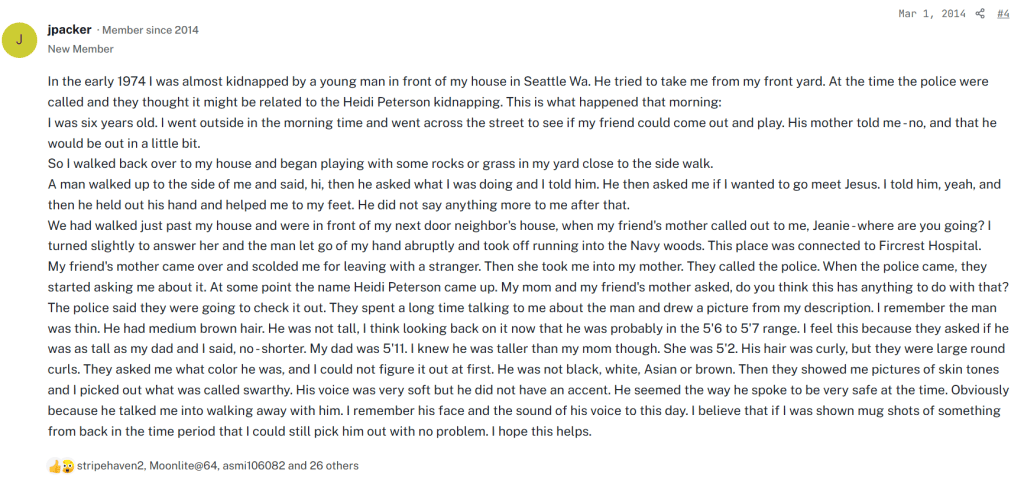
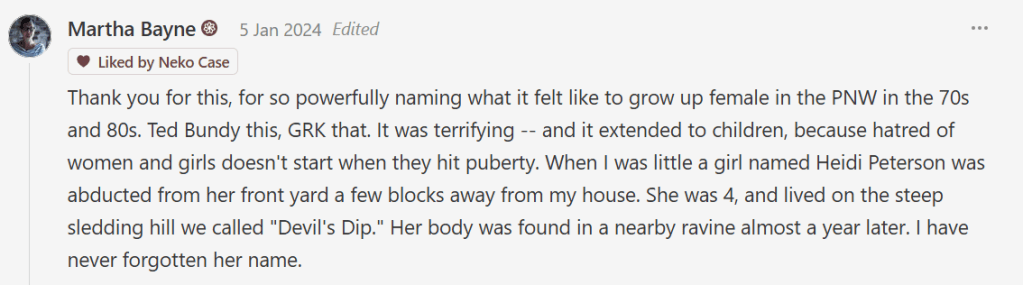
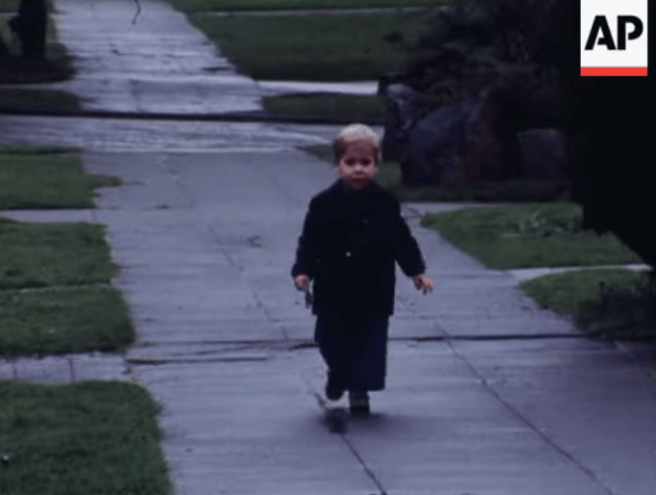
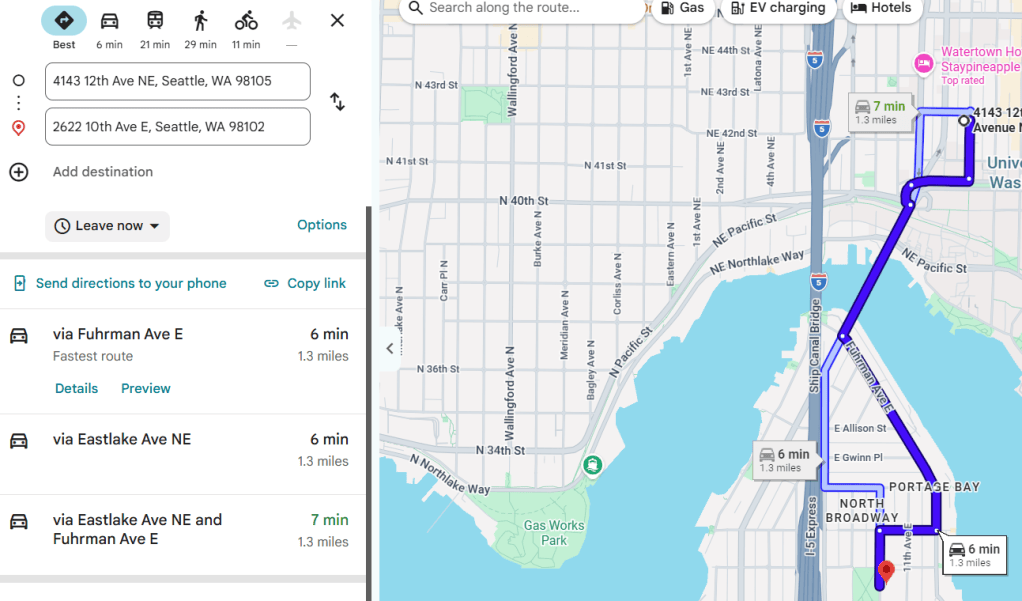
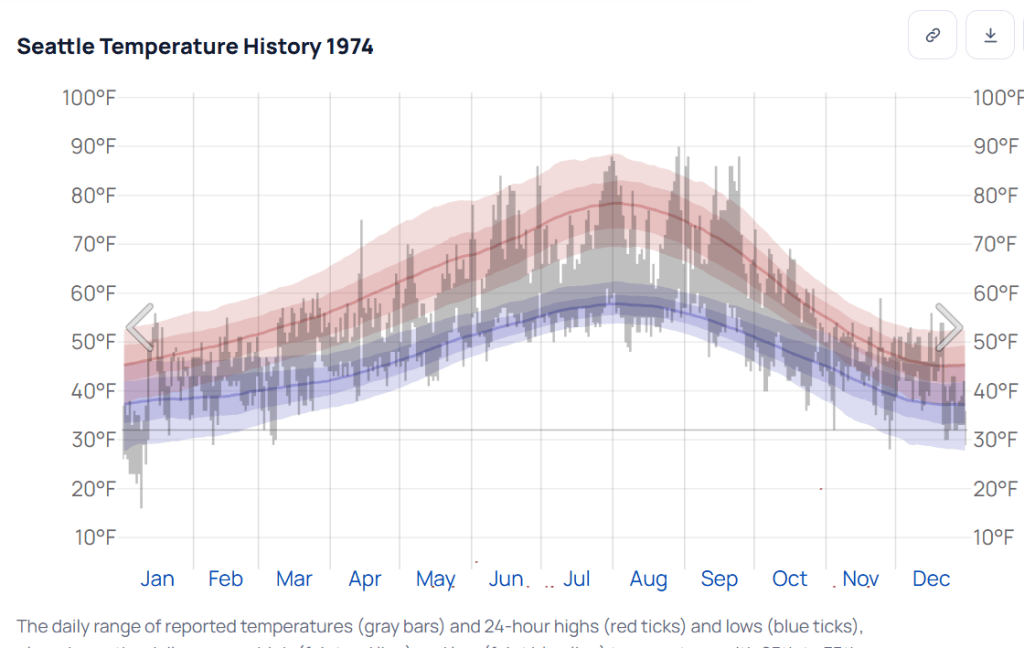
February 21, 1974: at roughly 1:30 PM on February 21, 1974, four-year-old Heidi vanished without a trace while playing with her two-and-a-half-year-old brother Carl in the front yard of the family home in the Capitol Hill neighborhood of Seattle. Her father was working inside the house, and her mother had briefly gone out to purchase some items at a nearby grocery store; when Mr. Peterson went outside to check on them (he surmised they had been left alone for roughly fifteen minutes), Heidi was gone: Carl was alone playing on his bicycle, and he simply said, ‘Heidi go…’ The family immediately called the police and quickly began searching the area, and specially trained German Shepards tracked Heidi’s scent to the curb in front of the house, indicating she may have been abruptly pulled into a vehicle; in addition to canines, search efforts included horse patrol, police helicopters, and explorer scouts. Rewards were posted and her picture was circulated nationwide and in parts of Canada in an effort to return her to her parents, and her disappearance sparked one of the largest and most extensive law enforcement searches in the history of the Pacific Northwest at the time. Heidi’s height and weight at the time of her disappearance are unknown, but she had brown eyes and dark hair she wore short.
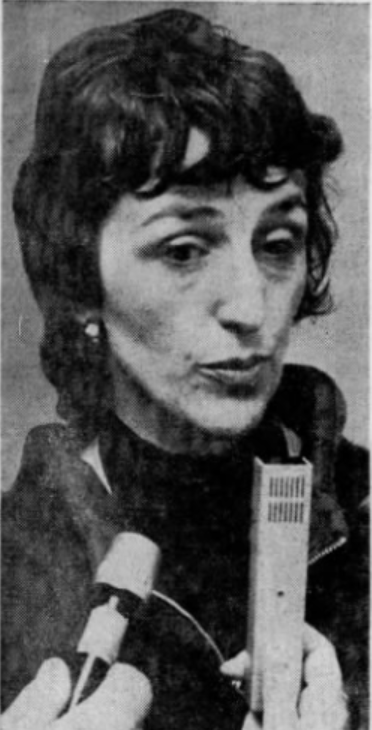
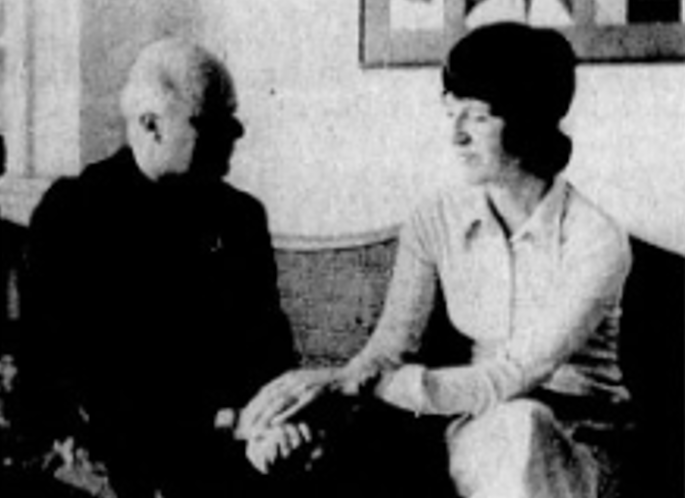
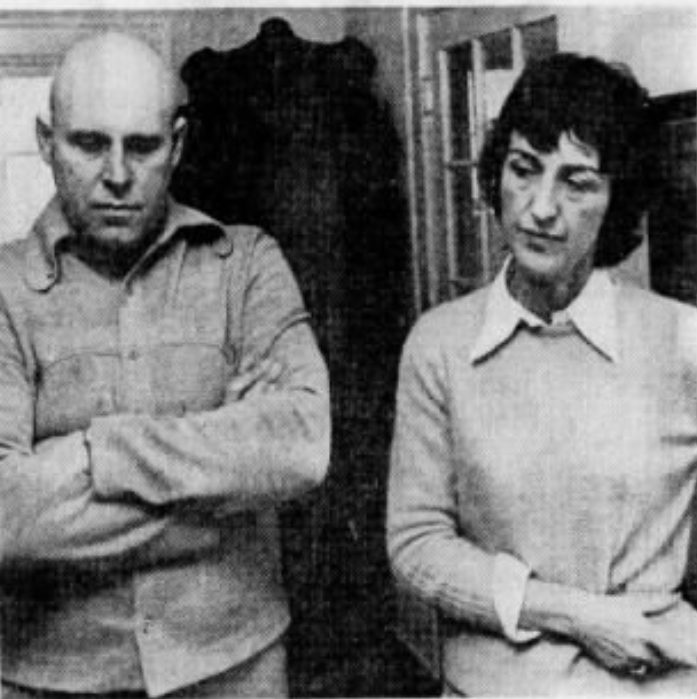
According to an article published in The Seattle Post-Intelligencer on February 23, 1974, Sally Peterson said she ‘left the house to go shopping at 1:30 PM. Heidi and her younger brother were both outside playing then. Five minutes later my husband came out but her only the boy was there.’ A reporter asked her if Heidi wanted to go shopping with her and may have tried to follow her to the store, and in response to this Sally said, ‘No. My husband is unemployed much of the time and she is accustomed to staying at home with just her father there. She was expecting me to being her back a treat from the store.’ She also said she trained Heidi not to get into a car with a stranger because ‘if you do, you may not come back again,’ and clarified that Heidi had never run off by herself before. Her father said that Heidi ‘was very likable, and ‘People take to her, and she takes to people.’
According to Ann Rule’s book, ‘Kiss Me, Kill Me, ‘in the immediate aftermath of her disappearance, police scrutinized local residents. They thoroughly interviewed men in the Capitol Hill area with prior records for sexual offenses, as well as several neighborhood individuals whose initial alibis and answers did not fully satisfy investigators. Despite this, no concrete physical evidence or forensic links could connect any local individual to her abduction. Because the crime scene was limited to a brief fifteen-minute window in a quiet yard, and her remains were located a year later in a park trash can that had been previously searched, the lack of physical evidence remains the primary hurdle to identifying her killer.’
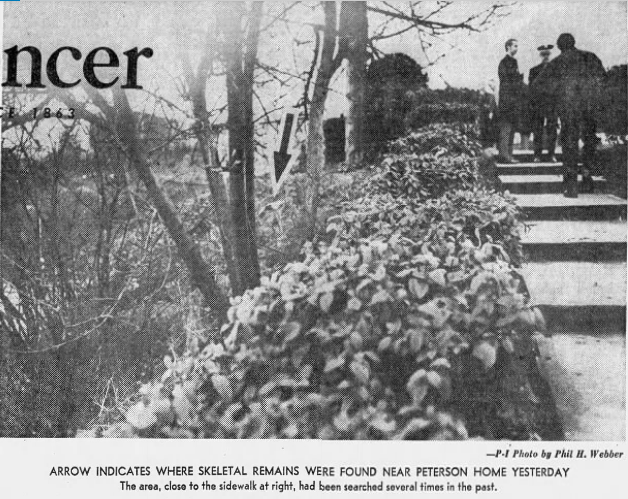
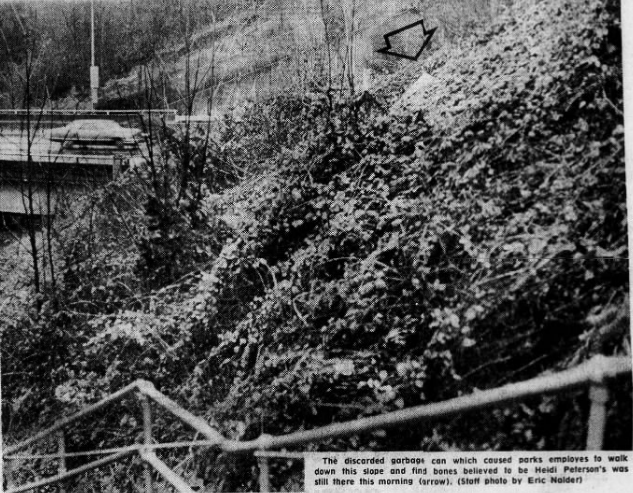
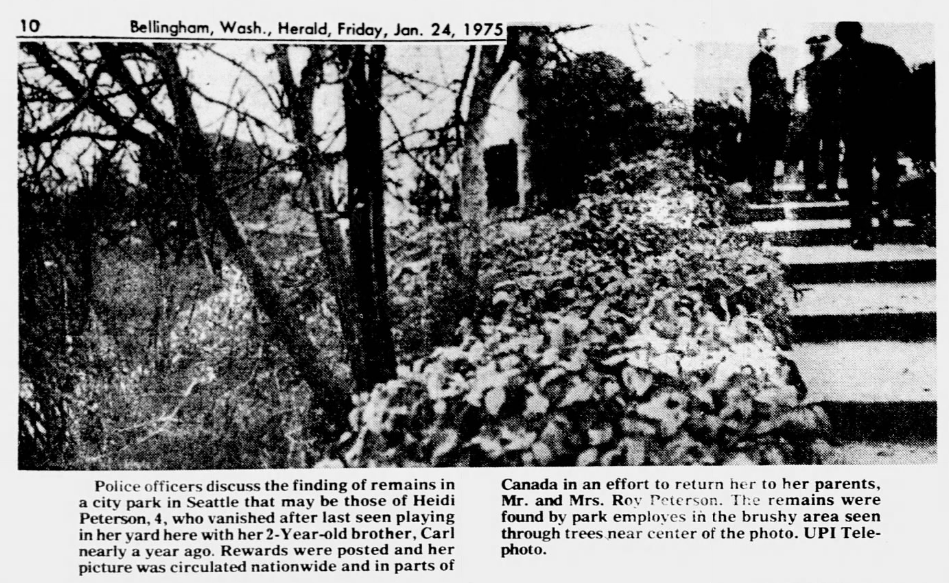
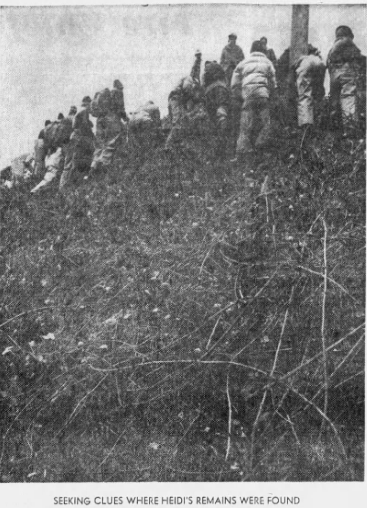
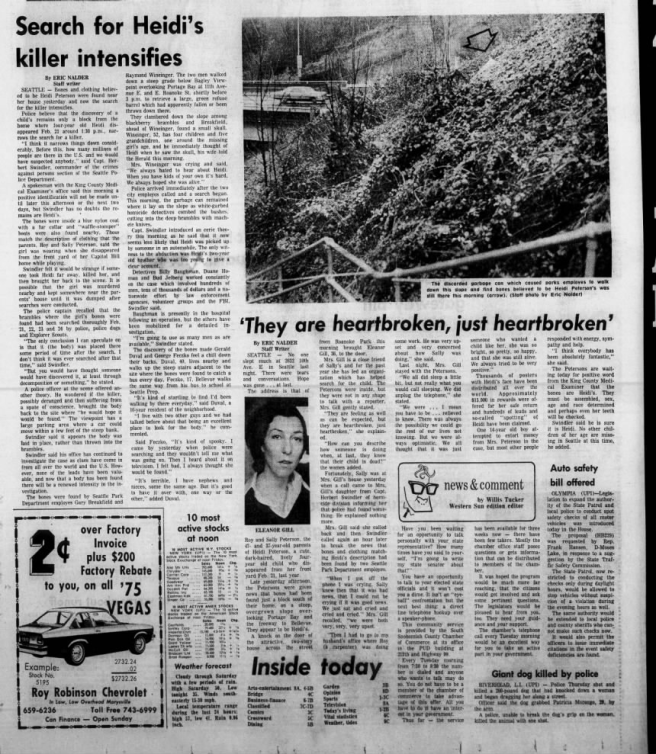
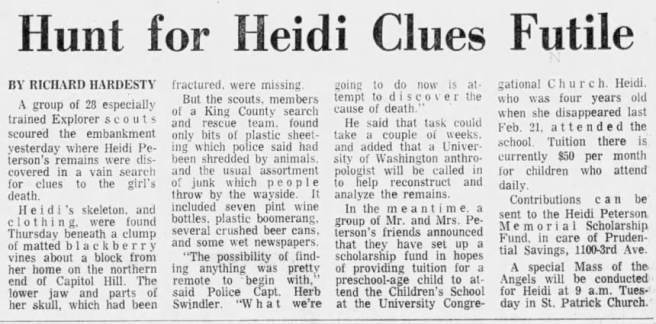
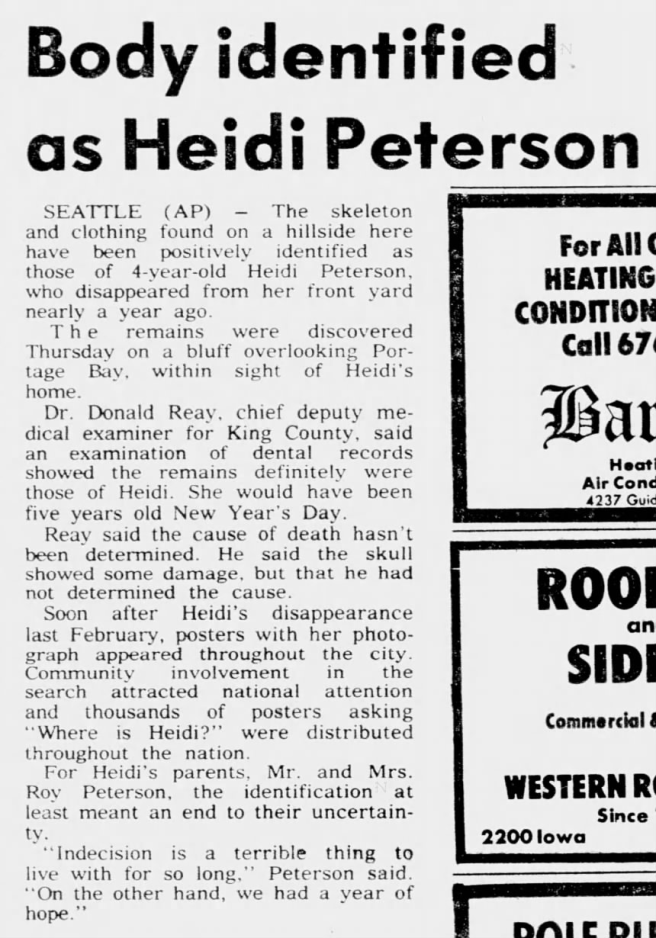
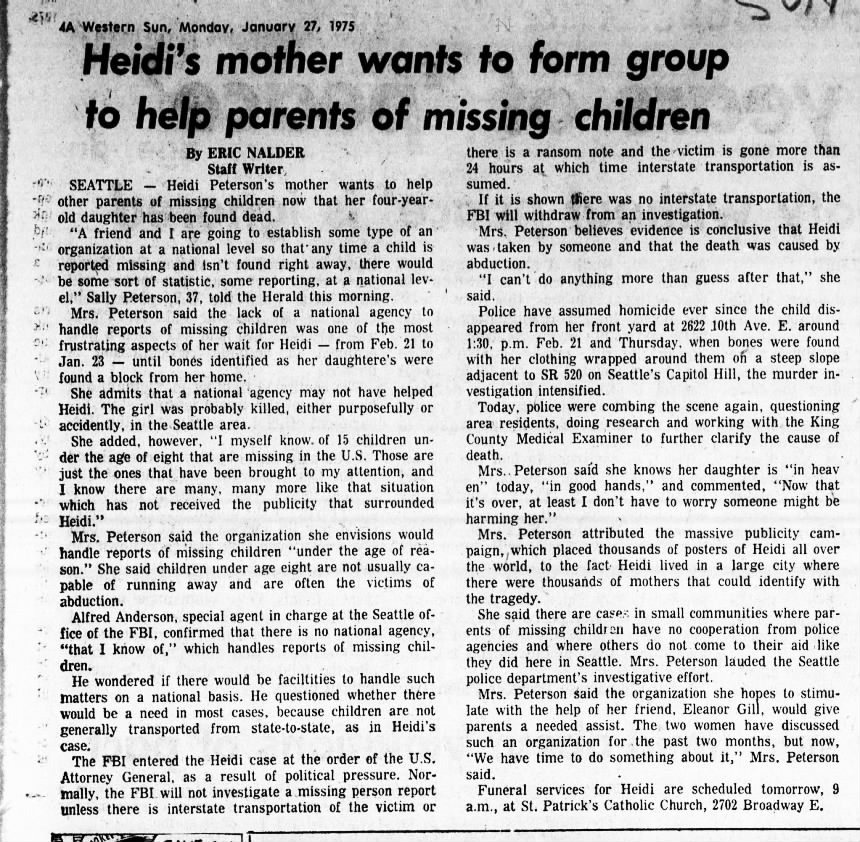
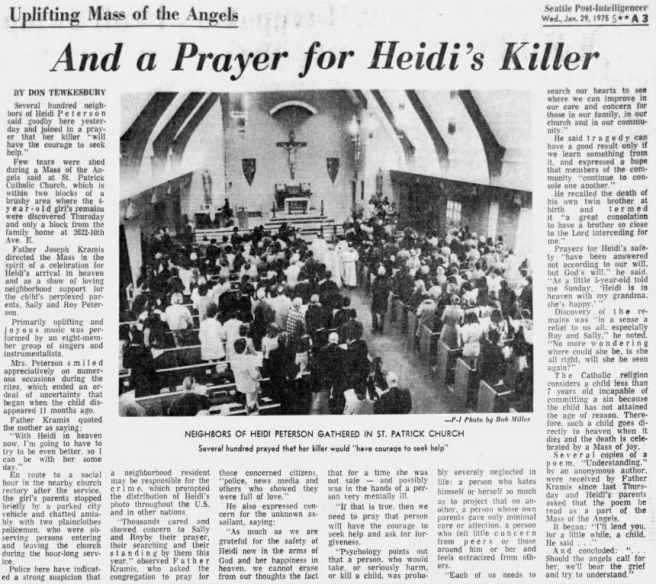
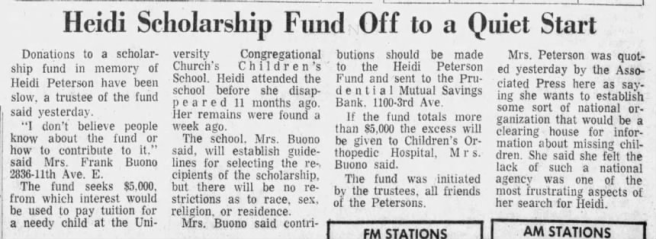
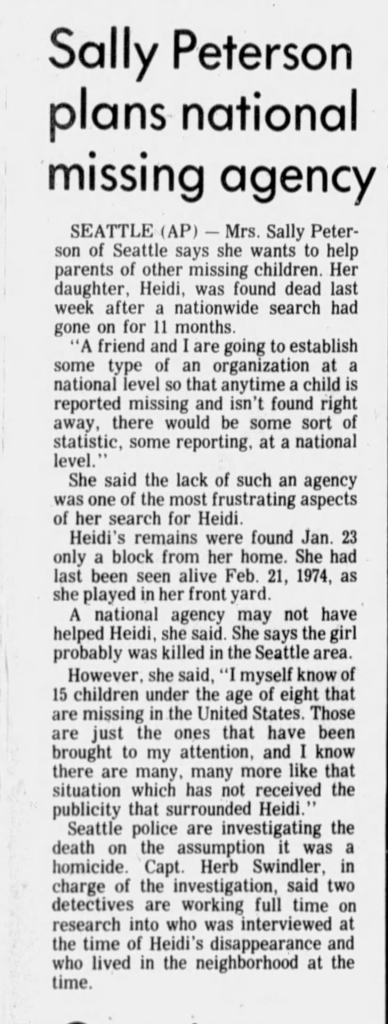
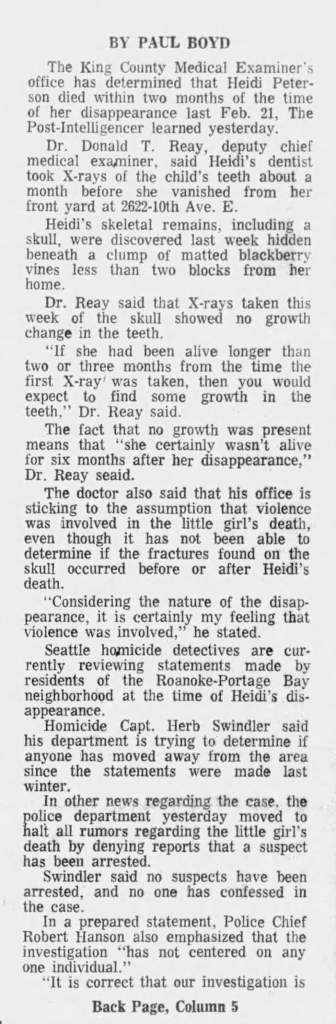
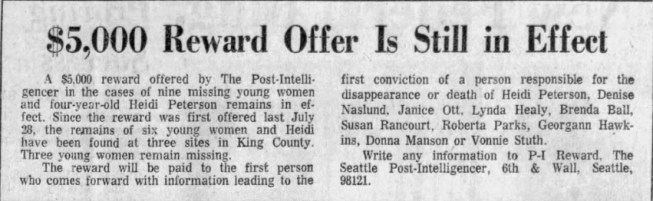
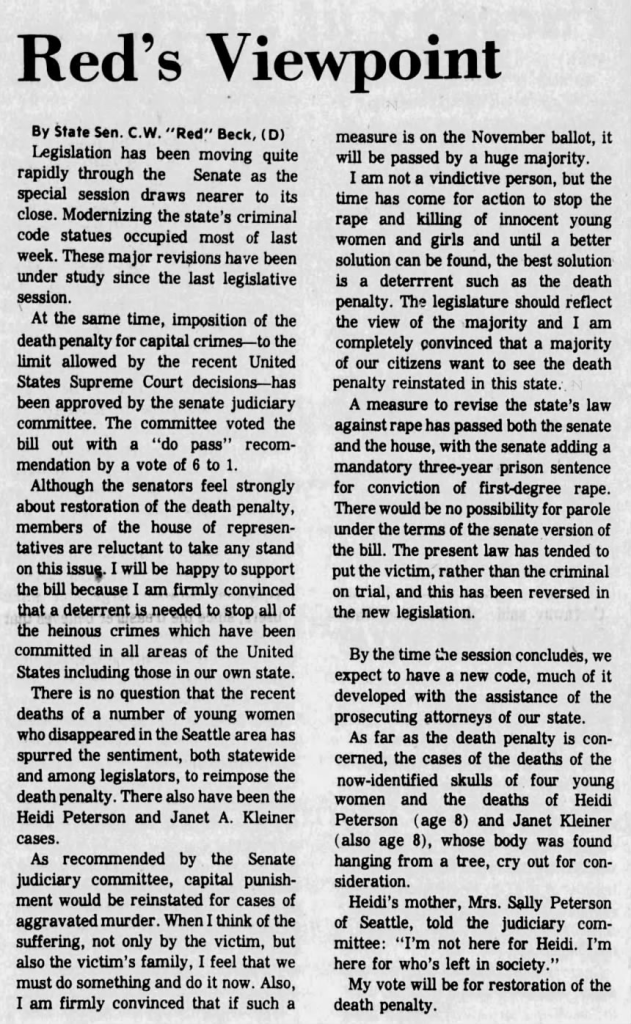
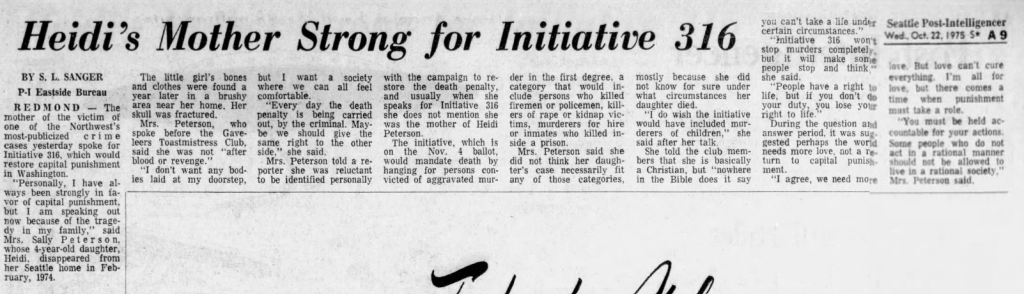
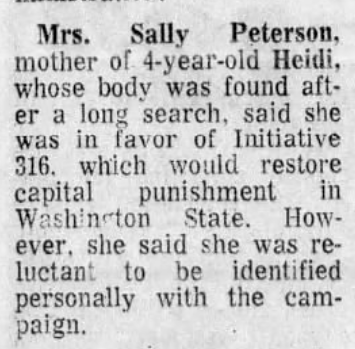
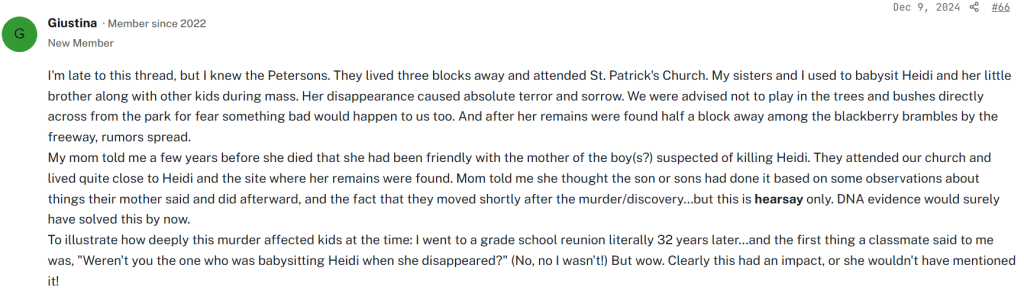
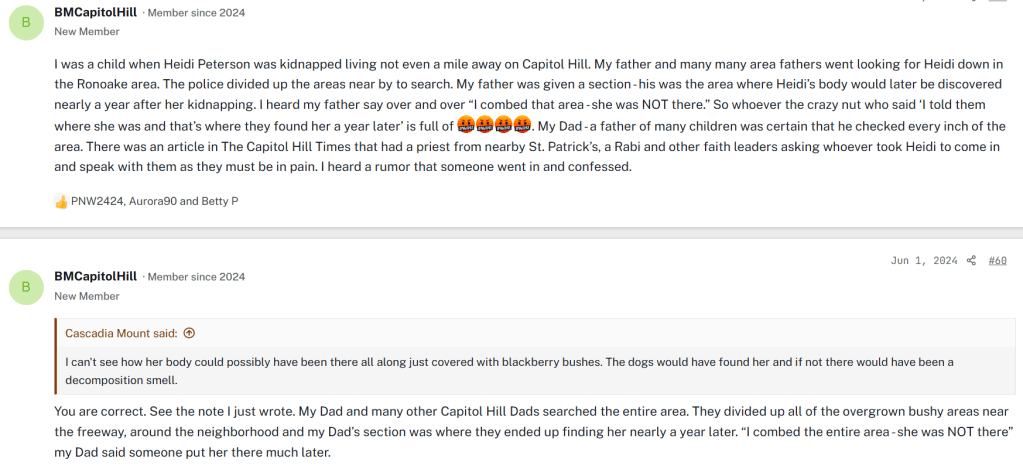
The Discovery: on January 23, 1975, park department employees were retrieving a garbage can from a hill directly below a scenic bluff in a brushy area and found the bones of a small child inside along with some clothing. The area where the remains were found was only a block away from where Heidi was abducted from nearly a year prior, and the clothing matched what she was wearing when she disappeared; dental records later confirmed the remains belonged to her. The can had been discreetly hidden in some dense blackberry bushes, which had been searched thoroughly several times after Peterson first disappeared in 1974, which makes investigators strongly believe that her remains were moved there sometime prior to the discovery (possibly up to a few months). Police believe she had been killed shortly after she was abducted, and the case was immediately ruled a homicide; due to the advanced level of decomposition, the medical examiner was unable to determine the exact cause of death.
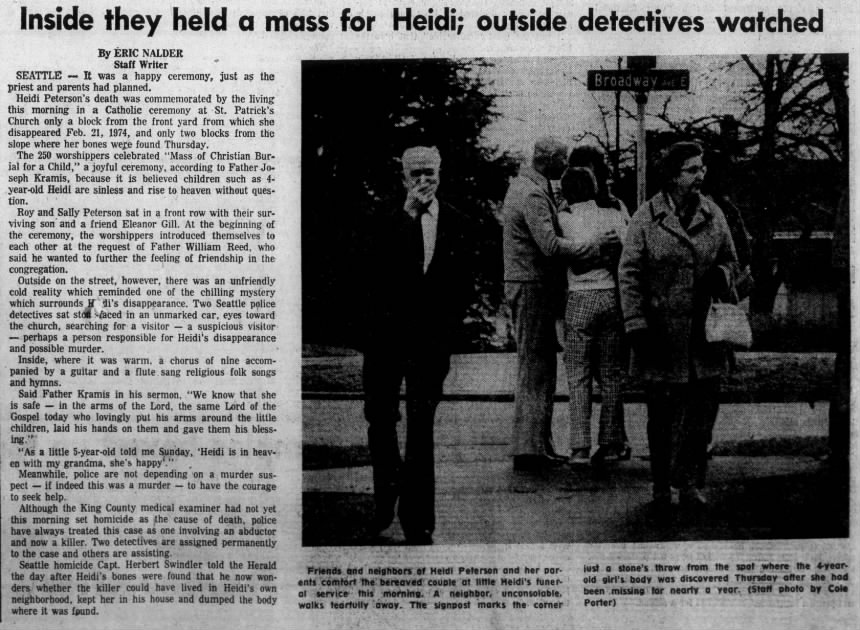
The Investigation: in the days following her disappearance, police patrolled Heidi’s Capitol Hill neighborhood throughout all hours of the day (and night) with a canine unit, hoping desperately that the dog accompanying them would help sniff her out. According to Ann Rule, ‘there were rumors and tips. Someone said they had heard a child screaming in a house one street over. But when detectives investigated, there was no indication that Heidi had ever been there. It was the next winter when the snows came before anyone knew where Heidi was. On the corner a half block south of her house there was a vacant lot where wild blackberries had towered eight feet or more over the ground for years. But this snow was heavy enough to make the vines break and flatten to the earth. Heidi’s skull was there, and the fractures in it showed the cause of her death: bludgeoning with some heavy object. There was no other evidence left. No clothes. No weapon. Nothing at all that the killer might have left behind.’
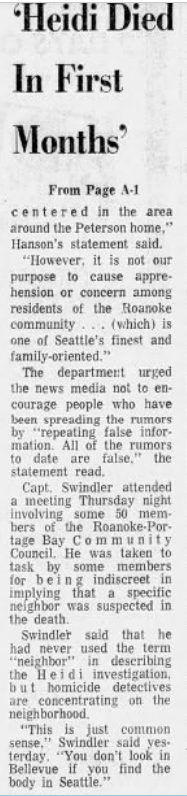
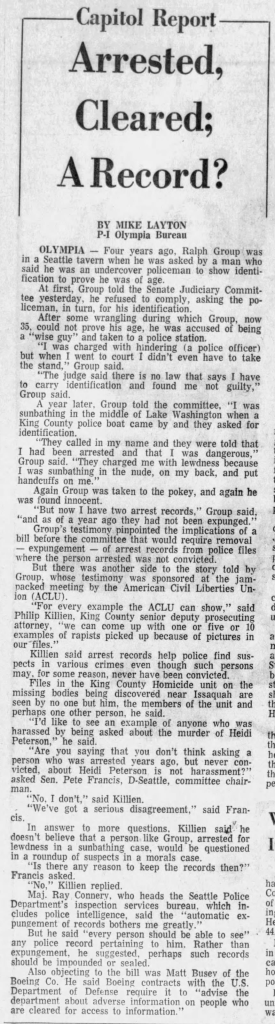
Rule went on that ‘the homicide investigators continued to check residents in an ever-widening circle with Heidi’s house in the center. They found men with records for sexual crimes and younger men whose answers to their questions didn’t quite add up. They had a suspect in mind, but they could never link him to Heidi’s murder. One of the things detectives count on is that even the most secretive murderer usually has to tell someone, either to brag about what he has done or because he feels guilty and is compelled to talk. Allegedly, Heidi Peterson’s killer told the woman in his life, and when they broke up, she told someone else. Eventually, word reached Seattle detectives. They were sure they knew the killer’s name. They looked beneath a house where the suspect said he had left evidence, but too much time had passed. It was gone. They could not arrest him.’
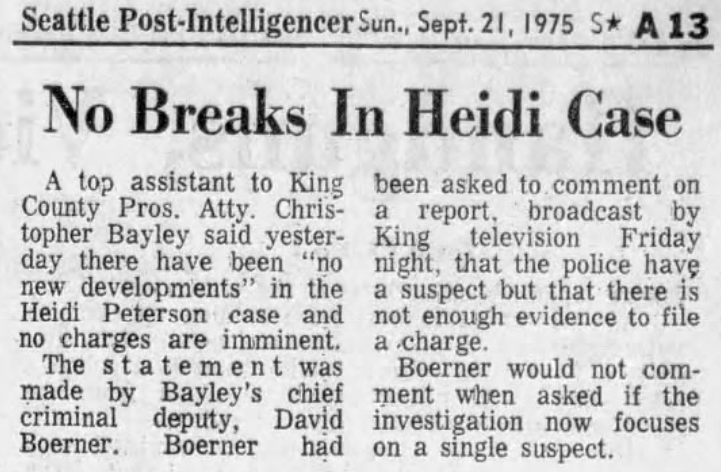
An Unconfirmed Suspect: according to an article that was published in The Seattle Times on September 20, 1975, Seattle homicide detectives did eventually narrow their focus toward a highly specific, unnamed person of interest: allegedly, that individual confided what he had done to a woman in his life, and after they broke up, she passed the information along and the tip eventually reached detectives. Detectives were confident enough in this lead to execute a search beneath a residence where the suspect allegedly claimed to have hidden physical evidence, however due to the extensive passage of time, nothing was recovered, and because of this police lacked the definitive proof required to make an arrest.
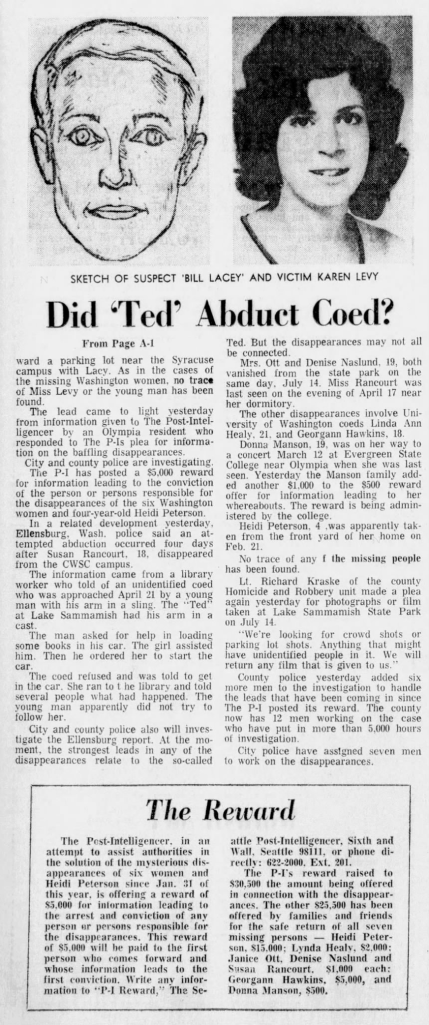
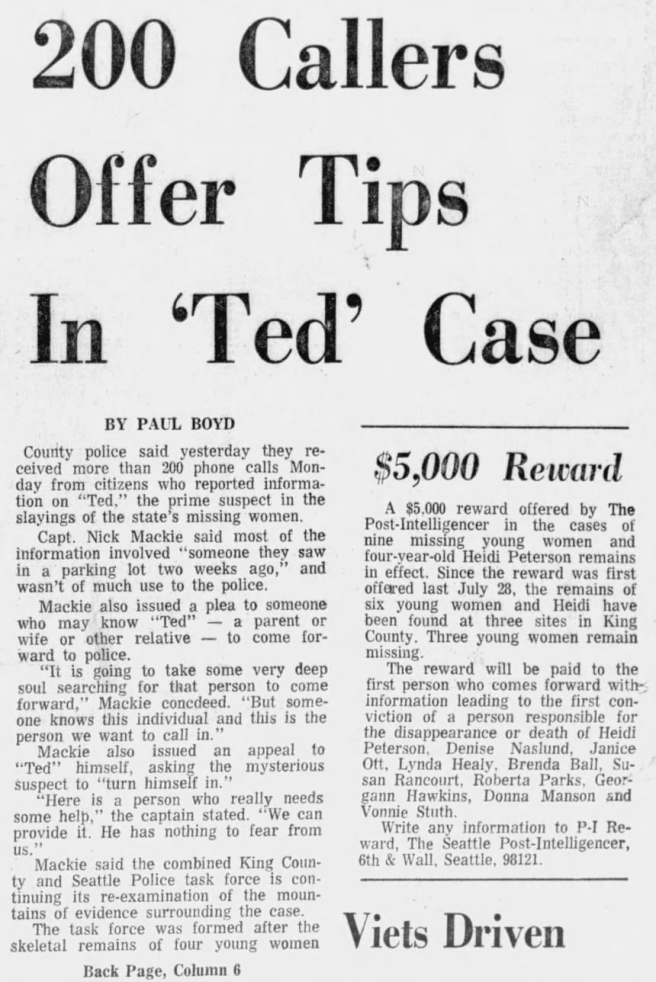
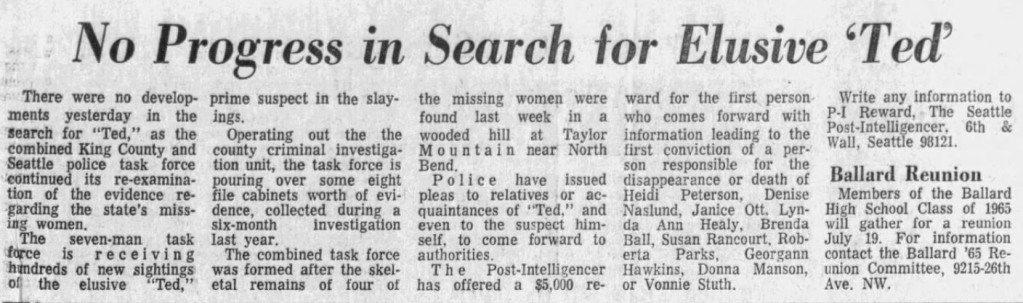
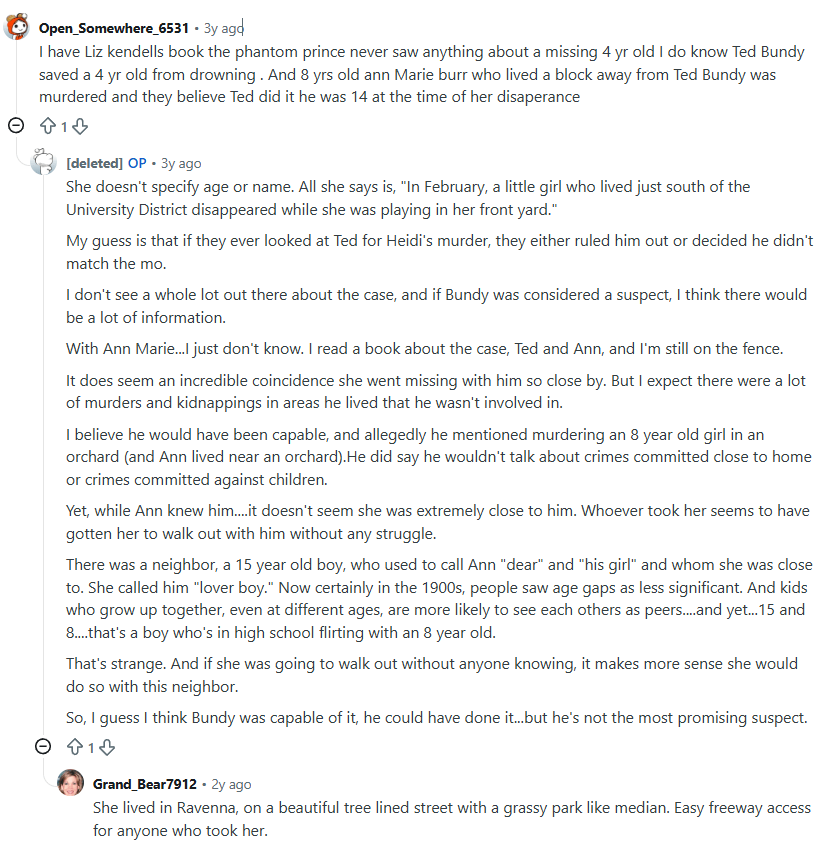
Ted Bundy: in the early to middle 1970’s Bundy maintained the facade of a normal, ambitious young man: he graduated from the University of Washington with his BS (in June 1972) and he went on to enroll in (two separate) law schools, all while working a ‘regular’ job and maintaining a ‘normal’ relationship with Liz Kloepher (although he wasn’t always faithful to her).
In January 1974, Ted Bundy was living in the Rogers Rooming House in Seattle’s University district, and he was attending law school at the University of Puget Sound (he attended from September 1973 to May 1974, and its now Seattle University School of Law). It was around this time that he began his first (confirmed) documented, definitive serial violent crimes, and that month, his known activities during include:
Shortly after midnight on January 4, 1974, Bundy broke into the basement apartment of eighteen-year-old University of Washington student Karen Sparks: he brutally bludgeoned her with a metal rod from her bed frame and sexually assaulted her. Sparks survived the attack but spent ten days in a coma and was left with permanent brain damage, vision loss, and hearing loss. It was also around the same time in early January, that he officially terminated his relationship with Diane Edwards, a woman he had been obsessively courting and restructuring his life to impress: he abruptly cut off all contact with her in January 1974 when he stopped returning her phone calls and letters after they had discussed marriage. When she finally got ahold of him by phone about a month later in February 1974, Bundy claimed he had no idea who she was or what she was talking about and hung up on her. Throughout the remainder of January, he stalked college coeds and prepared for his first official abduction: in the early morning of February 1, 1974 (mere hours after January ended) he committed his first confirmed murder by breaking into the apartment of twenty-one-year-old UW undergraduate, Lynda Ann Healy.
Despite the close geographic proximity and overlapping timeline, Bundy did not fit the profile for Heidi’s case: his documented victims were almost exclusively attractive college-aged women with long hair they wore parted down the middle (although I will admit that I was surprised to learn Heidi had been bludgeoned, like Ted usually did with his victims). He consistently denied targeting young children, and investigators have never uncovered any evidence linking him to Heidi, although there is no proven link or official record showing that he was formally questioned in relation to her murder.
Conclusion: unfortunately, as of November 2026, Heidi’s killer has never been identified or arrested and her murder remains unsolved. No named suspects have ever been publicly identified, formally charged, or arrested, and because her case remains unsolved, law enforcement agencies investigating the murder have kept specific names and ongoing investigative details private.