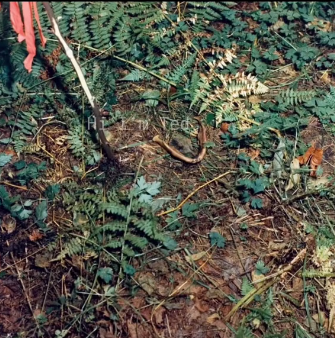
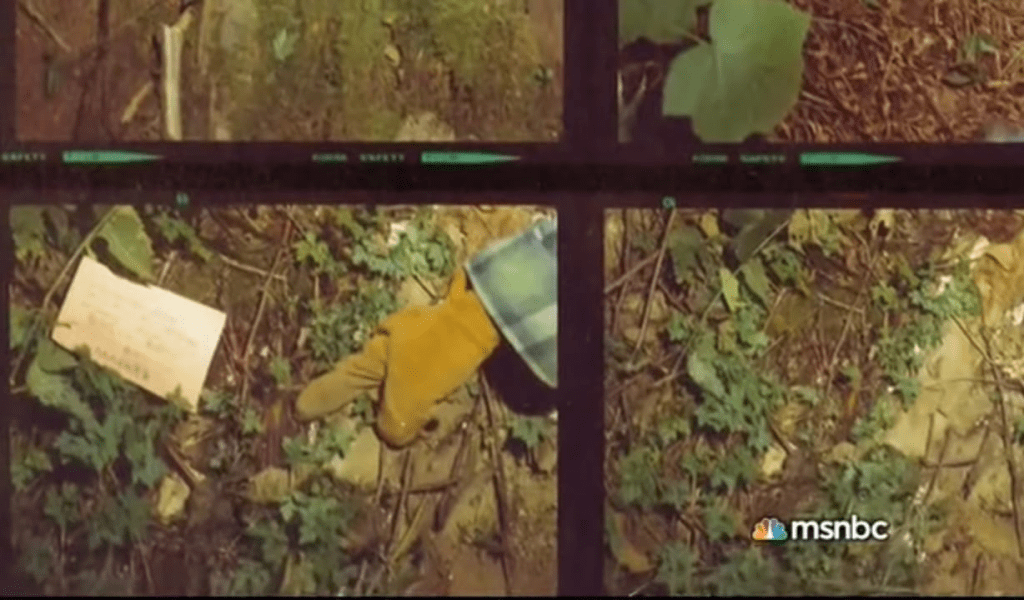
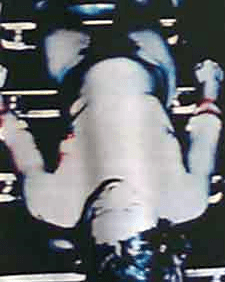
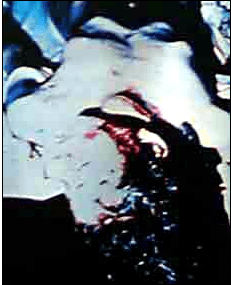
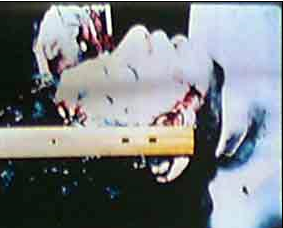
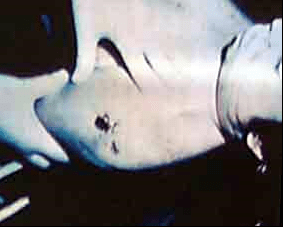
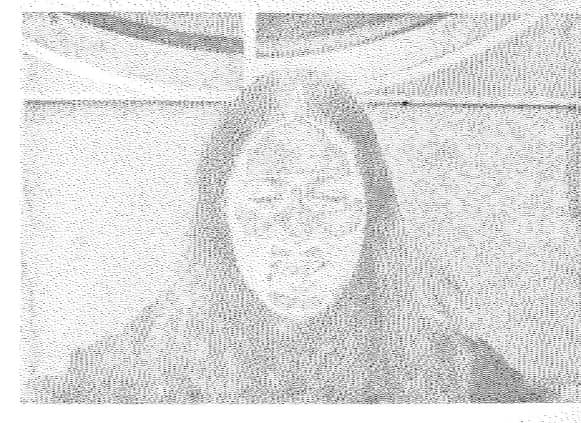
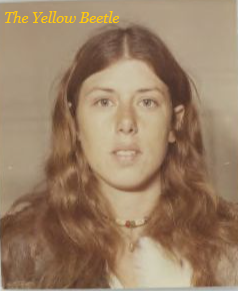
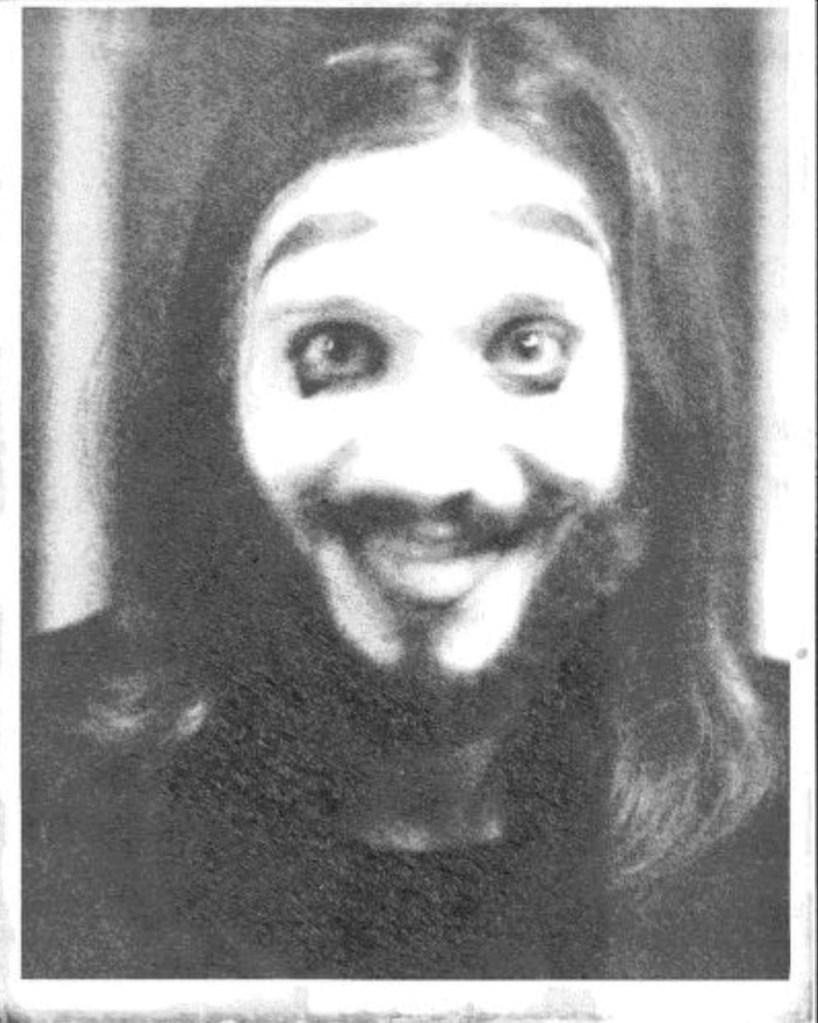
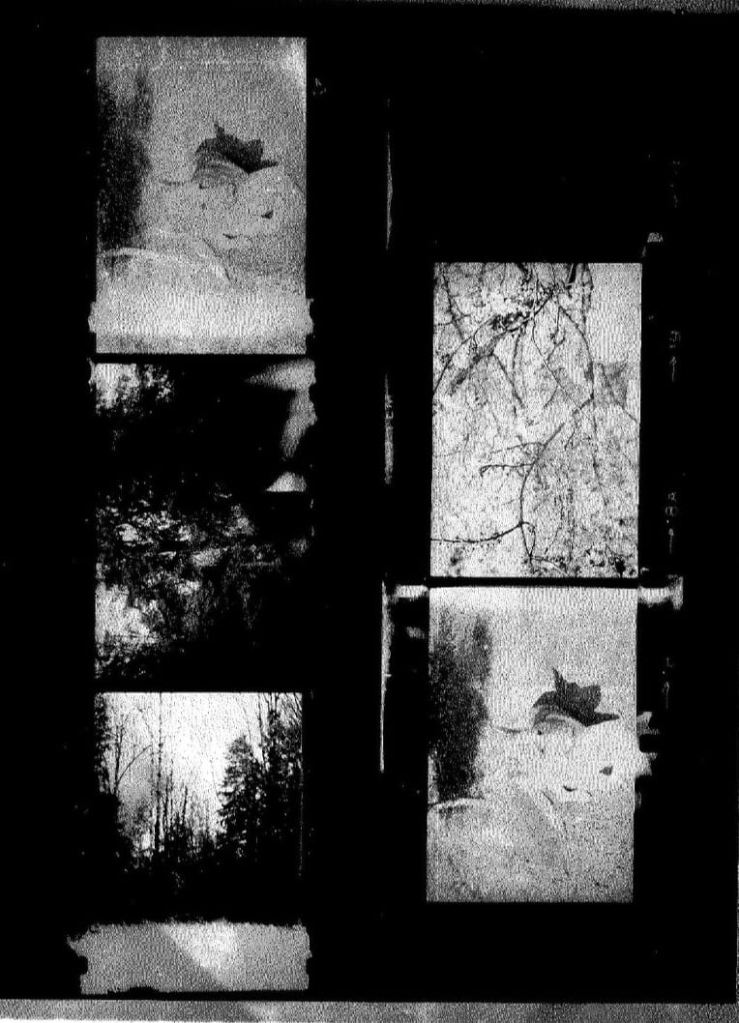
Donna Gail Manson, Case Files.

Back in April I began the process of requesting the case files related to the murder of Katherine Merry Devine from the Thurston Co. Sheriff’s Department out of Washington state. I found the entire ordeal to be not only simple but also incredibly inexpensive, so logically I thought to myself, ‘what else can I get from these fine people?,’ and after looking into it I realized that confirmed Bundy victim Donna Gail Manson was also abducted from the same county. These are the documents that they sent me. Last night I registered with neighboring King County and requested some documents from them as well. This is outstanding.

Theodore Robert Bundy, Crime Scene Photos.

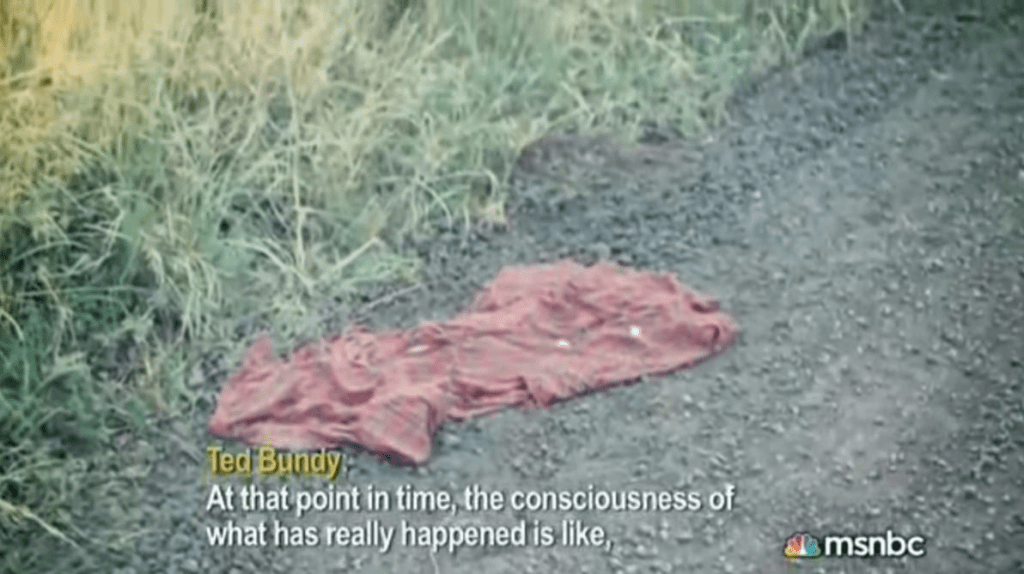
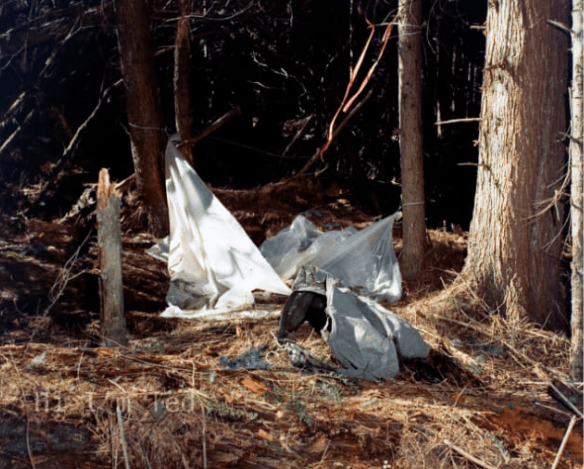
Over the years I’ve only come across a few pictures from Bundy’s crime scenes, for the simple fact that there’s not many of them. This is because he usually left little to no trace of himself behind, and there were no bodies recovered until they were completely decomposed (well, until the end in 1978). I came across a website last night on TikTok (as silly as that sounds), and it contained a bunch of pictures I’ve never seen before, I was pretty amazed. So, here they are. I also went through my own collection and found some additional crime-scene related pictures and included those as well. Because, why not? If anyone has more, please feel free out reach out to me. I will give you credit.

Edit: I wanted to thank Tiffany Jean for all of the hard work she does on the Bundy case. Because of her we have information never before accessible, and she is a wonderful educator and TB resource. Thank you for all that you do.

TB’s kill kit.
Some more items from Bundy’s kill kit. Photo courtesy of Kevin Sullivan.
The outside of Bundy’s VW Beetle. It’s confirmed that at least eighteen of his victims were transported in this vehicle.
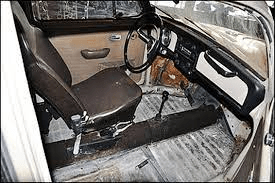
The inside of Ted’s VW Beetle. Bundy took out the cars passenger seat so that his victims could lie vertically without being seen by others.
Another shot of the inside of Bundy’s VW.
Bundy’s VW Beetle notes from the ‘Ted Bundy Multiagency Investigative Team Report 1992.’ He bought the infamous tan Bug in the spring of 1973 from a woman named Martha Helms.
First confirmed Bundy victim, Karen Sparks-Epley (formerly known as Joni Lenz).
Karen Sparks-Epley’s residence where was attacked by Ted Bundy on January 4, 1974. This is a police photograph of 4325 8th Avenue NE, Sparks’ bedroom is circled in white. The house was torn down at some time in 1985.
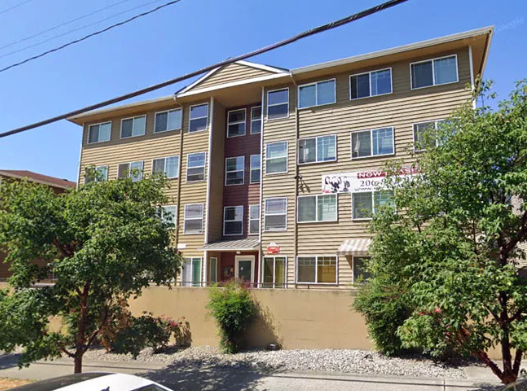
These days the site of the house is now home to the Westwood apartments, which were built in 1985.
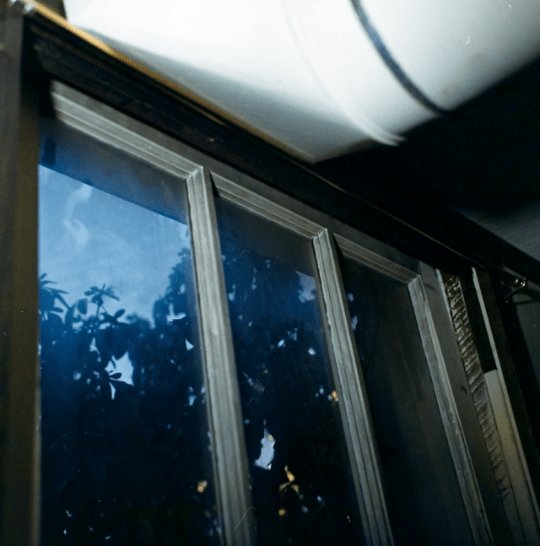
The window at Karen Sparks apartment Bundy used to break in.
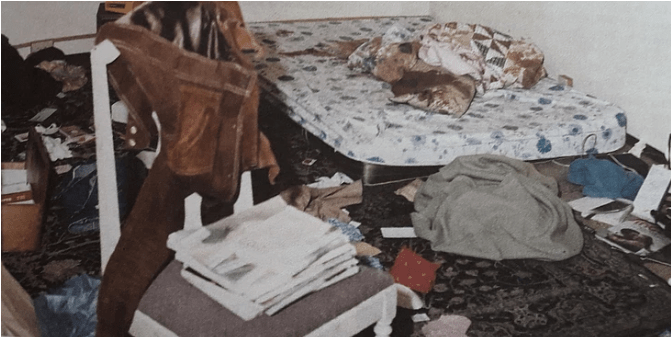
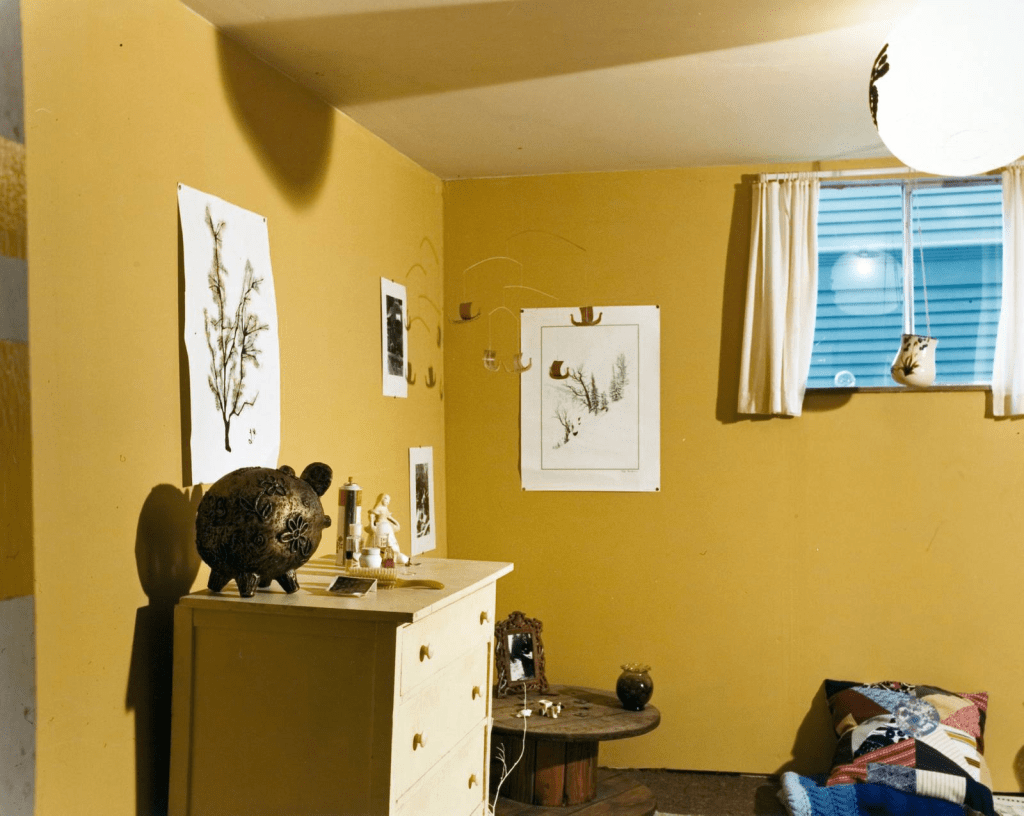
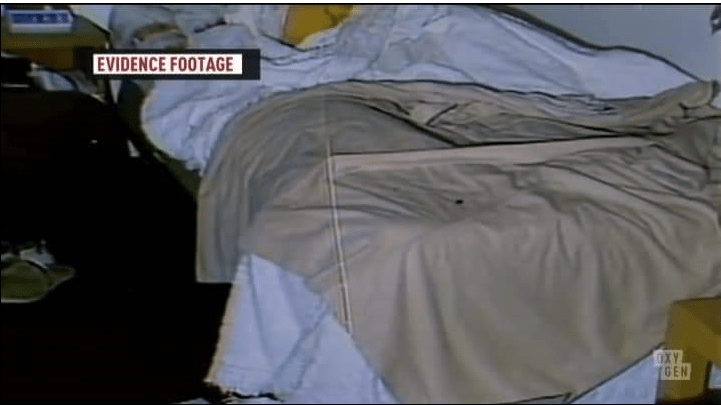
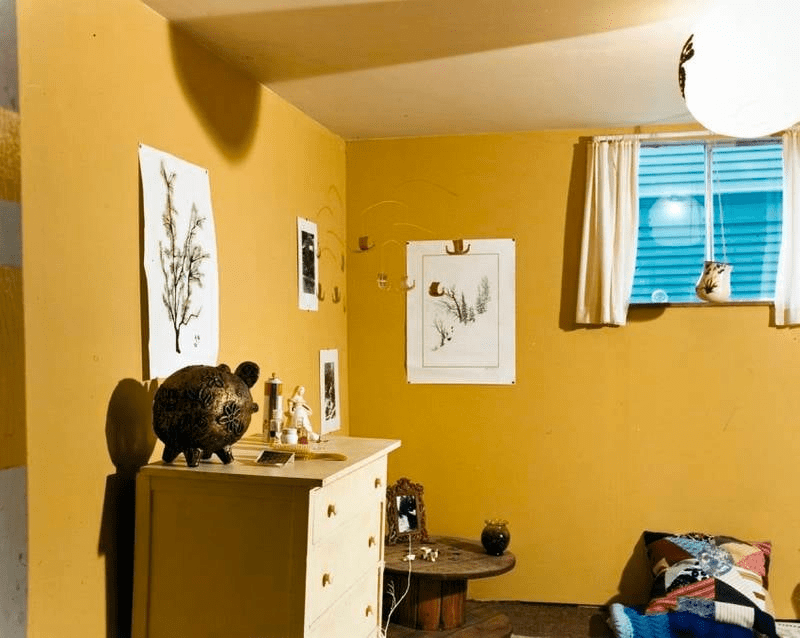
The bedroom of Karen Sparks after her assault. Photo courtesy of KIRO-7.
The close-up of Sparks bed after her assault. Photo courtesy of Amazon.
The bedroom of Karen Sparks after her assault. Photo courtesy of KIRO-7.
The doorway of Karen Sparks bedroom after her assault. Photo courtesy of KIRO-7.
The floor of Karen Sparks bedroom after her assault. Photo courtesy of KIRO-7.
The bedroom of Karen Sparks after her assault.
The bedding of Sparks. Photo courtesy of Amazon.
A crime scene photo from the assault of Karen Sparks.
Lynda Ann Healy, TB’s first confirmed kill. Healy was born on July 3,1952 in Seattle and was abducted on January 31, 1974.
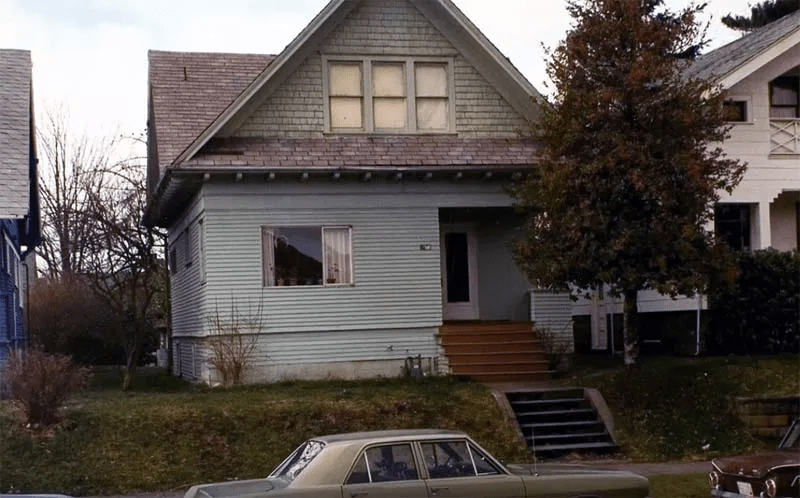
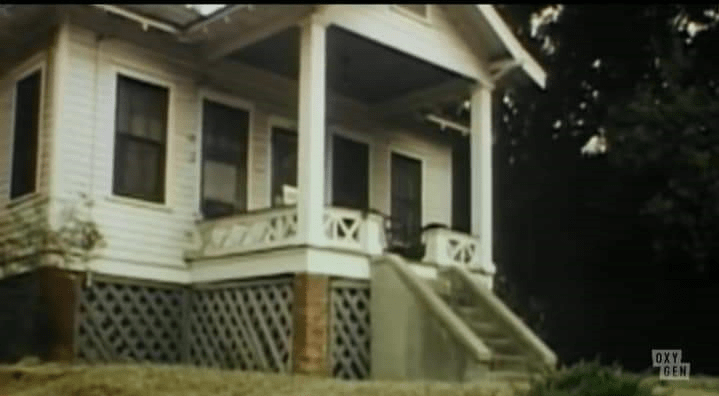
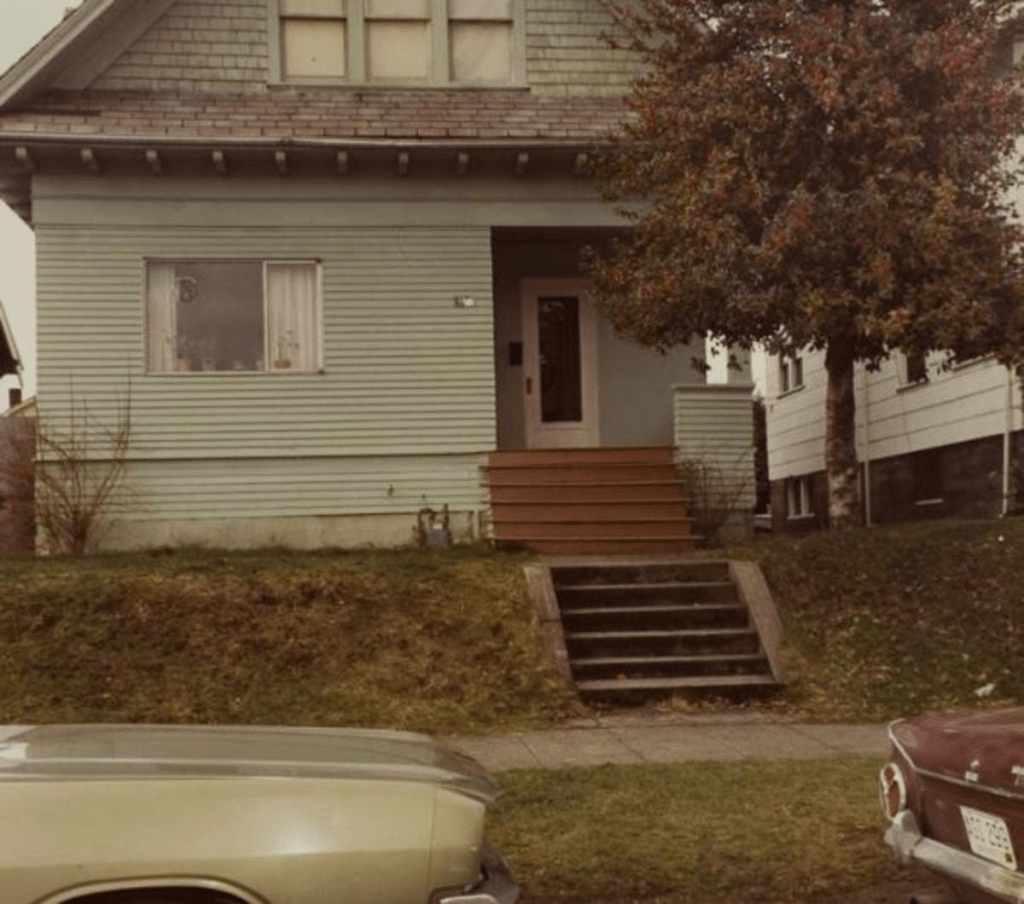
Healy’s house as it looked in the 1970’s.
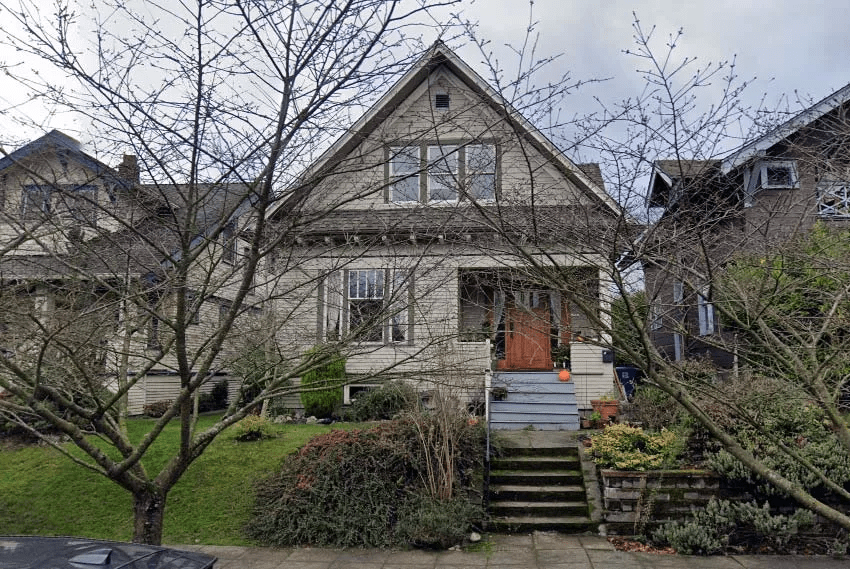
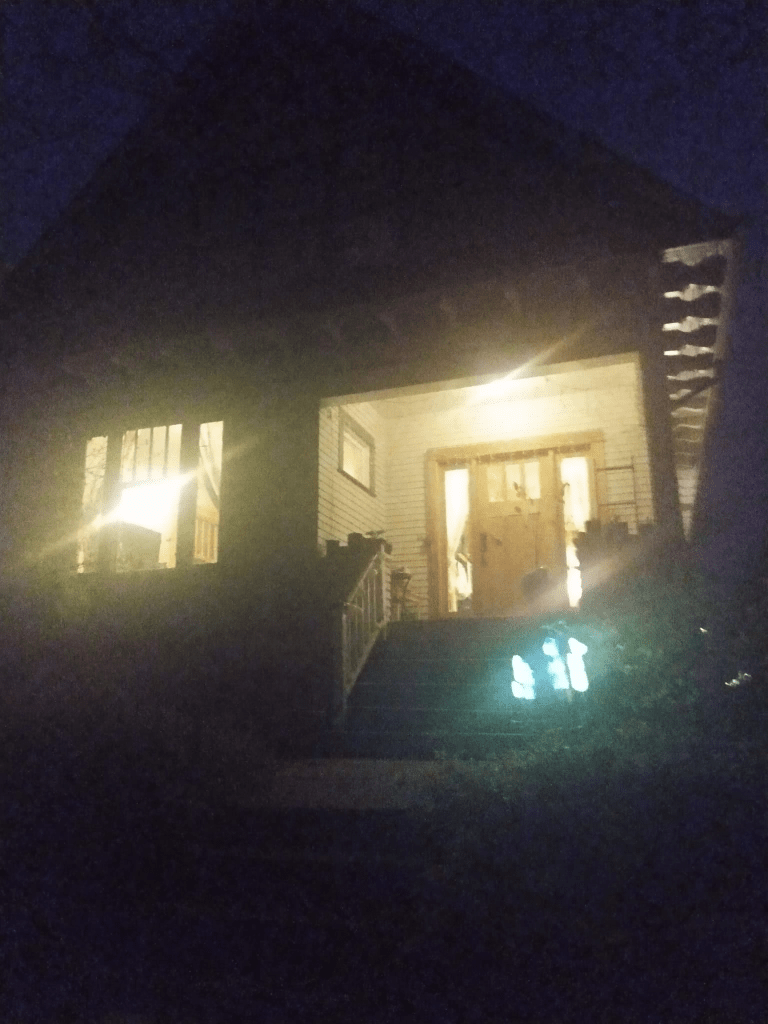
Healy’s apartment in 2021.
A photo of the trail behind Lynda Ann Healy’s apartment; her house is circled in red. Photo courtesy of OddStops.
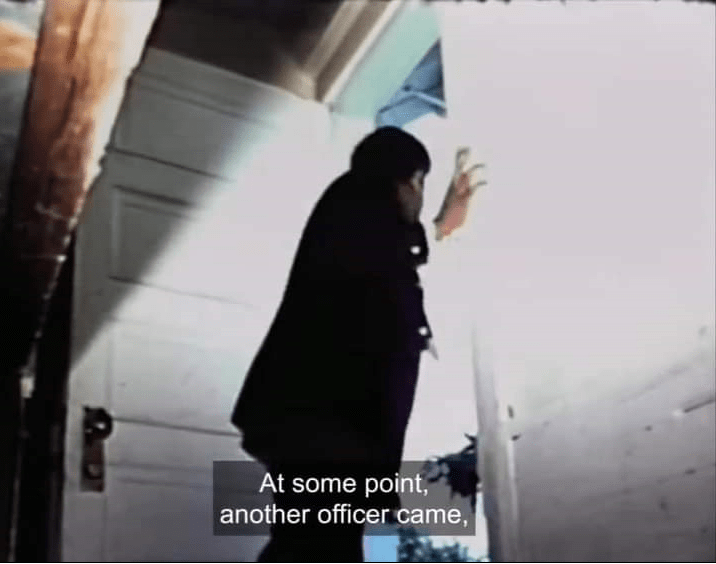
A King County Detective walking out of the side door of Healy’s apartment. Photo courtesy of Amazon.
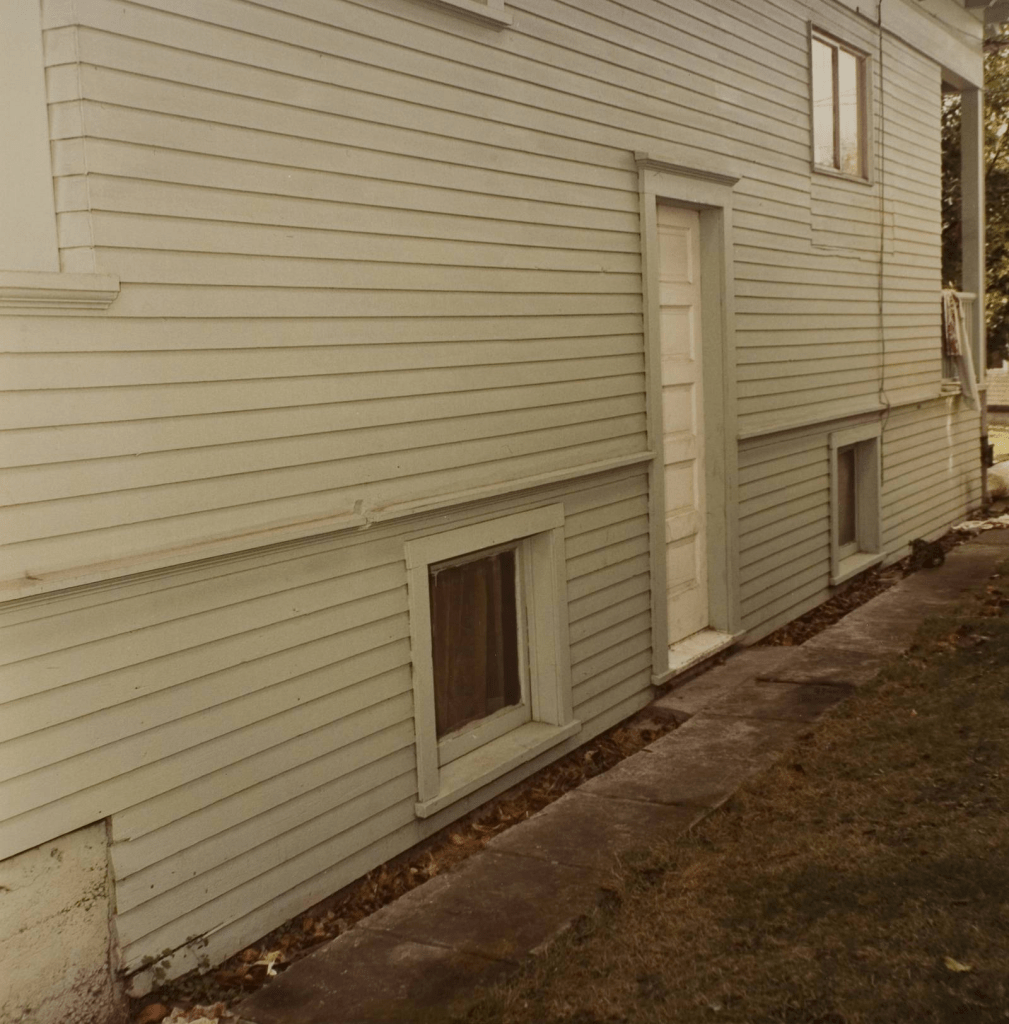
The entrance of Healy’s apartment, via the side door of the house. Photo courtesy of KIRO-7.
The side door of Healy’s apartment. Photo courtesy of KIRO-7.
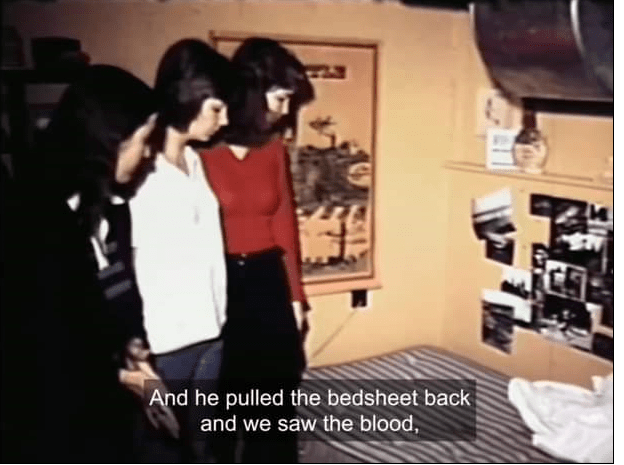
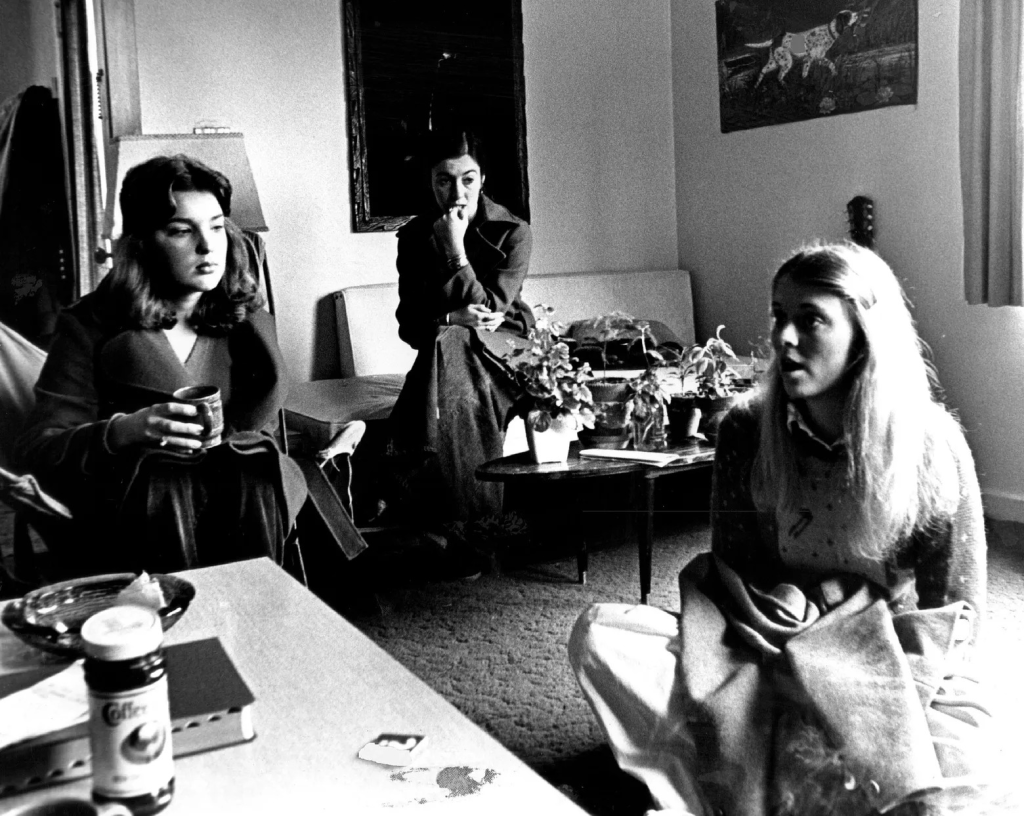
Lynda’s roommates standing around her bed. Photo courtesy of Amazon.
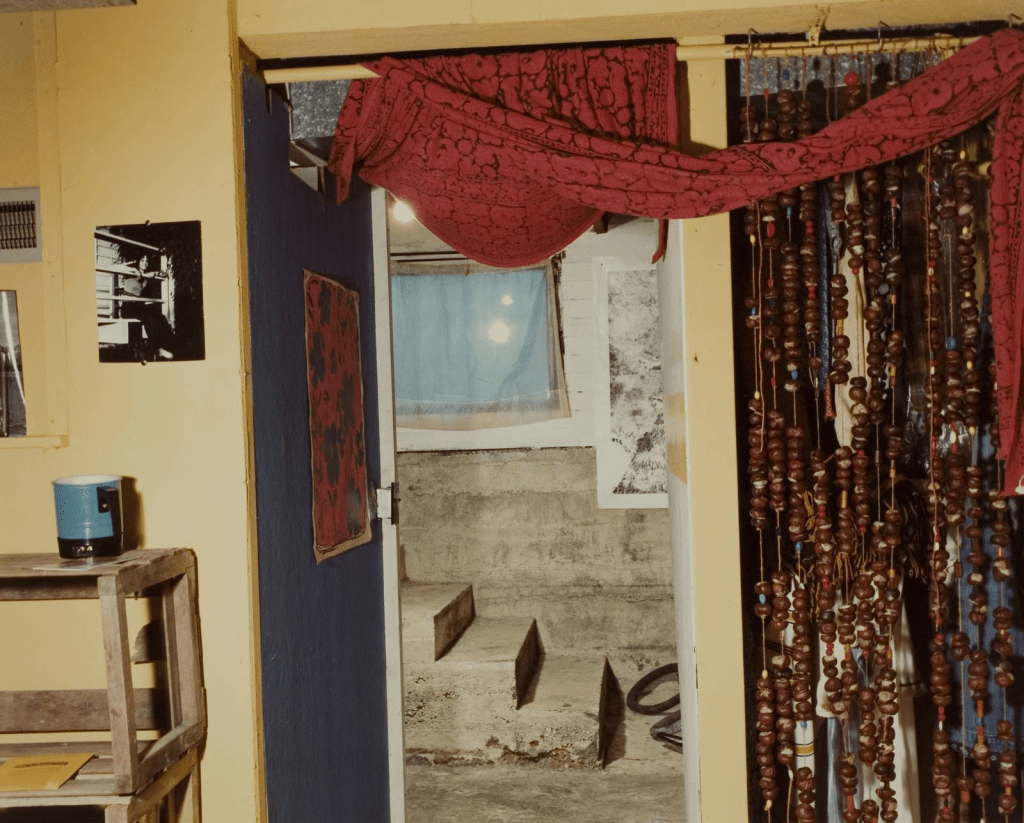
The entrance of Healy’s bedroom and the stairs leading outside. Photo courtesy of KIRO-7.
Another shot of the entrance of Lynda Healy’s bedroom. Photo courtesy of KIRO-7.
One side of Healy’s bedroom. Photo courtesy of KIRO-7.
Another shot of Healy’s bedroom. Photo courtesy of KIRO-7.
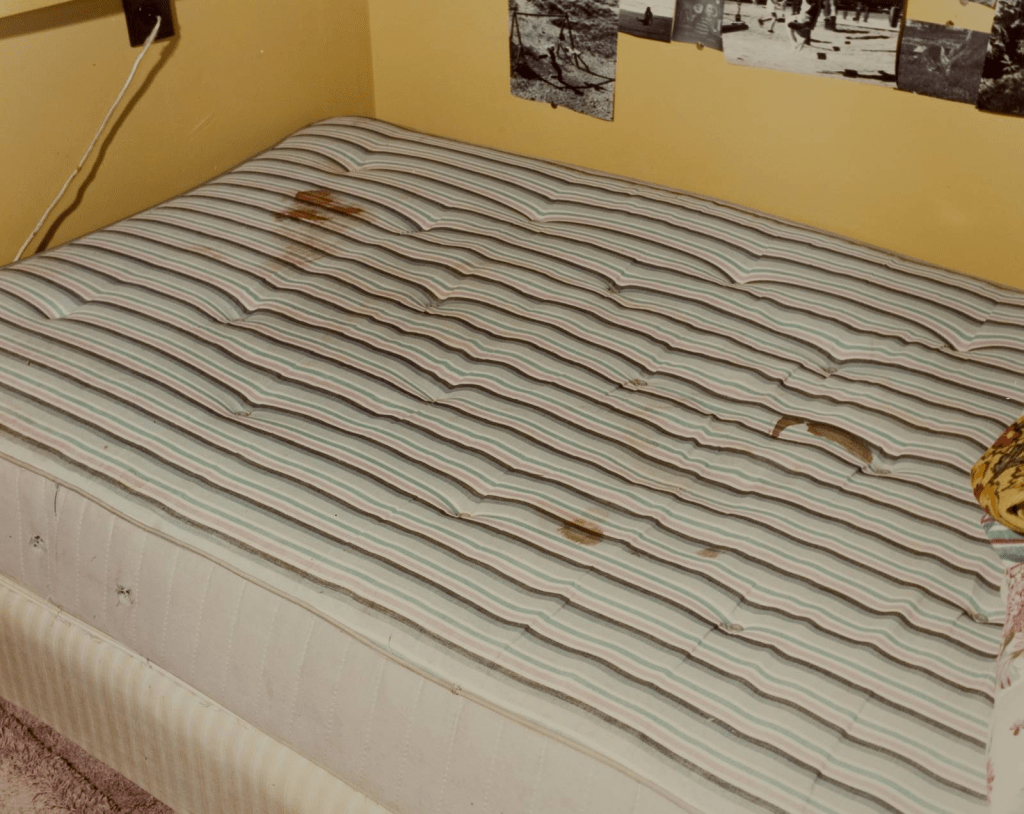
A shot of Healy’s mattress. Photo courtesy of KIRO-7.
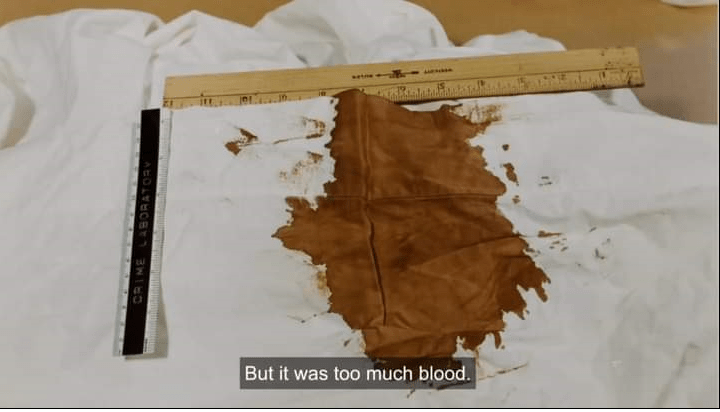
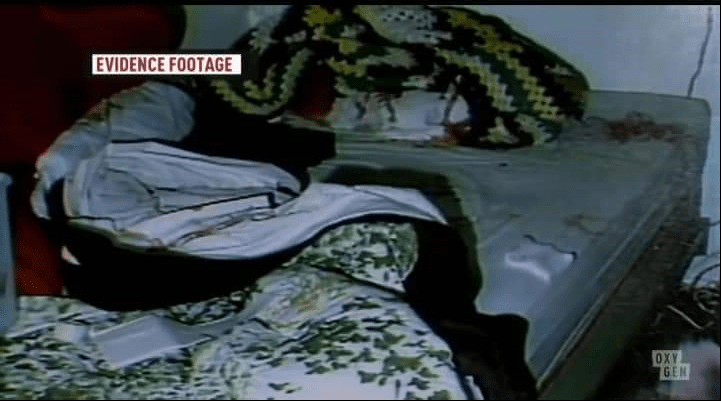
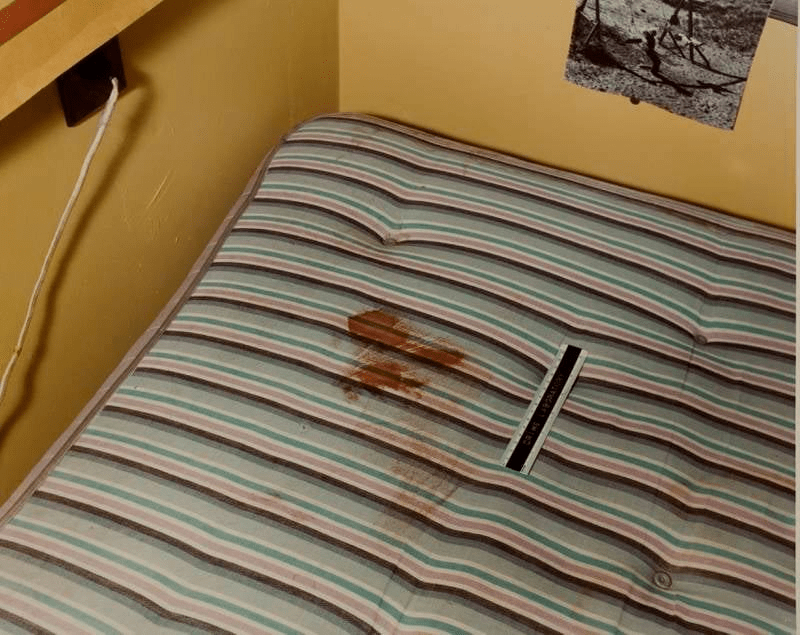
A close-up of the blood stain on Lynda Ann Healy’s mattress. Photo courtesy of KIRO-7.
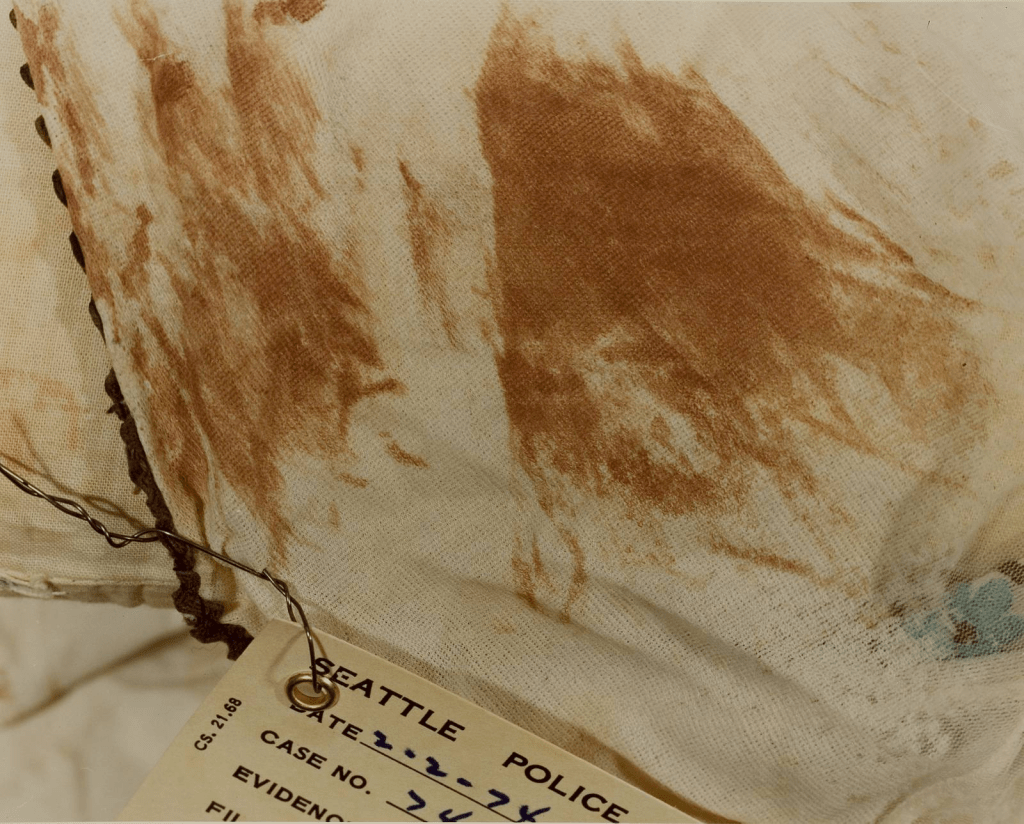
The blood stain on Lynda Ann Healy’s bedding. Photo courtesy of Amazon.
A close-up of the blood stain on Lynda Ann Healy’s bedding. Photo courtesy of Amazon.
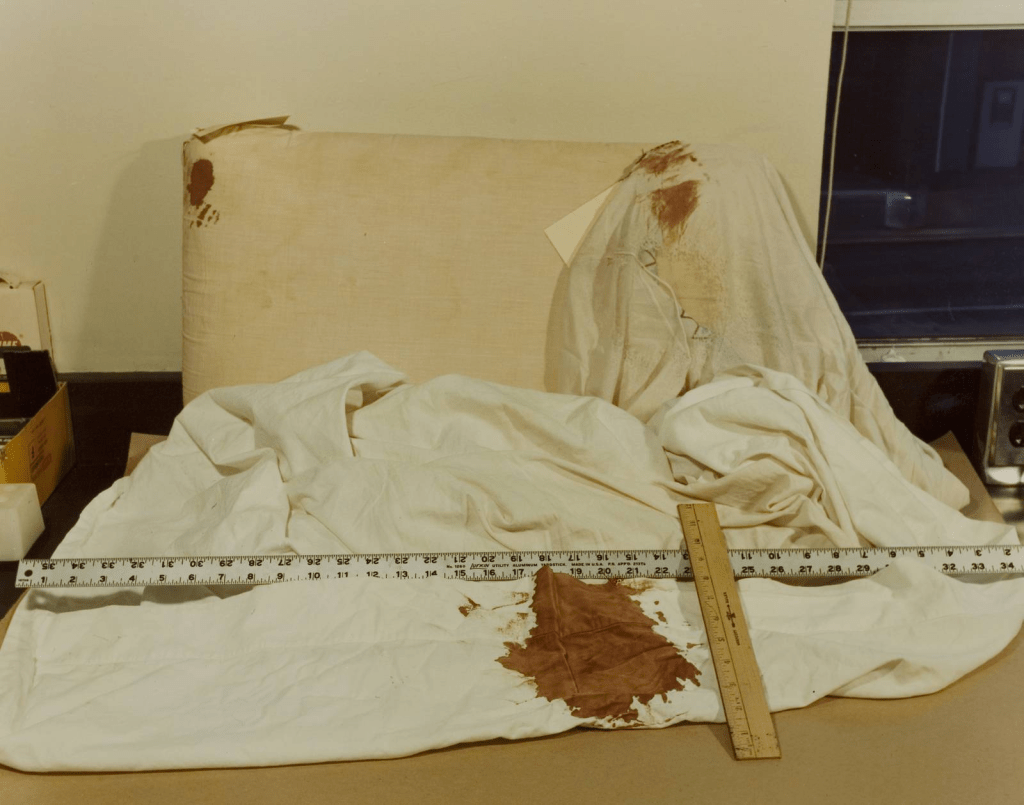
The blood stain at the crime scene of Healy. Photo courtesy of Amazon.
A close-up of the blood stain at the crime scene of Lynda Healy. Photo courtesy of Amazon.
Susan Elaine Rancourt.
Roberta Kathleen Parks.
Brenda Ball’s drivers license. Photo courtesy of KIRO-7.
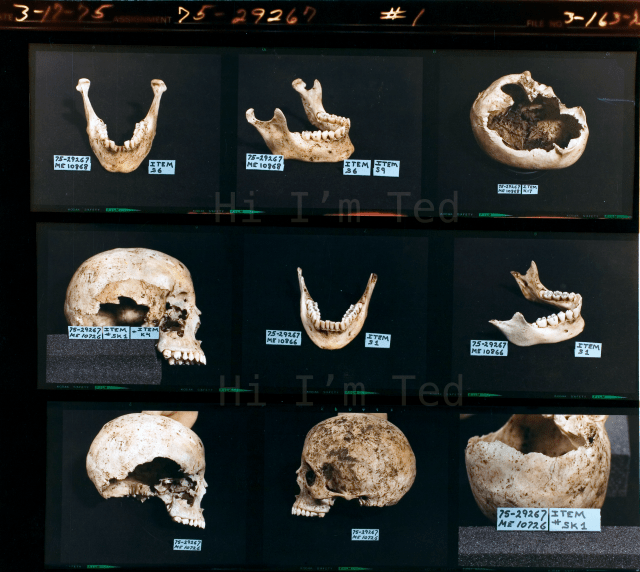
The following is borrowed from Dr. Robert Keppel’s true crime classic ‘The Riverman: Ted Bundy and I Hunt for the Green River Killer:’ ‘The final tally of remains for Taylor Mountain paled in comparison to Issaquah: three crania, three mandibles, two small pieces of a skull, one tooth, and a small blond hair mass. Not one other remnant of a human skeleton was discovered. The remains of four women were identified from the sparse skeletal remains we had recovered: Susan Rancourt, who disappeared April 17, 1974, from the library at Central Washington State College; Kathy Parks, last seen May 5, 1974, at Oregon State University, over 260 miles from Taylor Mountain; Brenda Ball, who was last seen May 31, 1974, at the Flame Tavern in Seattle; and Lynda Healy, who was reported missing from her basement bedroom at the University of Washington on January 31, 1974.’
Powerline Road on Taylor Mountain. Photo courtesy of KIRO-7.
Another shot of the Taylor Mountain burial site. Photo courtesy of KIRO-7.
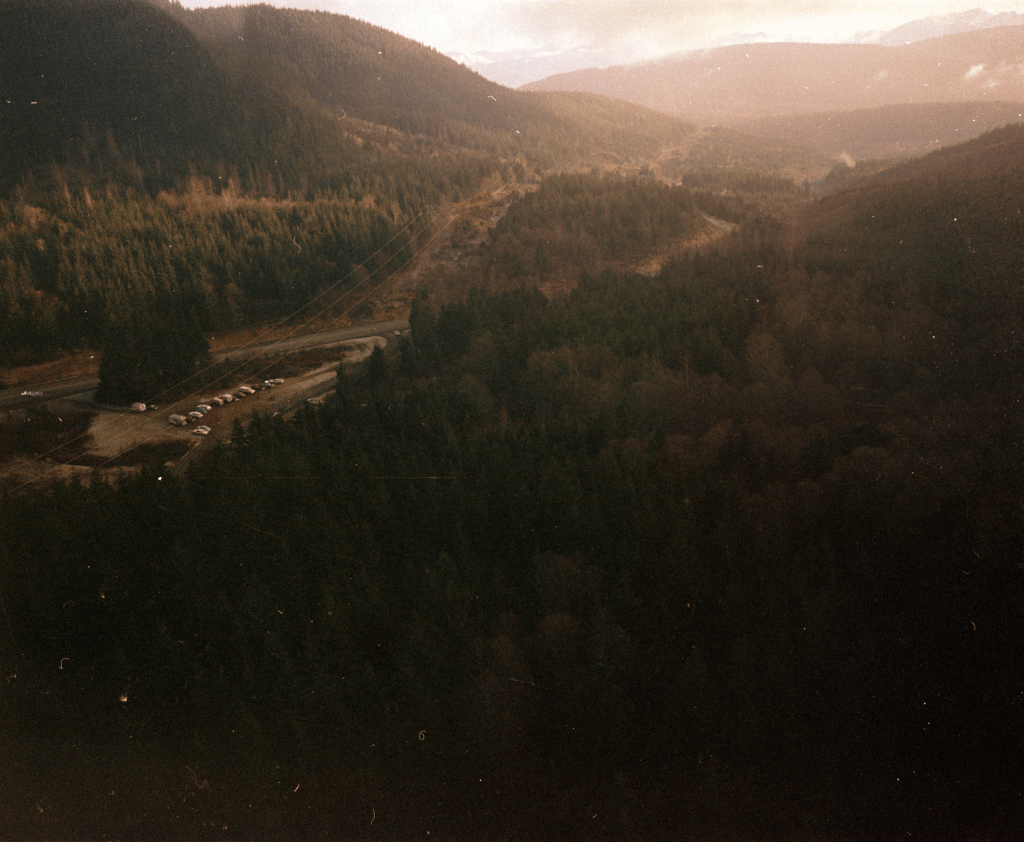
An aerial shot of Taylor Mountain. Photo courtesy of KIRO-7.
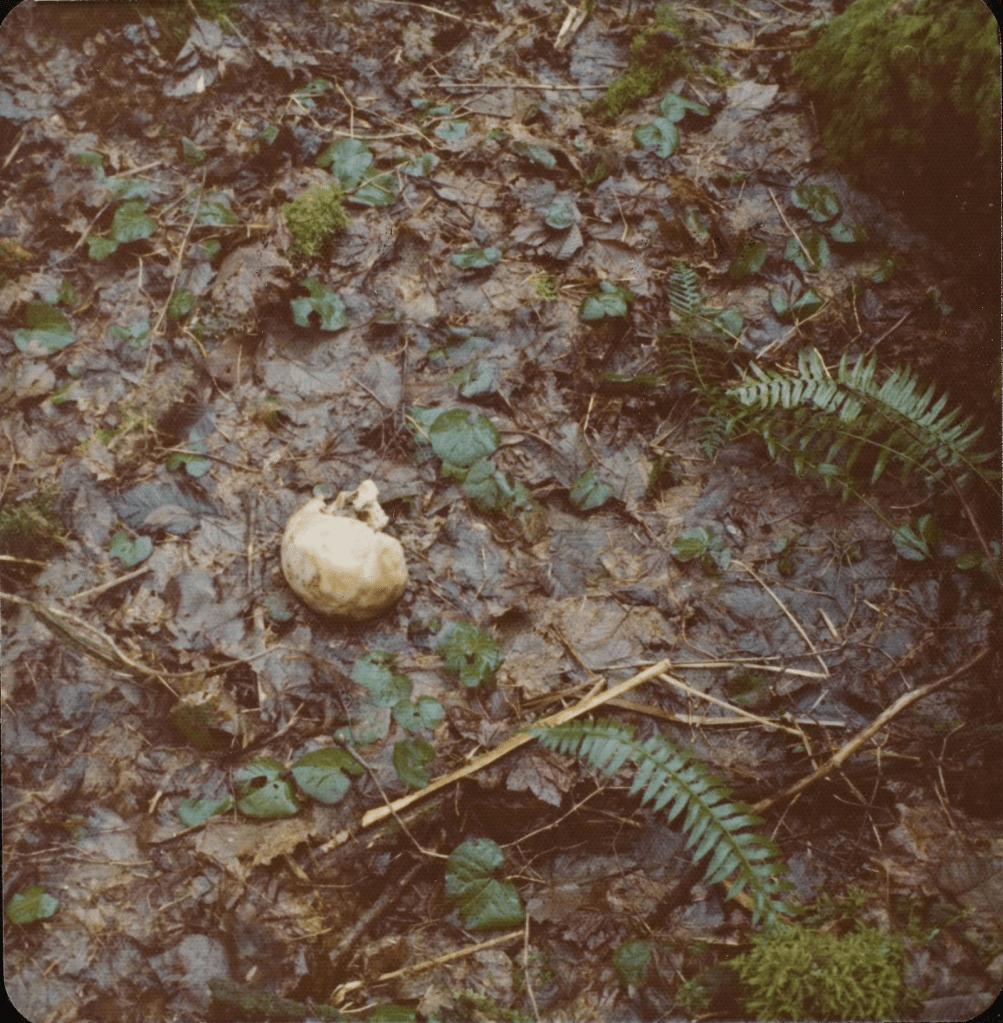
The skull of Brenda Ball at the Taylor Mountain burial site. Photo courtesy of KIRO-7.
Another shot of the skull of Brenda Ball at the Taylor Mountain burial site. Photo courtesy of KIRO-7.
A close-up shot of the skull of Brenda Ball. Photo courtesy of the KIRO-7.
A shot of Lynda Ann Healy’s mandible with teeth taken from about 15 feet away. Photo courtesy of the King County Archives.
A shot of Lynda Ann Healy’s mandible taken from roughly four feet away. Photo courtesy of the King County Archives/Tiffany Jean.
Susan Rancourt’s beautiful blonde hair. Photo courtesy of the King County Archives/Tiffany Jean.
Susan Rancourt’s skull. Photo courtesy of the King County Archives/Tiffany Jean.
Kathy Parks’ skull. Photo courtesy of the King County Archives/Tiffany Jean.
One of the skulls recovered from Taylor Mountain. Photo courtesy of the King County Archives/Tiffany Jean.
LE pointing out something at the Taylor Mountain burial site. Photo courtesy of Oxygen.
A member of law enforcement pointing something out at the Taylor Mountain burial site.
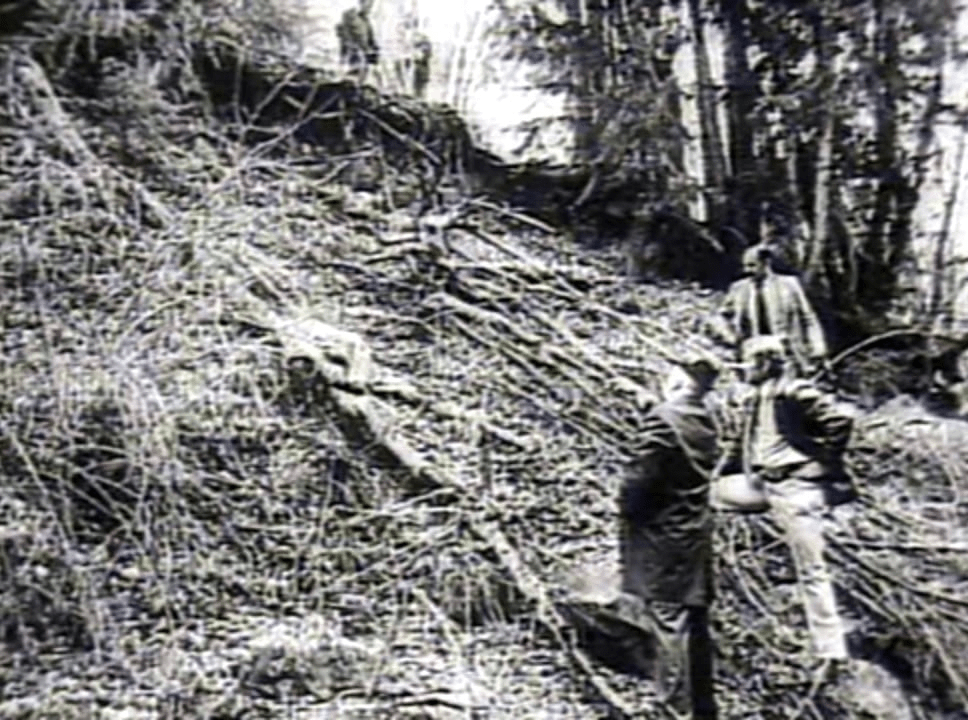
Members of law enforcement at the Taylor Mountain burial site. Photo courtesy of KIRO-7.
A green, military-style type coat, item #K-35. Photo courtesy of the King County Archives/Tiffany Jean.
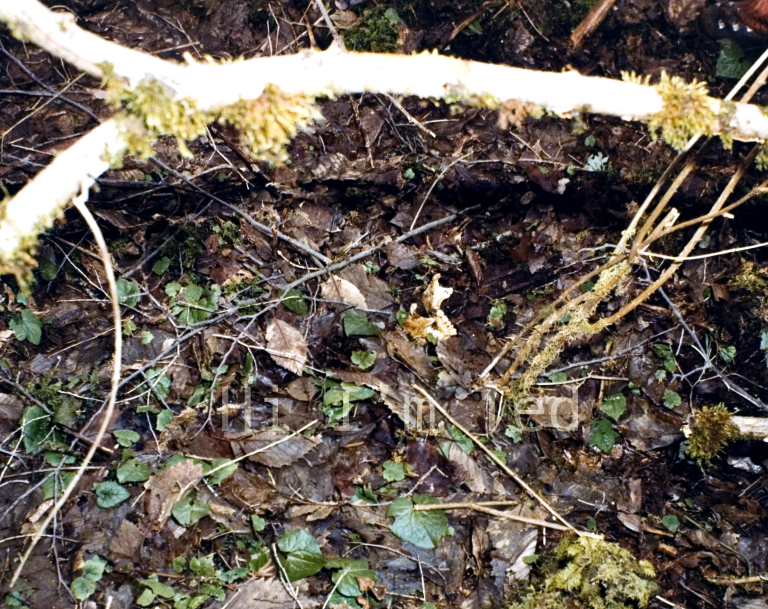
Dense underbrush at the Taylor Mountain burial site. Photo courtesy of the King County Archives/Tiffany Jean.
A shot from the Taylor Mountain burial site. Photo courtesy of the King County Archives/Tiffany Jean.
A shot from the Taylor Mountain burial site. Photo courtesy of MSNBC.
The tattered remains of a sloppily made, lean-to shelter found at Taylor Mountain. Photo courtesy of the King County Archives/Tiffany Jean.
Clockwise from the top left: Parks mandible, Parks mandible, Parks skull, Healy mandible, Ball skull, Ball skull, Ball skull, Ball skull, Healy mandible center. Photo courtesy of the King County Archives/Tiffany Jean.
Clockwise from top left: Parks skull and mandible, Parks skull and mandible, Rancourt skull, Parks skull, Parks skull, Parks skull, Parks skull, Parks skull, Parks skull at center. Photo courtesy of the King County Archives/Tiffany Jean.
Another group of bones found at Taylor Mountain. Photo courtesy of KIRO-7. I believe these are all bones in Susan Rancourts skull.
Brenda Ball’s skull. Photo courtesy of the King County Archives/Tiffany Jean.
Susan Rancourt’s skull. Photo courtesy of the King County Archives/Tiffany Jean.
Kathy Parks’ skull. Photo courtesy of the King County Archives/Tiffany Jean.
Janice Ott.
Denise Naslund.
TB’s Issaquah burial site as it looks today.
The entryway to Ted’s Issaquah burial site as it looks today.
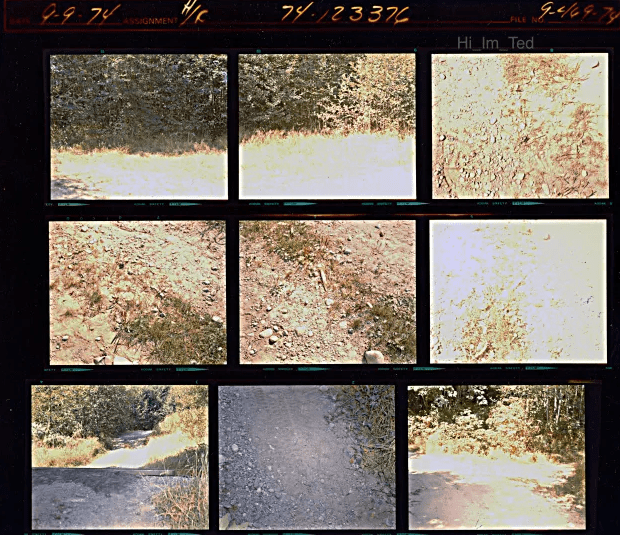
The Issaquah dirt road and grassy area in September 1974. Photo courtesy of the King County Archives/Tiffany Jean.
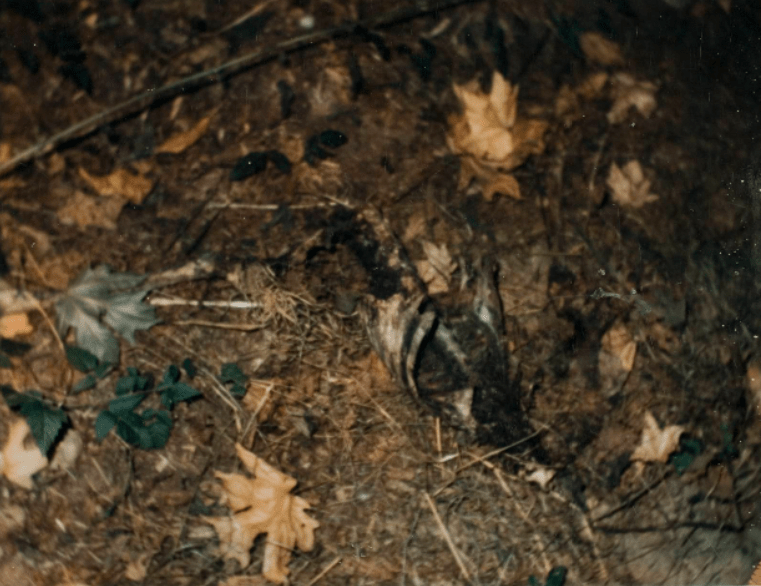
Denise Naslunds hair at the Issaquah burial site. Photo courtesy of the King County Archives.
Another shot of Denise Naslunds hair at the Issaquah burial site. Photo courtesy of the King County Archives.
A rib cage at the Issaquah burial site. Photo courtesy of the King County Archives.
Another shot of the rib cage at the Issaquah burial site. Photo courtesy of the King County Archives.
Denise Naslunds skull from the Issaquah burial site. It was found by two hunters on a hillside just east of Issaquah, less than ten miles from Lake Sammamish where she was abducted. Photo courtesy of KIRO-7.
A picture from the Issaquah burial site. Photo courtesy of Oxygen.
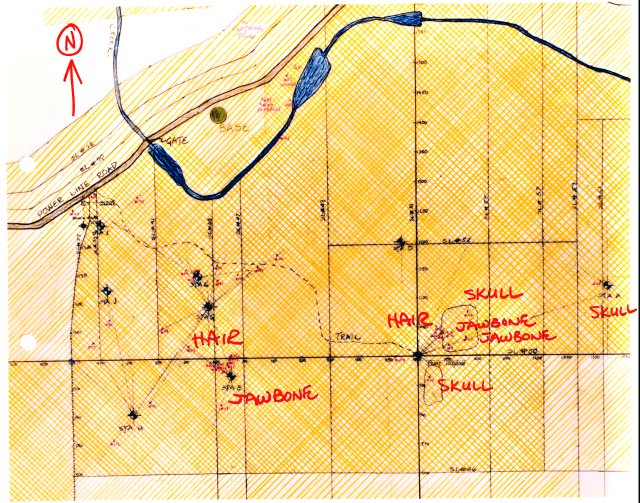
A mapping of where the different bones were found at the Issaquah burial site.
Ted at the Issaquah burial site; he was there with Liz that day.
Georgann Hawkins.
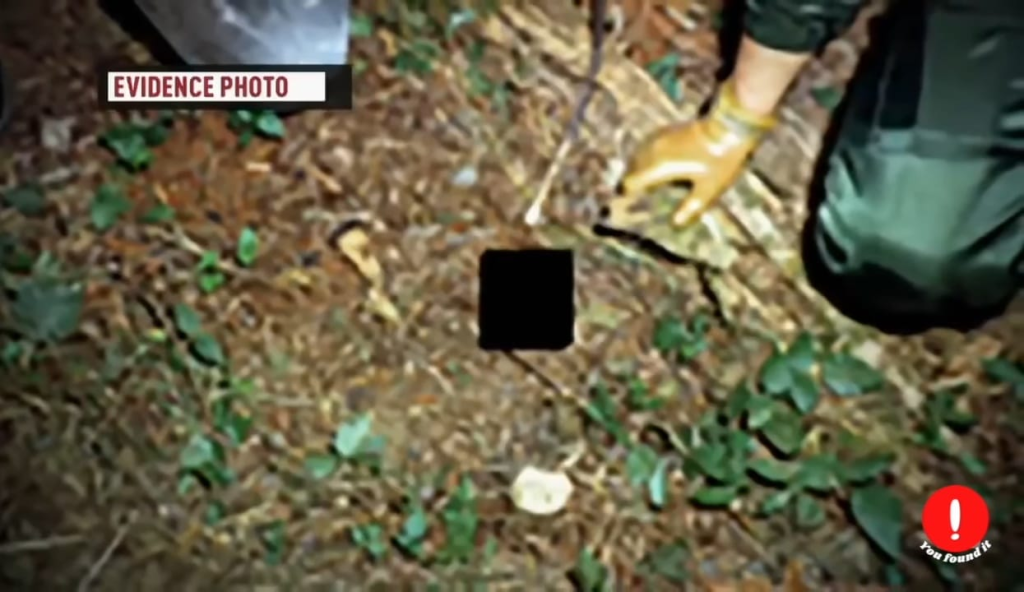
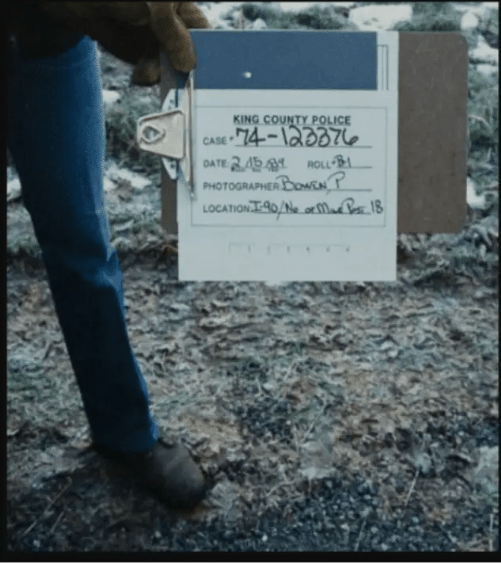
A snapshot taken at the Issaquah burial site on February 15, 1989. Investigators were looking for the remains of Georgann Hawkins, after Bundy confessed to her murder during his death row confessions. Photo courtesy of the King County Archives.
Another picture taken at the Issaquah burial site on February 15, 1989.
A picture of the possible burial site of Georgann Hawkins taken in February 1989.
The ESAR map Keppel brought with him to the Florida State Prison for his final interview with Bundy. Photo courtesy of the King County Archives/Tiffany Jean.
Susan Curtis.
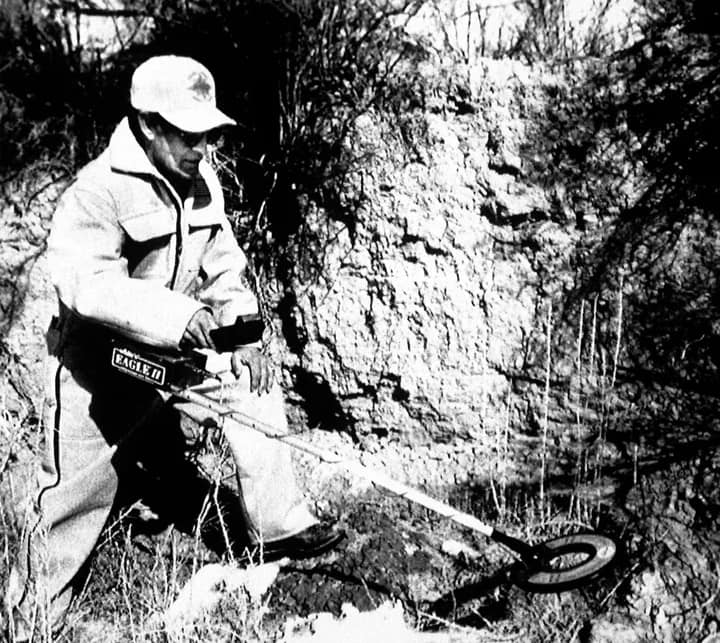
Joe Ruden from the Carbon County Search and Rescue team uses a metal detector to search for the burial site of Susan Curtis, who disappeared from the BYU campus in Utah in the summer of 1975. Bundy confessed to killing Curtis during his death row confessions and that he buried her about ten miles south east of Price, UT.
Jim Simone from the Carbon County Search and Rescue team sets out in search for the remains of Sue Curtis.
Debra Kent.
Deb Kent’s patella. Photo courtesy of Tiffany Jean. Right before he was put to death in January 1989, Bundy finally confessed to killing Deb Kent. He said that he brought her back to his apartment and after ‘keeping her for a while’ murdered her. He then put her body in his car and drove 105 miles away to Fairview Canyon, where he buried her remains about 3 feet deep, under some heavy rocks. After searching the Canyon, law enforcement found a patella (kneecap), and it is likely that her other bones were scavenged and spread around by wildlife over time. Although the ME’s office determined that the bone was human, they weren’t able to test it beyond that until 2015, when a cold-case detective stumbled across Kent’s DNA that had never been entered into the NamUs database. At that point, he reached out to Mrs. Kent, who held onto the only piece of her daughter she had left and asked if he could take the bone for genetic testing. Although she gave the detective the patella, Mrs. Kent told him that she didn’t want to know the results. In her mind, it belonged to Debra and didn’t want to be told otherwise. Thankfully her fears were put to rest five months later, when the results came back that the bone belonged to Debra.
Melissa Smith.
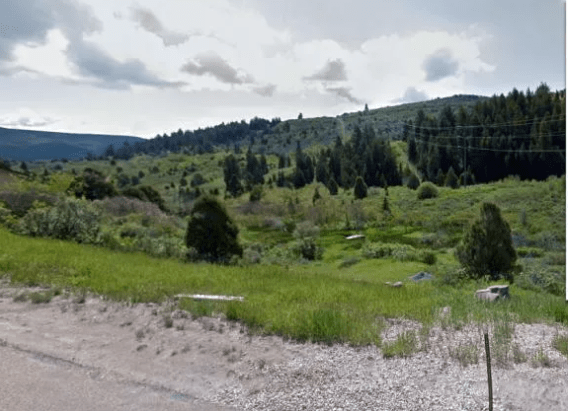
Where the remains of Melissa Smith were found, on Kilby Road in Park City, Utah.
Investigators at the scene where the remains of Laura Ann Aime were found.
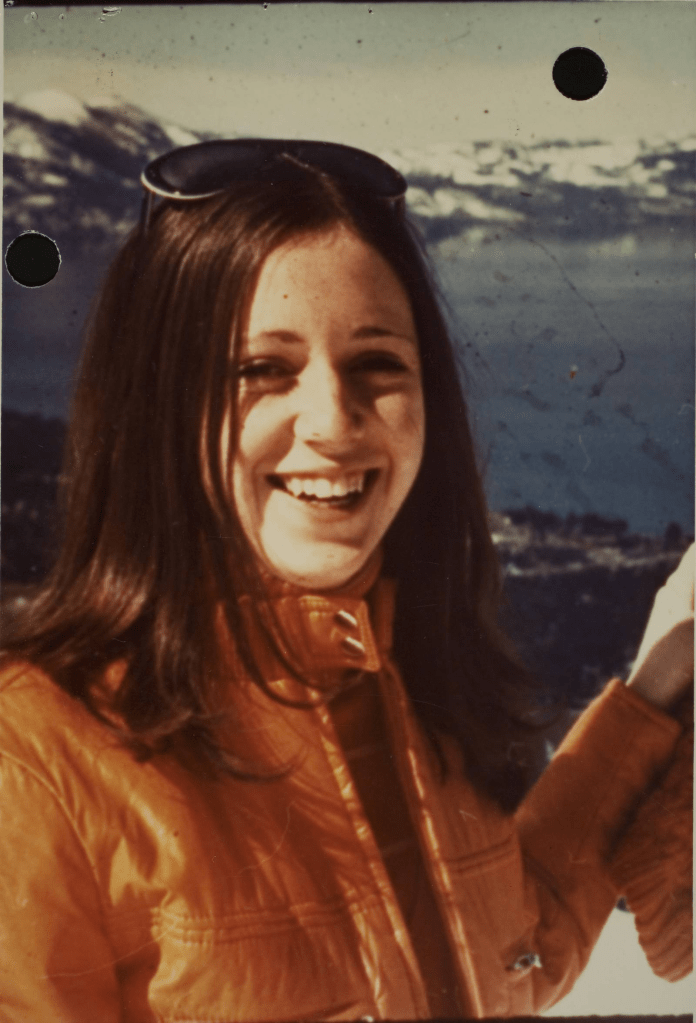
Caryn Campbell. Photo courtesy of KIRO-7.
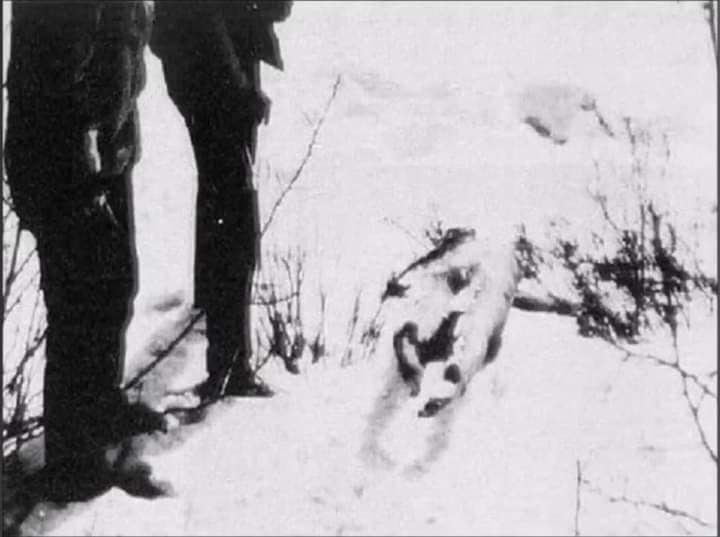
A shot of the remains of Caryn Campbell in the snow. Photo courtesy of Vanessa West.
The skull of Caryn Campbell. Photo courtesy of Vanessa West.Thank you to my friend Samantha Shore for letting me know the identity of this victim.
Vince Lahey holding a crowbar over Campbells autopsy photo. Photo courtesy of Erin Banks.
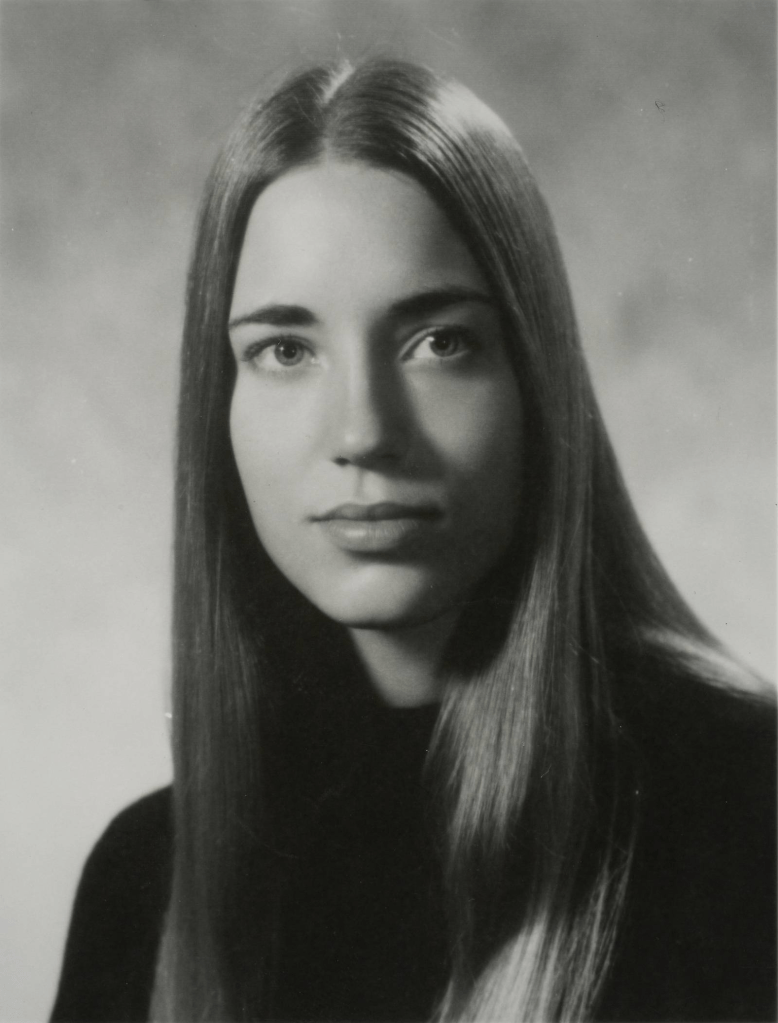
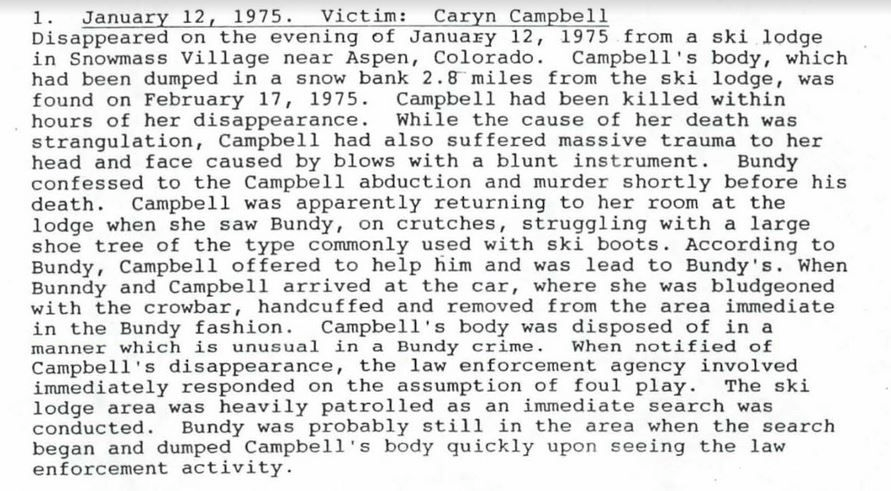
Caryn Campbell, Bundy’s MO. Photo courtesy of Erin Banks.
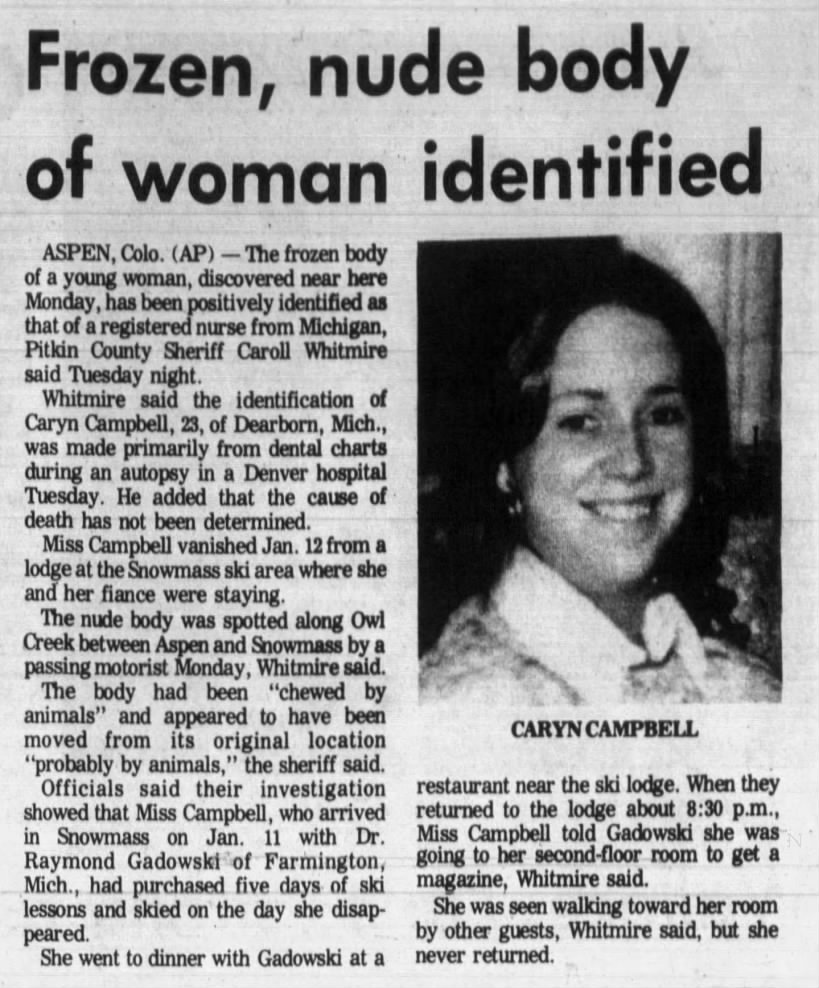
An article about the discovery of Caryn Campbell’s remains, published by The Daily Sentinel on February 19, 1975.
A photo of Bundy’s shoe print in the snow after his second escape on December 30, 1977. Photo courtesy of The Coloradoan.
Margaret Bowman, a victim of Bundy’s 1978 Florida rampage.
Lisa Levy, a victim of Bundy’s 1978 Florida rampage.
Kathy Kleiner testifying at Bundy’s trial.
Kathy Kleiner, today.
Karen Ann Chandler testifying at Bundy’s trial.
Karen Chandler, today.
The crime scene of Chi Omega victim, Margaret Bowman. Photo courtesy of Vanessa West.
Margaret Bowman, who was murdered while defenseless in her bed. Photo courtesy of Vanessa West.
Chi Omega victim, Margaret Bowman. Photo courtesy of Vanessa West.
A photo of Chi Omega victim, Lisa Levy. Photo courtesy of Vanessa West.
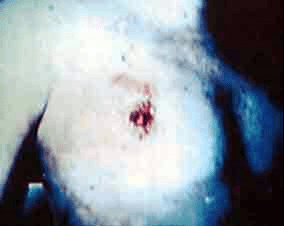
A bite mark on Chi Omega victim, Lisa Levy. Photo courtesy of Vanessa West.
Another shot of Bundy’s bite mark on Lisa Levy’s buttock. Photo courtesy of Vanessa West.
The layout of the rooms at the Chi Omega sororiety house.
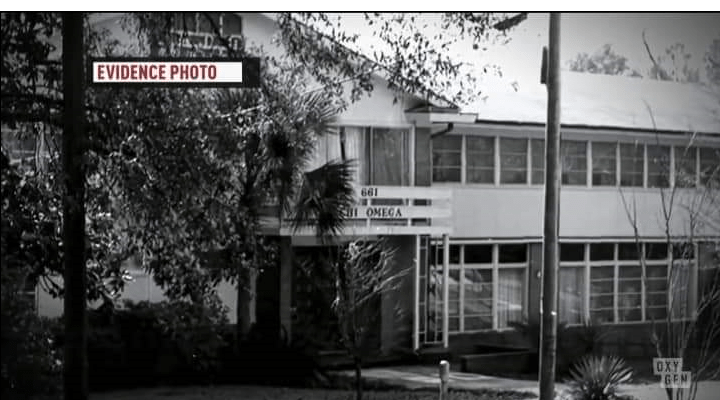
The Chi Omega House right after the murders took place in 1978. Twenty year old Lisa Levy and twenty-one year old Margaret Bowman were brutally murdered in their beds by Bundy. He also viciously attacked and left for dead Karen Ann Chandler and Kathy Kleiner, but thankfully both women survived. Photo courtesy of Oxygen.
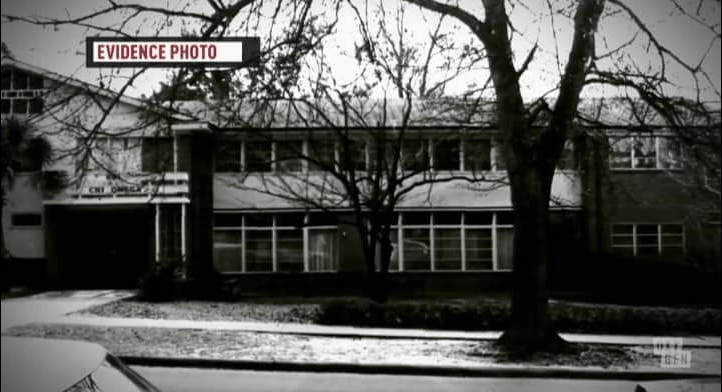
Another shot of the Chi Omega House right after the murders. Photo courtesy of Oxygen.
Another shot of the Chi Omega House right after the murders. I love the old LE vehicle parked out front. Photo courtesy of Oxygen.
The unlocked door of the Chi Omega House that Bundy snuck into. Photo courtesy of Oxygen.
An area outside of the Chi Omega house. Photo courtesy of Oxygen.
A shot of the logs outside of the Chi Omega house Bundy used to attack the four sleeping co-eds. Photo courtesy of Oxygen.
Another shot of the logs outside the Chi Omega house. Photo courtesy of Oxygen.
One of the beds in the Chi Omega house. Photo courtesy of Oxygen.
Another one of the beds from the Chi Omega house. Photo courtesy of Oxygen.
Another bed from the Chi Omega house. Photo courtesy of Oxygen.
Another one of the beds from the Chi Omega house. Photo courtesy of Oxygen.
Another bed at Chi Oh.
A picture of one of the bedrooms in the Chi Omega house after Bundy’s murders.
A picture of a hallway at the Chi Omega house after Bundy’s murders.
A photo related to Bundy’s January 1978 Tallahassee crime scene. Photo courtesy of Oxygen.
Cheryl Thomas. Bundy used the same log to attack Thomas that he used in the Chi Omega assaults. Photo courtesy of Oxygen.
A photo of the house on Dunwoody Street Cheryl Thomas shared with friends from FSU. Photo courtesy of Oxygen.
Another shot of the house that Cheryl Thomas shared with friends from FSU. Photo courtesy of OddStops.
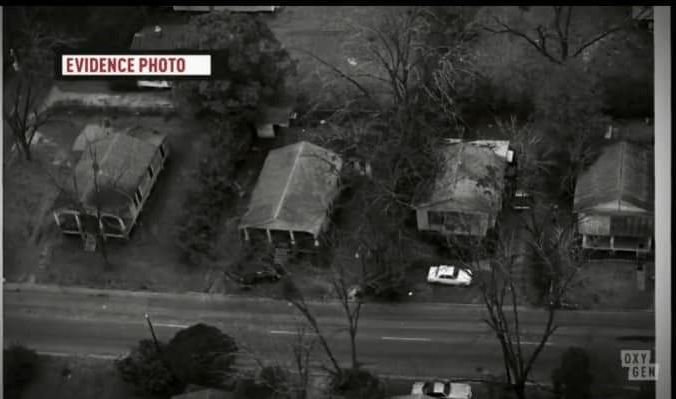
An aerial shot of where Cheryl Thomas lived and was attacked, located at 431 Dunwoody Street in Tallahassee; the house has since been torn down. Photo courtesy of Oxygen.
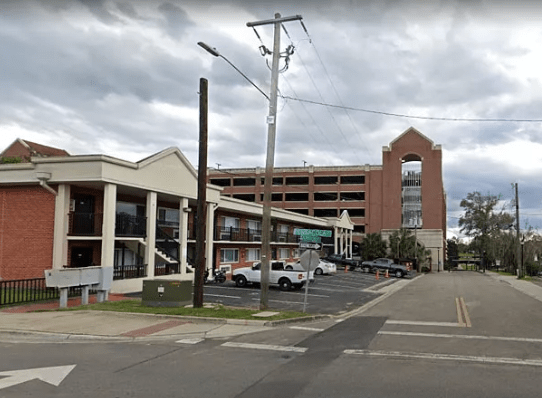
What the area on Dunwoody Street looks like in 2023.
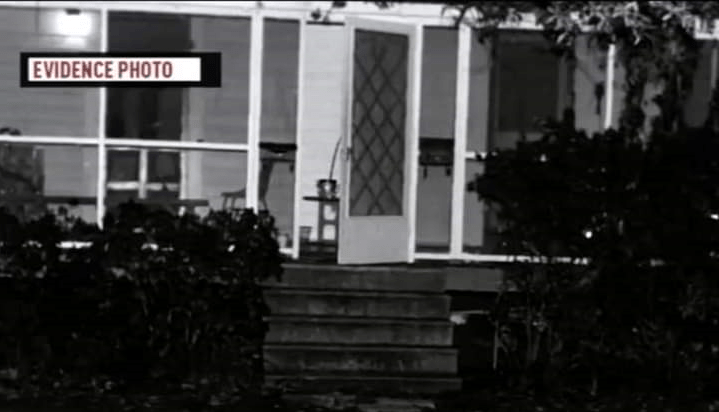
The door at the residence of Cheryl Thomas in Tallahassee. Photo courtesy of Oxygen.
The open window in Cheryl Thomas’s kitchen that Bundy climbed into. Photo courtesy of Oxygen.
The fly screen on Thomas’ window that Bundy knocked loose when he climbed into her kitchen the night of her assault. Photo courtesy of Rob Dielenberg.
The flower pot that Bundy knocked over when he broke into Cheryl Thomas’ apartment. Photo courtesy of Rob Dielenberg.
The window in Thomas’s kitchen that Bundy crawled through.
The back door at Cheryl Thomas’s apartment. Law enforcement took chunks out of the doors of both sides of the house; the perpetrator left his fingerprints behind on both. Photo courtesy of Oxygen.
The crime scene of Cheryl Thomas. Photo courtesy of Oxygen.
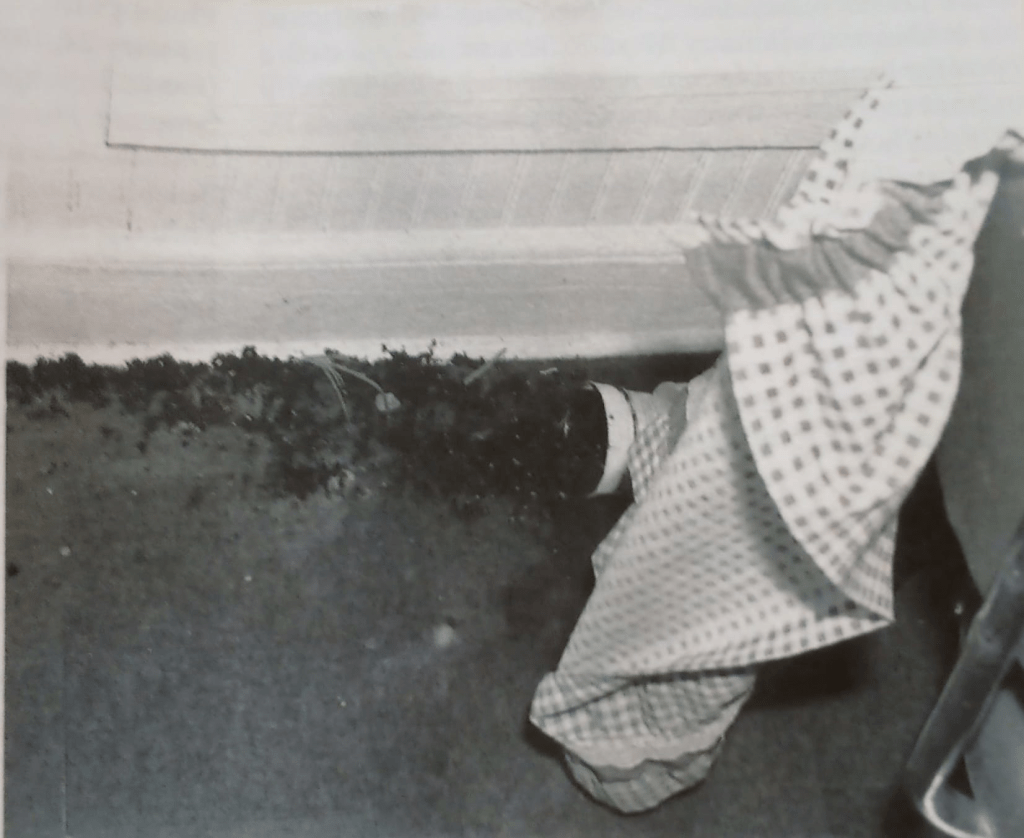
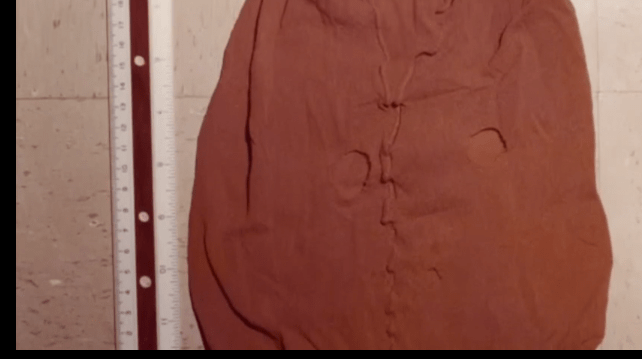
Pantyhose found in Cheryl Thomas’ apartment. According to court documents, a knotted pair of pantyhose was found in her bedroom with holes cut into the nylon to create a mask. Photo courtesy of Oxygen.
The lath that Thomas used to prop her bedroom window open. Photo courtesy of Rob Dielenberg.
The pantyhose mask found in Cheryl Thomas’ apartment. 
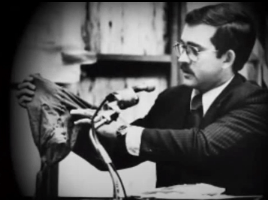
An expert holding up the pantyhose mask found in Cheryl Thomas’ apartment at Bundy’s Chi Omega trial. 
Kimberly Dianne Leach.
The white van Bundy stole from FSU. It’s the vehicle he used to abduct Kim Leach with.
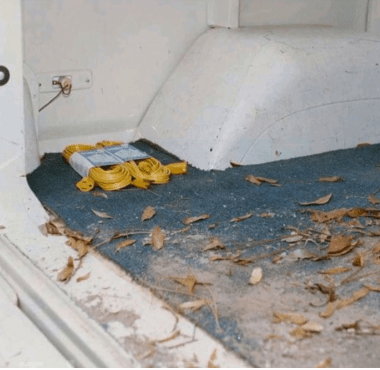
The inside of the van Bundy stole from FSU.
Another shot of the inside of the van Bundy stole from FSU.
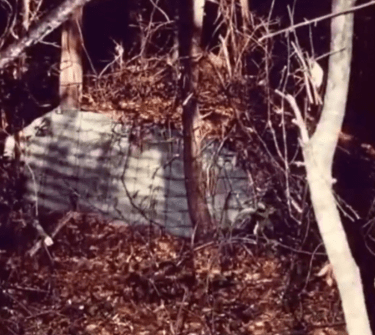
The hog shed Bundy used to dispose of Leach’s body.
A screen shot from Leach’s crime scene. This was all could find, I apologize for the poor quality.
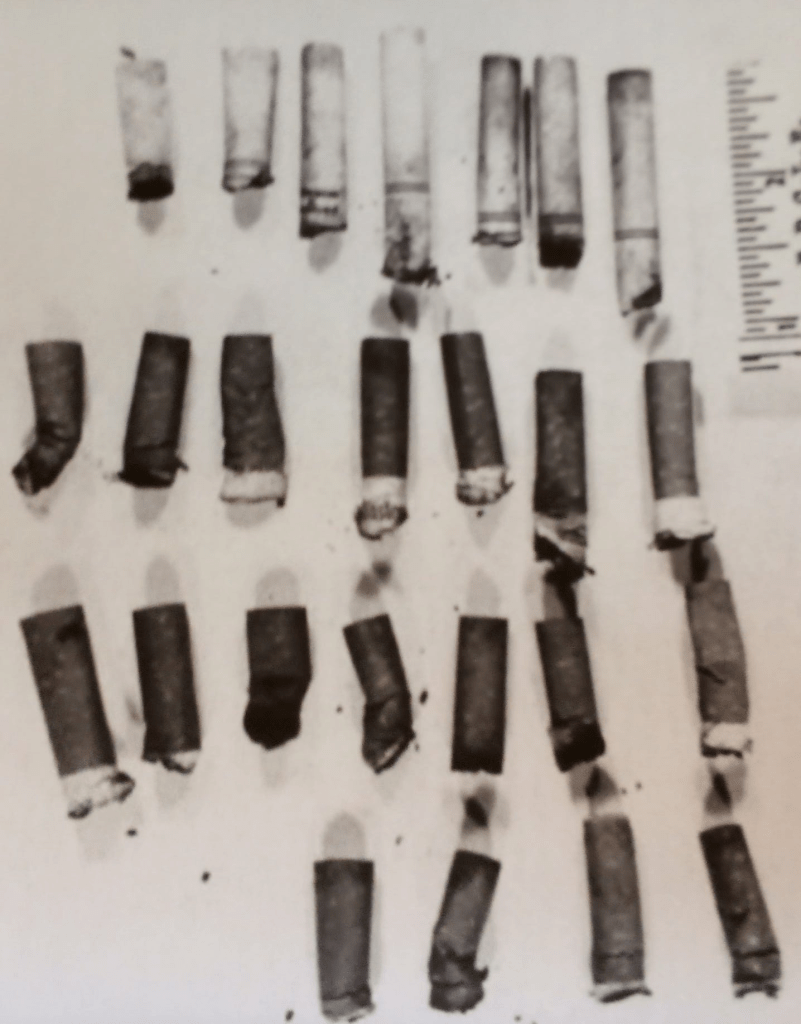
The first three rows of butts were found discarded on the ground in Suwannee River State Park, and the single column on the right were the ones ground discarded in the FSU van. Photo courtesy of Rob Dielenberg.
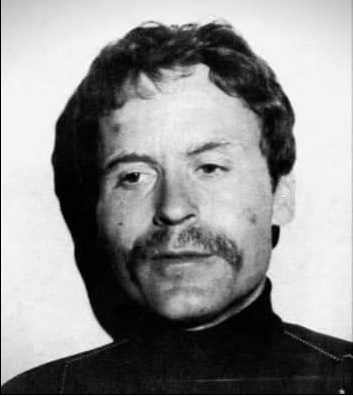
Bundy’s final mug shot from February 1978 after he was arrested in Jacksonville. The bruise on his face occurred after he got into a brief tussle with the arresting officer, who hit him in the cheek with his gun.
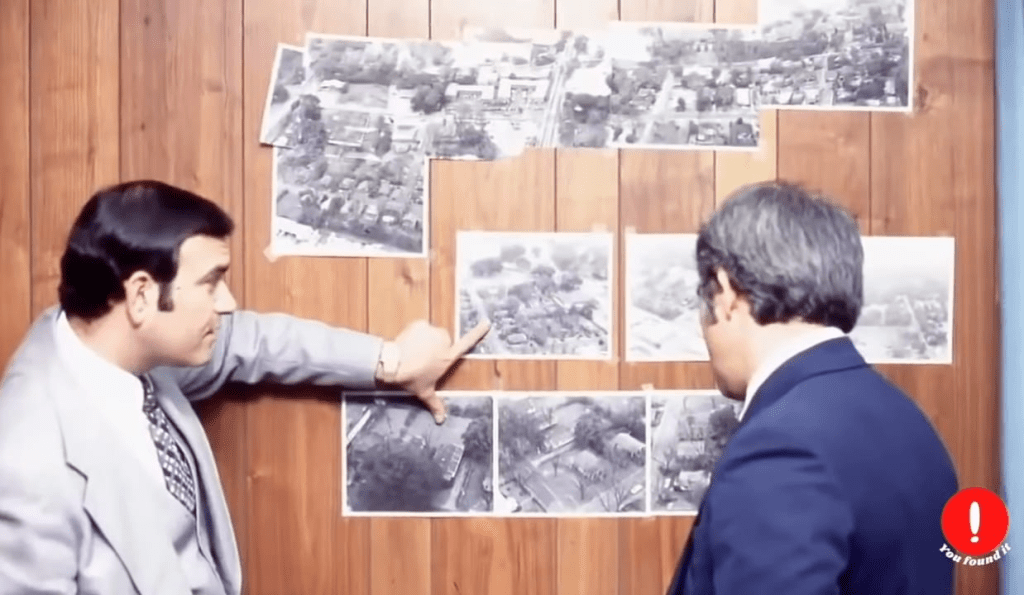
Former Leon County Sheriff Ken Katsaris looking at pictures related to the Bundy case.
A dentist taking a mold of Bundys teeth. Photo courtesy of Oxygen.
Another shot of a dentist taking a old of Bundys teeth. Photo courtesy of Oxygen.
Molds of Bundy’s teeth. Photo courtesy of Oxygen.
Bundy’s teeth. Photo courtesy of Vanessa West.
Bundy’s gross teeth.
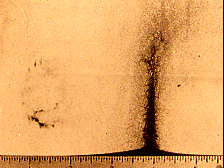
Bundy’s bite mark. Photo courtesy of Vanessa West.
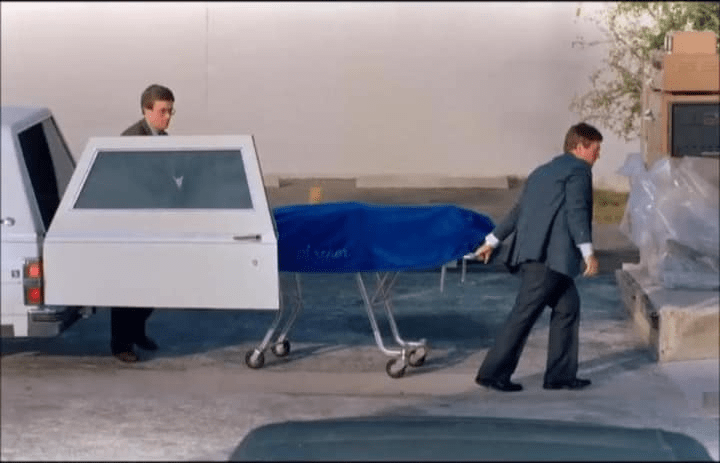
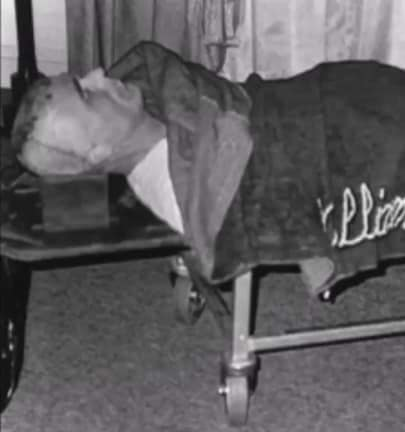
A photo of Ted arriving at the Medical Examiners office after his execution.
A B&W of Bundy after his execution.
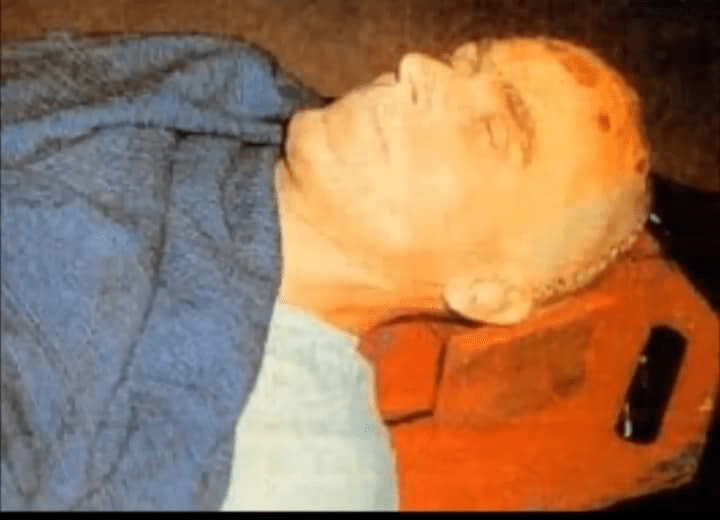
Bundy after his execution.
A picture of Bundy, post-mortem. Photo courtesy of the Florida state Department of Corrections.
Bundy after his execution.
The top of Bundy’s head after his execution.

Residence of Lynda Ann Healy, 1974 vs. 2022.

This is the residence where Ted Bundy attacked and abducted his first known murder victim, Lynda Ann Healy in February of 1974. Healy was born in 1952 to James and Joyce Healy and resided in an upper middle class Newport Hills neighborhood in Bellevue, Washington (a suburb of Seattle). The Healy’s had three children: Lynda was the oldest, then Laura, then youngest brother Robert. Lynda was a slender 115 pounds, with long brown hair, blue eyes, and a strong personality to compliment her kind nature. According to the book ‘The Only Living Witness,’ by Hugh Aynesworth and Stephen Michaud, Lynda was 21 years old at the time of her murder and was a student at the University of Washington, majoring in Psychology. She also loved volunteering and working with children with disabilities. Lynda was an above average student who loved learning; she was also a talented musician and photographer and was rarely seen without her camera.

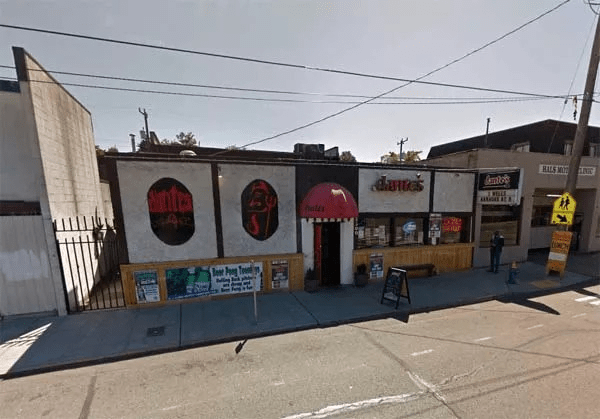
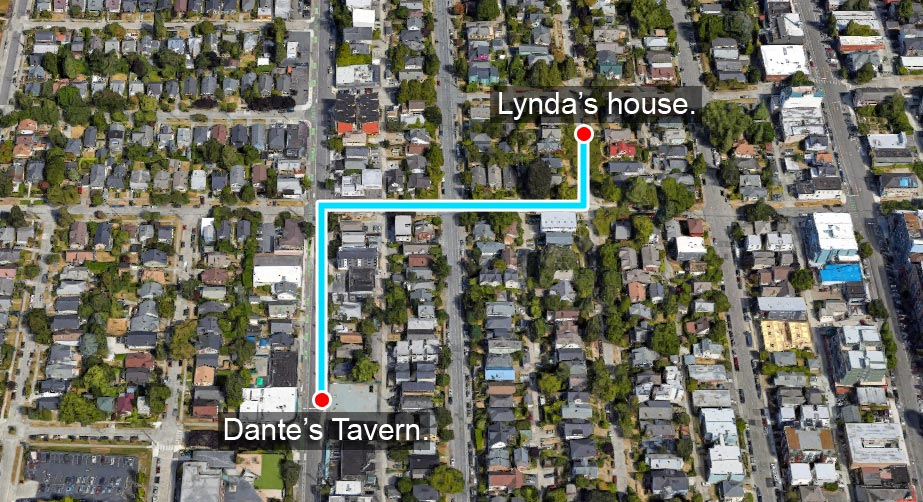
On Thursday, January 31st, 1974, Lynda borrowed her roommates car to go shopping for a family dinner she was preparing the next night and returned with her groceries at roughly 8:30 PM. Shortly after, Lynda and her roommates went drinking at a popular bar called Dante’s Tavern located at 5300 Roosevelt Way NE in Seattle. The bar was a five minute walk from Lynda’s apartment, and the friends ordered two pitchers of beer between the four of them; however they didn’t stay out too late because Lynda needed to be up at 5:30 AM to be at her job giving the ski report for a local radio station. A number of sources report that Bundy used to go to the bar often and it is hypothesized that he first saw Lynda there then followed her home. In the early morning hours of February 1, 1974, Bundy broke into Healy’s basement room. He beat her, took off her bloody nightgown (making sure to neatly hang it up in her closet), dressed her in blue jeans, a white blouse, and boots, then carried her off into the night, never to be seen again. It is theorized that Bundy only took clothes to make it appear as if Lynda left on her own, and we’ll most likely never know the truth.

A few hours later, Lynda’s alarm clock went off at 5:30 AM and continued to buzz for another half hour until her roommate Karen Skavlem woke up. Upon inspection, Karen could see that the room was completely normal and nothing looked out of place, so she turned off Lynda’s alarm clock and left.

Later that day, Lynda’s boss called the house asking where she was: his model employee didn’t show up to the station that morning for work. It was at that point that the roommates started to become concerned that something could be wrong. When Lynda’s parents showed up for dinner that evening and were informed about their missing daughter Mrs. Healy immediately called the police.

During a search of the room, police noted that everything was extremely neat and tidy, including her bed being perfectly made, hospital corners and all. Lynda’s roommates found this incredibly strange, as she usually didn’t make her bed when she had to leave early for work. It wasn’t until after police lifted up the bedspread that they spotted blood on the pillow and parts of the bed sheets. The location of the blood on the upper part of Lynda’s bed and nightgown suggests that Bundy incapacitated her by hitting her over the head with a blunt object, most likely while she was sleeping. It is not known if Lynda was dead or alive when her attacker took her from the house. At this point in the investigation, it was very clear that something terrible had happened to Lynda Ann Healy.

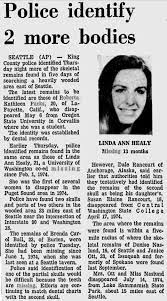
For the next thirteen months, Lynda’s case remained unsolved; in March of 1975, two forestry students from the Green River Community College discovered her skull and mandible on Taylor Mountain, where Bundy frequently went hiking. During a search of the site, police discovered the partial remains of four women, including the mandible of Lynda Ann Healy. The police were able to confirm her identity by comparing the lower jawbone to her dental records.

By now, the police were well aware that there was a sadistic killer targeting women in the Seattle area. It wasn’t until Theodore Robert Bundy was arrested in November of 1975 for the attempted kidnapping of Utah resident Carol DaRonch outside of a bookstore in a shopping mall that the pieces of the puzzle all came together and he became the chief suspect in Healy’s murder.

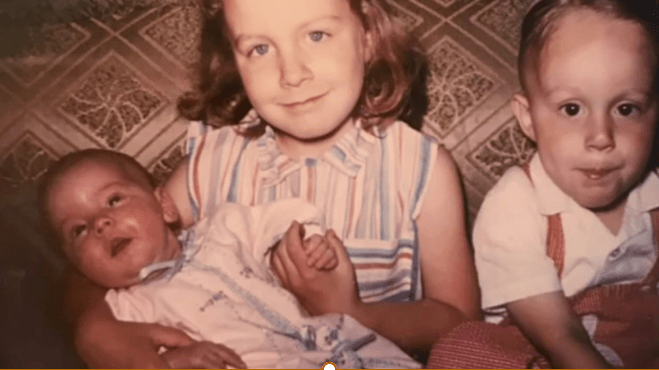
The former apartment where Lynda Healy lived, photo courtesy of ‘OddStops.’
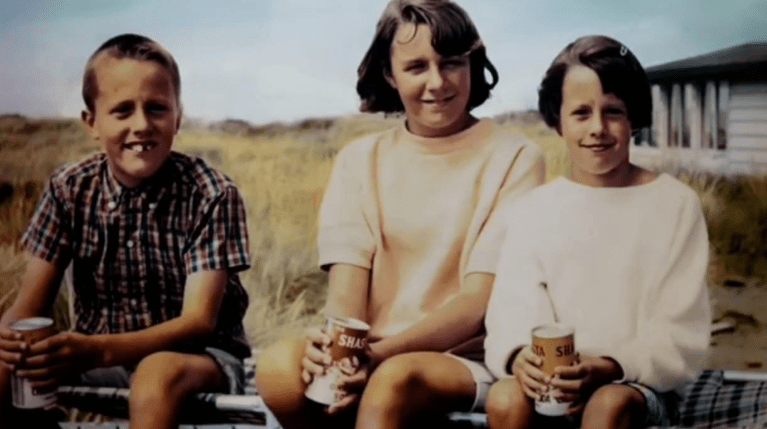
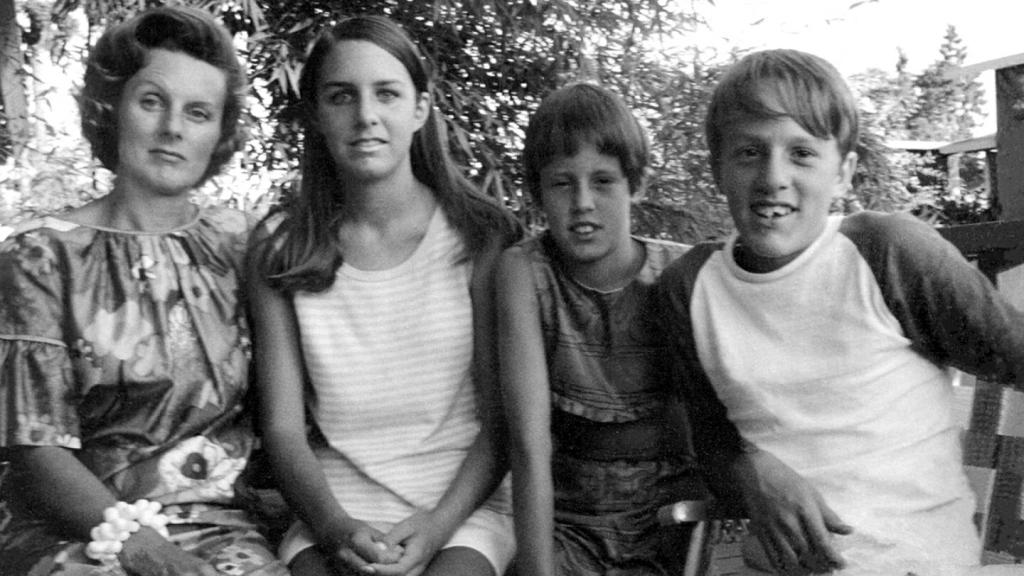
A photo of some of the Healy children.
Lynda with a very large cat.
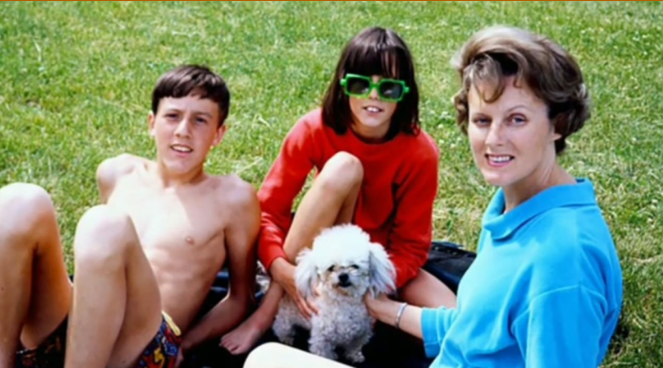
A photo of some of the Healy’s with their dog.
A photo of some of the Healy children.
Some B&W pictures of the Healy family.
Lynda Ann Healy.
Lynda Ann Healy.
Lynda Ann Healy and a fish she caught.
Lynda Ann Healy.
Lynda Ann Healy.
Lynda Ann Healy.
Lynda Ann Healy and her Mother.
Lynda with her mother and some of her siblings.
Lynda and some of her brothers, photo courtesy of Amazon Prime.
Lynda with her brother unboxing Christmas presents, photo courtesy of Amazon Prime.
Lynda and one of her brothers at Christmas, photo courtesy of Amazon Prime.
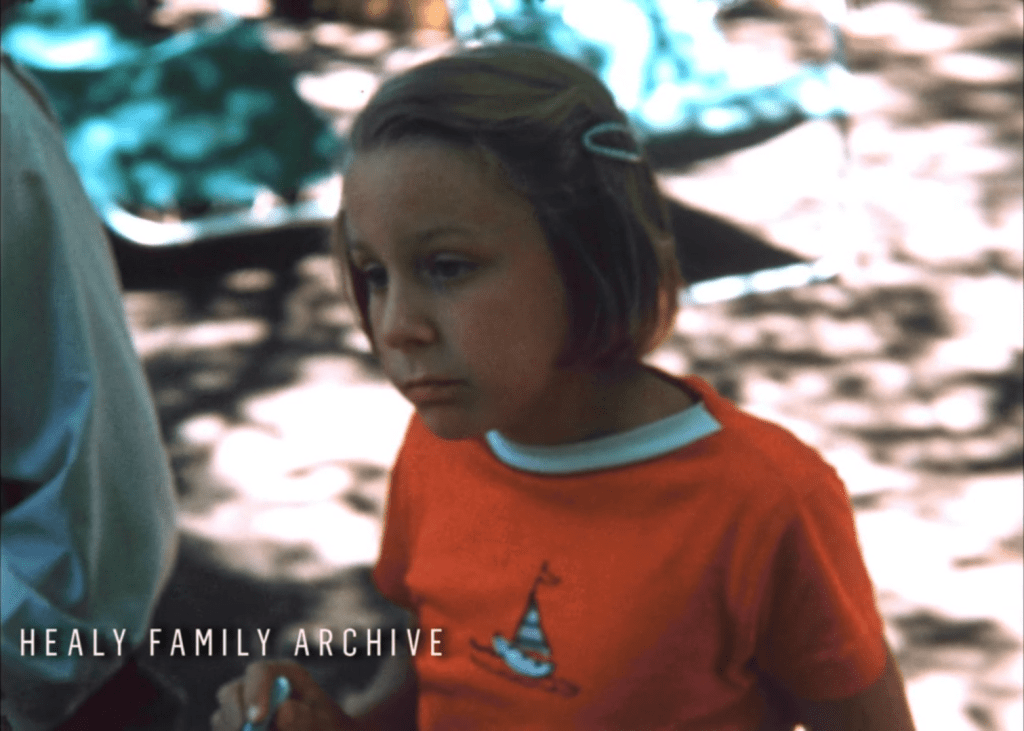
A young Lynda Healy, photo courtesy of Amazon Prime.
A picture of Lynda with a camera; her friends and family said she was an avid photographer and rarely left home without it.
Lynda painting her apartment.
Lynda’s bedroom in her apartment in Seattle.
A photo of the crime scene of blood on Lynda’s bed.
Bloodstains were visible on Lynda’s pillow.
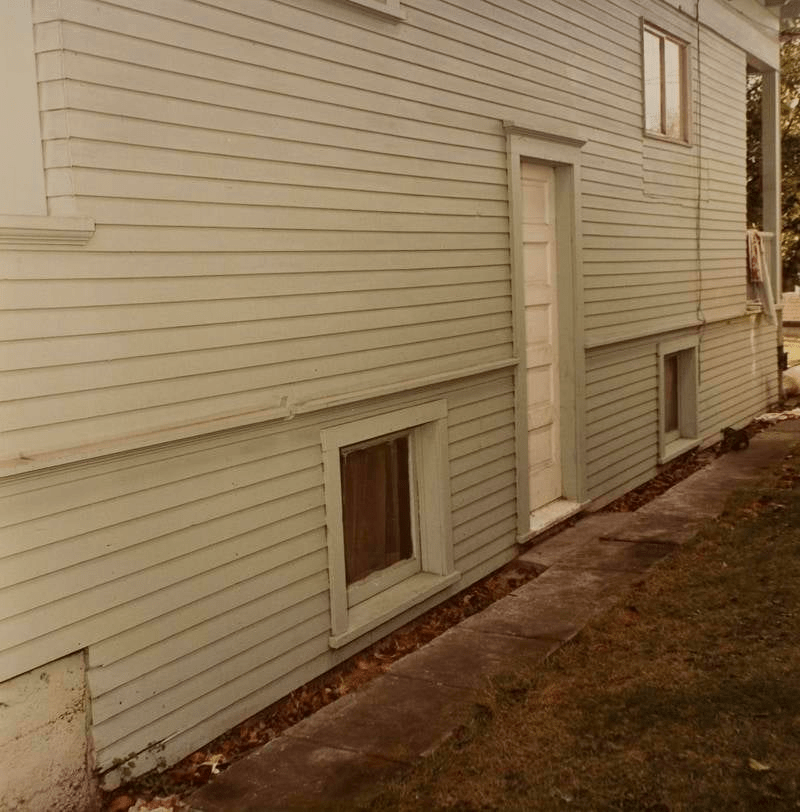
The side door provided quick and easy access to the basement.
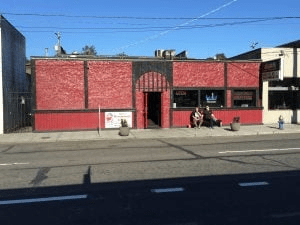
The Old Dante’s Tavern, photo courtesy of ‘OddStops.’
Dantes Tavern before it caught fire and was demolished, photo courtesy of ‘OddStops.’
The inside of the old Dante’s Tavern, photo courtesy of ‘OddStops.’
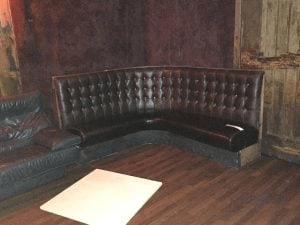
The infamous ‘Bundy booth’ at Dante’s. Photo courtesy of ‘OddStops.’
Dante’s in flames, photo courtesy of ‘OddStops.’
The parking lot where Dante’s once stood, April 2022.
A search team at Taylor Mountain, photo courtesy of ‘OddStops.’.
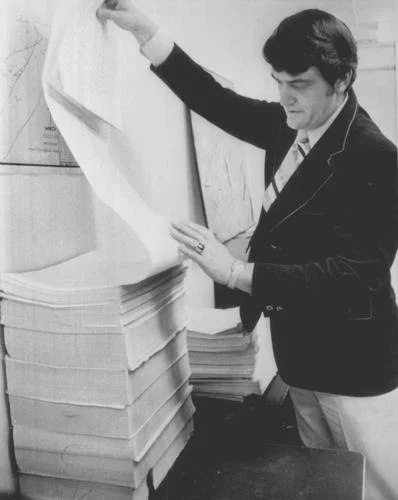
Captain Mackie.
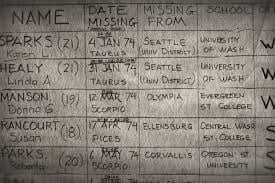
A chart of Bundy’s Seattle victims.
A still image from a news story investigating Lynda’s disappearance.
Lynda’s roommates.
Lynda read the ski report for a local radio station.
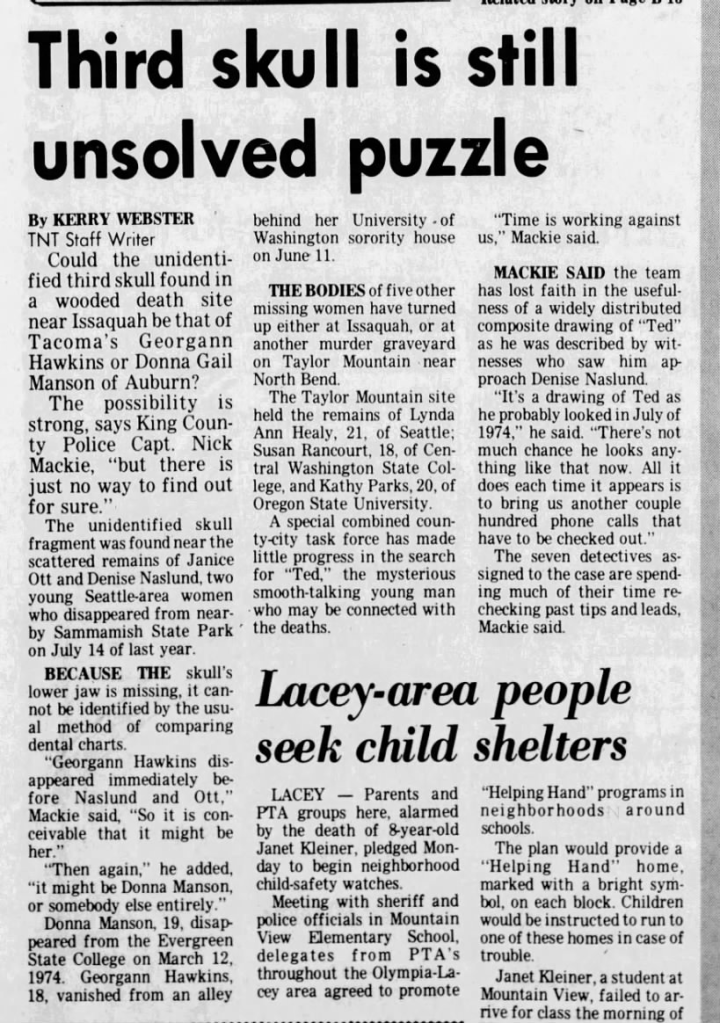
A clipping from The News Tribune published on July 28th, 1974, photo courtesy of ‘ThisInterestsMe.’
The basement window to Lynda Healy’s bedroom.
An aerial map that shows the quickest route between Dante’s Tavern and Lynda Healy’s house; she lived about two blocks away, photo courtesy of ‘ThisInterestsMe.’
The Taylor Mountain burial site where Bundy left Lynda’s body; a search team discovered her lower jawbone in the area circled in red, photo courtesy of ‘ThisInterestsMe.’
An aerial image of Lynda’s apartment compared to where Liz Kendall lived, photo courtesy of ‘ThisInterestsMe.’
Lynda Ann Healy’s old apartment, April 2022.
Lynda Ann Healy’s old apartment, 1974, photo courtesy of the King County Sheriff’s Department.
It’s strongly suspected Bundy carried Healy out this side door, photo courtesy of the King County Sheriff’s Department.
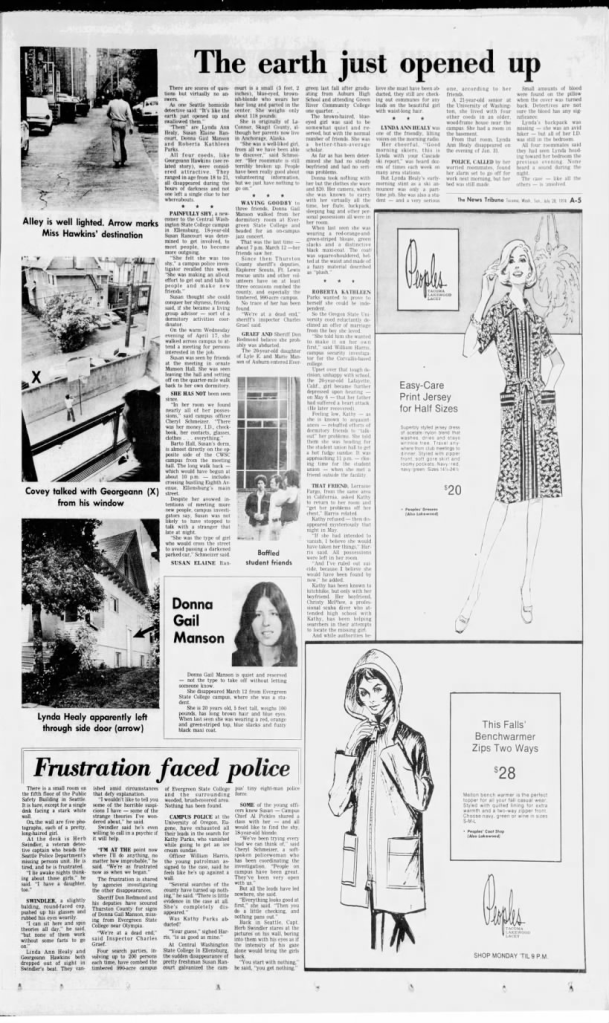
An article about the disappearance of Lynda Ann Healy, published by The Seattle Times.
A newspaper about the disappearance of Lynda Healy.
The gravestone of Lynda Healy, picture courtesy of ‘FindAGrave.’.

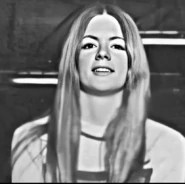
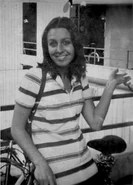
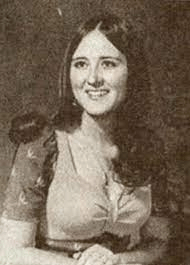
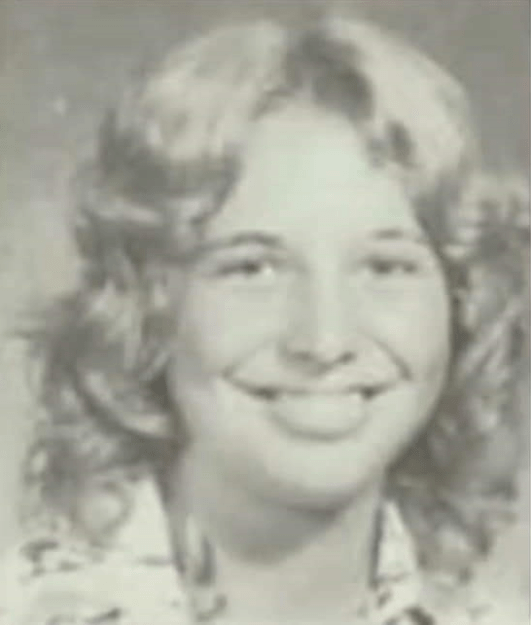
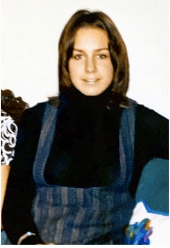
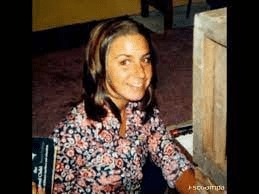
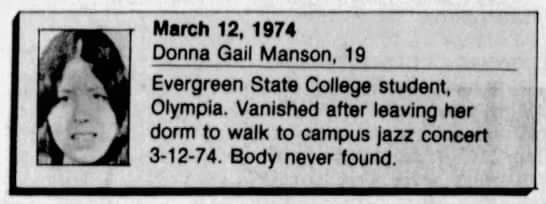
Donna Gail Manson.

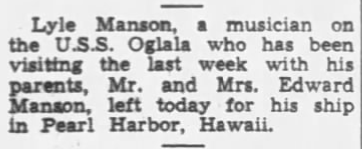
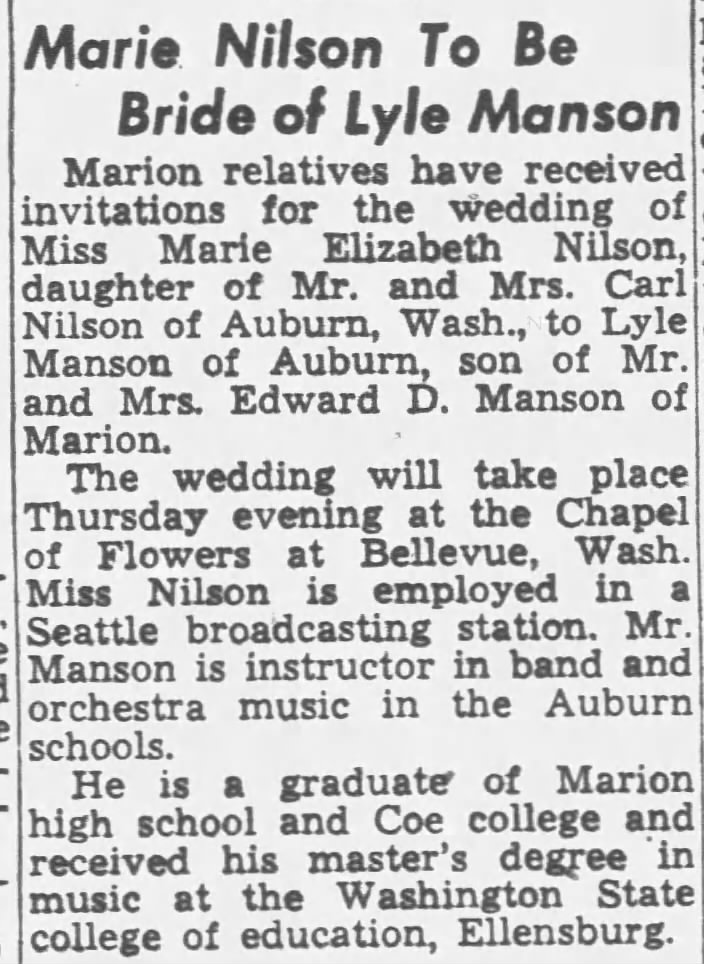
Donna Gail Manson was born on June 9, 1954 to Lyle Edward and Marie Elizabeth (nee Nilson) Manson in Olympia, WA. Mr. Manson was born on August 29, 1917 in Marion, Iowa and Mrs. Manson was born on May 9, 1923 in Auburn, WA. The couple were wed on December 4, 1952 and had two children together: Donna and her younger brother, James. An eagle scout and troop leader, Mr. Manson served in the Navy during World War II (he was a Pearl Harbor survivor), and upon returning home he continued with his education and graduated with his BA in music education from Coe College in June 1949; he went on to earn his master’s degree from Central Washington University in 1952 (which is the same college Susan Rancourt was abducted from), and after graduating he got a position as a music teacher for the Seattle school district. Marie Manson graduated from the University of Washington in 1949 with a BA in music education and worked PT as a legal secretary; she was also the choir director at Auburn First United Methodist. Both Mr. and Mrs. Manson spent two years performing with the Seattle Philharmonic Orchestra.
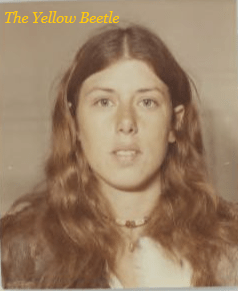
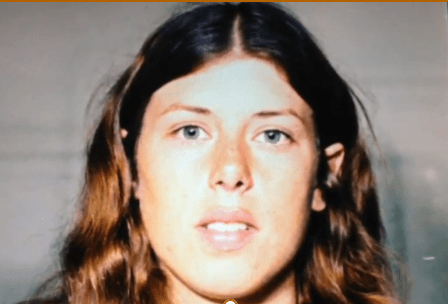
Donna Manson is Ted Bundy’s third (known) victim. It was said by those that knew her that at the time she disappeared Donna was going through a rough time and was struggling with depression, but she showed interest in overcoming these obstacles. Despite suffering from bouts of melancholy and anxiety, Donna’s loved ones called her a ‘free spirit’ and said that she was known to hitchhike and frequently ‘couch surfed’ among friends. She was an intelligent young woman and earned good grades over the course of her academic career, and was working towards a Bachelor’s degree in English. Much like her parents, she loved music and the arts and was an accomplished flutist. Manson graduated from Auburn Senior High School in 1972 and attended Green River Community College for a short period of time before transferring to Evergreen State College. She had pale blue eyes and chocolate brown hair that she wore long and parted down the middle; she was small in stature and stood at only five feet tall, and weighed a mere 100 pounds.

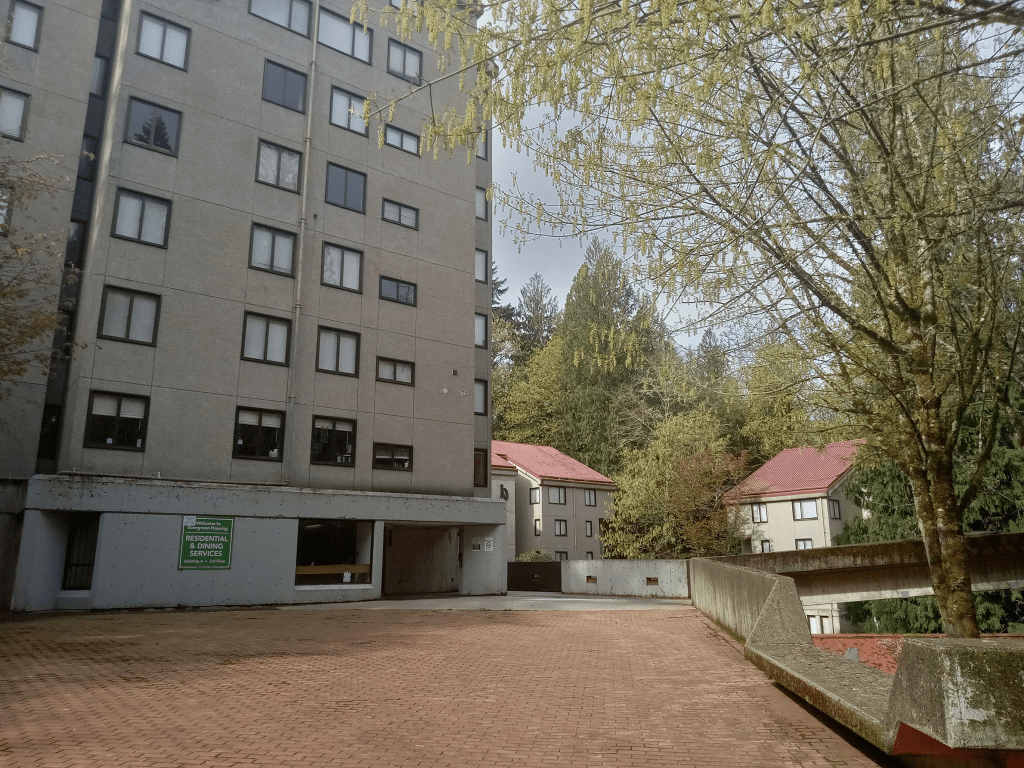
The campus at Evergreen State College is less than ten miles east of Olympia and was built in an isolated, remote spot surrounded by a dense forest of evergreen trees. A small, liberal arts school, in the fall of 1974 its enrollment wasn’t even at 3,000, and some of the more conservative Washington state residents complained about its high per-student cost of operation and ‘hippie-like atmosphere.’ One lawmaker even complained during a speech about how the students’ dogs were peeing on the expensive carpets in the school’s library (which was ironically named the Daniel J. Evans Library, after the state governor that Bundy worked for).

On the day of her abduction, Donna planned on going to a folk dancing class at her schools activities building, and later that same night, she made plans to go to a jazz concert at the Daniel J. Evans Library (which was also on school grounds), which was scheduled to start at 8 PM. She lived in room 206 of the C building on Evergreens campus, and according to her roommates earlier in the evening Donna played her flute a bit and ate some beef vegetable soup (she even left some of it out in a pot on the stove). They also noticed that she seemed unusually focused on her appearance that evening, going so far as to switch outfits several times before eventually settling on a red, orange, and green striped shirt, blue (or green) slacks, a fuzzy black full-length coat (that used to belong to her grandmother), an oval-shaped brown agate ring, and a Bulova Caravelle wristwatch. Despite this detail, Manson did not share any details about a date or meet-up with her friends. The night prior to her disappearance Donna spoke with her mother on the phone, and the two discussed her idea of taking a trip to the ocean during her upcoming spring recess. Regarding this, Marie Manson said it sounded like a good idea that they get away for a few days, and despite the ongoing gas shortage of the 70’s said that the family would ‘find a way.’

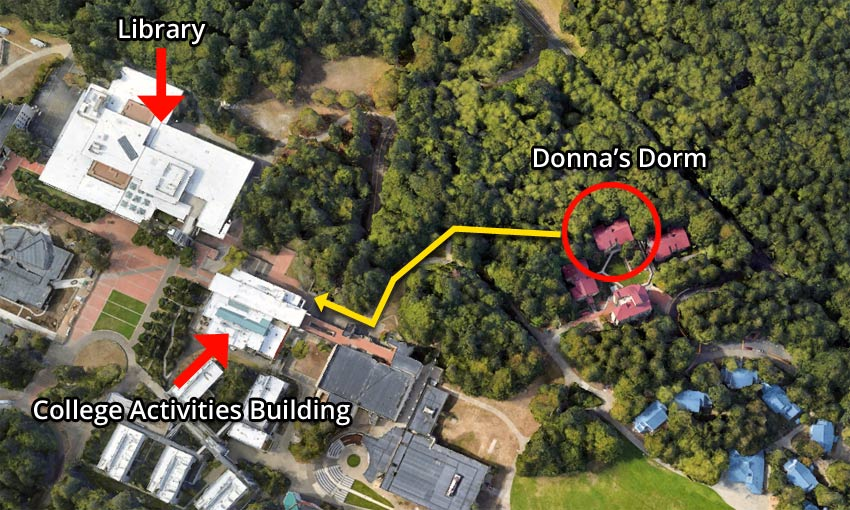
Donna departed her dormitory shortly after 7 PM on March 12, 1974 and set out for the dance class, which should have been just a two-minute walk across campus. However, despite how close the College Activities Building was to her dormitory no one recalled seeing her at either the class or the jazz recital, meaning it is highly unlikely that she ever made it that far. She left behind all of her personal effects, money, and clothing.

Perhaps it was because of her free spirit and habit of hitchhiking and leaving for days at a time, but when Manson didn’t return home that night no one seemed very alarmed: it took her roommates a full six days to report her missing to the authorities, which is why newspapers didn’t start reporting on her disappearance until March 22, 1974, a full ten days after she was last seen. Several days after her disappearance some local police officers went to the Manson family home in Auburn to tell them that Donna had run away from school, news that made her mother immediately feel uneasy, and she immediately knew that: ‘she hasn’t run away, something’s happened to her.’

Perhaps it was because of her free spirit, her habit to leave for days at a time, or her habit to hitchhike but when Manson didn’t come back that night no one was very alarmed. In fact, it took her roommates a full six days to report her missing to the authorities, which is why newspapers didn’t start reporting about her disappearance until March 22, a full ten days later. Following Donna’s disappearance, on four different occasions search teams of up to 200 people combed the 990-acre college campus with the assistance of tracking dogs. Despite their best efforts, investigators were unable to find not one single trace of the missing girl: she had literally vanished out of thin air.

After he got the news that his daughter was missing, Lyle Manson immediately drove to the Evergreen campus to see if he could find out more information about what may have happened to her. When he arrived, Thurston County Detective Paul Barclift tried to reassure him by saying: ‘maybe she just went off somewhere with some boyfriend. That’s the way these things usually turn out around here.’ Manson’s stern Scotsman’s face showed cold disagreement, and in response he said: ‘no, Donna had no need to run away. We’ve always given her freedom.’ He and the detective walked from the parking lot to her residence hall, and together they looked through the items in her bedroom: she had left behind all her clothes, toiletries, and other personal items one would need if leaving for any period of time, and amongst her belongings Mr. Manson found her camera and flute, and it was then that he knew that something was seriously wrong. Following Donna’s disappearance, search teams of up to 200 people combed the 990 acre college campus with the assistance of tracking dogs on four separate occasions, but despite their best efforts not one trace of her was ever recovered: she had literally vanished out of thin air.

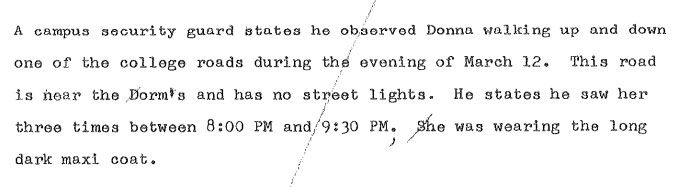
The guard also told investigators that he remembered seeing Donna around campus prior to her disappearance and recalled that when he last saw her, she was wearing a long fur coat, a fact that her roommates corroborated. This strongly hints that he wasn’t mistaken and did in fact see Manson on the night she was abducted, meaning that she either got sidetracked by something (or someone, like a man with his arm in a sling asking for help) on her way to the dance class, or she lied to her roommates about what her plans were. Many Bundy researchers believe that Ted approached the nineteen-year-old asking for help as she was walking toward the library, where others strongly feel that the two may have been acquainted previously (somehow) and that they had made plans to meet up that night. He liked to frequent college campuses, did he go to Evergreen at an earlier time and run into Donna? Maybe the two planned a secret rendezvous and she told her roommates that she was going somewhere else in an attempt to get them off her back? Obviously, they would have started asking questions had they known she was going out with a guy, and when they found out she had plans to meet up with a twenty-seven-year-old that she barely knew, then surely, they would have persuaded her to not go.

Donna was into many things that would typically be considered ‘mysterious and dark,’ and had an interest in topics like death, the occult, and alchemy; when investigators searched her room they found several class listings on positive thinking and mind discipline from a local Olympia business called ‘The Institute of Insight’ (casual Bundy acquaintance Ann Rule incorrectly referred to it as the ‘Institute of the ESP’ in her 1980 book ‘The Stranger Beside Me’). It was mostly because of Manson’s unconventional interests that detectives initially wondered if maybe she had killed herself, and it wasn’t until a psychiatrist read through her journals and said that it was in his professional opinion that she wasn’t suicidal and most likely did not take her own life that they changed their minds. Donna’s habit of hitchhiking put her in a higher risk pool compared to other coeds, and it was very concerning to detectives, who felt that there was a possibility that she was picked up by the individual that killed her. Because her roommates did not see her take a backpack or a change of clothes with her on the evening she disappeared, LE deduced that she was not planning on going anywhere that evening and had no plans on hitchhiking.

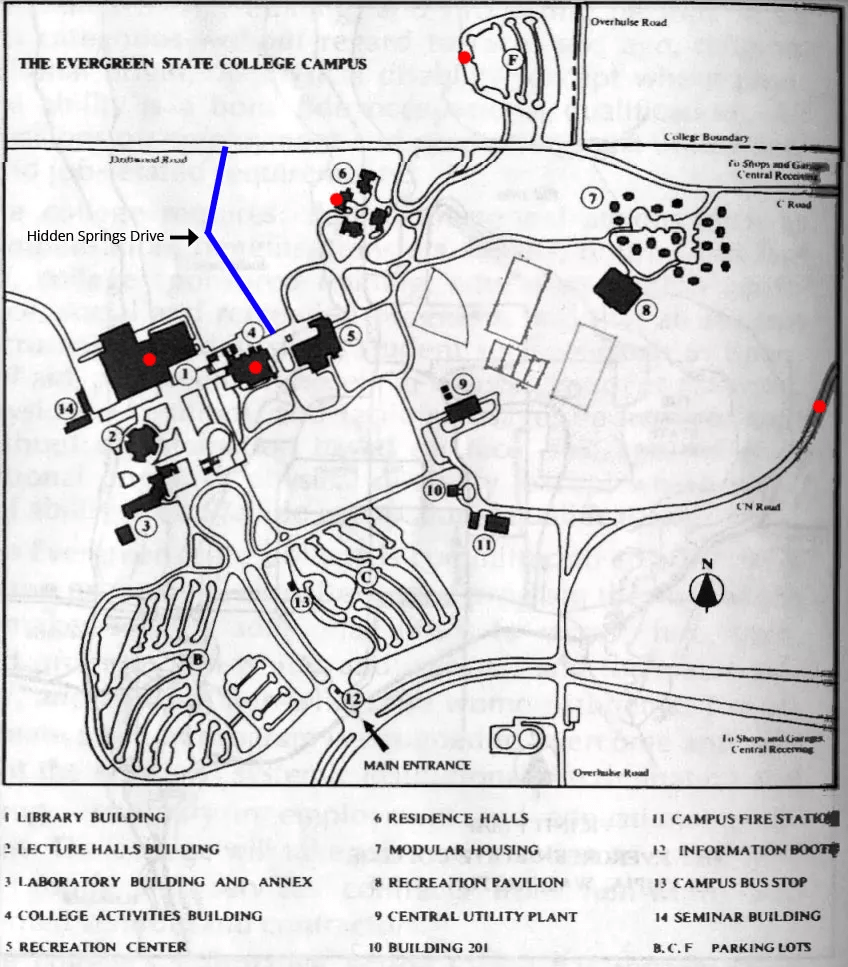
The most widely believed theory was that Bundy grabbed Donna in a Georgann Hawkins-esque grab as she was on her way to the dance class that evening in March 1974: the route that she most likely took from her dormitory to the folk dancing class was only 350 yards away, and should have only been about a two minute walk, and because of the short distance involved it has been theorized that Ted grabbed Manson almost immediately after she left. One possible scenario could be that he may have approached her (perhaps while using crutches or an arm sling) in a nearby parking lot (lot F) and asked her to assist him with carrying something to his car. Another idea is that Bundy parked his car on Hidden Springs Drive, which is close to the c-dormitory and connects the area around the library with Driftwood Road, and is incredibly close to the route that Donna would have walked to get to the folk dancing class. But because traffic on campus was unusually high that evening because of three different events taking place, it stands to reason that both areas would have been pretty busy at the time, and a careful Bundy wouldn’t have taken the chance of getting caught. But at the same time… he was a known risk taker, especially while under the influence of alcohol and marijuana, so we can’t completely rule it out (and keep in mind that it worked out for him).

Mostly because Olympia is over an hour away from where Bundy’s other Washington state victims were abducted from, Manson’s case was not immediately connected to the other Seattle disappearances, and it wasn’t until more women started to disappear that it became clear that her case was a part of a much bigger puzzle. There was a (brief) period where (former) Thurston County Sheriff Don Redmond wondered if maybe there was a slavery ring nabbing young women from the area, but this was quickly ruled out. Unfortunately, we will never know exactly what happened to Donna on the evening she disappeared, as there are very few confirmed details regarding her disappearance. Due to the abduction taking place right before spring break detectives were not able to interview many of the eyewitnesses until weeks later, after their memories were dulled by time (maybe if her roommates reported her abduction earlier LE would have stood a chance of getting some worthwhile information).

In his previous two abductions/murders, Bundy broke into his victims’ houses and assaulted them while they were sleeping, but in the case of Donna Manson he completely switched up his MO and took her from a public place… I also wonder if perhaps this was the first time that he used the fake injury ruse? The dates of credit card receipts that were listed in the ‘TB Multiagency Report 1992’ prove that Bundy frequented the Olympia area at least twenty-five times in 1973 alone, so it would be reasonable to assume that he knew the area fairly well; this also falls in line with the theory that (most) serial killers prefer to operate in places that they are familiar with, and feel comfortable being in.

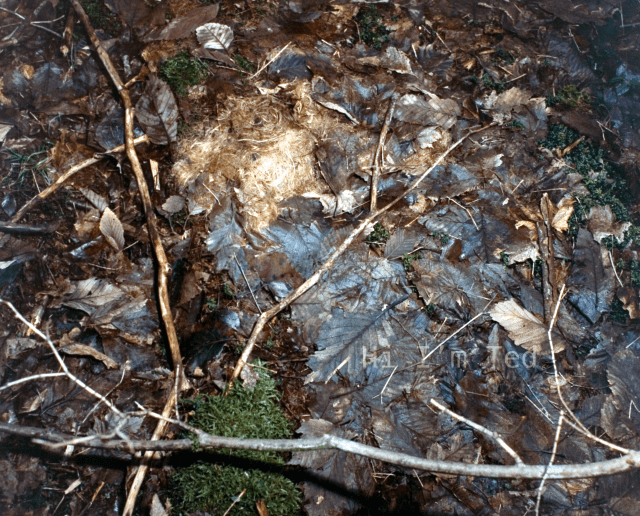
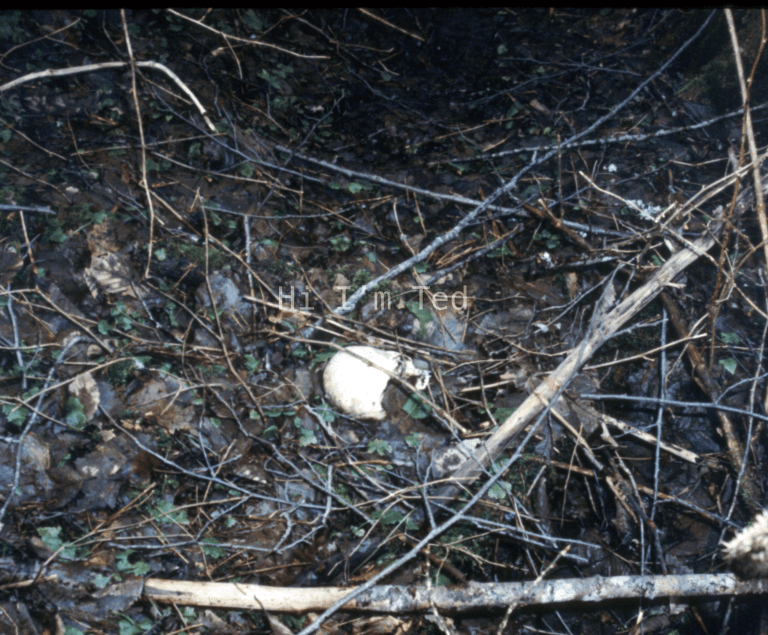
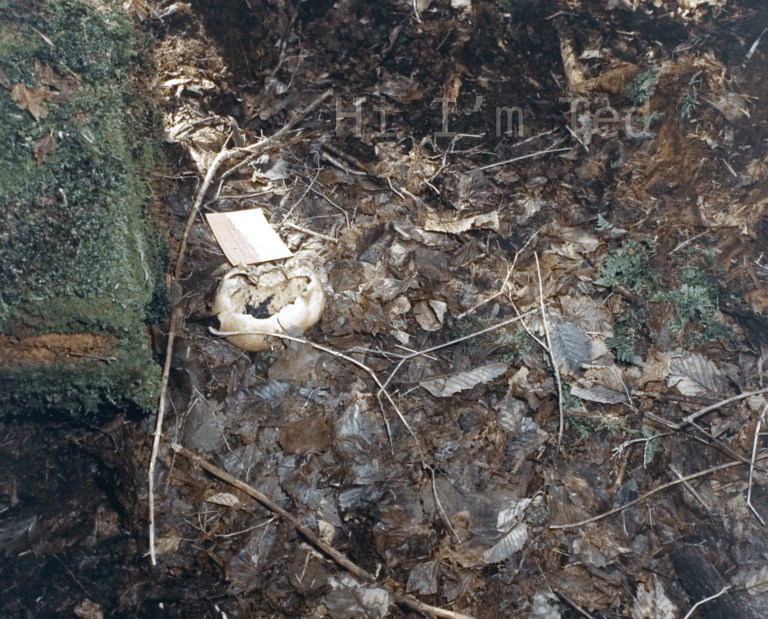
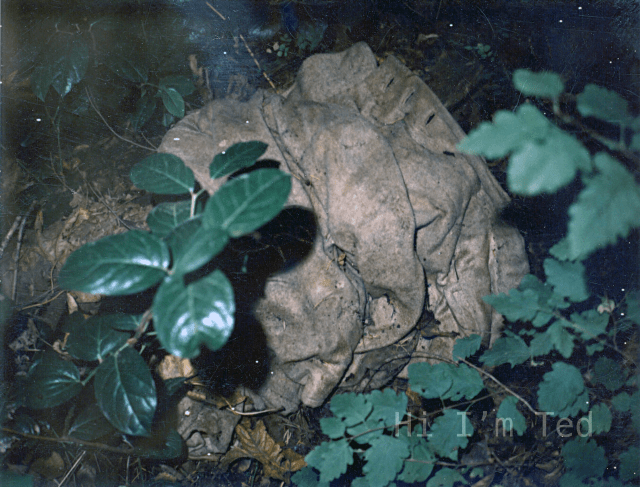
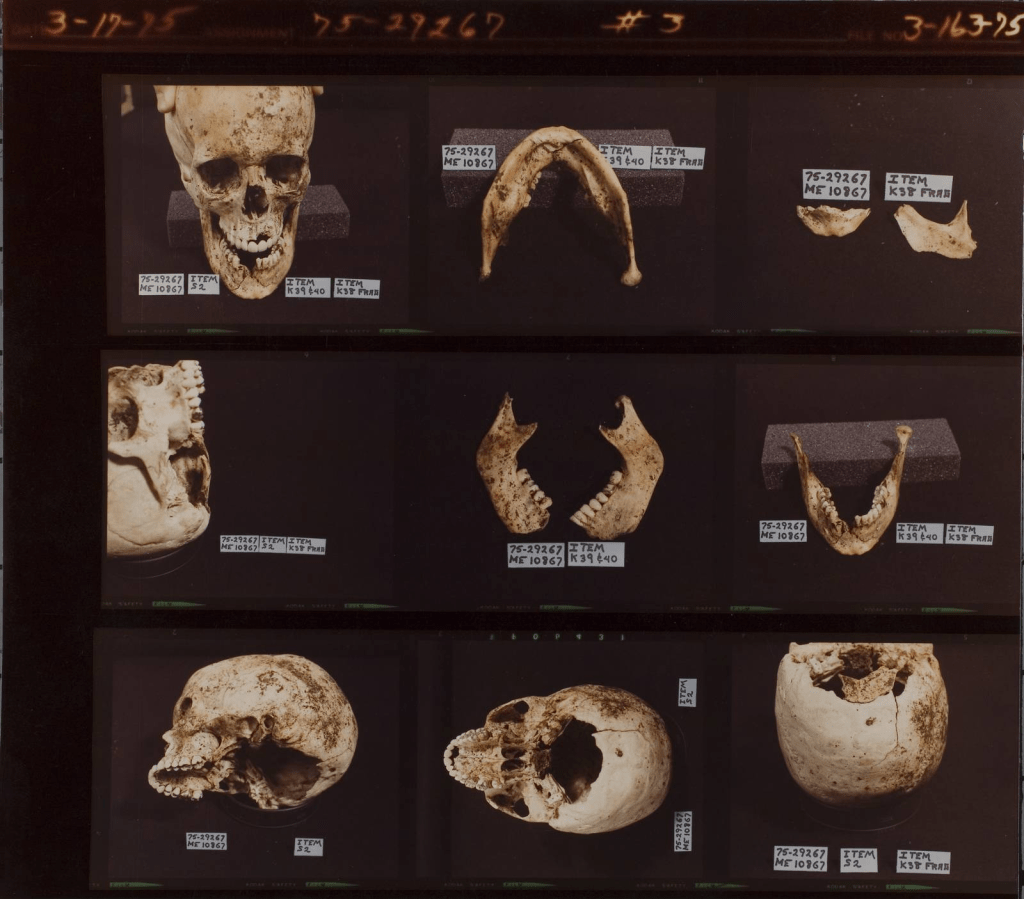
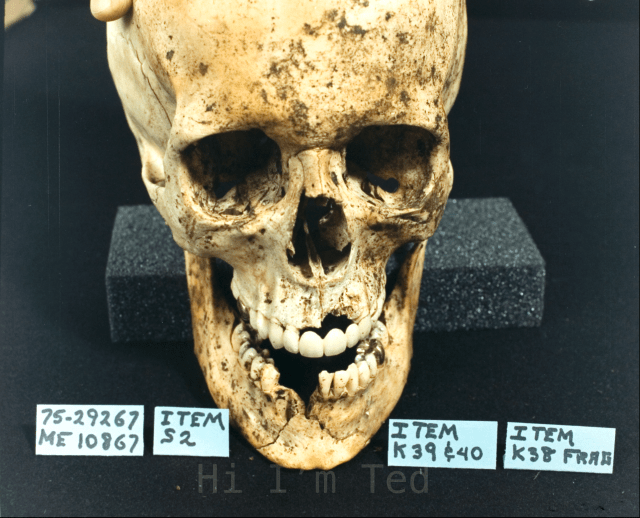
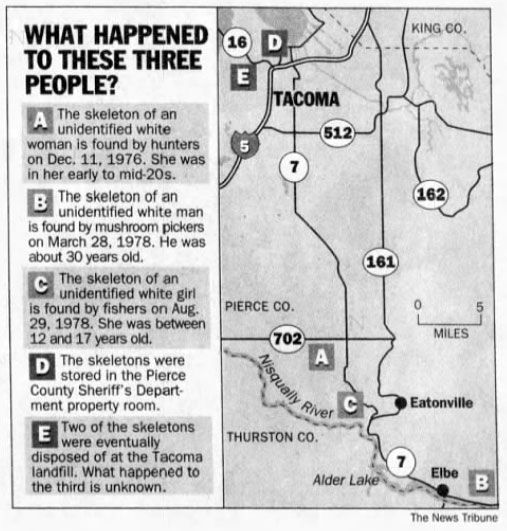
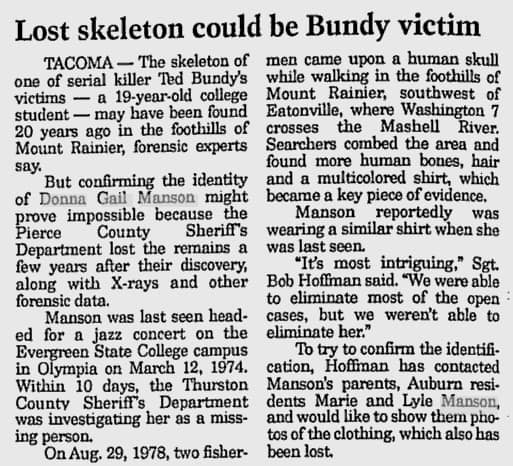
On August 29, 1978 two fishermen that were walking on Highway 7 southwest of Eatonville, WA discovered a human skull in the foothills of Mount Rainier; further searches by local investigators turned up additional bones, hair, and clothes that matched the description of the ones that Donna Manson was last seen wearing four years prior. Unfortunately, law enforcement lost everything before a positive ID could be made (although apparently color photographs were taken) and to this day she is classified as a missing person. Bundy confessed to her murder as a last-ditch effort to avoid the electric chair in January 1989 and told investigators that he buried her remains at Taylor Mountain but burned her skull to ashes in his then-girlfriends Liz’s fireplace. He also told Robert Keppel that he didn’t remember much about the event because he was so drunk but did recall that it was ‘nightmarish, blurry, and incoherent.’

Retired Pierce County detective Roy Durham said that he felt the bones did not appear to go back as far as 1974 and did not appear to suffer from any blunt force trauma to the head (which is common in Bundy victims). Unfortunately, the skeletal remains were destroyed after being examined by a forensic dentist (who determined there was a strong possibility that the skeleton belonged to Manson) and most additional information (such as x-rays) related to the case were lost during a ‘routine purge’ of the Pierce County Sheriff’s Department. Personally, I wonder if the remains found in 1978 belonged to a different (unknown) Bundy victim. I know people will argue that he was in prison by that time and wouldn’t have been able to commit a murder in his home state, but even law enforcement admitted they weren’t sure when victim was killed, just that it probably wasn’t in 1974. 

During Ted’s interview with Dr. Keppel, he claimed that he left Manson’s body ‘up in the mountains,’ and although it was the same place where he disposed of Brenda Ball, Lynda Ann Healy, Susan Rancourt and Roberta Parks, he specified that he left her in a slightly different place than the others:
Keppel: ‘OK. How about Donna Manson? The girl from Thurston County, Olympia. Where is she?’
B: ‘Where is she? She should be… on Taylor Mountain.’
K: ‘Was she dumped out along the power line too or on a different road?’
B: ‘That was different. That was different.’
K: ‘What was different about it?’
B: ‘Well, where she was, relative to the power line road.’
K: ‘You told me before that Donna might be buried.’
B: ‘Yea. Do you have any pictures of the site?’

Bundy then pointed out a spot on a map where he thinks he left Donna’s remains, but clarified that search teams would never find her skull because it was ‘nowhere’ (Bundy’s words, not mine). When Keppel pressed Ted about that he claimed to have completely incinerated it then vacuumed up the ash that remained behind. Later searches of that area failed to find anything related to a human skeleton (keep in mind he admitted to being inebriated at the time of the abduction so he probably directed them to the wrong place). He explained: ‘it’s a lot of work and certainly very risky, under the circumstances. I mean, the kids come home from school and there’s a roaring fire in the fireplace and its warm outside.’

Now, there are holes in that story so big I can drive my VW Beetle through them: throughout the duration of his murder spree Bundy was (surprisingly) good about avoiding detection (although I firmly believe he may never have been caught if he wasn’t such a shitty driver), so I have a really hard time believing that he smuggled an entire HUMAN HEAD into his girlfriend’s apartment (which goes without saying is a huge risk). Additionally, burning a skull in a residential fireplace would not have been an easy feat: in order to transform human bone into ash, the fire would need to get to somewhere between 1,500 and 2,000 degrees Fahrenheit (which can be done with the use of an accelerant), and even if he was able to get it that hot, there would still be pieces of bone left behind.

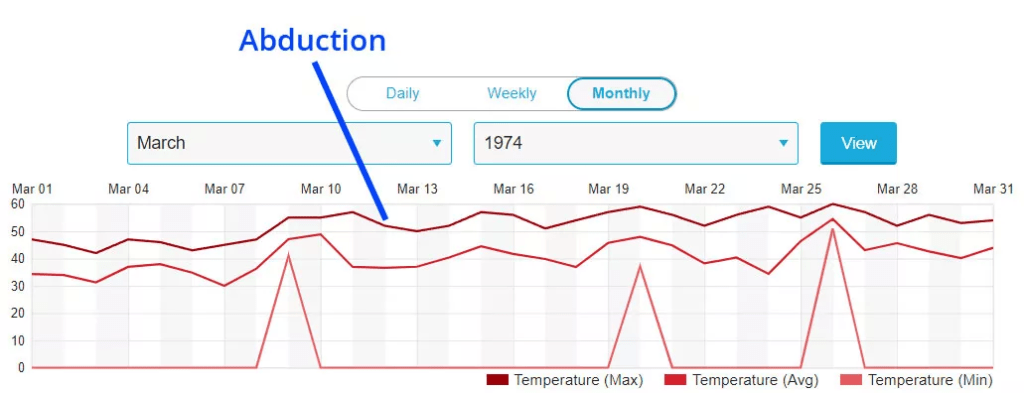
What I think more likely happened with Donna’s skull is, Ted attempted to burn it in Liz’s fireplace (in her apartment on 18th Ave NE), but partway through realized how difficult of an ordeal it was (plus, burnt hair smells ABSOLUTELY HORRIBLE, and at the time of her murder she had a lot of it as it was pretty long), and took the chunks of bone that didn’t turn to ash and disposed of them in a different way (as awful as this sounds, perhaps they were so small he was able to dispose of them in the household garbage?). Another reason to doubt Bundy’s story is that he said it was ‘warm outside’ when he burned the skull, and according to records the temperature range in the days after Mansons disappearance in Seattle was between 49°F to 57°F, and it remained on the cooler side until March 26th (although I guess perhaps warm to one person can be considered chilly by the next, as its subjective and it doesn’t appear that he elaborated). So, that makes me think Ted was either lying about the weather, or he simply got his dates mixed up (it was fifteen years prior). Some people wonder if Bundy made up the incident completely simply to hurt Kloepfer, who by that time had cut all ties with him… but, at the end of the day, Bundy was a habitual liar that rarely told the truth. And let’s say this ONE TIME he wasn’t lying: he had avoided telling the truth for so long, why would anyone believe him at that point (especially when he was trying to avoid the electric chair). Keep in mind that only minutes before he told Keppel about incinerating Manson’s skull, he cracked a ‘joke’ about how much press his confession would generate.

The following is a conversation between Bundy and Robert Keppel regarding Manson:
Robert Keppel: ‘What about Donna Mason?’
Bundy: ‘I won’t beat around the bush with you anymore because I’m just tired and want to get back to sleep. So let me tell you, I know part of her is buried up there, the head however, wouldn’t be there.’
RK: ‘Where is it now?’
TB: ‘It’s nowhere. I’m not trying to be flippant. It’s in a category all by itself. It was incinerated. It was an exception, a strange exception.’
RK: ‘Where did you incinerate it?’
TB: ‘I promised myself I’d never tell this. In her fireplace. That’s not really that humorous, but I mean, the fireplace at her house… that was the twist. It’s a lot of work and certainly very risky, under the circumstances. I mean, the kids come home from school, there’s a roaring fire in the fireplace, and its warm outside.’

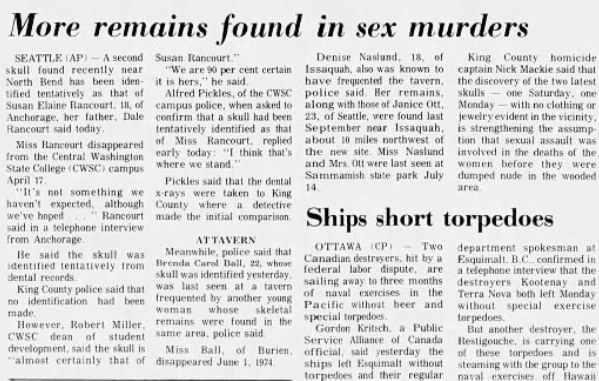
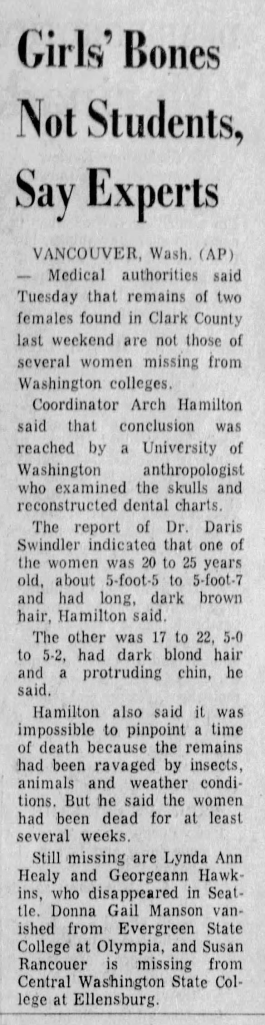
On August 28th, 1978, two fishermen discovered the skeleton of a young female in the foothills of Mount Rainier near Eatonville, about 60 miles away from Bundy’s Taylor Mountain burial site. Despite multiple newspapers reporting that the missing skeleton belonged to Manson, the facts do not seem to line up: ‘The News Tribune’ reported that the skeleton Pierce County sheriffs discovered was 5’7”, and Donna was only 5 feet tall. Also, the remains were discovered wearing blue jeans, where Donna’s roommates said she was wearing a pair of green pants the night she disappeared. Investigators also showed photographs of the clothing found on the skeleton to Manson’s parents and her mother was quick to say that she didn’t recognize the top as belonging to her daughter. The report also said the victim was somewhere between 12 and 17 years old where Donna was 19 at the time she disappeared.

Mr. Manson passed away on December 31, 2007, and Donna’s mother died on May 26, 2014, in Auburn, WA. James Manson currently lives in Seattle and is the owner of ‘Axis Stainless Fabrication,’ and works with metal; he appears to be an expert in his field, and has his work on display at the Seattle Art Museum.
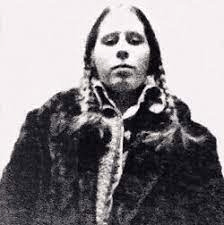
Donna Manson, clad in the long black coat that she was last seen wearing. Photo courtesy of the Thurston County Sheriff’s Department.
Donna Manson.
Donna Manson’s student identification photo from 1973.
Donna Manson.
Donna Manson.
A picture of Donna Manson. Photo courtesy of the Thurston County Sheriff’s Department.
Donna Manson.
Donna Manson and an unknown male friend. Photo courtesy of the Thurston County Sheriff’s Department.
A picture of a friend that Donna Manson took. Photo courtesy of the Thurston County Sheriff’s Department.
Another picture of a friend that Donna Manson took. Photo courtesy of the Thurston County Sheriff’s Department.
Another picture that Manson took of a friend. Photo courtesy of the Thurston County Sheriff’s Department.
Some pictures Donna Manson took. Photo courtesy of the Thurston County Sheriff’s Department..
A hand-written note card from Donna Manson to her parents. Photo courtesy of Erin Banks/CrimePiper.
A typed letter from Donna to a friend named Sally W. in Indonesia; it was found on her desk but never mailed. Photo courtesy of Erin Banks/CrimePiper.
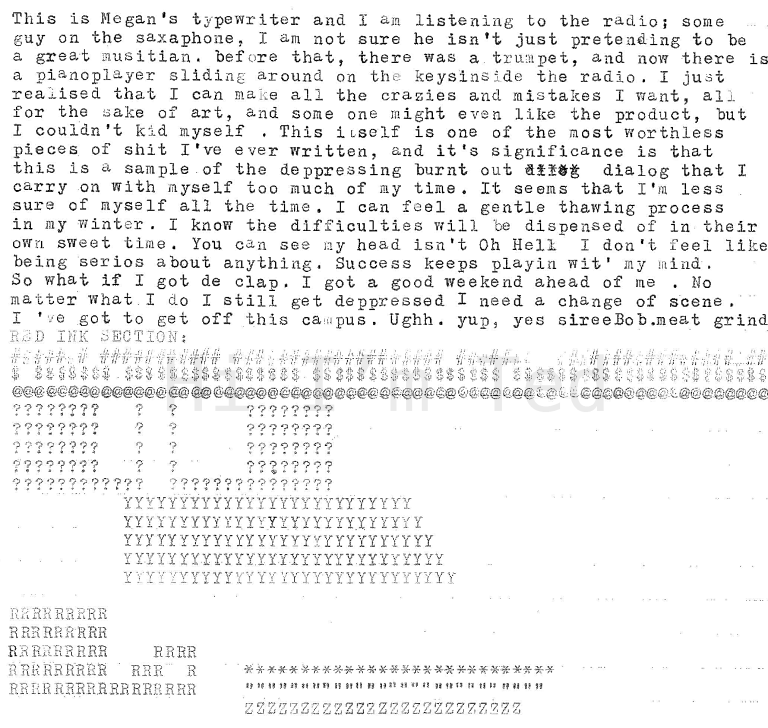
A letter to Marie Manson from Donna’s friend, Megan Ellis. Photo courtesy of the Thurston County Sheriff’s Department/’hi: I’m Ted.’

A note found in Donna’s room. Photo courtesy of the Thurston County Sheriff’s Department/’hi: Im Ted.’
A newspaper clipping about Donna Manson’s disappearance.
The front of an article published by the Cooper Point Journal on July 11, 1974; as you can see, Donna is featured on the front. Photo courtesy of the Evergreen State College Archives.
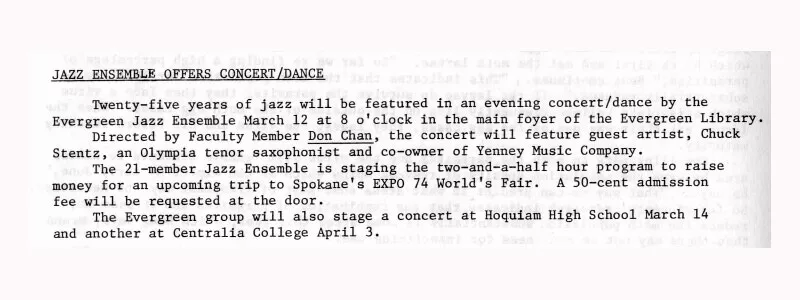
A blurb on the jazz concert that Donna was planning on attending from the Evergreen State College newsletter published on March 8, 1974, courtesy of OddStops.
The Evergreen State College Newsletter from the week of March 11, 1974 mentioning the jazz concert Donna was planning on attending. Photo courtesy of the Evergreen State College Archives.
An excerpt from Donna Manson’s police report. Photo courtesy of ThisInterestsMe.
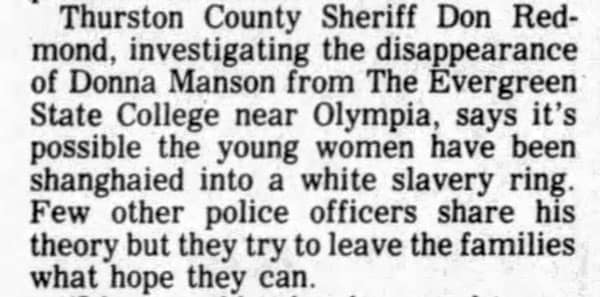
Thurston County Sheriff Don Redmond floated the theory that Donna’s disappearance was related to a white slavery ring. Photo courtesy of ThisInterestsMe.
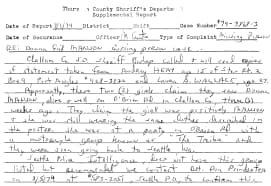
A page from Donna Manson’s missing persons report.
A blurb from Donna’s missing persons report.
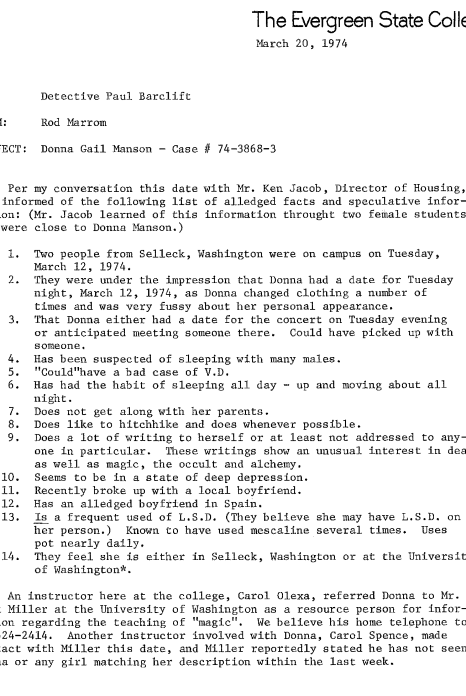
A memo from Evergreen Campus Security Chief Rod Marrom to Thurston County Detective Paul Barclift. Photo courtesy of the Thurston County Sheriff’s Department/’hi: I’m Ted.’
A letter to the Thurston County Sheriff’s Department related to the Manson case.
A handwritten report about Donna’s disappearance from the Thurston County Sheriffs Department.
An aerial view of the Evergreen State College campus from 1974.
A: Residence halls.
B: Library.
C: C&N Road. 
Photo courtesy of the Evergreen State College Archives.
An old 1970’s b&w picture of Evergreen State College.
A path to residence halls from the 1970’s. Photo courtesy of the Evergreen State College Archives.
A more rural area of the Evergreen State campus. Photo courtesy of the Evergreen State College Archives.
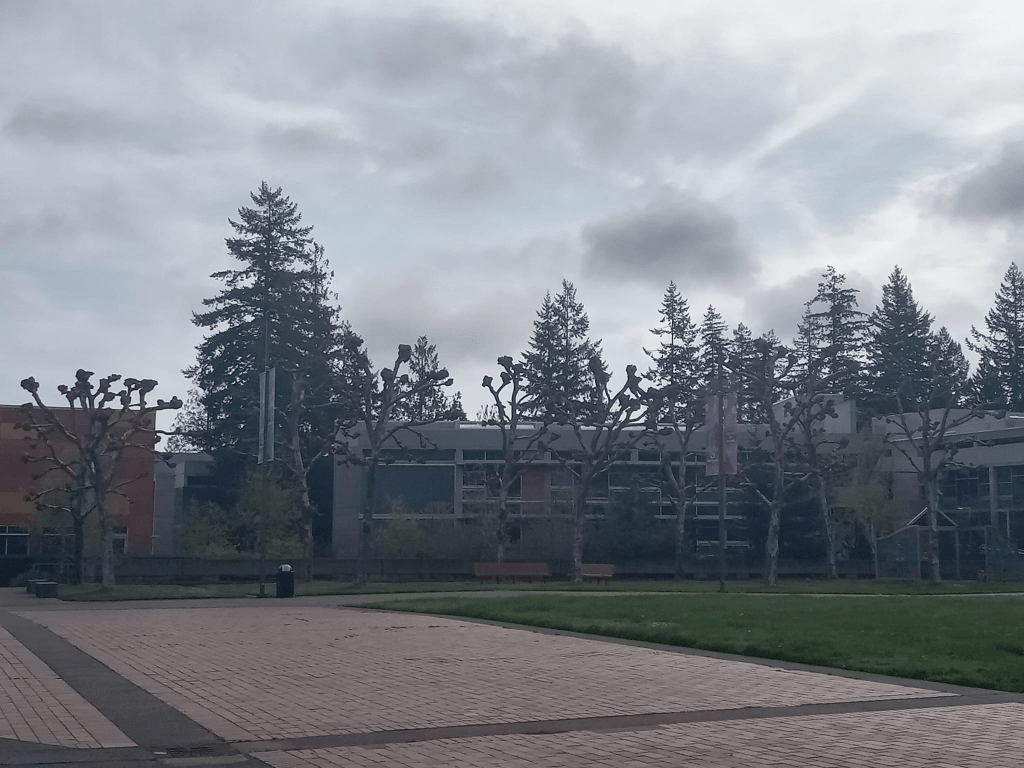
Evergreen State College.
A security booth at Evergreen State College.
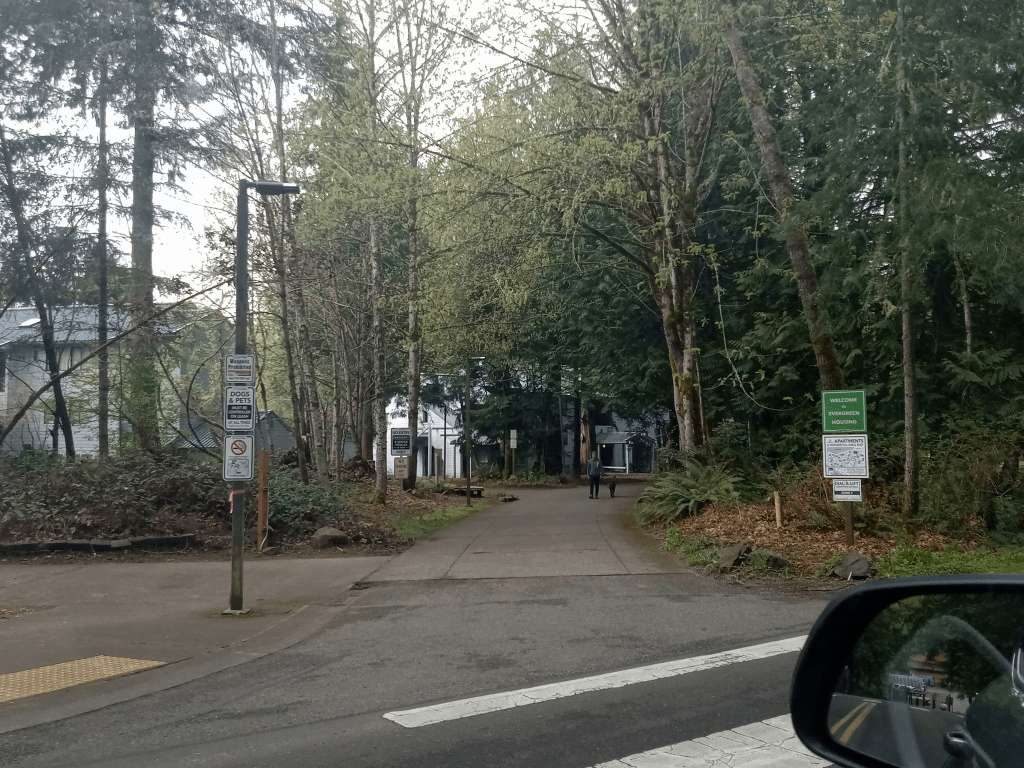
One of the entrances to Evergreen State College.
Evergreen State College.
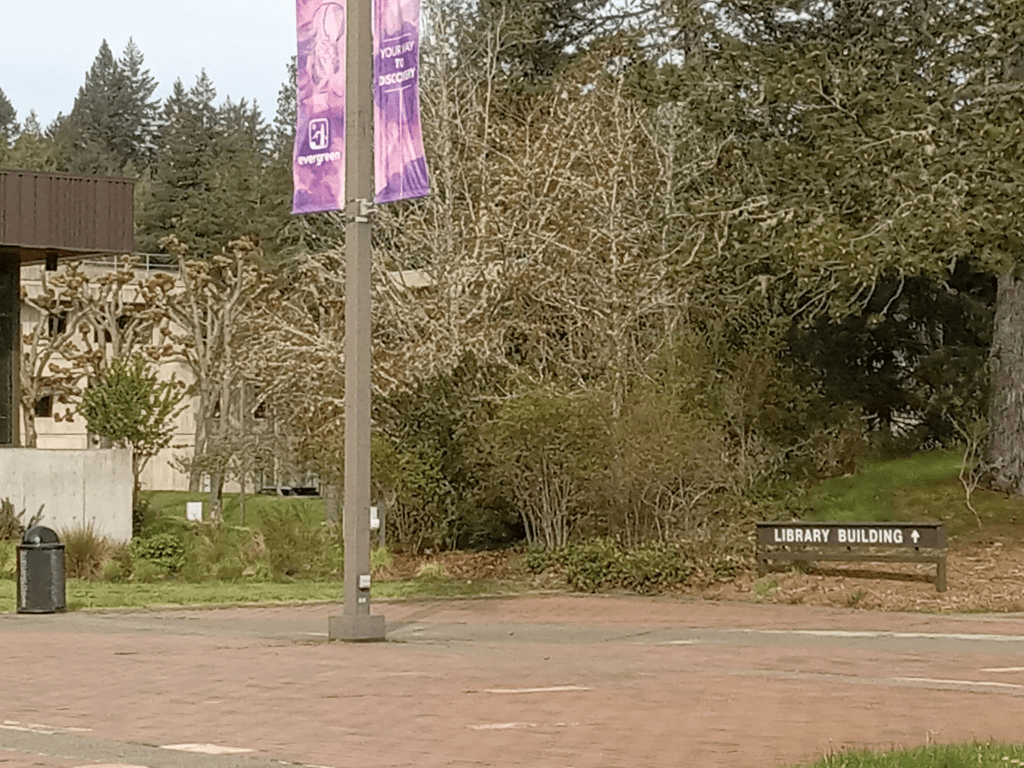
A sign for the Daniel J. Evans Library at Evergreen State College.
The Daniel J. Evans Library at Evergreen State College.
The Daniel J. Evans Library at Evergreen State College; the concert took place on the first floor.
The entrance of the Daniel J. Evans Library at Evergreen State College.
The Daniel J. Evans Library at Evergreen State College.
The windows at the Daniel J. Evans Library at Evergreen State College.
A student reading outside Dorm C from the 1970’s. Photo courtesy of the Evergreen State College Archives.
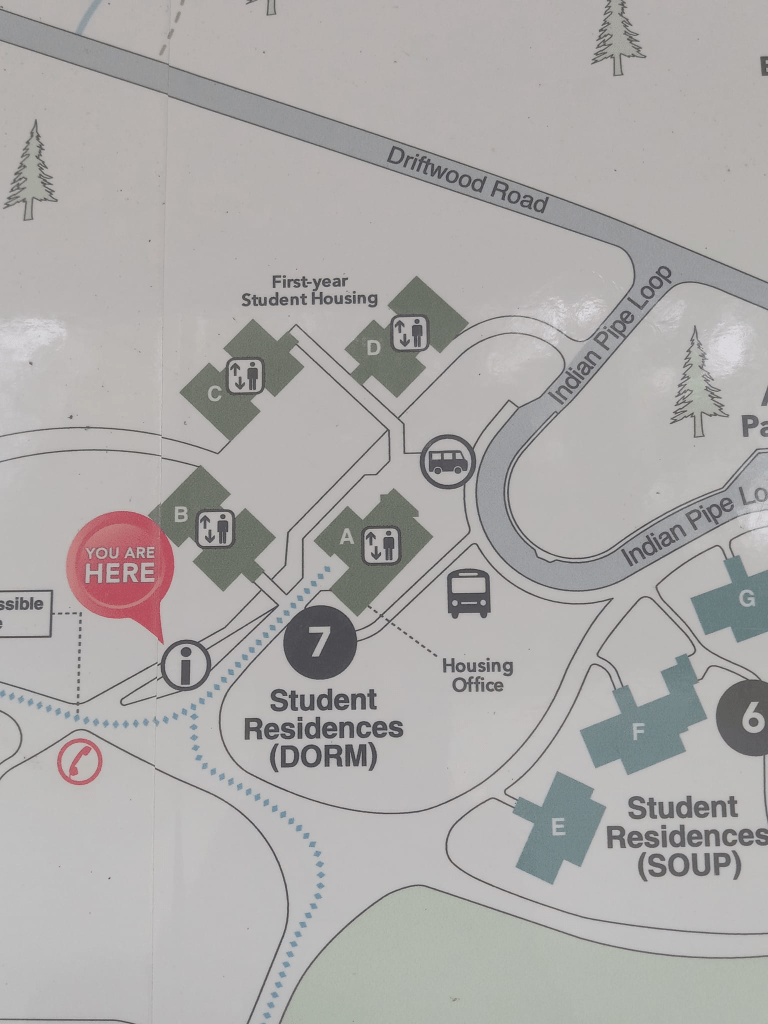
The entrance to the dorms at Evergreen State College; Donna lived in the ‘C-building,’ and her exact mailing address was ‘4319 Indian Pipe Loop NW / ℅ Evergreen State College / Olympia WA, 98505.
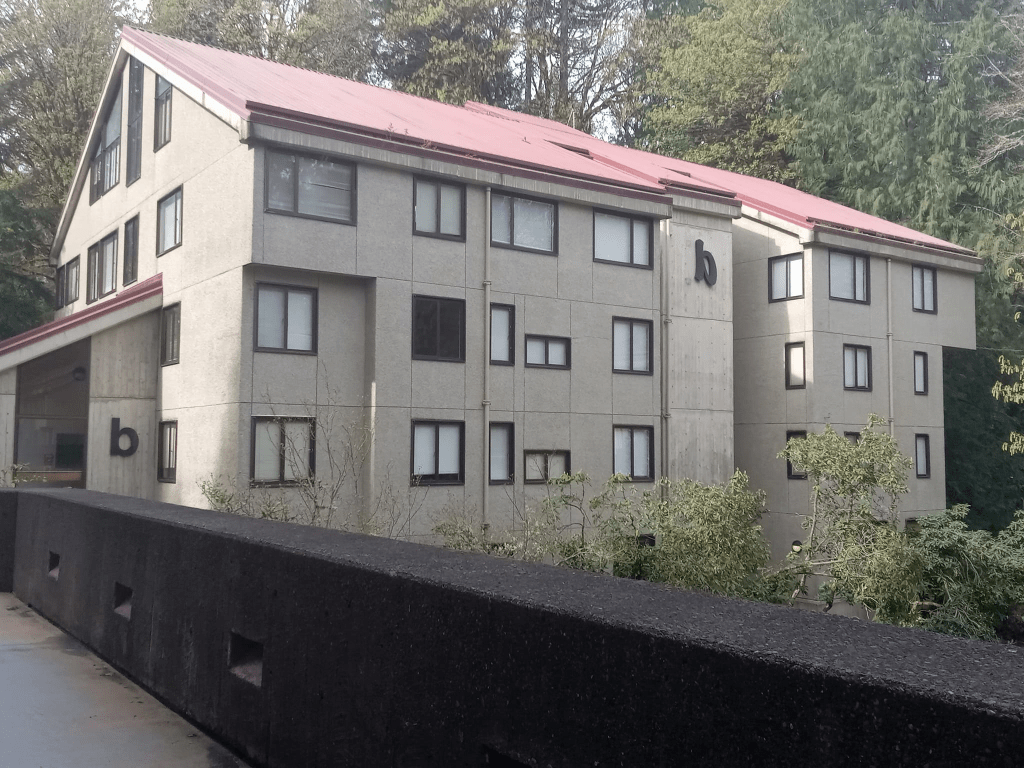
The dorms at Evergreen State College
The dorms at Evergreen State College.
The C-dorm at Evergreen State College where Donna Manson lived when she was murdered.
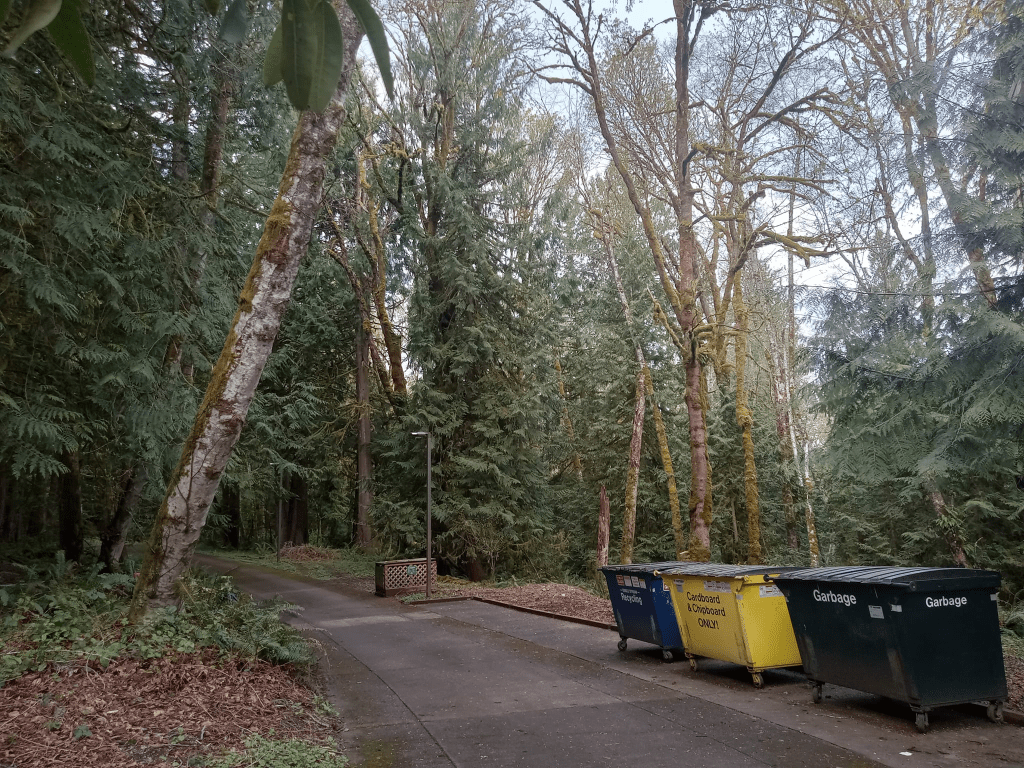
A trail at Evergreen State College.
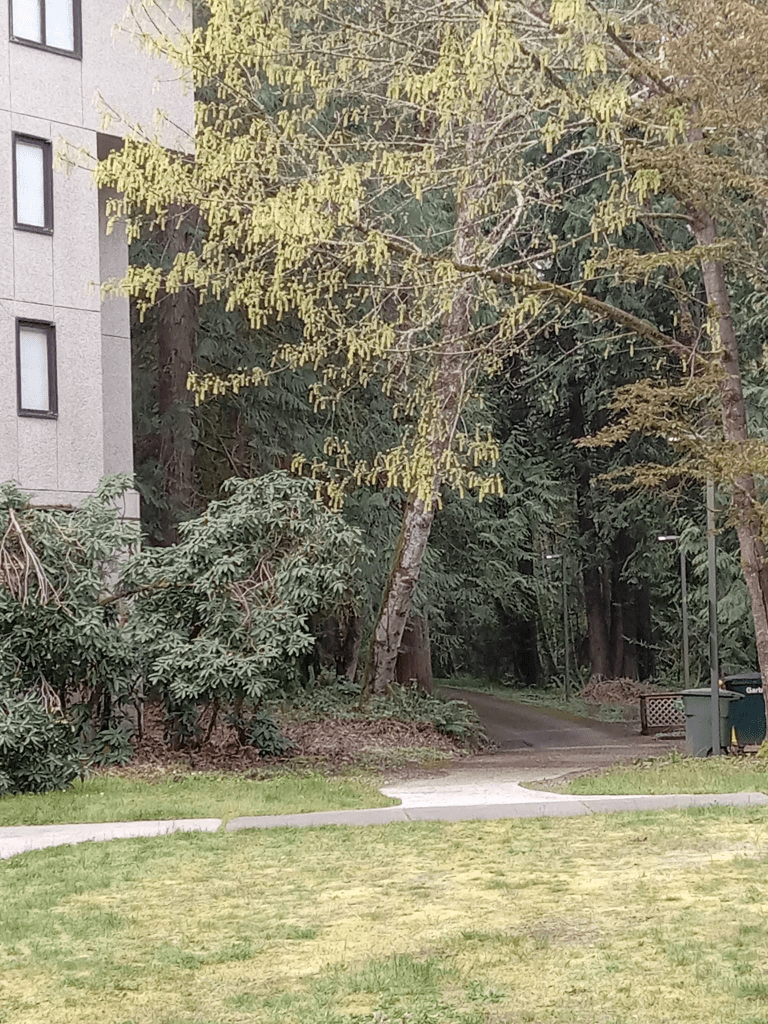
A trail behind the dorms at Evergreen State College.
A trail behind the dormitories at Evergreen State College.
The bridge on Madrona Beach Road at Perry Creek from November 2018. Photo courtesy of Google Maps.
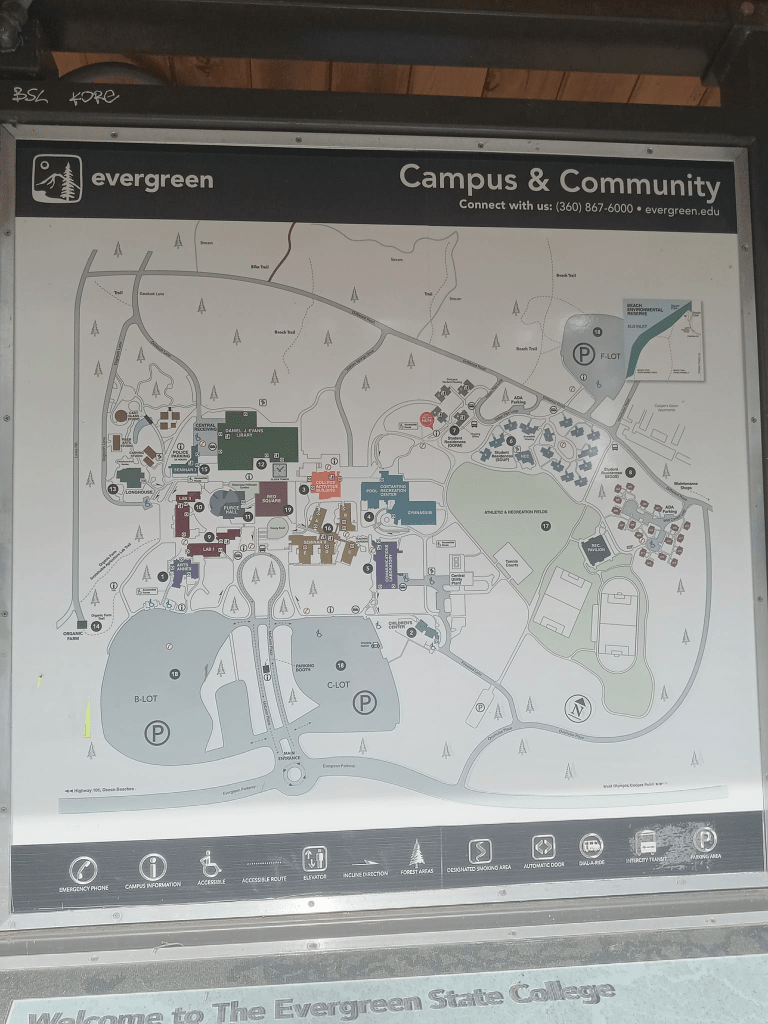
A display of the trails available to walk on the Evergreen State College campus.
A display at Evergreen State College.
A map of Evergreen State College.
This old map of the Evergreen State College campus is from the 1975–1977 course catalog; the relevant locations are notated with red dots, courtesy of OddStops.
The News Tribune broke the story about the missing skeletons on December 2nd, 1996. Photo courtesy of ‘ThisInterestsMe.’
At the time of her disappearance Donna lived in room 206 in the C building. Photo courtesy of ‘ThisInterestsMe.’
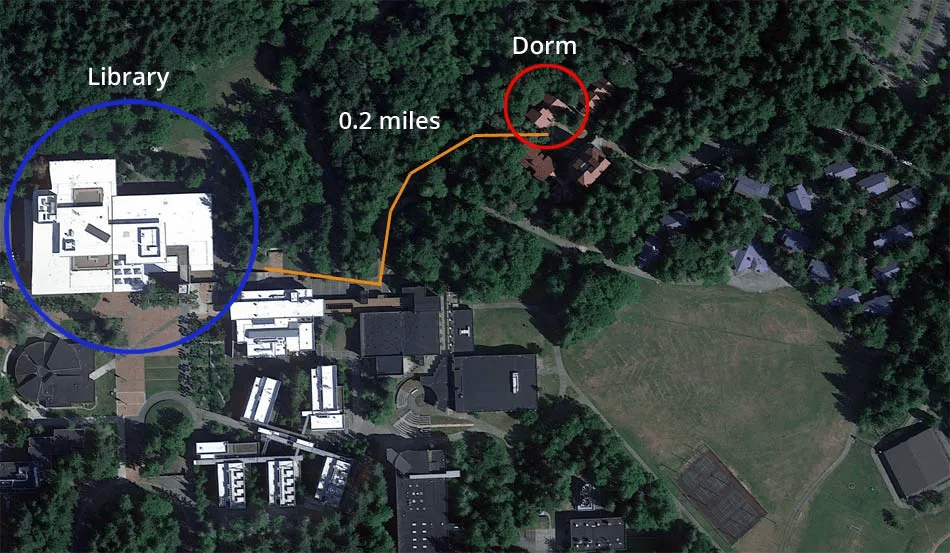
This satellite map shows the most likely route that Donna Manson took while she was walking between her dorm room and the library area. Photo courtesy of OddStops.
This aerial image shows the College Activities Building and the library. Photo courtesy of OddStops.
Another theory surrounding Donna Manson’s abduction is that Bundy parked his car on Hidden Springs Drive, which connects the area around the library with Driftwood Road to the north. It is also very close to the route she would have taken the night she vanished. Photo courtesy of OddStops.
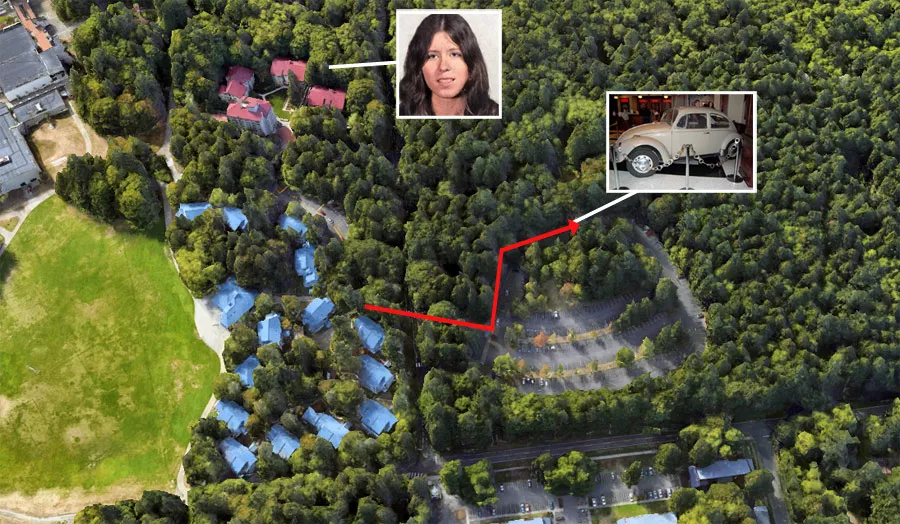
This aerial image illustrates how close Manson’s dorm building was to Parking Lot F; its roughly a five minute walk. Photo courtesy of OddStops.
This route is only 0.1 miles long: less than two minute walk. Photo courtesy of ‘ThisInterestsMe.’
This aerial map shows Donna’s dorm, Parking Lot F, and the C&N road that she was seen walking along (the buildings above the C&N road were digitally removed because they did not exist at the time of Donna’s disappearance). Photo courtesy of OddStops.
In police reports, the road is labelled as C&N Road and on Google Maps it is called Overhulse Place. Photo courtesy of ‘ThisInterestsMe.’
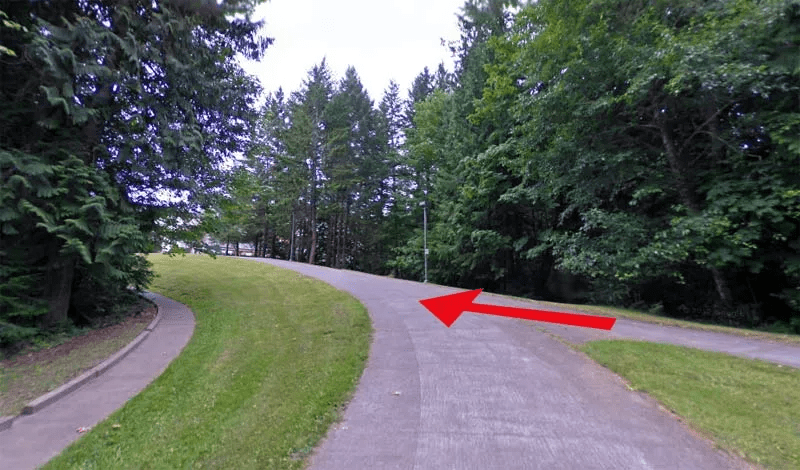
This is a section of the pathway between Donna’s dorm and the library; the red arrow points in the direction she would have been walking in. Photo courtesy of OddStops.
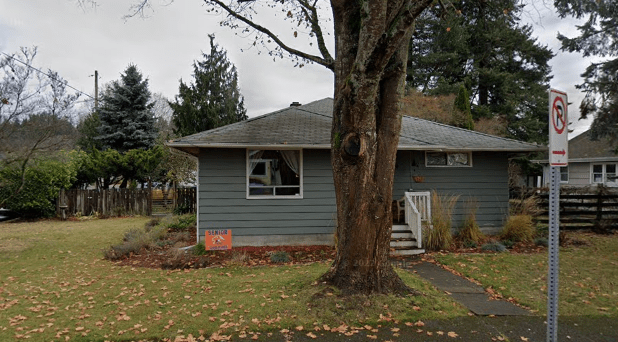
When she wasn’t staying at her college dorm Donna lived at this home at 124 O St NE in Auburn with her parents at the time of her disappearance.
Taylor Mountain, April 2022.
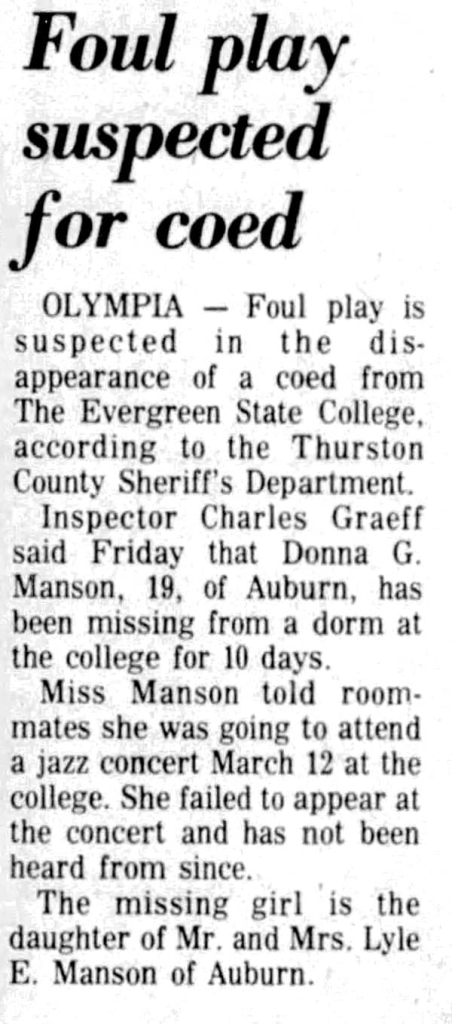
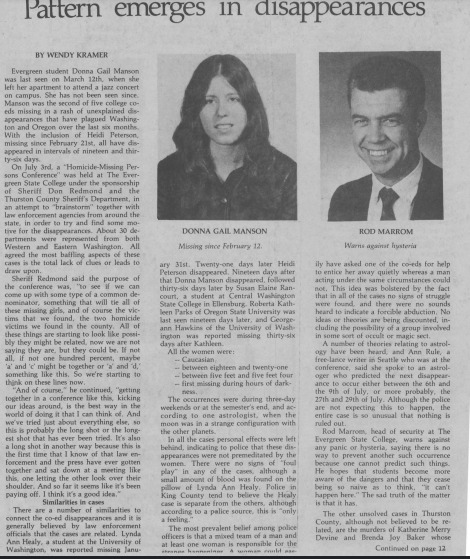
An article about Donna’s disappearance published in The News Tribune. It was published on March 22, 1974, ten days after she disappeared.
An article on Donna from The Daily Olympian published on March 24, 1974.
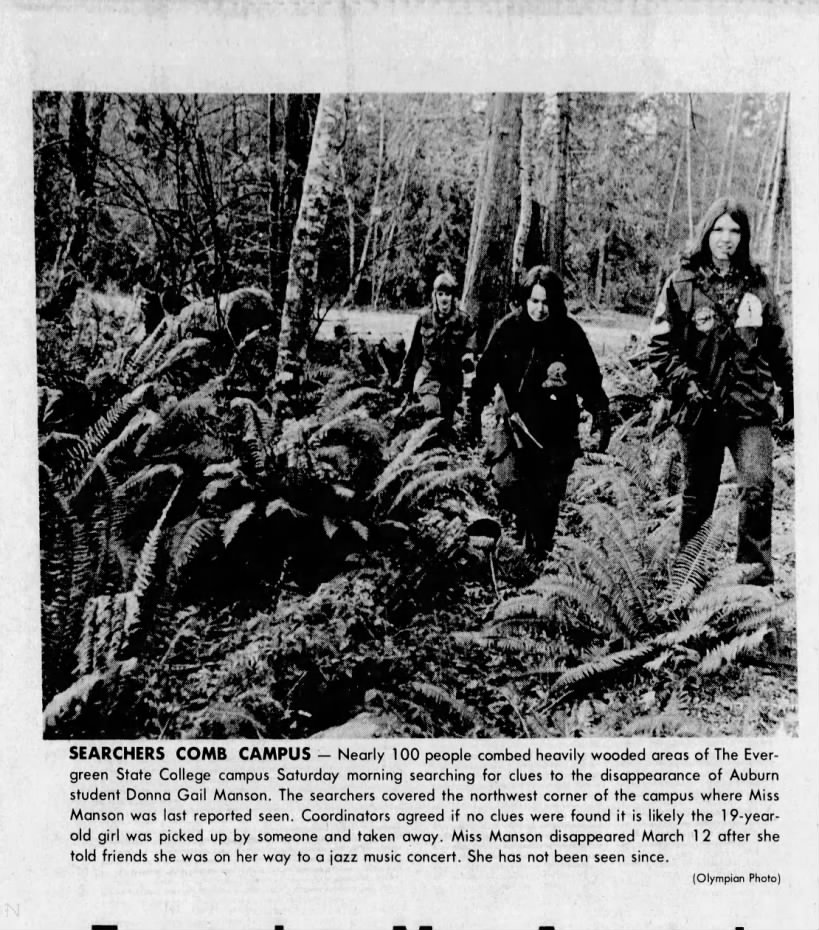
An article about the search for Donna Manson published in The Olympian on March 24, 1974.
An article about Donna’s disappearance published in The Daily Herald on March 30, 1974.
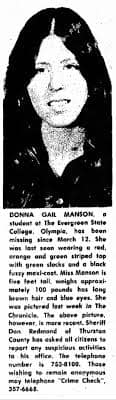
An article about Donna Manson published in The Daily Olympian on March 30, 1974.
An article about Donna Manson published in The Daily Chronicle on March 30, 1974.
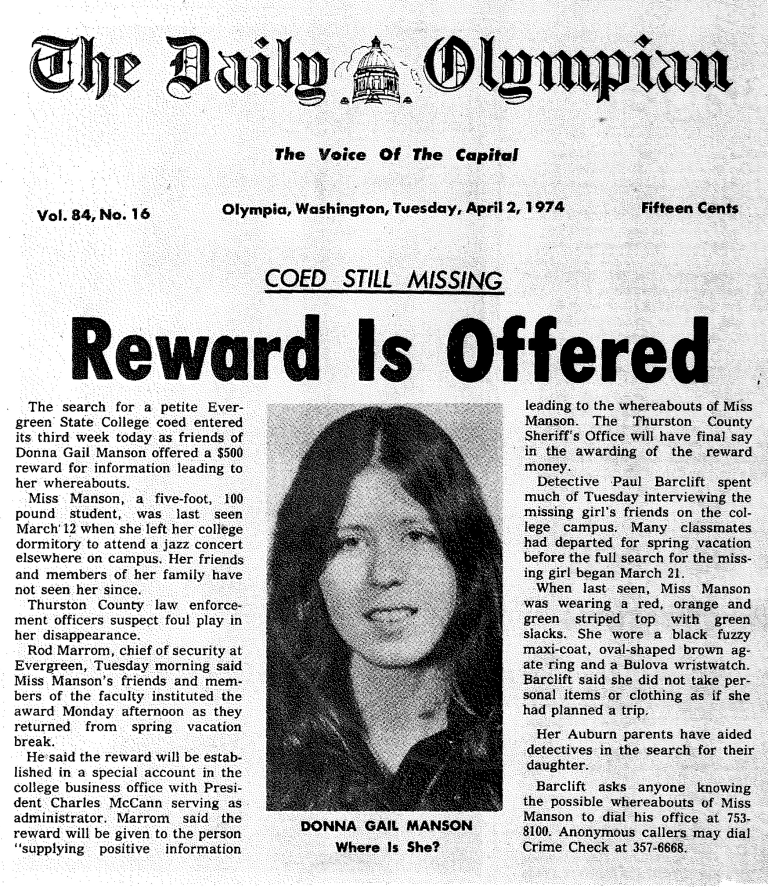
An article on Donna Manson’s disappearance from The Daily Olympian published on April 2, 1974.
A newspaper blurb about a reward for any information leading to the discovery of Donna Manson published in The Daily Chronicle on April 3, 1974.
An article mentioning Donna’s disappearance published in The Daily Chronicle on April 6, 1974.
The first part of an article about Donna Manson published by The Auburn Globe-News on April 17, 1974.
The second part of an article about Donna Manson published by The Auburn Globe-News on April 17, 1974.
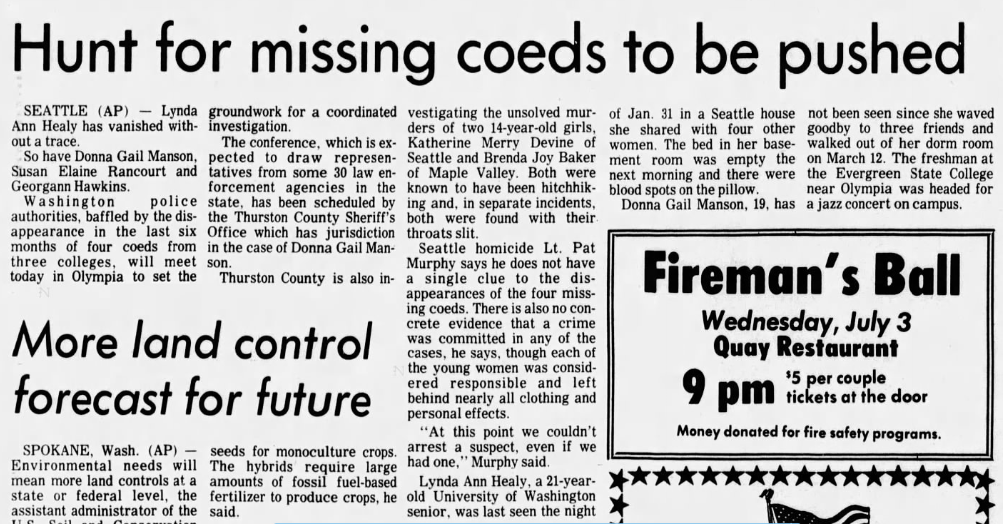
An article about the missing Washington state coeds that mentions Donna published in The News Tribune on May 29, 1974.
An article about Donna’s disappearance published in The Olympian on June 18, 1974.
An article about mentioning Donna published in The Spokane Chronicle on June 19, 1974; the victim they’re referring to is actually Brenda Joy Baker.
An article mentioning Donna’s disappearance published in The Olympian on July 2, 1974.
An article about the missing Washington state coeds mentioning Donna published in The Columbian on July 3, 1974.
An article mentioning Donna’s disappearance published in The News Tribune on July 5, 1974.
An article mentioning Donna’s disappearance published in The News Tribune on July 28, 1974.
The first part of an article published by the Cooper Point Journal on August 11, 1974. Photo courtesy of the Evergreen State College Archives.
The second part of an article published by the Cooper Point Journal on August 11, 1974. Photo courtesy of the Evergreen State College Archives.
An article about the missing Seattle woman published in The Longview Daily News on August 27, 1974.
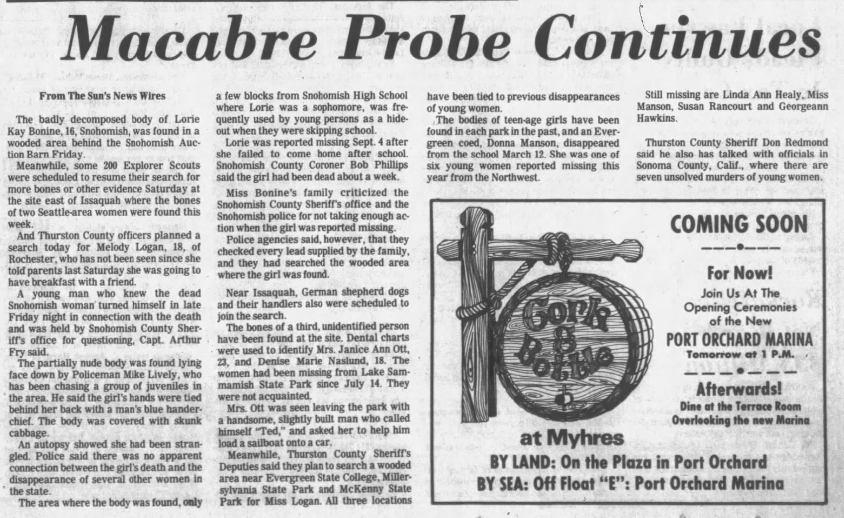
An article about the Issaquah burial site mentioning Donna Manson that was published in The News Tribune on September 13, 1974.
An article mentioning the disappearance of Donna Manson published by The Kitsap Sun on September 14, 1974.
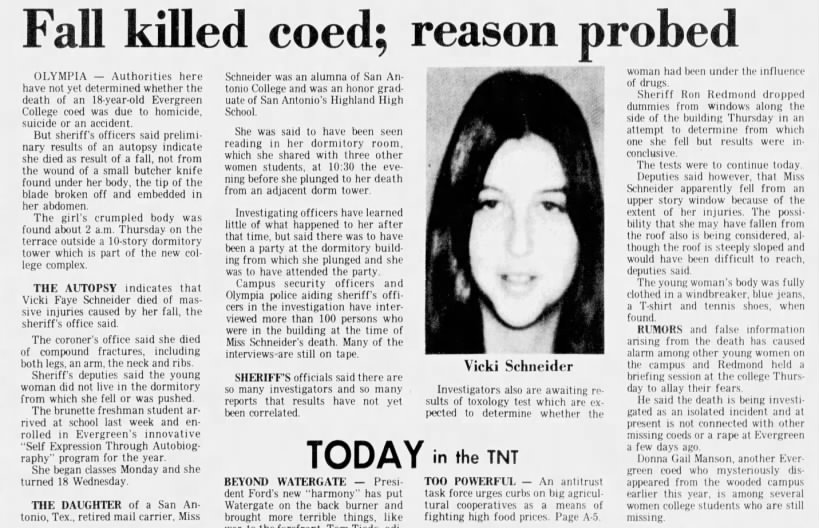
An article about a murdered coed from Evergreen State that mentions Donna Manson published in The News Tribune on•October 4, 1974.
An article about Donna’s disappearance in The Daily-Herald-Tribune on March 5, 1975.
An article about Donna’s disappearance in The Spokesman-Review on March 8, 1975.
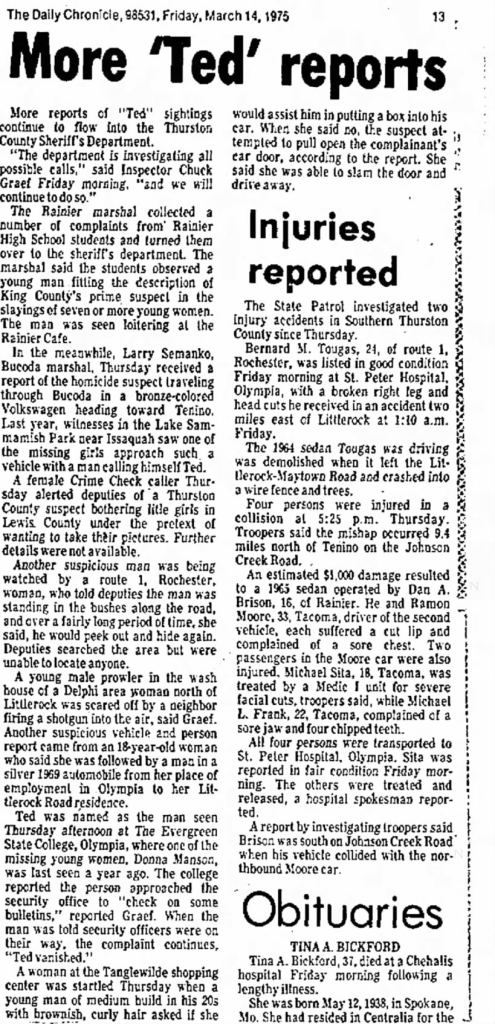
An article about Donna’s disappearance in The Daily Chronicle on March 14, 1975.
An article that mentions the disappearance of Donna Manson published in The News Tribune on March 18, 1975.
An article mentioning Donna’s disappearance in The Spokesman-Review on October 16, 1975.
This image has an empty alt attribute; its file name is image-362.png
An article about the remains that were found in the foothills of Mount Rainier in August 1978 that mentions Donna Manson.
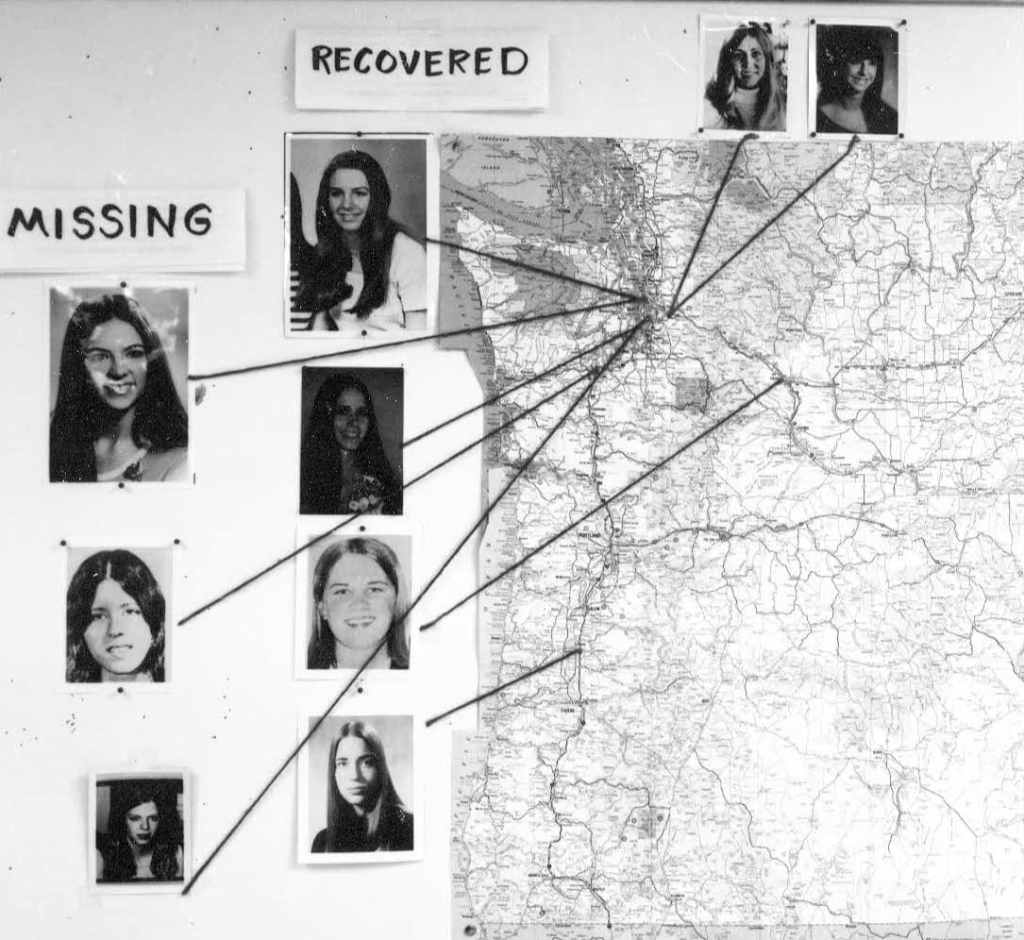
Seven of the eight Seattle Bundy victims… notice anyone missing? Detectives were hesitant to include Brenda Ball in with the other girls because she was a little older than them and not a college student (also she was away from a college setting and was a known hitchhiker). Ironically hers was the first skull found on Taylor Mountain.
A map of where the missing Washington women went missing compared to one another. Picture courtesy of the King County Archives.
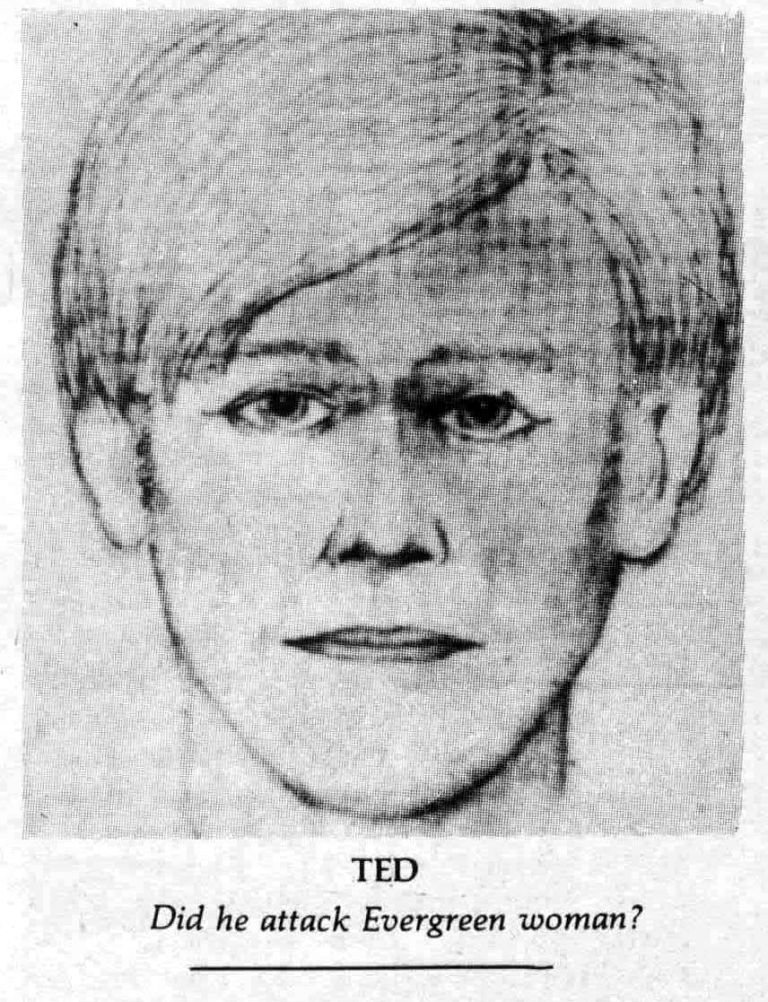
An picture of the suspect from an article published by The Cooper Point Journal on August 8, 1974. Photo courtesy of the Evergreen State College Archives.
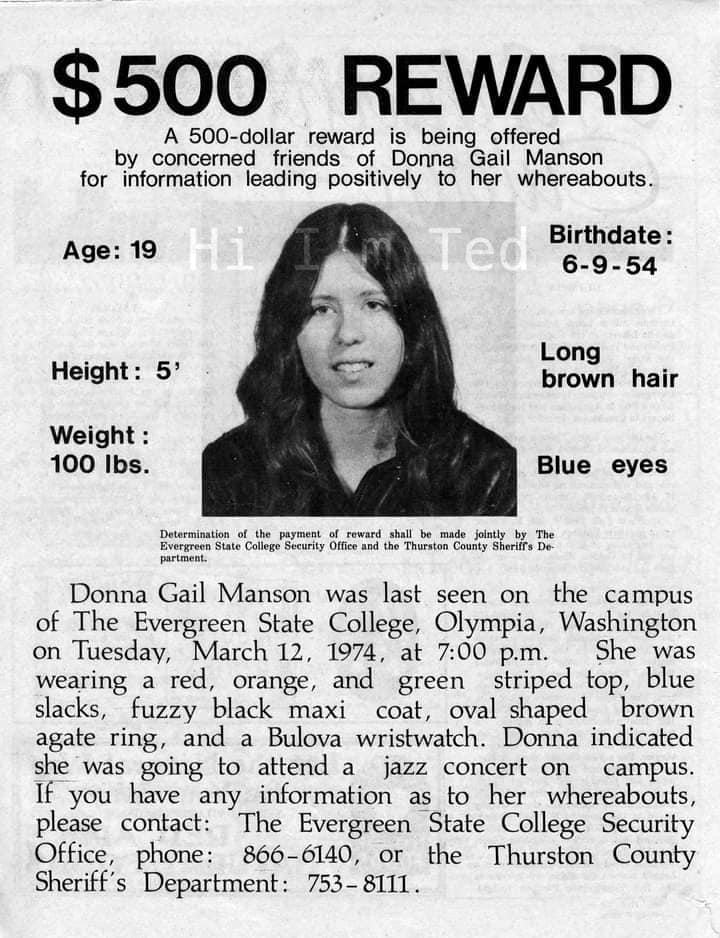
A missing poster for Donna Manson. Photo courtesy of ‘hi: I’m Ted.’
A missing poster for Donna Manson. photo courtesy of ‘Ted Bundy: I was Trying to Think like an Elk.’

A missing poster for Donna Manson. Photo courtesy of ‘hi: I’m Ted.’
Photo courtesy of the Thurston County Sheriff’s Department/’hi: I’m Ted.’
A photo of Ted and Liz cuddling in front of the fireplace he may have used to incinerate Donna Manson’s skull. Photo courtesy of Liz Kloepfer.
A graph of the temperature range in Seattle from March 1974, courtesy of OddStops.
Information about ‘The Institute of Insight,’ photo courtesy of Captain Borax.
Information about classes offered at ‘The Institute of Insight,’ photo courtesy of Captain Borax.
A World War II Bonus Case File related to Lyle Edward Manson.
Donna’s parents marriage certificate from December 1952.
A short newspaper blurb about Lyle Manson published in The Gazette on November 9, 1941.
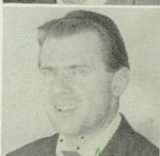
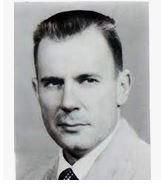
Mr. Manson from the 1953 Auburn High School yearbook.
Donna Manson’s father Lyle in 1956, sadly he passed away in December of 2007 after a long battle with Parkinson’s disease. Photo courtesy of Erin Banks.
Donna Manson’s father Lyle. Photo courtesy of Erin Banks.
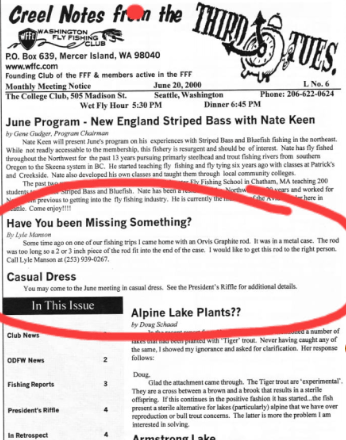
A newspaper blurb from a Seattle fishing club mentioning Lyle Manson.
The gravestone of Lyle Manson.
Marie Manson’s junior year photo from the 1940 Auburn High School yearbook.
Donna’s parents wedding announcement published in The Gazette on November 30, 1952.
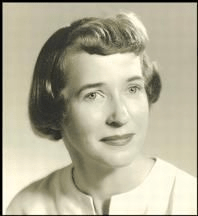
A picture of Donna Manson’s Mother, Marie Elizabeth (nee Nilson) Manson was born on May 9, 1923 and passed on May 6, 2014 at the age of 91. Photo courtesy of findagrave.
Donna’s Mother, Marie Elizabeth (nee Nilson) Manson. Photo courtesy of FindaGrave.
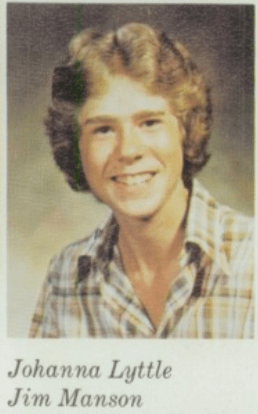
James Manson’s senior year picture from the 1978 Auburn High School yearbook.
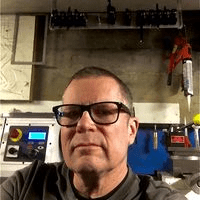
A more recent picture of James Manson. Photo courtesy of Facebook.
Some of Jim Manson’s artwork. Photo courtesy of Facebook.
Ted Bundy and a dog.
A Google Maps view of how to get from the Rogers Rooming House to Evergreen State College.
An article published by the Cooper Point Journal on October 16, 1975 after Bundy’s arrest. Photo courtesy of the Evergreen State College Archives.
Bundy’s activities on March 12, 1974 according to the ‘TB Multiagency Investigative Team Report.’