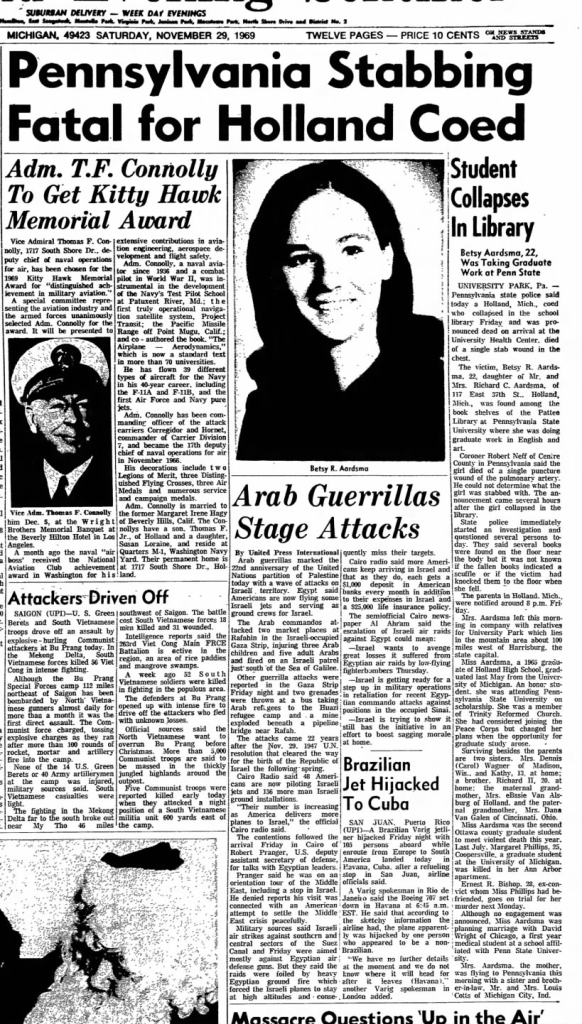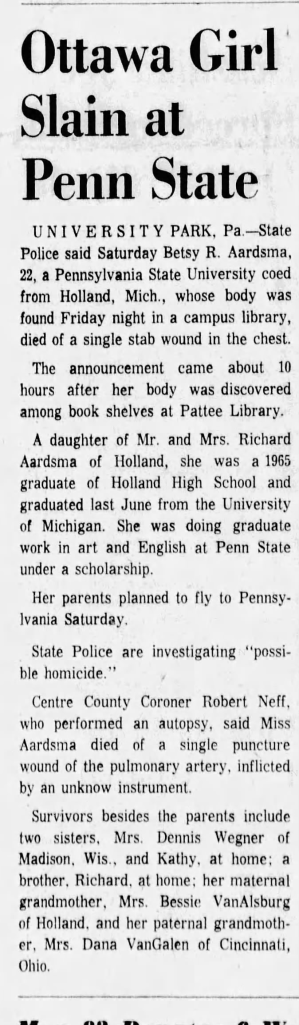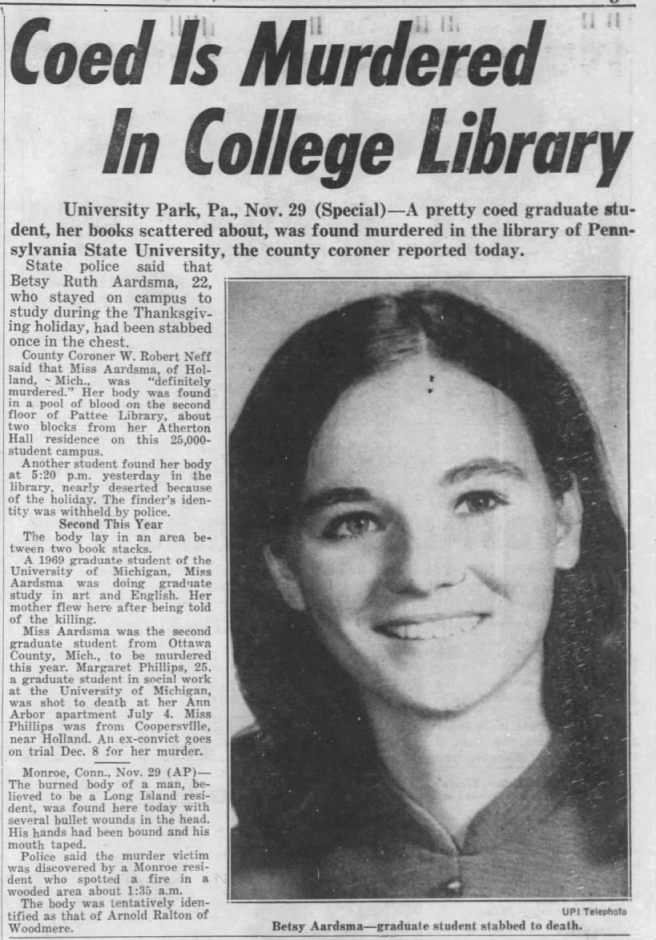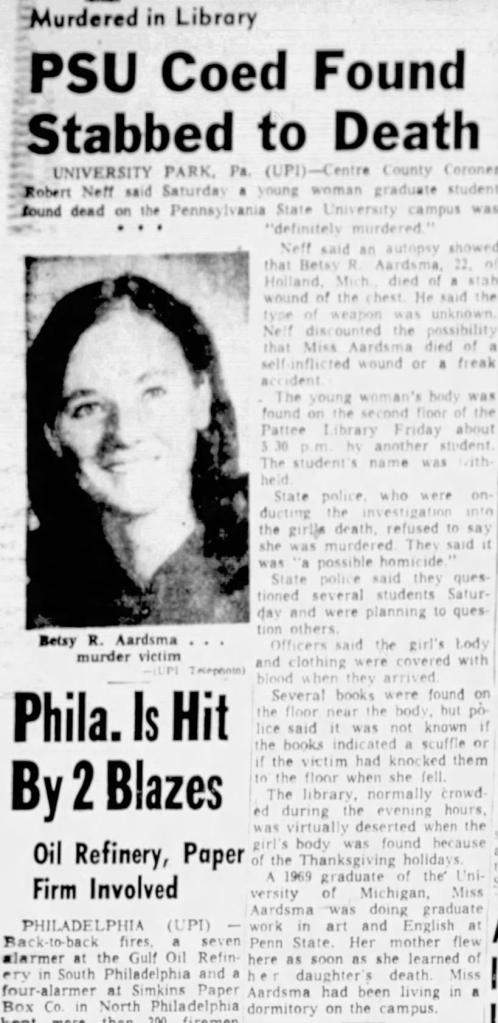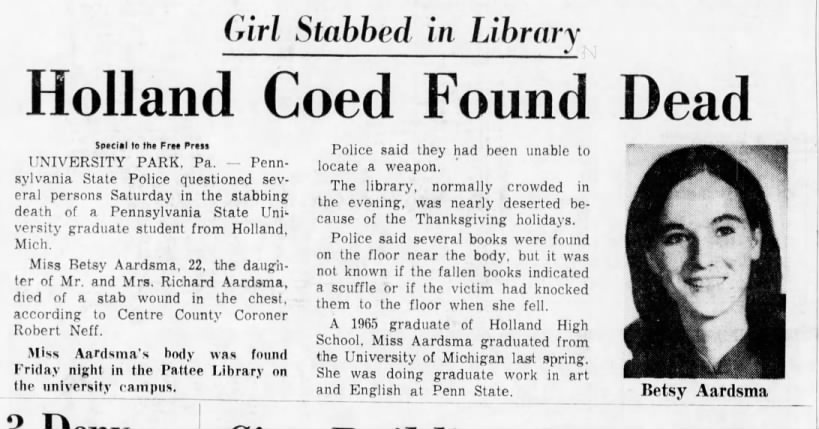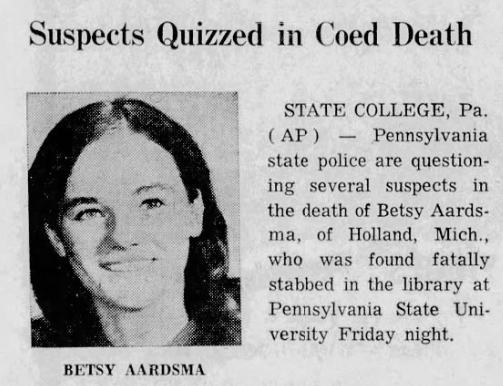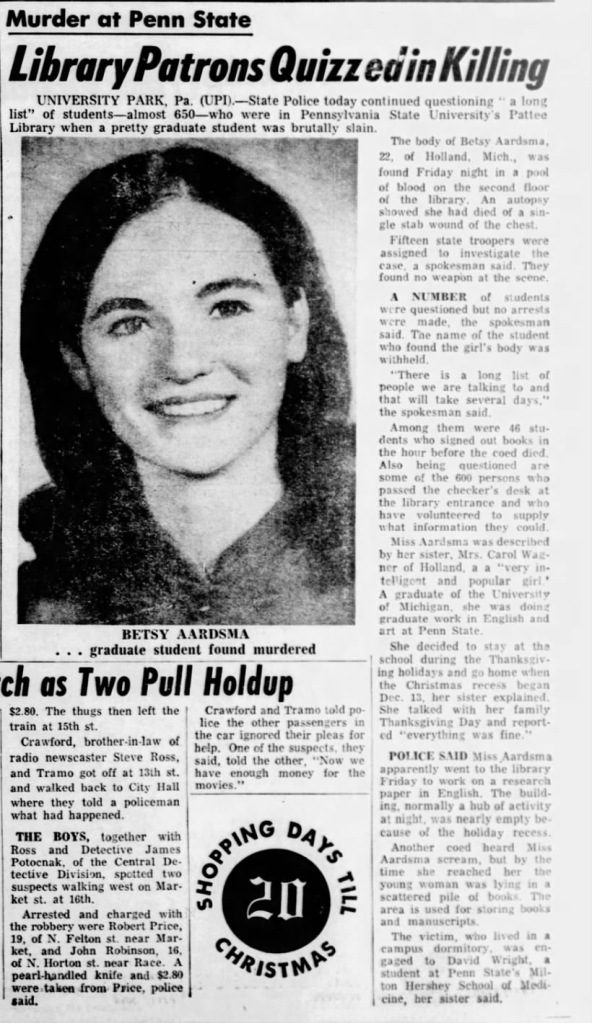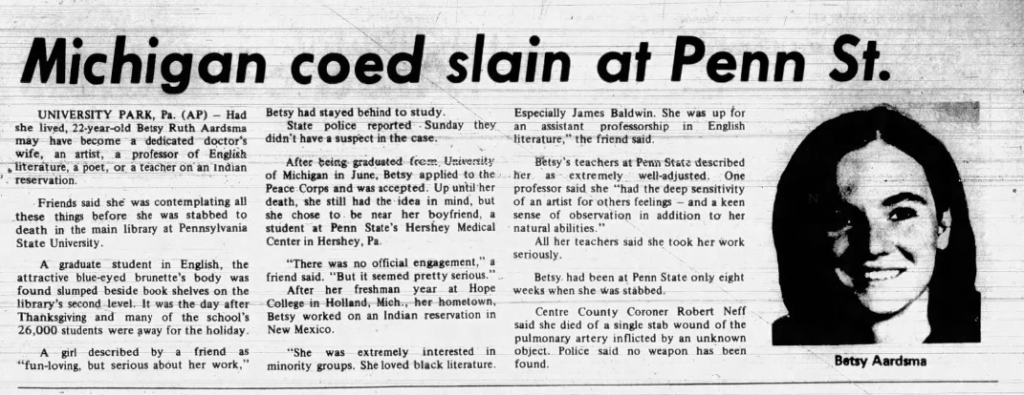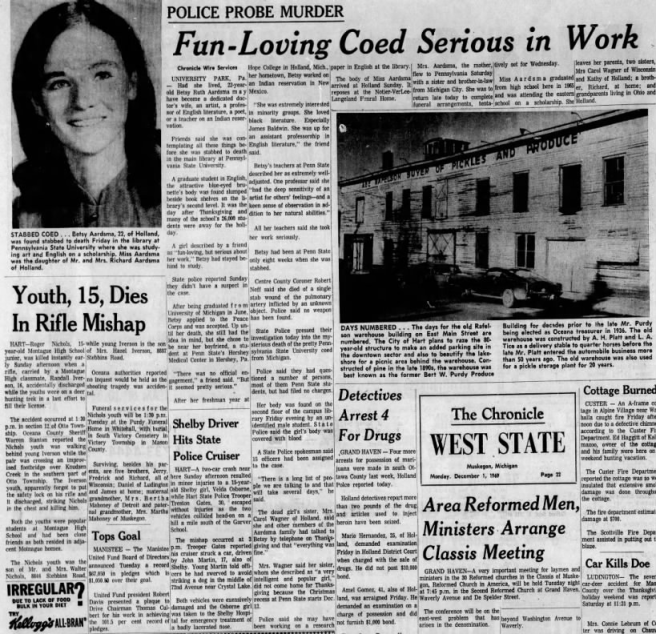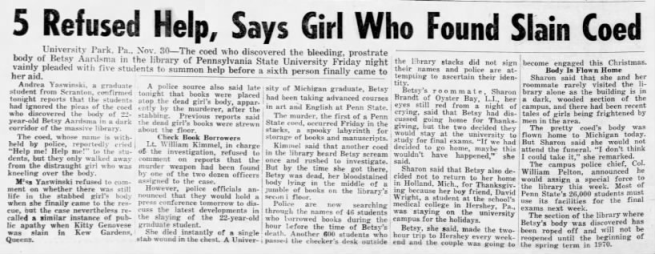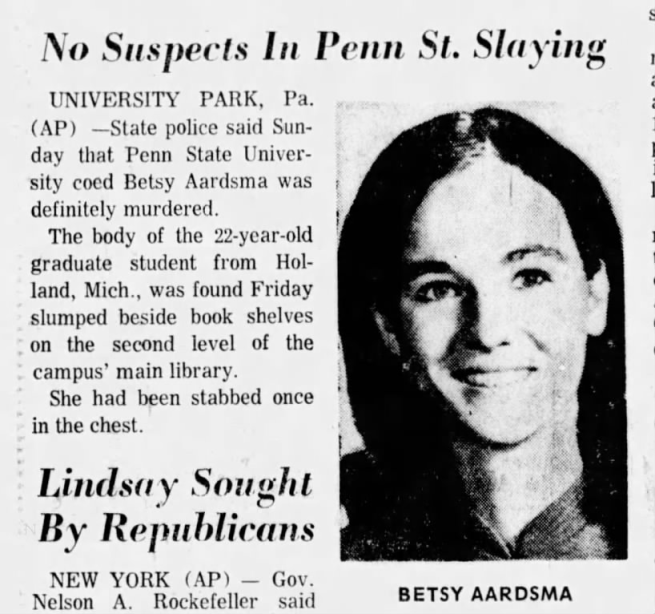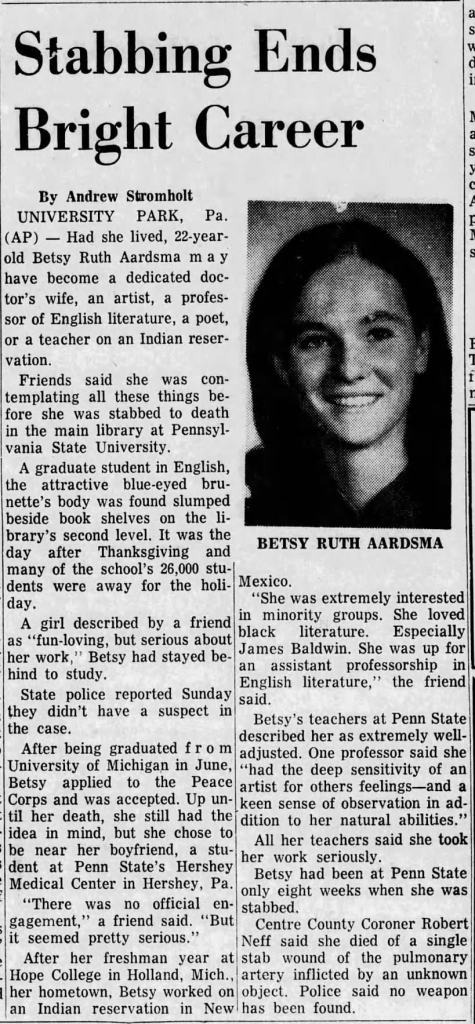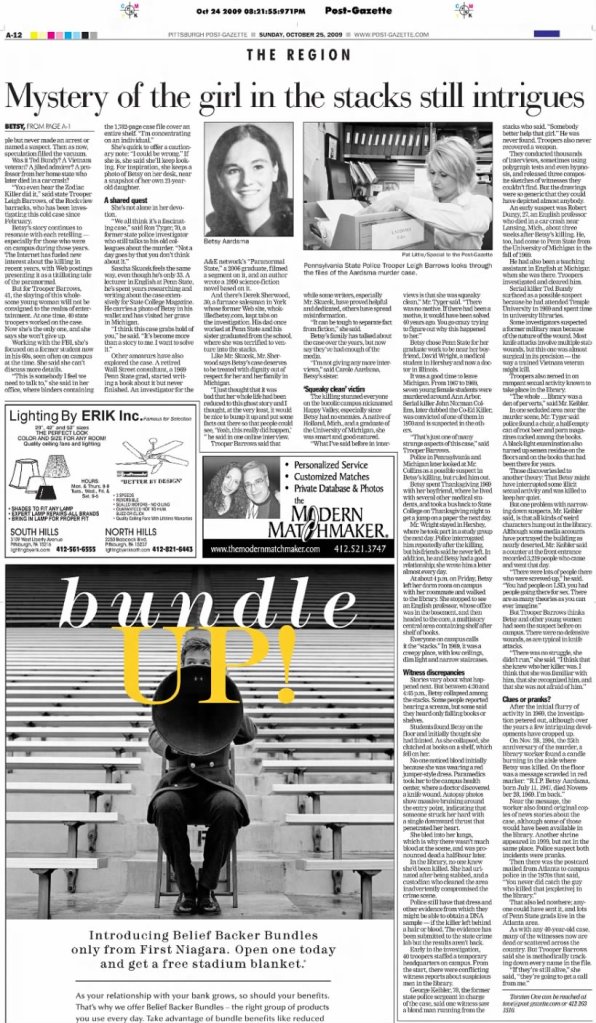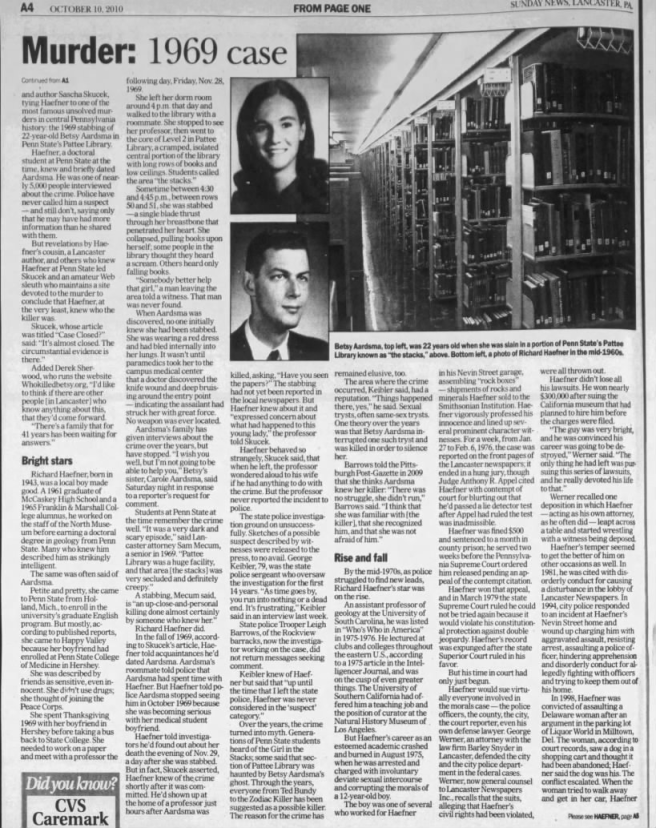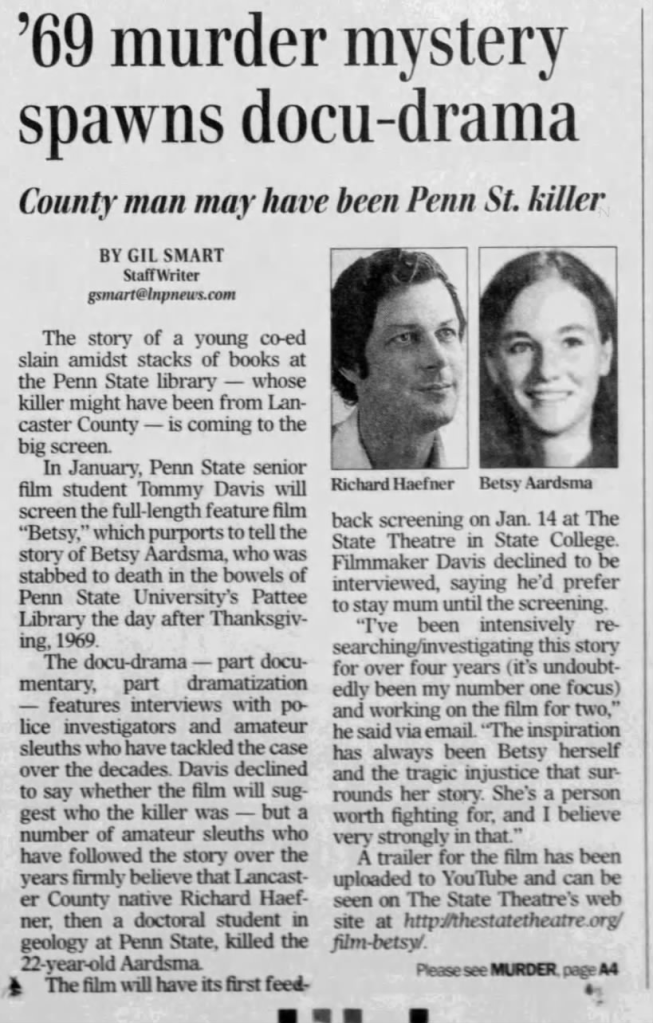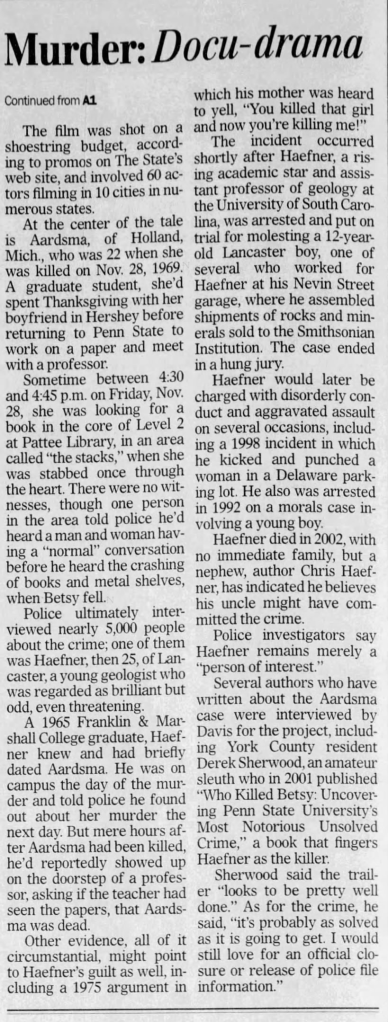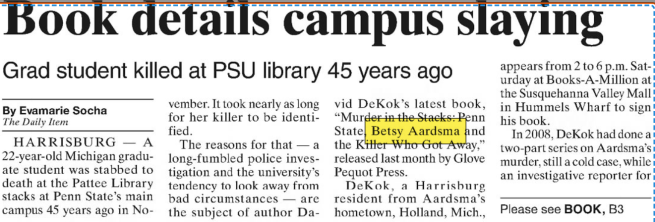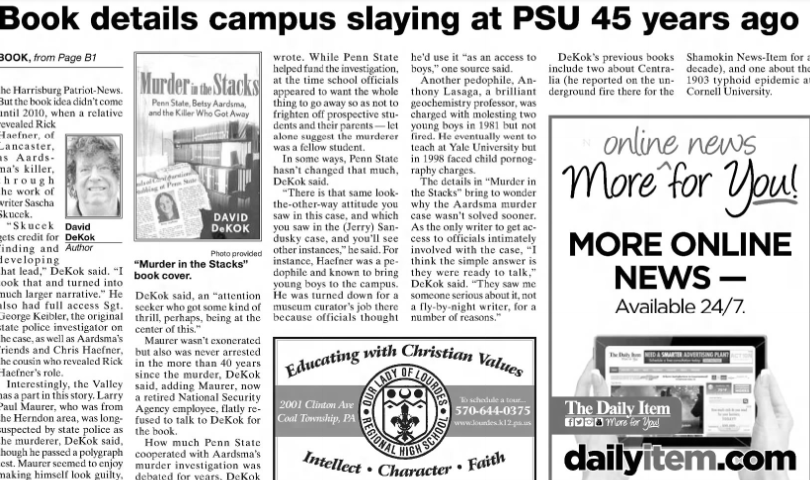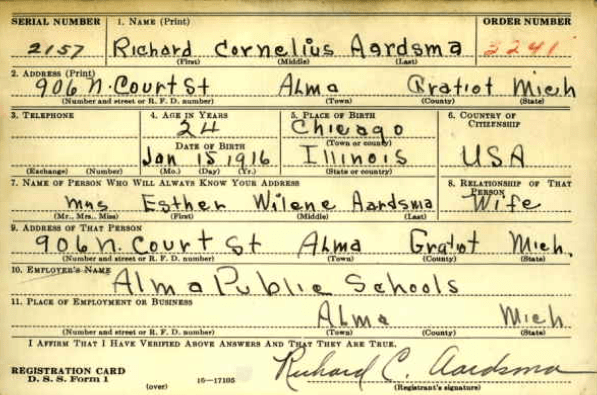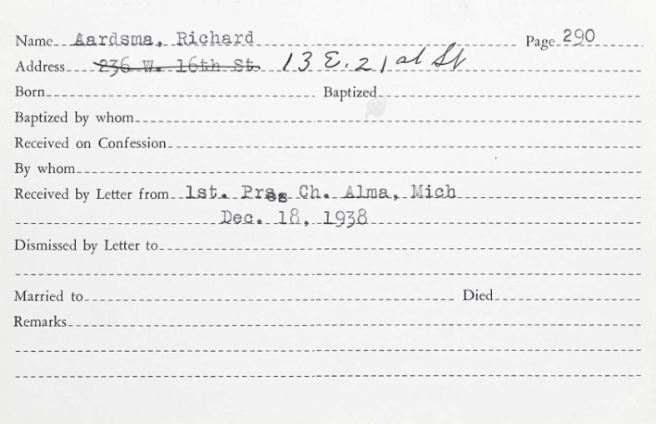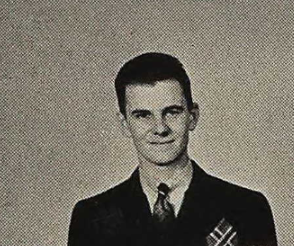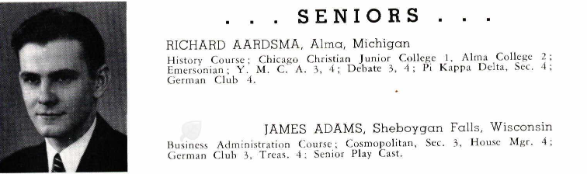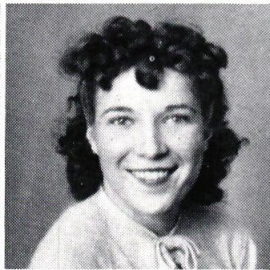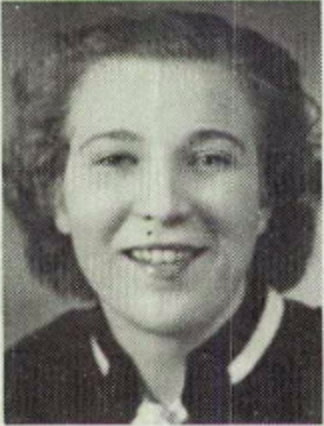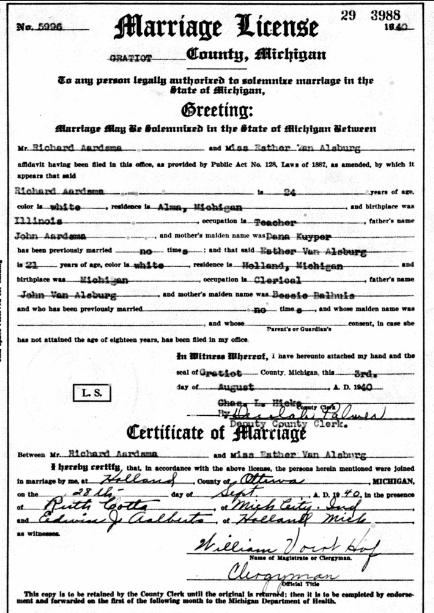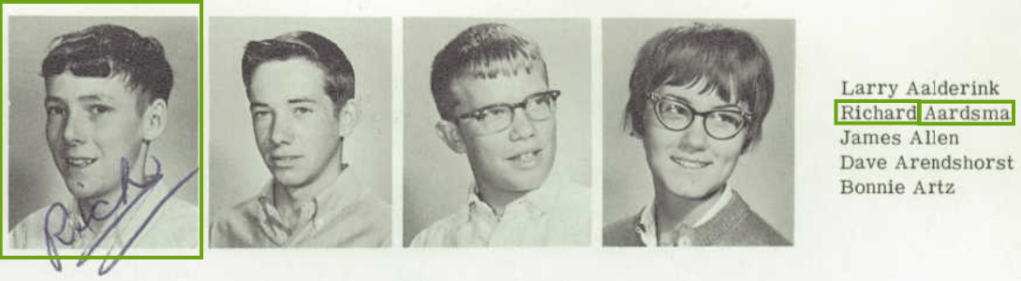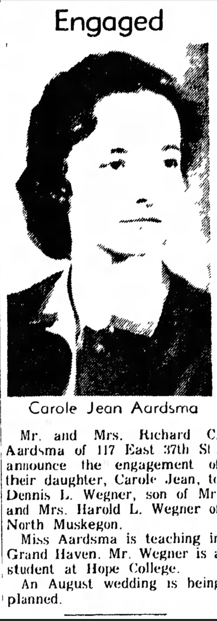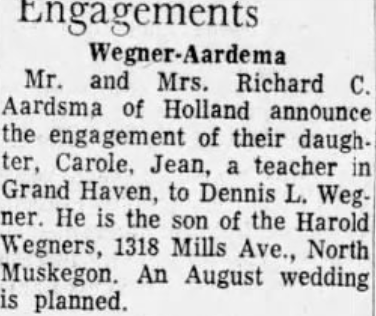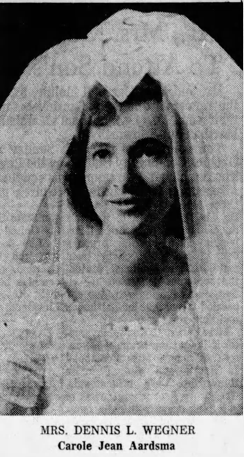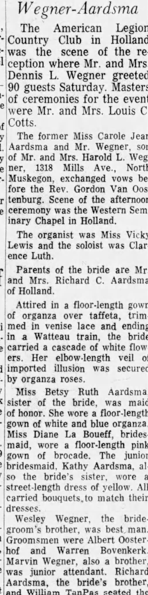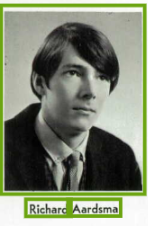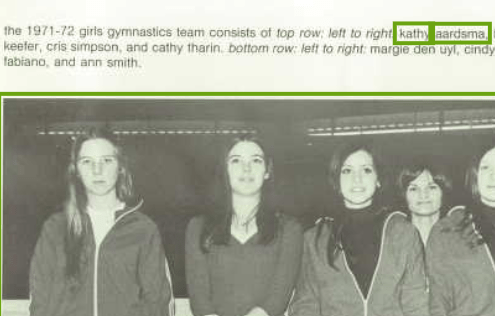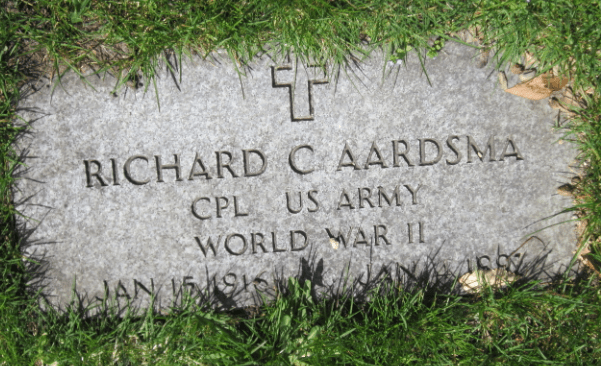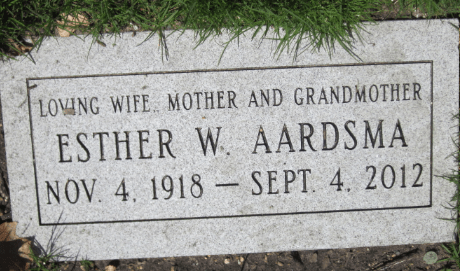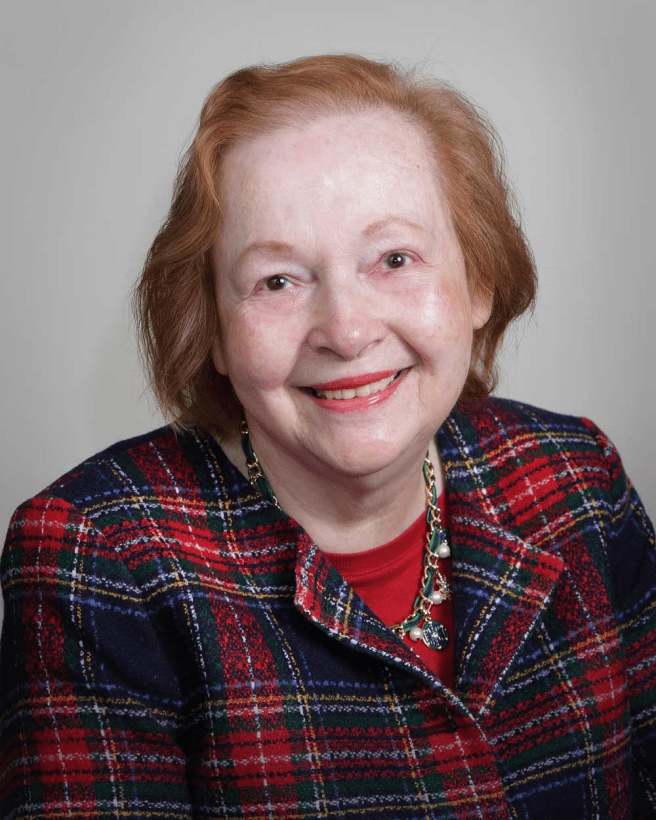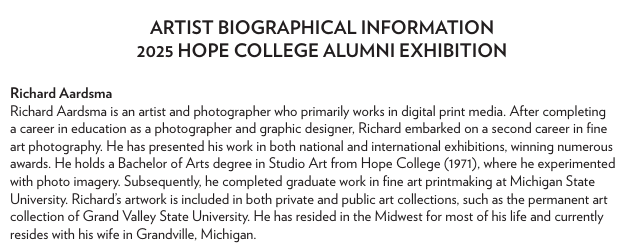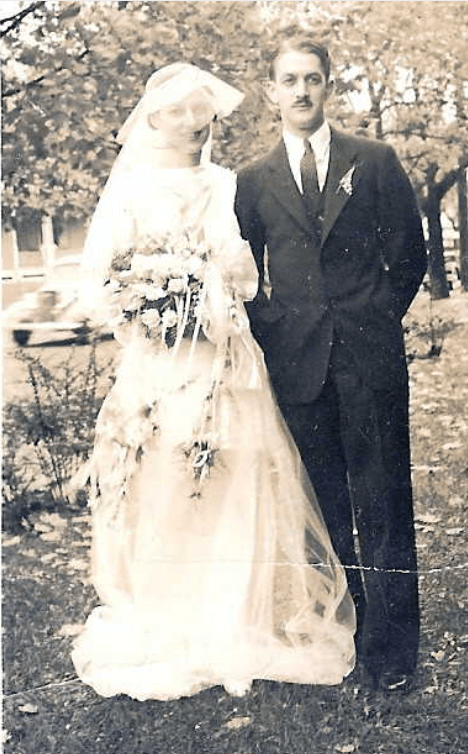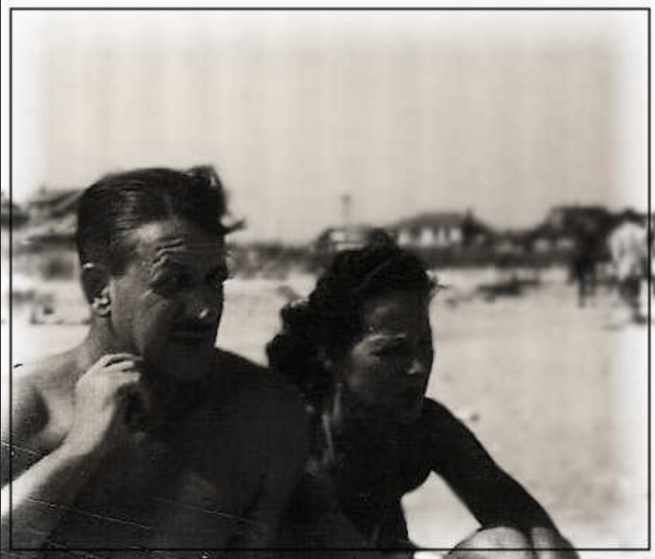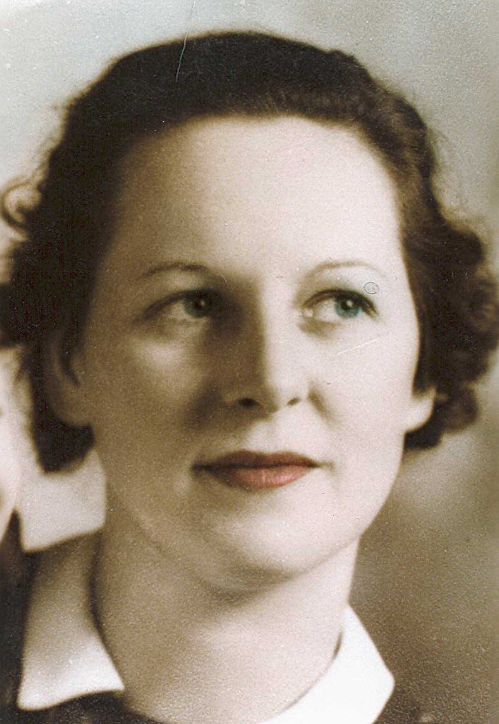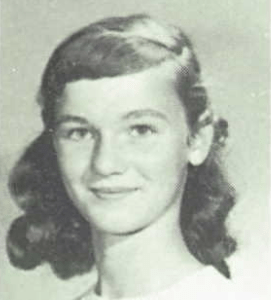
Elizabeth ‘Betsy’ Ruth Aardsma was born on July 11, 1947 in Holland, Michigan to Richard and Esther Aarsdma. Richard Cornelius Aardsma was born on January 15, 1916 in Chicago, IL and Esther Williene Van Alsburg was born on November 4, 1918 in Holland, MI. Betsy’s father fought in WWII and the couple were married on September 28, 1940 in Holland, MI and went on to have four children together: Carol, Betsy, Kathleen, and David. They both attended Hope College in Holland, which is described as a ‘private four-year Christian liberal arts college known for its academic excellence, top-ranked undergraduate research and rich campus life.’
Betsy grew up in a devoutly religious family and was raised in a middle-class household on leafy West 37th Street in Holland, MI: her dad worked as a sales tax auditor for the state of Michigan Treasury Department (although strangely a single report said he was a psychologist for the Ottawa County Community Mental Health Department), and Mrs. Aardsma was a former teacher and stay-at-home mother. The Aardsma’s lived according to the Reformed Church tradition, a lifestyle that emphasized strong conservative values and religious observance.
In the late 1960’s, Betsy’s hometown of Holland was made up of around 25,000 residents and had strong Dutch-American roots that was reflective her family’s heritage and was founded by Calvinist religious dissidents from the Netherlands in 1847. It was known for being conservative and insular, and as the local saying went: ‘if you’re not Dutch, you’re not much,’ something that was part joke, half belief. At the time, Holland was made up of two main religious denominations: the moderate Reformed Church and the ultraconservative Christian Reformed Church, both of which believed that God’s will determines every event in life (good or bad) and that humans are ‘predestined’ at birth for heaven or hell.
As a child, Betsy displayed a flair for art and poetry, and by the time she was in her early teenage years had developed somewhat liberal ideals (at the time, anyways) and displayed a genuine concern for the underprivileged. An exceptionally strong student, she was known for her intelligence and the well-mannered way in which she presented herself: she graduated fifth in her class at Holland High School and was a member of the National Honor Society (she had a special interest in English, art, and biology); she was also the VP of her sophomore class, the East Unit Vice President of her junior class, and was in an exhibition dance group.
A friend and Holland High School classmate of Betsy’s named Judith Jahns Aycock recalled that she loved their colorful English literature teacher Olin Van Lare, who had been prone to burst into tears while reciting particularly moving passages of poetry. Verne C. Kupelian, a history teacher turned entrepreneur that later opened a teen dance club in Holland that was patronized by Aardsma and her friends, cherished a poem that his one-time student wrote for him long after her death. Dirk Bloemendaal Senior, who taught physiology (which had been an advanced senior-level biology course), remembered that Betsy was a hard worker that did well in a difficult class, one that required students to dissect cats: ‘I think I ended up giving her a straight ‘A’ in the class, and it was not an easy class. She was really the kind of person you love to have in your class.’ Aardsma largely hung out with a group of young ladies that took academics as seriously she did, and according to her best friend, Jan Sasamoto-Brandt (a Japanese-American girl whose parents had relocated to Holland from the West Coast during World War II): ‘Betsy was artistic, and I was bright also. But I was more the serious bright and she was more artistic, so I think we balanced each other pretty well.’
Upon graduating from Holland High School in 1965 Betsy was uncertain of what she wanted to do next with her life: her parents strongly encouraged her to go into medicine, but she felt more drawn to the arts and literature (she briefly entertained the idea of combining her two interests and becoming a medical illustrator), but in the end, she enrolled in the Honors Program at Hope College in the fall of 1965, majoring in pre-med (one of the schools’ stronger programs)… even though (according to Jan Sasamoto-Brandt, who spent all four years in Ann Arbor), Betsy would have preferred to start college at the University of Michigan and even discussed rooming together. But, the Aardsma’s were a Hope College family, and that’s the direction eventually Betsy went in: in addition to both of her parents, her older sister, Carole was also a graduate, and her brother would also one day go.
Aardsma’s freshman year roommate at Hope College was Linda DenBesten-Jones of South Holland, IL, who said she was friendly, accommodating to a fault, and was fascinating to talk to. And according to Tamara Lockwood-Quinn (an acquaintance of Betsy’s and fellow Voorhees Hall resident): ‘when we came to Hope College, it was really strict: lights out at 9 o’clock, chapel three times a week.’ Lockwood -Quinn even wondered if perhaps Aardsma was an early feminist, and she recalled that ‘she wanted to be a doctor. I think that’s pretty feminist. I thought it was kind of gutsy to say you were going to be a doctor. I didn’t know anybody else who was going to be a doctor. In the classes she was in, she was one of the few women in it.’ According to her friend Margo Hakken-Zeedyk, ‘she was always into really deep things and then was just so creative. She had a real good sense of humor, but at the same time, it was a little dry. Real clever.’
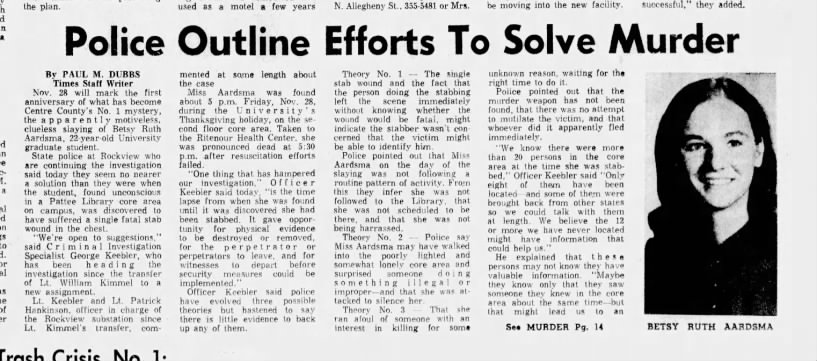
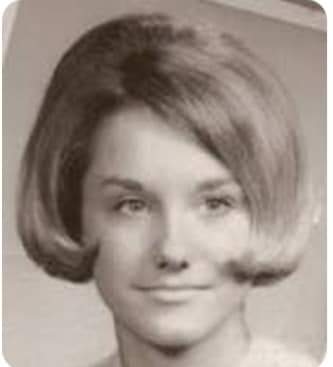
Betsy was a beautiful young woman: she stood five feet, eight inches tall, weighed 145 pounds, had hazel eyes, and long brown hair (that had a slight tint of red in it). Intrigued by the larger world, she wasn’t sure if a traditional life of one day becoming a wife and mother was for her, and during her years as an undergraduate student she began to explore some experiences beyond academics: she went on several dates with a few different promising young men, though none developed into serious relationships… however one encounter took a dark turn when the young suitor either threatened her with a knife or pulled one out during an argument; she immediately ended things, and no charges were filed against the young man. Friends recall that where Betsy had never been short of male admirers, she wasn’t boy-crazy and never went out with the same guy for very long.
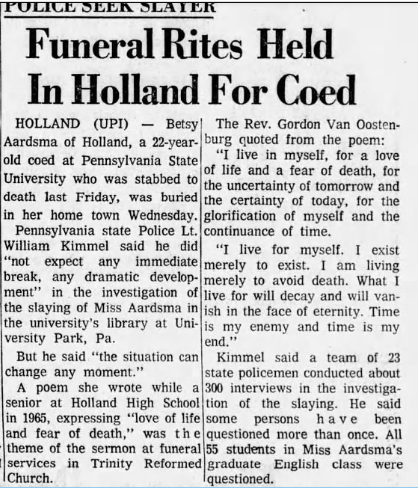
At some time during her late high school or early college years, Aardsma spent a week on a mission trip in New Mexico teaching art to underprivileged children on a Navajo reservation in a program that had been run by the Reformed Church. Those close to Betsy also said that she also had a dark side, and at times seemed to foresee that her life would one day soon be cut short: a poem she wrote as a high school sophomore titled, ‘Why Do I Live?’ was briefly cited by her pastor at her funeral as evidence that she had ‘accepted God’s will and embraced death’: ‘I am living in preparation for death / What I live for will last. / And increase in the face of eternity.’
Betsy’s unhappiness with her choice of going to Hope College began to grow, and she began to yearn for a more dynamic environment, and in 1967 at the beginning of her junior year she made the decision to transfer to the University of Michigan. When she first moved to Ann Arbor Aardsma found herself somewhat lonely, and even though her high school best friend Jan Sasamoto-Brandt was there, by then she had joined a sorority and the two seemed to have grown apart during their two-years apart. Aardsma missed her Holland friends but kept in touch with them through the US Postal Service, and in a September 1967 letter to a high school friend named Phyllis ‘Peggy’ Wich-Vandenberg (who was a student at Marquette University in Wisconsin): ‘intellectually, this place is not as alive as it should be. I run into asses every day,’ but according to Wich-Vandenberg, she also encountered ‘a good number of acutely aware people’ and was happy that ‘no matter the type of person, U of M had a lot of them.’
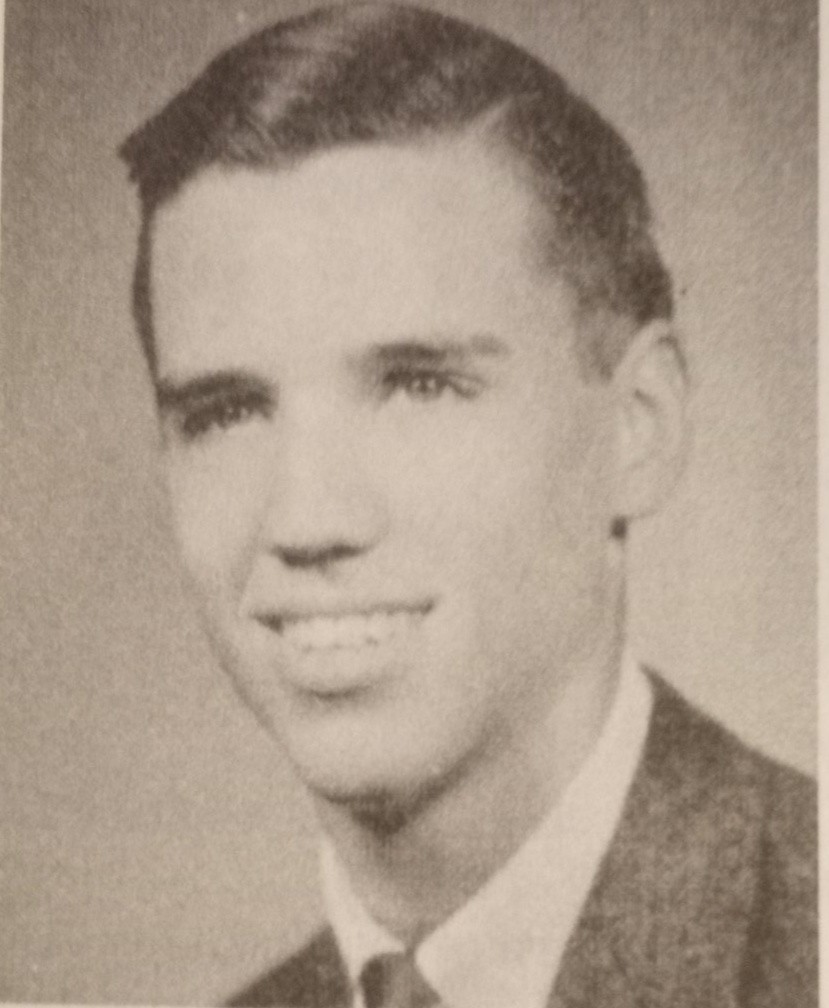
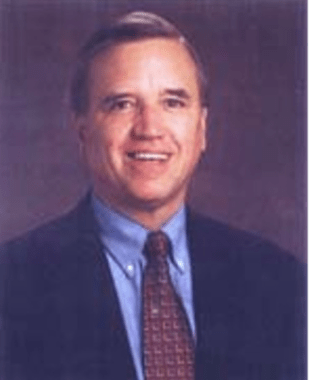
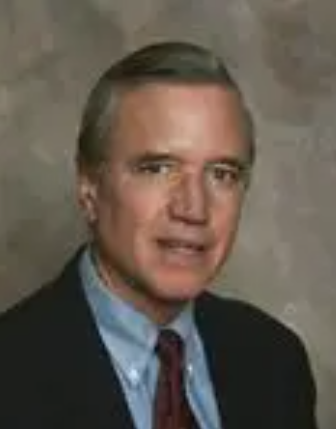
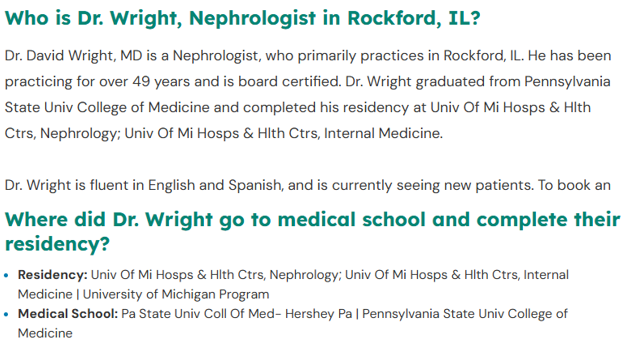
During her senior year of undergrad, Betsy shared an off-campus apartment with three other girlfriends that was below a residence that was shared by four brothers of the Alpha Delta Phi fraternity; one of them was David L. Wright, the son of a prominent psychiatrist from Elmhurst, IL. David was a senior pre-med major, and even though the two had met the year prior as juniors, it was their friends that started to push them to get together during their final year. According to Wright (who is now a kidney specialist in Rockford, IL): ‘she was just a very brilliant person, extremely smart. Good sense of humor. Just a wonderful person.’ Betsy and David talked about possibly getting engaged and married in the summer of 1970 but were not ‘officially engaged’ at the time of her murder (according to reports, Wright planned to propose over the upcoming Christmas break).
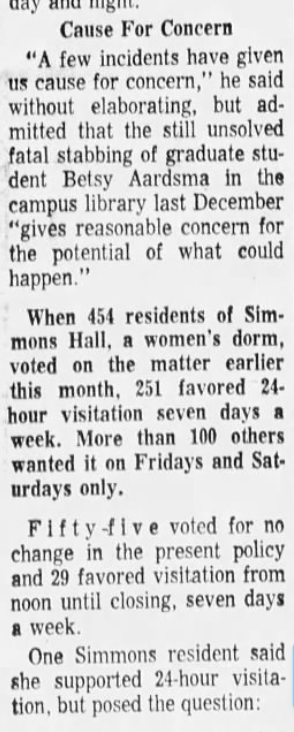
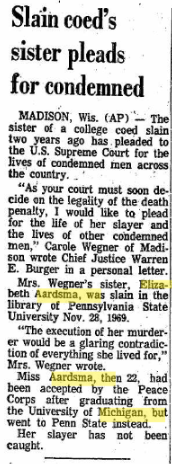
As content and happy as Aardsma had been during her last spring at the U of M, she was among many young women on campus that was worried about the murders of young females that had started two years earlier… Meanwhile, David became one of sixty-four individuals that had been accepted into the third class of the Penn State College of Medicine in Hershey, which had opened in the fall of 1967. In the spring of 1969, Aardsma graduated from the University of Michigan with her bachelor’s degree (with ‘distinction and honors’) in English… but, as much as she loved and cared for her beau, she had plans of joining the Peace Corps and going to Africa for a year (she applied and had been accepted); the uncertainty of everything made for an unhappy summer in Holland.
In the beginning of the summer of 1969 Aardsma initially told Brandt that she wouldn’t be able to stand up in her wedding later that August because she was scheduled to be shipped off to Africa by then… but, this was before Wright told her that ‘he wasn’t crazy about the idea’ of his girlfriend going away for a year and ‘he wouldn’t wait for her’: ‘she asked if I would wait for her and so forth. And I sort of selfishly said, ‘I just don’t know what will happen.’’ After that, Betsy canceled her plans of going to Africa and she made the decision to follow Wright to Pennsylvania: she enrolled at Penn State in September 1969 with the intention of earning a Master of Arts in English, even though the campus that she would take up her studies the one in State College, PA, which was almost a hundred miles away from the medical school David was attending in Hershey.
Ultimately, Betsy set aside her dreams of volunteering at an international level and once again decided to focus on academics, this time with the goal of one day finding a career as a college English professor. Because of the murders of young coeds in the state of Michigan that had been taking place since 1967, the Aardsma family was relieved that she was getting out of Ann Arbor, and according to her former brother-in-law, David Wegner: ‘when she moved to Penn State, we thought, ‘oh, thank God, she’s at a place where she’s safe, not out at the University of Michigan.’’
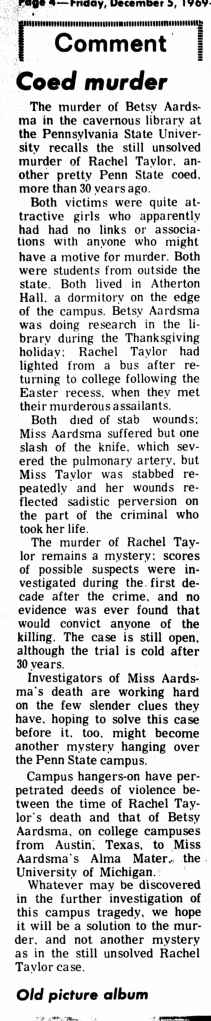
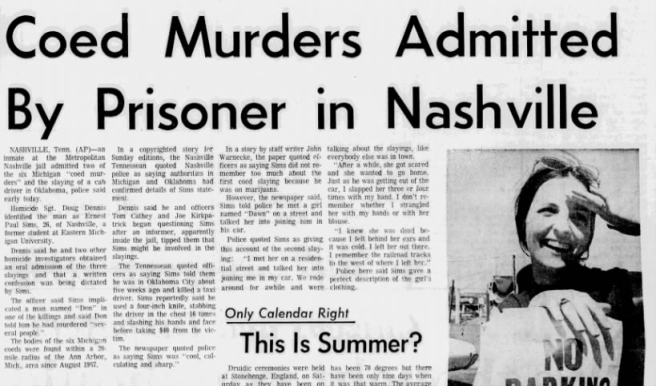
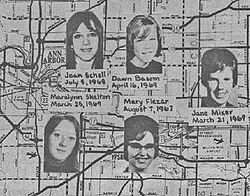
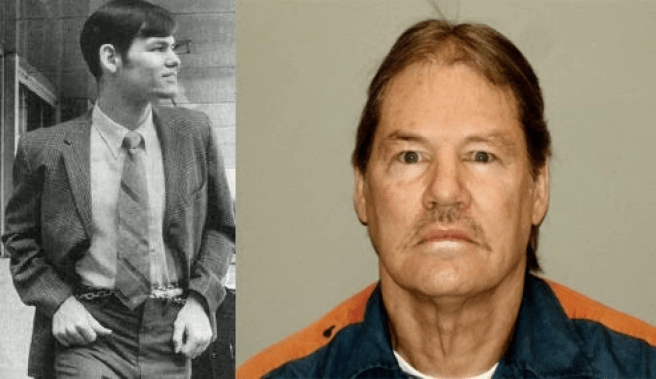
The ‘Michigan co-ed murders’ were a series of highly publicized homicides that took place between 1967 and 1969 in the Ann Arbor/Ypsilanti area by an individual that had been given multiple nicknames, including ‘The Ypsilanti Ripper,’ ‘The Michigan Murderer, and ‘The Coed Killer.’ All of the victims were young women between the ages of thirteen and twenty-one and had been bludgeoned, abducted, and raped prior to their deaths; typically, they were murdered by stabbing or strangulation. Their remains were discovered within a fifteen-mile radius in Washtenaw County and on occasion they were mutilated post-mortem; each victim had been menstruating at the time of their death which made detectives strongly speculate had invoked an intense feeling of extreme rage into killer. The prime suspect, John Norman Chapman (who was then known as John Norman Collins) was arrested one week after the final murder; he was eventually sentenced to life imprisonment on August 19, 1970, and is currently incarcerated at Carson City Correctional Facility. Although never tried for the remaining five murders attributed to the Michigan Murderer (or the murder of a sixth girl killed in California whose death has been linked to the others), LEO’s believe Chapman was responsible for all seven murders.
When it comes to being a suspect for the murder of Betsy Aardsma, Collins was already in custody when she was killed in November 1969, as he was arrested earlier that July for unrelated murders; although some investigators feel that it is too much of a coincidence that he killed young women in the same Michigan area where Aardsma was in school, and wonder that it’s possible he may have stalked her then followed her to Penn State and murdered her there.
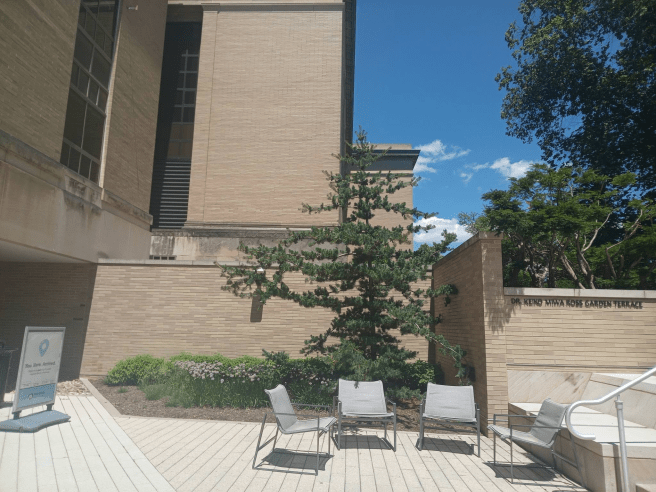
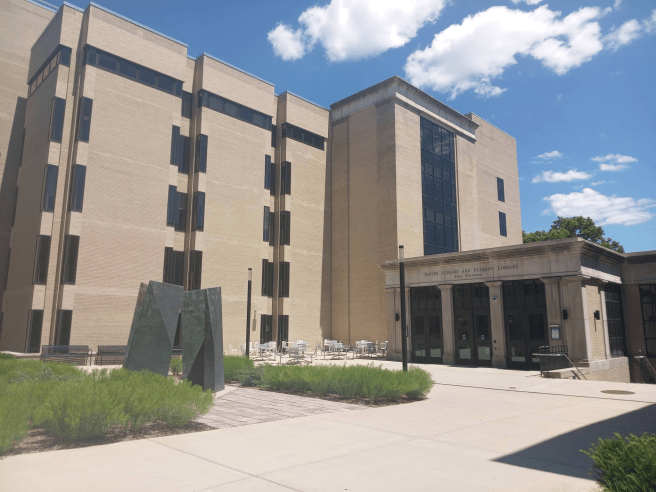
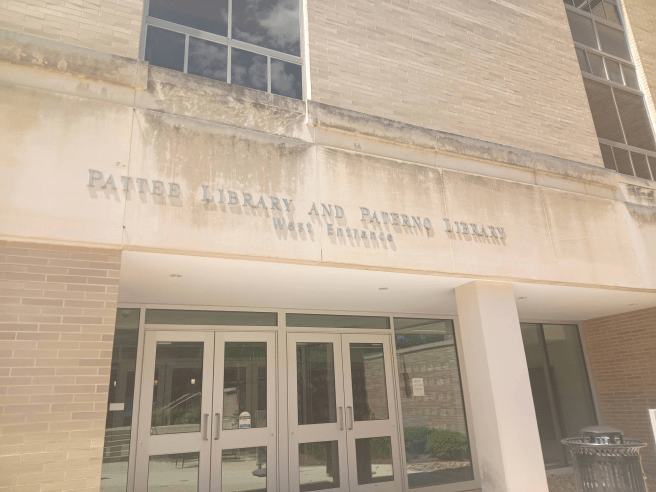
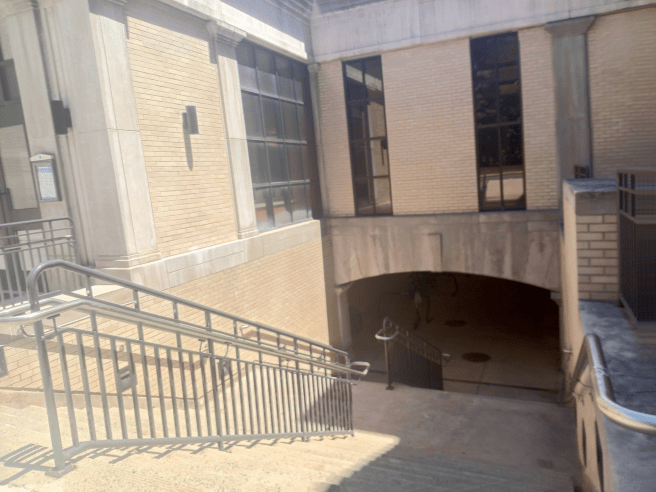
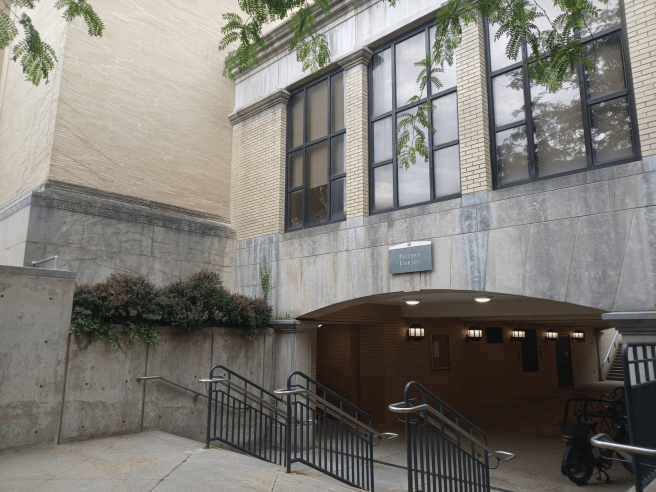
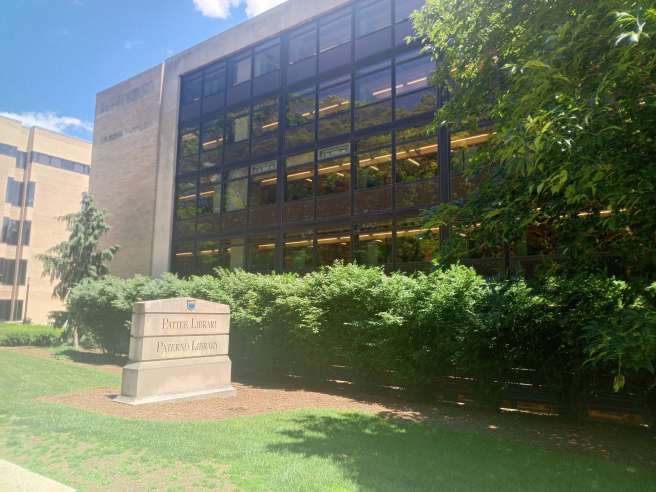
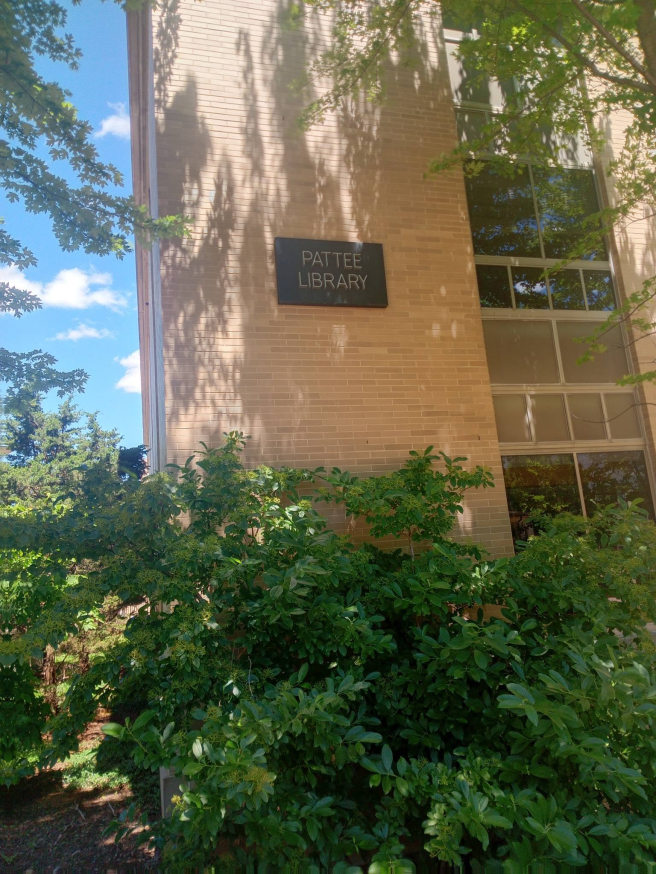
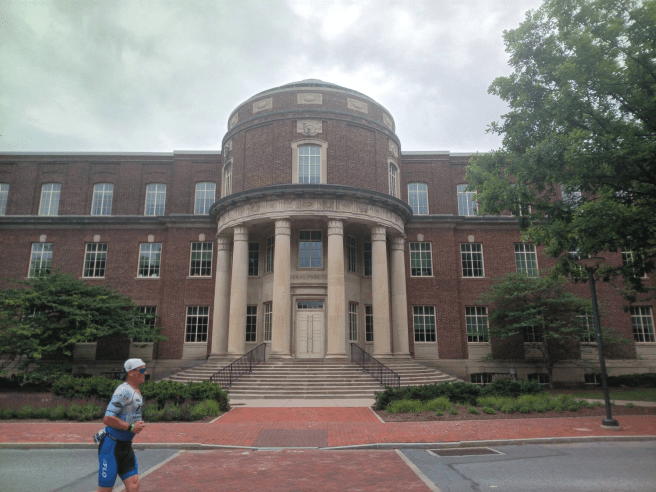
Going to a school so far away from home offered the twenty-two-year-old graduate student a fresh start, although her workload was incredibly demanding: one of her classes, English 501, which was co-taught by the tough but greatly respected Professor Harrison Meserole, was especially challenging (he handled the early American literature portion of the coursework). But, Betsy was diligent when it came to her studies and for the first eight weeks before her death had spent most of her time outside of class in Penn State’s Pattee Library. She maintained her relationship with David through daily letters and weekend bus trips to Hershey, but the intense academic pressures (on both of them) left little time for socializing. Long-distance telephone calls were expensive in 1969, so she wrote her long distance love a letter every day, with the last one arriving on the morning after her death.
Wright recalled that about halfway through the semester (roughly at the end of October), Betsy seemed troubled about something and told him she wanted to transfer schools and relocate to Harrisburg (which was a twenty-five minute drive versus an almost two hour one) and enroll in courses at the Penn State campus there: ‘in retrospect, when I thought about that, I wondered if she was worried about something up there. My wife’s theory is that she just wanted to move things along and be closer.’ But something seemed to be troubling Aardsma, and according to her former BIL, she had previously expressed a premonition of early death in some of her writings, and it was also around that time that she had told her mother, ‘I don’t know why I’m here. I have this weird feeling about being here.’
By Thanksgiving, Betsy Aardsma had been showing exhibited signs of stress due to the fact that she had fallen behind on an important English assignment, but instead of working on it she spent the day in Hershey in the company of her boyfriend, his roommates, and their girlfriends in the designated dormitory of the female medical students: the women cooked, and it according to David Wright it was ‘a real nice time.’ At some point during that day, Betsy called her family in Holland to wish them a Happy Thanksgiving: David and Carole were in visiting from Madison, WI, and everyone got a chance to chat briefly with her and say hello.
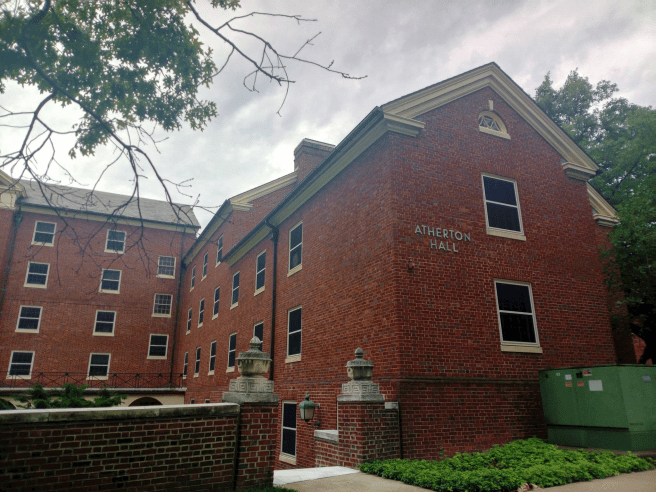
Wright said they briefly discussed the idea of her staying in Hershey for the weekend, but she declined, stating she simply had too much work to do and she needed to do research in the library for her English 501 paper that was due in less than two weeks. When dinner was over, he drove her to a nearby bus stop in the 400 block of Market Street in Harrisburg, and she arrived home later the same day. It was the last time he saw her alive, and according to him, ‘I always wonder if she had stayed down that weekend what would have happened,’ and that not insisting she did so was one of his ‘biggest regrets.’ Betsy and her roommate Sharon Brandt resided in room 5A in Atherton Hall (a dormitory that primarily housed graduate students), and before they went to bed the two chatted about their day and played cards. Brandt would later recall that her roommate seldom pursued ‘extracurricular activities’ outside of academics and spent much of her free time either studying or (on weekends) traveling to Penn State Hershey to be in the company of Wright.
During her short amount of time in graduate school, Aardsma managed to make some new friends at Penn State, among them Linda Marsa, another English graduate student, who said that Betsy: ‘always seemed like a young Katharine Hepburn. You know, with those kind of angular features and this curly, reddish hair that she pinned up. Lean and lanky with that same kind of sarcastic, funny, witty attitude.’ She also said that she knew Betsy loved her boyfriend and went to visit him often, ‘but she had a certain ambivalence that I think was very natural.’ Marsa, who called herself a political radical, said she and Aardsma were as one in the same when it came to their opposition to the Vietnam War, and in a 1972 news article David Wegner said that his one-time SIL had led a campus discussion group against the war on national Vietnam Moratorium Day (October 15, 1969). Additionally, a friend that has never been identified told The Associated Press that Aardsma loved black literature, especially the works of James Baldwin, and in the same news story an unidentified professor said she had ‘the deep sensitivity of an artist for others’ feelings.’`
Shortly before her death, Aardsma had started to express concerns about possibly (one day) becoming a ‘physician’s wife’ and a mother, however none of her journal entries, or the letters she regularly wrote to Wright showed any indication that she had felt any reluctance about her feelings for him. Based on these readings, Pennsylvania State Troopers also said that she did not appear to be interested in another man or had otherwise felt intimidated and/or uncomfortable during the eight weeks she had been enrolled at Penn State: according to the pages of her journal, Betsy seemed normal and devoted to David.
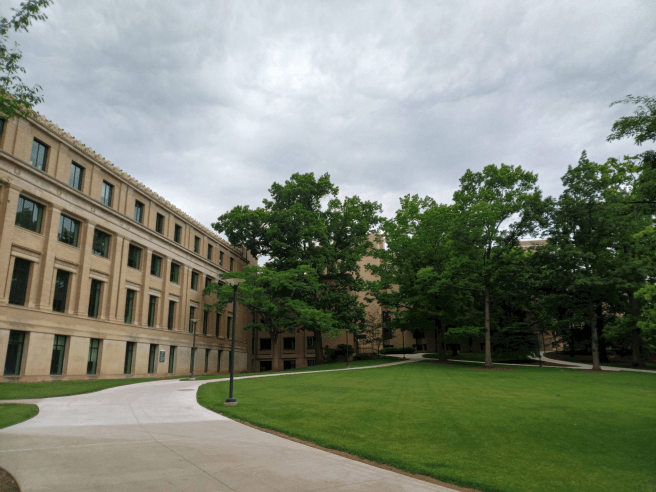
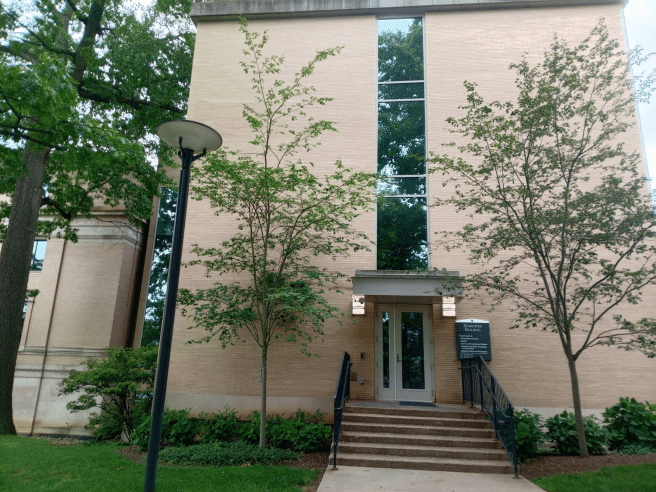
On the afternoon of Friday, November 28, 1969 the campus of Penn State University in State College PA was eerily quiet: most students were home for the long Thanksgiving weekend, leaving the sprawling campus in a state of almost total silence… but, deadlines loomed, and Betsy’s focus was on completing her assignments. Clad in a sleeveless red dress layered over a white turtleneck sweater with a gold watch pendant hanging around her neck, she left Atherton Hall at roughly 3:50 PM with Sharon with plans of a full day of classwork ahead of her (her primary goal that day was to gather materials for a paper in her English 501 course). According to (current) Penn State (and Betsy Aardsma case expert) English Professor Sascha Skucek, the girls made a brief stop in Burrowes Hall to talk to Professor Nicholas Joukovsky during his open office hours, who co-taught English 501 along with the lead Professor, Harrison Meserole. Their discussion revolved around a previous paper Betsy had written, as he had taken an interest in one of her sources, and she told him she would retrieve it during her visit to the library and would bring it to him.
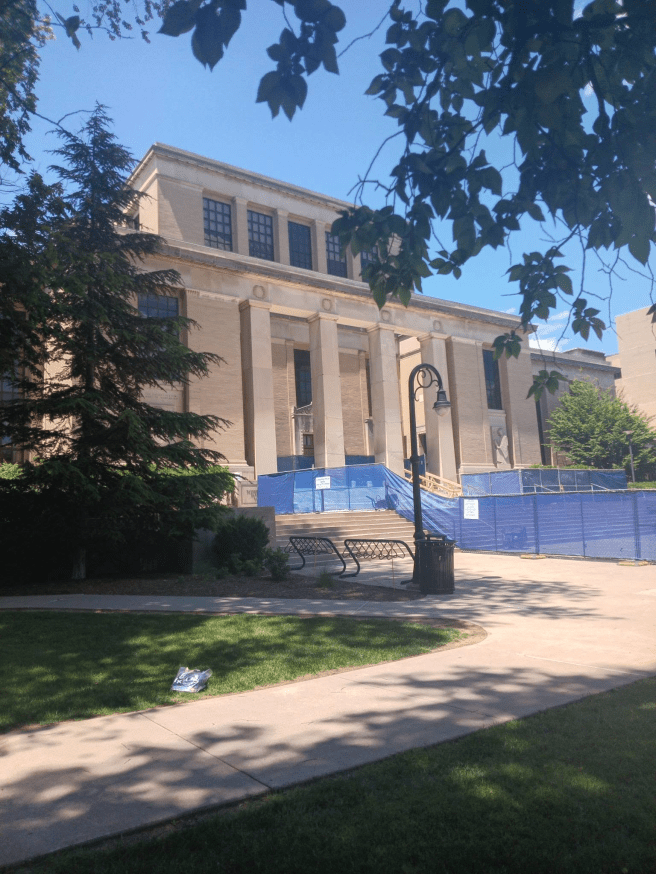
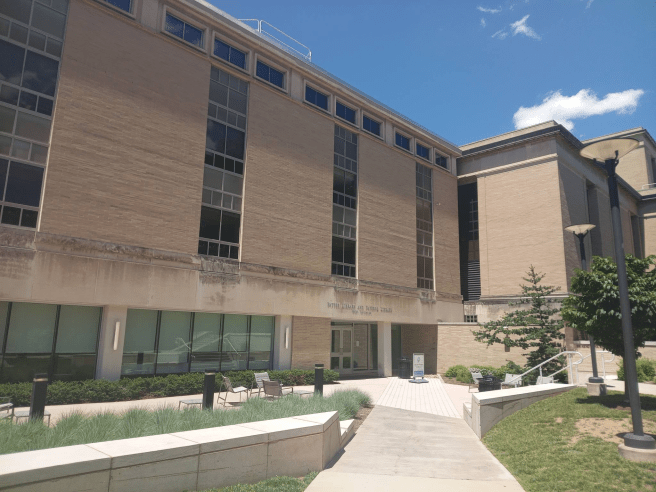
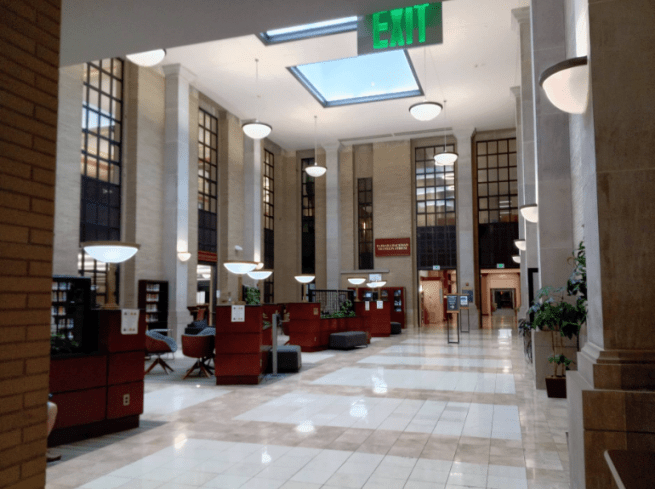
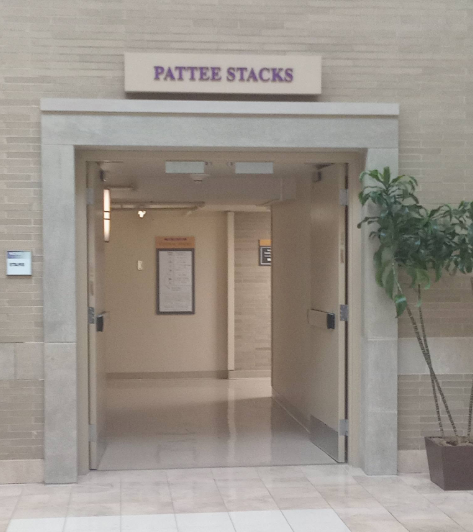
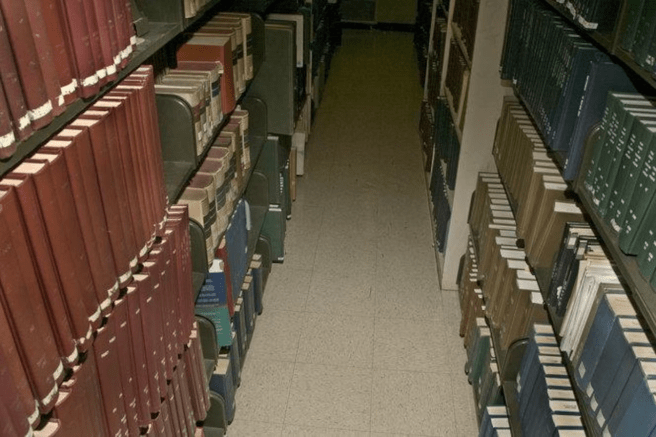
When the girls arrived at the Pattee Library at 4 PM, they confirmed their plans to meet up again later that evening to watch either ‘Easy Rider’ or ‘Take the Money and Run’ at a movie theater near campus then parted ways (although one report says they made plans to meet at 7 PM for dinner): Brandt proceeded to the main reading room while Aardsma made her way to the central stacks (which has been referred to as ‘a labyrinthine,’ and a ‘dimly lit area housing millions of volumes in narrow, multi-tiered aisles designed for storage rather than prolonged occupancy’). Despite the Thanksgiving holiday drastically reducing the number of students on campus that Friday, the Pattee Library remained open and fully operational and recorded 3,343 exits that day (including staff); investigators would later learn that on an average Friday, upwards of 400 people would come and go from the Pattee Library between 4:30 and 5:00 PM, although on the date in question, only about ninety had done so.
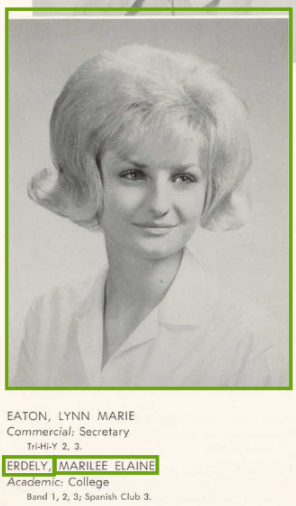
A little after 4 PM, Betsy entered Penn State’s Pattee Library through its main entrance, passing the security checkpoint; she exchanged a brief greeting with two classmates from English 501 (Linda Marsa and Bob Steinberg), who were leaving the library together. Betsy then headed for Professor Harrison Meserole’s office in the basement, and according to Priscilla Letterman-Meserole (who at the time was the professor’s secretary but would later go on to be his wife): ‘we had a steady stream of students coming in the afternoon to talk about their research projects. She had on a red dress. I remember I complimented her on her dress.’ When she came up from the basement Betsy placed her purse, jacket, and a book about Africa inside a carrel assigned to her before she made her way towards one of the card catalogs, and it was around this time that she bumped into twenty-three-year-old Marilee Elaine Erdely, who dropped her pencil during the exchange. It didn’t take long for her to find the card for the book that she was looking for, with the system advising her it was in the level two core stacks.
The stacks at the Pattee Library were known for its claustrophobic layout: rows upon rows of shelves obscured everything around it, creating an environment where one’s presence was ‘acutely felt by others but rarely seen because of the height of the stacks of books;’ it’s aisles were barely wide enough for one person go get through let alone two, so visitors had to think ahead when attempting to navigate the aisles. Yet… Betsy seemed comfortable there. An undergraduate student named Carol Manning was in the same area of the stacks as Aardsma, and she had been searching for information related to a term paper. Manning later recalled that afternoon that her pen had died, and she asked Betsy if she could borrow one from her; in response, she smiled at her and handed her one and told her to keep it; by that point in the afternoon, she had already been surrounded by books and had been fully immersed in her work.
At around 4:30 PM assistant stacks supervisor Dean Brungart walked by the area and noticed Aardsma in the aisle, and that two men were lingering a few rows away on the west side of the library, talking to one another quietly. It’s around this time that eyewitness accounts started to become fragmented and inconsistent: Manning reported there had been two men near Aardsma in the level two core, and she described one of them as having ‘dark hair and darker skin,’ and said that he helped her retrieve a book from a high shelf, however Brungart told investigators that there had been ‘two white males in the vicinity.’ It’s also important to note that neither one reported seeing the other that afternoon, and as a result their accounts fueled years of speculation about a possible two-killer scenario. These sightings also pointed to possible outsiders or non-students as the mystery man, but alibis, lack of matching physical evidence, and failure to re-identify suspects led to their dismissal.
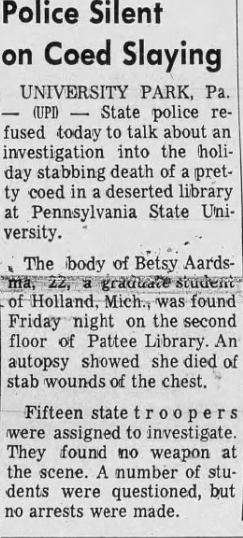
Sometime between 4:30 PM and 4:45 PM on the afternoon of November 28, 1969 a still unknown assailant stabbed Elizabeth Ruth Aardsma a single time through the left breastbone with a thin-bladed knife, between rows 50 and 51 of the second level stacks: the precision of the wound (which had gone right between her ribs and went directly into the heart) initially produced minimal external bleeding, as the blade’s narrow profile limited blood flow at the entry point. The entire incident occurred silently, as the young victim didn’t scream nor cry out for help.
At roughly 4:45 PM, a badly injured Betsy stumbled out of the level 2 stacks and into the main circulation area of the Pattee Library and collapsed near the card catalog while in full view of the library. As she slumped to the floor, she finally made some noise, as she pulled books down on herself while she fell: students and library employees watched as she fell to the floor, however they initially mistook the incident for a ‘medical emergency’ (thinking she either fainted due to the stress of finals week, or perhaps suffered a seizure/epileptic episode) largely due to the fact that her red dress hid the extent of her injuries and her lack of reaction hinted towards there not been a violent altercation. A level above, Dean Brungart heard the sound of falling books through a floor vent, but he did not go to investigate, and according to Wayne Baumgardner (one of the librarian’s on staff that day): ‘there wasn’t any kind of real security in the building because it wasn’t considered to be necessary. Once the Aardsma slaying happened, the university put in major security regulations and things and really tightened up.’ There were thought to be nine people that had been within seventy feet of Betsy Aardsma when she was stabbed, but none of them (because of the intervening shelves of books) saw what happened to her.
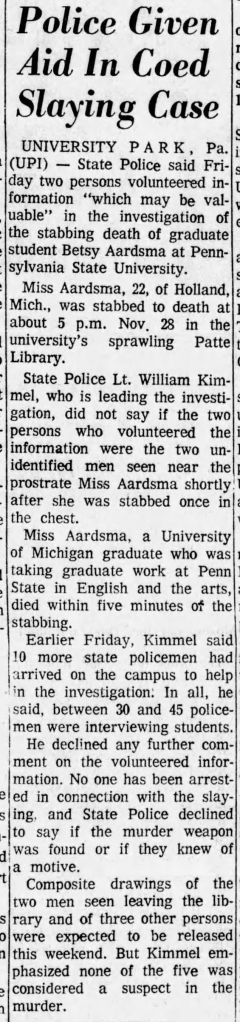
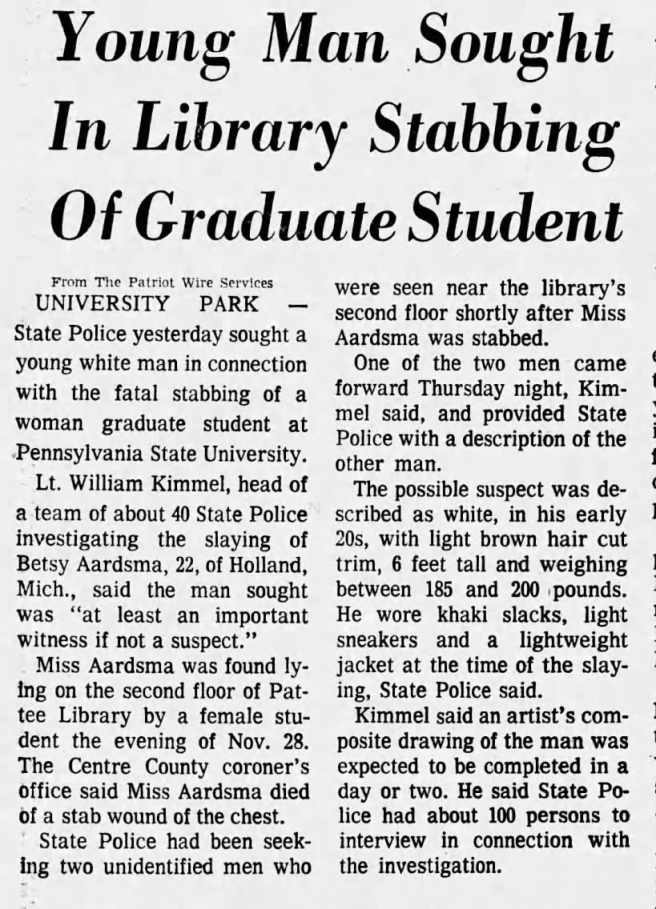
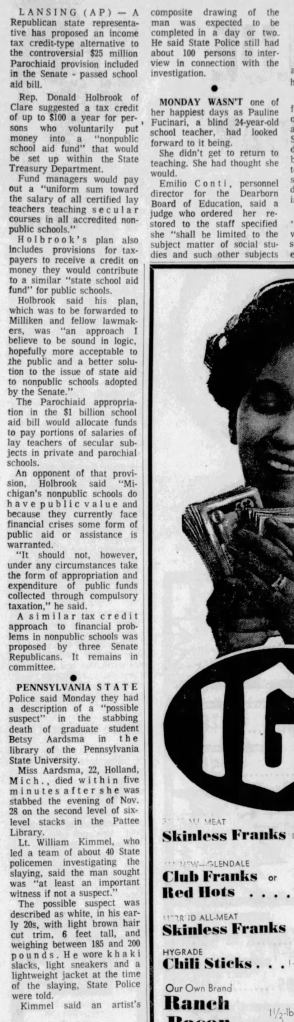
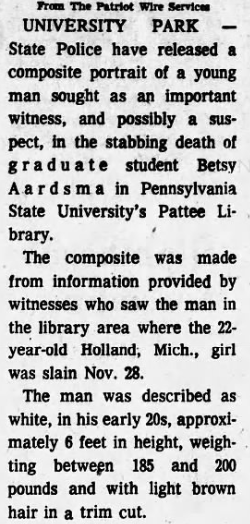
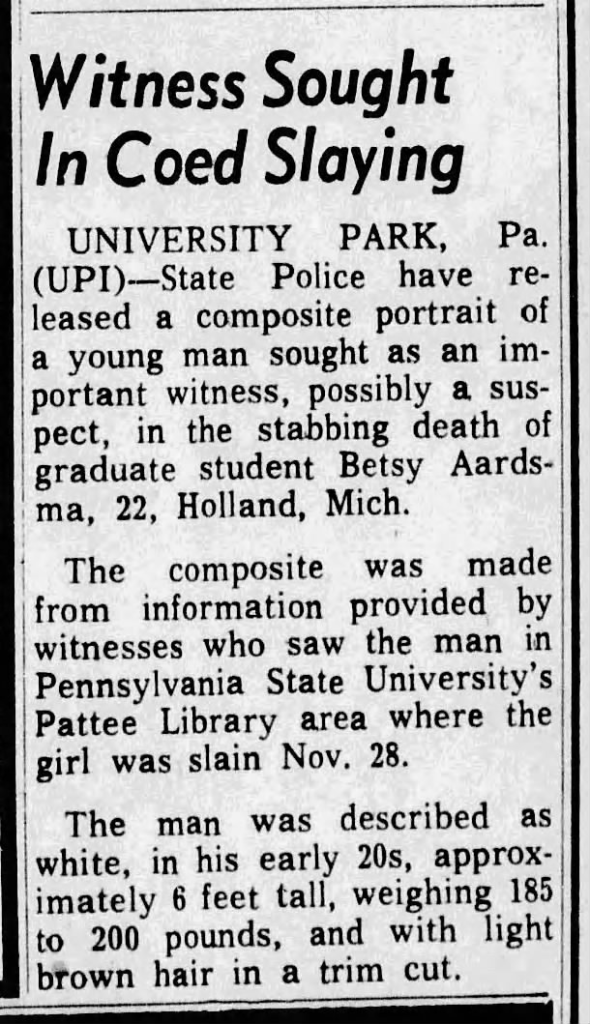
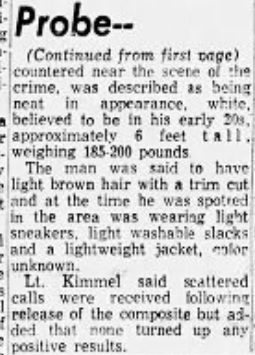
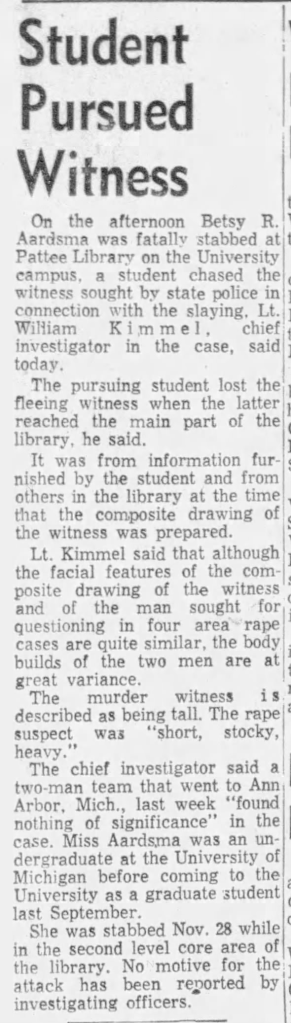
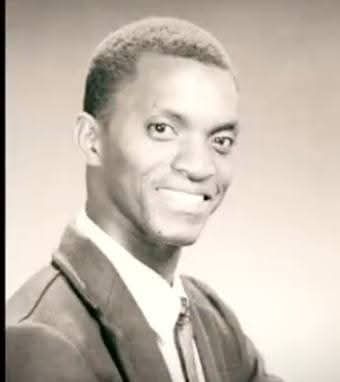
Just before the attack, Marilee Erdely had settled herself at a desk just outside the eastern entrance of level two stacks, approximately twenty feet from where Betsy had been working, and she had a clear view of the eastern passage leading into the core. The loud crash associated with Aardsma falling startled both Erdely and Joao Uafinda (an international student from Mozambique that had been browsing books in a different section of the library), and neither recalled seeing anyone enter the stacks during this time. Less than a minute later, Erdely said that a man rushed out of the east passage that had been approximately six feet tall, 185 pounds, with trimmed brown hair; she clarified that he wore a lightweight jacket, slacks, and a plaid button-down shirt (possibly with a tie); Uafinda’s description matched Erdely’s, though he also noted that the man kept his right hand hidden behind him. Both Erdely and Uafinda reported that he said, ‘somebody better help that girl,’ before he quickly turned around and led them toward rows 50 and 51; once there, the man fled down a nearby staircase… But something about this ‘helpful stranger’ didn’t sit right with Uafinda, and he attempted to follow him, but the man quickly shook him.
Because both Erdely and Uafinda would later struggle to identify the suspect and their descriptions varied slightly police were uncertain if there had been one man or two. Analysis of the escape by law enforcement suggested that the individual had possessed a sense of familiarity regarding the layout of the library, as he was able to make a quick getaway without alerting anyone that had been nearby. While nobody on the main floor of the library was yet aware of the homicide that had been taken place only feet away from them, the sight of a black man chasing a white one out of the stacks caught the attention of one young student library employee, who managed to catch a glimpse of the suspect’s face as he made his way to the door; it was this last eyewitness report that helped to confirm that the man attempting to flee not only wore glasses but specifically horn rimmed ones.
Meanwhile, Erdely entered the core cautiously, and what she discovered was absolute chaos, with books lay scattered all over the floor, a heavy metal bookshelf had toppled over, and at the center of it all was Betsy. She had been moving only slightly and had been lying on her stomach. Dropping to her knees, Marliee leaned close to her, panic rising with each passing second: she interpreted the fallen books and the confusion as evidence that her new friend had suffered a medical episode, andwhereshe immediately noticed a small blood spot on Betsy’s sweater, she did not see the one inch wound that laid beneath it, hidden by her clothing. She softly whispered something, but her voice was too weak and quiet to understand. Never leaving Aardsma’s side, Marliee repeatedly called out for help, her voice echoing throughout the otherwise quiet library, and over the next few minutes, at least six people walked by, but none stopped to help. She didn’t move until Patricia Bland (the circulation librarian) came over to assist, and only moments later, Murray Martin appeared, who was the assistant head of the library: he unbuttoned the collar of Betsy’s blouse and attempted to administer a mouth-to-mouth resuscitation, but his efforts were in vain. Another library employee phoned Ritenour Student Health Center at 5:01 PM, which was a few hundred yards from Pattee Library.
Shortly after the call was made a team of student paramedics arrived at the level two stacks, believing they were only responding to a fainting and/or nosebleed incident. Initially, they believed they detected a faint pulse, which offered a fleeting glimmer of hope, but as they carefully turned Betsy over to place her on the cloth gurney, another librarian named Betsy Davis, noted drops of blood falling onto the floor. The EMT’s, with the guidance of the library staff, helped carry Betsy out through the east side of the core and into the larger elevator within the stacks. Erdely, (who remained with Betsy and had been clutching her purse tightly against her chest), followed them into the ambulance and sat in its passengers seat during the short drive to Ritenour Health Centre; in the back, one of the paramedic’s desperately tried CPR.
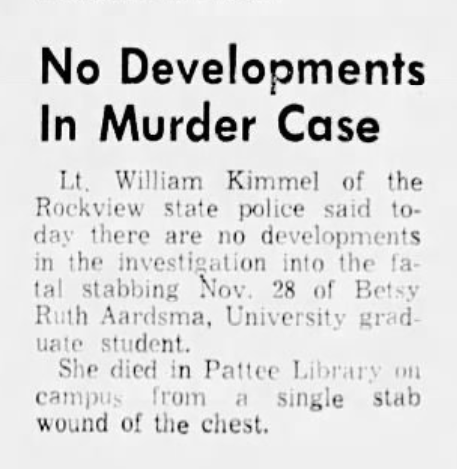
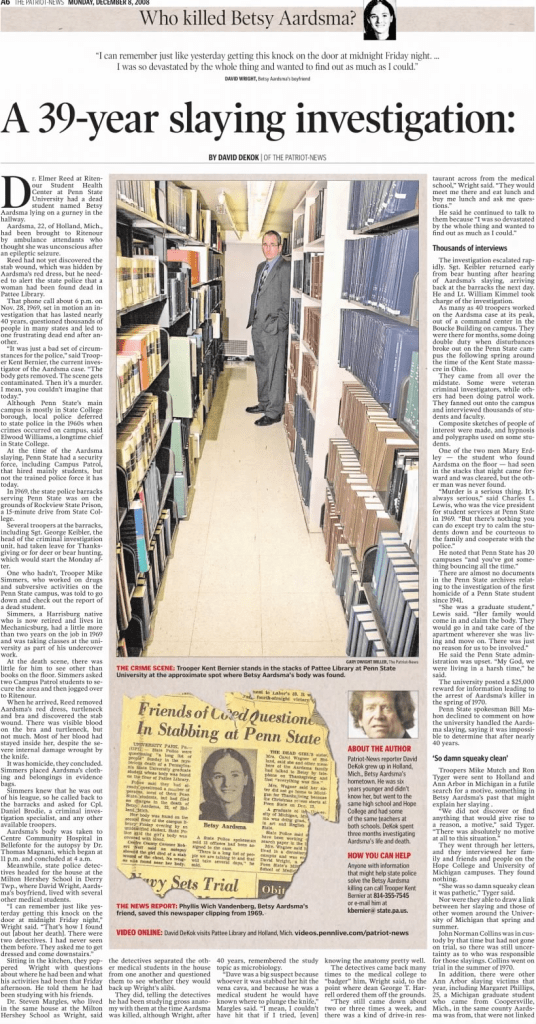
While the EMT was performing CPR, Dr. Elmer Reed, the on-duty doctor at the time, noticed something unusual: after each compression, a small amount of blood oozed out of her chest. The paramedics once again checked for a pulse, and when they found none (this time they were certain) they cut her clothes off, which finally revealed the wound that had since then gone unnoticed: on the upper left hand side of Aardsma’s chest was a single downward angled incision which sliced all the way through to her heart and severed her pulmonary artery. Upon discovering the fatal wound, Dr. Reed pronounced Betsy Aardsma dead at 5:19 PM; shortly after, a call over the Pennsylvania State Police was made, and her murder investigation officially began (one report incorrectly listed 5:50 PM as Betsy’s TOD).
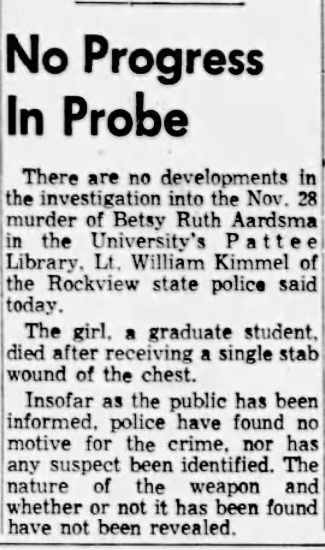
Back at the Pattee Library, the staff (completely unaware that a homicide had just taken place) began cleaning the scene: books were reshelved, papers were picked up, and a janitor was even called to mop the floor (Betsy had urinated on herself during the incident, and there had been a small amount of blood left behind as well). As a result of this ‘accidental cleaning,’ multiple crucial pieces of trace evidence were lost, including footprints, fibers, and other microscopic traces of DNA; additionally, the students and untrained medical staff that had initially found Betsy and helped move her resulted in additional contamination. The absence of the murder weapon (which investigators felt was a small knife or similar shaped implement) meant no ballistic or tool-mark analysis could be performed, and searches of the stacks yielded no trace of one.
Later, detectives found blood smears on the wall of a nearby stairwell, which suggested that the killer had either wiped the knife off there before fleeing, or he had injured himself with it and in the process of fleeing, accidentally flicked some of his own blood onto the wall. At the scene, blood splatter evidence (which included samples on the floor and displaced bookshelves), indicated that Betsy had fallen in place after she sustained the single stab wound and suggested ‘minimal post-stabbing movement confined to her fall.’ Investigators also found a series of small, freshly spilt blood droplets that matched Aardsma’s blood type in the staircase that led to the level three core stacks, which hinted that her killer fled the scene using this route, however the lack of external spatter greatly limited serological analysis.
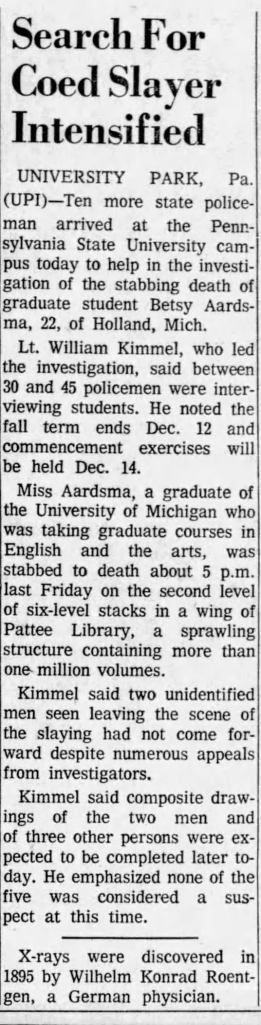
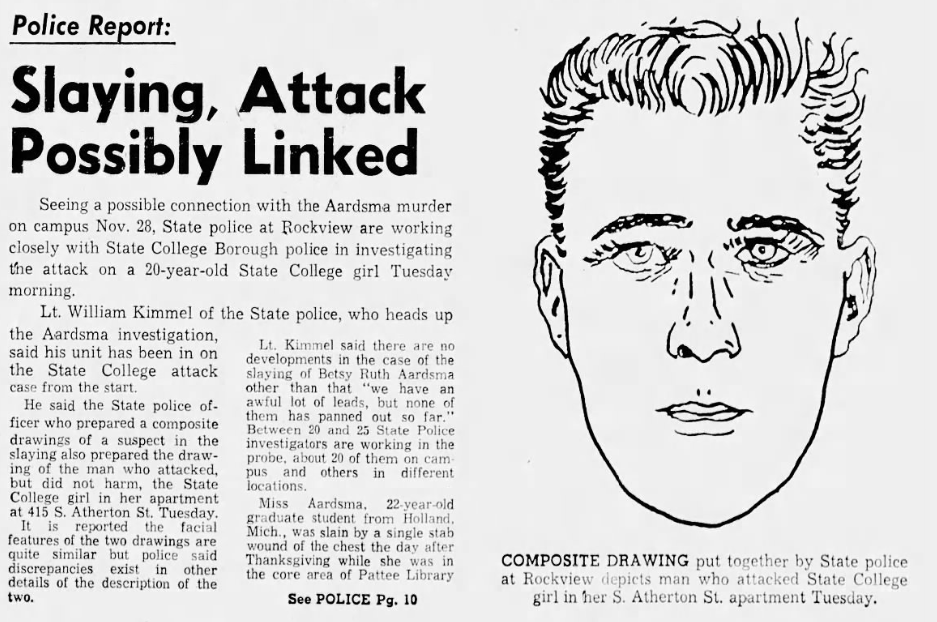
At the time of Betsy’s murder in 1969, forensic technicians didn’t properly preserve any biological samples, which as we know would have proven invaluable in more modern times when it comes to genetic testing. DNA profiling wasn’t’ a thing’ until 1984, and in 1969 crime scene experts were unable to match a victim’s genetic material against biological samples (such as blood, hair, or other bodily fluid); despite the fact that blood typing had been around since the turn of the century, there had been an insufficient amount of it found at the scene, and the large amount of contamination had drastically reduced its value (which also led to degraded trace evidence preservation). Forensic artists were later able to come up with a couple of composite sketches of the suspicious figures that had been seen around the library the afternoon of Betsy’s murder, but they eventually proved to be unreliable thanks in part to the poor lighting in the stacks and ‘the fallibility of human memory under a large amount of stress.’
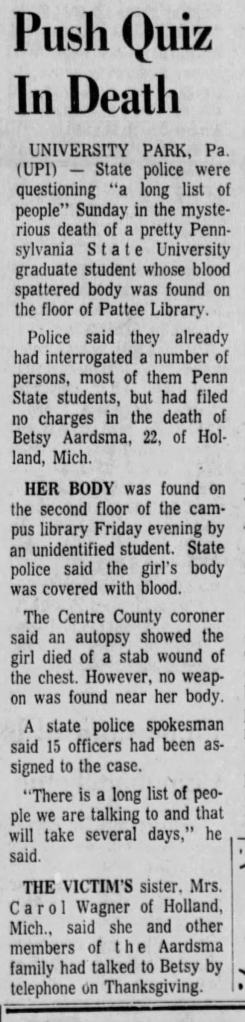
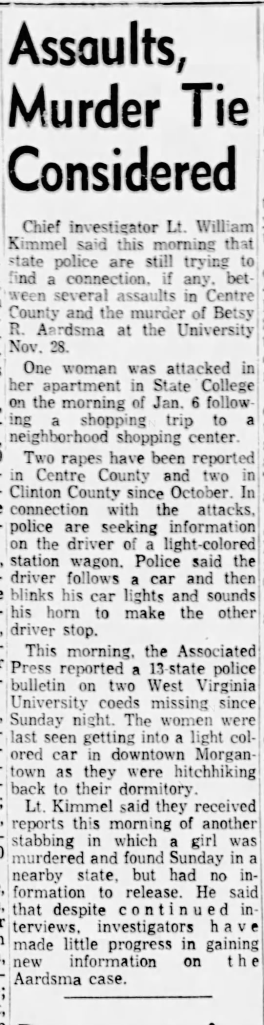
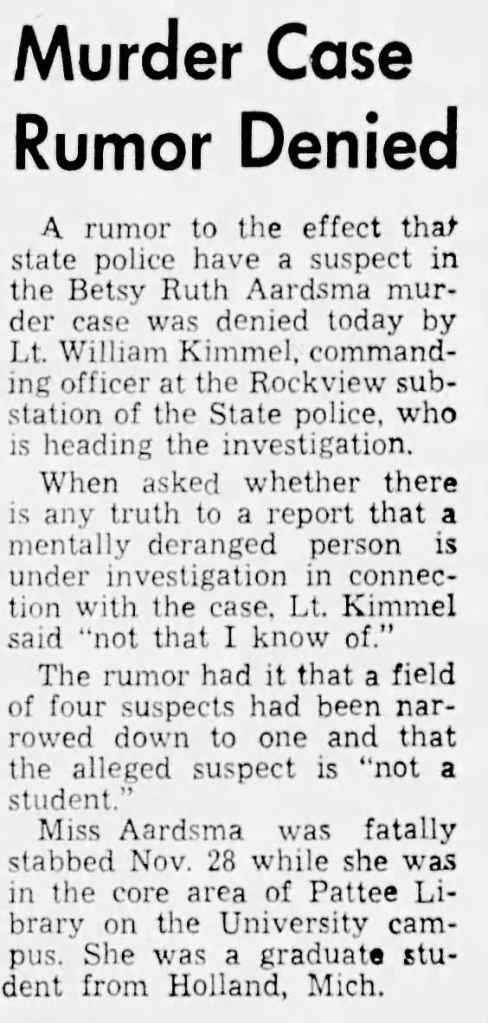
The nearest Pennsylvania State Police barracks was roughly fifteen minutes away on the campus of Rockview State Prison… but the first officer to arrive on scene didn’t come from Rockview: instead, the responding LEO was part-time student and full-time undercover narcotics officer, Investigator Mike Simmers, who reached the Pattee Library at approximately 6 PM and thankfully had the sense to order that the scene finally be secured. Because of the holiday weekend there were a limited number of troopers that were available to assist with the case, as they had assumed jurisdiction as the lead investigative agency responsible for looking into Betsy’s murder. A full search of the stacks did not occur until November 29th, when Pennsylvania State Police began canvassing the campus of Penn State in an attempt to locate possible witnesses.
In an interview, Simmers said they had a few people they believed may have been suspects, but there was never enough evidence against any of them to make an arrest. He also pointed out that the general area of the stacks where Betsy was killed had been known for being a ‘clandestine spot,’ and was often used to stash porn and was had been a popular location for ‘secret homosexual rendezvous’. Trooper Simmers worked tirelessly on the case for multiple months, leveraging his knowledge of the university’s campus to track down and bring in students for questioning.
In the beginning of the investigation, efforts were largely focused on Betsy’s personal connections, which included looking into her boyfriend, David Wright, who said he had been studying with multiple friends in Hershey (which had been verified through multiple witnesses). Broader search efforts extended to door-to-door inquiries of dormitories and buildings that were close to the library in an attempt to identify any potential witnesses that may have observed any unusual activity around 4:45-5:00 PM on the afternoon of November 27th. These initial searches (that were conducted through the end of November and throughout December 1969), aimed to reconstruct foot traffic and secure any overlooked physical trace evidence that may have previously been overlooked.
The lack of video surveillance in the Pattee Library in November 1969 reflected the common technological constraints of that time era, as there had been no closed-circuit recording system that had been installed at the scene, and as a result investigators were forced to rely instead solely on faulty memories and eyewitness testimonies. When they started looking into Aardsma’s background and personal life detectives didn’t find many helpful clues that aided in the investigation, with one of the original investigators referring to her as ‘so damn squeaky clean;’ Retired Pennsylvania State Trooper Leigh Barrows (who worked Betsy’s case from 2008 to 2014), repeated (roughly) the exact same sentiment decades later, and told A&E Crime + Investigation that ‘everybody you talk to always had something good to say about her. They missed her. They couldn’t understand how somebody could do this to her.’
Witness descriptions of ‘transient figures’ in the Pattee Library at approximately 4:30-4:45 PM on November 28, 1969 generated brief leads that resulted in no identifications: a librarian reported seeing a man with wavy blond hair that had maybe been wearing glasses (but maybe not) walk briskly from the card catalog room towards the main exit of the library. Another student named Shirley Brooks came forward and told police that afternoon at around 4:45 PM in the Pattee Library she walked down the stairs into level BA to ask Betsy if she could borrow a pen, and when she made her way back upstairs she had bumped into ‘a tanned, mustached man’ that was wearing a brown overcoat as he had been exiting the level two core stacks. Additionally, a secondhand account from Patricia Bland at the circulation desk implied that a person in a winter coat emerged directly from the southern entrance of level three core into the lobby, telling her, ‘a girl needs help;’ she couldn’t remember whether the person was male or female. Nothing ever came of these reports.
An aerospace historian named Richard Allen had been at the Pattee Library on the afternoon of November 27, 1969, and as he was using a photocopier while waiting for his son, he overheard a seemingly normal conversation between a man and a woman in the general direction of where Aardsma was. Moments later, he heard a metallic crashing noise before a young man whom he described as ‘looking like a student’ ran ‘barreling’ past him; he also described another man in ‘student dress’ leaving the area, whilst casually saying , ‘there’s a girl down there needs help.’ However, in a second interview a week later, Allen claimed a blond man in student dress (‘preppy with khakis’) had exited the level three core west passageway and said, ‘a girl in there needs help.’ The distinction is important because it means Allen may have been on the same level of the core as Betsy, rather than a floor above.
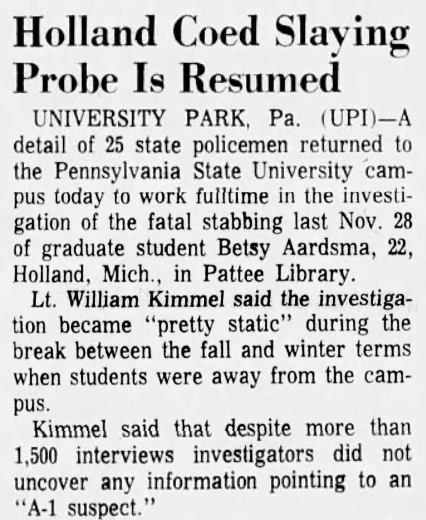
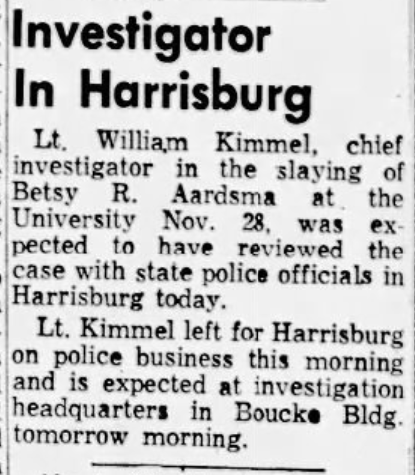
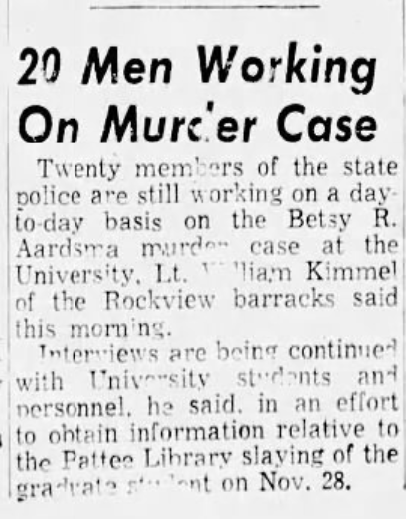
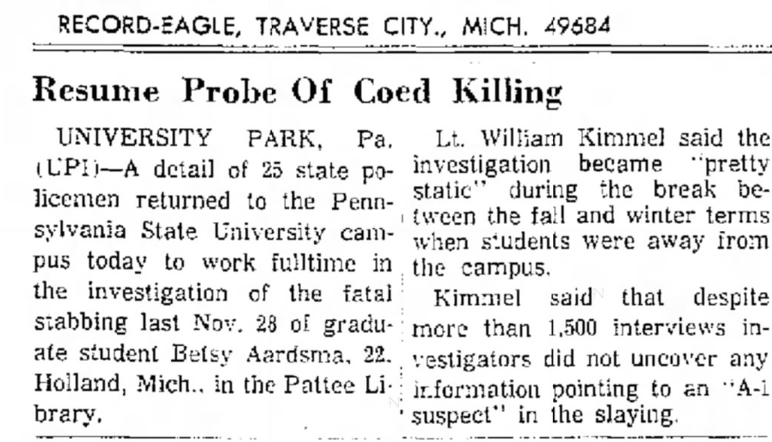
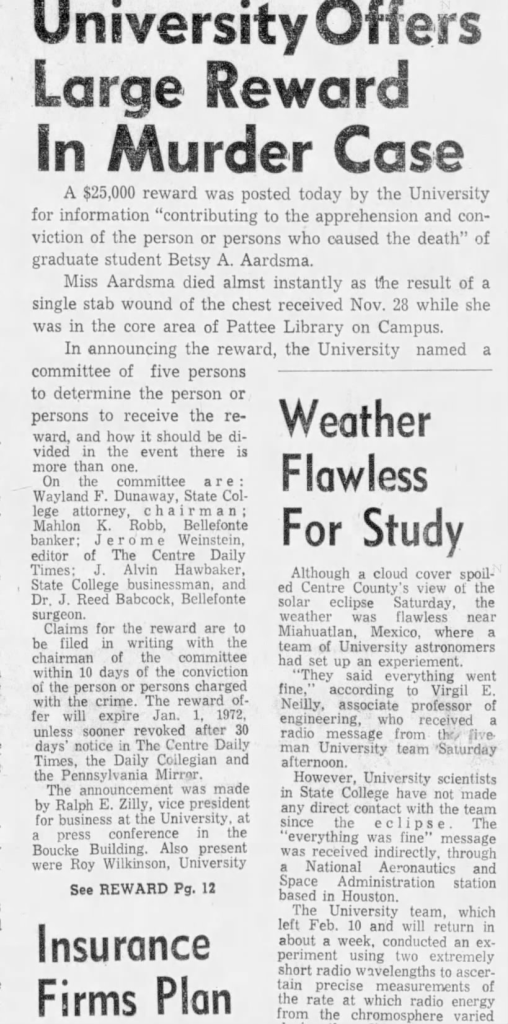
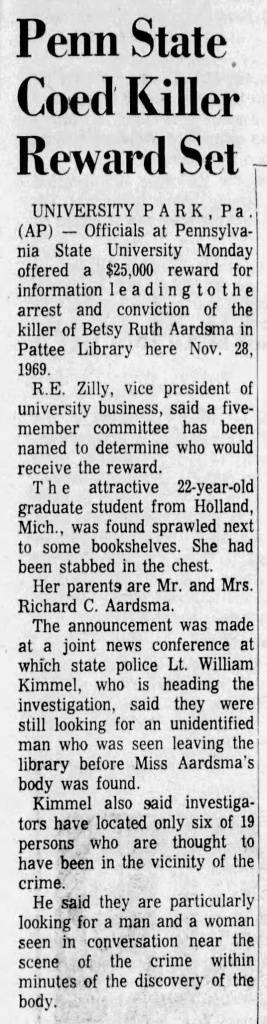
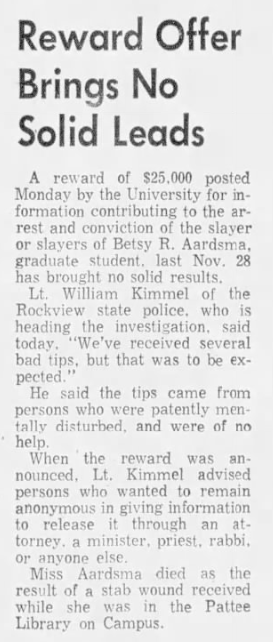
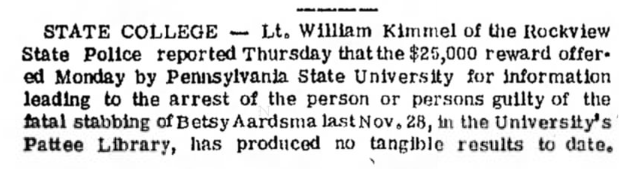
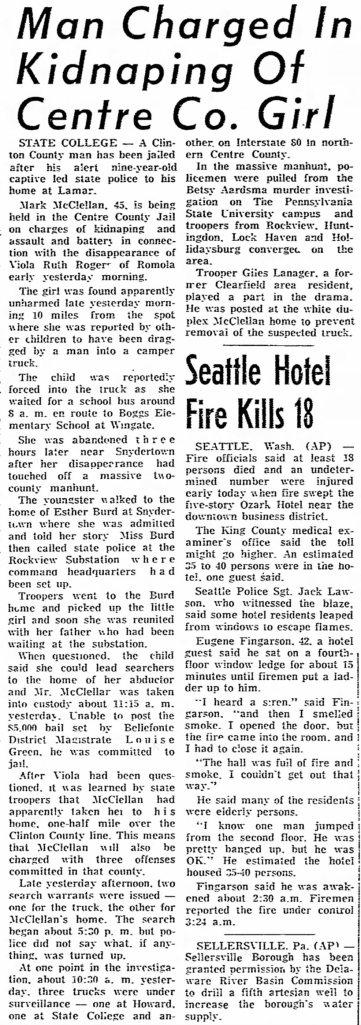
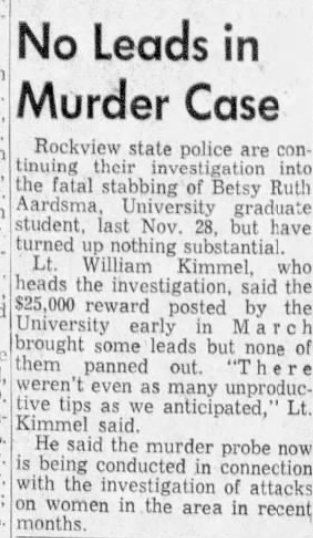
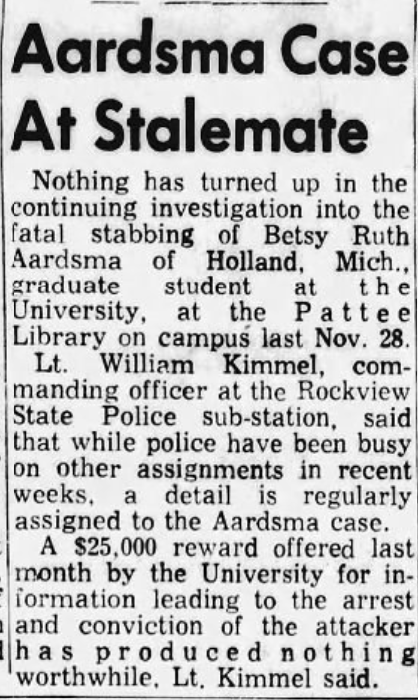
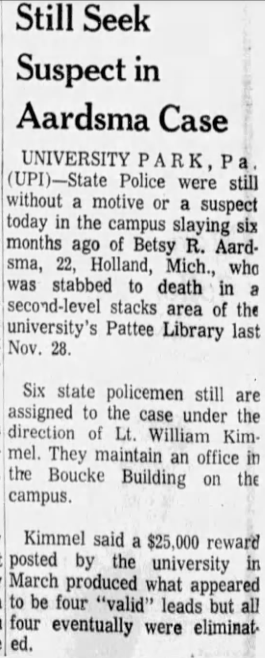
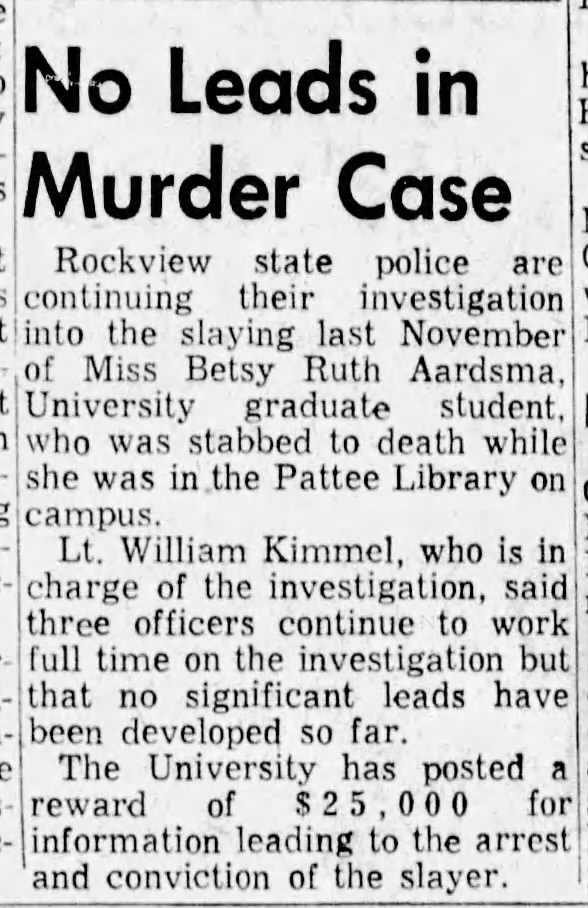
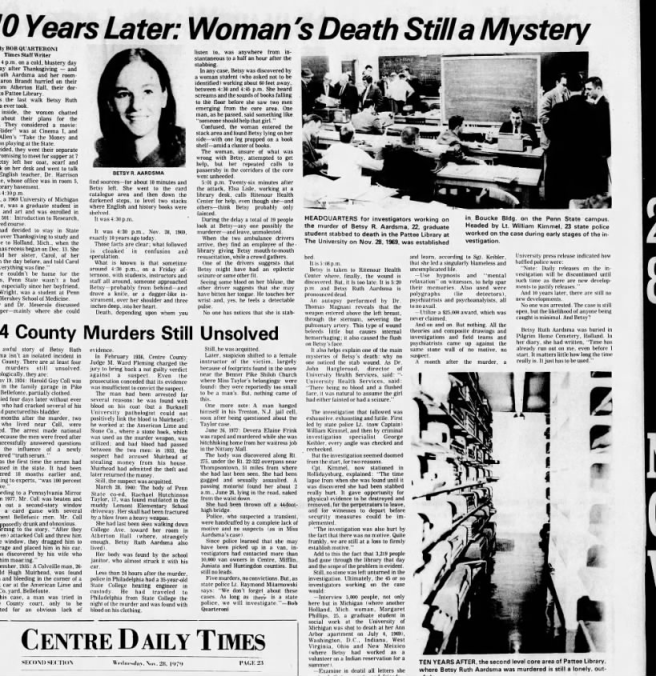
Pennsylvania State Police assigned approximately thirty-five troopers to investigate the death of Betsy Aardsma; they were assigned use of room 109 in the Boucke Building on Penn States campus as a temporary ‘command center’ as they conducted inquiries, and hundreds of students were interviewed in the weeks that followed the murder. In the days that followed the entire campus was unsuccessfully searched in an effort to locate the murder weapon, and a $25,000 reward (the equivalent of approximately $220,800 in 2026) was offered for any information that led to the arrest of the killer of Betsy Aardsma. By December 11, 1969 investigators had conducted close to 1,500 interviews, and two men that had been sought by state police came forward on the sixth and provided their accounts of the event.
Betsy Aardsma’s autopsy was performed by Centre County Coroner Doctor Thomas Magnani at Bellefonte Hospital in Bellefonte, PA; it began at 11 PM on November 28th, 1969, and concluded at 4 AM the following morning. The Pathologist determined that Betsy had been killed as the result of a single stab to the heart (an act that would have required a good amount of strength and force), a wound that severed her pulmonary artery which led to extensive hemorrhaging into her chest cavity, which would have filled her lungs with blood, essentially drowning her (this also would have made her unable to call out for help). Exsanguination had occurred quickly, and Dr. Magnani estimated Aardsma was dead within five minutes. Further examination revealed no evidence of sexual assault.
The coroner noted signs of petechial hemorrhaging on Betsy’s chest (which are tiny, pinpoint-sized red/purple/brown spots on the skin or mucous membranes that are the result of broken capillaries) as well as some minor bruising and abrasions around one of her ears, wounds that were most likely were sustained when she fell to the floor of the library. Doctor Magnani concluded that Aardsma’s killer had intentionally aimed for her heart, suggesting that the act may have been premeditated. Additionally, the angle and depth of the stab wound led him to believe the killer was a right-handed individual who had attacked her face to face.
According to Dr. Thomas Magnani, his ‘findings also suggest that the wound was inflicted with considerable force at the time of a face-to-face confrontation of the victim and the assailant, and that this weapon was held in the right hand of the assailant.’ It is worth noting that most state troopers involved in the investigation believe that the killer grabbed her from behind before he stuck the knife into her chest.
According to Betsy’s autopsy report, her killer used a hunting knife with a one-edged blade that was approximately 0.5 inches wide and 3.5 to 4 inches long; the wound measured one inch wide and three inches deep. Toxicology results indicated no presence of alcohol or drugs in her system. In the Spring of 1970, a knife was discovered underneath some bushes outside the University’s Recreation Building that matched the size and shape of the blade that killed Betsy Aardsma, but due to the length of time that had passed any physical evidence that may have been left behind had eroded away.
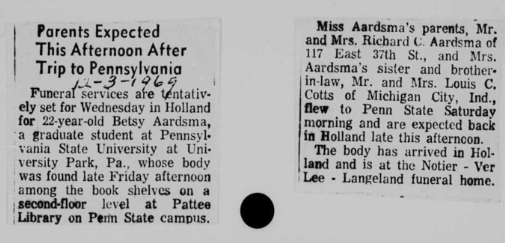
After his son called him to let him know what happened to Betsy, David Wright’s father reached out to the Aardsma family by telephone to offer his condolences… unfortunately, the news hasn’t quite made its way to them yet and it was at that moment that they learned that Betsy had been killed. In the early morning hours of Saturday morning, November 29. 1969, Richard and Esther Aardsma’s nephew Ron Cotts (a pilot for Delta Airlines) flew his parents (his mother was Esther’s sister) to Holland to pick up his aunt and uncle; he then flew them all to Chicago, a flight of about two hundred miles, to catch a plane to State College to talk to police and bring Betsy’s body home. According to him: ‘Esther and Dick were absolutely silent from Holland, Michigan all the way to Chicago O’Hare. Almost didn’t say a word.’
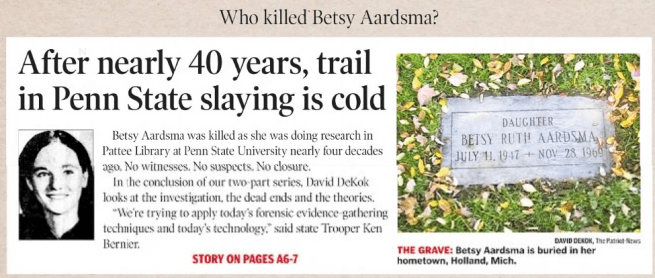
Elizabeth Ruth Aardsma was laid to rest on December 3rd, 1969 at Trinity Reformed Church in Holland, Michigan. Her casket remained open throughout the ceremony and (as I did mention earlier), the family’s pastor Reverend Gordon Van Oostenburg recited a portion of the poem she wrote in 1965 titled, ‘Why Do I Live?’ during the service. David Wright said he briefly thought about not attending the funeral because it was ‘so close to finals,’ but his family convinced him that he had to go; he sent a dozen roses to the church, one of which was placed in Betsy’s hands as she lay in the coffin, and according to him: ‘that’s pretty much the only thing I remember. I was sort of in a daze.’ Reverend Van Oostenburg told mourners that her murder had been ’God’s will,’ which (according to one of her friends that had been there) was a statement that outraged most of those in attendance that day, as those who knew Betsy did not believe this to be true and felt that her death had been an unimaginable loss. She was buried in the Aardsma family plot within Pilgrim Home Cemetery.
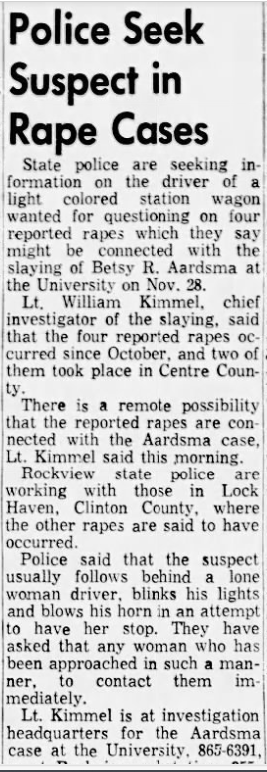
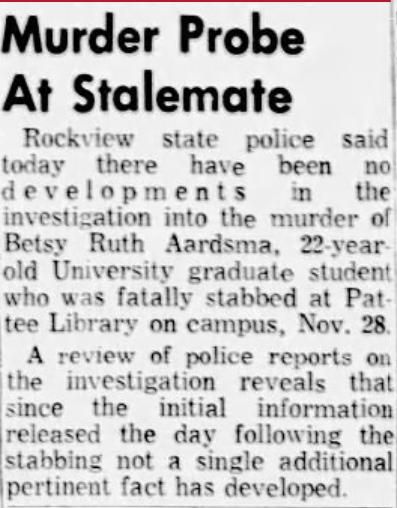
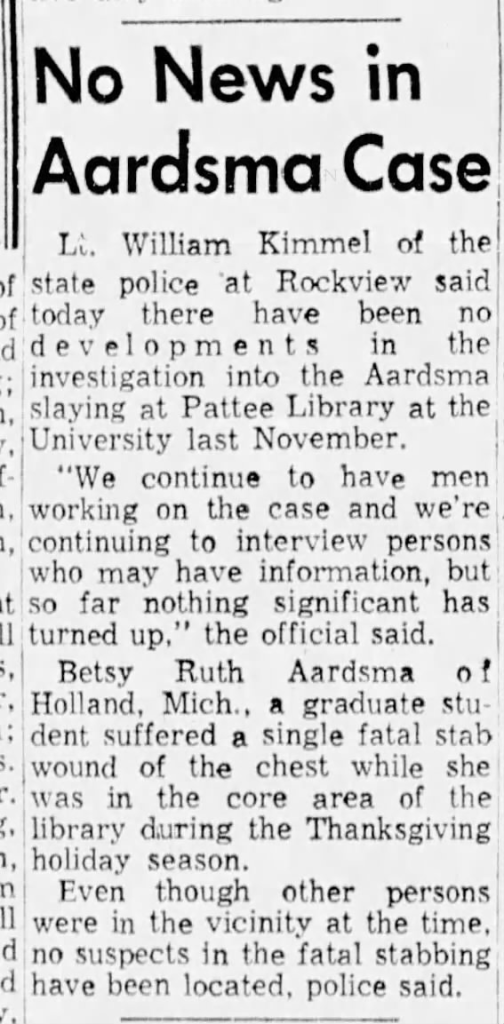
Following the initial intensive police investigation, Pennsylvania State Police continued actively looking into the murder throughout the 1970’s, conducting supplementary interviews and pursuing leads, including one that involved an anonymous postcard sent from Atlanta (which ultimately led to nothing). Efforts included polygraph tests and hypnosis sessions, along with the creation of multiple composite sketches, but these efforts failed to produce anything useful to help with the investigation.
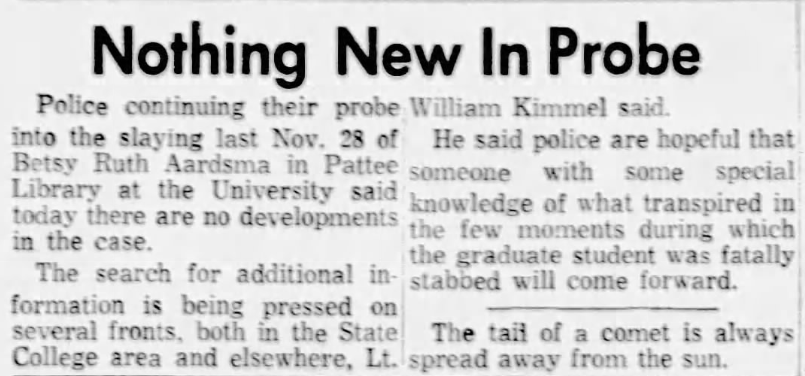
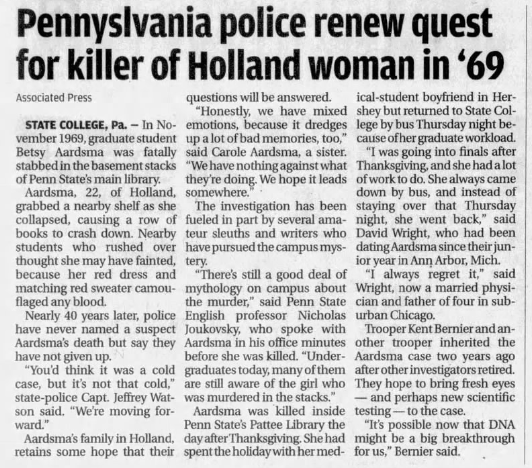
Into the 1980’s and 1990’s, the probe continued despite a lack of workable suspects, with troopers revisiting prior witness statements and coordinating internally within state police units (even though inter-agency collaboration remained minimal at the time and resulted in no prosecutions). Aardsma’s case file (which was approaching 1,700 pages at this time), documented thousands of interviews and highlighted persistent obstacles detectives ran into along the course of the investigation, which included deceased/relocated POI, conflicting recollections, and limited access to university-held records. By the late 1990’s, momentum had decreased despite the case still being classified as ‘open,’ and by the 2000’s the matter was deemed to be stalled and without any recent ‘fresh breakthroughs.’
There are six main theories as to what may have happened to Betsy:
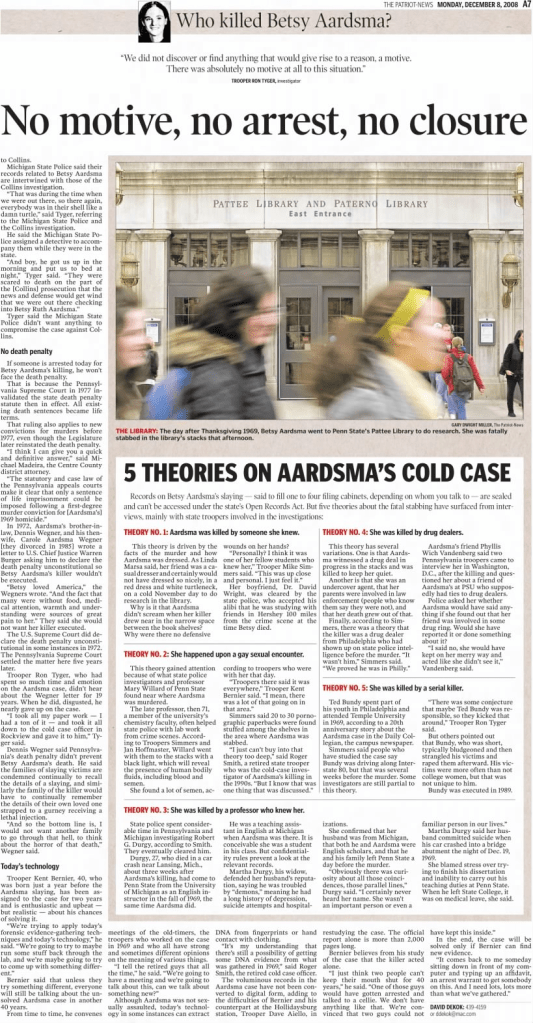
Theory One, Betsy was Killed by Someone that she knew: this hinges on the deeply personal nature of the murder as well as the circumstances surrounding it: Aardsma had been known for her casual, almost Bohemian sense of style, and it was unusual for her to have worn the clothes she did that day (a red woolen dress and white turtleneck). Her friend Linda Marsa told investigators that her choice of clothing that day had been highly unusual for her, which raises questions about whether she had dressed up with the intent of meeting someone special. When she encountered her assailant, it is highly suspected that he had approached her from the front, and they both would have been in one of the incredibly narrow rows of the stacks, and it would have been next to impossible for two people to pass through at the same time unless one (or both) of them turned sideways. Additionally, she appeared to have made no attempt to flee or scream, and why had there been no defensive wounds found on her hands? This all points towards the idea that Betsy may had known and possibly even trusted her killer. Trooper Simmers shared his own spin on things: ‘personally, I think it was one of her fellow students who knew her. This was up close and personal. I just feel it.’
Theory Two, Betsy’s boyfriend was her Killer: David L. Wright was investigated but was ultimately cleared of any wrongdoing by Pennsylvania State Police: his alibi placed him 100 miles away in Hershey studying with multiple friends at the time of the murder.
Theory Three, A Professor with a Troubled Past Killed Betsy: One suspect to come under the PA state Police looked into in relation to the murder of Betsy Aardsma was Robert G. Durgy, an English teaching assistant at Penn State that was originally from the University of Michigan that happened to arrive in the area at around the same time as she did. The TA, who suffered from crippling depression and had an extensive history of self-harm, left State College, PA abruptly the day before the murder, citing ‘medical leave’ from the University. Three weeks after Betsy’s murder, he died at the age of twenty-seven in a car crash near Lansing, Michigan; his widow, Martha described it as most ‘likely a deliberate act.’ Investigators ultimately cleared him of any wrongdoing in relation to the murder of Betsy Aardsma when they learned he had been out of state at the time.
Durgy was a teaching assistant in English at Michigan when Aardsma was there, and it isn’t too farfetched that she may have been a student in one of his classes (sadly, failed FOIA requests prevent me from verifying this). His widow defended her husband and his reputation, claiming he had been troubled by ‘demons,’ and hinted towards his long history of depression, suicide attempts, and inpatient hospitalizations. She also confirmed that her husband was from Michigan, that he and the victim were both English scholars, and that he and his family left Penn State a day prior to the murder: ‘obviously there was curiosity about all those coincidences, those parallel lines. I certainly never heard her name. She wasn’t an important person or even a familiar person in our lives.’ Mrs. Durgy said her husband was deeply stressed over trying to finish his dissertation along with his inability to carry out his teaching responsibilities at Penn State, and he was officially cleared of suspicion after investigators confirmed he was out of state at the time.
Professor Michael Begnal recalled a moment where Durgy had confided in him that he could no longer face students in his class (although he wouldn’t elaborate as to why), and as a result he needed him to take over some of his lectures. In the aftermath of his quick departure, a rumor began to spread around Penn State that he and Aardsma had been having a scandalous affair and that they had agreed to meet in the stacks that day so that she could give him some bad news (most likely that she was either planning on marrying David or that she was simply breaking up with him). The professor, unwilling to let anyone else have her, immediately took her life on the spot in a sudden fit of jealous rage. The problem was this theory was, there was no mention of Durgy in any of Betsy’s diaries or letters to her loved ones, and her friends couldn’t recall her ever mentioning him a single time. But perhaps most importantly, he’d left Pennsylvania before Betsy was killed and was confirmed to have spent Thanksgiving with his family in MI the night before (he was also said to have been with them the morning after as well).
Theory Four, Betsy was Killed by Drug Dealers: this (farfetched) theory suggests that Aardsma may have accidentally stumbled across a drug deal in progress while she was doing research in the Pattee Library level two stacks. Phyllis Wich-Vandenberg later recalled being questioned by detectives about whether her friend would have ‘reported’ such an encounter: ‘I said no, she would have kept on a merry way and acted like she didn’t see it.’ Live and let live, that’s how things ‘rolled’ back then and it was a common motto for many college students in the 1960’s when it came to casual drug use. Betsy was a modern-day woman, after all. LEO’s also followed a lead into a drug dealer from Philadelphia, but it was eventually determined that this person was elsewhere at the time Betsy was killed. It has been further speculated that she may have possibly been targeted because she was working as an undercover agent (although this theory has been largely debunked by those that knew her); a slightly different substance-related theory that investigators briefly considered was that she had been murdered due to an unsettled drug debt. It is important to bring up that although Betsy did smoke cigarettes and very occasionally drink, friends were adamant that she was not a user of drugs.
Theory Five, Betsy stumbled upon some sort of unusual sexual encounter and was killed to ensure her silence: this theory gained attention because of what state police investigators and Penn State Chemistry Professor Mary Willard found near where Aardsma was murdered. The late professor (who had been seventy-one at the time of the investigation) frequently helped state police analyze lab work from crime scenes, and according to Troopers Simmers and Jan Hoffmaster, she went with them to the stacks armed with a black light and luminol, which revealed the presence of human bodily fluids (largely semen). According to Trooper Kent Bernier: ‘it was everywhere. I mean, there was a lot of that going on in that area.’
In a section of the core that had been used to store desks and spare shelving located only a few aisles from where Aardsma had been murdered, investigators observed a desk with a seat pulled backwards: atop it was a half-empty can of POP (not soda) and a stack of about twenty to thirty heterosexual and homosexual pornographic magazines, some of which were dated as recently as October and November 1969 (I also read that they were found stuffed among the shelves in the area where she was stabbed). Although partial fingerprints were obtained from the beverage, they did not match any within police databases and any prints that were found upon and within the magazines had been smudged and were unusable.
However, State College Borough Police investigator Roger Smith deemed this scenario improbable, citing the absence of direct corroborating witness accounts or physical links to specific individuals, saying: ‘I just can’t buy into that theory too deep, but I know that was one thing that was discussed.’
Other sex related theories included the possibility Betsy may have accidentally stumbled upon an exhibitionist, or a man engaging in masturbatory fantasies, which was given particular credence by investigator Michael Mutch, who speculated Aardsma had observed two men engaged in sexual behavior, had recognized one or both of them, and had been killed in order to prevent her divulging to others what she had seen.
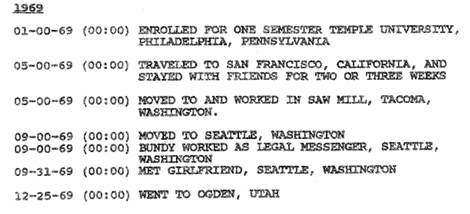
Theory Six, Betsy was killed by a serial killer, possibly Ted Bundy or the Zodiac Killer: every once in a while, I see Ted’s name brought up relation to the murder of Betsy Aardsma, as it was heavily documented that he attended Temple University in Philadelphia in 1969. Theodore Robert Cowell (later Nelson, then eventually Bundy) spent the first five years of his life residing at his grandparents’ house in the Roxborough neighborhood of Philadelphia, PA; in 1950 he relocated (along with Louise) to Tacoma, and moved in with his Great Uncle Jack (I don’t think I need to go into yet another full history of TB so I’m going to skip ahead a bit). According to the ’1992 FBI TB Multiagency Team Report,‘ at the end of 1968 Ted quit his job at the Queen Anne Safeway and relocated to the East Coast, where he lived with his Aunt Julia in her apartment outside Lafayette Hill. He enrolled in classes at Temple University in January 1969 but never finished out the semester, and in May 1969 he returned to the East Coast and stayed with friends in San Francisco for ‘two or three weeks.‘ Later that month he moved back to Tacoma, where he found brief employment at a local sawmill, and in September he moved into the Rogers Rooming House in Seattle and began dating single mother Elizabeth Kloepfer.
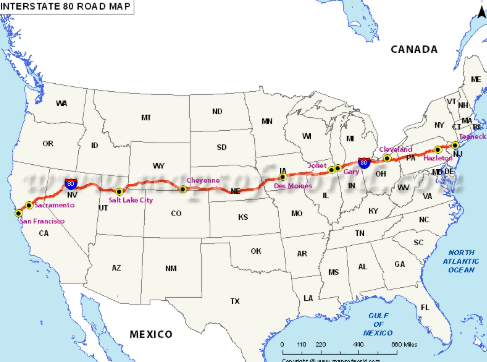
Per Mike Simmers, people who have studied the Bundy case in depth claim he had been seen driving along Interstate-80 in PA at roughly around the same time that Aardsma was killed… but the reports didn’t exactly line up, as the dates had been several weeks before the murder. Where some investigators do feel it was possible that Ted was responsible for Betsy’s murder (especially since she perfectly matched the description of one of his victims), most point out that he typically bludgeoned his victims then strangled and raped them afterward; additionally, no records have ever placed him at Penn State.
In addition to Ted Bundy, some true crime buffs speculate that the Zodiac Killer could be responsible for the murder of Betsy Aardsma (though most experts do not agree). Although the timing of the murder coincides with his activity, they were separated by significant geographic distance, as the Zodiac murders took place in California and rarely (if ever) took place indoors; additionally, there was a total absence of his signature correspondence at or near the crime scene. Theories attempting to link Aardsma to the Zodiac largely revolve around circumstantial parallels to the 1966 Cheri Jo Bates murder in Riverside (which also took place near a university library), as well as a 1978 letter that cryptically hinted at some out-of-state murders. However, this connection has several major holes: firstly, the Zodiac Killer was infamous for craving attention, and would often demand publication of his ciphers, and was known to take credit for his atrocities. Aardsma was stabbed a single time in a public, crowded university library without her killer leaving behind any identifying letters, symbols, or taunts; there is also no verifiable evidence that the Zodiac Killer was ever in Pennsylvania at the time of the murder.
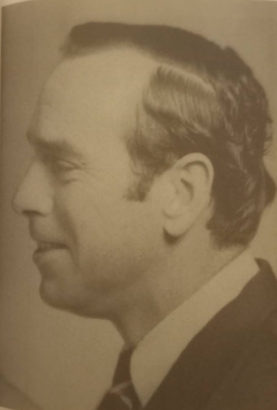
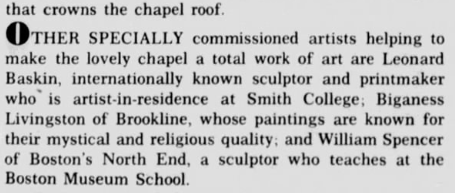
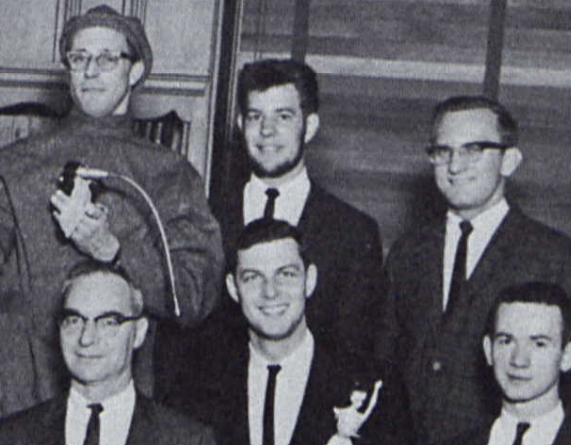
Suspects: William Spencer: one of the primary suspects that Pennsylvania State Police focused on in relation to the death of Betsy Aardsma was a forty-year-old teacher, artist, and sculptor named William Spencer, who had relocated to PA from Boston shortly before the murder. Upon looking into his background, Spencer had quite a scandalous background: in May 1960 he co-founded the Caffè Lena with his first wife in Saratoga Springs, NY, and some point after earning his degree a university had rescinded a teaching offer after he was arrested for growing marijuana. Only a few years prior to him moving to Pennsylvania he left his first marriage to chase after his (eventual) second wife Nancy, who had been an undergraduate student at Skidmore College at the time they met. In the fall of 1969, Spencer taught sculpture at a nearby local college while his wife studied for her PhD, and at some point earlier in the semester he told investigators that Aardsma had agreed to pose naked for one of his classes, a bold claim that her friends and family dismissed outright: those that knew her described her as a modest, reserved young woman, a fact that made Spencer’s claims that she offered to pose naked completely implausible. Detectives also noted that all (known) nude models who had participated in his classes traveled from The University from Philadelphia, which further discredited his claims.
Spencer was first reported to police as a potential suspect for Aardsma’s murder after allegedly confessing to having ‘killed that girl in the library’ at a Christmas 1969 faculty party; these claims culminated in his being formally questioned by investigators in early 1970, when he changed his tune slightly and said that he had only been ‘acquainted’ with Betsy and she had agreed to pose nude for his sculpting classes to earn ‘extra money.’ He also said in that same interview that he had been in the same part of the Pattee Library at the time she had been killed and had caught a glimpse of who did it (he claimed the man had been ‘wearing an overcoat’), and he even offered to construct a bust of the individual he had seen for investigators (which he later did provide to the task force). Although his confession and successive statements initially raised suspicions, investigators eventually were about to dismiss him as a suspect, as his claims lacked credibility and were unsupported by evidence or corroborating testimonies. Additionally, investigators did not feel that he would have had enough time to have gotten to know Aardsma before she was murdered (as he had moved there after her, only weeks prior).
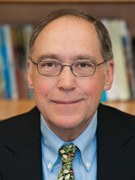
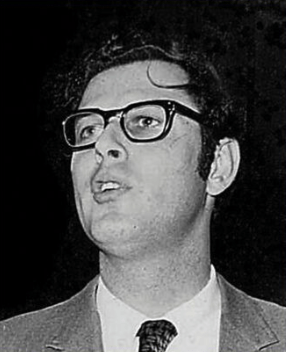
Larry Maurer: a Penn State graduate student and classmate of Betsy in an English literature course, Larry Maurer had met Aardsma several weeks before she was killed, and he had even taken her out for coffee on at least one occasion (he followed up by asking her out for a movie, which was an offer she politely declined). No documented animosity existed between them, but investigators initially scrutinized him due to his recent acquaintance with the victim and his inconsistencies during multiple interviews that took place on the day of the murder: according to detectives, his behavior during questioning (which had been described as ‘taunting’ and ‘suggestive of guilt’) further raised suspicions, which prompted multiple repeat conversations. During his initial interview he very casually brought up that he carried a knife around with him, and when he was pressed about it, he clarified that he used it to ‘cut cheese, not stab young women.’ Speculation of a motive arose due to their limited interactions, with made some officers theorize he had unrequited affections for the pretty young victim, or she straight-up rejected him (though no concrete evidence supported such claims and police found no indication of conflict). Maurer’s involvement in Penn States’ ROTC program also drew attention to him, and shortly after Betsy’s homicide, he abruptly left Penn State and enlisted in the Army, a move that some saw as suspicious. Investigators further speculated that a military issued bayonet may have been the one that inflicted the fatal wound through Betsy’s heart.
Some reports claim that Maurer had been described as ‘an eccentric character’ by his peers, and he had been deeply fixated on Betsy even after she told him she was not interested in him romantically. He was ‘a country boy’ as well as an avid outdoorsman, and was also skilled in basic anatomy, which was a fact that made detectives wonder if he would have been able to execute the precise wound that took the life of Betsy Aardsma. So, thinking they had their man, the Pennsylvania State Troopers brought him in for a polygraph, but he passed with flying colors, which combined with the fact that he was a few inches too short and a few shades too blonde to match the description given by Joao Uafinda and Marliee Erdely, forced them to move on and seek a more appropriate suspect. Oddly enough, one presented itself in direct connection to Larry: his former roommate, Rick Haefner. Maurer went on to find employment with the National Security Agency.
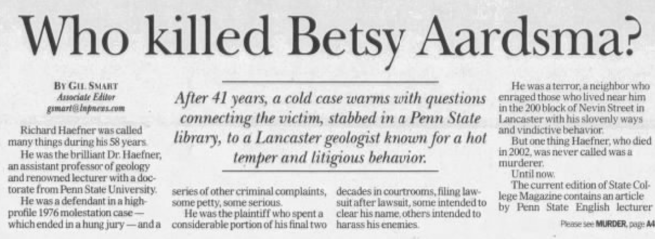
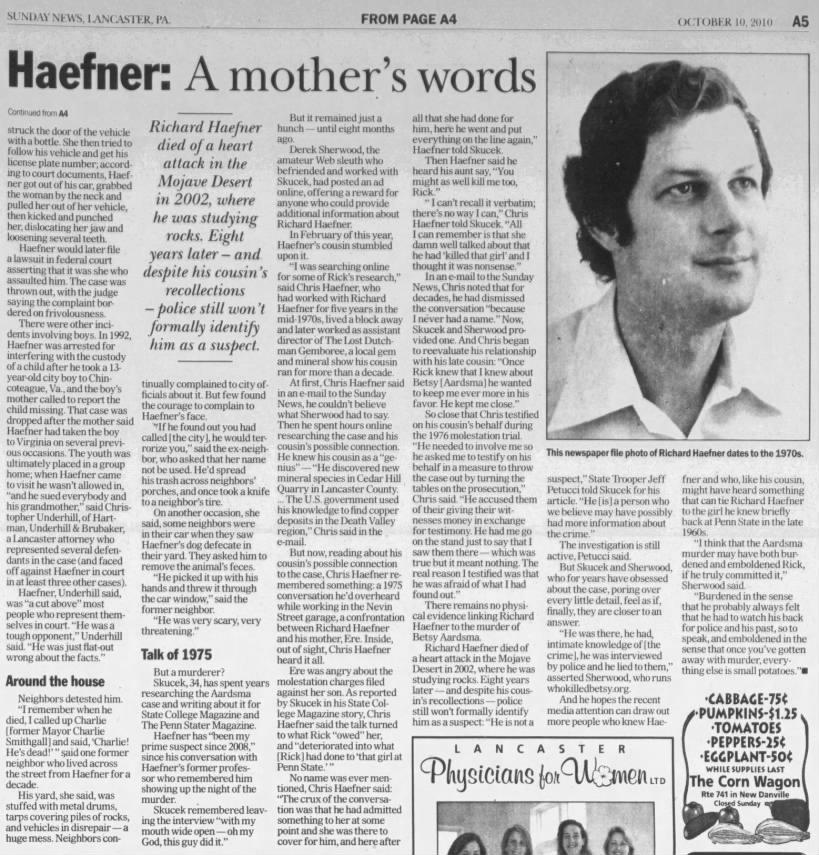
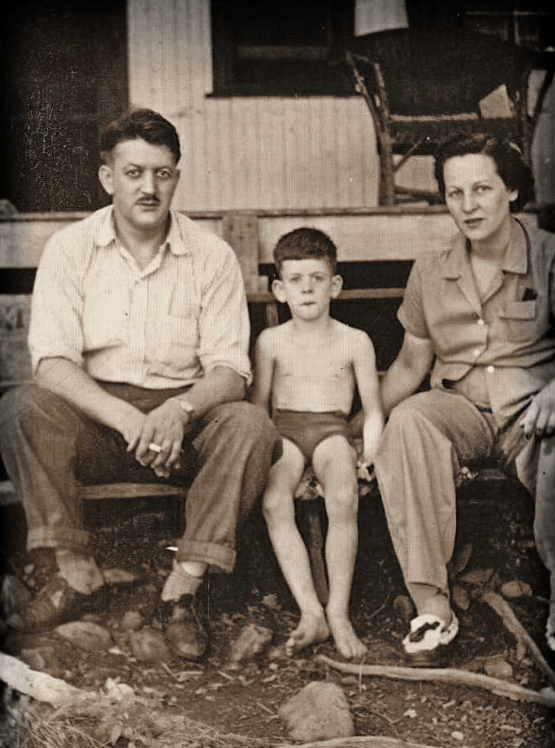
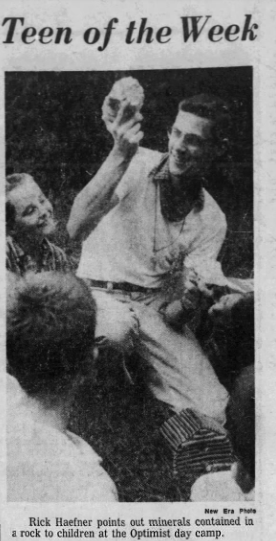
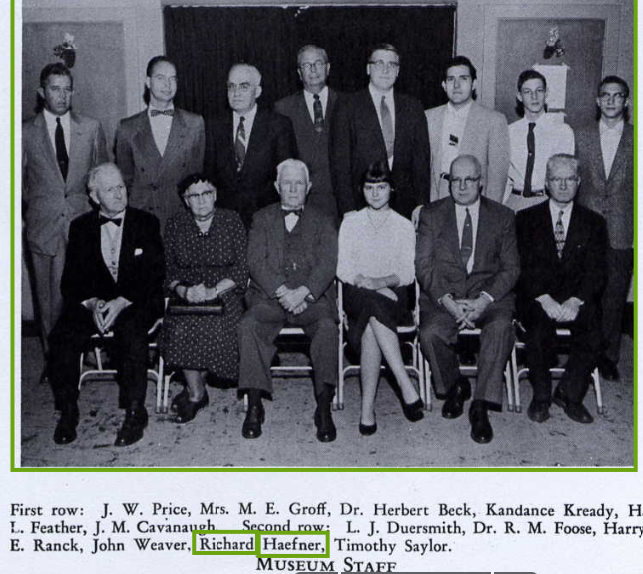
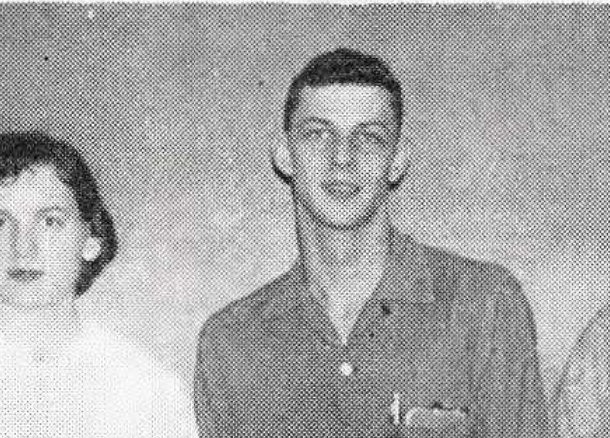
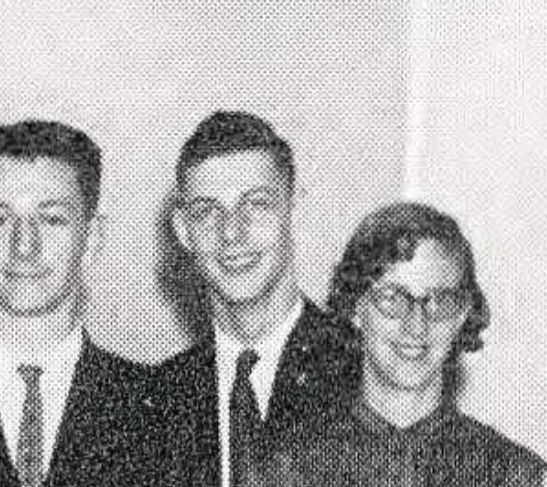
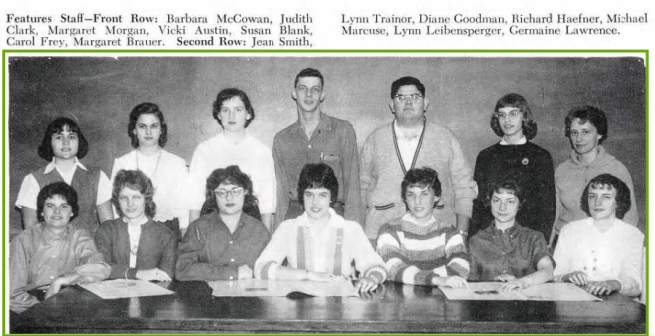
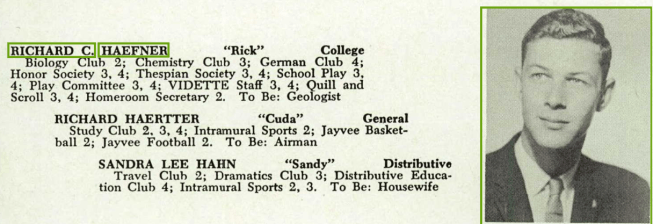
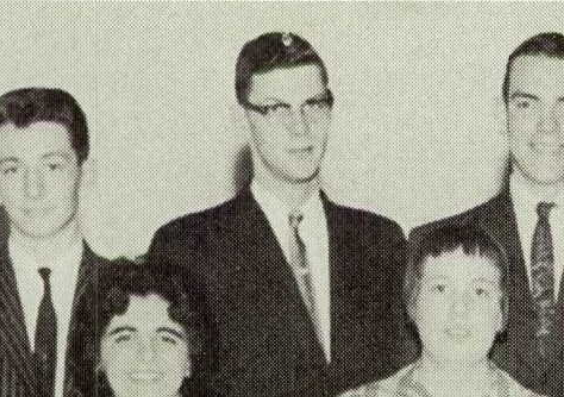
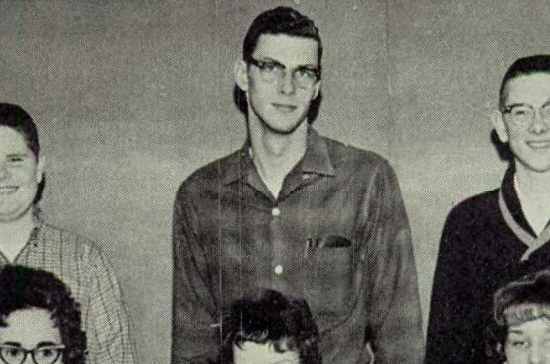
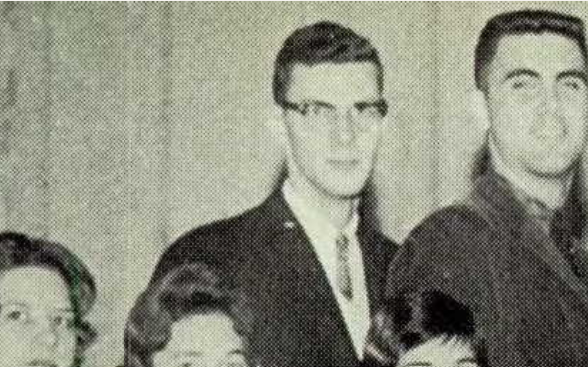
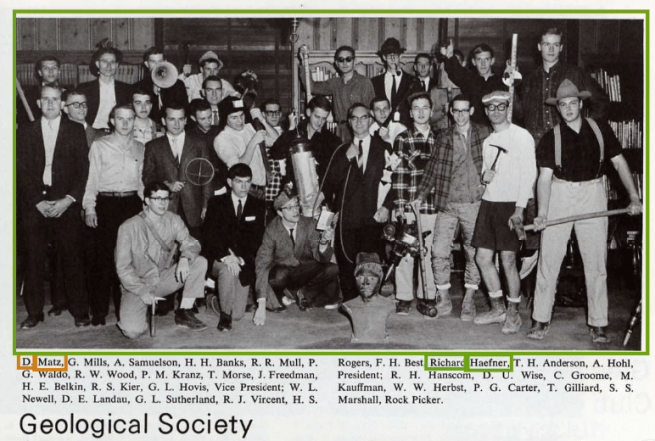
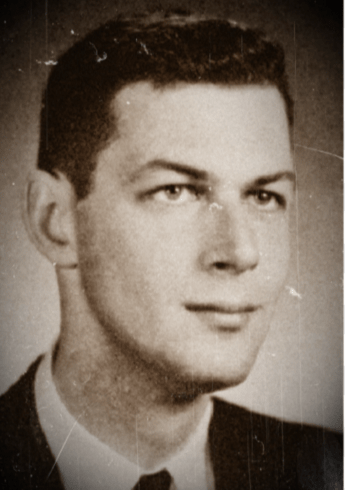
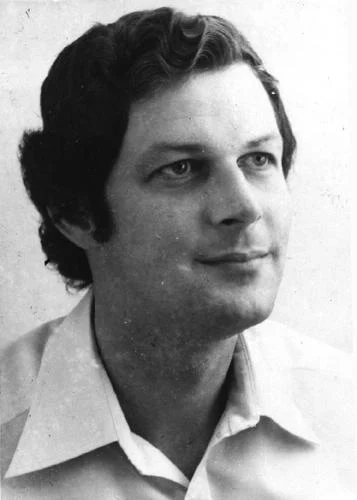
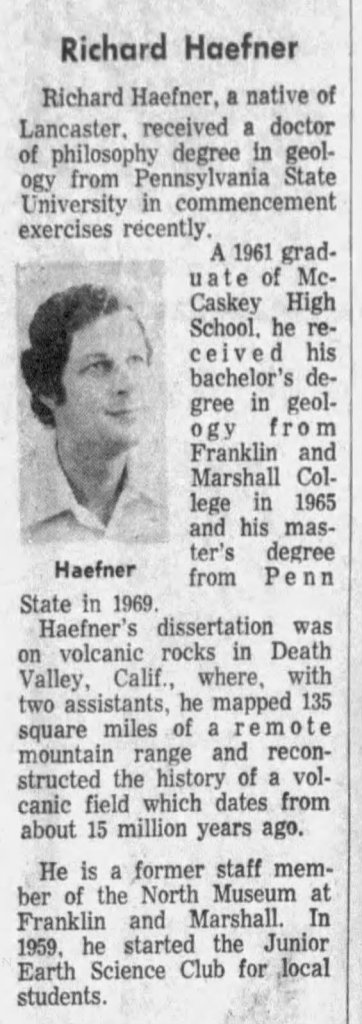
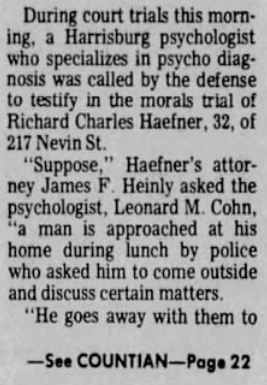
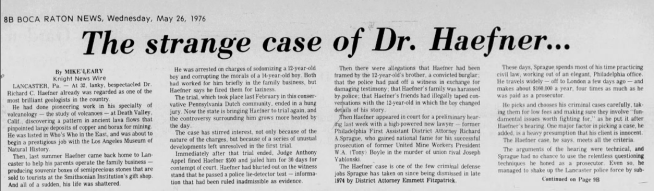
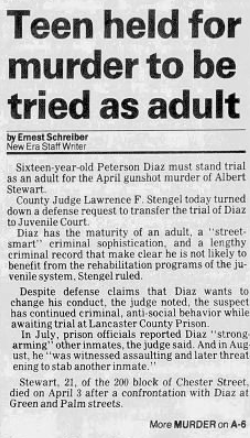
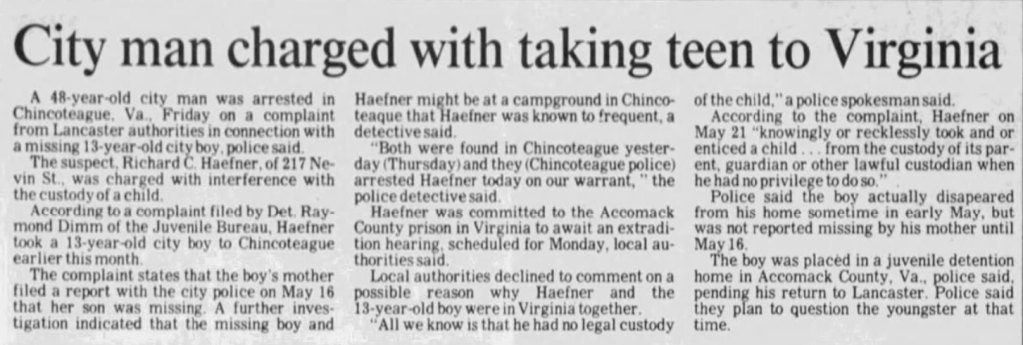
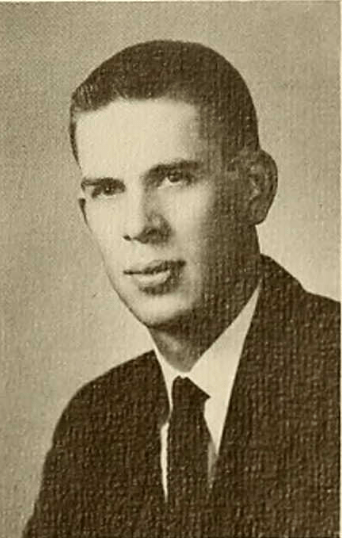
Richard Charles Haefner: perhaps the most widely accepted killer of Betsy Aardsma is Dr. Richard Charles Haefner, a twenty-five-year-old geology graduate student that took her on a few dates and lived in the same dormitory as she did. Haefner first came to the attention of investigators only days after the murder, when Betsy’s roommate, Sharon Brant, suggested police interview him: per Brandt, Haefner had visited their room on more than one occasion in the weeks prior to the murder.
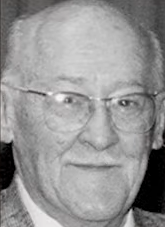
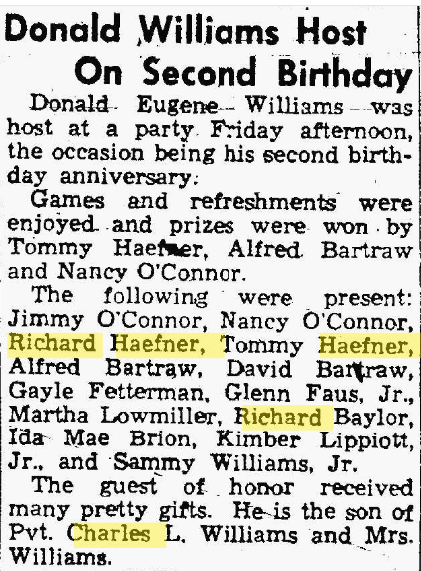
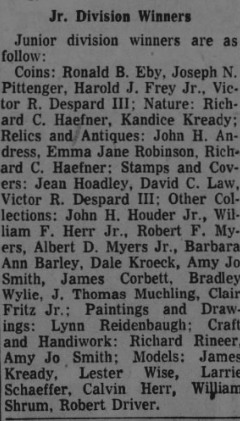
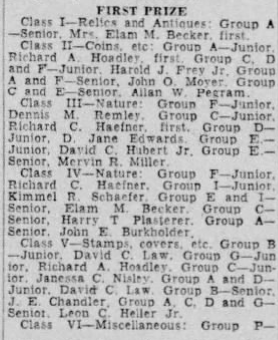
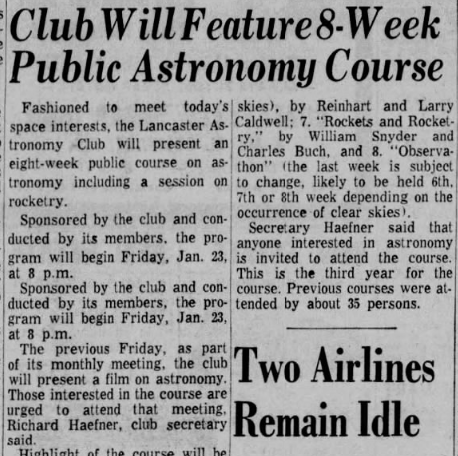
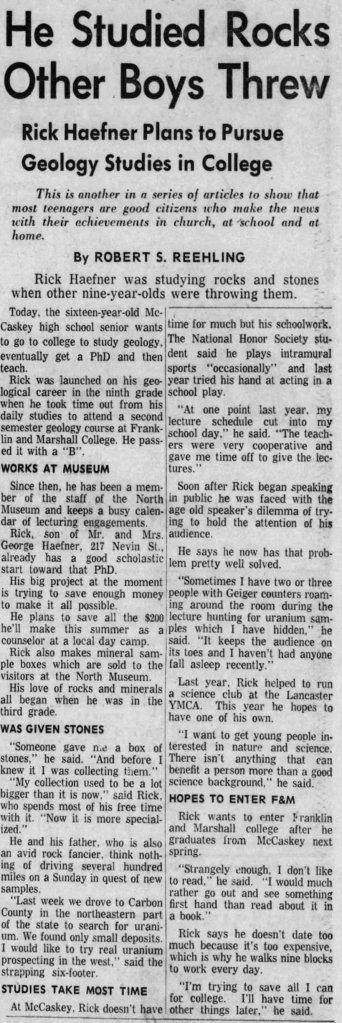
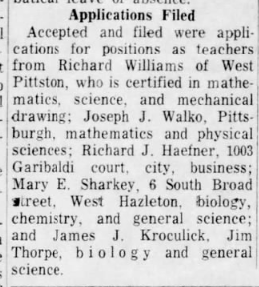
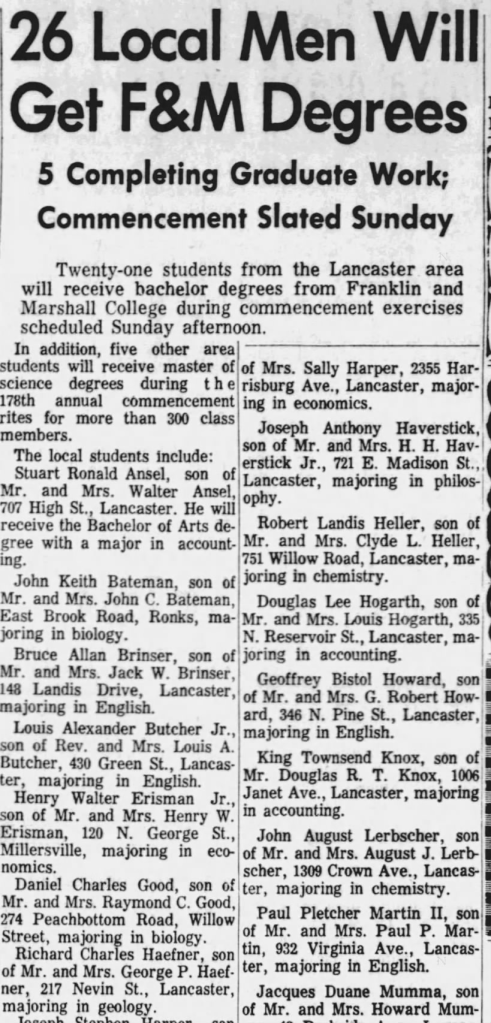
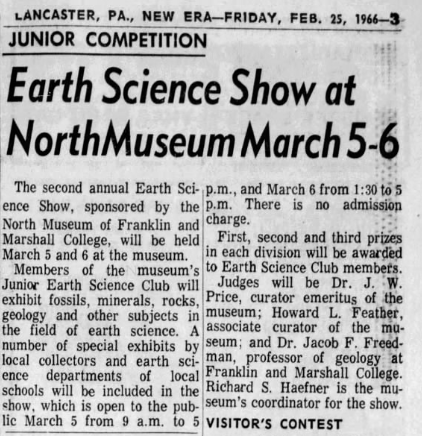
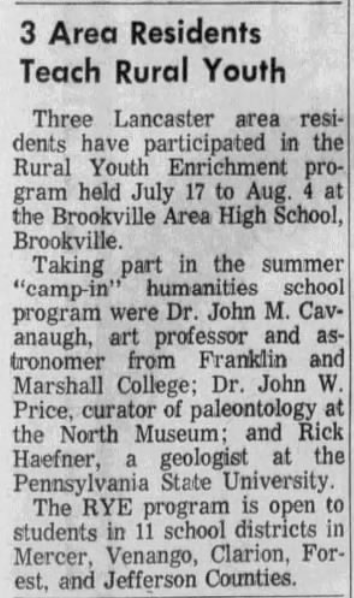
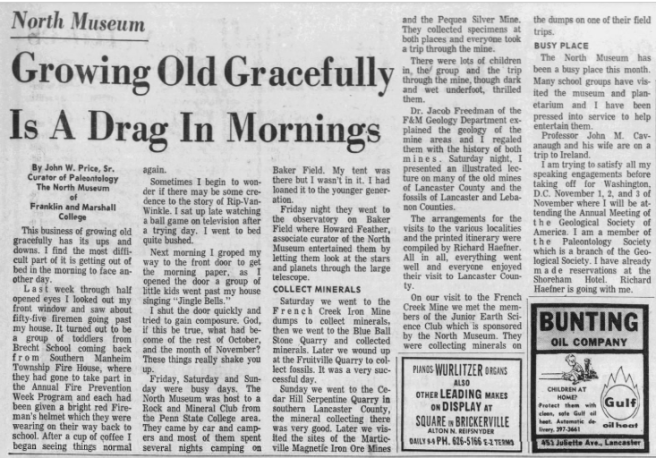
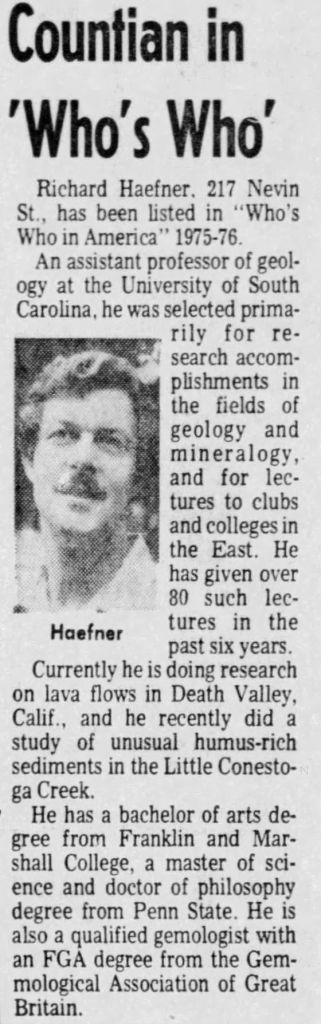
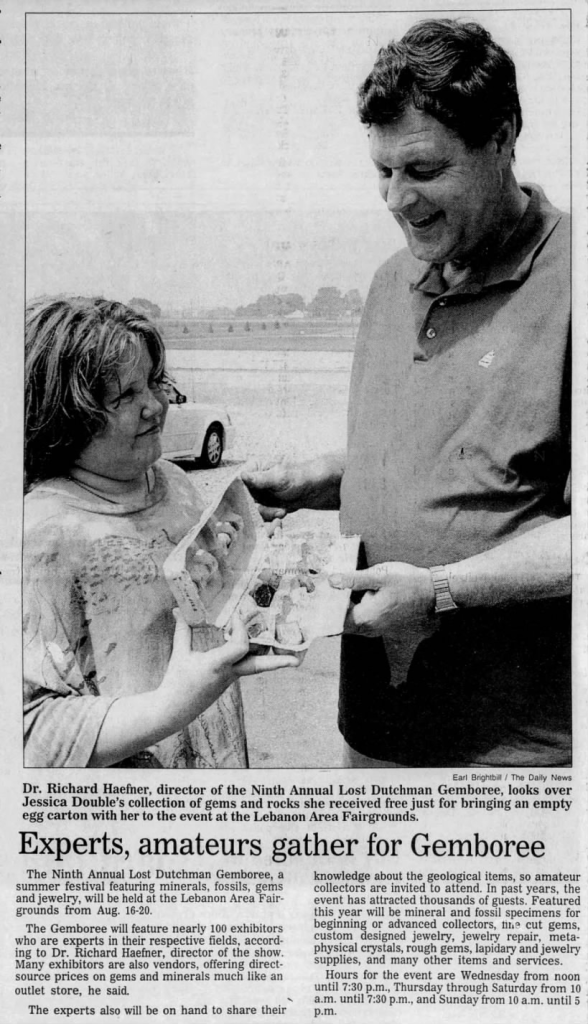
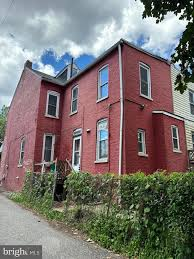
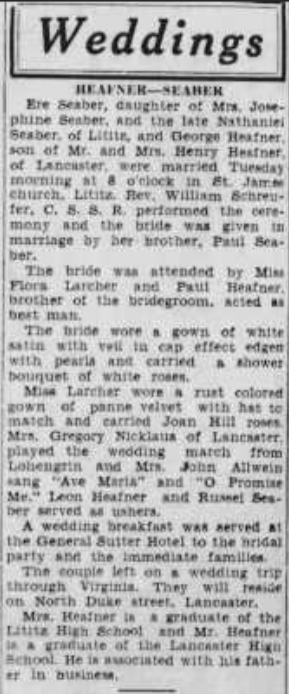
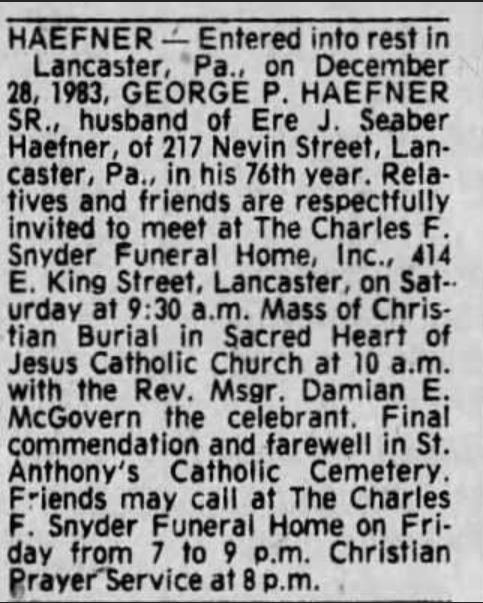
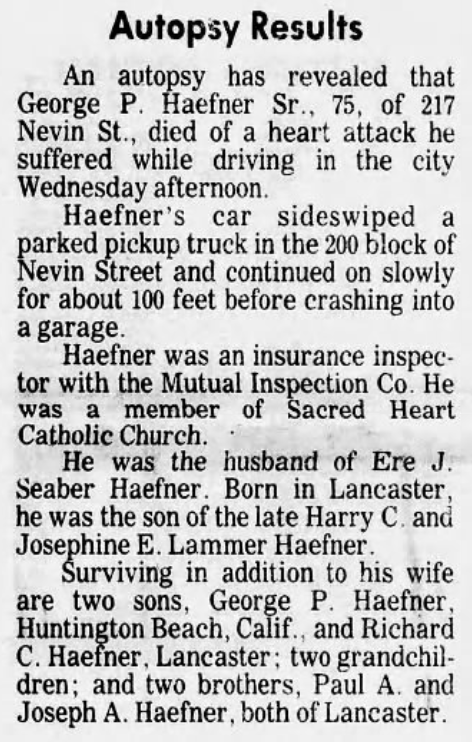
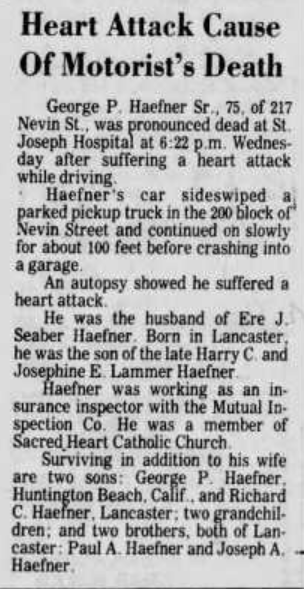
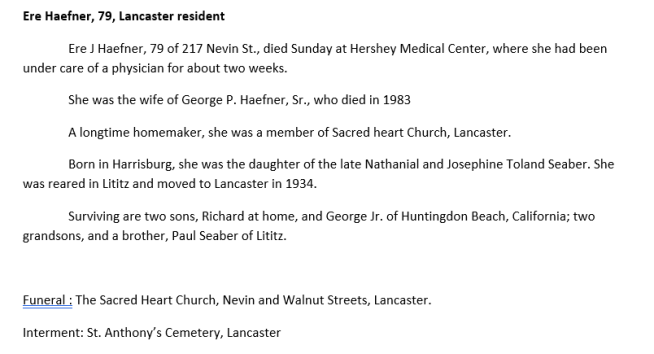
Richard Charles Haefner was born on December 13, 1943 in Lancaster, Pennsylvania to George and Ere Haefner. The younger of two sons (he had an older brother named George), Richard excelled at academics (he was especially strong at the natural sciences) and was described as a well-respected but socially awkward individual that was known for his eccentric behavior and bouts of explosive anger. According to his ‘FindAGrave’ page, Haefner was a ‘talented but deeply troubled Geologist who is remembered today as much if not more for his violent and unpredictable nature as he is for his work in the field of geology and petrology.’ He got his Bachelor of Science in Geology from Franklin and Marshall College in 1965, his Masters in Geology from Penn State University in 1969, and his PhD (also in Geology from Penn State) in 1972.
Haefner told police that he’d met Betsy not long after she’d moved into Atherton Hall in September 1969 and that he took an immediate liking to her; not long after that, he claimed they’d begin seeing each other as ‘more than just friends or neighbors.’ Throughout the month of October, he took Aardsma out on various dates around State College: they went out for ice cream at the Penn State creamery then drove her out to Bellefonte Lanes to go bowling, and one evening he treated her to dinner at the Nitny Lion Inn on the Northern Extreme of Campus. Towards the end of the month, he said they made plans to go on a drive together, but a ‘sudden illness’ dashed those plans, and shortly after, Betsy withdrew from their budding romance completely, citing the fact that she had a boyfriend in Hershey and was choosing to focus on him.
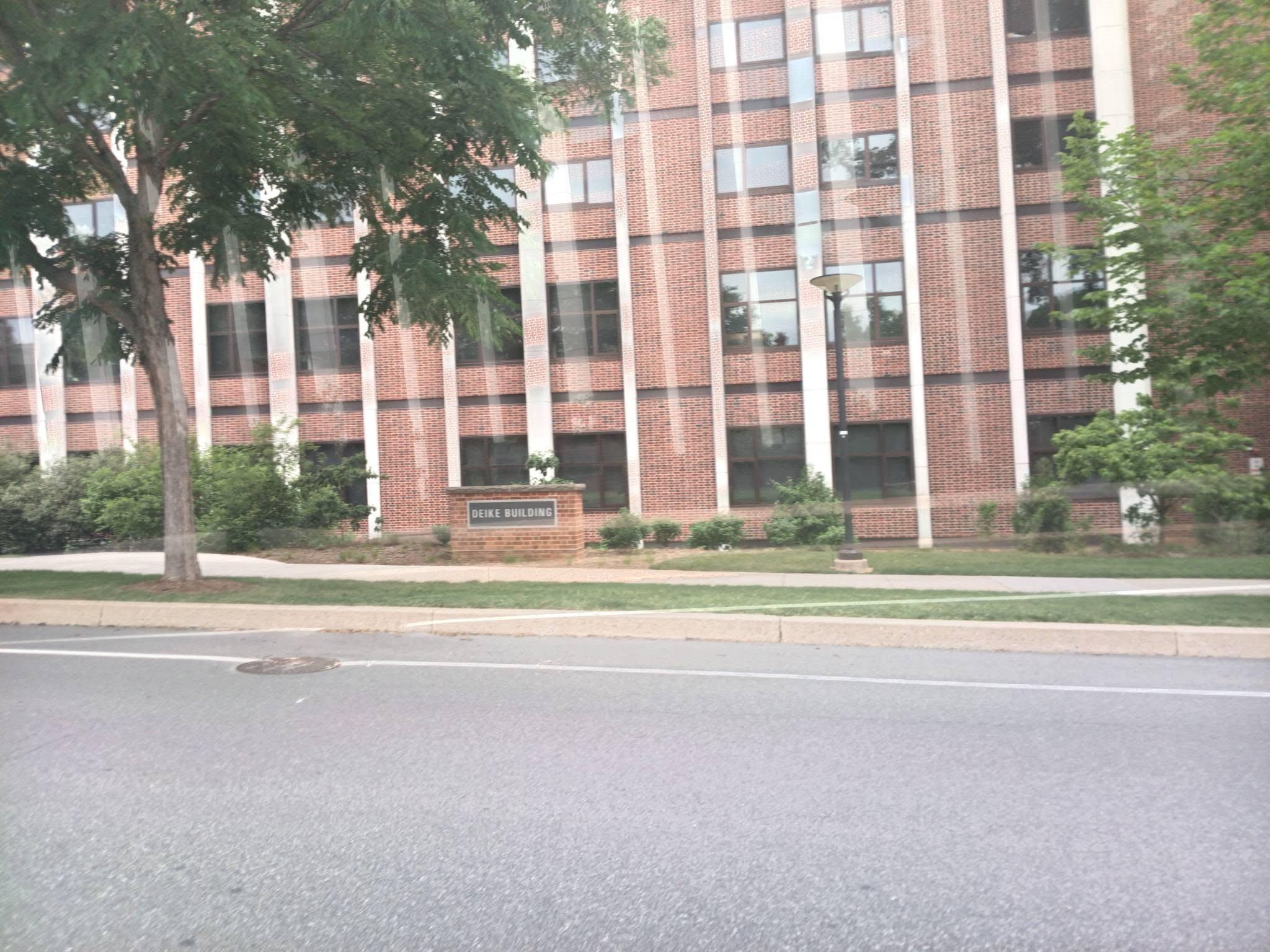
Haefner told investigators that because he was a geology student he would have had little reason to go to the Pattee Library (which primarily serviced the students in the schools College of the Liberal Arts), and his ‘library of choice’ was in the Deike Building, where the majority of the University’s earth science reference materials were kept. When questioned about how and when he’d learned about Betsy’s murder, he claimed to have found out later the same day: on the evening of November 28, 1969 he had been eating dinner in the hub building at the center of campus when he had first heard circulating rumors of a student having been murdered at the Pattee Library, when he found out who it had been he left the dining hall feeling sick because ‘his former girlfriend had been murdered.’ When the interview came to an end, investigators deemed he showed no sign of hostility towards Betsy.
In 1976 (after a falling out with his former student), Haefner’s mentor at Penn State Dr. Lauren Wright (no relation to David Wright) reported a suspicious encounter with his student on the evening of Betsy’s murder. An internationally renowned expert regarding the geology of Death Valley, Dr. Wright recalled Haefner arrived at his house on the evening of November 28. 1969 just as he and his wife had sat down to have dinner at roughly 6 PM in a state of panic: he exclaimed, ‘have you heard a girl I dated was murdered in the library?’, then proceeded to ask if there had been any news in the papers about Betsy Aardsma being killed in the Pattee Library. As we know, the murder had just happened less than two hours prior, making it nearly improbable that a news report had been published, and this account directly contradicted the statement that Haefner made to police about his whereabouts that night.
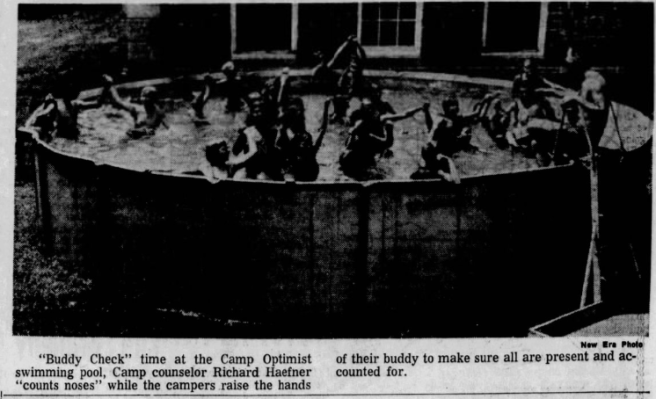
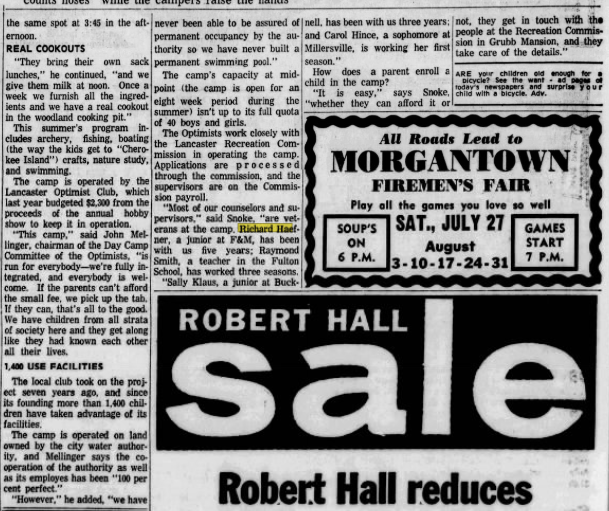
Had investigators bothered to look into Haefner’s past related to his hometown of Lancaster, PA they would have discovered a treasure trove of scandals, as he had quite a few skeletons buried deep in his closet: Rick first became known to police at the age of nineteen in the fall of 1962 when he was a sophomore at Franklin and Marshall College, and he committed an unsavory act with an underaged male elementary school student. At the time, he had been a counselor for the Lancaster YMCA, and where it’s unclear exactly how far things went, Haefner somehow managed to avoid arrest, and as result that single failure would have severe consequences for a number of young boys in the area, particularly the members of Boy Scout Troop 24, where he had recently taken a position as assistant scoutmaster.
Michael Whitmer would later recall to investigators that at first Haefner seemed like a really cool, smart guy who treated the boys (many of them up to a decade younger than him), as if they were his friends or younger brothers… but it was all just a ruse intended to gain their trust so that he could violate it for his own sick sense of satisfaction, something Whitmer realized for the first time when his best friend Dave broke down to him about something deeply inappropriate that Haefner had done to him while on a camping trip in the summer of 1965. Dave himself would later come forward and admit that it was not the first instance of abuse at the hands of Rick and that he had done it three or four additional times in 1963 and 1964; he said that when his parents found out, they complained to the scoutmaster, who also happened to be the parish priest of the church that hosted Boy Scout Troop 24.
Father Stephen E. Popovich brought Haefner in for a meeting which may or may not have been under the seal of confession, and where it’s unclear if he admitted to anything during that discussion, it led the priest to conclude that the accusations were legitimate and that he was ‘sick beyond help.’ After that, the troop removed Rick from his position and even took it a step further and informed the national headquarters of the Boy Scouts of America, which led to a lifetime ban from the organization… but of course, nobody had thought to contact the police.
Because the authorities were never made aware of the incident, Haefner managed to hold on to his job with the Lancaster Recreation Commission as a playground supervisor, which allowed him to gain the trust of a single mother, who in turn gave him permission to take her ten and eleven-year-old sons on five day vacation to Ocean City, Maryland in August of 1965; during the trip, he made victims of them both. Thankfully, the brothers had the sense to tell their mother upon returning home, and even though she confronted both Haefner and the chairman of the recreation commission, Philip Bomberger III, who ultimately choose to side with the abuser and against doing the right thing. In the end, Bomberger attempted to assess what had happened and tried his best to help Rick deal with his demons, which included a closed-door meeting with him on August 30, 1965 in which he had appeared very nervous and shaken after he was informed how the victim’s mother had reacted to the news; he also said that he only felt compassion for her and that if he had done anything wrong, he wasn’t aware of what it was.
During that meeting Haefner guilt tripped Bomberger by saying if he ever went to the cops and if people found out what he’d done, his only choices would be to either run away or kill himself… so, instead of turning him in, Bomberger asked the opinion of medical professionals, one of them being Dr. Charles H. Curtis (who was actually the victim’s physician), who understood why someone might be reluctant to report the crime, but did say he was leaning towards reporting it himself. It was eventually decided that if Rick was willing to start psychiatric care, then the police would not be notified of what he did in Ocean City; shortly after, Rick began seeing Dr. Curtis on September 13th, 1969, however, the therapy sessions were short lived and ceased after he moved across the state and began his graduate studies at Penn State. It never dawned on the doctor to check in with Haefner to make sure he was continuing to receive care while in State College.
Rick Haefner’s mom Ere seemed to be the type of parent that had no problem covering for her son and was also most likely the driving force behind his decision to start dating women, Mary Kelling being one of them. And while Dr. (Lauren) Wright may have been unsure of Rick’s involvement in Betsy’s death, he was certainly aware of his almost aggressive pursuit of Kelling, who had met on Thanksgiving Day in 1967 while doing field work in Death Valley, California. It was also around this time that Wright first began to wonder if there may have been something wrong with his student (at least as it pertained to his sexuality), and while it appeared that he didn’t surmise JUST how deviant he was, he eventually figured out that Haefner was not a typical heterosexual male and even commented to his other students that he wasn’t sure if he liked girls.
Rick met Mary Kelling while doing field work with Dr. Wright in Death Valley, California in 1967, (they went out to Shosonyi around the start of the fall term on October 1, 1967 along with another student named Joe Head); because they were there for the Thanksgiving holiday, Dr. Wright arranged for the three of them to have dinner with the family of his friend Bernice Sorrel, and it was that evening that Rick met Mary, who at the time had been a senior English major at Smith College in Northampton, MA. Mary was beautiful, with deep chocolate eyes and dark brown hair she wore short and styled in a bob, and where Head didn’t remember seeing the two engage in any noticeable interaction that evening, it was obvious that the young lady had made quite an impression on Rick. And it wasn’t hard to see why: she was beautiful, carried herself well, and was academically gifted… she even had dreams of one day entering the Peace Corps and going to Liberia, which is obviously something that Betsy (who looked remarkably similar to Mary) wanted to do as well. The biggest obstacle for Rick was that Kelling seemed to have absolutely no romantic interest in him whatsoever.
Rick, not knowing how to approach a woman like a normal young man, showed up at her dorm room in the spring of 1968: he had driven 400 miles from Penn State to Smith College, asked around campus as to where he could find her, then knocked on her door to tell her how he felt about her. There had been no calls, no letters… the two literally had never even spoken aside from a few polite exchanges on Thanksgiving. Mary asked him to leave then immediately phoned Bernice to tell her about the bizarre and somewhat threatening encounter; when they hung up, Ms. Sorrel then called Lauren Wright to complain about his protege’s behavior. Despite this, Dr. Wright continued to work with Haefner, and he even had him return to Shosonyi with him the following year to do more fieldwork, and didn’t even have the sense to tell him to stay away from Mary: he simply made sure to closely observe them together, and in the end, Wright seemed to have been satisfied by his young protégé’s behavior. But Dan Stevens, another Penn State graduate student that came along to help with the trip, felt perturbed by Haefner, who he found to be nerdy, annoying, and had always been ‘always looking down at him through horn rimmed glasses.’
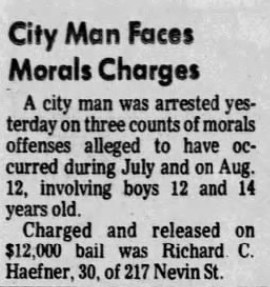
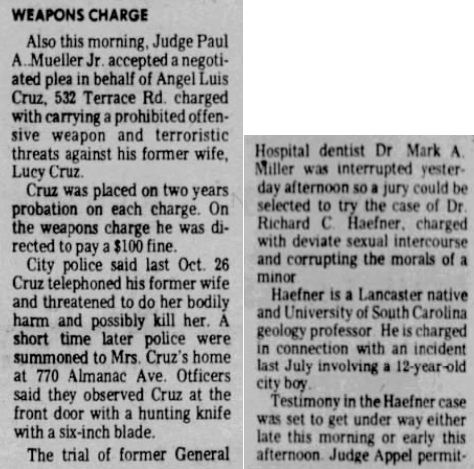
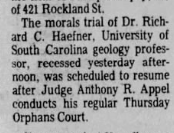
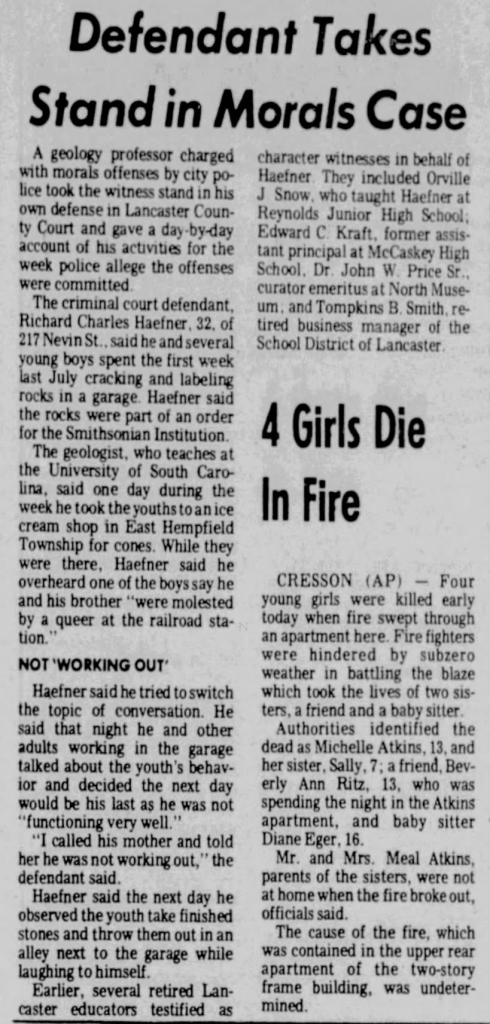
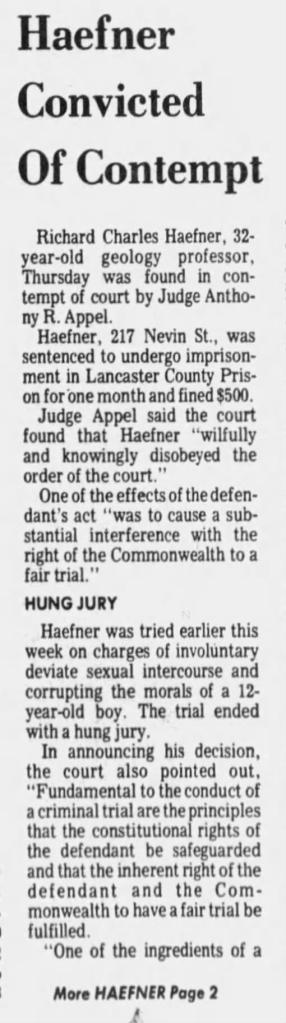
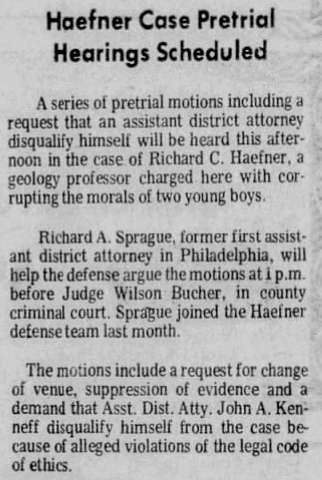
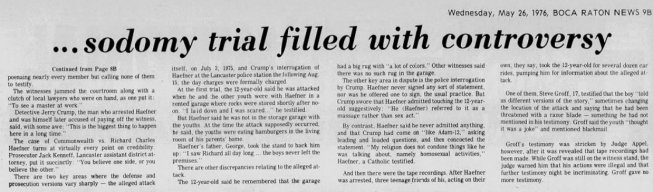
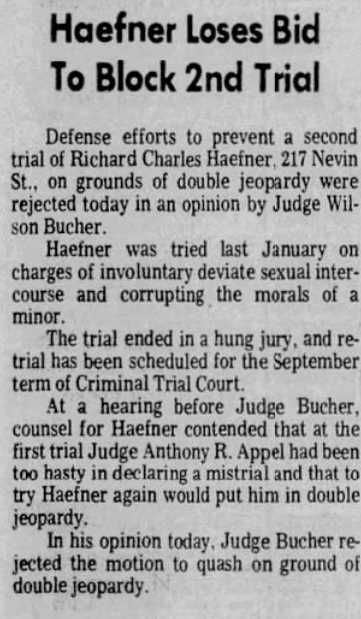
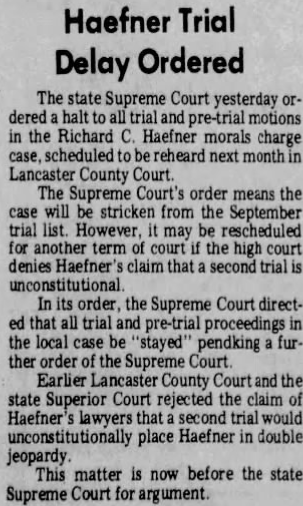
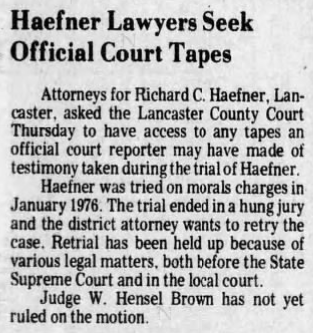
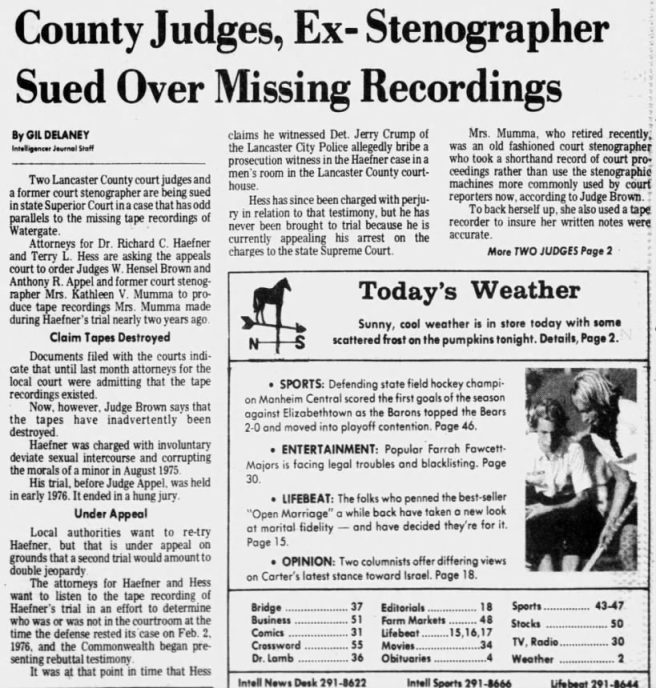
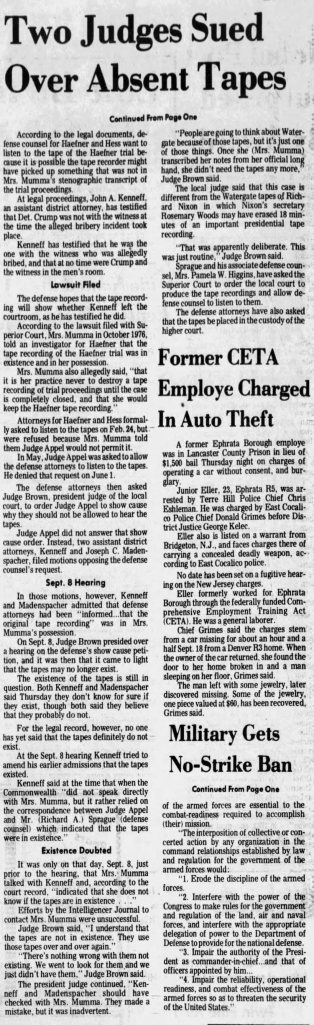
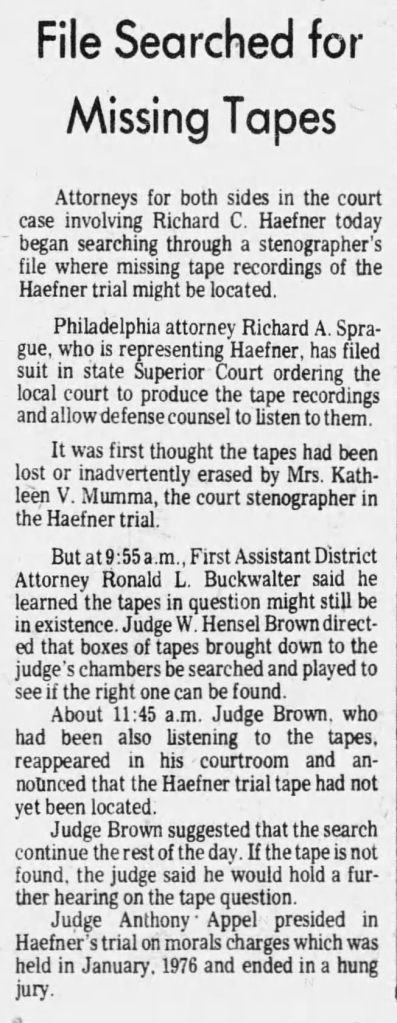
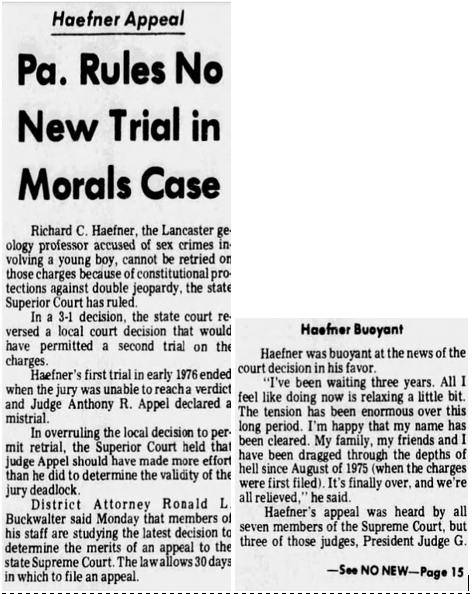
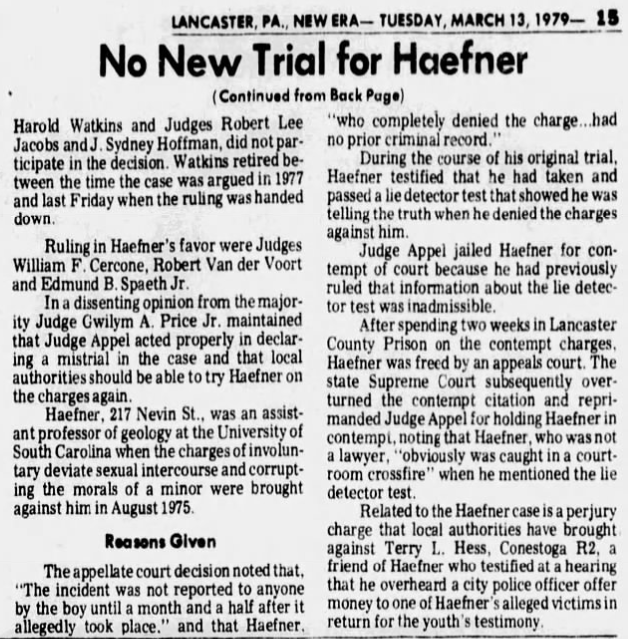
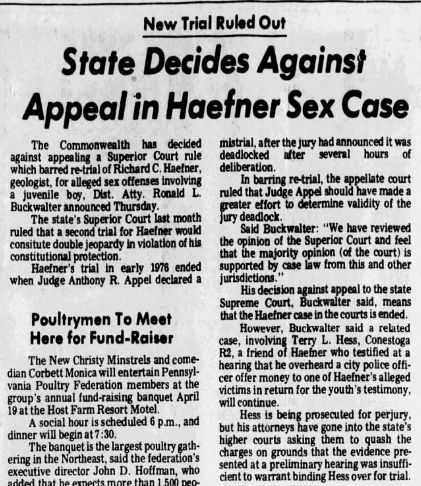
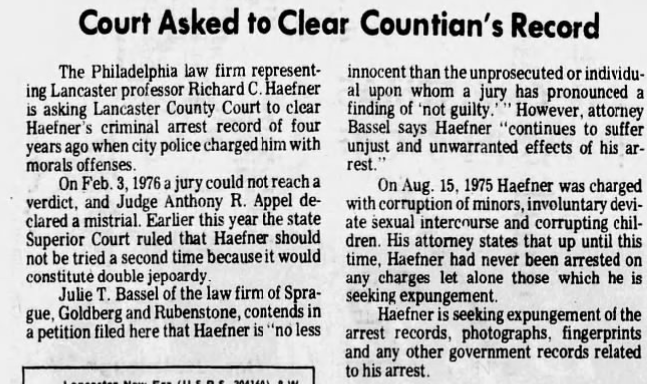
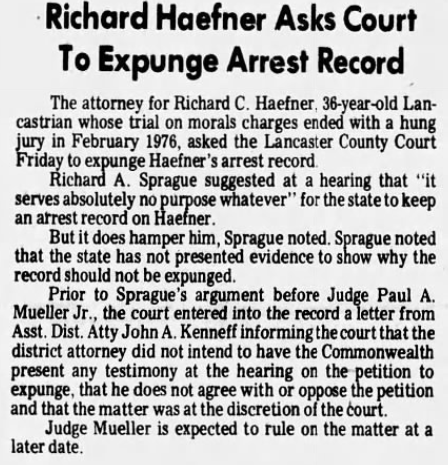
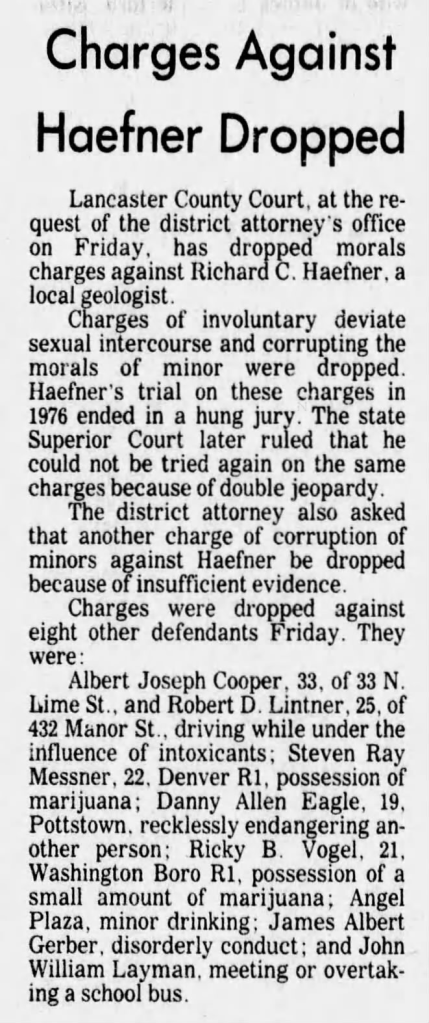
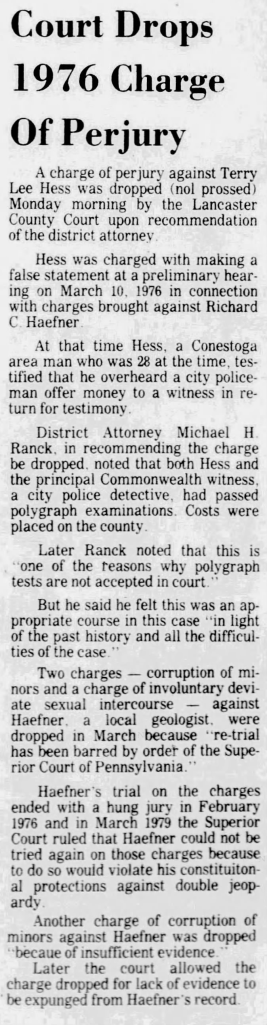
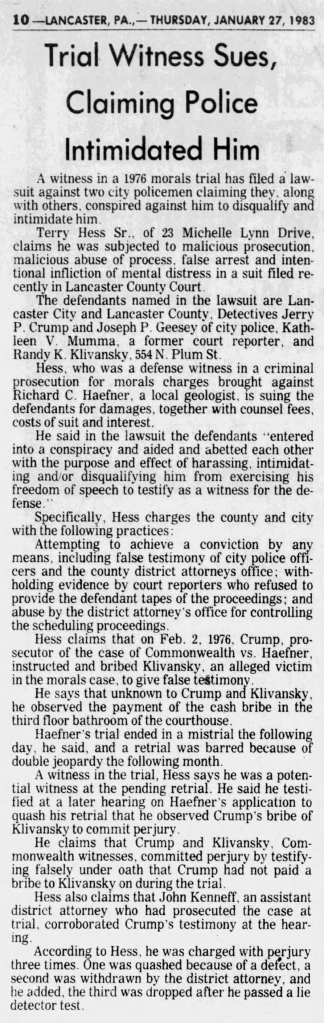
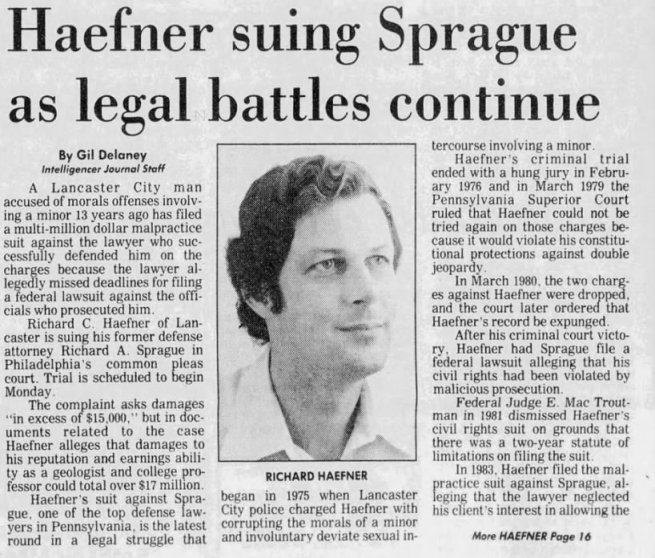
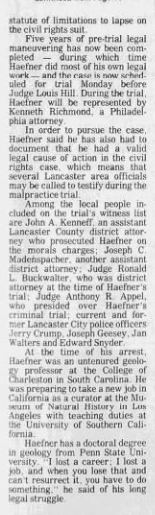
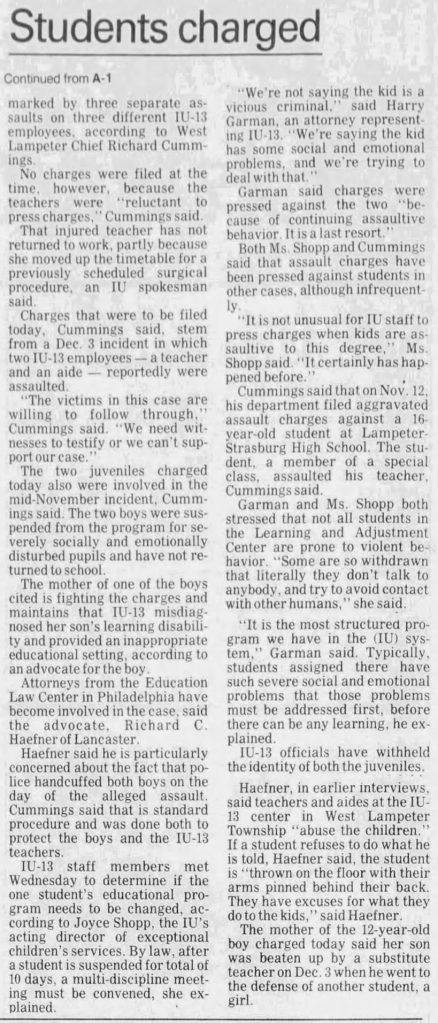
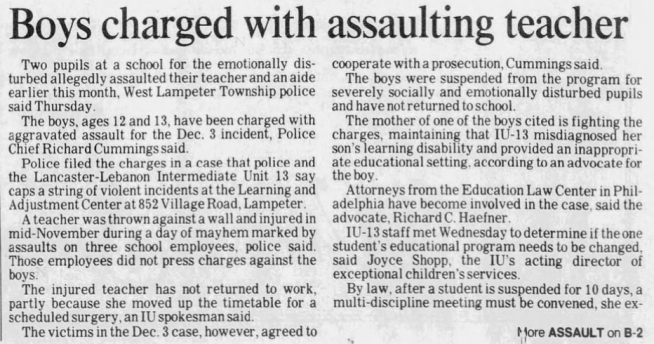
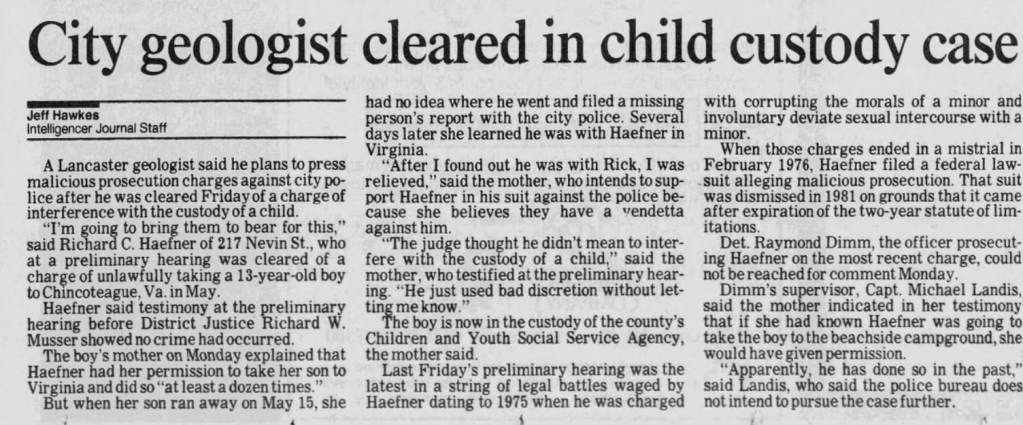
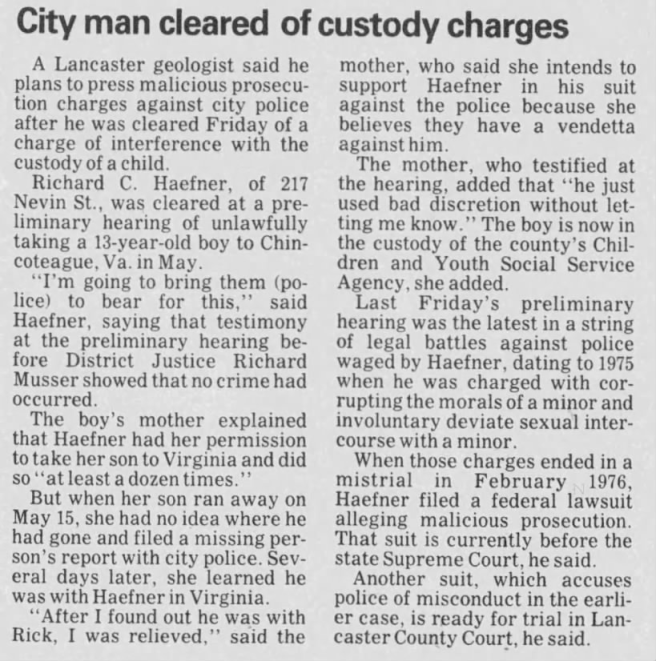
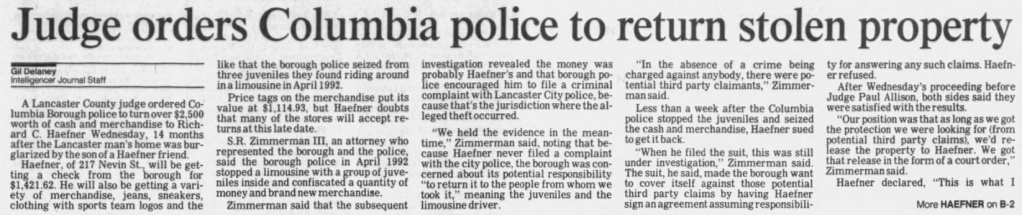
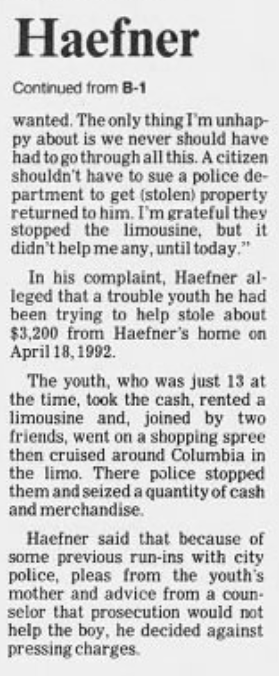
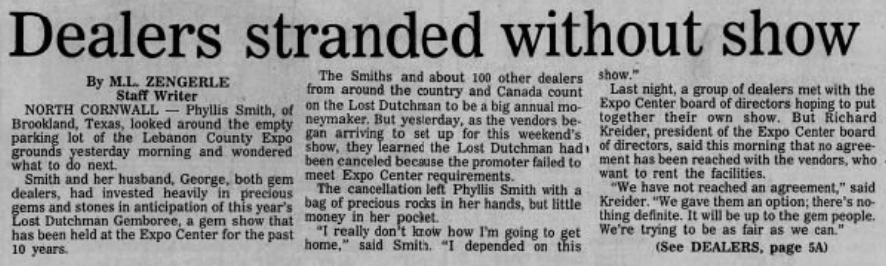
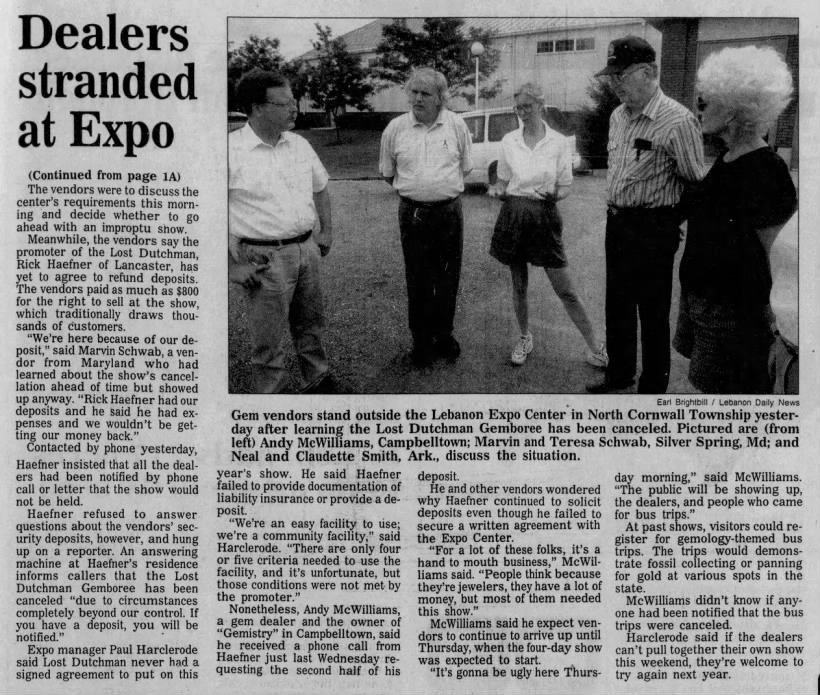
In 1975 Rick was selected as the new head of the Los Angeles Museum of Natural History, which came with a prestigious teaching position at University of Southern California in LA… but in August of that year, two young boys that had worked in the Haefner family rock shop would separately come forward and accuse him of having touched them inappropriately, and as a result he was charged with involuntary deviant sexual intercourse and corruption of a twelve-year-old boy. Although his subsequent trial resulted in a hung jury, these accusations resulted in the recension of his job offer and did irreparable damage to his reputation.
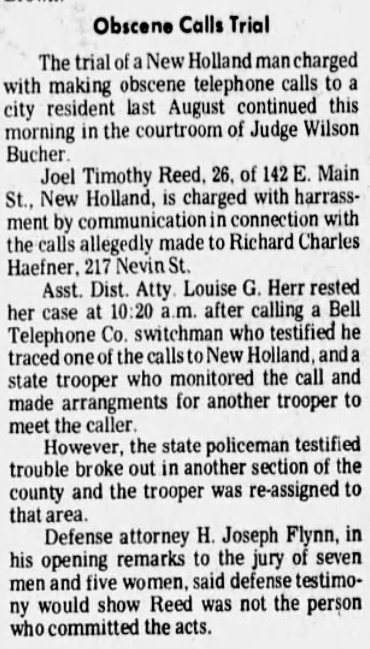
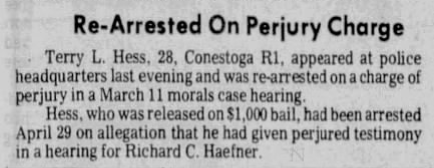
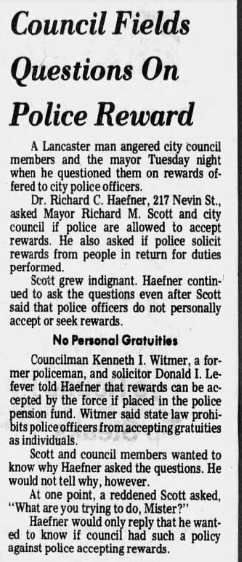
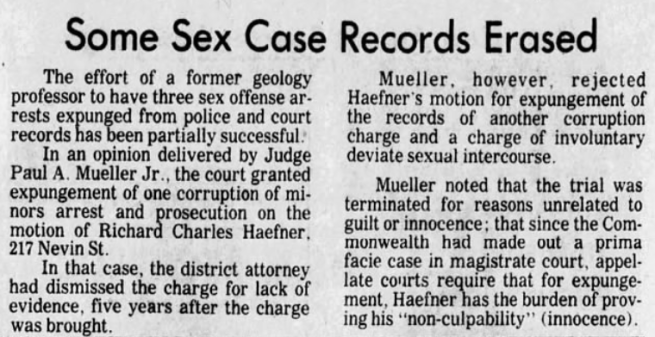
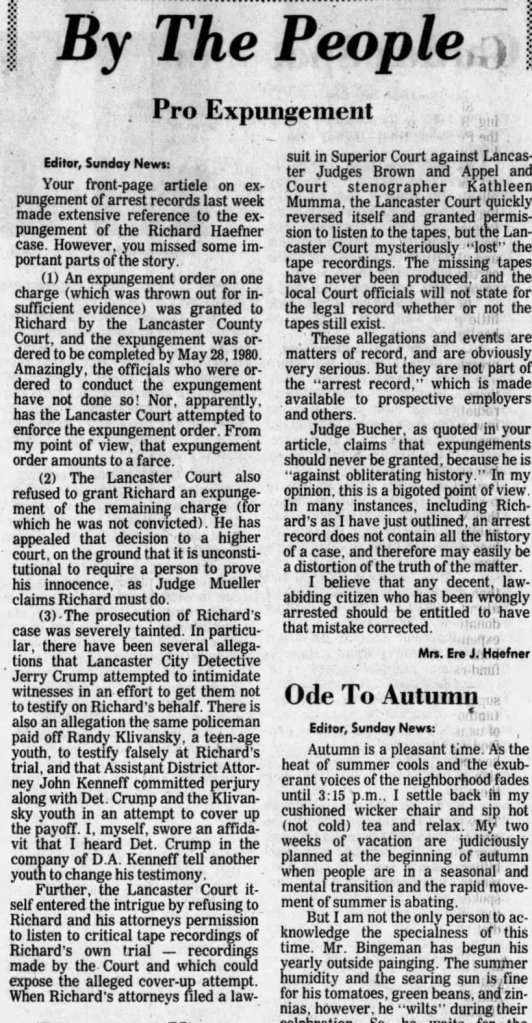
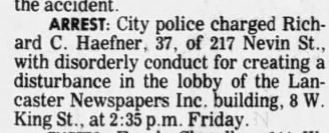
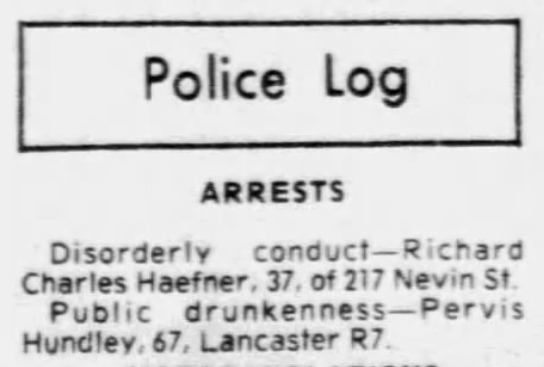
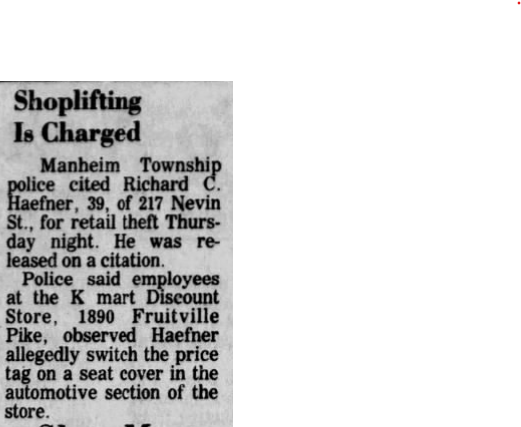
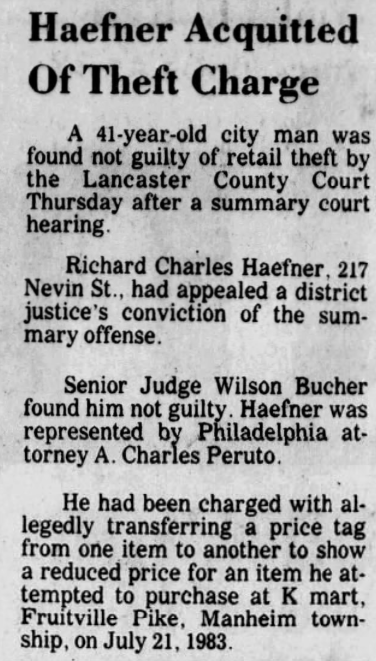
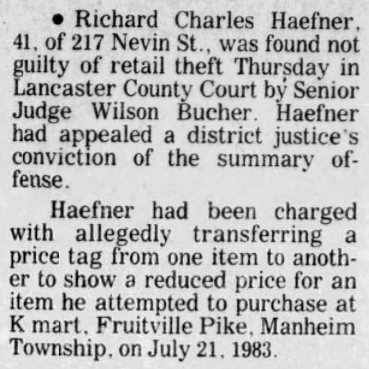
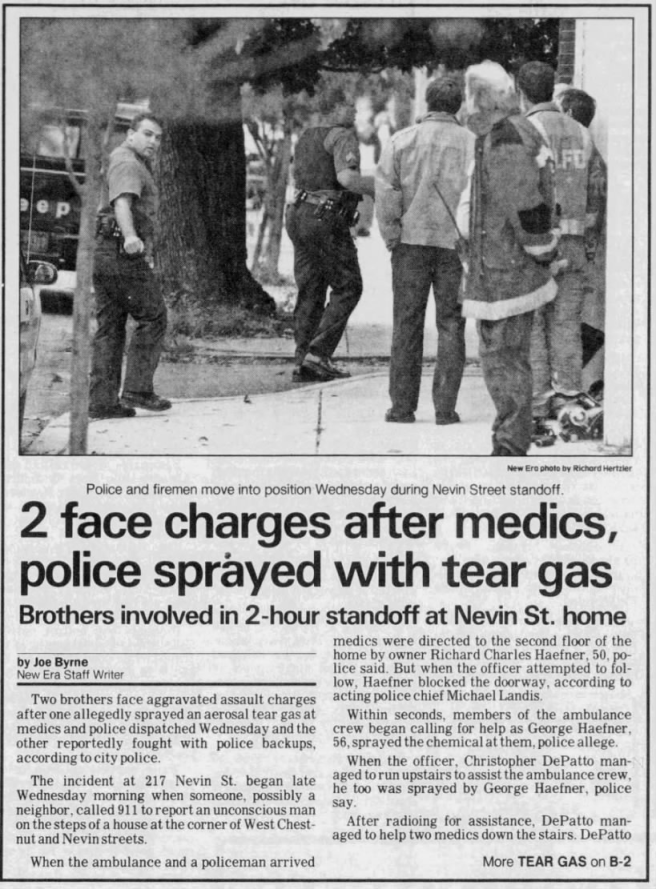
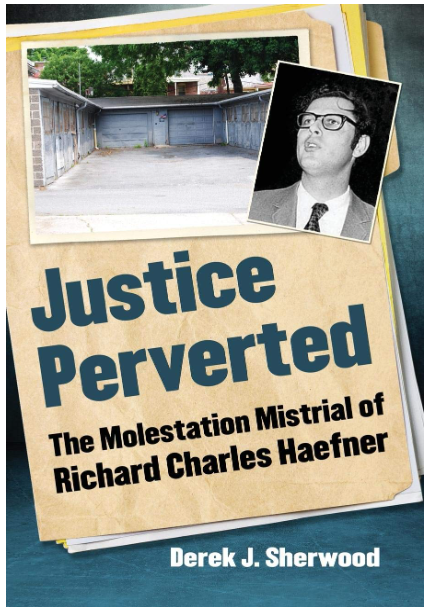
After this, Haefner began filing a number of vindictive lawsuits against anyone that accused him of any and all wrongdoing, and where he was successful in his attempt to expunge the records pertaining to his arrest and trial in 1981, he was later convicted of assaulting a woman in 1998 after he dragged her from her car and beat her until he dislocated her jaw; he has also stood accused of harassed his neighbors and was arrested more than once for shoplifting. In 2009, one of Haefner’s nephews contacted Derek Sherwood to divulge that after his initial arrest in approximately 1975, he had overheard a heated conversation between him and his mother, who had been aware of several accusations of pederasty that had been made over the years against her son. The overall context of the conversation indicated that he had confessed to Ere (at some point in time) of killing Betsy, and she ended the exchange with the phrase: ‘you killed that girl, and now you’re killing me!;’ also during that same encounter, she had also gave Rick a hard time for coming to the attention of the police after ‘all her effort’ to protect him’ on the previous occasion.
In recent years some of the young men that Rick had ‘befriended’ came forward and said that he had taken them on ‘field trips’ to Penn State, and on one occasion he took one of them to the same library stacks where Betsy has been killed and directed him to stand in one spot. He then took a step back, and where the kid initially thought that he was going to show him something interesting, he then said (with a weird, almost satisfied expression on his face) that a girl he had known (or dated) had been murdered in the exact same spot he was standing in.
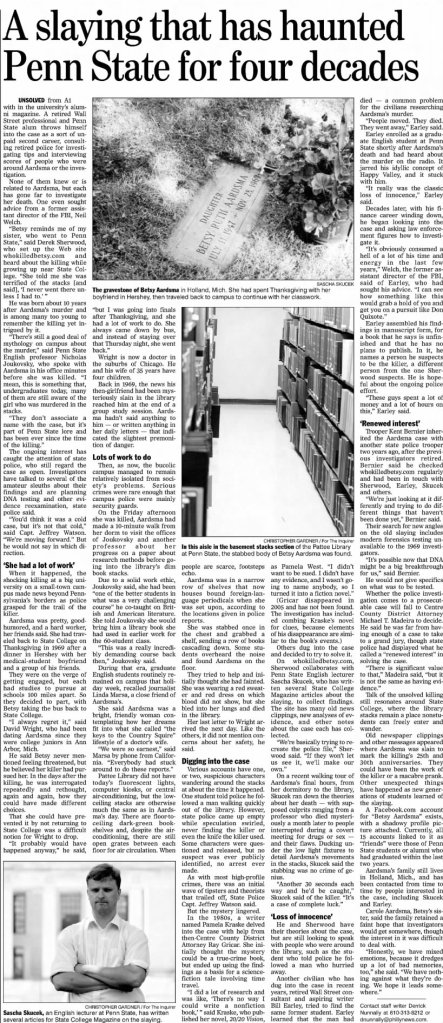
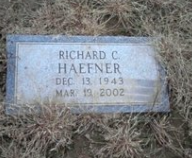
Richard Charles Haefner died at the age of fifty-eight in the bathroom of a Las Vegas hospital on March 19, 2002 after a tear in his aorta (a congenital heart defect) caused him to bleed out into his lungs (which ironically is a similar manner of death endured by Aardsma.) His grave marker is placed with his family in Lancaster, but he was in fact cremated and it is not known for certain if his ashes are buried there or not. According to Haefner’s ‘FindAGrave’ page, he was a ‘talented but deeply troubled Geologist who is remembered today as much if not more for his violent and unpredictable nature as he is for his work in the field of geology and petrology.’ Ultimately, no physical evidence has ever linked Richard Haefner to the murder of Betsy Aardsma, and as a result he was never charged, however according to Sascha Skucek; ‘he is the best suspect, but I don’t like that people act like it’s been solved. There is not a smoking gun that says he did this.’
A Stalker?: although investigators found no proof that Aardsma had been stalked during her short amount of time at Penn State, many years after her death a campus security guard would recollect to author Derek Sherwood that one evening as he performed his security rounds in the days prior to her murder, he had observed Betsy typing alone in the Pattee Library. The former officer recalled that at the end of the night he asked her if she wanted him to walk her to her dormitory, to which she said: ‘No. The guy who lives upstairs isn’t around, so I’ll be fine.’ As I said earlier, Richard Haefner lived in the same residence hall as Betsy, however there was never any clarification as to who she was referring to.
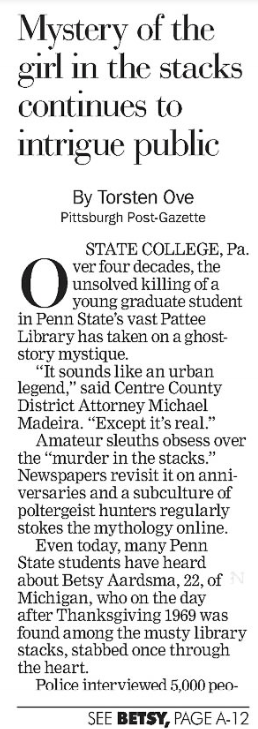
Despite the best efforts of the Pennsylvania State Police and the President of the University, Eric Walker (who had conducted his own private investigation into Aardsma’s murder), the case gradually went completely cold, and over the years things took on almost a supernatural aspect: on the twenty-fifth anniversary of Betsy’s death someone left a candle burning in exact spot in the library where she had been fatally wounded, along with an original newspaper clipping about the crime and a message that read, ‘RIP Betsy Aardsma, born July 11, 1947, died November 28, 1969. I’m back.’ A similar spectacle was discovered in a different part of the library in 1999, however investigators believe both incidents were pranks.
Conclusion: The Aardsma family endured decades of unresolved grief following Betsy’s murder, with her parents channeling their loss into supporting other families who had experienced the murder of a child. After the murder, Penn State made no attempt to keep in contact with the Aardsma’s, and it almost appeared that they tried to brush the entire thing under the rug; according to Mrs. Aardsma in an interview with Ted Anthony of The Daily Collegian in 1989: ‘when it happened the school was quite nice, but we really never met with the administration. I think they were very worried the University would get a bad name. So the victim is sort of pushed aside, I guess.’ Betsy’s brother and two sisters have maintained privacy regarding the incident and decline most interview requests, with her sister Carole saying, ‘I’ve said all I’m going to say.’ Betsy’s police file (which spans sixty-five years and consists of over 3,000 pages) remains sealed to the public as of June 2026.
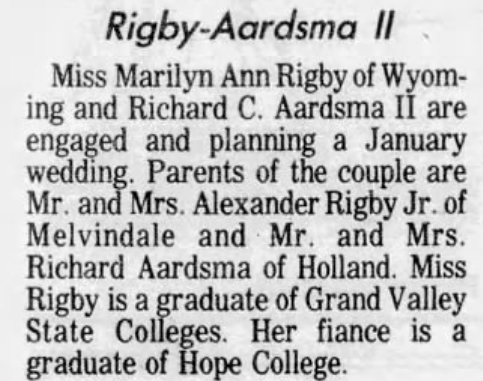
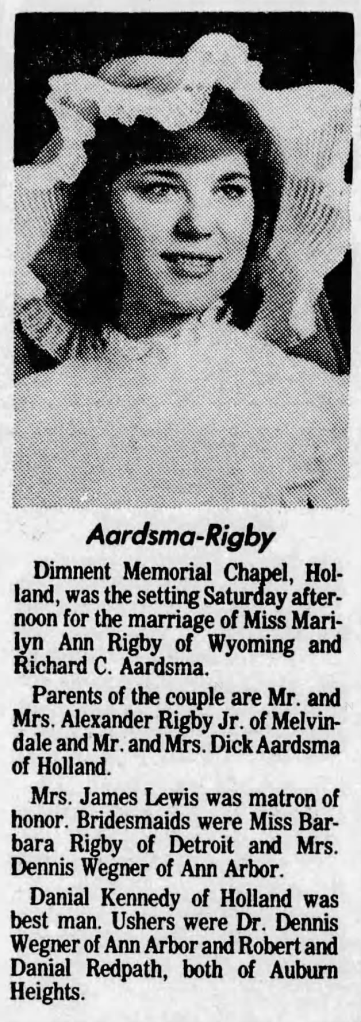
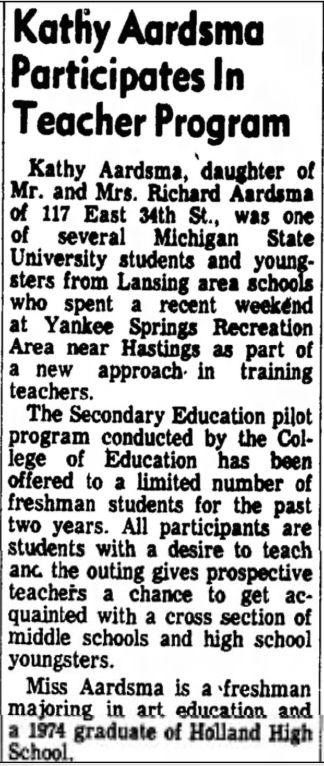
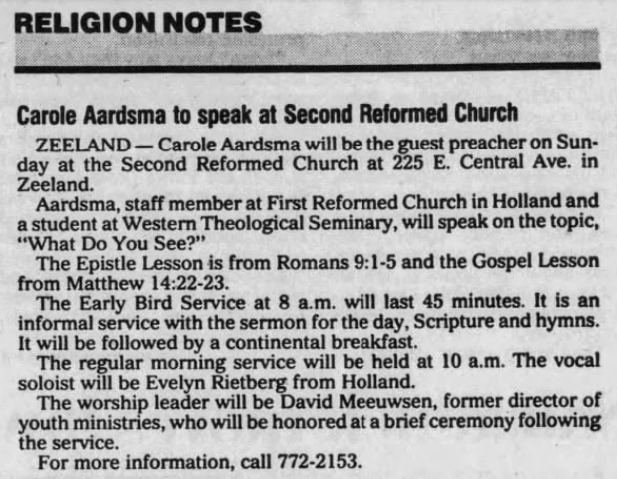
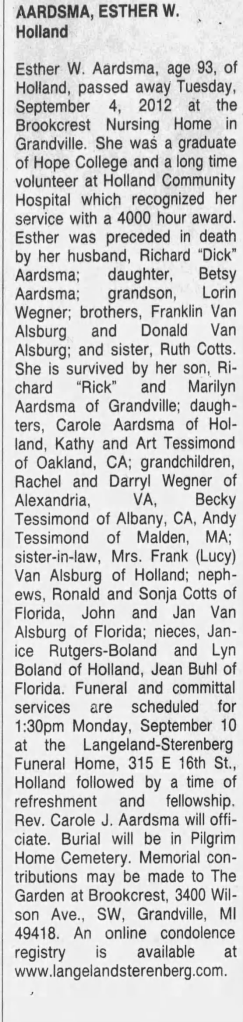
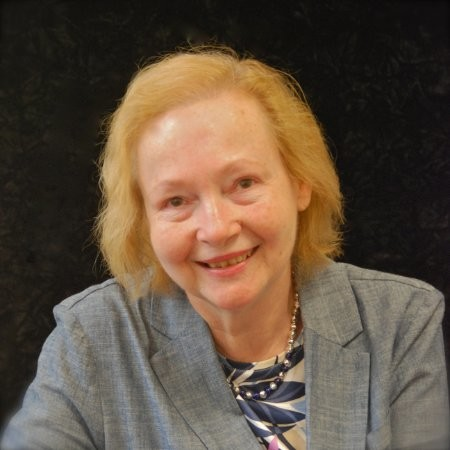
Richard Cornelius Aardsma died at the age of eighty on January 4, 1997 in Holland, Michigan, and Betsy’s mother Esther died at the age of ninety-three on September 4, 2012 in the Brookcrest Nursing Home in Grandville. According to her obituary, she was a longtime volunteer at Holland Community Hospital, who had at one time recognized her service to them with a ‘4,000 hour award.’ Carole Aardsma was once a teacher before she changed career paths and became a Reformed Church minister; she currently lives in Holland, MI. Richard and his wife Marilyn reside in Holland and he is a retired graphic artist for the Kent County School system in Michigan, until he retired and now he creates (beautiful) paintings, which are featured on his website. Betsy’s younger sister Kathy found success as an art instructor in Amesbury, MA before she retired, and currently lives with her husband Art in Holland, MI.
Works Cited:
Daly, Kim (November 28, 2025). ‘The Fatal Stabbing of Penn State Student Betsy Aardsma Remains Unsolved More Than 55 Years Later.’ Taken June 12, 2026 from aetv.com
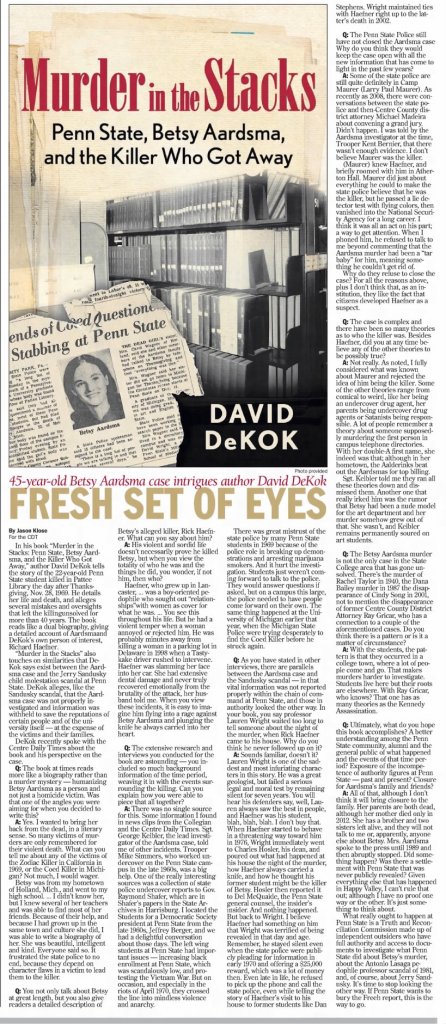
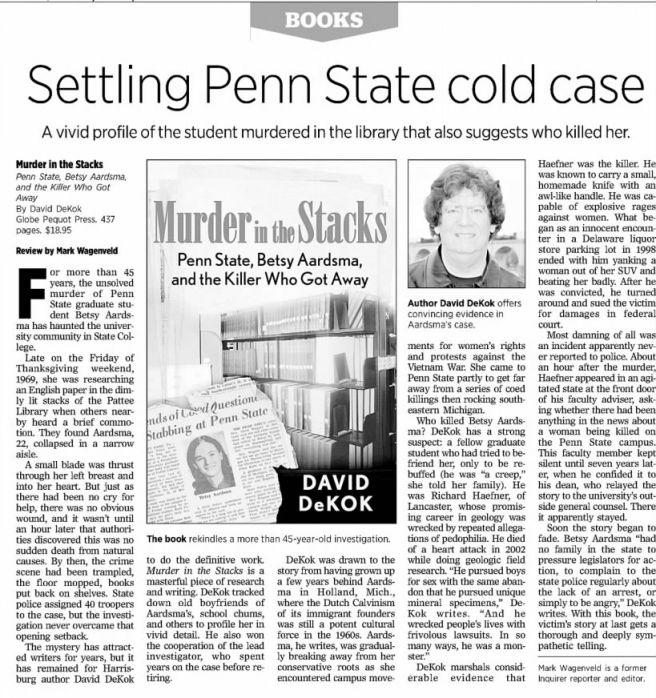
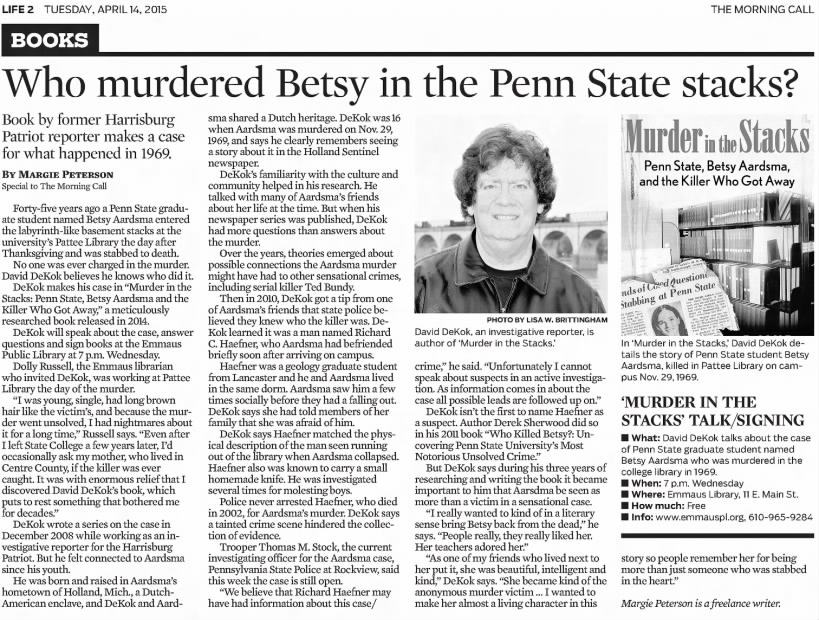
DeKok, David (2014). ‘Murder in the Stacks: Penn State, Betsy Aardsma, and the Killer Who Got Away.’
Sherwood , Derek (May 30, 2018). ‘Justice Perverted: The Molestation Mistrial of Richard Charles Haefner.’
Sherwood , Derek (December 7, 2011). ‘Who Killed Betsy? Uncovering Penn State University’s Most Notorious Unsolved Crime.’
Skucek, Sascha. (January 1, 2025). ‘Blood & Burden: The Enduring Mystery of Betsy Aardsma. Taken June 12, 2026 from statecollegemagazine.com
Smart, Gil. (October 10, 2010).’Who killed Betsy Aardsma?’ Taken June 12, 2026 from lancasteronline.com

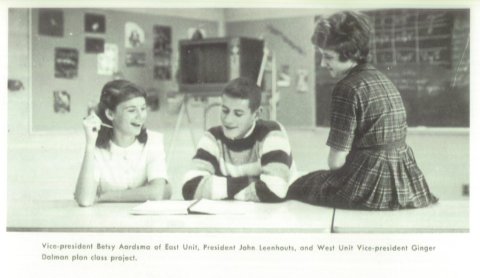
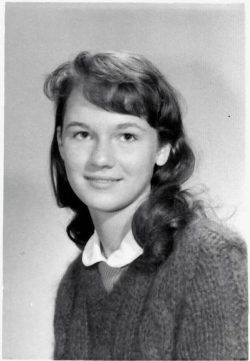
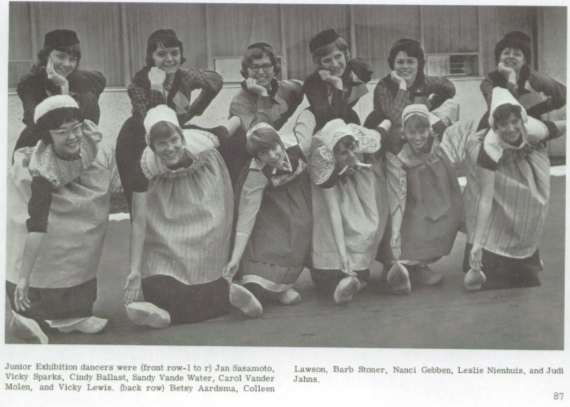
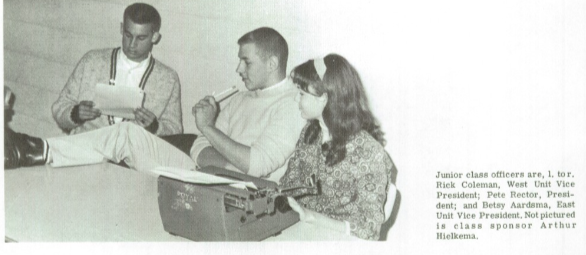
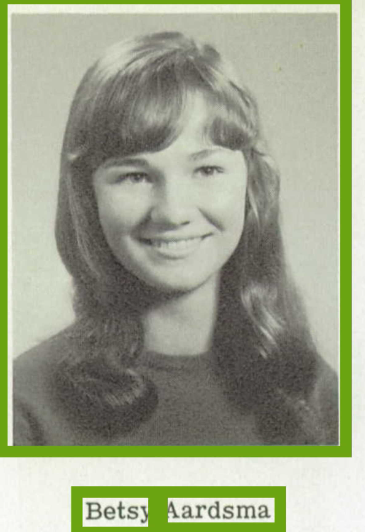
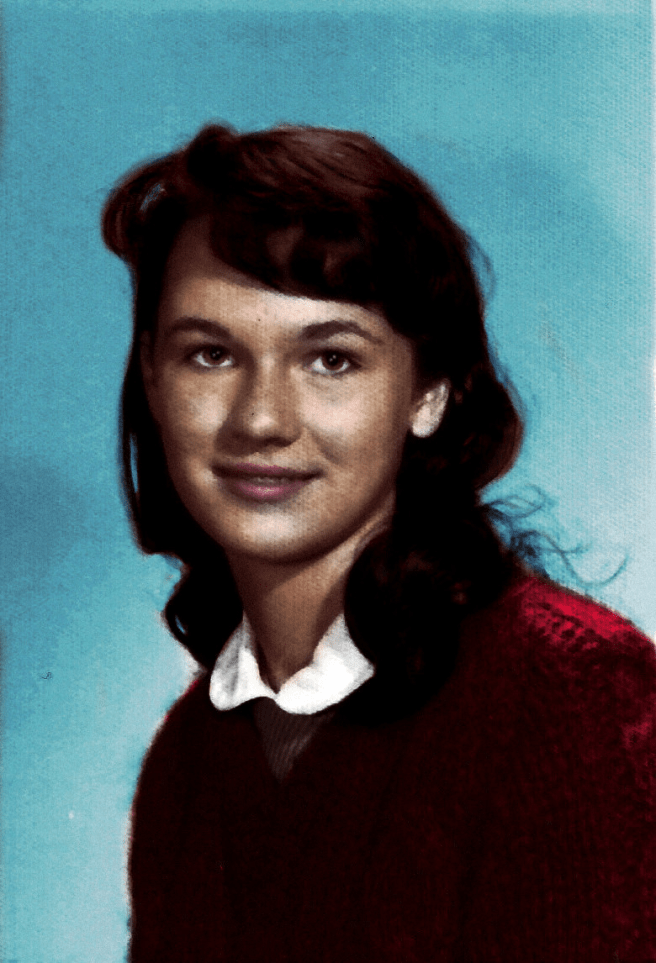
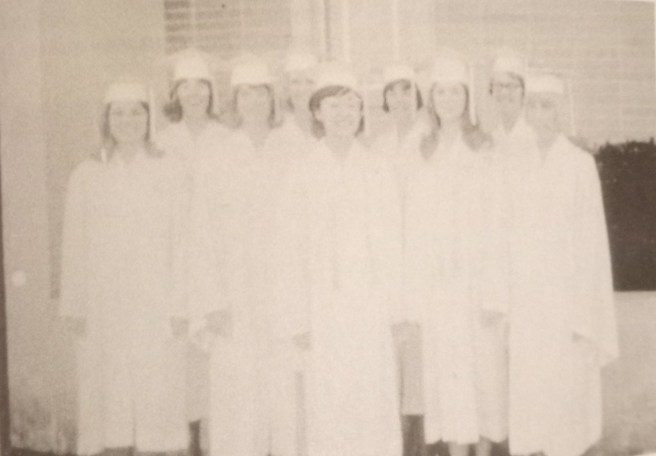
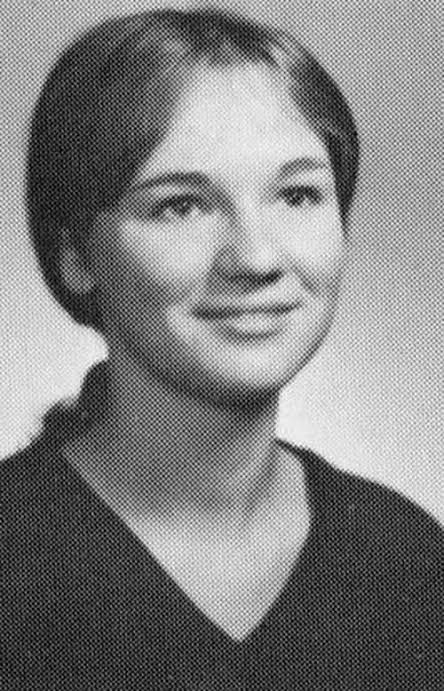
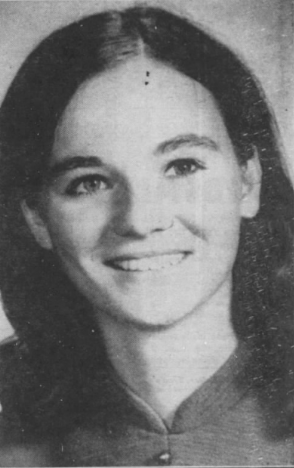
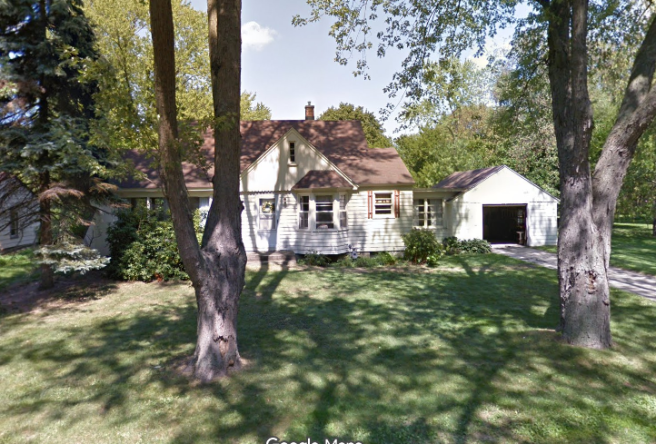
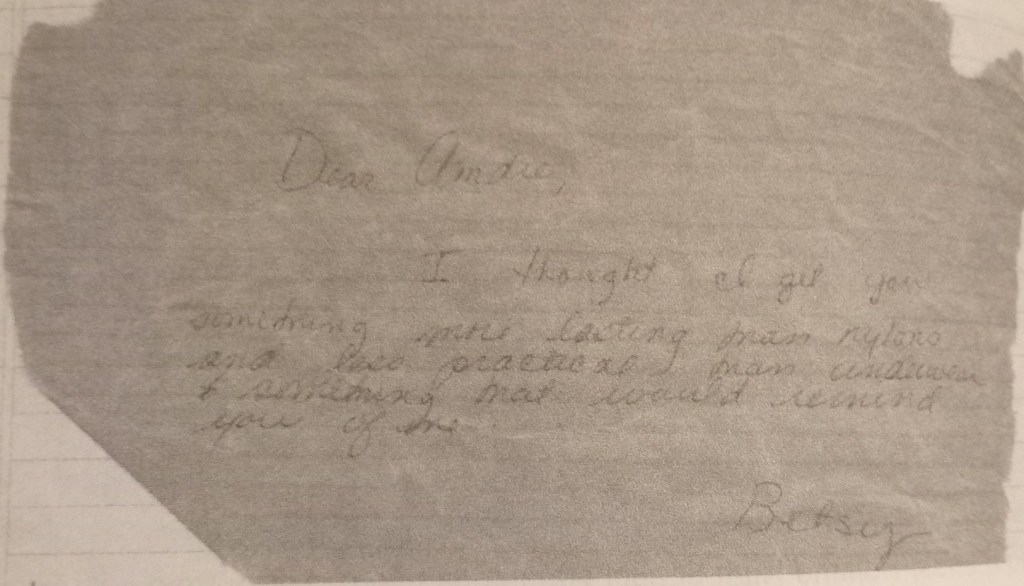
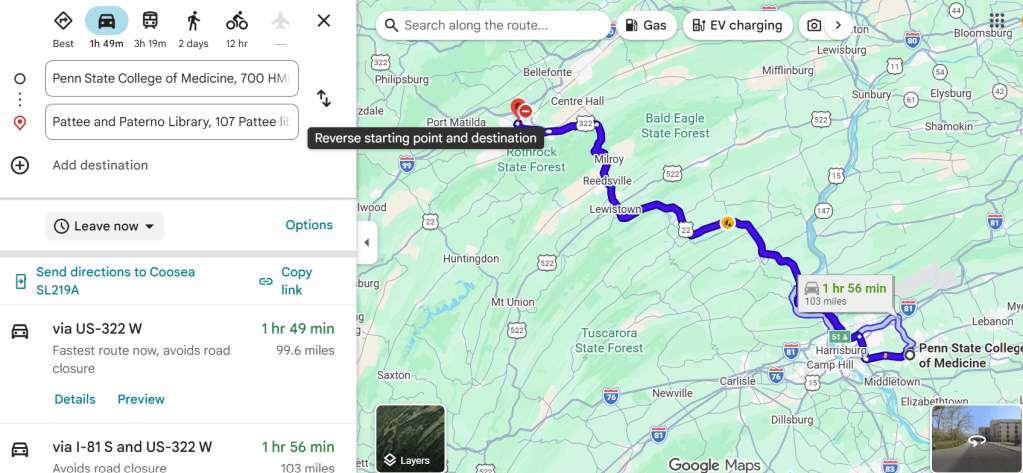
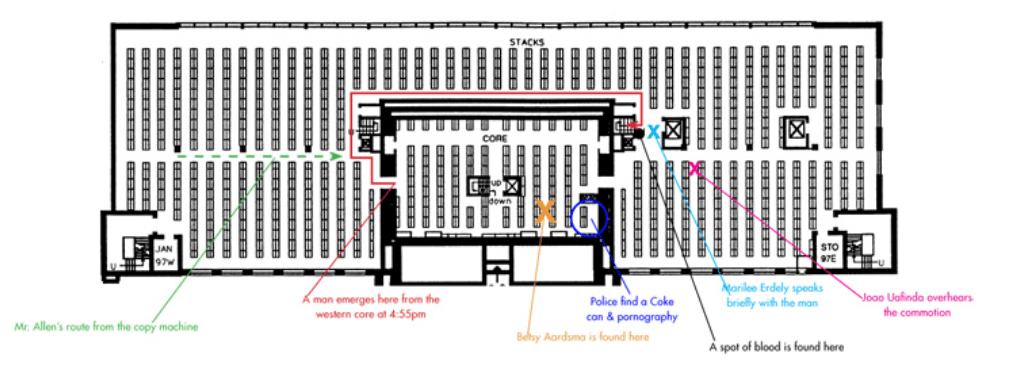
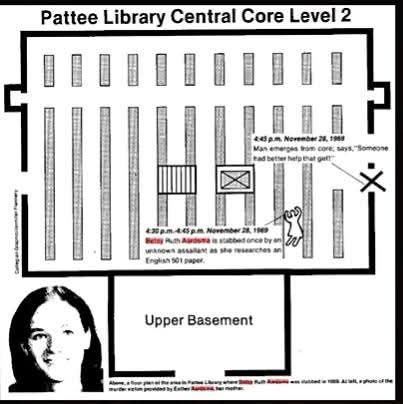
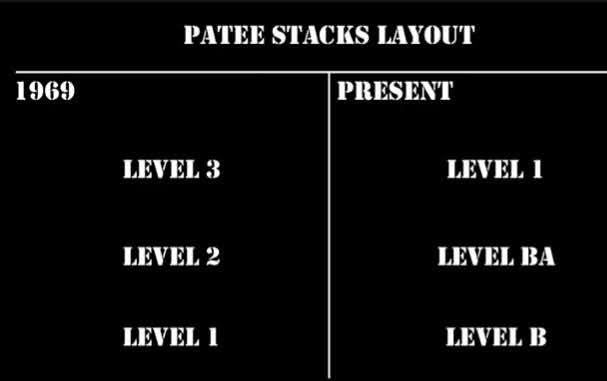
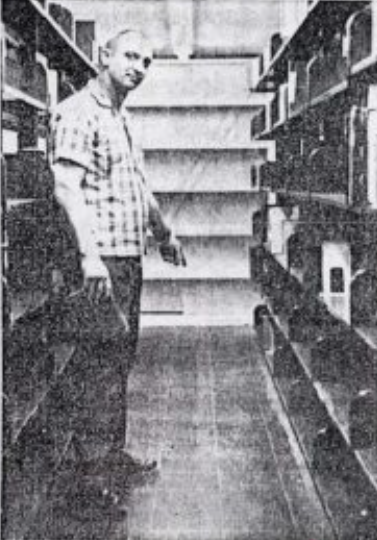
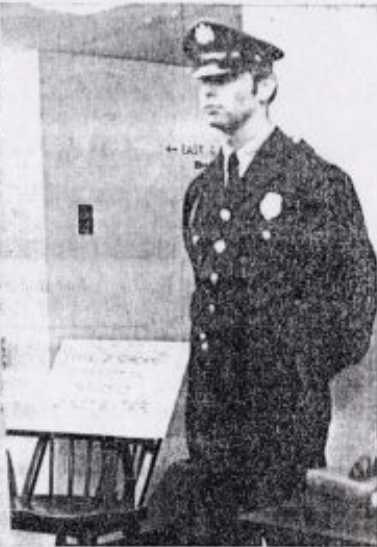
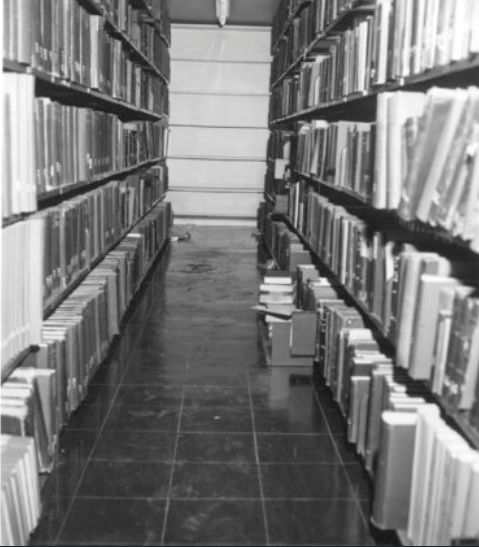
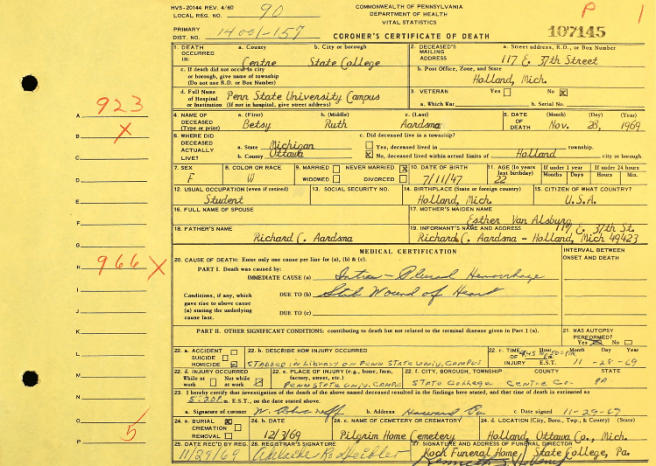
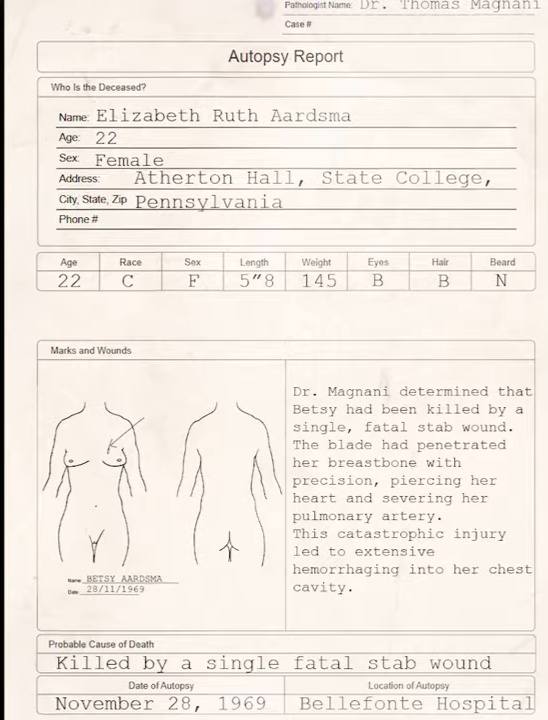
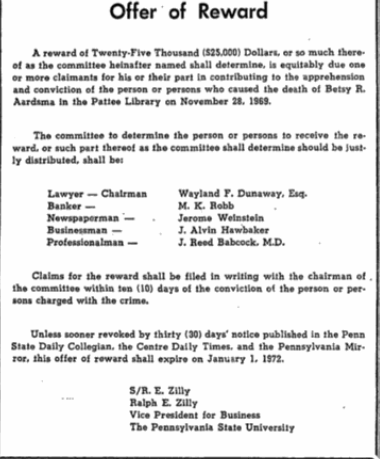
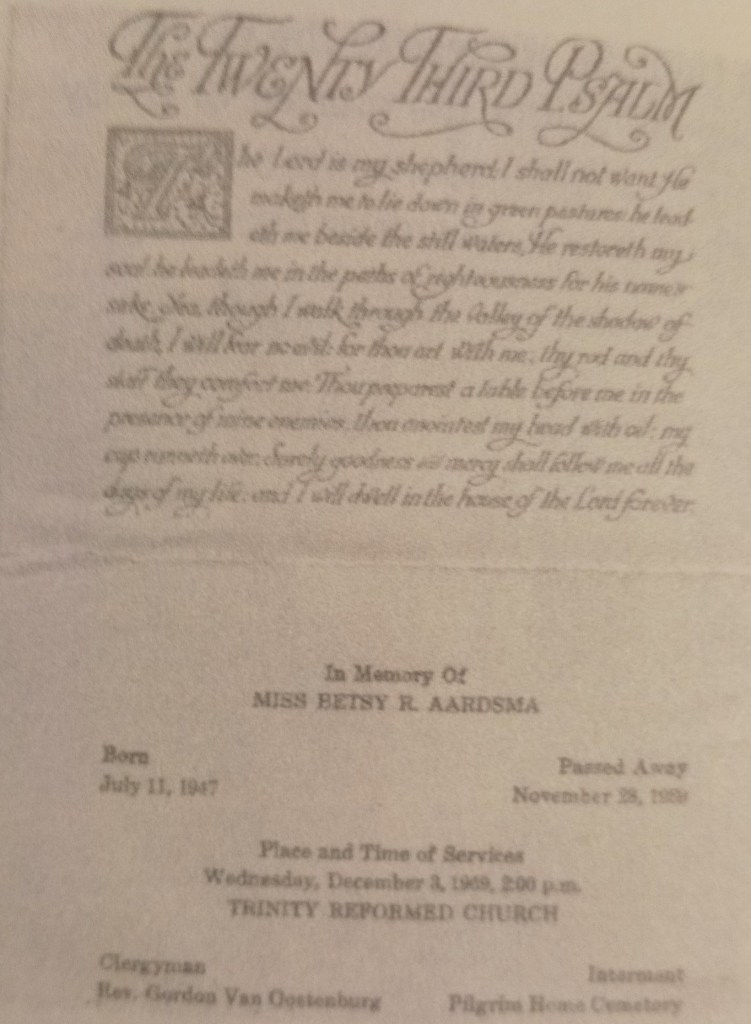
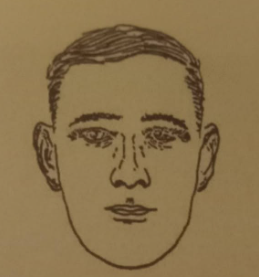
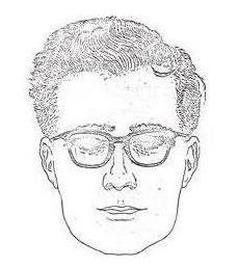
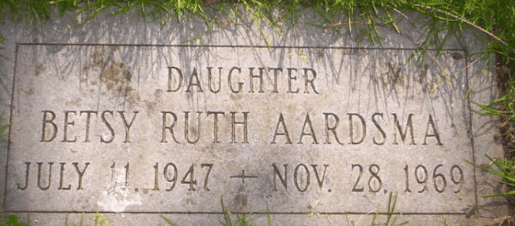
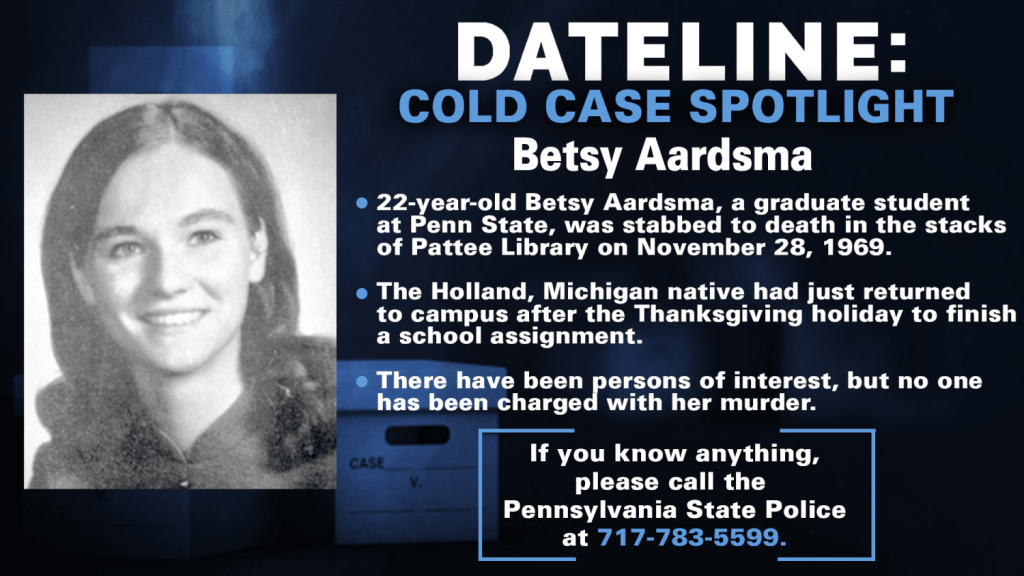
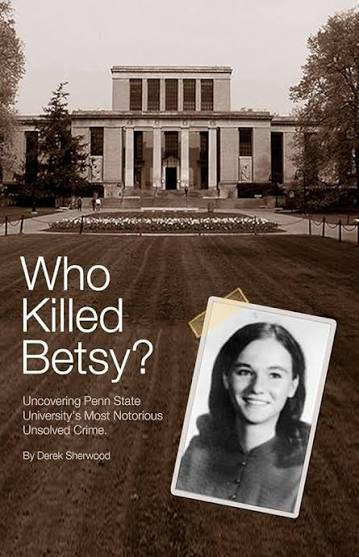
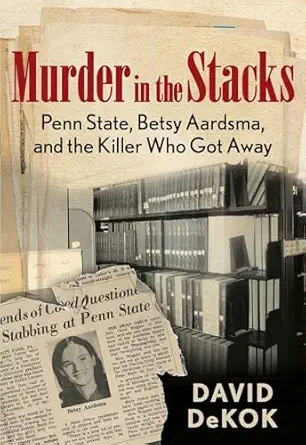
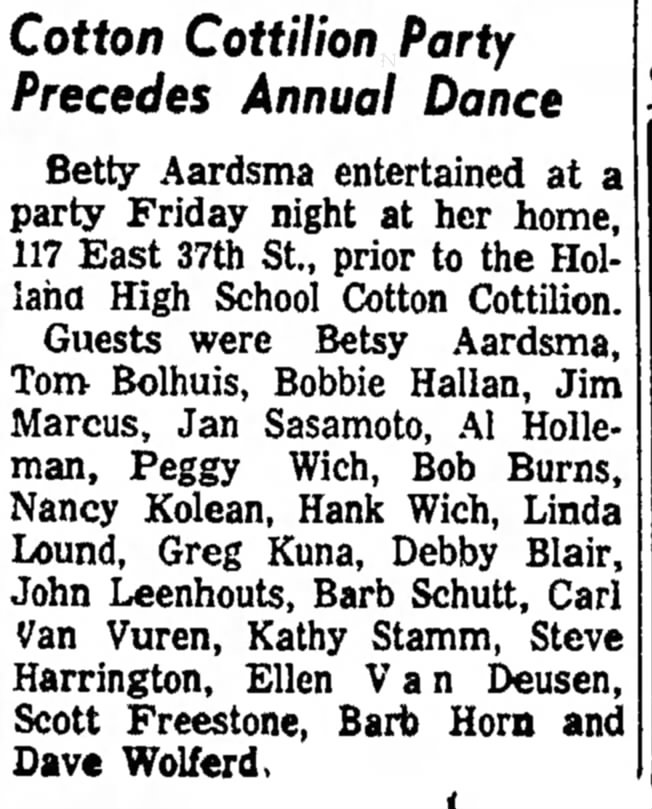
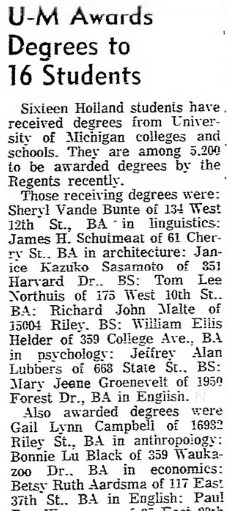
Betsy’s name is listed amongst the name of local college graduates that was posted in The Holland Sentinel on June 17, 1969.