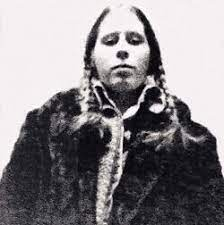
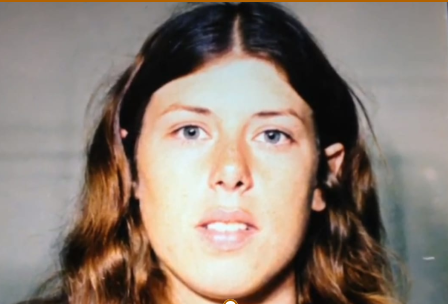
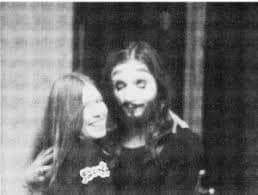
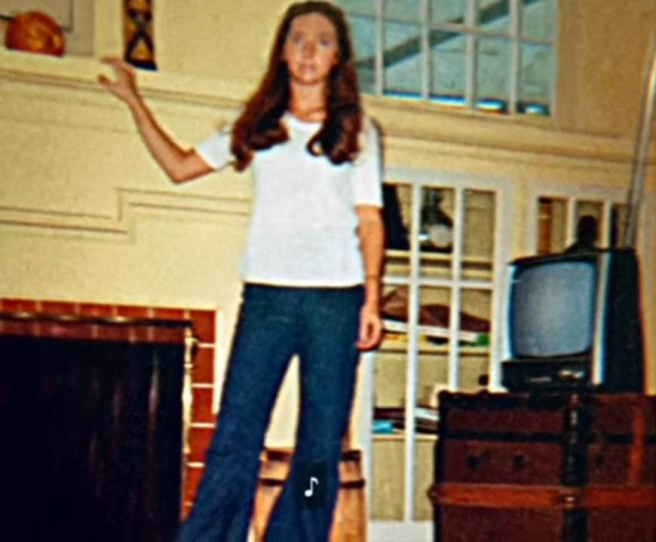
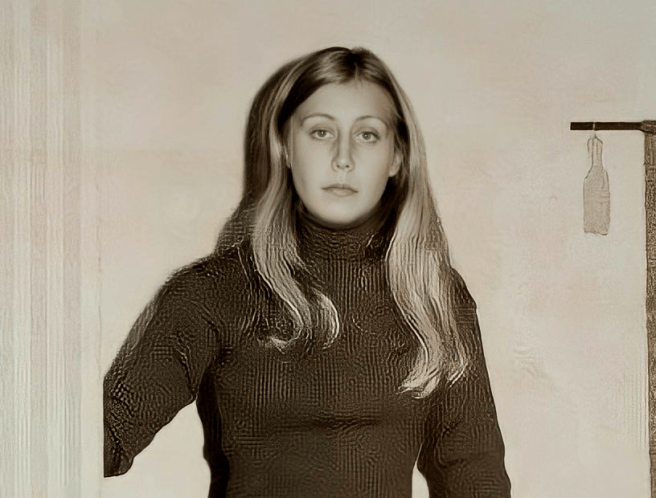
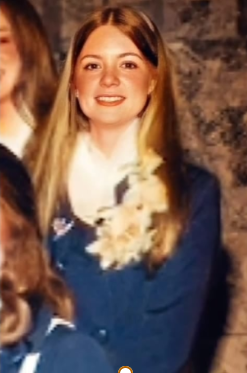
Donna Gail Manson: Donna Manson was a nineteen-year-old student at ‘The Evergreen State College’ in Olympia, WA when she became the third (confirmed) victim of Ted Bundy on March 12 .1974. Born on June 9, 1954 to Lyle Edward and Marie Elizabeth (nee Nilson) Manson, Donna’s father was a music teacher for the Seattle public school district, and her mother was a church choir director and part-time legal secretary. She grew up in Auburn, WA and followed in her parents’ musical footsteps and was an accomplished flutist and talented poet; Donna was described as highly intelligent with a high IQ and was physically small in stature, standing in at only 5 feet tall; she weighed roughly one-hundred pounds and had long brown hair and blue eyes.
Donna graduated from Auburn High School in 1972, and that summer she went to Europe with her (then) boyfriend, and upon returning home she enrolled at Green River Community College. In early 1974 she transferred to Evergreen State in Olympia, a place she was drawn to because of its progressive academic environment and courses in alternative subjects, like the ‘I-Ching’ and alchemy; while there, she enrolled in a coordinated sixteen-credit study program called ‘P.O.R.T.E.L.S.,’ which stood for ‘Personal Options Reaching Towards Effective Learning Skills.’
Described by her loved ones as a ‘free spirit,’ Manson struggled with bouts of depression and anxiety, which adversely affected her academic performance (it was reported that she was also suicidal at times); to most people, she seemed like an introverted young woman that enjoyed spending time alone. On occasion, she engaged in high-risk behaviors that were common for the era, such as hitchhiking and taking impromptu trips without telling any loved ones; she would frequently stay out late and liked to skip class and was known to ‘couch surf’ amongst her friends’ residences.
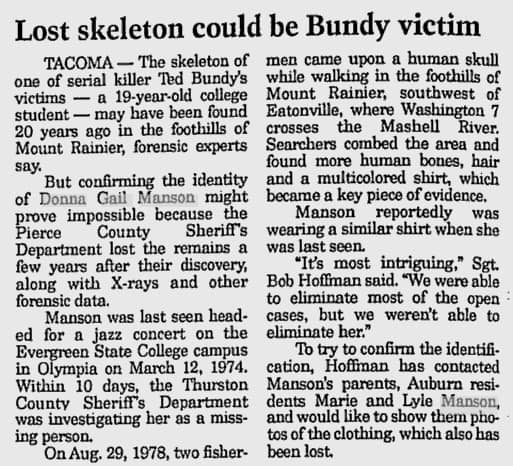
On the evening of March 12, 1974, Manson left her dormitory around 7:00 PM to attend a campus jazz concert on the first floor of the Daniel J. Evans Library, which is considered to be the heart of The Evergreen State College’s Olympia campus; she was last seen walking toward the library wearing a red/orange/green striped top, green slacks (or pants), and a dark fuzzy maxi-coat (she also had on a Bulova wristwatch and an oval-shaped brown agate ring). Because she enjoyed traveling and would frequently disappear for days at time without telling her peers, she was not officially reported missing until March 18th, a full six days after she was last seen. When her room was checked, she had left all her personal belongings behind, including her purse, money, and clothes.
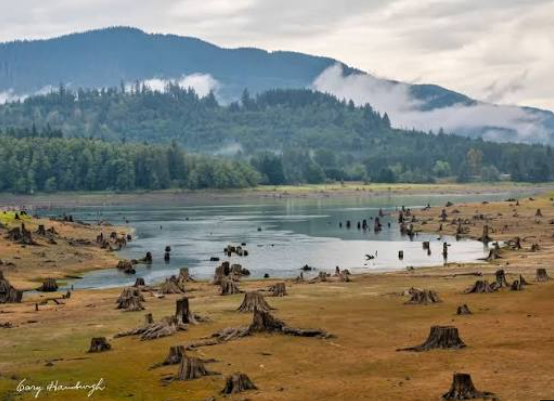
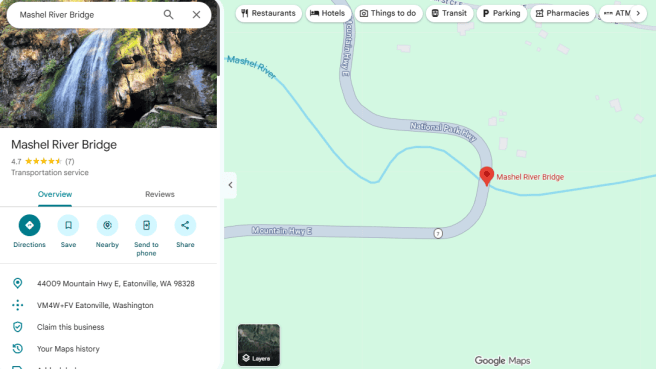
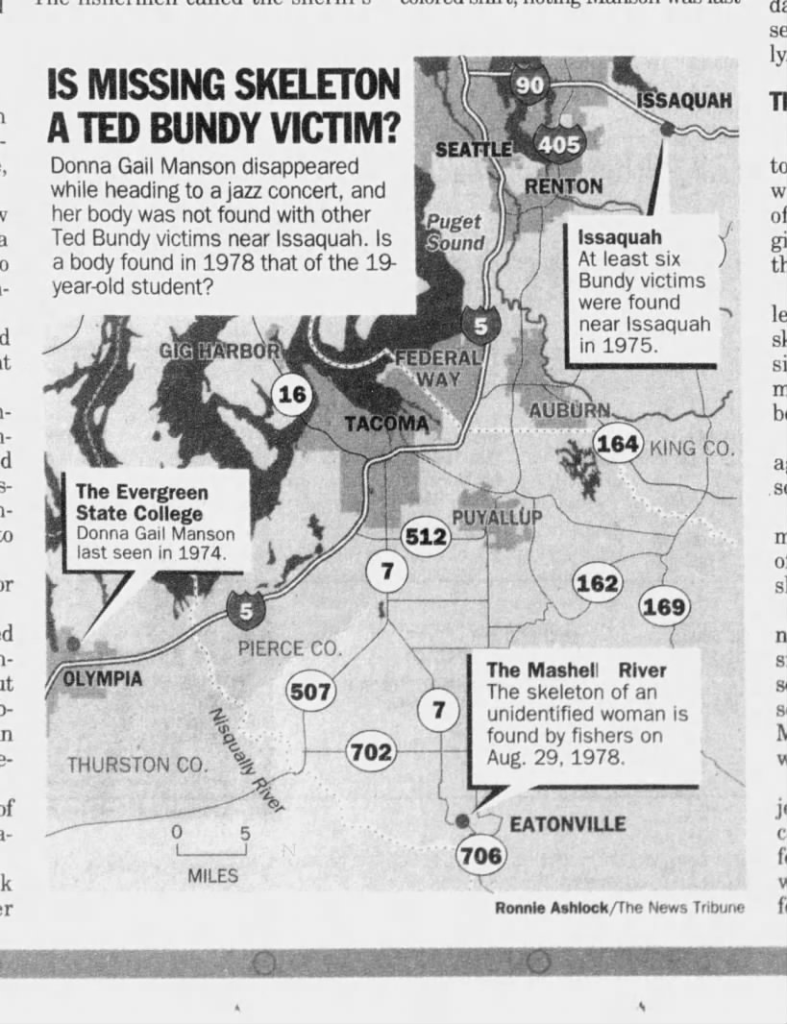
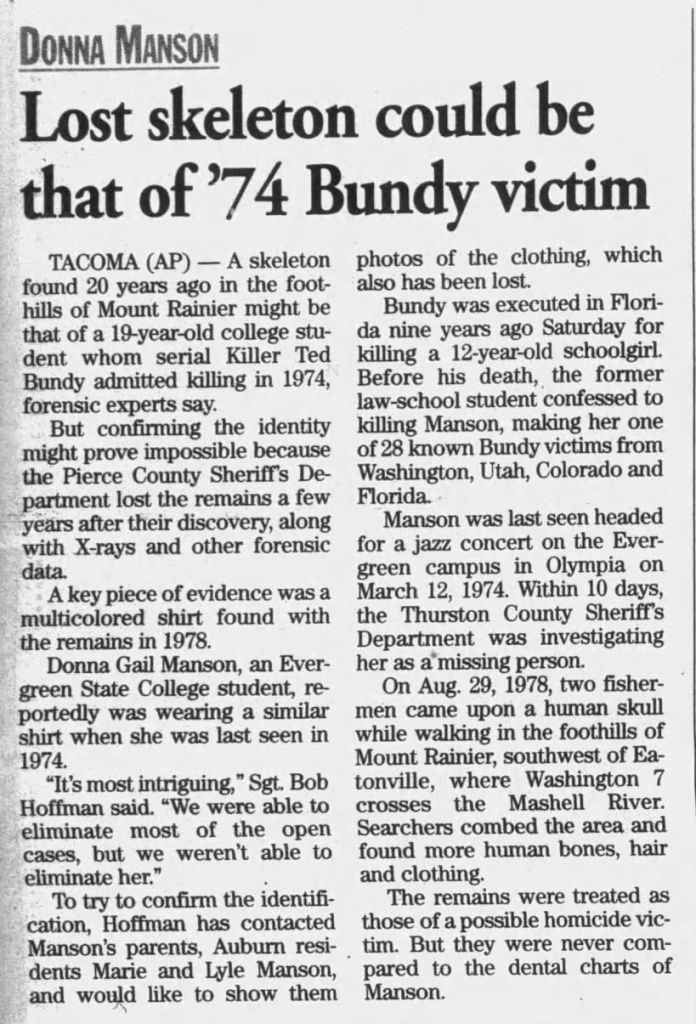
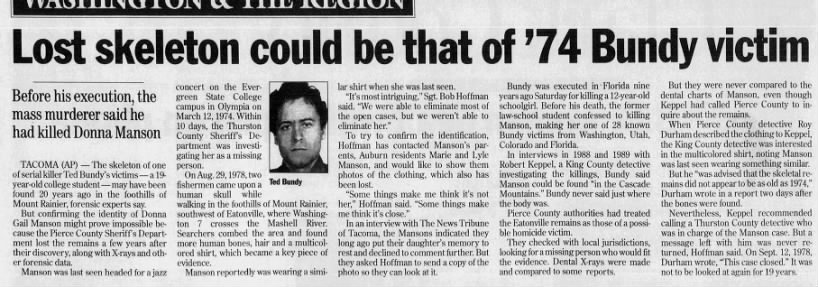
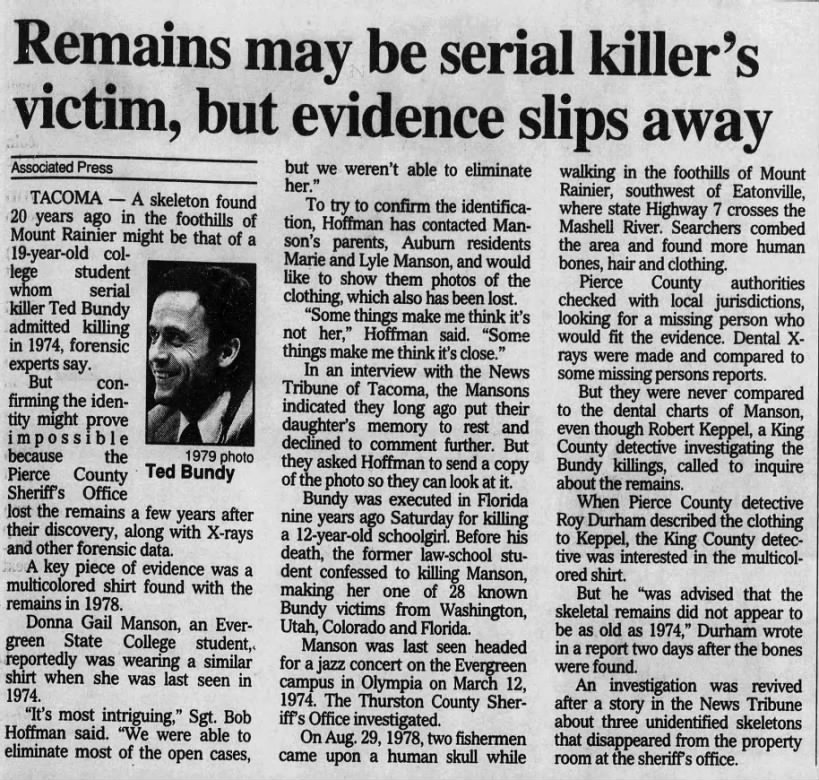
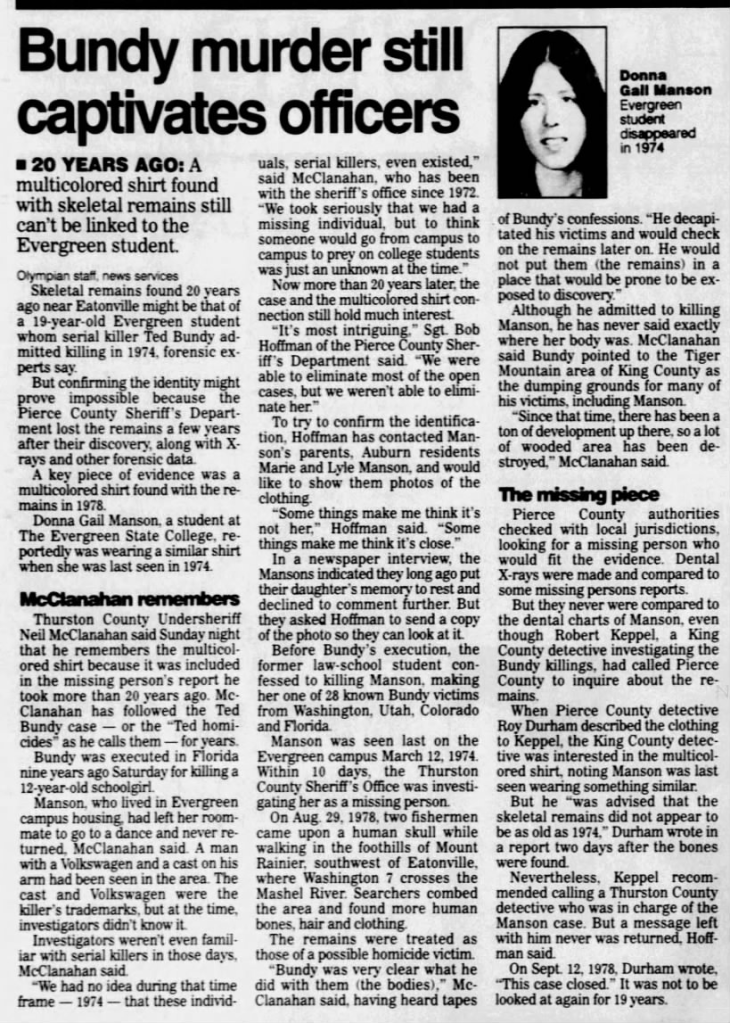
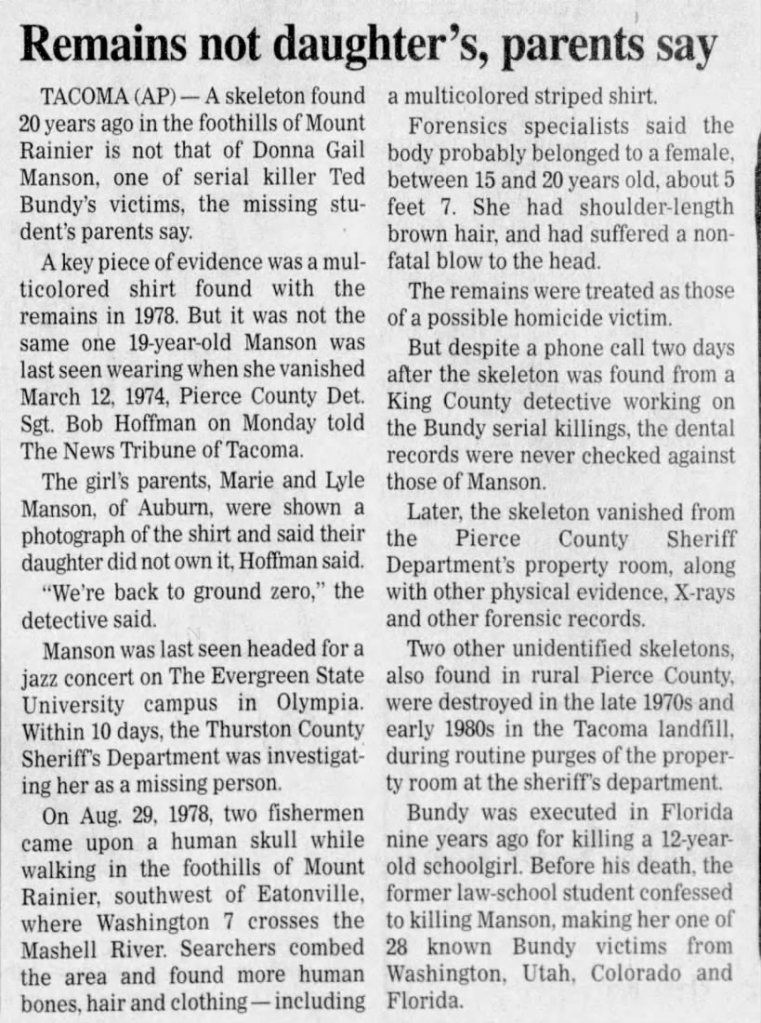
August 29, 1978: on the morning of August 29, 1978 two fishermen out walking on Highway 7 (southwest of Eatonville) found skeletonized remains on the north side of the Mashel River, where it crosses with the Washington 7 after one of them went to kick what they thought was a rock and found out it was really a human skull. They immediately left and contacted the Pierce County Sheriff’s department, and within hours Explorer Scouts were combing the area, which was located only about sixty miles away from Bundy’s Taylor Mountain burial site; further efforts by law enforcement and search teams found additional bones, hair, and clothing. The Mashel River is a prominent salmon-bearing stream that is a little over twenty miles long and located near the town of Eatonville in Pierce County, Washington. The waterway flows through the foothills of Mount Rainier near the town of Eatonville and is a highly protected environmental zone that is managed (in part) by the Nisqually Land Trust to preserve critical spawning habitats of the threatened Chinook salmon and steelhead trout.
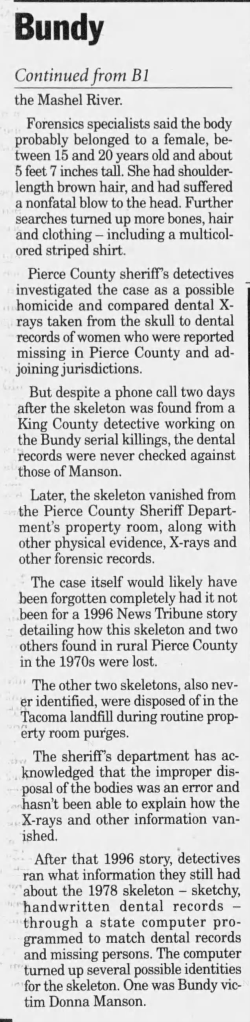
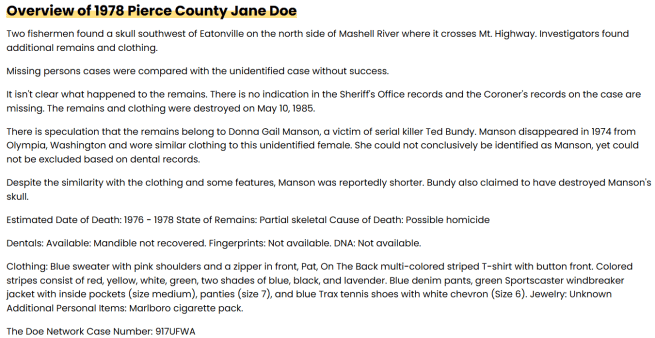
The victim had long brown hair that was roughly thirteen to seventeen inches long and contained blondish highlights; during the autopsy it was determined that the skeleton belonged to a female that was roughly 5’7″ tall and somewhere between fifteen to twenty years old. Her dental records are available, although her mandible was never recovered; her fingerprints and DNA are not available, and due to the advanced level of decomp her eye color is unknown. Her case number with ‘The Doe Network’ is 917UFWA. In an article published in The News Tribune on January 25, 1998, forensic experts noted that the Jane Doe possessed a ‘small crescent-shaped depression’ and fracture on the back that measured about one inch in diameter that was likely caused by a hammer striking a pointed blow at an odd angle or by a tire iron.
She was wearing a zip-up blue sweater with pink shoulders (of an unknown brand) with arm bones found inside; a Marlboro cigarette pack was found near the body along with a girl’s tee shirt with button front and red, yellow, white, green, two colors of blue, black, and lavender stripes on it (made by the brand ‘Pat, On the Back).’ She was also wearing size seven panties, blue pants with no distinguishing markings, and a medium-sized green Sportscaster windbreaker (that had pockets on the inside); on her feet were size six Trax brand tennis shoes that were blue with white chevron stripes.
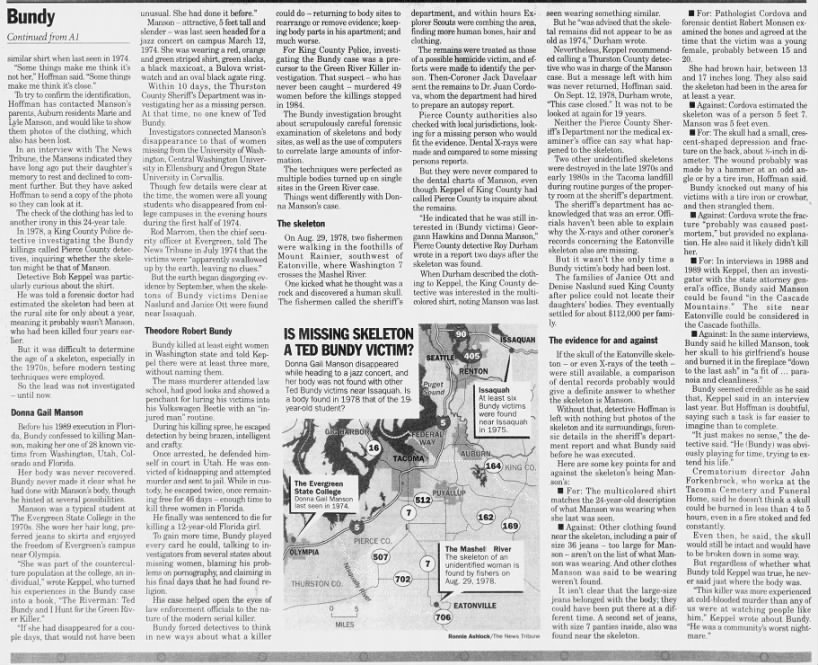
From the very beginning, the remains were treated like that of a homicide victim, and the Pierce County Medical Examiner estimated the young victim had been deceased for roughly one to two years (therefore had been killed sometime between 1976 to 1978. Pierce County Coroner Dr. Jack Davelear sent the remains to Dr. Juan Cordoca, a forensic dentist that the department hired to prepare an autopsy report, and per Detective Ray Durham, ‘the remains most likely belonged to either Donna Manson or Georgann Hawkins’ (although most investigators felt it was more likely Manson due to the shirt she had been found wearing). The Pierce County detective also advised Bob Keppel that ‘the skeletal remains did not appear to be as old as 1974,’ and in response to this, the he recommend that Durham try reaching out to the Thurston County Detective that was overseeing the Manson case, but the call was never made, and the case was closed on September 12, 1978 (I will touch more on the 1978 Eatonville Jane Doe in relation to Bob Keppel later).
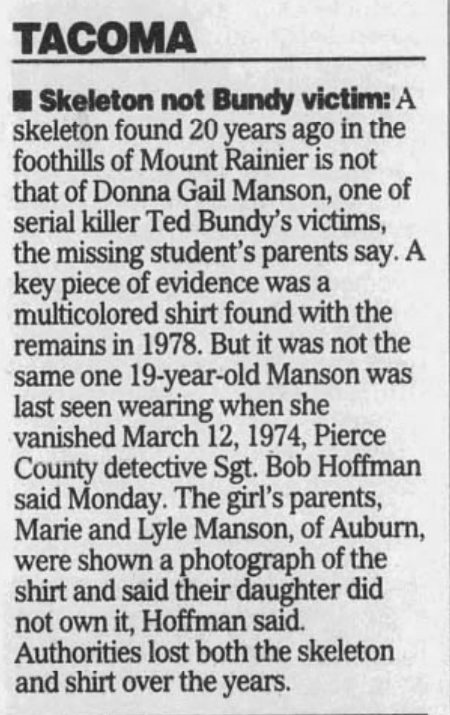
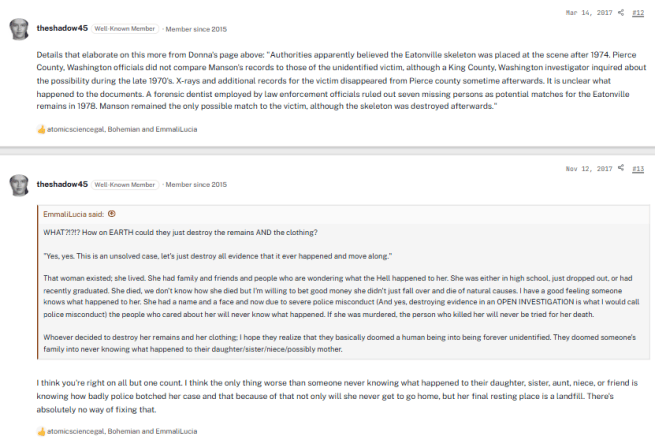
Before a conclusive positive ID could be made, the physical remains and clothing related to the 1978 Pierce County Jane Doe were destroyed during a routine purge of the Pierce County Medical Examiner’s Office on May 10, 1985, after they were examined by a forensic dentist (who determined there was a strong possibility that the skeleton belonged to Manson). In addition, documents and x-rays related to the case were lost/thrown out, although it is worth mentioning that color photographs of the remains and clothing were taken and saved. In addition to the 1978 Eatonville Jane Doe, two more skeletons were destroyed in the late 1970’s/early 1980’s in the Tacoma landfills during ‘routine purges of the property room of the sheriff’s department.’ Personally, I wonder if the remains found in 1978 belonged to a different (unknown) Bundy victim: I know people will argue that he was in prison by then many states away and he wouldn’t have been able to commit a murder in Washington, but even law enforcement admitted they weren’t sure when victim was killed (which makes sense, as it was the 1970’s).
Ted Bundy’s Confession: after they were first discovered (now retired) Pierce County detective Roy Durham said that he felt the bones did not appear to go back as far as 1974 and did not appear to suffer from any blunt force trauma to the head (which was common in Bundy victims), however I do want to point out a contradiction to this: in an article published in The News Tribune on January 25, 1998, forensic experts noted that the 1978 Pierce County Jane Doe possessed a ‘small crescent-shaped depression’ and fracture on the back that measured about one inch in diameter that was likely caused by a hammer striking a pointed blow at an odd angle or by a tire iron.
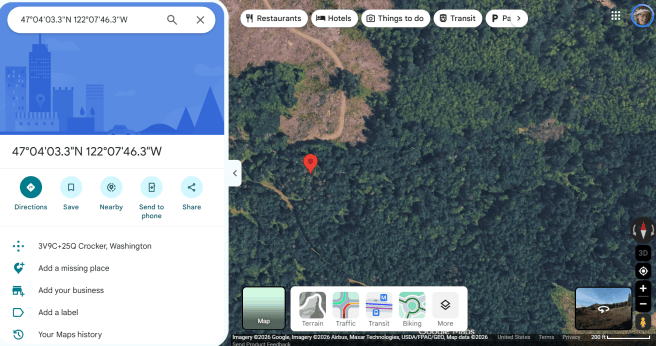
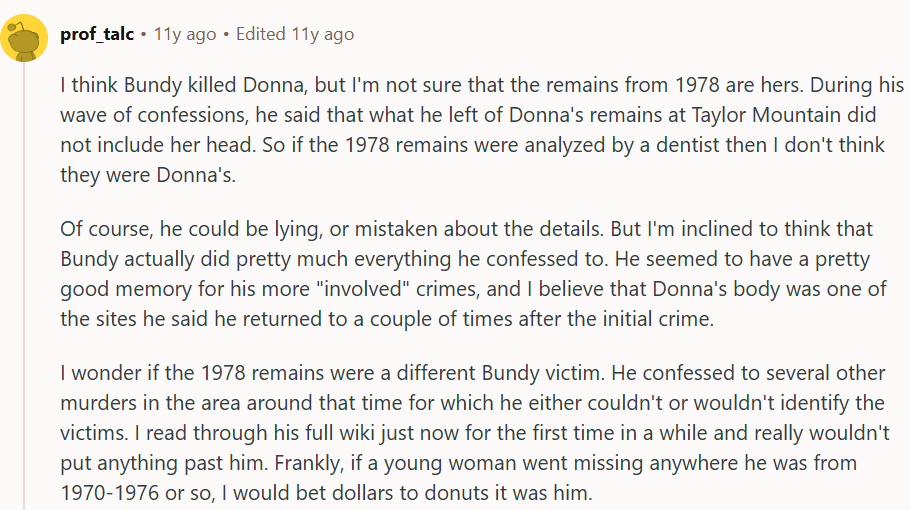
Ted Bundy’s Confession: during his death row interview with Bob Keppel on January 20, 1989, Ted claimed that he left Manson’s body ‘up in the mountains’ close to Taylor Mountain (which is the same place he disposed of Brenda Ball, Lynda Ann Healy, Susan Rancourt, and Roberta Parks) but specified he left her in a slightly different location than the others. He also volunteered that he didn’t remember much about the event because he was incredibly intoxicated at the time, but he did recall it was ‘nightmarish, blurry, and incoherent:’
Keppel: ‘OK. How about Donna Manson? The girl from Thurston County, Olympia. Where is she?’
B: ‘Where is she? She should be… on Taylor Mountain.’
K: ‘Was she dumped out along the power line too or on a different road?’
B: ‘That was different. That was different.’
K: ‘What was different about it?’
B: ‘Well, where she was, relative to the power line road.’
K: ‘You told me before that Donna might be buried.’
B: ‘Yea. Do you have any pictures of the site?’
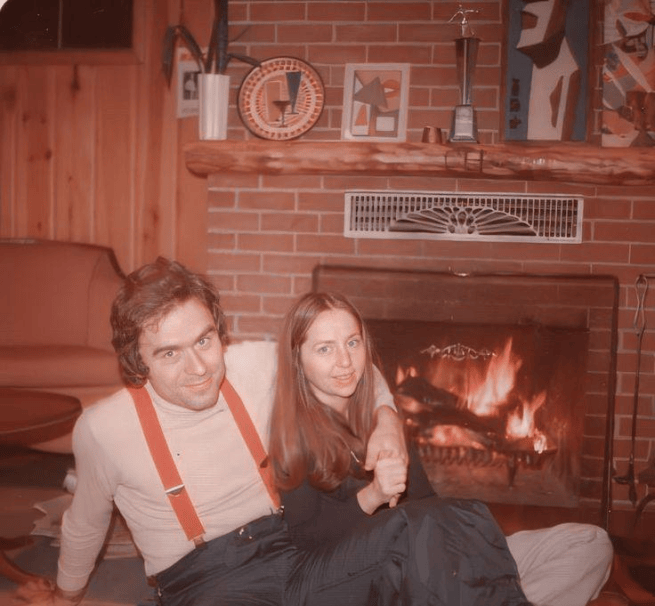
Bundy then pointed out a spot on a map where he thought he had left Donna’s remains but clarified that search teams would never find her skull because it was ‘nowhere;’ when Keppel pressed him for more information, he claimed to have burned her skull to ashes’ in his then-girlfriends Liz’s fireplace, then vacuumed up the ashes that remained behind. He explained: ‘it’s a lot of work and certainly very risky, under the circumstances. I mean, the kids come home from school and there’s a roaring fire in the fireplace and it’s warm outside.’ Later searches of that area failed to find anything related to a human skeleton (keep in mind he admitted to being inebriated at the time of the abduction, so he probably directed them in the wrong direction).
Now, there are holes in that story so big I can drive my station wagon through them: throughout the entirety of his murder spree, Bundy was (surprisingly) very good about avoiding detection (although I firmly believe he may never have been caught if he wasn’t such a shitty driver), so I have a really hard time believing that he took the risk and smuggled an entire HUMAN HEAD into his girlfriend’s apartment. Additionally, incinerating a skull in a residential fireplace would not have been an easy feat: in order to transform human bone into ash, the fire would need to get between 1,500 and 2,000 degrees Fahrenheit (which can be done with the use of an accelerant), and burn for a period of at least a few hours… even if he was able to get the fire that hot, there would still be pieces of bone left behind.
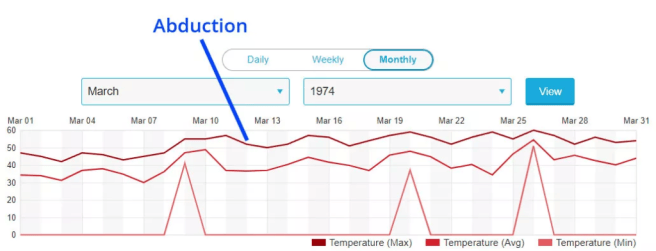
What I think more likely happened with Donna’s skull is, Ted *attempted* to burn it in Liz’s fireplace (in her apartment on 18th Ave NE), but partway through realized how difficult of an ordeal it was (plus, burnt hair smells ABSOLUTELY HORRIBLE, and at the time of her murder she had a lot of it, as it was pretty long), and took the chunks of bone that didn’t turn to ash and disposed of them in a different way (as awful as this sounds, perhaps they were so small he was able to dispose of them in the household garbage?). Another reason to doubt Bundy’s story is that he said it was ‘warm outside’ when he burned the skull, and according to records, the temperature range in the days after Mansons disappearance in Seattle ranged somewhere between 49°F to 57°F, and it remained on the cooler side until March 26th (although I guess warm to one person can be considered chilly by the next, as its subjective and it doesn’t appear that he elaborated). So, this makes me think Ted was either lying about the weather, or he simply got his dates mixed up (it was fifteen years prior). Some people wonder if Bundy made up the incident completely simply to hurt Kloepfer, who by that time had cut all ties with him and had moved on with her life (she remarried in September 1978)… but, at the end of the day, Bundy was a habitual liar that rarely told the truth. And let’s say this ONE TIME he wasn’t lying: he had avoided telling the truth for so long, why would anyone take him seriously at that point (especially when he was trying to avoid the electric chair). Also keep in mind that only minutes before he told Keppel about incinerating Manson’s skull, he cracked a ‘joke’ about how much press his confession would generate.
The following is a brief back-and-forth between Bundy and Robert Keppel regarding the condemned man being responsible for the murder of Donna Gail Manson:
Robert Keppel: ‘What about Donna Mason?’
Bundy: ‘I won’t beat around the bush with you anymore because I’m just tired and want to get back to sleep. So let me tell you, I know part of her is buried up there, the head however, wouldn’t be there.’
RK: ‘Where is it now?’
TB: ‘It’s nowhere. I’m not trying to be flippant. It’s in a category all by itself. It was incinerated. It was an exception, a strange exception.’
RK: ‘Where did you incinerate it?’
TB: ‘I promised myself I’d never tell this. In her fireplace. That’s not really that humorous, but I mean, the fireplace at her house… that was the twist. It’s a lot of work and certainly very risky, under the circumstances. I mean, the kids come home from school, there’s a roaring fire in the fireplace, and it’s warm outside.’
In my opinion, it would make sense that Donna was a Bundy victim, she certainly fit neatly into his victim profile: she was a young, attractive, petite college student that had long, dark hair that she wore in a center-part. She also disappeared during the time that he was actively preying on young women across Washington state, and the area surrounding Mount Rainier was one of his preferred burial grounds (it was also determined that the spot where the Eatonville Jane Doe’s remains were found were not their original resting place, and they were moved at some point post-mortem). Donna’s case was re-opened in 1990, but no new evidence was uncovered.
Despite multiple newspapers reporting that the missing skeleton belonged to Donna Manson, some of the facts don’t completely line up: ‘The News Tribune’ reported that the skeleton Pierce County Sheriffs discovered was 5’7”, and Donna was only 5 feet tall. Also, the remains were discovered wearing blue jeans, where Donna’s roommates said she was wearing a pair of green pants the night she disappeared. The report also said the victim was somewhere between twelve and seventeen years old, where Donna was nineteen at the time she disappeared
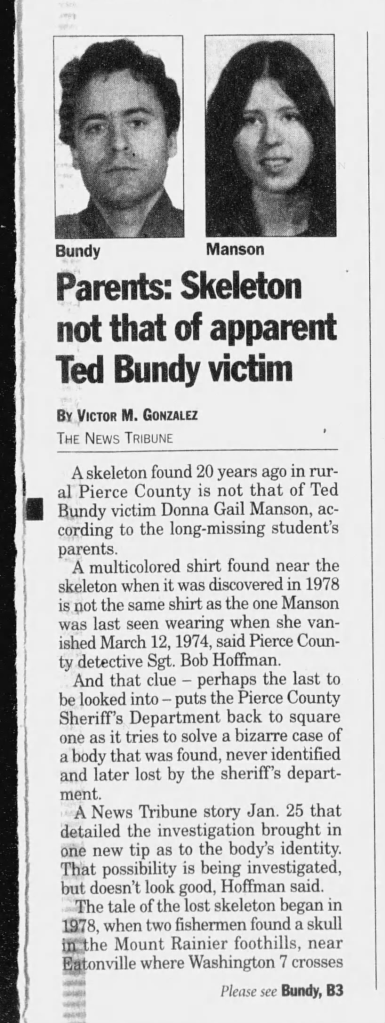
It was revealed by Detective Bob Hoffman that in early 1998 Lyle and Marie Manson were sent a photograph of the multicolored shirt that was found with the remains of the 1978 Eatonville Jane Doe, and they both agreed that it was not the one that their daughter had owned. It’s do want to mention that nearly twenty-five-years had passed since the couple had last seen their daughter wearing that shirt, and maybe their memories weren’t 100% accurate (they were also only shown a picture of it and did not see the real thing). I also wonder if they ever went through Donna’s belongings and found the shirt (although my guess is, by 1998 it was long gone).
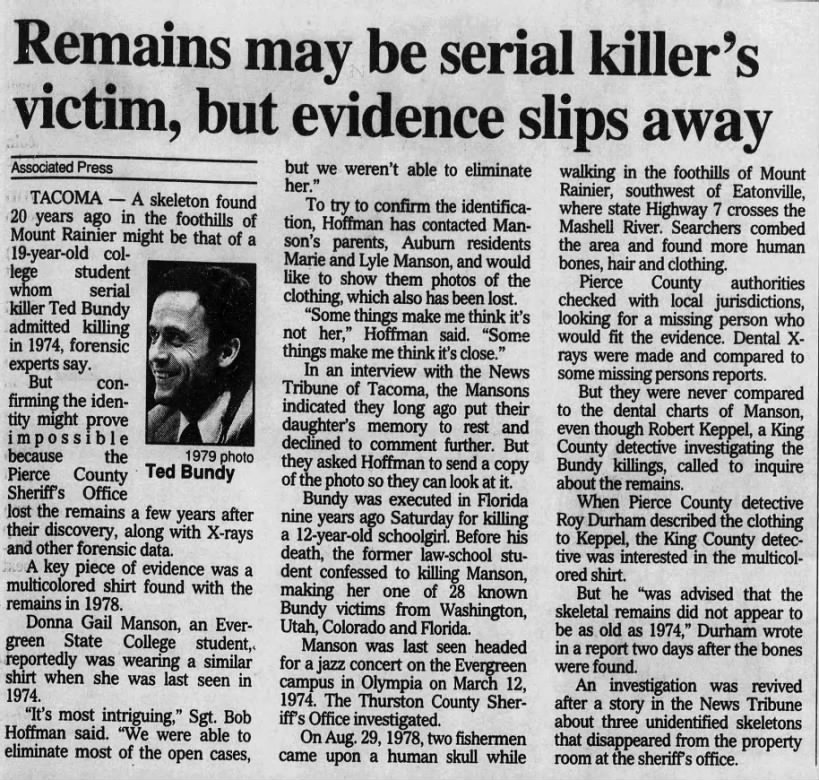
The News Tribune, December 2, 1996/January 25, 1998: in an article published in The News Tribune on December 2, 1996, a recent check of dental records of people missing in Washington state produced eight possibilities as to who the Eatonville Jane Doe could be; those possibilities were reduced to two because of other obvious discrepancies. A forensic dentist hired by the department ruled out one, leaving Manson as the last remaining possibility. According to Pierce County Detective Sergeant Bob Hoffman, ‘some things make me think it’s not her, some things make me think it is her.’ … ‘Its most intriguing, we were able to eliminate most of the open cases, but we weren’t able to eliminate her.’
According to an article published in The News Tribune on January 25, 1998, after the skull was first found in early 1978 Bob Keppel (who had been a detective at the time with King County) called Peirce County Sheriff’s Department and inquired if the skeleton might belong to Donna Manson: he was told that a forensic doctor had estimated the skeleton had been at the rural location for only about a year, which meant it most likely wasn’t hers. But it is worth noting that the same article said it has been ‘difficult to determine the age of the skeleton, especially in the 1970’s, before modern testing techniques were employed.’
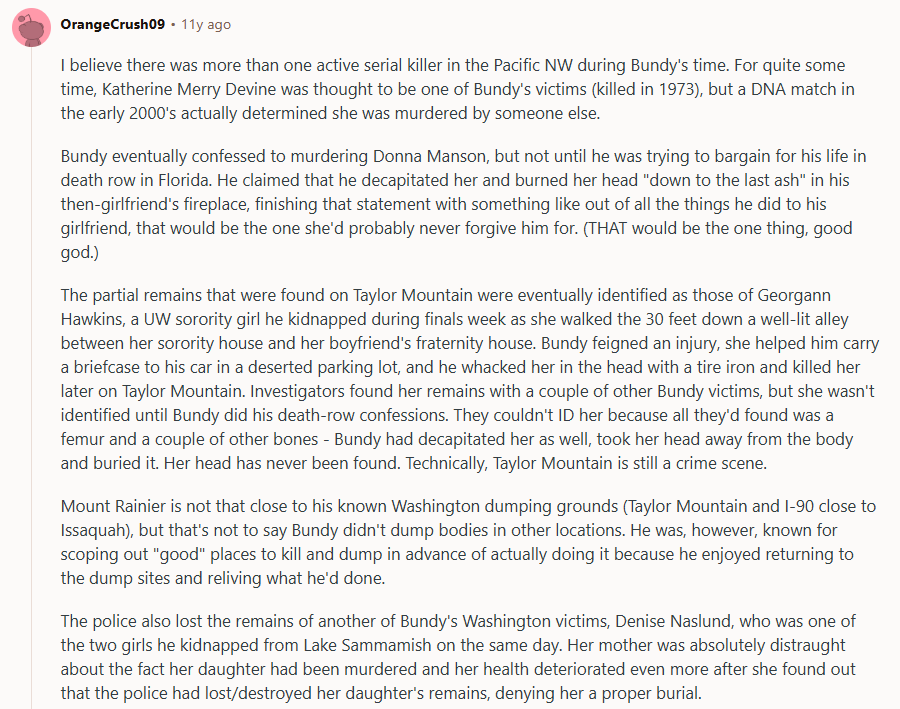
Other Bundy Victims Missing Remains: oddly enough, the 1978 Eatonville Jane Doe was not the first time a Bundy victims’ remains came up missing: following the identification of Jan Ott and Denise Naslund in September 1974, the King County ME’s Office held onto the remains ‘as potential evidence’ if Bundy was extradited back to Washington state to stand trial instead of returning them to the families. However, when the Medical Examiner’s office moved their offices to the Harborview Medical Center in 1976, the remains of both girls disappeared, and investigative records suggest that the county may have accidentally cremated them (or simply misplaced them during the move). When they discovered their daughters’ remains had been lost, the Naslund and Ott families filed lawsuits against the King County Medical Examiner’s Office, and they both received payouts through legal settlements (the exact financial terms were never fully disclosed in public reporting).
Additionally, when the two grouse hunters discovered Ott and Naslund’s remains at the Issaquah burial site, it’s thought that Georgann Hawkins was also buried there as well: when forensic experts later inspected the bones they realized they were in the possession of five femur bones, not four; they also had in their possession several additional vertebrae that did not belong to either Denise or Janice.
Because DNA profiling did not exist in the mid-1970’s, unidentified skeletal remains required a jawbone or skull for dental record comparison to order to secure a positive ID. As I stated earlier, unidentified remains are required to be held onto for a certain amount of time before they can be properly disposed of, and some time before Bundy’s execution in January 1989 the extra femur and vertebrae were cremated and disposed of (one article said it took place in March 1986, but when I went to check my sources, I could no longer find it). As a side note, I was incredibly surprised to learn that unidentified human remains are eventually discarded: I sort of just assumed they were held onto forever until they were one day identified, but it makes sense: they can’t hold onto every single bone, forever… the department would be overrun with human remains. It is worth noting that in recent years, police work has become much more structured (and civilized), and before remains are disposed of, DNA samples are taken along with pictures, fingerprints, dentals, full body x-rays and the serial numbers from medical devices are documented. Additionally, the victims’ personal belongings and clothing are collected, catalogued, and documented, and an array of biological samples are taken (which includes hair, fingernail clippings, and toxicological specimens).
Almost three years after the bones were allegedly destroyed, in January 1989 Bundy confessed to the murder of Georgann Hawkins right before he was executed (it was the same interview where he confessed to killing Donna on January 20, 1989), and he explicitly stated that he had left her remains at his Issaquah burial site; he also confirmed that the extra femur bone and vertebrae investigators found in the fall of 1974 did indeed belong to her.