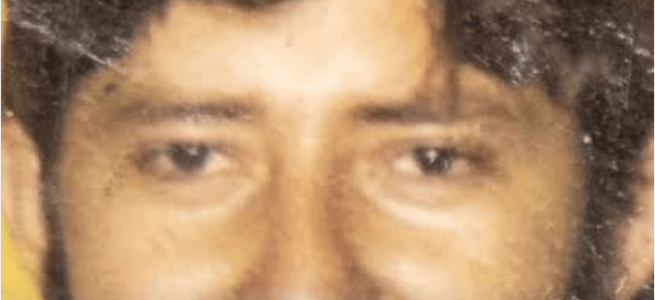
The following is an impromptu interview that the creators of ‘The Cold Podcasters’ conducted with Thomas Richard Jackson, who is a suspect in the Nancy Perry-Baird disappearance.
Dave Cawley: We’ve come, unannounced, in the hopes of talking to one of the other men who worked for the East Layton Police Department in 1975.
(Sound of seat belt click)
Sheryl Worsley: We’ll see. (Laughs)
Dave Cawley: See what kind of reception we get.
Dave Cawley: His name is Thomas Jackson, Junior. As we walk toward his door, a tall white-haired man steps out.
Dave Cawley (to Tom Jackson): Hi, how you doing? Are you Tom?
Dave Cawley: Tom Jackson can see the microphone in my hand. He asks “uh oh, what did I do now” with a bit of a laugh.
Dave Cawley (to Tom Jackson): You did nothing.
Sheryl Worsley: You didn’t do anything. (Laughs)
Dave Cawley: We’re doing a history project on the Nancy Baird case. From way back in—
Tom Jackson: Oh, Nancy Perry Baird?
Dave Cawley: You got it.
Tom Jackson: When I was a cop? Yeah.
Dave Cawley: Yeah.
Sheryl Worsley: Yeah.
Tom Jackson: Oh, that’d be great. Uh, you want to come in?
Dave Cawley: Is that ok?
Sheryl Worsley: Is that alright?
Dave Cawley: He ushers us inside and makes space on the couch.
Tom Jackson: I’m glad you’re here. Man, this is, just been exciting to know that her case is still open and is, I’m tickled.
Dave Cawley: Tom Jackson was about four years older than Nancy Baird. And he confirms, they knew each other as kids.
Tom Jackson: She was a pretty gal.
Dave Cawley: Tom’d lived just down the street from Nancy. In fact, he’d even married one of Nancy’s friends, a neighbor girl. They’d stayed in the neighborhood, living just off Cherry Lane, a little ways behind the Fina station where Nancy’d worked.
Tom worked a full-time job, but around the start of 1975 also accepted a part-time position as a reserve officer for the East Layton police department. His reserve role was a little different than Cary Hartmann’s, which we heard about in Cold season 3. East Layton was a lot smaller than Ogden City, so it asked much more of its reserves. As a result, Tom worked a more regular schedule, received a paycheck, and wrote a lot of tickets.
Tom told me on the day Nancy Baird disappeared, he’d been driving around in one of the town’s two police cars.
Tom Jackson: I didn’t even hear anything on the radio about it.
Dave Cawley: Which is a little strange, since officer Dave Anderson did describe radioing dispatch about Nancy in his report. In any case, Tom said he’d stopped by the Fina station that evening and found his chief, Ray Adams, and officer Dave Anderson there.
Tom Jackson: I pulled in, I was like “what’s going on?” And they said “Nancy’s gone.” I said “what the crap, what?”
Dave Cawley: Tom remembered going to Nancy’s house and helping retrieve her address book. According to a report, Tom and the chief then went and looked around a place called Fernwood Park, as the dark of night descended. Why Fernwood? Well, it was home to a sort of “lover’s lane,” a place in the hills where couples would park their cars and make out. The police found no sign of Nancy there.
Records show Tom Jackson didn’t have any involvement with the Nancy Baird case after that. He intentionally opted out.
Tom Jackson: At that time, I don’t think I was, I don’t know, I wasn’t a good cop, I would say. I wanted to, I wanted to let someone else handle it. I didn’t want to mess it up.
Dave Cawley: In spite of this, East Layton sent Tom Jackson to the Utah police academy in September of 1975. That’s only about two-and-a-half months after Nancy Baird disappeared. Why did Tom go to the academy, instead of officer Dave Anderson? I’m not sure. Tom didn’t remember.
I’ve talked to one of Tom’s academy classmates. He said Tom struggled a bit, but Tom did graduate the academy and was certified to work in law enforcement. He replaced Dave Anderson as East Layton’s full-time police officer. At some point in the middle of all this, Tom talked to the Davis County Sheriff’s Office about next-steps in the Nancy Baird investigation. East Layton had jurisdiction. It was their call.
Tom Jackson: The county asked me, says “you want to handle this?” And I says “no way! All we are is just little hick town cops here so if we’re gonna find her, you guys is the ones that’s gotta do it.”
Dave Cawley: Tom knew the county had already tracked down several of Nancy’s boyfriends, working off her address book.
Tom Jackson: They had the book and whatever name was in there, they went after ‘em.
Dave Cawley: But the boyfriend leads ran dry, right around the time Ted Bundy entered the picture.
Tom Jackson: Yeah, there was suspicion of him.
Dave Cawley: Tom’s mind didn’t settle on Bundy, though. He figured Nancy’s abductor could’ve been much closer.
Tom Jackson: This person must’ve been someone she knew and had some trust in him. That’s the other reason why I thought it was one of the cops, that one cop.
Dave Cawley: Former officer Dave Anderson. Tom remembered Dave Anderson spending a lot of time at the Fina station.
Tom Jackson: He spent too much time looking at women, too.
Dave Cawley (to Tom Jackson): Thinks he’s a lady’s man, maybe—
Tom Jackson: Yeah.
Dave Cawley: —a little bit?
Tom Jackson: He was a good-looking guy, so I’m sure he thought so.
Dave Cawley: This description of former officer Dave Anderson reminded me of Cary Hartmann and his brief time in the Ogden police reserve corps, which we talked about during Cold season 3. There are some people who are drawn to law enforcement jobs for all the wrong reasons. Dave Anderson, it seems, might’ve been one of them. This idea was overlooked though, probably because the East Layton police department was itself in crisis. Its chief, Ray Adams, shouldn’t have been chief. He’d wasn’t a cop. He’d secured his position through the good ol’ boy system. State law required he attend the academy, but he wasn’t willing to take a leave from his full-time job to do that.
So, in April of 1976, Ray Adams vacated the chief of police position. He instead became a justice of the peace for the town, a form of low-level judge, a job for which Adams was also not qualified. Officer Tom Jackson departed the East Layton police department not long after that. He decided to leave law enforcement entirely, and went into private security work. So within about a year of the disappearance of Nancy Baird, the entire East Layton police force turned over.
Tom Jackson: Real Mayberry thing. (Laughs)
Dave Cawley: There is one other point I need to acknowledge here: former officer Tom Jackson has a criminal record. In 1986, 11 years after the disappearance of Nancy Baird, Davis County prosecutors filed a criminal charge against Tom. He stood accused of sexually abusing two young girls. He pleaded guilty to a second-degree felony, which made him eligible for a sentence of up to 15 years in prison. But the judge only placed Tom on probation.
Tom’s wife divorced him in the years that followed. He left Utah, remarried, and then, in 1995, police arrested Tom Jackson again, this time on charges of lewd conduct with a child under 16 years of age. He again pleaded guilty, but the Idaho judge showed none of the leniency the Utah judge had. Tom received a life sentence. But Tom’s no longer in prison, clearly. He won an appeal that reduced his sentence to 15 years. He served that time, a fact he and I discussed at the start of our interview.
Tom confided he felt a bit nervous going on tape. He hoped I wouldn’t make a monster of him. I promised to treat him fairly. And Tom acknowledged his past complicates how we might see him.
Tom Jackson: I wouldn’t doubt if I was a suspect and all that. And that’s ok with me.
Dave Cawley: Because, Tom says, he’s taken polygraph after polygraph as part of his probation.
Tom Jackson: And one of the questions in there is “you committed any other crimes that we don’t know about?” And when I said “no, not at all.” And it come up true, so.
Dave Cawley (to Tom Jackson): I mean, it’s—
Tom Jackson: Y’know, that pretty much cleared me right there.
Dave Cawley: —it’s a lot of years, right? You would think if you were a suspect, someone would’ve come and talked to you a long time ago—
Tom Jackson: Yeah, yeah.
Dave Cawley: —right?
Tom Jackson: That’s true.
Dave Cawley: After Tom Jackson left his job at the East Layton Police Department a year following Nancy Baird’s disappearance, the town hired a new officer, a guy named Dave Davis. Town leaders quickly promoted Davis to chief. Davis told The Salt Lake Tribune he was “working wonders” with the small budget provided to him in a 1977 newspaper story comically headlined “Yes, East Layton has a police department.”
Gary McFarland: They just did not have the funding to take and keep somebody.
Dave Cawley: Chief Davis also inherited the Nancy Baird case. He did nothing with it until, in 1979, four years on from Nancy’s disappearance, Davis hired a new patrol officer named Gary McFarland.
Gary McFarland: And it came down to where it was just me covering 12 hours and the other, the chief would cover the other 12 hours. And there was a promise from the city that if I did that, they would send me to the police academy.
Dave Cawley: Chief Davis gave Gary former East Layton police officer Dave Anderson’s report about the disappearance of Nancy Baird.
Gary McFarland: There just wasn’t a lot. We were, y’know, a very small community. There was very few things going on. Property disputes, loose cows, loose, loose horses. (Laughs) That kind of thing. It just, that was, that was a pretty big case.
Dave Cawley: At this same time, Ted Bundy was standing trial for murder in Florida.
John Hollenhorst (from July 24, 1979 KSL TV archive): As the verdict approached, reporters, editors and photographers prepared for the climax of the trial. The Bundy case has generated vast amounts of publicity all over Florida and in the western states of Utah, Colorado and Washington. In all those places, Bundy is suspected of murders. All involving young women.
Dave Cawley: Gary, and many others, believed Ted Bundy might’ve killed Nancy Baird. It wasn’t much of a leap: Bundy had been in Utah the summer Nancy disappeared.
Gary McFarland: She had the appearance of some, the females that he preferred. That’s all we had, is the method of operation fit.
Dave Cawley: But that suspicion didn’t give Gary any direction as to where to look for Nancy’s remains.
Gary McFarland: It was becoming a cold case, basically.
Dave Cawley: A little kerfuffle erupted in East Layton around this same time. The mayor fired police chief Davis, who responded by telling the news media it was an attack on the entire department.
Dave Davis (from March 24, 1980 KSL TV archive): They may be looking into an outside agency to contract to and dissolve the police department as a whole.
Dave Cawley: I suspect you probably don’t much care about this small town political squabble, but I promise you, it’s relevant to the Nancy Baird case because of what happened in the end.
Gaylen Young (from March 26, 1980 KSL TV archive): Nearly 400 angry residents were in attendance at the city council meeting because mayor Delin Yates was not going to keep police chief Dave Davis on the job.
East Layton resident (from March 26, 1980 KSL TV archive): We don’t want a contract with Davis County. We don’t want a contract with Layton City. We want the police force we have with the responsible, interested service that we get from them.
Dave Cawley: This protest proved ineffective. East Layton dissolved its police department. Officer Gary McFarland, fresh out of the academy, no longer had a job. But it didn’t stop there. The residents of East Layton voted to disincorporate at the end of 1980. Their town ceased to be and neighboring Layton City swallowed it whole. The records of the East Layton police department were lost to time. All except for the report of former police officer Dave Anderson about the disappearance of Nancy Baird. Gary McFarland still had it.
Gary McFarland: It ended up with me. No direction as to what to do with it. But it was in my custody.
Dave Cawley: But with East Layton gone, who would inherit jurisdiction over Nancy Baird’s case? Did it belong to Layton City, which absorbed East Layton? Or did the Davis County Sheriff’s Office bear responsibility, given the work deputies there had done assisting East Layton early on?
Gary McFarland: Davis County provided a lot of the crime scene investigations because small communities could not provide that service.
Dave Cawley: As we saw with the Sheree Warren case in Cold season 3, victims fall through the cracks when police agencies fail to communicate. And that’s what also appears to have happened with Nancy Baird. No one took the initiative. It wasn’t Gary McFarland’s case, but he felt duty-bound to safeguard the reports.
Gary McFarland: Because it was one of those cases that you knew someday would have a lead.
Dave Cawley: Gary ended up taking another police job at a different agency. Year after year, he waited for a phone call that might break the case.
Gary McFarland: Nobody ever came forward. Nobody was ever found. Not one tip, not nothing.
Dave Cawley: Gary McFarland retired in 2012. He turned the East Layton police report on Nancy Baird over to the Davis County Sheriff’s Office.
Gary McFarland: They’d come up with some other theories, besides the only one that I ever came up with.
Dave Cawley (to Gary McFarland): Bundy?
Gary McFarland: Yeah.
Dave Cawley: Is that what you mean?
Gary McFarland: Yeah, ‘cause I’m stuck on it. It will, until I’m proven different.
Dave Cawley: Gary still believes Ted Bundy is the most likely suspect in Nancy Baird’s presumed murder. But he knows that’s not the only theory.
Gary McFarland: The theories were that it was possibly a law enforcement officer that worked in East Layton.
Dave Cawley: The story we’ve heard so far leaves me deeply skeptical about any conclusion regarding Nancy Baird’s death being the work of serial killer Ted Bundy. To my mind, there are too many other plausible scenarios. And, Tiffany Jean, the archivist, told me she’s unsure as well.
Tiffany Jean: I, I looked at the case a little bit. And I thought that it didn’t quite fit his M.O., with what I know about how he operated.
Dave Cawley: What was different? For one, the location. Ted Bundy was never known to abduct a woman from a gas station during daylight hours.
Tiffany Jean: And while Bundy was capable of doing that, he mostly operated at night. And he mostly avoided places where he could be seen or picked out.
Dave Cawley: In his early crimes in Washington state, Bundy sometimes approached women while claiming to be injured, needing help to put something in his car. Would Nancy Baird have taken that kind of bait?
Tiffany Jean: It seems unusual that she would have been willing to leave her post to do that when there was no one else at the station.
Dave Cawley: Bundy liked to lure women to his car—a light tan 1968 Volkswagen Beetle—then handcuffed them or knocked them unconscious. If he’d done something like that with Nancy Baird, it probably would’ve happened right in the parking lot outside the Fina station.
Tiffany Jean: And that seems like kind of a big risk for Bundy to have taken.
Dave Cawley: None of the witnesses from the Fina station reported seeing a Volkswagen Beetle like Bundy’s. And the descriptions provided by the Williams children didn’t match Ted Bundy, either.
Tiffany Jean: So, that’s another reason that seems unlikely that it would have been him.
Dave Cawley: Nancy Baird vanished from the Fina station within the space of just five or ten minutes.
Kenny Payne: Yeah I mean she’s just, she’s just gone.
Dave Cawley: No signs of a struggle, no indication she ran away.
Kenny Payne: I mean she’s got a, a child at home.
Dave Cawley: So retired sheriff’s detective Kenny Payne gets why even some of his former colleagues believe to this day Ted Bundy abducted and murdered Nancy Baird.
Kenny Payne: But then you have to try and figure out whether or not the first thought of “it’s gotta be Ted Bundy” well no, what can you find that tells me a story?
Dave Cawley: What Kenny’s saying is the elements necessary to build a narrative about Ted Bundy killing Nancy Baird just aren’t there.
Tiffany Jean also shared another, more compelling reason why she questions Ted Bundy’s supposed involvement. Bundy, she told me, might have an alibi for the day Nancy Baird disappeared. And Tiffany could be the first person to ever piece it together.
Ted Bundy first moved to Utah in September of 1974, having come from Washington state to attend law school at the University of Utah in Salt Lake City.
Tiffany Jean: He had a steady girlfriend who lived in Seattle who was originally from Ogden. And she was probably the reason why he came to Utah in the first place, because she had roots there. And eventually they planned on settling down there, if they ever got married. But y’know, he was not a good person. (Laughs) So in addition to everything else bad that he did, he also cheated on her quite a bit.
Dave Cawley: In June of 1975, just a few weeks before Nancy Baird disappeared, Ted Bundy met a young school teacher named Leslie Knudsen at a party in Salt Lake City. Bundy and Leslie started seeing one another.
Tiffany Jean: And they dated until August, she saw that he was arrested and didn’t want anything more to do with him.
Dave Cawley: Leslie spoke to investigators back in 1975, but she was never called as a witness in court and has kept a very low profile all the years since. Her story is not well known, even among Ted Bundy experts.
Tiffany Jean: But I was able to find her phone number, and an associate of mine called her. And this was back in 2019. And it took a little while for her to warm up and agree to, to speak at all. But she gave some, y‘ou ‘know, some kind of overall arching details about her time that she spent with him. And she mentioned that he had visited her family, and she’d introduced him to her entire family at a family reunion on the 4th of July, 1975. And that struck me immediately because Nancy Baird disappeared on 4th of July, 1975. And if Leslie Knudson was accurate in her recall, then Ted probably could not have done that, if he was with her, and being introduced to her entire family at their July 4th family reunion. But it doesn’t seem like anyone else has ever put those together that he was with her on the day that this crime occurred.
Dave Cawley: I’ve listened to a recording of this interview with Leslie Knudson. There are legal and ethical considerations that prevent me from sharing the audio with you, but I can tell you what Leslie said: she and Bundy had “gone to the family ranch” on the 4th of July. Leslie didn’t say where the ranch was, and she’s not responded to multiple messages I’ve left for her. But I did some genealogy research and can tell you Leslie’s maternal grandfather was a prominent sheep rancher in an area of Utah called the Uinta Basin.
When Leslie’s mother died, the obituary described how she’d spent “many summers in the Fruitland, Utah area on the family ranch.” Fruitland is in the Uinta Basin. This is likely where Leslie Knudson took Ted Bundy on the day Nancy Baird disappeared.
Tiffany Jean: And so it’d be pretty difficult for him to have done both things on that day because it would have been quite a drive.
Dave Cawley: More than 100 miles. Quite the drive, indeed. But once investigators in the Nancy Baird case honed in on Ted Bundy as a suspect, all efforts involving other persons of interest came to a halt.
Tiffany Jean: I was amazed at how many people went through that gas station in that tiny frame of time, within like 15 minutes. And nobody saw her leave?
Dave Cawley: My look into the Nancy Perry Baird case came about because a jailhouse informant once told the FBI Cary Hartmann had known Nancy. I haven’t seen any sign that tip was ever shared, investigated or corroborated. What I’ve learned, is there are other, more likely leads still left unexplored. But after nearly 50 years, so many people important to solving this puzzle are gone. And former East Layton officer Tom Jackson told me his health is on the decline.
Tom Jackson: One of the first people I want to see, other than my parents when I get to the other side, is Nancy. ‘Cause she has bugged me for so long. What could I have done to have been there for her? ‘Cause she’s, she was not the type, to’ve just bugged out and said, y’know, “I’m tired of the world.”
Dave Cawley: “She was not the type…” This is a common refrain we hear in so many cases of missing women, and to be honest, it’s getting under my skin. Because who is the type? Sure, people do run away, but in this podcast we’ve repeatedly heard how more sinister circumstances often surround the disappearances of women. It happened with Sheree Warren. Her disappearance, 10 years after Nancy Baird’s, bore many similarities. Both were young mothers, just out of unhappy marriages. Both were last seen at work. Neither just walked away. But in both cases, speculation about about serial killers distracted investigators, drawing attention away from more probable suspects.
Tom Jackson: And boy, whoever did it, he’s another Bundy.
Dave Cawley: Against the backdrop of turnover and jurisdictional dysfunction we’ve explored, it’s easy to understand how Ted Bundy filled a vacuum. His entrance to the scene took pressure off East Layton police. Nancy Baird’s friends and relatives were placated by the belief Bundy did it, even though no proof ever emerged to support that. But there are too many unexplored avenues of investigation for me to accept that conclusion. Like the man who stalked, “molested” and threatened Nancy a couple of nights before she disappeared. Or the two “hippie type” guys chatting with her at the Fina station moments before she vanished. Or even an East Layton police officer with a troubled past.
Until these other leads are closed, how can anyone accept taking “the convenient alternative?”

