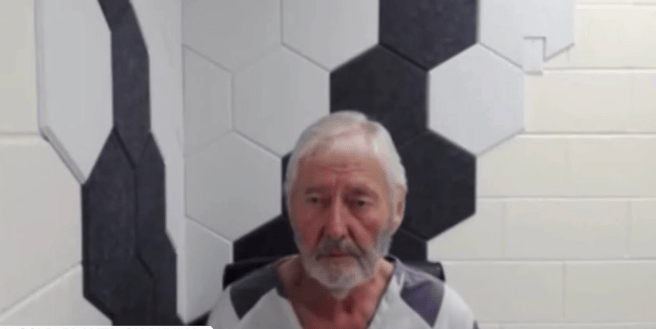
An Interview Between ‘The Cold Podcast’ and Thomas R. Jackson.

The following is an impromptu interview that the creators of ‘The Cold Podcasters’ conducted with Thomas Richard Jackson, who is a suspect in the Nancy Perry-Baird disappearance.

Dave Cawley: We’ve come, unannounced, in the hopes of talking to one of the other men who worked for the East Layton Police Department in 1975.
(Sound of seat belt click)
Sheryl Worsley: We’ll see. (Laughs)
Dave Cawley: See what kind of reception we get.
Dave Cawley: His name is Thomas Jackson, Junior. As we walk toward his door, a tall white-haired man steps out.
Dave Cawley (to Tom Jackson): Hi, how you doing? Are you Tom?
Dave Cawley: Tom Jackson can see the microphone in my hand. He asks “uh oh, what did I do now” with a bit of a laugh.
Dave Cawley (to Tom Jackson): You did nothing.
Sheryl Worsley: You didn’t do anything. (Laughs)
Dave Cawley: We’re doing a history project on the Nancy Baird case. From way back in—
Tom Jackson: Oh, Nancy Perry Baird?
Dave Cawley: You got it.
Tom Jackson: When I was a cop? Yeah.
Dave Cawley: Yeah.
Sheryl Worsley: Yeah.
Tom Jackson: Oh, that’d be great. Uh, you want to come in?
Dave Cawley: Is that ok?
Sheryl Worsley: Is that alright?
Dave Cawley: He ushers us inside and makes space on the couch.
Tom Jackson: I’m glad you’re here. Man, this is, just been exciting to know that her case is still open and is, I’m tickled.
Dave Cawley: Tom Jackson was about four years older than Nancy Baird. And he confirms, they knew each other as kids.
Tom Jackson: She was a pretty gal.
Dave Cawley: Tom’d lived just down the street from Nancy. In fact, he’d even married one of Nancy’s friends, a neighbor girl. They’d stayed in the neighborhood, living just off Cherry Lane, a little ways behind the Fina station where Nancy’d worked.
Tom worked a full-time job, but around the start of 1975 also accepted a part-time position as a reserve officer for the East Layton police department. His reserve role was a little different than Cary Hartmann’s, which we heard about in Cold season 3. East Layton was a lot smaller than Ogden City, so it asked much more of its reserves. As a result, Tom worked a more regular schedule, received a paycheck, and wrote a lot of tickets.
Tom told me on the day Nancy Baird disappeared, he’d been driving around in one of the town’s two police cars.
Tom Jackson: I didn’t even hear anything on the radio about it.
Dave Cawley: Which is a little strange, since officer Dave Anderson did describe radioing dispatch about Nancy in his report. In any case, Tom said he’d stopped by the Fina station that evening and found his chief, Ray Adams, and officer Dave Anderson there.
Tom Jackson: I pulled in, I was like “what’s going on?” And they said “Nancy’s gone.” I said “what the crap, what?”
Dave Cawley: Tom remembered going to Nancy’s house and helping retrieve her address book. According to a report, Tom and the chief then went and looked around a place called Fernwood Park, as the dark of night descended. Why Fernwood? Well, it was home to a sort of “lover’s lane,” a place in the hills where couples would park their cars and make out. The police found no sign of Nancy there.
Records show Tom Jackson didn’t have any involvement with the Nancy Baird case after that. He intentionally opted out.
Tom Jackson: At that time, I don’t think I was, I don’t know, I wasn’t a good cop, I would say. I wanted to, I wanted to let someone else handle it. I didn’t want to mess it up.
Dave Cawley: In spite of this, East Layton sent Tom Jackson to the Utah police academy in September of 1975. That’s only about two-and-a-half months after Nancy Baird disappeared. Why did Tom go to the academy, instead of officer Dave Anderson? I’m not sure. Tom didn’t remember.
I’ve talked to one of Tom’s academy classmates. He said Tom struggled a bit, but Tom did graduate the academy and was certified to work in law enforcement. He replaced Dave Anderson as East Layton’s full-time police officer. At some point in the middle of all this, Tom talked to the Davis County Sheriff’s Office about next-steps in the Nancy Baird investigation. East Layton had jurisdiction. It was their call.
Tom Jackson: The county asked me, says “you want to handle this?” And I says “no way! All we are is just little hick town cops here so if we’re gonna find her, you guys is the ones that’s gotta do it.”
Dave Cawley: Tom knew the county had already tracked down several of Nancy’s boyfriends, working off her address book.
Tom Jackson: They had the book and whatever name was in there, they went after ‘em.
Dave Cawley: But the boyfriend leads ran dry, right around the time Ted Bundy entered the picture.
Tom Jackson: Yeah, there was suspicion of him.
Dave Cawley: Tom’s mind didn’t settle on Bundy, though. He figured Nancy’s abductor could’ve been much closer.
Tom Jackson: This person must’ve been someone she knew and had some trust in him. That’s the other reason why I thought it was one of the cops, that one cop.
Dave Cawley: Former officer Dave Anderson. Tom remembered Dave Anderson spending a lot of time at the Fina station.
Tom Jackson: He spent too much time looking at women, too.
Dave Cawley (to Tom Jackson): Thinks he’s a lady’s man, maybe—
Tom Jackson: Yeah.
Dave Cawley: —a little bit?
Tom Jackson: He was a good-looking guy, so I’m sure he thought so.
Dave Cawley: This description of former officer Dave Anderson reminded me of Cary Hartmann and his brief time in the Ogden police reserve corps, which we talked about during Cold season 3. There are some people who are drawn to law enforcement jobs for all the wrong reasons. Dave Anderson, it seems, might’ve been one of them. This idea was overlooked though, probably because the East Layton police department was itself in crisis. Its chief, Ray Adams, shouldn’t have been chief. He’d wasn’t a cop. He’d secured his position through the good ol’ boy system. State law required he attend the academy, but he wasn’t willing to take a leave from his full-time job to do that.
So, in April of 1976, Ray Adams vacated the chief of police position. He instead became a justice of the peace for the town, a form of low-level judge, a job for which Adams was also not qualified. Officer Tom Jackson departed the East Layton police department not long after that. He decided to leave law enforcement entirely, and went into private security work. So within about a year of the disappearance of Nancy Baird, the entire East Layton police force turned over.
Tom Jackson: Real Mayberry thing. (Laughs)
Dave Cawley: There is one other point I need to acknowledge here: former officer Tom Jackson has a criminal record. In 1986, 11 years after the disappearance of Nancy Baird, Davis County prosecutors filed a criminal charge against Tom. He stood accused of sexually abusing two young girls. He pleaded guilty to a second-degree felony, which made him eligible for a sentence of up to 15 years in prison. But the judge only placed Tom on probation.
Tom’s wife divorced him in the years that followed. He left Utah, remarried, and then, in 1995, police arrested Tom Jackson again, this time on charges of lewd conduct with a child under 16 years of age. He again pleaded guilty, but the Idaho judge showed none of the leniency the Utah judge had. Tom received a life sentence. But Tom’s no longer in prison, clearly. He won an appeal that reduced his sentence to 15 years. He served that time, a fact he and I discussed at the start of our interview.
Tom confided he felt a bit nervous going on tape. He hoped I wouldn’t make a monster of him. I promised to treat him fairly. And Tom acknowledged his past complicates how we might see him.
Tom Jackson: I wouldn’t doubt if I was a suspect and all that. And that’s ok with me.
Dave Cawley: Because, Tom says, he’s taken polygraph after polygraph as part of his probation.
Tom Jackson: And one of the questions in there is “you committed any other crimes that we don’t know about?” And when I said “no, not at all.” And it come up true, so.
Dave Cawley (to Tom Jackson): I mean, it’s—
Tom Jackson: Y’know, that pretty much cleared me right there.
Dave Cawley: —it’s a lot of years, right? You would think if you were a suspect, someone would’ve come and talked to you a long time ago—
Tom Jackson: Yeah, yeah.
Dave Cawley: —right?
Tom Jackson: That’s true.
Dave Cawley: After Tom Jackson left his job at the East Layton Police Department a year following Nancy Baird’s disappearance, the town hired a new officer, a guy named Dave Davis. Town leaders quickly promoted Davis to chief. Davis told The Salt Lake Tribune he was “working wonders” with the small budget provided to him in a 1977 newspaper story comically headlined “Yes, East Layton has a police department.”
Gary McFarland: They just did not have the funding to take and keep somebody.
Dave Cawley: Chief Davis also inherited the Nancy Baird case. He did nothing with it until, in 1979, four years on from Nancy’s disappearance, Davis hired a new patrol officer named Gary McFarland.
Gary McFarland: And it came down to where it was just me covering 12 hours and the other, the chief would cover the other 12 hours. And there was a promise from the city that if I did that, they would send me to the police academy.
Dave Cawley: Chief Davis gave Gary former East Layton police officer Dave Anderson’s report about the disappearance of Nancy Baird.
Gary McFarland: There just wasn’t a lot. We were, y’know, a very small community. There was very few things going on. Property disputes, loose cows, loose, loose horses. (Laughs) That kind of thing. It just, that was, that was a pretty big case.
Dave Cawley: At this same time, Ted Bundy was standing trial for murder in Florida.
John Hollenhorst (from July 24, 1979 KSL TV archive): As the verdict approached, reporters, editors and photographers prepared for the climax of the trial. The Bundy case has generated vast amounts of publicity all over Florida and in the western states of Utah, Colorado and Washington. In all those places, Bundy is suspected of murders. All involving young women.
Dave Cawley: Gary, and many others, believed Ted Bundy might’ve killed Nancy Baird. It wasn’t much of a leap: Bundy had been in Utah the summer Nancy disappeared.
Gary McFarland: She had the appearance of some, the females that he preferred. That’s all we had, is the method of operation fit.
Dave Cawley: But that suspicion didn’t give Gary any direction as to where to look for Nancy’s remains.
Gary McFarland: It was becoming a cold case, basically.
Dave Cawley: A little kerfuffle erupted in East Layton around this same time. The mayor fired police chief Davis, who responded by telling the news media it was an attack on the entire department.
Dave Davis (from March 24, 1980 KSL TV archive): They may be looking into an outside agency to contract to and dissolve the police department as a whole.
Dave Cawley: I suspect you probably don’t much care about this small town political squabble, but I promise you, it’s relevant to the Nancy Baird case because of what happened in the end.
Gaylen Young (from March 26, 1980 KSL TV archive): Nearly 400 angry residents were in attendance at the city council meeting because mayor Delin Yates was not going to keep police chief Dave Davis on the job.
East Layton resident (from March 26, 1980 KSL TV archive): We don’t want a contract with Davis County. We don’t want a contract with Layton City. We want the police force we have with the responsible, interested service that we get from them.
Dave Cawley: This protest proved ineffective. East Layton dissolved its police department. Officer Gary McFarland, fresh out of the academy, no longer had a job. But it didn’t stop there. The residents of East Layton voted to disincorporate at the end of 1980. Their town ceased to be and neighboring Layton City swallowed it whole. The records of the East Layton police department were lost to time. All except for the report of former police officer Dave Anderson about the disappearance of Nancy Baird. Gary McFarland still had it.
Gary McFarland: It ended up with me. No direction as to what to do with it. But it was in my custody.
Dave Cawley: But with East Layton gone, who would inherit jurisdiction over Nancy Baird’s case? Did it belong to Layton City, which absorbed East Layton? Or did the Davis County Sheriff’s Office bear responsibility, given the work deputies there had done assisting East Layton early on?
Gary McFarland: Davis County provided a lot of the crime scene investigations because small communities could not provide that service.
Dave Cawley: As we saw with the Sheree Warren case in Cold season 3, victims fall through the cracks when police agencies fail to communicate. And that’s what also appears to have happened with Nancy Baird. No one took the initiative. It wasn’t Gary McFarland’s case, but he felt duty-bound to safeguard the reports.
Gary McFarland: Because it was one of those cases that you knew someday would have a lead.
Dave Cawley: Gary ended up taking another police job at a different agency. Year after year, he waited for a phone call that might break the case.
Gary McFarland: Nobody ever came forward. Nobody was ever found. Not one tip, not nothing.
Dave Cawley: Gary McFarland retired in 2012. He turned the East Layton police report on Nancy Baird over to the Davis County Sheriff’s Office.
Gary McFarland: They’d come up with some other theories, besides the only one that I ever came up with.
Dave Cawley (to Gary McFarland): Bundy?
Gary McFarland: Yeah.
Dave Cawley: Is that what you mean?
Gary McFarland: Yeah, ‘cause I’m stuck on it. It will, until I’m proven different.
Dave Cawley: Gary still believes Ted Bundy is the most likely suspect in Nancy Baird’s presumed murder. But he knows that’s not the only theory.
Gary McFarland: The theories were that it was possibly a law enforcement officer that worked in East Layton.
Dave Cawley: The story we’ve heard so far leaves me deeply skeptical about any conclusion regarding Nancy Baird’s death being the work of serial killer Ted Bundy. To my mind, there are too many other plausible scenarios. And, Tiffany Jean, the archivist, told me she’s unsure as well.
Tiffany Jean: I, I looked at the case a little bit. And I thought that it didn’t quite fit his M.O., with what I know about how he operated.
Dave Cawley: What was different? For one, the location. Ted Bundy was never known to abduct a woman from a gas station during daylight hours.
Tiffany Jean: And while Bundy was capable of doing that, he mostly operated at night. And he mostly avoided places where he could be seen or picked out.
Dave Cawley: In his early crimes in Washington state, Bundy sometimes approached women while claiming to be injured, needing help to put something in his car. Would Nancy Baird have taken that kind of bait?
Tiffany Jean: It seems unusual that she would have been willing to leave her post to do that when there was no one else at the station.
Dave Cawley: Bundy liked to lure women to his car—a light tan 1968 Volkswagen Beetle—then handcuffed them or knocked them unconscious. If he’d done something like that with Nancy Baird, it probably would’ve happened right in the parking lot outside the Fina station.
Tiffany Jean: And that seems like kind of a big risk for Bundy to have taken.
Dave Cawley: None of the witnesses from the Fina station reported seeing a Volkswagen Beetle like Bundy’s. And the descriptions provided by the Williams children didn’t match Ted Bundy, either.
Tiffany Jean: So, that’s another reason that seems unlikely that it would have been him.
Dave Cawley: Nancy Baird vanished from the Fina station within the space of just five or ten minutes.
Kenny Payne: Yeah I mean she’s just, she’s just gone.
Dave Cawley: No signs of a struggle, no indication she ran away.
Kenny Payne: I mean she’s got a, a child at home.
Dave Cawley: So retired sheriff’s detective Kenny Payne gets why even some of his former colleagues believe to this day Ted Bundy abducted and murdered Nancy Baird.
Kenny Payne: But then you have to try and figure out whether or not the first thought of “it’s gotta be Ted Bundy” well no, what can you find that tells me a story?
Dave Cawley: What Kenny’s saying is the elements necessary to build a narrative about Ted Bundy killing Nancy Baird just aren’t there.
Tiffany Jean also shared another, more compelling reason why she questions Ted Bundy’s supposed involvement. Bundy, she told me, might have an alibi for the day Nancy Baird disappeared. And Tiffany could be the first person to ever piece it together.
Ted Bundy first moved to Utah in September of 1974, having come from Washington state to attend law school at the University of Utah in Salt Lake City.
Tiffany Jean: He had a steady girlfriend who lived in Seattle who was originally from Ogden. And she was probably the reason why he came to Utah in the first place, because she had roots there. And eventually they planned on settling down there, if they ever got married. But y’know, he was not a good person. (Laughs) So in addition to everything else bad that he did, he also cheated on her quite a bit.
Dave Cawley: In June of 1975, just a few weeks before Nancy Baird disappeared, Ted Bundy met a young school teacher named Leslie Knudsen at a party in Salt Lake City. Bundy and Leslie started seeing one another.
Tiffany Jean: And they dated until August, she saw that he was arrested and didn’t want anything more to do with him.
Dave Cawley: Leslie spoke to investigators back in 1975, but she was never called as a witness in court and has kept a very low profile all the years since. Her story is not well known, even among Ted Bundy experts.
Tiffany Jean: But I was able to find her phone number, and an associate of mine called her. And this was back in 2019. And it took a little while for her to warm up and agree to, to speak at all. But she gave some, y‘ou ‘know, some kind of overall arching details about her time that she spent with him. And she mentioned that he had visited her family, and she’d introduced him to her entire family at a family reunion on the 4th of July, 1975. And that struck me immediately because Nancy Baird disappeared on 4th of July, 1975. And if Leslie Knudson was accurate in her recall, then Ted probably could not have done that, if he was with her, and being introduced to her entire family at their July 4th family reunion. But it doesn’t seem like anyone else has ever put those together that he was with her on the day that this crime occurred.
Dave Cawley: I’ve listened to a recording of this interview with Leslie Knudson. There are legal and ethical considerations that prevent me from sharing the audio with you, but I can tell you what Leslie said: she and Bundy had “gone to the family ranch” on the 4th of July. Leslie didn’t say where the ranch was, and she’s not responded to multiple messages I’ve left for her. But I did some genealogy research and can tell you Leslie’s maternal grandfather was a prominent sheep rancher in an area of Utah called the Uinta Basin.
When Leslie’s mother died, the obituary described how she’d spent “many summers in the Fruitland, Utah area on the family ranch.” Fruitland is in the Uinta Basin. This is likely where Leslie Knudson took Ted Bundy on the day Nancy Baird disappeared.
Tiffany Jean: And so it’d be pretty difficult for him to have done both things on that day because it would have been quite a drive.
Dave Cawley: More than 100 miles. Quite the drive, indeed. But once investigators in the Nancy Baird case honed in on Ted Bundy as a suspect, all efforts involving other persons of interest came to a halt.
Tiffany Jean: I was amazed at how many people went through that gas station in that tiny frame of time, within like 15 minutes. And nobody saw her leave?
Dave Cawley: My look into the Nancy Perry Baird case came about because a jailhouse informant once told the FBI Cary Hartmann had known Nancy. I haven’t seen any sign that tip was ever shared, investigated or corroborated. What I’ve learned, is there are other, more likely leads still left unexplored. But after nearly 50 years, so many people important to solving this puzzle are gone. And former East Layton officer Tom Jackson told me his health is on the decline.
Tom Jackson: One of the first people I want to see, other than my parents when I get to the other side, is Nancy. ‘Cause she has bugged me for so long. What could I have done to have been there for her? ‘Cause she’s, she was not the type, to’ve just bugged out and said, y’know, “I’m tired of the world.”
Dave Cawley: “She was not the type…” This is a common refrain we hear in so many cases of missing women, and to be honest, it’s getting under my skin. Because who is the type? Sure, people do run away, but in this podcast we’ve repeatedly heard how more sinister circumstances often surround the disappearances of women. It happened with Sheree Warren. Her disappearance, 10 years after Nancy Baird’s, bore many similarities. Both were young mothers, just out of unhappy marriages. Both were last seen at work. Neither just walked away. But in both cases, speculation about about serial killers distracted investigators, drawing attention away from more probable suspects.
Tom Jackson: And boy, whoever did it, he’s another Bundy.
Dave Cawley: Against the backdrop of turnover and jurisdictional dysfunction we’ve explored, it’s easy to understand how Ted Bundy filled a vacuum. His entrance to the scene took pressure off East Layton police. Nancy Baird’s friends and relatives were placated by the belief Bundy did it, even though no proof ever emerged to support that. But there are too many unexplored avenues of investigation for me to accept that conclusion. Like the man who stalked, “molested” and threatened Nancy a couple of nights before she disappeared. Or the two “hippie type” guys chatting with her at the Fina station moments before she vanished. Or even an East Layton police officer with a troubled past.
Until these other leads are closed, how can anyone accept taking “the convenient alternative?”

Nancy Perry-Baird.

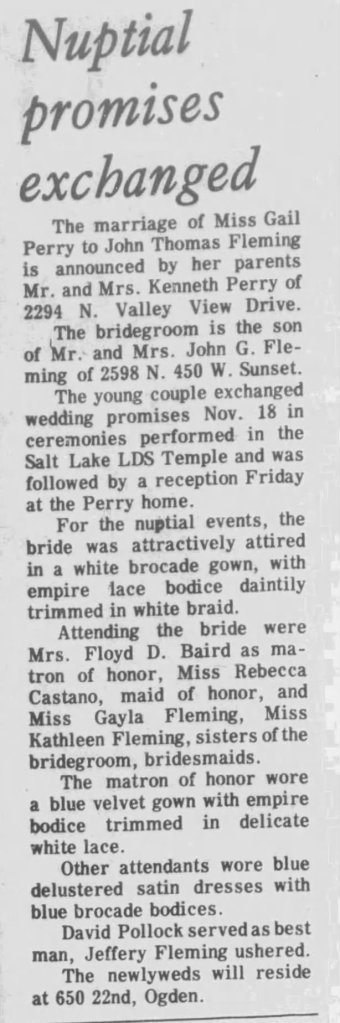
Nancy Perry-Baird was born on January 14, 1952 to Kenneth and Elna (nee Dee) Perry of Provo, Utah. On July 21, 1947 Kenneth and Elna wed and the couple eventually settled in Layton, Utah. They had five children: a son (Don) and four daughters, Norma (Pitt), Pat (Lindeman), Gail (Fleming), and Nancy. I couldn’t find what Mr. Perry did for a living but he was in the military at one point and was married twice (he got hitched to his first wife Wanda in 1939 but sadly she passed away in 1945). Elna was a graduate of Brigham Young University and earned degrees in both accounting and education; she retired from the IRS in Ogden after working there for 15 years. Nancy had fair skin with long strawberry blonde hair and hazel eyes; she stood 5’2”/5’3″tall and had scars on the inside of both wrists (interesting factoid: she had type O-positive blood). At the time of her disappearance she was living at 471 Wasatch Drive in Layton, Utah and was employed at the Triangle Oil Company’s Fina Gas Station at 1378 North Highway 89. I wasn’t able to find a lot about Nancy’s early life or family background, but everything I came across pointed towards her having a relatively normal childhood; she did however at one point attempt suicide. She went to Layton High School in Utah and got married to Floyd D. (Dee) Baird in 1970 after she graduated (they were both 18). Floyd was employed as a master electrician and the couple had a son together in the Winter of 1971; they sadly got divorced in the Spring of 1975.

On July 4, 1975, 23 year-old Nancy was working a 3-11 PM shift (some sources say it was until midnight) as an attendant at the Fina self-service gas station in East Layton, Utah. At the time of her disappearance she lived close to her job, her son lived with family, and her ex-husband lived in Wyoming state. A little after five o’clock Officer David Anderson stopped and chatted with Nancy a little bit during her shift; he bought a soda water before leaving a few minutes later to investigate a potential alcohol violation at the Shamrock gas station on the other side of the highway. He returned to the Fina station shortly after at around 5:30, when he noticed a green van and a couple of lingering ‘hippie-types’ and wanted to assess the situation. When Perry-Baird’s manager Bonnie Peck popped in to pick up some soda water at around 5:30 she came into a line of customers and no cashier. After Officer Anderson returned he encountered Peck and quickly realized that sometime in the past 15-20 minutes Nancy Perry-Baird had vanished off the face of the earth. The only thing out of the ordinary was that there was $10 worth of gas on a pump that hadn’t been paid for (the average cost of a gallon of gas in 1975 was .57 cents so that was a good amount of fuel). Not only was Nancy’s locked car left behind but her handbag containing her cashed paycheck ($167), car/house keys, headache medications, and other personal belongings was left in the gas station as well. Former East Layton Police Chief Ray Adams said Baird’s purse was left inside the station and that she was checked on by an officer out on patrol no more than 15 minutes before she disappeared. She was last seen wearing a blue halter top with blue shorts, a gold pinky ring inlaid with a ruby in the center, with two smaller rubies on each side of the center stone. Over her street clothes was her work attire: a blue pinstriped smock-type shirt with the Fina Gas Station logo embroidered on it. At the time Nancy was working her son was with relatives.

By July 7th, law enforcement exhausted their land and air searches and shifted their focus to talking to Nancy’s family, friends, acquaintances, and customers. Police were able to obtain receipts from the gas station for the hours she worked and were able to track down a good number of her customers. One by the name of Denzel G. Williams was contacted by law enforcement because a credit card receipt proved that he had purchased gasoline during the time Nancy was there. Mr. Williams told police that he was there to fill up the family car and a gas can before a trip to Park City the next morning, and was there with his son David and nine-year-old daughter, Jana; he estimated they were there between roughly 5:10 and 5:15 PM. He never entered the service station but his daughter went in to buy a bottle of raspberry soda (she only had 28 cents and the beverage cost 29 but Nancy let the penny slide and gave it to her anyways). The young girl said that two young white men, roughly in their early 20’s, were chatting with Nancy at the end of the counter, but didn’t appear to be buying anything. The Williams children were able to provide police with descriptions of the individuals they saw, which allowed them to use a tool called an ‘Identi-kit’ which helped build composite images of the suspects. Police labeled the men ‘subject #1’ and ‘subject #2,’ and both were determined to be ‘hippie type individuals.’ Subject #1 was described as ‘skinny, had shoulder-length hair, a beard and mustache and wore a denim jacket with frayed edges.’ Subject #2 also had a beard and mustache, however his hair only came to the bottom of his ears and he was wearing a yellow long-sleeve shirt.

Mr. Williams remembered seeing what he thought was a bright yellow 1973 four-door Ford Maverick with a white stripe along the side. He also reported seeing a third man outside the gas station, who he described as being between 55 to 60 years old and very slender, with a full head of gray hair and overly prominent veins on his arms. The man went into the exterior men’s restroom and came out while he was still pumping his gasoline. Williams said the gentleman never went inside the station and after he filled up his gas tank gave his credit card to his son, who went inside and paid. He said that it takes about four to five minutes to drive to his house from the Fina station and he very clearly remembered being home before 5:30, which was exactly when his brother came over for a visit.

Another important eyewitness is Mrs. Henry Heath, who reached out to the police because she had stopped by the gas station around 5:30 PM to buy film and witnessed several people milling around the counter waiting for assistance. She distinctly remembered a Caucasian man in his late 20’s with medium length brown hair styled neatly with a bit of facial stubble buying what appeared to be a canned beverage. Mrs. Heath further reported that she saw a Mexican man with two small boys that were also standing at the counter waiting to purchase some items. Lastly, there was a visibly irritated tall, thin, white male in his 50’s who (most likely upset by the lack of customer service) put a six pack of beer down and walked out. It was at this point that the older woman started poking around the store to see exactly what was going on. She checked the women’s restroom and noticed the door was open and there was no one inside; the man with the two boys looked in the office, which also was unoccupied. Mrs. Heath also reported seeing a yellow pickup truck hauling a shell camper with a young couple inside; they stopped to get gas and when they weren’t serviced right away blew their horn. Within about 5-7 minutes of waiting around for help Peck came in to purchase some soda water, and as she was in a hurry made a beeline to the counter. A male customer (obviously a regular that recognized her) made a joke asking if she stepped away for a moment to grab a beer, which is when she asked what was going on and where her cashier was. At this point three people in a van pulled up asking for directions to the Sheriff’s Office, announcing that one of their vehicles had been impounded. Peck quickly jumped into action and cashed out the waiting customers; Mrs. Heath paid for her film and remembers getting home roughly 10 minutes before 6:00.

What happened in the 15-20 minutes between Mr. Williams leaving the gas station and Mrs. Heath showing up? One of the stranger parts of this case is (to me) how she was abducted in the middle of the day on a holiday during peak business hours. Why abduct someone then? Why not wait until 9:00 or 10:00 at night when there’s fewer customers and you’re protected by darkness? The FBI briefly got involved because at first they felt maybe Nancy was kidnapped but after about six weeks and no leads they eventually left things in the hands of local law enforcement (as they were unable to prove anything and weren’t able to officially take on the case if she was abducted). Over the years hundreds of Nancy’s family, friends, and acquaintances were interviewed and polygraphed and everyone passed.

In a joint statement released by former Davis County Sheriff William J. ‘Dub’ Lawrence and Chief Adams, it was reported there were no signs of a struggle or theft from the Fina station (aside from the $10 worth of gas). Thankfully Nancy’s disappearance was taken seriously from the start. I mean, that makes sense when comparing this disappearance to the other missing girls in Utah at the time… after all, she had a son, a stable job, and was a bit older than most of the other victims (even though Caryn Campbell was also 23, Denise Oliverson was 24, and Julie Cunningham was 26). Family and friends told police there were no signs that Nancy had any intention of leaving or taking off. All of her personal belongings were left behind in her residence and no money was taken, which almost makes me think she was an intended target and the attack was not meant to be a robbery. Additionally, her manager said she was always on time to work and was a good employee, making me think she wouldn’t just walk off the job or just leave. Law enforcement interviewed Perry-Baird’s family the night she disappeared but they weren’t able to offer much help. They felt it especially odd that Nancy left behind $167 in cash… but what if she was possibly attempting to stage an abduction so she could disappear? Maybe then it might make sense? Law enforcement spoke with Richard Marinoka from the employment office in Ogden, UT on July 8, who said that Nancy had come in to speak with someone in March because she was apparently unhappy at her job and wanted to find a better one. Was she depressed about her current situation and trying to disappear?

When police searched Nancy’s bedroom they found a phone number scribbled on a pad of paper near the phone that belonged to a female relative in Lakewood, Colorado. When they called the family member she claimed she hadn’t had any contact with Perry-Baird for about two and a half years. Law enforcement also collected a sampling of her hair brushes from her home as well as her birth control pills, which showed that she hadn’t taken any since April 7. Now…. why does a woman stop taking her pill? She’s either not having any sex at all, she WANTS to get pregnant, or she already is. This (in my opinion) throws a wrench in things. Apparently (according to the police report) there were nine different men that Nancy had some sort of past or current romantic involvement with, so my educated assumption is she was having some sort of sex life.

Sheriff Lawrence brought 14 deputies to the area early on Saturday, July 5, and those deputies joined four East Layton officers in a ground search of the mountains and roads of North Davis County over the course of the day. Lawrence commented that: ‘we’re treating it as if it were the worst, but hoping she’ll come home.’ A SLC Police Department helicopter was brought in for about three hours to search both sides of the highway but with no success. The sheriff said that all leads were checked out; however the case quickly ran dry and eventually went cold. About two months after she vanished two residents in Castle Rock, Utah reported that they thought they saw Nancy shopping at a local food store (unfortunately nothing came from that sighting). It’s worth mentioning that Castle Rock is only a 30 minutes drive away from Lakewood, which is where that female relative of Nancy’s lives whose phone number was written down on the pad of paper next to her bed.

Floyd Baird was out of state when his ex-wife disappeared and was officially cleared by authorities in 1975. He had been working on an electrical job in Rexburg, Idaho that fourth of July holiday and spent the day in Jackson Hole with a friend (Rick Thomas) either river running or kayaking. Interestingly enough, he did tell police that despite being divorced he still went on the occasional date with his ex-wife.

According to neighbors, Monty Torres was a man who Nancy hired to mow her lawn the month before she disappeared. When law enforcement spoke with Torres, he seemed visibly nervous, however told them he was in Pocatello, ID the afternoon of July 4. He was able to provide them with alibis that confirmed they saw him at 1 PM and again at 7 PM. Torres told investigators the last time he saw Nancy was about a month before she disappeared (his mom volunteered that she hadn’t seen her son in about three months). When police showed Mr. Williams’ daughter some pictures from Nancy’s personal photo album, she positively identified Torres as being one of the two men she saw at the gas station the afternoon of July 4th. Additionally, two other male acquaintances of the young divorcee were questioned in relation to Nancy’s disappearance: Reed Miller and a man whose name was redacted. Deputy Ben Reichel interviewed Miller, who was also in the Jackson Hole area that holiday weekend. He shared that he knew Nancy for roughly two and a half years (since the winter of 1972) and at one point the two were pretty serious but after he told her that he didn’t have any interest in getting married things cooled down quick. The two saw each other for the last time on June 28 when they went out on a date. Miller, Torres, and Baird were polygraphed and all three men passed.

Only one of the men Nancy was involved with had their name redacted and all we know about him is that police tried to speak with him multiple times but he dodged their every attempt. In a report completed by Officer Anderson dated July 8, Baird’s parents provided police with two pictures of a boyfriend whose name they have currently redacted due to the fact he is still under investigation for this abduction. According to reports, the ‘redacted’ man reportedly worked in a warehouse setting and his Foreman shared that he left for Phoenix to see his parents on July 2nd and wasn’t supposed to be back to work until either July 12/13. Because they couldn’t reach him, law enforcement tried to locate his family members and the closest ones they found were a cousin and an aunt. The cousin shared that despite ‘reacted’ getting divorced in June 1975 he was supposedly thinking about getting back together with his ex-wife. His Aunt, Mrs. Frank Olson stated she didn’t associate with her brother or his side of the family.

At the time Nancy was abducted in the summer of 1975, Sheriff Lawrence said the department was investigating quite a few high-profile cases and for about a month after she vanished they talked to multiple people of interest but were unable to pinpoint a suspect. He commented that: ‘when a police officer does this for years you develop a sixth sense. You feel it. (Bundy) was the worst of the worst criminals and it took its toll on most of us. We had five missing women at one time. Half we found part of the bodies, some of them.’

Enter Ted Bundy… in the summer of 1975, Ted was enrolled in classes at the University of Utah School of Law and was living at 565 1st Avenue in SLC (he was there from September of 1974 to September of 1975). He was briefly employed as the night manager in charge of Bailiff Hall from June to July 1975 (he was fired for showing up drunk) and from July to August 1975 he was a PT security guard at the University of Utah (his position was terminated due to budget cuts). His activity is unaccounted for on July 4, 1975 in the FBI Bundy Multiagency Investigative Team Report 1992. It’s obvious by her physical description that Nancy fit Bundy’s typical victim profile, however the crime scene is outside of a school setting, and I never heard of Ted going after anyone in a retail/gas station setting before. Before Perry-Baird’s disappearance, Bundy’s last confirmed kill was Susan Curtis on June 28, 1975 out of Provo, Utah: the 12 year old girl vanished from Brigham Young University and Ted told law enforcement he buried her roughly 75 miles away. Now, if you’re considering the unconfirmed victims, on June 29, 1975, Shelley K. Robertson also vanished without a trace; her body was found in a mine shaft near Georgetown seven weeks later. Ted’s reign of terror didn’t last much longer after Nancy disappeared: early in the morning on August 16th, 1975 Utah State Trooper Sergeant Bob Hayward arrested him in Granger, Utah after leading him on a mile and a half long car chase.

Bundy living in the area is really the only thing police have linking him to Perry-Baird’s disappearance. No one at the Fina station reported seeing a man that fit his physical description or his VW nearby (lets face it, a Bug is a fairly memorable vehicle). Unlike Nancy Wilcox (for example), there was never any mention of a mysterious law student in Nancy’s life (it’s been speculated Ted went into the restaurant where Wilcox worked and flirted with her). When asked about Nancy Perry-Baird’s disappearance during his death row interviews, Bundy denied any responsibility. This obviously means he was either lying or telling the truth, and if he was telling the truth it means that someone else abducted her.

After Ted was arrested in SLC, Sheriff Lawrence’s team of detectives started looking into him in relation to Nancy’s abduction, saying ‘we had him in Rock Springs, Wyoming which put him on Interstate-80 coming back from Colorado.’ From Rock Springs, Lawrence said Bundy headed west into Utah and chose to return to Salt Lake using Interstate-84: ‘we don’t have any gas receipts that he stopped in the area.’ The Sheriff theorized that Bundy at one point headed south on Highway-89, the same roadway where the Fina gas station Nancy worked at was located, saying ‘there’s no women missing (along I-80). There was no abduction on 80-coming in.’ He strongly believes that the serial killer murdered Baird then disposed of her remains in Lambs Canyon, saying ‘Ted Bundy was tired, he had driven all day. I believe he went to somewhere that was close. It was handy it was safe, it was secure.’ Lawrence also said that Bundy was familiar with the area and that the body of Melissa Smith was found just about ten miles away in Parleys Canyon: ‘it’s what we call the law of probability. It’s not provable but if you work back by process of elimination you come up with the most logical scenario.’ In the pictures section I included a Websleuths comment saying that East Layton law enforcement said Bundy fueled up at the Fina station at least once in 1975.

According to researcher Tiffany Jean, records from the Carol DaRonch kidnapping case show that during the summer of 1975 Bundy briefly dated a woman from SLC named Leslie Knudson. Jean said that Knudson was able to provide law enforcement with an alibi for her beau on that fourth of July weekend in 1975: the pair had attended a family reunion at her family’s ranch. Her maternal grandfather was a sheep rancher and owned property in Fruitland, UT, which is more than 100 miles from the gas station where Nancy Perry-Baird disappeared from.

Sadly, at the end of the day Ted’s involvement with the disappearance of Nancy Perry-Baird is just a theory with nothing but weak, circumstantial evidence: there just wasn’t enough for prosecutors to bring him up on charges. Before he was put to death he was interviewed by a Salt Lake Sheriff, and told him that he didn’t kill Baird. According to the audio tapes, Bundy said: ‘Nancy Baird, who is that? I’m not sure who you are talking about. No. I didn’t have anything to do with that.’

Despite Ted denying any involvement with Baird’s death, Sheriff Lawrence doesn’t believe him: ‘he admitted that he had some of the heads of his victims in Utah at his apartment. He mentioned Lamb’s Canyon.’ Perry-Baird’s in-laws don’t believe Bundy either and also felt he was responsible for her murder: her FIL Wally Baird felt Ted’s denial could have possibly been a cover-up: ‘he may have been that way because he didn’t know at the time that she had kids, a child and had been married. That was something that was contrary to his MO.’

Law enforcement commented at the time that they found no evidence making them think Nancy’s disappearance had anything to do with the then nine month old disappearance of Debbie Kent from Bountiful, UT. Kent was abducted from the parking lot of Viewmont High School on November 8,1974; as of March 2023 only her patella has been found. For reference, the school was about a 45-minute drive away from the gas station. Here’s an interesting tidbit of information: according to a 1975 news story published by the Davis County Clipper, Kent’s father was an official of the Triangle Oil Company that owned the Fina gas station that Baird was employed at.

Recently a new theory on Perry-Baird’s strange disappearance has emerged: The Utah Cold Case Coalition noticed that the investigation pretty much stopped after Bundy came into the picture. One of the coalitions co-founders Karra Porter commented that ‘a lot of the investigation stopped there. So we talked to quite a few people that were never interviewed.’ Some of the people interviewed include former law enforcement that worked the case when Nancy first disappeared. The coalition has recently come across two possible persons of interest, the first was a young man that was trying to date Baird (the feeling wasn’t mutual) and that ‘one of the names we’ve been given by former law enforcement does have a subsequent history of sex offenses and a criminal record and so that at least adds to the red flag.’ (he even had a history that landed him in prison) … ‘What we’ve learned so far is that one of the two suspects would be consistent with potentially having a pickup like that.’ Porter elaborated that new witnesses that were never before interviewed reported seeing a pickup truck leaving the area at roughly the time Nancy was abducted, which jumps out at me because when Bundy moved from Seattle to SLC he did buy an old pickup truck. She also said that of the two potential suspects one stands out a touch more than the other. The Coalition is currently attempting to interview him, however as of March 2023 the Covid pandemic is still getting in the way.

It’s speculated that Nancy’s case may somehow be related to the disappearance of another young woman named Cheryl Scherer. Nineteen year-old Scherer vanished out of thin air from Rhoades Pump-Ur-Own self service station in Scott City, Missouri sometime between 11:40 and 11:50 AM on April 17, 1979. The two women shared many similar characteristics (such as age, body type, and hairstyle) and disappeared under incredibly similar circumstances. Two hours before her shift ended, Cheryl called her mother who later told police nothing about the conversation was out of the ordinary and that her daughter seemed to be in a good mood. A coworker eventually came in to find the station deserted and ransacked. Just like Perry-Baird, Scherer’s car was left in the parking lot (with the keys inside) and her purse and checkbook were left inside her POE (however in this situation $480 was missing from the cash register). Police speculated the young girl was abducted after a robbery but there were no witnesses. The depraved serial killers Otis Toole and Henry Lee Lucas admitted to an abduction during that time and it’s strongly suspected they are responsible for Scherers disappearance. Both men denied any involvement in either girls disappearance.

When Nancy vanished in July of 1975, a young reserve officer named Thomas Jackson was the newest member of the East Layton police force, and Nancy’s case file shows he didn’t play a huge role in her investigation. However he shared with the COLD podcast that he didn’t feel Ted Bundy was responsible for Perry-Baird’s disappearance. Instead, he speculated it was his colleague officer Dave Anderson that might have been responsible for the young mothers demise. At the time of her disappearance, he had only been a police officer for about ten months. A few former law enforcement-related sources familiar with East Layton police operations in the 1970’s shared with the podcast that most of Anderson’s time was spent patrolling US Highway 89, which is the same stretch of road that Nancy’s place of employment was located on. In former Officer Jackson’s opinion, ‘Anderson spent too much time looking at women.’ Anderson left his job with the East Layton PD almost right after Nancy vanished, and case records do not show that he was ever investigated or challenged in any way regarding his account of her disappearance.

After she disappeared, Perry-Baird’s young son was told that ‘his mother is vacationing’ and he was sent to live with relatives. Newer technology at a Texas University helped forensic experts create a DNA profile for Baird based on genetic samples provided by her family. Nancy Perry-Baird would be 71 years old as of March 2023. Her ex-husband passed away on March 17, 2018 after years of battling Idiopathic Pulmonary Fibrosis. Despite her remains never being recovered, she has a memorial stone in a Provo City Cemetery. Her date of death is listed as the fourth of July, 1975.

***

Update, August 2023: I’m always updating my articles as I come across new information, and recently I found the initial police report (thanks to the COLD podcast) as well as a newly published article by ksltv.com. After initially being denied a request for Nancy’s case file by Davis County Sheriff’s Office, the podcast filed an appeal, and the original determination was overturned and the request was granted (with portions redacted). 

Perry-Baird’s name came to the attention of the podcast’s co-collaborators Dave Cawley and Keira Fairmont while conducting research on the Sheree Warren case. Apparently an informant named William Babbel began communicating with the FBI in February of 1989 while incarcerated at Florida State Prison. Babbel shared that he was at one point incarcerated with Warren’s ex-boyfriend Cary Hartmann, who at the time was serving a prison sentence of 15-years-to-life for an aggravated sexual assault in Ogden, Utah. Although she vanished years after Nancy in 1985, their cases had some eerie similarities: both women were recently divorced from (or were in the process of the act) their spouses and were primary caregivers for their young sons. They were about the same age at the time of their disappearances (Sheree was 25 and Nancy was 23) and both were last seen at their places of employment.

Babbel reportedly claimed that ‘Hartmann had been ‘openly talking about Warren’s disappearance,’ and the FBI states that he told one of their agents that ‘Hartmann questioned why Ted Bundy was blamed for the disappearance of Nancy Baird.’ … ‘on one occasion, Hartmann was looking at a newspaper article depicting Ted Bundy along with photos of many of his victims. Hartmann placed a X by the photos of five of Bundy’s alleged victims.’ FBI Special Agent Gregory Hall later commented that Babbel ‘learned that Cary Hartmann was an acquaintance of Nancy Baird. Baird’s disappearance allegedly occurred while Hartmann was experiencing a divorce.’ At the time Nancy disappeared in July 1975, Hartmann had been between his two marriages, so Babbel’s information seemed to have at least a glimmer of credibility. However the agency later dropped the inmate as an informant, claiming he was unreliable. In addition to Perry-Baird and Warren, he also attempted to tell the FBI about information related to the disappearance of Joyce Yost. 

One new piece of information I gathered from the case file that I didn’t know beforehand was an account from a friend of Nancy’s named Deloris Drake. She told a detective that on the evening of July 2, 1975 the two girls went to a few bars together along Ogden’s Washington Boulevard, including Rigos and the Iron Horse. She drove the pair back to her house at around 2:30 AM early the morning of July 3, 1975 and from there Nancy left for her own home in East Layton. About 30 minutes after leaving, she returned to her friends home, and she ‘appeared to be quite shaken and frightened because a man named Tom in a yellow van had followed her home.’ Tom had apparently pursued Perry-Baird to Drake’s home and was making threatening comments toward her as she opened her door. Deloris told law enforcement that she had seen a second man with ‘Tom’ that was on a motorcycle.

Update, October 2026:

A baby picture of Nancy from 1952.
Nancy Perry-Baird as a child, photo taken in 1960 when she was around 8 years old.
Nancy Perry-Baird in her youth sitting at a piano.
Nancy Perry-Baird as a child.
Nancy with a cat.
Nancy Perry-Baird in grade school.
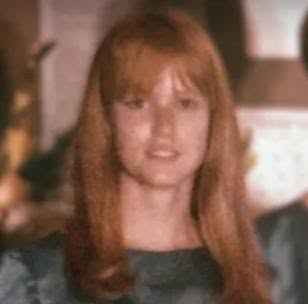
Nancy at the age of fifteen, photo courtesy of Brant Baird.
Nancy Perry as a sophomore in 1968; photo courtesy of Layton High School yearbook. 
Nancy Perry-Baird from the 1969 East Layton yearbook.
A wedding invitation from Floyd and Nancy’s wedding.
Nancy on her wedding day.
Floyd and Nancy on their wedding day.
Nancy with family on her wedding day.
A photo from Nancy’s wedding day.
Nancy and her son.
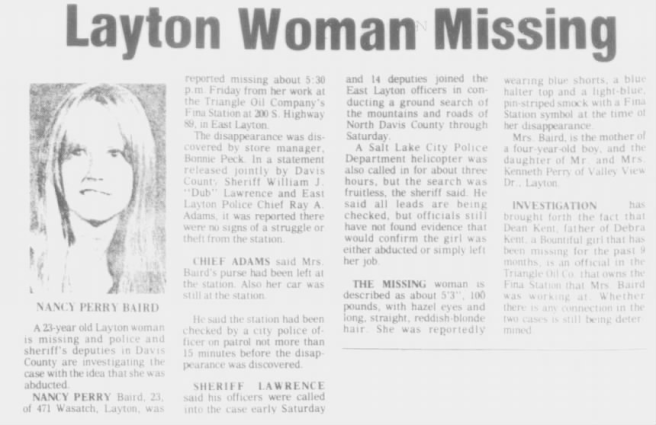
Nancy Perry Baird, photo courtesy of KSL.
Nancy on a motorcycle.
Floyd and Nancy at her high school graduation.
Nancy Perry-Baird compared to the Finley Creek Jane Doe.
Another composite sketch of the Finley Creek Jane Doe
Floyd Dee Baird.
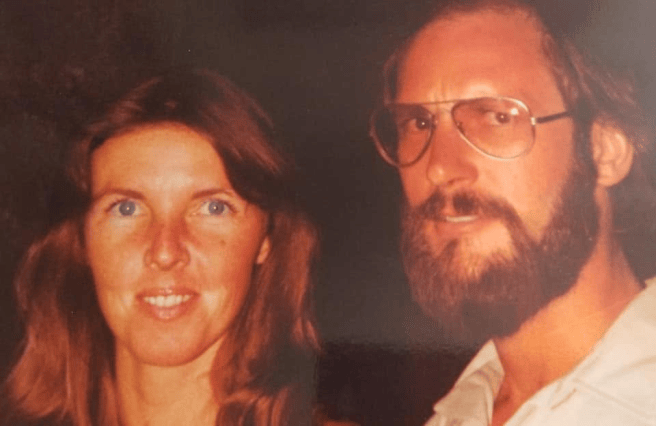
Floyd and his second wife, Colleen.
Floyd Dee Baird.
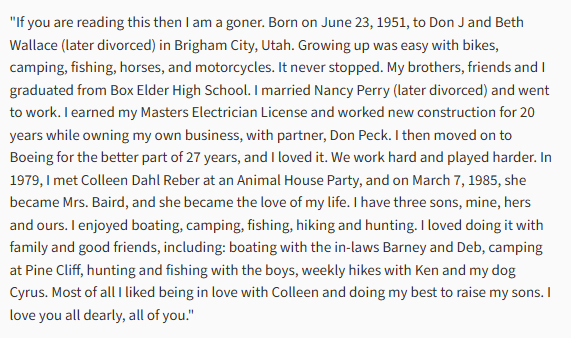
Floyd Baird’s obituary, written by him before he passed.
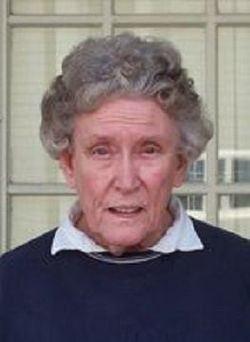
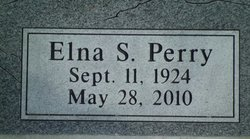
Nancy’s Mother, Elna Lorraine Perry; she was born on September 11, 1924 and passed away on May 28, 2010.

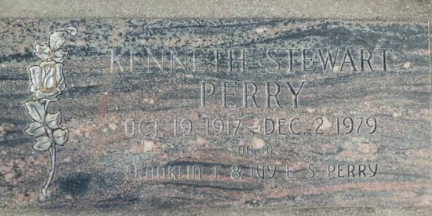
Nancy’s Father Kenneth Stewart Perry; he was born on October 19, 1917 and passed away on December 2, 1979.
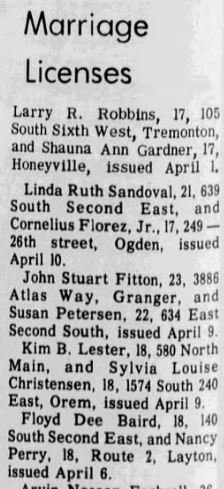
Box Elder Journal on April 16, 1970.
A birth announcement for Floyd and Nancy’s son published in The Ogden Standard-Examiner on October 14, 1970. Photo found by Teri Offield.
Nancy and Floyd are mentioned in Floyd’s sisters’ marriages announcement that was published in The Sun Chronicle on December 2, 1971.
Nancy’s sister, Pat Perry-Lindeman.
Elna Lorraine Stueler-Perry.
This picture was taken when Nancy’s son Brant entered kindergarten weeks after she disappeared, photo courtesy of Brant Baird.
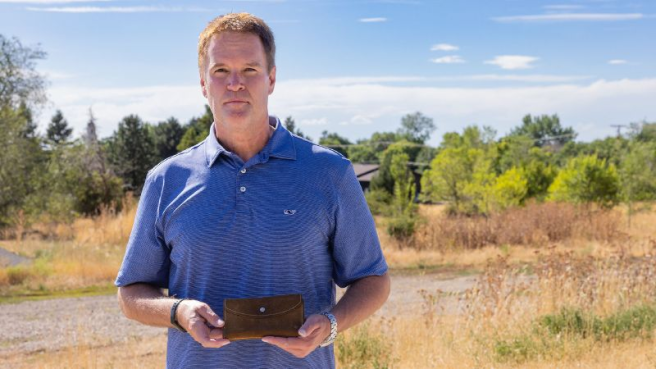
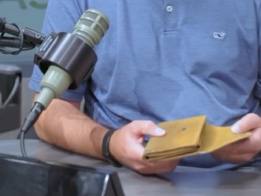
Nancy’s son holding her wallet that she left behind the day she disappeared.
Another picture of Brant Baird holding his moms wallet that she left behind the day she disappeared.
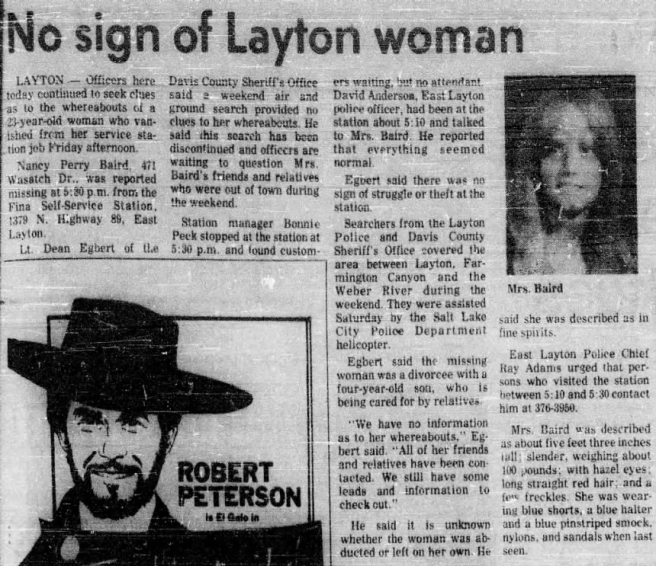
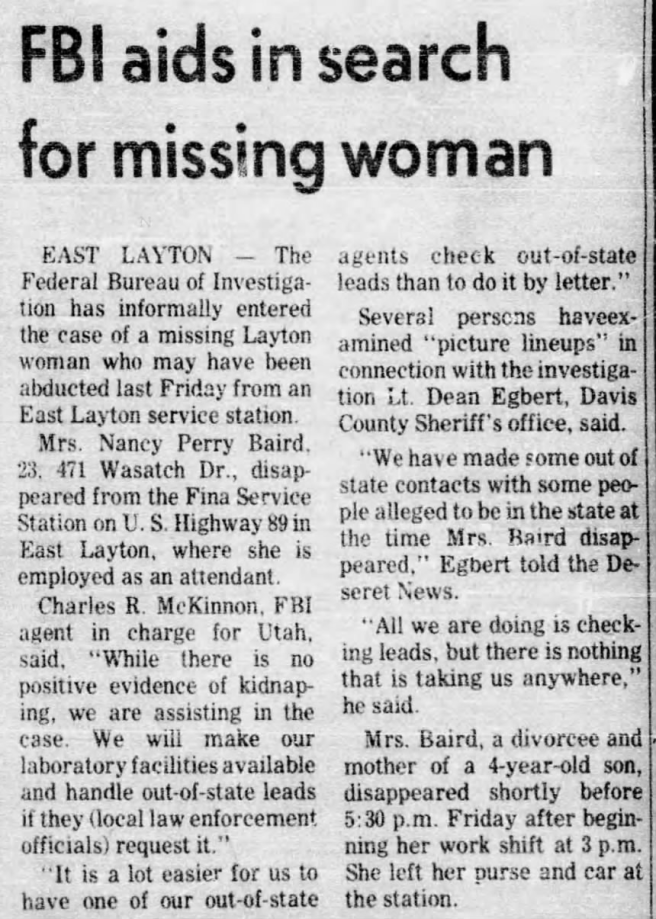
An article about Nancy’s disappearance, published in The Salt Lake Tribune on July 6, 1975.
An article about Nancy’s disappearance, published in The Salt Lake Tribune on July 7, 1975.
An article about Nancy’s disappearance, published in The Deseret News on July 7, 1975.
An article about Nancy’s disappearance, published in The Ogden Standard-Examiner on July 7, 1975.
An article about Nancy’s disappearance titled ‘Police Question Friends of Missing Woman, 23’ published by The Daily Herald on July 7, 1975.
An article about Nancy’s disappearance, published in The Ogden Standard-Examiner on July 8, 1975.
An article about Nancy’s disappearance, published in The Salt Lake Tribune on July 8, 1975.
An article about Nancy’s disappearance published by The Ogden Standard-Examiner on July 9, 1975.
An article about Nancy’s disappearance published by The Deseret News on July 9, 1975.
An article about Nancy’s disappearance published by The Salt Lake Tribune on July 9, 1975.
An article about Nancy’s disappearance published by The Ogden Standard-Examiner on July 10, 1975.
An article about Nancy’s disappearance titled ‘Help Sought to Locate Woman, 23′ published by The Daily Herald on July 10, 1975.
An article about Nancy’s disappearance published by The Logan Herald Journal on July 10, 1975.
An article about Nancy’s disappearance published by The Salt Lake City Tribune on July 10, 1975.
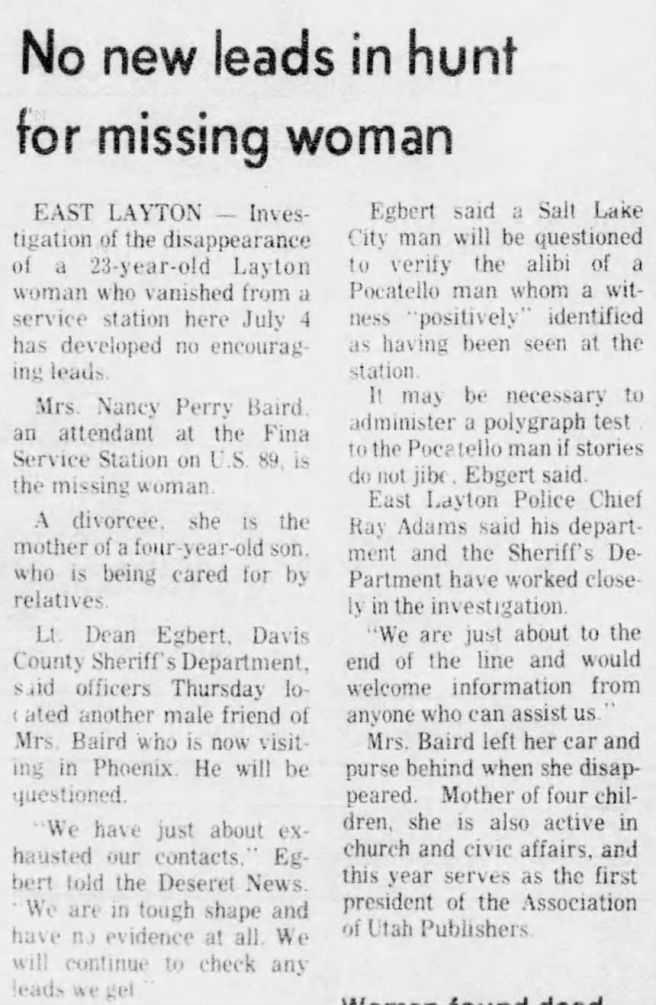
An article about Nancy’s disappearance published by The Deseret News on July 10, 1975.
An article about Nancy’s disappearance published by The Utah Provo Daily Herald on July 10, 1975.
An article about Nancy’s disappearance published by The Deseret News on July 11, 1975.
An article about Nancy’s disappearance published by The Davis County Clipper on July 11, 1975.
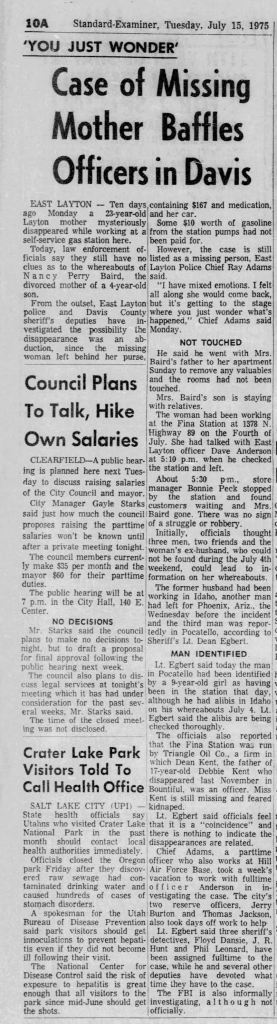
An article about Nancy’s disappearance titled ‘Case of Missing Mother Baffles Officers in Davis’ that mentions both David Ray Anderson and Thomas Jackson that was spublished by The Ogden Standard-Examiner on July 15, 1975.
An article about Nancy’s disappearance published by The Deseret News on July 28, 1975.
An article about Nancy’s disappearance published by The Salt Lake City Tribune on August 25, 1975,
An article about Nancy’s disappearance titled ”Authorities Still Baffled By Missing Woman, 23′ published by The Ogden Standard-Examiner on September 2, 1975.
An article about Nancy’s disappearance titled ‘Missing Layton Woman Spotted? Story Checked’ published in The Ogden Standard-Examiner on September 5, 1975.
An article about Nancy’s disappearance, published in The Ogden Standard-Examiner on November 19, 1975.
An article about Nancy published by The Ogden Standard-Examiner on January 13, 1976.
A 1976 article about the disappearance of Nancy Perry-Baird.
An article about Ted Bundy that mentions Nancy Perry-Baird that was published in The Tampa Tribune on April 5, 1978.
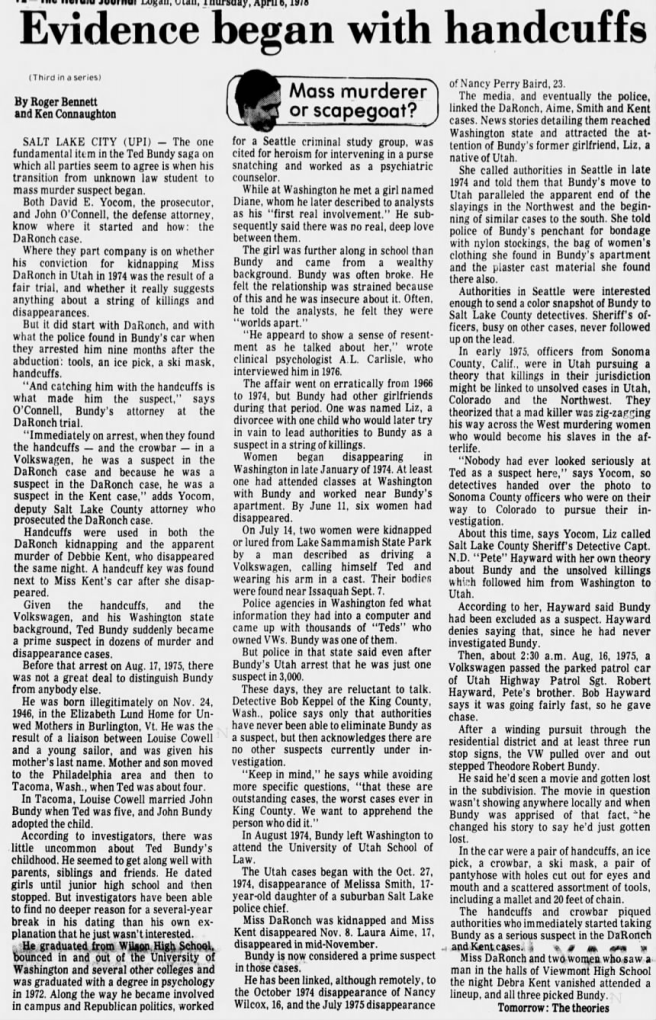
An article about Ted Bundy that mentions Nancy Perry-Baird that was published in The Herald-Journal on April 6, 1978.
An article mentioning Nancy’s disappearance published by The Deseret News on July 10, 1978, found by Teri Offield.
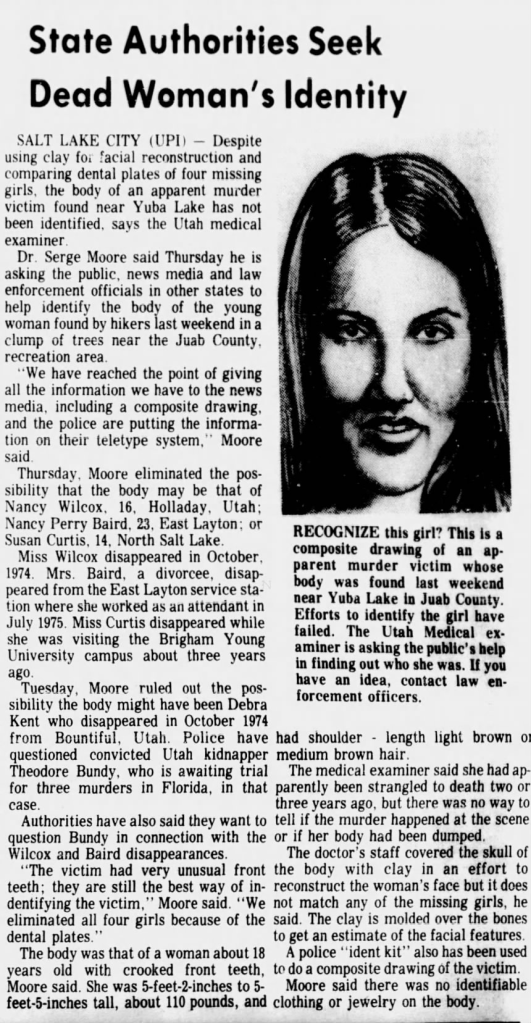
An article written about Utah authorities looking for a dead woman’s identity that mentions Nancy-Perry-Baird that was published in The Daily Herald on September 8, 1978.
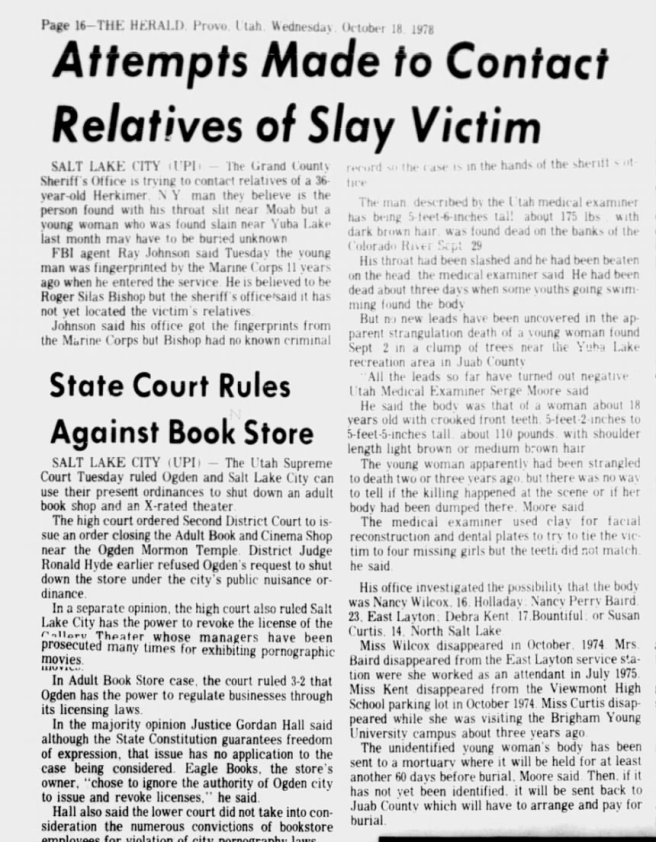
An article written the less than a year before Bundy’s execution that mentions Nancy Perry-Baird that was published in The Herald on October 18, 1978.
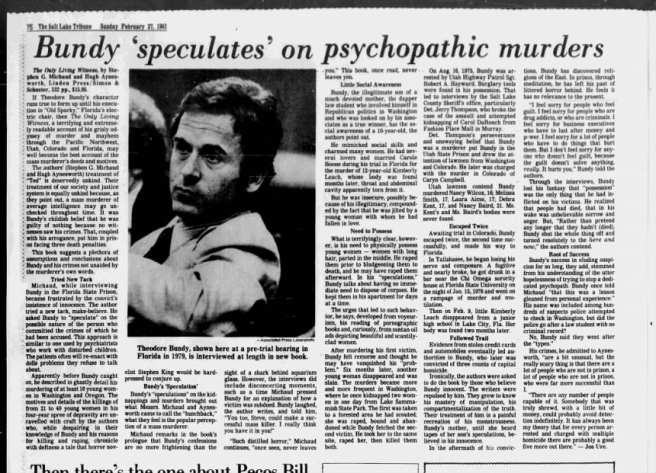
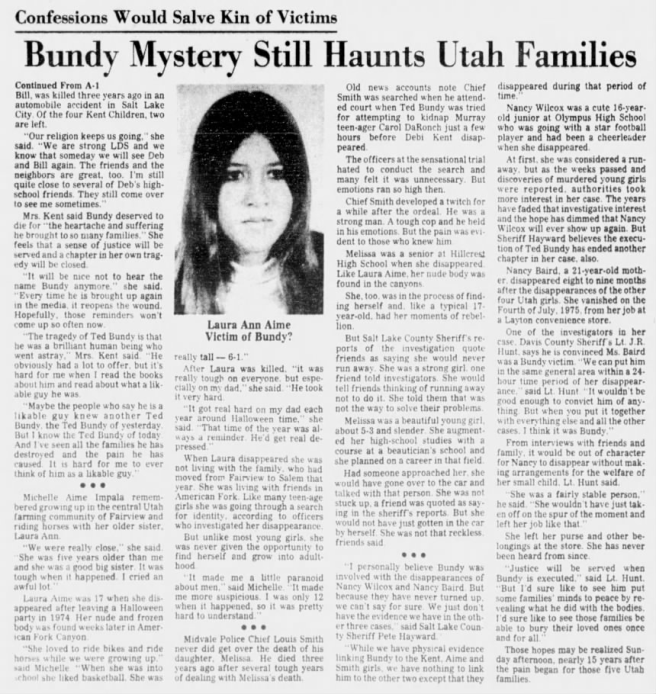
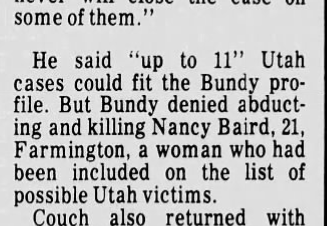
An article written about Ted Bundy that mentions Nancy Perry-Baird that was published in The Salt Lake Tribune on February 27, 1983.
An article written about Ted Bundy that mentions Nancy Perry-Baird that was published in The Walla Walla Union Bulletin on May 23, 1986.
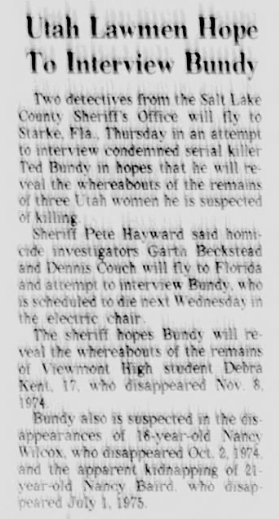
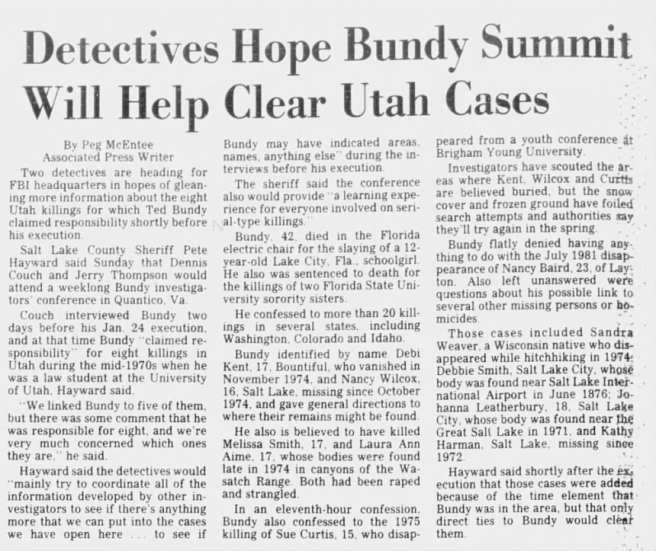
An article about members of Utah law enforcement hoping to talk to Ted Bundy before his execution that was published in The Salt Lake Tribune on June 26, 1986; I apologize for the poor quality, it was the only copy I could find.
An article about Ted’s name being carved on a tree possibly being a clue in relation to some Utah deaths that was published in The Manti Messenger on August 21, 1986.
An article written the less than a year before Bundy’s execution that mentions Nancy Perry-Baird that was published in The Texan Newspaper on March 2, 1988.
This image has an empty alt attribute; its file name is 319158609_903021394191868_6987185981797144771_n.jpg
An article mentioning Nancy among the list of Ted’s victims after his 1989 execution.
An article written two days before Bundy’s execution that mentions Nancy Perry-Baird that was published in The Salt Lake Tribune on January 22, 1989.
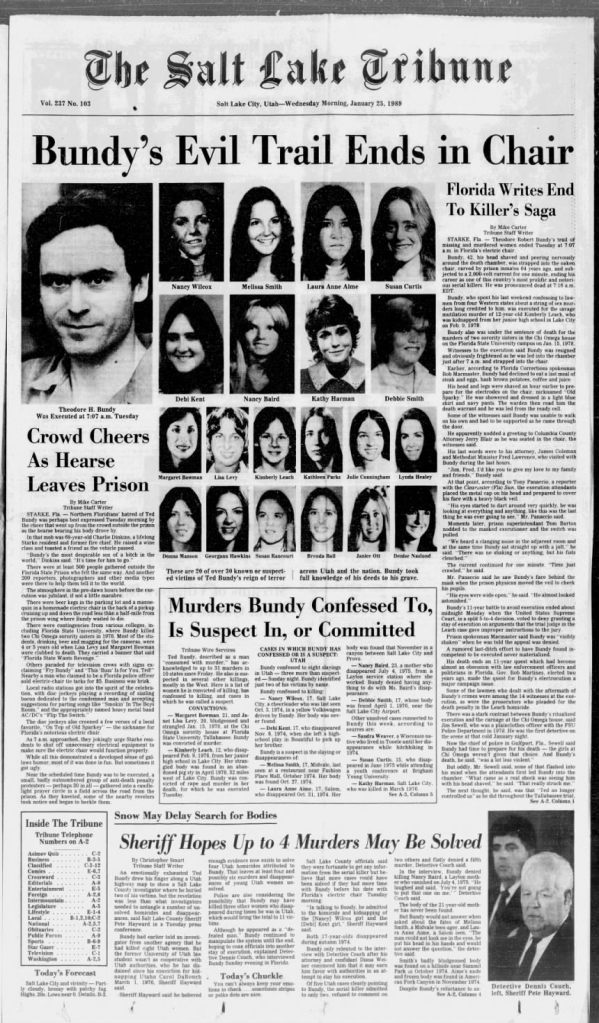
An article written the day after Bundy’s execution that mentions Nancy Perry-Baird that was published in The Salt Lake Tribune on January 25, 1989.
An article written the day after Bundy’s execution that mentions Nancy Perry-Baird that was published in The Herald-Journal on January 25, 1989.
An article written after Bundy’s execution that mentions Nancy Perry-Baird that was published in The Salt Lake Tribune on February 20, 1989.
Some articles about the disappearance of Nancy Perry-Baird.
The FBI Bundy Multiagency Investigative Team Report 1992; Bundy’s activity is unaccounted for on July 5 when Nancy disappeared.
Ralph Leroy Menzies.
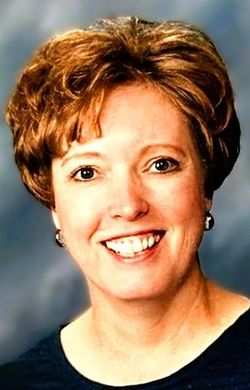
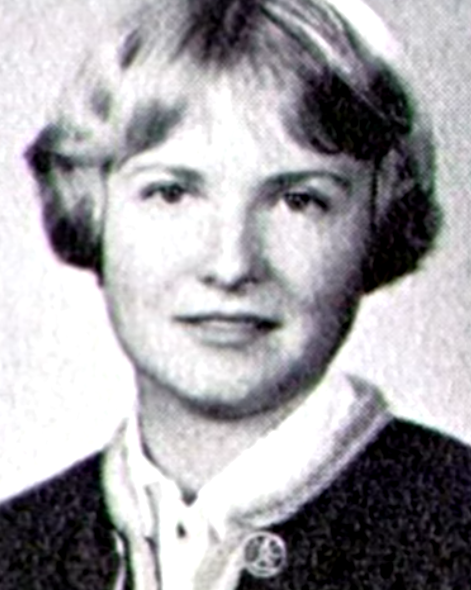
A picture of Ted’s one-time girlfriend Leslie Knudson, who provided him with ab alibi for the day of Nancy’s disappearance.
Courtesy of Websleuths.
Courtesy of Websleuths. I think the most interesting part is “I have followed this case and know that Bundy used his credit card at that location, at least once (per the East Layton police).”
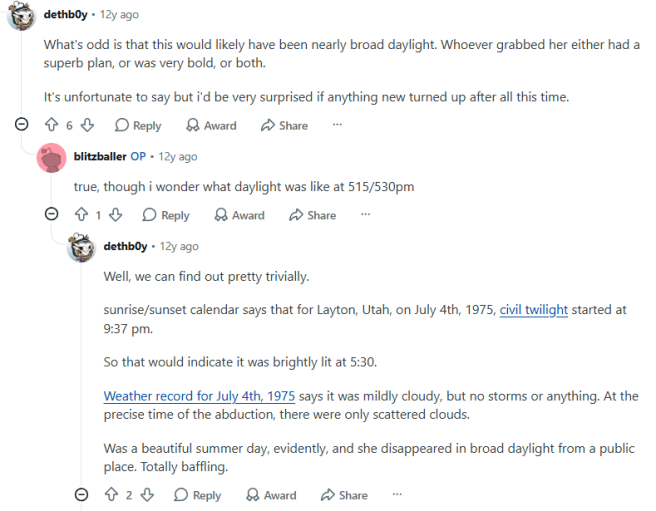
Courtesy of Reddit.
A ‘NamUs’ missing persons poster for Nancy.
Nancy’s gravestone.
Jana Williams Grow and David Williams as they look today from the article titled, ‘Blamed on Bundy: COLD Podcast Challenges Popular Theory in Nancy Baird Cold Case’ published on May 15, 2023 and written by Dave Cawley and Keira Fairmont.
David and Jana Williams provided information to the Davis County Sheriff’s Office about two men they’d seen speaking to Nancy Baird minutes prior to her disappearance. A detective used that information to generate these two Identi-kit composites.
What is an identi-kit, you may ask? (I did). It’s a 1970’s-era kit that helped law enforcement to generate composite facial sketches by stacking transparencies of individual features.
The Identi-kit composite of ‘subject #1’ in the Nancy Perry-Baird case. Photo courtesy of thecoldpodcast.

The Identi-kit composite of ‘subject #2’ in the Nancy Perry Baird case. Photo courtesy of thecoldpodcast.

The Identi-kit composite of ‘subject #3’ in the Nancy Perry Baird case. Photo courtesy of thecoldpodcast.
kl
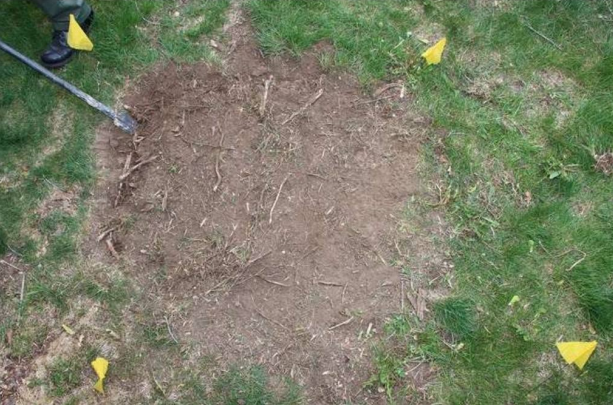
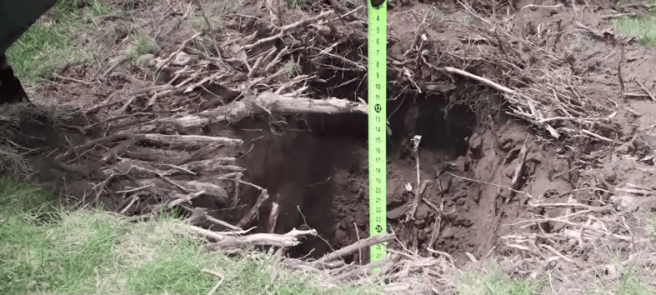
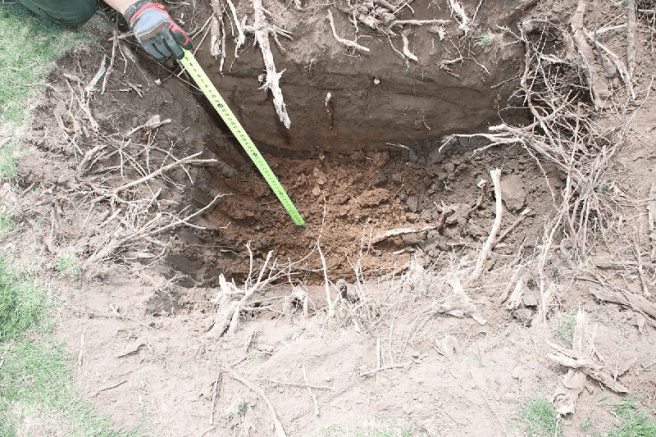
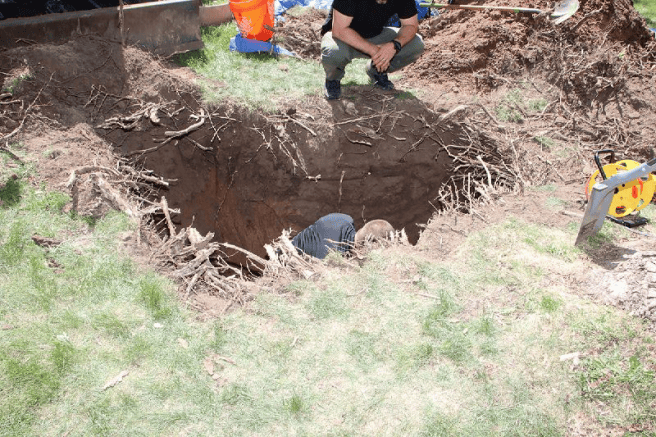
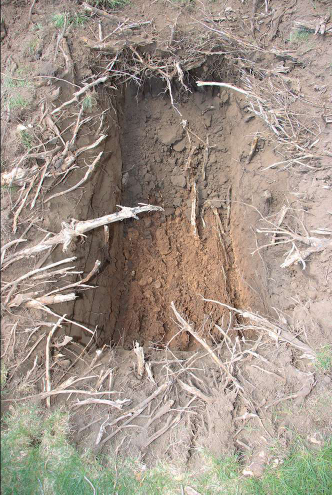
Davis County Sheriff’s Office excavated the backyard of a home on Gilman Drive in Layton on May 8, 2025. Detectives believed the remains of Nancy Perry Baird might be located on the property. No human remains were discovered as a result of the excavation. Photo courtesy of the Davis County Sheriff’s Office.
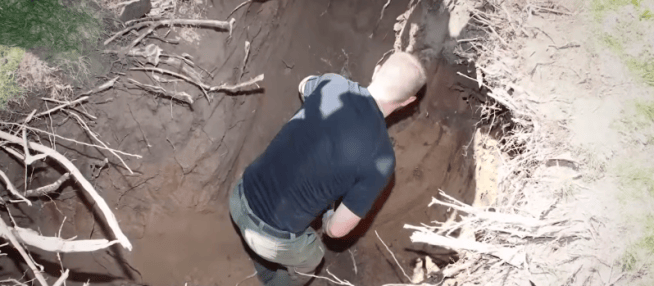
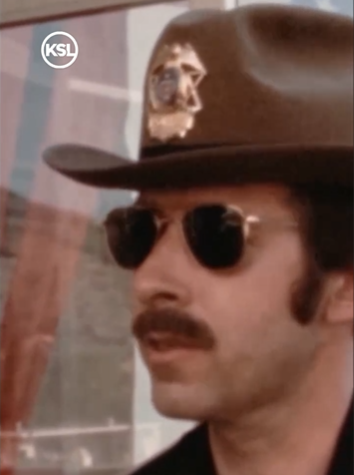
A still of a Davis County deputy digging in the back yard of former police officer Thomas Richard Jackson in search of the remains of Nancy Perry-Baird, courtesy of KSL News Utah, September 30, 2026.
Davis County Sheriff’s Office detectives excavated the backyard of a home on Gilman Drive in Layton on May 8, 2025, as they strongly suspected the remains of Nancy Perry-Baird might be located on the property. Unfortunately, no human remains were discovered. Photo courtesy of the Davis County Sheriff’s Office.
Nancy Perry-Baird went to this bar with a friend two days before she vanished. Photo courtesy of thecoldpodcast.
A Google Earth view of the Fina station where Nancy worked.
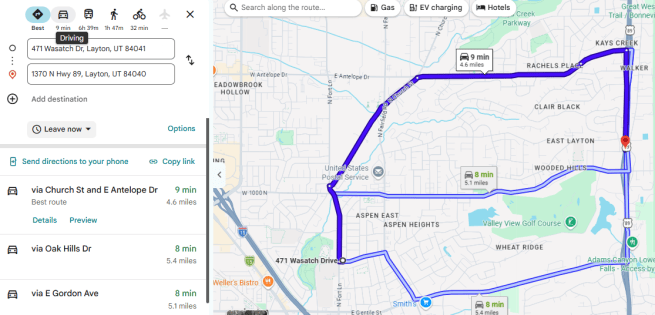
A Google Maps route from where Nancy was living at 471 Wasatch Dr, Layton, UT to t he gas station she was working at located at 1370 N Hwy 89, Layton.
The
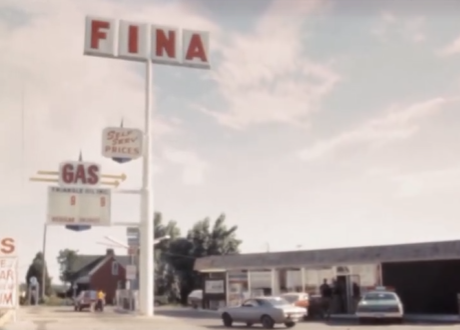
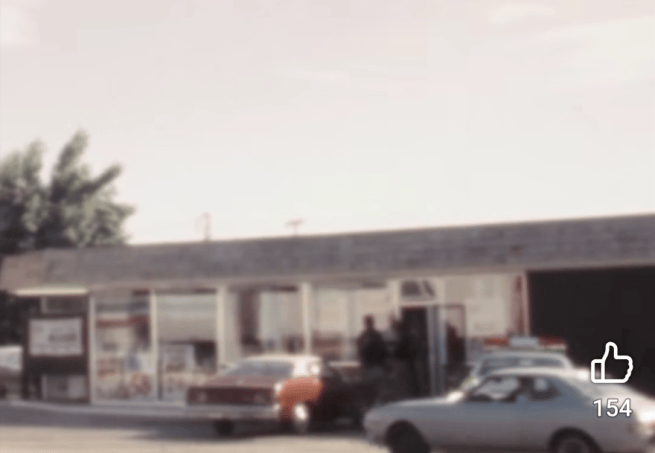
The Fina station where Nancy worked.
A map from Layton to Rock Springs, CO where Nancy was reported being seen.
A Google Maps view of 471 Wasatch, Layton UT.
Google Maps view from the Fina gas station to Bundys boarding house.
A yellow 1973 four-door Ford Maverick.
Officer Dave Anderson.
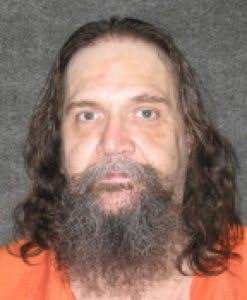
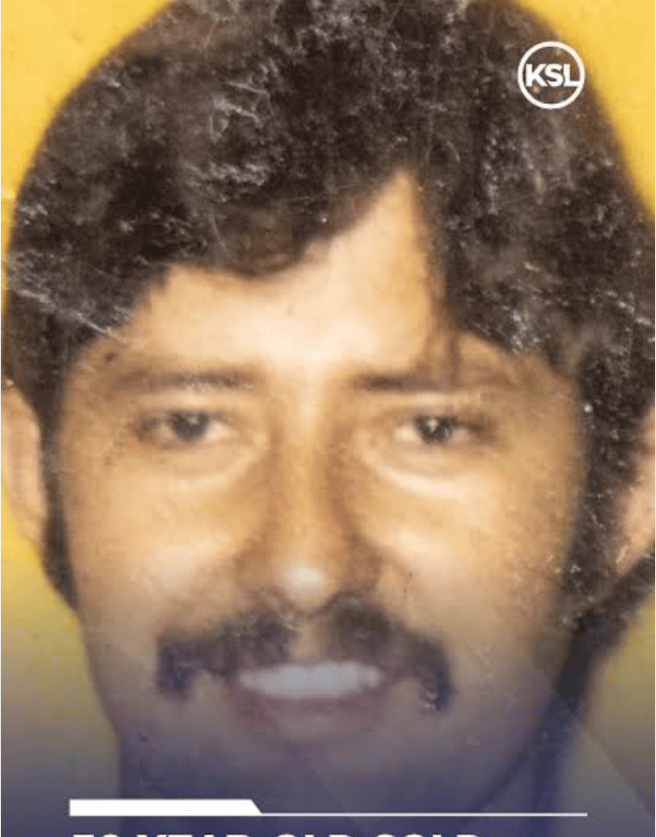
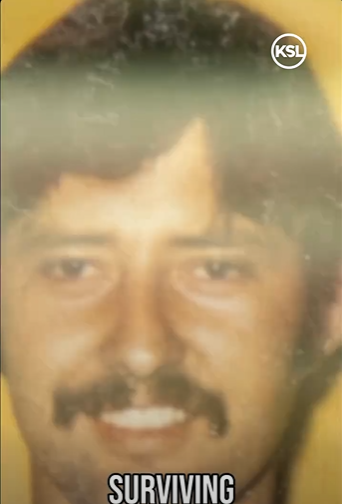
Thomas Richard Jackson.
Tom Jackson courtesy of ‘Crime without Closure.’
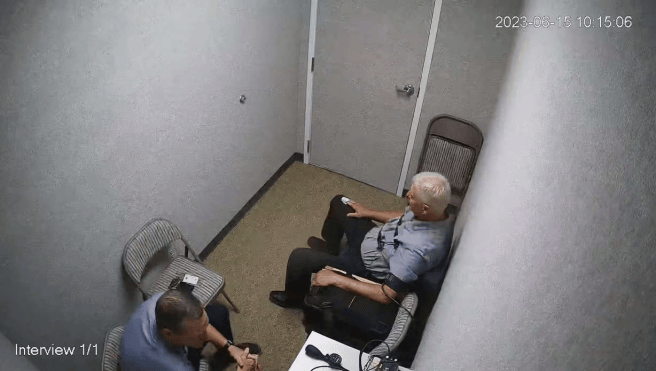
Former East Layton, Utah police officer Thomas Jackson undergoing a polygraph examination on June 15, 2025 where he was interrogated about his possible involvement in the disappearance of Nancy Perry Baird on July 4, 1975. Photo courtesy of the Davis County Sheriff’s Office.
Sheriff William “Dub” Lawrence.
Bonnie Peck.
Cheryl Scherer.
Cheryl Scherer.
A map of reference from East Layton, UT where Nancy Perry-Baird was possibly abducted from to Scott Hill, Missouri, where Cheryl Scherer was last seen alive.
William Babbel, who briefly acted as an FBI informant in February of 1989. Photo courtesy of The Weber County Attorneys Office.