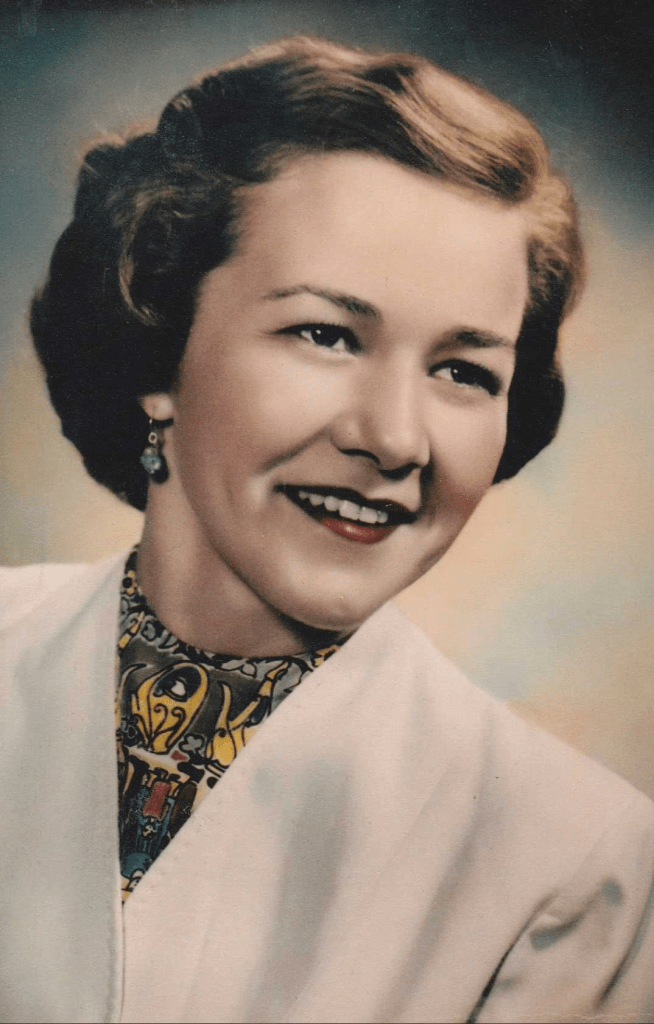
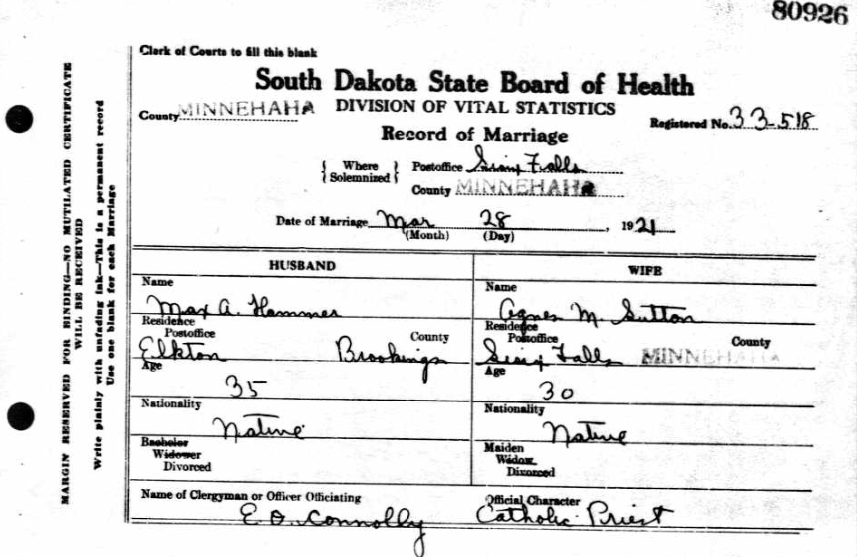
Ann Marie Hammer was born on February 4, 1927 to Maxwell Algernon and Agnes Marie (nee Sutton) Hammer in Aberdeen, SD. She had an older sister named Cecelia Mae (Boyce) and a brother named Lowden William, who was born in December 1921 and sadly only lived to the age of three. Maxwell was born on April 7, 1887 in Hubbard, Iowa, and Agnes was born on August 31, 1890 in Illinois. I wasn’t able to find out very much about Ann’s background, and wasn’t even able to find the name of the high school she graduated from. According to Ancestry.com, the Hammer family lived in Aberdeen, SD in 1930 and in 1935 they moved to Rural, SD. Ann’s father was a WWII vet and was the owner and operator of the Hammer Realtor Company, and president of the Co-operative Building and Sales Company. Sadly he shot himself in the chest in November 1940 with a .410 shotgun, and according to his obituary he had been in poor health for several months prior to his death and had recently learned he had malignant cancer. In late 1940 Mrs. Hammer took her two daughters and moved to Maricopa, AZ.
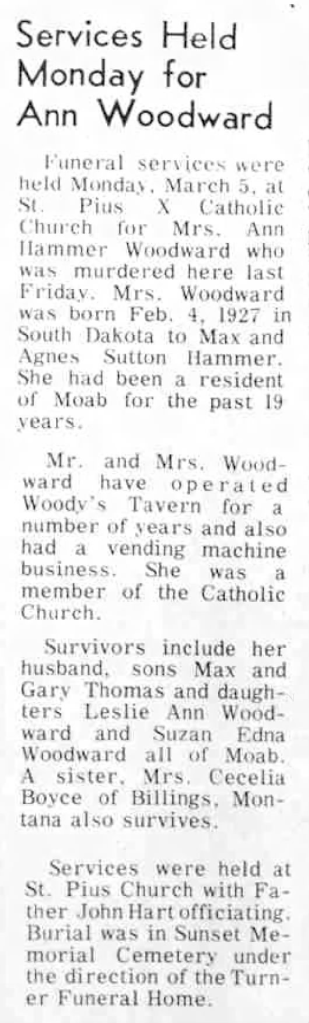
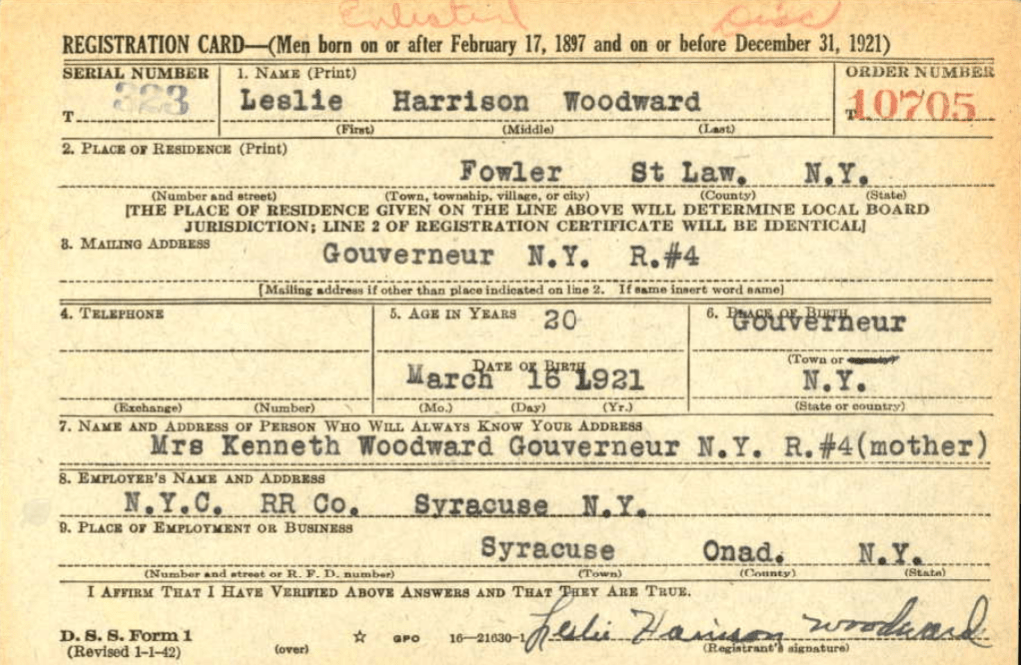
Ann was married twice: she wed her first husband Clarence George Sutherland in Juárez, Mexico, and her second Leslie Harrison ‘Woody’ Woodward on November 17, 1953 in Gallup, NM (she was his third wife). Sutherland was born in June 1912 in Peoria, Illinois and died in June 1996 in San Diego. ‘Woody’ was born on March 19, 1921 in New York, and the couple had four children together: Leslie Ann, Maxwell Joseph, Suzan Edna, and Guy Thomas.
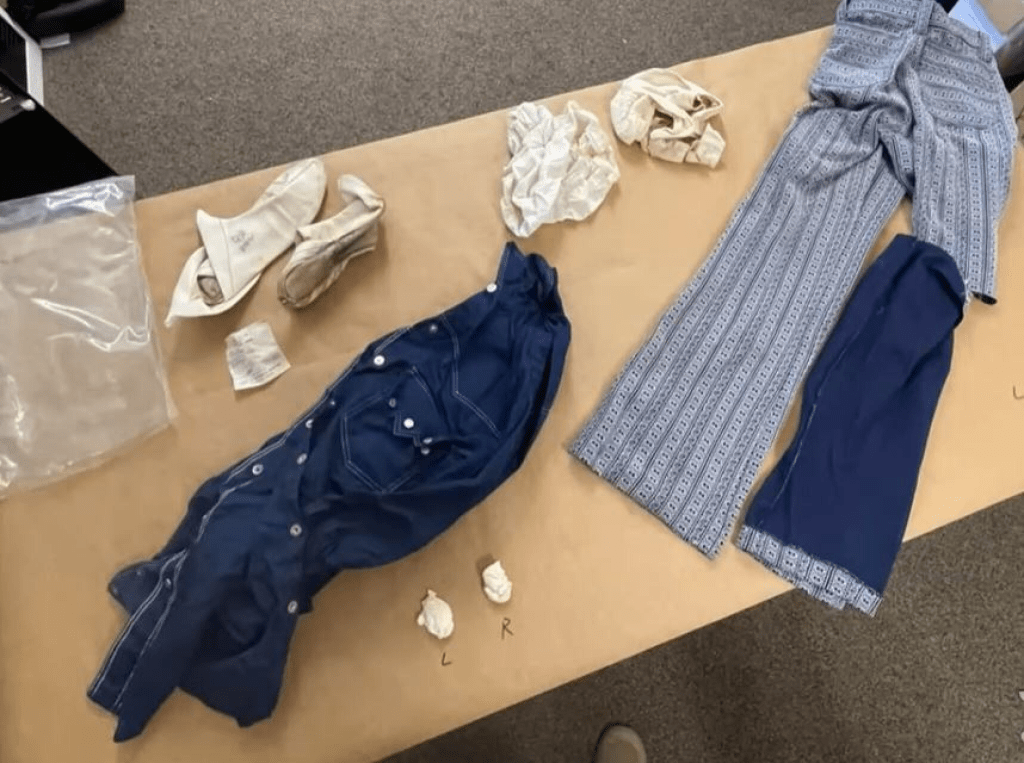
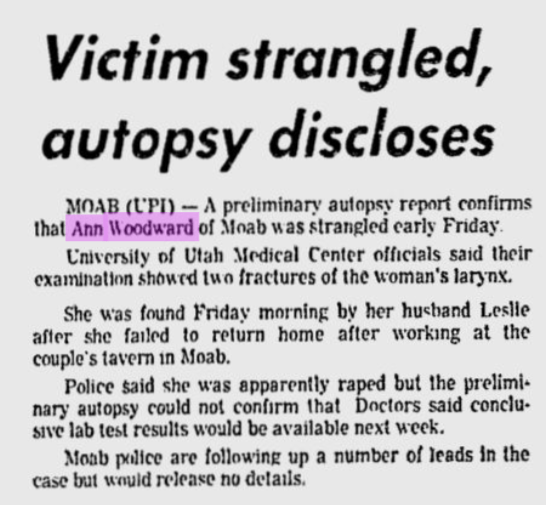
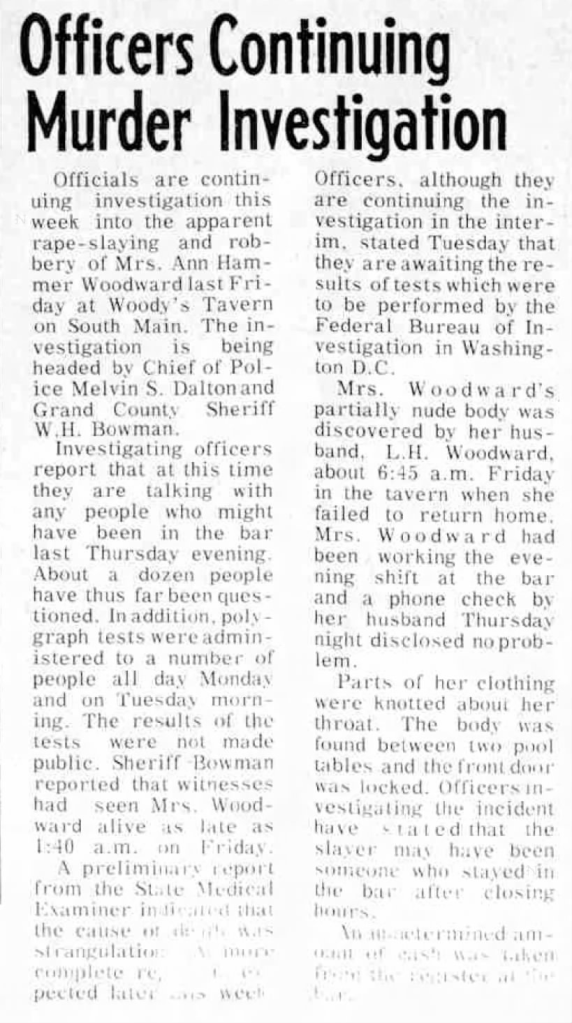
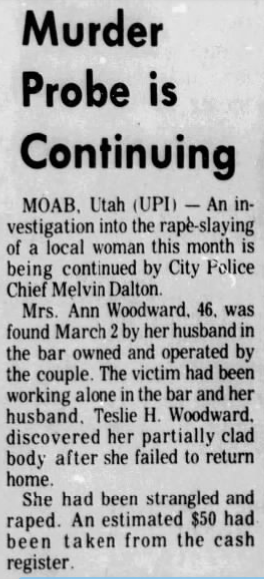
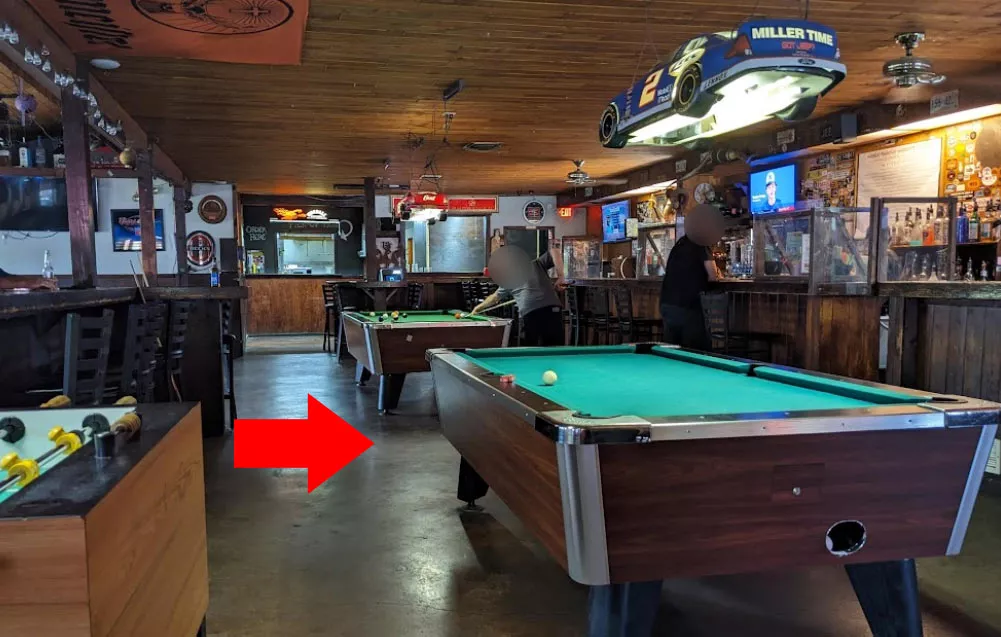
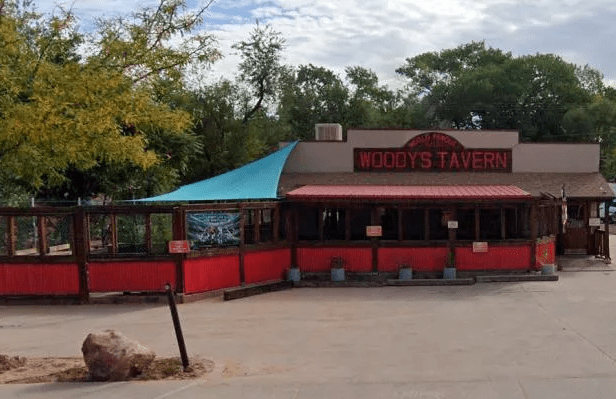
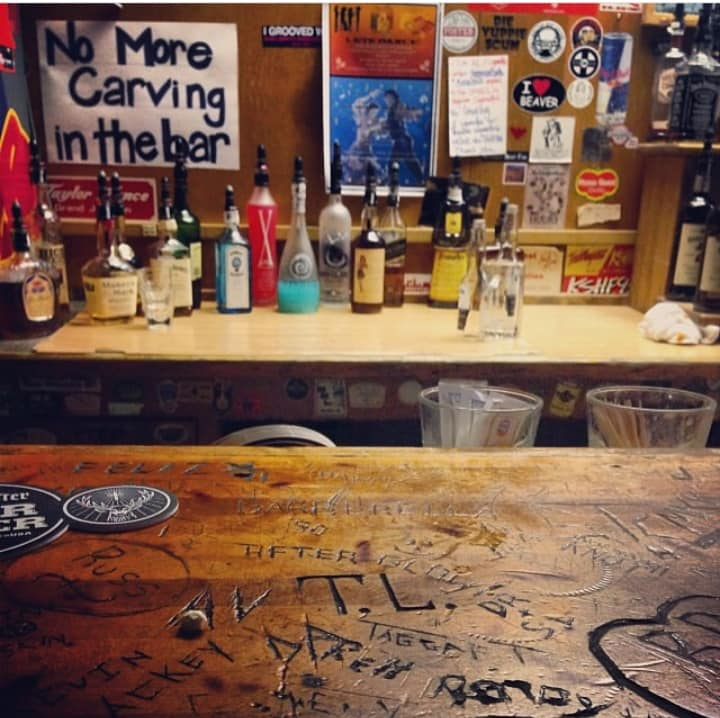
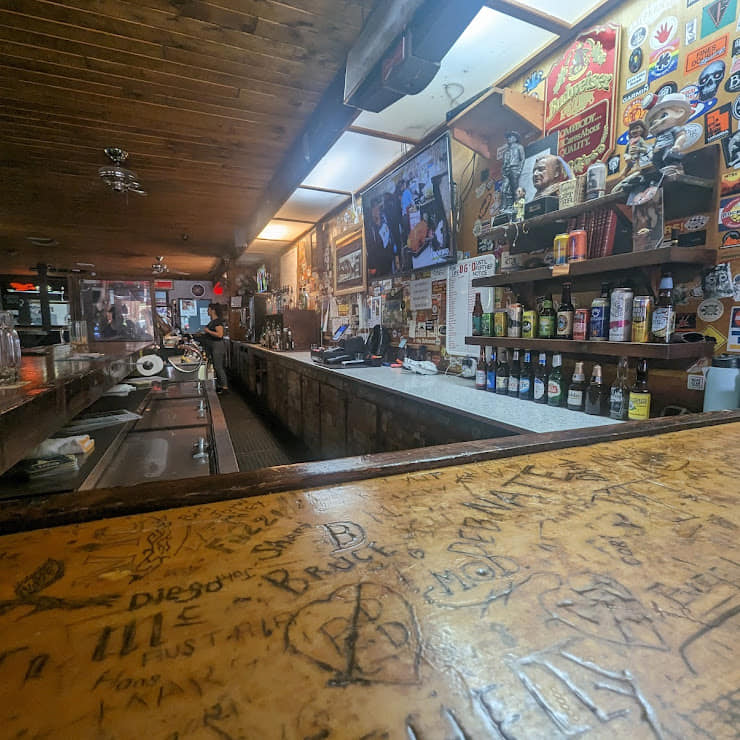
In the early morning hours between 1:40 and 2:30 AM on March 2, 1973 Woodward was killed in the bar she worked at and owned with her husband. After his wife failed to return home Leslie went into the establishment between 6:30 and 6:45 AM to look for her, and stumbled upon a gruesome sight: Ann, deceased. She was half-dressed with her shirt completely unbuttoned and bra exposed, and she had no pants on and was lying on the floor in between two pool tables, with the right leg of her white striped slacks still tied around her neck. Next to her discarded pants were eight dimes and one tissue, and Moab Detective Jeremy Drexler said there were tissues in every one of Ann’s pockets, except for the left pocket. The mother of four had been beaten, raped and strangled. Woody immediately called his friend Heck Bowman, who was the Grand County Sheriff even though the bar was outside his jurisdiction. Typically the case would have fallen into the lap of the Moab PD instead of the sheriff’s, and that ended up playing a large role in how the investigation was handled and why it was mishandled. Detective Drexler commented that based on the notes he read in Woodward’s case file, there seemed to be some bad blood between the two policing agencies, and they didn’t really get along and couldn’t really seem to work together.
In the early morning hours between 1:40 and 2:30 AM on March 2, 1973 Woodward was killed in the bar she worked at and owned with her husband. After his wife failed to return home Leslie went into the establishment between 6:30 and 6:45 AM to look for her, and stumbled upon a gruesome sight: Ann, deceased. She was half-dressed with her shirt completely unbuttoned and bra exposed; she had no pants on and was lying on the floor in between two pool tables, with the right leg of her white striped slacks still tied around her neck. Next to her discarded pants were eight dimes and a single Klenex, and Detective Drexler said there were tissues in every one of Ann’s pockets except for the left one. The mother of four had been beaten, raped and strangled. Woody immediately called his friend Heck Bowman, who was the Grand County Sheriff even though the bar was outside his jurisdiction. Typically the case would have fallen into the lap of the Moab PD instead of the sheriff’s, and this ended up playing a large role in how the investigation was handled (and why it was mishandled). Detective Drexler commented that based on the notes he read in Woodward’s case file, there seemed to be some bad blood between the two policing agencies, and they didn’t really get along or work together.
Found at the scene were two sets of bar glasses as well as some cigarette butts which helped point investigators to where Ann and her killer were most likely sitting. According to Detective Drexler, ‘they wanted to identify that person who sat next to Ann in the worst way. You can see from the original case notes that they were really hoping that fingerprints on the bar glasses would identify him.’ But, sadly that never worked out, and the glassware was sent to the FBI but came back inconclusive.
In recent years Moab police admitted that they didn’t handle the crime scene as well as they should have, and a lot of important evidence was mishandled and lost. While the (now retired) Police Chief Melvin Dalton was meticulous in his investigation, the method in which things were done 51 years ago muddied the waters, and while ‘very neatly put together and ready for our taking’ there was no records management system in place at the time. The two boxes of information related to Woodward’s murder were eventually removed from the sheriff’s office and placed in a building off campus and was eventually forgotten about. Once Drexler discovered the evidence that was lost so many years before things broke wide open: ‘it was 50 years and six months later, but we got it and I knew we had it. I called my wife and told her I had the evidence in the backseat of my truck and I got emotional. It was a treasure trove.’
The evidence related to Woodward’s murder sat collecting dust in the archives of the Grand County Sheriff’s Department until September 14, 2023, when Detective Drexler found them after taking over the investigation. According to him, ‘it was actually on a shelf back next to some Geiger counters. So the evidence was not labeled as evidence, I guess you could say. It’s just a beat-up cardboard box with dust on it.’ … ‘It was truly amazing. We found these boxes in a store room, and they were absolutely pristine. We opened one box and saw that it was Ann’s clothing. I knew right then: we’re going to get him.’ Two months later DNA related to the case was sent to the Utah State Crime Lab for analysis. In May 2024, that genetic evidence was returned and pointed to Chudomelka. Drexler said: ‘He could explain away having his DNA on the outside of her clothes, but not the inside of her pants. No way.’
Upon taking over the case, Detective Drexler initially thought Ted Bundy was his guy using the logic that he was known to be in the general area at the time Ann was killed… but this isn’t really the case, and a quick glance at the ‘1992 TB MultiAgency Investigative Team Report’ would have told him that Ted was nowhere near Utah at that time. In March 1973 Bundy worked for the King County Program Planning and he was still in a long term relationship with Liz Kloepfer (although by this time he was seeing multiple other women and wasn’t being entirely faithful to her). He wouldn’t go on to commit his first (proven) murder until the beginning of 1974, and wasn’t even active in the state until October 2 when he killed Nancy Wilcox.
In recent years former Moab Police Chief Melvin Dalton sat down with The Deseret Morning News and shared that when he arrived at the scene of the crime it was chaotic and almost like a party: ‘people were going in and out like they were going to church.’ The former police chief also said that because the sheriff’s had taken over the investigation the Moab PD didn’t have access to very much evidence, and that the case was not handled well by them despite his admission that he and his officers weren’t trained to handle a murder: ‘I wasn’t really trained in homicide, I always felt if we had a really good trained detective, we’d have been in a lot better shape.’
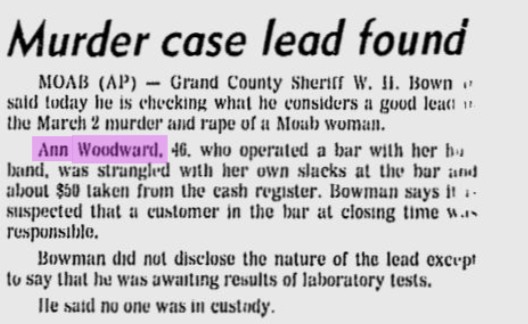
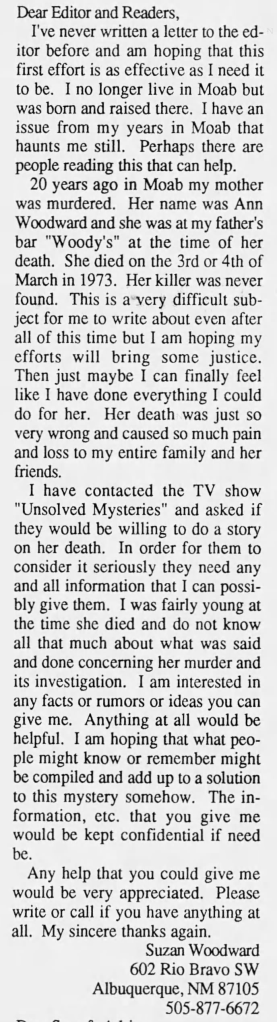
Shortly after the murder took place in March 1973, the Deseret News newspaper reported that Sheriff Bowman had a good lead in the case, but nothing ever came of it. Chief Dalton recalled administering polygraph tests and even came up with a few strong potential suspects, however they both got lawyers and stopped talking. The investigation quickly went cold but was reopened in October 2006 after Ann’s daughter Suzan (who was 16 when her mom was killed) sent a letter to (now retired) Moab Police Chief Mike Navarre asking him for help. The homicide remained unsolved until the summer of 2024 when forensic experts were able to determine that a man named Douglas Keith Chudomelka killed the 46 year old wife and mother.
Detective Drexler speculated that Ann’s killer was angry at her for beating him at poker, but clarified that he wasn’t 100% sure and it could also have been a crime of opportunity versus rage. He said that he does know without a doubt that night that the two played cards and Chudomelka ‘drank beer and smoked Camel cigarettes.’ Using modern scientific techniques, he was able to separate the 29 pieces of evidence (which included ashtrays, fingernails, hair, fingerprints and salt shakers) that were part of the original investigation and break them down into about 80, helping the department analyze the components more thoroughly.
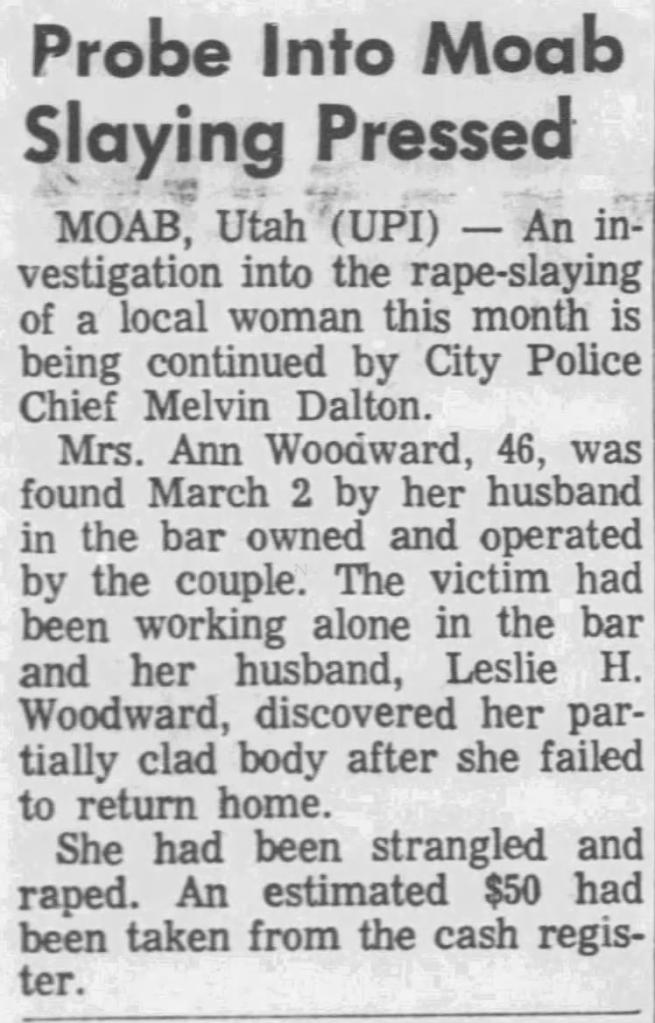
Chudomelka worked at the Rio Algom Mine in the Moab area during the early to middle 1970’s and rented a trailer in the Walnut Lane Mobile Home Park for $100 a month. He was known to frequent Woody’s Tavern when he was done with work for the day and had a long paper trail of documented violence. After he killed Woodward, he went into the establishments cash register and helped himself to $75; he also took the $50 out of her left pants pocket that she won from him playing poker (some sources say it was an undetermined amount of money), and two days later he paid his rent with five $20 bills. Detective Drexler said he has no idea if he gave the landlord the stolen money but it’s definitely a possibility.
The current Moab Police Chief Lex Bell said: ‘that pair of pants is what led us to her killer,’ and Detective Drexler said that in addition to the inside of the slacks Ann was wearing, all the buttons on her shirt had Chudomelka’s DNA on them as well. Forensic testing was also done on items found at the bar as well, which confirmed his presence at the establishment on the night Woodward was murdered.
According to Moab reporter Emily Arnsten, the area was much more conservative in 1973, and the Mormon Church had a much greater influence on the community than it does today. But at the same time, there was also a large, blue-collar mining community that contained a large amount of transient workers that may not have been the most pious of people, and Woody’s was the perfect stomping grounds for these individuals. The establishment was perhaps a bit more wild than it is today as well, as they used to employ the likes of go-go dancers and there was lots of gambling that took place on the premises.
According to Ann’s granddaughter Annie Dalton, Woodward was unlike most of the other more ‘traditional’ women in the area: firstly, she was Catholic, not Mormon, and wasn’t originally from the area. She also ran a bar in a conservative area where a lot of people maybe didn’t drink and was a pretty avid card player. Dalton and Woodward family friend Tim Buckingham wonder if her grandmother’s worldly lifestyle had anything to do with the Moab police’s lack of urgency regarding this murder: ‘’I think that when something that horrific happens in a town like this, to convince yourself that it could never happen to you, to feel safe in that, you do what you can to distance yourself from the person that it happened to. That’s most of what I got, the sense of people who were trying to come up with stories that made sense.’ About her grandmother’s murder, Annie said: ‘it was this thing that my mom carried that was grief and loss, and she ended up passing away from COPD. They say that you carry grief in your lungs, and I’ve always felt like it was just grief that she never was able to process. So they were all carrying this burden in different ways and it never got resolved. It’s a tragedy that just keeps being tragic over and over.’
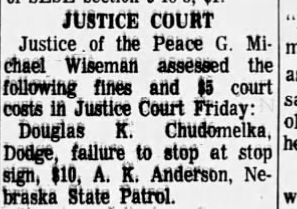
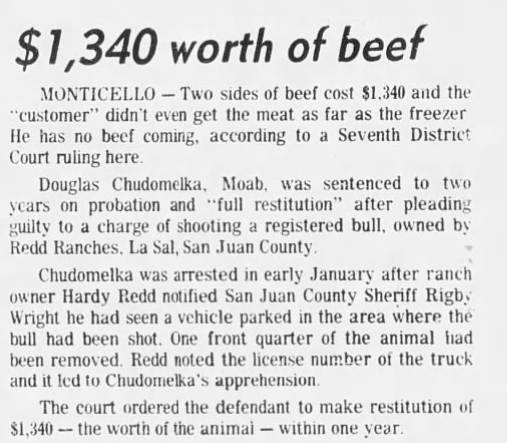
When questioned Chudomelka told investigators that he had not been in Woody’s on the night of the murder, but had instead spent the evening drinking at The Westerner Grill. His girlfriend, Joyce, provided him with an alibi, and told investigating officers that he came home at about 2 AM, however the bartender at The Westerner Grill told police that he was not in at all the night of March 1. Law enforcement asked Chudomelka if he was willing to take a polygraph test, to which he agreed, but in the end they were unable to administer it because when he arrived at the station he was drunk. Eventually, he stopped talking to police and asked for a lawyer and no charges ever stuck. Before he left the area Doug would later be convicted of cattle rustling (which is ‘the act of stealing livestock’) in San Juan County and served out a term of probation. Detective Drexler said he was found guilty of additional crimes in other states, including an atrocity involving a 10-year-old child in Alabama. In 1978, Chudomelka returned to Nebraska, where he managed to (mostly) fly under the radar until his death.
Chudomelka was always considered to be a prime suspect in Woodward’s murder and was one of 25-30 suspects, a number that included acquaintances, bar patrons, and members of the Moab community. Anyone that had been in the tavern on the night of the homicide or was known to be a regular at the establishment was considered a suspect… but he had more going against him than the others: the mid-1960’s Ford sedan that he owned matched the description of the car witnesses reportedly saw parked next to Woodward’s truck late in the evening on March 1, 1973. According to Detective Drexler: ‘they were looking at Doug, they just couldn’t get him. He easily could have killed her and made it home by 2 AM, but the bartender at the Westerner told police Chudomelka was not in at all the night of March 1.’ … ‘They wanted to solve it. All the evidence was there, but they just didn’t have the technology at the time to solve this case beyond a doubt.’
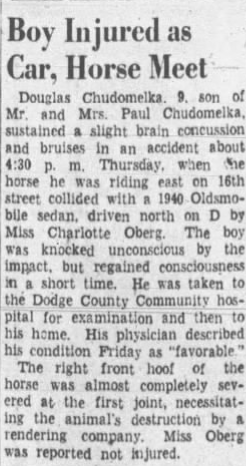
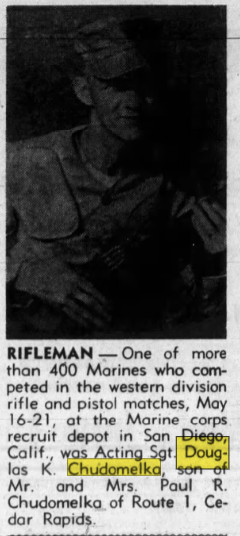
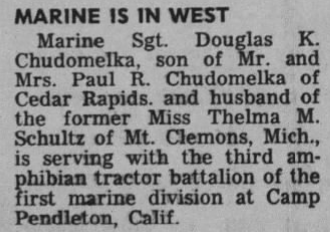
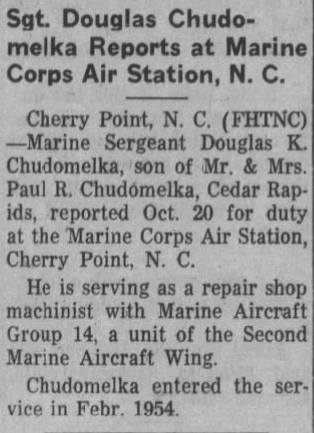
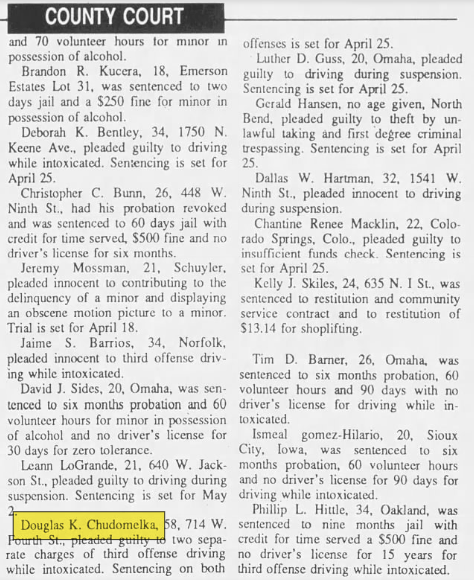
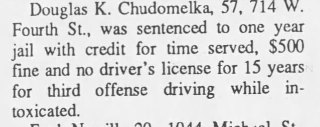
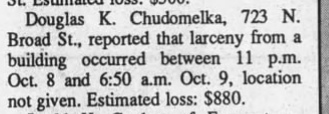
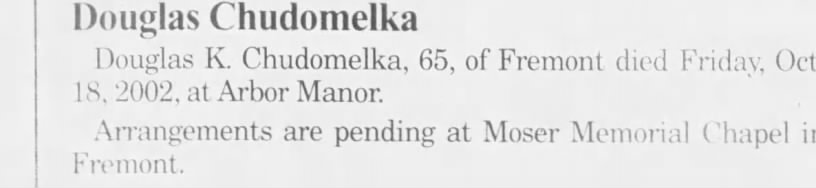
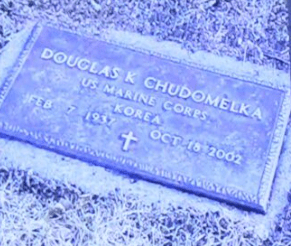
Douglas Keith was born to Paul and Magdalena (nee Arps) Chudomelka in rural Dodge, NE on February 7, 1937. On February 9, 1954 he joined the US Marine Corps and he was married three times: he wed Thelma Mae Scheulz on May 16, 1958 in San Diego, California and the couple had four children together. After they parted ways he met Ernestine Winnie Jolly, and the two were wed on December 3, 1976 in Galveston, TX; I don’t know any details about their divorce but he married Vickie Flowers for a third time at some point before his death. Chudomelka left the military on December 13, 1961 with the rank of sergeant after serving in Korea, then went on to get his CDL and worked as a long haul trucker for several companies across the United States. According to his obituary, at some point after Ann’s murder he moved to Fremont, Nebraska, where he became a lifetime member of the VFW Post 7419 in Nickerson. According to his obituary he had no kids (this is a complete lie) and only left behind siblings (five sisters and two brothers) and three ‘special friends…’ He died on October 18, 2002.
Just a few days after Ann’s murder on March 6, Chief Dalton received permission to pull hairs from the suspects body, and took samples from his belly button, chest, pubic area and head; cigarette butts (which were Camels, like the ones found at the scene of the crime) were also recovered from an ashtray in his residence to see if a saliva sample could be pulled. After the evidence was meticulously collected and preserved it was sent to the FBI, however in 1973 the Bureau was not yet equipped to test hair or saliva, and according to Drexler, ‘this case hinged on the hair Dalton pulled in 1973. I have no idea how he knew that we would be able to do that today. Dalton made this case very easy for us in that aspect.’ The box of evidence was returned (unopened) to the Sheriff’s department along with a letter that (essentially) read: ‘this is a great idea, but we don’t have the technology to do that.’
Douglas Keith Chudomelka was born to Paul and Magdalena (nee Arps) Chudomelka in rural Dodge, NE on February 7, 1937. On February 9, 1954 he joined the US Marine Corps and he was married three times: he wed Thelma Mae Scheulz on May 16, 1958 in San Diego, California and the couple had four children together. After they parted ways he met Ernestine Winnie Jolly, and the two were wed on December 3, 1976 in Galveston, TX; I don’t know any details about their divorce but he married Vickie Flowers for a third time at some point before his death. Chudomelka left the military on December 13, 1961 with the rank of sergeant after serving in Korea, then went on to get his CDL and worked as a long haul trucker for several companies across the United States. According to his obituary, at some point after Ann’s murder he moved to Fremont, Nebraska, where he became a lifetime member of the VFW Post 7419 in Nickerson. According to his obituary he had no kids and only left behind siblings (five sisters and two brothers) and three ‘special friends…’ He died on October 18, 2002.
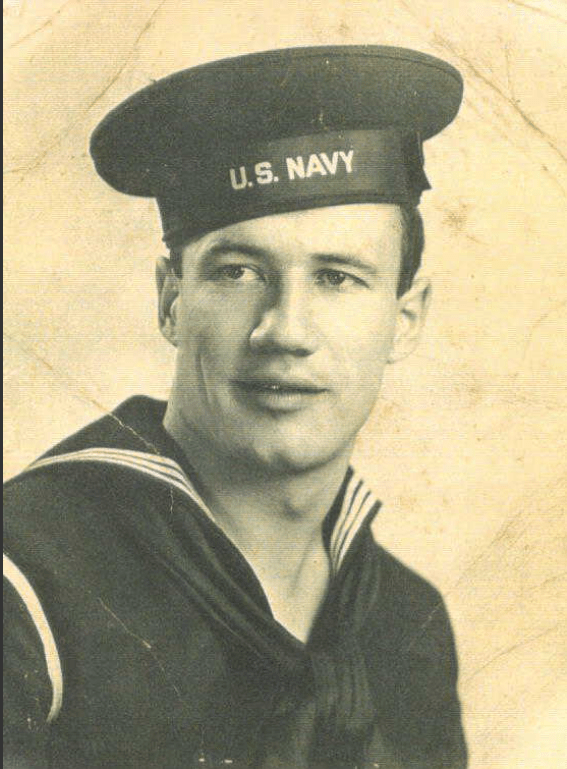
After Ann died Leslie went on to remarry Jane Jaramillo on November 17, 1985, in Las Vegas (I also saw the date listed as November 11, 1984); the two stayed together until his death on Christmas day in 2015 at the age of 84 in Newton, Kansas. According to his obit, Woody served in the US Navy during WWII, where he earned 13 battle stars. He was an entrepreneur and ran several businesses across Moab, including laundromats, gas stations, and Woody’s Tavern, and in his spare time he enjoyed hunting, fishing and exploring the country while on vacation.
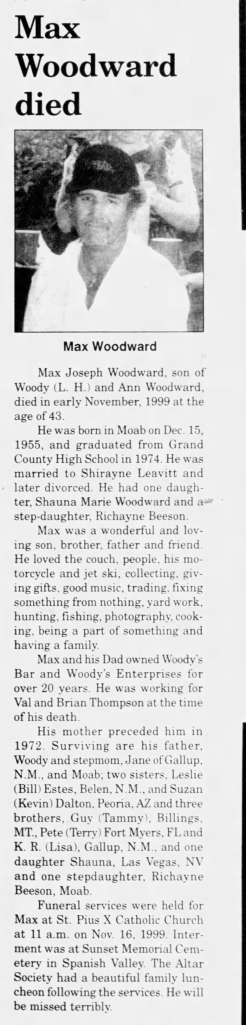
Ann’s sister Cecelia passed away on August 12, 2004. As of November 2024 three of her four children have passed away and the only one remaining is her older daughter Leslie Ann (Estes). According to Estes, ‘there’s no closure for me. It’s still going to go on. She’s still going to be gone tomorrow, and my grandkid, my children have never seen her and don’t ever know what a wonderful grandmother she would have been.’ Max Woodward died in early November 1999 at the age of 43, and Ann’s daughter Suzan passed away on June 1, 2019. According to her obituary, she ‘loved sewing, cross-stitching, driving across the country on adventures, playing with her grandchildren, talking to her daughters and friends, laughing and joking with Pug, going to the mountains, watching sunsets, making pots, and staying in little old hotels with character.’ Guy ‘Bugsy’ Woodward died at the age of fifty on March 13, 2009, and according to his obituary in The Times-Independent, he was a sweet, funny, and loving brother, dad, son, uncle and friend that loved the outdoors, music, yard work, fishing, hunting, making jewelry, heckling his sisters, and being a part of Narcotics Anonymous. His three daughters were the jewels in his crown and were the ‘best accomplishments of his life.’
According to Detective Drexler, ‘if he was alive today, I would be asking Grand County District Attorney Stephen Stocks for an arrest warrant for Douglas K. Chudomelka for the crime of first-degree murder for his actions on March 2, 1973.’ Stacks seemed to be in agreement with Drexlers statement, and said, ‘had he not passed, we would have filed criminal information against him. I hope today brings some closure to the family. I truly believe if this case would have been presented to the jury, he would have been found guilty beyond reasonable doubt for the murder of Ann Woodward.’ Leslie Ann said that her father was the first suspect that LE investigated, and the locals always seemed to be whispering that he was the one responsible for her death; Estes hopes that now these rumors can finally be put to rest. About her father, Leslie Ann said ‘he was larger than life, and it just, it broke our, it broke his heart, but it broke our family, like the splinter never was healed. It never really did even begin to heal.’
Chief Bell said that (as of June 2024) his department was still testing additional items found at Woody’s Tavern, and Detective Drexler commented that both the Moab PD and the Grand County Sheriff’s are ready to start digging into other cold cases.
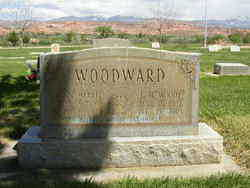
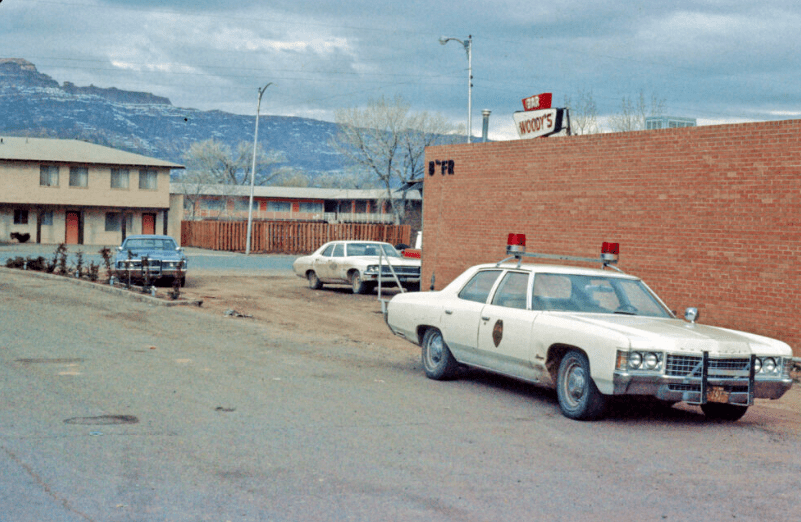
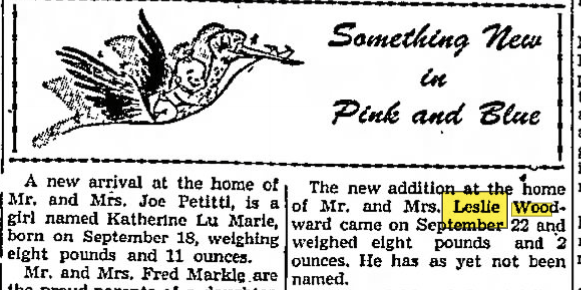
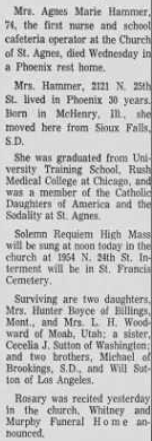
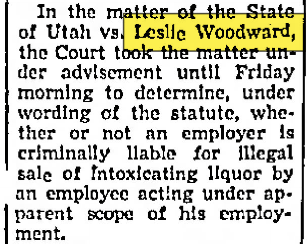
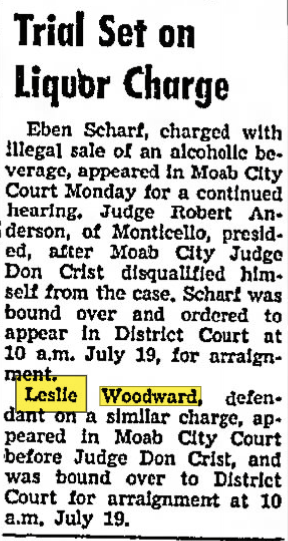
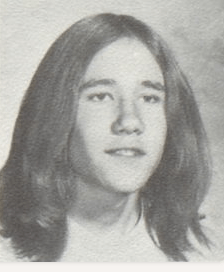
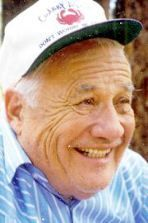
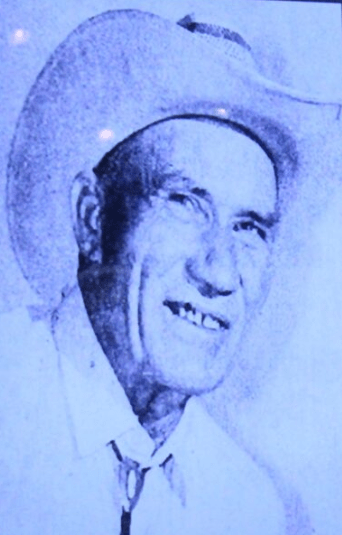
A young Ann Hammer.Woodward.Ann’s grave.A law enforcement unit is parked outside of Woody’s Tavern on March 2, 1973. Photo courtesy of MPDAnn’s clothes.An article about the murder of Ann Woodward published in The Daily Herald on March 2, 1973.An article about the murder of Ann Woodward published in The Deseret News on March 3, 1973.An article about the murder of Ann Woodward published in The Daily Herald on March 4, 1973.An article about the murder of Ann Woodward published in The Deseret News on March 5, 1973.An article about the murder of Ann Woodward published in The Ogden Herald-Journal on March 6, 1973.An article about the murder of Ann Woodward published in The Daily Herald on March 6, 1973.An article about a memorial service being held for Ann Woodward published in The Times-Independent on March 8, 1973.An article about the investigation of the murder of Ann Woodward published in The Times-Independent on March 8, 1973.An article about the continuing investigation related to the homicide of Ann Woodward published in The Times-Independent on March 15, 1973.An article about the continuing investigation related to the homicide of Ann Woodward published in The Salt Lake Tribune on March 25, 1973.An article about the continuing investigation related to the homicide of Ann Woodward published in The Ogden Standard-Examiner on March 26, 1973.An article about the continuing investigation related to the homicide of Ann Woodward published in The Deseret News on March 26, 1973.An article about the continuing investigation related to the homicide of Ann Woodward published in The Daily Herald on March 27, 1973.An article about the murder of Ann Woodward published in The Times-Independent on March 29, 1973.An article about the murder of Ann Woodward published in The Ogden Standard-Examiner on August 19, 1973.An article about unsolved murders in Utah that mentions Ann Woodward published in Deseret News on August 7, 1974.Ann is mentioned in a ‘notice to creditors’ related to her estate; this was published in The Times-Independent on April 3, 1975.A plea to the public from Ann’s daughter Suzan for anyone with information related to the murder of her mother to come forward, published in The Times-Independent on May 20, 1993; sadly she has since passed.A press release put out by the Moab City PD in related to the murder of Ann Woodward.Woody’s Tavern.Woody’s in 1973. Photo courtesy of OddStops.Woody’s in 1973. Photo courtesy of OddStops.DNA evidence proved that Chudomelka had been sitting at the bar that night. Photo courtesy of OddStops.The scene of the murder in March 1973. Photo courtesy of OddStops.The victim’s body was found between a set of pool tables. Photo courtesy of OddStops.Woody’s Tavern as it looks today, photo courtesy of OddStops. The bar is located at 221 South Main Street in Moab, Utah.Woody’s Tavern.The inside of Woody’s Tavern.The bar at Woody’s Tavern.A sign inside Woody’s Tavern. Photo courtesy of Instagram.The bar at Woody’s. Photo courtesy of Instagram.The inside of Woody’s Tavern. Photo courtesy of Instagram.A show at Woody’s (this is a great shot of what looks like the entire bar). Photo courtesy of Instagram.A show at Woody’s. Photo courtesy of Instagram.A band onstage at Woody’s. Photo courtesy of Instagram.Individuals that have been permanently banned from Woody’s Tavern. Photo courtesy of Instagram.A mural on the outside of Woody’s. Photo courtesy of Instagram.Ted’s whereabouts in early March 1973 according to the ‘TB Multiagency Investigative Team Report 1992.’Moab Police Detective Jeremy Drexler giving Ann’s remaining living daughter Leslie Ann Estes a hug at the conclusion of the press conference announcing the case was solved. Photo courtesy of Doug McMurdo.Doug Chudomelka.An older Doug Chudomelka during his time incarcerated at Dodge County Correctional Facility. Doug Chudomelka and Thelma Schultz’s marriage records from 1958.A newspaper clipping about Chudomelka breaking his leg at the age of nine published in The Fremont Tribune on March 1, 1946.A newspaper clipping about Chudomelka being admitted to the hospital in Camp Pendleton published in The North Bend Eagle on November 7, 1957.Part one of an article about Chudomelka getting into a car accident published in The Fallbrook/Bonsall Enterprise on September 3, 1959.Part two of an article about Chudomelka getting into a car accident published in The Fallbrook/Bonsall Enterprise on September 3, 1959.A newspaper clipping about Chudomelka competing in a marksman contest for the Marines published in The Albion News on June 2, 1960.A newspaper clipping about Chudomelka’s time in the US Marine Corps published in The North Bend Eagle on September 8, 1960.A newspaper clipping about Chudomelka serving in the US Marines published in The Boone Companion on February 6, 1961.A newspaper clipping about Chudomelka competing in a marksman contest published in The Boone Companion on May 8, 1961.A newspaper article announcing the birth of Chudomelka’s daughter published in The Fremont Tribune on October 23, 1963.A newspaper clipping about Chudomelka working as a repair shop machinist with the US Marines published in The Cedar Rapids Press on November 26, 1964.A newspaper clipping about Chudomelka being arrested for reckless driving published in The Independent on June 6, 1965.A newspaper clipping about Chudomelka getting into a motor vehicle accident published in The Daily Nonpareil on April 9, 1966.A newspaper clipping about Chudomelka being sued for child support by his ex-wife published in The Daily Nonpareil on August 16, 1967 An article about a car accident Chudomelka was in, I was unable to find the publication date.A newspaper clipping about Chudomelka being fined after a traffic infraction published in The Fremont Tribune on July 22, 1972.A newspaper clipping about Chudomelka being charged with check forgery published in The Fremont Tribune on January 20, 1973.A newspaper clipping about Chudomelka being sued for child support by his ex-wife published in The Fremont Tribune on July 24, 1973.A newspaper clipping about Chudomelka being charged with theft published in The Salt Lake Tribune on January 9, 1974.A newspaper clipping about Chudomelka being charged with theft published in The Times-Independent on January 10, 1974 .A newspaper clipping about Chudomelka being sentenced to two years of probation after pleading guilty to shooting a registered bull published in The Deseret News on February 9, 1974.A newspaper clipping about Chudomelka being charged with theft published in The Daily Herald on May 6, 1974.A newspaper clipping about Chudomelka being charged with theft published in The Manti Messenger on May 9, 1974.A newspaper clipping about Chudomelka being charged with illegal hunting and trespassing published in The Fremont Tribune on May 15, 1985.A newspaper clipping about Chudomelka being charged with a drunken driving charge published in The Fremont Tribune on October 14, 1992.A newspaper clipping about Chudomelka being charged with hitting a fire hydrant with his motor vehicle published in The Fremont Tribune on February 15, 1995.An article mentioning Chudomelka pleading guilty to a DWI published in The Fremont Tribune on April 7, 1995.A newspaper clipping about Chudomelka being charged with hi third DWI published The Fremont Tribune on April 28, 1995.A newspaper clipping about Chudomelka reporting a larceny published in The Fremont Tribune on October 17, 1996.A newspaper blurb announcing that Douglas Chudomelka died published in The Fremont Tribune on October 19, 2002.Chudomelka’s obituary published in The The Fremont Tribune on October 21, 2002.The grave site of Douglas Keith Chudomelka.Ann’s parents record of marriage filed on March 28, 1921. Woody in WWII.Leslie Woodward with his first wife.Leslie Woodward’s WWII draft card.Leslie Woodward and his first wife’s marriage certificate.A letter to Gloria Woodward letting her know that her divorce from Woody was finalized. The wedding announcement for Ann’s parents, Max Hammer and Agnes Sutton. Courtesy of Jan Even on Ancestry.Ann’s father’s obituary, published in The Arizona Republican November 28, 1940.A newspaper clipping regarding Max Hammers funeral, published on November 29, 1940 in Phoenix, AZ.An application for a military headstone for Ann’s father published on September 17, 1941.A newspaper clipping about the birth of Woody and Ann’s daughter published in The Times-Independent on September 25, 1958.An article about a court case involving Leslie Woodward published in The Times-Independent on August 6, 1964.Ann’s mothers obituary published on February 5, 1965.An article about a court case involving Leslie Woodward published in The Times-Independent on June 10, 1965.An article about a court case involving Leslie Woodward published in The Times-Independent on June 17, 1965.Leslie Ann Woodward (r) in a picture for the FHA published in The Times-Independent on March 4, 1971.An article about Ann’s husband Woody getting into some trouble related to a car accident, published in The Times-Independent on September 16, 1971.A newspaper blurb regarding property taxes for Ann and Leslie published in The Times-Independent on December 27, 1973.An article about Woody appearing before a judge for a driving while intoxicated charge, published in The Times-Independent on February 20, 1973.A picture of Leslie Woodword from the 1972 Grand County High School yearbook.A picture of Max Woodword from the 1973 Grand County High School yearbook.A picture of Suzan Woodward from the 1974 Grand County High School yearbook.A picture of Guy Woodword from the 1974 Grand County High School yearbook.A newspaper clipping announcing Guy Woodward’s death published in The Times-Independent on November 25, 1999.Woody.A newspaper clipping announcing Leslie Woodward’s death published in The Wichita Eagle on December 27, 2005.Jane N. Jaramillo, who was born on November 11, 1934 and passed on July 3, 2016.Former Sheriff Heck Bowman.Former Moab Police Chief Melvin Dalton, who took steps in 1973 that allowed current law enforcement officers to solve one of Moab’s most notorious cold cases.Former Moab Police Chief Melvin Dalton.
In late April 2024 I requested the files related to the murder of Kathy Devine from the Thurston County Sherrif’s department in Washington state, and they finally got around to getting them to me at the end of June. I shouldn’t be so salty, I’m very thankful they were willing to send them to me. Included in the information was a bunch of newspaper articles about Kathy, and I almost didn’t include them because most of them I found on newspapers.com (and are in my article), but it was important that I release Kathy’s case file in it’s entirety. They did tell me that sometime in August additional information will be ‘made available’ so… that’s also exciting.
Gayle Elizabeth LeClair was born on January 26, 1951 to Donald and Barbara LeClair in Gold Beach, Oregon.Mr. LeClair was born on June 4, 1930 and was employed as a car salesman, and Barbara Jean was born on July 8, 1930 in Redondo Beach, CA and worked as a bank teller at Western Bank. The couple were wed on February 10, 1950 and had two children together (Gayle and her younger brother Cleve*), but sadly divorced in September 1970. After his marriage ended he had a daughter named Leah with a woman he only dated for a short period of time. The woman put her up for adoption and Mr. LeClair wasn’t aware of her existence until around 2000. He went on to get remarried in December 1970 and had a son named Frank; the couple remained together until the early 1980’s. On September 22, 1985 Mr. LeClair remarried for a third time to a woman named Leola Wilson, who he remained with until his death.
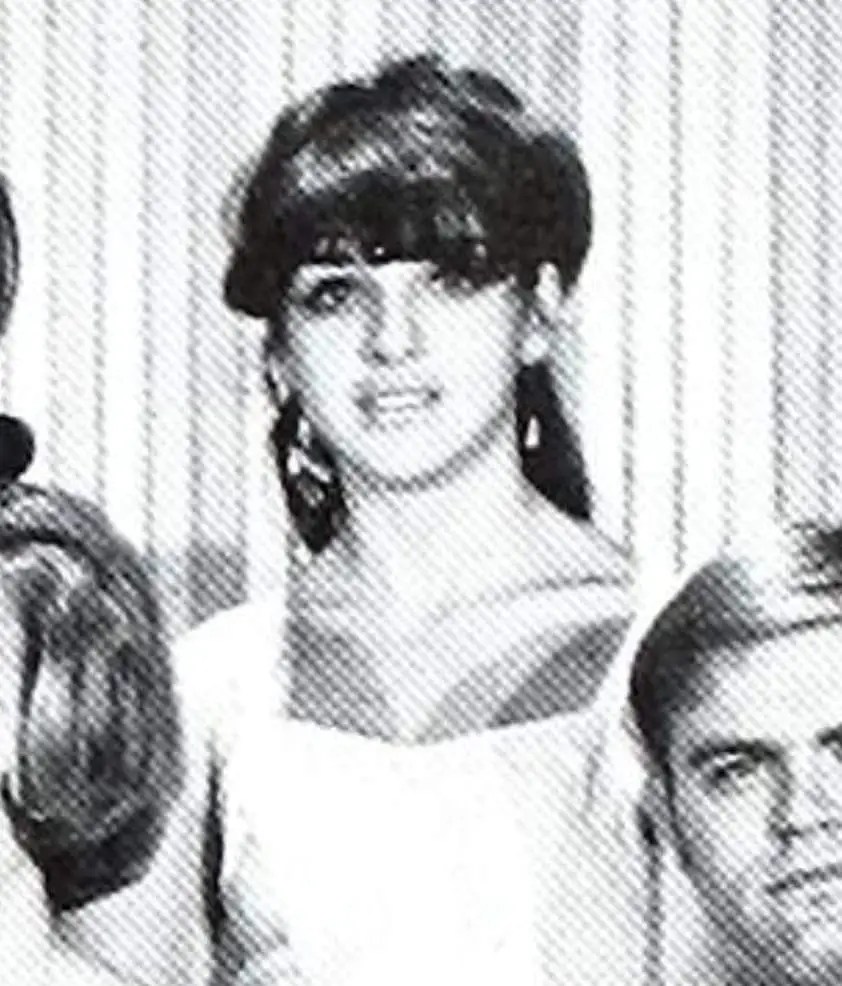
Gayle LeClair was a petite, attractive young woman, with blue eyes and light blonde hair that she woreshort while in high school but according to her mother grew out in college, and often wore it tied up with a leather barrette. After graduatingfrom Gold Beach High School in 1969 LeClair went on to attend Southwestern Oregon Community College for two years. While at SWOCC she was active in the schools theater group, and during her first semester there was on the crew during a production of ‘Don’t Drink the Water.’ According to her mother, Gayle was a studious young woman that excelled in math and had dreams of continuing her education and becoming a teacher one day. When she lived at home she would (on occasion) attend service at Emmanuel Episcopal Church in Coos Bay. LeClair moved to Eugene in January 1972 after she graduated from community college and got a job at the Eugene Municipal Library as a clerk-typist.
After Gayle failed to come in for her scheduled shift at 10:30 AM on August 23, 1973 (or answer multiple phone calls) her supervisor went to her house to check on her. Upon arrival, there was no sign of forced entry and the front door was unlocked, and after walking towards LeClair’s bedroom the unidentified supervisor discovered her deceased from multiple stab wounds shortly after 11:00 AM; upon the discovery she immediately went next door and used a neighbor’s telephone to contact police. Gayle had a date with a known acquaintance the night before; they went to a drive-in movie then went back to her apartment for a nightcap. She was last seen alive by him at 1:30 AM, and after a conversation with detectives the young man was quickly cleared as a suspect.
Lieutenant Donald Lonnecker with the Eugene Police Department said the LeClair was dressed for bed when she was murdered and a ‘preliminary autopsy indicated no evidence of sexual assault.’ Before moving into the house she was killed in, from January 1972 to May 1973 she resided at 3760 Concord Street in the Bethel-Echo neighborhood of West-Eugene; she lived by herself in both residences. Mrs. Duane Brown lived next door to the victim on Concord Street and said where they weren’t close and didn’t talk often she said she was a ‘nice, pleasant person.’ Miss LeClair seemed to have a healthy relationship with her family, and before she was murdered her brother Cleve visited her (he lived in North Bend with their mother), and Barbara said of her daughter ‘she would pick up the phone in the evening just to ask how our day had been.’ Neither Gayle’s mother nor father could come up with any reason why anyone would want to hurt their daughter.
Members of law enforcement were immediately baffled at the motive behind the murder of LeClair. Lieutenant Lonnecker said that the victim ‘spent a lot of time socially with people’ and ‘had a lot of friends,’ and those that knew LeClair said she was ‘both outgoing and moody, depending on who knows her and in what way;’ he also said that she was ‘pleasant, and socially active,’ had a lot of friends, and a busy social life. Despite this, neighbors of LeClair didn’t seem to know her at all, and one of them even thought the house she lived in was vacant. According to an article published in The World on August 30, 1973, the small home that LeClair rented had lots of trees, shrubs and other greenery on the property despite being in a residential neighborhood, which would make it very easy for someone to hide in her yard and look through her windows. Her landlord, J. Sidney Armstrong, was a former Lane County District Attorney that moved into private practice, and at one point even dated the victim (although not recently). Armstrong told investigators that his ex ‘had a lot of boyfriends’ and was eventually cleared of any wrongdoing. On August 24, 1973 Lane County DA J. Pat Horton said they never recovered the murder weapon, but did clarify they think it was either a ‘knife or some other sharp instrument.’
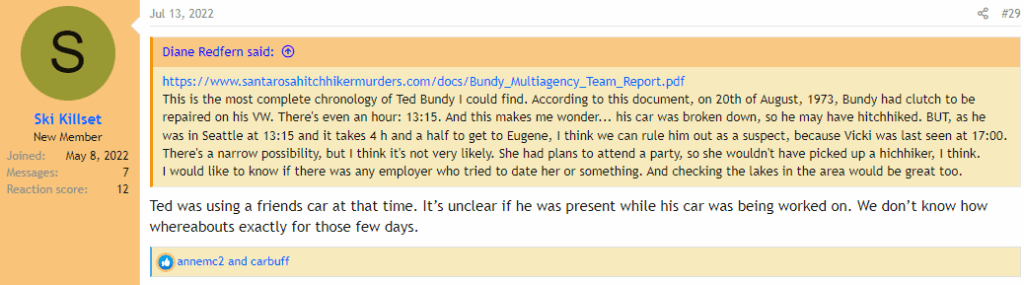
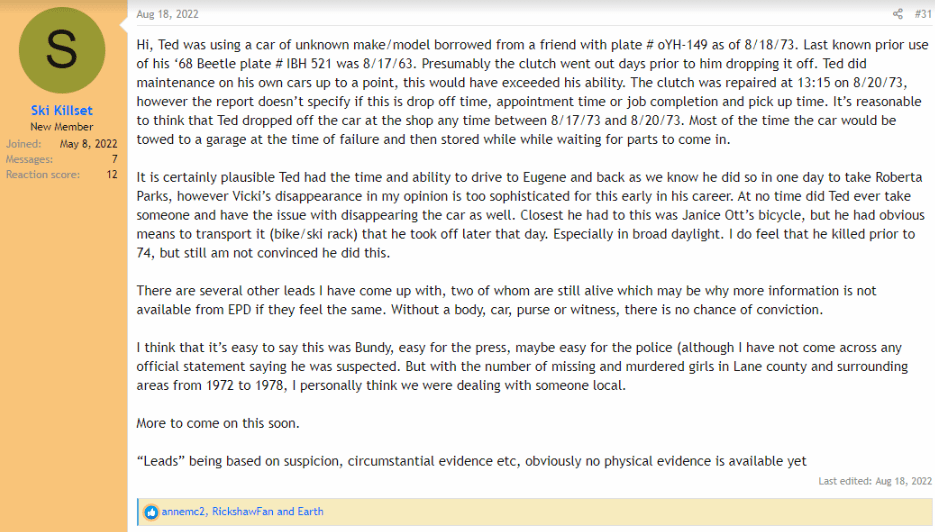
At the time of her murder in August 1973, Ted Bundy seemed to be in between jobs: from February to April of that year he worked for King County Program Planning then took a break from employment until September 1973, when he got a position as the Assistant to the Washington State Republican chairman. Although it wasn’t as intense as their first few years together he was still in a relationship with Liz Kloepfer… but he was also seeing his ex-girlfriend Stephanie Brooks on the side as well (they rekindled their romance earlier that year). He was also getting ready to start law school at the University of Puget Sound (which he started the following month in September 1973). According to the ‘Ted Bundy Multiagency Investigative Team Report 1992,’ on the day of LeClair’s murder Bundy got into a car accident in Kloepfer’s eggshell blue VW Beetle.
Now, it’s widely accepted that Bundy’s murder rampage began in January 1974, when he brutally assaulted (and most likely left for dead) fellow University of Washington student Karen Sparks in her basement apartment. But, most people in the true crime community strongly suspect he started well before this (some people think as early as 1961 with little Ann Marie Burr in his hometown of Tacoma). I feel it’s worth mentioning that during his final death row interviews with Dr. Bob Keppel, Bundy confessed to starting his murder spree in 1972, not 1974:
Robert Keppel: ‘There’s a gal in 1971, Thurston County.’ Ted Bundy: ‘No.’ RK: ‘Not that far back. Nothing that far back?’ TB: ‘1972.’
Additionally, after Bundy was executed forensic psychologist Arthur Norman told New Jersey based news magazine ‘The SandPaper’ that the killer once told him that he murdered ‘two women in the Philadelphia area’ (most likely Elizabeth Perry and Susan Davis), which he suspected were his first two homicides. Dr. Norman even notified Atlantic City Prosecutor Jeffrey Blitz about his confession, who immediately shot down the story, calling it inconclusive. He never investigated it.
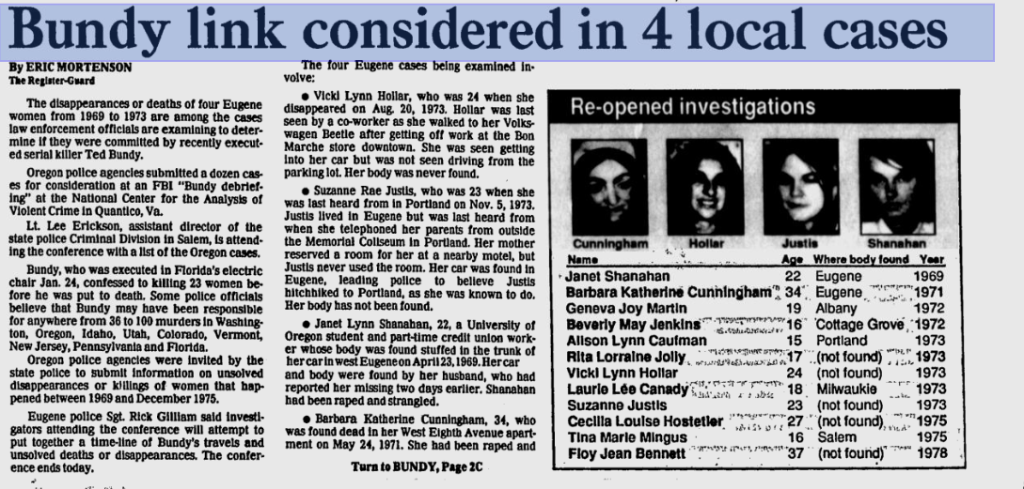
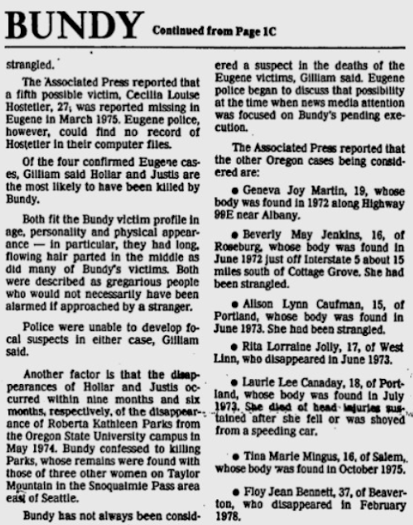
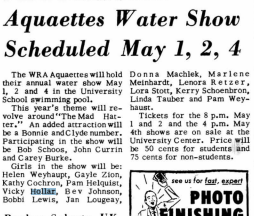
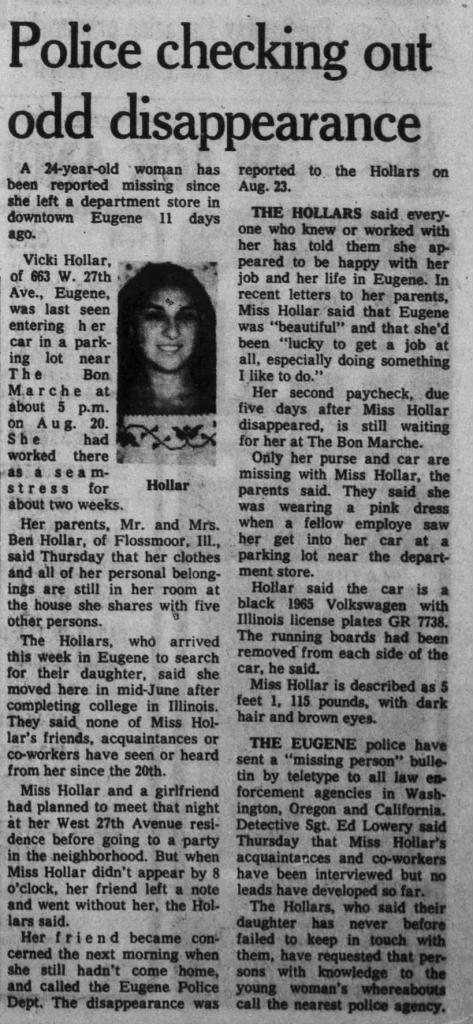
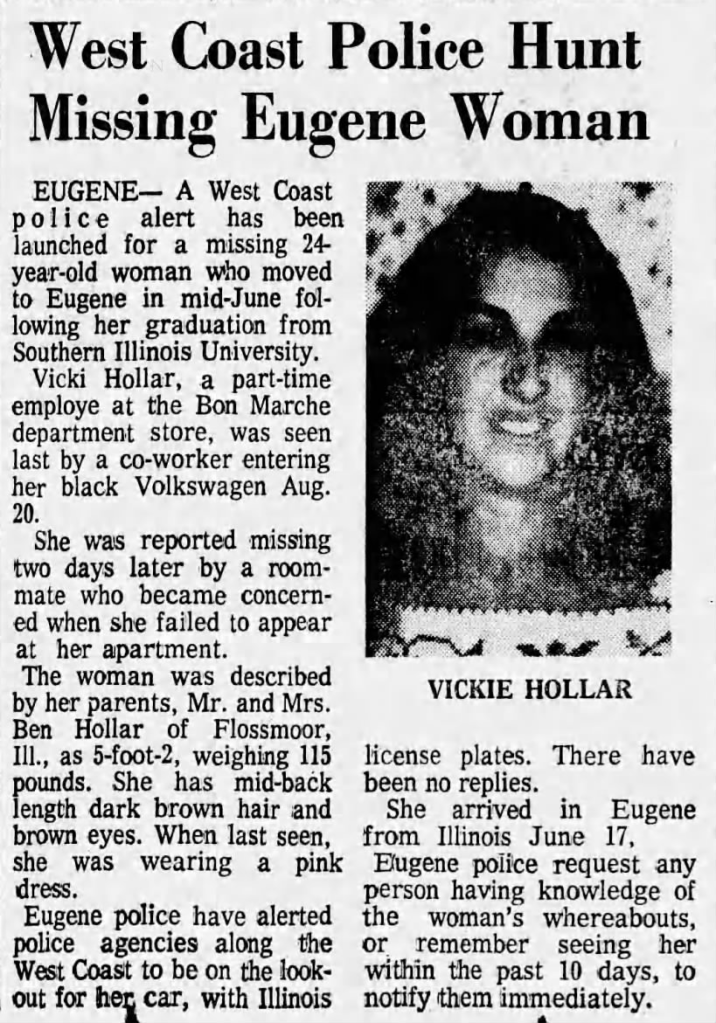
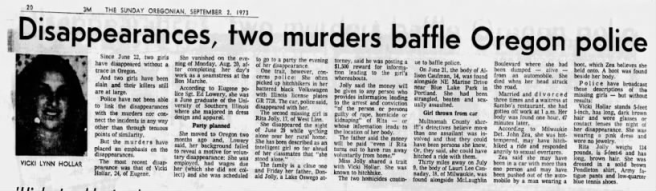
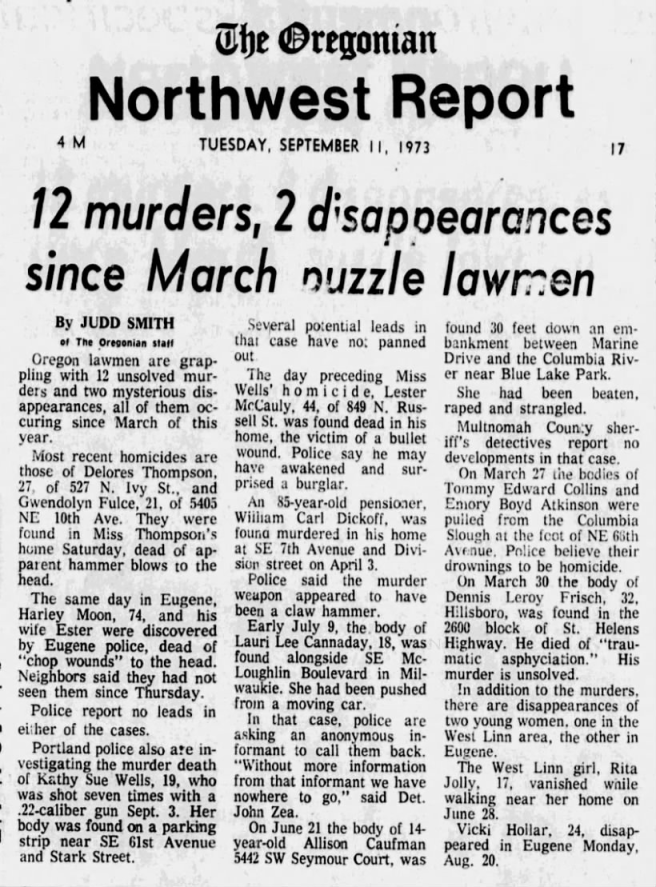
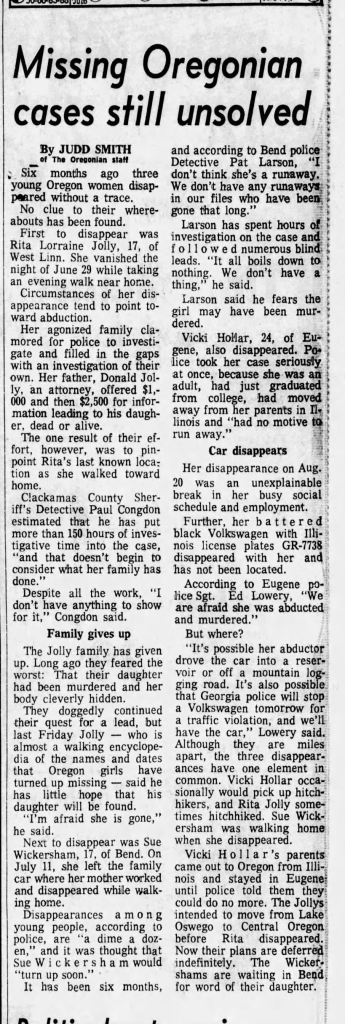
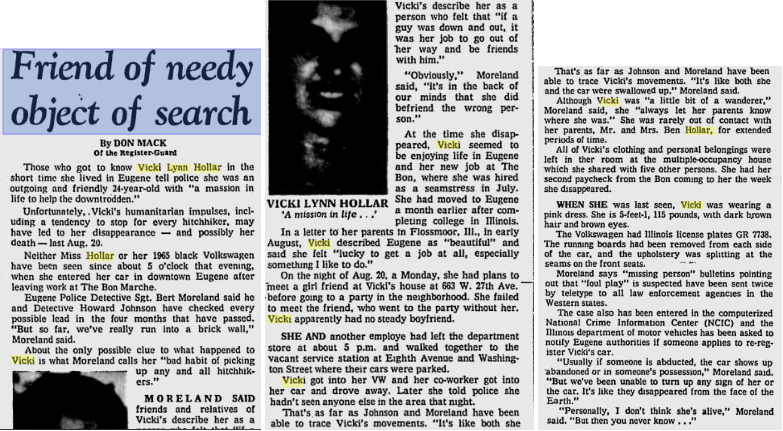
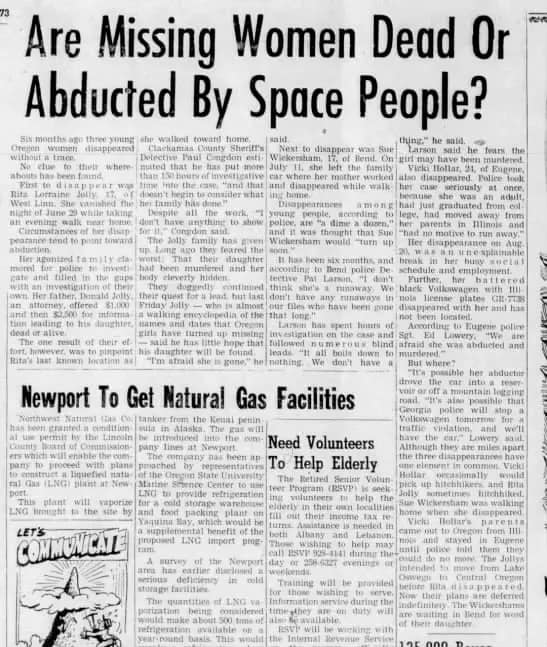
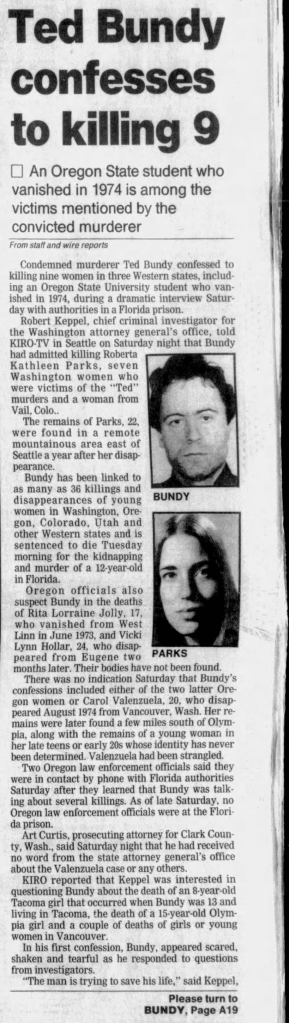
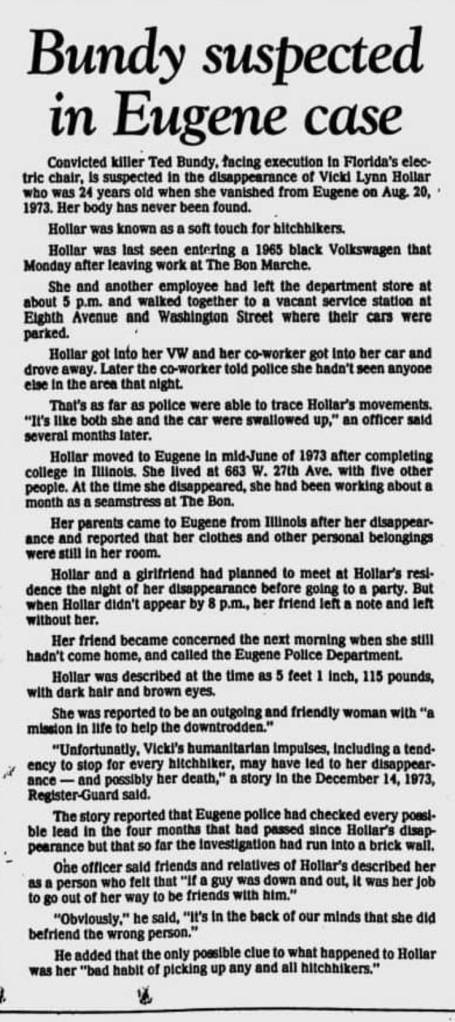
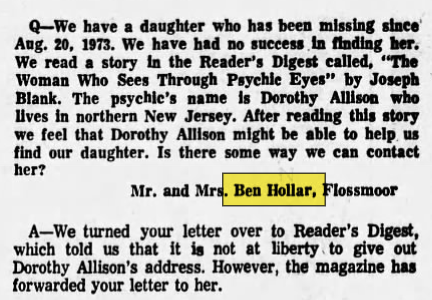
Ted confessed to abducting Roberta Kathleen Parks from Oregon State University on May 6, 1974: he drove her over 250 miles away to Taylor Mountain, where he raped and killed her. She is his only confirmed Oregon victim. In interviews with law enforcement, Bundy confessed to murdering two additional women in the ‘Beaver State’ but refused to elaborate any further; according to most law enforcement, Vicki Hollar and Rita Jolly are the best candidates. On June 29, 1973 seventeen year old Rita Lorraine Jolly left her family home to take a walk, something she did every night before bed. She never returned home. Not even two months later on August 20, 1973 twenty-four-year-old Hollar disappeared without a trace after leaving the Bon Marche in Eugene, where she had just gotten a new job as a seamstress two weeks prior. Detectives tried but were unable to question Ted regarding Vicki’s disappearance before his execution in 1989, eliminating the chance of closing the case in relation to the serial killer. I was not able to find anything from the Hollar family in regards to Bundy, however I did find a quote by Jill Jolly: ‘as I recall, my mother told me that the local detectives managed to get a direct question about Rita through to him before his execution, and his reply was ‘No. No more in Oregon.’ Bundy withheld many secrets in the end in hopes to parlay them into yet another stay of execution, and even told detectives that ‘there are other buried remains in Colorado’ (then of course he refused to elaborate any further).
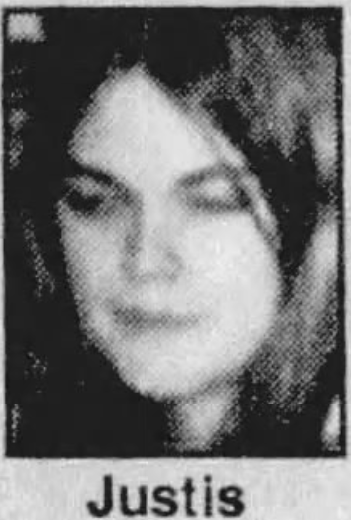
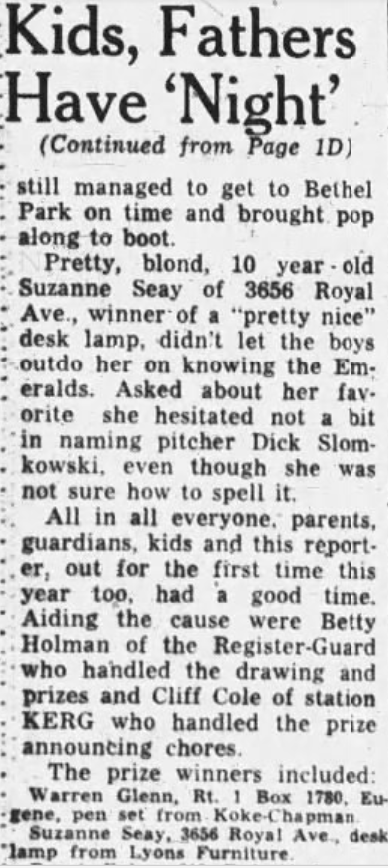
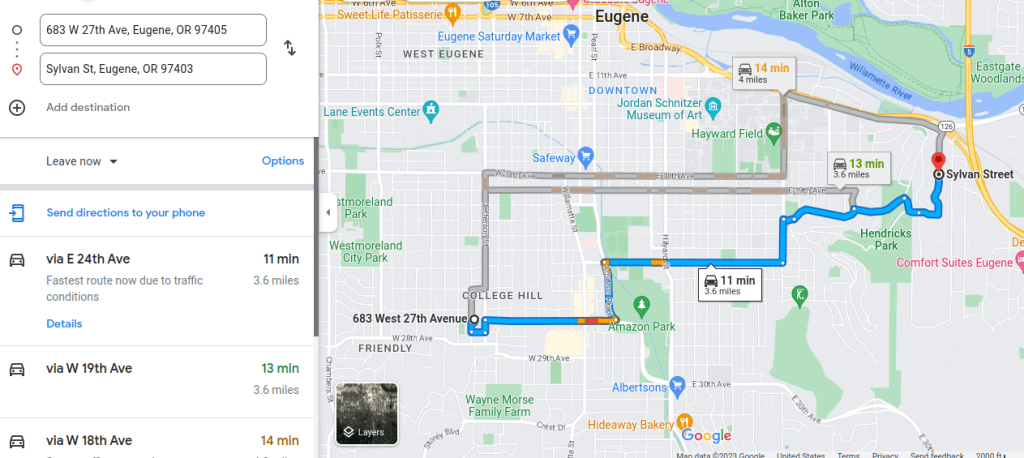
Regarding how close the Bon Marche in Eugene was compared to LeClair’s residence, WebSleuths user BlueJean40′ points out that ‘both of these locations are relatively close on the same side of our city. Just wondered if anyone had read anything about them possibly being connected.’ Not even three months after LeClair was killed on November 5, 1973 twenty-three year old Suzanne Justis most likely hitchhiked from her home in Eugene to Portland, as her car was found left behind at home. She spoke to her mother from a phone booth located outside of the Memorial Coliseum. Justis told her mother she was planning on coming home the following day to pick up her young son from school but never showed up. No trace of her has ever been recovered.
Now, when I say this I’m in no way implying that Ted Bundy was responsible for every single murder that took place in the state of Oregon in 1973… but I am surprised that after two years of very intense research I’m still coming across names that I’ve never seen before. During my research into Gayle LeClair I learned about a young women named Faye Robinson (her high school yearbook spelled her first name ‘Fay’), who was found deceased from multiple stab wounds in the upper part of her body not even six months before LeClair in March 1973. Like Gayle, Robinson was educated and worked in county government: she graduated from the University of Oregon in 1970 and was employed by the Lane County Welfare Department.
Another girl I want to mention is 17 year old Susan Wickersham, who disappeared on July 11, 1973 after dropping off the family car at her mom’s POE in downtown Bend after joyriding around town with a girlfriend (some conflicting reports say she was at a party). Her remains were found on January 20, 1976 and her skull had a bullet hole behind the right ear with no exit wound. Lastly, a 15 year old girl named Alison Lynn Caufman disappeared out of Portland sometime in 1973 (I was unable to find an exact date or any more details about her) as well as eighteen year old Laurie Lee Caniday from nearby Milwaukie (yes, that’s spelled correctly).
Now, I want to (briefly) talk about the May 1969 Garden State Parkway killings separately from the other missing/murdered girls for a moment, just because I feel that they share some (very) general commonalities with the murder of Miss. LeClair (even though I personally don’t think Bundy was responsible for the murder of Susan Davis and Elizabeth Perry): like LeClair, both victims expired as a result of multiple stab wounds, and even though none of Ted’s other victims(that we know of, anyways) ever suffered from any similar types of injuries we do know that he used a (dull) knife to cut the throat of little Kimberly Dianne Leach in Florida on February 9, 1978.
Aside from Ted, another name that came up in relation to the murder of Gayle LeClair is Dayton Leroy Rogers, an American serial killer that has been linked to the slayings of at least eight ‘street’ women (which is code for sex workers/addicts/runaways) across Oregon. He was convicted of the murder of his final victim in 1988, and two years later in May 1989 he was sentenced to death after being found guilty of six additional homicides. Rogers was actually sentenced to death on three separate occasions, but all three times the Oregon Supreme Court vacated the decision and remanded the cases for a new trial; he was sentenced to death for a fourth time on November 16, 2015. According to Roger’s defense attorney, the killer said that he would have waived all future appeals and allocated to his atrocities in exchange for a life sentence rather than receiving the death penalty. His death sentence was overturned for the fourth time on November 12, 2021 partially thanks to a new law signed by Governor Kate Brown limiting the amount of ‘aggravating factors required for seeking the death penalty.’ Governor Brown commuted the death sentences of everyone on Oregon’s death row to life without parole on December 13, 2022. Dayton is still alive as of June 2024, and will live out the rest of his days behind bars.
Now, nothing in my research told me that TedBundy was ever considered a suspect in LeClair’s murder, despite her living in a fairly accessible area to him and fit neatly into his preferred age range, as he killed young females anywhere from 12 years old (possibly even as young as eight if you throw Ann Marie Burr into the mix) up to 26 years old (ski instructor Julie Cunningham). Miss. LeClair also fit the physical description of one of Ted’s victims, as she was beautiful and slim and had long hair and a petite build. But these superficial details are pretty much where any possible link to Bundy ends.
Mr. LeClair died at the age of 74 on January 27, 2009 due to a ‘smoking related illness.’ He was an avid outdoorsman, loved racing, and was a member of the Fraternal Order of Eagles. Gayle’s brother Cleve died of heart failure on May 9, 2009. He was active in a local HAM radio club and was trained to help run a radio station in the event of an emergency. Frank LeClair was able to tell me that Barbara LeClair passed away on December 11, 2024.
* Edit, January 2025: I would like to thank Gayle’s brother Frank, who was kind enough to reach out to me and point out a few mistakes I made and give me some updates about his sister’s case. He shared with me that a detective from the Eugene PD Cold Case Squad had been in touch with him in recent years, who shared they had uncovered a piece of evidence in relation to the murder that unfortunately at the time had not been properly processed into evidence, therefore there was no chain of custody and it wouldn’t hold up in court. But they did however send a piece of the sample to a laboratory that specializes in recovering DNA and they were able to uncover two partial but separate genetic profiles from the blood evidence. The detective shared with him that they needed a blood sample from an immediate family member in order to determine which portion belonged to Gayle, and unfortunately since Frank was only a half-sibling he didn’t qualify, as it needed to come from a ‘more direct relative.’ He helped them get in touch with Ms. LeClair’s motherBarbara, who happily volunteered a sample. After receiving it the lab was able to isolate the suspected killers DNA from the sample taken from the crime scene, however because of the age and the fact that the sample was degraded they weren’t able to obtain a full set of genetic markers.
But Frank did tell me that recently they were able to get genetic samples from every person of interest in relation to the case, and if they were deceased they got one from one of their children. So far investigators have been able to clear every suspect except for one, who died several years ago; his child has refused to voluntarily give up a DNA sample. The detective told Frank the names of a few different suspects that were eliminated after the DNA evidence was analyzed, but he forgot most of them. The ones that stuck out the most were Gayle’s date that night and the landlord, John Sydney Armstrong.
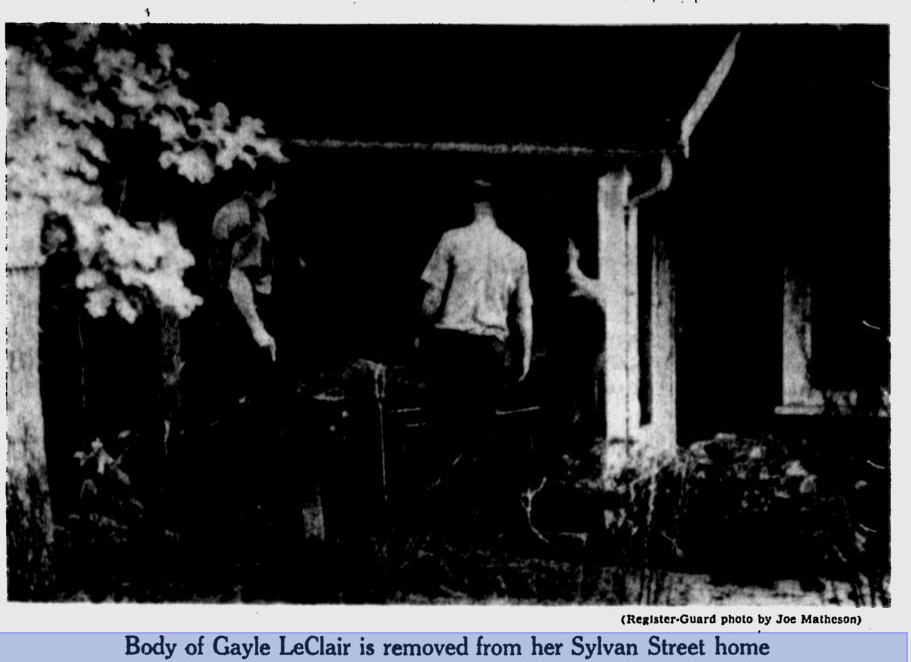
Gayle LeClair’s junior year picture from the 1968 Gold Beach Union High School yearbook.Gayle LeClair’s senior year picture from the 1969 Gold Beach Union High School yearbook.The final resting place of Gayle LeClair. She is buried at Rogue River Cemetery in Gold Beach, OR.LeClair listed in the Oregon state death index.LeClair mentioned in an article published by The World on February 10, 1954.An article about a play called ‘Don’t Drink the Water’ put on by Southwestern Oregon Community College in the fall of 1969. Gayle LeClair is mentioned at the bottom, it was published in The World on November 15, 1969.A newspaper blurb about the murder of Gayle LeClair published by The Albany Democrat-Herald on August 24, 1973.A picture of the Sylvan Street crime scene published in The Eugene Register-Guard on August 24, 1973.Part one of an article about the murder of Gayle LeClair published in The Eugene-Register Guard on August 24, 1973.Part two of an article about the murder of Gayle LeClair published in The Eugene-Register Guard on August 24, 1973.Part one of an article about the murder of Gayle LeClair published by The World on August 30, 1973.Part two of an article about the murder of Gayle LeClair published by The World on August 30, 1973.Gayle LeClair’s obituary published in The World on August 27, 1973.An article mentioning LeClair published by The Eugene Register-Guard on September 10, 1973.An article about multiple murders in Lane County, Oregon that mentions the murder of Gayle LeClair published by The Eugene Register-Guard on April 16, 1978 (there is more to this but it doesn’t mention LeClair).The first part of a newspaper article about serial killer Dayton Leroy Rogers that mentions the murder of Gayle LeClair published in The Eugene Register-Guard on September 19, 1987.The second part of a newspaper article about serial killer Dayton Leroy Rogers that mentions the murder of Gayle LeClair published in The Eugene Register-Guard on September 19, 1987.3760 Concord Street, where LeClair lived from January to May 1973.1781 Sylvan Street, where LeClair was murdered. Donald and Barbara’s marriage announcement published in The World on February 21, 1950.Donald and Barbara LeClair’s marriage certificate that was filed on June 5, 1950.A newspaper clipping about Mr. LeClair being charged with a DUI published in The World on January 9, 1969.Donald and Barbara’s divorce announcement published in The World on June 20, 1970 .Donald and Barbara LeClair’s divorce paperwork, filed on September 29, 1970.An obituary for Gayle’s brother Cleve published in The World on May 12, 2009.Some kind words written by a friend about Gayle’s brother Donald from his memorial page on Legacy.com.I was unable to find out much about Gayle but I did find this on WebSleuths that was written by someone that knew her.Bundy’s whereabouts on August 24, 1973 according to the ‘TB Multiagency Team Report 1992.’A list of just some of the missing (and murdered) girls from Oregon between 1969-78.Fay (Faye?) Robinsons senior picture from the 1966 Tigard High School yearbook.An article about Robinson’s murder published by The Statesman Journal on March 23, 1972.Dayton Leroy Rogers.
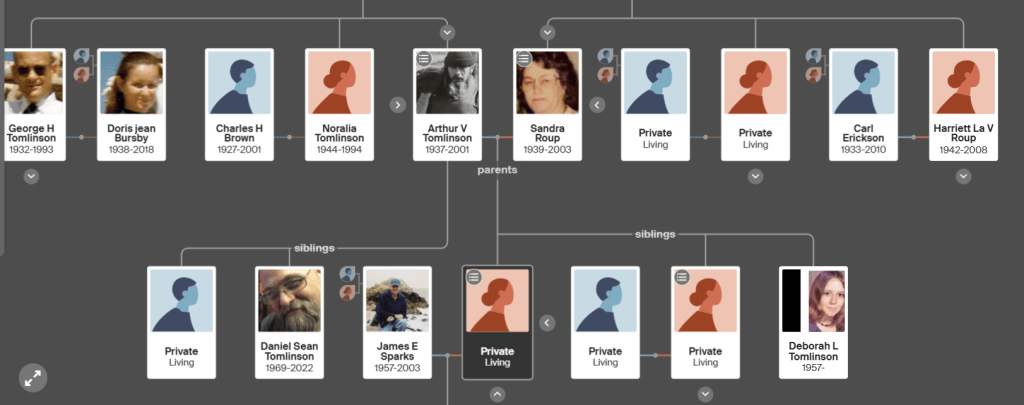
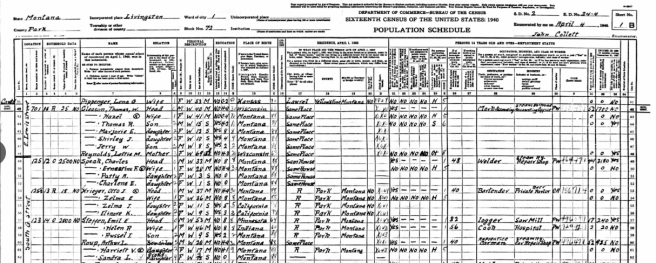
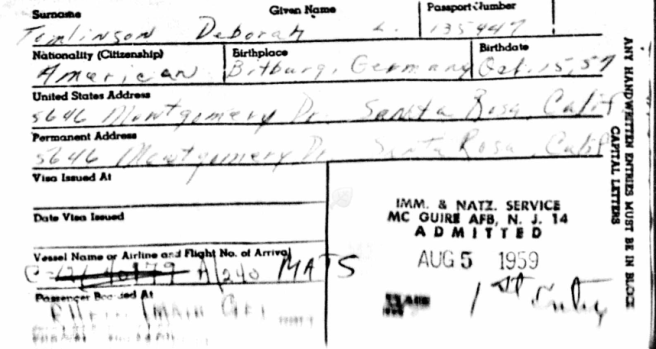
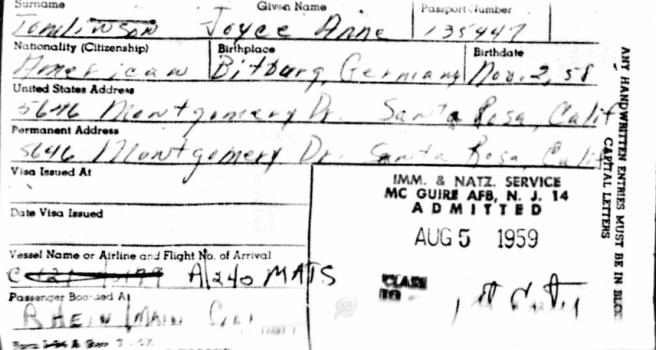
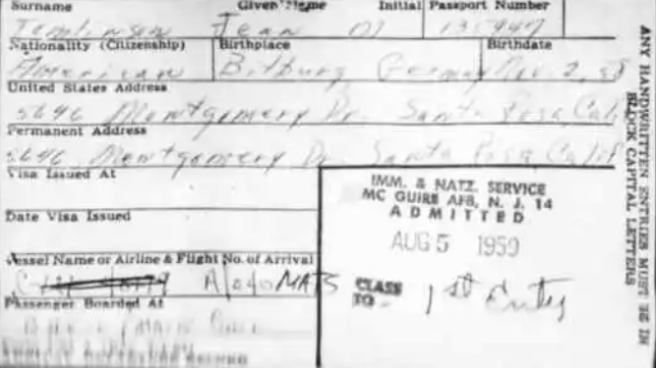
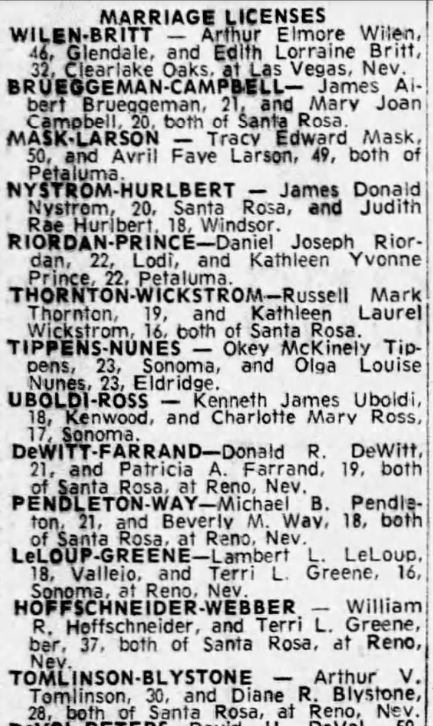
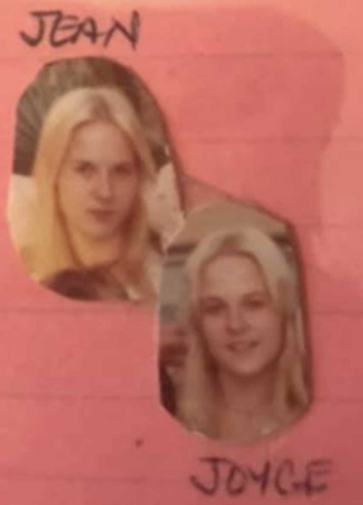
Deborah Lee Tomlinson was born on October 15, 1957 in Bitburg, Germany to Arthur and Sandra (nee Roup) Tomlinson.Arthur Vernon Tomlinson was born on September 22, 1937 in Modesto, California, and Sandra Lee Roup was born on December 31, 1939 in Livingston, Montana. According to the Tomlinson family tree, the couple had three daughters together: Deborah and her twin sisters, Jean and Joyce (b. 1958). At some point they divorced, and Mr. Tomlinson was briefly married again in 1968 (they quickly parted ways; he went on to have a relationship with Sally Morphisand in 1969 they had a son together named Daniel. He got married to Shelley Williams on August 30, 1975 in Orange, CA but their union also didn’t last long, and they split up in February of the following year. Mr. Tomlinson was married for a fourth time, and the couple had a son together. Sandra got remarried to Henry Nelson on May 10, 1963 in Billings, Montana.
After their parents parted ways Deborah, Jean, and Joyce went to live with their father and stepmother in California, and Sandra relocated to Oregon. Because of their parents’ divorce the girls were separated from their mother at a very young age, which Joyce felt prevented them from forming a strong bond because she wasn’t given a chance to raise her own babies.
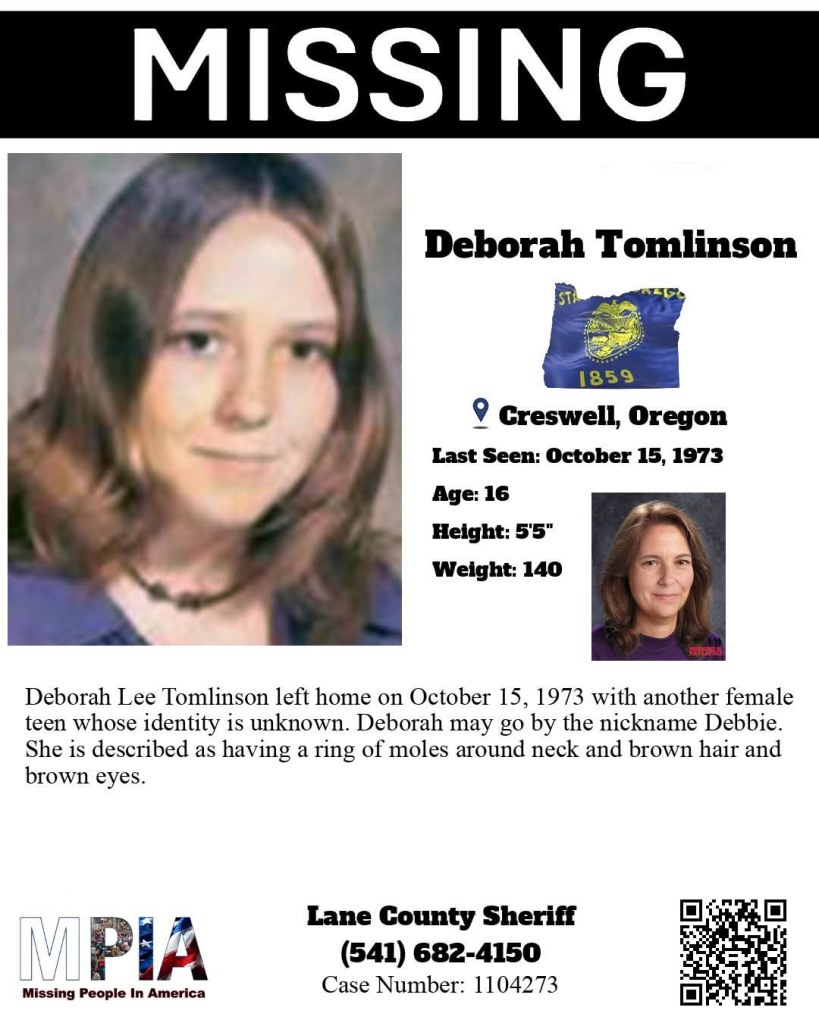
According to most reports online, Deborah Lee Tomlinson disappeared from Creswell, Oregon** on her sixteenth birthday on October 15, 1973.Creswell is an incredibly small town with only one high school, and according to the 1970 census the reported population was made up of a mere 1,199 people (it went up to 5,031 in 2010). Referred to as ‘Debbie’ by family and friends (per Joyce, she hated being called ‘Deb’), Tomlinson had brown eyes, stood at 5’5” tall, and weighed 140 pounds (Joyce felt she may have been slightly heavier); she wore her golden-brown hair at her shoulders and had a ring of moles around her neck. In the initial days following her disappearance investigators strongly believed that she was a runaway,whichmost likely explains why I couldn’t find any newspaper reports or media coverage on her. One of the only other real takeaways I could find regarding her case was that she disappeared with an ‘unidentified teenage friend.’
** After I initially wrote the article on Deborah in April 2024 I was contacted by her sister Jean, and more recently Joyce. Both sisters were kind enough to help fill in some of the gaps in their family background and were able to provide me with some of their thoughts regarding her disappearance. According to Jean, their Aunt Helen told them in more recent years that Deborah had ran away from Eugene, not Creswell, and at one point the family had been contacted by a friend that claimed they had seen her in Santa Rosa, CA with ‘a black guy,’ which was a big deal as their father didn’t approve of people of color (Joyce also said she was there visiting a friend named Lyn). The family member also volunteered that they thought she may have been pregnant at the time as well, but nothing ever came out of that. About this alleged sighting, Joyce doesn’t feel it’s true, as that’s where their grandmother lived and Deborah would never have left the area without paying her a visit, especially if she had been pregnant (the two were especially close).
According to Jean, after their parents split up the girls were raised by their father in California, but because Deborah’s didn’t get along very well with their stepmother she had moved to Oregon to live with their mother (who she also clashed with). She also said that at the time her sister disappeared she seemed mostly happy but had been in a bit of a transition period in her life and may have been under the impression that moving out of state may have resulted in more lenient rules, but that wasn’t the case.
According to Joyce, Debbie was simply acting like any other teenager, doing things like sneaking out at night and smoking: one evening in a quick moment of anger their dad announced that he was pulling a ‘Pontious Pilot’ and was ‘washing his hands of her.’ When she left home Joyce said somehow she knew it would be the last time that she ever saw her, and to this day she struggles with her feelings towards her father about that event. Additionally, she strongly suspects that a missing person’s report was never filed in the days after she was last seen, as she never came across one after contacting local Oregon law enforcement. Because of this, I strongly feel that Debbie didn’t disappear exactly on October 15, 1973, and most likely vanished sometime around it.
Jean shared with me that in the years following her sister’s disappearance neither one of their parents wanted to talk much about her, as it brough up too many painful memories. Because of this she told me that she doesn’t know as much about her as she would like to, but she does know that Debbie loved rock n ’roll music and had gotten caught sneaking out at night several times while she still lived with them in California.
Shortly after Deborah disappeared Joyce told me that their stepbrother had reached out to let her know about a formerly missing woman had been found murdered that happened to have some moles around her neck in a pattern similar to Debbie’s (which she said appeared to be ‘almost like a spaced apart, like a necklace’); it obviously turned out not to be her.
When I asked if perhaps Debbie had run off with a guy, Jean shared with me that was what most likely happened, despite the fact the sisters weren’t allowed to date until they were sixteen. Regarding her feelings on the recent ‘genetic genealogy’ craze and if she thought it could help solve the mystery of what happened to her sister, she said that she has never been contacted by LE about it, however at one point she was told by the National Center for Missing & Exploited Children that any records possibly related to Deborah were destroyed in a fire.
In 1984 Joyce and her husband took a road trip with their grandkids to visit their great-grandmother and Hank, and while there her stepfather shared that he caught Debbie sneaking out one night and she had been smoking marijuana. He told them that this freaked him out and he tried to do a ‘scared straight’ type intervention and had reached out to the local county sheriff (who had happened to be a friend of his), who had come to the house and had a conversation with his teenage stepdaughter; Debbie disappeared shortly after that.
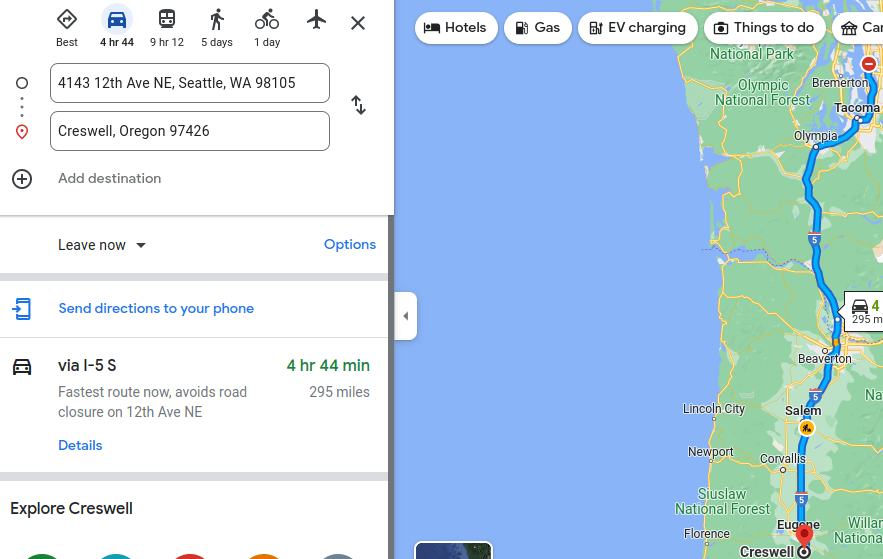
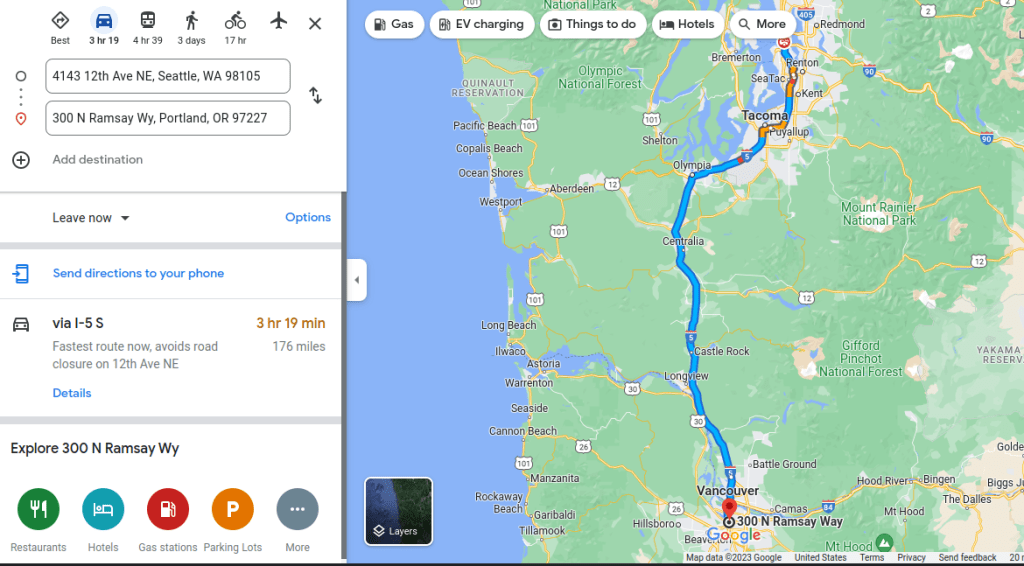
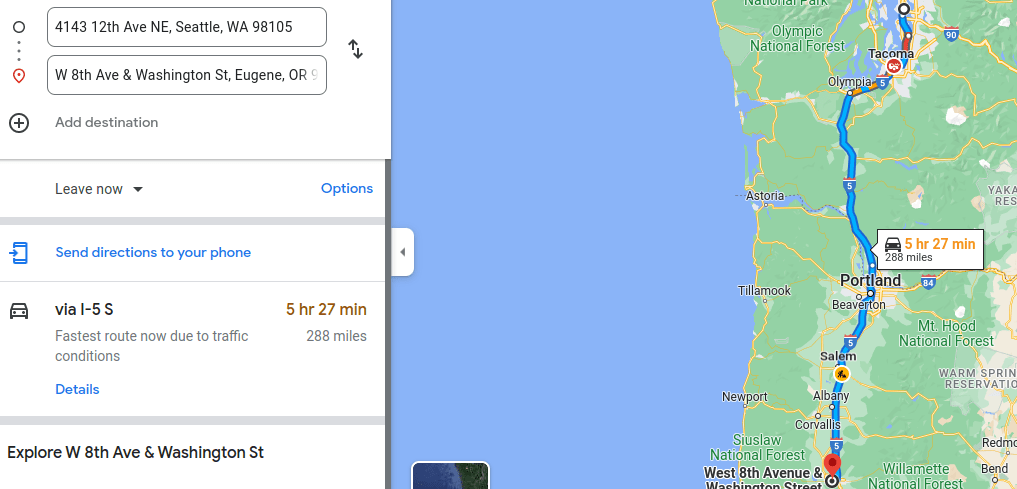
At the time Tomlinson disappeared in October 1973, Ted Bundy was living at the Rogers Rooming House on 12th Avenue Northeast in Seattle, and where it was a five-hour drive (one way) from his residence to Eugene/Creswell, we know he had no problem with traveling long distances to look for prey. Despite being in a long term, (supposedly) monogamous relationship with Liz Kendall, while on a business trip with the Republican Party to California in the summer of 1973 he rekindled his romance with one time girlfriend Diane Edwards. Ted’s former flame visited him in Seattle on multiple occasions in the latter part of the year, and the couple at one point were even briefly engaged… but the happy times didn’t last long, and in January 1974 he abruptly and without reason cut off all contact with her.
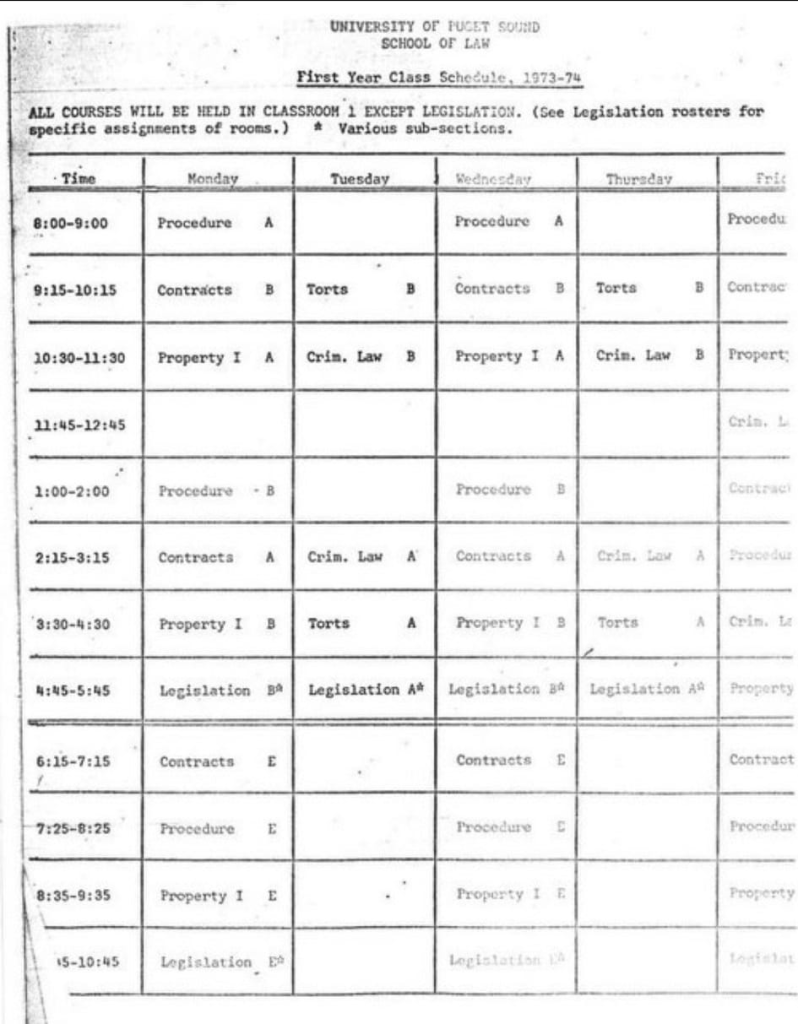
On top of juggling two women, in September 1973 Ted enrolled in law school at the University of Puget Sound, and according to the ‘TB MultiAgency Investigative Team Report 1992,’ on Monday, October 15, 1973 when Tomlinson disappeared, he was in class. Additionally, at the time he was in between employment: in September 1973 he was the Assistant to the Washington state Republican chairman and remained unemployed until May 3 of the following year when he got a position with the Department of Emergency Services in Olympia.
In addition to Ted Bundy multiple other serial killers roamed the Pacific Northwest in the early to middle 1970’s: the first one (aside from Ted) that popped in my head was Warren Leslie Forrest, a double murderer that has been sentenced to two life terms in prison for the murders of Krysta Blake and Martha Morrison in 1974; he is also considered the prime suspect in at least five additional murders and disappearances going back as far as 1971. He has been in police custody since 1974 and on February 4, 2023 he was convicted on another murder count after DNA linked him to the murder of Martha Morrison.
On June 8, 1961, Portland police received a call from a housewife whose dog had returned home with a human foot in a paper bag, and when detectives went to her home the animal came back with a hand. Upon investigating, LE found several additional body parts around the woman’s neighborhood, and all of the appendages were deemed to be fresh and were completely drained of blood. Police went through local missing people’s reports and came across the file of twenty-three year old Joan Caudle, a housewife and mother of two that had recently been reported missing by her husband (who of course was an immediate suspect).
Joan’s husband told detectives that where she wasn’t normally a big drinker she had been a bit depressed recently because her mother had been sick, therefore there was a chance she had been at a bar having a few. Police then tracked down a barfly that had a string of arrests for public drunkenness and she told them she had been in a bar on the night of June 7 and met a man going by the name Marquette. The pair had seemingly hit it off when a woman approached them and stole his attention away, and when detectives showed the eyewitness a photograph of Joan Caudle, she said that was definitely the same woman from the bar.
Upon his arrest Marquette admitted that he raped and murdered the Portland housewife then he drained her blood, dismembered her body, and left her head to rot in the woods. Despite being found guilty of first degree murder the jury recommended leniency, and Marquette was sentenced to life in prison.After serving only eleven years of his sentence (during which he was described as a model prisoner), he was released on parole in 1973.
Not even two and a half years after Marquette was released on parole in April 1975, a fisherman discovered a mutilated corpse floating in a Willamette River slough in Marion County, Oregon; it had been bled dry and had been dismembered. Detectives determined the remains were those of thirty-seven-year-old Betty Lucille Wilson (one report said she was thirty-five), a North Carolina native who led a life of extreme poverty and had seven children since marrying her abusive husband at the age of 16. At the time she was killed she was living in an abandoned school bus.
While he was confessing to Wilson’s murder, Marquette also shared with detectives that he killed a second woman in a similar fashion sometime in 1974, and he led them to two shallow graves where he had disposed of the bulk of the remains. Unfortunately because the head was never found, there was no way the victim could be identified, and Marquette admitted that he didn’t know who she was. Her identity remains unknown.
Within a five-month period in the latter part of 1973 five young women went missing in Oregon, and three more were found murdered: first was Rita Lorraine Jolly, who disappeared on June 29 while taking a nightly walk in her West Linn neighborhood; her remains have never been found. On July 9, 1973 the body of Laurie Lee Canaday was recovered in the middle of the road at the intersection of Southeast Scott Street and McLoughlin Boulevard in Milwaukee,OR. Next was seventeen-year-old SusanWickersham from Bend on July 11; her body was discovered in January 1976, only five miles south of her hometown; she had suffered a gunshot wound to the head. Additionally, sometime in July 1973 fifteen-year-old Allison Lynn Caufman of Portland died as a result of head injuries after she was shoved from a car moving at a high rate of speed.
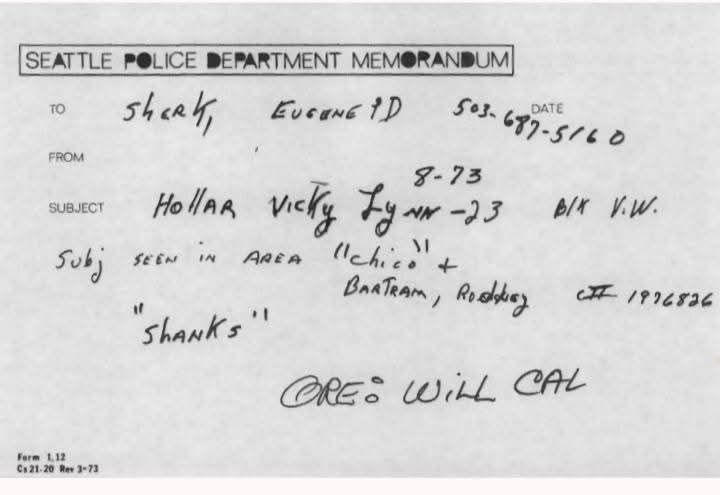
On August 20, 1973 twenty-four-year-old Illinois transplant Vicki Lynn Hollar was last seen getting in her black 1965 Volkswagen Beetle (with the running boards removed) after she left her place of employment at the Bon Marché in Eugene, where she had been working as a seamstress for about two weeks. It’s thought that she was headed home to her apartment, as she had plans of meeting up with a friend to attend a party in her neighborhood later that evening (she never showed up). Friends shared with police that she had a habit of picking up hitchhikers; her VW and personal belongings have also never been recovered. Just three days later on August 23, 1973, Gayle LeClair was found stabbed in her apartment in Eugene, OR. The twenty-two year old had recently moved to the area after she got a job at the Eugene City Library.
Just six days after Deborah Tomlinson was reportedly last seen, thirty-two-year-old VirginiaErickson disappeared from Sweet Home on October 21, 1973; although it’s never been proven, evidence points towards her husband being her killer and that it most likely took place while the two were ‘out on a hunting trip.’ Lastly, we have twenty-three-year-old divorcee Suzanne Justis, who went missing on November 5, 1973. From Eugene, Justis had hitchhiked to Portland (despite owning her own car), and had called her mom from a payphone outside of the Veterans Memorial Coliseum to let her know that she would be home the next day to pick up her son from school; she never showed up. Not one case has been solved.
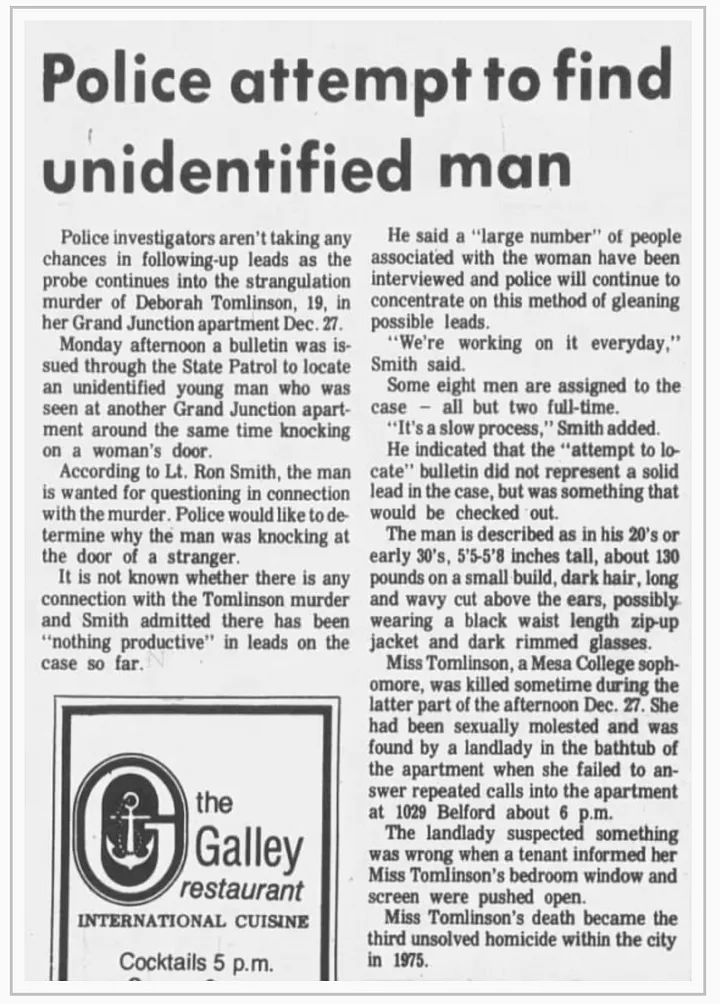
Strangely enough, there was another young woman with the same first and last name as Deborah that had been brutally killed a little over two years after she was last seen in Colorado: nineteen-year-oldDeborah Kathleen Tomlinson was murdered in her apartment complex on Belford Ave in Grand Junction on December 27, 1975. In the days that followed her murder, detectives quickly exhausted all leads and the investigation quickly went cold. Forty-five long years went by. In an article published on December 3, 2020 by the website ‘WesternSlopeNow,’ the Grand Junction PD announced a break in the case: they had partnered with a DNA Technology Company calledParabon to analyze the unknown semen and blood that had been found with the victim at the original 1975 crime scene.
About the process, Parabon’s Chief Genetic Genealogist CeCe Moore said that they analyze ‘the DNA, so we can look at 850,000 genetic markers that will allow us to predict relationships that are distant.’ Also, just as a side note, Moore is the scientist that helped solve the 1971 murder of Roman Catholic schoolteacher Rita Curran out of Vermont (who up until recently was also an unconfirmed Bundy victim). After the samples that were collected from the original 1975 crime scene were processed, Parabon built a family tree using public records in an attempt to identify the unknown person-of-interest, and it was concluded that a man named Jimmy Dean Duncan killed Deborah K. Tomlinson. As ofApril 2024, law enforcement has found no connection between Duncan and Tomlinson, but found that he had a family member that lived close to the college she was attending at the time of her death. Detective Sean Crocker from the Grand Junction Police Department commented that ‘we believe Mr. Duncan visited this relative, and that’s how possibly he could’ve encountered Ms. Tomlinson.’ Jimmy Dean Duncan passed away in 1987.
Arthur Tomlinson died at the age of sixty-four on January 29, 2001 in Las Vegas, NV. Deborah’s mother Sandra Lee Nelson passed away from lung cancer at the age of sixty-three on February 2, 2003, and according to her death certificate, she had been the owner/operator of a café. Sandy’s husband Henry died on March 16, 1994 at the age of 54, most likely in a medical facility in Spokane, WA. Deborah’s brother Daniel Sean Tomlinson died in 2022 at the age of fifty-three in California.
Deborah’s sister Jean retired after almost twenty years in the RV Business in November 2023, and she currently lives in Henderson, Nevada with her husband of almost twenty years, Dave. In 2019 Joyce retired from the Bureau for Child Support Enforcement with the State of West Virginia, and was married to the love of her life until he passed away on May 26, 2003. She currently resides in St Thomas, Pennsylvania. If Deborah was anything like her sisters, she was a kind, compassionate person that would have done a lot of good in this world.
In the years following Deborah’s disappearance the twins remain close, although Jean admitted her disappearance has been incredibly hard on their family. She also confessed that a small part of her always thought her big sister would reach out to one of them when they were adults, after everyone had grown up. More than anything they want closure, and at the very least wish they had a body to properly lay to rest so their sister could be with the rest of their family. Debbie would have been an aunt and great aunt multiple times over, and it’s heartbreaking to think of her never getting to meet either of her brother-in-laws, or nieces and nephews. As of October 2025, Deborah Lee Tomlinson’s case remains open and she would be 68 years old. Joyce said that the family’s DNA is on file with the NCMEC website.
* In October 2025 I finally came across the Tomlinson family’s Ancestry page, which helped give me a lot of background into Deborah’s family life and background. I also updated the article with information from an interview that I did with her sister Jean in February 2025 as well.
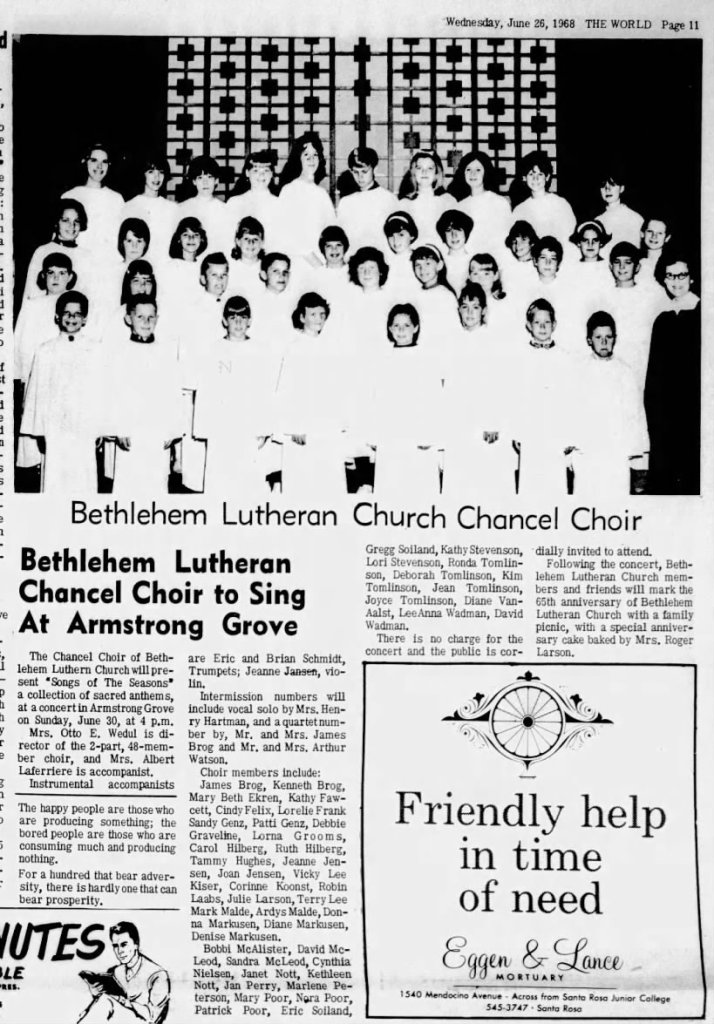
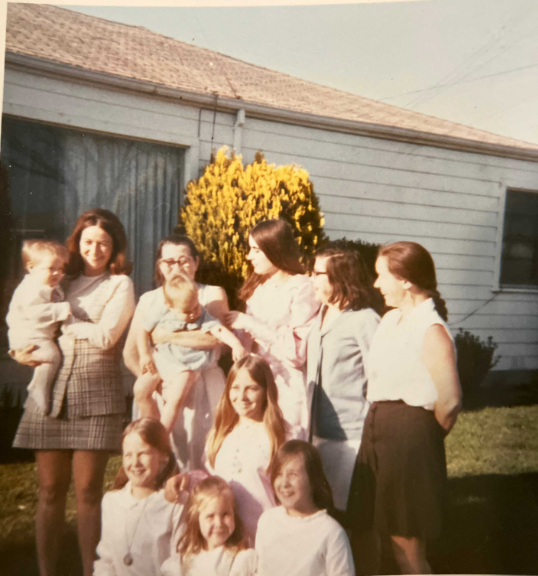
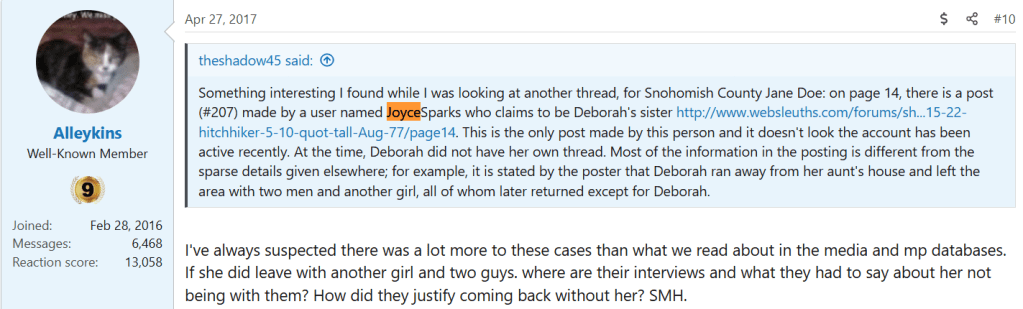
A missing persons poster for Deborah.The girls standing with their dad and Aunt Jean, who Joyce said they were all especially fond of; sadly right after this picture was taken she moved to Virginia. Photo courtesy of the Tomlinson family archives.The three sisters in a picture during their time in the Bethlehem Lutheran Church Chancel Choir that was published in The Rohnert Park Cotati Clarion on June 26, 1968.Deborah (on the far left), Joyce, and Jean. Photo courtesy of the Tomlinson family archives.Some members of the Tomlinson family; it looks like Deborah and her sisters are in the front. Photo courtesy of the Tomlinson family archives.Tomlinson before she disappeared in 1973.What Debbie Tomlinson might have looked like at the age of 53 using age progressing technology, photo released on July 21, 2011.What Debbie Tomlinson might have looked like at the age of 58 using age progressing technology, photo released on June 28, 2016.According to the ‘Ted Bundy MultiAgency Investigative Team Report 1992,’ on October 15, 1973 when Tomlinson disappeared Bundy was supposed to be in class at The University of Puget Sound in Tacoma. Bundy’s fall 1973 law school schedule from the University of Puget Sound.Bundy’s route from where he lived at the Rogers Rooming house to Creswell, OR.Warren Leslie Forrest.A more recent picture of Warren Leslie Forrest.Warren Leslie Forrest’s van.Richard Laurence Marquette.A list of some other missing girls from Oregon from 1969-78. Tomlinson isn’t even listed.A comment on a Websleuth’s page about Deborah’s disappearance made by Joyce Sparks on October 16, 2013.A comment on a Websleuth’s post about Deborah Tomlinson made by user ‘Caring1.’A Websleuth’s comment on a post about Deborah made by a user named ‘theshadow45’ on August 27, 2017.A Websleuth’s comment on a post about Deborah made by a user named ‘Alleykins’ on August 27, 2017.Deborah Kathleen Tomlinson.An article about the murder of Deborah Kathleen Tomlinson published by The Daily Sentinel on January 14, 1976.The Tomlinson family tree, courtesy of Joyce Tomlinson.Deborah’s grandmother Nora and her father, Arthur. Photo courtesy of the Tomlinson family archives.Deborah’s father, Arthur Vernon Tomlinson. Photo courtesy of the Tomlinson family archives.Deborah’s mother listed in the 1940 census.Arthur Tomlinson from the 1951 Westwego High School yearbook.Deborah’s father listed in some Baptism’s that took place in New Orleans, Louisiana in 1951.An article about Mr. Tomlinson’s time in the military in Great Falls, Montana published in The Malmstrom Minuteman on May 25, 1956.A passport log for Deborah’s mother Sandra dated August 5, 1959.A passport log for Deborah, dated August 5, 1959.A passport log for Deborah’s sister Joyce dated August 5, 1959.A passport log for Deborah’s sister Jean dated August 5, 1959,Arthur Tomlinson in a list of people applying for a marriage license published in The Press Democrat on January 11, 1968.Mr. Tomlinson’s address; according to this, he was employed at Sonoma State Hospital at the time.Arthur Tomlinson and his second wife listed in the CA Divorce Index, 1966-1977.Jean and Joyce Tomlinson. Photo courtesy of the Tomlinson family archives.Some of the Tomlinson family at Jean’s wedding. Photo courtesy of the Tomlinson family archives.Some members of Deborah’s family at Joyce’s wedding. Photo courtesy of the Tomlinson family archives.Mr. Tomlinson’s second wife, Shelley.Henry Nelson’s obituary published in The Montana Standard on March 17, 1994.Deborah’s mothers death certificate.Deborah’s half-brother, Daniel Sean Tomlinson.Deborah’s half-brother, Daniel.Deborah’s baby sisters, Joyce and Jean.Deborah’s sister Jean and her husband, Dave.
Intro: Jessica told you about the monster behind these heinous crimes, and now, I am going to tell you about the victims. I think it is important to know about their lives and not the fact that they died, but that they lived. The victims are the ones who should be remembered. I feel that his sisters were among his first victims along with Helen Pilkerton. They suffered abuse at his hand and also were used to lure unsuspecting victims. To my utter disbelief, there were not much information for the beautiful lost souls, and none for the hitchhikers they fell victim to him. I want them to know that I, a complete stranger, do not know who you are or where you are, did not forget you. I also feel that if his parents would have not covered for him and turned him in, many lives would have been saved. This is my opinion but after hearing the whole story from his sisters, my opinion is that they didn’t protect them and then did not protect the poor innocent girls from this monster. Ted Bundy was suspected of Kathy’s death, but DNA proved to be William Cosden Jr. He was in prison for attacking Beverly Pearson already hiding right under their nose. It took 28 years and DNA evidence to find the truth. Here is the havoc this man created and the grief he inflicted on the families of his victims. I will start with his earliest victims, his sisters, and then go on to victims he raped, and killed, and finally Kathy Devine, his final known victim. A story full of senseless killings that never should have happened if he would have stayed in jail where he belonged.
Early Victim, Helen Pilkerton: Cosden was sent to a mental hospital in Maryland for killing a woman in 1967 and was serving a three to four-year term at the McNeil Island Corrections Center near Tacoma for a 1976 rape and murder conviction. Her name was Helen Patricia Pilkerton. She was an employee of the Lexington Park Motel and was just 20 years old. Helen Patricia Pilkerton was born on May 24th, 1945, in St. Mary’s, Maryland, her father, John was 22 and her mother Helen was 21. She had one brother and four sisters. She died on April 16, 1967, at the age of 21, and was buried in Hollywood, Maryland.
Helen was found in a stream by two teenage girls and her body was badly beaten. Cosden had just returned from active duty in Vietnam where he was discharged due to violent behavior. The family of the victim had to sue the Military because of the outrageous leniency of the sentence. To my utter disbelief, Cosden was free after 6 years to rape and kill again. Deputy Prosecutor Philip Harju said, “He is an obvious danger to society.” Yet, he was released to rape and kill again. The story should have ended here, better yet not allowed at all.
His sisters, Karen and Susan: They were told their brother was away at a hospital and so his sisters thought he was all better when he came home. There was no warning from their parents whatsoever. They never told them why he was away and never took steps to protect them. He would get in constant trouble at home and in school almost like he invited the punishment. He always had to be in control. His sisters wished their parents were more aware. He loved to torment his sisters and animals. He got pleasure in making his sisters cry. When Karen was 4, he started sexually abusing her. He warned her he would hurt the whole family if she told. The same thing happened to Susan in a few years. He took steps to encourage them to not be close. When Susan was 8, her brother can downstairs all dressed up to go out. The next morning, she woke to find the sheriff at the kitchen table. They came for her brother. He had confessed to his father that he had killed a woman the night before. The sisters were beginning to see just how evil he was. He did four years in a mental hospital. Four years. His parents told the girls he had went to get well and he was well. That very night he came home, he sexually assaulted his sister. He was also a firebug and burned down the family home. His mother suspected it was him but did nothing. Again. The cause of the fire was listed as electrical. A house down the block burned too. He seemed to get away with everything. He would also burn his truck to cover evidence. Then one day the paper was showing about a body found. He got more and more agitated as the paper was read and screamed at them to stop reading. This turned out to be Kathy. He would go to “help” people on snow days when in fact he was looking for prey. One day after a snow day he was arrested for rape. In 1986, Susan came across his file that showed he was going to be released, she freaked out. She went to the police department to talk about her abuse. The detective she talked to said he believed her brother killed Kathy and would not retire until he found out. Susan told her story and wanted to make sure he didn’t get out. DNA tests were done, and he was convicted. She even flipped him the bird as they were sentencing him. Her family was actually mad at her for doing this. Susan, you are a hero to me. In 2015, he died alone of a heart attack. They had to deal with the effects of their traumatic past as adults, with one of the sisters even nearing death. Despite the difficulties, the sisters band together to discuss the harm done to them and make an effort to make things right. About a week after filming, Sisters in Silence, Karen Harris passed away following a battle with lung cancer. RIP Karen.
Hitchhikers: Restover Truck Stop in Tumwater, just off Interstate 5, focal point for hitchhikers where he worked there, and his father owned. As I pointed out, Susan says her brother Williams Cosden Jr. would use her as bait to pick up women hitchhikers. The women would feel safe getting into his truck with a little girl there. He would tell his mom he was taking Susan to get ice cream and then take her to pick up hitchhikers. Once the girls were in the truck, he would lock Susan in the back. Many hitchhikers would disappear during this time. We may never know all his victims and which ones were Bundy’s. I apologize for not finding any names of the hitchhiker victims, it makes me wonder how many girls are in unmarked graves all over because of men like Cosden. I wonder if these families ever knew what happened to their daughters. My heart goes out to these families. I hope they found some kind of closure.
Beverly Pearson: On November 30th, 1975, 24-year-old Beverly Pearson stopped to get gas. As she was filling up, she encountered Willian Cosden Jr. She recognized him, but finished getting gas and drove away. On her way home, she lost control of her truck and pulled over. She noticed that Cosden pulled over right behind her. She told him she was fine, but when she went to get back in her truck, he hit her with a rubber mallet. He then forced her into his truck and kept threatening her and she kept saying to not hit her again. He pulled over at a wooded area and sexually assaulted her. She remembers thinking to try to get him to talk. Her step father was a police commissioner and taught her to try and get anyone who attacks you to talk. She asked him personal questions and told him if he let her go, he could come visit her at home. It worked and he took her back to her truck. She immediately called the police and Cosden was picked up Cosden was found guilty and was sentence to serve a 49-year sentence. Because of her bravery, he was off the streets.
Kathy Devine: I got most of Kathy’s story from Jessica because she wrote it better than any article I read. According to Jessica, Katherine Devine was born to Sally and William L. Devine in Seattle in King County, Washington, on December 25, 1958. She was a Christmas baby. Her family remembered how the kind-hearted teen thought she was destined to become a Minister after being born on Christmas Day. Kathy regularly brought home stray animals and homeless children living on the streets to take care of them. She had a big heart and always sought to help the less fortunate and helpless individuals. Witnesses last saw the 14-year-old teen hitchhiking in Seattle near North 91st Street and Aurora Avenue North. Her mother stared Kathy had just broken up with her boyfriend and was headed south to visit relatives in Rockaway, Oregon. Her family had reported her to the authorities as a runaway. Little did they know that was the last time their daughter would be seen alive. On December 6, 1973, a young couple stumbled across the remains of the 14-year-old girl in Margaret McKenny Campground in Thurston County. The victim’s throat had been slashed, and she was lying face down. An examination further revealed she had been brutally sodomized and strangled to death. According to police reports, the officers found the victim’s pants were deliberately torn. Authorities figured that since the place was deserted and it would take a local to know their way around the campground, the killer must be local. The decomposed remains were not immediately identified until Kathy’s sister Sherrie Devine, then 16, saw a television news program in Seattle of the discovery and recognized an embroidered patch on the pair of jeans the victim was reported wearing. Witnesses saw Cosden come in the night of the murder with stains on his clothing. The witnesses called police. After leaving the truck stop, Cosden’s truck caught fire and was destroyed three miles from the truck stop. During initial interviews with police, Cosden denied ever seeing Kathy Devine.” Kathy was first thought to be a victim of Ted Bundy. When Ms. Devine disappeared in 1973 Ted was attending the University of Puget Sound Law School and lived within two miles from where she was last seen. Everyone knows he drove the yellow, cream-colored Beetle for years before his arrest, but supposedly his brother owned a white pickup truck. During his death row confessions before his execution in 1989, Bundy told law enforcement that he picked up a hitchhiker in 1973, killed her then left her body close to where Kathy’s remains were found in Olympia, however he couldn’t remember the exact location. He denied having any involvement with Devine’s murder. But this makes me wonder if he did indeed kill Kathy. Cosden was surprised to be convicted and Bundy admitted to killing a hitchhiker and they only found Kathy at that site. Kathy’s ex-boyfriend was a suspect but passed the polygraph. Another man said he saw the whole thing but was very uncooperative with police. While searching his house, a lot of newspaper articles about Kathy were found along with a blood-stained knife. When they brought him in, he denied all charges and said he could explain. He said the knife was for hunting and after testing, the knife did indeed have animal blood on it. He was cleared of the charges. An anonymous man called detectives and suggested they investigate Cosden. The man said he looked in the back of Cosden’s truck and found a blood-soaked sleeping bag along with a single shoe. He was looking in Cosden’s truck because he claimed he was a co-worker and Cosden was stealing from him. Before the police had a chance to investigate Cosden’s truck “mysteriously” caught in fire. Remember, Kathy was found missing a shoe. The shoe found on Kathy matched what the man described but they never got the evidence since it burned. The police went to the jail to confront Cosden and he denied it even though they have DNA proof found on Kathy. Luckily, they had enough to convince a jury and his sister, Susan helped, and he was convicted. He lived in the area at the time of Kathy’s disappearance and murder. According to witnesses, William was seen wearing bloodstained clothes at the Truck Stop on November 26, 1973. He worked at the truck shop owned by his father and was reportedly working an early morning shift. After leaving the truck stop, Cosden’s truck caught fire and was destroyed three miles from the truck stop. Additionally, witnesses claimed to find what appeared to be bloodstains inside William’s truck late on November 25, the very day Kathy was last seen alive.
William Cosden was already in prison for sexually assaulting Beverly Pearson when he was convicted of Kathy’s death. it was be the oldest open murder case in the state to have been solved by DNA “fingerprinting,” authorities said. After Cosden was finally convicted of his daughter’s murder, Mr. Devine said: ‘It’s finished. There’s a justice system, and it works.″ ‘It doesn’t bring Kathy back, but it sure does help. “It was very creepy,” Sherrie Devine, the victim’s older sister, said of the court appearance. Devine’s mother, Sally, said she was nervous about seeing Cosden for the first time. “It would have been worse if we would have had to look directly at him,” I cannot help thinking that if the justice system kept this monster behind bars after his first murder and rape in 1967, Kathy would still be alive. And why weren’t his sisters protected from this monster? They were just little girls.
Conclusion: It took many years to finally catch her killer, but finally the family has answers and hopefully a little bit of peace. Such an unnecessary waste of her and of the beautiful souls who left this world too soon. My heart goes out to everyone whose life was touched by William Cosden Jr. I want to thank Jessica for not letting these girls be forgotten and reminding us they did live and not only die. And Charlene and Sherrie, you should have never had to endure this kind of horror in your family. My heart goes out to you and much respect for coming out the other side of this tragedy. A long as Jessica and I are here, we will not let her be forgotten.
McNeil Prison.William E. Cosden Jr.Cosden.Kathy Devine.Kathy Devine.Devine.Kathy and one of her sisters.The remains of Kathy Devine.The bell-bottom blue jeans with a dragon patch on the pocket that Kathy was wearing when her remains were recovered.The mock-suede coat with fur trim that Kathy Devine was wearing when her remains were recovered.The ‘waffle-stomper” boots Kathy was wearing when her remains were recovered.Beverly Pearson.
Cites:
Katherine Devine Murder: Where is William Cosden Jr Today? Update (thecinemaholic.com) Life term for man whom DNA linked to murder (seattlepi.com) Closing ceremony, tour of McNeil Island prison (seattlepi.com) Evil Lives Here, Sisters in Silence. Season 13, Episode 10. Katherine Devine Murder: Where is William Cosden Jr Today? Update (thecinemaholic.com) Katherine Merry “Kathy” Devine. | Another Bundy Blog. (wordpress.com) Most pictures were taken from Another Bundy Blog: Kathy Devine Facebook page Cowards ad Killers Man sentenced to life in prison for 1973 murder | The Seattle Times Historical Newspapers from 1700s-2000s – Newspapers.com On the case with Paul Zahn, Season 12, Ep 4, Waving Goodbye. Other info, Another Bundy Blog. (wordpress.com) https://www.heraldnet.com/news/rapist-charged-in-1973-killing/
Suzanne “Sue” Rae Justis was born to John and Doris (Smeed) Seay on January 5, 1950 in Vancouver, Washington. The couple were wed on December 25, 1954 and eventually relocated to Eugene, Oregon; they had three daughters (Suzanne, Chris, and Joan) and a son (Gary). Sue attended North Eugene High School and about halfway through her senior year on February 3, 1968 she married Mike Justis (who I’m deducing was her high school sweetheart as they went to school together and were so young); the couple had a son together however they divorced in November 1971. Sue was 5’3,” weighed 110 pounds and had blue eyes; she also had a mole on the left side of her face underneath her bottom lip. Like so many of the other unconfirmed victims I write about, there isn’t a lot of information out there on her (the majority of the pictures I found were from high school). At the time she disappeared in 1973 Justis was 23 years old and wore her brown hair long and parted down the middle. Most of what we know about the last hours of Suzanne Justis’ life is because of a conversation she had with her mother: at some point on November 5, 1973 Mrs. Seay spoke with her daughter on the phone. Sue told her that she was in the general area of what was (at the time) The Memorial Coliseum in Portland, OR and was planning on returning home the next day so she could pick her son up from school (which makes me think she didn’t have to be back until around 2 or 3 PM). Mrs. Seay (who for obvious reasons was concerned about her daughter) got her a hotel room although there are no details about what one she set it up with. Despite owning a car Suzanne was known to hitchhike frequently: according to one article, law enforcement found her vehicle in her hometown of Eugene so it’s believed that she got to Portland through ulterior means (most likely hitchhiking). Sue never used the room her Mom got for her and she never returned home, making law enforcement speculate that she tried to thumb a ride home and most likely was abducted by the individual that picked her up. As we all know, Bundy often targeted hitchhikers and would quickly subdue then incapacitate them once they were securely in his vehicle. For reasons that have never been made known, a missing persons report was never filed for Justis until 1989.
One frequentroute Bundy liked to take when hunting for prey was the I-5, which is the main north-to-south Interstate Highway located on the West Coast of the US. It extends throughout California, Oregon, and goes right through Seattle, WA (where Bundy was living at the time Justis disappeared in 1973). The Memorial Coliseum is located right off the I-5, which is where Sue told her Mom she was close to on the night they last spoke. Additionally, when Vicki Lynn Hollar was abducted from the nearby college town of Eugene (the University of Oregon is located there as well, which is where Kathy Parks was abducted form) she was taken right off the I-5 as well.n As we all know, Bundy’s ‘official’ reign of terror began on January 4, 1974 when he brutally assaulted and left Karen Sparks for dead in Seattle. According to the ‘Ted Bundy Multiagency Investigative Team Report 1992,’ when Justis vanished on November 5, 1973 he purchased gas in Seattle. At the time Ted was in between jobs: in September 1973 he was briefly employed as the Assistant to the Washington State Republican Chairman and he remained unemployed until May 3, 1974, when he got a job at the Department of Emergency Services in Olympia (he was there until August 28, 1974). In September 1973 he started law school at the University of Puget Sound but quickly grew disenchanted with the schools ‘lack of prestige’ and stopped attending classes. At the time he was still in a fairly committed relationship with Elizabeth Kloepfer, his longtime girlfriend in Seattle. Is it really that far-fetched that Bundy would have gone out driving around aimlessly on a random Monday night, maybe after studying or seeing Liz? The trip would have been roughly three hours and nineteen minutes away (one way) from the Rogers Rooming House where he was living at the time. Did he just happen to drive past the Memorial Coliseum and stumble across Justis, thumbing a ride around Portland? We know he abducted Kathy Parks while living at the same place and she was roughly the same distance away (even though she was found in Washington state’s Taylor Mountain). I know the TB Investigative Report places him in Seattle (it doesn’t specify at what time), but the round trip would have been an easy one for Ted. I don’t know, if I can be honest, I don’t think he killed a lot of the girls I write about (maybe 70% of them)… but, I’m leaning towards him killing Suzanne Justis. I personally think that all these girls are going to be found in a burial site together: Rita Jolly. Vicki Hollar. Suzanne Justis. I speculate that when they find one, they’ll find them all. ‘Steve the Amateur Historian’ points out in his YouTube video about Justis that the week she disappeared Ted wasn’t going to class: he attended on Friday, November 2, 1973 then there’s a break until the following Friday, November 9. What was he doing in this time? Skipping class because he was hunting for a victim (who happened to be Suzanne)? I was able to track down his school schedule and on Monday nights he had night class from 6:15-10:45 PM (with a few ten-minute breaks in between). I would think if this happened more recently, I could search for the school’s Academic Calendar and check if maybe there was a weird mid-semester break for those dates, but considering the University of Puget Sounds Law School doesn’t even exist anymore I’m not wasting my time. As far as I know, Bundy never discussed Justis in any capacity. When being questioned by Dr. Bob Keppel about the murder of WSU student Joyce LePage, the following exchange occurred between the two men: Ted Bundy: ‘Yeah, I can tell you– I can tell you — yeah, we can do it that way if you’d like, too. And maybe in some ways that’s easier. I can tell you what, that’s, you know, what I’m not involved in. You know; if you have a list of that type in your head.’ Robert Keppel: ‘There’s a gal in 1971, Thurston County.’ TB: ‘No.’ RK: ‘Not that far back. Nothing that far back?’ TB: ‘1972.’ (…) In this interview Bundy claims he started killing in 1972, meaning it isn’t that much of a reach that he would have abducted more girls from Oregon than he admitted to. Before he was executed Ted admitted to killing three women there in that state (including Parks). Who knows if he was being truthful with this number, but most Bundy scholars feel Rita Jolly and Vicki Hollar were these victims… but at this point we’ll probably never know. Ted was often under the influence while he was committing his atrocities (whether it was booze, weed, or a combination of the two)…. what’s to say there weren’t additional girls he either lied about killing or straight up didn’t remember? Another possible suspect that was investigated but eventually ruled out was Warren LeslieForrest, a serial killer who operated mostly in the Washington state area from 1972 to 1974. Forrest was 5’9,” 155 pounds, had light brown shoulder length hair, blue eyes, and a bushy mustache. He was employed with the Clark County Parks and Recreation Department in Washington from January 1, 1971 to October 2, 1974, when he was arrested; he could have anywhere from one to six victims. At the time of his arrest Warren was 25 years old and living with his wife and two kids on 18th Avenue in Battleground, WA. I’m not sure if he is a candidate for Suzanne Justis’ murder as he seemed to gravitate towards younger, more adolescent girls (in their mid to late teenage years). There was an obvious difference between a teenage girl and 23 year old Justis (in my opinion). Also, he seemed to ‘hunt’ more around the Vancouver area, as his only confirmed victim from Portland was MarthaMorrison. Around the same time in 1973 multiple other girls went missing from the same general area in Oregon: Fifteen year old Alison Lynn Caufman was found strangled to death in June1973. Rita Jolly disappeared from West Linn while out on a nightly walk on June 29, 1973 and Susan Wickersham was abducted while waiting for a ride home from friends in Bend, OR on July 11,1973. Her body was found on January 20, 1976 with a gunshot wound in the head (it’s strongly speculated Bundy didn’t have anything to do with her death as it didn’t fit his MO). Vicki Lynn Hollar disappeared after leaving her new job as a seamstress at Bon Marche in Eugene on August 20, 1973 (her black 1965 VW Beetle has also never been recovered). In 1973 Laurie Lee Canady died from massive head injuries after being shoved out of a moving vehicle at a high rate of speed in Portland (I wasn’t able to find ANYTHING else about her). I don’t mean to immediately jump to Bundy (or any other serial killer) when I hear about any woman in the Pacific Northwest that was abducted and/or murdered in the early to mid-1970’s, but I guess I just can’t help myself. Who knows, maybe Justis met her demise at the hands of a random killer who only targeted her. Look at the recently solved case of Rita Curran, who was brutally butchered by William DeRoos. Whenever I hear about deaths like this in the 1970’s my mind automatically jumps to Bundy, but what if it was just some random nut? If Suzanne were alive in May 2023 she would be 73 years old. Because she had a son to care for I highly doubt she would just up and leave on her own (especially since she spoke with her mother the night she vanished and mentioned her intentions of coming home the next day). Mr. Seay passed on January 11, 1994 and Suzanne’s mom Doris died at the age of 82 on March 12, 2012.
Sue’s sophomore picture from the 1966 North Eugene High School yearbook.Sue in the sophomore class officers picture from the 1966 North Eugene High School yearbook.Sue posing with the cheerleading squad in 1966.Sue with the cheerleading squad in 1966.Suzanne’s picture in the 1967 North Eugene High School yearbook.Sue posing with the Evaluation Committee in 1967.Sue in a group picture from 1967.Sue in a group picture from her 1967 yearbook.A blurb mentioning Sue in the prom committee in the 1967 yearbook.Sue posing with the Junior Class Council in 1967.Students practicing for the all language caroling party at Christmas time in 1967.A blurb mentioning Sue’s position in the German Club in the 1967 North Eugene High School yearbook.Sue’s senior picture from the 1968 North Eugene High School yearbook.A blurb mentioning Sue’s position in the German Club in the 1968 North Eugene High School yearbook.Sue Justis, photo courtesy of the King County Sheriffs Department.A picture of Sue taken from The Register-Guard on February 24, 1989.Michael and Suzanne Justis’ marriage application.Michael and Suzanne Justis’ marriage certificate.Michael and Suzanne Justis’ divorce papers filed on November 22, 1971.A clipping that mentions Sue Seay and her father that was published in The Register-Guard on August 4, 1960.Sue Seay expressing ‘what Christmas means to me’ that was published in The Register-Guard on December 18, 1960.An article about Seay being featured in a segment for KING-TV that was published in The Oregonian on October 13, 1961.A clipping that mentions Joanne and Sue Seay in relation to the local YMCA that was published in The Register-Guard on April 29, 1963.An article about Sue Seay winning a $25 scholarship that was given out annually by the FBLA to the most deserving senior in the organization that was published in The Register-Guard on May 29, 1963.A clipping about Sue Seay participating in a track meet that was published in The News-Review on October 23, 1963.An article about Sue Seay being voted as an officer of her sophomore class that was published in The Register-Guard on November 3, 1965.An article about Sue and her sister standing up in their aunts wedding that was published in The Register-Guard on July 26, 1964.Sue’s name is listed in a list of students that ran the mile that was published in The Register-Guard on July 26, 1964A clipping that mentions Sue Seay being the historian of her high school’s International Relations League that was published in The Register-Guard on October 12, 1966.An article about Sue Seay being in charge of publicity for her high schools prom that was published in The Register-Guard on November 16, 1966.A clipping that mentions Sue Seay being co-chair of her high schools Christmas dance that was published in The Register-Guard on December 7, 1966.Sue’s name is mentioned in relation to cheerleading that was published in The Register-Guard on May 3, 1967.Sue’s name is mentioned in relation to her school yearbook staff (she was the ad manager) that was published in The Register-Guard on May 24, 1967.An article about Sue working on her high schools yearbook that was published in The Register-Guard on May 24, 1967.An article about Sue being voted secretary/treasurer of her high schools German Club that was published in The Register-Guard on June 7, 1967.Michael and Sue Justis in a list of high school graduates that was published in The Register-Guard on June 5, 1968.Divorces granted on November 22, 1971 in Eugene, OR published by The Eugene Register-Guard on November 28, 1971.A citation about custody of Mike and Suzanne’s son, Timothy published by The Eugene Register-Guard on April 1, 1974.Mike Justis’ picture from the 1967 North Eugene High School yearbook.A list of the missing girls from Oregon from 1969-78.A blurb mentioning Suzanne serving cake at her Aunts wedding.An article mentioning Suzanne before she vanished published by The Eugene Register-Guard on November 28, 1971.Part one of an article about the missing Oregon girls published by the Eugene Register-Guard on February 24, 1989.Part two of an article about the missing Oregon girls published by The Eugene Register-Guard on February 24, 1989.The Memorial Coliseum in Portland, OR. The Memorial Coliseum in Portland, OR. Bundy’s whereabouts on November 5, 1973 according to the ‘Ted Bundy Multiagency Investigative Team Report 1992.’ A Google Maps route from the Rogers Rooming House where Bundy was living at the time to the Memorial Coliseum in Portland, where Justis told her Mother last she was.A poorly made map of where Bundy’s unconfirmed Oregon victims were last seen (aside from Kathy Parks, who is considered one of his confirmed casualties).Route I-5, highlighted in red. Bundy’s class schedule from his first semester at ‘The University of Puget Sounds Law School.’Vicki Lynn Hollar.Rita Jolly.A younger Warren Leslie Forrest.Warren Leslie Forrest.Martha Morrison.Suzanne’s mother, Doris Seay.John Seay’s obituary, published in The Arizona Republic on January 14, 1994.John Seay’s obituary, published in The The Register-Guard on March 15, 2012.Suzanne’s sister Joan from the 1966 North Eugene High School yearbook.
A Preliminary Research Proposal written by Theodore R. Bundy (consultant to Department of Budget & Program Planning) for King County, ‘Misdemeanants who Recidivate,’ dated January 26, 1973. Document courtesy of the Internet Archives, user ‘Marionumber1.’ From February to the end of April in 1973 Bundy worked for King County Program Planning.
Susan Ann Wickersham was born on November 21, 1955 to Roy and Sharon Wickersham of 905 SE Roosevelt Ave in Bend, Oregon. ‘Susie’ (as she was called by family and friends) was 5’3” tall, weighed 110 pounds, and had medium length blonde hair.One of three children, at the time she disappeared Susan was 17 years old and had just completed her junior year at Bend High School. Family and friends described her as ‘a likable young lady with a bubbly, outgoing personality.’
In 1973, Bend, Oregon had a population of approximately 37,000* people and contained only one high school, and (for the most part) its residents were trusting and everyone residing there felt safe. At that time in the 1970’s hitchhiking was common (and legal), as people believed in the goodness of others. At roughly 11:30 PM on Wednesday July 11th, 1973, Susan dropped the family car off at the Sage Room Restaurant where her mother was employed after joyriding around town with a girlfriend (some conflicting reports say she was at a party with friends). Sharon let Susan borrow the vehicle on the condition that she return it before her shift ended. The restaurant has since closed but was located at 855 NW Wall Street in Bend, OR. Mrs. Wickersham asked her daughter if she wanted to sit and wait with her until the restaurant closed and they could drive home together, but Susan said she was going to hitch a ride with friends across the street in front of the Owl Pharmacy. When they didn’t show up she decided to trek the two miles home. Susan was last seen walking away from the drug store toward the intersection of Wall and Franklin streets wearing a ‘brown car coat,’ white slacks, white shoes and a blue and white checkered shirt; she was carrying a brown handbag.
After Susan never came home that summer night, the Wickersham family became frantic with worry and traveled all over Bend in hopes to locate their daughter. They showed anyone willing to look her picture, begging for any information they may know about what may have happened the night she disappeared. Police said that disappearances among young people at the time were a ‘dime a dozen’ and theorized that she took off but would ‘turn up soon.’ Mr. and Mrs. Wickersham immediately suspected foul play and told law enforcement that Susan didn’t runaway and would never leave voluntarily: she had a steady job and no problems in her personal or family life. Unfortunately they didn’t agree and suspected the teen ran away from home. In the months following Wickersham’s disappearance, police received multiple reports of possible sightings of her: former Bend Police Chief Emil Moen said they received calls that she was seen in Vancouver, Klamath Falls, Portland, and Bend. Most of these reports were from people who had seen girls that they felt looked like Susan. Two of them said she was in Klamath Falls a few days after Wickersham disappeared; another report was given by a salesman who said he recognized her as a girl he saw eating breakfast at a restaurant in Klamath Falls after he saw a story about Susan on the news. A Bend woman said that she spoke with a girl fitting Wickersham’s description at a bus stop in Klamath Falls. All reports lead to nothing. Wickersham’s little sister Rhonda McMurran said that ‘the police tried to tell them she had run away. I just don’t think they took it real seriously at the time. We knew better.’ … ‘I just knew she was gone, but you still have to hold hope.’ The family knew deep down that something bad had happened to their Susan. Because at first they weren’t taken seriously, the Wickersham family feels that law enforcement lost valuable time and evidence in the first few years after she disappeared. The police however claim that’s not true at all, and they did follow up on multiple leads and claim they made a real effort to locate her.
Denice Blake was at the Sage Room Restaurant waitressing the night Susan disappeared in 1973 and told police she remembers seeing her childhood friend briefly when she stopped in to return her mothers car. In 2015, Denice told KTVZ: ‘It was just a sunny ordinary day. This was Bend, Oregon in 1973, stuff like that didn’t happen here. I worked at the Sage Room Restaurant with (Susan’s) mom. She came in that day and we said ‘hi’ and exchanged greetings. A couple minutes later, I was waiting on a table and I saw her standing across the street in front of what was then the Owl Pharmacy, and the next time I happened to look out the window, she was gone.’ A different eyewitness claimed to have seen Wickersham near the Tower Theater a little later on in the night.
On January 20, 1976, Susans remains were discovered about three to five miles south of Bend in the Deschutes River Woods; I read conflicting reports that said a man scouring the area for firewood stumbled upon them and others that said, ‘a logger near a truck weigh station close to Highway 97 found her remains near a cinder pit.’ With the body were some ‘personal items’ and scraps of clothing that helped identify her. Like most other cases involving a burial site in a remote location, forest creatures had scattered Wickersham’s bones all over the area. Her skull had a bullet hole behind the right ear with no exit wound, and because of this police feel that she most likely met her demise from a small caliber weapon (possibly a .22 pistol). Portland Deputy State Medical Examiner Larry Lewman determined that the bones were there for probably two years or more’ and were those of an individual in their late teens/early 20’s (but had no idea if the skeleton belonged to a male or female). Because Susan’s dental records couldn’t be located (for unknown reasons), Bend law enforcement had to mail the skull to her former dentist, Dr.David Mason (who moved to Stewart, British Columbia to treat Eskimos) in hopes he could ID his former patients’ teeth from memory. Dr. Lewman said that ‘we’re depending on memory. There are some distinctive dental characteristics (residual baby teeth, impacted wisdom teeth) which he (Mason) might remember.’ Thankfully Dr. Davis did remember because he was able to confirm that the skull belonged to Wickersham as he ‘recognized the dental work as his own.’ Former Deschutes County District Attorney Mike Dugan said that ‘there was no doubt that she was dead, there’s no question she met death by a homicidal act, so it became a whodunit.’
Unfortunately the amount of evidence found with Susans remains was next to nothing and the case once again went cold. To this day law enforcement has an unnamed person of interest in mind but unfortunately not enough evidence to prosecute them. In 2004 (one source said it was 2005), the Deschutes County Sheriff’s Office assembled their ‘Cold Case Team,’ which consists of veteran law enforcement whose mission is to investigate cases that have long gone nowhere and still remain unsolved. According to a 2011 article published in the Bend Bulletin, ‘the squad consists of four retired law enforcement officials who volunteer about 20 hours each week poring over binders filled with information on unsolved crimes. And it’s Wickersham’s long-unsolved case that sparked the start of the cold case squad.’ They are hoping for members of the public to come forward and help provide new information to help link the suspect to Susan’s murder. On September 12, 2006, the Cold Case Squad joined forces with a FBI crime scene processing team from Portland that included 15 volunteers from the sheriff’s office search and rescue unit. Together they searched an area near Knott and Scalehouse Roads in hopes to collect new evidence related to Wickersham’s case (however they didn’t come up with much).
In July 1973, Ted Bundy was in between jobs: from November 1972 to April 1973 he worked for the Seattle Crime PreventionAdvisory Commission helping draft the state’s new hitchhiking laws (ironically, he also wrote a rape-prevention pamphlet). He remained unemployed until September 1973 when he was the assistant to the Washington State Republican chairman. The ‘FBI Multi-Agency Team Report 1992‘ has no record of Teds whereabouts on 7.11.1973 (although he was in Olympia the day before and after). Bundy was in between schooling at the time as well: later on in the year he enrolled in the of University of Puget Sound’s Law School in Tacoma (that endeavor didn’t last long). He was also in a long-term relationship with Liz Kloepfer at the time as well. The drive from the Rogers Rooming House in Seattle where Ted was residing at the time to the Sage Room Restaurant in Bend was a bit over six hours, one way (or roughly 330ish miles). Receipts put him in Seattle the day before and after but in my opinion, Ted definitely could have made that trip easily with no issues. and what if he bought gas in cash (so there was no real paper trail)? Now, I know I’m not a cop or criminologist. I know that none of Bundy’s victims suffered from gunshot wounds BUT (and I’m just throwing this out there): in a 2022 interview with People magazine, Carol DaRonch said Ted ‘brandished a gun’ when he attempted to kidnap her in 1975 in Utah. Did Bundy experiment with alternative methods aside from a crowbar and strangulation? In my article about the homicides of Susan Davis and Elizabeth Perry (also known as the New Jersey Parkway Murders), I wrote about how the two girls were vacationing at the Jersey Shore Memorial Day weekend in 1969 and were stabbed to death shortly after they departed for home. Were these early murders ones Bundy committed before he honed and ‘perfected’ his technique? The human body contains a shockingly large amount of blood; was stabbing and shooting too ‘messy’ for Ted, which is why he never returned to these methods again (that we know of anyways)? We do know he carried an extra set of clothes in his car with him at all times in case of emergencies. Personally, I do think this case is a bit of a stretch and poor Miss. Wickersham was most likely murdered by someone else. I don’t think she is a victim of Ted Bundy.
On April 19, 2022 a Reddit user suggested that Wickersham may be the victim of John Arthur Ackroyd. Born on October 3, 1949, Ackroyd was raised in the small logging town of Sweet Home, Oregon (a little over 2 hours away from where Susan was last seen); in 1977 he started working for the Oregon state highway department along US Route 20. That same year, he sexually assaulted Marlene Gabrielson and in 1978 he abducted and murdered Kaye Turner (with the ‘help’ of an accomplice, Roger Dale Beck). Ackroyd’s stepdaughter Rachanda Pickle went missing in 1990 and he was officially charged with her murder in 2013 (he pleaded no contest). He is also suspected of killing Sheila Swanson and Melissa Sanders in 1992 in Lincoln County, Oregon. ‘The Oregonian’ newspaper further alleges he was involved in the murders of several additional women. Despite Ackroyd’s shady history, it was determined that he was stationed oversees in the Army between 1969 and 1976 so he couldn’t have been responsible for Susan’s death. He died on December 30, 2016.
For former Deschutes County Sheriff’s Captain Marc Mills, Susan’s case was personal. The two were classmates at Bend High School, and said that ‘Susan was happy, free-spirited. We would occasionally be at the same lunch table. It was sad when Susan went missing, and a shock when the town learned how she died. It was disturbing for our Class of 1974.’ … ‘It was one of the first things I wanted to do, was pick this file up as a young detective, the youngest detective at the time. This is one of the cases I really, truly wanted to have closure.’ Mills said it was upsetting for everyone in the community when Wickersham went missing, and a horrible shock when everyone learned how she died: ‘it was disturbing for our Class of 1974. It’s disheartening. Of course, a lot of my classmates had hope, had hope in me.’ He said that detectives are ‘only a clue or two away from cracking the case, but the clock is ticking.’ The cold case team uses the 1974 Bend High School yearbook in their interviews to help ‘jog memories and spark conversation’ when trying to obtain new information about Susan. In 2022 former Deschutes County District Attorney Mike Dugan told KTVZ news that ‘it’s more of a case of a lack of concrete proof than a lack of a theory,’ and that ‘they absolutely believed they knew who did it. The cold case unit came and tried to get us to do a prosecution. My chief deputy district attorney and I reviewed what they had and said, ‘we still don’t have enough’.’
It’s speculated that Susan’s disappearance could be linked to Rita Jolly from West Linn, OR and Vicki Lynn Hollar from Eugene, OR. Jolly vanished on June 29, 1973 while out on a nightly walk and Hollar disappeared while leaving her job at Bon Marche (she was employed there as a seamstress) on August 20, 1973. Unlike Susan, both girls haven’t been recovered. As I said earlier, I don’t think Bundy killed Wickersham but I do think he murdered Jolly and Hollar.
Rhonda said that Susan is never far from her thoughts, ‘probably because we never had closure. I couldn’t even imagine then that it would take this long to solve.’ She hopes that one day she will learn why Susan was taken from them, saying ‘someday, I’d like to look the guy in the eye and say, ‘Why’d you do this?’ She was just a nice person. You think of all those things that could have been, and all the people who loved her.’
Despite her case being cold for many years, Bend police as well as Susans loved ones still think they have a pretty good idea who is responsible for her murder; they hope one day they’ll come up with enough evidence to be able to make an arrest. Rhonda thinks that she has a good idea who the killer is, saying: ‘it’s probably going to surprise many of us, and it’s probably going to surprise how close in proximity they were to a number of us in Bend community.’ In 2015, Captain Mills said he still holds onto hope that Wickersham’s killer will be caught, and has a message for anyone that knows something but is holding back: ‘you’re 42 years older. You’re probably near the end of your life. Put some things in motion… at least in the event of your death, so investigators at the sheriff’s office can put this case to rest and give what family is left closure.’ Sadly, both of Susan’s parents died before police were able to solve their daughters murder: Mr. Wickersham passed away in 1993 and Mrs. Wickersham in 2006.
* I’ve had numerous residents of Bend reach out to tell me they feel this number is wrong. I would know nothing about that, I pulled that figure off the website ‘oregon.reaproject.org.’
Susan in her 1972 yearbook photo.Susan Wickersham.Susan Wickersham’s gravestone.The Owl Pharmacy in Bend, OR where Susan was last seen; it’s no longer open.An older shot of Bend, OR.An older shot of Bend, OR.An article on Susan Wickersham published by The Bulletin on July 17, 1973.An article on Susan Wickersham published by The Bend Bulletin on July 23, 1973.
An article on Susan Wickersham published by The Bulletin on September 19, 1973.
Article courtesy of ‘Ted Bundy: I was trying to Think like an Elk.Article courtesy of ‘Ted Bundy: I was trying to Think like an Elk.An article on the missing Oregon girls published by The Greater Oregon on December 21, 1973.An article on Susan Wickersham published by The Bulletin on January 17, 1975.An article on Susan Wickersham published by The Bulletin on January 21, 1976. An article about Susan after her remains were found published in The Capital Journal. I couldn’t find the publication date.An article on Susan Wickersham published by The Bulletin on January 26, 1976.An article on Susan Wickersham published by The The Bulletin on January 29, 1976. An article on Susan Wickersham published by The Eugene Register-Guard on February 11, 1976.A newspaper piece on the Deschutes County Cold Case Squad.Out of respect I left Susan’s SIL’s name off this Facebook post. When I see posts like this my heart drops to my feet. On occasion I need to ground myself and remember why I’m doing this: for the victims, not Ted Bundy. Monsters like him need to stop being glorified. Another post from Susans SIL. Ted’s whereabouts for July 11, 1973’s are unaccounted for in the ‘Ted Bundy Multiagency Investigative Team Report 1992.’Susan Ann Wickersham listed in the Oregon US, Death Index from 1898-2008.The house the Wickersham family was living in when Susan was murdered located at 905 Southeast Roosevelt Avenue in Bend, OR. The most logical route from the Rogers Rooming house where Ted was living at the time to the Sage Room Restaurant in Bend, OR.A Google Maps route of Susan Wickershams possible walk home from the Sage Room Restaurant.A Google Maps view of where Susan Wickersham was last seen compared to where her remains were discovered at the Deschutes River Woods.A Google Maps view of where a recent search for Susan Wickersham took place compared to where her body was found.Susan’s sisters Rhonda’s write up for her ten year high school reunion booklet, courtesy of bendhigh1969.com/clients/869621/File/10thReunionBookletPart3.pdf.John Arthur Ackroyd.Vicki Lynn Hollar.Rita Jolly around age 10-11.
I’m going to preface this by saying I decided to split this article into two parts: the first will be about Sara A. Survivors background (whose real, legal name is Susan Lorrayne Roller) and her supposed relationship with Ted Bundy. The second piece will be a breakdown and review of her second book, ‘Reflections on Green River: The Letters of, and Conversations with Ted Bundy.‘
The tl;dr version of Ms. Survivors story is (whose real name is easily found in police documents so the need to publish under a pseudonym doesn’t make any sense): she isa surviving victim of Ted Bundy and over a four year period while in high school and college he repeatedly stalked, kidnapped, and sexually assaulted her. Survivor further claims that Seattle based law enforcement purposefully left out evidence in Bundy related reports (specifically related to the Taylor Mountain burial site), and even goes so far as to suggest there were additional victims that law enforcement refuses to investigate or even acknowledge. In a letter written to former Seattle Police Chief Kathleen O’Toole dated July 18, 2017, Survivor said that ‘there has been a cover up of the Ted Bundy cases in general and in particular relative to the findings at Taylor Mountain. Victims were left behind and never investigated and evidence at the crime scene of both Issaquah and Taylor Mountain are not protected. People were allowed to profit from the case and too much information was released and other evidence was simply lost, destroyed and discounted.’
Susan Lorrayne Rollerwas born on September 13, 1954 to Gilbert and Lois (nee Moore) in Portsmouth, Virginia; the family eventually relocated to Lakewood, Washington. She graduated from Clover Park High School in 1972, the same year she was elected to represent her high school as Daffodil Princess in the Pierce County Daffodil Festival (an event to help support the flower bulb business). She went on to attend the University of Washington in Seattle, where she was a member of the KappaKappa Gamma sorority; Roller graduated with her Bachelor of Science in Medical Sciences in 1976. At first, I wasn’t able to find a great deal of information on her background (not having access to her memoir put me at a huge disadvantage), however once I discovered her real name I was able to find quite a bit more information. Well, let me clarify: I only found a handful of websites with useful information BUT this is one of those instances where quality is more important than quantity because the few sources I found were VERY helpful (I will include all links in the works cited section at the bottom)… Personally, I’d rather have 3-4 informative, high-quality resources than twenty crappy ones rehashing the same information over and over.
Beginning in 2016, a woman going by the name of ‘Sara A. Survivor’ published a trilogy of books about the Ted Bundy case. Her first release, ‘ReconstructingSara: The Lost Victim of Ted Bundy,‘ is (for the most part) a memoir that is currentlyout of circulation waiting to be rewritten by a professional writer (as of May 2023). I tried my hardest to get my hands on a copy (I searched many websites, used bookstores, and even asked my sister the bookworm to check her local library but sadly she was unsuccessful). For that reason, I heavily relied on information from a variety of different sources including Erin Banks’ extremely well written book ‘Ted Bundy: Examining the Unconfirmed Survivor Stories.’ On the ‘Google Books’ page for Survivors first novel is the blurb: ‘what happened to Sara, both with Ted Bundy and with law enforcement, needs to be publicly reviewed. Bullying, cover up of materials (moving them into sealed areas during the time Sara was coming forward), and deciding who gets access to the justice system and who doesn’t are not elements of a democracy. They do not represent what the justice system of the United States was intended to be.’ Ms. Survivors second book is the one I’m reading, ‘Reflections on Green River: The Letters of, and Conversations with Ted Bundy.‘ The is composed of never before released interviews, transcripts, and information that took place between 1984 and 1988 related to Ted’s Washington state murders while he was on death row in Florida.
Last is the transcript of Bundy’s Final Prison Interview with Bob Keppel in January 1989: ‘In Defense of Denial: Ted Bundy’s Florida ConfessionInterview.’ Right before Ted was strapped into ‘Ol’ Sparky’ he met with Dr. Keppel in what would be his final interview with law enforcement regarding his atrocities in Washington. Nearly all of his confessions have been published in full through a variety of different mediums, however ‘Ms. Survivors’ final book is the transcript of it in full (as provided by her FOIA request originally made in June of 2015). In 2014 and 2015, she requested (and was granted) over 1,000 pages of original documents related to the Bundy case never before released to the public in their entirety as well as over 12 hours of original audio files. Upon reviewing the newly obtained files, she came to the conclusion that the case out of Washington state was ‘peppered with problems,’ and there was evidence that was purposefully misplaced. She elaborated that ‘documents couldn’t be found in some instances, and witness statements were not factored into the entire spectrum of the case in a consistent cohesive manner.’ The FOIA, or the ‘Freedom of Information Act’ was created in 1966 and states that any person has the right to request access to federal agency records. Survivor claims that the transcript is proof that information was purposefully withheld by law enforcement in relation to crimes Bundy committed before 1974 (when his ‘official’ reign of terror began with the brutal assault of Karen Sparks). On her website, ‘Sara discusses her concern that law enforcement withheld information about the Bundy case to the public (she specifically called it ‘incomplete information), elaborating that: ‘questions need to be raised as to why Bundy cases were released publicly with so much information put out when girls were still missing and not all was known. The case was never protected in the event future witnesses and victims came forward.’ The book (or more specifically, the transcribed original document) was not changed or altered in any way from how it was released to her (aside from taking out some names not directly related to the case). Perhaps I’ll read it after ‘Reflections on GRK.’
One of Sara’s more shocking revelations (for what I think are obvious reasons) is that detectives deliberately left important information out of case files, including the fact that they found ‘additional heads were found on Taylor Mountain.’ She claims the information released to her is proof that ‘158 items of evidence were found that included: skeletal remains, women’s clothing, evidence the killer spent time there; jewelry; signs of bondage and weapons (shotgun casings, gun shells, snug tie, etc) animal trails indicating animals had scattered the remains and human remains (female) who were not identified as being with the known victims there. There was also an abandoned home nearby and the ME statement states that the girls known and found there were not decapitated as has been claimed publicly. At Issaquah, there were also findings of women’s clothing, jewelry and a bicycle shift cable (labeled with a question mark). Much of this evidence was significant enough that at the time it was forwarded on to the Superior Court so why was it publicly denied? Evidence supports Sara and her contentions: her memories time and date stamped contained details which at the time the memories emerged as far back as 2001 had never been publicly released. They also contain details that are still not publicly released.’ I included the document in full below, and for this particular portion please refer to pages 12-15 of the Susan L. Roller document from cavdef.org.
In her first book, Ms. Survivor admits that she isn’t 100% certain when exactly she became acquainted with Bundy, however feels it most likely happened sometime in her junior year of high school in the winter months of 1970/71. One way that Survivor speculated she could have met him was on a ski trip to the Washington Cascade Mountains with her friend ‘Robert.‘ While there, she attracted the attention of Ted, who just happened to be there at the same time; she alleges to remember the two men fighting over her at some point. Sadly, Robert died about a year and a half after the incident in a waterskiing accident. Regarding the circumstances surrounding her friends death, Sara can’t help but wonder if somehow Ted was involved (whether it was from screwing around with his jet skis or boat), and despite having absolutely no tangible proof of this her inner voice ‘felt something was wrong back then…’ I’m sorry, but why would Bundy give one single crap about some guy he randomly met a year and a half earlier, one time? Was he so obsessed with Survivor that he jealously killed any other man that showed any sort of interest in her? Keep in mind at this timeTed was in a committed, long-term relationship with Liz (in fact this was towards the beginning of their romance, where Kloepfer reported they spent a lot of time together). He was also a student at the University of Washington as well and from June 5, 1970 to December 31, 1971 was employed as a delivery driver for Pedline Supply Company (a small, family-owned medical supply company). This is obviously a busy, vigorous schedule and his life was pretty busy at this time… so, let me get this straight: Survivor is saying Ted had all this extra time to follow her around AND was still able to go about his normal, everyday routine? Although I don’t believe Bundy had anything to do with Roberts death, in her book Ms. Banks does point out that one’s of his Seattle based attorneys John Henry Browne wrote in his book ‘TheDevils Defender‘ that Ted allegedly confessed to him (and conveniently onlyhim) that his first murder victim was a male (although it’s widely speculated Browne often embellished and wasn’t always truthful in his storytelling).
A second scenario Sara said she could have possibly become acquainted with Bundy was through her modeling job, and that he was stalking her while at shoots across various states. In her book, Ms. Banks points out that Survivor ‘repeatedly points out in her memoir how beautiful and petite she was at the time. This seems to hold particular meaning to her, as though it validated her claim that Bundy had targeted her. Bundy, she writes, came to stalk her at her tearoom, runway, and photography modeling jobs, yet she neither recognized him as the person who’d previously dated a friends sister in California nor as the man who had approached her during a prior ski trip (Banks, 81).’ Survivor claims their relationship started off innocently enough (like most do): movies, late night walks, skiing trips (you know… normal, nonthreatening dates). It didn’t take long before the date part of their meet-ups disappeared, only to turn into walks in the dark alone, which eventually led to the first time Ted sexually assaulted her. He apologizedafter, saying he had been drinking before their date and she forgave him. In an email to true crime writer and Bundy bff (kidding) Ann Rule, Susan said that ‘the relationship was not about fear. There were many times on many walks and nights on the phone, where we just talked in the beginning of 1974, he was asking me out skiing, to movies, to do things. I canceled a skiing date due to weather, but shortly after that he stopped asking for the traditional dating things and we wound up basically just on walks and talks. But, he had overpowered me in Tacoma when I knew him (when I was in high school) and he had raped me there, this was the violent time that hurt me physically and I never said anything because I blamed myself and he had been drinking and he was apologetic about it afterwards, to at least claimed to be that I forgave him.’ Survivor then claims that she began dating Bundy again in 1974 but couldn’t get past the sexual assault as well as his increasing possessiveness of her, to the point she suspected he was following her late at night and was slowly isolating her from her friends. Further on in the same email to Rule, Survivor said her ‘injuries were done in Tacoma and they were bad: I never went to a hospital but probably should have. I developed severe endometriosis (normally only seen in seat belt injury or violent rape) on nearly ever organ and space in the abdomen as well as on my lungs. Doctors said it was the worst case they had ever seen.’
Ms. Survivor said she remembers Bundy coming to her house at some time in late 1970/early 71 (despite the fact she didn’t know or recognize him in any capacity) to play with her pet raccoon (I want one). She further alleges he pulled up to her house driving a cream-colored VW Beetle BUT… a damning piece of evidence against her story is that Bundy drove a light blue VW Beetle at that time in the early 70’s: he didn’t purchase his yellow (or cream/tan/gold/bronze/ beige) roving death machine until sometime in the spring of 1973. Sara also claims that in 1971 Bundy started calling her family home despite not knowing her name, phone number, or where she lived. She further claims that one of the reasons he contacted her was to offer up his counseling services to her, and I mean… Why would he do that when he didn’t have his Psychology degree until 1973? Obviously Survivor took him up on the offer (I mean, who wouldn’t accept help from some stranger on the phone?) and began freely sharing all of her deepest, most personal secrets with this mystery man, such as her feelings about her parents splitting up, the fact that she was frequently left home alone, and that she was suffering from extreme loneliness as a result of the whole situation. It’s worth mentioning that Sara freely admits she was drinking quite a bit at this time, which would most likely affect her memory in some capacity.
In ‘Reconstructing Sara,’ Survivor claims she was so terribly victimized by the serial killer that a Stockholm Syndrome type relationship began taking place. Stockholm Syndrome is defined as a condition where hostages develop a psychological bond with their captors and occurs when a specific set of circumstances or criteria occur. In most situations, it’s directly related to the power imbalances that take place in hostage-taking/kidnapping/abusive relationships. Survivor often referred to herself as Teds ‘secret friend’ and even made a promise to him that she wouldn’t tell anyone about their ‘relationship.’ In an email to ‘BlueZinnia9@aol.com,’ Sara said that a friend named ‘Anne’ can confirm the time frames of Survivors ‘secret friend,’ and that ‘it started slowly after we moved into the annex which she believes was in October and which I think was more than likely November, but sometime in here. She also told me that she remembered it gradually escalating from the point until becoming more intense right before we left for California.’ Ms. Survivor also claims that sometime in 1971 Bundy began aggressively stalking her, even claiming he broke into her childhood bedroom (while her entire family was home). On page 16 of the cavdev.org document, Survivor said that ‘Ted lived in Tacoma; I lived in a nearby suburb Lakewood. Ted’s parents lived less than one mile from my fathers home in Tacoma in 1974 and prior to that even closer to my fathers apartment at the time (he was separated from my mother in summer of 1971 when Ted was actively stalking me). Phone records would prove contact with him if they still exist. There are other facts as well that would prove what I am saying. I think he was using me as a blueprint for his killing, he stated to FBI he was abducting a woman and releasing her to test his skill as a ‘dry run.’ A dry run is against a target by definition.’ Additionally, Survivor is fairly certain that he followed her and some friends while they were on a walk one night into a secluded, wooded area. She said that the violence Bundy inflicted on her was so extreme that it left her with permanentpsychological and structural brain damage: psychological because of the incredible amount of stress, trauma, and grief he inflicted on her and structurally because of repeated violent head injuries she sustained by him. Ms. Survivor further alleges the memory loss she experienced before Bundy came into her life was the result of being sexually abused by multiple other men during her childhood and adolescence.
Now, I could be totally off base so forgive me if I get too far off track but I’ve been studying Bundy for quite a few years now, and it wasn’t until I was in Seattle in April 2022 that I stumbled upon Ms. Survivors story (I’ve spent MANY nights in the past few years going down the Ted Bundy rabbit hole at 3 AM)… on a side note, has anyone ever really looked into ‘Bundy isinnocent‘ theories or that he was somehow involved with the ‘MKUltra’project? I’m not saying I believe he’s innocent (he obviously wasn’t) or that I think the government had a hand in Bundy killing innocent young girls (I don’t)… I’m just saying, there is some really weeeeeeeeeeeeird shit out there. Anyways, I digress… back to Sara. There was a night I literally didn’t sleep a single wink while in Washington and while surfing the interwebs I stumbled upon Sara’s story (I didn’t do very well being away from my new husband and leaving my Wellbutrin at home really messed with my mental health). I did buy Erin’s book back when it was first published in 2021 and read it right away but to be truthful, at the time I was more interested in the confirmed victims just because I was still learning the basics (I felt like I was reading a masterclass level text while at a beginners skill level, to be truthful). When I picked it up again while researching this story (I can’t even call it a case because technically it isn’t) it was like, 11:30 at night and as I was flipping through it I sat up in bed and said ‘OH MY GOD!’ really loudly, to which my husband said ‘you’re not staying up all night reading, we’re going to bed.’ Just… I know I made a post about it already on my FB page but wow! What a wealth of information. If you haven’t read it yet you’re missing out. Anyways, I had zero knowledge of Survivors story before my trip in April 2022 and I’ve read many (many many) books on Bundy (I’ll post a picture of my collection below), but for the life of me I don’t recall ever seeing anything about this victim before (even under her ‘real name’). Maybe I’m wrong but if there is anything written about her it must be very short and concise because I can’t for the life of me remember anything. Anyways, her first book is said to be written in ‘fragmented, confused and repetitive order in which most of these events and the emotions that are associated to them still exist in her mind.’ Sara claims she blocked out all of her traumatic memories until ‘recently’ (for reference, her first book was published on September 13, 2016) and she regained only partial ones from the damaged regions of her brain: all of the memories she experienced with Bundy during that four-year period in her youth came back to her in pieces between 2001 and 2009. The book/website said that ‘her memory fragments documented in emails back and forth between Sara and law enforcement over a fourteen-year period dating back to 2001 containing specific details of the Bundy case that were never publicly released. Her physical features, locations, travels and proximity to Bundy in high school and in college also line up to the case overall.’
In a letter to Kathleen O’Toole, Survivor started out by apologizing for being so ’emotional and disorganized,’ and that she can’t help it: ‘I am a professional writer and I work from home due to the trauma of what happened to me decades ago and I am organized in most aspects of my life but I struggle still to this day in trying to communicate all that happened and why it’s relevant. There has been a cover up of the Ted Bundy cases in general and in particular relative to the findings at Taylor Mountain. Victims were left behind and never investigated and evidence at the crime scene of both Issaquah ad Taylor Mountain was not protected. People were allowed to profit from the case and too much information was released and other evidence was simply lost, destroyed and discounted.’ Common sense should tell you (plus it’s still widely discussed in the true crime community) that law enforcement is still looking to solve all unsolved Ted-related cases and put them to bed. Despite this, Survivor claims that for over 14 years they refused to investigate any of her claims (that they admitted to her anyways, remember how police were still investigating Bundy despite telling Liz they cleared him?), acknowledge her as a victim (or even talk to her), or even assign her a case number. It is worth noting that people in general have trouble remembering events that happened a long time ago (I think I’ve said that in my last few articles when discussing Bundy’s family attempting to answer questions about Teds activities as a youth). Ms. Survivor heavily implies that Ann Rule helped plant false memories into her head and that was why she gave contradictory statements and false memories (which could be why she pulled her book from publication and is rewriting parts of it); I am including some screen shots of these emails below (Banks, 80).
Something really interesting Erin touched on in her book was that Ms. Survivor claimed that after spending time in Modesto, California she realized she looked strikingly similar to many of the Santa Rosa Hitchhiking victims (which were at one time also thought to be committed by Bundy)… now, why she felt this way we’ll probably never know, as the girls had a broad range of hair colors (light/dark… black, blonde, and brunettes) and were ‘Caucasian, Polynesians, South-East Asians, Hispanic Americans, and those of mixed ethnicity (Banks, 82).’ Why did she feel she somehow looked like this very broad range of women? The SRH murders took place in 1972 and 1973 throughout both Sonoma and Santa Rosa counties in the North Bay region of California. There are seven unsolved homicides related to the case and involve femalehitchhikers, all of which were discovered completely naked in rural areas close to steep embankments or creek beds close to roadways. The case remains unsolved to this day; Bundy was strongly suspected in relation to these cases after he was taken into custody for the final time in 1978 (it’s proven he had spent some time in nearby Marin County in California). Ted was eventually ruled out a suspect by Sonoma County detectives twice: once in the 1970’s then again in 1989 thanks to credit card receipts and Bundy being placed in Washington state at the times of some of the disappearances. However, in 2011 ‘The San Francisco Chronicle’ published an article looking into the logistics of Ted’s potential trips from Seattle to California and after comparing the dates and times of his credit card receipts to the where the murders took place it was determined he would have been enough time to drive to California, commit the murders, then hightail it back to Seattle in time for his alibi (it would have taken slightly over 12 hours to drive from the Rogers Rooming House on 12th Ave in Seattle to Santa Rosa County, one-way). Some law enforcement officials feel Ted was a poor suspect in the SRH murders because they strongly felt the killer was native to the Santa Rosa area… perhaps someone who worked as a rural letter carrier or utility worker that would have been familiar with the remote areas where the bodies were left. However, about his relation to the case, Bob Keppel said that ‘Bundy is definitely a good suspect. The killings in Santa Rosa would fit his methods, he spent time in the area, and I’m sure he started killing well before 1974. It was an open market for Bundy.’
From page 28 of ‘Citizens Complaint: SLR June 2017’: ‘also, I know Georgann and Ted started with her in his confessions. She was important to him because she was important to me: she was my friend. He was dropping one of his hints to police at the time and being superior to them as was typical of him because he knew what they didn’t: that he had been catching and releasing a victim over and over (me) and that I had been the target all along.’ I mean, this just sounds like the ramblings of a person suffering from delusions: why wouldn’t he just talk about Roller? Why would he be so insistent on keeping his relationship with her a secret? If I can be completely honest, I was almost ready to completely write off Ms. Survivors claims that she knew Georgann Hawkins in any sort of capacity. And where I couldn’t find actual proof of their friendship I did discover that Sara was a Daffodil Princess in 1972… It’s fairly common knowledge in the Bundy community that Georgann was Pierce County’s Daffodil Princess the following year in 1973… now, I scoured the internet to find any pictures/videos of them together and came up with absolutely nothing. Perhaps this isn’t the groundbreaking proof I originally thought it was, however it does make me wonder if they were at the very least acquaintances through events with the flower bulb business. It definitely makes me wonder…
The severe PTSD and ‘fragmentedmemory’ Ms. Survivor claims to suffer from is due to the severe head trauma she experienced from multiple head fractures inflicted on her by Bundy and previous assailants. In her memoir she claims the only reason Bundy even abducted Georgann was because she was trying to stop him from pursuing his frequent attacks, assaults, and abductions on her. Survivor claimed that Hawkins walked through the pathway by the Theta house when she was talking to Ted: he was mad at her for avoiding him (she said it had been going on for a few weeks). During her freshman year, Hawkins joined the sorority Kappa Alpha Theta and lived in their house on campus, where Sara was a sister and resident at the Kappa Kappa Gamma house. Ted told Survivor that he ‘wanted her to carry the briefcase and go out for a drive with him to talk but Manfred (who I’m assuming is a dog) was pacing at the door to go in and I was not supposed to have him in the annex and he could get in trouble so I told him that I would go later to talk. George volunteered to help Ted, she was my friend, we were close and had been in Daffodil and she was like another little sister to me (similar to Anne) and I think she could tell that there was tension between us and she was trying to help me. They walked me to the annex door, which was only a short distance with George having to stop and wait for Ted several times as he kept trying to get me to go with him. I went in and left the light off to go to bed and put my pajamas on and shortly thereafter I heart the noise outside my window. It sounded like a body falling. I kept telling myself I was imagining things. I was also alarmed because the lot was big and rarely did anyone park outside of my window at night unless it was Ted. I was alarmed as I had not seen the lights of his car and if he was indeed parked outside of my window then he had broken his routine and not put his lights on and that frightened me. I snuck to the window and peeked out the side, lower edge of it. He did not see me. All I saw was him, standing by his VW, with the door open staring into my window. I never saw George, but just the actions and the sound terrified me. I tried to call the police as I stated, but I had nothing to go on but a noise.’ Additionally, per the ‘Citizens Complaint: SLR June 2017,’ on the evening that Georgann Hawkins was abducted Survivor said that she: ‘heard Bundy but I did not see him, knock Georgann out and I peeked out the window to see what the sound was as I was terrified of him (related to what happened with me, I did not realize at the time all else he was doing).’ … ‘I saw him drive away that night but did not know he had George. I also wasn’t processing anything very well at that time. Repeated captivity with rape, head trauma, and unrecognized and untreated rape syndrome from high school was taking a serious toll on me.’
One of the biggest parts of Survivors story that I don’t understand is why Bundy would keep her alive. I mean, this is the first time I ever heard about him leaving a victim alive like this, and a part of me feels like an asshole picking apart a possible sexual assault victims story but immediately after looking into her background Sotria Kritsonis and Rhonda Stapley came to my mind, and I’m sorry, I don’t believe either one of them. Rhonda because she’s… Rhonda and Ms. Kritsonis because of her claim that Bundy LET HER GO BECAUSE OF HER HAIR/the missing door handle lie. Just off the top of my head, Kim Leach had shorter hair at the time she was killed and I’m sorry, the long brown hair parted down the middle was simply NOT an absolute requirement when Bundy picked his victims. Quite a few of them had light hair even on the medium length side. Anyways, I digress…
Ms. Banks points out that in Sara’s ‘memoir,’ roughly 1/3 of the text is simply a list of discovered items not properly cataloged in relation to the Bundy burial sites. Survivor claims that King County law enforcement purposefully kept this information from the community and that ‘what was put before the public for decades by Keppel and others especially early on has been incomplete, misrepresented, fabricated and blatant lies.’ This part I pulled directly from ‘Reflections on Green River’ (from the ‘table of contents’): ‘There were additional audio tapes noted in the files beyond the ones given here but they were designed ‘unplayable.’ Where are the transcripts of those tapes? What did those tapes contain in information? Why were records allowed to be held privately?’ … ‘Keppel set the tone of the case from the beginning and made sure he was the face of it but his positioning of the case was inaccurate at best and self-serving. He made every effort he could for years even after he ‘retired’ to use his connections to the justice system and to media to silence me and continue to control the case as the ‘expert’ but from what I see in the records some of his maneuverings in the case files were illegal. His statements to press were false and misleading about the case in general in WA.’ She further claims that there were many additional, never before released to the public items found at both burial sites that law enforcement never even bothered cataloging. I’m again citing Erin Banks, who very eloquently commented: ‘anyone who read Bob Keppel’s ‘TheRiverman,’ knowing how meticulously the young Detective and his team combed Taylor Mountain and its surrounding area for skeletal remains and any evidence that could have been relevant to solving the case. Thousands of items were collected, thousands of items were collected thousands of callers reported their boyfriends, co-workers, family members and suspicious neighbors to the police tip line.’ Despite a massive amount of data collected from law enforcement in relation to the Bundy case that translated into a massive amount of physical documentation… Sara still claimed they (for whatever reason) purposefully left out items found at crime scenes (like skeletal human remains) in official reports. Not willing to take into account that perhaps if anything were to be missing it was more likely due to human error instead of being done purposefully. Banks also points out that ‘The Ted Task Force consisted of relatively few members. And, untoward as it may be, even investigators make mistakes, including misspelling names and losing evidence. If it looks like a duck, and quacks like a duck, it most likely is a duck.’ I’m going to have to agree with her, 100%. Sara seemed to have a particular disdain for Dr. Keppel, even going so far as to suggest or hint that he had some sort of collaborative type-relationship with Bundy, which was why certain things were left off the record.
Survivor further claims that investigatorsinSeattle were in communication with other states where Bundy was active (even though they said to have had no awareness of his general activities during that period in the 1970’s)… in fact, there are quite a few documents that prove law enforcement was keeping tabs on him at the time (for example, they were aware he worked for the Seattle Crime Commission studying rape, the WA state Republican Party, the Olympic Hotel, The Seattle Yacht Club, and Pedline Medical Company). In her blog, Survivor said: ‘his sites in WA had multiple bodies each (skeletal remains) and over 100 pieces of evidence at both locations including clothing that matched the description of what at least some missing girls were wearing. This evidence found on site appears per record sheets at the time to have been earmarked for Superior Court of WA. Why was it denied as existing by Keppel? Missing girls found at WA state sites of Bundy were even from out of King County jurisdiction (Rancourt and Parks) and out of WA State (Parks). Yet the public claim for decades was that this never existed. That evidence from one site was lost and per Keppel nothing existed at the other site. Interstate abduction of a young girl (Parks) and FBI was never called in when her remains were found? Multiple bodies at two major crime sites? Private ownership and profit off a multiple serial case by one cop who works the media while still under color of law to the detriment of the cases and families and victims?? There needs to be some answers and accountability. I firmly believe having seen so many of these records that Keppel attacked me publicly and behind the scenes as a ‘consensual’ survivor knowing full well that I was a victim because he didn’t want anyone in law enforcement to review the case and realize all that he had done that was not only unethical but also in my opinion appears to be illegal.’ Personally, I think that Keppel didn’t buy Survivors stories and didn’t attempt to hide it, which is why she most likely writes about him in a very negative light.
As I said earlier, I didn’t read ‘Reconstructing Sara’ (although I did notice the Amazon site said it’s available for ‘professional use only,’ but I feel I don’t quite apply) so I can’t give it any sort of review. I read through her write up in Erin Banks book multiple times when preparing for this piece, who said a good portion of what was in it could be found on her WordPress page (I included that in the works cited portion). When I first stumbled upon Sara’s story in April 2022 her website was fully operational and all of her blog posts and articles were still available (the page is also titled ‘Reconstructing Sara: The Lost Victim of Ted Bundy’). However, now (or as of May 2023) it appears that most articles have been pulled and are no longer available. When I clicked on numerous articles it took me to a page that said ‘Oops! That page can’t be found. It looks like nothing was found at this location.’ The pieces had names such as: ‘Ted Bundy Evidence Taylor Mountain: 158 items: Denied, Destroyed, Discounted for Decades,’ ‘Ted Bundy & The Public Image The Authorities Initially Created Of Him To Create Their Own ‘Super Cop’ Scenarios,’ ‘Ted Bundy & Pornography: He talked of it years before the execution,’ ‘Refuting Riverman: Doesn’t Match Original Case Files In Multiple Places,’ and ‘1989 Ted Bundy Final Confession: Was it Planned and Rehearsed?’ I wonder if this is possibly because Survivor is working on a rewrite of the book (per her Amazon page). Oddly enough, only one remains; it’s titled ‘Ted Bundy: WA Crime Sites Itemized’ and discusses how she thinks Bob Keppel purposefully tainted the Bundy investigation in Seattle and goes over the 158 items related to the Taylor Mountain evidence list. She starts it with the intro: ‘this website isn’t as much about me anymore as about justice process in the Bundy case. Keppel’s original efforts to become the face of the case suppressed important case information that should have been worked – his suppression of Bundy’s comments about Rule’s book sending it to psychiatrists instead of into evidence and suppression of Bundy’s comments about Michaud’s interview being possibly not all fact [Bundy claimed some was done by Bundy for effect] shows his willingness to protect his buddies behind the scenes and also to lessen any evidentiary probe into possible facts that were included in Bundy’s complaints [its not always just psychology – Bundy claimed Hawkins was found at Taylor Mountain with Ott and Naslund and the records appear to support that]; even the attack on me over the years as to my character was an effort to redirect any investigation away from the facts of my experiences versus what actually happened: a psychological behind the scenes gas lighting of me – no one was evaluating the correlations and facts of my experiences objectively. Keppel walked the line between ‘author’ and ‘expert’ for decades, ‘updating’ as ‘new’ what was already in evidence years earlier, using the inherent protections of both roles to cover up his original transgressions. This type of loophole in current justice system standards needs new laws.’
I had a fairly tough time getting through parts of Sara’s writing. I found it to be very wordy and almost made a point of being elegant on purpose (I hope this makes sense, in my opinion Bundy oddly wrote the same way). I found my eyes glazing over whenever I attempted to read it (on multiple occasions) and I quickly grew bored with what I was trying to process.
As I said earlier, Ms. Survivor claims that Bundy stalked and followed her while in school (both at Clover Park High School in Tacoma and the University of Washington), even going so far as to follow her when she traveled for modeling jobs throughout the western part of Washington state and beyond… she said that wherever she went, Bundy was there, waiting… but WHY? And how? I hopefully don’t need to say this took place way before the days of social media. Yes, I definitely think Bundy stalked his prey before he went in for the kill but how did he track her from states away? Logically, it makes absolutely no sense and timewise… how would he have been able to pull something that time consuming off and not have anyone notice this incredibly erratic behavior? Survivor claimed that what Bundy did to her back in the 1970’s is still being looked into by law enforcement. On page 28 of ‘Citizens Complaint: SLR June 2017, ‘if I am ever given an honest chance at having what I am saying evaluated it will not only make sense to the cases as a while but it will help solve a few also that I know he did such as Georgann’s, possibly one in Oregon and CA as well.’
Per her website, ‘what happened to me back then is being investigated and so too I hope is the behind the scenes maneuvering that favored the killer instead of the victims and for now I am going to defer to, and trust in, those who have committed their time and expense to giving what happened back then the comprehensive, objective investigation it warrants. I am grateful the investigation is being done for my own sense of closure, but in addition to that for a lot of reasons, including reviewing the maneuverings back then that allowed critical evidence to be denied, moved about without chain of custody and destroyed. The Bundy cases were never an example of good police work though some did do their jobs faithfully. In my opinion, having healed enough to process some of this it was about politics. And those politics continued into the present day and the stalking, threats, and intimidation tactics used against me to prevent any of this from coming into public awareness. It makes me sad and upset that politics back then over-rode common decency and that politics continued to influence the silencing that occurred decades later. The Bundy cases deserved a new investigation. It needed to be done.’
Roller currently resides in Oneida, WI. Per her ‘classmates’ page, she said: ‘I am living in the midwest now after many years in Washington. I am very happy here. I am still actively working and enjoying life. The older I become the more I appreciate the journey and the intangibles in life. The updated photo is from Christmas 2019. I have a collie now that is my constant companion at home and at work, always by my side. She is a blessing as keeps me active walking her at least 2 miles a day even when I wish I didn’t have to such as in the snow or rain. I love the Midwest storms, the approaching thunderstorms, and the hard wood forests. I grew up in the Midwest. For me, this region is like coming home.’ After completing her degree at the University of Washington, Roller got a job as the Director Medical Programming for the Omnia Corporation from 1980 to 1982. After leaving them she got a position with Golle & Holmes in Minneapolis as a program developer; she left the following year. In 1983 Susan was briefly employed as the Director of Marketing for The Santal Corporation in St. Louis. In 1984 she started a company called ‘Fine Line, Ltd.’ based out of Reno, Nevada; her position is the President. Additionally under the ‘career’ section of her website ‘independent film producer and writer’ is listed as well. Under the ‘achievements’ portion is: ‘screenwriting, cowboy poetry, skiing, art FC.’ Roller is also a member of the Reno Chamber of Commerce, is a practicing Episcopalian, and sides with the Republican party.
Works Cited: Banks, Erin. ‘Ted Bundy: Examining The Unconfirmed Survivor Stories.’ Published March 7, 2021. Survivor, Sara A. ‘Reflections on Green River: The Letters of, and Conversations with, Ted Bundy.’ Published on April 5, 2016. archive.org/details/953-32-10-bundy-notes-keppel-redacted/page/n44/mode/2up (Opinion at the end of document is that of Maria Serban). http://www.sfgate.com/news/article/Ted-Bundy-a-suspect-in-Sonoma-County-cold-cases-2355670.php books.google.com/books/about/Reconstructing_Sara.html?id=TGhYvgAACAAJ reconstructingsara.com
Page 154 from the Downey High School 1969 yearbook.Susan’s education background, photo courtesy of classmates.A photo of Sara A. Survivor, photo courtesy of Erin Banks/CrimePiper.A photo of Sara A. Survivor.Page 44 from the Clover Park High School 1972 yearbook.Page 56 from the Clover Park High School 1972 yearbook.Page 78 from the Clover Park High School 1972 yearbook.Page 169 from the Clover Park High School 1972 yearbook, photo courtesy of classmates.com.Page 177 from the Clover Park High School 1972 yearbook, photo courtesy of classmates.com.Page 214 from the Clover Park High School 1972 yearbook, photo courtesy of classmates.com.Page 228 from the 1972 Clover Park High School yearbook.A write up from page 215 of the Clover Park High School 1972 yearbook, photo courtesy of classmates.com.Page 234 from the Clover Park High School 1972 yearbook, photo courtesy of classmates.com.Page 263 from the Clover Park High School 1972 yearbook, photo courtesy of classmates.com.Page 263 from the Clover Park High School 1972 yearbook, photo courtesy of classmates.com.A photo from the 1972 Daffodil Parade.Photo courtesy of classmates.com.Photo courtesy of Facebook.Sara A. Survivor.A photo of a 15 year old Sara A. Survivor, photo courtesy of Erin Banks/The CrimePiper.A photo of Sara A. Survivor while in nursing school at the University of Washington, photo courtesy of Erin Banks/The CrimePiper.A photo of Sara A. Survivor with some confirmed Bundy victims, photo courtesy of Erin Banks/The CrimePiper.An article about the Daffodil Princesses that mentions Susan Roller published in The News Tribune on December 26, 1971.Susan and some fellow Daffodil Princesses in an article published by The News Tribune on February 20, 1972.Susan and some fellow Daffodil Princesses in an article published by The Suburban Times on February 20, 1972.Susan and some fellow Daffodil Princesses in an article published by The News Tribune on March 26, 1972.Susan and some fellow Daffodil Princesses in an article published by The News Tribune on April 2, 1972.Susan and some fellow Daffodil Princesses in an article published by The News Tribune on April 9, 1972.A post card from Bundy to Detective Keppel. Per Maria Serban’s write up on ‘archives.org’ (I’ll leave the link in the works cited section): ‘Awhile ago I received from the King County archivists a .pdf file with Robert Keppel’s notes, related to Ted Bundy. The notes in this pdf file basically contain Keppel’s early 80’s correspondence from people about Bundy, also notes from experts who claimed they might help Keppel decipher Ted’s personality based on his handwriting (bogus claim, in my opinion), and also a postcard that was signed ‘Ted B’ (Bundy himself never signed his letters to Keppel ‘Ted B,’ but usually he would sign them ‘ted’ – lower case). The postcard also spelled ‘Raiford’ wrongly, and it had a taunting tone, very different from the tone Bundy was using with Keppel in the 80’s, and the handwriting wasn’t Bundy’s either. I dare say I’m 100% persuaded that the postcard was a phony one, not sent by Bundy himself. Almost all of Bundy’s letters to Keppel have been transcribed in the book ‘Reflections on Green River: The Letters of, and Conversations with, Ted Bundy’ by ‘Sara: A Survivor.’ The tone in those letters was professional, sober, never taunting, unlike the tone in the phony postcard included in Keppel’s files. Bundy’s correspondence with Keppel started when Bundy sent the Green River Task Force (Dave Reichert and Robert Keppel) a letter, on October 2, 1984, offering his help in solving the Green River serial murders. He signed that first letter ‘ted’ (lower case), and sent it via Tom Swayze, a Republican superior court judge in Tacoma whom Bundy knew from his campaigning days. On October 15, 1984, Bundy sent the Green River Task Force a second letter, this time via his former attorney John Henry Brown, again offering his help in solving the Green River serial murders. He signed this second letter, ‘Sincerely, Ted Bundy.’ Photo courtesy of Maria Serban.Part one of an article about Susan Roller published by The News Tribune on November 30, 1971.Part two of an article about Susan Roller published by The News Tribune on November 30, 1971.Susan featured in an article about new hires that was published in The Spokesman-Review on November 7, 1993.Susan’s work history taken from her website.On her GoodReads webpage, Roller answers the question, ‘What mystery in your own life could be a plot for a book?’A note about her book ‘Reconstructing Sara’ that Sara posted on the website ‘GoodReads.’ https://www.goodreads.com/author/show/15149861.Sara_A_SurvivorThe cover of Sara’s first book.This is what you see when you try to read the majority of the articles on the ‘ReconstructingSara’ web page.Some of the articles on the ‘ReconstructingSara’ web page that have been pulled.Some of the articles on the ‘ReconstructingSara’ web page that have been pulled.A hand drawn map at the beginning of the only article remaining on Sara’s page, titled ‘Ted Bundy: WA Crime Sites Itemized.’ The second portion of the introduction for the only article remaining on Sara’s page, titled ‘Ted Bundy: WA Crime Sites Itemized.’ Page one of a document regarding Susan L. Roller from cavdef.org.Page two of a document regarding Susan L. Roller from cavdef.org.Page three of a document regarding Susan L. Roller from cavdef.org.Page four of a document regarding Susan L. Roller from cavdef.org.Page five of a document regarding Susan L. Roller from cavdef.org.A letter from Susan Roller to the Seattle police chief on 7/18/2017 claiming that there was ‘a cover up of the Ted Bundy cases in general and in particular relative to the findings at Taylor Mountain,’ asserting that crime scenes were unprotected and evidence was ignored or destroyed while people ‘were allowed to profit from the case.’ Page six of a document regarding Susan L. Roller from cavdef.org.Page seven of a document regarding Susan L. Roller from cavdef.org.Page eight of a document regarding Susan L. Roller from cavdef.org.Communication between Survivor and Ann Rule. Page nine of a document regarding Susan L. Roller from cavdef.org.Page ten of a document regarding Susan L. Roller from cavdef.org.Survivor discussing possible or imagined memories with a man using crutches. Page eleven of a document regarding Susan L. Roller from cavdef.org.Page twelve of a document regarding Susan L. Roller from cavdef.org.Page thirteen of a document regarding Susan L. Roller from cavdef.org.Page fourteen of a document regarding Susan L. Roller from cavdef.org.Page fifteen of a document regarding Susan L. Roller from cavdef.org.Page sixteen of a document regarding Susan L. Roller from cavdef.org.Page seventeen of a document regarding Susan L. Roller from cavdef.org.Page eighteen of a document regarding Susan L. Roller from cavdef.org.Page nineteen of a document regarding Susan L. Roller from cavdef.org.Page twenty of a document regarding Susan L. Roller from cavdef.org.Page twenty-one of a document regarding Susan L. Roller from cavdef.org.Page twenty-two of a document regarding Susan L. Roller from cavdef.org.Page twenty-three of a document regarding Susan L. Roller from cavdef.org.Page twenty-four of a document regarding Susan L. Roller from cavdef.org.Page twenty-five of a document regarding Susan L. Roller from cavdef.org.Page twenty-six of a document regarding Susan L. Roller from cavdef.org.Page twenty-seven of a document regarding Susan L. Roller from cavdef.org.Page twenty-eight of a document regarding Susan L. Roller from cavdef.org.Page twenty-nine of a document regarding Susan L. Roller from cavdef.org.Page thirty of a document regarding Susan L. Roller from cavdef.org.Page thirty-one of a document regarding Susan L. Roller from cavdef.org.Page thirty-two of a document regarding Susan L. Roller from cavdef.org.A drawing and recollection of Susans first hand testimony of what happened the night Georgann Hawkins was abducted. Page thirty-three of a document regarding Susan L. Roller from cavdef.org.Above is a drawing (from memory) of Sara’s recollection of where her dorm room was in comparison to Liz Kloepfer’s apartment. Page thirty-four of a document regarding Susan L. Roller from cavdef.org.Page thirty-five of a document regarding Susan L. Roller from cavdef.org.Page thirty-six of a document regarding Susan L. Roller from cavdef.org.Page thirty-seven of a document regarding Susan L. Roller from cavdef.org.Page thirty-eight of a document regarding Susan L. Roller from cavdef.org.Page thirty-nine of a document regarding Susan L. Roller from cavdef.org.Page forty of a document regarding Susan L. Roller from cavdef.org.Page forty-one of a document regarding Susan L. Roller from cavdef.org.Page forty-two of a document regarding Susan L. Roller from cavdef.org.Page forty-three of a document regarding Susan L. Roller from cavdef.org.Page forty-four of a document regarding Susan L. Roller from cavdef.org.Page forty-five of a document regarding Susan L. Roller from cavdef.org.Page forty-six of a document regarding Susan L. Roller from cavdef.org.Page forty-seven of a document regarding Susan L. Roller from cavdef.org.Page forty-eight of a document regarding Susan L. Roller from cavdef.org.Page forty-nine of a document regarding Susan L. Roller from cavdef.org.Page fifty of a document regarding Susan L. Roller from cavdef.org.Page fifty-one of a document regarding Susan L. Roller from cavdef.org.Page fifty-two of a document regarding Susan L. Roller from cavdef.org.Page fifty-three of a document regarding Susan L. Roller from cavdef.org.Page sixty-seven of a document regarding Susan L. Roller from cavdef.org.Page seventy of a document regarding Susan L. Roller from cavdef.org.Page seventy-one of a document regarding Susan L. Roller from cavdef.org.Page seventy-two of a document regarding Susan L. Roller from cavdef.org.Page seventy-three of a document regarding Susan L. Roller from cavdef.org.Page seventy-four of a document regarding Susan L. Roller from cavdef.org.Page seventy-five of a document regarding Susan L. Roller from cavdef.org.Page seventy-six of a document regarding Susan L. Roller from cavdef.org.Page seventy-seven of a document regarding Susan L. Roller from cavdef.org.Page seventy-eight of a document regarding Susan L. Roller from cavdef.org.Page seventy-nine of a document regarding Susan L. Roller from cavdef.org.Page eighty of a document regarding Susan L. Roller from cavdef.org.Page eighty-one of a document regarding Susan L. Roller from cavdef.org.Page eighty-three of a document regarding Susan L. Roller from cavdef.org.Page eighty-four of a document regarding Susan L. Roller from cavdef.org.Page eighty-five of a document regarding Susan L. Roller from cavdef.org.Page eighty-six of a document regarding Susan L. Roller from cavdef.org.Page eighty-seven of a document regarding Susan L. Roller from cavdef.org.Page eighty-eight of a document regarding Susan L. Roller from cavdef.org.Page eighty-nine of a document regarding Susan L. Roller from cavdef.org.Photo courtesy of ‘CrimePiper.’A photo of Georgann Hawkins at Pierce County’s 1973 Daffodil Festival.A photo of Georgann Hawkins from her Lakes High School yearbook in 1973.Friend of Georgann Hawkins, Phyllis Armstrong from her 1973 yearbook. Armstrong was also featured on Amazon’s ‘Falling for a Killer.’ Photo courtesy of ‘CrimePiper.’A picture of the where Georgann Hawkins was abducted.A map of the alley that Hawkins walked the night she disappeared. Photo courtesy of King County Archives.A Google Maps image of Georgann’s sorority house compared to where Rollers sorority house is.I took this picture of the alley where Georgann Hawkins was abducted in April 2022. The pathway above is where Georgann was walking when Bundy approached her. While she was leaving the Beta Theta Pi House, she stopped for a moment to talk to her boyfriends friend Duane Covey.The University of Washington Greek Row, also the alley where Georgann Hawkins disappeared on June 13, 1974. Photo courtesy of Greg Gilbert from ‘The Seattle Times.’Susan’s father, Gilbert John Roller.
Vicki Lynn Hollar was born on March 8, 1949 to Benjamin and Aida (nee Presta) Hollar in Flossmoor, Illinois; the couple also had a son named Kenneth. Sadly Aida gave birth to a son they named Benny Gene on November 11, 1959 but he only lived for four days. An attractive, small framed girl, Ms. Hollar stood 5’1” tall, had brown hair and eyes and weighed a mere 115 pounds. She moved to Eugene from Illinois in June 1972 after graduating from Southern Illinois University and moved into an apartment with five roommates. She was employed as a seamstress at Bon Marche locatedat 175 West Broadway (now Macy’s) and had only worked there for two weeks. Friends and coworkers told law enforcement that Vicki was happy and was looking forward to being scheduled for full-time hours the following work week.
On Monday, August 20, 1973 twenty-four-year-old Vicki disappeared without a trace: she was last seen getting into her black 1965 Volkswagen Bug close to 8th Avenue and Washington Street in Eugene; her Beetle had Illinois plates (numbered GR7738) and its running boards were removed. After work at around 5:00 PM she walked with her supervisor to their cars parked in a vacant service station at 8th Avenue and Washington; she was wearing a pink dress. The coworker said that she ‘hadn’t seen anyone else in the area that night.’ That was the last time anyone saw Vicki: law enforcement said that ‘it’s like both she and the car were swallowed up.‘
It’s strongly theorized that after her workday Vicki was on her way to her apartment about 1.7 miles away located in the 6600 block of West 27th Avenue. She was supposed to meet a friend at her place around 8:00 PM and from there the pair were going to go to a party somewhere in the neighborhood. Unfortunately, Vicki never made it home or to the gathering, and sadly was seen or heard from again. The friend she was supposed to meet up with hung around for a little bit then when she never showed up, left a note for Vicki and went to the party by herself. The next day however, when she still didn’t hear from Ms. Hollar the friend became even more concerned, and because Vicki was a bit older than the other missing girls vanishing around the region law enforcement immediately took her disappearance seriously: she was establishing roots in Eugene and didn’t seem to have any reason to just up and leave.
After Vicki disappeared, her parents came from Illinois to talk to law enforcement and get a feel for the investigation. They told police that all of their daughter’s clothes and personal belongings were left behind at her apartment. Additionally, she never picked up her last paycheck from Bon Marche and her purse and car have never been found to this day. Eugene Police followed every single lead they received for four full months after Vicki’s disappearance but came up with nothing.
Vicki’s family stated she was incredibly content with where she was in her life and was happy with the direction it was heading: she loved her new job, had a lot of friends and didn’t seem to have any reason to just up and leave. Like so many others in the 1970’s, she did have a habit of picking up hitchhikers on occasion. Described as ‘outgoing and friendly,’ the young woman was said to ‘have a mission in life to help the downtrodden,’ and an officer that worked the case said that loved ones described Vicki as a kind-hearted person who felt that ‘if a guy was down and out, it was her job to go out of her way to be friends with him. Obviously, it’s in the back of our minds that she did befriend the wrong person. On December 14, 1973 a story that ran in the Register-Guard said ‘unfortunately, Vicki’s humanitarian impulses, including a tendency to stop for every hitchhiker, may have lead to her disappearance but that so far the investigation had run into a brick wall.‘
I already briefly touched on Vicki’s case when I wrote about another young girl that Bundy suspected of murdering from Oregon, Rita Jolly. Seventeen-year-old Ms. Jolly also disappeared without a trace from West Linn on June 29, 1973. At the time of Vicki’s disappearance in August 1973, Bundy seemed to be in between jobs: from February to April of that year he worked for King County Program Planning then took a break from employment until September 1973, when he was the Assistant to the Washington State Republican chairman. At this time he was still in a relationship with Liz Kloepfer and he was also enrolled in law school at the University of Puget Sound. According to the ‘Ted Bundy Multiagency Investigative Team Report 1992,’ Ted was having the clutch repaired on his VW Bug in Seattle, although it’s argued he was ‘borrowing’ a car from someone (see Websleuths screen grabs below for clarification).
In his final death row interview with Bob Keppel, Bundy confessed to starting his murder spree in 1972, years before his official reign of terror started in 1974:
RK: There’s a gal in 1971, Thurston County. TB: No. RK: Not that far back. Nothing that far back? TB: 1972.
I’ve been finding most of Bundy’s ‘unconfirmedvictims‘ have very weak commonalities without a lot of substance… Vicki did look like one of Teds victims: she was beautiful and slim, with brown hair and dark features. Her abduction was most likely a crime of opportunity, like so many of the others. Additionally, she fit neatly into his age range, as he killed young females anywhere from 12 years old (possibly even as young as eight if you throw Ann Marie Burr into the mix) up to 26 years old (ski instructor JulieCunningham). But that’s about it. Bundy confessed to two homicides in Oregon but never gave any information that would identify the victims. It’s highly considered that Hollar is one of those two girls. Ted confessed to abducting Roberta Kathleen Parks from Oregon State University on May 6, 1974; he claimed to have raped and killed her at Taylor Mountain, over 250 miles away from the school and about 25 miles southeast of Seattle. Because she was found in Washington, she is not included in his Oregon victim count. In interviews with law enforcement, Ted confessed to killing two additional women in Oregon but refused to elaborate on their details; Vicki Hollar and Rita Jolly are the best candidates according to most law enforcement. Oregon detectives tried but were unable to question Ted regarding Vicki’s disappearance before his execution in 1989, eliminating the chance of closing the case in relation to Bundy. I was not able to find anything from any of Ms. Hollar’s family in regards to Bundy as her killer, however I did find a quote by Jill Jolly that was of importance: ‘as I recall, my mother told me that the local detectives managed to get a direct question about Rita through to him before his execution, and his reply was ‘No. No more in Oregon.’ Bundy withheld many secrets hoping to parlay the untold stories into yet another stay of execution. ‘There are other buried remains in Colorado’ he said, refusing to elaborate any further. Dubbed Ted’s ‘bones-for-time scheme,’ this only frustrated detectives even more.
At this point in my writing I don’t need to point out that this attractive young woman fits the physical description of Teds other victims and he was known to have been in the general region at the time of her disappearance. At first I thought 24 was a little too old to make her one of Teds victims (as I previously stated, Julie Cunningham was 26 when she was killed)… then I remember this one time when I went back to school for my counseling degree (what a total waste of time that was): all the kids I was taking classes with were all in their very early 20’s and in between classes one day we were all sitting around talking and when I told them I was 30 they all seemed genuinely surprised that I wasn’t ‘their age’ (their words, not mine I swear). I mean, maybe they were being kind but I’ve been told my entire life I look younger than I am. Maybe not SUPER young but maybe Vicki looked younger than she was. Or maybe I’m overthinking this and 24 was a fine age for Bundy. Just my thoughts.
An interesting piece of this puzzle is Vicki’s little black bug has never been found. Now, obviously this means it’s most likely been stashed somewhere out of view (or broken down and sold for parts)… like, in a deserted barn, storage unit, or even a large body of water…My first instinct is a body of water. Websleuths user ‘Klimster’ points out that: ‘There are a LOT of bodies of water around Eugene. There’s the Willamette and McKenzie rivers and Fern Ridge, as you’ve mentioned. However, Fern Ridge has been emptied out at least one time that I know of in the ten years I’ve lived around here. There’s also a lot of lakes nearby and it doesn’t take long to get to the ocean either. The Willamette River is quite large. There are many areas where a car could have gone in unnoticed, IMO.’ According to Eugene Police Sergeant Ed Lowrey: ‘we are afraid she was abducted and murdered.’ … ‘its possible her abductor drove the car into a reservoir or off a mountain logging road. It’s also possible that Georgia police will stop a Volkswagen tomorrow for a traffic violation and we’ll have the car.’
An interesting factoid I figured out from mapping out lots of potential routes along Washington/Oregon/Utah/Idaho is that Vickie Hollar and Rita Jolly were both last seen in close vicinity of major roadways. Bundy loved to drive around late at night, just roaming the Pacific Northwest looking for prey… that makes me think that if Ted was going to destinations south of Seattle he would just hop on the I-5 (which goes right through Eugene), or possibly go down I-205 in the Portland area. The city of Eugene has four colleges in it (New Hope Christian College, Bushnell U, University of Oregon, and Lane CC) and is home to the school Roberta Parks attended (University of Oregon). It’s well known that Bundy loved to prowl areas around college campus’s, and where better to go than a medium-sized college town with four schools?
Looking through different true crime forums I was able to find some stories about Vicki from people that knew her: Websleuths user ‘Fal’ commented that: ‘Vicki was my grandmother’s goddaughter. My grandma tells a story of how when Vicki was coming from Illinois on her way to Oregon, she stopped in Denver to see her. My grandma told her that she should stay in Denver with her, because it was a nice place to live. Vicki said no, and that she had a job lined up for her in Oregon that she was excited to start (I’m assuming it was the seamstress job, which actually runs in my Gma’s family). That was the last time my grandma heard from her. Additionally, from the same forum user ‘Cait6’ commented that: Vicki stood up in my parents wedding just prior to leaving Illinois. She was good friends with my parents in college at SIU and at one point slept on their couch as college kids do when they are in between living situations. They had a tight knit group of friends and my dad told me stories of them all taking her beetle off roading down in Carbondale. One day off roading they accidentally knocked off one of the running boards on one side. When they got back to even it out, my dad and friends helped take off the other one which has always been a unique detail in her vehicle that remains missing. I wish I could provide you more information than that. My parents too have always wanted to know what happened to Vicki as they are now both close to their 70’s. I hope one day more information comes to light for you and her family.’
Another young woman was murdered from Eugene, OR just three days after Vicki disappeared: Gayle LeClair was just 22 years old when she was stabbed to death in her rented home. The young women who dreamed of one day becoming a teacher moved to Eugene in January 1972 and was found brutally killed in her apartment on Sylvan Street. I couldn’t find much on this case, but much like Vicki Hollar she seemed happy and very well liked by the people around her. Webslueths user ‘CherryValley’ commented that: ‘I knew Gayle in gold Beach in the 60’s. I have always wondered if they ever caught her murderer. Her murder was a shocking event in our circle of young friends. I wish someday soon this will be solved.’
What happened to Vicki in the 1.7 miles from where her car was parked to her apartment? Did she pick up a hitchhiker who took her hostage and killed her? Did she decide to leave it all behind and start a new life somewhere? As of February 2023, Vicki Hollar is still classified as missing. She would be 73 years old. Benny Hollar passed away in December 1991 and as of September 2023 Aida Hollar is still alive.
I’ll end this with a poem about Vicki from Aimée Bakers piece, ‘The Saints of the Last Days’ called ‘Patron Saint of Seamstresses:’ ‘Pray that she is the kind of woman who knows how to pull a thread through, stitch a hem closed with straight lines, and cut
an end loose without shifting, so you can offer your own thimbleful of blood to place at the feet of our maternal
heroine, the only one who will know if the dark man watches her as he does her blood sisters. Know that you offer for her a relic,
a way to carry her through the passageway to the dusky vein of a car lot. Pray that her pink-blushed dress stays neat
and clean. That the latch on her car door always bolts tight against wanderers. That the ivory dawn awakens her every morning until she is a grandmother.
And know that your prayers will not be enough for her to overstep this moment, so that she can darn this evening closed with her sleep.’
Edit: As of March 2023 I found some interesting new information from a ‘Websleuths’ user trying to solve Vicki’s case. It would be wonderful if they were successful.
The only childhood picture I could find of Vicki, she is in the front row on the far left. Vicki Hollar.Vicki Lynn Hollar.Vicki Hollars 1964 Homewood-Flossmoor High School yearbook photo.Vicki Hollars 1965 Homewood-Flossmoor High School yearbook photo.Vicki Hollars 1966 Homewood-Flossmoor High School yearbook photo.Vicki Hollars 1967 Homewood-Flossmoor High School yearbook photo.Vicki Hollars 1967 Homewood-Flossmoor High School senior activities.An article mentioning Vicki published by The Daily Mail on January 30, 1967. A photo of Vicki from her 1968 Southern Illinois University yearbook, ‘The Obelisk.’A photo of ‘The Aquaettes’ including Vicki from the 1968 Southern Illinois University yearbook, ‘The Obelisk.’A photo of Vicki from the 1969 Southern Illinois University yearbook, ‘The Obelisk.’A photo of Vicki from the 1969 Southern Illinois University yearbook, ‘The Obelisk.’Vicki. Photo courtesy of the King County Sheriffs Department.Some artwork of Vicki created by Christina Marie Martinez.Some artwork of Vicki created by Christina Marie Martinez.A police memorandum about Hollar, courtesy of the King County Sheriffs Department.A newspaper blurb mentioning Hollar during her time as an Aquaette.A newspaper clipping mentioning Vicki seeking a job published in The Homewood Flossmoor Star in early May 27, 1971.Vicki is listed in the list of graduates from the commencement address at Southern Illinois University at Carbondale.An article from a newspaper mentioning a speeding ticket Vicki got in early 1973, the same year she disappeared.The 1950 census mentioning one-year-old Vicki.A newspaper article about the disappearance of Vicki Lynn Hollar published in The Register-Guard on August 31, 1973.An article about the disappearance of Vicki Hollar published in The Sunday Oregon Journal on September 1, 1973.An article about the disappearance of Vicki Hollar published in The Sunday Oregonian on September 2, 1973.An article about the disappearance of Vicki Hollar published in The Oregonian on September 11, 1973.An article mentioning the disappearance of Vicki Hollar published in The Sunday Oregonian on December 9, 1973.An article about Hollar published by The Register-Guard on December 14, 1973.An article on the missing Oregon girls published by The Greater Oregon on December 21, 1973.The first part of an article mentioning Vicki’s disappearance published in The Eugene Register-Guard on April 16, 1978.The second part of an article mentioning Vicki’s disappearance published in The Eugene Register-Guard on April 16, 1978.An article mentioning Hollar published by The Statesman Journal on January 25, 1989.An article published two days before Bundy’s execution that mentions Vicki Lynn Hollar that was published in The Sunday Oregonian on January 22, 1989.Vicki Hollar is mentioned above in an article published by The Hartford Courant on January 25, 1989.An article about Bundy’s execution mentioning Hollar published by The Columbian on January 27, 1989.An article mentioning Hollar published by The Statesman Journal on January 27, 1989.An article on Vicki Hollar.A screen shot of where Bundy was on August 20, 1973 according to the FBI’s ‘Ted Bundy Multiagency Investigative Team Report 1992.’A picture of a 1965 black VW Beetle (although Vicki’s car had the running boards removed). Where Vicki walked with a coworker to get her Beetle.I couldn’t find an exact address for Ms. LeClair but I did search for the name of is in relation to Ms. Hollars residence. The route from the Rogers rooming house on 12th Ave to the area where Vicki was last seen getting into her Bug where it was parked at W 8th Ave in Eugene, OR.This is the image that came up when I searched Vicki’s address at the time of her murder, 683 West 27th Ave in Eugene, OR.An interesting theory surrounding the disappearance of Vicki Hollar from ‘Websleuths” user ‘Earth.’An interesting theory on the disappearance of Vicki Hollar from ‘Websleuths’ user ‘Fai’ written on July 21, 2019.An interesting theory on the disappearance of Vicki Hollar from ‘Websleuths’ user ‘Cait6’ written on July 22, 2019.An interesting theory on the disappearance of Vicki Hollar from ‘Websleuths’ user ‘Ski Killset’ written on July 13, 2022.An interesting theory on the disappearance of Vicki Hollar from ‘Websleuths’ user ‘Ski Killset’ written on August 18, 2022.An article on the murder of Gayle LeClair, published on August 30, 1973 by The Globe (Coos Bay, OR). The obituary of Gayle LeClair, published on August 27, 1973 by The Globe (Coos Bay, OR). A photo of the crime scene from the murder of Gayle LeClair from the Eugene Register-Guard, published on August 24, 1973.Ben Hollar’s draft card. A photo of Aida Hollar from the 1947 Fenger Academy yearbook.Benny and Aida Hollars marriage license announcement in the local newspaper.Vicki’s mother Aida.Vicki’s parents begging for help, published The Chicago Tribune on March 10, 1979.Vicki’s brother Kenneth from the 1969 Homewood-Flossmoor High School yearbook.